EP3252064A1 - Metallocene compound - Google Patents
Metallocene compound Download PDFInfo
- Publication number
- EP3252064A1 EP3252064A1 EP16803776.0A EP16803776A EP3252064A1 EP 3252064 A1 EP3252064 A1 EP 3252064A1 EP 16803776 A EP16803776 A EP 16803776A EP 3252064 A1 EP3252064 A1 EP 3252064A1
- Authority
- EP
- European Patent Office
- Prior art keywords
- group
- chemical formula
- metallocene compound
- halogen
- compound
- Prior art date
- Legal status (The legal status is an assumption and is not a legal conclusion. Google has not performed a legal analysis and makes no representation as to the accuracy of the status listed.)
- Granted
Links
- 0 **(*)(*CC=C)*C=C*(*)(*)N Chemical compound **(*)(*CC=C)*C=C*(*)(*)N 0.000 description 5
- SVVAIJYQHPAJDQ-UHFFFAOYSA-N CCC1(c2ccccc2C=C1S)N Chemical compound CCC1(c2ccccc2C=C1S)N SVVAIJYQHPAJDQ-UHFFFAOYSA-N 0.000 description 1
- XJRJQYVIEHVPPH-UHFFFAOYSA-N CCc(nc1C2(C)N)c(C)cc1-c1c2cccc1 Chemical compound CCc(nc1C2(C)N)c(C)cc1-c1c2cccc1 XJRJQYVIEHVPPH-UHFFFAOYSA-N 0.000 description 1
Classifications
-
- C—CHEMISTRY; METALLURGY
- C08—ORGANIC MACROMOLECULAR COMPOUNDS; THEIR PREPARATION OR CHEMICAL WORKING-UP; COMPOSITIONS BASED THEREON
- C08F—MACROMOLECULAR COMPOUNDS OBTAINED BY REACTIONS ONLY INVOLVING CARBON-TO-CARBON UNSATURATED BONDS
- C08F4/00—Polymerisation catalysts
- C08F4/42—Metals; Metal hydrides; Metallo-organic compounds; Use thereof as catalyst precursors
- C08F4/44—Metals; Metal hydrides; Metallo-organic compounds; Use thereof as catalyst precursors selected from light metals, zinc, cadmium, mercury, copper, silver, gold, boron, gallium, indium, thallium, rare earths or actinides
- C08F4/60—Metals; Metal hydrides; Metallo-organic compounds; Use thereof as catalyst precursors selected from light metals, zinc, cadmium, mercury, copper, silver, gold, boron, gallium, indium, thallium, rare earths or actinides together with refractory metals, iron group metals, platinum group metals, manganese, rhenium technetium or compounds thereof
- C08F4/619—Component covered by group C08F4/60 containing a transition metal-carbon bond
- C08F4/6192—Component covered by group C08F4/60 containing a transition metal-carbon bond containing at least one cyclopentadienyl ring, condensed or not, e.g. an indenyl or a fluorenyl ring
- C08F4/61922—Component covered by group C08F4/60 containing a transition metal-carbon bond containing at least one cyclopentadienyl ring, condensed or not, e.g. an indenyl or a fluorenyl ring containing at least two cyclopentadienyl rings, fused or not
- C08F4/61927—Component covered by group C08F4/60 containing a transition metal-carbon bond containing at least one cyclopentadienyl ring, condensed or not, e.g. an indenyl or a fluorenyl ring containing at least two cyclopentadienyl rings, fused or not two cyclopentadienyl rings being mutually bridged
-
- C—CHEMISTRY; METALLURGY
- C07—ORGANIC CHEMISTRY
- C07F—ACYCLIC, CARBOCYCLIC OR HETEROCYCLIC COMPOUNDS CONTAINING ELEMENTS OTHER THAN CARBON, HYDROGEN, HALOGEN, OXYGEN, NITROGEN, SULFUR, SELENIUM OR TELLURIUM
- C07F17/00—Metallocenes
-
- C—CHEMISTRY; METALLURGY
- C07—ORGANIC CHEMISTRY
- C07F—ACYCLIC, CARBOCYCLIC OR HETEROCYCLIC COMPOUNDS CONTAINING ELEMENTS OTHER THAN CARBON, HYDROGEN, HALOGEN, OXYGEN, NITROGEN, SULFUR, SELENIUM OR TELLURIUM
- C07F7/00—Compounds containing elements of Groups 4 or 14 of the Periodic Table
-
- C—CHEMISTRY; METALLURGY
- C07—ORGANIC CHEMISTRY
- C07F—ACYCLIC, CARBOCYCLIC OR HETEROCYCLIC COMPOUNDS CONTAINING ELEMENTS OTHER THAN CARBON, HYDROGEN, HALOGEN, OXYGEN, NITROGEN, SULFUR, SELENIUM OR TELLURIUM
- C07F7/00—Compounds containing elements of Groups 4 or 14 of the Periodic Table
- C07F7/003—Compounds containing elements of Groups 4 or 14 of the Periodic Table without C-Metal linkages
-
- C—CHEMISTRY; METALLURGY
- C07—ORGANIC CHEMISTRY
- C07F—ACYCLIC, CARBOCYCLIC OR HETEROCYCLIC COMPOUNDS CONTAINING ELEMENTS OTHER THAN CARBON, HYDROGEN, HALOGEN, OXYGEN, NITROGEN, SULFUR, SELENIUM OR TELLURIUM
- C07F7/00—Compounds containing elements of Groups 4 or 14 of the Periodic Table
- C07F7/02—Silicon compounds
-
- C—CHEMISTRY; METALLURGY
- C07—ORGANIC CHEMISTRY
- C07F—ACYCLIC, CARBOCYCLIC OR HETEROCYCLIC COMPOUNDS CONTAINING ELEMENTS OTHER THAN CARBON, HYDROGEN, HALOGEN, OXYGEN, NITROGEN, SULFUR, SELENIUM OR TELLURIUM
- C07F7/00—Compounds containing elements of Groups 4 or 14 of the Periodic Table
- C07F7/02—Silicon compounds
- C07F7/08—Compounds having one or more C—Si linkages
- C07F7/0803—Compounds with Si-C or Si-Si linkages
-
- C—CHEMISTRY; METALLURGY
- C07—ORGANIC CHEMISTRY
- C07F—ACYCLIC, CARBOCYCLIC OR HETEROCYCLIC COMPOUNDS CONTAINING ELEMENTS OTHER THAN CARBON, HYDROGEN, HALOGEN, OXYGEN, NITROGEN, SULFUR, SELENIUM OR TELLURIUM
- C07F7/00—Compounds containing elements of Groups 4 or 14 of the Periodic Table
- C07F7/30—Germanium compounds
-
- C—CHEMISTRY; METALLURGY
- C08—ORGANIC MACROMOLECULAR COMPOUNDS; THEIR PREPARATION OR CHEMICAL WORKING-UP; COMPOSITIONS BASED THEREON
- C08F—MACROMOLECULAR COMPOUNDS OBTAINED BY REACTIONS ONLY INVOLVING CARBON-TO-CARBON UNSATURATED BONDS
- C08F10/00—Homopolymers and copolymers of unsaturated aliphatic hydrocarbons having only one carbon-to-carbon double bond
- C08F10/02—Ethene
-
- C—CHEMISTRY; METALLURGY
- C08—ORGANIC MACROMOLECULAR COMPOUNDS; THEIR PREPARATION OR CHEMICAL WORKING-UP; COMPOSITIONS BASED THEREON
- C08F—MACROMOLECULAR COMPOUNDS OBTAINED BY REACTIONS ONLY INVOLVING CARBON-TO-CARBON UNSATURATED BONDS
- C08F110/00—Homopolymers of unsaturated aliphatic hydrocarbons having only one carbon-to-carbon double bond
- C08F110/02—Ethene
-
- C—CHEMISTRY; METALLURGY
- C08—ORGANIC MACROMOLECULAR COMPOUNDS; THEIR PREPARATION OR CHEMICAL WORKING-UP; COMPOSITIONS BASED THEREON
- C08F—MACROMOLECULAR COMPOUNDS OBTAINED BY REACTIONS ONLY INVOLVING CARBON-TO-CARBON UNSATURATED BONDS
- C08F210/00—Copolymers of unsaturated aliphatic hydrocarbons having only one carbon-to-carbon double bond
- C08F210/16—Copolymers of ethene with alpha-alkenes, e.g. EP rubbers
-
- C—CHEMISTRY; METALLURGY
- C08—ORGANIC MACROMOLECULAR COMPOUNDS; THEIR PREPARATION OR CHEMICAL WORKING-UP; COMPOSITIONS BASED THEREON
- C08F—MACROMOLECULAR COMPOUNDS OBTAINED BY REACTIONS ONLY INVOLVING CARBON-TO-CARBON UNSATURATED BONDS
- C08F2420/00—Metallocene catalysts
- C08F2420/07—Heteroatom-substituted Cp, i.e. Cp or analog where at least one of the substituent of the Cp or analog ring is or contains a heteroatom
-
- C—CHEMISTRY; METALLURGY
- C08—ORGANIC MACROMOLECULAR COMPOUNDS; THEIR PREPARATION OR CHEMICAL WORKING-UP; COMPOSITIONS BASED THEREON
- C08F—MACROMOLECULAR COMPOUNDS OBTAINED BY REACTIONS ONLY INVOLVING CARBON-TO-CARBON UNSATURATED BONDS
- C08F2420/00—Metallocene catalysts
- C08F2420/10—Heteroatom-substituted bridge, i.e. Cp or analog where the bridge linking the two Cps or analogs is substituted by at least one group that contains a heteroatom
-
- C—CHEMISTRY; METALLURGY
- C08—ORGANIC MACROMOLECULAR COMPOUNDS; THEIR PREPARATION OR CHEMICAL WORKING-UP; COMPOSITIONS BASED THEREON
- C08F—MACROMOLECULAR COMPOUNDS OBTAINED BY REACTIONS ONLY INVOLVING CARBON-TO-CARBON UNSATURATED BONDS
- C08F4/00—Polymerisation catalysts
- C08F4/42—Metals; Metal hydrides; Metallo-organic compounds; Use thereof as catalyst precursors
- C08F4/44—Metals; Metal hydrides; Metallo-organic compounds; Use thereof as catalyst precursors selected from light metals, zinc, cadmium, mercury, copper, silver, gold, boron, gallium, indium, thallium, rare earths or actinides
- C08F4/60—Metals; Metal hydrides; Metallo-organic compounds; Use thereof as catalyst precursors selected from light metals, zinc, cadmium, mercury, copper, silver, gold, boron, gallium, indium, thallium, rare earths or actinides together with refractory metals, iron group metals, platinum group metals, manganese, rhenium technetium or compounds thereof
- C08F4/62—Refractory metals or compounds thereof
- C08F4/64—Titanium, zirconium, hafnium or compounds thereof
- C08F4/659—Component covered by group C08F4/64 containing a transition metal-carbon bond
- C08F4/65912—Component covered by group C08F4/64 containing a transition metal-carbon bond in combination with an organoaluminium compound
Definitions
- the present disclosure relates to a novel metallocene compound.
- CGC Constrained-Geometry Catalyst
- US Patent No. 5,064,802 The CGC is superior to commonly known metallocene catalysts in a copolymerization reaction of ethylene and alpha-olefin as follows: (1) At a high polymerization temperature, high activity is shown and a polymer having a high molecular weight is produced, and (2) the copolymerization ability of alpha-olefin having large steric hindrance such as 1-hexene and 1-octene is excellent.
- a variety of characteristics of CGC upon polymerization are becoming gradually known, and thus thorough research into synthesis of derivatives thereof to serve as a polymerization catalyst is ongoing in academic and industrial fields.
- a Group 4 transition metal compound having one or two cyclopentadienyl groups as a ligand may be used as a catalyst for olefin polymerization by activating it with methylaluminoxane or a boron compound.
- Such catalyst shows unique characteristics that traditional Zeigler-Natta catalyst does not have.
- a polymer obtained by using such catalyst has a narrow molecular weight distribution and higher reactivity for a second monomer such as alpha-olefin or cycloolefin, and distribution of the second monomer in the polymer is even. Furthermore, it is possible to control the stereoselectivity of the polymer in the polymerization of alpha-olefin by changing the substituent of the cyclopentadienyl ligand in the metallocene catalyst, and it is easy to control the degree of copolymerization, the molecular weight, and the distribution of the second monomer upon copolymerization of ethylene and other olefins.
- the metallocene catalyst is more expensive than Zeigler-Natta catalyst, it must have good activity for its economic value. If the metallocene catalyst has high reactivity for the second monomer, there is an advantage that a polymer including a large amount of the second monomer may be obtained by using only a small amount of the second monomer.
- the bridged catalyst developed until 1 now may be classified into three types according to the type of the bridge.
- the first type of the bridged catalyst is a catalyst of which two cyclopentadienyl ligands are connected to an alkylene dibridge by the reaction of an electrophile, such as an alkyl halide, indene or fluorene.
- the second is a silicone-bridged catalyst of which the ligands are connected to -SiR2-
- the third is a methylene-bridged catalyst which is obtained by the reaction of fulvene, indene or fluorene.
- the present disclosure provides a metallocene compound which has excellent activity and is capable of producing an olefin-based polymer having a high molecular weight.
- the present disclosure provides a metallocene compound which maintains a high activity even in the presence of hydrogen because of its low hydrogen reactivity, and may polymerize an olefin-based polymer having a high molecular weight.
- the present disclosure provides a metallocene compound represented by the following Chemical Formula 1. wherein in Chemical Formula 1,
- a metallocene compound according to the present disclosure may be used for the preparation of an olefin-based polymer, may have excellent activity, and may produce an olefin-based polymer having a relatively high molecular weight compared with the case of using a catalyst composition having a similar structure due to the structural and electrical steric hindrance effect.
- the activity of the catalyst may be maintained for a long residence time in a reactor because of its long life time.
- the terms "the first” , “the second” , and the like are used to describe a variety of components, and these terms are merely employed to differentiate a certain component from other components.
- a metallocene compound according to the present disclosure is characterized in that it is represented by the following Chemical Formula 1. wherein in Chemical Formula 1,
- the C1 to C20 alkyl group may include a linear or branched alkyl group, and specifically, it may be a methyl group, an ethyl group, a propyl group, an isopropyl group, an n-butyl group, a tert-butyl group, a pentyl group, a hexyl group, a heptyl group, an octyl group, or the like, but is not limited thereto.
- the C2 to C20 alkenyl group may include a linear or branched alkenyl group, and specifically, it may be an allyl group, an ethenyl group, a propenyl group, a butenyl group, a pentenyl group, or the like, but is not limited thereto.
- the C6 to C20 aryl group may include a single ring aryl group or a condensed ring aryl group, and specifically, it may be a phenyl group, a biphenyl group, a naphthyl group, a phenanthrenyl group, a fluorenyl group, or the like, but is not limited thereto.
- the C5 to C20 heteroaryl group may include a single ring heteroaryl group or a condensed ring heteroaryl group, and specifically, it may be a carbazolyl group, a pyridyl group, a quinoline group, an isoquinoline group, a thiophenyl group, a furanyl group, an imidazole group, an oxazolyl group, a thiazolyl group, a triazine group, a tetrahydropyranyl group, a tetrahydrofuranyl group, or the like, but is not limited thereto.
- the C1 to C20 alkoxy group may be a methoxy group, an ethoxy group, a phenyloxy group, a cyclohexyloxy group, a tert-butoxyhexyl group, or the like, but is not limited thereto.
- the Group 4 transition metal may be titanium, zirconium, hafnium, or the like, but is not limited thereto.
- R 1 to R 5 are each independently hydrogen, halogen, a methyl group, an ethyl group, a propyl group, an isopropyl group, an n-butyl group, a tert-butyl group, a pentyl group, a hexyl group, a heptyl group, an octyl group, an ethylene group, a propylene group, a butylene group, a phenyl group, a benzyl group, a naphthyl group, a halogen group, an ether group, a dimethyl ether group, a methoxy group, an ethoxy group, or a tert-butoxyhexyl group, and R 6 to R 32 are each independently hydrogen, halogen, a methyl group, an ethyl group, a propyl group, an isopropyl group, an n-butyl group, a tert-butyl group
- Q 1 and Q 2 in Chemical Formula 1 are each independently hydrogen, a methyl group, an ethyl group, a propyl group, an isopropyl group, an n-butyl group, a tert-butyl group, a methoxymethyl group, a tert-butoxymethyl group, a 1-ethoxyethyl group, a 1-methyl-1-methoxyethyl group, a tert-butoxyhexyl group, a tetrahydropyranyl group, or a tetrahydrofuranyl group, but is not limited thereto.
- B 1 in Chemical Formula 1 is preferably silicon, but is not limited thereto.
- the metallocene compound of the Chemical Formula 1 is characterized in that the substituent of the Chemical Formula 2a includes a silylalkyl group such as trimethylsilyl methyl.
- the indene derivative of the Chemical Formula 2a has a silylalkyl group at the 2-position carbon of the indene, the vicinity of the active site is opened only in one direction due to the steric effect by the substituent, and thereby the polymer can be grown only in one direction.
- chain elongation can occur relatively strongly because access to monomers or reagents that cause chain transfer is difficult and beta-elimination of the beta site is difficult in the molecule itself. Therefore, the olefin polymer having a relatively high molecular weight can be polymerized with high activity as compared with the case of using another metallocene compound having a similar structure.
- the compound since the compound has the indenyl group represented by the above Chemical Formula 2a containing a silylalkyl group at 2-position carbon only on one side, it has smaller steric hindrance effect than the compound having a silylalkyl group on both sides. Therefore, when the ethylene-alpha olefin copolymerization proceeds, the content of the comonomer can be effectively increased even when a relatively large alpha-olefin such as 1-hexene, 1-heptene or 1-octene is used.
- the compound forms a structure in which the indeno indole derivative represented by the following Chemical Formula 2b, the fluorenyl derivative represented by the following Chemical Formula 2c, the indene derivative represented by the following Chemical Formula 2d, and the cyclopentadiene derivative represented by the following Chemical Formula 2e are cross-linked by a bridge, and exhibits a high polymerization activity by having a non-covalent electron pair capable of acting as a Lewis base in a ligand structure.
- a specific example of the compound represented by Chemical Formula 2a may be a compound represented by any one of the following structural formulae, but is not limited thereto.
- a specific example of the compound represented by Chemical Formula 2b may be a compound represented by any one of the following structural formulae, but is not limited thereto.
- a specific example of the compound represented by Chemical Formula 2c may be a compound represented by any one of the following structural formulae, but is not limited thereto.
- a specific example of the compound represented by Chemical Formula 2d may be a compound represented by any one of the following structural formulae, but is not limited thereto.
- a specific example of the compound represented by Chemical Formula 2e may be a compound represented by any one of the following structural formulae, but is not limited thereto.
- the metallocene compound according to the present disclosure may have excellent activity and may polymerize an olefin-based polymer having a high molecular weight.
- the metallocene compound according to the present disclosure may polymerize an olefin-based polymer having a high molecular weight with still high activity because of its low hydrogen reactivity, even when the polymerization reaction is carried out in the presence of hydrogen in order to prepare an olefin-based polymer having a high molecular weight and a wide molecular weight distribution at the same time. Therefore, the metallocene compound may prepare an olefin-based polymer satisfying the high molecular characteristic without a decrease in activity even when the metallocene compound is heterogeneously used together with a catalyst having different characteristics, and thus the olefin-based polymer having a high molecular weight and a wide molecular weight distribution may be easily prepared.
- the metallocene compound of Chemical Formula 1 may be obtained by connecting the indene derivative and the cyclopentadiene derivative with a bridge compound to prepare a ligand compound, and carrying out a metallation by adding a metal precursor compound, but is not limited to thereto.
- a halogenated compound of a bridge compound is mixed therewith and then this mixture is reacted to prepare the ligand compound.
- the reaction mixture may be filtered and dried under reduced pressure to obtain the metallocene compound represented by Chemical Formula 1.
- the present disclosure also provides a method of preparing an olefin copolymer using the metallocene compound.
- the metallocene compound represented by the Chemical Formula 1 may be used in the preparation of the polyolefin polymer, alone or in combination with a cocatalyst as a catalyst composition.
- a cocatalyst as a catalyst composition.
- an olefin homopolymer or an olefin copolymer may be provided by contacting the catalyst composition including the metallocene compound represented by the Chemical formula 1 with an olefin-based monomer to carry out a polymerization process.
- the catalyst composition may further include one or more of cocatalyst compounds represented by the following Chemical Formula 3, Chemical Formula 4, and Chemical Formula 5, in addition to the metallocene compound: [Chemical Formula 3] -[Al(R 50 )-O] m - in Chemical Formula 3,
- Examples of the compound represented by Chemical Formula 3 may include methylaluminoxane, ethylaluminoxane, isobutylaluminoxane, butylaluminoxane or the like, and a more preferred compound may be methylaluminoxane.
- Examples of the compound represented by Chemical Formula 4 may include trimethylaluminum, triethylaluminum, triisobutylaluminum, tripropylaluminum, tributylaluminum, dimethylchloroaluminum, triisopropylaluminum, tri-s-butylaluminum, tricyclopentylaluminum, tripentylaluminum, triisopentylaluminum, trihexylaluminum, trioctylaluminum, ethyldimethylaluminum, methyldiethylaluminum, triphenylaluminum, tri-p-tolylaluminum, dimethylaluminummethoxide, dimethylaluminumethoxide, trimethylboron, triethylboron, triisobutylboron, tripropylboron, tributylboron or the like, and a more preferred compound may be selected from trimethylaluminum, trie
- Examples of the compound represented by Chemical Formula 5 may include triethylammonium tetraphenylboron, tributylammonium tetraphenylboron, trimethylammonium tetraphenylboron, tripropylammonium tetraphenylboron, trimethylammonium tetra(p-tolyl)boron, trimethylammonium tetra(o,p-dimethylphenyl)boron, tributylammonium tetra(p-trifluoromethylphenyl)boron, trimethylammonium tetra(p-trifluoromethylphenyl)boron, tributylammonium tetrapentafluorophenylboron, N,N-diethylanilinium tetraphenylboron, N,N-diethylanilinium tetrapentafluorophenylboron, diethylammonium tetrap
- Alumoxane may be preferably used, and methylalumoxane (MAO) which is an alkyl alumoxane may be more preferably used.
- MAO methylalumoxane
- the catalyst composition may be prepared by a first method including the steps of 1) contacting the metallocene compound represented by Chemical Formula 1 with the compound represented by Chemical Formula 3 or Chemical Formula 4 to obtain a mixture; and 2) adding the compound represented by Chemical Formula 5 to the mixture.
- the catalyst composition may be prepared by a second method of contacting the metallocene compound represented by Chemical Formula 1 with the compound represented by Chemical Formula 3.
- a hydrocarbon solvent such as pentane, hexane, heptane, etc., or an aromatic solvent such as benzene, toluene, etc., may be used.
- An olefin-based polymer may be prepared by polymerizing olefin-based monomers in the presence of the catalyst composition including the metallocene compound.
- the polymerization reaction may be carried out according to a solution polymerization process, a slurry process, or a gas phase process by using a continuous slurry polymerization reactor, a loop slurry reactor, a gas phase reactor, or a solution reactor. Furthermore, the reaction may be a homopolymerization of an olefin-based monomer or copolymerization of two or more monomers.
- the polymerization of the olefin-based monomer may be carried out at a temperature of about 25 to about 500°C and at a pressure of about 1 to about 100 kgf/cm 2 for about 1 to about 24 hours. Specifically, the polymerization of the olefin-based monomer may be carried out at a temperature of about 25 to about 500 °C, preferably about 25 to about 200 °C, and more preferably, about 50 to about 100 °C. Furthermore, the reaction pressure may be about 1 to about 100 kgf/cm 2 , preferably about 1 to about 50 kgf/cm 2 , and more preferably about 5 to about 40 kgf/cm 2 .
- the olefin-based monomer may include ethylene, propylene, 1-butene, 1-pentene, 4-methyl-1-pentene, 1-hexene, 1-heptene, 1-octene, 1-decene, 1-undecene, 1-dodecene, 1-tetradecene, 1-hexadecene, 1-eicosene or the like, and the olefin-based monomer may be a copolymer prepared by copolymerizing two or more of the monomers.
- the olefin-based polymer may be a polyethylene polymer, but is not limited to thereto.
- the olefin-based polymer is a copolymer of ethylene/alpha-olefin
- the content of a comonomer, alpha-olefin is not particularly limited, and it may be adequately selected according to the use or purpose of the olefin-based polymer. More specifically, the content may be more than 0 mole% and 99 mole% or less.
- the olefin-based polymer prepared by the method may exhibit a high molecular weight compared with the case of using an organometallic compound having a similar structure as a catalyst.
- a weight average molecular weight (Mw) of the olefin-based polymer may be about 100,000 to about 1,000,000 g/mol, more preferably about 100,000 to about 600,000 g/mol.
- a molecular weight distribution (Mw/Mn, PDI) of the olefin-based polymer may be about 1 to about 10, more preferably about 3 to about 6.
- the olefin-based polymer according to the present disclosure shows a high molecular weight, thereby being applied to a variety of fields according to its use.
- Synthesized Composition 1-2 was added to the Synthesized Composition 1-1 dropwise in a dry ice/acetone bath, the reaction mixture was slowly warmed up to room temperature, and then stirred for 24 hours.
- Synthesized Composition 2-2 was added to the Synthesized Composition 2-1 dropwise in a dry ice/acetone bath, the reaction mixture was slowly warmed up to room temperature, and then stirred for 24 hours.
- Synthesized Composition 3-2 was added to the Synthesized Composition 3-1 dropwise in a dry ice/acetone bath, the reaction mixture was slowly warmed up to room temperature, and then stirred for 24 hours.
- Synthesized Composition 4-2 was added to the Synthesized Composition 4-1 dropwise in a dry ice/acetone bath, the reaction mixture was slowly warmed up to room temperature, and then stirred for 24 hours.
- Synthesized Composition 5-2 was added to the Synthesized Composition 5-1 dropwise in a dry ice/acetone bath, the reaction mixture was slowly warmed up to room temperature, and then stirred for 24 hours.
- a 100 mL Andrew bottle was prepared and assembled with an impeller part, and then air in the bottle was replaced by argon in a glove box. After adding 70 mL of toluene containing a small amount of TMA to the Andrew bottle, 10 mL of an MAO (10 wt% in toluene) solution was added thereto. 5 mL of a catalyst/toluene solution (5 ⁇ mol of catalyst), which was prepared by dissolving the metallocene compound of the Examples in toluene, was injected into the Andrew bottle. While the Andrew bottle was immersed in an oil bath heated to 90°C, the top of the bottle was fixed to a mechanical stirrer, and then, the reaction solution was stirred for 5 minutes until it reached to 90°C.
- the air in the bottle was purged with ethylene gas 3 times, and pressure was slowly raised up to 50 psig by opening an ethylene valve.
- the reaction was allowed to continue for 30 min while operating the mechanical stirrer at 500 rpm while maintaining the pressure by continuously providing ethylene of as much as was consumed.
- the gas in the reactor was slowly vented after locking the ethylene valve and stopping agitation.
- 400 mL of the reactant was poured into a mixed solution of ethanol/HCl aqueous solution, and the solution was stirred for about 1 hour, and then, filtered to obtain polymer, which was dried in a vacuum oven of 60°C for 20 hours.
- the obtained polymer was weighed to calculate the activity of the catalyst, and 10 mg of the sample was taken and used for GPC analysis.
- a 100 mL Andrew bottle was prepared and assembled with an impeller part, and then air in the bottle was replaced by argon in a glove box. After adding 70 mL of toluene containing a small amount of TMA to the Andrew bottle, 10 mL of an MAO (10 wt% in toluene) solution was added thereto. 5 mL of a catalyst/toluene solution (5 ⁇ mol of catalyst), which was prepared by dissolving the metallocene compound of the Examples in toluene, was injected into the Andrew bottle. While the Andrew bottle was immersed in an oil bath heated to 90°C, the top of the bottle was fixed to a mechanical stirrer, and then, the reaction solution was stirred for 5 minutes until it reached to 90°C.
Landscapes
- Chemical & Material Sciences (AREA)
- Organic Chemistry (AREA)
- Health & Medical Sciences (AREA)
- Chemical Kinetics & Catalysis (AREA)
- Medicinal Chemistry (AREA)
- Polymers & Plastics (AREA)
- Crystallography & Structural Chemistry (AREA)
- Engineering & Computer Science (AREA)
- Materials Engineering (AREA)
- Transition And Organic Metals Composition Catalysts For Addition Polymerization (AREA)
Abstract
Description
- This application claims the benefit of Korean Patent Applications No.
10-2015-0080018 on June 5, 2015 10-2016-0069064 on June 2, 2016 - The present disclosure relates to a novel metallocene compound.
- In the early 1990s, [Me2Si(Me4C5)NtBu]TiCl2 (Constrained-Geometry Catalyst, hereinafter abbreviated as CGC) was reported by Dow Co. (
US Patent No. 5,064,802 ). The CGC is superior to commonly known metallocene catalysts in a copolymerization reaction of ethylene and alpha-olefin as follows: (1) At a high polymerization temperature, high activity is shown and a polymer having a high molecular weight is produced, and (2) the copolymerization ability of alpha-olefin having large steric hindrance such as 1-hexene and 1-octene is excellent. In addition, a variety of characteristics of CGC upon polymerization are becoming gradually known, and thus thorough research into synthesis of derivatives thereof to serve as a polymerization catalyst is ongoing in academic and industrial fields. - A Group 4 transition metal compound having one or two cyclopentadienyl groups as a ligand may be used as a catalyst for olefin polymerization by activating it with methylaluminoxane or a boron compound. Such catalyst shows unique characteristics that traditional Zeigler-Natta catalyst does not have.
- That is, a polymer obtained by using such catalyst has a narrow molecular weight distribution and higher reactivity for a second monomer such as alpha-olefin or cycloolefin, and distribution of the second monomer in the polymer is even. Furthermore, it is possible to control the stereoselectivity of the polymer in the polymerization of alpha-olefin by changing the substituent of the cyclopentadienyl ligand in the metallocene catalyst, and it is easy to control the degree of copolymerization, the molecular weight, and the distribution of the second monomer upon copolymerization of ethylene and other olefins.
- Meanwhile, since the metallocene catalyst is more expensive than Zeigler-Natta catalyst, it must have good activity for its economic value. If the metallocene catalyst has high reactivity for the second monomer, there is an advantage that a polymer including a large amount of the second monomer may be obtained by using only a small amount of the second monomer.
- Many researchers have studied various catalysts, and as a result, have proved that a bridged catalyst generally has high reactivity for the second monomer. The bridged catalyst developed until 1 now may be classified into three types according to the type of the bridge. The first type of the bridged catalyst is a catalyst of which two cyclopentadienyl ligands are connected to an alkylene dibridge by the reaction of an electrophile, such as an alkyl halide, indene or fluorene. The second is a silicone-bridged catalyst of which the ligands are connected to -SiR2-, and the third is a methylene-bridged catalyst which is obtained by the reaction of fulvene, indene or fluorene.
- However, very few catalysts have been practically applied in commercial factories from the catalysts mentioned above, and thus, preparation of catalysts showing more improved polymerization performance is still in demand.
- The present disclosure provides a metallocene compound which has excellent activity and is capable of producing an olefin-based polymer having a high molecular weight.
- Particularly, the present disclosure provides a metallocene compound which maintains a high activity even in the presence of hydrogen because of its low hydrogen reactivity, and may polymerize an olefin-based polymer having a high molecular weight.
- The present disclosure provides a metallocene compound represented by the following Chemical Formula 1.

- M is a Group 4 transition metal;
- B1 is carbon, silicon, or germanium;
- Q1 and Q2 are the same as or different from each other, and are each independently hydrogen, halogen, a C1 to C20 alkyl group, a C2 to C20 alkenyl group, a C6 to C20 aryl group, a C7 to C20 alkylaryl group, a C7 to C20 arylalkyl group, a C1 to C20 alkoxy group, a C2 to C20 alkoxyalkyl group, a C3 to C20 heterocycloalkyl group, or a C5 to C20 heteroaryl group;
- X1 and X2 are the same as or different from each other, and are each independently halogen, a C1 to C20 alkyl group, a C2 to C20 alkenyl group, a C6 to C20 aryl group, a nitro group, an amido group, a C1 to C20 alkylsilyl group, a C1 to C20 alkoxy group, or a C1 to C20 sulfonate group;
- C1 is represented by the following Chemical Formula 2a, and C2 is represented by the following Chemical Formula 2b, Chemical Formula 2c, Chemical Formula 2d, or Chemical Formula 2e;


- B2 is a single bond or a C1 to C3 alkylene group,
- * is a site to which M or B1 of Chemical Formula 1 is connected,
- R1 to R5 are the same as or different from each other, and are each independently hydrogen, halogen, a C1 to C20 alkyl group, a C2 to C20 alkenyl group, an C1 to C20 ether group, a C1 to C20 alkoxy group, a C6 to C20 aryl group, a C7 to C20 alkylaryl group, or a C7 to C20 arylalkyl group,
- R6 to R32 are the same as or different from each other, and are each independently hydrogen, halogen, a C1 to C20 alkyl group, a C1 to C20 alkoxy group, a C6 to C20 aryl group, a C7 to C20 alkylaryl group, or a C7 to C20 arylalkyl group,
- R' 1 to R' 3 are the same as or different from each other, and are each independently hydrogen, halogen, or a C1 to C20 alkyl group.
- A metallocene compound according to the present disclosure may be used for the preparation of an olefin-based polymer, may have excellent activity, and may produce an olefin-based polymer having a relatively high molecular weight compared with the case of using a catalyst composition having a similar structure due to the structural and electrical steric hindrance effect.
- Furthermore, the activity of the catalyst may be maintained for a long residence time in a reactor because of its long life time.
- In the present disclosure, the terms "the first" , "the second" , and the like are used to describe a variety of components, and these terms are merely employed to differentiate a certain component from other components.
- Further, the terms used in this description are just for explaining exemplary embodiments and it is not intended to restrict the present disclosure. The singular expression may include the plural expression unless it is differently expressed contextually. It must be understood that the term "include" , "equip" , or "have" in the present description is only used for designating the existence of characteristics taken effect, numbers, steps, components, or combinations thereof, and do not exclude the existence or the possibility of addition of one or more different characteristics, numbers, steps, components of combinations thereof beforehand.
- The present disclosure may be variously modified and have various forms, and specific examples of the present disclosure are explained in this description. However, it is not intended to limit the present disclosure to the specific examples and it must be understood that the present disclosure includes every modifications, equivalents, or replacements included in the spirit and technical scope of the present disclosure.
- Hereinafter, the present disclosure will be described in more detail.
- A metallocene compound according to the present disclosure is characterized in that it is represented by the following Chemical Formula 1.

- M is a Group 4 transition metal;
- B1 is carbon, silicon, or germanium;
- Q1 and Q2 are the same as or different from each other, and are each independently hydrogen, halogen, a C1 to C20 alkyl group, a C2 to C20 alkenyl group, a C6 to C20 aryl group, a C7 to C20 alkylaryl group, a C7 to C20 arylalkyl group, a C1 to C20 alkoxy group, a C2 to C20 alkoxyalkyl group, a C3 to C20 heterocycloalkyl group, or a C5 to C20 heteroaryl group;
- X1 and X2 are the same as or different from each other, and are each independently halogen, a C1 to C20 alkyl group, a C2 to C20 alkenyl group, a C6 to C20 aryl group, a nitro group, an amido group, a C1 to C20 alkylsilyl group, a C1 to C20 alkoxy group, or a C1 to C20 sulfonate group;
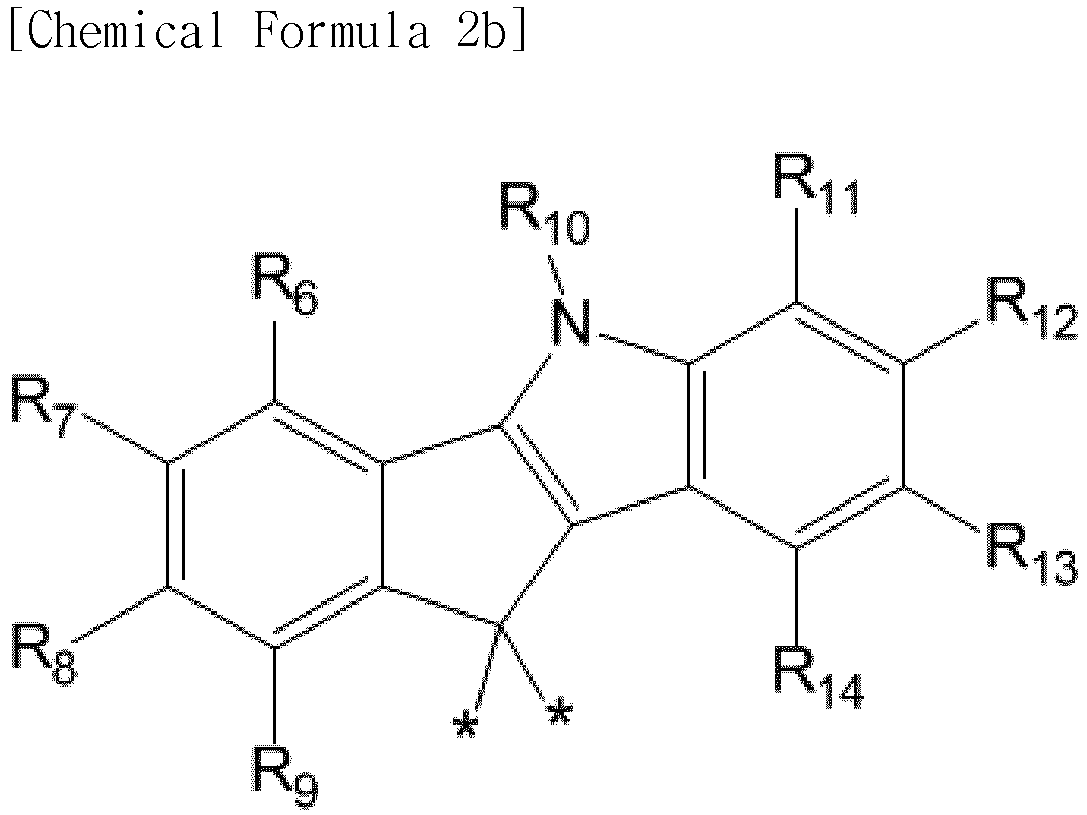
- C1 is represented by the following Chemical Formula 2a, and C2 is represented by the following Chemical Formula 2b, Chemical Formula 2c, Chemical Formula 2d, or Chemical Formula 2e;



- B2 is a single bond or a C1 to C3 alkylene group,
- * is a site to which M or B1 of Chemical Formula 1 is connected,
- R1 to R5 are the same as or different from each other, and are each independently hydrogen, halogen, a C1 to C20 alkyl group, a C2 to C20 alkenyl group, an C1 to C20 ether group, a C1 to C20 alkoxy group, a C6 to C20 aryl group, a C7 to C20 alkylaryl group, or a C7 to C20 arylalkyl group,
- R6 to R32 are the same as or different from each other, and are each independently hydrogen, halogen, a C1 to C20 alkyl group, a C1 to C20 alkoxy group, a C6 to C20 aryl group, a C7 to C20 alkylaryl group, or a C7 to C20 arylalkyl group,
- R' 1 to R' 3 are the same as or different from each other, and are each independently hydrogen, halogen, or a C1 to C20 alkyl group.
- In the metallocene compound according to the present disclosure, the substituents of Chemical Formula 1 are more specifically explained as follows.
- The C1 to C20 alkyl group may include a linear or branched alkyl group, and specifically, it may be a methyl group, an ethyl group, a propyl group, an isopropyl group, an n-butyl group, a tert-butyl group, a pentyl group, a hexyl group, a heptyl group, an octyl group, or the like, but is not limited thereto.
- The C2 to C20 alkenyl group may include a linear or branched alkenyl group, and specifically, it may be an allyl group, an ethenyl group, a propenyl group, a butenyl group, a pentenyl group, or the like, but is not limited thereto.
- The C6 to C20 aryl group may include a single ring aryl group or a condensed ring aryl group, and specifically, it may be a phenyl group, a biphenyl group, a naphthyl group, a phenanthrenyl group, a fluorenyl group, or the like, but is not limited thereto.
- The C5 to C20 heteroaryl group may include a single ring heteroaryl group or a condensed ring heteroaryl group, and specifically, it may be a carbazolyl group, a pyridyl group, a quinoline group, an isoquinoline group, a thiophenyl group, a furanyl group, an imidazole group, an oxazolyl group, a thiazolyl group, a triazine group, a tetrahydropyranyl group, a tetrahydrofuranyl group, or the like, but is not limited thereto.
- The C1 to C20 alkoxy group may be a methoxy group, an ethoxy group, a phenyloxy group, a cyclohexyloxy group, a tert-butoxyhexyl group, or the like, but is not limited thereto.
- The Group 4 transition metal may be titanium, zirconium, hafnium, or the like, but is not limited thereto.
- In the metallocene compound according to the present disclosure, it is more preferable in Chemical Formulae 2a, 2b, 2c, 2d, and 2e that R1 to R5 are each independently hydrogen, halogen, a methyl group, an ethyl group, a propyl group, an isopropyl group, an n-butyl group, a tert-butyl group, a pentyl group, a hexyl group, a heptyl group, an octyl group, an ethylene group, a propylene group, a butylene group, a phenyl group, a benzyl group, a naphthyl group, a halogen group, an ether group, a dimethyl ether group, a methoxy group, an ethoxy group, or a tert-butoxyhexyl group, and R6 to R32 are each independently hydrogen, halogen, a methyl group, an ethyl group, a propyl group, an isopropyl group, an n-butyl group, a tert-butyl group, a pentyl group, a hexyl group, a heptyl group, an octyl group, an ethylene group, a propylene group, a butylene group, a phenyl group, a benzyl group, a naphthyl group, a halogen group, an ether group, a dimethyl ether group, a methoxy group, an ethoxy group, or a tert-butoxyhexyl group, but is not limited thereto.
- In the metallocene compound according to the present disclosure, it is preferable that Q1 and Q2 in Chemical Formula 1 are each independently hydrogen, a methyl group, an ethyl group, a propyl group, an isopropyl group, an n-butyl group, a tert-butyl group, a methoxymethyl group, a tert-butoxymethyl group, a 1-ethoxyethyl group, a 1-methyl-1-methoxyethyl group, a tert-butoxyhexyl group, a tetrahydropyranyl group, or a tetrahydrofuranyl group, but is not limited thereto.
- In the metallocene compound according to the present disclosure, B1 in Chemical Formula 1 is preferably silicon, but is not limited thereto.
- Specifically, the metallocene compound of the Chemical Formula 1 is characterized in that the substituent of the Chemical Formula 2a includes a silylalkyl group such as trimethylsilyl methyl.
- More specifically, as the indene derivative of the Chemical Formula 2a has a silylalkyl group at the 2-position carbon of the indene, the vicinity of the active site is opened only in one direction due to the steric effect by the substituent, and thereby the polymer can be grown only in one direction. In addition, chain elongation can occur relatively strongly because access to monomers or reagents that cause chain transfer is difficult and beta-elimination of the beta site is difficult in the molecule itself. Therefore, the olefin polymer having a relatively high molecular weight can be polymerized with high activity as compared with the case of using another metallocene compound having a similar structure.
- In particular, since the compound has the indenyl group represented by the above Chemical Formula 2a containing a silylalkyl group at 2-position carbon only on one side, it has smaller steric hindrance effect than the compound having a silylalkyl group on both sides. Therefore, when the ethylene-alpha olefin copolymerization proceeds, the content of the comonomer can be effectively increased even when a relatively large alpha-olefin such as 1-hexene, 1-heptene or 1-octene is used.
- In addition, the compound forms a structure in which the indeno indole derivative represented by the following Chemical Formula 2b, the fluorenyl derivative represented by the following Chemical Formula 2c, the indene derivative represented by the following Chemical Formula 2d, and the cyclopentadiene derivative represented by the following Chemical Formula 2e are cross-linked by a bridge, and exhibits a high polymerization activity by having a non-covalent electron pair capable of acting as a Lewis base in a ligand structure.
- According to an embodiment of the present disclosure, a specific example of the compound represented by Chemical Formula 2a may be a compound represented by any one of the following structural formulae, but is not limited thereto.



- According to an embodiment of the present disclosure, a specific example of the compound represented by Chemical Formula 2b may be a compound represented by any one of the following structural formulae, but is not limited thereto.


- According to an embodiment of the present disclosure, a specific example of the compound represented by Chemical Formula 2c may be a compound represented by any one of the following structural formulae, but is not limited thereto.

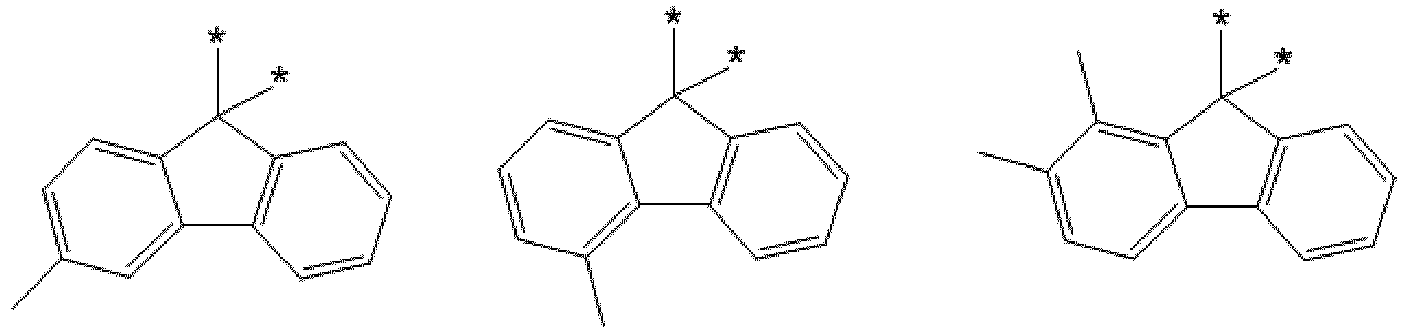


- According to an embodiment of the present disclosure, a specific example of the compound represented by Chemical Formula 2d may be a compound represented by any one of the following structural formulae, but is not limited thereto.


- According to an embodiment of the present disclosure, a specific example of the compound represented by Chemical Formula 2e may be a compound represented by any one of the following structural formulae, but is not limited thereto.


- The metallocene compound according to the present disclosure may have excellent activity and may polymerize an olefin-based polymer having a high molecular weight.
- Furthermore, the metallocene compound according to the present disclosure may polymerize an olefin-based polymer having a high molecular weight with still high activity because of its low hydrogen reactivity, even when the polymerization reaction is carried out in the presence of hydrogen in order to prepare an olefin-based polymer having a high molecular weight and a wide molecular weight distribution at the same time. Therefore, the metallocene compound may prepare an olefin-based polymer satisfying the high molecular characteristic without a decrease in activity even when the metallocene compound is heterogeneously used together with a catalyst having different characteristics, and thus the olefin-based polymer having a high molecular weight and a wide molecular weight distribution may be easily prepared.
- According to an embodiment of the present disclosure, the metallocene compound of Chemical Formula 1 may be obtained by connecting the indene derivative and the cyclopentadiene derivative with a bridge compound to prepare a ligand compound, and carrying out a metallation by adding a metal precursor compound, but is not limited to thereto.
- More specifically, for example, after preparing a lithium salt by reacting the indene derivative with an organic lithium compound such as n-BuLi, a halogenated compound of a bridge compound is mixed therewith and then this mixture is reacted to prepare the ligand compound. After mixing the ligand compound or the lithium salt thereof and the metal precursor compound, and reacting them for about 12 to 24 hours until the reaction is completed, the reaction mixture may be filtered and dried under reduced pressure to obtain the metallocene compound represented by Chemical Formula 1.
- A preparation method of the metallocene compound of the present disclosure is concretely explained in the following examples.
- In the mean time, the present disclosure also provides a method of preparing an olefin copolymer using the metallocene compound.
- The metallocene compound represented by the Chemical Formula 1 may be used in the preparation of the polyolefin polymer, alone or in combination with a cocatalyst as a catalyst composition. For example, an olefin homopolymer or an olefin copolymer may be provided by contacting the catalyst composition including the metallocene compound represented by the Chemical formula 1 with an olefin-based monomer to carry out a polymerization process.
- The catalyst composition may further include one or more of cocatalyst compounds represented by the following Chemical Formula 3, Chemical Formula 4, and Chemical Formula 5, in addition to the metallocene compound:
[Chemical Formula 3] -[Al(R50)-O]m-
in Chemical Formula 3, - R50 may be the same as or different from each other, and each independently halogen; C1 to C20 hydrocarbon; or C1 to C20 halogen-substituted hydrocarbon; and
- m is an integer of 2 or more;
[Chemical Formula 4] J(R51)3
in Chemical Formula 4,- R51 may be the same as defined in Chemical Formula 3; and
- J is aluminum or boron;
[Chemical Formula 5] [E-H]+[ZA4]- or [E]+[ZA4]-
in Chemical Formula 5,- E is a neutral or cationic Lewis base;
- H is a hydrogen atom;
- Z is a Group 13 element; and
- A may be the same as or different from each other, and each independently a C6 to C20 aryl group or a C1 to C20 alkyl group, of which one or more hydrogen atoms are substituted or unsubstituted with halogen, C1 to C20 hydrocarbon, alkoxy, or phenoxy.
- Examples of the compound represented by Chemical Formula 3 may include methylaluminoxane, ethylaluminoxane, isobutylaluminoxane, butylaluminoxane or the like, and a more preferred compound may be methylaluminoxane.
- Examples of the compound represented by Chemical Formula 4 may include trimethylaluminum, triethylaluminum, triisobutylaluminum, tripropylaluminum, tributylaluminum, dimethylchloroaluminum, triisopropylaluminum, tri-s-butylaluminum, tricyclopentylaluminum, tripentylaluminum, triisopentylaluminum, trihexylaluminum, trioctylaluminum, ethyldimethylaluminum, methyldiethylaluminum, triphenylaluminum, tri-p-tolylaluminum, dimethylaluminummethoxide, dimethylaluminumethoxide, trimethylboron, triethylboron, triisobutylboron, tripropylboron, tributylboron or the like, and a more preferred compound may be selected from trimethylaluminum, triethylaluminum, and triisobutylaluminum.
- Examples of the compound represented by Chemical Formula 5 may include triethylammonium tetraphenylboron, tributylammonium tetraphenylboron, trimethylammonium tetraphenylboron, tripropylammonium tetraphenylboron, trimethylammonium tetra(p-tolyl)boron, trimethylammonium tetra(o,p-dimethylphenyl)boron, tributylammonium tetra(p-trifluoromethylphenyl)boron, trimethylammonium tetra(p-trifluoromethylphenyl)boron, tributylammonium tetrapentafluorophenylboron, N,N-diethylanilinium tetraphenylboron, N,N-diethylanilinium tetrapentafluorophenylboron, diethylammonium tetrapentafluorophenylboron, triphenylphosphonium tetraphenylboron, trimethylphosphonium tetraphenylboron, triethylammonium tetraphenylaluminum, tributylammonium tetraphenylaluminum, trimethylammonium tetraphenylaluminum, tripropylammonium tetraphenylaluminum, trimethylammonium tetra(p-tolyl)aluminum, tripropylammonium tetra(p-tolyl)aluminum, triethylammonium tetra(o,p-dimethylphenyl)aluminum, tributylammonium tetra(p-trifluoromethylphenyl)aluminum, trimethylammonium tetra(p-trifluoromethylphenyl)aluminum, tributylammonium tetrapentafluorophenylaluminum, N,N-diethylanilinium tetraphenylaluminum, N,N-diethylanilinium tetrapentafluorophenylaluminum, diethylammonium tetrapentatetraphenylaluminum, triphenylphosphonium tetraphenylaluminum, trimethylphosphonium tetraphenylaluminum, tripropylammonium tetra(p-tolyl)boron, triethylammonium tetra(o,p-dimethylphenyl)boron, tributylammonium tetra(p-trifluoromethylphenyl)boron, triphenylcarboniumtetra(p-trifluoromethylphenyl)boron, triphenylcarboniumtetrapentafluorophenylboron, etc.
- Alumoxane may be preferably used, and methylalumoxane (MAO) which is an alkyl alumoxane may be more preferably used.
- The catalyst composition may be prepared by a first method including the steps of 1) contacting the metallocene compound represented by Chemical Formula 1 with the compound represented by Chemical Formula 3 or Chemical Formula 4 to obtain a mixture; and 2) adding the compound represented by Chemical Formula 5 to the mixture.
- Further, the catalyst composition may be prepared by a second method of contacting the metallocene compound represented by Chemical Formula 1 with the compound represented by Chemical Formula 3.
- As a reaction solvent used upon preparation of the catalyst composition, a hydrocarbon solvent such as pentane, hexane, heptane, etc., or an aromatic solvent such as benzene, toluene, etc., may be used.
- An olefin-based polymer may be prepared by polymerizing olefin-based monomers in the presence of the catalyst composition including the metallocene compound.
- The polymerization reaction may be carried out according to a solution polymerization process, a slurry process, or a gas phase process by using a continuous slurry polymerization reactor, a loop slurry reactor, a gas phase reactor, or a solution reactor. Furthermore, the reaction may be a homopolymerization of an olefin-based monomer or copolymerization of two or more monomers.
- The polymerization of the olefin-based monomer may be carried out at a temperature of about 25 to about 500°C and at a pressure of about 1 to about 100 kgf/cm2 for about 1 to about 24 hours. Specifically, the polymerization of the olefin-based monomer may be carried out at a temperature of about 25 to about 500 °C, preferably about 25 to about 200 °C, and more preferably, about 50 to about 100 °C. Furthermore, the reaction pressure may be about 1 to about 100 kgf/cm2, preferably about 1 to about 50 kgf/cm2, and more preferably about 5 to about 40 kgf/cm2.
- Specific example of the olefin-based monomer may include ethylene, propylene, 1-butene, 1-pentene, 4-methyl-1-pentene, 1-hexene, 1-heptene, 1-octene, 1-decene, 1-undecene, 1-dodecene, 1-tetradecene, 1-hexadecene, 1-eicosene or the like, and the olefin-based monomer may be a copolymer prepared by copolymerizing two or more of the monomers.
- The olefin-based polymer may be a polyethylene polymer, but is not limited to thereto.
- If the olefin-based polymer is a copolymer of ethylene/alpha-olefin, the content of a comonomer, alpha-olefin is not particularly limited, and it may be adequately selected according to the use or purpose of the olefin-based polymer. More specifically, the content may be more than 0 mole% and 99 mole% or less.
- The olefin-based polymer prepared by the method may exhibit a high molecular weight compared with the case of using an organometallic compound having a similar structure as a catalyst.
- According to an embodiment of the present disclosure, a weight average molecular weight (Mw) of the olefin-based polymer may be about 100,000 to about 1,000,000 g/mol, more preferably about 100,000 to about 600,000 g/mol.
- Further, a molecular weight distribution (Mw/Mn, PDI) of the olefin-based polymer may be about 1 to about 10, more preferably about 3 to about 6.
- Therefore, the olefin-based polymer according to the present disclosure shows a high molecular weight, thereby being applied to a variety of fields according to its use.
- Hereinafter, the preferred Examples are provided for better understanding. However, these Examples are for illustrative purposes only, and the invention is not intended to be limited by these Examples.
-

- 3.7 ml (30 mmol) of 2-Bromo-1H-indene was added to a flask, and Ar bubbling was performed for about 5 minutes while stirring in the presence of 100 ml of THF to remove dissolved gas. Under Ar bubbling, 0.8 g (1.5 mmol) of Ni(dppe)Cl2 was rapidly added and 30 ml (30 mmol) of 1.0 M ((Trimethylsilyl)methyl)magnesium chloride dissolved in diethyl ether at room temperature was slowly added dropwise. And then, the reaction was continued overnight while refluxing under Ar condition at 80 °C. (dppe=1,2-Bis(diphenylphosphino)ethane)
- 50 mL of water was added thereto, and the organic layer was extracted three times with 50 mL of diethylether. An appropriate amount of MgSO4 was added to the collected organic layer, stirred for a while, filtered, and the solvent was dried under reduced pressure.
- The resulting product was confirmed by 1H-NMR.
1H-NMR (500MHz, CDCl3): 0.03 (9H. s), 3.25 (2H, s), 6.3(1H, s), 7.02-7.32 (4H, m) -

- After dissolving 1.01 g (5 mmol) of ((1H-inden-3-yl)methyl)trimethylsi lane in 80 ml of Hexane and 2.4 ml of MTBE, 2.4 mL (6 mmol) of a 2.50 M n-BuLi hexane solution was added thereto dropwise in a dry ice/acetone bath. The reaction mixture was slowly warmed up to room temperature, and then stirred for 24 hours, followed by addition of 50 ml of Hexane.
- Another 250 mL Schlenk flask was placed in the glove box and weighed 1.36 g (5 mmol) of SiCH3Cl2(CH2)6(t-Bu0) in the glove box. Then, it was taken out of the glove box, dissolved in 50 mL of Hexane, and then the mixture prepared above was added thereto dropwise in a dry ice/acetone bath (Synthesized Compound 1-1).
- Separately, after dissolving 1.01 g (5 mmol) of ((1H-inden-2-yl)methyl)trimethylsi lane of the Preparation Example 1 in 50 ml of THF, 2.4 mL (6 mmol) of a 2.50 M n-BuLi Hexane solution was added thereto dropwise in a dry ice/acetone bath. The reaction mixture was slowly warmed up to room temperature, and then stirred for 24 hours, followed by addition of 50 ml of Hexane (Synthesized Compound 1-2).
- After the Synthesized Composition 1-2 was added to the Synthesized Composition 1-1 dropwise in a dry ice/acetone bath, the reaction mixture was slowly warmed up to room temperature, and then stirred for 24 hours.
- 50 mL of water was added thereto, and the organic layer was extracted three times with 50 mL of ether. An appropriate amount of MgSO4 was added to the collected organic layer, stirred for a while, filtered, and the solvent was dried under reduced pressure to obtain 3.02 g (5 mmol) of a ligand compound in an oil phase, which was confirmed by 1H-NMR.
- The obtained ligand compound was used for the preparation of the metallocene compound.
1H NMR (500MHz, CDCl3): -0.38 (3H, s), 0.02 (18H, s), 1.17 (9H, m), 1.16 (9H, s), 0.41-1.52 (10H, m), 1.96 (2H, s), 2.04 (2H, m), 2.4 (1H, m), 3.23 (2H, m), 3.5 (1H, m), 6.02 (1H, m), 6.30 (1H, m), 7.0-7.46 (8H, m) -

- After dissolving 3.02 g (4.7 mmol) of the ligand compound synthesized in Example 1-1 in 80 mL of toluene and 2.6 mL of MTBE in a 250 mL Schlenk flask which is dried in an oven, 4.4 mL (11 mmol) of a 2.5 M n-BuLi Hexane solution was added thereto dropwise in a dry ice/acetone bath. The reaction mixture was slowly warmed up to room temperature, and then stirred for 24 hours, followed by lithiation.
- 1.88 g (5 mmol) of ZrCl4(THF)2 was taken in a glove box and injected into another 250 mL Schlenk flask to prepare a suspension having 80 mL of toluene. The above two flasks were cooled down to -78 °C and the lithiated ligand compound was slowly added to the toluene suspension of ZrCl4(THF)2. After the completion of the injection, the reaction mixture was slowly warmed up to room temperature, stirred for one day and subjected to reaction. Then, toluene in the mixture was removed up to a volume of about 1/5 through vacuum-reduced pressure. Hexane was added in about 5 times volume of the remaining toluene thereto and recrystallized. The mixture was filtered without contacting with the outside air to give a metallocene compound. The resulting filter cake in the upper portion of the filter was washed using a little Hexane, and then weighed in the glove box to identify the synthesis and yield (yield: 97%).
- The resulting product was stored in a toluene solution.
1H NMR (500MHz, CDCl3): -0.1 (18H, m), 1.17 (9H, m), 1.49 (3H, s), 0.84-2.21 (10H, m), 1.84 (2H, s), 2.34 (2H, s), 3.32 (2H, m), 5.62 (2H, d), 6.5-7.6 (8H, m) -


- After dissolving 1 g (6 mmol) of fluorene in 60 ml of Hexane and 2.4 ml of MTBE, 2.9 mL (7.2 mmol) of a 2.50 M n-BuLi Hexane solution was added thereto dropwise in a dry ice/acetone bath. The reaction mixture was slowly warmed up to room temperature, and then stirred for 24 hours.
- Another 250 mL Schlenk flask was placed in the glove box and weighed 1.62 g (6 mmol) of SiCH3Cl2(CH2)6(t-BuO) in the glove box. And it was taken out of the glove box, dissolved in 50 mL of Hexane, and then the mixture prepared above was added thereto dropwise in a dry ice/acetone bath (Synthesized Compound 2-1).
- Separately, after dissolving 1.21 g (6 mmol) of ((1H-inden-2-yl)methyl)trimethylsi lane of the Preparation Example 1 in 80 ml of THF, 2.9 mL (7.2 mmol) of a 2.50 M n-BuLi Hexane solution was added thereto dropwise in a dry ice/acetone bath. The reaction mixture was slowly warmed up to room temperature, and then stirred for 24 hours. And, a portion was sampled, dried, and then sampled for NMR in a glove box to identify the progress and completion of the reaction(Synthesized Compound 2-2).
1H NMR (500MHz, C6D6): -0.01 (3H, s), 1.12 (9H, m), 1.03-1.46 (10H, m), 3.17 (2H, t), 3.87 (1H, s), 7.15-7.78 (8H, m) - After the Synthesized Composition 2-2 was added to the Synthesized Composition 2-1 dropwise in a dry ice/acetone bath, the reaction mixture was slowly warmed up to room temperature, and then stirred for 24 hours.
- 50 mL of water was added thereto, and the organic layer was extracted three times with 50 mL of ether. An appropriate amount of MgSO4 was added to the collected organic layer, stirred for a while, filtered, and the solvent was dried under reduced pressure to obtain 3.36 g (5.9 mmol) of a ligand compound in an oil phase, which was confirmed by 1H-NMR.
- The obtained ligand compound was used for the preparation of the metallocene compound.
1H NMR (500MHz, CDCl3): -0.01 (3H, d), 1.16 (9H, m), 0.79-1.31 (10H, m), 1.57 (2H, s), 1.96 (1H, s), 3.25 (2H, m), 4.08 (1H, s), 6.34 (1H, d), 7.03-7.87 (12H, m) -

- After dissolving 3.36 g (5.9 mmol) of the ligand compound synthesized in Example 2-1 in 80 mL of toluene and 2.6 mL of MTBE in a 250 mL Schlenk flask which is dried in an oven, 5.2 mL (13 mmol) of a 2.5 M n-BuLi Hexane solution was added thereto dropwise in a dry ice/acetone bath. The reaction mixture was slowly warmed up to room temperature, and then stirred for 24 hours, followed by lithiation.
- 2.23 g (5.9 mmol) of ZrCl4(THF)2 was taken in a glove box and injected into another 250 mL Schlenk flask to prepare a suspension having 80 mL of toluene. The above two flasks were cooled down to -78 °C and the lithiated ligand compound was slowly added to the toluene suspension of ZrCl4(THF)2. After the completion of the injection, the reaction mixture was slowly warmed up to room temperature, stirred for one day and subjected to reaction. Then, toluene in the mixture was removed up to a volume of about 1/5 through vacuum-reduced pressure. Hexane was added in about 5 times volume of the remaining toluene thereto and recrystallized. The mixture was filtered without contacting with the outside air to give a metallocene compound in a brown powder phase. The resulting filter cake in the upper portion of the filter was washed using a little Hexane, and then weighed in the glove box to identify the synthesis and yield (yield: 82%).
1H NMR (500MHz, CDCl3): -0.15 (9H, s), 1.3 (9H, m), 1.8 (3H, m), 0.9-1.8 (10H, m), 2.3 (2H, d), 3.4 (2H, m), 5.6 (1H, s), 6.5-8.0 (12H, m) -
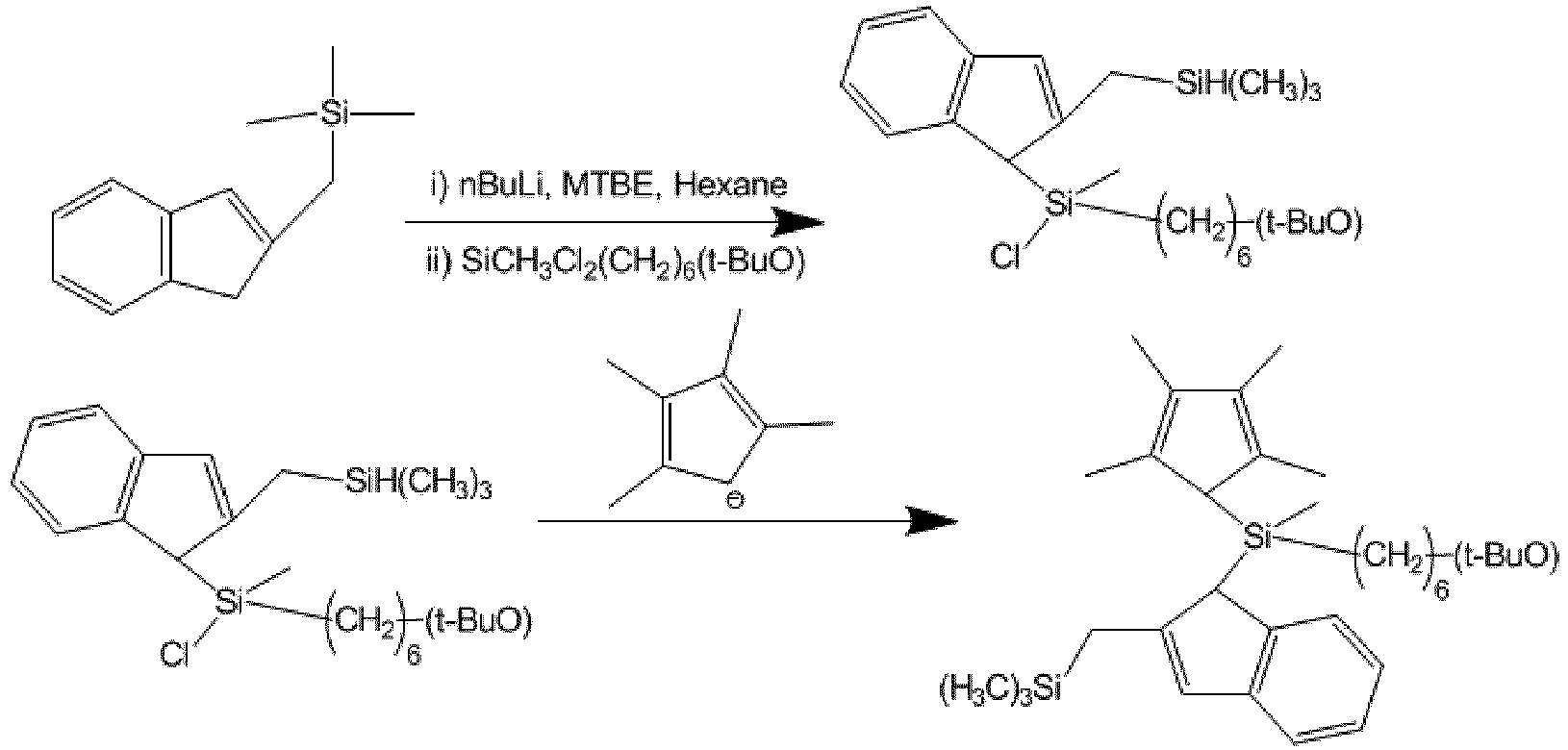
- After dissolving 1.01 g (5 mmol) of ((1H-inden-2-yl)methyl)trimethylsi lane of the Preparation Example 1 in 80 ml of THF, 2.4 mL (6 mmol) of a 2.50 M n-BuLi Hexane solution was added thereto dropwise in a dry ice/acetone bath. The reaction mixture was slowly warmed up to room temperature, and then stirred for 24 hours, followed by addition of 50 ml of Hexane.
- Another 250 mL Schlenk flask was placed in the glove box and weighed 1.36 g (5 mmol) of SiCH3Cl2(CH2)6(t-BuO) in the glove box. And it was taken out of the glove box, dissolved in 50 mL of Hexane, and then the mixture prepared above was added thereto dropwise in a dry ice/acetone bath(Synthesized Compound 3-1).
- Separately, after dissolving 0.61 g (5 mmol) of 1,2,3,4-tetramethylcyclopenta-1,3-diene in 80 ml of THF, 2.4 mL (6 mmol) of a 2.50 M n-BuLi Hexane solution was added thereto dropwise in a dry ice/acetone bath. The reaction mixture was slowly warmed up to room temperature, and then stirred for 24 hours (Synthesized Compound 3-2).
- After the Synthesized Composition 3-2 was added to the Synthesized Composition 3-1 dropwise in a dry ice/acetone bath, the reaction mixture was slowly warmed up to room temperature, and then stirred for 24 hours.
- 50 mL of water was added thereto, and the organic layer was extracted three times with 50 mL of ether. An appropriate amount of MgSO4 was added to the collected organic layer, stirred for a while, filtered, and the solvent was dried under reduced pressure to obtain 2.07 g (3.96 mmol) of a ligand compound in an oil phase, which was confirmed by 1H-NMR.
- The obtained ligand compound was used for the preparation of the metallocene compound.
1H NMR (500MHz, CDCl3): -0.21 (3H, s), -0.01 (9H, m), 0.04 (12H, m), 1.16 (9H, m), 0.9-1.54 (10H, m), 2.09 (2H, d), 3.30 (2H, m), 4.19 (1H, d), 4.52 (1H, d), 6.41 (1H, m), 7.0-7.33 (4H, m) -

- After dissolving 2.07 g (3.96 mmol) of the ligand compound synthesized in Example 3-1 in 80 mL of toluene and 2.6 mL of MTBE in a 250 mL Schlenk flask which is dried in an oven, 3.5 mL (8.7 mmol) of a 2.5 M n-BuLi Hexane solution was added thereto dropwise in a dry ice/acetone bath. The reaction mixture was slowly warmed up to room temperature, and then stirred for 24 hours, followed by lithiation.
- 1.49 g (3.96 mmol) of ZrCl4(THF)2 was taken in a glove box and injected into another 250 mL Schlenk flask to prepare a suspension having 80 mL of toluene. The above two flasks were cooled down to -78 °C and the lithiated ligand compound was slowly added to the toluene suspension of ZrCl4(THF)2. After the completion of the injection, the reaction mixture was slowly warmed up to room temperature, stirred for one day and subjected to reaction. Then, toluene in the mixture was removed up to a volume of about 1/5 through vacuum-reduced pressure. Hexane was added in about 5 times volume of the remaining toluene thereto and recrystallized. The mixture was filtered without contacting with the outside air to give a metallocene compound. The resulting filter cake in the upper portion of the filter was washed using a little Hexane, and then weighed in the glove box to identify the synthesis and yield (yield: 70%).
- The resulting product was stored in a toluene solution.
1H NMR (500MHz, CDCl3): -0.32 (3H, s), 0.01 (12H, s), 0.07 (9H, s), 1.16 (9H, s), 0.8-1.5 (10H, m), 1.38 (2H, s), 3.23 (2H, s), 4.19 (1H, d), 4.5 (1H, d), 6.4 (2H, m), 6.96-7.33 (4H, m) -


- After dissolving 0.58 g (5 mmol) of Indene in 100 ml of Hexane and 3.0 ml of MTBE, 2.4 mL (6 mmol) of a 2.50 M n-BuLi Hexane solution was added thereto dropwise in a dry ice/acetone bath. The reaction mixture was slowly warmed up to room temperature, and then stirred for 24 hours.
- Another 250 mL Schlenk flask was placed in the glove box and weighed 1.36 g (5 mmol) of SiCH3Cl2(CH2)6(t-BuO) in the glove box. And it was taken out of the glove box, dissolved in 100 mL of Hexane, and then the mixture prepared above was added thereto dropwise in a dry ice/acetone bath (Synthesized Compound 4-1).
- Separately, after dissolving 1.01 g (5 mmol) of ((1H-inden-2-yl)methyl)trimethylsilane of the Preparation Example 1 in 100 ml of THF, 2.4 mL (6 mmol) of a 2.50 M n-BuLi Hexane solution was added thereto dropwise in a dry ice/acetone bath. The reaction mixture was slowly warmed up to room temperature, and then stirred for 24 hours. And, a portion was sampled, dried, and then sampled for NMR in a glove box to identify the progress and completion of the reaction (Synthesized Compound 4-2).
- After the Synthesized Composition 4-2 was added to the Synthesized Composition 4-1 dropwise in a dry ice/acetone bath, the reaction mixture was slowly warmed up to room temperature, and then stirred for 24 hours.
- 50 mL of water was added thereto, and the organic layer was extracted three times with 50 mL of ether. An appropriate amount of MgSO4 was added to the collected organic layer, stirred for a while, filtered, and the solvent was dried under reduced pressure to obtain 2.6 g (5 mmol) of a ligand compound in an oil phase, which was confirmed by 1H-NMR.
- The obtained ligand compound was used for the preparation of the metallocene compound.
1H NMR (500MHz, CDCl3): -0.04 (3H, d), 0.04 (9H, s), 1.1 (9H, s), 0.8-1.8 (20H, m), 2.02 (2H, s), 2.15 (1H, s), 3.05 (1H, s), 3.26 (1H, s), 3.57 (2H, m), 6.2-6.36 (3H, m), 7.03-7.46 (8H, m) -

- After dissolving 2.6 g (5 mmol) of the ligand compound synthesized in Example 4-1 in 100 mL of toluene and 3 mL of MTBE in a 250 mL Schlenk flask which is dried in an oven, 4.8 mL (12 mmol) of a 2.5 M n-BuLi Hexane solution was added thereto dropwise in a dry ice/acetone bath. The reaction mixture was slowly warmed up to room temperature, and then stirred for 24 hours, followed by lithiation.
- 1.88 g (5 mmol) of ZrCl4(THF)2 was taken in a glove box and injected into another 250 mL Schlenk flask to prepare a suspension having 100 mL of toluene. The above two flasks were cooled down to -78 °C and the lithiated ligand compound was slowly added to the toluene suspension of ZrCl4(THF)2. After the completion of the injection, the reaction mixture was slowly warmed up to room temperature, stirred for one day and subjected to reaction. Then, toluene in the mixture was removed up to a volume of about 1/5 through vacuum-reduced pressure. Hexane was added in about 5 times volume of the remaining toluene thereto and recrystallized. The mixture was filtered without contacting with the outside air to give a metallocene compound in a dark red powder phase. The resulting filter cake in the upper portion of the filter was washed using a little Hexane, and then weighed in the glove box to identify the synthesis.
1H NMR (500MHz, CDCl3): -0.1 (9H, m), 1.12 (9H, m), 1.23 (3H, s), 0.8-1.8 (19H, m), 1.93 (2H, s), 2.1 (1H, s), 3.3 (2H, m), 6.25-6.8 (3H, m), 6.9-7.6 (8H, m) -


- After dissolving 1.06 g (5 mmol) of 3-(cyclohexylmethyl)-1H-indene in 50 ml of Hexane and 2.4 ml of MTBE, 2.4 mL (6 mmol) of a 2.50 M n-BuLi Hexane solution was added thereto dropwise in a dry ice/acetone bath. The reaction mixture was slowly warmed up to room temperature, and then stirred for 24 hours.
- Another 250 mL Schlenk flask was placed in the glove box and weighed 1.36 g (5 mmol) of SiCH3Cl2(CH2)6(t-BuO) in the glove box. And it was taken out of the glove box, dissolved in 100 mL of Hexane, and then the mixture prepared above was added thereto dropwise in a dry ice/acetone bath (Synthesized Compound 5-1).
- Separately, after dissolving 1.01 g (5 mmol) of ((1H-inden-2-yl)methyl)trimethylsilane of the Preparation Example 1 in 80 ml of THF, 2.4 mL (6 mmol) of a 2.50 M n-BuLi Hexane solution was added thereto dropwise in a dry ice/acetone bath. The reaction mixture was slowly warmed up to room temperature, and then stirred for 24 hours (Synthesized Compound 5-2).
- After the Synthesized Composition 5-2 was added to the Synthesized Composition 5-1 dropwise in a dry ice/acetone bath, the reaction mixture was slowly warmed up to room temperature, and then stirred for 24 hours.
- 50 mL of water was added thereto, and the organic layer was extracted three times with 50 mL of ether. An appropriate amount of MgSO4 was added to the collected organic layer, stirred for a while, filtered, and the solvent was dried under reduced pressure to obtain 3.03 g (4.96 mmol) of a ligand compound in an oil phase, which was confirmed by 1H-NMR.
- The obtained ligand compound was used for the preparation of the metallocene compound.
1H NMR (500MHz, CDCl3): -0.01 (3H, d), 0.04 (9H, s), 1.2 (9H, s), 0.8-1.8 (20H, m), 1.96 (2H, s), 3.26 (2H, s), 3.46 (1H, m), 3.57 (1H, m), 6.3 (1H, s), 6.43 (1H, s), 7.03-7.46 (8H, m) -

- After dissolving 3.03 g (4.94 mmol) of the ligand compound synthesized in Example 5-1 in 80 mL of toluene and 2.6 mL of MTBE in a 250 mL Schlenk flask which is dried in an oven, 4.4 mL (10.8 mmol) of a 2.5 M n-BuLi Hexane solution was added thereto dropwise in a dry ice/acetone bath. The reaction mixture was slowly warmed up to room temperature, and then stirred for 24 hours, followed by lithiation.
- 1.86 g (4.94 mmol) of ZrCl4(THF)2 was taken in a glove box and injected into another 250 mL Schlenk flask to prepare a suspension having 100 mL of toluene. The above two flasks were cooled down to -78 °C and the lithiated ligand compound was slowly added to the toluene suspension of ZrCl4(THF)2. After the completion of the injection, the reaction mixture was slowly warmed up to room temperature, stirred for one day and subjected to reaction. Then, toluene in the mixture was removed up to a volume of about 1/5 through vacuum-reduced pressure. Hexane was added in about 5 times volume of the remaining toluene thereto and recrystallized. The mixture was filtered without contacting with the outside air to give a metallocene compound in a brown solid phase. The resulting filter cake in the upper portion of the filter was washed using a little Hexane, and then weighed in the glove box to identify the synthesis (yield: 66%).
1H NMR (500MHz, CDCl3): -0.14 (9H, s), -0.03 (3H, d), 1.15 (9H, s), 0.47-1.58 (20H, m), 1.48 (2H, s), 1.84 (2H, s), 3.33 (2H, m), 3.57 (1H, m), 5.62 (2H, s), 6.8-7.6 (8H, m) - A 100 mL Andrew bottle was prepared and assembled with an impeller part, and then air in the bottle was replaced by argon in a glove box. After adding 70 mL of toluene containing a small amount of TMA to the Andrew bottle, 10 mL of an MAO (10 wt% in toluene) solution was added thereto. 5 mL of a catalyst/toluene solution (5 µmol of catalyst), which was prepared by dissolving the metallocene compound of the Examples in toluene, was injected into the Andrew bottle. While the Andrew bottle was immersed in an oil bath heated to 90°C, the top of the bottle was fixed to a mechanical stirrer, and then, the reaction solution was stirred for 5 minutes until it reached to 90°C. The air in the bottle was purged with ethylene gas 3 times, and pressure was slowly raised up to 50 psig by opening an ethylene valve. The reaction was allowed to continue for 30 min while operating the mechanical stirrer at 500 rpm while maintaining the pressure by continuously providing ethylene of as much as was consumed. When the reaction was completed, the gas in the reactor was slowly vented after locking the ethylene valve and stopping agitation. 400 mL of the reactant was poured into a mixed solution of ethanol/HCl aqueous solution, and the solution was stirred for about 1 hour, and then, filtered to obtain polymer, which was dried in a vacuum oven of 60°C for 20 hours. The obtained polymer was weighed to calculate the activity of the catalyst, and 10 mg of the sample was taken and used for GPC analysis.
- A 100 mL Andrew bottle was prepared and assembled with an impeller part, and then air in the bottle was replaced by argon in a glove box. After adding 70 mL of toluene containing a small amount of TMA to the Andrew bottle, 10 mL of an MAO (10 wt% in toluene) solution was added thereto. 5 mL of a catalyst/toluene solution (5 µmol of catalyst), which was prepared by dissolving the metallocene compound of the Examples in toluene, was injected into the Andrew bottle. While the Andrew bottle was immersed in an oil bath heated to 90°C, the top of the bottle was fixed to a mechanical stirrer, and then, the reaction solution was stirred for 5 minutes until it reached to 90°C. 5 mL of comonomer 1-hexen was injected, the inside of the bottle was purged three times with ethylene gas, and then, the ethylene valve was opened to slowly pressurize. Ethylene was continuously supplied as much as consumed ethylene so as to maintain pressure, and the mechanical stirrer was operated to react at 500 rpm for 30 minutes. After the reaction was completed, temperature was lowered to room temperature, and the ethylene valve was closed and stirring was discontinued, and then, the pressure inside the reactor was slowly vented. 400 mL of the reactant was poured into a mixed solution of ethanol/HCl aqueous solution, and the solution was stirred for about 1 hour, and then, filtered to obtain polymer, which was dried in a vacuum oven of 60°C for 20 hours. The obtained polymer was weighed to calculate the activity of the catalyst, and 10 mg of the sample was taken and used for GPC analysis.
- The polymerization process conditions and analysis results of the Polymerization Examples are given in the following Table 1.
[Table 1] Catalyst 1-Hex (mL) Activity b (X106) Mw c (g/mol) PDI c Branch (1-Hx mol%) Polymerization Example 1 Example 1-2 4.6 260,000 4.3 5 5.0 210,000 4.7 5.6 Polymerization Example 2 Example 2-2 5.1 410,000 5.6 5 5.4 420,000 5.1 5.9 Polymerization Example 3 Example 3-2 4.8 170,000 3.0 5 5.0 190,000 3.4 6.1 Polymerization Example 4 Example 4-2 5.2 110,000 4.2 5 5.6 150,000 3.8 6.4 Polymerization Example 5 Example 5-2 8.3 210,000 3.4 5 8.2 190,000 5.7 6.2 a Conditions: amount of catalyst (5 µmol), Ethylene pressure(PE=50psig), Al/Zr=3000, Temperature: 90°C, reaction time 30min. b g/mol · hr c GPC - Referring to Table 1, in the case of the polymerization examples using the metallocene compound of the present disclosure as a catalyst, it is confirmed that an ethylene polymer having a generally high weight average molecular weight is obtained. In particular, as an indenyl group having a trimethylsilyl group at the 2-position carbon exists only on one side of the metallocene compound molecule, it can be confirmed that the incorporation of 1-hexene is high.
Claims (9)
- A metallocene compound represented by the following Chemical Formula 1:
 M is a Group 4 transition metal;B1 is carbon, silicon, or germanium;Q1 and Q2 are the same as or different from each other, and are each independently hydrogen, halogen, a C1 to C20 alkyl group, a C2 to C20 alkenyl group, a C6 to C20 aryl group, a C7 to C20 alkylaryl group, a C7 to C20 arylalkyl group, a C1 to C20 alkoxy group, a C2 to C20 alkoxyalkyl group, a C3 to C20 heterocycloalkyl group, or a C5 to C20 heteroaryl group;X1 and X2 are the same as or different from each other, and are each independently halogen, a C1 to C20 alkyl group, a C2 to C20 alkenyl group, a C6 to C20 aryl group, a nitro group, an amido group, a C1 to C20 alkylsilyl group, a C1 to C20 alkoxy group, or a C1 to C20 sulfonate group;C1 is represented by the following Chemical Formula 2a, and C2 is represented by the following Chemical Formula 2b, Chemical Formula 2c, Chemical Formula 2d, or Chemical Formula 2e;


 B2 is a single bond or a C1 to C3 alkylene group,* is a site to which M or B1 of Chemical Formula 1 is connected,R1 to R5 are the same as or different from each other, and are each independently hydrogen, halogen, a C1 to C20 alkyl group, a C2 to C20 alkenyl group, an C1 to C20 ether group, a C1 to C20 alkoxy group, a C6 to C20 aryl group, a C7 to C20 alkylaryl group, or a C7 to C20 arylalkyl group,R6 to R32 are the same as or different from each other, and are each independently hydrogen, halogen, a C1 to C20 alkyl group, a C1 to C20 alkoxy group, a C6 to C20 aryl group, a C7 to C20 alkylaryl group, or a C7 to C20 arylalkyl group,R' 1 to R' 3 are the same as or different from each other, and are each independently hydrogen, halogen, or a C1 to C20 alkyl group.
 - The metallocene compound of Claim 1, wherein R1 to R5 in the Chemical Formulae 2a, 2b, 2c, 2d, and 2e are each independently hydrogen, halogen, a methyl group, an ethyl group, a propyl group, an isopropyl group, an n-butyl group, a tert-butyl group, a pentyl group, a hexyl group, a heptyl group, an octyl group, an ethylene group, a propylene group, a butylene group, a phenyl group, a benzyl group, a naphthyl group, a halogen group, an ether group, a dimethyl ether group, a methoxy group, an ethoxy group, or a tert-butoxyhexyl group, and
R6 to R22 and R24 to R32 are each independently hydrogen, halogen, a methyl group, an ethyl group, a propyl group, an isopropyl group, an n-butyl group, a tert-butyl group, a pentyl group, a hexyl group, a heptyl group, an octyl group, an ethylene group, a propylene group, a butylene group, a phenyl group, a benzyl group, a naphthyl group, a halogen group, an ether group, a trimethylsilyl group, a triethylsilyl group, a tripropylsilyl group, a tributylsilyl group, a triisopropylsilyl group, a trimethylsilylmethyl group, a dimethyl ether group, tert-butyldimethylsilyl ether group, a methoxy group, an ethoxy group, or a tert-butoxyhexyl group. - The metallocene compound of Claim 1, wherein Q1 and Q2 in the Chemical Formula 1 are each independently hydrogen, a methyl group, an ethyl group, a propyl group, an isopropyl group, an n-butyl group, a tert-butyl group, a methoxymethyl group, a tert-butoxymethyl group, a 1-ethoxyethyl group, a 1-methyl-1-methoxyethyl group, a tert-butoxyhexyl group, a tetrahydropyranyl group, or a tetrahydrofuranyl group.
- The metallocene compound of Claim 1, wherein the compound represented by the Chemical Formula 2a is any one of the following structural formulae:


- The metallocene compound of Claim 1, wherein the compound represented by the Chemical Formula 2b is any one of the following structural formulae:


- The metallocene compound of Claim 1, wherein the compound represented by the Chemical Formula 2c is any one of the following structural formulae:


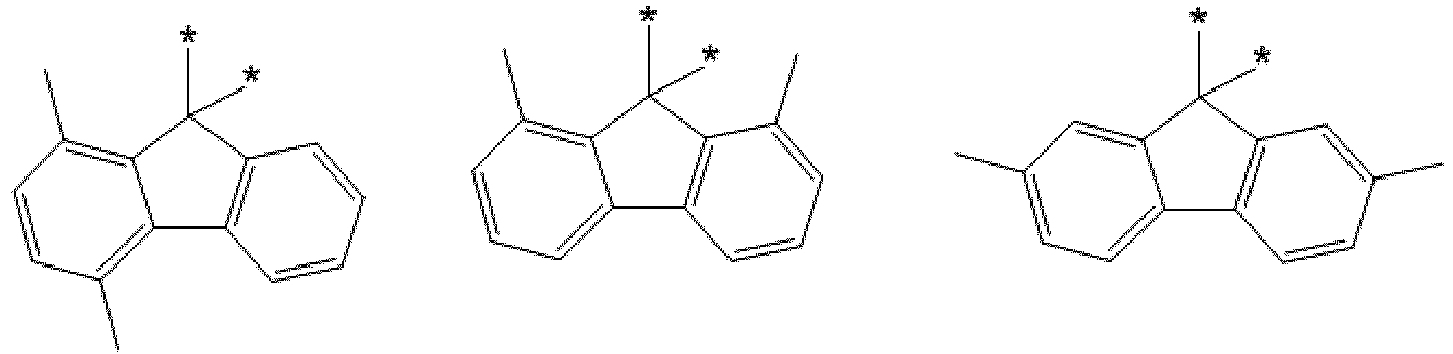


- The metallocene compound of Claim 1, wherein the compound represented by the Chemical Formula 2d is any one of the following structural formulae:


- The metallocene compound of Claim 1, wherein the compound represented by the Chemical Formula 2e is any one of the following structural formulae:


- A method of preparing an ethylene copolymer using the metallocene compound of any one of Claims 1 to 8.
Applications Claiming Priority (3)
| Application Number | Priority Date | Filing Date | Title |
|---|---|---|---|
| KR20150080018 | 2015-06-05 | ||
| KR1020160069064A KR101926833B1 (en) | 2015-06-05 | 2016-06-02 | Metallocene compound |
| PCT/KR2016/005924 WO2016195423A1 (en) | 2015-06-05 | 2016-06-03 | Metallocene compound |
Publications (3)
| Publication Number | Publication Date |
|---|---|
| EP3252064A1 true EP3252064A1 (en) | 2017-12-06 |
| EP3252064A4 EP3252064A4 (en) | 2018-10-24 |
| EP3252064B1 EP3252064B1 (en) | 2021-05-26 |
Family
ID=57575526
Family Applications (1)
| Application Number | Title | Priority Date | Filing Date |
|---|---|---|---|
| EP16803776.0A Active EP3252064B1 (en) | 2015-06-05 | 2016-06-03 | Metallocene compound |
Country Status (5)
| Country | Link |
|---|---|
| US (1) | US10385146B2 (en) |
| EP (1) | EP3252064B1 (en) |
| JP (1) | JP6470847B2 (en) |
| KR (1) | KR101926833B1 (en) |
| CN (1) | CN107428788B (en) |
Cited By (2)
| Publication number | Priority date | Publication date | Assignee | Title |
|---|---|---|---|---|
| EP3255069A4 (en) * | 2015-06-05 | 2018-10-24 | LG Chem, Ltd. | Supported metallocene catalyst, and method for preparing polyolefin by using same |
| US10882925B2 (en) | 2017-11-29 | 2021-01-05 | Exxonmobil Chemical Patents Inc. | Catalysts that produce polyethylene with broad, bimodal molecular weight distribution |
Families Citing this family (1)
| Publication number | Priority date | Publication date | Assignee | Title |
|---|---|---|---|---|
| CN112745366B (en) * | 2019-10-30 | 2024-05-24 | 中国石油化工股份有限公司 | Silicon-based bridged metallocene compound and preparation method and application thereof |
Family Cites Families (23)
| Publication number | Priority date | Publication date | Assignee | Title |
|---|---|---|---|---|
| US5064802A (en) | 1989-09-14 | 1991-11-12 | The Dow Chemical Company | Metal complex compounds |
| GB9219612D0 (en) | 1992-09-16 | 1992-10-28 | Khambay Bhupinder P S | Pesticidal fluoroolefins |
| JPH06271594A (en) | 1993-03-22 | 1994-09-27 | Mitsui Petrochem Ind Ltd | Process for producing cyclopentadienyl group-containing silicon compound or cyclopentadienyl group-containing germanium compound |
| NL9400758A (en) | 1994-05-06 | 1995-12-01 | Dsm Nv | Process for the preparation of a high molecular weight polymer from ethylene, alpha olefin and optionally diene. |
| JPH07304829A (en) | 1994-05-09 | 1995-11-21 | Mitsubishi Chem Corp | Polymer manufacturing method |
| DE19527652A1 (en) * | 1995-07-28 | 1997-01-30 | Hoechst Ag | Metallocene compound |
| FI104826B (en) * | 1996-01-30 | 2000-04-14 | Borealis As | Heteroatom-substituted metallose compounds for catalytic systems in olefin polymerization and process for their preparation |
| US5780659A (en) | 1996-03-29 | 1998-07-14 | Phillips Petroleum Company | Substituted indenyl unbridged metallocenes |
| DE69710838T2 (en) | 1996-04-22 | 2002-10-31 | Japan Polyolefins Co. Ltd., Tokio/Tokyo | POLYOLEFIN PRODUCTION CATALYST AND POLYOLEFIN PRODUCTION METHOD |
| FI970349A7 (en) | 1997-01-28 | 1998-07-29 | Borealis As | New activator systems for metallocene compounds |
| DE60132827D1 (en) | 2001-12-10 | 2008-03-27 | Exxon Chemical Patents Inc | METALLOCENE AND CATALYST COMPOSITIONS DERIVED BY YOU |
| DE10200422A1 (en) | 2002-01-08 | 2003-07-17 | Basell Polyolefine Gmbh | Process for the preparation of dialkyl-ansa metallocenes |
| KR20050024287A (en) | 2002-05-31 | 2005-03-10 | 에퀴스타 케미칼즈, 엘피 | High-temperature olefin polymerisation process in solution |
| US6756455B2 (en) | 2002-05-31 | 2004-06-29 | Equistar Chemicals, Lp | High-temperature solution process for polyolefin manufacture |
| KR100690345B1 (en) | 2004-09-03 | 2007-03-09 | 주식회사 엘지화학 | Supported metallocene catalyst, preparation method thereof and preparation method of polyolefin using the same |
| BRPI0722162A2 (en) | 2007-10-25 | 2014-03-18 | Lummus Novolen Technology Gmbh | METALOCENE COMPOUNDS, CATALYZERS UNDERSTANDING THE SAME, PROCESS FOR PRODUCING AN OLEPHIN POLYMER BY THE USE OF CATALYZERS, AND OLEFINE HOMO-AND COPOLYMERS. |
| JP5466826B2 (en) | 2008-02-08 | 2014-04-09 | 日本ポリプロ株式会社 | Method for producing propylene / ethylene-α-olefin block copolymer |
| EP2374822B1 (en) | 2008-12-11 | 2014-10-15 | LG Chem, Ltd. | Hybrid supported metallocene catalyst, method for preparing the same, and method for preparing polyolefin polymers using same |
| JP5892025B2 (en) | 2011-10-10 | 2016-03-23 | 日本ポリプロ株式会社 | Method for producing metallocene prepolymerization catalyst |
| JP6015306B2 (en) * | 2012-09-28 | 2016-10-26 | 日本ポリエチレン株式会社 | Metallocene compound, olefin polymerization catalyst component and olefin polymerization catalyst containing the same, and method for producing olefin polymer using the olefin polymerization catalyst |
| WO2015047031A1 (en) * | 2013-09-30 | 2015-04-02 | 주식회사 엘지화학 | Polypropylene preparation method and polypropylene obtained therefrom |
| KR101637026B1 (en) * | 2013-11-18 | 2016-07-07 | 주식회사 엘지화학 | Metallocene supported catalyst and method for preparing polyolefin using the same |
| KR20150066484A (en) | 2013-12-06 | 2015-06-16 | 주식회사 엘지화학 | Metallocene compound |
-
2016
- 2016-06-02 KR KR1020160069064A patent/KR101926833B1/en active Active
- 2016-06-03 US US15/557,775 patent/US10385146B2/en active Active
- 2016-06-03 JP JP2017548193A patent/JP6470847B2/en active Active
- 2016-06-03 CN CN201680019772.7A patent/CN107428788B/en active Active
- 2016-06-03 EP EP16803776.0A patent/EP3252064B1/en active Active
Cited By (3)
| Publication number | Priority date | Publication date | Assignee | Title |
|---|---|---|---|---|
| EP3255069A4 (en) * | 2015-06-05 | 2018-10-24 | LG Chem, Ltd. | Supported metallocene catalyst, and method for preparing polyolefin by using same |
| US10604596B2 (en) | 2015-06-05 | 2020-03-31 | Lg Chem, Ltd. | Metallocene supported catalyst and method for preparing polyolefin using the same |
| US10882925B2 (en) | 2017-11-29 | 2021-01-05 | Exxonmobil Chemical Patents Inc. | Catalysts that produce polyethylene with broad, bimodal molecular weight distribution |
Also Published As
| Publication number | Publication date |
|---|---|
| JP2018513126A (en) | 2018-05-24 |
| KR20160143551A (en) | 2016-12-14 |
| EP3252064A4 (en) | 2018-10-24 |
| CN107428788B (en) | 2020-03-10 |
| KR101926833B1 (en) | 2019-03-07 |
| US10385146B2 (en) | 2019-08-20 |
| JP6470847B2 (en) | 2019-02-13 |
| US20180072822A1 (en) | 2018-03-15 |
| EP3252064B1 (en) | 2021-05-26 |
| CN107428788A (en) | 2017-12-01 |
Similar Documents
| Publication | Publication Date | Title |
|---|---|---|
| JP6236155B2 (en) | Metallocene compound, catalyst composition containing the same, and method for producing olefin polymer using the same | |
| CN102574885B (en) | Metallocene compound, catalyst composition comprising the metallocene compound, and olefin polymer prepared using the catalyst composition | |
| JP6272477B2 (en) | Metallocene compound, catalyst composition containing the same, and method for producing olefin polymer using the same | |
| EP3138847B1 (en) | Metallocene compound, catalyst composition containing same, and method for preparing polyolefin using same | |
| CN107075008B (en) | Metallocene compound, supported metallocene catalyst and method for preparing polyolefin using the supported metallocene catalyst | |
| EP3138846B1 (en) | Metallocene compound, catalyst composition comprising same, and method for preparing olefin-based polymer using same | |
| CN107406538B (en) | Metallocene supported catalyst and method for preparing polyolefin using the same | |
| US10385146B2 (en) | Metallocene compound | |
| WO2016195423A1 (en) | Metallocene compound |
Legal Events
| Date | Code | Title | Description |
|---|---|---|---|
| STAA | Information on the status of an ep patent application or granted ep patent |
Free format text: STATUS: THE INTERNATIONAL PUBLICATION HAS BEEN MADE |
|
| PUAI | Public reference made under article 153(3) epc to a published international application that has entered the european phase |
Free format text: ORIGINAL CODE: 0009012 |
|
| STAA | Information on the status of an ep patent application or granted ep patent |
Free format text: STATUS: REQUEST FOR EXAMINATION WAS MADE |
|
| 17P | Request for examination filed |
Effective date: 20170831 |
|
| AK | Designated contracting states |
Kind code of ref document: A1 Designated state(s): AL AT BE BG CH CY CZ DE DK EE ES FI FR GB GR HR HU IE IS IT LI LT LU LV MC MK MT NL NO PL PT RO RS SE SI SK SM TR |
|
| AX | Request for extension of the european patent |
Extension state: BA ME |
|
| DAV | Request for validation of the european patent (deleted) | ||
| DAX | Request for extension of the european patent (deleted) | ||
| A4 | Supplementary search report drawn up and despatched |
Effective date: 20180920 |
|
| RIC1 | Information provided on ipc code assigned before grant |
Ipc: C07F 7/08 20060101AFI20180915BHEP Ipc: C07C 9/22 20060101ALI20180915BHEP Ipc: C07C 2/34 20060101ALI20180915BHEP |
|
| STAA | Information on the status of an ep patent application or granted ep patent |
Free format text: STATUS: EXAMINATION IS IN PROGRESS |
|
| 17Q | First examination report despatched |
Effective date: 20190521 |
|
| REG | Reference to a national code |
Ref country code: DE Ref legal event code: R079 Ref document number: 602016058506 Country of ref document: DE Free format text: PREVIOUS MAIN CLASS: C07F0017000000 Ipc: C07F0007080000 |
|
| GRAP | Despatch of communication of intention to grant a patent |
Free format text: ORIGINAL CODE: EPIDOSNIGR1 |
|
| STAA | Information on the status of an ep patent application or granted ep patent |
Free format text: STATUS: GRANT OF PATENT IS INTENDED |
|
| RIC1 | Information provided on ipc code assigned before grant |
Ipc: C08F 4/659 20060101ALI20210215BHEP Ipc: C08F 110/02 20060101ALI20210215BHEP Ipc: C07F 7/08 20060101AFI20210215BHEP Ipc: C08F 210/16 20060101ALI20210215BHEP Ipc: C08F 10/02 20060101ALI20210215BHEP Ipc: C08F 210/14 20060101ALI20210215BHEP Ipc: C07F 17/00 20060101ALI20210215BHEP |
|
| INTG | Intention to grant announced |
Effective date: 20210309 |
|
| GRAS | Grant fee paid |
Free format text: ORIGINAL CODE: EPIDOSNIGR3 |
|
| GRAA | (expected) grant |
Free format text: ORIGINAL CODE: 0009210 |
|
| STAA | Information on the status of an ep patent application or granted ep patent |
Free format text: STATUS: THE PATENT HAS BEEN GRANTED |
|
| AK | Designated contracting states |
Kind code of ref document: B1 Designated state(s): AL AT BE BG CH CY CZ DE DK EE ES FI FR GB GR HR HU IE IS IT LI LT LU LV MC MK MT NL NO PL PT RO RS SE SI SK SM TR |
|
| REG | Reference to a national code |
Ref country code: GB Ref legal event code: FG4D |
|
| REG | Reference to a national code |
Ref country code: CH Ref legal event code: EP |
|
| REG | Reference to a national code |
Ref country code: DE Ref legal event code: R096 Ref document number: 602016058506 Country of ref document: DE |
|
| REG | Reference to a national code |
Ref country code: AT Ref legal event code: REF Ref document number: 1396143 Country of ref document: AT Kind code of ref document: T Effective date: 20210615 |
|
| REG | Reference to a national code |
Ref country code: IE Ref legal event code: FG4D |
|
| REG | Reference to a national code |
Ref country code: LT Ref legal event code: MG9D |
|
| REG | Reference to a national code |
Ref country code: AT Ref legal event code: MK05 Ref document number: 1396143 Country of ref document: AT Kind code of ref document: T Effective date: 20210526 |
|
| PG25 | Lapsed in a contracting state [announced via postgrant information from national office to epo] |
Ref country code: FI Free format text: LAPSE BECAUSE OF FAILURE TO SUBMIT A TRANSLATION OF THE DESCRIPTION OR TO PAY THE FEE WITHIN THE PRESCRIBED TIME-LIMIT Effective date: 20210526 Ref country code: LT Free format text: LAPSE BECAUSE OF FAILURE TO SUBMIT A TRANSLATION OF THE DESCRIPTION OR TO PAY THE FEE WITHIN THE PRESCRIBED TIME-LIMIT Effective date: 20210526 Ref country code: HR Free format text: LAPSE BECAUSE OF FAILURE TO SUBMIT A TRANSLATION OF THE DESCRIPTION OR TO PAY THE FEE WITHIN THE PRESCRIBED TIME-LIMIT Effective date: 20210526 Ref country code: BG Free format text: LAPSE BECAUSE OF FAILURE TO SUBMIT A TRANSLATION OF THE DESCRIPTION OR TO PAY THE FEE WITHIN THE PRESCRIBED TIME-LIMIT Effective date: 20210826 Ref country code: AT Free format text: LAPSE BECAUSE OF FAILURE TO SUBMIT A TRANSLATION OF THE DESCRIPTION OR TO PAY THE FEE WITHIN THE PRESCRIBED TIME-LIMIT Effective date: 20210526 |
|
| REG | Reference to a national code |
Ref country code: NL Ref legal event code: MP Effective date: 20210526 |
|
| PG25 | Lapsed in a contracting state [announced via postgrant information from national office to epo] |
Ref country code: LV Free format text: LAPSE BECAUSE OF FAILURE TO SUBMIT A TRANSLATION OF THE DESCRIPTION OR TO PAY THE FEE WITHIN THE PRESCRIBED TIME-LIMIT Effective date: 20210526 Ref country code: GR Free format text: LAPSE BECAUSE OF FAILURE TO SUBMIT A TRANSLATION OF THE DESCRIPTION OR TO PAY THE FEE WITHIN THE PRESCRIBED TIME-LIMIT Effective date: 20210827 Ref country code: IS Free format text: LAPSE BECAUSE OF FAILURE TO SUBMIT A TRANSLATION OF THE DESCRIPTION OR TO PAY THE FEE WITHIN THE PRESCRIBED TIME-LIMIT Effective date: 20210926 Ref country code: PT Free format text: LAPSE BECAUSE OF FAILURE TO SUBMIT A TRANSLATION OF THE DESCRIPTION OR TO PAY THE FEE WITHIN THE PRESCRIBED TIME-LIMIT Effective date: 20210927 Ref country code: NO Free format text: LAPSE BECAUSE OF FAILURE TO SUBMIT A TRANSLATION OF THE DESCRIPTION OR TO PAY THE FEE WITHIN THE PRESCRIBED TIME-LIMIT Effective date: 20210826 Ref country code: PL Free format text: LAPSE BECAUSE OF FAILURE TO SUBMIT A TRANSLATION OF THE DESCRIPTION OR TO PAY THE FEE WITHIN THE PRESCRIBED TIME-LIMIT Effective date: 20210526 Ref country code: RS Free format text: LAPSE BECAUSE OF FAILURE TO SUBMIT A TRANSLATION OF THE DESCRIPTION OR TO PAY THE FEE WITHIN THE PRESCRIBED TIME-LIMIT Effective date: 20210526 Ref country code: SE Free format text: LAPSE BECAUSE OF FAILURE TO SUBMIT A TRANSLATION OF THE DESCRIPTION OR TO PAY THE FEE WITHIN THE PRESCRIBED TIME-LIMIT Effective date: 20210526 |
|
| PG25 | Lapsed in a contracting state [announced via postgrant information from national office to epo] |
Ref country code: NL Free format text: LAPSE BECAUSE OF FAILURE TO SUBMIT A TRANSLATION OF THE DESCRIPTION OR TO PAY THE FEE WITHIN THE PRESCRIBED TIME-LIMIT Effective date: 20210526 |
|
| PG25 | Lapsed in a contracting state [announced via postgrant information from national office to epo] |
Ref country code: SK Free format text: LAPSE BECAUSE OF FAILURE TO SUBMIT A TRANSLATION OF THE DESCRIPTION OR TO PAY THE FEE WITHIN THE PRESCRIBED TIME-LIMIT Effective date: 20210526 Ref country code: SM Free format text: LAPSE BECAUSE OF FAILURE TO SUBMIT A TRANSLATION OF THE DESCRIPTION OR TO PAY THE FEE WITHIN THE PRESCRIBED TIME-LIMIT Effective date: 20210526 Ref country code: EE Free format text: LAPSE BECAUSE OF FAILURE TO SUBMIT A TRANSLATION OF THE DESCRIPTION OR TO PAY THE FEE WITHIN THE PRESCRIBED TIME-LIMIT Effective date: 20210526 Ref country code: CZ Free format text: LAPSE BECAUSE OF FAILURE TO SUBMIT A TRANSLATION OF THE DESCRIPTION OR TO PAY THE FEE WITHIN THE PRESCRIBED TIME-LIMIT Effective date: 20210526 Ref country code: DK Free format text: LAPSE BECAUSE OF FAILURE TO SUBMIT A TRANSLATION OF THE DESCRIPTION OR TO PAY THE FEE WITHIN THE PRESCRIBED TIME-LIMIT Effective date: 20210526 Ref country code: RO Free format text: LAPSE BECAUSE OF FAILURE TO SUBMIT A TRANSLATION OF THE DESCRIPTION OR TO PAY THE FEE WITHIN THE PRESCRIBED TIME-LIMIT Effective date: 20210526 Ref country code: ES Free format text: LAPSE BECAUSE OF FAILURE TO SUBMIT A TRANSLATION OF THE DESCRIPTION OR TO PAY THE FEE WITHIN THE PRESCRIBED TIME-LIMIT Effective date: 20210526 |
|
| REG | Reference to a national code |
Ref country code: CH Ref legal event code: PL |
|
| REG | Reference to a national code |
Ref country code: DE Ref legal event code: R097 Ref document number: 602016058506 Country of ref document: DE |
|
| REG | Reference to a national code |
Ref country code: BE Ref legal event code: MM Effective date: 20210630 |
|
| PLBE | No opposition filed within time limit |
Free format text: ORIGINAL CODE: 0009261 |
|
| STAA | Information on the status of an ep patent application or granted ep patent |
Free format text: STATUS: NO OPPOSITION FILED WITHIN TIME LIMIT |
|
| PG25 | Lapsed in a contracting state [announced via postgrant information from national office to epo] |
Ref country code: MC Free format text: LAPSE BECAUSE OF FAILURE TO SUBMIT A TRANSLATION OF THE DESCRIPTION OR TO PAY THE FEE WITHIN THE PRESCRIBED TIME-LIMIT Effective date: 20210526 Ref country code: LU Free format text: LAPSE BECAUSE OF NON-PAYMENT OF DUE FEES Effective date: 20210603 |
|
| PG25 | Lapsed in a contracting state [announced via postgrant information from national office to epo] |
Ref country code: LI Free format text: LAPSE BECAUSE OF NON-PAYMENT OF DUE FEES Effective date: 20210630 Ref country code: IE Free format text: LAPSE BECAUSE OF NON-PAYMENT OF DUE FEES Effective date: 20210603 Ref country code: CH Free format text: LAPSE BECAUSE OF NON-PAYMENT OF DUE FEES Effective date: 20210630 |
|
| 26N | No opposition filed |
Effective date: 20220301 |
|
| PG25 | Lapsed in a contracting state [announced via postgrant information from national office to epo] |
Ref country code: IS Free format text: LAPSE BECAUSE OF FAILURE TO SUBMIT A TRANSLATION OF THE DESCRIPTION OR TO PAY THE FEE WITHIN THE PRESCRIBED TIME-LIMIT Effective date: 20210926 Ref country code: AL Free format text: LAPSE BECAUSE OF FAILURE TO SUBMIT A TRANSLATION OF THE DESCRIPTION OR TO PAY THE FEE WITHIN THE PRESCRIBED TIME-LIMIT Effective date: 20210526 |
|
| PG25 | Lapsed in a contracting state [announced via postgrant information from national office to epo] |
Ref country code: BE Free format text: LAPSE BECAUSE OF NON-PAYMENT OF DUE FEES Effective date: 20210630 |
|
| PG25 | Lapsed in a contracting state [announced via postgrant information from national office to epo] |
Ref country code: HU Free format text: LAPSE BECAUSE OF FAILURE TO SUBMIT A TRANSLATION OF THE DESCRIPTION OR TO PAY THE FEE WITHIN THE PRESCRIBED TIME-LIMIT; INVALID AB INITIO Effective date: 20160603 |
|
| PG25 | Lapsed in a contracting state [announced via postgrant information from national office to epo] |
Ref country code: CY Free format text: LAPSE BECAUSE OF FAILURE TO SUBMIT A TRANSLATION OF THE DESCRIPTION OR TO PAY THE FEE WITHIN THE PRESCRIBED TIME-LIMIT Effective date: 20210526 |
|
| PG25 | Lapsed in a contracting state [announced via postgrant information from national office to epo] |
Ref country code: MK Free format text: LAPSE BECAUSE OF FAILURE TO SUBMIT A TRANSLATION OF THE DESCRIPTION OR TO PAY THE FEE WITHIN THE PRESCRIBED TIME-LIMIT Effective date: 20210526 |
|
| PG25 | Lapsed in a contracting state [announced via postgrant information from national office to epo] |
Ref country code: MT Free format text: LAPSE BECAUSE OF FAILURE TO SUBMIT A TRANSLATION OF THE DESCRIPTION OR TO PAY THE FEE WITHIN THE PRESCRIBED TIME-LIMIT Effective date: 20210526 |
|
| PGFP | Annual fee paid to national office [announced via postgrant information from national office to epo] |
Ref country code: DE Payment date: 20250520 Year of fee payment: 10 |
|
| PGFP | Annual fee paid to national office [announced via postgrant information from national office to epo] |
Ref country code: GB Payment date: 20250520 Year of fee payment: 10 |
|
| PGFP | Annual fee paid to national office [announced via postgrant information from national office to epo] |
Ref country code: IT Payment date: 20250523 Year of fee payment: 10 |
|
| PGFP | Annual fee paid to national office [announced via postgrant information from national office to epo] |
Ref country code: FR Payment date: 20250521 Year of fee payment: 10 |
|
| PG25 | Lapsed in a contracting state [announced via postgrant information from national office to epo] |
Ref country code: TR Free format text: LAPSE BECAUSE OF FAILURE TO SUBMIT A TRANSLATION OF THE DESCRIPTION OR TO PAY THE FEE WITHIN THE PRESCRIBED TIME-LIMIT Effective date: 20210526 |