EP3249920B1 - Device and method for controlling osd protocol - Google Patents
Device and method for controlling osd protocol Download PDFInfo
- Publication number
- EP3249920B1 EP3249920B1 EP17173064.1A EP17173064A EP3249920B1 EP 3249920 B1 EP3249920 B1 EP 3249920B1 EP 17173064 A EP17173064 A EP 17173064A EP 3249920 B1 EP3249920 B1 EP 3249920B1
- Authority
- EP
- European Patent Office
- Prior art keywords
- video image
- analysis data
- data
- osd
- storage device
- Prior art date
- Legal status (The legal status is an assumption and is not a legal conclusion. Google has not performed a legal analysis and makes no representation as to the accuracy of the status listed.)
- Active
Links
Images




Classifications
-
- H—ELECTRICITY
- H04—ELECTRIC COMMUNICATION TECHNIQUE
- H04N—PICTORIAL COMMUNICATION, e.g. TELEVISION
- H04N7/00—Television systems
- H04N7/18—Closed-circuit television [CCTV] systems, i.e. systems in which the video signal is not broadcast
- H04N7/183—Closed-circuit television [CCTV] systems, i.e. systems in which the video signal is not broadcast for receiving images from a single remote source
-
- G—PHYSICS
- G08—SIGNALLING
- G08B—SIGNALLING SYSTEMS, e.g. PERSONAL CALLING SYSTEMS; ORDER TELEGRAPHS; ALARM SYSTEMS
- G08B13/00—Burglar, theft or intruder alarms
- G08B13/18—Actuation by interference with heat, light, or radiation of shorter wavelength; Actuation by intruding sources of heat, light, or radiation of shorter wavelength
- G08B13/189—Actuation by interference with heat, light, or radiation of shorter wavelength; Actuation by intruding sources of heat, light, or radiation of shorter wavelength using passive radiation detection systems
- G08B13/194—Actuation by interference with heat, light, or radiation of shorter wavelength; Actuation by intruding sources of heat, light, or radiation of shorter wavelength using passive radiation detection systems using image scanning and comparing systems
- G08B13/196—Actuation by interference with heat, light, or radiation of shorter wavelength; Actuation by intruding sources of heat, light, or radiation of shorter wavelength using passive radiation detection systems using image scanning and comparing systems using television cameras
- G08B13/19665—Details related to the storage of video surveillance data
- G08B13/19671—Addition of non-video data, i.e. metadata, to video stream
- G08B13/19673—Addition of time stamp, i.e. time metadata, to video stream
-
- H—ELECTRICITY
- H04—ELECTRIC COMMUNICATION TECHNIQUE
- H04N—PICTORIAL COMMUNICATION, e.g. TELEVISION
- H04N5/00—Details of television systems
- H04N5/76—Television signal recording
- H04N5/765—Interface circuits between an apparatus for recording and another apparatus
-
- H—ELECTRICITY
- H04—ELECTRIC COMMUNICATION TECHNIQUE
- H04N—PICTORIAL COMMUNICATION, e.g. TELEVISION
- H04N5/00—Details of television systems
- H04N5/76—Television signal recording
- H04N5/78—Television signal recording using magnetic recording
- H04N5/781—Television signal recording using magnetic recording on disks or drums
-
- H—ELECTRICITY
- H04—ELECTRIC COMMUNICATION TECHNIQUE
- H04N—PICTORIAL COMMUNICATION, e.g. TELEVISION
- H04N5/00—Details of television systems
- H04N5/76—Television signal recording
- H04N5/907—Television signal recording using static stores, e.g. storage tubes or semiconductor memories
-
- H—ELECTRICITY
- H04—ELECTRIC COMMUNICATION TECHNIQUE
- H04N—PICTORIAL COMMUNICATION, e.g. TELEVISION
- H04N5/00—Details of television systems
- H04N5/76—Television signal recording
- H04N5/91—Television signal processing therefor
- H04N5/92—Transformation of the television signal for recording, e.g. modulation, frequency changing; Inverse transformation for playback
- H04N5/9201—Transformation of the television signal for recording, e.g. modulation, frequency changing; Inverse transformation for playback involving the multiplexing of an additional signal and the video signal
- H04N5/9206—Transformation of the television signal for recording, e.g. modulation, frequency changing; Inverse transformation for playback involving the multiplexing of an additional signal and the video signal the additional signal being a character code signal
Definitions
- the invention relates to a device and method for controlling an on-screen display (OSD) protocol, and more particularly, to a method of providing a function of temporarily storing an OSD protocol in addition to a function of persistently storing the same.
- OSD on-screen display
- a device and a method for controlling an on-screen display (OSD) protocol is disclosed in WO 2015/0536379 A1 .
- OSD on-screen display
- OSD data used for an image is recorded on a storage device capable of storing data persistently.
- OSD setting protocol for storing text strings or logo images whose format or content is stored once entered.
- a storage device is repeatedly accessed to store an image or text that is continuously changed in real time.
- a vehicle number recognition result, a recognized person's name, or an overlaid image displayed in a specific area of a video image the image is temporarily displayed and disappears after a certain amount of time passes.
- a storage device such as NAND flash memory may be accessed a limited number of times. Accordingly, when NAND flash memory is accessed more than a certain number of times to write OSD data, the NAND flash memory may become defective and may no longer be able to store data or may even lose stored data.
- HDDs hard disk drives
- One or more exemplary embodiments include a device for controlling an on-screen display (OSD) protocol.
- OSD on-screen display
- One or more exemplary embodiments include a method of selectively classifying data having high variability as temporary OSD data and data having low volatility as persistent OSD data, and storing respective data in different storage devices.
- One or more exemplary embodiments include a method of managing OSD data varying in real time, by which OSD data may be used in financial institutions or at points of sale (PoS).
- One or more exemplary embodiments include a method of managing OSD data varying in real time, by which Internet of things (loT) data may be used.
- LoT Internet of things
- One or more exemplary embodiments include a method of managing OSD data varying in real time, by which the number of persons may be detected and managed by network cameras or security cameras.
- a method of controlling an on-screen display (OSD) protocol in a device may include receiving analysis data of a video image from an apparatus capable of at least one of wired and wireless communication; displaying the video image and the analysis data of the video on a display of the device; determining whether to record the analysis data of the video image in a persistent storage device to be retained after the device reboots or in a temporary storage device to be erased after the device reboots; and storing the analysis data of the video image in one of the persistent storage device and the temporary storage device according to the determination.
- OSD on-screen display
- the temporary storage device may include random access memory (RAM).
- RAM random access memory
- the persistent storage device may include at least one of a flash memory, a hard disk drive, and NAND memory.
- the analysis data of the video image may include at least one of data about faces recognized in the video image, data about the number of persons counted in the video image, information about a vehicle number recognized in the video image, information about the vehicle in the video image; information about a location, a date, and a time of capturing the video image, information about one of a credit card and a note in the video image captured at a point of sale (PoS), billing information, and IoT data of an object.
- PoS point of sale
- the displaying the video image and the analysis data may include one of displaying the analysis data overlaid on the video image, and displaying the analysis data separately from the video image.
- a user may be provided with an interface to select a position of the displayed analysis data with respect to the video image.
- a user may be provided with an interface to select a position of each of the at least one portion of the analysis data with respect to the video image.
- a first portion of the analysis data that is recorded in the persistent storage device may be displayed at a predetermined position
- a second portion of the analysis data that is recorded in the temporary storage device may be displayed at a position selected by a user by using an interface to select the position of the second portion of the analysis data with respect to the video image.
- the displaying the video image and the analysis data may include displaying the analysis data as one of an image and text.
- a method of controlling an on-screen display (OSD) protocol in a device may include displaying a video image and analysis data of the video image on a display of the device that follows an open network video interface (ONVIF) standard; and storing the analysis data of the video image in a random access memory (RAM).
- OSD on-screen display
- ONVIF open network video interface
- the method may further include, in response to the analysis data of the video image relating to a number of persons counted in the video image, transmitting an alarm message when the number of persons counted in the video image exceeds a threshold value.
- the analysis data of the video image may be received from an external apparatus capable of one of wired and wireless communication.
- a device for controlling an on-screen display (OSD) protocol may include a receiver configured to receive analysis data of a video image from an apparatus capable of one of wired and wireless communication; an OSD display configured to display the video image and the analysis data of the video image; and a controller configured to store the analysis data of the video image in a temporary storage medium to be erased after the device reboots, in response to a value of a Boolean element added to a parameter format of an open network video interface forum (ONVIF) protocol implemented by the device being false.
- OVIF open network video interface forum
- the controller may be further configured to, in response to the value of the Boolean element being true, store the analysis data of the video image in a persistent storage medium to retain the analysis data of the video image after the device reboots.
- a security system which uses a network camera, a storage device such as a network video recorder (NVR) or a digital video recorder (DVR), and video management software (VMS) provides a function of overlay settings. Text strings, graphics, or pictures among metadata may be overlaid onto a live video or these overlay data may be separately configured as metadata.
- NVR network video recorder
- DVR digital video recorder
- VMS video management software
- the open network video interface forum (ONVIF) standard provides a protocol to control OSD.
- the OSD protocol provided by the ONVIF includes parameter formats, parameters, and meanings thereof, as illustrated in Table 1 below.
- Table 1 Parameter Format Parameter Meaning VideoSourceConfigurationT oken OSDRefere nce Video source, Information about classification of captured images OSDType Type Text string, Image, Other data formats OSDPosConfiguration Position Text string start position of UpperRight, LowerLeft, LowerRight, or Custom OSDTextConfiguration TextString Plain text, Date, Time, Type of date and time, Date and time indication format OSDImgConfiguration Image Image path OSDConfiguration Extension Extension Additional information
- the ONVIF standard has only provided an OSD protocol to allow a format or content of a text string or a logo image, if once entered, to be kept after a device is rebooted, when the text string or logo image is to be displayed overlaid on a video image or set as separate metadata.
- an OSD protocol may allow recorded data having high variability (e.g., high update frequency) or low variability (e.g., low update frequency), such as a point of sale (PoS), a vehicle number (e.g., license plate number) recognition result, a recognized person's name, or an overlaid image displayed in a specific area of a video image, to be erased after the device is rebooted, according to a setting or selection by a user.
- OSD information may be implemented to be temporarily operated by adding a Boolean element called "IsPersistentText" to the parameter format "OSDConfigurationExtension" of Table 1.
- the Configuration value is a Persistent value and is implemented to retain information even when the system is rebooted.
- the OSD data such as the analysis data of a video image, text, or a logo is implemented so as not to be retained.
- the OSD protocol by which information is temporarily displayed and then disappears after a specific time passes, may reduce or solve a problem of a memory defect generated as a storage device is repeatedly accessed to store an image or text when using an OSD protocol for persistently displaying information.
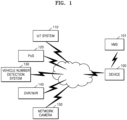
- FIG. 1 illustrates a system in which a device 100 for controlling an on-screen display (OSD) protocol is operated, according to an exemplary embodiment.
- OSD on-screen display
- the device 100 for controlling an OSD protocol may communicate in a wired or wireless manner with a security system using video management software (VMS) 101, an Internet of Things (IoT) system 110, a PoS system 120, a vehicle number detection system 130, a storage device 140 such as an NVR or a DVR, or a network camera.
- VMS video management software
- IoT Internet of Things
- PoS vehicle number detection
- storage device 140 such as an NVR or a DVR, or a network camera.
- the device 100 may include any device having video images. Examples of the device 100 may include computers, laptops, smartwatches, tablets, smartphones, cell phones, cameras, robots, storage devices such as NVRs or DVRs, or handheld devices. The device 100 may follow the ONVIF standard.
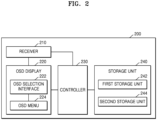
- FIG. 2 is a block diagram of an internal structure of a device 200 for controlling an OSD protocol, according to an exemplary embodiment.
- the device 200 may include a receiver 210, an OSD display 220, a controller 230, and a storage unit 240.
- the OSD display 220 may include an OSD selection interface 222, such as the one illustrated in an exemplary embodiment of FIG. 3 .
- the OSD display 220 may further include an OSD menu 224.
- the OSD menu 224 may provide a function of tabularizing items related to a name, a structure, or a function of an OSD menu, to facilitate adding, modifying, and erasing of the OSD menu by any user.
- the storage unit 240 may include a first storage unit 242 and a second storage unit 244.
- the first storage unit 242 is implemented to store the OSD data and the analysis data of the video image received from the external device, even after the device is rebooted.
- the first storage unit 242 may be a persistent storage device or medium that is designed to retain any data stored therein even when power is no longer supplied to the storage device, including while and after the device reboots.
- the second storage unit 244 is implemented to erase, after the device is rebooted, the OSD data and the analysis data of the video image received from the external device, which are recorded before the reboot.
- the second storage unit 244 may be a temporary storage device or medium that may lose the stored data when power is no longer supplied to the storage device, such as when a device reboots.
- An example of the first storage unit 242 may include hard disk drives (HDDs), flash memory, or NAND flash memory.
- An example of the second storage unit 244 may include NAND flash memory or random access memory (RAM).
- the NAND flash memory may be used to store data that needs to be erased after the device is rebooted, as well as data that needs to be retained after the device is rebooted.
- the device 200 for controlling an OSD protocol may be implemented so as to receive the analysis data of a video image from an apparatus capable of wired or wireless communication via the receiver 210.
- the analysis data of a video image may include data about face recognition in the video image; data about the number of persons counted in the video image; information about vehicle numbers (e.g., license plate numbers) recognized in the video image; information about vehicles in the video image; information about the capturing location, date, and time of the video image; information about credit cards and notes in the video image captured at a PoS; billing information; or IoT data of an object.
- the OSD display 220 is implemented to display the video image and the analysis data of the video image on a display of the device 200.
- the analysis data of the video image may be displayed by being overlaid over the video image or may be separately displayed from the video image.
- the controller 230 when the value of the Boolean element "IsPersistentText" added to the parameter format “OSDConfigurationExtension” of the ONVIF protocol used by the device 200 is false, the controller 230 is implemented to store the analysis data of the video image in the second storage unit 244, in which the analysis data is to be erased after the device is rebooted.
- the controller 230 is implemented to store the analysis data of the video image in the first storage unit 242, in which the analysis data is to be retained after the device is rebooted.
- the controller 230 operates the OSD selection interface 222 to classify, according to a user's selection, some data of at least one of the OSD data and the analysis data of the video image as persistent data to be stored in the first storage unit 242, and some other data as temporary data to be stored in the second storage unit 244.
- the controller 230 operates the OSD selection interface 222 to classify, according to a user's or manager's selection, all the OSD data or analysis data of the video image as persistent data to be stored in the first storage unit 242, or as temporary data to be stored in the second storage unit 244.
- the controller 230 operates the OSD selection interface 222 to classify data having high variability such as a PoS, a vehicle number recognition result, a recognized person's name, or an image displayed overlaid over a specific area of a video image as temporary data to be stored in the second storage unit 244, and other data having low variability as persistent data to be stored in the first storage unit 242.
- data having high variability such as a PoS, a vehicle number recognition result, a recognized person's name, or an image displayed overlaid over a specific area of a video image
- other data having low variability as persistent data to be stored in the first storage unit 242.
- FIG. 3 is a block diagram of an OSD selection interface 300 provided to a user or manager, according to an exemplary embodiment. Even after the device is rebooted, whether to store the OSD data or the analysis data of the video image persistently or temporarily may be selected through the OSD selection interface 300.
- all the OSD data or analysis data of the video image may be set to be stored as persistent data 310 or as temporary data 320 through the OSD selection interface 300.
- some data of at least one of the OSD data and the analysis data of the video image may be set to be stored as the persistent data 310, or some other data may be set to be stored as the temporary data 320.
- data having low variability may be set to be stored as the persistent data 310 and data having high variability may be set to be stored as the temporary data 320, through the OSD selection interface 300.
- an example of the data having low variability may include a logo image, a camera name, date, or time.
- the data having high variability may include user face image information detected from a video image or vehicle number information detected from a video image.
- High or low variability may be determined by a user or may be determined based on a threshold value. For example, if an update frequency (e.g., read/write data access per unit time) for a certain data type is greater than a predetermined threshold value, that data type may be classified as having high variability.
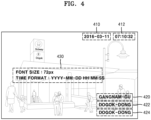
- FIG. 4 illustrates an example of displaying an OSD on a captured image, according to an exemplary embodiment.
- a date 410, time 412, and locations 420, 422, and 424 are displayed overlaid on a captured video image, in which the OSD menu 224 of FIG. 2 is activated (430) to set the formats of the date 410 and the time 412 or a font size.
- the OSD data displayed on the video image or the analysis data of the video image that is externally received may be displayed according to the font size and text layout formats set through the OSD menu 224.
- Locations overlay 420, 422, and 424 are displayed according to text layout formats.
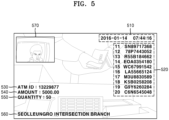
- FIG. 5 illustrates an example of displaying an OSD on a captured image received from an imaging apparatus installed at a financial institution, according to an exemplary embodiment.
- the analysis data of the video image is displayed on a video image received from a security camera installed at the ATM.
- the analysis data of the video image may include date and time 510, numbers of checks to be withdrawn 520, an ATM identification number 530, an amount 540, a quantity of checks 550, a location 560, and an image 570 of a face of a user withdrawing the checks.
- Information such as the date and time 510, the ATM identification number 530, or the location 560 among the analysis data of the video image in the embodiment of FIG. 5 may be classified as data having low variability, and may be recorded in a storage medium such as an HDD so as to be retained after the device is rebooted. Furthermore, information such as the numbers of the checks to be withdrawn 520, the amount 540, the quantity of checks 550, or the image 570 of a face of a user withdrawing a check may be classified as data having high variability, and may be recorded in a storage medium such as RAM so as to be erased in case of a device reboot. Whether data is classified as having high variability or low variability may be set by a user, or may be classified through machine learning.
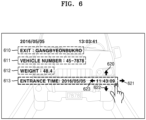
- FIG. 6 illustrates an example of displaying an OSD on an image captured at a tollgate, according to an exemplary embodiment.
- a vehicle is displayed in a video image, and information such as date, time, a location 610, a vehicle number (e.g., license plate number) 611, a weight 612, or an entrance time 613 are displayed on the video image.
- information such as date, time, a location 610, a vehicle number (e.g., license plate number) 611, a weight 612, or an entrance time 613 are displayed on the video image.
- a user may record part or all of the analysis data of the video image in a storage medium such as RAM, in which the analysis data is to be erased in case of a device reboot. Furthermore, a position where the part of the analysis data of the video image is displayed may be set on the video image by using arrows 620, 621, 622, and 623. In this case, a position where the analysis data of the video image is to be displayed overlaid on the video image may be set through an interface of touching a touch screen.
- FIGS. 7A and 7B illustrate examples of displaying, on an OSD, information about the number of persons detected in a captured image, according to an exemplary embodiment.
- the device may display both of a video image received from a video image capturing device 702 for capturing an image of a specific area and analysis data of the received video image (700).
- FIG. 7A illustrates an example of receiving the number of persons in the received video image as the analysis data of the video image.
- "Number of persons: 6" 710 which is analysis data of the video image
- "Number of persons: 6" which is analysis data of the video image
- “Number of persons: 6” which is analysis data of the video image that varies in real time
- the information about the number of persons is to be permanently stored in real time, the information may be classified as persistent data and may be stored in a preset storage medium such as HDD or NAND flash memory.
- FIG. 7B illustrates "Number of persons: 3" 712, which is analysis data of the video image, as being displayed overlaid on the video image.
- an alarm may be transmitted to a manager when the number of persons exceeds a preset value or falls below a preset value.
- FIG. 8 illustrates an example of a standardized coordinate system for displaying an OSD on a captured image, according to an exemplary embodiment.
- a standardized coordinate system as shown in FIG. 8 is used to display an OSD.
- the standardized coordinate system as shown in FIG. 8 may be used.
- analysis data of the video image which is recorded so as to be retained after the device is rebooted, is displayed at preset positions 810, 811, 812, and 813
- analysis data 820 of the analysis data of the video image which is recorded so as to be erased in case of a device reboot, is displayed in a manner that a user may select a position to display the analysis data of the video image in the video image.
- the user may display the analysis data of the video image at a desired position by using a touch-type interface or a drag-and-drop-type interface.
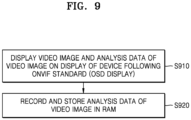
- FIGS. 9 to 10 are flowcharts of methods of controlling an OSD protocol in a device, according to exemplary embodiments.
- the operations outlined herein are exemplary and can be implemented in any combination thereof, including combinations that exclude, add, or modify certain operations.
- FIG. 9 is a flowchart of a method of controlling an OSD protocol in a device, according to an exemplary embodiment.
- the method may include displaying a video image and the analysis data of the video image on a display of a device following the ONVIF standard (S910), and recording and storing the analysis data of the video image in RAM (S920).
- FIG. 10 illustrates a method of controlling an OSD protocol in a device, according to another exemplary embodiment.
- the device receives analysis data of the video image from an apparatus capable of wired or wireless communication (S1010).
- a video image and the analysis data of the video image are displayed on a display of the device (S1020).
- the analysis data of the video image may be displayed overlaid on the video image or may be displayed at a separate position.
- a controller of the device controls selection of whether to record the analysis data of the video image so as to be retained after the device is rebooted or to be erased after the device is rebooted.
- the analysis data of the video image is classified as data to be retained after the device is rebooted or as data to be erased after the device is rebooted, according to a user's selection, and then the respective data are stored in different storage media (S1040).
- the various exemplary embodiments may be implemented as computer-readable code or instructions stored on a computer-readable recording medium.
- the computer-readable recording medium is any data storage device that can store data which can thereafter be read by a computer system. Examples of the computer-readable recording medium include read-only memory (ROM), random access memory (RAM), compact disc ROMs (CD-ROMs), magnetic tapes, floppy disks, optical data storage devices, etc.
- ROM read-only memory
- RAM random access memory
- CD-ROMs compact disc ROMs
- the computer-readable recording medium may also be distributed over network-coupled computer systems so that the computer-readable code is stored and executed in a distributive manner.
- OSD data may be temporarily stored.
- the OSD data may be used regardless of the number of times memory is accessed.
- the OSD protocol may solve a memory defect problem that occurs as the storage device is repeatedly accessed to continuously store an image or text when an OSD protocol for persistently displaying data is used.
- OSD data may be used with high-frequency access in a financial institute or a PoS.
- data may be displayed on a video image by using IoT data.
- a network camera or a security camera may detect and manage the number of persons.
Landscapes
- Engineering & Computer Science (AREA)
- Multimedia (AREA)
- Signal Processing (AREA)
- Library & Information Science (AREA)
- Physics & Mathematics (AREA)
- General Physics & Mathematics (AREA)
- General Engineering & Computer Science (AREA)
- Human Computer Interaction (AREA)
- Theoretical Computer Science (AREA)
- Television Signal Processing For Recording (AREA)
- Closed-Circuit Television Systems (AREA)
Description
- The invention relates to a device and method for controlling an on-screen display (OSD) protocol, and more particularly, to a method of providing a function of temporarily storing an OSD protocol in addition to a function of persistently storing the same.
- A device and a method for controlling an on-screen display (OSD) protocol is disclosed in
WO 2015/0536379 A1 - An on-screen display (OSD) function enables a user to directly optimize a display by controlling a menu displayed on the display. These days, OSD functions are widely used to adjust basic settings of digital devices.
- In a security system using network cameras or video management software (VMS), OSD data used for an image is recorded on a storage device capable of storing data persistently. According to the related art, there is provided an OSD setting protocol for storing text strings or logo images whose format or content is stored once entered. However, as this OSD protocol has recently been used in various ways, for example, for displaying an image showing characteristics of a person recognized as a result of vehicle number recognition, a storage device is repeatedly accessed to store an image or text that is continuously changed in real time. In particular, in the case of a point of sale (PoS) system, a vehicle number recognition result, a recognized person's name, or an overlaid image displayed in a specific area of a video image, the image is temporarily displayed and disappears after a certain amount of time passes.
- Unlike a device such as hard disk drives (HDDs) capable of accessing data repeatedly, a storage device such as NAND flash memory may be accessed a limited number of times. Accordingly, when NAND flash memory is accessed more than a certain number of times to write OSD data, the NAND flash memory may become defective and may no longer be able to store data or may even lose stored data.
- According to the invention, a method according to
claim 1 and a device according to claim 10 are provided. - One or more exemplary embodiments include a device for controlling an on-screen display (OSD) protocol.
- One or more exemplary embodiments include a method of selectively classifying data having high variability as temporary OSD data and data having low volatility as persistent OSD data, and storing respective data in different storage devices.
- One or more exemplary embodiments include a method of managing OSD data varying in real time, by which OSD data may be used in financial institutions or at points of sale (PoS).
- One or more exemplary embodiments include a method of managing OSD data varying in real time, by which Internet of things (loT) data may be used.
- One or more exemplary embodiments include a method of managing OSD data varying in real time, by which the number of persons may be detected and managed by network cameras or security cameras.
- Additional aspects will be set forth in part in the description which follows and, in part, will be apparent from the description, or may be learned by practice of the presented embodiments.
- According to an aspect of an exemplary embodiment, a method of controlling an on-screen display (OSD) protocol in a device may include receiving analysis data of a video image from an apparatus capable of at least one of wired and wireless communication; displaying the video image and the analysis data of the video on a display of the device; determining whether to record the analysis data of the video image in a persistent storage device to be retained after the device reboots or in a temporary storage device to be erased after the device reboots; and storing the analysis data of the video image in one of the persistent storage device and the temporary storage device according to the determination.
- The temporary storage device may include random access memory (RAM).
- The persistent storage device may include at least one of a flash memory, a hard disk drive, and NAND memory.
- The analysis data of the video image may include at least one of data about faces recognized in the video image, data about the number of persons counted in the video image, information about a vehicle number recognized in the video image, information about the vehicle in the video image; information about a location, a date, and a time of capturing the video image, information about one of a credit card and a note in the video image captured at a point of sale (PoS), billing information, and IoT data of an object.
- The displaying the video image and the analysis data may include one of displaying the analysis data overlaid on the video image, and displaying the analysis data separately from the video image.
- When the analysis data is displayed overlaid on the video image, a user may be provided with an interface to select a position of the displayed analysis data with respect to the video image.
- When at least one portion of the analysis data is displayed overlaid on the video image, a user may be provided with an interface to select a position of each of the at least one portion of the analysis data with respect to the video image.
- When at least one portion of the analysis data is displayed overlaid on the video image, a first portion of the analysis data that is recorded in the persistent storage device may be displayed at a predetermined position, and a second portion of the analysis data that is recorded in the temporary storage device may be displayed at a position selected by a user by using an interface to select the position of the second portion of the analysis data with respect to the video image.
- The displaying the video image and the analysis data may include displaying the analysis data as one of an image and text.
- According to an aspect of an exemplary embodiment, a method of controlling an on-screen display (OSD) protocol in a device may include displaying a video image and analysis data of the video image on a display of the device that follows an open network video interface (ONVIF) standard; and storing the analysis data of the video image in a random access memory (RAM).
- The method may further include, in response to the analysis data of the video image relating to a number of persons counted in the video image, transmitting an alarm message when the number of persons counted in the video image exceeds a threshold value.
- The analysis data of the video image may be received from an external apparatus capable of one of wired and wireless communication.
- According to an aspect of an exemplary embodiment, a device for controlling an on-screen display (OSD) protocol may include a receiver configured to receive analysis data of a video image from an apparatus capable of one of wired and wireless communication; an OSD display configured to display the video image and the analysis data of the video image; and a controller configured to store the analysis data of the video image in a temporary storage medium to be erased after the device reboots, in response to a value of a Boolean element added to a parameter format of an open network video interface forum (ONVIF) protocol implemented by the device being false.
- The controller may be further configured to, in response to the value of the Boolean element being true, store the analysis data of the video image in a persistent storage medium to retain the analysis data of the video image after the device reboots.
- The above and/or other aspects will become apparent and more readily appreciated from the following description of various exemplary embodiments, taken in conjunction with the accompanying drawings in which:
-
FIG. 1 illustrates a system in which a device for controlling an on-screen display (OSD) protocol is operated, according to an exemplary embodiment; -
FIG. 2 is a block diagram of an internal structure of a device for controlling an OSD protocol, according to an exemplary embodiment; -
FIG. 3 is a block diagram of an OSD selection interface provided by a device for controlling an OSD protocol, according to an exemplary embodiment; -
FIG. 4 illustrates an example of displaying an OSD on a captured image, according to an exemplary embodiment; -
FIG. 5 illustrates an example of displaying an OSD on a captured image received from an imaging apparatus installed at a financial institution, according to an exemplary embodiment; -
FIG. 6 illustrates an example of displaying an OSD on an image captured at a tollgate, according to an exemplary embodiment; -
FIGS. 7A and7B illustrate examples of displaying, on an OSD, information about the number of persons detected in a captured image, according to an exemplary embodiment; -
FIG. 8 illustrates an example of a standardized coordinate system for displaying an OSD on a captured image, according to an exemplary embodiment; and -
FIGS. 9 to 10 are flowcharts of methods of controlling an OSD protocol in a device, according to an exemplary embodiment. - Reference will now be made in detail to exemplary embodiments, which are illustrated in the accompanying drawings, wherein like reference numerals refer to like elements throughout. In this regard, the exemplary embodiments may have different forms and should not be construed as being limited to the descriptions set forth herein. Accordingly, the exemplary embodiments are merely described below, by referring to the figures, to explain aspects of the present description. Expressions such as "at least one of," when preceding a list of elements, modify the entire list of elements and do not modify the individual elements of the list.
- A security system which uses a network camera, a storage device such as a network video recorder (NVR) or a digital video recorder (DVR), and video management software (VMS) provides a function of overlay settings. Text strings, graphics, or pictures among metadata may be overlaid onto a live video or these overlay data may be separately configured as metadata.
- The open network video interface forum (ONVIF) standard provides a protocol to control OSD. The OSD protocol provided by the ONVIF includes parameter formats, parameters, and meanings thereof, as illustrated in Table 1 below.
[Table 1] Parameter Format Parameter Meaning VideoSourceConfigurationT oken OSDRefere nce Video source, Information about classification of captured images OSDType Type Text string, Image, Other data formats OSDPosConfiguration Position Text string start position of UpperRight, LowerLeft, LowerRight, or Custom OSDTextConfiguration TextString Plain text, Date, Time, Type of date and time, Date and time indication format OSDImgConfiguration Image Image path OSDConfiguration Extension Extension Additional information - The ONVIF standard has only provided an OSD protocol to allow a format or content of a text string or a logo image, if once entered, to be kept after a device is rebooted, when the text string or logo image is to be displayed overlaid on a video image or set as separate metadata.
- According to an aspect of an exemplary embodiment, in addition to the method of persistently recording and storing OSD data as described above, an OSD protocol may allow recorded data having high variability (e.g., high update frequency) or low variability (e.g., low update frequency), such as a point of sale (PoS), a vehicle number (e.g., license plate number) recognition result, a recognized person's name, or an overlaid image displayed in a specific area of a video image, to be erased after the device is rebooted, according to a setting or selection by a user. According to an aspect of an exemplary embodiment, OSD information may be implemented to be temporarily operated by adding a Boolean element called "IsPersistentText" to the parameter format "OSDConfigurationExtension" of Table 1.
- When a value of the Boolean element "IsPersistentText" added to the parameter format "OSDConfigurationExtension" of an open network video interface forum (ONVIF) protocol is false, analysis data of the video image is stored to be erased after the device is rebooted. In this case, in the ONVIF, the Configuration value is a Persistent value and is implemented to retain information even when the system is rebooted. In other words, when the device is rebooted, while the Configuration value is retained as the Persistent value, the OSD data such as the analysis data of a video image, text, or a logo is implemented so as not to be retained.
- New optional attribute added to the OSDTextConfiguration.
  <xs:complexType name="OSDTextConfiguration">
                   -
                   -
  <xs:attribute name="lsPersistentText" type="xs:boolean" type="xs:boolean" use="optional">
  <xs:annotation>
  <xs:documentation>This flag is applicable only when Type is Plain, when set to False;
  PlainText Content will not be persistent across device reboots. When not specified should
  be considered as True. </xs:documentation>
  </xs:annotation>
  </xs:attribute>
"OSDConfigurationExtension" of the ONVIF protocol used by the
Claims (11)
- A method of providing a function of temporarily storing an on-screen display (OSD) protocol in a device in addition to a function of persistently storing the same, the method comprising,receiving analysis data of a video image from an apparatus capable of at least one of wired and wireless communication;displaying the video image and the analysis data of the video on a display of the device; determining whether to record the analysis data of the video image in a persistent storage device to be retained after the device being rebooted or in a temporary storage device to be erased after the device being rebooted based on a value of a Boolean element of a parameter format of an open network interface, ONVIF, protocol, whereinstoring the analysis data of the video image in one of the persistent storage device in response to the value of the Boolean element added to the parameter format of the open network interface, ONVIF, protocol, being true andthe temporary storage device in response to the value of the Boolean element added to the parameter format of the open network interface, ONVIF, protocol, being false whereinanalysis data having a high variability is stored in the temporary storage device and analysis data having a low variability is stored in the persistent storage device, wherein high and low variability are determined by a user or based on a threshold value, and whereinthe analysis data includes numbers of checks to be withdrawn (520), an ATM identification number (530), an amount (540), a quantity of checks (550), a location (560), and an image (570) of a face of a user withdrawing the checks.
- The method of claim 1, wherein the temporary storage device comprises a random access memory (RAM).
- The method of claim 1, wherein the persistent storage device comprises at least one of a flash memory, a hard disk drive, and a NAND memory.
- The method of claim 1, wherein the analysis data of the video image comprises at least one of data about faces recognized in the video image; data about a number of persons counted in the video image; information about a vehicle number recognized in the video image; information about the vehicle in the video image; information about location, date, and time of capturing the video image; information about one of a credit card and a note in the video image captured at a point of sale (PoS); billing information; and Internet of things (loT) data of an object.
- The method of claim 1, wherein the displaying the video image and the analysis data comprises one of displaying the analysis data overlaid on the video image, and displaying the analysis data separately from the video image.
- The method of claim 5, wherein, when the analysis data is displayed overlaid on the video image, a user interface to select a position of the displayed analysis data with respect to the video image is provided.
- The method of claim 5, wherein, when at least one portion of the analysis data is displayed overlaid on the video image, a user interface to select a position of each of the at least one portion of the analysis data with respect to the video image is provided.
- The method of claim 5, wherein, when at least one portion of the analysis data is displayed overlaid on the video image, a first portion of the analysis data that is recorded in the persistent storage device is displayed at a predetermined position, and a second portion of the analysis data that is recorded in the temporary storage device is displayed at a position selected by a user by using an interface to select the position of the second portion of the analysis data with respect to the video image.
- The method of claim 1, wherein the displaying the video image and the analysis data comprises displaying the analysis data as one of an image and text.
- A device for storing an on-screen display (OSD) protocol, the device comprising:a receiver configured to receive analysis data of a video image from an apparatus capable of one of wired and wireless communication;an OSD display configured to display the video image and the analysis data of the video image; anda controller configured to store the analysis data of the video image in a temporary storage medium to be erased after the device being rebooted, in response to a value of a Boolean element added to a parameter format of an open network video interface forum (ONVIF) protocol implemented by the device being false, and to store, in response to the value of the Boolean element being true, the analysis data of the video image in a persistent storage medium to retain the analysis data of the video image after the device being rebooted, whereinthe controller is configured to store analysis data having a high variability in the temporary storage device and analysis data having a low variability in the persistent storage device, wherein high and low variability are determined by a user or wherein the controller is configured to determine high and low variability based on a threshold value, and whereinthe analysis data includes numbers of checks to be withdrawn (520), an ATM identification number (530), an amount (540), a quantity of checks (550), a location (560), and an image (570) of a face of a user withdrawing the checks.
- The device of claim 10, wherein the Boolean element is "IsPersistentText," and the parameter format is "OSDConfigurationExtension."
Applications Claiming Priority (2)
| Application Number | Priority Date | Filing Date | Title |
|---|---|---|---|
| US201662342319P | 2016-05-27 | 2016-05-27 | |
| KR1020160176844A KR102614014B1 (en) | 2016-05-27 | 2016-12-22 | A device and method for controlling OSD protocol |
Publications (2)
| Publication Number | Publication Date |
|---|---|
| EP3249920A1 EP3249920A1 (en) | 2017-11-29 |
| EP3249920B1 true EP3249920B1 (en) | 2023-05-03 |
Family
ID=59077794
Family Applications (1)
| Application Number | Title | Priority Date | Filing Date |
|---|---|---|---|
| EP17173064.1A Active EP3249920B1 (en) | 2016-05-27 | 2017-05-26 | Device and method for controlling osd protocol |
Country Status (2)
| Country | Link |
|---|---|
| US (1) | US11438552B2 (en) |
| EP (1) | EP3249920B1 (en) |
Families Citing this family (8)
| Publication number | Priority date | Publication date | Assignee | Title |
|---|---|---|---|---|
| US10169884B2 (en) * | 2017-01-03 | 2019-01-01 | International Business Machines Corporation | Image-based device configuration |
| US10783755B2 (en) * | 2018-04-20 | 2020-09-22 | Corey T. King | Devices and methods for generating video overlay of transaction data on automated teller machine video |
| CN112739250B (en) * | 2018-09-18 | 2024-10-15 | 富士胶片株式会社 | Medical image processing device, processor device and medical image processing method |
| US11587420B2 (en) * | 2019-03-14 | 2023-02-21 | Johnson Controls Tyco IP Holdings LLP | Systems and methods of combining RFID and VMS for people tracking and intrusion detection |
| FR3095878B1 (en) * | 2019-05-10 | 2021-10-08 | Univ De Brest | Method of automatic image analysis to automatically recognize at least one rare characteristic |
| CN111327924B (en) * | 2019-07-30 | 2022-08-05 | 杭州海康威视系统技术有限公司 | Code stream screening method and device and access equipment |
| CN113608915B (en) * | 2021-08-31 | 2024-12-03 | 新华三技术有限公司成都分公司 | Disk failure detection method and device |
| US20230344842A1 (en) * | 2022-04-21 | 2023-10-26 | Palo Alto Networks, Inc. | Detection of user anomalies for software as a service application traffic with high and low variance feature modeling |
Citations (1)
| Publication number | Priority date | Publication date | Assignee | Title |
|---|---|---|---|---|
| US20140074977A1 (en) * | 2012-09-11 | 2014-03-13 | Canon Kabushiki Kaisha | Transmission apparatus, instruction apparatus, transmission method, instruction method, and storage medium |
Family Cites Families (19)
| Publication number | Priority date | Publication date | Assignee | Title |
|---|---|---|---|---|
| US6328207B1 (en) * | 1998-08-11 | 2001-12-11 | Electronic Data Systems Corporation | Method and apparatus for automated cashing of checks |
| US9892606B2 (en) * | 2001-11-15 | 2018-02-13 | Avigilon Fortress Corporation | Video surveillance system employing video primitives |
| US6806887B2 (en) * | 2001-04-04 | 2004-10-19 | International Business Machines Corporation | System for integrating personalized data with visual content |
| JP4102647B2 (en) * | 2002-11-05 | 2008-06-18 | 日立オムロンターミナルソリューションズ株式会社 | Banknote transaction equipment |
| US7636721B2 (en) * | 2002-11-22 | 2009-12-22 | Sony Corporation | Picture program production assistance system |
| EP1427197A1 (en) * | 2002-12-03 | 2004-06-09 | Ming-Ho Yu | Apparatus for producing TV advertising contents and inserting interstitial advertisements on TV programs |
| GB2415564A (en) | 2004-06-24 | 2005-12-28 | Trevor Burke Technology Ltd | Classifying video data |
| US20110010631A1 (en) * | 2004-11-29 | 2011-01-13 | Ariel Inventions, Llc | System and method of storing and retrieving associated information with a digital image |
| JP4654974B2 (en) * | 2006-05-23 | 2011-03-23 | 富士フイルム株式会社 | Imaging apparatus and imaging method |
| US20080097907A1 (en) * | 2006-10-24 | 2008-04-24 | Ncr Corporation | Methods of operating a self-service check depositing terminal to deposit a plurality of checks in a single deposit transaction |
| JP2009048348A (en) * | 2007-08-17 | 2009-03-05 | Sony Corp | Information processing apparatus, character information candidate search method, and character information candidate search program |
| US8443285B2 (en) * | 2010-08-24 | 2013-05-14 | Apple Inc. | Visual presentation composition |
| WO2012177160A1 (en) * | 2011-06-22 | 2012-12-27 | General Instrument Corporation | Method and apparatus for processing and displaying multiple captions superimposed on video images |
| KR101447356B1 (en) | 2013-03-27 | 2014-10-06 | (주) 넥스트칩 | Apparatus and method of forming on screen display menu of camera |
| JP6376743B2 (en) | 2013-10-18 | 2018-08-22 | キヤノン株式会社 | IMAGING DEVICE, IMAGING SYSTEM, IMAGING DEVICE CONTROL METHOD, IMAGING SYSTEM CONTROL METHOD, AND PROGRAM |
| CN203537510U (en) | 2013-10-22 | 2014-04-09 | 北京汉邦高科数字技术股份有限公司 | High-definition network camera device |
| CN103581624A (en) | 2013-10-25 | 2014-02-12 | 江苏万联新兆信息科技有限公司(外商合资) | Method for configuring network camera through video OSD and USB equipment |
| KR101641646B1 (en) * | 2014-11-28 | 2016-07-21 | 전자부품연구원 | Video masking processing method and apparatus |
| US10387627B2 (en) * | 2015-09-28 | 2019-08-20 | Kryptowire LLC | Systems and methods for analyzing software |
-
2017
- 2017-05-26 EP EP17173064.1A patent/EP3249920B1/en active Active
- 2017-05-26 US US15/606,144 patent/US11438552B2/en active Active
Patent Citations (1)
| Publication number | Priority date | Publication date | Assignee | Title |
|---|---|---|---|---|
| US20140074977A1 (en) * | 2012-09-11 | 2014-03-13 | Canon Kabushiki Kaisha | Transmission apparatus, instruction apparatus, transmission method, instruction method, and storage medium |
Also Published As
| Publication number | Publication date |
|---|---|
| US20170345268A1 (en) | 2017-11-30 |
| US11438552B2 (en) | 2022-09-06 |
| EP3249920A1 (en) | 2017-11-29 |
Similar Documents
| Publication | Publication Date | Title |
|---|---|---|
| US11438552B2 (en) | Device and method for controlling OSD protocol | |
| US20110102829A1 (en) | Image size warning | |
| US9521293B2 (en) | Management apparatus, management system, object management method, and computer-readable storage medium | |
| JP2006259930A (en) | Display device, control method therefor, electronic device including display device, display device control program, and recording medium recording the program | |
| US20130167224A1 (en) | Lock function handling for information processing devices | |
| RU2643464C2 (en) | Method and apparatus for classification of images | |
| JP2012123804A (en) | System and method for facial identification | |
| US20180241900A1 (en) | Suggesting image files for deletion based on image file parameters | |
| US20150331566A1 (en) | Electronic album creating apparatus and method of producing electronic album | |
| US20170364303A1 (en) | Suggesting image files for deletion based on image file parameters | |
| US8244005B2 (en) | Electronic apparatus and image display method | |
| CN100407317C (en) | Method of displaying data information to be deleted in digital video recorder | |
| JP2008197954A (en) | Electronic equipment | |
| JP7834301B2 (en) | Video analysis support device and program | |
| US10839198B2 (en) | Image processing apparatus, image processing method, and program | |
| CN111353475A (en) | Self-service transaction equipment abnormality identification method and self-service transaction equipment | |
| JP2006163527A (en) | Image search apparatus and method | |
| US7006416B1 (en) | Record medium with mechanism of secrecy protection | |
| JP2004104572A (en) | Method and system for controlling monitoring camera, program for making computer implement monitoring camera controlling method, and recording medium with the program recorded thereon | |
| US11205258B2 (en) | Image processing apparatus, image processing method, and storage medium | |
| KR102614014B1 (en) | A device and method for controlling OSD protocol | |
| US20060290788A1 (en) | Image capturing apparatus, control method and program therefor | |
| US10978110B2 (en) | Image recording apparatus and control method thereof | |
| US20140023229A1 (en) | Handheld device and method for displaying operation manual | |
| JP2015064656A (en) | Image search system |
Legal Events
| Date | Code | Title | Description |
|---|---|---|---|
| PUAI | Public reference made under article 153(3) epc to a published international application that has entered the european phase |
Free format text: ORIGINAL CODE: 0009012 |
|
| STAA | Information on the status of an ep patent application or granted ep patent |
Free format text: STATUS: THE APPLICATION HAS BEEN PUBLISHED |
|
| AK | Designated contracting states |
Kind code of ref document: A1 Designated state(s): AL AT BE BG CH CY CZ DE DK EE ES FI FR GB GR HR HU IE IS IT LI LT LU LV MC MK MT NL NO PL PT RO RS SE SI SK SM TR |
|
| AX | Request for extension of the european patent |
Extension state: BA ME |
|
| STAA | Information on the status of an ep patent application or granted ep patent |
Free format text: STATUS: REQUEST FOR EXAMINATION WAS MADE |
|
| 17P | Request for examination filed |
Effective date: 20180502 |
|
| RBV | Designated contracting states (corrected) |
Designated state(s): AL AT BE BG CH CY CZ DE DK EE ES FI FR GB GR HR HU IE IS IT LI LT LU LV MC MK MT NL NO PL PT RO RS SE SI SK SM TR |
|
| RAP1 | Party data changed (applicant data changed or rights of an application transferred) |
Owner name: HANWHA TECHWIN CO., LTD. |
|
| STAA | Information on the status of an ep patent application or granted ep patent |
Free format text: STATUS: EXAMINATION IS IN PROGRESS |
|
| 17Q | First examination report despatched |
Effective date: 20210208 |
|
| GRAP | Despatch of communication of intention to grant a patent |
Free format text: ORIGINAL CODE: EPIDOSNIGR1 |
|
| STAA | Information on the status of an ep patent application or granted ep patent |
Free format text: STATUS: GRANT OF PATENT IS INTENDED |
|
| INTG | Intention to grant announced |
Effective date: 20221219 |
|
| RIN1 | Information on inventor provided before grant (corrected) |
Inventor name: TARAK, RAMGOPAL ANUMOLU Inventor name: YOGAVANAN, MATHIVANAN Inventor name: VENKATESWARA, RAO ARAVAPALLI Inventor name: SUJITH, RAMAN Inventor name: CHO, SUNG BONG |
|
| GRAS | Grant fee paid |
Free format text: ORIGINAL CODE: EPIDOSNIGR3 |
|
| GRAA | (expected) grant |
Free format text: ORIGINAL CODE: 0009210 |
|
| STAA | Information on the status of an ep patent application or granted ep patent |
Free format text: STATUS: THE PATENT HAS BEEN GRANTED |
|
| AK | Designated contracting states |
Kind code of ref document: B1 Designated state(s): AL AT BE BG CH CY CZ DE DK EE ES FI FR GB GR HR HU IE IS IT LI LT LU LV MC MK MT NL NO PL PT RO RS SE SI SK SM TR |
|
| REG | Reference to a national code |
Ref country code: GB Ref legal event code: FG4D |
|
| REG | Reference to a national code |
Ref country code: AT Ref legal event code: REF Ref document number: 1565659 Country of ref document: AT Kind code of ref document: T Effective date: 20230515 Ref country code: CH Ref legal event code: EP |
|
| REG | Reference to a national code |
Ref country code: DE Ref legal event code: R096 Ref document number: 602017068236 Country of ref document: DE |
|
| REG | Reference to a national code |
Ref country code: IE Ref legal event code: FG4D |
|
| REG | Reference to a national code |
Ref country code: LT Ref legal event code: MG9D |
|
| REG | Reference to a national code |
Ref country code: DE Ref legal event code: R081 Ref document number: 602017068236 Country of ref document: DE Owner name: HANWHA VISION CO., LTD., SEONGNAM-SI, KR Free format text: FORMER OWNER: HANWHA TECHWIN CO., LTD., SEONGNAM-SI, GYEONGGI-DO, KR |
|
| REG | Reference to a national code |
Ref country code: NL Ref legal event code: MP Effective date: 20230503 |
|
| REG | Reference to a national code |
Ref country code: AT Ref legal event code: MK05 Ref document number: 1565659 Country of ref document: AT Kind code of ref document: T Effective date: 20230503 |
|
| PG25 | Lapsed in a contracting state [announced via postgrant information from national office to epo] |
Ref country code: SE Free format text: LAPSE BECAUSE OF FAILURE TO SUBMIT A TRANSLATION OF THE DESCRIPTION OR TO PAY THE FEE WITHIN THE PRESCRIBED TIME-LIMIT Effective date: 20230503 Ref country code: PT Free format text: LAPSE BECAUSE OF FAILURE TO SUBMIT A TRANSLATION OF THE DESCRIPTION OR TO PAY THE FEE WITHIN THE PRESCRIBED TIME-LIMIT Effective date: 20230904 Ref country code: NO Free format text: LAPSE BECAUSE OF FAILURE TO SUBMIT A TRANSLATION OF THE DESCRIPTION OR TO PAY THE FEE WITHIN THE PRESCRIBED TIME-LIMIT Effective date: 20230803 Ref country code: NL Free format text: LAPSE BECAUSE OF FAILURE TO SUBMIT A TRANSLATION OF THE DESCRIPTION OR TO PAY THE FEE WITHIN THE PRESCRIBED TIME-LIMIT Effective date: 20230503 Ref country code: ES Free format text: LAPSE BECAUSE OF FAILURE TO SUBMIT A TRANSLATION OF THE DESCRIPTION OR TO PAY THE FEE WITHIN THE PRESCRIBED TIME-LIMIT Effective date: 20230503 Ref country code: AT Free format text: LAPSE BECAUSE OF FAILURE TO SUBMIT A TRANSLATION OF THE DESCRIPTION OR TO PAY THE FEE WITHIN THE PRESCRIBED TIME-LIMIT Effective date: 20230503 |
|
| PG25 | Lapsed in a contracting state [announced via postgrant information from national office to epo] |
Ref country code: RS Free format text: LAPSE BECAUSE OF FAILURE TO SUBMIT A TRANSLATION OF THE DESCRIPTION OR TO PAY THE FEE WITHIN THE PRESCRIBED TIME-LIMIT Effective date: 20230503 Ref country code: PL Free format text: LAPSE BECAUSE OF FAILURE TO SUBMIT A TRANSLATION OF THE DESCRIPTION OR TO PAY THE FEE WITHIN THE PRESCRIBED TIME-LIMIT Effective date: 20230503 Ref country code: LV Free format text: LAPSE BECAUSE OF FAILURE TO SUBMIT A TRANSLATION OF THE DESCRIPTION OR TO PAY THE FEE WITHIN THE PRESCRIBED TIME-LIMIT Effective date: 20230503 Ref country code: LT Free format text: LAPSE BECAUSE OF FAILURE TO SUBMIT A TRANSLATION OF THE DESCRIPTION OR TO PAY THE FEE WITHIN THE PRESCRIBED TIME-LIMIT Effective date: 20230503 Ref country code: IS Free format text: LAPSE BECAUSE OF FAILURE TO SUBMIT A TRANSLATION OF THE DESCRIPTION OR TO PAY THE FEE WITHIN THE PRESCRIBED TIME-LIMIT Effective date: 20230903 Ref country code: HR Free format text: LAPSE BECAUSE OF FAILURE TO SUBMIT A TRANSLATION OF THE DESCRIPTION OR TO PAY THE FEE WITHIN THE PRESCRIBED TIME-LIMIT Effective date: 20230503 Ref country code: GR Free format text: LAPSE BECAUSE OF FAILURE TO SUBMIT A TRANSLATION OF THE DESCRIPTION OR TO PAY THE FEE WITHIN THE PRESCRIBED TIME-LIMIT Effective date: 20230804 |
|
| PG25 | Lapsed in a contracting state [announced via postgrant information from national office to epo] |
Ref country code: FI Free format text: LAPSE BECAUSE OF FAILURE TO SUBMIT A TRANSLATION OF THE DESCRIPTION OR TO PAY THE FEE WITHIN THE PRESCRIBED TIME-LIMIT Effective date: 20230503 |
|
| REG | Reference to a national code |
Ref country code: CH Ref legal event code: PL |
|
| PG25 | Lapsed in a contracting state [announced via postgrant information from national office to epo] |
Ref country code: SK Free format text: LAPSE BECAUSE OF FAILURE TO SUBMIT A TRANSLATION OF THE DESCRIPTION OR TO PAY THE FEE WITHIN THE PRESCRIBED TIME-LIMIT Effective date: 20230503 |
|
| REG | Reference to a national code |
Ref country code: BE Ref legal event code: MM Effective date: 20230531 |
|
| PG25 | Lapsed in a contracting state [announced via postgrant information from national office to epo] |
Ref country code: SM Free format text: LAPSE BECAUSE OF FAILURE TO SUBMIT A TRANSLATION OF THE DESCRIPTION OR TO PAY THE FEE WITHIN THE PRESCRIBED TIME-LIMIT Effective date: 20230503 Ref country code: SK Free format text: LAPSE BECAUSE OF FAILURE TO SUBMIT A TRANSLATION OF THE DESCRIPTION OR TO PAY THE FEE WITHIN THE PRESCRIBED TIME-LIMIT Effective date: 20230503 Ref country code: RO Free format text: LAPSE BECAUSE OF FAILURE TO SUBMIT A TRANSLATION OF THE DESCRIPTION OR TO PAY THE FEE WITHIN THE PRESCRIBED TIME-LIMIT Effective date: 20230503 Ref country code: LU Free format text: LAPSE BECAUSE OF NON-PAYMENT OF DUE FEES Effective date: 20230526 Ref country code: LI Free format text: LAPSE BECAUSE OF NON-PAYMENT OF DUE FEES Effective date: 20230531 Ref country code: EE Free format text: LAPSE BECAUSE OF FAILURE TO SUBMIT A TRANSLATION OF THE DESCRIPTION OR TO PAY THE FEE WITHIN THE PRESCRIBED TIME-LIMIT Effective date: 20230503 Ref country code: DK Free format text: LAPSE BECAUSE OF FAILURE TO SUBMIT A TRANSLATION OF THE DESCRIPTION OR TO PAY THE FEE WITHIN THE PRESCRIBED TIME-LIMIT Effective date: 20230503 Ref country code: CZ Free format text: LAPSE BECAUSE OF FAILURE TO SUBMIT A TRANSLATION OF THE DESCRIPTION OR TO PAY THE FEE WITHIN THE PRESCRIBED TIME-LIMIT Effective date: 20230503 Ref country code: CH Free format text: LAPSE BECAUSE OF NON-PAYMENT OF DUE FEES Effective date: 20230531 |
|
| REG | Reference to a national code |
Ref country code: DE Ref legal event code: R097 Ref document number: 602017068236 Country of ref document: DE |
|
| PG25 | Lapsed in a contracting state [announced via postgrant information from national office to epo] |
Ref country code: MC Free format text: LAPSE BECAUSE OF FAILURE TO SUBMIT A TRANSLATION OF THE DESCRIPTION OR TO PAY THE FEE WITHIN THE PRESCRIBED TIME-LIMIT Effective date: 20230503 |
|
| REG | Reference to a national code |
Ref country code: IE Ref legal event code: MM4A |
|
| PG25 | Lapsed in a contracting state [announced via postgrant information from national office to epo] |
Ref country code: MC Free format text: LAPSE BECAUSE OF FAILURE TO SUBMIT A TRANSLATION OF THE DESCRIPTION OR TO PAY THE FEE WITHIN THE PRESCRIBED TIME-LIMIT Effective date: 20230503 |
|
| PLBE | No opposition filed within time limit |
Free format text: ORIGINAL CODE: 0009261 |
|
| STAA | Information on the status of an ep patent application or granted ep patent |
Free format text: STATUS: NO OPPOSITION FILED WITHIN TIME LIMIT |
|
| 26N | No opposition filed |
Effective date: 20240206 |
|
| PG25 | Lapsed in a contracting state [announced via postgrant information from national office to epo] |
Ref country code: IE Free format text: LAPSE BECAUSE OF NON-PAYMENT OF DUE FEES Effective date: 20230526 |
|
| PG25 | Lapsed in a contracting state [announced via postgrant information from national office to epo] |
Ref country code: IE Free format text: LAPSE BECAUSE OF NON-PAYMENT OF DUE FEES Effective date: 20230526 |
|
| PG25 | Lapsed in a contracting state [announced via postgrant information from national office to epo] |
Ref country code: SI Free format text: LAPSE BECAUSE OF FAILURE TO SUBMIT A TRANSLATION OF THE DESCRIPTION OR TO PAY THE FEE WITHIN THE PRESCRIBED TIME-LIMIT Effective date: 20230503 |
|
| PG25 | Lapsed in a contracting state [announced via postgrant information from national office to epo] |
Ref country code: SI Free format text: LAPSE BECAUSE OF FAILURE TO SUBMIT A TRANSLATION OF THE DESCRIPTION OR TO PAY THE FEE WITHIN THE PRESCRIBED TIME-LIMIT Effective date: 20230503 Ref country code: IT Free format text: LAPSE BECAUSE OF FAILURE TO SUBMIT A TRANSLATION OF THE DESCRIPTION OR TO PAY THE FEE WITHIN THE PRESCRIBED TIME-LIMIT Effective date: 20230503 Ref country code: BE Free format text: LAPSE BECAUSE OF NON-PAYMENT OF DUE FEES Effective date: 20230531 |
|
| PG25 | Lapsed in a contracting state [announced via postgrant information from national office to epo] |
Ref country code: BG Free format text: LAPSE BECAUSE OF FAILURE TO SUBMIT A TRANSLATION OF THE DESCRIPTION OR TO PAY THE FEE WITHIN THE PRESCRIBED TIME-LIMIT Effective date: 20230503 |
|
| PG25 | Lapsed in a contracting state [announced via postgrant information from national office to epo] |
Ref country code: BG Free format text: LAPSE BECAUSE OF FAILURE TO SUBMIT A TRANSLATION OF THE DESCRIPTION OR TO PAY THE FEE WITHIN THE PRESCRIBED TIME-LIMIT Effective date: 20230503 |
|
| PGFP | Annual fee paid to national office [announced via postgrant information from national office to epo] |
Ref country code: DE Payment date: 20250422 Year of fee payment: 9 |
|
| PGFP | Annual fee paid to national office [announced via postgrant information from national office to epo] |
Ref country code: FR Payment date: 20250422 Year of fee payment: 9 |
|
| PG25 | Lapsed in a contracting state [announced via postgrant information from national office to epo] |
Ref country code: CY Free format text: LAPSE BECAUSE OF FAILURE TO SUBMIT A TRANSLATION OF THE DESCRIPTION OR TO PAY THE FEE WITHIN THE PRESCRIBED TIME-LIMIT; INVALID AB INITIO Effective date: 20170526 |
|
| PG25 | Lapsed in a contracting state [announced via postgrant information from national office to epo] |
Ref country code: HU Free format text: LAPSE BECAUSE OF FAILURE TO SUBMIT A TRANSLATION OF THE DESCRIPTION OR TO PAY THE FEE WITHIN THE PRESCRIBED TIME-LIMIT; INVALID AB INITIO Effective date: 20170526 |
|
| PG25 | Lapsed in a contracting state [announced via postgrant information from national office to epo] |
Ref country code: TR Free format text: LAPSE BECAUSE OF FAILURE TO SUBMIT A TRANSLATION OF THE DESCRIPTION OR TO PAY THE FEE WITHIN THE PRESCRIBED TIME-LIMIT Effective date: 20230503 |
|
| PGFP | Annual fee paid to national office [announced via postgrant information from national office to epo] |
Ref country code: GB Payment date: 20260324 Year of fee payment: 10 |