EP3249604B1 - Verfahren, vorrichtungen und computerprogrammprodukte zum demosaicing eines durch einen bildsensor mit einer farbfilteranordnung aufgenommenen bildes - Google Patents
Verfahren, vorrichtungen und computerprogrammprodukte zum demosaicing eines durch einen bildsensor mit einer farbfilteranordnung aufgenommenen bildes Download PDFInfo
- Publication number
- EP3249604B1 EP3249604B1 EP16170899.5A EP16170899A EP3249604B1 EP 3249604 B1 EP3249604 B1 EP 3249604B1 EP 16170899 A EP16170899 A EP 16170899A EP 3249604 B1 EP3249604 B1 EP 3249604B1
- Authority
- EP
- European Patent Office
- Prior art keywords
- color
- pixel
- texture
- shader
- color component
- Prior art date
- Legal status (The legal status is an assumption and is not a legal conclusion. Google has not performed a legal analysis and makes no representation as to the accuracy of the status listed.)
- Active
Links
Images




Classifications
-
- G—PHYSICS
- G06—COMPUTING OR CALCULATING; COUNTING
- G06T—IMAGE DATA PROCESSING OR GENERATION, IN GENERAL
- G06T3/00—Geometric image transformations in the plane of the image
- G06T3/40—Scaling of whole images or parts thereof, e.g. expanding or contracting
- G06T3/4015—Image demosaicing, e.g. colour filter arrays [CFA] or Bayer patterns
-
- G—PHYSICS
- G06—COMPUTING OR CALCULATING; COUNTING
- G06T—IMAGE DATA PROCESSING OR GENERATION, IN GENERAL
- G06T7/00—Image analysis
- G06T7/40—Analysis of texture
- G06T7/49—Analysis of texture based on structural texture description, e.g. using primitives or placement rules
-
- G—PHYSICS
- G06—COMPUTING OR CALCULATING; COUNTING
- G06T—IMAGE DATA PROCESSING OR GENERATION, IN GENERAL
- G06T7/00—Image analysis
- G06T7/90—Determination of colour characteristics
-
- G—PHYSICS
- G06—COMPUTING OR CALCULATING; COUNTING
- G06T—IMAGE DATA PROCESSING OR GENERATION, IN GENERAL
- G06T2207/00—Indexing scheme for image analysis or image enhancement
- G06T2207/10—Image acquisition modality
- G06T2207/10024—Color image
-
- G—PHYSICS
- G06—COMPUTING OR CALCULATING; COUNTING
- G06T—IMAGE DATA PROCESSING OR GENERATION, IN GENERAL
- G06T2210/00—Indexing scheme for image generation or computer graphics
- G06T2210/52—Parallel processing
Definitions
- the present disclosure generally relates to the field of demosaicing an image captured by an image sensor a color filter array, and more specifically relate to such a demosaicing operation using the GPU, shaders of the GPU and built-in rasterization function of the GPU.
- a demosaicing (also de-mosaicing, demosaicking or debayering) algorithm is a digital image process used to reconstruct a full color image from the incomplete color samples output from an image sensor overlaid with a color filter array (CFA). It is also known as CFA interpolation or color reconstruction.
- CFA color filter array
- GPUs Graphics Processor Units
- CPU Central Processing Unit
- the prior art also comprises US2012/0026178 , which discloses a GPU that implements a graph/graphics pipeline utilizing procedural shaders comprising a vertex shader and a pixel shader, where the pixel shader is configured to operate on the outputs of the vertex shader.
- the GPU is enabled to demosaic raw image data by downloading specialized pixel shading functionality to the pixel shader to enable the pixel shader to perform a demosaicing algorithm.
- an objective of the invention is to solve or at least reduce one or several of the drawbacks discussed above.
- the above objective is achieved by the attached independent patent claims.
- this and other objectives are achieved by a method for demosaicing an image captured by an image sensor comprising a color filter array, the method comprising the steps of:
- patch primitive type (or just “patch”) should, in the context of present specification, be understood a data structure (primitive) with a user-defined number of vertices, for example four pixel positions forming a quad. This primitive is supported by some GPUs, for example those implementing OpenGL 4 or later, or Direct3D 11 or later. Each patch of vertex data may be subdivided into smaller primitives in the rendering pipeline (also known as Tessellation).
- triangle primitive type (or just “triangle) should, in the context of present specification, be understood a data structure (primitive) formed by 3 vertices.
- the built-in rasterization function of the GPU may function as described in the rastarization rules for Direct3D 11. Any other suitable rasterization rule may apply.
- vertex points In the context of the present specification, all data elements processed before the rasterization step are stored within vertex points.
- the data points of the grids originate from the pixel positions of the texture but in this context may be considered as vertex points containing pixel position data.
- the input to the vertex shader should be the pixel center positions, i.e. x+0.5, y+0.5. Consequently, the first, second, third and fourth grid may define such pixel center positions. According to other embodiments, the grids define e.g. x and y, and the addition of the 0.5 to each of the x-, and y-value is made before inputting the value to the vertex shader.
- the Tessellation process (e.g. defining of the two triangles) may be done implicitly during execution of the shader.
- the geometry shader will define two instances of the triangle primitive type from the instance of the patch primitive type.
- each pixel position will after rasterization correspond to two color components of the third color. These two will then be blended together or otherwise added to each other, to form a single color component in the final image, as will be further described below.
- the inventors have realized that by using the built-in rasterization function of the GPU, which includes an interpolator in fixed-function silicon/hardware (which is normally used by the rasterization stage of the 3D graphics pipeline), an energy consumption similar to a dedicated camera processing chip (which typically has the Bayer interpolator implemented as fixed function hardware) can be achieved when performing Bayer demosaicing. Consequently, the functionality of such dedicated camera processing chip can be implemented by the GPU and a more cost efficient Bayer demosaicing can be achieved.
- a dedicated camera processing chip which typically has the Bayer interpolator implemented as fixed function hardware
- the method further comprises the steps of: prior to the step of defining two instances of a triangle primitive type by the geometry shader, calculating, by the geometry shader, a first difference between the color components corresponding to a upper left pixel position in the quad, and a lower right pixel position in the quad, and a second difference between the color components corresponding to a upper right pixel position in the quad, and a lower left pixel position in the quad, and reorder the pixel positions comprised in the instance of the patch primitive type in case the second difference is larger than the first difference.
- the geometry shader can order the pixel positions in the quad such that the rasterization can be done with either of two different diagonal settings.
- the absolute difference between the diagonally positioned pixels in the quad may be calculated.
- this may improve the resulting image quality of the interpolation when there is edges present in the region defined by the pixel positions in the quad.
- the present invention provides a computer program product comprising a computer-readable storage medium with instructions adapted to carry out the method of any one of claims 1-8 when executed by a device having processing capability.
- the present invention provides a graphical processing unit, GPU, arranged for demosaicing an image captured by an image sensor comprising a color filter array, wherein the GPU is arranged to:
- the second and third aspect may generally have the same features and advantages as the first aspect.
- a demosaicing (also de-mosaicing, demosaicking or debayering) algorithm is a digital image process used to reconstruct a full color image from the incomplete color samples output from an image sensor overlaid with a color filter array (CFA). It is also known as CFA interpolation or color reconstruction.
- CFA color filter array
- Such an incomplete color sample 100 e.g. an image 100 captured by an image sensor comprising a CFA, is shown in figure 1 .
- the color sample 100 has a mosaic pattern with a first 104, second 106, 108 and third 102 color. Since image 100 are captured with a by an image sensor comprising a CFA (e.g.
- each pixel in the image has a color component from only one color of said first, second and third color.
- 25% of the pixels in the texture have a color component from the first color 104
- 25% of the pixels in the texture have a color component from the second color 106
- 50% of the pixels in the texture have a color component from the third color 102.
- the CFA is exemplified as a RGBG filter, and the first color 104 thus corresponds to red, the second color 106 corresponds to blue and the third color 102 corresponds to green.
- demosaicing With demosaicing, the missing colors for each pixel are created. In the RGBG case, 3 cases exist. If the pixel is a "green pixel" 102 (the green color component), the red and blue color components have to be created. If the pixel is a "blue pixel" 106 (the blue color component), the red and green color components have to be created. If the pixel is a "red pixel" 104 (the red color component), the green and blue color component have to be created.
- demosaicing is done using interpolation in a hardware specifically dedicated for the demosaicing operation. For example, for the blue pixel 108, the following steps need to be performed:
- the GPU will receive S802 a texture corresponding to the captured image 100.
- This is thus the raw image as captured by the image sensor of the camera.
- the texture have a mosaic pattern with a first 104, second 106, 108 and third 102 color, each pixel in the texture having a color component from only one color of said first, second and third color, wherein 25% of the pixels in the texture have a color component from the first color 104 (e.g. red), wherein 25% of the pixels in the texture have a color component from the second color 106 (e.g. blue), wherein 50% of the pixels in the texture have a color component from the third color 102 (e.g. green).
- first color 104 e.g. red
- the second color 106 e.g. blue
- 50% of the pixels in the texture have a color component from the third color 102 (e.g. green).
- the GPU may define S804 four grids 202-208, shown in figure 2 .
- the first grid 202 defines pixel positions of all pixels of the texture having a color component from the first color 104 (red).
- the second grid 204 defines pixel positions of all pixels of the texture having a color component from the second color 106 (blue).
- the third grid 206 defines pixel positions of 50% of the pixels of the texture having a color component from the third color 102 (green).
- the fourth grid 208 defines pixel positions of a remaining 50% of the pixels of the texture having a color component from the third color 102 (green).
- the same density and pattern of pixel positions in all grids will be achieved, and consequently the same method may be used for rasterization of all the tree colors 102, 104, 106.
- the same implementation of the vertex shader may be used for all grids.
- the GPU may extract metadata defining a mosaic pattern from the texture, and defining the four grids based on the metadata. This may decrease the computational complexity.
- the mosaic pattern is defined by e.g. analyzing a small bit of the input texture, to extract the pattern. This may increase the flexibility since no metadata may be needed to define the pattern.
- the second, third and fourth grid is defined by shifting the positions of the first grid according to a predefined rule. Consequently, only one grid with pixel positions needs to be defined and stored in memory since the second, third and fourth grid with their respective pixel positions may be deduced from the one grid defined and stored in memory. In case the captured image always is of the same size, the grid may be hardcoded in memory. Otherwise, the size may be read from the captured image.
- the color components for each pixel position in the grids 202-208 need to be extracted S806. This may be done by, for each grid and each pixel position in the grid, initiating a vertex shader of the GPU and provide as an input to the vertex shader the pixel position.
- the input to a vertex shader is thus a single pixel position
- the output of the vertex shader is the pixel position and the corresponding color component of the pixel position, i.e. the color component from the pixel position in the texture having the mosaiced pattern.
- the extraction of the color value for each pixel positions defined in a grid 202-208 may be performed in parallel.
- a grid 202-208 comprises e.g. 200 pixel positions
- 200 vertex shaders may be initiated in parallel.
- Each of the 200 vertex shaders may then in parallel extract the respective color component by reading directly from the texture memory of the GPU. This may increase the speed of the demosaicing operation in the GPU.
- the output from the vertex shaders are vertex points containing pixel position data and corresponding color component data of the pixel position data, read from the texture as described above..
- patches are instantiated and defined S810, where each instance of a patch comprises four pixel positions forming a quad, and the color component corresponding to each of the four pixel positions.
- the content of a patch is exemplified in figure 3 where four pixel positions 106a-d forms a quad 302, and where the color components (blue in this case) of the pixel positions 106a-d extracted by the vertex shaders also are included in the patch.
- a geometry shader of the GPU may be initiated.
- the input the geometry shader is the instance of the patch primitive type.
- the geometry shader may be arranged to define S814 two instances of a triangle primitive type from the instance of the patch primitive type based on an order of the pixel positions comprised in the instance of the patch primitive type.
- a triangle is a data structure formed by 3 vertices, and consequently, each instance of the triangle primitive type comprises three pixel positions forming a triangle, and the color components corresponding to each of the three pixel positions.
- the two defined instances of the triangle are then outputted from the geometry shader.
- adjacent quads 302, 402, 404 share some vertices (pixel positions and thus corresponding color components).
- the quad 302 is defined by the pixel positions 106a-d
- the quad 402 is defined by the pixel positions 106b, 106d, 106e, 106g, thus sharing two vertices with the neighboring quad 302.
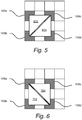
- the defining of the two triangles may be content adaptive, in the sense that based on the differences between diagonally positioned pixels, different diagonal settings of the triangles may be employed. This is shown in figures 5-6 where figure 5 shows two triangles 602, 604.
- the first triangle 602 is formed by the pixel positions 106a, 106b, and 106c, while the second triangle 604 is formed by the pixel positions 106b, 106c and 106d.
- another diagonal setting is used.
- the first triangle 702 is formed by the pixel positions 106a, 106b, and 106d
- the second triangle 604 is formed by the pixel positions 106a, 106c and 106d.
- the selection between the diagonal settings may be done by calculating, by the geometry shader, a first difference between the color components corresponding to a upper left pixel position 106a in the quad, and a lower right pixel position 106d in the quad, and a second difference between the color components corresponding to a upper right pixel position 106c in the quad, and a lower left pixel position 106b in the quad.
- the first difference is larger than the second difference
- the diagonal setting shown in figure 5 is selected; else the diagonal setting shown in figure 6 is selected.
- this embodiment provides a decision point in the algorithm that substantially improves visual quality of the resulting demosaiced image.
- the interpolation is adaptive to the actual pixel values in the 3x3 pixel area (quad) and thus content adaptive. Consequently, the geometry shader may be arranged to, prior to the step of defining two instances of a triangle primitive type, calculate the above described differences and reorder S812 the pixel positions comprised in the instance of the patch primitive type in case it is needed, e.g. when the second difference is larger than the first difference.
- the built-in rasterization function of the GPU can be used for rasterization S816 of each instance of the triangle primitive outputted by the geometry shaders.
- the already existing, fixed function e.g. implemented in dedicated silicon in the GPU
- rasterization functionality can be used for providing that all pixel positions of the texture with color components of each of the first, second and third color.
- the raster data may be snapped to integer locations that are then culled and clipped (to draw the minimum number of pixels), and per-pixel attributes (e.g. the color component corresponding to the pixel position) are interpolated (from per-vertex attributes) before being passed to a pixel shader
- the rasterization rules of the GPU will be used for the rasterization, and example of such rules may be as defined for Direct3D version 11.
- each pixel position will now correspond to two color components of the third color, and one color component of the first color and one color component of the second color.
- each pixel position verex
- each pixel position has 4 attributes, one attribute defining the color component of the first color, one attribute defining the color component of the second color, and two attributes defining the color components of the third color.
- each pixel position of the texture and the corresponding components of the first, second and third color will now automatically be inputted to the pixel shader of the GPU.
- a complete image (all pixels of the image having a color component from each of the first, second and third color) may be formed.
- the pixel shader may perform an alpha blending operation. Consequently, the fixed function blend stage (using dedicated hardware of the GPU) may be employed for forming the final image.
- the alpha blending operation is performed on one of the color components corresponding to each pixel position inputted to the pixel shader.
- each color channel is added to the final image using four rendering operations at the pixel shader. For each rendering operation, the color component for 100% of the first color or 100% of the color component for the second color or the color component for 50% of the third color is generated.
- the pixel shader needs to, for each inputted pixel position of the texture and the corresponding color components of each of the first, second and third color, divide the corresponding color component of the third color by 2 (or multiplying with 0.5) before outputting the pixel position and the corresponding color components of each of the first, second and third color.
- the alpha blending operation is shown in figure 7a , and is thus a single pass solution where an additive blend is performed on color components 704, 705 (from the third color) which thus forms color component 712 (from the third color) in the final pixel.
- the final pixel is thus a pixel having an R-component 702, a G-component 712 and a B-component 706.
- no blending operation is performed by the pixel shader.
- the pixel shader is, for each inputted pixel position of the texture and the corresponding color components of each of the first, second and third color, outputting the pixel position and corresponding color components of each of the first, second and third color.
- the pixel shader outputs the interpolated colors of the first, second and third color for each pixel position.
- the final image is formed by, for each pixel position, combining the corresponding color component of the first color, the corresponding color component of the second color and the two corresponding color components of the third color. Pseudo code for this may be as follow:
- the color component of the third color (e.g. green) is formed by adding the two color components 708, 709 of the third color (which where the outcome from the built-in rasterization function) and dividing the added values by 2 (or multiplying with 0.5) to form the final color component 714 of the third color.
- the final pixel is thus a pixel having an R-component 702, a G-component 714 and a B-component 706.
- any of the combination functions for this embodiment may also include weight or similar for the color channels and this embodiment may thus be more flexible than performing the blending in the pixel shader (as shown in figure 7a and described above).
Landscapes
- Engineering & Computer Science (AREA)
- Physics & Mathematics (AREA)
- General Physics & Mathematics (AREA)
- Theoretical Computer Science (AREA)
- Computer Vision & Pattern Recognition (AREA)
- Image Processing (AREA)
- Color Television Image Signal Generators (AREA)
Claims (15)
- Verfahren für das Demosaicing eines Bilds (100), das durch einen Bildsensor aufgenommen wird, der ein Farbfilterarray umfasst, wobei das Verfahren die folgenden Schritte umfasst:Empfangen (S802), durch eine grafische Verarbeitungseinheit GPU, einer Textur entsprechend dem aufgenommenen Bild, wobei die Textur ein Mosaikmuster mit einer ersten (104), zweiten (106, 108) und dritten (102) Farbe besitzt, wobei jedes Pixel in der Textur eine Farbkomponente von nur einer Farbe der ersten, zweiten und dritten Farbe besitzt, wobei 25 % der Pixel in der Textur eine Farbkomponente von der ersten Farbe besitzen, wobei 25 % der Pixel in der Textur eine Farbkomponente von der zweiten Farbe besitzen, wobei 50 % der Pixel in der Textur eine Farbkomponente von der dritten Farbe besitzen,Verarbeiten (S804-S816) der Textur durch einen Vertex-Shader und einen Pixel-Shader der GPU, undAusbilden (S818) eines Bilds auf Basis von Ausgaben des Pixel-Shaders, wobei alle Pixel des Bilds eine Farbkomponente von jedem der ersten, zweiten und dritten Farbe besitzen, dadurch gekennzeichnet, dass das Verarbeiten die folgenden Schritte umfasst:anhand der Textur, Definieren (S804) von vier Gittern (202, 204, 206, 208), wobei jedes Gitter mehrere Pixelpositionen in der Textur definiert, wobei ein erstes Gitter Pixelpositionen aller Pixel der Textur mit einer Farbkomponente von der ersten Farbe definiert, wobei ein zweites Gitter Pixelpositionen von allen Pixeln der Textur mit einer Farbkomponente von der zweiten Farbe definiert, wobei ein drittes Gitter Pixelpositionen von 50 % der Pixel der Textur mit einer Farbkomponente von der dritten Farbe definiert, wobei ein viertes Gitter Pixelpositionen von restlichen 50 % der Pixel der Textur mit einer Farbkomponente von der dritten Farbe definiert,für jedes Gitter und jede Pixelposition in dem Gitter, Initiieren eines Vertex-Shaders der GPU und Liefern der Pixelposition als eine Eingabe zu dem Vertex-Shader, wobei der Vertex-Shader die Farbkomponente entsprechend der Pixelposition in der Textur extrahiert und die Pixelposition und die entsprechende Farbkomponente der Pixelposition ausgibt,für jedes Gitter und unter Verwendung der Ausgabe von den Vertex-Shadern, Definieren von mehreren Instanzen eines Patch-Grundtyps, wobei jede Instanz des Patch-Grundtyps vier Pixelpositionen umfasst, die ein Quad (302, 402, 404) bilden, und die Farbkomponente entsprechend jeder der vier Pixelpositionen,für jede Instanz des Patch-Grundtyps, Initiieren eines Geometrie-Shaders der GPU und Liefern der Instanz des Patch-Grundtyps als eine Eingabe zu dem Geometrie-Shader, wobei der Geometrie-Shader zwei Instanzen eines Dreieck-Grundtyps von der Instanz des Patch-Grundtyps auf Basis einer Ordnung der in der Instanz des Patch-Grundtyps umfassten Pixelpositionen definiert (S814), wobei jede Instanz des Dreieck-Grundtyps drei Pixelpositionen umfasst, die ein Dreieck (602, 604, 702, 704) bilden, und die Farbkomponenten entsprechend jedem der drei Pixelpositionen, und die beiden Instanzen des Dreieck-Grundtyps ausgibt,Verwenden einer eingebauten Rasterisierungsfunktion der GPU für die Rasterisierung (S816) jeder Instanz des durch die Geometrie-Shader der GPU ausgegebenen Dreieck-Grundtyps, so dass alle Pixelpositionen der Textur jeweils einer Farbkomponente der ersten Farbe, einer Farbkomponente der zweiten Farbe und zwei Farbkomponenten der dritten Farbe entspricht, undEingeben jeder Pixelposition der Textur und der entsprechenden Farbkomponenten jeder der ersten, zweiten und dritten Farbe in den Pixel-Shader der GPU.
- Verfahren nach Anspruch 1, weiterhin umfassend die folgenden Schritte:vor dem Schritt des Definierens von zwei Instanzen eines Dreieck-Grundtyps durch den Geometrie-Shader,Berechnen, durch den Geometrie-Shader, einer ersten Differenz zwischen den Farbkomponenten entsprechend einer linken oberen Pixelposition in dem Quad und einer rechten unteren Pixelposition in dem Quad und einer zweiten Differenz zwischen den Farbkomponenten entsprechend einer rechten oberen Pixelposition in dem Quad und einer linken unteren Pixelposition in dem Quad und Neuordnen der in der Instanz des Patch-Grundtyps umfassten Pixelpositionen in dem Fall, dass die zweite Differenz größer ist als die erste Differenz.
- Verfahren nach einem der Ansprüche 1-2, weiterhin umfassend den folgenden Schritt:
Extrahieren von ein Mosaikmuster definierenden Metadaten aus der Textur, wobei der Schritt des Definierens der vier Gitter auf Basis der Metadaten durchgeführt wird. - Verfahren nach einem der Ansprüche 1-3, wobei das zweite, dritte und vierte Gitter durch Verschieben der Positionen des ersten Gitters gemäß einer vordefinierten Regel definiert wird.
- Verfahren nach einem der Ansprüche 1-4, weiterhin umfassend den folgenden Schritt:
Durchführen einer Alpha-Blending-Operation durch den Pixel-Shader an einer der Farbkomponenten entsprechend jeder in den Pixel-Shader eingegebenen Pixelposition. - Verfahren nach Anspruch 5, wobei die Alpha-Blending-Operation durch den Pixel-Shader an der Farbkomponente des dritten Kanals durchgeführt wird, wobei das Verfahren weiterhin den folgenden Schritt umfasst:
durch den Pixel-Shader, für jede eingegebene Pixelposition der Textur und die entsprechenden Farbkomponenten jeder der ersten, zweiten und dritten Farbe, Teilen der entsprechenden Farbkomponente der dritten Farbe durch 2 vor dem Ausgeben der Pixelposition und der entsprechenden Farbkomponenten von jeder der ersten, zweiten und dritten Farbe. - Verfahren nach einem der Ansprüche 1-4, weiterhin umfassend die folgenden Schritte:
durch den Pixel-Shader, für jede eingegebene Pixelposition der Textur und die entsprechenden Farbkomponenten jeder der ersten, zweiten und dritten Farbe, Ausgeben der Pixelposition und entsprechender Farbkomponenten von jeder der ersten, zweiten und dritten Farbe und wobei der Schritt des Ausbildens eines Bild umfasst:
für jede Pixelposition, Kombinieren der entsprechenden Farbkomponente der ersten Farbe, der entsprechenden Farbkomponente der zweiten Farbe und der zwei entsprechenden Farbkomponenten der dritten Farbe. - Verfahren nach einem der Ansprüche 1-7, wobei das Farbfilterarray einem aus der Liste von einem RGBG-Filter, einem GRGB-Filter, einem RGGB-Filter und einem CYYM-Filter entspricht.
- Computerlesbares Ablagemedium umfassend darauf ein Computerprogrammprodukt mit Anweisungen, die, wenn das Programm durch einen Computer mit Verarbeitungsfähigkeit ausgeführt wird, bewirken, dass der Computer das Verfahren nach einem der Ansprüche 1-8 ausführt.
- Grafische Verarbeitungseinheit GPU, die ausgelegt ist für das Demosaicing eines Bilds, das durch einen Bildsensor aufgenommen wird, der ein Farbfilterarray umfasst, wobei die GPU ausgelegt ist zum:Empfangen einer Textur entsprechend dem aufgenommenen Bild, wobei die Textur ein Mosaikmuster mit einer ersten, zweiten und dritten Farbe besitzt, wobei jedes Pixel in der Textur eine Farbkomponente von nur einer Farbe der ersten, zweiten und dritten Farbe besitzt, wobei 25 % der Pixel in der Textur eine Farbkomponente von der ersten Farbe besitzen, wobei 25 % der Pixel in der Textur eine Farbkomponente von der zweiten Farbe besitzen, wobei 50 % der Pixel in der Textur eine Farbkomponente von der dritten Farbe besitzen,Verarbeiten der Textur durch einen Vertex-Shader und einen Pixel-Shader, undAusbilden eines Bilds auf Basis von Ausgaben des Pixel-Shaders, wobei alle Pixel des Bilds eine Farbkomponente von jedem der ersten, zweiten und dritten Farbe besitzen, dadurch gekennzeichnet, dass die GPU ausgelegt ist bei dem Verarbeiten zum:anhand der Textur, Definieren von vier Gittern, wobei jedes Gitter mehrere Pixelpositionen in der Textur definiert, wobei ein erstes Gitter Pixelpositionen aller Pixel der Textur mit einer Farbkomponente von der ersten Farbe definiert, wobei ein zweites Gitter Pixelpositionen von allen Pixeln der Textur mit einer Farbkomponente von der zweiten Farbe definiert, wobei ein drittes Gitter Pixelpositionen von 50 % der Pixel der Textur mit einer Farbkomponente von der dritten Farbe definiert, wobei ein viertes Gitter Pixelpositionen von restlichen 50 % der Pixel der Textur mit einer Farbkomponente von der dritten Farbe definiert,für jedes Gitter und jede Pixelposition in dem Gitter, Initiieren eines Vertex-Shaders und Liefern der Pixelposition als eine Eingabe zu dem Vertex-Shader, wobei der Vertex-Shader die Farbkomponente entsprechend der Pixelposition in der Textur extrahiert und die Pixelposition und die entsprechende Farbkomponente der Pixelposition ausgibt,für jedes Gitter und unter Verwendung der Ausgabe von den Vertex-Shadern, Definieren von mehreren Instanzen eines Patch-Grundtyps, wobei jede Instanz des Patch-Grundtyps vier Pixelpositionen umfasst, die ein Quad bilden, und die Farbkomponente entsprechend jeder der vier Pixelpositionen,für jede Instanz des Patch-Grundtyps, Initiieren eines Geometrie-Shaders und Liefern der Instanz des Patch-Grundtyps als eine Eingabe zu dem Geometrie-Shader, wobei der Geometrie-Shader zwei Instanzen eines Dreieck-Grundtyps von der Instanz des Patch-Grundtyps auf Basis einer Ordnung der in der Instanz des Patch-Grundtyps umfassten Pixelpositionen definiert, wobei jede Instanz des Dreieck-Grundtyps drei Pixelpositionen umfasst, die ein Dreieck bilden, und die Farbkomponenten entsprechend jedem der drei Pixelpositionen, und die beiden Instanzen des Dreieck-Grundtyps ausgibt,Verwenden einer eingebauten Rasterisierungsfunktion für die Rasterisierung jeder Instanz des durch die Geometrie-Shader ausgegebenen Dreieck-Grundtyps, so dass alle Pixelpositionen der Textur jeweils einer Farbkomponente der ersten Farbe, einer Farbkomponente der zweiten Farbe und zwei Farbkomponenten der dritten Farbe entspricht, undEingeben jeder Pixelposition der Textur und der entsprechenden Farbkomponenten jeder der ersten, zweiten und dritten Farbe in den Pixel-Shader.
- GPU nach Anspruch 10, weiterhin ausgelegt zum:vor dem Definieren von zwei Instanzen eines Dreieck-Grundtyps durch den Geometrie-Shader,Berechnen, durch den Geometrie-Shader, einer ersten Differenz zwischen den Farbkomponenten entsprechend einer linken oberen Pixelposition in dem Quad und einer rechten unteren Pixelposition in dem Quad und einer zweiten Differenz zwischen den Farbkomponenten entsprechend einer rechten oberen Pixelposition in dem Quad und einer linken unteren Pixelpositionen in dem Quad und Neuordnen der in der Instanz des Patch-Grundtyps umfassten Pixelpositionen in dem Fall, dass die zweite Differenz größer ist als die erste Differenz.
- GPU nach einem der Ansprüche 10 bis 11, weiterhin ausgelegt zum:
Extrahieren von ein Mosaikmuster definierenden Metadaten aus der Textur, wobei der Schritt des Definierens der vier Gitter auf Basis der Metadaten durchgeführt wird. - GPU nach einem der Ansprüche 10 bis 12, weiterhin ausgelegt zum Definieren des zweiten, dritten und vierten Gitters durch Verschieben der Positionen des ersten Gitters gemäß einer vordefinierten Regel.
- GPU nach einem der Ansprüche 10-13, weiterhin ausgelegt zum
Durchführen einer Alpha-Blending-Operation durch den Pixel-Shader an einer der Farbkomponenten entsprechend jeder in den Pixel-Shader eingegebenen Pixelposition. - GPU nach einem der Ansprüche 10-13, weiterhin ausgelegt zum:
durch den Pixel-Shader, für jede eingegebene Pixelposition der Textur und die entsprechenden Farbkomponenten jeder der ersten, zweiten und dritten Farbe, Ausgeben der Pixelposition und entsprechender Farbkomponenten von jeder der ersten, zweiten und dritten Farbe und wobei der Schritt des Ausbildens eines Bilds umfasst:
für jede Pixelposition, Kombinieren der entsprechenden Farbkomponente der ersten Farbe, der entsprechenden Farbkomponente der zweiten Farbe und der zwei entsprechenden Farbkomponenten der dritten Farbe.
Priority Applications (2)
| Application Number | Priority Date | Filing Date | Title |
|---|---|---|---|
| EP16170899.5A EP3249604B1 (de) | 2016-05-23 | 2016-05-23 | Verfahren, vorrichtungen und computerprogrammprodukte zum demosaicing eines durch einen bildsensor mit einer farbfilteranordnung aufgenommenen bildes |
| US15/594,641 US10255660B2 (en) | 2016-05-23 | 2017-05-14 | Methods, devices and computer program products for demosaicing an image captured by an image sensor comprising a color filter array |
Applications Claiming Priority (1)
| Application Number | Priority Date | Filing Date | Title |
|---|---|---|---|
| EP16170899.5A EP3249604B1 (de) | 2016-05-23 | 2016-05-23 | Verfahren, vorrichtungen und computerprogrammprodukte zum demosaicing eines durch einen bildsensor mit einer farbfilteranordnung aufgenommenen bildes |
Publications (2)
| Publication Number | Publication Date |
|---|---|
| EP3249604A1 EP3249604A1 (de) | 2017-11-29 |
| EP3249604B1 true EP3249604B1 (de) | 2019-06-26 |
Family
ID=56080274
Family Applications (1)
| Application Number | Title | Priority Date | Filing Date |
|---|---|---|---|
| EP16170899.5A Active EP3249604B1 (de) | 2016-05-23 | 2016-05-23 | Verfahren, vorrichtungen und computerprogrammprodukte zum demosaicing eines durch einen bildsensor mit einer farbfilteranordnung aufgenommenen bildes |
Country Status (2)
| Country | Link |
|---|---|
| US (1) | US10255660B2 (de) |
| EP (1) | EP3249604B1 (de) |
Families Citing this family (7)
| Publication number | Priority date | Publication date | Assignee | Title |
|---|---|---|---|---|
| KR20180038793A (ko) * | 2016-10-07 | 2018-04-17 | 삼성전자주식회사 | 영상 데이터 처리 방법 및 장치 |
| US10885676B2 (en) * | 2016-12-27 | 2021-01-05 | Samsung Electronics Co., Ltd. | Method and apparatus for modifying display settings in virtual/augmented reality |
| US10922203B1 (en) * | 2018-09-21 | 2021-02-16 | Nvidia Corporation | Fault injection architecture for resilient GPU computing |
| CN109658358B (zh) * | 2018-12-25 | 2023-05-12 | 辽宁工程技术大学 | 一种基于多导向滤波的快速bayer彩色重建方法 |
| EP3812801B1 (de) | 2019-10-23 | 2024-06-19 | Samsung Electronics Co., Ltd. | Bildsensor mit farbentrennender linsenanordnung und elektronische vorrichtung mit dem bildsensor |
| CN112701132B (zh) | 2019-10-23 | 2025-08-22 | 三星电子株式会社 | 图像传感器和包括该图像传感器的电子装置 |
| US12112420B2 (en) | 2021-12-07 | 2024-10-08 | Samsung Electronics Co., Ltd. | Method and apparatus for improving the image quality of variable rate shading using gradients |
Family Cites Families (3)
| Publication number | Priority date | Publication date | Assignee | Title |
|---|---|---|---|---|
| US6816197B2 (en) * | 2001-03-21 | 2004-11-09 | Hewlett-Packard Development Company, L.P. | Bilateral filtering in a demosaicing process |
| US8098964B2 (en) * | 2006-02-06 | 2012-01-17 | Microsoft Corp. | Raw image processing |
| US10013735B2 (en) * | 2015-01-28 | 2018-07-03 | Qualcomm Incorporated | Graphics processing unit with bayer mapping |
-
2016
- 2016-05-23 EP EP16170899.5A patent/EP3249604B1/de active Active
-
2017
- 2017-05-14 US US15/594,641 patent/US10255660B2/en active Active
Non-Patent Citations (1)
| Title |
|---|
| None * |
Also Published As
| Publication number | Publication date |
|---|---|
| EP3249604A1 (de) | 2017-11-29 |
| US10255660B2 (en) | 2019-04-09 |
| US20170337664A1 (en) | 2017-11-23 |
Similar Documents
| Publication | Publication Date | Title |
|---|---|---|
| US10255660B2 (en) | Methods, devices and computer program products for demosaicing an image captured by an image sensor comprising a color filter array | |
| JP7646619B2 (ja) | カメラの画像処理方法およびカメラ | |
| CN109889800B (zh) | 图像增强方法和装置、电子设备、存储介质 | |
| US11983848B2 (en) | AI frame engine for mobile edge | |
| CN110852953B (zh) | 图像插值方法及装置、存储介质、图像信号处理器、终端 | |
| US10863148B2 (en) | Tile-selection based deep demosaicing acceleration | |
| CN102682426A (zh) | 图像处理设备、图像处理方法及程序 | |
| US11263805B2 (en) | Method of real-time image processing based on rendering engine and a display apparatus | |
| WO2022061879A1 (zh) | 图像处理方法、装置和系统,计算机可读存储介质 | |
| CN114040246A (zh) | 图形处理器的图像格式转换方法、装置、设备及存储介质 | |
| CN102509294A (zh) | 一种基于单幅图像的全局深度估计方法 | |
| US8948509B2 (en) | Blending with multiple blend modes for image manipulation | |
| US20160063752A1 (en) | Rendering apparatus and method | |
| CN108431751A (zh) | 背景去除 | |
| CN113424231B (zh) | 用于生成光强度图像的装置和方法 | |
| US20180101980A1 (en) | Method and apparatus for processing image data | |
| CN106570924B (zh) | 纹理处理方法和单元 | |
| Hore et al. | An edge-sensing generic demosaicing algorithm with application to image resampling | |
| US7986358B1 (en) | Bayer image conversion using a graphics processing unit | |
| US20160314615A1 (en) | Graphic processing device and method for processing graphic images | |
| Yamaguchi et al. | Image demosaicking via chrominance images with parallel convolutional neural networks | |
| US8452090B1 (en) | Bayer reconstruction of images using a GPU | |
| CN116258644B (zh) | 图像增强方法、装置、计算机设备、存储介质 | |
| US20190206025A1 (en) | Image magnifying apparatus | |
| US20130182000A1 (en) | System and method for rendering an image |
Legal Events
| Date | Code | Title | Description |
|---|---|---|---|
| PUAI | Public reference made under article 153(3) epc to a published international application that has entered the european phase |
Free format text: ORIGINAL CODE: 0009012 |
|
| STAA | Information on the status of an ep patent application or granted ep patent |
Free format text: STATUS: THE APPLICATION HAS BEEN PUBLISHED |
|
| AK | Designated contracting states |
Kind code of ref document: A1 Designated state(s): AL AT BE BG CH CY CZ DE DK EE ES FI FR GB GR HR HU IE IS IT LI LT LU LV MC MK MT NL NO PL PT RO RS SE SI SK SM TR |
|
| AX | Request for extension of the european patent |
Extension state: BA ME |
|
| STAA | Information on the status of an ep patent application or granted ep patent |
Free format text: STATUS: REQUEST FOR EXAMINATION WAS MADE |
|
| 17P | Request for examination filed |
Effective date: 20180419 |
|
| RBV | Designated contracting states (corrected) |
Designated state(s): AL AT BE BG CH CY CZ DE DK EE ES FI FR GB GR HR HU IE IS IT LI LT LU LV MC MK MT NL NO PL PT RO RS SE SI SK SM TR |
|
| GRAP | Despatch of communication of intention to grant a patent |
Free format text: ORIGINAL CODE: EPIDOSNIGR1 |
|
| STAA | Information on the status of an ep patent application or granted ep patent |
Free format text: STATUS: GRANT OF PATENT IS INTENDED |
|
| RIC1 | Information provided on ipc code assigned before grant |
Ipc: G06T 3/40 20060101AFI20181214BHEP |
|
| INTG | Intention to grant announced |
Effective date: 20190122 |
|
| GRAS | Grant fee paid |
Free format text: ORIGINAL CODE: EPIDOSNIGR3 |
|
| GRAA | (expected) grant |
Free format text: ORIGINAL CODE: 0009210 |
|
| STAA | Information on the status of an ep patent application or granted ep patent |
Free format text: STATUS: THE PATENT HAS BEEN GRANTED |
|
| AK | Designated contracting states |
Kind code of ref document: B1 Designated state(s): AL AT BE BG CH CY CZ DE DK EE ES FI FR GB GR HR HU IE IS IT LI LT LU LV MC MK MT NL NO PL PT RO RS SE SI SK SM TR |
|
| REG | Reference to a national code |
Ref country code: GB Ref legal event code: FG4D |
|
| REG | Reference to a national code |
Ref country code: CH Ref legal event code: EP |
|
| REG | Reference to a national code |
Ref country code: AT Ref legal event code: REF Ref document number: 1149183 Country of ref document: AT Kind code of ref document: T Effective date: 20190715 |
|
| REG | Reference to a national code |
Ref country code: IE Ref legal event code: FG4D |
|
| REG | Reference to a national code |
Ref country code: DE Ref legal event code: R096 Ref document number: 602016015799 Country of ref document: DE |
|
| REG | Reference to a national code |
Ref country code: NL Ref legal event code: FP |
|
| PG25 | Lapsed in a contracting state [announced via postgrant information from national office to epo] |
Ref country code: SE Free format text: LAPSE BECAUSE OF FAILURE TO SUBMIT A TRANSLATION OF THE DESCRIPTION OR TO PAY THE FEE WITHIN THE PRESCRIBED TIME-LIMIT Effective date: 20190626 Ref country code: LT Free format text: LAPSE BECAUSE OF FAILURE TO SUBMIT A TRANSLATION OF THE DESCRIPTION OR TO PAY THE FEE WITHIN THE PRESCRIBED TIME-LIMIT Effective date: 20190626 Ref country code: FI Free format text: LAPSE BECAUSE OF FAILURE TO SUBMIT A TRANSLATION OF THE DESCRIPTION OR TO PAY THE FEE WITHIN THE PRESCRIBED TIME-LIMIT Effective date: 20190626 Ref country code: AL Free format text: LAPSE BECAUSE OF FAILURE TO SUBMIT A TRANSLATION OF THE DESCRIPTION OR TO PAY THE FEE WITHIN THE PRESCRIBED TIME-LIMIT Effective date: 20190626 Ref country code: NO Free format text: LAPSE BECAUSE OF FAILURE TO SUBMIT A TRANSLATION OF THE DESCRIPTION OR TO PAY THE FEE WITHIN THE PRESCRIBED TIME-LIMIT Effective date: 20190926 Ref country code: HR Free format text: LAPSE BECAUSE OF FAILURE TO SUBMIT A TRANSLATION OF THE DESCRIPTION OR TO PAY THE FEE WITHIN THE PRESCRIBED TIME-LIMIT Effective date: 20190626 |
|
| REG | Reference to a national code |
Ref country code: LT Ref legal event code: MG4D |
|
| PG25 | Lapsed in a contracting state [announced via postgrant information from national office to epo] |
Ref country code: GR Free format text: LAPSE BECAUSE OF FAILURE TO SUBMIT A TRANSLATION OF THE DESCRIPTION OR TO PAY THE FEE WITHIN THE PRESCRIBED TIME-LIMIT Effective date: 20190927 Ref country code: BG Free format text: LAPSE BECAUSE OF FAILURE TO SUBMIT A TRANSLATION OF THE DESCRIPTION OR TO PAY THE FEE WITHIN THE PRESCRIBED TIME-LIMIT Effective date: 20190926 Ref country code: RS Free format text: LAPSE BECAUSE OF FAILURE TO SUBMIT A TRANSLATION OF THE DESCRIPTION OR TO PAY THE FEE WITHIN THE PRESCRIBED TIME-LIMIT Effective date: 20190626 Ref country code: LV Free format text: LAPSE BECAUSE OF FAILURE TO SUBMIT A TRANSLATION OF THE DESCRIPTION OR TO PAY THE FEE WITHIN THE PRESCRIBED TIME-LIMIT Effective date: 20190626 |
|
| REG | Reference to a national code |
Ref country code: AT Ref legal event code: MK05 Ref document number: 1149183 Country of ref document: AT Kind code of ref document: T Effective date: 20190626 |
|
| PG25 | Lapsed in a contracting state [announced via postgrant information from national office to epo] |
Ref country code: AT Free format text: LAPSE BECAUSE OF FAILURE TO SUBMIT A TRANSLATION OF THE DESCRIPTION OR TO PAY THE FEE WITHIN THE PRESCRIBED TIME-LIMIT Effective date: 20190626 Ref country code: EE Free format text: LAPSE BECAUSE OF FAILURE TO SUBMIT A TRANSLATION OF THE DESCRIPTION OR TO PAY THE FEE WITHIN THE PRESCRIBED TIME-LIMIT Effective date: 20190626 Ref country code: RO Free format text: LAPSE BECAUSE OF FAILURE TO SUBMIT A TRANSLATION OF THE DESCRIPTION OR TO PAY THE FEE WITHIN THE PRESCRIBED TIME-LIMIT Effective date: 20190626 Ref country code: CZ Free format text: LAPSE BECAUSE OF FAILURE TO SUBMIT A TRANSLATION OF THE DESCRIPTION OR TO PAY THE FEE WITHIN THE PRESCRIBED TIME-LIMIT Effective date: 20190626 Ref country code: PT Free format text: LAPSE BECAUSE OF FAILURE TO SUBMIT A TRANSLATION OF THE DESCRIPTION OR TO PAY THE FEE WITHIN THE PRESCRIBED TIME-LIMIT Effective date: 20191028 Ref country code: SK Free format text: LAPSE BECAUSE OF FAILURE TO SUBMIT A TRANSLATION OF THE DESCRIPTION OR TO PAY THE FEE WITHIN THE PRESCRIBED TIME-LIMIT Effective date: 20190626 |
|
| PG25 | Lapsed in a contracting state [announced via postgrant information from national office to epo] |
Ref country code: IS Free format text: LAPSE BECAUSE OF FAILURE TO SUBMIT A TRANSLATION OF THE DESCRIPTION OR TO PAY THE FEE WITHIN THE PRESCRIBED TIME-LIMIT Effective date: 20191026 Ref country code: IT Free format text: LAPSE BECAUSE OF FAILURE TO SUBMIT A TRANSLATION OF THE DESCRIPTION OR TO PAY THE FEE WITHIN THE PRESCRIBED TIME-LIMIT Effective date: 20190626 Ref country code: SM Free format text: LAPSE BECAUSE OF FAILURE TO SUBMIT A TRANSLATION OF THE DESCRIPTION OR TO PAY THE FEE WITHIN THE PRESCRIBED TIME-LIMIT Effective date: 20190626 Ref country code: ES Free format text: LAPSE BECAUSE OF FAILURE TO SUBMIT A TRANSLATION OF THE DESCRIPTION OR TO PAY THE FEE WITHIN THE PRESCRIBED TIME-LIMIT Effective date: 20190626 |
|
| PG25 | Lapsed in a contracting state [announced via postgrant information from national office to epo] |
Ref country code: TR Free format text: LAPSE BECAUSE OF FAILURE TO SUBMIT A TRANSLATION OF THE DESCRIPTION OR TO PAY THE FEE WITHIN THE PRESCRIBED TIME-LIMIT Effective date: 20190626 |
|
| PG25 | Lapsed in a contracting state [announced via postgrant information from national office to epo] |
Ref country code: DK Free format text: LAPSE BECAUSE OF FAILURE TO SUBMIT A TRANSLATION OF THE DESCRIPTION OR TO PAY THE FEE WITHIN THE PRESCRIBED TIME-LIMIT Effective date: 20190626 Ref country code: PL Free format text: LAPSE BECAUSE OF FAILURE TO SUBMIT A TRANSLATION OF THE DESCRIPTION OR TO PAY THE FEE WITHIN THE PRESCRIBED TIME-LIMIT Effective date: 20190626 |
|
| PG25 | Lapsed in a contracting state [announced via postgrant information from national office to epo] |
Ref country code: IS Free format text: LAPSE BECAUSE OF FAILURE TO SUBMIT A TRANSLATION OF THE DESCRIPTION OR TO PAY THE FEE WITHIN THE PRESCRIBED TIME-LIMIT Effective date: 20200224 |
|
| REG | Reference to a national code |
Ref country code: DE Ref legal event code: R097 Ref document number: 602016015799 Country of ref document: DE |
|
| PLBE | No opposition filed within time limit |
Free format text: ORIGINAL CODE: 0009261 |
|
| STAA | Information on the status of an ep patent application or granted ep patent |
Free format text: STATUS: NO OPPOSITION FILED WITHIN TIME LIMIT |
|
| PG2D | Information on lapse in contracting state deleted |
Ref country code: IS |
|
| 26N | No opposition filed |
Effective date: 20200603 |
|
| PG25 | Lapsed in a contracting state [announced via postgrant information from national office to epo] |
Ref country code: SI Free format text: LAPSE BECAUSE OF FAILURE TO SUBMIT A TRANSLATION OF THE DESCRIPTION OR TO PAY THE FEE WITHIN THE PRESCRIBED TIME-LIMIT Effective date: 20190626 |
|
| PG25 | Lapsed in a contracting state [announced via postgrant information from national office to epo] |
Ref country code: LI Free format text: LAPSE BECAUSE OF NON-PAYMENT OF DUE FEES Effective date: 20200531 Ref country code: CH Free format text: LAPSE BECAUSE OF NON-PAYMENT OF DUE FEES Effective date: 20200531 Ref country code: MC Free format text: LAPSE BECAUSE OF FAILURE TO SUBMIT A TRANSLATION OF THE DESCRIPTION OR TO PAY THE FEE WITHIN THE PRESCRIBED TIME-LIMIT Effective date: 20190626 |
|
| REG | Reference to a national code |
Ref country code: BE Ref legal event code: MM Effective date: 20200531 |
|
| GBPC | Gb: european patent ceased through non-payment of renewal fee |
Effective date: 20200523 |
|
| PG25 | Lapsed in a contracting state [announced via postgrant information from national office to epo] |
Ref country code: LU Free format text: LAPSE BECAUSE OF NON-PAYMENT OF DUE FEES Effective date: 20200523 |
|
| PG25 | Lapsed in a contracting state [announced via postgrant information from national office to epo] |
Ref country code: GB Free format text: LAPSE BECAUSE OF NON-PAYMENT OF DUE FEES Effective date: 20200523 Ref country code: IE Free format text: LAPSE BECAUSE OF NON-PAYMENT OF DUE FEES Effective date: 20200523 Ref country code: FR Free format text: LAPSE BECAUSE OF NON-PAYMENT OF DUE FEES Effective date: 20200531 |
|
| PG25 | Lapsed in a contracting state [announced via postgrant information from national office to epo] |
Ref country code: BE Free format text: LAPSE BECAUSE OF NON-PAYMENT OF DUE FEES Effective date: 20200531 |
|
| PG25 | Lapsed in a contracting state [announced via postgrant information from national office to epo] |
Ref country code: MT Free format text: LAPSE BECAUSE OF FAILURE TO SUBMIT A TRANSLATION OF THE DESCRIPTION OR TO PAY THE FEE WITHIN THE PRESCRIBED TIME-LIMIT Effective date: 20190626 Ref country code: CY Free format text: LAPSE BECAUSE OF FAILURE TO SUBMIT A TRANSLATION OF THE DESCRIPTION OR TO PAY THE FEE WITHIN THE PRESCRIBED TIME-LIMIT Effective date: 20190626 |
|
| PG25 | Lapsed in a contracting state [announced via postgrant information from national office to epo] |
Ref country code: MK Free format text: LAPSE BECAUSE OF FAILURE TO SUBMIT A TRANSLATION OF THE DESCRIPTION OR TO PAY THE FEE WITHIN THE PRESCRIBED TIME-LIMIT Effective date: 20190626 |
|
| P01 | Opt-out of the competence of the unified patent court (upc) registered |
Effective date: 20230527 |
|
| PGFP | Annual fee paid to national office [announced via postgrant information from national office to epo] |
Ref country code: NL Payment date: 20240418 Year of fee payment: 9 |
|
| PGFP | Annual fee paid to national office [announced via postgrant information from national office to epo] |
Ref country code: DE Payment date: 20240418 Year of fee payment: 9 |
|
| REG | Reference to a national code |
Ref country code: DE Ref legal event code: R119 Ref document number: 602016015799 Country of ref document: DE |
|
| REG | Reference to a national code |
Ref country code: NL Ref legal event code: MM Effective date: 20250601 |
|
| PG25 | Lapsed in a contracting state [announced via postgrant information from national office to epo] |
Ref country code: NL Free format text: LAPSE BECAUSE OF NON-PAYMENT OF DUE FEES Effective date: 20250601 |
|
| PG25 | Lapsed in a contracting state [announced via postgrant information from national office to epo] |
Ref country code: DE Free format text: LAPSE BECAUSE OF NON-PAYMENT OF DUE FEES Effective date: 20251202 |