EP3248970A1 - Forms of umeclidinium bromide - Google Patents
Forms of umeclidinium bromide Download PDFInfo
- Publication number
- EP3248970A1 EP3248970A1 EP17020225.3A EP17020225A EP3248970A1 EP 3248970 A1 EP3248970 A1 EP 3248970A1 EP 17020225 A EP17020225 A EP 17020225A EP 3248970 A1 EP3248970 A1 EP 3248970A1
- Authority
- EP
- European Patent Office
- Prior art keywords
- umeclidinium bromide
- water
- ray powder
- bromide
- dsc
- Prior art date
- Legal status (The legal status is an assumption and is not a legal conclusion. Google has not performed a legal analysis and makes no representation as to the accuracy of the status listed.)
- Withdrawn
Links
Images



Classifications
-
- C—CHEMISTRY; METALLURGY
- C07—ORGANIC CHEMISTRY
- C07D—HETEROCYCLIC COMPOUNDS
- C07D453/00—Heterocyclic compounds containing quinuclidine or iso-quinuclidine ring systems, e.g. quinine alkaloids
- C07D453/02—Heterocyclic compounds containing quinuclidine or iso-quinuclidine ring systems, e.g. quinine alkaloids containing not further condensed quinuclidine ring systems
Definitions
- the invention relates to novel solid forms of umeclidinium bromide (I), chemically 1-[2-(benzyloxy)ethyl]-4-(hydroxydiphenylmethyl)-1-azabicyclo[2.2.2]octane bromide.
- umeclidinium bromide (I) chemically 1-[2-(benzyloxy)ethyl]-4-(hydroxydiphenylmethyl)-1-azabicyclo[2.2.2]octane bromide.
- novel crystalline forms identified as form A and form B, as well as to an amorphous form, and to their characterization by means of analytic methods.
- the invention further relates to methods of their preparation and their use for the preparation of umeclidinium bromide in the API quality.
- Umeclidinium bromide is indicated as an inhalation anticholinergic drug with an ultra-long-term effect in cooperating patients with the diagnosis of COPD (chronic obstructive pulmonary disease).
- COPD is defined as a preventable and treatable disease that is characterized by a persistent obstruction of air flow in the bronchi (bronchial obstruction), which usually progresses and is related to an intensified inflammatory response of the airways to harmful particles or gases.
- the main goal of the treatment of COPD is an improvement of the current control, i.e. elimination of symptoms, improvement of toleration of physical effort, improvement of the health condition and reduction of future risks, i.e. prevention and treatment of exacerbations, prevention of progression of the disease and mortality reduction.
- umeclidinium bromide 1-[2-(benzyloxy)ethyl]-4-(hydroxydiphenylmethyl)-1-azabicyklo[2.2.2]octane bromide, is first mentioned in the general patent application WO2005009362 of 2003 .
- the invention relates to solid forms of umeclidinium bromide, in particular the non-solvated anhydrous form 1, novel crystalline forms A and B and an amorphous form, their characterization with the use of analytic methods, methods of their preparation and their use for the preparation of highly pure umeclidinium bromide.
- Form A of umeclidinium bromide was obtained by crystallization from other solvents of general formula ROH, where R can be a C1 to C4 carbon chain, and crystallization from these solvents in a mixture with water.
- ROH general formula
- a mixture of methanol and water is preferably used.
- the novel form A is characterized by these characteristic reflections in the X-ray powder pattern: 5.4; 10.9; 19.6 and 23,8 ⁇ 0.2° 2-theta, which were measured with the use of CuK ⁇ radiation. This form also shows more reflections: 9.5; 16.3; 17.7; 21.6 and 27.5 ⁇ 0.2° 2-theta.
- the chemical purity of the sample obtained this way achieved 99.9% according to UPLC.
- the melting point determined by means of DSC is 167.6°C.
- Form B of umeclidinium bromide was obtained by loading of a sample of form A with a temperature higher than 180°C.
- the novel form B is characterized by these characteristic reflections in the X-ray powder pattern: 6.7; 18.3; 20.6 and 24,9 ⁇ 0.2° 2-theta, which were measured with the use of CuK ⁇ radiation. This form also shows more reflections: 14.6; 15.9; 19.2, 23.0 and 23.8 ⁇ 0.2° 2-theta.
- the melting point determined by means of DSC is 232°C.
- Lyophilization of a freeze-dried solution of umeclidinium bromide provided a so far not described amorphous form, characterized by an X-ray powder pattern characteristic for an amorphous form (included in the Appendix, Figure 8 ) and the glass transition temperature of 81 °C as determined by DSC (record in Figure 9 ).
- the invention relates to novel solid forms of umeclidinium bromide, in particular its non-solvated form 1, prepared using the procedure of the patent EP 1 740 177B , novel crystalline forms A and B and an amorphous form, their characterization with the use of analytic methods, methods of their preparation and their use for the preparation of highly pure umeclidinium bromide.
- Form 1 of umeclidinium bromide is characterized by the powder XRPD pattern ( Fig. 1 ) presented in Table 1, melting point of 237°C determined by the DSC thermal method ( Fig. 2 ) and a TGA record ( Fig. 3 ).
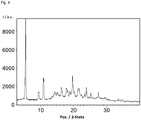
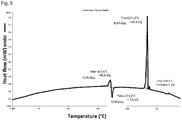
- Form A is characterized by the powder XRPD pattern ( Fig. 4 ) presented in Table 2 and the melting point of 167.6°C determined by the DSC thermal method ( Fig. 5 ).
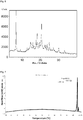
- Form B is characterized by the powder XRPD pattern ( Fig. 6 ) presented in Table 2 and the melting point of 232°C determined by the DSC thermal method ( Fig. 7 ).
- the amorphous form of umeclidinium bromide is characterized by a powder XRPD pattern ( Fig. 8 ) and a DSC record with the glass transition temperature of 81 °C ( Fig. 9 ).
- Form 1 was prepared by reproduction of procedure B from Example 2 of the patent EP1740177B .
- umeclidinium bromide is dissolved, or suspended at an elevated temperature (60 to 70°C) in a suitable amount of water (12 ml/g of the API) and at this temperature it is left to be stirred for 1 to 2 hours. Subsequently, the mixture is left to cool down to the room temperature (20 to 25°C).
- the produced suspension is filtered and washed with water.
- the isolated substance is dried at an elevated temperature (30 to 50°C) in vacuum (10,000 to 30,000 Pa) for at least 16 h.
- Form A is produced by crystallization from a solution of umeclidinium bromide in a mixture of methanol and water in the volume ratio of 1:1 to 2:1.
- the substance is dissolved in methanol under boiling (concentration 15 to 25 ml of MeOH per 1 g of the API), subsequently, a suitable amount of water (7 to 25 ml per 1 g of the API) is added at an elevated temperature (approx. 60°C) and the solution is left to be stirred under boiling for 1 to 2 hours with the possibility of evaporation of a certain amount of the solvent (20 to 50%).
- the mixture is left to cool down to the room temperature (20 to 25°C).
- the thick suspension is then diluted with water, filtered and washed with water.
- the isolated substance is dried at an elevated temperature (30 to 50°C) in vacuum (10,000 to 30,000 Pa) for at least 24 h.
- Form B of umeclidinium bromide was obtained by loading of a sample of form A with a temperature higher than 180°C.
- the amorphous form of umeclidium bromide is obtained by lyophilization of a freeze-dried solution of the substance in a mixture of the solvents water and tert- butanol in the volume ratio of 6:4. The freeze-dried solution is subjected to high vacuum for one to three days.
- the primary optical equipment programmable divergence slits with the irradiated area of the sample of 10 mm, 0.02 rad Soller slits and a 1 ⁇ 4° anti-diffusion slit were used.
- For the setting of the secondary optical equipment an X'Celerator detector with maximum opening of the detection slot, 0.02 rad Soller slits and a 5.0 mm anti-diffusion slit were used.
- the records of the differential scanning calorimetry (DSC) a) for the crystalline form of umeclidinium bromide were measured using a DSC Pyris 1 device made by the company Perkin Elmer.
- the sample charge in a standard Al pot was between 3 mg and the heating rate was 10°C/min.
- the temperature program that was used consists of 1 min of stabilization at the temperature of 0°C and then of heating up to 250°C at the heating rate of 10°C/min.
- As the carrier gas 4.0 N 2 was used at the flow of 20 ml/min.
- thermogravimetric analysis TGA 6 device made by the company Perkin Elmer.
- the sample charge in a corundum pot was about 20 mg and the heating rate was 10°C/min.
- the temperature program that was used consists of 1 minute's stabilization at the temperature of 15°C and then of heating up to 300°C at the heating rate of 10°C/min.
- As the carrier gas 4.0 N 2 was used at the flow of 20 ml/min.
- HPLC liquid chromatography records
- the amount of 188.7 g of umeclidinium bromide of form A was obtained in the yield of 70% with the purity of 99.96%.
- the X-ray powder diffraction pattern is shown in Fig. 4 and the DSC record in Fig. 5 .
- Form A (50 mg) was dried at the atmospheric pressure at 200°C.
- the X-ray powder diffraction pattern is shown in Fig. 6 and the DSC record in Fig. 7 .
Landscapes
- Chemical & Material Sciences (AREA)
- Organic Chemistry (AREA)
- Pharmaceuticals Containing Other Organic And Inorganic Compounds (AREA)
- Nitrogen Condensed Heterocyclic Rings (AREA)
Abstract
Solid forms of umeclidinium bromide, in particular its non-solvated form 1, novel crystalline forms A and B and an amorphous form, their characterization with the use of analytic methods, methods of their preparation and their use for the preparation of highly pure umeclidinium bromide.
Description
- The invention relates to novel solid forms of umeclidinium bromide (I), chemically 1-[2-(benzyloxy)ethyl]-4-(hydroxydiphenylmethyl)-1-azabicyclo[2.2.2]octane bromide. In particular, to its novel crystalline forms, identified as form A and form B, as well as to an amorphous form, and to their characterization by means of analytic methods. The invention further relates to methods of their preparation and their use for the preparation of umeclidinium bromide in the API quality.

- Umeclidinium bromide is indicated as an inhalation anticholinergic drug with an ultra-long-term effect in cooperating patients with the diagnosis of COPD (chronic obstructive pulmonary disease). COPD is defined as a preventable and treatable disease that is characterized by a persistent obstruction of air flow in the bronchi (bronchial obstruction), which usually progresses and is related to an intensified inflammatory response of the airways to harmful particles or gases. The main goal of the treatment of COPD is an improvement of the current control, i.e. elimination of symptoms, improvement of toleration of physical effort, improvement of the health condition and reduction of future risks, i.e. prevention and treatment of exacerbations, prevention of progression of the disease and mortality reduction.
- The structure of umeclidinium bromide, 1-[2-(benzyloxy)ethyl]-4-(hydroxydiphenylmethyl)-1-azabicyklo[2.2.2]octane bromide, is first mentioned in the general patent application
WO2005009362 of 2003 . - Preparation of umeclidinium bromide is first disclosed in the
patent EP 1 740 177B (WO2005104745 ), where two methods (A and B) are mentioned, differing in the final processing and the product yield (method B included in Scheme 1). There, the last steps of the synthesis are described, the product being described by means of EI-MS, 1H NMR and elementary analysis. There is no information concerning the chemical purity or polymorphic form.
- Another preparation method of umeclidinium bromide is disclosed in the patent application
WO 2014027045 , where three forms are also described (identified asforms 1 to 3), prepared using a method that is different from the procedure disclosed in thepatent EP 1 740 177B . - The invention relates to solid forms of umeclidinium bromide, in particular the non-solvated
anhydrous form 1, novel crystalline forms A and B and an amorphous form, their characterization with the use of analytic methods, methods of their preparation and their use for the preparation of highly pure umeclidinium bromide. - It has been found out that reproduction of the procedure of method B from Example 2 of the
patent EP 1 740177B provided the non-solvated anhydrous form of umeclidinium bromide known asform 1 from the patent applicationWO 2014027045 , characterized by the following characteristic reflections in the X-ray powder pattern: 6.7; 13.4; 20.1 and 24,3 ± 0.2° 2-theta, which were measured with the use of CuKα radiation. This form also shows more reflections: 11.5; 14.6; 22.4 and 26.9 ± 0.2° 2-theta. The chemical purity of the sample obtained this way achieved 99.8% according to UPLC. The melting point ofform 1 obtained this way is 237°C as determined by DSC. - Form A of umeclidinium bromide was obtained by crystallization from other solvents of general formula ROH, where R can be a C1 to C4 carbon chain, and crystallization from these solvents in a mixture with water. A mixture of methanol and water is preferably used. The novel form A is characterized by these characteristic reflections in the X-ray powder pattern: 5.4; 10.9; 19.6 and 23,8 ± 0.2° 2-theta, which were measured with the use of CuKα radiation. This form also shows more reflections: 9.5; 16.3; 17.7; 21.6 and 27.5 ± 0.2° 2-theta. The chemical purity of the sample obtained this way achieved 99.9% according to UPLC. The melting point determined by means of DSC is 167.6°C.
- Form B of umeclidinium bromide was obtained by loading of a sample of form A with a temperature higher than 180°C. The novel form B is characterized by these characteristic reflections in the X-ray powder pattern: 6.7; 18.3; 20.6 and 24,9 ± 0.2° 2-theta, which were measured with the use of CuKα radiation. This form also shows more reflections: 14.6; 15.9; 19.2, 23.0 and 23.8 ± 0.2° 2-theta. The melting point determined by means of DSC is 232°C.
- Lyophilization of a freeze-dried solution of umeclidinium bromide provided a so far not described amorphous form, characterized by an X-ray powder pattern characteristic for an amorphous form (included in the Appendix,
Figure 8 ) and the glass transition temperature of 81 °C as determined by DSC (record inFigure 9 ). - The invention relates to novel solid forms of umeclidinium bromide, in particular its non-solvated
form 1, prepared using the procedure of thepatent EP 1 740 177B , novel crystalline forms A and B and an amorphous form, their characterization with the use of analytic methods, methods of their preparation and their use for the preparation of highly pure umeclidinium bromide. -
Form 1 of umeclidinium bromide is characterized by the powder XRPD pattern (Fig. 1 ) presented in Table 1, melting point of 237°C determined by the DSC thermal method (Fig. 2 ) and a TGA record (Fig. 3 ).Tab. 1: XRPD - diffraction peaks corresponding to the non-solvated anhydrous form 1 of umeclidinium bromidePos. [°2θ] d [A = 0.1 nm] Rel. Int. [%] 6.70 13.190 100.0 8.90 9.932 2.0 10.02 8.819 2.0 Pos. [°2θ] d [A = 0.1nm] Rel. Int. [%] 11.45 7.719 5.6 13.39 6.607 15.5 13.70 6.457 8.8 14.55 6.082 5.1 15.29 5.789 4.3 17.31 5.119 2.6 17.76 4.990 3.7 18.66 4.752 2.5 19.84 4.472 13.4 20.14 4.406 16.3 22.39 3.968 6.1 23.03 3.860 5.3 23.60 3.767 2.0 24.26 3.666 6.4 25.40 3.504 1.4 25.91 3.436 2.5 26.94 3.307 5.0 27.64 3.225 4.1 28.32 3.149 4.1 29.25 3.051 1.0 29.57 3.018 0.8 29.97 2.979 0.7 30.77 2.903 3.9 31.84 2.809 1.6 33.33 2.686 0.8 33.84 2.646 0.9 34.62 2.589 2.4 35.06 2.558 1.5 37.03 2.426 1.1 38.11 2.360 1.7 - Form A is characterized by the powder XRPD pattern (
Fig. 4 ) presented in Table 2 and the melting point of 167.6°C determined by the DSC thermal method (Fig. 5 ).Tab. 2: XRPD - diffraction peaks corresponding to form A of umeclidinium bromide Pos. [°2θ] d [A = 0.1 njm] Rel. Int. [%] 5.45 16.209 100.0 9.47 9.333 10.0 10.94 8.079 25.5 13.92 6.355 3.6 14.30 6.187 5.8 15.08 5.869 4.2 16.25 5.449 10.8 17.71 5.005 8.5 18.10 4.898 6.9 18.83 4.709 5.3 19.60 4.525 25.1 20.11 4.411 6.1 21.19 4.189 8.9 21.55 4.121 10.0 22.27 3.988 2.5 23.23 3.827 4.5 23.78 3.738 13.0 24.49 3.631 1.3 25.08 3.547 5.1 27.46 3.246 7.0 29.04 3.073 1.4 29.39 3.036 2.5 33.54 2.670 1.8 34.49 2.598 1.7 - Form B is characterized by the powder XRPD pattern (
Fig. 6 ) presented in Table 2 and the melting point of 232°C determined by the DSC thermal method (Fig. 7 ).Tab. 3: XRPD - diffraction peaks corresponding to form B of umeclidinium bromide Pos. [°2θ] d [Å = 0.1 nm] Rel.Int. [%] 6.66 13.258 100.0 9.08 9.732 6.4 12.33 7.174 2.9 12.77 6.926 4.9 14.61 6.059 9.6 15.91 5.567 12.3 16.48 5.374 5.5 17.62 5.030 17.6 18.27 4.853 31.6 19.19 4.621 10.3 19.79 4.482 12.0 20.60 4.308 45.9 22.32 3.980 7.3 23.04 3.856 9.3 23.79 3.737 11.3 24.87 3.578 16.5 25.81 3.448 3.2 27.00 3.299 8.4 30.04 2.972 13.6 33.23 2.694 6.5 - The amorphous form of umeclidinium bromide is characterized by a powder XRPD pattern (
Fig. 8 ) and a DSC record with the glass transition temperature of 81 °C (Fig. 9 ). -
Form 1 was prepared by reproduction of procedure B from Example 2 of the patentEP1740177B . In a preferred embodiment, umeclidinium bromide is dissolved, or suspended at an elevated temperature (60 to 70°C) in a suitable amount of water (12 ml/g of the API) and at this temperature it is left to be stirred for 1 to 2 hours. Subsequently, the mixture is left to cool down to the room temperature (20 to 25°C). - The produced suspension is filtered and washed with water. The isolated substance is dried at an elevated temperature (30 to 50°C) in vacuum (10,000 to 30,000 Pa) for at least 16 h.
- Form A is produced by crystallization from a solution of umeclidinium bromide in a mixture of methanol and water in the volume ratio of 1:1 to 2:1. In a preferred embodiment, the substance is dissolved in methanol under boiling (concentration 15 to 25 ml of MeOH per 1 g of the API), subsequently, a suitable amount of water (7 to 25 ml per 1 g of the API) is added at an elevated temperature (approx. 60°C) and the solution is left to be stirred under boiling for 1 to 2 hours with the possibility of evaporation of a certain amount of the solvent (20 to 50%). Subsequently, the mixture is left to cool down to the room temperature (20 to 25°C). The thick suspension is then diluted with water, filtered and washed with water. The isolated substance is dried at an elevated temperature (30 to 50°C) in vacuum (10,000 to 30,000 Pa) for at least 24 h.
- Form B of umeclidinium bromide was obtained by loading of a sample of form A with a temperature higher than 180°C.
- The amorphous form of umeclidium bromide is obtained by lyophilization of a freeze-dried solution of the substance in a mixture of the solvents water and tert-butanol in the volume ratio of 6:4. The freeze-dried solution is subjected to high vacuum for one to three days.
-
-
Fig. 1 . XRPD pattern ofform 1 of umeclidinium bromide -
Fig. 2 DSC record ofform 1 of umeclidinium bromide -
Fig. 3 TGA record ofform 1 of umeclidinium bromide -
Fig. 4 XRPD pattern of form A of umeclidinium bromide -
Fig. 5 DSC record of form A of umeclidinium bromide -
Fig. 6 XRPD pattern of form B of umeclidinium bromide -
Fig. 7 DSC record of form B of umeclidinium bromide -
Fig. 8 XRPD pattern of the amorphous form of umeclidinium bromide -
Fig. 9 DSC record of the amorphous form of umeclidinium bromide - Measurement parameters of XRPD: The diffractograms were measured using an X'PERT PRO MPD PANalytical diffractometer, used radiation CuKa (λ=1.542 A), excitation voltage: 45 kV, anode current: 40 mA, measured range: 2 - 40° 2θ, increment: 0.-01° 2θ, the measurement was carried out on a flat powder sample that was applied on a Si plate and covered with Kapton foil. For the setting of the primary optical equipment programmable divergence slits with the irradiated area of the sample of 10 mm, 0.02 rad Soller slits and a ¼° anti-diffusion slit were used. For the setting of the secondary optical equipment an X'Celerator detector with maximum opening of the detection slot, 0.02 rad Soller slits and a 5.0 mm anti-diffusion slit were used.
- The records of the differential scanning calorimetry (DSC) a) for the crystalline form of umeclidinium bromide were measured using a
DSC Pyris 1 device made by the company Perkin Elmer. The sample charge in a standard Al pot was between 3 mg and the heating rate was 10°C/min. The temperature program that was used consists of 1 min of stabilization at the temperature of 0°C and then of heating up to 250°C at the heating rate of 10°C/min. As the carrier gas 4.0 N2 was used at the flow of 20 ml/min. - b) for the amorphous form of umeclidinium bromide were measured with the Discovery DSC device made by TA Instruments. The sample charge in a standard Al pot (40 µL) was 4-5 mg and the heating rate was 5°C/min. The temperature program that was used consists of 5 min of stabilization at the temperature of 0°C and then of heating up to 300°C at the heating rate of 5°C/min (Amplitude = 0.8°C and Period = 60 s). As the carrier gas 5.0 N2 was used at the flow of 50 ml/min.
- The records of the thermogravimetric analysis (TGA) were measured using a TGA 6 device made by the company Perkin Elmer. The sample charge in a corundum pot was about 20 mg and the heating rate was 10°C/min. The temperature program that was used consists of 1 minute's stabilization at the temperature of 15°C and then of heating up to 300°C at the heating rate of 10°C/min. As the carrier gas 4.0 N2 was used at the flow of 20 ml/min.
- The liquid chromatography records (HPLC) were measured with an Acquity device made by Waters with a PDA detector.
Measurement parameters of HPLC:mobile phase: A: 2 ml of perchloric acid 70% are dissolved in 1 l of MQ water. B: acetonitrile elution: gradient Time (min.) Flow (ml/min.) % A % B 0 0.8 75 25 1 0.8 75 25 9 0.8 30 70 10 0.8 30 70 11 0.8 75 25 12 0.8 75 25 column: XSelect CSH Phenyl-Hexyl 2.5 µm, 4.6 x 100 mm sample solvent: Methanol : Water (50:50, vol./vol.) detection: spectrophotometric 211 nm injected amount: 1 µl autosampler temperature: 18°C column temperature: 35°C analysis time: 12 min sample concentration: 1 mg/ml - 1-[2-(Benzyloxy)ethyl]-4-(hydroxydiphenylmethyl)-1-azabicyclo[2.2.2]octane bromide (66.4 g, 0.13 mol, UPLC purity 99.67%) is suspended in 800 ml of water, the mixture is heated up to 55°C and stirred for 55 minutes. Subsequently, it is left to cool down to 20°C and filtered through frit. The filtered product is washed with 150 ml of water and dried in a vacuum drier at 45°C for 16 hours. The amount of 61.4 g of umeclidinium bromide of
form 1 was obtained in the yield of 92% with the purity of 99.78%. The X-ray powder diffraction pattern is shown in the Annex inFig. 1 , DSC record inFig. 2 and TGA record inFig. 3 . - 1-[2-(Benzyloxy)ethyl]-4-(hydroxydiphenylmethyl)-1-azabicyclo[2.2.2]octane bromide (66.6 g, 0.13 mol, UPLC purity 99.67%) is suspended in 800 ml of water, the mixture is heated up to 65°C and stirred for 1.5 hours. Subsequently, the weak suspension is left to cool down to 20°C and filtered through frit. The filtered product is washed with 150 ml of water and dried in a vacuum drier at 45°C for 18 hours. The amount of 55.7 g of umeclidinium bromide of
form 1 was obtained in the yield of 84% with the purity of 99.81%. The X-ray powder diffraction pattern was equal to the X-ray powder diffraction pattern of Example 1. - 1-[2-(Benzyloxy)ethyl]-4-(hydroxydiphenylmethyl)-1-azabicyclo[2.2.2]octane bromide (327 mg, 0.643 mmol, UPLC purity 98.89%) is dissolved in 8 ml of methanol at 60°C and 4.3 ml of water are slowly added by dripping to the stirred solution and the solution is left to be refluxed for 1.5 hours. Then, the mixture is cooled down to the room temperature (20 to 25°C). The obtained thick suspension is diluted with water (3 to 5 ml) and filtered through frit. The filtered product is washed with 5 ml of water and dried in a vacuum drier at 45°C for 24 hours, 13,600 Pa. The amount of 188.7 g of umeclidinium bromide of form A was obtained in the yield of 70% with the purity of 99.96%. The X-ray powder diffraction pattern is shown in
Fig. 4 and the DSC record inFig. 5 . - Form A (50 mg) was dried at the atmospheric pressure at 200°C. The X-ray powder diffraction pattern is shown in
Fig. 6 and the DSC record inFig. 7 . - 1-[2-(benzyloxy)ethyl]-4-(hydroxydiphenylmethyl)-1-azabicyclo[2.2.2]octane bromide (100 mg, 0.197 mmol, purity UPLC 98.89%) is dissolved at the temperature of 25°C in a water: tert-butanol mixture in the volume ratio of 6:4 (total 70 ml). The clear solution is freeze-dried (a bath with a mixture of dry ice and ethanol, -70°C) and lyophilized (vacuum: 1.8 Pa for 72 h). An amorphous form of umeclidinium bromide was obtained (100 mg). This amorphous form was confirmed with DSC and X-ray powder diffraction. The X-ray powder diffraction pattern is shown in
Fig. 8 and the DSC record inFig. 9 .
Claims (15)
- Form A of umeclidinium bromide, exhibiting the following characteristic reflections in the X-ray powder pattern, with the use of CuKa radiation: 5.4; 10.9; 19.6 and 23.8 ± 0.2° 2-theta.
- Form A according to claim 1, exhibiting the following characteristic reflections in the X-ray powder pattern, with the use of CuKa radiation: 9.5; 16.3; 17.7; 21.6 and 27.5 ± 0.2° 2-theta.
- Form A according to claims 1 or 2, having the melting point of 167.6°C as determined by means of DSC.
- Form A according to claims 1 to 3, obtainable by crystallization from a mixture of an alcohol of the general formula ROH, where R is a C1-C4 carbon chain, and water, preferably from a methanol and water mixture.
- Form A according to claim 4, wherein the crystallization mixture contains methanol and water in the volume ratio of 1:1 to 2:1.
- Form B of umeclidinium bromide, exhibiting the following characteristic reflections in the X-ray powder pattern, with the use of CuKa radiation: 6.7; 18.3; 20.6 and 24.9 ± 0.2° 2-theta.
- Form B according to claim 6, exhibiting the following characteristic reflections in the X-ray powder pattern, with the use of CuKa radiation: 14.6; 15.9; 19.2; 23.0 and 23.8 ± 0.2° 2-theta.
- Form B according to claims 6 or 7, having the melting point of 232°C as determined by means of DSC.
- Form B of umeclidinium bromide, which is obtained from form A as defined in any one of claims 1 to 5 at a temperature over 180°C.
- Form B according to claims 6 to 8, obtainable from form A by drying at atmospheric pressure at a temperature of 200°C.
- An amorphous form of umeclidinium bromide.
- The amorphous form of umeclidinium bromide according to claim 11, exhibiting a characteristic amorphous halo in the X-ray powder pattern with the use of CuKa radiation.
- The amorphous form according to claims 11 or 12, exhibiting the glass transition temperature of 81 °C as determined with the use of DSC.
- The amorphous form according to claims 11 to 13, obtainable by dissolution of umeclidinium bromide in a water and tert-butanol mixture, freeze-drying and subsequent lyophilization.
- The amorphous form according to claim 14, wherein the volume ratio of water and tert-butanol is 6:4.
Applications Claiming Priority (3)
| Application Number | Priority Date | Filing Date | Title |
|---|---|---|---|
| CZ2016-33012U CZ30430U1 (en) | 2016-05-27 | 2016-05-27 | The amorphous form of umeclidinium bromide |
| CZ2016-32417U CZ30420U1 (en) | 2016-05-27 | 2016-05-27 | A-Form of umeclidinium bromide |
| CZ2016-33011U CZ30429U1 (en) | 2016-05-27 | 2016-05-27 | B-Form of umeclidinium bromide |
Publications (1)
| Publication Number | Publication Date |
|---|---|
| EP3248970A1 true EP3248970A1 (en) | 2017-11-29 |
Family
ID=58772682
Family Applications (1)
| Application Number | Title | Priority Date | Filing Date |
|---|---|---|---|
| EP17020225.3A Withdrawn EP3248970A1 (en) | 2016-05-27 | 2017-05-23 | Forms of umeclidinium bromide |
Country Status (1)
| Country | Link |
|---|---|
| EP (1) | EP3248970A1 (en) |
Cited By (2)
| Publication number | Priority date | Publication date | Assignee | Title |
|---|---|---|---|---|
| CN109956938A (en) * | 2017-12-26 | 2019-07-02 | 天津金耀集团有限公司 | Intermediate crystal form of umeclidinium bromide and preparation method thereof and method for preparing umeclidinium bromide with the intermediate |
| WO2020254791A1 (en) | 2019-06-17 | 2020-12-24 | Hovione Scientia Limited | Continuous process for the preparation of anticholinergic drugs |
Citations (3)
| Publication number | Priority date | Publication date | Assignee | Title |
|---|---|---|---|---|
| WO2005009362A2 (en) | 2003-07-17 | 2005-02-03 | Glaxo Group Limited | Muscarinic acetylcholine receptor antagonists |
| WO2005104745A2 (en) | 2004-04-27 | 2005-11-10 | Glaxo Group Limited | Muscarinic acetylcholine receptor antagonists |
| WO2014027045A1 (en) | 2012-08-15 | 2014-02-20 | Glaxo Group Limited | Chemical process |
-
2017
- 2017-05-23 EP EP17020225.3A patent/EP3248970A1/en not_active Withdrawn
Patent Citations (4)
| Publication number | Priority date | Publication date | Assignee | Title |
|---|---|---|---|---|
| WO2005009362A2 (en) | 2003-07-17 | 2005-02-03 | Glaxo Group Limited | Muscarinic acetylcholine receptor antagonists |
| WO2005104745A2 (en) | 2004-04-27 | 2005-11-10 | Glaxo Group Limited | Muscarinic acetylcholine receptor antagonists |
| EP1740177B1 (en) | 2004-04-27 | 2012-08-08 | Glaxo Group Limited | Muscarinic acetylcholine receptor antagonists |
| WO2014027045A1 (en) | 2012-08-15 | 2014-02-20 | Glaxo Group Limited | Chemical process |
Non-Patent Citations (2)
| Title |
|---|
| CAIRA M R: "CRYSTALLINE POLYMORPHISM OF ORGANIC COMPOUNDS", TOPICS IN CURRENT CHEMISTRY, SPRINGER, BERLIN, DE, vol. 198, 1 January 1998 (1998-01-01), pages 163 - 208, XP001156954, ISSN: 0340-1022, DOI: 10.1007/3-540-69178-2_5 * |
| DRAMANE I LAINEÌ ET AL: "Discovery of Novel 1-Azoniabicyclo[2.2.2]octane Muscarinic Acetylcholine Receptor Antagonists", JOURNAL OF MEDICINAL CHEMISTRY, AMERICAN CHEMICAL SOCIETY, vol. 58, no. 8, 23 April 2009 (2009-04-23), pages 2493 - 2505, XP002691510, ISSN: 0022-2623, [retrieved on 20090324], DOI: 10.1021/JM801601V * |
Cited By (2)
| Publication number | Priority date | Publication date | Assignee | Title |
|---|---|---|---|---|
| CN109956938A (en) * | 2017-12-26 | 2019-07-02 | 天津金耀集团有限公司 | Intermediate crystal form of umeclidinium bromide and preparation method thereof and method for preparing umeclidinium bromide with the intermediate |
| WO2020254791A1 (en) | 2019-06-17 | 2020-12-24 | Hovione Scientia Limited | Continuous process for the preparation of anticholinergic drugs |
Similar Documents
| Publication | Publication Date | Title |
|---|---|---|
| US12291517B2 (en) | Crystalline form of 6-(cyclopropanecarboxamido)-4-((2-methoxy-3-(1-methyl-1H-1,2,4-triazol-3-yl)phenyl)amino)-n-(methyl-D3) pyridazine-3-carboxamide | |
| US12570637B2 (en) | Crystalline salt forms 6-(cyclopropanecarboxamido)-4-((2-methoxy-3-(1-methyl-1H-1,2,4-triazol-3-yl)phenyl)amino)-n-(methyld3) pyridazine-3-carboxamide | |
| EP3205653B1 (en) | Crystal form of bisulfate of jak inhibitor and preparation method therefor | |
| WO2017008773A1 (en) | Crystalline forms of obeticholic acid | |
| EP4361164A1 (en) | Crystal forms of glucosamine derivative, and preparation method therefor and use thereof | |
| WO2017125097A1 (en) | Crystalline forms of (3r)-3-cyclopentyl-3-[4-(7h-pyrrolo[2,3-d]pyrimidin-4- yl)pyrazol-l-yl]propanenitrile salts and preparation thereof | |
| JP2023503833A (en) | Crystalline form of tafamidis, its preparation method and its use | |
| KR20120046069A (en) | Hydrate of 1-((2s)-2-amino-4-(2,4-bis(trifluoromethyl)-5,8-dihydropyrido(3,4-d)pyrimidin-7(6h)-yl)-4-oxobutyl)-5,5-difluoropiperidin-2-one tartrate | |
| EP4624474A1 (en) | Pharmaceutically acceptable salt of nitrogen-containing heterocyclic compound, crystal form thereof, and preparation method therefor | |
| EP3322709B1 (en) | Crystalline forms of (3r)-3-cyclopentyl-3-[4-(7h-pyrrolo[2,3-d]pyrimidin-4-yl)pyrazol-1-yl]propanenitrile salts and preparation thereof | |
| WO2016131431A1 (en) | Solid forms of empagliflozin | |
| JP2015522037A (en) | Solid form of Vemurafenib choline salt | |
| EP3248970A1 (en) | Forms of umeclidinium bromide | |
| EP4011867B1 (en) | Crystal forms c and e of pyrazin-2(1h)-one compound and preparation method therefor | |
| EP3321267A1 (en) | Crystalline forms of 2-[1-ethylsulfonyl-3-[7h-pyrrolo[2,3-d]pyrimidin-4-yl)pyrazol-1-yl]azetidin-3-yl]acetonitrile salts and preparation thereof | |
| EP3744712A1 (en) | Crystalline forms of mesaconine and preparation method therefor | |
| US11299462B2 (en) | Crystal form of oxopicolinamide derivative and preparation method therefor | |
| EP4538277A1 (en) | Pharmaceutically acceptable salt of benzo[c]chroman compound and polymorphic form and use of pharmaceutically acceptable salt | |
| EP3202772B1 (en) | Crystal of a complex of l-proline/sodium-glucose cotransporter 2 inhibitor | |
| IL301471A (en) | Aldosterone synthase inhibitor | |
| CZ27764U1 (en) | Umeclidinium bromide methanolic solvate | |
| EP4596538A1 (en) | Pharmaceutically acceptable salt and crystal form of tetrahydronaphthalene derivative, and preparation method | |
| AU2015247489B2 (en) | Polymorphic forms and co-crystals of a c-Met inhibitor | |
| EP3960742A1 (en) | Crystals of alkynyl-containing compound, salt and solvate thereof, preparation method, and applications | |
| EP2251318A1 (en) | Method for preparing fesoterodine fumarate |
Legal Events
| Date | Code | Title | Description |
|---|---|---|---|
| PUAI | Public reference made under article 153(3) epc to a published international application that has entered the european phase |
Free format text: ORIGINAL CODE: 0009012 |
|
| AK | Designated contracting states |
Kind code of ref document: A1 Designated state(s): AL AT BE BG CH CY CZ DE DK EE ES FI FR GB GR HR HU IE IS IT LI LT LU LV MC MK MT NL NO PL PT RO RS SE SI SK SM TR |
|
| AX | Request for extension of the european patent |
Extension state: BA ME |
|
| STAA | Information on the status of an ep patent application or granted ep patent |
Free format text: STATUS: THE APPLICATION IS DEEMED TO BE WITHDRAWN |
|
| 18D | Application deemed to be withdrawn |
Effective date: 20180530 |