EP3248963B1 - Pyrrole sulfonyl derivative, and preparation method and medical use thereof - Google Patents
Pyrrole sulfonyl derivative, and preparation method and medical use thereof Download PDFInfo
- Publication number
- EP3248963B1 EP3248963B1 EP15879703.5A EP15879703A EP3248963B1 EP 3248963 B1 EP3248963 B1 EP 3248963B1 EP 15879703 A EP15879703 A EP 15879703A EP 3248963 B1 EP3248963 B1 EP 3248963B1
- Authority
- EP
- European Patent Office
- Prior art keywords
- alkyl
- compound
- exp
- sulfonyl
- acid
- Prior art date
- Legal status (The legal status is an assumption and is not a legal conclusion. Google has not performed a legal analysis and makes no representation as to the accuracy of the status listed.)
- Active
Links
Classifications
-
- C—CHEMISTRY; METALLURGY
- C07—ORGANIC CHEMISTRY
- C07D—HETEROCYCLIC COMPOUNDS
- C07D207/00—Heterocyclic compounds containing five-membered rings not condensed with other rings, with one nitrogen atom as the only ring hetero atom
- C07D207/46—Heterocyclic compounds containing five-membered rings not condensed with other rings, with one nitrogen atom as the only ring hetero atom with hetero atoms directly attached to the ring nitrogen atom
- C07D207/48—Sulfur atoms
-
- A—HUMAN NECESSITIES
- A61—MEDICAL OR VETERINARY SCIENCE; HYGIENE
- A61P—SPECIFIC THERAPEUTIC ACTIVITY OF CHEMICAL COMPOUNDS OR MEDICINAL PREPARATIONS
- A61P1/00—Drugs for disorders of the alimentary tract or the digestive system
-
- A—HUMAN NECESSITIES
- A61—MEDICAL OR VETERINARY SCIENCE; HYGIENE
- A61P—SPECIFIC THERAPEUTIC ACTIVITY OF CHEMICAL COMPOUNDS OR MEDICINAL PREPARATIONS
- A61P1/00—Drugs for disorders of the alimentary tract or the digestive system
- A61P1/04—Drugs for disorders of the alimentary tract or the digestive system for ulcers, gastritis or reflux esophagitis, e.g. antacids, inhibitors of acid secretion, mucosal protectants
-
- A—HUMAN NECESSITIES
- A61—MEDICAL OR VETERINARY SCIENCE; HYGIENE
- A61P—SPECIFIC THERAPEUTIC ACTIVITY OF CHEMICAL COMPOUNDS OR MEDICINAL PREPARATIONS
- A61P1/00—Drugs for disorders of the alimentary tract or the digestive system
- A61P1/14—Prodigestives, e.g. acids, enzymes, appetite stimulants, antidyspeptics, tonics, antiflatulents
-
- A—HUMAN NECESSITIES
- A61—MEDICAL OR VETERINARY SCIENCE; HYGIENE
- A61P—SPECIFIC THERAPEUTIC ACTIVITY OF CHEMICAL COMPOUNDS OR MEDICINAL PREPARATIONS
- A61P31/00—Antiinfectives, i.e. antibiotics, antiseptics, chemotherapeutics
- A61P31/04—Antibacterial agents
-
- A—HUMAN NECESSITIES
- A61—MEDICAL OR VETERINARY SCIENCE; HYGIENE
- A61P—SPECIFIC THERAPEUTIC ACTIVITY OF CHEMICAL COMPOUNDS OR MEDICINAL PREPARATIONS
- A61P35/00—Antineoplastic agents
-
- A—HUMAN NECESSITIES
- A61—MEDICAL OR VETERINARY SCIENCE; HYGIENE
- A61P—SPECIFIC THERAPEUTIC ACTIVITY OF CHEMICAL COMPOUNDS OR MEDICINAL PREPARATIONS
- A61P43/00—Drugs for specific purposes, not provided for in groups A61P1/00-A61P41/00
-
- A—HUMAN NECESSITIES
- A61—MEDICAL OR VETERINARY SCIENCE; HYGIENE
- A61P—SPECIFIC THERAPEUTIC ACTIVITY OF CHEMICAL COMPOUNDS OR MEDICINAL PREPARATIONS
- A61P7/00—Drugs for disorders of the blood or the extracellular fluid
- A61P7/04—Antihaemorrhagics; Procoagulants; Haemostatic agents; Antifibrinolytic agents
-
- C—CHEMISTRY; METALLURGY
- C07—ORGANIC CHEMISTRY
- C07D—HETEROCYCLIC COMPOUNDS
- C07D401/00—Heterocyclic compounds containing two or more hetero rings, having nitrogen atoms as the only ring hetero atoms, at least one ring being a six-membered ring with only one nitrogen atom
- C07D401/02—Heterocyclic compounds containing two or more hetero rings, having nitrogen atoms as the only ring hetero atoms, at least one ring being a six-membered ring with only one nitrogen atom containing two hetero rings
- C07D401/12—Heterocyclic compounds containing two or more hetero rings, having nitrogen atoms as the only ring hetero atoms, at least one ring being a six-membered ring with only one nitrogen atom containing two hetero rings linked by a chain containing hetero atoms as chain links
-
- C—CHEMISTRY; METALLURGY
- C07—ORGANIC CHEMISTRY
- C07D—HETEROCYCLIC COMPOUNDS
- C07D405/00—Heterocyclic compounds containing both one or more hetero rings having oxygen atoms as the only ring hetero atoms, and one or more rings having nitrogen as the only ring hetero atom
- C07D405/02—Heterocyclic compounds containing both one or more hetero rings having oxygen atoms as the only ring hetero atoms, and one or more rings having nitrogen as the only ring hetero atom containing two hetero rings
- C07D405/04—Heterocyclic compounds containing both one or more hetero rings having oxygen atoms as the only ring hetero atoms, and one or more rings having nitrogen as the only ring hetero atom containing two hetero rings directly linked by a ring-member-to-ring-member bond
-
- C—CHEMISTRY; METALLURGY
- C07—ORGANIC CHEMISTRY
- C07D—HETEROCYCLIC COMPOUNDS
- C07D413/00—Heterocyclic compounds containing two or more hetero rings, at least one ring having nitrogen and oxygen atoms as the only ring hetero atoms
- C07D413/02—Heterocyclic compounds containing two or more hetero rings, at least one ring having nitrogen and oxygen atoms as the only ring hetero atoms containing two hetero rings
- C07D413/12—Heterocyclic compounds containing two or more hetero rings, at least one ring having nitrogen and oxygen atoms as the only ring hetero atoms containing two hetero rings linked by a chain containing hetero atoms as chain links
-
- A—HUMAN NECESSITIES
- A61—MEDICAL OR VETERINARY SCIENCE; HYGIENE
- A61K—PREPARATIONS FOR MEDICAL, DENTAL OR TOILETRY PURPOSES
- A61K31/00—Medicinal preparations containing organic active ingredients
- A61K31/33—Heterocyclic compounds
- A61K31/395—Heterocyclic compounds having nitrogen as a ring hetero atom, e.g. guanethidine or rifamycins
- A61K31/40—Heterocyclic compounds having nitrogen as a ring hetero atom, e.g. guanethidine or rifamycins having five-membered rings with one nitrogen as the only ring hetero atom, e.g. sulpiride, succinimide, tolmetin, buflomedil
- A61K31/402—1-aryl substituted, e.g. piretanide
-
- A—HUMAN NECESSITIES
- A61—MEDICAL OR VETERINARY SCIENCE; HYGIENE
- A61K—PREPARATIONS FOR MEDICAL, DENTAL OR TOILETRY PURPOSES
- A61K31/00—Medicinal preparations containing organic active ingredients
- A61K31/33—Heterocyclic compounds
- A61K31/395—Heterocyclic compounds having nitrogen as a ring hetero atom, e.g. guanethidine or rifamycins
- A61K31/40—Heterocyclic compounds having nitrogen as a ring hetero atom, e.g. guanethidine or rifamycins having five-membered rings with one nitrogen as the only ring hetero atom, e.g. sulpiride, succinimide, tolmetin, buflomedil
- A61K31/4025—Heterocyclic compounds having nitrogen as a ring hetero atom, e.g. guanethidine or rifamycins having five-membered rings with one nitrogen as the only ring hetero atom, e.g. sulpiride, succinimide, tolmetin, buflomedil not condensed and containing further heterocyclic rings, e.g. cromakalim
-
- A—HUMAN NECESSITIES
- A61—MEDICAL OR VETERINARY SCIENCE; HYGIENE
- A61K—PREPARATIONS FOR MEDICAL, DENTAL OR TOILETRY PURPOSES
- A61K31/00—Medicinal preparations containing organic active ingredients
- A61K31/33—Heterocyclic compounds
- A61K31/395—Heterocyclic compounds having nitrogen as a ring hetero atom, e.g. guanethidine or rifamycins
- A61K31/40—Heterocyclic compounds having nitrogen as a ring hetero atom, e.g. guanethidine or rifamycins having five-membered rings with one nitrogen as the only ring hetero atom, e.g. sulpiride, succinimide, tolmetin, buflomedil
- A61K31/403—Heterocyclic compounds having nitrogen as a ring hetero atom, e.g. guanethidine or rifamycins having five-membered rings with one nitrogen as the only ring hetero atom, e.g. sulpiride, succinimide, tolmetin, buflomedil condensed with carbocyclic rings, e.g. carbazole
- A61K31/404—Indoles, e.g. pindolol
-
- A—HUMAN NECESSITIES
- A61—MEDICAL OR VETERINARY SCIENCE; HYGIENE
- A61K—PREPARATIONS FOR MEDICAL, DENTAL OR TOILETRY PURPOSES
- A61K31/00—Medicinal preparations containing organic active ingredients
- A61K31/33—Heterocyclic compounds
- A61K31/395—Heterocyclic compounds having nitrogen as a ring hetero atom, e.g. guanethidine or rifamycins
- A61K31/435—Heterocyclic compounds having nitrogen as a ring hetero atom, e.g. guanethidine or rifamycins having six-membered rings with one nitrogen as the only ring hetero atom
- A61K31/44—Non condensed pyridines; Hydrogenated derivatives thereof
- A61K31/445—Non condensed piperidines, e.g. piperocaine
- A61K31/4523—Non condensed piperidines, e.g. piperocaine containing further heterocyclic ring systems
- A61K31/454—Non condensed piperidines, e.g. piperocaine containing further heterocyclic ring systems containing a five-membered ring with nitrogen as a ring hetero atom, e.g. pimozide, domperidone
-
- C—CHEMISTRY; METALLURGY
- C07—ORGANIC CHEMISTRY
- C07D—HETEROCYCLIC COMPOUNDS
- C07D403/00—Heterocyclic compounds containing two or more hetero rings, having nitrogen atoms as the only ring hetero atoms, not provided for by group C07D401/00
- C07D403/02—Heterocyclic compounds containing two or more hetero rings, having nitrogen atoms as the only ring hetero atoms, not provided for by group C07D401/00 containing two hetero rings
- C07D403/04—Heterocyclic compounds containing two or more hetero rings, having nitrogen atoms as the only ring hetero atoms, not provided for by group C07D401/00 containing two hetero rings directly linked by a ring-member-to-ring-member bond
Definitions
- the Invention relates to a new pyrrolesulfonyl derivative and its preparation methods, a pharmaceutical composition comprising the derivative and its uses as therapeutic agents, in particular as a gastric acid secretion inhibitor and as potassium-competitive acid blockers (P-CABs).
- P-CABs potassium-competitive acid blockers
- the proton pump inhibitors represented by omeprazole, have been widely used in clinical applications for treating such diseases as peptic ulcer, reflux esophagitis and Zollinger-Ellison syndrome (ZES) since 1988. It is found from long-term clinical applications that existing proton pump inhibitors have limitations in pharmacokinetics and pharmacodynamics, such as the effect of administration time on efficacy of medicine, the slow effect of nocturnal acid breakthrough, the instability under acidic condition (more likely to be enteric-coated preparation) and the dependence on enzyme CYP450 (resulting in significant individual differences), etc.
- P-CABs Potassium-Competitive Acid Blockers
- P-CABs may restrain K + in enzyme H + /K + -ATP competitively through a direct and reversible process.
- P-CABs are characterized by lipotropy, alkalescence, high dissociation constant and stability under low pH condition.
- P-CABs may combine with enzyme H + /K + -ATP in an ionized form, preventing H + and acid secretion being delivered into gastral cavity and increasing the pH value in the stomach rapidly. It is found from animal experiments and clinical studies that, P-CABs take effects rapidly and can achieve maximum therapeutic effect in 1h; the blood concentration and the oral administration dosage are linearly dependent, thus the optimum acid suppression effect can be easily reached.
- WO 2014/075575 discloses substituted pyrroles which are potassium-competitive active blockers (P-CABs) for use in the treatment of gastrointestinal and related disorders.
- P-CABs potassium-competitive active blockers
- the Application provides a gastric acid secretion inhibitor with a structure as shown in Formula (I); the application method of which is described as follows:
- the Application provides a compound with a structure as shown in Formula (I), or its tautomer, mesomer, racemate, enantiomer, diastereoisomer, or its mixture form or pharmaceutically acceptable salt:
- said compound is selected from:
- the Invention further relates to a pharmaceutical composition; said pharmaceutical composition contains an effective dose of the compound according toany of Claims 1-3, or its tautomer, mesomer, racemate, enantiomer, diastereoisomer, or its mixture form or pharmaceutically acceptable salt and acceptable carriers, excipients, or thinner for medicine.
- the pharmaceutical composition can be used as a gastric acid secretion inhibitor.
- the Invention relates to a method for inhibiting gastric acid secretion; the method comprises an effective dose of the compound as shown in Formula (I) or its tautomer, mesomer, racemate, enantiomer, diastereoisomer, or its mixture form or pharmaceutically acceptable salt, or the pharmaceutical composition containing the compound is administered to the patient who needs treatment.
- the Invention relates to the usage of the compound as shown in Formula (I) or its tautomer, mesomer, racemate, enantiomer, diastereoisomer, or its mixture form or pharmaceutically acceptable salt, or the pharmaceutical composition containing the compound in preparing inhibitor H + /K + -adenosine triphosphatase (H + /K + -ATPase).
- the Invention relates to the usage of the compound as shown in Formula (I) or its tautomer, mesomer, racemate, enantiomer, diastereoisomer, or its mixture form or pharmaceutically acceptable salt, or the pharmaceutical composition containing the compound in preparing potassium-competitive acid blockers (P-CABs).
- P-CABs potassium-competitive acid blockers
- the pharmaceutical composition according to the present Invention can be used in the treatment or prevention of peptic ulcer peptic ulcer, Zollinger-Ellison syndrome, gastritis, erosive esophagitis, reflux esophagitis, symptomatic gastroesophageal reflux disease, Barrett esophagitis, functional dyspepsia, helicobacter pylori infection, gastric cancer, gastric malt lymphoma, anabrosis caused by non-steroidal anti-inflammatory drugs (NSAIDs), or hyperacidity or anabrosis due to postoperative stress.
- NSAIDs non-steroidal anti-inflammatory drugs
- the Invention provides the usage of the medicine for treating or preventing peptic ulcer, Zollinger-Ellison syndrome, gastritis, erosive esophagitis, reflux esophagitis, symptomatic gastroesophageal reflux disease, Barrett esophagitis, functional dyspepsia, helicobacter pylori infection, gastric cancer, gastric malt lymphoma, anabrosis caused by non-steroidal anti-inflammatory drugs (NSAIDs), or hyperacidity or anabrosis due to postoperative stress; or the method for preparing the medicine for inhibiting gastrointestinal bleeding caused by peptic ulcer, acute stress ulcer, hemorrhagic gastritis or invasive stress; wherein, peptic ulcer is selected from gastric ulcer, duodenal ulcer and marginal ulcer; said symptomatic gastroesophageal reflux disease is selected from nonerosive reflux disease, and gastroesophageal reflux disease without oesophagitis.
- Alkyl refers to saturated aliphatic hydrocarbon group, comprising the linear chain or branched chain group with 1-20 carbon atoms, preferably the medium sized alkyl with 1-6 carbon atoms, such as methyl, ethyl, propyl, 2-propyl, n-butyl, isobutyl, tert-butyl and amyl. and more preferably the lower alkyl with 1-4 carbon atoms, such as methyl, ethyl, propyl, 2-propyl, n-butyl, isobutyl and tert-butyl.
- Alkyl can be either substituted or un-substituted; when substituted, the preferred groups are halogen, C 2 -C 6 alkenyl, C 6 -C 10 aryl, C 5 .C 10 heteroaryl, halogenated C 1 -C 6 alkyl, 4 - 8-element heteroalkyl, hydroxyl, C 1 -C 6 alkoxy, and C 6 -C 10 aryloxy.
- Hetero-naphthenic group refers to monocyclic group or condensed ring group; there are 5-9 annular atoms in the ring, wherein, one or two annular atoms are heteroatoms selected from N, O and S(O) p (wherein, p is an integer from 0-2) and the rest annular atoms are C. These rings can have one or more double bonds, but no ⁇ electronic system that is fully conjugated.
- the non-restrictive example of the un-substituted hetero-alcyl comprises pyrrolidinyl, piperidine (1-position only), piperazine (1-position only), morpholine substituted group, thiomorpholine substituted group, homopiperazine (1-position only), etc.
- Heteroalkyl can be either substituted or un-substituted; when substituted, the substituent is preferably one or more; more preferably one, two or three and further more preferably one or two; said substituent is selected from hydrogen, hydroxyl, sulfydryl, oxo, lower alkyl, lower alkoxy, lower naphthenic base, lower hetero-alcyl, lower halogenated alkoxy, alkyl sulphanyl, halogen, lower halogenated alkyl, lower hydroxyalkyl, lower naphthenic base alkylidene, lower hetero-alcylalkylidene, aryl, ceteroary, alkoxy carbonyl, amino, alkyl amino, alkyl sulfonyl, aryl sulfonyl, alkyl amino sulfonyl, aryl amino sulfonyl, alkyl sulfonyl amino, aryl sulfony
- miscellaneous alicyclic base comprises but not limited to morpholinyl, piperazinyl, piperidyl, azacyclo-butyl, pyrrolidyl, hexahydro-aza-tropylium group, oxacyclo-butyl, tetrahydrofuranyl, tetrahydrothiophenyl, oxazolidinyl, thiazolidinyl, isoxazolidinyl, tetrahydropyranyl, sulfomorpholinyl, quinuclidinyl and imidazolinyl; each group is as previously mentioned; the example can be dicyclic, such as 3,8-biaza-dicyclic [3.2.1] octane, 2,5-biaza-dicyclic [2.2.2] octane or octahydro-pyrazine [2,1-c] [1,4] oxazine; where
- the representative example comprises but not limited to methoxyl, ethyoxyl, propoxy, butoxy, cyclopropoxy, cyclobutoxy, cyclopentyloxy and cyclohexyloxy, etc.
- Alkyl sulfonyl represents -S(O 2 )-alkyl.
- Alkyl amino represents -NH-alkyl.
- Alkyl acyl represents R is lower alkyl.
- Halogen represents fluorine, chlorine, bromine or iodine; fluorine or chlorine is preferred.
- substituted by one or more groups refers to that one, two, three or four hydrogen atoms in specific atom or group are substituted by the same or different group selected from the groups in a specified scope.
- the “pharmaceutically acceptable salt” refers to the salts that keep the bio-availabilities and properties of the parent compound. Such salts comprise:
- the "pharmaceutical composition” refers to the mixture of one or more of the compounds or its pharmaceutically acceptable salt, solvate, aquo-complex or prodrug and other chemical components as the pharmaceutically acceptable carriers.
- the pharmaceutical composition is to facilitate the process of drug delivery to animals.
- the “pharmaceutical carrier” refers to the inactive ingredients in the pharmaceutical composition that neither cause obvious irritating effect to the organism, nor interferes the bioactivities and properties given to the compound, which comprise but not limited to calcium carbonate, calcium phosphate, various saccharides(such as lactose and mannitol), starch, cyclodextrin, magnesium stearate, cellulose, magnesium carbonate, acrylic polymers or methacrylate polymers, gel, water, polyethylene glycol, propylene glycol, ethylene glycol, castor oil or hydrogenated castor oil or polyethoxy hydrogenated castor oil, sesame oil, corn oil and peanut oil, etc.
- composition in addition to the pharmaceutically acceptable carriers, it may also comprise adjuvants commonly used in pharmacy, such as antibacterial agent, antifungal agent, antimicrobial agent, quality preservation agent, color matching agent, solubilizing agent, thickening agent, surface active agent, complexing agent, protein, amino acid, fat, saccharides, vitamin, mineral substance, microelement, sweetening agent, pigment, essence or their combinations.
- adjuvants commonly used in pharmacy such as antibacterial agent, antifungal agent, antimicrobial agent, quality preservation agent, color matching agent, solubilizing agent, thickening agent, surface active agent, complexing agent, protein, amino acid, fat, saccharides, vitamin, mineral substance, microelement, sweetening agent, pigment, essence or their combinations.
- Compound IC 50 is calculated through the inhibition ratios at different concentrations.
- EXP 10 EXP 11 EXP 12 EXP 14 ++ +++ +++ ++ +++ means IC 50 ⁇ 100nM; ++ means a scope of 0.1-1 ⁇ M; + means a scope of 1-5 ⁇ M
- Reagent Extracellular fluid mM
- Intracellular fluid mM
- Chloral hydrate provided by Sinopharm Chemical Reagent Co., Ltd.; batch no.: 20130314; prepared into 3% chloral hydrate solution with 0.9% sodium chloride solution.
- Phenolphthalein provided by Sinopharm Chemical Reagent Co., Ltd.; batch no.: F20110125; prepared into 3% phenolphthalein solution with 95% ethyl alcohol.
- Table 3 The effect of the tested compound on gastric acid secretion induced by histamine Groups Dosage (mg/kg) Total acid content (10 -4 mol) Acid inhibiting rate % Negative control / 0.33 ⁇ 0.12 / Model control / 1.09 ⁇ 0.18 / EXP 1 2 0.49 ⁇ 0.12** 55.4 TAK-438 2 0.52 ⁇ 0.10** 52.3 EXP14 2 0.65 ⁇ 0.20** 40.4 Note: *p ⁇ 0.05, **p ⁇ 0.01; compared with model groups
Landscapes
- Organic Chemistry (AREA)
- Chemical & Material Sciences (AREA)
- Health & Medical Sciences (AREA)
- General Health & Medical Sciences (AREA)
- Veterinary Medicine (AREA)
- Nuclear Medicine, Radiotherapy & Molecular Imaging (AREA)
- General Chemical & Material Sciences (AREA)
- Pharmacology & Pharmacy (AREA)
- Life Sciences & Earth Sciences (AREA)
- Animal Behavior & Ethology (AREA)
- Chemical Kinetics & Catalysis (AREA)
- Public Health (AREA)
- Medicinal Chemistry (AREA)
- Engineering & Computer Science (AREA)
- Bioinformatics & Cheminformatics (AREA)
- Communicable Diseases (AREA)
- Oncology (AREA)
- Diabetes (AREA)
- Hematology (AREA)
- Nutrition Science (AREA)
- Pharmaceuticals Containing Other Organic And Inorganic Compounds (AREA)
- Plural Heterocyclic Compounds (AREA)
- Pyrrole Compounds (AREA)
Description
- The Invention relates to a new pyrrolesulfonyl derivative and its preparation methods, a pharmaceutical composition comprising the derivative and its uses as therapeutic agents, in particular as a gastric acid secretion inhibitor and as potassium-competitive acid blockers (P-CABs).
- The proton pump inhibitors, represented by omeprazole, have been widely used in clinical applications for treating such diseases as peptic ulcer, reflux esophagitis and Zollinger-Ellison syndrome (ZES) since 1988. It is found from long-term clinical applications that existing proton pump inhibitors have limitations in pharmacokinetics and pharmacodynamics, such as the effect of administration time on efficacy of medicine, the slow effect of nocturnal acid breakthrough, the instability under acidic condition (more likely to be enteric-coated preparation) and the dependence on enzyme CYP450 (resulting in significant individual differences), etc.
- Potassium-Competitive Acid Blockers (P-CABs) may restrain K+ in enzyme H+/K+-ATP competitively through a direct and reversible process. Compared with traditional proton pump inhibitors, P-CABs are characterized by lipotropy, alkalescence, high dissociation constant and stability under low pH condition. In acid environment, P-CABs may combine with enzyme H+/K+-ATP in an ionized form, preventing H+ and acid secretion being delivered into gastral cavity and increasing the pH value in the stomach rapidly. It is found from animal experiments and clinical studies that, P-CABs take effects rapidly and can achieve maximum therapeutic effect in 1h; the blood concentration and the oral administration dosage are linearly dependent, thus the optimum acid suppression effect can be easily reached.
- Although a series of P-CABs has been disclosed by far, new compounds with more abundant structure types and better druggability still need to be developed. Through unremitting efforts, the Inventor designed a compound with a structure as shown in Formula (I) and discovered the outstanding effect and functions of the compound with such structure.
-
WO 2014/075575 discloses substituted pyrroles which are potassium-competitive active blockers (P-CABs) for use in the treatment of gastrointestinal and related disorders. - The Application provides a gastric acid secretion inhibitor with a structure as shown in Formula (I); the application method of which is described as follows:
The Application provides a compound with a structure as shown in Formula (I), or its tautomer, mesomer, racemate, enantiomer, diastereoisomer, or its mixture form or pharmaceutically acceptable salt:
- Wherein, A and B are independently selected from N or CR4; R4 is selected from hydrogen, halogen and alkyl;
- X is selected from O and NR5; R5 is selected from hydrogen and alkyl;
- R1 is selected from alkyl and heterocyclic alkyl; wherein, said alkyl and heterocyclic alkyl are further substituted by one or more substituents selected from hydrogen, halogen and alkyl; alkyl may be unsubstituted or substituted by halogen, C2-C6alkenyl, C6-C10 aryl, C5-C10heteroaryl, halogenated C1-C6 alkyl, 4 - 8-element heteroalkyl, hydroxyl, C1-C6alkoxy, and C6-C10aryloxy;
- R2 is selected from alkyl sulfonyl, heterocyclic alkyl, alkoxy, alkyl acyl, phenoxy and alkyl amino; wherein, said alkyl sulfonyl, heterocyclic alkyl, alkoxy, alkyl acyl, phenoxy and alkyl amino are further substituted by one or more substituents selected from hydrogen, halogen and alkyl;
- R3 is selected from hydrogen, halogen and alkyl;
- Further, A and B are selected from CR4 and R4 is selected from hydrogen.
- Further, said compound is selected from:

- The Invention further relates to a pharmaceutical composition; said pharmaceutical composition contains an effective dose of the compound according toany of Claims 1-3, or its tautomer, mesomer, racemate, enantiomer, diastereoisomer, or its mixture form or pharmaceutically acceptable salt and acceptable carriers, excipients, or thinner for medicine.
- The pharmaceutical composition can be used as a gastric acid secretion inhibitor.
- In another aspect, the Invention relates to a method for inhibiting gastric acid secretion; the method comprises an effective dose of the compound as shown in Formula (I) or its tautomer, mesomer, racemate, enantiomer, diastereoisomer, or its mixture form or pharmaceutically acceptable salt, or the pharmaceutical composition containing the compound is administered to the patient who needs treatment.
- In another aspect, the Invention relates to the usage of the compound as shown in Formula (I) or its tautomer, mesomer, racemate, enantiomer, diastereoisomer, or its mixture form or pharmaceutically acceptable salt, or the pharmaceutical composition containing the compound in preparing inhibitor H+/K+-adenosine triphosphatase (H+/K+-ATPase).
- In another aspect, the Invention relates to the usage of the compound as shown in Formula (I) or its tautomer, mesomer, racemate, enantiomer, diastereoisomer, or its mixture form or pharmaceutically acceptable salt, or the pharmaceutical composition containing the compound in preparing potassium-competitive acid blockers (P-CABs).
- The pharmaceutical composition according to the present Invention can be used in the treatment or prevention of peptic ulcer peptic ulcer, Zollinger-Ellison syndrome, gastritis, erosive esophagitis, reflux esophagitis, symptomatic gastroesophageal reflux disease, Barrett esophagitis, functional dyspepsia, helicobacter pylori infection, gastric cancer, gastric malt lymphoma, anabrosis caused by non-steroidal anti-inflammatory drugs (NSAIDs), or hyperacidity or anabrosis due to postoperative stress. The Invention provides the usage of the medicine for treating or preventing peptic ulcer, Zollinger-Ellison syndrome, gastritis, erosive esophagitis, reflux esophagitis, symptomatic gastroesophageal reflux disease, Barrett esophagitis, functional dyspepsia, helicobacter pylori infection, gastric cancer, gastric malt lymphoma, anabrosis caused by non-steroidal anti-inflammatory drugs (NSAIDs), or hyperacidity or anabrosis due to postoperative stress; or the method for preparing the medicine for inhibiting gastrointestinal bleeding caused by peptic ulcer, acute stress ulcer, hemorrhagic gastritis or invasive stress; wherein, peptic ulcer is selected from gastric ulcer, duodenal ulcer and marginal ulcer; said symptomatic gastroesophageal reflux disease is selected from nonerosive reflux disease, and gastroesophageal reflux disease without oesophagitis.
- Unless otherwise stated, the following terms used in the Description and the Claims have the following implication.
- "Alkyl" refers to saturated aliphatic hydrocarbon group, comprising the linear chain or branched chain group with 1-20 carbon atoms, preferably the medium sized alkyl with 1-6 carbon atoms, such as methyl, ethyl, propyl, 2-propyl, n-butyl, isobutyl, tert-butyl and amyl. and more preferably the lower alkyl with 1-4 carbon atoms, such as methyl, ethyl, propyl, 2-propyl, n-butyl, isobutyl and tert-butyl. Alkyl can be either substituted or un-substituted; when substituted, the preferred groups are halogen, C2-C6alkenyl, C6-C10 aryl, C5.C10heteroaryl, halogenated C1-C6 alkyl, 4 - 8-element heteroalkyl, hydroxyl, C1-C6alkoxy, and C6-C10aryloxy. "Hetero-naphthenic group" refers to monocyclic group or condensed ring group; there are 5-9 annular atoms in the ring, wherein, one or two annular atoms are heteroatoms selected from N, O and S(O)p (wherein, p is an integer from 0-2) and the rest annular atoms are C. These rings can have one or more double bonds, but no π electronic system that is fully conjugated. The non-restrictive example of the un-substituted hetero-alcyl comprises pyrrolidinyl, piperidine (1-position only), piperazine (1-position only), morpholine substituted group, thiomorpholine substituted group, homopiperazine (1-position only), etc. Heteroalkyl can be either substituted or un-substituted; when substituted, the substituent is preferably one or more; more preferably one, two or three and further more preferably one or two; said substituent is selected from hydrogen, hydroxyl, sulfydryl, oxo, lower alkyl, lower alkoxy, lower naphthenic base, lower hetero-alcyl, lower halogenated alkoxy, alkyl sulphanyl, halogen, lower halogenated alkyl, lower hydroxyalkyl, lower naphthenic base alkylidene, lower hetero-alcylalkylidene, aryl, ceteroary, alkoxy carbonyl, amino, alkyl amino, alkyl sulfonyl, aryl sulfonyl, alkyl amino sulfonyl, aryl amino sulfonyl, alkyl sulfonyl amino, aryl sulfonyl amino, alkyl amino carbonyl, aryl amino carbonyl, alkyl carbonyl amino and aryl carbonyl amino. Unless otherwise indicated, the example of miscellaneous alicyclic base comprises but not limited to morpholinyl, piperazinyl, piperidyl, azacyclo-butyl, pyrrolidyl, hexahydro-aza-tropylium group, oxacyclo-butyl, tetrahydrofuranyl, tetrahydrothiophenyl, oxazolidinyl, thiazolidinyl, isoxazolidinyl, tetrahydropyranyl, sulfomorpholinyl, quinuclidinyl and imidazolinyl; each group is as previously mentioned; the example can be dicyclic, such as 3,8-biaza-dicyclic [3.2.1] octane, 2,5-biaza-dicyclic [2.2.2] octane or octahydro-pyrazine [2,1-c] [1,4] oxazine; wherein, the hetero-alcyl (and its derivatives) include the ion forms."Alkoxy" represents -O- (un-substituted alkyl) and -O (substituted naphthenic base). The representative example comprises but not limited to methoxyl, ethyoxyl, propoxy, butoxy, cyclopropoxy, cyclobutoxy, cyclopentyloxy and cyclohexyloxy, etc. "Alkyl sulfonyl" represents -S(O2)-alkyl.
- "Alkyl amino" represents -NH-alkyl.
- "Alkyl acyl" represents

- "Hydroxy" represents -OH group.
- "Halogen" represents fluorine, chlorine, bromine or iodine; fluorine or chlorine is preferred.
- The so-called "optionally" means the subsequently described events or circumstances may or may not occur; the description includes that the events or circumstances may or may not occur and the description includes two possibilities as occurrence and nonoccurrence of the events or circumstances.
- In some embodiments, "substituted by one or more groups" refers to that one, two, three or four hydrogen atoms in specific atom or group are substituted by the same or different group selected from the groups in a specified scope.
- The "pharmaceutically acceptable salt" refers to the salts that keep the bio-availabilities and properties of the parent compound. Such salts comprise:
- (1) Acid addition salt, which is obtained through the reaction of the free alkali of the parent compound with an inorganic acid or an organic acid; the inorganic acid comprises hydrochloric acid, hydrobromic acid, nitric acid, phosphoric acid, metaphosphoric acid, sulfuric acid, sulphurous acid, perchloric acid, etc.; the organic acid comprises acetic acid, propionic acid, crylic acid, oxalic acid, (D) or (L) malic acid, fumaric acid, maleic acid, hydroxybenzoic acid, γ-hydroxybutyric acid, methoxybenzoic acid, phthalic acid, methanesulfonic acid, ethanesulfonic acid, naphthalene-1-sulfoacid, naphthalene-2-sulfoacid, p-toluenesulfonic acid, salicylic acid, tartaric acid, citric acid, lactic acid, mandelic acid, succinic acid,malonic acid, etc.
- (2) The salt generated from the acidic proton in parent compound being substituted by a metal ion or from the complexing combination with an organic alkali; the metal ion is selected form alkali metal ion, alkaline earth metal ion and aluminium ion; the organic alkali is selected form cholamine, diethanolamine, triethanolamine, tromethamine and n-methylglucosamine, etc.
- The "pharmaceutical composition" refers to the mixture of one or more of the compounds or its pharmaceutically acceptable salt, solvate, aquo-complex or prodrug and other chemical components as the pharmaceutically acceptable carriers. The pharmaceutical composition is to facilitate the process of drug delivery to animals.
- The "pharmaceutical carrier" refers to the inactive ingredients in the pharmaceutical composition that neither cause obvious irritating effect to the organism, nor interferes the bioactivities and properties given to the compound, which comprise but not limited to calcium carbonate, calcium phosphate, various saccharides(such as lactose and mannitol), starch, cyclodextrin, magnesium stearate, cellulose, magnesium carbonate, acrylic polymers or methacrylate polymers, gel, water, polyethylene glycol, propylene glycol, ethylene glycol, castor oil or hydrogenated castor oil or polyethoxy hydrogenated castor oil, sesame oil, corn oil and peanut oil, etc.
- In above pharmaceutical composition, in addition to the pharmaceutically acceptable carriers, it may also comprise adjuvants commonly used in pharmacy, such as antibacterial agent, antifungal agent, antimicrobial agent, quality preservation agent, color matching agent, solubilizing agent, thickening agent, surface active agent, complexing agent, protein, amino acid, fat, saccharides, vitamin, mineral substance, microelement, sweetening agent, pigment, essence or their combinations.
- The Invention is further described in combination with the following embodiments, which are not limitations to the scope of the Invention.
-

- Dissolving 3-nitrophenol (Compound 1, 1.0g, 7.19mmol), potassium carbonate (2.9g, 21.6mmol) and 1-bromo-3-methoxy propane (1.65g, 10.79) in anhydrous DMF (20mL) and stirring it at 90°C for staying overnight; adding water (50mL) and extracting it with ethyl acetate (50mLx3); combining organic phases for drying and concentration, thus, the yellow solid 1-(3-methoxy propoxy)-nitrobenzene (Compound 2, 1.5g, 100% yield) is obtained.
- Dissolving 1-(3-methoxypropoxy)-nitrobenzene (Compound 2, 1g, 4.74mmol), RaneyNi (100mg) in anhydrous methanol (20mL) and stirring it under hydrogen atmosphere at ambient temperature for staying overnight; filtering it to get filter liquor for spin drying, thus the solid 1-(3-methoxy propoxy)-phenylamine (Compound 3, 0.80g, 91% yield) is obtained.
- Adding sodium nitrite (571mg, 8.29mmol) in batches into the acetic acid (10mL) and hydrochloric acid water solution (2N, 10mL) of 1-(3-methoxy propoxy)-phenylamine (Compound 3, 1.0g, 5.52mmol) at 0°C; stirring it for 25min at 0°C after feeding to obtain Solution I; adding cuprous chloride (190mg, 1.1mmol) into the acetic acid solution (10mL, 2N) of sulfur dioxide at 0°C to obtain Solution II; adding Solution I into Solution II by drops at 0°C; rising the temperature up to ambient temperature naturally thereafter and stirring the solution for reaction for 3h; extracting it with ethyl acetate (150mLx3); combining organic phases for drying, concentration and column chromatography (petroleum ether : ethyl acetate = 20 : 1), thus the yellow oily substance 1-(3-methoxy propoxy)-benzene sulfonyl chloride (Compound 4, 800 mg, 55% yield) is obtained.
- Adding t-BuOK (233mg, 2.08mmol) in the anhydrous THF (5mL) of 5-(2-fluorobenzene)-1H-pyrrole-3-formaldehyde (200mg, 1.04mmol) and stirring it for reaction for 30min at 0°C; adding 15-crown-5 (542mg, 2.08mmol) and 1-(3-methoxy propoxy)-benzene sulfonyl chloride (Compound 4, 412mg, 2.08mmol) respectively after the reaction; rising the temperature up to ambient temperature naturally after feeding and stirring the solution for reaction for 90min;adding ice water (50g) for quenching after the reaction and extracting it with ethyl acetate (50mLx3); combining organic phases for drying, concentration and column chromatography (petroleum ether : ethyl acetate = 8 : 1), thus the yellow oily substance 5-(2-fluorobenzene)-1-((3-(3-methoxy propoxy)phenyl)sulfonyl)-1H-pyrrole-3-formaldehyde (260mg, 60% yield) is obtained.
- Dissolving 5-(2-fluorobenzene)-1-((3-(3-methoxy propoxy)phenyl)sulfonyl)-1H-pyrrole-3-formaldehyde (Compound 5, 500mg, 1.19 mmol), acetic acid (144mg, 2.39mmol) and methylamine alcohol solution (1mL) in anhydrous methanol (3mL) and stirring it for 4h at ambient temperature; adding NaBH3CN (212mg, 3.59mmol) and stirring for 60min; adding ice water (30g) for quenching and extracting it with ethyl acetate (50mLx3); combining organic phases for drying, concentration and column chromatography, thus the yellow solid 1-(5-(2-fluorobenzene)-1-((3-(3-methoxy propoxy)phenyl)sulfonyl)-1H-pyrrole-3-yl)-N-methyl methylamine (EXP 1, 100mg, 20%) is obtained.
HPLC: 99.4%; MS (ESI) m/z: [M+H]+=433.0; 1H-NMR (400 MHz, DMSO-d6) δ: 8.72 (s, 1H), 7.78 (d, 1H), 7.46-7.55 (m, 2H), 7.21-7.32 (m, 3H), 6.85-7.11 (m, 2H), 6.83-6.85 (m, 1H), 6.44 (d, 1H), 3.95-4.02 (m, 4H), 3.47 (t, 2H), 3.32 (s, 3H), 2.52 (m, 3H), 1.94 (t, 2H) ppm. -

- Obtaining the white solid compound 1-(3-(3-((2-(2-fluorobenzene)-4-((methylamino)methyl)-1H-yl)sulfonyl)phenoxy)pyrrolidine-1-yl)ethyl-1-ketone (EXP 2, 65% yield) by reference to the preparation method in Embodiment 1.
HPLC: 94.8%; MS (ESI) m/z: [M+H]+=472; 1H-NMR (400 MHz, DMSO-d6) δ: 8.75 (s, 1H), 7.78 (s, 1H), 7.48-7.53 (m, 2H), 7.35 (t, 1H), 7.22-7.25 (m, 2H), 7.04-7.09 (m, 2H), 6.86-6.88 (m, 1H), 6.45 (d, 1H), 4.77-4.79 (m, 1H), 4.01 (s, 2H), 3.39-3.64 (m, 4H), 2.55 (d, 3H), 1.86-2.09 (m, 4H) ppm. -

- Obtaining the compound 1-(5-(2-fluorobenzene)-1-((3-(2-methoxy ethyoxyl)phenyl)sulfonyl)-1H-pyrrole-3-yl)-N-methyl methylamine (EXP 3, 80mg, 10% yield) by reference to the preparation method in Embodiment 1.
HPLC:96.5%; MS (ESI)m/z: [M+H]+=419.2; 1H-NMR(400 MHz, MeOD)δ: 7.44(d, 1H), 7.42(m, 1H), 7.37(t, 1H), 7.04-7.19(m,5H), 6.89(t, 1H),6.28(d, 1H), 4.03(t,2H), 3.72(t,2H), 3.63(s, 2H), 3.42(d, 3H), 2.38(s, 3H) ppm. -

- Obtaining the compound 1-(5-(2-fluorobenzene)-1-((3-(3-methyl sulphonylpropoxy)phenyl)sulfonyl)-1H-pyrrole-3-yl)-N-methyl methylamine (EXP 4, 70mg, 20% yield) by reference to the preparation method in Embodiment 1.
HPLC:94.28%; MS (ESI) m/z: [M+H+=481.2;1H-NMR (400 MHz, MeOD)δ: 7.45(m,2H), 7.34(t, 1H), 7.06-7.19(m,5H), 6.89(t, 1H),6.28(d, 1H), 4.06(t,2H), 3.59(s,2H), 3.34(m, 2H), 3.42(d, 3H), 3.01(s, 3H), 2.36(s, 3H),2.27(m,2H)ppm. -


- Dissolving 3-bromophenol (SM-1, 5g, 29 mmol, 1eq), N-(2-chloroethyl) morpholine (SM-2, 4.3g, 29mmol, 1eq) and potassium carbonate (8g, 58mmol, 2eq) in anhydrous DMF (50ml) and stirring it at ambient temperature for staying overnight; conducting TLC test for complete reaction; adding water and extracting it with EA; evaporating the organic layer for column chromatography isolation, thus the Compound A (9g, 90% yield) is obtained.
- Dissolving Compound A (4g, 14mmol, 1eq) in anhydrous THF (50ml) and cooling it to -78°C; adding n-BuLi (13ml, 21mmol, 1.5eq) and stirring for 1h at -78°C; inletting sulfur dioxide gas into the reaction mixture for 20min and heating up from -78°C to 0°C in 2h; Concentrating and evaporating the reaction mixture to dryness and adding DCM (50ml) and N-chlorosuccinimide (NCS 2.8g, 21mmol, 1.5eq) and stirring for 12h; conducting column chromatography isolation to the reaction mixture directly, thus the Compound B (2g, 50% yield) is obtained.
- Dissolving compound SM-3 (1.2g, 6.5mmol, 1eq) in THF (15ml) and cooling it to 0°C; adding NaH (0.4g, 9.8mmol, 1.5eq) and stirring for 0.5h at 0°C; Adding Compound B (2g, 6.5mmol, 1eq) and 15-crown-5 (2g) into the reaction mixture add stirring for 0.5h at ambient temperature; adding water; extracting with EA; evaporating the organic layer for column chromatography isolation, thus the Compound C (700mg, 30% yield) is obtained.
- Dissolving Compound C (0.7 g, 1.53 mmol, 1eq) in methyl alcohol (5ml); adding methylamine alcohol solution (4ml) and adding acetic acid (2ml) at 0°C for stirring for 2h; adding sodium cyanoborohydride (0.9g, 15.3mmol, 10eq) and stirring for 14h; conducting LC-MS test for complete reaction; adding sodium bicarbonate solution and extracting it with EA; evaporating the organic layer, thus the compound (EXP 5) (100mg, 15% yield) is obtained.
HPLC:96.06%; MS (ESI) m/z: [M+H]+=474.6;1H-NMR (400MHz, DMSO-d6) δ: 7.42-7.51 (m,3H), 7.17-7.27(m,3H), 7.08-7.12(m, 1H), 7.02(d, 1H), 6.87(s, 1H), 6.32(s, 1H), 4.03(t,2H), 3.57(t,4H), 3.50(s,2H), 2.66(t, 2H), 2.45-2.50(m, 4H), 2.24(s, 3H)ppm. -

- Obtaining the compound 3-((2-(2-fluorobenzene)-4-((methylamino)methylene)-1H-pyrrole-1-yl)sulfonyl)-N-(2-morph olinyl ethyl) henylamine (EXP 6, 100mg, 20% yield) by reference to the preparation method in Embodiment 5.
HPLC:96.99%; MS (ESI) m/z: [M+H]+=473.6; 1H-NMR (400 MHz, DMSO-d6) δ: 7.57 (d, 1H), 7.48(q, 1H), 7.17-7.24(m,3H), 7.08-7.12(m, 1H), 6.85(d, 1H), 6.55-6.58(m, 1H), 6.38(s, 1H), 6.11(t, 1H),3.83(s,2H), 3.59(s,4H), 3.03(q, 2H), 2.39-2.44(m,9H)ppm. -

- Obtaining the compound 3-(3-((2-(2-fluorobenzene)-4-((methylamino)methylene)-1H-pyrrole-1-yl)sulfonyl)phenoxy)-N-methyl-n-propylamine (EXP 7, 80 mg, 40% yield) by reference to the preparation method in Embodiment 5.
HPLC:95.84%; MS (ESI) m/z: [M+H]+=432.2;1H-NMR (400 MHz, DMSO-d6) δ: 7.40-7.51 (m,3H), 7.18-7.25(m,3H), 7.03-7.13(m, 1H), 6.83(s, 1H), 6.31(s, 1H), 3.39(t,2H), 3.46(s, 2H), 2.59(t, 2H), 2.29(s, 3H), 1.81(m, 2H) ppm. -

- Obtaining the compound 1-(5-(2-fluorobenzene)-)-1-((3-(morpholinyl-2-yl-methoxyl)phenyl)sulfonyl)-1H-pyrrole-3-yl)-N-methyl methylamine (EXP 8, 100 mg, 20% yield) by reference to the preparation method in Embodiment 5.
HPLC:95.75%; MS (ESI) m/z: [M+H]+=460.2, [M+Na]+=482.2;1H-NMR (400 MHz, DMSO-d6) δ: 7.44-7.47(m,3H), 7.18-7.28(m,3H), 7.04-7.13(m, 1H), 7.02 (d, 1H), 6.86(s, 1H), 6.31 (d, 1H),3.86(d,2H), 3.65-3.75(m,2H), 3.44-3.48(m,3H),2.82-2.85(m, 1H), 2.64-2.67(m, 3H),2.45-2.51(m, 1H), 2.23(s, 3H) ppm. -

- Obtaining the compound 1-(5-(2-fluorobenzene)-1-((3-(3-methoxy-2,2-dimethyl propoxy)phenyl)sulfonyl)-1H-pyrrole-3-yl)-N-methyl methylamine (EXP 9, 59 mg, 15% yield) by reference to the preparation method in Embodiment 1.
HPLC:96.4%; MS (ESI) m/z: [M+H]+=461.5; 1H-NMR (400 MHz, DMSO-d6) δ: 7.85(t, 1H), 7.68-7.75(m,3H), 7.46-7.49(m,2H), 7.27-7.35(m,2H), 6.80-6.83(m, 1H), 6.34(s, 1H), 3.79-3.85(m,4H), 3.61(t, 2H), 3.26(s, 3H),2.38(m, 3H), 0.89(s, 6H)ppm. -
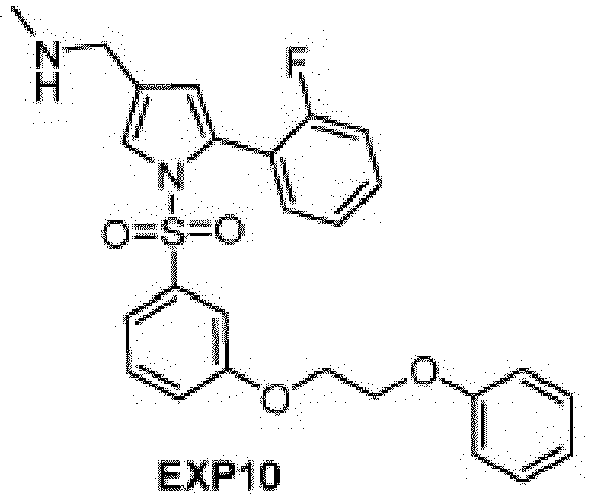
- Obtaining the compound 1-(5-(2-fluorobenzene)-1-((3-(2-phenoxy ethyoxyl)phenyl)sulfonyl)-1H-pyrrole-3-yl)-N-methyl methylamine (EXP 10, 74 mg, 25% yield) by reference to the preparation method in Embodiment 1.
HPLC:98.4%; MS (ESI) m/z: [M+H]+=481.5; 1H-NMR (400 MHz, DMSO-d6) δ: 7.65-7.81 (m, 4H), 7.46-7.50(m,2H), 7.25-7.33(m,4H), 6.89-6.93(m,4H), 6.13(s, 1H),4.51(s, 4H), 3.61(s,2H), 3.21(s, 3H) ppm. -
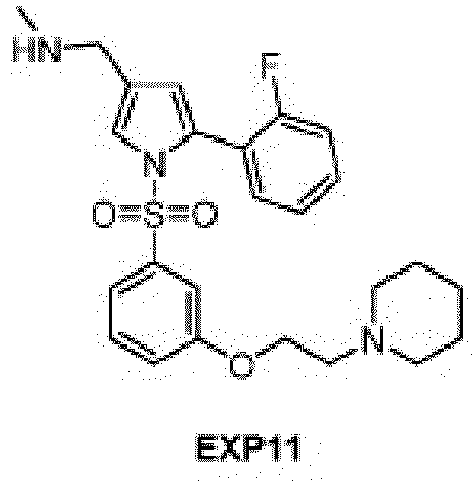
- Obtaining the compound 1-(5-(2-fluorobenzene)-)-1-((3-(2-piperidine-1-yl)ethyoxyl)phenyl)sulfonyl)-1H-pyrrole-3-yl)-N-methyl methylamine (EXP 11, 174 mg, 35% yield) by reference to the preparation method in Embodiment 1.
HPLC:98.1%;MS (ESI) m/z: [M+H]+=472.6; 1H-NMR (400 MHz, DMSO-d6)δ: 7.48-7.72 (m, 3H), 7.18-7.32(m,3H), 7.10-7.15(m,2H), 6.87(s, 1H), 6.23(s, 1H),4.03(t, 2H), 3.50(s,2H),2.66(t, 2H), 2.41-2.52(m, 4H), 2.28(s, 3H),1.37-1.51(m, 6H)ppm. -

- Obtaining the compound 1-(5-(2-fluorobenzene)-1-((3-(2-methoxy phenyl)sulfonyl)-1H-pyrrole-3-yl)-N-methyl methylamine (EXP 12, 105 mg, 20% yield) by reference to the preparation method disclosed in the literature
WO 2006036024 , Journal of Medicinal Chemistry (2012), 55(9), 4446-4456.
HPLC:95.4%; MS (ESI) m/z: [M+H]+=375.5. -

- Obtaining the compound 5-(2-fluorophenyl)-N-methyl-1-(3-pyridyl sulfonyl)-1H-pyrrole-3-methamine fumarate (TAK-438, 5.0g, 40% yield) by reference to the preparation method disclosed in the literature
WO 2006036024 , Journal of Medicinal Chemistry (2012), 55(9), 4446-4456.
HPLC:99.8%; MS (ESI) m/z: [M+H]+=347.1;1H-NMR (500 MHz, DMSO-d6) δ: 10.71 (s, 3H), 8.86(dd, 1H), 8.55(d, 1H), 7.83-7.85(m, 1H), 7.78(s, 1H), 7.55-7.60(m, 1H), 7.46-7.50(m, 1H), 7.13-7.19(m, 1H), 7.07-7.10(m, 1H), 6.49-6.51(m,3H),3.94(s,2H),2.50(s,3H)ppm. -

- Obtaining the compound 2-(3-((2-(2-fluorophenyl)-4-((methylamine)methyl)-1H-pyrrole-1-yl)sulfonyl)phenoxy)-N-me thylacetamide (EXP 14, 50mg, 40% yield) by reference to the preparation method disclosed in the literature
WO 2014075575 .
HPLC:96.4%;MS (ESI) m/z: [M+H]+=432.3; 1H-NMR (400 MHz, DMSO-d6)δ: 7.75 (s, 1H), 7.39-7.49(m,2H), 7.27-7.29(m, 1H), 7.05-7.17(m,4H), 6.96(s, 1H), 6.39(d, 1H), 4.45(s,2H), 4.09(s,2H), 3.31(s,3H), 2.79(s,3H), 2.68(s, 3H) ppm. - The following screening assays in vitro are used to evaluate the inhibiting effect of the compound of the Invention on the enzymatic activity of H+/K+-ATPase. Experimental materials and instruments are as follows:
- 1) Rabbit gastric mucosal microsomes (enriched H+/K+-ATPase; extracted by the Applicant)
- 2) 5-triphosadenine ATP (Sigma-Aldrich: Art. No.: A2383)
- 3) Malachite green (Bailingwei Chemical Technology Co., Ltd.; Art. No.: 913120)
- 4) Ammonium molybdate (Bailingwei Chemical Technology Co., Ltd.; Art. No.: 128321)
- 5) Valinomycin (Bailingwei Chemical Technology Co., Ltd.; Art. No.: 227304)
-
- 1) Dissolving the compound with DMSO to a proper concentration;
- 2) Buffer solution: 50mmol/L HEPEs-Tris, pH=6.5, 5mmol/L magnesium chloride, 10µ mol/L valinomycin;
- 3) Buffer solution: 50 mmol/L HEPEs-Tris, pH=6.5, 5mmol/L magnesium chloride, 10µ mol/L valinomycin, 5 mmol/L potassium chloride;
- 4) ATP: diluting ATP to 5mM with buffer solution 1;
- 5) Malachite green solution: dissolving 0.12% of malachite green in 2.5mol/L of sulfuric acid; mixing 7.5%(V/V) of ammonium molybdate and 11% of Tween 20(V/V) in a proportion of 100:25:2;
- 6) The method for extracting rabbit gastric mucosal microsomes (enriched H+/K+-ATPase) is sucrose gradient centrifugation, i.e., washing the rabbit stomach with tap water and 3M NaCl solution respectively and removing the surface moisture with filter paper; adding the pre-cooled buffer solution (4ml/g tissue) for homogenation in a tissue homogenizer for 2-5min; removing the large tissue particles in a way of centrifugation (600g, 10mm) if any after homogenation; transferring the supernatant to a clean centrifugal tube for centrifugation for 30min at 2000g; then transferring the supernatant to a clean centrifugal tube for further centrifugation for 90min at 100000g; collecting the sediment; suspending the sediment in the homogenate and blowing it to be uniform; measuring the protein concentration with Bradford method; adjusting the concentration to 10mg/ml; adding 7.5% Ficolldemixing fluid in an equal proportion for centrifugation for 60min at 100000g; collecting the middle layer (H+/K+-ATPase enriched gastric membranes) into a clean centrifugal tube; diluting it with 4-5 times of homogenate for further centrifugation for 90min at 100000g; collecting the sediment; suspending the sediment in the homogenate for homogenation with a glass homogenizer; measuring the protein concentration with Bradford method and adjusting the concentration to 22.5mg/ml; freezing it under -80°C for standby.
- Adding 5µL of gastric mucosal microsomes (H+/K+-ATPase) in 45µL of buffer solution 2; adding 5µL of the compound solution; adding 5µL 5mM of ATP to start the reaction for pre-reaction at 37°C for 30min; adding 15µL of malachite green solution to terminate the reaction; balancing at ambient temperature for 20min; reading the value of absorbed light at 620nm.
- Meanwhile, conducting another reaction with the same volume without potassium chloride for background, which will be subtracted when calculating the enzymatic activity.
- The value of Compound IC50 is calculated through the inhibition ratios at different concentrations.
- The median inhibitory concentration (IC50) of the compound provided by the Invention as shown in Formula I to the activity of H+/K+-ATPase
Table 1 The median inhibitory concentration (IC50) of the compound to the activity of H+/K+-ATPase TAK-438 EXP 1 EXP 2 EXP 3 EXP 4 EXP5 EXP 6 EXP 7 EXP8 +++ +++ ++ ++ +++ ++ ++ ++ ++ EXP 9 EXP 10 EXP 11 EXP 12 EXP 14 ++ +++ + +++ ++ +++ means IC50<100nM; ++ means a scope of 0.1-1µM; + means a scope of 1-5µM -
- 1) Cell culture: the hERG cell is cultured in a routine way, which is subcultured in a DMEM containing 10% of fetal calf serum and 250 µg/ml of G418.
- 2) Fluid preparation: the composition of the extracellular fluid used in the experiment of whole cell patch clamp comprises (mM): NaCl 145, MgCl21, KCl 4, Glucose 10, HEPES 10 and CaC122; adjusting the pH value of NaOH to 7.4 and adjusting the value of osmotic pressure to 300 mOsm with sucrose. The composition of the intracellular fluid comprises (mM):KCl 140; MgCl 21; EGTA 5; HEPES 10 and Na2ATP 4; adjusting the pH value of KOH to 7.2 and adjusting the value of osmotic pressure to 290 mOsm with sucrose.
-
Reagent Extracellular fluid (mM) Intracellular fluid (mM) CaCl2 2 - MgCl2 1 1 KCl 4 140 NaCl 145 - Glucose 10 - HEPES 10 10 EGTA - 5 Na2ATP - 4 PH 7.4 (adjusted with NaOH), osmolarity -300 mOsm 7.2 (adjusted with KOH), osmolarity -290 mOsm -
- 1) Electrophysiological recording: taking out one culture dish for each test; cleaning it with the extracellular fluid twice and placing it on the inverted microscope stage. The experiment of whole cell patch clamp is conducted at ambient temperature; the resistance at the microelectrode tip of the used borosilicate glass is 3 - 5 MQ.
- 2) Voltage stimulus plan and current record: clamping down the membrane potential to -80mV under the whole-cell recording mode; giving +50mV of depolarized voltage stimulus to the cell every 30s and lasting for 2s, then repolarizing it to -50mV and lasting for 3s, thus, the tail current of hERG can be extracted. Giving 50ms, -50mV repolarized voltage to the cell before depolarized voltage stimulus; the current recorded at such voltage is as the base line for calculating the tail current of hERG. Only the cells meet the recording standard can be used in the test of the compounds to be tested. The hERG tail current should be recorded stably at last for 3min in the extracellular fluid before the compound is added. After perfusion of drugs, it can be regarded that the drug effect reaches a steady state if the change of the amplitude of hERG tail current is less than 5%. If the current fails to reach a steady state in 6min, the test should also be terminated.
- 3) Testing standard: the membrane resistance in the experiment should be more than 1,000MQ. The initial current should be more than 300pA. The series resistance should be less than 12MQ after the whole-cell recording mode is constructed. The leakage current is less than 10% of the ionic channel current (taking -80pA as the peak value).
- Using Clampex 10.2 to record the original data and saving the data in the format of *abf.Using pCLAMP 10.1 to conduct data collection and analysis. Selecting 4-5 sweeps when the current is in a steady state before the compound is added; calculating the average peak value to serve as the contrasted current amplitude. Selecting 4-5 sweeps when the current is in a steady state after the compound is added; calculating the average peak value to serve as the residual amplitude of the inhibited current. The inhibition ratio of the compound to be tested to hERG current is calculated as per the equation as:

- After the inhibition ratio (average value ± standard deviation) of the compound to be tested to the hERG current of different concentrations is obtained through the above computing method, the data with logistic equation should be fitted to obtain the value of IC50.
-
Table 2 Inhibition results of EXP 1, TAK-438 and EXP 12 to hERG current Compound name Max. test concentration Inhibition ratio of max. test concentration IC50 value EXP 1 100 µM 86.21 ± 1.67% 18.69M TAK-438 100 µM 88.23 ±3.18% 15.93M EXP 12 30 µM 90.33 ±2.16% 3.95M - SD rat, class SPF, male, 180-220g; provided by Zhejiang Experimental Animal Center; production permit no.: SCXK (Z) 2014-0001.
- Compound EXP 1, dissolved with a small amount of acetic acid (about 1.10N EXP 1), 0.9% sodium chloride solution to a clear liquid with needed concentration before use.
- Compound TAK-438, dissolved with 0.9% sodium chloride solution to a clear liquid with needed concentration before use.
- Compound EXP 14, dissolved with a small amount of acetic acid (about 1.10N EXP 14), 0.9% sodium chloride solution to a clear liquid with needed concentration before use.
- 0.9% of sodium chloride solution, provided by Anhui Double-Crane Pharmaceutical Co., Ltd.; batch no.: 131202. Histamine dihydrochloride: Aladdin; batch no.: H110868.
- Chloral hydrate: provided by Sinopharm Chemical Reagent Co., Ltd.; batch no.: 20130314; prepared into 3% chloral hydrate solution with 0.9% sodium chloride solution.
- Phenolphthalein: provided by Sinopharm Chemical Reagent Co., Ltd.; batch no.: F20110125; prepared into 3% phenolphthalein solution with 95% ethyl alcohol.
- Electronic scale: produced by Beijing Sartorius Scientific Instruments Co., Ltd.
- Centrifuge: produced by Medical Equipment Factory of Shanghai Medical Instruments Co., Ltd.
- Alkali burette: provided by Analysis & Research Office of China Medicine University
- Fetching 60 SD rats of class SPF with a weight of 180-220g; dividing the rats into 5 groups as per weights randomly, including Group EXP 1 (2mg/kg), Group TAK-438 (2mg/kg, as per free alkali), Group EXP 14 (2mg/kg), Group negative control (normal saline of equal volume) and Group model control (normal saline of equal volume); 12 rats per group. Absolute diet for 24h, water is allowed. After 24h, administrating drugs to the tested compound groups A, B and C by gavage with a volume of 1ml/100g; each group is administered once; the negative control and model negative control groups are administrated by gavage with normal saline of equal volume. Narcotizing the rat with 300mg/kg of chloral hydrate (1ml/100g) and fixing it onto the rat board; cutting to open the abdominal wall along the medioventral line from the mucronate cartilage with an incision of 2-3cm; slightly pushing the left costal margin upward to expose the stomach in the incision. Ligaturing the pylorus thereunder (leave alone the adjacent blood vessels) and then suturing the abdominal incision. Giving histamine dihydrochloride (30mg/10m/kg) hypodermically to the rat 1h after the tested compound or normal saline are administrated. Choking the rat to death with excessive CO2 3h after the histamine is given; taking out the stomach and collecting the gastric contents for centrifugation at 3000rpm/min; adjusting the PH value of the acid fluid to 7.0 with 0.1mol/L of NaOH titration and then calculating the total acid content of the 3h. Refer to Table 3 for results.
Table 3 The effect of the tested compound on gastric acid secretion induced by histamine Groups Dosage (mg/kg) Total acid content (10-4 mol) Acid inhibiting rate % Negative control / 0.33±0.12 / Model control / 1.09±0.18 / EXP 1 2 0.49±0.12** 55.4 TAK-438 2 0.52±0.10** 52.3 EXP14 2 0.65 ±0.20** 40.4 Note: *p<0.05, **p<0.01; compared with model groups -
- Drugs: Compound EXP 1 (about 1.10N EXP 1), TAK-438 (the administration dosage is given as per free alkali)
- Test content: single administration dosage: 2000mg/kg, 600mg/kg; administration by gavage: once; volume: 10ml/kg; observing for 14 days for the rat's behavior and weight each day.
- Animal: SD rat, class SPF, 180-220g; provided by Zhejiang Experimental Animal Center; animal certificate no.: SCXK(Z)2014-0001.
- Experimental grouping: black group, Group of 600mg/kg, Group of 2000mg/kg; 4 rats each group; half male and half female. Experiment results:
- EXP 1, single oral dose of 600mg/Kg or 2000mg/Kg; no death. As for the single oral dose of 600mg/Kg, the impact on the rat's weight is not obvious.
- TAK-438: 2000 mg/kg: all died; 600 mg/kg: inhibition of weight gain.
- For the purposes of elaboration and understanding, the above invention is described in details in combination with examples and embodiments. It is obvious for a person skilled in the art that modifications and improvements can be made within the scope of the enclosed claims. Therefore, it should be understand that the above description is for illustration rather than limitation. Thus, the scope of the Invention should be determined by reference to the full scope of the enclosed claims and the equivalent authorized by the claims but not to the above Specification.
Claims (7)
- A compound with a structure as shown in Formula (I), or its tautomer, mesomer, racemate, enantiomer, diastereoisomer, or its mixture form or pharmaceutically acceptable salt:
 A and B are independently selected from N or CR4; R4 is selected from hydrogen, halogen and alkyl;X is selected from O and NR5; R5 is selected from hydrogen and alkyl;R1 is selected from alkyl and heterocyclic alkyl; wherein, said alkyl and heterocyclic alkyl are further substituted by one or more substituents selected from hydrogen, halogen and alkyl; alkyl may be unsubstituted or substituted by halogen, C2-C6alkenyl, C6-C10 aryl, C5-C10heteroaryl, halogenated C1-C6 alkyl, 4 - 8-element heteroalkyl, hydroxyl, C1-C6alkoxy, and C6-C10aryloxy;R2 is selected from alkyl sulfonyl, heterocyclic alkyl, alkoxy, alkyl acyl, phenoxy and alkyl amino; wherein, said alkyl sulfonyl, heterocyclic alkyl, alkoxy, alkyl acyl, phenoxy and alkyl amino are further substituted by one or more substituents selected from hydrogen, halogen and alkyl; andR3 is selected from hydrogen, halogen and alkyl.
 - The compound according to Claim 1, wherein A and B are selected from CR4; R4 is selected from hydrogen.
- The compound according to Claim 1 or 2, wherein said compound is selected from any of the following compounds as:

- A pharmaceutical composition; said pharmaceutical composition contains an effective dose of the compound according to any one of Claims 1-3, or its tautomer, mesomer, racemate, enantiomer, diastereoisomer, or its mixture form or pharmaceutically acceptable salt and acceptable carriers, excipients, or thinner for medicine.
- The pharmaceutical composition according to Claim 4 for use as a gastric acid secretion inhibitor.
- The pharmaceutical composition for use according to Claim 5 whereby the use is in the treatment or prevention of peptic ulcer, Zollinger-Ellison syndrome, gastritis, erosive esophagitis, reflux esophagitis, symptomatic gastroesophageal reflux disease, Barrett esophagitis, functional dyspepsia, helicobacter pylori infection, gastric cancer, gastric malt lymphoma, anabrosis caused by non-steroidal anti-inflammatory drugs (NSAIDs), or hyperacidity or anabrosis due to postoperative stress; or the method for preparing the medicine for inhibiting gastrointestinal bleeding caused by peptic ulcer, acute stress ulcer, hemorrhagic gastritis or invasive stress.
- The pharmaceutical composition for use according to Claim6, wherein, said peptic ulcer comprises gastric ulcer, duodenal ulcer or marginal ulcer; said symptomatic gastroesophageal reflux disease comprises nonerosive reflux disease or gastroesophageal reflux disease without oesophagitis.
Applications Claiming Priority (2)
| Application Number | Priority Date | Filing Date | Title |
|---|---|---|---|
| CN201510040549.8A CN105985278A (en) | 2015-01-27 | 2015-01-27 | Pyrrole sulfonyl derivatives, preparation method and medicinal application thereof |
| PCT/CN2015/094255 WO2016119505A1 (en) | 2015-01-27 | 2015-11-11 | Pyrrole sulfonyl derivative, and preparation method and medical use thereof |
Publications (3)
| Publication Number | Publication Date |
|---|---|
| EP3248963A1 EP3248963A1 (en) | 2017-11-29 |
| EP3248963A4 EP3248963A4 (en) | 2018-06-20 |
| EP3248963B1 true EP3248963B1 (en) | 2019-07-17 |
Family
ID=56542345
Family Applications (1)
| Application Number | Title | Priority Date | Filing Date |
|---|---|---|---|
| EP15879703.5A Active EP3248963B1 (en) | 2015-01-27 | 2015-11-11 | Pyrrole sulfonyl derivative, and preparation method and medical use thereof |
Country Status (6)
| Country | Link |
|---|---|
| US (1) | US10913714B2 (en) |
| EP (1) | EP3248963B1 (en) |
| JP (1) | JP6412656B2 (en) |
| CN (2) | CN105985278A (en) |
| ES (1) | ES2751702T3 (en) |
| WO (1) | WO2016119505A1 (en) |
Families Citing this family (20)
| Publication number | Priority date | Publication date | Assignee | Title |
|---|---|---|---|---|
| ES2960801T3 (en) | 2010-07-30 | 2024-03-06 | Cargill Inc | Process to obtain citrus fiber from citrus pulp |
| US11834776B2 (en) | 2010-07-30 | 2023-12-05 | Cargill, Incorporated | Process for modifying the characteristics of citrus fiber |
| US11589600B2 (en) | 2014-07-15 | 2023-02-28 | Cargill, Incorporated | Process for obtaining citrus fiber from citrus peel |
| CN115385845B (en) * | 2016-09-12 | 2024-07-26 | 江苏柯菲平医药股份有限公司 | Preparation of pyrrole sulfonic acid compound salt |
| CN107875387A (en) * | 2016-09-29 | 2018-04-06 | 江苏柯菲平医药股份有限公司 | A compound drug containing pyrrolesulfonyl derivatives and its use |
| CN107879964B (en) * | 2016-09-29 | 2023-02-10 | 江苏柯菲平医药股份有限公司 | Preparation method of 1- (5- (2-fluorophenyl) -1- (3- (3-methoxy propoxy) benzenesulfonyl chloride) -1H-pyrrole-3-yl) -N-methylamine |
| CN108069891B (en) * | 2016-11-16 | 2022-09-20 | 江苏柯菲平医药股份有限公司 | A crystal form of methyl methylamine hydrochloride, preparation and application thereof |
| CN108117503B (en) * | 2016-11-30 | 2022-09-02 | 江苏柯菲平医药股份有限公司 | Novel pyrrole sulfonyl chemical entity, preparation method and application thereof |
| CN108969520A (en) * | 2017-06-02 | 2018-12-11 | 南京柯菲平盛辉制药有限公司 | A kind of composition of the A crystal-form compound of N- methyl methylamine hydrochloride |
| KR20210156235A (en) * | 2020-06-17 | 2021-12-24 | 일동제약(주) | Novel acid secretion inhibitors and use thereof |
| CN111620804A (en) * | 2020-06-17 | 2020-09-04 | 山东理工大学 | Synthesis method and application of two sulfonyl pyrrolidine P-CABs |
| CN113390983B (en) * | 2021-05-26 | 2022-06-07 | 株洲千金药业股份有限公司 | Detection method for simultaneously determining 3 impurities in Voranolan fumarate |
| CN115594622B (en) * | 2021-07-09 | 2025-03-21 | 天地恒一制药股份有限公司 | A pyrrolsulfonyl derivative, and its preparation method and application |
| CN115594623B (en) * | 2021-07-09 | 2025-03-18 | 天地恒一制药股份有限公司 | A pyrrolsulfonyl derivative, and its preparation method and application |
| CN116239606B (en) * | 2021-07-09 | 2025-09-02 | 天地恒一制药股份有限公司 | A pyrrolylsulfonyl derivative, and its preparation method and application |
| KR102556500B1 (en) * | 2021-11-19 | 2023-07-19 | 하나제약 주식회사 | Pyrrole derivatives or pharmaceutically or food acceptable salts thereof, and composition for preventing, improving or treating gastrointestinal diseases comprising the same as an active ingredient |
| CN119654147A (en) * | 2022-08-04 | 2025-03-18 | 江苏柯菲平医药股份有限公司 | A pharmaceutical composition containing pyrrole gastric acid secretion inhibitor and preparation method thereof |
| CN115557876A (en) * | 2022-10-26 | 2023-01-03 | 四川国康药业有限公司 | A 3-aryl ring sulfonyl-1-N-heteropyrrole derivative for treating peptic ulcer, its preparation method and application |
| WO2024188316A1 (en) * | 2023-03-15 | 2024-09-19 | 江苏柯菲平医药股份有限公司 | Pyrrolesulfonic acid compound salt form, and preparation method therefor and use thereof |
| AU2024374671A1 (en) * | 2023-11-09 | 2026-05-14 | Jiangsu Carephar Pharmaceutical Co., Ltd. | Method for preparing 1-[5-(2-fluorophenyl)-1-{[3-(3-methoxypropoxy)phenyl]sulfonyl}-1h-pyrrol-3-yl]-n-methylmethylamine and hydrochloride thereof |
Family Cites Families (10)
| Publication number | Priority date | Publication date | Assignee | Title |
|---|---|---|---|---|
| WO2005041961A1 (en) * | 2003-11-03 | 2005-05-12 | Astrazeneca Ab | Imidazo [1,2-a] pyridine derivatives for the treatment of silent gastro-esophageal reflux |
| EP2336107B1 (en) * | 2004-09-30 | 2015-09-23 | Takeda Pharmaceutical Company Limited | Proton pump inhibitors |
| CA2608582A1 (en) * | 2005-06-14 | 2006-12-21 | Pfizer Inc. | Chromane substituted benzimidazole derivatives as acid pump antagonists |
| EP2327692B9 (en) * | 2005-08-30 | 2014-06-04 | Takeda Pharmaceutical Company Limited | 1-heterocyclylsulfonyl, 2-aminomethyl, 5-(hetero-)aryl substituted 1-H-pyrrole derivatives as acid secretion inhibitors |
| EP2005957B1 (en) * | 2006-03-31 | 2012-05-30 | Takeda Pharmaceutical Company Limited | Acid secretion inhibitor |
| US8933105B2 (en) * | 2007-02-28 | 2015-01-13 | Takeda Pharmaceutical Company Limited | Pyrrole compounds |
| EP2196459B1 (en) * | 2007-09-28 | 2016-11-02 | Takeda Pharmaceutical Company Limited | 5-membered heterocyclic compound |
| WO2010013823A2 (en) * | 2008-07-28 | 2010-02-04 | Takeda Pharmaceutical Company Limited | Pharmaceutical composition |
| WO2010021149A1 (en) * | 2008-08-21 | 2010-02-25 | 武田薬品工業株式会社 | Spiro compound capable of inhibiting acid secretion |
| CN104718189B (en) * | 2012-11-19 | 2017-03-15 | 江苏豪森药业集团有限公司 | Pyrroles's sulphonyl analog derivative, its preparation method and its in application pharmaceutically |
-
2015
- 2015-01-27 CN CN201510040549.8A patent/CN105985278A/en active Pending
- 2015-11-11 ES ES15879703T patent/ES2751702T3/en active Active
- 2015-11-11 EP EP15879703.5A patent/EP3248963B1/en active Active
- 2015-11-11 WO PCT/CN2015/094255 patent/WO2016119505A1/en not_active Ceased
- 2015-11-11 CN CN201580069871.1A patent/CN107207432B/en active Active
- 2015-11-11 JP JP2017540775A patent/JP6412656B2/en active Active
- 2015-11-11 US US15/547,522 patent/US10913714B2/en active Active
Non-Patent Citations (1)
| Title |
|---|
| None * |
Also Published As
| Publication number | Publication date |
|---|---|
| CN107207432A (en) | 2017-09-26 |
| US20180009749A1 (en) | 2018-01-11 |
| WO2016119505A1 (en) | 2016-08-04 |
| ES2751702T3 (en) | 2020-04-01 |
| CN107207432B (en) | 2019-09-17 |
| US10913714B2 (en) | 2021-02-09 |
| JP6412656B2 (en) | 2018-10-24 |
| CN105985278A (en) | 2016-10-05 |
| EP3248963A4 (en) | 2018-06-20 |
| JP2018503675A (en) | 2018-02-08 |
| EP3248963A1 (en) | 2017-11-29 |
Similar Documents
| Publication | Publication Date | Title |
|---|---|---|
| US10913714B2 (en) | Pyrrole sulfonyl derivative, preparation method and medical use thereof | |
| JP5002077B2 (en) | Novel 3-hydroxy-5-arylisothiazole derivatives | |
| WO2011052756A1 (en) | Novel 3-hydroxy-5-arylisoxazole derivative | |
| BR112021009145A2 (en) | treatment methods for cystic fibrosis | |
| CA2922352A1 (en) | Pharmaceutical composition containing pyrimidine compound as active ingredient | |
| TW201247636A (en) | Novel 3-hydroxyisothiazole 1-oxide derivatives | |
| WO2012046869A1 (en) | Cyclic amide derivative | |
| CN103159736A (en) | Substitutional pyrazol kinase inhibitor | |
| US20190070154A1 (en) | New methods of use for an anti-diarrhea agent | |
| TW200904409A (en) | Azetidines | |
| JP2024073574A (en) | Crystalline form of fulvatinib or its methanesulfonate salt and its manufacturing method | |
| Wang et al. | Discovery and optimization of selective FGFR4 inhibitors via scaffold hopping | |
| CA3089243C (en) | Crystal form targeting cdk4/6 kinase inhibitor | |
| EP3572399A1 (en) | Crystal form of gft-505 and preparation method and use thereof | |
| CN104725372B (en) | Tetracyclic indole alkaloid derivative as well as preparation method and application thereof | |
| CN103360407A (en) | Thiophene miazines derivate as well as preparation method and medical application thereof | |
| WO2022228549A1 (en) | Phenyl -o-quinoline, quinazoline, thienopyridine, thienopyrimidine, pyrrolopyridine, pyrrolopyrimidine compounds having anticancer activity | |
| CN118359628A (en) | A tyrosine threonine kinase PKMYT1 inhibitor | |
| CN113402444B (en) | A carbazole compound and its application in preparing a drug for treating metabolic-related diseases such as fatty liver and type 2 diabetes | |
| CN113135905A (en) | Crystalline forms of a polycyclic anaplastic lymphoma kinase inhibitor | |
| CN107001262A (en) | The hemifumarate and its crystal formation of the proton pump inhibitor containing pyrrole ring, intermediate and medical usage | |
| CN105566302B (en) | The crystallization of indolinone compounds and its salt | |
| CN111875513B (en) | Resveratrol A ring N (CH) 3 ) 2 Base derivatives, preparation method and application thereof | |
| WO2022022735A1 (en) | Crystal form of fibroblast growth factor receptor inhibitor and preparation method therefor | |
| KR20250111195A (en) | Solid form of condensed ring compound and its preparation method and use |
Legal Events
| Date | Code | Title | Description |
|---|---|---|---|
| STAA | Information on the status of an ep patent application or granted ep patent |
Free format text: STATUS: THE INTERNATIONAL PUBLICATION HAS BEEN MADE |
|
| PUAI | Public reference made under article 153(3) epc to a published international application that has entered the european phase |
Free format text: ORIGINAL CODE: 0009012 |
|
| STAA | Information on the status of an ep patent application or granted ep patent |
Free format text: STATUS: REQUEST FOR EXAMINATION WAS MADE |
|
| 17P | Request for examination filed |
Effective date: 20170822 |
|
| AK | Designated contracting states |
Kind code of ref document: A1 Designated state(s): AL AT BE BG CH CY CZ DE DK EE ES FI FR GB GR HR HU IE IS IT LI LT LU LV MC MK MT NL NO PL PT RO RS SE SI SK SM TR |
|
| AX | Request for extension of the european patent |
Extension state: BA ME |
|
| DAV | Request for validation of the european patent (deleted) | ||
| DAX | Request for extension of the european patent (deleted) | ||
| A4 | Supplementary search report drawn up and despatched |
Effective date: 20180524 |
|
| RIC1 | Information provided on ipc code assigned before grant |
Ipc: A61P 31/04 20060101ALI20180517BHEP Ipc: A61K 31/4025 20060101ALI20180517BHEP Ipc: C07D 403/04 20060101ALI20180517BHEP Ipc: A61K 31/402 20060101ALI20180517BHEP Ipc: A61K 31/454 20060101ALI20180517BHEP Ipc: A61P 1/14 20060101ALI20180517BHEP Ipc: C07D 405/04 20060101ALI20180517BHEP Ipc: A61P 1/04 20060101ALI20180517BHEP Ipc: A61K 31/404 20060101ALI20180517BHEP Ipc: C07D 207/48 20060101AFI20180517BHEP |
|
| GRAP | Despatch of communication of intention to grant a patent |
Free format text: ORIGINAL CODE: EPIDOSNIGR1 |
|
| STAA | Information on the status of an ep patent application or granted ep patent |
Free format text: STATUS: GRANT OF PATENT IS INTENDED |
|
| INTG | Intention to grant announced |
Effective date: 20190123 |
|
| GRAS | Grant fee paid |
Free format text: ORIGINAL CODE: EPIDOSNIGR3 |
|
| GRAA | (expected) grant |
Free format text: ORIGINAL CODE: 0009210 |
|
| STAA | Information on the status of an ep patent application or granted ep patent |
Free format text: STATUS: THE PATENT HAS BEEN GRANTED |
|
| AK | Designated contracting states |
Kind code of ref document: B1 Designated state(s): AL AT BE BG CH CY CZ DE DK EE ES FI FR GB GR HR HU IE IS IT LI LT LU LV MC MK MT NL NO PL PT RO RS SE SI SK SM TR |
|
| REG | Reference to a national code |
Ref country code: GB Ref legal event code: FG4D |
|
| REG | Reference to a national code |
Ref country code: CH Ref legal event code: EP |
|
| REG | Reference to a national code |
Ref country code: IE Ref legal event code: FG4D |
|
| REG | Reference to a national code |
Ref country code: DE Ref legal event code: R096 Ref document number: 602015034097 Country of ref document: DE |
|
| REG | Reference to a national code |
Ref country code: AT Ref legal event code: REF Ref document number: 1155724 Country of ref document: AT Kind code of ref document: T Effective date: 20190815 |
|
| REG | Reference to a national code |
Ref country code: NL Ref legal event code: MP Effective date: 20190717 |
|
| REG | Reference to a national code |
Ref country code: LT Ref legal event code: MG4D |
|
| REG | Reference to a national code |
Ref country code: AT Ref legal event code: MK05 Ref document number: 1155724 Country of ref document: AT Kind code of ref document: T Effective date: 20190717 |
|
| PG25 | Lapsed in a contracting state [announced via postgrant information from national office to epo] |
Ref country code: SE Free format text: LAPSE BECAUSE OF FAILURE TO SUBMIT A TRANSLATION OF THE DESCRIPTION OR TO PAY THE FEE WITHIN THE PRESCRIBED TIME-LIMIT Effective date: 20190717 Ref country code: BG Free format text: LAPSE BECAUSE OF FAILURE TO SUBMIT A TRANSLATION OF THE DESCRIPTION OR TO PAY THE FEE WITHIN THE PRESCRIBED TIME-LIMIT Effective date: 20191017 Ref country code: NL Free format text: LAPSE BECAUSE OF FAILURE TO SUBMIT A TRANSLATION OF THE DESCRIPTION OR TO PAY THE FEE WITHIN THE PRESCRIBED TIME-LIMIT Effective date: 20190717 Ref country code: HR Free format text: LAPSE BECAUSE OF FAILURE TO SUBMIT A TRANSLATION OF THE DESCRIPTION OR TO PAY THE FEE WITHIN THE PRESCRIBED TIME-LIMIT Effective date: 20190717 Ref country code: FI Free format text: LAPSE BECAUSE OF FAILURE TO SUBMIT A TRANSLATION OF THE DESCRIPTION OR TO PAY THE FEE WITHIN THE PRESCRIBED TIME-LIMIT Effective date: 20190717 Ref country code: LT Free format text: LAPSE BECAUSE OF FAILURE TO SUBMIT A TRANSLATION OF THE DESCRIPTION OR TO PAY THE FEE WITHIN THE PRESCRIBED TIME-LIMIT Effective date: 20190717 Ref country code: PT Free format text: LAPSE BECAUSE OF FAILURE TO SUBMIT A TRANSLATION OF THE DESCRIPTION OR TO PAY THE FEE WITHIN THE PRESCRIBED TIME-LIMIT Effective date: 20191118 Ref country code: AT Free format text: LAPSE BECAUSE OF FAILURE TO SUBMIT A TRANSLATION OF THE DESCRIPTION OR TO PAY THE FEE WITHIN THE PRESCRIBED TIME-LIMIT Effective date: 20190717 Ref country code: NO Free format text: LAPSE BECAUSE OF FAILURE TO SUBMIT A TRANSLATION OF THE DESCRIPTION OR TO PAY THE FEE WITHIN THE PRESCRIBED TIME-LIMIT Effective date: 20191017 |
|
| PG25 | Lapsed in a contracting state [announced via postgrant information from national office to epo] |
Ref country code: AL Free format text: LAPSE BECAUSE OF FAILURE TO SUBMIT A TRANSLATION OF THE DESCRIPTION OR TO PAY THE FEE WITHIN THE PRESCRIBED TIME-LIMIT Effective date: 20190717 Ref country code: IS Free format text: LAPSE BECAUSE OF FAILURE TO SUBMIT A TRANSLATION OF THE DESCRIPTION OR TO PAY THE FEE WITHIN THE PRESCRIBED TIME-LIMIT Effective date: 20191117 Ref country code: LV Free format text: LAPSE BECAUSE OF FAILURE TO SUBMIT A TRANSLATION OF THE DESCRIPTION OR TO PAY THE FEE WITHIN THE PRESCRIBED TIME-LIMIT Effective date: 20190717 Ref country code: GR Free format text: LAPSE BECAUSE OF FAILURE TO SUBMIT A TRANSLATION OF THE DESCRIPTION OR TO PAY THE FEE WITHIN THE PRESCRIBED TIME-LIMIT Effective date: 20191018 Ref country code: RS Free format text: LAPSE BECAUSE OF FAILURE TO SUBMIT A TRANSLATION OF THE DESCRIPTION OR TO PAY THE FEE WITHIN THE PRESCRIBED TIME-LIMIT Effective date: 20190717 |
|
| PG25 | Lapsed in a contracting state [announced via postgrant information from national office to epo] |
Ref country code: TR Free format text: LAPSE BECAUSE OF FAILURE TO SUBMIT A TRANSLATION OF THE DESCRIPTION OR TO PAY THE FEE WITHIN THE PRESCRIBED TIME-LIMIT Effective date: 20190717 |
|
| REG | Reference to a national code |
Ref country code: ES Ref legal event code: FG2A Ref document number: 2751702 Country of ref document: ES Kind code of ref document: T3 Effective date: 20200401 |
|
| PG25 | Lapsed in a contracting state [announced via postgrant information from national office to epo] |
Ref country code: RO Free format text: LAPSE BECAUSE OF FAILURE TO SUBMIT A TRANSLATION OF THE DESCRIPTION OR TO PAY THE FEE WITHIN THE PRESCRIBED TIME-LIMIT Effective date: 20190717 Ref country code: PL Free format text: LAPSE BECAUSE OF FAILURE TO SUBMIT A TRANSLATION OF THE DESCRIPTION OR TO PAY THE FEE WITHIN THE PRESCRIBED TIME-LIMIT Effective date: 20190717 Ref country code: EE Free format text: LAPSE BECAUSE OF FAILURE TO SUBMIT A TRANSLATION OF THE DESCRIPTION OR TO PAY THE FEE WITHIN THE PRESCRIBED TIME-LIMIT Effective date: 20190717 Ref country code: DK Free format text: LAPSE BECAUSE OF FAILURE TO SUBMIT A TRANSLATION OF THE DESCRIPTION OR TO PAY THE FEE WITHIN THE PRESCRIBED TIME-LIMIT Effective date: 20190717 |
|
| PG25 | Lapsed in a contracting state [announced via postgrant information from national office to epo] |
Ref country code: IS Free format text: LAPSE BECAUSE OF FAILURE TO SUBMIT A TRANSLATION OF THE DESCRIPTION OR TO PAY THE FEE WITHIN THE PRESCRIBED TIME-LIMIT Effective date: 20200224 Ref country code: SK Free format text: LAPSE BECAUSE OF FAILURE TO SUBMIT A TRANSLATION OF THE DESCRIPTION OR TO PAY THE FEE WITHIN THE PRESCRIBED TIME-LIMIT Effective date: 20190717 Ref country code: SM Free format text: LAPSE BECAUSE OF FAILURE TO SUBMIT A TRANSLATION OF THE DESCRIPTION OR TO PAY THE FEE WITHIN THE PRESCRIBED TIME-LIMIT Effective date: 20190717 Ref country code: CZ Free format text: LAPSE BECAUSE OF FAILURE TO SUBMIT A TRANSLATION OF THE DESCRIPTION OR TO PAY THE FEE WITHIN THE PRESCRIBED TIME-LIMIT Effective date: 20190717 |
|
| REG | Reference to a national code |
Ref country code: DE Ref legal event code: R097 Ref document number: 602015034097 Country of ref document: DE |
|
| REG | Reference to a national code |
Ref country code: CH Ref legal event code: PL |
|
| PLBE | No opposition filed within time limit |
Free format text: ORIGINAL CODE: 0009261 |
|
| STAA | Information on the status of an ep patent application or granted ep patent |
Free format text: STATUS: NO OPPOSITION FILED WITHIN TIME LIMIT |
|
| PG2D | Information on lapse in contracting state deleted |
Ref country code: IS |
|
| PG25 | Lapsed in a contracting state [announced via postgrant information from national office to epo] |
Ref country code: CH Free format text: LAPSE BECAUSE OF NON-PAYMENT OF DUE FEES Effective date: 20191130 Ref country code: MC Free format text: LAPSE BECAUSE OF FAILURE TO SUBMIT A TRANSLATION OF THE DESCRIPTION OR TO PAY THE FEE WITHIN THE PRESCRIBED TIME-LIMIT Effective date: 20190717 Ref country code: LI Free format text: LAPSE BECAUSE OF NON-PAYMENT OF DUE FEES Effective date: 20191130 Ref country code: LU Free format text: LAPSE BECAUSE OF NON-PAYMENT OF DUE FEES Effective date: 20191111 |
|
| 26N | No opposition filed |
Effective date: 20200603 |
|
| REG | Reference to a national code |
Ref country code: BE Ref legal event code: MM Effective date: 20191130 |
|
| PG25 | Lapsed in a contracting state [announced via postgrant information from national office to epo] |
Ref country code: SI Free format text: LAPSE BECAUSE OF FAILURE TO SUBMIT A TRANSLATION OF THE DESCRIPTION OR TO PAY THE FEE WITHIN THE PRESCRIBED TIME-LIMIT Effective date: 20190717 |
|
| PG25 | Lapsed in a contracting state [announced via postgrant information from national office to epo] |
Ref country code: IE Free format text: LAPSE BECAUSE OF NON-PAYMENT OF DUE FEES Effective date: 20191111 |
|
| PG25 | Lapsed in a contracting state [announced via postgrant information from national office to epo] |
Ref country code: BE Free format text: LAPSE BECAUSE OF NON-PAYMENT OF DUE FEES Effective date: 20191130 |
|
| PG25 | Lapsed in a contracting state [announced via postgrant information from national office to epo] |
Ref country code: CY Free format text: LAPSE BECAUSE OF FAILURE TO SUBMIT A TRANSLATION OF THE DESCRIPTION OR TO PAY THE FEE WITHIN THE PRESCRIBED TIME-LIMIT Effective date: 20190717 |
|
| PG25 | Lapsed in a contracting state [announced via postgrant information from national office to epo] |
Ref country code: HU Free format text: LAPSE BECAUSE OF FAILURE TO SUBMIT A TRANSLATION OF THE DESCRIPTION OR TO PAY THE FEE WITHIN THE PRESCRIBED TIME-LIMIT; INVALID AB INITIO Effective date: 20151111 Ref country code: MT Free format text: LAPSE BECAUSE OF FAILURE TO SUBMIT A TRANSLATION OF THE DESCRIPTION OR TO PAY THE FEE WITHIN THE PRESCRIBED TIME-LIMIT Effective date: 20190717 |
|
| PG25 | Lapsed in a contracting state [announced via postgrant information from national office to epo] |
Ref country code: MK Free format text: LAPSE BECAUSE OF FAILURE TO SUBMIT A TRANSLATION OF THE DESCRIPTION OR TO PAY THE FEE WITHIN THE PRESCRIBED TIME-LIMIT Effective date: 20190717 |
|
| REG | Reference to a national code |
Ref country code: DE Ref legal event code: R081 Ref document number: 602015034097 Country of ref document: DE Owner name: JIANGSU CAREPHAR PHARMACEUTICAL CO., LTD., NAN, CN Free format text: FORMER OWNERS: JIANGSU CAREPHAR PHARMACEUTICAL CO., LTD., NANJING, JIANGSU, CN; NANJING CAREPHAR SHENGHUI PHARMACEUTICAL CO., LTD, NANJING, JIANGSU, CN |
|
| REG | Reference to a national code |
Ref country code: ES Ref legal event code: PC2A Owner name: JIANGSU CAREPHAR PHARMACEUTICAL CO., LTD Effective date: 20220914 |
|
| REG | Reference to a national code |
Ref country code: GB Ref legal event code: 732E Free format text: REGISTERED BETWEEN 20230309 AND 20230315 |
|
| PGFP | Annual fee paid to national office [announced via postgrant information from national office to epo] |
Ref country code: DE Payment date: 20251126 Year of fee payment: 11 |
|
| PGFP | Annual fee paid to national office [announced via postgrant information from national office to epo] |
Ref country code: GB Payment date: 20251126 Year of fee payment: 11 |
|
| PGFP | Annual fee paid to national office [announced via postgrant information from national office to epo] |
Ref country code: IT Payment date: 20251127 Year of fee payment: 11 |
|
| PGFP | Annual fee paid to national office [announced via postgrant information from national office to epo] |
Ref country code: FR Payment date: 20251127 Year of fee payment: 11 |
|
| PGFP | Annual fee paid to national office [announced via postgrant information from national office to epo] |
Ref country code: ES Payment date: 20251202 Year of fee payment: 11 |