EP3247435B1 - Ultrasonic vaporizing element - Google Patents
Ultrasonic vaporizing element Download PDFInfo
- Publication number
- EP3247435B1 EP3247435B1 EP16740889.7A EP16740889A EP3247435B1 EP 3247435 B1 EP3247435 B1 EP 3247435B1 EP 16740889 A EP16740889 A EP 16740889A EP 3247435 B1 EP3247435 B1 EP 3247435B1
- Authority
- EP
- European Patent Office
- Prior art keywords
- liquid
- sonotrode
- housing
- ultrasonic
- container
- Prior art date
- Legal status (The legal status is an assumption and is not a legal conclusion. Google has not performed a legal analysis and makes no representation as to the accuracy of the status listed.)
- Active
Links
Images


Classifications
-
- A—HUMAN NECESSITIES
- A24—TOBACCO; CIGARS; CIGARETTES; SIMULATED SMOKING DEVICES; SMOKERS' REQUISITES
- A24F—SMOKERS' REQUISITES; MATCH BOXES; SIMULATED SMOKING DEVICES
- A24F15/00—Receptacles or boxes specially adapted for cigars, cigarettes, simulated smoking devices or cigarettes therefor
- A24F15/01—Receptacles or boxes specially adapted for cigars, cigarettes, simulated smoking devices or cigarettes therefor specially adapted for simulated smoking devices or cigarettes therefor
-
- A—HUMAN NECESSITIES
- A24—TOBACCO; CIGARS; CIGARETTES; SIMULATED SMOKING DEVICES; SMOKERS' REQUISITES
- A24F—SMOKERS' REQUISITES; MATCH BOXES; SIMULATED SMOKING DEVICES
- A24F40/00—Electrically operated smoking devices; Component parts thereof; Manufacture thereof; Maintenance or testing thereof; Charging means specially adapted therefor
- A24F40/40—Constructional details, e.g. connection of cartridges and battery parts
- A24F40/42—Cartridges or containers for inhalable precursors
-
- A—HUMAN NECESSITIES
- A24—TOBACCO; CIGARS; CIGARETTES; SIMULATED SMOKING DEVICES; SMOKERS' REQUISITES
- A24B—MANUFACTURE OR PREPARATION OF TOBACCO FOR SMOKING OR CHEWING; TOBACCO; SNUFF
- A24B15/00—Chemical features or treatment of tobacco; Tobacco substitutes, e.g. in liquid form
- A24B15/10—Chemical features of tobacco products or tobacco substitutes
- A24B15/16—Chemical features of tobacco products or tobacco substitutes of tobacco substitutes
- A24B15/167—Chemical features of tobacco products or tobacco substitutes of tobacco substitutes in liquid or vaporisable form, e.g. liquid compositions for electronic cigarettes
-
- A—HUMAN NECESSITIES
- A24—TOBACCO; CIGARS; CIGARETTES; SIMULATED SMOKING DEVICES; SMOKERS' REQUISITES
- A24F—SMOKERS' REQUISITES; MATCH BOXES; SIMULATED SMOKING DEVICES
- A24F40/00—Electrically operated smoking devices; Component parts thereof; Manufacture thereof; Maintenance or testing thereof; Charging means specially adapted therefor
- A24F40/05—Devices without heating means
-
- A—HUMAN NECESSITIES
- A24—TOBACCO; CIGARS; CIGARETTES; SIMULATED SMOKING DEVICES; SMOKERS' REQUISITES
- A24F—SMOKERS' REQUISITES; MATCH BOXES; SIMULATED SMOKING DEVICES
- A24F40/00—Electrically operated smoking devices; Component parts thereof; Manufacture thereof; Maintenance or testing thereof; Charging means specially adapted therefor
- A24F40/10—Devices using liquid inhalable precursors
-
- A—HUMAN NECESSITIES
- A24—TOBACCO; CIGARS; CIGARETTES; SIMULATED SMOKING DEVICES; SMOKERS' REQUISITES
- A24F—SMOKERS' REQUISITES; MATCH BOXES; SIMULATED SMOKING DEVICES
- A24F40/00—Electrically operated smoking devices; Component parts thereof; Manufacture thereof; Maintenance or testing thereof; Charging means specially adapted therefor
- A24F40/20—Devices using solid inhalable precursors
-
- A—HUMAN NECESSITIES
- A24—TOBACCO; CIGARS; CIGARETTES; SIMULATED SMOKING DEVICES; SMOKERS' REQUISITES
- A24F—SMOKERS' REQUISITES; MATCH BOXES; SIMULATED SMOKING DEVICES
- A24F40/00—Electrically operated smoking devices; Component parts thereof; Manufacture thereof; Maintenance or testing thereof; Charging means specially adapted therefor
- A24F40/40—Constructional details, e.g. connection of cartridges and battery parts
- A24F40/44—Wicks
-
- A—HUMAN NECESSITIES
- A61—MEDICAL OR VETERINARY SCIENCE; HYGIENE
- A61M—DEVICES FOR INTRODUCING MEDIA INTO, OR ONTO, THE BODY; DEVICES FOR TRANSDUCING BODY MEDIA OR FOR TAKING MEDIA FROM THE BODY; DEVICES FOR PRODUCING OR ENDING SLEEP OR STUPOR
- A61M11/00—Sprayers or atomisers specially adapted for therapeutic purposes
- A61M11/005—Sprayers or atomisers specially adapted for therapeutic purposes using ultrasonics
-
- A—HUMAN NECESSITIES
- A61—MEDICAL OR VETERINARY SCIENCE; HYGIENE
- A61M—DEVICES FOR INTRODUCING MEDIA INTO, OR ONTO, THE BODY; DEVICES FOR TRANSDUCING BODY MEDIA OR FOR TAKING MEDIA FROM THE BODY; DEVICES FOR PRODUCING OR ENDING SLEEP OR STUPOR
- A61M11/00—Sprayers or atomisers specially adapted for therapeutic purposes
- A61M11/04—Sprayers or atomisers specially adapted for therapeutic purposes operated by the vapour pressure of the liquid to be sprayed or atomised
- A61M11/041—Sprayers or atomisers specially adapted for therapeutic purposes operated by the vapour pressure of the liquid to be sprayed or atomised using heaters
- A61M11/042—Sprayers or atomisers specially adapted for therapeutic purposes operated by the vapour pressure of the liquid to be sprayed or atomised using heaters electrical
-
- A—HUMAN NECESSITIES
- A61—MEDICAL OR VETERINARY SCIENCE; HYGIENE
- A61M—DEVICES FOR INTRODUCING MEDIA INTO, OR ONTO, THE BODY; DEVICES FOR TRANSDUCING BODY MEDIA OR FOR TAKING MEDIA FROM THE BODY; DEVICES FOR PRODUCING OR ENDING SLEEP OR STUPOR
- A61M15/00—Inhalators
- A61M15/0001—Details of inhalators; Constructional features thereof
- A61M15/0021—Mouthpieces therefor
-
- A—HUMAN NECESSITIES
- A61—MEDICAL OR VETERINARY SCIENCE; HYGIENE
- A61M—DEVICES FOR INTRODUCING MEDIA INTO, OR ONTO, THE BODY; DEVICES FOR TRANSDUCING BODY MEDIA OR FOR TAKING MEDIA FROM THE BODY; DEVICES FOR PRODUCING OR ENDING SLEEP OR STUPOR
- A61M15/00—Inhalators
- A61M15/0085—Inhalators using ultrasonics
-
- A—HUMAN NECESSITIES
- A61—MEDICAL OR VETERINARY SCIENCE; HYGIENE
- A61M—DEVICES FOR INTRODUCING MEDIA INTO, OR ONTO, THE BODY; DEVICES FOR TRANSDUCING BODY MEDIA OR FOR TAKING MEDIA FROM THE BODY; DEVICES FOR PRODUCING OR ENDING SLEEP OR STUPOR
- A61M15/00—Inhalators
- A61M15/06—Inhaling appliances shaped like cigars, cigarettes or pipes
-
- B—PERFORMING OPERATIONS; TRANSPORTING
- B05—SPRAYING OR ATOMISING IN GENERAL; APPLYING FLUENT MATERIALS TO SURFACES, IN GENERAL
- B05B—SPRAYING APPARATUS; ATOMISING APPARATUS; NOZZLES
- B05B17/00—Apparatus for spraying or atomising liquids or other fluent materials, not covered by the preceding groups
- B05B17/04—Apparatus for spraying or atomising liquids or other fluent materials, not covered by the preceding groups operating with special methods
- B05B17/06—Apparatus for spraying or atomising liquids or other fluent materials, not covered by the preceding groups operating with special methods using ultrasonic or other kinds of vibrations
- B05B17/0607—Apparatus for spraying or atomising liquids or other fluent materials, not covered by the preceding groups operating with special methods using ultrasonic or other kinds of vibrations generated by electrical means, e.g. piezoelectric transducers
- B05B17/0623—Apparatus for spraying or atomising liquids or other fluent materials, not covered by the preceding groups operating with special methods using ultrasonic or other kinds of vibrations generated by electrical means, e.g. piezoelectric transducers coupled with a vibrating horn
-
- B—PERFORMING OPERATIONS; TRANSPORTING
- B05—SPRAYING OR ATOMISING IN GENERAL; APPLYING FLUENT MATERIALS TO SURFACES, IN GENERAL
- B05B—SPRAYING APPARATUS; ATOMISING APPARATUS; NOZZLES
- B05B17/00—Apparatus for spraying or atomising liquids or other fluent materials, not covered by the preceding groups
- B05B17/04—Apparatus for spraying or atomising liquids or other fluent materials, not covered by the preceding groups operating with special methods
- B05B17/06—Apparatus for spraying or atomising liquids or other fluent materials, not covered by the preceding groups operating with special methods using ultrasonic or other kinds of vibrations
- B05B17/0607—Apparatus for spraying or atomising liquids or other fluent materials, not covered by the preceding groups operating with special methods using ultrasonic or other kinds of vibrations generated by electrical means, e.g. piezoelectric transducers
- B05B17/0653—Details
- B05B17/0676—Feeding means
- B05B17/0684—Wicks or the like
-
- B—PERFORMING OPERATIONS; TRANSPORTING
- B06—GENERATING OR TRANSMITTING MECHANICAL VIBRATIONS IN GENERAL
- B06B—METHODS OR APPARATUS FOR GENERATING OR TRANSMITTING MECHANICAL VIBRATIONS OF INFRASONIC, SONIC, OR ULTRASONIC FREQUENCY, e.g. FOR PERFORMING MECHANICAL WORK IN GENERAL
- B06B1/00—Methods or apparatus for generating mechanical vibrations of infrasonic, sonic, or ultrasonic frequency
- B06B1/02—Methods or apparatus for generating mechanical vibrations of infrasonic, sonic, or ultrasonic frequency making use of electrical energy
- B06B1/06—Methods or apparatus for generating mechanical vibrations of infrasonic, sonic, or ultrasonic frequency making use of electrical energy operating with piezoelectric effect or with electrostriction
- B06B1/0607—Methods or apparatus for generating mechanical vibrations of infrasonic, sonic, or ultrasonic frequency making use of electrical energy operating with piezoelectric effect or with electrostriction using multiple elements
- B06B1/0611—Methods or apparatus for generating mechanical vibrations of infrasonic, sonic, or ultrasonic frequency making use of electrical energy operating with piezoelectric effect or with electrostriction using multiple elements in a pile
-
- A—HUMAN NECESSITIES
- A61—MEDICAL OR VETERINARY SCIENCE; HYGIENE
- A61M—DEVICES FOR INTRODUCING MEDIA INTO, OR ONTO, THE BODY; DEVICES FOR TRANSDUCING BODY MEDIA OR FOR TAKING MEDIA FROM THE BODY; DEVICES FOR PRODUCING OR ENDING SLEEP OR STUPOR
- A61M16/00—Devices for influencing the respiratory system of patients by gas treatment, e.g. ventilators; Tracheal tubes
- A61M16/0003—Accessories therefor, e.g. sensors, vibrators, negative pressure
- A61M2016/0015—Accessories therefor, e.g. sensors, vibrators, negative pressure inhalation detectors
- A61M2016/0018—Accessories therefor, e.g. sensors, vibrators, negative pressure inhalation detectors electrical
- A61M2016/0024—Accessories therefor, e.g. sensors, vibrators, negative pressure inhalation detectors electrical with an on-off output signal, e.g. from a switch
-
- A—HUMAN NECESSITIES
- A61—MEDICAL OR VETERINARY SCIENCE; HYGIENE
- A61M—DEVICES FOR INTRODUCING MEDIA INTO, OR ONTO, THE BODY; DEVICES FOR TRANSDUCING BODY MEDIA OR FOR TAKING MEDIA FROM THE BODY; DEVICES FOR PRODUCING OR ENDING SLEEP OR STUPOR
- A61M2205/00—General characteristics of the apparatus
- A61M2205/36—General characteristics of the apparatus related to heating or cooling
- A61M2205/3693—General characteristics of the apparatus related to heating or cooling by mechanical waves, e.g. ultrasonic
-
- A—HUMAN NECESSITIES
- A61—MEDICAL OR VETERINARY SCIENCE; HYGIENE
- A61M—DEVICES FOR INTRODUCING MEDIA INTO, OR ONTO, THE BODY; DEVICES FOR TRANSDUCING BODY MEDIA OR FOR TAKING MEDIA FROM THE BODY; DEVICES FOR PRODUCING OR ENDING SLEEP OR STUPOR
- A61M2205/00—General characteristics of the apparatus
- A61M2205/82—Internal energy supply devices
- A61M2205/8206—Internal energy supply devices battery-operated
Definitions
- An improvement for an ultrasonic vaporizing element for an electronic cigarette is an improvement for an ultrasonic vaporizing element for an electronic cigarette.
- Vaping liquids are typically solutions of propylene glycol, glycerol, or both, plus nicotine and flavorant chemicals. Medical marijuana users also add cannabis extracts to the mixture.
- Some E-cigarettes are also designed to allow for vaporization of solid herbal extracts.
- Various types of liquid and solid herbal extracts are available and are commonly referred to as “e-juice,” “essential oil,” “butter,” “concentrate” or “wax.”
- a common heating element is Nichrome resistance wire, which is a non-magnetic alloy of nickel, chromium, and often iron.
- a typical device will contain a rechargeable battery (usually lithium-ion), which is connected to a circuit board that has an On/Off switch. When the switch is turned on, the current from the battery will flow to the heating element to generate heat and causes the herbal extract that is placed on or close to the heating element to vaporize. The user will then inhale the vapor via a mouthpiece.
- a drawback of using Nichrome as a heat source is that nickel alloys and compounds are classified as carcinogenic to humans: www.nipera.org/WorkplaceGuide/WorkplaceSurveillance/CarcinogenicClassifications.aspx.
- Another disadvantage of the heating system of such vaporizers is that after several uses, the heating element will be covered with residue from the extract. Over time, the residue will build up and causes a drop in the heater's efficiency. At such point, the device will be rendered inoperable, and the user will need to replace or repair the heating element.
- Ultrasonic atomization a more effective method for vaporizing herbal extracts is thus explored via ultrasonic atomization.
- Ultrasonic atomization or nebulization has been studied for decades and much has been written about these subjects and shall not be elaborated in detail here. Briefly, atomization occurs through the rapid mechanical upward and downward motion of an ultrasonic tip, which causes a film of liquid to form into standing capillary waves.
- Ultrasonic sound waves are generally created by piezoelectric or magnetostrictive transducers.
- Piezoelectric transducers utilize the piezoelectric property of a material to convert electrical energy directly into mechanical energy.
- Magnetostrictive transducers utilize the magnetostrictive property of a material to convert the energy in a magnetic field into mechanical energy.
- Nebulizers other types of vaporizers in the medical industry exist whereby liquids are atomized using ultrasonic sound waves. These types of vaporizers are also called nebulizers, which is a drug delivery device used to administer medication in the form of a mist inhaled into the lungs to treat cystic fibrosis, asthma, COPD and other respiratory diseases. Different types of ultrasonic nebulizers are described below: Ultrasonic wave nebulizers - these have an electronic oscillator generate a high frequency ultrasonic wave, which causes the mechanical vibration of a Mist Transducer. This transducer is comprised of a ring-shaped piezoelectric element attached to a metal plate, which amplifies the vibration.
- the metal plate is in contact with a liquid reservoir, and its high frequency vibration is sufficient to produce a vapor mist.
- An example of such a type of Mist Transducer is the SMIST15F28RR111 model produced by Steiner and Martins, Inc. of Florida, USA.
- Examples of such nebulizers are: Omron NE-U17 and Beurer Nebulizer IH30. These nebulizers are often larger table top devices requiring plug-in power.
- Vibrating mesh technology a metallic mesh/membrane with 1000-7000 laser drilled holes vibrates at the top of the liquid reservoir, and thereby pressures out a mist of very fine droplets through the holes.
- This technology is more efficient than having a vibrating piezoelectric element at the bottom of the liquid reservoir, and thereby allows for smaller and more portable designs.
- the mesh can be vibrated with the same ring-shaped piezoelectric element attached to the mesh, or it can be vibrated by a Langevin type transducer placed against the mesh; some examples are Pari eFlow, Respironics i-Neb, Beurer Nebulizer IH50, Aerogen Aeroneb and Omron MicroAir products.
- Sandwich type ultrasonic transducers also called bolt-clamped or Langevin transducers, are well known and established for the production of high intensity ultrasonic motion.
- United Kingdom Patent No. 145,691 issued in 1921, P. Langevin inventor, a sandwich of piezoelectric material positioned between metal plates is described to generate high intensity ultrasound.
- Sandwich transducers utilizing a bolted stack transducer tuned to a resonant frequency and designed to a half wavelength of the resonant frequency are described in United Kingdom Patent No. 868,784 .
- vaping liquids are inappropriate for vaping liquids or solids used in electronic cigarettes.
- any liquid tank in the portable device should preferably be replaceable and disposable.
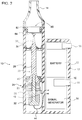
- FIG. 1 is a longitudinal cross-sectional view of an embodiment of the nebulizer with a removable liquid tank according to the invention.
- FIG. 2 is a longitudinal cross-sectional view of a comparative example of nebulizer with a removable soft membrane container.
- FIG. 3 is a longitudinal cross-sectional view of a further comparative example of nebulizer with a removable solid tank container incorporated into the sonotrode.
- each said example employs an ultrasonic signal generator to vaporize the e-juice (or material to be vaporized, including without limitation "wax,” gel or solid vaporizable substances) from the e-juice container or tank.
- This invention uses and employs ultrasonic signals and vibrations to cause atomization of e-juice, such as a nebulizer.
- a suitable frequency is about 30 kHz, and the amplitude of the vibrating probe in contact with liquid at >10 micrometer. A higher displacement will create more vapor output. Lower frequencies can also atomize, but the vapor particles will be too large. It is presumed that no prior art vaporizers or nebulizers exist that work in the desired frequency/amplitude range. Ultrasonic lab equipment for sonochemistry exists for cavitation of liquids and is powerful enough for atomizing e-juice.
- an ultrasonic atomizing/nebulizing device which generally comprises: an ultrasonic generator (typical, existing), powered by a DC power supply (can be battery or DC from an AC/DC converter); an ultrasonic generator drives a Langevin transducer; a horn, a part of the transducer, is a typical component of a Langevin transducer to amplify the ultrasonic signal, but not sufficient to atomize viscous liquid; a metal probe is attached to horn; a probe is bent to allow for greater movement of the probe tip so as to create a displacement of >10 micrometer; a tip touches a cotton wick, which draws fluid from a removable tank; and vapor of the atomized substance or liquid exits the mouthpiece.
- an ultrasonic generator typically, existing
- a DC power supply can be battery or DC from an AC/DC converter
- an ultrasonic generator drives a Langevin transducer
- a horn a part of the transducer, is a typical component of a Lang
- the nebulizer 10 comprises: a body 12, comprising a top portion mouthpiece 14, and encloses an ultrasonic transducer assembly 20 constituted by a stack of piezoelectric elements 22 which are supplied with electric current by supply wires 42 and 44 connected to a high frequency signal generator 50, which is an integral component on circuit board 60 which also includes primarily an on/off switch 56, a battery power source 52, and an input power jack 58.
- the transducer assembly 20 is held within the nebulizer housing 12 with acoustic isolators 40 and 38, so as to dampen the vibrations emitted from the transducer assembly 20 to the housing 12.
- Acoustic isolator 38 also acts as a seal to prevent nebulized droplets from straying into other components of the nebulizer 10.
- the transducer assembly 20 which is known as a "Langevin stack,” generally includes a transduction portion 24, a bearing member or “anvil” 26, and an amplification member or “sonotrode” 28.
- the bearing member or “anvil” 26 is connected to the proximal end of transduction section 24, and the sonotrode 28 is connected to the distal end of transduction portion 24.
- the anvil 26, sonotrode 28 are preferably fabricated from titanium, aluminum, stainless steel, or any other suitable material. Sonotrode 28 and anvil 26 have a length determined by a number of variables, including the thickness of the transduction section 24, the density and modulus of elasticity of material used in sonotrode 28, anvil 26 and the resonant frequency of the transducer assembly 20.
- the sonotrode 28 may be tapered inwardly from its proximal end to its distal end to amplify the ultrasonic vibration amplitude as velocity transformer 30, or alternately may have no amplification.
- the piezoelectric elements 22 may be fabricated from any suitable material, such as, for example, lead zirconate-titanate, lead meta-niobate, lead titanate, or other piezoelectric crystal material.
- the piezoelectric elements 22 have a bore extending through the center and are electrically coupled to wires 42 and 44, and electrically connected to the signal generator 50 on circuit board 60.
- the circuit board 60 also comprises a power source in the form of a rechargeable battery 52, an on/off switch 56 and a power jack 58 for accepting an external power source for charging the rechargeable battery 52 or to power the circuit board 50 in the absence of battery 52.
- the power jack 58 can be omitted if the battery 52 is removable from the nebulizer 10 for charging externally, or the nebulizer 10 is powered only by plug-in power through the power jack 58 without a battery power source.
- the piezoelectric elements 22 are conventionally held in compression between anvil 26 and sonotrode 28 by a bolt 32.
- the bolt 32 preferably has a head, a shank, and a threaded distal end.
- the bolt 32 is inserted from the proximal end of anvil 26 through the bores of anvil 26 and piezoelectric elements 22.
- the threaded distal end of the bolt 32 is screwed into a threaded bore in the proximal end of sonotrode 28.
- a removable mouthpiece 14 is attached to the nebulizer housing 12 to direct the vapor generated for inhalation by the user.
- the components of the transducer assembly 20 are preferably acoustically tuned such that the length of any assembly is an integral number of one-half wavelengths (n ⁇ /2), where the wavelength ⁇ is the wavelength of a pre-selected or operating longitudinal vibration drive frequency f d of the acoustic assembly 20, and where n is any positive integer. It is also contemplated that the acoustic assembly 20 may incorporate any suitable arrangement of acoustic elements.
- wires 42 and 44 transmit the electrical signal from the signal generator 50 to the piezoelectric elements 22 of the transducer assembly 20.
- the signal generator 50 is in turn electrically powered by a battery 52, and drives the circuit board 60 that primarily includes the signal generator 50, on/off switch 56 and power input jack 58.
- the piezoelectric elements 22 are energized by an electrical signal supplied from the generator 50 in response to the on/off switch 56 to produce an acoustic standing wave in the transducer 20.
- the electrical signal causes disturbances in the piezoelectric elements 22 in the form of repeated small displacements resulting in large compression forces within the material.
- the repeated small displacements cause the piezoelectric elements 22 to expand and contract in a continuous manner along the axis of the voltage gradient, producing longitudinal waves of ultrasonic energy.
- the ultrasonic energy is transmitted through the acoustic assembly 20 to the velocity transformer 30.
- Vaping medium or substance in contact with the distal end of the velocity transformer 30 is energized or agitated to the point of atomization or cavitation, resulting in nebulization of the vaping medium.
- a removable tank assembly 70 is attached to the housing 12 to store an amount of vaping liquid 74 within the tank 72.
- a soft absorbent material or "wick" 76 is adapted to draw a small amount of vaping liquid 74 to the distal end of the velocity transformer 30.
- the wick 76 is made from materials, including without limitation: cotton, fiberglass, ceramic fiber or any material that is absorbent and acoustically dampening, so that any friction caused by contact with the distal end of the velocity transformer 30 does not result in unnecessary friction-induced high pitched noise.
- the wick 76 is placed appropriately so that there is sufficient contact with the distal end of the velocity transformer 30, and allows for a capillary amount of vaping liquid to flow onto the distal end of the velocity transformer 30 for nebulization. As more of the liquid is nebulized, the wick 76 continues to draw more liquid 74 from the tank 72 to the velocity transformer 30.
- the wick 76 acts as a stopper to prevent leakage of the vaping liquid 74.
- a stopper 78 plugs the opening and can be removed to allow refilling of the vaping liquid 74.
- the tank assembly 70 can thus be easily removed for cleaning or replaced inexpensively without affecting any components of the transducer assembly 20.
- a removable container 80 is adapted between the mouthpiece 14 and nebulizer housing 12, and in contact with the distal end of the velocity transformer 30.
- the container 80 is constructed of a soft bottom membrane 84, and rigid side-wall 82.
- the soft bottom membrane 84 is made from resilient and pliable materials such as silicone or thermoplastic elastomer or any material that can withstand the vibrations of the velocity transformer 30 without melting or breaking, and at the same time acoustically dampening to prevent generating friction-induced noise when the transducer 20 is activated. Further, the thickness of the soft bottom membrane 84 should preferably be thin, about 0.5mm (0.02") so that vibratory energy can be transmitted from the velocity transformer 30 through the material of the bottom piece 84.
- the side-wall 82 is made from materials such as plastic, metal, glass or ceramic. The soft bottom 84 can be over-molded onto the side-wall 82, or it can be stretched over the side-wall 82 as a two-piece constructed tank 80.
- the soft bottom membrane 84 should preferably be taut around the side-wall 82, so that when the bottom 80 is in contact with the velocity transformer 30, vibratory energy can be efficiently transferred to the content of container 80.
- Vaping liquid or solid placed inside the container 80 can thus be energized by the velocity transformer 30 for nebulization without being in direct contact with the velocity transformer 30.
- Such vaping liquid or solid used in this example are typically gel-like or wax-like with high viscosity and do not flow freely through a wick 76 as described in Fig. 1 .
- the container 80 described in this example can thus be easily removed for cleaning or replaced inexpensively without affecting any components of the transducer assembly 20.
- a solid container 90 is integrated as part of the velocity transformer 30.
- the velocity transformer 30 has a first end and a second end.
- the sonotrode 28 comprises a first end coupled to the transduction section 24 of the transducer 20.
- the second end of the sonotrode 28 has a threaded distal end coupled to the first end of the velocity transformer 30.
- the second end of the velocity transformer has an attached container 90, comprising a bottom 94 and side-wall 92.
- An acoustic isolator 98 is adapted between the container 90 and nebulizer housing 12 to minimize any transfer of vibration and friction to the housing 12.
- the velocity transformer 30 and attached container 90 can thus be removed from the sonotrode 28 by unscrewing from the sonotrode 28 for cleaning or storage.
- vaping liquids or solids placed inside the container 90 can thus be energized by the velocity transformer 30 for nebulization.
- Such vaping liquid or solid used in this example are typically gel-like or wax-like with high viscosity and do not flow freely through a wick 76 as described in FIG. 1 .
- the container 90 and the attached velocity transformer 30 can be made from a single metallic material such as titanium, stainless steel or aluminum. Alternatively, the container 90 and velocity transformer 30 are separate components attached together with glue or fasteners. In either case, the container 90 and velocity transformer 30 should be attached in such a manner as to allow the maximum transfer of ultrasonic energy from the acoustic assembly 20 to the bottom 94 of the tank 90, without looseness or allowing for friction between the container 90 and velocity transformer 94. Any looseness or friction will result in audible and undesired high-pitched friction noise. Transducers are currently available and are used in several devices like dental scalers and surgical knives, and existing devices are shown and described in the following patents: US 6278218 ; US 5702360 ; and US 8257377 .
- the first one is object of the current invention and is for liquid and are the most applicable for e-cigarettes.
- the other two are more suitable for concentrates and THC waxes.
- Embodiment 1 for liquids For the embodiment of the current invention, the most important component is the delivery of the liquid from the tank to the transducer using a wick.
- No ultrasonic nebulizers for medicine use a wick; most of them have transducers, which are attached directly to a container to fill the liquid.
- Using a wick limits the amount of liquid to the transducer, such that it is just enough for atomization.
- Using a container like existing nebulizers requires the transducer has to be so powerful as to transfer energy through the depth of the liquid, but with instant improved design, less power is required.
- Example 1 for the first example, using silicone to atomize THC is a big discovery because the energy from the transducer can pass through silicone to melt and then atomize the THC, but it is important to have the silicone material taut.
- Example 2 the second example improves on Example 1 (silicone) and has a metal container that is attached to the transducer so there is as little as possible friction between the two parts; little or no friction results in reduced or no sound.
- the function of a typical nebulizer is directly related to the amount of liquid above the probe (or velocity transformer) of the transducer.
- the liquid flow amount of the wick can be controlled by the wick's density, porosity, and/or constricting the wick's diameter.
- the term “plurality” is defined as: two or more than two.
- the term “another” is defined as: at least a second or more.
- the terms “including” and/or “having” are defined as comprising (i.e., open language).
- the term “coupled” is defined as connected, although not necessarily directly, and not necessarily mechanically.
Landscapes
- Health & Medical Sciences (AREA)
- Engineering & Computer Science (AREA)
- Life Sciences & Earth Sciences (AREA)
- Animal Behavior & Ethology (AREA)
- Anesthesiology (AREA)
- Biomedical Technology (AREA)
- Heart & Thoracic Surgery (AREA)
- Hematology (AREA)
- Veterinary Medicine (AREA)
- Public Health (AREA)
- General Health & Medical Sciences (AREA)
- Pulmonology (AREA)
- Bioinformatics & Cheminformatics (AREA)
- Mechanical Engineering (AREA)
- Chemical & Material Sciences (AREA)
- Chemical Kinetics & Catalysis (AREA)
- General Chemical & Material Sciences (AREA)
- Special Spraying Apparatus (AREA)
Description
- An improvement for an ultrasonic vaporizing element for an electronic cigarette.
- In recent years, portable electronic vaporizers, or commonly known as electronic cigarettes or "e-cigs" have gained popularity among users who vaporize herbal extracts to inhale the vapors emitted when the extracts are heated. This action is often referred to as "vaping." An electronic vaporizer uses one or more batteries to power a heating element, which then heats up a small amount of the vaping liquid at an appropriate temperature to convert the liquid to vapor, which the user then inhales. Vaping liquids are typically solutions of propylene glycol, glycerol, or both, plus nicotine and flavorant chemicals. Medical marijuana users also add cannabis extracts to the mixture. Some E-cigarettes are also designed to allow for vaporization of solid herbal extracts. Various types of liquid and solid herbal extracts are available and are commonly referred to as "e-juice," "essential oil," "butter," "concentrate" or "wax."
- A common heating element is Nichrome resistance wire, which is a non-magnetic alloy of nickel, chromium, and often iron. A typical device will contain a rechargeable battery (usually lithium-ion), which is connected to a circuit board that has an On/Off switch. When the switch is turned on, the current from the battery will flow to the heating element to generate heat and causes the herbal extract that is placed on or close to the heating element to vaporize. The user will then inhale the vapor via a mouthpiece. A drawback of using Nichrome as a heat source is that nickel alloys and compounds are classified as carcinogenic to humans:
www.nipera.org/WorkplaceGuide/WorkplaceSurveillance/CarcinogenicClassifications.aspx. - Another disadvantage of the heating system of such vaporizers is that after several uses,
the heating element will be covered with residue from the extract. Over time, the residue will build up and causes a drop in the heater's efficiency. At such point, the device will be rendered inoperable, and the user will need to replace or repair the heating element. - Health issues associated with "vaping" have also been reported by The New England Journal of Medicine (www.neim.org/doi/full/10.1056/NEJMc1413069). At heated temperatures, formaldehyde, a known carcinogen, is released.
- Ultrasonic atomization: a more effective method for vaporizing herbal extracts is thus explored via ultrasonic atomization. Ultrasonic atomization or nebulization has been studied for decades and much has been written about these subjects and shall not be elaborated in detail here. Briefly, atomization occurs through the rapid mechanical upward and downward motion of an ultrasonic tip, which causes a film of liquid to form into standing capillary waves.
- When the amplitude of the capillary wave peaks above what is required for stability of the system, the liquid at the peak crests breaks away in the form of droplets. The phenomenon known as cavitation occurs at higher energy levels. Microscopic gas bubbles in a liquid will be forced to oscillate due to the applied sound wave. At such high intensity, bubbles will grow in size and rapidly collapse or implode. This disintegration of the liquid also results in droplet formation. Ultrasonic atomization is often used in automotive spray painting, in humidifiers, and coatings for fuel cells, wafers and solar panels.
- Ultrasonic sound waves are generally created by piezoelectric or magnetostrictive transducers. Piezoelectric transducers utilize the piezoelectric property of a material to convert electrical energy directly into mechanical energy. Magnetostrictive transducers utilize the magnetostrictive property of a material to convert the energy in a magnetic field into mechanical energy.
- Investigation into the suitable ultrasonic frequency and amplitude is made using an Ultrasonic Processor, such as the Hielscher UP100H model; this is lab equipment used for sonochemistry, which is the study of emulsifying, dispersing, dissolving and cell disruption of liquids. A frequency range of 20 - 40 kHz and a displacement amplitude of at least 10 micrometer at the vibrating tip is observed to sufficiently atomize a thin layer of vaping liquid with comparable vapor volume as that generated by traditional electronic cigarettes.
- However, using a lab ultrasonic processor will be impractical as a portable vaporizer due to the size, weight and high power requirement. Another important consideration is the method of containing and delivering the vaping liquid to the vibrating ultrasonic tip (sonotrode or horn). Using a separate beaker like that used in conjunction with a lab ultrasonic processor will not be leak proof or practical.
- Nebulizers: other types of vaporizers in the medical industry exist whereby liquids are atomized using ultrasonic sound waves. These types of vaporizers are also called nebulizers, which is a drug delivery device used to administer medication in the form of a mist inhaled into the lungs to treat cystic fibrosis, asthma, COPD and other respiratory diseases. Different types of ultrasonic nebulizers are described below:
Ultrasonic wave nebulizers - these have an electronic oscillator generate a high frequency ultrasonic wave, which causes the mechanical vibration of a Mist Transducer. This transducer is comprised of a ring-shaped piezoelectric element attached to a metal plate, which amplifies the vibration. The metal plate is in contact with a liquid reservoir, and its high frequency vibration is sufficient to produce a vapor mist. An example of such a type of Mist Transducer is the SMIST15F28RR111 model produced by Steiner and Martins, Inc. of Florida, USA. Examples of such nebulizers are: Omron NE-U17 and Beurer Nebulizer IH30. These nebulizers are often larger table top devices requiring plug-in power. - Vibrating mesh technology (VMT): a metallic mesh/membrane with 1000-7000 laser drilled holes vibrates at the top of the liquid reservoir, and thereby pressures out a mist of very fine droplets through the holes. This technology is more efficient than having a vibrating piezoelectric element at the bottom of the liquid reservoir, and thereby allows for smaller and more portable designs. The mesh can be vibrated with the same ring-shaped piezoelectric element attached to the mesh, or it can be vibrated by a Langevin type transducer placed against the mesh; some examples are Pari eFlow, Respironics i-Neb, Beurer Nebulizer IH50, Aerogen Aeroneb and Omron MicroAir products.
- Sandwich type ultrasonic transducers, also called bolt-clamped or Langevin transducers, are well known and established for the production of high intensity ultrasonic motion. In United Kingdom Patent No.
145,691, issued in 1921, P. Langevin 868,784 - Regardless of the types of nebulizer technology, these devices are inappropriate for vaping liquids or solids used in electronic cigarettes. The drugs used for nebulizing are often water-like in viscosity (water = 1cSt), whereas vaping liquids are often more than 50cSt, depending on the types and concentration of glycol, glycerol and nicotine in the mixture. Bubbling is observed when vaping liquids are used in medical nebulizers, but the intensity of the vibration is insufficient to cause atomization.
- An obvious solution to the aforementioned problem is to use a higher-powered transducer. However, this is unsuitable for the following reasons:
- 1. Size - The ring-shaped transducers used in ultrasonic wave or VMT nebulizers are often 1.5 cm to 4 cm in diameter. For such transducers to be powerful enough to atomize viscous vaping liquids, the transducer has to be significantly bigger for higher amplification. This is apparently unsuitable to be incorporated in a pocket-sized vaporizer.
- 2. Power - A higher power input is required for powering a larger transducer, which will be unsuitable for a portable device running on battery.
- 3. Noise - A VMT nebulizer utilizing a Langevin transducer will generate a very noticeable high-pitch noise if the transducer sonotrode or tip vibrates at the desired amplitude of more than 10 micrometer against metal or any hard objects. This rules out any transducer-to-metal mesh vibration mechanism.
- Another consideration is the cleanability of the device. Vaping liquids containing cannabis extracts, or solid cannabis extracts are thick, sticky and do not dissolve in water or detergent. At room temperature, these liquids and are difficult to wash off without acidic solvents. Thus, any liquid tank in the portable device should preferably be replaceable and disposable.
- However, existing nebulizers using VMT often incorporate the mesh and transducer directly onto the removable liquid tanks and are not intended to be discarded after short uses. The preferred configuration should be to separate the tank from the transducer or vibrating source so that the tank itself can be cheaply replaced. This presents a challenge with the appropriate
- methodology of delivering the vaping liquid from a removable tank to the transducer that is permanently attached to the device, and yet is leak proof when transported. From the United States patent application publication
US 2010/0044460 A1 an ultrasound liquid atomizer comprising a rigid piezoelectric transducer body is known. From the United Kingdom patentGB 2 107 611 A JP 2000 051755 A JP 2010 142737 A - It is an object to improve an apparatus for ultrasonic atomizing of a vaping liquid with respect to better cleanability of the apparatus including improved detachability and leak proof transportability of a vaping liquid tank.
- This and other objects are achieved by the current invention as defined in claim 1. . Advantageous further embodiments are claimed in the dependent claims.
-
FIG. 1 is a longitudinal cross-sectional view of an embodiment of the nebulizer with a removable liquid tank according to the invention.FIG. 2 is a longitudinal cross-sectional view of a comparative example of nebulizer with a removable soft membrane container.FIG. 3 is a longitudinal cross-sectional view of a further comparative example of nebulizer with a removable solid tank container incorporated into the sonotrode. -
- 10 nebulizer
- 12 body
- 14 mouthpiece
- 20 ultrasonic transducer assembly or transducer assembly
- 22 piezoelectric elements
- 24 transduction portion
- 26 "anvil" or bearing member
- 28 amplification member or "sonotrode"
- 30 velocity transformer
- 32 bolt
- 38, 40 acoustic isolators
- 42, 44 electric current supply wires
- 50 high frequency signal generator
- 52 battery or power source
- 56 activation actuator or on/off switch
- 58 input power jack
- 60 circuit board
- 70 tank assembly
- 72 tank
- 74 vaping liquid or substance
- 76 soft absorbent material or "wick"
- 78 stopper
- 80 removable container
- 82 container side wall
- 84 soft bottom membrane
- 90 container
- 92 side wall of container
- 94 container bottom
- Referring to
Figures 1-3 , there is illustrated several examples for the vaporizing element for a certain type of e-cigarette or "e-cig," - each said example employs an ultrasonic signal generator to vaporize the e-juice (or material to be vaporized, including without limitation "wax," gel or solid vaporizable substances) from the e-juice container or tank. - This invention uses and employs ultrasonic signals and vibrations to cause atomization of e-juice, such as a nebulizer. There are existing nebulizers, such as: (http://www.omron-healthcare.com/eu/en/our-products/respiratory-therapy/microair-u22), but these nebulizers work with thin liquids that are water-like (viscosity = 1 Cst), and are not powerful enough for viscous liquids >10 Cst.
- The inventor has discovered such a suitable frequency is about 30 kHz, and the amplitude of the vibrating probe in contact with liquid at >10 micrometer. A higher displacement will create more vapor output. Lower frequencies can also atomize, but the vapor particles will be too large. It is presumed that no prior art vaporizers or nebulizers exist that work in the desired frequency/amplitude range. Ultrasonic lab equipment for sonochemistry exists for cavitation of liquids and is powerful enough for atomizing e-juice.
- However, these existing lab equipment devices are high-powered and often have very long ultrasonic "horns" or probes that amplify the signal. This setup makes it ineffective for a portable device.
- The discovery of shaping a transducer horn so that amplitude can be increased has been important; it is L-shaped (like dental scaling tips). This takes up less space with similar vibrational displacement achieved at the end of the probe. Due to the vibration energy created, especially at the end of the probe, heat is generated. This can reach >70°C, which means that the device can also be used for solids or waxes such as THC. THC melts at 66°C and turns into a liquid, which can then be ultrasonically atomized.
- A preferred embodiment of an ultrasonic atomizing/nebulizing device, which generally comprises: an ultrasonic generator (typical, existing), powered by a DC power supply (can be battery or DC from an AC/DC converter); an ultrasonic generator drives a Langevin transducer; a horn, a part of the transducer, is a typical component of a Langevin transducer to amplify the ultrasonic signal, but not sufficient to atomize viscous liquid; a metal probe is attached to horn; a probe is bent to allow for greater movement of the probe tip so as to create a displacement of >10 micrometer; a tip touches a cotton wick, which draws fluid from a removable tank; and vapor of the atomized substance or liquid exits the mouthpiece.
- In
Figures 1 to 3 , thenebulizer 10 comprises: abody 12, comprising atop portion mouthpiece 14, and encloses anultrasonic transducer assembly 20 constituted by a stack ofpiezoelectric elements 22 which are supplied with electric current bysupply wires frequency signal generator 50, which is an integral component oncircuit board 60 which also includes primarily an on/offswitch 56, abattery power source 52, and aninput power jack 58. Thetransducer assembly 20 is held within thenebulizer housing 12 withacoustic isolators transducer assembly 20 to thehousing 12.Acoustic isolator 38 also acts as a seal to prevent nebulized droplets from straying into other components of thenebulizer 10. - The
transducer assembly 20, which is known as a "Langevin stack," generally includes atransduction portion 24, a bearing member or "anvil" 26, and an amplification member or "sonotrode" 28. The bearing member or "anvil" 26 is connected to the proximal end oftransduction section 24, and thesonotrode 28 is connected to the distal end oftransduction portion 24. Theanvil 26, sonotrode 28 are preferably fabricated from titanium, aluminum, stainless steel, or any other suitable material. Sonotrode 28 andanvil 26 have a length determined by a number of variables, including the thickness of thetransduction section 24, the density and modulus of elasticity of material used insonotrode 28,anvil 26 and the resonant frequency of thetransducer assembly 20. Thesonotrode 28 may be tapered inwardly from its proximal end to its distal end to amplify the ultrasonic vibration amplitude asvelocity transformer 30, or alternately may have no amplification. - The
piezoelectric elements 22 may be fabricated from any suitable material, such as, for example, lead zirconate-titanate, lead meta-niobate, lead titanate, or other piezoelectric crystal material. Thepiezoelectric elements 22 have a bore extending through the center and are electrically coupled towires signal generator 50 oncircuit board 60. Thecircuit board 60 also comprises a power source in the form of arechargeable battery 52, an on/offswitch 56 and apower jack 58 for accepting an external power source for charging therechargeable battery 52 or to power thecircuit board 50 in the absence ofbattery 52. Alternatively, thepower jack 58 can be omitted if thebattery 52 is removable from thenebulizer 10 for charging externally, or thenebulizer 10 is powered only by plug-in power through thepower jack 58 without a battery power source. - The
piezoelectric elements 22 are conventionally held in compression betweenanvil 26 andsonotrode 28 by abolt 32. Thebolt 32 preferably has a head, a shank, and a threaded distal end. Thebolt 32 is inserted from the proximal end ofanvil 26 through the bores ofanvil 26 andpiezoelectric elements 22. The threaded distal end of thebolt 32 is screwed into a threaded bore in the proximal end ofsonotrode 28. Aremovable mouthpiece 14 is attached to thenebulizer housing 12 to direct the vapor generated for inhalation by the user. - In order for the
transducer assembly 20 to deliver energy all components oftransducer assembly 20 must be acoustically coupled. The components of thetransducer assembly 20 are preferably acoustically tuned such that the length of any assembly is an integral number of one-half wavelengths (nλ/2), where the wavelength λ is the wavelength of a pre-selected or operating longitudinal vibration drive frequency fd of theacoustic assembly 20, and where n is any positive integer. It is also contemplated that theacoustic assembly 20 may incorporate any suitable arrangement of acoustic elements. - Referring to
FIGS. 1 to 3 ,wires signal generator 50 to thepiezoelectric elements 22 of thetransducer assembly 20. Thesignal generator 50 is in turn electrically powered by abattery 52, and drives thecircuit board 60 that primarily includes thesignal generator 50, on/offswitch 56 andpower input jack 58. Thepiezoelectric elements 22 are energized by an electrical signal supplied from thegenerator 50 in response to the on/offswitch 56 to produce an acoustic standing wave in thetransducer 20. The electrical signal causes disturbances in thepiezoelectric elements 22 in the form of repeated small displacements resulting in large compression forces within the material. The repeated small displacements cause thepiezoelectric elements 22 to expand and contract in a continuous manner along the axis of the voltage gradient, producing longitudinal waves of ultrasonic energy. The ultrasonic energy is transmitted through theacoustic assembly 20 to thevelocity transformer 30. Vaping medium or substance in contact with the distal end of thevelocity transformer 30 is energized or agitated to the point of atomization or cavitation, resulting in nebulization of the vaping medium. - In
FIG. 1 of the embodiment of the present invention, aremovable tank assembly 70 is attached to thehousing 12 to store an amount of vapingliquid 74 within thetank 72. On one opening end of thetank 72, a soft absorbent material or "wick" 76 is adapted to draw a small amount of vapingliquid 74 to the distal end of thevelocity transformer 30. Thewick 76 is made from materials, including without limitation: cotton, fiberglass, ceramic fiber or any material that is absorbent and acoustically dampening, so that any friction caused by contact with the distal end of thevelocity transformer 30 does not result in unnecessary friction-induced high pitched noise. Thewick 76 is placed appropriately so that there is sufficient contact with the distal end of thevelocity transformer 30, and allows for a capillary amount of vaping liquid to flow onto the distal end of thevelocity transformer 30 for nebulization. As more of the liquid is nebulized, thewick 76 continues to draw more liquid 74 from thetank 72 to thevelocity transformer 30. When thetank assembly 70 is removed from thenebulizer housing 12, thewick 76 acts as a stopper to prevent leakage of the vapingliquid 74. On another opening end of thetank 72, astopper 78 plugs the opening and can be removed to allow refilling of the vapingliquid 74. Thetank assembly 70 can thus be easily removed for cleaning or replaced inexpensively without affecting any components of thetransducer assembly 20. - In
FIG. 2 aremovable container 80 is adapted between themouthpiece 14 andnebulizer housing 12, and in contact with the distal end of thevelocity transformer 30. Thecontainer 80 is constructed of asoft bottom membrane 84, and rigid side-wall 82. Thesoft bottom membrane 84 is made from resilient and pliable materials such as silicone or thermoplastic elastomer or any material that can withstand the vibrations of thevelocity transformer 30 without melting or breaking, and at the same time acoustically dampening to prevent generating friction-induced noise when thetransducer 20 is activated. Further, the thickness of thesoft bottom membrane 84 should preferably be thin, about 0.5mm (0.02") so that vibratory energy can be transmitted from thevelocity transformer 30 through the material of thebottom piece 84. The side-wall 82 is made from materials such as plastic, metal, glass or ceramic. The soft bottom 84 can be over-molded onto the side-wall 82, or it can be stretched over the side-wall 82 as a two-piece constructedtank 80. - Whichever method the
tank 80 is constructed, thesoft bottom membrane 84 should preferably be taut around the side-wall 82, so that when the bottom 80 is in contact with thevelocity transformer 30, vibratory energy can be efficiently transferred to the content ofcontainer 80. Vaping liquid or solid placed inside thecontainer 80 can thus be energized by thevelocity transformer 30 for nebulization without being in direct contact with thevelocity transformer 30. Such vaping liquid or solid used in this example are typically gel-like or wax-like with high viscosity and do not flow freely through awick 76 as described inFig. 1 . Thecontainer 80 described in this example can thus be easily removed for cleaning or replaced inexpensively without affecting any components of thetransducer assembly 20. - In
FIG. 3 asolid container 90 is integrated as part of thevelocity transformer 30. Thevelocity transformer 30 has a first end and a second end. Thesonotrode 28 comprises a first end coupled to thetransduction section 24 of thetransducer 20. The second end of thesonotrode 28 has a threaded distal end coupled to the first end of thevelocity transformer 30. The second end of the velocity transformer has an attachedcontainer 90, comprising a bottom 94 and side-wall 92. Anacoustic isolator 98 is adapted between thecontainer 90 andnebulizer housing 12 to minimize any transfer of vibration and friction to thehousing 12. Thevelocity transformer 30 and attachedcontainer 90 can thus be removed from thesonotrode 28 by unscrewing from thesonotrode 28 for cleaning or storage. When thevelocity transformer 30 is coupled to thesonotrode 28, ultrasonic energy from theacoustic assembly 20 is transferred to the bottom 94 of thecontainer 90. Vaping liquids or solids placed inside thecontainer 90 can thus be energized by thevelocity transformer 30 for nebulization. Such vaping liquid or solid used in this example are typically gel-like or wax-like with high viscosity and do not flow freely through awick 76 as described inFIG. 1 . - The
container 90 and the attachedvelocity transformer 30 can be made from a single metallic material such as titanium, stainless steel or aluminum. Alternatively, thecontainer 90 andvelocity transformer 30 are separate components attached together with glue or fasteners. In either case, thecontainer 90 andvelocity transformer 30 should be attached in such a manner as to allow the maximum transfer of ultrasonic energy from theacoustic assembly 20 to the bottom 94 of thetank 90, without looseness or allowing for friction between thecontainer 90 andvelocity transformer 94. Any looseness or friction will result in audible and undesired high-pitched friction noise. Transducers are currently available and are used in several devices like dental scalers and surgical knives, and existing devices are shown and described in the following patents:US 6278218 ;US 5702360 ; andUS 8257377 . - There are 3 examples of design. The first one is object of the current invention and is for liquid and are the most applicable for e-cigarettes. The other two are more suitable for concentrates and THC waxes.
- Embodiment 1 for liquids: For the embodiment of the current invention, the most important component is the delivery of the liquid from the tank to the transducer using a wick. No ultrasonic nebulizers for medicine use a wick; most of them have transducers, which are attached directly to a container to fill the liquid. Using a wick limits the amount of liquid to the transducer, such that it is just enough for atomization. Using a container like existing nebulizers requires the transducer has to be so powerful as to transfer energy through the depth of the liquid, but with instant improved design, less power is required.
- Example 1: for the first example, using silicone to atomize THC is a big discovery because the energy from the transducer can pass through silicone to melt and then atomize the THC, but it is important to have the silicone material taut.
- Note that hard materials will not work, such as metal, glass or ceramic; the transducer scratches the material and creates an audible screeching sound. If in plastic, the transducer actually melts and cut through the plastic, much like an ultrasonic welding machine. Silicone has another advantage because THC material does not stick to the silicone and makes for easier cleaning.
- Example 2: the second example improves on Example 1 (silicone) and has a metal container that is attached to the transducer so there is as little as possible friction between the two parts; little or no friction results in reduced or no sound.
- The function of a typical nebulizer is directly related to the amount of liquid above the probe (or velocity transformer) of the transducer. The thicker the amount of liquid above the probe, the more powerful the transducer needs to be in order to transmit the acoustic energy to the surface of the liquid to cause atomization.
- To minimize the amount of power required, a thin film of liquid is desired, so that less energy (thus smaller battery) is sufficient to atomize the liquid; the preferred wick will draw just enough liquid to the probe so that no big puddle is formed on the probe (i.e., big puddle = thick amount = insufficient energy to transmit through the thickness of the liquid).
- Conversely, if the wick is too dense, not enough liquid is drawn to the probe for optimal vapor output. The liquid flow amount of the wick can be controlled by the wick's density, porosity, and/or constricting the wick's diameter.
- Detailed embodiments of the present invention are disclosed; however, the disclosed embodiments are merely exemplary of the invention, which can be embodied in various forms; specific structural and functional details disclosed are not to be interpreted as limiting, but merely as a basis for the claims and as a representative basis for teaching one skilled in the art to variously employ the present invention in virtually any appropriately detailed structure. The title, headings, terms and phrases used are not intended to limit the subject matter or scope; but rather, to provide an understandable description of the invention. The invention is composed of several sub-parts that serve a portion of the total functionality of the invention independently and contribute to system level functionality when combined with other parts of the invention. The terms "a" or "an" are defined as: one or more than one. The term "plurality" is defined as: two or more than two. The term "another" is defined as: at least a second or more. The terms "including" and/or "having" are defined as comprising (i.e., open language). The term "coupled" is defined as connected, although not necessarily directly, and not necessarily mechanically.
Claims (3)
- An apparatus (10) for ultrasonic atomizing of a liquid (74) in a replaceable container (72), comprising:a housing (12) with a power source (52);wherein the housing (12) has the container (72) with the liquid (74) for atomizing;an ultrasonic transducer (24) and a sonotrode (28), wherein the container (72) has a wick (76) for drawing the liquid (74) to the sonotrode (28) provided at one end of the ultrasonic transducer (24), which is located in the housing (12);the sonotrode (28) being configured to engage the wick (76) and allow for a displacement of greater than 10 micrometer;the ultrasonic transducer (24) is connected to the power source (52) and a signal generator (50);the ultrasonic transducer (24) is a Langevin stack with piezoelectric elements (22) held in compression between an anvil (26) and the sonotrode (28) by a bolt (32), transmitting ultrasonic energy to the sonotrode's forward end that engages the wick formed by a porous absorbent material interfacing the forward end of the sonotrode, wherein the liquid in the replaceable container is such that the liquid is delivered to the sonotrode for nebulizing in a controlled manner;whereby when activated, the ultrasonic transducer (24) is configured to vibrate the sonotrode (28), such that the liquid (74) from the wick (76) is atomized, and vapor of the atomized liquid exits the apparatus; anda removable container assembly (70) that is removable from the housing (12);characterized in thatthe housing (12) has a mouthpiece (14) and the liquid is a vaping liquid; andthe wick (76) is configured to act as a stopper to prevent leakage of the vaping liquid (74) when the container assembly (70) is removed from the nebulizer housing (12).
- The apparatus of claim 1 wherein the power source (52) is an internal battery or an external power source; and the ultrasonic transducer (24) is activated by an activation switch (56) or an activation button (56).
- The apparatus of claim 1 wherein the housing (12) has acoustic isolators (38, 40) to dampen vibrations emitted from the ultrasonic transducer (24) to the housing (12).
Applications Claiming Priority (3)
| Application Number | Priority Date | Filing Date | Title |
|---|---|---|---|
| US201562106852P | 2015-01-23 | 2015-01-23 | |
| US201562142464P | 2015-04-02 | 2015-04-02 | |
| PCT/US2016/014646 WO2016118941A1 (en) | 2015-01-23 | 2016-01-23 | Ultrasonic vaporizing element |
Publications (3)
| Publication Number | Publication Date |
|---|---|
| EP3247435A1 EP3247435A1 (en) | 2017-11-29 |
| EP3247435A4 EP3247435A4 (en) | 2018-07-25 |
| EP3247435B1 true EP3247435B1 (en) | 2021-03-10 |
Family
ID=56417857
Family Applications (1)
| Application Number | Title | Priority Date | Filing Date |
|---|---|---|---|
| EP16740889.7A Active EP3247435B1 (en) | 2015-01-23 | 2016-01-23 | Ultrasonic vaporizing element |
Country Status (8)
| Country | Link |
|---|---|
| US (1) | US20160213866A1 (en) |
| EP (1) | EP3247435B1 (en) |
| JP (1) | JP6531183B2 (en) |
| KR (1) | KR20170108057A (en) |
| CN (1) | CN107206198B (en) |
| CA (1) | CA2973880A1 (en) |
| IL (1) | IL253591B (en) |
| WO (1) | WO2016118941A1 (en) |
Cited By (3)
| Publication number | Priority date | Publication date | Assignee | Title |
|---|---|---|---|---|
| US12171938B1 (en) | 2023-01-06 | 2024-12-24 | Microneb Tech Holdings, Inc. | Apparatus, methods, and systems for delivery and administration of pharmaceutical, therapeutic and cosmetic substances to users |
| DE102024124473A1 (en) | 2023-08-28 | 2025-03-06 | Marc Deppe | Aerosol generating device and method for generating an aerosol |
| GB2638841A (en) * | 2024-02-27 | 2025-09-03 | Shenzhen First Union Tech Co | Electronic atomization device, device body, and liquid source |
Families Citing this family (156)
| Publication number | Priority date | Publication date | Assignee | Title |
|---|---|---|---|---|
| US10244793B2 (en) | 2005-07-19 | 2019-04-02 | Juul Labs, Inc. | Devices for vaporization of a substance |
| US10279934B2 (en) | 2013-03-15 | 2019-05-07 | Juul Labs, Inc. | Fillable vaporizer cartridge and method of filling |
| US10159282B2 (en) | 2013-12-23 | 2018-12-25 | Juul Labs, Inc. | Cartridge for use with a vaporizer device |
| USD842536S1 (en) | 2016-07-28 | 2019-03-05 | Juul Labs, Inc. | Vaporizer cartridge |
| US10076139B2 (en) | 2013-12-23 | 2018-09-18 | Juul Labs, Inc. | Vaporizer apparatus |
| US10058129B2 (en) | 2013-12-23 | 2018-08-28 | Juul Labs, Inc. | Vaporization device systems and methods |
| US20160366947A1 (en) | 2013-12-23 | 2016-12-22 | James Monsees | Vaporizer apparatus |
| KR102267997B1 (en) | 2013-12-23 | 2021-06-23 | 쥴 랩스, 인크. | Vaporization device systems and methods |
| USD825102S1 (en) | 2016-07-28 | 2018-08-07 | Juul Labs, Inc. | Vaporizer device with cartridge |
| EP3200633B1 (en) | 2014-10-02 | 2025-04-02 | Cue Vapor Ltd | Disposable tank electronic cigarette, method of manufacture and method of use |
| KR102627987B1 (en) | 2014-12-05 | 2024-01-22 | 쥴 랩스, 인크. | Calibrated dose control |
| CN113230021A (en) | 2015-01-12 | 2021-08-10 | 科达莱昂治疗公司 | Droplet delivery apparatus and method |
| US10039320B2 (en) | 2015-05-14 | 2018-08-07 | Lunatech, Llc | Multi-chambered vaporizer and blend control |
| WO2016187115A1 (en) | 2015-05-15 | 2016-11-24 | John Cameron | Hybrid vapor delivery system utilizing nebulized and non-nebulized elements |
| USD792020S1 (en) * | 2015-07-29 | 2017-07-11 | All About Vapor, Inc. | Vaporizer |
| USD792642S1 (en) * | 2015-07-29 | 2017-07-18 | All About Vapor, Inc. | Vaporizer |
| CA167415S (en) | 2015-09-15 | 2016-10-13 | Nicoventures Holdings Ltd | Docking station for vaporizer |
| US9936737B2 (en) | 2015-10-28 | 2018-04-10 | Lunatech, Llc | Methods and systems for a dual function vapor device |
| USD790766S1 (en) * | 2015-10-29 | 2017-06-27 | Shenzhen Innokin Technology Co., Limited. | Electronic cigarette |
| KR101776431B1 (en) * | 2015-12-14 | 2017-09-07 | 현대자동차주식회사 | Washer nozzle for vehicle |
| US10092036B2 (en) * | 2015-12-28 | 2018-10-09 | Rai Strategic Holdings, Inc. | Aerosol delivery device including a housing and a coupler |
| USD788364S1 (en) * | 2016-01-08 | 2017-05-30 | Smiss Technology Co., Ltd. | Dry herb vaporizer |
| USD789598S1 (en) * | 2016-01-08 | 2017-06-13 | Smiss Technology Co., Ltd. | Dry herb vaporizer |
| USD788363S1 (en) * | 2016-01-08 | 2017-05-30 | Smiss Technology Co., Ltd. | Dry herb vaporizer |
| WO2019032758A1 (en) * | 2017-08-08 | 2019-02-14 | William Tan | Ultrasonic atomizer with removable cartridge for the dispersal of a liquid |
| US11325149B2 (en) * | 2016-01-23 | 2022-05-10 | William Tan | Ultrasonic atomizer and cartridge for the dispersal of a liquid |
| JP6695701B2 (en) * | 2016-02-03 | 2020-05-20 | 株式会社Screenホールディングス | Treatment liquid vaporizer and substrate treatment equipment |
| WO2017139675A1 (en) | 2016-02-11 | 2017-08-17 | Pax Labs, Inc. | Securely attaching cartridges for vaporizer devices |
| MX377347B (en) | 2016-02-11 | 2025-03-07 | Juul Labs Inc | Fillable vaporizer cartridge and method of filling |
| US10405582B2 (en) | 2016-03-10 | 2019-09-10 | Pax Labs, Inc. | Vaporization device with lip sensing |
| JP2019515684A (en) * | 2016-04-04 | 2019-06-13 | ネクスバップ エスアー | Portable inhaler and container for use therewith |
| EP3452150B1 (en) | 2016-05-03 | 2024-01-17 | Pneuma Respiratory, Inc. | Droplet delivery device for delivery of fluids to the pulmonary system |
| USD783895S1 (en) * | 2016-05-31 | 2017-04-11 | Smiss Technology Co., Ltd. | Dry herb vaporizer |
| USD809191S1 (en) * | 2016-06-07 | 2018-01-30 | Yong-Sheng Li | E-cigarette |
| USD849996S1 (en) | 2016-06-16 | 2019-05-28 | Pax Labs, Inc. | Vaporizer cartridge |
| USD851830S1 (en) | 2016-06-23 | 2019-06-18 | Pax Labs, Inc. | Combined vaporizer tamp and pick tool |
| USD836541S1 (en) | 2016-06-23 | 2018-12-25 | Pax Labs, Inc. | Charging device |
| CN205912905U (en) | 2016-08-03 | 2017-02-01 | 湖南中烟工业有限责任公司 | Ultrasonic wave electron smog core and atomizer |
| WO2018023188A1 (en) * | 2016-08-05 | 2018-02-08 | Jarman Gordon Alexander | Method and apparatus for producing an inhalable vapour |
| CN107752129B (en) * | 2016-08-19 | 2024-04-23 | 湖南中烟工业有限责任公司 | Ultrasonic atomization sheet and manufacturing method thereof, ultrasonic atomizer and electronic cigarette |
| JP6776761B2 (en) * | 2016-09-20 | 2020-10-28 | オムロンヘルスケア株式会社 | Mesh nebulizer and chemical pack |
| US11660403B2 (en) | 2016-09-22 | 2023-05-30 | Juul Labs, Inc. | Leak-resistant vaporizer device |
| PT3519025T (en) * | 2016-09-30 | 2023-03-03 | De Motu Cordis Pty Ltd | Delivery device and associated methods of use |
| CN108078009B (en) * | 2016-11-22 | 2024-02-27 | 湖南中烟工业有限责任公司 | Oblique ultrasonic atomizing piece structure and atomizer, electronic cigarette |
| CA3046954C (en) | 2016-12-12 | 2024-01-02 | Vmr Products Llc | Refillable cartridge for vaporizer |
| USD816895S1 (en) * | 2017-01-20 | 2018-05-01 | Qiuming Ren | Electronic hookah |
| CN109906120A (en) | 2017-01-20 | 2019-06-18 | 科达莱昂治疗公司 | Piezoelectric fluid distributor |
| WO2018146737A1 (en) * | 2017-02-08 | 2018-08-16 | 日本たばこ産業株式会社 | Supply method for liquids |
| GB201704999D0 (en) | 2017-03-29 | 2017-05-10 | British American Tobacco Investments Ltd | Aerosol delivery system |
| EP4223335A3 (en) | 2017-05-19 | 2023-11-08 | Pneuma Respiratory, Inc. | Dry powder delivery device and methods of use |
| US10349674B2 (en) | 2017-07-17 | 2019-07-16 | Rai Strategic Holdings, Inc. | No-heat, no-burn smoking article |
| US10440988B2 (en) * | 2017-08-10 | 2019-10-15 | Cigar Labs Inc. | Humidification apparatus |
| USD887632S1 (en) | 2017-09-14 | 2020-06-16 | Pax Labs, Inc. | Vaporizer cartridge |
| GB2604314A (en) | 2017-09-22 | 2022-09-07 | Nerudia Ltd | Device, system and method |
| JP2020536614A (en) | 2017-10-04 | 2020-12-17 | ニューマ・リスパイラトリー・インコーポレイテッド | In-line droplet delivery device and usage that is electrically operated by breathing |
| CA3079189A1 (en) | 2017-10-17 | 2019-04-25 | Pneuma Respiratory, Inc. | Nasal drug delivery apparatus and methods of use |
| USD848673S1 (en) * | 2017-10-31 | 2019-05-14 | Avail Vapor Llc | Microvaporizer cartridge |
| JP2021502178A (en) | 2017-11-08 | 2021-01-28 | ニューマ・リスパイラトリー・インコーポレイテッド | In-line droplet delivery device with a small volume ampoule and electrically actuated by breathing and how to use |
| AU2018373743B2 (en) * | 2017-11-21 | 2020-07-02 | Qingdao university of technology | Electrostatic-atomization ultrasonic wave assisted low-damage and controllable biologic bone grinding process and apparatus |
| WO2019113483A1 (en) | 2017-12-08 | 2019-06-13 | Kedalion Therapeutics, Inc. | Fluid delivery alignment system |
| CN108030153B (en) * | 2018-01-26 | 2019-07-26 | 云南中烟工业有限责任公司 | A kind of surface acoustic wave electronic cigarette system |
| WO2019198162A1 (en) * | 2018-04-10 | 2019-10-17 | 日本たばこ産業株式会社 | Atomization unit |
| US12350194B1 (en) | 2018-04-12 | 2025-07-08 | Bausch + Lomb Ireland Limited | Topical ocular delivery of fluids with controlled mass dosing and wireless communication |
| US20190314197A1 (en) | 2018-04-12 | 2019-10-17 | Kedalion Therapeutics, Inc. | Topical Ocular Delivery Methods and Devices for Use in the Same |
| US20190356047A1 (en) * | 2018-05-16 | 2019-11-21 | Intrepid Brands, LLC | Radio-frequency heating medium |
| WO2020010116A1 (en) | 2018-07-03 | 2020-01-09 | Kedalion Therapeutics, Inc. | Topical ocular delivery devices and methods for using the same |
| US12029243B2 (en) * | 2018-07-06 | 2024-07-09 | China Tobacco Hunan Industrial Co., Ltd. | Ultrasonic atomization core, ultrasonic atomizer, and ultrasonic electronic cigarette |
| US11690963B2 (en) | 2018-08-22 | 2023-07-04 | Qnovia, Inc. | Electronic device for producing an aerosol for inhalation by a person |
| US11517685B2 (en) * | 2019-01-18 | 2022-12-06 | Qnovia, Inc. | Electronic device for producing an aerosol for inhalation by a person |
| WO2020041641A1 (en) | 2018-08-22 | 2020-02-27 | Respira Technologies, Inc. | Electronic device for producing an aerosol for inhalation by a person |
| US12501929B2 (en) | 2018-08-22 | 2025-12-23 | Qnovia, Inc. | Electronic device for producing an aerosol for inhalation by a person |
| EP3863453A4 (en) | 2018-10-18 | 2022-11-23 | Qnovia, Inc. | ELECTRONIC DEVICE FOR PRODUCING AN AEROSOL INTENDED TO BE INHALED BY A PERSON |
| US11838997B2 (en) | 2018-11-05 | 2023-12-05 | Juul Labs, Inc. | Cartridges for vaporizer devices |
| EP3876760B1 (en) | 2018-11-08 | 2024-05-15 | Juul Labs, Inc. | Cartridges for vaporizer devices |
| CN109480334B (en) * | 2018-11-27 | 2024-02-02 | 云南中烟工业有限责任公司 | An electronic cigarette liquid supply device and liquid supply method |
| KR20210104029A (en) | 2018-12-17 | 2021-08-24 | 필립모리스 프로덕츠 에스.에이. | A tubular element having a thread for use with an aerosol-generating article |
| CN113260262A (en) * | 2018-12-17 | 2021-08-13 | 菲利普莫里斯生产公司 | Tubular element comprising a porous medium and a wrapper for use with an aerosol-generating article |
| US11096419B2 (en) | 2019-01-29 | 2021-08-24 | Rai Strategic Holdings, Inc. | Air pressure sensor for an aerosol delivery device |
| US11553730B2 (en) * | 2019-02-01 | 2023-01-17 | Lunatech, Llc | Pre-filled vaporizing liquid container and personal vaporizing devices for using such container |
| CN111569197B (en) * | 2019-02-15 | 2024-07-23 | 秦皇岛嘎哈医疗电子仪器有限公司 | Laser ultrasonic oxygen atomization therapeutic apparatus |
| US11679028B2 (en) * | 2019-03-06 | 2023-06-20 | Novartis Ag | Multi-dose ocular fluid delivery system |
| US12097145B2 (en) | 2019-03-06 | 2024-09-24 | Bausch + Lomb Ireland Limited | Vented multi-dose ocular fluid delivery system |
| CA3128133A1 (en) * | 2019-03-06 | 2020-09-10 | Kedalion Therapeutics, Inc. | Multi-dose ocular fluid delivery system |
| US12396480B2 (en) * | 2019-05-22 | 2025-08-26 | Rai Strategic Holdings, Inc. | Reservoir configuration for aerosol delivery device |
| WO2020254862A1 (en) | 2019-06-20 | 2020-12-24 | Shaheen Innovations Holding Limited | Personal ultrasonic atomizer device |
| TWI850406B (en) * | 2019-06-26 | 2024-08-01 | 日商松下知識產權經營股份有限公司 | Active ingredient producing device |
| US11207711B2 (en) | 2019-08-19 | 2021-12-28 | Rai Strategic Holdings, Inc. | Detachable atomization assembly for aerosol delivery device |
| WO2021039343A1 (en) * | 2019-08-30 | 2021-03-04 | 日本たばこ産業株式会社 | Non-heating type flavor inhaler |
| JP2022177327A (en) * | 2019-08-30 | 2022-12-01 | 日本たばこ産業株式会社 | liquid for atomization |
| WO2021046157A1 (en) | 2019-09-03 | 2021-03-11 | Juul Labs, Inc. | Fuel cell powered vaporizer device |
| US11889861B2 (en) * | 2019-09-23 | 2024-02-06 | Rai Strategic Holdings, Inc. | Arrangement of atomization assemblies for aerosol delivery device |
| US11785991B2 (en) | 2019-10-04 | 2023-10-17 | Rai Strategic Holdings, Inc. | Use of infrared temperature detection in an aerosol delivery device |
| US11304451B2 (en) | 2019-10-18 | 2022-04-19 | Rai Strategic Holdings, Inc. | Aerosol delivery device with dual reservoir |
| US12414586B2 (en) | 2019-10-18 | 2025-09-16 | Rai Strategic Holdings, Inc. | Surface acoustic wave atomizer for aerosol delivery device |
| US12496218B1 (en) | 2019-11-12 | 2025-12-16 | Bausch + Lomb Ireland Limited | Fractionated topical ocular drug delivery methods and devices for use in the same |
| PL3837999T3 (en) | 2019-12-15 | 2022-10-10 | Shaheen Innovations Holding Limited | Mist inhaler devices |
| US11589610B2 (en) | 2019-12-15 | 2023-02-28 | Shaheen Innovations Holding Limited | Nicotine delivery device having a mist generator device and a driver device |
| US12121056B2 (en) | 2019-12-15 | 2024-10-22 | Shaheen Innovations Holding Limited | Hookah device |
| US12538944B2 (en) | 2019-12-15 | 2026-02-03 | Shaheen Innovations Holding Limited | Nicotine delivery device with identification arrangement |
| US11666713B2 (en) | 2019-12-15 | 2023-06-06 | Shaheen Innovations Holding Limited | Mist inhaler devices |
| US11730193B2 (en) | 2019-12-15 | 2023-08-22 | Shaheen Innovations Holding Limited | Hookah device |
| EP3860696B1 (en) | 2019-12-15 | 2024-04-10 | Shaheen Innovations Holding Limited | Ultrasonic mist inhaler |
| WO2021123867A1 (en) * | 2019-12-15 | 2021-06-24 | Shaheen Innovations Holding Limited | Ultrasonic mist inhaler |
| US11730191B2 (en) | 2019-12-15 | 2023-08-22 | Shaheen Innovations Holding Limited | Hookah device |
| US12262738B2 (en) | 2019-12-15 | 2025-04-01 | Shaheen Innovations Holding Limited | Ultrasonic mist inhaler |
| EP4031216B1 (en) | 2019-12-15 | 2025-01-15 | Shaheen Innovations Holding Limited | Ultrasonic mist inhaler |
| PL4292632T3 (en) | 2019-12-15 | 2025-11-24 | Shaheen Innovations Holding Limited | Ultrasonic mist inhaler |
| US12201144B2 (en) | 2019-12-15 | 2025-01-21 | Shaheen Innovations Holding Limited | Hookah device |
| US12233207B2 (en) | 2019-12-15 | 2025-02-25 | Shaheen Innovations Holding Limited | Mist inhaler devices |
| US20210228824A1 (en) * | 2020-01-29 | 2021-07-29 | Aerami Therapeutics, Inc. | Wicking cap and methods |
| CA3178448A1 (en) * | 2020-04-01 | 2021-10-07 | Juul Labs, Inc. | Vaporizer device |
| EP3920731B1 (en) * | 2020-04-14 | 2024-01-31 | KT&G Corporation | Cartridge and aerosol generating device comprising the same |
| EP4120973A4 (en) | 2020-04-17 | 2024-04-17 | Bausch + Lomb Ireland Limited | HYDRODYNAMIC ACTUATED PRESERVATIVE-FREE DISPENSING SYSTEM WITH COLLAPSIBLE LIQUID CONTAINER |
| CN115768384A (en) | 2020-04-17 | 2023-03-07 | 科达隆治疗公司 | Hydrodynamically actuated, preservative-free dispensing system |
| US12290472B2 (en) | 2020-04-17 | 2025-05-06 | Bausch + Lomb Ireland Limited | Hydrodynamically actuated preservative free dispensing system |
| US11938057B2 (en) | 2020-04-17 | 2024-03-26 | Bausch + Lomb Ireland Limited | Hydrodynamically actuated preservative free dispensing system |
| KR102450715B1 (en) | 2020-04-20 | 2022-10-04 | 주식회사 케이티앤지 | Aerosol-generating apparatus based on ultrasound |
| CA3180786A1 (en) | 2020-06-01 | 2021-05-28 | Imad Lahoud | An infectious disease screening system |
| WO2021245391A1 (en) | 2020-06-01 | 2021-12-09 | Shaheen Innovations Holding Limited | An infectious disease screening device |
| KR102542597B1 (en) * | 2020-06-15 | 2023-06-12 | 주식회사 케이티앤지 | Aerosol generating device |
| KR102509094B1 (en) * | 2020-07-16 | 2023-03-13 | 주식회사 케이티앤지 | Cartridge and aerosol generating device comprising the same |
| KR102513605B1 (en) * | 2020-07-24 | 2023-03-23 | 주식회사 케이티앤지 | Aerosol-generating apparatus based on ultrasound |
| KR102466513B1 (en) * | 2020-07-24 | 2022-11-11 | 주식회사 케이티앤지 | Aerosol-generating apparatus based on ultrasound and control method thereof |
| KR102593728B1 (en) * | 2020-08-26 | 2023-10-24 | 주식회사 케이티앤지 | Aerosol-generating apparatus based on ultrasound and cartridge recognition method thereof |
| US12171263B2 (en) * | 2020-09-24 | 2024-12-24 | Kt&G Corporation | Aerosol generating device |
| AU2021363089B2 (en) * | 2020-10-12 | 2024-11-14 | Vectura Delivery Devices Limited | Aerosol generator for an inhalation device |
| US12471625B2 (en) | 2020-11-01 | 2025-11-18 | Qnovia, Inc. | Electronic devices and liquids for aerosolizing and inhaling therewith |
| US11969545B2 (en) | 2020-12-01 | 2024-04-30 | Rai Strategic Holdings, Inc. | Liquid feed systems for an aerosol delivery device |
| US12433331B2 (en) | 2020-12-03 | 2025-10-07 | Kt&G Corporation | Atomization assembly, cartridge, and aerosol generating device including the same |
| WO2022140292A1 (en) * | 2020-12-21 | 2022-06-30 | Breatheasy Co. | Aerosol generating device and method |
| CN112701954B (en) * | 2020-12-24 | 2022-01-11 | 江苏大学 | An Ultrasonic Stepping Ultrafine Single Droplet Generator |
| KR102608372B1 (en) * | 2021-01-26 | 2023-12-01 | 주식회사 케이티앤지 | Aerosol generating device |
| WO2022164115A1 (en) | 2021-01-26 | 2022-08-04 | Kt&G Corporation | Aerosol generating device |
| KR102555123B1 (en) | 2021-02-17 | 2023-07-14 | 주식회사 이엠텍 | Aerosol generator having ultrasoninc vibrator |
| KR102654882B1 (en) * | 2021-02-19 | 2024-04-05 | 주식회사 케이티앤지 | Aerosol generating device comprising sealing member |
| KR102623331B1 (en) * | 2021-03-31 | 2024-01-09 | 주식회사 케이티앤지 | Aerosol-generating apparatus and control method thereof |
| US20220312912A1 (en) * | 2021-04-05 | 2022-10-06 | Ken-Ming Li | Atomizing Cooling Structure Attachable to an Umbrella |
| US20220378096A1 (en) * | 2021-06-01 | 2022-12-01 | 2792684 Ontario Inc. | E-Liquid Agitator |
| PL4359046T3 (en) | 2021-06-22 | 2025-10-13 | Pneuma Respiratory, Inc. | Droplet delivery device with push ejection |
| IT202100025034A1 (en) * | 2021-09-30 | 2023-03-30 | Orazio Gambino | ATOMIZER FOR WATER ELECTRONIC CIGARETTE |
| CN114176255A (en) * | 2021-11-02 | 2022-03-15 | 深圳爱芯怡科技有限公司 | Atomizing core and atomizing device |
| US20230188901A1 (en) | 2021-12-15 | 2023-06-15 | Shaheen Innovations Holding Limited | Apparatus for transmitting ultrasonic waves |
| EP4252561A1 (en) * | 2022-03-29 | 2023-10-04 | MO GmbH & Co. KG | A device and a method for generating aerosol |
| US12279650B2 (en) | 2022-04-22 | 2025-04-22 | Qnovia, Inc. | Electronic devices for aerosolizing and inhaling liquid having an enclosed interior air passageway with diaphragm and pressure sensor |
| US12161795B2 (en) | 2022-07-18 | 2024-12-10 | Pneuma Respiratory, Inc. | Small step size and high resolution aerosol generation system and method |
| US12550948B2 (en) | 2022-08-19 | 2026-02-17 | Rai Strategic Holdings, Inc. | Pressurized aerosol delivery device |
| US20260083165A1 (en) * | 2022-10-31 | 2026-03-26 | Jt International Sa | Nebulizer Device for a Personal Aerosol Generating Device |
| DE202023001809U1 (en) | 2023-08-28 | 2024-09-16 | Marc Deppe | Liquid for a water-based electronic cigarette with an ultrasonic nebulizer |
| DE202023001810U1 (en) | 2023-08-28 | 2024-09-16 | Marc Deppe | Ph value for a water-based electronic cigarette with an ultrasonic nebulizer |
| DE202023001824U1 (en) | 2023-08-28 | 2024-09-16 | Marc Deppe | Aroma for a water-based electronic cigarette with an ultrasonic nebulizer |
| DE202023001823U1 (en) | 2023-08-28 | 2024-09-16 | Marc Deppe | Electric cigarette with an ultrasonic nebulizer |
| EP4643677A1 (en) | 2024-03-26 | 2025-11-05 | Cape EMS Manufacturing (M) SDN BHD | A vapor inhalation device |
| EP4699472A1 (en) * | 2024-08-22 | 2026-02-25 | Shenzhen Smoore Technology Limited | Aerosol generating device |
| WO2026047451A1 (en) * | 2024-08-27 | 2026-03-05 | Nebutech Med Limited | Room temperature vaporizer |
| WO2026047453A1 (en) * | 2024-08-27 | 2026-03-05 | Nebufit Limited | Device and system for aspirating a vaporized substance at room temperature |
| US12485249B1 (en) * | 2024-09-25 | 2025-12-02 | Calm and Sense Technologies, LLC | Relaxation system with scent release |
Citations (2)
| Publication number | Priority date | Publication date | Assignee | Title |
|---|---|---|---|---|
| JP2000051755A (en) * | 1998-08-05 | 2000-02-22 | Fumakilla Ltd | Piezo type chemical spray device |
| JP2010142737A (en) * | 2008-12-19 | 2010-07-01 | Kao Corp | Ultrasonic atomization apparatus |
Family Cites Families (19)
| Publication number | Priority date | Publication date | Assignee | Title |
|---|---|---|---|---|
| US4085893A (en) * | 1974-03-20 | 1978-04-25 | Durley Iii Benton A | Ultrasonic humidifiers, atomizers and the like |
| JPS525513Y2 (en) * | 1974-04-02 | 1977-02-04 | ||
| JPS5833818Y2 (en) * | 1979-05-04 | 1983-07-28 | 松下精工株式会社 | Ultrasonic atomizer |
| JPS5861857A (en) * | 1981-10-09 | 1983-04-13 | Matsushita Electric Works Ltd | Liquid atomizer |
| EP0814860B1 (en) * | 1995-03-14 | 1999-11-03 | Siemens Aktiengesellschaft | Ultrasonic atomizer device with removable precision dosating unit |
| US6278218B1 (en) * | 1999-04-15 | 2001-08-21 | Ethicon Endo-Surgery, Inc. | Apparatus and method for tuning ultrasonic transducers |
| WO2002028459A1 (en) * | 2000-10-05 | 2002-04-11 | Omron Corporation | Liquid atomizer |
| US7975688B1 (en) * | 2003-03-14 | 2011-07-12 | Ric Investments, Llc | Vibration reducing blower assembly mounting |
| TWI262824B (en) * | 2005-04-01 | 2006-10-01 | Ind Tech Res Inst | Device for creating fine mist |
| FR2898468B1 (en) * | 2006-03-15 | 2008-06-06 | Lvmh Rech | PIEZOELECTRIC ELEMENT SPRAY DEVICE AND USE THEREOF IN COSMETOLOGY AND PERFUMERY. |
| CN2889333Y (en) * | 2006-05-24 | 2007-04-18 | 深圳市健康源科技有限公司 | Mouth sucking type household ultrasonic atomization therapeutic device |
| GB0615303D0 (en) * | 2006-08-02 | 2006-09-13 | Reckitt Benckiser Uk Ltd | An atomiser for the dispersal of a liquid |
| CN200966824Y (en) * | 2006-11-10 | 2007-10-31 | 韩力 | Inhalation atomizing device |
| FR2908329B1 (en) * | 2006-11-14 | 2011-01-07 | Telemaq | DEVICE AND METHOD FOR ULTRASOUND FLUID DELIVERY |
| CN201067728Y (en) * | 2007-07-17 | 2008-06-04 | 朱晓春 | Oral suction type domestic atomizer |
| US8991722B2 (en) * | 2009-05-11 | 2015-03-31 | Monash University | Microfluidic apparatus for the atomisation of a liquid |
| US20130079733A1 (en) * | 2009-11-18 | 2013-03-28 | Reckitt Benckiser Llc | Surface Treatment Device and Method |
| BR112013011411A2 (en) * | 2010-11-08 | 2019-09-24 | British American Tobacco Investiments Ltd | liquid droplet spraying device |
| AU2013201383B2 (en) * | 2013-03-01 | 2015-07-02 | Royal Melbourne Institute Of Technology | Atomisation apparatus using surface acoustic wave generaton |
-
2016
- 2016-01-23 EP EP16740889.7A patent/EP3247435B1/en active Active
- 2016-01-23 JP JP2017558351A patent/JP6531183B2/en active Active
- 2016-01-23 CN CN201680006656.1A patent/CN107206198B/en active Active
- 2016-01-23 CA CA2973880A patent/CA2973880A1/en not_active Abandoned
- 2016-01-23 KR KR1020177023261A patent/KR20170108057A/en not_active Ceased
- 2016-01-23 US US15/004,920 patent/US20160213866A1/en not_active Abandoned
- 2016-01-23 WO PCT/US2016/014646 patent/WO2016118941A1/en not_active Ceased
-
2017
- 2017-07-19 IL IL253591A patent/IL253591B/en unknown
Patent Citations (2)
| Publication number | Priority date | Publication date | Assignee | Title |
|---|---|---|---|---|
| JP2000051755A (en) * | 1998-08-05 | 2000-02-22 | Fumakilla Ltd | Piezo type chemical spray device |
| JP2010142737A (en) * | 2008-12-19 | 2010-07-01 | Kao Corp | Ultrasonic atomization apparatus |
Cited By (6)
| Publication number | Priority date | Publication date | Assignee | Title |
|---|---|---|---|---|
| US12171938B1 (en) | 2023-01-06 | 2024-12-24 | Microneb Tech Holdings, Inc. | Apparatus, methods, and systems for delivery and administration of pharmaceutical, therapeutic and cosmetic substances to users |
| DE102024124473A1 (en) | 2023-08-28 | 2025-03-06 | Marc Deppe | Aerosol generating device and method for generating an aerosol |
| DE102024124472A1 (en) | 2023-08-28 | 2025-03-06 | Marc Deppe | Aerosol generating device and method for generating an aerosol |
| DE102024124474A1 (en) | 2023-08-28 | 2025-03-06 | Marc Deppe | Aerosol generating device for generating an aerosol |
| EP4555876A1 (en) | 2023-08-28 | 2025-05-21 | Olaf Kersten | Aerosol generating device and method for generating an aerosol |
| GB2638841A (en) * | 2024-02-27 | 2025-09-03 | Shenzhen First Union Tech Co | Electronic atomization device, device body, and liquid source |
Also Published As
| Publication number | Publication date |
|---|---|
| IL253591B (en) | 2021-08-31 |
| EP3247435A1 (en) | 2017-11-29 |
| EP3247435A4 (en) | 2018-07-25 |
| WO2016118941A1 (en) | 2016-07-28 |
| CN107206198A (en) | 2017-09-26 |
| CA2973880A1 (en) | 2016-07-28 |
| IL253591A0 (en) | 2017-09-28 |
| JP2018504927A (en) | 2018-02-22 |
| KR20170108057A (en) | 2017-09-26 |
| JP6531183B2 (en) | 2019-06-12 |
| US20160213866A1 (en) | 2016-07-28 |
| CN107206198B (en) | 2021-05-04 |
Similar Documents
| Publication | Publication Date | Title |
|---|---|---|
| EP3247435B1 (en) | Ultrasonic vaporizing element | |
| TWI556873B (en) | Ultrasonic atomization device | |
| CA3161558C (en) | Hookah device | |
| GB2566773A (en) | Device, system and method | |
| US11700882B2 (en) | Hookah device | |
| US20250057216A1 (en) | Ultrasonic mist inhaler | |
| JP2013255920A (en) | Ultrasound liquid atomiser | |
| EP3834949A1 (en) | Ultrasonic systems and methods | |
| US20220370739A1 (en) | Ultrasonic mist inhaler | |
| WO2019162370A1 (en) | Device, system and method | |
| WO2019162372A1 (en) | Consumable for a substitute smoking device, associated system and method | |
| EP3758525A1 (en) | Substitute smoking device comprising multiple aerosols and passive aerosol generation | |
| WO2019162368A1 (en) | Device, system and method | |
| WO2019162369A1 (en) | Substitute smoking device comprising passive aerosol generation | |
| EP3758526A1 (en) | Substitute smoking device comprising passive aerosol generation | |
| EP3758528A1 (en) | Device, system and method | |
| US20250186720A1 (en) | Substitute smoking device comprising multiple aerosols and passive aerosol generation | |
| WO2019162371A1 (en) | Device, system and method | |
| WO2019162377A1 (en) | Consumable for a substitute smoking device, associated system and method |
Legal Events
| Date | Code | Title | Description |
|---|---|---|---|
| STAA | Information on the status of an ep patent application or granted ep patent |
Free format text: STATUS: THE INTERNATIONAL PUBLICATION HAS BEEN MADE |
|
| PUAI | Public reference made under article 153(3) epc to a published international application that has entered the european phase |
Free format text: ORIGINAL CODE: 0009012 |
|
| STAA | Information on the status of an ep patent application or granted ep patent |
Free format text: STATUS: REQUEST FOR EXAMINATION WAS MADE |
|
| 17P | Request for examination filed |
Effective date: 20170822 |
|
| AK | Designated contracting states |
Kind code of ref document: A1 Designated state(s): AL AT BE BG CH CY CZ DE DK EE ES FI FR GB GR HR HU IE IS IT LI LT LU LV MC MK MT NL NO PL PT RO RS SE SI SK SM TR |
|
| AX | Request for extension of the european patent |
Extension state: BA ME |
|
| DAV | Request for validation of the european patent (deleted) | ||
| DAX | Request for extension of the european patent (deleted) | ||
| A4 | Supplementary search report drawn up and despatched |
Effective date: 20180625 |
|
| RIC1 | Information provided on ipc code assigned before grant |
Ipc: A61M 15/00 20060101AFI20180619BHEP Ipc: B06B 1/06 20060101ALI20180619BHEP Ipc: B05B 17/06 20060101ALI20180619BHEP Ipc: A61M 15/06 20060101ALI20180619BHEP |
|
| STAA | Information on the status of an ep patent application or granted ep patent |
Free format text: STATUS: EXAMINATION IS IN PROGRESS |
|
| 17Q | First examination report despatched |
Effective date: 20200204 |
|
| GRAP | Despatch of communication of intention to grant a patent |
Free format text: ORIGINAL CODE: EPIDOSNIGR1 |
|
| STAA | Information on the status of an ep patent application or granted ep patent |
Free format text: STATUS: GRANT OF PATENT IS INTENDED |
|
| INTG | Intention to grant announced |
Effective date: 20201001 |
|
| GRAS | Grant fee paid |
Free format text: ORIGINAL CODE: EPIDOSNIGR3 |
|
| GRAA | (expected) grant |
Free format text: ORIGINAL CODE: 0009210 |
|
| STAA | Information on the status of an ep patent application or granted ep patent |
Free format text: STATUS: THE PATENT HAS BEEN GRANTED |
|
| AK | Designated contracting states |
Kind code of ref document: B1 Designated state(s): AL AT BE BG CH CY CZ DE DK EE ES FI FR GB GR HR HU IE IS IT LI LT LU LV MC MK MT NL NO PL PT RO RS SE SI SK SM TR |
|
| REG | Reference to a national code |
Ref country code: GB Ref legal event code: FG4D |
|
| REG | Reference to a national code |
Ref country code: AT Ref legal event code: REF Ref document number: 1369128 Country of ref document: AT Kind code of ref document: T Effective date: 20210315 Ref country code: CH Ref legal event code: EP |
|
| REG | Reference to a national code |
Ref country code: IE Ref legal event code: FG4D |
|
| REG | Reference to a national code |
Ref country code: DE Ref legal event code: R096 Ref document number: 602016054011 Country of ref document: DE |
|
| REG | Reference to a national code |
Ref country code: CH Ref legal event code: NV Representative=s name: PRINS INTELLECTUAL PROPERTY AG, CH |
|
| REG | Reference to a national code |
Ref country code: LT Ref legal event code: MG9D |
|
| PG25 | Lapsed in a contracting state [announced via postgrant information from national office to epo] |
Ref country code: HR Free format text: LAPSE BECAUSE OF FAILURE TO SUBMIT A TRANSLATION OF THE DESCRIPTION OR TO PAY THE FEE WITHIN THE PRESCRIBED TIME-LIMIT Effective date: 20210310 Ref country code: GR Free format text: LAPSE BECAUSE OF FAILURE TO SUBMIT A TRANSLATION OF THE DESCRIPTION OR TO PAY THE FEE WITHIN THE PRESCRIBED TIME-LIMIT Effective date: 20210611 Ref country code: FI Free format text: LAPSE BECAUSE OF FAILURE TO SUBMIT A TRANSLATION OF THE DESCRIPTION OR TO PAY THE FEE WITHIN THE PRESCRIBED TIME-LIMIT Effective date: 20210310 Ref country code: NO Free format text: LAPSE BECAUSE OF FAILURE TO SUBMIT A TRANSLATION OF THE DESCRIPTION OR TO PAY THE FEE WITHIN THE PRESCRIBED TIME-LIMIT Effective date: 20210610 Ref country code: BG Free format text: LAPSE BECAUSE OF FAILURE TO SUBMIT A TRANSLATION OF THE DESCRIPTION OR TO PAY THE FEE WITHIN THE PRESCRIBED TIME-LIMIT Effective date: 20210610 Ref country code: LT Free format text: LAPSE BECAUSE OF FAILURE TO SUBMIT A TRANSLATION OF THE DESCRIPTION OR TO PAY THE FEE WITHIN THE PRESCRIBED TIME-LIMIT Effective date: 20210310 |
|
| REG | Reference to a national code |
Ref country code: AT Ref legal event code: MK05 Ref document number: 1369128 Country of ref document: AT Kind code of ref document: T Effective date: 20210310 |
|
| REG | Reference to a national code |
Ref country code: NL Ref legal event code: MP Effective date: 20210310 |
|
| PG25 | Lapsed in a contracting state [announced via postgrant information from national office to epo] |
Ref country code: RS Free format text: LAPSE BECAUSE OF FAILURE TO SUBMIT A TRANSLATION OF THE DESCRIPTION OR TO PAY THE FEE WITHIN THE PRESCRIBED TIME-LIMIT Effective date: 20210310 Ref country code: LV Free format text: LAPSE BECAUSE OF FAILURE TO SUBMIT A TRANSLATION OF THE DESCRIPTION OR TO PAY THE FEE WITHIN THE PRESCRIBED TIME-LIMIT Effective date: 20210310 Ref country code: SE Free format text: LAPSE BECAUSE OF FAILURE TO SUBMIT A TRANSLATION OF THE DESCRIPTION OR TO PAY THE FEE WITHIN THE PRESCRIBED TIME-LIMIT Effective date: 20210310 |
|
| PG25 | Lapsed in a contracting state [announced via postgrant information from national office to epo] |
Ref country code: NL Free format text: LAPSE BECAUSE OF FAILURE TO SUBMIT A TRANSLATION OF THE DESCRIPTION OR TO PAY THE FEE WITHIN THE PRESCRIBED TIME-LIMIT Effective date: 20210310 |
|
| PG25 | Lapsed in a contracting state [announced via postgrant information from national office to epo] |
Ref country code: CZ Free format text: LAPSE BECAUSE OF FAILURE TO SUBMIT A TRANSLATION OF THE DESCRIPTION OR TO PAY THE FEE WITHIN THE PRESCRIBED TIME-LIMIT Effective date: 20210310 Ref country code: EE Free format text: LAPSE BECAUSE OF FAILURE TO SUBMIT A TRANSLATION OF THE DESCRIPTION OR TO PAY THE FEE WITHIN THE PRESCRIBED TIME-LIMIT Effective date: 20210310 Ref country code: SM Free format text: LAPSE BECAUSE OF FAILURE TO SUBMIT A TRANSLATION OF THE DESCRIPTION OR TO PAY THE FEE WITHIN THE PRESCRIBED TIME-LIMIT Effective date: 20210310 Ref country code: AT Free format text: LAPSE BECAUSE OF FAILURE TO SUBMIT A TRANSLATION OF THE DESCRIPTION OR TO PAY THE FEE WITHIN THE PRESCRIBED TIME-LIMIT Effective date: 20210310 |
|
| PG25 | Lapsed in a contracting state [announced via postgrant information from national office to epo] |
Ref country code: RO Free format text: LAPSE BECAUSE OF FAILURE TO SUBMIT A TRANSLATION OF THE DESCRIPTION OR TO PAY THE FEE WITHIN THE PRESCRIBED TIME-LIMIT Effective date: 20210310 Ref country code: SK Free format text: LAPSE BECAUSE OF FAILURE TO SUBMIT A TRANSLATION OF THE DESCRIPTION OR TO PAY THE FEE WITHIN THE PRESCRIBED TIME-LIMIT Effective date: 20210310 Ref country code: PT Free format text: LAPSE BECAUSE OF FAILURE TO SUBMIT A TRANSLATION OF THE DESCRIPTION OR TO PAY THE FEE WITHIN THE PRESCRIBED TIME-LIMIT Effective date: 20210712 Ref country code: PL Free format text: LAPSE BECAUSE OF FAILURE TO SUBMIT A TRANSLATION OF THE DESCRIPTION OR TO PAY THE FEE WITHIN THE PRESCRIBED TIME-LIMIT Effective date: 20210310 Ref country code: IS Free format text: LAPSE BECAUSE OF FAILURE TO SUBMIT A TRANSLATION OF THE DESCRIPTION OR TO PAY THE FEE WITHIN THE PRESCRIBED TIME-LIMIT Effective date: 20210710 |
|
| REG | Reference to a national code |
Ref country code: DE Ref legal event code: R097 Ref document number: 602016054011 Country of ref document: DE |
|
| PLBE | No opposition filed within time limit |
Free format text: ORIGINAL CODE: 0009261 |
|
| STAA | Information on the status of an ep patent application or granted ep patent |
Free format text: STATUS: NO OPPOSITION FILED WITHIN TIME LIMIT |
|
| PG25 | Lapsed in a contracting state [announced via postgrant information from national office to epo] |
Ref country code: AL Free format text: LAPSE BECAUSE OF FAILURE TO SUBMIT A TRANSLATION OF THE DESCRIPTION OR TO PAY THE FEE WITHIN THE PRESCRIBED TIME-LIMIT Effective date: 20210310 Ref country code: ES Free format text: LAPSE BECAUSE OF FAILURE TO SUBMIT A TRANSLATION OF THE DESCRIPTION OR TO PAY THE FEE WITHIN THE PRESCRIBED TIME-LIMIT Effective date: 20210310 Ref country code: DK Free format text: LAPSE BECAUSE OF FAILURE TO SUBMIT A TRANSLATION OF THE DESCRIPTION OR TO PAY THE FEE WITHIN THE PRESCRIBED TIME-LIMIT Effective date: 20210310 |
|
| 26N | No opposition filed |
Effective date: 20211213 |
|
| PG25 | Lapsed in a contracting state [announced via postgrant information from national office to epo] |
Ref country code: SI Free format text: LAPSE BECAUSE OF FAILURE TO SUBMIT A TRANSLATION OF THE DESCRIPTION OR TO PAY THE FEE WITHIN THE PRESCRIBED TIME-LIMIT Effective date: 20210310 |
|
| PG25 | Lapsed in a contracting state [announced via postgrant information from national office to epo] |
Ref country code: IT Free format text: LAPSE BECAUSE OF FAILURE TO SUBMIT A TRANSLATION OF THE DESCRIPTION OR TO PAY THE FEE WITHIN THE PRESCRIBED TIME-LIMIT Effective date: 20210310 |
|
| PG25 | Lapsed in a contracting state [announced via postgrant information from national office to epo] |
Ref country code: IS Free format text: LAPSE BECAUSE OF FAILURE TO SUBMIT A TRANSLATION OF THE DESCRIPTION OR TO PAY THE FEE WITHIN THE PRESCRIBED TIME-LIMIT Effective date: 20210710 |
|
| PG25 | Lapsed in a contracting state [announced via postgrant information from national office to epo] |
Ref country code: MC Free format text: LAPSE BECAUSE OF FAILURE TO SUBMIT A TRANSLATION OF THE DESCRIPTION OR TO PAY THE FEE WITHIN THE PRESCRIBED TIME-LIMIT Effective date: 20210310 |
|
| REG | Reference to a national code |
Ref country code: BE Ref legal event code: MM Effective date: 20220131 |
|
| PG25 | Lapsed in a contracting state [announced via postgrant information from national office to epo] |
Ref country code: LU Free format text: LAPSE BECAUSE OF NON-PAYMENT OF DUE FEES Effective date: 20220123 |
|
| PG25 | Lapsed in a contracting state [announced via postgrant information from national office to epo] |
Ref country code: FR Free format text: LAPSE BECAUSE OF NON-PAYMENT OF DUE FEES Effective date: 20220131 Ref country code: BE Free format text: LAPSE BECAUSE OF NON-PAYMENT OF DUE FEES Effective date: 20220131 |
|
| PG25 | Lapsed in a contracting state [announced via postgrant information from national office to epo] |
Ref country code: IE Free format text: LAPSE BECAUSE OF NON-PAYMENT OF DUE FEES Effective date: 20220123 |
|
| PG25 | Lapsed in a contracting state [announced via postgrant information from national office to epo] |
Ref country code: HU Free format text: LAPSE BECAUSE OF FAILURE TO SUBMIT A TRANSLATION OF THE DESCRIPTION OR TO PAY THE FEE WITHIN THE PRESCRIBED TIME-LIMIT; INVALID AB INITIO Effective date: 20160123 |
|
| PG25 | Lapsed in a contracting state [announced via postgrant information from national office to epo] |
Ref country code: MK Free format text: LAPSE BECAUSE OF FAILURE TO SUBMIT A TRANSLATION OF THE DESCRIPTION OR TO PAY THE FEE WITHIN THE PRESCRIBED TIME-LIMIT Effective date: 20210310 Ref country code: CY Free format text: LAPSE BECAUSE OF FAILURE TO SUBMIT A TRANSLATION OF THE DESCRIPTION OR TO PAY THE FEE WITHIN THE PRESCRIBED TIME-LIMIT Effective date: 20210310 |
|
| PG25 | Lapsed in a contracting state [announced via postgrant information from national office to epo] |
Ref country code: MT Free format text: LAPSE BECAUSE OF FAILURE TO SUBMIT A TRANSLATION OF THE DESCRIPTION OR TO PAY THE FEE WITHIN THE PRESCRIBED TIME-LIMIT Effective date: 20210310 |
|
| PG25 | Lapsed in a contracting state [announced via postgrant information from national office to epo] |
Ref country code: TR Free format text: LAPSE BECAUSE OF FAILURE TO SUBMIT A TRANSLATION OF THE DESCRIPTION OR TO PAY THE FEE WITHIN THE PRESCRIBED TIME-LIMIT Effective date: 20210310 |
|
| REG | Reference to a national code |
Ref country code: CH Ref legal event code: U11 Free format text: ST27 STATUS EVENT CODE: U-0-0-U10-U11 (AS PROVIDED BY THE NATIONAL OFFICE) Effective date: 20260201 |
|
| PGFP | Annual fee paid to national office [announced via postgrant information from national office to epo] |
Ref country code: GB Payment date: 20260122 Year of fee payment: 11 |
|
| PGFP | Annual fee paid to national office [announced via postgrant information from national office to epo] |
Ref country code: DE Payment date: 20260129 Year of fee payment: 11 |
|
| PGFP | Annual fee paid to national office [announced via postgrant information from national office to epo] |
Ref country code: CH Payment date: 20260201 Year of fee payment: 11 |