EP3244472A1 - Composites comprising hollow microspheres of a vanadium oxide for lithium sulfur cells - Google Patents
Composites comprising hollow microspheres of a vanadium oxide for lithium sulfur cells Download PDFInfo
- Publication number
- EP3244472A1 EP3244472A1 EP16168920.3A EP16168920A EP3244472A1 EP 3244472 A1 EP3244472 A1 EP 3244472A1 EP 16168920 A EP16168920 A EP 16168920A EP 3244472 A1 EP3244472 A1 EP 3244472A1
- Authority
- EP
- European Patent Office
- Prior art keywords
- sulfur
- electroactive
- vanadium oxide
- electrochemical cell
- range
- Prior art date
- Legal status (The legal status is an assumption and is not a legal conclusion. Google has not performed a legal analysis and makes no representation as to the accuracy of the status listed.)
- Withdrawn
Links
- XHCLAFWTIXFWPH-UHFFFAOYSA-N [O-2].[O-2].[O-2].[O-2].[O-2].[V+5].[V+5] Chemical compound [O-2].[O-2].[O-2].[O-2].[O-2].[V+5].[V+5] XHCLAFWTIXFWPH-UHFFFAOYSA-N 0.000 title claims abstract description 66
- 229910001935 vanadium oxide Inorganic materials 0.000 title claims abstract description 54
- 239000004005 microsphere Substances 0.000 title claims abstract description 49
- JDZCKJOXGCMJGS-UHFFFAOYSA-N [Li].[S] Chemical compound [Li].[S] JDZCKJOXGCMJGS-UHFFFAOYSA-N 0.000 title abstract description 10
- 239000002131 composite material Substances 0.000 title description 16
- NINIDFKCEFEMDL-UHFFFAOYSA-N Sulfur Chemical compound [S] NINIDFKCEFEMDL-UHFFFAOYSA-N 0.000 claims abstract description 91
- 229910052717 sulfur Inorganic materials 0.000 claims abstract description 76
- 239000011593 sulfur Substances 0.000 claims abstract description 76
- 239000011264 electroactive composite Substances 0.000 claims abstract description 62
- 239000000463 material Substances 0.000 claims abstract description 45
- 239000010406 cathode material Substances 0.000 claims abstract description 35
- 238000004519 manufacturing process Methods 0.000 claims abstract description 15
- OKTJSMMVPCPJKN-UHFFFAOYSA-N Carbon Chemical compound [C] OKTJSMMVPCPJKN-UHFFFAOYSA-N 0.000 claims description 39
- 229910052799 carbon Inorganic materials 0.000 claims description 27
- 239000011230 binding agent Substances 0.000 claims description 18
- 229920000642 polymer Polymers 0.000 claims description 14
- 238000000034 method Methods 0.000 claims description 13
- 239000002245 particle Substances 0.000 claims description 13
- WFKWXMTUELFFGS-UHFFFAOYSA-N tungsten Chemical compound [W] WFKWXMTUELFFGS-UHFFFAOYSA-N 0.000 claims description 11
- 229910052721 tungsten Inorganic materials 0.000 claims description 10
- 239000010937 tungsten Substances 0.000 claims description 10
- 238000010438 heat treatment Methods 0.000 claims description 7
- 229910052720 vanadium Inorganic materials 0.000 claims description 7
- LEONUFNNVUYDNQ-UHFFFAOYSA-N vanadium atom Chemical compound [V] LEONUFNNVUYDNQ-UHFFFAOYSA-N 0.000 claims description 7
- 125000004432 carbon atom Chemical group C* 0.000 claims description 5
- 238000011068 loading method Methods 0.000 claims description 5
- 238000002360 preparation method Methods 0.000 claims description 5
- 230000008569 process Effects 0.000 claims description 5
- 239000011258 core-shell material Substances 0.000 claims description 3
- 238000011049 filling Methods 0.000 abstract description 2
- -1 polyethylene Polymers 0.000 description 32
- 239000000203 mixture Substances 0.000 description 19
- KFZMGEQAYNKOFK-UHFFFAOYSA-N Isopropanol Chemical compound CC(C)O KFZMGEQAYNKOFK-UHFFFAOYSA-N 0.000 description 17
- 229910052783 alkali metal Inorganic materials 0.000 description 16
- 229910052744 lithium Inorganic materials 0.000 description 16
- WHXSMMKQMYFTQS-UHFFFAOYSA-N Lithium Chemical compound [Li] WHXSMMKQMYFTQS-UHFFFAOYSA-N 0.000 description 14
- 239000002904 solvent Substances 0.000 description 14
- 229920001577 copolymer Polymers 0.000 description 13
- 150000008117 polysulfides Polymers 0.000 description 13
- 230000015572 biosynthetic process Effects 0.000 description 12
- 229910052751 metal Inorganic materials 0.000 description 12
- 239000002184 metal Substances 0.000 description 12
- 239000005077 polysulfide Substances 0.000 description 12
- 229920001021 polysulfide Polymers 0.000 description 12
- 238000003786 synthesis reaction Methods 0.000 description 11
- XLYOFNOQVPJJNP-UHFFFAOYSA-N water Substances O XLYOFNOQVPJJNP-UHFFFAOYSA-N 0.000 description 9
- 239000011888 foil Substances 0.000 description 8
- ZFDNHUHPLXMMBR-UHFFFAOYSA-N sulfanylidenevanadium Chemical compound [V]=S ZFDNHUHPLXMMBR-UHFFFAOYSA-N 0.000 description 8
- 239000003792 electrolyte Substances 0.000 description 7
- ARXJGSRGQADJSQ-UHFFFAOYSA-N 1-methoxypropan-2-ol Chemical compound COCC(C)O ARXJGSRGQADJSQ-UHFFFAOYSA-N 0.000 description 6
- QGZKDVFQNNGYKY-UHFFFAOYSA-N Ammonia Chemical compound N QGZKDVFQNNGYKY-UHFFFAOYSA-N 0.000 description 6
- XTHFKEDIFFGKHM-UHFFFAOYSA-N Dimethoxyethane Chemical compound COCCOC XTHFKEDIFFGKHM-UHFFFAOYSA-N 0.000 description 6
- 239000004372 Polyvinyl alcohol Substances 0.000 description 6
- 150000001340 alkali metals Chemical class 0.000 description 6
- 230000001351 cycling effect Effects 0.000 description 6
- 229910002804 graphite Inorganic materials 0.000 description 6
- 239000010439 graphite Substances 0.000 description 6
- 229960004592 isopropanol Drugs 0.000 description 6
- 229910003002 lithium salt Inorganic materials 0.000 description 6
- 159000000002 lithium salts Chemical class 0.000 description 6
- 229920002451 polyvinyl alcohol Polymers 0.000 description 6
- 239000011148 porous material Substances 0.000 description 6
- 150000003839 salts Chemical class 0.000 description 6
- LFQSCWFLJHTTHZ-UHFFFAOYSA-N Ethanol Chemical compound CCO LFQSCWFLJHTTHZ-UHFFFAOYSA-N 0.000 description 5
- 239000004698 Polyethylene Substances 0.000 description 5
- 229910052782 aluminium Inorganic materials 0.000 description 5
- XAGFODPZIPBFFR-UHFFFAOYSA-N aluminium Chemical compound [Al] XAGFODPZIPBFFR-UHFFFAOYSA-N 0.000 description 5
- 239000006229 carbon black Substances 0.000 description 5
- 235000019241 carbon black Nutrition 0.000 description 5
- 125000004122 cyclic group Chemical group 0.000 description 5
- 150000002170 ethers Chemical class 0.000 description 5
- 239000007788 liquid Substances 0.000 description 5
- 229920001515 polyalkylene glycol Polymers 0.000 description 5
- 229920000573 polyethylene Polymers 0.000 description 5
- 150000001875 compounds Chemical class 0.000 description 4
- 239000001257 hydrogen Substances 0.000 description 4
- 229910052739 hydrogen Inorganic materials 0.000 description 4
- 230000008595 infiltration Effects 0.000 description 4
- 238000001764 infiltration Methods 0.000 description 4
- 150000002500 ions Chemical class 0.000 description 4
- 150000005677 organic carbonates Chemical class 0.000 description 4
- 229920001223 polyethylene glycol Polymers 0.000 description 4
- 239000003586 protic polar solvent Substances 0.000 description 4
- 229910052710 silicon Inorganic materials 0.000 description 4
- QTBSBXVTEAMEQO-UHFFFAOYSA-N Acetic acid Chemical compound CC(O)=O QTBSBXVTEAMEQO-UHFFFAOYSA-N 0.000 description 3
- WEVYAHXRMPXWCK-UHFFFAOYSA-N Acetonitrile Chemical compound CC#N WEVYAHXRMPXWCK-UHFFFAOYSA-N 0.000 description 3
- IAZDPXIOMUYVGZ-UHFFFAOYSA-N Dimethylsulphoxide Chemical compound CS(C)=O IAZDPXIOMUYVGZ-UHFFFAOYSA-N 0.000 description 3
- 229910016850 F2n+1SO2 Inorganic materials 0.000 description 3
- UFHFLCQGNIYNRP-UHFFFAOYSA-N Hydrogen Chemical compound [H][H] UFHFLCQGNIYNRP-UHFFFAOYSA-N 0.000 description 3
- 229910001290 LiPF6 Inorganic materials 0.000 description 3
- OKKJLVBELUTLKV-UHFFFAOYSA-N Methanol Chemical compound OC OKKJLVBELUTLKV-UHFFFAOYSA-N 0.000 description 3
- 229920003171 Poly (ethylene oxide) Polymers 0.000 description 3
- 239000004743 Polypropylene Substances 0.000 description 3
- 229910000831 Steel Inorganic materials 0.000 description 3
- 239000000654 additive Substances 0.000 description 3
- 229910021529 ammonia Inorganic materials 0.000 description 3
- 239000000010 aprotic solvent Substances 0.000 description 3
- 238000007599 discharging Methods 0.000 description 3
- 238000000921 elemental analysis Methods 0.000 description 3
- 229910021389 graphene Inorganic materials 0.000 description 3
- 150000008040 ionic compounds Chemical class 0.000 description 3
- 229910001416 lithium ion Inorganic materials 0.000 description 3
- QSZMZKBZAYQGRS-UHFFFAOYSA-N lithium;bis(trifluoromethylsulfonyl)azanide Chemical compound [Li+].FC(F)(F)S(=O)(=O)[N-]S(=O)(=O)C(F)(F)F QSZMZKBZAYQGRS-UHFFFAOYSA-N 0.000 description 3
- 229920001155 polypropylene Polymers 0.000 description 3
- 229920001343 polytetrafluoroethylene Polymers 0.000 description 3
- 239000004810 polytetrafluoroethylene Substances 0.000 description 3
- 239000002002 slurry Substances 0.000 description 3
- 239000007787 solid Substances 0.000 description 3
- 238000004729 solvothermal method Methods 0.000 description 3
- 239000007858 starting material Substances 0.000 description 3
- 239000010959 steel Substances 0.000 description 3
- 229910052718 tin Inorganic materials 0.000 description 3
- 239000003981 vehicle Substances 0.000 description 3
- 230000035899 viability Effects 0.000 description 3
- DHKHKXVYLBGOIT-UHFFFAOYSA-N 1,1-Diethoxyethane Chemical compound CCOC(C)OCC DHKHKXVYLBGOIT-UHFFFAOYSA-N 0.000 description 2
- SPEUIVXLLWOEMJ-UHFFFAOYSA-N 1,1-dimethoxyethane Chemical compound COC(C)OC SPEUIVXLLWOEMJ-UHFFFAOYSA-N 0.000 description 2
- WNXJIVFYUVYPPR-UHFFFAOYSA-N 1,3-dioxolane Chemical compound C1COCO1 WNXJIVFYUVYPPR-UHFFFAOYSA-N 0.000 description 2
- XKRFYHLGVUSROY-UHFFFAOYSA-N Argon Chemical compound [Ar] XKRFYHLGVUSROY-UHFFFAOYSA-N 0.000 description 2
- 229920002134 Carboxymethyl cellulose Polymers 0.000 description 2
- HBBGRARXTFLTSG-UHFFFAOYSA-N Lithium ion Chemical compound [Li+] HBBGRARXTFLTSG-UHFFFAOYSA-N 0.000 description 2
- 239000002033 PVDF binder Substances 0.000 description 2
- 229920001328 Polyvinylidene chloride Polymers 0.000 description 2
- VYPSYNLAJGMNEJ-UHFFFAOYSA-N Silicium dioxide Chemical compound O=[Si]=O VYPSYNLAJGMNEJ-UHFFFAOYSA-N 0.000 description 2
- WYURNTSHIVDZCO-UHFFFAOYSA-N Tetrahydrofuran Chemical compound C1CCOC1 WYURNTSHIVDZCO-UHFFFAOYSA-N 0.000 description 2
- RTAQQCXQSZGOHL-UHFFFAOYSA-N Titanium Chemical compound [Ti] RTAQQCXQSZGOHL-UHFFFAOYSA-N 0.000 description 2
- 150000001241 acetals Chemical class 0.000 description 2
- 239000011149 active material Substances 0.000 description 2
- 229910052787 antimony Inorganic materials 0.000 description 2
- 230000008901 benefit Effects 0.000 description 2
- 238000005119 centrifugation Methods 0.000 description 2
- 239000003795 chemical substances by application Substances 0.000 description 2
- 238000004891 communication Methods 0.000 description 2
- 230000000052 comparative effect Effects 0.000 description 2
- 239000000470 constituent Substances 0.000 description 2
- 238000010276 construction Methods 0.000 description 2
- 239000008367 deionised water Substances 0.000 description 2
- 229910021641 deionized water Inorganic materials 0.000 description 2
- 238000009792 diffusion process Methods 0.000 description 2
- 239000007772 electrode material Substances 0.000 description 2
- 238000004146 energy storage Methods 0.000 description 2
- 150000002148 esters Chemical class 0.000 description 2
- XLYOFNOQVPJJNP-ZSJDYOACSA-N heavy water Substances [2H]O[2H] XLYOFNOQVPJJNP-ZSJDYOACSA-N 0.000 description 2
- 229910052738 indium Inorganic materials 0.000 description 2
- 239000002608 ionic liquid Substances 0.000 description 2
- IIPYXGDZVMZOAP-UHFFFAOYSA-N lithium nitrate Chemical compound [Li+].[O-][N+]([O-])=O IIPYXGDZVMZOAP-UHFFFAOYSA-N 0.000 description 2
- MHCFAGZWMAWTNR-UHFFFAOYSA-M lithium perchlorate Chemical compound [Li+].[O-]Cl(=O)(=O)=O MHCFAGZWMAWTNR-UHFFFAOYSA-M 0.000 description 2
- 229910001486 lithium perchlorate Inorganic materials 0.000 description 2
- 229910001496 lithium tetrafluoroborate Inorganic materials 0.000 description 2
- 239000011159 matrix material Substances 0.000 description 2
- 125000002496 methyl group Chemical group [H]C([H])([H])* 0.000 description 2
- 230000005012 migration Effects 0.000 description 2
- 238000013508 migration Methods 0.000 description 2
- 238000002156 mixing Methods 0.000 description 2
- 229920000620 organic polymer Polymers 0.000 description 2
- 239000002798 polar solvent Substances 0.000 description 2
- 229920002239 polyacrylonitrile Polymers 0.000 description 2
- 229920006254 polymer film Polymers 0.000 description 2
- 229920000098 polyolefin Polymers 0.000 description 2
- 229920000915 polyvinyl chloride Polymers 0.000 description 2
- 239000004800 polyvinyl chloride Substances 0.000 description 2
- 229920002620 polyvinyl fluoride Polymers 0.000 description 2
- 239000005033 polyvinylidene chloride Substances 0.000 description 2
- 229920002981 polyvinylidene fluoride Polymers 0.000 description 2
- 239000002244 precipitate Substances 0.000 description 2
- 230000002035 prolonged effect Effects 0.000 description 2
- 159000000000 sodium salts Chemical class 0.000 description 2
- 239000000126 substance Substances 0.000 description 2
- 150000004763 sulfides Chemical class 0.000 description 2
- 125000000999 tert-butyl group Chemical group [H]C([H])([H])C(*)(C([H])([H])[H])C([H])([H])[H] 0.000 description 2
- 238000012360 testing method Methods 0.000 description 2
- XOLBLPGZBRYERU-UHFFFAOYSA-N tin dioxide Chemical compound O=[Sn]=O XOLBLPGZBRYERU-UHFFFAOYSA-N 0.000 description 2
- 239000011800 void material Substances 0.000 description 2
- 125000004178 (C1-C4) alkyl group Chemical group 0.000 description 1
- AVQQQNCBBIEMEU-UHFFFAOYSA-N 1,1,3,3-tetramethylurea Chemical compound CN(C)C(=O)N(C)C AVQQQNCBBIEMEU-UHFFFAOYSA-N 0.000 description 1
- LZDKZFUFMNSQCJ-UHFFFAOYSA-N 1,2-diethoxyethane Chemical compound CCOCCOCC LZDKZFUFMNSQCJ-UHFFFAOYSA-N 0.000 description 1
- VDFVNEFVBPFDSB-UHFFFAOYSA-N 1,3-dioxane Chemical compound C1COCOC1 VDFVNEFVBPFDSB-UHFFFAOYSA-N 0.000 description 1
- VAYTZRYEBVHVLE-UHFFFAOYSA-N 1,3-dioxol-2-one Chemical group O=C1OC=CO1 VAYTZRYEBVHVLE-UHFFFAOYSA-N 0.000 description 1
- RYHBNJHYFVUHQT-UHFFFAOYSA-N 1,4-Dioxane Chemical compound C1COCCO1 RYHBNJHYFVUHQT-UHFFFAOYSA-N 0.000 description 1
- DURPTKYDGMDSBL-UHFFFAOYSA-N 1-butoxybutane Chemical compound CCCCOCCCC DURPTKYDGMDSBL-UHFFFAOYSA-N 0.000 description 1
- XEZNGIUYQVAUSS-UHFFFAOYSA-N 18-crown-6 Chemical compound C1COCCOCCOCCOCCOCCO1 XEZNGIUYQVAUSS-UHFFFAOYSA-N 0.000 description 1
- RYGMFSIKBFXOCR-UHFFFAOYSA-N Copper Chemical compound [Cu] RYGMFSIKBFXOCR-UHFFFAOYSA-N 0.000 description 1
- OIFBSDVPJOWBCH-UHFFFAOYSA-N Diethyl carbonate Chemical compound CCOC(=O)OCC OIFBSDVPJOWBCH-UHFFFAOYSA-N 0.000 description 1
- RWSOTUBLDIXVET-UHFFFAOYSA-N Dihydrogen sulfide Chemical compound S RWSOTUBLDIXVET-UHFFFAOYSA-N 0.000 description 1
- ZAFNJMIOTHYJRJ-UHFFFAOYSA-N Diisopropyl ether Chemical compound CC(C)OC(C)C ZAFNJMIOTHYJRJ-UHFFFAOYSA-N 0.000 description 1
- DGAQECJNVWCQMB-PUAWFVPOSA-M Ilexoside XXIX Chemical compound C[C@@H]1CC[C@@]2(CC[C@@]3(C(=CC[C@H]4[C@]3(CC[C@@H]5[C@@]4(CC[C@@H](C5(C)C)OS(=O)(=O)[O-])C)C)[C@@H]2[C@]1(C)O)C)C(=O)O[C@H]6[C@@H]([C@H]([C@@H]([C@H](O6)CO)O)O)O.[Na+] DGAQECJNVWCQMB-PUAWFVPOSA-M 0.000 description 1
- 238000003109 Karl Fischer titration Methods 0.000 description 1
- 229910001216 Li2S Inorganic materials 0.000 description 1
- 229910007549 Li2SiF6 Inorganic materials 0.000 description 1
- 229910002986 Li4Ti5O12 Inorganic materials 0.000 description 1
- 229910013375 LiC Inorganic materials 0.000 description 1
- 229910000552 LiCF3SO3 Inorganic materials 0.000 description 1
- 229910013426 LiN(SO2F)2 Inorganic materials 0.000 description 1
- 229920000557 Nafion® Polymers 0.000 description 1
- OAICVXFJPJFONN-UHFFFAOYSA-N Phosphorus Chemical group [P] OAICVXFJPJFONN-UHFFFAOYSA-N 0.000 description 1
- 239000004642 Polyimide Substances 0.000 description 1
- 229920002367 Polyisobutene Polymers 0.000 description 1
- ZLMJMSJWJFRBEC-UHFFFAOYSA-N Potassium Chemical compound [K] ZLMJMSJWJFRBEC-UHFFFAOYSA-N 0.000 description 1
- GJEAMHAFPYZYDE-UHFFFAOYSA-N [C].[S] Chemical class [C].[S] GJEAMHAFPYZYDE-UHFFFAOYSA-N 0.000 description 1
- 150000001298 alcohols Chemical class 0.000 description 1
- 229910045601 alloy Inorganic materials 0.000 description 1
- 239000000956 alloy Substances 0.000 description 1
- 239000004411 aluminium Substances 0.000 description 1
- PNEYBMLMFCGWSK-UHFFFAOYSA-N aluminium oxide Inorganic materials [O-2].[O-2].[O-2].[Al+3].[Al+3] PNEYBMLMFCGWSK-UHFFFAOYSA-N 0.000 description 1
- 150000001408 amides Chemical class 0.000 description 1
- 229910052786 argon Inorganic materials 0.000 description 1
- 239000012298 atmosphere Substances 0.000 description 1
- 125000004429 atom Chemical group 0.000 description 1
- QVGXLLKOCUKJST-UHFFFAOYSA-N atomic oxygen Chemical group [O] QVGXLLKOCUKJST-UHFFFAOYSA-N 0.000 description 1
- 230000009286 beneficial effect Effects 0.000 description 1
- 230000002902 bimodal effect Effects 0.000 description 1
- 150000004657 carbamic acid derivatives Chemical class 0.000 description 1
- 150000001721 carbon Chemical class 0.000 description 1
- 239000002041 carbon nanotube Substances 0.000 description 1
- 229910021393 carbon nanotube Inorganic materials 0.000 description 1
- 150000004653 carbonic acids Chemical class 0.000 description 1
- 239000001768 carboxy methyl cellulose Substances 0.000 description 1
- 235000010948 carboxy methyl cellulose Nutrition 0.000 description 1
- 239000008112 carboxymethyl-cellulose Substances 0.000 description 1
- 230000030833 cell death Effects 0.000 description 1
- 239000001913 cellulose Substances 0.000 description 1
- 229920002678 cellulose Polymers 0.000 description 1
- 230000008859 change Effects 0.000 description 1
- 239000003610 charcoal Substances 0.000 description 1
- 239000007795 chemical reaction product Substances 0.000 description 1
- 239000003153 chemical reaction reagent Substances 0.000 description 1
- 239000011231 conductive filler Substances 0.000 description 1
- 239000011889 copper foil Substances 0.000 description 1
- 230000007797 corrosion Effects 0.000 description 1
- 238000005260 corrosion Methods 0.000 description 1
- 229910052593 corundum Inorganic materials 0.000 description 1
- 150000003983 crown ethers Chemical class 0.000 description 1
- 239000002739 cryptand Substances 0.000 description 1
- 150000004292 cyclic ethers Chemical class 0.000 description 1
- 230000008021 deposition Effects 0.000 description 1
- 238000011161 development Methods 0.000 description 1
- NKDDWNXOKDWJAK-UHFFFAOYSA-N dimethoxymethane Chemical compound COCOC NKDDWNXOKDWJAK-UHFFFAOYSA-N 0.000 description 1
- IEJIGPNLZYLLBP-UHFFFAOYSA-N dimethyl carbonate Chemical compound COC(=O)OC IEJIGPNLZYLLBP-UHFFFAOYSA-N 0.000 description 1
- 238000009826 distribution Methods 0.000 description 1
- GUVUOGQBMYCBQP-UHFFFAOYSA-N dmpu Chemical compound CN1CCCN(C)C1=O GUVUOGQBMYCBQP-UHFFFAOYSA-N 0.000 description 1
- 230000000694 effects Effects 0.000 description 1
- 239000012777 electrically insulating material Substances 0.000 description 1
- 239000011263 electroactive material Substances 0.000 description 1
- 238000000840 electrochemical analysis Methods 0.000 description 1
- 230000008030 elimination Effects 0.000 description 1
- 238000003379 elimination reaction Methods 0.000 description 1
- KLKFAASOGCDTDT-UHFFFAOYSA-N ethoxymethoxyethane Chemical compound CCOCOCC KLKFAASOGCDTDT-UHFFFAOYSA-N 0.000 description 1
- 125000001495 ethyl group Chemical group [H]C([H])([H])C([H])([H])* 0.000 description 1
- JBTWLSYIZRCDFO-UHFFFAOYSA-N ethyl methyl carbonate Chemical compound CCOC(=O)OC JBTWLSYIZRCDFO-UHFFFAOYSA-N 0.000 description 1
- 229920006242 ethylene acrylic acid copolymer Polymers 0.000 description 1
- 229920005648 ethylene methacrylic acid copolymer Polymers 0.000 description 1
- 229920000840 ethylene tetrafluoroethylene copolymer Polymers 0.000 description 1
- 238000011156 evaluation Methods 0.000 description 1
- 239000004744 fabric Substances 0.000 description 1
- 238000005562 fading Methods 0.000 description 1
- 150000002431 hydrogen Chemical class 0.000 description 1
- 229910000037 hydrogen sulfide Inorganic materials 0.000 description 1
- 230000006872 improvement Effects 0.000 description 1
- 239000003112 inhibitor Substances 0.000 description 1
- 239000010954 inorganic particle Substances 0.000 description 1
- 238000009830 intercalation Methods 0.000 description 1
- 230000002687 intercalation Effects 0.000 description 1
- 125000000959 isobutyl group Chemical group [H]C([H])([H])C([H])(C([H])([H])[H])C([H])([H])* 0.000 description 1
- 125000001449 isopropyl group Chemical group [H]C([H])([H])C([H])(*)C([H])([H])[H] 0.000 description 1
- 150000003951 lactams Chemical class 0.000 description 1
- 150000002596 lactones Chemical class 0.000 description 1
- 239000011244 liquid electrolyte Substances 0.000 description 1
- 229910003473 lithium bis(trifluoromethanesulfonyl)imide Inorganic materials 0.000 description 1
- 229910001547 lithium hexafluoroantimonate(V) Inorganic materials 0.000 description 1
- 229910001540 lithium hexafluoroarsenate(V) Inorganic materials 0.000 description 1
- GLNWILHOFOBOFD-UHFFFAOYSA-N lithium sulfide Chemical class [Li+].[Li+].[S-2] GLNWILHOFOBOFD-UHFFFAOYSA-N 0.000 description 1
- 229910001537 lithium tetrachloroaluminate Inorganic materials 0.000 description 1
- 238000012423 maintenance Methods 0.000 description 1
- 239000012528 membrane Substances 0.000 description 1
- 229910044991 metal oxide Inorganic materials 0.000 description 1
- 150000004706 metal oxides Chemical class 0.000 description 1
- 229910052752 metalloid Inorganic materials 0.000 description 1
- 150000002738 metalloids Chemical class 0.000 description 1
- 150000002739 metals Chemical class 0.000 description 1
- 230000004048 modification Effects 0.000 description 1
- 238000012986 modification Methods 0.000 description 1
- 125000004108 n-butyl group Chemical group [H]C([H])([H])C([H])([H])C([H])([H])C([H])([H])* 0.000 description 1
- 125000004123 n-propyl group Chemical group [H]C([H])([H])C([H])([H])C([H])([H])* 0.000 description 1
- 229910021423 nanocrystalline silicon Inorganic materials 0.000 description 1
- 239000002105 nanoparticle Substances 0.000 description 1
- 239000011858 nanopowder Substances 0.000 description 1
- 150000002825 nitriles Chemical class 0.000 description 1
- IJGRMHOSHXDMSA-UHFFFAOYSA-N nitrogen Substances N#N IJGRMHOSHXDMSA-UHFFFAOYSA-N 0.000 description 1
- 229910052757 nitrogen Inorganic materials 0.000 description 1
- QJGQUHMNIGDVPM-UHFFFAOYSA-N nitrogen group Chemical group [N] QJGQUHMNIGDVPM-UHFFFAOYSA-N 0.000 description 1
- 239000012454 non-polar solvent Substances 0.000 description 1
- 239000004745 nonwoven fabric Substances 0.000 description 1
- 239000001301 oxygen Substances 0.000 description 1
- 229910052760 oxygen Inorganic materials 0.000 description 1
- 239000011236 particulate material Substances 0.000 description 1
- 229910052698 phosphorus Chemical group 0.000 description 1
- 239000011574 phosphorus Chemical group 0.000 description 1
- 229920002492 poly(sulfone) Polymers 0.000 description 1
- 229920001721 polyimide Polymers 0.000 description 1
- 229910052700 potassium Inorganic materials 0.000 description 1
- 239000011591 potassium Substances 0.000 description 1
- 150000003141 primary amines Chemical class 0.000 description 1
- 239000003223 protective agent Substances 0.000 description 1
- 238000007717 redox polymerization reaction Methods 0.000 description 1
- 230000009467 reduction Effects 0.000 description 1
- 125000002914 sec-butyl group Chemical group [H]C([H])([H])C([H])([H])C([H])(*)C([H])([H])[H] 0.000 description 1
- 150000003335 secondary amines Chemical class 0.000 description 1
- 239000010703 silicon Chemical group 0.000 description 1
- 239000000377 silicon dioxide Substances 0.000 description 1
- 239000002356 single layer Substances 0.000 description 1
- 229910052708 sodium Inorganic materials 0.000 description 1
- 239000011734 sodium Substances 0.000 description 1
- 238000001179 sorption measurement Methods 0.000 description 1
- 238000003756 stirring Methods 0.000 description 1
- 238000003860 storage Methods 0.000 description 1
- 229920003048 styrene butadiene rubber Polymers 0.000 description 1
- NVBFHJWHLNUMCV-UHFFFAOYSA-N sulfamide Chemical class NS(N)(=O)=O NVBFHJWHLNUMCV-UHFFFAOYSA-N 0.000 description 1
- 150000003457 sulfones Chemical class 0.000 description 1
- YLQBMQCUIZJEEH-UHFFFAOYSA-N tetrahydrofuran Natural products C=1C=COC=1 YLQBMQCUIZJEEH-UHFFFAOYSA-N 0.000 description 1
- 150000003573 thiols Chemical class 0.000 description 1
- 229910001887 tin oxide Inorganic materials 0.000 description 1
- 229910052723 transition metal Inorganic materials 0.000 description 1
- 150000003624 transition metals Chemical class 0.000 description 1
- 239000000080 wetting agent Substances 0.000 description 1
- 229910001845 yogo sapphire Inorganic materials 0.000 description 1
Classifications
-
- H—ELECTRICITY
- H01—ELECTRIC ELEMENTS
- H01M—PROCESSES OR MEANS, e.g. BATTERIES, FOR THE DIRECT CONVERSION OF CHEMICAL ENERGY INTO ELECTRICAL ENERGY
- H01M4/00—Electrodes
- H01M4/02—Electrodes composed of, or comprising, active material
- H01M4/36—Selection of substances as active materials, active masses, active liquids
- H01M4/362—Composites
- H01M4/366—Composites as layered products
-
- H—ELECTRICITY
- H01—ELECTRIC ELEMENTS
- H01M—PROCESSES OR MEANS, e.g. BATTERIES, FOR THE DIRECT CONVERSION OF CHEMICAL ENERGY INTO ELECTRICAL ENERGY
- H01M10/00—Secondary cells; Manufacture thereof
- H01M10/05—Accumulators with non-aqueous electrolyte
- H01M10/052—Li-accumulators
-
- H—ELECTRICITY
- H01—ELECTRIC ELEMENTS
- H01M—PROCESSES OR MEANS, e.g. BATTERIES, FOR THE DIRECT CONVERSION OF CHEMICAL ENERGY INTO ELECTRICAL ENERGY
- H01M4/00—Electrodes
- H01M4/02—Electrodes composed of, or comprising, active material
- H01M2004/026—Electrodes composed of, or comprising, active material characterised by the polarity
- H01M2004/028—Positive electrodes
-
- H—ELECTRICITY
- H01—ELECTRIC ELEMENTS
- H01M—PROCESSES OR MEANS, e.g. BATTERIES, FOR THE DIRECT CONVERSION OF CHEMICAL ENERGY INTO ELECTRICAL ENERGY
- H01M4/00—Electrodes
- H01M4/02—Electrodes composed of, or comprising, active material
- H01M4/13—Electrodes for accumulators with non-aqueous electrolyte, e.g. for lithium-accumulators; Processes of manufacture thereof
-
- H—ELECTRICITY
- H01—ELECTRIC ELEMENTS
- H01M—PROCESSES OR MEANS, e.g. BATTERIES, FOR THE DIRECT CONVERSION OF CHEMICAL ENERGY INTO ELECTRICAL ENERGY
- H01M4/00—Electrodes
- H01M4/02—Electrodes composed of, or comprising, active material
- H01M4/36—Selection of substances as active materials, active masses, active liquids
- H01M4/38—Selection of substances as active materials, active masses, active liquids of elements or alloys
-
- H—ELECTRICITY
- H01—ELECTRIC ELEMENTS
- H01M—PROCESSES OR MEANS, e.g. BATTERIES, FOR THE DIRECT CONVERSION OF CHEMICAL ENERGY INTO ELECTRICAL ENERGY
- H01M4/00—Electrodes
- H01M4/02—Electrodes composed of, or comprising, active material
- H01M4/36—Selection of substances as active materials, active masses, active liquids
- H01M4/48—Selection of substances as active materials, active masses, active liquids of inorganic oxides or hydroxides
- H01M4/483—Selection of substances as active materials, active masses, active liquids of inorganic oxides or hydroxides for non-aqueous cells
-
- H—ELECTRICITY
- H01—ELECTRIC ELEMENTS
- H01M—PROCESSES OR MEANS, e.g. BATTERIES, FOR THE DIRECT CONVERSION OF CHEMICAL ENERGY INTO ELECTRICAL ENERGY
- H01M4/00—Electrodes
- H01M4/02—Electrodes composed of, or comprising, active material
- H01M4/36—Selection of substances as active materials, active masses, active liquids
- H01M4/58—Selection of substances as active materials, active masses, active liquids of inorganic compounds other than oxides or hydroxides, e.g. sulfides, selenides, tellurides, halogenides or LiCoFy; of polyanionic structures, e.g. phosphates, silicates or borates
- H01M4/581—Chalcogenides or intercalation compounds thereof
- H01M4/5815—Sulfides
-
- Y—GENERAL TAGGING OF NEW TECHNOLOGICAL DEVELOPMENTS; GENERAL TAGGING OF CROSS-SECTIONAL TECHNOLOGIES SPANNING OVER SEVERAL SECTIONS OF THE IPC; TECHNICAL SUBJECTS COVERED BY FORMER USPC CROSS-REFERENCE ART COLLECTIONS [XRACs] AND DIGESTS
- Y02—TECHNOLOGIES OR APPLICATIONS FOR MITIGATION OR ADAPTATION AGAINST CLIMATE CHANGE
- Y02E—REDUCTION OF GREENHOUSE GAS [GHG] EMISSIONS, RELATED TO ENERGY GENERATION, TRANSMISSION OR DISTRIBUTION
- Y02E60/00—Enabling technologies; Technologies with a potential or indirect contribution to GHG emissions mitigation
- Y02E60/10—Energy storage using batteries
Definitions
- the present invention relates to an electroactive composite for an electrochemical cell comprising
- the present invention further relates to a cathode material for an electrochemical cell comprising said electroactive composite, to a cathode and an electrochemical cell comprising said cathode material and to a process for preparing said electroactive composite.
- Secondary batteries, accumulators or rechargeable batteries are just some embodiments by which electrical energy can be stored after generation and used when required. Due to the significantly better power density, there has been a move in recent times away from the water-based secondary batteries to development of batteries in which the charge transport in the electrical cell is accomplished by lithium ions.
- lithium-sulfur cells sulfur in the sulfur cathode is reduced via polysulfide ions to S 2- , which is reoxidized when the cell is charged to form sulfur-sulfur bonds.
- a problem is the solubility of the polysulfides, for example Li 2 S 4 and Li 2 S 6 , which are generally soluble in the solvent and can migrate to the anode.
- the consequences may include: loss of capacitance and deposition of electrically insulating material on the sulfur particles of the electrode.
- the migration of the polysulfide ions from the cathode to anode can ultimately lead to discharge of the affected cell and to cell death in the battery. This unwanted migration of polysulfide ions is also referred to as "shuttling", a term which is also used in the context of the present invention.
- Carbon sulfur composites are important components of the cathodes of lithium sulfur cells contributing significantly to the overall performance of lithium sulfur cells in particular with respect to lowering the internal impedance by providing a conductive element.
- the carbon framework can increase the coulombic efficiency, lower the degree of capacity fading, and help limit self-discharge by physically trapping polysulfide ions within the cathode although these effects are usually limited to short-term cycling.
- US 6,210,831 describes solid composite cathodes which comprise (a) sulfur-containing cathode material which, in its oxidized state, comprises a polysulfide moiety of the formula, -S m -, wherein m is an integer from 3 to 10; and (b) a non-electroactive particulate material having a strong adsorption of soluble polysulfides.
- US 8,173,302 describes an electrode material having carbon and sulfur, wherein the carbon is in the form of a porous matrix having nanoporosity and the sulfur is sorbed into the nanoporosity of the carbon matrix.
- US 2013/0065127 describes sulfur cathodes for use in an electric current producing cells or rechargeable batteries.
- the sulfur cathode comprises an electroactive sulfur containing material, an electrically conductive filler and a non-electroactive component.
- thermochromic W-doped VO 2 nanopowders L. Chen et al., J. of Nanomat., Volume 2012 , Article ID 491051 describe the synthesis of thermochromic W-doped VO 2 nanopowders.
- the sulfur-containing electroactive composites or cathode materials described in the literature still have shortcomings with regard to one or more of the properties desired for such materials and the electrochemical cells produced therefrom.
- Desirable properties are, for example, high electrical conductivity of the cathode materials, maintenance of cathode capacity during lifetime, reduced self-discharge of the electrochemical cells during storage, an increase in the lifetime of the electrochemical cell, an improvement in the mechanical stability of the cathode or a reduced change in volume of the cathodes during a charge-discharge cycle.
- the desired properties mentioned also make a crucial contribution to improving the economic viability of the electrochemical cell, which, as well as the aspect of the desired technical performance profile of an electrochemical cell, is of crucial significance to the user.
- a further aspect of the economic viability is the accessibility of the appropriate starting materials. Host materials for sulfur, which are only accessible by complicated template assisted syntheses, have to be substituted by easily accessible ones.
- the electrode where during discharging a net negative charge occurs is called the anode and the electrode where during discharging a net positive charge occurs is called the cathode.
- An inventive electroactive composite for an electrochemical cell also referred to hereinafter as electroactive composite (A)
- electroactive composite (A) comprises, as component (A1), an electroactive sulfur-containing material, also referred to hereinafter as electroactive material (A1) for short, and, as component (A2), hollow microspheres of a vanadium oxide, also referred to hereinafter as VO x particles (A2) for short.
- Electroactive sulfur-containing materials are either covalent compounds like elemental sulfur, composites produced from elemental sulfur and at least one polymer or polymers comprising polysulfide bridges or ionic compounds like salts of sulfides or polysulfides.
- Elemental sulfur is known as such.
- Composites produced from elemental sulfur and at least one polymer, which find use as a constituent of electrode materials, are likewise known to those skilled in the art.
- Adv. Funct. Mater. 2003, 13, 487 - 492 describes, for example, a reaction product of sulfur and polyacrylonitrile, which results from elimination of hydrogen from polyacrylonitrile with simultaneous formation of hydrogen sulfide.
- Polymers comprising divalent di- or polysulfide bridges are likewise known in principle to those skilled in the art. J. Electrochem. Soc., 1991, 138, 1896 - 1901 and US 5,162,175 describe the replacement of pure sulfur with polymers comprising disulfide bridges. Polyorganodisulfides are used therein as materials for solid redox polymerization electrodes in rechargeable cells, together with polymeric electrolytes.
- Salts of sulfides or polysulfides are examples of ionic compounds comprising at least one Li-S-group like Li 2 S, lithium polysulfides (Li 2 S 2 to 8 ) or lithiated thiols (lithium thiolates).
- a preferred electroactive sulfur-containing material (A1) is elemental sulfur.
- the inventive electroactive composite (A) is characterized in that the electroactive sulfur-containing material (A1) is elemental sulfur.
- Vanadium oxides are known as such. Examples of vanadium oxides are VO, V 2 O 3 , VO 2 and V 2 O 5 . Preferred vanadium oxides are VO 2 and V 2 O 5 .
- the vanadium oxide is doped with tungsten. The amount of tungsten can be varied in a wide range. Preferably the vanadium oxide is doped with tungsten, wherein the atomic ratio of tungsten to vanadium is in the range from 0.001 to 0.20, more preferably in the range from 0.005 to 0.10, in particular in the range from 0.01 to 0.05.
- the inventive electroactive composite (A) is characterized in that the vanadium oxide is selected from VO 2 and V 2 O 5 , and wherein the vanadium oxide is doped with tungsten, wherein the atomic ratio of tungsten to vanadium is in the range from 0.005 to 0.10.
- Hollow microspheres of a vanadium oxide are known by the person skilled in the art. Preferred are hollow microspheres of a vanadium oxide, which are obtained by a template free method such as described by A. Pan et al. in Angew. Chem. 52 (2013) 2226-2230 .
- the voids of the hollow microspheres of a vanadium oxide are filled at least partially with the electroactive sulfur-containing material. That means, that the electroactive composite comprises core-shell particles, wherein the core of said particles comprises the electroactive sulfur-containing material, and wherein the shell of said particles comprises the vanadium oxide.
- the electroactive composite (A) is characterized in that the electroactive composite comprises core-shell particles, wherein the core of said particles comprises the electroactive sulfur-containing material, and wherein the shell of said particles comprises the vanadium oxide.
- the size or average diameter of the hollow microspheres can be varied in a wide range.
- the electroactive composite (A) is characterized in that the average diameter of the hollow microspheres is in the range from 0.1 ⁇ m to 10 ⁇ m.
- the hollow microspheres of a vanadium oxide can show a unimodal, a bimodal or a multimodal particle distribution.
- the thickness of the shells of said hollow microspheres can be varied in a wide range.
- the shells of said hollow microspheres can be free of any pores or they are preferably porous, in particular having through pores, which allow the filling of the voids of the hollow microspheres with electroactive sulfur-containing material (A1).
- the volume fraction of the pores of the shell based on the total volume of the shell, disregarding the embedded void volume inside the hollow microsphere can be varied in a wide range.
- the volume fraction of the pores of the shells based on the total volume of the shells, disregarding the embedded void volume inside the hollow microspheres is in the range from 0 up to 0.5, more preferably in the range from 0.05 up to 0.35, in particular in the range from 0.15 up to 0.3.
- the shells of said particles comprise the vanadium oxide.
- the shells might in addition to the vanadium oxide also comprise other compounds, such as Al 2 O 3 or silica nano-particles or CNT.
- the mass fraction of vanadium oxide in the shell of said hollow microsphere can be varied in a wide range.
- the mass fraction of vanadium oxide in the shell of said hollow microsphere is in the range from 0.8 up to 1, more preferably in the range from 0.9 up to 1, in particular in the range from 0.95 up to 1.
- the mass fraction of all electroactive sulfur-containing material (A1), in particular elemental sulfur, and the mass fraction of hollow microspheres of a vanadium oxide (A2) can be varied in a wide range depending on the applied process of production and the used starting materials.
- the mass fraction of all electroactive sulfur-containing material (A1), in particular elemental sulfur, in the electroactive composite (A) is preferably in the range from 0.2 to 0.95, in particular in the range from 0.6 to 0.85.
- the mass fraction of hollow microspheres of a vanadium oxide (A2) in the electroactive composite (A) is preferably in the range from 0.05 to 0.8, in particular in the range from 0.15 to 0.4.
- the inventive electroactive composite (A) is characterized in that the mass fraction of electroactive sulfur-containing material (A1) is in the range from 0.2 up to 0.95, more preferably in the range from 0.6 to 0.85.
- the inventive electroactive composite (A) is characterized in that the mass fraction of hollow microspheres of a vanadium oxide (A2) is in the range from 0.05 to 0.8, more preferably in the range from 0.15 to 0.4
- the inventive electroactive composite (A) is characterized in that the mass fraction of electroactive sulfur-containing material is in the range from 0.2 up to 0.95 and the mass fraction of hollow microspheres of a vanadium oxide is in the range from 0.05 up to 0.8.
- the ratio of the mass fraction of all electroactive sulfur-containing material (A1) to the mass fraction of the hollow microspheres of a vanadium oxide (A2) can be varied in a wide range.
- the ratio of the mass fraction of all electroactive sulfur-containing material (A1) to the mass fraction of the hollow microspheres of a vanadium oxide (A2) is in the range from 0.2 to 20, preferably in the range from 1.5 to 6.
- the inventive electroactive composite (A) is characterized in that the ratio of the mass fraction of all electroactive sulfur-containing materials (A1) to the mass fraction of the hollow microspheres of a vanadium oxide (A2) is in the range from 0.2 to 20, preferably in the range from 1.5 to 6.
- the sum of the mass fraction of all electroactive sulfur-containing material (A1) and of the mass fraction of the hollow microspheres of a vanadium oxide (A2) based on the total mass of the electroactive composite (A) can be varied in a wide range depending on the amount of components in addition to components (A1) and (A2).
- the sum of the mass fraction of all electroactive sulfur-containing material (A1) and of the mass fraction of the hollow microspheres of a vanadium oxide (A2) based on the mass of the electroactive composite (A) is in the range from 0.5 to 1, preferably in the range from 0.8 to 1, in particular in the range from 0.9 to 1.
- the inventive electroactive composite for an electrochemical cell is characterized in that the electroactive sulfur-containing material (A1) is elemental sulfur, and the vanadium oxide of the hollow microspheres of a vanadium oxide is selected from VO 2 , V 2 O 5 , W-doped VO 2 and W-doped V 2 O 5 , wherein the atomic ratio of tungsten to vanadium is in the range from 0.005 to 0.10, wherein the ratio of the mass fraction of elemental sulfur to the mass fraction of hollow microspheres of a vanadium oxide (A2) is in the range from 1.5 to 6, and the sum of the mass fraction of elemental sulfur and of the mass fraction of hollow microspheres of a vanadium oxide (A2) is in the range from 0.90 to 1.
- the electroactive sulfur-containing material (A1) is elemental sulfur
- the vanadium oxide of the hollow microspheres of a vanadium oxide is selected from VO 2 , V 2 O 5 , W-doped VO 2 and W-doped V 2
- the invention further provides a process for preparing an electroactive composite for an electro-chemical cell comprising
- electroactive composite (A) for an electrochemical cell (electroactive composite (A)) and its components, in particular the description of the electroactive sulfur-containing material (A1) as a first component and of the hollow microspheres of a vanadium oxide (A2) as a second component, in the inventive process correspond to the above description of these components for the electroactive composite (A) of the present invention.
- the inventive process for preparing an electroactive composite (A) is characterized in that in process step (a) the electroactive sulfur-containing material (A1) is elemental sulfur.
- Process step (a) can be executed in a wide temperature range.
- process step (a) comprises a heat treatment at a temperature in the range from 100 to 200°C, preferably in the range from 120 to 180°C, in particular in the range from 150 to 160°C.
- the inventive process for preparing an electroactive composite (A) is characterized in that process step (a) comprises a heat treatment at a temperature in the range from 100 to 200°C, preferably in the range from 120 to 180°C, in particular in the range from 150 to 160°C.
- the hollow microspheres of a vanadium oxide (A2) can be used as a component for the preparation of an electroactive composite for an electrochemical cell comprising an electroactive sulfur-containing material.
- the invention further provides the use of hollow microspheres of a vanadium oxide as a component for the preparation of an electroactive composite for an electrochemical cell comprising an electroactive sulfur containing material.
- hollow microspheres of a vanadium oxide (A2) correspond to the above description of this component for the electroactive composite (A) of the present invention.
- Particularly preferred is the use of hollow microspheres of a vanadium oxide (A2), wherein the vanadium oxide is selected from VO 2 , V 2 O 5 .
- W-doped VO 2 and W-doped V 2 O 5 wherein the atomic ratio of tungsten to vanadium is in the range from 0.005 to 0.10, as a component for the preparation of an electroactive composite for an electrochemical cell comprising as a further component elemental sulfur.
- the present invention further also provides a cathode material for an electrochemical cell comprising
- the inventive cathode material for an electrochemical cell comprises optionally in addition to the inventive electroactive composite (A), which has been described above, as an optional second component, carbon in a polymorph comprising at least 60% sp 2 -hybridized carbon atoms, also referred to hereinafter as carbon (B) for short, and as an optional third component (C) a polymer as a binder, also referred to hereinafter as binder (C) for short.
- the cathode material for an electrochemical cell comprises in addition to the inventive electroactive composite (A), which has been described above, as a second component, carbon in a polymorph comprising at least 60% sp 2 -hybridized carbon atoms, also referred to hereinafter as carbon (B) for short, and as an optional third component (C) a polymer as a binder, also referred to hereinafter as binder (C) for short.
- A inventive electroactive composite
- B sp 2 -hybridized carbon atoms
- C a polymer as a binder
- the cathode material for an electrochemical cell comprises in addition to the inventive electroactive composite (A), which has been described above, as a second component, carbon in a polymorph comprising at least 60% sp 2 -hybridized carbon atoms, also referred to hereinafter as carbon (B) for short, and as a third component (C) a polymer as a binder, also referred to hereinafter as binder (C) for short.
- A inventive electroactive composite
- B a polymorph comprising at least 60% sp 2 -hybridized carbon atoms
- C a polymer as a binder
- Carbon (B) which improves the electrical conductivity of the inventive cathode material, can be selected from graphite, carbon black, carbon nanotubes, graphene or mixtures of at least two of the aforementioned substances. Suitable carbons in a conductive polymorph are described in WO 2012/168851 page 4, line 30 to page 6, line 22.
- the inventive cathode material for an electrochemical cell is characterized in that carbon (B) is selected from graphite, graphene, activated carbon and especially carbon black.
- the inventive cathode material for an electrochemical cell comprises at least one polymer as a binder.
- Binder (C) can be selected from a wide range of organic polymers. Suitable binders are described in WO 2012/168851 page 6, line 40 to page 7, line 30.
- Particularly suitable binders for the inventive cathode material for an electrochemical cell are especially polyvinyl alcohol, poly(ethylene oxide), carboxymethyl cellulose (CMC) and halogenated (co)polymers, for example polyvinyl chloride or polyvinylidene chloride, especially fluorinated (co)polymers such as polyvinyl fluoride and especially polyvinylidene fluoride, lithiated Nafion and polytetrafluoroethylene.
- the inventive cathode material for an electrochemical cell comprises in the range from 10 to 80% by weight, preferably 30 to 75% by weight, of sulfur, determined by elemental analysis, based on the total weight of the cathode material for an electrochemical cell.
- the inventive cathode material for an electrochemical cell comprises in the range from 0.1 to 60% by weight of carbon in a conductive polymorph, preferably 0.2 to 30% by weight, more preferably 0.3 to 10% by weight, much more preferably 0.4 to 5% by weight, in particular 0.5 to 3% by weight based on the total weight of the cathode material for an electrochemical cell.
- This carbon can likewise be determined by elemental analysis, for example, in which case the evaluation of the elemental analysis has to take into account the fact that carbon also arrives in organic polymers representing binders, and possibly further sources.
- the inventive cathode material for an electrochemical cell comprises in the range from 0.1 to 20% by weight of binder, preferably 0.5 to 10% by weight and more preferably 2 to 5% by weight, based on the total weight of the cathode material for an electrochemical cell.
- inventive electroactive composite (A) and inventive cathode material are particularly suitable as or for production of cathodes, especially for production of cathodes of lithium-containing batteries.
- inventive electroactive composites (A) or inventive cathode materials are particularly suitable as or for production of cathodes for electrochemical cells.
- the present invention further also provides a cathode which has been produced from or using a cathode material as described above.
- the originally assembled cathode comprises cathode material as described above.
- the cathode material continuously changes, in particular S-S-bonds are broken by reduction with two electrons under the formation of two -S - -groups.
- the inventive cathode may have further constituents customary per se, for example a current collector, which may be configured in the form of a metal wire, metal grid, metal mesh, expanded metal, metal sheet, metal foil or carbon paper/cloth.
- a current collector which may be configured in the form of a metal wire, metal grid, metal mesh, expanded metal, metal sheet, metal foil or carbon paper/cloth.
- Suitable metal foils are especially aluminum foils.
- the inventive cathode has a thickness in the range from 25 to 200 ⁇ m, preferably from 30 to 100 ⁇ m, based on the thickness without current collector.
- inventive electroactive composites (A) or inventive cathode materials is that it is possible in accordance with the invention to produce battery cells which are preferably stable over at least 30 cycles, more preferably over at least 50 cycles, even more preferably over at least 100 cycles, especially over at least 200 cycles or over at least 500 cycles.
- electroactive composite (A) or inventive cathode material is processed to cathodes, for example in the form of continuous belts which are processed by the battery manufacturer.
- inventive cathodes produced from electroactive composite (A) or inventive cathode material may have, for example, thicknesses in the range from 20 to 500 ⁇ m, preferably 40 to 200 ⁇ m. They may, for example, be in the form of rods, in the form of round, elliptical or square columns or in cuboidal form, or in the form of flat cathodes.
- the present invention further provides an electrochemical cell comprising at least one inventive cathode as described above, which has been produced from or using at least one inventive electroactive composite (A) or at least one inventive cathode material as described above.
- the inventive cathode comprises usually a mixture of different electroactive sulfur-containing materials since more and more S-S-bonds are formed.
- inventive electrochemical cells comprise, as well as inventive cathode, which comprises inventive electroactive composite (A) respectively inventive cathode material, at least one anode comprising at least one alkali metal like lithium, sodium or potassium.
- inventive electroactive composite A respectively inventive cathode material
- at least one anode comprising at least one alkali metal like lithium, sodium or potassium.
- the anode of the inventive electrochemical cell comprises lithium.
- the alkali metal of anode of the inventive electrochemical cell can be present in the form of a pure alkali metal phase, in form of an alloy together with other metals or metalloids, in form of an intercalation compound or in form of an ionic compound comprising at least one alkali metal and at least one transition metal.
- the anode of the inventive electrochemical cell can be selected from anodes being based on various active materials.
- Suitable active materials are metallic lithium, carbon-containing materials such as graphite, graphene, charcoal, expanded graphite, in particular graphite, furthermore lithium titanate (Li4Ti 5 O 12 ), anodes comprising In, TI, Sb, Sn or Si, in particular Sn or Si, for example tin oxide (SnO 2 ) or nanocrystalline silicon, and anodes comprising metallic lithium.
- the electrochemical cell is characterized in that the anode of the inventive electrochemical cell is selected from graphite anodes, lithium titanate anodes, anodes comprising In, TI, Sb, Sn or Si, and anodes comprising metallic lithium.
- the inventive electrochemical cell is characterized in that the alkali metal of the anode is lithium.
- the anode of the inventive electrochemical cell can further comprise a current collector.
- Suitable current collectors are, e.g., metal wires, metal grids, metal gauze and preferably metal foils such as copper foils.
- the anode of the inventive electrochemical cell can further comprise a binder.
- Suitable binders can be selected from organic (co)polymers. Suitable organic (co)polymers may be halogenated or halogen-free. Examples are polyethylene oxide (PEO), cellulose, carboxymethyl cellulose, polyvinyl alcohol, polyethylene, polypropylene, polytetrafluoroethylene, polyacrylonitrile-methyl methacrylate, styrene-butadiene copolymers, tetrafluoroethylene-hexafluoropropylene copolymers, vinylidene fluoride-hexafluoropropylene copolymers (PVdF-HFP), vinylidene fluoride-tetrafluoroethylene copolymers, perfluoroalkyl vinyl ether copolymers, ethylene-tetrafluoroethylene copolymers, vinylidene fluoride-chlorotrifluoroethylene copolymers, ethylene
- Suitable binders are especially polyvinyl alcohol and halogenated (co)polymers, for example polyvinyl chloride or polyvinylidene chloride, especially fluorinated (co)polymers such as polyvinyl fluoride and especially polyvinylidene fluoride and polytetrafluoroethylene.
- the average molecular weight M w of binder may be selected within wide limits, suitable examples being 20,000 g/mol to 1,000,000 g/mol.
- the anode of the inventive electrochemical cell can have a thickness in the range of from 15 to 200 ⁇ m, preferably from 30 to 100 ⁇ m, determined without the current collector.
- the inventive electrochemical cell further comprises, as well as the inventive cathode and an anode, at least one electrolyte composition comprising at least one solvent and at least one alkali metal salt.
- the solvents of the electrolyte composition can be chosen from a wide range of solvents, in particular from solvents which dissolve alkali metal salts easily.
- Solvents or solvent systems, which dissolve alkali metal salts are for example ionic liquids, polar solvents or combinations of apolar solvents combined with polar additives like crown ethers, like 18-crown-6, or cryptands.
- Examples of polar solvents are polar protic solvents or dipolar aprotic solvents.
- polar protic solvents are water, alcohols like methanol, ethanol or iso-propanol, carbonic acids like acetic acid, ammonia, primary amines or secondary amines.
- Polar protic solvents can only be used in electrochemical cell comprising an anode, which comprises an alkali metal, if any contact between that anode and the polar protic solvent is strictly precluded by an appropriate separator.
- dipolar aprotic solvents examples include organic carbonates, esters, ethers, sulfones like DMSO, sulfamides, amides like DMF or DMAc, nitriles like acetonitrile, lactams like NMP, lactones, linear or cyclic peralkylated urea derivatives like TMU or DMPU, fluorinated ether, fluorinated carbamates, fluorinated carbonated or fluorinated esters.
- organic carbonates esters, ethers, sulfones like DMSO, sulfamides, amides like DMF or DMAc, nitriles like acetonitrile, lactams like NMP, lactones, linear or cyclic peralkylated urea derivatives like TMU or DMPU, fluorinated ether, fluorinated carbamates, fluorinated carbonated or fluorinated esters.
- Suitable solvents of the electrolyte composition may be liquid or solid at room temperature and are preferably liquid at room temperature.
- the inventive electrochemical cell is characterized in that the solvent is a dipolar aprotic solvent.
- a suitable solvent is preferably selected from polymers, cyclic or noncyclic ethers, cyclic or noncyclic acetals, cyclic or noncyclic organic carbonates and ionic liquids.
- the inventive electrochemical cell is characterized in that the solvent is selected from polymers, cyclic or noncyclic ethers, noncyclic or cyclic acetals and cyclic or noncyclic organic carbonates.
- suitable polymers are especially polyalkylene glycols, preferably poly-C 1 -C a -alkylene glycols and especially polyethylene glycols.
- Polyethylene glycols may comprise up to 20 mol% of one or more C 1 -C 4 -alkylene glycols in copolymerized form.
- Polyalkylene glycols are preferably doubly methyl- or ethyl-capped polyalkylene glycols.
- the molecular weight M w of suitable polyalkylene glycols and especially of suitable polyethylene glycols may be at least 400 g/mol.
- the molecular weight M w of suitable polyalkylene glycols and especially of suitable polyethylene glycols may be up to 5 000 000 g/mol, preferably up to 2 000 000 g/mol.
- noncyclic ethers are, for example, diisopropyl ether, di-n-butyl ether, 1,2-dimethoxyethane, 1,2-diethoxyethane, preference being given to 1,2-dimethoxyethane.
- Suitable cyclic ethers are tetrahydrofuran and 1,4-dioxane.
- noncyclic acetals are, for example, dimethoxymethane, diethoxymethane, 1,1-dimethoxyethane and 1,1-diethoxyethane.
- Suitable cyclic acetals are 1,3-dioxane and especially 1,3-dioxolane.
- noncyclic organic carbonates examples include dimethyl carbonate, ethyl methyl carbonate and diethyl carbonate.
- Suitable cyclic organic carbonates are compounds of the general formulae (X) and (XI) in which R 1 , R 2 and R 3 may be the same or different and are each selected from hydrogen and C 1 -C 4 -alkyl, for example methyl, ethyl, n-propyl, isopropyl, n-butyl, isobutyl, sec-butyl and tert-butyl, where R 2 and R 3 are preferably not both tert-butyl.
- R 1 is methyl and R 2 and R 3 are each hydrogen, or R 1 , R 2 and R 3 are each hydrogen.
- Another preferred cyclic organic carbonate is vinylene carbonate, formula (XII).
- alkali metal salts which are used as conductive salts, have to be soluble in the solvent.
- Preferred alkali metal salts are lithium salts or sodium salts, in particular lithium salts.
- the inventive electrochemical cell is characterized in that the alkali metal salt is a lithium salt or sodium salt, preferably a lithium salt.
- Suitable alkali metal salts are especially lithium salts.
- suitable lithium salts are LiPF 6 , LiBF 4 , LiClO 4 , LiAsF 6 , LiCF 3 SO 3 , LiC(C n F 2n+1 SO 2 ) 3 , lithium imides such as LiN(C n F 2n+1 SO 2 ) 2 , where n is an integer in the range from 1 to 20, LiN(SO 2 F) 2 , Li 2 SiF 6 , LiSbF 6 , LiAlCl 4 , and salts of the general formula (C n F 2n+1 SO 2 ) m XLi, where m is defined as follows:
- Preferred alkali metal salts are selected from LiC(CF 3 SO 2 ) 3 , LiN(CF 3 SO 2 ) 2 , LiPF 6 , LiBF 4 , LiClO 4 , and particular preference is given to LiPF 6 and LiN(CF 3 SO 2 ) 2 .
- the concentration of conductive salt in electrolyte is in the range of from 0.01 M to 5 M, preferably 0.5 M to 1.5 M.
- inventive electrochemical cells comprise one or more separators by which the electrodes are mechanically separated from one another.
- Suitable separators are polymer films, especially porous polymer films, which are unreactive toward metallic lithium and toward lithium sulfides and lithium polysulfides.
- Particularly suitable materials for separators are polyolefins, especially porous polyethylene films and porous polypropylene films.
- Polyolefin separators especially of polyethylene or polypropylene, may have a porosity in the range from 35 to 45%. Suitable pore diameters are, for example, in the range from 30 to 500 nm.
- the separators selected may be separators composed of PET nonwovens filled with inorganic particles.
- Such separators may have a porosity in the range from 40 to 55%. Suitable pore diameters are, for example, in the range from 80 to 750 nm.
- inventive electrochemical cells can contain additives such as wetting agents, corrosion inhibitors, or protective agents such as agents to protect any of the electrodes or agents to protect the salt(s).
- inventive electrochemical cells can have a disc-like shape. In another embodiment, inventive electrochemical cells can have a prismatic shape.
- inventive electrochemical cells can include a housing that can be from steel or aluminium.
- inventive electrochemical cells are combined to stacks including electrodes that are laminated.
- inventive electrochemical cells are selected from pouch cells.
- inventive electrochemical cells in particular rechargeable lithium sulfur cells, comprising the inventive electroactive composite (A) have overall advantageous properties. They exhibit good capacity, a low capacity fade rate per cycle, and good cycling stability on extended cycling.
- a further aspect of the present invention refers to batteries, in particular to rechargeable lithium sulfur batteries, comprising at least one inventive electrochemical cell, for example two or more.
- inventive electrochemical cells can be combined with one another in inventive batteries, for example in series connection or in parallel connection. Series connection is preferred.
- Inventive batteries in particular rechargeable lithium sulfur batteries, have advantageous properties. They exhibit good capacity, a low capacity fade rate per cycle, and good cycling stability on extended cycling.
- inventive electrochemical cells or inventive batteries can be used for making or operating cars, computers, personal digital assistants, mobile telephones, watches, camcorders, digital cameras, thermometers, calculators, laptop BIOS, communication equipment or remote car locks, and stationary applications such as energy storage devices for power plants.
- a further aspect of the present invention is a method of making or operating cars, computers, personal digital assistants, mobile telephones, watches, camcorders, digital cameras, thermometers, calculators, laptop BIOS, communication equipment, remote car locks, and stationary applications such as energy storage devices for power plants by employing at least one inventive battery or at least one inventive electrochemical cell.
- a further aspect of the present invention is the use of the electrochemical cell as described above in motor vehicles, bicycles operated by electric motor, aircraft, ships or stationary energy stores.
- inventive electrochemical cells in devices gives the advantage of prolonged run time before recharging and a smaller loss of capacity in the course of prolonged run time. If the intention were to achieve an equal run time with electrochemical cells with lower energy density, a higher weight for electrochemical cells would have to be accepted.
- the present invention further provides a device comprising at least one inventive electrochemical cell as described above.
- mobile devices such as vehicles, for example automobiles, bicycles, aircraft, or water vehicles such as boats or ships.
- mobile devices are those which are portable, for example computers, especially laptops, telephones or electrical power tools, for example from the construction sector, especially drills, battery-driven screwdrivers or battery-driven tackers.
- VO 2 hollow spheres were prepared through a solvothermal reaction, by firstly dissolving 1.2 g V 2 O 5 and H 2 C 2 O 4 .2H 2 O in a molar ratio 1:3 in 40 ml of deionized water, stirring at 80 °C during 2 hours. The thus obtained VOC 2 O 4 solution was mixed with 2-propanol (1:10 volume ratio) and stirred for 20 min. The mixture was then sealed either in a microwave vessel, heated at 200 °C for 4 hours, 150 W, 19 bar in a Discover-SP microwave or in a steel autoclave and heated at 200 °C for 12 hours. The precipitate was collected by centrifugation and washed 3 times with absolute ethanol.
- V 2 O 5 and H 2 C 2 O 4 .2H 2 O in a molar ratio 1:3 were dissolved in 40 ml of deionized water.
- 3 atom% ammonium tungstate were added, and then stirred at 80 °C during 2 hours.
- the obtained VOC 2 O 4 solution was mixed with 2-propanol (1:10 volume ratio) and stirred for 20 min.
- the mixture was then sealed either in a microwave vessel, heated at 200 °C for 4 hours, 150 W, 19 bar in a Discover-SP microwave or in a steel autoclave and heated at 200 °C for 12 hours.
- the precipitate was collected by centrifugation and washed 3 times with absolute ethanol.
- the obtained hollow spheres A2-1 were calcinated in air at 350 °C for 2 h with heating rate of 1 °C min in order to obtain hollow spheres A2-3.
- the obtained material A2-2 was calcinated under inert atmosphere at 350 °C for 2 h with heating rate of 1 °C min in order to obtain calcined hollow spheres A2-4.
- Composite A-1 was obtained by sulfur infiltration on the vanadium hollow spheres A2-3.
- the infiltration was performed by mixing V 2 O 5 hollow spheres (A2-3) with sulfur and heating the mixture at 155 °C for melt diffusion.
- the sulfur content was determined by TGA as 80 wt.-%.
- Composite A-2 was obtained by sulfur infiltration on the vanadium hollow spheres A2-4.
- the infiltration was performed by mixing calcined W-doped VO 2 hollow spheres (A2-4) with sulfur and heating the mixture at 155 °C for melt diffusion.
- the sulfur content was determined by TGA as 80 wt.-%.
- Bare sulfur cathodes were prepared by a mixture of carbon blacks (Super C65 and Printex XE2), sulfur (Aldrich, reagent grade) and polyvinyl alcohol (Selvol 425, Sekisui) in a ratio 35 : 60 : 5 by weight in a mixture of water, 2-propanol and 1-methoxy-2-propanol (liquid mixture-LM, 65 : 30 : 5 by weight).
- the resulting mixture was ball milled for 20 h to form a homogeneous slurry which was then coated by doctor blade onto a 8 ⁇ m thick carbon coated aluminum foil and dried in vacuum at 40 °C during 16 h.
- the sulfur content in the final electrode was 60 wt.-% and the sulfur loading was 2.0 mg of sulfur/cm 2 .
- Vanadium-sulfur composite cathodes were prepared in a similar way to the bare sulfur cathodes (CC.1); using A-1. Aiming for a final sulfur content of 60 wt.-% on the cathodes, a mixture of carbon blacks (Super C65 and Printex XE2), vanadium-sulfur composite (A-1) and polyvinyl alcohol (Selvol 425, Sekisui) in a ratio 20 : 75 : 5 by weight in a mixture of water, 2-propanol and 1-methoxy-2-propanol (liquid mixture-LM, 65 : 30 : 5 by weight).
- the resulting mixture was ball milled for 20h to form a homogeneous slurry which was then coated by doctor blade onto a 8 ⁇ m thick carbon coated aluminum foil and dried in vacuum at 40 °C during 16 h.
- the final sulfur loading on the vanadium-sulfur composite cathodes was 2.5 mg of sulfur/cm 2 .
- W-doped vanadium-sulfur composite cathodes were prepared in a similar way to the bare sulfur cathodes (CC.1); using A-2. Aiming for a final sulfur content of 60 wt.-% on the cathodes, a mixture of carbon blacks (Super C65 and Printex XE2), W-doped vanadium-sulfur composite (A-2) and polyvinyl alcohol (Selvol 425, Sekisui) in a ratio 20 : 75 : 5 by weight in a mixture of water, 2-propanol and 1-methoxy-2-propanol (liquid mixture-LM, 65 : 30 : 5 by weight).
- the resulting mixture was ball milled for 20 h to form a homogeneous slurry which was then coated by doctor blade onto a 8 ⁇ m thick carbon coated aluminum foil and dried in vacuum at 40 °C during 16 h.
- the final sulfur loading on the vanadium-sulfur composite cathodes was 2.5 mg of S/cm 2 .
- the electrochemical tests were done using coin-type cells.
- the cells were assembled in an argon-filled glove box using lithium foil as the counter electrode and a porous monolayer polyethylene membrane (thickness: 20 ⁇ m; porosity: 45%) as separator.
- the electrolyte used was a solution of lithium bis(tri-fluoromethanesulfonyl)imide, LiNO 3 in 1,2-dimethoxyethane and 1,3-dioxolane (8 : 4 : 44 : 44 by weight).
- Galvanostatic charge-discharge cycling were carried out using a Maccor battery tester in the potential range of 1.7-2.5 V (vs Li + /Li) at a current density of 0.02 C rate for the first cycle and 0.2 C discharge rate and 0.125 C charge rate for the subsequent cycles at controlled 25 °C.
- the sulfur to electrolyte ratio was 1:7 for the cells with the vanadium-sulfur composite and 1:10 for the cells with bare sulfur.
- Table 1 The resulting test data of the electrochemical cells are summarized in Table 1 and Table 2.
- Table 1 Inventive electrodes comprising vanadium-sulfur composite cathodes (C.2 and C.3) Cycle Discharge capacity [mAh/gs] C.2 C.3 1 1338 1460 2 954 932 10 972 886 100 965 808 200 863 653 300 818 455 400 702 292 500 520 222
- Table 2 Comparison of discharge capacity between inventive electrode (C.2) and comparative bare sulfur electrode (CC.1) Cycle Discharge capacity [mAh/gs] C.2 CC.1 1 1338 1456 2 954 860 10 972 761 100 965 736 200 863 765 300 818 378 400 702 295 500 520 221
Landscapes
- Chemical & Material Sciences (AREA)
- Composite Materials (AREA)
- Chemical Kinetics & Catalysis (AREA)
- Electrochemistry (AREA)
- General Chemical & Material Sciences (AREA)
- Battery Electrode And Active Subsutance (AREA)
Abstract
The present invention relates to an electroactive composite for an electrochemical cell, especially a lithium-sulfur battery cell, comprising (A1) an electroactive sulfur-containing material (e.g. elemental sulfur), and
(A2) hollow microspheres of a vanadium oxide (e.g. V2O5). The present invention further relates to a cathode material for an electrochemical cell comprising said electroactive composite, to a cathode and an electrochemical cell comprising said cathode material and to a process for preparing said electroactive composite by filling/infiltrating the hollow microspheres of vanadium oxide with the electroactive sulfur-containing material.
(A2) hollow microspheres of a vanadium oxide (e.g. V2O5). The present invention further relates to a cathode material for an electrochemical cell comprising said electroactive composite, to a cathode and an electrochemical cell comprising said cathode material and to a process for preparing said electroactive composite by filling/infiltrating the hollow microspheres of vanadium oxide with the electroactive sulfur-containing material.
Description
- The present invention relates to an electroactive composite for an electrochemical cell comprising
- (A1) an electroactive sulfur-containing material, and
- (A2) hollow microspheres of a vanadium oxide.
- The present invention further relates to a cathode material for an electrochemical cell comprising said electroactive composite, to a cathode and an electrochemical cell comprising said cathode material and to a process for preparing said electroactive composite.
- Secondary batteries, accumulators or rechargeable batteries are just some embodiments by which electrical energy can be stored after generation and used when required. Due to the significantly better power density, there has been a move in recent times away from the water-based secondary batteries to development of batteries in which the charge transport in the electrical cell is accomplished by lithium ions.
- However, the energy density of conventional lithium ion batteries which have a carbon anode and a cathode based on metal oxides is limited. New horizons with regard to energy density have been opened up by lithium-sulfur cells. In lithium-sulfur cells, sulfur in the sulfur cathode is reduced via polysulfide ions to S2-, which is reoxidized when the cell is charged to form sulfur-sulfur bonds.
- A problem, however, is the solubility of the polysulfides, for example Li2S4 and Li2S6, which are generally soluble in the solvent and can migrate to the anode. The consequences may include: loss of capacitance and deposition of electrically insulating material on the sulfur particles of the electrode. The migration of the polysulfide ions from the cathode to anode can ultimately lead to discharge of the affected cell and to cell death in the battery. This unwanted migration of polysulfide ions is also referred to as "shuttling", a term which is also used in the context of the present invention.
- Carbon sulfur composites are important components of the cathodes of lithium sulfur cells contributing significantly to the overall performance of lithium sulfur cells in particular with respect to lowering the internal impedance by providing a conductive element. Depending on the porous carbon architecture and its surface modification, the carbon framework can increase the coulombic efficiency, lower the degree of capacity fading, and help limit self-discharge by physically trapping polysulfide ions within the cathode although these effects are usually limited to short-term cycling.
-
US 6,210,831 describes solid composite cathodes which comprise (a) sulfur-containing cathode material which, in its oxidized state, comprises a polysulfide moiety of the formula, -Sm-, wherein m is an integer from 3 to 10; and (b) a non-electroactive particulate material having a strong adsorption of soluble polysulfides. -
US 8,173,302 describes an electrode material having carbon and sulfur, wherein the carbon is in the form of a porous matrix having nanoporosity and the sulfur is sorbed into the nanoporosity of the carbon matrix. -
US 2013/0065127 describes sulfur cathodes for use in an electric current producing cells or rechargeable batteries. The sulfur cathode comprises an electroactive sulfur containing material, an electrically conductive filler and a non-electroactive component. - N. Jayaprakash et al., Angew. Chem. 123 (2011) 6026-6030 describe the synthesis of hollow carbon capsules, which are afterwards filled with sulfur in order to obtain a C@S composites, which are used in lithium-sulfur batteries.
- Z.W. Seh et al., Nat. Commun. 4:1331 doi: 10.1038/ncomms2327 (2013) disclose particles, which show a sulfur-TiO2 yolk-shell nanoarchitecture with internal void space and which can be used for long-cycle lithium sulfur batteries.
- Z.W. Seh et al., Nat. Commun. 5:5017 doi: 10.1038/ncomms6017 (2014) describe core-shell particles comprising a core of Li2S and a shell formed by crystalline TiS2, which is a two-dimensional layered transition metal disulfide.
- A.M. Cao et al., Angew. Chem. 117 (2005) 4465-4469 describe the preparation of hollow microspheres of V2O5 and their application in lithium-ion-batteries.
- A. Pan et al., Angew. Chem. 52 (2013) 2226-2230 disclose a template-free synthesis of hollow microspheres of VO2 and their application in lithium-ion-batteries.
- L. Chen et al., J. of Nanomat., Volume 2012, Article ID 491051 describe the synthesis of thermochromic W-doped VO2 nanopowders.
- The sulfur-containing electroactive composites or cathode materials described in the literature still have shortcomings with regard to one or more of the properties desired for such materials and the electrochemical cells produced therefrom. Desirable properties are, for example, high electrical conductivity of the cathode materials, maintenance of cathode capacity during lifetime, reduced self-discharge of the electrochemical cells during storage, an increase in the lifetime of the electrochemical cell, an improvement in the mechanical stability of the cathode or a reduced change in volume of the cathodes during a charge-discharge cycle. In general, the desired properties mentioned also make a crucial contribution to improving the economic viability of the electrochemical cell, which, as well as the aspect of the desired technical performance profile of an electrochemical cell, is of crucial significance to the user. A further aspect of the economic viability is the accessibility of the appropriate starting materials. Host materials for sulfur, which are only accessible by complicated template assisted syntheses, have to be substituted by easily accessible ones.
- It was thus an object of the present invention to provide a beneficial sulfur-containing electroactive composite or the corresponding cathode material for a lithium-sulfur cell, which have advantages over one or more properties of known materials, more particularly a sulfur-containing electroactive composite and accordingly the cathode material which enable the construction of cathodes with an improved electrical conductivity, combined with high cathode capacity, high mechanical stability, long lifetime and high economic viability due to cost effective starting materials and simple processes.
- This object is achieved by an electroactive composite for an electrochemical cell comprising
- (A1) an electroactive sulfur-containing material, and
- (A2) hollow microspheres of a vanadium oxide.
- In the context with the present invention, the electrode where during discharging a net negative charge occurs is called the anode and the electrode where during discharging a net positive charge occurs is called the cathode.
- An inventive electroactive composite for an electrochemical cell, also referred to hereinafter as electroactive composite (A), for short, comprises, as component (A1), an electroactive sulfur-containing material, also referred to hereinafter as electroactive material (A1) for short, and, as component (A2), hollow microspheres of a vanadium oxide, also referred to hereinafter as VOx particles (A2) for short.
- Electroactive sulfur-containing materials are either covalent compounds like elemental sulfur, composites produced from elemental sulfur and at least one polymer or polymers comprising polysulfide bridges or ionic compounds like salts of sulfides or polysulfides.
- Elemental sulfur is known as such.
- Composites produced from elemental sulfur and at least one polymer, which find use as a constituent of electrode materials, are likewise known to those skilled in the art. Adv. Funct. Mater. 2003, 13, 487 - 492 describes, for example, a reaction product of sulfur and polyacrylonitrile, which results from elimination of hydrogen from polyacrylonitrile with simultaneous formation of hydrogen sulfide.
- Polymers comprising divalent di- or polysulfide bridges, for example polyethylene tetrasulfide, are likewise known in principle to those skilled in the art. J. Electrochem. Soc., 1991, 138, 1896 - 1901 and
US 5,162,175 describe the replacement of pure sulfur with polymers comprising disulfide bridges. Polyorganodisulfides are used therein as materials for solid redox polymerization electrodes in rechargeable cells, together with polymeric electrolytes. - Salts of sulfides or polysulfides are examples of ionic compounds comprising at least one Li-S-group like Li2S, lithium polysulfides (Li2S2 to 8) or lithiated thiols (lithium thiolates).
- A preferred electroactive sulfur-containing material (A1) is elemental sulfur.
- In one embodiment of the present invention, the inventive electroactive composite (A) is characterized in that the electroactive sulfur-containing material (A1) is elemental sulfur.
- Vanadium oxides are known as such. Examples of vanadium oxides are VO, V2O3, VO2 and V2O5. Preferred vanadium oxides are VO2 and V2O5. In a preferred embodiment the vanadium oxide is doped with tungsten. The amount of tungsten can be varied in a wide range. Preferably the vanadium oxide is doped with tungsten, wherein the atomic ratio of tungsten to vanadium is in the range from 0.001 to 0.20, more preferably in the range from 0.005 to 0.10, in particular in the range from 0.01 to 0.05.
- In one embodiment of the present invention, the inventive electroactive composite (A) is characterized in that the vanadium oxide is selected from VO2 and V2O5, and wherein the vanadium oxide is doped with tungsten, wherein the atomic ratio of tungsten to vanadium is in the range from 0.005 to 0.10.
- Hollow microspheres of a vanadium oxide are known by the person skilled in the art. Preferred are hollow microspheres of a vanadium oxide, which are obtained by a template free method such as described by A. Pan et al. in Angew. Chem. 52 (2013) 2226-2230.
- Preferably, the voids of the hollow microspheres of a vanadium oxide are filled at least partially with the electroactive sulfur-containing material. That means, that the electroactive composite comprises core-shell particles, wherein the core of said particles comprises the electroactive sulfur-containing material, and wherein the shell of said particles comprises the vanadium oxide.
- In one embodiment of the present invention, the electroactive composite (A) is characterized in that the electroactive composite comprises core-shell particles, wherein the core of said particles comprises the electroactive sulfur-containing material, and wherein the shell of said particles comprises the vanadium oxide.
- The size or average diameter of the hollow microspheres can be varied in a wide range. Preferred are hollow microspheres, which show an average diameter in the range from 0.01 µm to 100 µm, more preferably in the range from 0.1 µm to 10 µm, in particular in the range from 0.5 µm to 8 µm.
- In one embodiment of the present invention, the electroactive composite (A) is characterized in that the average diameter of the hollow microspheres is in the range from 0.1 µm to 10 µm.
- The hollow microspheres of a vanadium oxide can show a unimodal, a bimodal or a multimodal particle distribution.
- The thickness of the shells of said hollow microspheres can be varied in a wide range. Preferred are hollow microspheres, wherein the thickness of the shells of said hollow microspheres is in the range from 0.001 µm to 40 µm, more preferably in the range from 0.01 µm to 5 µm, in particular in the range from 0.1 µm to 1 µm.
- The shells of said hollow microspheres can be free of any pores or they are preferably porous, in particular having through pores, which allow the filling of the voids of the hollow microspheres with electroactive sulfur-containing material (A1).
- The volume fraction of the pores of the shell based on the total volume of the shell, disregarding the embedded void volume inside the hollow microsphere, can be varied in a wide range. Preferably the volume fraction of the pores of the shells based on the total volume of the shells, disregarding the embedded void volume inside the hollow microspheres is in the range from 0 up to 0.5, more preferably in the range from 0.05 up to 0.35, in particular in the range from 0.15 up to 0.3.
- The shells of said particles comprise the vanadium oxide. The shells might in addition to the vanadium oxide also comprise other compounds, such as Al2O3 or silica nano-particles or CNT.
- The mass fraction of vanadium oxide in the shell of said hollow microsphere can be varied in a wide range. Preferably the mass fraction of vanadium oxide in the shell of said hollow microsphere is in the range from 0.8 up to 1, more preferably in the range from 0.9 up to 1, in particular in the range from 0.95 up to 1.
- The mass fraction of all electroactive sulfur-containing material (A1), in particular elemental sulfur, and the mass fraction of hollow microspheres of a vanadium oxide (A2) can be varied in a wide range depending on the applied process of production and the used starting materials. The mass fraction of all electroactive sulfur-containing material (A1), in particular elemental sulfur, in the electroactive composite (A) is preferably in the range from 0.2 to 0.95, in particular in the range from 0.6 to 0.85. The mass fraction of hollow microspheres of a vanadium oxide (A2) in the electroactive composite (A) is preferably in the range from 0.05 to 0.8, in particular in the range from 0.15 to 0.4.
- In one embodiment of the present invention, the inventive electroactive composite (A) is characterized in that the mass fraction of electroactive sulfur-containing material (A1) is in the range from 0.2 up to 0.95, more preferably in the range from 0.6 to 0.85.
- In one embodiment of the present invention, the inventive electroactive composite (A) is characterized in that the mass fraction of hollow microspheres of a vanadium oxide (A2) is in the range from 0.05 to 0.8, more preferably in the range from 0.15 to 0.4
- In one embodiment of the present invention, the inventive electroactive composite (A) is characterized in that the mass fraction of electroactive sulfur-containing material is in the range from 0.2 up to 0.95 and the mass fraction of hollow microspheres of a vanadium oxide is in the range from 0.05 up to 0.8.
- The ratio of the mass fraction of all electroactive sulfur-containing material (A1) to the mass fraction of the hollow microspheres of a vanadium oxide (A2) can be varied in a wide range. Preferably the ratio of the mass fraction of all electroactive sulfur-containing material (A1) to the mass fraction of the hollow microspheres of a vanadium oxide (A2) is in the range from 0.2 to 20, preferably in the range from 1.5 to 6.
- In one embodiment of the present invention, the inventive electroactive composite (A) is characterized in that the ratio of the mass fraction of all electroactive sulfur-containing materials (A1) to the mass fraction of the hollow microspheres of a vanadium oxide (A2) is in the range from 0.2 to 20, preferably in the range from 1.5 to 6.
- The sum of the mass fraction of all electroactive sulfur-containing material (A1) and of the mass fraction of the hollow microspheres of a vanadium oxide (A2) based on the total mass of the electroactive composite (A) can be varied in a wide range depending on the amount of components in addition to components (A1) and (A2). Preferably the sum of the mass fraction of all electroactive sulfur-containing material (A1) and of the mass fraction of the hollow microspheres of a vanadium oxide (A2) based on the mass of the electroactive composite (A) is in the range from 0.5 to 1, preferably in the range from 0.8 to 1, in particular in the range from 0.9 to 1.
- In one embodiment of the present invention, the inventive electroactive composite for an electrochemical cell is characterized in that the electroactive sulfur-containing material (A1) is elemental sulfur, and the vanadium oxide of the hollow microspheres of a vanadium oxide is selected from VO2, V2O5, W-doped VO2 and W-doped V2O5, wherein the atomic ratio of tungsten to vanadium is in the range from 0.005 to 0.10, wherein the ratio of the mass fraction of elemental sulfur to the mass fraction of hollow microspheres of a vanadium oxide (A2) is in the range from 1.5 to 6, and the sum of the mass fraction of elemental sulfur and of the mass fraction of hollow microspheres of a vanadium oxide (A2) is in the range from 0.90 to 1.
- The invention further provides a process for preparing an electroactive composite for an electro-chemical cell comprising
- (A1) an electroactive sulfur-containing material, and
- (A2) hollow microspheres of a vanadium oxide,
- (a) loading the electroactive sulfur-containing material (A1) into the hollow microspheres of a vanadium oxide (A2).
- The description and preferred embodiments of the electroactive composite for an electrochemical cell (electroactive composite (A)) and its components, in particular the description of the electroactive sulfur-containing material (A1) as a first component and of the hollow microspheres of a vanadium oxide (A2) as a second component, in the inventive process correspond to the above description of these components for the electroactive composite (A) of the present invention.
- In one embodiment of the present invention, the inventive process for preparing an electroactive composite (A) is characterized in that in process step (a) the electroactive sulfur-containing material (A1) is elemental sulfur.
- Process step (a) can be executed in a wide temperature range. Preferably process step (a) comprises a heat treatment at a temperature in the range from 100 to 200°C, preferably in the range from 120 to 180°C, in particular in the range from 150 to 160°C.
- In one embodiment of the present invention, the inventive process for preparing an electroactive composite (A) is characterized in that process step (a) comprises a heat treatment at a temperature in the range from 100 to 200°C, preferably in the range from 120 to 180°C, in particular in the range from 150 to 160°C.
- As described above the hollow microspheres of a vanadium oxide (A2) can be used as a component for the preparation of an electroactive composite for an electrochemical cell comprising an electroactive sulfur-containing material.
- The invention further provides the use of hollow microspheres of a vanadium oxide as a component for the preparation of an electroactive composite for an electrochemical cell comprising an electroactive sulfur containing material.
- The description and preferred embodiments of the hollow microspheres of a vanadium oxide (A2) correspond to the above description of this component for the electroactive composite (A) of the present invention. Particularly preferred is the use of hollow microspheres of a vanadium oxide (A2), wherein the vanadium oxide is selected from VO2, V2O5. W-doped VO2 and W-doped V2O5, wherein the atomic ratio of tungsten to vanadium is in the range from 0.005 to 0.10, as a component for the preparation of an electroactive composite for an electrochemical cell comprising as a further component elemental sulfur.
- The present invention further also provides a cathode material for an electrochemical cell comprising
- (A) an electroactive composite as described above,
- (B) optionally carbon in a polymorph comprising at least 60% sp2-hybridized carbon atoms, and
- (C) optionally at least one polymer as a binder.
- The inventive cathode material for an electrochemical cell comprises optionally in addition to the inventive electroactive composite (A), which has been described above, as an optional second component, carbon in a polymorph comprising at least 60% sp2-hybridized carbon atoms, also referred to hereinafter as carbon (B) for short, and as an optional third component (C) a polymer as a binder, also referred to hereinafter as binder (C) for short. Preferably the cathode material for an electrochemical cell comprises in addition to the inventive electroactive composite (A), which has been described above, as a second component, carbon in a polymorph comprising at least 60% sp2-hybridized carbon atoms, also referred to hereinafter as carbon (B) for short, and as an optional third component (C) a polymer as a binder, also referred to hereinafter as binder (C) for short. In particular the cathode material for an electrochemical cell comprises in addition to the inventive electroactive composite (A), which has been described above, as a second component, carbon in a polymorph comprising at least 60% sp2-hybridized carbon atoms, also referred to hereinafter as carbon (B) for short, and as a third component (C) a polymer as a binder, also referred to hereinafter as binder (C) for short.
- The description and preferred embodiments of the electroactive composite (A) and its components correspond to the above description.
- Carbon (B), which improves the electrical conductivity of the inventive cathode material, can be selected from graphite, carbon black, carbon nanotubes, graphene or mixtures of at least two of the aforementioned substances. Suitable carbons in a conductive polymorph are described in
WO 2012/168851 page 4, line 30 to page 6, line 22. - In one embodiment of the present invention, the inventive cathode material for an electrochemical cell is characterized in that carbon (B) is selected from graphite, graphene, activated carbon and especially carbon black.
- In one embodiment of the present invention, the inventive cathode material for an electrochemical cell comprises at least one polymer as a binder.
- Binder (C) can be selected from a wide range of organic polymers. Suitable binders are described in
WO 2012/168851 page 6, line 40 to page 7, line 30. - Particularly suitable binders for the inventive cathode material for an electrochemical cell are especially polyvinyl alcohol, poly(ethylene oxide), carboxymethyl cellulose (CMC) and halogenated (co)polymers, for example polyvinyl chloride or polyvinylidene chloride, especially fluorinated (co)polymers such as polyvinyl fluoride and especially polyvinylidene fluoride, lithiated Nafion and polytetrafluoroethylene.
- In one embodiment of the present invention, the inventive cathode material for an electrochemical cell comprises in the range from 10 to 80% by weight, preferably 30 to 75% by weight, of sulfur, determined by elemental analysis, based on the total weight of the cathode material for an electrochemical cell.
- In one embodiment of the present invention, the inventive cathode material for an electrochemical cell comprises in the range from 0.1 to 60% by weight of carbon in a conductive polymorph, preferably 0.2 to 30% by weight, more preferably 0.3 to 10% by weight, much more preferably 0.4 to 5% by weight, in particular 0.5 to 3% by weight based on the total weight of the cathode material for an electrochemical cell. This carbon can likewise be determined by elemental analysis, for example, in which case the evaluation of the elemental analysis has to take into account the fact that carbon also arrives in organic polymers representing binders, and possibly further sources.
- In one embodiment of the present invention, the inventive cathode material for an electrochemical cell comprises in the range from 0.1 to 20% by weight of binder, preferably 0.5 to 10% by weight and more preferably 2 to 5% by weight, based on the total weight of the cathode material for an electrochemical cell.
- Inventive electroactive composite (A) and inventive cathode material are particularly suitable as or for production of cathodes, especially for production of cathodes of lithium-containing batteries. The present invention provides for the use of inventive electroactive composites (A) or inventive cathode materials as or for production of cathodes for electrochemical cells.
- The present invention further also provides a cathode which has been produced from or using a cathode material as described above. The originally assembled cathode comprises cathode material as described above. During discharging of the electrochemical cell, the cathode material continuously changes, in particular S-S-bonds are broken by reduction with two electrons under the formation of two -S--groups.
- The inventive cathode may have further constituents customary per se, for example a current collector, which may be configured in the form of a metal wire, metal grid, metal mesh, expanded metal, metal sheet, metal foil or carbon paper/cloth. Suitable metal foils are especially aluminum foils.
- In one embodiment of the present invention, the inventive cathode has a thickness in the range from 25 to 200 µm, preferably from 30 to 100 µm, based on the thickness without current collector.
- A further feature of inventive electroactive composites (A) or inventive cathode materials is that it is possible in accordance with the invention to produce battery cells which are preferably stable over at least 30 cycles, more preferably over at least 50 cycles, even more preferably over at least 100 cycles, especially over at least 200 cycles or over at least 500 cycles.
- In one embodiment of the present invention, electroactive composite (A) or inventive cathode material is processed to cathodes, for example in the form of continuous belts which are processed by the battery manufacturer.
- Inventive cathodes produced from electroactive composite (A) or inventive cathode material may have, for example, thicknesses in the range from 20 to 500 µm, preferably 40 to 200 µm. They may, for example, be in the form of rods, in the form of round, elliptical or square columns or in cuboidal form, or in the form of flat cathodes.
- The present invention further provides an electrochemical cell comprising at least one inventive cathode as described above, which has been produced from or using at least one inventive electroactive composite (A) or at least one inventive cathode material as described above.
- During the charging process of an inventive electrochemical cell the inventive cathode comprises usually a mixture of different electroactive sulfur-containing materials since more and more S-S-bonds are formed.
- In one embodiment of the present invention, inventive electrochemical cells comprise, as well as inventive cathode, which comprises inventive electroactive composite (A) respectively inventive cathode material, at least one anode comprising at least one alkali metal like lithium, sodium or potassium. Preferably the anode of the inventive electrochemical cell comprises lithium.
- The alkali metal of anode of the inventive electrochemical cell can be present in the form of a pure alkali metal phase, in form of an alloy together with other metals or metalloids, in form of an intercalation compound or in form of an ionic compound comprising at least one alkali metal and at least one transition metal.
- The anode of the inventive electrochemical cell can be selected from anodes being based on various active materials. Suitable active materials are metallic lithium, carbon-containing materials such as graphite, graphene, charcoal, expanded graphite, in particular graphite, furthermore lithium titanate (Li4Ti5O12), anodes comprising In, TI, Sb, Sn or Si, in particular Sn or Si, for example tin oxide (SnO2) or nanocrystalline silicon, and anodes comprising metallic lithium.
- In one embodiment of the present invention the electrochemical cell is characterized in that the anode of the inventive electrochemical cell is selected from graphite anodes, lithium titanate anodes, anodes comprising In, TI, Sb, Sn or Si, and anodes comprising metallic lithium.
- In one embodiment of the present invention, the inventive electrochemical cell is characterized in that the alkali metal of the anode is lithium.
- The anode of the inventive electrochemical cell can further comprise a current collector. Suitable current collectors are, e.g., metal wires, metal grids, metal gauze and preferably metal foils such as copper foils.
- The anode of the inventive electrochemical cell can further comprise a binder. Suitable binders can be selected from organic (co)polymers. Suitable organic (co)polymers may be halogenated or halogen-free. Examples are polyethylene oxide (PEO), cellulose, carboxymethyl cellulose, polyvinyl alcohol, polyethylene, polypropylene, polytetrafluoroethylene, polyacrylonitrile-methyl methacrylate, styrene-butadiene copolymers, tetrafluoroethylene-hexafluoropropylene copolymers, vinylidene fluoride-hexafluoropropylene copolymers (PVdF-HFP), vinylidene fluoride-tetrafluoroethylene copolymers, perfluoroalkyl vinyl ether copolymers, ethylene-tetrafluoroethylene copolymers, vinylidene fluoride-chlorotrifluoroethylene copolymers, ethylene-chlorofluoroethylene copolymers, ethylene-acrylic acid copolymers, optionally at least partially neutralized with alkali metal salt or ammonia, ethylene-methacrylic acid copolymers, optionally at least partially neutralized with alkali metal salt or ammonia, ethylene-(meth)acrylic ester copolymers, polysulfones, polyimides and polyisobutene.
- Suitable binders are especially polyvinyl alcohol and halogenated (co)polymers, for example polyvinyl chloride or polyvinylidene chloride, especially fluorinated (co)polymers such as polyvinyl fluoride and especially polyvinylidene fluoride and polytetrafluoroethylene.
- The average molecular weight Mw of binder may be selected within wide limits, suitable examples being 20,000 g/mol to 1,000,000 g/mol.
- In one embodiment of the present invention, the anode of the inventive electrochemical cell can have a thickness in the range of from 15 to 200 µm, preferably from 30 to 100 µm, determined without the current collector.
- The inventive electrochemical cell further comprises, as well as the inventive cathode and an anode, at least one electrolyte composition comprising at least one solvent and at least one alkali metal salt.
- As regards suitable solvents and further additives for nonaqueous liquid electrolytes for lithium-based rechargeable batteries reference is made to the relevant prior art, e.g. Chem Rev. 2004, 104, 4303-4417, in particular table 1 on page 4307, table 2 on page 4308 and table 12 on page 4379.
- The solvents of the electrolyte composition can be chosen from a wide range of solvents, in particular from solvents which dissolve alkali metal salts easily. Solvents or solvent systems, which dissolve alkali metal salts, are for example ionic liquids, polar solvents or combinations of apolar solvents combined with polar additives like crown ethers, like 18-crown-6, or cryptands. Examples of polar solvents are polar protic solvents or dipolar aprotic solvents.
- Examples of polar protic solvents are water, alcohols like methanol, ethanol or iso-propanol, carbonic acids like acetic acid, ammonia, primary amines or secondary amines. Polar protic solvents can only be used in electrochemical cell comprising an anode, which comprises an alkali metal, if any contact between that anode and the polar protic solvent is strictly precluded by an appropriate separator.
- Examples of dipolar aprotic solvents are organic carbonates, esters, ethers, sulfones like DMSO, sulfamides, amides like DMF or DMAc, nitriles like acetonitrile, lactams like NMP, lactones, linear or cyclic peralkylated urea derivatives like TMU or DMPU, fluorinated ether, fluorinated carbamates, fluorinated carbonated or fluorinated esters.
- Suitable solvents of the electrolyte composition may be liquid or solid at room temperature and are preferably liquid at room temperature.
- In one embodiment of the present invention the inventive electrochemical cell is characterized in that the solvent is a dipolar aprotic solvent.
- A suitable solvent is preferably selected from polymers, cyclic or noncyclic ethers, cyclic or noncyclic acetals, cyclic or noncyclic organic carbonates and ionic liquids.
- In one embodiment of the present invention the inventive electrochemical cell is characterized in that the solvent is selected from polymers, cyclic or noncyclic ethers, noncyclic or cyclic acetals and cyclic or noncyclic organic carbonates.
- Examples of suitable polymers are especially polyalkylene glycols, preferably poly-C1-Ca-alkylene glycols and especially polyethylene glycols. Polyethylene glycols may comprise up to 20 mol% of one or more C1-C4-alkylene glycols in copolymerized form. Polyalkylene glycols are preferably doubly methyl- or ethyl-capped polyalkylene glycols.
- The molecular weight Mw of suitable polyalkylene glycols and especially of suitable polyethylene glycols may be at least 400 g/mol.
- The molecular weight Mw of suitable polyalkylene glycols and especially of suitable polyethylene glycols may be up to 5 000 000 g/mol, preferably up to 2 000 000 g/mol.
- Examples of suitable noncyclic ethers are, for example, diisopropyl ether, di-n-butyl ether, 1,2-dimethoxyethane, 1,2-diethoxyethane, preference being given to 1,2-dimethoxyethane.
- Examples of suitable cyclic ethers are tetrahydrofuran and 1,4-dioxane.
- Examples of suitable noncyclic acetals are, for example, dimethoxymethane, diethoxymethane, 1,1-dimethoxyethane and 1,1-diethoxyethane.
- Examples of suitable cyclic acetals are 1,3-dioxane and especially 1,3-dioxolane.
- Examples of suitable noncyclic organic carbonates are dimethyl carbonate, ethyl methyl carbonate and diethyl carbonate.
- Examples of suitable cyclic organic carbonates are compounds of the general formulae (X) and (XI)
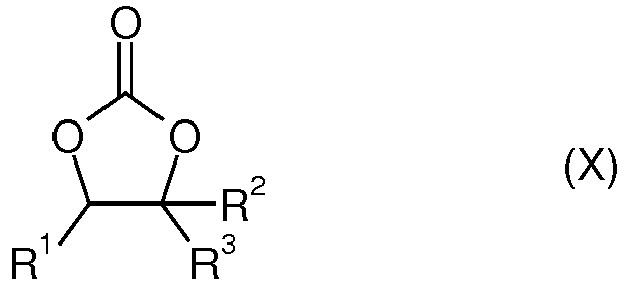

- In particularly preferred embodiments, R1 is methyl and R2 and R3 are each hydrogen, or R1, R2 and R3 are each hydrogen.
- Another preferred cyclic organic carbonate is vinylene carbonate, formula (XII).

- Preference is given to using the solvent(s) in what is called the anhydrous state, i.e. with a water content in the range from 1 ppm to 0.1 % by weight, determinable, for example, by Karl Fischer titration.
- Possible alkali metal salts, which are used as conductive salts, have to be soluble in the solvent. Preferred alkali metal salts are lithium salts or sodium salts, in particular lithium salts.
- In one embodiment of the present invention the inventive electrochemical cell is characterized in that the alkali metal salt is a lithium salt or sodium salt, preferably a lithium salt.
- Suitable alkali metal salts are especially lithium salts. Examples of suitable lithium salts are LiPF6, LiBF4, LiClO4, LiAsF6, LiCF3SO3, LiC(CnF2n+1SO2)3, lithium imides such as LiN(CnF2n+1SO2)2, where n is an integer in the range from 1 to 20, LiN(SO2F)2, Li2SiF6, LiSbF6, LiAlCl4, and salts of the general formula (CnF2n+1SO2)mXLi, where m is defined as follows:
- m = 1 when X is selected from oxygen and sulfur,
- m = 2 when X is selected from nitrogen and phosphorus, and
- m = 3 when X is selected from carbon and silicon.
- Preferred alkali metal salts are selected from LiC(CF3SO2)3, LiN(CF3SO2)2, LiPF6, LiBF4, LiClO4, and particular preference is given to LiPF6 and LiN(CF3SO2)2.
- In one embodiment of the present invention, the concentration of conductive salt in electrolyte is in the range of from 0.01 M to 5 M, preferably 0.5 M to 1.5 M.
- In one embodiment of the present invention, inventive electrochemical cells comprise one or more separators by which the electrodes are mechanically separated from one another. Suitable separators are polymer films, especially porous polymer films, which are unreactive toward metallic lithium and toward lithium sulfides and lithium polysulfides. Particularly suitable materials for separators are polyolefins, especially porous polyethylene films and porous polypropylene films.
- Polyolefin separators, especially of polyethylene or polypropylene, may have a porosity in the range from 35 to 45%. Suitable pore diameters are, for example, in the range from 30 to 500 nm.
- In another embodiment of the present invention, the separators selected may be separators composed of PET nonwovens filled with inorganic particles. Such separators may have a porosity in the range from 40 to 55%. Suitable pore diameters are, for example, in the range from 80 to 750 nm.
- In one embodiment of the present invention, inventive electrochemical cells can contain additives such as wetting agents, corrosion inhibitors, or protective agents such as agents to protect any of the electrodes or agents to protect the salt(s).
- In one embodiment of the present invention, inventive electrochemical cells can have a disc-like shape. In another embodiment, inventive electrochemical cells can have a prismatic shape.
- In one embodiment of the present invention, inventive electrochemical cells can include a housing that can be from steel or aluminium.
- In one embodiment of the present invention, inventive electrochemical cells are combined to stacks including electrodes that are laminated.
- In one embodiment of the present invention, inventive electrochemical cells are selected from pouch cells.
- Inventive electrochemical cells, in particular rechargeable lithium sulfur cells, comprising the inventive electroactive composite (A) have overall advantageous properties. They exhibit good capacity, a low capacity fade rate per cycle, and good cycling stability on extended cycling.
- A further aspect of the present invention refers to batteries, in particular to rechargeable lithium sulfur batteries, comprising at least one inventive electrochemical cell, for example two or more. Inventive electrochemical cells can be combined with one another in inventive batteries, for example in series connection or in parallel connection. Series connection is preferred.
- Inventive batteries, in particular rechargeable lithium sulfur batteries, have advantageous properties. They exhibit good capacity, a low capacity fade rate per cycle, and good cycling stability on extended cycling.
- The inventive electrochemical cells or inventive batteries can be used for making or operating cars, computers, personal digital assistants, mobile telephones, watches, camcorders, digital cameras, thermometers, calculators, laptop BIOS, communication equipment or remote car locks, and stationary applications such as energy storage devices for power plants. A further aspect of the present invention is a method of making or operating cars, computers, personal digital assistants, mobile telephones, watches, camcorders, digital cameras, thermometers, calculators, laptop BIOS, communication equipment, remote car locks, and stationary applications such as energy storage devices for power plants by employing at least one inventive battery or at least one inventive electrochemical cell.
- A further aspect of the present invention is the use of the electrochemical cell as described above in motor vehicles, bicycles operated by electric motor, aircraft, ships or stationary energy stores.
- The use of inventive electrochemical cells in devices gives the advantage of prolonged run time before recharging and a smaller loss of capacity in the course of prolonged run time. If the intention were to achieve an equal run time with electrochemical cells with lower energy density, a higher weight for electrochemical cells would have to be accepted.
- The present invention further provides a device comprising at least one inventive electrochemical cell as described above. Preferred are mobile devices such as vehicles, for example automobiles, bicycles, aircraft, or water vehicles such as boats or ships. Other examples of mobile devices are those which are portable, for example computers, especially laptops, telephones or electrical power tools, for example from the construction sector, especially drills, battery-driven screwdrivers or battery-driven tackers.
- The invention is illustrated by the examples which follow, but these do not restrict the invention.
- Figures in percent are each based on % by weight, unless explicitly stated otherwise.
- VO2 hollow spheres were prepared through a solvothermal reaction, by firstly dissolving 1.2 g V2O5 and H2C2O4.2H2O in a molar ratio 1:3 in 40 ml of deionized water, stirring at 80 °C during 2 hours. The thus obtained VOC2O4 solution was mixed with 2-propanol (1:10 volume ratio) and stirred for 20 min. The mixture was then sealed either in a microwave vessel, heated at 200 °C for 4 hours, 150 W, 19 bar in a Discover-SP microwave or in a steel autoclave and heated at 200 °C for 12 hours. The precipitate was collected by centrifugation and washed 3 times with absolute ethanol.
- For the preparation of W-doped VO2 hollow spheres, 1.2 g V2O5 and H2C2O4.2H2O in a molar ratio 1:3 were dissolved in 40 ml of deionized water. To this mixture 3 atom% ammonium tungstate were added, and then stirred at 80 °C during 2 hours. The obtained VOC2O4 solution was mixed with 2-propanol (1:10 volume ratio) and stirred for 20 min. The mixture was then sealed either in a microwave vessel, heated at 200 °C for 4 hours, 150 W, 19 bar in a Discover-SP microwave or in a steel autoclave and heated at 200 °C for 12 hours. The precipitate was collected by centrifugation and washed 3 times with absolute ethanol.
- After the solvothermal synthesis I.1.a, the obtained hollow spheres A2-1 were calcinated in air at 350 °C for 2 h with heating rate of 1 °C min in order to obtain hollow spheres A2-3.
- After the solvothermal synthesis I.1.b, the obtained material A2-2 was calcinated under inert atmosphere at 350 °C for 2 h with heating rate of 1 °C min in order to obtain calcined hollow spheres A2-4.
- Composite A-1 was obtained by sulfur infiltration on the vanadium hollow spheres A2-3. The infiltration was performed by mixing V2O5 hollow spheres (A2-3) with sulfur and heating the mixture at 155 °C for melt diffusion. The sulfur content was determined by TGA as 80 wt.-%.
- Composite A-2 was obtained by sulfur infiltration on the vanadium hollow spheres A2-4. The infiltration was performed by mixing calcined W-doped VO2 hollow spheres (A2-4) with sulfur and heating the mixture at 155 °C for melt diffusion. The sulfur content was determined by TGA as 80 wt.-%.
- Bare sulfur cathodes were prepared by a mixture of carbon blacks (Super C65 and Printex XE2), sulfur (Aldrich, reagent grade) and polyvinyl alcohol (Selvol 425, Sekisui) in a ratio 35 : 60 : 5 by weight in a mixture of water, 2-propanol and 1-methoxy-2-propanol (liquid mixture-LM, 65 : 30 : 5 by weight). The resulting mixture was ball milled for 20 h to form a homogeneous slurry which was then coated by doctor blade onto a 8 µm thick carbon coated aluminum foil and dried in vacuum at 40 °C during 16 h. The sulfur content in the final electrode was 60 wt.-% and the sulfur loading was 2.0 mg of sulfur/cm2.
- Vanadium-sulfur composite cathodes (C.2) were prepared in a similar way to the bare sulfur cathodes (CC.1); using A-1. Aiming for a final sulfur content of 60 wt.-% on the cathodes, a mixture of carbon blacks (Super C65 and Printex XE2), vanadium-sulfur composite (A-1) and polyvinyl alcohol (Selvol 425, Sekisui) in a ratio 20 : 75 : 5 by weight in a mixture of water, 2-propanol and 1-methoxy-2-propanol (liquid mixture-LM, 65 : 30 : 5 by weight). The resulting mixture was ball milled for 20h to form a homogeneous slurry which was then coated by doctor blade onto a 8 µm thick carbon coated aluminum foil and dried in vacuum at 40 °C during 16 h. The final sulfur loading on the vanadium-sulfur composite cathodes was 2.5 mg of sulfur/cm2.
- W-doped vanadium-sulfur composite cathodes (C.3) were prepared in a similar way to the bare sulfur cathodes (CC.1); using A-2. Aiming for a final sulfur content of 60 wt.-% on the cathodes, a mixture of carbon blacks (Super C65 and Printex XE2), W-doped vanadium-sulfur composite (A-2) and polyvinyl alcohol (Selvol 425, Sekisui) in a ratio 20 : 75 : 5 by weight in a mixture of water, 2-propanol and 1-methoxy-2-propanol (liquid mixture-LM, 65 : 30 : 5 by weight). The resulting mixture was ball milled for 20 h to form a homogeneous slurry which was then coated by doctor blade onto a 8 µm thick carbon coated aluminum foil and dried in vacuum at 40 °C during 16 h. The final sulfur loading on the vanadium-sulfur composite cathodes was 2.5 mg of S/cm2.
- The electrochemical tests were done using coin-type cells. The cells were assembled in an argon-filled glove box using lithium foil as the counter electrode and a porous monolayer polyethylene membrane (thickness: 20 µm; porosity: 45%) as separator. The electrolyte used was a solution of lithium bis(tri-fluoromethanesulfonyl)imide, LiNO3 in 1,2-dimethoxyethane and 1,3-dioxolane (8 : 4 : 44 : 44 by weight). Galvanostatic charge-discharge cycling were carried out using a Maccor battery tester in the potential range of 1.7-2.5 V (vs Li+/Li) at a current density of 0.02 C rate for the first cycle and 0.2 C discharge rate and 0.125 C charge rate for the subsequent cycles at controlled 25 °C. The sulfur to electrolyte ratio was 1:7 for the cells with the vanadium-sulfur composite and 1:10 for the cells with bare sulfur.
- The resulting test data of the electrochemical cells are summarized in Table 1 and Table 2.
Table 1: Inventive electrodes comprising vanadium-sulfur composite cathodes (C.2 and C.3) Cycle Discharge capacity [mAh/gs] C.2 C.3 1 1338 1460 2 954 932 10 972 886 100 965 808 200 863 653 300 818 455 400 702 292 500 520 222 Table 2: Comparison of discharge capacity between inventive electrode (C.2) and comparative bare sulfur electrode (CC.1) Cycle Discharge capacity [mAh/gs] C.2 CC.1 1 1338 1456 2 954 860 10 972 761 100 965 736 200 863 765 300 818 378 400 702 295 500 520 221
Claims (14)
- An electroactive composite for an electrochemical cell comprising(A1) an electroactive sulfur-containing material, and(A2) hollow microspheres of a vanadium oxide.
- The electroactive composite according to claim 1, wherein the electroactive sulfur containing material (A1) is elemental sulfur.
- The electroactive composite according to claim 1 or 2, wherein the vanadium oxide is selected from VO2 and V2O5, and wherein the vanadium oxide is doped with tungsten, wherein the atomic ratio of tungsten to vanadium is in the range from 0.005 to 0.10.
- The electroactive composite according to any of claims 1 to 3, wherein the electroactive composite comprises core-shell particles, wherein the core of said particles comprises the electroactive sulfur-containing material, and wherein the shell of said particles comprises the vanadium oxide.
- The electroactive composite according to any of claims 1 to 4, wherein the average diameter of the hollow microspheres is in the range from 0.1 µm to 10 µm.
- The electroactive composite according to any of claims 1 to 5, wherein the mass fraction of electroactive sulfur-containing material is in the range from 0.2 up to 0.95 and the mass fraction of hollow microspheres of a vanadium oxide is in the range from 0.05 up to 0.8.
- A cathode material for an electrochemical cell comprising(A) an electroactive composite according to any of claims 1 to 6,(B) optionally carbon in a polymorph comprising at least 60% sp2-hybridized carbon atoms, and(C) optionally at least one polymer as a binder.
- A cathode which has been produced from or using a cathode material according to claim 7.
- An electrochemical cell comprising at least one cathode according to claim 8.
- A battery comprising at least one electrochemical cell according to claim 9.
- A device comprising at least one electrochemical cell according to claim 9.
- A process for preparing an electroactive composite for an electrochemical cell comprising(A1) an electroactive sulfur-containing material, and(A2) hollow microspheres of a vanadium oxide,according to any of claims 1 to 6, comprising the process step of(a) loading the electroactive sulfur-containing material (A1) into the hollow microspheres of a vanadium oxide (A2).
- The process according to claim 12, wherein process step (a) comprises a heat treatment at a temperature in the range from 120 to 180°C.
- The use of hollow microspheres of a vanadium oxide as a component for the preparation of an electroactive composite for an electrochemical cell comprising an electroactive sulfur containing material.
Priority Applications (1)
| Application Number | Priority Date | Filing Date | Title |
|---|---|---|---|
| EP16168920.3A EP3244472A1 (en) | 2016-05-10 | 2016-05-10 | Composites comprising hollow microspheres of a vanadium oxide for lithium sulfur cells |
Applications Claiming Priority (1)
| Application Number | Priority Date | Filing Date | Title |
|---|---|---|---|
| EP16168920.3A EP3244472A1 (en) | 2016-05-10 | 2016-05-10 | Composites comprising hollow microspheres of a vanadium oxide for lithium sulfur cells |
Publications (1)
| Publication Number | Publication Date |
|---|---|
| EP3244472A1 true EP3244472A1 (en) | 2017-11-15 |
Family
ID=55953066
Family Applications (1)
| Application Number | Title | Priority Date | Filing Date |
|---|---|---|---|
| EP16168920.3A Withdrawn EP3244472A1 (en) | 2016-05-10 | 2016-05-10 | Composites comprising hollow microspheres of a vanadium oxide for lithium sulfur cells |
Country Status (1)
| Country | Link |
|---|---|
| EP (1) | EP3244472A1 (en) |
Cited By (5)
| Publication number | Priority date | Publication date | Assignee | Title |
|---|---|---|---|---|
| KR20210010025A (en) * | 2019-07-19 | 2021-01-27 | 주식회사 엘지화학 | Vanadium oxide-sulfur composite, positive electrode and lithium secondary battery comprising the same |
| CN112710718A (en) * | 2020-12-17 | 2021-04-27 | 景德镇陶瓷大学 | Ceramic hollow microsphere electrochemical sensor and application thereof |
| CN112919428A (en) * | 2019-12-06 | 2021-06-08 | 中国科学院过程工程研究所 | Vanadium nitride microsphere and preparation method and application thereof |
| CN114899433A (en) * | 2022-05-11 | 2022-08-12 | 电子科技大学长三角研究院(湖州) | Iron-doped vanadium dioxide catalyst, preparation method and application thereof in lithium-sulfur battery |
| CN115241421A (en) * | 2022-06-16 | 2022-10-25 | 南通大学 | Lithium-sulfur battery cathode material with cocklebur-like structure and preparation method and application thereof |
Citations (11)
| Publication number | Priority date | Publication date | Assignee | Title |
|---|---|---|---|---|
| US5162175A (en) | 1989-10-13 | 1992-11-10 | Visco Steven J | Cell for making secondary batteries |
| US6210831B1 (en) | 1997-12-19 | 2001-04-03 | Moltech Corporation | Cathodes comprising electroactive sulfur materials and secondary batteries using same |
| US20030082442A1 (en) * | 2001-10-27 | 2003-05-01 | Samsung Sdi, Co., Ltd. | Positive active material for rechargeable lithium-sulfur batteries and method of preparing same |
| US8173302B2 (en) | 2008-06-11 | 2012-05-08 | Toyota Motor Engineering & Manufacturing North America, Inc. | Sulfur-carbon material |
| WO2012168851A1 (en) | 2011-06-08 | 2012-12-13 | Basf Se | Electrode materials for electrical cells |
| CN102969487A (en) * | 2012-11-23 | 2013-03-13 | 南开大学 | Carbon-sulfur composite material used for positive pole of lithium-sulfur battery and preparation method of material |
| US20130065127A1 (en) | 2010-06-17 | 2013-03-14 | Linda Faye NAZAR | Multicomponent electrodes for rechargeable batteries |
| US20130224594A1 (en) * | 2012-02-28 | 2013-08-29 | Sila Nanotechnologies Inc. | Core-Shell Composites for Sulfur-Based Cathodes in Metal-Ion Batteries |
| WO2014182281A1 (en) * | 2013-05-07 | 2014-11-13 | GM Global Technology Operations LLC | Voltage-responsive coating for lithium-sulfur battery |
| KR20150031129A (en) * | 2013-09-13 | 2015-03-23 | 한국세라믹기술원 | Method for preparing co-doped vanadium dioxide with transition materials |
| WO2015165762A1 (en) * | 2014-04-30 | 2015-11-05 | Basf Se | Process for producing a monolithic body of a porous carbon material, monolithic bodies of special porous carbon materials and their use |
-
2016
- 2016-05-10 EP EP16168920.3A patent/EP3244472A1/en not_active Withdrawn
Patent Citations (12)
| Publication number | Priority date | Publication date | Assignee | Title |
|---|---|---|---|---|
| US5162175A (en) | 1989-10-13 | 1992-11-10 | Visco Steven J | Cell for making secondary batteries |
| US6210831B1 (en) | 1997-12-19 | 2001-04-03 | Moltech Corporation | Cathodes comprising electroactive sulfur materials and secondary batteries using same |
| EP1583168A2 (en) * | 1997-12-19 | 2005-10-05 | Moltech Corporation | Cathodes comprising electroactive sulfur materials and secondary batteries using same |
| US20030082442A1 (en) * | 2001-10-27 | 2003-05-01 | Samsung Sdi, Co., Ltd. | Positive active material for rechargeable lithium-sulfur batteries and method of preparing same |
| US8173302B2 (en) | 2008-06-11 | 2012-05-08 | Toyota Motor Engineering & Manufacturing North America, Inc. | Sulfur-carbon material |
| US20130065127A1 (en) | 2010-06-17 | 2013-03-14 | Linda Faye NAZAR | Multicomponent electrodes for rechargeable batteries |
| WO2012168851A1 (en) | 2011-06-08 | 2012-12-13 | Basf Se | Electrode materials for electrical cells |
| US20130224594A1 (en) * | 2012-02-28 | 2013-08-29 | Sila Nanotechnologies Inc. | Core-Shell Composites for Sulfur-Based Cathodes in Metal-Ion Batteries |
| CN102969487A (en) * | 2012-11-23 | 2013-03-13 | 南开大学 | Carbon-sulfur composite material used for positive pole of lithium-sulfur battery and preparation method of material |
| WO2014182281A1 (en) * | 2013-05-07 | 2014-11-13 | GM Global Technology Operations LLC | Voltage-responsive coating for lithium-sulfur battery |
| KR20150031129A (en) * | 2013-09-13 | 2015-03-23 | 한국세라믹기술원 | Method for preparing co-doped vanadium dioxide with transition materials |
| WO2015165762A1 (en) * | 2014-04-30 | 2015-11-05 | Basf Se | Process for producing a monolithic body of a porous carbon material, monolithic bodies of special porous carbon materials and their use |
Non-Patent Citations (11)
| Title |
|---|
| A. PAN ET AL., ANGEW. CHEM., vol. 52, 2013, pages 2226 - 2230 |
| A.M. CAO ET AL., ANGEW. CHEM., vol. 117, 2005, pages 4465 - 4469 |
| ADV. FUNCT. MATER., vol. 13, 2003, pages 487 - 492 |
| ANQIANG PAN ET AL: "Template-Free Synthesis of VO 2 Hollow Microspheres with Various Interiors and Their Conversion into V 2 O 5 for Lithium-Ion Batteries", ANGEWANDTE CHEMIE INTERNATIONAL EDITION, vol. 52, no. 8, 11 January 2013 (2013-01-11), DE, pages 2226 - 2230, XP055289646, ISSN: 1433-7851, DOI: 10.1002/anie.201209535 * |
| CHEM REV., vol. 104, 2004, pages 4303 - 4417 |
| J. ELECTROCHEM. SOC., vol. 138, 1991, pages 1896 - 1901 |
| KYU TAE LEE ET AL: "Surface-Initiated Growth of Thin Oxide Coatings for Li-Sulfur Battery Cathodes", ADVANCED ENERGY MATERIALS, vol. 2, no. 12, 27 August 2012 (2012-08-27), DE, pages 1490 - 1496, XP055289663, ISSN: 1614-6832, DOI: 10.1002/aenm.201200006 * |
| L. CHEN ET AL., J. OF NANOMAT., vol. 2012 |
| N. JAYAPRAKASH ET AL., ANGEW. CHEM., vol. 123, 2011, pages 6026 - 6030 |
| Z.W. SEH ET AL., NAT. COMMUN., vol. 4, 2013, pages 1331 |
| Z.W. SEH ET AL., NAT. COMMUN., vol. 5, 2014, pages 5017 |
Cited By (8)
| Publication number | Priority date | Publication date | Assignee | Title |
|---|---|---|---|---|
| KR20210010025A (en) * | 2019-07-19 | 2021-01-27 | 주식회사 엘지화학 | Vanadium oxide-sulfur composite, positive electrode and lithium secondary battery comprising the same |
| CN112919428A (en) * | 2019-12-06 | 2021-06-08 | 中国科学院过程工程研究所 | Vanadium nitride microsphere and preparation method and application thereof |
| CN112919428B (en) * | 2019-12-06 | 2023-09-05 | 中国科学院过程工程研究所 | Vanadium nitride microsphere and preparation method and application thereof |
| CN112710718A (en) * | 2020-12-17 | 2021-04-27 | 景德镇陶瓷大学 | Ceramic hollow microsphere electrochemical sensor and application thereof |
| CN112710718B (en) * | 2020-12-17 | 2023-04-18 | 景德镇陶瓷大学 | A ceramic hollow microsphere electrochemical sensor and its application |
| CN114899433A (en) * | 2022-05-11 | 2022-08-12 | 电子科技大学长三角研究院(湖州) | Iron-doped vanadium dioxide catalyst, preparation method and application thereof in lithium-sulfur battery |
| CN114899433B (en) * | 2022-05-11 | 2023-11-14 | 电子科技大学长三角研究院(湖州) | Iron-doped vanadium dioxide catalyst, preparation method and application thereof in lithium-sulfur battery |
| CN115241421A (en) * | 2022-06-16 | 2022-10-25 | 南通大学 | Lithium-sulfur battery cathode material with cocklebur-like structure and preparation method and application thereof |
Similar Documents
| Publication | Publication Date | Title |
|---|---|---|
| TWI496333B (en) | Use of expanded graphite in lithium/sulphur batteries | |
| EP1995817B1 (en) | Lithium rechargeable battery using ionic liquid | |
| WO2016012275A1 (en) | Composites comprising mxenes for cathodes of lithium sulfur cells | |
| CN103050707B (en) | Lithium rechargeable battery | |
| KR101607024B1 (en) | Lithium secondary battery | |
| JP5702362B2 (en) | Lithium secondary battery using ionic liquid | |
| KR20240017067A (en) | Battery cathode material, manufacturing method thereof, and application thereof | |
| JP2009543318A (en) | Nonaqueous electrolyte additive having cyano group and electrochemical device using the same | |
| JP2007317647A (en) | Organic electrolyte and lithium battery using the same | |
| US20170047586A1 (en) | Electrochemical cells exposed to hydrostatic pressure | |
| EP3244472A1 (en) | Composites comprising hollow microspheres of a vanadium oxide for lithium sulfur cells | |
| KR101049826B1 (en) | A positive electrode for a lithium secondary battery, a manufacturing method thereof, and a lithium secondary battery including the same | |
| JP5191931B2 (en) | Lithium secondary battery using ionic liquid | |
| WO2015165762A1 (en) | Process for producing a monolithic body of a porous carbon material, monolithic bodies of special porous carbon materials and their use | |
| JP7789619B2 (en) | Positive electrode for lithium-sulfur battery, lithium-sulfur battery and charge/discharge method thereof | |
| CN102948003A (en) | Lithium electrochemical accumulator having a bipolar architecture and operating with a lithium-sulphur compound electrode pair | |
| EP3312909A1 (en) | Electroactive composites comprising silicon particles, metal nanoparticles and carbon nanostructures | |
| EP3121877A1 (en) | Core-shell particles comprising elemental sulfur and manganese dioxide for cathodes of lithium sulfur cells and the synthesis of these particles | |
| US8734988B2 (en) | Lithium batteries having anodes based on polythiocyanogen | |
| WO2015185400A1 (en) | Metal oxide coated cathodes comprising sulfur for electrochemical cells | |
| JP2002175836A (en) | Non-aqueous electrolyte battery | |
| JP2003203675A (en) | Non-aqueous electrolyte and non-aqueous electrolyte secondary battery | |
| JP4224681B2 (en) | Nonaqueous electrolyte secondary battery | |
| WO2013069790A1 (en) | Non-aqueous electrolyte secondary cell | |
| EP3208871A1 (en) | Process for producing carbon sulfur composite materials |
Legal Events
| Date | Code | Title | Description |
|---|---|---|---|
| PUAI | Public reference made under article 153(3) epc to a published international application that has entered the european phase |
Free format text: ORIGINAL CODE: 0009012 |
|
| AK | Designated contracting states |
Kind code of ref document: A1 Designated state(s): AL AT BE BG CH CY CZ DE DK EE ES FI FR GB GR HR HU IE IS IT LI LT LU LV MC MK MT NL NO PL PT RO RS SE SI SK SM TR |
|
| AX | Request for extension of the european patent |
Extension state: BA ME |
|
| STAA | Information on the status of an ep patent application or granted ep patent |
Free format text: STATUS: THE APPLICATION HAS BEEN WITHDRAWN |
|
| 18W | Application withdrawn |
Effective date: 20171124 |