EP3243152B1 - Systeme und verfahren zur erkennung der notwendigkeit zur messung des herzzeitvolumens - Google Patents
Systeme und verfahren zur erkennung der notwendigkeit zur messung des herzzeitvolumens Download PDFInfo
- Publication number
- EP3243152B1 EP3243152B1 EP16701901.7A EP16701901A EP3243152B1 EP 3243152 B1 EP3243152 B1 EP 3243152B1 EP 16701901 A EP16701901 A EP 16701901A EP 3243152 B1 EP3243152 B1 EP 3243152B1
- Authority
- EP
- European Patent Office
- Prior art keywords
- patient
- data
- indicative
- cardiac output
- value
- Prior art date
- Legal status (The legal status is an assumption and is not a legal conclusion. Google has not performed a legal analysis and makes no representation as to the accuracy of the status listed.)
- Active
Links
Images


Classifications
-
- A—HUMAN NECESSITIES
- A61—MEDICAL OR VETERINARY SCIENCE; HYGIENE
- A61B—DIAGNOSIS; SURGERY; IDENTIFICATION
- A61B5/00—Measuring for diagnostic purposes; Identification of persons
- A61B5/02—Detecting, measuring or recording for evaluating the cardiovascular system, e.g. pulse, heart rate, blood pressure or blood flow
- A61B5/026—Measuring blood flow
- A61B5/029—Measuring blood output from the heart, e.g. minute volume
-
- A—HUMAN NECESSITIES
- A61—MEDICAL OR VETERINARY SCIENCE; HYGIENE
- A61B—DIAGNOSIS; SURGERY; IDENTIFICATION
- A61B5/00—Measuring for diagnostic purposes; Identification of persons
- A61B5/08—Measuring devices for evaluating the respiratory organs
- A61B5/083—Measuring rate of metabolism by using breath test, e.g. measuring rate of oxygen consumption
- A61B5/0833—Measuring rate of oxygen consumption
-
- A—HUMAN NECESSITIES
- A61—MEDICAL OR VETERINARY SCIENCE; HYGIENE
- A61B—DIAGNOSIS; SURGERY; IDENTIFICATION
- A61B5/00—Measuring for diagnostic purposes; Identification of persons
- A61B5/145—Measuring characteristics of blood in vivo, e.g. gas concentration or pH-value ; Measuring characteristics of body fluids or tissues, e.g. interstitial fluid or cerebral tissue
- A61B5/14542—Measuring characteristics of blood in vivo, e.g. gas concentration or pH-value ; Measuring characteristics of body fluids or tissues, e.g. interstitial fluid or cerebral tissue for measuring blood gases
-
- A—HUMAN NECESSITIES
- A61—MEDICAL OR VETERINARY SCIENCE; HYGIENE
- A61B—DIAGNOSIS; SURGERY; IDENTIFICATION
- A61B5/00—Measuring for diagnostic purposes; Identification of persons
- A61B5/145—Measuring characteristics of blood in vivo, e.g. gas concentration or pH-value ; Measuring characteristics of body fluids or tissues, e.g. interstitial fluid or cerebral tissue
- A61B5/1455—Measuring characteristics of blood in vivo, e.g. gas concentration or pH-value ; Measuring characteristics of body fluids or tissues, e.g. interstitial fluid or cerebral tissue using optical sensors, e.g. spectral photometrical oximeters
- A61B5/14551—Measuring characteristics of blood in vivo, e.g. gas concentration or pH-value ; Measuring characteristics of body fluids or tissues, e.g. interstitial fluid or cerebral tissue using optical sensors, e.g. spectral photometrical oximeters for measuring blood gases
-
- A—HUMAN NECESSITIES
- A61—MEDICAL OR VETERINARY SCIENCE; HYGIENE
- A61B—DIAGNOSIS; SURGERY; IDENTIFICATION
- A61B5/00—Measuring for diagnostic purposes; Identification of persons
- A61B5/72—Signal processing specially adapted for physiological signals or for diagnostic purposes
- A61B5/7235—Details of waveform analysis
- A61B5/7246—Details of waveform analysis using correlation, e.g. template matching or determination of similarity
-
- A—HUMAN NECESSITIES
- A61—MEDICAL OR VETERINARY SCIENCE; HYGIENE
- A61B—DIAGNOSIS; SURGERY; IDENTIFICATION
- A61B5/00—Measuring for diagnostic purposes; Identification of persons
- A61B5/72—Signal processing specially adapted for physiological signals or for diagnostic purposes
- A61B5/7271—Specific aspects of physiological measurement analysis
- A61B5/7278—Artificial waveform generation or derivation, e.g. synthesizing signals from measured signals
-
- G—PHYSICS
- G16—INFORMATION AND COMMUNICATION TECHNOLOGY [ICT] SPECIALLY ADAPTED FOR SPECIFIC APPLICATION FIELDS
- G16H—HEALTHCARE INFORMATICS, i.e. INFORMATION AND COMMUNICATION TECHNOLOGY [ICT] SPECIALLY ADAPTED FOR THE HANDLING OR PROCESSING OF MEDICAL OR HEALTHCARE DATA
- G16H50/00—ICT specially adapted for medical diagnosis, medical simulation or medical data mining; ICT specially adapted for detecting, monitoring or modelling epidemics or pandemics
- G16H50/30—ICT specially adapted for medical diagnosis, medical simulation or medical data mining; ICT specially adapted for detecting, monitoring or modelling epidemics or pandemics for calculating health indices; for individual health risk assessment
-
- G—PHYSICS
- G16—INFORMATION AND COMMUNICATION TECHNOLOGY [ICT] SPECIALLY ADAPTED FOR SPECIFIC APPLICATION FIELDS
- G16H—HEALTHCARE INFORMATICS, i.e. INFORMATION AND COMMUNICATION TECHNOLOGY [ICT] SPECIALLY ADAPTED FOR THE HANDLING OR PROCESSING OF MEDICAL OR HEALTHCARE DATA
- G16H50/00—ICT specially adapted for medical diagnosis, medical simulation or medical data mining; ICT specially adapted for detecting, monitoring or modelling epidemics or pandemics
- G16H50/50—ICT specially adapted for medical diagnosis, medical simulation or medical data mining; ICT specially adapted for detecting, monitoring or modelling epidemics or pandemics for simulation or modelling of medical disorders
-
- A—HUMAN NECESSITIES
- A61—MEDICAL OR VETERINARY SCIENCE; HYGIENE
- A61B—DIAGNOSIS; SURGERY; IDENTIFICATION
- A61B2505/00—Evaluating, monitoring or diagnosing in the context of a particular type of medical care
- A61B2505/03—Intensive care
-
- A—HUMAN NECESSITIES
- A61—MEDICAL OR VETERINARY SCIENCE; HYGIENE
- A61B—DIAGNOSIS; SURGERY; IDENTIFICATION
- A61B5/00—Measuring for diagnostic purposes; Identification of persons
- A61B5/68—Arrangements of detecting, measuring or recording means, e.g. sensors, in relation to patient
- A61B5/6846—Arrangements of detecting, measuring or recording means, e.g. sensors, in relation to patient specially adapted to be brought in contact with an internal body part, i.e. invasive
- A61B5/6847—Arrangements of detecting, measuring or recording means, e.g. sensors, in relation to patient specially adapted to be brought in contact with an internal body part, i.e. invasive mounted on an invasive device
- A61B5/6852—Catheters
-
- G—PHYSICS
- G16—INFORMATION AND COMMUNICATION TECHNOLOGY [ICT] SPECIALLY ADAPTED FOR SPECIFIC APPLICATION FIELDS
- G16H—HEALTHCARE INFORMATICS, i.e. INFORMATION AND COMMUNICATION TECHNOLOGY [ICT] SPECIALLY ADAPTED FOR THE HANDLING OR PROCESSING OF MEDICAL OR HEALTHCARE DATA
- G16H40/00—ICT specially adapted for the management or administration of healthcare resources or facilities; ICT specially adapted for the management or operation of medical equipment or devices
- G16H40/60—ICT specially adapted for the management or administration of healthcare resources or facilities; ICT specially adapted for the management or operation of medical equipment or devices for the operation of medical equipment or devices
- G16H40/63—ICT specially adapted for the management or administration of healthcare resources or facilities; ICT specially adapted for the management or operation of medical equipment or devices for the operation of medical equipment or devices for local operation
-
- G—PHYSICS
- G16—INFORMATION AND COMMUNICATION TECHNOLOGY [ICT] SPECIALLY ADAPTED FOR SPECIFIC APPLICATION FIELDS
- G16H—HEALTHCARE INFORMATICS, i.e. INFORMATION AND COMMUNICATION TECHNOLOGY [ICT] SPECIALLY ADAPTED FOR THE HANDLING OR PROCESSING OF MEDICAL OR HEALTHCARE DATA
- G16H50/00—ICT specially adapted for medical diagnosis, medical simulation or medical data mining; ICT specially adapted for detecting, monitoring or modelling epidemics or pandemics
- G16H50/20—ICT specially adapted for medical diagnosis, medical simulation or medical data mining; ICT specially adapted for detecting, monitoring or modelling epidemics or pandemics for computer-aided diagnosis, e.g. based on medical expert systems
Definitions
- the present invention relates to a decision support system (DSS), a medical monitoring system, and a corresponding method for identifying the need for measurement of cardiac output (CO). More specifically, for identifying when an approximated value of CO cannot be correct due to circulatory compromise and as such that another estimated or measured value is required, and that when a calculation of the minimum value of CO consistent with other values of physiological variables is required.
- DSS decision support system
- CO cardiac output
- Patients residing at the intensive care unit are typically monitored for their circulatory or hemodynamic status. This usually includes measurement of arterial blood pressure from either an arterial catheter or a non-invasive blood pressure cuff; and measurement of central venous pressure using a catheter. While measurement of blood pressure is a useful indication for hemodynamic status it does not provide sufficient monitoring for patients where circulation is expected to be most compromised, for example those with shock [1]. In these patients, it is often desirable to measure both pressure and the total blood flow in the circulatory system, known as the cardiac output (CO) [1]. Most clinically importance is the cardiac output from the left ventricle of a normal human being.
- CO cardiac output
- the reference technique for measurement of CO is using a thermodilution technique following placement of a Swan-Ganz or pulmonary artery (PA) catheter.
- PA catheters are placed in the pulmonary circulation via the right side of the heart, making this procedure an invasive technique.
- the invasive nature of the technique has led to development of a large number of less invasive techniques, ranging from thermodilution performed with catheters placed in the central vein and femoral artery [2] to measurements performed using finger cuffs [3,4].
- Less invasive techniques often include a number of extra assumptions and can therefore be less accurate than using a PA catheter.
- the present invention generally relates to such systems based upon simulations performed using mathematical models of physiological processes.
- an object of the present invention relates to a system and a method for assessing the need for measurement of cardiac output.
- an object of the present invention relates to a system and a method for assessing the minimum value of cardiac output which is consistent with all other values of physiological variables.
- Another object is the provision of integration of physiological variables in a single device for assessing the need for measurement of cardiac output and potentially also for assessing the minimum value of cardiac output consistent with other values of physiological variables.
- This device providing advice on the need for measurement of cardiac output and the minimum value of cardiac output in one graphical display.
- the present invention relates to a decision support system (DSS) for providing medical decision support for cardiac output (CO) measurements in connection with an associated patient using one or more physiological models (MOD1) implemented on a computer system, the computer system being arranged for:
- the decision support system may comprise a computer system or any means for performing the steps in the present disclosure.
- the computer system is arranged for receiving first data (D1) indicative of a relative arterial oxygenation and second data (D2) indicative of a haemoglobin concentration, but not necessarily third and fourth data (D3 and D4).
- the computer system is correspondingly further arranged for applying the physiological model(s) (MOD1) of the patient using the first data (D1) and second data (D2), but necessarily the third and fourth data (D3 and D4), for modelling the tissue metabolism in the patient.
- MOD1 physiological model(s)
- the computer system is arranged for receiving first data (D1) indicative of a relative arterial oxygenation, second data (D2) indicative of a haemoglobin concentration, and fourth data (D4) indicative of a rate of oxygen consumption, but not necessarily third data (D3).
- the computer system is correspondingly further arranged for applying the physiological model(s) (MOD1) of the patient using the first data (D1), the second data (D2) and the fourth data (D4), but necessarily the third data (D3), for modelling the tissue metabolism in the patient.
- the computer system is arranged for receiving all four abovementioned data (D1, D2, D3, D4).
- the computer system is correspondingly further arranged for applying the physiological model(s) (MOD1) of the patient using the first data (D1), the second data (D2), the third data (D3) and the fourth data (D4) for modelling the tissue metabolism.
- MOD1 physiological model(s)
- the decision support system may be further arranged for applying the physiological model(s) (MOD1) of the patient using said first data (D1), said second data (D2), optionally said third data (D3) and optionally said fourth data (D4) for modelling a tissue metabolism in the patient, thereby outputting an estimated measure indicative of the haemoglobin oxygen saturation in the mixed venous blood of the patient (SvO2_EST) or an estimated value indicative of the cardiac output (CO_EST) in the patient, by executing a number of steps according to a group A of steps or a group B of steps.
- group A comprises the steps of
- a second group of steps, group B, comprises the steps of:
- the step of generating a measure (NM_CO) indicative of the need for an improved measurement and/or estimation of the cardiac output (CO) may be based on either the first comparison (COMP1 of ii in A) or the second comparison (COMP2 of iv in B), or both A and B.
- the step of generating a measure (NM_CO) indicative of the need for an improved measurement and/or estimation of the cardiac output (CO) may be based on both the first comparison (COMP1 of ii in A) and the second comparison (COMP2 of iv in B).
- the decision support system provides medical decision support for cardiac output (CO) measurements in connection with an associated patient using one or more physiological models (MOD1) implemented on a computer system, the computer system being arranged for:
- model simulated values of mixed venous oxygen saturation can be advantageously used to assess the need for measurement of cardiac output and to assess the minimum value of cardiac output which is consistent with all other measured or simulated values. This is beneficial in evaluating the patient state and targeting measurement of cardiac output to clinical situations where standard approximation is not possible.
- first (D1), second (D2), third (D3), and fourth data (D4) could be measured, alternatively estimated, or more alternatively be based on model data obtained from other physiological models, cf. embodiment of Figure 3 . In one particular case, previously obtained measured data could be applied as best estimates for the data. Blood data values will normally be assumed to be for whole blood, unless otherwise stated.
- haemoglobin oxygen saturation in the mixed venous blood of the patient may be equivalent to the oxygen concentration, if most of the oxygen is bound to haemoglobin.
- the said preliminary value for the cardiac output may be a value representative for the specific patient (P1), preferably dependent on age, gender, weight, and/or one, or more, clinical conditions having an impact on the cardiac output (CO), e.g. a standard or modified lock-up table (LUT) may be provided for the purpose.
- P1 a value representative for the specific patient (P1), preferably dependent on age, gender, weight, and/or one, or more, clinical conditions having an impact on the cardiac output (CO), e.g. a standard or modified lock-up table (LUT) may be provided for the purpose.
- LUT locked-up table
- said first comparison (COMP1) may comprises an evaluation of whether or not the said estimated measure indicative of the haemoglobin oxygen saturation in the mixed venous blood of the specific patient (SvO2_EST) is physiologically possible, e.g. is above, equal to, or below some known limit or reference value of the measure, and more preferably said first comparison (COMP1) comprises an evaluation of whether or not the said estimated measure indicative of the haemoglobin oxygen saturation in the mixed venous blood of the patient (SvO2_EST) is physiologically probable in view of the age, gender, weight, and/or one, or more, clinical conditions having an impact on the cardiac output (CO), and/or on the received fourth data (D4, V ⁇ O 2 ), e.g. a statistical method or computation may be applied for such as an evaluation.
- a statistical method or computation may be applied for such as an evaluation.
- the said reference value for the haemoglobin oxygen saturation in the mixed venous blood of the patient may be a minimum value, preferably of 40% or 60%, more preferably 50% as is presently known to the skilled person as a reasonable minimum value for this value.
- the said reference value for the haemoglobin oxygen saturation in the mixed venous blood of the specific patient may be a value dependent on age, gender, weight, and/or one, or more, clinical conditions having an impact on the cardiac output (CO), and/or on the received fourth data (D4, V ⁇ O 2 ).
- said second comparison may comprise an evaluation of whether or not said estimated value indicative for the cardiac output (CO_EST) of the specific patient is physiologically possible, e.g.
- said second comparison comprises an evaluation of whether or not the said estimated value indicative for the cardiac output (CO_EST) is physiologically probable in view of the age, gender, weight, and/or one, or more, clinical conditions having an impact on the estimated cardiac output (CO_EST), e.g. a statistical method or computation may be applied for such as an evaluation.
- said measure (NM_CO) indicative of the need for an improved measurement and/or estimation of the cardiac output (CO) may be a quantitative measure, preferably a number indicating the need for an improved measurement and/or estimation of the cardiac output (CO), or a qualitative measure.
- the need for improved measurement may particularly be relevant for clinically purposes where the CO value is used in connection with a diagnostic application in mind i.e. for performing a diagnosis, though the present invention is not intended for a method for performing a diagnosis as such, but assisting a clinician with reliable assessment of need for an improved CO value, though the CO value itself may possibly be used as input in connection with performing a diagnosis of a patient.
- the first data (D1) and/or the third data (D3) may be based - wholly or partly - on a second physiological model (MOD2) of the acid-base system of the blood of the patient and/or of the interstitial fluid of the patient, cf. reference [8] for further information about such physiological models.
- the second physiological model (MOD2) may receive data from a third physiological model (MOD3) of the pulmonary gas exchange, the third physiological model (MOD3) further receiving data from ventilation measurements of the patient.
- the first data (D1), second data (D2), the third data (D3) and/or the third data (D4) may additionally be -wholly or partly - based on, or more, physiological models representing respiratory drive of patient and/or the lung mechanics of the patient.
- the present invention relates to a medical monitoring system capable of providing medical decision support for cardiac output (CO) measurements in connection with an associated patient using one or more physiological models (MOD1) implemented on a computer system (10), the computer system (10) being arranged for:
- the medical monitoring system shall be construed as being implementable applying the details of the above decision support system (DSS) for providing medical decision support for cardiac output (CO) measurements in connection with an associated patient using one or more physiological models (MOD1) implemented on a computer system, including the disclosed combinations of groups A and B and the generation of a measure (NM_CO) indicative of the need for an improved measurement based on either the first comparison (COMP1 of ii in A) or the second comparison (COMP2 of iv in B) or both (COMP1, COMP2) as explained in relation to the decision support system (DSS).
- DSS decision support system
- the present invention relates to a method for providing medical decision support for cardiac output (CO) measurements in connection with an associated patient using one or more physiological models (MOD1) implemented on a computer system, the computer system being arranged for:
- the method may be carried out by means of a computer having processing means.
- the method may be performed according to the disclosed details apply the above details for providing medical decision support for cardiac output (CO) measurements in connection with an associated patient using one or more physiological models (MOD1) implemented on a computer system, including the disclosed combinations of groups A and B and the generation of a measure (NM_CO) indicative of the need for an improved measurement based on either the first comparison (COMP1 of ii in A) or the second comparison (COMP2 of iv in B) or both (COMP1, COMP2) as explained in relation to the decision support system (DSS).
- CO cardiac output
- MOD1 physiological models
- NM_CO generation of a measure indicative of the need for an improved measurement based on either the first comparison (COMP1 of ii in A) or the second comparison (COMP2 of iv in B) or both (COMP1, COMP2) as explained in relation to the decision support system (DSS).
- DSS decision support system
- the present invention relates to a computer program product being adapted to enable a computer system comprising at least one computer having data storage means in connection therewith to implement the method according to the third aspect or according to the steps and combinations disclosed in relation to the decision support system and medical monitoring system.
- This aspect of the invention is particularly, but not exclusively, advantageous in that the present invention may be accomplished by a computer program product enabling a computer system to carry out the operations of the systems of the first and second aspect of the invention when down- or uploaded into the computer system.
- a computer program product may be provided on any kind of computer readable medium, or through a network.
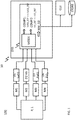
- FIG. 1 is a schematic drawing of a medical monitoring system 100 comprising a decision support system DSS according to the present invention.
- the decision support system DSS provides medical decision support for cardiac output (CO) measurements in connection with an associated patient P,1 using a physiological models MOD1 implemented on a computer system 10.
- CO cardiac output
- the computer system is arranged for i.e. computationally capable of and instructed to:
- the computer is arranged for:
- a measure NM_CO indicative of the need for an improved measurement and/or estimation of the cardiac output (CO), e.g. a number indicating the need, or an outputting on a general user interface GUI a message like 'Other CO measurement/estimate needed' etc.
- the invention comprises a method to assess the need for measurement of cardiac output and to assess the minimum value of cardiac output which consistent with other values of physiological variables.
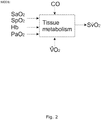
- the principle of this invention is as follows. Model simulated or measured values of arterial blood oxygenation and acid-base status are used, along with measured tissue oxygen consumption and an estimated value of CO, to calculate mixed venous oxygen saturation ( S v O 2 ). If arterial oxygen levels are low or tissue oxygen consumption levels are high, then the simulated S v O 2 values will be low. Typically, values of S v O 2 or P v O 2 below a minimum, say 50%, can be considered non-physiological [5].
- This equation calculates C v O 2 from the difference between the concentration of oxygen in the arterial blood ( CaO 2 ) and the ratio of oxygen consumption ( V ⁇ O 2 ) and CO.
- O 2 represents the solubility of oxygen in blood and Hb the haemoglobin concentration of blood.
- ODC represents a mathematical function of the oxygen dissociation curve
- pH v is the mixed venous pH
- P v CO 2 is the mixed venous partial pressure of carbon dioxide.
- pH v , and P v CO 2 can be either set to normal values or calculated for the specific patient from arterial acid-base status, measurement of tissue production of carbon dioxide ( V ⁇ CO 2 ), and a mathematical model of the acid-base status of venous blood [7].
- Hb can be obtained from laboratory values for the patient or from a blood gas analysis.
- PaO 2 and SaO 2 can be obtained from a blood gas analysis, i.e. the blood analysis apparatus may constitute third measurement means M3 and first measurement means M1 as schematically indicated in Figure 1 , or they can be simulated using other mathematical models.
- Figure 3 illustrates a chain of previously published mathematical models which may be used to simulate arterial values of PaO 2 and SaO 2 (8). These models enable prediction of PaO 2 and SaO 2 values on changing patient state or ventilation [8].
- Figure 3 therefore represents an extended set of models which may also be used to exemplify the invention. These are exemplified in figure 3 with models of pulmonary gas exchange and blood acid-base chemistry, but may include mathematical representation of any physiological system required to simulate the variables necessary to calculate S v O 2 .
- ⁇ O 2 PaO 2 is assumed to be zero then measurement of PaO 2 is not required.
- the measurement of SaO 2 could be simplified by using a non-invasive value of SaO 2 obtained from a pulse oximeter ( SpO 2 ), which may be considered as a particular embodiment of first measurement means M1 in Figure 1 .
- V ⁇ O 2 can be measured at the mouth using indirect calorimetry systems [9] measuring both O 2 concentration and gas flow in respiratory gasses, i.e. being embodiments of the fourth measurement means M4 as schematically shown in Figure 1 .
- measurement of carbon dioxide production V ⁇ CO 2
- V ⁇ O 2 could be performed at the mouth using volumetric capnography, and V ⁇ O 2 calculated using V ⁇ CO 2 and an estimate for respiratory exchange ratio (RER) or respiratory quotient (RQ).
- CO The remaining input to calculate S v O 2 in equations 1-3 is CO.
- CO can be estimated from standard formulae calculating an average CO depending upon a patient's ideal body weight as shown previously (10). This typically requires input of only the patient's gender and height. Any similar method for estimating CO can be applied, including estimating CO to the normal value (5 l/min) for all patients.
- the calculated S v O 2 value is compared against a reference value, with this reference value being that assumed to be the lowest physiologically possible. Any value can be applied, but in the examples used here a value of 50% is used. If the calculated value of S v O 2 is below the reference value then one or both of the following steps can be performed
- Example 1 A situation where no advice is provided to measure CO or for a minimum value of CO.
- Figure 4 illustrates a situation where no advice or minimum CO calculation would be performed.
- S v O 2 78%.
- Example 2 A situation where advice is provided to measure CO and a minimum value of CO is calculated.
- Figure 5 illustrates a situation where advice to measure CO and/or a minimum CO calculation would be performed.
- Normal values of arterial oxygenation are input along with a value of Hb that is less than half of normal. Hb values reduced to these levels are common in patients who have received substantial fluid infusions. These are combined with a normal estimate of CO but a value of V ⁇ O 2 twice that normal. Such values of V ⁇ O 2 are consistent with increased metabolism due to muscle activity, fever or other causes.
- the overall principle of the method is then that calculation of S v O 2 from an estimate of CO, values of other variables and physiological models, can indicate whether the estimate of CO is physiologically reasonable, and if not this information can be used to a) provide advice to consider measurement of CO and/or b) provide a minimum values of CO which is consistent with the values of all other physiological variables.
- the invention thus relates to a method for evaluating the current estimate of CO and providing advice on the need to measure CO.
- the invention also relates to a method for calculating a minimum value of CO that is consistent with other values of variables input into a physiological model.
- the invention comprises measuring, estimating or simulating one or more of the following variables as use as input to the calculation of S v O 2 : Arterial oxygen saturation ( Sa0 2 ) as an example of first data D1, blood haemoglobin concentration ( Hb ) as an example of second data D2, arterial oxygen partial pressure ( PaO 2 ) as an example of third data D3, and tissue oxygen consumption ( V ⁇ O 2 ) as an example of fourth data D4.
- Arterial oxygen saturation Sa0 2
- Hb blood haemoglobin concentration
- PaO 2 arterial oxygen partial pressure
- V ⁇ O 2 tissue oxygen consumption
- the invention in all aspects further comprises estimating a value of CO for calculating S v O 2 .
- the invention in all aspects further comprises analysis of these data in terms of mathematical models to calculate S v O 2 .
- the invention in all aspects further comprises analysis of these data with a minimum value of S v O 2 in terms of mathematical models to calculate a minimum CO.
- the invention in all aspects may also comprise the use of one or more mathematical physiological models of pulmonary gas exchange and blood acid-base chemistry to calculate either arterial oxygenation ( SaO 2 , PaO 2 , CaO 2 ) or to calculate S v O 2 .
- the level of arterial oxygenation may be provided by measurement of arterial blood oxygen and acid-base status, by non-invasive pulse oximetry measurement ( SpO 2 ), by mathematical model simulation, or other equivalent measures available to the skilled person.
- SpO 2 non-invasive pulse oximetry measurement
- the level tissue oxygen consumption may be provided by measurements of oxygen fraction in respiratory gas ( FEO 2 , PEO 2 ), along with measurement of flow in the respiratory gas, or other equivalent measures available to the skilled person, cf. Figure 3 .
- These equivalent measures may include measurement of the level of tissue carbon dioxide production ( V ⁇ CO 2 ) from measurements of carbon dioxide fraction in respiratory gas ( FEC , PECO 2 ), along with measurement of flow in the respiratory gas.
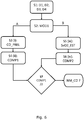
- FIG. 6 shows a flow chart of the method according to the invention.
- the method provides medical decision support for cardiac output (CO) measurements in connection with an associated patient P,1 using a physiological model MOD1 implemented on a computer system 10, the computer system being arranged for S1:
- the present invention may be beneficially applied when the individual is a normal person, a person under mechanical ventilation in general, including both invasive and non/invasive mechanical ventilation.
- the invention may be beneficially applied when the patient is under continuous hemodynamic monitoring either using invasive catheter measurements or non-invasive measurements such as an inflated cuff on the arm or finger.
- the invention may be beneficially applied when the patient presents with, or is monitored for, circulatory abnormalities such as sepsis, heart failure or other diseases or conditions which may cause circulatory abnormalities.
- the invention can be implemented by means of hardware, software, firmware or any combination of these.
- the invention or some of the features thereof can also be implemented as software running on one or more data processors and/or digital signal processors.
- the individual elements of an embodiment of the invention may be physically, functionally and logically implemented in any suitable way such as in a single unit, in a plurality of units or as part of separate functional units.
- the invention may be implemented in a single unit, or be both physically and functionally distributed between different units and processors.
Landscapes
- Health & Medical Sciences (AREA)
- Life Sciences & Earth Sciences (AREA)
- Engineering & Computer Science (AREA)
- Medical Informatics (AREA)
- Public Health (AREA)
- Physics & Mathematics (AREA)
- General Health & Medical Sciences (AREA)
- Pathology (AREA)
- Biomedical Technology (AREA)
- Veterinary Medicine (AREA)
- Molecular Biology (AREA)
- Surgery (AREA)
- Animal Behavior & Ethology (AREA)
- Biophysics (AREA)
- Heart & Thoracic Surgery (AREA)
- Physiology (AREA)
- Hematology (AREA)
- Cardiology (AREA)
- Data Mining & Analysis (AREA)
- Databases & Information Systems (AREA)
- Epidemiology (AREA)
- Primary Health Care (AREA)
- Optics & Photonics (AREA)
- Emergency Medicine (AREA)
- Obesity (AREA)
- Pulmonology (AREA)
- Spectroscopy & Molecular Physics (AREA)
- Computer Vision & Pattern Recognition (AREA)
- Psychiatry (AREA)
- Signal Processing (AREA)
- Artificial Intelligence (AREA)
- Measurement Of The Respiration, Hearing Ability, Form, And Blood Characteristics Of Living Organisms (AREA)
- Measuring Pulse, Heart Rate, Blood Pressure Or Blood Flow (AREA)
Claims (15)
- Entscheidungsunterstützungssystem (DSS) zum Bereitstellen medizinischer Entscheidungsunterstützung für Messungen des Herzzeitvolumens (CO) in Verbindung mit einem zugehörigen Patienten (P, 1) unter Verwendung eines oder mehrerer physiologischer Modelle (MODI), die auf einem Computersystem (10) implementiert sind, wobei das Computersystem geeignet ist zum:- Empfangen erster Daten (D1), die eine relative arterielle Sauerstoffsättigung (SaO2, SpO2) im Blut des Patienten angeben;- Empfangen zweiter Daten (D2), die eine Hämoglobinkonzentration (Hb) im Blut des Patienten angeben;wobei das Entscheidungsunterstützungssystem geeignet ist zum:- Anwenden des physiologischen Modells/der physiologischen Modelle (MOD1) des Patienten unter Verwendung der ersten Daten (D1) und der zweiten Daten (D2) zum Modellieren eines Gewebestoffwechsels im Patienten;A)i. Ausgeben aus dem/den physiologischen Modell(en) (MOD1) unter Verwendung eines vorläufigen Wertes für ein Herzzeitvolumen (CO_PREL), wobei der vorläufige Wert ein Wert ist, der für einen bestimmten Patienten (P, 1) abhängig von Alter, Geschlecht, Gewicht und/oder einem oder mehreren klinischen Zuständen, die eine Auswirkung auf das Herzzeitvolumen (CO) haben, repräsentativ ist, eines geschätzten Maßes, das die Hämoglobin-Sauerstoffsättigung im gemischten venösen Blut des Patienten (SvO2_EST) angibt; undii. Durchführen eines ersten Vergleichs (COMP1) des geschätzten Maßes, das die Hämoglobin-Sauerstoffsättigung im gemischten venösen Blut des Patienten (SvO2_EST) angibt, mit einem Referenzwert für die Hämoglobin-Sauerstoffsättigung im gemischten venösen Blut des Patienten (SvO2_REF);und/oder B)iii. Ausgeben aus dem/den physiologischen Modell (en) (MOD1) unter Verwendung eines Referenzwerts für die Hämoglobin-Sauerstoffsättigung im gemischten venösen Blut des Patienten (SvO2_REF), wobei der Referenzwert ein Wert ist, der vom Alter, Geschlecht, Gewicht und/oder einem oder mehreren klinischen Zuständen, die eine Auswirkung auf das Herzzeitvolumen (CO) haben, abhängt, eines geschätzten Wertes, der das Herzzeitvolumen (CO_EST) im Patienten angibt; undiv. Durchführen eines zweiten Vergleichs (COMP2) des geschätzten Wertes, der das Herzzeitvolumen (CO_EST) angibt, mit einem Referenzwert für das Herzzeitvolumen (CO_REF) im Patienten, wobei CO_REF ein Minimalwert des CO ist, der mit den ersten Daten (D1) und den zweiten Daten (D2) für das/die physiologische(n) Modell(e) (MOD1) im Einklang steht; und- basierend auf dem ersten Vergleich (COMP1, Schritt ii von A), wobei der Vergleich (COMP1) eine Bewertung umfasst, die angibt, ob SvO2_EST physiologisch möglich oder physiologisch wahrscheinlich ist angesichts des Alters, Geschlechts, Gewichts und/oder eines oder mehrerer klinischer Zustände, die eine Auswirkung auf das Herzzeitvolumen (CO) haben, und/oder auf dem zweiten Vergleich (COMP2, Schritt iv von B) Erzeugen eines Maßes (NM_CO), das die Notwendigkeit zu einer verbesserten Messung und/oder Schätzung des Herzzeitvolumens (CO) angibt.
- Entscheidungsunterstützungssystem (DSS) nach Anspruch 1, wobei das Computersystem (10) ferner geeignet ist, um dritte Daten (D3) zu empfangen, die einen Sauerstoffpartialdruck im arteriellen Blut (PaO2) des Patienten (1) angeben, und/oder ferner geeignet ist, um vierte Daten (D4) zu empfangen, die eine Sauerstoffverbrauchsrate (V̇O 2) des Patienten angeben.
- Entscheidungsunterstützungssystem (DSS) nach Anspruch 2, das ferner geeignet ist, um das/die physiologische(n) Modell(e) (MOD1) des Patienten unter Verwendung der dritten Daten (D3) und/oder der vierten Daten (D4) zum Modellieren des Gewebestoffwechsels im Patienten anzuwenden.
- Entscheidungsunterstützungssystem (DSS) nach einem der vorstehenden Ansprüche, wobei der Referenzwert für die Hämoglobin-Sauerstoffsättigung im gemischten venösen Blut des Patienten (SvO2_REF, iii) ein Minimalwert ist, vorzugsweise von 40 % oder 60 %.
- Entscheidungsunterstützungssystem (DSS) nach einem der vorstehenden Ansprüche, wobei das Maß (NM_CO), das die Notwendigkeit für eine verbesserte Messung und/oder Schätzung des Herzzeitvolumens (CO) angibt, ein quantitatives Maß ist, vorzugsweise eine Zahl, die die Notwendigkeit für eine verbesserte Messung und/oder Schätzung des Herzzeitvolumens (CO) angibt, oder ein qualitatives Maß.
- Entscheidungsunterstützungssystem (DSS) nach einem der vorstehenden Ansprüche, wobei die ersten Daten (D1) und/oder die dritten Daten (D3) - ganz oder teilweise - auf einem zweiten physiologischen Modell (MOD2) des Säure-Base-System des Bluts des Patienten und/oder der interstitiellen Flüssigkeit des Patienten basieren.
- Entscheidungsunterstützungssystem (DSS) nach Anspruch 6, wobei das zweite physiologische Modell (MOD2) Daten aus einem dritten physiologischen Modell (MOD3) des pulmonalen Gasaustauschs empfängt, wobei das dritte physiologische Modell (MOD3) Daten von den Belüftungsmessungen des Patienten (P) empfängt.
- Entscheidungsunterstützungssystem (DSS) nach einem der vorstehenden Ansprüche, wobei die ersten Daten (D1), die zweiten Daten (D2), die dritten Daten (D3) und/oder die dritten Daten (D4) zusätzlich - ganz oder teilweise - auf einem oder mehreren physiologischen Modellen basieren, die den Atemantrieb des Patienten und/oder die Lungenmechanik des Patienten darstellen.
- Medizinisches Überwachungssystem (100), das in der Lage ist, medizinische Entscheidungsunterstützung für Messungen des Herzzeitvolumens (CO) in Verbindung mit einem zugehörigen Patienten (P, 1) unter Verwendung eines oder mehrerer physiologischer Modelle (MOD1), die auf einem Computersystem (10) implementiert sind, bereitzustellen, wobei das Computersystem (10) geeignet ist zum:- Bereitstellen erster Daten (D1), die eine relative arterielle Sauerstoffsättigung (SaO2, SpO2) im Blut des Patienten angeben, vorzugsweise durch entsprechende erste Messmittel (M1);- Bereitstellen zweiter Daten (D2), die eine Hämoglobinkonzentration (Hb) im Blut des Patienten angeben, vorzugsweise durch entsprechende zweite Messmittel (M2);wobei das medizinische Überwachungssystem (100) geeignet ist zum:- Anwenden des physiologischen Modells/der physiologischen Modelle (MOD1) des Patienten unter Verwendung der ersten Daten (D1) und der zweiten Daten (D2) zum Modellieren eines Gewebestoffwechsels im Patienten;A)i. Ausgeben aus dem physiologischen Modell (MOD1) unter Verwendung eines vorläufigen Wertes für das Herzzeitvolumen (CO_PREL), wobei der vorläufige Wert ein Wert ist, der für einen bestimmten Patienten (P, 1) abhängig von Alter, Geschlecht, Gewicht und/oder einem oder mehreren klinischen Zuständen, die eine Auswirkung auf das Herzzeitvolumen (CO) haben, repräsentativ ist, eines geschätzten Maßes, das die Hämoglobin-Sauerstoffsättigung im gemischten venösen Blut des Patienten (SvO2_EST) angibt; undii. Durchführen eines ersten Vergleichs (COMP1) des geschätzten Maßes, das die Hämoglobin-Sauerstoffsättigung im gemischten venösen Blut des Patienten (SvO2_EST) angibt, mit einem Referenzwert für die Hämoglobin-Sauerstoffsättigung im gemischten venösen Blut des Patienten (SvO2_REF);und/oder B)iii. Ausgeben aus dem physiologischen Modell (MOD1) unter Verwendung eines Referenzwerts für die Hämoglobin-Sauerstoffsättigung im gemischten venösen Blut des Patienten (SvO2_REF), wobei der Referenzwert ein Wert ist, der vom Alter, Geschlecht, Gewicht und/oder einem oder mehreren klinischen Zuständen, die eine Auswirkung auf das Herzzeitvolumen (CO) haben, abhängt, eines geschätzten Wertes, der das Herzzeitvolumen (CO_EST) im Patienten angibt; undiv. Durchführen eines zweiten Vergleichs (COMP2) des geschätzten Wertes, der das Herzzeitvolumen (CO_EST) angibt, mit einem Referenzwert für das Herzzeitvolumen (CO_REF) im Patienten, wobei CO_REF ein Minimalwert des CO ist, der mit den ersten Daten (D1) und den zweiten Daten (D2) für das/die physiologische(n) Modell(e) (MOD1) im Einklang steht; und- basierend auf dem ersten Vergleich (COMP1, Schritt ii von A), wobei der Vergleich (COMP1) eine Bewertung umfasst, die angibt, ob SvO2_EST physiologisch möglich oder physiologisch wahrscheinlich ist angesichts des Alters, Geschlechts, Gewichts und/oder eines oder mehrerer klinischer Zustände, die eine Auswirkung auf das Herzzeitvolumen (CO) haben, und/oder auf dem zweiten Vergleich (COMP2, Schritt iv von B) Erzeugen eines Maßes (NM_CO), das die Notwendigkeit zu einer verbesserten Messung und/oder Schätzung des Herzzeitvolumens (CO) angibt.
- Medizinisches Überwachungssystem (100) nach Anspruch 9, wobei das Computersystem (10) ferner geeignet ist, um dritte Daten (D3) bereitzustellen, die einen Sauerstoffpartialdruck im arteriellen Blut (PaO2) des Patienten (1) angeben, vorzugsweise durch entsprechende dritte Messmittel (M3), und/oder ferner geeignet ist, um vierte Daten (D4) bereitzustellen, die eine Sauerstoffverbrauchsrate (V̇O 2) des Patienten angeben, vorzugsweise durch entsprechende vierte Messmittel (M4).
- Medizinisches Überwachungssystem (100) nach Anspruch 10, das ferner geeignet ist, um das/die physiologische(n) Modell(e) (MOD1) des Patienten unter Verwendung der dritten Daten (D3) und/oder der vierten Daten (D4) zum Modellieren des Gewebestoffwechsels im Patienten anzuwenden.
- Verfahren zum Bereitstellen medizinischer Entscheidungsunterstützung für Messungen des Herzzeitvolumens (CO) in Verbindung mit einem Patienten (P,1) unter Verwendung eines oder mehrerer physiologischer Modelle (MOD1), die auf einem Computersystem (10) implementiert sind, wobei das Computersystem (10) geeignet ist zum:- Empfangen erster Daten (D1), die eine relative arterielle Sauerstoffsättigung (SaO2, SpO2) im Blut des Patienten angeben;- Empfangen zweiter Daten (D2), die eine Hämoglobinkonzentration (Hb) im Blut des Patienten angeben;wobei das Verfahren die folgenden Schritte umfasst:- Anwenden des physiologischen Modells/der physiologischen Modelle (MOD1) des Patienten unter Verwendung der ersten Daten (D1) und der zweiten Daten (D2) zum Modellieren eines Gewebestoffwechsels im Patienten;A)i. Ausgeben aus dem/den physiologischen Modell(en) (MOD1) unter Verwendung eines vorläufigen Wertes für das Herzzeitvolumen (CO_PREL), wobei der vorläufige Wert ein Wert ist, der für einen bestimmten Patienten (P, 1) abhängig von Alter, Geschlecht, Gewicht und/oder einem oder mehreren klinischen Zuständen, die eine Auswirkung auf das Herzzeitvolumen (CO) haben, repräsentativ ist, eines geschätzten Maßes, das die Hämoglobin-Sauerstoffsättigung im gemischten venösen Blut des Patienten (SvO2_EST) angibt; undii. Durchführen eines ersten Vergleichs (COMP1) des geschätzten Maßes, das die der Hämoglobin-Sauerstoffsättigung im gemischten venösen Blut des Patienten (SvO2_EST) angibt, mit einem Referenzwert für die Hämoglobin-Sauerstoffsättigung im gemischten venösen Blut des Patienten (SvO2_REF);und/oder B)iii. Ausgeben aus dem/den physiologischen Modell(en) (MOD1) unter Verwendung eines Referenzwerts für die Hämoglobin-Sauerstoffsättigung im gemischten venösen Blut des Patienten (SvO2_REF), wobei der Referenzwert ein Wert ist, der vom Alter, Geschlecht, Gewicht und/oder einem oder mehreren klinischen Zuständen, die eine Auswirkung auf das Herzzeitvolumen (CO) haben, abhängt, eines geschätzten Wertes, der das Herzzeitvolumen (CO_EST) im Patienten angibt; undiv. Durchführen eines zweiten Vergleichs (COMP2) des geschätzten Wertes, der das Herzzeitvolumen (CO_EST) angibt, mit einem Referenzwert für das Herzzeitvolumen (CO_REF) im Patienten, wobei CO_REF ein Minimalwert des CO ist, der mit den ersten Daten (D1) und den zweiten Daten (D2) für das/die physiologische(n) Modell(e) (MOD1) im Einklang steht; und- Erzeugen eines Maßes (NM_CO), das die Notwendigkeit zu einer verbesserten Messung und/oder Schätzung des Herzzeitvolumens (CO) angibt, basierend auf dem ersten Vergleich (COMP1, Schritt ii von A), wobei der Vergleich (COMP1) eine Bewertung umfasst, die angibt, ob SvO2_EST physiologisch möglich oder physiologisch wahrscheinlich ist angesichts des Alters, Geschlechts, Gewichts und/oder eines oder mehrerer klinischer Zustände, die eine Auswirkung auf das Herzzeitvolumen (CO) haben, und/oder auf dem zweiten Vergleich (COMP2, Schritt iv von B).
- Verfahren nach Anspruch 12, wobei das Computersystem (10) ferner geeignet ist, um dritte Daten (D3) zu empfangen, die einen Sauerstoffpartialdruck im arteriellen Blut (PaO2) des Patienten (1) angeben, und/oder ferner geeignet ist, um vierte Daten (D4) zu empfangen, die eine Sauerstoffverbrauchsrate (V̇O 2) des Patienten angeben.
- Verfahren nach Anspruch 13, ferner umfassend den Schritt des Anwendens des physiologischen Modells/der physiologischen Modelle (MOD1) des Patienten unter Verwendung der dritten Daten (D3) und/oder der vierten Daten (D4) zum Modellieren des Gewebestoffwechsels im Patienten.
- Computerprogrammprodukt, das geeignet ist, um ein Computersystem zu befähigen, mindestens einen Computer zu umfassen, der Datenspeichermittel in Verbindung mit diesem aufweist, um das Verfahren nach einem der Ansprüche 12-14 zu implementieren.
Applications Claiming Priority (2)
| Application Number | Priority Date | Filing Date | Title |
|---|---|---|---|
| DKPA201570007 | 2015-01-09 | ||
| PCT/DK2016/050004 WO2016110297A1 (en) | 2015-01-09 | 2016-01-08 | Systems and method for identifying the need for measurement of cardiac output |
Publications (2)
| Publication Number | Publication Date |
|---|---|
| EP3243152A1 EP3243152A1 (de) | 2017-11-15 |
| EP3243152B1 true EP3243152B1 (de) | 2019-03-06 |
Family
ID=55262625
Family Applications (1)
| Application Number | Title | Priority Date | Filing Date |
|---|---|---|---|
| EP16701901.7A Active EP3243152B1 (de) | 2015-01-09 | 2016-01-08 | Systeme und verfahren zur erkennung der notwendigkeit zur messung des herzzeitvolumens |
Country Status (6)
| Country | Link |
|---|---|
| US (1) | US10478081B2 (de) |
| EP (1) | EP3243152B1 (de) |
| CN (1) | CN107106060B (de) |
| DK (1) | DK3243152T3 (de) |
| ES (1) | ES2728161T3 (de) |
| WO (1) | WO2016110297A1 (de) |
Families Citing this family (1)
| Publication number | Priority date | Publication date | Assignee | Title |
|---|---|---|---|---|
| EP4072410B1 (de) * | 2019-12-10 | 2026-01-28 | Maquet Critical Care AB | Schätzung von gemischter venöser sauerstoffsättigung |
Family Cites Families (16)
| Publication number | Priority date | Publication date | Assignee | Title |
|---|---|---|---|---|
| US6390977B1 (en) * | 1995-06-07 | 2002-05-21 | Alliance Pharmaceutical Corp. | System and methods for measuring oxygenation parameters |
| US5634461A (en) | 1995-06-07 | 1997-06-03 | Alliance Pharmaceutical Corp. | System for measuring blood oxygen levels |
| US6743172B1 (en) * | 1998-01-14 | 2004-06-01 | Alliance Pharmaceutical Corp. | System and method for displaying medical process diagrams |
| US6413226B1 (en) | 1999-10-22 | 2002-07-02 | Respironics, Inc. | Method and apparatus for determining cardiac output |
| US20030032871A1 (en) | 2001-07-18 | 2003-02-13 | New England Medical Center Hospitals, Inc. | Adjustable coefficients to customize predictive instruments |
| US7108659B2 (en) | 2002-08-01 | 2006-09-19 | Healthetech, Inc. | Respiratory analyzer for exercise use |
| US8033996B2 (en) | 2005-07-26 | 2011-10-11 | Adidas Ag | Computer interfaces including physiologically guided avatars |
| US20090149724A1 (en) | 2007-12-05 | 2009-06-11 | Massachusetts Institute Of Technology | System and method for predicting septic shock |
| AU2009208373A1 (en) | 2008-01-31 | 2009-08-06 | Applied Physiology Pty. Ltd. | Systems, methods and devices for maintenance, guidance and/or control |
| KR100868808B1 (ko) | 2008-03-04 | 2008-11-17 | 한국과학기술원 | 호흡가스 및 혈액가스의 측정을 통한 비침습적 호흡특성치 예측 방법 및 표시장치 |
| US20110144967A1 (en) | 2008-08-12 | 2011-06-16 | Lev Adirovich | System and method for dynamic cardiac analysis, detection, prediction, and response using cardio-physiological mathematical modeling |
| US9173575B2 (en) | 2009-06-17 | 2015-11-03 | Stephen Woodford | Determining hemodynamic performance |
| US10792000B2 (en) | 2011-03-31 | 2020-10-06 | Aarhus Universitet | System for assessing tissue substance extraction |
| US9597022B2 (en) * | 2011-09-09 | 2017-03-21 | Nellcor Puritan Bennett Ireland | Venous oxygen saturation systems and methods |
| US20130231949A1 (en) | 2011-12-16 | 2013-09-05 | Dimitar V. Baronov | Systems and methods for transitioning patient care from signal-based monitoring to risk-based monitoring |
| US9332917B2 (en) | 2012-02-22 | 2016-05-10 | Siemens Medical Solutions Usa, Inc. | System for non-invasive cardiac output determination |
-
2016
- 2016-01-08 WO PCT/DK2016/050004 patent/WO2016110297A1/en not_active Ceased
- 2016-01-08 ES ES16701901T patent/ES2728161T3/es active Active
- 2016-01-08 CN CN201680005332.6A patent/CN107106060B/zh active Active
- 2016-01-08 EP EP16701901.7A patent/EP3243152B1/de active Active
- 2016-01-08 DK DK16701901.7T patent/DK3243152T3/da active
- 2016-01-08 US US15/541,795 patent/US10478081B2/en active Active
Non-Patent Citations (1)
| Title |
|---|
| None * |
Also Published As
| Publication number | Publication date |
|---|---|
| CN107106060A (zh) | 2017-08-29 |
| US20180000357A1 (en) | 2018-01-04 |
| DK3243152T3 (da) | 2019-06-11 |
| ES2728161T3 (es) | 2019-10-22 |
| CN107106060B (zh) | 2020-04-28 |
| EP3243152A1 (de) | 2017-11-15 |
| US10478081B2 (en) | 2019-11-19 |
| WO2016110297A1 (en) | 2016-07-14 |
Similar Documents
| Publication | Publication Date | Title |
|---|---|---|
| EP1813187A1 (de) | Vorrichtung zur Evaluierung des hämodynamischen Zustandes einer Person mittels Herz-Lunge-Interaktion | |
| US20100152592A1 (en) | Assessment of Preload Dependence and Fluid Responsiveness | |
| US20120150003A1 (en) | System Non-invasive Cardiac Output Determination | |
| Carter et al. | Predicting oxygen uptake for men and women with moderate to severe chronic obstructive pulmonary disease | |
| Hansen et al. | Validity and reliability of seismocardiography for the estimation of cardiorespiratory fitness | |
| CA2656538A1 (en) | Methods and systems for assessing metabolic transition points | |
| WO2009025667A1 (en) | Determining cardiac output and left ventricular pressure | |
| CN105960198B (zh) | 病患的智能医疗监测 | |
| EP3243152B1 (de) | Systeme und verfahren zur erkennung der notwendigkeit zur messung des herzzeitvolumens | |
| US10342437B2 (en) | Detection of progressive central hypovolemia | |
| JP7112495B2 (ja) | 動脈血の値を推定するための改良された方法 | |
| EP3952741B1 (de) | Identifizierung und quantifizierung einer beatmungsstörung, die eine fehlmessung des arteriellen säure-base-status bewirkt | |
| Wang et al. | Intelligent model-based advisory system for the management of ventilated intensive care patients: Hybrid blood gas patient model | |
| Loureiro et al. | Towards continuous non-invasive blood pressure measurements—interpretation of the vasculature response to cuff inflation | |
| Zinna et al. | Chest compressions for pediatric organized rhythms: A hemodynamic and outcomes analysis | |
| KR102135716B1 (ko) | 생체 정보 추정 장치 및 방법 | |
| US20250325769A1 (en) | An improved method of converting venous blood gas values to arterial blood gas values | |
| CN113747837A (zh) | 组织缺氧的程度的标识和量化 | |
| RU2846747C1 (ru) | Способ оценки адаптационного потенциала студентов в период интенсивного обучения на основе модели множественной линейной регрессии | |
| US20250127461A1 (en) | Method relating to pulmonary hypertension | |
| Wininger et al. | Coefficient-Determined Cardiac Output in The Cardiac Catheterization Laboratory. | |
| RU2275630C2 (ru) | Способ определения среднего значения насыщения кислородом смешанной венозной крови человека (варианты) | |
| JP2026010654A (ja) | 健康指数計 poco-iii | |
| KR20250074500A (ko) | 산소포화도 및 맥진파형 데이터 분석 기반 고압산소치료기 시뮬레이션 방법 | |
| Fonck et al. | Algorithmic distinction of ARDS and Heart Failure in ICU data from medical embedded systems by using a computer model |
Legal Events
| Date | Code | Title | Description |
|---|---|---|---|
| STAA | Information on the status of an ep patent application or granted ep patent |
Free format text: STATUS: THE INTERNATIONAL PUBLICATION HAS BEEN MADE |
|
| PUAI | Public reference made under article 153(3) epc to a published international application that has entered the european phase |
Free format text: ORIGINAL CODE: 0009012 |
|
| STAA | Information on the status of an ep patent application or granted ep patent |
Free format text: STATUS: REQUEST FOR EXAMINATION WAS MADE |
|
| 17P | Request for examination filed |
Effective date: 20170809 |
|
| AK | Designated contracting states |
Kind code of ref document: A1 Designated state(s): AL AT BE BG CH CY CZ DE DK EE ES FI FR GB GR HR HU IE IS IT LI LT LU LV MC MK MT NL NO PL PT RO RS SE SI SK SM TR |
|
| AX | Request for extension of the european patent |
Extension state: BA ME |
|
| DAV | Request for validation of the european patent (deleted) | ||
| DAX | Request for extension of the european patent (deleted) | ||
| REG | Reference to a national code |
Ref country code: DE Ref legal event code: R079 Ref document number: 602016010695 Country of ref document: DE Free format text: PREVIOUS MAIN CLASS: G06F0019000000 Ipc: G16H0050300000 |
|
| GRAP | Despatch of communication of intention to grant a patent |
Free format text: ORIGINAL CODE: EPIDOSNIGR1 |
|
| STAA | Information on the status of an ep patent application or granted ep patent |
Free format text: STATUS: GRANT OF PATENT IS INTENDED |
|
| RIC1 | Information provided on ipc code assigned before grant |
Ipc: A61B 5/1455 20060101ALI20180717BHEP Ipc: A61B 5/083 20060101ALI20180717BHEP Ipc: A61B 5/029 20060101ALI20180717BHEP Ipc: G16H 50/30 20180101AFI20180717BHEP Ipc: A61B 5/00 20060101ALI20180717BHEP Ipc: G06F 19/00 20180101ALI20180717BHEP Ipc: A61B 5/145 20060101ALI20180717BHEP Ipc: G16H 50/50 20180101ALN20180717BHEP |
|
| RIC1 | Information provided on ipc code assigned before grant |
Ipc: A61B 5/00 20060101ALI20180723BHEP Ipc: G16H 50/30 20180101AFI20180723BHEP Ipc: A61B 5/029 20060101ALI20180723BHEP Ipc: A61B 5/083 20060101ALI20180723BHEP Ipc: G16H 50/50 20180101ALN20180723BHEP Ipc: A61B 5/1455 20060101ALI20180723BHEP Ipc: A61B 5/145 20060101ALI20180723BHEP Ipc: G06F 19/00 20180101ALI20180723BHEP |
|
| INTG | Intention to grant announced |
Effective date: 20180821 |
|
| GRAS | Grant fee paid |
Free format text: ORIGINAL CODE: EPIDOSNIGR3 |
|
| GRAA | (expected) grant |
Free format text: ORIGINAL CODE: 0009210 |
|
| STAA | Information on the status of an ep patent application or granted ep patent |
Free format text: STATUS: THE PATENT HAS BEEN GRANTED |
|
| AK | Designated contracting states |
Kind code of ref document: B1 Designated state(s): AL AT BE BG CH CY CZ DE DK EE ES FI FR GB GR HR HU IE IS IT LI LT LU LV MC MK MT NL NO PL PT RO RS SE SI SK SM TR |
|
| REG | Reference to a national code |
Ref country code: GB Ref legal event code: FG4D |
|
| REG | Reference to a national code |
Ref country code: CH Ref legal event code: EP Ref country code: AT Ref legal event code: REF Ref document number: 1105642 Country of ref document: AT Kind code of ref document: T Effective date: 20190315 |
|
| REG | Reference to a national code |
Ref country code: DE Ref legal event code: R096 Ref document number: 602016010695 Country of ref document: DE |
|
| REG | Reference to a national code |
Ref country code: IE Ref legal event code: FG4D |
|
| REG | Reference to a national code |
Ref country code: CH Ref legal event code: NV Representative=s name: STOLMAR AND PARTNER INTELLECTUAL PROPERTY S.A., CH |
|
| REG | Reference to a national code |
Ref country code: DK Ref legal event code: T3 Effective date: 20190607 |
|
| REG | Reference to a national code |
Ref country code: SE Ref legal event code: TRGR |
|
| REG | Reference to a national code |
Ref country code: NL Ref legal event code: MP Effective date: 20190306 |
|
| REG | Reference to a national code |
Ref country code: LT Ref legal event code: MG4D |
|
| PG25 | Lapsed in a contracting state [announced via postgrant information from national office to epo] |
Ref country code: NO Free format text: LAPSE BECAUSE OF FAILURE TO SUBMIT A TRANSLATION OF THE DESCRIPTION OR TO PAY THE FEE WITHIN THE PRESCRIBED TIME-LIMIT Effective date: 20190606 Ref country code: LT Free format text: LAPSE BECAUSE OF FAILURE TO SUBMIT A TRANSLATION OF THE DESCRIPTION OR TO PAY THE FEE WITHIN THE PRESCRIBED TIME-LIMIT Effective date: 20190306 |
|
| PG25 | Lapsed in a contracting state [announced via postgrant information from national office to epo] |
Ref country code: RS Free format text: LAPSE BECAUSE OF FAILURE TO SUBMIT A TRANSLATION OF THE DESCRIPTION OR TO PAY THE FEE WITHIN THE PRESCRIBED TIME-LIMIT Effective date: 20190306 Ref country code: HR Free format text: LAPSE BECAUSE OF FAILURE TO SUBMIT A TRANSLATION OF THE DESCRIPTION OR TO PAY THE FEE WITHIN THE PRESCRIBED TIME-LIMIT Effective date: 20190306 Ref country code: LV Free format text: LAPSE BECAUSE OF FAILURE TO SUBMIT A TRANSLATION OF THE DESCRIPTION OR TO PAY THE FEE WITHIN THE PRESCRIBED TIME-LIMIT Effective date: 20190306 Ref country code: GR Free format text: LAPSE BECAUSE OF FAILURE TO SUBMIT A TRANSLATION OF THE DESCRIPTION OR TO PAY THE FEE WITHIN THE PRESCRIBED TIME-LIMIT Effective date: 20190607 Ref country code: NL Free format text: LAPSE BECAUSE OF FAILURE TO SUBMIT A TRANSLATION OF THE DESCRIPTION OR TO PAY THE FEE WITHIN THE PRESCRIBED TIME-LIMIT Effective date: 20190306 Ref country code: BG Free format text: LAPSE BECAUSE OF FAILURE TO SUBMIT A TRANSLATION OF THE DESCRIPTION OR TO PAY THE FEE WITHIN THE PRESCRIBED TIME-LIMIT Effective date: 20190606 |
|
| REG | Reference to a national code |
Ref country code: AT Ref legal event code: MK05 Ref document number: 1105642 Country of ref document: AT Kind code of ref document: T Effective date: 20190306 |
|
| REG | Reference to a national code |
Ref country code: ES Ref legal event code: FG2A Ref document number: 2728161 Country of ref document: ES Kind code of ref document: T3 Effective date: 20191022 |
|
| PG25 | Lapsed in a contracting state [announced via postgrant information from national office to epo] |
Ref country code: RO Free format text: LAPSE BECAUSE OF FAILURE TO SUBMIT A TRANSLATION OF THE DESCRIPTION OR TO PAY THE FEE WITHIN THE PRESCRIBED TIME-LIMIT Effective date: 20190306 Ref country code: EE Free format text: LAPSE BECAUSE OF FAILURE TO SUBMIT A TRANSLATION OF THE DESCRIPTION OR TO PAY THE FEE WITHIN THE PRESCRIBED TIME-LIMIT Effective date: 20190306 Ref country code: AL Free format text: LAPSE BECAUSE OF FAILURE TO SUBMIT A TRANSLATION OF THE DESCRIPTION OR TO PAY THE FEE WITHIN THE PRESCRIBED TIME-LIMIT Effective date: 20190306 Ref country code: PT Free format text: LAPSE BECAUSE OF FAILURE TO SUBMIT A TRANSLATION OF THE DESCRIPTION OR TO PAY THE FEE WITHIN THE PRESCRIBED TIME-LIMIT Effective date: 20190706 Ref country code: CZ Free format text: LAPSE BECAUSE OF FAILURE TO SUBMIT A TRANSLATION OF THE DESCRIPTION OR TO PAY THE FEE WITHIN THE PRESCRIBED TIME-LIMIT Effective date: 20190306 Ref country code: SK Free format text: LAPSE BECAUSE OF FAILURE TO SUBMIT A TRANSLATION OF THE DESCRIPTION OR TO PAY THE FEE WITHIN THE PRESCRIBED TIME-LIMIT Effective date: 20190306 |
|
| PG25 | Lapsed in a contracting state [announced via postgrant information from national office to epo] |
Ref country code: PL Free format text: LAPSE BECAUSE OF FAILURE TO SUBMIT A TRANSLATION OF THE DESCRIPTION OR TO PAY THE FEE WITHIN THE PRESCRIBED TIME-LIMIT Effective date: 20190306 Ref country code: SM Free format text: LAPSE BECAUSE OF FAILURE TO SUBMIT A TRANSLATION OF THE DESCRIPTION OR TO PAY THE FEE WITHIN THE PRESCRIBED TIME-LIMIT Effective date: 20190306 |
|
| REG | Reference to a national code |
Ref country code: DE Ref legal event code: R097 Ref document number: 602016010695 Country of ref document: DE |
|
| PG25 | Lapsed in a contracting state [announced via postgrant information from national office to epo] |
Ref country code: AT Free format text: LAPSE BECAUSE OF FAILURE TO SUBMIT A TRANSLATION OF THE DESCRIPTION OR TO PAY THE FEE WITHIN THE PRESCRIBED TIME-LIMIT Effective date: 20190306 Ref country code: IS Free format text: LAPSE BECAUSE OF FAILURE TO SUBMIT A TRANSLATION OF THE DESCRIPTION OR TO PAY THE FEE WITHIN THE PRESCRIBED TIME-LIMIT Effective date: 20190706 |
|
| PLBE | No opposition filed within time limit |
Free format text: ORIGINAL CODE: 0009261 |
|
| STAA | Information on the status of an ep patent application or granted ep patent |
Free format text: STATUS: NO OPPOSITION FILED WITHIN TIME LIMIT |
|
| 26N | No opposition filed |
Effective date: 20191209 |
|
| PG25 | Lapsed in a contracting state [announced via postgrant information from national office to epo] |
Ref country code: SI Free format text: LAPSE BECAUSE OF FAILURE TO SUBMIT A TRANSLATION OF THE DESCRIPTION OR TO PAY THE FEE WITHIN THE PRESCRIBED TIME-LIMIT Effective date: 20190306 |
|
| PG25 | Lapsed in a contracting state [announced via postgrant information from national office to epo] |
Ref country code: TR Free format text: LAPSE BECAUSE OF FAILURE TO SUBMIT A TRANSLATION OF THE DESCRIPTION OR TO PAY THE FEE WITHIN THE PRESCRIBED TIME-LIMIT Effective date: 20190306 |
|
| PG25 | Lapsed in a contracting state [announced via postgrant information from national office to epo] |
Ref country code: MC Free format text: LAPSE BECAUSE OF FAILURE TO SUBMIT A TRANSLATION OF THE DESCRIPTION OR TO PAY THE FEE WITHIN THE PRESCRIBED TIME-LIMIT Effective date: 20190306 |
|
| REG | Reference to a national code |
Ref country code: BE Ref legal event code: MM Effective date: 20200131 |
|
| PG25 | Lapsed in a contracting state [announced via postgrant information from national office to epo] |
Ref country code: LU Free format text: LAPSE BECAUSE OF NON-PAYMENT OF DUE FEES Effective date: 20200108 |
|
| PG25 | Lapsed in a contracting state [announced via postgrant information from national office to epo] |
Ref country code: BE Free format text: LAPSE BECAUSE OF NON-PAYMENT OF DUE FEES Effective date: 20200131 |
|
| PGFP | Annual fee paid to national office [announced via postgrant information from national office to epo] |
Ref country code: CH Payment date: 20211221 Year of fee payment: 7 |
|
| PG25 | Lapsed in a contracting state [announced via postgrant information from national office to epo] |
Ref country code: MT Free format text: LAPSE BECAUSE OF FAILURE TO SUBMIT A TRANSLATION OF THE DESCRIPTION OR TO PAY THE FEE WITHIN THE PRESCRIBED TIME-LIMIT Effective date: 20190306 Ref country code: CY Free format text: LAPSE BECAUSE OF FAILURE TO SUBMIT A TRANSLATION OF THE DESCRIPTION OR TO PAY THE FEE WITHIN THE PRESCRIBED TIME-LIMIT Effective date: 20190306 |
|
| PGFP | Annual fee paid to national office [announced via postgrant information from national office to epo] |
Ref country code: SE Payment date: 20220112 Year of fee payment: 7 |
|
| PG25 | Lapsed in a contracting state [announced via postgrant information from national office to epo] |
Ref country code: MK Free format text: LAPSE BECAUSE OF FAILURE TO SUBMIT A TRANSLATION OF THE DESCRIPTION OR TO PAY THE FEE WITHIN THE PRESCRIBED TIME-LIMIT Effective date: 20190306 |
|
| REG | Reference to a national code |
Ref country code: SE Ref legal event code: EUG |
|
| REG | Reference to a national code |
Ref country code: CH Ref legal event code: PL |
|
| REG | Reference to a national code |
Ref country code: FI Ref legal event code: PCE Owner name: COVIDIEN LP |
|
| PG25 | Lapsed in a contracting state [announced via postgrant information from national office to epo] |
Ref country code: SE Free format text: LAPSE BECAUSE OF NON-PAYMENT OF DUE FEES Effective date: 20230109 Ref country code: LI Free format text: LAPSE BECAUSE OF NON-PAYMENT OF DUE FEES Effective date: 20230131 Ref country code: CH Free format text: LAPSE BECAUSE OF NON-PAYMENT OF DUE FEES Effective date: 20230131 |
|
| PGFP | Annual fee paid to national office [announced via postgrant information from national office to epo] |
Ref country code: IE Payment date: 20231221 Year of fee payment: 9 Ref country code: FR Payment date: 20231219 Year of fee payment: 9 Ref country code: FI Payment date: 20231219 Year of fee payment: 9 Ref country code: DK Payment date: 20231219 Year of fee payment: 9 |
|
| PGFP | Annual fee paid to national office [announced via postgrant information from national office to epo] |
Ref country code: ES Payment date: 20240202 Year of fee payment: 9 |
|
| REG | Reference to a national code |
Ref country code: ES Ref legal event code: PC2A Owner name: COVIDIEN LP Effective date: 20240425 |
|
| PGFP | Annual fee paid to national office [announced via postgrant information from national office to epo] |
Ref country code: IT Payment date: 20240102 Year of fee payment: 9 |
|
| REG | Reference to a national code |
Ref country code: DK Ref legal event code: EBP Effective date: 20250131 |
|
| PG25 | Lapsed in a contracting state [announced via postgrant information from national office to epo] |
Ref country code: FI Free format text: LAPSE BECAUSE OF NON-PAYMENT OF DUE FEES Effective date: 20250108 |
|
| PG25 | Lapsed in a contracting state [announced via postgrant information from national office to epo] |
Ref country code: FR Free format text: LAPSE BECAUSE OF NON-PAYMENT OF DUE FEES Effective date: 20250131 |
|
| PGFP | Annual fee paid to national office [announced via postgrant information from national office to epo] |
Ref country code: GB Payment date: 20251219 Year of fee payment: 11 |
|
| PG25 | Lapsed in a contracting state [announced via postgrant information from national office to epo] |
Ref country code: DK Free format text: LAPSE BECAUSE OF NON-PAYMENT OF DUE FEES Effective date: 20250131 |
|
| PG25 | Lapsed in a contracting state [announced via postgrant information from national office to epo] |
Ref country code: IT Free format text: LAPSE BECAUSE OF NON-PAYMENT OF DUE FEES Effective date: 20250108 |
|
| PG25 | Lapsed in a contracting state [announced via postgrant information from national office to epo] |
Ref country code: IE Free format text: LAPSE BECAUSE OF NON-PAYMENT OF DUE FEES Effective date: 20250108 |
|
| REG | Reference to a national code |
Ref country code: ES Ref legal event code: FD2A Effective date: 20260226 |
|
| PG25 | Lapsed in a contracting state [announced via postgrant information from national office to epo] |
Ref country code: ES Free format text: LAPSE BECAUSE OF NON-PAYMENT OF DUE FEES Effective date: 20250109 |
|
| PGFP | Annual fee paid to national office [announced via postgrant information from national office to epo] |
Ref country code: DE Payment date: 20251217 Year of fee payment: 11 |