EP3239314A1 - Spheroidal graphite cast iron, manufacturing method therefor, and hydraulic device component manufactured therefrom - Google Patents
Spheroidal graphite cast iron, manufacturing method therefor, and hydraulic device component manufactured therefrom Download PDFInfo
- Publication number
- EP3239314A1 EP3239314A1 EP15873489.7A EP15873489A EP3239314A1 EP 3239314 A1 EP3239314 A1 EP 3239314A1 EP 15873489 A EP15873489 A EP 15873489A EP 3239314 A1 EP3239314 A1 EP 3239314A1
- Authority
- EP
- European Patent Office
- Prior art keywords
- cast iron
- spheroidal graphite
- graphite cast
- hydraulic device
- device component
- Prior art date
- Legal status (The legal status is an assumption and is not a legal conclusion. Google has not performed a legal analysis and makes no representation as to the accuracy of the status listed.)
- Granted
Links
Images



Classifications
-
- C—CHEMISTRY; METALLURGY
- C22—METALLURGY; FERROUS OR NON-FERROUS ALLOYS; TREATMENT OF ALLOYS OR NON-FERROUS METALS
- C22C—ALLOYS
- C22C37/00—Cast-iron alloys
- C22C37/10—Cast-iron alloys containing aluminium or silicon
-
- C—CHEMISTRY; METALLURGY
- C21—METALLURGY OF IRON
- C21C—PROCESSING OF PIG-IRON, e.g. REFINING, MANUFACTURE OF WROUGHT-IRON OR STEEL; TREATMENT IN MOLTEN STATE OF FERROUS ALLOYS
- C21C1/00—Refining of pig-iron; Cast iron
- C21C1/10—Making spheroidal graphite cast-iron
- C21C1/105—Nodularising additive agents
-
- C—CHEMISTRY; METALLURGY
- C21—METALLURGY OF IRON
- C21D—MODIFYING THE PHYSICAL STRUCTURE OF FERROUS METALS; GENERAL DEVICES FOR HEAT TREATMENT OF FERROUS OR NON-FERROUS METALS OR ALLOYS; MAKING METAL MALLEABLE, e.g. BY DECARBURISATION OR TEMPERING
- C21D1/00—General methods or devices for heat treatment, e.g. annealing, hardening, quenching or tempering
- C21D1/06—Surface hardening
- C21D1/09—Surface hardening by direct application of electrical or wave energy; by particle radiation
- C21D1/10—Surface hardening by direct application of electrical or wave energy; by particle radiation by electric induction
-
- C—CHEMISTRY; METALLURGY
- C21—METALLURGY OF IRON
- C21D—MODIFYING THE PHYSICAL STRUCTURE OF FERROUS METALS; GENERAL DEVICES FOR HEAT TREATMENT OF FERROUS OR NON-FERROUS METALS OR ALLOYS; MAKING METAL MALLEABLE, e.g. BY DECARBURISATION OR TEMPERING
- C21D5/00—Heat treatments of cast-iron
-
- C—CHEMISTRY; METALLURGY
- C21—METALLURGY OF IRON
- C21D—MODIFYING THE PHYSICAL STRUCTURE OF FERROUS METALS; GENERAL DEVICES FOR HEAT TREATMENT OF FERROUS OR NON-FERROUS METALS OR ALLOYS; MAKING METAL MALLEABLE, e.g. BY DECARBURISATION OR TEMPERING
- C21D9/00—Heat treatment, e.g. annealing, hardening, quenching or tempering, adapted for particular articles; Furnaces therefor
- C21D9/0068—Heat treatment, e.g. annealing, hardening, quenching or tempering, adapted for particular articles; Furnaces therefor for particular articles not mentioned below
-
- C—CHEMISTRY; METALLURGY
- C22—METALLURGY; FERROUS OR NON-FERROUS ALLOYS; TREATMENT OF ALLOYS OR NON-FERROUS METALS
- C22C—ALLOYS
- C22C33/00—Making ferrous alloys
- C22C33/006—Making ferrous alloys compositions used for making ferrous alloys
-
- C—CHEMISTRY; METALLURGY
- C22—METALLURGY; FERROUS OR NON-FERROUS ALLOYS; TREATMENT OF ALLOYS OR NON-FERROUS METALS
- C22C—ALLOYS
- C22C33/00—Making ferrous alloys
- C22C33/04—Making ferrous alloys by melting
-
- C—CHEMISTRY; METALLURGY
- C22—METALLURGY; FERROUS OR NON-FERROUS ALLOYS; TREATMENT OF ALLOYS OR NON-FERROUS METALS
- C22C—ALLOYS
- C22C33/00—Making ferrous alloys
- C22C33/08—Making cast-iron alloys
-
- C—CHEMISTRY; METALLURGY
- C22—METALLURGY; FERROUS OR NON-FERROUS ALLOYS; TREATMENT OF ALLOYS OR NON-FERROUS METALS
- C22C—ALLOYS
- C22C33/00—Making ferrous alloys
- C22C33/08—Making cast-iron alloys
- C22C33/10—Making cast-iron alloys including procedures for adding magnesium
-
- C—CHEMISTRY; METALLURGY
- C22—METALLURGY; FERROUS OR NON-FERROUS ALLOYS; TREATMENT OF ALLOYS OR NON-FERROUS METALS
- C22C—ALLOYS
- C22C37/00—Cast-iron alloys
- C22C37/04—Cast-iron alloys containing spheroidal graphite
-
- C—CHEMISTRY; METALLURGY
- C21—METALLURGY OF IRON
- C21D—MODIFYING THE PHYSICAL STRUCTURE OF FERROUS METALS; GENERAL DEVICES FOR HEAT TREATMENT OF FERROUS OR NON-FERROUS METALS OR ALLOYS; MAKING METAL MALLEABLE, e.g. BY DECARBURISATION OR TEMPERING
- C21D2211/00—Microstructure comprising significant phases
- C21D2211/006—Graphite
-
- C—CHEMISTRY; METALLURGY
- C21—METALLURGY OF IRON
- C21D—MODIFYING THE PHYSICAL STRUCTURE OF FERROUS METALS; GENERAL DEVICES FOR HEAT TREATMENT OF FERROUS OR NON-FERROUS METALS OR ALLOYS; MAKING METAL MALLEABLE, e.g. BY DECARBURISATION OR TEMPERING
- C21D2211/00—Microstructure comprising significant phases
- C21D2211/008—Martensite
-
- C—CHEMISTRY; METALLURGY
- C21—METALLURGY OF IRON
- C21D—MODIFYING THE PHYSICAL STRUCTURE OF FERROUS METALS; GENERAL DEVICES FOR HEAT TREATMENT OF FERROUS OR NON-FERROUS METALS OR ALLOYS; MAKING METAL MALLEABLE, e.g. BY DECARBURISATION OR TEMPERING
- C21D2211/00—Microstructure comprising significant phases
- C21D2211/009—Pearlite
-
- C—CHEMISTRY; METALLURGY
- C22—METALLURGY; FERROUS OR NON-FERROUS ALLOYS; TREATMENT OF ALLOYS OR NON-FERROUS METALS
- C22C—ALLOYS
- C22C2202/00—Physical properties
-
- Y—GENERAL TAGGING OF NEW TECHNOLOGICAL DEVELOPMENTS; GENERAL TAGGING OF CROSS-SECTIONAL TECHNOLOGIES SPANNING OVER SEVERAL SECTIONS OF THE IPC; TECHNICAL SUBJECTS COVERED BY FORMER USPC CROSS-REFERENCE ART COLLECTIONS [XRACs] AND DIGESTS
- Y02—TECHNOLOGIES OR APPLICATIONS FOR MITIGATION OR ADAPTATION AGAINST CLIMATE CHANGE
- Y02P—CLIMATE CHANGE MITIGATION TECHNOLOGIES IN THE PRODUCTION OR PROCESSING OF GOODS
- Y02P10/00—Technologies related to metal processing
- Y02P10/25—Process efficiency
Definitions
- the present invention relates to a spheroidal graphite cast iron used to manufacture a hydraulic device component (for example, a housing) and a method for manufacturing the same.
- a spheroidal graphite cast iron is manufactured by injecting a molten metal into a mold and coagulating the molten metal, and thus, it is difficult for spherical graphite to be uniformly formed in a matrix.
- a spheroidal graphite cast iron having non-uniformly formed spherical graphite is subjected to high-frequency induction hardening, the martensite transformation of the matrix is not easy and the hard layer and physical property values required are difficult to secure, so that a casting (component) obtained by subjecting spheroidal graphite cast iron to high-frequency induction hardening is easily transformed.
- a technique has been proposed that improves a high-frequency induction hardening process of the spheroidal graphite cast iron, thereby advancing the physical properties of a spheroidal graphite cast iron.
- the technique has a limitation in controlling the number of spherical graphite, the size of spherical graphite, the spheroidization ratio, and the fraction of pearlite in spheroidal graphite cast iron, which are key factors for obtaining physical property values required in a hardened portion subjected to high-frequency induction hardening.
- a technique has been proposed that improves physical properties of the spheroidal graphite cast iron by adding an expensive element, such as nickel (Ni) and molybdenum (Mo), to control key factors of the spheroidal graphite cast iron.
- Ni nickel
- Mo molybdenum
- a pearlite fraction is less than 10%, and thus, a plastic processing portion, when being subjected to high-frequency induction hardening, has difficulty in the martensite transformation of the matrix. Therefore, the technique has a limitation in increasing the strength and abrasion resistance of spheroidal graphite cast iron.
- a spheroidal graphite cast iron that has uniform spherical graphite and matrix, and thus has minimized transformation and exhibits strength and abrasion resistance equal to or higher than those of steel materials even though the time for high-frequency induction hardening varies depending on the size of a component.
- An object of the present invention is to provide a spheroidal graphite cast iron having spherical graphite uniformly formed in the matrix and a method for manufacturing the same.
- Another object of the present invention is to provide a hydraulic device component including the spheroidal graphite cast iron.
- the present invention provides a hydraulic device component including a spheroidal graphite cast iron, wherein the spheroidal graphite cast iron contains 3.4 to 3.8 wt% of carbon (C), 2.0 to 2.4 wt% of silicon (Si), 0.2 to 0.5 wt% of manganese (Mn), 0.025 to 0.06 wt% of magnesium (Mg), 0.2 to 0.5 wt% of copper (Cu), 0.005 to 0.01 wt% of zirconium (Zr), and the balance iron (Fe) and impurities, and wherein the ratio (Cu/Zr) of the content of the copper (Cu) to the content of the zirconium (Zr) is 20 to 100.
- the present invention provides a method for manufacturing a spheroidal graphite cast iron, the method including: (a) preparing a raw-material molten metal containing carbon (C), silicon (Si), manganese (Mn), iron (Fe), and impurities; (b) adding copper (Cu) to the raw-material molten metal; (c) adding zirconium (Zr) to the raw-material molten metal, to which the copper (Cu) has been added, such that the ratio (Cu/Zr) of the content of the copper (Cu) to the content of the zirconium (Zr) is 20 to 100; (d) adding a spheroidizing agent made of Fe-Si-Mg to the raw-material molten metal, to which the zirconium (Zr) has been added; and (e) adding an inoculant made of Fe-Si to the raw-material molten metal, to which the spheroidizing agent has been added, thereby preparing a cast-iron
- the present invention provides a hydraulic device component manufactured by subjecting the hydraulic device component to high-frequency induction hardening.
- the present invention can provide a spheroidal graphite cast iron having a uniform size and distribution of spherical graphite and a high fraction of pearlite in the matrix, by controlling the ratio (Cu/Zr) of the content of copper (Cu) to the content of zirconium (Zr) to manufacture the spheroidal graphite cast iron.
- the present invention can provide a hydraulic device component having a minimized transformation and exhibiting strength and abrasion resistance equal to or higher than those of steel materials (carbon steel, alloy steel, and forged steel) by subjecting the spheroidal graphite cast iron to high-frequency induction hardening.
- the spheroidal graphite cast iron contains carbon (C), silicon (Si), manganese (Mn), magnesium (Mg), copper (Cu), and zirconium (Zr) in particular content ranges while the content ratio (Cu/Zr) of copper (Cu) to zirconium (Zr) falls within a particular range, so that spherical graphite having a predetermined size are uniformly distributed in the matrix. This will be described in detail as below.
- the spheroidal graphite cast iron contains 3.4 to 3.8 wt% of carbon (C) based on the total weight thereof.
- Carbon (C) is an element that generates spherical graphite or fine pearlite. If the content of carbon (C) is less than 3.4 wt%, the number of spherical graphite for carbon diffusion per unit area (1 mm 2 ) may be reduced, which results in a deterioration in stable martensite transformation of the matrix. If the content of carbon (C) is more than 3.8 wt%, primary graphite may be excessively formed or chunky graphite may be formed, thereby making it difficult to obtain a normal spheroidal graphite cast iron. Therefore, it is preferred that the content of carbon (C) falls within the above range.
- the spheroidal graphite cast iron contains 2.0 to 2.4 wt% of silicon (Si) based on the total weight thereof. If the content of silicon (Si) is less than 2.0 wt%, the number of spherical graphite may be reduced or shrinkage defect may be caused in a final coagulated portion of a molten metal. If the content of silicon (Si) is more than 2.4 wt%, spherical graphite may be excessively formed, which results in a reduction in the fraction of pearlite, so that the tensile strength of the spheroidal graphite cast iron may deteriorate or the performance after high-frequency induction hardening may deteriorate. Therefore, it is preferred that the content of silicon (Si) falls within the above range.
- the spheroidal graphite cast iron contains 0.2 to 0.5 wt% of manganese (Mn) based on the total weight thereof.
- Manganese (Mn) is a representative element that generates pearlite and reacts with sulfur (S) to form nucleation sites of spherical graphite. If the content of Manganese (Mn) is less than 0.2 wt%, the number of nucleation sites may be reduced, which results in a high formation rate of coarse spherical graphite, thereby making it difficult to obtain a normal spheroidal graphite cast iron.
- Manganese (Mn) is more than 0.5 wt%, pearlite may be excessively generated in the matrix, and thus, normalizing and high-frequency induction hardening may excessively increase in the surface hardness, resulting in a deterioration of brittleness. Therefore, it is preferred that the content of manganese (Mn) falls within the above range.
- the spheroidal graphite cast iron contains 0.025 to 0.06 wt% of magnesium (Mg) based on the total weight thereof.
- Mg Magnesium
- S sulfur
- O oxygen
- Mg magnesium
- S sulfur
- O oxygen
- the content of Magnesium (Mg) is less than 0.025 wt%, compacted graphite iron (CGI) or flake graphite may be formed.
- CGI compacted graphite iron
- the content of Magnesium (Mg) is more than 0.06 wt%, the possibility of occurrence of chill may be increased, which results in a deterioration of brittleness. Therefore, it is preferred that the content of magnesium (Mg) falls within the above range.
- the spheroidal graphite cast iron contains 0.2 to 0.5 wt% of copper (Cu) based on the total weight thereof.
- Copper (Cu) which is an element that anneals the matrix of the spheroidal graphite cast iron, functions to promote the generation of pearlite and to micronize pearlite. If the content of copper (Cu) is less than 0.2 wt%, the generation of pearlite may be reduced, thereby making it difficult to obtain a required tensile strength. If the content of copper (Cu) is more than 0.5 wt%, pearlite may be excessively generated, and thus, normalizing and high-frequency induction hardening may excessively increase the surface hardness, resulting in a deterioration of brittleness. Therefore, it is preferred that the content of copper (Cu) falls within the above range.
- the spheroidal graphite cast iron contains 0.005 to 0.01 wt% of zirconium (Zr) based on the total weight thereof.
- Zirconium (Zr) is an element that reacts with sulfur (S) to form a sulfide or forms a substrate in which nuclei of spheroidal graphite can grow in other forms, thereby uniformly forming spherical graphite. If the content of Zirconium (Zr) is less than 0.005 wt%, chunky graphite, explosive graphite, carbon dross, or the like may be formed.
- the content of Zirconium (Zr) is more than 0.01 wt%, spherical graphite may be excessively formed, thereby making it difficult to obtain a normal spheroidal graphite cast iron. Therefore, it is preferred that the content of zirconium (Zr) preferably falls within the above range.
- the spheroidal graphite cast iron contains, in addition to the above ingredients, the balance iron (Fe) and impurities.
- the impurities are not particularly limited, but an example thereof may be sulfur (S), phosphorus (P), or the like.
- the content of sulfur (S) contained in the spheroidal graphite cast iron is not particularly limited, but is preferably 0.002 to 0.01 wt% based on the total weight of the spheroidal graphite cast iron. If the content of sulfur (S) is less than 0.002 wt%, the number of nucleation sites of spherical graphite may be reduced, which result in a high formation rate of coarse spherical graphite. If the content of sulfur (S) is more than 0.01 wt%, graphite spheroidization may be inhibited, which results in the formation of flake graphite. Therefore, it is preferred that the content of sulfur (S) falls within the above range.
- the content of phosphor (P) contained in the spheroidal graphite cast iron is also not particularly limited, but is preferably 0.06 wt% or less based on the total weight of the spheroidal graphite cast iron.
- Phosphor (P) is an impurity that is naturally added in the process for manufacturing a spheroidal graphite cast iron.
- Phosphor (P) hardens the matrix by forming a phosphide (steadite). But, if the content of Phosphor (P) is more than 0.06 wt%, a phosphide (steadite) may be excessively formed, which results in a rapid increase in the brittleness, and causes deterioration in the processability. Therefore, it is preferred that the content of phosphor (P) falls within the above range.
- the spheroidal graphite cast iron contains zirconium (Zr) and copper (Cu) with the above ranges, and the ratio of the content of copper (Cu) to the content of zirconium (Zr) is 20 to 100, preferably 30 to 90.
- the ratio of Cu/Zr is within 20 to 100, a complex reaction of copper (Cu), which is an element for pearlite generation and graphitization, and zirconium (Zr), which functions as a nucleation site of graphite, is optimized, thereby obtaining a spheroidal graphite cast iron in which spherical graphite having a predetermined size are uniformly distributed in the matrix.
- the number of spherical graphite, the size of spherical graphite, the spheroidization ratio, and the fraction of pearlite, which are key factors of the spheroidal graphite cast iron, may be controlled.
- the number of spherical graphite per unit area (1 mm 2 ) is 130 or more, preferably 140 to 200, and the size of spherical graphite is 50 ⁇ m or less, preferably 10 to 45 ⁇ m. If the number of spherical graphite per unit area (1 mm 2 ) is less than 130, the spherical graphite becomes coarse, and thus a required spheroidization ratio is difficult to obtain, and graphite, such as chunky graphite, explosive graphite, or carbon dross, may be formed, and therefore, the number of spherical graphite is preferably 130 or more. The reason why the size of the spherical graphite is preferably 50 ⁇ m or less is also the same.
- the spheroidal graphite cast iron of the present invention has a spheroidization ratio of 80% or higher (preferably 80 to 100%) even though the cross-section thickness of the spheroidal graphite cast iron is 30 mm or more.
- the spheroidal graphite cast iron has a pearlite fraction of 50 to 85% in the matrix.
- the pearlite fraction is less than 50%, the martensite transformation of the matrix is not stably performed.
- a hydraulic device component having required physical property values may be difficult to secure.
- the pearlite fraction is more than 85%, normalizing and high-frequency induction hardening may lead to an excessive increase in the surface hardness of a spheroidal graphite cast iron.
- the pearlite fraction is preferably 50 to 85%.
- the spheroidal graphite cast iron has a tensile strength of 550 to 650 MPa. Since the tensile strength falls within the above range, the spheroidal graphite cast iron is subjected to normalizing and high-frequency induction hardening, thereby producing a hydraulic device component having required physical property values.
- the present invention provides a manufacturing method for the above described spheroidal graphite cast iron, which will be described in detail with reference to FIG. 1 .
- a raw-material molten metal 110 containing carbon (C), silicon (Si), manganese (Mn), iron (Fe), and impurities is prepared.
- a method of preparing the raw-material molten metal 110 is not particularly limited as long as the method is known in the art. Meanwhile, the contents of carbon (C), silicon (Si), and manganese (Mn) contained in the raw-material molten metal are preferably 3.4 to 3.8 wt% for carbon (C), 1.4 to 1.8 wt% for silicon (Si), and 0.2 to 0.5 wt% for manganese (Mn) based on the total weight of the raw-material molten metal 110.
- Copper (Cu) 210 is added to the prepared raw-material molten metal 110.
- the addition amount of copper (Cu) 210 is preferably 0.2 to 0.5 wt% based on the total amount of the raw-material molten metal 110.
- Zirconium (Zr) 220 is added to the raw-material molten metal 110 to which the copper (Cu) has been added, such that the ratio (Cu/Zr) of the content of copper (Cu) 210 to the content of zirconium (Zr) 220 is 20 to 100.
- zirconium (Zr) is preferably added in a content of 0.0005 to 0.01 wt% based on the total amount of the raw-material molten metal 110. Since the ratio Cu 210 /Zr 220 is adjusted to a range of 20 to 100, a spheroidal graphite cast iron, in which spherical graphite having a predetermined size are uniformly distributed, can be obtained.
- zirconium (Zr) 220 is not added in step (a) of preparing a raw-material molten metal 110 but is added later, thereby preventing the conversion of zirconium (Zr) 220 into an oxide, and thus, the addition amount of zirconium (Zr) 220 contained in the raw-material molten metal 110 can be maintained (when zirconium (Zr) 220 is converted into an oxide, the oxide floats on the surface of the raw-material molten metal 110, and then regarded as an impurity to be removed).
- the raw-material molten metal 110 to which zirconium (Zr) 200 has been added is analyzed by using a carbon equivalent meter, a carbon/sulfur analyzer, a spectrometer, and the like, so that the ingredients of the raw-material molten metal 110 are monitored to investigate whether the respective ingredients are contained in the required contents.
- a spheroidizing agent made of Fe-Si-Mg is added to the raw-material molten metal 110 to which zirconium (Zr) 220 has been added.
- the raw-material molten metal 110 is poured into a ladle 300, which is a container for tapping, and a spheroidizing agent made of Fe-Si-Mg for promoting graphite spheroidization is added to perform graphite spheroidization.
- the addition amount of the spheroidizing agent made of Fe-Si-Mg is not particularly limited, but is preferably 1.1 ⁇ 0.05 wt%.
- the content of magnesium (Mg) contained in the spheroidal graphite cast iron is determined. Meanwhile, in order to improve the stabilization of the spheroidal graphite cast iron, an inoculant made of Fe-Si, which will be described later, may be added during spheroidization.
- An inoculant made of Fe-Si is added to the raw-material molten metal 110 to which the spheroidizing agent has been added, to prepare a cast iron molten metal 120 containing 3.4 to 3.8 wt% of carbon (C), 2.0 to 2.4 wt% of silicon (Si), 0.2 to 0.5 wt% of manganese (Mn), 0.2 to 0.5 wt% of copper (Cu), 0.005 to 0.01 wt% of zirconium (Zr), 0.025 to 0.06 wt% of magnesium (Mg), and the balance iron (Fe) and impurities.
- the addition amount of the inoculant made of Fe-Si is not particularly limited, but is preferably 0.5 ⁇ 0.05 wt%.
- the temperature of the prepared cast-iron molten metal 120 is measured using a deposition-type thermometer, and then the cast-iron molten metal is injected into a casting mold 400 to manufacture a spheroidal graphite cast iron having a desired shape.
- the present invention provides a hydraulic device component manufactured by subjecting the above-described spheroidal graphite cast iron to high-frequency induction hardening. Since the hydraulic device component of the present invention is obtained by subjecting the above-described spheroidal graphite cast iron to high-frequency induction hardening, the hydraulic device component has a surface hardness within a required range and a minimized amount of transformation. That is, when the above-described spheroidal graphite cast iron is subjected to high-frequency induction hardening, the matrix is transformed into stable martensite and the transformation of a heat-affected zone is minimized, and therefore, the present invention can provide a hydraulic device component having a surface hardness with an optimal range and a minimized amount of transformation.
- the hydraulic device component of the present invention has a surface hardness of HRC 55 to 65, which is equal to or higher than the surface hardness of a steel material, and has a transformation amount of 65 ⁇ m or less (preferably 0 to 60 ⁇ m).
- a method for subjecting a spheroidal graphite cast iron to high-frequency induction hardening to obtain the hydraulic device component of the present invention is not particularly limited as long as the method is known in the art, but the method may be conducted such that the spheroidal graphite cast iron is subjected to primary hardening at a temperature of 850 to 1050°C, cooled with water or oil, and then subjected to secondary hardening at a temperature of 120 to 250°C.
- the hydraulic device component of the present invention is preferable as long as the spheroidal graphite cast iron is subjected to a normalizing process before the high-frequency induction hardening.
- a method for normalizing a spheroidal graphite cast iron is not particularly limited as long as the method is known in the art, but the method may be conducted by a heat treatment at 880 to 910°C for 3 to 5 hours and then cooling to room temperature.
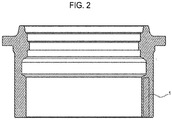
- the shape of the spheroidal graphite cast irons was a housing shape having the cross section shown in FIG. 2 .
- the spheroidal graphite iron cast of Comparative Example 8 was manufactured by the same method as in Example 1 except that nickel (Ni) and molybdenum (Mo) were used instead of copper (Cu) and zirconium (Zr).
- the matrixes of the spheroidal graphite cast irons manufactured in Examples 1 to 6 and Comparative Example 1 to 8 were monitored using an optical microscope (ASTM E 3-2001/E 883-2011), and the results are shown in FIGs. 3 and 4 .
- the spherical graphite having a predetermined size were uniformly distributed in the spheroidal graphite cast irons of the present invention.
- Test pieces (1 in FIG. 2 ) were collected from the spheroidal graphite cast irons manufactured in Examples 1 to 6 and Comparative Examples 1 to 8, and then the physical properties thereof were evaluated by the following methods. The results are shown in Table 2 below.
- the spheroidal graphite cast irons according to the present invention satisfied all the conditions: a tensile strength in the range of 550 to 650 MPa, a number of spherical graphite per unit area (1 mm 2 ) in the range of 130 to 190, a size of spherical graphite of 50 ⁇ m or less, a spheroidization ratio of 80% or higher, and a pearlite fraction of 50 to 85%.
- the number of spherical graphite per unit area (1 mm 2 ) may be preferably 134 to 172.
- Comparative Examples 1 to 3 did not satisfy the physical property values required in the present invention except for the pearlite fraction
- Comparative Example 4 did not satisfy the physical property values required in the present invention except for the size of spherical graphite.
- Comparative Examples 5 to 7 did not satisfy the physical property values required in the present invention
- Comparative Example 8 did not satisfy the physical property values required in the present invention except for the size of spherical graphite and the spheroidization ratio.
- the spheroidal graphite cast irons manufactured in Examples 1 to 6 and Comparative Examples 1 to 8 were tooth-profile processed into the shape shown in FIG. 5 , and the tooth-profile processed portions were subjected to a surfacing treatment and high-frequency induction hardening to manufacture housings, which are hydraulic device components.
- the hydraulic device components according to the present invention had a surface hardness in the range of HRC 55 to 65 and a transformation amount of 65 ⁇ m or less.
Landscapes
- Chemical & Material Sciences (AREA)
- Engineering & Computer Science (AREA)
- Materials Engineering (AREA)
- Metallurgy (AREA)
- Organic Chemistry (AREA)
- Mechanical Engineering (AREA)
- Physics & Mathematics (AREA)
- Thermal Sciences (AREA)
- Crystallography & Structural Chemistry (AREA)
- Refinement Of Pig-Iron, Manufacture Of Cast Iron, And Steel Manufacture Other Than In Revolving Furnaces (AREA)
Abstract
Description
- The present invention relates to a spheroidal graphite cast iron used to manufacture a hydraulic device component (for example, a housing) and a method for manufacturing the same.
- Despite lower strength and abrasion resistance of a spheroidal graphite cast iron than steel materials, such as carbon steel, alloy steel, and forged steel, it is easy to manufacture and can secure strength and abrasion resistance equal to or higher than those of steel materials through high-frequency induction hardening (or high-frequency heat treatment), and thus is utilized as a substitute material for a steel material.
- However, a spheroidal graphite cast iron is manufactured by injecting a molten metal into a mold and coagulating the molten metal, and thus, it is difficult for spherical graphite to be uniformly formed in a matrix. When such a spheroidal graphite cast iron having non-uniformly formed, spherical graphite is subjected to high-frequency induction hardening, the martensite transformation of the matrix is not easy and the hard layer and physical property values required are difficult to secure, so that a casting (component) obtained by subjecting spheroidal graphite cast iron to high-frequency induction hardening is easily transformed. Therefore, despite increased strength and abrasion resistance of a spheroidal graphite cast iron through high-frequency induction hardening, it is restrictively used only in small components that are not susceptible to transformation during high-frequency induction hardening (for example, engine components or transmission components for automobiles).
- Accordingly, in order to increase the availability of spheroidal graphite cast iron, a technique has been proposed that improves a high-frequency induction hardening process of the spheroidal graphite cast iron, thereby advancing the physical properties of a spheroidal graphite cast iron. However, the technique has a limitation in controlling the number of spherical graphite, the size of spherical graphite, the spheroidization ratio, and the fraction of pearlite in spheroidal graphite cast iron, which are key factors for obtaining physical property values required in a hardened portion subjected to high-frequency induction hardening.
- In order to solve such limitation, a technique has been proposed that improves physical properties of the spheroidal graphite cast iron by adding an expensive element, such as nickel (Ni) and molybdenum (Mo), to control key factors of the spheroidal graphite cast iron. However, according to the technique, a pearlite fraction is less than 10%, and thus, a plastic processing portion, when being subjected to high-frequency induction hardening, has difficulty in the martensite transformation of the matrix. Therefore, the technique has a limitation in increasing the strength and abrasion resistance of spheroidal graphite cast iron.
- Therefore, a spheroidal graphite cast iron is required that has uniform spherical graphite and matrix, and thus has minimized transformation and exhibits strength and abrasion resistance equal to or higher than those of steel materials even though the time for high-frequency induction hardening varies depending on the size of a component.
- An object of the present invention is to provide a spheroidal graphite cast iron having spherical graphite uniformly formed in the matrix and a method for manufacturing the same.
- Another object of the present invention is to provide a hydraulic device component including the spheroidal graphite cast iron.
- In order to achieve the objects as above, the present invention provides a hydraulic device component including a spheroidal graphite cast iron, wherein the spheroidal graphite cast iron contains 3.4 to 3.8 wt% of carbon (C), 2.0 to 2.4 wt% of silicon (Si), 0.2 to 0.5 wt% of manganese (Mn), 0.025 to 0.06 wt% of magnesium (Mg), 0.2 to 0.5 wt% of copper (Cu), 0.005 to 0.01 wt% of zirconium (Zr), and the balance iron (Fe) and impurities, and wherein the ratio (Cu/Zr) of the content of the copper (Cu) to the content of the zirconium (Zr) is 20 to 100.
- In addition, the present invention provides a method for manufacturing a spheroidal graphite cast iron, the method including: (a) preparing a raw-material molten metal containing carbon (C), silicon (Si), manganese (Mn), iron (Fe), and impurities; (b) adding copper (Cu) to the raw-material molten metal; (c) adding zirconium (Zr) to the raw-material molten metal, to which the copper (Cu) has been added, such that the ratio (Cu/Zr) of the content of the copper (Cu) to the content of the zirconium (Zr) is 20 to 100; (d) adding a spheroidizing agent made of Fe-Si-Mg to the raw-material molten metal, to which the zirconium (Zr) has been added; and (e) adding an inoculant made of Fe-Si to the raw-material molten metal, to which the spheroidizing agent has been added, thereby preparing a cast-iron molten metal containing 3.4 to 3.8 wt% of carbon (C), 2.0 to 2.4 wt% of silicon (Si), 0.2 to 0.5 wt% of manganese (Mn), 0.2 to 0.5 wt% of copper (Cu), 0.005 to 0.01 wt% of zirconium (Zr), 0.025 to 0.06 wt% of magnesium (Mg), and the balance iron (Fe) and impurities.
- In addition, the present invention provides a hydraulic device component manufactured by subjecting the hydraulic device component to high-frequency induction hardening.
- The present invention can provide a spheroidal graphite cast iron having a uniform size and distribution of spherical graphite and a high fraction of pearlite in the matrix, by controlling the ratio (Cu/Zr) of the content of copper (Cu) to the content of zirconium (Zr) to manufacture the spheroidal graphite cast iron. In addition, the present invention can provide a hydraulic device component having a minimized transformation and exhibiting strength and abrasion resistance equal to or higher than those of steel materials (carbon steel, alloy steel, and forged steel) by subjecting the spheroidal graphite cast iron to high-frequency induction hardening.
-
-
FIG. 1 is a flow chart showing a process for manufacturing a spheroidal graphite cast iron according to an embodiment of the present invention. -
FIGs. 2 to 5 are reference images for illustrating examples and experimental examples of the present invention. - Hereinafter, the present invention will be described in detail.
- The spheroidal graphite cast iron contains carbon (C), silicon (Si), manganese (Mn), magnesium (Mg), copper (Cu), and zirconium (Zr) in particular content ranges while the content ratio (Cu/Zr) of copper (Cu) to zirconium (Zr) falls within a particular range, so that spherical graphite having a predetermined size are uniformly distributed in the matrix. This will be described in detail as below.
- The spheroidal graphite cast iron contains 3.4 to 3.8 wt% of carbon (C) based on the total weight thereof. Carbon (C) is an element that generates spherical graphite or fine pearlite. If the content of carbon (C) is less than 3.4 wt%, the number of spherical graphite for carbon diffusion per unit area (1 mm2) may be reduced, which results in a deterioration in stable martensite transformation of the matrix. If the content of carbon (C) is more than 3.8 wt%, primary graphite may be excessively formed or chunky graphite may be formed, thereby making it difficult to obtain a normal spheroidal graphite cast iron. Therefore, it is preferred that the content of carbon (C) falls within the above range.
- The spheroidal graphite cast iron contains 2.0 to 2.4 wt% of silicon (Si) based on the total weight thereof. If the content of silicon (Si) is less than 2.0 wt%, the number of spherical graphite may be reduced or shrinkage defect may be caused in a final coagulated portion of a molten metal. If the content of silicon (Si) is more than 2.4 wt%, spherical graphite may be excessively formed, which results in a reduction in the fraction of pearlite, so that the tensile strength of the spheroidal graphite cast iron may deteriorate or the performance after high-frequency induction hardening may deteriorate. Therefore, it is preferred that the content of silicon (Si) falls within the above range.
- The spheroidal graphite cast iron contains 0.2 to 0.5 wt% of manganese (Mn) based on the total weight thereof. Manganese (Mn) is a representative element that generates pearlite and reacts with sulfur (S) to form nucleation sites of spherical graphite. If the content of Manganese (Mn) is less than 0.2 wt%, the number of nucleation sites may be reduced, which results in a high formation rate of coarse spherical graphite, thereby making it difficult to obtain a normal spheroidal graphite cast iron. If the content of Manganese (Mn) is more than 0.5 wt%, pearlite may be excessively generated in the matrix, and thus, normalizing and high-frequency induction hardening may excessively increase in the surface hardness, resulting in a deterioration of brittleness. Therefore, it is preferred that the content of manganese (Mn) falls within the above range.
- The spheroidal graphite cast iron contains 0.025 to 0.06 wt% of magnesium (Mg) based on the total weight thereof. Magnesium (Mg) is an element that accelerates the formation of spherical graphite by reacting with sulfur (S) and oxygen (O), which are elements inhibiting spheroidization, to remove these elements. If the content of Magnesium (Mg) is less than 0.025 wt%, compacted graphite iron (CGI) or flake graphite may be formed. If the content of Magnesium (Mg) is more than 0.06 wt%, the possibility of occurrence of chill may be increased, which results in a deterioration of brittleness. Therefore, it is preferred that the content of magnesium (Mg) falls within the above range.
- The spheroidal graphite cast iron contains 0.2 to 0.5 wt% of copper (Cu) based on the total weight thereof. Copper (Cu), which is an element that anneals the matrix of the spheroidal graphite cast iron, functions to promote the generation of pearlite and to micronize pearlite. If the content of copper (Cu) is less than 0.2 wt%, the generation of pearlite may be reduced, thereby making it difficult to obtain a required tensile strength. If the content of copper (Cu) is more than 0.5 wt%, pearlite may be excessively generated, and thus, normalizing and high-frequency induction hardening may excessively increase the surface hardness, resulting in a deterioration of brittleness. Therefore, it is preferred that the content of copper (Cu) falls within the above range.
- The spheroidal graphite cast iron contains 0.005 to 0.01 wt% of zirconium (Zr) based on the total weight thereof. Zirconium (Zr) is an element that reacts with sulfur (S) to form a sulfide or forms a substrate in which nuclei of spheroidal graphite can grow in other forms, thereby uniformly forming spherical graphite. If the content of Zirconium (Zr) is less than 0.005 wt%, chunky graphite, explosive graphite, carbon dross, or the like may be formed. If the content of Zirconium (Zr) is more than 0.01 wt%, spherical graphite may be excessively formed, thereby making it difficult to obtain a normal spheroidal graphite cast iron. Therefore, it is preferred that the content of zirconium (Zr) preferably falls within the above range.
- The spheroidal graphite cast iron contains, in addition to the above ingredients, the balance iron (Fe) and impurities. The impurities are not particularly limited, but an example thereof may be sulfur (S), phosphorus (P), or the like.
- Here, the content of sulfur (S) contained in the spheroidal graphite cast iron is not particularly limited, but is preferably 0.002 to 0.01 wt% based on the total weight of the spheroidal graphite cast iron. If the content of sulfur (S) is less than 0.002 wt%, the number of nucleation sites of spherical graphite may be reduced, which result in a high formation rate of coarse spherical graphite. If the content of sulfur (S) is more than 0.01 wt%, graphite spheroidization may be inhibited, which results in the formation of flake graphite. Therefore, it is preferred that the content of sulfur (S) falls within the above range.
- In addition, the content of phosphor (P) contained in the spheroidal graphite cast iron is also not particularly limited, but is preferably 0.06 wt% or less based on the total weight of the spheroidal graphite cast iron. Phosphor (P) is an impurity that is naturally added in the process for manufacturing a spheroidal graphite cast iron. Phosphor (P) hardens the matrix by forming a phosphide (steadite). But, if the content of Phosphor (P) is more than 0.06 wt%, a phosphide (steadite) may be excessively formed, which results in a rapid increase in the brittleness, and causes deterioration in the processability. Therefore, it is preferred that the content of phosphor (P) falls within the above range.
- Meanwhile, the spheroidal graphite cast iron contains zirconium (Zr) and copper (Cu) with the above ranges, and the ratio of the content of copper (Cu) to the content of zirconium (Zr) is 20 to 100, preferably 30 to 90. When the ratio of Cu/Zr is within 20 to 100, a complex reaction of copper (Cu), which is an element for pearlite generation and graphitization, and zirconium (Zr), which functions as a nucleation site of graphite, is optimized, thereby obtaining a spheroidal graphite cast iron in which spherical graphite having a predetermined size are uniformly distributed in the matrix. As a result, the number of spherical graphite, the size of spherical graphite, the spheroidization ratio, and the fraction of pearlite, which are key factors of the spheroidal graphite cast iron, may be controlled.
- Specifically, in the spheroidal graphite cast iron, the number of spherical graphite per unit area (1 mm2) is 130 or more, preferably 140 to 200, and the size of spherical graphite is 50 µm or less, preferably 10 to 45 µm. If the number of spherical graphite per unit area (1 mm2) is less than 130, the spherical graphite becomes coarse, and thus a required spheroidization ratio is difficult to obtain, and graphite, such as chunky graphite, explosive graphite, or carbon dross, may be formed, and therefore, the number of spherical graphite is preferably 130 or more. The reason why the size of the spherical graphite is preferably 50 µm or less is also the same.
- In addition, the spheroidal graphite cast iron of the present invention has a spheroidization ratio of 80% or higher (preferably 80 to 100%) even though the cross-section thickness of the spheroidal graphite cast iron is 30 mm or more.
- In addition, the spheroidal graphite cast iron has a pearlite fraction of 50 to 85% in the matrix. When the pearlite fraction is less than 50%, the martensite transformation of the matrix is not stably performed. Thus, even though the spheroidal graphite cast iron is subjected to high-frequency induction hardening, a hydraulic device component having required physical property values may be difficult to secure. When the pearlite fraction is more than 85%, normalizing and high-frequency induction hardening may lead to an excessive increase in the surface hardness of a spheroidal graphite cast iron. Thus, the brittleness of the hydraulic device component may deteriorate or an additional heat treatment may be needed. Therefore, the pearlite fraction is preferably 50 to 85%.
- Meanwhile, the spheroidal graphite cast iron has a tensile strength of 550 to 650 MPa. Since the tensile strength falls within the above range, the spheroidal graphite cast iron is subjected to normalizing and high-frequency induction hardening, thereby producing a hydraulic device component having required physical property values.
- The present invention provides a manufacturing method for the above described spheroidal graphite cast iron, which will be described in detail with reference to
FIG. 1 . - First, a raw-
material molten metal 110 containing carbon (C), silicon (Si), manganese (Mn), iron (Fe), and impurities is prepared. A method of preparing the raw-material molten metal 110 is not particularly limited as long as the method is known in the art. Meanwhile, the contents of carbon (C), silicon (Si), and manganese (Mn) contained in the raw-material molten metal are preferably 3.4 to 3.8 wt% for carbon (C), 1.4 to 1.8 wt% for silicon (Si), and 0.2 to 0.5 wt% for manganese (Mn) based on the total weight of the raw-material molten metal 110. - Copper (Cu) 210 is added to the prepared raw-
material molten metal 110. Here, the addition amount of copper (Cu) 210 is preferably 0.2 to 0.5 wt% based on the total amount of the raw-material molten metal 110. - Zirconium (Zr) 220 is added to the raw-
material molten metal 110 to which the copper (Cu) has been added, such that the ratio (Cu/Zr) of the content of copper (Cu) 210 to the content of zirconium (Zr) 220 is 20 to 100. Specifically, zirconium (Zr) is preferably added in a content of 0.0005 to 0.01 wt% based on the total amount of the raw-material molten metal 110. Since theratio Cu 210 /Zr 220 is adjusted to a range of 20 to 100, a spheroidal graphite cast iron, in which spherical graphite having a predetermined size are uniformly distributed, can be obtained. - Meanwhile, zirconium (Zr) 220 is not added in step (a) of preparing a raw-
material molten metal 110 but is added later, thereby preventing the conversion of zirconium (Zr) 220 into an oxide, and thus, the addition amount of zirconium (Zr) 220 contained in the raw-material molten metal 110 can be maintained (when zirconium (Zr) 220 is converted into an oxide, the oxide floats on the surface of the raw-material molten metal 110, and then regarded as an impurity to be removed). - The raw-
material molten metal 110 to which zirconium (Zr) 200 has been added is analyzed by using a carbon equivalent meter, a carbon/sulfur analyzer, a spectrometer, and the like, so that the ingredients of the raw-material molten metal 110 are monitored to investigate whether the respective ingredients are contained in the required contents. - A spheroidizing agent made of Fe-Si-Mg is added to the raw-
material molten metal 110 to which zirconium (Zr) 220 has been added. Specifically, the raw-material molten metal 110 is poured into aladle 300, which is a container for tapping, and a spheroidizing agent made of Fe-Si-Mg for promoting graphite spheroidization is added to perform graphite spheroidization. Here, the addition amount of the spheroidizing agent made of Fe-Si-Mg is not particularly limited, but is preferably 1.1 ± 0.05 wt%. By adding such a spheroidizing agent, the content of magnesium (Mg) contained in the spheroidal graphite cast iron is determined. Meanwhile, in order to improve the stabilization of the spheroidal graphite cast iron, an inoculant made of Fe-Si, which will be described later, may be added during spheroidization. - An inoculant made of Fe-Si is added to the raw-
material molten metal 110 to which the spheroidizing agent has been added, to prepare a cast ironmolten metal 120 containing 3.4 to 3.8 wt% of carbon (C), 2.0 to 2.4 wt% of silicon (Si), 0.2 to 0.5 wt% of manganese (Mn), 0.2 to 0.5 wt% of copper (Cu), 0.005 to 0.01 wt% of zirconium (Zr), 0.025 to 0.06 wt% of magnesium (Mg), and the balance iron (Fe) and impurities. Here, the addition amount of the inoculant made of Fe-Si is not particularly limited, but is preferably 0.5 ± 0.05 wt%. - Thereafter, the temperature of the prepared cast-
iron molten metal 120 is measured using a deposition-type thermometer, and then the cast-iron molten metal is injected into a castingmold 400 to manufacture a spheroidal graphite cast iron having a desired shape. - The present invention provides a hydraulic device component manufactured by subjecting the above-described spheroidal graphite cast iron to high-frequency induction hardening. Since the hydraulic device component of the present invention is obtained by subjecting the above-described spheroidal graphite cast iron to high-frequency induction hardening, the hydraulic device component has a surface hardness within a required range and a minimized amount of transformation. That is, when the above-described spheroidal graphite cast iron is subjected to high-frequency induction hardening, the matrix is transformed into stable martensite and the transformation of a heat-affected zone is minimized, and therefore, the present invention can provide a hydraulic device component having a surface hardness with an optimal range and a minimized amount of transformation.
- Specifically, the hydraulic device component of the present invention has a surface hardness of HRC 55 to 65, which is equal to or higher than the surface hardness of a steel material, and has a transformation amount of 65 µm or less (preferably 0 to 60 µm).
- Meanwhile, a method for subjecting a spheroidal graphite cast iron to high-frequency induction hardening to obtain the hydraulic device component of the present invention is not particularly limited as long as the method is known in the art, but the method may be conducted such that the spheroidal graphite cast iron is subjected to primary hardening at a temperature of 850 to 1050°C, cooled with water or oil, and then subjected to secondary hardening at a temperature of 120 to 250°C.
- In addition, the hydraulic device component of the present invention is preferable as long as the spheroidal graphite cast iron is subjected to a normalizing process before the high-frequency induction hardening. Here, a method for normalizing a spheroidal graphite cast iron is not particularly limited as long as the method is known in the art, but the method may be conducted by a heat treatment at 880 to 910°C for 3 to 5 hours and then cooling to room temperature.
- Hereinafter, the present invention is described in detail through examples, but the following examples are only for illustrating an embodiment of the present invention, and the aspect of the present invention is not limited by the following examples.
- A raw-material molten metal, which has been melted in a blast furnace, was poured into a ladle, and a spheroidizing agent made of Fe-Si-Mg and an inoculant made of Fe-Si (primary inoculation) were added to perform graphite spheroidization. Then, an inoculant made of Fe-Si (secondary inoculation) was added to the raw-material molten metal, of which graphite spheroidization has been performed, to prepare a cast iron molten melt, which was then injected into a casting frame, thereby manufacturing spheroidal graphite cast irons having the compositions shown in Table 1 below. Here, the shape of the spheroidal graphite cast irons was a housing shape having the cross section shown in
FIG. 2 . Meanwhile, the spheroidal graphite iron cast of Comparative Example 8 was manufactured by the same method as in Example 1 except that nickel (Ni) and molybdenum (Mo) were used instead of copper (Cu) and zirconium (Zr).[Table 1] C Si Mn S P Mg Cu Zr Cu/Zr Fe Example 1 3.62 2.22 0.47 0.007 0.03 0.043 0.50 0.005 100 Balance Example 2 3.41 2.31 0.33 0.003 0.03 0.029 0.34 0.009 37.7 Balance Example 3 3.74 2.09 0.39 0.004 0.04 0.038 0.20 0.010 20 Balance Example 4 3.80 2.17 0.27 0.006 0.02 0.055 0.37 0.008 46.2 Balance Example 5 3.66 2.28 0.43 0.006 0.04 0.052 0.50 0.010 50 Balance Example 6 3.53 2.33 0.33 0.004 0.02 0.041 0.39 0.005 78 Balance Comparative Example 1 3.79 2.11 0.42 0.005 0.03 0.040 0.48 0.003 160 Balance Comparative Example 2 3.55 2.19 0.37 0.006 0.05 0.039 0.25 0.016 15.6 Balance Comparative Example 3 3.68 2.34 0.29 0.007 0.05 0.033 0.64 0.006 106.6 Balance Comparative Example 4 3.49 2.29 0.41 0.007 0.04 0.050 0.16 0.009 17.7 Balance Comparative Example 5 3.63 2.13 0.34 0.003 0.03 0.048 0.78 0.024 32.5 Balance Comparative Example 6 3.59 2.21 0.44 0.004 0.05 0.054 0.12 0.003 40 Balance Comparative Example 7 3.55 2.34 0.39 0.008 0.04 0.041 0.11 0.002 55 Balance Comparative Example 8 3.71 1.94 0.42 0.021 0.04 0.036 0.47%Ni - Balance 0.42%Mo Unit: wt% - The matrixes of the spheroidal graphite cast irons manufactured in Examples 1 to 6 and Comparative Example 1 to 8 were monitored using an optical microscope (ASTM E 3-2001/E 883-2011), and the results are shown in
FIGs. 3 and4 . - Referring to
FIG. 3 , it could be confirmed that the spherical graphite having a predetermined size were uniformly distributed in the spheroidal graphite cast irons of the present invention. - While, referring to
FIG. 4 , it could be confirmed that the size of spherical graphite was not uniform and the distribution of spherical graphite was not uniform in the spheroidal graphite cast irons of Comparative Examples 1 to 8. - Test pieces (1 in
FIG. 2 ) were collected from the spheroidal graphite cast irons manufactured in Examples 1 to 6 and Comparative Examples 1 to 8, and then the physical properties thereof were evaluated by the following methods. The results are shown in Table 2 below. - 1. Tensile strength (MPa): Measured according to KS B 0802:2003.
- 2. Number of spherical graphite (ea/mm2): Measured according to ISO 945-1:2008.
- 3. Size of spherical graphite (µm): Measured according to ISO 945-1:2008.
- 4. Spheroidization ratio (%): Measured according to KS D 4302:2011.
- 5. Pearlite fraction (%): Measured according to KS D 4302:2011.
- Referring to Table 2, it could be confirmed that the spheroidal graphite cast irons according to the present invention satisfied all the conditions: a tensile strength in the range of 550 to 650 MPa, a number of spherical graphite per unit area (1 mm2) in the range of 130 to 190, a size of spherical graphite of 50 µm or less, a spheroidization ratio of 80% or higher, and a pearlite fraction of 50 to 85%. The number of spherical graphite per unit area (1 mm2) may be preferably 134 to 172.
- In contrast, it could be confirmed that Comparative Examples 1 to 3 did not satisfy the physical property values required in the present invention except for the pearlite fraction, and Comparative Example 4 did not satisfy the physical property values required in the present invention except for the size of spherical graphite. In addition, it could be confirmed that Comparative Examples 5 to 7 did not satisfy the physical property values required in the present invention, and Comparative Example 8 did not satisfy the physical property values required in the present invention except for the size of spherical graphite and the spheroidization ratio.
- The spheroidal graphite cast irons manufactured in Examples 1 to 6 and Comparative Examples 1 to 8 were tooth-profile processed into the shape shown in
FIG. 5 , and the tooth-profile processed portions were subjected to a surfacing treatment and high-frequency induction hardening to manufacture housings, which are hydraulic device components. - The physical properties of the hydraulic device components manufactured in Manufacturing Examples 1 to 6 and Comparative Manufacturing Examples 1 to 8 were evaluated by the following methods, and the results are shown in Table 3 below.
- 1. Surface hardness (HRC): Measured according to KS B 0806.
- 2. Transformation amount (µm): Measured using a three-dimensional measuring instrument.
- Referring to Table 3 above, it could be confirmed that the hydraulic device components according to the present invention had a surface hardness in the range of HRC 55 to 65 and a transformation amount of 65 µm or less.
| Tensile strength (MPa) | Number of spherical graphite (ea/mm2) | Size of spherical graphite (um) | Spheroidization ratio (%) | Pearlite fraction (%) | |
| Example 1 | 635 | 142 | 42 | 86 | 82 |
| Example 2 | 612 | 172 | 34 | 85 | 64 |
| Example 3 | 561 | 169 | 38 | 94 | 74 |
| Example 4 | 595 | 166 | 34 | 89 | 69 |
| Example 5 | 622 | 156 | 41 | 90 | 79 |
| Example 6 | 572 | 134 | 46 | 82 | 81 |
| Comparative Example 1 | 492 | 109 | 72 | 78 | 58 |
| Comparative Example 2 | 548 | 98 | 86 | 77 | 54 |
| Comparative Example 3 | 661 | 111 | 76 | 73 | 84 |
| Comparative Example 4 | 473 | 127 | 48 | 78 | 39 |
| Comparative Example 5 | 679 | 89 | 91 | 74 | 89 |
| Comparative Example 6 | 466 | 103 | 88 | 79 | 41 |
| Comparative Example 7 | 459 | 116 | 71 | 61 | 32 |
| Comparative Example 8 | 497 | 114 | 41 | 83 | 21 |
| Surface hardness (HRC) | Transformation amount (µm) | |
| Example 1 | 64 | 61 |
| Example 2 | 62 | 54 |
| Example 3 | 56 | 32 |
| Example 4 | 59 | 41 |
| Example 5 | 61 | 59 |
| Example 6 | 57 | 44 |
| Comparative Example 1 | 48 | 69 |
| Comparative Example 2 | 53 | 72 |
| Comparative Example 3 | 68 | 88 |
| Comparative Example 4 | 44 | 78 |
| Comparative Example 5 | 67 | 81 |
| Comparative Example 6 | 47 | 76 |
| Comparative Example 7 | 46 | 71 |
| Comparative Example 8 | 41 | 74 |
Claims (9)
- A hydraulic device component comprising a spheroidal graphite cast iron, wherein the spheroidal graphite cast iron contains 3.4 to 3.8 wt% of carbon (C), 2.0 to 2.4 wt% of silicon (Si), 0.2 to 0.5 wt% of manganese (Mn), 0.2 to 0.5 wt% of copper (Cu), 0.005 to 0.01 wt% of zirconium (Zr), 0.025 to 0.06 wt% of magnesium (Mg), and the balance iron (Fe) and impurities, and
wherein the ratio of the content of the copper (Cu) to the content of the zirconium (Zr) is 20 to 100. - The hydraulic device component of claim 1, wherein in the spheroidal graphite cast iron, the number of spherical graphite per unit area (1 mm2) is 130 to 190 and the size of spherical graphite is 50 µm or less.
- The hydraulic device component of claim 1, wherein in the spheroidal graphite cast iron, the spheroidization ratio is 80% or higher.
- The hydraulic device component of claim 1, wherein in the spheroidal graphite cast iron, the fraction of pearlite in a matrix is 50 to 85%.
- The hydraulic device component of claim 1, wherein in the spheroidal graphite cast iron, the tensile strength is 550 to 650 MPa.
- A method for manufacturing a spheroidal graphite cast iron, the method comprising:(a) preparing a raw-material molten metal containing carbon (C), silicon (Si), manganese (Mn), iron (Fe), and impurities;(b) adding copper (Cu) to the raw-material molten metal;(c) adding zirconium (Zr) to the raw-material molten metal, to which the copper (Cu) has been added, such that the ratio (Cu/Zr) of the content of the copper (Cu) to the content of the zirconium (Zr) is 20 to 100;(d) adding a spheroidizing agent made of Fe-Si-Mg to the raw-material molten metal, to which the zirconium (Zr) has been added; and(e) adding an inoculant made of Fe-Si to the raw-material molten metal, to which the spheroidizing agent has been added, thereby preparing a cast-iron molten metal containing 3.4 to 3.8 wt% of carbon (C), 2.0 to 2.4 wt% of silicon (Si), 0.2 to 0.5 wt% of manganese (Mn), 0.2 to 0.5 wt% of copper (Cu), 0.005 to 0.01 wt% of zirconium (Zr), 0.025 to 0.06 wt% of magnesium (Mg), and the balance iron (Fe) and impurities.
- A hydraulic device component manufactured by subjecting the hydraulic device component of any one of claims 1 to 5 to high-frequency induction hardening.
- The hydraulic device component of claim 7, wherein the amount of transformation of the hydraulic device component is 65 µm or less.
- The hydraulic device component of claim 7, wherein the surface hardness of the hydraulic device component is HRC 55 to 65.
Applications Claiming Priority (2)
| Application Number | Priority Date | Filing Date | Title |
|---|---|---|---|
| KR1020140187871A KR102279874B1 (en) | 2014-12-24 | 2014-12-24 | Nodular graphite cast iron and preparation method thereof, and component for hydraulic device prepared thereby |
| PCT/KR2015/012634 WO2016104961A1 (en) | 2014-12-24 | 2015-11-24 | Spheroidal graphite cast iron, manufacturing method therefor, and hydraulic device component manufactured therefrom |
Publications (3)
| Publication Number | Publication Date |
|---|---|
| EP3239314A1 true EP3239314A1 (en) | 2017-11-01 |
| EP3239314A4 EP3239314A4 (en) | 2018-06-20 |
| EP3239314B1 EP3239314B1 (en) | 2020-08-05 |
Family
ID=56150936
Family Applications (1)
| Application Number | Title | Priority Date | Filing Date |
|---|---|---|---|
| EP15873489.7A Active EP3239314B1 (en) | 2014-12-24 | 2015-11-24 | Spheroidal graphite cast iron, manufacturing method therefor, and hydraulic device component manufactured therefrom |
Country Status (4)
| Country | Link |
|---|---|
| EP (1) | EP3239314B1 (en) |
| KR (1) | KR102279874B1 (en) |
| CN (1) | CN107109550A (en) |
| WO (1) | WO2016104961A1 (en) |
Cited By (1)
| Publication number | Priority date | Publication date | Assignee | Title |
|---|---|---|---|---|
| EP4428259A1 (en) * | 2023-03-07 | 2024-09-11 | Akademia Gorniczo-Hutnicza im. Stanislawa Staszica w Krakowie | A method for the modification of primary carbide precipitates in cast iron alloys |
Family Cites Families (9)
| Publication number | Priority date | Publication date | Assignee | Title |
|---|---|---|---|---|
| JP2000239780A (en) | 1999-02-25 | 2000-09-05 | Kubota Tekkosho:Kk | Spheroid al graphite cast iron and machine parts such as gear using the same |
| JP2002003982A (en) * | 2000-06-16 | 2002-01-09 | Kiyohito Ishida | Cast iron with excellent machinability and mechanical properties |
| JP4527304B2 (en) * | 2001-03-13 | 2010-08-18 | アイシン精機株式会社 | High strength high toughness spheroidal graphite cast iron |
| JP4565301B2 (en) * | 2001-03-21 | 2010-10-20 | アイシン精機株式会社 | High-strength spheroidal graphite cast iron and method for producing the same |
| JP2005002445A (en) | 2003-06-13 | 2005-01-06 | Aisin Takaoka Ltd | Heat treatment method for member made of spheroidal graphite cast iron |
| KR101605905B1 (en) * | 2009-12-22 | 2016-03-23 | 두산인프라코어 주식회사 | Cgi cast iron and preparation method thereof |
| JP5812832B2 (en) * | 2011-12-02 | 2015-11-17 | 曙ブレーキ工業株式会社 | Thin-walled spheroidal graphite cast iron member, method for producing the same, and vehicle component |
| KR101822201B1 (en) * | 2012-01-27 | 2018-01-26 | 두산인프라코어 주식회사 | High strength flake graphite iron using rare earth element and preparation method thereof |
| KR101988463B1 (en) * | 2012-11-13 | 2019-06-12 | 현대모비스 주식회사 | Nodular graphite cast iron with high strength and high toughness and parts of an automobile manufactured from the same |
-
2014
- 2014-12-24 KR KR1020140187871A patent/KR102279874B1/en active Active
-
2015
- 2015-11-24 EP EP15873489.7A patent/EP3239314B1/en active Active
- 2015-11-24 CN CN201580070045.9A patent/CN107109550A/en active Pending
- 2015-11-24 WO PCT/KR2015/012634 patent/WO2016104961A1/en not_active Ceased
Cited By (1)
| Publication number | Priority date | Publication date | Assignee | Title |
|---|---|---|---|---|
| EP4428259A1 (en) * | 2023-03-07 | 2024-09-11 | Akademia Gorniczo-Hutnicza im. Stanislawa Staszica w Krakowie | A method for the modification of primary carbide precipitates in cast iron alloys |
Also Published As
| Publication number | Publication date |
|---|---|
| EP3239314B1 (en) | 2020-08-05 |
| EP3239314A4 (en) | 2018-06-20 |
| KR102279874B1 (en) | 2021-07-20 |
| CN107109550A (en) | 2017-08-29 |
| KR20160077680A (en) | 2016-07-04 |
| WO2016104961A1 (en) | 2016-06-30 |
Similar Documents
| Publication | Publication Date | Title |
|---|---|---|
| JP6079641B2 (en) | Spheroidal graphite cast iron excellent in strength and toughness and method for producing the same | |
| CN105063466B (en) | metal alloy for high impact applications | |
| EP2354265A1 (en) | Austenitic ductile cast iron | |
| CN109943772B (en) | Steel material for graphite steel and graphite steel with improved machinability | |
| CN110592487B (en) | 700 MPa-grade austenite ferrite dual-phase low-density cast steel and preparation method thereof | |
| US11466349B2 (en) | Spheroidal graphite cast iron | |
| JP6911606B2 (en) | Nitriding parts and nitriding method | |
| EP2749658A1 (en) | Method for as-cast production of ausferritic ductile iron | |
| JP2021165436A (en) | Fine spheroidal graphite cast iron mold casting | |
| KR101605905B1 (en) | Cgi cast iron and preparation method thereof | |
| KR20170035133A (en) | Ductile cast iron roll and method of manufacturing the same | |
| EP3279360B1 (en) | Case-hardened steel component | |
| JP6328968B2 (en) | Spheroidal graphite cast iron and method for producing spheroidal graphite cast iron | |
| EP3239314B1 (en) | Spheroidal graphite cast iron, manufacturing method therefor, and hydraulic device component manufactured therefrom | |
| Caldera et al. | Precipitation and dissolution of carbides in low alloy ductile iron plates of varied thickness | |
| WO2017158988A1 (en) | Cold working tool material and cold working tool manufacturing method | |
| US10844450B2 (en) | Black heart malleable cast iron and manufacturing method thereof | |
| KR101822203B1 (en) | Preparation method of high strength flake graphite iron and flake graphite iron preparaed by the same method, and engine body for internal combustion engine comprising the same | |
| JP2019157234A (en) | Cold tool material and manufacturing method of cold tool | |
| JP5151662B2 (en) | Method of manufacturing steel for soft nitriding | |
| WO2021177454A1 (en) | Black heart malleable cast iron and method for producing same | |
| EP3358026B1 (en) | Spheroidal graphite cast iron excellent in gas defect resistance | |
| KR102076368B1 (en) | Flake graphite iron and preparation method thereof, and engine body for internal combustion engine comprising the same | |
| EP4726064A1 (en) | Grey cast iron with vermicular graphite | |
| JP2011068921A (en) | Austenitic cast iron, manufacturing method therefor and austenitic cast iron product |
Legal Events
| Date | Code | Title | Description |
|---|---|---|---|
| STAA | Information on the status of an ep patent application or granted ep patent |
Free format text: STATUS: THE INTERNATIONAL PUBLICATION HAS BEEN MADE |
|
| PUAI | Public reference made under article 153(3) epc to a published international application that has entered the european phase |
Free format text: ORIGINAL CODE: 0009012 |
|
| STAA | Information on the status of an ep patent application or granted ep patent |
Free format text: STATUS: REQUEST FOR EXAMINATION WAS MADE |
|
| 17P | Request for examination filed |
Effective date: 20170711 |
|
| AK | Designated contracting states |
Kind code of ref document: A1 Designated state(s): AL AT BE BG CH CY CZ DE DK EE ES FI FR GB GR HR HU IE IS IT LI LT LU LV MC MK MT NL NO PL PT RO RS SE SI SK SM TR |
|
| AX | Request for extension of the european patent |
Extension state: BA ME |
|
| DAV | Request for validation of the european patent (deleted) | ||
| DAX | Request for extension of the european patent (deleted) | ||
| A4 | Supplementary search report drawn up and despatched |
Effective date: 20180522 |
|
| RIC1 | Information provided on ipc code assigned before grant |
Ipc: C21D 1/10 20060101ALI20180515BHEP Ipc: C22C 33/00 20060101ALI20180515BHEP Ipc: C22C 37/04 20060101AFI20180515BHEP Ipc: C22C 33/10 20060101ALI20180515BHEP |
|
| STAA | Information on the status of an ep patent application or granted ep patent |
Free format text: STATUS: EXAMINATION IS IN PROGRESS |
|
| RIC1 | Information provided on ipc code assigned before grant |
Ipc: C21D 9/00 20060101ALI20190129BHEP Ipc: C21D 1/10 20060101ALI20190129BHEP Ipc: C21D 5/00 20060101ALI20190129BHEP Ipc: C22C 33/00 20060101ALI20190129BHEP Ipc: C22C 37/04 20060101AFI20190129BHEP Ipc: C22C 33/10 20060101ALI20190129BHEP |
|
| 17Q | First examination report despatched |
Effective date: 20190212 |
|
| REG | Reference to a national code |
Ref country code: DE Ref legal event code: R079 Ref document number: 602015057175 Country of ref document: DE Free format text: PREVIOUS MAIN CLASS: C22C0037040000 Ipc: C21C0001100000 |
|
| RIC1 | Information provided on ipc code assigned before grant |
Ipc: C21D 1/10 20060101ALI20200117BHEP Ipc: C22C 33/10 20060101ALI20200117BHEP Ipc: C21D 9/00 20060101ALI20200117BHEP Ipc: C22C 33/00 20060101ALI20200117BHEP Ipc: C22C 37/04 20060101ALI20200117BHEP Ipc: C21D 5/00 20060101ALI20200117BHEP Ipc: C21C 1/10 20060101AFI20200117BHEP |
|
| GRAP | Despatch of communication of intention to grant a patent |
Free format text: ORIGINAL CODE: EPIDOSNIGR1 |
|
| STAA | Information on the status of an ep patent application or granted ep patent |
Free format text: STATUS: GRANT OF PATENT IS INTENDED |
|
| INTG | Intention to grant announced |
Effective date: 20200304 |
|
| GRAS | Grant fee paid |
Free format text: ORIGINAL CODE: EPIDOSNIGR3 |
|
| GRAA | (expected) grant |
Free format text: ORIGINAL CODE: 0009210 |
|
| STAA | Information on the status of an ep patent application or granted ep patent |
Free format text: STATUS: THE PATENT HAS BEEN GRANTED |
|
| AK | Designated contracting states |
Kind code of ref document: B1 Designated state(s): AL AT BE BG CH CY CZ DE DK EE ES FI FR GB GR HR HU IE IS IT LI LT LU LV MC MK MT NL NO PL PT RO RS SE SI SK SM TR |
|
| REG | Reference to a national code |
Ref country code: GB Ref legal event code: FG4D |
|
| REG | Reference to a national code |
Ref country code: CH Ref legal event code: EP |
|
| REG | Reference to a national code |
Ref country code: AT Ref legal event code: REF Ref document number: 1298789 Country of ref document: AT Kind code of ref document: T Effective date: 20200815 |
|
| REG | Reference to a national code |
Ref country code: DE Ref legal event code: R096 Ref document number: 602015057175 Country of ref document: DE |
|
| REG | Reference to a national code |
Ref country code: IE Ref legal event code: FG4D |
|
| REG | Reference to a national code |
Ref country code: LT Ref legal event code: MG4D |
|
| REG | Reference to a national code |
Ref country code: NL Ref legal event code: MP Effective date: 20200805 |
|
| REG | Reference to a national code |
Ref country code: AT Ref legal event code: MK05 Ref document number: 1298789 Country of ref document: AT Kind code of ref document: T Effective date: 20200805 |
|
| PG25 | Lapsed in a contracting state [announced via postgrant information from national office to epo] |
Ref country code: PT Free format text: LAPSE BECAUSE OF FAILURE TO SUBMIT A TRANSLATION OF THE DESCRIPTION OR TO PAY THE FEE WITHIN THE PRESCRIBED TIME-LIMIT Effective date: 20201207 Ref country code: ES Free format text: LAPSE BECAUSE OF FAILURE TO SUBMIT A TRANSLATION OF THE DESCRIPTION OR TO PAY THE FEE WITHIN THE PRESCRIBED TIME-LIMIT Effective date: 20200805 Ref country code: GR Free format text: LAPSE BECAUSE OF FAILURE TO SUBMIT A TRANSLATION OF THE DESCRIPTION OR TO PAY THE FEE WITHIN THE PRESCRIBED TIME-LIMIT Effective date: 20201106 Ref country code: NO Free format text: LAPSE BECAUSE OF FAILURE TO SUBMIT A TRANSLATION OF THE DESCRIPTION OR TO PAY THE FEE WITHIN THE PRESCRIBED TIME-LIMIT Effective date: 20201105 Ref country code: SE Free format text: LAPSE BECAUSE OF FAILURE TO SUBMIT A TRANSLATION OF THE DESCRIPTION OR TO PAY THE FEE WITHIN THE PRESCRIBED TIME-LIMIT Effective date: 20200805 Ref country code: FI Free format text: LAPSE BECAUSE OF FAILURE TO SUBMIT A TRANSLATION OF THE DESCRIPTION OR TO PAY THE FEE WITHIN THE PRESCRIBED TIME-LIMIT Effective date: 20200805 Ref country code: LT Free format text: LAPSE BECAUSE OF FAILURE TO SUBMIT A TRANSLATION OF THE DESCRIPTION OR TO PAY THE FEE WITHIN THE PRESCRIBED TIME-LIMIT Effective date: 20200805 Ref country code: HR Free format text: LAPSE BECAUSE OF FAILURE TO SUBMIT A TRANSLATION OF THE DESCRIPTION OR TO PAY THE FEE WITHIN THE PRESCRIBED TIME-LIMIT Effective date: 20200805 Ref country code: AT Free format text: LAPSE BECAUSE OF FAILURE TO SUBMIT A TRANSLATION OF THE DESCRIPTION OR TO PAY THE FEE WITHIN THE PRESCRIBED TIME-LIMIT Effective date: 20200805 Ref country code: BG Free format text: LAPSE BECAUSE OF FAILURE TO SUBMIT A TRANSLATION OF THE DESCRIPTION OR TO PAY THE FEE WITHIN THE PRESCRIBED TIME-LIMIT Effective date: 20201105 |
|
| PG25 | Lapsed in a contracting state [announced via postgrant information from national office to epo] |
Ref country code: NL Free format text: LAPSE BECAUSE OF FAILURE TO SUBMIT A TRANSLATION OF THE DESCRIPTION OR TO PAY THE FEE WITHIN THE PRESCRIBED TIME-LIMIT Effective date: 20200805 Ref country code: PL Free format text: LAPSE BECAUSE OF FAILURE TO SUBMIT A TRANSLATION OF THE DESCRIPTION OR TO PAY THE FEE WITHIN THE PRESCRIBED TIME-LIMIT Effective date: 20200805 Ref country code: RS Free format text: LAPSE BECAUSE OF FAILURE TO SUBMIT A TRANSLATION OF THE DESCRIPTION OR TO PAY THE FEE WITHIN THE PRESCRIBED TIME-LIMIT Effective date: 20200805 Ref country code: LV Free format text: LAPSE BECAUSE OF FAILURE TO SUBMIT A TRANSLATION OF THE DESCRIPTION OR TO PAY THE FEE WITHIN THE PRESCRIBED TIME-LIMIT Effective date: 20200805 Ref country code: IS Free format text: LAPSE BECAUSE OF FAILURE TO SUBMIT A TRANSLATION OF THE DESCRIPTION OR TO PAY THE FEE WITHIN THE PRESCRIBED TIME-LIMIT Effective date: 20201205 |
|
| PG25 | Lapsed in a contracting state [announced via postgrant information from national office to epo] |
Ref country code: EE Free format text: LAPSE BECAUSE OF FAILURE TO SUBMIT A TRANSLATION OF THE DESCRIPTION OR TO PAY THE FEE WITHIN THE PRESCRIBED TIME-LIMIT Effective date: 20200805 Ref country code: RO Free format text: LAPSE BECAUSE OF FAILURE TO SUBMIT A TRANSLATION OF THE DESCRIPTION OR TO PAY THE FEE WITHIN THE PRESCRIBED TIME-LIMIT Effective date: 20200805 Ref country code: SM Free format text: LAPSE BECAUSE OF FAILURE TO SUBMIT A TRANSLATION OF THE DESCRIPTION OR TO PAY THE FEE WITHIN THE PRESCRIBED TIME-LIMIT Effective date: 20200805 Ref country code: CZ Free format text: LAPSE BECAUSE OF FAILURE TO SUBMIT A TRANSLATION OF THE DESCRIPTION OR TO PAY THE FEE WITHIN THE PRESCRIBED TIME-LIMIT Effective date: 20200805 Ref country code: DK Free format text: LAPSE BECAUSE OF FAILURE TO SUBMIT A TRANSLATION OF THE DESCRIPTION OR TO PAY THE FEE WITHIN THE PRESCRIBED TIME-LIMIT Effective date: 20200805 |
|
| REG | Reference to a national code |
Ref country code: DE Ref legal event code: R097 Ref document number: 602015057175 Country of ref document: DE |
|
| PG25 | Lapsed in a contracting state [announced via postgrant information from national office to epo] |
Ref country code: AL Free format text: LAPSE BECAUSE OF FAILURE TO SUBMIT A TRANSLATION OF THE DESCRIPTION OR TO PAY THE FEE WITHIN THE PRESCRIBED TIME-LIMIT Effective date: 20200805 |
|
| PLBE | No opposition filed within time limit |
Free format text: ORIGINAL CODE: 0009261 |
|
| STAA | Information on the status of an ep patent application or granted ep patent |
Free format text: STATUS: NO OPPOSITION FILED WITHIN TIME LIMIT |
|
| PG25 | Lapsed in a contracting state [announced via postgrant information from national office to epo] |
Ref country code: MC Free format text: LAPSE BECAUSE OF FAILURE TO SUBMIT A TRANSLATION OF THE DESCRIPTION OR TO PAY THE FEE WITHIN THE PRESCRIBED TIME-LIMIT Effective date: 20200805 Ref country code: SK Free format text: LAPSE BECAUSE OF FAILURE TO SUBMIT A TRANSLATION OF THE DESCRIPTION OR TO PAY THE FEE WITHIN THE PRESCRIBED TIME-LIMIT Effective date: 20200805 |
|
| REG | Reference to a national code |
Ref country code: CH Ref legal event code: PL |
|
| 26N | No opposition filed |
Effective date: 20210507 |
|
| PG25 | Lapsed in a contracting state [announced via postgrant information from national office to epo] |
Ref country code: IT Free format text: LAPSE BECAUSE OF FAILURE TO SUBMIT A TRANSLATION OF THE DESCRIPTION OR TO PAY THE FEE WITHIN THE PRESCRIBED TIME-LIMIT Effective date: 20200805 Ref country code: LU Free format text: LAPSE BECAUSE OF NON-PAYMENT OF DUE FEES Effective date: 20201124 |
|
| REG | Reference to a national code |
Ref country code: BE Ref legal event code: MM Effective date: 20201130 |
|
| PG25 | Lapsed in a contracting state [announced via postgrant information from national office to epo] |
Ref country code: CH Free format text: LAPSE BECAUSE OF NON-PAYMENT OF DUE FEES Effective date: 20201130 Ref country code: SI Free format text: LAPSE BECAUSE OF FAILURE TO SUBMIT A TRANSLATION OF THE DESCRIPTION OR TO PAY THE FEE WITHIN THE PRESCRIBED TIME-LIMIT Effective date: 20200805 Ref country code: LI Free format text: LAPSE BECAUSE OF NON-PAYMENT OF DUE FEES Effective date: 20201130 |
|
| PG25 | Lapsed in a contracting state [announced via postgrant information from national office to epo] |
Ref country code: FR Free format text: LAPSE BECAUSE OF NON-PAYMENT OF DUE FEES Effective date: 20201130 Ref country code: IE Free format text: LAPSE BECAUSE OF NON-PAYMENT OF DUE FEES Effective date: 20201124 |
|
| REG | Reference to a national code |
Ref country code: DE Ref legal event code: R081 Ref document number: 602015057175 Country of ref document: DE Owner name: HYUNDAI DOOSAN INFRACORE CO., LTD., KR Free format text: FORMER OWNER: DOOSAN INFRACORE CO., LTD., INCHEON, KR Ref country code: DE Ref legal event code: R081 Ref document number: 602015057175 Country of ref document: DE Owner name: HD HYUNDAI INFRACORE CO., LTD., KR Free format text: FORMER OWNER: DOOSAN INFRACORE CO., LTD., INCHEON, KR |
|
| PG25 | Lapsed in a contracting state [announced via postgrant information from national office to epo] |
Ref country code: TR Free format text: LAPSE BECAUSE OF FAILURE TO SUBMIT A TRANSLATION OF THE DESCRIPTION OR TO PAY THE FEE WITHIN THE PRESCRIBED TIME-LIMIT Effective date: 20200805 Ref country code: MT Free format text: LAPSE BECAUSE OF FAILURE TO SUBMIT A TRANSLATION OF THE DESCRIPTION OR TO PAY THE FEE WITHIN THE PRESCRIBED TIME-LIMIT Effective date: 20200805 Ref country code: CY Free format text: LAPSE BECAUSE OF FAILURE TO SUBMIT A TRANSLATION OF THE DESCRIPTION OR TO PAY THE FEE WITHIN THE PRESCRIBED TIME-LIMIT Effective date: 20200805 |
|
| PG25 | Lapsed in a contracting state [announced via postgrant information from national office to epo] |
Ref country code: MK Free format text: LAPSE BECAUSE OF FAILURE TO SUBMIT A TRANSLATION OF THE DESCRIPTION OR TO PAY THE FEE WITHIN THE PRESCRIBED TIME-LIMIT Effective date: 20200805 |
|
| PG25 | Lapsed in a contracting state [announced via postgrant information from national office to epo] |
Ref country code: BE Free format text: LAPSE BECAUSE OF NON-PAYMENT OF DUE FEES Effective date: 20201130 |
|
| REG | Reference to a national code |
Ref country code: DE Ref legal event code: R081 Ref document number: 602015057175 Country of ref document: DE Owner name: HD HYUNDAI INFRACORE CO., LTD., KR Free format text: FORMER OWNER: HYUNDAI DOOSAN INFRACORE CO., LTD., INCHEON, KR |
|
| PGFP | Annual fee paid to national office [announced via postgrant information from national office to epo] |
Ref country code: DE Payment date: 20250930 Year of fee payment: 11 |
|
| PGFP | Annual fee paid to national office [announced via postgrant information from national office to epo] |
Ref country code: GB Payment date: 20251001 Year of fee payment: 11 |