EP3239277A1 - Fuel blend comprising a mixture of aryl ethers - Google Patents
Fuel blend comprising a mixture of aryl ethers Download PDFInfo
- Publication number
- EP3239277A1 EP3239277A1 EP16167104.5A EP16167104A EP3239277A1 EP 3239277 A1 EP3239277 A1 EP 3239277A1 EP 16167104 A EP16167104 A EP 16167104A EP 3239277 A1 EP3239277 A1 EP 3239277A1
- Authority
- EP
- European Patent Office
- Prior art keywords
- fuel
- mixture
- fuel blend
- aryl
- aryl ethers
- Prior art date
- Legal status (The legal status is an assumption and is not a legal conclusion. Google has not performed a legal analysis and makes no representation as to the accuracy of the status listed.)
- Granted
Links
Images
Classifications
-
- C—CHEMISTRY; METALLURGY
- C10—PETROLEUM, GAS OR COKE INDUSTRIES; TECHNICAL GASES CONTAINING CARBON MONOXIDE; FUELS; LUBRICANTS; PEAT
- C10L—FUELS NOT OTHERWISE PROVIDED FOR; NATURAL GAS; SYNTHETIC NATURAL GAS OBTAINED BY PROCESSES NOT COVERED BY SUBCLASSES C10G OR C10K; LIQUIFIED PETROLEUM GAS; USE OF ADDITIVES TO FUELS OR FIRES; FIRE-LIGHTERS
- C10L1/00—Liquid carbonaceous fuels
- C10L1/02—Liquid carbonaceous fuels essentially based on components consisting of carbon, hydrogen, and oxygen only
- C10L1/026—Liquid carbonaceous fuels essentially based on components consisting of carbon, hydrogen, and oxygen only for compression ignition
-
- C—CHEMISTRY; METALLURGY
- C10—PETROLEUM, GAS OR COKE INDUSTRIES; TECHNICAL GASES CONTAINING CARBON MONOXIDE; FUELS; LUBRICANTS; PEAT
- C10L—FUELS NOT OTHERWISE PROVIDED FOR; NATURAL GAS; SYNTHETIC NATURAL GAS OBTAINED BY PROCESSES NOT COVERED BY SUBCLASSES C10G OR C10K; LIQUIFIED PETROLEUM GAS; USE OF ADDITIVES TO FUELS OR FIRES; FIRE-LIGHTERS
- C10L1/00—Liquid carbonaceous fuels
- C10L1/10—Liquid carbonaceous fuels containing additives
- C10L1/14—Organic compounds
- C10L1/18—Organic compounds containing oxygen
- C10L1/185—Ethers; Acetals; Ketals; Aldehydes; Ketones
- C10L1/1852—Ethers; Acetals; Ketals; Orthoesters
-
- C—CHEMISTRY; METALLURGY
- C10—PETROLEUM, GAS OR COKE INDUSTRIES; TECHNICAL GASES CONTAINING CARBON MONOXIDE; FUELS; LUBRICANTS; PEAT
- C10L—FUELS NOT OTHERWISE PROVIDED FOR; NATURAL GAS; SYNTHETIC NATURAL GAS OBTAINED BY PROCESSES NOT COVERED BY SUBCLASSES C10G OR C10K; LIQUIFIED PETROLEUM GAS; USE OF ADDITIVES TO FUELS OR FIRES; FIRE-LIGHTERS
- C10L10/00—Use of additives to fuels or fires for particular purposes
- C10L10/12—Use of additives to fuels or fires for particular purposes for improving the cetane number
-
- C—CHEMISTRY; METALLURGY
- C10—PETROLEUM, GAS OR COKE INDUSTRIES; TECHNICAL GASES CONTAINING CARBON MONOXIDE; FUELS; LUBRICANTS; PEAT
- C10L—FUELS NOT OTHERWISE PROVIDED FOR; NATURAL GAS; SYNTHETIC NATURAL GAS OBTAINED BY PROCESSES NOT COVERED BY SUBCLASSES C10G OR C10K; LIQUIFIED PETROLEUM GAS; USE OF ADDITIVES TO FUELS OR FIRES; FIRE-LIGHTERS
- C10L10/00—Use of additives to fuels or fires for particular purposes
- C10L10/14—Use of additives to fuels or fires for particular purposes for improving low temperature properties
-
- C—CHEMISTRY; METALLURGY
- C10—PETROLEUM, GAS OR COKE INDUSTRIES; TECHNICAL GASES CONTAINING CARBON MONOXIDE; FUELS; LUBRICANTS; PEAT
- C10L—FUELS NOT OTHERWISE PROVIDED FOR; NATURAL GAS; SYNTHETIC NATURAL GAS OBTAINED BY PROCESSES NOT COVERED BY SUBCLASSES C10G OR C10K; LIQUIFIED PETROLEUM GAS; USE OF ADDITIVES TO FUELS OR FIRES; FIRE-LIGHTERS
- C10L2200/00—Components of fuel compositions
- C10L2200/04—Organic compounds
- C10L2200/0407—Specifically defined hydrocarbon fractions as obtained from, e.g. a distillation column
- C10L2200/0438—Middle or heavy distillates, heating oil, gasoil, marine fuels, residua
- C10L2200/0446—Diesel
-
- C—CHEMISTRY; METALLURGY
- C10—PETROLEUM, GAS OR COKE INDUSTRIES; TECHNICAL GASES CONTAINING CARBON MONOXIDE; FUELS; LUBRICANTS; PEAT
- C10L—FUELS NOT OTHERWISE PROVIDED FOR; NATURAL GAS; SYNTHETIC NATURAL GAS OBTAINED BY PROCESSES NOT COVERED BY SUBCLASSES C10G OR C10K; LIQUIFIED PETROLEUM GAS; USE OF ADDITIVES TO FUELS OR FIRES; FIRE-LIGHTERS
- C10L2200/00—Components of fuel compositions
- C10L2200/04—Organic compounds
- C10L2200/0461—Fractions defined by their origin
- C10L2200/0469—Renewables or materials of biological origin
- C10L2200/0484—Vegetable or animal oils
-
- C—CHEMISTRY; METALLURGY
- C10—PETROLEUM, GAS OR COKE INDUSTRIES; TECHNICAL GASES CONTAINING CARBON MONOXIDE; FUELS; LUBRICANTS; PEAT
- C10L—FUELS NOT OTHERWISE PROVIDED FOR; NATURAL GAS; SYNTHETIC NATURAL GAS OBTAINED BY PROCESSES NOT COVERED BY SUBCLASSES C10G OR C10K; LIQUIFIED PETROLEUM GAS; USE OF ADDITIVES TO FUELS OR FIRES; FIRE-LIGHTERS
- C10L2270/00—Specifically adapted fuels
- C10L2270/02—Specifically adapted fuels for internal combustion engines
- C10L2270/026—Specifically adapted fuels for internal combustion engines for diesel engines, e.g. automobiles, stationary, marine
-
- C—CHEMISTRY; METALLURGY
- C10—PETROLEUM, GAS OR COKE INDUSTRIES; TECHNICAL GASES CONTAINING CARBON MONOXIDE; FUELS; LUBRICANTS; PEAT
- C10L—FUELS NOT OTHERWISE PROVIDED FOR; NATURAL GAS; SYNTHETIC NATURAL GAS OBTAINED BY PROCESSES NOT COVERED BY SUBCLASSES C10G OR C10K; LIQUIFIED PETROLEUM GAS; USE OF ADDITIVES TO FUELS OR FIRES; FIRE-LIGHTERS
- C10L2300/00—Mixture of two or more additives covered by the same group of C10L1/00 - C10L1/308
- C10L2300/40—Mixture of four or more components
-
- Y—GENERAL TAGGING OF NEW TECHNOLOGICAL DEVELOPMENTS; GENERAL TAGGING OF CROSS-SECTIONAL TECHNOLOGIES SPANNING OVER SEVERAL SECTIONS OF THE IPC; TECHNICAL SUBJECTS COVERED BY FORMER USPC CROSS-REFERENCE ART COLLECTIONS [XRACs] AND DIGESTS
- Y02—TECHNOLOGIES OR APPLICATIONS FOR MITIGATION OR ADAPTATION AGAINST CLIMATE CHANGE
- Y02E—REDUCTION OF GREENHOUSE GAS [GHG] EMISSIONS, RELATED TO ENERGY GENERATION, TRANSMISSION OR DISTRIBUTION
- Y02E50/00—Technologies for the production of fuel of non-fossil origin
- Y02E50/10—Biofuels, e.g. bio-diesel
-
- Y—GENERAL TAGGING OF NEW TECHNOLOGICAL DEVELOPMENTS; GENERAL TAGGING OF CROSS-SECTIONAL TECHNOLOGIES SPANNING OVER SEVERAL SECTIONS OF THE IPC; TECHNICAL SUBJECTS COVERED BY FORMER USPC CROSS-REFERENCE ART COLLECTIONS [XRACs] AND DIGESTS
- Y02—TECHNOLOGIES OR APPLICATIONS FOR MITIGATION OR ADAPTATION AGAINST CLIMATE CHANGE
- Y02T—CLIMATE CHANGE MITIGATION TECHNOLOGIES RELATED TO TRANSPORTATION
- Y02T50/00—Aeronautics or air transport
- Y02T50/60—Efficient propulsion technologies, e.g. for aircraft
- Y02T50/678—Aviation using fuels of non-fossil origin
Definitions
- the present invention relates to middle distillate fuel blends, in particular renewable diesel fuel blends comprising a mixture of aryl ethers.
- Middle distillate fuels such as diesel are useful transportation fuels.
- the quality of diesel may be measured on a number of parameters, such as for example cetane number, energy content, density, lubricity, cold-flow properties and sulphur content.
- cetane number and cold flow properties are both important factors for determining the quality of diesel.
- Renewable fuels such as paraffinic diesel
- resources which are naturally replenished on a human timescale, as opposed to fossil fuels, such as petroleum diesel (petrodiesel).
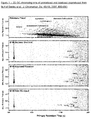
- Petrodiesel is formed from natural processes through millions of years of decomposition and comprise a large number of different compounds, as evidenced from figure 1 . This is in sharp contrast to biodiesel from e.g. soybean, rapeseed or palm oil (see figure 1 ) which contains significantly fewer compounds, as evidenced from figure 1 , where biodiesel compounds in the form of fatty acid methyl esters (FAMEs) are shown.
- FAMEs fatty acid methyl esters
- Heat release is related to the combustion process of a diesel engine.
- the combustion process in a diesel engine is usually considered to occur in four phases according to heat release rate. Those phases are the ignition delay period, premixed burning phase, diffusion burning phase and oxidation phase.
- Diesel engines are usually are tuned to the heat release from petrodiesel, which heat release results from the many different compounds making up petrodiesel.
- the heat release profile is related to the broad distillation curve obtained from the distillation of petrodiesel comprising many compounds, compared to e.g. the narrow distillation curve of FAMEs comprising relatively fewer compounds. Heat release is linked to soot formation, and it is an object in internal combustion engines to reduce the soot formation.
- the fatty acid esters In order to use the fatty acid esters as diesel fuels, and to increase the components of the fuel, the fatty acid esters have been mixed with petro diesel in various ratios to obtain a suitable quality fuel with a heat release profile not requiring modification of the timing of diesel engines.
- Another solution in the art to generating a diesel fuel that has more compounds similar to petrodiesel is the preparation of paraffinic fuels through the hydrotreatment of vegetable oil, such as triglyceridic vegetable oil.
- the number of compounds of such renewable diesel has been increased through hydrocracking and isomerisation. While such a diesel fuel has many more compounds compared to FAMEs, the distillation curve is still narrow compared to petrodiesel due to the relatively narrow carbon number distribution.
- middle distillates from renewable sources, such as diesel fuels, which more closely mimics the number of compounds of petrodiesel, and at the same time provides an acceptable quality, e.g. good diesel cetane number and good cold flow properties.
- the present invention was made in view of the prior art described above, and the object of the present invention is to provide middle distillate fuel blends, in particular diesel fuel blends which has a broader distillation range due to more compounds being present. It is further an object to increase the renewable part of a middle distillate fuel. It is an object that the middle distillate fuel blend has an acceptable quality.
- the present invention provides a fuel blend comprising as the major portion an internal combustion engine fuel and as a minor portion a fuel component, wherein the internal combustion engine fuel is diesel, and wherein the fuel component comprises a mixture of five or more aryl ethers, the mixture containing less than 1 wt% of compounds having a free alcohol group.
- biomass such as lignin
- a fuel component comprising aryl ethers by suitably reacting the biomass, such as lignin to obtain a pyrolysis oil comprising aryl alcohols that are further converted into a fuel component comprising aryl ethers.
- lignin pyrolysis oil that is further processed into ethers may be used as a component in middle distillate fuels and at the same time provide an acceptable quality, and even improving the cold flow properties.
- the internal combustion engine fuel may be paraffinic diesel or the internal combustion engine fuel may be a mixture of paraffinic diesel and fossil diesel.
- the fuel component may be obtained by reacting biomass pyrolysis oil comprising one or more phenols with one or more hydrocarbyl moieties having 1 to 10 carbon atoms forming one or more hydrocarbyl-ether bonds with the one or more phenols present in the biomass pyrolysis oil.
- the mixture of five or more aryl ethers may comprise one or more selected from the group consisting of: anisole, 4-methyl anisole, 4-propyl anisole and butyl phenyl ether.
- the mixture of five or more aryl ethers of may have a distillation range from 140 °C to 420 °C.
- the mixture of five or more aryl ethers may make up at least 80 wt% of the fuel component.
- the mixture of five or more aryl ethers may be selected from formula I, wherein
- the mixture of five or more aryl ethers of formula I may be selected from the group of phenols, guaiacols and syringols, the group being defined as follows:
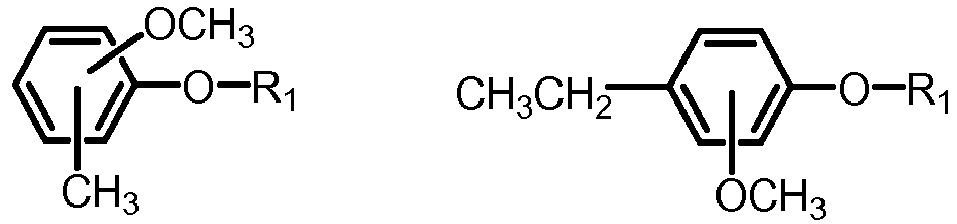
- the mixture of five or more aryl ethers may be selected from one or more of the below formulae: where R 1 is defined as above.
- the mixture of five or more aryl ethers may comprise at least 2 aryl ethers wherein R 1 is aryl or naphtyl.
- the mixture of five or more aryl ethers may comprise at least one aryl ether where R 1 is ethyl and b is 0.
- the one or more hydrocarbyl moieties may have 2 to 10 carbon atoms.
- the fuel component may be obtained by reacting biomass pyrolysis oil comprising one or more of the below formulae: with one or more compounds of the formula R 1 -Y, wherein
- reaction When reacting biomass pyrolysis oil as described above with one or more compounds of the formula R 1 -Y, where Y is O, the reaction may be conducted under dehydrating conditions.
- reaction When reacting biomass pyrolysis oil as described above, the reaction may be conducted in an ionic liquid.
- an acid catalyst When reacting biomass pyrolysis oil as described above, an acid catalyst may be added.
- the fuel blend may be for use in a compression ignition engine.
- Figure 1 shows two-dimensional gas chromatography chromatograms of petrodiesel and Fatty Acid Methyl Esters (FAME) from three different sources (reproduced from fig.4 of Seeley et al., J. Chromatogr. Sci. 45(10), 2007, 650-656 ). It can be seen that petrodiesel is a complex mixture of saturated hydrocarbons, mono- and di-aromatic hydrocarbons and naphthenes.
- the invention involves aryl ethers, in particular mixtures of five or more aryl ethers, the mixture containing less than 10 wt% of compounds having a free alcohol group.
- aryl ether mixtures may be obtained from biomass pyrolysis oil, and further refined or upgraded by ether synthesis to yield a mixture of at least five aryl ethers where the mixture has less than 10 wt% of free alcohol groups.
- the aryl ether mixtures of the present invention preferably has less than 5 wt%, less than 3 wt% of free alcohol groups, more preferably less than 2 wt%, less than 1.5 wt% of free alcohol groups. More preferably less than 1 wt%, such as less than 0.5 wt% of free alcohol groups.
- the amount of free alcohol groups are calculated on the basis of the free alcohol groups present in the oxygen containing aryl compounds of the mixture.
- the mixtures of aryl ethers where the mixture has less than 10 wt%, preferably less than 1 wt% of free alcohol groups may be used as fuel components in fuels for internal combustion engines, in particular diesel fuels for diesel engines.
- the invention relates to fuel blends of internal combustion engine fuel with fuel components comprising mixtures of aryl ethers where the mixture has less than 10 wt%, preferably less than 1 wt% of free alcohol groups.
- fuel blends may comprise as the major portion an internal combustion engine fuel and as a minor portion the fuel component comprising aryl ethers.
- the major portion of the internal combustion engine fuel e.g. diesel, will account for more than 40 wt%, for example more than 50 wt% of the fuel blend, preferably more than 60 wt%, more preferably more than 70 wt% of the fuel blend.
- the minor portion of the fuel component comprising aryl ethers will account for 50 wt% or less of the fuel blend, but more than 1 wt% of the fuel blend, e.g. more than 5 wt%. Suitable ranges would encompass 3-30 wt%, such as 5-40 wt% for example 10-20 wt%, or combinations of such ranges.
- the fuel blend may comprise other components and additives used in the formulation of particular fuel blends, with the proviso that the total fuel blend makes up 100 wt%
- the internal combustion engines may both be of the kind of which the combustion is intermittent, such as e.g. piston engines or wankel rotary engines, but the internal combustion engines may also be of the kind where combustion is continuous, such as e.g. gas turbines or jet engines.
- the intermittent combustion engine may be a compression ignition engine, such as e.g. a diesel engine, or it may also be a spark ignition engine, such as a gasoline engine.
- the fuel blend may be for use in a compression ignition engine, such as for use in a diesel engine.
- the internal combustion engine fuel depends on the kind of internal combustion engine used.
- the fuel will usually be derived from the light distillate fractions, in particular gasoline or naphta, or from the middle distillate fractions, in particular kerosene or diesel.
- fuels from the light distillate fractions may be converted into gasoline for use in a spark compression engine
- fuels from the middle distillate fraction may be converted into a diesel fuel for use in a diesel engine, or aviation fuel for use in a turbine engine, such as a jet engine.
- the internal combustion engine fuel is a middle distillate, more preferably the internal combustion engine fuel is diesel.
- the middle distillate fuel comprise the distillation range from 180 °C to 400 °C, such as from 200 °C to 350 °C.
- the internal combustion engine fuel may be fossil diesel, which is also called petrodiesel, and is derived from the fractional distillation of crude oil between 180°C and 400°C, such as between 200°C and 350°C. From example 1 and table 1 it can be seen that the addition of aryl ethers having cloud points higher than fossil diesel (see table 3) actually decreased (improved) the cloud point by 1.4% of the resulting mixture without influencing too much net heat of combustion in MJ/I value. The cetane number decrease can be compensated by paraffinic diesel or additives.
- the internal combustion engine fuel may be paraffinic diesel.
- Paraffinic comprise Fischer-Tropsch diesel, which is a synthetic diesel that can be produced from any carbonaceous material, in which the raw material is converted (e.g. by gassification) into a synthesis gas, which after purification is converted by the Fischer-Tropsch process to a synthetic diesel.
- Paraffinic diesel also comprises hydrotreated vegetable oil (HVO), such as the NEXBTL® diesel (Neste Renewable Diesel) from Finnish oil and refining company Neste.
- hydrotreated vegetable oil involves at least hydrodeoxygenation of a triglyceridic (e.g. vegetable oils, such as palm oil) or fatty acid (e.g.
- paraffinic diesel has a high content of paraffins and a very low content of both sulfur and aryl compounds (aromatics), where the aromatics reduce the cetane number producing a lower quality fuel from an ignition point of view.
- aromatics typically paraffinic diesel has a cetane number of above 70, whereas fossil diesel has a cetane numer of around 50.
- the internal combustion engine fuel may also be a mixture of paraffinic diesel and fossil diesel.
- the mixture of five or more aryl ethers of may have a distillation range from 140 °C to 420 °C, for example a distillation range from 180 °C to 400 °C, such as 180 °C to 360 °C or from 200 °C to 360 °C.
- the individual aryl ethers may have more than one ether bond, for example the aryl ethers may have one, two, three or four, or more ether bonds. In preferred embodiments the aryl ethers will have from one to four ether bonds, for example from one to three ether bonds.
- the individual aryl ethers may have a having a molecular weight of 600 g/mol or less, for example 400 g/mol or less, such as 350 g/mol or less.
- the molecular weight may be 100 g/mol or more. In some embodiments, which may be preferred for diesel fuels, the molecular weight may more than 110 g/mol.
- the mixture of five or more aryl ethers may make up at least 80 wt% of the fuel component.
- the aryl ether mixture of the present invention may be advantageously prepared from biological raw materials, such as for example by further refining biomass pyrolysis oil by isolating aryl ethers therefrom or to further refine biomass pyrolysis oil by subjecting it to one or more etherification steps, as will be described later in this description. It will provide a broader distillation curve the more components that are present in the fuel component, which is another object of the present invention, linked to heat release of the fuel.
- This broader distillation curve may for example be obtained by reacting the components of biomass pyrolysis oil, such as aryl components having a free alcohol group with a number of different carbyl-containing moieties, such as C1-C10-alcohols, for example including, methanol, ethanol, isopropanol, butanol, isobutanol, tert-butanol, and the like.
- biomass pyrolysis oil such as aryl components having a free alcohol group with a number of different carbyl-containing moieties, such as C1-C10-alcohols, for example including, methanol, ethanol, isopropanol, butanol, isobutanol, tert-butanol, and the like.
- the five or more aryl ethers may make up 80 wt% or more, such as 95wt% or more, or 99 wt% or more of the fuel component which is going to be blended with the internal combustion fuel to prepare the fuel blend, so that for the most part the fuel component is comprised of the aryl ethers of the present invention, but allowing for other compounds, which may often be present when refining a crude biological material such as e.g. biomass pyrolysis oil.
- the mixture of five or more aryl ethers increases the number of individual molecules present in the final fuel blend, and helps in broadening the distillation range of the final fuel blend so that it becomes more broad due to more compounds making up the fuel blend. It may therefore be beneficial to further improve the broadening of the distillation range by having five or more aryl ethers, such as 10 or more aryl ethers, or 20 or more aryl ethers. As explained above, it is advantageous if the mixture of five or more aryl ethers are obtained from a biological source, such as biomass pyrolysis oil, because in addition to a diversity of aryl ethers there may be other compounds that can be further beneficial in improving the complexity of the final fuel and thereby broaden the distillation range.
- a biological source such as biomass pyrolysis oil
- Examples of the mixture of five or more aryl ethers may be anisole (being the simplest aryl ether), 4-methyl anisole and 4-propyl anisole and butyl phenyl ether. Accordingly the mixture of five or more aryl ethers, and thereby also the final fuel blend may comprise one or more selected from the group consisting of: anisole, 4-methyl anisole, 4-propyl anisole and butyl phenyl ether.
- the mixture of five or more aryl ethers may be selected from formula I, wherein
- the mixture of five or more aryl ethers may comprise at least one aryl ether where R 1 is ethyl and b is 0.
- Such aryl ethers are not present in biomass pyrolysis oil, and require further processing of the biomass pyrolysis oil, such as etherification.
- the mixture of five or more aryl ethers may comprise at least one aryl ether where R 1 is selected from, methyl, ethyl, propyl, iso-propyl, butyl; and b is 0.
- R 1 is selected from, methyl, ethyl, propyl, iso-propyl, butyl; and b is 0.
- Methanol, ethanol, propanol, isopropanol and butanol may be obtained from biological sources and using bio-alcohols for the etherification reaction with biomass pyrolysis oil will ensure that the mixture of five or more aryl ethers are entirely of biological/renewable origin, which is relevant for the characterisation of the final fuel blend with regards to how much of the fuel is biofuel from a renewable source ( i.e. from sources which are natural replenished on a human timescale).
- the mixture of five or more aryl ethers of formula I may be selected from the group of phenols, guaiacols and syringols, which are often present in biomass pyrolysis oil, the group being defined as follows:
- the mixture of five or more aryl ethers may be selected from one or more of the below formulae: where R 1 is defined as above.
- the mixture of five or more aryl ethers may comprise at least 2 aryl ethers wherein R 1 is aryl or naphtyl.
- the aryl ethers of the present invention may be prepared from biomass pyrolysis oil.
- Lignocellulose is a challenging raw material for biofuel production as it consists of three relatively different components, cellulose, hemicellulose and lignin.
- Lignin comprises phenolic irregular polymer, which can be separated from cellulose and hemicellulose. The separation process is a very important step in the pulp and paper industry. However, even if the separation of lignin is a relatively easy and known process, the further processing of lignin to obtain products has not been found to be as simple. Often lignin is burned to obtain energy for other processes.
- the present invention uses lignin pyrolysis oil, which contains different aryl alcohol compounds, among which are phenols, guaiacols and syringols.
- the biomass pyrolysis oil here exemplified by lignin pyrolysis oil, may undergo ether reactions to convert the free alcohols in the aryl compounds to aryl ethers through etherification reactions.
- Switchgrass and alfalfa are other examples of biomass that may be converted into pyrolysis oil.
- the fuel component of the present invention may be obtained by reacting biomass pyrolysis oil comprising one or more phenols with one or more hydrocarbyl moiety/moieties having 1 to 10 carbon atoms forming one or more hydrocarbyl-ether bonds with the one or more phenols present in the biomass pyrolysis oil, thereby obtaining a mixture of five or more aryl ethers.
- the one or more hydrocarbyl moieties may have 2 to 10 carbon atoms.
- a hydrocarbyl moiety is a univalent group formed by removing a hydrogen atom from a hydrocarbon, e.g . ethyl, phenyl.
- hydrocarbyl moiety is any reaction partner that in a reaction with biomass pyrolysis oil comprising one or more phenols will form a hydrocarbyl-ether bonds with the one or more phenols present in the biomass pyrolysis oil.
- the hydrocarbyl reaction partner has a reactive part that under suitable reaction conditions forms an ether bond with the one or more phenols present in the biomass pyrolysis oil.
- the hydrocarbyl moiety may be ethyl or another hydrocarbyl moiety, and the reactive part could for example be an alcohol, a halogen, an alkene or the like.
- Pyrolysis oil such as lignin pyrolysis oil
- pyrolysis oil may be obtained in a number of ways. Often pyrolysis oil is prepared by the application of heat in the presence of an inert gas (absence of oxygen) in order to break down complex polymeric constituents of biomass, e.g. cellulose, hemicellulose and lignin.
- inert gas absence of oxygen
- Different reactors for preparing pyrolysis oils are known in the art, such as for example fluidized bed, circulating fluidized bed, rotating cone, ablative (vortex and rotating blade), and vacuum. Some of the reactors do not require an inert carrier gas for operation. It is preferable that the biomass is introduced to a pyrolysis reactor as small particles to ensure a high surface area.
- the fuel component may be obtained by reacting biomass pyrolysis oil comprising one or more of the below formulae: with one or more compounds of the formula R 1 -Y, wherein
- reaction scheme where the reaction is conducted with R 1 -Y involve different reactions.
- Y is halogen (e.g. Cl, Br, I) then the etherification reaction type an S N 1 or S N 2 type reaction which could be catalysed by base or acid, or in the case of R 1 being an aryl- or naphtyl-halide, the reaction could be the Ullmann condensation, which could be catalysed by e.g. copper.
- Y is vinyl the reaction may for example be conducted using acid catalysis.
- Grignard reactions may also be used to prepare ethers through magnesium halides.
- One preferred method when reacting biomass pyrolysis oil as described above with one or more compounds of the formula R 1 -Y, where Y is O, is where the reaction is conducted under dehydrating conditions, thereby obtaining ethers from dehydrating phenol and alcohol, e.g. by acid catalysed condensation.
- an acid catalyst may be added, such as e.g. sulfuric acid or another strong acid.
- water may also be removed through the reaction in order to further shift the reaction towards ether product.
- reaction When reacting biomass pyrolysis oil as described above, the reaction may be conducted in an ionic liquid.
- Example 1 Diesel fuel blends
- aryl ethers were selected for testing.
- the aryl ethers were blended with fossil diesel (no additives, not commercial quality) and paraffinic diesel (Neste Renewable Diesel, also known as NEXBTL® diesel). All the blends were made with 10 vol-% aryl ether addition, and analysed for density, cloud point, cold filter plugging point (CFPP), cetane number, and net heat of combustion value. The results are shown in tables 1 and 2.
- the addition of the aryl ethers increased the density of both fossil diesel and paraffinic diesel. As was expected the addition of the aryl ethers reduced the cetane number of the paraffinic diesel in table 2. However, the addition of the aryl ethers to paraffinic diesel did not lower the cetane level below the EN590 specification requirement which is minimum 51 or below the cetane specification for EN 15940 class A fuels, which is 70.
- the density of the paraffinic diesel can be increased with aryl ethers up to EN 590 requirement i.e. min 800kg/m 3 for winter grade and 820kg/m 3 for summer grade diesel, respectively, by adding more than 10 vol% of aryl ethers (not shown).
Landscapes
- Chemical & Material Sciences (AREA)
- Oil, Petroleum & Natural Gas (AREA)
- Engineering & Computer Science (AREA)
- Organic Chemistry (AREA)
- Chemical Kinetics & Catalysis (AREA)
- General Chemical & Material Sciences (AREA)
- Combustion & Propulsion (AREA)
- Health & Medical Sciences (AREA)
- Emergency Medicine (AREA)
- Liquid Carbonaceous Fuels (AREA)
Abstract
Description
- The present invention relates to middle distillate fuel blends, in particular renewable diesel fuel blends comprising a mixture of aryl ethers.
- Middle distillate fuels, such as diesel are useful transportation fuels. The quality of diesel may be measured on a number of parameters, such as for example cetane number, energy content, density, lubricity, cold-flow properties and sulphur content. The cetane number and cold flow properties are both important factors for determining the quality of diesel.
- Renewable fuels, such as paraffinic diesel, are collected from resources, which are naturally replenished on a human timescale, as opposed to fossil fuels, such as petroleum diesel (petrodiesel).
- Petrodiesel is formed from natural processes through millions of years of decomposition and comprise a large number of different compounds, as evidenced from
figure 1 . This is in sharp contrast to biodiesel from e.g. soybean, rapeseed or palm oil (seefigure 1 ) which contains significantly fewer compounds, as evidenced fromfigure 1 , where biodiesel compounds in the form of fatty acid methyl esters (FAMEs) are shown. - Heat release is related to the combustion process of a diesel engine. The combustion process in a diesel engine is usually considered to occur in four phases according to heat release rate. Those phases are the ignition delay period, premixed burning phase, diffusion burning phase and oxidation phase.
- Diesel engines are usually are tuned to the heat release from petrodiesel, which heat release results from the many different compounds making up petrodiesel.
- The heat release profile is related to the broad distillation curve obtained from the distillation of petrodiesel comprising many compounds, compared to e.g. the narrow distillation curve of FAMEs comprising relatively fewer compounds. Heat release is linked to soot formation, and it is an object in internal combustion engines to reduce the soot formation.
- Ali et al. (1996) "Effect of alternative diesel fuels on heat release curves for Cummins N14-410 diesel engine" (DOI: 10.13031/2013.27516) discuss i.a. the different heat release curves of rapeseed oil, ethanol and diesel fuel blends compared to petrodiesel fuel, and refers to lower combustion speeds and temperature from rapeseed oil compared to diesel fuel, as well as slightly shorter inflammation lag.
- In the art it has been attempted to mimic petrodiesel from renewable sources, such as the preparation of fatty acid esters of vegetable oils.
- In order to use the fatty acid esters as diesel fuels, and to increase the components of the fuel, the fatty acid esters have been mixed with petro diesel in various ratios to obtain a suitable quality fuel with a heat release profile not requiring modification of the timing of diesel engines.
- Another solution in the art to generating a diesel fuel that has more compounds similar to petrodiesel is the preparation of paraffinic fuels through the hydrotreatment of vegetable oil, such as triglyceridic vegetable oil. The number of compounds of such renewable diesel has been increased through hydrocracking and isomerisation. While such a diesel fuel has many more compounds compared to FAMEs, the distillation curve is still narrow compared to petrodiesel due to the relatively narrow carbon number distribution.
- There is still a need in the art for middle distillates from renewable sources, such as diesel fuels, which more closely mimics the number of compounds of petrodiesel, and at the same time provides an acceptable quality, e.g. good diesel cetane number and good cold flow properties.
- The present invention was made in view of the prior art described above, and the object of the present invention is to provide middle distillate fuel blends, in particular diesel fuel blends which has a broader distillation range due to more compounds being present. It is further an object to increase the renewable part of a middle distillate fuel. It is an object that the middle distillate fuel blend has an acceptable quality.
- To solve the problem, the present invention provides a fuel blend comprising as the major portion an internal combustion engine fuel and as a minor portion a fuel component, wherein the internal combustion engine fuel is diesel, and wherein the fuel component comprises a mixture of five or more aryl ethers, the mixture containing less than 1 wt% of compounds having a free alcohol group.
- That is, the inventors of the present invention in a first aspect of the invention found that biomass, such as lignin, which is obtained from the processing of lignocellulosic material can be further refined into a fuel component comprising aryl ethers by suitably reacting the biomass, such as lignin to obtain a pyrolysis oil comprising aryl alcohols that are further converted into a fuel component comprising aryl ethers. The inventors have surprisingly discovered that lignin pyrolysis oil that is further processed into ethers may be used as a component in middle distillate fuels and at the same time provide an acceptable quality, and even improving the cold flow properties.
- The internal combustion engine fuel may be paraffinic diesel or the internal combustion engine fuel may be a mixture of paraffinic diesel and fossil diesel.
- The fuel component may be obtained by reacting biomass pyrolysis oil comprising one or more phenols with one or more hydrocarbyl moieties having 1 to 10 carbon atoms forming one or more hydrocarbyl-ether bonds with the one or more phenols present in the biomass pyrolysis oil.
- The mixture of five or more aryl ethers may comprise one or more selected from the group consisting of: anisole, 4-methyl anisole, 4-propyl anisole and butyl phenyl ether.
- The mixture of five or more aryl ethers of may have a distillation range from 140 °C to 420 °C.
- The mixture of five or more aryl ethers may make up at least 80 wt% of the fuel component.
- The mixture of five or more aryl ethers may be selected from formula I,

- R1 is: linear or branched C1-C10-alkyl, cycloalkyl, aryl, or naphtyl, wherein the aryl or naphtyl is unsubstituted or substituted with one two or three groups, independently selected from: C1-C5-alkyl, C1-C5-alkoxy;
- a and b are each independently: 0, 1, 2, 3 and 4;
- R2, R3 R4, R5 and R6 are each independently: hydrogen, alkyl, alkoxy, alkenyl, and alkenoxy;
- at least two of R2, R3 R4, R5 and R6 are hydrogen.
- The mixture of five or more aryl ethers of formula I may be selected from the group of phenols, guaiacols and syringols, the group being defined as follows:
- (a) R2=R3=R4=R5=R6 is hydrogen (phenol);
- (b) four of R2, R3 R4, R5 and R6 are hydrogen and one is methyl, ethyl, propyl, iso-propyl (cresols);
- (c) three of R2, R3 R4, R5 and R6 are hydrogen and two are independently selected from methyl, ethyl, propyl, iso-propyl (xylenols);
- (d) four of R2, R3 R4, R5 and R6 are hydrogen and one is methoxy (guaiacols);
- (e) Three of R2, R3 R4, R5 and R6 are hydrogen one is methoxy, one is methyl, ethyl, propyl, iso-propyl, vinyl or allyl (eugenol, isoeugenol);
- (f) three of R2, R3, R4, R5 and R6 are hydrogen and two are methoxy (syringol);
- (g) two of R2, R3, R4, R5 and R6 are hydrogen, two are methoxy, one is methyl, ethyl, propyl, iso-propyl, vinyl or allyl.
- The mixture of five or more aryl ethers may be selected from one or more of the below formulae:


- The mixture of five or more aryl ethers may comprise at least 2 aryl ethers wherein R1 is aryl or naphtyl.
- The mixture of five or more aryl ethers may comprise at least one aryl ether where R1 is ethyl and b is 0.
- The one or more hydrocarbyl moieties may have 2 to 10 carbon atoms.
- The fuel component may be obtained by reacting biomass pyrolysis oil comprising one or more of the below formulae:


wherein - R1 is: linear or branched C1-C10-alkyl, cycloalkyl, aryl, or naphtyl, wherein the aryl or naphtyl is unsubstituted or substituted with one two or three groups, independently selected from: C1-C5-alkyl, C1-C5-alkoxy;
- Y is halogen, vinyl, OH, MgX, where X is Cl or Br thereby obtaining one or more compounds of the formulae


- When reacting biomass pyrolysis oil as described above with one or more compounds of the formula R1-Y, where Y is O, the reaction may be conducted under dehydrating conditions.
- When reacting biomass pyrolysis oil as described above, the reaction may be conducted in an ionic liquid.
- When reacting biomass pyrolysis oil as described above, an acid catalyst may be added.
- The fuel blend may be for use in a compression ignition engine.
-
Figure 1 shows two-dimensional gas chromatography chromatograms of petrodiesel and Fatty Acid Methyl Esters (FAME) from three different sources (reproduced from fig.4 of Seeley et al., J. Chromatogr. Sci. 45(10), 2007, 650-656). It can be seen that petrodiesel is a complex mixture of saturated hydrocarbons, mono- and di-aromatic hydrocarbons and naphthenes. - In describing the embodiments of the invention specific terminology will be resorted to for the sake of clarity. However, the invention is not intended to be limited to the specific terms so selected, and it is understood that each specific term includes all technical equivalents which operate in a similar manner to accomplish a similar purpose.
- The invention involves aryl ethers, in particular mixtures of five or more aryl ethers, the mixture containing less than 10 wt% of compounds having a free alcohol group. Such aryl ether mixtures may be obtained from biomass pyrolysis oil, and further refined or upgraded by ether synthesis to yield a mixture of at least five aryl ethers where the mixture has less than 10 wt% of free alcohol groups. The aryl ether mixtures of the present invention preferably has less than 5 wt%, less than 3 wt% of free alcohol groups, more preferably less than 2 wt%, less than 1.5 wt% of free alcohol groups. More preferably less than 1 wt%, such as less than 0.5 wt% of free alcohol groups.
- The amount of free alcohol groups are calculated on the basis of the free alcohol groups present in the oxygen containing aryl compounds of the mixture.
- The mixtures of aryl ethers where the mixture has less than 10 wt%, preferably less than 1 wt% of free alcohol groups may be used as fuel components in fuels for internal combustion engines, in particular diesel fuels for diesel engines.
- In particular the invention relates to fuel blends of internal combustion engine fuel with fuel components comprising mixtures of aryl ethers where the mixture has less than 10 wt%, preferably less than 1 wt% of free alcohol groups. Such fuel blends may comprise as the major portion an internal combustion engine fuel and as a minor portion the fuel component comprising aryl ethers.
- The major portion of the internal combustion engine fuel, e.g. diesel, will account for more than 40 wt%, for example more than 50 wt% of the fuel blend, preferably more than 60 wt%, more preferably more than 70 wt% of the fuel blend.
- The minor portion of the fuel component comprising aryl ethers will account for 50 wt% or less of the fuel blend, but more than 1 wt% of the fuel blend, e.g. more than 5 wt%. Suitable ranges would encompass 3-30 wt%, such as 5-40 wt% for example 10-20 wt%, or combinations of such ranges.
- The fuel blend may comprise other components and additives used in the formulation of particular fuel blends, with the proviso that the total fuel blend makes up 100 wt%
- The internal combustion engines may both be of the kind of which the combustion is intermittent, such as e.g. piston engines or wankel rotary engines, but the internal combustion engines may also be of the kind where combustion is continuous, such as e.g. gas turbines or jet engines.
- The intermittent combustion engine may be a compression ignition engine, such as e.g. a diesel engine, or it may also be a spark ignition engine, such as a gasoline engine. In preferred embodiments the fuel blend may be for use in a compression ignition engine, such as for use in a diesel engine.
- The internal combustion engine fuel depends on the kind of internal combustion engine used. The fuel will usually be derived from the light distillate fractions, in particular gasoline or naphta, or from the middle distillate fractions, in particular kerosene or diesel. Typically fuels from the light distillate fractions may be converted into gasoline for use in a spark compression engine, and fuels from the middle distillate fraction may be converted into a diesel fuel for use in a diesel engine, or aviation fuel for use in a turbine engine, such as a jet engine. In preferred embodiments of the present invention, the internal combustion engine fuel is a middle distillate, more preferably the internal combustion engine fuel is diesel.
- In some embodiments the middle distillate fuel comprise the distillation range from 180 °C to 400 °C, such as from 200 °C to 350 °C.
- The internal combustion engine fuel may be fossil diesel, which is also called petrodiesel, and is derived from the fractional distillation of crude oil between 180°C and 400°C, such as between 200°C and 350°C. From example 1 and table 1 it can be seen that the addition of aryl ethers having cloud points higher than fossil diesel (see table 3) actually decreased (improved) the cloud point by 1.4% of the resulting mixture without influencing too much net heat of combustion in MJ/I value. The cetane number decrease can be compensated by paraffinic diesel or additives.
- The internal combustion engine fuel may be paraffinic diesel. Paraffinic comprise Fischer-Tropsch diesel, which is a synthetic diesel that can be produced from any carbonaceous material, in which the raw material is converted (e.g. by gassification) into a synthesis gas, which after purification is converted by the Fischer-Tropsch process to a synthetic diesel. Paraffinic diesel also comprises hydrotreated vegetable oil (HVO), such as the NEXBTL® diesel (Neste Renewable Diesel) from Finnish oil and refining company Neste. Usually hydrotreated vegetable oil involves at least hydrodeoxygenation of a triglyceridic (e.g. vegetable oils, such as palm oil) or fatty acid (e.g. from tall oil) containing feedstock, but also advantageously hydroisomerisation of such feedstock, resulting in paraffins and isomerised paraffins. Owing to its production methods, paraffinic diesel has a high content of paraffins and a very low content of both sulfur and aryl compounds (aromatics), where the aromatics reduce the cetane number producing a lower quality fuel from an ignition point of view. Typically paraffinic diesel has a cetane number of above 70, whereas fossil diesel has a cetane numer of around 50.
- The inventors surprisingly found that the addition of aryl ethers (all having a higher cloud point than paraffinic diesel, see table 3) to paraffinic diesel (see example 1 and table 2) markedly decreased (improved) the cloud point by 9.4%, which was more than six times the improvement in cloud point obtained from adding aryl ethers to fossil diesel. This improvement in cloud point did not influence too much the cetane number of the resultant blend, which remained above 70, as well as not influencing too much the net heat of combustion value.
- The internal combustion engine fuel may also be a mixture of paraffinic diesel and fossil diesel.
- The mixture of five or more aryl ethers of may have a distillation range from 140 °C to 420 °C, for example a distillation range from 180 °C to 400 °C, such as 180 °C to 360 °C or from 200 °C to 360 °C.
- The individual aryl ethers may have more than one ether bond, for example the aryl ethers may have one, two, three or four, or more ether bonds. In preferred embodiments the aryl ethers will have from one to four ether bonds, for example from one to three ether bonds.
- The individual aryl ethers may have a having a molecular weight of 600 g/mol or less, for example 400 g/mol or less, such as 350 g/mol or less. The molecular weight may be 100 g/mol or more. In some embodiments, which may be preferred for diesel fuels, the molecular weight may more than 110 g/mol.
- The mixture of five or more aryl ethers may make up at least 80 wt% of the fuel component. The aryl ether mixture of the present invention may be advantageously prepared from biological raw materials, such as for example by further refining biomass pyrolysis oil by isolating aryl ethers therefrom or to further refine biomass pyrolysis oil by subjecting it to one or more etherification steps, as will be described later in this description. It will provide a broader distillation curve the more components that are present in the fuel component, which is another object of the present invention, linked to heat release of the fuel. This broader distillation curve may for example be obtained by reacting the components of biomass pyrolysis oil, such as aryl components having a free alcohol group with a number of different carbyl-containing moieties, such as C1-C10-alcohols, for example including, methanol, ethanol, isopropanol, butanol, isobutanol, tert-butanol, and the like. In some embodiments the five or more aryl ethers may make up 80 wt% or more, such as 95wt% or more, or 99 wt% or more of the fuel component which is going to be blended with the internal combustion fuel to prepare the fuel blend, so that for the most part the fuel component is comprised of the aryl ethers of the present invention, but allowing for other compounds, which may often be present when refining a crude biological material such as e.g. biomass pyrolysis oil.
- The mixture of five or more aryl ethers increases the number of individual molecules present in the final fuel blend, and helps in broadening the distillation range of the final fuel blend so that it becomes more broad due to more compounds making up the fuel blend. It may therefore be beneficial to further improve the broadening of the distillation range by having five or more aryl ethers, such as 10 or more aryl ethers, or 20 or more aryl ethers. As explained above, it is advantageous if the mixture of five or more aryl ethers are obtained from a biological source, such as biomass pyrolysis oil, because in addition to a diversity of aryl ethers there may be other compounds that can be further beneficial in improving the complexity of the final fuel and thereby broaden the distillation range.
- Examples of the mixture of five or more aryl ethers may be anisole (being the simplest aryl ether), 4-methyl anisole and 4-propyl anisole and butyl phenyl ether. Accordingly the mixture of five or more aryl ethers, and thereby also the final fuel blend may comprise one or more selected from the group consisting of: anisole, 4-methyl anisole, 4-propyl anisole and butyl phenyl ether.
- The mixture of five or more aryl ethers may be selected from formula I,

- R1 is: linear or branched C1-C10-alkyl, cycloalkyl, aryl, or naphtyl, wherein the aryl or naphtyl is unsubstituted or substituted with one two or three groups, independently selected from: C1-C5-alkyl, C1-C5-alkoxy;
- a and b are each independently: 0, 1, 2, 3 and 4;
- R2, R3 R4, R5 and R6 are each independently: hydrogen, alkyl, alkoxy, alkenyl, and alkenoxy;
- at least two of R2, R3 R4, R5 and R6 are hydrogen.
- In some embodiments the mixture of five or more aryl ethers may comprise at least one aryl ether where R1 is ethyl and b is 0. Such aryl ethers are not present in biomass pyrolysis oil, and require further processing of the biomass pyrolysis oil, such as etherification.
- In some embodiments the mixture of five or more aryl ethers may comprise at least one aryl ether where R1 is selected from, methyl, ethyl, propyl, iso-propyl, butyl; and b is 0. Methanol, ethanol, propanol, isopropanol and butanol may be obtained from biological sources and using bio-alcohols for the etherification reaction with biomass pyrolysis oil will ensure that the mixture of five or more aryl ethers are entirely of biological/renewable origin, which is relevant for the characterisation of the final fuel blend with regards to how much of the fuel is biofuel from a renewable source (i.e. from sources which are natural replenished on a human timescale).
- In some embodiments the mixture of five or more aryl ethers of formula I may be selected from the group of phenols, guaiacols and syringols, which are often present in biomass pyrolysis oil, the group being defined as follows:
- (a) R2=R3=R4=R5=R6 is hydrogen (phenol);
- (b) four of R2, R3 R4, R5 and R6 are hydrogen and one is methyl, ethyl, propyl, iso-propyl (cresols);
- (c) three of R2, R3, R4, R5 and R6 are hydrogen and two are independently selected from methyl, ethyl, propyl, iso-propyl (xylenols);
- (d) four of R2, R3, R4, R5 and R6 are hydrogen and one is methoxy (guaiacols);
- (e) Three of R2, R3, R4, R5 and R6 are hydrogen one is methoxy, one is methyl, ethyl, propyl, iso-propyl, vinyl or allyl (eugenol, isoeugenol);
- (f) three of R2, R3, R4, R5 and R6 are hydrogen and two are methoxy (syringol);
- (g) two of R2, R3, R4, R5 and R6 are hydrogen, two are methoxy, one is methyl, ethyl, propyl, iso-propyl, vinyl or allyl.
- In some embodiments the mixture of five or more aryl ethers may be selected from one or more of the below formulae:




- In some embodiments the mixture of five or more aryl ethers may comprise at least 2 aryl ethers wherein R1 is aryl or naphtyl.
- The aryl ethers of the present invention may be prepared from biomass pyrolysis oil. Lignocellulose is a challenging raw material for biofuel production as it consists of three relatively different components, cellulose, hemicellulose and lignin. Lignin comprises phenolic irregular polymer, which can be separated from cellulose and hemicellulose. The separation process is a very important step in the pulp and paper industry. However, even if the separation of lignin is a relatively easy and known process, the further processing of lignin to obtain products has not been found to be as simple. Often lignin is burned to obtain energy for other processes. The present invention uses lignin pyrolysis oil, which contains different aryl alcohol compounds, among which are phenols, guaiacols and syringols. The biomass pyrolysis oil, here exemplified by lignin pyrolysis oil, may undergo ether reactions to convert the free alcohols in the aryl compounds to aryl ethers through etherification reactions. Switchgrass and alfalfa are other examples of biomass that may be converted into pyrolysis oil.
- Accordingly, the fuel component of the present invention may be obtained by reacting biomass pyrolysis oil comprising one or more phenols with one or more hydrocarbyl moiety/moieties having 1 to 10 carbon atoms forming one or more hydrocarbyl-ether bonds with the one or more phenols present in the biomass pyrolysis oil, thereby obtaining a mixture of five or more aryl ethers. In some embodiments the one or more hydrocarbyl moieties may have 2 to 10 carbon atoms. A hydrocarbyl moiety is a univalent group formed by removing a hydrogen atom from a hydrocarbon, e.g. ethyl, phenyl. In reacting biomass pyrolysis oil comprising one or more phenols with one or more hydrocarbyl moiety/moieties, it should be understood that hydrocarbyl moiety is any reaction partner that in a reaction with biomass pyrolysis oil comprising one or more phenols will form a hydrocarbyl-ether bonds with the one or more phenols present in the biomass pyrolysis oil. In order to obtain such a hydrocarbyl-ether bond with the one or more phenols present in the biomass pyrolysis oil it will usually be necessary that the hydrocarbyl reaction partner has a reactive part that under suitable reaction conditions forms an ether bond with the one or more phenols present in the biomass pyrolysis oil. For example the hydrocarbyl moiety may be ethyl or another hydrocarbyl moiety, and the reactive part could for example be an alcohol, a halogen, an alkene or the like.
- Pyrolysis oil, such as lignin pyrolysis oil, may be obtained in a number of ways. Often pyrolysis oil is prepared by the application of heat in the presence of an inert gas (absence of oxygen) in order to break down complex polymeric constituents of biomass, e.g. cellulose, hemicellulose and lignin. Different reactors for preparing pyrolysis oils are known in the art, such as for example fluidized bed, circulating fluidized bed, rotating cone, ablative (vortex and rotating blade), and vacuum. Some of the reactors do not require an inert carrier gas for operation. It is preferable that the biomass is introduced to a pyrolysis reactor as small particles to ensure a high surface area.
- The fuel component may be obtained by reacting biomass pyrolysis oil comprising one or more of the below formulae:


wherein - R1 is: linear or branched C1-C10-alkyl, cycloalkyl, aryl, or naphtyl, wherein the aryl or naphtyl is unsubstituted or substituted with one two or three groups, independently selected from: C1-C5-alkyl, C1-C5-alkoxy;
- Y is halogen, vinyl, OH, MgX, where X is Cl or Br thereby obtaining one or more compounds of the formulae



- The above reaction scheme where the reaction is conducted with R1-Y involve different reactions. When Y is halogen (e.g. Cl, Br, I) then the etherification reaction type an SN1 or SN2 type reaction which could be catalysed by base or acid, or in the case of R1 being an aryl- or naphtyl-halide, the reaction could be the Ullmann condensation, which could be catalysed by e.g. copper. When Y is vinyl the reaction may for example be conducted using acid catalysis. Grignard reactions may also be used to prepare ethers through magnesium halides. One preferred method when reacting biomass pyrolysis oil as described above with one or more compounds of the formula R1-Y, where Y is O, is where the reaction is conducted under dehydrating conditions, thereby obtaining ethers from dehydrating phenol and alcohol, e.g. by acid catalysed condensation.
- When reacting biomass pyrolysis oil as described above, an acid catalyst may be added, such as e.g. sulfuric acid or another strong acid. Furthermore water may also be removed through the reaction in order to further shift the reaction towards ether product.
- When reacting biomass pyrolysis oil as described above, the reaction may be conducted in an ionic liquid.
- When describing the embodiments of the present invention, the combinations and permutations of all possible embodiments have not been explicitly described. Nevertheless, the mere fact that certain measures are recited in mutually different dependent claims or described in different embodiments does not indicate that a combination of these measures cannot be used to advantage. The present invention envisages all possible combinations and permutations of the described embodiments.
- The terms "comprising", "comprise" and comprises herein are intended by the inventors to be optionally substitutable with the terms "consisting of", "consist of" and "consists of", respectively, in every instance.
- Different aryl ethers were selected for testing. The aryl ethers were blended with fossil diesel (no additives, not commercial quality) and paraffinic diesel (Neste Renewable Diesel, also known as NEXBTL® diesel). All the blends were made with 10 vol-% aryl ether addition, and analysed for density, cloud point, cold filter plugging point (CFPP), cetane number, and net heat of combustion value. The results are shown in tables 1 and 2.
- The addition of the aryl ethers increased the density of both fossil diesel and paraffinic diesel. As was expected the addition of the aryl ethers reduced the cetane number of the paraffinic diesel in table 2. However, the addition of the aryl ethers to paraffinic diesel did not lower the cetane level below the EN590 specification requirement which is minimum 51 or below the cetane specification for EN 15940 class A fuels, which is 70.
- Given that the cloud point of the pure aryl ethers were higher than the pure fossil diesel and pure paraffinic diesel, it was expected that the cloud point would increase, which is unwanted. On the contrary the cloud point remained the same level or decreased for the mixtures with fossil diesel and with the mixtures of paraffinic diesel.
- In fact the effect on the cloud point of the paraffinic diesel mixtures was better than the effect on the cloud point of the fossil diesel mixtures, as evident from tables 1 and 2. On average the cloud point of fossil diesel was decreased (improved) by 0.4 °C (+1.4 %), whereas on average the cloud point of paraffinic diesel was decreased (improved) by 2.1 °C (+9.4 %). So the addition of aryl ethers to paraffinic diesel improved the cloud point significantly compared to fossil diesel, and at the same time other properties such as density, cetane and net heat of combustion value were still within acceptable ranges for use of the mixtures as a fuel.
- For example, the density of the paraffinic diesel can be increased with aryl ethers up to EN 590 requirement i.e. min 800kg/m3 for winter grade and 820kg/m3 for summer grade diesel, respectively, by adding more than 10 vol% of aryl ethers (not shown).
- Density was measured using ENISO12185, Cloud point was measured using ASTM D7689. CFPP was measured using EN116, cetane No using ASTM D6890 and Net heat of combustion using ASTM D4809.
Table 1- 10 vol% Fuel blends of aryl ethers with fossil Diesel. Blended components Density (kg/m3) Cloud point (°C) CFPP (°C) Cetane No Net heat of combustion Fossil diesel 818.4 -28.6 -31 47.5 43.2 MJ/kg 35.4 MJ/I Fossil diesel + 4-Me-anisole 833.4 -27.5 -32 42.5 42.3 MJ/kg 35.2 MJ/I Fossil diesel + Bu-Ph-Ether 830.1 -29.9 -31 45.3 42.4 MJ/kg 35.2 MJ/I Fossil diesel + 4-Pr-anisole 830.4 -29.6 -33 44.0 42.4 MJ/kg 35.2 MJ/I Table 2 - 10 vol% Fuel blends of aryl ethers with Neste Renewable Diesel (NRD). Blended components Density (kg/m3) Cloud point (°C) CFPP (°C) Cetane No Net heat of combustion NRD 778.8 -22 -21 79.8 44.0 MJ/kg 34.2 MJ/I NRD + 4-Me-anisole 797.2 -24.6 -23 70.2 42.8 MJ/kg 34.1 MJ/I NRD + Bu-Ph-Ether 794.0 -24 -22 70.7 42.9 MJ/kg 34.1 MJ/I NRD + 4-Pr-anisole 794.7 -23.6 -22 70.4 42,9 MJ/kg 34.1 MJ/I Table 3 - Measured cloud points (ASTM D 7689) of pure components. Component Cloud point (°C) Fossil diesel -28.6 NRD -22 4-Me-anisole -19.7 Bu-Ph-Ether -16.5 4-Pr-anisole -14.8
Claims (18)
- Fuel blend comprising as the major portion an internal combustion engine fuel and as a minor portion a fuel component, wherein the internal combustion engine fuel is diesel, and wherein the fuel component comprises a mixture of five or more aryl ethers, the mixture containing less than 1 wt% of compounds having a free alcohol group.
- Fuel blend according to claim 1, wherein the internal combustion engine fuel is paraffinic diesel.
- Fuel blend according to claims 1 or 2, wherein the internal combustion engine fuel is a mixture of paraffinic diesel and fossil diesel.
- The fuel blend according to any one of claims 1 to 3, wherein the fuel component is obtainable by reacting biomass pyrolysis oil comprising one or more phenols with one or more hydrocarbyl moieties having 1 to 10 carbon atoms forming one or more hydrocarbyl-ether bonds with the one or more phenols present in the biomass pyrolysis oil.
- Fuel blend according to any one of claims 1 to 4, wherein the mixture of five or more aryl ethers comprise one or more selected from the group consisting of: anisole, 4-methyl anisole, 4-propyl anisole and butyl phenyl ether.
- The fuel blend according to any one of claims 1 to 5, wherein the mixture of five or more aryl ethers of has a distillation range from 140 °C to 420 °C.
- The fuel blend according to any one of claim 1 to 3, wherein the mixture of five or more aryl ethers makes up at least 80 wt% of the fuel component.
- The fuel blend according to any one of claim 1 to 7, wherein the mixture of five or more aryl ethers are selected from formula I,
 R1 is: linear or branched C1-C10-alkyl, cycloalkyl, aryl, or naphtyl, wherein the aryl or naphtyl is unsubstituted or substituted with one two or three groups, independently selected from: C1-C5-alkyl, C1-C5-alkoxy;a and b are each independently: 0, 1, 2, 3 and 4;R2, R3 R4, R5 and R6 are each independently: hydrogen, alkyl, alkoxy, alkenyl, and alkenoxy;at least two of R2, R3 R4, R5 and R6 are hydrogen.
 - The fuel blend according to claim 8, wherein the mixture of five or more aryl ethers of formula I are selected from the group of phenols, guaiacols and syringols, the group being defined as follows:(a) R2=R3=R4=R5=R6 is hydrogen (phenol);(b) four of R2, R3 R4, R5 and R6 are hydrogen and one is methyl, ethyl, propyl, iso-propyl (cresols);(c) three of R2, R3 R4, R5 and R6 are hydrogen and two are independently selected from methyl, ethyl, propyl, iso-propyl (xylenols);(d) four of R2, R3 R4, R5 and R6 are hydrogen and one is methoxy (guaiacols);(e) Three of R2, R3 R4, R5 and R6 are hydrogen one is methoxy, one is methyl, ethyl, propyl, iso-propyl, vinyl or allyl (eugenol, isoeugenol);(f) three of R2, R3 R4, R5 and R6 are hydrogen and two are methoxy (syringol);(g) two of R2, R3 R4, R5 and R6 are hydrogen, two are methoxy, one is methyl, ethyl, propyl, iso-propyl, vinyl or allyl.
- The fuel blend according to claim 8, wherein the mixture of five or more aryl ethers are selected from one or more of the below formulae:




- The fuel blend according to any one of claims 8 to 10, wherein the mixture of five or more aryl ethers comprise at least 2 aryl ethers wherein R1 is aryl or naphtyl.
- The fuel blend according to anyone of claims 10 to 11, wherein the mixture of five or more aryl ethers comprise at least one aryl ether where R1 is ethyl and b is 0.
- The fuel blend according to claim 4, wherein the one or more hydrocarbyl moieties has 2 to 10 carbon atoms.
- The fuel blend according to claim 4 comprising reacting biomass pyrolysis oil
comprising one or more of the below formulae:




whereinR1 is: linear or branched C1-C10-alkyl, cycloalkyl, aryl, or naphtyl, wherein the aryl or naphtyl is unsubstituted or substituted with one two or three groups, independently selected from: C1-C5-alkyl, C1-C5-alkoxy;Y is halogen, vinyl, OH, MgX, where X is Cl or Br thereby obtaining one or more compounds of the formulae




- Fuel blend according to claim 14, where Y is O, wherein the reaction is conducted under dehydrating conditions.
- Fuel blend according to any one of claims 14 to 15, where the reaction is conducted in an ionic liquid.
- Fuel blend according to any one of claims 14 to 16, where an acid catalyst is added.
- Fuel blend according to any one of claims 1 to 17, where the fuel blend is for use in a compression ignition engine.
Priority Applications (7)
| Application Number | Priority Date | Filing Date | Title |
|---|---|---|---|
| ES16167104T ES2893546T3 (en) | 2016-04-26 | 2016-04-26 | Fuel blend comprising a mixture of aryl ethers |
| EP16167104.5A EP3239277B1 (en) | 2016-04-26 | 2016-04-26 | Fuel blend comprising a mixture of aryl ethers |
| BR112018071797-5A BR112018071797B1 (en) | 2016-04-26 | 2017-04-25 | Fuel blend comprising a mixture of aryl ethers |
| CN201780024607.5A CN109072108A (en) | 2016-04-26 | 2017-04-25 | Fuel mixture comprising aryl ether mixture |
| US16/096,132 US11401477B2 (en) | 2016-04-26 | 2017-04-25 | Fuel blend comprising a mixture of aryl ethers |
| CA3019880A CA3019880C (en) | 2016-04-26 | 2017-04-25 | Fuel blend comprising a mixture of aryl ethers |
| PCT/EP2017/059824 WO2017186734A1 (en) | 2016-04-26 | 2017-04-25 | Fuel blend comprising a mixture of aryl ethers |
Applications Claiming Priority (1)
| Application Number | Priority Date | Filing Date | Title |
|---|---|---|---|
| EP16167104.5A EP3239277B1 (en) | 2016-04-26 | 2016-04-26 | Fuel blend comprising a mixture of aryl ethers |
Publications (2)
| Publication Number | Publication Date |
|---|---|
| EP3239277A1 true EP3239277A1 (en) | 2017-11-01 |
| EP3239277B1 EP3239277B1 (en) | 2021-09-29 |
Family
ID=55910124
Family Applications (1)
| Application Number | Title | Priority Date | Filing Date |
|---|---|---|---|
| EP16167104.5A Active EP3239277B1 (en) | 2016-04-26 | 2016-04-26 | Fuel blend comprising a mixture of aryl ethers |
Country Status (7)
| Country | Link |
|---|---|
| US (1) | US11401477B2 (en) |
| EP (1) | EP3239277B1 (en) |
| CN (1) | CN109072108A (en) |
| BR (1) | BR112018071797B1 (en) |
| CA (1) | CA3019880C (en) |
| ES (1) | ES2893546T3 (en) |
| WO (1) | WO2017186734A1 (en) |
Cited By (2)
| Publication number | Priority date | Publication date | Assignee | Title |
|---|---|---|---|---|
| WO2019195014A1 (en) * | 2018-04-05 | 2019-10-10 | Dow Global Technologies Llc | Diaryl ethers as fuel markers |
| EP3585862A4 (en) * | 2018-01-17 | 2020-11-11 | REG Synthetic Fuels, LLC | MIXED FUEL COMPOSITIONS WITH IMPROVED EMISSION PROFILES |
Families Citing this family (1)
| Publication number | Priority date | Publication date | Assignee | Title |
|---|---|---|---|---|
| CN109929622B (en) * | 2019-04-26 | 2021-01-29 | 山东聚兴新材料科技有限公司 | A kind of ethanol gasoline dispersant and ethanol gasoline containing the dispersant |
Citations (3)
| Publication number | Priority date | Publication date | Assignee | Title |
|---|---|---|---|---|
| US20020000063A1 (en) * | 1999-12-21 | 2002-01-03 | Yeh Lisa I-Ching | Diesel fuel composition |
| US20150057475A1 (en) * | 2013-08-23 | 2015-02-26 | Battelle Memorial Institute | Bi-functional catalyst and processes for conversion of biomass to fuel-range hydrocarbons |
| US20150080622A1 (en) * | 2013-09-18 | 2015-03-19 | Shell Oil Company | Methods and systems for supplying hydrogen to a hydrocatalytic reaction |
Family Cites Families (6)
| Publication number | Priority date | Publication date | Assignee | Title |
|---|---|---|---|---|
| US4312636A (en) * | 1980-11-12 | 1982-01-26 | The United States Of America As Represented By The United States Department Of Energy | Novel anisole mixture and gasoline containing the same |
| US6716258B2 (en) * | 1999-12-21 | 2004-04-06 | Exxonmobil Research And Engineering Company | Fuel composition |
| NL1033228C2 (en) * | 2007-01-15 | 2008-07-16 | Univ Eindhoven Tech | Liquid fuel composition useful in compression-ignition engine, comprises a mixture of hydrocarbons containing a cyclic hydrocarbon compound having at least five carbon atoms and at least one oxygen atom |
| CN101381611B (en) * | 2008-10-15 | 2012-04-11 | 中国林业科学研究院林产化学工业研究所 | Method for modifying biomass cracked oil to modified bio-oil by quality-improving of esterification and etherification |
| NL2008052C2 (en) * | 2011-12-29 | 2013-07-03 | Michael Dirk Boot | A fuel composition. |
| TWI494424B (en) * | 2012-11-20 | 2015-08-01 | Dow Global Technologies Llc | Distillable fuel marker |
-
2016
- 2016-04-26 EP EP16167104.5A patent/EP3239277B1/en active Active
- 2016-04-26 ES ES16167104T patent/ES2893546T3/en active Active
-
2017
- 2017-04-25 BR BR112018071797-5A patent/BR112018071797B1/en not_active IP Right Cessation
- 2017-04-25 WO PCT/EP2017/059824 patent/WO2017186734A1/en not_active Ceased
- 2017-04-25 CN CN201780024607.5A patent/CN109072108A/en active Pending
- 2017-04-25 US US16/096,132 patent/US11401477B2/en active Active
- 2017-04-25 CA CA3019880A patent/CA3019880C/en active Active
Patent Citations (3)
| Publication number | Priority date | Publication date | Assignee | Title |
|---|---|---|---|---|
| US20020000063A1 (en) * | 1999-12-21 | 2002-01-03 | Yeh Lisa I-Ching | Diesel fuel composition |
| US20150057475A1 (en) * | 2013-08-23 | 2015-02-26 | Battelle Memorial Institute | Bi-functional catalyst and processes for conversion of biomass to fuel-range hydrocarbons |
| US20150080622A1 (en) * | 2013-09-18 | 2015-03-19 | Shell Oil Company | Methods and systems for supplying hydrogen to a hydrocatalytic reaction |
Non-Patent Citations (3)
| Title |
|---|
| ALI ET AL., EFFECT OF ALTERNATIVE DIESEL FUELS ON HEAT RELEASE CURVES FOR CUMMINS N14-410 DIESEL ENGINE, 1996 |
| LEI ZHOU ET AL: "The Effect of the Position of Oxygen Group to the Aromatic Ring to Emission Performance in a Heavy-Duty Diesel Engine", SAE INTERNATIONAL JOURNAL OF FUELS AND LUBRICANTS, vol. 5, no. 3, 30 January 2012 (2012-01-30), US, pages 1216 - 1239, XP055645397, ISSN: 1946-3960, DOI: 10.4271/2012-01-1697 * |
| SEELEY ET AL., J. CHROMATOGR. SCI., vol. 45, no. 10, 2007, pages 650 - 656 |
Cited By (4)
| Publication number | Priority date | Publication date | Assignee | Title |
|---|---|---|---|---|
| EP3585862A4 (en) * | 2018-01-17 | 2020-11-11 | REG Synthetic Fuels, LLC | MIXED FUEL COMPOSITIONS WITH IMPROVED EMISSION PROFILES |
| AU2019209477B2 (en) * | 2018-01-17 | 2024-04-04 | Reg Synthetic Fuels, Llc | Blended fuel compositions with improved emissions profiles |
| EP4530333A3 (en) * | 2018-01-17 | 2025-06-04 | REG Synthetic Fuels, LLC | Method for blended fuel compositions with improved emissions profiles |
| WO2019195014A1 (en) * | 2018-04-05 | 2019-10-10 | Dow Global Technologies Llc | Diaryl ethers as fuel markers |
Also Published As
| Publication number | Publication date |
|---|---|
| CA3019880C (en) | 2023-07-18 |
| EP3239277B1 (en) | 2021-09-29 |
| US20190136145A1 (en) | 2019-05-09 |
| WO2017186734A1 (en) | 2017-11-02 |
| US11401477B2 (en) | 2022-08-02 |
| CN109072108A (en) | 2018-12-21 |
| CA3019880A1 (en) | 2017-11-02 |
| BR112018071797A2 (en) | 2019-02-19 |
| BR112018071797B1 (en) | 2022-05-10 |
| ES2893546T3 (en) | 2022-02-09 |
Similar Documents
| Publication | Publication Date | Title |
|---|---|---|
| FI128977B (en) | Enhancing co-processing of lignocellulose pyrolysis oil by enhancing its compatibility with typical oil refinery hydrocarbon feed | |
| CA2811646C (en) | Production of renewable bio-distillate | |
| EP3555241B1 (en) | A multicomponent diesel composition | |
| CA3046881C (en) | A multicomponent diesel composition | |
| US9534181B2 (en) | Method of using renewable fuel composition | |
| No | Application of liquid biofuels to internal combustion engines | |
| KR20210097823A (en) | Fuel compositions with enhanced cold properties and methods of making the same | |
| BR112019003771B1 (en) | METHOD FOR MANUFACTURING A FUEL COMPONENT | |
| MX2013011769A (en) | Low pour point renewable fuel blend. | |
| US11401477B2 (en) | Fuel blend comprising a mixture of aryl ethers | |
| JP5265435B2 (en) | Unleaded gasoline composition for in-cylinder direct injection gasoline engine | |
| US20250136881A1 (en) | Renewable jet-fuel composition | |
| Wang et al. | Catalytic hydrotreatment of the high-boiling-point fraction of soybean straw biocrude in a mixed hydrogen donor | |
| Pstrowska et al. | Hydrorefining of oil from rapeseed cake pyrolysis over NiMo/Al2O3 catalyst | |
| EP4562114A1 (en) | Renewable jet fuel composition having a high content of naphthenic compounds, and associated preparation method | |
| CN103756723A (en) | Method for producing high-cetane number diesel fuel by hydrogenating biodiesel fuel and coal tar | |
| Gad et al. | EXPERIMENTAL STUDY OF BIODIESEL-DIESEL BLENDING USING DIFFERENT PROCESSING TECHNOLOGIES AND FEEDSTOCK. | |
| Chen et al. | Research on upgrading of pyrolysis oil from Japanese cedar by blending with biodiesel | |
| Denson et al. | Co-hydrotreatment of bio-oil and yellow greases using NiMo catalyst | |
| WO2025040446A1 (en) | Fuel composition | |
| Gulyaeva et al. | Hydrofining of vegetable, synthetic, and petroleum blendstocks to produce diesel fuel | |
| WO2026041495A1 (en) | Renewable fuel component | |
| FR3138443A1 (en) | Renewable jet fuel composition with high naphthenic content | |
| Kumar et al. | Production, physico-chemical and cold-flow properties of biodiesel from Jatropha and Karanja oils | |
| Dragomir et al. | Comparative Properties of Fossil Diesel, Conventional Biodiesel and Green Diesel Blends |
Legal Events
| Date | Code | Title | Description |
|---|---|---|---|
| PUAI | Public reference made under article 153(3) epc to a published international application that has entered the european phase |
Free format text: ORIGINAL CODE: 0009012 |
|
| STAA | Information on the status of an ep patent application or granted ep patent |
Free format text: STATUS: REQUEST FOR EXAMINATION WAS MADE |
|
| 17P | Request for examination filed |
Effective date: 20160426 |
|
| AK | Designated contracting states |
Kind code of ref document: A1 Designated state(s): AL AT BE BG CH CY CZ DE DK EE ES FI FR GB GR HR HU IE IS IT LI LT LU LV MC MK MT NL NO PL PT RO RS SE SI SK SM TR |
|
| AX | Request for extension of the european patent |
Extension state: BA ME |
|
| STAA | Information on the status of an ep patent application or granted ep patent |
Free format text: STATUS: EXAMINATION IS IN PROGRESS |
|
| 17Q | First examination report despatched |
Effective date: 20180611 |
|
| GRAP | Despatch of communication of intention to grant a patent |
Free format text: ORIGINAL CODE: EPIDOSNIGR1 |
|
| STAA | Information on the status of an ep patent application or granted ep patent |
Free format text: STATUS: GRANT OF PATENT IS INTENDED |
|
| INTG | Intention to grant announced |
Effective date: 20210506 |
|
| GRAS | Grant fee paid |
Free format text: ORIGINAL CODE: EPIDOSNIGR3 |
|
| GRAA | (expected) grant |
Free format text: ORIGINAL CODE: 0009210 |
|
| STAA | Information on the status of an ep patent application or granted ep patent |
Free format text: STATUS: THE PATENT HAS BEEN GRANTED |
|
| AK | Designated contracting states |
Kind code of ref document: B1 Designated state(s): AL AT BE BG CH CY CZ DE DK EE ES FI FR GB GR HR HU IE IS IT LI LT LU LV MC MK MT NL NO PL PT RO RS SE SI SK SM TR |
|
| REG | Reference to a national code |
Ref country code: GB Ref legal event code: FG4D |
|
| RIN1 | Information on inventor provided before grant (corrected) |
Inventor name: TIITTA, MARJA Inventor name: ROUHIAINEN, MAIJA Inventor name: KIISKI, ULLA |
|
| REG | Reference to a national code |
Ref country code: CH Ref legal event code: EP Ref country code: AT Ref legal event code: REF Ref document number: 1434204 Country of ref document: AT Kind code of ref document: T Effective date: 20211015 |
|
| REG | Reference to a national code |
Ref country code: DE Ref legal event code: R096 Ref document number: 602016064235 Country of ref document: DE |
|
| REG | Reference to a national code |
Ref country code: IE Ref legal event code: FG4D |
|
| REG | Reference to a national code |
Ref country code: FI Ref legal event code: FGE |
|
| REG | Reference to a national code |
Ref country code: SE Ref legal event code: TRGR |
|
| REG | Reference to a national code |
Ref country code: NL Ref legal event code: FP |
|
| REG | Reference to a national code |
Ref country code: LT Ref legal event code: MG9D |
|
| REG | Reference to a national code |
Ref country code: NO Ref legal event code: T2 Effective date: 20210929 |
|
| PG25 | Lapsed in a contracting state [announced via postgrant information from national office to epo] |
Ref country code: RS Free format text: LAPSE BECAUSE OF FAILURE TO SUBMIT A TRANSLATION OF THE DESCRIPTION OR TO PAY THE FEE WITHIN THE PRESCRIBED TIME-LIMIT Effective date: 20210929 Ref country code: HR Free format text: LAPSE BECAUSE OF FAILURE TO SUBMIT A TRANSLATION OF THE DESCRIPTION OR TO PAY THE FEE WITHIN THE PRESCRIBED TIME-LIMIT Effective date: 20210929 Ref country code: LT Free format text: LAPSE BECAUSE OF FAILURE TO SUBMIT A TRANSLATION OF THE DESCRIPTION OR TO PAY THE FEE WITHIN THE PRESCRIBED TIME-LIMIT Effective date: 20210929 Ref country code: BG Free format text: LAPSE BECAUSE OF FAILURE TO SUBMIT A TRANSLATION OF THE DESCRIPTION OR TO PAY THE FEE WITHIN THE PRESCRIBED TIME-LIMIT Effective date: 20211229 |
|
| REG | Reference to a national code |
Ref country code: ES Ref legal event code: FG2A Ref document number: 2893546 Country of ref document: ES Kind code of ref document: T3 Effective date: 20220209 |
|
| REG | Reference to a national code |
Ref country code: AT Ref legal event code: MK05 Ref document number: 1434204 Country of ref document: AT Kind code of ref document: T Effective date: 20210929 |
|
| PG25 | Lapsed in a contracting state [announced via postgrant information from national office to epo] |
Ref country code: LV Free format text: LAPSE BECAUSE OF FAILURE TO SUBMIT A TRANSLATION OF THE DESCRIPTION OR TO PAY THE FEE WITHIN THE PRESCRIBED TIME-LIMIT Effective date: 20210929 Ref country code: GR Free format text: LAPSE BECAUSE OF FAILURE TO SUBMIT A TRANSLATION OF THE DESCRIPTION OR TO PAY THE FEE WITHIN THE PRESCRIBED TIME-LIMIT Effective date: 20211230 |
|
| PG25 | Lapsed in a contracting state [announced via postgrant information from national office to epo] |
Ref country code: AT Free format text: LAPSE BECAUSE OF FAILURE TO SUBMIT A TRANSLATION OF THE DESCRIPTION OR TO PAY THE FEE WITHIN THE PRESCRIBED TIME-LIMIT Effective date: 20210929 |
|
| PG25 | Lapsed in a contracting state [announced via postgrant information from national office to epo] |
Ref country code: IS Free format text: LAPSE BECAUSE OF FAILURE TO SUBMIT A TRANSLATION OF THE DESCRIPTION OR TO PAY THE FEE WITHIN THE PRESCRIBED TIME-LIMIT Effective date: 20220129 Ref country code: SK Free format text: LAPSE BECAUSE OF FAILURE TO SUBMIT A TRANSLATION OF THE DESCRIPTION OR TO PAY THE FEE WITHIN THE PRESCRIBED TIME-LIMIT Effective date: 20210929 Ref country code: RO Free format text: LAPSE BECAUSE OF FAILURE TO SUBMIT A TRANSLATION OF THE DESCRIPTION OR TO PAY THE FEE WITHIN THE PRESCRIBED TIME-LIMIT Effective date: 20210929 Ref country code: PT Free format text: LAPSE BECAUSE OF FAILURE TO SUBMIT A TRANSLATION OF THE DESCRIPTION OR TO PAY THE FEE WITHIN THE PRESCRIBED TIME-LIMIT Effective date: 20220131 Ref country code: PL Free format text: LAPSE BECAUSE OF FAILURE TO SUBMIT A TRANSLATION OF THE DESCRIPTION OR TO PAY THE FEE WITHIN THE PRESCRIBED TIME-LIMIT Effective date: 20210929 Ref country code: EE Free format text: LAPSE BECAUSE OF FAILURE TO SUBMIT A TRANSLATION OF THE DESCRIPTION OR TO PAY THE FEE WITHIN THE PRESCRIBED TIME-LIMIT Effective date: 20210929 Ref country code: CZ Free format text: LAPSE BECAUSE OF FAILURE TO SUBMIT A TRANSLATION OF THE DESCRIPTION OR TO PAY THE FEE WITHIN THE PRESCRIBED TIME-LIMIT Effective date: 20210929 Ref country code: AL Free format text: LAPSE BECAUSE OF FAILURE TO SUBMIT A TRANSLATION OF THE DESCRIPTION OR TO PAY THE FEE WITHIN THE PRESCRIBED TIME-LIMIT Effective date: 20210929 |
|
| REG | Reference to a national code |
Ref country code: DE Ref legal event code: R097 Ref document number: 602016064235 Country of ref document: DE |
|
| PG25 | Lapsed in a contracting state [announced via postgrant information from national office to epo] |
Ref country code: DK Free format text: LAPSE BECAUSE OF FAILURE TO SUBMIT A TRANSLATION OF THE DESCRIPTION OR TO PAY THE FEE WITHIN THE PRESCRIBED TIME-LIMIT Effective date: 20210929 |
|
| PLBE | No opposition filed within time limit |
Free format text: ORIGINAL CODE: 0009261 |
|
| STAA | Information on the status of an ep patent application or granted ep patent |
Free format text: STATUS: NO OPPOSITION FILED WITHIN TIME LIMIT |
|
| 26N | No opposition filed |
Effective date: 20220630 |
|
| PG25 | Lapsed in a contracting state [announced via postgrant information from national office to epo] |
Ref country code: SI Free format text: LAPSE BECAUSE OF FAILURE TO SUBMIT A TRANSLATION OF THE DESCRIPTION OR TO PAY THE FEE WITHIN THE PRESCRIBED TIME-LIMIT Effective date: 20210929 |
|
| REG | Reference to a national code |
Ref country code: CH Ref legal event code: PL |
|
| PG25 | Lapsed in a contracting state [announced via postgrant information from national office to epo] |
Ref country code: MC Free format text: LAPSE BECAUSE OF FAILURE TO SUBMIT A TRANSLATION OF THE DESCRIPTION OR TO PAY THE FEE WITHIN THE PRESCRIBED TIME-LIMIT Effective date: 20210929 Ref country code: LU Free format text: LAPSE BECAUSE OF NON-PAYMENT OF DUE FEES Effective date: 20220426 Ref country code: LI Free format text: LAPSE BECAUSE OF NON-PAYMENT OF DUE FEES Effective date: 20220430 Ref country code: CH Free format text: LAPSE BECAUSE OF NON-PAYMENT OF DUE FEES Effective date: 20220430 |
|
| PG25 | Lapsed in a contracting state [announced via postgrant information from national office to epo] |
Ref country code: IE Free format text: LAPSE BECAUSE OF NON-PAYMENT OF DUE FEES Effective date: 20220426 |
|
| P01 | Opt-out of the competence of the unified patent court (upc) registered |
Effective date: 20230525 |
|
| PG25 | Lapsed in a contracting state [announced via postgrant information from national office to epo] |
Ref country code: HU Free format text: LAPSE BECAUSE OF FAILURE TO SUBMIT A TRANSLATION OF THE DESCRIPTION OR TO PAY THE FEE WITHIN THE PRESCRIBED TIME-LIMIT; INVALID AB INITIO Effective date: 20160426 |
|
| PG25 | Lapsed in a contracting state [announced via postgrant information from national office to epo] |
Ref country code: SM Free format text: LAPSE BECAUSE OF FAILURE TO SUBMIT A TRANSLATION OF THE DESCRIPTION OR TO PAY THE FEE WITHIN THE PRESCRIBED TIME-LIMIT Effective date: 20210929 Ref country code: MK Free format text: LAPSE BECAUSE OF FAILURE TO SUBMIT A TRANSLATION OF THE DESCRIPTION OR TO PAY THE FEE WITHIN THE PRESCRIBED TIME-LIMIT Effective date: 20210929 Ref country code: CY Free format text: LAPSE BECAUSE OF FAILURE TO SUBMIT A TRANSLATION OF THE DESCRIPTION OR TO PAY THE FEE WITHIN THE PRESCRIBED TIME-LIMIT Effective date: 20210929 |
|
| PG25 | Lapsed in a contracting state [announced via postgrant information from national office to epo] |
Ref country code: TR Free format text: LAPSE BECAUSE OF FAILURE TO SUBMIT A TRANSLATION OF THE DESCRIPTION OR TO PAY THE FEE WITHIN THE PRESCRIBED TIME-LIMIT Effective date: 20210929 |
|
| PGFP | Annual fee paid to national office [announced via postgrant information from national office to epo] |
Ref country code: ES Payment date: 20240508 Year of fee payment: 9 |
|
| PG25 | Lapsed in a contracting state [announced via postgrant information from national office to epo] |
Ref country code: MT Free format text: LAPSE BECAUSE OF FAILURE TO SUBMIT A TRANSLATION OF THE DESCRIPTION OR TO PAY THE FEE WITHIN THE PRESCRIBED TIME-LIMIT Effective date: 20210929 |
|
| PGFP | Annual fee paid to national office [announced via postgrant information from national office to epo] |
Ref country code: SE Payment date: 20250310 Year of fee payment: 10 |
|
| PGFP | Annual fee paid to national office [announced via postgrant information from national office to epo] |
Ref country code: NL Payment date: 20250314 Year of fee payment: 10 |
|
| PGFP | Annual fee paid to national office [announced via postgrant information from national office to epo] |
Ref country code: BE Payment date: 20250318 Year of fee payment: 10 |
|
| PGFP | Annual fee paid to national office [announced via postgrant information from national office to epo] |
Ref country code: FR Payment date: 20250321 Year of fee payment: 10 |
|
| PGFP | Annual fee paid to national office [announced via postgrant information from national office to epo] |
Ref country code: GB Payment date: 20250306 Year of fee payment: 10 Ref country code: IT Payment date: 20250320 Year of fee payment: 10 |
|
| PGFP | Annual fee paid to national office [announced via postgrant information from national office to epo] |
Ref country code: FI Payment date: 20250421 Year of fee payment: 10 |
|
| PGFP | Annual fee paid to national office [announced via postgrant information from national office to epo] |
Ref country code: DE Payment date: 20250305 Year of fee payment: 10 |
|
| PGFP | Annual fee paid to national office [announced via postgrant information from national office to epo] |
Ref country code: NO Payment date: 20250409 Year of fee payment: 10 |