EP3239135A1 - Pyrimidone compounds used as lp-pla2 inhibitors and pharmaceutical compositions thereof - Google Patents
Pyrimidone compounds used as lp-pla2 inhibitors and pharmaceutical compositions thereof Download PDFInfo
- Publication number
- EP3239135A1 EP3239135A1 EP15871995.5A EP15871995A EP3239135A1 EP 3239135 A1 EP3239135 A1 EP 3239135A1 EP 15871995 A EP15871995 A EP 15871995A EP 3239135 A1 EP3239135 A1 EP 3239135A1
- Authority
- EP
- European Patent Office
- Prior art keywords
- compound
- alkyl
- aryl
- chloro
- general formula
- Prior art date
- Legal status (The legal status is an assumption and is not a legal conclusion. Google has not performed a legal analysis and makes no representation as to the accuracy of the status listed.)
- Granted
Links
- 0 C*(C)C(C(*)=C(*)N1)=NC1=O Chemical compound C*(C)C(C(*)=C(*)N1)=NC1=O 0.000 description 3
- WBKRACVPSBEDQC-UHFFFAOYSA-N CN(C(N(CC1)CC1(F)F)=CC(OCc(cc1F)cc(F)c1Oc(cc1)cc(C(F)(F)F)c1Cl)=N1)C1=O Chemical compound CN(C(N(CC1)CC1(F)F)=CC(OCc(cc1F)cc(F)c1Oc(cc1)cc(C(F)(F)F)c1Cl)=N1)C1=O WBKRACVPSBEDQC-UHFFFAOYSA-N 0.000 description 2
- YIOKKXOOODUKRH-UHFFFAOYSA-N CN(C(c(cc1)ccc1F)=CC(OCc(cc1)cc(F)c1Oc(cc1)cc(C(F)(F)F)c1Cl)=N1)C1=O Chemical compound CN(C(c(cc1)ccc1F)=CC(OCc(cc1)cc(F)c1Oc(cc1)cc(C(F)(F)F)c1Cl)=N1)C1=O YIOKKXOOODUKRH-UHFFFAOYSA-N 0.000 description 2
- ADUPOHCSVVBPLB-ZDUSSCGKSA-N C[C@@H](COCC1)N1C(N1C)=CC(OCc(cc2F)cc(F)c2Oc(cc2)cc(C(F)(F)F)c2Cl)=NC1=O Chemical compound C[C@@H](COCC1)N1C(N1C)=CC(OCc(cc2F)cc(F)c2Oc(cc2)cc(C(F)(F)F)c2Cl)=NC1=O ADUPOHCSVVBPLB-ZDUSSCGKSA-N 0.000 description 2
- XCIHVUZIGMXCON-UHFFFAOYSA-N CC(N1Cc2c[n](C)nc2)=CC(OCc(cc2F)cc(F)c2Oc(cc2)cc(C(F)(F)F)c2Cl)=NC1=O Chemical compound CC(N1Cc2c[n](C)nc2)=CC(OCc(cc2F)cc(F)c2Oc(cc2)cc(C(F)(F)F)c2Cl)=NC1=O XCIHVUZIGMXCON-UHFFFAOYSA-N 0.000 description 1
- KPWGASJBMHDPEJ-UHFFFAOYSA-N CC(N1Cc2cccnc2)=CC(OCc(cc2)cc(F)c2Oc(cc2)cc(C(F)(F)F)c2Cl)=NC1=O Chemical compound CC(N1Cc2cccnc2)=CC(OCc(cc2)cc(F)c2Oc(cc2)cc(C(F)(F)F)c2Cl)=NC1=O KPWGASJBMHDPEJ-UHFFFAOYSA-N 0.000 description 1
- FRMTUFLWGAJABU-UHFFFAOYSA-N CCCN(C(N1CCOCC1)=CC(OCc(cc1F)cc(F)c1Oc(cc1)cc(C(F)(F)F)c1Cl)=N1)C1=O Chemical compound CCCN(C(N1CCOCC1)=CC(OCc(cc1F)cc(F)c1Oc(cc1)cc(C(F)(F)F)c1Cl)=N1)C1=O FRMTUFLWGAJABU-UHFFFAOYSA-N 0.000 description 1
- KBODCQLTBUAPTM-UHFFFAOYSA-N CCN(C(C)=CC(OCc(cc1F)cc(F)c1Oc(cc1)cc(C(F)(F)F)c1Cl)=N1)C1=O Chemical compound CCN(C(C)=CC(OCc(cc1F)cc(F)c1Oc(cc1)cc(C(F)(F)F)c1Cl)=N1)C1=O KBODCQLTBUAPTM-UHFFFAOYSA-N 0.000 description 1
- AOSGEKKSRYJBGW-UHFFFAOYSA-N CN(C(Cl)=CC(N1)=O)C1=O Chemical compound CN(C(Cl)=CC(N1)=O)C1=O AOSGEKKSRYJBGW-UHFFFAOYSA-N 0.000 description 1
- FAXNJIYEHNWSHK-UHFFFAOYSA-N CN(C(N1CCCC1)=CC(OCc(cc1)cc(F)c1Oc(cc1C(F)(F)F)ccc1Cl)=N1)C1=O Chemical compound CN(C(N1CCCC1)=CC(OCc(cc1)cc(F)c1Oc(cc1C(F)(F)F)ccc1Cl)=N1)C1=O FAXNJIYEHNWSHK-UHFFFAOYSA-N 0.000 description 1
- ZYGCTSLIUCSVLN-UHFFFAOYSA-N CN(C(N1CCOCC1)=CC(OCCc(cc1F)cc(F)c1Oc(cc1)cc(C(F)(F)F)c1Cl)=N1)C1=O Chemical compound CN(C(N1CCOCC1)=CC(OCCc(cc1F)cc(F)c1Oc(cc1)cc(C(F)(F)F)c1Cl)=N1)C1=O ZYGCTSLIUCSVLN-UHFFFAOYSA-N 0.000 description 1
- VBQSNORRSNLCAN-UHFFFAOYSA-N CN(C(N1CCOCC1)=CC(OCc(cc1)cc(C#N)c1Oc(cc1)cc(C(F)(F)F)c1F)=N1)C1=O Chemical compound CN(C(N1CCOCC1)=CC(OCc(cc1)cc(C#N)c1Oc(cc1)cc(C(F)(F)F)c1F)=N1)C1=O VBQSNORRSNLCAN-UHFFFAOYSA-N 0.000 description 1
- HGMODZYWSFTDMK-UHFFFAOYSA-N CN(C(N1CCOCC1)=CC(OCc(cc1)cc(F)c1Oc(cc1)cc(C(F)(F)F)c1Cl)=N1)C1=O Chemical compound CN(C(N1CCOCC1)=CC(OCc(cc1)cc(F)c1Oc(cc1)cc(C(F)(F)F)c1Cl)=N1)C1=O HGMODZYWSFTDMK-UHFFFAOYSA-N 0.000 description 1
- AWWXPCCSNMKHGY-UHFFFAOYSA-N CN(C(N1CCOCC1)=CC(OCc(cc1F)cc(F)c1Oc(cc1)cc(C(F)(F)F)c1Cl)=N1)C1=O Chemical compound CN(C(N1CCOCC1)=CC(OCc(cc1F)cc(F)c1Oc(cc1)cc(C(F)(F)F)c1Cl)=N1)C1=O AWWXPCCSNMKHGY-UHFFFAOYSA-N 0.000 description 1
- SXTXQMRKUDDOBA-UHFFFAOYSA-N CN(C(c(cn1)cnc1OC)=CC(OCc(cc1)cc(F)c1Oc(cc1)cc(C(F)(F)F)c1Cl)=N1)C1=O Chemical compound CN(C(c(cn1)cnc1OC)=CC(OCc(cc1)cc(F)c1Oc(cc1)cc(C(F)(F)F)c1Cl)=N1)C1=O SXTXQMRKUDDOBA-UHFFFAOYSA-N 0.000 description 1
- MRHZQYKUNBPJQZ-UHFFFAOYSA-N CN(C(c1ccccc1)=CC(Cl)=N1)C1=O Chemical compound CN(C(c1ccccc1)=CC(Cl)=N1)C1=O MRHZQYKUNBPJQZ-UHFFFAOYSA-N 0.000 description 1
- PPONYEBHZLCCHO-UHFFFAOYSA-N CN(C(c1ccccc1)=CC(N1)=O)C1=O Chemical compound CN(C(c1ccccc1)=CC(N1)=O)C1=O PPONYEBHZLCCHO-UHFFFAOYSA-N 0.000 description 1
- GCCAKXSHJLQHFA-UHFFFAOYSA-N CN(C(c1ccncc1)=CC(OCc(cc1)cc(F)c1Oc(cc1C(F)(F)F)ccc1Cl)=N1)C1=O Chemical compound CN(C(c1ccncc1)=CC(OCc(cc1)cc(F)c1Oc(cc1C(F)(F)F)ccc1Cl)=N1)C1=O GCCAKXSHJLQHFA-UHFFFAOYSA-N 0.000 description 1
- XNTVZPWNCMQKJE-UHFFFAOYSA-N CN(C(c1cnccc1)=CC(OCc(cc1)cc(F)c1Oc(cc1C(F)(F)F)ccc1Cl)=N1)C1=O Chemical compound CN(C(c1cnccc1)=CC(OCc(cc1)cc(F)c1Oc(cc1C(F)(F)F)ccc1Cl)=N1)C1=O XNTVZPWNCMQKJE-UHFFFAOYSA-N 0.000 description 1
- KOKAYDQARPXZPM-UHFFFAOYSA-N CN(C(c1cncnc1)=CC(OCc(cc1)cc(F)c1Oc(cc1C(F)(F)F)ccc1Cl)=N1)C1=O Chemical compound CN(C(c1cncnc1)=CC(OCc(cc1)cc(F)c1Oc(cc1C(F)(F)F)ccc1Cl)=N1)C1=O KOKAYDQARPXZPM-UHFFFAOYSA-N 0.000 description 1
- UYRNKOQVPSOCFP-UHFFFAOYSA-N CN(C1(N2)OC1)C(Cl)=CC2=O Chemical compound CN(C1(N2)OC1)C(Cl)=CC2=O UYRNKOQVPSOCFP-UHFFFAOYSA-N 0.000 description 1
- FFUJWARHMSHZEP-UHFFFAOYSA-N CN(CC1)CCN1C(N1C)=CC(OCc(cc2F)cc(F)c2Oc(cc2)cc(C(F)(F)F)c2Cl)=NC1=O Chemical compound CN(CC1)CCN1C(N1C)=CC(OCc(cc2F)cc(F)c2Oc(cc2)cc(C(F)(F)F)c2Cl)=NC1=O FFUJWARHMSHZEP-UHFFFAOYSA-N 0.000 description 1
- GMGDLLMAGZBUAW-UHFFFAOYSA-N CN(CCOC)C(N1C)=CC(Cl)=NC1=O Chemical compound CN(CCOC)C(N1C)=CC(Cl)=NC1=O GMGDLLMAGZBUAW-UHFFFAOYSA-N 0.000 description 1
- IVKRPQXUIXDQEN-UHFFFAOYSA-N COC(N1)=CC(OCc(cc2)ccc2Oc(cc2)cc(C(F)(F)F)c2Cl)=NC1=O Chemical compound COC(N1)=CC(OCc(cc2)ccc2Oc(cc2)cc(C(F)(F)F)c2Cl)=NC1=O IVKRPQXUIXDQEN-UHFFFAOYSA-N 0.000 description 1
- XICLOHUGVNYSFZ-UHFFFAOYSA-N COC(N1)=CC(OCc(cc2F)cc(F)c2Oc2cc(C(F)(F)F)cnc2)=NC1=O Chemical compound COC(N1)=CC(OCc(cc2F)cc(F)c2Oc2cc(C(F)(F)F)cnc2)=NC1=O XICLOHUGVNYSFZ-UHFFFAOYSA-N 0.000 description 1
- FCTXOCSBOARQIU-AWEZNQCLSA-N C[C@@H](COCC1)N1C(N1C)=CC(OCc(cc2)cc(F)c2Oc(cc2C(F)(F)F)ccc2Cl)=NC1=O Chemical compound C[C@@H](COCC1)N1C(N1C)=CC(OCc(cc2)cc(F)c2Oc(cc2C(F)(F)F)ccc2Cl)=NC1=O FCTXOCSBOARQIU-AWEZNQCLSA-N 0.000 description 1
- XGRLAWBKCVMNOP-UHFFFAOYSA-N N#Cc(cc1)c(C(F)(F)F)cc1Oc(ccc(CO)c1)c1C#N Chemical compound N#Cc(cc1)c(C(F)(F)F)cc1Oc(ccc(CO)c1)c1C#N XGRLAWBKCVMNOP-UHFFFAOYSA-N 0.000 description 1
Images


Classifications
-
- C—CHEMISTRY; METALLURGY
- C07—ORGANIC CHEMISTRY
- C07D—HETEROCYCLIC COMPOUNDS
- C07D239/00—Heterocyclic compounds containing 1,3-diazine or hydrogenated 1,3-diazine rings
- C07D239/02—Heterocyclic compounds containing 1,3-diazine or hydrogenated 1,3-diazine rings not condensed with other rings
- C07D239/24—Heterocyclic compounds containing 1,3-diazine or hydrogenated 1,3-diazine rings not condensed with other rings having three or more double bonds between ring members or between ring members and non-ring members
- C07D239/28—Heterocyclic compounds containing 1,3-diazine or hydrogenated 1,3-diazine rings not condensed with other rings having three or more double bonds between ring members or between ring members and non-ring members with hetero atoms or with carbon atoms having three bonds to hetero atoms with at the most one bond to halogen, directly attached to ring carbon atoms
- C07D239/46—Two or more oxygen, sulphur or nitrogen atoms
- C07D239/52—Two oxygen atoms
- C07D239/54—Two oxygen atoms as doubly bound oxygen atoms or as unsubstituted hydroxy radicals
-
- A—HUMAN NECESSITIES
- A61—MEDICAL OR VETERINARY SCIENCE; HYGIENE
- A61K—PREPARATIONS FOR MEDICAL, DENTAL OR TOILETRY PURPOSES
- A61K31/00—Medicinal preparations containing organic active ingredients
- A61K31/33—Heterocyclic compounds
- A61K31/395—Heterocyclic compounds having nitrogen as a ring hetero atom, e.g. guanethidine or rifamycins
- A61K31/495—Heterocyclic compounds having nitrogen as a ring hetero atom, e.g. guanethidine or rifamycins having six-membered rings with two or more nitrogen atoms as the only ring heteroatoms, e.g. piperazine or tetrazines
- A61K31/505—Pyrimidines; Hydrogenated pyrimidines, e.g. trimethoprim
- A61K31/513—Pyrimidines; Hydrogenated pyrimidines, e.g. trimethoprim having oxo groups directly attached to the heterocyclic ring, e.g. cytosine
-
- A—HUMAN NECESSITIES
- A61—MEDICAL OR VETERINARY SCIENCE; HYGIENE
- A61K—PREPARATIONS FOR MEDICAL, DENTAL OR TOILETRY PURPOSES
- A61K31/00—Medicinal preparations containing organic active ingredients
- A61K31/33—Heterocyclic compounds
- A61K31/395—Heterocyclic compounds having nitrogen as a ring hetero atom, e.g. guanethidine or rifamycins
- A61K31/54—Heterocyclic compounds having nitrogen as a ring hetero atom, e.g. guanethidine or rifamycins having six-membered rings with at least one nitrogen and one sulfur as the ring hetero atoms, e.g. sulthiame
- A61K31/541—Non-condensed thiazines containing further heterocyclic rings
-
- A—HUMAN NECESSITIES
- A61—MEDICAL OR VETERINARY SCIENCE; HYGIENE
- A61P—SPECIFIC THERAPEUTIC ACTIVITY OF CHEMICAL COMPOUNDS OR MEDICINAL PREPARATIONS
- A61P13/00—Drugs for disorders of the urinary system
- A61P13/12—Drugs for disorders of the urinary system of the kidneys
-
- A—HUMAN NECESSITIES
- A61—MEDICAL OR VETERINARY SCIENCE; HYGIENE
- A61P—SPECIFIC THERAPEUTIC ACTIVITY OF CHEMICAL COMPOUNDS OR MEDICINAL PREPARATIONS
- A61P17/00—Drugs for dermatological disorders
- A61P17/06—Antipsoriatics
-
- A—HUMAN NECESSITIES
- A61—MEDICAL OR VETERINARY SCIENCE; HYGIENE
- A61P—SPECIFIC THERAPEUTIC ACTIVITY OF CHEMICAL COMPOUNDS OR MEDICINAL PREPARATIONS
- A61P19/00—Drugs for skeletal disorders
- A61P19/02—Drugs for skeletal disorders for joint disorders, e.g. arthritis, arthrosis
-
- A—HUMAN NECESSITIES
- A61—MEDICAL OR VETERINARY SCIENCE; HYGIENE
- A61P—SPECIFIC THERAPEUTIC ACTIVITY OF CHEMICAL COMPOUNDS OR MEDICINAL PREPARATIONS
- A61P25/00—Drugs for disorders of the nervous system
-
- A—HUMAN NECESSITIES
- A61—MEDICAL OR VETERINARY SCIENCE; HYGIENE
- A61P—SPECIFIC THERAPEUTIC ACTIVITY OF CHEMICAL COMPOUNDS OR MEDICINAL PREPARATIONS
- A61P25/00—Drugs for disorders of the nervous system
- A61P25/18—Antipsychotics, i.e. neuroleptics; Drugs for mania or schizophrenia
-
- A—HUMAN NECESSITIES
- A61—MEDICAL OR VETERINARY SCIENCE; HYGIENE
- A61P—SPECIFIC THERAPEUTIC ACTIVITY OF CHEMICAL COMPOUNDS OR MEDICINAL PREPARATIONS
- A61P25/00—Drugs for disorders of the nervous system
- A61P25/28—Drugs for disorders of the nervous system for treating neurodegenerative disorders of the central nervous system, e.g. nootropic agents, cognition enhancers, drugs for treating Alzheimer's disease or other forms of dementia
-
- A—HUMAN NECESSITIES
- A61—MEDICAL OR VETERINARY SCIENCE; HYGIENE
- A61P—SPECIFIC THERAPEUTIC ACTIVITY OF CHEMICAL COMPOUNDS OR MEDICINAL PREPARATIONS
- A61P27/00—Drugs for disorders of the senses
- A61P27/02—Ophthalmic agents
-
- A—HUMAN NECESSITIES
- A61—MEDICAL OR VETERINARY SCIENCE; HYGIENE
- A61P—SPECIFIC THERAPEUTIC ACTIVITY OF CHEMICAL COMPOUNDS OR MEDICINAL PREPARATIONS
- A61P27/00—Drugs for disorders of the senses
- A61P27/02—Ophthalmic agents
- A61P27/06—Antiglaucoma agents or miotics
-
- A—HUMAN NECESSITIES
- A61—MEDICAL OR VETERINARY SCIENCE; HYGIENE
- A61P—SPECIFIC THERAPEUTIC ACTIVITY OF CHEMICAL COMPOUNDS OR MEDICINAL PREPARATIONS
- A61P29/00—Non-central analgesic, antipyretic or antiinflammatory agents, e.g. antirheumatic agents; Non-steroidal antiinflammatory drugs [NSAID]
-
- A—HUMAN NECESSITIES
- A61—MEDICAL OR VETERINARY SCIENCE; HYGIENE
- A61P—SPECIFIC THERAPEUTIC ACTIVITY OF CHEMICAL COMPOUNDS OR MEDICINAL PREPARATIONS
- A61P3/00—Drugs for disorders of the metabolism
- A61P3/08—Drugs for disorders of the metabolism for glucose homeostasis
- A61P3/10—Drugs for disorders of the metabolism for glucose homeostasis for hyperglycaemia, e.g. antidiabetics
-
- A—HUMAN NECESSITIES
- A61—MEDICAL OR VETERINARY SCIENCE; HYGIENE
- A61P—SPECIFIC THERAPEUTIC ACTIVITY OF CHEMICAL COMPOUNDS OR MEDICINAL PREPARATIONS
- A61P31/00—Antiinfectives, i.e. antibiotics, antiseptics, chemotherapeutics
- A61P31/04—Antibacterial agents
-
- A—HUMAN NECESSITIES
- A61—MEDICAL OR VETERINARY SCIENCE; HYGIENE
- A61P—SPECIFIC THERAPEUTIC ACTIVITY OF CHEMICAL COMPOUNDS OR MEDICINAL PREPARATIONS
- A61P43/00—Drugs for specific purposes, not provided for in groups A61P1/00-A61P41/00
-
- A—HUMAN NECESSITIES
- A61—MEDICAL OR VETERINARY SCIENCE; HYGIENE
- A61P—SPECIFIC THERAPEUTIC ACTIVITY OF CHEMICAL COMPOUNDS OR MEDICINAL PREPARATIONS
- A61P7/00—Drugs for disorders of the blood or the extracellular fluid
- A61P7/10—Antioedematous agents; Diuretics
-
- A—HUMAN NECESSITIES
- A61—MEDICAL OR VETERINARY SCIENCE; HYGIENE
- A61P—SPECIFIC THERAPEUTIC ACTIVITY OF CHEMICAL COMPOUNDS OR MEDICINAL PREPARATIONS
- A61P9/00—Drugs for disorders of the cardiovascular system
-
- A—HUMAN NECESSITIES
- A61—MEDICAL OR VETERINARY SCIENCE; HYGIENE
- A61P—SPECIFIC THERAPEUTIC ACTIVITY OF CHEMICAL COMPOUNDS OR MEDICINAL PREPARATIONS
- A61P9/00—Drugs for disorders of the cardiovascular system
- A61P9/10—Drugs for disorders of the cardiovascular system for treating ischaemic or atherosclerotic diseases, e.g. antianginal drugs, coronary vasodilators, drugs for myocardial infarction, retinopathy, cerebrovascula insufficiency, renal arteriosclerosis
-
- A—HUMAN NECESSITIES
- A61—MEDICAL OR VETERINARY SCIENCE; HYGIENE
- A61P—SPECIFIC THERAPEUTIC ACTIVITY OF CHEMICAL COMPOUNDS OR MEDICINAL PREPARATIONS
- A61P9/00—Drugs for disorders of the cardiovascular system
- A61P9/12—Antihypertensives
-
- C—CHEMISTRY; METALLURGY
- C07—ORGANIC CHEMISTRY
- C07D—HETEROCYCLIC COMPOUNDS
- C07D239/00—Heterocyclic compounds containing 1,3-diazine or hydrogenated 1,3-diazine rings
- C07D239/02—Heterocyclic compounds containing 1,3-diazine or hydrogenated 1,3-diazine rings not condensed with other rings
- C07D239/24—Heterocyclic compounds containing 1,3-diazine or hydrogenated 1,3-diazine rings not condensed with other rings having three or more double bonds between ring members or between ring members and non-ring members
- C07D239/28—Heterocyclic compounds containing 1,3-diazine or hydrogenated 1,3-diazine rings not condensed with other rings having three or more double bonds between ring members or between ring members and non-ring members with hetero atoms or with carbon atoms having three bonds to hetero atoms with at the most one bond to halogen, directly attached to ring carbon atoms
- C07D239/46—Two or more oxygen, sulphur or nitrogen atoms
- C07D239/48—Two nitrogen atoms
-
- C—CHEMISTRY; METALLURGY
- C07—ORGANIC CHEMISTRY
- C07D—HETEROCYCLIC COMPOUNDS
- C07D239/00—Heterocyclic compounds containing 1,3-diazine or hydrogenated 1,3-diazine rings
- C07D239/02—Heterocyclic compounds containing 1,3-diazine or hydrogenated 1,3-diazine rings not condensed with other rings
- C07D239/24—Heterocyclic compounds containing 1,3-diazine or hydrogenated 1,3-diazine rings not condensed with other rings having three or more double bonds between ring members or between ring members and non-ring members
- C07D239/28—Heterocyclic compounds containing 1,3-diazine or hydrogenated 1,3-diazine rings not condensed with other rings having three or more double bonds between ring members or between ring members and non-ring members with hetero atoms or with carbon atoms having three bonds to hetero atoms with at the most one bond to halogen, directly attached to ring carbon atoms
- C07D239/46—Two or more oxygen, sulphur or nitrogen atoms
- C07D239/52—Two oxygen atoms
-
- C—CHEMISTRY; METALLURGY
- C07—ORGANIC CHEMISTRY
- C07D—HETEROCYCLIC COMPOUNDS
- C07D239/00—Heterocyclic compounds containing 1,3-diazine or hydrogenated 1,3-diazine rings
- C07D239/02—Heterocyclic compounds containing 1,3-diazine or hydrogenated 1,3-diazine rings not condensed with other rings
- C07D239/24—Heterocyclic compounds containing 1,3-diazine or hydrogenated 1,3-diazine rings not condensed with other rings having three or more double bonds between ring members or between ring members and non-ring members
- C07D239/28—Heterocyclic compounds containing 1,3-diazine or hydrogenated 1,3-diazine rings not condensed with other rings having three or more double bonds between ring members or between ring members and non-ring members with hetero atoms or with carbon atoms having three bonds to hetero atoms with at the most one bond to halogen, directly attached to ring carbon atoms
- C07D239/46—Two or more oxygen, sulphur or nitrogen atoms
- C07D239/52—Two oxygen atoms
- C07D239/54—Two oxygen atoms as doubly bound oxygen atoms or as unsubstituted hydroxy radicals
- C07D239/545—Two oxygen atoms as doubly bound oxygen atoms or as unsubstituted hydroxy radicals with other hetero atoms or with carbon atoms having three bonds to hetero atoms with at the most one bond to halogen, directly attached to ring carbon atoms
-
- C—CHEMISTRY; METALLURGY
- C07—ORGANIC CHEMISTRY
- C07D—HETEROCYCLIC COMPOUNDS
- C07D239/00—Heterocyclic compounds containing 1,3-diazine or hydrogenated 1,3-diazine rings
- C07D239/02—Heterocyclic compounds containing 1,3-diazine or hydrogenated 1,3-diazine rings not condensed with other rings
- C07D239/24—Heterocyclic compounds containing 1,3-diazine or hydrogenated 1,3-diazine rings not condensed with other rings having three or more double bonds between ring members or between ring members and non-ring members
- C07D239/28—Heterocyclic compounds containing 1,3-diazine or hydrogenated 1,3-diazine rings not condensed with other rings having three or more double bonds between ring members or between ring members and non-ring members with hetero atoms or with carbon atoms having three bonds to hetero atoms with at the most one bond to halogen, directly attached to ring carbon atoms
- C07D239/46—Two or more oxygen, sulphur or nitrogen atoms
- C07D239/56—One oxygen atom and one sulfur atom
-
- C—CHEMISTRY; METALLURGY
- C07—ORGANIC CHEMISTRY
- C07D—HETEROCYCLIC COMPOUNDS
- C07D401/00—Heterocyclic compounds containing two or more hetero rings, having nitrogen atoms as the only ring hetero atoms, at least one ring being a six-membered ring with only one nitrogen atom
- C07D401/02—Heterocyclic compounds containing two or more hetero rings, having nitrogen atoms as the only ring hetero atoms, at least one ring being a six-membered ring with only one nitrogen atom containing two hetero rings
- C07D401/04—Heterocyclic compounds containing two or more hetero rings, having nitrogen atoms as the only ring hetero atoms, at least one ring being a six-membered ring with only one nitrogen atom containing two hetero rings directly linked by a ring-member-to-ring-member bond
-
- C—CHEMISTRY; METALLURGY
- C07—ORGANIC CHEMISTRY
- C07D—HETEROCYCLIC COMPOUNDS
- C07D401/00—Heterocyclic compounds containing two or more hetero rings, having nitrogen atoms as the only ring hetero atoms, at least one ring being a six-membered ring with only one nitrogen atom
- C07D401/02—Heterocyclic compounds containing two or more hetero rings, having nitrogen atoms as the only ring hetero atoms, at least one ring being a six-membered ring with only one nitrogen atom containing two hetero rings
- C07D401/12—Heterocyclic compounds containing two or more hetero rings, having nitrogen atoms as the only ring hetero atoms, at least one ring being a six-membered ring with only one nitrogen atom containing two hetero rings linked by a chain containing hetero atoms as chain links
-
- C—CHEMISTRY; METALLURGY
- C07—ORGANIC CHEMISTRY
- C07D—HETEROCYCLIC COMPOUNDS
- C07D403/00—Heterocyclic compounds containing two or more hetero rings, having nitrogen atoms as the only ring hetero atoms, not provided for by group C07D401/00
- C07D403/02—Heterocyclic compounds containing two or more hetero rings, having nitrogen atoms as the only ring hetero atoms, not provided for by group C07D401/00 containing two hetero rings
- C07D403/04—Heterocyclic compounds containing two or more hetero rings, having nitrogen atoms as the only ring hetero atoms, not provided for by group C07D401/00 containing two hetero rings directly linked by a ring-member-to-ring-member bond
-
- C—CHEMISTRY; METALLURGY
- C07—ORGANIC CHEMISTRY
- C07D—HETEROCYCLIC COMPOUNDS
- C07D403/00—Heterocyclic compounds containing two or more hetero rings, having nitrogen atoms as the only ring hetero atoms, not provided for by group C07D401/00
- C07D403/02—Heterocyclic compounds containing two or more hetero rings, having nitrogen atoms as the only ring hetero atoms, not provided for by group C07D401/00 containing two hetero rings
- C07D403/06—Heterocyclic compounds containing two or more hetero rings, having nitrogen atoms as the only ring hetero atoms, not provided for by group C07D401/00 containing two hetero rings linked by a carbon chain containing only aliphatic carbon atoms
-
- C—CHEMISTRY; METALLURGY
- C07—ORGANIC CHEMISTRY
- C07D—HETEROCYCLIC COMPOUNDS
- C07D409/00—Heterocyclic compounds containing two or more hetero rings, at least one ring having sulfur atoms as the only ring hetero atoms
- C07D409/02—Heterocyclic compounds containing two or more hetero rings, at least one ring having sulfur atoms as the only ring hetero atoms containing two hetero rings
- C07D409/04—Heterocyclic compounds containing two or more hetero rings, at least one ring having sulfur atoms as the only ring hetero atoms containing two hetero rings directly linked by a ring-member-to-ring-member bond
-
- C—CHEMISTRY; METALLURGY
- C07—ORGANIC CHEMISTRY
- C07D—HETEROCYCLIC COMPOUNDS
- C07D413/00—Heterocyclic compounds containing two or more hetero rings, at least one ring having nitrogen and oxygen atoms as the only ring hetero atoms
- C07D413/02—Heterocyclic compounds containing two or more hetero rings, at least one ring having nitrogen and oxygen atoms as the only ring hetero atoms containing two hetero rings
- C07D413/04—Heterocyclic compounds containing two or more hetero rings, at least one ring having nitrogen and oxygen atoms as the only ring hetero atoms containing two hetero rings directly linked by a ring-member-to-ring-member bond
Definitions
- the present invention relates to the field of pharmaceutical chemistry, and more particularly to novel pyrimidone compounds and preparation method, pharmaceutical compositions containing such compounds as active ingredients, and use thereof in the manufacture of medicaments for the treatment of diseases associated with Lp-PLA 2 enzyme activity.
- Lipoprotein-associated phospholipase A 2 also known as platelet activating factor acetylhydrolase (PAF-AH)
- PAF-AH platelet activating factor acetylhydrolase
- Lp-PLA 2 can rapidly hydrolyze oxidized phosphatidylcholine into lysophophotidylcholine (lyso-PC) and oxidized non-esterified fatty acids (ox-NEFA), while both lyso-PC and ox-NEFA have a strong proinflammation effect and can initiate inflammation/immune response of a variety of cells including endothelial cells, smooth muscle cells, monocytes/macrophages, T cells and neutrophils.
- lyso-PC lysophophotidylcholine
- ox-NEFA oxidized non-esterified fatty acids
- Lp-PLA 2 inhibitors can be generally applicable to any condition involving the hydrolysis of oxidized lipids into the two inflammatory substances in the participation of Lp-PLA 2 .
- Atherosclerosis is not only related to abnormal levels of blood lipids, but also an inflammation-related disease. It is a new way to treat the disease by inhibiting inflammatory factors of atherosclerosis. Studies have shown that lyso-PC can promote the development of atherosclerotic plaques and eventually form necrotic cores. Experiments on the diabetic hypercholesterolemic pig model have demonstrated that Lp-PLA 2 inhibitors can affect the volume, composition and gene expression of atherosclerotic plaques in diabetic/hypercholesterolemic pig and can effectively inhibit the continued growth of atherosclerotic plaques.
- Lyso-PC as a proinflammatory factor, can induce the release of a variety of cytotoxic inflammatory cytokines, while Lp-PLA 2 inhibitors can attenuate the inflammatory response by inhibiting the production of lyso-PC.
- Lp-PLA 2 inhibitors are able to improve function of the blood brain barrier (BBB), reduce permeability of the blood-brain barrier (BBB), and reduce precipitation of the beta-like protein in the brain.
- Lp-PLA 2 inhibitors can be used in the treatment of diabetes-related tissue damage by inhibiting the production of lyso-PC. Considering that local inflammatory response plays an important role in the development and progression of diabetic retinopathy, it is speculated that Lp-PLA 2 inhibitors can be used in the treatment of diabetic eye disease.
- BRB blood retinal barrier
- DME diabetic macular edema
- Lp-PLA 2 inhibitors can block the release of inflammatory cytokines, it is speculated that Lp-PLA 2 inhibitors can be used in the treatment of glaucoma and AMD.
- GlaxoSmithKline has developed a class of potent reversible inhibitors of Lp-PLA 2 ( WO 99/24420 , WO 01/60805 , WO 02/30911 , WO 03/016287 , WO 03/042179 , WO 03/042206 , WO 08/048867 , and etc.), characterized by pyrimidone or pyridone groups contained in the structure.
- the representative compounds darapladib and rilapladib are currently in clinical research.
- GlaxoSmithKline also developed another class of Lp-PLA 2 inhibitors ( US 2012/0142717 , WO 2012/075917 , WO 2012/037782 , WO 2013/013503 , WO 2013/014185 , WO 2014/114248 , WO 2014/114249 , WO 2014/114694 ).
- the structure thereof is also characterized by pyrimidone group, but this class of inhibitors differs from the previous class of reversible inhibitors in that they have a linear structure and their molecular weight is also relatively small.
- the object of the present invention is to provide a pyrimidone compound used as a Lp-PLA 2 inhibitor and a pharmaceutical composition thereof.
- the substitution is mono- or poly- substitution .
- the substitution is mono- substitution, di- substitution, tri-substitution or tetra-substitution.
- the polysubstitution means comprising a plurality of identical or different groups, such as two, three, or four groups.
- said general formula I compounds have one or more of the following features:
- X is O, S, or -N(R 4 )-, wherein R 4 is H, C 1 -C 4 alkyl;
- X is O, S, -NH, -N(CH 3 ) or -N(CH 2 CH 3 ).
- R 1 is C 1 -C 4 alkyl or -(CH 2 ) q -(3-6 membered heteroaryl), wherein q is 1 or 2; said -(CH 2 ) q -(3-6 membered heteroaryl) are optionally substituted with a group selected from the group consisting of C 1 -C 4 alkyl, C 1 -C 4 alkoxy, halogen, halo-C 1 -C 4 alkyl.
- R 1 is methyl, ethyl, propyl, -CH 2 -pyridyl or -CH 2 -pyrazolyl, said pyridyl or pyrazolyl are optionally substituted with a group selected from the group consisting of methyl, ethyl, methoxy, ethoxy, fluoro, chloro, bromo, trifluoromethyl.
- said general formula I compounds have one or two of the following features:
- Ar is substituted or unsubstituted phenyl, substituted or unsubstituted 5-6 membered heteroaryl, wherein said substitution means that the phenyl or 5-6 membered heteroaryl has 1-3 substituents selected from the group consisting of-CN, C 1 -C 4 alkyl, C 1 -C 4 alkoxy, halogen, hydroxyl, halo-C 1 -C 4 alkyl, halo-C 1 -C 4 alkoxy.
- Ar is substituted or unsubstituted phenyl, whrein said substitution means that the phenyl has 1-3 substituents selected from the group consisting of-CN, F, Cl, Br, trifluoromethyl, methyl, ethyl or propyl.
- A is O.
- said C 6 -C 10 aryl or 5-6 membered heteroaryl optionally has 1-3 substituents selected from the group consisting of-CN, F, Cl, CF 3 .
- said compound has a structure represented by formula (IA):
- said general formula I compound is any one of the compounds prepared in Example 1 to Example 83.
- said pharmaceutically acceptable salt is hydrochloride, hydrobromide, sulfate, nitrate, phosphate, citrate, methanesulfonate, trifluoroacetate, acetate, oxalate, succinate, malate, tosylate, tartrate, fumarate, glutamate, glucuronate, lactate, glutarate, arginine salt or maleate.
- a pharmaceutical composition comprising the compound of general formula I, a stereoisomer, a deuterated form or a pharmaceutically acceptable salt thereof according to the first aspect; and a pharmaceutically acceptable carrier.
- said disease associated with the Lp-PLA 2 enzyme activity is atherosclerosis, diabetes, diabetic eye diseases, diabetic macular edema, kidney diseases, diabetic nephropathy, hypertension, angina, rheumatoid arthritis, stroke, myocardial infarction, post ischemia-and-reperfusion conditions, psoriasis, brain inflammatory diseases, Alzheimer's disease, various neuropsychiatric disorders, schizophrenia, ischemia-reperfusion injury, sepsis, acute inflammatory diseases, chronic inflammatory diseases, neurodegenerative diseases, glaucoma macular degeneration or Alzheimer's disease.
- the diseases associated with the Lp-PLA 2 enzyme activity include atherosclerosis, diabetes, diabetic eye diseases, kidney diseases, diabetic nephropathy.
- the disease associated with the Lp-PLA 2 enzyme activity is atherosclerosis, diabetes, diabetic macular edema, or Alzheimer's disease.
- R 3 is H, C 1 -C 6 alkyl, C 3 -C 8 cycloalkyl, C 6 -C 10 aryl or -(CH 2 ) q -(3-8 membered heteroaryl), preferably R 3 is H or C 1 -C 6 alkyl, more preferably, R 3 is H or C 1 -C 4 alkyl, most preferably, R 3 is H; R 1 is H, C 1 -C 6 alkyl, -(CH 2 ) q -(3-8 membered heteroaryl); q is independently 1, 2, 3 or 4; R 2 is C 1 -C 6 alkyl, C 2 -C 6 alkenyl, C 2 -C 6 alkynyl, C 3 -C 8 cycloalkyl, 3-8 membered heterocyclic radical, -O-(3-8 membered heterocyclic radical), C 3 -C 8 cycloalkenyl, C 1 -C 6 alkoxy, C 3
- an intermediate of said general formula I compound which has the structure: wherein, R 2 , R 3 , Y, Ar, n, and X are defined as in the first aspect.
- Y is -A-(C 6 -C 10 aryl) or -A-(3-8 membered heteroaryl), wherein the definition is the same as described above.
- a method for inhibiting Lp-PLA 2 which comprises administering a safe and effective amount of said general formula I compound to a subject in need or to the environment.
- a method for treating a disease associated with the Lp-PLA 2 enzyme activity which comprises administering a safe and effective amount of said general formula I compound to a subject in need.
- the subject in need includes in vitro cultured cells, human or non-human mammals, preferably human, mouse or rat.
- a safe and effective amount means that the amount of the active ingredient (said general formula I compound) is sufficient to significantly improve the condition of disease without causing serious side effects.
- the inventors Based on a long-term and in-depth study, the inventors have developed for the first time a structurally novel pyrimidone compound which can be used as a Lp-PLA 2 inhibitor for preventing and/or treating and/or alleviating a disease associated with the Lp-PLA 2 enzyme activity. On such basis, the present invention has been completed.
- C 1 -C 6 alkyl refers to a straight or branched chain alkyl having 1 to 6 carbon atoms, and includes, without limitation, methyl, ethyl, propyl, isopropyl, butyl and the like; and the term “C 1 -C 4 alkyl” has a similar meaning.
- C 2 -C 6 alkenyl refers to a straight or branched alkenyl containing one double bond and having 2 to 6 carbon atoms, and includes, without limitation, vinyl, propenyl, butenyl, isobutenyl, pentenyl and hexenyl.
- C 2 -C 6 alkynyl refers to a straight or branched alkynyl containing one triple bond and having 2 to 6 carbon atoms, and includes without limitation ethynyl, propynyl, butynyl, isobutynyl, pentynyl and hexynyl.
- halo-C 1 -C 6 alkyl refers to an alkyl substituted with one or more halogen atoms, such as -CH 2 F, -CF 3 , -CH 2 CHF 3 and the like.
- C 1 -C 6 alkoxy means a straight or branched chain alkoxy group having 1 to 6 carbon atoms, and includes, without limitation, methoxy, ethoxy, propoxy, isopropoxy and butoxy, and the like; the term “C 1 -C 4 alkoxy” has a similar meaning.
- C 3 -C 8 cycloalkyl refers to a cyclic alkyl having 3 to 8 carbon atoms on the ring, and includes, without limitation, cyclopropyl, cyclobutyl, cyclopentyl, cyclohexyl, cycloheptyl, and the like; the term “C 3 -C 6 cycloalkyl” has a similar meaning.
- C 3 -C 8 cycloalkenyl refers to a cyclic alkenyl having 3 to 8 carbon atoms on the ring, and includes, without limitation, cyclopropenyl, cyclobutenyl, cyclopentenyl, cyclohexenyl and the like.
- aryl means a hydrocarbyl containing one or more aromatic rings, such as phenyl or naphthyl.
- heteroaryl refers to an aromatic ring group containing 1 to 4 heteroatoms selected from N, O, and S and includes, without limitation, pyrazolyl, thienyl, pyridyl, pyrimidinyl, pyrazinyl, pyridazinyl, furyl, pyrrolyl, oxazolyl, isoxazolyl, imidazolyl, thiazolyl, isothiazolyl, quinazolinyl, quinolyl, isoquinolyl and indolyl.
- heterocyclic radical refers to a cycloalkyl containing 1 to 4 heteroatoms selected from N, O, and S, and includes, without limitation, pyrrolidinyl, morpholinyl, piperidinyl, thiomorpholinyl, piperazinyl, tetrahydrofuryl, tetrahydropyranyl, tetrahydrothienyl, tetrahydrothiazolyl.
- the term "compound of the invention” refers to the compound of formula I, a stereoisomer thereof, or a pharmaceutically acceptable salt thereof.
- the term also includes the partial or totally deuterated form of the compound of formula I or a pharmaceutically acceptable salt thereof.
- R 1 , R 2 , R 3 , X, Y and Ar are defined as above.
- the term "pharmaceutically acceptable salt” refers to a salt suitable for use as a medicament formed by a compound of the invention with an acid or base.
- Pharmaceutically acceptable salt includes inorganic salts and organic salts.
- Suitable acids for forming salts include, but are not limited to, inorganic acids such as hydrochloric acid, hydrobromic acid, hydrofluoric acid, sulfuric acid, nitric acid, phosphoric acid and the like; organic acids such as formic acid, acetic acid, propionic acid, oxalic acid, malonic acid, succinic acid, fumaric acid, maleic acid, lactic acid, malic acid, tartaric acid, citric acid, picric acid, methanesulfonic acid, benzenemethane sulfonic acid, benzenesulfonic acid and the like; and acidic amino acids such as aspartic acid and glutamic acid.
- Suitable bases for forming salts include, but are not limited to, alkali metal hydrox
- the compound of formula I, stereoisomer, deuterated form or pharmaceutically acceptable salt thereof can be prepared by the following method:
- said nucleophile is R 2 H, R 2 is defined as above.
- R 2 H is selected from and
- said boronic acid or boronate is selected from
- the base in step (a), (d), (i) or (iii) is selected from the group consisting of inorganic base, organic base and combinations thereof; preferably, the inorganic base is selected from the group consisting of sodium hydroxide, potassium hydroxide, strontium hydroxide, lithium hydroxide, barium hydroxide, calcium hydroxide, cesium hydroxide, sodium bicarbonate, potassium bicarbonate, potassium carbonate, sodium carbonate, strontium carbonate, cesium carbonate, sodium sulfide, sodium hydrogen and combinations thereof; the organic base is selected from the group consisting of sodium alkoxide, potassium alkoxide, butyllithium, 1,8-diazacyclo[5,4,0]undecene-7, pyridine, piperidine, pyrrolidine, morpholine, N-methylmorpholine, quinoline, 4-dimethylaminopyridine, triethylamine, diethylamine, tri-n-butylamine, tripropylamine, diiso
- the compounds of the present invention are Lp-PLA 2 inhibitors. Therefore, these compounds can be useful for treatment, for example, for the treatment of conditions associated with the activity of Lp-PLA 2 . Accordingly, another aspect of the present invention relates to the treatment of a condition associated with the activity of Lp-PLA 2 . It will be understood by those skilled in the art that a particular disorder or its treatment may involve one or more underlying mechanisms associated with Lp-PLA 2 activity, including one or more of the mechanisms described herein.
- the compounds of the present invention can be used in the treatment of any disease involving endothelium dysfunction, such as atherosclerosis, diabetes, hypertension, angina and conditions after ischemia and reperfusion.
- the compounds of the present invention can be used in the treatment of any disease involving lipid oxidation associated with enzymatic activity, for example, other conditions in addition to such as atherosclerosis, diabetes and the like, such as rheumatoid arthritis, stroke, brain inflammatory conditions such as Alzheimer's disease, various neuropsychiatric disorders such as schizophrenia, myocardial infarction, ischemia, reperfusion injury, sepsis, as well as acute and chronic inflammation.
- any disease involving lipid oxidation associated with enzymatic activity for example, other conditions in addition to such as atherosclerosis, diabetes and the like, such as rheumatoid arthritis, stroke, brain inflammatory conditions such as Alzheimer's disease, various neuropsychiatric disorders such as schizophrenia, myocardial infarction, ischemia, reperfusion injury, sepsis, as well as acute and chronic inflammation.
- the compounds of the present invention can be used in the treatment of diseases involving activated monocytes, macrophages or lymphocytes, since all of these cell species express Lp-PLA 2 , including diseases involving activated macrophages, typical disorders include but not limited to psoriasis, rheumatoid arthritis, wound healing, chronic obstructive pulmonary disease, cirrhosis, atopic dermatitis, emphysema, chronic pancreatitis, chronic gastritis, aortic aneurysm, atherosclerosis, multiple sclerosis, Alzheimer's disease and autoimmune diseases such as lupus.
- the present invention provides a method of treating a disease associated with the Lp-PLA 2 activity comprising treating a subject in need of treatment with an effective amount of an Lp-PLA 2 inhibitor.
- the disease may be associated with increased involvement of monocytes, macrophages or lymphocytes; associated with the formation of lysophosphatidylcholine and oxidized free fatty acids; associated with lipid oxidation involving the Lp-PLA 2 activity; or associated with endothelial dysfunction.
- the compounds of the present invention may be used for primary or secondary prophylaxis of acute coronary events, used in a combined therapy for the prophylaxis of restenosis, or used for delaying the development of diabetes or hypertensive renal insufficiency.
- prophylaxis includes treating a subject at risk of having such a condition.
- the compounds of the present invention can be used in combination with anti-hyperlipidemia agents, anti-atherosclerotic agents, anti-diabetic agents, anti-angina agents or an-tihypertensive agents or agents for lowering lipoprotein a to treat the diseases described in the present invention.
- anti-hyperlipidemia agents such as statins; antioxidants such as probucol; insulin sensitizers; calcium channel antagonists and antiinflammatory agents such as nonsteroidal antiinflammatory drugs.
- the compounds of the present invention can be used in the treatment of a neurodegenerative disease in a subject.
- the method comprises administering a pharmaceutical composition comprising a drug that can inhibit the Lp-PLA 2 activity to a subject in need of such treatment.
- exemplary neurodegenerative diseases include, but are not limited to, Alzheimer's disease; vascular dementia, Parkinson's disease and Huntington's chorea.
- the neurodegenerative disease of the present invention is associated with an abnormal blood-brain barrier.
- the subject administered with an agent that can inhibit the Lp-PLA 2 activity is human.
- the present invention provides a method of treating a subject suffering from vascular dementia or having a risk of vascular dementia. Said method comprises administering a pharmaceutical composition comprising an effective amount of the compound of the invention to a subject.
- the vascular dementia is associated with Alzheimer's disease.
- the present invention provides a method of treating a neurological disorder associated with abnormal function of blood brain barrier, inflammation, or microglia activation in a subject in need of treatment. Said method comprises administering an effective amount of a compound of the invention to the subject.
- the abnormal blood-brain barrier is a permeable blood-brain barrier.
- the disease is a neurodegenerative disease. Such neurodegenerative disease is such as, but not limited to, vascular dementia, Alzheimer's disease, Parkinson's disease, and Huntington's disease.
- the present invention provides a method of treating a disease associated with blood-brain barrier leakage in a subject. Exemplary diseases include, but are not limited to, cerebral hemorrhage, cerebral amyloid angiopathy.
- the neurodegenerative disease is Alzheimer's disease.
- the neurodegenerative disease is vascular dementia.
- the neurodegenerative disease is multiple sclerosis.
- the present invention provides a method of reducing the accumulation of beta amyloid protein in the brain of a subject. Said method comprises administering to a subject in need of treatment a pharmaceutical composition comprising an effective amount of a compound of the invention.
- the beta amyloid protein is A ⁇ -42.
- the method may further comprise administering to the subject another therapeutic agent for treating a neurodegenerative disease or a complication of the subject undergoing treatment.
- a neurodegenerative disease is similar to Alzheimer's disease
- the subject may be treated with other agents targeted to Alzheimer's disease, such as donepezil, tacrine, rivastigmine, galanthamine, anti-amyloid protein vaccine, A ⁇ reduction therapy, thinking practice or stimulation.
- the present invention relates to a method of treating metabolic bone disease by administering an effective amount of a compound of the invention to a subject in need of treatment.
- exemplary metabolic bone diseases include diseases associated with loss of bone mass and bone density, including but not limited to osteoporosis and osteopenia-related diseases.
- Exemplary osteoporosis and osteopenia-related diseases include, but are not limited to, bone marrow abnormalities, dyslipidemia, Paget's disease, type II diabetes, metabolic syndrome, insulin resistance, hyperparathyroidism and related diseases.
- the subject in need of treatment is human.
- methods of preventing osteoporosis and/or osteopenia disorders described herein may be affected by inhibition of Lp-PLA 2 expression and/or inhibition of Lp-PLA 2 protein activity.
- some embodiments of the present invention provide methods of blocking enzyme activity to inhibit Lp-PLA 2 .
- a method of inhibiting Lp-PLA 2 by reducing and/or down-regulating the expression of Lp-PLA 2 RNA is provided.
- the prevention and/or reduction of loss of bone mass and/or loss of bone density results in the prevention or reduction of symptoms associated with metabolic bone diseases such as osteoporosis and/or osteopenia disease.
- the method further comprises administering to the subject in need of treatment other therapeutic agent(s) for the treatment of metabolic bone diseases.
- other therapeutic agent(s) such as bisphosphonates, may be used.
- One aspect of the present invention provides a method of treating an eye disease by administering an effective amount of a compound of the invention.
- the eye disease to which the present invention is applicable may be related to the destruction of the blood-retina barrier.
- Exemplary eye diseases involve diabetic eye diseases and include the disorders such as macular edema, diabetic retinopathy, and the like.
- the present invention relates to a method of treating an eye disease by administering a compound of the invention to inhibit Lp-PLA 2 .
- Exemplary eye diseases include, but are not limited to, central retinal vein occlusion, retinal branch vein occlusion, irvine-gass syndrome, pigmented retinitis, flat inflammation, birdshot retino choroidopathy, retinal outer membrane, choroidal tumors, cystic macular edema, parafoveal telangiectasis, traction macular disease, vitreous macular traction syndrome, retinal detachment, optic nerve retinitis, idiopathic macular edema and the like.
- some embodiments of the present invention provide methods for treating diabetic macular edema in a subject.
- Said method comprises administering an effective amount of a compound of the invention to a subject in need of treatment.
- the present invention provides a method for treating a subject suffering from macular edema or having a risk of macular edema.
- Said method comprises administering an effective amount of a compound of the invention to the subject.
- the macular edema is associated with a diabetic eye disease, such as diabetic retinopathy.
- the macular edema is associated with posterior uveitis.
- the present invention provides a method of treating glaucoma or macular degeneration. Said method comprises administering an effective amount of a compound of the invention to a subject.
- the present invention provides a method of treating a disease associated with the destruction of the blood-retina barrier in a subject in need of treatment. Said method comprises administering an effective amount of a compound of the invention to the subject.
- a systemic inflammatory disease such as adolescent rheumatoid arthritis, inflammatory bowel disease, Kawasaki disease, multiple sclerosis, sarcoidosis, polyarteritis, psoriatic arthritis, reactive arthritis, systemic lupus erythematosus,Vogt-Koyanagi-Harada syndrome, lyme disease, Behcet's disease, ankylosing spondylitis, inflammatory granulomatous disease, enthesitis, may be the underlying cause of the posterior uveitis of retina and it can cause macular edema.
- the present invention relates to a method of treating posterior uveitis or anyone of these systemic inflammatory diseases by administering an effective amount of a compound of the present invention.
- the compounds of the present invention can significantly reduce the blood glucose level of spontaneous type 2 diabetes, significantly lower the level of glycosylated hemoglobin, and upregulate the level of insulin, thereby having a promising prospect to be used in the treatment of diabetes.
- the compounds of the present invention can significantly downregulate the triglyceride level and low density lipoprotein level in spontaneous type 2 diabetes, whereas have no significant effect on high density lipoproteins, thereby having a promising prospect to be used against dyslipidemia diseases, such as atherosclerosis.
- the compounds of the present invention can significantly downregulate the urinary albumin level in the urine of spontaneous type 2 diabetes, thereby having a promising prospect to be used against kidney diseases, such as diabetic nephropathy.
- the compounds and pharmaceutical compositions provided by the present invention may be in a variety of forms such as tablets, capsules, powders, syrups, solutions, suspensions, aerosols and the like, and may be present in a suitable solid or liquid carrier or dilution.
- the pharmaceutical composition of the present invention may also be stored in a suitable sterilized utensil for injection or infusion.
- the pharmaceutical composition may also contain odorants, flavoring agents and the like.
- the pharmaceutical composition contains a compound represented by formula (I) or a pharmaceutically acceptable salt thereof in a safe and effective amount (e.g., 0.1 to 99.9 parts by weight, preferably 1 to 90 parts by weight), and a residual amount of a pharmaceutically acceptable excipient, wherein the total weight of the composition is 100 parts by weight.
- the pharmaceutical composition according to the present invention contains a compound represented by formula (I) or a pharmaceutically acceptable salt thereof in an amount of 0.1 to 99.9% by weight on the basis of the total weight, preferably 1 to 90% by weight on the basis of the total weight, and a residual amount of a pharmaceutically acceptable excipient, wherein the total weight of the composition is 100 parts by weight.
- the preferred ratio of the compound of formula (I) to the pharmaceutically acceptable carrier, excipient or sustained release agent is that the formula (I) compound as active ingredient accounts for more than 60% of the total weight, and the remainder accounts for 0 to 40% of the total weight. preferably 1 to 20%, most preferably 1 to 10%.
- the compound of formula (I) or the pharmaceutical composition containing the compound of formula (I) according to the present invention may be clinically administered to a mammal, including human and animal, and the route of administration may include oral, nasal inhalation, transdermal absorption, pulmonary or gastrointestinal tract administration, and the like.
- the preferred route of administration is oral.
- it is in a unit dosage form, and each dosage contains an active ingredient of 0.01 mg to 200 mg, preferably 0.5 mg to 100 mg, administerd in one or more times.
- the optimal dose of an individual should be adjusted based on the specific treatment. Normally, starting from a small dose, the dose is gradually increased until the most appropriate dose is found.
- compositions of the present invention can be administered by oral and intravenous, intramuscular or subcutaneous routes.
- Preferred pharmaceutical compositions are solid compositions, particularly tablets and solid filled or liquid filled capsules, from the standpoint of ease of preparation and administration. Oral administration of pharmaceutical compositions is preferred.
- 6-chloro-uracil (7 g, 1 eq.), methyl iodide (8.9 ml, 3 eq.) and anhydrous potassium carbonate (3.36 g, 0.5 eq.) were stirred in 30 ml of dimethylsulfoxide at room temperature for 3 h, then 38 ml of water was added and stirred in ice bath for 2 h. A white solid precipitated and the precipitate was collected by filtration and dried to give 5.12 g of a solid.
- 6-chloro-uracil 100mg, 1 eq.
- ethyl iodide 165ul, 3 eq.
- anhydrous potassium carbonate 47mg, 0.5 eq.
- the mixture was extracted with ethyl acetate twice, rinsed three times with saturated brine, dried over magnesium sulfate, filtered and separated by column chromatograph to give 130 mg of a white solid.
- 6-chloro-uracil 300mg, 1 eq.
- bromopropane 560ul, 3 eq.
- anhydrous potassium carbonate 14 mg, 0.5 eq.
- the mixture was extracted with ethyl acetate twice, rinsed three times with saturated brine, dried over magnesium sulfate, filtered and separated by column chromatograph to give 220 mg solid.
- N-methylpyrazole (1.0 g, 1 eq.) was dissolved in N,N-dimethylformamide (2.8 ml, 3 eq.), phosphorus oxychloride (1.3ml, 1.2 eq.) was added dropwise at 90 °C over about 1 h. The mixture was reacted for another 2 h and then cooled. The reaction liquid was poured into iced water and adjusted with 10% aqueous sodium hydroxide solution to PH 4 ⁇ 5, extracted four times with dichloromethane, rinsed with water twice, and separated by column chromatography to give 600 mg product.
- the compounds in the following examples were prepared by referring to the preparation method of example 1.
- example compound name structural formula raw materials MS (ESI) 40 2-(4-chloro-3-(trifluorome thyl)phenoxy)-5-(((1-meth yl-2-oxo-6-(piperidin-1-yl) -1,2-dihydropyrimidin-4-y l)oxy)methyl)benzonitrile intermediate 8, intermediate 40 519 (M+H) 41 4-((3-fluoro-4-((2-(trifluor omethyl)pyridin-4-yl)oxy) benzyl)oxy)-1-methyl-6-m orpholinopyrimidin-2( 1 H ) -one intermediate 5, intermediate 48 481 (M+H) 42 5-(((1-methyl-6-morpholin yl-2-oxo-1,2-dihydropyrim idin-4-yl)oxy)methyl)-2-(( 5-(tri
- Example 8 The compound of Example 8 (30 mg, 1 eq.) and m-chloroperoxybenzoic acid (40 mg, 70%, 3 eq.) were mixed in dichloromethane and stirred at room temperature for 2h. Saturated aqueous sodium bicarbonate solution was added to quench the reaction and the mixture was extracted with dichloromethane, rinsed with saturated brine, dried over anhydrous sodium sulfate, filtered, evaporated to dryness, and separated by column chromatography to give 20 mg product.
- Example 15 24 mg, 1 eq.
- tartaric acid 6.6 mg, 1 eq.
- the raw materials were completely dissolved and the mixture was evaporated to remove solvent to give the salt product.
- the solution was prepared just before use. Triple distilled water was used to make a concentration of 1.1mg/ml, and an appropriate amount of 0.1M NaOH was added until DTNB was just dissolved.
- Lp-PLA 2 activity was determined by using 2-thio-PAF as substrate.
- the thiol group produced upon the hydrolysis of 2-thio-PAF can react with DTNB to generate a yellow substance.
- the optical density at 414 nm can be detected to reflect Lp-PLA 2 activity.
- Table 2 The inhibitory activity of part of the compounds at various concentrations on Lp-PLA 2 (rabbit serum as the source of enzyme) Compound inhibitory ratio, % 1 ⁇ M 100 nM 10 nM Example 1 99.06 83.61 32.25 Example 5 97.29 93.75 49.17 Example 6 96.60 91.15 70.08 Example 7 90.30 81.95 41.89 Example 8 91.04 87.99 58.06 Example 9 95.17 92.65 74.51 Example 10 96.96 88.23 45.33 Example 11 100 83.5 29.52 Example 15 96.03 96.58 46.16 Example 16 96.38 77.43 13.22 Example 17 93.90 82.5 34.54 Example 18 NT 80.62 40.59 Example 19 NT 59.67 - Example 20 NT 54.17 - Example 21 NT 65.39 33.18 Example 24 NT 63.59 35.91 Example 25 96.57 92.
- All the compounds listed in Table 4 had a Lp-PLA 2 inhibitory ratio of greater than 50% at a concentration of 10 nM, wherein the compounds in examples 5, 6, 10, 18, 24, 25 and 27 showed the best activity in vitro in human recombinant enzymes, and their Lp-PLA 2 inhibitory ratios reached about 90% at the concentration of 10 nM.
- Example 2 In vivo inhibition assay of Lp-PLA 2 activity in SD rats
- Each group had 5 SD rats and 50 mg/kg test agents was administrated orally to the rats.
- Darapladib was dissolved in ddH 2 O, and the other compounds were dissolved in sodium carboxymethyl cellulose (CMC sodium).
- Blood was collected from the orbits of the rats at 0 h before administration and at 1h, 3h, 5h, 7h and 24h after administration and placed at room temperature for 30 minutes before centrifugation. Serum was collected and the Lp-PLA 2 activity in serum was measured.
- part of the compounds was selected for an in vivo test of the Lp-PLA 2 inhibitory activity in SD rats.
- the experimental results were shown in Fig. 1 and Fig. 2 .
- the in vivo experimental results showed that the orally administered example compounds exhibited a remarkable Lp-PLA 2 inhibitory activity in rats, indicating that the example compounds have a promosing prospect for development.
- TRIS tris-hydroxymethyl aminomethane
- MgCl 2 (100 mM) solution was prepared with 0.1 M Tris/HCl buffer, aliquoted and stored at -20 °C. The incubation concentration of MgCl 2 was 5.0 mM.
- NADPH (10 mM) solution was prepared with 0.1 M Tris/HCl buffer, aliquoted and stored at -20 °C. The incubation concentration of NADPH was 1.0 mM.
- the compound was dissolved in DMSO to obtain a stock solution at a concentration of 10 mM.
- the stock solution was diluted to 1 mM with DMSO and then diluted with 0.1% BSA-water to obtain a working solution at a concentration of 2 ⁇ M.
- the working solution of 2 ⁇ M was diluted 20 times to a final concentration of 0.1 ⁇ M.
- the concentration of DMSO in the incubation system was ⁇ 0.01%.
- VIVID stock solution purchased from Shanghai Beili Biotechnology Co., Ltd.
- 2 mM VIVID stock solution purchased from Shanghai Beili Biotechnology Co., Ltd.
- 2 ⁇ M working solution for the compounds to be tested.
- the mixed working solution of VIVID and the compounds to be tested were diluted 20 times
- Table 7 The metabolic stability of part of the compounds in human and rat S9 Compound number Tested species Reductive coenzyme II (NADPH) Half life (min) Example 1 human addition - Example 1 rat addition 1217 Example 6 human addition 563 Example 6 rat addition 149 Example 11 human addition 457 Example 11 rat addition 46 Example 12 human addition 233 Example 12 rat addition 90 Example 17 human addition - Example 17 rat addition 160 Example 21 human addition - Example 21 rat addition 11692 Example 24 human addition 592 Example 24 rat addition 285 Example 25 human addition 415 Example 25 rat addition 251 Example 65 human addition 425 Example 65 rat addition 161 "-" indicates that the compound was stable in the test system and its half-life was unable to be measured.
- Test compound The compounds of example 11 and example 27 were dissolved in 0.25% CMC-Na.
- Positive control Darapladib, dissolved in ultrapure water.
- Varieties commercially available SD rats; grade: SPF grade; gender: male; weight 180 ⁇ 220g.
- the compounds of examples 11 and 27 and darapladib were administered orally to the two animal groups of administration at a dose of 25 mg/kg/day, and the administration period was 4 weeks.
- the activity of LP-PLA 2 in serum was measured before administration, at 3 h and 24 h after administration on the first day, at 24 h after administration on the second day, at 2 weeks and at 4 weeks after administration.
- the eyeballs of the rats were removed, frozen and sectioned and the thickness of each slice was 8 ⁇ m.
- the slice was stained with conventional hematoxylin/eosin and photographed with a 400-fold optical microscope (Eclipse 80i, Nikon).
- the thickness of the retina was analyzed using the software Image-Pro plus 6.0. Five points were selected in each photo.
- the thickness of the retina of the diabetic rats in model control group were significantly increased.
- the retinal thickness of the rats in the example 11 compound group, the example 27 compound group and the darapladib group were significantly decreased.
- STZ-induced diabetic rats are considered to be an effective animal model of diabetic macular edema, wherein long-term hyperglycemia leads to dysfunction of the blood retinal barrier and increased barrier permeability, which in turn leads to the consequence that entrance of the fluid and protein from the peripheral blood into the retina cannot be strictly controlled, and once the fluid and protein of the peripheral blood accumulate in the retinal parenchyma, it will lead to edema of the retina, which is pathologically manifested as the increase of the the retinal thickness.
- the experimental data showed that the compound of example 11 and the compound of example 27 have a promising prospect to be used for the treatment of diabetic macular edema.
- Test compound The compound of Example 11, dissolved in 0.25% CMC-Na.
- Positive control metformin, produced by China-US Shanghai Squibb Pharmaceutical Co., Ltd.; dissolved in ultra-pure water.
- kits for total cholesterol (TC), triglyceride (TG), high density lipoprotein cholesterol (HDL-C), low density lipoprotein cholesterol (LDL-C), blood glucose (GLU), aspartate transferase (AST), alanine aminotransferase (ALT), alkaline phosphatase (ALP), urea (BUN), creatinine (CREA) and the like were purchased from Shanghai Shenneng Desai Diagnostic Technology Co., Ltd.
- the reagents for glycosylated hemoglobin (HbA1c) assay was purchased from Trinity Biotech Corporation.
- Insulin ELISA Assay Kit was purchased from BertinPharma Corporation.
- Urine microalbumin (mALB) and other ELISA kits were purchased from Nanjing Jiancheng Bioengineering Institute.
- Two ZDF rat groups were orally administered with the compound of example 11 and metformin, respectively.
- the dose of the compound of example 11 was 25 mg/kg/day for the first 4 days and adjusted to 10 mg/kg/day afterwards.
- the dose of metformin was 300 mg/kg/day. Both were administered for a period of 6 weeks.
- the serum was separated and then blood glucose and blood lipid (GLU, TC, TG) and hepatorenal function (ALT, AST, ALP, BUN, CREA) were determined.
- GLU, TC, TG blood glucose and blood lipid
- ALT, AST, ALP, BUN, CREA hepatorenal function
- the 18 selected ZDF rats were evenly grouped by stratified randomization to the following groups: model control group, example 11 compound group, positive control group, 6 rats in each group. Rats in each group were given the corresponding drug or solvent by gavage through oral once a day in the morning for 6 continuous weeks. Another 6 ZL rats were taken as normal control group. During the period of administration, the model control group, the example 11 compound group and the positive control group were fed with Purina # 5008 feed, and the normal control group was fed with normal feed.
- the rats were fasted but allowed free drinking for 10h, the empty body weight was weighed and 0.5 mL blood was collected thurough the tail vein to determine the blood glucose levels.
- the levels of insulin, glycosylated hemoglobin and triglyceride were measured at the 4 th week of administration and at the end of the administration.
- the levels of low density lipoprotein and high density lipoprotein were measured at the 6 th week of administration.
- the urine samples were collected once before the end of the administration and 24 h (11:00 am to 11:00 am the next day) urine samples were collected to detect urinary albumin content in urine.
- the blood glucose levels of the diabetic rats in the model control group were significantly increased.
- the blood glucose level of the example 11 compound group was significantly decreased at 2 weeks, 4 weeks and 6 weeks after administration.
- the experimental results showed that long-term oral administration of the compound of example 11 was effective in significantly reducing blood glucose levels in ZDF rats.
- the insulin level was significantly increased in the example 11 compound group at 4 weeks after the administration, and the insulin level was also remarkably increased at 6 weeks.
- Example 11 compound group had significantly reduced glycosylated hemoglobin levels at 4 weeks and 6 weeks after the administration compared to the model control group.
- the triglyceride level of the example 11 compound group was significantly decreased compared with that of the model control group at 4 weeks after the administration.
- the level of low-density lipoprotein of the example 11 compound group was significantly reduced compared with that of the model control group at 6 weeks after the administration.
- Fig. 13 there was no significant change in the high-density lipoprotein level in the example 11 compound group at 6 weeks after the administration compared with that in the model control group.
- the urinary albumin levels in the urine of the example 11 compound group were significantly reduced at 6 weeks after the administration compared with that in the model control group.
- example 11 compound can significantly down-regulate the level of triglyceride and the level of low-density lipoprotein in spontaneous type 2 diabetic ZDF rats without significant effect on high density lipoprotein, indicating that the compound of example 11 has an excellent prospect for dyslipidemia, such as atherosclerosis.
- example 11 compound can significantly down-regulate urinary albumin level in the urine of spontaneous type 2 diabetic ZDF rats, indicating that the compound of example 11 has a promising prospect for kidney diseases, such as diabetic nephropathy.
Landscapes
- Chemical & Material Sciences (AREA)
- Organic Chemistry (AREA)
- Health & Medical Sciences (AREA)
- General Health & Medical Sciences (AREA)
- Medicinal Chemistry (AREA)
- Pharmacology & Pharmacy (AREA)
- Life Sciences & Earth Sciences (AREA)
- Animal Behavior & Ethology (AREA)
- Public Health (AREA)
- Veterinary Medicine (AREA)
- Bioinformatics & Cheminformatics (AREA)
- Engineering & Computer Science (AREA)
- Chemical Kinetics & Catalysis (AREA)
- General Chemical & Material Sciences (AREA)
- Nuclear Medicine, Radiotherapy & Molecular Imaging (AREA)
- Epidemiology (AREA)
- Neurosurgery (AREA)
- Biomedical Technology (AREA)
- Diabetes (AREA)
- Neurology (AREA)
- Cardiology (AREA)
- Heart & Thoracic Surgery (AREA)
- Ophthalmology & Optometry (AREA)
- Urology & Nephrology (AREA)
- Rheumatology (AREA)
- Psychiatry (AREA)
- Hematology (AREA)
- Emergency Medicine (AREA)
- Oncology (AREA)
- Obesity (AREA)
- Endocrinology (AREA)
- Communicable Diseases (AREA)
- Pain & Pain Management (AREA)
- Vascular Medicine (AREA)
- Hospice & Palliative Care (AREA)
- Immunology (AREA)
- Orthopedic Medicine & Surgery (AREA)
- Physical Education & Sports Medicine (AREA)
- Dermatology (AREA)
- Pharmaceuticals Containing Other Organic And Inorganic Compounds (AREA)
Abstract
Description
- The present invention relates to the field of pharmaceutical chemistry, and more particularly to novel pyrimidone compounds and preparation method, pharmaceutical compositions containing such compounds as active ingredients, and use thereof in the manufacture of medicaments for the treatment of diseases associated with Lp-PLA2 enzyme activity.
- Lipoprotein-associated phospholipase A2 (Lp-PLA2), also known as platelet activating factor acetylhydrolase (PAF-AH), contains 441 amino acids with a relative molecular mass of 45 kD. 70% of Lp-PLA2 in human plasma binds to low density lipoprotein (LDL) and 30% of Lp-PLA2 binds to high density lipoprotein (HDL). Lp-PLA2 can rapidly hydrolyze oxidized phosphatidylcholine into lysophophotidylcholine (lyso-PC) and oxidized non-esterified fatty acids (ox-NEFA), while both lyso-PC and ox-NEFA have a strong proinflammation effect and can initiate inflammation/immune response of a variety of cells including endothelial cells, smooth muscle cells, monocytes/macrophages, T cells and neutrophils.
- Lp-PLA2 inhibitors can be generally applicable to any condition involving the hydrolysis of oxidized lipids into the two inflammatory substances in the participation of Lp-PLA2. This includes atherosclerosis, diabetes, diabetic eye diseases, hypertension, angina, rheumatoid arthritis, stroke, myocardial infarction, post ischemia-and-reperfusion conditions, psoriasis, brain inflammatory diseases (e.g., Alzheimer's disease), various neuropsychiatric disorders (e.g., schizophrenia), ischemia-reperfusion injury, sepsis, acute and chronic inflammatory diseases.
- Atherosclerosis is not only related to abnormal levels of blood lipids, but also an inflammation-related disease. It is a new way to treat the disease by inhibiting inflammatory factors of atherosclerosis. Studies have shown that lyso-PC can promote the development of atherosclerotic plaques and eventually form necrotic cores. Experiments on the diabetic hypercholesterolemic pig model have demonstrated that Lp-PLA2 inhibitors can affect the volume, composition and gene expression of atherosclerotic plaques in diabetic/hypercholesterolemic pig and can effectively inhibit the continued growth of atherosclerotic plaques.
- Studies have shown that all neurodegenerative diseases, such as multiple sclerosis, Parkinson's disease, Alzheimer's disease and the like, demonstrate neuroinflammation. Lyso-PC, as a proinflammatory factor, can induce the release of a variety of cytotoxic inflammatory cytokines, while Lp-PLA2 inhibitors can attenuate the inflammatory response by inhibiting the production of lyso-PC.
- In addition, the brain of patients with Alzheimer's disease (AD) showed significant neuroinflammation, and a number of cytotoxic inflammatory cytokines were up-regulated. Experiments on the diabetic/hypercholesterolemic pig model showed that Lp-PLA2 inhibitors are able to improve function of the blood brain barrier (BBB), reduce permeability of the blood-brain barrier (BBB), and reduce precipitation of the beta-like protein in the brain. These research results suggested that Lp-PLA2 inhibitors may be useful in the treatment of Alzheimer's disease.
- Because lyso-PC is involved in leukocyte activation, induces apoptosis and can mediate endothelial dysfunction, and diabetes can cause persistent vascular inflammation and increase the production of reactive oxygen, it is generally believed that Lp-PLA2 inhibitors can be used in the treatment of diabetes-related tissue damage by inhibiting the production of lyso-PC. Considering that local inflammatory response plays an important role in the development and progression of diabetic retinopathy, it is speculated that Lp-PLA2 inhibitors can be used in the treatment of diabetic eye disease.
- In addition, the destruction of the blood retinal barrier (BRB) is a common pathological feature of diabetic macular edema (DME) patients. Under normal circumstances, BRB can prevent the free flow of plasma components into the retina through active and passive transport, thereby maintaining the self-stability of the receptor cells in the retina. Once BRB is destroyed, it cannot strictly control the water and protein in plasma from entering into the retinal parenchymal layer, leading to significant expansion of retinal extracellular space which exhibits as macular edema in the macular area. Animal experiments on streptozotocin (STZ)-induced SD rat and brown Norwegian rat models showed that Lp-PLA2 inhibitors are able to reduce BRB permeability and the research results showed that Lp-PLA2 inhibitors might be useful in the treatment of diabetic macular edema.
- Both glaucoma and age-related macular degeneration (AMD) are retinal neurodegenerative diseases. Studies have shown that inflammatory response, including TNF-α signaling pathway, may play an important role in these two diseases. Considering that Lp-PLA2 inhibitors can block the release of inflammatory cytokines, it is speculated that Lp-PLA2 inhibitors can be used in the treatment of glaucoma and AMD.
- GlaxoSmithKline has developed a class of potent reversible inhibitors of Lp-PLA2 (
WO 99/24420 WO 01/60805 WO 02/30911 WO 03/016287 WO 03/042179 WO 03/042206 WO 08/048867 - GlaxoSmithKline also developed another class of Lp-PLA2 inhibitors (
US 2012/0142717 ,WO 2012/075917 ,WO 2012/037782 ,WO 2013/013503 ,WO 2013/014185 ,WO 2014/114248 ,WO 2014/114249 ,WO 2014/114694 ). The structure thereof is also characterized by pyrimidone group, but this class of inhibitors differs from the previous class of reversible inhibitors in that they have a linear structure and their molecular weight is also relatively small. - There is still a need for further research and development of Lp-PLA2 inhibitors in this field.
- The object of the present invention is to provide a pyrimidone compound used as a Lp-PLA2 inhibitor and a pharmaceutical composition thereof.
- In the first aspect of the present invention there is provided a compound of general formula I, a stereoisomer, a deuterated form or a pharmaceutically acceptable salt thereof:

- wherein, R1 and R3 are independently selected from the group consisting of H, C1-C6 alkyl, C3-C8 cycloalkyl, C6-C10 aryl, -(CH2)q-(3-8 membered heteroaryl);
- R2 is C1-C6 alkyl, C2-C6 alkenyl, C2-C6 alkynyl, C3-C8 cycloalkyl, 3-8 membered heterocyclic radical, -O-(3-8 membered heterocyclic radical), C3-C8 cycloalkenyl, C1-C6 alkoxy, C3-C8 cycloalkyloxy, C6-C10 aryl, -O-(C6-C10 aryl), -OH, -CN, halogen, -(CH2)m-(3-8 membered heteroaryl) or -NR4R5;
- X is O, S, -(CH2)m- or -N(R4)-;
- n is 0, 1, 2, 3 or 4;
- Ar is C6-C10 aryl or 3-8 membered heteroaryl;
- Y is absent, -A-(C6-C10 aryl) or -A-(3-8 membered heteroaryl), wherein, A is O, S, -(CH2)m- or -N(R4)-,
- wherein,
- said C1-C6 alkyl, C2-C6 alkenyl, C2-C6 alkynyl, C1-C6 alkoxy, C3-C8 cycloalkyl, C3-C8 cycloalkenyl, 3-8 membered heteroaryl, -(CH2)q-(3-8 membered heteroaryl), 3-8 membered heterocyclic radical, and C6-C10 aryl are optionally substituted with a group selected from the group consisting of -OH, -CN, =O, C1-C6 alkyl, C6-C10 aryl, C1-C6 alkoxy, C1-C6 alkoxyacyl, C1-C6 alkanoyl, C1-C6 alkanoyloxy, C3-C8 cycloalkyl, 3-8 membered heterocyclic radical, -C(O)-3-8 membered heterocyclic radical, carboxyl, halogen, halo-C1-C6 alkyl, -S(O)R4, -SO2R4, -NO2, -NR4R5;
- each R4 and each R5 are independently selected from the group consisting of H, C1-C6 alkyl, C1-C6 alkanoyl, -(CH2)m-(C1-C6 alkoxy), C3-C8 cycloalkyl, C2-C6 alkenyl, C2-C6 alkynyl, 3-8 membered heterocyclic radical, C3-C8 cycloalkenyl and C6-C10 aryl;
- each m is independently 0, 1, 2, 3 or 4.
- q is independently 1, 2, 3 or 4.
- In the present invention, the substitution is mono- or poly- substitution . In another preferred embodiment, the substitution is mono- substitution, di- substitution, tri-substitution or tetra-substitution. In another preferred embodiment, the polysubstitution means comprising a plurality of identical or different groups, such as two, three, or four groups.
- In another preferred embodiment, said general formula I compounds have one or more of the following features:
- (1) R1 is H, C1-C6 alkyl or -(CH2)q-(3-8 membered heteroaryl), wherein,
q is 1, 2 or 3; said C1-C6 alkyl, -(CH2)q-(3-8 membered heteroaryl) are optionally substituted with a group selected from the group consisting of C1-C4 alkyl, C6-C10 aryl, C1-C4 alkoxy, halogen, halo-C1-C4 alkyl; - (2) R3 is H or C1-C6 alkyl; preferably, R3 is H or C1-C4 alkyl; most preferably, R3 is H;
- (3) n is 1 or 2;
- (4) X is O, S, or -N(R4)-, wherein, R4 is H, C1-C6 alkyl;
- In a preferred embodiment, X is O, S, or -N(R4)-, wherein R4 is H, C1-C4 alkyl;
- In another preferred embodiment, X is O, S, -NH, -N(CH3) or -N(CH2CH3).
- In another preferred embodiment, R1 is C1-C4 alkyl or -(CH2)q-(3-6 membered heteroaryl), wherein q is 1 or 2; said -(CH2)q-(3-6 membered heteroaryl) are optionally substituted with a group selected from the group consisting of C1-C4 alkyl, C1-C4 alkoxy, halogen, halo-C1-C4 alkyl.
- In another preferred embodiment, R1 is methyl, ethyl, propyl, -CH2-pyridyl or -CH2-pyrazolyl, said pyridyl or pyrazolyl are optionally substituted with a group selected from the group consisting of methyl, ethyl, methoxy, ethoxy, fluoro, chloro, bromo, trifluoromethyl.
- In another preferred embodiment, R2 is C1-C6 alkyl, C3-C8 cycloalkyl, 3-8 membered heterocyclic radical, C1-C6 alkoxy, C6-C10 aryl, -(CH2)m-(3-8 membered heteroaryl) or -NR4R5, wherein,
said 3-8 membered heterocyclic radical, C6-C10 aryl, -(CH2)m-(3-8 membered heteroaryl) are optionally substituted with a group selected from the group consisting of =O, C1-C6 alkyl, C6-C10 aryl, C1-C6 alkoxy, C3-C8 cycloalkyl, halogen, halo-C1-C6 alkyl;
R4 and R5 are independently selected from the group consisting of H, C1-C6 alkyl, -(CH2)m-(C1-C6 alkoxy), C3-C8 cycloalkyl;
m is 0, 1, 2 or 3. - In another preferred embodiment, R2 is C1-C4 alkyl, C3-C6 cycloalkyl, 5-6 membered heterocyclic radical, C1-C4 alkoxy, C6-C10 aryl, -(CH2)m-(5-6 membered heteroaryl) or -NR4R5, wherein, said 5-6 membered heterocyclic radical, C6-C10 aryl, -(CH2)m-(5-6 membered heteroaryl) are optionally substituted with a group selected from the group consisting of =O, C1-C4 alkyl, C6-C10 aryl, C1-C4 alkoxy, C3-C6 cycloalkyl, halogen, halo-C1-C4 alkyl; R4 and R5 are independently selected from the group consisting of H, C1-C4 alkyl, -(CH2)m-(C1-C4 alkoxy), C3-C6 cycloalkyl; m is 0, 1 or 2.
- In another preferred embodiment, R2 is C1-C4 alkyl, 5-6 membered heterocyclic radical, C1-C4 alkoxy, C6-C10 aryl, -(5-6 membered heteroaryl) or -NR4R5, wherein, said 5-6 membered heterocyclic radical, C6-C10 aryl, -(5-6 membered heteroaryl) are optionally substituted with a group selected from the group consisting of =O, C1-C4 alkyl, phenyl, C1-C4 alkoxy, C3-C6 cycloalkyl, halogen, fluoro-C1-C4 alkyl; R4 and R5 are independently selected from the group consisting of C1-C4 alkyl, -(CH2)2-(C1-C4 alkoxy), C3-C6 cycloalkyl.
- In another preferred embodiment, R2 is methyl, ethyl, propyl, methoxy, ethoxy, propoxy, pyrrolidinyl, piperidinyl, piperazinyl, thiomorpholinyl, morpholinyl, phenyl, naphthyl, thienyl, furyl, imidazolyl, thiazolyl, oxazolyl, pyridyl, pyrazolyl, pyrimidinyl or -NR4R5, wherein the pyrrolidinyl, piperidinyl, piperazinyl, thiomorpholinyl, morpholinyl, phenyl, naphthyl, thienyl, furyl, imidazolyl, thiazolyl, oxazolyl, pyridyl, pyrazolyl or pyrimidinyl are optionally substituted with a group selected from the group consisting of =O, methyl, ethyl, phenyl, methoxy, ethoxy, cyclopropyl, fluoro, chloro, bromo, trifluoromethyl;
R4 and R5 are independently selected from the group consisting of methyl, ethyl, propyl, -(CH2)2OCH3 or cyclopropyl. - In another preferred embodiment, said general formula I compounds have one or two of the following features:
- (1) Ar is substituted or unsubstituted phenyl, substituted or unsubstituted naphthyl, substituted or unsubstituted 5-6 membered heteroaryl, wherein said substitution means that the phenyl, naphthyl or 5-6 membered heteroaryl has 1- 4 substituents selected from the group consisting of -CN, C1-C6 alkyl, C1-C6 alkoxy, halogen, hydroxyl, halo-C1-C6 alkyl, halo-C1-C6 alkoxy;
- (2) Y is absent, -A-(C6-C10 aryl) or -A-(5-6 membered heteroaryl), wherein, A is O or S; said C6-C10 aryl, or 5-6 membered heteroaryl optionally has 1-3 substituents selected from the group consisting of C1-C4 alkyl, -CN, halogen, halo-C1-C6 alkyl.
- In another preferred embodiment, Ar is substituted or unsubstituted phenyl, substituted or unsubstituted 5-6 membered heteroaryl, wherein said substitution means that the phenyl or 5-6 membered heteroaryl has 1-3 substituents selected from the group consisting of-CN, C1-C4 alkyl, C1-C4 alkoxy, halogen, hydroxyl, halo-C1-C4 alkyl, halo-C1-C4 alkoxy.
- In another preferred embodiment, Ar is substituted or unsubstituted phenyl, whrein said substitution means that the phenyl has 1-3 substituents selected from the group consisting of-CN, F, Cl, Br, trifluoromethyl, methyl, ethyl or propyl.
- In another preferred embodiment, A is O. In another preferred embodiment, said C6-C10 aryl or 5-6 membered heteroaryl optionally has 1-3 substituents selected from the group consisting of-CN, F, Cl, CF3.
- In another preferred embodiment, said compound has a structure represented by formula (IA):

- wherein, Ra and Rb each independently are H, halogen, -CN or methyl;
- R1 is methyl, ethyl, propyl, -CH2-pyridyl or -CH2-pyrazolyl;
- R2 is methyl, methoxy, pyrrolidinyl, piperidinyl, piperazinyl, thiomorpholinyl, morpholinyl, phenyl, thienyl, pyridyl, pyrazolyl, pyrimidinyl or -NR4R5, wherein said pyrrolidinyl, piperidinyl, piperazinyl, thiomorpholinyl, morpholinyl, phenyl, thienyl, pyridyl, pyrazolyl or pyrimidinyloptionally is substituted with one or more, the same or different groups selected from the following group consisting of =O, methyl, phenyl, methoxy, F, trifluoromethyl;
- R4 and R5 are independently selected from the group consisting of methyl, ethyl, -(CH2)2OCH3 or cyclopropyl;
- Ar' is phenyl, pyridyl, pyrimidinyl, wherein, said phenyl, pyridyl, pyrimidinyl optionally is substituted with one or more, the same or different groups selected from the following group consisting of trifluoromethyl, F, Cl, cyano, methyl.
- In another preferred embodiment, said general formula I compound is any one of the compounds prepared in Example 1 to Example 83.
- In another preferred embodiment, said pharmaceutically acceptable salt is hydrochloride, hydrobromide, sulfate, nitrate, phosphate, citrate, methanesulfonate, trifluoroacetate, acetate, oxalate, succinate, malate, tosylate, tartrate, fumarate, glutamate, glucuronate, lactate, glutarate, arginine salt or maleate.
- In the second aspect of the present invention there is provided a preparation method of the compound of general formula I, stereoisomer, deuterated form or pharmaceutically acceptable salt thereof according to the first aspect, comprising the following steps:

- reacting a formula Id-1 compound or formula Id-2 compound with Y-Ar-(CH2)nXH to obtain said general formula I compound;
- or said preparation method comprises the following steps:

- reacting a formula IIc compound with R1Z to obtain said general formula I compound, wherein, Z is F, Cl, Br or I,
- wherein, R1, R2, R3, Y, Ar, n, and X are defined as in the first aspect.
- In the third aspect of the present invention there is provided a pharmaceutical composition comprising the compound of general formula I, a stereoisomer, a deuterated form or a pharmaceutically acceptable salt thereof according to the first aspect; and
a pharmaceutically acceptable carrier. - In the fourth aspect of the present invention there is provided a use of the compound of general formula I, a stereoisomer, a deuterated form or a pharmaceutically acceptable salt thereof according to the first aspect or a use of the pharmaceutical composition according to the third aspect, wherein the use is in:
- (1) the manufacture of a medicament for inhibiting Lp-PLA2;
- (2) the manufacture of a medicament for preventing and/or treating and/or alleviating a disease associated with the Lp-PLA2 enzyme activity;
- (3) the manufacture of a medicament for reducing glycosylated hemoglobin level and/or up-regulating insulin level;
- (4) the manufacture of a medicament for down-regulating triglyceride level or low-density lipoprotein level; and/or
- (5) the manufacture of a medicament for down-regulating urinary albumin level in urine.
- In another preferred embodiment, said disease associated with the Lp-PLA2 enzyme activity is atherosclerosis, diabetes, diabetic eye diseases, diabetic macular edema, kidney diseases, diabetic nephropathy, hypertension, angina, rheumatoid arthritis, stroke, myocardial infarction, post ischemia-and-reperfusion conditions, psoriasis, brain inflammatory diseases, Alzheimer's disease, various neuropsychiatric disorders, schizophrenia, ischemia-reperfusion injury, sepsis, acute inflammatory diseases, chronic inflammatory diseases, neurodegenerative diseases, glaucoma macular degeneration or Alzheimer's disease.
- In another preferred embodiment, the diseases associated with the Lp-PLA2 enzyme activity include atherosclerosis, diabetes, diabetic eye diseases, kidney diseases, diabetic nephropathy.
- In another preferred embodiment, the disease associated with the Lp-PLA2 enzyme activity is atherosclerosis, diabetes, diabetic macular edema, or Alzheimer's disease.
- In the fifth aspect of the present invention there is provided an intermediate of said general formula I compound, which has the structure:

- In another preferred embodiment, R3 is H, C1-C6 alkyl, C3-C8 cycloalkyl, C6-C10 aryl or -(CH2)q-(3-8 membered heteroaryl), preferably R3 is H or C1-C6 alkyl, more preferably, R3 is H or C1-C4 alkyl, most preferably, R3 is H; R1 is H, C1-C6 alkyl, -(CH2)q-(3-8 membered heteroaryl); q is independently 1, 2, 3 or 4; R2 is C1-C6 alkyl, C2-C6 alkenyl, C2-C6 alkynyl, C3-C8 cycloalkyl, 3-8 membered heterocyclic radical, -O-(3-8 membered heterocyclic radical), C3-C8 cycloalkenyl, C1-C6 alkoxy, C3-C8 cycloalkyloxy, C6-C10 aryl, -O-(C6-C10 aryl), -OH, -CN, halogen, -(CH2)m-(3-8 membered heteroaryl) or -NR4R5; preferably is C1-C6 alkyl, C3-C8 cycloalkyl, 3-8 membered heterocyclic radical, C1-C6 alkoxy, C6-C10 aryl, -(CH2)m-(3-8 membered heteroaryl) or -NR4R5, said 3-8 membered heterocyclic radical, C6-C10 aryl, -(CH2)m-(3-8 membered heteroaryl) are optionally substituted with a group selected from the group consisting of =O, C1-C6 alkyl, C6-C10 aryl, C1-C6 alkoxy, C3-C8 cycloalkyl, halogen, halo-C1-C6 alkyl; each m is independently 0, 1, 2, 3 or 4; with the proviso that R1 and R2 are not both methyl and even not both C1-C6 alkyl at the same time.
- In the sixth aspect of the present invention there is provided an intermediate of said general formula I compound, which has the structure:

- In the seventh aspect of the present invention there is provided an intermediate of said general formula I compound, which has the structure:

- In another preferred embodiment, Y is -A-(C6-C10 aryl) or -A-(3-8 membered heteroaryl), wherein the definition is the same as described above.
- In the eighth aspect of the present invention, there is provided a method for inhibiting Lp-PLA2, which comprises administering a safe and effective amount of said general formula I compound to a subject in need or to the environment.
- In the ninth aspect of the present invention, there is provided a method for treating a disease associated with the Lp-PLA2 enzyme activity, which comprises administering a safe and effective amount of said general formula I compound to a subject in need.
- In another preferred embodiment, the subject in need includes in vitro cultured cells, human or non-human mammals, preferably human, mouse or rat.
- In the present invention, "a safe and effective amount" means that the amount of the active ingredient (said general formula I compound) is sufficient to significantly improve the condition of disease without causing serious side effects.
- It is to be understood that within the scope of the present invention, each foregoing technical feature of the present invention and each technical feature described in detail below (e.g., examples) may be combined with each other to constitute a new or preferred technical solution which needs not be described one by one herein due to the space limitation of the specification.
-
-
Figure 1 shows the activity of Lp-PLA2 in the serum of SD rats after single administration. -
Figure 2 shows the activity of Lp-PLA2 in the serum of SD rats after single administration. -
Figure 3 shows the in vivo activity of Lp-PLA2 in the serum of STZ-induced diabetic rats after long-term administration. -
Figure 4 shows the retinal thickness changes of STZ-induced diabetic rats after long-term administration. -
Figure 5 shows the blood glucose changes of ZDF diabetic rats after long-term administration. -
Figure 6 shows the insulin levels changes of ZDF diabetic rats after 4 weeks of administration. -
Figure 7 shows the insulin levels changes of ZDF diabetic rats after 6 weeks of administration. -
Figure 8 shows the glycosylated hemoglobin level changes of ZDF diabetic rats after 4 weeks of administration. -
Figure 9 shows the glycosylated hemoglobin level changes of ZDF diabetic rats after 6 weeks of administration. -
Figure 10 shows the triglyceride level changes of ZDF diabetic rats after 4 weeks of administration. -
Figure 11 shows the triglyceride level changes of ZDF diabetic rats after 6 weeks of administration. -
Figure 12 shows the low-density lipoprotein level changes of ZDF diabetic rats after 6 weeks of administration. -
Figure 13 shows the high-density lipoprotein level changes of ZDF diabetic rats after 6 weeks of administration. -
Figure 14 shows the urinary albumin level changes in urine of ZDF diabetic rats after 6 weeks of administration. - Based on a long-term and in-depth study, the inventors have developed for the first time a structurally novel pyrimidone compound which can be used as a Lp-PLA2 inhibitor for preventing and/or treating and/or alleviating a disease associated with the Lp-PLA2 enzyme activity. On such basis, the present invention has been completed.
- In the present invention, the term "C1-C6 alkyl" refers to a straight or branched chain alkyl having 1 to 6 carbon atoms, and includes, without limitation, methyl, ethyl, propyl, isopropyl, butyl and the like; and the term "C1-C4 alkyl" has a similar meaning. The term "C2-C6 alkenyl" refers to a straight or branched alkenyl containing one double bond and having 2 to 6 carbon atoms, and includes, without limitation, vinyl, propenyl, butenyl, isobutenyl, pentenyl and hexenyl. The term "C2-C6 alkynyl" refers to a straight or branched alkynyl containing one triple bond and having 2 to 6 carbon atoms, and includes without limitation ethynyl, propynyl, butynyl, isobutynyl, pentynyl and hexynyl. The term "halo-C1-C6 alkyl" refers to an alkyl substituted with one or more halogen atoms, such as -CH2F, -CF3, -CH2CHF3 and the like.
- In the present invention, the term "C1-C6 alkoxy" means a straight or branched chain alkoxy group having 1 to 6 carbon atoms, and includes, without limitation, methoxy, ethoxy, propoxy, isopropoxy and butoxy, and the like; the term "C1-C4 alkoxy" has a similar meaning.
- In the present invention, the term "C3-C8 cycloalkyl" refers to a cyclic alkyl having 3 to 8 carbon atoms on the ring, and includes, without limitation, cyclopropyl, cyclobutyl, cyclopentyl, cyclohexyl, cycloheptyl, and the like; the term "C3-C6 cycloalkyl" has a similar meaning. The term "C3-C8 cycloalkenyl" refers to a cyclic alkenyl having 3 to 8 carbon atoms on the ring, and includes, without limitation, cyclopropenyl, cyclobutenyl, cyclopentenyl, cyclohexenyl and the like.
- In the present invention, the term "aryl" means a hydrocarbyl containing one or more aromatic rings, such as phenyl or naphthyl. The term "heteroaryl" refers to an aromatic ring group containing 1 to 4 heteroatoms selected from N, O, and S and includes, without limitation, pyrazolyl, thienyl, pyridyl, pyrimidinyl, pyrazinyl, pyridazinyl, furyl, pyrrolyl, oxazolyl, isoxazolyl, imidazolyl, thiazolyl, isothiazolyl, quinazolinyl, quinolyl, isoquinolyl and indolyl.
- In the present invention, the term "heterocyclic radical" refers to a cycloalkyl containing 1 to 4 heteroatoms selected from N, O, and S, and includes, without limitation, pyrrolidinyl, morpholinyl, piperidinyl, thiomorpholinyl, piperazinyl, tetrahydrofuryl, tetrahydropyranyl, tetrahydrothienyl, tetrahydrothiazolyl.
- As used herein, the term "compound of the invention" refers to the compound of formula I, a stereoisomer thereof, or a pharmaceutically acceptable salt thereof. In addition, the term also includes the partial or totally deuterated form of the compound of formula I or a pharmaceutically acceptable salt thereof.

- As used herein, the term "pharmaceutically acceptable salt" refers to a salt suitable for use as a medicament formed by a compound of the invention with an acid or base. Pharmaceutically acceptable salt includes inorganic salts and organic salts. Suitable acids for forming salts include, but are not limited to, inorganic acids such as hydrochloric acid, hydrobromic acid, hydrofluoric acid, sulfuric acid, nitric acid, phosphoric acid and the like; organic acids such as formic acid, acetic acid, propionic acid, oxalic acid, malonic acid, succinic acid, fumaric acid, maleic acid, lactic acid, malic acid, tartaric acid, citric acid, picric acid, methanesulfonic acid, benzenemethane sulfonic acid, benzenesulfonic acid and the like; and acidic amino acids such as aspartic acid and glutamic acid. Suitable bases for forming salts include, but are not limited to, alkali metal hydroxides (such as lithium hydroxide, sodium hydroxide, potassium hydroxide and the like).
- The compound of formula I, stereoisomer, deuterated form or pharmaceutically acceptable salt thereof can be prepared by the following method:
-


- (a) reacting a formula Ia compound with R1Z in the presence of a base to give a formula Ib compound;
- (b) reacting the formula Ib compound with a corresponding nucleophile through nucleophilic substitution, or with a corresponding boronic acid or boronate through Suzuki coupling reaction, to give a formula Ic compound;
- (c) reacting the formula Ic compound with phosphorus oxychloride to give a formula Id-1 compound, or reacting the formula Ic compound with phosphorus tribromide to give a formula Id-2 compound;
- (d) reacting the formula Id-1 compound or formula Id-2 compound with Y-Ar-(CH2)nXH in the presence of a base to give the formula I compound.
- In another preferred embodiment, said nucleophile is R2H, R2 is defined as above. Preferably, R2H is selected from


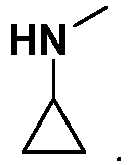
- In another preferred embodiment, said boronic acid or boronate is selected from


-

- (i) reacting a formula IIa compound with Y-Ar-(CH2)nXH in the presence of a base to give a formula IIb compound ;
- (ii) dissolving the IIb compound in acetic acid and adding NaNO2 to give a formula IIc compound;
- (iii) reacting the formula IIc compound with R1Z in the presence of a base to give formula I compound,
- The base in step (a), (d), (i) or (iii) is selected from the group consisting of inorganic base, organic base and combinations thereof; preferably, the inorganic base is selected from the group consisting of sodium hydroxide, potassium hydroxide, strontium hydroxide, lithium hydroxide, barium hydroxide, calcium hydroxide, cesium hydroxide, sodium bicarbonate, potassium bicarbonate, potassium carbonate, sodium carbonate, strontium carbonate, cesium carbonate, sodium sulfide, sodium hydrogen and combinations thereof; the organic base is selected from the group consisting of sodium alkoxide, potassium alkoxide, butyllithium, 1,8-diazacyclo[5,4,0]undecene-7, pyridine, piperidine, pyrrolidine, morpholine, N-methylmorpholine, quinoline, 4-dimethylaminopyridine, triethylamine, diethylamine, tri-n-butylamine, tripropylamine, diisopropylamine, diisopropylethylamine and combinations thereof; more preferably, the base is selected from the group consisting of sodium hydroxide, potassium hydroxide, lithium hydroxide, sodium bicarbonate, potassium bicarbonate, potassium carbonate, sodium carbonate, cesium carbonate, sodium hydrogen, sodium methoxide, sodium ethoxide, potassium tert-butoxide, pyridine, piperidine, pyrrolidine, morpholine, N-methylmorpholine, triethylamine, diethylamine, diisopropylamine, diisopropylethylamine and combinations thereof; the reaction solvent of the reaction is selected from the group consisting of aromatic hydrocarbon solvent, ether solvent, halogenated hydrocarbon solvent and other solvent; preferably, the aromatic hydrocarbon solvent is selected from the group consisting of benzene, toluene, xylene, chlorobenzene, nitrobenzene and combinations thereof; the ether solvent is selected from the group consisting of tetrahydrofuran, diethyl ether, glycol dimethyl ether, diethylene glycol dimethyl ether, diethylene glycol monomethyl ether, dioxane and combinations thereof; the halogenated hydrocarbon solvent is selected from the group consisting of dichloromethane, chloroform, carbon tetrachloride, dichloroethane and combinations thereof; said other solvent is selected from the group consisting of N,N-dimethylformamide, N,N-dimethylacetamide, dimethylsulfoxide, N-methylpyrrolidone, hexamethylphosphoramide, acetone, acetonitrile, ethyl acetate and combinations thereof; preferably, the reaction temperature of the reaction is from -30 °C to 300 °C, more preferably from -10 °C to 150 °C; preferably, the reaction time of the reaction is 0.5 to 12 hours.
- The compounds of the present invention are Lp-PLA2 inhibitors. Therefore, these compounds can be useful for treatment, for example, for the treatment of conditions associated with the activity of Lp-PLA2. Accordingly, another aspect of the present invention relates to the treatment of a condition associated with the activity of Lp-PLA2. It will be understood by those skilled in the art that a particular disorder or its treatment may involve one or more underlying mechanisms associated with Lp-PLA2 activity, including one or more of the mechanisms described herein.
- In an embodiment, the compounds of the present invention can be used in the treatment of any disease involving endothelium dysfunction, such as atherosclerosis, diabetes, hypertension, angina and conditions after ischemia and reperfusion.
- In an embodiment, the compounds of the present invention can be used in the treatment of any disease involving lipid oxidation associated with enzymatic activity, for example, other conditions in addition to such as atherosclerosis, diabetes and the like, such as rheumatoid arthritis, stroke, brain inflammatory conditions such as Alzheimer's disease, various neuropsychiatric disorders such as schizophrenia, myocardial infarction, ischemia, reperfusion injury, sepsis, as well as acute and chronic inflammation.
- In an embodiment, the compounds of the present invention can be used in the treatment of diseases involving activated monocytes, macrophages or lymphocytes, since all of these cell species express Lp-PLA2, including diseases involving activated macrophages, typical disorders include but not limited to psoriasis, rheumatoid arthritis, wound healing, chronic obstructive pulmonary disease, cirrhosis, atopic dermatitis, emphysema, chronic pancreatitis, chronic gastritis, aortic aneurysm, atherosclerosis, multiple sclerosis, Alzheimer's disease and autoimmune diseases such as lupus.
- In an embodiment, the present invention provides a method of treating a disease associated with the Lp-PLA2 activity comprising treating a subject in need of treatment with an effective amount of an Lp-PLA2 inhibitor. The disease may be associated with increased involvement of monocytes, macrophages or lymphocytes; associated with the formation of lysophosphatidylcholine and oxidized free fatty acids; associated with lipid oxidation involving the Lp-PLA2 activity; or associated with endothelial dysfunction.
- In other embodiments, the compounds of the present invention may be used for primary or secondary prophylaxis of acute coronary events, used in a combined therapy for the prophylaxis of restenosis, or used for delaying the development of diabetes or hypertensive renal insufficiency. prophylaxis includes treating a subject at risk of having such a condition.
- In some embodiments, the compounds of the present invention can be used in combination with anti-hyperlipidemia agents, anti-atherosclerotic agents, anti-diabetic agents, anti-angina agents or an-tihypertensive agents or agents for lowering lipoprotein a to treat the diseases described in the present invention. Examples of such agents include, but are not limited to, cholesterol synthesis inhibitors such as statins; antioxidants such as probucol; insulin sensitizers; calcium channel antagonists and antiinflammatory agents such as nonsteroidal antiinflammatory drugs.
- In one embodiment, the compounds of the present invention can be used in the treatment of a neurodegenerative disease in a subject. The method comprises administering a pharmaceutical composition comprising a drug that can inhibit the Lp-PLA2 activity to a subject in need of such treatment. Exemplary neurodegenerative diseases include, but are not limited to, Alzheimer's disease; vascular dementia, Parkinson's disease and Huntington's chorea. In an embodiment, the neurodegenerative disease of the present invention is associated with an abnormal blood-brain barrier. In an embodiment, the subject administered with an agent that can inhibit the Lp-PLA2 activity is human.
- In one embodiment, the present invention provides a method of treating a subject suffering from vascular dementia or having a risk of vascular dementia. Said method comprises administering a pharmaceutical composition comprising an effective amount of the compound of the invention to a subject. In an embodiment, the vascular dementia is associated with Alzheimer's disease.
- In an embodiment, the present invention provides a method of treating a neurological disorder associated with abnormal function of blood brain barrier, inflammation, or microglia activation in a subject in need of treatment. Said method comprises administering an effective amount of a compound of the invention to the subject. In another embodiment, the abnormal blood-brain barrier is a permeable blood-brain barrier. In another embodiment, the disease is a neurodegenerative disease. Such neurodegenerative disease is such as, but not limited to, vascular dementia, Alzheimer's disease, Parkinson's disease, and Huntington's disease. In one embodiment, the present invention provides a method of treating a disease associated with blood-brain barrier leakage in a subject. Exemplary diseases include, but are not limited to, cerebral hemorrhage, cerebral amyloid angiopathy. In one embodiment, the neurodegenerative disease is Alzheimer's disease. In one embodiment, the neurodegenerative disease is vascular dementia. In one embodiment, the neurodegenerative disease is multiple sclerosis.
- In an embodiment, the present invention provides a method of reducing the accumulation of beta amyloid protein in the brain of a subject. Said method comprises administering to a subject in need of treatment a pharmaceutical composition comprising an effective amount of a compound of the invention. In another embodiment, the beta amyloid protein is Aβ-42.
- In an embodiment, when the subject is administered an effective amount of a compound of the invention, the method may further comprise administering to the subject another therapeutic agent for treating a neurodegenerative disease or a complication of the subject undergoing treatment. For example, when the neurodegenerative disease is similar to Alzheimer's disease, the subject may be treated with other agents targeted to Alzheimer's disease, such as donepezil, tacrine, rivastigmine, galanthamine, anti-amyloid protein vaccine, Aβ reduction therapy, thinking practice or stimulation.
- In an embodiment, the present invention relates to a method of treating metabolic bone disease by administering an effective amount of a compound of the invention to a subject in need of treatment. Exemplary metabolic bone diseases include diseases associated with loss of bone mass and bone density, including but not limited to osteoporosis and osteopenia-related diseases. Exemplary osteoporosis and osteopenia-related diseases include, but are not limited to, bone marrow abnormalities, dyslipidemia, Paget's disease, type II diabetes, metabolic syndrome, insulin resistance, hyperparathyroidism and related diseases. In another embodiment, the subject in need of treatment is human.
- It is contemplated that methods of preventing osteoporosis and/or osteopenia disorders described herein may be affected by inhibition of Lp-PLA2 expression and/or inhibition of Lp-PLA2 protein activity. Thus, some embodiments of the present invention provide methods of blocking enzyme activity to inhibit Lp-PLA2. In another embodiment, a method of inhibiting Lp-PLA2 by reducing and/or down-regulating the expression of Lp-PLA2 RNA is provided. In another embodiment, the prevention and/or reduction of loss of bone mass and/or loss of bone density results in the prevention or reduction of symptoms associated with metabolic bone diseases such as osteoporosis and/or osteopenia disease.
- In an embodiment, the method further comprises administering to the subject in need of treatment other therapeutic agent(s) for the treatment of metabolic bone diseases. For example, when the metabolic bone disease is osteoporosis, other therapeutic agent(s), such as bisphosphonates, may be used.
- One aspect of the present invention provides a method of treating an eye disease by administering an effective amount of a compound of the invention. The eye disease to which the present invention is applicable may be related to the destruction of the blood-retina barrier. Exemplary eye diseases involve diabetic eye diseases and include the disorders such as macular edema, diabetic retinopathy, and the like. In addition, in one embodiment, the present invention relates to a method of treating an eye disease by administering a compound of the invention to inhibit Lp-PLA2. Exemplary eye diseases include, but are not limited to, central retinal vein occlusion, retinal branch vein occlusion, irvine-gass syndrome, pigmented retinitis, flat inflammation, birdshot retino choroidopathy, retinal outer membrane, choroidal tumors, cystic macular edema, parafoveal telangiectasis, traction macular disease, vitreous macular traction syndrome, retinal detachment, optic nerve retinitis, idiopathic macular edema and the like.
- In addition, some embodiments of the present invention provide methods for treating diabetic macular edema in a subject. Said method comprises administering an effective amount of a compound of the invention to a subject in need of treatment. In an embodiment, the present invention provides a method for treating a subject suffering from macular edema or having a risk of macular edema. Said method comprises administering an effective amount of a compound of the invention to the subject. In another embodiment, the macular edema is associated with a diabetic eye disease, such as diabetic retinopathy. In another embodiment, the macular edema is associated with posterior uveitis.
- In an embodiment, the present invention provides a method of treating glaucoma or macular degeneration. Said method comprises administering an effective amount of a compound of the invention to a subject.
- In one embodiment, the present invention provides a method of treating a disease associated with the destruction of the blood-retina barrier in a subject in need of treatment. Said method comprises administering an effective amount of a compound of the invention to the subject.
- In one embodiment, a systemic inflammatory disease, such as adolescent rheumatoid arthritis, inflammatory bowel disease, Kawasaki disease, multiple sclerosis, sarcoidosis, polyarteritis, psoriatic arthritis, reactive arthritis, systemic lupus erythematosus,Vogt-Koyanagi-Harada syndrome, lyme disease, Behcet's disease, ankylosing spondylitis, inflammatory granulomatous disease, enthesitis, may be the underlying cause of the posterior uveitis of retina and it can cause macular edema. The present invention relates to a method of treating posterior uveitis or anyone of these systemic inflammatory diseases by administering an effective amount of a compound of the present invention.
- In one embodiment, the compounds of the present invention can significantly reduce the blood glucose level of
spontaneous type 2 diabetes, significantly lower the level of glycosylated hemoglobin, and upregulate the level of insulin, thereby having a promising prospect to be used in the treatment of diabetes. - In one embodiment, the compounds of the present invention can significantly downregulate the triglyceride level and low density lipoprotein level in
spontaneous type 2 diabetes, whereas have no significant effect on high density lipoproteins, thereby having a promising prospect to be used against dyslipidemia diseases, such as atherosclerosis. - In one embodiment, the compounds of the present invention can significantly downregulate the urinary albumin level in the urine of
spontaneous type 2 diabetes, thereby having a promising prospect to be used against kidney diseases, such as diabetic nephropathy. - The compounds and pharmaceutical compositions provided by the present invention may be in a variety of forms such as tablets, capsules, powders, syrups, solutions, suspensions, aerosols and the like, and may be present in a suitable solid or liquid carrier or dilution. The pharmaceutical composition of the present invention may also be stored in a suitable sterilized utensil for injection or infusion. The pharmaceutical composition may also contain odorants, flavoring agents and the like.
- In the present invention, the pharmaceutical composition contains a compound represented by formula (I) or a pharmaceutically acceptable salt thereof in a safe and effective amount (e.g., 0.1 to 99.9 parts by weight, preferably 1 to 90 parts by weight), and a residual amount of a pharmaceutically acceptable excipient, wherein the total weight of the composition is 100 parts by weight. Alternatively, the pharmaceutical composition according to the present invention contains a compound represented by formula (I) or a pharmaceutically acceptable salt thereof in an amount of 0.1 to 99.9% by weight on the basis of the total weight, preferably 1 to 90% by weight on the basis of the total weight, and a residual amount of a pharmaceutically acceptable excipient, wherein the total weight of the composition is 100 parts by weight.
- The preferred ratio of the compound of formula (I) to the pharmaceutically acceptable carrier, excipient or sustained release agent is that the formula (I) compound as active ingredient accounts for more than 60% of the total weight, and the remainder accounts for 0 to 40% of the total weight. preferably 1 to 20%, most preferably 1 to 10%.
- The compound of formula (I) or the pharmaceutical composition containing the compound of formula (I) according to the present invention may be clinically administered to a mammal, including human and animal, and the route of administration may include oral, nasal inhalation, transdermal absorption, pulmonary or gastrointestinal tract administration, and the like. The preferred route of administration is oral. Preferably, it is in a unit dosage form, and each dosage contains an active ingredient of 0.01 mg to 200 mg, preferably 0.5 mg to 100 mg, administerd in one or more times. Regardless of the method of administration, the optimal dose of an individual should be adjusted based on the specific treatment. Normally, starting from a small dose, the dose is gradually increased until the most appropriate dose is found.
- The pharmaceutical compositions of the present invention can be administered by oral and intravenous, intramuscular or subcutaneous routes. Preferred pharmaceutical compositions are solid compositions, particularly tablets and solid filled or liquid filled capsules, from the standpoint of ease of preparation and administration. Oral administration of pharmaceutical compositions is preferred.
- The features mentioned above, or the features mentioned in the examples, may be combined in any manner. All features disclosed in this specification may be used in conjunction with any form of the composition, and each of the features disclosed in the specification may be substituted by any alternative feature that can achieve the same, equal or similar purpose. Thus, unless otherwise specified, the features disclosed are only general examples of equal or similar features.
- The present invention will be further described with reference to specific examples. It is to be understood that these examples are merely illustrative of the invention and are not intended to limit the scope of the invention. The experimental methods not specifically specified in the following examples are generally carried out according to conventional conditions such as those described in Sambrook et al., Molecular Cloning: Laboratory Manual (New York: Cold Spring Harbor Laboratory Press, 1989), or in accordance with the conditions recommended by the manufacturers. Unless otherwise stated, the percentages and parts are by weight.
- Unless otherwise defined, all professional and scientific terms used herein are of the same meaning as those skilled in the art are familiar with. In addition, any method and material similar to or equivalent to the contents described may be applied to the method of the present invention. The preferred embodiments and materials described herein are for exemplary purposes only.
-

- 6-chloro-uracil (7 g, 1 eq.), methyl iodide (8.9 ml, 3 eq.) and anhydrous potassium carbonate (3.36 g, 0.5 eq.) were stirred in 30 ml of dimethylsulfoxide at room temperature for 3 h, then 38 ml of water was added and stirred in ice bath for 2 h. A white solid precipitated and the precipitate was collected by filtration and dried to give 5.12 g of a solid. MS (ESI): 161(M+H).
-

- 6-chloro-uracil (100mg, 1 eq.), ethyl iodide (165ul, 3 eq.) and anhydrous potassium carbonate (47mg, 0.5 eq.) were stirred in 2 ml of dimethylsulfoxide at room temperature for 3 h, and then 3 ml of water was added. The mixture was extracted with ethyl acetate twice, rinsed three times with saturated brine, dried over magnesium sulfate, filtered and separated by column chromatograph to give 130 mg of a white solid. MS (ESI): 175(M+H).
-

- 6-chloro-uracil (300mg, 1 eq.), bromopropane (560ul, 3 eq.) and anhydrous potassium carbonate (141mg, 0.5 eq.) were stirred in 6 ml of dimethylsulfoxide at room temperature for 3 h, and then 8 ml of water was added. The mixture was extracted with ethyl acetate twice, rinsed three times with saturated brine, dried over magnesium sulfate, filtered and separated by column chromatograph to give 220 mg solid. MS (ESI): 189(M+H).
-

- Intermediate 1 (300 mg, 1 eq.) and tetrahydropyrrole (930 ul, 6 eq.) were dissolved in 5 ml of absolute ethanol and stirred at 70 °C for 0.5 h. After the mixture was cooled, the ethanol was distilled off and water was added. The mixture was extracted twice with dichloromethane, rinsed once with saturated brine, dried over magnesium sulfate, filtered and the solvent was evaporated to give 310 mg of intermediate 4a. MS (ESI): 196 (M+H).
- The intermediate 4a (100 mg) was dissolved in phosphorus oxychloride (5ml), stirred at 90 °C for 4h, cooled, evaporated to remove phosphorus oxychloride, adjusted with 1N NaOH to neutral pH, extracted three times with methylene chloride, dried over sodium sulfate, separated by column chromatography to give 90 mg of intermediate 4. MS (ESI): 214 (M+H).
- The following intermediates were prepared by referring to the preparation method of intermediate 4.
number intermediate name structural formula raw materials 5 4-chloro-1-methyl-6-morpholinopyrimidin-2(1H )-one 
intermediate 1, morpholine, phosphorus oxychloride 6 4-chloro-1-ethyl-6-morpholinopyrimidin-2(1H )-one 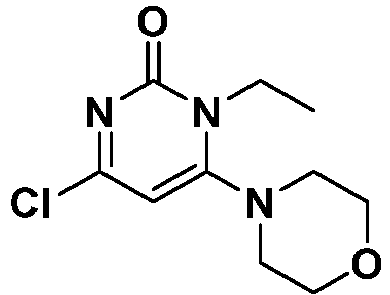
intermediate 2, morpholine, phosphorus oxychloride 7 4-chloro-1-propyl-6-morpholinopyrimidin-2(1H )-one 
intermediate 3, morpholine, phosphorus oxychloride 8 4-chloro-1-methyl-6-(piperidyl)pyrimidin-2(1H )-one 
intermediate 1, piperidine, phosphorus oxychloride 9 4-chloro-1-methyl-6-thiomorpholinopyrimidin-2(1H )-one 
intermediate 1, thiomorpholine, phosphorus oxychloride 10 4-chloro-6-(4-methoxypiperidyl)-1-methylpyrimidin-2(1H )-one 
intermediate 1, 4-methoxypiperidine, phosphorus oxychloride 11 4-chloro-6-(cyclopropyl(methyl) amino)-1-methyl pyrimidin-2(1H )-one 
intermediate 1, N-methylcyclopropylamine, phosphorus oxychloride 12 4-chloro-6-(cyclopropyl(methyl) amino)-1-methyl pyrimidin-2(1H )-one 
intermediate 1, dimethylamine, phosphorus oxychloride 13 4-chloro-6-(diethylamino)-1-methylpyrimidin-2(1H )-one 
intermediate 1, diethylamine, phosphorus oxychloride 14 4-chloro-1-methyl-6-(4-phenylpiperazinyl) pyrimidin-2(1H )-one 
intermediate 1, N-phenylpiperazine, phosphorus oxychloride 15 4-chloro-1-methyl-6-(4-methylpiperidyl) pyrimidin-2(1H )-one 
intermediate 1, 4-methylpiperidine, phosphorus oxychloride 16 4-chloro-1-methyl-6-(4-methylpiperazinyl) pyrimidin-2(1H )-one 
intermediate 1, N-methylpiperazine, phosphorus oxychloride 17 4-chloro-6-(4-cyclopropylpiperazin-1-yl)-1-methyl pyrimidin-2(1H )-one 
intermediate 1, N-cyclopropylpiperazine, phosphorus oxychloride 18 4-chloro-6-(3,3-difluoropyrrolidinyl)-1-methylpyrimidin-2(1H )-one 
intermediate 1, 3,3-difluoropyrrolidine, phosphorus oxychloride 19 4-chloro-6-(4,4-difluoropiperidyl)-1-methylpyrimidin-2(1H )-one 
intermediate 1, 4,4-difluoropiperidine, phosphorus oxychloride 20 4-chloro-6-((2-methoxyethyl) (methyl) amino)-1-methyl pyrimidin-2(1H )-one 
intermediate 1, 2-methoxy-N-methylethyl-1-amine, phosphorus oxychloride 21 (S)-4-chloro-1-methyl-6-(3-methylmorpholino) pyrimidin-2(1H )-one 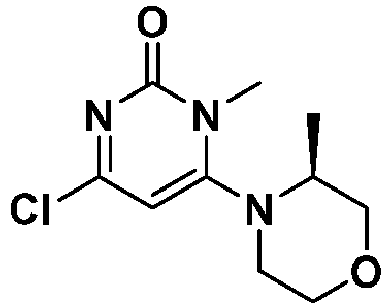
intermediate 1, (S)-3-methylmorpholine, phosphorus oxychloride 22 4-chloro-6-(4-fluoropiperid-1-yl)-1- methylpyrimidin-2- 2(1H )-one 
intermediate 1, 4-fluoropiperidine, phosphorus oxychloride -

- Intermediate 1 (300 mg, 1 eq.), phenylboronic acid (296 mg, 1.3 eq.), tetrakis(triphenylphosphine)palladium (108 mg, 0.05 eq.) and 2N aqueous sodium carbonate solution (654ul, 3 eq.) were mixed in 5 ml of glycol dimethyl ether and reacted under microwave at 120 °C for 50 min. The mixture was cooled and evaporated to remove solvent. Water was added and the mixture was extracted with dichloromethane twice, rinsed with saturated brine once, dried over sodium sulfate, filtered, and evaporated to remove solvent to give 310 mg of intermediate 23a. MS (ESI): 203(M+H).
- Intermediate (100 mg) was dissolved in phosphorus oxychloride (5ml), stirred at 90 °C for 4 h, cooled, evaporated to remove phosphorus oxychloride, adjusted with 1N NaOH to neutral PH, extracted three times with dichloromethane, dried over sodium sulfate, and separated by column chromatography to give 90 mg of intermediate 23. MS (ESI): 221(M+H).
- The following intermediates were prepared by referring to the preparation method of intermediate 23.
number intermediate name structural formula raw materials 24 4-chloro-6-(4-methoxyphe nyl)-1-methylpyrimidin-2( 1H )-one 
intermediate 1, p-methoxyphenylboronic acid, tetrakis(triphenylphosphine)pall adium, 2N aqueous sodium carbonate solution, phosphorus oxychloride 25 4-chloro-1-methyl-6-(1-m ethyl-1H-pyrazolyl-4)pyri midin-2(1H )-one 
intermediate 1, (1-methyl-1H-pyrazolyl-4)boro nic acid, tetrakis(triphenylphosphine)pall adium, 2N aqueous sodium carbonate solution, phosphorus oxychloride 26 4-chloro-1-methyl-6-(thie n-3-yl)pyrimidin-2(1H )-o ne 
intermediate 1, thienyl-3-boronic acid, tetrakis(triphenylphosphine)pall adium, 2N aqueous sodium carbonate solution, phosphorus oxychloride 27 4-chloro-1-methyl-6-(pyri din-4-yl)pyrimidin-2(1H )-one 
intermediate 1, 4-pyridineboronic acid, tetrakis(triphenylphosphine)pall adium, 2N aqueous sodium carbonate solution, phosphorus oxychloride 28 4-chloro-1-methyl-6-(pyri din-3-yl)pyrimidin-2(1H )-one 
intermediate 1, 3-pyridineboronic acid, tetrakis(triphenylphosphine)pall adium, 2N aqueous sodium carbonate solution, phosphorus oxychloride 29 6-chloro-3-methyl-[4,5'-di pyrimidin]-2(3H)-one 
intermediate 1, pyrimidine-5-boronic acid, tetrakis(triphenylphosphine)pall adium, 2N aqueous sodium carbonate solution, phosphorus oxychloride 30 6-chloro-2'-methoxy-3-me thyl-[4,5'-pyrimidin]-2(3H )-one 
intermediate 1, (2-methoxy-5-yl)boronic acid, tetrakis(triphenylphosphine)pall adium, 2N aqueous sodium carbonate solution, phosphorus oxychloride 31 4-chloro-6-(4-fluoropheny 1)-1-methylpyrimidin-2(1 H )-one 
intermediate 1, p-fluorophenylboronic acid, tetrakis(triphenylphosphine)pall adium, 2N aqueous sodium carbonate solution, phosphorus oxychloride 32 4-chloro-1-methyl-6-(4-(tr ifluoromethyl)phenyl)pyri midin-2(1H )-one 
intermediate 1, p-trifluoromethylphenylboronic acid, tetrakis(triphenylphosphine)pall adium, 2N aqueous sodium carbonate solution, phosphorus oxychloride -

- 4-chloro-3-(trifluoromethyl)phenol (6.5g, 1 eq.), p-fluorobenzaldehyde (3.9ml, 1.1 eq.) and anhydrous potassium carbonate (6g, 1.3 eq.) were dissolved in 30ml of DMF, under nitrogen, and stirred at 120 °C for 2 h and cooled. Water was added and the mixture was extracted with ethyl acetate twice, rinsed three times with aqueous brine, dried over sodium sulfate, filtered, and evaporated to remove solvent to give 11 g of intermediate 33a. MS (ESI): 301(M+H).
- Intermediate 33a (200mg, 1 eq.) and methylamine alcohol solution (2ml) were mixed in 4 ml of methanol and a certain amount of 4A molecular sieve was added and placed at room temperature for 1 h. Sodium borohydride (24mg, 1 eq.) was added and the reaction bottle was shaken and placed at room temperature for 1 h. The mixture was filtered, evaporated to dryness and aqueous ammonium chloride solution was added. The mixture was extracted three times with ethyl acetate, dried over anhydrous sodium sulfate, filtered and evaporated to dryness. The product was directly used in the next step. MS (ESI): 316(M+H).
-

- Intermediate 33a (4g, 1 eq.) was dissolved in 50 ml of anhydrous ethanol, and sodium borohydride (493mg, 1 eq.) was added under ice bath and then stirred at room temperature for 1 h. Aqueous ammonium chloride solution was added to quench the reaction, and evaporated to remove ethanol. Water was added and the mixture was extracted with ethyl acetate twice, rinsed with saturated brine once, dried over anhydrous sodium sulfate, and separated by column chromatography to give 4g of intermediate 34. MS (ESI): 285(M-17).
-

- Intermediate 34 (1 g, 1 eq.) was dissolved in re-distilled dichloromethane and dichlorosulfoxide (480 ul, 2 eq.) was added dropwise under ice bath. After the addition was complete, the mixture was stirred at room temperature for 2 h, then evaporated to remove solvent and dichlorosulfoxide to give 1.05 g of intermediate 35a which was directly used in the next step without purification.
- Intermediate 35a (1g, 1 eq.), phthalimide potassium salt (2.3g, 2 eq.) and 18-crown-6 (165mg, 0.1 eq.) were mixed in tetrahydrofuran, and the mixture was reacted under nitrogen at 65 °C overnight, then evaporated to remove solvent, added with water, extracted with dichloromethane three times, rinsed with saturated brine once, dried over anhydrous sodium sulfate, filtered, evaporated to dryness, and separated by column chromatography to give 1.63 g of intermediate 35b.
- Intermediate 35b (1.63g, 1 eq.) and hydrazine hydrate (4.5ml, 80%, 20 eq.) were mixed in ethanol, stirred at room temperature for 1 h, evaporated to remove partial solvent, stirred at room temperature for a period of time, and filtered to remove solid. The filtrate was evaporated to dryness, and separated by column (aluminum oxide) chromatography to give 0.9g of intermediate 35. MS (ESI): 302(M+H).
-

- Intermediate 35a (210mg, 1 eq.) and thiourea (70mg, 1.4 eq.) were mixed in 2 ml of anhydrous ethanol, refluxed for 4h, and cooled to room temperature. 10 N aqueous sodium hydroxide solution (2 ml) was added, refluxed for 3h, and cooled to room temperature. 4N aqueous hydrochloric acid solution was added to adjust pH to 5, extracted with ethyl acetate three times, rinsed with saturated brine once, dried over anhydrous sodium sulfate, filtered, and evaporated to dryness. The product was directly used in the next step without purification. MS (ESI): 285(M-33).
-

- 4-chloro-3-(trifluoromethyl)phenol (4.67g, 1 eq.), 3,4,5-trifluorobenzaldehyde (4g, 1.05 eq.) and anhydrous potassium carbonate (4.27g, 1.3 eq.) were dissolved in DMF, under nitrogen, stirred at 120 °C for 2 h, cooled, added with water, extracted with ethyl acetate twice, rinsed with aqueous brine three times, dried over sodium sulfate, filtered, and evaporated to remove solvent to give 8 g of intermediate 37a. MS (ESI): 337(M+H).
- Intermediate 37a (4g, 1 eq.) was dissolved in 50ml of anhydrous ethanol, under ice bath added with sodium borohydride (440mg, 1 eq.), then stirred at room temperature for 1 h. Aqueous ammonium chloride solution was added to quench the reaction, and the mixture was evaporated to remove ethanol, added with water, extracted with ethyl acetate twice, rinsed with saturated brine once, dried over anhydrous sodium sulfate, and separated by column chromatography to give 4 g of intermediate 37. MS (ESI): 321(M-17).
-

- Sodium hydride (950mg, 4 eq.) was placed in a flask, under ice bath, added with ultra dry tetrahydrofuran and methyltriphenylphosphonium bromide (2.54g, 1.2 eq.) sequentially, and stirred under ice bath for 1h. Then intermediate 35a (2g, 1 eq.) was added, and stirred at room temperature for 2h. After the reaction was complete, the mixture was direactly mixed and separated by column chromatography to give 730 mg of intermediate 38a.
- Intermediate 38a (730mg, 1 eq.) was dissolved in ultra dry tetrahydrofuran, under nitrogen and ice bath, 1N borane tetrahydrofuran solution (2.2ml, 1.2 eq.) was added, and stirred at room temperature for 1h. Then under
ice bath 2 ml of methanol was slowly added dropwise to quench excessive borane and sodium hydroxide (350mg, 4 eq.) was added in batches followed by the addition of hydrogen peroxide (3.1ml, 30% aqueous solution, 14 eq.). After the addition, the reaction was carried out at 60 °C for 2h and sodium sulfite aqueous solution was added to quench the reaction. The mixture was extracted with ethyl acetate three times, rinsed with saturated brine once, dried over anhydrous sodium sulfate, filtered, evaporated to dryness, and separated by column chromatography to give 600 g of intermediate 38.348(M-17). - The following intermediates were prepared by referring to the preparation method of intermediate 37.
number intermediate name structural formula raw materials 39 (4-(4-chloro-3-(trifluorom ethyl)phenoxy)-3-fluoroph enyl)methanol 
4-chloro-3-(trifluoromethyl)p henol, 4,5-difluorobenzaldehyde, sodium borohydride 40 2-(4-chloro-3-(trifluorome thyl)phenoxy)-5-(hydroxy methyl)benzonitrile 
4-chloro-3-(trifluoromethyl)p henol, 2-fluoro-5-cyanobenzaldehyd e, sodium borohydride 41 (3,5-difluoro-4-(6-(trifluor omethyl)pyridinyl-3-oxy) phenyl)methanol 
6-(trifluoromethyl)pyridin-3-ol, 3,4,5-trifluorobenzaldehyde, sodium borohydride 42 (3,4,5-trifluorophenyl)met hanol 
3,4,5-trifluorobenzaldehyde, sodium borohydride 43 (3,5-difluoro-4-(2-(trifluor omethyl)pyridinyl-4-oxy) phenyl)methanol 
2-(trifluoromethyl)pyridin-4-ol, 3,4,5-trifluorobenzaldehyde, sodium borohydride 44 (4-(6-chloropyridinyl-3-ox y)-3,5-difluorophenyl)met hanol 
6-chloropyridin-3-ol, 3,4,5-difluorobenzaldehyde, sodium borohydride 45 (3-chloro-4-(4-chloro-3-(tr ifluoromethyl)phenoxy)ph enyl)methanol 
4-chloro-3-(trifluoromethyl)p henol, 3-chloro-4fluorobenzaldehyd e, sodium borohydride 46 (4-(4-chloro-3-(trifluorom ethyl)phenoxy)-3-methylp henyl)methanol 
4-chloro-3-(trifluoromethyl)p henol, 4fluoro-3-methylbenzaldehyd e, sodium borohydride 47 (3,5-difluoro-4-(4-fluoro-3 -(trifluoromethyl)phenoxy )phenyl)methanol 
4-fluoro-3-(trifluoromethyl)p henol, 3,4,5-trifluorobenzaldehyde , sodium borohydride 48 (3-fluoro-4-((2-(trifluorom ethyl)pyridin-4-yl)oxy)ph enyl)methanol 
2-(trifluoromethyl)pyridin-4-ol, 3,4-difluorobenzaldehyde, sodium borohydride 49 5-(hydroxymethyl)-2-((5-( trifluoromethyl)pyridin-3-yl)oxy)benzonitrile 
5-(trifluoromethyl)pyridin-3-ol, 2-fluoro-5-cyanobenzaldehyd e, sodium borohydride 50 (3,5-difluoro-4-((5-(trifluo romethyl)pyridin-3-yl)oxy )phenyl)methanol 
5-(trifluoromethyl)pyridin-3-ol, 3,4,5-trifluorobenzaldehyde, sodium borohydride 51 4-(2,6-difluoro-4-(hydrox ymethyl)phenoxy)-2-(trifl uoromethyl)benzonitrile 
4-hydroxyl-2-(trifluoromethy l)benzonitrile, 3,4,5-trifluorobenzaldehyde , sodium borohydride 52 4-(2-fluoro-4-(hydroxyme thyl)phenoxy)-2-(trifluoro methyl)benzonitrile 
4-hydroxyl-2-(trifluoromethy l)benzonitrile, 3,4-difluorobenzaldehyde, sodium borohydride 53 4-(2-cyano-4-(hydroxymet hyl)phenoxy)-2-(trifluoro methyl)benzonitrile 
4-hydroxyl-2-(trifluoromethy l)benzonitrile, 2-fluoro-5-cyanobenzaldehyd e, sodium borohydride 54 2-(4-fluoro-3-(trifluorome thyl)phenoxy)-5-(hydroxy methyl)benzonitrile 
4-fluoro-3-(trifluoromethyl)p henol, 2-fluoro-5-cyanobenzaldehyd e, sodium borohydride 55 5-(hydroxymethyl)-2-((6-( trifluoromethyl)pyridin-3-yl)oxy)benzonitrile 
6-(trifluoromethyl)pyridin-3-ol, 2-fluoro-5-cyanobenzaldehyd e, sodium borohydride -

- Intermediate 37 (1.1g, 1.1 eq.) was dissolved in tetrahydrofuran, and under ice bath added with sodium hydride (352mg, 60%, 3 eq.). The mixture was stirred under ice bath for 30min, added with 4-chloro-6-methoxypyrimidine-2-amine (467mg, 1 eq.), then reacted at 70 °C overnight. After the reaction was complete, under ice bath aqueous ammonium chloride solution was added to quench the reaction. The mixture was extracted with ethyl acetate three times, dried over anhydrous sodium sulfate, filtered, evaporated to dryness, and separated by column chromatography to give 440 mg of intermediate 56a as white solid. MS (ESI): 462(M+H).
- Intermediate 56a (200 mg, 1 eq.) was dissolved in glacial acetic acid, and sodium nitrite (60 mg, 2 eq.) was added in batches and reacted at room temperature overnight. After completion of the reaction, the solvent was distilled off. Dichloromethane was added and the mixture was washed twice with aqueous sodium bicarbonate, dried over anhydrous sodium sulfate, filtered, evaporated to dryness, and 150 mg of product was separated by column chromatography. MS (ESI): 463(M+H).
- The following intermediates were prepared by referring to the preparation method of intermediate 56.
number intermediate name structure formula raw materials 57 4-((4-(4-chloro-3-(t rifluoromethyl)phen oxy)benzyl)oxy)-6-methoxypyrimidin-2(1H )-one 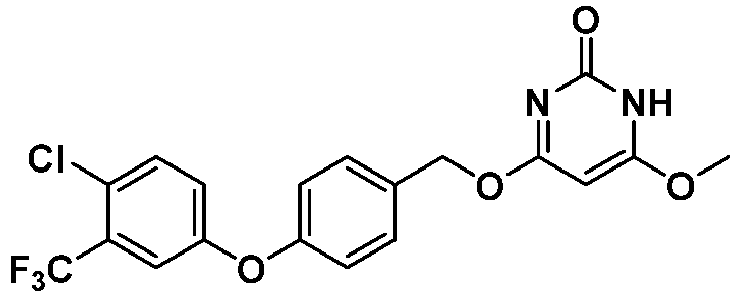
intermediate 34, 4-chloro-6-methoxypyrimidi ne-2-amine, sodium hydride, sodium nitrite, glacial acetic acid 58 4-((4-(4-chloro-3-(t rifluoromethyl)phen oxy)-3-fluorobenzyl )oxy)-6-methoxypy rimidin-2(1H )-one 
intermediate 39, 4-chloro-6-methoxypyrimidi ne-2-amine, sodium hydride, sodium nitrite, glacial acetic acid 59 2-(4-chloro-3-(triflu oromethyl)phenoxy )-5-(((6-methoxy-2-oxo-1,2-dihydropyri midin-4-yl)oxy)met hyl)benzonitrile 
intermediate 40, 4-chloro-6-methoxypyrimidi ne-2-amine, sodium hydride, sodium nitrite, glacial acetic acid 60 4-((3-fluoro-4-((2-(t rifluoromethyl)pyri din-4-yl)oxy)benzyl )oxy)-6-methoxypy rimidin-2(1H )-one 
intermediate 48, 4-chloro-6-methoxypyrimidi ne-2-amine, sodium hydride, sodium nitrite, glacial acetic acid 61 4-((3,5-difluoro-4-(( 2-(trifluoromethyl)p yridin-4-yl)oxy)ben zyl)oxy)-6-methoxy pyrimidin-2(1H )-on e 
intermediate 43, 4-chloro-6-methoxypyrimidi ne-2-amine, sodium hydride, sodium nitrite, glacial acetic acid 62 4-((3,5-difluoro-4-(( 6-(trifluoromethyl)p yridin-3-yl)oxy)ben zyl)oxy)-6-methoxy pyrimidin-2(1H )-on e 
intermediate 41, 4-chloro-6-methoxypyrimidi ne-2-amine, sodium hydride, sodium nitrite, glacial acetic acid 63 5-(((6-methoxy-2-o xo-1,2-dihydropyri midin-4-yl)oxy)met hyl)-2-((5-(trifluoro methyl)pyridin-3-yl )oxy)benzonitrile 
intermediate 49, 4-chloro-6-methoxypyrimidi ne-2-amine, sodium hydride, sodium nitrite, glacial acetic acid 64 4-((3,5-difluoro-4-(( 5-(trifluoromethyl)p yridin-3-yl)oxy)ben zyl)oxy)-6-methoxy pyrimidin-2(1H )-on e 
intermediate 50, 4-chloro-6-methoxypyrimidi ne-2-amine, sodium hydride, sodium nitrite, glacial acetic acid 65 4-(2,6-difluoro-4-((( 6-methoxy-2-oxo-1, 2-dihydropyrimidin -4-yl)oxy)methyl)p henoxy)-2-(trifluoro methyl)benzonitrile 
intermediate 51, 4-chloro-6-methoxypyrimidi ne-2-amine, sodium hydride, sodium nitrite, glacial acetic acid 66 4-(2-fluoro-4-(((6-methoxy-2-oxo-1,2-dihydropyrimidin-4 -yl)oxy)methyl)phe noxy)-2-(trifluorom ethyl)benzonitrile 
intermediate 52, 4-chloro-6-methoxypyrimidi ne-2-amine, sodium hydride, sodium nitrite, glacial acetic acid 67 4-(2-cyano-4-(((6-methoxy-2-oxo-1,2-dihydropyrimidin-4 -yl)oxy)methyl)phe noxy)-2-(trifluorom ethyl)benzonitrile 
intermediate 53, 4-chloro-6-methoxypyrimidi ne-2-amine, sodium hydride, sodium nitrite, glacial acetic acid 68 2-(4-fluoro-3-(triflu oromethyl)phenoxy )-5-(((6-methoxy-2-oxo-1,2-dihydropyri midin-4-yl)oxy)met hyl)benzonitrile 
intermediate 54, 4-chloro-6-methoxypyrimidi ne-2-amine, sodium hydride, sodium nitrite, glacial acetic acid -
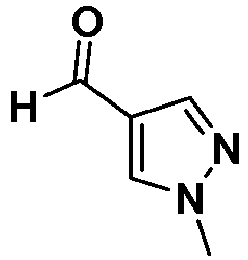
- N-methylpyrazole (1.0 g, 1 eq.) was dissolved in N,N-dimethylformamide (2.8 ml, 3 eq.), phosphorus oxychloride (1.3ml, 1.2 eq.) was added dropwise at 90 °C over about 1 h. The mixture was reacted for another 2 h and then cooled. The reaction liquid was poured into iced water and adjusted with 10% aqueous sodium hydroxide solution to
PH 4∼5, extracted four times with dichloromethane, rinsed with water twice, and separated by column chromatography to give 600 mg product. -

- Intermediate 69 (600mg, 1 eq.) was dissolved in tetrahydrofuran, and lithium aluminum hydride (210 mg, 1 eq.) was added under ice bath and the mixture was reacted at room temperature for 2 h. After completion of the reaction, 210 µl of water, 210 µl of 10% aqueous sodium hydroxide solution, and 630 µl of water were successively added, followed by addition of anhydrous magnesium sulfate. The mixture was stirred for a while, filtered and evaporated to dryness to give 400 mg of an oil. MS (ESI): 113(M+H).
-
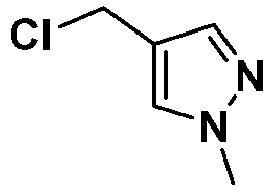
- Intermediate 70 (160mg, 1 eq.) was dissolved in re-distilled dichloromethane, and dichlorosulfoxide (310 µl, 3 eq.) was added under ice bath. The mixture was reacted for 1 h, evaporated to remove solvent. The product was directly used in the next step without purification.
-

- Intermediate 37 (1.1g, 1.1 eq.) was dissolved in tetrahydrofuran, and sodium hydride (352mg, 60%, 3 eq.) was added under ice bath. The mixture was stirred under ice bath for 30 min, 4-chloro-6-methylpyrimidine-2-amine (420mg, 1 eq.) was added and then the mixture was reacted at room temperature overnight. After completion of the reaction, under ice bath aqueous ammonium chloride solution was added to quench the reaction. The mixture was extracted with ethyl acetate three times, dried over anhydrous sodium sulfate, filtered, evaporated to dryness, and separated by column chromatography to give 440 mg of white solid. MS (ESI): 446(M+H).
-

- Intermediate 72 (200 mg, 1 eq.) was dissolved in glacial acetic acid, sodium nitrite (62 mg, 2 eq.) was added in batches, and the mixture was reacted at room temperature overnight. After completion of the reaction, the mixture was evaporated to remove solvent, dichloromethane was added and the mixture was rinsed with aqueous sodium bicarbonate solution twice, dried over anhydrous sodium sulfate, filtered, evaporated to dryness, and separated by column chromatography to give 150 mg produce. MS (ESI): 447(M+H).
-

- Intermediate 39 and 4-chloro-6-methoxypyrimidine-2-amine were used as raw materials. Reference was made to the preparation method of Intermediate 72. MS (ESI): 428(M+H).
-

- Starting from intermediate 74 as a starting material, Reference was made to the preparation method of intermediate 73. MS (ESI): 429 (M+H).
-

- Intermediate 4 (19 mg, 1 eq.), intermediate 37 (30 mg, 1 eq.) and sodium hydride (11 mg, 3 eq.) were mixed in 2 ml of N,N-dimethylformamide, stirred at room temperature for 30 min, added with water to quench the reaction. The mixture was extracted three times with ethyl acetate, rinsed three times with saturated brine, dried over anhydrous sodium sulfate, separated by column chromatography to give 20 mg target product. 1H NMR (400 MHz, Chloroform-d) δ 7.4 (d, J = 8.8 Hz, 1H), 7.32 (d, J = 3.0 Hz, 1H), 7.15 - 7.08 (m, 2H), 7.03 (dd, J = 8.8, 2.9 Hz, 1H), 5.42 (s, 2H), 5.35 (s, 1H), 3.51 (s, 3H), 3.41 - 3.34 (m, 4H), 2.07 - 1.98 (m, 4H). MS (ESI): 516 (M+H).
-

- Intermediate 5 (25 mg, 1 eq.), intermediate 33 (34 mg, 1 eq.) and triethylamine (18 ul, 1.2 eq.) were mixed in N,N-dimethylformamide, the mixture was reacted at room temperature overnight, then added with water to quench the reaction. The mixture was extracted with ethyl acetate three times, rinsed with saturated brine twice, dried over anhydrous sodium sulfate, filtered, evaporated to remove solvent, and separated by column chromatography to give 18 mg of white solid. 1H NMR (400 MHz, Chloroform-d) δ 7.45 (d, J = 8.8 Hz, 1H), 7.32 (d, J = 2.9 Hz, 1H), 7.27 (d, J = 8.3 Hz, 2H), 7.08 (dd, J = 8.6, 2.6 Hz, 1H), 6.98 (d, J = 8.3 Hz, 2H), 5.27 (s, 1H), 4.89 (s, 2H), 3.86 (s, 4H), 3.46 (s, 3H), 2.99 (s, 4H). MS (ESI): 509 (M+H).
-

- Intermediate 5 and intermediate 35 were used as raw materials. Reference was made to the preparation method of Example 2. 1H NMR (400 MHz, Chloroform-d) δ 7.45 (d, J = 8.8 Hz, 1H), 7.36 (d, J = 8.5 Hz, 2H), 7.32 (d, J = 2.8 Hz, 1H), 7.08 (dd, J = 8.7, 2.9 Hz, 1H), 7.00 (d, J = 8.5 Hz, 2H), 5.12 (s, 1H), 4.67 (s, 2H), 3.88 - 3.81 (m, 4H), 3.44 (s, 3H), 3.01 - 2.92 (m, 4H). MS (ESI): 495 (M+H).
-
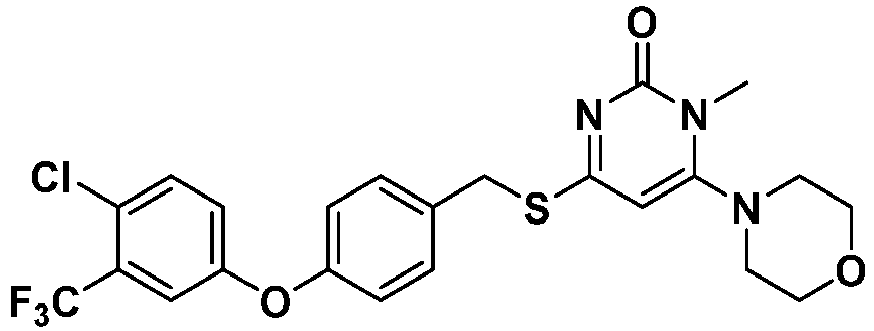
- Intermediate 5 and intermediate 36 were used as raw materials. Reference was made to the preparation method of Example 1. 1H NMR (400 MHz, Chloroform-d) δ 7.44 - 7.38 (m, 3H), 7.31 (d, J = 2.6 Hz, 1H), 7.05 (dd, J = 8.8, 2.3 Hz, 1H), 6.93 (d, J = 8.3 Hz, 2H), 5.74 (s, 1H), 4.47 (s, 2H), 3.87 - 3.81 (m, 4H), 3.48 (s, 3H), 3.05 - 2.98 (m, 4H). MS (ESI): 512 (M+H).
-

- Intermediate 5 and intermediate 38 were used as raw materials. Reference was made to the preparation method of Example 1. 1H NMR (400 MHz, Chloroform-d) δ 7.44 (d, J = 8.7 Hz, 1H), 7.30 (d, J = 3.1 Hz, 1H), 7.03 (dd, J = 8.8, 2.8 Hz, 1H), 6.99 - 6.93 (m, 2H), 5.40 (s, 1H), 4.62 (t, J = 6.4 Hz, 2H), 3.90 - 3.85 (m, 4H), 3.49 (s, 3H), 3.07 (t, J = 6.4 Hz, 2H), 3.05 - 3.01 (m, 4H). MS (ESI): 546 (M+H).
-
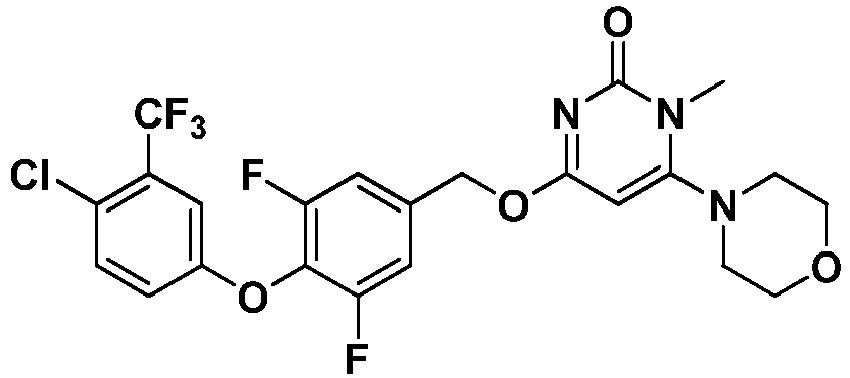
- Intermediate 5 and intermediate 37 were used as raw materials. Reference was made to the preparation method of Example 1. 1H NMR (400 MHz, Chloroform-d) δ 7.44 (d, J = 8.8 Hz, 1H), 7.32 (d, J = 3.0 Hz, 1H), 7.16 - 7.09 (m, 2H), 7.04 (dd, J = 8.8, 3.0 Hz, 1H), 5.50 (s, 1H), 5.43 (s, 2H), 3.91 - 3.85 (m, 4H), 3.51 (s, 3H), 3.08 - 3.03 (m, 4H). MS (ESI): 532 (M+H).
-

- Intermediate 8 and intermediate 37 were used as raw materials. Reference was made to the preparation method of Example 1. 1H NMR (400 MHz, Chloroform-d) δ 7.43 (d, J = 8.8 Hz, 1H), 7.32 (d, J = 2.9 Hz, 1H), 7.15 - 7.08 (m, 2H), 7.03 (dd, J = 8.8, 2.9 Hz, 1H), 5.47 (s, 1H), 5.42 (s, 2H), 3.47 (s, 3H), 3.03 - 2.94 (m, 4H), 1.80 -1.72 (m, 4H), 1.71 - 1.65 (m, 2H). MS (ESI): 530 (M+H).
-

- Intermediate 9 and intermediate 37 were used as raw materials. Reference was made to the preparation method of Example 1. 1H NMR (400 MHz, Chloroform-d) δ 7.44 (d, J = 8.8 Hz, 1H), 7.31 (d, J = 2.8 Hz, 1H), 7.12 (d, J = 8.1 Hz, 2H), 7.03 (dd, J = 8.8, 2.8 Hz, 1H), 5.50 (s, 1H), 5.42 (s, 2H), 3.47 (s, 3H), 3.35 - 3.24 (m, 4H), 2.88 - 2.77 (m, 4H). MS (ESI): 548 (M+H).
-

-
Intermediate 10 and intermediate 37 were used as raw materials. Reference was made to the preparation method of Example 1. 1H NMR (400 MHz, Chloroform-d) δ 7.44 (d, J = 8.8 Hz, 1H), 7.32 (d, J = 3.0 Hz, 1H), 7.12 (d, J = 8.1 Hz, 2H), 7.03 (dd, J = 8.8, 3.0 Hz, 1H), 5.49 (s, 1H), 5.42 (s, 2H), 3.50 -3.48 (m, 1H), 3.48 (s, 3H), 3.40 (s, 3H), 3.28 - 3.17 (m, 2H), 2.93 - 2.85 (m, J = 8.3, 2H), 2.06 - 1.96 (m, 2H), 1.87 - 1.76 (m, 1H). MS (ESI): 560 (M+H). -
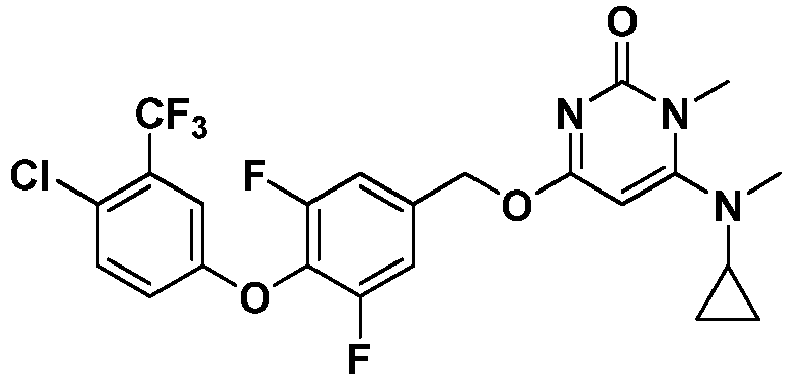
-
Intermediate 11 and intermediate 37 were used as raw materials. Reference was made to the preparation method of Example 1. 1H NMR (300 MHz, Chloroform-d) δ 7.41 (d, J = 8.8 Hz, 1H), 7.29 (d, J = 2.9 Hz, 1H), 7.10 (d, J = 8.2 Hz, 2H), 7.01 (dd, J = 8.8, 2.9 Hz, 1H), 5.60 (s, 1H), 5.39 (s, 2H), 3.41 (s, 3H), 2.88 (s, 3H), 2.54 (tt, J = 6.7, 3.7 Hz, 1H), 0.85 - 0.79 (m, 2H), 0.60 - 0.52 (m, 2H). MS (ESI): 516 (M+H). -

- Intermediate 12 and intermediate 37 were used as raw materials. Reference was made to the preparation method of Example 1. 1H NMR (400 MHz, Chloroform-d) δ 7.44 (d, J = 8.8 Hz, 1H), 7.32 (d, J = 3.0 Hz, 1H), 7.15 - 7.09 (m, 2H), 7.03 (dd, J = 8.8, 3.0 Hz, 1H), 5.45 (s, 1H), 5.42 (s, 2H), 3.49 (s, 3H), 2.85 (s, 6H). MS (ESI): 490 (M+H).
-

- Intermediate 13 and intermediate 37 were used as raw materials. Reference was made to the preparation method of Example 1. 1H NMR (300 MHz, Chloroform-d) δ 7.41 (d, J = 8.8 Hz, 1H), 7.29 (d, J = 2.9 Hz, 1H), 7.10 (d, J = 8.2 Hz, 2H), 7.01 (dd, J = 8.8, 2.9 Hz, 1H), 5.49 (s, 1H), 5.39 (s, 2H), 3.45 (s, 3H), 3.11 (q, J = 7.0 Hz, 4H), 1.14 (t, J = 7.0 Hz, 6H). MS (ESI): 518 (M+H).
-

- Intermediate 14 and intermediate 42 were used as raw materials. Reference was made to the preparation method of Example 1. 1H NMR (300 MHz, Chloroform-d) δ 7.35 - 7.27 (m, 2H), 7.11 - 7.01 (m, 2H), 7.00 - 6.92 (m, 3H), 5.50 (s, 1H), 5.34 (s, 2H), 3.50 (s, 3H), 3.38 - 3.30 (m, 4H), 3.23 - 3.14 (m, 4H). MS (ESI): 430 (M+H).
-

- Intermediate 13 and intermediate 35 were used as raw materials. Reference was made to the preparation method of Example 1. 1H NMR (400 MHz, Chloroform-d) δ 7.43 (d, J = 8.8 Hz, 1H), 7.32 (d, J = 3.0 Hz, 1H), 7.14 - 7.08 (m, 2H), 7.03 (dd, J = 8.8, 3.0 Hz, 1H), 5.47 (s, 1H), 5.42 (s, 2H), 3.47 (s, 3H), 3.30 (d, J = 12.4 Hz, 2H), 2.72 (td, J = 12.1, 2.1 Hz, 2H), 1.85 - 1.77 (m, 2H), 1.43 - 1.32 (m, 3H), 1.04 (d, J = 6.5 Hz, 3H). MS (ESI): 544 (M+H).
-

- Intermediate 16 and intermediate 37 were used as raw materials. Reference was made to the preparation method of Example 1. 1H NMR (400 MHz, Chloroform-d) δ 7.43 (d, J = 8.8 Hz, 1H), 7.32 (d, J = 3.0 Hz, 1H), 7.15 - 7.08 (m, 2H), 7.03 (dd, J = 8.8, 3.0 Hz, 1H), 5.55 (s, 1H), 5.42 (s, 2H), 3.48 (s, 3H), 3.30 (s, 4H), 2.94 (s, 4H), 2.63 (s, 3H). MS (ESI): 545 (M+H).
-

- Intermediate 18 and intermediate 37 were used as raw materials. Reference was made to the preparation method of Example 1. 1H NMR (400 MHz, Chloroform-d) δ 7.44 (d, J = 8.8 Hz, 1H), 7.31 (d, J = 2.9 Hz, 1H), 7.12 (d, J = 8.2 Hz, 2H), 7.03 (dd, J = 8.8, 2.9 Hz, 1H), 5.42 (s, 3H), 3.66 (t, J = 12.4 Hz, 2H), 3.54 (t, J = 6.9 Hz, 2H), 3.51 (s, 3H), 2.57 - 2.46 (m, 2H). MS (ESI): 552 (M+H).
-

- Intermediate 19 and intermediate 37 were used as raw materials. Reference was made to the preparation method of Example 1. 1H NMR (400 MHz, Chloroform-d) δ 7.44 (d, J = 8.8 Hz, 1H), 7.31 (d, J = 3.0 Hz, 1H), 7.15 - 7.08 (m, 2H), 7.04 (dd, J = 8.9, 3.0 Hz, 1H), 5.53 (s, 1H), 5.42 (s, 2H), 3.50 (s, 3H), 3.17 (t, J = 5.7 Hz, 4H), 2.26 - 2.14 (m, 4H). MS (ESI): 566 (M+H).
-

-
Intermediate 20 and intermediate 37 were used as raw materials. Reference was made to the preparation method of Example 1. 1H NMR (400 MHz, Chloroform-d) δ 7.44 (d, J = 8.8 Hz, 1H), 7.32 (d, J = 3.0 Hz, 1H), 7.15 - 7.09 (m, 2H), 7.03 (dd, J = 8.8, 2.9 Hz, 1H), 5.51 (s, 1H), 5.42 (s, 2H), 3.60 (t, J = 5.3 Hz, 2H), 3.49 (s, 3H), 3.37 (s, 3H), 3.28 (t, J = 5.3 Hz, 2H), 2.88 (s, 3H). MS (ESI): 534 (M+H). -

- Intermediate 23 and intermediate 37 were used as raw materials. Reference was made to the preparation method of Example 1. 1H NMR (400 MHz, Chloroform-d) δ 7.57 - 7.51 (m, 3H), 7.46 - 7.37 (m, 3H), 7.32 (d, J = 3.0 Hz, 1H), 7.18 - 7.12 (m, 2H), 7.04 (dd, J = 8.7, 3.1 Hz, 1H), 5.94 (s, 1H), 5.49 (s, 2H), 3.39 (s, 3H). MS (ESI): 523 (M+H).
-

- Intermediate 24 and intermediate 37 were used as raw materials. Reference was made to the preparation method of Example 1. 1H NMR (400 MHz, Chloroform-d) δ 7.44 (d, J = 8.8 Hz, 1H), 7.35 - 7.31 (m, 3H), 7.17 - 7.11 (m, 2H), 7.06 - 7.01 (m, 3H), 5.92 (s, 1H), 5.48 (s, 2H), 3.90 (s, 3H), 3.41 (s, 3H). MS (ESI): 553 (M+H).
-

-
Intermediate 25 and intermediate 37 were used as raw materials. Reference was made to the preparation method of Example 1. 1H NMR (400 MHz, Chloroform-d) δ 7.71 (s, 1H), 7.67 (s, 1H), 7.44 (d, J = 8.8 Hz, 1H), 7.32 (d, J = 3.0 Hz, 1H), 7.17 - 7.09 (m, 2H), 7.04 (dd, J = 8.9, 3.0 Hz, 1H), 5.97 (s, 1H), 5.46 (s, 2H), 4.03 (s, 3H), 3.61 (s, 3H). MS (ESI): 527 (M+H). -

- Intermediate 12 and intermediate 41 were used as raw materials. Reference was made to the preparation method of Example 1. 1H NMR (400 MHz, Chloroform-d) δ 8.51 (d, J = 2.8 Hz, 1H), 7.65 (d, J = 8.7 Hz, 1H), 7.31 (dd, J = 8.7, 2.8 Hz, 1H), 7.18 - 7.11 (m, 2H), 5.45 (s, 1H), 5.43 (s, 2H), 3.49 (s, 3H), 2.85 (s, 6H). MS (ESI): 457 (M+H).
-

-
Intermediate 20 and intermediate 40 were used as raw materials. Reference was made to the preparation method of Example 1. 1H NMR (400 MHz, Chloroform-d) δ 7.78 (d, J = 2.0 Hz, 1H), 7.61 (dd, J = 8.6, 2.2 Hz, 1H), 7.55 (d, J = 8.7 Hz, 1H), 7.43 (d, J = 2.9 Hz, 1H), 7.28 (s, 1H), 7.19 (dd, J = 8.7, 2.9 Hz, 1H), 6.93 (d, J = 8.6 Hz, 1H), 5.48 (s, 1H), 5.42 (s, 2H), 3.60 (t, J = 5.3 Hz, 2H), 3.48 (s, 3H), 3.36 (s, 3H), 3.27 (t, J = 5.3 Hz, 2H), 2.87 (s, 3H). MS (ESI): 523 (M+H). -

- Intermediate 5 and intermediate 34 were used as raw materials. Reference was made to the preparation method of Example 1. 1H NMR (400 MHz, Chloroform-d) δ 7.49 - 7.42 (m, 3H), 7.35 (d, J = 2.5 Hz, 1H), 7.10 (dd, J = 8.7, 2.4 Hz, 1H), 7.03 (d, J = 8.3 Hz, 2H), 5.47 (s, 1H), 5.41 (s, 2H), 3.89 - 3.83 (m, 4H), 3.50 (s, 3H), 3.05 - 2.99 (m, 4H). MS (ESI): 496 (M+H).
-

- Intermediate 5 and intermediate 39 were used as raw materials. Reference was made to the preparation method of Example 1. 1H NMR (400 MHz, Chloroform-d) δ 7.44 (d, J = 8.8 Hz, 1H), 7.34 - 7.29 (m, 2H), 7.23 (d, J = 8.3 Hz, 1H), 7.12 (t, J = 8.2 Hz, 1H), 7.05 (dd, J = 8.8, 3.0 Hz, 1H), 5.49 (s, 1H), 5.42 (s, 2H), 3.89 - 3.85 (m, 4H), 3.50 (s, 3H), 3.07 - 3.02 (m, 4H). MS (ESI): 514 (M+H).
-

- Intermediate 5 and intermediate 41 were used as raw materials. Reference was made to the preparation method of Example 1. 1H NMR (400 MHz, Chloroform-d) δ 8.51 (d, J = 2.8 Hz, 1H), 7.65 (d, J = 8.7 Hz, 1H), 7.32 (dd, J = 8.7, 2.8 Hz, 1H), 7.18 - 7.11 (m, 2H), 5.50 (s, 1H), 5.44 (s, 2H), 3.92 - 3.84 (m, 4H), 3.51 (s, 3H), 3.09 - 3.02 (4, 5H). MS (ESI): 499 (M+H).
-

- Intermediate 5 and intermediate 40 were used as raw materials. Reference was made to the preparation method of Example 1. 1H NMR (400 MHz, Chloroform-d) δ 7.78 (d, J = 2.2 Hz, 1H), 7.62 (dd, J = 8.7, 2.2 Hz, 1H), 7.55 (d, J = 8.7 Hz, 1H), 7.43 (d, J = 2.8 Hz, 1H), 7.20 (dd, J = 8.7, 2.8 Hz, 1H), 6.93 (d, J = 8.7 Hz, 1H), 5.48 (s, 1H), 5.43 (s, 2H), 3.90 - 3.84 (m, 4H), 3.50 (s, 3H), 3.08 - 3.02 (m, 4H). MS (ESI): 521 (M+H).
-

- Intermediate 5 and intermediate 42 were used as raw materials. Reference was made to the preparation method of Example 1. 1H NMR (400 MHz, Chloroform-d) δ 7.09 - 7.02 (m, 2H), 5.47 (s, 1H), 5.35 (s, 2H), 3.90 - 3.83 (m, 4H), 3.49 (s, 3H), 3.08 - 3.01 (m, 4H). MS (ESI): 356 (M+H).
-

- Intermediate 5 and intermediate 43 were used as raw materials. Reference was made to the preparation method of Example 1. 1H NMR (400 MHz, Chloroform-d) δ 8.63 (d, J = 5.7 Hz, 1H), 7.28 (d, J = 2.3 Hz, 1H), 7.17 (d, J = 8.1 Hz, 2H), 7.01 (dd, J = 5.7, 2.3 Hz, 1H), 5.51 (s, 1H), 5.45 (s, 2H), 3.91 - 3.86 (m, 4H), 3.51 (s, 3H), 3.09 - 3.03 (m, 4H). MS (ESI): 499 (M+H).
-

- Intermediate 5 and intermediate 44 were used as raw materials. Reference was made to the preparation method of Example 1. 1H NMR (400 MHz, Chloroform-d) δ 8.16 (d, J = 2.8 Hz, 1H), 7.27 (s, 1H), 7.25 (d, J = 2.8 Hz, 1H), 7.12 (d, J = 8.2 Hz, 2H), 5.50 (s, 1H), 5.42 (s, 2H), 3.90-3.86 (m, 4H), 3.50 (s, 3H), 3.11 - 3.01 (m, 4H). MS (ESI): 465 (M+H).
-

- Intermediate 5 and intermediate 45 were used as raw materials. Reference was made to the preparation method of Example 1. 1H NMR (400 MHz, Chloroform-d) δ 7.58 (s, 1H), 7.45 (d, J = 8.8 Hz, 1H), 7.36 (d, J = 8.2 Hz, 1H), 7.30 (d, J = 2.6 Hz, 1H), 7.06 (d, J = 8.4 Hz, 1H), 7.01 (dd, J = 8.7, 2.6 Hz, 1H), 5.49 (s, 1H), 5.42 (s, 2H), 3.91 - 3.85 (m, 4H), 3.50 (s, 3H), 3.07 - 3.01 (m, 4H). MS (ESI): 530 (M+H).
-

- Intermediate 5 and intermediate 46 were used as raw materials. Reference was made to the preparation method of Example 1. 1H NMR (400 MHz, Methanol-d 4) δ 7.56 (d, J = 8.8 Hz, 1H), 7.46 - 7.43 (m, 1H), 7.36 (dd, J = 8.2, 1.8 Hz, 1H), 7.26 (d, J = 2.9 Hz, 1H), 7.08 (dd, J = 8.9, 2.9 Hz, 1H), 6.99 (d, J = 8.3 Hz, 1H), 5.70 (s, 1H), 5.37 (s, 2H), 3.87 - 3.82 (m, 4H), 3.48 (s, 3H), 3.12 - 3.07 (m, 4H). MS (ESI): 510 (M+H).
-

- Intermediate 5 and intermediate 47 were used as raw materials. Reference was made to the preparation method of Example 1. 1H NMR (400 MHz, Chloroform-d) δ 7.20 (dt, J = 6.4, 3.2 Hz, 1H), 7.17 - 7.08 (m, 4H), 5.50 (s, 1H), 5.42 (s, 2H), 3.92 - 3.85 (m, 4H), 3.51 (s, 3H), 3.09 - 3.01 (m, 4H). MS (ESI): 516 (M+H).
-

- Intermediate 6 and intermediate 37 were used as raw materials. Reference was made to the preparation method of Example 1. 1H NMR (400 MHz, Chloroform-d) δ 7.44 (d, J = 8.8 Hz, 1H), 7.32 (d, J = 2.9 Hz, 1H), 7.12 (d, J = 8.1 Hz, 2H), 7.04 (dd, J = 8.8, 3.0 Hz, 1H), 5.54 (s, 1H), 5.42 (s, 2H), 4.05 (q, J = 6.9 Hz, 2H), 3.90 - 3.84 (m, 4H), 3.07 - 2.99 (m, 4H), 1.37 (t, J = 6.9 Hz, 3H). MS (ESI): 546 (M+H).
-

- Intermediate 7 and intermediate 37 were used as raw materials. Reference was made to the preparation method of Example 1. 1H NMR (400 MHz, Chloroform-d) δ 7.44 (d, J = 8.8 Hz, 1H), 7.32 (d, J = 3.0 Hz, 1H), 7.12 (d, J = 8.1 Hz, 2H), 7.04 (dd, J = 8.8, 3.0 Hz, 1H), 5.54 (s, 1H), 5.41 (s, 2H), 3.97 - 3.91 (m, 2H), 3.90 - 3.85 (m, 4H), 3.04 - 2.98 (m, 4H), 1.80 (dt, J = 14.8, 7.4 Hz, 2H), 0.94 (t, J = 7.4 Hz, 3H). MS (ESI): 560 (M+H).
-

- Intermediate 4 and intermediate 39 were used as raw materials. Reference was made to the preparation method of Example 1. 1H NMR (400 MHz, Chloroform-d) δ 7.43 (d, J = 8.8 Hz, 1H), 7.31 (dd, J = 11.4, 2.3 Hz, 2H), 7.22 (d, J = 8.9 Hz, 1H), 7.10 (t, J = 8.2 Hz, 1H), 7.04 (dd, J = 8.8, 2.9 Hz, 1H), 5.42 (s, 2H), 5.34 (s, 1H), 3.51 (s, 3H), 3.38 - 3.33 (m, 4H), 2.04 - 1.98 (m, 4H). MS (ESI): 498 (M+H).
-
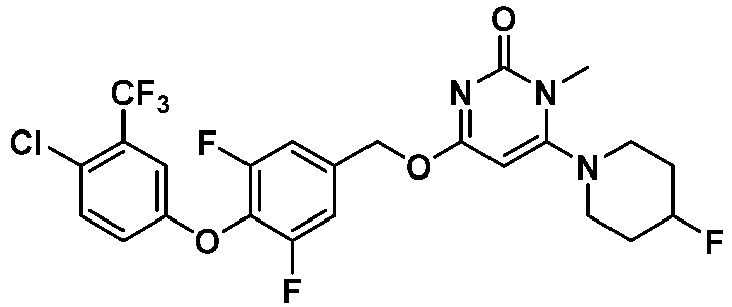
- Intermediate 22 and intermediate 37 were used as raw materials. Reference was made to the preparation method of Example 1. 1H NMR (400 MHz, Chloroform-d) δ 7.44 (d, J = 8.8 Hz, 1H), 7.32 (d, J = 2.9 Hz, 1H), 7.13 (t, J = 6.9 Hz, 2H), 7.03 (dd, J = 8.8, 2.8 Hz, 1H), 5.52 (s, 1H), 5.42 (s, 2H), 5.04 - 4.83 (m, 1H), 3.49 (s, 3H), 3.18 (td, J = 10.7, 9.2, 3.1 Hz, 2H), 3.09 - 2.99 (m, 2H), 2.13 - 1.94 (m, 4H). MS (ESI): 548 (M+H).
-

- Intermediate 19 and intermediate 39 were used as raw materials. Reference was made to the preparation method of Example 1. 1H NMR (400 MHz, Chloroform-d) δ 7.44 (d, J = 8.8 Hz, 1H), 7.31 (dd, J = 10.0, 2.3 Hz, 2H), 7.22 (d, J = 8.3 Hz, 1H), 7.11 (t, J = 8.2 Hz, 1H), 7.05 (dd, J = 8.8, 2.9 Hz, 1H), 5.51 (s, 1H), 5.42 (s, 2H), 3.49 (s, 3H), 3.19 - 3.12 (m, 4H), 2.19 (tt, J = 12.8, 6.2 Hz, 4H). MS (ESI): 548 (M+H).
-

- Intermediate 4 and intermediate 40 were used as raw materials. Reference was made to the preparation method of Example 1. 1H NMR (400 MHz, Chloroform-d) δ 7.75 (d, J = 2.0 Hz, 1H), 7.60 (dd, J = 8.7, 2.1 Hz, 1H), 7.53 (d, J = 8.7 Hz, 1H), 7.41 (d, J = 2.8 Hz, 1H), 7.18 (dd, J = 8.7, 2.8 Hz, 1H), 6.91 (d, J = 8.6 Hz, 1H), 5.41 (s, 2H), 5.33 (s, 1H), 3.49 (s, 3H), 3.39 - 3.33 (m, 4H), 2.04 - 1.98 (m, 4H). MS (ESI): 505 (M+H).
The compounds in the following examples were prepared by referring to the preparation method of example 1.example compound name structural formula raw materials MS (ESI) 40 2-(4-chloro-3-(trifluorome thyl)phenoxy)-5-(((1-meth yl-2-oxo-6-(piperidin-1-yl) -1,2-dihydropyrimidin-4-y l)oxy)methyl)benzonitrile 
intermediate 8, intermediate 40 519 (M+H) 41 4-((3-fluoro-4-((2-(trifluor omethyl)pyridin-4-yl)oxy) benzyl)oxy)-1-methyl-6-m orpholinopyrimidin-2(1H ) -one 
intermediate 5, intermediate 48 481 (M+H) 42 5-(((1-methyl-6-morpholin yl-2-oxo-1,2-dihydropyrim idin-4-yl)oxy)methyl)-2-(( 5-(trifluoromethyl)pyridin-3-yl)oxy)benzonitrile 
intermediate 5, intermediate 49 488 (M+H) 43 4-((3,5-difluoro-4-((5-(trifl uoromethyl)pyridin-3-yl)o xy)benzyl)oxy)-1-methyl-6-morpholinopyrimidin-2( 1H )-one 
intermediate 5, intermediate 50, 499 (M+H) 44 4-(2,6-difluoro-4-(((1-met hyl-6-morpholinyl-2-oxo-1,2-dihydropyrimidin-4-yl )oxy)methyl)phenoxy)-2-(t rifluoromethyl)benzonitril e 
intermediate 5, intermediate 51 523 (M+H) 45 4-(2-fluoro-4-(((1-methyl-6-morpholinyl-2-oxo-1,2-d ihydropyrimidin-4-yl)oxy) methyl)phenoxy)-2-(triflu oromethyl)benzonitrile 
intermediate 5, intermediate 52 505 (M+H) 46 4-(2-cyano-4-(((1-methyl-6-morpholinyl-2-oxo-1,2-d ihydropyrimidin-4-yl)oxy) methyl)phenoxy)-2-(triflu oromethyl)benzonitrile 
intermediate 5, intermediate 53 512 (M+H) 47 2-(4-fluoro-3-(trifluoromet hyl)phenoxy)-5-(((1-meth yl-6-morpholinyl-2-oxo-1, 2-dihydropyrimidin-4-yl)o xy)methyl)benzonitrile 
intermediate 5, intermediate 54, 505 (M+H) 48 5-(((1-methyl-6-morpholin yl-2-oxo-1,2-dihydropyrim idin-4-yl)oxy)methyl)-2-(( 6-(trifluoromethyl)pyridin-3-yl)oxy)benzonitrile 
intermediate 5, intermediate 55 488 (M+H) 49 4-((4-(4-chloro-3-(trifluor omethyl)phenoxy)-3-fluor obenzyl)oxy)-1-methyl-6-( piperidin-1-yl)pyrimidin-2 (1H)-one 
intermediate 8, intermediate 39 512 (M+H) 50 4-((4-(4-chloro-3-(trifluor omethyl)phenoxy)-3-fluor obenzyl)oxy)-6-(4-methox ypiperidin-1-yl)-1-methylp yrimidin-2(1H )-one 
intermediate 10, intermediate 39 542 (M+H) 51 4-((4-(4-chloro-3-(trifluor omethyl)phenoxy)-3-fluor obenzyl)oxy)-1-methyl-6-( 4-methylpiperazin-3-yl)py rimidin-2(1H )-one 
intermediate 16, intermediate 39, 527 (M+H) 52 4-((4-(4-chloro-3-(trifluor omethyl)phenoxy)-3,5-difl uorobenzyl)oxy)-6-(4-cycl opropylpiperazin-1-yl)-1-methylpyrimidin-2(1H )-on e 
intermediate 17, intermediate 37, 571 (M+H) 53 4-((4-(4-chloro-3-(trifluor omethyl)phenoxy)-3-fluor obenzyl)oxy)-6-(3,3-difluo ropyrrolidin-1-yl)-1-methy lpyrimidin-2(1H )-one 
intermediate 18, intermediate 39 534 (M+H) 54 (S)-4-((4-(4-chloro-3-(trifl uoromethyl)phenoxy)-3,5-difluorobenzyl)oxy)-1-met hyl-6-(3-methylmorpholin yl)pyrimidin-2(1H )-one 
intermediate 21, intermediate 37 546 (M+H) 55 (S)-4-((4-(4-(4-chloro-3-(t rifluoromethyl)phenoxy)-3 -fluorobenzyl)oxy)-1-meth yl-6-(3-methylmorpholinyl )pyrimidin-2(1H )-one 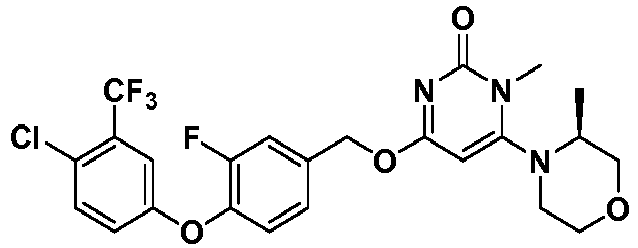
intermediate 21, intermediate 39 528 (M+H) 56 4-((4-(4-chloro-3-(trifluor omethyl)phenoxy)-3-fluor obenzyl)oxy)-6-(4-fluorop iperidin-1-yl)-1-methylp yr imidin-2(1H )-one 
intermediate 22, intermediate 39 530 (M+H) 57 4-((4-(4-chloro-3-(trifluor omethyl)phenoxy)-3-fluor ophenyl)oxy)-1-methyl-6-( 1-methyl-1H-pyrazol-4-yl) pyrimidin-2(1H )-one 
intermediate 25, intermediate 39 509 (M+H) 58 4-((4-(4-chloro-3-(trifluor omethyl)phenoxy)-3-fluor obenzyl)oxy)-1-methyl-6-( thien-3-yl)pyrimidin-2(1H )-one 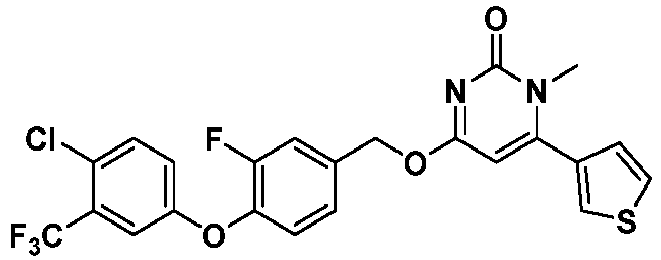
intermediate 26, intermediate 39 511 (M+H) 59 4-((4-(4-chloro-3-(trifluor omethyl)phenoxy)-3-fluor obenzyl)oxy)-1-methyl-6-( pyridin-4-yl)pyrimidin-2(1 H )-one 
intermediate 27, intermediate 39 506 (M+H) 60 4-((4-(4-chloro-3-(trifluor omethyl)phenoxy)-3-fluor obenzyl)oxy)-1-methyl-6-( pyridin-3-yl)pyrimidin-2(1 H )-one 
intermediate 28, intermediate 39 506 (M+H) 61 6-((4-(4-chloro-3-(trifluor omethyl)phenoxy)-3-fluor obenzyl)oxy)-3-methyl-[4,5'-dipyrimidin]-2(3H)-one 
intermediate 29, intermediate 39 507 (M+H) 62 6-((4-(4-chloro-3-(trifluor omethyl)phenoxy)-3-fluor obenzyl)oxy)-2'-methoxy-3-methyl-[4,5'-dipyrimidin ]-2(3H)-one 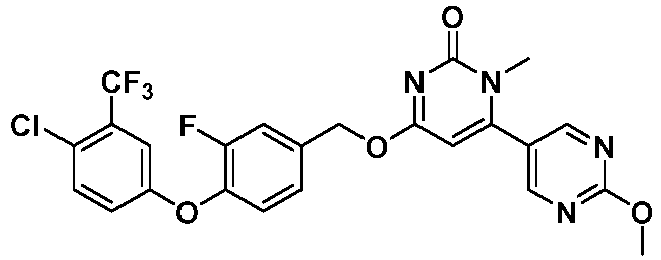
intermediate 30, intermediate 39 537 (M+H) 63 4-((4-(4-chloro-3-(trifluor omethyl)phenoxy)-3-fluor obenzyl)oxy)-6-(4-fluorop henyl)-1-methylpyrimidin-2(1H )-one 
intermediate 31, intermediate 39 523 (M+H) 64 4-((4-(4-chloro-3-(trifluor omethyl)phenoxy)-3-fluor obenzyl)oxy)-1-methyl-6-( 4-(trifluoromethyl)phenyl) pyrimidin-2(1H )-one 
intermediate 32, intermediate 39 573 (M+H) -

- Intermediate 65 (34 mg, 1 eq.), methyl iodide (25 ul, 5 eq.) and potassium carbonate (23 mg, 2 eq.) were mixed in acetone, and the mixture was reacted at room temperature overnight, evaporated to remove solvent, and separated by column chromatography to give 25 mg of white solid.
1H NMR (400 MHz, Chloroform-d) δ 7.44 (d, J = 8.8 Hz, 1H), 7.32 (d, J = 2.9 Hz, 1H), 7.16-7.09 (m, 2H), 7.04 (dd, J = 8.9, 3.0 Hz, 1H), 5.44 (s, 2H), 5.40 (s, 1H), 3.98 (s, 3H), 3.44 (s, 3H). MS (ESI): 477 (M+H). -
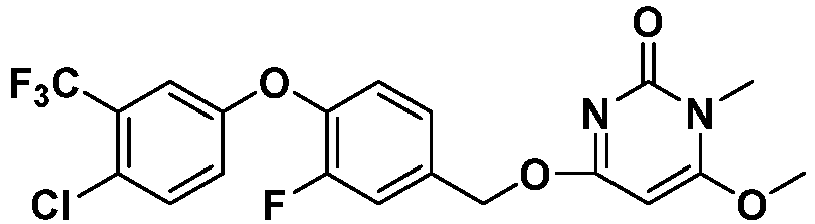
- Intermediate 58 and methyl iodide were used as raw materials. Reference was made to the preparation method of Example 65. 1H NMR (400 MHz, Chloroform-d) δ 7.43 (d, J = 8.8 Hz, 1H), 7.32 - 7.28 (m, 2H), 7.21 (d, J = 9.0 Hz, 1H), 7.10 (t, J = 8.2 Hz, 1H), 7.04 (dd, J = 8.8, 2.9 Hz, 1H), 5.42 (s, 2H), 5.37 (s, 1H), 3.95 (s, 3H), 3.42 (s, 3H). MS (ESI): 459 (M+H).
-

- Intermediate 59 and methyl iodide were used as raw materials. Reference was made to the preparation method of Example 65. 1H NMR (400 MHz, Chloroform-d) δ 7.76 (d, J = 2.0 Hz, 1H), 7.60 (dd, J = 8.7, 2.1 Hz, 1H), 7.54 (d, J = 8.7 Hz, 1H), 7.41 (d, J = 2.9 Hz, 1H), 7.19 (dd, J = 8.7, 2.8 Hz, 1H), 6.92 (d, J = 8.6 Hz, 1H), 5.42 (s, 2H), 5.36 (s, 1H), 3.96 (s, 3H), 3.42 (s, 3H). MS (ESI): 466 (M+H).
The compounds in the following examples were prepared by referring to the preparation method of example 65.example compound name structure formula raw materials MS (ESI) 68 4-((3-fluoro-4-((2-(tri fluoromethyl)pyridin-4-yl)oxy)benzyl)oxy) -6-methoxy-1-methyl pyrimidin-2(1H )-one 
intermediate 60 426 (M+H) 69 4-((3,5-difluoro-4-((2 -(trifluoromethyl)pyri din-4-yl)oxy)benzyl) oxy)-6-methoxy-1-m ethylpyrimidin-2(1H ) -one 
intermediate 61 443 (M+H) 70 4-((3,5-difluoro-4-((6 -(trifluoromethyl)pyri din-3-yl)oxy)benzyl) oxy)-6-methoxy-1-m ethylpyrimidin-2(1H ) -one 
intermediate 62 443 (M+H) 71 4-((4-(4-chloro-3-(trif luoromethyl)phenoxy )benzyl)oxy)-6-metho xy-1-methylpyrimidi n-2(1H )-one 
intermediate 57 441 (M+H) 72 5-(((6-methoxy-1-met hyl-2-oxo-1,2-dihydr opyrimidin-4-yl)oxy) methyl)-2-((5-(trifluo romethyl)pyridin-3-yl )oxy)benzonitrile 
intermediate 63 433 (M+H) 73 4-((3,5-difluoro-4-((5 -(trifluoromethyl)pyri din-3-yl)oxy)benzyl) oxy)-6-methoxy-1-m ethylpyrimidin-2(1H ) -one 
intermediate 64 444 (M+H) 74 4-(2,6-difluoro-4-(((6 -methoxy-1-methyl-2 -oxo-1,2-dihydropyri midin-4-yl)oxy)meth yl)phenoxy)-2-(triflu oromethyl)benzonitril e 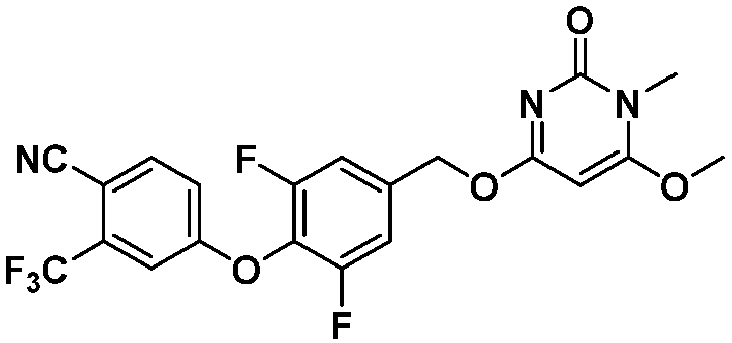
intermediate 65 468 (M+H) 75 4-(2-fluoro-4-(((6-me thoxy-1-methyl-2-ox o-1,2-dihydropyrimid in-4-yl)oxy)methyl)p henoxy)-2-(trifluoro methyl)benzonitrile 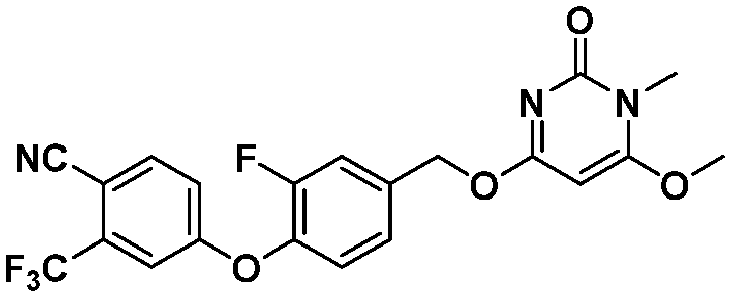
intermediate 66 450 (M+H) 76 4-(2-cyano-4-(((6-me thoxy-1-methyl-2-ox o-1,2-dihydropyrimid in-4-yl)oxy)methyl)p henoxy)-2-(trifluoro methyl)benzonitrile 
intermediate 67 457 (M+H) 77 2-(4-fluoro-3-(trifluor omethyl)phenoxy)-5-(((6-methoxy-1-meth yl-2-oxo-1,2-dihydro pyrimidin-4-yl)oxy)m ethyl)benzonitrile 
intermediate 68 450 (M+H) -

- The compound of Example 8 (30 mg, 1 eq.) and m-chloroperoxybenzoic acid (40 mg, 70%, 3 eq.) were mixed in dichloromethane and stirred at room temperature for 2h. Saturated aqueous sodium bicarbonate solution was added to quench the reaction and the mixture was extracted with dichloromethane, rinsed with saturated brine, dried over anhydrous sodium sulfate, filtered, evaporated to dryness, and separated by column chromatography to give 20 mg product. 1H NMR (400 MHz, Chloroform-d) δ 7.44 (d, J = 8.8 Hz, 1H), 7.31 (d, J = 3.0 Hz, 1H), 7.15 - 7.09 (m, 2H), 7.04 (dd, J = 8.8, 2.9 Hz, 1H), 5.58 (s, 1H), 5.43 (s, 2H), 3.61 - 3.54 (m, 4H), 3.52 (s, 3H), 3.31-3.23 (m, 4H). MS (ESI): 580 (M+H).
-

- Example 15 (24 mg, 1 eq.) and tartaric acid (6.6 mg, 1 eq.) were mixed in anhydrous methanol and stirred for 30 min. The raw materials were completely dissolved and the mixture was evaporated to remove solvent to give the salt product. 1H NMR (400 MHz, Chloroform-d) δ 7.44 (d, J = 8.5 Hz, 1H), 7.32 (s, 2H), 7.12 (d, J = 8.1 Hz, 2H), 7.04 (d, J = 9.4 Hz, 1H), 5.59 (s, 1H), 5.43 (s, 2H), 5.37 (s, 1H), 3.50 (d, J = 11.8 Hz, 9H), 3.18 (s, 4H), 2.80 (s, 3H). MS (ESI): 545 (M+H).
-

- Intermediate 73 (35 mg, 1 eq.), methyl iodide (25 ul, 5 eq.) and potassium carbonate (23 mg, 2 eq.) were mixed in acetone, and the mixture was reacted at room temperature overnight, evaporated to remove solvent, and separated by column chromatography to give 25 mg of white solid. 1H NMR (400 MHz, Chloroform-d) δ 7.44 (d, J = 8.8 Hz, 1H), 7.32 (d, J = 3.0 Hz, 1H), 7.15 - 7.08 (m, 2H), 7.03 (dd, J = 8.8, 2.9 Hz, 1H), 5.87 (s, 1H), 5.42 (s, 2H), 3.53 (s, 3H), 2.37 (s, 3H). MS (ESI): 461 (M+H).
-

- Intermediate 73 and ethyl iodide were used as raw materials. Reference was made to the preparation method of Example 80. 1H NMR (400 MHz, Chloroform-d) δ 7.44 (d, J = 8.7 Hz, 1H), 7.32 (d, J = 2.8 Hz, 1H), 7.15 - 7.07 (m, 2H), 7.06 - 7.00 (m, 1H), 5.84 (s, 1H), 5.41 (s, 2H), 4.06 (q, J = 7.0 Hz, 2H), 2.40 (s, 3H), 1.35 (t, J = 7.1 Hz, 3H). MS (ESI): 510 (M+H).MS (ESI): 475 (M+H).
-

- Intermediate 73 (45 mg, 1 eq.), intermediate 71 (39 mg, 3 eq.) and cesium carbonate (197mg, 6 eq.) were mixed in N, N-dimethylformamide and reacted at 110 °C under microwave for 60 min. The mixture was added with water, extracted with ethyl acetate three times, rinsed with water twice, dried over anhydrous sodium sulfate, filtered, evaporated to dryness, and separated by column chromatography to give 10 mg of white solid. 1H NMR (400 MHz, Chloroform-d) δ 7.44 (dd, J = 14.5, 8.6 Hz, 3H), 7.31 (d, J = 2.7 Hz, 1H), 7.18 (d, J = 8.3 Hz, 2H), 7.01 (dd, J = 8.9, 2.7 Hz, 1H), 5.67 (s, 1H), 5.12 (s, 2H), 4.92 (s, 2H), 3.90 (s, 3H), 2.37 (s, 3H). MS (ESI): 541 (M+H).
-
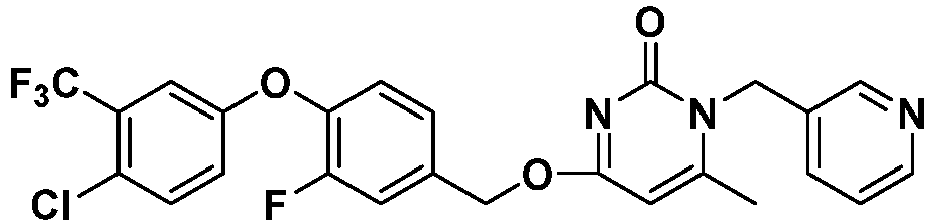
- Intermediate 75 and 3-(chloromethyl)pyridine hydrochloride were used as raw materials. Reference was made to the preparation method of Example 82. 1H NMR (400 MHz, Chloroform-d) δ 8.56 (dd, J = 5.0, 1.5 Hz, 1H), 8.54 (d, J = 1.9 Hz, 1H), 7.66 (dt, J = 8.2, 1.8 Hz, 1H), 7.43 (d, J = 8.8 Hz, 1H), 7.33 - 7.27 (m, 3H), 7.22 (d, J = 8.6 Hz, 1H), 7.10 (t, J = 8.1 Hz, 1H), 7.04 (dd, J = 8.9, 2.8 Hz, 1H), 5.85 (s, 1H), 5.43 (s, 2H), 5.27 (s, 2H), 2.30 (s, 3H). MS (ESI): 538 (M+H).
- Anhydrous ethanol was used as solvent to make a 25mg/ml mother liquor. The solution was aliquoted, stored at -80 °C and diluted 900 times before use (about 50 µM of concentration)
- The solution was prepared just before use. Triple distilled water was used to make a concentration of 1.1mg/ml, and an appropriate amount of 0.1M NaOH was added until DTNB was just dissolved.
- Lp-PLA2 activity was determined by using 2-thio-PAF as substrate. The thiol group produced upon the hydrolysis of 2-thio-PAF can react with DTNB to generate a yellow substance. The optical density at 414 nm can be detected to reflect Lp-PLA2 activity.
-
1) The corresponding reagents were added according to Table 1 and mixed uniformly by shaking.Table 1: The list of the reaction system blank well sample well control well reaction buffer 30 µL 20 µL 20 µL rabbit serum (source of the enzyme) 10 µL 10 µL DMSO 10 µL 10 µL sample (in DMSO) 10L
2) 10 µL of DTNB was added to each well.
3) 150 µL of 2-thio-PAF was added to each well and shaken for 15 s on a microplate reader to mix the liquid in the well uniformly. The detection was carried out at 414 nM over 10 minutes, once per minute and the slope was measured. The inhibitory ratio was calculated according to the following formula:
- 1.1.2 The experimental results are shown in Table 2.
Table 2: The inhibitory activity of part of the compounds at various concentrations on Lp-PLA2 (rabbit serum as the source of enzyme) Compound inhibitory ratio, % 1 µM 100 nM 10 nM Example 1 99.06 83.61 32.25 Example 5 97.29 93.75 49.17 Example 6 96.60 91.15 70.08 Example 7 90.30 81.95 41.89 Example 8 91.04 87.99 58.06 Example 9 95.17 92.65 74.51 Example 10 96.96 88.23 45.33 Example 11 100 83.5 29.52 Example 15 96.03 96.58 46.16 Example 16 96.38 77.43 13.22 Example 17 93.90 82.5 34.54 Example 18 NT 80.62 40.59 Example 19 NT 59.67 - Example 20 NT 54.17 - Example 21 NT 65.39 33.18 Example 24 NT 63.59 35.91 Example 25 96.57 92.07 47.54 Example 26 93.45 57.30 - Example 27 94.46 88.82 34.43 Example 29 97.09 83.46 22.58 Example 34 95.62 54.15 - Example 65 95.08 77.36 32.32 "-" indicates no inhibitory activity; "NT" indicates no test. - All the compounds listed in Table 2 had a Lp-PLA2 inhibitory ratios of greater than 50% at the concentration of 100 nM, wherein the compounds in example 6 and example 9 showed the best activity in vitro in rabbit serum and their Lp-PLA2 inhibitory ratios reached 70% at the concentration of 10 nM.
-
1) The corresponding reagents were added according to Table 3 and mixed uniformly by shaking.Table 3: The list of the reaction system blank well sample well control well reaction buffer 30 µL 20 µL 20 µL human recombinant enzyme (the source of enzyme) 10 µL 10 µL DMSO 10 µL 10 µL sample (in DMSO) 10 L
2) 10 µL of DTNB was added to each well.
3) 150 µL of 2-thio-PAF was added to each well and shaken for 15 s on a microplate reader to mix the liquid in the well uniformly. The detection was carried out at 414 nM over 10 minutes, once per minute and the slope was measured. The inhibitory ratio was calculated according to the following formula:
- 1.2.2 The experimental results are shown in Table 4.
Table 4: The inhibitory activity of part of the compounds on Lp-PLA2 (human recombinant enzyme as the source of enzyme) compound number inhibitory ratio, % 100 nM 10 nM Example 1 84.91 48.52 Example 5 100 92.43 Example 6 100 89.13 Example 7 94.15 57.14 Example 8 95.67 66.63 Example 9 96.55 83.11 Example 10 100 86.23 Example 11 93.17 79.14 Example 15 100 77.03 Example 16 92.41 55.33 Example 17 96.03 63.92 Example 18 80.1 91.95 Example 19 89.74 53.63 Example 20 90.40 46.94 Example 21 90.06 82.83 Example 24 95.55 89.77 Example 25 100 89.21 Example 27 100 90.65 Example 31 91.46 49.16 Example 32 84.47 43.85 Example 33 92.86 78.84 Example 34 95.62 53.88 Example 65 97.13 75.36 "-" indicates no inhibitory activity; "NT" indicates no test. - All the compounds listed in Table 4 had a Lp-PLA2 inhibitory ratio of greater than 50% at a concentration of 10 nM, wherein the compounds in examples 5, 6, 10, 18, 24, 25 and 27 showed the best activity in vitro in human recombinant enzymes, and their Lp-PLA2 inhibitory ratios reached about 90% at the concentration of 10 nM.
-
1) The corresponding reagents were added according to Table 5 and mixed uniformly by shaking.Table 5: The list of the reaction system blank well sample well control well reaction buffer 30 µL 20 µL 20 µL rat serum (the source of enzyme) 10 µL 10 µL DMSO 10 µL 10 µL sample (in DMSO) 10 L
2) 10 µL of DTNB was added to each well.
3) 150 µL of 2-thio-PAF was added to each well and shaken for 15 s on a microplate reader to mix the liquid in the well uniformly. The detection was carried out at 414 nM over 10 minutes, once per minute and the slope was measured. The inhibitory ratio was calculated according to the following formula:
- 1.3.2 The experimental results are shown in Table 6.
Table 6: The inhibitory activity of part of the compounds on Lp-PLA2 (rat serum as the source of enzyme) compound number inhibitory ratio, % 1 µM 100 nM 10 nM Example 1 100 64.69 11.84 Example 5 NT 73.23 18.21 Example 6 NT 86.85 38.66 Example 8 77.05 67.55 18.97 Example 9 89.94 83.24 42.03 Example 10 NT 82.5 22.5 Example 11 100 83.50 29.52 Example 15 NT 78.94 23.09 Example 16 NT 50.35 6.84 Example 17 NT 50.55 13.86 Example 18 NT 91.69 27.75 Example 19 NT 18.06 - Example 20 NT 43.27 - Example 21 NT 82.48 27.65 Example 24 NT 100 71.86 Example 25 NT 100 60.04 Example 27 NT 100 94.11 Example 65 100 81.68 33.51 "-" indicates no inhibitory activity; "NT" indicates no test. - All the compounds listed in Table 6, except the compounds of Example 19 and Example 20, had a Lp-PLA2 inhibitory ratio of greater than 50% at the concentration of 10 nM, wherein the compound in example 27 showed the best activity in vitro in rat serum and its Lp-PLA2 inhibitory ratio exceeded 90% at the concentration of 10 nM.
- Each group had 5 SD rats and 50 mg/kg test agents was administrated orally to the rats. Darapladib was dissolved in ddH2O, and the other compounds were dissolved in sodium carboxymethyl cellulose (CMC sodium). Blood was collected from the orbits of the rats at 0 h before administration and at 1h, 3h, 5h, 7h and 24h after administration and placed at room temperature for 30 minutes before centrifugation. Serum was collected and the Lp-PLA2 activity in serum was measured.
- According to the results of the in vitro activity assays, part of the compounds was selected for an in vivo test of the Lp-PLA2 inhibitory activity in SD rats. The experimental results were shown in
Fig. 1 and Fig. 2 . - The results showed that the selected compounds were able to significantly inhibit the activity of Lp-PLA2 in serum of the SD rats after a single administration, wherein the compounds of example 27 (50 mg/kg), example 65 (50 mg/kg), and example 66 (50 mg/kg) showed in vivo activities comparable to darapladib (50 mg/kg), a Lp-PLA2 inhibitor currently under Phase III clinical trials. The in vivo experimental results showed that the orally administered example compounds exhibited a remarkable Lp-PLA2 inhibitory activity in rats, indicating that the example compounds have a promosing prospect for development.
- 12.12 g of TRIS (tris-hydroxymethyl aminomethane) was weighed, dissolved in 800 mL of water, and adjusted to pH 7.4 with HCl (2 M), and then the volume was adjusted to 1000 mL with water.
- MgCl2 (100 mM) solution was prepared with 0.1 M Tris/HCl buffer, aliquoted and stored at -20 °C. The incubation concentration of MgCl2 was 5.0 mM.
- NADPH (10 mM) solution was prepared with 0.1 M Tris/HCl buffer, aliquoted and stored at -20 °C. The incubation concentration of NADPH was 1.0 mM.
- Human S9 (purchased from Reid Liver Disease Research (Shanghai) Co., Ltd.) was diluted 10 times with 0.1 M Tris/HCl and rat S9 (purchased from Reid Liver Disease Research (Shanghai) Co., Ltd.) was diluted 5 times with 0.1 M Tris/HCl, so that the incubation concentrations of human and rat S9 were equivalent to the incubation concentrations of the liver microsomes in the corresponding species (both incubation concentrations of liver microsomes in human and rats are 0.33 mg/mL).
- The compound was dissolved in DMSO to obtain a stock solution at a concentration of 10 mM. The stock solution was diluted to 1 mM with DMSO and then diluted with 0.1% BSA-water to obtain a working solution at a concentration of 2 µM. In the incubation system, the working solution of 2 µM was diluted 20 times to a final concentration of 0.1 µM. The concentration of DMSO in the incubation system was ≤ 0.01%.
- 2 mM VIVID stock solution (purchased from Shanghai Beili Biotechnology Co., Ltd.) was diluted 50 times with the 2 µM working solution for the compounds to be tested. In the incubation system, the mixed working solution of VIVID and the compounds to be tested were diluted 20 times
- S9 was incubated in a 96-well plate and each incubation system was 450 µL. 0.1 M Tris buffer (pH 7.4), MgCl2, S9 and +NADPH/-NADPH were pre-incubated at 37 ° C for 10 min (600 rpm), and then the reaction was initiated by adding a compound to be tested. The same volume of glacial methanol was adde to terminate the reaction after 0, 7, 17, 30 and 60 minutes, respectively.
- 3.3 The experimental results were shown in Table 7.
Table 7: The metabolic stability of part of the compounds in human and rat S9 Compound number Tested species Reductive coenzyme II (NADPH) Half life (min) Example 1 human addition - Example 1 rat addition 1217 Example 6 human addition 563 Example 6 rat addition 149 Example 11 human addition 457 Example 11 rat addition 46 Example 12 human addition 233 Example 12 rat addition 90 Example 17 human addition - Example 17 rat addition 160 Example 21 human addition - Example 21 rat addition 11692 Example 24 human addition 592 Example 24 rat addition 285 Example 25 human addition 415 Example 25 rat addition 251 Example 65 human addition 425 Example 65 rat addition 161 "-" indicates that the compound was stable in the test system and its half-life was unable to be measured. - The experimental results show that all the compounds listed in Table 7 have a good metabolism stability, and furthermore, the metabolism stabilities in human and rat were in a similar trend, which indicates a good species consistency. Some of the compounds such as the compounds in example 1, example 21, example 24, and example 25 showed a superior metabolism stability.
- The effect of the example compounds on retinopathy of STZ-induced diabetic rats was observed.
- Test compound: The compounds of example 11 and example 27 were dissolved in 0.25% CMC-Na.
Positive control: Darapladib, dissolved in ultrapure water. - Varieties: commercially available SD rats; grade: SPF grade; gender: male; weight 180 ∼ 220g.
- The compounds of examples 11 and 27 and darapladib were administered orally to the two animal groups of administration at a dose of 25 mg/kg/day, and the administration period was 4 weeks.
- All SD rats were preconditioned for 3-5 days. Except for the normal control group, all the other rats were injected intraperitoneally with STZ. The specific method of model establishment was as follows: fasting rats (fasting for 16 h, free to drink water) were weighed and injected with 50 mg/kg of STZ through tail vein to build the diabetic rat model. STZ was prepared with 10 mM pH 4.6 sodium citrate buffer (freshly prepared on site, placed on ice, kept at low temperature to avoid STZ volatilization). 7 days after injection and after 10 h of fasting, the blood was collected from the rat submandibular vein and the blood glucose was measured. The diabetic model was established when the blood glucose of the rats was more than 10 mmol/L.
- Twenty diabetic rats whose blood glucose values were more than 10 mmol/L and close to the average value were selected and grouped by stratified randomization into the following 4 groups according to the blood glucose value: model control group, the compound of example 11, the compound of example 27 and darapladib positive control group and each group had 5 rats. The rats were administrated once a day. Another 5 rats without injection of STZ were used as normal control group.
- The activity of LP-PLA2 in serum was measured before administration, at 3 h and 24 h after administration on the first day, at 24 h after administration on the second day, at 2 weeks and at 4 weeks after administration.
- The eyeballs of the rats were removed, frozen and sectioned and the thickness of each slice was 8 µm. The slice was stained with conventional hematoxylin/eosin and photographed with a 400-fold optical microscope (Eclipse 80i, Nikon). The thickness of the retina was analyzed using the software Image-Pro plus 6.0. Five points were selected in each photo.
- Statistical analysis was performed with the EXCEL 2007 software. All data were expressed as mean ± standard error (
χ ±SEM). The experiment results were evaluated by Student T test. - It can be seen from
Fig. 3 that the in vivo serum Lp-PLA2 activity of the diabetic rats in the model control group was significantly higher compared with the normal control group. Compared with the model control group, the in vivo serum Lp-PLA2 activity of the rats in groups of the example 11 compound, the example 27 compound and darapladib were all desreased significantly at 3 hours, 24 hours, 48 hours, 2 weeks and 4 weeks after administration. The experiment results showed that the compounds of example 11 and example 27 administered orally for a long term can continuously and effectively inhibit the activity of serum Lp-PLA2 in rats. - As can be seen from
Fig. 4 , compared with the normal control group, the thickness of the retina of the diabetic rats in model control group were significantly increased. Compared with the model control group, the retinal thickness of the rats in the example 11 compound group, the example 27 compound group and the darapladib group were significantly decreased. STZ-induced diabetic rats are considered to be an effective animal model of diabetic macular edema, wherein long-term hyperglycemia leads to dysfunction of the blood retinal barrier and increased barrier permeability, which in turn leads to the consequence that entrance of the fluid and protein from the peripheral blood into the retina cannot be strictly controlled, and once the fluid and protein of the peripheral blood accumulate in the retinal parenchyma, it will lead to edema of the retina, which is pathologically manifested as the increase of the the retinal thickness. Thus, the experimental data showed that the compound of example 11 and the compound of example 27 have a promising prospect to be used for the treatment of diabetic macular edema. - The effect of long-term administration of the compound of example 11 on blood glucose and other biochemical indexes of
spontaneous type 2 diabetic obese rats (ZDF) were observed. - Test compound: The compound of Example 11, dissolved in 0.25% CMC-Na.
- Positive control: metformin, produced by China-US Shanghai Squibb Pharmaceutical Co., Ltd.; dissolved in ultra-pure water.
- Varieties: ZDF rats, ZL rats; Grade: SPF grade; Age: 56-62 days; Gender: Male; Source: Beijing Weitong Lihua Experimental Animal Co., Ltd.
- The kits for total cholesterol (TC), triglyceride (TG), high density lipoprotein cholesterol (HDL-C), low density lipoprotein cholesterol (LDL-C), blood glucose (GLU), aspartate transferase (AST), alanine aminotransferase (ALT), alkaline phosphatase (ALP), urea (BUN), creatinine (CREA) and the like were purchased from Shanghai Shenneng Desai Diagnostic Technology Co., Ltd. The reagents for glycosylated hemoglobin (HbA1c) assay was purchased from Trinity Biotech Corporation. Insulin ELISA Assay Kit was purchased from BertinPharma Corporation. Urine microalbumin (mALB) and other ELISA kits were purchased from Nanjing Jiancheng Bioengineering Institute.
- Two ZDF rat groups were orally administered with the compound of example 11 and metformin, respectively. The dose of the compound of example 11 was 25 mg/kg/day for the first 4 days and adjusted to 10 mg/kg/day afterwards. The dose of metformin was 300 mg/kg/day. Both were administered for a period of 6 weeks.
- Thirty male ZDF rats (56 ∼ 62 days old) were fed with Purina # 5008 feed (purchased from Nongbiao Purina Feed Co., Ltd.) and the other 6 ZL rats were fed with normal diet as normal control. After fed for 2 weeks, the empty body weights of the fasting rats (fasting for 10 h, free to drink water) were weighed. 0.3 mL blood was collected through tail vein and placed in EDTA anticoagulant tube for the determination of glycosylated hemoglobin (HbA1c). Another 0.5 mL blood was collected and centrifugated at 3000 rpm for 10 min to separate serum which then was determined by automatic biochemical analyzer Model 7020. The serum was separated and then blood glucose and blood lipid (GLU, TC, TG) and hepatorenal function (ALT, AST, ALP, BUN, CREA) were determined. The ZDF rats with blood glucose far from the mean value or having other abnormal indexes were removed and 18 ZDF rats with GLU close to the mean value were selected.
- Using the blood glucose value as the main indicator and also taking into account the glycosylated hemoglobin, insulin and other indicators, the 18 selected ZDF rats were evenly grouped by stratified randomization to the following groups: model control group, example 11 compound group, positive control group, 6 rats in each group. Rats in each group were given the corresponding drug or solvent by gavage through oral once a day in the morning for 6 continuous weeks. Another 6 ZL rats were taken as normal control group. During the period of administration, the model control group, the example 11 compound group and the positive control group were fed with Purina # 5008 feed, and the normal control group was fed with normal feed.
- Every 2 weeks the rats were fasted but allowed free drinking for 10h, the empty body weight was weighed and 0.5 mL blood was collected thurough the tail vein to determine the blood glucose levels. The levels of insulin, glycosylated hemoglobin and triglyceride were measured at the 4th week of administration and at the end of the administration. The levels of low density lipoprotein and high density lipoprotein were measured at the 6th week of administration. The urine samples were collected once before the end of the administration and 24 h (11:00 am to 11:00 am the next day) urine samples were collected to detect urinary albumin content in urine.
- Statistical analysis was performed with EXCEL 2007 software. All data were expressed as mean ± standard error (
χ ±SEM). and the results were evaluated by Student T test. - As can be seen from
Fig. 5 , compared with the normal control group, the blood glucose levels of the diabetic rats in the model control group were significantly increased. Compared with the model control group, the blood glucose level of the example 11 compound group was significantly decreased at 2 weeks, 4 weeks and 6 weeks after administration. The experimental results showed that long-term oral administration of the compound of example 11 was effective in significantly reducing blood glucose levels in ZDF rats. - As can be seen from
Fig. 6 andFig. 7 , compared with the model control group, the insulin level was significantly increased in the example 11 compound group at 4 weeks after the administration, and the insulin level was also remarkably increased at 6 weeks. - As can be seen from
Fig. 8 andFig. 9 , the Example 11 compound group had significantly reduced glycosylated hemoglobin levels at 4 weeks and 6 weeks after the administration compared to the model control group. - As can be seen from
Fig. 10 andFig. 11 , the triglyceride level of the example 11 compound group was significantly decreased compared with that of the model control group at 4 weeks after the administration. - As can be seen from
Fig. 12 , the level of low-density lipoprotein of the example 11 compound group was significantly reduced compared with that of the model control group at 6 weeks after the administration. As can be seen fromFig. 13 , there was no significant change in the high-density lipoprotein level in the example 11 compound group at 6 weeks after the administration compared with that in the model control group. - As can be seen from
Fig. 14 , the urinary albumin levels in the urine of the example 11 compound group were significantly reduced at 6 weeks after the administration compared with that in the model control group. - The experimental results demonstrate that long-term administration of the example 11 compound can significantly reduce the level of blood glucose in
spontaneouse type 2 diabetic ZDF rats, significantly lower the level of glycosylated hemoglobin and up-regulate the level of insulin, indicating that the compound of example 11 has an excellent prospect for the treatment of diabetes. - In addition, long-term administration of the example 11 compound can significantly down-regulate the level of triglyceride and the level of low-density lipoprotein in
spontaneous type 2 diabetic ZDF rats without significant effect on high density lipoprotein, indicating that the compound of example 11 has an excellent prospect for dyslipidemia, such as atherosclerosis. - Finally, long-term administration of the example 11 compound can significantly down-regulate urinary albumin level in the urine of
spontaneous type 2 diabetic ZDF rats, indicating that the compound of example 11 has a promising prospect for kidney diseases, such as diabetic nephropathy. - All documents mentioned in the present invention are incorporated herein by reference, as if each document were individually recited for reference. It is also to be understood that those skilled in the art can make various changes or modifications to the present invention upon reading of the above teachings of the present invention, and these equavilents also fall within the scope of the appended claims.
Claims (10)
- A compound of general formula I, a stereoisomer or pharmaceutically acceptable salt thereof:
 wherein, R1 and R3 are independently selected from the group consisting of H, C1-C6 alkyl, C3-C8 cycloalkyl, C6-C10 aryl, -(CH2)q-(3-8 membered heteroaryl);R2 is C1-C6 alkyl, C2-C6 alkenyl, C2-C6 alkynyl, C3-C8 cycloalkyl, 3-8 membered heterocyclic radical, -O-(3-8 membered heterocyclic radical), C3-C8 cycloalkenyl, C1-C6 alkoxy, C3-C8 cycloalkyloxy, C6-C10 aryl, -O-(C6-C10 aryl), -OH, -CN, halogen, -(CH2)m-(3-8 membered heteroaryl) or -NR4R5;X is O, S, -(CH2)m or -N(R4)-;n is 0, 1, 2, 3 or 4;Ar is C6-C10 aryl or 3-8 membered heteroaryl;Y is absent, -A-(C6-C10 aryl) or -A-(3-8 membered heteroaryl), wherein, A is O, S, -(CH2)m- or -N(R4)-,wherein,said C1-C6 alkyl, C2-C6 alkenyl, C2-C6 alkynyl, C1-C6 alkoxy, C3-C8 cycloalkyl, C3-C8 cycloalkenyl, 3-8 membered heteroaryl, -(CH2)q-(3-8 membered heteroaryl), 3-8 membered heterocyclic radical, C6-C10 aryl are optionally substituted with a group selected from the group consisting of: -OH, -CN, =O, C1-C6 alkyl, C6-C10 aryl, C1-C6 alkoxy, C1-C6 alkoxyacyl, C1-C6 alkanoyl, C1-C6 alkanoyloxy, C3-C8 cycloalkyl, 3-8 membered heterocyclic radical, -C(O)-3-8 membered heterocyclic radical, carboxyl, halogen, halo-C1-C6 alkyl, -S(O)R4, -SO2R4, -NO2, -NR4R5;each R4 and each R5 are independently selected from the group consisting of H, C1-C6 alkyl, C1-C6 alkanoyl, -(CH2)m-(C1-C6 alkoxy), C3-C8 cycloalkyl, C2-C6 alkenyl, C2-C6 alkynyl, 3-8 membered heterocyclic radical, C3-C8 cycloalkenyl and C6-C10 aryl;each m is independently 0, 1, 2, 3 or 4;q is independently 1, 2, 3 or 4.
 - The compound of general formula I, a stereoisomer, deuterated form or pharmaceutically acceptable salt thereof according to claim 1, wherein said compound of general formula I has one or more of the following features:(1) R1 is H, C1-C6 alkyl or -(CH2)q-(3-8 membered heteroaryl), wherein,
q is 1, 2 or 3; said C1-C6 alkyl, -(CH2)q-(3-8 membered heteroaryl) are optionally substituted with a group selected from the group consisting of C1-C4 alkyl, C6-C10 aryl, C1-C4 alkoxy, halogen, halo-C1-C4 alkyl;(2) R3 is H or C1-C6 alkyl; preferably, R3 is H or C1-C4 alkyl; most preferably, R3 is H;(3) n is 1 or 2;(4) X is O, S, or -N(R4)-, whereinR4 is H, C1-C6 alkyl. - The compound of general formula I, a stereoisomer, deuterated form or pharmaceutically acceptable salt thereof according to claim 1, wherein R2 is C1-C6 alkyl, C3-C8 cycloalkyl, 3-8 membered heterocyclic radical, C1-C6 alkoxy, C6-C10 aryl, -(CH2)m-(3-8 membered heteroaryl) or -NR4R5, wherein,
said 3-8 membered heterocyclic radical, C6-C10 aryl, -(CH2)m-(3-8 membered heteroaryl) are optionally substituted with a group selected from the group consisting of: =O, C1-C6 alkyl, C6-C10 aryl, C1-C6 alkoxy, C3-C8 cycloalkyl, halogen, halo-C1-C6 alkyl;
R4 and R5 are independently selected from the group consisting of H, C1-C6 alkyl, -(CH2)m-(C1-C6 alkoxy), C3-C8 cycloalkyl;
m is 0, 1, 2 or 3. - The compound of general formula I, a stereoisomer, deuterated form or pharmaceutically acceptable salt thereof according to claim 1, wherein said compound of general formula I has one or two of the following features:(1) Ar is substituted or unsubstituted phenyl, substituted or unsubstituted naphthyl, substituted or unsubstituted 5-6 membered heteroaryl, wherein said substitution means that the phenyl, naphthyl or 5-6 membered heteroaryl has 1-4 substituents selected from the group consisting of: -CN, C1-C6 alkyl, C1-C6 alkoxy, halogen, hydroxyl, halo-C1-C6 alkyl, halo-C1-C6 alkoxy;(2) Y is absent, -A-(C6-C10 aryl) or -A-(5-6 membered heteroaryl), wherein, A is O or S; said C6-C10 aryl or 5-6 membered heteroaryl optionally has 1-3 substituents selected from the group consisting of: C1-C4 alkyl, -CN, halogen, halo-C1-C6 alkyl.
- The compound of general formula I, a stereoisomer, deuterated form or pharmaceutically acceptable salt thereof according to claim 1, wherein said compound of general formula I is:


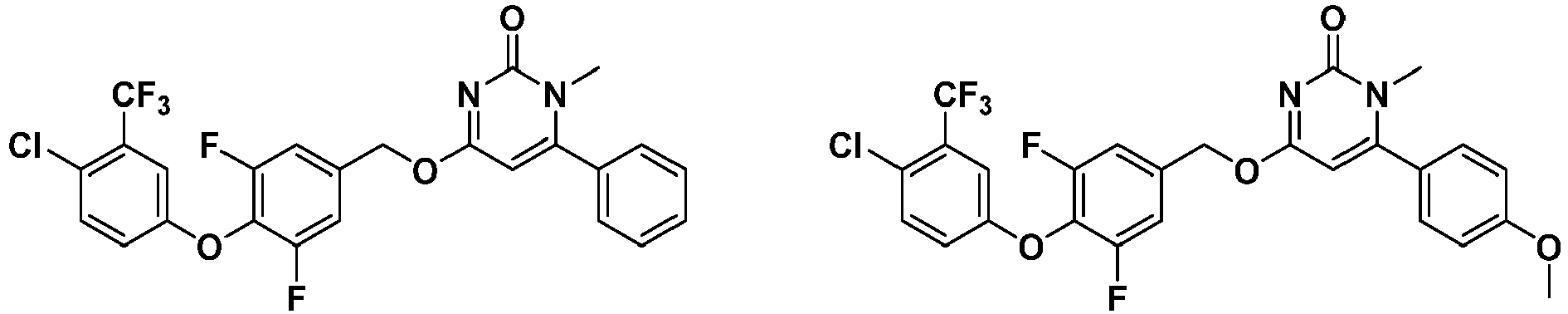
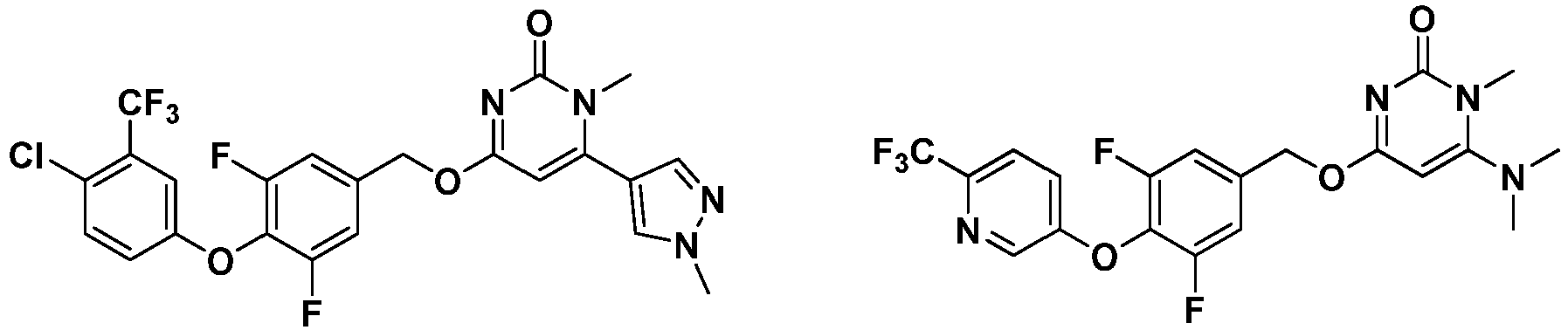








- A method for preparing the compound of general formula I, a stereoisomer, deuterated form or pharmaceutically acceptable salt thereof according to claim 1, wherein said method comprises the following steps:
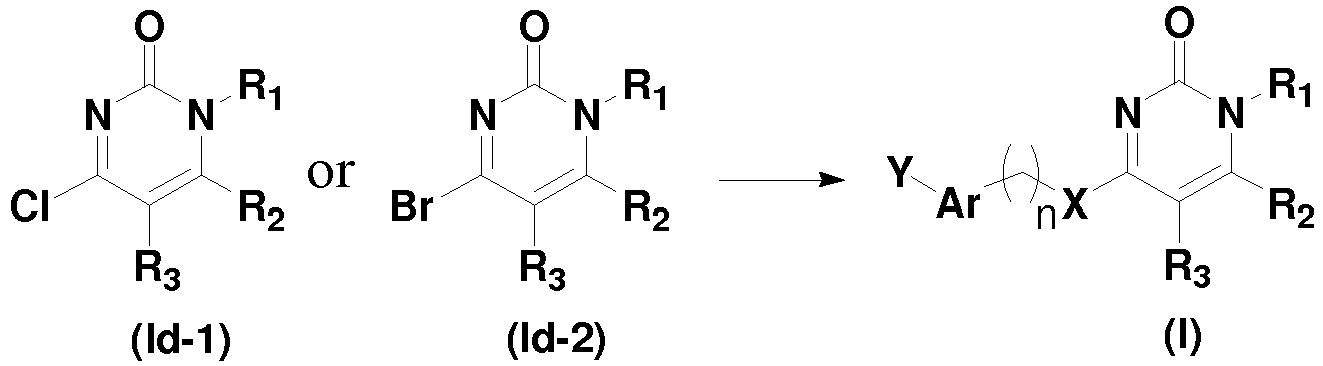
or said method comprises the following steps:
wherein, R1, R2, R3, Y, Ar, n, and X are defined as in claim 1. - A pharmaceutical composition, which comprises the compound of general formula I, a stereoisomer, deuterated form or pharmaceutically acceptable salt thereof according to claim 1; and
a pharmaceutically acceptable carrier. - Use of the compound of general formula I, a stereoisomer, deuterated form or pharmaceutically acceptable salt thereof according to claim 1 or the pharmaceutical composition according to claim 7, wherein the use is in:(1) the manufacture of a medicament for inhibiting Lp-PLA2;(2) the manufacture of a medicament for preventing and/or treating and/or alleviating a disease associated with the Lp-PLA2 enzyme activity;(3) the manufacture of a medicament for reducing glycosylated hemoglobin level and/or up-regulating insulin level;(4) the manufacture of a medicament for down-regulating triglyceride level or low-density lipoprotein level; and/or(5) the manufacture of a medicament for down-regulating urinary albumin level in urine.
- The use according to claim 8, wherein said disease associated with the Lp-PLA2 enzyme activity is atherosclerosis, diabetes, diabetic eye diseases, diabetic macular edema, kidney diseases, diabetic nephropathy, hypertension, angina, rheumatoid arthritis, stroke, myocardial infarction, post ischemia and-reperfusion conditions, psoriasis, brain inflammatory diseases, Alzheimer's disease, various neuropsychiatric disorders, schizophrenia, ischemia-reperfusion injury, sepsis, acute inflammatory diseases, chronic inflammatory diseases, neurodegenerative diseases, glaucoma macular degeneration or Alzheimer's disease.
- An intermediate of general formula I compound, wherein the structure of said intermediate is:

Applications Claiming Priority (2)
| Application Number | Priority Date | Filing Date | Title |
|---|---|---|---|
| CN201410855183.5A CN105777653A (en) | 2014-12-26 | 2014-12-26 | Pyrimidinone compounds used as Lp-PLA2 inhibitors and pharmaceutical compositions thereof |
| PCT/CN2015/099252 WO2016101927A1 (en) | 2014-12-26 | 2015-12-28 | Pyrimidone compounds used as lp-pla2 inhibitors and pharmaceutical compositions thereof |
Publications (3)
| Publication Number | Publication Date |
|---|---|
| EP3239135A1 true EP3239135A1 (en) | 2017-11-01 |
| EP3239135A4 EP3239135A4 (en) | 2018-07-11 |
| EP3239135B1 EP3239135B1 (en) | 2022-05-04 |
Family
ID=56149300
Family Applications (1)
| Application Number | Title | Priority Date | Filing Date |
|---|---|---|---|
| EP15871995.5A Not-in-force EP3239135B1 (en) | 2014-12-26 | 2015-12-28 | Pyrimidone compounds used as lp-pla2 inhibitors and pharmaceutical compositions thereof |
Country Status (6)
| Country | Link |
|---|---|
| US (2) | US10280146B2 (en) |
| EP (1) | EP3239135B1 (en) |
| JP (1) | JP6491751B2 (en) |
| CN (2) | CN105777653A (en) |
| CA (1) | CA2972112C (en) |
| WO (1) | WO2016101927A1 (en) |
Families Citing this family (8)
| Publication number | Priority date | Publication date | Assignee | Title |
|---|---|---|---|---|
| CN105777653A (en) * | 2014-12-26 | 2016-07-20 | 中国科学院上海药物研究所 | Pyrimidinone compounds used as Lp-PLA2 inhibitors and pharmaceutical compositions thereof |
| CN106188063A (en) * | 2015-05-08 | 2016-12-07 | 中国科学院上海药物研究所 | Bicyclic compound used as Lp-PLA2 inhibitor, its preparation method and medical application |
| CN112574221B (en) * | 2019-09-30 | 2022-03-04 | 上海纽思克生物科技有限公司 | Tetracyclic pyrimidinone compounds, preparation method, composition and application thereof |
| CN113666930B (en) * | 2020-05-13 | 2022-10-25 | 上海纽思克生物科技有限公司 | Bridged pyrimidone compounds, preparation method, composition and application thereof |
| CN113912622B (en) * | 2020-07-10 | 2023-12-01 | 上海纽思克生物科技有限公司 | Tricyclic pyrimidinone compounds, preparation methods, compositions and uses thereof |
| CN115304620A (en) * | 2021-05-07 | 2022-11-08 | 上海赛默罗生物科技有限公司 | Pyrimidone derivatives, preparation method, pharmaceutical composition and application thereof |
| WO2025002454A1 (en) * | 2023-06-29 | 2025-01-02 | 上海赛默罗生物科技有限公司 | Use of compound in preparation of drug for preventing, relieving, assisting in treating, or treating lung injury |
| WO2025015951A1 (en) * | 2023-07-17 | 2025-01-23 | 上海枢境生物科技有限公司 | Bicyclo[5,6] imidazole pyrimidone derivative and preparation method therefor and use thereof |
Family Cites Families (15)
| Publication number | Priority date | Publication date | Assignee | Title |
|---|---|---|---|---|
| DE3023369A1 (en) * | 1980-06-23 | 1982-01-14 | Boehringer Mannheim Gmbh, 6800 Mannheim | ARYLOXYPROPANOLAMINE, METHOD FOR THE PRODUCTION THEREOF AND MEDICINAL PRODUCTS CONTAINING THESE COMPOUNDS |
| TW234077B (en) | 1992-07-17 | 1994-11-11 | Shell Internat Res Schappej B V | |
| WO2000075118A1 (en) * | 1999-06-03 | 2000-12-14 | Vertex Pharmaceuticals Incorporated | INHIBITORS OF c-JUN N-TERMINAL KINASES (JNK) |
| DK1263740T3 (en) | 2000-02-16 | 2006-11-13 | Smithkline Beecham Plc | Pyrimidin-4-one derivative as LDL-PLA2 inhibitor |
| GB0127139D0 (en) * | 2001-11-10 | 2002-01-02 | Smithkline Beecham | Novel compounds |
| JP2006500351A (en) | 2002-08-13 | 2006-01-05 | ワーナー−ランバート・カンパニー、リミテッド、ライアビリティ、カンパニー | Pyrimidine-2,4-dione derivatives as matrix metalloproteinase-13 inhibitors |
| JP2005350363A (en) | 2004-06-08 | 2005-12-22 | Kyorin Pharmaceut Co Ltd | 4-Trifluoromethylpyrimidine derivatives as heme oxygenase induction or induction promoters |
| CA2581623A1 (en) * | 2004-09-23 | 2006-03-30 | Reddy Us Therapeutics, Inc. | Novel pyridine compounds, process for their preparation and compositions containing them |
| JP2012006869A (en) | 2010-06-25 | 2012-01-12 | Ono Pharmaceut Co Ltd | Pyrimidinone compound and medicinal application thereof |
| JP2013537203A (en) * | 2010-09-20 | 2013-09-30 | グラクソ グループ リミテッド | Tricyclic compounds, production methods, and uses thereof |
| JP2013544854A (en) * | 2010-12-06 | 2013-12-19 | グラクソ グループ リミテッド | Compound |
| CA2842965A1 (en) * | 2011-07-27 | 2013-01-31 | Glaxo Group Limited | 2,3-dihydroimidazo[1,2-c] pyrimidin-5(1h)-one compounds use as lp-pla2 inhibitors |
| AR087309A1 (en) * | 2011-07-27 | 2014-03-12 | Glaxo Group Ltd | HETEROCICLIC COMPOUND OF SUBSTITUTED CONDENSED RINGS, PHARMACEUTICAL COMPOSITION THAT INCLUDES IT AND ITS USE FOR THE MANUFACTURE OF A MEDICINAL PRODUCT FOR THE TREATMENT OF NEUROGENERATIVE DISEASES AND ATEROSCLEROSIS |
| EP2948456A4 (en) * | 2013-01-25 | 2016-09-14 | Glaxosmithkline Ip Dev Ltd | Bicyclic pyrimidone compounds as inhibitors of lp-pla2 |
| CN105777653A (en) * | 2014-12-26 | 2016-07-20 | 中国科学院上海药物研究所 | Pyrimidinone compounds used as Lp-PLA2 inhibitors and pharmaceutical compositions thereof |
-
2014
- 2014-12-26 CN CN201410855183.5A patent/CN105777653A/en active Pending
-
2015
- 2015-12-28 JP JP2017534564A patent/JP6491751B2/en not_active Expired - Fee Related
- 2015-12-28 CN CN201580069866.0A patent/CN107108525B/en active Active
- 2015-12-28 CA CA2972112A patent/CA2972112C/en not_active Expired - Fee Related
- 2015-12-28 US US15/540,025 patent/US10280146B2/en not_active Expired - Fee Related
- 2015-12-28 WO PCT/CN2015/099252 patent/WO2016101927A1/en not_active Ceased
- 2015-12-28 EP EP15871995.5A patent/EP3239135B1/en not_active Not-in-force
-
2019
- 2019-03-12 US US16/299,636 patent/US10787422B2/en active Active
Also Published As
| Publication number | Publication date |
|---|---|
| CN107108525B (en) | 2020-05-19 |
| US10787422B2 (en) | 2020-09-29 |
| WO2016101927A1 (en) | 2016-06-30 |
| CA2972112A1 (en) | 2016-06-30 |
| CN105777653A (en) | 2016-07-20 |
| CN107108525A (en) | 2017-08-29 |
| US20190248751A1 (en) | 2019-08-15 |
| CA2972112C (en) | 2019-07-02 |
| US20180009766A1 (en) | 2018-01-11 |
| US10280146B2 (en) | 2019-05-07 |
| EP3239135B1 (en) | 2022-05-04 |
| JP6491751B2 (en) | 2019-03-27 |
| JP2018502105A (en) | 2018-01-25 |
| EP3239135A4 (en) | 2018-07-11 |
Similar Documents
| Publication | Publication Date | Title |
|---|---|---|
| EP3239135B1 (en) | Pyrimidone compounds used as lp-pla2 inhibitors and pharmaceutical compositions thereof | |
| EP3692040B1 (en) | Chemical compounds | |
| CN104334529B (en) | Compounds and compositions for inhibiting the activity of ABL1, ABL2 and BCR-ABL1 | |
| CN109020957B (en) | Heterocyclic compounds as MNK inhibitors | |
| CN104379574B (en) | For suppressing the heterocyclic carbamate derivatives of the activity of ABL1, ABL2 and BCR ABL1 | |
| CN101821266B (en) | Modulator of cystic fibrosis transmembrane channel regulator | |
| JP4834699B2 (en) | Pharmaceutical composition | |
| JP4846769B2 (en) | Pharmaceutical composition | |
| KR102317334B1 (en) | NEW 1-(4-PYRIMIDINYL)-1H-PYRROLO[3,2-c]PYRIDINE DERIVATIVES AS NIK INHIBITORS | |
| CN105294654B (en) | ALK kinase inhibitors and its preparation method and application | |
| US20110319449A1 (en) | Pyridone analogs useful as melanin concentrating hormone receptor-1 antagonists | |
| WO2024214038A1 (en) | Glucose-dependent insulinotropic polypeptide receptor antagonists and uses thereof | |
| TW201400471A (en) | Compounds and compositions for inhibiting ABL1, ABL2 and BCR-ABL1 activity | |
| TW201402572A (en) | Piperidinyl pyrazolopyridine derivative | |
| EP3135667A1 (en) | Novel 2-amino-pyridine and 2-amino-pyrimidine derivatives and medicinal use thereof | |
| TW201130814A (en) | Pyrazine derivatives | |
| CN112261941A (en) | Aminopyrazines and related compounds useful as mitochondrial uncouplers | |
| JP2011136942A (en) | Novel substituted pyrimidine derivative and medicine comprising the same | |
| JP2010111702A (en) | Heterocyclic compound, method for producing the same and use thereof | |
| JP2022548230A (en) | Novel compounds and methods | |
| EP3490970B1 (en) | Compositions for the treatment of pulmonary fibrosis | |
| EP4091670A1 (en) | Crystal of imidazopyridinone compound or salt thereof | |
| HK1219952B (en) | Alk kinase inhibitor, and preparation method and use thereof | |
| HK40012053A (en) | Compositions for the treatment of pulmonary fibrosis |
Legal Events
| Date | Code | Title | Description |
|---|---|---|---|
| STAA | Information on the status of an ep patent application or granted ep patent |
Free format text: STATUS: THE INTERNATIONAL PUBLICATION HAS BEEN MADE |
|
| PUAI | Public reference made under article 153(3) epc to a published international application that has entered the european phase |
Free format text: ORIGINAL CODE: 0009012 |
|
| STAA | Information on the status of an ep patent application or granted ep patent |
Free format text: STATUS: REQUEST FOR EXAMINATION WAS MADE |
|
| 17P | Request for examination filed |
Effective date: 20170713 |
|
| AK | Designated contracting states |
Kind code of ref document: A1 Designated state(s): AL AT BE BG CH CY CZ DE DK EE ES FI FR GB GR HR HU IE IS IT LI LT LU LV MC MK MT NL NO PL PT RO RS SE SI SK SM TR |
|
| AX | Request for extension of the european patent |
Extension state: BA ME |
|
| DAV | Request for validation of the european patent (deleted) | ||
| DAX | Request for extension of the european patent (deleted) | ||
| RIC1 | Information provided on ipc code assigned before grant |
Ipc: A61P 27/02 20060101ALI20180530BHEP Ipc: C07D 239/48 20060101ALI20180530BHEP Ipc: C07D 403/04 20060101ALI20180530BHEP Ipc: A61K 31/513 20060101ALI20180530BHEP Ipc: A61K 31/541 20060101ALI20180530BHEP Ipc: A61P 3/10 20060101ALI20180530BHEP Ipc: C07D 239/52 20060101AFI20180530BHEP Ipc: A61P 9/10 20060101ALI20180530BHEP Ipc: C07D 409/04 20060101ALI20180530BHEP Ipc: C07D 401/04 20060101ALI20180530BHEP |
|
| A4 | Supplementary search report drawn up and despatched |
Effective date: 20180611 |
|
| STAA | Information on the status of an ep patent application or granted ep patent |
Free format text: STATUS: EXAMINATION IS IN PROGRESS |
|
| 17Q | First examination report despatched |
Effective date: 20190624 |
|
| GRAP | Despatch of communication of intention to grant a patent |
Free format text: ORIGINAL CODE: EPIDOSNIGR1 |
|
| STAA | Information on the status of an ep patent application or granted ep patent |
Free format text: STATUS: GRANT OF PATENT IS INTENDED |
|
| INTG | Intention to grant announced |
Effective date: 20211005 |
|
| GRAS | Grant fee paid |
Free format text: ORIGINAL CODE: EPIDOSNIGR3 |
|
| GRAA | (expected) grant |
Free format text: ORIGINAL CODE: 0009210 |
|
| STAA | Information on the status of an ep patent application or granted ep patent |
Free format text: STATUS: THE PATENT HAS BEEN GRANTED |
|
| AK | Designated contracting states |
Kind code of ref document: B1 Designated state(s): AL AT BE BG CH CY CZ DE DK EE ES FI FR GB GR HR HU IE IS IT LI LT LU LV MC MK MT NL NO PL PT RO RS SE SI SK SM TR |
|
| REG | Reference to a national code |
Ref country code: GB Ref legal event code: FG4D |
|
| REG | Reference to a national code |
Ref country code: CH Ref legal event code: EP |
|
| REG | Reference to a national code |
Ref country code: AT Ref legal event code: REF Ref document number: 1488936 Country of ref document: AT Kind code of ref document: T Effective date: 20220515 |
|
| REG | Reference to a national code |
Ref country code: IE Ref legal event code: FG4D Ref country code: DE Ref legal event code: R096 Ref document number: 602015078793 Country of ref document: DE |
|
| REG | Reference to a national code |
Ref country code: LT Ref legal event code: MG9D |
|
| REG | Reference to a national code |
Ref country code: NL Ref legal event code: MP Effective date: 20220504 |
|
| REG | Reference to a national code |
Ref country code: AT Ref legal event code: MK05 Ref document number: 1488936 Country of ref document: AT Kind code of ref document: T Effective date: 20220504 |
|
| PG25 | Lapsed in a contracting state [announced via postgrant information from national office to epo] |
Ref country code: SE Free format text: LAPSE BECAUSE OF FAILURE TO SUBMIT A TRANSLATION OF THE DESCRIPTION OR TO PAY THE FEE WITHIN THE PRESCRIBED TIME-LIMIT Effective date: 20220504 Ref country code: PT Free format text: LAPSE BECAUSE OF FAILURE TO SUBMIT A TRANSLATION OF THE DESCRIPTION OR TO PAY THE FEE WITHIN THE PRESCRIBED TIME-LIMIT Effective date: 20220905 Ref country code: NO Free format text: LAPSE BECAUSE OF FAILURE TO SUBMIT A TRANSLATION OF THE DESCRIPTION OR TO PAY THE FEE WITHIN THE PRESCRIBED TIME-LIMIT Effective date: 20220804 Ref country code: NL Free format text: LAPSE BECAUSE OF FAILURE TO SUBMIT A TRANSLATION OF THE DESCRIPTION OR TO PAY THE FEE WITHIN THE PRESCRIBED TIME-LIMIT Effective date: 20220504 Ref country code: LT Free format text: LAPSE BECAUSE OF FAILURE TO SUBMIT A TRANSLATION OF THE DESCRIPTION OR TO PAY THE FEE WITHIN THE PRESCRIBED TIME-LIMIT Effective date: 20220504 Ref country code: HR Free format text: LAPSE BECAUSE OF FAILURE TO SUBMIT A TRANSLATION OF THE DESCRIPTION OR TO PAY THE FEE WITHIN THE PRESCRIBED TIME-LIMIT Effective date: 20220504 Ref country code: GR Free format text: LAPSE BECAUSE OF FAILURE TO SUBMIT A TRANSLATION OF THE DESCRIPTION OR TO PAY THE FEE WITHIN THE PRESCRIBED TIME-LIMIT Effective date: 20220805 Ref country code: FI Free format text: LAPSE BECAUSE OF FAILURE TO SUBMIT A TRANSLATION OF THE DESCRIPTION OR TO PAY THE FEE WITHIN THE PRESCRIBED TIME-LIMIT Effective date: 20220504 Ref country code: BG Free format text: LAPSE BECAUSE OF FAILURE TO SUBMIT A TRANSLATION OF THE DESCRIPTION OR TO PAY THE FEE WITHIN THE PRESCRIBED TIME-LIMIT Effective date: 20220804 Ref country code: AT Free format text: LAPSE BECAUSE OF FAILURE TO SUBMIT A TRANSLATION OF THE DESCRIPTION OR TO PAY THE FEE WITHIN THE PRESCRIBED TIME-LIMIT Effective date: 20220504 |
|
| PG25 | Lapsed in a contracting state [announced via postgrant information from national office to epo] |
Ref country code: RS Free format text: LAPSE BECAUSE OF FAILURE TO SUBMIT A TRANSLATION OF THE DESCRIPTION OR TO PAY THE FEE WITHIN THE PRESCRIBED TIME-LIMIT Effective date: 20220504 Ref country code: PL Free format text: LAPSE BECAUSE OF FAILURE TO SUBMIT A TRANSLATION OF THE DESCRIPTION OR TO PAY THE FEE WITHIN THE PRESCRIBED TIME-LIMIT Effective date: 20220504 Ref country code: LV Free format text: LAPSE BECAUSE OF FAILURE TO SUBMIT A TRANSLATION OF THE DESCRIPTION OR TO PAY THE FEE WITHIN THE PRESCRIBED TIME-LIMIT Effective date: 20220504 Ref country code: IS Free format text: LAPSE BECAUSE OF FAILURE TO SUBMIT A TRANSLATION OF THE DESCRIPTION OR TO PAY THE FEE WITHIN THE PRESCRIBED TIME-LIMIT Effective date: 20220904 |
|
| PG25 | Lapsed in a contracting state [announced via postgrant information from national office to epo] |
Ref country code: SM Free format text: LAPSE BECAUSE OF FAILURE TO SUBMIT A TRANSLATION OF THE DESCRIPTION OR TO PAY THE FEE WITHIN THE PRESCRIBED TIME-LIMIT Effective date: 20220504 Ref country code: SK Free format text: LAPSE BECAUSE OF FAILURE TO SUBMIT A TRANSLATION OF THE DESCRIPTION OR TO PAY THE FEE WITHIN THE PRESCRIBED TIME-LIMIT Effective date: 20220504 Ref country code: RO Free format text: LAPSE BECAUSE OF FAILURE TO SUBMIT A TRANSLATION OF THE DESCRIPTION OR TO PAY THE FEE WITHIN THE PRESCRIBED TIME-LIMIT Effective date: 20220504 Ref country code: ES Free format text: LAPSE BECAUSE OF FAILURE TO SUBMIT A TRANSLATION OF THE DESCRIPTION OR TO PAY THE FEE WITHIN THE PRESCRIBED TIME-LIMIT Effective date: 20220504 Ref country code: EE Free format text: LAPSE BECAUSE OF FAILURE TO SUBMIT A TRANSLATION OF THE DESCRIPTION OR TO PAY THE FEE WITHIN THE PRESCRIBED TIME-LIMIT Effective date: 20220504 Ref country code: DK Free format text: LAPSE BECAUSE OF FAILURE TO SUBMIT A TRANSLATION OF THE DESCRIPTION OR TO PAY THE FEE WITHIN THE PRESCRIBED TIME-LIMIT Effective date: 20220504 Ref country code: CZ Free format text: LAPSE BECAUSE OF FAILURE TO SUBMIT A TRANSLATION OF THE DESCRIPTION OR TO PAY THE FEE WITHIN THE PRESCRIBED TIME-LIMIT Effective date: 20220504 |
|
| REG | Reference to a national code |
Ref country code: DE Ref legal event code: R097 Ref document number: 602015078793 Country of ref document: DE |
|
| PLBE | No opposition filed within time limit |
Free format text: ORIGINAL CODE: 0009261 |
|
| STAA | Information on the status of an ep patent application or granted ep patent |
Free format text: STATUS: NO OPPOSITION FILED WITHIN TIME LIMIT |
|
| PG25 | Lapsed in a contracting state [announced via postgrant information from national office to epo] |
Ref country code: AL Free format text: LAPSE BECAUSE OF FAILURE TO SUBMIT A TRANSLATION OF THE DESCRIPTION OR TO PAY THE FEE WITHIN THE PRESCRIBED TIME-LIMIT Effective date: 20220504 |
|
| 26N | No opposition filed |
Effective date: 20230207 |
|
| PG25 | Lapsed in a contracting state [announced via postgrant information from national office to epo] |
Ref country code: SI Free format text: LAPSE BECAUSE OF FAILURE TO SUBMIT A TRANSLATION OF THE DESCRIPTION OR TO PAY THE FEE WITHIN THE PRESCRIBED TIME-LIMIT Effective date: 20220504 |
|
| REG | Reference to a national code |
Ref country code: DE Ref legal event code: R119 Ref document number: 602015078793 Country of ref document: DE |
|
| REG | Reference to a national code |
Ref country code: CH Ref legal event code: PL |
|
| GBPC | Gb: european patent ceased through non-payment of renewal fee |
Effective date: 20221228 |
|
| REG | Reference to a national code |
Ref country code: BE Ref legal event code: MM Effective date: 20221231 |
|
| PG25 | Lapsed in a contracting state [announced via postgrant information from national office to epo] |
Ref country code: LU Free format text: LAPSE BECAUSE OF NON-PAYMENT OF DUE FEES Effective date: 20221228 |
|
| PG25 | Lapsed in a contracting state [announced via postgrant information from national office to epo] |
Ref country code: LI Free format text: LAPSE BECAUSE OF NON-PAYMENT OF DUE FEES Effective date: 20221231 Ref country code: IE Free format text: LAPSE BECAUSE OF NON-PAYMENT OF DUE FEES Effective date: 20221228 Ref country code: GB Free format text: LAPSE BECAUSE OF NON-PAYMENT OF DUE FEES Effective date: 20221228 Ref country code: DE Free format text: LAPSE BECAUSE OF NON-PAYMENT OF DUE FEES Effective date: 20230701 Ref country code: CH Free format text: LAPSE BECAUSE OF NON-PAYMENT OF DUE FEES Effective date: 20221231 |
|
| PG25 | Lapsed in a contracting state [announced via postgrant information from national office to epo] |
Ref country code: FR Free format text: LAPSE BECAUSE OF NON-PAYMENT OF DUE FEES Effective date: 20221231 Ref country code: BE Free format text: LAPSE BECAUSE OF NON-PAYMENT OF DUE FEES Effective date: 20221231 |
|
| PG25 | Lapsed in a contracting state [announced via postgrant information from national office to epo] |
Ref country code: IT Free format text: LAPSE BECAUSE OF FAILURE TO SUBMIT A TRANSLATION OF THE DESCRIPTION OR TO PAY THE FEE WITHIN THE PRESCRIBED TIME-LIMIT Effective date: 20220504 |
|
| PG25 | Lapsed in a contracting state [announced via postgrant information from national office to epo] |
Ref country code: HU Free format text: LAPSE BECAUSE OF FAILURE TO SUBMIT A TRANSLATION OF THE DESCRIPTION OR TO PAY THE FEE WITHIN THE PRESCRIBED TIME-LIMIT; INVALID AB INITIO Effective date: 20151228 |
|
| PG25 | Lapsed in a contracting state [announced via postgrant information from national office to epo] |
Ref country code: CY Free format text: LAPSE BECAUSE OF FAILURE TO SUBMIT A TRANSLATION OF THE DESCRIPTION OR TO PAY THE FEE WITHIN THE PRESCRIBED TIME-LIMIT Effective date: 20220504 |
|
| PG25 | Lapsed in a contracting state [announced via postgrant information from national office to epo] |
Ref country code: MK Free format text: LAPSE BECAUSE OF FAILURE TO SUBMIT A TRANSLATION OF THE DESCRIPTION OR TO PAY THE FEE WITHIN THE PRESCRIBED TIME-LIMIT Effective date: 20220504 |
|
| PG25 | Lapsed in a contracting state [announced via postgrant information from national office to epo] |
Ref country code: MC Free format text: LAPSE BECAUSE OF FAILURE TO SUBMIT A TRANSLATION OF THE DESCRIPTION OR TO PAY THE FEE WITHIN THE PRESCRIBED TIME-LIMIT Effective date: 20220504 |
|
| PG25 | Lapsed in a contracting state [announced via postgrant information from national office to epo] |
Ref country code: TR Free format text: LAPSE BECAUSE OF FAILURE TO SUBMIT A TRANSLATION OF THE DESCRIPTION OR TO PAY THE FEE WITHIN THE PRESCRIBED TIME-LIMIT Effective date: 20220504 Ref country code: MC Free format text: LAPSE BECAUSE OF FAILURE TO SUBMIT A TRANSLATION OF THE DESCRIPTION OR TO PAY THE FEE WITHIN THE PRESCRIBED TIME-LIMIT Effective date: 20220504 |
|
| PG25 | Lapsed in a contracting state [announced via postgrant information from national office to epo] |
Ref country code: MT Free format text: LAPSE BECAUSE OF FAILURE TO SUBMIT A TRANSLATION OF THE DESCRIPTION OR TO PAY THE FEE WITHIN THE PRESCRIBED TIME-LIMIT Effective date: 20220504 |
|
| PG25 | Lapsed in a contracting state [announced via postgrant information from national office to epo] |
Ref country code: BG Free format text: LAPSE BECAUSE OF FAILURE TO SUBMIT A TRANSLATION OF THE DESCRIPTION OR TO PAY THE FEE WITHIN THE PRESCRIBED TIME-LIMIT Effective date: 20220504 |
|
| PG25 | Lapsed in a contracting state [announced via postgrant information from national office to epo] |
Ref country code: BG Free format text: LAPSE BECAUSE OF FAILURE TO SUBMIT A TRANSLATION OF THE DESCRIPTION OR TO PAY THE FEE WITHIN THE PRESCRIBED TIME-LIMIT Effective date: 20220504 |