EP3237186B1 - System und verfahren zur behandlung von ophthalmischen linsen - Google Patents
System und verfahren zur behandlung von ophthalmischen linsen Download PDFInfo
- Publication number
- EP3237186B1 EP3237186B1 EP14861149.4A EP14861149A EP3237186B1 EP 3237186 B1 EP3237186 B1 EP 3237186B1 EP 14861149 A EP14861149 A EP 14861149A EP 3237186 B1 EP3237186 B1 EP 3237186B1
- Authority
- EP
- European Patent Office
- Prior art keywords
- lens
- ophthalmic lens
- available equipment
- parameters
- performance
- Prior art date
- Legal status (The legal status is an assumption and is not a legal conclusion. Google has not performed a legal analysis and makes no representation as to the accuracy of the status listed.)
- Active
Links
Images

Classifications
-
- B—PERFORMING OPERATIONS; TRANSPORTING
- B29—WORKING OF PLASTICS; WORKING OF SUBSTANCES IN A PLASTIC STATE IN GENERAL
- B29D—PRODUCING PARTICULAR ARTICLES FROM PLASTICS OR FROM SUBSTANCES IN A PLASTIC STATE
- B29D11/00—Producing optical elements, e.g. lenses or prisms
- B29D11/00009—Production of simple or compound lenses
- B29D11/00432—Auxiliary operations, e.g. machines for filling the moulds
-
- G—PHYSICS
- G02—OPTICS
- G02C—SPECTACLES; SUNGLASSES OR GOGGLES INSOFAR AS THEY HAVE THE SAME FEATURES AS SPECTACLES; CONTACT LENSES
- G02C7/00—Optical parts
- G02C7/02—Lenses; Lens systems ; Methods of designing lenses
- G02C7/024—Methods of designing ophthalmic lenses
- G02C7/028—Special mathematical design techniques
-
- B—PERFORMING OPERATIONS; TRANSPORTING
- B29—WORKING OF PLASTICS; WORKING OF SUBSTANCES IN A PLASTIC STATE IN GENERAL
- B29D—PRODUCING PARTICULAR ARTICLES FROM PLASTICS OR FROM SUBSTANCES IN A PLASTIC STATE
- B29D11/00—Producing optical elements, e.g. lenses or prisms
- B29D11/00009—Production of simple or compound lenses
-
- B—PERFORMING OPERATIONS; TRANSPORTING
- B29—WORKING OF PLASTICS; WORKING OF SUBSTANCES IN A PLASTIC STATE IN GENERAL
- B29D—PRODUCING PARTICULAR ARTICLES FROM PLASTICS OR FROM SUBSTANCES IN A PLASTIC STATE
- B29D11/00—Producing optical elements, e.g. lenses or prisms
- B29D11/00865—Applying coatings; tinting; colouring
- B29D11/00923—Applying coatings; tinting; colouring on lens surfaces for colouring or tinting
-
- B—PERFORMING OPERATIONS; TRANSPORTING
- B29—WORKING OF PLASTICS; WORKING OF SUBSTANCES IN A PLASTIC STATE IN GENERAL
- B29D—PRODUCING PARTICULAR ARTICLES FROM PLASTICS OR FROM SUBSTANCES IN A PLASTIC STATE
- B29D11/00—Producing optical elements, e.g. lenses or prisms
- B29D11/00951—Measuring, controlling or regulating
- B29D11/00961—Measuring, controlling or regulating using microprocessors or computers
-
- B—PERFORMING OPERATIONS; TRANSPORTING
- B29—WORKING OF PLASTICS; WORKING OF SUBSTANCES IN A PLASTIC STATE IN GENERAL
- B29D—PRODUCING PARTICULAR ARTICLES FROM PLASTICS OR FROM SUBSTANCES IN A PLASTIC STATE
- B29D11/00—Producing optical elements, e.g. lenses or prisms
- B29D11/00951—Measuring, controlling or regulating
- B29D11/0098—Inspecting lenses
-
- A—HUMAN NECESSITIES
- A61—MEDICAL OR VETERINARY SCIENCE; HYGIENE
- A61F—FILTERS IMPLANTABLE INTO BLOOD VESSELS; PROSTHESES; DEVICES PROVIDING PATENCY TO, OR PREVENTING COLLAPSING OF, TUBULAR STRUCTURES OF THE BODY, e.g. STENTS; ORTHOPAEDIC, NURSING OR CONTRACEPTIVE DEVICES; FOMENTATION; TREATMENT OR PROTECTION OF EYES OR EARS; BANDAGES, DRESSINGS OR ABSORBENT PADS; FIRST-AID KITS
- A61F2/00—Filters implantable into blood vessels; Prostheses, i.e. artificial substitutes or replacements for parts of the body; Appliances for connecting them with the body; Devices providing patency to, or preventing collapsing of, tubular structures of the body, e.g. stents
- A61F2/02—Prostheses implantable into the body
- A61F2/14—Eye parts, e.g. lenses or corneal implants; Artificial eyes
- A61F2/16—Intraocular lenses
Definitions
- the present disclosure relates generally to ophthalmic lens treatment application, more particularly to systems and methods for optimizing the selection and application of ophthalmic lens treatments, and specifically to systems and methods for optimizing a ophthalmic lens treatment plan by considering the equipment used to process and treat the lens(es) and/or by taking into account the results of previous treatments.
- Ophthalmic lens treatments may include, but are not necessarily limited to, coatings, tints, films, polarization, photochromic properties, and other techniques for applying treatments to lenses.
- Ophthalmic lenses are typically treated using batch processes, thus limiting the optimization of the performance of the treatments applied to a particular lens or pair of lenses. Such batch processing typically employs a best acceptable average application of such treatments, thereby providing each individual lens or pair of lenses, at best, a compromise lens treatment.
- a calculation system for manufacturing an ophthalmic lens is known from document WO 2014/177 387 .
- US 2014/055744 A1 also relates to the manufacture of ophthalmic lenses.
- the present invention is directed to a method according to claim 1.
- the invention also provides an ophthalmic lens treatment system in accordance with claim 13.
- one or more of the techniques described herein may be performed by one or more computer systems.
- a tangible computer-readable storage medium may have program instructions stored thereon that, upon execution by one or more computer systems, cause the one or more computer systems to execute one or more operations disclosed herein.
- one or more systems may each include at least one processor and memory coupled to the processors, wherein the memory is configured to store program instructions executable by the processor(s) to cause the system(s) to execute one or more operations disclosed herein.
- an ophthalmic lens treatment planning system receives lens and ophthalmic lens treatment information from a customer lens order, identification of available equipment to apply ophthalmic lens treatment(s) from the customer order, and performance and parameters of the available equipment.
- the ophthalmic lens treatment planning system formulates an optimal ophthalmic lens treatment plan to be implemented by the available equipment to apply the ophthalmic lens treatment(s) from the customer order to the lens. Following application of the optimal ophthalmic lens treatment plan to the lens, the resulting lens is measured to provide last run results and the last run results is fed back to the ophthalmic lens treatment planning system to provide further performance and parameters of the available equipment to the ophthalmic lens treatment planning system.
- Embodiments of the present systems and methods employ computer-based models that consider relevant specific aspects of a given lens or pair of lenses. These models optimize the selection of and application of ophthalmic lens treatments. In particular, these models may consider not only the wearer needs but also the equipment used to process and treat the lens(es). Further, the present systems and methods may include an ability of these models to take into account the results of previous treatments in order to optimize the process and equipment to insure the correct result in subsequent treatments. As a result, these models may allow an eye care professional, lens laboratory, or other applicable provider to fully consider and optimize specific needs of a given lens or pair of lenses. Rather than target average output as with batching, the present systems and methods may be used to customize lenses to a greater degree for the wearer.
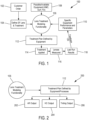
- FIGURE 1 is a block diagram of an overview of an embodiment of example ophthalmic lens treatment planning system and process 100, according to various embodiments.
- System and process 100 considers aspects of a given lens, or pair of lenses, relevant to ophthalmic lens treatments for the given lens or pair of lenses, including wearer needs and equipment to be used to process and treat the given lens or pair of lenses. Whereupon system and process 100 optimizes selection of and/or application of ophthalmic lens treatments for the given lens or pair of lenses and the equipment.
- lens treatment modeling functionality 106 customer order 102's lens and ophthalmic lens treatment information 104 is received in lens treatment modeling functionality 106.
- Information 104 may include, by way of example, information about hard multi-coat lens treatments, such as information about lens coatings, lens tints, lens films, lens polarization, lens photochromic properties, as well as information about techniques for applying treatments to the lens, and further lens surfacing, or lens finishing, or the like. Identification of equipment available (or that may possibly be used) (108) for application of lens treatments (104) is provided to lens treatment modeling functionality 106.
- Modeling functionality 106 may in accordance with various embodiments of the present systems and methods, be computer-based and may take the form of a special purpose ophthalmic lens treatment planning system, at least a part of (a) centralized control system(s) for lens treatment equipment, software executing on a computer system, or the like.
- a centralized control system(s) for lens treatment equipment software executing on a computer system, or the like.
- embodiments of the present systems and methods may be incorporated into, or be employed in conjunction with ophthalmic lens laboratory software such as may typically be referred to as a Lab Management System (LMS), a Lens Design System (LDS), or the like.
- Performance and parameters 110 of available equipment 108 is also provided to equipment modeling functionality 106.
- Modeling functionality 106 determines, and/or otherwise formulates, ophthalmic lens treatment application plan 112 to be applied by the equipment to the lens.
- formulating and determining ophthalmic lens treatment plan 112 to be applied by the equipment 108 to the lens may include applying computer-based models to the lens treatment application plan, such as by modeling employment of possible combinations of ophthalmic lens treatments that can be applied to the lens using the available equipment 108.
- formulating, or otherwise determining, an ophthalmic lens treatment plan may include considering aspects of a given lens or pair of lenses relevant to requested ophthalmic lens treatments for the given lens or pair of lenses, including the equipment available to apply ophthalmic lens treatments and performance and parameters of the equipment, and then considering and optimizing an ophthalmic lens treatment plan for the equipment available to apply ophthalmic lens treatments and performance and parameters of the equipment.
- lens treatment plan 112 may be defined by equipment 108 available to apply the lens treatments and the performance and parameters 110 of such equipment, in accordance with various embodiments of the present systems and methods.
- embodiments of the present systems and methods may dynamically account for results of previous ophthalmic lens treatments. For example, as discussed in greater detail below, with reference to FIGURE 3 , following application of the ophthalmic lens treatment plan to the lens 114, the resulting lens may be measured at 116 to provide last run results 118. Whereupon, last run results 118 may be fed back at 120 to provide further performance and parameters 110 of the equipment to ophthalmic lens treatment modeling functionality 106
- lens treatment plans 112 which may be, as noted, defined in light of the equipment available to apply the lens treatments and the performance and parameters of such equipment, attention is directed to FIGURE 2 .
- a block diagram of treatment plan output 200 from, by way of example, system and process 100 of FIGURE 1 is shown as including a number of possible plan modeling outputs 202 through 206, according to various embodiments.
- modeling functionality 106 formulates and outputs ophthalmic lens treatment plan 112, which is to be applied by the equipment to the lens, based at least in part on the equipment available to apply the ophthalmic lens treatments and/or the performance and parameters of the equipment.
- Lens treatment plan 112 may include (i.e.
- lens treatment modeling functionality 106 may also adjust outputs 202, 204, 206, etc. based on upstream and/or downstream processes and equipment, such as surfacing processes, finishing processes, and/or the like.
- formulation of ophthalmic lens treatment plan 112 may result in anti-reflective coating output 202.
- Formulation of anti-reflective coating output 202 may include optimizing any of a number of variable anti-reflective coating process parameters, such as, coating layer thicknesses, application rates, ramps, soaks, ion gun power, gas flows, and/or process pressure.
- Other anti-reflective coating application parameters related to specifications of equipment available to apply the ant-reflective treatment might also be taken into account, such as, e-gun voltage, available distribution mask size, distribution mask location(s), fixture(s) and/or the like.
- an anti- reflective application process employing the equipment available to apply the ophthalmic lens treatments for lens and taking into account the performance and parameters of the available equipment may be optimized for the lens may be embodied in anti-reflective output 202.
- ophthalmic lens treatments include a hard coating
- formulation of ophthalmic lens treatment plan 112 may result in hard coating output 204.
- Determining hard coating output 204 may include optimizing any of a number of hard coating parameters, such as a hard coating thickness, type, cure rate, cure type, as well as available preparation and application equipment and tooling, available lens preparation process(es), lens stripping process(es) and/or the like for the available treatment application process(es).
- a hard coating application process employing the equipment available to apply the ophthalmic lens treatments and taking into account the performance and parameters of the available equipment may be optimized for the lens as hard coating output 204.
- tinting output 206 may include optimizing any number of tinting process parameters, such as temperature, color, one or more treatment dyes to use, time, or the like. Further, tinting output 206 may take into account or call for particular pre-processing, post-processing, tinting gradient parameters, or the like. Tint applicator parameters, and/or dye application processes employed by the equipment available may also be taken into account in tinting output 206. Thereby, a tinting process employing the equipment available to apply the ophthalmic lens treatments and taking into account the performance and parameters of the equipment may be optimized for the lens in the form of tinting output 206.
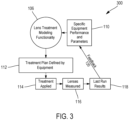
- FIGURE 3 is block diagram for feedback loop control 300 such as may, by way of example, be employed in the system and process of FIGURE 1 , according to various embodiments, and as illustrated.
- last run results 118 may be fed back, such as along illustrated path 120 to provide further performance and parameters 110 of equipment 108 to ophthalmic lens treatment modeling functionality 106.
- lens(es) resulting from application of the ophthalmic lens treatment plan 114 may be measured at 116 to provide such last run results.
- Last run results 118 may include, by way of example, one or more of a measure of the treated lens' spectral performance including reflection, transmission and absorption characteristics as well as spectral parameters, product performance testing results of the treated lens, results of a cosmetic inspection of the treated lens, a measured light through the treated lens, adhesion of the treatment(s) to the lens, resulting scratch resistance of the treated lens, resulting abrasion resistance of the treated lens, chemical resistance of the treated lens, and/or the like.
- performance and parameters 110 of equipment 108 may be considered in optimizing lens coatings. For example, such optimization may involve a feasibility check based on machine capability and/or maintenance status.
- performance and parameters 110 of equipment 108 may include, whether the equipment includes of employs various tools or tooling, for example whether an electron beam gun can be used, any sputter target employed for deposition of coatings, use of evaporation boats by the equipment, use of an ion gun, use of shields, use of distribution masks, sector geometry employed by the equipment; and/or the like.
- optimization feasibility check may include machine maintenance status, or the like, such as condition of ion gun filaments, condition of specific components within the electron beam gun or the ion gun, cleanliness of shields, age of coating material to be used, condition of tooling, age of chemicals to be used, condition of chemicals to be used, age of dye bath, dye bath temperature, room conditions etc.
- machine maintenance status such as condition of ion gun filaments, condition of specific components within the electron beam gun or the ion gun, cleanliness of shields, age of coating material to be used, condition of tooling, age of chemicals to be used, condition of chemicals to be used, age of dye bath, dye bath temperature, room conditions etc.
- last run results that may be affected by machine capability and/or maintenance status may be considered in ophthalmic lens treatment plan determinations, for example optimization may take into account resulting optical thickness measurement(s), measured resulting lens axis orientation, resulting lens color, and/or the like.
- lens treatment plan 112 may, in accordance with various embodiments of the present systems and methods, be defined not only by equipment 108 available to apply the lens treatments, but also the performance and parameters 110 of such equipment.
- the present systems and methods provide greater customization of lens treatments than typical batch processing
- various embodiments of the present systems and methods may make use of batch processing when applicable.
- optimizing selection of ophthalmic lens treatments for the given lens or pair of lenses may call for application of one or more ophthalmic lens treatments that may be carried out using batch processes. That is, when optimizing application of ophthalmic lens treatments for the given lens or pair of lenses can include inclusion of the given lens or pair of lenses in at least one batch processing for a ophthalmic lens treatment, modeling functionality 106 may in accordance with such various embodiments of the present systems and methods, select such batch processing for at least one particular lens treatment, where such batch processing will not compromise the optimization of the customer ordered ophthalmic lens treatments.
- Embodiments of the present systems and methods for optimization of the selection and application of ophthalmic lens treatments, as described herein, may be implemented or executed, at least in part, by one or more computer systems.
- One such computer system is illustrated in FIGURE 4 .
- computer system 400 may be a server, a mainframe computer system, a workstation, a network computer, a desktop computer, a laptop, a tablet computing device, media player, or the like.
- computer 400 may implement one or more steps of example processes (100) described above with respect to FIGURES 1 through 3 , and/or a computer system such as computer system 400 may be used as, or as part of, one or more of a special purpose ophthalmic lens treatment panning system, a centralized control systems for lens treatment equipment, and/or may be a computer system implementing embodiments of the present methods, and/or the like.
- two or more of these computer systems may be configured to communicate with each other in any suitable way, such as, for example, via a network.
- example computer system 400 includes one or more processors 410 (i.e. 410A through 410N) coupled to a system memory 420 via an input/output (I/O) interface 430.
- Example computer system 400 further includes a network interface 440 coupled to I/O interface 430, and one or more input/output devices 450, such as video device(s) 460 (e.g., a camera), audio device(s) 470 (e.g., a microphone and/or a speaker), and display(s) 480.
- Computer system 400 may also include a cursor control device (e.g., a mouse or touchpad), a keyboard, etc.
- Multiple input/output devices 450 may be present in computer system 400 or may be distributed on various nodes of computer system 400. In some embodiments, similar input/output devices may be separate from computer system 400 and may interact with one or more nodes of computer system 400 through a wired or wireless connection, such as over network interface 440.
- computer system 400 may be a single-processor system including one processor 410, or a multi-processor system including two or more processors 410 (e.g., two, four, eight, or another suitable number).
- Processors 410 may be any processor capable of executing program instructions.
- processors 410 may be general-purpose or embedded processors implementing any of a variety of instruction set architectures (ISAs), such as the x86, POWERPC ® , ARM ® , SPARC ® , or MIPS ® ISAs, or any other suitable ISA.
- ISAs instruction set architectures
- each of processors 410 may commonly, but not necessarily, implement the same ISA.
- at least one processor 410 may be a graphics processing unit (GPU) or other dedicated graphics-rendering device.
- GPU graphics processing unit
- System memory 420 may be configured to store program instructions and/or data accessible by processor 410.
- system memory 420 may be implemented using any suitable memory technology, such as static random access memory (SRAM), synchronous dynamic RAM (SDRAM), nonvolatile/Flash-type memory, or any other type of memory.
- SRAM static random access memory
- SDRAM synchronous dynamic RAM
- program instructions and data implementing certain operations such as, for example, those described in connection with FIGURES 1 through 3 , above, may be stored within system memory 420 as program instructions 425 and data storage 435, respectively.
- program instructions and/or data may be received, sent or stored upon different types of computer-accessible media or on similar media separate from system memory 420 or computer system 400.
- a computer-readable medium may include any tangible or non-transitory storage media or memory media such as magnetic or optical media-e.g., disk or CD/DVD-ROM coupled to computer system 400 via I/O interface 430, Flash memory, random access memory (RAM), etc.
- Program instructions and data stored on a tangible computer-accessible medium in non-transitory form may further be transmitted by transmission media or signals such as electrical, electromagnetic, or digital signals, which may be conveyed via a communication medium such as a network and/or a wireless link, such as may be implemented via network interface 440.
- I/O interface 430 may be configured to coordinate I/O traffic between processor 410, system memory 420, and any peripheral devices in the device, including network interface 440 or other peripheral interfaces, such as input/output devices 450.
- I/O interface 430 may perform any suitable protocol, timing or other data transformations to convert data signals from one component (e.g., system memory 420) into a format usable by another component (e.g., processor 410).
- I/O interface 430 may include support for devices attached through various types of peripheral buses, such as a variant of the Peripheral Component Interconnect (PCI) bus standard or the Universal Serial Bus (USB) standard, for example.
- PCI Peripheral Component Interconnect
- USB Universal Serial Bus
- I/O interface 430 may be split into two or more separate components, such as a north bridge and a south bridge, for example.
- some or all of the functionality of I/O interface 430 such as an interface to system memory 420, may be incorporated into processor 410.
- Network interface 440 may be configured to allow data to be exchanged between computer system 400 and other devices attached to a network, such as other computer systems, or between nodes of computer system 400.
- network interface 440 may support communication via wired or wireless general data networks, such as any suitable type of Ethernet network, for example; via telecommunications/telephony networks such as analog voice networks or digital fiber communications networks; via storage area networks such as Fiber Channel SANs, or via any other suitable type of network and/or protocol.
- memory 420 may include program instructions 425, configured to implement certain embodiments described herein, and data storage 435, comprising various data accessible by program instructions 425.
- program instructions 425 may include software elements corresponding to one or more of the various embodiments illustrated in the above figures.
- program instructions 425 may be implemented in various embodiments using any desired programming language, scripting language, or combination of programming languages and/or scripting languages (e.g., C, C++, C#, JAVA ® , JAVASCRIPT ® , PERL ® , etc.).
- Data storage 435 may include data that may be used in these embodiments. In other embodiments, other or different software elements and data may be included.
- computer system 400 is merely illustrative and is not intended to limit the scope of the disclosure described herein.
- the computer system and devices may include any combination of hardware or software that can perform the indicated operations.
- the operations performed by the illustrated components may, in some embodiments, be performed by fewer components or distributed across additional components.
- the operations of some of the illustrated components may not be provided and/or other additional operations may be available. Accordingly, systems and methods described herein may be implemented or executed with other computer system configurations.
Landscapes
- Engineering & Computer Science (AREA)
- Health & Medical Sciences (AREA)
- Ophthalmology & Optometry (AREA)
- Manufacturing & Machinery (AREA)
- Mechanical Engineering (AREA)
- Physics & Mathematics (AREA)
- Microelectronics & Electronic Packaging (AREA)
- Mathematical Physics (AREA)
- General Health & Medical Sciences (AREA)
- General Physics & Mathematics (AREA)
- Optics & Photonics (AREA)
- Eyeglasses (AREA)
Claims (13)
- Verfahren, umfassend:in einem ophthalmischen Linsenbehandlungsplanungssystem (100) Empfangen von Linsen- und ophthalmischen Linsenbehandlungsinformationen aus einer Kundenlinsenbestellung (102), Identifizieren von verfügbaren Gerätschaften (108), um eine oder mehrere ophthalmische Linsenbehandlungen aus der Kundenbestellung zu applizieren, sowie Leistungsfähigkeit und Parametern (110) der verfügbaren Gerätschaften;Formulieren (106) eines optimalen ophthalmischen Linsenbehandlungsplans (112), der durch die verfügbaren Gerätschaften implementiert werden soll, durch das ophthalmische Linsenbehandlungsplanungssystem;Applizieren (114) der einen oder mehreren ophthalmischen Linsenbehandlungen aus der Kundenbestellung auf die Linse durch die verfügbaren Gerätschaften, die den optimalen ophthalmischen Linsenbehandlungsplan implementieren;Akzeptieren von Messungen von einer resultierenden Linse (116) nach Applikation des optimalen ophthalmischen Linsenbehandlungsplans auf die Linse, um letzte Laufergebnisse (118) zu entwickeln; undRückmelden (120) der letzten Laufergebnisse an das ophthalmische Linsenbehandlungsplanungssystem, um dem ophthalmischen Linsenbehandlungsplanungssystem weitere Leistungsfähigkeit und Parameter (110) der verfügbaren Gerätschaften bereitzustellen,wobei Formulieren eines optimalen ophthalmischen Linsenbehandlungsplans Erwägen und Optimieren des optimalen ophthalmischen Linsenbehandlungsplans für die verfügbaren Gerätschaften und Leistungsfähigkeit und Parameter der verfügbaren Gerätschaften einschließt.
- Verfahren nach Anspruch 1, wobei die letzten Laufergebnisse umfassen:ein Maß für Linsenspektralleistungsfähigkeit, einschließlich Reflexions-, Durchlässigkeits- und/oder Absorptionscharakteristika;Spektralparameter;Produktleistungsfähigkeitstests;kosmetische Untersuchung;Behandlungsadhäsion;Kratzfestigkeit;Abrasionsfestigkeit und/oderchemische Beständigkeit.
- Verfahren nach Anspruch 1, wobei Formulieren eines optimalen ophthalmischen Linsenbehandlungsplans, der durch die verfügbaren Gerätschaften auf die Linse implementiert werden soll, Anwenden von computerbasierten Modellen auf den Plan umfasst, wobei mögliche Kombinationen der ophthalmischen Linsenbehandlungen verwendet werden, die unter Verwendung der verfügbaren Gerätschaften auf die Linse appliziert werden können.
- Verfahren nach Anspruch 1, wobei Formulieren eines optimalen ophthalmischen Linsenbehandlungsplans umfasst:Erwägen von Aspekten einer gegebenen Linse oder eines gegebenen Paares von Linsen, die für opthalmische Linsenbehandlungen für die gegebene Linse oder das gegebene Paar von Linsen relevant sind, einschließlich der verfügbaren Gerätschaften und Leistungsfähigkeit und Parametern der verfügbaren Gerätschaften; undErwägen und Optimieren des optimalen ophthalmischen Linsenbehandlungsplans für die verfügbaren Gerätschaften und Leistungsfähigkeit und Parameter der verfügbaren Gerätschaften.
- Verfahren nach Anspruch 1, wobei die mindestens eine ophthalmische(n) Linsenbehandlung(en) eine Antireflexbeschichtung einschließt, und Formulieren eines optimalen ophthalmischen Linsenbehandlungsplans Optimieren von folgendem für die Antireflexbeschichtung umfasst: Schichtdicken, Applikationsraten, Rampen, Einweichvorgängen, Ionenkanonenleistung, Gasfluss, Gasdruck, Spannung der e-Kanone, Verteilungsmaskengröße, Verteilungsmaskenort, Linsenhalterung und/oder Applikationsprozess für die verfügbaren Gerätschaften und die Leistungsfähigkeit und Parameter der verfügbaren Gerätschaften.
- Verfahren nach Anspruch 1, wobei die mindestens eine opthalmische(n) Linsenbehandlung(en) eine Hartbeschichtung einschließt, und Formulieren eines optimalen ophthalmischen Linsenbehandlungsplans Optimieren von folgendem für die Hartbeschichtung umfasst: Dicke, Typ, Härtungsrate, Härtungstyp, Werkzeugausstattung, Linsenvorbereitungsprozess, Linsenstrippprozess und/oder Behandlungsapplikationsprozess für die verfügbaren Gerätschaften und die Leistungsfähigkeit und Parameter der verfügbaren Gerätschaften.
- Verfahren nach Anspruch 1, wobei die mindestens eine opthalmische(n) Linsenbehandlung(en) Tönung einschließt, und Formulieren eines optimalen ophthalmischen Linsenbehandlungsplans Optimieren von Tönungstemperatur, Farbe, einem oder mehreren zu verwendenden Behandlungsfarbstoffen, Zeit, Vorverarbeitung, Nachverarbeitung, Gradientenparametern, Tönungsapplikationsparametern und/oder Tönungsapplikationsprozess für die verfügbaren Gerätschaften und die Leistungsfähigkeit und Parameter für die verfügbaren Gerätschaften umfasst.
- Verfahren nach Anspruch 1, wobei die Leistungsfähigkeit und Parameter der verfügbaren Gerätschaften Verwendung einer Elektronenstrahlkanone, jegliches zur Abscheidung der Beschichtungen verwendete Sputter-Target, Verwendung von Verdampfungsschiffchen, Verwendung einer Ionenkanone, Zustand von Filamenten, Zustand von spezifischen Komponenten innerhalb der Elektronenstrahlkanone oder der Ionenkanone, Verwendung von Abschirmungen, Sauberkeit der Abschirmungen, Verwendung von Verteilungsmasken, durch die verfügbaren Gerätschaften verwendete Sektorgeometrie, resultierende optische Dickenmessung, resultierende Linsenachsenorientierung, resultierende Linsenfarbe, Alter des zu verwendenden Beschichtungsmaterials, Zustand der Werkzeugausstattung, Alter der zu verwendenden Chemikalien, Zustand der zu verwendenden Chemikalien, Alter des Farbstoffbades, Farbstoffbadtemperatur und/oder Raumbedingungen für die verfügbaren Gerätschaften umfassen.
- Verfahren nach Anspruch 1, wobei die ophthalmischen Linsenbehandlungsinformationen Informationen zu Linsenbeschichtungen, Linsentönungen, Linsenfilmen, Linsenpolarisation und/oder photochromen Linseneigenschaften einschließen.
- Verfahren nach Anspruch 1, wobei die ophthalmischen Linsenbehandlungsinformationen Informationen zu Techniken zum Applizieren von Behandlungen auf die Linse umfassen.
- Verfahren nach Anspruch 1, wobei die ophthalmischen Linsenbehandlungsinformationen Informationen zu Hartmehrfachbeschichtungslinsenbehandlungen umfassen.
- Verfahren nach Anspruch 1, wobei der optimale ophthalmische Linsenbehandlungsplan Applikation von mindestens einer ophthalmischen Linsenbehandlung unter Verwendung eines Chargenprozesses einschließt.
- Ophthalmisches Linsenbehandlungssystem (100), umfassend:Gerätschaften zum Applizieren von einer oder mehreren ophthalmischen Linsenbehandlungen; undein ophthalmisches Linsenbehandlungsplanungssystem, umfassend mindestens einen Prozessor und einen Speicher, der an den mindestens einen Prozessor gekoppelt ist, wobei der Speicher ausgestaltet ist, um Programmanweisungen zu speichern, die durch den mindestens einen Prozessor ausführbar sind, um zu bewirken, dass das ophthalmische Linsenbehandlungsplanungssystem folgendes durchführt:Empfangen von Linsen- und ophthalmischen Linsenbehandlungsinformationen aus einer Kundenlinsenbestellung (102);Empfangen der Identifikation der verfügbaren Gerätschaften (108);Empfangen von Leistungsfähigkeit und Parametern (110) der verfügbaren Gerätschaften; undFormulieren (106) eines optimalen ophthalmischen Linsenbehandlungsplans (112), der durch die verfügbaren Gerätschaften zu implementieren ist, zum Applizieren von einer oder mehreren ophthalmischen Linsenbehandlungen aus der Kundenlinsenbestellung auf die Linse, einschließlich Erwägen und Optimieren des optimalen Linsenbehandlungsplans für die verfügbaren Gerätschaften und Leistungsfähigkeit und Parameter der verfügbaren Gerätschaften;Akzeptieren von Messungen von einer resultierenden Linse (116) nach Applikation des optimalen ophthalmischen Linsenbehandlungsplans auf die Linse, um letzte Laufergebnisse (118) zu entwickeln; undRückmelden (120) der letzten Laufergebnisse an das ophthalmische Linsenbehandlungsplanungssystem, um dem ophthalmischen Linsenbehandlungsplanungssystem weitere Leistungsfähigkeit und Parameter der verfügbaren Gerätschaften bereitzustellen.
Applications Claiming Priority (1)
| Application Number | Priority Date | Filing Date | Title |
|---|---|---|---|
| PCT/IB2014/003130 WO2016102998A1 (en) | 2014-12-23 | 2014-12-23 | Ophthalmic lens treatment system |
Publications (2)
| Publication Number | Publication Date |
|---|---|
| EP3237186A1 EP3237186A1 (de) | 2017-11-01 |
| EP3237186B1 true EP3237186B1 (de) | 2024-12-18 |
Family
ID=53052889
Family Applications (1)
| Application Number | Title | Priority Date | Filing Date |
|---|---|---|---|
| EP14861149.4A Active EP3237186B1 (de) | 2014-12-23 | 2014-12-23 | System und verfahren zur behandlung von ophthalmischen linsen |
Country Status (4)
| Country | Link |
|---|---|
| US (1) | US10281741B2 (de) |
| EP (1) | EP3237186B1 (de) |
| CN (1) | CN107107496B (de) |
| WO (1) | WO2016102998A1 (de) |
Families Citing this family (1)
| Publication number | Priority date | Publication date | Assignee | Title |
|---|---|---|---|---|
| CN110737111A (zh) * | 2019-10-24 | 2020-01-31 | 明灏科技(北京)有限公司 | 一种镜片加工工艺 |
Citations (1)
| Publication number | Priority date | Publication date | Assignee | Title |
|---|---|---|---|---|
| US20140055744A1 (en) * | 2012-06-29 | 2014-02-27 | Johnson & Johnson Vision Care, Inc. | Lens precursor with features for the fabrication of an ophthalmic lens |
Family Cites Families (8)
| Publication number | Priority date | Publication date | Assignee | Title |
|---|---|---|---|---|
| US20060065989A1 (en) * | 2004-09-29 | 2006-03-30 | Thad Druffel | Lens forming systems and methods |
| US8313828B2 (en) * | 2008-08-20 | 2012-11-20 | Johnson & Johnson Vision Care, Inc. | Ophthalmic lens precursor and lens |
| CN101918178B (zh) * | 2007-11-30 | 2013-07-10 | 依视路国际集团(光学总公司) | 透镜制造过程的控制过程 |
| EP2604414A1 (de) * | 2011-12-15 | 2013-06-19 | Essilor International (Compagnie Générale D'Optique) | Vorrichtung zur Verarbeitung einer Bestellanfrage eines Brillenglases |
| WO2014075924A1 (en) * | 2012-11-19 | 2014-05-22 | Essilor International (Compagnie Generale D'optique) | Method of manufacturing an optical lens |
| EP2992393B1 (de) | 2013-04-29 | 2019-09-11 | Essilor International | Berechnungssystem zur herstellung einer ophthalmischen linse |
| EP3019908B1 (de) * | 2013-07-10 | 2023-06-07 | Essilor International | Linsenabgabesystem und zugehörige verfahren |
| US9952584B2 (en) * | 2014-04-01 | 2018-04-24 | Digital Vision, Inc. | Modifying a digital ophthalmic lens map to accommodate characteristics of a lens surfacing machine |
-
2014
- 2014-12-23 EP EP14861149.4A patent/EP3237186B1/de active Active
- 2014-12-23 US US15/538,593 patent/US10281741B2/en active Active
- 2014-12-23 CN CN201480084283.0A patent/CN107107496B/zh active Active
- 2014-12-23 WO PCT/IB2014/003130 patent/WO2016102998A1/en not_active Ceased
Patent Citations (1)
| Publication number | Priority date | Publication date | Assignee | Title |
|---|---|---|---|---|
| US20140055744A1 (en) * | 2012-06-29 | 2014-02-27 | Johnson & Johnson Vision Care, Inc. | Lens precursor with features for the fabrication of an ophthalmic lens |
Also Published As
| Publication number | Publication date |
|---|---|
| CN107107496B (zh) | 2019-10-08 |
| EP3237186A1 (de) | 2017-11-01 |
| WO2016102998A1 (en) | 2016-06-30 |
| CN107107496A (zh) | 2017-08-29 |
| US10281741B2 (en) | 2019-05-07 |
| US20170348928A1 (en) | 2017-12-07 |
Similar Documents
| Publication | Publication Date | Title |
|---|---|---|
| DE102021129078A1 (de) | Intelligente push-kupplung über der plattform für kühlsysteme in rechenzentren | |
| US11010282B2 (en) | Fault detection and localization using combinatorial test design techniques while adhering to architectural restrictions | |
| Garvey | A framework for evaluating barriers to the democratization of artificial intelligence | |
| US20150363691A1 (en) | Managing software bundling using an artificial neural network | |
| JP7251911B2 (ja) | 動的なコーティング厚さ測定及び制御 | |
| US12056469B2 (en) | Autonomous generation of GRC programs | |
| US10281741B2 (en) | Ophthalmic lens treatment system | |
| Zhao et al. | Serflow: A multi-stage service-enhanced mechanism for workflow applications in cpss with end-edge-cloud collaboration | |
| US12216342B2 (en) | Method and system for determining parameters used to manufacture an optical article and a corresponding optical article | |
| CN107909465A (zh) | 一种银行存款账户利息的校验方法及装置 | |
| CN115390112A (zh) | 电力系统北斗定位信号滤波方法、装置、设备及存储介质 | |
| Chen et al. | Orchid: An online learning based resource partitioning framework for job colocation with multiple objectives | |
| CN107767255A (zh) | 业务处理方法和装置 | |
| CN112242911B (zh) | 基于网络流量的测试方法及装置、存储介质、电子设备 | |
| CN116187433A (zh) | 基于秘密分享的联邦拟牛顿训练方法、装置及存储介质 | |
| Tian et al. | Moving beyond the conventional stratified analysis to estimate an overall treatment efficacy with the data from a comparative randomized clinical study | |
| US20210056387A1 (en) | Distributed machine learning with privacy protection | |
| AU2013365261B2 (en) | Manufacturing apparatus and manufacturing method for astigmatic spectacle lens | |
| AU2012351564A1 (en) | A method of processing an order request for an ophthalmic lens | |
| CN102982484A (zh) | 融资融券专有交易节点及其经纪业务平台 | |
| CN106484866B (zh) | 一种批量数据处理方法及装置 | |
| CN115390182A (zh) | 光波导的制作方法、制作设备、光波导及近眼显示设备 | |
| US20170243295A1 (en) | Graphical user interface for displaying dynamic strategies | |
| CN114898180A (zh) | 多任务神经网络的训练方法、多任务处理方法及装置 | |
| Cruz-Rodríguez et al. | RAY PATHS THROUGH A GRIN LENS: THE CRYSTALLINE CASE. |
Legal Events
| Date | Code | Title | Description |
|---|---|---|---|
| STAA | Information on the status of an ep patent application or granted ep patent |
Free format text: STATUS: THE INTERNATIONAL PUBLICATION HAS BEEN MADE |
|
| PUAI | Public reference made under article 153(3) epc to a published international application that has entered the european phase |
Free format text: ORIGINAL CODE: 0009012 |
|
| STAA | Information on the status of an ep patent application or granted ep patent |
Free format text: STATUS: REQUEST FOR EXAMINATION WAS MADE |
|
| 17P | Request for examination filed |
Effective date: 20170622 |
|
| AK | Designated contracting states |
Kind code of ref document: A1 Designated state(s): AL AT BE BG CH CY CZ DE DK EE ES FI FR GB GR HR HU IE IS IT LI LT LU LV MC MK MT NL NO PL PT RO RS SE SI SK SM TR |
|
| AX | Request for extension of the european patent |
Extension state: BA ME |
|
| RAP1 | Party data changed (applicant data changed or rights of an application transferred) |
Owner name: ESSILOR INTERNATIONAL |
|
| DAX | Request for extension of the european patent (deleted) | ||
| STAA | Information on the status of an ep patent application or granted ep patent |
Free format text: STATUS: EXAMINATION IS IN PROGRESS |
|
| 17Q | First examination report despatched |
Effective date: 20210331 |
|
| P01 | Opt-out of the competence of the unified patent court (upc) registered |
Effective date: 20230525 |
|
| GRAP | Despatch of communication of intention to grant a patent |
Free format text: ORIGINAL CODE: EPIDOSNIGR1 |
|
| STAA | Information on the status of an ep patent application or granted ep patent |
Free format text: STATUS: GRANT OF PATENT IS INTENDED |
|
| INTG | Intention to grant announced |
Effective date: 20240822 |
|
| GRAS | Grant fee paid |
Free format text: ORIGINAL CODE: EPIDOSNIGR3 |
|
| GRAA | (expected) grant |
Free format text: ORIGINAL CODE: 0009210 |
|
| STAA | Information on the status of an ep patent application or granted ep patent |
Free format text: STATUS: THE PATENT HAS BEEN GRANTED |
|
| AK | Designated contracting states |
Kind code of ref document: B1 Designated state(s): AL AT BE BG CH CY CZ DE DK EE ES FI FR GB GR HR HU IE IS IT LI LT LU LV MC MK MT NL NO PL PT RO RS SE SI SK SM TR |
|
| REG | Reference to a national code |
Ref country code: GB Ref legal event code: FG4D |
|
| REG | Reference to a national code |
Ref country code: CH Ref legal event code: EP |
|
| REG | Reference to a national code |
Ref country code: DE Ref legal event code: R096 Ref document number: 602014091357 Country of ref document: DE |
|
| REG | Reference to a national code |
Ref country code: IE Ref legal event code: FG4D |
|
| REG | Reference to a national code |
Ref country code: LT Ref legal event code: MG9D |
|
| PG25 | Lapsed in a contracting state [announced via postgrant information from national office to epo] |
Ref country code: HR Free format text: LAPSE BECAUSE OF FAILURE TO SUBMIT A TRANSLATION OF THE DESCRIPTION OR TO PAY THE FEE WITHIN THE PRESCRIBED TIME-LIMIT Effective date: 20241218 |
|
| PG25 | Lapsed in a contracting state [announced via postgrant information from national office to epo] |
Ref country code: FI Free format text: LAPSE BECAUSE OF FAILURE TO SUBMIT A TRANSLATION OF THE DESCRIPTION OR TO PAY THE FEE WITHIN THE PRESCRIBED TIME-LIMIT Effective date: 20241218 |
|
| PG25 | Lapsed in a contracting state [announced via postgrant information from national office to epo] |
Ref country code: BG Free format text: LAPSE BECAUSE OF FAILURE TO SUBMIT A TRANSLATION OF THE DESCRIPTION OR TO PAY THE FEE WITHIN THE PRESCRIBED TIME-LIMIT Effective date: 20241218 |
|
| PG25 | Lapsed in a contracting state [announced via postgrant information from national office to epo] |
Ref country code: NO Free format text: LAPSE BECAUSE OF FAILURE TO SUBMIT A TRANSLATION OF THE DESCRIPTION OR TO PAY THE FEE WITHIN THE PRESCRIBED TIME-LIMIT Effective date: 20250318 |
|
| REG | Reference to a national code |
Ref country code: NL Ref legal event code: MP Effective date: 20241218 |
|
| PG25 | Lapsed in a contracting state [announced via postgrant information from national office to epo] |
Ref country code: GR Free format text: LAPSE BECAUSE OF FAILURE TO SUBMIT A TRANSLATION OF THE DESCRIPTION OR TO PAY THE FEE WITHIN THE PRESCRIBED TIME-LIMIT Effective date: 20250319 Ref country code: LV Free format text: LAPSE BECAUSE OF FAILURE TO SUBMIT A TRANSLATION OF THE DESCRIPTION OR TO PAY THE FEE WITHIN THE PRESCRIBED TIME-LIMIT Effective date: 20241218 |
|
| PG25 | Lapsed in a contracting state [announced via postgrant information from national office to epo] |
Ref country code: RS Free format text: LAPSE BECAUSE OF FAILURE TO SUBMIT A TRANSLATION OF THE DESCRIPTION OR TO PAY THE FEE WITHIN THE PRESCRIBED TIME-LIMIT Effective date: 20250318 |
|
| PG25 | Lapsed in a contracting state [announced via postgrant information from national office to epo] |
Ref country code: NL Free format text: LAPSE BECAUSE OF FAILURE TO SUBMIT A TRANSLATION OF THE DESCRIPTION OR TO PAY THE FEE WITHIN THE PRESCRIBED TIME-LIMIT Effective date: 20241218 |
|
| REG | Reference to a national code |
Ref country code: AT Ref legal event code: MK05 Ref document number: 1751943 Country of ref document: AT Kind code of ref document: T Effective date: 20241218 |
|
| PG25 | Lapsed in a contracting state [announced via postgrant information from national office to epo] |
Ref country code: SM Free format text: LAPSE BECAUSE OF FAILURE TO SUBMIT A TRANSLATION OF THE DESCRIPTION OR TO PAY THE FEE WITHIN THE PRESCRIBED TIME-LIMIT Effective date: 20241218 |
|
| PG25 | Lapsed in a contracting state [announced via postgrant information from national office to epo] |
Ref country code: PL Free format text: LAPSE BECAUSE OF FAILURE TO SUBMIT A TRANSLATION OF THE DESCRIPTION OR TO PAY THE FEE WITHIN THE PRESCRIBED TIME-LIMIT Effective date: 20241218 |
|
| PG25 | Lapsed in a contracting state [announced via postgrant information from national office to epo] |
Ref country code: ES Free format text: LAPSE BECAUSE OF FAILURE TO SUBMIT A TRANSLATION OF THE DESCRIPTION OR TO PAY THE FEE WITHIN THE PRESCRIBED TIME-LIMIT Effective date: 20241218 |
|
| PG25 | Lapsed in a contracting state [announced via postgrant information from national office to epo] |
Ref country code: IS Free format text: LAPSE BECAUSE OF FAILURE TO SUBMIT A TRANSLATION OF THE DESCRIPTION OR TO PAY THE FEE WITHIN THE PRESCRIBED TIME-LIMIT Effective date: 20250418 |
|
| PG25 | Lapsed in a contracting state [announced via postgrant information from national office to epo] |
Ref country code: PT Free format text: LAPSE BECAUSE OF FAILURE TO SUBMIT A TRANSLATION OF THE DESCRIPTION OR TO PAY THE FEE WITHIN THE PRESCRIBED TIME-LIMIT Effective date: 20250421 |
|
| PG25 | Lapsed in a contracting state [announced via postgrant information from national office to epo] |
Ref country code: EE Free format text: LAPSE BECAUSE OF FAILURE TO SUBMIT A TRANSLATION OF THE DESCRIPTION OR TO PAY THE FEE WITHIN THE PRESCRIBED TIME-LIMIT Effective date: 20241218 |
|
| PG25 | Lapsed in a contracting state [announced via postgrant information from national office to epo] |
Ref country code: RO Free format text: LAPSE BECAUSE OF FAILURE TO SUBMIT A TRANSLATION OF THE DESCRIPTION OR TO PAY THE FEE WITHIN THE PRESCRIBED TIME-LIMIT Effective date: 20241218 Ref country code: AT Free format text: LAPSE BECAUSE OF FAILURE TO SUBMIT A TRANSLATION OF THE DESCRIPTION OR TO PAY THE FEE WITHIN THE PRESCRIBED TIME-LIMIT Effective date: 20241218 |
|
| PG25 | Lapsed in a contracting state [announced via postgrant information from national office to epo] |
Ref country code: SK Free format text: LAPSE BECAUSE OF FAILURE TO SUBMIT A TRANSLATION OF THE DESCRIPTION OR TO PAY THE FEE WITHIN THE PRESCRIBED TIME-LIMIT Effective date: 20241218 |
|
| PG25 | Lapsed in a contracting state [announced via postgrant information from national office to epo] |
Ref country code: CZ Free format text: LAPSE BECAUSE OF FAILURE TO SUBMIT A TRANSLATION OF THE DESCRIPTION OR TO PAY THE FEE WITHIN THE PRESCRIBED TIME-LIMIT Effective date: 20241218 |
|
| PG25 | Lapsed in a contracting state [announced via postgrant information from national office to epo] |
Ref country code: IT Free format text: LAPSE BECAUSE OF FAILURE TO SUBMIT A TRANSLATION OF THE DESCRIPTION OR TO PAY THE FEE WITHIN THE PRESCRIBED TIME-LIMIT Effective date: 20241218 |
|
| REG | Reference to a national code |
Ref country code: CH Ref legal event code: PL |
|
| PG25 | Lapsed in a contracting state [announced via postgrant information from national office to epo] |
Ref country code: LU Free format text: LAPSE BECAUSE OF NON-PAYMENT OF DUE FEES Effective date: 20241223 |
|
| PG25 | Lapsed in a contracting state [announced via postgrant information from national office to epo] |
Ref country code: SE Free format text: LAPSE BECAUSE OF FAILURE TO SUBMIT A TRANSLATION OF THE DESCRIPTION OR TO PAY THE FEE WITHIN THE PRESCRIBED TIME-LIMIT Effective date: 20241218 |
|
| PG25 | Lapsed in a contracting state [announced via postgrant information from national office to epo] |
Ref country code: MC Free format text: LAPSE BECAUSE OF FAILURE TO SUBMIT A TRANSLATION OF THE DESCRIPTION OR TO PAY THE FEE WITHIN THE PRESCRIBED TIME-LIMIT Effective date: 20241218 |
|
| REG | Reference to a national code |
Ref country code: DE Ref legal event code: R097 Ref document number: 602014091357 Country of ref document: DE |
|
| REG | Reference to a national code |
Ref country code: BE Ref legal event code: MM Effective date: 20241231 |
|
| PG25 | Lapsed in a contracting state [announced via postgrant information from national office to epo] |
Ref country code: DK Free format text: LAPSE BECAUSE OF FAILURE TO SUBMIT A TRANSLATION OF THE DESCRIPTION OR TO PAY THE FEE WITHIN THE PRESCRIBED TIME-LIMIT Effective date: 20241218 |
|
| PG25 | Lapsed in a contracting state [announced via postgrant information from national office to epo] |
Ref country code: BE Free format text: LAPSE BECAUSE OF NON-PAYMENT OF DUE FEES Effective date: 20241231 |
|
| PG25 | Lapsed in a contracting state [announced via postgrant information from national office to epo] |
Ref country code: CH Free format text: LAPSE BECAUSE OF NON-PAYMENT OF DUE FEES Effective date: 20241231 |
|
| PG25 | Lapsed in a contracting state [announced via postgrant information from national office to epo] |
Ref country code: IE Free format text: LAPSE BECAUSE OF NON-PAYMENT OF DUE FEES Effective date: 20241223 |
|
| PLBE | No opposition filed within time limit |
Free format text: ORIGINAL CODE: 0009261 |
|
| STAA | Information on the status of an ep patent application or granted ep patent |
Free format text: STATUS: NO OPPOSITION FILED WITHIN TIME LIMIT |
|
| 26N | No opposition filed |
Effective date: 20250919 |
|
| PGFP | Annual fee paid to national office [announced via postgrant information from national office to epo] |
Ref country code: GB Payment date: 20251229 Year of fee payment: 12 |
|
| PGFP | Annual fee paid to national office [announced via postgrant information from national office to epo] |
Ref country code: FR Payment date: 20251226 Year of fee payment: 12 |
|
| PGFP | Annual fee paid to national office [announced via postgrant information from national office to epo] |
Ref country code: DE Payment date: 20251229 Year of fee payment: 12 |
|
| PG25 | Lapsed in a contracting state [announced via postgrant information from national office to epo] |
Ref country code: CY Free format text: LAPSE BECAUSE OF FAILURE TO SUBMIT A TRANSLATION OF THE DESCRIPTION OR TO PAY THE FEE WITHIN THE PRESCRIBED TIME-LIMIT Effective date: 20241218 |