EP3235924A1 - Quenched-tempered high-strength steel with yield strength of 900 mpa to 1000 mpa grade, and manufacturing method therefor - Google Patents
Quenched-tempered high-strength steel with yield strength of 900 mpa to 1000 mpa grade, and manufacturing method therefor Download PDFInfo
- Publication number
- EP3235924A1 EP3235924A1 EP15869229.3A EP15869229A EP3235924A1 EP 3235924 A1 EP3235924 A1 EP 3235924A1 EP 15869229 A EP15869229 A EP 15869229A EP 3235924 A1 EP3235924 A1 EP 3235924A1
- Authority
- EP
- European Patent Office
- Prior art keywords
- temperature
- strength
- steel
- quenched
- yield strength
- Prior art date
- Legal status (The legal status is an assumption and is not a legal conclusion. Google has not performed a legal analysis and makes no representation as to the accuracy of the status listed.)
- Granted
Links
Images

Classifications
-
- C—CHEMISTRY; METALLURGY
- C21—METALLURGY OF IRON
- C21D—MODIFYING THE PHYSICAL STRUCTURE OF FERROUS METALS; GENERAL DEVICES FOR HEAT TREATMENT OF FERROUS OR NON-FERROUS METALS OR ALLOYS; MAKING METAL MALLEABLE, e.g. BY DECARBURISATION OR TEMPERING
- C21D9/00—Heat treatment, e.g. annealing, hardening, quenching or tempering, adapted for particular articles; Furnaces therefor
- C21D9/46—Heat treatment, e.g. annealing, hardening, quenching or tempering, adapted for particular articles; Furnaces therefor for sheet metals
-
- C—CHEMISTRY; METALLURGY
- C22—METALLURGY; FERROUS OR NON-FERROUS ALLOYS; TREATMENT OF ALLOYS OR NON-FERROUS METALS
- C22C—ALLOYS
- C22C38/00—Ferrous alloys, e.g. steel alloys
- C22C38/02—Ferrous alloys, e.g. steel alloys containing silicon
-
- C—CHEMISTRY; METALLURGY
- C21—METALLURGY OF IRON
- C21D—MODIFYING THE PHYSICAL STRUCTURE OF FERROUS METALS; GENERAL DEVICES FOR HEAT TREATMENT OF FERROUS OR NON-FERROUS METALS OR ALLOYS; MAKING METAL MALLEABLE, e.g. BY DECARBURISATION OR TEMPERING
- C21D1/00—General methods or devices for heat treatment, e.g. annealing, hardening, quenching or tempering
- C21D1/18—Hardening; Quenching with or without subsequent tempering
-
- C—CHEMISTRY; METALLURGY
- C21—METALLURGY OF IRON
- C21D—MODIFYING THE PHYSICAL STRUCTURE OF FERROUS METALS; GENERAL DEVICES FOR HEAT TREATMENT OF FERROUS OR NON-FERROUS METALS OR ALLOYS; MAKING METAL MALLEABLE, e.g. BY DECARBURISATION OR TEMPERING
- C21D6/00—Heat treatment of ferrous alloys
- C21D6/004—Heat treatment of ferrous alloys containing Cr and Ni
-
- C—CHEMISTRY; METALLURGY
- C21—METALLURGY OF IRON
- C21D—MODIFYING THE PHYSICAL STRUCTURE OF FERROUS METALS; GENERAL DEVICES FOR HEAT TREATMENT OF FERROUS OR NON-FERROUS METALS OR ALLOYS; MAKING METAL MALLEABLE, e.g. BY DECARBURISATION OR TEMPERING
- C21D6/00—Heat treatment of ferrous alloys
- C21D6/005—Heat treatment of ferrous alloys containing Mn
-
- C—CHEMISTRY; METALLURGY
- C21—METALLURGY OF IRON
- C21D—MODIFYING THE PHYSICAL STRUCTURE OF FERROUS METALS; GENERAL DEVICES FOR HEAT TREATMENT OF FERROUS OR NON-FERROUS METALS OR ALLOYS; MAKING METAL MALLEABLE, e.g. BY DECARBURISATION OR TEMPERING
- C21D6/00—Heat treatment of ferrous alloys
- C21D6/008—Heat treatment of ferrous alloys containing Si
-
- C—CHEMISTRY; METALLURGY
- C21—METALLURGY OF IRON
- C21D—MODIFYING THE PHYSICAL STRUCTURE OF FERROUS METALS; GENERAL DEVICES FOR HEAT TREATMENT OF FERROUS OR NON-FERROUS METALS OR ALLOYS; MAKING METAL MALLEABLE, e.g. BY DECARBURISATION OR TEMPERING
- C21D8/00—Modifying the physical properties of ferrous metals or ferrous alloys by deformation combined with, or followed by, heat treatment
- C21D8/02—Modifying the physical properties of ferrous metals or ferrous alloys by deformation combined with, or followed by, heat treatment during manufacturing of plates or strips
-
- C—CHEMISTRY; METALLURGY
- C21—METALLURGY OF IRON
- C21D—MODIFYING THE PHYSICAL STRUCTURE OF FERROUS METALS; GENERAL DEVICES FOR HEAT TREATMENT OF FERROUS OR NON-FERROUS METALS OR ALLOYS; MAKING METAL MALLEABLE, e.g. BY DECARBURISATION OR TEMPERING
- C21D8/00—Modifying the physical properties of ferrous metals or ferrous alloys by deformation combined with, or followed by, heat treatment
- C21D8/02—Modifying the physical properties of ferrous metals or ferrous alloys by deformation combined with, or followed by, heat treatment during manufacturing of plates or strips
- C21D8/0221—Modifying the physical properties of ferrous metals or ferrous alloys by deformation combined with, or followed by, heat treatment during manufacturing of plates or strips characterised by the working steps
- C21D8/0226—Hot rolling
-
- C—CHEMISTRY; METALLURGY
- C21—METALLURGY OF IRON
- C21D—MODIFYING THE PHYSICAL STRUCTURE OF FERROUS METALS; GENERAL DEVICES FOR HEAT TREATMENT OF FERROUS OR NON-FERROUS METALS OR ALLOYS; MAKING METAL MALLEABLE, e.g. BY DECARBURISATION OR TEMPERING
- C21D8/00—Modifying the physical properties of ferrous metals or ferrous alloys by deformation combined with, or followed by, heat treatment
- C21D8/02—Modifying the physical properties of ferrous metals or ferrous alloys by deformation combined with, or followed by, heat treatment during manufacturing of plates or strips
- C21D8/0247—Modifying the physical properties of ferrous metals or ferrous alloys by deformation combined with, or followed by, heat treatment during manufacturing of plates or strips characterised by the heat treatment
-
- C—CHEMISTRY; METALLURGY
- C22—METALLURGY; FERROUS OR NON-FERROUS ALLOYS; TREATMENT OF ALLOYS OR NON-FERROUS METALS
- C22C—ALLOYS
- C22C38/00—Ferrous alloys, e.g. steel alloys
- C22C38/001—Ferrous alloys, e.g. steel alloys containing N
-
- C—CHEMISTRY; METALLURGY
- C22—METALLURGY; FERROUS OR NON-FERROUS ALLOYS; TREATMENT OF ALLOYS OR NON-FERROUS METALS
- C22C—ALLOYS
- C22C38/00—Ferrous alloys, e.g. steel alloys
- C22C38/002—Ferrous alloys, e.g. steel alloys containing In, Mg, or other elements not provided for in one single group C22C38/001 - C22C38/60
-
- C—CHEMISTRY; METALLURGY
- C22—METALLURGY; FERROUS OR NON-FERROUS ALLOYS; TREATMENT OF ALLOYS OR NON-FERROUS METALS
- C22C—ALLOYS
- C22C38/00—Ferrous alloys, e.g. steel alloys
- C22C38/04—Ferrous alloys, e.g. steel alloys containing manganese
-
- C—CHEMISTRY; METALLURGY
- C22—METALLURGY; FERROUS OR NON-FERROUS ALLOYS; TREATMENT OF ALLOYS OR NON-FERROUS METALS
- C22C—ALLOYS
- C22C38/00—Ferrous alloys, e.g. steel alloys
- C22C38/06—Ferrous alloys, e.g. steel alloys containing aluminium
-
- C—CHEMISTRY; METALLURGY
- C22—METALLURGY; FERROUS OR NON-FERROUS ALLOYS; TREATMENT OF ALLOYS OR NON-FERROUS METALS
- C22C—ALLOYS
- C22C38/00—Ferrous alloys, e.g. steel alloys
- C22C38/08—Ferrous alloys, e.g. steel alloys containing nickel
-
- C—CHEMISTRY; METALLURGY
- C22—METALLURGY; FERROUS OR NON-FERROUS ALLOYS; TREATMENT OF ALLOYS OR NON-FERROUS METALS
- C22C—ALLOYS
- C22C38/00—Ferrous alloys, e.g. steel alloys
- C22C38/12—Ferrous alloys, e.g. steel alloys containing tungsten, tantalum, molybdenum, vanadium, or niobium
-
- C—CHEMISTRY; METALLURGY
- C22—METALLURGY; FERROUS OR NON-FERROUS ALLOYS; TREATMENT OF ALLOYS OR NON-FERROUS METALS
- C22C—ALLOYS
- C22C38/00—Ferrous alloys, e.g. steel alloys
- C22C38/14—Ferrous alloys, e.g. steel alloys containing titanium or zirconium
-
- C—CHEMISTRY; METALLURGY
- C22—METALLURGY; FERROUS OR NON-FERROUS ALLOYS; TREATMENT OF ALLOYS OR NON-FERROUS METALS
- C22C—ALLOYS
- C22C38/00—Ferrous alloys, e.g. steel alloys
- C22C38/18—Ferrous alloys, e.g. steel alloys containing chromium
-
- C—CHEMISTRY; METALLURGY
- C22—METALLURGY; FERROUS OR NON-FERROUS ALLOYS; TREATMENT OF ALLOYS OR NON-FERROUS METALS
- C22C—ALLOYS
- C22C38/00—Ferrous alloys, e.g. steel alloys
- C22C38/18—Ferrous alloys, e.g. steel alloys containing chromium
- C22C38/32—Ferrous alloys, e.g. steel alloys containing chromium with boron
-
- C—CHEMISTRY; METALLURGY
- C22—METALLURGY; FERROUS OR NON-FERROUS ALLOYS; TREATMENT OF ALLOYS OR NON-FERROUS METALS
- C22C—ALLOYS
- C22C38/00—Ferrous alloys, e.g. steel alloys
- C22C38/18—Ferrous alloys, e.g. steel alloys containing chromium
- C22C38/40—Ferrous alloys, e.g. steel alloys containing chromium with nickel
- C22C38/44—Ferrous alloys, e.g. steel alloys containing chromium with nickel with molybdenum or tungsten
-
- C—CHEMISTRY; METALLURGY
- C22—METALLURGY; FERROUS OR NON-FERROUS ALLOYS; TREATMENT OF ALLOYS OR NON-FERROUS METALS
- C22C—ALLOYS
- C22C38/00—Ferrous alloys, e.g. steel alloys
- C22C38/18—Ferrous alloys, e.g. steel alloys containing chromium
- C22C38/40—Ferrous alloys, e.g. steel alloys containing chromium with nickel
- C22C38/46—Ferrous alloys, e.g. steel alloys containing chromium with nickel with vanadium
-
- C—CHEMISTRY; METALLURGY
- C22—METALLURGY; FERROUS OR NON-FERROUS ALLOYS; TREATMENT OF ALLOYS OR NON-FERROUS METALS
- C22C—ALLOYS
- C22C38/00—Ferrous alloys, e.g. steel alloys
- C22C38/18—Ferrous alloys, e.g. steel alloys containing chromium
- C22C38/40—Ferrous alloys, e.g. steel alloys containing chromium with nickel
- C22C38/48—Ferrous alloys, e.g. steel alloys containing chromium with nickel with niobium or tantalum
-
- C—CHEMISTRY; METALLURGY
- C22—METALLURGY; FERROUS OR NON-FERROUS ALLOYS; TREATMENT OF ALLOYS OR NON-FERROUS METALS
- C22C—ALLOYS
- C22C38/00—Ferrous alloys, e.g. steel alloys
- C22C38/18—Ferrous alloys, e.g. steel alloys containing chromium
- C22C38/40—Ferrous alloys, e.g. steel alloys containing chromium with nickel
- C22C38/50—Ferrous alloys, e.g. steel alloys containing chromium with nickel with titanium or zirconium
-
- C—CHEMISTRY; METALLURGY
- C22—METALLURGY; FERROUS OR NON-FERROUS ALLOYS; TREATMENT OF ALLOYS OR NON-FERROUS METALS
- C22C—ALLOYS
- C22C38/00—Ferrous alloys, e.g. steel alloys
- C22C38/18—Ferrous alloys, e.g. steel alloys containing chromium
- C22C38/40—Ferrous alloys, e.g. steel alloys containing chromium with nickel
- C22C38/54—Ferrous alloys, e.g. steel alloys containing chromium with nickel with boron
-
- C—CHEMISTRY; METALLURGY
- C22—METALLURGY; FERROUS OR NON-FERROUS ALLOYS; TREATMENT OF ALLOYS OR NON-FERROUS METALS
- C22C—ALLOYS
- C22C38/00—Ferrous alloys, e.g. steel alloys
- C22C38/18—Ferrous alloys, e.g. steel alloys containing chromium
- C22C38/40—Ferrous alloys, e.g. steel alloys containing chromium with nickel
- C22C38/58—Ferrous alloys, e.g. steel alloys containing chromium with nickel with more than 1.5% by weight of manganese
-
- C—CHEMISTRY; METALLURGY
- C21—METALLURGY OF IRON
- C21D—MODIFYING THE PHYSICAL STRUCTURE OF FERROUS METALS; GENERAL DEVICES FOR HEAT TREATMENT OF FERROUS OR NON-FERROUS METALS OR ALLOYS; MAKING METAL MALLEABLE, e.g. BY DECARBURISATION OR TEMPERING
- C21D2211/00—Microstructure comprising significant phases
- C21D2211/008—Martensite
-
- Y—GENERAL TAGGING OF NEW TECHNOLOGICAL DEVELOPMENTS; GENERAL TAGGING OF CROSS-SECTIONAL TECHNOLOGIES SPANNING OVER SEVERAL SECTIONS OF THE IPC; TECHNICAL SUBJECTS COVERED BY FORMER USPC CROSS-REFERENCE ART COLLECTIONS [XRACs] AND DIGESTS
- Y02—TECHNOLOGIES OR APPLICATIONS FOR MITIGATION OR ADAPTATION AGAINST CLIMATE CHANGE
- Y02P—CLIMATE CHANGE MITIGATION TECHNOLOGIES IN THE PRODUCTION OR PROCESSING OF GOODS
- Y02P10/00—Technologies related to metal processing
- Y02P10/20—Recycling
Definitions
- the disclosure relates to a quenched-tempered high-strength steel having a yield strength of 900 MPa -1000 MPa grade and a manufacturing method thereof, wherein the steel has a yield strength of 900-1080 MPa, a tensile strength of 950-1200 MPa, an elongation >10%, an impact energy at -40°C >40J, and a microstructure of tempered martensite.
- the strength of the steel for engineering machinery is increased continuously from 500-600 MPa to 700 MPa, 900 MPa, 1000 MPa and even 1100 Mpa in a short period of time.
- the harsh use environment and load conditions of the ultrahigh-strength steel for engineering machinery impose rigid requirements on the quality of the steel material, including strength, impact resistance, bending property, weldability, strip shape, etc.
- Chinese Patent Application CN102560274A discloses a method for producing a high-strength thick steel sheet having a yield strength of 1000 MPa grade, wherein a process of re-heating-quenching + tempering is employed, and extremely high requirements are imposed on an equipment for decoiling a steel sheet.
- Chinese Patent Application CN102134680A discloses a method for producing a high-strength steel having a yield strength of 960 MPa grade, wherein a low carbon content and a high Cr content are employed in the design: C: 0.07%-0.09%, Cr: 1.05-1.15%, wherein microalloy elements Nb, Ti, V are absent and Cr has a high content according to this application, which is undesirable for welding.
- Chinese Patent Application CN101397640A discloses a method for producing a high-strength steel sheet having a yield strength of 960 MPa grade, wherein a high Mo content and a high tempering temperature are employed in the design, wherein the Mo content is 0.45-0.57%, and the tempering temperature is 550-600°C.
- compositional designs in the prior art neither control the comprehensive properties of plasticity and toughness at joints, nor improve strength or toughness of a final steel sheet by controlling inclusions or heredity of microstructure and properties.
- An object of the disclosure is to provide a quenched-tempered high-strength steel having a yield strength of 900 MPa -1000 MPa grade and a method for manufacturing the same, wherein the high-strength steel has a microstructure of tempered martensite, a yield strength of 900-1080 MPa, a tensile strength of 950-1200 MPa, an elongation >10%, and an impact energy at - 40°C >40J.
- the quenched-tempered high-strength steel having a yield strength of 900 MPa -1000 MPa grade has a yield strength of 900-1080 MPa, a tensile strength of 950-1200 MPa, an elongation >10%, an impact energy at -40°C >40J, wherein the steel has a microstructure of tempered martensite.
- control of 0.8% ⁇ Mo+0.8Ni+0.4Cr+6V ⁇ 1.3% is mainly used to guarantee equal-strength matching welding of the 900-1000 MPa high-strength steel, and adjust the strength and low-temperature toughness of a welding heat affected zone to realize optimal matching with a parent steel sheet in terms of strength and low-temperature toughness.
- Mo, Ni and Cr elements all can decrease the critical cooling speed of the steel, increase the hardenability of the steel, and increase the strength of the welded joints.
- Mo reacts with C to form compounds at high temperatures, and it has the effect of resisting softening of the welded joints.
- Mo and Ni elements both have the effect of refining structures and improving toughness.
- V and N react to form nano-scale V(C, N) particles which can resist softening of the joints.
- the collaboration of Mo, Ni, Cr and V elements can regulate the strength and toughness of the welding heat affected zone based on the strength of the parent material. If lower than 0.8%, both the strength and low-temperature toughness of the welded joints will be low; if higher than 1.3%, the strength of the welded joints will be rather high, and thus weld cracking tends to occur.
- the control of 3.7 ⁇ Ti/N ⁇ 7.0 can protect B atoms in the steel, so that B can be solid-dissolved to increase the hardenability.
- a suitable ratio of Ti to N helps to control the size of Ti precipitate particles, and improve the strength and toughness of the parent material and joints.
- Control of 1.0 ⁇ Ca/S ⁇ 3.0 can spheroidize sulfides in the steel, so as to improve the low-temperature toughness and weldability of the steel.
- a method of producing a quenched-tempered high-strength steel having a yield strength of 900-1000 MPa comprises the following steps:
- a composition as described below is smelted in a converter or electrical furnace, refined, and cast to a cast blank, wherein the components and amounts thereof by weight percentage of the composition are: C:0.16-0.20%, Si: 0.10-0.30%, Mn: 0.80-1.60%, Cr: 0.20-0.70%, Mo: 0.10-0.45%, Ni: 0.10-0.50%, Nb: 0.010-0.030%, Ti: 0.010-0.030%, V: 0.010-0.050%, B: 0.0005-0.0030%, Al: 0.02-0.06%, Ca: 0.001-0.004%, N: 0.002-0.005%, P ⁇ 0.020%, S ⁇ 0.010%, 0 ⁇ 0.008%, and the balance of Fe and unavoidable impurities, wherein the above elements meet the following relationships:
- the cast blank is heated at 1150-1270°C in a furnace, wherein, when the temperature of the core of the cast blank arrives at the temperature of the furnace, the temperature is held, and the holding time is >1.5h;
- Tempering A tempering temperature is 400-550°C; when the temperature of the core of the steel sheet arrives at the temperature of the furnace, the temperature is held, and the holding time is 20-180min, so as to obtain a quenched-tempered high-strength steel having a yield strength of 900-1000 MPa grade.
- the quenched-tempered high-strength steel having a yield strength of 900 MPa -1000 MPa grade has a yield strength of 900-1080 MPa, a tensile strength of 950-1200 MPa, an elongation >10%, an impact energy at -40°C >40J, wherein the steel has a microstructure of tempered martensite.
- the heating temperature is controlled to be greater than 1150°C, and the holding time of the core is >1.5h, so that full solid dissolution of the alloy elements can be ensured. If the heating temperature exceeds 1270°C, austenite grains will grow excessively, and thus the inter-grain binding force will be weakened, such that cracking tends to occur during rolling. In addition, if the heating temperature exceeds 1270°C, decarburization tends to occur at the surface of the steel blank, affecting the mechanical properties of the final product.
- the final rolling temperature is greater than Ar 3 ; in order to ensure rolling in a non-recrystallization zone of austenite, the final rolling temperature is less than Tnr.
- Rolling in the non-recrystallization zone of austenite can refine austenite grains and the cooled martensitic structure. After subsequent heat treatment, the grain size and toughness of the steel have some heredity, so that the strength and toughness of the heated steel can be improved.
- rolling at a large reduction rate is conducted to form sufficient deformation energy in the non-recrystallization zone, induce recrystallization of austenite in the range of Ar 3 -Tnr, and refine grains.
- the heating temperature is lower than Ac 3 +30°C, or the holding time is less than 5 min after the temperature of the core of the steel sheet arrives at the temperature of the furnace, it will be difficult for the alloy to solid dissolve sufficiently. If the heating temperature is higher than Ac 3 +80°C, or the holding time is more than 40 min after the temperature of the core of the steel sheet arrives at the temperature of the furnace, austenite grains tend to grow. By controlling the quenching heating temperature and quenching heating time in narrow ranges, obtainment of fine austenite grains can be ensured, so as to refine the martensitic structure after the quenching and improve the strength and toughness of the steel.
- tempering heat treatment process for steel of the chemical composition system according to the disclosure, if the tempering temperature exceeds 400 °C and the holding time is 20 min or longer after the temperature of the core of the steel sheet arrives at the temperature of the furnace, oversaturated carbon atoms in the quenched martensite will precipitate to form spherical Fe3C cementite, and alloy Mo and V will react with C at this temperature to form fine alloy carbides, so as to improve the plasticity and toughness of the steel, and eliminate effectively the internal stress in the steel.
- the tempering temperature exceeds 550°C or the holding time is too long, the spherical Fe3C cementite and the alloy carbides will be coarsened, which will degrade the toughness of the steel and reduce the strength of the steel. Optimal matching between the strength and the toughness can be ensured by regulating the tempering temperature and the tempering time.
- the disclosure controls the match of strength and toughness between parent material and welded joint by controlling the contents such elements as Mo, Ni, Cr and V, improves the toughness of the parent steel sheet and welded joints by controlling the ratio of Ti to N and the ratio of Ca to S, and improves the strength and toughness of the final steel sheet by a process utilizing the hereditary nature of the structure and properties.
- the process flow for producing the ultrahigh strength steel of the disclosure is as follows: steel making in a converter or electric furnace ⁇ secondary refining ⁇ continuous casting ⁇ heating ⁇ rolling ⁇ cooling ⁇ heat treatment.
- a method of producing a quenched-tempered high-strength steel having a yield strength of 900-1000 MPa grade according to Examples 1-10 in the disclosure comprises the following steps:
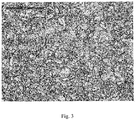
- Figs. 1-3 show the metallographical structure images of the test steels of Examples 1, 3 and 6.
- the metallographical structures of the final steel sheets are homogeneous equiaxed tempered martensite, and the structures are fine.
- the disclosure makes control with respect to the chemical compositional design, the structure of the parent material, the quenching heating temperature, the tempering heating temperature and the like, so as to obtain good elongation, low-temperature toughness and other properties of the steel while guaranteeing ultrahigh strength.
Landscapes
- Chemical & Material Sciences (AREA)
- Engineering & Computer Science (AREA)
- Materials Engineering (AREA)
- Mechanical Engineering (AREA)
- Metallurgy (AREA)
- Organic Chemistry (AREA)
- Physics & Mathematics (AREA)
- Thermal Sciences (AREA)
- Crystallography & Structural Chemistry (AREA)
- Heat Treatment Of Steel (AREA)
Abstract
Description
- The disclosure relates to a quenched-tempered high-strength steel having a yield strength of 900 MPa -1000 MPa grade and a manufacturing method thereof, wherein the steel has a yield strength of 900-1080 MPa, a tensile strength of 950-1200 MPa, an elongation >10%, an impact energy at -40°C >40J, and a microstructure of tempered martensite.
- The use of a high-strength, easy-to-weld structural steel for manufacture of members of mobile equipments such as beam structures in engineering machinery, crane jibs, dumper bodies and the like can reduce the dead weights of the equipments, reduce fuel consumption, and increase operating efficiency. As the international competition intensifies, it has already become a trend to use a high-strength, easy-to-weld structural steel to manufacture members of mobile equipments such as beam structures in harbor machinery, mining machinery, excavating machinery and loading machinery, crane jibs, dumper bodies and the like. Due to the requirements of high performance, upsizing and light weight in the development of engineering machinery, the strength of the steel for engineering machinery is increased continuously from 500-600 MPa to 700 MPa, 900 MPa, 1000 MPa and even 1100 Mpa in a short period of time. The harsh use environment and load conditions of the ultrahigh-strength steel for engineering machinery impose rigid requirements on the quality of the steel material, including strength, impact resistance, bending property, weldability, strip shape, etc.
- At present, there are very few domestic enterprises having the ability of producing high-strength steel sheets having a yield strength of 900-1000 MPa grade. Chinese Patent Application
CN102560274A discloses a method for producing a high-strength thick steel sheet having a yield strength of 1000 MPa grade, wherein a process of re-heating-quenching + tempering is employed, and extremely high requirements are imposed on an equipment for decoiling a steel sheet. Chinese Patent ApplicationCN102134680A discloses a method for producing a high-strength steel having a yield strength of 960 MPa grade, wherein a low carbon content and a high Cr content are employed in the design: C: 0.07%-0.09%, Cr: 1.05-1.15%, wherein microalloy elements Nb, Ti, V are absent and Cr has a high content according to this application, which is undesirable for welding. Chinese Patent ApplicationCN101397640A discloses a method for producing a high-strength steel sheet having a yield strength of 960 MPa grade, wherein a high Mo content and a high tempering temperature are employed in the design, wherein the Mo content is 0.45-0.57%, and the tempering temperature is 550-600°C. - The compositional designs in the prior art neither control the comprehensive properties of plasticity and toughness at joints, nor improve strength or toughness of a final steel sheet by controlling inclusions or heredity of microstructure and properties.
- An object of the disclosure is to provide a quenched-tempered high-strength steel having a yield strength of 900 MPa -1000 MPa grade and a method for manufacturing the same, wherein the high-strength steel has a microstructure of tempered martensite, a yield strength of 900-1080 MPa, a tensile strength of 950-1200 MPa, an elongation >10%, and an impact energy at - 40°C >40J.
- To achieve the above object, the technical solution provided according to the disclosure is as follows:
- A quenched-tempered high-strength steel having a yield strength of 900-1000 MPa grade, with the components and amounts thereof by weight percentage being: C:0.16-0.20%, Si: 0.10-0.30%, Mn: 0.80-1.60%, Cr: 0.20-0.70%, Mo: 0.10-0.45%, Ni: 0.10-0.50%, Nb: 0.010-0.030%, Ti: 0.010-0.030%, V: 0.010-0.050%, B: 0.0005-0.0030%, Al: 0.02-0.06%, Ca: 0.001-0.004%, N: 0.002-0.005%, P≤0.020%, S≤0.010%, O≤0.008%, and the balance of Fe and unavoidable impurities, wherein the above elements meet the following relationships: Ceq 0.51-0.60%, Ceq=C+Mn/6+(Cr+Mo+V)/5+(Ni+Cu)/15 ; 3.7≤Ti/N≤7.0; 1.0≤Ca/S≤3.0; 0.8%≤Mo+0.8Ni+0.4Cr+6V≤1.3%.
- Further, the quenched-tempered high-strength steel having a yield strength of 900 MPa -1000 MPa grade has a yield strength of 900-1080 MPa, a tensile strength of 950-1200 MPa, an elongation >10%, an impact energy at -40°C >40J, wherein the steel has a microstructure of tempered martensite.
- In the compositional design of the steel according to the disclosure:
- Carbon: Carbon has the effect of solid solution strengthening. It regulates the strength, plasticity and toughness of the martensitic structure. As tested, after re-heating and quenching, the tensile strength of low-carbon martensite and the carbon content have the following relationship: Rm=2510C(%)+790(MPa), wherein Rm is tensile strength. When the carbon content is 0.16% or higher, a tensile strength at a quenched state, which is greater than 1100 MPa can be guaranteed. Then, the strength is further reduced by tempering, so as to improve the toughness. An unduly high amount of carbon will result in increase of the carbon equivalent on the whole, leading to easy cracking during welding. The carbon content according to the disclosure is in the range of 0.16-0.20%.
- Silicon: Si in an amount of 0.10% or higher has a good effect of deoxygenation, but red scale tends to occur when the Si content exceeds 0.30%. If the Si content is excessively high, the toughness of the martensitic high-strength steel tends to be degraded. The silicon content according to the disclosure is in the range of 0.10-0.30%.
- Manganese: Mn in an amount of 0.8% or higher can increase the hardenability of the steel. When the Mn content exceeds 1.6%, segregation and inclusions such as MnS tend to occur, degrading the toughness of the martensitic high-strength steel. The Mn content according to the disclosure is in the range of 0.80-1.60%.
- Chromium: Cr element in an amount of 0.2% or higher can increase the hardenability of the steel, facilitating formation of a full martensitic structure during quenching. At a tempering temperature in the range of about 400-550 °C, Cr may form carbides of Cr, and has the effect of resisting softening during medium-temperature tempering. If the Cr content exceeds 0.70%, large sparks will occur during welding, affecting the welding quality. The Cr content according to the disclosure is in the range of 0.20-0.70%.
- Molybdenum: Mo element in an amount of 0.10% or higher can increase the hardenability of the steel, facilitating formation of a full martensitic structure during quenching. At a high temperature of 400 °C or higher, Mo can react with C to form compound particles having the effect of resisting softening during high-temperature tempering and softening of welded joints. An excessively high Mo content will lead to increase of the carbon equivalent, degrading weldability. Meanwhile, as Mo is a precious metal, the cost will be increased. The Mo content according to the disclosure is 0.10-0.45%.
- Nickel: Ni element in an amount of 0.10% or higher has the effect of refining the martensitic structure and improving the steel toughness. An excessively high content of Ni will lead to increase of the carbon equivalent, degrading weldability. Meanwhile, as Ni is a precious metal, the cost will be increased. The Ni content according to the disclosure is 0.10-0.50%.
- Niobium, titanium and vanadium: Nb, Ti and V are microalloy elements which form nano-scale precipitates with C, N and other elements, inhibiting growth of austenite grains during heating. Nb can increase the non-recrystallization critical temperature Tnr and expand the production window. The fine precipitate particles of Ti can improve weldability. V reacts with N and C during tempering to precipitate nano-scale V(C,N) particles, leading to improved steel strength. According to the disclosure, the Nb content is in the range of 0.010-0.030%, the Ti content is in the range of 0.010-0.030%, and the V content is in the range of 0.010-0.050%.
- Boron: A trace amount of B can improve the hardenability and strength of the steel. When B exceeds 0.0030%, segregation tends to occur, and borocarbide compounds form, leading to serious degradation of the toughness. The B content according to the disclosure is in the range of 0.0005-0.0030%.
- Aluminum: Al is used as a deoxidizer. Addition of 0.02% or more Al to the steel can refine grains and improve the impact toughness. If the Al content exceeds 0.06%, inclusion flaws of Al oxides tend to occur. The Al content according to the disclosure is in the range of 0.02-0.06%.
- Calcium: In the smelting of steel, Ca element in an amount of more than 0.001% can act as a purifier to improve the toughness of the steel. If the Ca content exceeds 0.004%, large-size Ca compounds tend to form, which degrades the toughness in turn. The Ca content according to the disclosure is 0.001-0.004%.
- Nitrogen: The disclosure requires strict control of the content of N element. In a tempering process, N element having a content of 0.002% or higher can react with V and C to form nano-scale V(C,N) particles, and thus have the effect of precipitation strengthening. In a welding process, softening of a heat-affected zone can also be inhibited by the precipitation strengthening. If the N content exceeds 0.005%, coarse precipitate particles tend to form, leading to degraded toughness. The N content according to the disclosure is 0.002-0.005%.
- Phosphorus, sulfur and oxygen: As impurity elements, P, S and O affect steel plasticity and toughness. According to the disclosure, these elements are controlled in the ranges of P≤0.020%, S≤0.010%, O≤0.008%.
- The carbon equivalent Ceq of an off-line quenched + tempered high-strength steel having a yield strength of 900-1000MPa needs to meet: Ceq 0.51-0.60%, Ceq=C+Mn/6+(Cr+Mo+V)/5+(Ni+Cu)/150. If Ceq is too low, softening of welded joints tends to occur; if Ceq is too high, microcracking tends to occur during welding.
- According to the disclosure, control of 0.8%≤Mo+0.8Ni+0.4Cr+6V≤1.3% is mainly used to guarantee equal-strength matching welding of the 900-1000 MPa high-strength steel, and adjust the strength and low-temperature toughness of a welding heat affected zone to realize optimal matching with a parent steel sheet in terms of strength and low-temperature toughness. Mo, Ni and Cr elements all can decrease the critical cooling speed of the steel, increase the hardenability of the steel, and increase the strength of the welded joints. Mo reacts with C to form compounds at high temperatures, and it has the effect of resisting softening of the welded joints. Mo and Ni elements both have the effect of refining structures and improving toughness. V and N react to form nano-scale V(C, N) particles which can resist softening of the joints. The collaboration of Mo, Ni, Cr and V elements can regulate the strength and toughness of the welding heat affected zone based on the strength of the parent material. If lower than 0.8%, both the strength and low-temperature toughness of the welded joints will be low; if higher than 1.3%, the strength of the welded joints will be rather high, and thus weld cracking tends to occur.
- The control of 3.7≤Ti/N≤7.0 can protect B atoms in the steel, so that B can be solid-dissolved to increase the hardenability. A suitable ratio of Ti to N helps to control the size of Ti precipitate particles, and improve the strength and toughness of the parent material and joints.
- Control of 1.0≤Ca/S≤3.0 can spheroidize sulfides in the steel, so as to improve the low-temperature toughness and weldability of the steel.
- A method of producing a quenched-tempered high-strength steel having a yield strength of 900-1000 MPa according to the disclosure comprises the following steps:
- 1) Smelting and casting of molten steel
- A composition as described below is smelted in a converter or electrical furnace, refined, and cast to a cast blank, wherein the components and amounts thereof by weight percentage of the composition are: C:0.16-0.20%, Si: 0.10-0.30%, Mn: 0.80-1.60%, Cr: 0.20-0.70%, Mo: 0.10-0.45%, Ni: 0.10-0.50%, Nb: 0.010-0.030%, Ti: 0.010-0.030%, V: 0.010-0.050%, B: 0.0005-0.0030%, Al: 0.02-0.06%, Ca: 0.001-0.004%, N: 0.002-0.005%, P≤0.020%, S≤0.010%, 0≤0.008%, and the balance of Fe and unavoidable impurities, wherein the above elements meet the following relationships:
- Ceq 0.51-0.60% , Ceq=C+Mn/6+(Cr+Mo+V)/5+(Ni+Cu)/15 ; 0.8%≤Mo+0.8Ni+0.4Cr+6V≤1.3%; 3.7≤Ti/N≤7.0; 1.0≤Ca/S≤3.0;
- The cast blank is heated at 1150-1270°C in a furnace, wherein, when the temperature of the core of the cast blank arrives at the temperature of the furnace, the temperature is held, and the holding time is >1.5h;
- The cast blank is rolled to a target thickness by single-stand reciprocating rolling or multi-stand hot continuous rolling, wherein a rolling reduction rate at a final rolling path is >15%; a final rolling temperature is 820-920 °C, and the final rolling temperature Tf meets: Ar3<Tf<Tnr, wherein Ar3 is a temperature at which hypo-eutectoid steel austenite begins to convert to ferrite: Ar3=901-325C-92Mn-126Cr-67Ni-149Mo; Tnr is non-recrystallization critical temperature:

- After the hot rolling, the rolled member is coiled at a temperature in the range of 480-Bs °C, followed by air cooling to room temperature; wherein

- Quenching: A quenching heating temperature is Ac3+(30-80)°C, and when the temperature of the core of the steel sheet arrives at the temperature of the furnace, the temperature is held and the holding time is 5-40 min, so as to obtain a full martensitic structure, wherein Ac3 is a temperature at which transformation of austenite is over,

- Tempering: A tempering temperature is 400-550°C; when the temperature of the core of the steel sheet arrives at the temperature of the furnace, the temperature is held, and the holding time is 20-180min, so as to obtain a quenched-tempered high-strength steel having a yield strength of 900-1000 MPa grade.
- Further, the quenched-tempered high-strength steel having a yield strength of 900 MPa -1000 MPa grade has a yield strength of 900-1080 MPa, a tensile strength of 950-1200 MPa, an elongation >10%, an impact energy at -40°C >40J, wherein the steel has a microstructure of tempered martensite.
- In the following relations involved in the present disclosure: Ceq=C+Mn/6+(Cr+Mo+V)/5+(Ni+Cu)/15, Mo+0.8Ni+0.4Cr+6V, Ti/N, Ca/S, the element symbols represent the weight percentages of the corresponding elements. In the following calculation formulae involved in the present disclosure: Ar3=901-325C-92Mn-126Cr-67Ni-149Mo, Tnr=887+464C+(6445Nb-644sqrt(Nb))+(732V-230sqrt(V))+890Ti+363A1-357Si, Bs=630-45Mn-40V-35Si-30Cr-25Mo-20Ni, Ac3=955-350C-25Mn+51Si+106Nb+100Ti+68Al-11Cr-33Ni-16Cu+67Mo, and V>e(5.3-2.53C-0.16Si-0.82Mn-0.95Cr-1.87Mo-160B), each of the element symbols represents the weight percentage of the corresponding element × 100.
- In the method for producing a quenched-tempered high-strength steel having a yield strength of 900-1000 MPa grade according to the disclosure, in the process of heating the cast blank, the heating temperature is controlled to be greater than 1150°C, and the holding time of the core is >1.5h, so that full solid dissolution of the alloy elements can be ensured. If the heating temperature exceeds 1270°C, austenite grains will grow excessively, and thus the inter-grain binding force will be weakened, such that cracking tends to occur during rolling. In addition, if the heating temperature exceeds 1270°C, decarburization tends to occur at the surface of the steel blank, affecting the mechanical properties of the final product.
- In order to ensure rolling in an austenite zone, the final rolling temperature is greater than Ar3; in order to ensure rolling in a non-recrystallization zone of austenite, the final rolling temperature is less than Tnr. Rolling in the non-recrystallization zone of austenite can refine austenite grains and the cooled martensitic structure. After subsequent heat treatment, the grain size and toughness of the steel have some heredity, so that the strength and toughness of the heated steel can be improved. At the same time, rolling at a large reduction rate is conducted to form sufficient deformation energy in the non-recrystallization zone, induce recrystallization of austenite in the range of Ar3-Tnr, and refine grains.
- In the cooling process, coiling is conducted at a temperature in the range of 480-Bs °C in order to obtain fine bainite structure and improve the steel toughness. After subsequent heat treatment, the grain size and toughness of the steel have some heredity, so that the strength and toughness of the heated steel can be improved.
- In the quenching heat treatment process, if the heating temperature is lower than Ac3+30°C, or the holding time is less than 5 min after the temperature of the core of the steel sheet arrives at the temperature of the furnace, it will be difficult for the alloy to solid dissolve sufficiently. If the heating temperature is higher than Ac3+80°C, or the holding time is more than 40 min after the temperature of the core of the steel sheet arrives at the temperature of the furnace, austenite grains tend to grow. By controlling the quenching heating temperature and quenching heating time in narrow ranges, obtainment of fine austenite grains can be ensured, so as to refine the martensitic structure after the quenching and improve the strength and toughness of the steel.
- In the tempering heat treatment process, for steel of the chemical composition system according to the disclosure, if the tempering temperature exceeds 400 °C and the holding time is 20 min or longer after the temperature of the core of the steel sheet arrives at the temperature of the furnace, oversaturated carbon atoms in the quenched martensite will precipitate to form spherical Fe3C cementite, and alloy Mo and V will react with C at this temperature to form fine alloy carbides, so as to improve the plasticity and toughness of the steel, and eliminate effectively the internal stress in the steel. If the tempering temperature exceeds 550°C or the holding time is too long, the spherical Fe3C cementite and the alloy carbides will be coarsened, which will degrade the toughness of the steel and reduce the strength of the steel. Optimal matching between the strength and the toughness can be ensured by regulating the tempering temperature and the tempering time.
- The beneficial effects of the disclosure include:
- By using a process of controlling rolling, controlling cooling, and off-line quenching + tempering, the disclosure makes control with respect to the chemical compositional design, the structure of the parent material, the quenching heating temperature, the tempering heating temperature and the like, so as to obtain good elongation, low-temperature toughness and other properties of the steel while guaranteeing ultrahigh strength.
- As compared with the prior art, the disclosure controls the match of strength and toughness between parent material and welded joint by controlling the contents such elements as Mo, Ni, Cr and V, improves the toughness of the parent steel sheet and welded joints by controlling the ratio of Ti to N and the ratio of Ca to S, and improves the strength and toughness of the final steel sheet by a process utilizing the hereditary nature of the structure and properties.
-
-
Fig. 1 is an image of the typical metallographical structure of the test steel of Example 1 according to the disclosure; -
Fig. 2 is an image of the typical metallographical structure of the test steel of Example 3 according to the disclosure; -
Fig. 3 is an image of the typical metallographical structure of the test steel of Example 6 according to the disclosure. - The disclosure will be further illustrated with reference to the following specific Examples.
- The process flow for producing the ultrahigh strength steel of the disclosure is as follows: steel making in a converter or electric furnace → secondary refining → continuous casting → heating → rolling → cooling → heat treatment.
- A method of producing a quenched-tempered high-strength steel having a yield strength of 900-1000 MPa grade according to Examples 1-10 in the disclosure comprises the following steps:
- 1) Smelting, casting: A 50 kg vacuum electric furnace was used for smelting. The compositions are shown in Table 1. The smelted liquid steel was cast into cast blanks having a thickness of 120mm. The cast blanks were placed into an electric furnace for heating.
- 2) Rolling: The cast blanks were rolled into steel sheets having a target thickness of 10 mm in multiple paths. The final rolling temperature was 820-920°C. At the same time, the final rolling temperature Tf met: Ar3<Tf<Tnr. The reduction rate at the final path was set at 17%.
- 3)Cooling: after rolling, the rolled members were subjected to on-line laminar cooling. The final cooling temperature was controlled in the range of 480-Bs °C, wherein Bs was a temperature at which transformation of Bainite began. The rolled members were coiled, and cooled to room temperature. Quenching heat treatment process: In the quenching heat treatment process, the quenching heating temperature was the final temperature of austenitic transformation Ac3+(30-80)°C; the quenching heating time was 5-40 min after the temperature of the core of the steel sheet arrived at the temperature of the furnace; the quenching cooling speed V>e(5.3-2.53C-0.16Si-0.82Mn-0.95Cr-1,87Mo-160B)°C/s; the steel was quenching cooled to (Ms-150) °C or less.
- 5)Tempering heat treatment process: The tempering temperature was 400-550 °C; the tempering time was 20-180 min after the temperature of the core of the steel sheet arrived at the temperature of the furnace. Then, a quenched-tempered high-strength steel having a yield strength of 900-1000 MPa grade according to the disclosure was obtained.
- 6)The quenched-tempered steel sheet was subjected to longitudinal tensile testing and longitudinal impact testing.
- The specific components and process conditions are shown in Tables 1 and 2. The properties of the sample sheets in the various Examples are shown in Table 3.
-
Figs. 1-3 show the metallographical structure images of the test steels of Examples 1, 3 and 6. As can be seen from the metallographical images inFigs. 1-3 , the metallographical structures of the final steel sheets are homogeneous equiaxed tempered martensite, and the structures are fine. - By using a process of controlling rolling, controlling cooling, and off-line quenching + tempering, the disclosure makes control with respect to the chemical compositional design, the structure of the parent material, the quenching heating temperature, the tempering heating temperature and the like, so as to obtain good elongation, low-temperature toughness and other properties of the steel while guaranteeing ultrahigh strength.
Table 1 unit: weight% Ex. C Si Mn Cr Mo V Ni Nb Ti B Al Ca P S N O 1 0.16 0.27 1.21 0.7 0.22 0.022 0.37 0.01 0.011 0.0015 0.051 0.0022 0.007 0.002 0.0021 0.0045 2 0.16 0.27 1.21 0.7 0.22 0.022 0.37 0.01 0.011 0.0015 0.051 0.0022 0.007 0.002 0.0021 0.0045 3 0.16 0.3 1.6 0.54 0.1 0.036 0.48 0.02 0.03 0.00052 0.06 0.0016 0.016 0.0013 0.0045 0,0072 4 0.16 0.3 1.6 0.54 0.1 0.036 0.48 0.02 0.03 0.00052 0.06 0.0016 0.016 0.0013 0.0045 0.0072 5 0.19 0.14 1.03 0.2 0.45 0.01 0.27 0.03 0.02 0.0016 0.035 0.004 0.015 0.0014 0.0036 0.0034 6 0.19 0.14 1.03 0.2 0.45 0.01 0.27 0.03 0.02 0.0016 0.035 0.004 0.015 0.0014 0.0036 0.0034 7 0.17 0.18 1.45 0.31 0.41 0.045 0.1 0.012 0.014 0.0017 0.022 0.0037 0.016 0.0016 0.0037 0.0067 8 0.17 0.18 1.45 0.31 0.41 0.045 0.1 0.012 0.014 0.0017 0.022 0.0037 0.016 0.0016 0.0037 0.0067 9 0.2 0.1 0.8 0.65 0.32 0.05 0.5 0.018 0.015 0.003 0.026 0.0026 0.012 0.0016 0.0026 0.0041 10 0.2 0.1 0.8 0.65 0.32 0.05 0.5 0.018 0.015 0.003 0.026 0.0026 0.012 0.0016 0.0026 0.0041 Table 2 Ex. Heating Temperature °C Holding time, min Final rolling temperature, °C Final cooling temperature after rolling, °C Quenching heating temperature, °C Quenching holding time min Quenching cooling speed, °C/ s Final cooling temperature after quenching , °C/s Tempering heating temperature, °C Tempering holding time min 1 1250 130 851 493 920 15 26 120 420 80 2 1220 160 870 508 910 30 45 212 540 30 3 1240 140 866 513 900 20 57 232 430 70 4 1260 210 855 517 930 30 46 210 550 20 5 1170 100 823 515 960 5 75 64 410 85 6 1270 110 891 504 935 40 84 26 500 35 7 1210 120 866 506 940 25 35 35 450 65 8 1190 190 903 512 950 20 36 153 530 30 9 1250 130 876 497 920 15 46 43 400 180 10 1230 110 844 513 910 10 64 76 510 30 Table 3 Ex. Yield strength MPa Tensile strength MPa Elongation % Impact energy at -40°C (7.5*10*55mm), J 1 1015 1082 13.4 88 83 95 2 917 967 15.2 120 103 107 3 1057 1119 12.6 53 60 49 4 983 1016 14.3 87 75 91 5 1078 1121 11.8 59 46 68 6 1025 1077 13.7 70 85 79 7 1006 1074 14.2 110 107 99 8 942 980 15.4 105 122 113 9 1074 1119 12.3 63 79 60 10 1046 1097 13.1 79 58 88 Note: The test results of the impact energy at -40°C in the three columns represent the test results of three parallel samples.
Claims (6)
- A quenched-tempered high-strength steel having a yield strength of 900-1000 MPa grade, consisting of the following components by weight percentage: C:0.16-0.20%, Si: 0.10-0,30%, Mn: 0.80-1.60%, Cr: 0.20-0.70%, Mo: 0.10-0.45%, Ni: 0.10-0.50%, Nb: 0.010-0.030%, Ti: 0.010-0.030%, V: 0.010-0.050%, B: 0.0005-0.0030%, Al: 0.02-0.06%, Ca: 0.001-0.004%, N: 0.002-0.005%, P≤0.020%, S≤0.010%, 0≤0.008%, the balance of Fe and unavoidable impurities, wherein the above elements meet the following relationships:Ceq 0.51-0.60% , Ceq=C+Mn/6+(Cr+Mo+V)/5+(Ni+Cu)/15 ; 0.8%≤Mo+0.8Ni+0.4Cr+6V≤1.3%; 3.7≤Ti/N≤7.0; 1.0≤Ca/S≤3.0.
- The quenched-tempered high-strength steel having a yield strength of 900-1000 MPa grade according to claim 1, wherein the quenched-tempered high-strength steel has a microstructure of tempered martensite.
- The quenched-tempered high-strength steel having a yield strength of 900-1000 MPa grade according to claim 1, wherein the quenched-tempered high-strength steel has a yield strength of 900-1080MPa, a tensile strength of 950-1200MPa, an elongation >10%, and an impact energy at -40°C >40J.
- A method of producing a quenched-tempered high-strength steel having a yield strength of 900-1000 MPa grade, comprising the following steps:1) Smelting and castingsmelting a composition as described below in a converter or electrical furnace, refining, and casting to a cast blank, wherein the composition consists of the following components by weight percentage: C:0.16-0.20%, Si: 0.10-0.30%, Mn: 0.80-1.60%, Cr: 0.20-0.70%, Mo: 0.10-0.45%, Ni: 0.10-0.50%, Nb: 0.010-0.030%, Ti: 0.010-0.030%, V: 0.010-0.050%, B: 0.0005-0.0030%, Al: 0.02-0.06%, Ca: 0.001-0.004%, N: 0.002-0.005%, P≤0.020%, S≤0.010%, O≤0.008%, the balance of Fe and unavoidable impurities, wherein the above elements meet the following relationships:Ceq 0.51-0.60% , Ceq=C+Mn/6+(Cr+Mo+V)/5+(Ni+Cu)/15 ; 0.8%≤Mo+0.8Ni+0.4Cr+(V≤1.3%; 3.7≤Ti/N≤7.0; 1.0≤Ca/S≤3.0;2) Heatingheating the cast blank at 1150-1270°C in a furnace, wherein, when the temperature of the core of the cast blank arrives at the temperature of the furnace, the temperature is held, and the holding time is >1.5h;3) Rollingrolling the cast blank to a target thickness by single-stand reciprocating rolling or multi-stand hot continuous rolling, wherein a rolling reduction rate at a final rolling path is >15%; a final rolling temperature is 820-920 °C, and the final rolling temperature Tf meets: Ar3<Tf<Tnr, wherein Ar3 is a temperature at which hypo-eutectoid steel austenite begins to convert to ferrite, and Tnr is non-recrystallization critical temperature: Ar3=901-325C-92Mn-126Cr-67Ni-149Mo;
 4) Coolingcoiling a rolled member at a temperature in the range of 480-Bs °C after hot rolling, followed by air cooling to room temperature; wherein
 5) Heat treatmentquenching at a quenching heating temperature of Ac3+(30-80)°C, wherein Ac3 is a temperature at which transformation of austenite is over:
 Ms=539-423C-30.4Mn-17.7Ni-12.1Cr-11.0Si-7.0Mo; wherein a quenching cooling speed V >e(5.3-2.53C-0.16Si-0.82Mn-0.95Cr-1.87Mo-160B)°C/s;tempering at a tempering temperature of 400-550°C; when the temperature of the core of the steel sheet arrives at the temperature of the furnace, the temperature is held for a holding time of 20-180min, so as to obtain a quenched-tempered high-strength steel having a yield strength of 900-1000 MPa grade.
 - The method of producing a quenched-tempered high-strength steel having a yield strength of 900-1000 MPa grade according to claim 4, wherein a high-strength steel sheet obtained by said method has a microstructure of tempered martensite.
- The method of producing a quenched-tempered high-strength steel having a yield strength of 900-1000 MPa grade according to claim 4, wherein a high-strength steel sheet obtained by said method has a yield strength of 900-1080MPa, a tensile strength of 950-1200MPa, an elongation >10%, and an impact energy at - 40°C >40J.
Applications Claiming Priority (2)
| Application Number | Priority Date | Filing Date | Title |
|---|---|---|---|
| CN201410810301.0A CN104532157A (en) | 2014-12-19 | 2014-12-19 | 900MPa-1000MPa grade (yield strength) quenched-tempered high-strength steel and production method thereof |
| PCT/CN2015/096639 WO2016095721A1 (en) | 2014-12-19 | 2015-12-08 | Quenched-tempered high-strength steel with yield strength of 900 mpa to 1000 mpa grade, and manufacturing method therefor |
Publications (3)
| Publication Number | Publication Date |
|---|---|
| EP3235924A1 true EP3235924A1 (en) | 2017-10-25 |
| EP3235924A4 EP3235924A4 (en) | 2018-05-09 |
| EP3235924B1 EP3235924B1 (en) | 2020-01-15 |
Family
ID=52847772
Family Applications (1)
| Application Number | Title | Priority Date | Filing Date |
|---|---|---|---|
| EP15869229.3A Active EP3235924B1 (en) | 2014-12-19 | 2015-12-08 | Quenched-tempered high-strength steel with yield strength of 900 mpa to 1080 mpa grade, and manufacturing method therefor |
Country Status (5)
| Country | Link |
|---|---|
| US (1) | US20170349966A1 (en) |
| EP (1) | EP3235924B1 (en) |
| JP (1) | JP6502499B2 (en) |
| CN (1) | CN104532157A (en) |
| WO (1) | WO2016095721A1 (en) |
Families Citing this family (32)
| Publication number | Priority date | Publication date | Assignee | Title |
|---|---|---|---|---|
| CN104532157A (en) * | 2014-12-19 | 2015-04-22 | 宝山钢铁股份有限公司 | 900MPa-1000MPa grade (yield strength) quenched-tempered high-strength steel and production method thereof |
| CN106319368B (en) * | 2015-06-16 | 2018-04-24 | 鞍钢股份有限公司 | Economical thin chain plate and manufacturing method thereof |
| CN105695860A (en) * | 2016-03-29 | 2016-06-22 | 安徽天澄钢构有限公司 | Structural steel and production technology thereof |
| CN114107839A (en) * | 2016-06-30 | 2022-03-01 | 中车戚墅堰机车车辆工艺研究所有限公司 | Low-alloy cast steel, heat treatment method thereof and application thereof in railway industry |
| CN107794440B (en) * | 2017-08-30 | 2019-12-27 | 宁波亿润汽车零部件有限公司 | High strength air intake manifold support |
| CN108642390B (en) * | 2018-05-30 | 2020-05-05 | 武汉钢铁有限公司 | High-strength thick steel plate with thickness direction performance Z of 35-50% and production method thereof |
| CN110129670B (en) * | 2019-04-25 | 2020-12-15 | 首钢集团有限公司 | A kind of 1300MPa grade high strength and high plasticity hot stamping steel and preparation method thereof |
| CN110952020A (en) * | 2019-10-16 | 2020-04-03 | 邯郸钢铁集团有限责任公司 | Economical 900 MPa-grade ultrahigh-strength quenched and tempered steel plate and production method thereof |
| CN111286669A (en) * | 2020-02-17 | 2020-06-16 | 本钢板材股份有限公司 | Martensitic hot-rolled high-strength steel with yield strength ≥900Mpa and preparation method |
| CN111876662B (en) * | 2020-06-18 | 2022-04-12 | 江阴兴澄特种钢铁有限公司 | Hot-work die steel plate and manufacturing method thereof |
| CN113832413B (en) * | 2020-06-23 | 2022-11-18 | 宝山钢铁股份有限公司 | Ultra-thick 800 MPa-grade quenched and tempered steel plate with excellent core low-temperature impact toughness and weldability and manufacturing method thereof |
| CN111926152A (en) * | 2020-08-17 | 2020-11-13 | 沈阳飞机工业(集团)有限公司 | Heat treatment deformation control method for large 23Co14Ni12Cr3MoE steel part |
| CN112143877B (en) * | 2020-09-02 | 2024-02-23 | 中冶南方工程技术有限公司 | Fully continuous heat treatment production system and method for hot-rolled high-strength steel |
| CN113308643B (en) * | 2021-04-23 | 2022-10-28 | 邯郸钢铁集团有限责任公司 | Production method of ultrahigh-strength Q1100E steel plate with good formability |
| CN113637900A (en) * | 2021-07-27 | 2021-11-12 | 包头钢铁(集团)有限责任公司 | Production method of thick steel plate for 1100 MPa-level heavy machinery suspension arm |
| CN114058793A (en) * | 2021-10-27 | 2022-02-18 | 舞阳钢铁有限责任公司 | Heat treatment method for reducing yield ratio of ultrahigh-strength marine steel EH890 |
| CN114000056A (en) * | 2021-10-27 | 2022-02-01 | 北京科技大学烟台工业技术研究院 | Marine steel plate with yield strength of 960MPa grade and low yield ratio and preparation method thereof |
| CN116254391B (en) * | 2021-12-10 | 2025-10-17 | 中国石油天然气集团有限公司 | High-plasticity ultrahigh-steel-grade high-strain pipeline steel and preparation method thereof |
| CN114480970B (en) * | 2022-01-25 | 2022-08-09 | 上海大学 | High-strength high-toughness steel and preparation method and application thereof |
| CN115449695B (en) * | 2022-08-22 | 2023-09-26 | 包头钢铁(集团)有限责任公司 | Production method of 1000 MPa-level high-strength round sucker rod steel |
| CN118064796A (en) * | 2022-11-23 | 2024-05-24 | 宝山钢铁股份有限公司 | Ultra-high strength steel with excellent welding performance and manufacturing method thereof |
| CN116179964A (en) * | 2022-12-14 | 2023-05-30 | 鞍钢股份有限公司 | A low-cost high-hardness steel plate for dredging pipelines and its production method |
| CN116024499B (en) * | 2022-12-28 | 2024-06-25 | 燕山大学 | A 10.9-grade bolt steel resistant to hydrogen-induced delayed fracture and a method for preparing a 10.9-grade bolt |
| CN116676541A (en) * | 2023-05-16 | 2023-09-01 | 北京科技大学 | A low-cost 960MPa grade ultra-high toughness steel plate and its preparation method |
| CN116904869B (en) * | 2023-08-07 | 2025-09-02 | 武汉钢铁有限公司 | Steel for welding structure with yield strength of 900-1100 MPa and production method thereof |
| CN117144260B (en) * | 2023-08-07 | 2025-08-26 | 武汉钢铁有限公司 | Steel for welding structure with tensile strength ≥750MPa and production method |
| CN117286414A (en) * | 2023-10-09 | 2023-12-26 | 湖南华菱湘潭钢铁有限公司 | A 960MPa grade extra-thick and high-strength quenched and tempered steel plate for structures and its production method |
| CN117821845A (en) * | 2023-12-20 | 2024-04-05 | 南京钢铁股份有限公司 | Ultra-high strength steel plate for hydropower and production method thereof |
| CN117821846A (en) * | 2023-12-20 | 2024-04-05 | 南京钢铁股份有限公司 | Ultra-low temperature 1000MPa grade high-strength hydropower steel plate and production method thereof |
| CN118127429A (en) * | 2024-02-01 | 2024-06-04 | 山西太钢不锈钢股份有限公司 | Alloy steel for ultra-high pressure gas cylinder and preparation method thereof |
| CN117737372B (en) * | 2024-02-19 | 2024-04-16 | 太原科技大学 | 2.0 GPa-grade Cu-containing hot-formed steel plate and preparation method thereof |
| CN118186310B (en) * | 2024-05-17 | 2024-08-30 | 江苏永钢集团有限公司 | 12.9-Grade quenching-free high-hardenability hot-rolled multiphase cold heading steel wire rod and manufacturing method thereof |
Family Cites Families (18)
| Publication number | Priority date | Publication date | Assignee | Title |
|---|---|---|---|---|
| CN100494451C (en) * | 2005-03-30 | 2009-06-03 | 宝山钢铁股份有限公司 | Superhigh strength steel plate with yield strength more than 960Mpa and method for producing same |
| CN101397640A (en) * | 2008-11-11 | 2009-04-01 | 武汉钢铁(集团)公司 | Welding structure steel with yield strength of 960MPa grade |
| CN101906594B (en) * | 2009-06-08 | 2013-07-31 | 鞍钢股份有限公司 | 900 MPa-grade yield strength quenched and tempered steel plate and manufacturing method thereof |
| CN102712972B (en) * | 2010-05-14 | 2013-08-07 | 新日铁住金株式会社 | High-strength steel plate and method for producing same |
| CN102134680A (en) * | 2011-04-19 | 2011-07-27 | 首钢总公司 | Ultrahigh strength steel with 960MPa of yield strength and production method thereof |
| CN103014538B (en) * | 2011-09-26 | 2015-10-28 | 宝山钢铁股份有限公司 | A kind of yield strength 960MPa grade high-strength steel plate and manufacture method thereof |
| CN103014539B (en) * | 2011-09-26 | 2015-10-28 | 宝山钢铁股份有限公司 | A kind of yield strength 700MPa grade high-strength high-tenacity steel plate and manufacture method thereof |
| JP6056235B2 (en) * | 2011-10-28 | 2017-01-11 | Jfeスチール株式会社 | Method for producing high-tensile steel sheet with excellent weldability and delayed fracture resistance and tensile strength of 950 MPa or more |
| CN102373384A (en) * | 2011-11-25 | 2012-03-14 | 宝山钢铁股份有限公司 | High-strength high-toughness wear-resistant steel plate and manufacturing method thereof |
| CN102560274A (en) * | 2011-12-12 | 2012-07-11 | 秦皇岛首秦金属材料有限公司 | Hardened and tempered ultrahigh-strength steel with 1000MPa-grade yield strength and production method thereof |
| CN102505096B (en) * | 2011-12-27 | 2014-03-05 | 宝山钢铁股份有限公司 | Steel with good property and ultra-high strength for engineering machinery and manufacturing method thereof |
| JP5811020B2 (en) * | 2012-04-25 | 2015-11-11 | 新日鐵住金株式会社 | High-strength steel sheet with high toughness, high workability and formability, and excellent delayed fracture characteristics due to hydrogen embrittlement |
| EP2664682A1 (en) * | 2012-05-16 | 2013-11-20 | ThyssenKrupp Steel Europe AG | Steel for the production of a steel component, flat steel product comprising same, component comprised of same and method for producing same |
| CN103060715B (en) * | 2013-01-22 | 2015-08-26 | 宝山钢铁股份有限公司 | A kind of ultra-high strength and toughness steel plate and manufacture method thereof with low yielding ratio |
| CN103205627B (en) * | 2013-03-28 | 2015-08-26 | 宝山钢铁股份有限公司 | A kind of Low-alloy high-performance wear-resistant steel plate and manufacture method thereof |
| CN103266269B (en) * | 2013-05-15 | 2015-04-22 | 武汉钢铁(集团)公司 | HB500 grade hot continuous rolling high strength wear-resisting steel and production method thereof |
| CN103555910B (en) * | 2013-11-12 | 2015-06-10 | 湖南华菱湘潭钢铁有限公司 | Production method of tempered high-strength Q550F super-thick steel plate |
| CN104532157A (en) * | 2014-12-19 | 2015-04-22 | 宝山钢铁股份有限公司 | 900MPa-1000MPa grade (yield strength) quenched-tempered high-strength steel and production method thereof |
-
2014
- 2014-12-19 CN CN201410810301.0A patent/CN104532157A/en active Pending
-
2015
- 2015-12-08 EP EP15869229.3A patent/EP3235924B1/en active Active
- 2015-12-08 JP JP2017532159A patent/JP6502499B2/en active Active
- 2015-12-08 US US15/536,601 patent/US20170349966A1/en not_active Abandoned
- 2015-12-08 WO PCT/CN2015/096639 patent/WO2016095721A1/en not_active Ceased
Also Published As
| Publication number | Publication date |
|---|---|
| EP3235924B1 (en) | 2020-01-15 |
| WO2016095721A1 (en) | 2016-06-23 |
| JP2018505303A (en) | 2018-02-22 |
| US20170349966A1 (en) | 2017-12-07 |
| JP6502499B2 (en) | 2019-04-17 |
| EP3235924A4 (en) | 2018-05-09 |
| CN104532157A (en) | 2015-04-22 |
Similar Documents
| Publication | Publication Date | Title |
|---|---|---|
| EP3235924B1 (en) | Quenched-tempered high-strength steel with yield strength of 900 mpa to 1080 mpa grade, and manufacturing method therefor | |
| US10961611B2 (en) | High-strength steel with yield strength of 800 MPa and production method therefor | |
| CN104513936B (en) | A quenched and tempered high-strength steel with a yield strength of 1100 MPa and a production method thereof | |
| US9790579B2 (en) | High tensile strength steel plate having excellent weld heat-affected zone low-temperature toughness and method for producing same | |
| KR101635008B1 (en) | Thick-walled, high tensile strength steel with excellent ctod characteristics of the weld heat-affected zone, and manufacturing method thereof | |
| CN100412223C (en) | Ultra-high strength steel with excellent corrosion resistance and fatigue resistance and its making process | |
| EP3239327A1 (en) | High-strength steel plate for pressure vessel having excellent toughness after post weld heat treatment and manufacturing method thereof | |
| CN101215669A (en) | High-strength thick steel plate for large-scale petroleum storing tank and low-cost manufacturing method thereof | |
| KR20170066612A (en) | High toughness and high tensile strength thick steel plate with excellent material homogeneity and production method for same | |
| CN101855379A (en) | Fire-resistant steel material excellent in reheat embrittlement resistance and low-temperature toughness of welded heat-affected zone, and manufacturing method thereof | |
| CN104561827A (en) | High strength steel with yield strength to be 900-1000MPa grade and production method of high strength steel | |
| CN104532156A (en) | Quenched and tempered high strength steel with 1300 MPa grade of yield strength and production method thereof | |
| CN101660104A (en) | High temperature tempering resistant thick plate with low welding crack sensitivity and production method thereof | |
| JP6245352B2 (en) | High-tensile steel plate and manufacturing method thereof | |
| KR101937005B1 (en) | Weld joint | |
| CN104532158A (en) | 800MPa-grade (yield strength) quenched-tempered high-strength steel and production method thereof | |
| CN104532159A (en) | 700MPa-grade (yield strength) quenched-tempered high-strength steel and production method thereof | |
| JP2007177318A (en) | Method for producing high-tensile steel plate and high-tensile steel plate | |
| JP2023031269A (en) | Ultra-low yield ratio high tensile strength thick steel sheet, and method for producing the same | |
| JP5028785B2 (en) | High toughness high tensile steel sheet and method for producing the same | |
| JP2781000B2 (en) | Method for producing high-strength steel sheet excellent in HIC resistance and SSC resistance | |
| CN106636937A (en) | Easy-to-weld structural steel with tensile strength in 600 MPa level and production method thereof | |
| JP2007063603A (en) | 780 MPa class high strength steel sheet and method for producing the same | |
| CN118441225A (en) | High-strength steel with low yield ratio and 1000MPa grade and production method thereof | |
| CN104513935A (en) | High-strength steel with yield strength of 700MPa and production method thereof |
Legal Events
| Date | Code | Title | Description |
|---|---|---|---|
| STAA | Information on the status of an ep patent application or granted ep patent |
Free format text: STATUS: THE INTERNATIONAL PUBLICATION HAS BEEN MADE |
|
| PUAI | Public reference made under article 153(3) epc to a published international application that has entered the european phase |
Free format text: ORIGINAL CODE: 0009012 |
|
| STAA | Information on the status of an ep patent application or granted ep patent |
Free format text: STATUS: REQUEST FOR EXAMINATION WAS MADE |
|
| 17P | Request for examination filed |
Effective date: 20170628 |
|
| AK | Designated contracting states |
Kind code of ref document: A1 Designated state(s): AL AT BE BG CH CY CZ DE DK EE ES FI FR GB GR HR HU IE IS IT LI LT LU LV MC MK MT NL NO PL PT RO RS SE SI SK SM TR |
|
| AX | Request for extension of the european patent |
Extension state: BA ME |
|
| DAV | Request for validation of the european patent (deleted) | ||
| DAX | Request for extension of the european patent (deleted) | ||
| A4 | Supplementary search report drawn up and despatched |
Effective date: 20180409 |
|
| RIC1 | Information provided on ipc code assigned before grant |
Ipc: C22C 38/06 20060101ALI20180403BHEP Ipc: C22C 38/46 20060101ALI20180403BHEP Ipc: C22C 38/48 20060101ALI20180403BHEP Ipc: C22C 38/58 20060101AFI20180403BHEP Ipc: C21D 9/46 20060101ALI20180403BHEP Ipc: C21D 6/00 20060101ALI20180403BHEP Ipc: C22C 38/00 20060101ALI20180403BHEP Ipc: C22C 38/54 20060101ALI20180403BHEP Ipc: C21D 8/02 20060101ALI20180403BHEP Ipc: C22C 38/02 20060101ALI20180403BHEP Ipc: C21D 1/18 20060101ALI20180403BHEP Ipc: C22C 38/50 20060101ALI20180403BHEP Ipc: C22C 38/44 20060101ALI20180403BHEP |
|
| RIC1 | Information provided on ipc code assigned before grant |
Ipc: C22C 38/06 20060101ALI20190415BHEP Ipc: C22C 38/50 20060101ALI20190415BHEP Ipc: C21D 8/02 20060101ALI20190415BHEP Ipc: C22C 38/44 20060101ALI20190415BHEP Ipc: C21D 6/00 20060101ALI20190415BHEP Ipc: C22C 38/58 20060101AFI20190415BHEP Ipc: C22C 38/48 20060101ALI20190415BHEP Ipc: C22C 38/00 20060101ALI20190415BHEP Ipc: C22C 38/54 20060101ALI20190415BHEP Ipc: C22C 38/02 20060101ALI20190415BHEP Ipc: C21D 9/46 20060101ALI20190415BHEP Ipc: C21D 1/18 20060101ALI20190415BHEP Ipc: C22C 38/46 20060101ALI20190415BHEP |
|
| GRAP | Despatch of communication of intention to grant a patent |
Free format text: ORIGINAL CODE: EPIDOSNIGR1 |
|
| STAA | Information on the status of an ep patent application or granted ep patent |
Free format text: STATUS: GRANT OF PATENT IS INTENDED |
|
| GRAJ | Information related to disapproval of communication of intention to grant by the applicant or resumption of examination proceedings by the epo deleted |
Free format text: ORIGINAL CODE: EPIDOSDIGR1 |
|
| GRAP | Despatch of communication of intention to grant a patent |
Free format text: ORIGINAL CODE: EPIDOSNIGR1 |
|
| INTG | Intention to grant announced |
Effective date: 20190527 |
|
| GRAJ | Information related to disapproval of communication of intention to grant by the applicant or resumption of examination proceedings by the epo deleted |
Free format text: ORIGINAL CODE: EPIDOSDIGR1 |
|
| STAA | Information on the status of an ep patent application or granted ep patent |
Free format text: STATUS: REQUEST FOR EXAMINATION WAS MADE |
|
| GRAP | Despatch of communication of intention to grant a patent |
Free format text: ORIGINAL CODE: EPIDOSNIGR1 |
|
| STAA | Information on the status of an ep patent application or granted ep patent |
Free format text: STATUS: GRANT OF PATENT IS INTENDED |
|
| INTG | Intention to grant announced |
Effective date: 20190625 |
|
| INTG | Intention to grant announced |
Effective date: 20190717 |
|
| GRAS | Grant fee paid |
Free format text: ORIGINAL CODE: EPIDOSNIGR3 |
|
| GRAA | (expected) grant |
Free format text: ORIGINAL CODE: 0009210 |
|
| STAA | Information on the status of an ep patent application or granted ep patent |
Free format text: STATUS: THE PATENT HAS BEEN GRANTED |
|
| AK | Designated contracting states |
Kind code of ref document: B1 Designated state(s): AL AT BE BG CH CY CZ DE DK EE ES FI FR GB GR HR HU IE IS IT LI LT LU LV MC MK MT NL NO PL PT RO RS SE SI SK SM TR |
|
| REG | Reference to a national code |
Ref country code: GB Ref legal event code: FG4D Ref country code: CH Ref legal event code: EP |
|
| REG | Reference to a national code |
Ref country code: IE Ref legal event code: FG4D |
|
| REG | Reference to a national code |
Ref country code: DE Ref legal event code: R096 Ref document number: 602015045810 Country of ref document: DE |
|
| REG | Reference to a national code |
Ref country code: AT Ref legal event code: REF Ref document number: 1225210 Country of ref document: AT Kind code of ref document: T Effective date: 20200215 |
|
| REG | Reference to a national code |
Ref country code: SE Ref legal event code: TRGR |
|
| REG | Reference to a national code |
Ref country code: NL Ref legal event code: MP Effective date: 20200115 |
|
| REG | Reference to a national code |
Ref country code: LT Ref legal event code: MG4D |
|
| PG25 | Lapsed in a contracting state [announced via postgrant information from national office to epo] |
Ref country code: PT Free format text: LAPSE BECAUSE OF FAILURE TO SUBMIT A TRANSLATION OF THE DESCRIPTION OR TO PAY THE FEE WITHIN THE PRESCRIBED TIME-LIMIT Effective date: 20200607 Ref country code: RS Free format text: LAPSE BECAUSE OF FAILURE TO SUBMIT A TRANSLATION OF THE DESCRIPTION OR TO PAY THE FEE WITHIN THE PRESCRIBED TIME-LIMIT Effective date: 20200115 Ref country code: NL Free format text: LAPSE BECAUSE OF FAILURE TO SUBMIT A TRANSLATION OF THE DESCRIPTION OR TO PAY THE FEE WITHIN THE PRESCRIBED TIME-LIMIT Effective date: 20200115 Ref country code: FI Free format text: LAPSE BECAUSE OF FAILURE TO SUBMIT A TRANSLATION OF THE DESCRIPTION OR TO PAY THE FEE WITHIN THE PRESCRIBED TIME-LIMIT Effective date: 20200115 Ref country code: NO Free format text: LAPSE BECAUSE OF FAILURE TO SUBMIT A TRANSLATION OF THE DESCRIPTION OR TO PAY THE FEE WITHIN THE PRESCRIBED TIME-LIMIT Effective date: 20200415 |
|
| PG25 | Lapsed in a contracting state [announced via postgrant information from national office to epo] |
Ref country code: LV Free format text: LAPSE BECAUSE OF FAILURE TO SUBMIT A TRANSLATION OF THE DESCRIPTION OR TO PAY THE FEE WITHIN THE PRESCRIBED TIME-LIMIT Effective date: 20200115 Ref country code: HR Free format text: LAPSE BECAUSE OF FAILURE TO SUBMIT A TRANSLATION OF THE DESCRIPTION OR TO PAY THE FEE WITHIN THE PRESCRIBED TIME-LIMIT Effective date: 20200115 Ref country code: IS Free format text: LAPSE BECAUSE OF FAILURE TO SUBMIT A TRANSLATION OF THE DESCRIPTION OR TO PAY THE FEE WITHIN THE PRESCRIBED TIME-LIMIT Effective date: 20200515 Ref country code: BG Free format text: LAPSE BECAUSE OF FAILURE TO SUBMIT A TRANSLATION OF THE DESCRIPTION OR TO PAY THE FEE WITHIN THE PRESCRIBED TIME-LIMIT Effective date: 20200415 Ref country code: GR Free format text: LAPSE BECAUSE OF FAILURE TO SUBMIT A TRANSLATION OF THE DESCRIPTION OR TO PAY THE FEE WITHIN THE PRESCRIBED TIME-LIMIT Effective date: 20200416 |
|
| REG | Reference to a national code |
Ref country code: DE Ref legal event code: R097 Ref document number: 602015045810 Country of ref document: DE |
|
| PG25 | Lapsed in a contracting state [announced via postgrant information from national office to epo] |
Ref country code: SK Free format text: LAPSE BECAUSE OF FAILURE TO SUBMIT A TRANSLATION OF THE DESCRIPTION OR TO PAY THE FEE WITHIN THE PRESCRIBED TIME-LIMIT Effective date: 20200115 Ref country code: DK Free format text: LAPSE BECAUSE OF FAILURE TO SUBMIT A TRANSLATION OF THE DESCRIPTION OR TO PAY THE FEE WITHIN THE PRESCRIBED TIME-LIMIT Effective date: 20200115 Ref country code: EE Free format text: LAPSE BECAUSE OF FAILURE TO SUBMIT A TRANSLATION OF THE DESCRIPTION OR TO PAY THE FEE WITHIN THE PRESCRIBED TIME-LIMIT Effective date: 20200115 Ref country code: SM Free format text: LAPSE BECAUSE OF FAILURE TO SUBMIT A TRANSLATION OF THE DESCRIPTION OR TO PAY THE FEE WITHIN THE PRESCRIBED TIME-LIMIT Effective date: 20200115 Ref country code: ES Free format text: LAPSE BECAUSE OF FAILURE TO SUBMIT A TRANSLATION OF THE DESCRIPTION OR TO PAY THE FEE WITHIN THE PRESCRIBED TIME-LIMIT Effective date: 20200115 Ref country code: CZ Free format text: LAPSE BECAUSE OF FAILURE TO SUBMIT A TRANSLATION OF THE DESCRIPTION OR TO PAY THE FEE WITHIN THE PRESCRIBED TIME-LIMIT Effective date: 20200115 Ref country code: LT Free format text: LAPSE BECAUSE OF FAILURE TO SUBMIT A TRANSLATION OF THE DESCRIPTION OR TO PAY THE FEE WITHIN THE PRESCRIBED TIME-LIMIT Effective date: 20200115 Ref country code: RO Free format text: LAPSE BECAUSE OF FAILURE TO SUBMIT A TRANSLATION OF THE DESCRIPTION OR TO PAY THE FEE WITHIN THE PRESCRIBED TIME-LIMIT Effective date: 20200115 |
|
| REG | Reference to a national code |
Ref country code: AT Ref legal event code: MK05 Ref document number: 1225210 Country of ref document: AT Kind code of ref document: T Effective date: 20200115 |
|
| PLBE | No opposition filed within time limit |
Free format text: ORIGINAL CODE: 0009261 |
|
| STAA | Information on the status of an ep patent application or granted ep patent |
Free format text: STATUS: NO OPPOSITION FILED WITHIN TIME LIMIT |
|
| 26N | No opposition filed |
Effective date: 20201016 |
|
| PG25 | Lapsed in a contracting state [announced via postgrant information from national office to epo] |
Ref country code: IT Free format text: LAPSE BECAUSE OF FAILURE TO SUBMIT A TRANSLATION OF THE DESCRIPTION OR TO PAY THE FEE WITHIN THE PRESCRIBED TIME-LIMIT Effective date: 20200115 Ref country code: AT Free format text: LAPSE BECAUSE OF FAILURE TO SUBMIT A TRANSLATION OF THE DESCRIPTION OR TO PAY THE FEE WITHIN THE PRESCRIBED TIME-LIMIT Effective date: 20200115 |
|
| PG25 | Lapsed in a contracting state [announced via postgrant information from national office to epo] |
Ref country code: PL Free format text: LAPSE BECAUSE OF FAILURE TO SUBMIT A TRANSLATION OF THE DESCRIPTION OR TO PAY THE FEE WITHIN THE PRESCRIBED TIME-LIMIT Effective date: 20200115 Ref country code: SI Free format text: LAPSE BECAUSE OF FAILURE TO SUBMIT A TRANSLATION OF THE DESCRIPTION OR TO PAY THE FEE WITHIN THE PRESCRIBED TIME-LIMIT Effective date: 20200115 |
|
| REG | Reference to a national code |
Ref country code: CH Ref legal event code: PL |
|
| GBPC | Gb: european patent ceased through non-payment of renewal fee |
Effective date: 20201208 |
|
| PG25 | Lapsed in a contracting state [announced via postgrant information from national office to epo] |
Ref country code: MC Free format text: LAPSE BECAUSE OF FAILURE TO SUBMIT A TRANSLATION OF THE DESCRIPTION OR TO PAY THE FEE WITHIN THE PRESCRIBED TIME-LIMIT Effective date: 20200115 |
|
| REG | Reference to a national code |
Ref country code: BE Ref legal event code: MM Effective date: 20201231 |
|
| PG25 | Lapsed in a contracting state [announced via postgrant information from national office to epo] |
Ref country code: IE Free format text: LAPSE BECAUSE OF NON-PAYMENT OF DUE FEES Effective date: 20201208 Ref country code: LU Free format text: LAPSE BECAUSE OF NON-PAYMENT OF DUE FEES Effective date: 20201208 Ref country code: FR Free format text: LAPSE BECAUSE OF NON-PAYMENT OF DUE FEES Effective date: 20201231 |
|
| PG25 | Lapsed in a contracting state [announced via postgrant information from national office to epo] |
Ref country code: GB Free format text: LAPSE BECAUSE OF NON-PAYMENT OF DUE FEES Effective date: 20201208 Ref country code: LI Free format text: LAPSE BECAUSE OF NON-PAYMENT OF DUE FEES Effective date: 20201231 Ref country code: CH Free format text: LAPSE BECAUSE OF NON-PAYMENT OF DUE FEES Effective date: 20201231 |
|
| PG25 | Lapsed in a contracting state [announced via postgrant information from national office to epo] |
Ref country code: TR Free format text: LAPSE BECAUSE OF FAILURE TO SUBMIT A TRANSLATION OF THE DESCRIPTION OR TO PAY THE FEE WITHIN THE PRESCRIBED TIME-LIMIT Effective date: 20200115 Ref country code: MT Free format text: LAPSE BECAUSE OF FAILURE TO SUBMIT A TRANSLATION OF THE DESCRIPTION OR TO PAY THE FEE WITHIN THE PRESCRIBED TIME-LIMIT Effective date: 20200115 Ref country code: CY Free format text: LAPSE BECAUSE OF FAILURE TO SUBMIT A TRANSLATION OF THE DESCRIPTION OR TO PAY THE FEE WITHIN THE PRESCRIBED TIME-LIMIT Effective date: 20200115 |
|
| PG25 | Lapsed in a contracting state [announced via postgrant information from national office to epo] |
Ref country code: MK Free format text: LAPSE BECAUSE OF FAILURE TO SUBMIT A TRANSLATION OF THE DESCRIPTION OR TO PAY THE FEE WITHIN THE PRESCRIBED TIME-LIMIT Effective date: 20200115 Ref country code: AL Free format text: LAPSE BECAUSE OF FAILURE TO SUBMIT A TRANSLATION OF THE DESCRIPTION OR TO PAY THE FEE WITHIN THE PRESCRIBED TIME-LIMIT Effective date: 20200115 |
|
| PG25 | Lapsed in a contracting state [announced via postgrant information from national office to epo] |
Ref country code: BE Free format text: LAPSE BECAUSE OF NON-PAYMENT OF DUE FEES Effective date: 20201231 |
|
| PGFP | Annual fee paid to national office [announced via postgrant information from national office to epo] |
Ref country code: DE Payment date: 20251126 Year of fee payment: 11 |
|
| PGFP | Annual fee paid to national office [announced via postgrant information from national office to epo] |
Ref country code: SE Payment date: 20251126 Year of fee payment: 11 |