EP3232223A1 - Reflective device for use in an optical measuring system - Google Patents
Reflective device for use in an optical measuring system Download PDFInfo
- Publication number
- EP3232223A1 EP3232223A1 EP17163598.0A EP17163598A EP3232223A1 EP 3232223 A1 EP3232223 A1 EP 3232223A1 EP 17163598 A EP17163598 A EP 17163598A EP 3232223 A1 EP3232223 A1 EP 3232223A1
- Authority
- EP
- European Patent Office
- Prior art keywords
- measuring
- reflective device
- retroreflector
- reflective
- optical
- Prior art date
- Legal status (The legal status is an assumption and is not a legal conclusion. Google has not performed a legal analysis and makes no representation as to the accuracy of the status listed.)
- Granted
Links
Images




Classifications
-
- G—PHYSICS
- G01—MEASURING; TESTING
- G01J—MEASUREMENT OF INTENSITY, VELOCITY, SPECTRAL CONTENT, POLARISATION, PHASE OR PULSE CHARACTERISTICS OF INFRARED, VISIBLE OR ULTRAVIOLET LIGHT; COLORIMETRY; RADIATION PYROMETRY
- G01J1/00—Photometry, e.g. photographic exposure meter
- G01J1/02—Details
- G01J1/04—Optical or mechanical part supplementary adjustable parts
- G01J1/0407—Optical elements not provided otherwise, e.g. manifolds, windows, holograms, gratings
- G01J1/0414—Optical elements not provided otherwise, e.g. manifolds, windows, holograms, gratings using plane or convex mirrors, parallel phase plates, or plane beam-splitters
-
- G—PHYSICS
- G01—MEASURING; TESTING
- G01S—RADIO DIRECTION-FINDING; RADIO NAVIGATION; DETERMINING DISTANCE OR VELOCITY BY USE OF RADIO WAVES; LOCATING OR PRESENCE-DETECTING BY USE OF THE REFLECTION OR RERADIATION OF RADIO WAVES; ANALOGOUS ARRANGEMENTS USING OTHER WAVES
- G01S17/00—Systems using the reflection or reradiation of electromagnetic waves other than radio waves, e.g. lidar systems
- G01S17/02—Systems using the reflection of electromagnetic waves other than radio waves
- G01S17/06—Systems determining position data of a target
- G01S17/08—Systems determining position data of a target for measuring distance only
-
- G—PHYSICS
- G01—MEASURING; TESTING
- G01J—MEASUREMENT OF INTENSITY, VELOCITY, SPECTRAL CONTENT, POLARISATION, PHASE OR PULSE CHARACTERISTICS OF INFRARED, VISIBLE OR ULTRAVIOLET LIGHT; COLORIMETRY; RADIATION PYROMETRY
- G01J1/00—Photometry, e.g. photographic exposure meter
- G01J1/42—Photometry, e.g. photographic exposure meter using electric radiation detectors
-
- G—PHYSICS
- G01—MEASURING; TESTING
- G01S—RADIO DIRECTION-FINDING; RADIO NAVIGATION; DETERMINING DISTANCE OR VELOCITY BY USE OF RADIO WAVES; LOCATING OR PRESENCE-DETECTING BY USE OF THE REFLECTION OR RERADIATION OF RADIO WAVES; ANALOGOUS ARRANGEMENTS USING OTHER WAVES
- G01S17/00—Systems using the reflection or reradiation of electromagnetic waves other than radio waves, e.g. lidar systems
- G01S17/74—Systems using reradiation of electromagnetic waves other than radio waves, e.g. IFF, i.e. identification of friend or foe
-
- G—PHYSICS
- G01—MEASURING; TESTING
- G01S—RADIO DIRECTION-FINDING; RADIO NAVIGATION; DETERMINING DISTANCE OR VELOCITY BY USE OF RADIO WAVES; LOCATING OR PRESENCE-DETECTING BY USE OF THE REFLECTION OR RERADIATION OF RADIO WAVES; ANALOGOUS ARRANGEMENTS USING OTHER WAVES
- G01S7/00—Details of systems according to groups G01S13/00, G01S15/00, G01S17/00
- G01S7/48—Details of systems according to groups G01S13/00, G01S15/00, G01S17/00 of systems according to group G01S17/00
- G01S7/481—Constructional features, e.g. arrangements of optical elements
-
- G—PHYSICS
- G01—MEASURING; TESTING
- G01C—MEASURING DISTANCES, LEVELS OR BEARINGS; SURVEYING; NAVIGATION; GYROSCOPIC INSTRUMENTS; PHOTOGRAMMETRY OR VIDEOGRAMMETRY
- G01C3/00—Measuring distances in line of sight; Optical rangefinders
- G01C3/02—Details
Definitions
- the present invention relates to a reflective device for use in an optical measuring system and for arranging in a measuring object, in particular for measuring distances on a flying object.
- the invention further relates to an optical measuring system, a flying object and a flying object system.
- a measuring beam is normally emitted from one of the reference points, for example from the earth or one of the satellites, in the direction of the other reference point, which is associated with another satellite or another measuring object.
- the measuring beam is reflected at the measuring object and detected on its return to the first reference point.
- a running time or a phase position of the returned beam is determined, for example, from which finally a distance or a change in distance between the reference points can be determined.
- retroreflectors are normally used as reflective devices. These have the property of reflecting incident light over a larger solid angle range precisely counter to its incoming direction in each case.
- the path length of a light beam within the retroreflector is independent of a lateral offset of the beam from an axis through the point of reference of the triple mirror. Corresponding movements of the measuring object do not affect the measuring result, therefore.
- the point of reference of the triple mirror thus corresponds at the same time to a stable reference point, which is associated with the flying object in the context of the optical measuring system.
- the central connecting axis between two satellites is additionally already occupied by other applications.
- a laterally offset arrangement of the optical measuring system with a measuring beam reflected into itself, i.e. a so-called monostatic structure, would result in the disadvantages described in the case of rotations of the satellite.
- a bistatic construction has therefore been proposed, in which the incoming and the reflected measuring beam run laterally offset from one another.
- the measuring beam impacts the measuring object here away from the main axis and is led back with the same offset on the opposite side of the main axis.
- the distance between incoming and reflected measuring beam is selected here so that the measuring beam circulates around the applications of the two satellites lying on the main axis as on a racetrack.
- a reflective device that avoids the aforesaid disadvantages is therefore desirable.
- the object of the invention is to provide a compact reflective device that permits precise distance measurements and at the same time only makes minor demands on the design of the associated measuring object.
- a reflective device for use in an optical measuring system and for arranging in a measuring object.
- the reflective device comprises an optical deflection device and a retroreflector.
- the optical deflection device is configured to deflect a light beam arriving at the optical deflection device from an incident axis of the light beam.
- the retroreflector is configured to reflect the light beam parallel to its respective incoming direction for each of various incoming directions of a light beam onto the reflector.
- the retroreflector and the optical deflection device are arranged in the reflective device in such a way and the reflective device can be arranged in the measuring object in such a way that a measuring beam of the optical measuring system, which is pointed at the measuring object and arrives at the optical deflection device in a first direction, is deflected by the optical deflection device in a second direction different from the first direction onto the retroreflector and, following reflection at the retroreflector, is deflected by the optical deflection device in reverse parallel to the first direction.
- the optical measuring system can be configured to determine at least one of a distance and a change in distance between a first reference point, which is associated with the measuring object, and a second reference point, which is movable with reference to the measuring object.
- the optical measuring system can be based in this case on the determination of at least one of a runtime and a phase position of light of the measuring beam reflected by the reflective device.
- the optical measuring system can be based on the determination of a runtime or a phase position of light that has twice passed through the distance between the first and the second reference point.
- the phase position can be determinable by the measuring system on the basis of optical interference.
- the reflective device can be configured in such a way and can be arranged in the measuring object in such a way that the first reference point is located outside of the reflective device. With reference to a measuring beam, which arrives at least substantially from the direction of the second reference point at the reflective device, a reflection of the first reference point can be produced in the reflective device.
- the deflection device can deflect the measuring beam onto the retroreflector offset to a point of reference of the retroreflector.
- the reflective device can be configured in such a way in this case that a distance between a part of the measuring beam deflected in the second direction and a part of the measuring beam reflected by the retroreflector in reverse parallel to the second direction is different from a distance between a part of the measuring beam arriving in the first direction at the deflection device and a part of the measuring beam deflected, following reflection at the retroreflector, in reverse by the optical deflection device parallel to the first direction.
- the retroreflector can be formed in one piece.
- the retroreflector can further comprise a triple mirror.
- the retroreflector can comprise a prism, for example an Abbe Koenig prism.
- the reflective device can be configured so that a distance between a part of the measuring beam deflected in the second direction and a part of the measuring beam reflected by the retroreflector in reverse parallel to the second direction is greater than a distance between a part of the measuring beam arriving in the first direction at the deflection device and a part of the measuring beam deflected, following reflection at the retroreflector, by the optical deflection device in reverse parallel to the first direction.
- a diameter of the retroreflector can be smaller than the distance between the part of the measuring beam arriving in the first direction at the deflection device and the part of the measuring beam deflected, following reflection at the retroreflector, by the optical deflection device in reverse parallel to the first direction.
- the reflective device can be configured so that a distance between a part of the measuring beam deflected in the second direction and a part of the measuring beam reflected by the retroreflector in reverse parallel to the second direction is smaller than a distance between a part of the measuring beam arriving in the first direction at the deflection device and a part of the measuring beam deflected, following reflection at the retroreflector, by the optical deflection device in reverse parallel to the first direction.
- a diameter of the retroreflector can be greater than the distance between the part of the measuring beam arriving in the first direction at the deflection device and the part of the measuring beam deflected, following reflection at the retroreflector, by the optical deflection device in reverse parallel to the first direction.
- the optical deflection device can comprise at least one mirror.
- the optical deflection device can comprise at least one beam splitter.
- the beam splitter can be a cubic beam splitter.
- the beam splitter can also be a polarising beam splitter.
- the reflective device can further comprise at least one waveplate.
- the optical deflection device can comprise two mirrors, which are aligned parallel to one another.
- the optical deflection device can deflect the measuring beam before and after reflection at the retroreflector on the same mirror plane respectively.
- several mirrors of the optical deflection device can be arranged in various mirror planes.
- a distance between the mirrors and/or the mirror planes can be adjustable.
- the reflection of the first reference point can be produced outside of the retroreflector.
- the reflection of the first reference point can be produced in a propagation direction of the measuring beam before or after the retroreflector.
- the reflective device can further comprise a measuring device for determining a phase position of the measuring beam.
- the measuring device can comprise a photodetector and/or a lens.
- the measuring device can be configured to detect the phase position of the measuring beam at a measuring point of the measuring device.
- the reflective device can further comprise a beam source for the measuring beam.
- the beam source can comprise a laser source and/or a tilting mirror.
- An injection of the measuring beam into a measuring path of the optical measuring system can be arranged at the measuring point of the measuring device.
- the tilting mirror of the beam source and the reflection of the first reference point can be arranged at least substantially at the same distance from the measuring point of the measuring device.
- an optical measuring system which comprises at least one reflective device according to the first aspect of the present invention.
- the optical measuring system can comprise at least two reflective devices for arrangement in different measuring objects respectively.
- the optical measuring system can be configured to reflect the measuring beam repeatedly between the measuring objects by means of the reflective devices.
- a flying object which comprises a reflective device according to the first aspect.
- the flying object can be a satellite.
- the flying object can also serve as the measuring object in which the reflective device is disposed.
- the first reference point can lie within the flying object.
- a flying object system which comprises at least two flying objects of the type presented here, wherein the reflective devices are constituents of an optical measuring system of the type presented here.
- Figure 1 shows a schematic representation of an example of a reflective unit 100 for arranging in a measuring object and for use in an optical measuring system.
- the reflective unit 100 shown in figure 1 consists of a retroreflector 110 in the form of a triple mirror.
- the apex of the triple mirror represents both the point of reference of the retroreflector 110 and the first reference point P1 in the context of an optical measuring system (not shown) comprising the reflective unit 110.
- a measuring beam arriving at the retroreflector 110 in the incoming direction R1 is reflected, after multiple reflection within the retroreflector 110 if applicable, in reverse parallel to the incoming direction R1.
- the distance d between incoming and reflected measuring beam is proportional to an offset of the incoming measuring beam from the axis running in parallel through the point of reference of the retroreflector 110.
- the path length covered by the measuring beam, starting out from a plane perpendicular to the beam direction up to arriving back at this plane following reflection at the retroreflector 110 is independent of such an offset. In the example of figure 1 , this path length is therefore always twice the distance I between such a plane and the point of reference of the retroreflector 110.
- a variation of the impact point thus has no effect on the measurement.
- the path length is also independent of an angle of incidence onto the retroreflector 110. Even rotations of the retroreflector 110 about the reference point P1 thus have no effect on the measurement.
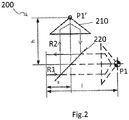
- FIG. 2 shows a schematic representation of a reflective device 200 according to a first practical example of the present invention.
- the reflective device 200 also comprises an optical deflection device 220 as well as a retroreflector 210. This deflects the measuring beam arriving in the incoming direction R1 onto the retroreflector 210 in a second direction R2 diverging from the incoming direction R1.
- the retroreflector 210 is arranged in such a way that its point of reference no longer lies at the reference point P1 of the optical measuring system.
- the reference point P1 is located outside of an area of the reflective device 200.
- the optical deflection device 220 is also arranged in such a way that it causes a reflection P1' of the reference point P1 within the reflective device 200.
- the deflection device 220 can be realised for this by a planar mirror, for example.
- the reflective device 200 is based on the observation that the path length invariance described in connection with figure 1 is not adversely affected even by an optical deflection at the deflection device 220.
- a hollow retroreflector 210 such as a hollow triple mirror, for instance, is assumed here, the beam path of which remains in a medium of constant optical density.
- the axis that runs parallel to the incoming measuring beam and is reflected by the deflection device 220 through the point of reference of the retroreflector 210 is drawn in as an auxiliary line in figure 2 .
- the length of this axis is s+h and it is identical to the length l from figure 1 .
- the path length measured from a plane perpendicular to this axis is twice the sum of distance s between the plane and the point of intersection of the axis with the mirror surface and of the distance h of this point to the point of reference of the retroreflector and thus, as in the example of figure 1 , amounts to 21. It also applies to the reflective device 200 that, in the event of rotations of the reflective device 200 about the reference point P1, the path length of the measuring beam within the reflective device 200 remains unchanged.
- the reflection at a single plane of the deflection device 220 in particular causes the reflection P1' of the first reference point P1 of the measuring system to take place in turn at the point of reference of the retroreflector 210.
- the above also applies regardless of a deflection angle by means of the deflection device 220.
- the reflective device 200 also acts independently of a distance h between the deflection device 220 and the retroreflector 210. In embodiments other than that shown in figure 2 , a multiple deflection of the measuring beam, for instance by other deflection devices similar to the deflection device 220, can also be provided.
- the reflective device 200 from figure 2 has the same effect as the reflective device 100 from figure 1 . Due to the spatial decoupling from the first reference point P1, however, the reflective device 200 facilitates expanded arrangement and configuration options of the reflective device 200 without deviating functionally from a preferred reference point P1. This is advantageous in particular in such cases in which the reference point P1 for an optical measuring system is not physically accessible in the measuring object, such as a satellite, for example.
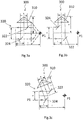
- FIG 3a shows a schematic representation of a reflective device 300 according to a first realisation of another practical example of the present invention.
- the reflective device 300 also comprises a retroreflector 310 and an optical deflection device 320.
- the deflection device 320 in the reflective device 300 comprises two separate mirrors 322, 324, which are arranged parallel to one another in different mirror planes.
- the arrangement of the mirrors 322, 324 permits a distance b of the measuring beam sections between the deflection device 320 and the retroreflector 310 to be produced that is different from a distance d of the measuring beam sections outside of the reflective device 300.
- the deflected beam sections can thus be brought together at any proximity. As shown by the dotted lines in figure 3 , this permits the use of a retroreflector 310 of an arbitrarily small size compared with a conventional design, even with a wide spacing d of the outer measuring beam sections.
- the aforesaid problems of space and weight resulting from the use of a large retroreflector can be avoided in this way.
- all components 310, 322, 324 are in a virtually linear arrangement with one another, while the mirrors 322, 324 also lie parallel to one another. Even compared with the distributed construction of a large triple mirror of differently aligned mirror segments, the reflective device 300 thus facilitates a more compact, simpler and thermomechanically easier to stabilise structure.
- At least one of the mirrors 322, 324 is adjustable in position.
- the reflective device 300 can thus be set to any beam distance d when using the same retroreflector 310.
- the reflection of the reference point P1 lies at half of the optical path length within the reflective device 300.
- the path length thus remains in particular independent of the beam distances b, d and the angle of incidence.
- Figure 3b shows another realisation of the reflective device 300.
- the mirrors 322, 324 are arranged opposed in their height in figure 3b . With reference to the measuring beam, this has the result that this no longer crosses as in figure 3a .
- the mirrors 322, 324 are adjustable in position.
- the reflective device 300 can thereby be set for different beam distances d.
- the mirrors 322, 324 can be set in any position between the positions shown in figures 3a and 3b .
- Figure 3c shows another realisation of the reflective device 300.
- the retroreflector 310 is aligned at a different angle to the incoming measuring beam compared with figures 3a and 3b , and the mirrors 322, 324 also correspondingly have another pitch angle.
- the auxiliary lines in figure 3c however, even this arrangement does not basically influence the determination of the overall path length of the measuring beam within the reflective device 300.
- the retroreflector 310 and/or the mirrors 322, 324 are adjustable in their orientation. As well as the angle of both mirrors, their spacing can also be changed as long as both mirrors are parallel and no other components block the light path.
- FIG 4a shows a schematic representation of a reflective device 400 according to another practical example of the present invention.
- the reflective device 400 also has a retroreflector 410 and an optical deflection device 420.
- the deflection device 420 comprises a beam splitter 430 as well as a mirror 422.
- a monostatic construction can be achieved by the beam splitter 430, i.e. the incoming and the reflected measuring beam overlap one another.
- the construction shown permits the measuring beam to arrive at the retroreflector 410 in a decentralised manner. It is hereby avoided that the measuring beam arrives at one or more mirror edges of the retroreflector 410 and so the wavefront of the measuring beam is segmented.
- the aforesaid principles with reference to the path length within the reflective device 400 apply accordingly to the reflective device 400 too.
- a high efficacy is achieved using a polarised beam splitter 430 connected with a rotation of the polarisation direction within the reflective device 400 by 90°.
- a p-polarised input beam is transmitted virtually completely at the beam splitter 430, for example, passes the mirror 422, the retroreflector 410 and at least one waveplate (not shown), is now reflected as s-polarised light by the beam splitter 430, so that a majority of the light output eventually exits the reflective device 400 again.
- a ⁇ /4-waveplate can be set up (not shown) at the input in each case when using two reflective devices of a similar type in both measuring objects of an optical measuring system, which together produce a ⁇ /2 waveplate. From this a circular polarisation results in addition between the objects, which transitions through the waveplate into a linear polarisation. On twisting of one of the objects about the line of sight, the full light output is constantly available on account of the circular polarisation. Even a phase shift, which can be measured in the case of a rotation behind the ⁇ /4 waveplate, is compensated again on passing in the other direction and thus has no effect on the measurement.
- a plate beam splitter is used as a beam splitter 430 at the input of the reflective device 400, as shown schematically in figure 4a , it is advantageous to reduce its angle-dependent influence on the optical path length by means of a compensation plate (not shown) rotated in the other direction.
- Figure 4b shows another realisation of the reflective device 400.
- a cube beam splitter 430 is provided instead of a plate beam splitter.
- the beam splitter cube - in spite of a longer path length as a whole in the substrate - can lead to a lower angular dependence.
- a pivot of the laser beam i.e. the origin of the angular deflection, is displaced in a passage through the cube in the beam direction by the length
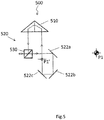
- Figure 5 shows a schematic representation of a reflective device 500 according to another practical example of the present invention.
- the optical deflection device 520 comprises several mirrors 522a, 522b, 522c as well as a beam splitter 530.
- the path of the measuring beam before the retroreflector 510 is extended by the mirrors 522a, 522b, 522c.
- the reflection P1' of the reference point P1 is thereby shifted by half of the added path length further ahead of the point of reference of the retroreflector 510.
- the reflection P1' of the reference point P1 can thus be localised in particular outside of the retroreflector 510. This is advantageous for the arrangement of other optical devices related to the reference point P1, such as an optical measuring head or a beam injection, for example.
- an aperture for example, is shown in figure 5 in the area of the reflection P1' of the reference point.
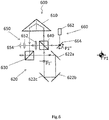
- FIG. 6 shows a schematic representation of a reflective device 600 according to another practical example of the present invention.
- the reflective device 600 also comprises a retroreflector 610 and an optical deflection device 620 with several mirrors 622a, 622b and 622c and a beam splitter 630.
- the reflection P1' of the reference point P1 is displaced before the retroreflector 610.
- the reflective device 600 additionally comprises a measuring head 650 with one or more optical elements 652, for example an adjusting mirror and a lens, and a photodetector 654 as well as a beam source 660 with a laser source 662 and a tilting mirror 664, for example a scanner.
- the reflective device 600 further comprises another beam splitter 640.
- the beam source 660 is used to generate a measuring beam of the measuring system and/or to amplify a measuring beam received by the reflective device 600 before it is re-emitted.
- the reflective device 600 acts as a transponder within the optical measuring system.
- Such an amplification of the measuring beam on half of its course is advantageous in the case of a large distance between the measuring objects in particular.
- the beam splitter 640 is used both for beam injection for the beam source 660 and for light extraction as a measuring point for the measuring head 650.
- the provision of the measuring head 650 is advantageous if the reflective device 600 is connected with another reflective device of the type described into an optical measuring system, in which the reflective devices reflect the measuring beam produced by at least one of the reflective devices 600 between one another.
- the measuring beam generated by the beam source 660 is emitted in this case to the other reflective device and following its arrival back at the reflective device 600 is extracted by the beam splitter 640 to the measuring head 650.
- the measuring beam is superimposed directly by a local partial beam of the laser light coming from the beam source 660, so that from the interference arising the phase position of the received measuring beam can be determined by the photodetector 654.
- the beam emitted by the laser source 662 is deflected at the tilting mirror 664 in such a way that no relative tilting of the superimposed beams, i.e. of the local beam from the tilting mirror 664 and of the received measuring beam, is detected at the photodetector 654.
- the angle-dependent influence of the second beam splitter 640 corresponding to a tilting of the mirror 664 can be compensated here by extension of the paths to the retroreflector 610 and to the tilting mirror 664.
- the pivot of the outgoing beam, i.e. the tilting mirror 664, and the reflection P1' of the reference point P1 in the incoming beam must lie at the same distance to the beam splitter 640, which superimposes the two beams.
- a pivot P1" of the outgoing beam for instance the tilting mirror 664, does not lie in reference point P1 or P1' of the system, this then leads, in the case of an angle change of the laser beams relative to the reflective device, to a parallel offset between incoming and outgoing beam.
- the beam radius at the input to the reflective device 600 is so large that a quasi-level wavefront is received and a beam offset delivers only a small error contribution.
- the reflective device 600 is then no longer in a purely monostatic operating mode, but changes the position of the measuring path between the measuring objects depending on the angle of incidence.
- the beam tracking on rotation about the reference point is realised by counter-rotation of the overall measuring object, in particular of an entire satellite, or by a mirror tilting mechanism, which deflects both the received and the transmitted beam, which is also described as in-field pointing. Changes in distance caused by these movements act directly on a signal measured in this way.
- the tilting mirror 664 facilitates beam tracking before injection of the measuring beam, i.e. outside of the measuring path.
- the measuring beam received can in addition be superimposed in the reflective device 600 by a local laser beam with a relatively smaller outlay due to the bistatic beam guidance within the reflective device 600, in order to determine the relative phase position as well as an angular offset of both beams and to continue the path of the received beam through the local laser beam.
- the reflective device 600 is shown as a monostatic structure. However, the shift of the reference point reflection P1' and a beam injection and extraction can be realised correspondingly also for a bistatic structure.
- the direction tracking of the local laser beam can in particular take place even in this case outside of the measuring path.
- the mode of functioning of the reflective device is also maintained even if other mirrors are used ahead of the beam splitter 630, for example to change the path length or the orientation angle of the reflective device 600.
- Other examples of the reflective device 600 have only one of measuring head 650 and beam source 660. In other examples beam injection and extraction take place in addition at different points of the reflective device 600.
- FIG. 7 shows a schematic representation of an optical measuring system 700 according to a practical example of the present invention.
- the optical measuring system 700 comprises two reflective devices 710, 720, as described previously.
- each of the reflective devices is associated with a reference point P1, P2.
- the reflective devices 710, 720 are arranged in such a way in relation to one another that a measuring beam can be emitted and reflected between them and amplified if necessary.
- a beam source in the reflective device 710 serves as a primary source for the measuring beam, which is amplified prior to reflection by the reflective device 720 by the latter according to the mode of functioning of a transponder.
- the measuring system 700 is particularly suitable for use in satellite missions in which each of the reflective devices 710, 720 is arranged respectively in another satellite and each of the reference points P1, P2 is associated with the respective satellite in the context of a distance measurement.
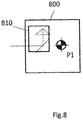
- FIG 8 shows a schematic representation of a flying object 800 according to a practical example of the present invention.
- the flying object 800 comprises a reflective device 810 as described previously for use as part of an optical measuring system.
- the reference point P1 lies in the area of the flying object 800. In other examples the reference point 800 lies outside of the flying object, on the other hand.
- the flying object 800 is a satellite, for example.
- the reflective device 810 serves here as part of a measuring system, for example, for satellite geodesy or for measuring the distance between the flying object 800 and another flying object.
- FIG. 9 shows a schematic representation of a flying object system 900 according to a practical example of the present invention.
- the flying object system 900 comprises two flying objects 902, 904, in which a reflective device 910, 920 is arranged respectively as constituents of an optical measuring system 906.
- the flying objects 902, 904 are two flying objects, for example, such as described in connection with figure 8 .
- the optical measuring system 906 is a measuring system, for example, as described in connection with figure 7 .
Landscapes
- Physics & Mathematics (AREA)
- Engineering & Computer Science (AREA)
- General Physics & Mathematics (AREA)
- Electromagnetism (AREA)
- Computer Networks & Wireless Communication (AREA)
- Radar, Positioning & Navigation (AREA)
- Remote Sensing (AREA)
- Spectroscopy & Molecular Physics (AREA)
- Optical Radar Systems And Details Thereof (AREA)
- Length Measuring Devices By Optical Means (AREA)
Abstract
Description
- The present invention relates to a reflective device for use in an optical measuring system and for arranging in a measuring object, in particular for measuring distances on a flying object. The invention further relates to an optical measuring system, a flying object and a flying object system.
- For the precise determination of distances and/or changes in distance between reference points that are far apart, for instance in satellite geodesy or for determining the distance between two satellites, optical measuring methods are often used. In these, a measuring beam is normally emitted from one of the reference points, for example from the earth or one of the satellites, in the direction of the other reference point, which is associated with another satellite or another measuring object. The measuring beam is reflected at the measuring object and detected on its return to the first reference point. In the detection, a running time or a phase position of the returned beam is determined, for example, from which finally a distance or a change in distance between the reference points can be determined.
- Due to the often great distances between the reference points, a precise back reflection of the measuring beam within the measuring system is necessary. At the same time, flying objects, such as satellites, as measuring objects are often exposed to random variations and rotary movements, which also affect a reflective device of the measuring system arranged in the flying object. The relatively great distance between the reference points here has the consequence that, when using a simple mirror as a reflective device, for example, even a slight tilting of the flying object can result in a large divergence of the reflected measuring beam. A measurement can be distorted or even become impossible due to this.
- To avoid such influences due to tilting, retroreflectors are normally used as reflective devices. These have the property of reflecting incident light over a larger solid angle range precisely counter to its incoming direction in each case. In addition, in the case of retroreflectors in the form of triple mirrors in particular, the path length of a light beam within the retroreflector is independent of a lateral offset of the beam from an axis through the point of reference of the triple mirror. Corresponding movements of the measuring object do not affect the measuring result, therefore. The point of reference of the triple mirror thus corresponds at the same time to a stable reference point, which is associated with the flying object in the context of the optical measuring system.
- Even when using a retroreflector, however, a rotation of the flying object can cause the reflective device to be moved along the axis of the measuring beam. The measuring system would therefore indicate a change of distance, although the position of the centre of gravity of the flying object may not have changed. In addition, in the case of a rotation of the flying object parallel to the connecting axis between the reference points, the reflective device can move laterally out of the range of the incident measuring beam. Both problems can be countered by leading the axis of the measuring beam at least approximately through the centre of gravity of the flying object. However, this considerably limits the options of an arrangement of the reflective device and thus also of the other installations in the flying object.
- In some cases, for instance in the case of the GRACE Follow-On satellite mission, the central connecting axis between two satellites is additionally already occupied by other applications. A laterally offset arrangement of the optical measuring system with a measuring beam reflected into itself, i.e. a so-called monostatic structure, would result in the disadvantages described in the case of rotations of the satellite. A bistatic construction has therefore been proposed, in which the incoming and the reflected measuring beam run laterally offset from one another. The measuring beam impacts the measuring object here away from the main axis and is led back with the same offset on the opposite side of the main axis. The distance between incoming and reflected measuring beam is selected here so that the measuring beam circulates around the applications of the two satellites lying on the main axis as on a racetrack.
- Even if the influences of variations are largely compensated by the guidance of the measuring beam described, a triple mirror of considerable size is required to achieve the required relatively large distance between incoming and reflected measuring beam. To save space and weight, it has therefore been proposed to reduce the large triple mirror of this kind to a few functional sections and to arrange these segments distributed in the satellite. This in turn calls for a high thermomechanical stability of the mirror segments in relation to one another, which can only be achieved expensively on account of their wide distribution.
- Known monostatic constructions also have the further disadvantage that beam tracking in the case of rotations of the measuring object is only possible with difficulty, since a tilting mirror arranged for this purpose in the measuring path, for instance, would directly influence the measuring result. On the other hand, the alternatively proposed realignment of the overall measuring object can likewise only be implemented expensively, especially in the case of a satellite.
- A reflective device that avoids the aforesaid disadvantages is therefore desirable.
- The object of the invention is to provide a compact reflective device that permits precise distance measurements and at the same time only makes minor demands on the design of the associated measuring object.
- According to a first aspect, a reflective device is presented for use in an optical measuring system and for arranging in a measuring object. The reflective device comprises an optical deflection device and a retroreflector. The optical deflection device is configured to deflect a light beam arriving at the optical deflection device from an incident axis of the light beam. The retroreflector is configured to reflect the light beam parallel to its respective incoming direction for each of various incoming directions of a light beam onto the reflector. The retroreflector and the optical deflection device are arranged in the reflective device in such a way and the reflective device can be arranged in the measuring object in such a way that a measuring beam of the optical measuring system, which is pointed at the measuring object and arrives at the optical deflection device in a first direction, is deflected by the optical deflection device in a second direction different from the first direction onto the retroreflector and, following reflection at the retroreflector, is deflected by the optical deflection device in reverse parallel to the first direction.
- The optical measuring system can be configured to determine at least one of a distance and a change in distance between a first reference point, which is associated with the measuring object, and a second reference point, which is movable with reference to the measuring object. The optical measuring system can be based in this case on the determination of at least one of a runtime and a phase position of light of the measuring beam reflected by the reflective device. For example, the optical measuring system can be based on the determination of a runtime or a phase position of light that has twice passed through the distance between the first and the second reference point. The phase position can be determinable by the measuring system on the basis of optical interference.
- The reflective device can be configured in such a way and can be arranged in the measuring object in such a way that the first reference point is located outside of the reflective device. With reference to a measuring beam, which arrives at least substantially from the direction of the second reference point at the reflective device, a reflection of the first reference point can be produced in the reflective device.
- The deflection device can deflect the measuring beam onto the retroreflector offset to a point of reference of the retroreflector. The reflective device can be configured in such a way in this case that a distance between a part of the measuring beam deflected in the second direction and a part of the measuring beam reflected by the retroreflector in reverse parallel to the second direction is different from a distance between a part of the measuring beam arriving in the first direction at the deflection device and a part of the measuring beam deflected, following reflection at the retroreflector, in reverse by the optical deflection device parallel to the first direction.
- The retroreflector can be formed in one piece. The retroreflector can further comprise a triple mirror. In addition or alternatively to this, the retroreflector can comprise a prism, for example an Abbe Koenig prism.
- The reflective device can be configured so that a distance between a part of the measuring beam deflected in the second direction and a part of the measuring beam reflected by the retroreflector in reverse parallel to the second direction is greater than a distance between a part of the measuring beam arriving in the first direction at the deflection device and a part of the measuring beam deflected, following reflection at the retroreflector, by the optical deflection device in reverse parallel to the first direction. In this case a diameter of the retroreflector can be smaller than the distance between the part of the measuring beam arriving in the first direction at the deflection device and the part of the measuring beam deflected, following reflection at the retroreflector, by the optical deflection device in reverse parallel to the first direction.
- Alternatively to this, the reflective device can be configured so that a distance between a part of the measuring beam deflected in the second direction and a part of the measuring beam reflected by the retroreflector in reverse parallel to the second direction is smaller than a distance between a part of the measuring beam arriving in the first direction at the deflection device and a part of the measuring beam deflected, following reflection at the retroreflector, by the optical deflection device in reverse parallel to the first direction. In this case a diameter of the retroreflector can be greater than the distance between the part of the measuring beam arriving in the first direction at the deflection device and the part of the measuring beam deflected, following reflection at the retroreflector, by the optical deflection device in reverse parallel to the first direction.
- The optical deflection device can comprise at least one mirror. In addition or alternatively to this, the optical deflection device can comprise at least one beam splitter. The beam splitter can be a cubic beam splitter. The beam splitter can also be a polarising beam splitter. In this case the reflective device can further comprise at least one waveplate.
- The optical deflection device can comprise two mirrors, which are aligned parallel to one another. The optical deflection device can deflect the measuring beam before and after reflection at the retroreflector on the same mirror plane respectively. Alternatively to this, several mirrors of the optical deflection device can be arranged in various mirror planes. Furthermore, a distance between the mirrors and/or the mirror planes can be adjustable.
- The reflection of the first reference point can be produced outside of the retroreflector. For example, the reflection of the first reference point can be produced in a propagation direction of the measuring beam before or after the retroreflector.
- The reflective device can further comprise a measuring device for determining a phase position of the measuring beam. The measuring device can comprise a photodetector and/or a lens. The measuring device can be configured to detect the phase position of the measuring beam at a measuring point of the measuring device.
- The reflective device can further comprise a beam source for the measuring beam. The beam source can comprise a laser source and/or a tilting mirror. An injection of the measuring beam into a measuring path of the optical measuring system can be arranged at the measuring point of the measuring device. The tilting mirror of the beam source and the reflection of the first reference point can be arranged at least substantially at the same distance from the measuring point of the measuring device.
- According to a second aspect, an optical measuring system is described, which comprises at least one reflective device according to the first aspect of the present invention. The optical measuring system can comprise at least two reflective devices for arrangement in different measuring objects respectively. In this case the optical measuring system can be configured to reflect the measuring beam repeatedly between the measuring objects by means of the reflective devices.
- According to a third aspect, a flying object is described, which comprises a reflective device according to the first aspect. The flying object can be a satellite. The flying object can also serve as the measuring object in which the reflective device is disposed. The first reference point can lie within the flying object.
- According to a fourth aspect, a flying object system is described, which comprises at least two flying objects of the type presented here, wherein the reflective devices are constituents of an optical measuring system of the type presented here.
- Other objects, features, advantages and application options result from the following description of practical examples, which are to be understood as not restrictive, with reference to the associated drawings. Here all features described and/or illustrated show the object disclosed here by themselves or in any combination, even regardless of their grouping in the claims or their back references. The dimensions and proportions of the components shown in the figures are not necessarily to scale in this case; they can differ from what is shown here in embodiments to be implemented. What is shown is:
- Figure 1
- an example of a reflective device for reflecting a measuring beam at a reference point;
- Figure 2
- a schematic representation of a reflective device according to a first practical example of the present invention;
- Figures 3a-3c
- schematic representations of various realisations of a reflective device according to another practical example of the present invention;
- Figures 4a-4b
- schematic representations of various realisations of a reflective device according to another practical example of the present invention;
- Figure 5
- a schematic representation of a reflective device according to another practical example of the present invention;
- Figure 6
- a schematic representation of a reflective device according to another practical example of the present invention;
- Figure 7
- a schematic representation of an optical measuring system according to a practical example of the present invention;
- Figure 8
- a schematic representation of a flying object with a reflective device according to a practical example of the present invention; and
- Figure 9
- a schematic representation of a flying object system with an optical measuring system according to a practical example of the present invention.
-
Figure 1 shows a schematic representation of an example of areflective unit 100 for arranging in a measuring object and for use in an optical measuring system. Thereflective unit 100 shown infigure 1 consists of aretroreflector 110 in the form of a triple mirror. The apex of the triple mirror represents both the point of reference of theretroreflector 110 and the first reference point P1 in the context of an optical measuring system (not shown) comprising thereflective unit 110. - As shown in
figure 1 , a measuring beam arriving at theretroreflector 110 in the incoming direction R1 is reflected, after multiple reflection within theretroreflector 110 if applicable, in reverse parallel to the incoming direction R1. Here the distance d between incoming and reflected measuring beam is proportional to an offset of the incoming measuring beam from the axis running in parallel through the point of reference of theretroreflector 110. At the same time, the path length covered by the measuring beam, starting out from a plane perpendicular to the beam direction up to arriving back at this plane following reflection at theretroreflector 110, is independent of such an offset. In the example offigure 1 , this path length is therefore always twice the distance I between such a plane and the point of reference of theretroreflector 110. A variation of the impact point thus has no effect on the measurement. In the case of a hollow retroreflector, such as a hollow triple mirror, for instance, the path length is also independent of an angle of incidence onto theretroreflector 110. Even rotations of theretroreflector 110 about the reference point P1 thus have no effect on the measurement. -
Figure 2 shows a schematic representation of areflective device 200 according to a first practical example of the present invention. Diverging from the example fromfigure 1 (cf. the dashed lines infigure 2 ), thereflective device 200 also comprises anoptical deflection device 220 as well as aretroreflector 210. This deflects the measuring beam arriving in the incoming direction R1 onto theretroreflector 210 in a second direction R2 diverging from the incoming direction R1. In addition, theretroreflector 210 is arranged in such a way that its point of reference no longer lies at the reference point P1 of the optical measuring system. On the contrary, the reference point P1 is located outside of an area of thereflective device 200. Theoptical deflection device 220 is also arranged in such a way that it causes a reflection P1' of the reference point P1 within thereflective device 200. Thedeflection device 220 can be realised for this by a planar mirror, for example. - The
reflective device 200 is based on the observation that the path length invariance described in connection withfigure 1 is not adversely affected even by an optical deflection at thedeflection device 220. Ahollow retroreflector 210, such as a hollow triple mirror, for instance, is assumed here, the beam path of which remains in a medium of constant optical density. To illustrate the path length of the measuring beam through the arrangement, the axis that runs parallel to the incoming measuring beam and is reflected by thedeflection device 220 through the point of reference of theretroreflector 210 is drawn in as an auxiliary line infigure 2 . As is evident fromfigure 2 , the length of this axis is s+h and it is identical to the length l fromfigure 1 . - Due to the properties of the
retroreflector 210 and the geometry shown infigure 2 , it also results that, independently of an offset of the measuring beam, the path length measured from a plane perpendicular to this axis is twice the sum of distance s between the plane and the point of intersection of the axis with the mirror surface and of the distance h of this point to the point of reference of the retroreflector and thus, as in the example offigure 1 , amounts to 21. It also applies to thereflective device 200 that, in the event of rotations of thereflective device 200 about the reference point P1, the path length of the measuring beam within thereflective device 200 remains unchanged. In thereflective device 200, the reflection at a single plane of thedeflection device 220 in particular causes the reflection P1' of the first reference point P1 of the measuring system to take place in turn at the point of reference of theretroreflector 210. The above also applies regardless of a deflection angle by means of thedeflection device 220. - The
reflective device 200 also acts independently of a distance h between thedeflection device 220 and theretroreflector 210. In embodiments other than that shown infigure 2 , a multiple deflection of the measuring beam, for instance by other deflection devices similar to thedeflection device 220, can also be provided. - Seen from outside, the
reflective device 200 fromfigure 2 has the same effect as thereflective device 100 fromfigure 1 . Due to the spatial decoupling from the first reference point P1, however, thereflective device 200 facilitates expanded arrangement and configuration options of thereflective device 200 without deviating functionally from a preferred reference point P1. This is advantageous in particular in such cases in which the reference point P1 for an optical measuring system is not physically accessible in the measuring object, such as a satellite, for example. -
Figure 3a shows a schematic representation of areflective device 300 according to a first realisation of another practical example of the present invention. Like thereflective device 200 fromfigure 2 , thereflective device 300 also comprises aretroreflector 310 and anoptical deflection device 320. Diverging fromfigure 2 , however, thedeflection device 320 in thereflective device 300 comprises twoseparate mirrors - In addition to deflection of the measuring beam, the arrangement of the
mirrors deflection device 320 and theretroreflector 310 to be produced that is different from a distance d of the measuring beam sections outside of thereflective device 300. The deflected beam sections can thus be brought together at any proximity. As shown by the dotted lines infigure 3 , this permits the use of aretroreflector 310 of an arbitrarily small size compared with a conventional design, even with a wide spacing d of the outer measuring beam sections. The aforesaid problems of space and weight resulting from the use of a large retroreflector can be avoided in this way. In addition, allcomponents mirrors reflective device 300 thus facilitates a more compact, simpler and thermomechanically easier to stabilise structure. - In one example of the
reflective device 300, at least one of themirrors reflective device 300 can thus be set to any beam distance d when using thesame retroreflector 310. - The reflection of the reference point P1 lies at half of the optical path length within the
reflective device 300. At the same time, the following also applies to thereflective device 300, as illustrated by the auxiliary lines infigure 3 , in regard to the path length I to the reference point P1:
- The path length thus remains in particular independent of the beam distances b, d and the angle of incidence.
-
Figure 3b shows another realisation of thereflective device 300. Compared with the realisation shown infigure 3a , themirrors figure 3b . With reference to the measuring beam, this has the result that this no longer crosses as infigure 3a . - In one example of the
reflective device 300, themirrors reflective device 300 can thereby be set for different beam distances d. For example, themirrors figures 3a and 3b . -
Figure 3c shows another realisation of thereflective device 300. In the realisation shown infigure 3c , theretroreflector 310 is aligned at a different angle to the incoming measuring beam compared withfigures 3a and 3b , and themirrors figure 3c , however, even this arrangement does not basically influence the determination of the overall path length of the measuring beam within thereflective device 300. - In one example, the
retroreflector 310 and/or themirrors -
Figure 4a shows a schematic representation of areflective device 400 according to another practical example of the present invention. Like the practical examples described above, thereflective device 400 also has aretroreflector 410 and anoptical deflection device 420. However, in the case of thereflective device 400, thedeflection device 420 comprises abeam splitter 430 as well as amirror 422. - In the
reflective device 400, a monostatic construction can be achieved by thebeam splitter 430, i.e. the incoming and the reflected measuring beam overlap one another. At the same time, the construction shown permits the measuring beam to arrive at theretroreflector 410 in a decentralised manner. It is hereby avoided that the measuring beam arrives at one or more mirror edges of theretroreflector 410 and so the wavefront of the measuring beam is segmented. The aforesaid principles with reference to the path length within thereflective device 400 apply accordingly to thereflective device 400 too. - A high efficacy is achieved using a polarised
beam splitter 430 connected with a rotation of the polarisation direction within thereflective device 400 by 90°. A p-polarised input beam is transmitted virtually completely at thebeam splitter 430, for example, passes themirror 422, theretroreflector 410 and at least one waveplate (not shown), is now reflected as s-polarised light by thebeam splitter 430, so that a majority of the light output eventually exits thereflective device 400 again. - To compensate for the rotation of the polarisation direction between input and output beam, a λ/4-waveplate can be set up (not shown) at the input in each case when using two reflective devices of a similar type in both measuring objects of an optical measuring system, which together produce a λ/2 waveplate. From this a circular polarisation results in addition between the objects, which transitions through the waveplate into a linear polarisation. On twisting of one of the objects about the line of sight, the full light output is constantly available on account of the circular polarisation. Even a phase shift, which can be measured in the case of a rotation behind the λ/4 waveplate, is compensated again on passing in the other direction and thus has no effect on the measurement. If, in addition, a plate beam splitter is used as a
beam splitter 430 at the input of thereflective device 400, as shown schematically infigure 4a , it is advantageous to reduce its angle-dependent influence on the optical path length by means of a compensation plate (not shown) rotated in the other direction. -
Figure 4b shows another realisation of thereflective device 400. Compared with the realisation shown infigure 4a , acube beam splitter 430 is provided instead of a plate beam splitter. For small angular deflections ϕ within the measuring system, the beam splitter cube - in spite of a longer path length as a whole in the substrate - can lead to a lower angular dependence. In the case of an edge length a and a refractive index n of the substrate, a pivot of the laser beam, i.e. the origin of the angular deflection, is displaced in a passage through the cube in the beam direction by the length
- For small angles ϕ, cos(ϕ) is roughly 1, so that the angular dependence can be significantly reduced, while a passage through the beam splitter cube for the incoming and outgoing laser beam is the same and is thus compensated. Only a portion of constant path length is therefore added to a measurement.
-
Figure 5 shows a schematic representation of areflective device 500 according to another practical example of the present invention. Deviating from thereflective device 400 fromfigure 4 , in the case of thereflective device 500 theoptical deflection device 520 comprisesseveral mirrors beam splitter 530. The path of the measuring beam before theretroreflector 510 is extended by themirrors retroreflector 510. The reflection P1' of the reference point P1 can thus be localised in particular outside of theretroreflector 510. This is advantageous for the arrangement of other optical devices related to the reference point P1, such as an optical measuring head or a beam injection, for example. Thus an aperture, for example, is shown infigure 5 in the area of the reflection P1' of the reference point. -
Figure 6 shows a schematic representation of areflective device 600 according to another practical example of the present invention. Like thereflective device 500 according tofigure 5 , thereflective device 600 also comprises aretroreflector 610 and anoptical deflection device 620 withseveral mirrors beam splitter 630. In addition, in thereflective device 600 also the reflection P1' of the reference point P1 is displaced before theretroreflector 610. In contrast tofigure 5 , however, thereflective device 600 additionally comprises a measuringhead 650 with one or moreoptical elements 652, for example an adjusting mirror and a lens, and aphotodetector 654 as well as abeam source 660 with alaser source 662 and atilting mirror 664, for example a scanner. Thereflective device 600 further comprises anotherbeam splitter 640. - The
beam source 660 is used to generate a measuring beam of the measuring system and/or to amplify a measuring beam received by thereflective device 600 before it is re-emitted. In the latter case, thereflective device 600 acts as a transponder within the optical measuring system. Such an amplification of the measuring beam on half of its course is advantageous in the case of a large distance between the measuring objects in particular. - In the example shown, the
beam splitter 640 is used both for beam injection for thebeam source 660 and for light extraction as a measuring point for the measuringhead 650. The provision of the measuringhead 650 is advantageous if thereflective device 600 is connected with another reflective device of the type described into an optical measuring system, in which the reflective devices reflect the measuring beam produced by at least one of thereflective devices 600 between one another. The measuring beam generated by thebeam source 660 is emitted in this case to the other reflective device and following its arrival back at thereflective device 600 is extracted by thebeam splitter 640 to the measuringhead 650. At the same time, the measuring beam is superimposed directly by a local partial beam of the laser light coming from thebeam source 660, so that from the interference arising the phase position of the received measuring beam can be determined by thephotodetector 654. - The beam emitted by the
laser source 662 is deflected at thetilting mirror 664 in such a way that no relative tilting of the superimposed beams, i.e. of the local beam from thetilting mirror 664 and of the received measuring beam, is detected at thephotodetector 654. The angle-dependent influence of thesecond beam splitter 640 corresponding to a tilting of themirror 664 can be compensated here by extension of the paths to theretroreflector 610 and to thetilting mirror 664. In addition, in a monostatic system the pivot of the outgoing beam, i.e. thetilting mirror 664, and the reflection P1' of the reference point P1 in the incoming beam must lie at the same distance to thebeam splitter 640, which superimposes the two beams. - If a pivot P1" of the outgoing beam, for instance the
tilting mirror 664, does not lie in reference point P1 or P1' of the system, this then leads, in the case of an angle change of the laser beams relative to the reflective device, to a parallel offset between incoming and outgoing beam. In a measurement over great distances, however, the beam radius at the input to thereflective device 600 is so large that a quasi-level wavefront is received and a beam offset delivers only a small error contribution. However, thereflective device 600 is then no longer in a purely monostatic operating mode, but changes the position of the measuring path between the measuring objects depending on the angle of incidence. - Compared with what has been described above, in conventional monostatic concepts the beam tracking on rotation about the reference point is realised by counter-rotation of the overall measuring object, in particular of an entire satellite, or by a mirror tilting mechanism, which deflects both the received and the transmitted beam, which is also described as in-field pointing. Changes in distance caused by these movements act directly on a signal measured in this way. By contrast, in the
reflective device 600, thetilting mirror 664 facilitates beam tracking before injection of the measuring beam, i.e. outside of the measuring path. Compared with conventional monostatic structures, the measuring beam received can in addition be superimposed in thereflective device 600 by a local laser beam with a relatively smaller outlay due to the bistatic beam guidance within thereflective device 600, in order to determine the relative phase position as well as an angular offset of both beams and to continue the path of the received beam through the local laser beam. - The
reflective device 600 is shown as a monostatic structure. However, the shift of the reference point reflection P1' and a beam injection and extraction can be realised correspondingly also for a bistatic structure. The direction tracking of the local laser beam can in particular take place even in this case outside of the measuring path. The mode of functioning of the reflective device is also maintained even if other mirrors are used ahead of thebeam splitter 630, for example to change the path length or the orientation angle of thereflective device 600. Other examples of thereflective device 600 have only one of measuringhead 650 andbeam source 660. In other examples beam injection and extraction take place in addition at different points of thereflective device 600. -
Figure 7 shows a schematic representation of anoptical measuring system 700 according to a practical example of the present invention. Theoptical measuring system 700 comprises tworeflective devices - In the example shown, the
reflective devices reflective device 710, for example, serves as a primary source for the measuring beam, which is amplified prior to reflection by thereflective device 720 by the latter according to the mode of functioning of a transponder. The measuringsystem 700 is particularly suitable for use in satellite missions in which each of thereflective devices -
Figure 8 shows a schematic representation of a flyingobject 800 according to a practical example of the present invention. The flyingobject 800 comprises areflective device 810 as described previously for use as part of an optical measuring system. - In the flying
object 800, the reference point P1 lies in the area of the flyingobject 800. In other examples thereference point 800 lies outside of the flying object, on the other hand. The flyingobject 800 is a satellite, for example. Thereflective device 810 serves here as part of a measuring system, for example, for satellite geodesy or for measuring the distance between the flyingobject 800 and another flying object. -
Figure 9 shows a schematic representation of a flyingobject system 900 according to a practical example of the present invention. The flyingobject system 900 comprises two flyingobjects reflective device optical measuring system 906. - The flying objects 902, 904 are two flying objects, for example, such as described in connection with
figure 8 . In addition, theoptical measuring system 906 is a measuring system, for example, as described in connection withfigure 7 .
Claims (15)
- Reflective device (200; 300; 400; 500; 600; 710, 720; 810; 910, 920) for use in an optical measuring system (700; 906) and for arranging in a measuring object (800; 902, 904), comprising:an optical deflection device (220; 320; 420; 520; 620), which is configured to deflect a light beam arriving at the optical deflection device (220; 320; 420; 520; 620) from an incident axis of the light beam, anda retroreflector (210; 310; 410; 510; 610), which is configured to reflect the light beam parallel to its respective incoming direction for each of various incoming directions of a light beam onto the retroreflector (210; 310; 410; 510; 610),wherein the retroreflector (210; 310; 410; 510; 610) and the optical deflection device (220; 320; 420; 520; 620) are arranged in the reflective device (200; 300; 400; 500; 600; 710, 720; 810; 910, 920) in such a way and the reflective device can be arranged in the measuring object (800; 902, 904) in such a way that a measuring beam of the optical measuring system (700; 906), which is pointed at the measuring object (800; 902, 904) and arrives in a first direction (R1) at the optical deflection device (220; 320; 420; 520; 620), is deflected by the optical deflection device (220; 320; 420; 520; 620) onto the retroreflector (210; 310; 410; 510; 610) in a second direction (R2) different from the first direction (R1) and, following reflection at the retroreflector (210; 310; 410; 510; 610), is deflected by the optical deflection device (220; 320; 420; 520; 620) in reverse parallel to the first direction (R1).
- Reflective device (200; 300; 400; 500; 600; 710, 720; 810; 910, 920) according to claim 1, wherein the retroreflector (210; 310; 410; 510; 610) is formed in one piece.
- Reflective device (200; 300; 400; 500; 600; 710, 720; 810; 910, 920) according to one of the preceding claims, wherein the optical deflection device (220; 320; 420; 520; 620) comprises at least one mirror (220; 322, 324; 422; 522a, 522b, 522c; 622a, 622b, 622c).
- Reflective device (300) according to claim 3, wherein the optical deflection device (320) comprises two mirrors (322, 324), which are aligned parallel to one another.
- Reflective device (300) according to claim 4, wherein the mirrors (322, 324) are arranged in different mirror planes.
- Reflective device (300) according to claim 4 or 5, wherein a distance between the mirrors (322, 324) and/or the mirror planes is adjustable.
- Reflective device (400; 500; 600) according to one of the preceding claims, wherein the optical deflection device (420; 520; 620) further comprises at least one beam splitter (430; 530; 630).
- Reflective device (200; 300; 400; 500; 600; 710, 720; 810; 910, 920) according to one of the preceding claims, wherein the optical measuring system (700; 906) is configured to determine at least one of a distance and a change of distance between a first reference point (P1), which is associated with the measuring object (800; 902, 904), and a second reference point (P2), which is movable in relation to the measuring object (800; 902, 904).
- Reflective device (200; 300; 400; 500; 600; 710, 720; 810; 910, 920) according to claim 8, wherein the reflective device (200; 300; 400; 500; 600; 710, 720; 810; 910, 920) is configured in such a way and can be arranged in the measuring object (800; 902, 904) in such a way that the first reference point (P1) is located outside the reflective device (200; 300; 400; 500; 600; 710, 720; 810; 910, 920) and in relation to a measuring beam, which arrives at the reflective device at least substantially from the direction of the second reference point (P2), a reflection (P1') of the first reference point (P1) is produced within the reflective device (200; 300; 400; 500; 600; 710, 720; 810; 910, 920).
- Reflective device (500; 600) according to claim 8 or 9, wherein the reflection (P1') of the first reference point (P1) is produced outside of the retroreflector (510; 610).
- Reflective device (600) according to one of the preceding claims, further comprising a measuring device (650) for detecting a phase position of the measuring beam and/or a beam source (660) for producing or amplifying the measuring beam.
- Reflective device (600) according to claim 11, wherein the reflective device (600) comprises a measuring device (650) and a beam source (660) and wherein a measuring point (640) of the measuring device (650) and an injection (640) of a beam from the beam source (660) are arranged at least substantially at the same point.
- Optical measuring system (700; 906), comprising at least one reflective device (710, 720; 910, 920) according to one of the preceding claims.
- Flying object (800; 902, 904), comprising at least one reflective device (710, 720; 910, 920) according to one of claims 1 to 12.
- Flying object system (900), comprising at least two flying objects (902, 904) according to claim 14, wherein the reflective devices (910, 920) are constituents of an optical measuring system (906) according to claim 13.
Applications Claiming Priority (1)
| Application Number | Priority Date | Filing Date | Title |
|---|---|---|---|
| DE102016206373.1A DE102016206373A1 (en) | 2016-04-15 | 2016-04-15 | Reflection device for use in an optical measuring system |
Publications (3)
| Publication Number | Publication Date |
|---|---|
| EP3232223A1 true EP3232223A1 (en) | 2017-10-18 |
| EP3232223C0 EP3232223C0 (en) | 2024-01-31 |
| EP3232223B1 EP3232223B1 (en) | 2024-01-31 |
Family
ID=58454963
Family Applications (1)
| Application Number | Title | Priority Date | Filing Date |
|---|---|---|---|
| EP17163598.0A Active EP3232223B1 (en) | 2016-04-15 | 2017-03-29 | Reflective device for use in an optical measuring system |
Country Status (3)
| Country | Link |
|---|---|
| US (1) | US10317277B2 (en) |
| EP (1) | EP3232223B1 (en) |
| DE (1) | DE102016206373A1 (en) |
Families Citing this family (2)
| Publication number | Priority date | Publication date | Assignee | Title |
|---|---|---|---|---|
| US11578977B1 (en) * | 2019-03-25 | 2023-02-14 | Optical Physics Company | Vertical navigation system |
| CN114942018B (en) * | 2022-05-30 | 2023-04-28 | 哈尔滨工业大学 | Vertical laser pointing correction device and method based on wavefront homodyne interference |
Citations (4)
| Publication number | Priority date | Publication date | Assignee | Title |
|---|---|---|---|---|
| DE3150642C2 (en) * | 1981-12-21 | 1983-11-03 | Precitronic Gesellschaft für Feinmechanik und Electronic mbH, 2000 Hamburg | Device for communication by means of retroreflection and modulation of electromagnetic, in particular optical radiation |
| EP0236137A2 (en) * | 1986-03-05 | 1987-09-09 | Chelsea Instruments Limited | Novel beam splitter and spectrometer containing the beam splitter |
| US5530549A (en) * | 1994-05-24 | 1996-06-25 | Spatialmetrix Corp. | Probing retroreflector and methods of measuring surfaces therewith |
| US20050157410A1 (en) * | 2004-01-15 | 2005-07-21 | Associated Universities, Inc. | Multidirectional retroflector |
Family Cites Families (6)
| Publication number | Priority date | Publication date | Assignee | Title |
|---|---|---|---|---|
| JP3239188B2 (en) * | 1992-02-28 | 2001-12-17 | コニカ株式会社 | Light beam scanning device |
| US5489984A (en) * | 1994-04-01 | 1996-02-06 | Imra America, Inc. | Differential ranging measurement system and method utilizing ultrashort pulses |
| DE19647152A1 (en) | 1996-11-14 | 1998-05-28 | Sick Ag | Laser distance determination device |
| US6327038B1 (en) * | 1999-09-21 | 2001-12-04 | Ut-Battelle, Llc | Linear and angular retroreflecting interferometric alignment target |
| US7121671B2 (en) | 2003-12-11 | 2006-10-17 | Agilent Technologies, Inc. | Phase-compensated cube corner in laser interferometry |
| US8724108B2 (en) * | 2011-01-19 | 2014-05-13 | Harbin Institute Of Technology | Photoelectric autocollimation method and apparatus based on beam drift compensation |
-
2016
- 2016-04-15 DE DE102016206373.1A patent/DE102016206373A1/en not_active Ceased
-
2017
- 2017-03-29 EP EP17163598.0A patent/EP3232223B1/en active Active
- 2017-04-12 US US15/485,894 patent/US10317277B2/en active Active
Patent Citations (4)
| Publication number | Priority date | Publication date | Assignee | Title |
|---|---|---|---|---|
| DE3150642C2 (en) * | 1981-12-21 | 1983-11-03 | Precitronic Gesellschaft für Feinmechanik und Electronic mbH, 2000 Hamburg | Device for communication by means of retroreflection and modulation of electromagnetic, in particular optical radiation |
| EP0236137A2 (en) * | 1986-03-05 | 1987-09-09 | Chelsea Instruments Limited | Novel beam splitter and spectrometer containing the beam splitter |
| US5530549A (en) * | 1994-05-24 | 1996-06-25 | Spatialmetrix Corp. | Probing retroreflector and methods of measuring surfaces therewith |
| US20050157410A1 (en) * | 2004-01-15 | 2005-07-21 | Associated Universities, Inc. | Multidirectional retroflector |
Also Published As
| Publication number | Publication date |
|---|---|
| DE102016206373A1 (en) | 2017-10-19 |
| US20170299428A1 (en) | 2017-10-19 |
| US10317277B2 (en) | 2019-06-11 |
| EP3232223C0 (en) | 2024-01-31 |
| EP3232223B1 (en) | 2024-01-31 |
Similar Documents
| Publication | Publication Date | Title |
|---|---|---|
| US8724108B2 (en) | Photoelectric autocollimation method and apparatus based on beam drift compensation | |
| CN105929382B (en) | A kind of coaxial fill-in light calibration device of the transmitting-receiving of active electro-optical system and method | |
| USRE41877E1 (en) | Multidirectional retroreflectors | |
| US9587977B2 (en) | Boresight error monitor for laser radar integrated optical assembly | |
| CN101609250B (en) | Camera Swing Mirror Swing Angle Scanning Characteristic Test Device | |
| CN101776516B (en) | Position detector-based dividing plane-sharing multispectral target | |
| CN104613900A (en) | Full optical path drift compensation high-precision roll angle measuring method and device | |
| CN101566459B (en) | Dual-frequency laser interferometer | |
| US8228490B2 (en) | System and method for precise measurement of deflection | |
| CN102176086A (en) | Two-dimensional photoelectric auto-collimation method and device of polarized light plane mirror reference common-path compensation | |
| CN109579777B (en) | Double-light-source high-precision anti-interference large-working-distance auto-collimation device and method | |
| CN100451540C (en) | Device for detecting three-axle parallel of large photoelectric monitoring equipment using thermal target technology | |
| JP2007052022A (en) | System for measuring an object and method for measuring vertical displacement | |
| CN106352985B (en) | Asymmetric spatial heterodyne spectrometer structure | |
| EP3232223A1 (en) | Reflective device for use in an optical measuring system | |
| US11448552B2 (en) | Common-path cube corner interferometer and interference technique | |
| CN109579776B (en) | High-precision anti-interference large-working-distance auto-collimation device and method | |
| US8537340B2 (en) | Optical distance-measuring device | |
| JP2019527479A (en) | Optical device for compensating for improper alignment of the reflector with respect to the light source | |
| US6219146B1 (en) | Laser reflector alignment | |
| CN100365381C (en) | A method and device for improving roll angle measurement sensitivity | |
| CN111433650B (en) | Protection of monostable or quasi-monostable laser rangefinders | |
| CN117685906A (en) | A dihedral angle optical measurement device and method | |
| CN211877754U (en) | Hyperspectral system for gas concentration detection | |
| US7511804B1 (en) | Crossed beam roof target for motion tracking |
Legal Events
| Date | Code | Title | Description |
|---|---|---|---|
| PUAI | Public reference made under article 153(3) epc to a published international application that has entered the european phase |
Free format text: ORIGINAL CODE: 0009012 |
|
| STAA | Information on the status of an ep patent application or granted ep patent |
Free format text: STATUS: THE APPLICATION HAS BEEN PUBLISHED |
|
| AK | Designated contracting states |
Kind code of ref document: A1 Designated state(s): AL AT BE BG CH CY CZ DE DK EE ES FI FR GB GR HR HU IE IS IT LI LT LU LV MC MK MT NL NO PL PT RO RS SE SI SK SM TR |
|
| AX | Request for extension of the european patent |
Extension state: BA ME |
|
| STAA | Information on the status of an ep patent application or granted ep patent |
Free format text: STATUS: REQUEST FOR EXAMINATION WAS MADE |
|
| 17P | Request for examination filed |
Effective date: 20171121 |
|
| RBV | Designated contracting states (corrected) |
Designated state(s): AL AT BE BG CH CY CZ DE DK EE ES FI FR GB GR HR HU IE IS IT LI LT LU LV MC MK MT NL NO PL PT RO RS SE SI SK SM TR |
|
| RAP1 | Party data changed (applicant data changed or rights of an application transferred) |
Owner name: AIRBUS DEFENCE AND SPACE GMBH |
|
| STAA | Information on the status of an ep patent application or granted ep patent |
Free format text: STATUS: EXAMINATION IS IN PROGRESS |
|
| 17Q | First examination report despatched |
Effective date: 20200615 |
|
| GRAP | Despatch of communication of intention to grant a patent |
Free format text: ORIGINAL CODE: EPIDOSNIGR1 |
|
| STAA | Information on the status of an ep patent application or granted ep patent |
Free format text: STATUS: GRANT OF PATENT IS INTENDED |
|
| INTG | Intention to grant announced |
Effective date: 20230906 |
|
| GRAS | Grant fee paid |
Free format text: ORIGINAL CODE: EPIDOSNIGR3 |
|
| GRAA | (expected) grant |
Free format text: ORIGINAL CODE: 0009210 |
|
| STAA | Information on the status of an ep patent application or granted ep patent |
Free format text: STATUS: THE PATENT HAS BEEN GRANTED |
|
| AK | Designated contracting states |
Kind code of ref document: B1 Designated state(s): AL AT BE BG CH CY CZ DE DK EE ES FI FR GB GR HR HU IE IS IT LI LT LU LV MC MK MT NL NO PL PT RO RS SE SI SK SM TR |
|
| REG | Reference to a national code |
Ref country code: GB Ref legal event code: FG4D Ref country code: CH Ref legal event code: EP |
|
| REG | Reference to a national code |
Ref country code: DE Ref legal event code: R096 Ref document number: 602017078850 Country of ref document: DE |
|
| REG | Reference to a national code |
Ref country code: IE Ref legal event code: FG4D |
|
| U01 | Request for unitary effect filed |
Effective date: 20240221 |
|
| U07 | Unitary effect registered |
Designated state(s): AT BE BG DE DK EE FI FR IT LT LU LV MT NL PT SE SI Effective date: 20240229 |
|
| U20 | Renewal fee for the european patent with unitary effect paid |
Year of fee payment: 8 Effective date: 20240325 |
|
| REG | Reference to a national code |
Ref country code: LT Ref legal event code: MG9D |
|
| PG25 | Lapsed in a contracting state [announced via postgrant information from national office to epo] |
Ref country code: IS Free format text: LAPSE BECAUSE OF FAILURE TO SUBMIT A TRANSLATION OF THE DESCRIPTION OR TO PAY THE FEE WITHIN THE PRESCRIBED TIME-LIMIT Effective date: 20240531 |
|
| PG25 | Lapsed in a contracting state [announced via postgrant information from national office to epo] |
Ref country code: GR Free format text: LAPSE BECAUSE OF FAILURE TO SUBMIT A TRANSLATION OF THE DESCRIPTION OR TO PAY THE FEE WITHIN THE PRESCRIBED TIME-LIMIT Effective date: 20240501 |
|
| PG25 | Lapsed in a contracting state [announced via postgrant information from national office to epo] |
Ref country code: RS Free format text: LAPSE BECAUSE OF FAILURE TO SUBMIT A TRANSLATION OF THE DESCRIPTION OR TO PAY THE FEE WITHIN THE PRESCRIBED TIME-LIMIT Effective date: 20240430 Ref country code: HR Free format text: LAPSE BECAUSE OF FAILURE TO SUBMIT A TRANSLATION OF THE DESCRIPTION OR TO PAY THE FEE WITHIN THE PRESCRIBED TIME-LIMIT Effective date: 20240131 |
|
| PG25 | Lapsed in a contracting state [announced via postgrant information from national office to epo] |
Ref country code: ES Free format text: LAPSE BECAUSE OF FAILURE TO SUBMIT A TRANSLATION OF THE DESCRIPTION OR TO PAY THE FEE WITHIN THE PRESCRIBED TIME-LIMIT Effective date: 20240131 |
|
| PG25 | Lapsed in a contracting state [announced via postgrant information from national office to epo] |
Ref country code: RS Free format text: LAPSE BECAUSE OF FAILURE TO SUBMIT A TRANSLATION OF THE DESCRIPTION OR TO PAY THE FEE WITHIN THE PRESCRIBED TIME-LIMIT Effective date: 20240430 Ref country code: NO Free format text: LAPSE BECAUSE OF FAILURE TO SUBMIT A TRANSLATION OF THE DESCRIPTION OR TO PAY THE FEE WITHIN THE PRESCRIBED TIME-LIMIT Effective date: 20240430 Ref country code: IS Free format text: LAPSE BECAUSE OF FAILURE TO SUBMIT A TRANSLATION OF THE DESCRIPTION OR TO PAY THE FEE WITHIN THE PRESCRIBED TIME-LIMIT Effective date: 20240531 Ref country code: HR Free format text: LAPSE BECAUSE OF FAILURE TO SUBMIT A TRANSLATION OF THE DESCRIPTION OR TO PAY THE FEE WITHIN THE PRESCRIBED TIME-LIMIT Effective date: 20240131 Ref country code: GR Free format text: LAPSE BECAUSE OF FAILURE TO SUBMIT A TRANSLATION OF THE DESCRIPTION OR TO PAY THE FEE WITHIN THE PRESCRIBED TIME-LIMIT Effective date: 20240501 Ref country code: ES Free format text: LAPSE BECAUSE OF FAILURE TO SUBMIT A TRANSLATION OF THE DESCRIPTION OR TO PAY THE FEE WITHIN THE PRESCRIBED TIME-LIMIT Effective date: 20240131 |
|
| PG25 | Lapsed in a contracting state [announced via postgrant information from national office to epo] |
Ref country code: PL Free format text: LAPSE BECAUSE OF FAILURE TO SUBMIT A TRANSLATION OF THE DESCRIPTION OR TO PAY THE FEE WITHIN THE PRESCRIBED TIME-LIMIT Effective date: 20240131 |
|
| PG25 | Lapsed in a contracting state [announced via postgrant information from national office to epo] |
Ref country code: PL Free format text: LAPSE BECAUSE OF FAILURE TO SUBMIT A TRANSLATION OF THE DESCRIPTION OR TO PAY THE FEE WITHIN THE PRESCRIBED TIME-LIMIT Effective date: 20240131 |
|
| U1N | Appointed representative for the unitary patent procedure changed after the registration of the unitary effect |
Representative=s name: SCHORNACK, OLIVER; DE |
|
| PG25 | Lapsed in a contracting state [announced via postgrant information from national office to epo] |
Ref country code: SM Free format text: LAPSE BECAUSE OF FAILURE TO SUBMIT A TRANSLATION OF THE DESCRIPTION OR TO PAY THE FEE WITHIN THE PRESCRIBED TIME-LIMIT Effective date: 20240131 |
|
| PG25 | Lapsed in a contracting state [announced via postgrant information from national office to epo] |
Ref country code: CZ Free format text: LAPSE BECAUSE OF FAILURE TO SUBMIT A TRANSLATION OF THE DESCRIPTION OR TO PAY THE FEE WITHIN THE PRESCRIBED TIME-LIMIT Effective date: 20240131 |
|
| PG25 | Lapsed in a contracting state [announced via postgrant information from national office to epo] |
Ref country code: SK Free format text: LAPSE BECAUSE OF FAILURE TO SUBMIT A TRANSLATION OF THE DESCRIPTION OR TO PAY THE FEE WITHIN THE PRESCRIBED TIME-LIMIT Effective date: 20240131 |
|
| PG25 | Lapsed in a contracting state [announced via postgrant information from national office to epo] |
Ref country code: SM Free format text: LAPSE BECAUSE OF FAILURE TO SUBMIT A TRANSLATION OF THE DESCRIPTION OR TO PAY THE FEE WITHIN THE PRESCRIBED TIME-LIMIT Effective date: 20240131 Ref country code: SK Free format text: LAPSE BECAUSE OF FAILURE TO SUBMIT A TRANSLATION OF THE DESCRIPTION OR TO PAY THE FEE WITHIN THE PRESCRIBED TIME-LIMIT Effective date: 20240131 Ref country code: RO Free format text: LAPSE BECAUSE OF FAILURE TO SUBMIT A TRANSLATION OF THE DESCRIPTION OR TO PAY THE FEE WITHIN THE PRESCRIBED TIME-LIMIT Effective date: 20240131 Ref country code: CZ Free format text: LAPSE BECAUSE OF FAILURE TO SUBMIT A TRANSLATION OF THE DESCRIPTION OR TO PAY THE FEE WITHIN THE PRESCRIBED TIME-LIMIT Effective date: 20240131 |
|
| REG | Reference to a national code |
Ref country code: CH Ref legal event code: PL |
|
| REG | Reference to a national code |
Ref country code: DE Ref legal event code: R097 Ref document number: 602017078850 Country of ref document: DE |
|
| PG25 | Lapsed in a contracting state [announced via postgrant information from national office to epo] |
Ref country code: MC Free format text: LAPSE BECAUSE OF FAILURE TO SUBMIT A TRANSLATION OF THE DESCRIPTION OR TO PAY THE FEE WITHIN THE PRESCRIBED TIME-LIMIT Effective date: 20240131 |
|
| PG25 | Lapsed in a contracting state [announced via postgrant information from national office to epo] |
Ref country code: MC Free format text: LAPSE BECAUSE OF FAILURE TO SUBMIT A TRANSLATION OF THE DESCRIPTION OR TO PAY THE FEE WITHIN THE PRESCRIBED TIME-LIMIT Effective date: 20240131 |
|
| PLBE | No opposition filed within time limit |
Free format text: ORIGINAL CODE: 0009261 |
|
| STAA | Information on the status of an ep patent application or granted ep patent |
Free format text: STATUS: NO OPPOSITION FILED WITHIN TIME LIMIT |
|
| GBPC | Gb: european patent ceased through non-payment of renewal fee |
Effective date: 20240430 |
|
| 26N | No opposition filed |
Effective date: 20241101 |
|
| PG25 | Lapsed in a contracting state [announced via postgrant information from national office to epo] |
Ref country code: GB Free format text: LAPSE BECAUSE OF NON-PAYMENT OF DUE FEES Effective date: 20240430 |
|
| PG25 | Lapsed in a contracting state [announced via postgrant information from national office to epo] |
Ref country code: IE Free format text: LAPSE BECAUSE OF NON-PAYMENT OF DUE FEES Effective date: 20240329 |
|
| PG25 | Lapsed in a contracting state [announced via postgrant information from national office to epo] |
Ref country code: IE Free format text: LAPSE BECAUSE OF NON-PAYMENT OF DUE FEES Effective date: 20240329 Ref country code: GB Free format text: LAPSE BECAUSE OF NON-PAYMENT OF DUE FEES Effective date: 20240430 Ref country code: CH Free format text: LAPSE BECAUSE OF NON-PAYMENT OF DUE FEES Effective date: 20240331 |
|
| U20 | Renewal fee for the european patent with unitary effect paid |
Year of fee payment: 9 Effective date: 20250325 |
|
| PG25 | Lapsed in a contracting state [announced via postgrant information from national office to epo] |
Ref country code: CY Free format text: LAPSE BECAUSE OF FAILURE TO SUBMIT A TRANSLATION OF THE DESCRIPTION OR TO PAY THE FEE WITHIN THE PRESCRIBED TIME-LIMIT; INVALID AB INITIO Effective date: 20170329 |
|
| PG25 | Lapsed in a contracting state [announced via postgrant information from national office to epo] |
Ref country code: HU Free format text: LAPSE BECAUSE OF FAILURE TO SUBMIT A TRANSLATION OF THE DESCRIPTION OR TO PAY THE FEE WITHIN THE PRESCRIBED TIME-LIMIT; INVALID AB INITIO Effective date: 20170329 |
|
| PG25 | Lapsed in a contracting state [announced via postgrant information from national office to epo] |
Ref country code: TR Free format text: LAPSE BECAUSE OF FAILURE TO SUBMIT A TRANSLATION OF THE DESCRIPTION OR TO PAY THE FEE WITHIN THE PRESCRIBED TIME-LIMIT Effective date: 20240131 |
|
| U20 | Renewal fee for the european patent with unitary effect paid |
Year of fee payment: 10 Effective date: 20260326 |