EP3231769A1 - Manufacturing method for lithium difluorophosphate powder, and lithium difluorophosphate - Google Patents
Manufacturing method for lithium difluorophosphate powder, and lithium difluorophosphate Download PDFInfo
- Publication number
- EP3231769A1 EP3231769A1 EP15867035.6A EP15867035A EP3231769A1 EP 3231769 A1 EP3231769 A1 EP 3231769A1 EP 15867035 A EP15867035 A EP 15867035A EP 3231769 A1 EP3231769 A1 EP 3231769A1
- Authority
- EP
- European Patent Office
- Prior art keywords
- lithium difluorophosphate
- solvent
- manufacturing
- based solvent
- powder according
- Prior art date
- Legal status (The legal status is an assumption and is not a legal conclusion. Google has not performed a legal analysis and makes no representation as to the accuracy of the status listed.)
- Granted
Links
Images
Classifications
-
- C—CHEMISTRY; METALLURGY
- C01—INORGANIC CHEMISTRY
- C01B—NON-METALLIC ELEMENTS; COMPOUNDS THEREOF; METALLOIDS OR COMPOUNDS THEREOF NOT COVERED BY SUBCLASS C01C
- C01B25/00—Phosphorus; Compounds thereof
- C01B25/16—Oxyacids of phosphorus; Salts thereof
- C01B25/26—Phosphates
- C01B25/455—Phosphates containing halogen
-
- C—CHEMISTRY; METALLURGY
- C01—INORGANIC CHEMISTRY
- C01D—COMPOUNDS OF ALKALI METALS, i.e. LITHIUM, SODIUM, POTASSIUM, RUBIDIUM, CAESIUM, OR FRANCIUM
- C01D15/00—Lithium compounds
-
- H—ELECTRICITY
- H01—ELECTRIC ELEMENTS
- H01M—PROCESSES OR MEANS, e.g. BATTERIES, FOR THE DIRECT CONVERSION OF CHEMICAL ENERGY INTO ELECTRICAL ENERGY
- H01M10/00—Secondary cells; Manufacture thereof
- H01M10/05—Accumulators with non-aqueous electrolyte
- H01M10/056—Accumulators with non-aqueous electrolyte characterised by the materials used as electrolytes, e.g. mixed inorganic/organic electrolytes
- H01M10/0564—Accumulators with non-aqueous electrolyte characterised by the materials used as electrolytes, e.g. mixed inorganic/organic electrolytes the electrolyte being constituted of organic materials only
- H01M10/0566—Liquid materials
- H01M10/0567—Liquid materials characterised by the additives
-
- C—CHEMISTRY; METALLURGY
- C01—INORGANIC CHEMISTRY
- C01P—INDEXING SCHEME RELATING TO STRUCTURAL AND PHYSICAL ASPECTS OF SOLID INORGANIC COMPOUNDS
- C01P2006/00—Physical properties of inorganic compounds
- C01P2006/80—Compositional purity
-
- Y—GENERAL TAGGING OF NEW TECHNOLOGICAL DEVELOPMENTS; GENERAL TAGGING OF CROSS-SECTIONAL TECHNOLOGIES SPANNING OVER SEVERAL SECTIONS OF THE IPC; TECHNICAL SUBJECTS COVERED BY FORMER USPC CROSS-REFERENCE ART COLLECTIONS [XRACs] AND DIGESTS
- Y02—TECHNOLOGIES OR APPLICATIONS FOR MITIGATION OR ADAPTATION AGAINST CLIMATE CHANGE
- Y02E—REDUCTION OF GREENHOUSE GAS [GHG] EMISSIONS, RELATED TO ENERGY GENERATION, TRANSMISSION OR DISTRIBUTION
- Y02E60/00—Enabling technologies; Technologies with a potential or indirect contribution to GHG emissions mitigation
- Y02E60/10—Energy storage using batteries
Definitions
- the present invention relates to a method for manufacturing lithium difluorophosphate powder used for non-aqueous electrolyte batteries.
- electrical storage systems for information-related equipment or telecommunication equipment i.e., electrical storage systems for equipment having a small size and requiring a high energy density, such as personal computers, video cameras, digital still cameras and cellular phones, as well as electrical storage systems for equipment having a large size and requiring a high electric power, such as electric automobiles, hybrid vehicles, auxiliary power supplies for fuel cell vehicles and electricity storages, have been attracting attentions.
- non-aqueous electrolyte batteries have been actively developed, such as lithium ion batteries, lithium batteries, lithium ion capacitors, etc.
- a non-aqueous electrolyte containing a non-aqueous solvent and a solute has been used as an ion conductor.
- the structure of the non-aqueous electrolyte is as follows.
- An aprotic mixed solvent in which one or several kinds selected from ethylene carbonate, propylene carbonate, dimethyl carbonate, diethyl carbonate and ethyl methyl carbonate had been mixed has been used as a non-aqueous solvent.
- a Lithium salt represented by, for example, LiPF 6 , LiBF 4 , (CF 3 SO 2 hNLi, (C 2 F 5 SO 2 ) 2 NL 1 , etc. has been used as a solute.
- a reaction liquid containing unreacted LiPF 6 and the produced lithium difluorophosphate can be used for preparing an electrolyte.
- HF as a by-product produced by decomposing LiHPO 3 F, H 2 PO 4 and LiPF 6 is mixed, and it has therefore been required to obtain lithium difluorophosphate having higher purity.
- it has been considered to purify lithium difluorophosphate by obtaining the powder of lithium difluorophosphate by precipitating the crystal of lithium difluorophosphate from a solution.
- lithium difluorophosphate tends to be gel due to hydrogen bound, and a method for manufacturing lithium difluorophosphate powder from a solution, method which is capable of being used for industrial production, has therefore not been established.
- a concentration method in which a solvent is removed and a cooling method in which a temperature of a solvent decreases it is possible to precipitate several tens of grams of lithium difluorophosphate in the level of a laboratory by solid-liquid separation, ignoring a device load.
- An object of the present invention is to provide a manufacturing method with which lithium difluorophosphate powder can be obtained from a lithium difluorophosphate solution.
- the present inventors focus on a poor solvent precipitation method (it is also called as a poor solvent addition crystallization method) for precipitating lithium difluorophosphate by adding a poor solvent having a low solubility to lithium difluorophosphate to a solution containing lithium difluorophosphate, to solve the above problem, and have found that lithium difluorophosphate powder can be efficiently recovered, in a case where there is a specific relation between the octanol/water partition coefficient of a main solvent and the octanol/water partition coefficient of the poor solvent.
- the present invention provides a method for manufacturing lithium difluorophosphate powder, including the steps of: precipitating solid lithium difluorophosphate by adding a poor solvent to a solution in which lithium difluorophosphate is dissolved in a main solvent; and obtaining lithium difluorophosphate powder by solid-liquid separation of the solid lithium difluorophosphate from a liquid containing the main solvent and the poor solvent, wherein the relational expression between the octanol/water partition coefficient P P of the main solvent and the octanol/water partition coefficient P A of the poor solvent is defined by a formula (1).
- the poor solvent is at least one kind selected from the group consisting of a saturated hydrocarbon-based solvent, an aromatic-based solvent, an ether-based solvent and a carbonic acid ester-based solvent
- the main solvent is at least one kind selected from the group consisting of an ester-based solvent, a ketone-based solvent and an alcohol-based solvent.
- the present invention also provides lithium difluorophosphate characterized in that 1000 mass ppm or less of toluene is contained.
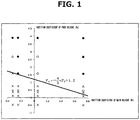
- FIG. 1 is a graph in which the result of a first example 1 is plotted when a horizontal axis represents the octanol/water partition coefficient of a main solvent and a vertical axis represents the octanol/water partition coefficient of a poor solvent.
- a method for manufacturing lithium difluorophosphate powder of the present invention includes a step of obtaining lithium difluorophosphate powder by solid-liquid separation of solid lithium difluorophosphate from a liquid containing a main solvent and a poor solvent, after the crystal of lithium difluorophosphate is precipitated by adding the poor solvent to a lithium difluorophosphate solution in which lithium difluorophosphate is dissolved in the main solvent.
- the poor solvent having a low solubility of lithium difluorophosphate is added to the lithium difluorophosphate solution, the amount of lithium difluorophosphate which can be dissolved in the solution decreases, and lithium difluorophosphate which cannot be dissolved in the solution is precipitated as a crystal.
- the obtained crystal has a high purity.
- An octanol/water partition coefficient (Log Pow, hereinafter, simply also called “partition coefficient”) is a concentration ratio of a chemical substance in two solvent phases of n-octanol and water, when the chemical substance is added to the two solvent phases and becoming an equilibrium state. It is used when the substance is judged if it is hydrophilicity or hydrophobicity, and if the value of the partition coefficient is large, the substance has a high hydrophobicity.
- the octanol/water partition coefficient can be evaluated with a method described in JIS Z7260. However, it can be also calculated with a computer.
- the addition of the poor solvent is preferably performed while stirring the solution to make the whole system uniform.
- a general solid-liquid separation method can be used for the solid-liquid separation, and natural filtration, vacuum filtration, pressure filtration and centrifugal filtration can be also used.
- the pressure filtration is used widely and industrially, and it is preferable because filtering speed can be increased.
- the poor solvent is at least one kind selected from the group consisting of a saturated hydrocarbon-based solvent, an aromatic-based solvent, an ether-based solvent and a carbonic acid ester-based solvent.
- a saturated hydrocarbon-based solvent an aromatic-based solvent, an ether-based solvent and a carbonic acid ester-based solvent.
- the octanol/water partition coefficients of these solvents tend to be high, and the relational expression of the formula (1) therefore tends to be satisfied.
- the saturated hydrocarbon-based solvent is at least one kind selected from the group consisting of n-hexane (3.90), n-heptane (4.66) and n-octane (5.18)
- the aromatic-based solvent is at least one kind selected from the group consisting of toluene (2.69), xylene (3.12) and benzene (3.12)
- the ether-based solvent is at least one kind selected from the group consisting of diisopropyl ether (1.52), tetrahydrofuran (0.46) and diethyl ether (0.89), because these solvents are generally distributed and their partition coefficients are relatively high.
- a number in parentheses after each substance name is a value of the octanol/water partition coefficient of each of the substances.
- the carbonic acid ester-based solvent is at least one kind selected from the group consisting of ethyl methyl carbonate (0.75), dimethyl carbonate (0.354), propylene carbonate (-0.48) and ethylene carbonate (0.11), because these solvents can be used for electrolytes for non-aqueous electrolyte batteries, and when these are used for the electrolytes, problems do not occur even if these solvents remain in solid contents.
- the main solvent is at least one kind selected from the group consisting of an ester-based solvent, a ketone-based solvent and an alcohol-based solvent, because the partition coefficients of these solvents tend to be low, and the relational expression of the formula (1) tends to be satisfied.
- the ester-based solvent is at least one kind selected from the group consisting of ethyl acetate (0.73), methyl acetate (0.18) and propyl acetate (1.24)
- the ketone-based solvent is at least one kind selected from the group consisting of acetone (-0.24), methyl ethyl ketone (0.29) and cyclohexanone (0.81)
- the alcohol-based solvent is at least one kind selected from the group consisting of ethanol (-0.32), isopropyl alcohol (0.05), methanol (-0.82) and isobutanol (0.8), because these solvents are generally distributed and the partition coefficients of these solvents are relatively low.
- the octanol/water partition coefficient P P of the main solvent is -0.40 or greater to 0.80 or less. In this range, in the examples, it has been proved that precipitation efficiency is high in a case where the relational expression of the formula (1) is satisfied.
- the main solvent is ethyl acetate and the poor solvent is toluene.
- the precipitation efficiency is particularly high, as compared with other combinations of the solvents, and furthermore, the lithium difluorophosphate solution is not turned into gel, and a precipitated product can be easily separated by filtration.
- the amount of the poor solvent to be added is preferably 0.1-5 mass times, more preferably 0.2-2 mass times, further preferably 0.4-1 mass times, relative to the mass of the solution. If the amount of the poor solvent is too small, the precipitation efficiency deteriorates, and if the amount of the poor solvent is large, when the precipitated product is separated by filtration, the amount of filtrate increases, and the filtration takes time, and moreover, the amount of waste increases.
- the steps of cleaning an obtained solid with cleaning liquid, removing the cleaning liquid, and drying it, after the solid-liquid separation a saturated hydrocarbon-based solvent, an aromatic-based solvent, an ether-based solvent and a carbonic acid ester-based solvent, which can be used as the poor solvent, can be used.
- a saturated hydrocarbon-based solvent, an aromatic-based solvent, an ether-based solvent and a carbonic acid ester-based solvent which can be used as the poor solvent, can be used.
- the cleaning step an excess solid content can be removed, and by the drying step, the solvent contained in the solid content is volatilized, and it can be removed.
- lithium difluorophosphate When lithium difluorophosphate is manufactured by a well-known manufacturing method, there is almost no possibility that reaction is completely proceeded, and only lithium difluorophosphate is produced. In general, a lithium difluorophosphate solution is obtained which contains non-target substances, such as unreacted starting substances, side reaction products and decomposition products under reaction, as impurities. The amount of the impurities is approximately 1-50 mass %, generally 5-25 mass %, relative to the amount of lithium difluorophosphate.
- lithium difluorophosphate powder of the present invention By applying the method for manufacturing the lithium difluorophosphate powder of the present invention to the lithium difluorophosphate solution containing those impurities, it is possible to obtain high purity lithium difluorophosphate powder in which the content of the impurities have been reduced, and lithium difluorophosphate can be purified.
- lithium difluorophosphate As a method for manufacturing lithium difluorophosphate, there can be used a method described in a patent document 2, method in which halides other than fluoride, LiPF 6 and water are reacted in a non-aqueous solvent, a method described in a patent document 3, method in which diphosphorus pentoxide, lithium hexafluorophosphate and hydrogen fluoride are reacted, and a method described in a patent document 4, method in which difluorophosphate and lithium chloride are reacted.
- the purity of the lithium difluorophosphate powder obtained with the manufacturing method of the present invention is high because crystal precipitation process is carried out.
- the purity of the lithium difluorophosphate powder is generally 95 mass % or greater, preferably 98 mass % or greater, more preferably 99 mass % or greater.
- the lithium difluorophosphate powder manufactured by applying the present method contains the used poor solvent within a range of 50 mass ppm or greater to 1000 mass ppm or less.
- Lithium difluorophosphate was added to 10 g of a main solvent until saturated at a room temperature (25 °C). A predetermined amount of a poor solvent was added to this solution. One night later, the mixed liquid was pressure-filtered (pressure: 0.4 MPaG, filter: polytetrafluoroethylene porous membrane having a pore diameter of 0.5 ⁇ m), and the amount of lithium difluorophosphate powder in a residue was determined by determining the amount of lithium difluorophosphate in filtrate.
- a value obtained by dividing the amount of the lithium difluorophosphate powder in the residue by the amount of lithium difluorophosphate contained in the saturated solution before adding the poor solvent was set as precipitation efficiency.
- the solution after adding the poor solvent was visually confirmed, and one which was capable of being stirred but which had a high viscosity was expressed as jelly, and one having a high viscosity which was not capable of being stirred was expressed as gel.
- a horizontal axis represents the partition coefficient of the main solvent and a vertical axis represents the partition coefficient of the poor solvent.
- the maximum value of the precipitation efficiency of each combination of the main solvents and the poor solvents less than 20 % is expressed as "x”, 20 % or greater to less than 45 % is expressed as " ⁇ ", 45 % or greater to less than 70 % is expressed as "o” and 70 % or greater is expressed as "•”, and results were plotted in FIG. 1 .
- the maximum precipitation efficiency exceeds 20 %, and it is understood that the precipitation efficiency is relatively high.
- Lithium difluorophosphate was synthesized, as follows, with reference to a method described in a patent document 2 for manufacturing lithium difluorophosphate.
- reaction liquid obtained in this way was analyzed with 19 F-NMR. It was confirmed that this reaction liquid contained 1.5 kg (9.6 mol) of LiPF 6 , 5.2 kg (47.9 mol) of lithium difluorophosphate and 0.05 kg (0.4 mol) of LiHPO 3 F, and reaction proceeded almost quantitatively.
- the residue was cleaned with ethyl methyl carbonate and dried for eight hours at 100 °C, and powder was obtained.
- the obtained powder was lithium difluorophosphate having a purity of 99.7 mass %.
- the amount of each impurity was shown in the following table. In addition, phosphorus-atom-based recovery rate was 94.5 %.
- Composition in solid content (mass %) Acid concentration in solid content (HF conversion) (mass ppm) Chlorine concentration in solid content (mass ppm) Solid concentration in solid content (mass ppm) LiPO 2 F 2 LiPF 6 LiHPO 3 F LiF EtOAc EMC Toluene 99.71 0.00 0.00 0.17 448 16 500 600 100
- lithium difluorophosphate powder having high purity was obtained at a high recovery rate without gelation.
Landscapes
- Chemical & Material Sciences (AREA)
- Engineering & Computer Science (AREA)
- Organic Chemistry (AREA)
- Inorganic Chemistry (AREA)
- Materials Engineering (AREA)
- Manufacturing & Machinery (AREA)
- Physics & Mathematics (AREA)
- Chemical Kinetics & Catalysis (AREA)
- Electrochemistry (AREA)
- General Chemical & Material Sciences (AREA)
- General Physics & Mathematics (AREA)
- Condensed Matter Physics & Semiconductors (AREA)
- Secondary Cells (AREA)
- Primary Cells (AREA)
Abstract
Description
- The present invention relates to a method for manufacturing lithium difluorophosphate powder used for non-aqueous electrolyte batteries.
- In recent years, electrical storage systems for information-related equipment or telecommunication equipment, i.e., electrical storage systems for equipment having a small size and requiring a high energy density, such as personal computers, video cameras, digital still cameras and cellular phones, as well as electrical storage systems for equipment having a large size and requiring a high electric power, such as electric automobiles, hybrid vehicles, auxiliary power supplies for fuel cell vehicles and electricity storages, have been attracting attentions. As one of the candidates, non-aqueous electrolyte batteries have been actively developed, such as lithium ion batteries, lithium batteries, lithium ion capacitors, etc.
- In general, in those non-aqueous electrolyte batteries, a non-aqueous electrolyte containing a non-aqueous solvent and a solute has been used as an ion conductor. The structure of the non-aqueous electrolyte is as follows. An aprotic mixed solvent in which one or several kinds selected from ethylene carbonate, propylene carbonate, dimethyl carbonate, diethyl carbonate and ethyl methyl carbonate had been mixed has been used as a non-aqueous solvent. A Lithium salt represented by, for example, LiPF6, LiBF4, (CF3SO2hNLi, (C2F5SO2)2NL1, etc. has been used as a solute.
- Until now, as a means for improving durability of non-aqueous electrolyte batteries, such as cycle characteristic and high temperature preservability, optimization of various constituent elements of a battery, such as active materials of cathode and anode, etc., has been considered. Technology related to non-aqueous electrolytes is not the exception, either. It has been suggested to suppress deterioration by various additives, deterioration which is caused by decomposing an electrolyte on the surface of active cathode and anode. For example, in a
patent document 1, it has been described that high temperature cycle characteristic is improved by an effect of a film formed on an electrode interface when lithium difluorophosphate (LiPO2F2) is added to an electrolyte. - As a method for manufacturing lithium difluorophosphate used as an additive, a method in which halides other than fluoride, LiPF6 and water are reacted in a non-aqueous solvent has been known (see a patent document 2).
- In addition, in a
patent document 3, for example, after reacting diphosphorus pentoxide, lithium hexafluorophosphate and hydrogen fluoride, a solution is concentrated, following which it is cooled down, and the crystal of lithium difluorophosphate is obtained. In apatent document 4, after reacting difluorophosphate and lithium chloride, a solution is cooled down, and the crystal of lithium difluorophosphate is precipitated. - In the method described in the
patent document 2, a reaction liquid containing unreacted LiPF6 and the produced lithium difluorophosphate can be used for preparing an electrolyte. However, there is a possibility that HF as a by-product produced by decomposing LiHPO3F, H2PO4 and LiPF6 is mixed, and it has therefore been required to obtain lithium difluorophosphate having higher purity. As its method, it has been considered to purify lithium difluorophosphate by obtaining the powder of lithium difluorophosphate by precipitating the crystal of lithium difluorophosphate from a solution. - However, lithium difluorophosphate tends to be gel due to hydrogen bound, and a method for manufacturing lithium difluorophosphate powder from a solution, method which is capable of being used for industrial production, has therefore not been established. For example, in the
patent documents -
- Patent Document 1: Japanese Patent Application Publication
H11-67270 - Patent Document 2: Japanese Patent Application Publication
2008-222484 - Patent Document 3: International Publication
2010/064637 - Patent Document 4: International Publication
2013/136533 - An object of the present invention is to provide a manufacturing method with which lithium difluorophosphate powder can be obtained from a lithium difluorophosphate solution.
- The present inventors focus on a poor solvent precipitation method (it is also called as a poor solvent addition crystallization method) for precipitating lithium difluorophosphate by adding a poor solvent having a low solubility to lithium difluorophosphate to a solution containing lithium difluorophosphate, to solve the above problem, and have found that lithium difluorophosphate powder can be efficiently recovered, in a case where there is a specific relation between the octanol/water partition coefficient of a main solvent and the octanol/water partition coefficient of the poor solvent.
- That is, the present invention provides a method for manufacturing lithium difluorophosphate powder, including the steps of: precipitating solid lithium difluorophosphate by adding a poor solvent to a solution in which lithium difluorophosphate is dissolved in a main solvent; and obtaining lithium difluorophosphate powder by solid-liquid separation of the solid lithium difluorophosphate from a liquid containing the main solvent and the poor solvent, wherein the relational expression between the octanol/water partition coefficient PP of the main solvent and the octanol/water partition coefficient PA of the poor solvent is defined by a formula (1).

- It is preferable that the poor solvent is at least one kind selected from the group consisting of a saturated hydrocarbon-based solvent, an aromatic-based solvent, an ether-based solvent and a carbonic acid ester-based solvent, and that the main solvent is at least one kind selected from the group consisting of an ester-based solvent, a ketone-based solvent and an alcohol-based solvent.
- Moreover, it is preferable to include the steps of cleaning the obtained solid with cleaning liquid, and removing the cleaning liquid and drying the solid, after the solid-liquid separation.
- In addition, the present invention also provides lithium difluorophosphate characterized in that 1000 mass ppm or less of toluene is contained.
- According to the present invention, it is possible to provide a manufacturing method with which lithium difluorophosphate powder can be obtained from a lithium difluorophosphate solution.
-
FIG. 1 is a graph in which the result of a first example 1 is plotted when a horizontal axis represents the octanol/water partition coefficient of a main solvent and a vertical axis represents the octanol/water partition coefficient of a poor solvent. - In the following, the present invention will be explained in detail.
- A method for manufacturing lithium difluorophosphate powder of the present invention includes a step of obtaining lithium difluorophosphate powder by solid-liquid separation of solid lithium difluorophosphate from a liquid containing a main solvent and a poor solvent, after the crystal of lithium difluorophosphate is precipitated by adding the poor solvent to a lithium difluorophosphate solution in which lithium difluorophosphate is dissolved in the main solvent. When the poor solvent having a low solubility of lithium difluorophosphate is added to the lithium difluorophosphate solution, the amount of lithium difluorophosphate which can be dissolved in the solution decreases, and lithium difluorophosphate which cannot be dissolved in the solution is precipitated as a crystal. The obtained crystal has a high purity.
- Furthermore, it is characterized that the relational expression between the octanol/water partition coefficient PP of the main solvent and the octanol/water partition coefficient PA of the poor solvent is defined by the following formula (1).

- An octanol/water partition coefficient (Log Pow, hereinafter, simply also called "partition coefficient") is a concentration ratio of a chemical substance in two solvent phases of n-octanol and water, when the chemical substance is added to the two solvent phases and becoming an equilibrium state. It is used when the substance is judged if it is hydrophilicity or hydrophobicity, and if the value of the partition coefficient is large, the substance has a high hydrophobicity. The octanol/water partition coefficient can be evaluated with a method described in JIS Z7260. However, it can be also calculated with a computer.
- When the relational expression between the octanol/water partition coefficient PP of the main solvent and the octanol/water partition coefficient PA of the poor solvent satisfies the formula (1), it is possible to recover the lithium difluorophosphate powder with a poor solvent precipitation method.
- The addition of the poor solvent is preferably performed while stirring the solution to make the whole system uniform.
- In addition, a general solid-liquid separation method can be used for the solid-liquid separation, and natural filtration, vacuum filtration, pressure filtration and centrifugal filtration can be also used. In particular, the pressure filtration is used widely and industrially, and it is preferable because filtering speed can be increased.
- In addition, it is preferable that the poor solvent is at least one kind selected from the group consisting of a saturated hydrocarbon-based solvent, an aromatic-based solvent, an ether-based solvent and a carbonic acid ester-based solvent. The octanol/water partition coefficients of these solvents tend to be high, and the relational expression of the formula (1) therefore tends to be satisfied.
- In addition, it is preferable that the saturated hydrocarbon-based solvent is at least one kind selected from the group consisting of n-hexane (3.90), n-heptane (4.66) and n-octane (5.18), the aromatic-based solvent is at least one kind selected from the group consisting of toluene (2.69), xylene (3.12) and benzene (3.12), and that the ether-based solvent is at least one kind selected from the group consisting of diisopropyl ether (1.52), tetrahydrofuran (0.46) and diethyl ether (0.89), because these solvents are generally distributed and their partition coefficients are relatively high. In addition, a number in parentheses after each substance name is a value of the octanol/water partition coefficient of each of the substances.
- It is preferable that the carbonic acid ester-based solvent is at least one kind selected from the group consisting of ethyl methyl carbonate (0.75), dimethyl carbonate (0.354), propylene carbonate (-0.48) and ethylene carbonate (0.11), because these solvents can be used for electrolytes for non-aqueous electrolyte batteries, and when these are used for the electrolytes, problems do not occur even if these solvents remain in solid contents.
- It is preferable that the main solvent is at least one kind selected from the group consisting of an ester-based solvent, a ketone-based solvent and an alcohol-based solvent, because the partition coefficients of these solvents tend to be low, and the relational expression of the formula (1) tends to be satisfied.
- It is preferable that the ester-based solvent is at least one kind selected from the group consisting of ethyl acetate (0.73), methyl acetate (0.18) and propyl acetate (1.24), the ketone-based solvent is at least one kind selected from the group consisting of acetone (-0.24), methyl ethyl ketone (0.29) and cyclohexanone (0.81), and that the alcohol-based solvent is at least one kind selected from the group consisting of ethanol (-0.32), isopropyl alcohol (0.05), methanol (-0.82) and isobutanol (0.8), because these solvents are generally distributed and the partition coefficients of these solvents are relatively low.
- In particular, it is preferable that the octanol/water partition coefficient PP of the main solvent is -0.40 or greater to 0.80 or less. In this range, in the examples, it has been proved that precipitation efficiency is high in a case where the relational expression of the formula (1) is satisfied.
- In particular, it is preferable that the main solvent is ethyl acetate and the poor solvent is toluene. In this combination, the precipitation efficiency is particularly high, as compared with other combinations of the solvents, and furthermore, the lithium difluorophosphate solution is not turned into gel, and a precipitated product can be easily separated by filtration.
- When the poor solvent is added to the lithium difluorophosphate solution, the amount of the poor solvent to be added is preferably 0.1-5 mass times, more preferably 0.2-2 mass times, further preferably 0.4-1 mass times, relative to the mass of the solution. If the amount of the poor solvent is too small, the precipitation efficiency deteriorates, and if the amount of the poor solvent is large, when the precipitated product is separated by filtration, the amount of filtrate increases, and the filtration takes time, and moreover, the amount of waste increases.
- Moreover, it is preferable to include the steps of cleaning an obtained solid with cleaning liquid, removing the cleaning liquid, and drying it, after the solid-liquid separation. As the cleaning liquid, a saturated hydrocarbon-based solvent, an aromatic-based solvent, an ether-based solvent and a carbonic acid ester-based solvent, which can be used as the poor solvent, can be used. By the cleaning step, an excess solid content can be removed, and by the drying step, the solvent contained in the solid content is volatilized, and it can be removed.
- When lithium difluorophosphate is manufactured by a well-known manufacturing method, there is almost no possibility that reaction is completely proceeded, and only lithium difluorophosphate is produced. In general, a lithium difluorophosphate solution is obtained which contains non-target substances, such as unreacted starting substances, side reaction products and decomposition products under reaction, as impurities. The amount of the impurities is approximately 1-50 mass %, generally 5-25 mass %, relative to the amount of lithium difluorophosphate. By applying the method for manufacturing the lithium difluorophosphate powder of the present invention to the lithium difluorophosphate solution containing those impurities, it is possible to obtain high purity lithium difluorophosphate powder in which the content of the impurities have been reduced, and lithium difluorophosphate can be purified. As a method for manufacturing lithium difluorophosphate, there can be used a method described in a
patent document 2, method in which halides other than fluoride, LiPF6 and water are reacted in a non-aqueous solvent, a method described in apatent document 3, method in which diphosphorus pentoxide, lithium hexafluorophosphate and hydrogen fluoride are reacted, and a method described in apatent document 4, method in which difluorophosphate and lithium chloride are reacted. In addition, the purity of the lithium difluorophosphate powder obtained with the manufacturing method of the present invention is high because crystal precipitation process is carried out. The purity of the lithium difluorophosphate powder is generally 95 mass % or greater, preferably 98 mass % or greater, more preferably 99 mass % or greater. - In addition, there is a case where the lithium difluorophosphate powder manufactured by applying the present method contains the used poor solvent within a range of 50 mass ppm or greater to 1000 mass ppm or less.
- Lithium difluorophosphate was added to 10 g of a main solvent until saturated at a room temperature (25 °C). A predetermined amount of a poor solvent was added to this solution. One night later, the mixed liquid was pressure-filtered (pressure: 0.4 MPaG, filter: polytetrafluoroethylene porous membrane having a pore diameter of 0.5 µm), and the amount of lithium difluorophosphate powder in a residue was determined by determining the amount of lithium difluorophosphate in filtrate.
- A value obtained by dividing the amount of the lithium difluorophosphate powder in the residue by the amount of lithium difluorophosphate contained in the saturated solution before adding the poor solvent was set as precipitation efficiency. In addition, the solution after adding the poor solvent was visually confirmed, and one which was capable of being stirred but which had a high viscosity was expressed as jelly, and one having a high viscosity which was not capable of being stirred was expressed as gel.
- The kinds of the main solvent and the poor solvent which were used, and the amount of the poor solvent to be added to the solution were changed and shown in the following Table 1 and Table 2. In addition, EtOAc is ethyl acetate, IPE is diisopropyl ether, THF is tetrahydrofuran, EMC is ethyl methyl carbonate, DMC is dimethyl carbonate, PC is propylene carbonate and EC is ethylene carbonate, in the tables. Each of their partition coefficients is shown in Table 3.
[Table 1] Main solvent (partition coefficient) Poor solvent Precipitation efficiency (vs saturated solution) [%] Note Poor solvent (partition coefficient) Addition amount [mass times] Poor solvent concentration [mass %] Toluene (2.69) 0.2 19.8 % 68.9 % 0.4 33.1 % 82.3 % 0.8 49.8 % 86.1 % Hexane (3.9) 0.1 11.0 % 58.4 % Gel or jelly immediately after mixing → Cloudy liquid, one night later 0.2 19.8 % 74.5 % Gel or jelly immediately after mixing → Cloudy liquid, one night later 0.6 42.6 % 85.9 % Gel or jelly immediately after mixing → Cloudy liquid, one night later IPE (1.52) 0.1 11. 0% 51.0 % EtOAc 0.3 27.1 % 77.1 % Gel or jelly immediately after mixing → Cloudy liquid, one night later (0.73) 0.8 49. 7% 86.0 % Gel or jelly immediately after mixing → Cloudy liquid, one night later THF (0.46) 0.2 19.8 % 33.1 % 0.6 42.6 % 68.9 % 1.0 55.3 % 65.0 % EMC (0.75) 1.0 55.3 % 25.0 % No precipitation immediately after mixing (one night later, slight precipitation) DMC (0.354) 1.0 55.3 % 22.4 % No precipitation immediately after mixing (one night later, slight precipitation) PC (-0.48) 1.0 55.3 % 0.0 % EC (0.11) 1.0 55.3 % 0.0 % Toluene (2.69) 0.1 13.4 % 23.3 % 0.3 23.6 % 45.5 % 0.8 48.2 % 71.2 % Hexane (3.9) 0.1 13.4 % 44.4 % 0.3 23.6 % 63.2 % Jelly → Jelly, one night later 0.6 43.6 % 77.2 % Jelly → Jelly, one night later IPE (1.52) 0.1 13.4 % 34.8 % 0.3 23.6 % 55.8 % Jelly → Jelly, one night later 0.6 43.6 % 73.6 % Jelly → Jelly, one night later Acetone THF (0.46) 0.1 13.4 % 0.0 % (-0.24) 0.3 23.6 % 0.0 % 0.6 43.6 % 17.3 % EMC (0.75) 0.6 43.6 % 0.0 % DMC (0.354) 0.6 43.6 % 0.0 % PC (-0.48) 0.6 43.6 % 0.0 % EC (0.11) 0.6 43.6 % 0.0 % [Table 2] Main solvent (partition coefficient) Poor solvent Precipitation efficiency (vs saturated solution) [%] Note Poor solvent (partition coefficient) Addition amount [mass times] Poor solvent concentration [mass %] Toluene (2.69) 0.2 20.9 % 14.4 % Gel, one night later 0.4 34.6 % 35.6 % Gel, one night later 0.7 48.0 % 52.9 % Gel, one night later Hexane (3.9) 0.2 20.9 % 36.5 % Gel, one night later 0.4 34.6 % 55.4 % Gel, one night later 0.7 48.0 % 70.7 % Gel, one night later IPE (1.52) 0.2 20.9 % 1.6 % 0.4 34.6 % 27.1 % 0.7 48.0 % 48.7 % IPA THF (0.46) 0.2 20.9 % 0.0 % (0.05) 0.4 34.6 % 0.0 % 0.7 48.0 % 0.0 % EMC (0.75) 0.9 54.3 % 0.0 % DMC (0.354) 0.9 54.3 % 0.0 % PC (-0.48) 0.9 54.3 % 0.0 % EC (0.11) 0.9 54.3 % 0.0 % Toluene (2.69) 0.2 25.8 % 3.6 % 0.4 41.0 % 10.2 % 0.7 54.9 % 20.2 % Partial separation into two layers Hexane (3.9) 0.2 25.8 % 6.8 % Separation into two layers 0.4 41.0 % 29.0 % Separation into two layers 0.7 54.9 % 85.0 % Separation into two layers IPE (1.52) 0.2 25.8 % 0.0 % 0.4 41.0 % 0.0 % 0.7 54.9 % 0.0 % Ethanol THF (0.46) 0.2 25.8 % 0.0 % (-0.32) 0.4 41.0 % 0.0 % 0.7 54.9 % 0.0 % EMC (0.75) 1.0 63.5 % 0.0 % DMC (0.354) 1.0 63.5 % 0.0 % PC (-0.48) 1.0 63.5 % 0.0 % EC (0.11) 1.0 63.5 % 0.0 % [Table 3] Name Log Pow (partition coefficient) AcOEt (ethyl acetate) 0.73 Acetone -0.24 IPA (isopropyl alcohol) 0.05 Ethanol -0.32 Hexane (n-hexane) 3.9 Toluene 2.69 IPE (diisopropyl ether) 1.52 THF (tetrahydrofuran) 0.46 EMC (ethyl methyl carbonate) 0.75 DMC (dimethyl carbonate) 0.354 PC (propylene carbonate) -0.48 EC (ethylene carbonate) 0.11 - In addition, in
FIG. 1 , a horizontal axis represents the partition coefficient of the main solvent and a vertical axis represents the partition coefficient of the poor solvent. As to the maximum value of the precipitation efficiency of each combination of the main solvents and the poor solvents, less than 20 % is expressed as "x", 20 % or greater to less than 45 % is expressed as "Δ", 45 % or greater to less than 70 % is expressed as "o" and 70 % or greater is expressed as "•", and results were plotted inFIG. 1 . A line inFIG. 1 is a line in a case where the relational expression between the octanol/water partition coefficient PP of the main solvent and the octanol/water partition coefficient PA of the poor solvent is defined by the following formula.
- As shown in
FIG. 1 , in a region above the line showing the relational expression between PP and PA, the maximum precipitation efficiency exceeds 20 %, and it is understood that the precipitation efficiency is relatively high. - In particular, in a case where ethyl acetate was used as the main solvent and toluene was used as the poor solvent, the precipitation efficiency was high, and gelation and separation in the solution did not occur. It can be therefore used for industrially manufacturing lithium difluorophosphate powder, and is particularly preferable.
- Poor solvent addition in which the combination of ethyl acetate and toluene had been used, combination which was made clear that it was the most preferable combination of the main solvent and the poor solvent in Example 1, was applied to a manufacturing step for lithium difluorophosphate powder.
- Lithium difluorophosphate was synthesized, as follows, with reference to a method described in a
patent document 2 for manufacturing lithium difluorophosphate. - 8.8 kg (57.9 mol) of LiPF6 was dissolved in 32.2 kg of ethyl acetate, and 7.9 kg (186.8 mol) of lithium chloride was added, following which it was stirred at 35 °C while adding 1.7 kg (97.0 mol) of water. This reaction liquid was depressurized at 35 °C, 11 kg of a solvent was distilled off, and hydrogen chloride as a by-product was removed. The free acid of this solution was analyzed by a titration method. It was 4700 ppm converted as HF.
- Next, the reaction liquid obtained in this way was analyzed with 19F-NMR. It was confirmed that this reaction liquid contained 1.5 kg (9.6 mol) of LiPF6, 5.2 kg (47.9 mol) of lithium difluorophosphate and 0.05 kg (0.4 mol) of LiHPO3F, and reaction proceeded almost quantitatively.
- As to this reaction liquid, pressure filtration (pressure: 0.2 MPaG, filter: polytetrafluoroethylene membrane having a pore diameter of 0.5 µm) was performed, and lithium fluoride as a by-product generated by the reaction was separated by the filtration, and a solution containing 20.2 % of lithium difluorophosphate was obtained.
- 38. 1 kg (1.55 times with respect to a lithium difluorophosphate solution, in mass ratio) of toluene was added to 24. 6 kg of the ethyl acetate solution containing 20.2 % of lithium difluorophosphate, which was obtained by the above-mentioned synthesis, and it was stirred for a hundred minutes, following which solids were precipitated. However, it was not turned into gel, and pressure filtration (pressure: 0.2 MPaG, filter: polytetrafluoroethylene membrane having a pore diameter of 0.5 µm) was therefore performed, and a residue was obtained. The filtration was completed without occurrence of clogging, etc., because gelation did not occur, and filtration performance was 5.97 kg per hour.
- The residue was cleaned with ethyl methyl carbonate and dried for eight hours at 100 °C, and powder was obtained.
- The obtained powder was lithium difluorophosphate having a purity of 99.7 mass %. The amount of each impurity was shown in the following table. In addition, phosphorus-atom-based recovery rate was 94.5 %.
[Table 4] Composition in solid content
(mass %)Acid concentration in solid content
(HF conversion)
(mass ppm)Chlorine concentration in solid content
(mass ppm)Solid concentration in solid content
(mass ppm)LiPO2F2 LiPF6 LiHPO3F LiF EtOAc EMC Toluene 99.71 0.00 0.00 0.17 448 16 500 600 100 - When an ethyl acetate solution containing lithium difluorophosphate and impurities, which had been obtained with the same method as that of Example 2, was cooled down to 5 °C, it became a supersaturated state, and solids were not precipitated. The same experiment was conducted again, and solids were precipitated. However, gelation occurred at the moment when the solids were precipitated, and consequently, filtration became difficult.
- As the above, when a poor solvent precipitation method, in which toluene as the poor solvent was added, was applied to the ethyl acetate solution of lithium difluorophosphate containing impurities, such as unreacted LiPF6 and LiHPO3F as a reaction by-product, lithium difluorophosphate powder having high purity was obtained at a high recovery rate without gelation.
Claims (15)
- A method for manufacturing lithium difluorophosphate powder, comprising the steps of:precipitating solid lithium difluorophosphate by adding a poor solvent to a solution in which lithium difluorophosphate is dissolved in a main solvent; andobtaining the lithium difluorophosphate powder by solid-liquid separation of the solid lithium difluorophosphate from a liquid containing the main solvent and the poor solvent,wherein a relational expression between an octanol/water partition coefficient PP of the main solvent and an octanol/water partition coefficient PA of the poor solvent is defined by a formula (1).

- The method for manufacturing the lithium difluorophosphate powder according to claim 1, wherein the poor solvent is at least one kind selected from the group consisting of a saturated hydrocarbon-based solvent, an aromatic-based solvent, an ether-based solvent and a carbonic acid ester-based solvent.
- The method for manufacturing the lithium difluorophosphate powder according to claim 2, wherein the saturated hydrocarbon-based solvent is at least one kind selected from the group consisting of n-hexane, n-heptane and n-octane.
- The method for manufacturing the lithium difluorophosphate powder according to claim 2, wherein the aromatic-based solvent is at least one kind selected from the group consisting of toluene, xylene and benzene.
- The method for manufacturing the lithium difluorophosphate powder according to claim 2, wherein the ether-based solvent is at least one kind selected from the group consisting of diisopropyl ether, tetrahydrofuran and diethyl ether.
- The method for manufacturing the lithium difluorophosphate powder according to claim 2, wherein the carbonic acid ester-based solvent is at least one kind selected from the group consisting of ethyl methyl carbonate, dimethyl carbonate, propylene carbonate and ethylene carbonate.
- The method for manufacturing the lithium difluorophosphate powder according to claim 1, wherein the main solvent is at least one kind selected from the group consisting of an ester-based solvent, a ketone-based solvent and an alcohol-based solvent.
- The method for manufacturing the lithium difluorophosphate powder according to claim 7, wherein the ester-based solvent is at least one kind selected from the group consisting of ethyl acetate, methyl acetate and propyl acetate.
- The method for manufacturing the lithium difluorophosphate powder according to claim 7, wherein the ketone-based solvent is at least one kind selected from the group consisting of acetone, methyl ethyl ketone and cyclohexanone.
- The method for manufacturing the lithium difluorophosphate powder according to claim 7, wherein the alcohol-based solvent is at least one kind selected from the group consisting of ethanol, isopropanol, methanol and isobutanol.
- The method for manufacturing the lithium difluorophosphate powder according to claim 1, wherein the octanol/water partition coefficient PP of the main solvent is -0.40 or greater to 0.80 or less.
- The method for manufacturing the lithium difluorophosphate powder according to claim 1, wherein the main solvent is ethyl acetate, and the poor solvent is toluene.
- The method for manufacturing the lithium difluorophosphate powder according to claim 1, an amount of the poor solvent to be added to the solution is 0.1-5 mass times, relative to the solution.
- The method for manufacturing the lithium difluorophosphate powder according to any of claims 1-13, comprising, after the solid-liquid separation, the steps of:cleaning an obtained solid with cleaning liquid; andremoving the cleaning liquid, and drying the solid.
- Lithium difluorophosphate, wherein 1000 mass ppm or less of toluene is contained.
Applications Claiming Priority (2)
| Application Number | Priority Date | Filing Date | Title |
|---|---|---|---|
| JP2014248913A JP6428222B2 (en) | 2014-12-09 | 2014-12-09 | Method for producing lithium difluorophosphate powder and lithium difluorophosphate |
| PCT/JP2015/082230 WO2016093025A1 (en) | 2014-12-09 | 2015-11-17 | Manufacturing method for lithium difluorophosphate powder, and lithium difluorophosphate |
Publications (3)
| Publication Number | Publication Date |
|---|---|
| EP3231769A1 true EP3231769A1 (en) | 2017-10-18 |
| EP3231769A4 EP3231769A4 (en) | 2018-08-22 |
| EP3231769B1 EP3231769B1 (en) | 2022-09-28 |
Family
ID=56107219
Family Applications (1)
| Application Number | Title | Priority Date | Filing Date |
|---|---|---|---|
| EP15867035.6A Active EP3231769B1 (en) | 2014-12-09 | 2015-11-17 | Manufacturing method for lithium difluorophosphate powder, and lithium difluorophosphate |
Country Status (8)
| Country | Link |
|---|---|
| US (1) | US10329155B2 (en) |
| EP (1) | EP3231769B1 (en) |
| JP (1) | JP6428222B2 (en) |
| KR (1) | KR101911461B1 (en) |
| CN (1) | CN107001042B (en) |
| HU (1) | HUE060546T2 (en) |
| PL (1) | PL3231769T3 (en) |
| WO (1) | WO2016093025A1 (en) |
Cited By (5)
| Publication number | Priority date | Publication date | Assignee | Title |
|---|---|---|---|---|
| EP3578511A4 (en) * | 2017-01-31 | 2020-07-08 | Mitsui Chemicals, Inc. | METHOD FOR PRODUCING LITHIUM DIFLUORPHOSPHATE |
| EP3572374A4 (en) * | 2017-01-20 | 2020-08-26 | Mitsui Chemicals, Inc. | Method for producing lithium difluorophosphate |
| EP3617140A4 (en) * | 2018-06-22 | 2020-10-21 | Chun Bo. Ltd. | METHOD OF MANUFACTURING HIGH PURITY LITHIUM DIFLUORPHOSPHATE CRYSTAL AND NON-Aqueous ELECTROLYTE SOLUTION FOR SECONDARY BATTERY THEREOF |
| US11148949B2 (en) | 2018-06-21 | 2021-10-19 | Chun Bo., Ltd | Method of preparing high-purity lithium difluorophosphate crystal and non-aqueous electrolyte solution for secondary battery including the crystal |
| EP3831771A4 (en) * | 2018-08-02 | 2022-04-27 | Chun Bo. Ltd. | PROCESS FOR PRODUCTION OF HIGH PURITY LITHIUM DIFLUOROPHOSPHATE CRYSTAL AND ANHYDROUS ELECTROLYTE FOR SECONDARY BATTERY THEREFORE |
Families Citing this family (10)
| Publication number | Priority date | Publication date | Assignee | Title |
|---|---|---|---|---|
| CN106744781A (en) * | 2016-12-26 | 2017-05-31 | 惠州市宙邦化工有限公司 | A kind of method of purification of difluorophosphate |
| CN107381530B (en) * | 2017-08-23 | 2020-06-16 | 中山大学 | A kind of purification method of lithium difluorophosphate |
| KR101887488B1 (en) * | 2018-01-18 | 2018-08-10 | 주식회사 천보 | Manufactuiring method for crystallization of lithium difluorophosphate having high-purity and Non-aqueous electrolyte for secondary battery |
| CN110220931B (en) * | 2019-07-18 | 2022-04-26 | 东莞东阳光科研发有限公司 | A kind of detection method of lithium salt solubility |
| CN110980683A (en) * | 2019-12-18 | 2020-04-10 | 江苏国泰超威新材料有限公司 | Method for purifying lithium salt containing phosphorus |
| KR102231049B1 (en) * | 2020-09-09 | 2021-03-23 | 주식회사 천보 | Manufacturing method for high-purity crystallization of lithium difluorophosphate with excellent solubility and Non-aqueous electrolyte for secondary battery |
| KR102300438B1 (en) * | 2021-01-29 | 2021-09-09 | 주식회사 천보 | Manufacturing method for high-purity crystallization of lithium difluorophosphate with excellet solubility and Non-aqueous electrolyte for secondary battery |
| KR102300440B1 (en) * | 2021-02-05 | 2021-09-09 | 주식회사 천보 | Manufacturing method for high-purity crystallization of lithium difluorophosphate with excellent solubility and Non-aqueous electrolyte for secondary battery |
| CN113880066B (en) * | 2021-11-12 | 2023-07-21 | 深圳市研一新材料有限责任公司 | Method for preparing lithium difluorophosphate by flow chemistry method |
| CN117069089B (en) * | 2023-08-24 | 2025-07-25 | 杭州万锂达新能源科技有限公司 | Preparation method of liquid lithium difluorophosphate solution |
Family Cites Families (10)
| Publication number | Priority date | Publication date | Assignee | Title |
|---|---|---|---|---|
| JP3439085B2 (en) * | 1997-08-21 | 2003-08-25 | 三洋電機株式会社 | Non-aqueous electrolyte secondary battery |
| KR101338814B1 (en) * | 2005-06-20 | 2013-12-06 | 미쓰비시 가가꾸 가부시키가이샤 | Method for producing difluorophosphate, non-aqueous electrolyte for secondary cell and non-aqueous electrolyte secondary cell |
| JP5277550B2 (en) * | 2007-03-12 | 2013-08-28 | セントラル硝子株式会社 | Method for producing lithium difluorophosphate and non-aqueous electrolyte battery using the same |
| CN102036912B (en) | 2008-12-02 | 2013-02-27 | 斯泰拉化工公司 | Method for producing difluorophosphate, nonaqueous electrolytic solution, and nonaqueous electrolyte secondary battery |
| EP2611731A1 (en) * | 2010-08-04 | 2013-07-10 | Solvay Sa | Manufacture of lipo2f2 from pof3 or pf5 |
| CN103874657A (en) * | 2011-08-16 | 2014-06-18 | 索尔维公司 | Fabrication of mixtures containing LiPO2F2 and LiPF6 |
| KR101614235B1 (en) * | 2012-03-14 | 2016-04-20 | 스텔라 케미파 코포레이션 | Method for producing difluorophosphate |
| CN103259040B (en) * | 2013-03-25 | 2016-01-13 | 中山市华玮新能源科技有限公司 | Organotin fluoride is utilized to prepare the method for high-purity lithium difluorophosphate |
| EP2842908A1 (en) * | 2013-08-28 | 2015-03-04 | Solvay SA | Production of metal difluorophosphates in liquid phase |
| WO2019061802A1 (en) * | 2017-09-27 | 2019-04-04 | 惠州市大道新材料科技有限公司 | Method for preparing lithium difluorophosphate |
-
2014
- 2014-12-09 JP JP2014248913A patent/JP6428222B2/en active Active
-
2015
- 2015-11-17 US US15/533,627 patent/US10329155B2/en active Active
- 2015-11-17 CN CN201580066596.8A patent/CN107001042B/en active Active
- 2015-11-17 HU HUE15867035A patent/HUE060546T2/en unknown
- 2015-11-17 PL PL15867035.6T patent/PL3231769T3/en unknown
- 2015-11-17 WO PCT/JP2015/082230 patent/WO2016093025A1/en not_active Ceased
- 2015-11-17 KR KR1020177014723A patent/KR101911461B1/en active Active
- 2015-11-17 EP EP15867035.6A patent/EP3231769B1/en active Active
Cited By (6)
| Publication number | Priority date | Publication date | Assignee | Title |
|---|---|---|---|---|
| EP3572374A4 (en) * | 2017-01-20 | 2020-08-26 | Mitsui Chemicals, Inc. | Method for producing lithium difluorophosphate |
| EP3578511A4 (en) * | 2017-01-31 | 2020-07-08 | Mitsui Chemicals, Inc. | METHOD FOR PRODUCING LITHIUM DIFLUORPHOSPHATE |
| US11148949B2 (en) | 2018-06-21 | 2021-10-19 | Chun Bo., Ltd | Method of preparing high-purity lithium difluorophosphate crystal and non-aqueous electrolyte solution for secondary battery including the crystal |
| EP3617140A4 (en) * | 2018-06-22 | 2020-10-21 | Chun Bo. Ltd. | METHOD OF MANUFACTURING HIGH PURITY LITHIUM DIFLUORPHOSPHATE CRYSTAL AND NON-Aqueous ELECTROLYTE SOLUTION FOR SECONDARY BATTERY THEREOF |
| US11225417B2 (en) | 2018-06-22 | 2022-01-18 | Chun Bo., Ltd | Method of preparing high-purity lithium difluorophosphate crystal and non-aqueous electrolyte solution for secondary battery including the crystal |
| EP3831771A4 (en) * | 2018-08-02 | 2022-04-27 | Chun Bo. Ltd. | PROCESS FOR PRODUCTION OF HIGH PURITY LITHIUM DIFLUOROPHOSPHATE CRYSTAL AND ANHYDROUS ELECTROLYTE FOR SECONDARY BATTERY THEREFORE |
Also Published As
| Publication number | Publication date |
|---|---|
| PL3231769T3 (en) | 2023-02-06 |
| US20170334723A1 (en) | 2017-11-23 |
| EP3231769A4 (en) | 2018-08-22 |
| CN107001042B (en) | 2020-01-14 |
| CN107001042A (en) | 2017-08-01 |
| KR101911461B1 (en) | 2018-10-24 |
| KR20170078784A (en) | 2017-07-07 |
| HUE060546T2 (en) | 2023-03-28 |
| JP6428222B2 (en) | 2018-11-28 |
| JP2016108197A (en) | 2016-06-20 |
| US10329155B2 (en) | 2019-06-25 |
| WO2016093025A1 (en) | 2016-06-16 |
| EP3231769B1 (en) | 2022-09-28 |
Similar Documents
| Publication | Publication Date | Title |
|---|---|---|
| EP3231769B1 (en) | Manufacturing method for lithium difluorophosphate powder, and lithium difluorophosphate | |
| KR101131707B1 (en) | Method for producing lithium difluorophosphate and nonaqueous electrolyte battery using the same | |
| EP3168917B1 (en) | Method for manufacturing alkali metal phosphate compounds | |
| JP5862094B2 (en) | Method for producing lithium hexafluorophosphate concentrate | |
| CN108147385B (en) | Method for producing lithium difluorophosphate | |
| JP6443903B1 (en) | Method for producing lithium difluorophosphate using difluorophosphate ester | |
| KR20190002543A (en) | Method for producing bis (fluorosulfonyl) imide alkali metal salt and bis (fluorosulfonyl) imide alkali metal salt composition | |
| WO2013121816A1 (en) | Method for producing concentrated lithium hexafluorophosphate solution | |
| KR20200114962A (en) | Method for producing bis (fluorosulfonyl) imide lithium salt (LiFSI) with reduced fluorine anion content | |
| US20170012321A1 (en) | Nonaqueous electrolyte compositions | |
| KR101435486B1 (en) | Method for producing electrolyte solution for lithium ion battery | |
| KR20230112800A (en) | Preparation Method of Bis(fluorosulfony)imide Lithium Salt in carbonate | |
| KR20230008582A (en) | Bis(fluorosulfonyl)imide alkali metal salt with reduced ammonium ions | |
| KR102677152B1 (en) | Solution of Lithium bis(fluorosulfony)imide containing reduced content of hydrofluoride and producing method thereof | |
| EP3604276A1 (en) | New components for electrolyte compositions | |
| WO2005123656A1 (en) | Novel methyl carbonates, and method for production thereof and non-aqueous electrolyte | |
| JP2020200234A (en) | Method for producing lithium difluorophosphate | |
| KR20230055130A (en) | Preparation Method of Bis(fluorosulfony)imide Alkali metal Salt in Ketone Solvent | |
| KR20230112799A (en) | Preparation Method of Bis(fluorosulfony)imide Lithium Salt in Carbonate Solvent | |
| KR20230009247A (en) | Bis(fluorosulfonyl)imide alkali metal salt |
Legal Events
| Date | Code | Title | Description |
|---|---|---|---|
| STAA | Information on the status of an ep patent application or granted ep patent |
Free format text: STATUS: THE INTERNATIONAL PUBLICATION HAS BEEN MADE |
|
| PUAI | Public reference made under article 153(3) epc to a published international application that has entered the european phase |
Free format text: ORIGINAL CODE: 0009012 |
|
| STAA | Information on the status of an ep patent application or granted ep patent |
Free format text: STATUS: REQUEST FOR EXAMINATION WAS MADE |
|
| 17P | Request for examination filed |
Effective date: 20170523 |
|
| AK | Designated contracting states |
Kind code of ref document: A1 Designated state(s): AL AT BE BG CH CY CZ DE DK EE ES FI FR GB GR HR HU IE IS IT LI LT LU LV MC MK MT NL NO PL PT RO RS SE SI SK SM TR |
|
| AX | Request for extension of the european patent |
Extension state: BA ME |
|
| DAV | Request for validation of the european patent (deleted) | ||
| DAX | Request for extension of the european patent (deleted) | ||
| A4 | Supplementary search report drawn up and despatched |
Effective date: 20180724 |
|
| RIC1 | Information provided on ipc code assigned before grant |
Ipc: H01M 10/0567 20100101ALI20180718BHEP Ipc: C01B 25/455 20060101AFI20180718BHEP |
|
| STAA | Information on the status of an ep patent application or granted ep patent |
Free format text: STATUS: EXAMINATION IS IN PROGRESS |
|
| 17Q | First examination report despatched |
Effective date: 20220201 |
|
| GRAP | Despatch of communication of intention to grant a patent |
Free format text: ORIGINAL CODE: EPIDOSNIGR1 |
|
| STAA | Information on the status of an ep patent application or granted ep patent |
Free format text: STATUS: GRANT OF PATENT IS INTENDED |
|
| INTG | Intention to grant announced |
Effective date: 20220531 |
|
| GRAS | Grant fee paid |
Free format text: ORIGINAL CODE: EPIDOSNIGR3 |
|
| GRAA | (expected) grant |
Free format text: ORIGINAL CODE: 0009210 |
|
| STAA | Information on the status of an ep patent application or granted ep patent |
Free format text: STATUS: THE PATENT HAS BEEN GRANTED |
|
| REG | Reference to a national code |
Ref country code: FR Ref legal event code: PLFP Year of fee payment: 8 |
|
| AK | Designated contracting states |
Kind code of ref document: B1 Designated state(s): AL AT BE BG CH CY CZ DE DK EE ES FI FR GB GR HR HU IE IS IT LI LT LU LV MC MK MT NL NO PL PT RO RS SE SI SK SM TR |
|
| REG | Reference to a national code |
Ref country code: GB Ref legal event code: FG4D |
|
| REG | Reference to a national code |
Ref country code: CH Ref legal event code: EP |
|
| REG | Reference to a national code |
Ref country code: DE Ref legal event code: R096 Ref document number: 602015081009 Country of ref document: DE |
|
| REG | Reference to a national code |
Ref country code: AT Ref legal event code: REF Ref document number: 1521140 Country of ref document: AT Kind code of ref document: T Effective date: 20221015 |
|
| REG | Reference to a national code |
Ref country code: IE Ref legal event code: FG4D |
|
| REG | Reference to a national code |
Ref country code: NO Ref legal event code: T2 Effective date: 20220928 |
|
| REG | Reference to a national code |
Ref country code: SE Ref legal event code: TRGR |
|
| REG | Reference to a national code |
Ref country code: LT Ref legal event code: MG9D |
|
| PG25 | Lapsed in a contracting state [announced via postgrant information from national office to epo] |
Ref country code: RS Free format text: LAPSE BECAUSE OF FAILURE TO SUBMIT A TRANSLATION OF THE DESCRIPTION OR TO PAY THE FEE WITHIN THE PRESCRIBED TIME-LIMIT Effective date: 20220928 Ref country code: LV Free format text: LAPSE BECAUSE OF FAILURE TO SUBMIT A TRANSLATION OF THE DESCRIPTION OR TO PAY THE FEE WITHIN THE PRESCRIBED TIME-LIMIT Effective date: 20220928 Ref country code: LT Free format text: LAPSE BECAUSE OF FAILURE TO SUBMIT A TRANSLATION OF THE DESCRIPTION OR TO PAY THE FEE WITHIN THE PRESCRIBED TIME-LIMIT Effective date: 20220928 Ref country code: FI Free format text: LAPSE BECAUSE OF FAILURE TO SUBMIT A TRANSLATION OF THE DESCRIPTION OR TO PAY THE FEE WITHIN THE PRESCRIBED TIME-LIMIT Effective date: 20220928 |
|
| REG | Reference to a national code |
Ref country code: NL Ref legal event code: MP Effective date: 20220928 |
|
| REG | Reference to a national code |
Ref country code: AT Ref legal event code: MK05 Ref document number: 1521140 Country of ref document: AT Kind code of ref document: T Effective date: 20220928 |
|
| PG25 | Lapsed in a contracting state [announced via postgrant information from national office to epo] |
Ref country code: HR Free format text: LAPSE BECAUSE OF FAILURE TO SUBMIT A TRANSLATION OF THE DESCRIPTION OR TO PAY THE FEE WITHIN THE PRESCRIBED TIME-LIMIT Effective date: 20220928 Ref country code: GR Free format text: LAPSE BECAUSE OF FAILURE TO SUBMIT A TRANSLATION OF THE DESCRIPTION OR TO PAY THE FEE WITHIN THE PRESCRIBED TIME-LIMIT Effective date: 20221229 |
|
| REG | Reference to a national code |
Ref country code: HU Ref legal event code: AG4A Ref document number: E060546 Country of ref document: HU |
|
| PG25 | Lapsed in a contracting state [announced via postgrant information from national office to epo] |
Ref country code: SM Free format text: LAPSE BECAUSE OF FAILURE TO SUBMIT A TRANSLATION OF THE DESCRIPTION OR TO PAY THE FEE WITHIN THE PRESCRIBED TIME-LIMIT Effective date: 20220928 Ref country code: RO Free format text: LAPSE BECAUSE OF FAILURE TO SUBMIT A TRANSLATION OF THE DESCRIPTION OR TO PAY THE FEE WITHIN THE PRESCRIBED TIME-LIMIT Effective date: 20220928 Ref country code: PT Free format text: LAPSE BECAUSE OF FAILURE TO SUBMIT A TRANSLATION OF THE DESCRIPTION OR TO PAY THE FEE WITHIN THE PRESCRIBED TIME-LIMIT Effective date: 20230130 Ref country code: ES Free format text: LAPSE BECAUSE OF FAILURE TO SUBMIT A TRANSLATION OF THE DESCRIPTION OR TO PAY THE FEE WITHIN THE PRESCRIBED TIME-LIMIT Effective date: 20220928 Ref country code: AT Free format text: LAPSE BECAUSE OF FAILURE TO SUBMIT A TRANSLATION OF THE DESCRIPTION OR TO PAY THE FEE WITHIN THE PRESCRIBED TIME-LIMIT Effective date: 20220928 |
|
| PG25 | Lapsed in a contracting state [announced via postgrant information from national office to epo] |
Ref country code: SK Free format text: LAPSE BECAUSE OF FAILURE TO SUBMIT A TRANSLATION OF THE DESCRIPTION OR TO PAY THE FEE WITHIN THE PRESCRIBED TIME-LIMIT Effective date: 20220928 Ref country code: IS Free format text: LAPSE BECAUSE OF FAILURE TO SUBMIT A TRANSLATION OF THE DESCRIPTION OR TO PAY THE FEE WITHIN THE PRESCRIBED TIME-LIMIT Effective date: 20230128 Ref country code: EE Free format text: LAPSE BECAUSE OF FAILURE TO SUBMIT A TRANSLATION OF THE DESCRIPTION OR TO PAY THE FEE WITHIN THE PRESCRIBED TIME-LIMIT Effective date: 20220928 |
|
| P01 | Opt-out of the competence of the unified patent court (upc) registered |
Effective date: 20230330 |
|
| REG | Reference to a national code |
Ref country code: DE Ref legal event code: R097 Ref document number: 602015081009 Country of ref document: DE |
|
| PG25 | Lapsed in a contracting state [announced via postgrant information from national office to epo] |
Ref country code: NL Free format text: LAPSE BECAUSE OF FAILURE TO SUBMIT A TRANSLATION OF THE DESCRIPTION OR TO PAY THE FEE WITHIN THE PRESCRIBED TIME-LIMIT Effective date: 20220928 Ref country code: MC Free format text: LAPSE BECAUSE OF FAILURE TO SUBMIT A TRANSLATION OF THE DESCRIPTION OR TO PAY THE FEE WITHIN THE PRESCRIBED TIME-LIMIT Effective date: 20220928 Ref country code: AL Free format text: LAPSE BECAUSE OF FAILURE TO SUBMIT A TRANSLATION OF THE DESCRIPTION OR TO PAY THE FEE WITHIN THE PRESCRIBED TIME-LIMIT Effective date: 20220928 |
|
| REG | Reference to a national code |
Ref country code: CH Ref legal event code: PL |
|
| REG | Reference to a national code |
Ref country code: BE Ref legal event code: MM Effective date: 20221130 |
|
| PG25 | Lapsed in a contracting state [announced via postgrant information from national office to epo] |
Ref country code: LI Free format text: LAPSE BECAUSE OF NON-PAYMENT OF DUE FEES Effective date: 20221130 Ref country code: DK Free format text: LAPSE BECAUSE OF FAILURE TO SUBMIT A TRANSLATION OF THE DESCRIPTION OR TO PAY THE FEE WITHIN THE PRESCRIBED TIME-LIMIT Effective date: 20220928 Ref country code: CH Free format text: LAPSE BECAUSE OF NON-PAYMENT OF DUE FEES Effective date: 20221130 |
|
| PLBE | No opposition filed within time limit |
Free format text: ORIGINAL CODE: 0009261 |
|
| STAA | Information on the status of an ep patent application or granted ep patent |
Free format text: STATUS: NO OPPOSITION FILED WITHIN TIME LIMIT |
|
| GBPC | Gb: european patent ceased through non-payment of renewal fee |
Effective date: 20221228 |
|
| PG25 | Lapsed in a contracting state [announced via postgrant information from national office to epo] |
Ref country code: LU Free format text: LAPSE BECAUSE OF NON-PAYMENT OF DUE FEES Effective date: 20221117 |
|
| 26N | No opposition filed |
Effective date: 20230629 |
|
| PG25 | Lapsed in a contracting state [announced via postgrant information from national office to epo] |
Ref country code: IE Free format text: LAPSE BECAUSE OF NON-PAYMENT OF DUE FEES Effective date: 20221117 Ref country code: GB Free format text: LAPSE BECAUSE OF NON-PAYMENT OF DUE FEES Effective date: 20221228 |
|
| PG25 | Lapsed in a contracting state [announced via postgrant information from national office to epo] |
Ref country code: SI Free format text: LAPSE BECAUSE OF FAILURE TO SUBMIT A TRANSLATION OF THE DESCRIPTION OR TO PAY THE FEE WITHIN THE PRESCRIBED TIME-LIMIT Effective date: 20220928 Ref country code: BE Free format text: LAPSE BECAUSE OF NON-PAYMENT OF DUE FEES Effective date: 20221130 |
|
| PG25 | Lapsed in a contracting state [announced via postgrant information from national office to epo] |
Ref country code: CY Free format text: LAPSE BECAUSE OF FAILURE TO SUBMIT A TRANSLATION OF THE DESCRIPTION OR TO PAY THE FEE WITHIN THE PRESCRIBED TIME-LIMIT Effective date: 20220928 |
|
| PG25 | Lapsed in a contracting state [announced via postgrant information from national office to epo] |
Ref country code: MK Free format text: LAPSE BECAUSE OF FAILURE TO SUBMIT A TRANSLATION OF THE DESCRIPTION OR TO PAY THE FEE WITHIN THE PRESCRIBED TIME-LIMIT Effective date: 20220928 Ref country code: IT Free format text: LAPSE BECAUSE OF FAILURE TO SUBMIT A TRANSLATION OF THE DESCRIPTION OR TO PAY THE FEE WITHIN THE PRESCRIBED TIME-LIMIT Effective date: 20220928 |
|
| PG25 | Lapsed in a contracting state [announced via postgrant information from national office to epo] |
Ref country code: BG Free format text: LAPSE BECAUSE OF FAILURE TO SUBMIT A TRANSLATION OF THE DESCRIPTION OR TO PAY THE FEE WITHIN THE PRESCRIBED TIME-LIMIT Effective date: 20220928 |
|
| PG25 | Lapsed in a contracting state [announced via postgrant information from national office to epo] |
Ref country code: MT Free format text: LAPSE BECAUSE OF FAILURE TO SUBMIT A TRANSLATION OF THE DESCRIPTION OR TO PAY THE FEE WITHIN THE PRESCRIBED TIME-LIMIT Effective date: 20220928 |
|
| PGFP | Annual fee paid to national office [announced via postgrant information from national office to epo] |
Ref country code: HU Payment date: 20241108 Year of fee payment: 10 |
|
| PGFP | Annual fee paid to national office [announced via postgrant information from national office to epo] |
Ref country code: DE Payment date: 20241119 Year of fee payment: 10 |
|
| PGFP | Annual fee paid to national office [announced via postgrant information from national office to epo] |
Ref country code: NO Payment date: 20241119 Year of fee payment: 10 |
|
| PGFP | Annual fee paid to national office [announced via postgrant information from national office to epo] |
Ref country code: PL Payment date: 20241105 Year of fee payment: 10 |
|
| PGFP | Annual fee paid to national office [announced via postgrant information from national office to epo] |
Ref country code: FR Payment date: 20241126 Year of fee payment: 10 |
|
| PGFP | Annual fee paid to national office [announced via postgrant information from national office to epo] |
Ref country code: CZ Payment date: 20241105 Year of fee payment: 10 |
|
| PGFP | Annual fee paid to national office [announced via postgrant information from national office to epo] |
Ref country code: SE Payment date: 20241120 Year of fee payment: 10 |
|
| PG25 | Lapsed in a contracting state [announced via postgrant information from national office to epo] |
Ref country code: TR Free format text: LAPSE BECAUSE OF FAILURE TO SUBMIT A TRANSLATION OF THE DESCRIPTION OR TO PAY THE FEE WITHIN THE PRESCRIBED TIME-LIMIT Effective date: 20220928 |