EP3229021B1 - Method for detecting dehydration - Google Patents
Method for detecting dehydration Download PDFInfo
- Publication number
- EP3229021B1 EP3229021B1 EP17165270.4A EP17165270A EP3229021B1 EP 3229021 B1 EP3229021 B1 EP 3229021B1 EP 17165270 A EP17165270 A EP 17165270A EP 3229021 B1 EP3229021 B1 EP 3229021B1
- Authority
- EP
- European Patent Office
- Prior art keywords
- saliva
- conductance
- subject
- electrode
- dehydrated
- Prior art date
- Legal status (The legal status is an assumption and is not a legal conclusion. Google has not performed a legal analysis and makes no representation as to the accuracy of the status listed.)
- Active
Links
Images


Classifications
-
- A—HUMAN NECESSITIES
- A61—MEDICAL OR VETERINARY SCIENCE; HYGIENE
- A61B—DIAGNOSIS; SURGERY; IDENTIFICATION
- A61B5/00—Measuring for diagnostic purposes; Identification of persons
-
- G—PHYSICS
- G01—MEASURING; TESTING
- G01N—INVESTIGATING OR ANALYSING MATERIALS BY DETERMINING THEIR CHEMICAL OR PHYSICAL PROPERTIES
- G01N27/00—Investigating or analysing materials by the use of electric, electrochemical, or magnetic means
- G01N27/02—Investigating or analysing materials by the use of electric, electrochemical, or magnetic means by investigating impedance
-
- A—HUMAN NECESSITIES
- A61—MEDICAL OR VETERINARY SCIENCE; HYGIENE
- A61B—DIAGNOSIS; SURGERY; IDENTIFICATION
- A61B5/00—Measuring for diagnostic purposes; Identification of persons
- A61B5/05—Detecting, measuring or recording for diagnosis by means of electric currents or magnetic fields; Measuring using microwaves or radio waves
-
- A—HUMAN NECESSITIES
- A61—MEDICAL OR VETERINARY SCIENCE; HYGIENE
- A61B—DIAGNOSIS; SURGERY; IDENTIFICATION
- A61B5/00—Measuring for diagnostic purposes; Identification of persons
- A61B5/05—Detecting, measuring or recording for diagnosis by means of electric currents or magnetic fields; Measuring using microwaves or radio waves
- A61B5/053—Measuring electrical impedance or conductance of a portion of the body
-
- A—HUMAN NECESSITIES
- A61—MEDICAL OR VETERINARY SCIENCE; HYGIENE
- A61B—DIAGNOSIS; SURGERY; IDENTIFICATION
- A61B5/00—Measuring for diagnostic purposes; Identification of persons
- A61B5/05—Detecting, measuring or recording for diagnosis by means of electric currents or magnetic fields; Measuring using microwaves or radio waves
- A61B5/053—Measuring electrical impedance or conductance of a portion of the body
- A61B5/0537—Measuring body composition by impedance, e.g. tissue hydration or fat content
-
- A—HUMAN NECESSITIES
- A61—MEDICAL OR VETERINARY SCIENCE; HYGIENE
- A61B—DIAGNOSIS; SURGERY; IDENTIFICATION
- A61B5/00—Measuring for diagnostic purposes; Identification of persons
- A61B5/145—Measuring characteristics of blood in vivo, e.g. gas concentration or pH-value ; Measuring characteristics of body fluids or tissues, e.g. interstitial fluid or cerebral tissue
- A61B5/14507—Measuring characteristics of blood in vivo, e.g. gas concentration or pH-value ; Measuring characteristics of body fluids or tissues, e.g. interstitial fluid or cerebral tissue specially adapted for measuring characteristics of body fluids other than blood
-
- A—HUMAN NECESSITIES
- A61—MEDICAL OR VETERINARY SCIENCE; HYGIENE
- A61B—DIAGNOSIS; SURGERY; IDENTIFICATION
- A61B5/00—Measuring for diagnostic purposes; Identification of persons
- A61B5/48—Other medical applications
- A61B5/4869—Determining body composition
- A61B5/4875—Hydration status, fluid retention of the body
-
- G—PHYSICS
- G01—MEASURING; TESTING
- G01N—INVESTIGATING OR ANALYSING MATERIALS BY DETERMINING THEIR CHEMICAL OR PHYSICAL PROPERTIES
- G01N27/00—Investigating or analysing materials by the use of electric, electrochemical, or magnetic means
- G01N27/02—Investigating or analysing materials by the use of electric, electrochemical, or magnetic means by investigating impedance
- G01N27/04—Investigating or analysing materials by the use of electric, electrochemical, or magnetic means by investigating impedance by investigating resistance
- G01N27/06—Investigating or analysing materials by the use of electric, electrochemical, or magnetic means by investigating impedance by investigating resistance of a liquid
-
- G—PHYSICS
- G01—MEASURING; TESTING
- G01N—INVESTIGATING OR ANALYSING MATERIALS BY DETERMINING THEIR CHEMICAL OR PHYSICAL PROPERTIES
- G01N33/00—Investigating or analysing materials by specific methods not covered by groups G01N1/00 - G01N31/00
- G01N33/48—Biological material, e.g. blood, urine; Haemocytometers
- G01N33/483—Physical analysis of biological material
- G01N33/487—Physical analysis of biological material of liquid biological material
- G01N33/48707—Physical analysis of biological material of liquid biological material by electrical means
Definitions
- the present invention relates to a method for detecting dehydration in a subject.
- Dehydration is a condition that occurs when the loss of body fluid, mostly water, exceeds the amount that is taken in. Fluid losses of between 2-3% of body mass detrimentally affect cardiovascular and renal function, thermal dissipation and exercise performance. More severe dehydration can lead to acute ischemic attack, stroke or even death.
- Methods for assessing hydration status include periodically weigh a subject under controlled conditions or testing specific parameters in the urine or blood. For example, urine specific gravity and output are commonly used in clinical setting. Hydration status can also be assessed using a blood sample, as an increase in plasma urea, creatinine or urea over creatinine ratio indicates dehydration. However, blood collection is invasive and can be highly impractical in many situations, especially in children. US 2012/0083711 teaches measuring salivary secretion rate for detecting dehydration. US2013/0325356 discloses a method for determining the hydration state of a subject by measuring saliva osmolarity, specific gravity, conductivity or refractive index measurements. US 2002/0127143 shows a saliva-monitoring oral device for collecting and measuring the contents of saliva for a range of tests such as fertility, pregnancy, labor onset, alcohol content, glucose concentration or HIV indicators.
- the present invention provide methods and apparatus for diagnosing dehydration to satisfy these and other needs.
- a method for detecting dehydration in a subject comprising the step of measuring the conductance parameter of the saliva of the subject, wherein the saliva conductance parameter is electric conductance or impedance, and a higher saliva electric conductance in the subject, relative to the saliva electric conductance of a non-dehydrated subject, is indicative the subject is dehydrated or a lower saliva impedance in the subject, relative to the saliva impedance of a non-dehydrated subject, is indicative the subject is dehydrated.
- the present invention provides the use of an apparatus described herein in a method for detecting dehydration in a subject in accordance with independent claim 1 comprising the step of measuring the saliva conductance parameter of the subject with said apparatus.
- a liquid collection element means one liquid collection element or more than one liquid collection elements.
- subject can refer to a vertebrate who is dehydrated or to a vertebrate deemed to be in need of rehydration treatment.
- Subjects include warm-blooded animals, such as mammals, such as a primate, and, more preferably, a human. Non-human primates are subjects as well.
- the term subject includes domesticated animals, such as cats, dogs, etc., livestock (for example, cattle, horses, pigs, sheep, goats, etc.) and laboratory animals (for example, mouse, rabbit, rat, gerbil, guinea pig, etc.).
- livestock for example, cattle, horses, pigs, sheep, goats, etc.
- laboratory animals for example, mouse, rabbit, rat, gerbil, guinea pig, etc.
- Saliva is a potential diagnostic tool for dehydration, as it is rapidly accessible and convenient to collect.
- Saliva comprises about 99% of water, about 0.2 % inorganic substances such as Na + , K + , Ca 2+ , Mg 2+ , Cl - , HCO 3 - , HPO 3 2- and about 0.7 % organic substances such as protein, for examples, IgA, amylase and carbonic anhydrase.
- the primary secretion from salivary glands is plasma ultrafiltrate but in salivary ducts there is energy-dependent resorption of Na + and Cl - resulting in a hypotonic fluid secretion, with a lower ion concentration compare to plasma.
- the protein concentration in saliva is about 0.04 to about 8 mg/ml, whereas the protein concentration in the urine is about 0-20 mg/dl or 0 to 0.2 mg/ml (see U.S. National Library of Medicine, MedlinePlus, https://www.nlm.nih.gov/medlineplus/ency/article/003580.htm ).
- the higher saliva protein concentration poses a unique problem for salivary conductance parameters measurement, as the saliva protein adheres to the surface of the electrodes and renders the electrodes less sensitive for electric conductance and/or impedance measurement.
- One way to prevent protein adhesion to the surface of the electrodes is to coat the electrodes with a layer of anti-fouling coating.
- this approach is not applicable here, as anti-fouling coating on the surfaces of the electrodes renders the electrodes less sensitive for electric conductance and/or impedance measurement.
- the present invention addresses this problem, by providing the use of an apparatus in measuring the conductance parameter of a high protein sample, wherein the electrodes of the apparatus are horizontally aligned.
- the term conductance parameter includes electric conductance (measured in siemens "S") and/or impedance (measured in ohm " ⁇ ").
- S electric conductance
- ⁇ impedance
- the conductivity of the high protein sample can be calculated from the measured electric conductance, based on the known formulation or will be apparent, to those skill of art.
- Other parameters such as ion concentration (e.g., Na) or osmolality can be measured using the apparatus of the present invention..
- a high protein sample includes a sample with a protein concentration between about 0.2 mg/ml to about 10 mg/ml.
- the upper limit of the protein concentration of a high protein sample may be less than about 15, 14.5, 14, 13.5, 13, 12.5, 12, 11.5, 11, 10.5, 10, 9.5, 9, 8.5, 8 or 7.5.
- the lower limit of the protein concentration of a high protein sample may be higher than about 1.5, 1, 0.9, 0.8, 0.7, 0.6, 0.5, 0.4 or 0.3 mg/ml.
- the protein concentration of the high protein sample is any value or range of values between the upper limit and the lower limit of the protein concentration in 0.01 mg/ml increments (e.g., 0.21 mg/ml, 3.7 mg/ml, 0.4 to 7.1 mg/ml, etc.).
- the high protein sample is saliva.
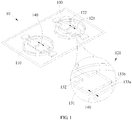
- the apparatus 10 may comprise a casing 100 , at least one liquid collection element 110 , a first electrode 121 and a second electrode 122 disposed in the liquid collection element 110 .
- Each electrode may have a top surface 131 , a bottom surface 132 and at least one edge 133a and 133b .
- the first electrode 121 and the second electrode 122 may be substantially horizontally aligned with a gap 140 therebetween.
- the term horizontally aligned refers to the alignment wherein one of the edge surfaces of the first electrode faces one of the edge surfaces of the second electrode.
- Horizontally aligned may refer to the edge 133a of the first electrode 121 faces the edge 133b of the second electrode 122 , as shown in Fig. 1 ..
- the gap 140 between the edge of the first electrodes 133a and the edge of the second electrode 133b is between about 50 ⁇ m to about 500 ⁇ m.
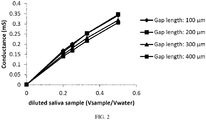
- the gap lengths of 100 ⁇ m to about 400 ⁇ m are linearly correlated with different salivary ion concentration and are sensitive to measure the electric conductance of a saliva sample with various dilutions ("0.2" on the X-axis indicates the saliva is 5 times diluted, "0.4" on the X-axis indicates the saliva is 2.5 times diluted).
- the gap 140 is about 50, about 100, about 150, about 200, about 250, about 300, about 350, about 400, about 450, about 500 ⁇ m or any vale or range of values therebetween in 1 ⁇ m increment (e.g., 59 ⁇ m to 377 ⁇ m or 100 ⁇ m to 400 ⁇ m).
- the electrodes may be made of materials known or will be apparent, to those skill of art.
- the electrode is made of a material selected from gold, platinum and a combination thereof.
- the electrode may be substantially free of an anti-fouling coating.
- Anti-fouling coating include any paint or coating that is applied to slow the adhesion of protein to the surface of the electrode.
- the apparatus 10 may further comprises a chip to measure various parameters of the sample, such as ion concentration, electric conductance or impedance.
- the apparatus may further comprises a display to show the results of the measurement, and/or if the subject is dehydrated.
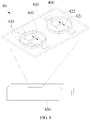
- the apparatus 40 may be connected to a device 450 comprising a chip for reading and/or a display for showing the results of the measurements in tested sample.
- Non limiting examples of the device 450 include USB drive, a portable electronic detector, a smartphone, a smartwatch, a pad or a laptop.
- the results of the tested sample may be stored in the device 450 and can be transferred to another device for further analysis.
- the device 450 may be an LCR meter (a meter to measure inductance (L), capacitance (C) and resistance (R)).
- the apparatus may be portable and compact. Hence, only a small amount of the tested sample is required, as long as the saliva can cover the edges of the electrodes in the liquid collection element. About 20 ⁇ l to about 1.5 ml of the tested sample is required, or any value or range of values therebetween in 10 ⁇ l increment (e.g., 50 ⁇ l, 0.1-0.15 ml etc.).
- the method in accordance with the present invention comprises the steps of measuring the conductance parameter of the saliva of the subject, wherein the saliva conductance parameter is electric conductance or impedance, and a higher saliva electric conductance in the subject, relative to the saliva electric conductance of a non-dehydrated subject, is indicative the subject is dehydrated or a lower saliva impedance in the subject, relative to the saliva impedance of a non-dehydrated subject, is indicative the subject is dehydrated.
- the saliva sample is diluted with a fluid suitable for diluting the saliva ("the dilution fluid"), such as deionic water, before measuring the conductance parameter.
- the dilution fluid a fluid suitable for diluting the saliva
- the ratio of the saliva to the dilution fluid may be 1:1, 1:1.5, 1:2, 1:2.5, 1:3, 1:3.5, 1:4, 1:4.5, 1:5, 1:5.5, 1:6, 1:6.5, 1:7, 1:7.5, 1:8, 1: 8.5, 1:9, 1:9.5 or 1:10 (v:v).
- the lower limit of the saliva electric conductance indicative of dehydration may be about 0.1, 0.15, 0.2, 0.25, 0.3, 0.35, 0.4, 0.45, 0.5, 0.55, or 0.6 mS, if the dilution ratio is 1:4 (v:v).
- the upper limit of the saliva electric conductance indicative of dehydration may be about 2, 1.9, 1.8, 1.7, 1.6, 1.5, 1.4, 1.3, 1.2, 1.1, 1, 0.95, 0.9, 0.85, 0.8, 0.75, 0.7, 0.65, 0.6 mS, if the dilution ratio is 1:4 (v:v).
- the saliva electric conductance indicative of dehydration may be a value or range of values between the upper limit (2 mS) and the lower limit (0.25 mS) of the saliva electric conductance in 0.01 mS increment (e.g., 0.4 mS, 0.25-0.55 mS, 0.3-0.5 mS,0.35-0.45 mS, 0.25-0.45, 0.28-0.78 mS, 0.28 to 1 mS, 0.23 mS to 0.35 mS), if the dilution ratio is 1:4 (v:v).
- the saliva electric conductance indicative of dehydration can be calculated for other saliva dilution ratios. For example, if the saliva dilution ratio is 1:1 (v:v), the saliva electric conductance indicative of dehydration is calculated as follows: (saliva electric conductance indicative of dehydration when the saliva dilution ratio of 1:4 (v:v))*5/2; if the dilution ratio is 1:2 (v:v), the saliva electric conductance indicative of dehydration is calculated as follows: (saliva electric conductance indicative of dehydration when the saliva dilution ratio of 1:4 (v:v))*5/3.
- the saliva impedance indicative of dehydration is about 500 ⁇ to about less than 3500 ⁇ if the dilution ratio is 1:4 (v:v), or any value or any range of values therebetween in 10 ⁇ increment (e.g., 600 ⁇ , 700 ⁇ , 800 ⁇ , 900 ⁇ , 1000 ⁇ , 1100 ⁇ , 1200 ⁇ , 1300 ⁇ , 1400 ⁇ , 1500 ⁇ , 1600 ⁇ , 1700 ⁇ , 1800 ⁇ , 1900 ⁇ , 2000 ⁇ , 2100 ⁇ , 2200 ⁇ , 2300 ⁇ , 2400 ⁇ , 2500 ⁇ , 2600 ⁇ , 2700 ⁇ , 2800 ⁇ , 2900 ⁇ , 3000 ⁇ , 3100 ⁇ , 3200 ⁇ , 3300 ⁇ , 3400 ⁇ , or about 1000 ⁇ - about 3200 ⁇ etc.)
- the saliva may be stimulated and collected.
- the saliva is unstimulated and collected.
- Saliva secretion can be stimulated by administering at least one of the following agent
- saliva samples were collected from subjects with dehydration (based on blood urea nitrogen /creatinine ratio ⁇ 15) and 5 normal saliva samples were collected from subjects without dehydration.
- the saliva was diluted 5 times with deionic water (i.e., the dilution ratio is 1:4 (v:v)).
- the diluted saliva was placed between the electrodes depicted in FIG. 1 and saliva conductance was measured using Agilent Semiconductor device analyzer B1500A (Keysight Technologies, USA).
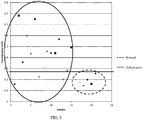
- FIG. 3 shows the saliva electric conductance of the dehydrated subjects ranged from 0.16 mS to about 0.78 mS (95% confidence interval is 0.10 mS - 0.28 mS).
- the saliva electric conductance of the normal (non-dehydrated) subjects was below 0.28 mS.
- the results show the saliva electric conductance higher than 0.28 mS is consistent with the diagnosis of dehydration.
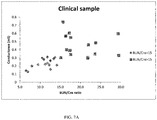
- FIG. 7A shows the saliva conductance of the dehydrated subjects and the normal subjects.
- the mean saliva conductance of the dehydrated subjects is 0.4 mS whereas the mean saliva conductance of the normal subjects is 0.23 mS and the difference is statistically significant (P ⁇ 0.05).
- the lower limit of saliva conductance for dehydration is about 0.34 mS.
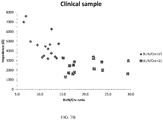
- Fig. 7B shows the saliva impedance of the dehydrated subjects and the normal subjects.
- the mean saliva impedance of the dehydrated subjects is 2377.7 ⁇ whereas the mean saliva impedance of the normal subjects is 4593.3 ⁇ and the difference is statistically significant (P ⁇ 0.05).
- Tested Samples The amount of NaCl in all the samples was fixed (5 mM NaCl) but the protein concentration varied from 0 mg/ml, 0.043 mg/ml, 1.0 mg/ml, 3.5 mg/ml, 7.0 mg/ml, 10 mg/ml, 15 mg/ml to 20 mg/ml.
- Procedure briefly, 50 ⁇ l of the tested sample was placed into the liquid collection element and the electric conductance of the tested sample was measured using (a) a commercial probe (Catalogue type: DJS-1, commercially available from Ruosull Technology, China), as illustrated in FIG. 6B wherein the electrodes 121 and 122 are vertically aligned, and (b) the apparatus of Fig. 6A , wherein the electrodes 121 and 122 are horizontally aligned. Given the amount of NaCl was fixed in all of the test samples, there should be minimal variation in electric conductance.
- a commercial probe Catalogue type: DJS-1, commercially available from Ruosull Technology, China
- FIG. 5 illustrates the electric conductance of the tested samples. Given the amount of NaCl was fixed in all of the samples, the conductance of all of the samples, despite different protein concentration, should be the same (as the dotted horizontal line at the bottom of Fig. 5 ). There is a huge variation in the electric conductance measured by the commercial probe of FIG. 6B but less variation in the electric conductance measured by the apparatus of FIG. 6A , compared to the dotted horizontal line. The results indicate there is less interference or adhesion of protein on the edge of the horizontally aligned electrodes. Hence, the apparatus of the present invention provides a more accurate measurement of the electric conductance of a high protein sample.
Landscapes
- Health & Medical Sciences (AREA)
- Life Sciences & Earth Sciences (AREA)
- Physics & Mathematics (AREA)
- Engineering & Computer Science (AREA)
- Pathology (AREA)
- Biomedical Technology (AREA)
- General Health & Medical Sciences (AREA)
- Molecular Biology (AREA)
- Biophysics (AREA)
- Public Health (AREA)
- Medical Informatics (AREA)
- Surgery (AREA)
- Animal Behavior & Ethology (AREA)
- Heart & Thoracic Surgery (AREA)
- Veterinary Medicine (AREA)
- Chemical & Material Sciences (AREA)
- Radiology & Medical Imaging (AREA)
- Nuclear Medicine, Radiotherapy & Molecular Imaging (AREA)
- Biochemistry (AREA)
- Analytical Chemistry (AREA)
- General Physics & Mathematics (AREA)
- Immunology (AREA)
- Electrochemistry (AREA)
- Chemical Kinetics & Catalysis (AREA)
- Optics & Photonics (AREA)
- Hematology (AREA)
- Urology & Nephrology (AREA)
- Food Science & Technology (AREA)
- Medicinal Chemistry (AREA)
- Investigating Or Analysing Biological Materials (AREA)
- Investigating Or Analyzing Materials By The Use Of Electric Means (AREA)
Description
- The present invention relates to a method for detecting dehydration in a subject.
- Dehydration is a condition that occurs when the loss of body fluid, mostly water, exceeds the amount that is taken in. Fluid losses of between 2-3% of body mass detrimentally affect cardiovascular and renal function, thermal dissipation and exercise performance. More severe dehydration can lead to acute ischemic attack, stroke or even death.
- Methods for assessing hydration status include periodically weigh a subject under controlled conditions or testing specific parameters in the urine or blood. For example, urine specific gravity and output are commonly used in clinical setting. Hydration status can also be assessed using a blood sample, as an increase in plasma urea, creatinine or urea over creatinine ratio indicates dehydration. However, blood collection is invasive and can be highly impractical in many situations, especially in children.
US 2012/0083711 teaches measuring salivary secretion rate for detecting dehydration.US2013/0325356 discloses a method for determining the hydration state of a subject by measuring saliva osmolarity, specific gravity, conductivity or refractive index measurements.US 2002/0127143 shows a saliva-monitoring oral device for collecting and measuring the contents of saliva for a range of tests such as fertility, pregnancy, labor onset, alcohol content, glucose concentration or HIV indicators. - There is an unmet need to develop an easy, rapid and non-invasive method to diagnose dehydration. The present invention provide methods and apparatus for diagnosing dehydration to satisfy these and other needs.
- According to the present invention a method is provided for detecting dehydration in a subject, comprising the step of measuring the conductance parameter of the saliva of the subject, wherein the saliva conductance parameter is electric conductance or impedance, and a higher saliva electric conductance in the subject, relative to the saliva electric conductance of a non-dehydrated subject, is indicative the subject is dehydrated or a lower saliva impedance in the subject, relative to the saliva impedance of a non-dehydrated subject, is indicative the subject is dehydrated.
- The present invention provides the use of an apparatus described herein in a method for detecting dehydration in a subject in accordance with independent claim 1 comprising the step of measuring the saliva conductance parameter of the subject with said apparatus.
- The subject matter should be understood by reference to appropriate portions of the entire specification, any or all drawings and each claim.
- The exemplary embodiment(s) of the present invention will be understood more fully from the detailed description given below and from the accompanying drawings of various embodiments of the invention, which, however, should not be taken to limit the invention to the specific embodiments, but are for explanation and understanding only.
-
FIG. 1 depicts the top angle view of an apparatus which may be used for measuring the conductance parameter of a high protein sample. -
FIG. 2 illustrates the electric conductance of various diluted saliva samples using an apparatus with different gap lengths between the electrodes of the apparatus. -
FIG. 3 shows the saliva electric conductance of normal and dehydrated samples, measured with the apparatus depicted inFIG.1 . -
FIG. 4 depicts the top angle view of the apparatus for measuring the conductance parameter of a high protein sample. -
FIG. 5 is a graph illustrate the electric conductance of samples with a fixed amount of NaCl but various protein concentrations, measured with a commercially available device (illustrated inFIG. 6B ) and measured with apparatus as illustrated inFIG. 6A . -
FIG. 7A andFIG. 7B show the saliva electric conductance (FIG. 7A ) and saliva impedance (FIG. 7B ) of normal and dehydrated samples of a second study, measured with the apparatus depicted inFIG.1 . - As used herein, the articles "a" and "an" refer to one or more than one (i.e., at least one) of the grammatical object of the article. By way of example, "a liquid collection element" means one liquid collection element or more than one liquid collection elements.
- The term "subject" can refer to a vertebrate who is dehydrated or to a vertebrate deemed to be in need of rehydration treatment. Subjects include warm-blooded animals, such as mammals, such as a primate, and, more preferably, a human. Non-human primates are subjects as well. The term subject includes domesticated animals, such as cats, dogs, etc., livestock (for example, cattle, horses, pigs, sheep, goats, etc.) and laboratory animals (for example, mouse, rabbit, rat, gerbil, guinea pig, etc.). Thus, veterinary uses and medical formulations are contemplated herein.
- All numbers herein may be understood as modified by "about." In one embodiment, the term "about," when referring to a measurable value such as an amount, a temporal duration, and the like, is meant to encompass variations of ± 10%, preferably ± 5%, more preferably ± 1%, and even more preferably ± 0.1% from the specified value, as such variations are appropriate to the electric conductance of saliva, unless other specified. As used herein, the term "about," when referring to a range, is meant to encompass variations of ± 10% within the difference of the range, preferably ± 5%, more preferably ± 1 %, and even more preferably ± 0.1 % from the specified value, as such variations are appropriate to the electric conductance of saliva, unless other specified.
- Saliva is a potential diagnostic tool for dehydration, as it is rapidly accessible and convenient to collect. Saliva comprises about 99% of water, about 0.2 % inorganic substances such as Na+, K+, Ca2+, Mg2+, Cl-, HCO3 -, HPO3 2- and about 0.7 % organic substances such as protein, for examples, IgA, amylase and carbonic anhydrase. The primary secretion from salivary glands is plasma ultrafiltrate but in salivary ducts there is energy-dependent resorption of Na+ and Cl- resulting in a hypotonic fluid secretion, with a lower ion concentration compare to plasma. The presence of mineralocorticoid receptors in the salivary duct lead to a higher salivary K+ concentration compare to plasma K+ concentration (25 vs. 4 mmol/l) and a lower salivary Na+ concentration compare to plasma Na+ concentration (2 vs. 145 mmol/l). The protein concentration in saliva is about 0.04 to about 8 mg/ml, whereas the protein concentration in the urine is about 0-20 mg/dl or 0 to 0.2 mg/ml (see U.S. National Library of Medicine, MedlinePlus, https://www.nlm.nih.gov/medlineplus/ency/article/003580.htm). The higher saliva protein concentration poses a unique problem for salivary conductance parameters measurement, as the saliva protein adheres to the surface of the electrodes and renders the electrodes less sensitive for electric conductance and/or impedance measurement. One way to prevent protein adhesion to the surface of the electrodes is to coat the electrodes with a layer of anti-fouling coating. However, this approach is not applicable here, as anti-fouling coating on the surfaces of the electrodes renders the electrodes less sensitive for electric conductance and/or impedance measurement.
- The present invention addresses this problem, by providing the use of an apparatus in measuring the conductance parameter of a high protein sample, wherein the electrodes of the apparatus are horizontally aligned. The term conductance parameter, as used herein, includes electric conductance (measured in siemens "S") and/or impedance (measured in ohm "Ω"). The conductivity of the high protein sample can be calculated from the measured electric conductance, based on the known formulation or will be apparent, to those skill of art. Other parameters, such as ion concentration (e.g., Na) or osmolality can be measured using the apparatus of the present invention..
- A high protein sample, as used herein, includes a sample with a protein concentration between about 0.2 mg/ml to about 10 mg/ml. The upper limit of the protein concentration of a high protein sample may be less than about 15, 14.5, 14, 13.5, 13, 12.5, 12, 11.5, 11, 10.5, 10, 9.5, 9, 8.5, 8 or 7.5. The lower limit of the protein concentration of a high protein sample may be higher than about 1.5, 1, 0.9, 0.8, 0.7, 0.6, 0.5, 0.4 or 0.3 mg/ml. The protein concentration of the high protein sample is any value or range of values between the upper limit and the lower limit of the protein concentration in 0.01 mg/ml increments (e.g., 0.21 mg/ml, 3.7 mg/ml, 0.4 to 7.1 mg/ml, etc.). The high protein sample is saliva.
- Referring to
FIG. 1 , which illustrates anapparatus 10 for measuring the conductance parameter of a high protein sample. Theapparatus 10 may comprise acasing 100, at least oneliquid collection element 110, afirst electrode 121 and asecond electrode 122 disposed in theliquid collection element 110. Each electrode may have atop surface 131, abottom surface 132 and at least oneedge - The
first electrode 121 and thesecond electrode 122 may be substantially horizontally aligned with agap 140 therebetween. The term horizontally aligned, as used herein, refers to the alignment wherein one of the edge surfaces of the first electrode faces one of the edge surfaces of the second electrode. Horizontally aligned may refer to theedge 133a of thefirst electrode 121 faces theedge 133b of thesecond electrode 122, as shown inFig. 1 .. - Specifically, the
gap 140 between the edge of thefirst electrodes 133a and the edge of thesecond electrode 133b is between about 50 µm to about 500 µm. As show inFig. 2 , the gap lengths of 100 µm to about 400 µm are linearly correlated with different salivary ion concentration and are sensitive to measure the electric conductance of a saliva sample with various dilutions ("0.2" on the X-axis indicates the saliva is 5 times diluted, "0.4" on the X-axis indicates the saliva is 2.5 times diluted). In one exemplary embodiment, thegap 140 is about 50, about 100, about 150, about 200, about 250, about 300, about 350, about 400, about 450, about 500µm or any vale or range of values therebetween in 1 µm increment (e.g., 59 µm to 377 µm or 100 µm to 400µm). - The electrodes may be made of materials known or will be apparent, to those skill of art. The electrode is made of a material selected from gold, platinum and a combination thereof. The electrode may be substantially free of an anti-fouling coating. Anti-fouling coating, as used herein, include any paint or coating that is applied to slow the adhesion of protein to the surface of the electrode.
- The
apparatus 10 may further comprises a chip to measure various parameters of the sample, such as ion concentration, electric conductance or impedance. The apparatus may further comprises a display to show the results of the measurement, and/or if the subject is dehydrated. As shown inFIG. 4 theapparatus 40 may be connected to adevice 450 comprising a chip for reading and/or a display for showing the results of the measurements in tested sample. Non limiting examples of thedevice 450 include USB drive, a portable electronic detector, a smartphone, a smartwatch, a pad or a laptop. The results of the tested sample may be stored in thedevice 450 and can be transferred to another device for further analysis. Thedevice 450 may be an LCR meter (a meter to measure inductance (L), capacitance (C) and resistance (R)). - The apparatus may be portable and compact. Hence, only a small amount of the tested sample is required, as long as the saliva can cover the edges of the electrodes in the liquid collection element. About 20 µl to about 1.5 ml of the tested sample is required, or any value or range of values therebetween in 10 µl increment (e.g., 50 µl, 0.1-0.15 ml etc.).
- The method in accordance with the present invention comprises the steps of measuring the conductance parameter of the saliva of the subject, wherein the saliva conductance parameter is electric conductance or impedance, and a higher saliva electric conductance in the subject, relative to the saliva electric conductance of a non-dehydrated subject, is indicative the subject is dehydrated or a lower saliva impedance in the subject, relative to the saliva impedance of a non-dehydrated subject, is indicative the subject is dehydrated.
- The saliva conductance parameters being measured by the apparatus described herein. In another embodiment, the saliva sample is diluted with a fluid suitable for diluting the saliva ("the dilution fluid"), such as deionic water, before measuring the conductance parameter. Such dilution before the measuring the conductance parameter reduces the froth in the saliva and increase the sensitivity of the measurement. The ratio of the saliva to the dilution fluid ("the dilution ratio) may be 1:1, 1:1.5, 1:2, 1:2.5, 1:3, 1:3.5, 1:4, 1:4.5, 1:5, 1:5.5, 1:6, 1:6.5, 1:7, 1:7.5, 1:8, 1: 8.5, 1:9, 1:9.5 or 1:10 (v:v).
- The lower limit of the saliva electric conductance indicative of dehydration may be about 0.1, 0.15, 0.2, 0.25, 0.3, 0.35, 0.4, 0.45, 0.5, 0.55, or 0.6 mS, if the dilution ratio is 1:4 (v:v). The upper limit of the saliva electric conductance indicative of dehydration may be about 2, 1.9, 1.8, 1.7, 1.6, 1.5, 1.4, 1.3, 1.2, 1.1, 1, 0.95, 0.9, 0.85, 0.8, 0.75, 0.7, 0.65, 0.6 mS, if the dilution ratio is 1:4 (v:v). The saliva electric conductance indicative of dehydration may be a value or range of values between the upper limit (2 mS) and the lower limit (0.25 mS) of the saliva electric conductance in 0.01 mS increment (e.g., 0.4 mS, 0.25-0.55 mS, 0.3-0.5 mS,0.35-0.45 mS, 0.25-0.45, 0.28-0.78 mS, 0.28 to 1 mS, 0.23 mS to 0.35 mS), if the dilution ratio is 1:4 (v:v).
- The saliva electric conductance indicative of dehydration can be calculated for other saliva dilution ratios. For example, if the saliva dilution ratio is 1:1 (v:v), the saliva electric conductance indicative of dehydration is calculated as follows: (saliva electric conductance indicative of dehydration when the saliva dilution ratio of 1:4 (v:v))*5/2; if the dilution ratio is 1:2 (v:v), the saliva electric conductance indicative of dehydration is calculated as follows: (saliva electric conductance indicative of dehydration when the saliva dilution ratio of 1:4 (v:v))*5/3.
- The saliva conductance parameter may be impedance, and conductance can be calculated from impedance by the following formula:

- Embodiments of the present invention are illustrated by the following examples, which are not to be construed in any way as imposing limitations upon the scope thereof. During the studies described in the following examples, conventional procedures were followed, unless otherwise stated. Some of the procedures are described below for illustrative purpose.
- 15 saliva samples were collected from subjects with dehydration (based on blood urea nitrogen /creatinine ratio≥15) and 5 normal saliva samples were collected from subjects without dehydration. The saliva was diluted 5 times with deionic water (i.e., the dilution ratio is 1:4 (v:v)).
- The diluted saliva was placed between the electrodes depicted in
FIG. 1 and saliva conductance was measured using Agilent Semiconductor device analyzer B1500A (Keysight Technologies, USA). - Results:
FIG. 3 shows the saliva electric conductance of the dehydrated subjects ranged from 0.16 mS to about 0.78 mS (95% confidence interval is 0.10 mS - 0.28 mS). The saliva electric conductance of the normal (non-dehydrated) subjects was below 0.28 mS. The results show the saliva electric conductance higher than 0.28 mS is consistent with the diagnosis of dehydration. - A second study of 15 dehydrated saliva samples (based on blood urea nitrogen /creatinine ratio≥15, measured by Beckman DXC 880i) and 15 normal saliva samples (based on blood urea nitrogen /creatinine ratio <15) was conducted. The saliva was stored at - 80°C and diluted 5 times with deionic water before the analysis (the saliva dilution ratio is 1:4). 50 µL of diluted saliva was placed between the electrodes depicted in
Fig. 1 and saliva impedance and saliva conductance were measured using LCR meter HIOKI IM3533 (Hioki E.E. Corporation, Japan). - Results:
FIG. 7A shows the saliva conductance of the dehydrated subjects and the normal subjects. The mean saliva conductance of the dehydrated subjects is 0.4 mS whereas the mean saliva conductance of the normal subjects is 0.23 mS and the difference is statistically significant (P<0.05). The lower limit of saliva conductance for dehydration is about 0.34 mS.Fig. 7B shows the saliva impedance of the dehydrated subjects and the normal subjects. The mean saliva impedance of the dehydrated subjects is 2377.7 Ω whereas the mean saliva impedance of the normal subjects is 4593.3 Ω and the difference is statistically significant (P<0.05). - Tested Samples: The amount of NaCl in all the samples was fixed (5 mM NaCl) but the protein concentration varied from 0 mg/ml, 0.043 mg/ml, 1.0 mg/ml, 3.5 mg/ml, 7.0 mg/ml, 10 mg/ml, 15 mg/ml to 20 mg/ml.
- Procedure: briefly, 50 µl of the tested sample was placed into the liquid collection element and the electric conductance of the tested sample was measured using (a) a commercial probe (Catalogue type: DJS-1, commercially available from Ruosull Technology, China), as illustrated in
FIG. 6B wherein theelectrodes Fig. 6A , wherein theelectrodes - Results:
FIG. 5 illustrates the electric conductance of the tested samples. Given the amount of NaCl was fixed in all of the samples, the conductance of all of the samples, despite different protein concentration, should be the same (as the dotted horizontal line at the bottom ofFig. 5 ). There is a huge variation in the electric conductance measured by the commercial probe ofFIG. 6B but less variation in the electric conductance measured by the apparatus ofFIG. 6A , compared to the dotted horizontal line. The results indicate there is less interference or adhesion of protein on the edge of the horizontally aligned electrodes. Hence, the apparatus of the present invention provides a more accurate measurement of the electric conductance of a high protein sample.
Claims (6)
- A method for detecting dehydration in a subject, comprising the step of measuring the saliva conductance parameter of the subject with an apparatus (10) comprising:at least one liquid collection element (110), anda first electrode (121) and a second electrode (122) in the liquid collection element, each electrodehaving a top surface (131), a bottom surface (132) and at least one edge (133a, 133b), wherein the electrodes are substantially horizontally aligned with a gap (140) between the first electrode and the second electrode, the gap length being between about 50µm to about 500 µm,and said edge of the first electrode is facing said edge of the second electrode,wherein the saliva conductance parameter is selected from saliva electric conductance or saliva impedance, and a higher saliva electric conductance in the subject, relative to the saliva electric conductance of a non-dehydrated subject, is indicative the subject is dehydrated or a lower saliva impedance in the subject, relative to the saliva impedance of a non-dehydrated subject, is indicative the subject is dehydrated.
- The method of claim 1, wherein the electrode is substantially free of anti-fouling coating.
- The method of any of claims 1 to 2, wherein the volume of the saliva for measuring salivary conductance is about 20 µl to about 1.5 ml.
- The method of any of claims 1 to 3, wherein the saliva is diluted with a dilution fluid before measuring salivary conductance.
- The method of claim 1, wherein the gap is about 100µm to about 400 µm.
- The method of claim 1, wherein the gap is about 100µm.
Applications Claiming Priority (1)
| Application Number | Priority Date | Filing Date | Title |
|---|---|---|---|
| US201662319693P | 2016-04-07 | 2016-04-07 |
Publications (2)
| Publication Number | Publication Date |
|---|---|
| EP3229021A1 EP3229021A1 (en) | 2017-10-11 |
| EP3229021B1 true EP3229021B1 (en) | 2019-07-17 |
Family
ID=58709712
Family Applications (1)
| Application Number | Title | Priority Date | Filing Date |
|---|---|---|---|
| EP17165270.4A Active EP3229021B1 (en) | 2016-04-07 | 2017-04-06 | Method for detecting dehydration |
Country Status (4)
| Country | Link |
|---|---|
| US (1) | US10299678B2 (en) |
| EP (1) | EP3229021B1 (en) |
| CN (1) | CN107300576B (en) |
| TW (1) | TWI651531B (en) |
Citations (1)
| Publication number | Priority date | Publication date | Assignee | Title |
|---|---|---|---|---|
| US20130325356A1 (en) * | 2012-05-30 | 2013-12-05 | Cantimer, Inc. | Methods for determining hydration or dehydration level in a subject |
Family Cites Families (22)
| Publication number | Priority date | Publication date | Assignee | Title |
|---|---|---|---|---|
| KR900005223B1 (en) * | 1986-12-11 | 1990-07-21 | 가부시끼가이샤 호리바 세이사꾸쇼 | Method of measuring ion-concentration and the like and a calibrating sheet as well as a calibrating method of measuring device used therein |
| CN2052263U (en) | 1988-12-22 | 1990-02-07 | 浙江大学 | Miniature physiological-parameter instrument for body fluid |
| US6623698B2 (en) * | 2001-03-12 | 2003-09-23 | Youti Kuo | Saliva-monitoring biosensor electrical toothbrush |
| US6824974B2 (en) * | 2001-06-11 | 2004-11-30 | Genorx, Inc. | Electronic detection of biological molecules using thin layers |
| US7485094B2 (en) * | 2003-09-30 | 2009-02-03 | Smithmarks, Inc. | Methods of diagnosis using pulse volume measurement |
| US8734341B2 (en) * | 2004-12-20 | 2014-05-27 | Ipventure, Inc. | Method and apparatus to sense hydration level of a person |
| US20070015287A1 (en) | 2005-07-15 | 2007-01-18 | Remote Clinical Solutions, Inc. | Methods and devices for measuring analyte concentration in a nonblood body fluid sample |
| CN1969743B (en) * | 2005-11-02 | 2011-10-26 | 专利创投公司 | Method and apparatus to sense hydration level of a person |
| WO2008079731A1 (en) * | 2006-12-22 | 2008-07-03 | Home Diagnostics, Inc. | Gel formation to reduce hematocrit sensitivity in electrochemical test |
| DE102007022323A1 (en) * | 2007-05-12 | 2008-11-13 | Kurt-Schwabe-Institut für Mess- und Sensortechnik e.V. Meinsberg | Multi-parameter measuring system for determining analytic parameter of e.g. blood, has physiochemical sensor either integrated into multi-parameter measuring device or connected with device as separate part over cable |
| US7975341B2 (en) | 2007-10-02 | 2011-07-12 | Colgate-Palmolive Company | Bio-activated oral care instrument |
| GB0823719D0 (en) * | 2008-12-31 | 2009-02-04 | Spd Swiss Prec Diagnostics Gmb | A conductive measurement cell |
| WO2010092773A1 (en) * | 2009-02-10 | 2010-08-19 | パナソニック株式会社 | Device and method for measuring fine particles |
| JP5917403B2 (en) | 2009-11-06 | 2016-05-11 | ザ・リサーチ・ファウンデーション・オブ・ステート・ユニバーシティ・オブ・ニューヨーク | Device for detecting carious lesions in early teeth without cavity |
| WO2012044871A2 (en) | 2010-09-30 | 2012-04-05 | Hydradx, Inc. | Diagnostic device and method for sensing hydration state of a mammallian subject |
| EP2884891A4 (en) * | 2012-08-15 | 2016-06-29 | Hydradx Inc | Diagnostic device and method for sensing hydration state of mammalian subject |
| US9360446B2 (en) * | 2012-10-23 | 2016-06-07 | Aytu Bioscience, Inc. | Methods and systems for measuring and using the oxidation-reduction potential of a biological sample |
| WO2014134431A1 (en) * | 2013-02-28 | 2014-09-04 | Telemedicine Up Close, Inc. | Diagnostic device for evaluating microbial content of a sample |
| CN203447276U (en) | 2013-09-03 | 2014-02-26 | 成都怡康科技有限公司 | Basal thermometer capable of being automatically turned on |
| US20170007172A1 (en) * | 2015-01-13 | 2017-01-12 | Umm-Al-Qura University | Correlation of saliva flow-rate and oral dryness in hyperuricemia |
| US10130301B2 (en) * | 2015-01-22 | 2018-11-20 | Elwha Llc | Devices and methods for remote hydration measurement |
| CN104622514B (en) | 2015-02-27 | 2018-04-10 | 江苏矽望电子科技有限公司 | A kind of ovulation test system and method based on dual sensor |
-
2017
- 2017-03-31 TW TW106111140A patent/TWI651531B/en active
- 2017-04-03 US US15/477,642 patent/US10299678B2/en active Active
- 2017-04-06 EP EP17165270.4A patent/EP3229021B1/en active Active
- 2017-04-07 CN CN201710223606.5A patent/CN107300576B/en active Active
Patent Citations (1)
| Publication number | Priority date | Publication date | Assignee | Title |
|---|---|---|---|---|
| US20130325356A1 (en) * | 2012-05-30 | 2013-12-05 | Cantimer, Inc. | Methods for determining hydration or dehydration level in a subject |
Also Published As
| Publication number | Publication date |
|---|---|
| EP3229021A1 (en) | 2017-10-11 |
| TW201736837A (en) | 2017-10-16 |
| US20170290509A1 (en) | 2017-10-12 |
| CN107300576A (en) | 2017-10-27 |
| CN107300576B (en) | 2020-08-14 |
| TWI651531B (en) | 2019-02-21 |
| US10299678B2 (en) | 2019-05-28 |
Similar Documents
| Publication | Publication Date | Title |
|---|---|---|
| Gómez-Ambrosi et al. | Clinical usefulness of a new equation for estimating body fat | |
| Lu et al. | A portable system to monitor saliva conductivity for dehydration diagnosis and kidney healthcare | |
| Brugger et al. | Quantitative determination of progesterone (P4) in canine blood serum using an enzyme‐linked fluorescence assay | |
| KR950703148A (en) | Monitoring Method | |
| US20120289863A1 (en) | Diagnostic device and method for sensing hydration state of a mammalian subject | |
| US11272868B2 (en) | Potentiometric wearable sweat sensor | |
| Wang | Engine oil condition sensor: method for establishing correlation with total acid number | |
| RU2016134617A (en) | DEVICE AND METHOD FOR FERTILITY AND PREGNANCY TRACKING | |
| Megahed et al. | Clinical utility of urine specific gravity, electrical conductivity, and color as on-farm methods for evaluating urine concentration in dairy cattle | |
| Rose et al. | Comparison of refractometry and biuret assay for measurement of total protein concentration in canine abdominal and pleural fluid specimens | |
| CN106066401A (en) | Biomarker VWF and ADAMTS13 and the purposes in liver cirrhosis diagnosis reagent thereof | |
| Megahed et al. | Characterization of the analytic performance of an electrochemical point‐of‐care meter for measuring β‐hydroxybutyrate concentration in blood and plasma from periparturient dairy cattle | |
| Mundy et al. | Reliability, validity and measurement error | |
| Stanojevic et al. | Comparison of the influence of thyroglobulin antibodies on serum thyroglobulin values from two different immunoassays in post surgical differentiated thyroid carcinoma patients | |
| EP3229021A1 (en) | Method and apparatus for detecting dehydration | |
| Mori et al. | Evaluation of newly developed veterinary portable blood glucose meter with hematocrit correction in dogs and cats | |
| Trefz et al. | Evaluation of a portable ion-selective electrode meter for measuring potassium concentrations in whole blood and plasma of calves | |
| Santoro et al. | Platelet concentrations and platelet‐associated IgG in greyhounds | |
| Selleri et al. | Point-of-care blood gases, electrolytes, chemistries, hemoglobin, and hematocrit measurement in venous samples from pet rabbits | |
| Gundlach et al. | Is lachrymal fluid a potential method for cortisol measurement in wild harbor seals? A pilot study | |
| CN109358098A (en) | A method of test cement-based material surface chlorine ion concentration | |
| Rodrigues Júnior et al. | Degree of skin denervation and its correlation to objective thermal sensory test in leprosy patients | |
| Gotoh et al. | Development of an electronic device for sialometry of minor salivary glands | |
| HRP20200229T1 (en) | Use of cell-free nucleosomes as biomarkers in fecal samples | |
| Zhou et al. | IoT based portable impedance biosensor for rapid detection of foodborne pathogen |
Legal Events
| Date | Code | Title | Description |
|---|---|---|---|
| PUAI | Public reference made under article 153(3) epc to a published international application that has entered the european phase |
Free format text: ORIGINAL CODE: 0009012 |
|
| STAA | Information on the status of an ep patent application or granted ep patent |
Free format text: STATUS: THE APPLICATION HAS BEEN PUBLISHED |
|
| AK | Designated contracting states |
Kind code of ref document: A1 Designated state(s): AL AT BE BG CH CY CZ DE DK EE ES FI FR GB GR HR HU IE IS IT LI LT LU LV MC MK MT NL NO PL PT RO RS SE SI SK SM TR |
|
| AX | Request for extension of the european patent |
Extension state: BA ME |
|
| RAP1 | Party data changed (applicant data changed or rights of an application transferred) |
Owner name: NATIONAL TAIWAN UNIVERSITY Owner name: CHANG GUNG MEMORIAL HOSPITAL, CHIAYI |
|
| STAA | Information on the status of an ep patent application or granted ep patent |
Free format text: STATUS: REQUEST FOR EXAMINATION WAS MADE |
|
| 17P | Request for examination filed |
Effective date: 20180320 |
|
| RBV | Designated contracting states (corrected) |
Designated state(s): AL AT BE BG CH CY CZ DE DK EE ES FI FR GB GR HR HU IE IS IT LI LT LU LV MC MK MT NL NO PL PT RO RS SE SI SK SM TR |
|
| RIC1 | Information provided on ipc code assigned before grant |
Ipc: G01N 33/487 20060101AFI20180404BHEP |
|
| STAA | Information on the status of an ep patent application or granted ep patent |
Free format text: STATUS: EXAMINATION IS IN PROGRESS |
|
| 17Q | First examination report despatched |
Effective date: 20180613 |
|
| GRAP | Despatch of communication of intention to grant a patent |
Free format text: ORIGINAL CODE: EPIDOSNIGR1 |
|
| STAA | Information on the status of an ep patent application or granted ep patent |
Free format text: STATUS: GRANT OF PATENT IS INTENDED |
|
| INTG | Intention to grant announced |
Effective date: 20190218 |
|
| GRAS | Grant fee paid |
Free format text: ORIGINAL CODE: EPIDOSNIGR3 |
|
| GRAJ | Information related to disapproval of communication of intention to grant by the applicant or resumption of examination proceedings by the epo deleted |
Free format text: ORIGINAL CODE: EPIDOSDIGR1 |
|
| GRAL | Information related to payment of fee for publishing/printing deleted |
Free format text: ORIGINAL CODE: EPIDOSDIGR3 |
|
| STAA | Information on the status of an ep patent application or granted ep patent |
Free format text: STATUS: EXAMINATION IS IN PROGRESS |
|
| GRAA | (expected) grant |
Free format text: ORIGINAL CODE: 0009210 |
|
| STAA | Information on the status of an ep patent application or granted ep patent |
Free format text: STATUS: THE PATENT HAS BEEN GRANTED |
|
| INTC | Intention to grant announced (deleted) | ||
| INTG | Intention to grant announced |
Effective date: 20190605 |
|
| AK | Designated contracting states |
Kind code of ref document: B1 Designated state(s): AL AT BE BG CH CY CZ DE DK EE ES FI FR GB GR HR HU IE IS IT LI LT LU LV MC MK MT NL NO PL PT RO RS SE SI SK SM TR |
|
| REG | Reference to a national code |
Ref country code: GB Ref legal event code: FG4D |
|
| REG | Reference to a national code |
Ref country code: CH Ref legal event code: EP |
|
| REG | Reference to a national code |
Ref country code: IE Ref legal event code: FG4D |
|
| REG | Reference to a national code |
Ref country code: DE Ref legal event code: R096 Ref document number: 602017005273 Country of ref document: DE |
|
| REG | Reference to a national code |
Ref country code: AT Ref legal event code: REF Ref document number: 1156319 Country of ref document: AT Kind code of ref document: T Effective date: 20190815 |
|
| REG | Reference to a national code |
Ref country code: NL Ref legal event code: MP Effective date: 20190717 |
|
| REG | Reference to a national code |
Ref country code: LT Ref legal event code: MG4D |
|
| REG | Reference to a national code |
Ref country code: AT Ref legal event code: MK05 Ref document number: 1156319 Country of ref document: AT Kind code of ref document: T Effective date: 20190717 |
|
| PG25 | Lapsed in a contracting state [announced via postgrant information from national office to epo] |
Ref country code: FI Free format text: LAPSE BECAUSE OF FAILURE TO SUBMIT A TRANSLATION OF THE DESCRIPTION OR TO PAY THE FEE WITHIN THE PRESCRIBED TIME-LIMIT Effective date: 20190717 Ref country code: HR Free format text: LAPSE BECAUSE OF FAILURE TO SUBMIT A TRANSLATION OF THE DESCRIPTION OR TO PAY THE FEE WITHIN THE PRESCRIBED TIME-LIMIT Effective date: 20190717 Ref country code: SE Free format text: LAPSE BECAUSE OF FAILURE TO SUBMIT A TRANSLATION OF THE DESCRIPTION OR TO PAY THE FEE WITHIN THE PRESCRIBED TIME-LIMIT Effective date: 20190717 Ref country code: NO Free format text: LAPSE BECAUSE OF FAILURE TO SUBMIT A TRANSLATION OF THE DESCRIPTION OR TO PAY THE FEE WITHIN THE PRESCRIBED TIME-LIMIT Effective date: 20191017 Ref country code: AT Free format text: LAPSE BECAUSE OF FAILURE TO SUBMIT A TRANSLATION OF THE DESCRIPTION OR TO PAY THE FEE WITHIN THE PRESCRIBED TIME-LIMIT Effective date: 20190717 Ref country code: PT Free format text: LAPSE BECAUSE OF FAILURE TO SUBMIT A TRANSLATION OF THE DESCRIPTION OR TO PAY THE FEE WITHIN THE PRESCRIBED TIME-LIMIT Effective date: 20191118 Ref country code: BG Free format text: LAPSE BECAUSE OF FAILURE TO SUBMIT A TRANSLATION OF THE DESCRIPTION OR TO PAY THE FEE WITHIN THE PRESCRIBED TIME-LIMIT Effective date: 20191017 Ref country code: LT Free format text: LAPSE BECAUSE OF FAILURE TO SUBMIT A TRANSLATION OF THE DESCRIPTION OR TO PAY THE FEE WITHIN THE PRESCRIBED TIME-LIMIT Effective date: 20190717 Ref country code: NL Free format text: LAPSE BECAUSE OF FAILURE TO SUBMIT A TRANSLATION OF THE DESCRIPTION OR TO PAY THE FEE WITHIN THE PRESCRIBED TIME-LIMIT Effective date: 20190717 |
|
| PG25 | Lapsed in a contracting state [announced via postgrant information from national office to epo] |
Ref country code: RS Free format text: LAPSE BECAUSE OF FAILURE TO SUBMIT A TRANSLATION OF THE DESCRIPTION OR TO PAY THE FEE WITHIN THE PRESCRIBED TIME-LIMIT Effective date: 20190717 Ref country code: LV Free format text: LAPSE BECAUSE OF FAILURE TO SUBMIT A TRANSLATION OF THE DESCRIPTION OR TO PAY THE FEE WITHIN THE PRESCRIBED TIME-LIMIT Effective date: 20190717 Ref country code: AL Free format text: LAPSE BECAUSE OF FAILURE TO SUBMIT A TRANSLATION OF THE DESCRIPTION OR TO PAY THE FEE WITHIN THE PRESCRIBED TIME-LIMIT Effective date: 20190717 Ref country code: GR Free format text: LAPSE BECAUSE OF FAILURE TO SUBMIT A TRANSLATION OF THE DESCRIPTION OR TO PAY THE FEE WITHIN THE PRESCRIBED TIME-LIMIT Effective date: 20191018 Ref country code: IS Free format text: LAPSE BECAUSE OF FAILURE TO SUBMIT A TRANSLATION OF THE DESCRIPTION OR TO PAY THE FEE WITHIN THE PRESCRIBED TIME-LIMIT Effective date: 20191117 |
|
| PG25 | Lapsed in a contracting state [announced via postgrant information from national office to epo] |
Ref country code: TR Free format text: LAPSE BECAUSE OF FAILURE TO SUBMIT A TRANSLATION OF THE DESCRIPTION OR TO PAY THE FEE WITHIN THE PRESCRIBED TIME-LIMIT Effective date: 20190717 |
|
| PG25 | Lapsed in a contracting state [announced via postgrant information from national office to epo] |
Ref country code: EE Free format text: LAPSE BECAUSE OF FAILURE TO SUBMIT A TRANSLATION OF THE DESCRIPTION OR TO PAY THE FEE WITHIN THE PRESCRIBED TIME-LIMIT Effective date: 20190717 Ref country code: PL Free format text: LAPSE BECAUSE OF FAILURE TO SUBMIT A TRANSLATION OF THE DESCRIPTION OR TO PAY THE FEE WITHIN THE PRESCRIBED TIME-LIMIT Effective date: 20190717 Ref country code: RO Free format text: LAPSE BECAUSE OF FAILURE TO SUBMIT A TRANSLATION OF THE DESCRIPTION OR TO PAY THE FEE WITHIN THE PRESCRIBED TIME-LIMIT Effective date: 20190717 Ref country code: DK Free format text: LAPSE BECAUSE OF FAILURE TO SUBMIT A TRANSLATION OF THE DESCRIPTION OR TO PAY THE FEE WITHIN THE PRESCRIBED TIME-LIMIT Effective date: 20190717 Ref country code: IT Free format text: LAPSE BECAUSE OF FAILURE TO SUBMIT A TRANSLATION OF THE DESCRIPTION OR TO PAY THE FEE WITHIN THE PRESCRIBED TIME-LIMIT Effective date: 20190717 |
|
| PG25 | Lapsed in a contracting state [announced via postgrant information from national office to epo] |
Ref country code: IS Free format text: LAPSE BECAUSE OF FAILURE TO SUBMIT A TRANSLATION OF THE DESCRIPTION OR TO PAY THE FEE WITHIN THE PRESCRIBED TIME-LIMIT Effective date: 20200224 Ref country code: CZ Free format text: LAPSE BECAUSE OF FAILURE TO SUBMIT A TRANSLATION OF THE DESCRIPTION OR TO PAY THE FEE WITHIN THE PRESCRIBED TIME-LIMIT Effective date: 20190717 Ref country code: SM Free format text: LAPSE BECAUSE OF FAILURE TO SUBMIT A TRANSLATION OF THE DESCRIPTION OR TO PAY THE FEE WITHIN THE PRESCRIBED TIME-LIMIT Effective date: 20190717 Ref country code: SK Free format text: LAPSE BECAUSE OF FAILURE TO SUBMIT A TRANSLATION OF THE DESCRIPTION OR TO PAY THE FEE WITHIN THE PRESCRIBED TIME-LIMIT Effective date: 20190717 |
|
| REG | Reference to a national code |
Ref country code: DE Ref legal event code: R097 Ref document number: 602017005273 Country of ref document: DE |
|
| PLBE | No opposition filed within time limit |
Free format text: ORIGINAL CODE: 0009261 |
|
| STAA | Information on the status of an ep patent application or granted ep patent |
Free format text: STATUS: NO OPPOSITION FILED WITHIN TIME LIMIT |
|
| PG2D | Information on lapse in contracting state deleted |
Ref country code: IS |
|
| 26N | No opposition filed |
Effective date: 20200603 |
|
| PG25 | Lapsed in a contracting state [announced via postgrant information from national office to epo] |
Ref country code: SI Free format text: LAPSE BECAUSE OF FAILURE TO SUBMIT A TRANSLATION OF THE DESCRIPTION OR TO PAY THE FEE WITHIN THE PRESCRIBED TIME-LIMIT Effective date: 20190717 |
|
| PG25 | Lapsed in a contracting state [announced via postgrant information from national office to epo] |
Ref country code: ES Free format text: LAPSE BECAUSE OF FAILURE TO SUBMIT A TRANSLATION OF THE DESCRIPTION OR TO PAY THE FEE WITHIN THE PRESCRIBED TIME-LIMIT Effective date: 20190717 |
|
| PG25 | Lapsed in a contracting state [announced via postgrant information from national office to epo] |
Ref country code: MC Free format text: LAPSE BECAUSE OF FAILURE TO SUBMIT A TRANSLATION OF THE DESCRIPTION OR TO PAY THE FEE WITHIN THE PRESCRIBED TIME-LIMIT Effective date: 20190717 |
|
| REG | Reference to a national code |
Ref country code: CH Ref legal event code: PL |
|
| PG25 | Lapsed in a contracting state [announced via postgrant information from national office to epo] |
Ref country code: LU Free format text: LAPSE BECAUSE OF NON-PAYMENT OF DUE FEES Effective date: 20200406 Ref country code: CH Free format text: LAPSE BECAUSE OF NON-PAYMENT OF DUE FEES Effective date: 20200430 Ref country code: LI Free format text: LAPSE BECAUSE OF NON-PAYMENT OF DUE FEES Effective date: 20200430 |
|
| REG | Reference to a national code |
Ref country code: BE Ref legal event code: MM Effective date: 20200430 |
|
| PG25 | Lapsed in a contracting state [announced via postgrant information from national office to epo] |
Ref country code: BE Free format text: LAPSE BECAUSE OF NON-PAYMENT OF DUE FEES Effective date: 20200430 |
|
| PG25 | Lapsed in a contracting state [announced via postgrant information from national office to epo] |
Ref country code: IE Free format text: LAPSE BECAUSE OF NON-PAYMENT OF DUE FEES Effective date: 20200406 |
|
| PG25 | Lapsed in a contracting state [announced via postgrant information from national office to epo] |
Ref country code: MT Free format text: LAPSE BECAUSE OF FAILURE TO SUBMIT A TRANSLATION OF THE DESCRIPTION OR TO PAY THE FEE WITHIN THE PRESCRIBED TIME-LIMIT Effective date: 20190717 Ref country code: CY Free format text: LAPSE BECAUSE OF FAILURE TO SUBMIT A TRANSLATION OF THE DESCRIPTION OR TO PAY THE FEE WITHIN THE PRESCRIBED TIME-LIMIT Effective date: 20190717 |
|
| PG25 | Lapsed in a contracting state [announced via postgrant information from national office to epo] |
Ref country code: MK Free format text: LAPSE BECAUSE OF FAILURE TO SUBMIT A TRANSLATION OF THE DESCRIPTION OR TO PAY THE FEE WITHIN THE PRESCRIBED TIME-LIMIT Effective date: 20190717 |
|
| PGFP | Annual fee paid to national office [announced via postgrant information from national office to epo] |
Ref country code: DE Payment date: 20250422 Year of fee payment: 9 |
|
| PGFP | Annual fee paid to national office [announced via postgrant information from national office to epo] |
Ref country code: GB Payment date: 20260216 Year of fee payment: 10 |
|
| PGFP | Annual fee paid to national office [announced via postgrant information from national office to epo] |
Ref country code: FR Payment date: 20260225 Year of fee payment: 10 |