EP3228659A1 - Rubber composition for tire treads - Google Patents
Rubber composition for tire treads Download PDFInfo
- Publication number
- EP3228659A1 EP3228659A1 EP15865506.8A EP15865506A EP3228659A1 EP 3228659 A1 EP3228659 A1 EP 3228659A1 EP 15865506 A EP15865506 A EP 15865506A EP 3228659 A1 EP3228659 A1 EP 3228659A1
- Authority
- EP
- European Patent Office
- Prior art keywords
- weight
- rubber
- oil
- parts
- silica
- Prior art date
- Legal status (The legal status is an assumption and is not a legal conclusion. Google has not performed a legal analysis and makes no representation as to the accuracy of the status listed.)
- Granted
Links
Images
Classifications
-
- C—CHEMISTRY; METALLURGY
- C08—ORGANIC MACROMOLECULAR COMPOUNDS; THEIR PREPARATION OR CHEMICAL WORKING-UP; COMPOSITIONS BASED THEREON
- C08L—COMPOSITIONS OF MACROMOLECULAR COMPOUNDS
- C08L7/00—Compositions of natural rubber
-
- C—CHEMISTRY; METALLURGY
- C08—ORGANIC MACROMOLECULAR COMPOUNDS; THEIR PREPARATION OR CHEMICAL WORKING-UP; COMPOSITIONS BASED THEREON
- C08L—COMPOSITIONS OF MACROMOLECULAR COMPOUNDS
- C08L9/00—Compositions of homopolymers or copolymers of conjugated diene hydrocarbons
- C08L9/06—Copolymers with styrene
-
- B—PERFORMING OPERATIONS; TRANSPORTING
- B60—VEHICLES IN GENERAL
- B60C—VEHICLE TYRES; TYRE INFLATION; TYRE CHANGING; CONNECTING VALVES TO INFLATABLE ELASTIC BODIES IN GENERAL; DEVICES OR ARRANGEMENTS RELATED TO TYRES
- B60C1/00—Tyres characterised by the chemical composition or the physical arrangement or mixture of the composition
-
- B—PERFORMING OPERATIONS; TRANSPORTING
- B60—VEHICLES IN GENERAL
- B60C—VEHICLE TYRES; TYRE INFLATION; TYRE CHANGING; CONNECTING VALVES TO INFLATABLE ELASTIC BODIES IN GENERAL; DEVICES OR ARRANGEMENTS RELATED TO TYRES
- B60C1/00—Tyres characterised by the chemical composition or the physical arrangement or mixture of the composition
- B60C1/0016—Compositions of the tread
-
- C—CHEMISTRY; METALLURGY
- C08—ORGANIC MACROMOLECULAR COMPOUNDS; THEIR PREPARATION OR CHEMICAL WORKING-UP; COMPOSITIONS BASED THEREON
- C08K—Use of inorganic or non-macromolecular organic substances as compounding ingredients
- C08K3/00—Use of inorganic substances as compounding ingredients
- C08K3/02—Elements
- C08K3/04—Carbon
-
- C—CHEMISTRY; METALLURGY
- C08—ORGANIC MACROMOLECULAR COMPOUNDS; THEIR PREPARATION OR CHEMICAL WORKING-UP; COMPOSITIONS BASED THEREON
- C08K—Use of inorganic or non-macromolecular organic substances as compounding ingredients
- C08K3/00—Use of inorganic substances as compounding ingredients
- C08K3/34—Silicon-containing compounds
- C08K3/36—Silica
-
- C—CHEMISTRY; METALLURGY
- C08—ORGANIC MACROMOLECULAR COMPOUNDS; THEIR PREPARATION OR CHEMICAL WORKING-UP; COMPOSITIONS BASED THEREON
- C08K—Use of inorganic or non-macromolecular organic substances as compounding ingredients
- C08K5/00—Use of organic ingredients
- C08K5/54—Silicon-containing compounds
- C08K5/541—Silicon-containing compounds containing oxygen
- C08K5/5415—Silicon-containing compounds containing oxygen containing at least one Si—O bond
-
- C—CHEMISTRY; METALLURGY
- C08—ORGANIC MACROMOLECULAR COMPOUNDS; THEIR PREPARATION OR CHEMICAL WORKING-UP; COMPOSITIONS BASED THEREON
- C08K—Use of inorganic or non-macromolecular organic substances as compounding ingredients
- C08K5/00—Use of organic ingredients
- C08K5/54—Silicon-containing compounds
- C08K5/541—Silicon-containing compounds containing oxygen
- C08K5/5415—Silicon-containing compounds containing oxygen containing at least one Si—O bond
- C08K5/5419—Silicon-containing compounds containing oxygen containing at least one Si—O bond containing at least one Si—C bond
-
- C—CHEMISTRY; METALLURGY
- C08—ORGANIC MACROMOLECULAR COMPOUNDS; THEIR PREPARATION OR CHEMICAL WORKING-UP; COMPOSITIONS BASED THEREON
- C08L—COMPOSITIONS OF MACROMOLECULAR COMPOUNDS
- C08L45/00—Compositions of homopolymers or copolymers of compounds having no unsaturated aliphatic radicals in side chain, and having one or more carbon-to-carbon double bonds in a carbocyclic or in a heterocyclic ring system; Compositions of derivatives of such polymers
-
- C—CHEMISTRY; METALLURGY
- C08—ORGANIC MACROMOLECULAR COMPOUNDS; THEIR PREPARATION OR CHEMICAL WORKING-UP; COMPOSITIONS BASED THEREON
- C08L—COMPOSITIONS OF MACROMOLECULAR COMPOUNDS
- C08L47/00—Compositions of homopolymers or copolymers of compounds having one or more unsaturated aliphatic radicals, at least one having two or more carbon-to-carbon double bonds; Compositions of derivatives of such polymers
-
- C—CHEMISTRY; METALLURGY
- C08—ORGANIC MACROMOLECULAR COMPOUNDS; THEIR PREPARATION OR CHEMICAL WORKING-UP; COMPOSITIONS BASED THEREON
- C08L—COMPOSITIONS OF MACROMOLECULAR COMPOUNDS
- C08L9/00—Compositions of homopolymers or copolymers of conjugated diene hydrocarbons
-
- C—CHEMISTRY; METALLURGY
- C08—ORGANIC MACROMOLECULAR COMPOUNDS; THEIR PREPARATION OR CHEMICAL WORKING-UP; COMPOSITIONS BASED THEREON
- C08L—COMPOSITIONS OF MACROMOLECULAR COMPOUNDS
- C08L91/00—Compositions of oils, fats or waxes; Compositions of derivatives thereof
-
- C—CHEMISTRY; METALLURGY
- C08—ORGANIC MACROMOLECULAR COMPOUNDS; THEIR PREPARATION OR CHEMICAL WORKING-UP; COMPOSITIONS BASED THEREON
- C08K—Use of inorganic or non-macromolecular organic substances as compounding ingredients
- C08K2201/00—Specific properties of additives
- C08K2201/002—Physical properties
- C08K2201/006—Additives being defined by their surface area
-
- C—CHEMISTRY; METALLURGY
- C08—ORGANIC MACROMOLECULAR COMPOUNDS; THEIR PREPARATION OR CHEMICAL WORKING-UP; COMPOSITIONS BASED THEREON
- C08L—COMPOSITIONS OF MACROMOLECULAR COMPOUNDS
- C08L2205/00—Polymer mixtures characterised by other features
- C08L2205/03—Polymer mixtures characterised by other features containing three or more polymers in a blend
- C08L2205/035—Polymer mixtures characterised by other features containing three or more polymers in a blend containing four or more polymers in a blend
Definitions
- the present invention relates to a rubber composition for tire treads that enhances processability, grip performance, and wear resistance beyond conventional levels.
- Pneumatic tires for passenger vehicles for use in high performance vehicles are required to have dry grip performance, wet grip performance, wear resistance, and low rolling resistance at the same time at a high level.
- a styrene butadiene rubber having a high glass transition temperature is blended or a rubber composition containing a large amount of inorganic filler having a small particle size is used.
- rolling resistance becomes greater even though the grip performance can be enhanced.
- a large amount of silica is blended to a rubber composition to make rolling resistance smaller, there is a problem in that wear resistance may be deteriorated.
- Patent Document 1 proposes a rubber composition having excellent low heat build-up, wear resistance, and wet grip performance by improving dispersibility of silica by blending a silica to a diene rubber in which an emulsion polymerized styrene butadiene rubber, a terminal-modified solution polymerized styrene butadiene rubber, and a natural rubber are compounded while the weight ratio thereof is limited.
- required levels of enhancement of the grip performance and the wear resistance expected by prospective consumers are even higher, and it is also important to enhance processability to stably produce high quality pneumatic tires. Further enhancement of the balance of these has been demanded.
- Patent Document 1 Japanese Unexamined Patent Application Publication No. 2011-246561A
- An objective of the present invention is to provide a rubber composition for tire treads by which processability, grip performance, and wear resistance are improved to or beyond conventional levels.
- the rubber composition for tire treads of the present invention that achieves the object described above is a rubber composition containing: a diene rubber; from 1 to 25 parts by weight of an aromatic modified terpene resin; from 80 to 150 parts by weight of a silica; from 5 to 50 parts by weight of a carbon black; and an oil component, per 100 parts by weight of the diene rubber; and from 0.1 to 20 wt.% of the weight of the silica of an alkyltriethoxysilane having an alkyl group having from 3 to 20 carbons, the diene rubber containing from 10 to 30 wt.% of a natural rubber, from 10 to 30 wt.% of a solution polymerized styrene butadiene rubber having a styrene unit content of 30 to 40 wt.% and from 80 to 40 wt.% of an emulsion polymerized styrene butadiene rubber, and a ratio of a total amount W oil of an oil-
- the rubber composition for tire treads of the present invention can enhance processability, grip performance, and wear resistance to or beyond conventional levels because the rubber composition contains, a diene rubber containing from 10 to 30 wt.% of a natural rubber, from 10 to 30 wt.% of a solution polymerized styrene butadiene rubber having a high styrene unit content, and from 80 to 40 wt.% of an emulsion polymerized styrene butadiene rubber, an aromatic modified terpene resin, a silica, a carbon black, an oil component, and an alkyltriethoxysilane; a ratio of a total amount W oil of an oil-extending component contained in the solution polymerized styrene butadiene rubber and/or the emulsion polymerized styrene butadiene rubber, the aromatic modified terpene resin, and the oil component to a weight W NR of the natural rubber (W oil /W NR
- the CTAB specific surface area of the silica is preferably set to 180 to 250 m 2 /g. Furthermore, the total compounded amount of the silica and the carbon black is preferably set to greater than 140 parts by weight and 200 parts by weight or less.
- the pneumatic tire in which the rubber composition for tire treads of the present invention is used has grip performance and wear resistance that are enhanced beyond conventional levels, and thus the high quality pneumatic tire can be produced stably.
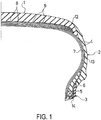
- FIG. 1 is a partial cross-sectional view in a tire meridian direction illustrating an example of an embodiment of a pneumatic tire in which the rubber composition for tire treads of the present invention is used.
- FIG. 1 illustrates an example of an embodiment of a pneumatic tire in which the rubber composition for tire treads is used.
- the pneumatic tire has a tread portion 1, sidewall portions 2, and bead portions 3.
- two carcass layers 4 formed by arranging reinforcing cords which extend in a tire radial direction, are disposed extending between the left and right side bead portions 3 in a tire circumferential direction at a predetermined pitch and embedding the reinforcing cords in a rubber layer. Both ends of the carcass layer 4 are made to sandwich a bead filler 6 around a bead core 5 that is embedded in the bead portions 3 and are folded back in a tire axial direction from the inside to the outside.
- An innerliner layer 7 is disposed inward of the carcass layer 4.
- the reinforcing cords of the two layers of belt layer 8 are inclined with respect to the tire circumferential direction, and the direction of the cords of the different layers have an opposite orientation and cross each other.
- a belt cover layer 9 is disposed on an outer circumferential side of the belt layer 8.
- the tread portion 1 is formed from a tread rubber layer 12 on an outer circumferential side of the belt cover layer 9.
- the tread rubber layer 12 is preferably formed from the rubber composition for tire treads of the present application.
- a side rubber layer 13 is disposed outward of the carcass layers 4 in each side wall portion 2, and a rim cushion rubber layer 14 is provided outward of the portion of each carcass layer 4 that is folded back around the bead
- the rubber component is formed from a diene rubber, and the total amount of a natural rubber, a solution polymerized styrene butadiene rubber (hereinafter, referred to as "S-SBR”) and an emulsion polymerized styrene butadiene rubber (hereinafter, referred to as "E-SBR”) is 100 wt.%.
- S-SBR solution polymerized styrene butadiene rubber
- E-SBR emulsion polymerized styrene butadiene rubber
- a natural rubber is included at 10 to 30 wt.% per 100 wt.% of the diene rubber.
- the grip performance can be enhanced while the wear resistance is significantly enhanced.
- the content of the natural rubber is less than 10 wt.%, the effect of enhancing the wear resistance cannot be exhibited sufficiently.
- the content of the natural rubber is greater than 30 wt.%, dry grip performance deteriorates.
- the content of the natural rubber is preferably from 10 to 20 wt.%, and more preferably from 15 to 20 wt.%.
- the styrene unit content of the S-SBR is from 30 to 40 wt.%, and preferably from 32 to 38 wt.%.
- the styrene unit content of the S-SBR is less than 30 wt.%, rigidity and strength of the rubber composition are insufficient, and thus the wear resistance and the wet grip performance cannot be sufficiently enhanced.
- the styrene unit content of the S-SBR is greater than 40 wt.%, the fuel economy performance deteriorates. Note that the styrene unit content of the S-SBR is measured by infrared spectroscopy (Hampton method).
- the S-SBR in the present invention, from 10 to 30 wt.% of the S-SBR is contained per 100 wt.% of the diene rubber.
- the content of the S-SBR is preferably from 15 to 30 wt.%, and more preferably from 20 to 30 wt.%.
- the rubber composition for tire treads of the present invention contains from 80 to 40 wt.% of the E-SBR per 100 wt.% of the diene rubber.
- the content of the E-SBR is preferably from 50 to 70 wt.%, and more preferably from 50 to 60 wt.%.
- wet grip performance can be enhanced by compounding an aromatic modified terpene resin.
- aromatic modified terpene resin include terpene resins obtained by polymerizing a terpene, such as ⁇ -pinene, ⁇ -pinene, dipentene, and limonene, and an aromatic compound, such as styrene, phenol, ⁇ -methylstyrene, and vinyl toluene.
- the compounded amount of the aromatic modified terpene resin is from 1 to 25 parts by weight, and preferably from 10 to 20 parts by weight, per 100 parts by weight of the diene rubber.
- the compounded amount of the aromatic modified terpene resin is less than 1 part by weight, wet grip performance cannot be sufficiently enhanced.
- the compounded amount of the aromatic modified terpene resin is greater than 25 parts by weight, fuel economy performance deteriorates.
- wet grip performance can be enhanced by compounding a silica.
- the compounded amount of the silica is from 80 to 150 parts by weight, and preferably from 100 to 150 parts by weight, per 100 parts by weight of the diene rubber.
- wet grip performance cannot be sufficiently enhanced.
- the compounded amount of the silica is greater than 150 parts by weight, fuel economy performance deteriorates.
- the CTAB specific surface area of the silica is preferably from 180 to 250 m 2 /g, and more preferably from 200 to 230 m 2 /g.
- the CTAB specific surface area of the silica is determined in accordance with JIS K6217-3:2001.
- the silica used in the present invention needs to be a silica having the characteristics described above and can be selected appropriately from among commercially available products.
- the silica may be produced using conventional methods so as to have the above-mentioned characteristics.
- Types of silica that can be used include wet method silica, dry method silica, and surface treated silica.
- the rubber composition for tire treads of the present invention contains a carbon black together with the silica.
- the compounded amount of the carbon black is from 5 to 50 parts by weight, and preferably from 10 to 30 parts by weight, per 100 parts by weight of the diene rubber.
- wear resistance and steering stability cannot be sufficiently enhanced.
- processability deteriorates.
- the total compounded amount of the silica and the carbon black is preferably greater than 140 parts by weight but 200 parts by weight or less, more preferably from 140 to 170 parts by weight, per 100 parts by weight of the diene rubber.
- the total amount of the silica and the carbon black is 140 parts by weight or less, grip performance and wear resistance may not be sufficiently enhanced.
- the total amount of the silica and the carbon black is greater than 200 parts by weight, viscosity becomes high and processability may deteriorate.
- Another inorganic filler besides the silica and the carbon black can be further compounded.
- examples of other inorganic fillers include clay, talc, calcium carbonate, mica, and aluminum hydroxide.
- the compounded amount of the other inorganic fillers is in a range that does not prevent achieving the object of the present invention.
- a silane coupling agent is preferably compounded together with the silica, and this enables enhancement of the dispersibility of the silica and makes the reinforcing properties for the diene rubber even higher.
- the compounded amount of the silane coupling agent is preferably from 3 to 15 wt.%, and more preferably from 5 to 12 wt.%, relative to the compounded amount of the silica. In cases where the compounded amount of the silane coupling agent is less than 3 wt.% of weight of the silica, the effect of enhancing silica dispersibility may not be sufficiently achieved. Furthermore, when the compounded amount of the silane coupling agent is greater than 15 wt.%, the silane coupling agents undergo condensation with each other, and the desired effect may not be achieved.
- the silane coupling agent is not particularly limited, but is preferably a sulfur-containing silane coupling agent.
- examples thereof include bis-(3-triethoxysilylpropyl)tetrasulfide, bis-(3-triethoxysilylpropyl)disulfide, 3-trimethoxysilylpropyl benzothiazole tetrasulfide, ⁇ -mercaptopropyltriethoxysilane, 3-octanoylthiopropyl triethoxysilane, and derivatives thereof.
- Examples of the derivative include NXT-Z (manufactured by Momentive Performance Materials Inc.).
- the rubber composition for tire treads of the present invention can suppress aggregation of the silica and increase in the viscosity of the rubber composition and can achieve even better processability, wet performance, and wear resistance.
- the alkyltriethoxysilane has an alkyl group having from 3 to 20 carbons, and preferably an alkyl group having from 7 to 10 carbons.
- the alkyl group having from 3 to 20 carbons include a propyl group, a butyl group, a pentyl group, a hexyl group, a heptyl group, an octyl group, a nonyl group, a decyl group, an undecyl group, a dodecyl group, a tridecyl group, a tetradecyl group, a pentadecyl group, a hexadecyl group, a heptadecyl group, an octadecyl group, a nonadecyl group, and an icosyl group.
- an octyl group or a nonyl group is
- the compounded amount of the alkyltriethoxysilane is from 0.1 to 20 wt.%, and preferably from 1 to 10 wt.%, relative to the compounded amount of the silica.
- the compounded amount of the alkyltriethoxysilane is less than 0.1 wt.%, the effect of making viscosity low while ensuring the wet performance and wear resistance cannot be achieved.
- wear resistance may deteriorate.
- the rubber composition for tire treads of the present invention contains an appropriate amount of an oil component.
- the oil component include aroma oil, and process oil.
- the compounded amount of the oil component is selected depending on the relationship of weight ratio of the total compounded amount of the oil-extending component contained in the S-SBR and/or the E-SBR, the aromatic modified terpene resin, and the oil component to the compounded amount of the natural rubber.
- the ratio (W oil /W NR ) needs to be from 3.0 to 4.0.
- the ratio (W oil /W NR ) is less than 3.0, grip performance cannot be sufficiently achieved.
- the ratio (W oil /W NR ) is greater than 4.0, wear resistance cannot be sufficiently achieved.
- the ratio (W oil /W NR ) is preferably from 3.2 to 3.8, and more preferably from 3.4 to 3.6.
- the rubber composition for tire treads may also contain various types of additives that are commonly used in rubber compositions for tires, such as vulcanization and crosslinking agents, vulcanization accelerators, anti-aging agents, plasticizers, and processing aids. These additives may be kneaded according to any common method to form the rubber composition and may be used in vulcanization or crosslinking. The compounded amount of these additives may be any conventional amount, as long as the object of the present invention is not impaired.
- a rubber composition can be produced by mixing the components described above using a publicly known rubber kneading machine, such as a Banbury mixer, a kneader, and a roll.
- the rubber composition for tire treads of the present invention can be suitably used in pneumatic tires, and in tire tread portions in particular.
- a pneumatic tire including this rubber composition can achieve excellent wear resistance and can enhance tire durability in addition to achieving excellent wet grip performance and dry grip performance. Furthermore, since the viscosity is low and excellent processability is achieved, high quality pneumatic tires can be stably produced.
- Each of 16 types of rubber compositions for tire treads (Standard Example, Examples 1 to 7, and Comparative Examples 1 to 8) was prepared according to the formulations shown in Tables 1 and 2 with the compounding agents shown in Table 3 used as common components.
- the sulfur and the vulcanization accelerator the components were kneaded in a 1.7 L sealed mixer for 5 minutes. The mixture was then extruded as a master batch and cooled at room temperature, the sulfur and the vulcanization accelerator were added, and the mixture was then kneaded in a 1.7 L sealed mixer.
- each row of the compounded amounts shows the actual compounded amount as well as the net compounded amount of the SBR excluding the oil-extending component in parentheses.
- the amounts of the compounding agents shown in Table 3 are shown in terms of part by weight relative to 100 parts by weight of the diene rubbers shown in Tables 1 and 2 (net rubber amounts).
- the total amount of the oil-extending component in the S-SBR1, the S-SBR 2, and the E-SBR, the aromatic modified terpene resin ("terpene resin" in the tables), and the aroma oil are shown in the rows of "total amount of oils Woil, part by weight” in Tables 1 and 2. Furthermore, the ratio (Woil/Wnr) of the total amount of oils (Woil) to the compounded amount of the natural rubber (Wnr) is shown in the rows of "ratio Woil/Wnr”. Furthermore, the total compounded amount of the silica and the carbon black (CB) is shown in the rows of "silica + CB, part by weight”.
- the Mooney viscosities of the obtained 16 types of the rubber compositions for tire treads were evaluated by the method described below.
- the Mooney viscosity of the obtained rubber composition was measured in accordance with JIS K6300 using a Mooney viscometer with an L-type rotor (diameter: 38.1 mm, thickness: 5.5 mm) under the conditions of a preheating time of 1 minute, a rotor rotation time of 4 minutes, 100°C, and 2 rpm.
- the obtained results are shown in the rows of "processability" in Tables 1 and 2 as index values, with the index value of Standard Example expressed as an index of 100. A smaller index value indicates smaller viscosity and superior processability.
- the obtained 16 types of rubber compositions for tire treads were press-vulcanized for 20 minutes at 160°C in a mold with a predetermined shape to produce vulcanized rubber samples.
- the obtained vulcanized rubber samples were used to evaluate the wear resistance and wet performance by the methods described below.
- a pneumatic tire was vulcanization-molded to evaluate the dry grip performance and steering stability by the methods described below.
- the amount of wear of the obtained vulcanized rubber sample was measured in accordance with JIS K6264, using a Lambourn abrasion test machine (manufactured by Iwamoto Seisakusho Co. Ltd.) under the following conditions: temperature: 20°C; load: 39 N; slip rate: 30%; time: 4 minutes.
- the obtained results are shown in the rows of "wear resistance" in Tables 1 and 2 as index values, with the reciprocal of the value of Standard Example expressed as an index of 100. A larger index value indicates superior wear resistance.
- the wet grip performance of the obtained vulcanized rubber sample was evaluated based on the loss tangent tan ⁇ (0°C), which is a known indicator of wet grip performance.
- the loss tangent tan ⁇ was measured using a viscoelasticity spectrometer (manufactured by Toyo Seiki Seisaku-sho, Ltd.) under the following conditions: initial strain; 10%; amplitude: ⁇ 2%; frequency: 20 Hz; and temperature: 0°C and 60°C.
- the obtained tan ⁇ (0°C) results are shown in the "wet performance" rows of Tables 1 and 2 as index values, with the value of Standard Example expressed as an index of 100. A larger index value indicates a larger tan ⁇ (0°C) and superior wet grip performance.
- the obtained tires were assembled on standard rims (rims of 195/65R15), inflated to an air pressure of 250 kPa, and mounted on 16 vehicles of the same type.
- the 16 vehicles traveled on a dry road surface with relatively less roughness, and braking distances for the case where the vehicles were decelerated from 100 km/hr to 50 km/hr were evaluated, thereby evaluating the dry grip performances.
- the obtained results are shown in the "dry performance" rows of Tables 1 and 2 as index values, with the value of Standard Example expressed as an index of 100. A larger index value indicates superior dry grip performance.
- the obtained tires were assembled on standard rims (rims of 195/65R15), inflated to an air pressure of 250 kPa, and mounted on 16 vehicles of the same type.
- the 16 vehicles traveled on a dry road surface with relatively less roughness, and response when the steering wheel was turned was subjected to sensory evaluation to evaluate the steering stability by five-grade evaluation with the rating of 3 being passing.
- the results are shown in "steering stability" rows in Tables 1 and 2. A larger rating indicates superior steering stability.
Landscapes
- Chemical & Material Sciences (AREA)
- Health & Medical Sciences (AREA)
- Chemical Kinetics & Catalysis (AREA)
- Medicinal Chemistry (AREA)
- Polymers & Plastics (AREA)
- Organic Chemistry (AREA)
- Engineering & Computer Science (AREA)
- Mechanical Engineering (AREA)
- Oil, Petroleum & Natural Gas (AREA)
- Compositions Of Macromolecular Compounds (AREA)
- Tires In General (AREA)
Abstract
Description
- The present invention relates to a rubber composition for tire treads that enhances processability, grip performance, and wear resistance beyond conventional levels.
- Pneumatic tires for passenger vehicles for use in high performance vehicles are required to have dry grip performance, wet grip performance, wear resistance, and low rolling resistance at the same time at a high level. For example, to achieve high grip performance, a styrene butadiene rubber having a high glass transition temperature is blended or a rubber composition containing a large amount of inorganic filler having a small particle size is used. Unfortunately, when such a rubber composition is used, rolling resistance becomes greater even though the grip performance can be enhanced. Furthermore, when a large amount of silica is blended to a rubber composition to make rolling resistance smaller, there is a problem in that wear resistance may be deteriorated.
- Patent Document 1 proposes a rubber composition having excellent low heat build-up, wear resistance, and wet grip performance by improving dispersibility of silica by blending a silica to a diene rubber in which an emulsion polymerized styrene butadiene rubber, a terminal-modified solution polymerized styrene butadiene rubber, and a natural rubber are compounded while the weight ratio thereof is limited. However, required levels of enhancement of the grip performance and the wear resistance expected by prospective consumers are even higher, and it is also important to enhance processability to stably produce high quality pneumatic tires. Further enhancement of the balance of these has been demanded.
- Patent Document 1: Japanese Unexamined Patent Application Publication No.
2011-246561A - An objective of the present invention is to provide a rubber composition for tire treads by which processability, grip performance, and wear resistance are improved to or beyond conventional levels.
- The rubber composition for tire treads of the present invention that achieves the object described above is a rubber composition containing: a diene rubber; from 1 to 25 parts by weight of an aromatic modified terpene resin; from 80 to 150 parts by weight of a silica; from 5 to 50 parts by weight of a carbon black; and an oil component, per 100 parts by weight of the diene rubber; and from 0.1 to 20 wt.% of the weight of the silica of an alkyltriethoxysilane having an alkyl group having from 3 to 20 carbons, the diene rubber containing from 10 to 30 wt.% of a natural rubber, from 10 to 30 wt.% of a solution polymerized styrene butadiene rubber having a styrene unit content of 30 to 40 wt.% and from 80 to 40 wt.% of an emulsion polymerized styrene butadiene rubber, and a ratio of a total amount Woil of an oil-extending component contained in the solution polymerized styrene butadiene rubber and/or the emulsion polymerized styrene butadiene rubber, the aromatic modified terpene resin, and the oil component to a weight WNR of the natural rubber (Woil/WNR) being from 3.0 to 4.0.
- The rubber composition for tire treads of the present invention can enhance processability, grip performance, and wear resistance to or beyond conventional levels because the rubber composition contains, a diene rubber containing from 10 to 30 wt.% of a natural rubber, from 10 to 30 wt.% of a solution polymerized styrene butadiene rubber having a high styrene unit content, and from 80 to 40 wt.% of an emulsion polymerized styrene butadiene rubber, an aromatic modified terpene resin, a silica, a carbon black, an oil component, and an alkyltriethoxysilane; a ratio of a total amount Woil of an oil-extending component contained in the solution polymerized styrene butadiene rubber and/or the emulsion polymerized styrene butadiene rubber, the aromatic modified terpene resin, and the oil component to a weight WNR of the natural rubber (Woil/WNR) being from 3.0 to 4.0.
- In the present invention, the CTAB specific surface area of the silica is preferably set to 180 to 250 m2/g. Furthermore, the total compounded amount of the silica and the carbon black is preferably set to greater than 140 parts by weight and 200 parts by weight or less.
- The pneumatic tire in which the rubber composition for tire treads of the present invention is used has grip performance and wear resistance that are enhanced beyond conventional levels, and thus the high quality pneumatic tire can be produced stably.
-
FIG. 1 is a partial cross-sectional view in a tire meridian direction illustrating an example of an embodiment of a pneumatic tire in which the rubber composition for tire treads of the present invention is used. -
FIG. 1 illustrates an example of an embodiment of a pneumatic tire in which the rubber composition for tire treads is used. The pneumatic tire has a tread portion 1,sidewall portions 2, and bead portions 3. - In
FIG. 1 , in a pneumatic tire, two carcass layers 4, formed by arranging reinforcing cords which extend in a tire radial direction, are disposed extending between the left and right side bead portions 3 in a tire circumferential direction at a predetermined pitch and embedding the reinforcing cords in a rubber layer. Both ends of the carcass layer 4 are made to sandwich a bead filler 6 around abead core 5 that is embedded in the bead portions 3 and are folded back in a tire axial direction from the inside to the outside. Aninnerliner layer 7 is disposed inward of the carcass layer 4. Two layers ofbelt layer 8, formed by arranging reinforcing cords which extend inclined in the tire circumferential direction, are disposed on an outer circumferential side of the carcass layer 4 of the tread portion 1 in the tire axial direction at a predetermined pitch and embedding these reinforcing cords in a rubber layer. The reinforcing cords of the two layers ofbelt layer 8 are inclined with respect to the tire circumferential direction, and the direction of the cords of the different layers have an opposite orientation and cross each other. Abelt cover layer 9 is disposed on an outer circumferential side of thebelt layer 8. The tread portion 1 is formed from atread rubber layer 12 on an outer circumferential side of thebelt cover layer 9. Thetread rubber layer 12 is preferably formed from the rubber composition for tire treads of the present application. Aside rubber layer 13 is disposed outward of the carcass layers 4 in eachside wall portion 2, and a rimcushion rubber layer 14 is provided outward of the portion of each carcass layer 4 that is folded back around the bead portion 3. - In the rubber composition for tire treads of the present invention, the rubber component is formed from a diene rubber, and the total amount of a natural rubber, a solution polymerized styrene butadiene rubber (hereinafter, referred to as "S-SBR") and an emulsion polymerized styrene butadiene rubber (hereinafter, referred to as "E-SBR") is 100 wt.%.
- In the present invention, a natural rubber is included at 10 to 30 wt.% per 100 wt.% of the diene rubber. By compounding the natural rubber, the grip performance can be enhanced while the wear resistance is significantly enhanced. When the content of the natural rubber is less than 10 wt.%, the effect of enhancing the wear resistance cannot be exhibited sufficiently. Furthermore, when the content of the natural rubber is greater than 30 wt.%, dry grip performance deteriorates. The content of the natural rubber is preferably from 10 to 20 wt.%, and more preferably from 15 to 20 wt.%.
- In the present invention, the styrene unit content of the S-SBR is from 30 to 40 wt.%, and preferably from 32 to 38 wt.%. When the styrene unit content of the S-SBR is less than 30 wt.%, rigidity and strength of the rubber composition are insufficient, and thus the wear resistance and the wet grip performance cannot be sufficiently enhanced. When the styrene unit content of the S-SBR is greater than 40 wt.%, the fuel economy performance deteriorates. Note that the styrene unit content of the S-SBR is measured by infrared spectroscopy (Hampton method).
- In the present invention, from 10 to 30 wt.% of the S-SBR is contained per 100 wt.% of the diene rubber. When the content of the S-SBR is less than 10 wt.%, fuel economy performance deteriorates. When the content of the S-SBR is greater than 30 wt.%, dry grip performance deteriorates. The content of the S-SBR is preferably from 15 to 30 wt.%, and more preferably from 20 to 30 wt.%.
- The rubber composition for tire treads of the present invention contains from 80 to 40 wt.% of the E-SBR per 100 wt.% of the diene rubber. When the content of the E-SBR is less than 40 wt.%, wet grip performance deteriorates. When the content of the E-SBR is greater than 80 wt.%, fuel economy performance deteriorates. The content of the E-SBR is preferably from 50 to 70 wt.%, and more preferably from 50 to 60 wt.%.
- In the rubber composition for tire treads of the present invention, wet grip performance can be enhanced by compounding an aromatic modified terpene resin. Examples of the aromatic modified terpene resin include terpene resins obtained by polymerizing a terpene, such as α-pinene, β-pinene, dipentene, and limonene, and an aromatic compound, such as styrene, phenol, α-methylstyrene, and vinyl toluene.
- The compounded amount of the aromatic modified terpene resin is from 1 to 25 parts by weight, and preferably from 10 to 20 parts by weight, per 100 parts by weight of the diene rubber. When the compounded amount of the aromatic modified terpene resin is less than 1 part by weight, wet grip performance cannot be sufficiently enhanced. When the compounded amount of the aromatic modified terpene resin is greater than 25 parts by weight, fuel economy performance deteriorates.
- In the rubber composition for tire treads of the present invention, wet grip performance can be enhanced by compounding a silica. The compounded amount of the silica is from 80 to 150 parts by weight, and preferably from 100 to 150 parts by weight, per 100 parts by weight of the diene rubber. When the compounded amount of the silica is less than 80 parts by weight, wet grip performance cannot be sufficiently enhanced. When the compounded amount of the silica is greater than 150 parts by weight, fuel economy performance deteriorates.
- The CTAB specific surface area of the silica is preferably from 180 to 250 m2/g, and more preferably from 200 to 230 m2/g. When the CTAB specific surface area of the silica is less than 180 m2/g, wet grip performance deteriorates. When the CTAB specific surface area of the silica is greater than 250 m2/g, fuel economy performance deteriorates. The CTAB specific surface area of the silica is determined in accordance with JIS K6217-3:2001.
- The silica used in the present invention needs to be a silica having the characteristics described above and can be selected appropriately from among commercially available products. In addition, the silica may be produced using conventional methods so as to have the above-mentioned characteristics. Types of silica that can be used include wet method silica, dry method silica, and surface treated silica.
- The rubber composition for tire treads of the present invention contains a carbon black together with the silica. By blending the carbon black, high wear resistance and steering stability can be achieved. The compounded amount of the carbon black is from 5 to 50 parts by weight, and preferably from 10 to 30 parts by weight, per 100 parts by weight of the diene rubber. When the compounded amount of the carbon black is less than 5 parts by weight, wear resistance and steering stability cannot be sufficiently enhanced. Furthermore, when the compounded amount of the carbon black is greater than 50 parts by weight, processability deteriorates.
- The total compounded amount of the silica and the carbon black is preferably greater than 140 parts by weight but 200 parts by weight or less, more preferably from 140 to 170 parts by weight, per 100 parts by weight of the diene rubber. When the total amount of the silica and the carbon black is 140 parts by weight or less, grip performance and wear resistance may not be sufficiently enhanced. Furthermore, when the total amount of the silica and the carbon black is greater than 200 parts by weight, viscosity becomes high and processability may deteriorate.
- Another inorganic filler besides the silica and the carbon black can be further compounded. Examples of other inorganic fillers include clay, talc, calcium carbonate, mica, and aluminum hydroxide. However, the compounded amount of the other inorganic fillers is in a range that does not prevent achieving the object of the present invention.
- In the rubber composition of the present invention, a silane coupling agent is preferably compounded together with the silica, and this enables enhancement of the dispersibility of the silica and makes the reinforcing properties for the diene rubber even higher. The compounded amount of the silane coupling agent is preferably from 3 to 15 wt.%, and more preferably from 5 to 12 wt.%, relative to the compounded amount of the silica. In cases where the compounded amount of the silane coupling agent is less than 3 wt.% of weight of the silica, the effect of enhancing silica dispersibility may not be sufficiently achieved. Furthermore, when the compounded amount of the silane coupling agent is greater than 15 wt.%, the silane coupling agents undergo condensation with each other, and the desired effect may not be achieved.
- The silane coupling agent is not particularly limited, but is preferably a sulfur-containing silane coupling agent. Examples thereof include bis-(3-triethoxysilylpropyl)tetrasulfide, bis-(3-triethoxysilylpropyl)disulfide, 3-trimethoxysilylpropyl benzothiazole tetrasulfide, γ-mercaptopropyltriethoxysilane, 3-octanoylthiopropyl triethoxysilane, and derivatives thereof. Examples of the derivative include NXT-Z (manufactured by Momentive Performance Materials Inc.).
- By blending an alkyltriethoxysilane having an alkyl group having from 3 to 20 carbons, the rubber composition for tire treads of the present invention can suppress aggregation of the silica and increase in the viscosity of the rubber composition and can achieve even better processability, wet performance, and wear resistance.
- The alkyltriethoxysilane has an alkyl group having from 3 to 20 carbons, and preferably an alkyl group having from 7 to 10 carbons. Examples of the alkyl group having from 3 to 20 carbons include a propyl group, a butyl group, a pentyl group, a hexyl group, a heptyl group, an octyl group, a nonyl group, a decyl group, an undecyl group, a dodecyl group, a tridecyl group, a tetradecyl group, a pentadecyl group, a hexadecyl group, a heptadecyl group, an octadecyl group, a nonadecyl group, and an icosyl group. Among these, from the perspective of miscibility with the diene rubber, an octyl group or a nonyl group is more preferable.
- The compounded amount of the alkyltriethoxysilane is from 0.1 to 20 wt.%, and preferably from 1 to 10 wt.%, relative to the compounded amount of the silica. When the compounded amount of the alkyltriethoxysilane is less than 0.1 wt.%, the effect of making viscosity low while ensuring the wet performance and wear resistance cannot be achieved. Furthermore, when the compounded amount of the alkyltriethoxysilane is greater than 20 wt.%, wear resistance may deteriorate.
- The rubber composition for tire treads of the present invention contains an appropriate amount of an oil component. Examples of the oil component include aroma oil, and process oil. The compounded amount of the oil component is selected depending on the relationship of weight ratio of the total compounded amount of the oil-extending component contained in the S-SBR and/or the E-SBR, the aromatic modified terpene resin, and the oil component to the compounded amount of the natural rubber. That is, when the total compounded amount of the oil-extending component contained in the S-SBR and/or the E-SBR, the aromatic modified terpene resin, and the oil component is defined as Woil and when the compounded amount of the natural rubber is defined as WNR, the ratio (Woil/WNR) needs to be from 3.0 to 4.0. When the ratio (Woil/WNR) is less than 3.0, grip performance cannot be sufficiently achieved. Furthermore, when the ratio (Woil/WNR) is greater than 4.0, wear resistance cannot be sufficiently achieved. The ratio (Woil/WNR) is preferably from 3.2 to 3.8, and more preferably from 3.4 to 3.6.
- In addition to the compounding agents described above, the rubber composition for tire treads may also contain various types of additives that are commonly used in rubber compositions for tires, such as vulcanization and crosslinking agents, vulcanization accelerators, anti-aging agents, plasticizers, and processing aids. These additives may be kneaded according to any common method to form the rubber composition and may be used in vulcanization or crosslinking. The compounded amount of these additives may be any conventional amount, as long as the object of the present invention is not impaired. Such a rubber composition can be produced by mixing the components described above using a publicly known rubber kneading machine, such as a Banbury mixer, a kneader, and a roll.
- The rubber composition for tire treads of the present invention can be suitably used in pneumatic tires, and in tire tread portions in particular. A pneumatic tire including this rubber composition can achieve excellent wear resistance and can enhance tire durability in addition to achieving excellent wet grip performance and dry grip performance. Furthermore, since the viscosity is low and excellent processability is achieved, high quality pneumatic tires can be stably produced.
- The present invention is further described below using examples. However, the scope of the present invention is not limited to these examples.
- Each of 16 types of rubber compositions for tire treads (Standard Example, Examples 1 to 7, and Comparative Examples 1 to 8) was prepared according to the formulations shown in Tables 1 and 2 with the compounding agents shown in Table 3 used as common components. With the exception of the sulfur and the vulcanization accelerator, the components were kneaded in a 1.7 L sealed mixer for 5 minutes. The mixture was then extruded as a master batch and cooled at room temperature, the sulfur and the vulcanization accelerator were added, and the mixture was then kneaded in a 1.7 L sealed mixer. Note that, in Tables 1 and 2, since the S-SBR 1, S-
SBR 2, and E-SBR contained 37.5 parts by weight of oil-extending component per net amount of 100 parts by weight of the rubber, each row of the compounded amounts shows the actual compounded amount as well as the net compounded amount of the SBR excluding the oil-extending component in parentheses. Note that the amounts of the compounding agents shown in Table 3 are shown in terms of part by weight relative to 100 parts by weight of the diene rubbers shown in Tables 1 and 2 (net rubber amounts). - The total amount of the oil-extending component in the S-SBR1, the S-
SBR 2, and the E-SBR, the aromatic modified terpene resin ("terpene resin" in the tables), and the aroma oil are shown in the rows of "total amount of oils Woil, part by weight" in Tables 1 and 2. Furthermore, the ratio (Woil/Wnr) of the total amount of oils (Woil) to the compounded amount of the natural rubber (Wnr) is shown in the rows of "ratio Woil/Wnr". Furthermore, the total compounded amount of the silica and the carbon black (CB) is shown in the rows of "silica + CB, part by weight". - The Mooney viscosities of the obtained 16 types of the rubber compositions for tire treads were evaluated by the method described below.
- The Mooney viscosity of the obtained rubber composition was measured in accordance with JIS K6300 using a Mooney viscometer with an L-type rotor (diameter: 38.1 mm, thickness: 5.5 mm) under the conditions of a preheating time of 1 minute, a rotor rotation time of 4 minutes, 100°C, and 2 rpm. The obtained results are shown in the rows of "processability" in Tables 1 and 2 as index values, with the index value of Standard Example expressed as an index of 100. A smaller index value indicates smaller viscosity and superior processability.
- The obtained 16 types of rubber compositions for tire treads were press-vulcanized for 20 minutes at 160°C in a mold with a predetermined shape to produce vulcanized rubber samples. The obtained vulcanized rubber samples were used to evaluate the wear resistance and wet performance by the methods described below. Furthermore, a pneumatic tire was vulcanization-molded to evaluate the dry grip performance and steering stability by the methods described below.
- The amount of wear of the obtained vulcanized rubber sample was measured in accordance with JIS K6264, using a Lambourn abrasion test machine (manufactured by Iwamoto Seisakusho Co. Ltd.) under the following conditions: temperature: 20°C; load: 39 N; slip rate: 30%; time: 4 minutes. The obtained results are shown in the rows of "wear resistance" in Tables 1 and 2 as index values, with the reciprocal of the value of Standard Example expressed as an index of 100. A larger index value indicates superior wear resistance.
- The wet grip performance of the obtained vulcanized rubber sample was evaluated based on the loss tangent tan δ (0°C), which is a known indicator of wet grip performance. The loss tangent tan δ was measured using a viscoelasticity spectrometer (manufactured by Toyo Seiki Seisaku-sho, Ltd.) under the following conditions: initial strain; 10%; amplitude: ±2%; frequency: 20 Hz; and temperature: 0°C and 60°C. The obtained tan δ (0°C) results are shown in the "wet performance" rows of Tables 1 and 2 as index values, with the value of Standard Example expressed as an index of 100. A larger index value indicates a larger tan δ (0°C) and superior wet grip performance.
- Pneumatic tires having a tire size of 195/65R15, in which each tire tread portion was formed from each of the obtained 16 types of the rubber compositions for tire treads, were vulcanization-molded. The obtained tires were assembled on standard rims (rims of 195/65R15), inflated to an air pressure of 250 kPa, and mounted on 16 vehicles of the same type. The 16 vehicles traveled on a dry road surface with relatively less roughness, and braking distances for the case where the vehicles were decelerated from 100 km/hr to 50 km/hr were evaluated, thereby evaluating the dry grip performances. The obtained results are shown in the "dry performance" rows of Tables 1 and 2 as index values, with the value of Standard Example expressed as an index of 100. A larger index value indicates superior dry grip performance.
- Pneumatic tires having a tire size of 195/65R15, in which each tire tread portion was formed from each of the obtained 16 types of the rubber compositions for tire treads, were vulcanization-molded. The obtained tires were assembled on standard rims (rims of 195/65R15), inflated to an air pressure of 250 kPa, and mounted on 16 vehicles of the same type. The 16 vehicles traveled on a dry road surface with relatively less roughness, and response when the steering wheel was turned was subjected to sensory evaluation to evaluate the steering stability by five-grade evaluation with the rating of 3 being passing. The results are shown in "steering stability" rows in Tables 1 and 2. A larger rating indicates superior steering stability.
[Table 1-1] Standard Example Example 1 Example 2 Example 3 NR (Wnr) Part by weight 15 15 15 15 S-BBR1 Part by weight 37.5 (30) 37.5 (30) 37.5 (30) 37.5 (30) S-BBR2 Part by weight E-SBR Part by weight 75.63 (55) 75.63 (55) 75.63 (55) 75.63 (55) Silica 1 Part by weight 115 115 Silica 2 Part by weight 115 130 CB Part by weight 20 20 20 20 Coupling agent Part by weight 6.9 6.9 6.9 7.8 Alkylsilane Part by weight 5.0 5.0 5.0 5.0 Terpene resin Part by weight 10 10 20 Aroma oil Part by weight 22 12 12 2 (Total amount of oils Woil, part by weight) (50.1) (50.1) (50.1) (50.1) (Ratio Woil/Wnr) (3.34) (3.34) (3.34) (3.34) (Silica + CB, part by weight) (135) (135) (135) (150) Processability Index value 100 85 94 98 Wear resistance Index value 100 102 102 104 Wet performance Index value 100 105 105 110 Dry performance Index value 100 101 105 107 Steering stability Rating 3 3 4 4 [Table 1-2] Example 4 Example 5 Example 6 Example 7 NR (Wnr) Part by weight 20 15 15 15 S-BBR1 Part by weight 31.25 (25) 12.5 (10) 37.5 (30) 37.5 (30) S-BBR2 Part by weight E-SBR Part by weight 75.63 (55) 103.13 (75) 75.63 (55) 75.63 (55) Silica 1 Part by weight 115 115 115 130 Silica 2 Part by weight CB Part by weight 20 20 30 20 Coupling agent Part by weight 6.9 6.9 6.9 7.8 Alkylsilane Part by weight 5.0 5.0 5.0 5.0 Terpene resin Part by weight 10 10 10 10 Aroma oil Part by weight 19 12 12 12 (Total amount of oils Woil, part by weight) (60.9) (52.6) (50.1) (50.1) (Ratio Woil/Wnr) (3.04) (3.51) (3.34) (3.34) (Silica + CB, part by weight) (135) (135) (145) (150) Processability Index value 89 87 96 97 Wear resistance Index value 110 103 105 106 Wet performance Index value 103 107 104 105 Dry performance Index value 100 106 108 107 Steering stability Rating 3 4 4 4 [Table 2-1] Comparative Example 1 Comparative Example 2 Comparative Example 3 Comparative Example 4 NR (Wnr) Part by weight 15 15 15 S-BBR1 Part by weight 37.5 (30) 37.5 (30) 37.5 (30) 43.75 (35) S-BBR2 Part by weight E-SBR Part by weight 96.25 (70) 75.63 (55) 75.63 (55) 82.5 (60) Silica 1 Part by weight 115 160 75 115 Silica 2 Part by weight CB Part by weight 20 60 60 20 Coupling agent Part by weight 6.9 9.6 4.5 6.9 Alkylsilane Part by weight 5.0 5.0 5.0 5.0 Terpene resin Part by weight 10 10 10 10 Aroma oil Part by weight 6.4 20 12 16 (Total amount of oils Woil, part by weight) (50.2) (58.1) (50.1) (57.3) (Ratio Woil/Wnr) - (3.88) (3.34) (3.82) (Silica + CB, part by weight) (135) (220) (135) (135) Processability Index value 92 150 95 96 Wear resistance Index value 90 110 90 105 Wet performance Index value 102 120 90 95 Dry performance Index value 97 110 95 102 Steering stability Rating 3 4 2 3 [Table 2-2] Comparative Example 5 Comparative Example 6 Comparative Example 7 Comparative Example 8 NR (Wnr) Part by weight 15 15 15 15 S-BBR1 Part by weight 37.5 (30) 37.5 (30) 37.5 (30) S-BBR2 Part by weight 30 E-SBR Part by weight 75.63 (55) 75.63 (55) 75.63 (55) 75.63 (55) Silica 1 Part by weight 115 115 115 115 Silica 2 Part by weight CB Part by weight 20 20 20 20 Coupling agent Part by weight 6.9 6.9 6.9 6.9 Alkylsilane Part by weight 5.0 5.0 5.0 Terpene resin Part by weight 10 10 10 10 Aroma oil Part by weight 16 16 0 22 (Total amount of oils Woil, part by weight) (54.1) (46.6) (38.1) (60.1) (Ratio Woil/Wnr) (3.61) (3.11) (2.54) (4.01) (Silica + CB, part by weight) (135) (135) (135) (135) Processability Index value 130 105 105 95 Wear resistance Index value 105 103 106 90 Wet performance Index value 97 96 95 105 Dry performance Index value 101 94 96 104 Steering stability Rating 3 3 3 3 - Note that the types of raw materials used in Tables 1 and 2 are as described below.
- NR: Natural rubber, SIR-20
- S-SBR 1: Solution polymerized styrene butadiene rubber; Tufdene F3420, manufactured by Asahi Kasei Chemicals Corporation; styrene unit content: 36 wt.%; oil extended product containing 25.0 parts by weight of oil per 100 parts by weight of rubber component
- S-SBR 2: Solution polymerized styrene butadiene rubber; Tufdene 1000R, manufactured by Asahi Kasei Chemicals Corporation; styrene unit content: 18.5 wt.%; non-oil-extended product (oil content: 0 parts by weight)
- E-SBR: Emulsion polymerized styrene butadiene rubber; Nipol 9458, manufactured by Zeon Corporation; oil extended product containing 37.5 parts by weight of oil per 100 parts by weight of rubber component
- Silica 1: 1165MP, manufactured by Solvay Corporation; CTAB specific surface area: 180 m2/g
- Silica 2: 9000GR, manufactured by Evonik Degussa; CTAB specific surface area: 200 m2/g
- CB: Carbon black; N234, manufactured by Cabot Japan K.K.
- Coupling agent: Sulfur-containing silane coupling agent; Si69, manufactured by Evonik Degussa
- Alkylsilane: Octyltriethoxysilane; KBE-3083, manufactured by Shin-Etsu Chemical Co., Ltd.
- Terpene resin: Aromatic modified terpene resin; YS Polyster T145, manufactured by Yasuhara Chemical Co., Ltd.; softening point: 145°C
- Aroma oil: Extract No. 4S, manufactured by Showa Shell Sekiyu K.K.
- The types of raw materials used as per Table 3 are shown below.
- Zinc oxide: Zinc Oxide #3, manufactured by Seido Chemical Industry Co., Ltd.
- Stearic acid: Stearic acid YR, manufactured by NOF Corporation
- Sulfur: Oil-treated sulfur, manufactured by Karuizawa Refinery Ltd.
- Vulcanization accelerator: NOCCELER CZ-G, manufactured by Ouchi Shinko Chemical Industrial Co., Ltd.
- As is clear from Table 1, it was confirmed that the rubber compositions for tire treads of Examples 1 to 7 maintained and/or enhanced processability (Mooney viscosity), wear resistance, wet grip performance (tan δ at 0°C), dry grip performance, and steering stability.
- As is clear from Table 2, with the rubber composition of Comparative Example 1 which contained no natural rubber, wear resistance and dry grip performance deteriorated.
- With the rubber composition of Comparative Example 2, processability deteriorated since the compounded amount of the silica was greater than 150 parts by weight and the compounded amount of the carbon black was greater than 50 parts by weight.
- With the rubber composition of Comparative Example 3, wear resistance, wet grip performance, dry grip performance, and steering stability deteriorated since the compounded amount of the silica was less than 80 parts by weight and the compounded amount of the carbon black was greater than 50 parts by weight.
- With the rubber composition of Comparative Example 4, wet grip performance deteriorated since the compounded amount of the S-SBR 1 was greater than 30 parts by weight.
- With the rubber composition of Comparative Example 5, processability and wet grip performance deteriorated since alkylsilane was not compounded.
- With the rubber composition of Comparative Example 6, dry grip performance and wet grip performance deteriorated since the styrene unit content of the S-
SBR 2 was less than 30 wt.%. - With the rubber composition of Comparative Example 7, dry grip performance and wet grip performance deteriorated since the ratio (Woil/WNR) of the total amount Woil of the oil-extending component contained in the S-SBR 1 and the E-SBR, the aromatic modified terpene resin, and the oil component to the weight WNR of the natural rubber was less than 3.0.
- With the rubber composition of Comparative Example 8, wear resistance deteriorated since the ratio (Woil/WNR) of the total amount Woil of the oil-extending component contained in the S-SBR 1 and the E-SBR, the aromatic modified terpene resin, and the oil component to the weight WNR of the natural rubber was greater than 4.0.
-
- 1 Tread portion
- 12 Tread rubber layer
| Common formulation of rubber composition | |
| Zinc oxide | 3.0 Part by weight |
| Stearic acid | 2.0 Part by weight |
| Sulfur | 1.0 Part by weight |
| Vulcanization | 2.0 Part by weight |
| accelerator | |
Claims (4)
- A rubber composition for tire treads comprising:a diene rubber;from 1 to 25 parts by weight of an aromatic modified terpene resin; from 80 to 150 parts by weight of a silica;from 5 to 50 parts by weight of a carbon black;an oil component, per 100 parts by weight of the diene rubber; and from 0.1 to 20 wt.% of the weight of the silica of an alkyltriethoxysilane having an alkyl group having from 3 to 20 carbons,the diene rubber containing from 10 to 30 wt.% of a natural rubber, from 10 to 30 wt.% of a solution polymerized styrene butadiene rubber having a styrene unit content of 30 to 40 wt.%, and from 80 to 40 wt.% of an emulsion polymerized styrene butadiene rubber, anda ratio of a total amount Woil of an oil-extending component contained in the solution polymerized styrene butadiene rubber and/or the emulsion polymerized styrene butadiene rubber, the aromatic modified terpene resin, and the oil component to a weight WNR of the natural rubber (Woil/WNR) being from 3.0 to 4.0.
- The rubber composition for tire treads according to claim 1, wherein
a CTAB specific surface area of the silica is from 180 to 250 m2/g. - The rubber composition for tire treads according to claim 1 or 2, wherein
a total compounded amount of the silica and the carbon black is greater than 140 parts by weight and 200 parts by weight or less. - A pneumatic tire comprising the rubber composition for tire treads according to any one of claims 1 to 3.
Applications Claiming Priority (2)
| Application Number | Priority Date | Filing Date | Title |
|---|---|---|---|
| JP2014246488A JP5999167B2 (en) | 2014-12-05 | 2014-12-05 | Rubber composition for tire tread |
| PCT/JP2015/083908 WO2016088811A1 (en) | 2014-12-05 | 2015-12-02 | Rubber composition for tire treads |
Publications (3)
| Publication Number | Publication Date |
|---|---|
| EP3228659A1 true EP3228659A1 (en) | 2017-10-11 |
| EP3228659A4 EP3228659A4 (en) | 2019-01-09 |
| EP3228659B1 EP3228659B1 (en) | 2020-04-01 |
Family
ID=56091751
Family Applications (1)
| Application Number | Title | Priority Date | Filing Date |
|---|---|---|---|
| EP15865506.8A Active EP3228659B1 (en) | 2014-12-05 | 2015-12-02 | Rubber composition for tire treads |
Country Status (6)
| Country | Link |
|---|---|
| US (1) | US10087313B2 (en) |
| EP (1) | EP3228659B1 (en) |
| JP (1) | JP5999167B2 (en) |
| KR (1) | KR101828493B1 (en) |
| CN (1) | CN107108974B (en) |
| WO (1) | WO2016088811A1 (en) |
Cited By (2)
| Publication number | Priority date | Publication date | Assignee | Title |
|---|---|---|---|---|
| EP4039504A1 (en) * | 2021-02-09 | 2022-08-10 | Sumitomo Rubber Industries, Ltd. | Rubber composition and tire |
| EP4056644A1 (en) * | 2021-03-09 | 2022-09-14 | The Goodyear Tire & Rubber Company | A rubber composition and a tire |
Families Citing this family (15)
| Publication number | Priority date | Publication date | Assignee | Title |
|---|---|---|---|---|
| JP6834194B2 (en) * | 2016-07-01 | 2021-02-24 | 横浜ゴム株式会社 | Rubber composition and pneumatic tires using it |
| KR101878260B1 (en) * | 2016-09-22 | 2018-07-13 | 금호타이어 주식회사 | Rubber composition for tire tread |
| EP3569651B1 (en) * | 2017-01-12 | 2022-04-27 | The Yokohama Rubber Co., Ltd. | Rubber composition for tire treads and pneumatic tire |
| JP7403207B2 (en) * | 2017-05-17 | 2023-12-22 | 住友ゴム工業株式会社 | Rubber composition for tires and tires |
| CN110944851B (en) * | 2017-08-01 | 2022-04-19 | 横滨橡胶株式会社 | Pneumatic tire |
| US20190062533A1 (en) * | 2017-08-31 | 2019-02-28 | The Goodyear Tire & Rubber Company | Pneumatic tire |
| US10428205B2 (en) * | 2017-08-31 | 2019-10-01 | The Goodyear Tire & Rubber Company | Pneumatic tire |
| JP7397272B2 (en) * | 2017-12-08 | 2023-12-13 | 横浜ゴム株式会社 | pneumatic tires |
| CN108264663A (en) * | 2018-01-29 | 2018-07-10 | 中国化工集团曙光橡胶工业研究设计院有限公司 | A kind of method of mining and logging tyre tread rubber for preparing cut resistant |
| CN108752675B (en) * | 2018-06-04 | 2020-06-16 | 正新橡胶(中国)有限公司 | Low-rolling-resistance tire rubber composition and application thereof |
| US10767034B2 (en) * | 2018-09-04 | 2020-09-08 | The Goodyear Tire & Rubber Company | Pneumatic tire |
| JP6838599B2 (en) * | 2018-12-17 | 2021-03-03 | 横浜ゴム株式会社 | Pneumatic tires |
| US10947368B2 (en) | 2019-03-04 | 2021-03-16 | The Goodyear Tire & Rubber Company | Pneumatic tire |
| CN111333930A (en) * | 2020-02-11 | 2020-06-26 | 山东玲珑轮胎股份有限公司 | High-modulus steel wire ring rubber-coated sizing material and preparation method and application thereof |
| US11440350B2 (en) | 2020-05-13 | 2022-09-13 | The Goodyear Tire & Rubber Company | Pneumatic tire |
Family Cites Families (13)
| Publication number | Priority date | Publication date | Assignee | Title |
|---|---|---|---|---|
| JPS6399252A (en) * | 1987-09-25 | 1988-04-30 | Asahi Chem Ind Co Ltd | Improved rubber composition |
| WO1998014515A1 (en) * | 1996-10-04 | 1998-04-09 | The Yokohama Rubber Co., Ltd. | Silica-containing diene rubber composition |
| JP4970786B2 (en) * | 2005-12-12 | 2012-07-11 | 住友ゴム工業株式会社 | Rubber composition for covering carcass cords |
| JP4849176B2 (en) * | 2010-02-26 | 2012-01-11 | 横浜ゴム株式会社 | Rubber composition for tire tread and pneumatic tire using the same |
| JP4835769B2 (en) * | 2010-05-26 | 2011-12-14 | 横浜ゴム株式会社 | Rubber composition for tire tread |
| CN102336939B (en) * | 2010-07-16 | 2014-10-22 | 住友橡胶工业株式会社 | Rubber composition for tread and pneumatic tire |
| DE112011104011B9 (en) * | 2010-12-03 | 2017-07-20 | The Yokohama Rubber Co., Ltd. | Use of a rubber composition for producing a pneumatic tire and pneumatic tires comprising the same |
| JP5234203B2 (en) | 2011-07-14 | 2013-07-10 | 横浜ゴム株式会社 | Rubber composition for tire |
| JP5559234B2 (en) * | 2011-08-09 | 2014-07-23 | 住友ゴム工業株式会社 | Rubber composition for tire and pneumatic tire |
| JP5376027B2 (en) * | 2012-03-08 | 2013-12-25 | 横浜ゴム株式会社 | Rubber composition for tire |
| JP5650690B2 (en) * | 2012-06-12 | 2015-01-07 | 住友ゴム工業株式会社 | Rubber composition for tread and pneumatic tire |
| JP6229284B2 (en) * | 2013-03-28 | 2017-11-15 | 横浜ゴム株式会社 | Rubber composition for tire tread |
| JP5987865B2 (en) * | 2014-06-17 | 2016-09-07 | 横浜ゴム株式会社 | Rubber composition for tire and pneumatic tire |
-
2014
- 2014-12-05 JP JP2014246488A patent/JP5999167B2/en active Active
-
2015
- 2015-12-02 WO PCT/JP2015/083908 patent/WO2016088811A1/en not_active Ceased
- 2015-12-02 EP EP15865506.8A patent/EP3228659B1/en active Active
- 2015-12-02 CN CN201580061843.5A patent/CN107108974B/en active Active
- 2015-12-02 KR KR1020177012962A patent/KR101828493B1/en active Active
- 2015-12-02 US US15/533,319 patent/US10087313B2/en active Active
Cited By (3)
| Publication number | Priority date | Publication date | Assignee | Title |
|---|---|---|---|---|
| EP4039504A1 (en) * | 2021-02-09 | 2022-08-10 | Sumitomo Rubber Industries, Ltd. | Rubber composition and tire |
| EP4056644A1 (en) * | 2021-03-09 | 2022-09-14 | The Goodyear Tire & Rubber Company | A rubber composition and a tire |
| US11827791B2 (en) | 2021-03-09 | 2023-11-28 | The Goodyear Tire & Rubber Company | Rubber composition and a tire |
Also Published As
| Publication number | Publication date |
|---|---|
| EP3228659A4 (en) | 2019-01-09 |
| JP2016108428A (en) | 2016-06-20 |
| KR101828493B1 (en) | 2018-02-12 |
| JP5999167B2 (en) | 2016-09-28 |
| EP3228659B1 (en) | 2020-04-01 |
| US20170362415A1 (en) | 2017-12-21 |
| WO2016088811A1 (en) | 2016-06-09 |
| US10087313B2 (en) | 2018-10-02 |
| CN107108974A (en) | 2017-08-29 |
| KR20170061170A (en) | 2017-06-02 |
| CN107108974B (en) | 2018-10-09 |
Similar Documents
| Publication | Publication Date | Title |
|---|---|---|
| EP3228659B1 (en) | Rubber composition for tire treads | |
| US11104782B2 (en) | Rubber composition for use in tire tread | |
| US9260600B2 (en) | Rubber composition for use in tires | |
| US8759439B2 (en) | Tire tread rubber composition | |
| US10894871B2 (en) | Rubber composition for use in tire treads | |
| US9284439B2 (en) | Tire rubber composite and pneumatic tire | |
| CN105164195B (en) | Rubber composition for tire | |
| US10442917B2 (en) | Rubber composition for tire tread | |
| US10808107B2 (en) | Rubber composition for tire | |
| US12377681B2 (en) | Pneumatic tire | |
| EP3412716B1 (en) | Rubber composition for tires | |
| WO2015093316A1 (en) | Rubber composition for tires |
Legal Events
| Date | Code | Title | Description |
|---|---|---|---|
| STAA | Information on the status of an ep patent application or granted ep patent |
Free format text: STATUS: THE INTERNATIONAL PUBLICATION HAS BEEN MADE |
|
| PUAI | Public reference made under article 153(3) epc to a published international application that has entered the european phase |
Free format text: ORIGINAL CODE: 0009012 |
|
| STAA | Information on the status of an ep patent application or granted ep patent |
Free format text: STATUS: REQUEST FOR EXAMINATION WAS MADE |
|
| 17P | Request for examination filed |
Effective date: 20170704 |
|
| AK | Designated contracting states |
Kind code of ref document: A1 Designated state(s): AL AT BE BG CH CY CZ DE DK EE ES FI FR GB GR HR HU IE IS IT LI LT LU LV MC MK MT NL NO PL PT RO RS SE SI SK SM TR |
|
| AX | Request for extension of the european patent |
Extension state: BA ME |
|
| DAV | Request for validation of the european patent (deleted) | ||
| DAX | Request for extension of the european patent (deleted) | ||
| A4 | Supplementary search report drawn up and despatched |
Effective date: 20181212 |
|
| RIC1 | Information provided on ipc code assigned before grant |
Ipc: B60C 1/00 20060101ALI20181206BHEP Ipc: C08L 7/00 20060101ALI20181206BHEP Ipc: C08K 5/5415 20060101ALI20181206BHEP Ipc: C08K 3/36 20060101ALI20181206BHEP Ipc: C08L 45/00 20060101ALI20181206BHEP Ipc: C08K 3/04 20060101ALI20181206BHEP Ipc: C08L 9/06 20060101AFI20181206BHEP Ipc: C08L 91/00 20060101ALI20181206BHEP |
|
| GRAP | Despatch of communication of intention to grant a patent |
Free format text: ORIGINAL CODE: EPIDOSNIGR1 |
|
| STAA | Information on the status of an ep patent application or granted ep patent |
Free format text: STATUS: GRANT OF PATENT IS INTENDED |
|
| INTG | Intention to grant announced |
Effective date: 20191023 |
|
| GRAS | Grant fee paid |
Free format text: ORIGINAL CODE: EPIDOSNIGR3 |
|
| GRAA | (expected) grant |
Free format text: ORIGINAL CODE: 0009210 |
|
| STAA | Information on the status of an ep patent application or granted ep patent |
Free format text: STATUS: THE PATENT HAS BEEN GRANTED |
|
| AK | Designated contracting states |
Kind code of ref document: B1 Designated state(s): AL AT BE BG CH CY CZ DE DK EE ES FI FR GB GR HR HU IE IS IT LI LT LU LV MC MK MT NL NO PL PT RO RS SE SI SK SM TR |
|
| REG | Reference to a national code |
Ref country code: GB Ref legal event code: FG4D |
|
| REG | Reference to a national code |
Ref country code: AT Ref legal event code: REF Ref document number: 1251287 Country of ref document: AT Kind code of ref document: T Effective date: 20200415 Ref country code: CH Ref legal event code: EP |
|
| REG | Reference to a national code |
Ref country code: DE Ref legal event code: R096 Ref document number: 602015050046 Country of ref document: DE |
|
| REG | Reference to a national code |
Ref country code: IE Ref legal event code: FG4D |
|
| PG25 | Lapsed in a contracting state [announced via postgrant information from national office to epo] |
Ref country code: BG Free format text: LAPSE BECAUSE OF FAILURE TO SUBMIT A TRANSLATION OF THE DESCRIPTION OR TO PAY THE FEE WITHIN THE PRESCRIBED TIME-LIMIT Effective date: 20200701 |
|
| REG | Reference to a national code |
Ref country code: NL Ref legal event code: MP Effective date: 20200401 |
|
| REG | Reference to a national code |
Ref country code: LT Ref legal event code: MG4D |
|
| PG25 | Lapsed in a contracting state [announced via postgrant information from national office to epo] |
Ref country code: IS Free format text: LAPSE BECAUSE OF FAILURE TO SUBMIT A TRANSLATION OF THE DESCRIPTION OR TO PAY THE FEE WITHIN THE PRESCRIBED TIME-LIMIT Effective date: 20200801 Ref country code: NO Free format text: LAPSE BECAUSE OF FAILURE TO SUBMIT A TRANSLATION OF THE DESCRIPTION OR TO PAY THE FEE WITHIN THE PRESCRIBED TIME-LIMIT Effective date: 20200701 Ref country code: SE Free format text: LAPSE BECAUSE OF FAILURE TO SUBMIT A TRANSLATION OF THE DESCRIPTION OR TO PAY THE FEE WITHIN THE PRESCRIBED TIME-LIMIT Effective date: 20200401 Ref country code: GR Free format text: LAPSE BECAUSE OF FAILURE TO SUBMIT A TRANSLATION OF THE DESCRIPTION OR TO PAY THE FEE WITHIN THE PRESCRIBED TIME-LIMIT Effective date: 20200702 Ref country code: FI Free format text: LAPSE BECAUSE OF FAILURE TO SUBMIT A TRANSLATION OF THE DESCRIPTION OR TO PAY THE FEE WITHIN THE PRESCRIBED TIME-LIMIT Effective date: 20200401 Ref country code: CZ Free format text: LAPSE BECAUSE OF FAILURE TO SUBMIT A TRANSLATION OF THE DESCRIPTION OR TO PAY THE FEE WITHIN THE PRESCRIBED TIME-LIMIT Effective date: 20200401 Ref country code: PT Free format text: LAPSE BECAUSE OF FAILURE TO SUBMIT A TRANSLATION OF THE DESCRIPTION OR TO PAY THE FEE WITHIN THE PRESCRIBED TIME-LIMIT Effective date: 20200817 Ref country code: LT Free format text: LAPSE BECAUSE OF FAILURE TO SUBMIT A TRANSLATION OF THE DESCRIPTION OR TO PAY THE FEE WITHIN THE PRESCRIBED TIME-LIMIT Effective date: 20200401 Ref country code: NL Free format text: LAPSE BECAUSE OF FAILURE TO SUBMIT A TRANSLATION OF THE DESCRIPTION OR TO PAY THE FEE WITHIN THE PRESCRIBED TIME-LIMIT Effective date: 20200401 |
|
| REG | Reference to a national code |
Ref country code: AT Ref legal event code: MK05 Ref document number: 1251287 Country of ref document: AT Kind code of ref document: T Effective date: 20200401 |
|
| PG25 | Lapsed in a contracting state [announced via postgrant information from national office to epo] |
Ref country code: HR Free format text: LAPSE BECAUSE OF FAILURE TO SUBMIT A TRANSLATION OF THE DESCRIPTION OR TO PAY THE FEE WITHIN THE PRESCRIBED TIME-LIMIT Effective date: 20200401 Ref country code: RS Free format text: LAPSE BECAUSE OF FAILURE TO SUBMIT A TRANSLATION OF THE DESCRIPTION OR TO PAY THE FEE WITHIN THE PRESCRIBED TIME-LIMIT Effective date: 20200401 Ref country code: LV Free format text: LAPSE BECAUSE OF FAILURE TO SUBMIT A TRANSLATION OF THE DESCRIPTION OR TO PAY THE FEE WITHIN THE PRESCRIBED TIME-LIMIT Effective date: 20200401 |
|
| PG25 | Lapsed in a contracting state [announced via postgrant information from national office to epo] |
Ref country code: AL Free format text: LAPSE BECAUSE OF FAILURE TO SUBMIT A TRANSLATION OF THE DESCRIPTION OR TO PAY THE FEE WITHIN THE PRESCRIBED TIME-LIMIT Effective date: 20200401 |
|
| REG | Reference to a national code |
Ref country code: DE Ref legal event code: R097 Ref document number: 602015050046 Country of ref document: DE |
|
| PG25 | Lapsed in a contracting state [announced via postgrant information from national office to epo] |
Ref country code: SM Free format text: LAPSE BECAUSE OF FAILURE TO SUBMIT A TRANSLATION OF THE DESCRIPTION OR TO PAY THE FEE WITHIN THE PRESCRIBED TIME-LIMIT Effective date: 20200401 Ref country code: EE Free format text: LAPSE BECAUSE OF FAILURE TO SUBMIT A TRANSLATION OF THE DESCRIPTION OR TO PAY THE FEE WITHIN THE PRESCRIBED TIME-LIMIT Effective date: 20200401 Ref country code: AT Free format text: LAPSE BECAUSE OF FAILURE TO SUBMIT A TRANSLATION OF THE DESCRIPTION OR TO PAY THE FEE WITHIN THE PRESCRIBED TIME-LIMIT Effective date: 20200401 Ref country code: DK Free format text: LAPSE BECAUSE OF FAILURE TO SUBMIT A TRANSLATION OF THE DESCRIPTION OR TO PAY THE FEE WITHIN THE PRESCRIBED TIME-LIMIT Effective date: 20200401 Ref country code: RO Free format text: LAPSE BECAUSE OF FAILURE TO SUBMIT A TRANSLATION OF THE DESCRIPTION OR TO PAY THE FEE WITHIN THE PRESCRIBED TIME-LIMIT Effective date: 20200401 Ref country code: ES Free format text: LAPSE BECAUSE OF FAILURE TO SUBMIT A TRANSLATION OF THE DESCRIPTION OR TO PAY THE FEE WITHIN THE PRESCRIBED TIME-LIMIT Effective date: 20200401 Ref country code: IT Free format text: LAPSE BECAUSE OF FAILURE TO SUBMIT A TRANSLATION OF THE DESCRIPTION OR TO PAY THE FEE WITHIN THE PRESCRIBED TIME-LIMIT Effective date: 20200401 |
|
| PLBE | No opposition filed within time limit |
Free format text: ORIGINAL CODE: 0009261 |
|
| STAA | Information on the status of an ep patent application or granted ep patent |
Free format text: STATUS: NO OPPOSITION FILED WITHIN TIME LIMIT |
|
| PG25 | Lapsed in a contracting state [announced via postgrant information from national office to epo] |
Ref country code: PL Free format text: LAPSE BECAUSE OF FAILURE TO SUBMIT A TRANSLATION OF THE DESCRIPTION OR TO PAY THE FEE WITHIN THE PRESCRIBED TIME-LIMIT Effective date: 20200401 Ref country code: SK Free format text: LAPSE BECAUSE OF FAILURE TO SUBMIT A TRANSLATION OF THE DESCRIPTION OR TO PAY THE FEE WITHIN THE PRESCRIBED TIME-LIMIT Effective date: 20200401 |
|
| 26N | No opposition filed |
Effective date: 20210112 |
|
| PG25 | Lapsed in a contracting state [announced via postgrant information from national office to epo] |
Ref country code: SI Free format text: LAPSE BECAUSE OF FAILURE TO SUBMIT A TRANSLATION OF THE DESCRIPTION OR TO PAY THE FEE WITHIN THE PRESCRIBED TIME-LIMIT Effective date: 20200401 |
|
| REG | Reference to a national code |
Ref country code: CH Ref legal event code: PL |
|
| GBPC | Gb: european patent ceased through non-payment of renewal fee |
Effective date: 20201202 |
|
| PG25 | Lapsed in a contracting state [announced via postgrant information from national office to epo] |
Ref country code: MC Free format text: LAPSE BECAUSE OF FAILURE TO SUBMIT A TRANSLATION OF THE DESCRIPTION OR TO PAY THE FEE WITHIN THE PRESCRIBED TIME-LIMIT Effective date: 20200401 |
|
| REG | Reference to a national code |
Ref country code: BE Ref legal event code: MM Effective date: 20201231 |
|
| PG25 | Lapsed in a contracting state [announced via postgrant information from national office to epo] |
Ref country code: IE Free format text: LAPSE BECAUSE OF NON-PAYMENT OF DUE FEES Effective date: 20201202 Ref country code: FR Free format text: LAPSE BECAUSE OF NON-PAYMENT OF DUE FEES Effective date: 20201231 Ref country code: LU Free format text: LAPSE BECAUSE OF NON-PAYMENT OF DUE FEES Effective date: 20201202 |
|
| PG25 | Lapsed in a contracting state [announced via postgrant information from national office to epo] |
Ref country code: CH Free format text: LAPSE BECAUSE OF NON-PAYMENT OF DUE FEES Effective date: 20201231 Ref country code: GB Free format text: LAPSE BECAUSE OF NON-PAYMENT OF DUE FEES Effective date: 20201202 Ref country code: LI Free format text: LAPSE BECAUSE OF NON-PAYMENT OF DUE FEES Effective date: 20201231 |
|
| PG25 | Lapsed in a contracting state [announced via postgrant information from national office to epo] |
Ref country code: TR Free format text: LAPSE BECAUSE OF FAILURE TO SUBMIT A TRANSLATION OF THE DESCRIPTION OR TO PAY THE FEE WITHIN THE PRESCRIBED TIME-LIMIT Effective date: 20200401 Ref country code: MT Free format text: LAPSE BECAUSE OF FAILURE TO SUBMIT A TRANSLATION OF THE DESCRIPTION OR TO PAY THE FEE WITHIN THE PRESCRIBED TIME-LIMIT Effective date: 20200401 Ref country code: CY Free format text: LAPSE BECAUSE OF FAILURE TO SUBMIT A TRANSLATION OF THE DESCRIPTION OR TO PAY THE FEE WITHIN THE PRESCRIBED TIME-LIMIT Effective date: 20200401 |
|
| PG25 | Lapsed in a contracting state [announced via postgrant information from national office to epo] |
Ref country code: MK Free format text: LAPSE BECAUSE OF FAILURE TO SUBMIT A TRANSLATION OF THE DESCRIPTION OR TO PAY THE FEE WITHIN THE PRESCRIBED TIME-LIMIT Effective date: 20200401 |
|
| PG25 | Lapsed in a contracting state [announced via postgrant information from national office to epo] |
Ref country code: BE Free format text: LAPSE BECAUSE OF NON-PAYMENT OF DUE FEES Effective date: 20201231 |
|
| P01 | Opt-out of the competence of the unified patent court (upc) registered |
Effective date: 20230512 |
|
| PG25 | Lapsed in a contracting state [announced via postgrant information from national office to epo] |
Ref country code: IS Free format text: LAPSE BECAUSE OF NON-PAYMENT OF DUE FEES Effective date: 20200801 |
|
| PGFP | Annual fee paid to national office [announced via postgrant information from national office to epo] |
Ref country code: DE Payment date: 20251028 Year of fee payment: 11 |