EP3225610A1 - Method for manufacturing compound - Google Patents
Method for manufacturing compound Download PDFInfo
- Publication number
- EP3225610A1 EP3225610A1 EP15863828.8A EP15863828A EP3225610A1 EP 3225610 A1 EP3225610 A1 EP 3225610A1 EP 15863828 A EP15863828 A EP 15863828A EP 3225610 A1 EP3225610 A1 EP 3225610A1
- Authority
- EP
- European Patent Office
- Prior art keywords
- group
- compound
- atom
- represented
- producing
- Prior art date
- Legal status (The legal status is an assumption and is not a legal conclusion. Google has not performed a legal analysis and makes no representation as to the accuracy of the status listed.)
- Granted
Links
- 0 CC*c(cc1)ccc1-c1nc(-c2ccc(*(C)C)cc2)nc(-c2ccc(C)cc2)n1 Chemical compound CC*c(cc1)ccc1-c1nc(-c2ccc(*(C)C)cc2)nc(-c2ccc(C)cc2)n1 0.000 description 24
- FOQJHZPURACERJ-UHFFFAOYSA-N CB1OC(C)(C)C(C)(C)O1 Chemical compound CB1OC(C)(C)C(C)(C)O1 FOQJHZPURACERJ-UHFFFAOYSA-N 0.000 description 1
- ASRDINLIZIEEFA-UHFFFAOYSA-N CB1OCC(C)(C)CO1 Chemical compound CB1OCC(C)(C)CO1 ASRDINLIZIEEFA-UHFFFAOYSA-N 0.000 description 1
- ULFPBVSCYAHJJN-UHFFFAOYSA-N CB1Oc(cccc2)c2O1 Chemical compound CB1Oc(cccc2)c2O1 ULFPBVSCYAHJJN-UHFFFAOYSA-N 0.000 description 1
- APCOQCLKCAFINS-UHFFFAOYSA-N CCC(C)c(cc1)ccc1N(c(cc1)ccc1Br)c(cc1)ccc1Br Chemical compound CCC(C)c(cc1)ccc1N(c(cc1)ccc1Br)c(cc1)ccc1Br APCOQCLKCAFINS-UHFFFAOYSA-N 0.000 description 1
- UEMGXZCEIPUHJU-UHFFFAOYSA-N CCCCCCCCc1cc(C(CC)(CC)Cl)c(CCCCCCCC)cc1C Chemical compound CCCCCCCCc1cc(C(CC)(CC)Cl)c(CCCCCCCC)cc1C UEMGXZCEIPUHJU-UHFFFAOYSA-N 0.000 description 1
- JAWGPAZVWPEMQN-AJDRMPRJSA-N CCCCCCNc(cc1)ccc1N(C(/C=C\C)=C)C(/C=C\C)=C Chemical compound CCCCCCNc(cc1)ccc1N(C(/C=C\C)=C)C(/C=C\C)=C JAWGPAZVWPEMQN-AJDRMPRJSA-N 0.000 description 1
- GJCMRTGLBNHHOX-UHFFFAOYSA-N Cc(cc1)ccc1-[n](c(c(c1c2)c3)ccc3-[n]3c4ccc(C)cc4c4c3ccc(C)c4)c1ccc2-[n]1c2ccc(C)cc2c2c1ccc(C)c2 Chemical compound Cc(cc1)ccc1-[n](c(c(c1c2)c3)ccc3-[n]3c4ccc(C)cc4c4c3ccc(C)c4)c1ccc2-[n]1c2ccc(C)cc2c2c1ccc(C)c2 GJCMRTGLBNHHOX-UHFFFAOYSA-N 0.000 description 1
Classifications
-
- C—CHEMISTRY; METALLURGY
- C07—ORGANIC CHEMISTRY
- C07B—GENERAL METHODS OF ORGANIC CHEMISTRY; APPARATUS THEREFOR
- C07B37/00—Reactions without formation or introduction of functional groups containing hetero atoms, involving either the formation of a carbon-to-carbon bond between two carbon atoms not directly linked already or the disconnection of two directly linked carbon atoms
- C07B37/04—Substitution
-
- C—CHEMISTRY; METALLURGY
- C07—ORGANIC CHEMISTRY
- C07C—ACYCLIC OR CARBOCYCLIC COMPOUNDS
- C07C1/00—Preparation of hydrocarbons from one or more compounds, none of them being a hydrocarbon
- C07C1/32—Preparation of hydrocarbons from one or more compounds, none of them being a hydrocarbon starting from compounds containing hetero-atoms other than or in addition to oxygen or halogen
- C07C1/321—Preparation of hydrocarbons from one or more compounds, none of them being a hydrocarbon starting from compounds containing hetero-atoms other than or in addition to oxygen or halogen the hetero-atom being a non-metal atom
-
- C—CHEMISTRY; METALLURGY
- C07—ORGANIC CHEMISTRY
- C07C—ACYCLIC OR CARBOCYCLIC COMPOUNDS
- C07C209/00—Preparation of compounds containing amino groups bound to a carbon skeleton
- C07C209/68—Preparation of compounds containing amino groups bound to a carbon skeleton from amines, by reactions not involving amino groups, e.g. reduction of unsaturated amines, aromatisation, or substitution of the carbon skeleton
-
- C—CHEMISTRY; METALLURGY
- C07—ORGANIC CHEMISTRY
- C07C—ACYCLIC OR CARBOCYCLIC COMPOUNDS
- C07C211/00—Compounds containing amino groups bound to a carbon skeleton
- C07C211/43—Compounds containing amino groups bound to a carbon skeleton having amino groups bound to carbon atoms of six-membered aromatic rings of the carbon skeleton
- C07C211/54—Compounds containing amino groups bound to a carbon skeleton having amino groups bound to carbon atoms of six-membered aromatic rings of the carbon skeleton having amino groups bound to two or three six-membered aromatic rings
- C07C211/56—Compounds containing amino groups bound to a carbon skeleton having amino groups bound to carbon atoms of six-membered aromatic rings of the carbon skeleton having amino groups bound to two or three six-membered aromatic rings the carbon skeleton being further substituted by halogen atoms or by nitro or nitroso groups
-
- C—CHEMISTRY; METALLURGY
- C07—ORGANIC CHEMISTRY
- C07C—ACYCLIC OR CARBOCYCLIC COMPOUNDS
- C07C41/00—Preparation of ethers; Preparation of compounds having groups, groups or groups
- C07C41/01—Preparation of ethers
- C07C41/18—Preparation of ethers by reactions not forming ether-oxygen bonds
- C07C41/30—Preparation of ethers by reactions not forming ether-oxygen bonds by increasing the number of carbon atoms, e.g. by oligomerisation
-
- C—CHEMISTRY; METALLURGY
- C08—ORGANIC MACROMOLECULAR COMPOUNDS; THEIR PREPARATION OR CHEMICAL WORKING-UP; COMPOSITIONS BASED THEREON
- C08G—MACROMOLECULAR COMPOUNDS OBTAINED OTHERWISE THAN BY REACTIONS ONLY INVOLVING UNSATURATED CARBON-TO-CARBON BONDS
- C08G61/00—Macromolecular compounds obtained by reactions forming a carbon-to-carbon link in the main chain of the macromolecule
- C08G61/12—Macromolecular compounds containing atoms other than carbon in the main chain of the macromolecule
-
- C—CHEMISTRY; METALLURGY
- C07—ORGANIC CHEMISTRY
- C07C—ACYCLIC OR CARBOCYCLIC COMPOUNDS
- C07C2523/00—Catalysts comprising metals or metal oxides or hydroxides, not provided for in group C07C2521/00
- C07C2523/38—Catalysts comprising metals or metal oxides or hydroxides, not provided for in group C07C2521/00 of noble metals
- C07C2523/40—Catalysts comprising metals or metal oxides or hydroxides, not provided for in group C07C2521/00 of noble metals of the platinum group metals
- C07C2523/44—Palladium
-
- C—CHEMISTRY; METALLURGY
- C07—ORGANIC CHEMISTRY
- C07C—ACYCLIC OR CARBOCYCLIC COMPOUNDS
- C07C2531/00—Catalysts comprising hydrides, coordination complexes or organic compounds
- C07C2531/16—Catalysts comprising hydrides, coordination complexes or organic compounds containing coordination complexes
- C07C2531/24—Phosphines
-
- C—CHEMISTRY; METALLURGY
- C07—ORGANIC CHEMISTRY
- C07C—ACYCLIC OR CARBOCYCLIC COMPOUNDS
- C07C2603/00—Systems containing at least three condensed rings
- C07C2603/02—Ortho- or ortho- and peri-condensed systems
- C07C2603/04—Ortho- or ortho- and peri-condensed systems containing three rings
- C07C2603/06—Ortho- or ortho- and peri-condensed systems containing three rings containing at least one ring with less than six ring members
- C07C2603/10—Ortho- or ortho- and peri-condensed systems containing three rings containing at least one ring with less than six ring members containing five-membered rings
- C07C2603/12—Ortho- or ortho- and peri-condensed systems containing three rings containing at least one ring with less than six ring members containing five-membered rings only one five-membered ring
- C07C2603/18—Fluorenes; Hydrogenated fluorenes
-
- C—CHEMISTRY; METALLURGY
- C08—ORGANIC MACROMOLECULAR COMPOUNDS; THEIR PREPARATION OR CHEMICAL WORKING-UP; COMPOSITIONS BASED THEREON
- C08G—MACROMOLECULAR COMPOUNDS OBTAINED OTHERWISE THAN BY REACTIONS ONLY INVOLVING UNSATURATED CARBON-TO-CARBON BONDS
- C08G2261/00—Macromolecular compounds obtained by reactions forming a carbon-to-carbon link in the main chain of the macromolecule
- C08G2261/10—Definition of the polymer structure
- C08G2261/12—Copolymers
- C08G2261/124—Copolymers alternating
-
- C—CHEMISTRY; METALLURGY
- C08—ORGANIC MACROMOLECULAR COMPOUNDS; THEIR PREPARATION OR CHEMICAL WORKING-UP; COMPOSITIONS BASED THEREON
- C08G—MACROMOLECULAR COMPOUNDS OBTAINED OTHERWISE THAN BY REACTIONS ONLY INVOLVING UNSATURATED CARBON-TO-CARBON BONDS
- C08G2261/00—Macromolecular compounds obtained by reactions forming a carbon-to-carbon link in the main chain of the macromolecule
- C08G2261/10—Definition of the polymer structure
- C08G2261/14—Side-groups
- C08G2261/148—Side-chains having aromatic units
-
- C—CHEMISTRY; METALLURGY
- C08—ORGANIC MACROMOLECULAR COMPOUNDS; THEIR PREPARATION OR CHEMICAL WORKING-UP; COMPOSITIONS BASED THEREON
- C08G—MACROMOLECULAR COMPOUNDS OBTAINED OTHERWISE THAN BY REACTIONS ONLY INVOLVING UNSATURATED CARBON-TO-CARBON BONDS
- C08G2261/00—Macromolecular compounds obtained by reactions forming a carbon-to-carbon link in the main chain of the macromolecule
- C08G2261/30—Monomer units or repeat units incorporating structural elements in the main chain
- C08G2261/31—Monomer units or repeat units incorporating structural elements in the main chain incorporating aromatic structural elements in the main chain
- C08G2261/314—Condensed aromatic systems, e.g. perylene, anthracene or pyrene
- C08G2261/3142—Condensed aromatic systems, e.g. perylene, anthracene or pyrene fluorene-based, e.g. fluorene, indenofluorene, or spirobifluorene
-
- C—CHEMISTRY; METALLURGY
- C08—ORGANIC MACROMOLECULAR COMPOUNDS; THEIR PREPARATION OR CHEMICAL WORKING-UP; COMPOSITIONS BASED THEREON
- C08G—MACROMOLECULAR COMPOUNDS OBTAINED OTHERWISE THAN BY REACTIONS ONLY INVOLVING UNSATURATED CARBON-TO-CARBON BONDS
- C08G2261/00—Macromolecular compounds obtained by reactions forming a carbon-to-carbon link in the main chain of the macromolecule
- C08G2261/30—Monomer units or repeat units incorporating structural elements in the main chain
- C08G2261/31—Monomer units or repeat units incorporating structural elements in the main chain incorporating aromatic structural elements in the main chain
- C08G2261/316—Monomer units or repeat units incorporating structural elements in the main chain incorporating aromatic structural elements in the main chain bridged by heteroatoms, e.g. N, P, Si or B
- C08G2261/3162—Arylamines
-
- C—CHEMISTRY; METALLURGY
- C08—ORGANIC MACROMOLECULAR COMPOUNDS; THEIR PREPARATION OR CHEMICAL WORKING-UP; COMPOSITIONS BASED THEREON
- C08G—MACROMOLECULAR COMPOUNDS OBTAINED OTHERWISE THAN BY REACTIONS ONLY INVOLVING UNSATURATED CARBON-TO-CARBON BONDS
- C08G2261/00—Macromolecular compounds obtained by reactions forming a carbon-to-carbon link in the main chain of the macromolecule
- C08G2261/30—Monomer units or repeat units incorporating structural elements in the main chain
- C08G2261/37—Metal complexes
- C08G2261/374—Metal complexes of Os, Ir, Pt, Ru, Rh, Pd
-
- C—CHEMISTRY; METALLURGY
- C08—ORGANIC MACROMOLECULAR COMPOUNDS; THEIR PREPARATION OR CHEMICAL WORKING-UP; COMPOSITIONS BASED THEREON
- C08G—MACROMOLECULAR COMPOUNDS OBTAINED OTHERWISE THAN BY REACTIONS ONLY INVOLVING UNSATURATED CARBON-TO-CARBON BONDS
- C08G2261/00—Macromolecular compounds obtained by reactions forming a carbon-to-carbon link in the main chain of the macromolecule
- C08G2261/40—Polymerisation processes
- C08G2261/41—Organometallic coupling reactions
- C08G2261/411—Suzuki reactions
Definitions
- the present invention relates to a production method of a compound.
- a compound production method using a coupling reaction of an organic boron compound and an organic halogen compound is a production method having higher general versatility.
- organic semiconductor materials for example, organic electroluminescent materials, organic transistor materials and organic solar battery materials
- medicinal materials for example, agrichemical materials, liquid crystal materials, or the like are produced using the coupling reaction.
- Patent documents 1 and 2 describe a compound production method comprising a step of coupling-reacting an organic boron compound with an organic halogen compound in the presence of a transition metal catalyst, an organic base and an organic solvent. Patent documents 1 and 2 do not describe a compound production method using a compound having two or more hydroxyl groups. Patent document 3 describes a compound production method comprising a step of coupling-reacting an organic boron compound with an organic halogen compound in the presence of a transition metal catalyst, an inorganic base, two or more hydroxyl groups and an organic solvent. Patent document 3 does not describe a compound production method using an organic base.
- the present invention has an object of providing a compound production method which is excellent in reaction rate (having higher reaction rate).
- the present invention provides the following [1] to [14].
- a compound production method excellent in reaction rate (having higher reaction rate) can be produced.
- Me represents a methyl group
- Et represents an ethyl group
- Bu represents a butyl group
- i-Pr represents an isopropyl group
- t-Bu represents a tert-butyl group.
- a hydrogen atom may be a heavy hydrogen atom or a light hydrogen atom.
- a solid line representing a bond to a central metal denotes a covalent bond or a coordinate bond.
- Polymer organic compound denotes a polymer having molecular weight distribution and having a polystyrene-equivalent number average molecular weight of 1 ⁇ 10 3 to 1 ⁇ 10 8 .
- Low molecular weight organic compound denotes a compound having no molecular weight distribution and having a molecular weight of 1 ⁇ 10 4 or less.
- Constant unit denotes a unit structure found once or more in a polymer organic compound.
- Alkyl group may be any of linear or branched.
- the number of carbon atoms of the linear alkyl group is, not including the number of carbon atoms of a substituent, usually 1 to 50, preferably 3 to 30, more preferably 4 to 20.
- the number of carbon atoms of branched alkyl group is, not including the number of carbon atoms of a substituent, usually 3 to 50, preferably 3 to 30, more preferably 4 to 20.
- the alkyl group optionally has a substituent, and examples thereof include a methyl group, an ethyl group, a propyl group, an isopropyl group, a butyl group, an isobutyl group, a tert-butyl group, a pentyl group, an isoamyl group, a 2-ethylbutyl group, a hexyl group, a heptyl group, an octyl group, a 2-ethylhexyl group, a 3-propylheptyl group, a decyl group, a 3,7-dimethyloctyl group, a 2-ethyloctyl group, a 2-hexyldecyl group and a dodecyl group, and groups obtained by substituting a hydrogen atom in these groups with a cycloalkyl group, an alkoxy group, a cycloalkoxy group, an aryl
- the number of carbon atoms of "Cycloalkyl group” is, not including the number of carbon atoms of a substituent, usually 3 to 50, preferably 3 to 30, more preferably 4 to 20.
- the cycloalkyl group optionally has a substituent, and examples thereof include a cyclohexyl group, a cyclohexylmethyl group and a cyclohexylethyl group.
- the aryl group optionally has a substituent, and examples thereof include a phenyl group, a 1-naphthyl group, a 2-naphthyl group, a 1-anthracenyl group, a 2-anthracenyl group, a 9-anthracenyl group, a 1-pyrenyl group, a 2-pyrenyl group, a 4-pyrenyl group, a 2-fluorenyl group, a 3-fluorenyl group, a 4-fluorenyl group, a 2-phenylphenyl group, a 3-phenylphenyl group, a 4-phenylphenyl group, and groups obtained by substituting a hydrogen atom in these groups with an alkyl group, a cycloalkyl group, an alkoxy group, a cycloalkoxy group, an aryl group, a fluorine atom or the like.
- Alkoxy group may be any of linear or branched.
- the number of carbon atoms of the linear alkoxy group is, not including the number of carbon atoms of a substituent, usually 1 to 40, preferably 4 to 10.
- the number of carbon atoms of the branched alkoxy group is, not including the number of carbon atoms of the substituent, usually 3 to 40, preferably 4 to 10.
- the alkoxy group optionally has a substituent, and examples thereof include a methoxy group, an ethoxy group, a propyloxy group, an isopropyloxy group, a butyloxy group, an isobutyloxy group, a tert-butyloxy group, a pentyloxy group, a hexyloxy group, a heptyloxy group, an octyloxy group, a 2-ethylhexyloxy group, a nonyloxy group, a decyloxy group, a 3,7-dimethyloctyloxy group and a lauryloxy group, and groups obtained by substituting a hydrogen atom in these groups with a cycloalkyl group, an alkoxy group, a cycloalkoxy group, an aryl group, a fluorine atom or the like.
- the number of carbon atoms of "Cycloalkoxy group” is, not including the number of carbon atoms of a substituent, usually 3 to 40, preferably 4 to 10.
- the cycloalkoxy group optionally has a substituent, and examples thereof include a cyclohexyloxy group.
- the number of carbon atoms of "Aryloxy group” is, not including the number of carbon atoms of a substituent, usually 6 to 60, preferably 7 to 48.
- the aryloxy group optionally has a substituent, and examples thereof include a phenoxy group, a 1-naphthyloxy group, a 2-naphthyloxy group, a 1-anthracenyloxy group, a 9-anthracenyloxy group, a 1-pyrenyloxy group, and groups obtained by substituting a hydrogen atom in these groups with an alkyl group, a cycloalkyl group, an alkoxy group, a cycloalkoxy group, a fluorine atom or the like.
- the number of carbon atoms of hydrocarbon not including the number of carbon atoms of the substituent, usually 1 to 60, preferably 6 to 20, more preferably 6 to 14.
- the hydrocarbon includes, for example, an aliphatic hydrocarbon and an aromatic hydrocarbon.
- Aliphatic hydrocarbon includes, for example, methane, ethane, propane, butane, isobutane, pentane, 2-methylbutane, 2-ethylbutane, hexane, heptane, octane, 2-ethylhexane, 3-propylheptane, decane, 3,7-dimethyloctane, 2-ethyloctane, 2-hexyldecane and dodecane.
- Aromatic hydrocarbon includes, for example, benzene, naphthalene, anthracene, phenanthrene, dihydrophenanthrene, naphthacene, fluorene, pyrene, perylene and chrysene.
- the number of carbon atomsof heterocyclic compound is, not including the number of carbon atoms of the substituent, usually 2 to 60, preferably 4 to 20, more preferably 4 to 10.
- the heterocyclic compound includes, for example, an aromatic heterocyclic compound.
- Aromatic heterocyclic compound includes, for example, compounds in which the heterocyclic ring itself shows aromaticity such as oxadiazole, thiadiazole, thiazole, oxazole, thiophene, pyrrole, phosphole, furan, pyridine, pyrazine, pyrimidine, triazine, pyridazine, quinoline, isoquinoline, carbazole, dibenzophosphole or the like, and compounds in which an aromatic ring is condensed to a heterocyclic ring even if the heterocyclic ring itself shows no aromaticity such as phenoxazine, phenothiazine, dibenzoborole, dibenzosilole, benzopyran or the like.
- q-Valent heterocyclic group (q represents an integer of 1 or more) denotes an atomic group remaining after removing from a heterocyclic compound q hydrogen atoms among hydrogen atoms directly linked to a carbon atom or a hetero atom constituting the ring.
- q-valent heterocyclic groups "q-valent aromatic heterocyclic groups” as an atomic group remaining after removing from an aromatic heterocyclic compound q hydrogen atoms among hydrogen atoms directly linked to a carbon atom or a hetero atom constituting the ring are preferable.
- the number of cabom atoms of the monovalent heterocyclic group is, not including the number of carbon atoms of the substituent usually 2 to 60, preferably 4 to 20.
- the monovalent heterocyclic group optionally has a substituent, and examples thereof include a thienyl group, a pyrrolyl group, a furyl group, a pyridyl group, a piperidinyl group, a quinolinyl group, an isoquinolinyl group, a pyrimidinyl group, a triazinyl group, and groups obtained by substituting a hydrogen atom in these groups with an alkyl group, a cycloalkyl group, an alkoxy group, a cycloalkoxy group or the like.
- Halogen atom denotes a fluorine atom, a chlorine atom, a bromine atom or an iodine atom.
- amino group optionally has a substituent, and a substituted amino group is preferable.
- the substituent which an amino group has is preferably an alkyl group, a cycloalkyl group, an aryl group or a monovalent heterocyclic group.
- the substituted amino group includes, for example, a dialkylamino group, a dicycloalkylamino group and a diarylamino group.
- the amino group includes, for example, a dimethylamino group, a diethylamino group, a diphenylamino group, a bis(4-methylphenyl)amino group, a bis(4-tert-butylphenyl)amino group and a bis(3,5-di-tert-butylphenyl)amino group.
- Alkenyl group may be any of linear or branched.
- the a number of carbon atoms of branched alkenyl group is, not including the number of carbon atoms of the substituent, usually 3 to 30, preferably 4 to 20.
- the number of carbon atoms of "Cycloalkenyl group”, not including the number of carbon atoms of the substituent, is usually 3 to 30, preferably 4 to 20.
- the alkenyl group and the cycloalkenyl group each optionally have a substituent, and examples thereof include a vinyl group, a 1-propenyl group, a 2-propenyl group, a 2-butenyl group, a 3-butenyl group, a 3-pentenyl group, a 4-pentenyl group, a 1-hexenyl group, a 5-hexenyl group, a 7-octenyl group, and these groups having a substituent.
- Alkynyl group may be any of linear or branched.
- the number of carbon atoms of the alkynyl group, not including carbon atoms of the substituent, is usually 2 to 20, preferably 3 to 20t.
- the number of carbon atoms of the branched alkynyl group, not including carbon atoms of the substituent, is usually 4 to 30, preferably 4 to 20.
- the number of carbon atoms of "Cycloalkynyl group", not including carbon atoms of the substituent, is usually 4 to 30, preferably 4 to 20.
- the alkynyl group and the cycloalkynyl group each optionally have a substituent, and examples thereof include an ethynyl group, a 1-propynyl group, a 2-propynyl group, a 2-butynyl group, a 3-butynyl group, a 3-pentynyl group, a 4-pentynyl group, a 1-hexynyl group and a 5-hexynyl group, and these groups having a substituent.
- Crosslinkable group is a group capable of forming a new bond by being subjected to a heating treatment, an ultraviolet irradiation treatment, a radical reaction or the like, and is preferably a group represented by any one of the formulae (B-1) to (B-17).
- the foregoing groups each optionally have a substituent.
- Substituent represents a halogen atom, a cyano group, an alkyl group, a cycloalkyl group, an aryl group, a monovalent heterocyclic group, an alkoxy group, a cycloalkoxy group, an aryloxy group, an amino group, a substituted amino group, an alkenyl group, a cycloalkenyl group, an alkynyl group or a cycloalkynyl group.
- the substituent may be a crosslinkable group.
- constitutional unit represented by the formula (X) is a constitutional unit which a polymer organic compound optionally contains.
- the constitutional unit represented by the formula (X) may be contained each singly or two or more constitutional units may be contained.
- Ar X1 and Ar X3 each independently represent an arylene group or a divalent heterocyclic group, the foregoing groups each optionally having a substituent.
- Ar X2 and Ar X4 each independently represent an arylene group, a divalent heterocyclic group or a divalent group in which at least one arylene group and at least one divalent heterocyclic group are bonded directly, the foregoing groups each optionally having a substituent.
- Ar X2 and Ar X4 may be the same or different at each occurrence.
- R X1 , R X2 and R X3 each independently represent a hydrogen atom, an alkyl group, an aryl group or a monovalent heterocyclic group, the foregoing groups each optionally having a substituent.
- R X2 and R X3 may be the same or different at each occurrence.].
- the constitutional unit represented by the formula (X) includes, for example, constitutional units represented by the formulae (X1-1)-(X1-11).
- constitutional unit represented by the formula (Y) is a constitutional unit which a polymer organic compound may contain.
- the constitutional unit represented by the formula (Y) may be contained each singly or two or more constitutional units may be contained.
- [Chemical Formula 13] -[-Ar Y1 -]- (Y) [wherein, Ar Y1 represents an arylene group, a divalent heterocyclic group or a divalent group in which at least one arylene group and at least one divalent heterocyclic group are bonded directly, the foregoing groups each optionally having a substituent.].
- the constitutional unit represented by the formula (Y) includes, for example, constitutional units composed of arylene groups represented by the formulae (Y-101)-(Y-121), constitutional units composed of divalent heterocyclic groups represented by the formulae (Y-201)-(Y-206), and constitutional units composed of divalent groups in which at least one arylene group and at least one divalent heterocyclic group are bonded directly represented by the formulae (Y-301)-(Y-304).
- Group obtained from an organometallic compound by removing r hydrogen atoms denotes an atomic group remaining after removing from an organometallic compound r hydrogen atoms among hydrogen atoms bonding to carbon atoms or hetero atoms constituting the organometallic compound.
- the organometallic compound includes, for example, phosphorescent compounds, and preferable are phosphorescent compounds represented by the formula (Z). [wherein,
- the phosphorescent compound represented by the formula (Z) includes, for example, phosphorescent compounds represented by the following formulae.
- the first embodiment of the present invention is a production method of a compound, comprising
- the compound (1) is a compound having at least one atom or group selected from Group A.
- the compound (1) is usually a compound which is dissolvable in an organic solvent.
- the diazonio group in Group A usually forms a salt with HSO 4 - , Cl - , Br - , NO 3 - , ClO 4 - , BF 4 - or PF 6 - .
- the compound (1) is preferably a compound having at least one atom or group selected from the group consisting of a chlorine atom, a bromine atom, a mesylate group and a trifluoromethanesulfonate group, more preferably a compound having at least one atom selected from the group consisting of a chlorine atom and a bromine atom, further preferably a compound having a bromine atom, because the method for producing the present invention (first embodiment) is more excellent in the reaction rate.
- the compound (1) is preferably a compound represented by the formula (11), because of easier availability.
- [Chemical Formula 29] R 1 -(-X 1 ) m1 (11) (wherein,
- m1 is preferably 1 or 2.
- X 1 is preferably a chlorine atom, a bromine atom, a mesylate group or a trifluoromethanesulfonate group, more preferably a chlorine atom or a bromine atom, further preferably a bromine atom.
- R 1 is a group obtained from an organic compound or an organometallic compound by removing m1 hydrogen atom(s).
- the organic compound may be a low molecular weight organic compound or a polymer organic compound.
- the low molecular weight organic compound includes, for example, hydrocarbons, heterocyclic compounds and amines, and preferable are groups obtained from an aromatic hydrocarbon, an aromatic heterocyclic compound or an aromatic amine by removing m1 hydrogen atom(s) attached directly to carbon atoms constituting the ring thereof, because the method for producing the present invention (first embodiment) is more excellent in the reaction rate.
- the hydrocarbon, the aromatic hydrocarbon, the heterocyclic compound, the aromatic heterocyclic compound, the amine and the aromatic amine optionally have a substituent.
- R 1 is a group obtained from a hydrocarbon by removing m1 hydrogen atom(s)
- the hydrocarbon has a number of carbon atoms of usually 1 to 60, preferably 6 to 20, more preferably 6 to 14, not including the number of carbon atoms of the substituent.
- R 1 is a group obtained from a heterocyclic compound by removing m1 hydrogen atom(s)
- the heterocyclic compound has a number of carbon atoms of usually 2 to 60, preferably 4 to 20, more preferably 4 to 10, not including the number of carbon atoms of the substituent.
- R 1 is a group obtained from an amine by removing m1 hydrogen atom(s)
- the amine has a number of carbon atoms of usually 1 to 60, preferably 6 to 30, more preferably 6 to 18, not including the number of carbon atoms of the substituent.
- R 1 is a group obtained from a polymer organic compound by removing m1 hydrogen atom(s)
- examples thereof include groups obtained from a polymer organic compound by removing m1 hydrogen atom(s) containing at least one constitutional unit selected from the group consisting of a constitutional unit represented by the formula (X), a constitutional unit represented by the formula (Y) and a constitutional unit obtained from an organometallic compound by removing two hydrogen atoms
- preferable are groups obtained from a polymer organic compound containing at least one constitutional unit selected from the group consisting of a constitutional unit represented by the formula (X) and a constitutional unit represented by the formula (Y) by removing m1 hydrogen atom(s).
- R 1 is a group obtained from an organometallic compound by removing m1 hydrogen atom(s)
- the organometallic compound has a number of carbon atoms of usually 24 to 120, preferably 24 to 60.
- the compound (1) (m1 is 1) includes, for example, compounds represented by the following formulae.
- the compound (1) (m1 is 1) includes, for example, also compounds represented by the following formulae.
- the compound (1) (m1 is 1) includes, for example, also polymer organic compounds represented by the following formulae.
- n represents the degree of polymerization
- p, q, (100-p) and (100-p-q) represent molar % of respective constitutional units.
- the polymer organic compound represented by the following formula may be any of a random copolymer, an alternate copolymer and a block copolymer.
- the compound (1) (m1 is 2) includes, for example, compounds represented by the following formulae.
- the compound (1) (m1 is 2) includes, for example, also compounds represented by the following formulae.
- the compound (1) (m1 is 2) includes, for example, also polymer organic compounds represented by the following formulae.
- n represents the degree of polymerization
- p, q, (100-p) and (100-p-q) represent molar % of respective constitutional units.
- the polymer organic compound represented by the following formula may be any of a random copolymer, an alternate copolymer and a block copolymer.
- the compound (1) (m1 is 3 or more) includes, for example, compounds represented by the following formulae.
- R C2 in the group represented by -B(R C2 ) 2 in Group B is preferably an alkyl group having a number of carbon atoms of 1 to 10.
- the group represented by -B(R C2 ) 2 in Group B includes, for example, groups represented by the formulae (G-1) to (G-5).
- R C2 in the group represented by -B(OR C2 ) 2 in Group B is preferably a hydrogen atom or an alkyl group having a number of carbon atoms of 1 to 10.
- the plurality of R C2 in the group represented by - B(OR C2 ) 2 in Group B may be combined together to form a ring together with a boron atom to which they are attached, however, it is preferable that they are not combined together because the method for producing the present invention (first embodiment) is more excellent in the reaction rate.
- R C2 in the group represented by -B(OR C2 ) 3 T in Group B is preferably an alkyl group having a number of carbon atoms of 1 to 10.
- T in the group represented by -B(OR C2 ) 3 T in Group B is preferably a potassium atom.
- the group represented by -B(OR C2 ) 3 T in Group B includes, for example, groups represented by following formulae.
- T in the group represented by -BF 3 T in Group B is preferably a potassium atom.
- the compound (2) is preferably a compound having a group represented by -B(OR C2 ) 2 , more preferably a compound having a group represented by the formula (F-1), because the method for producing the present invention (first embodiment) is more excellent in the reaction rate.
- the compound (2) is preferably a compound represented by the formula (12), because of easier availability.
- X 2 is preferably a group represented by -B(OR C2 ) 2 , more preferably a group represented by the formula (F-1).
- R 2 is a group obtained from an organic compound or an organometallic compound by removing m2 hydrogen atom(s).
- the organic compound may be a low molecular weight organic compound or a polymer organic compound.
- the low molecular weight organic compound includes, for example, hydrocarbons, heterocyclic compounds and amines, and preferable are groups obtained from an aromatic hydrocarbon, an aromatic heterocyclic compound or an aromatic amine by removing m2 hydrogen atom(s) attached directly to carbon atoms constituting the ring thereof, because the method for producing the present invention (first embodiment) is more excellent in the reaction rate.
- the hydrocarbon, the aromatic hydrocarbon, the heterocyclic compound, the aromatic heterocyclic compound, the amine and the aromatic amine optionally have a substituent.
- R 2 is a group obtained from a hydrocarbon by removing m2 hydrogen atom(s)
- the hydrocarbon has a number of carbon atoms of usually 1 to 60, preferably 6 to 20, more preferably 6 to 14, not including the number of carbon atoms of the substituent.
- R 2 is a group obtained from a heterocyclic compound by removing m2 hydrogen atom(s)
- the heterocyclic compound has a number of carbon atoms of usually 2 to 60, preferably 4 to 20, more preferably 4 to 10, not including the number of carbon atoms of the substituent.
- R 2 is a group obtained from an amine by removing m2 hydrogen atom(s)
- the amine has a number of carbon atoms of usually 1 to 60, preferably 6 to 30, more preferably 6 to 18, not including the number of carbon atoms of the substituent.
- R 2 is a group obtained from a polymer organic compound by removing m2 hydrogen atom(s)
- examples thereof include groups obtained from a polymer organic compound by removing m2 hydrogen atom(s) containing at least one constitutional unit selected from the group consisting of a constitutional unit represented by the formula (X), a constitutional unit represented by the formula (Y) and a constitutional unit obtained from an organometallic compound by removing two hydrogen atoms, and preferable are groups obtained from a polymer organic compound containing at least one constitutional unit selected from the group consisting of a constitutional unit represented by the formula (X) and a constitutional unit represented by the formula (Y) by removing m2 hydrogen atom(s).
- the organometallic compound When R 2 is a group obtained from an organometallic compound by removing m2 hydrogen atom(s), the organometallic compound has a number of carbon atoms of usually 24 to 120, preferably 24 to 60.
- the compound (2) (m2 is 1) includes, for example, compounds represented by the following formulae.
- the compound (2) (m2 is 1) includes, for example, also compounds represented by the following formulae.
- the compound (2) (m2 is 1) includes, for example, also polymer organic compounds represented by the following formulae.
- n represents the degree of polymerization
- p, q, (100-p) and (100-p-q) represent molar % of respective constitutional units.
- the polymer organic compound represented by the following formula may be any of a random copolymer, an alternate copolymer and a block copolymer.
- the compound (2) (m2 is 2) includes, for example, compounds represented by the following formulae.
- the compound (2) (m2 is 2) includes, for example, also compounds represented by the following formulae.
- the compound (2) (m2 is 2) includes, for example, also polymer organic compounds represented by the following formulae.
- n represents the degree of polymerization
- p, q, (100-p) and (100-p-q) represent molar % of respective constitutional units.
- the polymer organic compound represented by the following formula may be any of a random copolymer, an alternate copolymer and a block copolymer.
- the compound (2) (m2 is 3 or more) includes, for example, compounds represented by the following formulae.
- the second embodiment of the present invention is a method for producing a compound, comprising a step of supplying a compound (3) having at least one atom or group selected from Group A and at least one group selected from Group B, a transition metal catalyst, an organic base, and a compound having two or more hydroxyl groups into a reaction vessel, and a step of, in the reaction vessel, reacting the compound (3) with each other in the presence of the transition metal catalyst, the organic base and the compound having two or more hydroxyl groups.
- the compound (3) is a compound having at least one atom or group selected from Group A and at least one group selected from Group B.
- the compound (3) is usually a compound which is dissolvable in an organic solvent.
- Examples and preferable ranges of a group represented by -B(R C2 ) 2 , a group represented by-B(OR C2 ) 2 , a group represented by -B(OR C2 ) 3 T and a group represented by -BF 3 T in Group B for the compound (3) are the same as examples and preferable ranges of a group represented by -B(R C2 ) 2 , a group represented by -B(OR C2 ) 2 , a group represented by -B(OR C2 ) 3 T and a group represented by -BF 3 T in Group B for the compound (2).
- the compound (3) is preferably a compound having at least one atom or group selected from the group consisting of a chlorine atom, a bromine atom, a mesylate group and a trifluoromethanesulfonate group and a group represented by -B(OR C2 ) 2 , more preferably a compound having at least one atom selected from the group consisting of a chlorine atom and a bromine atom and a group represented by the formula (F-1), further preferably a compound having a bromine atom and a group represented by the formula (F-1), because the method for producing the present invention (second embodiment) is more excellent in the reaction rate.
- the compound (3) is preferably a compound represented by the formula (13), because of easier availability. (wherein,
- X 3 is preferably a chlorine atom, a bromine atom, a mesylate group or a trifluoromethanesulfonate group, more preferably a chlorine atom or a bromine atom, further preferably a bromine atom.
- X 4 is preferably a group represented by -B(OR C2 ) 2 , more preferably a group represented by the formula (F-1).
- R 3 is a group obtained from an organic compound or an organometallic compound by removing (m3+m4) hydrogen atom(s).
- the organic compound may be a low molecular weight organic compound or a polymer organic compound.
- the low molecular weight organic compound includes, for example, hydrocarbons, heterocyclic compounds and amines, and preferable are groups obtained from an aromatic hydrocarbon, an aromatic heterocyclic compound or an aromatic amine by removing (m3+m4) hydrogen atom(s) attached directly to carbon atoms constituting the ring thereof, because the method for producing the present invention (second embodiment) is more excellent in the reaction rate.
- the hydrocarbon, the aromatic hydrocarbon, the heterocyclic compound, the aromatic heterocyclic compound, the amine and the aromatic amine optionally have a substituent.
- R 3 is a group obtained from a hydrocarbon by removing (m3+m4) hydrogen atom(s), the hydrocarbon has a number of carbon atoms of usually 1 to 60, preferably 6 to 20, more preferably 6 to 14, not including the number of carbon atoms of the substituent.
- R 3 is a group obtained from a heterocyclic compound by removing (m3+m4) hydrogen atom(s)
- the heterocyclic compound has a number of carbon atoms of usually 2 to 60, preferably 4 to 20, more preferably 4 to 10, not including the number of carbon atoms of the substituent.
- R 3 is a group obtained from an amine by removing (m3+m4) hydrogen atom(s)
- the amine has a number of carbon atoms of usually 1 to 60, preferably 6 to 30, more preferably 6 to 18, not including the number of carbon atoms of the substituent.
- R 3 is a group obtained from a polymer organic compound by removing (m3+m4) hydrogen atom(s)
- examples thereof include groups obtained from a polymer organic compound by removing (m3+m4) hydrogen atom(s) containing at least one constitutional unit selected from the group consisting of a constitutional unit represented by the formula (X), a constitutional unit represented by the formula (Y) and a constitutional unit obtained from an organometallic compound by removing two hydrogen atoms, and preferable are groups obtained by removing (m3+m4) hydrogen atoms from a polymer organic compound containing at least one constitutional unit selected from the group consisting of a constitutional unit represented by the formula (X) and a constitutional unit represented by the formula (Y).
- R 3 is a group obtained from an organometallic compound by removing (m3+m4) hydrogen atom(s), the organometallic compound has a number of carbon atoms of usually 24 to 120, preferably 24 to 60.
- the compound (3) (m3 is 1 and m4 is 1) includes, for example, compounds represented by the following formulae.
- the compound (3) (m3 is 1 and m4 is 1) includes, for example, also compounds represented by the following formulae.
- the transition metal catalyst is preferably a Group 10 transition metal catalyst.
- the Group 10 transition metal catalyst includes, for example, a nickel catalyst, a palladium catalyst and a platinum catalyst, and preferable is a palladium catalyst because the methods for producing the present invention (first embodiment and second embodiment) are more excellent in the reaction rate.
- the palladium catalyst includes, for example, palladium complexes such as dichlorobis(triphenylphosphine)palladium, dichlorobis[tris(2-methoxyphenyl)phosphine]palladium, palladium[tetrakis(triphenylphosphine)], [tris(dibenzylideneacetone)]dipalladium, dichlorobis[dicyclopentyl(2-methoxyphenyl)phosphine]palladium, palladium acetate, dichlorobis[dicyclopentyl(2, 6-dimethoxyphenyl)phosphine]palladium, bis[di-tert-butyl(3, 5-di-tert-butylphenyl)phosphine]dichloropalladium or the like, and dichlorobis(triphenylphosphine)palladium or palladium[tetrakis(triphenylphosphine)] is prefer
- These palladium complexes may be a complex further having a ligand such as triphenylphosphine, tri(tert-butylphosphine), tricyclohexylphosphine, diphenylphosphinopropane, bipyridyl or the like.
- a ligand such as triphenylphosphine, tri(tert-butylphosphine), tricyclohexylphosphine, diphenylphosphinopropane, bipyridyl or the like.
- the transition metal catalyst may be used each singly or two or more transition metal catalysts may be used in combination.
- the use amount of the transition metal catalyst is usually 0.00001 to 3 mol with respect to 1 mol of the total use amount of the compound (1) and the compound (2).
- the use amount of the transition metal catalyst is usually 0.00001 to 3 mol with respect to 1 mol of the use amount of the compound (3).
- the organic base denotes a strongly basic organic compound, and is preferably an organic compound having a pKa of 11 or more.
- the organic base is preferably an organic base which is dissolvable in water.
- the organic base has a number of carbon atoms of usually 4 to 40, preferably 4 to 15.
- the organic base includes, for example, an ammonium hydroxide compound, an ammonium carbonate compound, an ammonium bicarbonate compound, 1,5-diazabicyclo[4,3,0]non-5-ene (DBN), 1,8-diazabicyclo[5.4.0]undec-7-ene (DBU) and guanidine, and an ammonium hydroxide compound, an ammonium carbonate compound or an ammonium bicarbonate compounds is preferable, an ammonium hydroxide compound is more preferable, because the methods for producing the present invention (first embodiment and second embodiment) are more excellent in the reaction rate.
- an ammonium hydroxide compound 1,5-diazabicyclo[4,3,0]non-5-ene (DBN), 1,8-diazabicyclo[5.4.0]undec-7-ene (DBU) and guanidine
- an ammonium hydroxide compound, an ammonium carbonate compound or an ammonium bicarbonate compounds is preferable, an ammonium hydroxide compound
- ammonium hydroxide compound, the ammonium carbonate compound and the ammonium bicarbonate compound are preferably quaternary ammonium compounds, because the methods for producing the present invention (first embodiment and second embodiment) are more excellent in the reaction rate.
- the ammonium hydroxide compound includes, for example, (CH 3 ) 4 NOH (tetramethylammonium hydroxide), (C 2 H 5 ) 4 NOH (tetraethylammonium hydroxide), (C 3 H 7 ) 4 NOH (tetrapropylammonium hydroxide), (PhCH 2 )(CH 3 ) 3 NOH (benzyltrimethylammonium hydroxide), (C 4 H 9 ) 4 NOH (tetrabutylammonium hydroxide), (Ph)(CH 3 ) 3 NOH (phenyltrimethylammonium hydroxide), (C 5 H 11 ) 4 NOH (tetrabutylammonium hydroxide), (C 16 H 33 )(CH 3 ) 3 NOH (hexadecyltrimethylammonium hydroxide), (C 8 H 17 ) 3 (CH 3 )NOH (trioctylmethylammonium hydroxide), (C 8 H 17 ) 2 (
- the ammonium carbonate compound includes, for example, [(CH 3 ) 4 N] 2 CO 3 (tetramethylammonium carbonate), [(C 2 H 5 ) 4 N] 2 CO 3 (tetraethylammonium carbonate), [(C 3 H 7 ) 4 N] 2 CO 3 (tetrapropylammonium carbonate), [(PhCH 2 )(CH 3 ) 3 N] 2 CO 3 (benzyltrimethylammonium carbonate), [(C 4 H 9 ) 4 N] 2 CO 3 (tetrabutylammonium carbonate) and [(Ph)(CH 3 ) 3 N] 2 CO 3 (phenyltrimethylammonium hydroxide).
- the ammonium bicarbonate compound includes, for example, (CH 3 ) 4 NCO 3 H (tetramethylammonium bicarbonate), (C 2 H 5 ) 4 NCO 3 H (tetraethylammonium bicarbonate), (C 3 H 7 ) 4 NCO 3 H (tetrapropylammonium bicarbonate), (PhCH 2 )(CH 3 ) 3 NCO 3 H (benzyltrimethylammonium bicarbonate), (C 4 H 9 ) 4 NCO 3 H (tetrabutylammonium bicarbonate) and (Ph)(CH 3 ) 3 NCO 3 H (phenyltrimethylammonium bicarbonate).
- the use amount of the organic base is usually 0.5 to 100 mol, preferably 0.5 to 70 mol, more preferably 0.5 to 40 mol, further preferably 0.9 to 20 mol with respect to 1 mol of the total use amount of the compound (1) and the compound (2).
- the use amount of the organic base is usually 0.5 to 100 mol, preferably 0.5 to 70 mol, more preferably 0.5 to 40 mol, further preferably 0.9 to 20 mol with respect to 1 mol of the use amount of the compound (3).
- the compound having two or more hydroxyl groups is usually a compound which is dissolvable in an organic solvent or water.
- the compound having two or more hydroxyl groups is preferably a compound represented by the formula (4), because of easier availability.
- the group obtained from a hydrocarbon represented by R by removing m5 hydrogen atom(s) 4 has a number of carbon atoms of usually 1 to 36, preferably 1 to 10, not including the number of carbon atoms of the substituent.
- the group obtained from a heterocyclic compound represented by R 4 by removing m5 hydrogen atom(s) has a number of carbon atoms of usually 2 to 60, preferably 4 to 10, not including the number of carbon atoms of the substituent.
- R 4 is preferably a group obtained from a hydrocarbon by removing m5 hydrogen atom(s), more preferably a group obtained from an aliphatic hydrocarbon by removing m5 hydrogen atom(s).
- the compound having two or more hydroxyl groups includes, for example, the formula (4-1) to the formula (4-14), and a compound represented by any one of the formula (4-1) to the formula (4-8) is preferable, because the methods for producing the present invention (first embodiment and second embodiment) are more excellent in the reaction rate.
- the compound having two or more hydroxyl groups may be used each singly or two or more compounds may be used in combination.
- the use amount of the compound having two or more hydroxyl groups is usually 0.01 to 100 mol, preferably 0.01 to 10 mol, more preferably 0.1 to 1 mol with respect to 1 mol of the total use amount of the compound (1) and the compound (2).
- the use amount of the compound having two or more hydroxyl groups is usually 0.01 to 100 mol, preferably 0.01 to 10 mol, more preferably 0.1 to 1 mol with respect to 1 mol of the use amount of the compound (3).
- the methods for producing the present invention are preferably conducted in the presence of an organic solvent.
- the method for producing the present invention is preferably a production method of a compound, comprising a step of supplying a compound (1) having at least one atom or group selected from Group A, a compound (2) having at least one group selected from Group B, a transition metal catalyst, an organic base, a compound having two or more hydroxyl groups and an organic solvent into a reaction vessel, and a step of, in the reaction vessel, reacting the compound (1) with the compound (2) in the presence of the transition metal catalyst, the organic base, the compound having two or more hydroxyl groups and the organic solvent.
- the method for producing the present invention is preferably a production method of a compound, comprising a step of supplying a compound (3) having at least one atom or group selected from Group A and at least one group selected from Group B, a transition metal catalyst, an organic base, a compound having two or more hydroxyl groups and an organic solvent into a reaction vessel, and a step of, in the reaction vessel, reacting the compound (3) with each other in the presence of the transition metal catalyst, the organic base, the compound having two or more hydroxyl groups and the organic solvent.
- the organic solvent includes, for example, aromatic hydrocarbon solvents such as toluene, xylene, mesitylene or the like; ether solvents such as tetrahydrofuran, 1,4-dioxane, dimethoxyethane or the like; amide solvents such as N,N-dimethylacetamide, N,N-dimethylformamide or the like; alcohol solvents such as methanol, ethanol, isopropyl alcohol, methylcellosolve, butylcellosolve or the like; ketone solvents such as acetone, methyl ethyl ketone, cyclopentanone, cyclohexanone, methyl amyl ketone, methyl isobutyl ketone, N-methyl-2-pyrrolidinone or the like; aliphatic hydrocarbon solvents such as pentane, hexane, heptane or the like; nitrile solvents such as acetonitrile or the
- the organic solvent is preferably one which is not mixed with water at any ratio. Specifically, aromatic hydrocarbon solvents or ether solvents are preferable, and toluene, xylene or mesitylene is more preferable.
- the organic solvent may be used each singly or two or more organic solvents may be used in combination.
- the use amount of the organic solvent is usually 10 parts by mass to 100000 parts by mass, preferably 1000 parts by mass to 50000 parts by mass, more preferably 2000 parts by mass to 20000 parts by mass with respect to 100 parts by mass of the total use amount of the compound (1) and the compound (2).
- the use amount of the organic solvent is usually 10 parts by mass to 100000 parts by mass, preferably 1000 parts by mass to 50000 parts by mass, more preferably 2000 parts by mass to 20000 parts by mass with respect to 100 parts by mass of the use amount of the compound (3).
- the reaction vessel is not particularly restricted, and examples thereof include a reaction vessel made of glass, a reaction vessel made of stainless steel and a reaction vessel made of a fluorine resin.
- the shape of the reaction vessel is not particularly restricted, and examples thereof include a spherical reaction vessel and a cylindrical reaction vessel.
- the temperature in the supplying step may be the same as or different from the temperature in the step of reacting the compound (1) with the compound (2) described later.
- the pressure in the supplying step is usually atmospheric pressure.
- the supplying order in the supplying step is not particularly restricted. That is, the compound (1), the compound (2), a transition metal catalyst, an organic base and a compound having two or more hydroxyl groups may be supplied in a mass into a reaction vessel, alternatively, some materials selected from the group consisting of the compound (1), the compound (2), a transition metal catalyst, an organic base and a compound having two or more hydroxyl groups may be supplied into a reaction vessel, then, the remaining materials may be added and mixed while stirring.
- the temperature in the supplying step may be the same as or different from the temperature in the step of reacting the compound (3) with each other.
- the pressure in the supplying step is usually atmospheric pressure.
- the supplying order in the supplying step is not particularly restricted. That is, the compound (3), a transition metal catalyst, an organic base and a compound having two or more hydroxyl groups may be supplied in a mass into a reaction vessel, alternatively, some materials selected from the group consisting of the compound (3), a transition metal catalyst, an organic base and a compound having two or more hydroxyl groups may be supplied into a reaction vessel, then, the remaining materials may be added and mixed while stirring.
- the temperature in the step of reacting the compound (1) with the compound (2) in the presence of a transition metal catalyst, an organic base and a compound having two or more hydroxyl groups is usually 0 to 200°C, preferably 20 to 150°C, more preferably 50 to 100°C.
- the time of the step of reacting is usually 0.1 to 48 hours, preferably 0.5 to 24 hours, more preferably 0.5 to 8 hours.
- the pressure in the step of reacting is usually atmospheric pressure.
- the temperature in the step of reacting the compound (3) with each other in the presence of a transition metal catalyst, an organic base and a compound having two or more hydroxyl groups is usually 0 to 200°C, preferably 20 to 150°C, more preferably 50 to 100°C.
- the time of the step of reacting is usually 0.1 to 48 hours, preferably 0.5 to 24 hours, more preferably 0.5 to 8 hours.
- the pressure in the step of reacting is usually atmospheric pressure.
- the use amount of the compound (1) is usually 0.1 to 10 mol, preferably 0.2 to 5 mol, more preferably 0.5 to 2 mol with respect to 1 mol of the use amount the compound (2).
- the compound (1) may be used each singly or two or more compounds (1) may be used in combination.
- the compound (2) may be used each singly or two or more compounds (2) may be used in combination.
- a reaction product in which an atom to which at least one atom or group selected from Group A is bonded in the compound (1) and an atom to which at least one group selected from Group B is bonded in the compound (2) are bonded is obtained.
- the reaction product may be a low molecular weight organic compound or a polymer organic compound.
- a reaction product in which an atom to which at least one atom or group selected from Group A is bonded in the compound (3) and an atom to which at least one group selected from Group B is bonded in another compound (3) are bonded is obtained.
- the reaction product is usually a polymer organic compound.
- a compound (m1 is 2) represented by the formula (11) and a compound (m2 is 1) represented by the formula (12) are reacted, to obtain a reaction product represented by the formula (22) and a reaction product represented by the formula (23).
- a compound (m1 is 1) represented by the formula (11) and a compound (m2 is 2) represented by the formula (12) are reacted, to obtain a reaction product represented by the formula (24) and a reaction product represented by the formula (25).
- R 1 -R 2 -X 2 (24)
- R 1 -R 2 -R 1 (25)
- a compound (m1 is 2) represented by the formula (11) and a compound (m2 is 2) represented by the formula (12) are reacted, to obtain a reaction product containing a constitutional unit represented by the formula (26).
- the reaction product containing a constitutional unit represented by the formula (26) is usually a polymer organic compound.
- the reaction product represented by (21) includes, for example, compounds represented by the following formulae.
- the reaction product represented by (21) includes, for example, also polymer organic compounds represented by the following formulae.
- n represents the degree of polymerization
- p and (100-p) represent molar % of respective constitutional units.
- the polymer organic compound represented by the following formula may be any of a random copolymer, an alternate copolymer and a block copolymer.
- the reaction product represented by the formula (22) includes, for example, compounds represented by the following formulae.
- the reaction product represented by (23) includes, for example, compounds represented by the following formulae.
- the reaction product represented by (23) includes, for example, also polymer organic compounds represented by the following formulae.
- n represents the degree of polymerization
- p and (100-p) represent molar % of respective constitutional units.
- the polymer organic compound represented by the following formula may be any of a random copolymer, an alternate copolymer and a block copolymer.
- the reaction product represented by (24) includes, for example, compounds represented by the following formulae.
- the reaction product represented by (25) includes, for example, compounds represented by the following formulae.
- the reaction product represented by (25) includes, for example, polymer organic compounds represented by the following formulae.
- n represents the degree of polymerization
- p and (100-p) represent molar % of respective constitutional units.
- the polymer organic compound represented by the following formula may be any of a random copolymer, an alternate copolymer and a block copolymer.
- the reaction product containing a constitutional unit represented by (27) includes, for example, compounds represented by the following formulae.
- n represents the degree of polymerization.
- the desired compound can be taken out by known methods such as a method for mixing a reaction mixture and water, separating the mixture, then, concentrating the liquid to dryness, a method for mixing a reaction mixture and a lower alcohol (methanol or the like), isolating the deposited precipitate by filtration, then, drying the precipitate, or the like, in the methods for producing the present invention (first embodiment and second embodiment).
- the compound taken out can be purified by known methods such as, for example, recrystallization, reprecipitation, continuous extraction with a Soxhlet extractor, column chromatography, sublimation purification or the like.
- Oxygen combustion-ion chromatograph analysis was performed using ICS-2100 (manufactured by Nippon Dionex K.K.).
- the above-described reaction mixture was stirred at 86°C for further 1 hour.
- the resultant reaction mixture was analyzed by LC, to find that the yield based on the internal standard of the compound (5-1) as the target was 99%.
- the compound (1-1) was synthesized according to a method described in International Publication WO2002/045184 .
- a nitrogen gas atmosphere was prepared in a reaction vessel, then, the compound (1-1) (1.93 g), the compound (2-1) (2.43 g), phenanthrene (0.316 g) (internal standard substance), dichlorobis[tris(2-methoxyphenyl)phosphine]palladium (1.18 mg), toluene (100 g) and pinacol (0.26 g) were added, and the mixture was heated at 86°C. Thereafter, to this was added a 20% tetraethylammonium hydroxide aqueous solution (15 g), and the mixture was stirred at 86°C for 2 hours.
- n represents the degree of polymerization.
- the compound (2-2) was synthesized according to a method described in US Patent No. 6169163 .
- a nitrogen gas atmosphere was prepared in a reaction vessel, then, the compound (1-2) (7.22 g), the compound (2-2) (9.90 g), dichlorobis[tris(2-methoxyphenyl)phosphine]palladium (4.15 mg) and toluene (131 g) were added, and the mixture was heated at 86°C. Thereafter, to this were added a 10% tetramethylammonium hydroxide aqueous solution (108 g) and tetrabutylammonium bromide (0.51 g), and the mixture was stirred at 86°C for 2 hours.
- the polymer organic compound P-1 was analyzed by GPC, to find that the polymer organic compound P-1 had a polystyrene-equivalent number average molecular weight (Mn) of 3.5 ⁇ 10 4 and a polystyrene-equivalent weight average molecular weight (Mw) of 1.05 ⁇ 10 5 .
- the polymer organic compound P-1 was analyzed by oxygen combustion-ion chromatograph, to find that the polymer organic compound P-1 had a bromine atom content of 3700 ppm by mass. The result is shown in Table 2.
- a nitrogen gas atmosphere was prepared in a reaction vessel, then, the polymer organic compound P-1 (406 mg), phenylboronic acid (7.35 mg), dichlorobis[tris(2-methoxyphenyl)phosphine]palladium (0.17 mg), tetrabutylammonium bromide (19.3 mg) and toluene (5.30 g) were added, and the mixture was heated at 80°C. Thereafter, to this was added a 10% tetramethylammonium hydroxide aqueous solution (4.25 g), and the mixture was stirred at 80°C for 1 hour.
- the polymer organic compound P-2 was analyzed by oxygen combustion-ion chromatograph, to find that the polymer organic compound P-2 had a bromine atom content of 3500 ppm by mass. The result is shown in Table 2.
- a nitrogen gas atmosphere was prepared in a reaction vessel, then, the polymer organic compound P-1 (407 mg), phenylboronic acid (7.37 mg), dichlorobis[tris(2-methoxyphenyl)phosphine]palladium (0.17 mg), tetrabutylammonium bromide (19.3 mg), toluene (5.30 g) and pinacol (14.0 mg) were added, and the mixture was heated at 80°C. Thereafter, to this was added a 10% tetramethylammonium hydroxide aqueous solution (4.25 g), and the mixture was stirred at 80°C for 1 hour.
- the polymer organic compound P-3 was analyzed by oxygen combustion-ion chromatograph, to find that the polymer organic compound P-3 had a bromine atom content of 1300 ppm by mass. The result is shown in Table 2.
- a nitrogen gas atmosphere was prepared in a reaction vessel, then, the polymer organic compound P-1 (408 mg), phenylboronic acid (7.35 mg), dichlorobis[tris(2-methoxyphenyl)phosphine]palladium (0.16 mg), tetrabutylammonium bromide (19.4 mg), toluene (5.30 g) and trimethylolethane (14.4 mg) were added, and the mixture was heated at 80°C. Thereafter, to this was added a 10% tetramethylammonium hydroxide aqueous solution (4.25 g), and the mixture was stirred at 80°C for 1 hour.
- the polymer organic compound P-4 was analyzed by oxygen combustion-ion chromatograph, to find that the polymer organic compound P-4 had a bromine atom content of 2400 ppm by mass. The result is shown in Table 2.
- Table 2 polymer organic compound compound having two or more hydroxyl groups reaction time bromine atom content Synthesis Example 1 P-1 - - 3700 ppm by mass Comparative Example 2 P-2 none 1 hour 3500 ppm by mass Example 2 P-3 pinacol 1 hour 1300 ppm by mass Example 3 P-4 trimethylolethane 1 hour 2400 ppm by mass
- n represents the degree of polymerization.
- the compound (2-2) was synthesized according to a method described in " Chem. Eur. J. 2006, 12, 4351 ".
- a nitrogen gas atmosphere was prepared in a reaction vessel, then, the compound (1-2) (2.01 g), the compound (2-2) (2.05 g), dichlorobis[tris(2-methoxyphenyl)phosphine]palladium (1.16 mg) and toluene (36 g) were added, and the mixture was heated at 86°C. Thereafter, to this were added a 10% tetramethylammonium hydroxide aqueous solution (30 g) and tetrabutylammonium bromide (0.14 g), and the mixture was stirred at 86°C for 1 hour.
- the resultant reaction mixture was analyzed by GPC, to find that the polymer organic compound P-5 had a polystyrene-equivalent number average molecular weight (Mn) of 8.8 ⁇ 10 2 and a polystyrene-equivalent weight average molecular weight (Mw) of 3.0 ⁇ 10 3 .
- Mn polystyrene-equivalent number average molecular weight
- Mw polystyrene-equivalent weight average molecular weight
- the compound (1-2) was synthesized according to a method described in International Publication WO2002/041584 .
- the compound (2-2) was synthesized according to a method described in " Chem. Eur. J. 2006, 12, 4351 ".
- a nitrogen gas atmosphere was prepared in a reaction vessel, then, the compound (1-2) (2.01 g), the compound (2-2) (2.05 g), dichlorobis[tris(2-methoxyphenyl)phosphine]palladium (1.16 mg), toluene (36 g) and pinacol (2.08 g) were added, and the mixture was heated at 86°C. Thereafter, to this were added a 10% tetramethylammonium hydroxide aqueous solution (30 g) and tetrabutylammonium bromide (0.14 g), and the mixture was stirred at 86°C for 1 hour.
- the resultant reaction mixture was analyzed by GPC, to find that the polymer organic compound P-6 had a polystyrene-equivalent number average molecular weight (Mn) of 2.1 ⁇ 10 4 and a polystyrene-equivalent weight average molecular weight (Mw) of 6.2 ⁇ 10 4 .
- Mn polystyrene-equivalent number average molecular weight
- Mw polystyrene-equivalent weight average molecular weight
- the compound (1-2) was synthesized according to a method described in International Publication WO2002/041584 .
- the compound (2-2) was synthesized according to a method described in " Chem. Eur. J. 2006, 12, 4351 ".
- the resultant reaction mixture was analyzed by GPC, to find that the polymer organic compound P-7 had a polystyrene-equivalent number average molecular weight (Mn) of 3.3 ⁇ 10 4 and a polystyrene-equivalent weight average molecular weight (Mw) of 1.0 ⁇ 10 5 .
- Mn polystyrene-equivalent number average molecular weight
- Mw polystyrene-equivalent weight average molecular weight
- the compound (1-2) was synthesized according to a method described in International Publication WO2002/041584 .
- the compound (2-2) was synthesized according to a method described in " Chem. Eur. J. 2006, 12, 4351 ".
- a nitrogen gas atmosphere was prepared in a reaction vessel, then, the compound (1-2) (2.01 g), the compound (2-2) (2.05 g), dichlorobis[tris(2-methoxyphenyl)phosphine]palladium (1.15 mg), toluene (36 g) and catechol (1.94 g) were added, and the mixture was heated at 86°C. Thereafter, to this were added a 10% tetramethylammonium hydroxide aqueous solution (30 g) and tetrabutylammonium bromide (0.14 g), and the mixture was stirred at 86°C for 1 hour.
- the resultant reaction mixture was analyzed by GPC, to find that the polymer organic compound P-8 had a polystyrene-equivalent number average molecular weight (Mn) of 2.0 ⁇ 10 3 and a polystyrene-equivalent weight average molecular weight (Mw) of 1.8 ⁇ 10 4 .
- Mn polystyrene-equivalent number average molecular weight
- Mw polystyrene-equivalent weight average molecular weight
- the above-described reaction mixture was stirred at 86°C for further 3 hours.
- the resultant reaction mixture was analyzed by GC, to find that the yield based on the internal standard of the compound (5-2) as the target was 34%.
- the above-described reaction mixture was stirred at 86°C for further 3 hours.
- the resultant reaction mixture was analyzed by GC, to find that the yield based on the internal standard of the compound (5-2) as the target was 90%.
- a nitrogen gas atmosphere was prepared in a reaction vessel, then, the compound (1-3) (141 mg), the compound (2-3) (206 mg), phenanthrene (157 mg) (internal standard substance), dichlorobis[tris(2-methoxyphenyl)phosphine]palladium (2.94 mg), toluene (4.45 g) and pinacol (69.8 mg) were added, and the mixture was heated at 86°C. Thereafter, to this was added a 20% tetraethylammonium hydroxide aqueous solution (3.81 g), and the mixture was stirred at 86°C for 1 hour.
Landscapes
- Chemical & Material Sciences (AREA)
- Organic Chemistry (AREA)
- Chemical Kinetics & Catalysis (AREA)
- Health & Medical Sciences (AREA)
- Medicinal Chemistry (AREA)
- Polymers & Plastics (AREA)
- Organic Low-Molecular-Weight Compounds And Preparation Thereof (AREA)
- Polyoxymethylene Polymers And Polymers With Carbon-To-Carbon Bonds (AREA)
- Low-Molecular Organic Synthesis Reactions Using Catalysts (AREA)
- Catalysts (AREA)
- Electroluminescent Light Sources (AREA)
Abstract
<Group A>
a chlorine atom, a bromine atom, an iodine atom or the like,
<Group B>
a group represented by -B(RC2)2, a group represented by -B(ORC2)2 or the like.
(wherein, RC2 represents a hydrogen atom, an alkyl group or the like. The plurality of RC2 may be the same or different and may be combined together to form a ring together with a boron atom or an oxygen atom to which they are attached.)
Description
- The present invention relates to a production method of a compound.
- A compound production method using a coupling reaction of an organic boron compound and an organic halogen compound is a production method having higher general versatility. Thus, organic semiconductor materials (for example, organic electroluminescent materials, organic transistor materials and organic solar battery materials), medicinal materials, agrichemical materials, liquid crystal materials, or the like are produced using the coupling reaction.
- Patent documents 1 and 2 describe a compound production method comprising a step of coupling-reacting an organic boron compound with an organic halogen compound in the presence of a transition metal catalyst, an organic base and an organic solvent. Patent documents 1 and 2 do not describe a compound production method using a compound having two or more hydroxyl groups. Patent document 3 describes a compound production method comprising a step of coupling-reacting an organic boron compound with an organic halogen compound in the presence of a transition metal catalyst, an inorganic base, two or more hydroxyl groups and an organic solvent. Patent document 3 does not describe a compound production method using an organic base.
-
- Patent document 1: Japanese Patent Application National Publication No.
2002-539287 - Patent document 2: Japanese Patent Application National Publication No.
2005-511807 - Patent document 3: Japanese Patent Application National Publication No.
Hei-11-509856 - The compound production methods described in Patent documents 1, 2 and 3 described above, however, have not necessarily sufficient reaction rate.
- Then, the present invention has an object of providing a compound production method which is excellent in reaction rate (having higher reaction rate).
- The present invention provides the following [1] to [14].
- [1] A method for producing a compound, comprising:
- a step of supplying
- a compound (1) having at least one atom or group selected from Group A,
- a compound (2) having at least one group selected from Group B,
- a transition metal catalyst, an organic base and a compound having two or more hydroxyl groups into a reaction vessel, and
- a step of, in the reaction vessel reacting the compound (1) with the compound (2)
- in the presence of the transition metal catalyst, the organic base and the compound having two or more hydroxyl groups,
- <Group A>
a chlorine atom, a bromine atom, an iodine atom, a diazonio group and a group represented by -O-S(=O)2RC1 (wherein, RC1 represents an alkyl group, a cycloalkyl group or an aryl group, the foregoing groups each optionally having a substituent.) - <Group B>
a group represented by -B(RC2)2, a group represented by -B(ORC2)2, a group represented by-B(ORC2)3T and a group represented by -BF3T
(wherein
RC2 represents a hydrogen atom, an alkyl group, a cycloalkyl group or an aryl group, the foregoing groups each optionally having a substituent. The plurality of RC2 may be the same or different, and may be combined together to form a ring together with a boron atom or an oxygen atom to which they are attached.
T represents a lithium atom, a sodium atom, a potassium atom, a rubidium atom or a cesium atom.).
- [2] The method for producing a compound according to [1], wherein the compound (1) is a compound represented by the formula (11) and the compound (2) is a compound represented by the formula (12):
[Chemical Formula 1] R1-(X1)m1 (11)
(wherein- m1 represents an integer of 1 to 3.
- R1 represents a group obtained from an organic compound or an organometallic compound by removing m1 hydrogen atom(s).
- X1 represents an atom or a group selected from Group A.)
[Chemical Formula 2] R2-(-X2)m2 (12)
(wherein- m2 represents an integer of 1 to 3.
- R2 represents a group obtained from an organic compound or an organometallic compound by removing m2 hydrogen atom(s).
- X2 represents a group selected from Group B described above.).
- [3] The method for producing a compound according to [2], wherein R1 is a group obtainedfrom an aromatic hydrocarbon, an aromatic heterocyclic compound or an aromatic amine by removing m1 hydrogen atom(s) attached directly to carbon atoms constituting the ring thereof and R2 is a group obtained from an aromatic hydrocarbon, an aromatic heterocyclic compound or an aromatic amine by removing m2 hydrogen atom(s) attached directly to carbon atoms constituting the ring thereof.
- [4] The method for producing a compound according to [2], wherein R1 is a group obtained from a polymer organic compound by removing m1 hydrogen atom(s) and the R2 is a group obtained from an aromatic hydrocarbon, an aromatic heterocyclic compound or an aromatic amine by removing m2 hydrogen atom(s) attached directly to carbon atoms constituting the ring thereof.
- [5] The method for producing a compound according to [2], wherein R1 is a group obtained from an aromatic hydrocarbon, an aromatic heterocyclic compound or an aromatic amine by removing m1 hydrogen atom(s) attached directly to carbon atoms constituting the ring thereof and R2 is a group obtained from a polymer organic compound by removing m2 hydrogen atom(s).
- [6] A method for producing a compound, comprising:
- a step of supplying
- a compound (3) having at least one atom or group selected from Group A and at least one group selected from Group B,
- a transition metal catalyst, an organic base and a compound having two or more hydroxyl groups into a reaction vessel, and
- a step of, in the reaction vessel, reacting the compound (3) with each other
- in the presence of the transition metal catalyst, the organic base and the compound having two or more hydroxyl groups.
- [7] The method for producing a compound according to [6], wherein the compound (3) is a compound represented by the formula (13):

- m3 represents an integer of 1 to 3.
- m4 represents an integer of 1 to 3.
- R3 represents a group obtainedfrom an organic compound or an organometallic compound by removing (m3+m4) hydrogen atom(s).
- X3 represents an atom or a group selected from Group A.
- X4 represents a group selected from Group B.).
- [8] The method for producing a compound according to any one of [1] to [7], wherein the at least one atom or group selected from Group A is a chlorine atom, a bromine atom, a mesylate group or a trifluoromethanesulfonate group.
- [9] The method for producing a compound according to any one of [1] to [8], wherein the at least one group selected from Group B is a group represented by -B(OH)2.
- [10] The method for producing a compound according to any one of [1] to [9], wherein the organic base is an ammonium hydroxide compound, an ammonium carbonate compound or an ammonium bicarbonate compound.
- [11] The method for producing a compound according to any one of [1] to [11], wherein the compound having two or more hydroxyl groups is a compound represented by the formula (4):
[Chemical Formula 4] R4-(-OH)m5 (4)
(wherein- m5 represents an integer of 2 to 6.
- R4 represents a group obtainedfrom a hydrocarbon or a heterocyclic compound by removing m5 hydrogen atom(s).).
- [12] The method for producing a compound according to [11], wherein R4 is a group obtained from a hydrocarbon by removing m5 hydrogen atom(s).
- [13] The method for producing a compound according to [12], wherein the compound represented by the formula (4) is a compound represented by any one of the formula (4-1) to the formula (4-8).

- [14] The method for producing a compound according to any one of [1] to [13], wherein the transition metal catalyst is a palladium catalyst.
- According to the present invention, a compound production method excellent in reaction rate (having higher reaction rate) can be produced.
- Suitable embodiments of the present invention will be illustrated in detail below.
- Terms commonly used in the present specification have the following meanings unless otherwise stated.
- Me represents a methyl group, Et represents an ethyl group, Bu represents a butyl group, i-Pr represents an isopropyl group and t-Bu represents a tert-butyl group.
- A hydrogen atom may be a heavy hydrogen atom or a light hydrogen atom.
- In the formula representing an organometallic compound, a solid line representing a bond to a central metal denotes a covalent bond or a coordinate bond.
- "Polymer organic compound" denotes a polymer having molecular weight distribution and having a polystyrene-equivalent number average molecular weight of 1×10³ to 1×10⁸.
- "Low molecular weight organic compound" denotes a compound having no molecular weight distribution and having a molecular weight of 1×10⁴ or less.
- "Constitutional unit" denotes a unit structure found once or more in a polymer organic compound.
- "Alkyl group" may be any of linear or branched. The number of carbon atoms of the linear alkyl group is, not including the number of carbon atoms of a substituent, usually 1 to 50, preferably 3 to 30, more preferably 4 to 20. The number of carbon atoms of branched alkyl group is, not including the number of carbon atoms of a substituent, usually 3 to 50, preferably 3 to 30, more preferably 4 to 20.
- The alkyl group optionally has a substituent, and examples thereof include a methyl group, an ethyl group, a propyl group, an isopropyl group, a butyl group, an isobutyl group, a tert-butyl group, a pentyl group, an isoamyl group, a 2-ethylbutyl group, a hexyl group, a heptyl group, an octyl group, a 2-ethylhexyl group, a 3-propylheptyl group, a decyl group, a 3,7-dimethyloctyl group, a 2-ethyloctyl group, a 2-hexyldecyl group and a dodecyl group, and groups obtained by substituting a hydrogen atom in these groups with a cycloalkyl group, an alkoxy group, a cycloalkoxy group, an aryl group, a fluorine atom or the like, and the alkyl group having a substituent includes a trifluoromethyl group, a pentafluoroethyl group, a perfluorobutyl group, a perfluorohexyl group, a perfluorooctyl group, a 3-phenylpropyl group, a 3-(4-methylphenyl)propyl group, a 3-(3,5-di-hexylphenyl)propyl group and a 6-ethyloxyhexyl group.
- The number of carbon atoms of "Cycloalkyl group" is, not including the number of carbon atoms of a substituent, usually 3 to 50, preferably 3 to 30, more preferably 4 to 20.
- The cycloalkyl group optionally has a substituent, and examples thereof include a cyclohexyl group, a cyclohexylmethyl group and a cyclohexylethyl group.
- "Aryl group" denotes an atomic group remaining after removing from an aromatic hydrocarbon one hydrogen atom linked directly to a carbon atom constituting the ring. The number of carbon atoms of the aryl group is, not including the number of carbon atoms of a substituent, usually 6 to 60, preferably 6 to 20, more preferably 6 to 10.
- The aryl group optionally has a substituent, and examples thereof include a phenyl group, a 1-naphthyl group, a 2-naphthyl group, a 1-anthracenyl group, a 2-anthracenyl group, a 9-anthracenyl group, a 1-pyrenyl group, a 2-pyrenyl group, a 4-pyrenyl group, a 2-fluorenyl group, a 3-fluorenyl group, a 4-fluorenyl group, a 2-phenylphenyl group, a 3-phenylphenyl group, a 4-phenylphenyl group, and groups obtained by substituting a hydrogen atom in these groups with an alkyl group, a cycloalkyl group, an alkoxy group, a cycloalkoxy group, an aryl group, a fluorine atom or the like.
- "Alkoxy group" may be any of linear or branched. The number of carbon atoms of the linear alkoxy group is, not including the number of carbon atoms of a substituent, usually 1 to 40, preferably 4 to 10. The number of carbon atoms of the branched alkoxy group is, not including the number of carbon atoms of the substituent, usually 3 to 40, preferably 4 to 10.
- The alkoxy group optionally has a substituent, and examples thereof include a methoxy group, an ethoxy group, a propyloxy group, an isopropyloxy group, a butyloxy group, an isobutyloxy group, a tert-butyloxy group, a pentyloxy group, a hexyloxy group, a heptyloxy group, an octyloxy group, a 2-ethylhexyloxy group, a nonyloxy group, a decyloxy group, a 3,7-dimethyloctyloxy group and a lauryloxy group, and groups obtained by substituting a hydrogen atom in these groups with a cycloalkyl group, an alkoxy group, a cycloalkoxy group, an aryl group, a fluorine atom or the like.
- The number of carbon atoms of "Cycloalkoxy group" is, not including the number of carbon atoms of a substituent, usually 3 to 40, preferably 4 to 10.
- The cycloalkoxy group optionally has a substituent, and examples thereof include a cyclohexyloxy group.
- The number of carbon atoms of "Aryloxy group" is, not including the number of carbon atoms of a substituent, usually 6 to 60, preferably 7 to 48.
- The aryloxy group optionally has a substituent, and examples thereof include a phenoxy group, a 1-naphthyloxy group, a 2-naphthyloxy group, a 1-anthracenyloxy group, a 9-anthracenyloxy group, a 1-pyrenyloxy group, and groups obtained by substituting a hydrogen atom in these groups with an alkyl group, a cycloalkyl group, an alkoxy group, a cycloalkoxy group, a fluorine atom or the like.
- The number of carbon atoms of hydrocarbon, not including the number of carbon atoms of the substituent, usually 1 to 60, preferably 6 to 20, more preferably 6 to 14. The hydrocarbon includes, for example, an aliphatic hydrocarbon and an aromatic hydrocarbon.
- "Aliphatic hydrocarbon" includes, for example, methane, ethane, propane, butane, isobutane, pentane, 2-methylbutane, 2-ethylbutane, hexane, heptane, octane, 2-ethylhexane, 3-propylheptane, decane, 3,7-dimethyloctane, 2-ethyloctane, 2-hexyldecane and dodecane.
- "Aromatic hydrocarbon" includes, for example, benzene, naphthalene, anthracene, phenanthrene, dihydrophenanthrene, naphthacene, fluorene, pyrene, perylene and chrysene.
- The number of carbon atomsof heterocyclic compound is, not including the number of carbon atoms of the substituent, usually 2 to 60, preferably 4 to 20, more preferably 4 to 10. The heterocyclic compound includes, for example, an aromatic heterocyclic compound.
- "Aromatic heterocyclic compound" includes, for example, compounds in which the heterocyclic ring itself shows aromaticity such as oxadiazole, thiadiazole, thiazole, oxazole, thiophene, pyrrole, phosphole, furan, pyridine, pyrazine, pyrimidine, triazine, pyridazine, quinoline, isoquinoline, carbazole, dibenzophosphole or the like, and compounds in which an aromatic ring is condensed to a heterocyclic ring even if the heterocyclic ring itself shows no aromaticity such as phenoxazine, phenothiazine, dibenzoborole, dibenzosilole, benzopyran or the like.
- "q-Valent heterocyclic group" (q represents an integer of 1 or more) denotes an atomic group remaining after removing from a heterocyclic compound q hydrogen atoms among hydrogen atoms directly linked to a carbon atom or a hetero atom constituting the ring. Of q-valent heterocyclic groups, "q-valent aromatic heterocyclic groups" as an atomic group remaining after removing from an aromatic heterocyclic compound q hydrogen atoms among hydrogen atoms directly linked to a carbon atom or a hetero atom constituting the ring are preferable.
- The number of cabom atoms of the monovalent heterocyclic group is, not including the number of carbon atoms of the substituent usually 2 to 60, preferably 4 to 20.
- The monovalent heterocyclic group optionally has a substituent, and examples thereof include a thienyl group, a pyrrolyl group, a furyl group, a pyridyl group, a piperidinyl group, a quinolinyl group, an isoquinolinyl group, a pyrimidinyl group, a triazinyl group, and groups obtained by substituting a hydrogen atom in these groups with an alkyl group, a cycloalkyl group, an alkoxy group, a cycloalkoxy group or the like.
- "Halogen atom" denotes a fluorine atom, a chlorine atom, a bromine atom or an iodine atom.
- "Amino group" optionally has a substituent, and a substituted amino group is preferable. The substituent which an amino group has is preferably an alkyl group, a cycloalkyl group, an aryl group or a monovalent heterocyclic group.
- The substituted amino group includes, for example, a dialkylamino group, a dicycloalkylamino group and a diarylamino group.
- The amino group includes, for example, a dimethylamino group, a diethylamino group, a diphenylamino group, a bis(4-methylphenyl)amino group, a bis(4-tert-butylphenyl)amino group and a bis(3,5-di-tert-butylphenyl)amino group.
- "Alkenyl group" may be any of linear or branched. The number of carbon atoms of the linear alkenyl group, not including the number of carbon atoms of the substituent, usually 2 to 30, preferably 3 to 20. The a number of carbon atoms of branched alkenyl group is, not including the number of carbon atoms of the substituent, usually 3 to 30, preferably 4 to 20.
- The number of carbon atoms of "Cycloalkenyl group", not including the number of carbon atoms of the substituent, is usually 3 to 30, preferably 4 to 20.
- The alkenyl group and the cycloalkenyl group each optionally have a substituent, and examples thereof include a vinyl group, a 1-propenyl group, a 2-propenyl group, a 2-butenyl group, a 3-butenyl group, a 3-pentenyl group, a 4-pentenyl group, a 1-hexenyl group, a 5-hexenyl group, a 7-octenyl group, and these groups having a substituent.
- "Alkynyl group" may be any of linear or branched. The number of carbon atoms of the alkynyl group, not including carbon atoms of the substituent, is usually 2 to 20, preferably 3 to 20t. The number of carbon atoms of the branched alkynyl group, not including carbon atoms of the substituent, is usually 4 to 30, preferably 4 to 20.
- The number of carbon atoms of "Cycloalkynyl group", not including carbon atoms of the substituent, is usually 4 to 30, preferably 4 to 20.
- The alkynyl group and the cycloalkynyl group each optionally have a substituent, and examples thereof include an ethynyl group, a 1-propynyl group, a 2-propynyl group, a 2-butynyl group, a 3-butynyl group, a 3-pentynyl group, a 4-pentynyl group, a 1-hexynyl group and a 5-hexynyl group, and these groups having a substituent.
- "Crosslinkable group" is a group capable of forming a new bond by being subjected to a heating treatment, an ultraviolet irradiation treatment, a radical reaction or the like, and is preferably a group represented by any one of the formulae (B-1) to (B-17). The foregoing groups each optionally have a substituent.

- "Substituent" represents a halogen atom, a cyano group, an alkyl group, a cycloalkyl group, an aryl group, a monovalent heterocyclic group, an alkoxy group, a cycloalkoxy group, an aryloxy group, an amino group, a substituted amino group, an alkenyl group, a cycloalkenyl group, an alkynyl group or a cycloalkynyl group. The substituent may be a crosslinkable group.
- "Constitutional unit represented by the formula (X)" is a constitutional unit which a polymer organic compound optionally contains. When a polymer organic compound contains a constitutional unit represented by the formula (X), the constitutional unit represented by the formula (X) may be contained each singly or two or more constitutional units may be contained.

- aX1 and aX2 each independently represent an integer of 0 or more.
- ArX1 and ArX3 each independently represent an arylene group or a divalent heterocyclic group, the foregoing groups each optionally having a substituent.
- ArX2 and ArX4 each independently represent an arylene group, a divalent heterocyclic group or a divalent group in which at least one arylene group and at least one divalent heterocyclic group are bonded directly, the foregoing groups each optionally having a substituent. When a plurality of ArX2 and ArX4 are present, they may be the same or different at each occurrence.
- RX1, RX2 and RX3 each independently represent a hydrogen atom, an alkyl group, an aryl group or a monovalent heterocyclic group, the foregoing groups each optionally having a substituent. When a plurality of RX2 and RX3 are present, they may be the same or different at each occurrence.].
- The constitutional unit represented by the formula (X) includes, for example, constitutional units represented by the formulae (X1-1)-(X1-11).


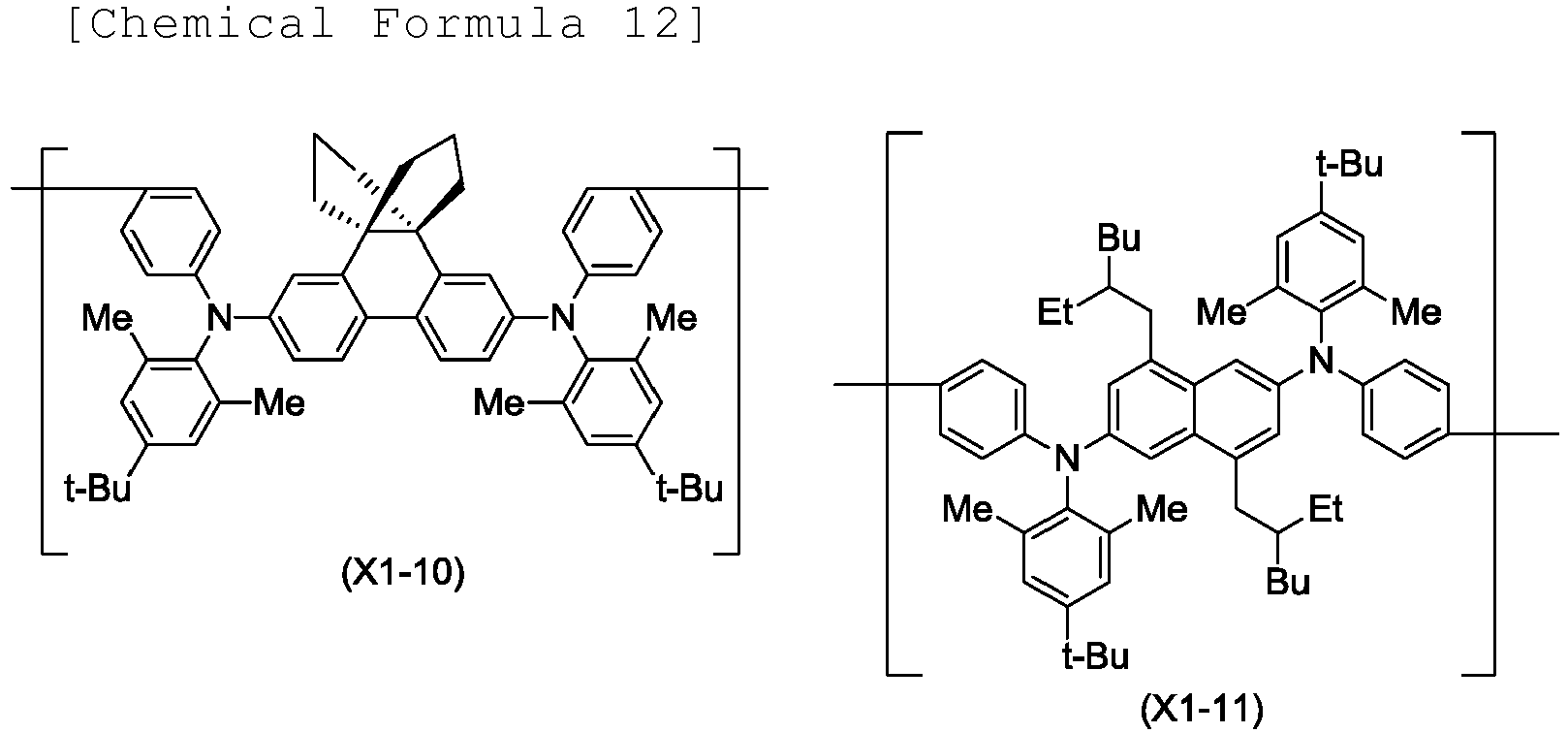
- "Constitutional unit represented by the formula (Y)" is a constitutional unit which a polymer organic compound may contain. When a polymer organic compound contains a constitutional unit represented by the formula (Y), the constitutional unit represented by the formula (Y) may be contained each singly or two or more constitutional units may be contained.
[Chemical Formula 13] -[-ArY1-]- (Y)
[wherein, ArY1 represents an arylene group, a divalent heterocyclic group or a divalent group in which at least one arylene group and at least one divalent heterocyclic group are bonded directly, the foregoing groups each optionally having a substituent.]. - The constitutional unit represented by the formula (Y) includes, for example, constitutional units composed of arylene groups represented by the formulae (Y-101)-(Y-121), constitutional units composed of divalent heterocyclic groups represented by the formulae (Y-201)-(Y-206), and constitutional units composed of divalent groups in which at least one arylene group and at least one divalent heterocyclic group are bonded directly represented by the formulae (Y-301)-(Y-304).


- "Group obtained from an organometallic compound by removing r hydrogen atoms" (r represents an integer of 1 or more.) denotes an atomic group remaining after removing from an organometallic compound r hydrogen atoms among hydrogen atoms bonding to carbon atoms or hetero atoms constituting the organometallic compound.
- The organometallic compound includes, for example, phosphorescent compounds, and preferable are phosphorescent compounds represented by the formula (Z).
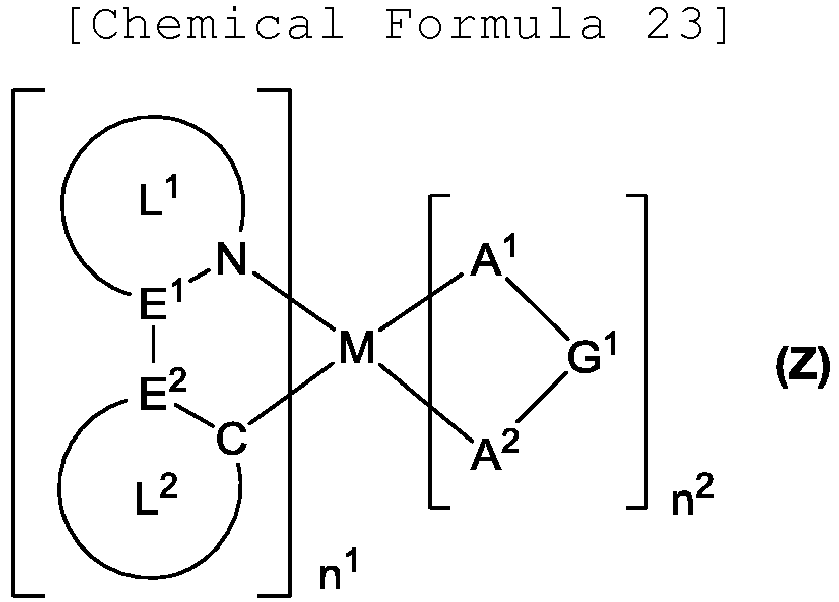
- M represents an iridium atom or a platinum atom.
- n1 represents an integer of 1 or more, and n2 represents an integer of 0 or more. n1+n2 is 3 when M is an iridium atom and n1+n2 is 2 when M is a platinum atom.
- E1 and E2 each independently represent a carbon atom or a nitrogen atom. At least one of E1 and E2 is a carbon atom.
- A ring L1 represents an aromatic heterocyclic ring, the foregoing ring each optionally having a substituent. When a plurality of the substituents are present, they may be the same or different, and may be combined together to form a ring together with atoms to which they are attached. When a plurality of the rings L1 are present, they may be the same or different. When the ring L1 is a 6-membered aromatic heterocyclic ring, E1 is a carbon atom.
- A ring L2 represents an aromatic hydrocarbon ring or an aromatic heterocyclic ring, the foregoing rings each optionally having a substituent. When a plurality of the substituents are present, they may be the same or different, and may be combined together to form a ring together with atoms to which they are attached. When a plurality of the rings L2 are present, they may be the same or different. When the ring L2 is a 6-membered aromatic heterocyclic ring, E2 is a carbon atom.
- A1-G1-A2 represents an anionic bidentate ligand, and A1 and A2 each independently represent a carbon atom, an oxygen atom or a nitrogen atom, and these atoms may be an atom constituting the ring. G1 represents a single bond or an atomic group constituting a bidentate ligand together with A1 and A2. When a plurality of A1-G1-A2 are present, they may be the same or different.].
- The phosphorescent compound represented by the formula (Z) includes, for example, phosphorescent compounds represented by the following formulae.




- The first embodiment of the present invention is a production method of a compound, comprising
- a step of supplying
- a compound (1) having at least one atom or group selected from Group A,
- a compound (2) having at least one group selected from Group B,
- a transition metal catalyst, an organic base, and a compound having two or more hydroxyl groups into a reaction vessel, and
- a step of, in the reaction vessel, reacting the compound (1) with the compound (2) in the presence of the transition metal catalyst, the organic base and the compound having two or more hydroxyl groups.
- The compound (1) is a compound having at least one atom or group selected from Group A. The compound (1) is usually a compound which is dissolvable in an organic solvent.
- The diazonio group in Group A usually forms a salt with HSO4 -, Cl-, Br-, NO3 -, ClO4 -, BF4 - or PF6 -.
- RC1 in the group represented by -O-S(=O)2RC1 in Group A is preferably an alkyl group having a number of carbon atoms of 1 to 20 or an aryl group having a number of carbon atoms of 6 to 20.
- The group represented by -O-S(=O)2RC1 in Group A includes, for example, a mesylate group, a trifluoromethanesulfonate group and a p-toluenesulfonate group, and preferable is a mesylate group or a trifluoromethanesulfonate group.
- The compound (1) is preferably a compound having at least one atom or group selected from the group consisting of a chlorine atom, a bromine atom, a mesylate group and a trifluoromethanesulfonate group, more preferably a compound having at least one atom selected from the group consisting of a chlorine atom and a bromine atom, further preferably a compound having a bromine atom, because the method for producing the present invention (first embodiment) is more excellent in the reaction rate.
- The compound (1) is preferably a compound represented by the formula (11), because of easier availability.
[Chemical Formula 29] R1-(-X1)m1 (11)
(wherein, - m1 represents an integer of 1 to 3.
- R1 represents a group obtained from an organic compound or an organometallic compound by removing m1 hydrogen atom(s).
- X1 represents an atom or a group selected from Group A described above.)
- m1 is preferably 1 or 2.
- X1 is preferably a chlorine atom, a bromine atom, a mesylate group or a trifluoromethanesulfonate group, more preferably a chlorine atom or a bromine atom, further preferably a bromine atom.
- R1 is a group obtained from an organic compound or an organometallic compound by removing m1 hydrogen atom(s). The organic compound may be a low molecular weight organic compound or a polymer organic compound.
- When R1 is a group obtained from a low molecular weight organic compound by removing m1 hydrogen atom(s), the low molecular weight organic compound includes, for example, hydrocarbons, heterocyclic compounds and amines, and preferable are groups obtained from an aromatic hydrocarbon, an aromatic heterocyclic compound or an aromatic amine by removing m1 hydrogen atom(s) attached directly to carbon atoms constituting the ring thereof, because the method for producing the present invention (first embodiment) is more excellent in the reaction rate. The hydrocarbon, the aromatic hydrocarbon, the heterocyclic compound, the aromatic heterocyclic compound, the amine and the aromatic amine optionally have a substituent.
- When R1 is a group obtained from a hydrocarbon by removing m1 hydrogen atom(s), the hydrocarbon has a number of carbon atoms of usually 1 to 60, preferably 6 to 20, more preferably 6 to 14, not including the number of carbon atoms of the substituent.
- When R1 is a group obtained from a heterocyclic compound by removing m1 hydrogen atom(s), the heterocyclic compound has a number of carbon atoms of usually 2 to 60, preferably 4 to 20, more preferably 4 to 10, not including the number of carbon atoms of the substituent.
- When R1 is a group obtained from an amine by removing m1 hydrogen atom(s), the amine has a number of carbon atoms of usually 1 to 60, preferably 6 to 30, more preferably 6 to 18, not including the number of carbon atoms of the substituent.
- When R1 is a group obtained from a polymer organic compound by removing m1 hydrogen atom(s), examples thereof include groups obtained from a polymer organic compound by removing m1 hydrogen atom(s) containing at least one constitutional unit selected from the group consisting of a constitutional unit represented by the formula (X), a constitutional unit represented by the formula (Y) and a constitutional unit obtained from an organometallic compound by removing two hydrogen atoms, and preferable are groups obtained from a polymer organic compound containing at least one constitutional unit selected from the group consisting of a constitutional unit represented by the formula (X) and a constitutional unit represented by the formula (Y) by removing m1 hydrogen atom(s).
- When R1 is a group obtained from an organometallic compound by removing m1 hydrogen atom(s), the organometallic compound has a number of carbon atoms of usually 24 to 120, preferably 24 to 60.
- The compound (1) (m1 is 1) includes, for example, compounds represented by the following formulae.


- The compound (1) (m1 is 1) includes, for example, also compounds represented by the following formulae.


- The compound (1) (m1 is 1) includes, for example, also polymer organic compounds represented by the following formulae. In the polymer organic compound represented by the following formula, n represents the degree of polymerization, and p, q, (100-p) and (100-p-q) represent molar % of respective constitutional units. The polymer organic compound represented by the following formula may be any of a random copolymer, an alternate copolymer and a block copolymer.



- The compound (1) (m1 is 2) includes, for example, compounds represented by the following formulae.


- The compound (1) (m1 is 2) includes, for example, also compounds represented by the following formulae.


- The compound (1) (m1 is 2) includes, for example, also polymer organic compounds represented by the following formulae. In the polymer organic compound represented by the following formula, n represents the degree of polymerization, and p, q, (100-p) and (100-p-q) represent molar % of respective constitutional units. The polymer organic compound represented by the following formula may be any of a random copolymer, an alternate copolymer and a block copolymer.


- The compound (1) (m1 is 3 or more) includes, for example, compounds represented by the following formulae.


- Commercialized products of the compound (1) may be purchased or the compound (1) may be synthesized according to a known method.
- The compound (2) is a compound having at least one group selected from Group B. The compound (2) is usually a compound which is dissolvable in an organic solvent.
- RC2 in the group represented by -B(RC2)2 in Group B is preferably an alkyl group having a number of carbon atoms of 1 to 10.
- The group represented by -B(RC2)2 in Group B includes, for example, groups represented by the formulae (G-1) to (G-5).

- RC2 in the group represented by -B(ORC2)2 in Group B is preferably a hydrogen atom or an alkyl group having a number of carbon atoms of 1 to 10.
- The plurality of RC2 in the group represented by - B(ORC2)2 in Group B may be combined together to form a ring together with a boron atom to which they are attached, however, it is preferable that they are not combined together because the method for producing the present invention (first embodiment) is more excellent in the reaction rate.
- The group represented by -B(ORC2)2 in Group B includes, for example, groups represented by the formulae (F-1) to (F-7), and a group represented by the formula (F-1) is preferable because synthesis of the compound (2) is easier. For compounds having a group represented by the formula (F-1) (three compounds), the groups represented by the formula (F-1) may be combined together to form a group represented by the formula (F-1') (a group composed of a trimer anhydride).

- RC2 in the group represented by -B(ORC2)3T in Group B is preferably an alkyl group having a number of carbon atoms of 1 to 10.
- T in the group represented by -B(ORC2)3T in Group B is preferably a potassium atom.
- The group represented by -B(ORC2)3T in Group B includes, for example, groups represented by following formulae.
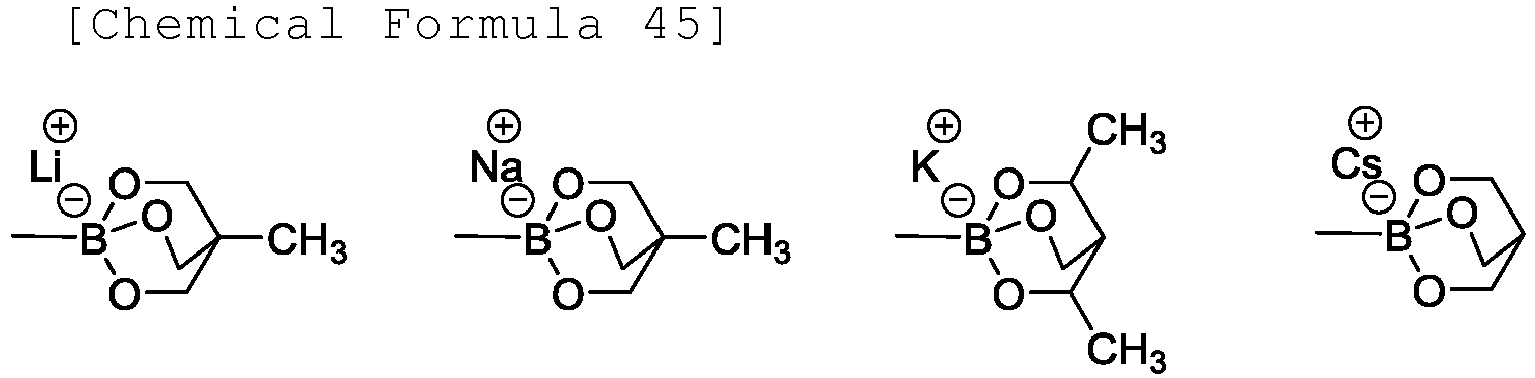
- T in the group represented by -BF3T in Group B is preferably a potassium atom.
- The compound (2) is preferably a compound having a group represented by -B(ORC2)2, more preferably a compound having a group represented by the formula (F-1), because the method for producing the present invention (first embodiment) is more excellent in the reaction rate.
- The compound (2) is preferably a compound represented by the formula (12), because of easier availability.
[Chemical Formula 46] R2-(-X2)m2 (12)
(wherein, - m2 represents an integer of 1 to 3.
- R2 represents a group obtained from an organic compound or an organometallic compound by removing m2 hydrogen atom(s).
- X2 represents a group selected from Group B described above.).
- m2 is preferably 1 or 2.
- X2 is preferably a group represented by -B(ORC2)2, more preferably a group represented by the formula (F-1).
- R2 is a group obtained from an organic compound or an organometallic compound by removing m2 hydrogen atom(s). The organic compound may be a low molecular weight organic compound or a polymer organic compound.
- When R2 is a group obtained from a low molecular weight organic compound by removing m2 hydrogen atom(s), the low molecular weight organic compound includes, for example, hydrocarbons, heterocyclic compounds and amines, and preferable are groups obtained from an aromatic hydrocarbon, an aromatic heterocyclic compound or an aromatic amine by removing m2 hydrogen atom(s) attached directly to carbon atoms constituting the ring thereof, because the method for producing the present invention (first embodiment) is more excellent in the reaction rate. The hydrocarbon, the aromatic hydrocarbon, the heterocyclic compound, the aromatic heterocyclic compound, the amine and the aromatic amine optionally have a substituent.
- When R2 is a group obtained from a hydrocarbon by removing m2 hydrogen atom(s), the hydrocarbon has a number of carbon atoms of usually 1 to 60, preferably 6 to 20, more preferably 6 to 14, not including the number of carbon atoms of the substituent.
- When R2 is a group obtained from a heterocyclic compound by removing m2 hydrogen atom(s), the heterocyclic compound has a number of carbon atoms of usually 2 to 60, preferably 4 to 20, more preferably 4 to 10, not including the number of carbon atoms of the substituent.
- When R2 is a group obtained from an amine by removing m2 hydrogen atom(s), the amine has a number of carbon atoms of usually 1 to 60, preferably 6 to 30, more preferably 6 to 18, not including the number of carbon atoms of the substituent.
- When R2 is a group obtained from a polymer organic compound by removing m2 hydrogen atom(s), examples thereof include groups obtained from a polymer organic compound by removing m2 hydrogen atom(s) containing at least one constitutional unit selected from the group consisting of a constitutional unit represented by the formula (X), a constitutional unit represented by the formula (Y) and a constitutional unit obtained from an organometallic compound by removing two hydrogen atoms, and preferable are groups obtained from a polymer organic compound containing at least one constitutional unit selected from the group consisting of a constitutional unit represented by the formula (X) and a constitutional unit represented by the formula (Y) by removing m2 hydrogen atom(s).
- When R2 is a group obtained from an organometallic compound by removing m2 hydrogen atom(s), the organometallic compound has a number of carbon atoms of usually 24 to 120, preferably 24 to 60.
- The compound (2) (m2 is 1) includes, for example, compounds represented by the following formulae.

- The compound (2) (m2 is 1) includes, for example, also compounds represented by the following formulae.

- The compound (2) (m2 is 1) includes, for example, also polymer organic compounds represented by the following formulae. In the polymer organic compounds represented by the following formulae, n represents the degree of polymerization, and p, q, (100-p) and (100-p-q) represent molar % of respective constitutional units. The polymer organic compound represented by the following formula may be any of a random copolymer, an alternate copolymer and a block copolymer.


- The compound (2) (m2 is 2) includes, for example, compounds represented by the following formulae.


- The compound (2) (m2 is 2) includes, for example, also compounds represented by the following formulae.


- The compound (2) (m2 is 2) includes, for example, also polymer organic compounds represented by the following formulae. In the polymer organic compounds represented by the following formulae, n represents the degree of polymerization, and p, q, (100-p) and (100-p-q) represent molar % of respective constitutional units. The polymer organic compound represented by the following formula may be any of a random copolymer, an alternate copolymer and a block copolymer.


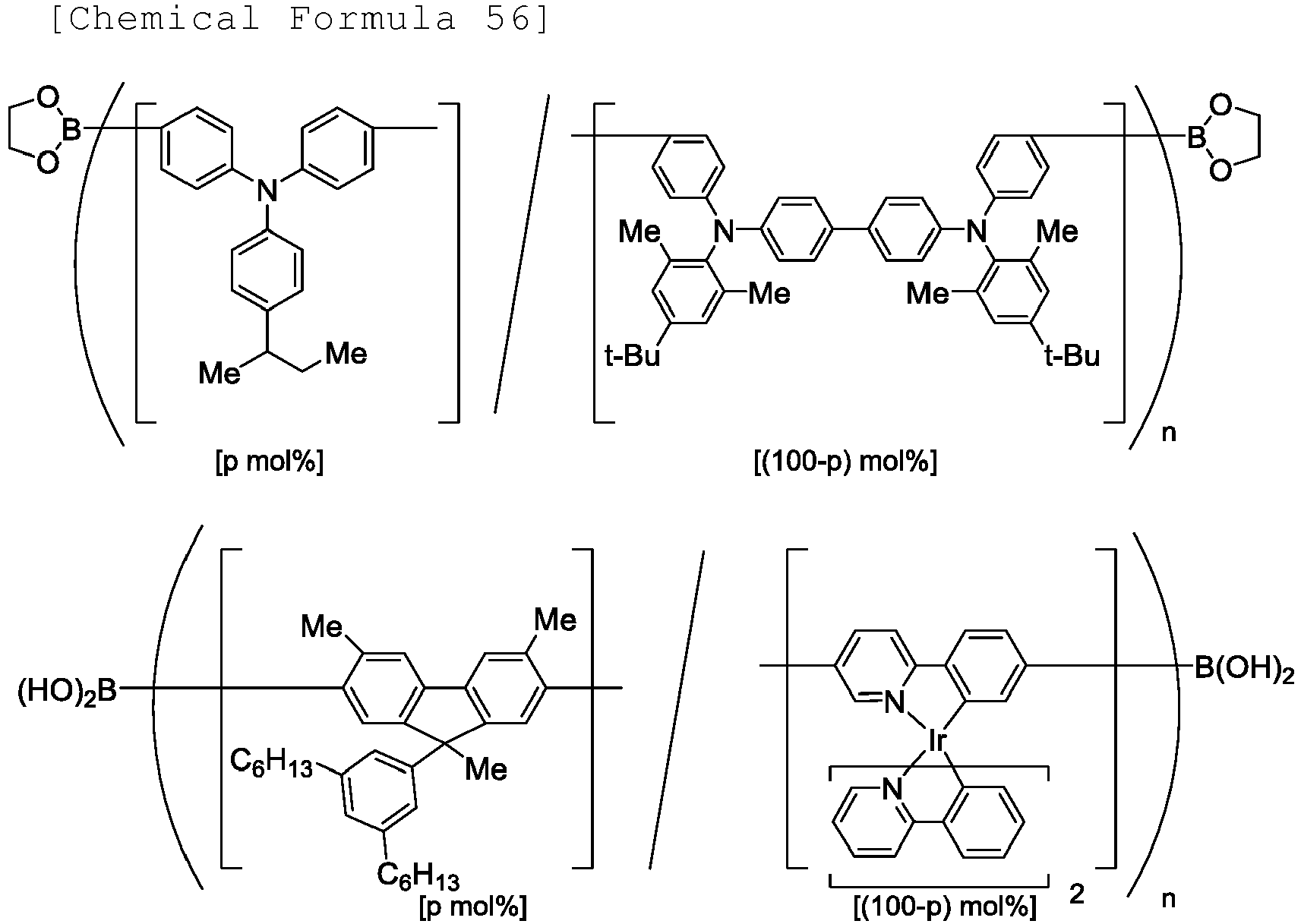


- The compound (2) (m2 is 3 or more) includes, for example, compounds represented by the following formulae.


- Commercialized products of the compound (2) may be purchased or the compound (2) may be synthesized according to a known method.
- The second embodiment of the present invention is a method for producing a compound, comprising
a step of supplying
a compound (3) having at least one atom or group selected from Group A and at least one group selected from Group B,
a transition metal catalyst, an organic base, and a compound having two or more hydroxyl groups into a reaction vessel, and
a step of, in the reaction vessel, reacting the compound (3) with each other in the presence of the transition metal catalyst, the organic base and the compound having two or more hydroxyl groups. - The compound (3) is a compound having at least one atom or group selected from Group A and at least one group selected from Group B. The compound (3) is usually a compound which is dissolvable in an organic solvent.
- Examples and preferable ranges of a diazonio group and a group represented by -O-S(=O)2RC1 in Group A for the compound (3) are the same as examples and preferable ranges of a diazonio group and a group represented by -O-S(=O)2RC1 in Group A for the compound (1).
- Examples and preferable ranges of a group represented by -B(RC2)2, a group represented by-B(ORC2)2, a group represented by -B(ORC2)3T and a group represented by -BF3T in Group B for the compound (3) are the same as examples and preferable ranges of a group represented by -B(RC2)2, a group represented by -B(ORC2)2, a group represented by -B(ORC2)3T and a group represented by -BF3T in Group B for the compound (2).
- The compound (3) is preferably a compound having at least one atom or group selected from the group consisting of a chlorine atom, a bromine atom, a mesylate group and a trifluoromethanesulfonate group and a group represented by -B(ORC2)2, more preferably a compound having at least one atom selected from the group consisting of a chlorine atom and a bromine atom and a group represented by the formula (F-1), further preferably a compound having a bromine atom and a group represented by the formula (F-1), because the method for producing the present invention (second embodiment) is more excellent in the reaction rate.
- The compound (3) is preferably a compound represented by the formula (13), because of easier availability.
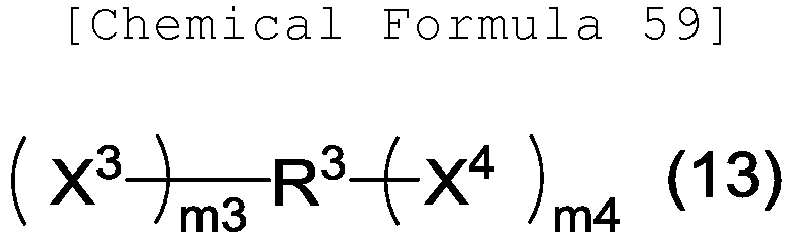
- m3 represents an integer of 1 to 3.
- m4 represents an integer of 1 to 3.
- R3 represents a group obtained from an organic compound or an organometallic compound by removing (m3+m4) hydrogen atom(s).
- X3 represents an atom or a group selected from Group A described above.
- X4 represents a group selected from Group B described above.)
- m3 is preferably 1 or 2.
- m4 is preferably 1 or 2.
- X3 is preferably a chlorine atom, a bromine atom, a mesylate group or a trifluoromethanesulfonate group, more preferably a chlorine atom or a bromine atom, further preferably a bromine atom.
- X4 is preferably a group represented by -B(ORC2)2, more preferably a group represented by the formula (F-1).
- R3 is a group obtained from an organic compound or an organometallic compound by removing (m3+m4) hydrogen atom(s). The organic compound may be a low molecular weight organic compound or a polymer organic compound.
- When R3 is a group obtained from a low molecular weight organic compound by removing (m3+m4) hydrogen atom(s), the low molecular weight organic compound includes, for example, hydrocarbons, heterocyclic compounds and amines, and preferable are groups obtained from an aromatic hydrocarbon, an aromatic heterocyclic compound or an aromatic amine by removing (m3+m4) hydrogen atom(s) attached directly to carbon atoms constituting the ring thereof, because the method for producing the present invention (second embodiment) is more excellent in the reaction rate. The hydrocarbon, the aromatic hydrocarbon, the heterocyclic compound, the aromatic heterocyclic compound, the amine and the aromatic amine optionally have a substituent.
- When R3 is a group obtained from a hydrocarbon by removing (m3+m4) hydrogen atom(s), the hydrocarbon has a number of carbon atoms of usually 1 to 60, preferably 6 to 20, more preferably 6 to 14, not including the number of carbon atoms of the substituent.
- When R3 is a group obtained from a heterocyclic compound by removing (m3+m4) hydrogen atom(s), the heterocyclic compound has a number of carbon atoms of usually 2 to 60, preferably 4 to 20, more preferably 4 to 10, not including the number of carbon atoms of the substituent.
- When R3 is a group obtained from an amine by removing (m3+m4) hydrogen atom(s), the amine has a number of carbon atoms of usually 1 to 60, preferably 6 to 30, more preferably 6 to 18, not including the number of carbon atoms of the substituent.
- When R3 is a group obtained from a polymer organic compound by removing (m3+m4) hydrogen atom(s), examples thereof include groups obtained from a polymer organic compound by removing (m3+m4) hydrogen atom(s) containing at least one constitutional unit selected from the group consisting of a constitutional unit represented by the formula (X), a constitutional unit represented by the formula (Y) and a constitutional unit obtained from an organometallic compound by removing two hydrogen atoms, and preferable are groups obtained by removing (m3+m4) hydrogen atoms from a polymer organic compound containing at least one constitutional unit selected from the group consisting of a constitutional unit represented by the formula (X) and a constitutional unit represented by the formula (Y).
- When R3 is a group obtained from an organometallic compound by removing (m3+m4) hydrogen atom(s), the organometallic compound has a number of carbon atoms of usually 24 to 120, preferably 24 to 60.
- The compound (3) (m3 is 1 and m4 is 1) includes, for example, compounds represented by the following formulae.


- The compound (3) (m3 is 1 and m4 is 1) includes, for example, also compounds represented by the following formulae.


-

-


- Commercialized products of the compound (3) may be purchased or the compound (3) may be synthesized according to a known method.
- The transition metal catalyst is preferably a Group 10 transition metal catalyst. The Group 10 transition metal catalyst includes, for example, a nickel catalyst, a palladium catalyst and a platinum catalyst, and preferable is a palladium catalyst because the methods for producing the present invention (first embodiment and second embodiment) are more excellent in the reaction rate.
- The palladium catalyst includes, for example, palladium complexes such as dichlorobis(triphenylphosphine)palladium, dichlorobis[tris(2-methoxyphenyl)phosphine]palladium, palladium[tetrakis(triphenylphosphine)], [tris(dibenzylideneacetone)]dipalladium, dichlorobis[dicyclopentyl(2-methoxyphenyl)phosphine]palladium, palladium acetate, dichlorobis[dicyclopentyl(2, 6-dimethoxyphenyl)phosphine]palladium, bis[di-tert-butyl(3, 5-di-tert-butylphenyl)phosphine]dichloropalladium or the like, and dichlorobis(triphenylphosphine)palladium or palladium[tetrakis(triphenylphosphine)] is preferable. These palladium complexes may be a complex further having a ligand such as triphenylphosphine, tri(tert-butylphosphine), tricyclohexylphosphine, diphenylphosphinopropane, bipyridyl or the like.
- In the methods for producing the present invention (first embodiment and second embodiment), the transition metal catalyst may be used each singly or two or more transition metal catalysts may be used in combination.
- In the method for producing the present invention (first embodiment), the use amount of the transition metal catalyst is usually 0.00001 to 3 mol with respect to 1 mol of the total use amount of the compound (1) and the compound (2).
- In the method for producing the present invention (second embodiment), the use amount of the transition metal catalyst is usually 0.00001 to 3 mol with respect to 1 mol of the use amount of the compound (3).
- The organic base denotes a strongly basic organic compound, and is preferably an organic compound having a pKa of 11 or more.
- The organic base is preferably an organic base which is dissolvable in water.
- The organic base has a number of carbon atoms of usually 4 to 40, preferably 4 to 15.
- The organic base includes, for example, an ammonium hydroxide compound, an ammonium carbonate compound, an ammonium bicarbonate compound, 1,5-diazabicyclo[4,3,0]non-5-ene (DBN), 1,8-diazabicyclo[5.4.0]undec-7-ene (DBU) and guanidine, and an ammonium hydroxide compound, an ammonium carbonate compound or an ammonium bicarbonate compounds is preferable, an ammonium hydroxide compound is more preferable, because the methods for producing the present invention (first embodiment and second embodiment) are more excellent in the reaction rate.
- The ammonium hydroxide compound, the ammonium carbonate compound and the ammonium bicarbonate compound are preferably quaternary ammonium compounds, because the methods for producing the present invention (first embodiment and second embodiment) are more excellent in the reaction rate.
- The ammonium hydroxide compound includes, for example, (CH3)4NOH (tetramethylammonium hydroxide), (C2H5)4NOH (tetraethylammonium hydroxide), (C3H7)4NOH (tetrapropylammonium hydroxide), (PhCH2)(CH3)3NOH (benzyltrimethylammonium hydroxide), (C4H9)4NOH (tetrabutylammonium hydroxide), (Ph)(CH3)3NOH (phenyltrimethylammonium hydroxide), (C5H11)4NOH (tetrabutylammonium hydroxide), (C16H33)(CH3)3NOH (hexadecyltrimethylammonium hydroxide), (C8H17)3(CH3)NOH (trioctylmethylammonium hydroxide), (C8H17)2(C10H21)(CH3)NOH (dioctyldecylmethylammonium hydroxide), (C8H17)(C10H21)2(CH3)NOH (octyldidecylmethylammonium hydroxide), (C10H21)3(CH3)NOH (tridecylmethylammonium hydroxide), (C8H17)4NOH (tetraoctylammonium hydroxide) and (PhCH2)(C2H5)NOH (benzyltriethylammonium hydroxide).
- The ammonium carbonate compound includes, for example, [(CH3)4N]2CO3 (tetramethylammonium carbonate), [(C2H5)4N]2CO3 (tetraethylammonium carbonate), [(C3H7)4N]2CO3 (tetrapropylammonium carbonate), [(PhCH2)(CH3)3N]2CO3 (benzyltrimethylammonium carbonate), [(C4H9)4N]2CO3 (tetrabutylammonium carbonate) and [(Ph)(CH3)3N]2CO3 (phenyltrimethylammonium hydroxide).
- The ammonium bicarbonate compound includes, for example, (CH3)4NCO3H (tetramethylammonium bicarbonate), (C2H5)4NCO3H (tetraethylammonium bicarbonate), (C3H7)4NCO3H (tetrapropylammonium bicarbonate), (PhCH2)(CH3)3NCO3H (benzyltrimethylammonium bicarbonate), (C4H9)4NCO3H (tetrabutylammonium bicarbonate) and (Ph)(CH3)3NCO3H (phenyltrimethylammonium bicarbonate).
- In the methods for producing the present invention (first embodiment and second embodiment), the organic base may be used each singly or two or more organic bases may be used in combination.
- In the method for producing the present invention (first embodiment), the use amount of the organic base is usually 0.5 to 100 mol, preferably 0.5 to 70 mol, more preferably 0.5 to 40 mol, further preferably 0.9 to 20 mol with respect to 1 mol of the total use amount of the compound (1) and the compound (2).
- In the method for producing the present invention (second embodiment), the use amount of the organic base is usually 0.5 to 100 mol, preferably 0.5 to 70 mol, more preferably 0.5 to 40 mol, further preferably 0.9 to 20 mol with respect to 1 mol of the use amount of the compound (3).
- The compound having two or more hydroxyl groups is usually a compound which is dissolvable in an organic solvent or water.
- The compound having two or more hydroxyl groups is preferably a compound represented by the formula (4), because of easier availability.
[Chemical Formula 65] R4-(-OH)m5 (4)
(wherein, - m5 represents an integer of 2 to 6.
- R4 represents a group obtained from a hydrocarbon or a heterocyclic compound by removing m5 hydrogen atom(s).)
- m5 is preferably 2 or 3.
- The group obtained from a hydrocarbon represented by R by removing m5 hydrogen atom(s) 4 has a number of carbon atoms of usually 1 to 36, preferably 1 to 10, not including the number of carbon atoms of the substituent.
- The group obtained from a heterocyclic compound represented by R4 by removing m5 hydrogen atom(s) has a number of carbon atoms of usually 2 to 60, preferably 4 to 10, not including the number of carbon atoms of the substituent.
- R4 is preferably a group obtained from a hydrocarbon by removing m5 hydrogen atom(s), more preferably a group obtained from an aliphatic hydrocarbon by removing m5 hydrogen atom(s).
- The compound having two or more hydroxyl groups includes, for example, the formula (4-1) to the formula (4-14), and a compound represented by any one of the formula (4-1) to the formula (4-8) is preferable, because the methods for producing the present invention (first embodiment and second embodiment) are more excellent in the reaction rate.

- In the methods for producing the present invention (first embodiment and second embodiment), the compound having two or more hydroxyl groups may be used each singly or two or more compounds may be used in combination.
- In the method for producing the present invention (first embodiment), the use amount of the compound having two or more hydroxyl groups is usually 0.01 to 100 mol, preferably 0.01 to 10 mol, more preferably 0.1 to 1 mol with respect to 1 mol of the total use amount of the compound (1) and the compound (2).
- In the method for producing the present invention (second embodiment), the use amount of the compound having two or more hydroxyl groups is usually 0.01 to 100 mol, preferably 0.01 to 10 mol, more preferably 0.1 to 1 mol with respect to 1 mol of the use amount of the compound (3).
- The methods for producing the present invention (first embodiment and second embodiment) are preferably conducted in the presence of an organic solvent.
- The method for producing the present invention (first embodiment) is preferably a production method of a compound, comprising
a step of supplying
a compound (1) having at least one atom or group selected from Group A,
a compound (2) having at least one group selected from Group B,
a transition metal catalyst, an organic base, a compound having two or more hydroxyl groups and an organic solvent into a reaction vessel, and
a step of, in the reaction vessel, reacting the compound (1) with the compound (2) in the presence of the transition metal catalyst, the organic base, the compound having two or more hydroxyl groups and the organic solvent. - The method for producing the present invention (second embodiment) is preferably a production method of a compound, comprising
a step of supplying
a compound (3) having at least one atom or group selected from Group A and at least one group selected from Group B,
a transition metal catalyst, an organic base, a compound having two or more hydroxyl groups and an organic solvent into a reaction vessel, and
a step of, in the reaction vessel, reacting the compound (3) with each other in the presence of the transition metal catalyst, the organic base, the compound having two or more hydroxyl groups and the organic solvent. - The organic solvent includes, for example, aromatic hydrocarbon solvents such as toluene, xylene, mesitylene or the like; ether solvents such as tetrahydrofuran, 1,4-dioxane, dimethoxyethane or the like; amide solvents such as N,N-dimethylacetamide, N,N-dimethylformamide or the like; alcohol solvents such as methanol, ethanol, isopropyl alcohol, methylcellosolve, butylcellosolve or the like; ketone solvents such as acetone, methyl ethyl ketone, cyclopentanone, cyclohexanone, methyl amyl ketone, methyl isobutyl ketone, N-methyl-2-pyrrolidinone or the like; aliphatic hydrocarbon solvents such as pentane, hexane, heptane or the like; nitrile solvents such as acetonitrile or the like; halogenated hydrocarbon solvents such as chloroform or the like.
- The organic solvent is preferably one which is not mixed with water at any ratio. Specifically, aromatic hydrocarbon solvents or ether solvents are preferable, and toluene, xylene or mesitylene is more preferable.
- In the methods for producing the present invention (first embodiment and second embodiment), the organic solvent may be used each singly or two or more organic solvents may be used in combination.
- In the method for producing the present invention (first embodiment), the use amount of the organic solvent is usually 10 parts by mass to 100000 parts by mass, preferably 1000 parts by mass to 50000 parts by mass, more preferably 2000 parts by mass to 20000 parts by mass with respect to 100 parts by mass of the total use amount of the compound (1) and the compound (2).
- In the method for producing the present invention (second embodiment), the use amount of the organic solvent is usually 10 parts by mass to 100000 parts by mass, preferably 1000 parts by mass to 50000 parts by mass, more preferably 2000 parts by mass to 20000 parts by mass with respect to 100 parts by mass of the use amount of the compound (3).
- In the methods for producing the present invention (first embodiment and second embodiment),
the reaction vessel is not particularly restricted, and examples thereof include a reaction vessel made of glass, a reaction vessel made of stainless steel and a reaction vessel made of a fluorine resin. The shape of the reaction vessel is not particularly restricted, and examples thereof include a spherical reaction vessel and a cylindrical reaction vessel. - In the method for producing the present invention (first embodiment),
the temperature in the supplying step may be the same as or different from the temperature in the step of reacting the compound (1) with the compound (2) described later. - In the method for producing the present invention (first embodiment),
the pressure in the supplying step is usually atmospheric pressure. - In the method for producing the present invention (first embodiment),
the supplying order in the supplying step is not particularly restricted. That is, the compound (1), the compound (2), a transition metal catalyst, an organic base and a compound having two or more hydroxyl groups may be supplied in a mass into a reaction vessel, alternatively, some materials selected from the group consisting of the compound (1), the compound (2), a transition metal catalyst, an organic base and a compound having two or more hydroxyl groups may be supplied into a reaction vessel, then, the remaining materials may be added and mixed while stirring. - In the method for producing the present invention (second embodiment),
the temperature in the supplying step may be the same as or different from the temperature in the step of reacting the compound (3) with each other. - In the method for producing the present invention (second embodiment),
the pressure in the supplying step is usually atmospheric pressure. - In the method for producing the present invention (second embodiment),
the supplying order in the supplying step is not particularly restricted. That is, the compound (3), a transition metal catalyst, an organic base and a compound having two or more hydroxyl groups may be supplied in a mass into a reaction vessel, alternatively, some materials selected from the group consisting of the compound (3), a transition metal catalyst, an organic base and a compound having two or more hydroxyl groups may be supplied into a reaction vessel, then, the remaining materials may be added and mixed while stirring. - In the method for producing the present invention (first embodiment),
the temperature in the step of reacting the compound (1) with the compound (2) in the presence of a transition metal catalyst, an organic base and a compound having two or more hydroxyl groups is usually 0 to 200°C, preferably 20 to 150°C, more preferably 50 to 100°C. - In the method for producing the present invention (first embodiment),
the time of the step of reacting is usually 0.1 to 48 hours, preferably 0.5 to 24 hours, more preferably 0.5 to 8 hours. - In the method for producing the present invention (first embodiment),
the pressure in the step of reacting is usually atmospheric pressure. - In the method for producing the present invention (second embodiment),
the temperature in the step of reacting the compound (3) with each other in the presence of a transition metal catalyst, an organic base and a compound having two or more hydroxyl groups is usually 0 to 200°C, preferably 20 to 150°C, more preferably 50 to 100°C. - In the method for producing the present invention (second embodiment),
the time of the step of reacting is usually 0.1 to 48 hours, preferably 0.5 to 24 hours, more preferably 0.5 to 8 hours. - In the method for producing the present invention (second embodiment),
the pressure in the step of reacting is usually atmospheric pressure. - In the method for producing the present invention (first embodiment),
the use amount of the compound (1) is usually 0.1 to 10 mol, preferably 0.2 to 5 mol, more preferably 0.5 to 2 mol with respect to 1 mol of the use amount the compound (2). - In the method for producing the present invention (first embodiment),
the compound (1) may be used each singly or two or more compounds (1) may be used in combination. The compound (2) may be used each singly or two or more compounds (2) may be used in combination. - In the method for producing the present invention (second embodiment),
- The compound (3) may be used each singly or two or more compounds (3) may be used in combination.
- In the method for producing the present invention (first embodiment),
at least one atom or group selected from Group A which the compound (1) has and at least one group selected from Group B which the compound (2) has conduct a coupling reaction. As a result, a reaction product in which an atom to which at least one atom or group selected from Group A is bonded in the compound (1) and an atom to which at least one group selected from Group B is bonded in the compound (2) are bonded is obtained. The reaction product may be a low molecular weight organic compound or a polymer organic compound. - In the method for producing the present invention (second embodiment),
at least one atom or group selected from Group A which the compound (3) has and at least one group selected from Group B which the compound (3) has conduct a coupling reaction. As a result, a reaction product in which an atom to which at least one atom or group selected from Group A is bonded in the compound (3) and an atom to which at least one group selected from Group B is bonded in another compound (3) are bonded is obtained. The reaction product is usually a polymer organic compound. - In the method for producing the present invention (first embodiment),
a compound (m1 is 1) represented by the formula (11) and a compound (m2 is 1) represented by the formula (12) are reacted, to obtain a reaction product represented by the formula (21).
R1-R2 (21)
- In the method for producing the present invention (first embodiment),
a compound (m1 is 2) represented by the formula (11) and a compound (m2 is 1) represented by the formula (12) are reacted, to obtain a reaction product represented by the formula (22) and a reaction product represented by the formula (23).
X1-R1-R2 (22)
R2-R1-R2 (23)
- In the method for producing the present invention (first embodiment),
a compound (m1 is 1) represented by the formula (11) and a compound (m2 is 2) represented by the formula (12) are reacted, to obtain a reaction product represented by the formula (24) and a reaction product represented by the formula (25).
R1-R2-X2 (24)
R1-R2-R1 (25)
- In the method for producing the present invention (first embodiment),
a compound (m1 is 2) represented by the formula (11) and a compound (m2 is 2) represented by the formula (12) are reacted, to obtain a reaction product containing a constitutional unit represented by the formula (26). The reaction product containing a constitutional unit represented by the formula (26) is usually a polymer organic compound. By adjusting the use amounts of a compound (m1 is 2) represented by the formula (11) and a compound (m2 is 2) represented by the formula (12), the polystyrene-equivalent number average molecular weight and weight average molecular weight of the reaction product (polymer organic compound) containing a constitutional unit represented by the formula (26) can be controlled.
[Chemical Formula 67] -(-R1-R2-)-n- (26)
(wherein, n represents the degree of polymerization.) - In the method for producing the present invention (second embodiment),
compounds (m3 is 1, m4 is 1) represented by the formula (13) with each other are reacted, to obtain a reaction product containing a constitutional unit represented by the formula (27). The reaction product containing a constitutional unit represented by the formula (27) is usually a polymer organic compound.
[Chemical Formula 68] -(-R3-R3-)-n- (27)
(wherein, n represents the degree of polymerization.) - The reaction product represented by (21) includes, for example, compounds represented by the following formulae.


- The reaction product represented by (21) includes, for example, also polymer organic compounds represented by the following formulae. In the polymer organic compounds represented by the following formulae, n represents the degree of polymerization, and p and (100-p) represent molar % of respective constitutional units. The polymer organic compound represented by the following formula may be any of a random copolymer, an alternate copolymer and a block copolymer.

- The reaction product represented by the formula (22) includes, for example, compounds represented by the following formulae.

- The reaction product represented by (23) includes, for example, compounds represented by the following formulae.


- The reaction product represented by (23) includes, for example, also polymer organic compounds represented by the following formulae. In the polymer organic compounds represented by the following formulae, n represents the degree of polymerization, and p and (100-p) represent molar % of respective constitutional units. The polymer organic compound represented by the following formula may be any of a random copolymer, an alternate copolymer and a block copolymer.

- The reaction product represented by (24) includes, for example, compounds represented by the following formulae.

- The reaction product represented by (25) includes, for example, compounds represented by the following formulae.


- The reaction product represented by (25) includes, for example, polymer organic compounds represented by the following formulae. In the polymer organic compounds represented by the following formulae, n represents the degree of polymerization, and p and (100-p) represent molar % of respective constitutional units. The polymer organic compound represented by the following formula may be any of a random copolymer, an alternate copolymer and a block copolymer.

- The reaction product containing a constitutional unit represented by (26) (polymer organic compound) includes, for example, compounds represented by the following formulae. In the reaction products represented by the following formulae (polymer organic compound), n represents the degree of polymerization.


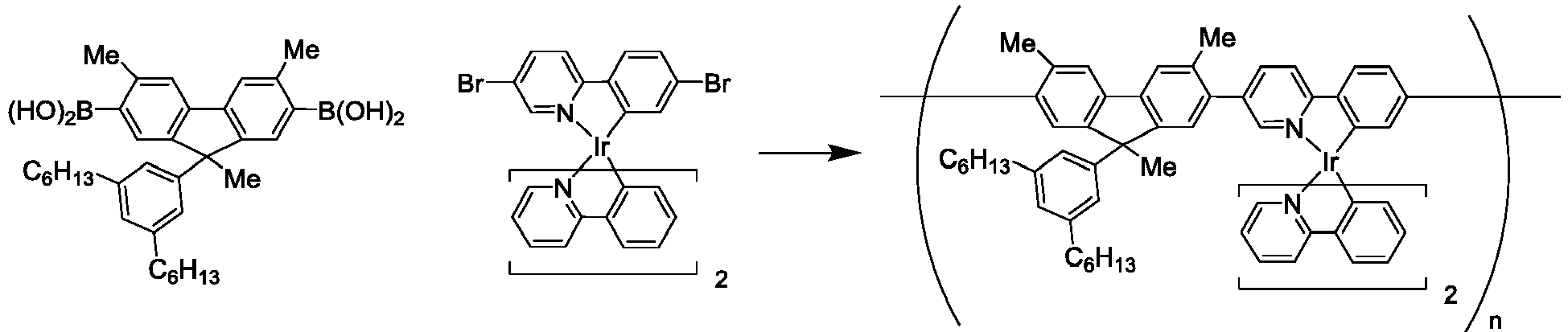
- The reaction product containing a constitutional unit represented by (27) (polymer organic compound) includes, for example, compounds represented by the following formulae. In the reaction products represented by the following formulae (polymer organic compound), n represents the degree of polymerization.


- After reaction of the compound (1) with the compound (2) and after reaction of the compound (3) with each other, the desired compound can be taken out by known methods such as a method for mixing a reaction mixture and water, separating the mixture, then, concentrating the liquid to dryness, a method for mixing a reaction mixture and a lower alcohol (methanol or the like), isolating the deposited precipitate by filtration, then, drying the precipitate, or the like, in the methods for producing the present invention (first embodiment and second embodiment). The compound taken out can be purified by known methods such as, for example, recrystallization, reprecipitation, continuous extraction with a Soxhlet extractor, column chromatography, sublimation purification or the like.
- The present invention will be illustrated further in detail by examples below, but the present invention is not limited to these examples.
-
- Measurement Apparatus: CBM-20A (manufactured by Shimadzu Corp.)
- Column: L-Column2 ODS (3 µm, 4.6 mmϕ × 25 cm)
- Mobile phase A: acetonitrile
- Mobile phase B: THF
- Mobile phase C: pure water
- Gradient: 0.01 minute A = 60%, B = 0%, C = 40%
- 10 minutes A = 60%, B = 0%, C = 40%
- 20 minutes A = 100%, B = 0%, C = 0%
- 100 minutes A = 100%, B = 0%, C = 0%
- 120 minutes A = 0%, B = 100%, C = 0%
- 130 minutes A = 0%, B = 100%, C = 0% Flow rate: 1.0 mL/min
- Detection wavelength: 280 nm
-
- Measurement Apparatus: HLC-822GPC (manufactured by Tosoh Corporation)
- Column: PLgel 10µm MIXED-B (manufactured by Tosoh Corporation)
- Column temperature: 40°C
- Mobile phase: tetrahydrofuran
- Flow rate: 1.5 mL/min
- Detection wavelength: 228 nm
-
- GC Measurement Apparatus: GC-2010 (manufactured by Shimadzu Corp.)
- Column: J&W DB-1 (0.25 mmϕ × 30 m, 1.0 µm)
- Column temperature: 40°C (10 minutes) → (10°C/min) → 300°C (20 minutes)
- Analysis time (total): 56 minutes
- Injection port temperature: 250°C, detector
- temperature: 250°C (FID)
- Carrier gas: helium gas (flow speed: about 2.6 mL/min)
- Injection port pressure: 85.3 kPa (control mode: pressure)
- Split ratio: total flow rate 43.1 mL/min (split ratio: about 1/15)
- Injection amount: 1 µL
- Oxygen combustion-ion chromatograph analysis was performed using ICS-2100 (manufactured by Nippon Dionex K.K.).
-

- The compound (1-1) was synthesized according to a method described in International Publication
WO2002/045184 . - As the compound (2-1), 4-biphenylboronic acid manufactured by Tokyo Chemical Industry Co., Ltd. was used.
- A nitrogen gas atmosphere was prepared in a reaction vessel, then, the compound (1-1) (1.93 g), the compound (2-1) (2.43 g), phenanthrene (0.316 g) (internal standard substance), dichlorobis[tris(2-methoxyphenyl)phosphine]palladium (1.19 mg) and toluene (100 g) were added, and the mixture was heated at 86°C. Thereafter, to this was added a 20% tetraethylammonium hydroxide aqueous solution (15 g), and the mixture was stirred at 86°C for 2 hours. The resultant reaction mixture was analyzed by LC, to find that the yield based on the internal standard of the compound (5-1) as the target was 71%. The result is shown in Table 1.
- The above-described reaction mixture was stirred at 86°C for further 1 hour. The resultant reaction mixture was analyzed by LC, to find that the yield based on the internal standard of the compound (5-1) as the target was 99%.
- The compound (1-1) was synthesized according to a method described in International Publication
WO2002/045184 . - As the compound (2-1), 4-biphenylboronic acid manufactured by Tokyo Chemical Industry Co., Ltd. was used.
- A nitrogen gas atmosphere was prepared in a reaction vessel, then, the compound (1-1) (1.93 g), the compound (2-1) (2.43 g), phenanthrene (0.316 g) (internal standard substance), dichlorobis[tris(2-methoxyphenyl)phosphine]palladium (1.18 mg), toluene (100 g) and pinacol (0.26 g) were added, and the mixture was heated at 86°C. Thereafter, to this was added a 20% tetraethylammonium hydroxide aqueous solution (15 g), and the mixture was stirred at 86°C for 2 hours. The resultant reaction mixture was analyzed by LC, to find that the yield based on the internal standard of the compound (5-1) as the target was 99%. The result is shown in Table 1.
[Table 1] compound having two or more hydroxyl groups reaction time yield of compound (5-1) Comparative Example 1 none 2 hours 71% Example 1 pinacol 2 hours 99% - A comparison of the yield of the compound (5-1) in Comparative Example 1 with the yield of the compound (5-1) in Example 1 denoted that the method for producing the present invention is excellent in the reaction rate.
-

- The compound (1-2) was synthesized according to a method described in International Publication
WO2002/045184 . - The compound (2-2) was synthesized according to a method described in
US Patent No. 6169163 . - A nitrogen gas atmosphere was prepared in a reaction vessel, then, the compound (1-2) (7.22 g), the compound (2-2) (9.90 g), dichlorobis[tris(2-methoxyphenyl)phosphine]palladium (4.15 mg) and toluene (131 g) were added, and the mixture was heated at 86°C. Thereafter, to this were added a 10% tetramethylammonium hydroxide aqueous solution (108 g) and tetrabutylammonium bromide (0.51 g), and the mixture was stirred at 86°C for 2 hours. The resultant reaction mixture was cooled down to room temperature, then, toluene (1096 g) was added for dilution and the liquid was separated, and water (324 g) was added and the liquid was separated. The resultant toluene layer was dropped into methanol (6853 g), then, the mixture was stirred for 1 hour, to observe a solid. The resultant solid was isolated by filtration, and dried, to obtain a polymer organic compound P-1 (10.2 g).
- The polymer organic compound P-1 was analyzed by GPC, to find that the polymer organic compound P-1 had a polystyrene-equivalent number average molecular weight (Mn) of 3.5×10⁴ and a polystyrene-equivalent weight average molecular weight (Mw) of 1.05×10⁵.
- The polymer organic compound P-1 was analyzed by oxygen combustion-ion chromatograph, to find that the polymer organic compound P-1 had a bromine atom content of 3700 ppm by mass. The result is shown in Table 2.
- A nitrogen gas atmosphere was prepared in a reaction vessel, then, the polymer organic compound P-1 (406 mg), phenylboronic acid (7.35 mg), dichlorobis[tris(2-methoxyphenyl)phosphine]palladium (0.17 mg), tetrabutylammonium bromide (19.3 mg) and toluene (5.30 g) were added, and the mixture was heated at 80°C. Thereafter, to this was added a 10% tetramethylammonium hydroxide aqueous solution (4.25 g), and the mixture was stirred at 80°C for 1 hour. The resultant reaction mixture was cooled down to room temperature, then, toluene (20 g) was added for dilution and the liquid was separated, and water (12 g) was added and the liquid was separated. The resultant toluene layer was dropped into methanol (169 g), then, the mixture was stirred for 1 hour, to observe a solid. The resultant solid was isolated by filtration, and dried, to obtain a polymer organic compound P-2 (362 mg).
- The polymer organic compound P-2 was analyzed by oxygen combustion-ion chromatograph, to find that the polymer organic compound P-2 had a bromine atom content of 3500 ppm by mass. The result is shown in Table 2.
- A nitrogen gas atmosphere was prepared in a reaction vessel, then, the polymer organic compound P-1 (407 mg), phenylboronic acid (7.37 mg), dichlorobis[tris(2-methoxyphenyl)phosphine]palladium (0.17 mg), tetrabutylammonium bromide (19.3 mg), toluene (5.30 g) and pinacol (14.0 mg) were added, and the mixture was heated at 80°C. Thereafter, to this was added a 10% tetramethylammonium hydroxide aqueous solution (4.25 g), and the mixture was stirred at 80°C for 1 hour. The resultant reaction mixture was cooled down to room temperature, then, toluene (20 g) was added for dilution and the liquid was separated, and water (12 g) was added and the liquid was separated. The resultant toluene layer was dropped into methanol (169 g), then, the mixture was stirred for 1 hour, to observe a solid. The resultant solid was isolated by filtration, and dried, to obtain a polymer organic compound P-3 (353 mg).
- The polymer organic compound P-3 was analyzed by oxygen combustion-ion chromatograph, to find that the polymer organic compound P-3 had a bromine atom content of 1300 ppm by mass. The result is shown in Table 2.
- A nitrogen gas atmosphere was prepared in a reaction vessel, then, the polymer organic compound P-1 (408 mg), phenylboronic acid (7.35 mg), dichlorobis[tris(2-methoxyphenyl)phosphine]palladium (0.16 mg), tetrabutylammonium bromide (19.4 mg), toluene (5.30 g) and trimethylolethane (14.4 mg) were added, and the mixture was heated at 80°C. Thereafter, to this was added a 10% tetramethylammonium hydroxide aqueous solution (4.25 g), and the mixture was stirred at 80°C for 1 hour. The resultant reaction mixture was cooled down to room temperature, then, toluene (20 g) was added for dilution and the liquid was separated, and water (12 g) was added and the liquid was separated. The resultant toluene layer was dropped into methanol (169 g), then, the mixture was stirred for 1 hour, to observe a solid. The resultant solid was isolated by filtration, and dried, to obtain a polymer organic compound P-4 (375 mg).
- The polymer organic compound P-4 was analyzed by oxygen combustion-ion chromatograph, to find that the polymer organic compound P-4 had a bromine atom content of 2400 ppm by mass. The result is shown in Table 2.
[Table 2] polymer organic compound compound having two or more hydroxyl groups reaction time bromine atom content Synthesis Example 1 P-1 - - 3700 ppm by mass Comparative Example 2 P-2 none 1 hour 3500 ppm by mass Example 2 P-3 pinacol 1 hour 1300 ppm by mass Example 3 P-4 trimethylolethane 1 hour 2400 ppm by mass - A comparison of the bromine atom content of the polymer organic compound P-2 in Comparative Example 2 with the bromine atom content of the polymer organic compound P-3 in Example 2 and the bromine atom content of the polymer organic compound P-4 in Example 3 denoted that the method for producing the present invention is excellent in the reaction rate.
-

- The compound (1-2) was synthesized according to a method described in International Publication
WO2002/045184 . - The compound (2-2) was synthesized according to a method described in "Chem. Eur. J. 2006, 12, 4351".
- A nitrogen gas atmosphere was prepared in a reaction vessel, then, the compound (1-2) (2.01 g), the compound (2-2) (2.05 g), dichlorobis[tris(2-methoxyphenyl)phosphine]palladium (1.16 mg) and toluene (36 g) were added, and the mixture was heated at 86°C. Thereafter, to this were added a 10% tetramethylammonium hydroxide aqueous solution (30 g) and tetrabutylammonium bromide (0.14 g), and the mixture was stirred at 86°C for 1 hour.
- The resultant reaction mixture was analyzed by GPC, to find that the polymer organic compound P-5 had a polystyrene-equivalent number average molecular weight (Mn) of 8.8×10² and a polystyrene-equivalent weight average molecular weight (Mw) of 3.0×10³. The result is shown in Table 3.
- The compound (1-2) was synthesized according to a method described in International Publication
WO2002/041584 . - The compound (2-2) was synthesized according to a method described in "Chem. Eur. J. 2006, 12, 4351".
- A nitrogen gas atmosphere was prepared in a reaction vessel, then, the compound (1-2) (2.01 g), the compound (2-2) (2.05 g), dichlorobis[tris(2-methoxyphenyl)phosphine]palladium (1.16 mg), toluene (36 g) and pinacol (2.08 g) were added, and the mixture was heated at 86°C. Thereafter, to this were added a 10% tetramethylammonium hydroxide aqueous solution (30 g) and tetrabutylammonium bromide (0.14 g), and the mixture was stirred at 86°C for 1 hour.
- The resultant reaction mixture was analyzed by GPC, to find that the polymer organic compound P-6 had a polystyrene-equivalent number average molecular weight (Mn) of 2.1×10⁴ and a polystyrene-equivalent weight average molecular weight (Mw) of 6.2×10⁴. The result is shown in Table 3.
- The compound (1-2) was synthesized according to a method described in International Publication
WO2002/041584 . - The compound (2-2) was synthesized according to a method described in "Chem. Eur. J. 2006, 12, 4351".
- A nitrogen gas atmosphere was prepared in a reaction vessel, then, the compound (1-2) (2.01 g), the compound (2-2) (2.05 g), dichlorobis[tris(2-methoxyphenyl)phosphine]palladium (1.15 mg), toluene (36 g) and trimethylolethane (2.12 g) were added, and the mixture was heated at 86°C. Thereafter, to this were added a 10% tetramethylammonium hydroxide aqueous solution (30 g) and tetrabutylammonium bromide (0.14 g), and the mixture was stirred at 86°C for 1 hour.
- The resultant reaction mixture was analyzed by GPC, to find that the polymer organic compound P-7 had a polystyrene-equivalent number average molecular weight (Mn) of 3.3×10⁴ and a polystyrene-equivalent weight average molecular weight (Mw) of 1.0×10⁵. The result is shown in Table 3.
- The compound (1-2) was synthesized according to a method described in International Publication
WO2002/041584 . - The compound (2-2) was synthesized according to a method described in "Chem. Eur. J. 2006, 12, 4351".
- A nitrogen gas atmosphere was prepared in a reaction vessel, then, the compound (1-2) (2.01 g), the compound (2-2) (2.05 g), dichlorobis[tris(2-methoxyphenyl)phosphine]palladium (1.15 mg), toluene (36 g) and catechol (1.94 g) were added, and the mixture was heated at 86°C. Thereafter, to this were added a 10% tetramethylammonium hydroxide aqueous solution (30 g) and tetrabutylammonium bromide (0.14 g), and the mixture was stirred at 86°C for 1 hour.
- The resultant reaction mixture was analyzed by GPC, to find that the polymer organic compound P-8 had a polystyrene-equivalent number average molecular weight (Mn) of 2.0×10³ and a polystyrene-equivalent weight average molecular weight (Mw) of 1.8×10⁴. The result is shown in Table 3.
[Table 3] polymer organic compound compound having two or more hydroxyl groups reaction time Mn Mw Comparative Example 3 P-5 none 1 hour 8.8 ×10² 3.0 ×10³ Example 4 P-6 pinacol 1 hour 2.1 ×10⁴ 6.2 ×10⁴ Example 5 P-7 trimethylolethane 1 hour 3.3 ×10⁴ 1.0 ×10⁵ Example 6 P-8 catechol 1 hour 2.0 ×10³ 1.8 ×10⁴ - A comparison of Mn and Mw of the polymer organic compound P-5 in Comparative Example 3 with Mn and Mw of the polymer organic compound P-6 in Example 4, Mn and Mw of the polymer organic compound P-7 in Example 5 and Mn and Mw of the polymer organic compound P-8 in Example 6 denoted that the method for producing the present invention is excellent in the reaction rate.
-

- As the compound (1-3), phenylboric acid manufactured by Boron Molecular was used.
- As the compound (2-3), 4-bromoanisole manufactured by Tokyo Chemical Industry Co., Ltd. was used.
- A nitrogen gas atmosphere was prepared in a reaction vessel, then, the compound (1-3) (141 mg), the compound (2-3) (207 mg), phenanthrene (157 mg) (internal standard substance), dichlorobis[tris(2-methoxyphenyl)phosphine]palladium (2.94 mg) and toluene (4.45 g) were added, and the mixture was heated at 86°C. Thereafter, to this was added a 20% tetraethylammonium hydroxide aqueous solution (3.81 g), and the mixture was stirred at 86°C for 1 hour. The resultant reaction mixture was analyzed by GC, to find that the yield based on the internal standard of the compound (5-2) as the target was 19%. The result is shown in Table 4.
- The above-described reaction mixture was stirred at 86°C for further 3 hours. The resultant reaction mixture was analyzed by GC, to find that the yield based on the internal standard of the compound (5-2) as the target was 34%.
- As the compound (1-3), phenylboric acid manufactured by Boron Molecular was used.
- As the compound (2-3), 4-bromoanisole manufactured by Tokyo Chemical Industry Co., Ltd. was used.
- A nitrogen gas atmosphere was prepared in a reaction vessel, then, the compound (1-3) (141 mg), the compound (2-3) (205 mg), phenanthrene (157 mg) (internal standard substance), dichlorobis[tris(2-methoxyphenyl)phosphine]palladium (2.94 mg), toluene (4.45 g) and pinacol (68.2 mg) were added, and the mixture was heated at 86°C. Thereafter, to this was added a 14% sodium carbonate aqueous solution (3.81 g), and the mixture was stirred at 86°C for 1 hour. The resultant reaction mixture was analyzed by GC, to find that the yield based on the internal standard of the compound (5-2) as the target was 70%. The result is shown in Table 4.
- The above-described reaction mixture was stirred at 86°C for further 3 hours. The resultant reaction mixture was analyzed by GC, to find that the yield based on the internal standard of the compound (5-2) as the target was 90%.
- As the compound (1-3), phenylboric acid manufactured by Boron Molecular was used.
- As the compound (2-3), 4-bromoanisole manufactured by Tokyo Chemical Industry Co., Ltd. was used.
- A nitrogen gas atmosphere was prepared in a reaction vessel, then, the compound (1-3) (141 mg), the compound (2-3) (206 mg), phenanthrene (157 mg) (internal standard substance), dichlorobis[tris(2-methoxyphenyl)phosphine]palladium (2.94 mg), toluene (4.45 g) and pinacol (69.8 mg) were added, and the mixture was heated at 86°C. Thereafter, to this was added a 20% tetraethylammonium hydroxide aqueous solution (3.81 g), and the mixture was stirred at 86°C for 1 hour. The resultant reaction mixture was analyzed by GC, to find that the yield based on the internal standard of the compound (5-2) as the target was 97%. The result is shown in Table 4.
[Table 4] compound having two or more hydroxyl groups base reaction time yield of compound (5-2) Comparative Example 4 none 20% tetraethylammonium hydroxide aqueous solution 1 hour 19% Comparative Example 5 pinacol 14% sodium carbonate aqueous solution 1 hour 70% Example 7 pinacol 20% tetraethylammonium hydroxide aqueous solution 1 hour 97% - A comparison of the yield of the compound (5-2) in Comparative Example 5 and the yield of the compound (5-2) in Comparative Example 6 with the yield of the compound (5-2) in Example 7 denoted that the method for producing the present invention is excellent in the reaction rate.
Claims (14)
- A method for producing a compound, comprising:a step of supplyinga compound (1) having at least one atom or group selected from Group A,a compound (2) having at least one group selected from Group B,a transition metal catalyst, an organic base and a compound having two or more hydroxyl groups into a reaction vessel, anda step of, in the reaction vessel, reacting the compound (1) with the compound (2) in the presence of the transition metal catalyst, the organic base and the compound having two or more hydroxyl groups,<Group A>
a chlorine atom, a bromine atom, an iodine atom, a diazonio group and a group represented by -O-S(=O)2RC1, wherein RC1 represents an alkyl group, a cycloalkyl group or an aryl group, the foregoing groups each optionally having a substituent,
<Group B>
a group represented by -B(RC2)2, a group represented by -B(ORC2)2, a group represented by -B(ORC2)3T and a group represented by -BF3T, wherein RC2 represents a hydrogen atom, an alkyl group, a cycloalkyl group or an aryl group, the foregoing groups each optionally having a substituent, and the plurality of RC2 may be the same or different and may be combined together to form a ring together with a boron atom or an oxygen atom to which they are attached, and
T represents a lithium atom, a sodium atom, a potassium atom, a rubidium atom or a cesium atom. - The method for producing a compound according to claim 1, wherein the compound (1) is a compound represented by the formula (11) and the compound (2) is a compound represented by the formula (12):
[Chemical Formula 1] R1-(-X1)m1 (11)
whereinm1 represents an integer of 1 to 3,R1 represents a group obtained from an organic compound or an organometallic compound by removing m1 hydrogen atom(s),X1 represents an atom or a group selected from Group A,[Chemical Formula 2] R2-(-X2)m2 (12)
whereinm2 represents an integer of 1 to 3,R2 represents a group obtained from an organic compound or an organometallic compound by removing m2 hydrogen atom(s),X2 represents a group selected from Group B. - The method for producing a compound according to claim 2, wherein R1 is a group obtained from an aromatic hydrocarbon, an aromatic heterocyclic compound or an aromatic amine by removing m1 hydrogen atom(s) attached directly to carbon atoms constituting the ring thereof and R2 is a group obtained from an aromatic hydrocarbon, an aromatic heterocyclic compound or an aromatic amine by removing m2 hydrogen atom(s) attached directly to carbon atoms constituting the ring thereof.
- The method for producing a compound according to claim 2, wherein R1 is a group obtained from a polymer organic compound by removing m1 hydrogen atom(s) and R2 is a group obtained from an aromatic hydrocarbon, an aromatic heterocyclic compound or an aromatic amine by removing m2 hydrogen atom(s) attached directly to carbon atoms constituting the ring thereof.
- The method for producing a compound according to claim 2, wherein R1 is a group obtained from an aromatic hydrocarbon, an aromatic heterocyclic compound or an aromatic amine by removing m1 hydrogen atom(s) attached directly to carbon atoms constituting the ring thereof and R2 is a group obtained from a polymer organic compound by removing m2 hydrogen atom(s).
- A method for producing a compound, comprising:a step of supplyinga compound (3) having at least one atom or group selected from Group A and at least one group selected from Group B,a transition metal catalyst, an organic base and a compound having two or more hydroxyl groups into a reaction vessel, anda step of, in the reaction vessel, reacting the compound (3) with each other in the presence of the transition metal catalyst, the organic base and the compound having two or more hydroxyl groups,
<Group A>a chlorine atom, a bromine atom, an iodine atom, a diazonio group and a group represented by -O-S(=O)2RC1, wherein RC1 represents an alkyl group, a cycloalkyl group or an aryl group, the foregoing groups each optionally having a substituent,
<Group B>a group represented by -B(RC2)2, a group represented by -B(ORC2)2, a group represented by -B(ORC2)3T and a group represented by -BF3T, wherein RC2 represents a hydrogen atom, an alkyl group, a cycloalkyl group or an aryl group, the foregoing groups each optionally having a substituent, and the plurality of RC2 may be the same or different and may be combined together to form a ring together with a boron atom or an oxygen atom to which they are attached, andT represents a lithium atom, a sodium atom, a potassium atom, a rubidium atom or a cesium atom. - The method for producing a compound according to claim 6, wherein the compound (3) is a compound represented by the formula (13):
 m3 represents an integer of 1 to 3,m4 represents an integer of 1 to 3,R3 represents a group obtained from an organic compound or an organometallic compound by removing (m3+m4) hydrogen atom(s),X3 represents an atom or a group selected from Group A, andX4 represents a group selected from Group B.
 - The method for producing a compound according to any one of claims 1 to 7, wherein the at least one atom or group selected from Group A is a chlorine atom, a bromine atom, a mesylate group or a trifluoromethanesulfonate group.
- The method for producing a compound according to any one of claims 1 to 8, wherein the at least one group selected from Group B is a group represented by -B(OH)2.
- The method for producing a compound according to any one of claims 1 to 9, wherein the organic base is an ammonium hydroxide compound, an ammonium carbonate compound or an ammonium bicarbonate compound.
- The method for producing a compound according to any one of claims 1 to 11, wherein the compound having two or more hydroxyl groups is a compound represented by the formula (4):
[Chemical Formula 4] R4-(-OH)m5 (4)
whereinm5 represents an integer of 2 to 6, andR4 represents a group obtained from a hydrocarbon or a heterocyclic compound by removing m5 hydrogen atom(s). - The method for producing a compound according to claim 11, wherein R4 is a group obtained from a hydrocarbon by removing m5 hydrogen atom(s).
- The method for producing a compound according to claim 12, wherein the compound represented by the formula (4) is a compound represented by any one of the formula (4-1) to the formula (4-8).

- The method for producing a compound according to any one of claims 1 to 13, wherein the transition metal catalyst is a palladium catalyst.
Applications Claiming Priority (2)
| Application Number | Priority Date | Filing Date | Title |
|---|---|---|---|
| JP2014238557 | 2014-11-26 | ||
| PCT/JP2015/081107 WO2016084565A1 (en) | 2014-11-26 | 2015-11-05 | Method for manufacturing compound |
Publications (3)
| Publication Number | Publication Date |
|---|---|
| EP3225610A1 true EP3225610A1 (en) | 2017-10-04 |
| EP3225610A4 EP3225610A4 (en) | 2018-07-25 |
| EP3225610B1 EP3225610B1 (en) | 2021-09-29 |
Family
ID=56074136
Family Applications (1)
| Application Number | Title | Priority Date | Filing Date |
|---|---|---|---|
| EP15863828.8A Not-in-force EP3225610B1 (en) | 2014-11-26 | 2015-11-05 | Process for the preparation of polymers by coupling reactions |
Country Status (5)
| Country | Link |
|---|---|
| EP (1) | EP3225610B1 (en) |
| JP (1) | JP6604334B2 (en) |
| KR (1) | KR102384765B1 (en) |
| CN (1) | CN107001171B (en) |
| WO (1) | WO2016084565A1 (en) |
Family Cites Families (15)
| Publication number | Priority date | Publication date | Assignee | Title |
|---|---|---|---|---|
| DE4236103A1 (en) * | 1992-10-26 | 1994-04-28 | Hoechst Ag | Process for the cross-coupling of aromatic boronic acids with aromatic halogen compounds or perfluoroalkyl sulfonates |
| CZ297891B6 (en) * | 1995-07-25 | 2007-04-25 | Archimica Gmbh | Process for preparing polynucleic aromatic compounds |
| KR100624632B1 (en) * | 1997-03-07 | 2006-09-15 | 타고르 게엠베하 | Metallocenes and Preparation of Preparing Them |
| JP3310658B1 (en) | 1999-03-05 | 2002-08-05 | ケンブリッジ ディスプレイ テクノロジー リミテッド | Polymer synthesis method |
| JP4507294B2 (en) * | 1999-05-27 | 2010-07-21 | チッソ株式会社 | Method for producing biaryl derivative |
| EP1074557A3 (en) * | 1999-07-31 | 2003-02-26 | Basell Polyolefine GmbH | Transition metal complexes, ligands, catalysts, and their use in the polymerisation of olefins |
| US20020016512A1 (en) * | 2000-07-17 | 2002-02-07 | Yongkui Sun | Heterogeneously catalyzed process for cross coupling aryl chlorides with aryl boronic acids |
| DE10159946A1 (en) | 2001-12-06 | 2003-06-18 | Covion Organic Semiconductors | Process for the production of aryl-aryl coupled compounds |
| ATE423784T1 (en) * | 2003-05-28 | 2009-03-15 | Basell Polyolefine Gmbh | BISINDENYL-ZIRCONIUM COMPLEXES FOR OLEFIN POLYMERIZATION |
| DE10358082A1 (en) * | 2003-12-10 | 2005-07-14 | Basell Polyolefine Gmbh | Organometallic transition metal compound used in catalyst system for preparation of polyolefins, uses biscyclopentadienyl ligand systems in its preparation |
| LV13737B (en) * | 2006-12-28 | 2008-10-20 | Vjaceslavs Tribulovics | Method for manufacturing 6[3-(1-adamantyl)-4-methoxyphenyl]-2-naphthoic acid |
| BRPI0722162A2 (en) * | 2007-10-25 | 2014-03-18 | Lummus Novolen Technology Gmbh | METALOCENE COMPOUNDS, CATALYZERS UNDERSTANDING THE SAME, PROCESS FOR PRODUCING AN OLEPHIN POLYMER BY THE USE OF CATALYZERS, AND OLEFINE HOMO-AND COPOLYMERS. |
| JP2012214707A (en) * | 2011-03-29 | 2012-11-08 | Sumitomo Chemical Co Ltd | Method for producing aromatic polymer |
| JP2012214704A (en) * | 2011-03-29 | 2012-11-08 | Sumitomo Chemical Co Ltd | Method for producing aromatic polymer |
| KR102029524B1 (en) * | 2012-07-06 | 2019-10-07 | 스미또모 가가꾸 가부시키가이샤 | Method for producing aromatic compound |
-
2015
- 2015-11-05 JP JP2016561472A patent/JP6604334B2/en active Active
- 2015-11-05 CN CN201580063880.XA patent/CN107001171B/en active Active
- 2015-11-05 EP EP15863828.8A patent/EP3225610B1/en not_active Not-in-force
- 2015-11-05 KR KR1020177016990A patent/KR102384765B1/en active Active
- 2015-11-05 WO PCT/JP2015/081107 patent/WO2016084565A1/en not_active Ceased
Also Published As
| Publication number | Publication date |
|---|---|
| WO2016084565A1 (en) | 2016-06-02 |
| CN107001171A (en) | 2017-08-01 |
| EP3225610B1 (en) | 2021-09-29 |
| JPWO2016084565A1 (en) | 2017-08-31 |
| JP6604334B2 (en) | 2019-11-13 |
| KR20170088919A (en) | 2017-08-02 |
| KR102384765B1 (en) | 2022-04-07 |
| CN107001171B (en) | 2020-12-22 |
| EP3225610A4 (en) | 2018-07-25 |
Similar Documents
| Publication | Publication Date | Title |
|---|---|---|
| Gallaway et al. | Ring-opening polymerization of rac-lactide and ε-caprolactone using zinc and calcium salicylaldiminato complexes | |
| EP3489275A1 (en) | Method for producing polymer compound | |
| ES2937742T3 (en) | Synthesis and characterization of metathesis catalysts | |
| Paton et al. | Observations regarding the crystal structures of non-halogenated phenoxyboronsubphthalocyanines having para substituents on the phenoxy group | |
| EP3225610A1 (en) | Method for manufacturing compound | |
| Tretyakov et al. | Molecular and Crystal Structure of 2-Amino-Polyfluorophenyl-4, 4, 5, 5-Tetramethyl-4, 5-Dihydro-1 H-Imidazol-3-Oxide-1-Oxyls | |
| EP3576175A1 (en) | Composition, film using said composition, and method for producing light emitting element | |
| Wu et al. | Synthesis and properties of tricarbazole-functionalized poly (norbornene-dicarboximide) | |
| Liu et al. | Exploring 9‐arylcarbazole moiety as the building block for the synthesis of photoluminescent group 10–12 heavy metal diynes and polyynes with high‐energy triplet states | |
| CN110235266A (en) | Composition and the light-emitting component obtained using the composition | |
| EP3636690A1 (en) | Method for producing polymer compound | |
| Bröring et al. | Palladium (II) complexes of the chiral pinBPI ligand | |
| Albinati et al. | Reactions of cyclopalladated N-nitrosoanilines with SnIV reagents. Crystal structure of the bis cyclopalladated complex cis-Pd {ONN (CH3)(C6H4)} 2 | |
| Saha et al. | A Four‐Component Heterometallic Cu‐Pt Quadrilateral via Self‐Sorting | |
| Hanamura et al. | Synthesis and characterization of poly (tetramethylsilarylenesiloxane) derivatives bearing benzodithiophene moieties | |
| CN110078749B (en) | 3a, 3a' -difuran [2,3-b ] indoline compound, preparation method, pharmaceutical composition and application | |
| EP3037398B1 (en) | Method for manufacturing chemical compound | |
| WO2018058494A1 (en) | Organic compound and electronic device comprising organic layer comprising organic compound | |
| EP3489274A1 (en) | Polymer compound production method | |
| JP6166648B2 (en) | Method for producing amine compound | |
| JP7330018B2 (en) | Method for producing polymer compound | |
| JP2013159728A (en) | Method for producing aromatic polymer | |
| EP4631926A1 (en) | Method for producing homo-coupling reaction product | |
| TW201139502A (en) | Method for producing high-polymer compound | |
| Thömmes et al. | A Bis (germaamidine) through Nitrene Insertion into Ge Si Bonds |
Legal Events
| Date | Code | Title | Description |
|---|---|---|---|
| STAA | Information on the status of an ep patent application or granted ep patent |
Free format text: STATUS: THE INTERNATIONAL PUBLICATION HAS BEEN MADE |
|
| PUAI | Public reference made under article 153(3) epc to a published international application that has entered the european phase |
Free format text: ORIGINAL CODE: 0009012 |
|
| STAA | Information on the status of an ep patent application or granted ep patent |
Free format text: STATUS: REQUEST FOR EXAMINATION WAS MADE |
|
| 17P | Request for examination filed |
Effective date: 20170412 |
|
| AK | Designated contracting states |
Kind code of ref document: A1 Designated state(s): AL AT BE BG CH CY CZ DE DK EE ES FI FR GB GR HR HU IE IS IT LI LT LU LV MC MK MT NL NO PL PT RO RS SE SI SK SM TR |
|
| AX | Request for extension of the european patent |
Extension state: BA ME |
|
| DAV | Request for validation of the european patent (deleted) | ||
| DAX | Request for extension of the european patent (deleted) | ||
| A4 | Supplementary search report drawn up and despatched |
Effective date: 20180625 |
|
| RIC1 | Information provided on ipc code assigned before grant |
Ipc: C07C 43/205 20060101ALI20180619BHEP Ipc: C07C 1/32 20060101ALI20180619BHEP Ipc: C07C 41/30 20060101ALI20180619BHEP Ipc: C07B 37/04 20060101AFI20180619BHEP Ipc: C07C 13/567 20060101ALI20180619BHEP Ipc: C07C 209/68 20060101ALI20180619BHEP Ipc: C08G 61/12 20060101ALI20180619BHEP Ipc: C07C 211/56 20060101ALI20180619BHEP |
|
| STAA | Information on the status of an ep patent application or granted ep patent |
Free format text: STATUS: EXAMINATION IS IN PROGRESS |
|
| 17Q | First examination report despatched |
Effective date: 20200206 |
|
| GRAP | Despatch of communication of intention to grant a patent |
Free format text: ORIGINAL CODE: EPIDOSNIGR1 |
|
| STAA | Information on the status of an ep patent application or granted ep patent |
Free format text: STATUS: GRANT OF PATENT IS INTENDED |
|
| INTG | Intention to grant announced |
Effective date: 20210318 |
|
| GRAS | Grant fee paid |
Free format text: ORIGINAL CODE: EPIDOSNIGR3 |
|
| RIN1 | Information on inventor provided before grant (corrected) |
Inventor name: KASHIMA, KEN Inventor name: YOKOI, YUKI |
|
| GRAA | (expected) grant |
Free format text: ORIGINAL CODE: 0009210 |
|
| STAA | Information on the status of an ep patent application or granted ep patent |
Free format text: STATUS: THE PATENT HAS BEEN GRANTED |
|
| AK | Designated contracting states |
Kind code of ref document: B1 Designated state(s): AL AT BE BG CH CY CZ DE DK EE ES FI FR GB GR HR HU IE IS IT LI LT LU LV MC MK MT NL NO PL PT RO RS SE SI SK SM TR |
|
| RAP3 | Party data changed (applicant data changed or rights of an application transferred) |
Owner name: SUMITOMO CHEMICAL COMPANY, LIMITED |
|
| REG | Reference to a national code |
Ref country code: GB Ref legal event code: FG4D |
|
| RIN1 | Information on inventor provided before grant (corrected) |
Inventor name: KASHIMA, KEN Inventor name: YOKOI, YUKI |
|
| REG | Reference to a national code |
Ref country code: CH Ref legal event code: EP Ref country code: AT Ref legal event code: REF Ref document number: 1434079 Country of ref document: AT Kind code of ref document: T Effective date: 20211015 |
|
| REG | Reference to a national code |
Ref country code: DE Ref legal event code: R096 Ref document number: 602015073787 Country of ref document: DE |
|
| REG | Reference to a national code |
Ref country code: IE Ref legal event code: FG4D |
|
| REG | Reference to a national code |
Ref country code: LT Ref legal event code: MG9D |
|
| PG25 | Lapsed in a contracting state [announced via postgrant information from national office to epo] |
Ref country code: LT Free format text: LAPSE BECAUSE OF FAILURE TO SUBMIT A TRANSLATION OF THE DESCRIPTION OR TO PAY THE FEE WITHIN THE PRESCRIBED TIME-LIMIT Effective date: 20210929 Ref country code: BG Free format text: LAPSE BECAUSE OF FAILURE TO SUBMIT A TRANSLATION OF THE DESCRIPTION OR TO PAY THE FEE WITHIN THE PRESCRIBED TIME-LIMIT Effective date: 20211229 Ref country code: NO Free format text: LAPSE BECAUSE OF FAILURE TO SUBMIT A TRANSLATION OF THE DESCRIPTION OR TO PAY THE FEE WITHIN THE PRESCRIBED TIME-LIMIT Effective date: 20211229 Ref country code: FI Free format text: LAPSE BECAUSE OF FAILURE TO SUBMIT A TRANSLATION OF THE DESCRIPTION OR TO PAY THE FEE WITHIN THE PRESCRIBED TIME-LIMIT Effective date: 20210929 Ref country code: HR Free format text: LAPSE BECAUSE OF FAILURE TO SUBMIT A TRANSLATION OF THE DESCRIPTION OR TO PAY THE FEE WITHIN THE PRESCRIBED TIME-LIMIT Effective date: 20210929 Ref country code: RS Free format text: LAPSE BECAUSE OF FAILURE TO SUBMIT A TRANSLATION OF THE DESCRIPTION OR TO PAY THE FEE WITHIN THE PRESCRIBED TIME-LIMIT Effective date: 20210929 Ref country code: SE Free format text: LAPSE BECAUSE OF FAILURE TO SUBMIT A TRANSLATION OF THE DESCRIPTION OR TO PAY THE FEE WITHIN THE PRESCRIBED TIME-LIMIT Effective date: 20210929 |
|
| REG | Reference to a national code |
Ref country code: NL Ref legal event code: MP Effective date: 20210929 |
|
| REG | Reference to a national code |
Ref country code: AT Ref legal event code: MK05 Ref document number: 1434079 Country of ref document: AT Kind code of ref document: T Effective date: 20210929 |
|
| PG25 | Lapsed in a contracting state [announced via postgrant information from national office to epo] |
Ref country code: LV Free format text: LAPSE BECAUSE OF FAILURE TO SUBMIT A TRANSLATION OF THE DESCRIPTION OR TO PAY THE FEE WITHIN THE PRESCRIBED TIME-LIMIT Effective date: 20210929 Ref country code: GR Free format text: LAPSE BECAUSE OF FAILURE TO SUBMIT A TRANSLATION OF THE DESCRIPTION OR TO PAY THE FEE WITHIN THE PRESCRIBED TIME-LIMIT Effective date: 20211230 |
|
| PG25 | Lapsed in a contracting state [announced via postgrant information from national office to epo] |
Ref country code: AT Free format text: LAPSE BECAUSE OF FAILURE TO SUBMIT A TRANSLATION OF THE DESCRIPTION OR TO PAY THE FEE WITHIN THE PRESCRIBED TIME-LIMIT Effective date: 20210929 |
|
| PG25 | Lapsed in a contracting state [announced via postgrant information from national office to epo] |
Ref country code: IS Free format text: LAPSE BECAUSE OF FAILURE TO SUBMIT A TRANSLATION OF THE DESCRIPTION OR TO PAY THE FEE WITHIN THE PRESCRIBED TIME-LIMIT Effective date: 20220129 Ref country code: SK Free format text: LAPSE BECAUSE OF FAILURE TO SUBMIT A TRANSLATION OF THE DESCRIPTION OR TO PAY THE FEE WITHIN THE PRESCRIBED TIME-LIMIT Effective date: 20210929 Ref country code: RO Free format text: LAPSE BECAUSE OF FAILURE TO SUBMIT A TRANSLATION OF THE DESCRIPTION OR TO PAY THE FEE WITHIN THE PRESCRIBED TIME-LIMIT Effective date: 20210929 Ref country code: PT Free format text: LAPSE BECAUSE OF FAILURE TO SUBMIT A TRANSLATION OF THE DESCRIPTION OR TO PAY THE FEE WITHIN THE PRESCRIBED TIME-LIMIT Effective date: 20220131 Ref country code: PL Free format text: LAPSE BECAUSE OF FAILURE TO SUBMIT A TRANSLATION OF THE DESCRIPTION OR TO PAY THE FEE WITHIN THE PRESCRIBED TIME-LIMIT Effective date: 20210929 Ref country code: NL Free format text: LAPSE BECAUSE OF FAILURE TO SUBMIT A TRANSLATION OF THE DESCRIPTION OR TO PAY THE FEE WITHIN THE PRESCRIBED TIME-LIMIT Effective date: 20210929 Ref country code: ES Free format text: LAPSE BECAUSE OF FAILURE TO SUBMIT A TRANSLATION OF THE DESCRIPTION OR TO PAY THE FEE WITHIN THE PRESCRIBED TIME-LIMIT Effective date: 20210929 Ref country code: EE Free format text: LAPSE BECAUSE OF FAILURE TO SUBMIT A TRANSLATION OF THE DESCRIPTION OR TO PAY THE FEE WITHIN THE PRESCRIBED TIME-LIMIT Effective date: 20210929 Ref country code: CZ Free format text: LAPSE BECAUSE OF FAILURE TO SUBMIT A TRANSLATION OF THE DESCRIPTION OR TO PAY THE FEE WITHIN THE PRESCRIBED TIME-LIMIT Effective date: 20210929 Ref country code: AL Free format text: LAPSE BECAUSE OF FAILURE TO SUBMIT A TRANSLATION OF THE DESCRIPTION OR TO PAY THE FEE WITHIN THE PRESCRIBED TIME-LIMIT Effective date: 20210929 |
|
| PG25 | Lapsed in a contracting state [announced via postgrant information from national office to epo] |
Ref country code: MC Free format text: LAPSE BECAUSE OF FAILURE TO SUBMIT A TRANSLATION OF THE DESCRIPTION OR TO PAY THE FEE WITHIN THE PRESCRIBED TIME-LIMIT Effective date: 20210929 |
|
| REG | Reference to a national code |
Ref country code: DE Ref legal event code: R097 Ref document number: 602015073787 Country of ref document: DE Ref country code: CH Ref legal event code: PL |
|
| PG25 | Lapsed in a contracting state [announced via postgrant information from national office to epo] |
Ref country code: LU Free format text: LAPSE BECAUSE OF NON-PAYMENT OF DUE FEES Effective date: 20211105 Ref country code: DK Free format text: LAPSE BECAUSE OF FAILURE TO SUBMIT A TRANSLATION OF THE DESCRIPTION OR TO PAY THE FEE WITHIN THE PRESCRIBED TIME-LIMIT Effective date: 20210929 Ref country code: BE Free format text: LAPSE BECAUSE OF NON-PAYMENT OF DUE FEES Effective date: 20211130 |
|
| REG | Reference to a national code |
Ref country code: BE Ref legal event code: MM Effective date: 20211130 |
|
| PLBE | No opposition filed within time limit |
Free format text: ORIGINAL CODE: 0009261 |
|
| STAA | Information on the status of an ep patent application or granted ep patent |
Free format text: STATUS: NO OPPOSITION FILED WITHIN TIME LIMIT |
|
| GBPC | Gb: european patent ceased through non-payment of renewal fee |
Effective date: 20211229 |
|
| PG25 | Lapsed in a contracting state [announced via postgrant information from national office to epo] |
Ref country code: LI Free format text: LAPSE BECAUSE OF NON-PAYMENT OF DUE FEES Effective date: 20211130 Ref country code: CH Free format text: LAPSE BECAUSE OF NON-PAYMENT OF DUE FEES Effective date: 20211130 |
|
| 26N | No opposition filed |
Effective date: 20220630 |
|
| PG25 | Lapsed in a contracting state [announced via postgrant information from national office to epo] |
Ref country code: IE Free format text: LAPSE BECAUSE OF NON-PAYMENT OF DUE FEES Effective date: 20211105 Ref country code: GB Free format text: LAPSE BECAUSE OF NON-PAYMENT OF DUE FEES Effective date: 20211229 |
|
| PG25 | Lapsed in a contracting state [announced via postgrant information from national office to epo] |
Ref country code: SI Free format text: LAPSE BECAUSE OF FAILURE TO SUBMIT A TRANSLATION OF THE DESCRIPTION OR TO PAY THE FEE WITHIN THE PRESCRIBED TIME-LIMIT Effective date: 20210929 Ref country code: FR Free format text: LAPSE BECAUSE OF NON-PAYMENT OF DUE FEES Effective date: 20211129 |
|
| PG25 | Lapsed in a contracting state [announced via postgrant information from national office to epo] |
Ref country code: IT Free format text: LAPSE BECAUSE OF FAILURE TO SUBMIT A TRANSLATION OF THE DESCRIPTION OR TO PAY THE FEE WITHIN THE PRESCRIBED TIME-LIMIT Effective date: 20210929 |
|
| PGFP | Annual fee paid to national office [announced via postgrant information from national office to epo] |
Ref country code: DE Payment date: 20221011 Year of fee payment: 8 |
|
| PG25 | Lapsed in a contracting state [announced via postgrant information from national office to epo] |
Ref country code: HU Free format text: LAPSE BECAUSE OF FAILURE TO SUBMIT A TRANSLATION OF THE DESCRIPTION OR TO PAY THE FEE WITHIN THE PRESCRIBED TIME-LIMIT; INVALID AB INITIO Effective date: 20151105 |
|
| PG25 | Lapsed in a contracting state [announced via postgrant information from national office to epo] |
Ref country code: CY Free format text: LAPSE BECAUSE OF FAILURE TO SUBMIT A TRANSLATION OF THE DESCRIPTION OR TO PAY THE FEE WITHIN THE PRESCRIBED TIME-LIMIT Effective date: 20210929 |
|
| PG25 | Lapsed in a contracting state [announced via postgrant information from national office to epo] |
Ref country code: SM Free format text: LAPSE BECAUSE OF FAILURE TO SUBMIT A TRANSLATION OF THE DESCRIPTION OR TO PAY THE FEE WITHIN THE PRESCRIBED TIME-LIMIT Effective date: 20210929 |
|
| PG25 | Lapsed in a contracting state [announced via postgrant information from national office to epo] |
Ref country code: MK Free format text: LAPSE BECAUSE OF FAILURE TO SUBMIT A TRANSLATION OF THE DESCRIPTION OR TO PAY THE FEE WITHIN THE PRESCRIBED TIME-LIMIT Effective date: 20210929 |
|
| REG | Reference to a national code |
Ref country code: DE Ref legal event code: R119 Ref document number: 602015073787 Country of ref document: DE |
|
| PG25 | Lapsed in a contracting state [announced via postgrant information from national office to epo] |
Ref country code: TR Free format text: LAPSE BECAUSE OF FAILURE TO SUBMIT A TRANSLATION OF THE DESCRIPTION OR TO PAY THE FEE WITHIN THE PRESCRIBED TIME-LIMIT Effective date: 20210929 |
|
| PG25 | Lapsed in a contracting state [announced via postgrant information from national office to epo] |
Ref country code: MT Free format text: LAPSE BECAUSE OF FAILURE TO SUBMIT A TRANSLATION OF THE DESCRIPTION OR TO PAY THE FEE WITHIN THE PRESCRIBED TIME-LIMIT Effective date: 20210929 |
|
| PG25 | Lapsed in a contracting state [announced via postgrant information from national office to epo] |
Ref country code: DE Free format text: LAPSE BECAUSE OF NON-PAYMENT OF DUE FEES Effective date: 20240601 |
|
| PG25 | Lapsed in a contracting state [announced via postgrant information from national office to epo] |
Ref country code: DE Free format text: LAPSE BECAUSE OF NON-PAYMENT OF DUE FEES Effective date: 20240601 |