EP3224764B1 - Systems and methods for object detection - Google Patents
Systems and methods for object detection Download PDFInfo
- Publication number
- EP3224764B1 EP3224764B1 EP15864007.8A EP15864007A EP3224764B1 EP 3224764 B1 EP3224764 B1 EP 3224764B1 EP 15864007 A EP15864007 A EP 15864007A EP 3224764 B1 EP3224764 B1 EP 3224764B1
- Authority
- EP
- European Patent Office
- Prior art keywords
- image
- feature
- hog
- gradient
- cell
- Prior art date
- Legal status (The legal status is an assumption and is not a legal conclusion. Google has not performed a legal analysis and makes no representation as to the accuracy of the status listed.)
- Active
Links
Images


Classifications
-
- G—PHYSICS
- G06—COMPUTING OR CALCULATING; COUNTING
- G06V—IMAGE OR VIDEO RECOGNITION OR UNDERSTANDING
- G06V10/00—Arrangements for image or video recognition or understanding
- G06V10/40—Extraction of image or video features
- G06V10/50—Extraction of image or video features by performing operations within image blocks; by using histograms, e.g. histogram of oriented gradients [HoG]; by summing image-intensity values; Projection analysis
- G06V10/507—Summing image-intensity values; Histogram projection analysis
-
- G—PHYSICS
- G06—COMPUTING OR CALCULATING; COUNTING
- G06V—IMAGE OR VIDEO RECOGNITION OR UNDERSTANDING
- G06V10/00—Arrangements for image or video recognition or understanding
- G06V10/40—Extraction of image or video features
- G06V10/56—Extraction of image or video features relating to colour
-
- G—PHYSICS
- G06—COMPUTING OR CALCULATING; COUNTING
- G06V—IMAGE OR VIDEO RECOGNITION OR UNDERSTANDING
- G06V10/00—Arrangements for image or video recognition or understanding
- G06V10/70—Arrangements for image or video recognition or understanding using pattern recognition or machine learning
- G06V10/74—Image or video pattern matching; Proximity measures in feature spaces
- G06V10/75—Organisation of the matching processes, e.g. simultaneous or sequential comparisons of image or video features; Coarse-fine approaches, e.g. multi-scale approaches; using context analysis; Selection of dictionaries
- G06V10/758—Involving statistics of pixels or of feature values, e.g. histogram matching
Definitions
- This relates generally to object detection, such as detection of pedestrian and other objects from vehicles.
- An object detector employs a video camera to capture videos/images in front of and around the vehicle, and applies image processing techniques therein for identifying obstacles and pedestrians in front of and around the vehicle.
- HOG histogram of oriented gradients
- the computation of the gradient orientation ⁇ in a fixed point processor is implemented by using two look-up tables, including one for division and another for tan inverse (tan -1 ).
- Use of the two look-up tables for computation of the gradient orientation of each image pixel is very time consuming, and requires very high computation and high memory bandwidth, which makes it very difficult to implement with real time performance on an embedded system.
- Memory bandwidth is an important resource in any system, especially in a multi-core system. The memory bandwidth plays a crucial role in optimizing system performance. So it is very crucial to have the memory bandwidth as small as possible, so that other processers also work in parallel effectively.
- US 2011/052050 relates to an image processing apparatus, image processing method and computer readable storage medium.
- US 2011/013805 relates to an image processing apparatus, image processing method and interface apparatus.
- an object detection system for detecting an object in an image that includes multiple image pixels
- the system includes a memory to store instructions, and a processor responsive to stored instructions to perform the steps of computing one or more feature planes of one or more types for each image pixel of the image and defining of multiple cells in the image.
- Each cell includes first through n th number of pixels. Starting locations of each cell in the image in horizontal and vertical directions are integral multiples of predefined horizontal and vertical step sizes respectively.
- the processor is further responsive to stored instructions to perform the steps of computing one or more feature plane summations of one or more types for each of the cells.
- a feature plane summation of a type for a cell is computed by summing corresponding features of the first through n th number of pixels of the cell, where n is an integral number.
- the processor is also responsive to stored instructions to perform the steps of determining a feature vector for an image portion of the image, where the feature vector includes a set of feature plane summations of one or more cells defined in the image portion, and comparing the feature vector with a corresponding object classifier to detect a presence of the object in the image portion of the image.
- the method includes computing one or more feature planes of one or more types for each image pixel of the image, and defining multiple cells in the image. Each cell includes first through n th number of pixels. Starting locations of each cell in the image in horizontal and vertical directions are integral multiples of predefined horizontal and vertical step sizes respectively. Further, the method includes computing one or more feature plane summations of one or more types for each of the cells. A feature plane summation of a type for a cell is computed by summing corresponding features of the first through nth number of pixels of the cell, where n is an integral number. Also, the method includes determining a feature vector for an image portion of the image. The feature vector includes a set of feature plane summations of one or more cells defined in the image portion. Moreover, the method includes comparing the feature vector with a corresponding object classifier to detect a presence of the object in the image portion of the image.
- the method includes computing one or more feature planes of one or more types for each image pixel of the image, and defining multiple cells in the image.
- Each cell includes first through n th number of pixels. Starting locations of each cell in the image in horizontal and vertical directions are integral multiples of predefined horizontal and vertical step sizes respectively.
- the method includes computing one or more feature plane summations of one or more types for each of the cells. A feature plane summation of a type for a cell is computed by summing corresponding features of the first through nth number of pixels of the cell, where n is an integral number.
- the method includes performing in an iterative manner, selecting a type of feature plane from the one or more types of feature planes, computing a partial feature vector, comparing the partial feature vector with a corresponding partial classifier of the object, and storing a result of a comparison in the memory.
- the partial feature vector includes one or more feature plane summations of the selected type, for one or more cells of the image portion.
- the method includes collating one or more comparison results corresponding to each type of the feature plane, and detecting the presence of the object in the image based on the collated results.
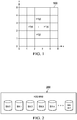
- an image 100 is illustrated that is formed of multiple image pixels.
- i+1 th (x) and i-1 th (x) are adjacent image pixels in x-direction
- i+1 th (y) and i-1 th (y) are adjacent image pixels in y-direction.
- Each image pixel has an intensity and a gradient, where a gradient of an i th image pixel has a magnitude MG i and an orientation ⁇ i .
- MGx i Abs I x i ⁇ 1 ⁇ I x i + 1
- MGy i Abs I y i ⁇ 1 ⁇ I y i + 1
- the horizontal gradient of the i th pixel can be determined using intensity differences of the i th pixel with either the i+1 th (x) pixel or the i-1 th (x) pixel; and the vertical gradient of the i th pixel can be determined using intensity differences of the i th pixel with either the i+1 th (y) pixel or the i-1 th (y) pixel.
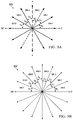
- FIG. 2 illustrates histogram of gradients (HOG) bins 200 for object detection in the image 100, in an example embodiment.
- the HOG bins 200 include first through m th bins, which are Bin 0 through Bin m-1.
- each image pixel of the image 100 is categorized in one of the first through m th bins based on an orientation ⁇ of corresponding gradient.
- the value of m 6.
- the value of m may be different, such as 8 or 10.
- FIGS. 3A and 3B illustrate a first set 300 of six HOG bins, and a second set 302 of eight HOG bins respectively, in an example scenario.
- An image pixel is assigned a HOG bin by comparing the ratio of corresponding vertical and horizontal gradients with tangent values of corresponding orientation range.
- ratio of vertical and horizontal gradients (y/x) of the image pixel may be compared with tan 0° and tan 30° values to check whether the corresponding gradient is in Bin 0.
- the ratio (y/x) may be compared with tan 30° and tan 60° values to check whether the corresponding gradient is in Bin 1, and so on.
- the values of tan 30°, 60°, 120° and 150° are 1/ ⁇ 3, ⁇ 3, - ⁇ 3, and -1/ ⁇ 3 respectively, which are irrational numbers, so the computation of HOG bin for an image pixel is a complex and time consuming task.
- the HOG bins of the first and second sets 300 and 302 are assigned unequal orientation ranges to simplify the computation of HOG bins for the image pixels of the image.
- the maximum and minimum binning angles ⁇ min and ⁇ max for each bin of first and second sets 300 and 302 are selected in such a manner that each of tan ⁇ min and tan ⁇ max are rational numbers and may be computed without division or multiplication operations. Further, each of at least one of shift operation, subtraction operation and comparison operation are useful to compute HOG bins of image pixels.
- the minimum and maximum binning angles for each bin are illustrated in Table I below.
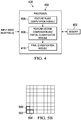
- FIG. 4 illustrates a block diagram of an object detection system 400, in an embodiment.
- the object is a pedestrian on a road
- the object detection system 400 is employed in a vehicle or any other moving platform for assisting in object detection on the road.
- the object detection system 400 may also be referred to as a pedestrian detection system 400.
- the object detection system 400 includes a memory 402 for storing instructions, and a processor 404 responsive to stored instructions to perform the steps of object detection in an image.
- the processor 404 includes a feature plane computation module 406, a feature vector computation and partial classification module 408, and a final classification module 410.
- the memory 402 may be any volatile or non-volatile memory, such as random access memory (RAM), read only memory (ROM), static dynamic RAM (SDRAM), double data rate (DDR) RAM and DDR SDRAM.
- the processor 404 may include a variety of known devices to facilitate or enable the execution or performance of software instructions, protocols or logical instructions stored on the memory 402.
- the processor 404 may be embodied as one or more integrated circuit devices, central processing units (CPUs) or microprocessors.
- the processor 404 may also include memory devices (e.g., a processor cache), time keeping devices (e.g., a real-time clock (RTC)), and/or additional circuitry or data transmission channels.
- RTC real-time clock
- One typical example of the processor 404 includes an embedded vision engine (EVE).
- EVE embedded vision engine
- the modules inside the processor 404 can be embodied in form of a single entity or different entities (such as integrated circuits, with or without software and firmware).
- the processor 404 can also include or otherwise be in communication with hardware systems for assisting in capture and/or post-processing of images and/or video of the objects on the road.
- the images and/or video can be captured by image capturing devices, such as cameras accessible to the processor 404.
- the feature plane computation module 406 receives an input image, such as the image 100 ( FIG. 1 ), and computes "h" feature planes for each image pixel of the image 100.
- h m+4, where m is equal to the total number of HOG bins.
- the number of feature planes h is equal to 10, when the number of HOG bins is equal to 6.
- the number of feature planes "h” is considered to be ten throughout, unless otherwise specified.
- the feature plane computation module 406 computes a feature set F i of ten types of feature planes for each image pixel of the image 100.
- the i th pixel has a non-zero gradient magnitude in one bin, and zero gradient in
- the feature plane computation module 406 computes or otherwise accesses the values of Y i , U i , V i , M i for an i th pixel based on conventional techniques.
- the feature plane computation module 406 computes the values of B i0 , B i1 , B i2 , B i3 , B i4 , B i5 based on a magnitude and orientation of the gradient of the i th pixel, which in turn is estimated based on corresponding horizontal and vertical gradients x i and y 1 .
- the feature plane computation module 406 refers to first and second threshold values and comparison conditions specified in Table III below to compute an HOG bin of the gradient of the i th pixel where the number of HOG bins is equal to 6.
- the feature plane computation module 406 refers to first and second threshold values and comparison conditions specified in Table IV below to compute a HOG bin of the gradient of the i th pixel, where the number of HOG bins is equal to 8.
- a bin is assigned to an i th pixel when its horizontal and vertical gradients x i and y i satisfy a corresponding comparison condition.
- the computation of HOG bin for an image pixel primarily includes shifts and comparisons. This is possible because ⁇ min and ⁇ max for each HOG bin are defined, such that each of tan ⁇ min and tan ⁇ max are rational numbers.
- the feature plane computation module 406 After computing a HOG bin for a gradient of the i th pixel, the feature plane computation module 406 computes a magnitude of corresponding gradient based on equation (6). Thereafter, the feature plane computation module 406 assigns the magnitude value to the HOG feature plane corresponding to the computed HOG bin, and assigns zero values to remaining HOG feature planes.
- the feature computation module 406 computes feature sets for each image pixel of the input image, and stores the same in the memory 402.
- the feature computation module 406 bypasses the computation of the orientation ⁇ and determines a HOG bin of an image pixel based on the mathematical relationship between horizontal and vertical gradients of the image pixel. This results in ⁇ 30-45% performance improvement in feature plane computation.
- the feature plane computation module 406 further defines multiple cells in the image 100.
- a cell is a unit of the image 100 with size as (C x , C y ), where C x is cell width, C y is cell height, and (C x ⁇ C y ) is total number of pixels in the cell.
- the starting locations of each cell in the image 100 in horizontal and vertical directions are integral multiples of predefined horizontal and vertical step sizes respectively.
- the cells within the input image are further illustrated with reference to FIGS. 5A and 5B and FIGS. 6A , 6B and 6C .
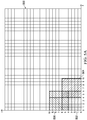
- FIGS. 5A and 5B illustrate an image 500 of size (64, 128), including first, second and third cells 502, 504, 506 of size (6, 6), in an example embodiment. Only a few cells 502, 504, 506 are shown to facilitate the description of some example embodiments.
- Cells are defined in the entire image 500.
- the first cell 502 extends from 0 th to sixth pixels in both x and y directions.
- the second cell 504 extends from fourth to tenth pixels in the x-direction, and from 0 th to sixth pixels in the y-direction.
- the third cell 506 extends from 0 th to sixth pixels in the x-direction, and from fourth to tenth pixels in the y-direction.
- the starting locations of each cell in the image 500 in x and y directions are multiples of predefined horizontal and vertical step sizes respectively. For example, when the horizontal and vertical step sizes are 4 pixels each, then irrespective of cell size, the starting locations of the cells are at 0, 4, 8, 12...pixels in x and y directions. In an example scenario, the starting locations of the first and second cells 502 and 504 along x-direction are 0 th and 4 th pixels respectively. Further, the starting locations of the first and third cells 502 and 506 along the y-direction are 0 th and 4 th pixels respectively. When the horizontal and vertical cell sizes differ from corresponding step sizes, some image pixels of adjacent cells overlap with each other.
- the feature plane computation module 406 ( FIG. 4 ) computes a feature plane summation for each type of feature plane, for each cell of the input image 500.
- a feature plane summation for a cell is computed by summing those features of image pixels of the cell that are of similar type.
- a feature plane summation C 1 (U) (of type U-plane) for the first cell 502 of size (6 ⁇ 6) is computed by summing U-feature planes of all the 36 pixels of the first cell 502, and is represented by:
- the feature plane computation module 406 computes ten feature plane summations corresponding to ten feature planes, for an i th cell of the image 500.
- C i (Y), C i (U) and C i (V) are Y, U and V feature plane summations for the i th cell
- C 1 (M) is M feature plane summation for the i th cell
- C i (B 0 ), C i (B 1 ), C i (B 2 ), C i (B 3 ), C i (B 4 ) and C i (B 5 ) are HOG feature plane summations for the
- FIGS. 6A and 6B illustrate an image 600 of size (such as 64 or 128) including first through ninth cells 602 through 618, where size of each of cells 602-618 is 4 ⁇ 4 (e.g., 16 pixels).
- the cell 602 extends from 0 th to fourth pixels in both x and y directions
- the cell 604 extends from fourth to eighth pixels in the x-direction, and from 0 th to fourth pixels in the y-direction
- the cell 606 extends from eight to twelfth pixels in the x-direction, and from 0 th to fourth pixels in the y-direction, and so on.
- the feature plane computation module 406 ( FIG. 4 ) computes a feature plane summation of each type for each cell of the input image 600.
- a feature plane summation C 2 (V) (of type V-plane) for the first cell 602 of size (4 ⁇ 4) is computed by summing V-feature planes of all the 16 pixels of the first cell 602, and is represented by:
- a feature plane summation C 2 (M) (of type M-feature plane) for the cell 602 of size (4 ⁇ 4) is computed by summing M-feature planes of all the 16 pixels of the first cell 604, and is represented by:
- the feature plane computation module 406 computes ten feature plane summations corresponding to ten feature planes, for each cell of the image 600.
- FIG. 6C illustrates an image 600 of size (64, 128) representing a cell 620 and a cell 622 of sizes (8 ⁇ 8).
- the cell 620 of size (8 ⁇ 8) is formed by combining the cells 602, 604, 608 and 610 of size (4 ⁇ 4) as described with reference to FIGS. 6A and 6B .
- the feature plane computation module 406 computes a feature plane summation C 3 (Y) (of type Y-plane) for the cell 620 of size (8 ⁇ 8) by summing Y-feature plane summations of the cells 602, 604, 608 and 610.
- the cell 622 of size (8 ⁇ 8) is formed by combining the cells 608, 610, 614 and 616 of size (4 ⁇ 4).
- the feature plane computation module 406 computes a feature plane summation C 4 (Y) (of type Y-plane) for the cell 622 of size (8,8) by summing Y-feature plane summations of the cells 608, 610, 614 and 616 of size (4 ⁇ 4).
- the feature plane computation module 406 reuses the Y-feature plane summations of the cells 608 and 610 in computing the Y-feature plane summation for the eleventh cell 622.
- summations for the other planes (such as U plane, V plane and 6 HOG planes) are also computed.
- FIG. 7 illustrates examples of detection windows 700 and 702 employed for object detection in an input image 704.
- the input image 704 has a frame size (F w , F h ), where F w is frame width, F h is frame height, and F h ⁇ F w is total number of image pixels in the input image 704.
- each of the detection windows 700 and 702 are image portions of the input image 704 with size (SW x , SW y ), where SW X is window width, SW y is window height, and SW x ⁇ SW y is total number of image pixels in the detection window (700, 702).
- the step size of the detection window (700, 702) is referred to as S x ⁇ S y , where S x is number of pixels traversed by the detection window (700, 702) in one movement along the x-direction, and S y is number of pixels traversed by the detection window (700, 702) in one movement along the y-direction.
- the module 408 selects the first detection window 700 and selects a type of feature plane for computing a first partial feature vector therein.
- the first partial feature vector is a set of feature plane summations of the selected type, corresponding to each cell of the first detection window 700.
- the module 408 selects Y-feature plane
- the first partial feature vector is a set including the Y-feature plane summations of cells defined within the first detection window 700.
- the module 408 compares the first partial feature vector with a corresponding partial classifier of the object, to detect the presence of Y-data of object in the first detection window 700, and stores a result of comparison in the memory 402, instead of storing the first partial feature vector.
- the module 408 selects a next type of feature plane, such as U-feature plane, for computing a second partial feature vector for the first detection window 700. Thereafter, it compares the second partial feature vector with a corresponding partial classifier of the object, to detect whether the U-data of the object is detected in the first detection window 700, and stores the result of comparison in the memory 402.
- the partial object classifier is an ADABOOST classifier.
- the module 408 in an iterative manner, performs the steps of computing a partial feature vector for a next feature plane and comparing with a corresponding partial classifier to store the result of comparison in the memory 402. As a result, the module 408 iteratively computes ten partial feature vectors and performs ten comparisons with corresponding partial object classifiers to store ten comparison results in the memory 402.
- the module 408 stores only comparison results in the memory 402 instead of storing the feature plane summations of cells of the first detection window 700, thus significantly saving memory bandwidth (such as double data rate (DDR) memory bandwidth).
- the module 408 bypasses the computation of the complete feature vector for the first detection window 700 (requiring computation of 1280 elements together) and computes only one partial feature vector (requiring computation of 128 elements together) at a time, thus significantly saving DDR bandwidth.
- DDR double data rate
- the final classification module 410 collates the comparison results generated by the module 408, and accordingly makes a final decision on whether the object is present in the first detection window 700.
- the module 408 computes a score corresponding to each partial feature vector based on comparison with a corresponding partial object classifier, and thus generates a total of ten partial scores corresponding to each feature plane type.
- the final classification module 410 adds the ten partial scores to generate a final score for indicating whether the object is present in the first detection window 700.
- the module 408 selects the second detection window 702 ( FIG. 7 ), and computes the corresponding partial feature vectors and partial scores.
- the final classification module 410 then collates the partial scores to detect the presence of the object in the second detection window 702.
- the module 408 computes partial scores, and the final classification module 410 collates the partial scores in a sequential manner for each of the remaining detection windows of the image 704, thereby detecting the presence of the corresponding object in the image 704.
- all of the 1280 elements may also be computed in a single cycle, and thereafter these elements can be compared with a classifier to detect the presence of the object in the detection window (the image portion).
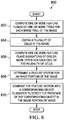
- FIG. 8 is a flowchart of a method of detecting an object in an image, in an embodiment.
- operations of method 800 are performed by a processor, such as the processor 400 ( FIG. 4 ).
- the method includes computing one or more feature planes of one or more types for each image pixel of an image (an input image), such as example image 100 ( FIG. 1 ).
- feature planes of ten types are computed for each image pixel, where ten types of feature planes include Y, U, V feature planes, M feature plane and six HOG feature planes.
- the six HOG feature planes for an image pixel are computed based on the horizontal and vertical gradients of the image pixel.
- the method includes defining multiple cells in the image 100, where each cell includes first through n th number of pixels.
- the starting locations of each cell in the image 100 in horizontal and vertical directions are integral multiples of predefined horizontal and vertical step sizes respectively. For example, when the horizontal and vertical step sizes are 4 pixels each, then irrespective of cell size, the starting locations of the cells are at 0, 4, 8, 12...pixels in x and y directions.
- the method includes computing one or more feature plane summations of one or more types for each of the cells.
- a feature plane summation of a type for a cell is computed by summing corresponding feature planes of the first through nth number of pixels of the cell.
- a feature plane summation C 1 (Y) (of type Y-feature plane) for a cell of size (6 ⁇ 6), such as the first cell 502 ( FIG. 5 ) is computed by summing Y-feature planes of all the 36 pixels of the first cell 502.
- the method includes determining a feature vector for an image portion, such as the first detecting window 700, of the image 704 ( FIG. 7 ).
- the feature vector of the image portion includes a set of feature plane summations of cells defined in the image portion.
- the feature vector is a partial feature vector, which includes a set of feature plane summations of only one type, for the cells defined in the image portion.
- the method includes comparing the feature vector with a corresponding object classifier to detect the presence of the corresponding object in the image portion of the image.
- the feature vector is a partial feature vector and is compared with a corresponding partial object classifier to detect the presence of the corresponding object in the image portion.
- the presence of the object is detected in various image portions (such as in various detection windows described with reference to FIG. 7 ) to determine the presence of the object in whole image.
- the partial feature vector is iteratively determined for each type of feature plane, and the partial feature vector for each type is compared with a corresponding partial classifier of each type. Further, the result of the comparison for each type is stored in the memory. Also, the one or more comparison results corresponding to each type of the feature plane are collated, and the presence of the object is detected in the image based on the collated results.
- Advantages of one or more of the example embodiments include detecting an object in an input image.
- HOG bin of an image pixel gradient is determined based on the mathematical relationship between horizontal and vertical gradients of the image pixel without computing the orientation of the gradient, thereby resulting in ⁇ 30-45% performance improvement in feature plane computation.
- the partial feature vector computation instead of complete feature vector computation significantly saves ⁇ 95% of the memory bandwidth.
- the computational complexity and footprint of the object detection system is considerably less than that of a conventional design.
- the object detection system is adaptable for any cell size, detection window size, step size, number of feature planes, number of feature vectors, and type of classifier.
Landscapes
- Engineering & Computer Science (AREA)
- Theoretical Computer Science (AREA)
- Physics & Mathematics (AREA)
- General Physics & Mathematics (AREA)
- Multimedia (AREA)
- Computer Vision & Pattern Recognition (AREA)
- Health & Medical Sciences (AREA)
- Artificial Intelligence (AREA)
- Computing Systems (AREA)
- Databases & Information Systems (AREA)
- Evolutionary Computation (AREA)
- General Health & Medical Sciences (AREA)
- Medical Informatics (AREA)
- Software Systems (AREA)
- Image Analysis (AREA)
Applications Claiming Priority (2)
| Application Number | Priority Date | Filing Date | Title |
|---|---|---|---|
| US14/551,942 US9508018B2 (en) | 2014-11-24 | 2014-11-24 | Systems and methods for object detection |
| PCT/US2015/062461 WO2016086002A1 (en) | 2014-11-24 | 2015-11-24 | Systems and methods for object detection |
Publications (3)
| Publication Number | Publication Date |
|---|---|
| EP3224764A1 EP3224764A1 (en) | 2017-10-04 |
| EP3224764A4 EP3224764A4 (en) | 2018-08-01 |
| EP3224764B1 true EP3224764B1 (en) | 2021-03-03 |
Family
ID=56010554
Family Applications (1)
| Application Number | Title | Priority Date | Filing Date |
|---|---|---|---|
| EP15864007.8A Active EP3224764B1 (en) | 2014-11-24 | 2015-11-24 | Systems and methods for object detection |
Country Status (5)
| Country | Link |
|---|---|
| US (1) | US9508018B2 (enExample) |
| EP (1) | EP3224764B1 (enExample) |
| JP (2) | JP2017535904A (enExample) |
| CN (1) | CN107004137B (enExample) |
| WO (1) | WO2016086002A1 (enExample) |
Families Citing this family (8)
| Publication number | Priority date | Publication date | Assignee | Title |
|---|---|---|---|---|
| WO2016083002A1 (en) * | 2014-11-28 | 2016-06-02 | Fotonation Limited | A method for producing a histogram of oriented gradients |
| US10248876B2 (en) * | 2016-06-27 | 2019-04-02 | Texas Instruments Incorporated | Method and apparatus for avoiding non-aligned loads using multiple copies of input data |
| CN106503697A (zh) * | 2016-12-05 | 2017-03-15 | 北京小米移动软件有限公司 | 目标识别方法及装置、人脸识别方法及装置 |
| US20180260658A1 (en) * | 2017-03-09 | 2018-09-13 | Qualcomm Incorporated | Systems and methods for avoiding redundant pixel computations in an image processing pipeline |
| FR3069087B1 (fr) * | 2017-07-11 | 2019-08-23 | Commissariat A L'energie Atomique Et Aux Energies Alternatives | Procede de traitement d'une image |
| CN113326212B (zh) * | 2020-02-28 | 2023-11-03 | 加特兰微电子科技(上海)有限公司 | 数据处理方法、装置及相关设备 |
| CN114359583A (zh) * | 2020-09-30 | 2022-04-15 | 北京君正集成电路股份有限公司 | 一种梯度直方图角度快速计算方法 |
| JP2024132391A (ja) | 2023-03-17 | 2024-10-01 | ルネサスエレクトロニクス株式会社 | プログラム、画像処理方法及び画像処理装置 |
Family Cites Families (24)
| Publication number | Priority date | Publication date | Assignee | Title |
|---|---|---|---|---|
| JPH0638274B2 (ja) * | 1989-07-31 | 1994-05-18 | 工業技術院長 | 画像認識装置および画像認識方法 |
| US6312123B1 (en) * | 1998-05-01 | 2001-11-06 | L&P Property Management Company | Method and apparatus for UV ink jet printing on fabric and combination printing and quilting thereby |
| US6331902B1 (en) | 1999-10-14 | 2001-12-18 | Match Lab, Inc. | System and method for digital color image processing |
| JP2001243479A (ja) * | 2000-02-28 | 2001-09-07 | Nippon Telegr & Teleph Corp <Ntt> | 画像処理方法および装置、ならびに画像処理プログラムを記録した記録媒体 |
| US7324665B2 (en) * | 2002-09-16 | 2008-01-29 | Massachusetts Institute Of Technology | Method of multi-resolution adaptive correlation processing |
| US9129381B2 (en) * | 2003-06-26 | 2015-09-08 | Fotonation Limited | Modification of post-viewing parameters for digital images using image region or feature information |
| US7689016B2 (en) * | 2005-05-27 | 2010-03-30 | Stoecker & Associates, A Subsidiary Of The Dermatology Center, Llc | Automatic detection of critical dermoscopy features for malignant melanoma diagnosis |
| JP2007034704A (ja) * | 2005-07-27 | 2007-02-08 | Canon Inc | 画像処理装置 |
| JP4588575B2 (ja) * | 2005-08-09 | 2010-12-01 | 富士フイルム株式会社 | デジタル画像の複数対象物検出方法および装置並びにプログラム |
| JP4893489B2 (ja) * | 2007-06-15 | 2012-03-07 | ソニー株式会社 | 画像処理装置、画像処理方法、画像処理方法のプログラム及び画像処理方法のプログラムを記録した記録媒体 |
| US8059888B2 (en) * | 2007-10-30 | 2011-11-15 | Microsoft Corporation | Semi-automatic plane extrusion for 3D modeling |
| US8031963B2 (en) * | 2008-04-09 | 2011-10-04 | Eyep Inc. | Noise filter |
| DE102010009906A1 (de) * | 2009-03-26 | 2010-10-14 | Heidelberger Druckmaschinen Ag | Verfahren zur Rasterung von Farbauszügen eines Lentikularbildes und Verfahren zur Herstellung eines Lentikularbildes auf einem Bedruckstoff |
| WO2011007390A1 (ja) * | 2009-07-15 | 2011-01-20 | 株式会社 東芝 | 画像処理装置、及びインターフェース装置 |
| JP4877374B2 (ja) * | 2009-09-02 | 2012-02-15 | 株式会社豊田中央研究所 | 画像処理装置及びプログラム |
| US8811663B2 (en) * | 2011-01-05 | 2014-08-19 | International Business Machines Corporation | Object detection in crowded scenes |
| CN104115189B (zh) * | 2011-11-18 | 2016-12-28 | 日本电气株式会社 | 局部特征量提取装置、用于提取局部特征量的方法 |
| JP5838948B2 (ja) * | 2012-10-17 | 2016-01-06 | 株式会社デンソー | 対象物識別装置 |
| US9008365B2 (en) * | 2013-04-18 | 2015-04-14 | Huawei Technologies Co., Ltd. | Systems and methods for pedestrian detection in images |
| JP6095519B2 (ja) * | 2013-08-09 | 2017-03-15 | 三菱電機株式会社 | 撮像装置 |
| US9595125B2 (en) * | 2013-08-30 | 2017-03-14 | Qualcomm Incorporated | Expanding a digital representation of a physical plane |
| JP6217339B2 (ja) * | 2013-11-20 | 2017-10-25 | 株式会社リコー | 印刷制御装置、印刷制御方法及びプログラム |
| CN103903238B (zh) * | 2014-03-21 | 2017-06-20 | 西安理工大学 | 图像特征的显著结构和相关结构融合方法 |
| CN104111665B (zh) * | 2014-07-29 | 2017-02-01 | 深圳市步科电气有限公司 | 旋转变压器的角度跟踪装置 |
-
2014
- 2014-11-24 US US14/551,942 patent/US9508018B2/en active Active
-
2015
- 2015-11-24 JP JP2017545876A patent/JP2017535904A/ja active Pending
- 2015-11-24 EP EP15864007.8A patent/EP3224764B1/en active Active
- 2015-11-24 CN CN201580062263.8A patent/CN107004137B/zh active Active
- 2015-11-24 WO PCT/US2015/062461 patent/WO2016086002A1/en not_active Ceased
-
2020
- 2020-09-17 JP JP2020156507A patent/JP7230294B2/ja active Active
Non-Patent Citations (1)
| Title |
|---|
| None * |
Also Published As
| Publication number | Publication date |
|---|---|
| JP2017535904A (ja) | 2017-11-30 |
| EP3224764A4 (en) | 2018-08-01 |
| EP3224764A1 (en) | 2017-10-04 |
| WO2016086002A1 (en) | 2016-06-02 |
| CN107004137A (zh) | 2017-08-01 |
| JP2020205118A (ja) | 2020-12-24 |
| US9508018B2 (en) | 2016-11-29 |
| US20160148071A1 (en) | 2016-05-26 |
| JP7230294B2 (ja) | 2023-03-01 |
| CN107004137B (zh) | 2021-11-19 |
Similar Documents
| Publication | Publication Date | Title |
|---|---|---|
| US9508018B2 (en) | Systems and methods for object detection | |
| US10878259B2 (en) | Vehicle detecting method, nighttime vehicle detecting method based on dynamic light intensity and system thereof | |
| US20140177925A1 (en) | License plate recognition system and method | |
| CN112052782B (zh) | 基于环视的停车位识别方法、装置、设备及存储介质 | |
| JP2019105634A (ja) | 構造化された光ベースの3dカメラシステムにおけるイメージの奥行の推定方法 | |
| US11250269B2 (en) | Recognition method and apparatus for false detection of an abandoned object and image processing device | |
| US10679098B2 (en) | Method and system for visual change detection using multi-scale analysis | |
| EP2951783B1 (en) | Method and system for detecting moving objects | |
| EP3156939A1 (en) | Method and apparatus for detecting a traffic state and electronic equipment | |
| CN109729298B (zh) | 图像处理方法与图像处理装置 | |
| US20180047271A1 (en) | Fire detection method, fire detection apparatus and electronic equipment | |
| CN101178770A (zh) | 一种图像检测方法及装置 | |
| CN105740751A (zh) | 一种目标检测与识别的方法和系统 | |
| Kim et al. | Vision-based vehicle detection and inter-vehicle distance estimation for driver alarm system | |
| CN113470065B (zh) | 移动物体检测和跟踪方法以及装置 | |
| US20070230785A1 (en) | Motion detecting method and apparatus | |
| US7403636B2 (en) | Method and apparatus for processing an image | |
| CN103106405A (zh) | 用于文档图像的行分割方法及系统 | |
| US9495609B2 (en) | System and method for evaluating data | |
| CN113239738B (zh) | 一种图像的模糊检测方法及模糊检测装置 | |
| CN104298960A (zh) | 识别数字图像中的可变形对象的方法及系统 | |
| CN111062415B (zh) | 基于对比差异的目标对象图像提取方法、系统及存储介质 | |
| KR20180125278A (ko) | 보행자 검출 장치 및 그 방법 | |
| JP2019053719A (ja) | 車両検出装置及び方法 | |
| US9183453B2 (en) | Banding noise detector for digital images |
Legal Events
| Date | Code | Title | Description |
|---|---|---|---|
| STAA | Information on the status of an ep patent application or granted ep patent |
Free format text: STATUS: THE INTERNATIONAL PUBLICATION HAS BEEN MADE |
|
| PUAI | Public reference made under article 153(3) epc to a published international application that has entered the european phase |
Free format text: ORIGINAL CODE: 0009012 |
|
| STAA | Information on the status of an ep patent application or granted ep patent |
Free format text: STATUS: REQUEST FOR EXAMINATION WAS MADE |
|
| 17P | Request for examination filed |
Effective date: 20170626 |
|
| AK | Designated contracting states |
Kind code of ref document: A1 Designated state(s): AL AT BE BG CH CY CZ DE DK EE ES FI FR GB GR HR HU IE IS IT LI LT LU LV MC MK MT NL NO PL PT RO RS SE SI SK SM TR |
|
| AX | Request for extension of the european patent |
Extension state: BA ME |
|
| DAV | Request for validation of the european patent (deleted) | ||
| DAX | Request for extension of the european patent (deleted) | ||
| A4 | Supplementary search report drawn up and despatched |
Effective date: 20180704 |
|
| RIC1 | Information provided on ipc code assigned before grant |
Ipc: G06K 9/46 20060101AFI20180628BHEP Ipc: G06K 9/62 20060101ALI20180628BHEP |
|
| GRAP | Despatch of communication of intention to grant a patent |
Free format text: ORIGINAL CODE: EPIDOSNIGR1 |
|
| STAA | Information on the status of an ep patent application or granted ep patent |
Free format text: STATUS: GRANT OF PATENT IS INTENDED |
|
| INTG | Intention to grant announced |
Effective date: 20201026 |
|
| RIN1 | Information on inventor provided before grant (corrected) |
Inventor name: SWAMI, PRAMOD KUMAR Inventor name: MATHEW, MANU Inventor name: DESAPPAN, KUMAR ARRAKUTTI |
|
| GRAS | Grant fee paid |
Free format text: ORIGINAL CODE: EPIDOSNIGR3 |
|
| GRAA | (expected) grant |
Free format text: ORIGINAL CODE: 0009210 |
|
| STAA | Information on the status of an ep patent application or granted ep patent |
Free format text: STATUS: THE PATENT HAS BEEN GRANTED |
|
| AK | Designated contracting states |
Kind code of ref document: B1 Designated state(s): AL AT BE BG CH CY CZ DE DK EE ES FI FR GB GR HR HU IE IS IT LI LT LU LV MC MK MT NL NO PL PT RO RS SE SI SK SM TR |
|
| REG | Reference to a national code |
Ref country code: GB Ref legal event code: FG4D |
|
| REG | Reference to a national code |
Ref country code: AT Ref legal event code: REF Ref document number: 1368012 Country of ref document: AT Kind code of ref document: T Effective date: 20210315 Ref country code: CH Ref legal event code: EP |
|
| REG | Reference to a national code |
Ref country code: DE Ref legal event code: R096 Ref document number: 602015066467 Country of ref document: DE |
|
| REG | Reference to a national code |
Ref country code: IE Ref legal event code: FG4D |
|
| REG | Reference to a national code |
Ref country code: LT Ref legal event code: MG9D |
|
| PG25 | Lapsed in a contracting state [announced via postgrant information from national office to epo] |
Ref country code: FI Free format text: LAPSE BECAUSE OF FAILURE TO SUBMIT A TRANSLATION OF THE DESCRIPTION OR TO PAY THE FEE WITHIN THE PRESCRIBED TIME-LIMIT Effective date: 20210303 Ref country code: HR Free format text: LAPSE BECAUSE OF FAILURE TO SUBMIT A TRANSLATION OF THE DESCRIPTION OR TO PAY THE FEE WITHIN THE PRESCRIBED TIME-LIMIT Effective date: 20210303 Ref country code: GR Free format text: LAPSE BECAUSE OF FAILURE TO SUBMIT A TRANSLATION OF THE DESCRIPTION OR TO PAY THE FEE WITHIN THE PRESCRIBED TIME-LIMIT Effective date: 20210604 Ref country code: LT Free format text: LAPSE BECAUSE OF FAILURE TO SUBMIT A TRANSLATION OF THE DESCRIPTION OR TO PAY THE FEE WITHIN THE PRESCRIBED TIME-LIMIT Effective date: 20210303 Ref country code: BG Free format text: LAPSE BECAUSE OF FAILURE TO SUBMIT A TRANSLATION OF THE DESCRIPTION OR TO PAY THE FEE WITHIN THE PRESCRIBED TIME-LIMIT Effective date: 20210603 Ref country code: NO Free format text: LAPSE BECAUSE OF FAILURE TO SUBMIT A TRANSLATION OF THE DESCRIPTION OR TO PAY THE FEE WITHIN THE PRESCRIBED TIME-LIMIT Effective date: 20210603 |
|
| REG | Reference to a national code |
Ref country code: NL Ref legal event code: MP Effective date: 20210303 |
|
| REG | Reference to a national code |
Ref country code: AT Ref legal event code: MK05 Ref document number: 1368012 Country of ref document: AT Kind code of ref document: T Effective date: 20210303 |
|
| PG25 | Lapsed in a contracting state [announced via postgrant information from national office to epo] |
Ref country code: SE Free format text: LAPSE BECAUSE OF FAILURE TO SUBMIT A TRANSLATION OF THE DESCRIPTION OR TO PAY THE FEE WITHIN THE PRESCRIBED TIME-LIMIT Effective date: 20210303 Ref country code: RS Free format text: LAPSE BECAUSE OF FAILURE TO SUBMIT A TRANSLATION OF THE DESCRIPTION OR TO PAY THE FEE WITHIN THE PRESCRIBED TIME-LIMIT Effective date: 20210303 Ref country code: PL Free format text: LAPSE BECAUSE OF FAILURE TO SUBMIT A TRANSLATION OF THE DESCRIPTION OR TO PAY THE FEE WITHIN THE PRESCRIBED TIME-LIMIT Effective date: 20210303 Ref country code: LV Free format text: LAPSE BECAUSE OF FAILURE TO SUBMIT A TRANSLATION OF THE DESCRIPTION OR TO PAY THE FEE WITHIN THE PRESCRIBED TIME-LIMIT Effective date: 20210303 |
|
| PG25 | Lapsed in a contracting state [announced via postgrant information from national office to epo] |
Ref country code: NL Free format text: LAPSE BECAUSE OF FAILURE TO SUBMIT A TRANSLATION OF THE DESCRIPTION OR TO PAY THE FEE WITHIN THE PRESCRIBED TIME-LIMIT Effective date: 20210303 |
|
| PG25 | Lapsed in a contracting state [announced via postgrant information from national office to epo] |
Ref country code: CZ Free format text: LAPSE BECAUSE OF FAILURE TO SUBMIT A TRANSLATION OF THE DESCRIPTION OR TO PAY THE FEE WITHIN THE PRESCRIBED TIME-LIMIT Effective date: 20210303 Ref country code: EE Free format text: LAPSE BECAUSE OF FAILURE TO SUBMIT A TRANSLATION OF THE DESCRIPTION OR TO PAY THE FEE WITHIN THE PRESCRIBED TIME-LIMIT Effective date: 20210303 Ref country code: SM Free format text: LAPSE BECAUSE OF FAILURE TO SUBMIT A TRANSLATION OF THE DESCRIPTION OR TO PAY THE FEE WITHIN THE PRESCRIBED TIME-LIMIT Effective date: 20210303 Ref country code: AT Free format text: LAPSE BECAUSE OF FAILURE TO SUBMIT A TRANSLATION OF THE DESCRIPTION OR TO PAY THE FEE WITHIN THE PRESCRIBED TIME-LIMIT Effective date: 20210303 |
|
| REG | Reference to a national code |
Ref country code: DE Ref legal event code: R079 Ref document number: 602015066467 Country of ref document: DE Free format text: PREVIOUS MAIN CLASS: G06K0009460000 Ipc: G06V0030180000 |
|
| PG25 | Lapsed in a contracting state [announced via postgrant information from national office to epo] |
Ref country code: IS Free format text: LAPSE BECAUSE OF FAILURE TO SUBMIT A TRANSLATION OF THE DESCRIPTION OR TO PAY THE FEE WITHIN THE PRESCRIBED TIME-LIMIT Effective date: 20210703 Ref country code: PT Free format text: LAPSE BECAUSE OF FAILURE TO SUBMIT A TRANSLATION OF THE DESCRIPTION OR TO PAY THE FEE WITHIN THE PRESCRIBED TIME-LIMIT Effective date: 20210705 Ref country code: SK Free format text: LAPSE BECAUSE OF FAILURE TO SUBMIT A TRANSLATION OF THE DESCRIPTION OR TO PAY THE FEE WITHIN THE PRESCRIBED TIME-LIMIT Effective date: 20210303 Ref country code: RO Free format text: LAPSE BECAUSE OF FAILURE TO SUBMIT A TRANSLATION OF THE DESCRIPTION OR TO PAY THE FEE WITHIN THE PRESCRIBED TIME-LIMIT Effective date: 20210303 |
|
| REG | Reference to a national code |
Ref country code: DE Ref legal event code: R097 Ref document number: 602015066467 Country of ref document: DE |
|
| PLBE | No opposition filed within time limit |
Free format text: ORIGINAL CODE: 0009261 |
|
| STAA | Information on the status of an ep patent application or granted ep patent |
Free format text: STATUS: NO OPPOSITION FILED WITHIN TIME LIMIT |
|
| PG25 | Lapsed in a contracting state [announced via postgrant information from national office to epo] |
Ref country code: DK Free format text: LAPSE BECAUSE OF FAILURE TO SUBMIT A TRANSLATION OF THE DESCRIPTION OR TO PAY THE FEE WITHIN THE PRESCRIBED TIME-LIMIT Effective date: 20210303 Ref country code: AL Free format text: LAPSE BECAUSE OF FAILURE TO SUBMIT A TRANSLATION OF THE DESCRIPTION OR TO PAY THE FEE WITHIN THE PRESCRIBED TIME-LIMIT Effective date: 20210303 Ref country code: ES Free format text: LAPSE BECAUSE OF FAILURE TO SUBMIT A TRANSLATION OF THE DESCRIPTION OR TO PAY THE FEE WITHIN THE PRESCRIBED TIME-LIMIT Effective date: 20210303 |
|
| 26N | No opposition filed |
Effective date: 20211206 |
|
| PG25 | Lapsed in a contracting state [announced via postgrant information from national office to epo] |
Ref country code: SI Free format text: LAPSE BECAUSE OF FAILURE TO SUBMIT A TRANSLATION OF THE DESCRIPTION OR TO PAY THE FEE WITHIN THE PRESCRIBED TIME-LIMIT Effective date: 20210303 |
|
| PG25 | Lapsed in a contracting state [announced via postgrant information from national office to epo] |
Ref country code: IT Free format text: LAPSE BECAUSE OF FAILURE TO SUBMIT A TRANSLATION OF THE DESCRIPTION OR TO PAY THE FEE WITHIN THE PRESCRIBED TIME-LIMIT Effective date: 20210303 |
|
| PG25 | Lapsed in a contracting state [announced via postgrant information from national office to epo] |
Ref country code: IS Free format text: LAPSE BECAUSE OF FAILURE TO SUBMIT A TRANSLATION OF THE DESCRIPTION OR TO PAY THE FEE WITHIN THE PRESCRIBED TIME-LIMIT Effective date: 20210703 |
|
| PG25 | Lapsed in a contracting state [announced via postgrant information from national office to epo] |
Ref country code: MC Free format text: LAPSE BECAUSE OF FAILURE TO SUBMIT A TRANSLATION OF THE DESCRIPTION OR TO PAY THE FEE WITHIN THE PRESCRIBED TIME-LIMIT Effective date: 20210303 |
|
| REG | Reference to a national code |
Ref country code: CH Ref legal event code: PL |
|
| PG25 | Lapsed in a contracting state [announced via postgrant information from national office to epo] |
Ref country code: LU Free format text: LAPSE BECAUSE OF NON-PAYMENT OF DUE FEES Effective date: 20211124 Ref country code: BE Free format text: LAPSE BECAUSE OF NON-PAYMENT OF DUE FEES Effective date: 20211130 |
|
| REG | Reference to a national code |
Ref country code: BE Ref legal event code: MM Effective date: 20211130 |
|
| PG25 | Lapsed in a contracting state [announced via postgrant information from national office to epo] |
Ref country code: IE Free format text: LAPSE BECAUSE OF NON-PAYMENT OF DUE FEES Effective date: 20211124 |
|
| PG25 | Lapsed in a contracting state [announced via postgrant information from national office to epo] |
Ref country code: HU Free format text: LAPSE BECAUSE OF FAILURE TO SUBMIT A TRANSLATION OF THE DESCRIPTION OR TO PAY THE FEE WITHIN THE PRESCRIBED TIME-LIMIT; INVALID AB INITIO Effective date: 20151124 |
|
| P01 | Opt-out of the competence of the unified patent court (upc) registered |
Effective date: 20230523 |
|
| PG25 | Lapsed in a contracting state [announced via postgrant information from national office to epo] |
Ref country code: CY Free format text: LAPSE BECAUSE OF FAILURE TO SUBMIT A TRANSLATION OF THE DESCRIPTION OR TO PAY THE FEE WITHIN THE PRESCRIBED TIME-LIMIT Effective date: 20210303 |
|
| PG25 | Lapsed in a contracting state [announced via postgrant information from national office to epo] |
Ref country code: LI Free format text: LAPSE BECAUSE OF NON-PAYMENT OF DUE FEES Effective date: 20220630 Ref country code: CH Free format text: LAPSE BECAUSE OF NON-PAYMENT OF DUE FEES Effective date: 20220630 |
|
| PG25 | Lapsed in a contracting state [announced via postgrant information from national office to epo] |
Ref country code: MK Free format text: LAPSE BECAUSE OF FAILURE TO SUBMIT A TRANSLATION OF THE DESCRIPTION OR TO PAY THE FEE WITHIN THE PRESCRIBED TIME-LIMIT Effective date: 20210303 |
|
| PG25 | Lapsed in a contracting state [announced via postgrant information from national office to epo] |
Ref country code: MT Free format text: LAPSE BECAUSE OF FAILURE TO SUBMIT A TRANSLATION OF THE DESCRIPTION OR TO PAY THE FEE WITHIN THE PRESCRIBED TIME-LIMIT Effective date: 20210303 |
|
| PG25 | Lapsed in a contracting state [announced via postgrant information from national office to epo] |
Ref country code: TR Free format text: LAPSE BECAUSE OF FAILURE TO SUBMIT A TRANSLATION OF THE DESCRIPTION OR TO PAY THE FEE WITHIN THE PRESCRIBED TIME-LIMIT Effective date: 20210303 |
|
| PGFP | Annual fee paid to national office [announced via postgrant information from national office to epo] |
Ref country code: DE Payment date: 20251022 Year of fee payment: 11 |
|
| PGFP | Annual fee paid to national office [announced via postgrant information from national office to epo] |
Ref country code: GB Payment date: 20251023 Year of fee payment: 11 |
|
| PGFP | Annual fee paid to national office [announced via postgrant information from national office to epo] |
Ref country code: FR Payment date: 20251022 Year of fee payment: 11 |