EP3220621A1 - Information processing apparatus - Google Patents
Information processing apparatus Download PDFInfo
- Publication number
- EP3220621A1 EP3220621A1 EP16187447.4A EP16187447A EP3220621A1 EP 3220621 A1 EP3220621 A1 EP 3220621A1 EP 16187447 A EP16187447 A EP 16187447A EP 3220621 A1 EP3220621 A1 EP 3220621A1
- Authority
- EP
- European Patent Office
- Prior art keywords
- image data
- frame
- original
- size
- unit
- Prior art date
- Legal status (The legal status is an assumption and is not a legal conclusion. Google has not performed a legal analysis and makes no representation as to the accuracy of the status listed.)
- Withdrawn
Links
Images



Classifications
-
- H—ELECTRICITY
- H04—ELECTRIC COMMUNICATION TECHNIQUE
- H04N—PICTORIAL COMMUNICATION, e.g. TELEVISION
- H04N19/00—Methods or arrangements for coding, decoding, compressing or decompressing digital video signals
- H04N19/50—Methods or arrangements for coding, decoding, compressing or decompressing digital video signals using predictive coding
- H04N19/587—Methods or arrangements for coding, decoding, compressing or decompressing digital video signals using predictive coding involving temporal sub-sampling or interpolation, e.g. decimation or subsequent interpolation of pictures in a video sequence
-
- G—PHYSICS
- G06—COMPUTING OR CALCULATING; COUNTING
- G06F—ELECTRIC DIGITAL DATA PROCESSING
- G06F3/00—Input arrangements for transferring data to be processed into a form capable of being handled by the computer; Output arrangements for transferring data from processing unit to output unit, e.g. interface arrangements
- G06F3/06—Digital input from, or digital output to, record carriers, e.g. RAID, emulated record carriers or networked record carriers
- G06F3/0601—Interfaces specially adapted for storage systems
- G06F3/0602—Interfaces specially adapted for storage systems specifically adapted to achieve a particular effect
- G06F3/061—Improving I/O performance
- G06F3/0613—Improving I/O performance in relation to throughput
-
- H—ELECTRICITY
- H04—ELECTRIC COMMUNICATION TECHNIQUE
- H04N—PICTORIAL COMMUNICATION, e.g. TELEVISION
- H04N1/00—Scanning, transmission or reproduction of documents or the like, e.g. facsimile transmission; Details thereof
- H04N1/00002—Diagnosis, testing or measuring; Detecting, analysing or monitoring not otherwise provided for
- H04N1/00005—Diagnosis, testing or measuring; Detecting, analysing or monitoring not otherwise provided for relating to image data
-
- H—ELECTRICITY
- H04—ELECTRIC COMMUNICATION TECHNIQUE
- H04N—PICTORIAL COMMUNICATION, e.g. TELEVISION
- H04N1/00—Scanning, transmission or reproduction of documents or the like, e.g. facsimile transmission; Details thereof
- H04N1/00002—Diagnosis, testing or measuring; Detecting, analysing or monitoring not otherwise provided for
- H04N1/00007—Diagnosis, testing or measuring; Detecting, analysing or monitoring not otherwise provided for relating to particular apparatus or devices
- H04N1/0001—Transmission systems or arrangements
-
- H—ELECTRICITY
- H04—ELECTRIC COMMUNICATION TECHNIQUE
- H04N—PICTORIAL COMMUNICATION, e.g. TELEVISION
- H04N1/00—Scanning, transmission or reproduction of documents or the like, e.g. facsimile transmission; Details thereof
- H04N1/00095—Systems or arrangements for the transmission of the picture signal
-
- H—ELECTRICITY
- H04—ELECTRIC COMMUNICATION TECHNIQUE
- H04N—PICTORIAL COMMUNICATION, e.g. TELEVISION
- H04N1/00—Scanning, transmission or reproduction of documents or the like, e.g. facsimile transmission; Details thereof
- H04N1/00095—Systems or arrangements for the transmission of the picture signal
- H04N1/001—Systems or arrangements for the transmission of the picture signal specially adapted for transmission via digital wireline networks
-
- H—ELECTRICITY
- H04—ELECTRIC COMMUNICATION TECHNIQUE
- H04N—PICTORIAL COMMUNICATION, e.g. TELEVISION
- H04N1/00—Scanning, transmission or reproduction of documents or the like, e.g. facsimile transmission; Details thereof
- H04N1/00095—Systems or arrangements for the transmission of the picture signal
- H04N1/00103—Systems or arrangements for the transmission of the picture signal specially adapted for radio transmission, e.g. via satellites
- H04N1/00106—Systems or arrangements for the transmission of the picture signal specially adapted for radio transmission, e.g. via satellites using land mobile radio networks, e.g. mobile telephone
-
- H—ELECTRICITY
- H04—ELECTRIC COMMUNICATION TECHNIQUE
- H04N—PICTORIAL COMMUNICATION, e.g. TELEVISION
- H04N1/00—Scanning, transmission or reproduction of documents or the like, e.g. facsimile transmission; Details thereof
- H04N1/00127—Connection or combination of a still picture apparatus with another apparatus, e.g. for storage, processing or transmission of still picture signals or of information associated with a still picture
- H04N1/00281—Connection or combination of a still picture apparatus with another apparatus, e.g. for storage, processing or transmission of still picture signals or of information associated with a still picture with a telecommunication apparatus, e.g. a switched network of teleprinters for the distribution of text-based information, a selective call terminal
- H04N1/00307—Connection or combination of a still picture apparatus with another apparatus, e.g. for storage, processing or transmission of still picture signals or of information associated with a still picture with a telecommunication apparatus, e.g. a switched network of teleprinters for the distribution of text-based information, a selective call terminal with a mobile telephone apparatus
-
- H—ELECTRICITY
- H04—ELECTRIC COMMUNICATION TECHNIQUE
- H04N—PICTORIAL COMMUNICATION, e.g. TELEVISION
- H04N1/00—Scanning, transmission or reproduction of documents or the like, e.g. facsimile transmission; Details thereof
- H04N1/00795—Reading arrangements
- H04N1/00798—Circuits or arrangements for the control thereof, e.g. using a programmed control device or according to a measured quantity
- H04N1/00801—Circuits or arrangements for the control thereof, e.g. using a programmed control device or according to a measured quantity according to characteristics of the original
-
- H—ELECTRICITY
- H04—ELECTRIC COMMUNICATION TECHNIQUE
- H04N—PICTORIAL COMMUNICATION, e.g. TELEVISION
- H04N1/00—Scanning, transmission or reproduction of documents or the like, e.g. facsimile transmission; Details thereof
- H04N1/23—Reproducing arrangements
- H04N1/2307—Circuits or arrangements for the control thereof, e.g. using a programmed control device, according to a measured quantity
- H04N1/2323—Circuits or arrangements for the control thereof, e.g. using a programmed control device, according to a measured quantity according to characteristics of the reproducing medium, e.g. type, size or availability
-
- H—ELECTRICITY
- H04—ELECTRIC COMMUNICATION TECHNIQUE
- H04N—PICTORIAL COMMUNICATION, e.g. TELEVISION
- H04N1/00—Scanning, transmission or reproduction of documents or the like, e.g. facsimile transmission; Details thereof
- H04N1/32—Circuits or arrangements for control or supervision between transmitter and receiver or between image input and image output device, e.g. between a still-image camera and its memory or between a still-image camera and a printer device
- H04N1/32561—Circuits or arrangements for control or supervision between transmitter and receiver or between image input and image output device, e.g. between a still-image camera and its memory or between a still-image camera and a printer device using a programmed control device, e.g. a microprocessor
- H04N1/32571—Details of system components
- H04N1/32582—Output interface
-
- H—ELECTRICITY
- H04—ELECTRIC COMMUNICATION TECHNIQUE
- H04N—PICTORIAL COMMUNICATION, e.g. TELEVISION
- H04N1/00—Scanning, transmission or reproduction of documents or the like, e.g. facsimile transmission; Details thereof
- H04N1/32—Circuits or arrangements for control or supervision between transmitter and receiver or between image input and image output device, e.g. between a still-image camera and its memory or between a still-image camera and a printer device
- H04N1/32561—Circuits or arrangements for control or supervision between transmitter and receiver or between image input and image output device, e.g. between a still-image camera and its memory or between a still-image camera and a printer device using a programmed control device, e.g. a microprocessor
- H04N1/32571—Details of system components
- H04N1/32587—Controller
-
- H—ELECTRICITY
- H04—ELECTRIC COMMUNICATION TECHNIQUE
- H04N—PICTORIAL COMMUNICATION, e.g. TELEVISION
- H04N1/00—Scanning, transmission or reproduction of documents or the like, e.g. facsimile transmission; Details thereof
- H04N1/32—Circuits or arrangements for control or supervision between transmitter and receiver or between image input and image output device, e.g. between a still-image camera and its memory or between a still-image camera and a printer device
- H04N1/32561—Circuits or arrangements for control or supervision between transmitter and receiver or between image input and image output device, e.g. between a still-image camera and its memory or between a still-image camera and a printer device using a programmed control device, e.g. a microprocessor
- H04N1/32598—Bus based systems
-
- H—ELECTRICITY
- H04—ELECTRIC COMMUNICATION TECHNIQUE
- H04N—PICTORIAL COMMUNICATION, e.g. TELEVISION
- H04N19/00—Methods or arrangements for coding, decoding, compressing or decompressing digital video signals
- H04N19/10—Methods or arrangements for coding, decoding, compressing or decompressing digital video signals using adaptive coding
- H04N19/102—Methods or arrangements for coding, decoding, compressing or decompressing digital video signals using adaptive coding characterised by the element, parameter or selection affected or controlled by the adaptive coding
- H04N19/119—Adaptive subdivision aspects, e.g. subdivision of a picture into rectangular or non-rectangular coding blocks
-
- H—ELECTRICITY
- H04—ELECTRIC COMMUNICATION TECHNIQUE
- H04N—PICTORIAL COMMUNICATION, e.g. TELEVISION
- H04N21/00—Selective content distribution, e.g. interactive television or video on demand [VOD]
- H04N21/40—Client devices specifically adapted for the reception of or interaction with content, e.g. set-top-box [STB]; Operations thereof
- H04N21/43—Processing of content or additional data, e.g. demultiplexing additional data from a digital video stream; Elementary client operations, e.g. monitoring of home network or synchronising decoder's clock; Client middleware
- H04N21/436—Interfacing a local distribution network, e.g. communicating with another STB or one or more peripheral devices inside the home
- H04N21/4363—Adapting the video stream to a specific local network, e.g. a Bluetooth® network
- H04N21/43637—Adapting the video stream to a specific local network, e.g. a Bluetooth® network involving a wireless protocol, e.g. Bluetooth®, RF or wireless LAN [IEEE 802.11]
-
- H—ELECTRICITY
- H04—ELECTRIC COMMUNICATION TECHNIQUE
- H04N—PICTORIAL COMMUNICATION, e.g. TELEVISION
- H04N2201/00—Indexing scheme relating to scanning, transmission or reproduction of documents or the like, and to details thereof
- H04N2201/0077—Types of the still picture apparatus
- H04N2201/0094—Multifunctional device, i.e. a device capable of all of reading, reproducing, copying, facsimile transception, file transception
Definitions
- the present invention relates to an information processing apparatus.
- This interface device includes a subframe format creating unit configured to create a subframe format by segmenting a frame format of an image signal, a 64-bit conversion unit configured to generate a 64-bit stream, of which single word consists of 64 bits, from the subframe format, a 64-bit/66-bit encoder configured to generate a 66-bit stream by performing 64-bit/66-bit encoding for the 64-bit stream, a block segmentation unit configured to periodically grouping 66-bit streams into blocks and inserting dummy data into inter-block gaps, an alignment insertion unit configured to periodically substitute dummy data with alignment data, and a parallel-serial conversion unit configured to convert the output of the alignment insertion unit from parallel to serial.
- a subframe format creating unit configured to create a subframe format by segmenting a frame format of an image signal
- a 64-bit conversion unit configured to generate a 64-bit stream, of which single word consists of 64 bits, from the subframe format
- a 64-bit/66-bit encoder configured
- An object of an exemplary embodiment of the present invention is to provide an information processing apparatus capable of, when sequentially input image data are transmitted by limiting a frame size, finishing transmission of the image data before a start of transmission of the next image data.
- Fig. 1 is a perspective view illustrating an instance of appearance of an information processing apparatus according to an exemplary embodiment of the invention.
- the originals 20 as a target object of the apparatus 1 have an existing formal size.
- the "formal size” refers to a size of the original that conforms to the JIS standard such as an A-series (such as A3 or A4) or a B-series (such as B3 or B4), an American legal letter format, and the like.
- Fig. 2 is a block diagram illustrating an instance of a control system of an information processing apparatus 1 according to an exemplary embodiment of the invention.
- the information processing apparatus 1 has an image input unit 2 configured to receive input image data, a transmission control unit 3 configured to transmit the image data input from the image input unit 2 to the controller 5 through the serial communication path 4, and a controller 5 configured to store the image data transmitted from the transmission control unit 3.
- the image input unit 2 has an original detection unit 23 configured to detect the original 20 supplied from the automatic sheet feeding device 22 and a reading unit 24 configured to optically read the image data on the original 20 supplied from the automatic sheet feeding device 22 or the original 20 laid on the original platen 25 using a solid image capturing element such as a charge-coupled device (CCD).
- a solid image capturing element such as a charge-coupled device (CCD).
- a serial interface such as the Mobile Industry Processor Interface (MIPI) is employed, in which the number of allowable frame sizes is limited to several frame sizes ("4" in this exemplary embodiment, that is, V 0 , V 1 , V 2 , and V 3 in the order from the larger size).
- MIPI Mobile Industry Processor Interface
- an arbitrary frame size is not allowed, and it is necessary to select one of the four frame sizes prepared in advance.
- the frame size may include 720 ⁇ 480p, 1280 ⁇ 720p, 1920 ⁇ 1080p, 4096 x 2160p, 3840 ⁇ 2160p, and the like.
- plural virtual channels may share a single communication path, and each of the virtual channels is provided with a buffer. In this exemplary embodiment, this buffer is used as a size buffer 34 for storing the frame sizes.
- the controller 5 has a deserialization unit 50 configured to convert serial image data transmitted from the transmission control unit 3 through the serial communication path 4 into parallel image data, and a nonvolatile system memory 51 configured to store the image data converted by the deserialization unit 50.
- the controller 5 transmits the image data stored in the system memory 51 to a printer engine, a hard disc, a user terminal, and the like depending on the selected menu.
- the original detection unit 23 has plural original sensors arranged in plural portions in a main scanning direction to transmit an original detection signal 23a in the event of detection of the original 20, and an edge sensor configured to detect leading and trailing ends of the original 20 in a sub-scanning direction (feeding direction) and transmit a page synchronization signal 23b.
- the number of frame sizes employed in the information processing apparatus 1 is not limited to four. For instance, either three or two frame sizes may be employed.
- the frame generation unit 36 generates the "N" frames each having the frame size selected by the frame size selection unit 35.
- the serialization unit 37 inserts the image data 32a output from the frame buffer 32 into a payload of the frame generated by the frame generation unit 36, converts the frame into serial data, and transmits the serial data to the controller 5 through the serial communication path 4.
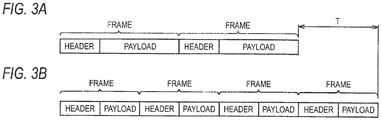
- Fig. 3A is a packet diagram illustrating a frame structure when the image data are transmitted in two frames.
- Fig. 3B is a packet diagram illustrating a frame structure when the image data having the same amount of data as that of Fig. 3A are transmitted in four frames.
- the frame including a header in which a transmission destination, a data amount, and the like are recorded and a payload that contains the image data.
- the header is an instance of an overhead.
- Fig. 4A is a diagram illustrating an exemplary method of selecting a frame size when the image data are transmitted at a frame size of V 0 .
- Fig. 4B is a diagram illustrating an exemplary method of selecting a frame size when the image data are transmitted at a frame size of V 2 .
- the frame size selection unit 35 selects the frame size of Fig. 4A which has a smaller number of segments as long as image data can be transmitted before a start of transmission of the next image data.
- a user sets plural originals 20 on the tray 21 of the image input unit 2 in a stack state and instructs reading of the originals 20 by manipulating the manipulation display unit 12.
- the originals 20 have a formal size.
- the automatic sheet feeding device 22 of the image input unit 2 starts automatic feeding of the originals 20.
- the original sensor of the original detection unit 23 transmits the original detection signal 23a to the original size determination unit 30 of the transmission control unit 3.
- the edge sensor of the original detection unit 23 transmits the page synchronization signal 23b to the original size determination unit 30 and an original edge detection unit 31 of the transmission control unit 3 from detection of the leading edge of the original 20 to detection of the trailing end of the original 20.
- the original size determination unit 30 determines the size of the original 20 based on the original detection signal 23a and the page synchronization signal 23b from the original detection unit 23 and determines whether the original 20 has a formal or informal size. Then, the determination result 30a is output to the frame size selection unit 35.
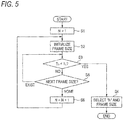
- the frame size selection unit 35 is operated as illustrated in the flowchart of Fig. 5 .
- step S3 The steps S3 and S5 described above are repeated until the relationship of "Ta ⁇ T L " is satisfied in step S3 (YES in step S3).
Landscapes
- Engineering & Computer Science (AREA)
- Multimedia (AREA)
- Signal Processing (AREA)
- Computer Hardware Design (AREA)
- Microelectronics & Electronic Packaging (AREA)
- General Physics & Mathematics (AREA)
- Physics & Mathematics (AREA)
- Human Computer Interaction (AREA)
- Theoretical Computer Science (AREA)
- Computer Networks & Wireless Communication (AREA)
- Astronomy & Astrophysics (AREA)
- General Engineering & Computer Science (AREA)
- Facsimiles In General (AREA)
- Health & Medical Sciences (AREA)
- Biomedical Technology (AREA)
- General Health & Medical Sciences (AREA)
Abstract
Description
- The present invention relates to an information processing apparatus.
- In the related art, an interface device for signals between devices that transmit moving videos such as a television set has been proposed (for instance, see
JP-A-2011-142521 - This interface device includes a subframe format creating unit configured to create a subframe format by segmenting a frame format of an image signal, a 64-bit conversion unit configured to generate a 64-bit stream, of which single word consists of 64 bits, from the subframe format, a 64-bit/66-bit encoder configured to generate a 66-bit stream by performing 64-bit/66-bit encoding for the 64-bit stream, a block segmentation unit configured to periodically grouping 66-bit streams into blocks and inserting dummy data into inter-block gaps, an alignment insertion unit configured to periodically substitute dummy data with alignment data, and a parallel-serial conversion unit configured to convert the output of the alignment insertion unit from parallel to serial.
- In an information processing apparatus configured to read plural originals sequentially, it is necessary to transmit the read image data without generating a waiting time.
- An object of an exemplary embodiment of the present invention is to provide an information processing apparatus capable of, when sequentially input image data are transmitted by limiting a frame size, finishing transmission of the image data before a start of transmission of the next image data.
- [1] An aspect of the invention provides an information processing apparatus that transmits image data input by sequentially reading originals, with limiting an allowable frame size, the apparatus including:
- a transmission control unit,
- in which, in a case where an original has an existing size, the transmission control unit transmits the image data to a destination with frames having one of frame sizes selected based on the existing size of the original, such that transmission of the current image data is finished before a start of transmission of the image data of the next original.
- [2] The information processing apparatus according to [1] may have a configuration in which
- the transmission control unit includes:
- a storing unit that stores a plurality of frame sizes available for a serial interface;
- a frame size selection unit that selects one of the frame sizes stored in the storing unit based on the existing size of the original such that the image data are segmented and transmitted in a plurality of frames, and transmission of the image data is finished before a start of transmission of the image data of a next original;
- a frame generation unit that generates the frames having the one of the frame sizes selected by the frame size selection unit; and
- a serialization unit that converts the frames generated by the frame generation unit into serial data and transmits the serial data to the destination through the serial interface.
- the transmission control unit includes:
- [3] The information processing apparatus according to [2] may have a configuration in which
the frame size selection unit preferentially selects a larger frame size out of a plurality of the frame sizes stored in the storing unit. - With the configurations of [1] and [2], when the sequentially input image data are transmitted through a serial interface by limiting a frame size, it is possible to finish transmission of the current image data before a start of transmission of the next image data.
- With the configuration of [3], it is possible to determine the frame size within a short time compared to a case where the larger frame size is not selected with a higher priority.
- Exemplary embodiment(s) of the present invention will be described in detail based on the following figures, wherein:
-
Fig. 1 is a perspective view illustrating an instance of appearance of an information processing apparatus according to an exemplary embodiment of the invention; -
Fig. 2 is a block diagram illustrating an instance of a control system of an information processing apparatus according to an exemplary embodiment of the invention; -
Fig. 3A is a packet diagram illustrating a frame structure when image data are transmitted in two frames; -
Fig. 3B is a packet diagram illustrating a frame structure when the image data having the same data amount as that ofFig. 3A are transmitted in four frames; -
Fig. 4A is a diagram illustrating an exemplary method of selecting a frame size when the image data are transmitted at a frame size of V0; -
Fig. 4B is a diagram illustrating an exemplary method of selecting a frame size when the image data are transmitted at a frame size of V2; and -
Fig. 5 is a flowchart illustrating an exemplary operation of a frame size selection unit when an original document has a formal size. - An exemplary embodiment of the invention will now be described with reference to the accompanying drawings. In each drawing, constituent elements having substantially the same function are given the same reference numerals and overlapping description will not be provided.
-
Fig. 1 is a perspective view illustrating an instance of appearance of an information processing apparatus according to an exemplary embodiment of the invention. - The
information processing apparatus 1 includes an automaticsheet feeding device 22 configured to automatically feedplural originals 20 placed in atray 21 in a stack state one by one to areading unit 24 and animage input unit 2 provided with anoriginal platen 25 where theoriginals 20 are placed one by one. In addition, theinformation processing apparatus 1 is a multifunction device having various functionalities such as a printer, a copier, and a facsimile. Theinformation processing apparatus 1 further includes acontroller 5 provided with a central processing unit (CPU), a nonvolatile memory, and the like to process information of abody portion 1a as illustrated inFig. 2 and atransmission control unit 3 configured to control transmission of image data input from theimage input unit 2 to acontroller 5 through aserial communication path 4 as illustrated inFig. 2 . Moreover, theinformation processing apparatus 1 has amanipulation display unit 12 such as a touch display for displaying a menu, various buttons, and the like and receiving manipulations therefrom. Here, thecontroller 5 is an instance of transmission destinations. - The
originals 20 as a target object of theapparatus 1 have an existing formal size. The "formal size" refers to a size of the original that conforms to the JIS standard such as an A-series (such as A3 or A4) or a B-series (such as B3 or B4), an American legal letter format, and the like. -
Fig. 2 is a block diagram illustrating an instance of a control system of aninformation processing apparatus 1 according to an exemplary embodiment of the invention. Theinformation processing apparatus 1 has animage input unit 2 configured to receive input image data, atransmission control unit 3 configured to transmit the image data input from theimage input unit 2 to thecontroller 5 through theserial communication path 4, and acontroller 5 configured to store the image data transmitted from thetransmission control unit 3. - The
image input unit 2 has anoriginal detection unit 23 configured to detect the original 20 supplied from the automaticsheet feeding device 22 and areading unit 24 configured to optically read the image data on the original 20 supplied from the automaticsheet feeding device 22 or the original 20 laid on theoriginal platen 25 using a solid image capturing element such as a charge-coupled device (CCD). - In the
serial communication path 4, a serial interface such as the Mobile Industry Processor Interface (MIPI) is employed, in which the number of allowable frame sizes is limited to several frame sizes ("4" in this exemplary embodiment, that is, V0, V1, V2, and V3 in the order from the larger size). In the MIPI, an arbitrary frame size is not allowed, and it is necessary to select one of the four frame sizes prepared in advance. For instance, the frame size may include 720 × 480p, 1280 × 720p, 1920 × 1080p, 4096 x 2160p, 3840 × 2160p, and the like. In the MIPI, plural virtual channels may share a single communication path, and each of the virtual channels is provided with a buffer. In this exemplary embodiment, this buffer is used as asize buffer 34 for storing the frame sizes. - The
controller 5 has adeserialization unit 50 configured to convert serial image data transmitted from thetransmission control unit 3 through theserial communication path 4 into parallel image data, and anonvolatile system memory 51 configured to store the image data converted by thedeserialization unit 50. Thecontroller 5 transmits the image data stored in thesystem memory 51 to a printer engine, a hard disc, a user terminal, and the like depending on the selected menu. - The
original detection unit 23 has plural original sensors arranged in plural portions in a main scanning direction to transmit anoriginal detection signal 23a in the event of detection of the original 20, and an edge sensor configured to detect leading and trailing ends of the original 20 in a sub-scanning direction (feeding direction) and transmit apage synchronization signal 23b. - When the original 20 has an existing size, the
transmission control unit 3 segments the image data into one or more frames having the same frame size based on the existing size of the original 20 and transmits the segmented image data to thecontroller 5 through theserial communication path 4 such that transmission of the current image data is finished before a start of transmission of the image data corresponding to the next original 20. - The number of frame sizes employed in the
information processing apparatus 1 is not limited to four. For instance, either three or two frame sizes may be employed. - The
transmission control unit 3 includes an originalsize determination unit 30, a frame buffer 32, a framesize setting unit 33, asize buffer 34, a framesize selection unit 35, aframe generation unit 36, and aserialization unit 37. Thetransmission control unit 3 may be implemented, for instance, using an application specific integrated circuit (ASIC), a field programmable gate array (FPGA), and the like. Here, the frame buffer 32 is an instance of a storing unit. - The original
size determination unit 30 determines a size of the original and whether the original 20 has a formal or informal size based on theoriginal detection signal 23a from the original sensor of theoriginal detection unit 23 and thepage synchronization signal 23b from the edge sensor. That is, if the originalsize determination unit 30 determines that the original 20 has a formal size, the size of the original 20 in the main scanning direction is detected based on theoriginal detection signal 23a, and the size of the original 20 in the sub-scanning direction is detected based on thepage synchronization signal 23b. The originalsize determination unit 30 outputs adetermination result 30a for the original 20 to the framesize selection unit 35. - The frame buffer 32 stores the image data of one page output from the
reading unit 24 as bitmap data. As the storing operation of the image data is terminated, the frame buffer 32 transmits the bitmap data stored therein to theserialization unit 37. - The frame
size setting unit 33 sets a frame size that can be used in theserial communication path 4 in thesize buffer 34 based on a user's manipulation entering to themanipulation display unit 12. - The
size buffer 34 hasplural buffers 34a to 34d. Thebuffers 34a to 34d store frame sizes V0, V1, V2, and V3, respectively, set by the framesize setting unit 33. - If the original
size determination unit 30 determines that the original 20 has a formal size, the framesize selection unit 35 selects one of the frame sizes V0, V1, V2, and V3 from thesize buffer 34 such that the image data are segmented and transmitted in one or more frames based on the existing size of the original 20, and transmission of the current image data is finished before a start of transmission of the image data of the next original. - The frame
size selection unit 35 selects the larger frame sizes V0 to V2 with a higher priority out of the frame sizes V0 to V3. - The frame
size selection unit 35 selects one of the frame sizes V0 to V3 and the number of segments "N" (including "1" which means no segment) and then controls theframe generation unit 36 such that frames having a frame size corresponding to the number of segments N are generated. - The
frame generation unit 36 generates the "N" frames each having the frame size selected by the framesize selection unit 35. - The
serialization unit 37 inserts theimage data 32a output from the frame buffer 32 into a payload of the frame generated by theframe generation unit 36, converts the frame into serial data, and transmits the serial data to thecontroller 5 through theserial communication path 4. -
Fig. 3A is a packet diagram illustrating a frame structure when the image data are transmitted in two frames.Fig. 3B is a packet diagram illustrating a frame structure when the image data having the same amount of data as that ofFig. 3A are transmitted in four frames. The frame including a header in which a transmission destination, a data amount, and the like are recorded and a payload that contains the image data. Here, the header is an instance of an overhead. If the transmission count increases from "two" illustrated inFig. 3A to "four" illustrated inFig. 3B , more time T is necessary to transmit the image data of the transmission count of "4" compared to the time for transmitting image data of the transmission count of "2" as much as the two headers. Therefore, the framesize selection unit 35 selects a relatively larger frame size with a higher priority to reduce the transmission count in the transmission of the remaining image data within a limited time. -
Fig. 4A is a diagram illustrating an exemplary method of selecting a frame size when the image data are transmitted at a frame size of V0.Fig. 4B is a diagram illustrating an exemplary method of selecting a frame size when the image data are transmitted at a frame size of V2. The framesize selection unit 35 selects the frame size ofFig. 4A which has a smaller number of segments as long as image data can be transmitted before a start of transmission of the next image data. - Next, an instance of the operation of the
information processing apparatus 1 will be described. A user setsplural originals 20 on thetray 21 of theimage input unit 2 in a stack state and instructs reading of theoriginals 20 by manipulating themanipulation display unit 12. In the following description, it is assumed that theoriginals 20 have a formal size. - The automatic
sheet feeding device 22 of theimage input unit 2 starts automatic feeding of theoriginals 20. As the original 20 is detected, the original sensor of theoriginal detection unit 23 transmits theoriginal detection signal 23a to the originalsize determination unit 30 of thetransmission control unit 3. The edge sensor of theoriginal detection unit 23 transmits thepage synchronization signal 23b to the originalsize determination unit 30 and an original edge detection unit 31 of thetransmission control unit 3 from detection of the leading edge of the original 20 to detection of the trailing end of the original 20. - The original
size determination unit 30 determines the size of the original 20 based on theoriginal detection signal 23a and thepage synchronization signal 23b from theoriginal detection unit 23 and determines whether the original 20 has a formal or informal size. Then, thedetermination result 30a is output to the framesize selection unit 35. - When it is determined that the original 20 has a formal size, the frame
size selection unit 35 is operated as illustrated in the flowchart ofFig. 5 . -
Fig. 5 is a flowchart illustrating an exemplary operation of the framesize selection unit 35 when the original 20 has a formal size. Unless specified otherwise, it is assumed that this operation is performed by the framesize selection unit 35. - The frame
size selection unit 35 sets the number of segments to "N=1" (which means no segment) in step S1 and initializes the frame size to a given value, for instance, "V0" in step S2. - The frame
size setting unit 35 obtains the data amount of the image data to be transmitted based on thedetermination result 30a from the originalsize determination unit 30 and computes a transmission time Ta (Ta = Tb × N, where "Tb" denotes a transmission time for transmitting a single frame) for transmitting the frames having the determined frame size (initialized to "V0") and a time TL (limited time) from the start of transmission of the current image data to the start of transmission of the image data of the next original 20. Then, the framesize selection unit 35 determines whether or not a relationship of "Ta < TL" is satisfied in step S3. - If it is determined that the relationship of "Ta < TL" is satisfied (YES in step S3), the number of segments N (N = 1) and the frame size V0 are determined, and the frame size selection process is terminated in step S4.
- In step S3, when it is determined that the relationship of "Ta < TL" is not satisfied (NO in step S3), the frame
size selection unit 35 determines whether or not there is the next smallest frame size V1 in thesize buffer 34 in step S5. When it is determined that there is the next smallest frame size V1 in the size buffer 34 (YES in step S5), the comparison process is performed for the frame size V1 similarly in step S3. - The steps S3 and S5 described above are repeated until the relationship of "Ta < TL" is satisfied in step S3 (YES in step S3).
- When there is no next smallest frame size in step S5 (NO in step S5), the number of segments is incremented (N = N + 1) in step S6, and the frame size is initialized to "V0" in step S2. Then, the steps S2, S3, S5, and S6 are repeated until an affirmative result is obtained in step S3.
- When the frame
size selection unit 35 determines the number of segments N and the frame size as described above, it is possible to reduce the number of segments and determine a frame size by which the image data can be transmitted before a start of the next transmission. - While exemplary embodiments of the present invention have been described hereinbefore, they are not intended to limit the scope of the invention. Various changes or medications may be possible without departing from the spirit and scope of the present invention. For instance, in step S5, a transmission time Tc, where "transmission time Tc = the data amount in the void area (refer to
Fig. 4 ) + (header (overhead) × the number of segments)," and a time Td (PS negation time) elapsing from a finish of transmission of the image data corresponding to a page size to a start of transmission of the image data of the next original may be computed. Then, whether or not a relationship of "Tc < Td" is satisfied may be determined. - Any step of the flow described in the exemplary embodiments may be added, deleted, changed, or substituted without departing from the spirit and scope of the invention.
- The foregoing description of the exemplary embodiments of the present invention has been provided for the purposes of illustration and description. It is not intended to be exhaustive or to limit the invention to the precise forms disclosed. Obviously, many modifications and variations will be apparent to practitioners skilled in the art. The embodiments were chosen and described in order to best explain the principles of the invention and its practical applications, thereby enabling others skilled in the art to understand the invention for various embodiments and with the various modifications as are suited to the particular use contemplated. It is intended that the scope of the invention be defined by the following claims and their equivalents.
Claims (3)
- An information processing apparatus that transmits image data input by sequentially reading originals, with limiting an allowable frame size, the apparatus comprising:a transmission control unit,wherein, in a case where an original has an existing size, the transmission control unit transmits the image data to a destination with frames having one of frame sizes selected based on the existing size of the original, such that transmission of the current image data is finished before a start of transmission of the image data of the next original.
- The information processing apparatus according to claim 1,
wherein the transmission control unit includes:a storing unit that stores a plurality of frame sizes available for a serial interface;a frame size selection unit that selects one of the frame sizes stored in the storing unit based on the existing size of the original such that the image data are segmented and transmitted in a plurality of frames, and transmission of the image data is finished before a start of transmission of the image data of a next original;a frame generation unit that generates the frames having the one of the frame sizes selected by the frame size selection unit; anda serialization unit that converts the frames generated by the frame generation unit into serial data and transmits the serial data to the destination through the serial interface. - The information processing apparatus according to claim 2,
wherein the frame size selection unit preferentially selects a larger frame size out of a plurality of the frame sizes stored in the storing unit.
Applications Claiming Priority (1)
| Application Number | Priority Date | Filing Date | Title |
|---|---|---|---|
| JP2016050961A JP2017168967A (en) | 2016-03-15 | 2016-03-15 | Information processing unit |
Publications (1)
| Publication Number | Publication Date |
|---|---|
| EP3220621A1 true EP3220621A1 (en) | 2017-09-20 |
Family
ID=57233277
Family Applications (1)
| Application Number | Title | Priority Date | Filing Date |
|---|---|---|---|
| EP16187447.4A Withdrawn EP3220621A1 (en) | 2016-03-15 | 2016-09-06 | Information processing apparatus |
Country Status (4)
| Country | Link |
|---|---|
| US (1) | US9769330B1 (en) |
| EP (1) | EP3220621A1 (en) |
| JP (1) | JP2017168967A (en) |
| CN (1) | CN107197308A (en) |
Citations (3)
| Publication number | Priority date | Publication date | Assignee | Title |
|---|---|---|---|---|
| US20100296115A1 (en) * | 2009-05-20 | 2010-11-25 | Canon Kabushiki Kaisha | Image processing apparatus, control method therefor, and program |
| JP2011142521A (en) | 2010-01-07 | 2011-07-21 | Nippon Hoso Kyokai <Nhk> | Interface device |
| US20140244907A1 (en) * | 2013-02-27 | 2014-08-28 | Kabushiki Kaisha Toshiba | Memory device |
Family Cites Families (9)
| Publication number | Priority date | Publication date | Assignee | Title |
|---|---|---|---|---|
| US20020097418A1 (en) * | 2001-01-19 | 2002-07-25 | Chang William Ho | Raster image processor and processing method for universal data output |
| SG183020A1 (en) * | 2007-07-12 | 2012-08-30 | Manovega Pte Ltd | System and method for voice and data communication |
| JP2012080336A (en) * | 2010-10-01 | 2012-04-19 | Canon Inc | Manuscript reading device, control method therefor and program |
| JP6012212B2 (en) * | 2012-03-19 | 2016-10-25 | キヤノン株式会社 | Document reader |
| JP5845166B2 (en) * | 2012-11-30 | 2016-01-20 | 株式会社沖データ | Image forming apparatus, image forming system, and image forming method |
| FR3013479B1 (en) * | 2013-11-21 | 2015-12-18 | Oberthur Technologies | NOTIFICATION METHOD FOR CONFIGURING A SECURE ELEMENT |
| JP6289066B2 (en) * | 2013-12-09 | 2018-03-07 | キヤノン株式会社 | Information processing apparatus, method, and program |
| US9564136B2 (en) * | 2014-03-06 | 2017-02-07 | Dts, Inc. | Post-encoding bitrate reduction of multiple object audio |
| JP6241426B2 (en) * | 2015-01-26 | 2017-12-06 | コニカミノルタ株式会社 | Image forming system, image forming apparatus, remote control method, and remote control program |
-
2016
- 2016-03-15 JP JP2016050961A patent/JP2017168967A/en active Pending
- 2016-07-11 US US15/207,087 patent/US9769330B1/en active Active
- 2016-09-06 EP EP16187447.4A patent/EP3220621A1/en not_active Withdrawn
- 2016-09-14 CN CN201610825269.2A patent/CN107197308A/en active Pending
Patent Citations (3)
| Publication number | Priority date | Publication date | Assignee | Title |
|---|---|---|---|---|
| US20100296115A1 (en) * | 2009-05-20 | 2010-11-25 | Canon Kabushiki Kaisha | Image processing apparatus, control method therefor, and program |
| JP2011142521A (en) | 2010-01-07 | 2011-07-21 | Nippon Hoso Kyokai <Nhk> | Interface device |
| US20140244907A1 (en) * | 2013-02-27 | 2014-08-28 | Kabushiki Kaisha Toshiba | Memory device |
Non-Patent Citations (1)
| Title |
|---|
| MIPI ALLIANCE ED - MIPI ALLIANCE: "MIPI Alliance Standard for Display Serial Interface V1.0", INTERNET CITATION, 5 April 2011 (2011-04-05), pages 1 - 82, XP002677191, Retrieved from the Internet <URL:http://wenku.baidu.com/view/0876b95377232f60ddcca124.html?from=rec&pos=2&weight=138&lastweight=115&count=5> [retrieved on 20120601] * |
Also Published As
| Publication number | Publication date |
|---|---|
| US9769330B1 (en) | 2017-09-19 |
| JP2017168967A (en) | 2017-09-21 |
| CN107197308A (en) | 2017-09-22 |
Similar Documents
| Publication | Publication Date | Title |
|---|---|---|
| JP6736881B2 (en) | Image processing apparatus, image forming apparatus, image processing method, and program | |
| CN102647539A (en) | Control device and method performed by the control device | |
| CN110719375B (en) | Multi-function device, control method thereof, and storage medium | |
| JP5247588B2 (en) | Image processing apparatus, control method thereof, and program | |
| US11645016B2 (en) | Image forming system, inspection device, and inspection method | |
| US11363154B2 (en) | Image processing apparatus capable of performing plurality of pieces of processing in parallel, control method for the image processing apparatus, and storage medium | |
| US9930221B2 (en) | Printing apparatus, printing apparatus control method, and storage medium for reducing a period of time between starting of a copy process for a preset plurality of copies to when the copy process is terminated | |
| JP2008134314A (en) | Image forming apparatus and control method | |
| CN109040514B (en) | Electronic device | |
| US9769330B1 (en) | Information processing apparatus | |
| EP3220278B1 (en) | Information processing apparatus | |
| US11425268B2 (en) | Image processing apparatus, method of controlling image processing apparatus, and storage medium | |
| JP6460627B2 (en) | Image processing apparatus capable of performing printing based on image data obtained by reading original, control method for image processing apparatus, and program | |
| JP7322366B2 (en) | Image reception device, image transmission/reception system, and image reception program | |
| US11184498B2 (en) | Image forming apparatus | |
| JP2007310775A (en) | Image processor and image processing method | |
| JP2012222446A (en) | Image reading device, control method therefor, and program | |
| JP5574727B2 (en) | Image forming apparatus and control method thereof | |
| JP6683145B2 (en) | Image forming device | |
| US12519892B2 (en) | Image processing apparatus, system, computer readable medium, and method for determining if document is a layout of plural images on single page based on count of black points | |
| JP2013055411A (en) | Image processing device, image processing method, and program | |
| US10602014B2 (en) | Image processing apparatus, control method of image processing apparatus, and storage medium | |
| JP2020004170A (en) | Image reading system, control method of image reading system, and program | |
| JP4803378B2 (en) | Image processing apparatus and program | |
| KR20160110135A (en) | Printing apparatus, control method for the printing apparatus, computer program, and storage medium |
Legal Events
| Date | Code | Title | Description |
|---|---|---|---|
| PUAI | Public reference made under article 153(3) epc to a published international application that has entered the european phase |
Free format text: ORIGINAL CODE: 0009012 |
|
| AK | Designated contracting states |
Kind code of ref document: A1 Designated state(s): AL AT BE BG CH CY CZ DE DK EE ES FI FR GB GR HR HU IE IS IT LI LT LU LV MC MK MT NL NO PL PT RO RS SE SI SK SM TR |
|
| AX | Request for extension of the european patent |
Extension state: BA ME |
|
| 17P | Request for examination filed |
Effective date: 20180319 |
|
| RBV | Designated contracting states (corrected) |
Designated state(s): AL AT BE BG CH CY CZ DE DK EE ES FI FR GB GR HR HU IE IS IT LI LT LU LV MC MK MT NL NO PL PT RO RS SE SI SK SM TR |
|
| 17Q | First examination report despatched |
Effective date: 20180706 |
|
| STAA | Information on the status of an ep patent application or granted ep patent |
Free format text: STATUS: THE APPLICATION HAS BEEN WITHDRAWN |
|
| 18W | Application withdrawn |
Effective date: 20181004 |