EP3219678A1 - Silicon doping of high voltage spinel - Google Patents
Silicon doping of high voltage spinel Download PDFInfo
- Publication number
- EP3219678A1 EP3219678A1 EP16160952.4A EP16160952A EP3219678A1 EP 3219678 A1 EP3219678 A1 EP 3219678A1 EP 16160952 A EP16160952 A EP 16160952A EP 3219678 A1 EP3219678 A1 EP 3219678A1
- Authority
- EP
- European Patent Office
- Prior art keywords
- active material
- cathode active
- lini
- ion cell
- lithium
- Prior art date
- Legal status (The legal status is an assumption and is not a legal conclusion. Google has not performed a legal analysis and makes no representation as to the accuracy of the status listed.)
- Granted
Links
Images




Classifications
-
- C—CHEMISTRY; METALLURGY
- C01—INORGANIC CHEMISTRY
- C01G—COMPOUNDS CONTAINING METALS NOT COVERED BY SUBCLASSES C01D OR C01F
- C01G53/00—Compounds of nickel
- C01G53/40—Complex oxides containing nickel and at least one other metal element
- C01G53/42—Complex oxides containing nickel and at least one other metal element containing alkali metals, e.g. LiNiO2
- C01G53/44—Complex oxides containing nickel and at least one other metal element containing alkali metals, e.g. LiNiO2 containing manganese
- C01G53/54—Complex oxides containing nickel and at least one other metal element containing alkali metals, e.g. LiNiO2 containing manganese of the type (Mn2O4)-, e.g. Li(NixMn2-x)O4 or Li(MyNixMn2-x-y)O4
-
- H—ELECTRICITY
- H01—ELECTRIC ELEMENTS
- H01M—PROCESSES OR MEANS, e.g. BATTERIES, FOR THE DIRECT CONVERSION OF CHEMICAL ENERGY INTO ELECTRICAL ENERGY
- H01M4/00—Electrodes
- H01M4/02—Electrodes composed of, or comprising, active material
- H01M4/36—Selection of substances as active materials, active masses, active liquids
- H01M4/48—Selection of substances as active materials, active masses, active liquids of inorganic oxides or hydroxides
- H01M4/52—Selection of substances as active materials, active masses, active liquids of inorganic oxides or hydroxides of nickel, cobalt or iron
- H01M4/525—Selection of substances as active materials, active masses, active liquids of inorganic oxides or hydroxides of nickel, cobalt or iron of mixed oxides or hydroxides containing iron, cobalt or nickel for inserting or intercalating light metals, e.g. LiNiO2, LiCoO2 or LiCoOxFy
-
- C—CHEMISTRY; METALLURGY
- C01—INORGANIC CHEMISTRY
- C01P—INDEXING SCHEME RELATING TO STRUCTURAL AND PHYSICAL ASPECTS OF SOLID INORGANIC COMPOUNDS
- C01P2002/00—Crystal-structural characteristics
- C01P2002/50—Solid solutions
-
- C—CHEMISTRY; METALLURGY
- C01—INORGANIC CHEMISTRY
- C01P—INDEXING SCHEME RELATING TO STRUCTURAL AND PHYSICAL ASPECTS OF SOLID INORGANIC COMPOUNDS
- C01P2002/00—Crystal-structural characteristics
- C01P2002/50—Solid solutions
- C01P2002/52—Solid solutions containing elements as dopants
-
- C—CHEMISTRY; METALLURGY
- C01—INORGANIC CHEMISTRY
- C01P—INDEXING SCHEME RELATING TO STRUCTURAL AND PHYSICAL ASPECTS OF SOLID INORGANIC COMPOUNDS
- C01P2002/00—Crystal-structural characteristics
- C01P2002/70—Crystal-structural characteristics defined by measured X-ray, neutron or electron diffraction data
- C01P2002/76—Crystal-structural characteristics defined by measured X-ray, neutron or electron diffraction data by a space-group or by other symmetry indications
-
- Y—GENERAL TAGGING OF NEW TECHNOLOGICAL DEVELOPMENTS; GENERAL TAGGING OF CROSS-SECTIONAL TECHNOLOGIES SPANNING OVER SEVERAL SECTIONS OF THE IPC; TECHNICAL SUBJECTS COVERED BY FORMER USPC CROSS-REFERENCE ART COLLECTIONS [XRACs] AND DIGESTS
- Y02—TECHNOLOGIES OR APPLICATIONS FOR MITIGATION OR ADAPTATION AGAINST CLIMATE CHANGE
- Y02E—REDUCTION OF GREENHOUSE GAS [GHG] EMISSIONS, RELATED TO ENERGY GENERATION, TRANSMISSION OR DISTRIBUTION
- Y02E60/00—Enabling technologies; Technologies with a potential or indirect contribution to GHG emissions mitigation
- Y02E60/10—Energy storage using batteries
Definitions
- This invention relates to a cathode active material for a Lithium (Li)-ion cell, to processing this material to electrodes, and to the use in electrochemical lithium ion cells of the same.
- Li-ion battery technologies are seen as the most promising power sources for electric vehicles (EV), hybrid electric vehicles (HEV), and plug-in hybrid electric vehicles (PHEV) to meet the requirements of next-generation electromobility, see e.g. D. Andre et al., J. Mater. Chem. A, 2015, 3, 6709-6732 .
- EV electric vehicles
- HEV hybrid electric vehicles
- PHEV plug-in hybrid electric vehicles
- Mn-based spinel LiNi 0.5 Mni 1.5 O 4 has become one of the top choices due to its facile 3D Li-ion diffusion ways and remarkable high charge-discharge voltage plateau at around 4,7 V (vs. Li/Li + ), which leads to high energy densities in the range of 650 Wh kg -1 , see e.g. G.B. Zhong et al., Electrochim. Acta, 2011, 56, 6554-6561 . Sufficing the capacity targets, operation in this high voltage range could greatly reduce the amount of cells in a battery pack system that is needed to run e-based vehicles.
- electrochemical parameters e. g. cycle performance and rate capability need to be improved and the strong capacity fade, especially observed at elevated temperatures is one of the major challenges that need to be tackled.
- purpose of the invention is to provide an improved cathode active material for a Li-ion cell (Li-ion cell) and the use of the same in an electrochemical cell.
- cathode active material for a Lithium-ion cell according to claim 1 and a method according to claim 6.
- Advantageous embodiments and developments of the invention arise from the dependent claims.
- the cathode active material includes high voltage spinel, which is at least partly substituted with Silicon (Si), Vanadium (V), Hafnium (Hf) or Zirconium (Zr).
- Substitution elements such as Si, V, Zr, and Hf have high bond dissociation energies with Oxygen (O) (significantly higher than Mn and Nickel (Ni)) which improves the chemical and structural stability of the oxygen rich spinel lattice and, therefore, the electrochemical performance of the resulting cathode material. Improved chemical and structural stabilities are beneficial to suppress material degradation e. g. Mn dissolution associated with oxygen deficiency. Oxygen deficiency and Mn dissolution are critical processes for cell lifetime and are to be suppressed. Dissolution of Mn is supposed to harm Li-ion cells with conducting salts, e.g.
- LiPF 6 due to transportation processes of solvated Mn 2+ ions through the electrolyte followed by deposition on the negative electrode according to the disproportionation reaction 2Mn 3+ (s) ⁇ Mn 4+ (s) +Mn 2+ (l) .
- the only substitution element (dopant) is silicon.
- the Si-O bond exhibits a very high dissociation energy of 798 kJ mol -1 at 298 K. This is far beyond the dissociation energies of the Mn-O and Ni-O bonds, which are 402 kJ mol -1 and 392 kJ mol -1 (at 298 K), respectively, and therefore is expected to improve the chemical and structural stability of an oxygen-rich crystal lattice greatly.
- Si as dopant is a non-toxic, eco-friendly and low-cost element.
- the person skilled in the art may reference the values of the mentioned dissociation energies in e.g. T. L. Cottrell, The Strengths of Chemical Bonds, 2d ed., Butterworth, London, 1958 .
- a preferred cathode active material is LiNi 0,5 Mn 1,5-x Si x O 4 . This means that Si substitutes Mn in the common high voltage spinel LiNi 0,5 Mn 1,5 O 4 . The most promising ratio of Si is 0 ⁇ x ⁇ 0,2.
- LiNi 0,5 Mn 1,5 SiO 4 substituted with the ratio of Si being 0 ⁇ x ⁇ 0,2 in LiNi 0,5 Mn 1,5-x Si x O 4 results in a mixture of two cubic phases, a disordered cubic phase, named Fd-3m, and an ordered phase, named P4 3 32.
- the prisitine LiNi 0,5 Mn 1,5 O 4 material shows a molar ratio of disordered phase material to ordered phase material of about 0,27 meaning that most of the material is in the ordered phase. The higher the doping ratio of Si, the 16d-site of the disordered phase gets more favored to be occupied by Si atoms.
- the disordered cubic phase material shows rock salt lattice structure (just like Ni x O) within the majority of ordered phase material, which is associated with Mn 3+ ions in the lattice.
- the unsubstituted spinel can be written as LiNi 2+ x Mn 3+ 1-2x Mn 4+ 1+x O 4 (0 ⁇ x ⁇ 0,5) and the formulas of the substituted materials are LiNi 0,5 Mn 1,5-x Si x O 4- ⁇ (0 ⁇ x ⁇ 0,5).
- the parameter ⁇ indicates oxygen deficiency and can be in the range of (0 ⁇ ⁇ ⁇ 0,02).
- the formation of the disordered cubic phase i.e. increased conversion of Mn 4+ sites in the ordered phase to Mn 4+ /Mn 3+ /Si 4+ sites in the disordered phase with increasing Si doping rates, results in an cathode active material with better electrical power parameters parallel to better lifetime parameters due to suppressed Mn dissolution because of the strong Dopant-Oxygen bonding.
- the method to which this invention relates is a method for the synthesis and processing a cathode active material for a Li-ion cell, said cathode active material including at least one compound having high voltage spinel structure according to the formula LiNi 0,5 Mn 1,5-x Si x O 4 with 0 ⁇ x ⁇ 0,2, wherein said synthesis method comprises:
- powders of the material LiNi 0,5 Mn 1,5-x Si x O 4 with 0 ⁇ x ⁇ 0,2 are synthesized by a two-step treatment process via solid-state reaction.
- the obtained material can be characterized by powder X-Ray diffraction, by field emission scanning electron microscopy and by Raman spectrometry or Fourier Transform Infrared Spectrometry.
- the method for synthesis of a cathode active material for a Li-ion cell is done with the calcination at a calcination temperature of 800 - 1000 °C in ambient atmosphere lasting for 4-6 hours with subsequent cooling down to 0 - 50 °C.
- the method for synthesizing a cathode active material for a Li-ion cell comprises the annealing step done at an annealing temperature of 600 - 800 °C in ambient atmosphere lasting for 15 - 30 hours.
- the obtained cathode material that can be used in a Li-ion cell on a working electrode containing the inventive cathode active material, can be acquired by:
- active material with the high doping levels (Si 0,15 and Si 0,20 ) exhibit greatly enhanced electrochemical stability.
- the enhanced electrochemical performance is related to the high Si-O bond dissociation energy which is far beyond of the Mn-O and Ni-O bond. Therefore, the structural and chemical stability is enlarged when Si is incorporated into an Oxygen rich crystal lattice and might also suppress Mn dissolution.
- a high potential of Si doping enhances the electrochemical activity of LiNi 0,5 Mn 1,5 O 4 .
- the doping with one of the dopants Vanadium (V), Zirconium (Zr) and Hafnium (Hf) instead of Si results in materials with similar behaviour compared to Si doped high voltage spinel material. This results from similar ionic radii (in the case of Si 4+ ) and comparable high Dopant-Oxygen bonding energy.
- the alternative dopants have a 4+ oxidation state at least on average. Thus, the Mn 4+ doping site of the ordered phase material was targeted.
- the reagent for Vanadium doping is V 2 O 5 /V 2 O 3 , or V 2 O 4 .
- the precursor for the doping with Hafnium is HfO 2 or HfCl 4 .
- the reagent for the doping with Zirconium can be Zr(C 5 H 7 O 2 ) 4 , Zirconium acetyl acetonate, Zirconium(IV) acetates hydroxide, Zirconium(IV) ethoxide, Zirconium acrylate, or Zirconium hydroxide.
- the precursor for the doping with Silicon are Si(OC 2 H 5 ) 4 (TEOS), Si(OCH 3 ) 4 (TMOS), Si(OC 3 H 7 ) 4 (TPOS), or Si(OC 3 H 7 ) (TPiOS).
- the invention is based on the following thoughts:
- Manganese (Mn) rich cathode active materials such as the spinels LiNi 0,5 Mn 1,5 O 4 and LiMn 2 O 4 , play a crucial role in order to achieve high energy densities on Li-ion cell level and to reduce costs.
- the synthesis includes the high temperature reaction of stoichiometric amounts of the elements in the form of oxides, acetates or nitrates. Other synthesis methods include spray drying and hydrothermal synthesis.
- the electrochemical performance of such manganese rich materials is strongly dependent on their composition.
- LiNi 0,5 Mn 1,5 O 4 the content of disordered phase influences the C-rate and power performance.
- LiNi 0,5 Mn 1,5 O 4 and the spinel LiMn 2 O 4 cycle- and storage life is significantly affected by the dissolution of manganese into the electrolyte.
- Mn based spinel materials show the effect of Mn dissolution into the electrolyte via disproportion: 2 Mn 3+ ⁇ Mn 2+ + Mn 4+ .
- This reaction is especially critical at high temperatures and leads to the degradation of the cathode active material.
- Another detrimental effect arises from the possible manganese (metal) deposition on the anode. Both negatively affects the cell lifetime.
- substitution elements are Silicon, Hafnium, Zirconium, and Vanadium.
- materials of the general composition LiNi 0,5 Mn 1,5-x A x O 4- ⁇ (0 ⁇ x ⁇ 0,5) are formed.
- the doping level should be in the range of 0 ⁇ x ⁇ 0,2 and 0 ⁇ ⁇ ⁇ 0,02.
- Cathode active material which contains one or both phases of doped high voltage spinel is characterized by high dissociation energy of the Oxygen to Silicon, Vanadium, Hafnium, and Zirconium, which provides high Oxygen lattice stability, reduces the amount of Manganese, and therefore prevents the dissolution of Manganese into the electrolyte. Therefore, an improvement in cycle and storage life is accomplished.
- the obtained material are LiNi 0,5 Mn 1,5-x Si x O 4 with 0 ⁇ x ⁇ 0,2, whereby the examples LiNi 0,5 Mn 1,45 Si 0,05 O 4 , LiNi 0,5 Mn 1,4 Si 0,1 O 4 , LiNi 0,5 Mn 1,35 Si 0,15 O 4 , and LiNi 0,5 Mn 1,3 Si 0,2 O 4 will be further discussed in comparison with the unsubstituted material LiNi 0,5 Mn 1,5 O 4 in the following.
- the molar ratio of disordered cubic phase material to ordered cubic phase material is ⁇ 0,1 for LiNi 0,5 Mn 1,5 O 4 and increases with higher Si doping ratio resulting to -0,314 for LiNi 0,5 Mn 1,45 Si 0,05 O 4 , ⁇ 0,282 for LiNi 0,5 Mn 1,4 Si 0,1 O 4 , ⁇ 0,376 for LiNi 0,5 Mn 1,35 Si 0,15 O 4 and -0,379 for LiNi 0,5 Mn 1,3 Si 0,2 O 4 .
- the powders were used to prepare positive electrodes for Li-ion cells by:
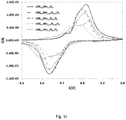
- Figs. 1a-c shows the cyclic voltammetry profiles at a scanning rate of 0.1 mV s -1 of half cells containing LiNi 0,5 Mn 1,5 O 4 and Si modified spinels as working electrodes, respectively.
- Fig. 1b is the magnified version of Fig. 1 a in the 4,0 V region.
- Fig. 1c is magnified in the region around 4,7 V.
- the intense peak located between 4.6 and 4.8 V in Figs. 1a-c originates from two two-phase reaction steps and is ascribed to the two-step oxidation/reduction of Ni 2+/3+/4+ .
- this peak separation can be associated with the presence of the disordered F3-dm phase, showing that disordered regimes are more pronounced with higher Si doping levels.
- Smaller differences in the potential between the anodic and cathodic peaks with higher Si doping levels show improved Li insertion/extraction kinetics compared to pure LiNi 0,5 Mn 1,5 O 4 .
- the second less intense redox peak mainly located at 4.0 V in Figs. 1a , 1b is observed for all samples, and can be attributed to the Mn 3+/4+ couple, indicating a reasonable amount of Mn 3+ in the structure.
- Highest intensity is found for LiNi 0,5 Mn 1,35 Si 0,15 O 4 and LiNi 0,5 Mn 1,30 Si 0,2 O 4 , indicating a trend towards higher Mn 3+ amount associated with superiorly Fd-3m proportion.
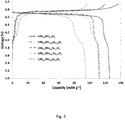
- the initial discharge/charge profiles at 0,5 C rate in the 3,00 - 4,95 V range for LiNi 0,5 Mn 1,5 O 4 and Si modified samples are presented in Fig. 2 .
- the initial discharge capacities are 126, 113, 113, 114 and 95 mAh g -1 for LiNi 0,5 Mn 1,5 O 4 , LiNi 0,5 Mn 1,45 Si 0,05 O 4 , LiNi 0,5 Mn 1,4 Si 0,1 O 4 , LiNi 0,5 Mn 1,35 Si 0,15 O 4 , and LiNi 0,5 Mn 1,3 Si 0,2 O 4 , respectively.
- a flat, extended plateau at 4,7 V ascribed to the oxidation/reduction of Ni 2+/3+/4+ is observed for all samples.
- Mn 3+ is subjected to disproportionation reaction which provides Mn 2+ that is soluble in LiPF 6 based electrolytes leading to degradation of the positive electrode and deposition on the negative electrode as follows from prior art.
- disproportionation reaction provides Mn 2+ that is soluble in LiPF 6 based electrolytes leading to degradation of the positive electrode and deposition on the negative electrode as follows from prior art.
- the existence of an appropriate amount of Mn 3+ is to be seen as beneficial for the electrochemical performance, since the disordered F3-dm phase supports the electrochemical performance based on its higher conductivity for electrons and Li ions.
- Mn 3+ in LiNi 0,5 Mn 1,5 O 4 spinel facilitates the Ni/Mn disorder leading to the F3-dm phase.
- Ni/Mn disorders are seen to decrease the internal resistance since Ni 2+/3+/4+ electrochemically active centers isolated by inactive Mn 4+ in an ordered structure becomes accessible.
- the electrochemical active Mn species participates in the redox reaction which supports compensation of capacity loss caused by substitution of Ni during Si doping.
- Mn 3+ ions support the electron hopping conduction mechanism by acting as internal carriers according to Ni 2+/3+ ⁇ Mn 4+ ⁇ Ni 3+/4+ as well as Ni 2+/3+ ⁇ Mn 4+ ⁇ Mn 3+ ⁇ Ni 3+/4+ .
Landscapes
- Chemical & Material Sciences (AREA)
- Inorganic Chemistry (AREA)
- Organic Chemistry (AREA)
- Chemical Kinetics & Catalysis (AREA)
- Electrochemistry (AREA)
- General Chemical & Material Sciences (AREA)
- Battery Electrode And Active Subsutance (AREA)
Abstract
Description
- This invention relates to a cathode active material for a Lithium (Li)-ion cell, to processing this material to electrodes, and to the use in electrochemical lithium ion cells of the same.
- Li-ion battery technologies are seen as the most promising power sources for electric vehicles (EV), hybrid electric vehicles (HEV), and plug-in hybrid electric vehicles (PHEV) to meet the requirements of next-generation electromobility, see e.g. D. Andre et al., J. Mater. Chem. A, 2015, 3, 6709-6732.
Since the widely applied and commercialized active cathode compounds for consumer and automotive cells are based on LiCoO2 and Li[Ni1/3Mn1/3Co1/3]O2 (NMC), current research and development focus on new and high-performance Co-free active materials in order to address the environmental issues, noxious effects, and high costs caused by Cobalt (Co).
Among several candidates, Mn-based spinel LiNi0.5Mni1.5O4 has become one of the top choices due to its facile 3D Li-ion diffusion ways and remarkable high charge-discharge voltage plateau at around 4,7 V (vs. Li/Li+), which leads to high energy densities in the range of 650 Wh kg-1, see e.g. G.B. Zhong et al., Electrochim. Acta, 2011, 56, 6554-6561.
Sufficing the capacity targets, operation in this high voltage range could greatly reduce the amount of cells in a battery pack system that is needed to run e-based vehicles.
However, prior to the commercialization of high voltage spinel, i.e. LiNi0.5Mn1.5O4, electrochemical parameters e. g. cycle performance and rate capability need to be improved and the strong capacity fade, especially observed at elevated temperatures is one of the major challenges that need to be tackled. - Thus, purpose of the invention is to provide an improved cathode active material for a Li-ion cell (Li-ion cell) and the use of the same in an electrochemical cell.
- This purpose is accomplished by cathode active material for a Lithium-ion cell according to
claim 1 and a method according to claim 6. Advantageous embodiments and developments of the invention arise from the dependent claims. - According to the invention, the cathode active material includes high voltage spinel, which is at least partly substituted with Silicon (Si), Vanadium (V), Hafnium (Hf) or Zirconium (Zr).
- Partial substitution of Manganese (Mn) in high voltage spinels, such as LiNi0.5Mn1.5O4, with one or a mixture of these elements results in advantageous features of the cathode active material for the use in Li-ion cells especially designed for automotive applications.
- In high voltage spinel, these dopants interrupt the ordering between Mn4+ and Ni2+ which minimizes isolated domains of active Ni2+/3+/4+ redox centers separated by inactive Mn4+ ions and, therefore, the internal resistance is decreased. See e.g., Chemelewski et al. J. Phys. Chem. C 2013, 117, 12465-12471. Moreover, electronic conductivity and Li diffusion kinetics can be improved from which automotive applications can benefit.
- Substitution elements, such as Si, V, Zr, and Hf have high bond dissociation energies with Oxygen (O) (significantly higher than Mn and Nickel (Ni)) which improves the chemical and structural stability of the oxygen rich spinel lattice and, therefore, the electrochemical performance of the resulting cathode material. Improved chemical and structural stabilities are beneficial to suppress material degradation e. g. Mn dissolution associated with oxygen deficiency. Oxygen deficiency and Mn dissolution are critical processes for cell lifetime and are to be suppressed. Dissolution of Mn is supposed to harm Li-ion cells with conducting salts, e.g. LiPF6, due to transportation processes of solvated Mn2+ ions through the electrolyte followed by deposition on the negative electrode according to the disproportionation reaction 2Mn3+ (s)→Mn4+ (s)+Mn2+ (l).
- According to one embodiment the only substitution element (dopant) is silicon.
- The Si-O bond exhibits a very high dissociation energy of 798 kJ mol-1 at 298 K. This is far beyond the dissociation energies of the Mn-O and Ni-O bonds, which are 402 kJ mol-1 and 392 kJ mol-1 (at 298 K), respectively, and therefore is expected to improve the chemical and structural stability of an oxygen-rich crystal lattice greatly. Moreover, Si as dopant is a non-toxic, eco-friendly and low-cost element. The person skilled in the art may reference the values of the mentioned dissociation energies in e.g. T. L. Cottrell, The Strengths of Chemical Bonds, 2d ed., Butterworth, London, 1958.
- A preferred cathode active material is LiNi0,5Mn1,5-xSixO4. This means that Si substitutes Mn in the common high voltage spinel LiNi0,5Mn1,5O4. The most promising ratio of Si is 0 < x ≤ 0,2.
- This amount of Si leads to spinels showing high crystallinity and a homogenous distribution of Si.
- Substitution of LiNi0,5Mn1,5SiO4 with the ratio of Si being 0 < x ≤ 0,2 in LiNi0,5Mn1,5-xSixO4 results in a mixture of two cubic phases, a disordered cubic phase, named Fd-3m, and an ordered phase, named P4332. The prisitine LiNi0,5Mn1,5O4 material shows a molar ratio of disordered phase material to ordered phase material of about 0,27 meaning that most of the material is in the ordered phase. The higher the doping ratio of Si, the 16d-site of the disordered phase gets more favored to be occupied by Si atoms. This leads to the effect that with a Si content of x = 0,2 the molar ratio of disordered phase to ordered phase material in LiNi0,5Mn1,3Si0,2O4 shifts to about 0,38.
Substitution levels of Mn by Si in the ratio of around 0,2 lead to an optimum of stability and cycling performance. Higher ratios than 0,2 (i.e. relatively more disordered phase material) are possible but leads to high cation disorder. - It has to be noted that the disordered cubic phase material shows rock salt lattice structure (just like NixO) within the majority of ordered phase material, which is associated with Mn3+ ions in the lattice. The unsubstituted spinel can be written as LiNi2+ xMn3+ 1-2xMn4+ 1+xO4 (0 ≤ x ≤ 0,5) and the formulas of the substituted materials are LiNi0,5Mn1,5-xSixO4-δ (0 ≤ x ≤ 0,5). The parameter δ indicates oxygen deficiency and can be in the range of (0 ≤ δ ≤ 0,02).
- On the one hand, the formation of the disordered cubic phase, i.e. increased conversion of Mn4+ sites in the ordered phase to Mn4+/Mn3+/Si4+ sites in the disordered phase with increasing Si doping rates, results in an cathode active material with better electrical power parameters parallel to better lifetime parameters due to suppressed Mn dissolution because of the strong Dopant-Oxygen bonding.
On the other hand, as the disordered phase is - due to the Mn3+ atom - prone to Jahn-Teller-distortion of the lattice, which is harmful to the crystal structure, the shifting towards more disordered phase material within the mixture is undesired. Therefore, x = 0,2 marks an upper limit of reasonable Si content. - For the purpose of simplicity, subsequently, the formula LiNi0,5Mni1,5-xSixO4 is addressed in this document.
- The method to which this invention relates is a method for the synthesis and processing a cathode active material for a Li-ion cell, said cathode active material including at least one compound having high voltage spinel structure according to the formula LiNi0,5Mn1,5-xSixO4 with 0 < x ≤ 0,2, wherein said synthesis method comprises:
- mixing of stoichiometric amounts of Lithiumacetate dihydrate (LiCH3OO*2H2O), Nickel(II)nitrate hexahydrate (Ni(NO2)2*6H2O), Manganese(III)acetate dihydrate (MnCH3COO)3*2H2O), and Tetraethylorthosilicate (Si(OC2H5)4 with Ethanol as dispersion medium by milling obtaining a milled mixture,
- calcination of the milled mixture and subsequent cooling down to room temperature,
- grinding of the calcined, milled mixture obtaining a grinded mixture,
- annealing of the grinded mixture in ambient obtaining the cathode active material.
- This means that powders of the material LiNi0,5Mn1,5-xSixO4 with 0 < x ≤ 0,2 are synthesized by a two-step treatment process via solid-state reaction. If desired, the obtained material can be characterized by powder X-Ray diffraction, by field emission scanning electron microscopy and by Raman spectrometry or Fourier Transform Infrared Spectrometry.
- Preferably, the method for synthesis of a cathode active material for a Li-ion cell is done with the calcination at a calcination temperature of 800 - 1000 °C in ambient atmosphere lasting for 4-6 hours with subsequent cooling down to 0 - 50 °C.
- Furthermore, best results are obtained if the method for synthesizing a cathode active material for a Li-ion cell comprises the annealing step done at an annealing temperature of 600 - 800 °C in ambient atmosphere lasting for 15 - 30 hours.
- The obtained cathode material, that can be used in a Li-ion cell on a working electrode containing the inventive cathode active material, can be acquired by:
- Mixing of about 70-98 wt-% of active materials, with about 1-20 wt-% of conductive additives (e.g. Super P) and about 1-10 wt-% of binder (e.g. polyvinylidene fluoride (PVDF) binder) in a solvent (e.g. N-methyl-2-pyrrolidone (NMP), N-ethyl-2-pyrrolidone (NEP), water) to form homogenous slurries in an agate mortar or planetary tank mixer.
- Coating of the as-prepared slurries on Aluminum collector foils with a doctor blade or other coating techniques, such as slot dye, gravure, comma, curtain, roll coating.
- Drying at about 60 °C in a vacuum oven for 8-12 hours.
- Pressing of the electrodes to the desired coating thickness (10-200µm, with electrode porosity within the range of 15-50%) and punching into desired shape.
- Assembly in a Li-ion cell.
- The higher the doping level the more a trend to increased ratios of disordered Fd-3m phase associated with amounts of Mn3+ ions occurs. Especially active material with the high doping levels (Si0,15 and Si0,20) exhibit greatly enhanced electrochemical stability. The enhanced electrochemical performance is related to the high Si-O bond dissociation energy which is far beyond of the Mn-O and Ni-O bond. Therefore, the structural and chemical stability is enlarged when Si is incorporated into an Oxygen rich crystal lattice and might also suppress Mn dissolution. A high potential of Si doping enhances the electrochemical activity of LiNi0,5Mn1,5O4. This, and also due to Si as dopant is a non-toxic, eco-friendly and low-cost element, make LiNi0,5Mn1,5-xSixO4 compounds with 0 < x ≤ 0,2 to attractive promising candidates for application as high voltage cathode materials in Li-ion battery technologies.
- The doping with one of the dopants Vanadium (V), Zirconium (Zr) and Hafnium (Hf) instead of Si results in materials with similar behaviour compared to Si doped high voltage spinel material. This results from similar ionic radii (in the case of Si4+) and comparable high Dopant-Oxygen bonding energy. As for Si doping, the alternative dopants have a 4+ oxidation state at least on average. Thus, the Mn4+ doping site of the ordered phase material was targeted.
- The reagent for Vanadium doping is V2O5/V2O3, or V2O4. The precursor for the doping with Hafnium is HfO2 or HfCl4. The reagent for the doping with Zirconium can be Zr(C5H7O2)4, Zirconium acetyl acetonate, Zirconium(IV) acetates hydroxide, Zirconium(IV) ethoxide, Zirconium acrylate, or Zirconium hydroxide. The precursor for the doping with Silicon are Si(OC2H5)4 (TEOS), Si(OCH3)4 (TMOS), Si(OC3H7)4 (TPOS), or Si(OC3H7) (TPiOS).
- The invention is based on the following thoughts:
- Manganese (Mn) rich cathode active materials, such as the spinels LiNi0,5Mn1,5O4 and LiMn2O4, play a crucial role in order to achieve high energy densities on Li-ion cell level and to reduce costs. The synthesis includes the high temperature reaction of stoichiometric amounts of the elements in the form of oxides, acetates or nitrates. Other synthesis methods include spray drying and hydrothermal synthesis. The electrochemical performance of such manganese rich materials is strongly dependent on their composition. For high voltage spinel, LiNi0,5Mn1,5O4, the content of disordered phase influences the C-rate and power performance. For LiNi0,5Mn1,5O4 and the spinel LiMn2O4 cycle- and storage life is significantly affected by the dissolution of manganese into the electrolyte.
- Mn based spinel materials show the effect of Mn dissolution into the electrolyte via disproportion: 2 Mn3+ → Mn2+ + Mn4+. This reaction is especially critical at high temperatures and leads to the degradation of the cathode active material. Another detrimental effect arises from the possible manganese (metal) deposition on the anode. Both negatively affects the cell lifetime.
- Thus, it is suggested to partially substitute Mn with elements that have similar oxidation number on average, compatible ionic radii and strong metal-oxygen bonds. Suggested substitution elements (A) are Silicon, Hafnium, Zirconium, and Vanadium. As a result of the substitution, materials of the general composition LiNi0,5Mn1,5-xAxO4-δ (0 ≤ x ≤ 0,5) are formed. The doping level should be in the range of 0 < x ≤ 0,2 and 0 ≤ δ ≤ 0,02.
- Cathode active material which contains one or both phases of doped high voltage spinel is characterized by high dissociation energy of the Oxygen to Silicon, Vanadium, Hafnium, and Zirconium, which provides high Oxygen lattice stability, reduces the amount of Manganese, and therefore prevents the dissolution of Manganese into the electrolyte. Therefore, an improvement in cycle and storage life is accomplished.
- Furthermore, in the ordered phase of high voltage spinel, LiNi0,5Mn4+ 1,5-xA4+ xO4, an interruption of cation-ordering is induced. Dopants interrupt the ordering between Mn4+ and Ni2+ which minimizes isolated domains of active Ni2+/3+/4+ redox centers separated by inactive Mn4+-ions and favors the disordered phase with facilitated Lithium diffusivity. This leads to better rate and power performance in the cell. With increasing parameter x, the disordered phase is favored.
- In the following, favored embodiments of the invention are discussed and illustrated by the attached figures. From these, further details, preferred embodiments and concrete characteristics result. In particular, these are shown schematically by
-
Figs. 1a-c Cyclic voltammograms of LiNi0,5Mni1,5O4 and Si modified materials. -
Fig. 2 Initial charge/discharge curves of LiNi0,5Mn1,5O4 and Si modified materials. -
Figs. 3a-b Cycling performance of LiNi0,5Mn1,5O4 and Si modified materials at room temperature. -
Fig. 4 Rate performance of LiNi0,5Mn1,5O4 and Si modified materials at various C rates. - As discrete embodiments of doping the high voltage spinel LiNi0,5Mn1,5O4 with Silicon the configurations LiNi0,5Mn1,45Si0,05O4, LiNi0,5Mn1,4Si0,1O4, LiNi0,5Mn1,35Si0,15O4, and LiNi0,5Mn1,3Si0,2O4 are chosen.
The relevant powders were synthesized by a two-step heat treatment process via solid-state reaction, following: - Mixing of stoichiometric amounts of Lithiumacetate dihydrate (LiCH3OO*2H2O, 97 %, Aldrich, (5% excess)), Nickel(II)nitrate hexahydrate (Ni(NO3)2*6H2O 97 %, Fluka), Manganese(III)acetate dihydrate (Mn(CH3OO)3*2H2O, 97 %, Aldrich), and Tetraethylorthosilicate (Si(OC2H5)4, 98 %, Aldrich) in a ball-milling machine (SPEX SamplePrep 8000D Dual Mixer/Mill, Titanium balls) with Ethanol as dispersion medium. H2O as dispersion medium can be used depending on the hydrolysis and condensation rates of the silicon reagent. A combination of the latter as dispersion medium by milling obtaining a milled mixture,
- Calcination: The milled mixtures were first calcined in ambient atmosphere at 900 °C for 5 h, and cooled down to room temperature.
- Grinding and annealing: The calcined mixtures were grinded in a mortar and then annealed to 700 °C in ambient atmosphere for 24 h.
- The obtained material are LiNi0,5Mn1,5-xSixO4 with 0 < x ≤ 0,2, whereby the examples LiNi0,5Mn1,45Si0,05O4, LiNi0,5Mn1,4Si0,1O4, LiNi0,5Mn1,35Si0,15O4, and LiNi0,5Mn1,3Si0,2O4 will be further discussed in comparison with the unsubstituted material LiNi0,5Mn1,5O4 in the following. According to constant voltage measurements, the molar ratio of disordered cubic phase material to ordered cubic phase material is ∼0,1 for LiNi0,5Mn1,5O4 and increases with higher Si doping ratio resulting to -0,314 for LiNi0,5Mn1,45Si0,05O4, ∼0,282 for LiNi0,5Mn1,4Si0,1O4, ∼0,376 for LiNi0,5Mn1,35Si0,15O4 and -0,379 for LiNi0,5Mn1,3Si0,2O4.
- The powders were used to prepare positive electrodes for Li-ion cells by:
- Mixing 70-98 wt-% of active materials, with 1-20 wt-% of conductive additives (Super P Li carbon, 99 %, Timcal) and 1-10 wt-% of polyvinylidene fluoride (PVDF) binder (Solef 5130 from SOLVAY) in N-methyl-2-pyrrolidone (99.85 %, BASF, Germany) as the solvent to form homogenous slurries in an agate mortar.
- Coating of the as-prepared slurries on Aluminum (Al) foils with a doctor blade.
- Drying at 60 °C overnight in a vacuum oven.
- Roll-pressing of the electrodes and punching into discs with diameters of 16 mm.
- Drying of the discs overnight in a vacuum oven and assembling into coin cells (CR2016) with a Li foil (0.59 mm thickness, Hohsen Corp., Japan) as the counter and reference electrode in an argon-filled atmosphere (H2O, O2 < 1 ppm, MBraun, Unilab, USA).
- Use of LP50 electrolyte (Charlston Technologies PTE LTD, 1 M LiPF6 solution in Ethylene carbonate (EC) - Dimethyl carbonate (DMC) (1:1 w/w)) and separator (Celgard 2400) during cell assembly.
- The electrochemical characterization of these electrodes displays the advantages of Si doping of high voltage spinel.
Figs. 1a-c shows the cyclic voltammetry profiles at a scanning rate of 0.1 mV s-1 of half cells containing LiNi0,5Mn1,5O4 and Si modified spinels as working electrodes, respectively.Fig. 1b is the magnified version ofFig. 1 a in the 4,0 V region.Fig. 1c is magnified in the region around 4,7 V. - The intense peak located between 4.6 and 4.8 V in
Figs. 1a-c originates from two two-phase reaction steps and is ascribed to the two-step oxidation/reduction of Ni2+/3+/4+. Peak splitting for the Ni2+/3+ (lower voltage) and the Ni3+/4+ (higher voltage) redox processes is seen especially for samples with highest doping level (x = 0,2) and also seen as vague depression of curve for LiNi0,5Mn1,5O4, LiNi0,5Mn1,45Si0,05O4, LiNi0,5Mn1,4Si0,1O4, and LiNi0,5Mn1,35Si0,15O4. According to state of the art this peak separation can be associated with the presence of the disordered F3-dm phase, showing that disordered regimes are more
pronounced with higher Si doping levels. Smaller differences in the potential between the anodic and cathodic peaks with higher Si doping levels show improved Li insertion/extraction kinetics compared to pure LiNi0,5Mn1,5O4. The second less intense redox peak mainly located at 4.0 V inFigs. 1a ,1b is observed for all samples, and can be attributed to the Mn3+/4+ couple, indicating a reasonable amount of Mn3+ in the structure. Highest intensity is found for LiNi0,5Mn1,35Si0,15O4 and LiNi0,5Mn1,30Si0,2O4, indicating a trend towards higher Mn3+ amount associated with superiorly Fd-3m proportion. - The initial discharge/charge profiles at 0,5 C rate in the 3,00 - 4,95 V range for LiNi0,5Mn1,5O4 and Si modified samples are presented in
Fig. 2 . The initial discharge capacities are 126, 113, 113, 114 and 95 mAh g-1 for LiNi0,5Mn1,5O4, LiNi0,5Mn1,45Si0,05O4, LiNi0,5Mn1,4Si0,1O4, LiNi0,5Mn1,35Si0,15O4, and LiNi0,5Mn1,3Si0,2O4, respectively. A flat, extended plateau at 4,7 V ascribed to the oxidation/reduction of Ni2+/3+/4+ is observed for all samples. For the Si doped samples the plateau is slightly shifted up to higher voltages values in the order Si0,20, Si0,15, Si0,10, Si0,05 indicating the highest power density for the LiNi0,5Mn1,45Si0,05O4 sample. In addition, there are small plateaus of varying length in the 4,0 V region associated with the Mn3+/4+ redox couple. This is in agreement with the analysis according toFigs. 1a-c and further proves the presence of Mn3+ in the system associated with a reasonable proportion of disordered Fd-3m regions. - Both, the two cubic space groups (Fd-3m, P4332) and the presence of Mn3+ in LiNi0,5Mn1,5O4 is critical for the electrochemical performance of the electrodes. Mn3+ is subjected to disproportionation reaction which provides Mn2+ that is soluble in LiPF6 based electrolytes leading to degradation of the positive electrode and deposition on the negative electrode as follows from prior art. However, the existence of an appropriate amount of Mn3+ is to be seen as beneficial for the electrochemical performance, since the disordered F3-dm phase supports the electrochemical performance based on its higher conductivity for electrons and Li ions. It is known from prior art that formation of Mn3+ in LiNi0,5Mn1,5O4 spinel facilitates the Ni/Mn disorder leading to the F3-dm phase. Ni/Mn disorders are seen to decrease the internal resistance since Ni2+/3+/4+ electrochemically active centers isolated by inactive Mn4+ in an ordered structure becomes accessible. The electrochemical active Mn species participates in the redox reaction which supports compensation of capacity loss caused by substitution of Ni during Si doping. Furthermore, it is known that Mn3+ ions support the electron hopping conduction mechanism by acting as internal carriers according to Ni2+/3+ → Mn4+ → Ni3+/4+ as well as Ni2+/3+ → Mn4+ ↔ Mn3+ → Ni3+/4+. These two additional pathways are not present at the P4332 polymorph according to prior art related to undoped high voltage spinel leading to comparatively faster charge transfer in the Fd-3m system. Moreover, assuming all Mn ions
exhibit an oxidation state of 4+, LiNi0,5Mn1,5O4 would be stochiometrically ordered without any Oxygen deficiency, which may not support a fast Li+ transportation. It is observed that the higher the doping level a trend towards higher degree of F3-dm phase associated with Mn3+ is presented in the material. - From
Figs. 3a-b it can be seen that the samples with the highest Si amount (Si0,15 and Si0,20) show enhanced cycle stability even over the pristine LiNi0,5Mn1,5O4 at the tested range of 0.5 (seeFig. 3a ) and 1 C rate (seeFig. 3b ) for 100 cycles as presented in the cycle performance diagrams ofFigs. 3a-b . It can also be observed, that the sample with the second highest doping level LiNi0,5Mn1,35Si0,15O4 shows superior capacity values among all Si modified samples and the pristine LiNi0,5Mn1,5O4 starting from the 40th cycle. - To demonstrate the rate performance of the LiNi0,5Mn1,5O4 and the Si modified spinels, the samples were discharged at various higher C rates from 0,1 to 10 C and finally again at 0,1 C according to
Fig. 4 . At higher C rates, the difference in the resulting capacities between the pristine LiNi0,5Mn1,5O4 and the Si modified samples are more pronounced, and starting from 0,5 C rates LiNi0,5Mn1,45Si0,05O4 and LiNi0,5Mn1,35Si0,15O4 deliver superior capacity values over the pure LiNi0,5Mn1,5O4. After cycling from 0,1 C to 10 C rates and applying again the C-rate of 0,1, the initial discharge capacity values can be reached again for all samples indicating an excellent reversible electrochemical behaviour. - In general, according to these embodiments it is shown that the higher the doping level a trend to increased ratios of disordered Fd-3m phase associated with detectable amounts of Mn3+ ions occurs. Especially active material with the two highest doping levels (Si0,15 and Si0,20) exhibit greatly enhanced electrochemical stability. The enhanced electrochemical performance is related to the high Si-O bond dissociation energy which is far beyond of the Mn-O and Ni-O bond. Therefore, the structural and chemical stability is enlarged when Si is incorporated into an Oxygen rich crystal lattice and might also suppress Mn dissolution. A high potential of Si doping enhances the electrochemical activity of LiNi0,5Mn1,5O4. This, and also due to Si as dopant is a non-toxic, eco-friendly and low-cost element, make LiNi0,5Mn1,5-xSixO4 compounds with 0 < x ≤ 0,2 to attractive promising candidates for application as high voltage cathode materials in Li-ion battery technologies.
Claims (8)
- Cathode active material for a Li-ion cell,- including at least one compound having high voltage spinel structure,- which is at least partly doped with a dopant or a mixture of dopants,- whereby the dopant or the dopants are Silicon, Vanadium, Hafnium or Zirconium.
- Cathode active material for a Lithium-ion cell according to claim 1 with Silicon as single dopant.
- Cathode active material for a Lithium-ion cell according to claim 2,
corresponding to the formula LiNi0,5Mn1,5-xSixO4. - Cathode active material for a Lithium-ion cell according to claim 3,
with 0 < x ≤ 0,2. - Cathode active material for a Lithium-ion cell according to claims 3 or 4,
whereby the compound having the high voltage spinel structure includes a disordered cubic crystal phase and a ordered cubic crystal phase with a molar ratio of the disordered cubic crystal phase to the ordered cubic crystal phase accounting for 0,2-0,4. - Method for processing a cathode active material for a Lithium-ion cell, said cathode active material including at least one compound having high voltage spinel structure according to the formula LiNi0,5Mn1,5-xSixO4 with 0 < x ≤ 0,2, wherein said method comprises:- mixing of stoichiometric amounts of- Lithiumacetate dihydrate (LiCH3OO*2H2O), Li- acetate, Li-nitrate, Li-hydroxide, Li-carbonate, or Li-halogenide, Nickel(II)nitrate hexahydrate (Ni(NO3)2*6H2O),- Nickel-acetate, Ni-sulfate, or Ni-halogenide, Manganese(III)acetate dihydrate (Mn(CH3OO)3*2H2O),- Mn-nitrate, Mn-sulfate, or Mn-halogenide, and- and Tetraethylorthosilicate (Si(OC2H5)4, TEOS), or Si(OCH3)4(TMOS), Si(OC3H7)4 (TPOS), or Si(OC3H7) (TPiOS), with- Ethanol other alcohols, such as methanol, propylalcohol, isopropylalcohol, or a mixture of these solvents,as dispersion medium by milling obtaining a milled mixture,- calcination of the milled mixture and subsequent cooling down to room temperature,- grinding of the calcined, milled mixture obtaining a grinded mixture,- annealing of the grinded mixture in ambient obtaining the cathode active material.
- Method for processing a cathode active material for a Lithium-ion cell according to claim 6, whereby the calcination is done at a calcination temperature of 800 - 1000 °C in ambient atmosphere lasting for 4 - 6 hours with subsequent cooling down to 0 - 50 °C.
- Method for processing a cathode active material for a Lithium-ion cell according to claim 7, whereby the annealing is done at an annealing temperature of 600 - 800 °C in ambient atmosphere lasting for 15 - 30 hours.
Priority Applications (1)
| Application Number | Priority Date | Filing Date | Title |
|---|---|---|---|
| EP16160952.4A EP3219678B1 (en) | 2016-03-17 | 2016-03-17 | Silicon doping of high voltage spinel |
Applications Claiming Priority (1)
| Application Number | Priority Date | Filing Date | Title |
|---|---|---|---|
| EP16160952.4A EP3219678B1 (en) | 2016-03-17 | 2016-03-17 | Silicon doping of high voltage spinel |
Publications (2)
| Publication Number | Publication Date |
|---|---|
| EP3219678A1 true EP3219678A1 (en) | 2017-09-20 |
| EP3219678B1 EP3219678B1 (en) | 2018-11-14 |
Family
ID=55542592
Family Applications (1)
| Application Number | Title | Priority Date | Filing Date |
|---|---|---|---|
| EP16160952.4A Active EP3219678B1 (en) | 2016-03-17 | 2016-03-17 | Silicon doping of high voltage spinel |
Country Status (1)
| Country | Link |
|---|---|
| EP (1) | EP3219678B1 (en) |
Cited By (1)
| Publication number | Priority date | Publication date | Assignee | Title |
|---|---|---|---|---|
| WO2024099774A1 (en) * | 2022-11-07 | 2024-05-16 | L'air Liquide, Societe Anonyme Pour L'etude Et L'exploitation Des Procedes Georges Claude | Method for producing spinel-type lithium-mixed transition metal oxide |
Families Citing this family (1)
| Publication number | Priority date | Publication date | Assignee | Title |
|---|---|---|---|---|
| CN111987298B (en) * | 2020-08-28 | 2021-02-26 | 成都新柯力化工科技有限公司 | Method for compounding lithium battery silicon carbon by using homogenizer and lithium battery silicon carbon cathode |
Citations (3)
| Publication number | Priority date | Publication date | Assignee | Title |
|---|---|---|---|---|
| US20030082453A1 (en) * | 2001-10-31 | 2003-05-01 | Tatsuji Numata | Secondary battery positive electrode and secondary battery using the same |
| JP2003197194A (en) * | 2001-10-18 | 2003-07-11 | Nec Corp | Electrode materials for non-aqueous electrolyte secondary batteries |
| US20070172734A1 (en) * | 2006-01-25 | 2007-07-26 | Takehiro Noguchi | Lithium secondary battery |
-
2016
- 2016-03-17 EP EP16160952.4A patent/EP3219678B1/en active Active
Patent Citations (3)
| Publication number | Priority date | Publication date | Assignee | Title |
|---|---|---|---|---|
| JP2003197194A (en) * | 2001-10-18 | 2003-07-11 | Nec Corp | Electrode materials for non-aqueous electrolyte secondary batteries |
| US20030082453A1 (en) * | 2001-10-31 | 2003-05-01 | Tatsuji Numata | Secondary battery positive electrode and secondary battery using the same |
| US20070172734A1 (en) * | 2006-01-25 | 2007-07-26 | Takehiro Noguchi | Lithium secondary battery |
Non-Patent Citations (6)
| Title |
|---|
| CHEMELEWSKI ET AL., J. PHYS. CHEM. C, vol. 117, 2013, pages 12465 - 12471 |
| D. ANDRE ET AL., J. MATER. CHEM. A, vol. 3, 2015, pages 6709 - 6732 |
| G.B. ZHONG ET AL., ELECTROCHIM. ACTA, vol. 56, 2011, pages 6554 - 6561 |
| NAGASUBRAMANIAN ARUN ET AL: "Importance of nanostructure for reversible Li-insertion into octahedral sites of LiNi0.5Mn1.5O4 and its application towards aqueous Li-ion chemistry", JOURNAL OF POWER SOURCES, vol. 280, 15 January 2015 (2015-01-15), CH, pages 240 - 245, XP055289884, ISSN: 0378-7753, DOI: 10.1016/j.jpowsour.2015.01.095 * |
| OH S H ET AL: "Structural and electrochemical investigations on the LiNi0.5-xMn1.5-yMx+yO4 (M=Cr, Al, Zr) compound for 5V cathode material", JOURNAL OF ALLOYS AND COMPOUNDS, ELSEVIER SEQUOIA, LAUSANNE, CH, vol. 469, no. 1-2, 5 February 2009 (2009-02-05), pages 244 - 250, XP025881593, ISSN: 0925-8388, [retrieved on 20080317], DOI: 10.1016/J.JALLCOM.2008.01.097 * |
| T. L. COTTRELL: "The Strengths of Chemical Bonds", 1958, BUTTERWORTH |
Cited By (1)
| Publication number | Priority date | Publication date | Assignee | Title |
|---|---|---|---|---|
| WO2024099774A1 (en) * | 2022-11-07 | 2024-05-16 | L'air Liquide, Societe Anonyme Pour L'etude Et L'exploitation Des Procedes Georges Claude | Method for producing spinel-type lithium-mixed transition metal oxide |
Also Published As
| Publication number | Publication date |
|---|---|
| EP3219678B1 (en) | 2018-11-14 |
Similar Documents
| Publication | Publication Date | Title |
|---|---|---|
| Jamil et al. | Suppressing H2–H3 phase transition in high Ni–low Co layered oxide cathode material by dual modification | |
| US9070489B2 (en) | Mixed phase lithium metal oxide compositions with desirable battery performance | |
| Guntlin et al. | Nanocrystalline FeF3 and MF2 (M= Fe, Co, and Mn) from metal trifluoroacetates and their Li (Na)-ion storage properties | |
| JP7033161B2 (en) | Anode active material for lithium secondary battery, its manufacturing method and lithium secondary battery containing it | |
| US9780371B2 (en) | Cathode active material and lithium secondary battery comprising the same | |
| US8999578B2 (en) | Positive electrode active materials for lithium secondary battery, method for preparing the same and lithium secondary battery comprising the same | |
| KR20200125443A (en) | Positive active material for rechargeable lithium battery, method of preparing the same, and rechargeable lithium battery including the same | |
| EP2445839B1 (en) | Particles of doped lithium cobalt oxide, method for preparing the same and their use in lithium ion batteries | |
| KR20120099375A (en) | Metal oxide coated positive electrode materials for lithium-based batteries | |
| KR20120089845A (en) | Layer-layer lithium rich complex metal oxides with high specific capacity and excellent cycling | |
| EP2619828A2 (en) | Metal halide coatings on lithium ion battery positive electrode materials and corresponding batteries | |
| US10115962B2 (en) | High capacity cathode material with stabilizing nanocoatings | |
| JP2023510984A (en) | Na-excess P3-type layered oxide NaxMyOz (x≧0.66, 0.8≦y≦1.0, z≦2) used as a cathode material for sodium ion batteries | |
| Keppeler et al. | Silicon doping of high voltage spinel LiNi0. 5Mn1. 5O4 towards superior electrochemical performance of lithium ion batteries | |
| He et al. | The effect of samaria doped ceria coating on the performance of Li1. 2Ni0. 13Co0. 13Mn0. 54O2 cathode material for lithium-ion battery | |
| US10164255B2 (en) | Silicon material and negative electrode of secondary battery | |
| Shih et al. | Spray-drying synthesis of fluorine-doped LiNi0. 5Mn1. 5O4 as high-voltage cathodes for lithium-ion batteries | |
| EP2624343B1 (en) | Positive electrode active material for a lithium secondary battery, method for preparing same, and lithium secondary battery comprising same | |
| US20190252671A1 (en) | Silicon (Si) Modified Li2MnO3-LiMO2 (M=Ni, Mn, Co) Cathode Material For Lithium-Ion Batteries | |
| Goharshadi et al. | Effects of Ba dopant on the structural, microstructural, and electrochemical properties of NCM811 cathode material (BaxLi1− xNi0. 8Co0. 1Mn0. 1O2) for Li-ion storage | |
| WO2014076946A1 (en) | Positive electrode material, production method for positive electrode material, and non-aqueous electrolyte battery | |
| EP3219678B1 (en) | Silicon doping of high voltage spinel | |
| US8609285B2 (en) | Cathode material for a battery with improved cycle performance at a high current density | |
| US9722244B2 (en) | Positive electrode material for lithium-ion battery | |
| WO2024209466A1 (en) | Air-stable cathode for sodium-ion batteries |
Legal Events
| Date | Code | Title | Description |
|---|---|---|---|
| PUAI | Public reference made under article 153(3) epc to a published international application that has entered the european phase |
Free format text: ORIGINAL CODE: 0009012 |
|
| STAA | Information on the status of an ep patent application or granted ep patent |
Free format text: STATUS: THE APPLICATION HAS BEEN PUBLISHED |
|
| AK | Designated contracting states |
Kind code of ref document: A1 Designated state(s): AL AT BE BG CH CY CZ DE DK EE ES FI FR GB GR HR HU IE IS IT LI LT LU LV MC MK MT NL NO PL PT RO RS SE SI SK SM TR |
|
| AX | Request for extension of the european patent |
Extension state: BA ME |
|
| STAA | Information on the status of an ep patent application or granted ep patent |
Free format text: STATUS: REQUEST FOR EXAMINATION WAS MADE |
|
| 17P | Request for examination filed |
Effective date: 20180319 |
|
| RBV | Designated contracting states (corrected) |
Designated state(s): AL AT BE BG CH CY CZ DE DK EE ES FI FR GB GR HR HU IE IS IT LI LT LU LV MC MK MT NL NO PL PT RO RS SE SI SK SM TR |
|
| GRAP | Despatch of communication of intention to grant a patent |
Free format text: ORIGINAL CODE: EPIDOSNIGR1 |
|
| STAA | Information on the status of an ep patent application or granted ep patent |
Free format text: STATUS: GRANT OF PATENT IS INTENDED |
|
| INTG | Intention to grant announced |
Effective date: 20180529 |
|
| GRAS | Grant fee paid |
Free format text: ORIGINAL CODE: EPIDOSNIGR3 |
|
| GRAA | (expected) grant |
Free format text: ORIGINAL CODE: 0009210 |
|
| STAA | Information on the status of an ep patent application or granted ep patent |
Free format text: STATUS: THE PATENT HAS BEEN GRANTED |
|
| RAP1 | Party data changed (applicant data changed or rights of an application transferred) |
Owner name: BAYERISCHE MOTOREN WERKE AKTIENGESELLSCHAFT |
|
| AK | Designated contracting states |
Kind code of ref document: B1 Designated state(s): AL AT BE BG CH CY CZ DE DK EE ES FI FR GB GR HR HU IE IS IT LI LT LU LV MC MK MT NL NO PL PT RO RS SE SI SK SM TR |
|
| REG | Reference to a national code |
Ref country code: CH Ref legal event code: EP Ref country code: AT Ref legal event code: REF Ref document number: 1064571 Country of ref document: AT Kind code of ref document: T Effective date: 20181115 |
|
| REG | Reference to a national code |
Ref country code: DE Ref legal event code: R096 Ref document number: 602016007049 Country of ref document: DE |
|
| REG | Reference to a national code |
Ref country code: IE Ref legal event code: FG4D |
|
| REG | Reference to a national code |
Ref country code: NL Ref legal event code: MP Effective date: 20181114 |
|
| REG | Reference to a national code |
Ref country code: LT Ref legal event code: MG4D |
|
| REG | Reference to a national code |
Ref country code: AT Ref legal event code: MK05 Ref document number: 1064571 Country of ref document: AT Kind code of ref document: T Effective date: 20181114 |
|
| PG25 | Lapsed in a contracting state [announced via postgrant information from national office to epo] |
Ref country code: LV Free format text: LAPSE BECAUSE OF FAILURE TO SUBMIT A TRANSLATION OF THE DESCRIPTION OR TO PAY THE FEE WITHIN THE PRESCRIBED TIME-LIMIT Effective date: 20181114 Ref country code: AT Free format text: LAPSE BECAUSE OF FAILURE TO SUBMIT A TRANSLATION OF THE DESCRIPTION OR TO PAY THE FEE WITHIN THE PRESCRIBED TIME-LIMIT Effective date: 20181114 Ref country code: ES Free format text: LAPSE BECAUSE OF FAILURE TO SUBMIT A TRANSLATION OF THE DESCRIPTION OR TO PAY THE FEE WITHIN THE PRESCRIBED TIME-LIMIT Effective date: 20181114 Ref country code: LT Free format text: LAPSE BECAUSE OF FAILURE TO SUBMIT A TRANSLATION OF THE DESCRIPTION OR TO PAY THE FEE WITHIN THE PRESCRIBED TIME-LIMIT Effective date: 20181114 Ref country code: IS Free format text: LAPSE BECAUSE OF FAILURE TO SUBMIT A TRANSLATION OF THE DESCRIPTION OR TO PAY THE FEE WITHIN THE PRESCRIBED TIME-LIMIT Effective date: 20190314 Ref country code: NO Free format text: LAPSE BECAUSE OF FAILURE TO SUBMIT A TRANSLATION OF THE DESCRIPTION OR TO PAY THE FEE WITHIN THE PRESCRIBED TIME-LIMIT Effective date: 20190214 Ref country code: FI Free format text: LAPSE BECAUSE OF FAILURE TO SUBMIT A TRANSLATION OF THE DESCRIPTION OR TO PAY THE FEE WITHIN THE PRESCRIBED TIME-LIMIT Effective date: 20181114 Ref country code: BG Free format text: LAPSE BECAUSE OF FAILURE TO SUBMIT A TRANSLATION OF THE DESCRIPTION OR TO PAY THE FEE WITHIN THE PRESCRIBED TIME-LIMIT Effective date: 20190214 Ref country code: HR Free format text: LAPSE BECAUSE OF FAILURE TO SUBMIT A TRANSLATION OF THE DESCRIPTION OR TO PAY THE FEE WITHIN THE PRESCRIBED TIME-LIMIT Effective date: 20181114 |
|
| PG25 | Lapsed in a contracting state [announced via postgrant information from national office to epo] |
Ref country code: GR Free format text: LAPSE BECAUSE OF FAILURE TO SUBMIT A TRANSLATION OF THE DESCRIPTION OR TO PAY THE FEE WITHIN THE PRESCRIBED TIME-LIMIT Effective date: 20190215 Ref country code: RS Free format text: LAPSE BECAUSE OF FAILURE TO SUBMIT A TRANSLATION OF THE DESCRIPTION OR TO PAY THE FEE WITHIN THE PRESCRIBED TIME-LIMIT Effective date: 20181114 Ref country code: SE Free format text: LAPSE BECAUSE OF FAILURE TO SUBMIT A TRANSLATION OF THE DESCRIPTION OR TO PAY THE FEE WITHIN THE PRESCRIBED TIME-LIMIT Effective date: 20181114 Ref country code: AL Free format text: LAPSE BECAUSE OF FAILURE TO SUBMIT A TRANSLATION OF THE DESCRIPTION OR TO PAY THE FEE WITHIN THE PRESCRIBED TIME-LIMIT Effective date: 20181114 Ref country code: PT Free format text: LAPSE BECAUSE OF FAILURE TO SUBMIT A TRANSLATION OF THE DESCRIPTION OR TO PAY THE FEE WITHIN THE PRESCRIBED TIME-LIMIT Effective date: 20190314 Ref country code: NL Free format text: LAPSE BECAUSE OF FAILURE TO SUBMIT A TRANSLATION OF THE DESCRIPTION OR TO PAY THE FEE WITHIN THE PRESCRIBED TIME-LIMIT Effective date: 20181114 |
|
| PG25 | Lapsed in a contracting state [announced via postgrant information from national office to epo] |
Ref country code: PL Free format text: LAPSE BECAUSE OF FAILURE TO SUBMIT A TRANSLATION OF THE DESCRIPTION OR TO PAY THE FEE WITHIN THE PRESCRIBED TIME-LIMIT Effective date: 20181114 Ref country code: DK Free format text: LAPSE BECAUSE OF FAILURE TO SUBMIT A TRANSLATION OF THE DESCRIPTION OR TO PAY THE FEE WITHIN THE PRESCRIBED TIME-LIMIT Effective date: 20181114 Ref country code: IT Free format text: LAPSE BECAUSE OF FAILURE TO SUBMIT A TRANSLATION OF THE DESCRIPTION OR TO PAY THE FEE WITHIN THE PRESCRIBED TIME-LIMIT Effective date: 20181114 Ref country code: CZ Free format text: LAPSE BECAUSE OF FAILURE TO SUBMIT A TRANSLATION OF THE DESCRIPTION OR TO PAY THE FEE WITHIN THE PRESCRIBED TIME-LIMIT Effective date: 20181114 |
|
| REG | Reference to a national code |
Ref country code: DE Ref legal event code: R097 Ref document number: 602016007049 Country of ref document: DE |
|
| PG25 | Lapsed in a contracting state [announced via postgrant information from national office to epo] |
Ref country code: RO Free format text: LAPSE BECAUSE OF FAILURE TO SUBMIT A TRANSLATION OF THE DESCRIPTION OR TO PAY THE FEE WITHIN THE PRESCRIBED TIME-LIMIT Effective date: 20181114 Ref country code: SM Free format text: LAPSE BECAUSE OF FAILURE TO SUBMIT A TRANSLATION OF THE DESCRIPTION OR TO PAY THE FEE WITHIN THE PRESCRIBED TIME-LIMIT Effective date: 20181114 Ref country code: EE Free format text: LAPSE BECAUSE OF FAILURE TO SUBMIT A TRANSLATION OF THE DESCRIPTION OR TO PAY THE FEE WITHIN THE PRESCRIBED TIME-LIMIT Effective date: 20181114 Ref country code: SK Free format text: LAPSE BECAUSE OF FAILURE TO SUBMIT A TRANSLATION OF THE DESCRIPTION OR TO PAY THE FEE WITHIN THE PRESCRIBED TIME-LIMIT Effective date: 20181114 |
|
| PLBE | No opposition filed within time limit |
Free format text: ORIGINAL CODE: 0009261 |
|
| STAA | Information on the status of an ep patent application or granted ep patent |
Free format text: STATUS: NO OPPOSITION FILED WITHIN TIME LIMIT |
|
| 26N | No opposition filed |
Effective date: 20190815 |
|
| PG25 | Lapsed in a contracting state [announced via postgrant information from national office to epo] |
Ref country code: SI Free format text: LAPSE BECAUSE OF FAILURE TO SUBMIT A TRANSLATION OF THE DESCRIPTION OR TO PAY THE FEE WITHIN THE PRESCRIBED TIME-LIMIT Effective date: 20181114 Ref country code: MC Free format text: LAPSE BECAUSE OF FAILURE TO SUBMIT A TRANSLATION OF THE DESCRIPTION OR TO PAY THE FEE WITHIN THE PRESCRIBED TIME-LIMIT Effective date: 20181114 |
|
| REG | Reference to a national code |
Ref country code: CH Ref legal event code: PL |
|
| PG25 | Lapsed in a contracting state [announced via postgrant information from national office to epo] |
Ref country code: LU Free format text: LAPSE BECAUSE OF NON-PAYMENT OF DUE FEES Effective date: 20190317 |
|
| REG | Reference to a national code |
Ref country code: BE Ref legal event code: MM Effective date: 20190331 |
|
| PG25 | Lapsed in a contracting state [announced via postgrant information from national office to epo] |
Ref country code: LI Free format text: LAPSE BECAUSE OF NON-PAYMENT OF DUE FEES Effective date: 20190331 Ref country code: CH Free format text: LAPSE BECAUSE OF NON-PAYMENT OF DUE FEES Effective date: 20190331 Ref country code: IE Free format text: LAPSE BECAUSE OF NON-PAYMENT OF DUE FEES Effective date: 20190317 |
|
| PG25 | Lapsed in a contracting state [announced via postgrant information from national office to epo] |
Ref country code: BE Free format text: LAPSE BECAUSE OF NON-PAYMENT OF DUE FEES Effective date: 20190331 |
|
| PG25 | Lapsed in a contracting state [announced via postgrant information from national office to epo] |
Ref country code: TR Free format text: LAPSE BECAUSE OF FAILURE TO SUBMIT A TRANSLATION OF THE DESCRIPTION OR TO PAY THE FEE WITHIN THE PRESCRIBED TIME-LIMIT Effective date: 20181114 |
|
| PG25 | Lapsed in a contracting state [announced via postgrant information from national office to epo] |
Ref country code: MT Free format text: LAPSE BECAUSE OF NON-PAYMENT OF DUE FEES Effective date: 20190317 |
|
| PG25 | Lapsed in a contracting state [announced via postgrant information from national office to epo] |
Ref country code: CY Free format text: LAPSE BECAUSE OF FAILURE TO SUBMIT A TRANSLATION OF THE DESCRIPTION OR TO PAY THE FEE WITHIN THE PRESCRIBED TIME-LIMIT Effective date: 20181114 |
|
| PG25 | Lapsed in a contracting state [announced via postgrant information from national office to epo] |
Ref country code: HU Free format text: LAPSE BECAUSE OF FAILURE TO SUBMIT A TRANSLATION OF THE DESCRIPTION OR TO PAY THE FEE WITHIN THE PRESCRIBED TIME-LIMIT; INVALID AB INITIO Effective date: 20160317 |
|
| PG25 | Lapsed in a contracting state [announced via postgrant information from national office to epo] |
Ref country code: MK Free format text: LAPSE BECAUSE OF FAILURE TO SUBMIT A TRANSLATION OF THE DESCRIPTION OR TO PAY THE FEE WITHIN THE PRESCRIBED TIME-LIMIT Effective date: 20181114 |
|
| P01 | Opt-out of the competence of the unified patent court (upc) registered |
Effective date: 20230502 |
|
| PGFP | Annual fee paid to national office [announced via postgrant information from national office to epo] |
Ref country code: GB Payment date: 20260324 Year of fee payment: 11 |
|
| PGFP | Annual fee paid to national office [announced via postgrant information from national office to epo] |
Ref country code: DE Payment date: 20260304 Year of fee payment: 11 |
|
| PGFP | Annual fee paid to national office [announced via postgrant information from national office to epo] |
Ref country code: FR Payment date: 20260325 Year of fee payment: 11 |