EP3217618A1 - Signal compensation method and device - Google Patents
Signal compensation method and device Download PDFInfo
- Publication number
- EP3217618A1 EP3217618A1 EP14908823.9A EP14908823A EP3217618A1 EP 3217618 A1 EP3217618 A1 EP 3217618A1 EP 14908823 A EP14908823 A EP 14908823A EP 3217618 A1 EP3217618 A1 EP 3217618A1
- Authority
- EP
- European Patent Office
- Prior art keywords
- compensation
- balance
- coefficient
- filtering
- filtering coefficient
- Prior art date
- Legal status (The legal status is an assumption and is not a legal conclusion. Google has not performed a legal analysis and makes no representation as to the accuracy of the status listed.)
- Granted
Links
Images


Classifications
-
- H—ELECTRICITY
- H04—ELECTRIC COMMUNICATION TECHNIQUE
- H04B—TRANSMISSION
- H04B10/00—Transmission systems employing electromagnetic waves other than radio-waves, e.g. infrared, visible or ultraviolet light, or employing corpuscular radiation, e.g. quantum communication
- H04B10/60—Receivers
- H04B10/66—Non-coherent receivers, e.g. using direct detection
- H04B10/69—Electrical arrangements in the receiver
- H04B10/697—Arrangements for reducing noise and distortion
- H04B10/6971—Arrangements for reducing noise and distortion using equalisation
-
- H—ELECTRICITY
- H04—ELECTRIC COMMUNICATION TECHNIQUE
- H04L—TRANSMISSION OF DIGITAL INFORMATION, e.g. TELEGRAPHIC COMMUNICATION
- H04L25/00—Baseband systems
- H04L25/02—Details ; arrangements for supplying electrical power along data transmission lines
- H04L25/03—Shaping networks in transmitter or receiver, e.g. adaptive shaping networks
- H04L25/03006—Arrangements for removing intersymbol interference
- H04L25/03178—Arrangements involving sequence estimation techniques
- H04L25/03248—Arrangements for operating in conjunction with other apparatus
- H04L25/03254—Operation with other circuitry for removing intersymbol interference
- H04L25/03267—Operation with other circuitry for removing intersymbol interference with decision feedback equalisers
-
- G—PHYSICS
- G01—MEASURING; TESTING
- G01R—MEASURING ELECTRIC VARIABLES; MEASURING MAGNETIC VARIABLES
- G01R31/00—Arrangements for testing electric properties; Arrangements for locating electric faults; Arrangements for electrical testing characterised by what is being tested not provided for elsewhere
- G01R31/28—Testing of electronic circuits, e.g. by signal tracer
- G01R31/30—Marginal testing, e.g. by varying supply voltage
- G01R31/3004—Current or voltage test
-
- G—PHYSICS
- G01—MEASURING; TESTING
- G01R—MEASURING ELECTRIC VARIABLES; MEASURING MAGNETIC VARIABLES
- G01R31/00—Arrangements for testing electric properties; Arrangements for locating electric faults; Arrangements for electrical testing characterised by what is being tested not provided for elsewhere
- G01R31/28—Testing of electronic circuits, e.g. by signal tracer
- G01R31/30—Marginal testing, e.g. by varying supply voltage
- G01R31/3016—Delay or race condition test, e.g. race hazard test
-
- H—ELECTRICITY
- H03—ELECTRONIC CIRCUITRY
- H03M—CODING; DECODING; CODE CONVERSION IN GENERAL
- H03M13/00—Coding, decoding or code conversion, for error detection or error correction; Coding theory basic assumptions; Coding bounds; Error probability evaluation methods; Channel models; Simulation or testing of codes
- H03M13/25—Error detection or forward error correction by signal space coding, i.e. adding redundancy in the signal constellation, e.g. Trellis Coded Modulation [TCM]
- H03M13/256—Error detection or forward error correction by signal space coding, i.e. adding redundancy in the signal constellation, e.g. Trellis Coded Modulation [TCM] with trellis coding, e.g. with convolutional codes and TCM
-
- H—ELECTRICITY
- H04—ELECTRIC COMMUNICATION TECHNIQUE
- H04B—TRANSMISSION
- H04B3/00—Line transmission systems
- H04B3/02—Details
- H04B3/20—Reducing echo effects or singing; Opening or closing transmitting path; Conditioning for transmission in one direction or the other
- H04B3/23—Reducing echo effects or singing; Opening or closing transmitting path; Conditioning for transmission in one direction or the other using a replica of transmitted signal in the time domain, e.g. echo cancellers
-
- H—ELECTRICITY
- H04—ELECTRIC COMMUNICATION TECHNIQUE
- H04L—TRANSMISSION OF DIGITAL INFORMATION, e.g. TELEGRAPHIC COMMUNICATION
- H04L25/00—Baseband systems
- H04L25/02—Details ; arrangements for supplying electrical power along data transmission lines
- H04L25/03—Shaping networks in transmitter or receiver, e.g. adaptive shaping networks
- H04L25/03006—Arrangements for removing intersymbol interference
- H04L25/03012—Arrangements for removing intersymbol interference operating in the time domain
- H04L25/03019—Arrangements for removing intersymbol interference operating in the time domain adaptive, i.e. capable of adjustment during data reception
- H04L25/03038—Arrangements for removing intersymbol interference operating in the time domain adaptive, i.e. capable of adjustment during data reception with a non-recursive structure
-
- H—ELECTRICITY
- H04—ELECTRIC COMMUNICATION TECHNIQUE
- H04L—TRANSMISSION OF DIGITAL INFORMATION, e.g. TELEGRAPHIC COMMUNICATION
- H04L25/00—Baseband systems
- H04L25/02—Details ; arrangements for supplying electrical power along data transmission lines
- H04L25/03—Shaping networks in transmitter or receiver, e.g. adaptive shaping networks
- H04L25/03006—Arrangements for removing intersymbol interference
- H04L25/03012—Arrangements for removing intersymbol interference operating in the time domain
- H04L25/03019—Arrangements for removing intersymbol interference operating in the time domain adaptive, i.e. capable of adjustment during data reception
- H04L25/03057—Arrangements for removing intersymbol interference operating in the time domain adaptive, i.e. capable of adjustment during data reception with a recursive structure
-
- H—ELECTRICITY
- H04—ELECTRIC COMMUNICATION TECHNIQUE
- H04L—TRANSMISSION OF DIGITAL INFORMATION, e.g. TELEGRAPHIC COMMUNICATION
- H04L25/00—Baseband systems
- H04L25/02—Details ; arrangements for supplying electrical power along data transmission lines
- H04L25/03—Shaping networks in transmitter or receiver, e.g. adaptive shaping networks
- H04L25/03006—Arrangements for removing intersymbol interference
- H04L2025/03592—Adaptation methods
- H04L2025/03598—Algorithms
- H04L2025/03611—Iterative algorithms
- H04L2025/03617—Time recursive algorithms
Definitions
- the present invention relates to the field of optical communications technologies, and in particular, to a signal compensation method and device.
- An optical fiber is used as a communication channel to constitute an optical fiber communications system.
- loss and dispersion are most important transmission characteristics of the optical fiber and are also basic problems of the optical fiber communications system.
- the pulse broadening causes intersymbol interference (English: Intersymbol Interference, ISI for short) between adjacent pulses. This shortens a transmission distance and increases a bit error rate of the system, thereby decreasing performance of the optical fiber communications system.
- ISI Intersymbol Interference
- the compensation mechanism specifically includes feed-forward equalization (English: Feed-Forward Equalization, FFE for short), decision-feedback equalization (English: Decision-Feedback Equalization, DFE for short), and maximum-likelihood sequence equalization (English: Maximum-Likelihood Sequence Equalization, MLSE for short).
- FFE Feed-Forward Equalization
- DFE Decision-Feedback Equalization
- MLSE Maximum-likelihood sequence equalization
- the foregoing compensation mechanism has the following disadvantage: Filtering coefficient balance is performed only on the FFE and the DFE during system compensation, and as a result, improving the performance of the optical fiber communications system by using the compensation mechanism cannot satisfy people's requirements for the performance of the optical fiber communications system.
- embodiments of the present invention provide a signal compensation method and device, to resolve a problem that an existing compensation mechanism does not greatly improve performance of an optical fiber communications system.
- a signal compensation device including a first compensation module, a balance filtering module, and a second compensation module, where:
- the second compensation module is specifically configured to perform subtraction on the compensation error value obtained last time by means of calculation and the compensation error value obtained the last but one time by means of calculation, where a difference obtained is the first compensation error.
- the second compensation module is further configured to: when receiving the balance compensation result sent by the balance filtering module, calculate a compensation error value of the currently received balance compensation result; and obtain a second compensation error by means of calculation according to the compensation error value obtained last time by means of calculation and the compensation error value of the currently received balance compensation result, and send the second compensation error obtained by means of calculation to the balance filtering module.
- the first compensation module is further configured to send, at an initialization stage, the first filtering coefficient to the balance filtering module; and the balance filtering module is further configured to receive the first filtering coefficient sent by the first compensation module, determine, according to a coefficient weight of the first filtering coefficient, a basic coefficient weight of an initialized balance filtering coefficient used by the balance filtering module, and obtain an initial value of the balance filtering coefficient according to the basic coefficient weight of the initialized balance filtering coefficient used by the balance filtering module.
- the first compensation module is further configured to calculate an error result according to a first compensation signal sequence obtained last time and a decision value of the first compensation signal sequence obtained last time, adjust the first filtering coefficient according to the error result obtained by means of calculation, and use an adjusted first filtering coefficient to perform filtering compensation on the currently received signal sequence.
- a signal compensation method including:
- the first compensation error is obtained by means of calculation according to a compensation error value obtained last time by means of calculation and a compensation error value obtained the last but one time by means of calculation includes:
- the method further includes:
- the method further includes:
- the determining a basic coefficient weight of an initialized balance filtering coefficient according to a coefficient weight of the first filtering coefficient includes:
- the method further includes:
- a signal compensation device including:
- that the processor is obtained by means of calculation according to a compensation error value obtained last time by means of calculation and a compensation error value obtained the last but one time by means of calculation includes:
- the processor is further configured to: when receiving the balance compensation result sent by the balance filtering module, calculate a compensation error value of the currently received balance compensation result; and obtain a second compensation error by means of calculation according to the compensation error value obtained last time by means of calculation and the compensation error value of the currently received balance compensation result, where the second compensation error is used to adjust a currently used balance filtering coefficient.
- the processor is further configured to: determine, at an initialization stage, a basic coefficient weight of an initialized balance filtering coefficient according to a coefficient weight of the first filtering coefficient; and obtain an initial value of the balance filtering coefficient according to the basic coefficient weight of the initialized balance filtering coefficient.
- a basic coefficient weight of an initialized balance filtering coefficient according to a coefficient weight of the first filtering coefficient includes:
- the processor is further configured to calculate an error result according to a first compensation signal sequence obtained last time and a decision value of the first compensation signal sequence obtained last time, and adjust the first filtering coefficient according to the error result obtained by means of calculation; and use an adjusted first filtering coefficient to perform filtering compensation on the currently received signal sequence, to obtain the first compensation signal sequence.
- an input signal sequence suffering from ISI interference is received, and a first filtering coefficient is used to perform filtering compensation on the received signal sequence to obtain a first compensation signal sequence; a balance filtering coefficient is used to perform filtering compensation on the first compensation signal sequence to obtain a balance compensation result, where the balance filtering coefficient is obtained by adjusting, according to a first compensation error, a balance filtering coefficient used last time, and the first compensation error is obtained by means of calculation according to a compensation error value obtained last time by means of calculation and a compensation error value obtained the last but one time by means of calculation; and sequence estimation is performed on the received balance compensation result and the balance compensation result is output.
- a first compensation error is generated by a back-end compensation module, the first compensation error is used to adjust a balance filtering coefficient in an iterative manner, and an adjusted balance filtering coefficient is used to perform filtering compensation on a first compensation signal sequence, thereby balancing performance between compensation modules at various levels, effectively compensating for a signal sequence suffering from ISI interference, and improving performance of an optical fiber communications system.
- the embodiments of the present invention provide a signal compensation method and device.
- An input signal sequence suffering from ISI interference is received, and a first filtering coefficient is used to perform filtering compensation on the received signal sequence to obtain a first compensation signal sequence; a balance filtering coefficient is used to perform filtering compensation on the first compensation signal sequence to obtain a balance compensation result, where the balance filtering coefficient is obtained by adjusting, according to a first compensation error, a balance filtering coefficient used last time, and the first compensation error is obtained by means of calculation according to a compensation error value obtained last time by means of calculation and a compensation error value obtained the last but one time by means of calculation; and sequence estimation is performed on the received balance compensation result and the balance compensation result is output.
- a first compensation error is generated by a back-end compensation module, the first compensation error is used to adjust a balance filtering coefficient in an iterative manner, and an adjusted balance filtering coefficient is used to perform filtering compensation on a first compensation signal sequence, thereby balancing performance between compensation modules at various levels, effectively compensating for a signal sequence suffering from ISI interference, and improving performance of an optical fiber communications system.
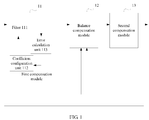
- FIG. 1 is a schematic structural diagram of a signal compensation device according to an embodiment of the present invention.
- the signal compensation device includes a first compensation module 11, a balance filtering module 12, and a second compensation module 13.
- the first compensation module 11 is configured to receive an input signal sequence suffering from ISI interference, use a first filtering coefficient to perform filtering compensation on the received signal sequence, to obtain a first compensation signal sequence, and send the first compensation signal sequence to the balance filtering module 12.
- the balance filtering module 12 is configured to use a balance filtering coefficient to perform filtering compensation on the first compensation signal sequence that is sent by the first compensation module 11, to obtain a balance compensation result, and send the balance compensation result to the second compensation module 13.
- the balance filtering coefficient is obtained by adjusting, according to a first compensation error sent by the second compensation module 13, a balance filtering coefficient used last time.
- the second compensation module 13 is configured to receive the balance compensation result sent by the balance filtering module 12, perform sequence estimation on the received balance compensation result and output the balance compensation result, obtain the first compensation error by means of calculation according to a compensation error value obtained last time by means of calculation and a compensation error value obtained the last but one time by means of calculation, and send the first compensation error to the balance filtering module 12.
- the first compensation module 11 is further configured to calculate an error result according to a first compensation signal sequence obtained last time and a decision value of the first compensation signal sequence obtained last time, adjust the first filtering coefficient according to the error result obtained by means of calculation, and use an adjusted first filtering coefficient to perform filtering compensation on the currently received signal sequence.
- the decision value of the first compensation signal sequence obtained last time refers to a value obtained after the first compensation signal sequence obtained last time is quantized.
- the first compensation module 11 may include a filter 111 and a coefficient configuration unit 112.
- the first compensation module 11 may further include an error calculation unit 113.
- the filter 111 is configured to receive the input signal sequence suffering from the ISI interference, use the first filtering coefficient configured by the coefficient configuration unit 112, to perform filtering compensation on the received signal sequence, to obtain the first compensation signal sequence, and send the first compensation signal sequence to the balance filtering module 12.
- the coefficient configuration unit 112 is adapted to configure the first filtering coefficient.
- An FFE structure or a DFE structure may be used.
- the first filtering coefficient is adaptively configured by using a least mean square (English: Least mean square, LMS for short) algorithm or another algorithm.
- L f is generally required to be greater than or equal to L c .
- the coefficient configuration unit 112 herein may be adapted to configure an initial first filtering coefficient.
- the first filtering coefficient obtained afterwards is obtained by means of adjustment according to the error result sent by the error calculation unit 113.
- the error calculation unit 113 is configured to calculate the error result according to the first compensation signal sequence obtained last time and the decision value of the first compensation signal sequence obtained last time, and send the error result to the coefficient configuration unit 112.
- the coefficient configuration unit 112 is specifically configured to adjust the first filtering coefficient according to the error result sent by the error calculation unit 113, and send the adjusted first filtering coefficient to the filter 111.
- the signal compensation device recorded in this embodiment of the present invention is a cyclic execution device.
- the balance filtering module 12 may use the second compensation error to adjust the balance filtering coefficient, so as to perform filtering compensation when receiving the first compensation signal sequence sent by the first compensation module 11.
- the second compensation module adjusts, according to a difference between compensation error values obtained two consecutive times by means of calculation, the balance filtering coefficient used by the balance filtering module, to achieve a purpose of balancing performance of various compensation modules.
- the second compensation module 13 is specifically configured to perform subtraction on the compensation error value obtained last time by means of calculation and the compensation error value obtained the last but one time by means of calculation. A difference obtained is the first compensation error.
- the second compensation module 13 is further configured to: when receiving the balance compensation result sent by the balance filtering module, calculate a compensation error value of the currently received balance compensation result; and obtain the second compensation error by means of calculation according to the compensation error value obtained last time by means of calculation and the compensation error value of the currently received balance compensation result, and send the second compensation error obtained by means of calculation to the balance filtering module 12.
- the first compensation module 11 is further configured to send, at an initialization stage, the first filtering coefficient to the balance filtering module 12.
- the balance filtering module 12 is further configured to receive the first filtering coefficient sent by the first compensation module, determine, according to a coefficient weight of the first filtering coefficient, a basic coefficient weight of an initialized balance filtering coefficient used by the balance filtering module, and obtain an initial value of the balance filtering coefficient according to the basic coefficient weight of the initialized balance filtering coefficient used by the balance filtering module.
- the signal compensation device described in this embodiment of the present invention may be implemented by means of hardware, or may be implemented by means of software. No limitation is imposed herein.
- a first compensation error is generated by a back-end compensation module, the first compensation error is used to adjust a balance filtering coefficient in an iterative manner, and an adjusted balance filtering coefficient is used to perform filtering compensation on a first compensation signal sequence, thereby balancing performance between compensation modules at various levels, effectively compensating for a signal sequence suffering from ISI interference, and improving performance of an optical fiber communications system.
- FIG. 2 is a schematic flowchart of a signal compensation method according to an embodiment of the present invention. The method may be described as follows.
- Step 201 Receive an input signal sequence suffering from ISI interference.
- ISI may easily occur on a communication signal. For example, due to a bandwidth limitation of a photoelectric transmitter or an electro-optic receiver, and the like, ISI occurs on a communication signal.
- Step 202 Use a first filtering coefficient to perform filtering compensation on the received signal sequence, to obtain a first compensation signal sequence.
- the first filtering coefficient may be an initially configured filtering coefficient, or may be obtained by adjusting, according to a feedback, a filtering coefficient used last time.
- the first filtering coefficient is obtained by means of configuration, an FFE structure or a DFE structure may be used.
- the first filtering coefficient is adaptively configured by using a least mean square (English: Least mean square, LMS for short) algorithm or another algorithm.
- L f is generally required to be greater than or equal to L c .
- the method specifically includes:
- Step 203 Use a balance filtering coefficient to perform filtering compensation on the first compensation signal sequence, to obtain a balance compensation result.
- the balance filtering coefficient is obtained by adjusting, according to a first compensation error, a balance filtering coefficient used last time, and the first compensation error is obtained by means of calculation according to a compensation error value obtained last time by means of calculation and a compensation error value obtained the last but one time by means of calculation.
- the balance filtering coefficient is obtained in an iterative manner.
- an initial value of the balance filtering coefficient is determined in the following manner:
- Step 204 Perform sequence estimation on the received balance compensation result and output the balance compensation result.
- Step 205 When receiving the balance compensation result sent by the balance filtering module, calculate a compensation error of the currently received balance compensation result; and perform step 203 according to a compensation error value obtained last time by means of calculation and the compensation error value of the currently received balance compensation result.
- a second compensation error is used to adjust a currently used balance filtering coefficient.
- step 205 subtraction is performed on the compensation error value obtained last time by means of calculation and the compensation error value of the currently received balance compensation result, and a difference obtained is the second compensation error.
- step 205 is a feedback operation.
- a balance filtering coefficient used by the balance filtering module is adjusted according to an error between two adjacent balance compensation results, to achieve a purpose of balancing performance of various compensation modules.
- an input signal sequence suffering from ISI interference is received, and a first filtering coefficient is used to perform filtering compensation on the received signal sequence to obtain a first compensation signal sequence; a balance filtering coefficient is used to perform filtering compensation on the first compensation signal sequence to obtain a balance compensation result, where the balance filtering coefficient is obtained by adjusting, according to a first compensation error, a balance filtering coefficient used last time, and the first compensation error is obtained by means of calculation according to a compensation error value obtained last time by means of calculation and a compensation error value obtained the last but one time by means of calculation; and sequence estimation is performed on the received balance compensation result and the balance compensation result is output.
- a first compensation error is generated by a back-end compensation module, the first compensation error is used to adjust a balance filtering coefficient in an iterative manner, and an adjusted balance filtering coefficient is used to perform filtering compensation on a first compensation signal sequence, thereby balancing performance between compensation modules at various levels, effectively compensating for a signal sequence suffering from ISI interference, and improving performance of an optical fiber communications system.
- FIG. 3 is a schematic structural diagram of a signal compensation device according to an embodiment of the present invention.
- the signal compensation device has the foregoing signal compensation function, and may use a general computer structure.
- the signal compensation device entity may include a signal receiver 31, a processor 32, and a signal transmitter 33.
- the signal receiver 31 is configured to receive an input signal sequence suffering from intersymbol interference ISI interference.
- the processor 32 is configured to use a first filtering coefficient to perform filtering compensation on the received signal sequence, to obtain a first compensation signal sequence, and use a balance filtering coefficient to perform filtering compensation on the first compensation signal sequence, to obtain a balance compensation result.
- the balance filtering coefficient is obtained by adjusting, according to a first compensation error, a balance filtering coefficient used last time, and the first compensation error is obtained by means of calculation according to a compensation error value obtained last time by means of calculation and a compensation error value obtained the last but one time by means of calculation.
- the signal transmitter 33 is configured to perform sequence estimation on the received balance compensation result and output the balance compensation result.
- the processor 32 is obtained by means of calculation according to a compensation error value obtained last time by means of calculation and a compensation error value obtained the last but one time by means of calculation includes:
- the processor 32 is further configured to: when receiving the balance compensation result sent by the balance filtering module, calculate a compensation error value of the currently received balance compensation result; and obtain a second compensation error by means of calculation according to the compensation error value obtained last time by means of calculation and the compensation error value of the currently received balance compensation result, where the second compensation error is used to adjust a currently used balance filtering coefficient.
- the processor 32 is further configured to: determine, at an initialization stage, a basic coefficient weight of an initialized balance filtering coefficient according to a coefficient weight of the first filtering coefficient; and obtain an initial value of the balance filtering coefficient according to the basic coefficient weight of the initialized balance filtering coefficient.
- the processor 32 determines a basic coefficient weight of an initialized balance filtering coefficient according to a coefficient weight of the first filtering coefficient includes:
- the processor 32 is further configured to calculate an error result according to a first compensation signal sequence obtained last time and a decision value of the first compensation signal sequence obtained last time, and adjust the first filtering coefficient according to the error result obtained by means of calculation; and use an adjusted first filtering coefficient to perform filtering compensation on the currently received signal sequence, to obtain the first compensation signal sequence.
- the processor 32 may be a general processor, including a central processing unit (English: central processing unit, CPU for short), a network processor (English: Network Processor, NP for short), and the like; or may be a combination of a CPU and a hardware chip.
- the processor 32 may also be a digital signal processor (DSP), an application specific integrated circuit (ASIC), a field-programmable gate array (FPGA) or any other programmable logic device, a discrete gate or transistor logic device, or a discrete hardware component.
- DSP digital signal processor
- ASIC application specific integrated circuit
- FPGA field-programmable gate array
- the foregoing program may be stored in a computer readable storage medium.
- the storage medium may be a non-transitory (non-transitory) medium, such as a random-access memory, read-only memory, a flash memory, a hard disk, a solid state drive, a magnetic tape (magnetic tape), a floppy disk (floppy disk), an optical disc (optical disc), or any combination thereof.
- These computer program instructions may be provided for a general-purpose computer, a dedicated computer, an embedded processor, or a processor of any other programmable data processing device to generate a machine, so that the instructions executed by a computer or a processor of any other programmable data processing device generate an apparatus for implementing a specific function in one or more processes in the flowcharts and/or in one or more blocks in the block diagrams.
Landscapes
- Engineering & Computer Science (AREA)
- Computer Networks & Wireless Communication (AREA)
- Signal Processing (AREA)
- Power Engineering (AREA)
- Physics & Mathematics (AREA)
- General Engineering & Computer Science (AREA)
- General Physics & Mathematics (AREA)
- Theoretical Computer Science (AREA)
- Probability & Statistics with Applications (AREA)
- Electromagnetism (AREA)
- Optical Communication System (AREA)
- Computer Hardware Design (AREA)
- Quality & Reliability (AREA)
Abstract
Description
- The present invention relates to the field of optical communications technologies, and in particular, to a signal compensation method and device.
- In a development process of communications technologies, much work has been done to increase an information transmission rate and distance and improve availability, reliability, and cost-effectiveness of a communications system, and remarkable achievements have been made. As a latest achievement in the development of modern communications technologies, an optical communications technology has become a cornerstone of modern communications, and is a main transfer tool of various types of information in a future information society.
- An optical fiber is used as a communication channel to constitute an optical fiber communications system. In addition to characteristics of a wide transmission frequency band, a large communication capacity, a small transmission loss, a long trunk distance, and a strong anti-electromagnetic interference capability of the optical fiber communications system, loss and dispersion are most important transmission characteristics of the optical fiber and are also basic problems of the optical fiber communications system.
- Due to existence of dispersion, a broadening phenomenon occurs on an optical pulse during transmission on an optical fiber channel. The pulse broadening causes intersymbol interference (English: Intersymbol Interference, ISI for short) between adjacent pulses. This shortens a transmission distance and increases a bit error rate of the system, thereby decreasing performance of the optical fiber communications system.
- To reduce or eliminate impact of the ISI on channel performance, a signal bandwidth compensation mechanism is proposed. The compensation mechanism specifically includes feed-forward equalization (English: Feed-Forward Equalization, FFE for short), decision-feedback equalization (English: Decision-Feedback Equalization, DFE for short), and maximum-likelihood sequence equalization (English: Maximum-Likelihood Sequence Equalization, MLSE for short). The FFE is used to pre-compensate for a system loss, the DEF is used to generate controllable ISI, and the MLSE is used to compensate for the generated controllable ISI, thereby improving the performance of the optical fiber communications system.
- However, the foregoing compensation mechanism has the following disadvantage: Filtering coefficient balance is performed only on the FFE and the DFE during system compensation, and as a result, improving the performance of the optical fiber communications system by using the compensation mechanism cannot satisfy people's requirements for the performance of the optical fiber communications system.
- In view of this, embodiments of the present invention provide a signal compensation method and device, to resolve a problem that an existing compensation mechanism does not greatly improve performance of an optical fiber communications system.
- According to a first aspect, a signal compensation device is provided, including a first compensation module, a balance filtering module, and a second compensation module, where:
- the first compensation module is configured to receive an input signal sequence suffering from intersymbol interference ISI interference, use a first filtering coefficient to perform filtering compensation on the received signal sequence, to obtain a first compensation signal sequence, and send the first compensation signal sequence to the balance filtering module;
- the balance filtering module is configured to use a balance filtering coefficient to perform filtering compensation on the first compensation signal sequence that is sent by the first compensation module, to obtain a balance compensation result, and send the balance compensation result to the second compensation module, where the balance filtering coefficient is obtained by adjusting, according to a first compensation error sent by the second compensation module, a balance filtering coefficient used last time; and
- the second compensation module is configured to receive the balance compensation result sent by the balance filtering module, perform sequence estimation on the received balance compensation result and output the balance compensation result, obtain the first compensation error by means of calculation according to a compensation error value obtained last time by means of calculation and a compensation error value obtained the last but one time by means of calculation, and send the first compensation error to the balance filtering module.
- With reference to the first aspect, in a first possible implementation, the second compensation module is specifically configured to perform subtraction on the compensation error value obtained last time by means of calculation and the compensation error value obtained the last but one time by means of calculation, where a difference obtained is the first compensation error.
- With reference to the first aspect, or with reference to the first possible implementation of the first aspect, in a second possible implementation, the second compensation module is further configured to: when receiving the balance compensation result sent by the balance filtering module, calculate a compensation error value of the currently received balance compensation result; and obtain a second compensation error by means of calculation according to the compensation error value obtained last time by means of calculation and the compensation error value of the currently received balance compensation result, and send the second compensation error obtained by means of calculation to the balance filtering module.
- With reference to the first aspect, or with reference to the first possible implementation of the first aspect, or with reference to the second possible implementation of the first aspect, in a third possible implementation, the balance filtering module is specifically configured to obtain the j th balance filtering coefficient in the following manner:

b j(current) is an obtained coefficient weight of the j th balance filtering coefficient that is currently used, a value range of j is 0 to Lb , Lb is a length of the balance filtering coefficient, b j(last time) is a basic coefficient weight of the j th balance filtering coefficient used last time, µ is a coefficient change length of the balance filtering coefficient, elast but one time -elast time is the first compensation error, elast but one time is the compensation error value obtained the last but one time by means of calculation, and elast time is the compensation error value obtained last time by means of calculation. - With reference to the first aspect, or with reference to the first possible implementation of the first aspect, or with reference to the second possible implementation of the first aspect, or with reference to the third possible implementation of the first aspect, in a fourth possible implementation, the first compensation module is further configured to send, at an initialization stage, the first filtering coefficient to the balance filtering module; and
the balance filtering module is further configured to receive the first filtering coefficient sent by the first compensation module, determine, according to a coefficient weight of the first filtering coefficient, a basic coefficient weight of an initialized balance filtering coefficient used by the balance filtering module, and obtain an initial value of the balance filtering coefficient according to the basic coefficient weight of the initialized balance filtering coefficient used by the balance filtering module. - With reference to the fourth possible implementation of the first aspect, in a fifth possible implementation, the balance filtering module is specifically configured to: if the received first filtering coefficient sent by the first compensation module is


bj is a basic coefficient weight of the j th balance filtering coefficient that is initialized, the value range of j is 0 to Lb , Lb is the length of the balance filtering coefficient, f i is a coefficient weight of the j th first filtering coefficient, a value range of i is 0 to Lf , and Lf is a length of the first filtering coefficient. - With reference to the first aspect, or with reference to the first possible implementation of the first aspect, or with reference to the second possible implementation of the first aspect, or with reference to the third possible implementation of the first aspect, or with reference to the fourth possible implementation of the first aspect, or with reference to the fifth possible implementation of the first aspect, in a sixth possible implementation, the first compensation module is further configured to calculate an error result according to a first compensation signal sequence obtained last time and a decision value of the first compensation signal sequence obtained last time, adjust the first filtering coefficient according to the error result obtained by means of calculation, and use an adjusted first filtering coefficient to perform filtering compensation on the currently received signal sequence.
- According to a second aspect, a signal compensation method is provided, including:
- receiving an input signal sequence suffering from intersymbol interference ISI interference, and using a first filtering coefficient to perform filtering compensation on the received signal sequence, to obtain a first compensation signal sequence;
- using a balance filtering coefficient to perform filtering compensation on the first compensation signal sequence, to obtain a balance compensation result, where the balance filtering coefficient is obtained by adjusting, according to a first compensation error, a balance filtering coefficient used last time, and the first compensation error is obtained by means of calculation according to a compensation error value obtained last time by means of calculation and a compensation error value obtained the last but one time by means of calculation; and
- performing sequence estimation on the received balance compensation result and outputting the balance compensation result.
- With reference to the second aspect, in a first possible implementation, that the first compensation error is obtained by means of calculation according to a compensation error value obtained last time by means of calculation and a compensation error value obtained the last but one time by means of calculation includes:
- performing subtraction on the compensation error value obtained last time by means of calculation and the compensation error value obtained the last but one time by means of calculation, where a difference obtained is the first compensation error.
- With reference to the second aspect, or with reference to the first possible implementations of the second aspect, in a second possible implementation, the method further includes:
- when receiving the balance compensation result sent by the balance filtering module, calculating a compensation error of the currently received balance compensation result; and
- obtaining a second compensation error by means of calculation according to the compensation error value obtained last time by means of calculation and the compensation error value of the currently received balance compensation result, where the second compensation error is used to adjust a currently used balance filtering coefficient.
- With reference to the second aspect, or with reference to the first possible implementation of the second aspect, or with reference to the second possible implementation of the second aspect, in a third possible implementation, the j th balance filtering coefficient that is currently used is obtained in the following manner:

b j(current) is an obtained coefficient weight of the j th balance filtering coefficient that is currently used, a value range of j is 0 to Lb , Lb is a length of the balance filtering coefficient, b j(last time) is a basic coefficient weight of the j th balance filtering coefficient used last time, µ is a coefficient change length of the balance filtering coefficient, elast but one time -elast time is the first compensation error, elast but one time is the compensation error value obtained the last but one time by means of calculation, and elast time is the compensation error value obtained last time by means of calculation. - With reference to the second aspect, or with reference to the first possible implementation of the second aspect, or with reference to the second possible implementation of the second aspect, or with reference to the third possible implementation of the second aspect, in a fourth possible implementation, the method further includes:
- determining, at an initialization stage, a basic coefficient weight of an initialized balance filtering coefficient according to a coefficient weight of the first filtering coefficient; and
- obtaining an initial value of the balance filtering coefficient according to the basic coefficient weight of the initialized balance filtering coefficient.
- With reference to the fourth possible implementation of the second aspect, in a fifth possible implementation, the determining a basic coefficient weight of an initialized balance filtering coefficient according to a coefficient weight of the first filtering coefficient includes:
- if the first filtering coefficient is
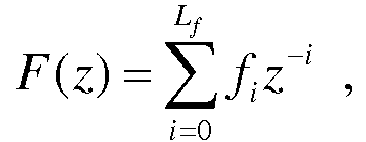

bj is a basic coefficient weight of the j th balance filtering coefficient that is initialized, the value range of j is 0 to Lb , Lb is the length of the balance filtering coefficient, fi is a coefficient weight of the j th first filtering coefficient, a value range of i is 0 to Lf, and Lf is a length of the first filtering coefficient. - With reference to the second aspect, or with reference to the first possible implementation of the second aspect, or with reference to the second possible implementation of the second aspect, or with reference to the third possible implementation of the second aspect, or with reference to the fourth possible implementation of the second aspect, or with reference to the fifth possible implementation of the second aspect, in a sixth possible implementation, the method further includes:
- calculating an error result according to a first compensation signal sequence obtained last time and a decision value of the first compensation signal sequence obtained last time; and
- adjusting the first filtering coefficient according to the error result obtained by means of calculation; and
- the using a first filtering coefficient to perform filtering compensation on the received signal sequence, to obtain a first compensation signal sequence includes:
- using an adjusted first filtering coefficient to perform filtering compensation on the currently received signal sequence, to obtain the first compensation signal sequence.
- According to a third aspect, a signal compensation device is provided, including:
- a signal receiver, configured to receive an input signal sequence suffering from intersymbol interference ISI interference;
- a processor, configured to use a first filtering coefficient to perform filtering compensation on the received signal sequence, to obtain a first compensation signal sequence, and use a balance filtering coefficient to perform filtering compensation on the first compensation signal sequence, to obtain a balance compensation result, where the balance filtering coefficient is obtained by adjusting, according to a first compensation error, a balance filtering coefficient used last time, and the first compensation error is obtained by means of calculation according to a compensation error value obtained last time by means of calculation and a compensation error value obtained the last but one time by means of calculation; and
- a signal transmitter, configured to perform sequence estimation on the received balance compensation result and output the balance compensation result.
- With reference to the third aspect, in a first possible implementation, that the processor is obtained by means of calculation according to a compensation error value obtained last time by means of calculation and a compensation error value obtained the last but one time by means of calculation includes:
- performing subtraction on the compensation error value obtained last time by means of calculation and the compensation error value obtained the last but one time by means of calculation, where a difference obtained is the first compensation error.
- With reference to the third aspect, or with reference to the first possible implementation of the third aspect, in a second possible implementation, the processor is further configured to: when receiving the balance compensation result sent by the balance filtering module, calculate a compensation error value of the currently received balance compensation result; and
obtain a second compensation error by means of calculation according to the compensation error value obtained last time by means of calculation and the compensation error value of the currently received balance compensation result, where the second compensation error is used to adjust a currently used balance filtering coefficient. - With reference to the third aspect, or with reference to the first possible implementation of the third aspect, or with reference to the second possible implementation of the third aspect, in a third possible implementation, the processor obtains, in the following manner, the j th balance filtering coefficient that is currently used:

b j(current) is an obtained coefficient weight of the j th balance filtering coefficient that is currently used, a value range of j is 0 to Lb , Lb is a length of the balance filtering coefficient, b j(last time) is a basic coefficient weight of the j th balance filtering coefficient used last time, µ is a coefficient change length of the balance filtering coefficient, elast but one time -elast time is the first compensation error, elast but one time is the compensation error value obtained the last but one time by means of calculation, and elast time is the compensation error value obtained last time by means of calculation. - With reference to the third aspect, or with reference to the first possible implementation of the third aspect, or with reference to the second possible implementation of the third aspect, or with reference to the third possible implementation of the third aspect, in a fourth possible implementation, the processor is further configured to: determine, at an initialization stage, a basic coefficient weight of an initialized balance filtering coefficient according to a coefficient weight of the first filtering coefficient; and obtain an initial value of the balance filtering coefficient according to the basic coefficient weight of the initialized balance filtering coefficient.
- With reference to the fourth possible implementation of the third aspect, in a fifth possible implementation, that the processor determines a basic coefficient weight of an initialized balance filtering coefficient according to a coefficient weight of the first filtering coefficient includes:
- if the first filtering coefficient is


bj is a basic coefficient weight of the j th balance filtering coefficient that is initialized, the value range of j is 0 to Lb , Lb is the length of the balance filtering coefficient, fi is a coefficient weight of the j th first filtering coefficient, a value range of i is 0 to Lf, and Lf is a length of the first filtering coefficient. - With reference to the third aspect, or with reference to the first possible implementation of the third aspect, or with reference to the second possible implementation of the third aspect, or with reference to the third possible implementation of the third aspect, or with reference to the fourth possible implementation of the third aspect, or with reference to the fifth possible implementation of the third aspect, in a sixth possible implementation, the processor is further configured to calculate an error result according to a first compensation signal sequence obtained last time and a decision value of the first compensation signal sequence obtained last time, and adjust the first filtering coefficient according to the error result obtained by means of calculation; and
use an adjusted first filtering coefficient to perform filtering compensation on the currently received signal sequence, to obtain the first compensation signal sequence. - The embodiments of the present invention have the following beneficial effects:
- According to the embodiments of the present invention, an input signal sequence suffering from ISI interference is received, and a first filtering coefficient is used to perform filtering compensation on the received signal sequence to obtain a first compensation signal sequence; a balance filtering coefficient is used to perform filtering compensation on the first compensation signal sequence to obtain a balance compensation result, where the balance filtering coefficient is obtained by adjusting, according to a first compensation error, a balance filtering coefficient used last time, and the first compensation error is obtained by means of calculation according to a compensation error value obtained last time by means of calculation and a compensation error value obtained the last but one time by means of calculation; and sequence estimation is performed on the received balance compensation result and the balance compensation result is output. A first compensation error is generated by a back-end compensation module, the first compensation error is used to adjust a balance filtering coefficient in an iterative manner, and an adjusted balance filtering coefficient is used to perform filtering compensation on a first compensation signal sequence, thereby balancing performance between compensation modules at various levels, effectively compensating for a signal sequence suffering from ISI interference, and improving performance of an optical fiber communications system.
- To describe the technical solutions in the embodiments of the present invention more clearly, the following briefly describes the accompanying drawings required for describing the embodiments. Apparently, the accompanying drawings in the following description show merely some embodiments of the present invention, and persons of ordinary skill in the art may still derive other drawings from these accompanying drawings without creative efforts.
-
FIG. 1 is a schematic structural diagram of a signal compensation device according to the present invention; -
FIG. 2 is a schematic flowchart of a signal compensation method according to the present invention; and -
FIG. 3 is a schematic structural diagram of a signal compensation device according to the present invention. - To implement the objectives of the present invention, the embodiments of the present invention provide a signal compensation method and device. An input signal sequence suffering from ISI interference is received, and a first filtering coefficient is used to perform filtering compensation on the received signal sequence to obtain a first compensation signal sequence; a balance filtering coefficient is used to perform filtering compensation on the first compensation signal sequence to obtain a balance compensation result, where the balance filtering coefficient is obtained by adjusting, according to a first compensation error, a balance filtering coefficient used last time, and the first compensation error is obtained by means of calculation according to a compensation error value obtained last time by means of calculation and a compensation error value obtained the last but one time by means of calculation; and sequence estimation is performed on the received balance compensation result and the balance compensation result is output. A first compensation error is generated by a back-end compensation module, the first compensation error is used to adjust a balance filtering coefficient in an iterative manner, and an adjusted balance filtering coefficient is used to perform filtering compensation on a first compensation signal sequence, thereby balancing performance between compensation modules at various levels, effectively compensating for a signal sequence suffering from ISI interference, and improving performance of an optical fiber communications system.
- The following further describes the embodiments of the present invention in detail with reference to this specification. Apparently, the described embodiments are merely some but not all of the embodiments of the present invention. All other embodiments obtained by persons of ordinary skill in the art based on the embodiments of the present invention without creative efforts shall fall within the protection scope of the present invention.
-
FIG. 1 is a schematic structural diagram of a signal compensation device according to an embodiment of the present invention. The signal compensation device includes afirst compensation module 11, abalance filtering module 12, and asecond compensation module 13. - The
first compensation module 11 is configured to receive an input signal sequence suffering from ISI interference, use a first filtering coefficient to perform filtering compensation on the received signal sequence, to obtain a first compensation signal sequence, and send the first compensation signal sequence to thebalance filtering module 12. - The
balance filtering module 12 is configured to use a balance filtering coefficient to perform filtering compensation on the first compensation signal sequence that is sent by thefirst compensation module 11, to obtain a balance compensation result, and send the balance compensation result to thesecond compensation module 13. The balance filtering coefficient is obtained by adjusting, according to a first compensation error sent by thesecond compensation module 13, a balance filtering coefficient used last time. - The
second compensation module 13 is configured to receive the balance compensation result sent by thebalance filtering module 12, perform sequence estimation on the received balance compensation result and output the balance compensation result, obtain the first compensation error by means of calculation according to a compensation error value obtained last time by means of calculation and a compensation error value obtained the last but one time by means of calculation, and send the first compensation error to thebalance filtering module 12. - Optionally, the
first compensation module 11 is further configured to calculate an error result according to a first compensation signal sequence obtained last time and a decision value of the first compensation signal sequence obtained last time, adjust the first filtering coefficient according to the error result obtained by means of calculation, and use an adjusted first filtering coefficient to perform filtering compensation on the currently received signal sequence. - It should be noted that the decision value of the first compensation signal sequence obtained last time refers to a value obtained after the first compensation signal sequence obtained last time is quantized.
- Specifically, the
first compensation module 11 may include afilter 111 and a coefficient configuration unit 112. Optionally, thefirst compensation module 11 may further include anerror calculation unit 113. - The
filter 111 is configured to receive the input signal sequence suffering from the ISI interference, use the first filtering coefficient configured by the coefficient configuration unit 112, to perform filtering compensation on the received signal sequence, to obtain the first compensation signal sequence, and send the first compensation signal sequence to thebalance filtering module 12. - For example, the received input signal sequence suffering from the ISI interference may be
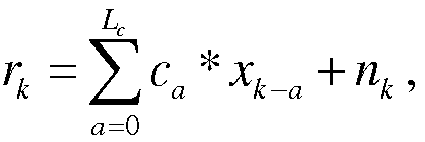
- The coefficient configuration unit 112 is adapted to configure the first filtering coefficient. An FFE structure or a DFE structure may be used. The first filtering coefficient is adaptively configured by using a least mean square (English: Least mean square, LMS for short) algorithm or another algorithm.
- For example, the first filtering coefficient is

- It should be noted that, to achieve a good compensation effect, Lf is generally required to be greater than or equal to Lc.
- The coefficient configuration unit 112 herein may be adapted to configure an initial first filtering coefficient. The first filtering coefficient obtained afterwards is obtained by means of adjustment according to the error result sent by the
error calculation unit 113. - The
error calculation unit 113 is configured to calculate the error result according to the first compensation signal sequence obtained last time and the decision value of the first compensation signal sequence obtained last time, and send the error result to the coefficient configuration unit 112. - The coefficient configuration unit 112 is specifically configured to adjust the first filtering coefficient according to the error result sent by the
error calculation unit 113, and send the adjusted first filtering coefficient to thefilter 111. - It should be noted that the signal compensation device recorded in this embodiment of the present invention is a cyclic execution device. After the
second compensation module 13 sends a second compensation error obtained by means of calculation to thebalance filtering module 12, thebalance filtering module 12 may use the second compensation error to adjust the balance filtering coefficient, so as to perform filtering compensation when receiving the first compensation signal sequence sent by thefirst compensation module 11. - Therefore, the second compensation module adjusts, according to a difference between compensation error values obtained two consecutive times by means of calculation, the balance filtering coefficient used by the balance filtering module, to achieve a purpose of balancing performance of various compensation modules.
- Specifically, the
second compensation module 13 is specifically configured to perform subtraction on the compensation error value obtained last time by means of calculation and the compensation error value obtained the last but one time by means of calculation. A difference obtained is the first compensation error. - Optionally, the
second compensation module 13 is further configured to: when receiving the balance compensation result sent by the balance filtering module, calculate a compensation error value of the currently received balance compensation result; and obtain the second compensation error by means of calculation according to the compensation error value obtained last time by means of calculation and the compensation error value of the currently received balance compensation result, and send the second compensation error obtained by means of calculation to thebalance filtering module 12. - Specifically, the
balance filtering module 12 is specifically configured to obtain the j th balance filtering coefficient in the following manner:
b j(current) is an obtained coefficient weight of the j th balance filtering coefficient that is currently used, a value range of j is 0 to Lb , Lb is a length of the balance filtering coefficient, b j(last time) is a basic coefficient weight of the j th balance filtering coefficient used last time, µ is a coefficient change length of the balance filtering coefficient, elast but one time -elast time is the first compensation error, elast but one time is the compensation error value obtained the last but one time by means of calculation, and elast time is the compensation error value obtained last time by means of calculation. - It should be noted that the
first compensation module 11 is further configured to send, at an initialization stage, the first filtering coefficient to thebalance filtering module 12. - The
balance filtering module 12 is further configured to receive the first filtering coefficient sent by the first compensation module, determine, according to a coefficient weight of the first filtering coefficient, a basic coefficient weight of an initialized balance filtering coefficient used by the balance filtering module, and obtain an initial value of the balance filtering coefficient according to the basic coefficient weight of the initialized balance filtering coefficient used by the balance filtering module. - The
balance filtering module 12 is specifically configured to: if the received first filtering coefficient sent by the first compensation module is

bj is a basic coefficient weight of the j th balance filtering coefficient that is initialized, the value range of j is 0 to Lb , Lb is the length of the balance filtering coefficient, f i is a coefficient weight of the j th first filtering coefficient, the value range of i is 0 to Lf , and Lf is the length of the first filtering coefficient. - The
balance filtering module 12 is specifically configured to obtain the balance filtering coefficient according to a coefficient weight of a balance filtering coefficient obtained by means of adjustment, for example, the obtained balance filtering coefficient is
bj is a coefficient weight of the j th balance filtering coefficient obtained by means of adjustment, the value range of j is 0 to Lb , and Lb is the length of the balance filtering coefficient. - The signal compensation device described in this embodiment of the present invention may be implemented by means of hardware, or may be implemented by means of software. No limitation is imposed herein. A first compensation error is generated by a back-end compensation module, the first compensation error is used to adjust a balance filtering coefficient in an iterative manner, and an adjusted balance filtering coefficient is used to perform filtering compensation on a first compensation signal sequence, thereby balancing performance between compensation modules at various levels, effectively compensating for a signal sequence suffering from ISI interference, and improving performance of an optical fiber communications system.
-
FIG. 2 is a schematic flowchart of a signal compensation method according to an embodiment of the present invention. The method may be described as follows. - Step 201: Receive an input signal sequence suffering from ISI interference.
- In
step 201, on an optical fiber communication link, ISI may easily occur on a communication signal. For example, due to a bandwidth limitation of a photoelectric transmitter or an electro-optic receiver, and the like, ISI occurs on a communication signal. - It is assumed that the received signal sequence suffering from the ISI interference is

- Step 202: Use a first filtering coefficient to perform filtering compensation on the received signal sequence, to obtain a first compensation signal sequence.
- In
step 202, the first filtering coefficient may be an initially configured filtering coefficient, or may be obtained by adjusting, according to a feedback, a filtering coefficient used last time. - If the first filtering coefficient is obtained by means of configuration, an FFE structure or a DFE structure may be used. The first filtering coefficient is adaptively configured by using a least mean square (English: Least mean square, LMS for short) algorithm or another algorithm.
- For example, the first filtering coefficient is

- It should be noted that, to achieve a good compensation effect, Lf is generally required to be greater than or equal to Lc .
- If the first filtering coefficient is obtained by adjusting, according to an error result that is fed back, the filtering coefficient used last time, the method specifically includes:
- calculating the error result according to a first compensation signal sequence obtained last time and a decision value of the first compensation signal sequence obtained last time; and
- obtaining an adjusted first filtering coefficient by adjusting the first filtering coefficient (that is, the filtering coefficient used last time) according to the error result obtained by means of calculation.
- Step 203: Use a balance filtering coefficient to perform filtering compensation on the first compensation signal sequence, to obtain a balance compensation result.
- The balance filtering coefficient is obtained by adjusting, according to a first compensation error, a balance filtering coefficient used last time, and the first compensation error is obtained by means of calculation according to a compensation error value obtained last time by means of calculation and a compensation error value obtained the last but one time by means of calculation.
- In
step 203, the j th balance filtering coefficient that is currently used is obtained in the following manner:
b j(current) is an obtained coefficient weight of the j th balance filtering coefficient that is currently used, a value range of j is 0 to Lb , Lb is a length of the balance filtering coefficient, b j(last time) is a basic coefficient weight of the j th balance filtering coefficient used last time, µ is a coefficient change length of the balance filtering coefficient, elast but one time -elast time is the first compensation error, elast but one time is the compensation error value obtained the last but one time by means of calculation, and elast time is the compensation error value obtained last time by means of calculation. - That is, the balance filtering coefficient is obtained in an iterative manner.
- Therefore, an initial value of the balance filtering coefficient is determined in the following manner:
- determining, at an initialization stage, a basic coefficient weight of an initialized balance filtering coefficient according to a coefficient weight of the first filtering coefficient; and
- obtaining the initial value of the balance filtering coefficient according to the basic coefficient weight of the initialized balance filtering coefficient.
- Specifically, if the first filtering coefficient is


bj is a basic coefficient weight of the j th balance filtering coefficient that is initialized, the value range of j is 0 to Lb , Lb is the length of the balance filtering coefficient, f i is a coefficient weight of the j th first filtering coefficient, the value range of i is 0 to Lf , and Lf is the length of the first filtering coefficient. - Step 204: Perform sequence estimation on the received balance compensation result and output the balance compensation result.
- Step 205: When receiving the balance compensation result sent by the balance filtering module, calculate a compensation error of the currently received balance compensation result; and perform
step 203 according to a compensation error value obtained last time by means of calculation and the compensation error value of the currently received balance compensation result. - A second compensation error is used to adjust a currently used balance filtering coefficient.
- In
step 205, subtraction is performed on the compensation error value obtained last time by means of calculation and the compensation error value of the currently received balance compensation result, and a difference obtained is the second compensation error. - It should be noted that the operation performed in
step 205 is a feedback operation. A balance filtering coefficient used by the balance filtering module is adjusted according to an error between two adjacent balance compensation results, to achieve a purpose of balancing performance of various compensation modules. - According to the description in this embodiment of the present invention, an input signal sequence suffering from ISI interference is received, and a first filtering coefficient is used to perform filtering compensation on the received signal sequence to obtain a first compensation signal sequence; a balance filtering coefficient is used to perform filtering compensation on the first compensation signal sequence to obtain a balance compensation result, where the balance filtering coefficient is obtained by adjusting, according to a first compensation error, a balance filtering coefficient used last time, and the first compensation error is obtained by means of calculation according to a compensation error value obtained last time by means of calculation and a compensation error value obtained the last but one time by means of calculation; and sequence estimation is performed on the received balance compensation result and the balance compensation result is output. A first compensation error is generated by a back-end compensation module, the first compensation error is used to adjust a balance filtering coefficient in an iterative manner, and an adjusted balance filtering coefficient is used to perform filtering compensation on a first compensation signal sequence, thereby balancing performance between compensation modules at various levels, effectively compensating for a signal sequence suffering from ISI interference, and improving performance of an optical fiber communications system.
-
FIG. 3 is a schematic structural diagram of a signal compensation device according to an embodiment of the present invention. The signal compensation device has the foregoing signal compensation function, and may use a general computer structure. The signal compensation device entity may include asignal receiver 31, aprocessor 32, and asignal transmitter 33. - The
signal receiver 31 is configured to receive an input signal sequence suffering from intersymbol interference ISI interference. - The
processor 32 is configured to use a first filtering coefficient to perform filtering compensation on the received signal sequence, to obtain a first compensation signal sequence, and use a balance filtering coefficient to perform filtering compensation on the first compensation signal sequence, to obtain a balance compensation result. The balance filtering coefficient is obtained by adjusting, according to a first compensation error, a balance filtering coefficient used last time, and the first compensation error is obtained by means of calculation according to a compensation error value obtained last time by means of calculation and a compensation error value obtained the last but one time by means of calculation. - The
signal transmitter 33 is configured to perform sequence estimation on the received balance compensation result and output the balance compensation result. - Specifically, that the
processor 32 is obtained by means of calculation according to a compensation error value obtained last time by means of calculation and a compensation error value obtained the last but one time by means of calculation includes: - performing subtraction on the compensation error value obtained last time by means of calculation and the compensation error value obtained the last but one time by means of calculation, where a difference obtained is the first compensation error.
- Specifically, the
processor 32 is further configured to: when receiving the balance compensation result sent by the balance filtering module, calculate a compensation error value of the currently received balance compensation result; and
obtain a second compensation error by means of calculation according to the compensation error value obtained last time by means of calculation and the compensation error value of the currently received balance compensation result, where the second compensation error is used to adjust a currently used balance filtering coefficient. - Specifically, the
processor 32 obtains, in the following manner, the j th balance filtering coefficient that is currently used:
b j(current) is an obtained coefficient weight of the j th balance filtering coefficient that is currently used, a value range of j is 0 to Lb , Lb is a length of the balance filtering coefficient, b j(last time) is a basic coefficient weight of the j th balance filtering coefficient used last time, µ is a coefficient change length of the balance filtering coefficient, elast but one time -elast time is the first compensation error, elast but one time is the compensation error value obtained the last but one time by means of calculation, and elast time is the compensation error value obtained last time by means of calculation. - Specifically, the
processor 32 is further configured to: determine, at an initialization stage, a basic coefficient weight of an initialized balance filtering coefficient according to a coefficient weight of the first filtering coefficient; and obtain an initial value of the balance filtering coefficient according to the basic coefficient weight of the initialized balance filtering coefficient. - Specifically, that the
processor 32 determines a basic coefficient weight of an initialized balance filtering coefficient according to a coefficient weight of the first filtering coefficient includes: - if the first filtering coefficient is


bj is a basic coefficient weight of the j th balance filtering coefficient that is initialized, the value range of j is 0 to Lb , Lb is the length of the balance filtering coefficient, fi is a coefficient weight of the j th first filtering coefficient, a value range of i is 0 to Lf , and Lf is a length of the first filtering coefficient. - Specifically, the
processor 32 is further configured to calculate an error result according to a first compensation signal sequence obtained last time and a decision value of the first compensation signal sequence obtained last time, and adjust the first filtering coefficient according to the error result obtained by means of calculation; and
use an adjusted first filtering coefficient to perform filtering compensation on the currently received signal sequence, to obtain the first compensation signal sequence. - The
processor 32 may be a general processor, including a central processing unit (English: central processing unit, CPU for short), a network processor (English: Network Processor, NP for short), and the like; or may be a combination of a CPU and a hardware chip. Theprocessor 32 may also be a digital signal processor (DSP), an application specific integrated circuit (ASIC), a field-programmable gate array (FPGA) or any other programmable logic device, a discrete gate or transistor logic device, or a discrete hardware component. - Persons of ordinary skill in the art may understand that all or a part of the steps in each of the foregoing method of the embodiments may be implemented by a program instructing a processor. The foregoing program may be stored in a computer readable storage medium. The storage medium may be a non-transitory (non-transitory) medium, such as a random-access memory, read-only memory, a flash memory, a hard disk, a solid state drive, a magnetic tape (magnetic tape), a floppy disk (floppy disk), an optical disc (optical disc), or any combination thereof.
- The present invention is described with reference to the flowcharts and/or block diagrams of the method, the device, and the computer program product according to the embodiments of the present invention. It should be understood that computer program instructions may be used to implement each process and/or each block in the flowcharts and/or the block diagrams and a combination of a process and/or a block in the flowcharts and/or the block diagrams. These computer program instructions may be provided for a general-purpose computer, a dedicated computer, an embedded processor, or a processor of any other programmable data processing device to generate a machine, so that the instructions executed by a computer or a processor of any other programmable data processing device generate an apparatus for implementing a specific function in one or more processes in the flowcharts and/or in one or more blocks in the block diagrams.
- The foregoing descriptions are merely examples of specific implementations of the present invention, but are not intended to limit the protection scope of the present invention. Any variation or replacement readily figured out by persons skilled in the art within the technical scope disclosed in the present invention shall fall within the protection scope of the present invention. Therefore, the protection scope of the present invention shall be subject to the protection scope of the claims.
Claims (21)
- A signal compensation device, comprising a first compensation module, a balance filtering module, and a second compensation module, wherein:the first compensation module is configured to receive an input signal sequence suffering from intersymbol interference ISI interference, use a first filtering coefficient to perform filtering compensation on the received signal sequence, to obtain a first compensation signal sequence, and send the first compensation signal sequence to the balance filtering module;the balance filtering module is configured to use a balance filtering coefficient to perform filtering compensation on the first compensation signal sequence that is sent by the first compensation module, to obtain a balance compensation result, and send the balance compensation result to the second compensation module, wherein the balance filtering coefficient is obtained by adjusting, according to a first compensation error sent by the second compensation module, a balance filtering coefficient used last time; andthe second compensation module is configured to receive the balance compensation result sent by the balance filtering module, perform sequence estimation on the received balance compensation result and output the balance compensation result, obtain the first compensation error by means of calculation according to a compensation error value obtained last time by means of calculation and a compensation error value obtained the last but one time by means of calculation, and send the first compensation error to the balance filtering module.
- The signal compensation device according to claim 1, wherein:the second compensation module is specifically configured to perform subtraction on the compensation error value obtained last time by means of calculation and the compensation error value obtained the last but one time by means of calculation, wherein a difference obtained is the first compensation error.
- The signal compensation device according to claim 1 or 2, wherein:the second compensation module is further configured to: when receiving the balance compensation result sent by the balance filtering module, calculate a compensation error value of the currently received balance compensation result; andobtain a second compensation error by means of calculation according to the compensation error value obtained last time by means of calculation and the compensation error value of the currently received balance compensation result, and send the second compensation error obtained by means of calculation to the balance filtering module.
- The signal compensation device according to any one of claims 1 to 3, wherein:the balance filtering module is specifically configured to obtain a j th balance filtering coefficient in the following manner:

b j(current) is an obtained coefficient weight of the j th balance filtering coefficient that is currently used, a value range of j is 0 to Lb , Lb is a length of the balance filtering coefficient, b j(last time) is a basic coefficient weight of the j th balance filtering coefficient used last time, µ is a coefficient change length of the balance filtering coefficient, elast but one time -elast time is the first compensation error, elast but one time is the compensation error value obtained the last but one time by means of calculation, and elast time is the compensation error value obtained last time by means of calculation. - The signal compensation device according to any one of claims 1 to 4, wherein:the first compensation module is further configured to send, at an initialization stage, the first filtering coefficient to the balance filtering module; andthe balance filtering module is further configured to receive the first filtering coefficient sent by the first compensation module, determine, according to a coefficient weight of the first filtering coefficient, a basic coefficient weight of an initialized balance filtering coefficient used by the balance filtering module, and obtain an initial value of the balance filtering coefficient according to the basic coefficient weight of the initialized balance filtering coefficient used by the balance filtering module.
- The signal compensation device according to claim 5, wherein:the balance filtering module is specifically configured to: if the received first filtering coefficient sent by the first compensation module is


bj is a basic coefficient weight of the j th balance filtering coefficient that is initialized, the value range of j is 0 to Lb , Lb is the length of the balance filtering coefficient, f i is a coefficient weight of the j th first filtering coefficient, a value range of i is 0 to Lf , and Lf is a length of the first filtering coefficient. - The signal compensation device according to any one of claims 1 to 6, wherein:the first compensation module is further configured to calculate an error result according to a first compensation signal sequence obtained last time and a decision value of the first compensation signal sequence obtained last time, adjust the first filtering coefficient according to the error result obtained by means of calculation, and use an adjusted first filtering coefficient to perform filtering compensation on the currently received signal sequence.
- A signal compensation method, comprising:receiving an input signal sequence suffering from intersymbol interference ISI interference, and using a first filtering coefficient to perform filtering compensation on the received signal sequence, to obtain a first compensation signal sequence;using a balance filtering coefficient to perform filtering compensation on the first compensation signal sequence, to obtain a balance compensation result, wherein the balance filtering coefficient is obtained by adjusting, according to a first compensation error, a balance filtering coefficient used last time, and the first compensation error is obtained by means of calculation according to a compensation error value obtained last time by means of calculation and a compensation error value obtained the last but one time by means of calculation; andperforming sequence estimation on the received balance compensation result and outputting the balance compensation result.
- The signal compensation method according to claim 8, wherein that the first compensation error is obtained by means of calculation according to a compensation error value obtained last time by means of calculation and a compensation error value obtained the last but one time by means of calculation comprises:performing subtraction on the compensation error value obtained last time by means of calculation and the compensation error value obtained the last but one time by means of calculation, wherein a difference obtained is the first compensation error.
- The signal compensation method according to claim 8 or 9, wherein the method further comprises:when receiving the balance compensation result sent by the balance filtering module, calculating a compensation error of the currently received balance compensation result; andobtaining a second compensation error by means of calculation according to the compensation error value obtained last time by means of calculation and the compensation error value of the currently received balance compensation result, wherein the second compensation error is used to adjust a currently used balance filtering coefficient.
- The signal compensation method according to any one of claims 8 to 10, wherein a j th balance filtering coefficient that is currently used is obtained in the following manner:

b j(current) is an obtained coefficient weight of the j th balance filtering coefficient that is currently used, a value range of j is 0 to Lb , Lb is a length of the balance filtering coefficient, b j(last time) is a basic coefficient weight of the j th balance filtering coefficient used last time, µ is a coefficient change length of the balance filtering coefficient, elast but one time -elast time is the first compensation error, elast but one time is the compensation error value obtained the last but one time by means of calculation, and elast time is the compensation error value obtained last time by means of calculation. - The signal compensation method according to any one of claims 8 to 11, wherein the method further comprises:determining, at an initialization stage, a basic coefficient weight of an initialized balance filtering coefficient according to a coefficient weight of the first filtering coefficient; andobtaining an initial value of the balance filtering coefficient according to the basic coefficient weight of the initialized balance filtering coefficient.
- The signal compensation method according to claim 12, wherein the determining a basic coefficient weight of an initialized balance filtering coefficient according to a coefficient weight of the first filtering coefficient comprises:if the first filtering coefficient is


bj is a basic coefficient weight of the j th balance filtering coefficient that is initialized, the value range of j is 0 to Lb , Lb is the length of the balance filtering coefficient, fi is a coefficient weight of the j th first filtering coefficient, a value range of i is 0 to Lf , and Lf is a length of the first filtering coefficient. - The signal compensation method according to any one of claims 8 to 13, wherein the method further comprises:calculating an error result according to a first compensation signal sequence obtained last time and a decision value of the first compensation signal sequence obtained last time; andadjusting the first filtering coefficient according to the error result obtained by means of calculation; andthe using a first filtering coefficient to perform filtering compensation on the received signal sequence, to obtain a first compensation signal sequence comprises:using an adjusted first filtering coefficient to perform filtering compensation on the currently received signal sequence, to obtain the first compensation signal sequence.
- A signal compensation device, comprising:a signal receiver, configured to receive an input signal sequence suffering from intersymbol interference ISI interference;a processor, configured to use a first filtering coefficient to perform filtering compensation on the received signal sequence, to obtain a first compensation signal sequence, and use a balance filtering coefficient to perform filtering compensation on the first compensation signal sequence, to obtain a balance compensation result, wherein the balance filtering coefficient is obtained by adjusting, according to a first compensation error, a balance filtering coefficient used last time, and the first compensation error is obtained by means of calculation according to a compensation error value obtained last time by means of calculation and a compensation error value obtained the last but one time by means of calculation; anda signal transmitter, configured to perform sequence estimation on the received balance compensation result and output the balance compensation result.
- The signal compensation device according to claim 15, wherein that the processor is obtained by means of calculation according to a compensation error value obtained last time by means of calculation and a compensation error value obtained the last but one time by means of calculation comprises:performing subtraction on the compensation error value obtained last time by means of calculation and the compensation error value obtained the last but one time by means of calculation, wherein a difference obtained is the first compensation error.
- The signal compensation device according to claim 15 or 16, wherein:the processor is further configured to: when receiving the balance compensation result sent by the balance filtering module, calculate a compensation error value of the currently received balance compensation result; andobtain a second compensation error by means of calculation according to the compensation error value obtained last time by means of calculation and the compensation error value of the currently received balance compensation result, wherein the second compensation error is used to adjust a currently used balance filtering coefficient.
- The signal compensation device according to any one of claims 15 to 17, wherein the processor obtains, in the following manner, a j th balance filtering coefficient that is currently used:

b j(current) is an obtained coefficient weight of the j th balance filtering coefficient that is currently used, a value range of j is 0 to Lb , Lb is a length of the balance filtering coefficient, b j(last time) is a basic coefficient weight of the j th balance filtering coefficient used last time, µ is a coefficient change length of the balance filtering coefficient, elast but one time -elast time is the first compensation error, elast but one time is the compensation error value obtained the last but one time by means of calculation, and elast time is the compensation error value obtained last time by means of calculation. - The signal compensation device according to any one of claims 15 to 18, wherein:the processor is further configured to: determine, at an initialization stage, a basic coefficient weight of an initialized balance filtering coefficient according to a coefficient weight of the first filtering coefficient; and obtain an initial value of the balance filtering coefficient according to the basic coefficient weight of the initialized balance filtering coefficient.
- The signal compensation device according to claim 19, wherein:that the processor determines a basic coefficient weight of an initialized balance filtering coefficient according to a coefficient weight of the first filtering coefficient comprises:if the first filtering coefficient is


bj is a basic coefficient weight of the j th balance filtering coefficient that is initialized, the value range of j is 0 to Lb , Lb is the length of the balance filtering coefficient, f i is a coefficient weight of the j th first filtering coefficient, a value range of i is 0 to Lf , and Lf is a length of the first filtering coefficient. - The signal compensation device according to any one of claims 15 to 20, wherein:the processor is further configured to calculate an error result according to a first compensation signal sequence obtained last time and a decision value of the first compensation signal sequence obtained last time, and adjust the first filtering coefficient according to the error result obtained by means of calculation; anduse an adjusted first filtering coefficient to perform filtering compensation on the currently received signal sequence, to obtain the first compensation signal sequence.
Applications Claiming Priority (1)
| Application Number | Priority Date | Filing Date | Title |
|---|---|---|---|
| PCT/CN2014/095111 WO2016101255A1 (en) | 2014-12-26 | 2014-12-26 | Signal compensation method and device |
Publications (3)
| Publication Number | Publication Date |
|---|---|
| EP3217618A1 true EP3217618A1 (en) | 2017-09-13 |
| EP3217618A4 EP3217618A4 (en) | 2017-10-18 |
| EP3217618B1 EP3217618B1 (en) | 2019-02-20 |
Family
ID=56148983
Family Applications (1)
| Application Number | Title | Priority Date | Filing Date |
|---|---|---|---|
| EP14908823.9A Active EP3217618B1 (en) | 2014-12-26 | 2014-12-26 | Signal compensation method and device |
Country Status (4)
| Country | Link |
|---|---|
| US (1) | US20170286250A1 (en) |
| EP (1) | EP3217618B1 (en) |
| CN (1) | CN107078978B (en) |
| WO (1) | WO2016101255A1 (en) |
Families Citing this family (2)
| Publication number | Priority date | Publication date | Assignee | Title |
|---|---|---|---|---|
| CN113517934B (en) * | 2020-04-10 | 2022-10-11 | 华为技术有限公司 | Signal processing method and related equipment |
| US20250226893A1 (en) * | 2022-04-01 | 2025-07-10 | Signify Holding B.V. | Model-based decision feedback detection for optical communication |
Family Cites Families (21)
| Publication number | Priority date | Publication date | Assignee | Title |
|---|---|---|---|---|
| US5031195A (en) * | 1989-06-05 | 1991-07-09 | International Business Machines Corporation | Fully adaptive modem receiver using whitening matched filtering |
| EP0987864A1 (en) * | 1998-09-15 | 2000-03-22 | Alcatel | Time error compensation arrangement and multi-carrier modem comprising the arrangement |
| US6775322B1 (en) * | 2000-08-14 | 2004-08-10 | Ericsson Inc. | Equalizer with adaptive pre-filter |
| US6870881B1 (en) * | 2000-08-24 | 2005-03-22 | Marvell International Ltd. | Feedforward equalizer for DFE based detector |
| GB0026206D0 (en) * | 2000-10-26 | 2000-12-13 | Koninkl Philips Electronics Nv | A method of receiving a signal and a receiver |
| US7003228B2 (en) * | 2001-09-11 | 2006-02-21 | Vitesse Semiconductor Corporation | Method and apparatus for improved high-speed adaptive equalization |
| US7471904B2 (en) * | 2003-07-25 | 2008-12-30 | Alcatel-Lucent Usa Inc. | Method and apparatus for electronic equalization in optical communication systems |
| US7302192B2 (en) * | 2005-04-28 | 2007-11-27 | Menara Networks | Methods of spread-pulse modulation and nonlinear time domain equalization for fiber optic communication channels |
| US7916779B1 (en) * | 2007-09-20 | 2011-03-29 | Integrated Device Technology, Inc. | Adaptive decision feedback equalizer for high data rate serial link receiver |
| JP5061855B2 (en) * | 2007-11-07 | 2012-10-31 | 富士通株式会社 | Electrical dispersion compensation device, optical receiver, and optical reception method |
| US8345793B2 (en) * | 2008-03-10 | 2013-01-01 | Telefonaktiebolaget Lm Ericsson (Publ) | Compensation of diagonal ISI in OFDM signals |
| US8325793B2 (en) * | 2009-05-05 | 2012-12-04 | Lsi Corporation | Precursor ISI cancellation using adaptation of negative gain linear equalizer |
| KR101363122B1 (en) * | 2010-06-29 | 2014-02-13 | 한국전자통신연구원 | Apparatus and Method of equalizing applied adaptation algorithm for high speed transmission |
| US8724688B1 (en) * | 2012-01-10 | 2014-05-13 | Pmc-Sierra Us, Inc. | Compensation factor reduction in an unrolled decision feedback equalizer |
| US8566687B1 (en) * | 2012-06-20 | 2013-10-22 | MagnaCom Ltd. | Method and system for forward error correction decoding with parity check for use in low complexity highly-spectrally efficient communications |
| US9106461B2 (en) * | 2012-07-20 | 2015-08-11 | Fujitsu Limited | Quarter-rate speculative decision feedback equalizer |
| US8842722B2 (en) * | 2012-08-22 | 2014-09-23 | International Business Machines Corporation | Decision feedback equalizers with high-order continuous time feedback |
| EP2975787B1 (en) * | 2014-07-16 | 2018-10-03 | ZTE Corporation | Adaptive post digital filter and inter-symbol interference equalizer for optical communication |
| US9313054B1 (en) * | 2015-02-09 | 2016-04-12 | Xilinx, Inc. | Circuits for and methods of filtering inter-symbol interference for SerDes applications |
| US9319057B1 (en) * | 2015-03-19 | 2016-04-19 | Nxp B.V. | Device and method for providing filtering for an analog-to-digital converter (ADC) |
| JP6206545B1 (en) * | 2016-06-17 | 2017-10-04 | Nttエレクトロニクス株式会社 | Transmission characteristic compensation apparatus, transmission characteristic compensation method, and communication apparatus |
-
2014
- 2014-12-26 CN CN201480082740.2A patent/CN107078978B/en active Active
- 2014-12-26 WO PCT/CN2014/095111 patent/WO2016101255A1/en not_active Ceased
- 2014-12-26 EP EP14908823.9A patent/EP3217618B1/en active Active
-
2017
- 2017-06-23 US US15/631,869 patent/US20170286250A1/en not_active Abandoned
Also Published As
| Publication number | Publication date |
|---|---|
| EP3217618B1 (en) | 2019-02-20 |
| CN107078978A (en) | 2017-08-18 |
| CN107078978B (en) | 2020-06-02 |
| WO2016101255A1 (en) | 2016-06-30 |
| US20170286250A1 (en) | 2017-10-05 |
| EP3217618A4 (en) | 2017-10-18 |
Similar Documents
| Publication | Publication Date | Title |
|---|---|---|
| US9705708B1 (en) | Integrated circuit with continuously adaptive equalization circuitry | |
| US9025655B1 (en) | Transmitter training using receiver equalizer coefficients | |
| US9191244B2 (en) | Equalizer and semiconductor device | |
| EP2487850B1 (en) | Clock recovery circuit for a receiver using a decision-feedback equalizer | |
| EP2688260B1 (en) | Methods and apparatus for adapting transmitter equalization coefficients based on receiver gain adaptation | |
| US8873615B2 (en) | Method and controller for equalizing a received serial data stream | |
| EP3226498B1 (en) | System and method for setting analog front end dc gain | |
| US9565037B1 (en) | Adaptive serdes receiver | |
| US20130195154A1 (en) | Transmitter Adaptation Loop Using Adjustable Gain and Convergence Detection | |
| US20110317754A1 (en) | Equalizer employing adaptive algorithm for high speed data transmissions and equalization method thereof | |
| US20170286250A1 (en) | Signal Compensation Method and Device | |
| WO2022002045A1 (en) | Signal processing method and device, storage medium, and electronic device | |
| US8937990B2 (en) | Low-frequency equalizer circuit for a high-speed broadband signal | |
| EP2487848B1 (en) | Analog continuous-time phase equalizer for data transmission | |
| CN104579618A (en) | Method applied to interconnection system and related processing module | |
| CN107534629B (en) | Decision feedback equalization device and method and optical transmission system | |
| US20160277220A1 (en) | Pattern-based coefficient adaptation operation for decision feedback equalization | |
| US10764095B1 (en) | Method and apparatus for tuning a continuous time linear equalizer | |
| EP3200411B1 (en) | Equalization in high speed links through in-situ channel estimation | |
| KR100860503B1 (en) | Decision Feedback Equalizer Using Hierarchical Feedback Filter and Soft Decision | |
| CN113517934B (en) | Signal processing method and related equipment | |
| US12034576B2 (en) | Receiver and transmitter adaptation using stochastic gradient hill climbing with genetic mutation | |
| EP2075930A1 (en) | Methods and apparatus for improved jitter tolerance in an SFP limit amplified signal | |
| JP5454799B2 (en) | Decision feedback equalizer | |
| US11381431B2 (en) | Receiver and transmitter adaptation using stochastic gradient hill climbing with genetic mutation |
Legal Events
| Date | Code | Title | Description |
|---|---|---|---|
| STAA | Information on the status of an ep patent application or granted ep patent |
Free format text: STATUS: THE INTERNATIONAL PUBLICATION HAS BEEN MADE |
|
| PUAI | Public reference made under article 153(3) epc to a published international application that has entered the european phase |
Free format text: ORIGINAL CODE: 0009012 |
|
| STAA | Information on the status of an ep patent application or granted ep patent |
Free format text: STATUS: REQUEST FOR EXAMINATION WAS MADE |
|
| 17P | Request for examination filed |
Effective date: 20170607 |
|
| AK | Designated contracting states |
Kind code of ref document: A1 Designated state(s): AL AT BE BG CH CY CZ DE DK EE ES FI FR GB GR HR HU IE IS IT LI LT LU LV MC MK MT NL NO PL PT RO RS SE SI SK SM TR |
|
| AX | Request for extension of the european patent |
Extension state: BA ME |
|
| A4 | Supplementary search report drawn up and despatched |
Effective date: 20170920 |
|
| RIC1 | Information provided on ipc code assigned before grant |
Ipc: H04L 25/03 20060101AFI20170914BHEP |
|
| DAX | Request for extension of the european patent (deleted) | ||
| GRAP | Despatch of communication of intention to grant a patent |
Free format text: ORIGINAL CODE: EPIDOSNIGR1 |
|
| STAA | Information on the status of an ep patent application or granted ep patent |
Free format text: STATUS: GRANT OF PATENT IS INTENDED |
|
| INTG | Intention to grant announced |
Effective date: 20180802 |
|
| GRAS | Grant fee paid |
Free format text: ORIGINAL CODE: EPIDOSNIGR3 |
|
| GRAA | (expected) grant |
Free format text: ORIGINAL CODE: 0009210 |
|
| STAA | Information on the status of an ep patent application or granted ep patent |
Free format text: STATUS: THE PATENT HAS BEEN GRANTED |
|
| AK | Designated contracting states |
Kind code of ref document: B1 Designated state(s): AL AT BE BG CH CY CZ DE DK EE ES FI FR GB GR HR HU IE IS IT LI LT LU LV MC MK MT NL NO PL PT RO RS SE SI SK SM TR |
|
| REG | Reference to a national code |
Ref country code: GB Ref legal event code: FG4D |
|
| REG | Reference to a national code |
Ref country code: CH Ref legal event code: EP |
|
| REG | Reference to a national code |
Ref country code: DE Ref legal event code: R096 Ref document number: 602014041627 Country of ref document: DE |
|
| REG | Reference to a national code |
Ref country code: AT Ref legal event code: REF Ref document number: 1099689 Country of ref document: AT Kind code of ref document: T Effective date: 20190315 |
|
| REG | Reference to a national code |
Ref country code: IE Ref legal event code: FG4D |
|
| REG | Reference to a national code |
Ref country code: NL Ref legal event code: MP Effective date: 20190220 |
|
| REG | Reference to a national code |
Ref country code: LT Ref legal event code: MG4D |
|
| PG25 | Lapsed in a contracting state [announced via postgrant information from national office to epo] |
Ref country code: SE Free format text: LAPSE BECAUSE OF FAILURE TO SUBMIT A TRANSLATION OF THE DESCRIPTION OR TO PAY THE FEE WITHIN THE PRESCRIBED TIME-LIMIT Effective date: 20190220 Ref country code: NO Free format text: LAPSE BECAUSE OF FAILURE TO SUBMIT A TRANSLATION OF THE DESCRIPTION OR TO PAY THE FEE WITHIN THE PRESCRIBED TIME-LIMIT Effective date: 20190520 Ref country code: FI Free format text: LAPSE BECAUSE OF FAILURE TO SUBMIT A TRANSLATION OF THE DESCRIPTION OR TO PAY THE FEE WITHIN THE PRESCRIBED TIME-LIMIT Effective date: 20190220 Ref country code: PT Free format text: LAPSE BECAUSE OF FAILURE TO SUBMIT A TRANSLATION OF THE DESCRIPTION OR TO PAY THE FEE WITHIN THE PRESCRIBED TIME-LIMIT Effective date: 20190620 Ref country code: LT Free format text: LAPSE BECAUSE OF FAILURE TO SUBMIT A TRANSLATION OF THE DESCRIPTION OR TO PAY THE FEE WITHIN THE PRESCRIBED TIME-LIMIT Effective date: 20190220 Ref country code: NL Free format text: LAPSE BECAUSE OF FAILURE TO SUBMIT A TRANSLATION OF THE DESCRIPTION OR TO PAY THE FEE WITHIN THE PRESCRIBED TIME-LIMIT Effective date: 20190220 |
|
| PG25 | Lapsed in a contracting state [announced via postgrant information from national office to epo] |
Ref country code: BG Free format text: LAPSE BECAUSE OF FAILURE TO SUBMIT A TRANSLATION OF THE DESCRIPTION OR TO PAY THE FEE WITHIN THE PRESCRIBED TIME-LIMIT Effective date: 20190520 Ref country code: GR Free format text: LAPSE BECAUSE OF FAILURE TO SUBMIT A TRANSLATION OF THE DESCRIPTION OR TO PAY THE FEE WITHIN THE PRESCRIBED TIME-LIMIT Effective date: 20190521 Ref country code: HR Free format text: LAPSE BECAUSE OF FAILURE TO SUBMIT A TRANSLATION OF THE DESCRIPTION OR TO PAY THE FEE WITHIN THE PRESCRIBED TIME-LIMIT Effective date: 20190220 Ref country code: IS Free format text: LAPSE BECAUSE OF FAILURE TO SUBMIT A TRANSLATION OF THE DESCRIPTION OR TO PAY THE FEE WITHIN THE PRESCRIBED TIME-LIMIT Effective date: 20190620 Ref country code: LV Free format text: LAPSE BECAUSE OF FAILURE TO SUBMIT A TRANSLATION OF THE DESCRIPTION OR TO PAY THE FEE WITHIN THE PRESCRIBED TIME-LIMIT Effective date: 20190220 Ref country code: RS Free format text: LAPSE BECAUSE OF FAILURE TO SUBMIT A TRANSLATION OF THE DESCRIPTION OR TO PAY THE FEE WITHIN THE PRESCRIBED TIME-LIMIT Effective date: 20190220 |
|
| REG | Reference to a national code |
Ref country code: AT Ref legal event code: MK05 Ref document number: 1099689 Country of ref document: AT Kind code of ref document: T Effective date: 20190220 |
|
| PG25 | Lapsed in a contracting state [announced via postgrant information from national office to epo] |
Ref country code: SK Free format text: LAPSE BECAUSE OF FAILURE TO SUBMIT A TRANSLATION OF THE DESCRIPTION OR TO PAY THE FEE WITHIN THE PRESCRIBED TIME-LIMIT Effective date: 20190220 Ref country code: RO Free format text: LAPSE BECAUSE OF FAILURE TO SUBMIT A TRANSLATION OF THE DESCRIPTION OR TO PAY THE FEE WITHIN THE PRESCRIBED TIME-LIMIT Effective date: 20190220 Ref country code: CZ Free format text: LAPSE BECAUSE OF FAILURE TO SUBMIT A TRANSLATION OF THE DESCRIPTION OR TO PAY THE FEE WITHIN THE PRESCRIBED TIME-LIMIT Effective date: 20190220 Ref country code: DK Free format text: LAPSE BECAUSE OF FAILURE TO SUBMIT A TRANSLATION OF THE DESCRIPTION OR TO PAY THE FEE WITHIN THE PRESCRIBED TIME-LIMIT Effective date: 20190220 Ref country code: IT Free format text: LAPSE BECAUSE OF FAILURE TO SUBMIT A TRANSLATION OF THE DESCRIPTION OR TO PAY THE FEE WITHIN THE PRESCRIBED TIME-LIMIT Effective date: 20190220 Ref country code: EE Free format text: LAPSE BECAUSE OF FAILURE TO SUBMIT A TRANSLATION OF THE DESCRIPTION OR TO PAY THE FEE WITHIN THE PRESCRIBED TIME-LIMIT Effective date: 20190220 Ref country code: ES Free format text: LAPSE BECAUSE OF FAILURE TO SUBMIT A TRANSLATION OF THE DESCRIPTION OR TO PAY THE FEE WITHIN THE PRESCRIBED TIME-LIMIT Effective date: 20190220 Ref country code: AL Free format text: LAPSE BECAUSE OF FAILURE TO SUBMIT A TRANSLATION OF THE DESCRIPTION OR TO PAY THE FEE WITHIN THE PRESCRIBED TIME-LIMIT Effective date: 20190220 |
|
| REG | Reference to a national code |
Ref country code: DE Ref legal event code: R097 Ref document number: 602014041627 Country of ref document: DE |
|
| PG25 | Lapsed in a contracting state [announced via postgrant information from national office to epo] |
Ref country code: PL Free format text: LAPSE BECAUSE OF FAILURE TO SUBMIT A TRANSLATION OF THE DESCRIPTION OR TO PAY THE FEE WITHIN THE PRESCRIBED TIME-LIMIT Effective date: 20190220 Ref country code: SM Free format text: LAPSE BECAUSE OF FAILURE TO SUBMIT A TRANSLATION OF THE DESCRIPTION OR TO PAY THE FEE WITHIN THE PRESCRIBED TIME-LIMIT Effective date: 20190220 |
|
| PLBE | No opposition filed within time limit |
Free format text: ORIGINAL CODE: 0009261 |
|
| STAA | Information on the status of an ep patent application or granted ep patent |
Free format text: STATUS: NO OPPOSITION FILED WITHIN TIME LIMIT |
|
| PG25 | Lapsed in a contracting state [announced via postgrant information from national office to epo] |
Ref country code: AT Free format text: LAPSE BECAUSE OF FAILURE TO SUBMIT A TRANSLATION OF THE DESCRIPTION OR TO PAY THE FEE WITHIN THE PRESCRIBED TIME-LIMIT Effective date: 20190220 |
|
| 26N | No opposition filed |
Effective date: 20191121 |
|
| PG25 | Lapsed in a contracting state [announced via postgrant information from national office to epo] |
Ref country code: SI Free format text: LAPSE BECAUSE OF FAILURE TO SUBMIT A TRANSLATION OF THE DESCRIPTION OR TO PAY THE FEE WITHIN THE PRESCRIBED TIME-LIMIT Effective date: 20190220 |
|
| PG25 | Lapsed in a contracting state [announced via postgrant information from national office to epo] |
Ref country code: TR Free format text: LAPSE BECAUSE OF FAILURE TO SUBMIT A TRANSLATION OF THE DESCRIPTION OR TO PAY THE FEE WITHIN THE PRESCRIBED TIME-LIMIT Effective date: 20190220 |
|
| REG | Reference to a national code |
Ref country code: CH Ref legal event code: PL |
|
| REG | Reference to a national code |
Ref country code: BE Ref legal event code: MM Effective date: 20191231 |
|
| PG25 | Lapsed in a contracting state [announced via postgrant information from national office to epo] |
Ref country code: MC Free format text: LAPSE BECAUSE OF FAILURE TO SUBMIT A TRANSLATION OF THE DESCRIPTION OR TO PAY THE FEE WITHIN THE PRESCRIBED TIME-LIMIT Effective date: 20190220 |
|
| GBPC | Gb: european patent ceased through non-payment of renewal fee |
Effective date: 20191226 |
|
| PG25 | Lapsed in a contracting state [announced via postgrant information from national office to epo] |
Ref country code: LU Free format text: LAPSE BECAUSE OF NON-PAYMENT OF DUE FEES Effective date: 20191226 Ref country code: IE Free format text: LAPSE BECAUSE OF NON-PAYMENT OF DUE FEES Effective date: 20191226 Ref country code: FR Free format text: LAPSE BECAUSE OF NON-PAYMENT OF DUE FEES Effective date: 20191231 Ref country code: GB Free format text: LAPSE BECAUSE OF NON-PAYMENT OF DUE FEES Effective date: 20191226 |
|
| PG25 | Lapsed in a contracting state [announced via postgrant information from national office to epo] |
Ref country code: CH Free format text: LAPSE BECAUSE OF NON-PAYMENT OF DUE FEES Effective date: 20191231 Ref country code: LI Free format text: LAPSE BECAUSE OF NON-PAYMENT OF DUE FEES Effective date: 20191231 Ref country code: BE Free format text: LAPSE BECAUSE OF NON-PAYMENT OF DUE FEES Effective date: 20191231 |
|
| PG25 | Lapsed in a contracting state [announced via postgrant information from national office to epo] |
Ref country code: CY Free format text: LAPSE BECAUSE OF FAILURE TO SUBMIT A TRANSLATION OF THE DESCRIPTION OR TO PAY THE FEE WITHIN THE PRESCRIBED TIME-LIMIT Effective date: 20190220 |
|
| PG25 | Lapsed in a contracting state [announced via postgrant information from national office to epo] |
Ref country code: HU Free format text: LAPSE BECAUSE OF FAILURE TO SUBMIT A TRANSLATION OF THE DESCRIPTION OR TO PAY THE FEE WITHIN THE PRESCRIBED TIME-LIMIT; INVALID AB INITIO Effective date: 20141226 Ref country code: MT Free format text: LAPSE BECAUSE OF FAILURE TO SUBMIT A TRANSLATION OF THE DESCRIPTION OR TO PAY THE FEE WITHIN THE PRESCRIBED TIME-LIMIT Effective date: 20190220 |
|
| PG25 | Lapsed in a contracting state [announced via postgrant information from national office to epo] |
Ref country code: MK Free format text: LAPSE BECAUSE OF FAILURE TO SUBMIT A TRANSLATION OF THE DESCRIPTION OR TO PAY THE FEE WITHIN THE PRESCRIBED TIME-LIMIT Effective date: 20190220 |
|
| PGFP | Annual fee paid to national office [announced via postgrant information from national office to epo] |
Ref country code: DE Payment date: 20251104 Year of fee payment: 12 |