EP3216788A1 - Alpha-hydroxy-beta-triazolo-tetrazoles - Google Patents
Alpha-hydroxy-beta-triazolo-tetrazoles Download PDFInfo
- Publication number
- EP3216788A1 EP3216788A1 EP16159846.1A EP16159846A EP3216788A1 EP 3216788 A1 EP3216788 A1 EP 3216788A1 EP 16159846 A EP16159846 A EP 16159846A EP 3216788 A1 EP3216788 A1 EP 3216788A1
- Authority
- EP
- European Patent Office
- Prior art keywords
- group
- aryl
- copper
- triazol
- tetrazol
- Prior art date
- Legal status (The legal status is an assumption and is not a legal conclusion. Google has not performed a legal analysis and makes no representation as to the accuracy of the status listed.)
- Withdrawn
Links
- KJUGUADJHNHALS-UHFFFAOYSA-N 1H-tetrazole Substances C=1N=NNN=1 KJUGUADJHNHALS-UHFFFAOYSA-N 0.000 title abstract description 29
- 150000001875 compounds Chemical class 0.000 claims abstract description 62
- 238000000034 method Methods 0.000 claims abstract description 62
- 230000008569 process Effects 0.000 claims abstract description 30
- 238000004519 manufacturing process Methods 0.000 claims abstract description 16
- -1 carboxylo Chemical group 0.000 claims description 137
- 125000003118 aryl group Chemical group 0.000 claims description 87
- 238000006243 chemical reaction Methods 0.000 claims description 56
- 125000001183 hydrocarbyl group Chemical group 0.000 claims description 55
- 239000001257 hydrogen Substances 0.000 claims description 54
- 229910052739 hydrogen Inorganic materials 0.000 claims description 54
- 125000004435 hydrogen atom Chemical group [H]* 0.000 claims description 54
- 125000000217 alkyl group Chemical group 0.000 claims description 50
- 125000001072 heteroaryl group Chemical group 0.000 claims description 41
- LRHPLDYGYMQRHN-UHFFFAOYSA-N N-Butanol Chemical compound CCCCO LRHPLDYGYMQRHN-UHFFFAOYSA-N 0.000 claims description 37
- 125000003342 alkenyl group Chemical group 0.000 claims description 34
- 150000001345 alkine derivatives Chemical group 0.000 claims description 34
- 125000005843 halogen group Chemical group 0.000 claims description 34
- IJGRMHOSHXDMSA-UHFFFAOYSA-N Atomic nitrogen Chemical group N#N IJGRMHOSHXDMSA-UHFFFAOYSA-N 0.000 claims description 30
- 125000002887 hydroxy group Chemical group [H]O* 0.000 claims description 30
- 239000000203 mixture Substances 0.000 claims description 26
- 125000003396 thiol group Chemical group [H]S* 0.000 claims description 26
- 150000001540 azides Chemical class 0.000 claims description 25
- 125000002877 alkyl aryl group Chemical group 0.000 claims description 23
- WKGZJBVXZWCZQC-UHFFFAOYSA-N 1-(1-benzyltriazol-4-yl)-n,n-bis[(1-benzyltriazol-4-yl)methyl]methanamine Chemical group C=1N(CC=2C=CC=CC=2)N=NC=1CN(CC=1N=NN(CC=2C=CC=CC=2)C=1)CC(N=N1)=CN1CC1=CC=CC=C1 WKGZJBVXZWCZQC-UHFFFAOYSA-N 0.000 claims description 22
- 125000000449 nitro group Chemical group [O-][N+](*)=O 0.000 claims description 21
- 229910001868 water Inorganic materials 0.000 claims description 21
- VMQMZMRVKUZKQL-UHFFFAOYSA-N Cu+ Chemical compound [Cu+] VMQMZMRVKUZKQL-UHFFFAOYSA-N 0.000 claims description 20
- 125000003710 aryl alkyl group Chemical group 0.000 claims description 20
- 125000002485 formyl group Chemical group [H]C(*)=O 0.000 claims description 20
- 125000003368 amide group Chemical group 0.000 claims description 19
- 125000004043 oxo group Chemical group O=* 0.000 claims description 19
- 150000003512 tertiary amines Chemical class 0.000 claims description 19
- 150000003839 salts Chemical class 0.000 claims description 18
- XLYOFNOQVPJJNP-UHFFFAOYSA-N water Substances O XLYOFNOQVPJJNP-UHFFFAOYSA-N 0.000 claims description 18
- 229910052757 nitrogen Inorganic materials 0.000 claims description 17
- 125000002924 primary amino group Chemical group [H]N([H])* 0.000 claims description 17
- 125000000464 thioxo group Chemical group S=* 0.000 claims description 16
- 239000010949 copper Substances 0.000 claims description 15
- 229910052802 copper Inorganic materials 0.000 claims description 15
- 125000005024 alkenyl aryl group Chemical group 0.000 claims description 13
- 239000003638 chemical reducing agent Substances 0.000 claims description 13
- 239000012429 reaction media Substances 0.000 claims description 13
- PPASLZSBLFJQEF-RXSVEWSESA-M sodium-L-ascorbate Chemical compound [Na+].OC[C@H](O)[C@H]1OC(=O)C(O)=C1[O-] PPASLZSBLFJQEF-RXSVEWSESA-M 0.000 claims description 13
- 125000004434 sulfur atom Chemical group 0.000 claims description 13
- 235000010378 sodium ascorbate Nutrition 0.000 claims description 12
- PPASLZSBLFJQEF-RKJRWTFHSA-M sodium ascorbate Substances [Na+].OC[C@@H](O)[C@H]1OC(=O)C(O)=C1[O-] PPASLZSBLFJQEF-RKJRWTFHSA-M 0.000 claims description 12
- 229960005055 sodium ascorbate Drugs 0.000 claims description 12
- LFQSCWFLJHTTHZ-UHFFFAOYSA-N Ethanol Chemical compound CCO LFQSCWFLJHTTHZ-UHFFFAOYSA-N 0.000 claims description 11
- JGFZNNIVVJXRND-UHFFFAOYSA-N N,N-Diisopropylethylamine (DIPEA) Chemical compound CCN(C(C)C)C(C)C JGFZNNIVVJXRND-UHFFFAOYSA-N 0.000 claims description 11
- ARUVKPQLZAKDPS-UHFFFAOYSA-L copper(II) sulfate Chemical compound [Cu+2].[O-][S+2]([O-])([O-])[O-] ARUVKPQLZAKDPS-UHFFFAOYSA-L 0.000 claims description 11
- 239000002904 solvent Substances 0.000 claims description 11
- 125000001425 triazolyl group Chemical group 0.000 claims description 11
- WEVYAHXRMPXWCK-UHFFFAOYSA-N Acetonitrile Chemical compound CC#N WEVYAHXRMPXWCK-UHFFFAOYSA-N 0.000 claims description 9
- 125000005018 aryl alkenyl group Chemical group 0.000 claims description 9
- 229910021589 Copper(I) bromide Inorganic materials 0.000 claims description 8
- WYURNTSHIVDZCO-UHFFFAOYSA-N Tetrahydrofuran Chemical compound C1CCOC1 WYURNTSHIVDZCO-UHFFFAOYSA-N 0.000 claims description 8
- NKNDPYCGAZPOFS-UHFFFAOYSA-M copper(i) bromide Chemical compound Br[Cu] NKNDPYCGAZPOFS-UHFFFAOYSA-M 0.000 claims description 7
- 239000004128 Copper(II) sulphate Substances 0.000 claims description 6
- JPVYNHNXODAKFH-UHFFFAOYSA-N Cu2+ Chemical class [Cu+2] JPVYNHNXODAKFH-UHFFFAOYSA-N 0.000 claims description 6
- BAVYZALUXZFZLV-UHFFFAOYSA-N Methylamine Chemical compound NC BAVYZALUXZFZLV-UHFFFAOYSA-N 0.000 claims description 6
- ORTQZVOHEJQUHG-UHFFFAOYSA-L copper(II) chloride Chemical compound Cl[Cu]Cl ORTQZVOHEJQUHG-UHFFFAOYSA-L 0.000 claims description 6
- OPQARKPSCNTWTJ-UHFFFAOYSA-L copper(ii) acetate Chemical compound [Cu+2].CC([O-])=O.CC([O-])=O OPQARKPSCNTWTJ-UHFFFAOYSA-L 0.000 claims description 6
- QTMDXZNDVAMKGV-UHFFFAOYSA-L copper(ii) bromide Chemical compound [Cu+2].[Br-].[Br-] QTMDXZNDVAMKGV-UHFFFAOYSA-L 0.000 claims description 6
- 125000005067 haloformyl group Chemical group 0.000 claims description 6
- 125000000962 organic group Chemical group 0.000 claims description 6
- 125000001476 phosphono group Chemical group [H]OP(*)(=O)O[H] 0.000 claims description 6
- 239000012453 solvate Substances 0.000 claims description 6
- HORXBRXFBVURMZ-UHFFFAOYSA-N tert-butyl 1-[2-hydroxy-1,1-diphenyl-2-(2H-tetrazol-5-yl)ethyl]triazole-4-carboxylate Chemical compound OC(C(C1=CC=CC=C1)(C1=CC=CC=C1)N1N=NC(=C1)C(=O)OC(C)(C)C)C1=NN=NN1 HORXBRXFBVURMZ-UHFFFAOYSA-N 0.000 claims description 6
- SOJXCNBFXFWOPJ-UHFFFAOYSA-N 2-ethyl-2-(4-phenyltriazol-1-yl)-1-(2H-tetrazol-5-yl)butan-1-ol Chemical compound C(C)C(C(O)C1=NN=NN1)(CC)N1N=NC(=C1)C1=CC=CC=C1 SOJXCNBFXFWOPJ-UHFFFAOYSA-N 0.000 claims description 5
- ZMXDDKWLCZADIW-UHFFFAOYSA-N N,N-Dimethylformamide Chemical compound CN(C)C=O ZMXDDKWLCZADIW-UHFFFAOYSA-N 0.000 claims description 5
- 229910019142 PO4 Inorganic materials 0.000 claims description 5
- 239000007983 Tris buffer Substances 0.000 claims description 5
- 239000010452 phosphate Chemical group 0.000 claims description 5
- NBIIXXVUZAFLBC-UHFFFAOYSA-K phosphate Chemical group [O-]P([O-])([O-])=O NBIIXXVUZAFLBC-UHFFFAOYSA-K 0.000 claims description 5
- 108090000765 processed proteins & peptides Proteins 0.000 claims description 5
- ZNDOKRZVBINBDS-UHFFFAOYSA-N 2-(4-hexyltriazol-1-yl)-2,2-diphenyl-1-(2H-tetrazol-5-yl)ethanol Chemical compound C(CCCCC)C=1N=NN(C=1)C(C(O)C1=NN=NN1)(C1=CC=CC=C1)C1=CC=CC=C1 ZNDOKRZVBINBDS-UHFFFAOYSA-N 0.000 claims description 4
- KNAUUEVSJUXUKN-UHFFFAOYSA-N 2-(4-hexyltriazol-1-yl)-2-phenyl-1-(2H-tetrazol-5-yl)ethanol Chemical compound C(CCCCC)C=1N=NN(C=1)C(C(O)C1=NN=NN1)C1=CC=CC=C1 KNAUUEVSJUXUKN-UHFFFAOYSA-N 0.000 claims description 4
- UNXGVQMUMLFDEQ-UHFFFAOYSA-N 2-[1-[1-[hydroxy(2H-tetrazol-5-yl)methyl]cyclooctyl]triazol-4-yl]ethanol Chemical compound OC(C1(CCCCCCC1)N1N=NC(=C1)CCO)C1=NN=NN1 UNXGVQMUMLFDEQ-UHFFFAOYSA-N 0.000 claims description 4
- IUJDCBFYBHPXBX-UHFFFAOYSA-N 2-[4-(3-chloropropyl)triazol-1-yl]-2,2-diphenyl-1-(2H-tetrazol-5-yl)ethanol Chemical compound ClCCCC=1N=NN(C=1)C(C(O)C1=NN=NN1)(C1=CC=CC=C1)C1=CC=CC=C1 IUJDCBFYBHPXBX-UHFFFAOYSA-N 0.000 claims description 4
- CYBVMEKJIPSZKE-UHFFFAOYSA-N [1-(4-phenyltriazol-1-yl)cycloheptyl]-(2H-tetrazol-5-yl)methanol Chemical compound C1(=CC=CC=C1)C=1N=NN(C=1)C1(CCCCCC1)C(O)C1=NN=NN1 CYBVMEKJIPSZKE-UHFFFAOYSA-N 0.000 claims description 4
- UHSMRDHOMXMFQC-UHFFFAOYSA-N [1-(4-phenyltriazol-1-yl)cyclohexyl]-(2H-tetrazol-5-yl)methanol Chemical compound C1(=CC=CC=C1)C=1N=NN(C=1)C1(CCCCC1)C(O)C1=NN=NN1 UHSMRDHOMXMFQC-UHFFFAOYSA-N 0.000 claims description 4
- JIRAAZWXELJLKM-UHFFFAOYSA-N [1-(4-phenyltriazol-1-yl)cyclooctyl]-(2H-tetrazol-5-yl)methanol Chemical compound C1(=CC=CC=C1)C=1N=NN(C=1)C1(CCCCCCC1)C(O)C1=NN=NN1 JIRAAZWXELJLKM-UHFFFAOYSA-N 0.000 claims description 4
- FMEYHEMGEXEIAQ-UHFFFAOYSA-N [1-[4-(3-chloropropyl)triazol-1-yl]cyclooctyl]-(2H-tetrazol-5-yl)methanol Chemical compound ClCCCC=1N=NN(C=1)C1(CCCCCCC1)C(O)C1=NN=NN1 FMEYHEMGEXEIAQ-UHFFFAOYSA-N 0.000 claims description 4
- 150000001413 amino acids Chemical class 0.000 claims description 4
- 125000000837 carbohydrate group Chemical group 0.000 claims description 4
- 239000002777 nucleoside Substances 0.000 claims description 4
- 150000003833 nucleoside derivatives Chemical class 0.000 claims description 4
- HYZJCKYKOHLVJF-UHFFFAOYSA-N 1H-benzimidazole Chemical compound C1=CC=C2NC=NC2=C1 HYZJCKYKOHLVJF-UHFFFAOYSA-N 0.000 claims description 3
- 229910021591 Copper(I) chloride Inorganic materials 0.000 claims description 3
- 229910021590 Copper(II) bromide Inorganic materials 0.000 claims description 3
- 229910021592 Copper(II) chloride Inorganic materials 0.000 claims description 3
- HRBDNIQCFVDWLM-UHFFFAOYSA-N N,N-bis[2,2-dimethyl-1-(2H-triazol-4-yl)propyl]-2,2-dimethyl-1-(2H-triazol-4-yl)propan-1-amine Chemical compound C(C)(C)(C)C(C=1N=NNC=1)N(C(C(C)(C)C)C=1N=NNC=1)C(C(C)(C)C)C=1N=NNC=1 HRBDNIQCFVDWLM-UHFFFAOYSA-N 0.000 claims description 3
- PZBFGYYEXUXCOF-UHFFFAOYSA-N TCEP Chemical compound OC(=O)CCP(CCC(O)=O)CCC(O)=O PZBFGYYEXUXCOF-UHFFFAOYSA-N 0.000 claims description 3
- 125000005213 alkyl heteroaryl group Chemical group 0.000 claims description 3
- 150000001412 amines Chemical class 0.000 claims description 3
- RFKZUAOAYVHBOY-UHFFFAOYSA-M copper(1+);acetate Chemical compound [Cu+].CC([O-])=O RFKZUAOAYVHBOY-UHFFFAOYSA-M 0.000 claims description 3
- OXBLHERUFWYNTN-UHFFFAOYSA-M copper(I) chloride Chemical compound [Cu]Cl OXBLHERUFWYNTN-UHFFFAOYSA-M 0.000 claims description 3
- HHYGZDSEMXDQQS-UHFFFAOYSA-L disodium;4,7-diphenyl-1,10-phenanthroline-2,3-disulfonate Chemical compound [Na+].[Na+].C=1C=CC=CC=1C1=C(S([O-])(=O)=O)C(S(=O)(=O)[O-])=NC(C2=NC=C3)=C1C=CC2=C3C1=CC=CC=C1 HHYGZDSEMXDQQS-UHFFFAOYSA-L 0.000 claims description 3
- 125000001495 ethyl group Chemical group [H]C([H])([H])C([H])([H])* 0.000 claims description 3
- 125000004446 heteroarylalkyl group Chemical group 0.000 claims description 3
- BJWSUILKWRDONF-UHFFFAOYSA-N tert-butyl 1-[1-[hydroxy(2H-tetrazol-5-yl)methyl]cyclooctyl]triazole-4-carboxylate Chemical compound OC(C1(CCCCCCC1)N1N=NC(=C1)C(=O)OC(C)(C)C)C1=NN=NN1 BJWSUILKWRDONF-UHFFFAOYSA-N 0.000 claims description 3
- 125000001626 borono group Chemical group [H]OB([*])O[H] 0.000 claims description 2
- YLQBMQCUIZJEEH-UHFFFAOYSA-N tetrahydrofuran Natural products C=1C=COC=1 YLQBMQCUIZJEEH-UHFFFAOYSA-N 0.000 claims description 2
- KDAOLWKYSLHLSZ-UHFFFAOYSA-N 5-azido-2h-tetrazole Chemical compound [N-]=[N+]=NC1=NN=NN1 KDAOLWKYSLHLSZ-UHFFFAOYSA-N 0.000 claims 1
- SERHXTVXHNVDKA-UHFFFAOYSA-N pantolactone Chemical compound CC1(C)COC(=O)C1O SERHXTVXHNVDKA-UHFFFAOYSA-N 0.000 claims 1
- 230000002194 synthesizing effect Effects 0.000 abstract description 2
- HEDRZPFGACZZDS-MICDWDOJSA-N Trichloro(2H)methane Chemical compound [2H]C(Cl)(Cl)Cl HEDRZPFGACZZDS-MICDWDOJSA-N 0.000 description 82
- 238000001644 13C nuclear magnetic resonance spectroscopy Methods 0.000 description 32
- 238000005160 1H NMR spectroscopy Methods 0.000 description 31
- YMWUJEATGCHHMB-UHFFFAOYSA-N Dichloromethane Chemical compound ClCCl YMWUJEATGCHHMB-UHFFFAOYSA-N 0.000 description 27
- 238000003786 synthesis reaction Methods 0.000 description 22
- 230000015572 biosynthetic process Effects 0.000 description 19
- LMDZBCPBFSXMTL-UHFFFAOYSA-N 1-ethyl-3-(3-dimethylaminopropyl)carbodiimide Chemical compound CCN=C=NCCCN(C)C LMDZBCPBFSXMTL-UHFFFAOYSA-N 0.000 description 18
- XEKOWRVHYACXOJ-UHFFFAOYSA-N Ethyl acetate Chemical compound CCOC(C)=O XEKOWRVHYACXOJ-UHFFFAOYSA-N 0.000 description 15
- OKKJLVBELUTLKV-UHFFFAOYSA-N Methanol Chemical compound OC OKKJLVBELUTLKV-UHFFFAOYSA-N 0.000 description 15
- 150000001718 carbodiimides Chemical class 0.000 description 15
- 125000004432 carbon atom Chemical group C* 0.000 description 13
- IAZDPXIOMUYVGZ-WFGJKAKNSA-N Dimethyl sulfoxide Chemical compound [2H]C([2H])([2H])S(=O)C([2H])([2H])[2H] IAZDPXIOMUYVGZ-WFGJKAKNSA-N 0.000 description 12
- 239000011734 sodium Substances 0.000 description 12
- 239000000243 solution Substances 0.000 description 12
- VYPSYNLAJGMNEJ-UHFFFAOYSA-N Silicium dioxide Chemical compound O=[Si]=O VYPSYNLAJGMNEJ-UHFFFAOYSA-N 0.000 description 10
- QOSSAOTZNIDXMA-UHFFFAOYSA-N Dicylcohexylcarbodiimide Chemical compound C1CCCCC1N=C=NC1CCCCC1 QOSSAOTZNIDXMA-UHFFFAOYSA-N 0.000 description 9
- 239000000741 silica gel Substances 0.000 description 9
- 229910002027 silica gel Inorganic materials 0.000 description 9
- SDTORDSXCYSNTD-UHFFFAOYSA-N 1-methoxy-4-[(4-methoxyphenyl)methoxymethyl]benzene Chemical compound C1=CC(OC)=CC=C1COCC1=CC=C(OC)C=C1 SDTORDSXCYSNTD-UHFFFAOYSA-N 0.000 description 8
- 238000012512 characterization method Methods 0.000 description 8
- 238000003818 flash chromatography Methods 0.000 description 8
- 239000000463 material Substances 0.000 description 8
- 125000006239 protecting group Chemical group 0.000 description 8
- 150000003536 tetrazoles Chemical class 0.000 description 8
- XEEYBQQBJWHFJM-UHFFFAOYSA-N Iron Chemical compound [Fe] XEEYBQQBJWHFJM-UHFFFAOYSA-N 0.000 description 7
- 239000002253 acid Substances 0.000 description 7
- 125000000304 alkynyl group Chemical group 0.000 description 7
- 150000001721 carbon Chemical group 0.000 description 7
- 229910052799 carbon Inorganic materials 0.000 description 7
- 150000003852 triazoles Chemical class 0.000 description 7
- RTZKZFJDLAIYFH-UHFFFAOYSA-N Diethyl ether Chemical compound CCOCC RTZKZFJDLAIYFH-UHFFFAOYSA-N 0.000 description 6
- 125000001797 benzyl group Chemical group [H]C1=C([H])C([H])=C(C([H])=C1[H])C([H])([H])* 0.000 description 6
- 235000019439 ethyl acetate Nutrition 0.000 description 6
- 125000002534 ethynyl group Chemical group [H]C#C* 0.000 description 6
- 125000000623 heterocyclic group Chemical group 0.000 description 6
- 125000001412 tetrahydropyranyl group Chemical group 0.000 description 6
- QTBSBXVTEAMEQO-UHFFFAOYSA-N Acetic acid Chemical compound CC(O)=O QTBSBXVTEAMEQO-UHFFFAOYSA-N 0.000 description 5
- UFHFLCQGNIYNRP-UHFFFAOYSA-N Hydrogen Chemical class [H][H] UFHFLCQGNIYNRP-UHFFFAOYSA-N 0.000 description 5
- 235000014633 carbohydrates Nutrition 0.000 description 5
- 150000001879 copper Chemical class 0.000 description 5
- 125000004122 cyclic group Chemical group 0.000 description 5
- 239000000376 reactant Substances 0.000 description 5
- 0 *C(*)(*)C(c1nnn[n]1)O Chemical compound *C(*)(*)C(c1nnn[n]1)O 0.000 description 4
- BDNKZNFMNDZQMI-UHFFFAOYSA-N 1,3-diisopropylcarbodiimide Chemical compound CC(C)N=C=NC(C)C BDNKZNFMNDZQMI-UHFFFAOYSA-N 0.000 description 4
- HKGWRKNONVSPIG-UHFFFAOYSA-N 1-(1-ethynylcyclooctyl)-4-phenyltriazole Chemical compound C(#C)C1(CCCCCCC1)N1N=NC(=C1)C1=CC=CC=C1 HKGWRKNONVSPIG-UHFFFAOYSA-N 0.000 description 4
- 125000004093 cyano group Chemical group *C#N 0.000 description 4
- 125000001997 phenyl group Chemical group [H]C1=C([H])C([H])=C(*)C([H])=C1[H] 0.000 description 4
- 229940002612 prodrug Drugs 0.000 description 4
- 239000000651 prodrug Substances 0.000 description 4
- 239000000126 substance Substances 0.000 description 4
- 125000005931 tert-butyloxycarbonyl group Chemical group [H]C([H])([H])C(OC(*)=O)(C([H])([H])[H])C([H])([H])[H] 0.000 description 4
- SEDZOYHHAIAQIW-UHFFFAOYSA-N trimethylsilyl azide Chemical compound C[Si](C)(C)N=[N+]=[N-] SEDZOYHHAIAQIW-UHFFFAOYSA-N 0.000 description 4
- WSLDOOZREJYCGB-UHFFFAOYSA-N 1,2-Dichloroethane Chemical compound ClCCCl WSLDOOZREJYCGB-UHFFFAOYSA-N 0.000 description 3
- JFJURLLPPZUTMS-UHFFFAOYSA-N 1-(1-ethynylcyclohexyl)-4-phenyltriazole Chemical compound C(#C)C1(CCCCC1)N1N=NC(=C1)C1=CC=CC=C1 JFJURLLPPZUTMS-UHFFFAOYSA-N 0.000 description 3
- DSBCDPOKWCSZOF-UHFFFAOYSA-N 1-(3-ethylpent-1-yn-3-yl)-4-phenyltriazole Chemical compound C(C)C(C#C)(CC)N1N=NC(=C1)C1=CC=CC=C1 DSBCDPOKWCSZOF-UHFFFAOYSA-N 0.000 description 3
- JUBQKJFWPFXBMB-UHFFFAOYSA-N 1-[1-(1-benzyltriazol-4-yl)cyclooctyl]-4-[3-[4-[1-(4-phenyltriazol-1-yl)cyclooctyl]triazol-1-yl]pentan-3-yl]triazole Chemical compound C(C1=CC=CC=C1)N1N=NC(=C1)C1(CCCCCCC1)N1N=NC(=C1)C(CC)(CC)N1N=NC(=C1)C1(CCCCCCC1)N1N=NC(=C1)C1=CC=CC=C1 JUBQKJFWPFXBMB-UHFFFAOYSA-N 0.000 description 3
- HZAXFHJVJLSVMW-UHFFFAOYSA-N 2-Aminoethan-1-ol Chemical compound NCCO HZAXFHJVJLSVMW-UHFFFAOYSA-N 0.000 description 3
- MQNCZOOCWZVPJJ-UHFFFAOYSA-N 2-ethyl-2-[4-[1-(4-phenyltriazol-1-yl)cyclooctyl]triazol-1-yl]-1-(2H-tetrazol-5-yl)butan-1-ol Chemical compound C(C)C(C(O)C1=NN=NN1)(CC)N1N=NC(=C1)C1(CCCCCCC1)N1N=NC(=C1)C1=CC=CC=C1 MQNCZOOCWZVPJJ-UHFFFAOYSA-N 0.000 description 3
- GDYFCPSNXVHJFO-UHFFFAOYSA-N 4-(3-chloropropyl)-1-(1-ethynylcyclooctyl)triazole Chemical compound ClCCCC=1N=NN(C=1)C1(CCCCCCC1)C#C GDYFCPSNXVHJFO-UHFFFAOYSA-N 0.000 description 3
- BKLSPYWTHZQBMG-UHFFFAOYSA-N 4-hexyl-1-(1-phenylprop-2-ynyl)triazole Chemical compound C(CCCCC)C=1N=NN(C=1)C(C#C)C1=CC=CC=C1 BKLSPYWTHZQBMG-UHFFFAOYSA-N 0.000 description 3
- CPELXLSAUQHCOX-UHFFFAOYSA-M Bromide Chemical group [Br-] CPELXLSAUQHCOX-UHFFFAOYSA-M 0.000 description 3
- VEXZGXHMUGYJMC-UHFFFAOYSA-M Chloride anion Chemical group [Cl-] VEXZGXHMUGYJMC-UHFFFAOYSA-M 0.000 description 3
- VEXZGXHMUGYJMC-UHFFFAOYSA-N Hydrochloric acid Chemical compound Cl VEXZGXHMUGYJMC-UHFFFAOYSA-N 0.000 description 3
- 229940024606 amino acid Drugs 0.000 description 3
- 125000000852 azido group Chemical group *N=[N+]=[N-] 0.000 description 3
- 239000003480 eluent Substances 0.000 description 3
- COJWWWCGCNMIFB-UHFFFAOYSA-N ethyl 4-[4-[1-(4-phenyltriazol-1-yl)cyclooctyl]triazol-1-yl]butanoate Chemical compound C1(=CC=CC=C1)C=1N=NN(C=1)C1(CCCCCCC1)C=1N=NN(C=1)CCCC(=O)OCC COJWWWCGCNMIFB-UHFFFAOYSA-N 0.000 description 3
- 125000000524 functional group Chemical group 0.000 description 3
- XMBWDFGMSWQBCA-UHFFFAOYSA-N hydrogen iodide Chemical group I XMBWDFGMSWQBCA-UHFFFAOYSA-N 0.000 description 3
- 239000000543 intermediate Substances 0.000 description 3
- 229910052742 iron Inorganic materials 0.000 description 3
- 125000002496 methyl group Chemical group [H]C([H])([H])* 0.000 description 3
- 239000003208 petroleum Substances 0.000 description 3
- 229920000642 polymer Polymers 0.000 description 3
- 239000000758 substrate Substances 0.000 description 3
- CGVXWKYTQNRLCL-UHFFFAOYSA-N tert-butyl 1-(1-ethynylcyclooctyl)triazole-4-carboxylate Chemical compound C(#C)C1(CCCCCCC1)N1N=NC(=C1)C(=O)OC(C)(C)C CGVXWKYTQNRLCL-UHFFFAOYSA-N 0.000 description 3
- QAKUIOCYHQUWIK-UHFFFAOYSA-N 1-(1,1-diphenylprop-2-ynyl)-4-hexyltriazole Chemical compound C1(=CC=CC=C1)C(C#C)(C1=CC=CC=C1)N1N=NC(=C1)CCCCCC QAKUIOCYHQUWIK-UHFFFAOYSA-N 0.000 description 2
- AKMMANNELGHPEU-UHFFFAOYSA-N 1-(1-ethynylcycloheptyl)-4-phenyltriazole Chemical compound C(#C)C1(CCCCCC1)N1N=NC(=C1)C1=CC=CC=C1 AKMMANNELGHPEU-UHFFFAOYSA-N 0.000 description 2
- WZHAEVKUFOKELB-UHFFFAOYSA-N 1-(1-ethynylcyclooctyl)-4-[3-[4-[1-(4-phenyltriazol-1-yl)cyclooctyl]triazol-1-yl]pentan-3-yl]triazole Chemical compound C(#C)C1(CCCCCCC1)N1N=NC(=C1)C(CC)(CC)N1N=NC(=C1)C1(CCCCCCC1)N1N=NC(=C1)C1=CC=CC=C1 WZHAEVKUFOKELB-UHFFFAOYSA-N 0.000 description 2
- JWDQBGQOXBZIDY-UHFFFAOYSA-N 1-(3-ethylpent-1-yn-3-yl)-4-[1-(4-phenyltriazol-1-yl)cyclooctyl]triazole Chemical compound C(C)C(C#C)(CC)N1N=NC(=C1)C1(CCCCCCC1)N1N=NC(=C1)C1=CC=CC=C1 JWDQBGQOXBZIDY-UHFFFAOYSA-N 0.000 description 2
- AOVRLMWCBFCIPT-UHFFFAOYSA-N 1-benzyl-4-[1-(4-phenyltriazol-1-yl)cyclooctyl]triazole Chemical compound C(C1=CC=CC=C1)N1N=NC(=C1)C1(CCCCCCC1)N1N=NC(=C1)C1=CC=CC=C1 AOVRLMWCBFCIPT-UHFFFAOYSA-N 0.000 description 2
- JVHQYPCOWFAEJD-UHFFFAOYSA-N 1-octyl-4-[1-(4-phenyltriazol-1-yl)cyclohexyl]triazole Chemical compound C(CCCCCCC)N1N=NC(=C1)C1(CCCCC1)N1N=NC(=C1)C1=CC=CC=C1 JVHQYPCOWFAEJD-UHFFFAOYSA-N 0.000 description 2
- UOWVRNVRZQEDES-UHFFFAOYSA-N 1-octyl-4-[1-(4-phenyltriazol-1-yl)cyclooctyl]triazole Chemical compound C(CCCCCCC)N1N=NC(=C1)C1(CCCCCCC1)N1N=NC(=C1)C1=CC=CC=C1 UOWVRNVRZQEDES-UHFFFAOYSA-N 0.000 description 2
- JXBKZAYVMSNKHA-UHFFFAOYSA-N 1h-tetrazol-1-ium-5-olate Chemical group OC=1N=NNN=1 JXBKZAYVMSNKHA-UHFFFAOYSA-N 0.000 description 2
- YVSWWBYMHGLTPO-UHFFFAOYSA-N 2-[1-(1-ethynylcyclooctyl)triazol-4-yl]ethanol Chemical compound C(#C)C1(CCCCCCC1)N1N=NC(=C1)CCO YVSWWBYMHGLTPO-UHFFFAOYSA-N 0.000 description 2
- AROBUUOCYMUQQD-UHFFFAOYSA-N 4-phenyl-1-[1-[1-(pyren-1-ylmethyl)triazol-4-yl]cyclooctyl]triazole Chemical compound C1(=CC=CC=C1)C=1N=NN(C=1)C1(CCCCCCC1)C=1N=NN(C=1)CC1=CC=C2C=CC3=CC=CC4=CC=C1C2=C34 AROBUUOCYMUQQD-UHFFFAOYSA-N 0.000 description 2
- QTBSBXVTEAMEQO-UHFFFAOYSA-M Acetate Chemical compound CC([O-])=O QTBSBXVTEAMEQO-UHFFFAOYSA-M 0.000 description 2
- XKRFYHLGVUSROY-UHFFFAOYSA-N Argon Chemical compound [Ar] XKRFYHLGVUSROY-UHFFFAOYSA-N 0.000 description 2
- DCERHCFNWRGHLK-UHFFFAOYSA-N C[Si](C)C Chemical compound C[Si](C)C DCERHCFNWRGHLK-UHFFFAOYSA-N 0.000 description 2
- HEDRZPFGACZZDS-UHFFFAOYSA-N Chloroform Chemical compound ClC(Cl)Cl HEDRZPFGACZZDS-UHFFFAOYSA-N 0.000 description 2
- KRKNYBCHXYNGOX-UHFFFAOYSA-K Citrate Chemical compound [O-]C(=O)CC(O)(CC([O-])=O)C([O-])=O KRKNYBCHXYNGOX-UHFFFAOYSA-K 0.000 description 2
- OKKJLVBELUTLKV-MZCSYVLQSA-N Deuterated methanol Chemical compound [2H]OC([2H])([2H])[2H] OKKJLVBELUTLKV-MZCSYVLQSA-N 0.000 description 2
- DHMQDGOQFOQNFH-UHFFFAOYSA-N Glycine Chemical compound NCC(O)=O DHMQDGOQFOQNFH-UHFFFAOYSA-N 0.000 description 2
- CPELXLSAUQHCOX-UHFFFAOYSA-N Hydrogen bromide Chemical compound Br CPELXLSAUQHCOX-UHFFFAOYSA-N 0.000 description 2
- CSNNHWWHGAXBCP-UHFFFAOYSA-L Magnesium sulfate Chemical compound [Mg+2].[O-][S+2]([O-])([O-])[O-] CSNNHWWHGAXBCP-UHFFFAOYSA-L 0.000 description 2
- YNAVUWVOSKDBBP-UHFFFAOYSA-N Morpholine Chemical compound C1COCCN1 YNAVUWVOSKDBBP-UHFFFAOYSA-N 0.000 description 2
- 229910002651 NO3 Inorganic materials 0.000 description 2
- NHNBFGGVMKEFGY-UHFFFAOYSA-N Nitrate Chemical compound [O-][N+]([O-])=O NHNBFGGVMKEFGY-UHFFFAOYSA-N 0.000 description 2
- OAICVXFJPJFONN-UHFFFAOYSA-N Phosphorus Chemical group [P] OAICVXFJPJFONN-UHFFFAOYSA-N 0.000 description 2
- XBDQKXXYIPTUBI-UHFFFAOYSA-N Propionic acid Chemical compound CCC(O)=O XBDQKXXYIPTUBI-UHFFFAOYSA-N 0.000 description 2
- QAOWNCQODCNURD-UHFFFAOYSA-L Sulfate Chemical compound [O-]S([O-])(=O)=O QAOWNCQODCNURD-UHFFFAOYSA-L 0.000 description 2
- FQZFZQHVJOEAJS-UHFFFAOYSA-N [3,4,5-triacetyloxy-6-[4-[1-(4-phenyltriazol-1-yl)cyclohexyl]triazol-1-yl]oxan-2-yl]methyl acetate Chemical compound C(C)(=O)OC1C(OC(C(C1OC(C)=O)OC(C)=O)N1N=NC(=C1)C1(CCCCC1)N1N=NC(=C1)C1=CC=CC=C1)COC(C)=O FQZFZQHVJOEAJS-UHFFFAOYSA-N 0.000 description 2
- 125000002777 acetyl group Chemical group [H]C([H])([H])C(*)=O 0.000 description 2
- 150000007513 acids Chemical class 0.000 description 2
- 125000002355 alkine group Chemical group 0.000 description 2
- 125000004429 atom Chemical group 0.000 description 2
- 238000010461 azide-alkyne cycloaddition reaction Methods 0.000 description 2
- UDLLFLQFQMACJB-UHFFFAOYSA-N azidomethylbenzene Chemical compound [N-]=[N+]=NCC1=CC=CC=C1 UDLLFLQFQMACJB-UHFFFAOYSA-N 0.000 description 2
- 230000003592 biomimetic effect Effects 0.000 description 2
- QAOWNCQODCNURD-UHFFFAOYSA-M bisulphate group Chemical group S([O-])(O)(=O)=O QAOWNCQODCNURD-UHFFFAOYSA-M 0.000 description 2
- 150000001720 carbohydrates Chemical class 0.000 description 2
- 239000011203 carbon fibre reinforced carbon Substances 0.000 description 2
- 150000004696 coordination complex Chemical class 0.000 description 2
- 125000000753 cycloalkyl group Chemical group 0.000 description 2
- 125000000113 cyclohexyl group Chemical group [H]C1([H])C([H])([H])C([H])([H])C([H])(*)C([H])([H])C1([H])[H] 0.000 description 2
- 125000001511 cyclopentyl group Chemical group [H]C1([H])C([H])([H])C([H])([H])C([H])(*)C1([H])[H] 0.000 description 2
- JGFBRKRYDCGYKD-UHFFFAOYSA-N dibutyl(oxo)tin Chemical compound CCCC[Sn](=O)CCCC JGFBRKRYDCGYKD-UHFFFAOYSA-N 0.000 description 2
- KPUWHANPEXNPJT-UHFFFAOYSA-N disiloxane Chemical class [SiH3]O[SiH3] KPUWHANPEXNPJT-UHFFFAOYSA-N 0.000 description 2
- 229940079593 drug Drugs 0.000 description 2
- 239000003814 drug Substances 0.000 description 2
- 239000012467 final product Substances 0.000 description 2
- 238000001727 in vivo Methods 0.000 description 2
- AXTNYCDVWRSOCU-UHFFFAOYSA-N n'-tert-butyl-n-ethylmethanediimine Chemical compound CCN=C=NC(C)(C)C AXTNYCDVWRSOCU-UHFFFAOYSA-N 0.000 description 2
- 239000012074 organic phase Substances 0.000 description 2
- 125000001147 pentyl group Chemical group C(CCCC)* 0.000 description 2
- 229910052698 phosphorus Inorganic materials 0.000 description 2
- 239000011574 phosphorus Chemical group 0.000 description 2
- 239000002243 precursor Substances 0.000 description 2
- 239000000047 product Substances 0.000 description 2
- 150000003242 quaternary ammonium salts Chemical class 0.000 description 2
- 239000007787 solid Substances 0.000 description 2
- 239000007858 starting material Substances 0.000 description 2
- 229910021653 sulphate ion Inorganic materials 0.000 description 2
- 125000000999 tert-butyl group Chemical group [H]C([H])([H])C(*)(C([H])([H])[H])C([H])([H])[H] 0.000 description 2
- 125000003831 tetrazolyl group Chemical group 0.000 description 2
- 238000004809 thin layer chromatography Methods 0.000 description 2
- VZCYOOQTPOCHFL-UHFFFAOYSA-N trans-butenedioic acid Natural products OC(=O)C=CC(O)=O VZCYOOQTPOCHFL-UHFFFAOYSA-N 0.000 description 2
- 125000000025 triisopropylsilyl group Chemical group C(C)(C)[Si](C(C)C)(C(C)C)* 0.000 description 2
- 125000000026 trimethylsilyl group Chemical group [H]C([H])([H])[Si]([*])(C([H])([H])[H])C([H])([H])[H] 0.000 description 2
- 229930195735 unsaturated hydrocarbon Natural products 0.000 description 2
- FMMZDNAHEIAMIG-UHFFFAOYSA-N (1-azidocyclooctyl)-(2H-tetrazol-5-yl)methanol Chemical compound N(=[N+]=[N-])C1(CCCCCCC1)C(O)C1=NN=NN1 FMMZDNAHEIAMIG-UHFFFAOYSA-N 0.000 description 1
- STKZPOFBTIKKRQ-UHFFFAOYSA-N 1-[(4-methoxyphenyl)methyl]-4-[3-[1-[(4-methoxyphenyl)methyl]triazol-4-yl]phenyl]triazole Chemical compound COc1ccc(Cn2cc(nn2)-c2cccc(c2)-c2cn(Cc3ccc(OC)cc3)nn2)cc1 STKZPOFBTIKKRQ-UHFFFAOYSA-N 0.000 description 1
- RXAHCVNYRABXLO-UHFFFAOYSA-N 1-azidooctane Chemical compound CCCCCCCCN=[N+]=[N-] RXAHCVNYRABXLO-UHFFFAOYSA-N 0.000 description 1
- YGTUPRIZNBMOFV-UHFFFAOYSA-N 2-(4-hydroxybenzoyl)benzoic acid Chemical compound OC(=O)C1=CC=CC=C1C(=O)C1=CC=C(O)C=C1 YGTUPRIZNBMOFV-UHFFFAOYSA-N 0.000 description 1
- KKFDCBRMNNSAAW-UHFFFAOYSA-N 2-(morpholin-4-yl)ethanol Chemical compound OCCN1CCOCC1 KKFDCBRMNNSAAW-UHFFFAOYSA-N 0.000 description 1
- MYSZEPUILMKTEX-UHFFFAOYSA-N 2-azido-2-ethyl-1-(2H-tetrazol-5-yl)butan-1-ol Chemical compound N(=[N+]=[N-])C(C(O)C1=NN=NN1)(CC)CC MYSZEPUILMKTEX-UHFFFAOYSA-N 0.000 description 1
- BFSVOASYOCHEOV-UHFFFAOYSA-N 2-diethylaminoethanol Chemical compound CCN(CC)CCO BFSVOASYOCHEOV-UHFFFAOYSA-N 0.000 description 1
- ODHCTXKNWHHXJC-VKHMYHEASA-N 5-oxo-L-proline Chemical compound OC(=O)[C@@H]1CCC(=O)N1 ODHCTXKNWHHXJC-VKHMYHEASA-N 0.000 description 1
- HBAQYPYDRFILMT-UHFFFAOYSA-N 8-[3-(1-cyclopropylpyrazol-4-yl)-1H-pyrazolo[4,3-d]pyrimidin-5-yl]-3-methyl-3,8-diazabicyclo[3.2.1]octan-2-one Chemical class C1(CC1)N1N=CC(=C1)C1=NNC2=C1N=C(N=C2)N1C2C(N(CC1CC2)C)=O HBAQYPYDRFILMT-UHFFFAOYSA-N 0.000 description 1
- 239000004475 Arginine Substances 0.000 description 1
- BVKZGUZCCUSVTD-UHFFFAOYSA-M Bicarbonate Chemical compound OC([O-])=O BVKZGUZCCUSVTD-UHFFFAOYSA-M 0.000 description 1
- BTBUEUYNUDRHOZ-UHFFFAOYSA-N Borate Chemical compound [O-]B([O-])[O-] BTBUEUYNUDRHOZ-UHFFFAOYSA-N 0.000 description 1
- OYPRJOBELJOOCE-UHFFFAOYSA-N Calcium Chemical compound [Ca] OYPRJOBELJOOCE-UHFFFAOYSA-N 0.000 description 1
- BVKZGUZCCUSVTD-UHFFFAOYSA-L Carbonate Chemical compound [O-]C([O-])=O BVKZGUZCCUSVTD-UHFFFAOYSA-L 0.000 description 1
- UDIPTWFVPPPURJ-UHFFFAOYSA-M Cyclamate Chemical compound [Na+].[O-]S(=O)(=O)NC1CCCCC1 UDIPTWFVPPPURJ-UHFFFAOYSA-M 0.000 description 1
- DSLZVSRJTYRBFB-LLEIAEIESA-N D-glucaric acid Chemical compound OC(=O)[C@@H](O)[C@@H](O)[C@H](O)[C@@H](O)C(O)=O DSLZVSRJTYRBFB-LLEIAEIESA-N 0.000 description 1
- RGHNJXZEOKUKBD-SQOUGZDYSA-M D-gluconate Chemical compound OC[C@@H](O)[C@@H](O)[C@H](O)[C@@H](O)C([O-])=O RGHNJXZEOKUKBD-SQOUGZDYSA-M 0.000 description 1
- AEMOLEFTQBMNLQ-AQKNRBDQSA-N D-glucopyranuronic acid Chemical compound OC1O[C@H](C(O)=O)[C@@H](O)[C@H](O)[C@H]1O AEMOLEFTQBMNLQ-AQKNRBDQSA-N 0.000 description 1
- FEWJPZIEWOKRBE-JCYAYHJZSA-N Dextrotartaric acid Chemical compound OC(=O)[C@H](O)[C@@H](O)C(O)=O FEWJPZIEWOKRBE-JCYAYHJZSA-N 0.000 description 1
- 241000854350 Enicospilus group Species 0.000 description 1
- BDAGIHXWWSANSR-UHFFFAOYSA-M Formate Chemical compound [O-]C=O BDAGIHXWWSANSR-UHFFFAOYSA-M 0.000 description 1
- VZCYOOQTPOCHFL-OWOJBTEDSA-N Fumaric acid Chemical compound OC(=O)\C=C\C(O)=O VZCYOOQTPOCHFL-OWOJBTEDSA-N 0.000 description 1
- 239000004471 Glycine Substances 0.000 description 1
- 238000006736 Huisgen cycloaddition reaction Methods 0.000 description 1
- 238000005873 Huisgen reaction Methods 0.000 description 1
- LELOWRISYMNNSU-UHFFFAOYSA-N Hydrocyanic acid Natural products N#C LELOWRISYMNNSU-UHFFFAOYSA-N 0.000 description 1
- DGAQECJNVWCQMB-PUAWFVPOSA-M Ilexoside XXIX Chemical compound C[C@@H]1CC[C@@]2(CC[C@@]3(C(=CC[C@H]4[C@]3(CC[C@@H]5[C@@]4(CC[C@@H](C5(C)C)OS(=O)(=O)[O-])C)C)[C@@H]2[C@]1(C)O)C)C(=O)O[C@H]6[C@@H]([C@H]([C@@H]([C@H](O6)CO)O)O)O.[Na+] DGAQECJNVWCQMB-PUAWFVPOSA-M 0.000 description 1
- ODKSFYDXXFIFQN-BYPYZUCNSA-P L-argininium(2+) Chemical compound NC(=[NH2+])NCCC[C@H]([NH3+])C(O)=O ODKSFYDXXFIFQN-BYPYZUCNSA-P 0.000 description 1
- CKLJMWTZIZZHCS-REOHCLBHSA-N L-aspartic acid Chemical compound OC(=O)[C@@H](N)CC(O)=O CKLJMWTZIZZHCS-REOHCLBHSA-N 0.000 description 1
- KDXKERNSBIXSRK-YFKPBYRVSA-N L-lysine Chemical compound NCCCC[C@H](N)C(O)=O KDXKERNSBIXSRK-YFKPBYRVSA-N 0.000 description 1
- JVTAAEKCZFNVCJ-UHFFFAOYSA-M Lactate Chemical compound CC(O)C([O-])=O JVTAAEKCZFNVCJ-UHFFFAOYSA-M 0.000 description 1
- KDXKERNSBIXSRK-UHFFFAOYSA-N Lysine Natural products NCCCCC(N)C(O)=O KDXKERNSBIXSRK-UHFFFAOYSA-N 0.000 description 1
- 239000004472 Lysine Substances 0.000 description 1
- FYYHWMGAXLPEAU-UHFFFAOYSA-N Magnesium Chemical compound [Mg] FYYHWMGAXLPEAU-UHFFFAOYSA-N 0.000 description 1
- OFOBLEOULBTSOW-UHFFFAOYSA-L Malonate Chemical compound [O-]C(=O)CC([O-])=O OFOBLEOULBTSOW-UHFFFAOYSA-L 0.000 description 1
- AFVFQIVMOAPDHO-UHFFFAOYSA-N Methanesulfonic acid Chemical compound CS(O)(=O)=O AFVFQIVMOAPDHO-UHFFFAOYSA-N 0.000 description 1
- 241001024304 Mino Species 0.000 description 1
- MBBZMMPHUWSWHV-BDVNFPICSA-N N-methylglucamine Chemical compound CNC[C@H](O)[C@@H](O)[C@H](O)[C@H](O)CO MBBZMMPHUWSWHV-BDVNFPICSA-N 0.000 description 1
- 238000005481 NMR spectroscopy Methods 0.000 description 1
- PVNIIMVLHYAWGP-UHFFFAOYSA-N Niacin Chemical compound OC(=O)C1=CC=CN=C1 PVNIIMVLHYAWGP-UHFFFAOYSA-N 0.000 description 1
- MUBZPKHOEPUJKR-UHFFFAOYSA-N Oxalic acid Chemical compound OC(=O)C(O)=O MUBZPKHOEPUJKR-UHFFFAOYSA-N 0.000 description 1
- ZLMJMSJWJFRBEC-UHFFFAOYSA-N Potassium Chemical compound [K] ZLMJMSJWJFRBEC-UHFFFAOYSA-N 0.000 description 1
- 102400000745 Potential peptide Human genes 0.000 description 1
- 101800001357 Potential peptide Proteins 0.000 description 1
- UIIMBOGNXHQVGW-UHFFFAOYSA-M Sodium bicarbonate Chemical class [Na+].OC([O-])=O UIIMBOGNXHQVGW-UHFFFAOYSA-M 0.000 description 1
- FAPWRFPIFSIZLT-UHFFFAOYSA-M Sodium chloride Chemical class [Na+].[Cl-] FAPWRFPIFSIZLT-UHFFFAOYSA-M 0.000 description 1
- NINIDFKCEFEMDL-UHFFFAOYSA-N Sulfur Chemical group [S] NINIDFKCEFEMDL-UHFFFAOYSA-N 0.000 description 1
- 229920002253 Tannate Polymers 0.000 description 1
- DTQVDTLACAAQTR-UHFFFAOYSA-M Trifluoroacetate Chemical compound [O-]C(=O)C(F)(F)F DTQVDTLACAAQTR-UHFFFAOYSA-M 0.000 description 1
- 230000002378 acidificating effect Effects 0.000 description 1
- WNLRTRBMVRJNCN-UHFFFAOYSA-L adipate(2-) Chemical compound [O-]C(=O)CCCCC([O-])=O WNLRTRBMVRJNCN-UHFFFAOYSA-L 0.000 description 1
- 150000001337 aliphatic alkines Chemical class 0.000 description 1
- 150000001336 alkenes Chemical class 0.000 description 1
- 125000005466 alkylenyl group Chemical group 0.000 description 1
- 239000004411 aluminium Substances 0.000 description 1
- 229910052782 aluminium Inorganic materials 0.000 description 1
- XAGFODPZIPBFFR-UHFFFAOYSA-N aluminium Chemical compound [Al] XAGFODPZIPBFFR-UHFFFAOYSA-N 0.000 description 1
- 150000001408 amides Chemical class 0.000 description 1
- 125000003277 amino group Chemical group 0.000 description 1
- 229940121375 antifungal agent Drugs 0.000 description 1
- 239000003429 antifungal agent Substances 0.000 description 1
- ODKSFYDXXFIFQN-UHFFFAOYSA-N arginine Natural products OC(=O)C(N)CCCNC(N)=N ODKSFYDXXFIFQN-UHFFFAOYSA-N 0.000 description 1
- 229910052786 argon Inorganic materials 0.000 description 1
- 239000012300 argon atmosphere Substances 0.000 description 1
- 125000002029 aromatic hydrocarbon group Chemical group 0.000 description 1
- 125000004104 aryloxy group Chemical group 0.000 description 1
- 229940009098 aspartate Drugs 0.000 description 1
- QVGXLLKOCUKJST-UHFFFAOYSA-N atomic oxygen Chemical compound [O] QVGXLLKOCUKJST-UHFFFAOYSA-N 0.000 description 1
- JUHORIMYRDESRB-UHFFFAOYSA-N benzathine Chemical compound C=1C=CC=CC=1CNCCNCC1=CC=CC=C1 JUHORIMYRDESRB-UHFFFAOYSA-N 0.000 description 1
- SRSXLGNVWSONIS-UHFFFAOYSA-M benzenesulfonate Chemical compound [O-]S(=O)(=O)C1=CC=CC=C1 SRSXLGNVWSONIS-UHFFFAOYSA-M 0.000 description 1
- WPYMKLBDIGXBTP-UHFFFAOYSA-N benzoic acid Chemical compound OC(=O)C1=CC=CC=C1 WPYMKLBDIGXBTP-UHFFFAOYSA-N 0.000 description 1
- 125000003236 benzoyl group Chemical group [H]C1=C([H])C([H])=C(C([H])=C1[H])C(*)=O 0.000 description 1
- 230000036983 biotransformation Effects 0.000 description 1
- 125000002529 biphenylenyl group Chemical group C1(=CC=CC=2C3=CC=CC=C3C12)* 0.000 description 1
- 125000004369 butenyl group Chemical group C(=CCC)* 0.000 description 1
- 125000000484 butyl group Chemical group [H]C([*])([H])C([H])([H])C([H])([H])C([H])([H])[H] 0.000 description 1
- 125000000480 butynyl group Chemical group [*]C#CC([H])([H])C([H])([H])[H] 0.000 description 1
- 239000011575 calcium Substances 0.000 description 1
- 229910052791 calcium Inorganic materials 0.000 description 1
- MIOPJNTWMNEORI-UHFFFAOYSA-N camphorsulfonic acid Chemical compound C1CC2(CS(O)(=O)=O)C(=O)CC1C2(C)C MIOPJNTWMNEORI-UHFFFAOYSA-N 0.000 description 1
- 125000002837 carbocyclic group Chemical group 0.000 description 1
- 238000001460 carbon-13 nuclear magnetic resonance spectrum Methods 0.000 description 1
- 150000001735 carboxylic acids Chemical class 0.000 description 1
- PBAYDYUZOSNJGU-UHFFFAOYSA-N chelidonic acid Natural products OC(=O)C1=CC(=O)C=C(C(O)=O)O1 PBAYDYUZOSNJGU-UHFFFAOYSA-N 0.000 description 1
- 239000003795 chemical substances by application Substances 0.000 description 1
- OEYIOHPDSNJKLS-UHFFFAOYSA-N choline Chemical compound C[N+](C)(C)CCO OEYIOHPDSNJKLS-UHFFFAOYSA-N 0.000 description 1
- 229960001231 choline Drugs 0.000 description 1
- 238000004587 chromatography analysis Methods 0.000 description 1
- 238000004440 column chromatography Methods 0.000 description 1
- 230000008878 coupling Effects 0.000 description 1
- 238000010168 coupling process Methods 0.000 description 1
- 238000005859 coupling reaction Methods 0.000 description 1
- 229940109275 cyclamate Drugs 0.000 description 1
- 125000000392 cycloalkenyl group Chemical group 0.000 description 1
- ZSWFCLXCOIISFI-UHFFFAOYSA-N cyclopentadiene Chemical compound C1C=CC=C1 ZSWFCLXCOIISFI-UHFFFAOYSA-N 0.000 description 1
- 125000001559 cyclopropyl group Chemical group [H]C1([H])C([H])([H])C1([H])* 0.000 description 1
- 238000011161 development Methods 0.000 description 1
- ZBCBWPMODOFKDW-UHFFFAOYSA-N diethanolamine Chemical compound OCCNCCO ZBCBWPMODOFKDW-UHFFFAOYSA-N 0.000 description 1
- HPNMFZURTQLUMO-UHFFFAOYSA-N diethylamine Chemical compound CCNCC HPNMFZURTQLUMO-UHFFFAOYSA-N 0.000 description 1
- BGRWYRAHAFMIBJ-UHFFFAOYSA-N diisopropylcarbodiimide Natural products CC(C)NC(=O)NC(C)C BGRWYRAHAFMIBJ-UHFFFAOYSA-N 0.000 description 1
- 229950010286 diolamine Drugs 0.000 description 1
- CCIVGXIOQKPBKL-UHFFFAOYSA-M ethanesulfonate Chemical compound CCS([O-])(=O)=O CCIVGXIOQKPBKL-UHFFFAOYSA-M 0.000 description 1
- ZPQNOPCJUCMNTL-UHFFFAOYSA-N ethyl 4-azidobutanoate Chemical compound CCOC(=O)CCCN=[N+]=[N-] ZPQNOPCJUCMNTL-UHFFFAOYSA-N 0.000 description 1
- 150000002222 fluorine compounds Chemical group 0.000 description 1
- 239000006260 foam Substances 0.000 description 1
- 229940044170 formate Drugs 0.000 description 1
- 229940050411 fumarate Drugs 0.000 description 1
- 125000002541 furyl group Chemical group 0.000 description 1
- 229960001731 gluceptate Drugs 0.000 description 1
- KWMLJOLKUYYJFJ-VFUOTHLCSA-N glucoheptonic acid Chemical compound OC[C@@H](O)[C@@H](O)[C@H](O)[C@@H](O)[C@@H](O)C(O)=O KWMLJOLKUYYJFJ-VFUOTHLCSA-N 0.000 description 1
- 229940050410 gluconate Drugs 0.000 description 1
- 229940097042 glucuronate Drugs 0.000 description 1
- 229960002449 glycine Drugs 0.000 description 1
- 125000000262 haloalkenyl group Chemical group 0.000 description 1
- 125000001188 haloalkyl group Chemical group 0.000 description 1
- 125000000232 haloalkynyl group Chemical group 0.000 description 1
- 125000003106 haloaryl group Chemical group 0.000 description 1
- 125000005842 heteroatom Chemical group 0.000 description 1
- IPCSVZSSVZVIGE-UHFFFAOYSA-M hexadecanoate Chemical compound CCCCCCCCCCCCCCCC([O-])=O IPCSVZSSVZVIGE-UHFFFAOYSA-M 0.000 description 1
- 125000006038 hexenyl group Chemical group 0.000 description 1
- 125000004051 hexyl group Chemical group [H]C([H])([H])C([H])([H])C([H])([H])C([H])([H])C([H])([H])C([H])([H])* 0.000 description 1
- 125000005980 hexynyl group Chemical group 0.000 description 1
- 229950000177 hibenzate Drugs 0.000 description 1
- 230000006872 improvement Effects 0.000 description 1
- 239000011261 inert gas Substances 0.000 description 1
- 150000002484 inorganic compounds Chemical class 0.000 description 1
- 229910010272 inorganic material Inorganic materials 0.000 description 1
- 238000003780 insertion Methods 0.000 description 1
- 230000037431 insertion Effects 0.000 description 1
- 230000010354 integration Effects 0.000 description 1
- 238000005342 ion exchange Methods 0.000 description 1
- 150000004698 iron complex Chemical class 0.000 description 1
- SUMDYPCJJOFFON-UHFFFAOYSA-N isethionic acid Chemical compound OCCS(O)(=O)=O SUMDYPCJJOFFON-UHFFFAOYSA-N 0.000 description 1
- 125000001449 isopropyl group Chemical group [H]C([H])([H])C([H])(*)C([H])([H])[H] 0.000 description 1
- 150000003951 lactams Chemical class 0.000 description 1
- 150000002596 lactones Chemical class 0.000 description 1
- 239000003446 ligand Substances 0.000 description 1
- 229960003646 lysine Drugs 0.000 description 1
- 239000011777 magnesium Substances 0.000 description 1
- 229910052749 magnesium Inorganic materials 0.000 description 1
- 229910052943 magnesium sulfate Inorganic materials 0.000 description 1
- 229940091250 magnesium supplement Drugs 0.000 description 1
- 229940049920 malate Drugs 0.000 description 1
- VZCYOOQTPOCHFL-UPHRSURJSA-N maleic acid Chemical compound OC(=O)\C=C/C(O)=O VZCYOOQTPOCHFL-UPHRSURJSA-N 0.000 description 1
- BJEPYKJPYRNKOW-UHFFFAOYSA-N malic acid Chemical compound OC(=O)C(O)CC(O)=O BJEPYKJPYRNKOW-UHFFFAOYSA-N 0.000 description 1
- 238000001819 mass spectrum Methods 0.000 description 1
- 230000007246 mechanism Effects 0.000 description 1
- 229960003194 meglumine Drugs 0.000 description 1
- 238000002844 melting Methods 0.000 description 1
- 230000008018 melting Effects 0.000 description 1
- 229910052751 metal Inorganic materials 0.000 description 1
- 239000002184 metal Substances 0.000 description 1
- 125000001160 methoxycarbonyl group Chemical group [H]C([H])([H])OC(*)=O 0.000 description 1
- HOXVEDVXEXGAEY-UHFFFAOYSA-N methyl 2-[(2-methylpropan-2-yl)oxycarbonylamino]-3-[4-[1-(4-phenyltriazol-1-yl)cyclohexyl]triazol-1-yl]propanoate Chemical compound C(C)(C)(C)OC(=O)NC(C(=O)OC)CN1N=NC(=C1)C1(CCCCC1)N1N=NC(=C1)C1=CC=CC=C1 HOXVEDVXEXGAEY-UHFFFAOYSA-N 0.000 description 1
- MBHFAIHTQFEOMY-UHFFFAOYSA-N methyl 3-azido-2-[(2-methylpropan-2-yl)oxycarbonylamino]propanoate Chemical compound [N-]=[N+]=NCC(C(=O)OC)NC(=O)OC(C)(C)C MBHFAIHTQFEOMY-UHFFFAOYSA-N 0.000 description 1
- JZMJDSHXVKJFKW-UHFFFAOYSA-M methyl sulfate(1-) Chemical compound COS([O-])(=O)=O JZMJDSHXVKJFKW-UHFFFAOYSA-M 0.000 description 1
- 239000002062 molecular scaffold Substances 0.000 description 1
- LGCPGZXYDWDZKQ-UHFFFAOYSA-N n',n'-dibenzyl-n,n-bis[2-(dibenzylamino)ethyl]ethane-1,2-diamine Chemical compound C=1C=CC=CC=1CN(CC=1C=CC=CC=1)CCN(CCN(CC=1C=CC=CC=1)CC=1C=CC=CC=1)CCN(CC=1C=CC=CC=1)CC1=CC=CC=C1 LGCPGZXYDWDZKQ-UHFFFAOYSA-N 0.000 description 1
- VTSXWGUXOIAASL-UHFFFAOYSA-N n'-tert-butyl-n-methylmethanediimine Chemical compound CN=C=NC(C)(C)C VTSXWGUXOIAASL-UHFFFAOYSA-N 0.000 description 1
- OFINSKLLOMEDMS-UHFFFAOYSA-N n-ethyl-n'-phenylmethanediimine Chemical compound CCN=C=NC1=CC=CC=C1 OFINSKLLOMEDMS-UHFFFAOYSA-N 0.000 description 1
- 125000000740 n-pentyl group Chemical group [H]C([H])([H])C([H])([H])C([H])([H])C([H])([H])C([H])([H])* 0.000 description 1
- PIFOMJNIKXFNNO-UHFFFAOYSA-N n-phenyl-n'-propan-2-ylmethanediimine Chemical compound CC(C)N=C=NC1=CC=CC=C1 PIFOMJNIKXFNNO-UHFFFAOYSA-N 0.000 description 1
- 125000004123 n-propyl group Chemical group [H]C([H])([H])C([H])([H])C([H])([H])* 0.000 description 1
- 125000005487 naphthalate group Chemical group 0.000 description 1
- 125000001624 naphthyl group Chemical group 0.000 description 1
- 235000001968 nicotinic acid Nutrition 0.000 description 1
- 239000011664 nicotinic acid Substances 0.000 description 1
- FEMOMIGRRWSMCU-UHFFFAOYSA-N ninhydrin Chemical compound C1=CC=C2C(=O)C(O)(O)C(=O)C2=C1 FEMOMIGRRWSMCU-UHFFFAOYSA-N 0.000 description 1
- 150000002825 nitriles Chemical class 0.000 description 1
- QJGQUHMNIGDVPM-UHFFFAOYSA-N nitrogen group Chemical group [N] QJGQUHMNIGDVPM-UHFFFAOYSA-N 0.000 description 1
- QIQXTHQIDYTFRH-UHFFFAOYSA-N octadecanoic acid Chemical compound CCCCCCCCCCCCCCCCCC(O)=O QIQXTHQIDYTFRH-UHFFFAOYSA-N 0.000 description 1
- 229950004864 olamine Drugs 0.000 description 1
- 150000002894 organic compounds Chemical class 0.000 description 1
- 239000012044 organic layer Substances 0.000 description 1
- 150000002902 organometallic compounds Chemical class 0.000 description 1
- PXQPEWDEAKTCGB-UHFFFAOYSA-N orotic acid Chemical compound OC(=O)C1=CC(=O)NC(=O)N1 PXQPEWDEAKTCGB-UHFFFAOYSA-N 0.000 description 1
- 229910052760 oxygen Inorganic materials 0.000 description 1
- 239000001301 oxygen Substances 0.000 description 1
- 125000004430 oxygen atom Chemical group O* 0.000 description 1
- 235000019371 penicillin G benzathine Nutrition 0.000 description 1
- 238000006116 polymerization reaction Methods 0.000 description 1
- 239000011591 potassium Substances 0.000 description 1
- 229910052700 potassium Inorganic materials 0.000 description 1
- 229960003975 potassium Drugs 0.000 description 1
- 239000012286 potassium permanganate Substances 0.000 description 1
- 238000002360 preparation method Methods 0.000 description 1
- 125000004368 propenyl group Chemical group C(=CC)* 0.000 description 1
- 125000002568 propynyl group Chemical group [*]C#CC([H])([H])[H] 0.000 description 1
- 102000004169 proteins and genes Human genes 0.000 description 1
- 108090000623 proteins and genes Proteins 0.000 description 1
- 238000000425 proton nuclear magnetic resonance spectrum Methods 0.000 description 1
- 125000003226 pyrazolyl group Chemical group 0.000 description 1
- MFNPPGMITMBNAD-UHFFFAOYSA-N pyrene;azide Chemical compound [N-]=[N+]=[N-].C1=CC=C2C=CC3=CC=CC4=CC=C1C2=C43 MFNPPGMITMBNAD-UHFFFAOYSA-N 0.000 description 1
- JUJWROOIHBZHMG-RALIUCGRSA-N pyridine-d5 Chemical compound [2H]C1=NC([2H])=C([2H])C([2H])=C1[2H] JUJWROOIHBZHMG-RALIUCGRSA-N 0.000 description 1
- 229940043131 pyroglutamate Drugs 0.000 description 1
- 125000000168 pyrrolyl group Chemical group 0.000 description 1
- 230000009257 reactivity Effects 0.000 description 1
- 230000009467 reduction Effects 0.000 description 1
- 238000012552 review Methods 0.000 description 1
- 238000007142 ring opening reaction Methods 0.000 description 1
- 229930195734 saturated hydrocarbon Natural products 0.000 description 1
- 229940083542 sodium Drugs 0.000 description 1
- 229910052708 sodium Inorganic materials 0.000 description 1
- 230000000707 stereoselective effect Effects 0.000 description 1
- KDYFGRWQOYBRFD-UHFFFAOYSA-L succinate(2-) Chemical compound [O-]C(=O)CCC([O-])=O KDYFGRWQOYBRFD-UHFFFAOYSA-L 0.000 description 1
- 229910052717 sulfur Inorganic materials 0.000 description 1
- 229940095064 tartrate Drugs 0.000 description 1
- ILMRJRBKQSSXGY-UHFFFAOYSA-N tert-butyl(dimethyl)silicon Chemical compound C[Si](C)C(C)(C)C ILMRJRBKQSSXGY-UHFFFAOYSA-N 0.000 description 1
- 125000001981 tert-butyldimethylsilyl group Chemical group [H]C([H])([H])[Si]([H])(C([H])([H])[H])[*]C(C([H])([H])[H])(C([H])([H])[H])C([H])([H])[H] 0.000 description 1
- 125000001544 thienyl group Chemical group 0.000 description 1
- JOXIMZWYDAKGHI-UHFFFAOYSA-N toluene-4-sulfonic acid Chemical compound CC1=CC=C(S(O)(=O)=O)C=C1 JOXIMZWYDAKGHI-UHFFFAOYSA-N 0.000 description 1
- 125000002088 tosyl group Chemical group [H]C1=C([H])C(=C([H])C([H])=C1C([H])([H])[H])S(*)(=O)=O 0.000 description 1
- 238000012546 transfer Methods 0.000 description 1
- LENZDBCJOHFCAS-UHFFFAOYSA-N tris Chemical compound OCC(N)(CO)CO LENZDBCJOHFCAS-UHFFFAOYSA-N 0.000 description 1
- 125000002221 trityl group Chemical group [H]C1=C([H])C([H])=C([H])C([H])=C1C([*])(C1=C(C(=C(C(=C1[H])[H])[H])[H])[H])C1=C([H])C([H])=C([H])C([H])=C1[H] 0.000 description 1
- 229960000281 trometamol Drugs 0.000 description 1
- 239000003643 water by type Substances 0.000 description 1
- 150000003751 zinc Chemical class 0.000 description 1
Classifications
-
- C—CHEMISTRY; METALLURGY
- C07—ORGANIC CHEMISTRY
- C07D—HETEROCYCLIC COMPOUNDS
- C07D403/00—Heterocyclic compounds containing two or more hetero rings, having nitrogen atoms as the only ring hetero atoms, not provided for by group C07D401/00
- C07D403/02—Heterocyclic compounds containing two or more hetero rings, having nitrogen atoms as the only ring hetero atoms, not provided for by group C07D401/00 containing two hetero rings
- C07D403/06—Heterocyclic compounds containing two or more hetero rings, having nitrogen atoms as the only ring hetero atoms, not provided for by group C07D401/00 containing two hetero rings linked by a carbon chain containing only aliphatic carbon atoms
Definitions
- the present invention pertains to chemistry, especially to organic chemistry and to the synthesis of organic compounds.
- the present invention relates to alpha-hydroxy-beta-triazolo-tetrazole compounds and their manufacturing process.
- the present invention further relates to the use of alpha-hydroxy-beta-triazolo-tetrazoles for synthesizing new compounds, especially but not limitatively in "click" chemistry.
- Triazoles and their derivatives are well-known as antifungal agents, and are also convenient intermediates for chemical synthesis. Moreover, since the triazole heterocycle is an analogue of the peptide bound, non-peptidic polymeric compounds comprising triazole groups may form peptide-like chains ( Angelo, N. G. et al., Journal of the America Chemical Society, 2005, Vol. 127, No. 49, pp.17134-17135 .). Such biomimetic molecules may lead to substantive progress in biotechnologies, especially in medicinal chemistry.
- CuAAC Copper-catalysed azide-alkyne cycloaddition
- alpha-hydroxy-beta-triazolo-tetrazoles could be useful molecular scaffolds for chemical synthesis, in particular for sequenced synthesis.
- the invention relates to an alpha-hydroxy-beta-triazolo-tetrazole compound of formula (I): wherein R 1 and R 2 are each independently hydrogen, hydrocarbyl, aryl, heteroaryl, hydrocarbylaryl, arylhydrocarbyl, hydrocarbylheteroaryl, or heteroarylhydrocarbyl groups; or R 1 and R 2 form together a group being hydrocarbyl, aryl, heteroaryl, hydrocarbylaryl, arylhydrocarbyl, hydrocarbylheteroaryl, or heteroarylhydrocarbyl;
- R 1 and R 2 are each hydrogen, alkyl, alkenyl, aryl, heteroaryl, alkylaryl, arylalkyl, alkenylaryl, or arylalkenyl groups; or R 1 and R 2 form together a group being alkyl, alkenyl, aryl, alkylaryl, arylalkyl, alkenylaryl or arylalkenyl; the group is optionally substituted by at least one group being hydroxyl, alkyl, alkenyl, aryl, alkylaryl, arylalkyl, amino, nitro, halo or sulfhydryl; and the group is optionally interrupted or terminated by at least one group being -O-; -S-; or -NR N - with R N is hydrogen, alkyl, alkenyl, aryl, or a combination thereof.
- R 1 and R 2 are each independently hydrogen, alkyl, aryl or alkenylaryl groups; or R 1 and R 2 form together a group being alkyl and aryl; wherein the group is optionally substituted by at least one halo group.
- R 3 is hydrogen, hydroxyl, amido, amino, cyano, tetrazolyl, triazolyl, nitro, borono, carboxylo, formyl, halo, haloformyl, phosphono, phosphate or sulfhydryl; or R 3 is a hydrocarbyl, aryl, heteroaryl, hydrocarbylaryl, arylhydrocarbyl, hydrocarbylheteroaryl, or heteroarylhydrocarbyl group;
- R 3 is an alkyl, alkenyl, aryl, heteroaryl, alkylaryl, arylalkyl, alkenylaryl, arylalkenyl, alkylheteroaryl, or heteroarylalkyl group; wherein the group is optionally substituted by at least one group being alkyl, alkenyl, aryl, heteroaryl, alkylaryl, arylalkyl, oxo, hydroxyl, amido, amino, tetrazolyl, triazolyl, nitro, carboxylo, formyl, halo, thioxo or sulfhydryl; and the group is optionally interrupted or terminated by at least one group being -O-; -S-; or -NR N - wherein R N is hydrogen, alkyl, alkenyl, aryl, or a combination thereof.
- the compound is selected from the group consisting of: (1-(4-phenyl-1H-1,2,3-triazol-1-yl)cyclohexyl)(1H-tetrazol-5-yl)methanol; (1-(4-phenyl-1H-1,2,3-triazol-1-yl)cycloheptyl)(1H-tetrazol-5-yl)methanol; (1-(4-phenyl-1H-1,2,3-triazol-1-yl)cyclooctyl)(1H-tetrazol-5-yl)methanol; tert-butyl 1-(1-(hydroxy(1H-tetrazol-5-yl)methyl)cyclooctyl)-1H-1,2,3-triazole-4-carboxylate; (1-(4-(3-chloropropyl)-1H-1,2,3-triazol-1-yl)cyclooctyl)(1H-te
- the invention relates to a process for manufacturing an alpha-hydroxy-beta-triazolo-tetrazole of formula (I): wherein R 1 and R 2 are each independently hydrogen, hydrocarbyl, aryl, heteroaryl, hydrocarbylaryl, arylhydrocarbyl, hydrocarbylheteroaryl, or heteroarylhydrocarbyl; or wherein R 1 and R 2 form together a group being hydrocarbyl, aryl, heteroaryl, hydrocarbylaryl, arylhydrocarbyl, hydrocarbylheteroaryl, or heteroarylhydrocarbyl;
- the copper(I) source is a combination of a copper(I) salt being copper(I) chloride, copper(I) bromide or copper(I) acetate; preferably copper(I) bromide; and a base being N,N-diisopropylethylamine.
- the copper(I) source is a combination of a copper(II) salt being copper(II) chloride, copper(II) bromide, copper(II) acetate or copper(II) sulphate; preferably copper(II) sulphate; and a reducing agent being sodium ascorbate or tri(2 carboxyethyl)phosphine; preferably sodium ascorbate; and the copper salt/reducing agent molar ratio in the reaction medium ranges from 0.1 to 2; preferably from 0.25 to 0.75; more preferably is 0.5.
- the tertiary amine is tris(benzyltriazolylmethyl)amine, tris(tertbutyltriazolylmethyl)amine, tris(benzimidazole)methyl amine , 4,7-diphenyl-1,10-phenanthroline-disulfonic acid disodium salt, tris[2 (N,N dibenzylamino)ethyl]amine or tris(benzyltriazolylmethyl)amine; preferably tris(benzyltriazolylmethyl)amine.
- the alkyne/azide molar ratio in the reaction medium ranges from 1 to 10, preferably from 2 to 5, more preferably is 3; and the copper salt/azide molar ratio in the reaction medium ranges from 0.01 to 2, preferably from 0.05 to 0.2, more preferably is 0.1.
- the copper salt/tertiary amine molar ratio in the reaction medium ranges from 0.1 to 10; preferably from 0.5 to 2; preferably is 1.
- the reaction is executed in a solvent; preferably ethanol, tetrahydrofuran, N,N'-dimethylformamide, acetonitrile, n-butyl alcohol, water or mixtures thereof; more preferably a mixture of n-butyl alcohol and water.
- a solvent preferably ethanol, tetrahydrofuran, N,N'-dimethylformamide, acetonitrile, n-butyl alcohol, water or mixtures thereof; more preferably a mixture of n-butyl alcohol and water.
- the reaction is executed in a duration ranging from 12h to 5 days; preferably from 24h to 72h; more preferably for 48h.
- the reaction is executed at a temperature ranging from 0 to 50°C; preferably from 15 to 30°C; more preferably at 25°C.
- the invention relates to a triazole alkyne of formula (III): wherein R 1 and R 2 are each independent groups as previously disclosed; or R 1 and R 2 form together a group as previously disclosed; and R 3 is a group as previously disclosed; and stereoisomers thereof; and salts thereof; and solvates thereof.
- the invention relates to reactions, especially CuAAC reactions, wherein compounds (I) and/or (III) are used as reactants.
- the invention relates to an alpha-hydroxy-beta-triazolo-tetrazole of formula (I): wherein R 1 and R 2 are each independently hydrogen, hydrocarbyl, aryl, heteroaryl, hydrocarbylaryl, arylhydrocarbyl, hydrocarbylheteroaryl, or heteroarylhydrocarbyl groups; or R 1 and R 2 form together a group being hydrocarbyl, aryl, heteroaryl, hydrocarbylaryl, arylhydrocarbyl, hydrocarbylheteroaryl, or heteroarylhydrocarbyl; and
- the invention also relates to any stereoisomers, salts, solvates, and prodrugs of a compound of formula (I), including quaternary ammonium salts.
- the compounds of the invention may contain one or more asymmetric center and may thus exist as different stereoisomeric forms. Accordingly, the present invention includes all possible stereoisomers and includes not only racemic compounds but the individual enantiomers and their non-racemic mixtures as well.
- a compound is desired as a single enantiomer, such may be obtained by stereospecific synthesis, by resolution of the final product or any convenient intermediate, or by chiral chromatographic methods as each are known in the art. Resolution of the final product, an intermediate, or a starting material may be performed by any suitable method known in the art.
- the compounds of the invention may be in the form of salts.
- Salts of the compounds of the invention include the acid addition and base salts thereof. Suitable acid addition salts are formed from acids. Examples include the acetate, adipate, aspartate, benzoate, besylate, bicarbonate/carbonate, bisulphate/sulphate, borate, camsylate, citrate, cyclamate, edisylate, esylate, formate, fumarate, gluceptate, gluconate, glucuronate, hexafluorophosphate, hibenzate, hydrochloride/chloride, hydrobromide/bromide, hydroiodide/iodide, isethionate, lactate, malate, maleate, malonate, mesylate, methylsulphate, naphthylate, 2-napsylate, nicotinate, nitrate, orotate, oxalate, palmitate, pamoate, phosphate/
- Suitable base salts are formed from bases. Examples include the aluminium, arginine, benzathine, calcium, choline, diethylamine, diolamine, glycine, lysine, magnesium, meglumine, olamine, potassium, sodium, tromethamine, 2-(diethylamino)ethanol, ethanolamine, morpholine, 4-(2-hydroxyethyl)morpholine and zinc salts. Hemisalts of acids and bases may also be formed, for example, hemisulphate and hemicalcium salts. When the compounds of the invention contain an acidic group as well as a basic group the compounds of the invention may also form internal salts, and such compounds are within the scope of the invention.
- the invention also covers salts and/or isomers formed by transfer of said hydrogen atom to a basic group or atom within the molecule.
- Preferred salts include hydrochloride/chloride, hydrobromide/bromide, bisulphate/sulphate, nitrate, citrate, and acetate.
- Salts of compounds of the invention may be prepared by one or more of these methods:
- one or more alkene, alkyne, oxo, hydroxyl, amido, amino, azido, nitro, borono, carboxylo, formyl, halo, haloformyl, phosphono, phosphato, thioxo or sulfhydryl being present in compound (I) is protected by any suitable protecting group known by a skilled person of the art.
- R 1 and R 2 are each independently hydrogen, hydrocarbyl, aryl, heteroaryl, hydrocarbylaryl, arylhydrocarbyl, hydrocarbylheteroaryl, or heteroarylhydrocarbyl groups;
- R 1 and R 2 are each independently hydrogen, alkyl, alkenyl, aryl, heteroaryl, alkylaryl, arylalkyl, alkenylaryl, or arylalkenyl groups;
- R 1 and R 2 are each independently hydrogen, alkyl, alkenyl, aryl, heteroaryl, alkylaryl or alkenylaryl groups; and the groups are optionally substituted by at least one group being hydroxyl, alkyl, amino, nitro, halo or sulfhydryl; and the groups are optionally interrupted or terminated by at least one group being -O-; -S-; or -NR N - with R N being selected from the group consisting of hydrogen, alkyl, alkenyl, aryl, alkylaryl, or arylalkyl.
- R 1 and R 2 are each independently hydrogen, alkyl, aryl or alkenylaryl groups; and the groups are optionally substituted by at least one halo group.
- R 1 and R 2 form together a group being hydrocarbyl, aryl, heteroaryl, hydrocarbylaryl, arylhydrocarbyl, hydrocarbylheteroaryl, or heteroarylhydrocarbyl; and the group is optionally substituted by at least one group being hydrocarbyl, heteroaryl, oxo, hydroxyl, amido, amino, nitro, carboxylo, formyl, halo, thioxo or sulfhydryl; and the group is optionally interrupted or terminated by at least one group being -O-; -S-; or -NR N - with R N being hydrogen, hydrocarbyl, aryl, or a combination thereof; and the nitrogen or sulfur atoms substituting or comprised in the group are optionally oxidized.
- R 1 and R 2 form together a group being alkyl, alkenyl, aryl, alkylaryl, arylalkyl, alkenylaryl or arylalkenyl; the group is optionally substituted by at least one group being hydroxyl, alkyl, alkenyl, aryl, alkylaryl, arylalkyl, amino, nitro, halo or sulfhydryl; and the group is optionally interrupted or terminated by at least one group being -O-; -S-; or -NR N - with R N being hydrogen, alkyl, alkenyl, aryl, or a combination thereof.
- R 1 and R 2 form together a group being alkyl, alkylaryl or arylalkyl; and the group is optionally substituted by at least one group being hydroxyl, alkyl, amino, nitro or halo; and the group is optionally interrupted or terminated by at least one group being -O- or -NR N - with R N being hydrogen, alkyl, alkenyl, aryl, alkylaryl, or arylalkyl.
- R 1 and R 2 form together a group being alkyl or aryl.
- R 3 is hydrogen, an organic group or an organic molecule.
- R 3 is hydrogen, hydroxyl, amido, amino, cyano, tetrazolyl, triazolyl, nitro, carboxylo, formyl, halo or sulfhydryl.
- R 3 is any independent R 1 or R 2 group as previously disclosed.
- R 3 is a hydrogen, hydrocarbyl, aryl, heteroaryl, hydrocarbylaryl, arylhydrocarbyl, hydrocarbylheteroaryl, or heteroarylhydrocarbyl group; the group is optionally substituted by at least one group being hydrocarbyl, heteroaryl, oxo, hydroxyl, amido, amino, azido, cyano, tetrazolyl, triazolyl, nitro, borono, carboxylo, formyl, halo, haloformyl, phosphono, phosphato, thioxo or sulfhydryl; the group is optionally interrupted or terminated by at least one group being -B(OR B )- with R B being hydrogen, hydrocarbyl, aryl, or a combination thereof; - O-; -PR P - with R P being hydrogen, hydrocarbyl, aryl, or a combination thereof; -P(OR OP )
- R 3 is a hydrogen, hydrocarbyl, aryl, heteroaryl, hydrocarbylaryl, arylhydrocarbyl, hydrocarbylheteroaryl, or heteroarylhydrocarbyl group; the group is optionally substituted by at least one group being hydrocarbyl, aryl, heteroaryl, oxo, hydroxyl, amido, amino, tetrazolyl, triazolyl, nitro, carboxylo, formyl, halo, thioxo or sulfhydryl; and the group is optionally interrupted or terminated by at least one group being -O-; -S-; or -NR N - with R N being hydrogen, hydrocarbyl, aryl, or a combination thereof; and the nitrogen or sulfur atoms substituting or comprised in the group are optionally oxidized.
- R 3 is an alkyl, alkenyl, aryl, heteroaryl, alkylaryl, arylalkyl, alkenylaryl, arylalkenyl, alkylheteroaryl, or heteroarylalkyl group; and the group is optionally substituted by at least one group being alkyl, alkenyl, aryl, heteroaryl, alkylaryl, arylalkyl, oxo, hydroxyl, amido, amino, tetrazolyl, triazolyl, nitro, carboxylo, formyl, halo, thioxo or sulfhydryl; and the group is optionally interrupted or terminated by at least one group being -O-; -S-; or -NR N - with R N being hydrogen, alkyl, alkenyl, aryl, or a combination thereof.
- R 3 is an alkyl, aryl, or alkylaryl group; and the group is optionally substituted by at least one group being oxo, hydroxyl, alkyl, amino or halo; and the group is optionally interrupted or terminated by at least one group being - O- or -NR N - with R N being hydrogen, alkyl, alkenyl, aryl, alkylaryl, or arylalkyl.
- R 3 is an alkyl or aryl group; and the group is optionally substituted by at least one group being oxo, hydroxyl, alkyloxyl, or halo.
- alpha-hydroxy-beta-triazole-tetrazolo is selected from the group consisting of:
- alpha-hydroxy-beta-triazolo-tetrazole is selected from the group consisting of:
- R 3 is a carbohydrate, an amino acid, a peptide or a nucleoside.
- one or more amino, hydroxyl or sulfhydryl group being present in compound (I) is protected by any suitable protecting group known by a skilled person of the art.
- one or more amino group being present in compound (I) is protected by a protective group being benzyl (CH 2 Ph), p -methoxybenzyl ether (PMB), tert -butyloxycarbonyl (BOC), carbobenzoyloxy (Cbz) or tosyl (Ts).
- a protective group being benzyl (CH 2 Ph), p -methoxybenzyl ether (PMB), tert -butyloxycarbonyl (BOC), carbobenzoyloxy (Cbz) or tosyl (Ts).
- one or more hydroxyl group being present in compound (I) is protected by a protective group being benzyl (CH 2 Ph), p -methoxybenzyl ether (PMB), tetrahydropyranyl (THP) or silyl ether such as trimethylsilyl (TMS, SiMe 3 ), tert- butyldimethylsilyl (TBDMS, Si t Bu(Me) 2 ), triethylsilyl (TES, SiEt 3 ), methyldiphenylsilyl (SiPh 2 Me) or tri-isopropylsilyl (TIPS, Si(iPr) 3 ).
- a protective group being benzyl (CH 2 Ph), p -methoxybenzyl ether (PMB), tetrahydropyranyl (THP) or silyl ether such as trimethylsilyl (TMS, SiMe 3 ), tert- butyldimethylsilyl (TBDM
- one or more sulfhydryl group being present in compound (I) is protected by a protective group being benzyl (CH 2 Ph), p -methoxybenzyl ether (PMB), triphenylmethyl ((C 6 H 5 ) 3 C) or tetrahydropyranyl (THP).
- a protective group being benzyl (CH 2 Ph), p -methoxybenzyl ether (PMB), triphenylmethyl ((C 6 H 5 ) 3 C) or tetrahydropyranyl (THP).
- the invention in its second aspect, relates to a process for manufacturing a alpha-hydroxy-beta-triazolo-tetrazole, comprising carrying out the reaction between an alpha-hydroxy-beta-azido-tetrazole and a terminal alkyne in presence of a copper(I) source and a tertiary amine.
- Alpha-hydroxy-beta-azido-tetrazoles may be synthesized by the method recently published by Quinodoz et al. ( Quinodoz, P. et al., Organic Chemistry Frontiers, 2015, Vol. 2, pp. 492-496 .).
- the invention relates to a process for manufacturing an alpha-hydroxy-beta-triazolo-tetrazole of formula (I): comprising starting from an alpha-hydroxy-beta-azido-tetrazole of formula (II): wherein R 1 and R 2 are each independently groups as previously disclosed; or R 1 and R 2 form together a group as previously disclosed; and a terminal alkyne of formula R 3 -C ⁇ C-H, wherein R 3 is as previously disclosed; and carrying out the reaction of compound (II) with alkyne R 3 -C ⁇ C-H in presence of a copper(I) source and a tertiary amine, wherein the copper(I) source is either:
- the copper(I) salt is copper(I) chloride, copper(I) bromide (CuBr) or copper(I) acetate; and the base is a basic amine such as N,N-diisopropylethylamine (DIEA).
- DIEA N,N-diisopropylethylamine
- the copper salt is copper(I) bromide and the base is N,N-diisopropylethylamine.
- the copper(II) salt is copper(II) chloride, copper(II) bromide, copper(II) acetate or copper(II) sulphate (Cu II SO 4 ); and the reducing agent is sodium ascorbate (NaAs) or tri(2-carboxyethyl)phosphine (TECP).
- the copper salt is copper(II) sulphate and the reducing agent is sodium ascorbate.
- the tertiary amine is tris(benzyltriazolylmethyl)amine (TBTA), tris( tert butyltriazolylmethyl)amine (TTTA), tris (benzimidazole)methyl amine (TBIA), 4,7-diphenyl-1,10-phenanthroline-disulfonic acid disodium salt, tris[2-(N,N-dibenzylamino)ethyl]amine or tris(benzyltriazolylmethyl)amine.
- the tertiary amine is tris(benzyltriazolylmethyl)amine (TBTA).
- the alkyne/azide molar ratio in the reaction medium ranges from 1 to 10. According to a specific embodiment, the alkyne/azide ratio ranges from 2 to 5. According to a more specific embodiment, the alkyne/azide ratio is about 3 (i.e. about 3 equiv. of alkyne for 1 equiv. of azide).
- the copper salt/azide molar ratio in the reaction medium ranges from 0.01 to 2. According to a specific embodiment, the copper salt/azide ratio ranges from 0.05 to 0.2. According to a more specific embodiment, the copper salt/azide ratio is about 0.1 (i.e. about 0.1 equiv. of copper salt for 1 equiv. of azide).
- the copper salt/tertiary amine molar ratio in the reaction medium ranges from 0.1 to 10. According to a specific embodiment, the copper salt/tertiary amine ratio ranges from 0.5 to 2. According to a more specific embodiment, the copper salt/tertiary amine ratio is about 1 (i.e. about 1 equiv. of copper salt for 1 equiv. of tertiary amine).
- the copper salt/reducing agent molar ratio in the reaction medium ranges from 0.1 to 2. According to a specific embodiment, the copper salt/ reducing agent ratio ranges from 0.25 to 0.75. According to a more specific embodiment, the copper salt/reducing agent ratio is about 0.5 (i.e. about 0.5 equiv. of copper salt for 1 equiv. of reducing agent).
- the step of carrying out the reaction between the alpha-hydroxy-beta-azido-tetrazole and the terminal alkyne is executed in a solvent.
- the solvent is ethanol, tetrahydrofurane (THF), N,N'-dimethylformamide (DMF), acetonitrile, n -butyl alcohol ( n -BuOH), water or mixtures thereof.
- the solvent is a mixture of n -butyl alcohol and water.
- the step of carrying out the reaction between the alpha-hydroxy-beta-azido-tetrazole and the terminal alkyne is executed in a duration ranging from 12h to 5 days. According to a specific embodiment, the duration ranges from 24h to 72h. According a more specific embodiment, the duration is about 48h.
- the step of carrying out the reaction between the alpha-hydroxy-beta-azido-tetrazole and the terminal alkyne is executed at a temperature ranging from 0 to 50°C. According to a specific embodiment, the temperature ranges from 15 to 30°C. According to a more specific embodiment, the temperature is room temperature, i.e. about 25°C.
- the step of carrying out the reaction between the alpha-hydroxy-beta-azido-tetrazole and the terminal alkyne is executed under a suitable inert gas, such as argon.
- the invention relates to a process for manufacturing a alpha-hydroxy-beta-triazolo-tetrazole of formula (III) as previously disclosed comprising starting from an alpha-hydroxy-beta-azido-tetrazole of formula (I) and a terminal alkyne of formula R 3 -C ⁇ C-H as previously disclosed, and carrying out the reaction of compound (II) with alkyne R 3 -C ⁇ C-H in presence of Cu II SO 4 , TBTA and NaAs in a n -BuOH/H 2 O mixture.
- the hydroxy-tetrazole group acts as a "latent” or “hidden” alkyne group. This means that it may be easily converted to an alkyne (as described hereafter) but does not react under CuAAC conditions. Such properties are highly desirable in order to achieve controlled orthogonal CuAAC reactions.
- the invention in its third aspect, relates to a triazole alkyne of formula (III): wherein R 1 and R 2 are each independently groups as previously disclosed; or R 1 and R 2 form together a group as previously disclosed; and R 3 is as previously disclosed.
- the invention also relates to any stereoisomers, salts, solvates, and prodrugs of a compound of formula (III), including quaternary ammonium salts.
- the triazole alkynes manufactured by the process are selected from the group consisting of:
- the invention in its fourth aspect, relates to a process for manufacturing a triazole alkyne, comprising carrying out the reaction between an alpha-hydroxy-beta-triazolo-tetrazole and a carbodiimide.
- the invention relates to a process for manufacturing a triazole alkyne of formula (III): comprising starting from an alpha-hydroxy-beta-triazolo-tetrazole of formula (I): wherein R 1 and R 2 are each independently groups as previously disclosed; or R 1 and R 2 form together a group as previously disclosed; and R 3 is a group as previously disclosed; and carrying out the reaction of compound (I) with a carbodiimide.
- the carbodiimide is N,N'-dicyclohexylcarbodiimide (DCC), N, N'-diisopropylcarbodiimide (DIC), 1-ethyl-3-(3-dimethylaminopropyl)carbodiimide (EDC), phenyl ethyl carbodiimide (PEC), phenyl isopropyl carbodiimide (PIC), tert -butyl ethyl carbodiimide (BEC) or tert -butyl methyl carbodiimide (BMC).
- the carbodiimide is EDC.
- the carbodiimide/tetrazole molar ratio in the reaction medium ranges from 0.5 to 5. According to a specific embodiment, the carbodiimide/tetrazole ratio ranges from 1 to 1.5. According to a more specific embodiment, the carbodiimide/tetrazole ratio is about 1.2 (i.e. about 1.2 equiv. of carbodiimide for 1 equiv. of tetrazole).
- the step of carrying out the reaction between the alpha-hydroxy-beta-triazolo-tetrazole and the carbodiimide is executed in a solvent.
- the solvent is: chloroform, 1,2-dichloroethane, dichloromethane or mixture thereof.
- the solvent is dichloromethane.
- the step of carrying out the reaction between the alpha-hydroxy-beta-triazolo-tetrazole and the carbodiimide is executed in a duration ranging from 4h to 72h. According to a specific embodiment, the duration ranges from 12h to 24h. According a more specific embodiment, the duration is about 18h.
- the step of carrying out the reaction between the alpha-hydroxy-beta-triazolo-tetrazole and the carbodiimide is executed at a temperature ranging from 0 to 50°C. According to a specific embodiment, the temperature ranges from 15 to 30°C. According to a more specific embodiment, the temperature is room temperature, i.e. about 25°C.
- the invention relates to a process for manufacturing an triazole alkyne of formula (IV) as previously disclosed, comprising starting from an alpha-hydroxy-beta-triazolo-tetrazole of formula (I) as previously disclosed, and carrying out the reaction of compound (I) with EDC in dichloromethane.
- reaction described in this aspect of the invention allows the conversion of the hydroxy-tetrazole to an alkyne, revealing the "latent” or “hidden” alkyne group of the alpha-hydroxy-beta-triazolo-tetrazole.
- the invention in its fifth aspect, relates to a process for manufacturing molecules comprising starting from a triazole alkyne of formula (III), and carrying out the reaction of the compound (III) with an azide.
- the invention relates to a process for manufacturing a di-triazole of formula (IV): comprising starting from a triazole alkyne of formula (III): wherein R 1 and R 2 are each independently groups as previously disclosed; or R 1 and R 2 form together a group as previously disclosed; and R 3 is as previously disclosed; and from an azide of formula R 4 -N 3 , wherein R 4 is any R 3 group as previously disclosed; and carrying out the reaction of compound (IV) with azide R 4 -N 3 in presence of a copper(I) source.
- a triazole alkyne of formula (III) wherein R 1 and R 2 are each independently groups as previously disclosed; or R 1 and R 2 form together a group as previously disclosed; and R 3 is as previously disclosed; and from an azide of formula R 4 -N 3 , wherein R 4 is any R 3 group as previously disclosed; and carrying out the reaction of compound (IV) with azide R 4 -N 3 in presence of a copper(I) source.
- R 4 is a carbohydrate.
- R 4 is a metal complex, such as an iron complex.
- R 4 is an alkyl or alkylaryl group; optionally substituted by at least one group being alkyl, oxo, hydroxyl, tetrazolyl or halo; and optionally interrupted or terminated by at least one group being -O- or -NH-.
- the di-triazoles manufactured by this process are selected from the group consisting of:
- the invention relates to a process for manufacturing an alpha-hydroxy-tetrazole of formula (V): comprising starting from a triazole alkyne of formula (III): and from an alpha-hydroxy-beta-azido tetrazole of formula (II): wherein R 1 and R 2 are each independently groups as previously disclosed; or R 1 and R 2 form together a group as previously disclosed; and R 3 is as previously disclosed; and carrying out the reaction of the compound (III) with compound (II) in presence of a copper(I) source and a tertiary amine.
- the invention relates to a process for manufacturing a poly-triazole compound of formula (VI): comprising starting from a triazole alkyne of formula (III): and from an alpha-hydroxy-beta-azido tetrazole of formula (II): wherein R 1 and R 2 are each independently groups as previously disclosed; or R 1 and R 2 form together a group as previously disclosed; and R 3 is as previously disclosed; and performing n iterations of the following steps (a) and (b):
- n ranges from 0 to 100. According to a more specific embodiment, n ranges from 1 to 10. According to another more specific embodiment, n ranges from 2 to 5.
- the poly-triazoles manufactured by this process are selected from the group consisting of:
- step (a) may be as previously disclosed in any embodiment of previous paragraph entitled "synthesis of alpha - hydroxy - beta - triazolo - tetrazoles - CuAAC reaction ".
- the compounds and the conditions of steps (b) may be as previously disclosed in any embodiment of previous paragraph entitled " Triazole alkynes - Hydroxy - tetrazole to alkine reaction ".
- Alkynes, other reactants and solvent are commercially available from ordinary chemical compounds suppliers, and were purchased from Sigma-Aldrich, Alfa Aesar, Acros Organics or TCI Chemicals.
- R 1 , R 2 and R 3 groups refer to formula (I): # R 1 R 2 R 3
- Procedure (b) A mixture of alpha-hydroxy-beta-azido-tetrazole substrate (0.10 mmol), copper (I) bromide (0.01 mmol) and TBTA (0.011 mmol) in THF (1 mL) was placed under argon atmosphere. An alkyne (0.30 mmol) and diisopropylethylamine (0.05 mL, 0.30 mmol) were added, and the mixture was stirred for 24 hours. The mixture was concentrated under reduced pressure. The residue was purified by flash chromatography on silica gel.
- Procedures (a) and (b) are thus efficient methods to prepare a wide range of alpha-hydroxy-beta-triazolo-tetrazoles compounds.
- R 1 , R 2 and R 3 groups refer to formula (III): # R 1 R 2 R 3 Formula Name 12 pentyl (cyclohexyl) Ph 1-(1-ethynylcyclohexyl) -4-phenyl-1H-1,2,3-triazole 13 hexyl (cycloheptyl) Ph 1-(1-ethynylcycloheptyl )-4-phenyl-1H-1,2,3-triazole 14 heptyl (cyclooctyl) Ph 1-(1-ethynylcyclooctyl)-4-phenyl-1H-1,2,3-triazole 15 heptyl (cyclooctyl) tBuAc tert-butyl 1-(1-ethynylcyclooctyl)-1H-1,2,3-triazole-4-carboxylate 16 heptyl (cyclooctyl) tBuAc tert
- alpha-hydroxy-beta-triazolo-tetrazoles according to the invention may be efficiency converted to triazoles alkynes, by procedures (c) and (d) according to the invention, which have a very broad scope while being very efficient.
- R 1 , R 2 , R 3 and R 4 groups refer to formula (IV): # R 1 R 2 R 3 R 4 Formula Name 21 pentyl (cyclo hexyl) Ph octyl 1-octyl-4-(1-(4-phenyl-1H-1,2,3-triazol-1-yl)cyclohexyl)-1H-1,2,3-triazole 22 pentyl (cyclo hexyl) Ph bis(cyclo pentadien yl)iron 1-[bis( ⁇ 5-cyclopentadienyl) iron]-4-(1-(4-phenyl-1H-1,2,3-triazol-1-yl)cyclohexyl)-1H-1,2,3-triazole 23 pentyl (cycl ohexyl) Ph carbo hydrate (2S,3S,4R,5S,6S) -2-(acetoxymethyl)-6-(4-(
- the triazole alkyne substrate (0.1 mmol) was dissolved in n -BuOH (1 mL). An azide (0.3 mmol) was added. A solution of sodium ascorbate (0.02 mmol in 0.25 mL water) was added, followed by a solution of copper sulphate (0.01 mmol in 0.25 mL water). The mixture was stirred at room temperature for 48 hours. The organic phase was separated and concentrated under reduced pressure. The residue was purified by flash chromatography on silica gel.
- Example 6 Poly-triazoles and synthesis thereof
Landscapes
- Chemical & Material Sciences (AREA)
- Organic Chemistry (AREA)
- Pharmaceuticals Containing Other Organic And Inorganic Compounds (AREA)
Abstract

Description
- The present invention pertains to chemistry, especially to organic chemistry and to the synthesis of organic compounds.
- The present invention relates to alpha-hydroxy-beta-triazolo-tetrazole compounds and their manufacturing process. The present invention further relates to the use of alpha-hydroxy-beta-triazolo-tetrazoles for synthesizing new compounds, especially but not limitatively in "click" chemistry.
- Tetrazoles and their derivatives have found applications in various domains including material science, energetic materials, coordination chemistry, organic synthesis, and especially medicinal chemistry, due to the fact that 5-substituted tetrazoles (5-ST) are bioisosteres of carboxylic acids. Therefore, there is a need of novel methods for introducing a tetrazole functional group in compounds, e.g. in organic molecules.
- Triazoles and their derivatives are well-known as antifungal agents, and are also convenient intermediates for chemical synthesis. Moreover, since the triazole heterocycle is an analogue of the peptide bound, non-peptidic polymeric compounds comprising triazole groups may form peptide-like chains (Angelo, N. G. et al., Journal of the America Chemical Society, 2005, Vol. 127, No. 49, pp.17134-17135.). Such biomimetic molecules may lead to substantive progress in biotechnologies, especially in medicinal chemistry.
- The 1,3-dipolar cycloaddition (Huisgen reaction) of azides and alkynes leads to five-membered triazole heterocycles and has gained considerable interest in the field of organic synthesis since the development of cooper (I)-catalysed procedures by Meldal and Tornøe. Copper-catalysed azide-alkyne cycloaddition (CuAAC) is a well-known "click" reaction, which is very general and has many attractive features, including: high or quantitative yields, robustness, insensibility, orthogonality, and compatibly with biological and polymerization conditions (Meldal, M. and Tornøe, C. W., Chemical Reviews 2008, Vol. 108, pp. 2952-3015.). A particularly advantageous aspect of CuAAC is that it allows orthogonal ligation reactions, which means that a dedicated set of reaction conditions will lead to a ligation reaction occurring specifically on a functional group of a molecule, without affecting the others.
- Due to the popularity of CuAAC reaction, many libraries of compatible azides and alkynes are available. However, there is a need for improvement of the selectivity of CuAAC reactions and/or reduction of the number of steps for the synthesis of complex molecules. Therefore, there is still a need for novel reactants having specific features advantageous for CuAAC and presenting a variety of reactive groups, especially tetrazole groups.
- There is also a need for reactants comprising "latent" or "hidden" functional groups, i.e. groups which will not react in CuAAC conditions, but may be easily converted to azide or alkyne when another reactive group is required, thus allowing sequential CuAAC reactions.
- The applicant surprisingly established that alpha-hydroxy-beta-triazolo-tetrazoles could be useful molecular scaffolds for chemical synthesis, in particular for sequenced synthesis.
- Therefore, the applicant conceived and successfully achieved the manufacture of alpha-hydroxy-beta-triazolo-tetrazoles and their use as reactants, especially in "click" reactions such as CuAAC.
- In a first aspect, the invention relates to an alpha-hydroxy-beta-triazolo-tetrazole compound of formula (I):

- wherein the group is optionally substituted by at least one group being hydrocarbyl, heteroaryl, oxo, hydroxyl, amido, amino, nitro, carboxylo, formyl, halo, thioxo or sulfhydryl;
- wherein the group is optionally interrupted or terminated by at least one group being -O-; -S-; or -NRN- wherein RN is hydrogen, hydrocarbyl, aryl, or a combination thereof;
- wherein the nitrogen or sulfur atoms substituting or comprised in the group are optionally oxidized; and
- According to an embodiment, R1 and R2 are each hydrogen, alkyl, alkenyl, aryl, heteroaryl, alkylaryl, arylalkyl, alkenylaryl, or arylalkenyl groups; or R1 and R2 form together a group being alkyl, alkenyl, aryl, alkylaryl, arylalkyl, alkenylaryl or arylalkenyl; the group is optionally substituted by at least one group being hydroxyl, alkyl, alkenyl, aryl, alkylaryl, arylalkyl, amino, nitro, halo or sulfhydryl; and the group is optionally interrupted or terminated by at least one group being -O-; -S-; or -NRN- with RN is hydrogen, alkyl, alkenyl, aryl, or a combination thereof.
- According to a specific embodiment, R1 and R2 are each independently hydrogen, alkyl, aryl or alkenylaryl groups; or R1 and R2 form together a group being alkyl and aryl; wherein the group is optionally substituted by at least one halo group.
- According to an embodiment, R3 is hydrogen, hydroxyl, amido, amino, cyano, tetrazolyl, triazolyl, nitro, borono, carboxylo, formyl, halo, haloformyl, phosphono, phosphate or sulfhydryl;
or R3 is a hydrocarbyl, aryl, heteroaryl, hydrocarbylaryl, arylhydrocarbyl, hydrocarbylheteroaryl, or heteroarylhydrocarbyl group; - wherein the group is optionally substituted by at least one group being hydrocarbyl, aryl, heteroaryl, oxo, hydroxyl, amido, amino, cyano, tetrazolyl, triazolyl, nitro, carboxylo, formyl, halo, thioxo or sulfhydryl;
- wherein the group is optionally interrupted or terminated by at least one group being -O-; -S-; or -NRN- wherein RN is hydrogen, hydrocarbyl, aryl, or a combination thereof; and
- wherein the nitrogen or sulfur atoms substituting or comprised in the group are optionally oxidized;
- According to a specific embodiment, R3 is an alkyl, alkenyl, aryl, heteroaryl, alkylaryl, arylalkyl, alkenylaryl, arylalkenyl, alkylheteroaryl, or heteroarylalkyl group; wherein the group is optionally substituted by at least one group being alkyl, alkenyl, aryl, heteroaryl, alkylaryl, arylalkyl, oxo, hydroxyl, amido, amino, tetrazolyl, triazolyl, nitro, carboxylo, formyl, halo, thioxo or sulfhydryl; and the group is optionally interrupted or terminated by at least one group being -O-; -S-; or -NRN- wherein RN is hydrogen, alkyl, alkenyl, aryl, or a combination thereof.
- According to a more specific embodiment, the compound is selected from the group consisting of: (1-(4-phenyl-1H-1,2,3-triazol-1-yl)cyclohexyl)(1H-tetrazol-5-yl)methanol; (1-(4-phenyl-1H-1,2,3-triazol-1-yl)cycloheptyl)(1H-tetrazol-5-yl)methanol; (1-(4-phenyl-1H-1,2,3-triazol-1-yl)cyclooctyl)(1H-tetrazol-5-yl)methanol; tert-butyl 1-(1-(hydroxy(1H-tetrazol-5-yl)methyl)cyclooctyl)-1H-1,2,3-triazole-4-carboxylate; (1-(4-(3-chloropropyl)-1H-1,2,3-triazol-1-yl)cyclooctyl)(1H-tetrazol-5-yl)methanol; 2-(1-(1-(hydroxy(1H-tetrazol-5-yl)methyl)cyclooctyl)-1H-1,2,3-triazol-4-yl)ethan-1-ol; 2-ethyl-2-(4-phenyl-1H-1,2,3-triazol-1-yl)-1-(1H-tetrazol-5-yl)butan-1-ol; 2-(4-hexyl-1H-1,2,3-triazol-1-yl)-2-phenyl-1-(1H-tetrazol-5-yl)ethan-1-ol; 2-(4-hexyl-1H-1,2,3-triazol-1-yl)-2,2-diphenyl-1-(1H-tetrazol-5-yl)ethan-1-ol; 2-(4-(3-chloropropyl)-1H-1,2,3-triazol-1-yl)-2,2-diphenyl-1-(1H-tetrazol-5-yl)ethan-1-ol and tert-butyl 1-(2-hydroxy-1,1-diphenyl-2-(1H-tetrazol-5-yl)ethyl)-1H-1,2,3-triazole-4-carboxylate.
- In a second aspect, the invention relates to a process for manufacturing an alpha-hydroxy-beta-triazolo-tetrazole of formula (I):

- wherein the group is optionally substituted by at least one group being hydrocarbyl, aryl, heteroaryl, oxo, hydroxyl, amido, amino, nitro, carboxylo, formyl, halo, thioxo or sulfhydryl;
- wherein the group is optionally interrupted or terminated by at least one group being -O-; -S-; or -NRN- wherein RN is hydrogen, hydrocarbyl, aryl, or a combination thereof; and
- wherein the nitrogen or sulfur atoms are optionally oxidized; and
- a combination of a copper(I) salt and a base, or
- a combination of a copper(II) salt and a reducing agent.
- According to an embodiment, the copper(I) source is a combination of a copper(I) salt being copper(I) chloride, copper(I) bromide or copper(I) acetate; preferably copper(I) bromide; and a base being N,N-diisopropylethylamine.
- According to an embodiment, the copper(I) source is a combination of a copper(II) salt being copper(II) chloride, copper(II) bromide, copper(II) acetate or copper(II) sulphate; preferably copper(II) sulphate; and a reducing agent being sodium ascorbate or tri(2 carboxyethyl)phosphine; preferably sodium ascorbate; and the copper salt/reducing agent molar ratio in the reaction medium ranges from 0.1 to 2; preferably from 0.25 to 0.75; more preferably is 0.5.
- According to an embodiment, the tertiary amine is tris(benzyltriazolylmethyl)amine, tris(tertbutyltriazolylmethyl)amine, tris(benzimidazole)methyl amine , 4,7-diphenyl-1,10-phenanthroline-disulfonic acid disodium salt, tris[2 (N,N dibenzylamino)ethyl]amine or tris(benzyltriazolylmethyl)amine; preferably tris(benzyltriazolylmethyl)amine.
- According to an embodiment, the alkyne/azide molar ratio in the reaction medium ranges from 1 to 10, preferably from 2 to 5, more preferably is 3; and the copper salt/azide molar ratio in the reaction medium ranges from 0.01 to 2, preferably from 0.05 to 0.2, more preferably is 0.1.
- According to an embodiment, the copper salt/tertiary amine molar ratio in the reaction medium ranges from 0.1 to 10; preferably from 0.5 to 2; preferably is 1.
- According to an embodiment, the reaction is executed in a solvent; preferably ethanol, tetrahydrofuran, N,N'-dimethylformamide, acetonitrile, n-butyl alcohol, water or mixtures thereof; more preferably a mixture of n-butyl alcohol and water.
- According to an embodiment, the reaction is executed in a duration ranging from 12h to 5 days; preferably from 24h to 72h; more preferably for 48h.
- According to an embodiment, the reaction is executed at a temperature ranging from 0 to 50°C; preferably from 15 to 30°C; more preferably at 25°C.
- In others aspects, the invention relates to a triazole alkyne of formula (III):

- In others aspects, the invention relates to reactions, especially CuAAC reactions, wherein compounds (I) and/or (III) are used as reactants.
- In the present invention, the following terms have the following meanings:
- "about" preceding a figure means plus or less 10% of the value of said figure.
- "alkyl" refers to a linear, cyclic or branched saturated hydrocarbon chain of general formula -CnH2n+1 wherein n is a number greater than or equal to 1, typically containing 1 to 16 carbon atoms, preferably 1 to 12 carbon atoms, more preferably 1 to 8 carbon atoms. When concerning a group being bounded twice to the same carbon atom, "alkyl" also refers to an alkylenyl derived from an alkyl by removal of a hydrogen atom. Examples of alkyl groups are methyl, ethyl, n-propyl, isopropyl, butyl, pentyl, hexyl, cyclopentyl and 2-ethylcyclohexyl.
- "alkenyl" refers to a linear, cyclic or branched unsaturated hydrocarbon chain, typically containing 1 to 16 carbon atoms, preferably 1 to 12 carbon atoms, more preferably 1 to 8 carbon atoms, wherein the unsaturation arises from the presence of one or more carbon-carbon double bonds. When concerning a group being bounded twice to the same carbon atom, "alkenyl" also refers to an alkenylenyl derived from an alkenyl by removal of a hydrogen atom. Examples of alkenyl groups are propenyl, butenyl, hexenyl and 3-ethylcyclohex-2-enyl.
- "alkynyl" refers to linear, cyclic or branched unsaturated hydrocarbon chain, typically containing 1 to 16 carbon atoms, preferably 1 to 12 carbon atoms, more preferably 1 to 8 carbon atoms, wherein the unsaturation arises from the presence of one or more carbon-carbon triple bonds. When concerning a group being bounded twice to the same carbon atom, "alkynyl" also refers to an alkynylenyl derived from an alkynyl by removal of a hydrogen atom. Examples of alkynyl groups are propynyl, butynyl, hexynyl and 3-ethylcyclohex-2-ynyl.
- "amido" refers to -C(=O)-NH2 group.
- "amino" refers to -NH2 group.
- "aryl" refers to a polyunsaturated, aromatic hydrocarbon chain having a single ring (i.e. phenyl) or multiple rings fused together (e.g. naphtyl) or linked covalently, wherein at least one ring is aromatic, typically containing 5 to 16 carbon atoms, preferably 5 to 10 carbon atoms, more preferably 5 or 6 carbon atoms. "Aryl" also refers to the partially hydrogenated derivatives of the carbocyclic systems enumerated herein. Examples of aryl comprise phenyl, biphenylyl, biphenylenyl, 5- or 6-tetralinyl, naphthalen-1- or -2-yl, 4-, 5-, 6 or 7-indenyl, 1- 2-, 3-, 4- or 5-acenaphtylenyl, 3-, 4- or 5-acenaphtenyl, 1- or 2-pentalenyl, 4- or 5-indanyl, 5-, 6- , 7- or 8-tetrahydronaphthyl, 1,2,3,4-tetrahydronaphthyl, 1,4-dihydronaphthyl, 1-, 2-, 3-, 4- or 5-pyrenyl.
- "azide" refers to a molecule comprising the azido group.
- "azido" refers to -N3 (-N=N(+)=N(-)) group.
- "borono" refers to -B(OH)2 group.
- "carboxylo" refers to carboxylic acid -COOH group.
- "cyano" or "carbonitrile" refers to -C≡N group.
- "cycloalkyl", "cycloalkenyl" and "cycloalkynyl" respectively refers to a cyclic or polycyclic alkyl, alkenyl and alkynyl group, typically containing 5 to 16 atoms, optionally branched. Non-limiting examples of cycloalkyl are cyclopropyl, cyclopentyl and cyclohexyl.
- "hydrocarbyl" refers to any alkyl, alkenyl or alkynyl group as defined above. Unless otherwise stated, any term defined in this section which include this term "hydrocarbyl" also define every corresponding term wherein "hydrocarbyl" is substituted by "alkyl", "alkenyl" or "alkynyl". For example, "halohydrocarbyl" as defined hereafter define simultaneously by similarity "haloalkyl", "haloalkenyl" or "haloalkynyl".
- "heteroaryl" refers to an aryl group as defined above, wherein one or more carbon atoms in one or more aromatic rings are replaced by oxygen, nitrogen or sulfur atoms, and where the nitrogen and sulfur heteroatoms may optionally be oxidized and the nitrogen heteroatoms may optionally be quaternized. Examples of such heteroaryl are pyrrolyl, furanyl, thiophenyl and pyrazolyl.
- "hydrocarbylaryl" and "arylhydrocarbyl" respectively refers to an aryl group substituted by, or fused with, a hydrocarbyl group and to a hydrocarbyl group substituted by, or fused with, an aryl group.
- "aryloxyl" refers to -O-aryl group.
- "hydrocarbyloxyl" refers to -O-hydrocarbyl group.
- "hydrocarbylheteroaryl" and "heteroarylhydrocarbyl" respectively refers to a heteroaryl group substituted by, or fused with, a hydrocarbyl group and to a hydrocarbyl group substituted by, or fused with, a heteroaryl group.
- "haloaryl" refers to an aryl group as defined above, further comprising at least one halo group.
- "halohydrocarbyl" refers to a hydrocarbyl group as defined above, further comprising at least one halo group.
- "formyl" refers to aldehyde -CHO group.
- "halo" refers to fluoride, chloride, bromide or iodide atoms.
- "haloformyl" refers to -C(=O)X group, wherein X is halo group as defined above.
- "hydroxyl" refers to -OH group.
- "nitro" refers to -NO2 group.
- "nitrile" refers to a molecule comprising the cyano group.
- "oxo" refers to =O group, i.e. an oxygen atom forming a double bond with a carbon atom.
- "phosphono" refers to -P(=O)(OH)2 group.
- "phosphato" refers to -O-P(=O)(OH)2 group.
- "prodrug" refers to derivatives of a biologically active drug compound, such as for example amides, whose in vivo biotransformation product generates the biologically active drug. Prodrugs are generally characterized by increased bio-availability and are readily metabolized into biologically active compounds in vivo.
- "protective group" refers to a functional group that masks the characteristic reactivity of another group to which it can later be converted. Examples of protecting groups are acetyl (Ac), benzoyl (Bz), tert-butyloxycarbonyl (BOC), carbobenzoyloxy (Cbz), p-methoxybenzyl ether (PMB), silyl ethers such as trimethylsilyl (TMS), tert-butyldimethylsilyl (TBDMS) and tetrahydropyranyl (THP).
- "solvate" refers to a compound that contains stoichiometric or sub-stoichiometric amounts of one or more solvent molecule such as ethanol. The term "hydrate" refers to when the said solvent is water.
- "sulfhydryl" refers to -SH group.
- "tetrazole" refers to a molecule comprising the tetrazolo group.
- "tetrazolo" refers to a 5-member heterocyclic group, consisting of a ring of four nitrogen and one carbon atom of general formula CRR'N4, wherein R and R' are either hydrogen or other groups.
- "tetrazolyl" refers to the 5-member heterocyclic group -CHN4.
- "triazole" refers to a molecule comprising the triazolo group.
- "triazolo" refers to a 5-member heterocyclic group, consisting of a ring of three nitrogen and two carbon atom, of general formula C2RR'R"N3. , wherein R, R' and R" are either hydrogen or other groups.
- "triazolyl" refers to the 5-member heterocyclic group -CH2N3.
- "thioxo" refers to =S group, i.e. a sulfur atom forming a double bond with a carbon atom.
- In the present invention, the following abbreviations have the following meanings:
- "Ac" refers to acetyl group -C(=O)CH3.
- "Bu2SnO" refers to dibutyltin oxide (C4H9)2Sn=O [No. CAS: 818-08-6].
- "CuAAC" refers to a copper-catalysed azide-alkyne cycloaddition reaction.
- "EDC" refers to 1-ethyl-3-(3-dimethylaminopropyl)carbodiimide [No. CAS: 1892-57-5].
- "Et" refers to ethyl -C2H5.
- "EtOAc" refers to ethyl acetate [No. CAS: 141-78-6].
- "DCC" refers to N,N'-dicyclohexylcarbodiimide [No. CAS: 538-75-0].
- "DIC" refers to N, N'-diisopropylcarbodiimide [No. CAS: 693-13-0].
- "NaAs" refers to sodium ascorbate [No. CAS: 134-03-2 (L)].
- "Ph" refers to phenyl -C6H5.
- "TBTA" refers to tris(benzyltriazolylmethyl)amine [No. CAS: 510758-28-8].
- "TMSN3" refers to trimethylsilyl azide (CH3)3SiN3 [No. CAS: 4648-54-8].
- In its first aspect, the invention relates to an alpha-hydroxy-beta-triazolo-tetrazole of formula (I):

or
R1 and R2 form together a group being hydrocarbyl, aryl, heteroaryl, hydrocarbylaryl, arylhydrocarbyl, hydrocarbylheteroaryl, or heteroarylhydrocarbyl; and - the group is optionally substituted by at least one group being hydrocarbyl, aryl, heteroaryl, oxo, hydroxyl, amido, amino, azido, cyano, nitro, borono, carboxylo, formyl, halo, haloformyl, phosphono, phosphato, thioxo or sulfhydryl; and
- the group is optionally interrupted or terminated by at least one group being -B(ORB)- with RB being hydrogen, hydrocarbyl, aryl or a combination thereof; -O-; -PRP- with RP being hydrogen, hydrocarbyl, aryl or a combination thereof; -P(OROP)- with ROP being hydrogen, hydrocarbyl, aryl or a combination thereof; -S-; or -NRN- with RN being hydrogen, hydrocarbyl, aryl or a combination thereof; or a combination thereof;
- the nitrogen, phosphorus or sulfur atoms substituting or comprised in the group are optionally oxidized; and
- The invention also relates to any stereoisomers, salts, solvates, and prodrugs of a compound of formula (I), including quaternary ammonium salts.
- The compounds of the invention may contain one or more asymmetric center and may thus exist as different stereoisomeric forms. Accordingly, the present invention includes all possible stereoisomers and includes not only racemic compounds but the individual enantiomers and their non-racemic mixtures as well. When a compound is desired as a single enantiomer, such may be obtained by stereospecific synthesis, by resolution of the final product or any convenient intermediate, or by chiral chromatographic methods as each are known in the art. Resolution of the final product, an intermediate, or a starting material may be performed by any suitable method known in the art.
- The compounds of the invention may be in the form of salts. Salts of the compounds of the invention include the acid addition and base salts thereof. Suitable acid addition salts are formed from acids. Examples include the acetate, adipate, aspartate, benzoate, besylate, bicarbonate/carbonate, bisulphate/sulphate, borate, camsylate, citrate, cyclamate, edisylate, esylate, formate, fumarate, gluceptate, gluconate, glucuronate, hexafluorophosphate, hibenzate, hydrochloride/chloride, hydrobromide/bromide, hydroiodide/iodide, isethionate, lactate, malate, maleate, malonate, mesylate, methylsulphate, naphthylate, 2-napsylate, nicotinate, nitrate, orotate, oxalate, palmitate, pamoate, phosphate/hydrogen, phosphate/dihydrogen, phosphate, pyroglutamate, saccharate, stearate, succinate, tannate, tartrate, tosylate, trifluoroacetate and xinofoate salts. Suitable base salts are formed from bases. Examples include the aluminium, arginine, benzathine, calcium, choline, diethylamine, diolamine, glycine, lysine, magnesium, meglumine, olamine, potassium, sodium, tromethamine, 2-(diethylamino)ethanol, ethanolamine, morpholine, 4-(2-hydroxyethyl)morpholine and zinc salts. Hemisalts of acids and bases may also be formed, for example, hemisulphate and hemicalcium salts. When the compounds of the invention contain an acidic group as well as a basic group the compounds of the invention may also form internal salts, and such compounds are within the scope of the invention. When the compounds of the invention contain a hydrogen-donating heteroatom (e.g. NH), the invention also covers salts and/or isomers formed by transfer of said hydrogen atom to a basic group or atom within the molecule. Preferred salts include hydrochloride/chloride, hydrobromide/bromide, bisulphate/sulphate, nitrate, citrate, and acetate.
- Salts of compounds of the invention may be prepared by one or more of these methods:
- (i) by reacting the compound of the invention with the desired acid;
- (ii) by reacting the compound of the invention with the desired base;
- (iii) by removing an acid- or base-labile protecting group from a suitable precursor of the compound of the invention or by ring-opening a suitable cyclic precursor, for example, a lactone or lactam, using the desired acid; or
- (iv) by converting one salt of the compound of the invention to another by reaction with an appropriate acid or by means of a suitable ion exchange column.
- Optionally, one or more alkene, alkyne, oxo, hydroxyl, amido, amino, azido, nitro, borono, carboxylo, formyl, halo, haloformyl, phosphono, phosphato, thioxo or sulfhydryl being present in compound (I) is protected by any suitable protecting group known by a skilled person of the art.
- According to an embodiment, R1 and R2 are each independently hydrogen, hydrocarbyl, aryl, heteroaryl, hydrocarbylaryl, arylhydrocarbyl, hydrocarbylheteroaryl, or heteroarylhydrocarbyl groups; and
- the groups are optionally substituted by at least one group being hydrocarbyl, aryl, heteroaryl, oxo, hydroxyl, amido, amino, nitro, carboxylo, formyl, halo, thioxo or sulfhydryl; and
- the groups are optionally interrupted or terminated by at least one group being -O-; -S-; or -NRN- with RN being hydrogen, hydrocarbyl, aryl, or a combination thereof; and
- the nitrogen or sulfur atoms substituting or comprised in the groups are optionally oxidized.
- According to a specific embodiment, R1 and R2 are each independently hydrogen, alkyl, alkenyl, aryl, heteroaryl, alkylaryl, arylalkyl, alkenylaryl, or arylalkenyl groups; and
- the groups are optionally substituted by at least one group selected being hydroxyl, alkyl, alkenyl, aryl, alkylaryl, arylalkyl, amino, nitro, halo or sulfhydryl; and
- the groups are optionally interrupted or terminated by at least one group being -O-; -S-; or -NRN- with RN being hydrogen, alkyl, alkenyl, aryl, or a combination thereof.
- According to a more specific embodiment, R1 and R2 are each independently hydrogen, alkyl, alkenyl, aryl, heteroaryl, alkylaryl or alkenylaryl groups; and the groups are optionally substituted by at least one group being hydroxyl, alkyl, amino, nitro, halo or sulfhydryl; and the groups are optionally interrupted or terminated by at least one group being -O-; -S-; or -NRN- with RN being selected from the group consisting of hydrogen, alkyl, alkenyl, aryl, alkylaryl, or arylalkyl.
- According to a furthermore specific embodiment, R1 and R2 are each independently hydrogen, alkyl, aryl or alkenylaryl groups; and the groups are optionally substituted by at least one halo group.
- According to an embodiment, R1 and R2 form together a group being hydrocarbyl, aryl, heteroaryl, hydrocarbylaryl, arylhydrocarbyl, hydrocarbylheteroaryl, or heteroarylhydrocarbyl; and
the group is optionally substituted by at least one group being hydrocarbyl, heteroaryl, oxo, hydroxyl, amido, amino, nitro, carboxylo, formyl, halo, thioxo or sulfhydryl; and the group is optionally interrupted or terminated by at least one group being -O-; -S-; or -NRN- with RN being hydrogen, hydrocarbyl, aryl, or a combination thereof; and
the nitrogen or sulfur atoms substituting or comprised in the group are optionally oxidized. - According to a specific embodiment, R1 and R2 form together a group being alkyl, alkenyl, aryl, alkylaryl, arylalkyl, alkenylaryl or arylalkenyl;
the group is optionally substituted by at least one group being hydroxyl, alkyl, alkenyl, aryl, alkylaryl, arylalkyl, amino, nitro, halo or sulfhydryl; and
the group is optionally interrupted or terminated by at least one group being -O-; -S-; or -NRN- with RN being hydrogen, alkyl, alkenyl, aryl, or a combination thereof. - According to a more specific embodiment, R1 and R2 form together a group being alkyl, alkylaryl or arylalkyl; and the group is optionally substituted by at least one group being hydroxyl, alkyl, amino, nitro or halo; and the group is optionally interrupted or terminated by at least one group being -O- or -NRN- with RN being hydrogen, alkyl, alkenyl, aryl, alkylaryl, or arylalkyl.
- According to a furthermore specific embodiment, R1 and R2 form together a group being alkyl or aryl.
- According to an embodiment, R3 is hydrogen, an organic group or an organic molecule.
- According to an embodiment, R3 is hydrogen, hydroxyl, amido, amino, cyano, tetrazolyl, triazolyl, nitro, carboxylo, formyl, halo or sulfhydryl.
- According to an embodiment, R3 is any independent R1 or R2 group as previously disclosed.
- According to an embodiment, R3 is a hydrogen, hydrocarbyl, aryl, heteroaryl, hydrocarbylaryl, arylhydrocarbyl, hydrocarbylheteroaryl, or heteroarylhydrocarbyl group;
the group is optionally substituted by at least one group being hydrocarbyl, heteroaryl, oxo, hydroxyl, amido, amino, azido, cyano, tetrazolyl, triazolyl, nitro, borono, carboxylo, formyl, halo, haloformyl, phosphono, phosphato, thioxo or sulfhydryl;
the group is optionally interrupted or terminated by at least one group being -B(ORB)- with RB being hydrogen, hydrocarbyl, aryl, or a combination thereof; - O-; -PRP- with RP being hydrogen, hydrocarbyl, aryl, or a combination thereof; -P(OROP)- with ROP being hydrogen, hydrocarbyl, aryl, or a combination thereof; -S-; or -NRN- with RN being hydrogen, hydrocarbyl, aryl, or a combination thereof; or a combination thereof; and
the nitrogen, phosphorus or sulfur atoms substituting or comprised in the group are optionally oxidized. - According to an embodiment, R3 is a hydrogen, hydrocarbyl, aryl, heteroaryl, hydrocarbylaryl, arylhydrocarbyl, hydrocarbylheteroaryl, or heteroarylhydrocarbyl group;
the group is optionally substituted by at least one group being hydrocarbyl, aryl, heteroaryl, oxo, hydroxyl, amido, amino, tetrazolyl, triazolyl, nitro, carboxylo, formyl, halo, thioxo or sulfhydryl; and
the group is optionally interrupted or terminated by at least one group being -O-; -S-; or -NRN- with RN being hydrogen, hydrocarbyl, aryl, or a combination thereof; and
the nitrogen or sulfur atoms substituting or comprised in the group are optionally oxidized. - According to a specific embodiment, R3 is an alkyl, alkenyl, aryl, heteroaryl, alkylaryl, arylalkyl, alkenylaryl, arylalkenyl, alkylheteroaryl, or heteroarylalkyl group; and
the group is optionally substituted by at least one group being alkyl, alkenyl, aryl, heteroaryl, alkylaryl, arylalkyl, oxo, hydroxyl, amido, amino, tetrazolyl, triazolyl, nitro, carboxylo, formyl, halo, thioxo or sulfhydryl; and
the group is optionally interrupted or terminated by at least one group being -O-; -S-; or -NRN- with RN being hydrogen, alkyl, alkenyl, aryl, or a combination thereof. - According to a more specific embodiment, R3 is an alkyl, aryl, or alkylaryl group; and the group is optionally substituted by at least one group being oxo, hydroxyl, alkyl, amino or halo; and the group is optionally interrupted or terminated by at least one group being - O- or -NRN- with RN being hydrogen, alkyl, alkenyl, aryl, alkylaryl, or arylalkyl.
- According to a furthermore specific embodiment, R3 is an alkyl or aryl group; and the group is optionally substituted by at least one group being oxo, hydroxyl, alkyloxyl, or halo.
- According to a furthermore specific embodiment, the alpha-hydroxy-beta-triazole-tetrazolo is selected from the group consisting of:
- (1-(4-phenyl-1H-1,2,3-triazol-1-yl)cyclohexyl)(1H-tetrazol-5-yl)methanol;
- (1-(4-phenyl-1H-1,2,3-triazol-1-yl)cycloheptyl)(1H-tetrazol-5-yl)methanol;
- (1-(4-phenyl-1H-1,2,3-triazol-1-yl)cyclooctyl)(1H-tetrazol-5-yl)methanol; tert-butyl 1-(1-(hydroxy(1H-tetrazol-5-yl)methyl)cyclooctyl)-1H-1,2,3-triazole-4-carboxylate;
- (1-(4-(3-chloropropyl)-1H-1,2,3-triazol-1-yl)cyclooctyl)(1H-tetrazol-5-yl)methanol; and
- 2-(1-(1-(hydroxy(1H-tetrazol-5-yl)methyl)cyclooctyl)-1H-1,2,3-triazol-4-yl)ethan-1-ol.
- According to another furthermore specific embodiment, the alpha-hydroxy-beta-triazolo-tetrazole is selected from the group consisting of:
- 2-ethyl-2-(4-phenyl-1H-1,2,3-triazol-1-yl)-1-(1H-tetrazol-5-yl)butan-1-ol;
- 2-(4-hexyl-1H-1,2,3-triazol-1-yl)-2-phenyl-1-(1H-tetrazol-5-yl)ethan-1-ol;
- 2-(4-hexyl-1H-1,2,3-triazol-1-yl)-2,2-diphenyl-1-(1H-tetrazol-5-yl)ethan-1-ol;
- 2-(4-(3-chloropropyl)- 1H-1,2,3-triazol-1-yl)-2,2-diphenyl-1-(1H-tetrazol-5-yl)ethan-1-ol; and
- tert-butyl 1-(2-hydroxy-1,1-diphenyl-2-(1H-tetrazol-5-yl)ethyl)-1H-1,2,3-triazole-4-carboxylate.
- According to an embodiment, R3 is a carbohydrate, an amino acid, a peptide or a nucleoside.
- According to an embodiment, one or more amino, hydroxyl or sulfhydryl group being present in compound (I) is protected by any suitable protecting group known by a skilled person of the art.
- According to a specific embodiment, one or more amino group being present in compound (I) is protected by a protective group being benzyl (CH2Ph), p-methoxybenzyl ether (PMB), tert-butyloxycarbonyl (BOC), carbobenzoyloxy (Cbz) or tosyl (Ts).
- According to another specific embodiment, one or more hydroxyl group being present in compound (I) is protected by a protective group being benzyl (CH2Ph), p-methoxybenzyl ether (PMB), tetrahydropyranyl (THP) or silyl ether such as trimethylsilyl (TMS, SiMe3), tert-butyldimethylsilyl (TBDMS, SitBu(Me)2), triethylsilyl (TES, SiEt3), methyldiphenylsilyl (SiPh2Me) or tri-isopropylsilyl (TIPS, Si(iPr)3).
- According to another specific embodiment, one or more sulfhydryl group being present in compound (I) is protected by a protective group being benzyl (CH2Ph), p-methoxybenzyl ether (PMB), triphenylmethyl ((C6H5)3C) or tetrahydropyranyl (THP).
- In its second aspect, the invention relates to a process for manufacturing a alpha-hydroxy-beta-triazolo-tetrazole, comprising carrying out the reaction between an alpha-hydroxy-beta-azido-tetrazole and a terminal alkyne in presence of a copper(I) source and a tertiary amine.
- Alpha-hydroxy-beta-azido-tetrazoles may be synthesized by the method recently published by Quinodoz et al. (Quinodoz, P. et al., Organic Chemistry Frontiers, 2015, Vol. 2, pp. 492-496.).
- According to an embodiment, the invention relates to a process for manufacturing an alpha-hydroxy-beta-triazolo-tetrazole of formula (I):


and a terminal alkyne of formula R3-C≡C-H,
wherein R3 is as previously disclosed; and carrying out the reaction of compound (II) with alkyne R3-C≡C-H in presence of a copper(I) source and a tertiary amine, wherein the copper(I) source is either: - a combination of a copper(I) salt and a base, or
- a combination of a copper(II) salt and a reducing agent.
- This process is schematically represented below (L referring to the tertiary amine):

- According to an embodiment, the copper(I) salt is copper(I) chloride, copper(I) bromide (CuBr) or copper(I) acetate; and the base is a basic amine such as N,N-diisopropylethylamine (DIEA). According to a specific embodiment, the copper salt is copper(I) bromide and the base is N,N-diisopropylethylamine.
- According to another embodiment, the copper(II) salt is copper(II) chloride, copper(II) bromide, copper(II) acetate or copper(II) sulphate (CuIISO4); and the reducing agent is sodium ascorbate (NaAs) or tri(2-carboxyethyl)phosphine (TECP). According to a specific embodiment, the copper salt is copper(II) sulphate and the reducing agent is sodium ascorbate.
- According to an embodiment, the tertiary amine is tris(benzyltriazolylmethyl)amine (TBTA), tris(tertbutyltriazolylmethyl)amine (TTTA), tris(benzimidazole)methyl amine (TBIA), 4,7-diphenyl-1,10-phenanthroline-disulfonic acid disodium salt, tris[2-(N,N-dibenzylamino)ethyl]amine or tris(benzyltriazolylmethyl)amine. According to a specific embodiment, the tertiary amine is tris(benzyltriazolylmethyl)amine (TBTA).
- According to an embodiment, the alkyne/azide molar ratio in the reaction medium ranges from 1 to 10. According to a specific embodiment, the alkyne/azide ratio ranges from 2 to 5. According to a more specific embodiment, the alkyne/azide ratio is about 3 (i.e. about 3 equiv. of alkyne for 1 equiv. of azide).
- According to an embodiment, the copper salt/azide molar ratio in the reaction medium ranges from 0.01 to 2. According to a specific embodiment, the copper salt/azide ratio ranges from 0.05 to 0.2. According to a more specific embodiment, the copper salt/azide ratio is about 0.1 (i.e. about 0.1 equiv. of copper salt for 1 equiv. of azide).
- According to an embodiment, the copper salt/tertiary amine molar ratio in the reaction medium ranges from 0.1 to 10. According to a specific embodiment, the copper salt/tertiary amine ratio ranges from 0.5 to 2. According to a more specific embodiment, the copper salt/tertiary amine ratio is about 1 (i.e. about 1 equiv. of copper salt for 1 equiv. of tertiary amine).
- According to an embodiment, the copper salt/reducing agent molar ratio in the reaction medium ranges from 0.1 to 2. According to a specific embodiment, the copper salt/ reducing agent ratio ranges from 0.25 to 0.75. According to a more specific embodiment, the copper salt/reducing agent ratio is about 0.5 (i.e. about 0.5 equiv. of copper salt for 1 equiv. of reducing agent).
- According to an embodiment, the step of carrying out the reaction between the alpha-hydroxy-beta-azido-tetrazole and the terminal alkyne is executed in a solvent. According to a specific embodiment, the solvent is ethanol, tetrahydrofurane (THF), N,N'-dimethylformamide (DMF), acetonitrile, n-butyl alcohol (n-BuOH), water or mixtures thereof. According to a more specific embodiment, the solvent is a mixture of n-butyl alcohol and water.
- According to an embodiment, the step of carrying out the reaction between the alpha-hydroxy-beta-azido-tetrazole and the terminal alkyne is executed in a duration ranging from 12h to 5 days. According to a specific embodiment, the duration ranges from 24h to 72h. According a more specific embodiment, the duration is about 48h.
- According to an embodiment, the step of carrying out the reaction between the alpha-hydroxy-beta-azido-tetrazole and the terminal alkyne is executed at a temperature ranging from 0 to 50°C. According to a specific embodiment, the temperature ranges from 15 to 30°C. According to a more specific embodiment, the temperature is room temperature, i.e. about 25°C.
- According to an embodiment, the step of carrying out the reaction between the alpha-hydroxy-beta-azido-tetrazole and the terminal alkyne is executed under a suitable inert gas, such as argon.
- According to a specific embodiment, the invention relates to a process for manufacturing a alpha-hydroxy-beta-triazolo-tetrazole of formula (III) as previously disclosed comprising starting from an alpha-hydroxy-beta-azido-tetrazole of formula (I) and a terminal alkyne of formula R3-C≡C-H as previously disclosed, and carrying out the reaction of compound (II) with alkyne R3-C≡C-H in presence of CuIISO4, TBTA and NaAs in a n-BuOH/H2O mixture.
- During the reaction described in this aspect of the invention, the hydroxy-tetrazole group acts as a "latent" or "hidden" alkyne group. This means that it may be easily converted to an alkyne (as described hereafter) but does not react under CuAAC conditions. Such properties are highly desirable in order to achieve controlled orthogonal CuAAC reactions.
- Wardrop et al. described the conversion of alpha-hydroxy-tetrazoles to alkynes through a [1,2]-rearrangement process using carbodiimides, which are compounds of general formula RN=C=NR, as dehydrating agents (Wardrop, D. J. et al., Organic Letters, 2012, Vol. 14, No. 6, pp. 1548-1551.). From alpha-hydroxy-alpha-aryl tetrazoles, this reaction allowed the preparation of internal alkynes substituted by at least one aryl group, most conveniently using diisoprolylcarbodiimide (DIC). However, instead of forming this alkyne, this process could also lead to a 5-membered cycle or heterocycle, by a cyclisation mechanism involving an [1,5]-C - H insertion.
- In its third aspect, the invention relates to a triazole alkyne of formula (III):

- The invention also relates to any stereoisomers, salts, solvates, and prodrugs of a compound of formula (III), including quaternary ammonium salts.
- According to a furthermore specific embodiment, the triazole alkynes manufactured by the process are selected from the group consisting of:
- 1-(1-ethynylcyclohexyl)-4-phenyl-1H-1,2,3-triazole;
- 1-(1-ethynylcycloheptyl)-4-phenyl-1H-1,2,3-triazole;
- 1-(1-ethynylcyclooctyl)-4-phenyl-1H-1,2,3-triazole;
- tert-butyl 1-(1-ethynylcyclooctyl)-1H-1,2,3-triazole-4-carboxylate;
- 4-(3-chloropropyl)-1-(1-ethynylcyclooctyl)-1H-1,2,3-triazole;
- 2-(1-(1-ethynylcyclooctyl)-1H-1,2,3-triazol-4-yl)ethan-1-ol;
- 1-(3-ethylpent-1-yn-3-yl)-4-phenyl-1H-1,2,3-triazole;
- 4-hexyl-1-(1-phenylprop-2-yn-1-yl)-1H-1,2,3-triazole; and
- 1-(1,1-diphenylprop-2-yn-1-yl)-4-hexyl-1H-1,2,3-triazole.
- In its fourth aspect, the invention relates to a process for manufacturing a triazole alkyne, comprising carrying out the reaction between an alpha-hydroxy-beta-triazolo-tetrazole and a carbodiimide.
- According to an embodiment, the invention relates to a process for manufacturing a triazole alkyne of formula (III):


- This process is schematically represented below:

- According to an embodiment, the carbodiimide is N,N'-dicyclohexylcarbodiimide (DCC), N, N'-diisopropylcarbodiimide (DIC), 1-ethyl-3-(3-dimethylaminopropyl)carbodiimide (EDC), phenyl ethyl carbodiimide (PEC), phenyl isopropyl carbodiimide (PIC), tert-butyl ethyl carbodiimide (BEC) or tert-butyl methyl carbodiimide (BMC). According to a specific embodiment, the carbodiimide is EDC.
- According to an embodiment, the carbodiimide/tetrazole molar ratio in the reaction medium ranges from 0.5 to 5. According to a specific embodiment, the carbodiimide/tetrazole ratio ranges from 1 to 1.5. According to a more specific embodiment, the carbodiimide/tetrazole ratio is about 1.2 (i.e. about 1.2 equiv. of carbodiimide for 1 equiv. of tetrazole).
- According to an embodiment, the step of carrying out the reaction between the alpha-hydroxy-beta-triazolo-tetrazole and the carbodiimide is executed in a solvent. According to a specific embodiment, the solvent is: chloroform, 1,2-dichloroethane, dichloromethane or mixture thereof. According to a more specific embodiment, the solvent is dichloromethane.
- According to an embodiment, the step of carrying out the reaction between the alpha-hydroxy-beta-triazolo-tetrazole and the carbodiimide is executed in a duration ranging from 4h to 72h. According to a specific embodiment, the duration ranges from 12h to 24h. According a more specific embodiment, the duration is about 18h.
- According to an embodiment, the step of carrying out the reaction between the alpha-hydroxy-beta-triazolo-tetrazole and the carbodiimide is executed at a temperature ranging from 0 to 50°C. According to a specific embodiment, the temperature ranges from 15 to 30°C. According to a more specific embodiment, the temperature is room temperature, i.e. about 25°C.
- According to a specific embodiment, the invention relates to a process for manufacturing an triazole alkyne of formula (IV) as previously disclosed, comprising starting from an alpha-hydroxy-beta-triazolo-tetrazole of formula (I) as previously disclosed, and carrying out the reaction of compound (I) with EDC in dichloromethane.
- The reaction described in this aspect of the invention allows the conversion of the hydroxy-tetrazole to an alkyne, revealing the "latent" or "hidden" alkyne group of the alpha-hydroxy-beta-triazolo-tetrazole.
- In its fifth aspect, the invention relates to a process for manufacturing molecules comprising starting from a triazole alkyne of formula (III), and carrying out the reaction of the compound (III) with an azide.
- According to a first embodiment, the invention relates to a process for manufacturing a di-triazole of formula (IV):


and from an azide of formula R4-N3,
wherein R4 is any R3 group as previously disclosed; and carrying out the reaction of compound (IV) with azide R4-N3 in presence of a copper(I) source. - This process is schematically represented below:

- In this first embodiment, the compounds and the conditions of the step of reaction of compound (III) with azide R4-N3 may be as previously disclosed in any embodiment of previous paragraph entitled "synthesis of alpha-hydroxy-beta-triazole-tetrazoles - CuAAC reaction", except that the presence of a tertiary amine ligand may not be required.
- According to a specific embodiment, R4 is a carbohydrate.
- According to a specific embodiment, R4 is a metal complex, such as an iron complex.
- According to a specific embodiment, R4 is an alkyl or alkylaryl group; optionally substituted by at least one group being alkyl, oxo, hydroxyl, tetrazolyl or halo; and optionally interrupted or terminated by at least one group being -O- or -NH-.
- According to a more specific embodiment, the di-triazoles manufactured by this process are selected from the group consisting of:
- 1-octyl-4-(1-(4-phenyl-1H-1,2,3-triazol-1-yl)cyclohexyl)-1H-1,2,3-triazole;
- 1-[bis(η5-cyclopentadienyl)iron]-4-(1-(4-phenyl-1H-1,2,3-triazol-1-yl)cyclohexyl)-1H-1,2,3-triazole;
- 2-(acetoxymethyl)-6-(4-(1-(4-phenyl-1H-1,2,3-triazol-1-yl)cyclohexyl)-1H-1,2,3-triazol-1-yl)tetrahydro-2H-pyran-3,4,5-triyl triacetate;
- methyl 2-((tert-butoxycarbonyl)amino)-3-(4-(1-(4-phenyl-1H-1,2,3-triazol-1-yl)cyclohexyl)-1H-1,2,3-triazol-1-yl)propanoate;
- 1-octyl-4-(1-(4-phenyl-1H-1,2,3-triazol-1-yl)cyclooctyl)-1H-1,2,3-triazole;
- ethyl 4-(4-(1-(4-phenyl-1H-1,2,3-triazol-1-yl)cyclooctyl)-1H-1,2,3-triazol-1-yl)butanoate;
- 4-phenyl-1-(1-(1-(pyren-1-ylmethyl)-1H-1,2,3-triazol-4-yl)cyclooctyl)-1H-1,2,3-triazole;
- 1-benzyl-4-(1-(4-phenyl-1H-1,2,3-triazol-1-yl)cyclooctyl)-1H-1,2,3-triazole;
- 2-ethyl-2-(4-(1-(4-phenyl-1H-1,2,3-triazol-1-yl)cyclooctyl)-1H-1,2,3-triazol-1-yl)-1-(1H-tetrazol-5-yl)butan-1-ol.
- According to a second embodiment, the invention relates to a process for manufacturing an alpha-hydroxy-tetrazole of formula (V):
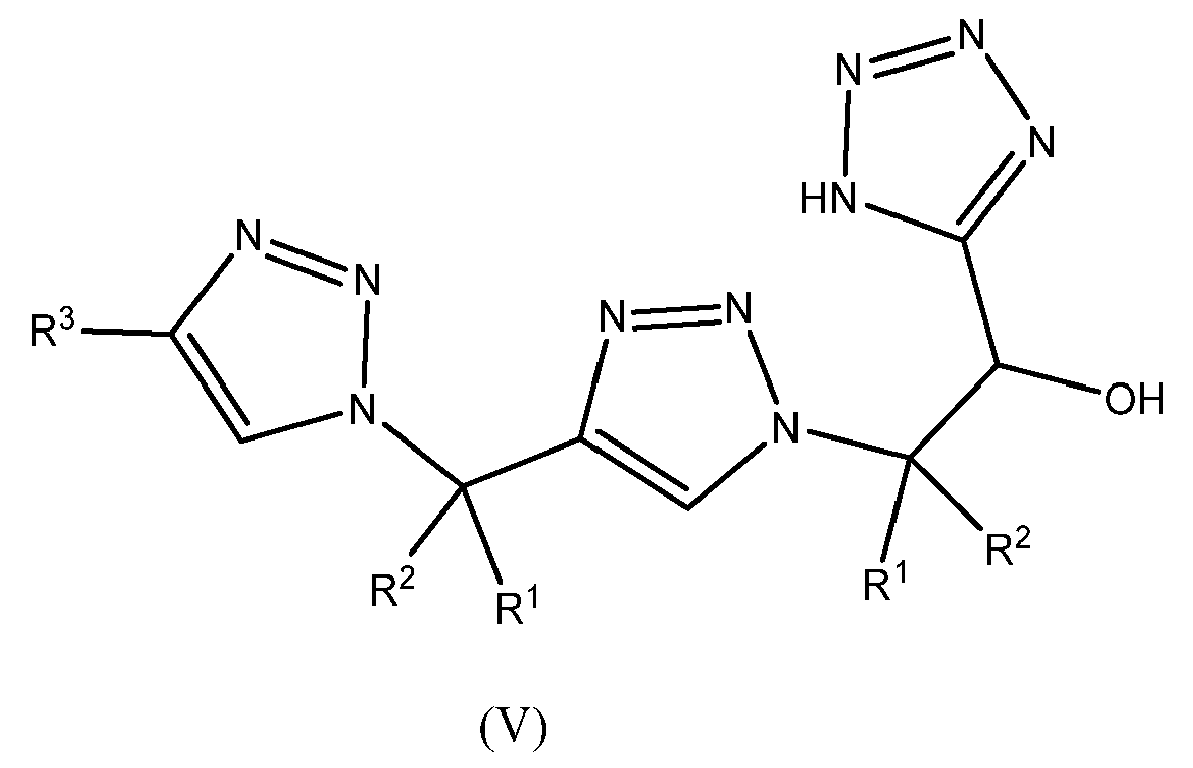


and carrying out the reaction of the compound (III) with compound (II) in presence of a copper(I) source and a tertiary amine. - According to a third embodiment, the invention relates to a process for manufacturing a poly-triazole compound of formula (VI):


and performing n iterations of the following steps (a) and (b): - (a) carrying out the reaction of the compound (III) with compound (II) in presence of a copper(I) source and a tertiary amine.
- (b) carrying out the reaction of the resulting compound with a carbodiimide.
- This process is schematically represented below (L referring to the tertiary amine):

- According to a specific embodiment, n ranges from 0 to 100. According to a more specific embodiment, n ranges from 1 to 10. According to another more specific embodiment, n ranges from 2 to 5.
- According to a more specific embodiment, the poly-triazoles manufactured by this process are selected from the group consisting of:
- 1-(3-ethylpent-1-yn-3-yl)-4-(1-(4-phenyl-1H-1,2,3-triazol-1-yl)cyclooclyl)-1H-1,2,3-triazole;
- 1-(1-ethynylcyclooctyl)-4-(3-(4-(1-(4-phenyl-1H-1,2,3-triazol-1-yl)cyclooclyl)-1H-1,2,3-triazol-1-yl)pentan-3-yl)-1H-1,2,3-triazole; and
- 1-benzyl-4-(1-(4-(3-(4-(1-(4-phenyl-1H-1,2,3-triazol-1-yl)cyclooclyl)-1H-1,2,3-triazol-1-yl)pentan-3-yl)-1H-1,2,3-triazol-1-yl)cyclooctyl)-1H-1,2,3-triazole.
- In these second and third embodiments, the compounds and the conditions of step (a) may be as previously disclosed in any embodiment of previous paragraph entitled "synthesis of alpha-hydroxy-beta-triazolo-tetrazoles - CuAAC reaction".
- In this third embodiment, the compounds and the conditions of steps (b) may be as previously disclosed in any embodiment of previous paragraph entitled "Triazole alkynes - Hydroxy-tetrazole to alkine reaction".
- The triazole heterocycle is an analogue of the peptidic bound, therefore oligomeric or polymeric compounds of general formula (VI) are potential peptides analogues. Such biomimetic compounds may present valuable applications in medicinal chemistry, and more generally in the biotechnologies field.
- The present invention is further illustrated by the following examples.
- Azides were prepared using known methods of the literature: Octyl azide (Org. Biomol. Chem., 2012, 10, 5993-6002.), Ferrocenyl azide (J. Organometal. Chem., 1970, 23, 225-228.), Pyrene azide (J. Org. Chem. 2008, 73, 8212-8218.), Methyl 3-azido-2-(tertbutoxycarbonyl-amino)propanoate ( Bioorg. Med. Chem., 2010, 18, 7338-7347.), 2,3,4,6-Tetra-O-acetyl-1-azido-β-D-glucopyranoside (Tet. Lett. 2007 48 3953-3957.), Ethyl 4-azido-butyrate (Eur. J. Org. Chem., 2011, 229-233.). Benzyl azide was purchased from Sigma-Aldrich.
- Alkynes, other reactants and solvent are commercially available from ordinary chemical compounds suppliers, and were purchased from Sigma-Aldrich, Alfa Aesar, Acros Organics or TCI Chemicals.
- Column chromatography were performed on a silica gel 230-400 mesh by using various mixtures of dichloromethane (DCM), ethyl acetate (EtOAc), methanol (MeOH), acetic acid (AcOH) and petroleum ether (PE). Thin Layer chromatographies (TLCs) were run on Kieselgel 60F254 plates and revealed by UV light and potassium permanganate or ninhydrin.
- 1H and 13C NMR spectra were collected on a Bruker Avance spectrometer respectively at 200 or 300 MHz and 75 MHz. Data are presented as follows: chemical shift (in ppm on the δ scale relative to δTMS = 0), multiplicity (s = singlet, d = doublet, t = triplet, m = multiplet, b = broad), coupling constant (J/Hz), integration and attribution. High resolution mass spectra (HR-MS) were obtained on a Waters Micromass Q-TofMicro instrument. Melting points are uncorrected.
- Hereafter are provided alpha-hydroxy-beta-triazole-tetrazoles according to the invention. R1, R2 and R3 groups refer to formula (I):

# R1 R2 R3 Formula Name 1 pentyl (cyclo hexyl) Ph 
(1-(4-phenyl-1H-1,2,3-triazol-1-yl)cyclohexyl)(1H-tetrazol-5-yl)methanol 2 hexyl (cyclo heptyl) Ph 
(1-(4-phenyl-1H-1,2,3-triazol-1-yl)cycloheptyl)(1H -tetrazol-5-yl)methanol 3 heptyl (cyclo octyl) Ph 
(1-(4-phenyl-1H-1,2,3-triazol-1-yl)cyclooctyl)(1H-tetrazol-5-yl)methanol 4 heptyl (cyclo octyl) -COOtBu 
tert-butyl1-(1-(hydroxy(1H-tetrazol-5-yl)methyl)cyclooct yl)-1H-1,2,3-triazole-4-carboxylate 5 heptyl (cyclo octyl) 3-chloropropyl 
(1-(4-(3-chloropropyl)-1H-1,2,3-triazol-1-yl)cyclooctyl)(1H-tetrazol-5-yl)methanol 6 heptyl (cyclo octyl) 2-hydroxyethyl 
2-(1-(1-(hydroxy(1H-tetrazol-5-yl)methyl)cyclooct yl)-1H-1,2,3-triazol-4-yl)ethan-1-ol 7 Et Et Ph 
2-ethyl-2-(4-phenyl-1H-1,2,3-triazol-1-yl)-1-(1H-tetrazol-5-yl)butan-1-ol 8 Ph H hexyl 
2-(4-hexyl-1H-1,2,3-triazol-1-yl)-2-phenyl-1-(1H-tetrazol-5-yl)ethan-1-ol 9 Ph Ph hexyl 
2-(4-hexyl-1H-1,2,3-triazol-1-yl)-2,2-diphenyl-1-(1H-tetrazol-5-yl)ethan-1-ol 10 Ph Ph 3-chloro propyl 
2-(4-(3-chloropropyl)-1H-1,2,3-triazol-1-yl)-2,2-diphenyl-1-(1H-tetrazol-5-yl)ethan-1-ol 11 Ph Ph -COOtBu 
tert-butyl 1-(2-hydroxy-1,1-diphenyl-2-(1H-tetrazol-5-yl)ethyl)-1H-1,2,3-triazole-4-carboxylate - These compounds may be prepared as disclosed in Example 2.
- Procedure for the synthesis of alpha-hydroxy-beta-azido-tetrazoles: these starting compounds for the synthesis of alpha-hydroxy-beta-triazolo-tetrazoles were prepared from the appropriate epoxynitriles, following the procedure disclosed in Quinodoz, P. et al., Organic Chemistry Frontiers, 2015, Vol. Vol. 2, pp. 492-496. and its Supplementary Material.
- Procedure (a): The alpha-hydroxy-beta-azido-tetrazole substrate (1 mmol) was dissolved in n-BuOH (3 mL). An alkyne (3 mmol) and TBTA (tris((1-benzyl-1H-1,2,3-triazolyl)methyl)amine) (0.1 mmol) were added. A solution of sodium ascorbate (0.2 mmol in 1.5 mL water) was added, followed by a solution of copper sulphate (0.1 mmol in 1.5 mL water). The mixture was stirred at room temperature for 48 hours. The organic phase was separated and concentrated under reduced pressure. The residue was purified by flash chromatography on silica gel.
- Procedure (b): A mixture of alpha-hydroxy-beta-azido-tetrazole substrate (0.10 mmol), copper (I) bromide (0.01 mmol) and TBTA (0.011 mmol) in THF (1 mL) was placed under argon atmosphere. An alkyne (0.30 mmol) and diisopropylethylamine (0.05 mL, 0.30 mmol) were added, and the mixture was stirred for 24 hours. The mixture was concentrated under reduced pressure. The residue was purified by flash chromatography on silica gel.
- Hereafter are provided the yield and physical characterization of alpha-hydroxy-beta-triazolo-tetrazoles according to the invention, prepared by procedure (a). Compound #3 was also prepared by procedure (b).
- Compounds #1-11 were prepared from the corresponding alpha-hydroxy-beta-azido-tetrazoles and from the appropriate R3-C≡CH terminal alkyne.
# Name Characterization Yield 1 (1-(4-phenyl-1H-1,2,3-triazol-1-yl)cyclohexyl)( 1H -tetrazol-5-yl)methanol Mp: 210-212°C.1H NMR (300 MHz, DMSO-d6) δ 8.60 (s, 1H), 7.87 (m, 2H), 7.44 (m, 2H), 7.31 (m, 1H), 6.76 (d, J = 5.0 Hz, 1H), 5.15 (d, J = 5.0 Hz, 1H), 2.61-2.66 (m, 2H), 1.88-1.96 (m, 2H), 1.48-1.67 (m, 3H), 1.08-1.29 (m, 3H). 13C NMR (75 MHz, DMSO-d6) δ 155.9, 145.6, 131.1, 128.7, 127.6, 125.1, 121.5, 70.9, 66.3, 30.3, 24.3, 20.9, 20.8. HRMS (ESI, TOF MS) m/z calculated for C16H20N7O [M+H]+: 326.1729, found: 326.1719. 84% (a) 2 (1-(4-phenyl-1H-1,2,3-triazol-1-yl)cycloheptyl)1 H-tetrazol-5-yl)methanol Mp: 119-120°C.1H NMR (300 MHz, DMF-d6) δ 8.74 (s, 1H), 7.98 (m, 2H), 7.47 (m, 2H), 7.35 (m, 1H), 7.03 (bs, 1H), 5.46 (bs, 1H), 3.53 (bs, 1H), 2.32-2.36 (m, 2H), 1.88-1.96 (m, 2H), 1.45-1.54 (m, 8H). 13C NMR (75 MHz, DMF-d6) δ 147.3, 132.8, 130.0, 129.8, 128.6, 126.3, 122.6, 72.8, 71.9, 30.4, 23.2, 23.1, 21.7. HRMS (ESI, TOF MS) m/z calculated for C17H22N7O [M+H]+: 340.1886, found: 340.1893. 98% (a) 3 (1-(4-phenyl-1H-1,2,3-triazol-1-yl)cyclooctyl)( 1H -tetrazol-5-yl)methanol Mp: 86-88°C. 1H NMR (300 MHz, DMF-d6) δ 8.71 (s, 1H), 7.96 (m, 2H), 7.44-7.49 (m, 2H), 7.34 (m,, 1H), 7.03 (bs, 1H), 5.48 (s, 1H), 3.66 (bs, 1H), 2.52-2.72 (m, 3H), 2.36-2.43 (m, 1H), 1.47-1.77 (m, 12H). 13C NMR (75 MHz, DMF-d6) δ 157.7, 146.9, 132.8, 129.8, 128.6, 126.3, 122.7, 80.2, 71.7, 71.6, 29.3, 28.5, 25.7, 22.8. HRMS (ESI, TOF MS) m/z calculated for C15H24N7O [M+H]+: 354.2042, found: 354.2045. 98% (a) 90% (b) 4 tert-butyl 1-(1-(hydroxy(1H-tetrazol-5-yl)methyl)cyclooc tyl)-1H-1,2,3-triazole-4-carboxylate Mp: 118-120°C.1H NMR (300 MHz, DMSO-d6) δ 8.60 (s, 1H), 6.83 (bs, 1H), 5.25 (s, 1H), 2.25-2.45 (m, 3H), 1.26-1.66 (m, 20H). 13C NMR (75 MHz, DMSO-d6) δ 159.9, 139.5, 128.9, 81.1, 69.8, 29.1, 27.9, 26.3, 24.2, 21.3. HRMS (ESI, TOF MS) m/z calculated for C17H18N7O3 [M+H]+: 378.2254, found: 378.2257. 98% (a) 5 (1-(4-(3-chloropropyl)-1H-1,2,3-triazol-1-yl)cyclooctyl)(1H -tetrazol-5-yl)methanol Mp: 85-87°C. 1H NMR (300 MHz, CDCl3) δ 7.23 (s, 1H), 5.51 (s, 1H), 3.45 (t, J = 5.9 Hz, 1H), 2.67-2.79 (m, 4H), 2.42-2.51 (m, 2H), 2.01-2.04 (m, 2H), 1.47-1.82 (m, 10H). 13C NMR (75 MHz, CDCl3) δ 121.8, 72.1, 71.3, 43.7, 31.6, 30.4, 29.6, 28.2, 27.3, 24.9, 22.1, 22.0. HRMS (ESI, TOF MS) m/z calculated for C15H25N7OCl [M+H]+: 354.1809, found: 354.1810. 71% (a) 6 2-(1-(1-(hydroxy(1H-tetrazol-5-yl)methyl)cyclooc tyl)-1H-1,2,3-triazol-4-yl)ethan-1-ol 1H NMR (300 MHz, CD3OD) δ 7.87 (s, 1H), 5.28 (s, 1H), 3.83 (t, J = 6.7 Hz, 1H), 2.90 (t, J = 6.5 Hz, 1H), 2.30-2.61 (m, 4H), 1.43-1.57 (m, 10H). 13C NMR (75 MHz, CDCl3) δ 158.7, 145.3, 124.4, 72.2, 72.0, 62.2, 30.9, 30.2, 30.0, 29.6, 28.8, 26.0, 23.1. HRMS (ESI, TOF MS) m/z calculated for C14H24N7O2 [M+H]+: 322.1991, found: 322.1995. 94% (a) 7 2-ethyl-2-(4-phenyl-1H-1,2,3-triazol-1-yl)-1-(1H-tetrazol-5-yl)butan-1-ol Mp: 103-105°C.1H NMR (300 MHz, DMSO-d6) δ 8.56 (s, 1H), 7.87 (m, 2H), 7.43 (m,, 2H), 7.30 (m, 1H), 6.84 (d, J = 5.4 Hz, 1H), 5.34 (d, J = 5.4 Hz, 1H), 2.18-2.36 (m, 4H), 0.90 (t, J = 7.3 Hz, 3H), 0.83 (t, J = 7.4 Hz, 3H).13C NMR (75 MHz, DMSO-d6) δ 156.2, 145.3, 131.1, 128.7, 127.6, 125.1, 121.5, 69.9, 68.3, 24.6, 23.8, 7.5. HRMS (ESI, TOF MS) m/z calculated for C15H20N7O [M+H]+: 314.1729, found: 314.1724. 99% (a) 8 2-(4-hexyl-1H-1,2,3-triazol-1-yl)-2-phenyl-1-(1H-tetrazol-5-yl)ethan-1-ol Mp: 157-159°C. 1H NMR (300 MHz, DMF-d6) δ 8.32 (bs, 1H), 7.30-7.53 (m, 5H), 6.37 (b, 2H), 2.66 (t, J = 7.3 Hz, 1H), 1.61-1.64 (m, 2H), 1.30 (b, 6H), 0.87 (t, J = 5.8 Hz, 1H). 13C NMR (75 MHz, DMF-d6) δ 136.7, 128.8, 128.3, 122.2, 68.6, 66.9, 31.7, 28.9, 25.7, 22.6, 13.8. HRMS (ESI, TOF MS) m/z calculated for C17H14N7O [M+H]+: 342.2042, found: 342.2049. 78% (a) 9 2-(4-hexyl-1H-1,2,3-triazol-1-yl)-2,2-diphenyl-1-(1H-tetrazol-5-yl)ethan-1-ol 1H NMR (300 MHz, CDCl3) δ 7.21-7.38 (m, 10H), 6.82-6.93 (m, 3H), 2.63-2.65 (m, 1H), 1.57 (m, 2H), 1.26 (b, 6H), 0.85 (t, J = 5.8 Hz, 3H). 13C NMR (75 MHz, CDCl3) δ 162.8, 139.2, 138.4, 129.3, 128.7, 128.4, 127.8, 124.2, 71.4, 31.3, 28.9, 28.7, 25.2, 22.4, 13.9. HRMS (ESI, TOF MS) m/z calculated for C23H28N7O [M+H]+: 418.2355, found: 418.2353. 60% (a) 10 2-(4-(3-chloropropyl)-1H-1,2,3-triazol-1-yl)-2,2-diphenyl-1-(1H-tetrazol-5-yl)ethan-1-ol Mp: 114-116°C. 1H NMR (300 MHz, CDCl3) δ 7.25-7.39 (m, 12H), 7.02 (bs, 1H), 6.83 (b, 4H), 3.55 (m, 2H), 2.82 (m, 2H), 2.11 (m, 2H). 13C NMR (75 MHz, CDCl3) δ 139.1, 138.3, 129.5, 128.8, 128.5, 127.8, 125.2, 71.2, 43.9, 31.4, 22.4. HRMS (ESI, TOF MS) m/z calculated for C20H21N7OCl [M+H]+: 410.1496, found: 410.1490. 78% (a) 11 tert-butyl 1-(2-hydroxy-1,1-diphenyl-2-(1H-tetrazol-5-yl)ethyl)-1H-1,2,3-triazole-4-carboxylate Mp: 122-124°C. 1H NMR (300 MHz, CDCl3) δ 7.69 (s, 1H), 7.43 (b, 5H), 7.27 (b, 3H), 6.94-6.97 (m, 3H), 1.59 (s, 9H). 13C NMR (75 MHz, CDCl3) δ 159.2, 155.5, 139.7, 138.1, 130.0, 129.5, 128.9, 128.8, 128.5, 127.6, 83.1, 70.7, 27.9. HRMS (ESI, TOF MS) m/z calculated for C22H23N7ONa [M+Na]+: 456.1760, found: 456.1754. 49% (a) - These results evidence that the applicant successfully conceived and achieved a CuAAC reaction between the alpha-hydroxy-beta-azido-tetrazoles and terminal alkynes, to manufacture alpha-hydroxy-beta-triazolo-tetrazoles.
- Procedures (a) and (b) are thus efficient methods to prepare a wide range of alpha-hydroxy-beta-triazolo-tetrazoles compounds.
- Hereafter are provided triazoles alkynes according to the invention. R1, R2 and R3 groups refer to formula (III):

# R1 R2 R3 Formula Name 12 pentyl (cyclohexyl) Ph 
1-(1-ethynylcyclohexyl) -4-phenyl-1H-1,2,3-triazole 13 hexyl (cycloheptyl) Ph 
1-(1-ethynylcycloheptyl )-4-phenyl-1H-1,2,3-triazole 14 heptyl (cyclooctyl) Ph 
1-(1-ethynylcyclooctyl)-4-phenyl-1H-1,2,3-triazole 15 heptyl (cyclooctyl) tBuAc 
tert-butyl 1-(1-ethynylcyclooctyl)-1H-1,2,3-triazole-4-carboxylate 16 heptyl (cyclooctyl) 3-chloroprop yl 
4-(3-chloropropyl)-1-(1-ethynylcyclooctyl)-1H-1,2,3-triazole 17 heptyl (cyclooctyl) 2-hydroxy ethyl 
2-(1-(1-ethynylcyclooctyl)-1H-1,2,3-triazol-4-yl)ethan-1-ol 18 Et Et Ph 
1-(3-ethylpent-1-yn-3-yl)-4-phenyl-1H-1,2,3-triazole 19 Ph H hexyl 
4-hexyl-1-(1-phenylprop-2-yn-1-yl)-1H-1,2,3-triazole 20 Ph Ph hexyl 
1-(1,1-diphenylprop-2-yn-1-yl)-4-hexyl-1H-1,2,3-triazole - These compounds may be prepared as disclosed in Example 4.
- Procedure (c), with diisopropylcarbodiimide (DIC): The alpha-hydroxy-beta-triazolotetrazole (0.35 mmol) was dissolved in dichloromethane (10 mL). DIC (0.42 mmol) was added. The mixture was stirred at room temperature for 18 hours, and then concentrated under reduced pressure. The residue was purified by flash chromatography on silica gel.
- Procedure (d), with N-(3-dimethylaminopropyl)-N'-ethylcarbodiimide (EDC): The alpha -hydroxy- beta-triazolo-tetrazole (0.1 mmol) was dissolved in dichloromethane (5 mL). EDC (0.12 mmol) was added and the mixture was stirred at room temperature for 18 hours. The mixture was diluted with dichloromethane and the resulting solution was washed successively with solutions of aqueous 0.5M HCl, aqueous saturated NaCl and aqueous saturated NaHCO3. The organic layer was dried over MgSO4 and concentrated under reduced pressure. The residue was purified by flash chromatography on silica gel.
- Hereafter are provided the yield and physical characterization of triazole alkynes according to the invention, prepared by procedures (c) and (d).
- Compounds #12-20 were prepared from the corresponding alpha-hydroxy-beta-triazolo-tetrazoles disclosed in Example 1 and 2.
# Name Characterization Yield 12 1-(1-ethynylcyclohexyl )-4-phenyl-1H-1,2,3-triazole Mp: 114-116°C. 1H NMR (300 MHz, CDCl3) δ 8.18 (d, J =4.6 Hz, 1H), 7.85-7.89 (m, 2H), 7.26-7.47 (m, 3H), 2.78 (d, J = 4.7 Hz, 1H), 2.25-2.43 (m, 4H), 1.77-1.88 (m, 5H), 1.28-1.43 (m, 1H). 13C NMR (75 MHz, CDCl3) δ 146.7, 130.7, 128.7, 128.0, 125.7, 118.5, 82.4, 76.2, 61.5, 38.6, 24.7, 23.1. HRMS (ESI, TOF MS) m/z calculated for C16H18N3 [M+H]+: 252.1501, found: 252.1498. 69% (c) 13 1-(1-ethynylcyclohepty 1)-4-phenyl-1H-1,2,3-triazole Mp: 80-81°C. 1H NMR (300 MHz, CDCl3) δ 8.18 (s, 1H), 7.85 (m, 2H), 7.40-7.45 (m, 2H), 7.33 (m, 1H), 2.79 (s, 1H), 2.59-2.63 (m, 2H), 2.27-2.34 (m, 2H), 1.66-1.87 (m, 8H). 13C NMR (75 MHz, CDCl3) δ 146.5, 130.6, 128.7, 128.0, 125.7, 118.5, 83.7, 75.4, 64.6, 42.1, 27.9, 22.7. HRMS (ESI, TOF MS) m/z calculated for C17H20N3 [M+H]+: 266.1657, found: 266.1655. 61% (c) 14 1-(1-ethynylcyclooctyl )-4-phenyl-lH-1,2,3-triazole Mp: 78°C. 1H NMR (300 MHz, CDCl3) δ 8.15 (s, 1H), 7.85 (m, 2H), 7.40-7.45 (m, 2H), 7.33 (t, J = 7.2 Hz, 1H), 2.72 (s, 1H), 2.64-2.71 (m, 2H), 2.24-2.33 (m, 2H), 1.63-1.81 (m, 12H). 13C NMR (75 MHz, CDCl3) δ 146.7, 130.6, 128.7, 128.0, 125.7, 118.5, 83.9, 74.7, 64.3, 37.0, 27.7, 24.4, 22.4. HRMS (ESI, TOF MS) m/z calculated for C18H22N3 [M+H]+: 280.1814, found: 280.1817 73% (c) 15 tert-butyl 1-(1-ethynylcyclooctyl )-1H-1,2,3-triazole-4-carboxylate 1H NMR (300 MHz, CDCl3) δ 8.35 (s, 1H), 2.73 (s, 1H), 2.57-2.62 (m, 2H), 2.18-2.24 (m, 2H), 1.61-1.75 (m, 21H). 13C NMR (75 MHz, CDCl3) δ 160.2, 140.5, 130.6, 125.9, 83.1, 82.2, 75.2, 64.8, 37.0, 28.2, 27.6, 24.3, 22.3. HRMS (ESI, TOF MS) m/z calculated for C17H26N3O2 [M+H]+: 304.2025, found: 304.2031. 76% (d) 16 4-(3-chloropropyl)-1-(1-ethynylcyclooctyl )-1H-1,2,3-triazole 1H NMR (300 MHz, CDCl3) δ 7.69 (s, 1H), 3.59 (t, J = 6.4 Hz, 2H), 2.89 (t, J =7.7 Hz, 2H), 2.67 (s, 1H), 2.57-2.64 (m, 2H), 2.16-2.26 (m, 4H), 1.62-1.76 (m, 10H). 13C NMR (75 MHz, CDCl3) δ 145.6, 119.9, 83.9, 74.4, 63.9, 44.3, 36.9, 31.9, 27.7, 24.3, 22.7, 22.4. HRMS (ESI, TOF MS) m/z calculated for C15H23N3Cl [M+H]+: 280.1581, found: 280.1587. 75% (d) 17 2-(1-(1-ethynylcyclooctyl )-1H-1,2,3-triazol-4-yl)ethan-1-ol 1H NMR (300 MHz, CDCl3) δ 7.76 (s, 1H), 3.95 (t, J = 5.6 Hz, 1H), 2.86-2.98 (m, 3H), 2.67 (s, 1H), 2.55-2.64 (m, 2H), 2.17-2.25 (m, 2H), 1.61-1.76 (m, 10H). 13C NMR (75 MHz, CDCl3) δ 144.5, 120.3, 83.8, 74.5, 64.0, 61.5, 36.9, 28.6, 27.7, 24.3, 22.4. HRMS (ESI, TOF MS) m/z calculated for C14H22N3O [M+H]+: 248.1763, found: 248.1770. 46% (d) 18 1-(3-ethylpent-1-yn-3-yl)-4-phenyl-1H-1,2,3-triazole Mp: 36-38°C. 1H NMR (300 MHz, CDCl3) δ 8.17 (s, 1H), 7.87-7.90 (m, 2H), 7.40-7.45 (m, 2H), 7.33 (m, 1H), 2.79 (s, 1H), 2.38-2.50 (m, 2H), 2.07-2.19 (m, 2H), 0.89 (t, J =7.4 Hz 6H). 13C NMR (75 MHz, CDCl3) δ 146.0, 130.7, 128.7, 127.9, 125.6, 120.6, 81.2, 76.3, 66.0, 34.8, 8.5. HRMS (ESI, TOF MS) m/z calculated for C15H18N3 [M+H]+: 240.1501, found: 240.1502 73% (c) 19 4-hexyl-1-(1-phenylprop-2-yn-1-yl)-1H-1,2,3-triazole Mp: 59-61°C. 1H NMR (300 MHz, CDCl3) δ 7.37-7.48 (m, 6H), 6.67 (d, J =2.0 Hz, 1H), 2.82 (d, J =2.4 Hz, 1H), 2.68 (t, J =7.5 Hz, 2H), 1.59-1.69 (m, 2H), 1.28-1.36 (m, 6H), 0.86 (t, J =7.0 Hz, 3H). 13C NMR (75 MHz, CDCl3) δ 149.0, 135.6, 129.2, 128.9, 127.0, 119.0, 78.1, 55.5, 31.4, 29.2, 28.8, 25.7, 22.5, 13.9. HRMS (ESI, TOF MS) m/z calculated for C17H22N3 [M+H]+: 268.1814, found: 268.1812. 75% (c) 20 1-(1,1-diphenylprop-2-yn-1-yl)-4-hexyl-1H-1,2,3-triazole Mp: 59-61°C. 1H NMR (300 MHz, CDCl3) δ 7.25-7.44 (m, 11H), 3.09 (s, 1H), 2.74 (t, J =8.0 Hz, 1H), 1.63-1.70 (m, 2H), 1.29-1.33 (m, 6H), 0.80 (b, 3H). 13C NMR (75 MHz, CDCl3) δ 147.7, 140.3, 128.8, 128.4, 127.9, 121.6, 83.2, 77.6, 69.1, 31.5, 29.3, 28.9, 25.7, 22.5, 14.0. HRMS (ESI, TOF MS) m/z calculated for C23H26N3 [M+H]+: 344.2127, found: 344.2132. 62% (d) - Surprisingly, the formation of a five-membered cycle or heterocycle was never observed by the applicant when carrying out the reaction of alpha-hydroxy-beta-triazolo-tetrazoles with carbodiimides. The triazoles alkyne is thus the only product of the reaction.
- These results evidence that the alpha-hydroxy-beta-triazolo-tetrazoles according to the invention may be efficiency converted to triazoles alkynes, by procedures (c) and (d) according to the invention, which have a very broad scope while being very efficient.
- Hereafter are provided di-triazoles according to the invention. R1, R2, R3 and R4 groups refer to formula (IV):

# R1 R2 R3 R4 Formula Name 21 pentyl (cyclo hexyl) Ph octyl 
1-octyl-4-(1-(4-phenyl-1H-1,2,3-triazol-1-yl)cyclohexyl)-1H-1,2,3-triazole 22 pentyl (cyclo hexyl) Ph bis(cyclo pentadien yl)iron 
1-[bis(η5-cyclopentadienyl) iron]-4-(1-(4-phenyl-1H-1,2,3-triazol-1-yl)cyclohexyl)-1H-1,2,3-triazole 23 pentyl (cycl ohexyl) Ph carbo hydrate 
(2S,3S,4R,5S,6S) -2-(acetoxymethyl)-6-(4-(1-(4-phenyl-1H-1,2,3-triazol-1-yl)cyclohexyl)-1H-1,2,3-triazol-1-yl)tetrahydro-2H-pyran-3,4,5-triyl triacetate 24 pentyl (cyclo hexyl) Ph -CH2CH (COOMe) NHBoc 
methyl2-((tert-butoxycarbonyl)a mino)-3-(4-(1-(4-phenyl-1H-1,2,3-triazol-1-yl)cyclohexyl)-1H-1,2,3-triazol-1-yl)propanoate 25 heptyl (cyclo octyl) Ph octyl 
1-octyl-4-(1-(4-phenyl-1H-1,2,3-triazol-1-yl)cyclooctyl)-1H-1,2,3-triazole 26 heptyl (cyclo octyl) Ph EtCOO-propyl 
ethyl 4-(4-(1-(4-phenyl-1H-1,2,3-triazol-1-yl)cyclooctyl)-1H-1,2,3-triazol-1-yl)butanoate 27 heptyl (cyclo octyl) Ph pyren-1-ylmethyl 
4-phenyl-1-(1-(1-(pyren-1-ylmethyl)-1H-1,2,3-triazol-4-yl)cyclooctyl)-1H-1,2,3-triazole 28 heptyl (cyclo octyl) Ph benzyl 
1-benzyl-4-(1-(4-phenyl-1H-1,2,3-triazol-1-yl)cyclooctyl)-1H-1,2,3-triazole 29 heptyl (cyclo octyl) Ph -C(Et)2-CH(OH)-Tz 
2-ethyl-2-(4-(1-(4-phenyl-1H-1,2,3-triazol-1-yl)cyclooctyl)-1H-1,2,3-triazol-1-yl)-1-(1H-tetrazol-5-yl)butan-1-ol - The triazole alkyne substrate (0.1 mmol) was dissolved in n-BuOH (1 mL). An azide (0.3 mmol) was added. A solution of sodium ascorbate (0.02 mmol in 0.25 mL water) was added, followed by a solution of copper sulphate (0.01 mmol in 0.25 mL water). The mixture was stirred at room temperature for 48 hours. The organic phase was separated and concentrated under reduced pressure. The residue was purified by flash chromatography on silica gel.
- Hereafter are provided the yield and physical characterization of di-triazoles according to the invention, prepared by procedure (e).
- Compounds #21-29 were prepared from the corresponding triazole alkynes disclosed in Examples 3 and 4 and from the appropriate R4-N3 azide.
# Name Characterization Yield 21 1-octyl-4-(1-(4-phenyl-1H-1,2,3-triazol-1-yl)cyclohexyl)-1H-1,2,3-triazole Mp: 110-112°C. 1H NMR δ 7.93 (s, 1H), 7.81-7.84 (m, 2H), 7.26-7.42 (m, 4H), 4.26 (t, J =6.9 Hz, 2H), 2.65-2.80 (m, 4H), 1.84 (b, 2H), 1.57-1.64 (m, 6H), 1.23-1.27 (m, 10H), 0.85 (t, J =6.1 Hz, 3H). 13C NMR (75 MHz, CDCl3) δ 150.8, 147.2, 130.5, 128.7, 128.0, 125.6, 121.1, 118.3, 62.3, 50.5, 35.7, 31.6, 30.1, 28.9, 28.8, 26.4, 24.8, 22.5, 22.0, 14.0. HRMS (ESI, TOF MS) m/z calculated for C24H35N6 [M+H]+: 407.2923, found: 407.2924. 98% 22 1-[bis(η5-cyclopentadienyl)ir on]-4-(1-(4-phenyl-1H-1,2,3-triazol-1-yl)cyclohexyl)-1H-1,2,3-triazole Mp: 157-163°C (dec.). 1H NMR δ 7.92 (s, 1H), 7.80-7.83 (m, 2H), 7.27-7.40 (m, 4H), 5.22 (bs, 2H), 4.14-4.24 (m, 9H), 2.65-2.75 (m, 4H), 1.84 (b, 2H), 1.58-1.62 (m, 6H). 13C NMR (75 MHz, CDCl3) δ 150.8, 147.3, 130.6, 128.7, 127.9, 125.5, 120.6, 118.3, 80.4, 69.1, 68.8, 62.1, 50.1, 35.7, 24.8, 21.9. HRMS (ESI, TOF MS) m/z calculated for C27H28N6Fe [M+H]+: 492.1724, found: 492.1729. 75% 23 2-(acetoxymethyl)-6-(4-(1-(4-phenyl-1H-1,2,3-triazol-1-yl)cyclohexyl)-1H-1,2,3-triazol-1-yl)tetrahydro-2H-pyran-3,4,5-triyl triacetate 1H NMR δ 7.86-7.84 (m, 3H), 7.66 (s, 1H), 7.30-7.42 (m, 3H), 5.82 (d, J =9.0 Hz, 1H), 5.23-5.39 (m, 2H), 5.33 (m, 1H), 4.27-4.33 (m, 1H), 4.11-4.15 (m, 1H), 3.99-4.02 (m, 1H), 2.70-2.81 (m, 4H), 2.07 (s, 3H), 2.05 (s, 3H), 2.01 (s, 3H), 1.84 (s, 3H), 1.57-1.62 (m, 6H). 13C NMR (75 MHz, CDCl3) δ 170.4, 169.8, 169.2, 168.8, 130.6, 128.7, 128.0, 125.5, 120.5, 85.9, 75.2, 72.2, 70.6, 67.6, 62.3, 61.4, 36.0, 35.6, 24.8, 22.0, 21.9, 20.6, 20.4, 20.0. HRMS (ESI, TOF MS) m/z calculated for C30H37N6O9 [M+H]+: 625.2622, found: 625.2626. 93% 24 methyl 2-((tert-butoxycarbonyl)am ino)-3-(4-(1-(4-phenyl-1H-1,2,3-triazol-1-yl)cyclohexyl)-1H-1,2,3-triazol-1-yl)propanoate 1H NMR δ 7.81-7.89 (m, 3H), 7.29-7.41 (m, 4H), 5.42 (d, J =6.9 Hz), 4.66-4.76 (m, 3H), 3.72 (s, 3H), 2.61-2.77 (m, 4H), 1.55-1.62 (m, 6H), 1.38 (s, 9H). 13C NMR (75 MHz, CDCl3) δ 169.3, 154.9, 130.4, 128.7, 128.0, 125.6, 122.8, 118.4, 80.7, 62.2, 53.6, 53.0, 51.0, 35.8, 35.7, 28.1, 24.8, 22.0. HRMS (ESI, TOF MS) m/z calculated for C25H34N7O4 [M+H]+: 496.2672, found: 496.2669. 89% 25 1-octyl-4-(1-(4-phenyl-1H-1,2,3-triazol-1-yl)cyclooctyl)-1H-1,2,3-triazole 1H NMR δ 7.93 (s, 1H), 7.80-7.83 (m, 2H), 7.27-7.41 (m, 4H), 4.29 (t, J =6.9 Hz, 2H), 2.75-2.96 (m, 4H), 1.84-1.89 (m, 2H), 1.65 (b, 10H), 1.24-1.28 (m, 10H), 0.86 (t, J =6.1 Hz, 3H). 13C NMR (75 MHz, CDCl3) δ 151.2, 130.7, 128.7, 127.9, 125.5, 121.3, 118.6, 66.1, 50.4, 33.5, 31.6, 30.0, 28.9, 28.8, 27.9, 26.4, 24.6, 22.5, 22.0, 14.0. HRMS (ESI, TOF MS) m/z calculated for C26H38N6Na [M+Na]+: 457.3056, found: 457.3061. 92% 26 ethyl 4-(4-(1-(4-phenyl-1H-1,2,3-triazol-1-yl)cyclooctyl)-1H-1,2,3-triazol-1-yl)butanoate 1H NMR δ 7.95 (s, 1H), 7.80-7.83 (m, 2H), 7.27-7.46 (m, 4H), 4.38 (t, J =6.7 Hz, 2H), 4.10 (m, 2H), 2.73-2.96 (m, 4H), 2.15-2.35 (m, 4H), 1.64 (b, 10H), 1.23 (m, J =6.5 Hz, 3H). 13C NMR (75 MHz, CDCl3) δ 172.1, 151.2, 146.9, 130.6, 128.7, 127.9, 125.5, 121.7, 118.7, 66.1, 60.7, 49.4, 33.5, 30.7, 27.9, 25.2, 24.6, 21.9, 14.1. HRMS (ESI, TOF MS) m/z calculated for C24H32N6O2Na [M+Na]+: 459.2484, found: 459.2479. 83% 27 4-phenyl-1-(1-(1-(pyren-1-ylmethyl)-1H-1,2,3-triazol-4-yl)cyclooctyl)-1H-1,2,3-triazole H NMR δ 8.02-8.25 (m, 8H), 7.73-7.94 (m, 4H), 7.27-7.36 (m, 4H), 6.20 (bs, 2H), 2.62-2.85 (m, 4H), 1.55 (b, 10H). 13C NMR (75 MHz, CDCl3) δ 151.3, 132.2, 131.1, 130.5, 129.0, 128.7, 128.3, 128.0, 127.7, 127.2, 126.4, 126.3, 125.9, 125.8, 125.6, 125.0, 124.9, 124.4, 121.7, 121.6, 118.7, 66.3, 52.6, 33.3, 27.8, 24.6, 21.9. HRMS (ESI, TOF MS) m/z calculated for C35H32N6Na [M+Na]+: 559.2586, found: 559.2584. 100% 28 1-benzyl-4-(1-(4-phenyl-1H-1,2,3-triazol-1-yl)cyclooctyl)-1H-1,2,3-triazole Mp: 133-134°C. 1H NMR δ 7.97 (s, 1H), 7.82-7.85 (m, 2H), 7.27-7.41 (m, 9H), 5.50 (bs, 2H), 2.73-2.95 (m, 4H), 1.65 (b, 10H). 13C NMR (75 MHz, CDCl3) δ 151.5, 146.9, 134.1, 130.5, 129.1, 128.7; 128.0, 127.9, 125.5, 121.5, 118.6,66.1,54.2,33.4,27.9,24.6,21.9. HRMS (ESI, TOF MS) m/z calculated for C25H29N6 [M+H]+: 413.2454, found: 413.2464 90% 29 2-ethyl-2-(4-(1-(4-phenyl-1H-1,2,3-triazol-1-yl)cyclooctyl)-1H-1,2,3-triazol-1-yl)-1-(1H-tetrazol-5-yl)butan-1-ol 1H NMR δ 8.59 (s, 1H), 8.33, (s, 1H), 8.18-8.21 (m, 2H), 7.32-7.44 (m, 3H), 2.54-3.05 (m, 8H), 1.41-1.59 (b, 10H), 0.94-1.03 (m, 6H). 13C NMR (75 MHz, pyridine-d5) δ 151.2, 130.7, 128.7, 127.9, 125.5, 121.3, 118.6, 66.1, 50.4, 33.5, 31.6, 30.0, 28.9, 28.8, 27.9, 26.4, 24.6, 22.5, 22.0, 14.0. HRMS (ESI, TOF MS) m/z calculated for C25H35N10O [M+H]+: 491.2995, found: 491.2996. 91% - These results evidence that the triazoles alkynes according to the invention may be efficiency reacted with azides in CuAAC conditions to prepare various di-triazoles compounds.
- Hereafter are provided poly-triazoles according to the invention.
# Formula Name 30 
1-(3-ethylpent-1-yn-3-yl)-4-(1-(4-phenyl-1H-1,2,3-triazol-1-yl)cyclooctyl)-1H-1,2,3-triazole 31 
1-(-ethynylcyclooctyl)-4-(3-(4-(1-(4-phenyl-1H-1,2,3-triazol-1-yl)cyclooctyl)-1H-1,2,3-triazol-1-yl)pentan-3-yl)-1H-1,2,3-triazole 32 
1-benzyl-4-(1-(4-(3-(4-(1-(4-phenyl-1H-1,2,3-triazol-1-yl)cyclooctyl)-1H-1,2,3-triazol-1-yl)pentan-3-yl)-1H-1,2,3-triazol-1-yl)cyclooctyl)-1H-1,2,3-triazole - 2-Azido-2-ethyl-1-(1H-tetrazol-5-yl)-butan-1-ol (28mg, 0.18 mmol) and 1-(1-ethynylcyclooctyl)-4-phenyl-1H-[1,2,3]triazole (45mg, 0.16 mmol) #14 were dissolved in nBuOH (2 mL). TBTA (tris((1-benzyl-1H-1,2,3-triazolyl)methyl)amine) (10.5mg, 0.02 mmol) was added. A solution of sodium ascorbate (11mg, 0.05 mmol in 0.5 mL water) was added, followed by a solution of copper sulphate (5mg, 0.02 mmol in 0.5 mL water). The mixture was stirred at room temperature for 48 hours. The mixture was concentrated under reduced pressure.
- The residue was dissolved in 1,2-dichloroethane (3 mL). DIC (0.035mL, 0.22 mmol) was added. The mixture was stirred at 50°C for 3 hours, and then concentrated under reduced pressure. The residue was purified by flash chromatography on silica gel using petroleum ether/EtOAc: 90/10 as eluent (Rf = 0.18). The bis-triazole alkyne was isolated as a white solid (41 mg, 62 % yield).
- (1-Azido-cyclooctyl)-(1H-tetrazol-5-yl)-methanol (30 mg, 0.12 mmol) and the bis-triazole alkyne #30 (41mg, 0.1mmol) were dissolved in n-BuOH (2 mL) and THF (1mL). TBTA (tris((1-benzyl-1H-1,2,3-triazolyl)methyl)amine) (8mg, 0.015 mmol) was added. A solution of sodium ascorbate (7mg, 0.035 mmol in 0.5 mL water) was added, followed by a solution of copper sulphate (3mg, 0.012 mmol in 0.5 mL water). The mixture was stirred at room temperature for 5 days. The mixture was concentrated under reduced pressure.
- The residue was dissolved in 1,2-dichloroethane (2 mL). DIC (0.02mL, 0.14 mmol) was added. The mixture was stirred at room temperature for 4 hours, and then concentrated under reduced pressure. The residue was purified by flash chromatography on silica gel using petroleum ether/EtOAc: 75/25 as eluent (Rf = 0.27). The tris-triazole alkyne was isolated as a white solid (31 mg, 52 % yield).
- The tris-triazole alkyne #31 (19mg, 0.032 mmol) was dissolved in n-BuOH (1 mL). Benzyl azide (0.01mL, 0.085 mmol) was added. A solution of sodium ascorbate (3mg, 0.015 mmol in 0.25 mL water) was added, followed by a solution of copper sulphate (1.2mg, 0.005 mmol in 0.25 mL water). The mixture was stirred at room temperature for 24 hours. The mixture was concentrated under reduced pressure. The residue was purified by flash chromatography on silica gel using dichloromethane/MeOH: 98/2 as eluent (Rf = 0.34). The tetra-triazole was isolated as white foam (20 mg, 86 % yield).
- Hereafter are provided the yield and physical characterization of poly-triazoles according to the invention, prepared by the above procedures.
# Name Characterization Yield 30 1-(3-ethylpent-1-yn-3-yl)-4-(1-(4-phenyl-1H-1,2,3-triazol-1-yl)cyclooctyl)-1H-1,2,3-triazole 1H NMR (300 MHz, CDCl3) δ 7.90 (s, 1H), 7.80-7.83 (m, 3H), 7.27-7.42 (m, 3H), 2.92-3.00 (m, 2H), 2.73-2.80 (m, 2H), 2.72 (s, 1H), 2.28-2.40 (m, 2H), 2.03-2.14 (m, 2H), 1.66 (b, 10H), 0.81 (m, 6H). 13C NMR (75 MHz, CDCl3) δ 149.3, 146.9, 130.7, 128.7, 127.9, 125.5, 122.6, 118.5, 80.7, 76.7, 66.2, 66.1, 34.7, 33.5, 27.9, 24.7, 22.0, 8.5. HRMS (ESI, TOF MS) m/z calculated for C25H32N6Na [M+Na]+: 439.2586, found: 439.2585. 62% 31 1-(1-ethynylcyclooctyl )-4-(3-(4-(1-(4-phenyl-1H-1,2,3-triazol-1-yl)cyclooctyl)-1H-1,2,3-triazol-1-yl)pentan-3-yl)-1H-1,2,3-triazole 1H NMR (300 MHz, CDCl3) δ 7.91 (s, 1H), 7.79-7.82 (m, 3H), 7.57 (s, 1H), 7.27-7.42 (m, 3H), 2.89-2.97 (m, 2H), 2.71-2.77 (m, 2H), 2.65 (s, 1H), 2.44-2.58 (m, 6H), 2.15-2.22 (m, 2H), 1.61-1.74 (m, 20H), 0.76 (m, 6H). 13C NMR (75 MHz, CDCl3) δ 150.2, 147.9, 146.9, 130.6, 128.7, 127.9, 125.6, 121.0, 121.0, 118.7, 83.4, 75.0, 67.0, 66.2, 64.4, 37.0, 33.5, 30.3, 27.9, 27.6, 24.7, 24.3, 22.4, 22.0, 7.8. HRMS (ESI, TOF MS) m/z calculated for C35H47N9Na [M+Na]+: 616.3852, found: 616.3859. 52% 32 1-benzyl-4-(1-(4-(3-(4-(1-(4-phenyl-1H-1,2,3-triazol-1-yl)cyclooctyl)-1H-1,2,3-triazol-1-yl)pentan-3-yl)-1H-1,2,3-triazol-1-yl)cyclooctyl)-1H-1,2,3-triazole 1H NMR (300 MHz, CDCl3) δ 7.91 (s, 1H), 7.80-7.82 (m, 2H), 7.57 (s, 1H), 7.51 (s, 1H), 7.21-7.41 (m, 9H), 5.47 (s, 2H), 2.60-2.92 (m, 8H), 2.38-2.51 (m, 4H), 1.52-1.60 (m, 20H), 0.68-0.72 (m, 6H). 13C NMR (75 MHz, CDCl3) δ 151.1, 148.1, 142.4, 142.2, 134.2, 130.5, 129.1, 128.8, 128.7, 128.0, 125.6, 121.5, 121.3, 121.2, 118.9, 118.7, 67.0, 66.4, 54.2, 33.6, 33.5, 30.3, 27.9, 27.8, 24.7, 24.6, 22.0, 21.9, 7.8. HRMS (ESI, TOF MS) m/z calculated for C42H55N12 [M+H]+: 727.4673, found: 727.4678. 86% - These results evidence that successive iterations of the reactions according to the invention may be used to efficiently prepare poly-triazoles compounds substituted by different alkyl and aryl groups.
and stereoisomers thereof; and salts thereof; and solvates thereof.
comprising starting from an alpha hydroxy-beta-azido-tetrazole of formula (II):

carrying out the reaction of compound (II) with alkyne R3-C≡C-H in the presence of a copper(I) source and a tertiary amine,
wherein the copper(I) source is either:
Claims (15)
- An alpha-hydroxy-beta-triazolo-tetrazole compound of formula (I):
 wherein the group is optionally substituted by at least one group being hydrocarbyl, aryl, heteroaryl, oxo, hydroxyl, amido, amino, nitro, carboxylo, formyl, halo, thioxo or sulfhydryl;wherein the group is optionally interrupted or terminated by at least one group being -O-; -S-; or -NRN- wherein RN is hydrogen, hydrocarbyl, aryl, or a combination thereof;wherein the nitrogen or sulfur atoms substituting or comprised in the group are optionally oxidized; andwherein R3 is hydrogen, an organic group or an organic molecule;
and stereoisomers thereof; and salts thereof; and solvates thereof. - The compound according to claim 1, wherein R1 and R2 are each independently hydrogen, alkyl, alkenyl, aryl, heteroaryl, alkylaryl, arylalkyl, alkenylaryl, or arylalkenyl groups; or wherein R1 and R2 form together a group being alkyl, alkenyl, aryl, alkylaryl, arylalkyl, alkenylaryl or arylalkenyl;wherein the group is optionally substituted by at least one group being hydroxyl, alkyl, alkenyl, aryl, alkylaryl, arylalkyl, amino, nitro, halo or sulfhydryl; andwherein the group is optionally interrupted or terminated by at least one group being -O-; -S-; and -NRN- with wherein RN is hydrogen, alkyl, alkenyl, aryl, or a combination thereof.
- The compound according to claim 2, wherein R1 and R2 are each independently hydrogen, alkyl, aryl or alkenylaryl groups or wherein R1 and R2 form together a group being alkyl or aryl;wherein the group is optionally substituted by at least one halo group.
- The compound according to anyone of claims 1 to 3, wherein R3 is hydrogen, hydroxyl, amido, amino, cyano, nitro, tetrazolyl, triazolyl, borono, carboxylo, formyl, halo, haloformyl, phosphono, phosphate or sulfhydryl; or wherein R3 is a hydrocarbyl, aryl, heteroaryl, hydrocarbylaryl, arylhydrocarbyl, hydrocarbylheteroaryl, or heteroarylhydrocarbyl group;wherein the group is optionally substituted by at least one group being hydrocarbyl, aryl, heteroaryl, oxo, hydroxyl, amido, amino, cyano, tetrazolyl, triazolyl, nitro, carboxylo, formyl, halo, thioxo or sulfhydryl;wherein the group is optionally interrupted or terminated by at least one group being -O-; -S-; or -NRN- wherein RN is hydrogen, hydrocarbyl, aryl or a combination thereof; andwherein the nitrogen or sulfur atoms substituting or comprised in the group are optionally oxidized;or wherein R3 is a carbohydrate, an amino acid, a peptide or a nucleoside.
- The compound according to anyone of claim 4, wherein R3 is an alkyl, alkenyl, aryl, heteroaryl, alkylaryl, arylalkyl, alkenylaryl, arylalkenyl, alkylheteroaryl, or heteroarylalkyl group;
wherein the group is optionally substituted by at least one group being alkyl, alkenyl, aryl, heteroaryl, alkylaryl, arylalkyl, oxo, hydroxyl, amido, amino, tetrazolyl, triazolyl, nitro, carboxylo, formyl, halo, thioxo or sulfhydryl; and
wherein the group is optionally interrupted or terminated by at least one group being -O-; -S-; or -NRN- wherein RN is hydrogen, alkyl, alkenyl, aryl, or a combination thereof. - The compound according to anyone of claims 1 to 5, being selected from the group consisting of: (1-(4-phenyl-1H-1,2,3-triazol-1-yl)cyclohexyl)(1H-tetrazol-5-yl)methanol; (1-(4-phenyl-1H-1,2,3-triazol-1-yl)cycloheptyl)(1H-tetrazol-5-yl)methanol; (1-(4-phenyl-1H-1,2,3-triazol-1-yl)cyclooctyl)(1H-tetrazol-5-yl)methanol; tert-butyl 1-(1-(hydroxy(1H-tetrazol-5-yl)methyl)cyclooctyl)-1H-1,2,3-triazole-4-carboxylate; (1-(4-(3-chloropropyl)-1H-1,2,3-triazol-1-yl)cyclooctyl)(1H-tetrazol-5-yl)methanol; 2-(1-(1-(hydroxy(1H-tetrazol-5-yl)methyl)cyclooctyl)-1H-1,2,3-triazol-4-yl)ethan-1-ol; 2-ethyl-2-(4-phenyl-1H-1,2,3-triazol-1-yl)-1-(1H-tetrazol-5-yl)butan-1-ol; 2-(4-hexyl-1H-1,2,3-triazol-1-yl)-2-phenyl-1-(1H-tetrazol-5-yl)ethan-1-ol; 2-(4-hexyl-1H-1,2,3-triazol-1-yl)-2,2-diphenyl-1-(1H-tetrazol-5-yl)ethan-1-ol; 2-(4-(3-chloropropyl)-1H-1,2,3-triazol-1-yl)-2,2-diphenyl-1-(1H-tetrazol-5-yl)ethan-1-ol; and tert-butyl 1-(2-hydroxy-1,1-diphenyl-2-(1H-tetrazol-5-yl)ethyl)-1H-1,2,3-triazole-4-carboxylate.
- A process for manufacturing an alpha-hydroxy-beta-triazolo-tetrazole of formula (I):
 wherein the group is optionally substituted by at least one group being hydrocarbyl, aryl, heteroaryl, oxo, hydroxyl, amido, amino, nitro, carboxylo, formyl, halo, thioxo or sulfhydryl;wherein the group is optionally interrupted or terminated by at least one group being -O-; -S-; or -NRN- wherein RN is hydrogen, hydrocarbyl, aryl, or a combination thereof; andwherein the nitrogen or sulfur atoms are optionally oxidized; andwherein R3 is hydrogen, an organic group or an organic molecule;
comprising starting from an alpha hydroxy-beta azido-tetrazole of formula (II):
carrying out the reaction of compound (II) with alkyne R3-C=C-H in the presence of a copper(I) source and a tertiary amine,wherein the copper(I) source is either:- a combination of a copper(I) salt and a base, or- a combination of a copper(II) salt and a reducing agent. - The process according to claim 7, wherein the copper(I) source is a combination of a copper(I) salt being copper(I) chloride, copper(I) bromide or copper(I) acetate; preferably copper(I) bromide; and a base being N,N-diisopropylethylamine.
- The process according to claim 7, wherein the copper(I) source is a combination of a copper(II) salt being copper(II) chloride, copper(II) bromide, copper(II) acetate or copper(II) sulphate; preferably copper(II) sulphate; and a reducing agent being sodium ascorbate or tri(2 carboxyethyl)phosphine; preferably sodium ascorbate; and
wherein the copper salt/reducing agent molar ratio in the reaction medium ranges from 0.1 to 2; preferably from 0.25 to 0.75; more preferably is 0.5. - The process according anyone of claims 7 to 9, wherein the tertiary amine is tris(benzyltriazolylmethyl)amine, tris(tertbutyltriazolylmethyl)amine, tris(benzimidazole)methyl amine , 4,7-diphenyl-1,10-phenanthroline-disulfonic acid disodium salt, tris[2 (N,N dibenzylamino)ethyl] amine or tris(benzyltriazolylmethyl)amine; preferably tris(benzyltriazolylmethyl)amine.
- The process according to anyone of claims 7 to 10, wherein the alkyne/azide molar ratio in the reaction medium ranges from 1 to 10, preferably from 2 to 5, more preferably is 3; and wherein the copper salt/azide molar ratio in the reaction medium ranges from 0.01 to 2, preferably from 0.05 to 0.2, more preferably is 0.1.
- The process according to anyone of claims 7 to 11, wherein the copper salt/tertiary amine molar ratio in the reaction medium ranges from 0.1 to 10; preferably from 0.5 to 2; preferably is 1.
- The process according to anyone of claims 7 to 12, wherein the reaction is executed in a solvent; preferably ethanol, tetrahydrofuran, N,N'-dimethylformamide, acetonitrile, n-butyl alcohol, water or mixtures thereof; more preferably a mixture of n-butyl alcohol and water.
- The process according to anyone of claims 7 to 13, wherein the reaction is executed in a duration ranging from 12h to 5 days; preferably from 24h to 72h; more preferably for 48h.
- The process according to anyone of claims 7 to 14, wherein the reaction is executed at a temperature ranging from 0 to 50°C; preferably from 15 to 30°C; more preferably at 25°C.
Priority Applications (1)
| Application Number | Priority Date | Filing Date | Title |
|---|---|---|---|
| EP16159846.1A EP3216788A1 (en) | 2016-03-11 | 2016-03-11 | Alpha-hydroxy-beta-triazolo-tetrazoles |
Applications Claiming Priority (1)
| Application Number | Priority Date | Filing Date | Title |
|---|---|---|---|
| EP16159846.1A EP3216788A1 (en) | 2016-03-11 | 2016-03-11 | Alpha-hydroxy-beta-triazolo-tetrazoles |
Publications (1)
| Publication Number | Publication Date |
|---|---|
| EP3216788A1 true EP3216788A1 (en) | 2017-09-13 |
Family
ID=55527395
Family Applications (1)
| Application Number | Title | Priority Date | Filing Date |
|---|---|---|---|
| EP16159846.1A Withdrawn EP3216788A1 (en) | 2016-03-11 | 2016-03-11 | Alpha-hydroxy-beta-triazolo-tetrazoles |
Country Status (1)
| Country | Link |
|---|---|
| EP (1) | EP3216788A1 (en) |
-
2016
- 2016-03-11 EP EP16159846.1A patent/EP3216788A1/en not_active Withdrawn
Non-Patent Citations (12)
| Title |
|---|
| ANGELO, N. G. ET AL., JOURNAL OF THE AMERICAN CHEMICAL SOCIETY, vol. 127, no. 49, 2005, pages 17134 - 17135 |
| BIOORG. MED. CHEM., vol. 18, 2010, pages 7338 - 7347 |
| EUR. J. ORG. CHEM., vol. 2011, pages 229 - 233 |
| J. ORG. CHEM., vol. 73, 2008, pages 8212 - 8218 |
| J. ORGANOMETAL. CHEM., vol. 23, 1970, pages 225 - 228 |
| MELDAL M ET AL: "Cu-catalyzed azide-alkyne cycloaddition", CHEMICAL REVIEWS, AMERICAN CHEMICAL SOCIETY, US, vol. 108, no. 8, 13 August 2008 (2008-08-13), pages 2952 - 3015, XP002545852, ISSN: 0009-2665, [retrieved on 20080813], DOI: 10.1021/CR0783479 * |
| MELDAL, M.; TOM E, C. W., CHEMICAL REVIEWS, vol. 108, 2008, pages 2952 - 3015 |
| ORG. BIOMOL. CHEM., vol. 10, 2012, pages 5993 - 6002 |
| QUINODOZ, P. ET AL., ORGANIC CHEMISTRY FRONTIERS, vol. 2, 2015, pages 492 - 496 |
| SHARMA S ET AL: "Synthesis of novel 3,5-disubstituted-dihydroisoxazoles from methyl undec-10-enoate and isoxazoles, triazole and tetrazolo-triazole from methyl undec-10-ynoate", CHINESE CHEMICAL LETTERS, ELSEVIER LTD, GB, vol. 20, no. 10, 1 October 2009 (2009-10-01), pages 1145 - 1149, XP026495453, ISSN: 1001-8417, [retrieved on 20090708], DOI: 10.1016/J.CCLET.2009.04.032 * |
| TET. LETT., vol. 48, 2007, pages 3953 - 3957 |
| WARDROP, D. J. ET AL., ORGANIC LETTERS, vol. 14, no. 6, 2012, pages 1548 - 1551 |
Similar Documents
| Publication | Publication Date | Title |
|---|---|---|
| CN1395485A (en) | Water soluble prodrugs of azole compounds | |
| JPH01275588A (en) | Synthesis of chiral 3-beta hydrogen (3r) 4-alloyloxyazetidinone | |
| JP4579496B2 (en) | Improved method for water-soluble azole compounds | |
| EP0144840A2 (en) | Optically active beta-lactams and method of their production | |
| MXPA05002874A (en) | Process for the synthesis of intermediates useful for the synthesis of tubulin inhibitors. | |
| US11161851B2 (en) | Processes to produce acalabrutinib | |
| KR20110104933A (en) | Stereoselective Synthesis of Piperidine Derivatives | |
| WO2011156355A1 (en) | Production method of phenyl guanidine salts and their intermediates | |
| EP3216788A1 (en) | Alpha-hydroxy-beta-triazolo-tetrazoles | |
| US6858727B2 (en) | Intermediate of carbapenem antibiotics and process for the preparation thereof | |
| US9765064B1 (en) | Alpha-hydroxy-beta-azido-tetrazoles | |
| EP3421463A1 (en) | New toxin and method for preparing intermediate thereof | |
| US5663365A (en) | Process for the preparation of pyrazolones | |
| US20190040066A1 (en) | Process for the preparation of phosphatidylinositol 3-kinase inhibitor | |
| KR19990077783A (en) | Improved process for chloroalkynes and alkynyl amines | |
| CN112225701A (en) | Synthesis method of N-vinyl azole compound | |
| JP4181233B2 (en) | Method for producing pyrrolidine-2,4-dione derivative | |
| Rottmann et al. | Asymmetric Synthesis of α-Alkyl-ω-amino Acids and α-Alkyllactams | |
| US6706888B2 (en) | Processes for preparing imidazole derivatives and salts thereof | |
| JP5046959B2 (en) | Method for producing water-soluble azole prodrug | |
| US7906676B2 (en) | Process for preparing 3-amino-5-fluoro-4-dialkoxypentanoic acid ester | |
| EA001696B1 (en) | Process for producing 1-chlorocarbonyl-4-piperidinopiperidine or hydrochloride thereof | |
| JP4326816B2 (en) | Optically active azole derivative and process for producing the same | |
| KR960010100B1 (en) | Method for preparing 2-methyldithiocarbazic acid ester | |
| Herath | Approaches toward the total synthesis of oroidin alkaloids: nagelamide A, C and ageliferin |
Legal Events
| Date | Code | Title | Description |
|---|---|---|---|
| PUAI | Public reference made under article 153(3) epc to a published international application that has entered the european phase |
Free format text: ORIGINAL CODE: 0009012 |
|
| AK | Designated contracting states |
Kind code of ref document: A1 Designated state(s): AL AT BE BG CH CY CZ DE DK EE ES FI FR GB GR HR HU IE IS IT LI LT LU LV MC MK MT NL NO PL PT RO RS SE SI SK SM TR |
|
| AX | Request for extension of the european patent |
Extension state: BA ME |
|
| 17P | Request for examination filed |
Effective date: 20180219 |
|
| RBV | Designated contracting states (corrected) |
Designated state(s): AL AT BE BG CH CY CZ DE DK EE ES FI FR GB GR HR HU IE IS IT LI LT LU LV MC MK MT NL NO PL PT RO RS SE SI SK SM TR |
|
| 17Q | First examination report despatched |
Effective date: 20180807 |
|
| STAA | Information on the status of an ep patent application or granted ep patent |
Free format text: STATUS: THE APPLICATION IS DEEMED TO BE WITHDRAWN |
|
| 18D | Application deemed to be withdrawn |
Effective date: 20191001 |