EP3216519B1 - Process for deeply catalytically oxidizing hydrogen sulfide to sulphur - Google Patents
Process for deeply catalytically oxidizing hydrogen sulfide to sulphur Download PDFInfo
- Publication number
- EP3216519B1 EP3216519B1 EP15856649.7A EP15856649A EP3216519B1 EP 3216519 B1 EP3216519 B1 EP 3216519B1 EP 15856649 A EP15856649 A EP 15856649A EP 3216519 B1 EP3216519 B1 EP 3216519B1
- Authority
- EP
- European Patent Office
- Prior art keywords
- catalyst
- gas
- hydrogen sulfide
- tail
- reactor
- Prior art date
- Legal status (The legal status is an assumption and is not a legal conclusion. Google has not performed a legal analysis and makes no representation as to the accuracy of the status listed.)
- Active
Links
Images
Classifications
-
- B—PERFORMING OPERATIONS; TRANSPORTING
- B01—PHYSICAL OR CHEMICAL PROCESSES OR APPARATUS IN GENERAL
- B01J—CHEMICAL OR PHYSICAL PROCESSES, e.g. CATALYSIS OR COLLOID CHEMISTRY; THEIR RELEVANT APPARATUS
- B01J23/00—Catalysts comprising metals or metal oxides or hydroxides, not provided for in group B01J21/00
- B01J23/70—Catalysts comprising metals or metal oxides or hydroxides, not provided for in group B01J21/00 of the iron group metals or copper
- B01J23/76—Catalysts comprising metals or metal oxides or hydroxides, not provided for in group B01J21/00 of the iron group metals or copper combined with metals, oxides or hydroxides provided for in groups B01J23/02 - B01J23/36
- B01J23/84—Catalysts comprising metals or metal oxides or hydroxides, not provided for in group B01J21/00 of the iron group metals or copper combined with metals, oxides or hydroxides provided for in groups B01J23/02 - B01J23/36 with arsenic, antimony, bismuth, vanadium, niobium, tantalum, polonium, chromium, molybdenum, tungsten, manganese, technetium or rhenium
- B01J23/847—Vanadium, niobium or tantalum or polonium
- B01J23/8472—Vanadium
-
- B—PERFORMING OPERATIONS; TRANSPORTING
- B01—PHYSICAL OR CHEMICAL PROCESSES OR APPARATUS IN GENERAL
- B01D—SEPARATION
- B01D53/00—Separation of gases or vapours; Recovering vapours of volatile solvents from gases; Chemical or biological purification of waste gases, e.g. engine exhaust gases, smoke, fumes, flue gases, aerosols
- B01D53/34—Chemical or biological purification of waste gases
- B01D53/74—General processes for purification of waste gases; Apparatus or devices specially adapted therefor
- B01D53/86—Catalytic processes
- B01D53/8603—Removing sulfur compounds
- B01D53/8612—Hydrogen sulfide
-
- B—PERFORMING OPERATIONS; TRANSPORTING
- B01—PHYSICAL OR CHEMICAL PROCESSES OR APPARATUS IN GENERAL
- B01J—CHEMICAL OR PHYSICAL PROCESSES, e.g. CATALYSIS OR COLLOID CHEMISTRY; THEIR RELEVANT APPARATUS
- B01J21/00—Catalysts comprising the elements, oxides, or hydroxides of magnesium, boron, aluminium, carbon, silicon, titanium, zirconium, or hafnium
- B01J21/06—Silicon, titanium, zirconium or hafnium; Oxides or hydroxides thereof
- B01J21/063—Titanium; Oxides or hydroxides thereof
-
- B—PERFORMING OPERATIONS; TRANSPORTING
- B01—PHYSICAL OR CHEMICAL PROCESSES OR APPARATUS IN GENERAL
- B01J—CHEMICAL OR PHYSICAL PROCESSES, e.g. CATALYSIS OR COLLOID CHEMISTRY; THEIR RELEVANT APPARATUS
- B01J23/00—Catalysts comprising metals or metal oxides or hydroxides, not provided for in group B01J21/00
- B01J23/70—Catalysts comprising metals or metal oxides or hydroxides, not provided for in group B01J21/00 of the iron group metals or copper
- B01J23/74—Iron group metals
- B01J23/745—Iron
-
- B—PERFORMING OPERATIONS; TRANSPORTING
- B01—PHYSICAL OR CHEMICAL PROCESSES OR APPARATUS IN GENERAL
- B01J—CHEMICAL OR PHYSICAL PROCESSES, e.g. CATALYSIS OR COLLOID CHEMISTRY; THEIR RELEVANT APPARATUS
- B01J35/00—Catalysts, in general, characterised by their form or physical properties
- B01J35/19—Catalysts containing parts with different compositions
-
- B—PERFORMING OPERATIONS; TRANSPORTING
- B01—PHYSICAL OR CHEMICAL PROCESSES OR APPARATUS IN GENERAL
- B01J—CHEMICAL OR PHYSICAL PROCESSES, e.g. CATALYSIS OR COLLOID CHEMISTRY; THEIR RELEVANT APPARATUS
- B01J8/00—Chemical or physical processes in general, conducted in the presence of fluids and solid particles; Apparatus for such processes
- B01J8/02—Chemical or physical processes in general, conducted in the presence of fluids and solid particles; Apparatus for such processes with stationary particles, e.g. in fixed beds
- B01J8/04—Chemical or physical processes in general, conducted in the presence of fluids and solid particles; Apparatus for such processes with stationary particles, e.g. in fixed beds the fluid passing successively through two or more beds
- B01J8/0446—Chemical or physical processes in general, conducted in the presence of fluids and solid particles; Apparatus for such processes with stationary particles, e.g. in fixed beds the fluid passing successively through two or more beds the flow within the beds being predominantly vertical
- B01J8/0449—Chemical or physical processes in general, conducted in the presence of fluids and solid particles; Apparatus for such processes with stationary particles, e.g. in fixed beds the fluid passing successively through two or more beds the flow within the beds being predominantly vertical in two or more cylindrical beds
- B01J8/0457—Chemical or physical processes in general, conducted in the presence of fluids and solid particles; Apparatus for such processes with stationary particles, e.g. in fixed beds the fluid passing successively through two or more beds the flow within the beds being predominantly vertical in two or more cylindrical beds the beds being placed in separate reactors
-
- C—CHEMISTRY; METALLURGY
- C01—INORGANIC CHEMISTRY
- C01B—NON-METALLIC ELEMENTS; COMPOUNDS THEREOF; METALLOIDS OR COMPOUNDS THEREOF NOT COVERED BY SUBCLASS C01C
- C01B17/00—Sulfur; Compounds thereof
- C01B17/02—Preparation of sulfur; Purification
- C01B17/04—Preparation of sulfur; Purification from gaseous sulfur compounds including gaseous sulfides
- C01B17/0404—Preparation of sulfur; Purification from gaseous sulfur compounds including gaseous sulfides by processes comprising a dry catalytic conversion of hydrogen sulfide-containing gases, e.g. the Claus process
- C01B17/0456—Preparation of sulfur; Purification from gaseous sulfur compounds including gaseous sulfides by processes comprising a dry catalytic conversion of hydrogen sulfide-containing gases, e.g. the Claus process the hydrogen sulfide-containing gas being a Claus process tail gas
-
- C—CHEMISTRY; METALLURGY
- C01—INORGANIC CHEMISTRY
- C01B—NON-METALLIC ELEMENTS; COMPOUNDS THEREOF; METALLOIDS OR COMPOUNDS THEREOF NOT COVERED BY SUBCLASS C01C
- C01B17/00—Sulfur; Compounds thereof
- C01B17/02—Preparation of sulfur; Purification
- C01B17/04—Preparation of sulfur; Purification from gaseous sulfur compounds including gaseous sulfides
- C01B17/0404—Preparation of sulfur; Purification from gaseous sulfur compounds including gaseous sulfides by processes comprising a dry catalytic conversion of hydrogen sulfide-containing gases, e.g. the Claus process
- C01B17/046—Preparation of sulfur; Purification from gaseous sulfur compounds including gaseous sulfides by processes comprising a dry catalytic conversion of hydrogen sulfide-containing gases, e.g. the Claus process without intermediate formation of sulfur dioxide
- C01B17/0465—Catalyst compositions
-
- C—CHEMISTRY; METALLURGY
- C10—PETROLEUM, GAS OR COKE INDUSTRIES; TECHNICAL GASES CONTAINING CARBON MONOXIDE; FUELS; LUBRICANTS; PEAT
- C10K—PURIFYING OR MODIFYING THE CHEMICAL COMPOSITION OF COMBUSTIBLE GASES CONTAINING CARBON MONOXIDE
- C10K1/00—Purifying combustible gases containing carbon monoxide
- C10K1/002—Removal of contaminants
- C10K1/003—Removal of contaminants of acid contaminants, e.g. acid gas removal
- C10K1/004—Sulfur containing contaminants, e.g. hydrogen sulfide
-
- C—CHEMISTRY; METALLURGY
- C10—PETROLEUM, GAS OR COKE INDUSTRIES; TECHNICAL GASES CONTAINING CARBON MONOXIDE; FUELS; LUBRICANTS; PEAT
- C10K—PURIFYING OR MODIFYING THE CHEMICAL COMPOSITION OF COMBUSTIBLE GASES CONTAINING CARBON MONOXIDE
- C10K1/00—Purifying combustible gases containing carbon monoxide
- C10K1/34—Purifying combustible gases containing carbon monoxide by catalytic conversion of impurities to more readily removable materials
-
- B—PERFORMING OPERATIONS; TRANSPORTING
- B01—PHYSICAL OR CHEMICAL PROCESSES OR APPARATUS IN GENERAL
- B01D—SEPARATION
- B01D2255/00—Catalysts
- B01D2255/20—Metals or compounds thereof
- B01D2255/207—Transition metals
- B01D2255/20707—Titanium
-
- B—PERFORMING OPERATIONS; TRANSPORTING
- B01—PHYSICAL OR CHEMICAL PROCESSES OR APPARATUS IN GENERAL
- B01D—SEPARATION
- B01D2255/00—Catalysts
- B01D2255/20—Metals or compounds thereof
- B01D2255/207—Transition metals
- B01D2255/20723—Vanadium
-
- B—PERFORMING OPERATIONS; TRANSPORTING
- B01—PHYSICAL OR CHEMICAL PROCESSES OR APPARATUS IN GENERAL
- B01D—SEPARATION
- B01D2255/00—Catalysts
- B01D2255/20—Metals or compounds thereof
- B01D2255/207—Transition metals
- B01D2255/20738—Iron
-
- B—PERFORMING OPERATIONS; TRANSPORTING
- B01—PHYSICAL OR CHEMICAL PROCESSES OR APPARATUS IN GENERAL
- B01D—SEPARATION
- B01D2257/00—Components to be removed
- B01D2257/30—Sulfur compounds
- B01D2257/304—Hydrogen sulfide
-
- B—PERFORMING OPERATIONS; TRANSPORTING
- B01—PHYSICAL OR CHEMICAL PROCESSES OR APPARATUS IN GENERAL
- B01J—CHEMICAL OR PHYSICAL PROCESSES, e.g. CATALYSIS OR COLLOID CHEMISTRY; THEIR RELEVANT APPARATUS
- B01J2208/00—Processes carried out in the presence of solid particles; Reactors therefor
- B01J2208/00008—Controlling the process
- B01J2208/00017—Controlling the temperature
- B01J2208/00106—Controlling the temperature by indirect heat exchange
-
- B—PERFORMING OPERATIONS; TRANSPORTING
- B01—PHYSICAL OR CHEMICAL PROCESSES OR APPARATUS IN GENERAL
- B01J—CHEMICAL OR PHYSICAL PROCESSES, e.g. CATALYSIS OR COLLOID CHEMISTRY; THEIR RELEVANT APPARATUS
- B01J2208/00—Processes carried out in the presence of solid particles; Reactors therefor
- B01J2208/00008—Controlling the process
- B01J2208/00017—Controlling the temperature
- B01J2208/00106—Controlling the temperature by indirect heat exchange
- B01J2208/00168—Controlling the temperature by indirect heat exchange with heat exchange elements outside the bed of solid particles
- B01J2208/00176—Controlling the temperature by indirect heat exchange with heat exchange elements outside the bed of solid particles outside the reactor
Definitions
- the present invention relates to a process for deeply catalytically oxidizing hydrogen sulfide to element sulfur, belonging to catalyst application field.
- a modified Claus process adopts acid gas burner (1200-1300°C)-two steps or three steps Claus catalytic conversion (200-300 °C )-Claus tail-gas treatment unit (reduction and absorption method)-tail-gas burner (750-1300°C).
- the advantages of the modified Claus process are developed techniques, strong dealing capability and a sulfur recovery rate of 95-97%.
- the investment and operating cost of the tail-gas dealing unit is high.
- the overall investment on a sulfur recovery unit with a dealing capability of 50000 tons of sulfur/year is over RMB 140 million of which the tail-gas treatment unit accounts for RMB 80 million.
- the flue gas consumption of the tail-gas burner is over RMB120 million/year.
- the cost of the sulfur is RMB1500/ton while the market price of the sulfur is RMB600-1000/ton.
- H 2 S content is low ( ⁇ 20%) the direct oxidation method is adopted.
- the detailed procedures are as below: adopt CLINSULF-PO produced by ⁇ The Linde Group; blend and preheat the acid gas and the oxygen-containing gas-inner-cooling pipe reactor(top adiabatic section and the bottom isothermal section)-condensate separation-tail-gas burner; use CRS-31 catalyst Prandtl French company.
- the features of the CLINSULF-DO are short process, easy operation, long-life catalyst, sulfur recovery rate ⁇ 90%, low selectivity and the tail-gas may also contains H 2 S and SO 2 .
- the CLINSULF-DO is not transferred any long.
- Selextox process adopts four steps reactor and the detailed method is as below: preheat the oxygen-containing acid gas mixture-catalytic oxidation step-two steps Claus process-catalytic burning step-chimney emission; adopt selection catalyst.
- the overall sulfur recovery rate is ⁇ 90%, When the acid gas H 2 S is ⁇ 5%, cyclic process is needed, that is the tail-gas cycle return to the oxidation step.
- Super/Euro-claus from the ⁇ Hofung Technology is a Claus tail-gas treatment method which supports the regular Claus sulfur recovery process; the detailed process is as below: tail-gas from the two steps Claus process-hydrotransformation-Super/Euroclaus-condensate separation-tail-gas burning; the sulfur recovery rate of the catalytic oxidation step is ⁇ 85%.
- the tail-gas of the oxidation processes has an unacceptable sulfur content (total sulfur ⁇ 960mg/m 3 , 1996 standard PRC).
- H 2 S low-H 2 S- concentration-containing acid gas
- H 2 S is ⁇ 2 % and an adiabatic reactor is adopted, at the outlet of which H 2 S and SO 2 exist in the same time.
- H 2 S 20-60mg/m 3
- SO 2 100-200mg/m 3 .
- the emission standard H 2 S ⁇ 5mg/m 3 . So re-treating is needed. Otherwise, when the H 2 S concentration is high, the activity of the H 2 S and the sulfur recovery is unsatisfying.
- the catalytically oxidizing catalysts have the following features in common: adopting adiabatic reactor, simple structure, high conversion rate, narrow applications, low concentration acid gas only (non-cycling, H 2 S ⁇ 3%), the sulfur recovery rate 90%; furthermore, the catalyst selectivity is inefficient and the tail-gas at the outlet may also contains H 2 S and SO 2 in the same time,which need to be re-treated.
- the tail-gas is able to be treated with thermal incineration and catalytic incineration.
- the thermal incineration is to add flue gas in the tail-gas of the thermal incinerator to convert the H 2 S to low-toxic SO 2 under high temperature of 700-800°C with little sulfur recovery effects.
- the catalytic incineration (not applied in PRC) is to adopt the tail-gas burning catalyst to convert the H 2 S under the temperature of 300-400 °C,
- the sulfur recovery rate is ⁇ 30%.
- Large amount of H 2 S-containing gas is emitted to the atmosphere, which pollute the environment and waste the sulfur resource.
- the thermal incineration is widely used, which has large flue gas consumption.
- the flue gas consumption is amount to 2200 tons and over RMB100 million.
- the oxidation reaction of the H 2 S is strong exothermic reaction; under adiabatic condition, the reaction (1) has a temperature rise of 60°C while 1% H 2 S oxidizing to element sulfur. Low temperature is favorable for the oxidation reaction. Without the catalyst, when the temperature reach 260°C reaction (2) started. The reaction (2) is unfavorable reaction which should be avoided. So, the research hot topic is how to promote reaction (1), suppress reaction (2) develop catalyst with high activity and selectivity and find out suitable process.
- a double-stage isothermal oxidization sulfur-producing device including a first-stage isothermal reactor, a second-stage isothermal reactor and a third-stage adiabatic reactor which are sequentially connected.
- the device is configured for oxidizing hydrogen sulfide, wherein hydrogen sulfide gas and a proper amount of oxygen-containing gas (e.g. air or oxygen) are enabled to react in the first-stage isothermal reactor, so that sulfur is obtained, wherein the concentration of hydrogen sulfide in the process gas can be lowered to a low level, such as 3% or below.
- oxygen-containing gas e.g. air or oxygen
- the process gas having a low content of hydrogen sulfide is subjected to direct oxidization reaction in the second-stage isothermal reactor.
- the first-stage reactor and the second-stage reactor are isothermal reactors.
- the reaction tail gas and an oxygen-containing gas are injected into the third-stage adiabatic reactor for performing a direct oxidation reaction.
- the present invention relates to the use of a catalyst for selectively catalytically oxidizing hydrogen sulfide, which has high selectivity and high sulfur recovery rate.
- the present invention further relates to the use of a catalyst for burning tail-gas.
- An object of the present invention is to provide a process for deeply catalytically oxidizing hydrogen sulfide to element sulfur, which is easy to operate and control.
- the catalyst for selectively catalytically oxidizing hydrogen sulfide comprises components of a mass percent of: 24-34% of iron trioxide, 60-70% of anatase titanium dioxide and a balance which are auxiliary agents.
- the catalyst for burning tail-gas comprises components of a mass percent of: 48-78% of iron trioxide, 18-48% of anatase titanium dioxide and a balance which are auxiliary agents.
- the catalyst for burning tail-gas further comprises a mass percent of 0.4-0.8% of vanadium pentoxide.
- An object of the present invention is to provide process for deeply catalytically oxidizing hydrogen sulfide to element sulfur, wherein the process uses an isothermal reactor and an adiabatic reactor connected in series, which are respectively filled with a catalyst for selectively catalytically oxidizing hydrogen sulfide and a catalyst for burning tail-gas respectively for reaction; wherein:
- air is injected in a gas mixture at an entrance of the isothermal reactor according to the O 2 /H 2 S mole ratio required by the catalyst for selective oxidation and the gas mixture passes through a source gas; a sulfur recovery rate of an isothermal reaction is ⁇ 95%; air is injected at an entrance of the adiabatic reactor according to the O 2 /H 2 S mole ratio required by the catalyst for burning tail-gas; in an adiabatic reaction a sulfur recovery rate is ⁇ 90%, a conversion rate is ⁇ 99%; in the vented-gas, SO 2 is ⁇ 400mg/m 3 , H 2 S is ⁇ 5mg/m 3 .
- the auxiliary agents in the present invention are regular auxiliary agents, such as water glass, aluminum sol, silica sol, dilute nitric acid, sesbania powder, carboxymethyl cellulose and etc.
- the raw material is able to be get from the market, which contains 85% of the ferric oxide, industrial-grade meta-titanic acid (80% is titanium dioxide), 2% of dilute nitric acid aqueous solution.
- the catalyst for selectively catalytically oxidizing hydrogen sulfide and the catalyst for burning tail-gas are processed according to the following steps: Take the iron oxide (if the catalyst for burning tail-gas contains vanadium pentoxide, ammonium metavanadate of the same measurement as vanadium pentoxide is added at the same time); add dilute nitric acid aqueous solution (volume is 12-15% of the mass of iron oxide); blend for 30 minutes; then add meta-titanic acid, add aluminum sol and silica sol at the same time (volume is 10% of the total mass of iron oxide and meta-titanic acid); mix the solution with the sesbania powder (the mass of the sesbania powder is measured as 1% of the total amount of iron oxide and meta-titanic acid) and knead in the kneader for 40 minutes; then squeeze out a column of semi-finished product of 4mm in diameter by using a screw extruder; place the semi-finished product in an environment with a temperature of 25
- the adoption of the selective oxidation catalyst of the present invention significantly improves the selectivity of the catalyst and get high sulfur recovery rate which is ⁇ 95%.
- the total sulfur content in the vented-gas is reduced significantly and the vented-gas deep purification burden is eased.
- the tail-gas burning catalyst is set after the selective oxidation catalyst, which further recovers the sulfur and the sulfur recovery rate is ⁇ 90%, the residue of the hydrogen sulfide ( ⁇ 10%) is completely converted to low-toxic sulfur dioxide.
- the high energy-consumption tail-gas burner is no longer needed, which cut the energy consumption and operation cost significantly.
- the method is simple and easy to control and operate.
- the present invention adopts a combination method of two different catalysts in the isothermal reactor and adiabatic reactor respectively, which extremely extends the H 2 S concentration range of the acid gas treatment. Self-heat balance is achieved within the system. The operation cost is less then 10% of the Claus process and the investment cost is 20% of the Claus process with the similar dealing capability.
- the present invention is able to replace the conventional Claus process and achieve the goal in one step. Realize the direct emission of the vented-gas without the burner while ensure a high sulfur recovery rate.
- the present invention fulfills the requirement of Emission standard of air pollutants issued in 2014(PRC ) and greatly benefits the environment and economy.
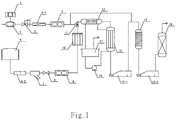
- Fig. 1 is a flow chart of a method of the present invention
- Element number 1. air filter; 2. air compressor; 3. pressure regulator; 4-1. first water-vapor separator; 4-2. second water-vapor separator; 5. air flow meter; 6. acid gas storage tank; 7. acid gas filter; 8. entrance stop valve; 9. acid gas flow meter; 10. acid gas heat exchanger; 11. gas mixing valve; 12. mixing heat exchanger; 13. isothermal reactor; 14. adiabatic reactor; 15-1. first collector; 15-2. second collector; 16. modified activated carbon filter tank; 17. heat conduction oil tank; 18. heat conduction cycling pump.
- CHT-02 small catalyst activity evaluation device (Beijing Wekindu Technology Co., Ltd); TY-2000 integrated trace sulfur analyzer (Automation research branch of Southwest research & design institute of chemical industry); 3420A- gas chromatography analyzer (Beijing Maihak analytical instrument Co.Ltd.).
- the isothermal reactor adopts catalyst A (not according to the invention), B, C (according to the invention) for selectively catalytically oxidizing hydrogen sulfide respectively.
- the evaluation condition parameter of the catalyst activity is listed in chart 1.
- the activity evaluation data and catalyst composition is listed in chart 2.
- the isothermal reactor adopts conventional catalyst D.
- the evaluation condition parameter of the catalyst activity is listed in chart 1.
- the activity evaluation data and catalyst composition is listed in chart 2.
- Chart 1 Evaluation condition of the activity of the selective oxidation catalyst Volume of the catalyst Granularity of the sample Space velocity (based on the mixed acid gas) Acid gas flow after air is injected in Air flow 8ml 20-40 mesh 1500h -1 200ml/min 136ml/min Source acid gas H 2 S% Acid gas after air is injected in H 2 S% Residual oxygen content in tail-gas % Oxygen content in air % Water content of saturated water vapor (40°C) 11.75 8.45-8.65 0.14 21 5.8%
- the adiabatic reactor adopts tail-gas burning catalyst E, F, G, H.
- the evaluation condition parameter of the catalyst activity is listed in chart 3.
- the activity evaluation data and catalyst composition is listed in chart 4.
- Chart 3 Evaluation condition of the activity of the tail-gas burning catalyst Volume of the catalyst Granularity of the sample Space velocity (based on the mixed acid gas) Acid gas flow after air is injected in Air flow 8ml 20-40 mesh 1500h -1 200ml/min 136ml/min Source acid gas H 2 S% Acid gas after air is injected in H 2 S% Residual oxygen content in tail-gas % Oxygen content in air % Water content of saturated water vapor(40°C) 5.20-5.34 3.15-3.25 0.52 20 5.8%
- the process for deeply catalytically oxidizing hydrogen sulfide to element sulfur of the present invention adopts an isothermal reactor and an adiabatic reactor connected in series, which are filled with the catalyst for selectively catalytically oxidizing hydrogen sulfide and the catalyst for burning tail-gas respectively for reaction.
- the air after being filtered by the air filter 1 passes through the air compressor 2, the pressure regulator 3, the first water-vapor separator 4-1, the air flow meter 5 and reaches the gas mixing valve 11; the acid gas from the acid gas storage tank 6 passes through the second water-vapor separator 4-2, the acid gas filter 7, the entrance stop valve 8, the acid gas flow meter 9, the acid gas heat exchanger 10 and reached the gas mixing valve 11 to blend with air.
- the acid gas enters the isothermal reactor after being filled with air; the isothermal reactor adopts the catalyst A for selectively catalytically oxidizing hydrogen sulfide; the method parameters are listed in Chart 1; the space velocity is 1500/h; the reaction temperature is 200°C; the tail-gas composition and sulfur recovery rate are listed in Chart 2; the tail gas enters the adiabatic reactor after being filled with air; the adiabatic reactor adopts the catalyst E for burning tail-gas; the space velocity is 1000/h; O 2 /H 2 S mole ratio is 1.5; the reaction temperature is 250°C; the sulfur recovery rate of the adiabatic reaction is 95.3%; the conversion rate is 99.5%; in the vented tail-gas, SO 2 is 0.1504 mg/m 3 , H 2 S is 0.
- the process for deeply catalytically oxidizing hydrogen sulfide to element sulfur of the present invention adopts an isothermal reactor and an adiabatic reactor connected in series, which are filled with the catalyst for selectively catalytically oxidizing hydrogen sulfide and the catalyst for burning tail-gas respectively for reaction.
- the method is explained in the embodiment 8.
- the acid gas enters the isothermal reactor after being filled with air; the isothermal reactor adopts the catalyst B for selectively catalytically oxidizing hydrogen sulfide; the method parameters are listed in the Chart 1; the space velocity is 1500/h; the reaction temperature is 250°C; the composition of the tail-gas and the sulfur recovery rate are listed in the Chart 2; the tail-gas enters the adiabatic rector after being filled with air; the adiabatic reactor adopts the catalyst F for burning tail-gas; the space velocity is 2000/h; the O 2 /H 2 S mole ratio is 2.0; the reaction temperature is 300 °C; the sulfur recovery rate of the adiabatic reaction is 94.7%; the conversion rate is 99.8%; in the vented tail-gas, SO 2 is 0.1608 mg/m 3 , H 2 S is 0.0094 mg/m 3 .
Landscapes
- Chemical & Material Sciences (AREA)
- Engineering & Computer Science (AREA)
- Organic Chemistry (AREA)
- Chemical Kinetics & Catalysis (AREA)
- Materials Engineering (AREA)
- Combustion & Propulsion (AREA)
- General Chemical & Material Sciences (AREA)
- Oil, Petroleum & Natural Gas (AREA)
- Inorganic Chemistry (AREA)
- Environmental & Geological Engineering (AREA)
- Health & Medical Sciences (AREA)
- Biomedical Technology (AREA)
- Analytical Chemistry (AREA)
- Catalysts (AREA)
- Exhaust Gas Treatment By Means Of Catalyst (AREA)
Description
- The present invention relates to a process for deeply catalytically oxidizing hydrogen sulfide to element sulfur, belonging to catalyst application field.
- The Claus process (H2S ≥ 30%) and direct oxidation method (H2S ≤ 20%) are adopted for recovery of sulfur from acid gas according to different H2S concentration.
- A modified Claus process adopts acid gas burner (1200-1300°C)-two steps or three steps Claus catalytic conversion (200-300 °C )-Claus tail-gas treatment unit (reduction and absorption method)-tail-gas burner (750-1300°C). The advantages of the modified Claus process are developed techniques, strong dealing capability and a sulfur recovery rate of 95-97%. The investment and operating cost of the tail-gas dealing unit is high. The overall investment on a sulfur recovery unit with a dealing capability of 50000 tons of sulfur/year is over RMB 140 million of which the tail-gas treatment unit accounts for RMB 80 million. The flue gas consumption of the tail-gas burner is over RMB120 million/year. The cost of the sulfur is RMB1500/ton while the market price of the sulfur is RMB600-1000/ton. When the H2S content is low (≤20%) the direct oxidation method is adopted. The detailed procedures are as below: adopt CLINSULF-PO produced by © The Linde Group; blend and preheat the acid gas and the oxygen-containing gas-inner-cooling pipe reactor(top adiabatic section and the bottom isothermal section)-condensate separation-tail-gas burner; use CRS-31 catalyst Prandtl French company. The features of the CLINSULF-DO are short process, easy operation, long-life catalyst, sulfur recovery rate ≤90%, low selectivity and the tail-gas may also contains H2S and SO2. The CLINSULF-DO is not transferred any long. Selextox process adopts four steps reactor and the detailed method is as below: preheat the oxygen-containing acid gas mixture-catalytic oxidation step-two steps Claus process-catalytic burning step-chimney emission; adopt selection catalyst. The overall sulfur recovery rate is ≤90%, When the acid gas H2S is ≥5%, cyclic process is needed, that is the tail-gas cycle return to the oxidation step. Super/Euro-claus from the © Hofung Technology is a Claus tail-gas treatment method which supports the regular Claus sulfur recovery process; the detailed process is as below: tail-gas from the two steps Claus process-hydrotransformation-Super/Euroclaus-condensate separation-tail-gas burning; the sulfur recovery rate of the catalytic oxidation step is ≤ 85%. The tail-gas of the oxidation processes has an unacceptable sulfur content (total sulfur ≥960mg/m3, 1996 standard PRC).
- The inventor introduced a process and a catalyst for selectively oxidizing low-H2S- concentration-containing acid gas (H2S≤3.0%) in patent
CN200810157750 90%; furthermore, the catalyst selectivity is inefficient and the tail-gas at the outlet may also contains H2S and SO2 in the same time,which need to be re-treated. Generally, the tail-gas is able to be treated with thermal incineration and catalytic incineration. The thermal incineration is to add flue gas in the tail-gas of the thermal incinerator to convert the H2S to low-toxic SO2 under high temperature of 700-800°C with little sulfur recovery effects. The catalytic incineration (not applied in PRC) is to adopt the tail-gas burning catalyst to convert the H2S under the temperature of 300-400 °C, The sulfur recovery rate is ≤30%. Large amount of H2S-containing gas is emitted to the atmosphere, which pollute the environment and waste the sulfur resource. In PRC, the thermal incineration is widely used, which has large flue gas consumption. According to the data of a sulfur recovery device which adopts reduction and absorption method and with a capability of 80000 tons of sulfur/year, the flue gas consumption is amount to 2200 tons and over RMB100 million. Currently, the requirement for environment protection is imperative, the total sulfur (SO2) emission target is down from 960mg/m3 to 400mg/m3 in the Emission standard of air pollutants issued in 2014(PRC). So the need for a new sulfur recovery technology which is able to replace the Claus process is imperative. The key is to develop a selectively oxidizing catalyst with high sulfur recovery rate and a tail-gas burning catalyst with high conversion rate and high sulfur recovery rate, which is able to save energy, cut the emission, clean the environment, transfer the pollutants to the resource to the maximum extend, high profit yield and promote a healthy recycle in environment protection field.
- In the oxidation reaction of H2S, two different reactions exists:
H2S+1/2O2---S+H2O ΔH(273K)=-222KJ/mol (1)
H2S+3/2O2---SO2+H2O ΔH(273K)=-519KJ/mol (2)
- The following conclusion is able to be drawn: the oxidation reaction of the H2S is strong exothermic reaction; under adiabatic condition, the reaction (1) has a temperature rise of 60°C while 1% H2S oxidizing to element sulfur. Low temperature is favorable for the oxidation reaction. Without the catalyst, when the temperature reach 260°C reaction (2) started. The reaction (2) is unfavorable reaction which should be avoided. So, the research hot topic is how to promote reaction (1), suppress reaction (2) develop catalyst with high activity and selectivity and find out suitable process.
- From document
CN 102 849 684 A a double-stage isothermal oxidization sulfur-producing device is known, including a first-stage isothermal reactor, a second-stage isothermal reactor and a third-stage adiabatic reactor which are sequentially connected. The device is configured for oxidizing hydrogen sulfide, wherein hydrogen sulfide gas and a proper amount of oxygen-containing gas (e.g. air or oxygen) are enabled to react in the first-stage isothermal reactor, so that sulfur is obtained, wherein the concentration of hydrogen sulfide in the process gas can be lowered to a low level, such as 3% or below. Then, the process gas having a low content of hydrogen sulfide is subjected to direct oxidization reaction in the second-stage isothermal reactor. The first-stage reactor and the second-stage reactor are isothermal reactors. The reaction tail gas and an oxygen-containing gas are injected into the third-stage adiabatic reactor for performing a direct oxidation reaction. - The present invention relates to the use of a catalyst for selectively catalytically oxidizing hydrogen sulfide, which has high selectivity and high sulfur recovery rate.
- The present invention further relates to the use of a catalyst for burning tail-gas.
- An object of the present invention is to provide a process for deeply catalytically oxidizing hydrogen sulfide to element sulfur, which is easy to operate and control.
- The catalyst for selectively catalytically oxidizing hydrogen sulfide comprises components of a mass percent of: 24-34% of iron trioxide, 60-70% of anatase titanium dioxide and a balance which are auxiliary agents.
- The catalyst for burning tail-gas comprises components of a mass percent of: 48-78% of iron trioxide, 18-48% of anatase titanium dioxide and a balance which are auxiliary agents.
- The catalyst for burning tail-gas further comprises a mass percent of 0.4-0.8% of vanadium pentoxide.
- An object of the present invention is to provide process for deeply catalytically oxidizing hydrogen sulfide to element sulfur, wherein the process uses an isothermal reactor and an adiabatic reactor connected in series, which are respectively filled with a catalyst for selectively catalytically oxidizing hydrogen sulfide and a catalyst for burning tail-gas respectively for reaction; wherein:
- in the isothermal reactor the catalyst for selectively catalytically oxidizing Hydrogen sulfide is used under the following conditions:
- temperature 150-300°C,
- space velocity 300-2000/h, 300-1000/h is preferred;
- O2/H2S mole ratio 0.5-1.5, 0.5-1.0 is preferred;
- in the adiabatic reactor, the catalyst for burning tail-gas is used under the following conditions:
- temperature 180-350°C,
- space velocity 1000-2000/h,
- O2/H2S mole ratio 1.0-3.0, 1.5-2.0 is preferred.
- In the process, air is injected in a gas mixture at an entrance of the isothermal reactor according to the O2/H2S mole ratio required by the catalyst for selective oxidation and the gas mixture passes through a source gas; a sulfur recovery rate of an isothermal reaction is ≥ 95%; air is injected at an entrance of the adiabatic reactor according to the O2/H2S mole ratio required by the catalyst for burning tail-gas; in an adiabatic reaction a sulfur recovery rate is ≥ 90%, a conversion rate is ≥ 99%; in the vented-gas, SO2 is ≤ 400mg/m3, H2S is ≤5mg/m3.
- The auxiliary agents in the present invention are regular auxiliary agents, such as water glass, aluminum sol, silica sol, dilute nitric acid, sesbania powder, carboxymethyl cellulose and etc. The raw material is able to be get from the market, which contains 85% of the ferric oxide, industrial-grade meta-titanic acid (80% is titanium dioxide), 2% of dilute nitric acid aqueous solution.
- The catalyst for selectively catalytically oxidizing hydrogen sulfide and the catalyst for burning tail-gas are processed according to the following steps:
Take the iron oxide (if the catalyst for burning tail-gas contains vanadium pentoxide, ammonium metavanadate of the same measurement as vanadium pentoxide is added at the same time); add dilute nitric acid aqueous solution (volume is 12-15% of the mass of iron oxide); blend for 30 minutes; then add meta-titanic acid, add aluminum sol and silica sol at the same time (volume is 10% of the total mass of iron oxide and meta-titanic acid); mix the solution with the sesbania powder (the mass of the sesbania powder is measured as 1% of the total amount of iron oxide and meta-titanic acid) and knead in the kneader for 40 minutes; then squeeze out a column of semi-finished product of 4mm in diameter by using a screw extruder; place the semi-finished product in an environment with a temperature of 25 °C for 24-hour natural drying; then place the semi-finished product in the oven to dry for 2 hours under 150°C; finally place the dried semi-finished product in the muffle and roast for 2 hours under 450 °C to get the test sample. - The benefits of the present invention are as follow:
In the process of catalytically oxidizing hydrogen sulfide to element sulfur, the adoption of the selective oxidation catalyst of the present invention significantly improves the selectivity of the catalyst and get high sulfur recovery rate which is ≥95%. The total sulfur content in the vented-gas is reduced significantly and the vented-gas deep purification burden is eased. The tail-gas burning catalyst is set after the selective oxidation catalyst, which further recovers the sulfur and the sulfur recovery rate is ≥ 90%, the residue of the hydrogen sulfide (≤10%) is completely converted to low-toxic sulfur dioxide. The high energy-consumption tail-gas burner is no longer needed, which cut the energy consumption and operation cost significantly. The method is simple and easy to control and operate. The present invention adopts a combination method of two different catalysts in the isothermal reactor and adiabatic reactor respectively, which extremely extends the H2S concentration range of the acid gas treatment. Self-heat balance is achieved within the system. The operation cost is less then 10% of the Claus process and the investment cost is 20% of the Claus process with the similar dealing capability. The present invention is able to replace the conventional Claus process and achieve the goal in one step. Realize the direct emission of the vented-gas without the burner while ensure a high sulfur recovery rate. The present invention fulfills the requirement of Emission standard of air pollutants issued in 2014(PRC) and greatly benefits the environment and economy. -
Fig. 1 is a flow chart of a method of the present invention - Element number: 1. air filter; 2. air compressor; 3. pressure regulator; 4-1. first water-vapor separator; 4-2. second water-vapor separator; 5. air flow meter; 6. acid gas storage tank; 7. acid gas filter; 8. entrance stop valve; 9. acid gas flow meter; 10. acid gas heat exchanger; 11. gas mixing valve; 12. mixing heat exchanger; 13. isothermal reactor; 14. adiabatic reactor; 15-1. first collector; 15-2. second collector; 16. modified activated carbon filter tank; 17. heat conduction oil tank; 18. heat conduction cycling pump.
- Referring to the drawings, according to a preferred embodiment of the present invention is illustrated, wherein
The following instruments and condition are used for the catalyst activity evaluation in the embodiments.
CHT-02 small catalyst activity evaluation device (Beijing Wekindu Technology Co., Ltd);
TY-2000 integrated trace sulfur analyzer (Automation research branch of Southwest research & design institute of chemical industry);
3420A- gas chromatography analyzer (Beijing Maihak analytical instrument Co.Ltd.). - Note: Due to the H2S concentration of the acid gas of the source gas and the tail-gas of the reactor (≤ 100mg/m3) differs greatly, different analysis methods are adopted. So, the thermal conductivity detector of the gas chromatography is adopted for the source gas; the flame photometric detector is adopted for the analysis of the tail-gas. Another gas line of the gas chromatography adopts 4A molecular sieves as the support for analysis of the oxygen content in the acid gas.
- In the embodiment 1-3, the isothermal reactor adopts catalyst A (not according to the invention), B, C (according to the invention) for selectively catalytically oxidizing hydrogen sulfide respectively. The evaluation condition parameter of the catalyst activity is listed in chart 1. The activity evaluation data and catalyst composition is listed in
chart 2. - In the contrast 1, the isothermal reactor adopts conventional catalyst D. The evaluation condition parameter of the catalyst activity is listed in chart 1. The activity evaluation data and catalyst composition is listed in
chart 2.Chart 1 Evaluation condition of the activity of the selective oxidation catalyst Volume of the catalyst Granularity of the sample Space velocity (based on the mixed acid gas) Acid gas flow after air is injected in Air flow 8ml 20-40 mesh 1500h-1 200ml/min 136ml/min Source acid gas H2S% Acid gas after air is injected in H2S% Residual oxygen content in tail-gas % Oxygen content in air % Water content of saturated water vapor (40°C) 11.75 8.45-8.65 0.14 21 5.8% 
- In the embodiment 4-7, the adiabatic reactor adopts tail-gas burning catalyst E, F, G, H. The evaluation condition parameter of the catalyst activity is listed in
chart 3. The activity evaluation data and catalyst composition is listed in chart 4.Chart 3 Evaluation condition of the activity of the tail-gas burning catalystVolume of the catalyst Granularity of the sample Space velocity (based on the mixed acid gas) Acid gas flow after air is injected in Air flow 8ml 20-40 mesh 1500h-1 200ml/min 136ml/min Source acid gas H2S% Acid gas after air is injected in H2S% Residual oxygen content in tail-gas % Oxygen content in air % Water content of saturated water vapor(40°C) 5.20-5.34 3.15-3.25 0.52 20 5.8% 
- The process for deeply catalytically oxidizing hydrogen sulfide to element sulfur of the present invention adopts an isothermal reactor and an adiabatic reactor connected in series, which are filled with the catalyst for selectively catalytically oxidizing hydrogen sulfide and the catalyst for burning tail-gas respectively for reaction.
- As illustrated in
Fig.1 , the air after being filtered by the air filter 1 passes through theair compressor 2, thepressure regulator 3, the first water-vapor separator 4-1, theair flow meter 5 and reaches thegas mixing valve 11; the acid gas from the acidgas storage tank 6 passes through the second water-vapor separator 4-2, the acid gas filter 7, the entrance stop valve 8, the acidgas flow meter 9, the acidgas heat exchanger 10 and reached thegas mixing valve 11 to blend with air. The mixed gas passed through the mixingheat exchanger 12, theisothermal reactor 13, the first collector 15, theadiabatic reactor 14; the second collector 15-2, and is emitted after being treated by the modified activatedcarbon filter tank 16; the heatconduction oil tank 17 is set between the mixingheat exchanger 12 and theisothermal reactor 13; the heatconduction cycling pump 18 recycle and utilize the heat. The acid gas enters the isothermal reactor after being filled with air; the isothermal reactor adopts the catalyst A for selectively catalytically oxidizing hydrogen sulfide; the method parameters are listed in Chart 1; the space velocity is 1500/h; the reaction temperature is 200°C; the tail-gas composition and sulfur recovery rate are listed inChart 2; the tail gas enters the adiabatic reactor after being filled with air; the adiabatic reactor adopts the catalyst E for burning tail-gas; the space velocity is 1000/h; O2/H2S mole ratio is 1.5; the reaction temperature is 250°C; the sulfur recovery rate of the adiabatic reaction is 95.3%; the conversion rate is 99.5%; in the vented tail-gas, SO2 is 0.1504 mg/m3, H2S is 0. - The process for deeply catalytically oxidizing hydrogen sulfide to element sulfur of the present invention adopts an isothermal reactor and an adiabatic reactor connected in series, which are filled with the catalyst for selectively catalytically oxidizing hydrogen sulfide and the catalyst for burning tail-gas respectively for reaction. The method is explained in the embodiment 8. The acid gas enters the isothermal reactor after being filled with air; the isothermal reactor adopts the catalyst B for selectively catalytically oxidizing hydrogen sulfide; the method parameters are listed in the Chart 1; the space velocity is 1500/h; the reaction temperature is 250°C; the composition of the tail-gas and the sulfur recovery rate are listed in the
Chart 2; the tail-gas enters the adiabatic rector after being filled with air; the adiabatic reactor adopts the catalyst F for burning tail-gas; the space velocity is 2000/h; the O2/H2S mole ratio is 2.0; the reaction temperature is 300 °C; the sulfur recovery rate of the adiabatic reaction is 94.7%; the conversion rate is 99.8%; in the vented tail-gas, SO2 is 0.1608 mg/m3, H2S is 0.0094 mg/m3.
Claims (5)
- A process for deeply catalytically oxidizing hydrogen sulfide to element sulfur comprises the following steps:providing an isothermal reactor and an adiabatic reactor which are connected in series;wherein the isothermal reactor is filled with a catalyst for selectively catalytically oxidizing the hydrogen sulfide to element sulfur, whereinthe catalyst for selectively catalytically oxidizing the hydrogen sulfide to element sulfur comprises components of a mass percent of: 24-34% of iron trioxide, 60-70% of anatase titanium dioxide and a balance which are auxiliary agents; andwherein the adiabatic reactor is filled with a catalyst for burning tail-gas, whereinthe catalyst for burning the tail-gas comprises components of a mass percent of: 48-78% of iron trioxide, 18-48% of anatase titanium dioxide and a balance which are auxiliary agents,isothermal reaction: injecting air in a gas mixture at an entrance of the isothermal reactor according to the O2/H2S mole ratio required by the catalyst for selective oxidation contained therein and selective oxidation of hydrogen sulfide by the catalyst in the isothermal reactor under the following conditions: temperature 150-250°C, a space velocity of 300-2000/h, and an O2/H2S mole ratio of 0.5-1.5,
- adiabatic reaction: injecting the tail-gas from the isothermal reactor into the adiabatic reactor after being filled with air and selective oxidation of hydrogen sulfide by the catalyst in the adiabatic reactor for further recovery of sulfur. The process for deeply catalytically oxidizing the hydrogen sulfide to the element sulfur, as recited in claim 1, wherein the catalyst for burning the tail-gas further comprises a mass percent of 0.4-0.8% of vanadium pentoxide.
- The process for deeply catalytically oxidizing the hydrogen sulfide to the element sulfur, as recited in claim 1, wherein, when the catalyst for selectively catalytically oxidizing hydrogen sulfide is used in the isothermal reactor, the space velocity is between 300-1000/h, the O2/H2S mole ratio is between 0.5-1.0.
- The process for deeply catalytically oxidizing the hydrogen sulfide to the element sulfur, as recited in claim 1, wherein in the adiabatic reactor selective oxidation using the catalyst for burning the tail-gas contained therein is performed under following conditions: a temperature of 180-350 °C, a space velocity of 1000-2000/h, an O2/H2S mole ratio of 1.0-3.0.
- The process for deeply catalytically oxidizing the hydrogen sulfide to the element sulfur, as recited in claim 4, wherein the O2/H2S mole ratio is between 1.5-2.0.
Applications Claiming Priority (2)
| Application Number | Priority Date | Filing Date | Title |
|---|---|---|---|
| CN201410617863.3A CN104475104B (en) | 2014-11-05 | 2014-11-05 | Selective catalytic oxidation vulcanizes the technique that hydrogen catalyst, tail gas catalyst to burned and treating technology hydrogen sulfide are sulphur |
| PCT/CN2015/093756 WO2016070805A1 (en) | 2014-11-05 | 2015-11-04 | Catalyst for selectively catalytically oxidizing hydrogen sulfide, catalyst for burning exhaust gas, and process for deeply catalytically oxidizing hydrogen sulfide to sulphur |
Publications (3)
| Publication Number | Publication Date |
|---|---|
| EP3216519A1 EP3216519A1 (en) | 2017-09-13 |
| EP3216519A4 EP3216519A4 (en) | 2018-08-08 |
| EP3216519B1 true EP3216519B1 (en) | 2019-10-23 |
Family
ID=52749785
Family Applications (1)
| Application Number | Title | Priority Date | Filing Date |
|---|---|---|---|
| EP15856649.7A Active EP3216519B1 (en) | 2014-11-05 | 2015-11-04 | Process for deeply catalytically oxidizing hydrogen sulfide to sulphur |
Country Status (4)
| Country | Link |
|---|---|
| US (1) | US10166531B2 (en) |
| EP (1) | EP3216519B1 (en) |
| CN (1) | CN104475104B (en) |
| WO (1) | WO2016070805A1 (en) |
Families Citing this family (11)
| Publication number | Priority date | Publication date | Assignee | Title |
|---|---|---|---|---|
| CN104475104B (en) * | 2014-11-05 | 2018-03-23 | 杨楠 | Selective catalytic oxidation vulcanizes the technique that hydrogen catalyst, tail gas catalyst to burned and treating technology hydrogen sulfide are sulphur |
| CN105565279A (en) * | 2015-12-21 | 2016-05-11 | 中国科学院生态环境研究中心 | SCOT + joint catalytic oxidation process for Claus tail gas purification sulfur recovery |
| NL2017533B1 (en) * | 2016-09-26 | 2018-04-04 | Jacobs Nederland Bv | Improved catalyst for the selective oxidation of hydrogen sulfide |
| CN108310964A (en) * | 2017-01-16 | 2018-07-24 | 托普索公司 | The poor H of catalysis oxidation2The method and system of S streams |
| CN109382105B (en) * | 2017-08-02 | 2021-12-21 | 中国石油化工股份有限公司 | Catalyst for selective oxidation of hydrogen sulfide and preparation method thereof |
| CN110605109B (en) * | 2018-06-14 | 2022-05-10 | 中国石油天然气股份有限公司 | Catalyst, preparation method and application process for waste gas treatment of liquid sulfur degassing process |
| CN109126847B (en) * | 2018-08-04 | 2021-10-15 | 山东迅达化工集团有限公司 | Preparation method of iron oxide titanium dioxide composite sulfur recovery catalyst |
| CN109529809B (en) * | 2018-12-05 | 2020-10-20 | 西南化工研究设计院有限公司 | A kind of selective catalytic incineration catalyst for sulfur-containing gas and preparation method thereof |
| CN112694163A (en) * | 2019-10-23 | 2021-04-23 | 中国石油化工股份有限公司 | Method for quenching waste water of catalytic wet-type acrylonitrile oxidation device |
| CN111321015B (en) * | 2020-03-12 | 2021-06-04 | 中国科学院过程工程研究所 | A device for dry desulfurization and sulfur resource utilization of blast furnace gas |
| CN115184506A (en) * | 2022-07-25 | 2022-10-14 | 贵州威顿催化技术有限公司 | Method for evaluating activity of vanadium catalyst for preparing acid by oxidizing sulfur dioxide |
Family Cites Families (22)
| Publication number | Priority date | Publication date | Assignee | Title |
|---|---|---|---|---|
| US3128242A (en) * | 1961-06-08 | 1964-04-07 | Socony Mobil Oil Co Inc | Isothermal-adiabatic catalytic hydrocarbon conversion |
| FR2658433B1 (en) * | 1990-02-19 | 1994-05-13 | Rhone Poulenc Chimie | CATALYSTS FOR THE TREATMENT OF GASEOUS EFFLUENTS CONTAINING SULFUR COMPOUNDS AND METHOD FOR TREATING SUCH EFFLUENTS. |
| DE4302896A1 (en) * | 1993-02-02 | 1994-08-04 | Degussa | Iron oxide-containing titanium dioxide powder |
| CN1088607C (en) * | 1997-06-27 | 2002-08-07 | 中国石化齐鲁石油化工公司 | Catalyst for vecovering elemental sulphur selective oxidation of hydrogen sulfide and its preparing method |
| AU2460199A (en) * | 1998-01-26 | 1999-08-09 | Tda Research, Inc. | Catalysts for the selective oxidation of hydrogen sulfide to sulfur |
| CN1126595C (en) * | 2001-04-27 | 2003-11-05 | 中国石化集团齐鲁石油化工公司 | Double-function sulphur recovering catalyst and its prepn |
| WO2003082455A2 (en) * | 2002-03-25 | 2003-10-09 | Tda Research, Inc. | Catalysts and process for oxidizing hydrogen sulfide to sulfur dioxide and sulfur |
| CN1210201C (en) * | 2002-12-31 | 2005-07-13 | 中国石油化工股份有限公司齐鲁分公司 | Multifunction sulfur recovery catalyst and its preparing method |
| US7351392B2 (en) * | 2004-03-03 | 2008-04-01 | Shell Oil Company | Process for the high recovery efficiency of sulfur from an acid gas stream |
| US7491676B2 (en) * | 2004-10-19 | 2009-02-17 | Millennium Inorganic Chemicals | High activity titania supported metal oxide DeNOx catalysts |
| DE102004054048A1 (en) * | 2004-11-05 | 2006-05-11 | Basf Ag | coating materials |
| CN100413566C (en) * | 2005-05-25 | 2008-08-27 | 中国石油天然气股份有限公司 | Direct oxidation desulfurization catalyst and preparation method thereof |
| US7833935B2 (en) * | 2006-11-08 | 2010-11-16 | Rockwood Italia S.P.A. | Iron oxide containing precipitated crystalline titanium dioxide and process for the manufacture thereof |
| CN101380582B (en) * | 2008-10-14 | 2011-11-23 | 淄博海川精细化工有限公司 | Catalyst and Reaction Process for Selective Oxidation of Hydrogen Sulfide to Elemental Sulfur |
| CN102039137B (en) * | 2009-10-21 | 2012-09-12 | 中国石油化工股份有限公司 | Honeycomb catalyst for catalytically incinerating sulfur recovery tail gases and preparation method |
| EP2522418A1 (en) * | 2011-05-11 | 2012-11-14 | Sachtleben Pigment GmbH | Raw materials for vanadium-free or vanadium-reduced DeNOx catalysts and method for producing same |
| CN102849684A (en) * | 2012-09-24 | 2013-01-02 | 邵志辉 | Double-stage isothermal oxidization sulfur-producing device |
| CN103495333B (en) * | 2013-10-11 | 2016-02-17 | 陕西延长石油(集团)有限责任公司炼化公司 | A kind of for the claus tail-gas clean-up technique containing sulfur dioxide, hydrogen sulfide and organic sulfur |
| PL3077105T3 (en) * | 2013-12-02 | 2025-05-12 | Topsoe A/S | Method for the oxidation of sulfur compounds |
| CA2935501C (en) * | 2013-12-31 | 2018-05-01 | Beijing Sj Environmental Protection And New Material Co., Ltd. | A desulfurizer for conversion and absorption of high-concentration carbonyl sulfide and a desulfurizer for catalytic conversion and absorption of carbon disulfide and their preparation methods |
| CN104475104B (en) * | 2014-11-05 | 2018-03-23 | 杨楠 | Selective catalytic oxidation vulcanizes the technique that hydrogen catalyst, tail gas catalyst to burned and treating technology hydrogen sulfide are sulphur |
| CN104479763A (en) * | 2014-12-12 | 2015-04-01 | 杨楠 | Synthesis gas dry-method catalytic oxidation desulfurization process |
-
2014
- 2014-11-05 CN CN201410617863.3A patent/CN104475104B/en not_active Expired - Fee Related
-
2015
- 2015-11-04 EP EP15856649.7A patent/EP3216519B1/en active Active
- 2015-11-04 WO PCT/CN2015/093756 patent/WO2016070805A1/en not_active Ceased
- 2015-11-04 US US15/525,052 patent/US10166531B2/en active Active
Non-Patent Citations (1)
| Title |
|---|
| None * |
Also Published As
| Publication number | Publication date |
|---|---|
| CN104475104B (en) | 2018-03-23 |
| US10166531B2 (en) | 2019-01-01 |
| EP3216519A1 (en) | 2017-09-13 |
| CN104475104A (en) | 2015-04-01 |
| WO2016070805A1 (en) | 2016-05-12 |
| EP3216519A4 (en) | 2018-08-08 |
| US20170333880A1 (en) | 2017-11-23 |
Similar Documents
| Publication | Publication Date | Title |
|---|---|---|
| US10166531B2 (en) | Catalyst for selectively catalytically oxidizing hydrogen sulfide, catalyst for burning tail-gas, and process for deeply catalytically oxidizing hydrogen sulfide to element sulfur | |
| Liu et al. | Highly efficient MnOx/biochar catalysts obtained by air oxidation for low-temperature NH3-SCR of NO | |
| CN106492791B (en) | A kind of middle low-temperature denitration catalyst and preparation method thereof | |
| CN1015536B (en) | Method for recovering sulfur from sulfur-containing gas | |
| CN105833901B (en) | A kind of PrOx-MnOx/SAPO-34 low temperature SCR flue gas denitration catalyst and its preparation method and application | |
| CN103282118A (en) | Method for treating sulfur-ontaining gas and hydrogenation catalyst used in the method | |
| CN102049257A (en) | Catalyst for simultaneously reducing SO2 and NO with CO as well as preparation and application of catalyst | |
| CN112138725B (en) | Catalytic decomposition of N2Preparation method of cobalt-based metal organic framework derivative catalyst of O | |
| CN110075848A (en) | The catalyst and preparation that are removed for non-methane total hydrocarbons in total hydrocarbon and application | |
| CN106732531A (en) | A kind of SCR denitration and its production and use | |
| CN104524968B (en) | Claus tail gases deep purifying is catalyzed reduction-oxidation technique and its catalyst for using | |
| CN110787797A (en) | Catalyst for catalytic combustion of chlorine-containing organic waste gas and preparation method thereof | |
| CN107511160A (en) | A kind of MOX/g C3N4@SiO2The preparation method and applications of catalyst | |
| CN105562030A (en) | Aluminum trioxide sulfur recovery catalyst resistant to sulfation and preparation method thereof | |
| CN109529809A (en) | A kind of selective catalysis catalyst to burned and preparation method thereof for sulfurous gas | |
| CN107497449B (en) | Catalyst for catalytic oxidation of elemental sulfur and sulfide, and preparation method and application thereof | |
| CN104190410A (en) | Method for preparing HCN oxidation catalyst | |
| CN116510737A (en) | Co-Ce composite catalyst for catalytic oxidation of toluene and preparation method thereof | |
| KR100636881B1 (en) | Medium-Circulation Combustion Furnace Using Dual-Path Circulating Fluidized Bed | |
| CN111151123A (en) | A kind of method for purifying tail gas of acrylonitrile plant | |
| Boyano et al. | Characterization and kinetic study of carbon-based briquettes for the reduction of NO | |
| CN109114577B (en) | Claus process H2S acid gas catalytic combustion method | |
| Weisweiler et al. | Absorption of NO2/N2O4 in nitric acid | |
| CN106311257A (en) | Catalytic incineration catalyst used for processing hydrogen sulfide-containing exhaust gas and preparation method thereof | |
| CN115814786B (en) | A chlorine-poisoning-resistant CVOCs removal catalyst and preparation method thereof |
Legal Events
| Date | Code | Title | Description |
|---|---|---|---|
| STAA | Information on the status of an ep patent application or granted ep patent |
Free format text: STATUS: THE INTERNATIONAL PUBLICATION HAS BEEN MADE |
|
| PUAI | Public reference made under article 153(3) epc to a published international application that has entered the european phase |
Free format text: ORIGINAL CODE: 0009012 |
|
| STAA | Information on the status of an ep patent application or granted ep patent |
Free format text: STATUS: REQUEST FOR EXAMINATION WAS MADE |
|
| 17P | Request for examination filed |
Effective date: 20170603 |
|
| AK | Designated contracting states |
Kind code of ref document: A1 Designated state(s): AL AT BE BG CH CY CZ DE DK EE ES FI FR GB GR HR HU IE IS IT LI LT LU LV MC MK MT NL NO PL PT RO RS SE SI SK SM TR |
|
| AX | Request for extension of the european patent |
Extension state: BA ME |
|
| DAV | Request for validation of the european patent (deleted) | ||
| DAX | Request for extension of the european patent (deleted) | ||
| RIC1 | Information provided on ipc code assigned before grant |
Ipc: B01J 23/847 20060101ALI20180329BHEP Ipc: B01J 23/745 20060101ALI20180329BHEP Ipc: B01D 53/52 20060101ALI20180329BHEP Ipc: B01D 53/48 20060101ALI20180329BHEP Ipc: B01J 21/06 20060101AFI20180329BHEP Ipc: B01D 53/90 20060101ALI20180329BHEP Ipc: C01B 17/04 20060101ALI20180329BHEP |
|
| RIC1 | Information provided on ipc code assigned before grant |
Ipc: B01D 53/90 20060101ALI20180405BHEP Ipc: B01D 53/52 20060101ALI20180405BHEP Ipc: B01D 53/48 20060101ALI20180405BHEP Ipc: B01J 23/847 20060101ALI20180405BHEP Ipc: B01J 21/06 20060101AFI20180405BHEP Ipc: C01B 17/04 20060101ALI20180405BHEP Ipc: B01J 23/745 20060101ALI20180405BHEP |
|
| A4 | Supplementary search report drawn up and despatched |
Effective date: 20180710 |
|
| RIC1 | Information provided on ipc code assigned before grant |
Ipc: B01J 8/06 20060101ALI20180703BHEP Ipc: C01B 17/04 20060101ALI20180703BHEP Ipc: B01D 53/86 20060101ALI20180703BHEP Ipc: C10G 35/04 20060101ALI20180703BHEP Ipc: B01D 53/48 20060101ALI20180703BHEP Ipc: B01J 35/00 20060101ALI20180703BHEP Ipc: B01J 23/847 20060101ALI20180703BHEP Ipc: B01J 21/06 20060101AFI20180703BHEP Ipc: B01D 53/90 20060101ALI20180703BHEP Ipc: B01D 53/52 20060101ALI20180703BHEP Ipc: B01J 23/745 20060101ALI20180703BHEP |
|
| REG | Reference to a national code |
Ref country code: DE Ref legal event code: R079 Ref document number: 602015040493 Country of ref document: DE Free format text: PREVIOUS MAIN CLASS: B01J0021060000 Ipc: B01J0023847000 |
|
| GRAP | Despatch of communication of intention to grant a patent |
Free format text: ORIGINAL CODE: EPIDOSNIGR1 |
|
| STAA | Information on the status of an ep patent application or granted ep patent |
Free format text: STATUS: GRANT OF PATENT IS INTENDED |
|
| RIC1 | Information provided on ipc code assigned before grant |
Ipc: C10K 1/00 20060101ALI20190329BHEP Ipc: B01J 8/04 20060101ALI20190329BHEP Ipc: B01J 23/745 20060101ALI20190329BHEP Ipc: B01J 21/06 20060101ALI20190329BHEP Ipc: B01J 23/847 20060101AFI20190329BHEP Ipc: C10K 1/34 20060101ALI20190329BHEP Ipc: B01D 53/86 20060101ALI20190329BHEP Ipc: C01B 17/04 20060101ALI20190329BHEP |
|
| INTG | Intention to grant announced |
Effective date: 20190430 |
|
| GRAS | Grant fee paid |
Free format text: ORIGINAL CODE: EPIDOSNIGR3 |
|
| GRAA | (expected) grant |
Free format text: ORIGINAL CODE: 0009210 |
|
| STAA | Information on the status of an ep patent application or granted ep patent |
Free format text: STATUS: THE PATENT HAS BEEN GRANTED |
|
| AK | Designated contracting states |
Kind code of ref document: B1 Designated state(s): AL AT BE BG CH CY CZ DE DK EE ES FI FR GB GR HR HU IE IS IT LI LT LU LV MC MK MT NL NO PL PT RO RS SE SI SK SM TR |
|
| REG | Reference to a national code |
Ref country code: GB Ref legal event code: FG4D |
|
| REG | Reference to a national code |
Ref country code: CH Ref legal event code: EP |
|
| REG | Reference to a national code |
Ref country code: IE Ref legal event code: FG4D |
|
| REG | Reference to a national code |
Ref country code: AT Ref legal event code: REF Ref document number: 1193072 Country of ref document: AT Kind code of ref document: T Effective date: 20191115 |
|
| REG | Reference to a national code |
Ref country code: DE Ref legal event code: R096 Ref document number: 602015040493 Country of ref document: DE |
|
| REG | Reference to a national code |
Ref country code: NL Ref legal event code: MP Effective date: 20191023 |
|
| REG | Reference to a national code |
Ref country code: LT Ref legal event code: MG4D |
|
| PG25 | Lapsed in a contracting state [announced via postgrant information from national office to epo] |
Ref country code: PT Free format text: LAPSE BECAUSE OF FAILURE TO SUBMIT A TRANSLATION OF THE DESCRIPTION OR TO PAY THE FEE WITHIN THE PRESCRIBED TIME-LIMIT Effective date: 20200224 Ref country code: NL Free format text: LAPSE BECAUSE OF FAILURE TO SUBMIT A TRANSLATION OF THE DESCRIPTION OR TO PAY THE FEE WITHIN THE PRESCRIBED TIME-LIMIT Effective date: 20191023 Ref country code: PL Free format text: LAPSE BECAUSE OF FAILURE TO SUBMIT A TRANSLATION OF THE DESCRIPTION OR TO PAY THE FEE WITHIN THE PRESCRIBED TIME-LIMIT Effective date: 20191023 Ref country code: BG Free format text: LAPSE BECAUSE OF FAILURE TO SUBMIT A TRANSLATION OF THE DESCRIPTION OR TO PAY THE FEE WITHIN THE PRESCRIBED TIME-LIMIT Effective date: 20200123 Ref country code: LT Free format text: LAPSE BECAUSE OF FAILURE TO SUBMIT A TRANSLATION OF THE DESCRIPTION OR TO PAY THE FEE WITHIN THE PRESCRIBED TIME-LIMIT Effective date: 20191023 Ref country code: FI Free format text: LAPSE BECAUSE OF FAILURE TO SUBMIT A TRANSLATION OF THE DESCRIPTION OR TO PAY THE FEE WITHIN THE PRESCRIBED TIME-LIMIT Effective date: 20191023 Ref country code: GR Free format text: LAPSE BECAUSE OF FAILURE TO SUBMIT A TRANSLATION OF THE DESCRIPTION OR TO PAY THE FEE WITHIN THE PRESCRIBED TIME-LIMIT Effective date: 20200124 Ref country code: NO Free format text: LAPSE BECAUSE OF FAILURE TO SUBMIT A TRANSLATION OF THE DESCRIPTION OR TO PAY THE FEE WITHIN THE PRESCRIBED TIME-LIMIT Effective date: 20200123 Ref country code: SE Free format text: LAPSE BECAUSE OF FAILURE TO SUBMIT A TRANSLATION OF THE DESCRIPTION OR TO PAY THE FEE WITHIN THE PRESCRIBED TIME-LIMIT Effective date: 20191023 Ref country code: LV Free format text: LAPSE BECAUSE OF FAILURE TO SUBMIT A TRANSLATION OF THE DESCRIPTION OR TO PAY THE FEE WITHIN THE PRESCRIBED TIME-LIMIT Effective date: 20191023 |
|
| PG25 | Lapsed in a contracting state [announced via postgrant information from national office to epo] |
Ref country code: RS Free format text: LAPSE BECAUSE OF FAILURE TO SUBMIT A TRANSLATION OF THE DESCRIPTION OR TO PAY THE FEE WITHIN THE PRESCRIBED TIME-LIMIT Effective date: 20191023 Ref country code: IS Free format text: LAPSE BECAUSE OF FAILURE TO SUBMIT A TRANSLATION OF THE DESCRIPTION OR TO PAY THE FEE WITHIN THE PRESCRIBED TIME-LIMIT Effective date: 20200224 Ref country code: HR Free format text: LAPSE BECAUSE OF FAILURE TO SUBMIT A TRANSLATION OF THE DESCRIPTION OR TO PAY THE FEE WITHIN THE PRESCRIBED TIME-LIMIT Effective date: 20191023 |
|
| PG25 | Lapsed in a contracting state [announced via postgrant information from national office to epo] |
Ref country code: AL Free format text: LAPSE BECAUSE OF FAILURE TO SUBMIT A TRANSLATION OF THE DESCRIPTION OR TO PAY THE FEE WITHIN THE PRESCRIBED TIME-LIMIT Effective date: 20191023 |
|
| REG | Reference to a national code |
Ref country code: CH Ref legal event code: PL |
|
| REG | Reference to a national code |
Ref country code: DE Ref legal event code: R097 Ref document number: 602015040493 Country of ref document: DE |
|
| PG2D | Information on lapse in contracting state deleted |
Ref country code: IS |
|
| PG25 | Lapsed in a contracting state [announced via postgrant information from national office to epo] |
Ref country code: EE Free format text: LAPSE BECAUSE OF FAILURE TO SUBMIT A TRANSLATION OF THE DESCRIPTION OR TO PAY THE FEE WITHIN THE PRESCRIBED TIME-LIMIT Effective date: 20191023 Ref country code: ES Free format text: LAPSE BECAUSE OF FAILURE TO SUBMIT A TRANSLATION OF THE DESCRIPTION OR TO PAY THE FEE WITHIN THE PRESCRIBED TIME-LIMIT Effective date: 20191023 Ref country code: CH Free format text: LAPSE BECAUSE OF NON-PAYMENT OF DUE FEES Effective date: 20191130 Ref country code: CZ Free format text: LAPSE BECAUSE OF FAILURE TO SUBMIT A TRANSLATION OF THE DESCRIPTION OR TO PAY THE FEE WITHIN THE PRESCRIBED TIME-LIMIT Effective date: 20191023 Ref country code: MC Free format text: LAPSE BECAUSE OF FAILURE TO SUBMIT A TRANSLATION OF THE DESCRIPTION OR TO PAY THE FEE WITHIN THE PRESCRIBED TIME-LIMIT Effective date: 20191023 Ref country code: RO Free format text: LAPSE BECAUSE OF FAILURE TO SUBMIT A TRANSLATION OF THE DESCRIPTION OR TO PAY THE FEE WITHIN THE PRESCRIBED TIME-LIMIT Effective date: 20191023 Ref country code: LI Free format text: LAPSE BECAUSE OF NON-PAYMENT OF DUE FEES Effective date: 20191130 Ref country code: DK Free format text: LAPSE BECAUSE OF FAILURE TO SUBMIT A TRANSLATION OF THE DESCRIPTION OR TO PAY THE FEE WITHIN THE PRESCRIBED TIME-LIMIT Effective date: 20191023 Ref country code: LU Free format text: LAPSE BECAUSE OF NON-PAYMENT OF DUE FEES Effective date: 20191104 Ref country code: IS Free format text: LAPSE BECAUSE OF FAILURE TO SUBMIT A TRANSLATION OF THE DESCRIPTION OR TO PAY THE FEE WITHIN THE PRESCRIBED TIME-LIMIT Effective date: 20200223 |
|
| REG | Reference to a national code |
Ref country code: AT Ref legal event code: MK05 Ref document number: 1193072 Country of ref document: AT Kind code of ref document: T Effective date: 20191023 |
|
| REG | Reference to a national code |
Ref country code: BE Ref legal event code: MM Effective date: 20191130 |
|
| PLBE | No opposition filed within time limit |
Free format text: ORIGINAL CODE: 0009261 |
|
| STAA | Information on the status of an ep patent application or granted ep patent |
Free format text: STATUS: NO OPPOSITION FILED WITHIN TIME LIMIT |
|
| PG25 | Lapsed in a contracting state [announced via postgrant information from national office to epo] |
Ref country code: SK Free format text: LAPSE BECAUSE OF FAILURE TO SUBMIT A TRANSLATION OF THE DESCRIPTION OR TO PAY THE FEE WITHIN THE PRESCRIBED TIME-LIMIT Effective date: 20191023 Ref country code: SM Free format text: LAPSE BECAUSE OF FAILURE TO SUBMIT A TRANSLATION OF THE DESCRIPTION OR TO PAY THE FEE WITHIN THE PRESCRIBED TIME-LIMIT Effective date: 20191023 Ref country code: IT Free format text: LAPSE BECAUSE OF FAILURE TO SUBMIT A TRANSLATION OF THE DESCRIPTION OR TO PAY THE FEE WITHIN THE PRESCRIBED TIME-LIMIT Effective date: 20191023 |
|
| 26N | No opposition filed |
Effective date: 20200724 |
|
| PG25 | Lapsed in a contracting state [announced via postgrant information from national office to epo] |
Ref country code: IE Free format text: LAPSE BECAUSE OF NON-PAYMENT OF DUE FEES Effective date: 20191104 |
|
| PG25 | Lapsed in a contracting state [announced via postgrant information from national office to epo] |
Ref country code: BE Free format text: LAPSE BECAUSE OF NON-PAYMENT OF DUE FEES Effective date: 20191130 Ref country code: SI Free format text: LAPSE BECAUSE OF FAILURE TO SUBMIT A TRANSLATION OF THE DESCRIPTION OR TO PAY THE FEE WITHIN THE PRESCRIBED TIME-LIMIT Effective date: 20191023 Ref country code: AT Free format text: LAPSE BECAUSE OF FAILURE TO SUBMIT A TRANSLATION OF THE DESCRIPTION OR TO PAY THE FEE WITHIN THE PRESCRIBED TIME-LIMIT Effective date: 20191023 |
|
| PG25 | Lapsed in a contracting state [announced via postgrant information from national office to epo] |
Ref country code: CY Free format text: LAPSE BECAUSE OF FAILURE TO SUBMIT A TRANSLATION OF THE DESCRIPTION OR TO PAY THE FEE WITHIN THE PRESCRIBED TIME-LIMIT Effective date: 20191023 |
|
| PG25 | Lapsed in a contracting state [announced via postgrant information from national office to epo] |
Ref country code: MT Free format text: LAPSE BECAUSE OF FAILURE TO SUBMIT A TRANSLATION OF THE DESCRIPTION OR TO PAY THE FEE WITHIN THE PRESCRIBED TIME-LIMIT Effective date: 20191023 Ref country code: HU Free format text: LAPSE BECAUSE OF FAILURE TO SUBMIT A TRANSLATION OF THE DESCRIPTION OR TO PAY THE FEE WITHIN THE PRESCRIBED TIME-LIMIT; INVALID AB INITIO Effective date: 20151104 |
|
| PG25 | Lapsed in a contracting state [announced via postgrant information from national office to epo] |
Ref country code: TR Free format text: LAPSE BECAUSE OF FAILURE TO SUBMIT A TRANSLATION OF THE DESCRIPTION OR TO PAY THE FEE WITHIN THE PRESCRIBED TIME-LIMIT Effective date: 20191023 |
|
| PG25 | Lapsed in a contracting state [announced via postgrant information from national office to epo] |
Ref country code: MK Free format text: LAPSE BECAUSE OF FAILURE TO SUBMIT A TRANSLATION OF THE DESCRIPTION OR TO PAY THE FEE WITHIN THE PRESCRIBED TIME-LIMIT Effective date: 20191023 |
|
| PGFP | Annual fee paid to national office [announced via postgrant information from national office to epo] |
Ref country code: FR Payment date: 20231014 Year of fee payment: 9 Ref country code: DE Payment date: 20231019 Year of fee payment: 9 |
|
| PGFP | Annual fee paid to national office [announced via postgrant information from national office to epo] |
Ref country code: GB Payment date: 20241111 Year of fee payment: 10 |
|
| REG | Reference to a national code |
Ref country code: DE Ref legal event code: R119 Ref document number: 602015040493 Country of ref document: DE |
|
| PG25 | Lapsed in a contracting state [announced via postgrant information from national office to epo] |
Ref country code: DE Free format text: LAPSE BECAUSE OF NON-PAYMENT OF DUE FEES Effective date: 20250603 |
|
| PG25 | Lapsed in a contracting state [announced via postgrant information from national office to epo] |
Ref country code: FR Free format text: LAPSE BECAUSE OF NON-PAYMENT OF DUE FEES Effective date: 20241130 |