EP3214139A1 - Azo compound production method - Google Patents
Azo compound production method Download PDFInfo
- Publication number
- EP3214139A1 EP3214139A1 EP15855070.7A EP15855070A EP3214139A1 EP 3214139 A1 EP3214139 A1 EP 3214139A1 EP 15855070 A EP15855070 A EP 15855070A EP 3214139 A1 EP3214139 A1 EP 3214139A1
- Authority
- EP
- European Patent Office
- Prior art keywords
- group
- formula
- organic amine
- compound represented
- salt
- Prior art date
- Legal status (The legal status is an assumption and is not a legal conclusion. Google has not performed a legal analysis and makes no representation as to the accuracy of the status listed.)
- Granted
Links
Classifications
-
- C—CHEMISTRY; METALLURGY
- C09—DYES; PAINTS; POLISHES; NATURAL RESINS; ADHESIVES; COMPOSITIONS NOT OTHERWISE PROVIDED FOR; APPLICATIONS OF MATERIALS NOT OTHERWISE PROVIDED FOR
- C09B—ORGANIC DYES OR CLOSELY-RELATED COMPOUNDS FOR PRODUCING DYES, e.g. PIGMENTS; MORDANTS; LAKES
- C09B29/00—Monoazo dyes prepared by diazotising and coupling
- C09B29/0025—Monoazo dyes prepared by diazotising and coupling from diazotized amino heterocyclic compounds
- C09B29/0029—Monoazo dyes prepared by diazotising and coupling from diazotized amino heterocyclic compounds the heterocyclic ring containing only nitrogen as heteroatom
- C09B29/0037—Monoazo dyes prepared by diazotising and coupling from diazotized amino heterocyclic compounds the heterocyclic ring containing only nitrogen as heteroatom containing a five-membered heterocyclic ring with two nitrogen atoms
-
- C—CHEMISTRY; METALLURGY
- C09—DYES; PAINTS; POLISHES; NATURAL RESINS; ADHESIVES; COMPOSITIONS NOT OTHERWISE PROVIDED FOR; APPLICATIONS OF MATERIALS NOT OTHERWISE PROVIDED FOR
- C09B—ORGANIC DYES OR CLOSELY-RELATED COMPOUNDS FOR PRODUCING DYES, e.g. PIGMENTS; MORDANTS; LAKES
- C09B29/00—Monoazo dyes prepared by diazotising and coupling
- C09B29/10—Monoazo dyes prepared by diazotising and coupling from coupling components containing hydroxy as the only directing group
- C09B29/12—Monoazo dyes prepared by diazotising and coupling from coupling components containing hydroxy as the only directing group of the benzene series
Definitions
- the present disclosure relates to a method for producing an azo compound.
- dyes and the like as coloring agents have sharp light absorption characteristics, have high color purity, and have excellent color reproducibility.
- coloring agents there is also a demand for a technology capable of producing coloring agents for practical purposes with high yield.
- nitrous acid or nitrous acid salts such as sodium nitrite are generally used as diazotizing agents, and a method of using nitrosylsulfuric acid is also known (see, for example, JP2001-335714A ).
- nitrosylsulfuric acid is added to a solution containing a heterocyclic amine, the mixture is subjected to a diazotization reaction to convert the heterocyclic amine to a diazonium, and a 2,6-dipyrazolyltriazine compound is added thereto so as to induce a coupling reaction (see, for example, JP2012-001627 Aand JP2009-73978A ).
- the present disclosure was achieved in view of the circumstances described above, and it is an object of the disclosure to provide a method for producing an azo compound, by which an azo compound having satisfactory color purity is produced with high yield.
- the method for producing an azo compound according to an embodiment of the invention includes at least the following diazotization reaction step (A) and azo compound production step (B):
- the method for producing an azo compound according to an embodiment of the invention can be configured to further include other steps such as a step of producing a salt (organic amine salt) of the organic amine compound represented by Formula (2) (organic amine salt production step), in addition to the diazotization reaction step (A) and azo compound production step (B).
- nitrous acid salt or the like Conventionally, methods of subjecting an organic amine to the action of nitrous acid, a nitrous acid salt, or a nitrous acid ester (hereinafter, referred to as nitrous acid salt or the like) have been widely utilized for the production of diazonium salts, and the production step for an azo compound that is carried out as a next step has been conducted such that an azo compound is produced by reacting a diazonium salt obtained by using a nitrous acid salt or the like as a diazotizing agent, with a hydroxyl group-containing aromatic compound.
- an organic amine compound represented by Formula (2) or a salt thereof is subjected to a diazotization reaction in the presence of nitrosylsulfuric acid, and thus a diazonium salt is produced.
- an organic amine compound or a salt thereof is subjected to the action of nitrosylsulfuric acid as a diazotizing agent.
- nitrosylsulfuric acid as a diazotizing agent.
- the organic amine compound represented by Formula (2) is a compound having an aminopyrazole skeleton, and tautomers are also included therein.
- R 1 and R 2 each represent a hydrogen atom; and R 3 and R 4 each independently represent a hydrogen atom, an alkyl group, an alkenyl group, an alkynyl group, an aromatic group, a heterocyclic group, a halogen atom, or a group represented by Formula (4).
- R 5 represents a hydrogen atom, an alkyl group, an alkenyl group, an alkynyl group, an aromatic group, or a heterocyclic group.
- X represents an oxygen atom or a sulfur atom
- R 8 represents a hydrogen atom, an alkyl group, an alkenyl group, an alkynyl group, an aromatic group, or a heterocyclic group.
- the symbol * represents a position of bonding.
- the alkyl group for R 5 may be any one of a linear alkyl group, a branched alkyl group, and a cyclic alkyl group (cycloalkyl group).
- alkyl group for R 5 examples include a methyl group, an ethyl group, a propyl group, an isopropyl group, a butyl group, an isobutyl group, a t-butyl group, a hexyl group, a 2-ethylhexyl group, a dodecyl group, a cyclopropyl group, a cyclopentyl group, a cyclohexyl group, and a 1-adamantyl group.
- the alkyl group for R 5 is preferably an alkyl group having 1 to 12 carbon atoms, more preferably an alkyl group having 1 to 6 carbon atoms, even more preferably an alkyl group having 1 to 3 carbon atoms, and particularly preferably a methyl group.
- the alkenyl group for R 5 may be any one of a linear alkenyl group, a branched alkenyl group, and a cyclic alkenyl group.
- alkenyl group for R 5 examples include a vinyl group, an allyl group, a 3-butenyl group, a 2-methyl-2-butenyl group, a 4-pentenyl group, a 3-pentenyl group, a 3-methyl-3-pentenyl group, a 5-hexenyl group, a 4-hexenyl group, a 3-hexenyl group, a 2-hexenyl group, a cyclopentenyl group, and a cyclohexenyl group.
- the alkenyl group for R 5 is preferably an alkenyl group having 2 to 12 carbon atoms, more preferably an alkenyl group having 2 to 6 carbon atoms, even more preferably an alkenyl group having 2 or 3 carbon atoms, and particularly preferably a vinyl group.
- the alkynyl group for R 5 may be any one of a linear alkynyl group, a branched alkynyl group, and a cyclic alkynyl group.
- alkynyl group for R 5 examples include an ethynyl group, a 1-propynyl group, a 2-propynyl group, a 1-butynyl group, a 2-butynyl group, a 3-butynyl group, a 2-methyl-2-propynyl group, and a 3-methyl-1-butynyl group.
- the alkynyl group for R 5 is preferably an alkynyl group having 2 to 12 carbon atoms, more preferably an alkynyl group having 2 to 6 carbon atoms, even more preferably an alkynyl group having 2 or 3 carbon atoms, and particularly preferably an ethynyl group.
- Examples of the aromatic group for R 5 include a phenyl group, a naphthyl group, and a biphenyl group.
- the aromatic group for R 5 is preferably an aromatic group having 6 to 12 carbon atoms, and particularly preferably a phenyl group.
- the heterocyclic group for R 5 may be a cyclic group containing at least one heteroatom selected from the group consisting of an oxygen atom, a sulfur atom, and a nitrogen atom, and more specific examples thereof include a furyl group, a thienyl group, a pyrrolyl group, a pyrazolyl group, a thiazolyl group, an oxazolyl group, an imidazolyl group, a pyridyl group, a pyrazyl group, a pyrimidinyl group, a pyridazinyl group, a pyrrolidinyl group, an imidazolidinyl group, a pyrazolidinyl group, a piperidinyl group, a benzoxazolyl group, a benzothiazolyl group, and a benzotriazolyl group.
- the heterocyclic group for R 5 is preferably a heterocyclic group having 3 to 12 carbon atoms
- the alkyl group, alkenyl group, alkynyl group, aromatic group, and heterocyclic group for R 5 may be respectively substituted with a substituent other than an amino group (for example, a halogen atom; and preferably, a fluorine atom or a chlorine atom).
- a substituent other than an amino group for example, a halogen atom; and preferably, a fluorine atom or a chlorine atom.
- the alkyl group for R 3 and R 4 has the same meaning as the alkyl group for R 5 , and a preferred range thereof is also the same.
- the alkenyl group for R 3 and R 4 has the same meaning as the alkenyl group for R 5 , and a preferred range thereof is also the same.
- the alkynyl group for R 3 and R 4 has the same meaning as the alkynyl group for R 5 , and a preferred range thereof is also the same.
- the aromatic group for R 3 and R 4 has the same meaning as the aromatic group for R 5 , and a preferred range thereof is also the same.
- the heterocyclic group for R 3 and R 4 has the same meaning as the heterocyclic group for R 5 , and a preferred range thereof is also the same.
- halogen atom for R 3 and R 4 examples include a fluorine atom, a chlorine atom, a bromine atom, and an iodine atom.
- the halogen atom for R 3 and R 4 is preferably a fluorine atom, a chlorine atom, or a bromine atom, and a fluorine atom or a chlorine atom is more preferred.
- the alkyl group for R 8 has the same meaning as the alkyl group for R 5 , and a preferred range thereof is also the same.
- the alkenyl group for R 8 has the same meaning as the alkenyl group for R 5 , and a preferred range thereof is also the same.
- the alkynyl group for R 8 has the same meaning as the alkynyl group for R 5 , and a preferred range thereof is also the same.
- the aromatic group for R 8 has the same meaning as the aromatic group for R 5 , and a preferred range thereof is also the same.
- the heterocyclic group for R 8 has the same meaning as the heterocyclic group for R 5 , and a preferred range thereof is also the same.
- R 5 represents a hydrogen atom or an alkyl group (preferably, an alkyl group having 1 to 12 carbon atoms, more preferably an alkyl group having 1 to 6 carbon atoms, and even more preferably an alkyl group having 1 to 3 carbon atoms), and it is even more preferable that R 5 represents an alkyl group.
- R 5 is an alkyl group having 1 to 3 carbon atoms (most preferably, a methyl group).
- R 3 and R 4 each independently represent a hydrogen atom or an alkyl group (preferably an alkyl group having 1 to 12 carbon atoms, more preferably an alkyl group having 1 to 6 carbon atoms, and even more preferably an alkyl group having 1 to 3 carbon atoms). Particularly preferably, R 3 and R 4 both represent a hydrogen atom.
- R 1 , R 2 , R 3 , and R 4 each represent a hydrogen atom, and R 5 represents an alkyl group.
- the amount of use of nitrosylsulfuric acid is preferably 1.5 times or more, more preferably 2.0 times or more, and more preferably 2.5 times or more, the molar amount of use of the organic amine compound represented by Formula (2) or a salt thereof.
- the amount of the solvent for the reaction system in which the azo compound is subsequently produced via a coupling reaction can be reduced to a large extent, while maintaining fluidity of the reaction medium, compared to the conventional methods for performing diazotization using a nitrous acid salt or the like.
- the amount of the solvent to be used in the azo compound production step that will be described below can be reduced by about 1/3 to 1/5 of the conventional amount.
- the diazotization reaction can be carried out in a reaction medium containing an acid such as sulfuric acid, acetic acid, or hydrochloric acid (acid-containing reaction medium).
- an acid such as sulfuric acid, acetic acid, or hydrochloric acid (acid-containing reaction medium).
- the reaction temperature employed in the case of performing the diazotization reaction is preferably in the range of -5°C to 30°C, and more preferably in the range of -5°C to 10°C.
- reaction time for the diazotization reaction is suitably in the range of 0.25 hours to 2.0 hours, and more suitably in the range of 0.5 hours to 2.0 hours.
- a salt of an organic amine compound represented by Formula (2) may also be used for the diazotization reaction.
- the salt of the organic amine compound according to an embodiment of the invention is preferably an organic amine salt that is produced by subjecting the organic amine compound represented by Formula (2) and a compound represented by the following Formula (5) to a neutralization reaction.
- an organic amine salt is subjected to a diazotization reaction, and thus a diazonium salt is produced.
- an organic amine salt production step of producing an organic amine salt by subjecting an organic amine compound represented by Formula (2) and a compound represented by Formula (5) to a neutralization reaction may be further provided before the diazotization reaction step.
- an organic amine salt production step is provided, an organic amine salt can be easily extracted as crystals, without requiring complicated operations such as concentration and purification.
- an organic amine salt obtained by subjecting an organic amine compound to a neutralization reaction can be easily produced by precipitation as crystals, despite being a compound (salt) having an aminopyrazole skeleton, without requiring complicated operations (concentration, purification and the like) for the reaction liquid after synthesis. Therefore, an organic amine salt is advantageous from the viewpoint that productivity can be further enhanced.
- R 6 and R 7 each independently represent a hydrogen atom, an alkyl group, an aromatic group, a heterocyclic group, or a hydroxyl group.
- the alkyl group for R 6 and R 7 has the same meaning as the alkyl group for R 5 in Formula (2), and a preferred range thereof is also the same.
- the aromatic group for R 6 and R 7 has the same meaning as the aromatic group for R 5 in Formula (2), and a preferred range thereof is also the same.
- the heterocyclic group for R 6 and R 7 has the same meaning as the heterocyclic group for R 5 in Formula (2), and a preferred range thereof is also the same.
- R 6 and R 7 in Formula (5) each independently represent a hydrogen atom, an alkyl group (preferably an alkyl group having 1 to 12 carbon atoms, more preferably an alkyl group having 1 to 6 carbon atoms, and even more preferably an alkyl group having 1 to 3 carbon atoms), or a hydroxyl group; and a hydrogen atom or a hydroxyl group is more preferred.
- R 6 and R 7 both represent a hydroxyl group. That is, a case in which the compound represented by Formula (5) is phosphoric acid (H 3 PO 4 ) is preferred.
- Example Compounds (B-1) and (B-2) Specific examples of the compound represented by Formula (5) (Example Compounds (B-1) and (B-2)) are shown below. However, the compound represented by Formula (5) is not intended to be limited to the following specific examples.
- the organic amine salt can be easily precipitated out as crystals because the organic amine salt is a salt produced by an organic amine compound having a particular structure (organic amine compound represented by Formula (2)) and an acid compound having a particular structure (compound represented by Formula (5)). That is, regarding a salt produced by an organic amine compound having a particular structure and an acid other than the acid compound having a particular structure, it is considered difficult to precipitate out the salt as crystals from the reaction liquid after synthesis. Furthermore, the fact that the skeletal structure of the organic amine compound is an aminopyrazole skeleton having only one amino group is also considered as a reason why the organic amine salt can be easily precipitated as crystals. That is, it is speculated to be because, since the skeletal structure of the organic amine compound has only one amino group, a salt (organic amine salt) is easily formed, and the salt thus formed is easily precipitated out as crystals.
- an azo coloring agent can be produced with a higher yield compared to the case in which a simple substance of the organic amine compound is used as a starting material or a synthesis intermediate.
- the structure of the organic amine salt is a structure of a salt including a cation (ammonium ion) obtained when at least one hydrogen atom is added to the organic amine compound represented by Formula (2), and an anion obtained when at least one hydrogen atom is removed from the compound represented by Formula (5).
- the position at which a hydrogen atom is added to the organic amine compound represented by Formula (2) is at least one position selected from among the at least three nitrogen atoms (N) existing in Formula (2).
- the hydrogen atom that is removed from the compound represented by Formula (5) is at least one hydrogen atom that is included in the at least one hydroxyl group existing in Formula (5).
- an organic amine salt may be described such that the organic amine compound represented by Formula (2) and the compound represented by Formula (5) are arranged side by side, with the symbol " ⁇ " disposed therebetween.
- phosphate as one of specific examples of the organic amine salt is described as in the case of the following Example Compound (1).
- organic amine salt examples include salts obtained by arbitrarily combining the above-described specific examples of the amine compound (Example Compounds (A-1) to (A-6)) and the compound represented by Formula (5) (Example Compounds (B-1) and (B-2)).
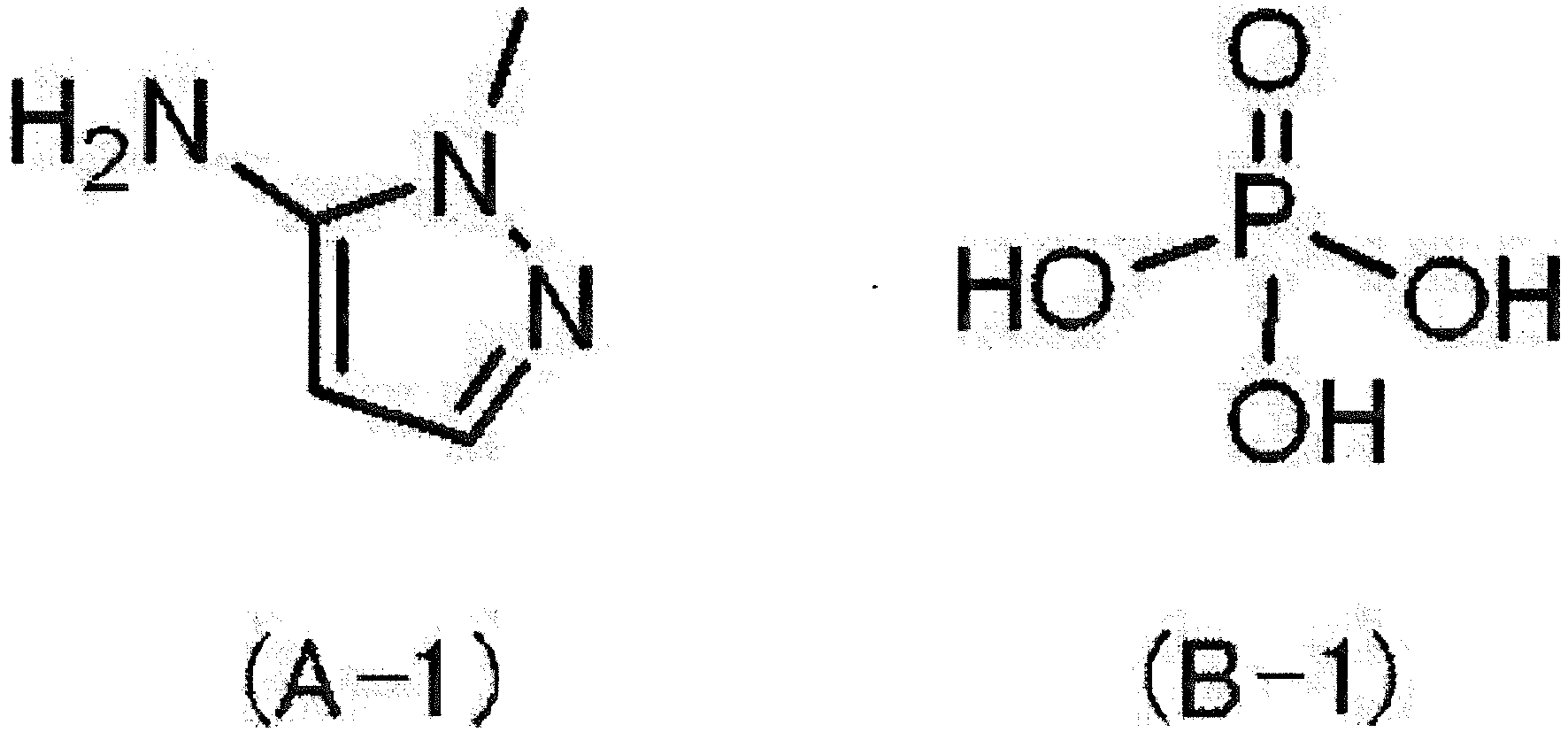
- the Example Compound (1) shown above is a compound including a cation derived from 5-aminopyrazole represented by the following Compound (A-1) and an anion derived from phosphoric acid represented by the following Compound (B-1).
- the molar ratio (cation:anion) between the cation derived from the organic amine compound represented by Formula (2) and the anion derived from the compound represented by Formula (5) is preferably 1:3 to 3:1, more preferably 1:2 to 2:1, and particularly preferably 1:1.
- Examples of the method for subjecting the organic amine compound represented by Formula (2) and the compound represented by Formula (5) to a neutralization reaction include a method of adding the compound represented by Formula (5) (for example, an acid) to an amine solution containing the organic amine compound; and a method of adding the organic amine compound to a solution (hereinafter, also referred to as acid solution) containing the compound represented by Formula (5) (for example, an acid).
- Adding the compound represented by Formula (5) is not limited to the case of adding the compound represented by Formula (5) (for example, an acid) alone, but the case of adding an acid solution containing the compound represented by Formula (5) (for example, an acid) is also included.
- adding the organic amine compound is not limited to the case of adding the organic amine compound alone, but the case of adding an amine solution containing the organic amine compound is also included.
- the solvent for the amine solution examples include methanol, ethanol, acetonitrile, and 2-propanol.
- the solvent for the amine solution one kind may be used, or two or more kinds thereof may be used.
- the solvent for the amine solution is preferably at least one selected from methanol, ethanol, and acetonitrile.
- the concentration of the organic amine compound in the amine solution is preferably 5 mass% to 50 mass%, and more preferably 5 mass% to 20 mass%, with respect to the total amount of the amine solution.
- the amine solution can be produced using, for example, a general synthesis method of synthesizing a compound having an aminopyrazole skeleton, such as a cyclization reaction between an acrylonitrile compound and a hydrazine compound (for example, the reaction described in paragraphs 0023 and 0024 of JP2006-515282A ).
- a general synthesis method of synthesizing a compound having an aminopyrazole skeleton such as a cyclization reaction between an acrylonitrile compound and a hydrazine compound (for example, the reaction described in paragraphs 0023 and 0024 of JP2006-515282A ).
- the solvent for the acid solution examples include water, methanol, and 2-propanol.
- the solvent for the acid solution one kind may be used, or two or more kinds thereof may be used.
- the solvent for the acid solution is preferably water or methanol.
- the concentration of the compound represented by Formula (5) (for example, an acid) in the acid solution is preferably 50 mass% to 100 mass%, more preferably 70 mass% to 95 mass%, and particularly preferably 80 mass% to 90 mass%, with respect to the total amount of the acid solution.
- the reaction temperature employed when the organic amine compound represented by Formula (2) and the compound represented by Formula (5) are subjected to a neutralization reaction is preferably 0°C to 35°C.
- a compound represented by Formula (1) is reacted with the diazonium salt produced by the diazotization reaction step, and thereby an azo compound represented by Formula (3) is produced.
- a diazotization reaction is performed using a salt of an organic amine compound (that is, organic amine salt) obtained via the organic amine salt production step
- a compound represented by Formula (1) is reacted with a diazonium salt produced from the organic amine salt, and thereby an azo compound represented by Formula (3) is produced.
- R 11 represents a halogen atom, an alkyl group, or an alkoxy group.
- n represents an integer from 0 to 4.
- R 3 and R 4 each independently represent a hydrogen atom, an alkyl group, an alkenyl group, an alkynyl group, an aromatic group, a heterocyclic group, a halogen atom, or a group represented by Formula (4); and R 5 represents a hydrogen atom, an alkyl group, an alkenyl group, an alkynyl group, an aromatic group, or a heterocyclic group.
- X represents an oxygen atom or a sulfur atom
- R 8 represents a hydrogen atom, an alkyl group, an alkenyl group, an alkynyl group, an aromatic group, or a heterocyclic group.
- the symbol * represents a position of bonding.
- the halogen atom for R 11 in Formula (1) and Formula (3) has the same meaning as the halogen atom for R 3 and R 4 in Formula (2).
- the alkyl group for R 11 in Formula (1) and Formula (3) has the same meaning as the alkyl group for R 5 in Formula (2), and a preferred range thereof is also the same.
- examples of the alkoxy group for R 11 in Formula (1) and Formula (3) include a methoxy group, an ethoxy group, a propoxy group, an isopropoxy group, a pentyloxy group, a phenoxy group, a cyclohexyloxy group, and an allyloxy group.
- n is preferably 0, 1, or 2; more preferably 0 or 1; and even more preferably 1.
- n ⁇ 1, and R 11 represents a halogen atom or an alkyl group substituted with a halogen atom
- the case in which n ⁇ 1, and R 11 represents a fluorine atom or a chlorine atom, is still more preferred
- the case in which n ⁇ 1, and R 11 represents a chlorine atom is particularly preferred.
- R 11 it is preferable that at least one of them is bonded to the ortho-position with respect to the hydroxyl group bonded to the benzene ring, and it is preferable that a halogen atom (particularly a chlorine atom) is bonded to the ortho-position with respect to the hydroxyl group bonded to the benzene ring.
- R 3 to R 5 in Formula (3) each independently have the same meanings as R 3 to R 5 in Formula (2), and preferred ranges thereof are also the same.
- R 11 represents a halogen atom or n is 0, R 1 and R 2 each represent a hydrogen atom, R 3 and R 4 each independently represent a hydrogen atom or an alkyl group, and R 5 represents an alkyl group, is preferred; and the case in which R 11 represents a halogen atom or n is 0, R 1 , R 2 , R 3 , and R 4 each represent a hydrogen atom, and R 5 represents an alkyl group, is more preferred.
- azo coloring agent represented by Formula (3) (Example Compounds (1) to (12)) are shown below.
- the azo coloring agent represented by Formula (3) is not limited to the following specific examples.
- the amount of use of the compound represented by Formula (1) is preferably 0.8 times or more, more preferably 1.1 times or more, and particularly preferably 1.2 times or more, the molar amount of use of the organic amine compound represented by Formula (2) or a salt thereof.
- the amount of use of the compound represented by Formula (1) is 0.8 times or more (particularly, 1.1 times or more) the molar amount of the organic amine compound, the yield of the azo coloring agent is further enhanced.
- the amount of use of the compound represented by Formula (1) can be adjusted to, for example, 3.0 times or less the molar amount, and the amount of use is preferably 2.5 times or less, and more preferably 2.0 times or less, the molar amount of the organic amine compound.
- the reaction temperature for the reaction between the compound represented by Formula (1) and the diazonium salt is preferably in the range of -5°C to 10°C, and more preferably in the range of -5°C to 5°C.
- reaction time for the reaction between the compound represented by Formula (1) and the diazonium salt is preferably in the range of 0.5 hours to 4.0 hours, more preferably in the range of 0.5 hours to 3.0 hours, and particularly preferably in the range of 1.0 hour to 3.0 hours.
- an azo compound is precipitated out by a known method such as a method of sequentially adding a mixed solvent of water and methanol, and an aqueous solution of sodium acetate, to the reaction liquid containing the azo compound produced by the reaction. Then, the azo compound can be preparatively separated from the reaction liquid.
- Example Compound (2) which is an azo compound [hereinafter, referred to as Compound (2)], was synthesized by the scheme illustrated below.
- the yield is a yield based on the amount of the raw material compound (1-a).
- the structure of the organic amine salt (1) was checked by NMR and ion chromatography.
- the organic amine salt (1) was a compound in which the molar ratio (trivalent cation:trivalent anion) between the trivalent cation derived from the organic amine compound (A-1) and the trivalent anion derived from phosphoric acid was 1:1.
- a mixed liquid obtained by mixing 180 g of acetic acid and 20 g of concentrated sulfuric acid 140 g of nitrosylsulfuric acid was added in divided portions at a temperature of the mixed liquid of 25°C.
- the reaction mixed liquid thus obtained was cooled to a temperature of 10°C or lower, and 80 g of the organic amine salt (1) was added thereto in divided portions while the temperature of the reaction mixed liquid was maintained at a temperature of 25°C or lower.
- this reaction mixed liquid was stirred for 30 minutes at a temperature of 25°C or lower so as to obtain a diazonium salt, and then 4 g of urea was added thereto. The mixture was further stirred for 30 minutes, and thereby excess nitrosylsulfuric acid was deactivated.
- a mixed liquid obtained by mixing 79 g of 2-chlorophenol and 340 mL of methanol was cooled to a temperature of 0°C or lower, and the mixture containing the diazonium salt was added dropwise to the mixed liquid, while the temperature of the mixed liquid was maintained at a temperature of 10°C or lower, to thereby induce a reaction.
- the reaction mixture thus obtained was stirred for 30 minutes at a temperature of 10°C or lower, and then, to this reaction mixture, 400 mL of water and an aqueous solution of sodium acetate (aqueous solution obtained by dissolving 220 g of sodium acetate in 550 mL of water) were slowly added in this order.
- reaction mixture was heated to a temperature of 60°C or higher, and was stirred for one hour or longer. Subsequently, the reaction mixture was cooled to a temperature of 30°C or lower. Crystals precipitated as a result of the cooling were collected by filtration and washed with water, and thereby crude crystals of Compound (2) were obtained.
- An organic amine salt (1) was synthesized in the same manner as in Example 1. Next, an azo coloring agent was synthesized as described below.
- a mixed liquid obtained by mixing 30 g of acetic acid and 400 g of concentrated sulfuric acid 70 g of sodium nitrite was added thereto in divided portions at a temperature of the mixed liquid of 15°C or lower, and the mixture was allowed to react.
- the reaction mixture thus obtained was stirred for 2 hours at 70°C, and then was cooled to a temperature of 10°C or lower. While the reaction mixture was maintained at a temperature of 10°C or lower, a mixed solution obtained by mixing 195 g of the organic amine salt (1), 50 g of phosphoric acid, 50 g of propionic acid, and 50 g of acetic acid was added dropwise to the reaction mixture.
- reaction mixture was stirred for 30 minutes at a temperature of 15°C or lower. While the reaction mixture was stirred, generation of NO x and effervescence of the reaction mixture occurred noticeably. Next, 9 g of urea was added to the stirred reaction mixture, and the mixture was further stirred for 30 minutes. In this manner, a mixture containing a diazonium salt of the organic amine salt (1) was prepared.
- a mixed liquid obtained by mixing 154 g of 2-chlorophenol and 300 mL of methanol was cooled to a temperature of 0°C or lower, and the mixture containing the diazonium salt was added in divided portions to the mixed liquid, while the temperature of the mixed liquid was maintained at a temperature of 10°C or lower, so as to induce a reaction.
- the reaction mixture thus obtained was stirred for 2 hours at a temperature of 10°C or lower, and then, to this reaction mixture, 1,000 mL of water, 1,000 mL of methanol, 2,000 mL of water, and an aqueous solution of sodium acetate (aqueous solution obtained by dissolving 500 g of sodium acetate in 2,000 mL of water) were added slowly in this order.
- reaction mixture was stirred for one hour or longer at 25°C, and then was cooled to a temperature of 30°C or lower. Crystals precipitated by the cooling were collected by filtration and washed with water, and thereby, crude crystals of Compound (2) were obtained.
- JP2014-221674 is incorporated herein in its entirety by reference.
Landscapes
- Chemical & Material Sciences (AREA)
- Organic Chemistry (AREA)
- Plural Heterocyclic Compounds (AREA)
- Organic Low-Molecular-Weight Compounds And Preparation Thereof (AREA)
Abstract
Description
- The present disclosure relates to a method for producing an azo compound.
- In the field of coloring agents, azo dyes and the like having a diazo structure are widely known (see, for example,
JP4080947B - It is desirable that dyes and the like as coloring agents have sharp light absorption characteristics, have high color purity, and have excellent color reproducibility. In regard to such coloring agents, there is also a demand for a technology capable of producing coloring agents for practical purposes with high yield.
- For the production of an azo coloring agent, nitrous acid or nitrous acid salts such as sodium nitrite are generally used as diazotizing agents, and a method of using nitrosylsulfuric acid is also known (see, for example,
JP2001-335714A JP2012-001627 JP2009-73978A - In regard to the production of an azo coloring agent that is produced by reacting a phenol compound with a diazonium compound of 1-substituted-5-aminopyrazole, it has been conventionally considered as a common practice to use nitrous acid or a nitrous acid salt as a diazotizing agent, as disclosed in
JP4080947B JP2001-335714A JP2012-001627A JP2009-73978A - The present disclosure was achieved in view of the circumstances described above, and it is an object of the disclosure to provide a method for producing an azo compound, by which an azo compound having satisfactory color purity is produced with high yield.
- Specific means for achieving the problems described above include the following embodiments.
- <1> A method for producing an azo compound, the method comprising: subjecting an organic amine compound represented by the following Formula (2) or a salt thereof to a diazotization reaction in the presence of nitrosylsulfuric acid, and thereby producing a diazonium salt (diazotization reaction step); and reacting a compound represented by the following Formula (1) with the diazonium salt, and thereby producing an azo compound represented by the following Formula (3) (azo compound production step).

In Formulae (1) to (3), R11 represents a halogen atom, an alkyl group, or an alkoxy group; R1 and R2 each represent a hydrogen atom; R3 and R4 each independently represent a hydrogen atom, an alkyl group, an alkenyl group, an alkynyl group, an aromatic group, a heterocyclic group, a halogen atom, or a group represented by the following Formula (4); and R5 represents a hydrogen atom, an alkyl group, an alkenyl group, an alkynyl group, an aromatic group, or a heterocyclic group.
n represents an integer from 0 to 4.
In the following Formula (4), X represents an oxygen atom or a sulfur atom; and R8 represents a hydrogen atom, an alkyl group, an alkenyl group, an alkynyl group, an aromatic group, or a heterocyclic group. The symbol * represents a position of bonding.
*-X-R8 (4)
- <2> The method for producing an azo compound according to <1>, the method further comprising: subjecting the organic amine compound represented by Formula (2) and a compound represented by the following Formula (5) to a neutralization reaction, and thereby producing an organic amine salt (organic amine salt production step), wherein, in the diazotization reaction step, an organic amine salt is subjected to a diazotization reaction to thereby produce a diazonium salt; and in the azo coloring agent production step, the compound represented by Formula (1) is reacted with the diazonium salt produced from the organic amine salt.
In Formula (5), R6 and R7 each independently represent a hydrogen atom, an alkyl group, an aromatic group, a heterocyclic group, or a hydroxyl group.
- <3> The method for producing an azo compound according to <2>, wherein in the organic amine salt production step, a compound represented by Formula (5) is added to an amine solution containing an organic amine compound represented by Formula (2), and thereby the organic amine compound represented by Formula (2) and the compound represented by Formula (5) are subjected to a neutralization reaction.
- <4> The method for producing an azo compound according to <2> or <3>, wherein the compound represented by Formula (5) is phosphoric acid.
- <5> The method for producing an azo compound according to any one of <1> to <4>, wherein R11 represents a halogen atom or n is 0; R1 and R2 each represent a hydrogen atom; R3 and R4 each independently represent a hydrogen atom or an alkyl group; and R5 represents an alkyl group.
- <6> The method for producing an azo compound according to any one of <1> to <5>, wherein R11 represents a halogen atom or n is 0; R1, R2, R3, and R4 each represent a hydrogen atom; and R5 represents an alkyl group.
- According to the present disclosure, there is provided a method for producing an azo compound, by which an azo compound having satisfactory color purity is produced with high yield.
- Hereinafter, embodiments of the method for producing an azo compound of the invention will be described in detail.
- The method for producing an azo compound according to an embodiment of the invention includes at least the following diazotization reaction step (A) and azo compound production step (B):
- (A) subjecting an organic amine compound represented by Formula (2) or a salt thereof to a diazotization reaction in the presence of nitrosylsulfuric acid, and thereby producing a diazonium salt; and
- (B) reacting a compound represented by Formula (1) with the diazonium salt, and thereby producing an azo compound represented by Formula (3).
- Furthermore, the method for producing an azo compound according to an embodiment of the invention can be configured to further include other steps such as a step of producing a salt (organic amine salt) of the organic amine compound represented by Formula (2) (organic amine salt production step), in addition to the diazotization reaction step (A) and azo compound production step (B).

- Conventionally, methods of subjecting an organic amine to the action of nitrous acid, a nitrous acid salt, or a nitrous acid ester (hereinafter, referred to as nitrous acid salt or the like) have been widely utilized for the production of diazonium salts, and the production step for an azo compound that is carried out as a next step has been conducted such that an azo compound is produced by reacting a diazonium salt obtained by using a nitrous acid salt or the like as a diazotizing agent, with a hydroxyl group-containing aromatic compound. However, in a case in which conversion to diazonium is achieved by using a nitrous acid salt or the like as a diazotizing agent, NOx is generated and brings about a noticeable effervescence phenomenon, and the product may be colored in brown. Furthermore, in a case in which an azo compound is subsequently produced using a diazonium salt obtained from a nitrous acid salt or the like, fluidity of the reaction system is markedly reduced, consequently the yield is decreased, and the color purity of the azo compound thus produced is also markedly deteriorated.
- In view of the circumstances as described above, according to the present disclosure, when a diazonium production reaction is performed using nitrosylsulfuric acid as a diazotizing agent, and a diazonium salt obtained using nitrosylsulfuric acid is reacted with a particular hydroxyl group-containing aromatic compound, an azo compound represented by Formula (3) is produced.
- It is speculated that an effervescence phenomenon that occurs along with generation of NOx is prevented at the time of the diazonium production reaction, and in the production step for an azo compound that is conducted as a next step, fluidity of the reaction system is maintained at a satisfactory level, so that an azo compound having excellent color purity can be produced with high yield. However, the embodiment of the invention is not intended to be limited by this speculation.
- In the diazotization reaction step according to an embodiment of the invention, an organic amine compound represented by Formula (2) or a salt thereof is subjected to a diazotization reaction in the presence of nitrosylsulfuric acid, and thus a diazonium salt is produced.
- According to an embodiment of the invention, as a method of producing a diazonium salt from an organic amine compound or a salt thereof, an organic amine compound or a salt thereof is subjected to the action of nitrosylsulfuric acid as a diazotizing agent. As described above, when a diazonium salt obtained using nitrosylsulfuric acid as a diazotizing agent is used, an azo coloring agent having excellent color purity can be produced with high yield.
- Here, the organic amine compound represented by Formula (2) or a salt thereof will be explained. The organic amine compound represented by Formula (2) is a compound having an aminopyrazole skeleton, and tautomers are also included therein.

*-X-R8 (4)
- In Formula (2), R1 and R2 each represent a hydrogen atom; and R3 and R4 each independently represent a hydrogen atom, an alkyl group, an alkenyl group, an alkynyl group, an aromatic group, a heterocyclic group, a halogen atom, or a group represented by Formula (4). R5 represents a hydrogen atom, an alkyl group, an alkenyl group, an alkynyl group, an aromatic group, or a heterocyclic group.
- Furthermore, in Formula (4), X represents an oxygen atom or a sulfur atom; and R8 represents a hydrogen atom, an alkyl group, an alkenyl group, an alkynyl group, an aromatic group, or a heterocyclic group. The symbol * represents a position of bonding.
- The alkyl group for R5 may be any one of a linear alkyl group, a branched alkyl group, and a cyclic alkyl group (cycloalkyl group).
- Examples of the alkyl group for R5 include a methyl group, an ethyl group, a propyl group, an isopropyl group, a butyl group, an isobutyl group, a t-butyl group, a hexyl group, a 2-ethylhexyl group, a dodecyl group, a cyclopropyl group, a cyclopentyl group, a cyclohexyl group, and a 1-adamantyl group. Among them, the alkyl group for R5 is preferably an alkyl group having 1 to 12 carbon atoms, more preferably an alkyl group having 1 to 6 carbon atoms, even more preferably an alkyl group having 1 to 3 carbon atoms, and particularly preferably a methyl group.
- The alkenyl group for R5 may be any one of a linear alkenyl group, a branched alkenyl group, and a cyclic alkenyl group.
- Examples of the alkenyl group for R5 include a vinyl group, an allyl group, a 3-butenyl group, a 2-methyl-2-butenyl group, a 4-pentenyl group, a 3-pentenyl group, a 3-methyl-3-pentenyl group, a 5-hexenyl group, a 4-hexenyl group, a 3-hexenyl group, a 2-hexenyl group, a cyclopentenyl group, and a cyclohexenyl group. The alkenyl group for R5 is preferably an alkenyl group having 2 to 12 carbon atoms, more preferably an alkenyl group having 2 to 6 carbon atoms, even more preferably an alkenyl group having 2 or 3 carbon atoms, and particularly preferably a vinyl group.
- The alkynyl group for R5 may be any one of a linear alkynyl group, a branched alkynyl group, and a cyclic alkynyl group.
- Examples of the alkynyl group for R5 include an ethynyl group, a 1-propynyl group, a 2-propynyl group, a 1-butynyl group, a 2-butynyl group, a 3-butynyl group, a 2-methyl-2-propynyl group, and a 3-methyl-1-butynyl group. The alkynyl group for R5 is preferably an alkynyl group having 2 to 12 carbon atoms, more preferably an alkynyl group having 2 to 6 carbon atoms, even more preferably an alkynyl group having 2 or 3 carbon atoms, and particularly preferably an ethynyl group.
- Examples of the aromatic group for R5 include a phenyl group, a naphthyl group, and a biphenyl group. The aromatic group for R5 is preferably an aromatic group having 6 to 12 carbon atoms, and particularly preferably a phenyl group.
- The heterocyclic group for R5 may be a cyclic group containing at least one heteroatom selected from the group consisting of an oxygen atom, a sulfur atom, and a nitrogen atom, and more specific examples thereof include a furyl group, a thienyl group, a pyrrolyl group, a pyrazolyl group, a thiazolyl group, an oxazolyl group, an imidazolyl group, a pyridyl group, a pyrazyl group, a pyrimidinyl group, a pyridazinyl group, a pyrrolidinyl group, an imidazolidinyl group, a pyrazolidinyl group, a piperidinyl group, a benzoxazolyl group, a benzothiazolyl group, and a benzotriazolyl group. Among them, the heterocyclic group for R5 is preferably a heterocyclic group having 3 to 12 carbon atoms, and more preferably a heterocyclic group having 3 to 6 carbon atoms.
- The alkyl group, alkenyl group, alkynyl group, aromatic group, and heterocyclic group for R5 may be respectively substituted with a substituent other than an amino group (for example, a halogen atom; and preferably, a fluorine atom or a chlorine atom).
- The alkyl group for R3 and R4 has the same meaning as the alkyl group for R5, and a preferred range thereof is also the same.
- The alkenyl group for R3 and R4 has the same meaning as the alkenyl group for R5, and a preferred range thereof is also the same.
- The alkynyl group for R3 and R4 has the same meaning as the alkynyl group for R5, and a preferred range thereof is also the same.
- The aromatic group for R3 and R4 has the same meaning as the aromatic group for R5, and a preferred range thereof is also the same.
- The heterocyclic group for R3 and R4 has the same meaning as the heterocyclic group for R5, and a preferred range thereof is also the same.
- Examples of the halogen atom for R3 and R4 include a fluorine atom, a chlorine atom, a bromine atom, and an iodine atom. The halogen atom for R3 and R4 is preferably a fluorine atom, a chlorine atom, or a bromine atom, and a fluorine atom or a chlorine atom is more preferred.
- The alkyl group for R8 has the same meaning as the alkyl group for R5, and a preferred range thereof is also the same.
- The alkenyl group for R8 has the same meaning as the alkenyl group for R5, and a preferred range thereof is also the same.
- The alkynyl group for R8 has the same meaning as the alkynyl group for R5, and a preferred range thereof is also the same.
- The aromatic group for R8 has the same meaning as the aromatic group for R5, and a preferred range thereof is also the same.
- The heterocyclic group for R8 has the same meaning as the heterocyclic group for R5, and a preferred range thereof is also the same.
- In regard to Formula (2), it is more preferable that R5 represents a hydrogen atom or an alkyl group (preferably, an alkyl group having 1 to 12 carbon atoms, more preferably an alkyl group having 1 to 6 carbon atoms, and even more preferably an alkyl group having 1 to 3 carbon atoms), and it is even more preferable that R5 represents an alkyl group. Particularly preferably, in Formula (2), R5 is an alkyl group having 1 to 3 carbon atoms (most preferably, a methyl group).
- In regard to Formula (2), it is more preferable that R3 and R4 each independently represent a hydrogen atom or an alkyl group (preferably an alkyl group having 1 to 12 carbon atoms, more preferably an alkyl group having 1 to 6 carbon atoms, and even more preferably an alkyl group having 1 to 3 carbon atoms). Particularly preferably, R3 and R4 both represent a hydrogen atom.
- Moreover, in regard to Formula (2), it is preferable that R1, R2, R3, and R4 each represent a hydrogen atom, and R5 represents an alkyl group.
- Specific examples of the organic amine compound represented by Formula (2) (Example Compounds (A-1) to (A-6)) are shown below. However, the organic amine compound represented by Formula (2) is not intended to be limited to the following specific examples.


- In regard to the diazotization reaction step, the amount of use of nitrosylsulfuric acid is preferably 1.5 times or more, more preferably 2.0 times or more, and more preferably 2.5 times or more, the molar amount of use of the organic amine compound represented by Formula (2) or a salt thereof.
- When nitrosylsulfuric acid is used as a diazotizing agent, the amount of the solvent for the reaction system in which the azo compound is subsequently produced via a coupling reaction, can be reduced to a large extent, while maintaining fluidity of the reaction medium, compared to the conventional methods for performing diazotization using a nitrous acid salt or the like. Specifically, the amount of the solvent to be used in the azo compound production step that will be described below can be reduced by about 1/3 to 1/5 of the conventional amount.
- The diazotization reaction can be carried out in a reaction medium containing an acid such as sulfuric acid, acetic acid, or hydrochloric acid (acid-containing reaction medium).
- The reaction temperature employed in the case of performing the diazotization reaction is preferably in the range of -5°C to 30°C, and more preferably in the range of -5°C to 10°C.
- Furthermore, the reaction time for the diazotization reaction is suitably in the range of 0.25 hours to 2.0 hours, and more suitably in the range of 0.5 hours to 2.0 hours.
- In the diazotization reaction step according to an embodiment of the invention, a salt of an organic amine compound represented by Formula (2) may also be used for the diazotization reaction. The salt of the organic amine compound according to an embodiment of the invention is preferably an organic amine salt that is produced by subjecting the organic amine compound represented by Formula (2) and a compound represented by the following Formula (5) to a neutralization reaction. In this case, in the diazotization reaction step, an organic amine salt is subjected to a diazotization reaction, and thus a diazonium salt is produced.
- According to an embodiment of the invention, an organic amine salt production step of producing an organic amine salt by subjecting an organic amine compound represented by Formula (2) and a compound represented by Formula (5) to a neutralization reaction may be further provided before the diazotization reaction step. When the organic amine salt production step is provided, an organic amine salt can be easily extracted as crystals, without requiring complicated operations such as concentration and purification.

- For an organic amine compound having an aminopyrazole skeleton, it is necessary to perform complicated operations such as concentration and purification (column chromatography or the like) when this organic amine compound is produced from a reaction liquid after synthesis, and productivity is likely to be deteriorated. On the contrary, an organic amine salt obtained by subjecting an organic amine compound to a neutralization reaction can be easily produced by precipitation as crystals, despite being a compound (salt) having an aminopyrazole skeleton, without requiring complicated operations (concentration, purification and the like) for the reaction liquid after synthesis. Therefore, an organic amine salt is advantageous from the viewpoint that productivity can be further enhanced.
- In regard to Formula (5), R6 and R7 each independently represent a hydrogen atom, an alkyl group, an aromatic group, a heterocyclic group, or a hydroxyl group.
- The alkyl group for R6 and R7 has the same meaning as the alkyl group for R5 in Formula (2), and a preferred range thereof is also the same.
- The aromatic group for R6 and R7 has the same meaning as the aromatic group for R5 in Formula (2), and a preferred range thereof is also the same.
- The heterocyclic group for R6 and R7 has the same meaning as the heterocyclic group for R5 in Formula (2), and a preferred range thereof is also the same.
- It is preferable from the viewpoint of producing an organic amine salt with higher efficiency that R6 and R7 in Formula (5) each independently represent a hydrogen atom, an alkyl group (preferably an alkyl group having 1 to 12 carbon atoms, more preferably an alkyl group having 1 to 6 carbon atoms, and even more preferably an alkyl group having 1 to 3 carbon atoms), or a hydroxyl group; and a hydrogen atom or a hydroxyl group is more preferred. Particularly preferably, from the viewpoint of producing an organic amine salt with higher efficiency, R6 and R7 both represent a hydroxyl group. That is, a case in which the compound represented by Formula (5) is phosphoric acid (H3PO4) is preferred.
- Specific examples of the compound represented by Formula (5) (Example Compounds (B-1) and (B-2)) are shown below. However, the compound represented by Formula (5) is not intended to be limited to the following specific examples.

- It is speculated that the organic amine salt can be easily precipitated out as crystals because the organic amine salt is a salt produced by an organic amine compound having a particular structure (organic amine compound represented by Formula (2)) and an acid compound having a particular structure (compound represented by Formula (5)). That is, regarding a salt produced by an organic amine compound having a particular structure and an acid other than the acid compound having a particular structure, it is considered difficult to precipitate out the salt as crystals from the reaction liquid after synthesis. Furthermore, the fact that the skeletal structure of the organic amine compound is an aminopyrazole skeleton having only one amino group is also considered as a reason why the organic amine salt can be easily precipitated as crystals. That is, it is speculated to be because, since the skeletal structure of the organic amine compound has only one amino group, a salt (organic amine salt) is easily formed, and the salt thus formed is easily precipitated out as crystals.
- Thereby, according to an embodiment of the invention, an azo coloring agent can be produced with a higher yield compared to the case in which a simple substance of the organic amine compound is used as a starting material or a synthesis intermediate.
- The structure of the organic amine salt is a structure of a salt including a cation (ammonium ion) obtained when at least one hydrogen atom is added to the organic amine compound represented by Formula (2), and an anion obtained when at least one hydrogen atom is removed from the compound represented by Formula (5).
- Here, the position at which a hydrogen atom is added to the organic amine compound represented by Formula (2) is at least one position selected from among the at least three nitrogen atoms (N) existing in Formula (2). The hydrogen atom that is removed from the compound represented by Formula (5) is at least one hydrogen atom that is included in the at least one hydroxyl group existing in Formula (5).
- According to the present specification, an organic amine salt may be described such that the organic amine compound represented by Formula (2) and the compound represented by Formula (5) are arranged side by side, with the symbol "·" disposed therebetween. For example, phosphate as one of specific examples of the organic amine salt is described as in the case of the following Example Compound (1).

- Specific examples of the organic amine salt include salts obtained by arbitrarily combining the above-described specific examples of the amine compound (Example Compounds (A-1) to (A-6)) and the compound represented by Formula (5) (Example Compounds (B-1) and (B-2)).
- The Example Compound (1) shown above is a compound including a cation derived from 5-aminopyrazole represented by the following Compound (A-1) and an anion derived from phosphoric acid represented by the following Compound (B-1).
- In regard to the organic amine salt, the molar ratio (cation:anion) between the cation derived from the organic amine compound represented by Formula (2) and the anion derived from the compound represented by Formula (5) is preferably 1:3 to 3:1, more preferably 1:2 to 2:1, and particularly preferably 1:1.
- Examples of the method for subjecting the organic amine compound represented by Formula (2) and the compound represented by Formula (5) to a neutralization reaction, include a method of adding the compound represented by Formula (5) (for example, an acid) to an amine solution containing the organic amine compound; and a method of adding the organic amine compound to a solution (hereinafter, also referred to as acid solution) containing the compound represented by Formula (5) (for example, an acid).
- Adding the compound represented by Formula (5) is not limited to the case of adding the compound represented by Formula (5) (for example, an acid) alone, but the case of adding an acid solution containing the compound represented by Formula (5) (for example, an acid) is also included. Similarly, adding the organic amine compound is not limited to the case of adding the organic amine compound alone, but the case of adding an amine solution containing the organic amine compound is also included.
- Above all, from the viewpoint of producing the organic amine salt with high efficiency, a method of adding the compound represented by Formula (5) (for example, an acid) to an amine solution containing the organic amine compound is preferred.
- Examples of the solvent for the amine solution include methanol, ethanol, acetonitrile, and 2-propanol. Regarding the solvent for the amine solution, one kind may be used, or two or more kinds thereof may be used. Among them, the solvent for the amine solution is preferably at least one selected from methanol, ethanol, and acetonitrile.
- The concentration of the organic amine compound in the amine solution is preferably 5 mass% to 50 mass%, and more preferably 5 mass% to 20 mass%, with respect to the total amount of the amine solution.
- The amine solution can be produced using, for example, a general synthesis method of synthesizing a compound having an aminopyrazole skeleton, such as a cyclization reaction between an acrylonitrile compound and a hydrazine compound (for example, the reaction described in paragraphs 0023 and 0024 of
JP2006-515282A - Examples of the solvent for the acid solution include water, methanol, and 2-propanol. Regarding the solvent for the acid solution, one kind may be used, or two or more kinds thereof may be used. Among them, the solvent for the acid solution is preferably water or methanol.
- The concentration of the compound represented by Formula (5) (for example, an acid) in the acid solution is preferably 50 mass% to 100 mass%, more preferably 70 mass% to 95 mass%, and particularly preferably 80 mass% to 90 mass%, with respect to the total amount of the acid solution.
- The reaction temperature employed when the organic amine compound represented by Formula (2) and the compound represented by Formula (5) are subjected to a neutralization reaction, is preferably 0°C to 35°C.
- In the azo compound production step according to an embodiment of the invention, a compound represented by Formula (1) is reacted with the diazonium salt produced by the diazotization reaction step, and thereby an azo compound represented by Formula (3) is produced. As described above, in a case in which a diazotization reaction is performed using a salt of an organic amine compound (that is, organic amine salt) obtained via the organic amine salt production step, a compound represented by Formula (1) is reacted with a diazonium salt produced from the organic amine salt, and thereby an azo compound represented by Formula (3) is produced.

- In regard to Formula (1) and Formula (3), R11 represents a halogen atom, an alkyl group, or an alkoxy group. n represents an integer from 0 to 4.
- In regard to Formula (3), R3 and R4 each independently represent a hydrogen atom, an alkyl group, an alkenyl group, an alkynyl group, an aromatic group, a heterocyclic group, a halogen atom, or a group represented by Formula (4); and R5 represents a hydrogen atom, an alkyl group, an alkenyl group, an alkynyl group, an aromatic group, or a heterocyclic group.
- Furthermore, in regard to Formula (4), X represents an oxygen atom or a sulfur atom; and R8 represents a hydrogen atom, an alkyl group, an alkenyl group, an alkynyl group, an aromatic group, or a heterocyclic group. The symbol * represents a position of bonding.
- The halogen atom for R11 in Formula (1) and Formula (3) has the same meaning as the halogen atom for R3 and R4 in Formula (2). The alkyl group for R11 in Formula (1) and Formula (3) has the same meaning as the alkyl group for R5 in Formula (2), and a preferred range thereof is also the same. Furthermore, examples of the alkoxy group for R11 in Formula (1) and Formula (3) include a methoxy group, an ethoxy group, a propoxy group, an isopropoxy group, a pentyloxy group, a phenoxy group, a cyclohexyloxy group, and an allyloxy group.
- In regard to Formula (1) and Formula (3), n is preferably 0, 1, or 2; more preferably 0 or 1; and even more preferably 1.
- In regard to Formula (1) and Formula (3), the case in which n = 0 (that is, in a case in which the compound represented by Formula (1) is phenol), and the case in which n ≥ 1, and R11 represents a halogen atom or an alkyl group substituted with a halogen atom, are preferred; the case in which n ≥ 1, and R11 represents a halogen atom or an alkyl group substituted with a halogen atom, is more preferred; the case in which n ≥ 1, and R11 represents a fluorine atom, a chlorine atom, a bromine atom, or a trifluoromethyl group, is even more preferred; the case in which n ≥ 1, and R11 represents a fluorine atom or a chlorine atom, is still more preferred; and the case in which n ≥ 1, and R11 represents a chlorine atom, is particularly preferred.
- Regarding R11, it is preferable that at least one of them is bonded to the ortho-position with respect to the hydroxyl group bonded to the benzene ring, and it is preferable that a halogen atom (particularly a chlorine atom) is bonded to the ortho-position with respect to the hydroxyl group bonded to the benzene ring.
- Specific examples of the compound represented by Formula (1) are shown below. However, according to an embodiment of the invention, the compound represented by Formula (1) is not limited to the following specific examples.


- R3 to R5 in Formula (3) each independently have the same meanings as R3 to R5 in Formula (2), and preferred ranges thereof are also the same.
- According to an embodiment of the invention, the case in which R11 represents a halogen atom or n is 0, R1 and R2 each represent a hydrogen atom, R3 and R4 each independently represent a hydrogen atom or an alkyl group, and R5 represents an alkyl group, is preferred; and the case in which R11 represents a halogen atom or n is 0, R1, R2, R3, and R4 each represent a hydrogen atom, and R5 represents an alkyl group, is more preferred.
- Specific examples of the azo coloring agent represented by Formula (3) (Example Compounds (1) to (12)) are shown below. However, according to an embodiment of the invention, the azo coloring agent represented by Formula (3) is not limited to the following specific examples.


- In regard to the azo compound production step, the amount of use of the compound represented by Formula (1) is preferably 0.8 times or more, more preferably 1.1 times or more, and particularly preferably 1.2 times or more, the molar amount of use of the organic amine compound represented by Formula (2) or a salt thereof. When the amount of use of the compound represented by Formula (1) is 0.8 times or more (particularly, 1.1 times or more) the molar amount of the organic amine compound, the yield of the azo coloring agent is further enhanced. The amount of use of the compound represented by Formula (1) can be adjusted to, for example, 3.0 times or less the molar amount, and the amount of use is preferably 2.5 times or less, and more preferably 2.0 times or less, the molar amount of the organic amine compound.
- The reaction temperature for the reaction between the compound represented by Formula (1) and the diazonium salt is preferably in the range of -5°C to 10°C, and more preferably in the range of -5°C to 5°C.
- Furthermore, the reaction time for the reaction between the compound represented by Formula (1) and the diazonium salt is preferably in the range of 0.5 hours to 4.0 hours, more preferably in the range of 0.5 hours to 3.0 hours, and particularly preferably in the range of 1.0 hour to 3.0 hours.
- After the compound represented by Formula (1) and the diazonium salt are reacted, an azo compound is precipitated out by a known method such as a method of sequentially adding a mixed solvent of water and methanol, and an aqueous solution of sodium acetate, to the reaction liquid containing the azo compound produced by the reaction. Then, the azo compound can be preparatively separated from the reaction liquid.
- Hereinafter, embodiments of the invention will be more specifically described by way of Examples. However, the embodiments of the invention are not intended to be limited to the following Examples as long as the gist is maintained. Unless particularly stated otherwise, the "parts" is on a mass basis.
- Example Compound (2), which is an azo compound [hereinafter, referred to as Compound (2)], was synthesized by the scheme illustrated below.

- First, an organic amine salt (1) was synthesized as illustrated in the following scheme.

- 50 g (1.0 mol) of Compound (1-a) was dissolved in 40 mL of ethanol, and the solution thus obtained was cooled to 0°C. While the cooled solution was stirred, 53 g (1.0 mol) of Compound (1-b) was added dropwise to the solution, and then the resulting mixture was stirred for one hour. After completion of stirring, the solution thus obtained was left to cool naturally, and then 250 mL of ethanol and 2.5 g of sodium hydrogen carbonate were added to the solution. 31 g (1.0 mol) of Compound (1-c) was further added thereto. The solution thus obtained was heated to an internal temperature of 45°C, and the solution was stirred for 30 minutes. The solution obtained after stirring for 30 minutes was cooled to 0°C. Next, 3 g of sodium ethoxide (NaOEt) was added to the cooled solution. The solution thus obtained was heated to an internal temperature of 85°C, and was stirred for 3 hours. Subsequently, the solution was left to cool naturally.
- In this manner, a solution containing an organic amine compound (A-1) (organic amine compound (A-1)-containing solution) was obtained.
- 700 mL of methanol was added to the organic amine compound (A-1)-containing solution. While the solution thus obtained was stirred at an internal temperature of 5°C, 120 g of a 85 mass% aqueous solution of phosphoric acid (H3PO4) (1.0 mol as the amount of H3PO4) was added dropwise to the solution. As a result of the dropwise addition, crystals were precipitated out. The crystals thus precipitated were collected by filtration, and 111 g of crystals of the organic amine salt (1) (pale yellow or white crystals) were obtained (yield 57%).
- The yield is a yield based on the amount of the raw material compound (1-a).
- The structure of the organic amine salt (1) was checked by NMR and ion chromatography.
- As a result, it was confirmed that the organic amine salt (1) was a compound in which the molar ratio (trivalent cation:trivalent anion) between the trivalent cation derived from the organic amine compound (A-1) and the trivalent anion derived from phosphoric acid was 1:1.
- To a mixed liquid obtained by mixing 180 g of acetic acid and 20 g of concentrated sulfuric acid, 140 g of nitrosylsulfuric acid was added in divided portions at a temperature of the mixed liquid of 25°C. The reaction mixed liquid thus obtained was cooled to a temperature of 10°C or lower, and 80 g of the organic amine salt (1) was added thereto in divided portions while the temperature of the reaction mixed liquid was maintained at a temperature of 25°C or lower. After the addition, this reaction mixed liquid was stirred for 30 minutes at a temperature of 25°C or lower so as to obtain a diazonium salt, and then 4 g of urea was added thereto. The mixture was further stirred for 30 minutes, and thereby excess nitrosylsulfuric acid was deactivated.
- In this manner, a mixture containing a diazonium salt of the organic amine salt (1) was prepared.
- In the process described above, generation of NOx and effervescence of the reaction mixture were not observed.
- Next, a mixed liquid obtained by mixing 79 g of 2-chlorophenol and 340 mL of methanol was cooled to a temperature of 0°C or lower, and the mixture containing the diazonium salt was added dropwise to the mixed liquid, while the temperature of the mixed liquid was maintained at a temperature of 10°C or lower, to thereby induce a reaction. The reaction mixture thus obtained was stirred for 30 minutes at a temperature of 10°C or lower, and then, to this reaction mixture, 400 mL of water and an aqueous solution of sodium acetate (aqueous solution obtained by dissolving 220 g of sodium acetate in 550 mL of water) were slowly added in this order. Subsequently, the reaction mixture was heated to a temperature of 60°C or higher, and was stirred for one hour or longer. Subsequently, the reaction mixture was cooled to a temperature of 30°C or lower. Crystals precipitated as a result of the cooling were collected by filtration and washed with water, and thereby crude crystals of Compound (2) were obtained.
- In the process described above, since fluidity of the reaction medium was maintained at a satisfactory level, a coloring agent could be produced even though the amount of solvent was suppressed to a low level. Also, the color purity of the crude crystals was also excellent.
- The purity (HPLC, area%) of the crude crystals of Compound (2) herein was 99.3%.
- Subsequently, the crude crystals thus obtained were added to a mixed solvent including 900 mL of methanol, 50 g of triethylamine, and 300 mL of water, and the mixture was stirred at a temperature of 50°C or higher. To the solution thus obtained by stirring, a mixed liquid of 22 g of concentrated sulfuric acid and 90 mL of water was added dropwise thereto, and the mixture was cooled to a temperature of 25°C or lower. Crystals precipitated by the cooling were collected by filtration, and were washed using water and methanol in this order, followed by drying. Thus, 86.4 g of Compound (2) was obtained (yield 87.0%).
- The purity (HPLC, area%) of the Compound (2) finally obtained was 99.9%.
- An organic amine salt (1) was synthesized in the same manner as in Example 1. Next, an azo coloring agent was synthesized as described below.
- To a mixed liquid obtained by mixing 30 g of acetic acid and 400 g of concentrated sulfuric acid, 70 g of sodium nitrite was added thereto in divided portions at a temperature of the mixed liquid of 15°C or lower, and the mixture was allowed to react. The reaction mixture thus obtained was stirred for 2 hours at 70°C, and then was cooled to a temperature of 10°C or lower. While the reaction mixture was maintained at a temperature of 10°C or lower, a mixed solution obtained by mixing 195 g of the organic amine salt (1), 50 g of phosphoric acid, 50 g of propionic acid, and 50 g of acetic acid was added dropwise to the reaction mixture. After the dropwise addition, the reaction mixture was stirred for 30 minutes at a temperature of 15°C or lower. While the reaction mixture was stirred, generation of NOx and effervescence of the reaction mixture occurred noticeably. Next, 9 g of urea was added to the stirred reaction mixture, and the mixture was further stirred for 30 minutes. In this manner, a mixture containing a diazonium salt of the organic amine salt (1) was prepared.
- Next, a mixed liquid obtained by mixing 154 g of 2-chlorophenol and 300 mL of methanol was cooled to a temperature of 0°C or lower, and the mixture containing the diazonium salt was added in divided portions to the mixed liquid, while the temperature of the mixed liquid was maintained at a temperature of 10°C or lower, so as to induce a reaction. The reaction mixture thus obtained was stirred for 2 hours at a temperature of 10°C or lower, and then, to this reaction mixture, 1,000 mL of water, 1,000 mL of methanol, 2,000 mL of water, and an aqueous solution of sodium acetate (aqueous solution obtained by dissolving 500 g of sodium acetate in 2,000 mL of water) were added slowly in this order. Subsequently, the reaction mixture was stirred for one hour or longer at 25°C, and then was cooled to a temperature of 30°C or lower. Crystals precipitated by the cooling were collected by filtration and washed with water, and thereby, crude crystals of Compound (2) were obtained.
- In the process described above, fluidity of the reaction medium was maintained by regulating the amount of the solvent.
- The purity (HPLC, area%) of the crude crystals of Compound (2) was 93.3%.
- Subsequently, the crude crystals thus obtained were added to a mixed solvent including 1,800 mL of methanol, 100 g of triethylamine, and 600 mL of water, and the resulting mixture was stirred at a temperature of 50°C or higher. To the solution thus obtained by stirring, a mixed liquid of 45 g of concentrated sulfuric acid and 180 mL of water was added dropwise, and the resulting mixture was cooled to a temperature of 25°C or lower. Crystals precipitated by the cooling were collected by filtration, and were washed using water and methanol in this order, followed by drying. Thus, 128 g of Compound (2) was obtained (yield 54.4%).
- The purity (HPLC, area%) of the Compound (2) finally obtained was 97.1%.
- The disclosure of
JP2014-221674 - All publications, patent applications, and technical standards mentioned in this specification are herein incorporated by reference to the same extent as if each individual publication, patent application, or technical standard was specifically and individually indicated to be incorporated by reference.
Claims (6)
- A method for producing an azo compound, the method comprising:subjecting an organic amine compound represented by the following Formula (2) or a salt thereof to a diazotization reaction in the presence of nitrosylsulfuric acid, and thereby producing a diazonium salt; andreacting a compound represented by the following Formula (1) with the diazonium salt, and thereby producing an azo compound represented by the following Formula (3),

*-X-R8 (4)
in Formula (4), X represents an oxygen atom or a sulfur atom; R8 represents a hydrogen atom, an alkyl group, an alkenyl group, an alkynyl group, an aromatic group, or a heterocyclic group; and the symbol * represents a position of bonding. - The method for producing an azo compound according to claim 1, the method further comprising:subjecting the organic amine compound represented by Formula (2) and a compound represented by the following Formula (5) to a neutralization reaction, and thereby producing an organic amine salt,wherein in the production of the diazonium salt, the organic amine salt is subjected to a diazotization reaction to produce a diazonium salt, andin the production of the azo compound, the compound represented by Formula (1) is reacted with the diazonium salt produced from the organic amine salt,

- The method for producing an azo compound according to claim 2, wherein in the production of the organic amine salt, the compound represented by Formula (5) is added to an amine solution containing the organic amine compound represented by Formula (2), and thereby the organic amine compound represented by Formula (2) and the compound represented by Formula (5) are subjected to a neutralization reaction.
- The method for producing an azo coloring agent according to claim 2 or 3, wherein the compound represented by Formula (5) is phosphoric acid.
- The method for producing an azo compound according to any one of claims 1 to 4, wherein R11 represents a halogen atom or n is 0; R1 and R2 each represent a hydrogen atom; R3 and R4 each independently represent a hydrogen atom or an alkyl group; and R5 represents an alkyl group.
- The method for producing an azo compound according to any one of claims 1 to 5, wherein R11 represents a halogen atom or n is 0; R1, R2, R3, and R4 each represent a hydrogen atom; and R5 represents an alkyl group.
Applications Claiming Priority (2)
| Application Number | Priority Date | Filing Date | Title |
|---|---|---|---|
| JP2014221674A JP6266489B2 (en) | 2014-10-30 | 2014-10-30 | Method for producing azo compound |
| PCT/JP2015/080292 WO2016068151A1 (en) | 2014-10-30 | 2015-10-27 | Azo compound production method |
Publications (3)
| Publication Number | Publication Date |
|---|---|
| EP3214139A1 true EP3214139A1 (en) | 2017-09-06 |
| EP3214139A4 EP3214139A4 (en) | 2017-10-25 |
| EP3214139B1 EP3214139B1 (en) | 2018-12-19 |
Family
ID=55857486
Family Applications (1)
| Application Number | Title | Priority Date | Filing Date |
|---|---|---|---|
| EP15855070.7A Active EP3214139B1 (en) | 2014-10-30 | 2015-10-27 | Azo compound production method |
Country Status (4)
| Country | Link |
|---|---|
| EP (1) | EP3214139B1 (en) |
| JP (1) | JP6266489B2 (en) |
| CN (1) | CN107075267B (en) |
| WO (1) | WO2016068151A1 (en) |
Families Citing this family (3)
| Publication number | Priority date | Publication date | Assignee | Title |
|---|---|---|---|---|
| JP6434530B2 (en) * | 2014-10-30 | 2018-12-05 | 富士フイルム株式会社 | Organic amine salt and method for producing the same, and method for producing azo dye |
| CN116075605A (en) * | 2020-08-19 | 2023-05-05 | 株式会社东进世美肯 | Azo compound preparation device |
| CN115956141A (en) * | 2020-08-19 | 2023-04-11 | 株式会社东进世美肯 | Process for preparing azo compounds |
Family Cites Families (18)
| Publication number | Priority date | Publication date | Assignee | Title |
|---|---|---|---|---|
| US2827449A (en) * | 1958-03-18 | Process of diazotization of aromatic | ||
| IT1096316B (en) * | 1978-05-24 | 1985-08-26 | Acna | DIAZONIUM SALTS OF 3-AMINO-PIRAZOLO |
| DE3524295A1 (en) * | 1984-07-14 | 1986-01-16 | Sandoz-Patent-GmbH, 7850 Lörrach | Anionic monoazo compounds containing a heterocyclic diazo component |
| JP4022271B2 (en) * | 1995-10-31 | 2007-12-12 | 富士フイルム株式会社 | Pyrazolylazophenol dye |
| JPH1160977A (en) * | 1997-08-20 | 1999-03-05 | Fuji Photo Film Co Ltd | Synthesis of sulfonyl chloride of azo compound |
| JP2000248188A (en) * | 1999-03-03 | 2000-09-12 | Fuji Photo Film Co Ltd | Manufacture of azo compound |
| JP2002038041A (en) * | 2000-07-28 | 2002-02-06 | Fuji Photo Film Co Ltd | Azo dyes and silver halide color photographic materials containing the same |
| EP1369105B1 (en) * | 2002-05-28 | 2008-03-19 | Kao Corporation | Use and method for dyeing hair |
| JP2004075921A (en) * | 2002-08-21 | 2004-03-11 | Konica Minolta Holdings Inc | Inkjet recording liquid |
| CN1557878A (en) * | 2004-01-18 | 2004-12-29 | 黑龙江大学 | Heterocyclyl-azo-dialkylaminophenol dyes and synthesis method thereof |
| JP4073453B2 (en) * | 2004-10-20 | 2008-04-09 | 富士フイルム株式会社 | Dye, ink, inkjet ink, inkjet recording method, ink sheet, color toner, and color filter |
| JP2007217681A (en) * | 2006-01-19 | 2007-08-30 | Fujifilm Corp | Method for producing azo compound |
| JP2009001708A (en) * | 2007-06-22 | 2009-01-08 | Fujifilm Corp | Magenta dye, method for producing the same, ink for ink jet recording, ink jet recording method, and method for improving hue of magenta dye |
| JP2010001455A (en) * | 2008-03-07 | 2010-01-07 | Fujifilm Corp | Azo pigment, pigment dispersion and coloring composition, containing the azo pigment |
| JP5317561B2 (en) * | 2008-07-16 | 2013-10-16 | 花王株式会社 | Hair dye composition |
| JP2011252046A (en) * | 2010-05-31 | 2011-12-15 | Fujifilm Corp | Azo pigment composition, manufacturing method for azo pigment composition, dispersion containing azo pigment composition, colored composition, and ink for inkjet recording |
| EP2606875A1 (en) * | 2011-12-23 | 2013-06-26 | KPSS-Kao Professional Salon Services GmbH | Bleaching and colouring composition for hair |
| JP2014034643A (en) * | 2012-08-09 | 2014-02-24 | Canon Inc | Ink, ink cartridge and ink jet recording method |
-
2014
- 2014-10-30 JP JP2014221674A patent/JP6266489B2/en active Active
-
2015
- 2015-10-27 EP EP15855070.7A patent/EP3214139B1/en active Active
- 2015-10-27 CN CN201580058249.0A patent/CN107075267B/en active Active
- 2015-10-27 WO PCT/JP2015/080292 patent/WO2016068151A1/en not_active Ceased
Also Published As
| Publication number | Publication date |
|---|---|
| EP3214139B1 (en) | 2018-12-19 |
| JP2016088966A (en) | 2016-05-23 |
| CN107075267A (en) | 2017-08-18 |
| CN107075267B (en) | 2020-01-07 |
| EP3214139A4 (en) | 2017-10-25 |
| JP6266489B2 (en) | 2018-01-24 |
| WO2016068151A1 (en) | 2016-05-06 |
Similar Documents
| Publication | Publication Date | Title |
|---|---|---|
| EP3214139B1 (en) | Azo compound production method | |
| EP2305638A1 (en) | Asymmetric azine compound and method for producing the same | |
| BR112014019346B1 (en) | ENAMINOCETONE, TRIFLUORMETOXIPIRAZOLES, TRIFLUORMETOXIPIRAZOLIC ACIDS, AND THEIR PREPARATION PROCESS | |
| BR112014019961B1 (en) | telescopic (single-row sequential) process for synthesizing 5-amino-4-nitrous-1-alkyl-1h-pyrazole salt and for producing a 4,5-diamino-1-alkylpyrazole salt | |
| AU2007216034A1 (en) | Process for production of 5-alkoxy-4-hydroxymethylpyrazole compound | |
| KR101539761B1 (en) | Method for preparing compounds through a novel Michael-addition reaction using water or various acids as additives | |
| EP3357901A1 (en) | Method for producing optically active 2-(2-fluorobiphenyl-4-yl) propanoic acid | |
| JP5790159B2 (en) | Process for producing phenylhydrazines | |
| CN109748860A (en) | A kind of synthetic method of 2,5- dibromo pyridine | |
| Song et al. | Synthesis and absorption properties of some new azo-metal chelates and their ligands | |
| CN104592122B (en) | The preparation method of 3 (base of 4 methyl 1H imidazoles 1) 5 (trifluoromethyl) aniline | |
| KR20060052532A (en) | Hydroxynaphthoic acid hydrazide compound and preparation method thereof | |
| US9840622B2 (en) | Azo dye composition and method for producing same | |
| JP6434530B2 (en) | Organic amine salt and method for producing the same, and method for producing azo dye | |
| CN116655528B (en) | A method for preparing 1-methylnicotinamide chloride | |
| US8835677B2 (en) | Methods for producing aminonitrobenzoic acids | |
| EP0140229A1 (en) | Process for producing a halogen-containing ethylbenzene derivative | |
| JP5499572B2 (en) | Process for producing 4-cyanotetrahydropyran | |
| CN113105436A (en) | Preparation method of pyrazole compound and intermediate thereof | |
| JP5760235B2 (en) | Method for producing dihalobiphenyl compound having sulfo group | |
| CN113336719A (en) | Novel thiazole azo dye and preparation method thereof | |
| CN113816884A (en) | Synthetic method of arylthionaphthols, naphthylamine compounds and phenylthioindole compounds | |
| KR20110007741A (en) | Process for preparing 5- (substituted phenylalkyl) -2-alkoxy-5-amino-benzoic acid compound | |
| CN111386256A (en) | Synthesis of 5-amino-1-(2,6-dichloro-4-trifluoromethyl-phenyl)-4-ethylsulfanyl-1H-pyrazole-3-carbonitrile and related compounds | |
| JP2019094331A (en) | Electrophilic azidizing agent or diazotizing agent |
Legal Events
| Date | Code | Title | Description |
|---|---|---|---|
| STAA | Information on the status of an ep patent application or granted ep patent |
Free format text: STATUS: THE INTERNATIONAL PUBLICATION HAS BEEN MADE |
|
| PUAI | Public reference made under article 153(3) epc to a published international application that has entered the european phase |
Free format text: ORIGINAL CODE: 0009012 |
|
| STAA | Information on the status of an ep patent application or granted ep patent |
Free format text: STATUS: REQUEST FOR EXAMINATION WAS MADE |
|
| 17P | Request for examination filed |
Effective date: 20170421 |
|
| AK | Designated contracting states |
Kind code of ref document: A1 Designated state(s): AL AT BE BG CH CY CZ DE DK EE ES FI FR GB GR HR HU IE IS IT LI LT LU LV MC MK MT NL NO PL PT RO RS SE SI SK SM TR |
|
| AX | Request for extension of the european patent |
Extension state: BA ME |
|
| RIC1 | Information provided on ipc code assigned before grant |
Ipc: C09B 29/036 20060101AFI20170914BHEP Ipc: C09B 29/12 20060101ALI20170914BHEP |
|
| A4 | Supplementary search report drawn up and despatched |
Effective date: 20170922 |
|
| DAV | Request for validation of the european patent (deleted) | ||
| DAX | Request for extension of the european patent (deleted) | ||
| GRAP | Despatch of communication of intention to grant a patent |
Free format text: ORIGINAL CODE: EPIDOSNIGR1 |
|
| STAA | Information on the status of an ep patent application or granted ep patent |
Free format text: STATUS: GRANT OF PATENT IS INTENDED |
|
| INTG | Intention to grant announced |
Effective date: 20180807 |
|
| GRAS | Grant fee paid |
Free format text: ORIGINAL CODE: EPIDOSNIGR3 |
|
| GRAA | (expected) grant |
Free format text: ORIGINAL CODE: 0009210 |
|
| STAA | Information on the status of an ep patent application or granted ep patent |
Free format text: STATUS: THE PATENT HAS BEEN GRANTED |
|
| AK | Designated contracting states |
Kind code of ref document: B1 Designated state(s): AL AT BE BG CH CY CZ DE DK EE ES FI FR GB GR HR HU IE IS IT LI LT LU LV MC MK MT NL NO PL PT RO RS SE SI SK SM TR |
|
| REG | Reference to a national code |
Ref country code: GB Ref legal event code: FG4D |
|
| REG | Reference to a national code |
Ref country code: CH Ref legal event code: EP |
|
| REG | Reference to a national code |
Ref country code: IE Ref legal event code: FG4D |
|
| REG | Reference to a national code |
Ref country code: DE Ref legal event code: R096 Ref document number: 602015022062 Country of ref document: DE |
|
| REG | Reference to a national code |
Ref country code: AT Ref legal event code: REF Ref document number: 1078651 Country of ref document: AT Kind code of ref document: T Effective date: 20190115 |
|
| REG | Reference to a national code |
Ref country code: NL Ref legal event code: MP Effective date: 20181219 |
|
| PG25 | Lapsed in a contracting state [announced via postgrant information from national office to epo] |
Ref country code: FI Free format text: LAPSE BECAUSE OF FAILURE TO SUBMIT A TRANSLATION OF THE DESCRIPTION OR TO PAY THE FEE WITHIN THE PRESCRIBED TIME-LIMIT Effective date: 20181219 Ref country code: NO Free format text: LAPSE BECAUSE OF FAILURE TO SUBMIT A TRANSLATION OF THE DESCRIPTION OR TO PAY THE FEE WITHIN THE PRESCRIBED TIME-LIMIT Effective date: 20190319 Ref country code: LV Free format text: LAPSE BECAUSE OF FAILURE TO SUBMIT A TRANSLATION OF THE DESCRIPTION OR TO PAY THE FEE WITHIN THE PRESCRIBED TIME-LIMIT Effective date: 20181219 Ref country code: LT Free format text: LAPSE BECAUSE OF FAILURE TO SUBMIT A TRANSLATION OF THE DESCRIPTION OR TO PAY THE FEE WITHIN THE PRESCRIBED TIME-LIMIT Effective date: 20181219 Ref country code: BG Free format text: LAPSE BECAUSE OF FAILURE TO SUBMIT A TRANSLATION OF THE DESCRIPTION OR TO PAY THE FEE WITHIN THE PRESCRIBED TIME-LIMIT Effective date: 20190319 Ref country code: HR Free format text: LAPSE BECAUSE OF FAILURE TO SUBMIT A TRANSLATION OF THE DESCRIPTION OR TO PAY THE FEE WITHIN THE PRESCRIBED TIME-LIMIT Effective date: 20181219 |
|
| REG | Reference to a national code |
Ref country code: LT Ref legal event code: MG4D |
|
| REG | Reference to a national code |
Ref country code: AT Ref legal event code: MK05 Ref document number: 1078651 Country of ref document: AT Kind code of ref document: T Effective date: 20181219 |
|
| PG25 | Lapsed in a contracting state [announced via postgrant information from national office to epo] |
Ref country code: GR Free format text: LAPSE BECAUSE OF FAILURE TO SUBMIT A TRANSLATION OF THE DESCRIPTION OR TO PAY THE FEE WITHIN THE PRESCRIBED TIME-LIMIT Effective date: 20190320 Ref country code: AL Free format text: LAPSE BECAUSE OF FAILURE TO SUBMIT A TRANSLATION OF THE DESCRIPTION OR TO PAY THE FEE WITHIN THE PRESCRIBED TIME-LIMIT Effective date: 20181219 Ref country code: RS Free format text: LAPSE BECAUSE OF FAILURE TO SUBMIT A TRANSLATION OF THE DESCRIPTION OR TO PAY THE FEE WITHIN THE PRESCRIBED TIME-LIMIT Effective date: 20181219 Ref country code: SE Free format text: LAPSE BECAUSE OF FAILURE TO SUBMIT A TRANSLATION OF THE DESCRIPTION OR TO PAY THE FEE WITHIN THE PRESCRIBED TIME-LIMIT Effective date: 20181219 |
|
| PG25 | Lapsed in a contracting state [announced via postgrant information from national office to epo] |
Ref country code: NL Free format text: LAPSE BECAUSE OF FAILURE TO SUBMIT A TRANSLATION OF THE DESCRIPTION OR TO PAY THE FEE WITHIN THE PRESCRIBED TIME-LIMIT Effective date: 20181219 |
|
| PG25 | Lapsed in a contracting state [announced via postgrant information from national office to epo] |
Ref country code: CZ Free format text: LAPSE BECAUSE OF FAILURE TO SUBMIT A TRANSLATION OF THE DESCRIPTION OR TO PAY THE FEE WITHIN THE PRESCRIBED TIME-LIMIT Effective date: 20181219 Ref country code: PL Free format text: LAPSE BECAUSE OF FAILURE TO SUBMIT A TRANSLATION OF THE DESCRIPTION OR TO PAY THE FEE WITHIN THE PRESCRIBED TIME-LIMIT Effective date: 20181219 Ref country code: ES Free format text: LAPSE BECAUSE OF FAILURE TO SUBMIT A TRANSLATION OF THE DESCRIPTION OR TO PAY THE FEE WITHIN THE PRESCRIBED TIME-LIMIT Effective date: 20181219 Ref country code: PT Free format text: LAPSE BECAUSE OF FAILURE TO SUBMIT A TRANSLATION OF THE DESCRIPTION OR TO PAY THE FEE WITHIN THE PRESCRIBED TIME-LIMIT Effective date: 20190419 Ref country code: IT Free format text: LAPSE BECAUSE OF FAILURE TO SUBMIT A TRANSLATION OF THE DESCRIPTION OR TO PAY THE FEE WITHIN THE PRESCRIBED TIME-LIMIT Effective date: 20181219 |
|
| PG25 | Lapsed in a contracting state [announced via postgrant information from national office to epo] |
Ref country code: SM Free format text: LAPSE BECAUSE OF FAILURE TO SUBMIT A TRANSLATION OF THE DESCRIPTION OR TO PAY THE FEE WITHIN THE PRESCRIBED TIME-LIMIT Effective date: 20181219 Ref country code: EE Free format text: LAPSE BECAUSE OF FAILURE TO SUBMIT A TRANSLATION OF THE DESCRIPTION OR TO PAY THE FEE WITHIN THE PRESCRIBED TIME-LIMIT Effective date: 20181219 Ref country code: RO Free format text: LAPSE BECAUSE OF FAILURE TO SUBMIT A TRANSLATION OF THE DESCRIPTION OR TO PAY THE FEE WITHIN THE PRESCRIBED TIME-LIMIT Effective date: 20181219 Ref country code: SK Free format text: LAPSE BECAUSE OF FAILURE TO SUBMIT A TRANSLATION OF THE DESCRIPTION OR TO PAY THE FEE WITHIN THE PRESCRIBED TIME-LIMIT Effective date: 20181219 Ref country code: IS Free format text: LAPSE BECAUSE OF FAILURE TO SUBMIT A TRANSLATION OF THE DESCRIPTION OR TO PAY THE FEE WITHIN THE PRESCRIBED TIME-LIMIT Effective date: 20190419 |
|
| REG | Reference to a national code |
Ref country code: DE Ref legal event code: R097 Ref document number: 602015022062 Country of ref document: DE |
|
| PLBE | No opposition filed within time limit |
Free format text: ORIGINAL CODE: 0009261 |
|
| STAA | Information on the status of an ep patent application or granted ep patent |
Free format text: STATUS: NO OPPOSITION FILED WITHIN TIME LIMIT |
|
| PG25 | Lapsed in a contracting state [announced via postgrant information from national office to epo] |
Ref country code: DK Free format text: LAPSE BECAUSE OF FAILURE TO SUBMIT A TRANSLATION OF THE DESCRIPTION OR TO PAY THE FEE WITHIN THE PRESCRIBED TIME-LIMIT Effective date: 20181219 Ref country code: AT Free format text: LAPSE BECAUSE OF FAILURE TO SUBMIT A TRANSLATION OF THE DESCRIPTION OR TO PAY THE FEE WITHIN THE PRESCRIBED TIME-LIMIT Effective date: 20181219 |
|
| 26N | No opposition filed |
Effective date: 20190920 |
|
| PG25 | Lapsed in a contracting state [announced via postgrant information from national office to epo] |
Ref country code: SI Free format text: LAPSE BECAUSE OF FAILURE TO SUBMIT A TRANSLATION OF THE DESCRIPTION OR TO PAY THE FEE WITHIN THE PRESCRIBED TIME-LIMIT Effective date: 20181219 |
|
| PG25 | Lapsed in a contracting state [announced via postgrant information from national office to epo] |
Ref country code: TR Free format text: LAPSE BECAUSE OF FAILURE TO SUBMIT A TRANSLATION OF THE DESCRIPTION OR TO PAY THE FEE WITHIN THE PRESCRIBED TIME-LIMIT Effective date: 20181219 |
|
| PG25 | Lapsed in a contracting state [announced via postgrant information from national office to epo] |
Ref country code: MC Free format text: LAPSE BECAUSE OF FAILURE TO SUBMIT A TRANSLATION OF THE DESCRIPTION OR TO PAY THE FEE WITHIN THE PRESCRIBED TIME-LIMIT Effective date: 20181219 |
|
| REG | Reference to a national code |
Ref country code: CH Ref legal event code: PL |
|
| PG25 | Lapsed in a contracting state [announced via postgrant information from national office to epo] |
Ref country code: LI Free format text: LAPSE BECAUSE OF NON-PAYMENT OF DUE FEES Effective date: 20191031 Ref country code: CH Free format text: LAPSE BECAUSE OF NON-PAYMENT OF DUE FEES Effective date: 20191031 Ref country code: LU Free format text: LAPSE BECAUSE OF NON-PAYMENT OF DUE FEES Effective date: 20191027 |
|
| REG | Reference to a national code |
Ref country code: BE Ref legal event code: MM Effective date: 20191031 |
|
| PG25 | Lapsed in a contracting state [announced via postgrant information from national office to epo] |
Ref country code: BE Free format text: LAPSE BECAUSE OF NON-PAYMENT OF DUE FEES Effective date: 20191031 |
|
| PG25 | Lapsed in a contracting state [announced via postgrant information from national office to epo] |
Ref country code: IE Free format text: LAPSE BECAUSE OF NON-PAYMENT OF DUE FEES Effective date: 20191027 |
|
| PG25 | Lapsed in a contracting state [announced via postgrant information from national office to epo] |
Ref country code: CY Free format text: LAPSE BECAUSE OF FAILURE TO SUBMIT A TRANSLATION OF THE DESCRIPTION OR TO PAY THE FEE WITHIN THE PRESCRIBED TIME-LIMIT Effective date: 20181219 |
|
| PG25 | Lapsed in a contracting state [announced via postgrant information from national office to epo] |
Ref country code: HU Free format text: LAPSE BECAUSE OF FAILURE TO SUBMIT A TRANSLATION OF THE DESCRIPTION OR TO PAY THE FEE WITHIN THE PRESCRIBED TIME-LIMIT; INVALID AB INITIO Effective date: 20151027 Ref country code: MT Free format text: LAPSE BECAUSE OF FAILURE TO SUBMIT A TRANSLATION OF THE DESCRIPTION OR TO PAY THE FEE WITHIN THE PRESCRIBED TIME-LIMIT Effective date: 20181219 |
|
| PG25 | Lapsed in a contracting state [announced via postgrant information from national office to epo] |
Ref country code: MK Free format text: LAPSE BECAUSE OF FAILURE TO SUBMIT A TRANSLATION OF THE DESCRIPTION OR TO PAY THE FEE WITHIN THE PRESCRIBED TIME-LIMIT Effective date: 20181219 |
|
| P01 | Opt-out of the competence of the unified patent court (upc) registered |
Effective date: 20230515 |
|
| PGFP | Annual fee paid to national office [announced via postgrant information from national office to epo] |
Ref country code: GB Payment date: 20250904 Year of fee payment: 11 |
|
| PGFP | Annual fee paid to national office [announced via postgrant information from national office to epo] |
Ref country code: FR Payment date: 20250908 Year of fee payment: 11 |
|
| PGFP | Annual fee paid to national office [announced via postgrant information from national office to epo] |
Ref country code: DE Payment date: 20250902 Year of fee payment: 11 |