EP3214092A1 - Prodrugs of the selective progesterone receptor modulator (sprm) (11.beta.,17.beta.)-17-hydroxy-11-[4-(methylsulphonyl)phenyl]-17-(pentafluoroethyl)estra-4,9-dien-3-one - Google Patents
Prodrugs of the selective progesterone receptor modulator (sprm) (11.beta.,17.beta.)-17-hydroxy-11-[4-(methylsulphonyl)phenyl]-17-(pentafluoroethyl)estra-4,9-dien-3-one Download PDFInfo
- Publication number
- EP3214092A1 EP3214092A1 EP16158598.9A EP16158598A EP3214092A1 EP 3214092 A1 EP3214092 A1 EP 3214092A1 EP 16158598 A EP16158598 A EP 16158598A EP 3214092 A1 EP3214092 A1 EP 3214092A1
- Authority
- EP
- European Patent Office
- Prior art keywords
- estra
- compound
- pentafluoroethyl
- phenyl
- prodrug
- Prior art date
- Legal status (The legal status is an assumption and is not a legal conclusion. Google has not performed a legal analysis and makes no representation as to the accuracy of the status listed.)
- Withdrawn
Links
- 239000002379 progesterone receptor modulator Substances 0.000 title claims abstract description 63
- 125000001997 phenyl group Chemical group [H]C1=C([H])C([H])=C(*)C([H])=C1[H] 0.000 title claims abstract description 49
- 239000000651 prodrug Substances 0.000 title claims abstract description 46
- 229940002612 prodrug Drugs 0.000 title claims abstract description 46
- DBLOJPKZEOYNBN-SQNIBIBYSA-N (8s,13s,14s)-13-methyl-2,6,7,8,11,12,14,15,16,17-decahydro-1h-cyclopenta[a]phenanthren-3-one Chemical compound C1CC2=CC(=O)CCC2=C2[C@@H]1[C@@H]1CCC[C@@]1(C)CC2 DBLOJPKZEOYNBN-SQNIBIBYSA-N 0.000 title claims description 28
- 229940125904 compound 1 Drugs 0.000 claims abstract description 54
- 201000010099 disease Diseases 0.000 claims description 28
- 208000037265 diseases, disorders, signs and symptoms Diseases 0.000 claims description 28
- 229940125782 compound 2 Drugs 0.000 claims description 24
- 150000003839 salts Chemical class 0.000 claims description 18
- 201000010260 leiomyoma Diseases 0.000 claims description 15
- 201000009273 Endometriosis Diseases 0.000 claims description 13
- 206010046798 Uterine leiomyoma Diseases 0.000 claims description 13
- 238000000034 method Methods 0.000 claims description 12
- 238000011321 prophylaxis Methods 0.000 claims description 12
- 239000008194 pharmaceutical composition Substances 0.000 claims description 11
- 229940079593 drug Drugs 0.000 claims description 9
- 239000003814 drug Substances 0.000 claims description 9
- 230000035558 fertility Effects 0.000 claims description 9
- 239000003638 chemical reducing agent Substances 0.000 claims description 8
- 238000004519 manufacturing process Methods 0.000 claims description 7
- 230000001225 therapeutic effect Effects 0.000 claims description 6
- 239000000546 pharmaceutical excipient Substances 0.000 claims description 5
- 206010006187 Breast cancer Diseases 0.000 claims description 4
- 208000026310 Breast neoplasm Diseases 0.000 claims description 4
- 230000001419 dependent effect Effects 0.000 claims description 4
- 239000003937 drug carrier Substances 0.000 claims description 4
- 229940088597 hormone Drugs 0.000 claims description 4
- 239000005556 hormone Substances 0.000 claims description 4
- 238000002560 therapeutic procedure Methods 0.000 abstract description 3
- 150000001875 compounds Chemical class 0.000 description 22
- 241000700159 Rattus Species 0.000 description 15
- 241001465754 Metazoa Species 0.000 description 14
- 210000004027 cell Anatomy 0.000 description 12
- 238000011534 incubation Methods 0.000 description 10
- WEVYAHXRMPXWCK-UHFFFAOYSA-N Acetonitrile Chemical compound CC#N WEVYAHXRMPXWCK-UHFFFAOYSA-N 0.000 description 9
- RJKFOVLPORLFTN-LEKSSAKUSA-N Progesterone Chemical compound C1CC2=CC(=O)CC[C@]2(C)[C@@H]2[C@@H]1[C@@H]1CC[C@H](C(=O)C)[C@@]1(C)CC2 RJKFOVLPORLFTN-LEKSSAKUSA-N 0.000 description 9
- 206010000210 abortion Diseases 0.000 description 9
- 231100000176 abortion Toxicity 0.000 description 9
- 230000000694 effects Effects 0.000 description 9
- 230000035935 pregnancy Effects 0.000 description 9
- 238000012360 testing method Methods 0.000 description 9
- 238000011282 treatment Methods 0.000 description 9
- 108010090388 progesterone receptor A Proteins 0.000 description 8
- XLYOFNOQVPJJNP-UHFFFAOYSA-N water Substances O XLYOFNOQVPJJNP-UHFFFAOYSA-N 0.000 description 8
- OKKJLVBELUTLKV-UHFFFAOYSA-N Methanol Chemical compound OC OKKJLVBELUTLKV-UHFFFAOYSA-N 0.000 description 6
- 230000003042 antagnostic effect Effects 0.000 description 6
- 239000000203 mixture Substances 0.000 description 6
- 102000003998 progesterone receptors Human genes 0.000 description 6
- 108090000468 progesterone receptors Proteins 0.000 description 6
- 108700008625 Reporter Genes Proteins 0.000 description 5
- 239000004480 active ingredient Substances 0.000 description 5
- GJMNAFGEUJBOCE-MEQIQULJSA-N asoprisnil Chemical compound C1([C@@H]2C3=C4CCC(=O)C=C4CC[C@H]3[C@@H]3CC[C@]([C@]3(C2)C)(COC)OC)=CC=C(\C=N\O)C=C1 GJMNAFGEUJBOCE-MEQIQULJSA-N 0.000 description 5
- VKHAHZOOUSRJNA-GCNJZUOMSA-N mifepristone Chemical compound C1([C@@H]2C3=C4CCC(=O)C=C4CC[C@H]3[C@@H]3CC[C@@]([C@]3(C2)C)(O)C#CC)=CC=C(N(C)C)C=C1 VKHAHZOOUSRJNA-GCNJZUOMSA-N 0.000 description 5
- 125000000319 biphenyl-4-yl group Chemical group [H]C1=C([H])C([H])=C([H])C([H])=C1C1=C([H])C([H])=C([*])C([H])=C1[H] 0.000 description 4
- 238000002513 implantation Methods 0.000 description 4
- 125000002496 methyl group Chemical group [H]C([H])([H])* 0.000 description 4
- 230000001575 pathological effect Effects 0.000 description 4
- 239000000186 progesterone Substances 0.000 description 4
- 229960003387 progesterone Drugs 0.000 description 4
- QFFCYTLOTYIJMR-XMGTWHOFSA-N promegestone Chemical compound C1CC2=CC(=O)CCC2=C2[C@@H]1[C@@H]1CC[C@@](C(=O)CC)(C)[C@@]1(C)CC2 QFFCYTLOTYIJMR-XMGTWHOFSA-N 0.000 description 4
- 229960001584 promegestone Drugs 0.000 description 4
- 239000012279 sodium borohydride Substances 0.000 description 4
- 229910000033 sodium borohydride Inorganic materials 0.000 description 4
- YMWUJEATGCHHMB-UHFFFAOYSA-N Dichloromethane Chemical compound ClCCl YMWUJEATGCHHMB-UHFFFAOYSA-N 0.000 description 3
- XEKOWRVHYACXOJ-UHFFFAOYSA-N Ethyl acetate Chemical compound CCOC(C)=O XEKOWRVHYACXOJ-UHFFFAOYSA-N 0.000 description 3
- 241000124008 Mammalia Species 0.000 description 3
- 230000001270 agonistic effect Effects 0.000 description 3
- 229950003620 asoprisnil Drugs 0.000 description 3
- 230000000740 bleeding effect Effects 0.000 description 3
- 239000000969 carrier Substances 0.000 description 3
- 239000007788 liquid Substances 0.000 description 3
- 210000001853 liver microsome Anatomy 0.000 description 3
- 239000002207 metabolite Substances 0.000 description 3
- 229960003248 mifepristone Drugs 0.000 description 3
- 239000013641 positive control Substances 0.000 description 3
- 210000001519 tissue Anatomy 0.000 description 3
- 210000004291 uterus Anatomy 0.000 description 3
- 239000003981 vehicle Substances 0.000 description 3
- 206010061692 Benign muscle neoplasm Diseases 0.000 description 2
- IAZDPXIOMUYVGZ-UHFFFAOYSA-N DMSO Substances CS(C)=O IAZDPXIOMUYVGZ-UHFFFAOYSA-N 0.000 description 2
- 101000574060 Homo sapiens Progesterone receptor Proteins 0.000 description 2
- 108060001084 Luciferase Proteins 0.000 description 2
- 239000005089 Luciferase Substances 0.000 description 2
- 201000004458 Myoma Diseases 0.000 description 2
- 206010029260 Neuroblastoma Diseases 0.000 description 2
- XJLXINKUBYWONI-DQQFMEOOSA-N [[(2r,3r,4r,5r)-5-(6-aminopurin-9-yl)-3-hydroxy-4-phosphonooxyoxolan-2-yl]methoxy-hydroxyphosphoryl] [(2s,3r,4s,5s)-5-(3-carbamoylpyridin-1-ium-1-yl)-3,4-dihydroxyoxolan-2-yl]methyl phosphate Chemical compound NC(=O)C1=CC=C[N+]([C@@H]2[C@H]([C@@H](O)[C@H](COP([O-])(=O)OP(O)(=O)OC[C@@H]3[C@H]([C@@H](OP(O)(O)=O)[C@@H](O3)N3C4=NC=NC(N)=C4N=C3)O)O2)O)=C1 XJLXINKUBYWONI-DQQFMEOOSA-N 0.000 description 2
- 239000005557 antagonist Substances 0.000 description 2
- 238000003556 assay Methods 0.000 description 2
- 239000013592 cell lysate Substances 0.000 description 2
- 150000005829 chemical entities Chemical class 0.000 description 2
- 238000006243 chemical reaction Methods 0.000 description 2
- 238000013461 design Methods 0.000 description 2
- 230000006698 induction Effects 0.000 description 2
- 230000004060 metabolic process Effects 0.000 description 2
- VLKZOEOYAKHREP-UHFFFAOYSA-N n-Hexane Chemical compound CCCCCC VLKZOEOYAKHREP-UHFFFAOYSA-N 0.000 description 2
- 239000013642 negative control Substances 0.000 description 2
- 229930027945 nicotinamide-adenine dinucleotide Natural products 0.000 description 2
- 238000007911 parenteral administration Methods 0.000 description 2
- 239000013612 plasmid Substances 0.000 description 2
- 230000023603 positive regulation of transcription initiation, DNA-dependent Effects 0.000 description 2
- 239000000583 progesterone congener Substances 0.000 description 2
- 108090000623 proteins and genes Proteins 0.000 description 2
- 102000004169 proteins and genes Human genes 0.000 description 2
- 239000000243 solution Substances 0.000 description 2
- 239000002904 solvent Substances 0.000 description 2
- 241000894007 species Species 0.000 description 2
- 150000003431 steroids Chemical class 0.000 description 2
- 239000000758 substrate Substances 0.000 description 2
- 239000006228 supernatant Substances 0.000 description 2
- 208000010579 uterine corpus leiomyoma Diseases 0.000 description 2
- 201000007954 uterine fibroid Diseases 0.000 description 2
- IBHQSODTBQCZDA-HZYJHYJVSA-N (3r,8r,9s,13s,14s,17s)-13-methyl-1,2,3,4,6,7,8,9,11,12,14,15,16,17-tetradecahydrocyclopenta[a]phenanthrene-3,17-diol Chemical compound C([C@H](O)CC1)C2=C1[C@H]1CC[C@](C)([C@H](CC3)O)[C@@H]3[C@@H]1CC2 IBHQSODTBQCZDA-HZYJHYJVSA-N 0.000 description 1
- TZFSSGWNJRBVCW-KGGOTROLSA-N (8S,13S,14S)-13-methyl-17-(1,1,2,2,2-pentafluoroethyl)-2,3,6,7,8,11,12,14,15,16-decahydro-1H-cyclopenta[a]phenanthrene-3,17-diol Chemical compound FC(C(F)(F)F)(C1([C@]2(C)[C@@H](CC1)[C@@H]1CCC3=CC(CCC3=C1CC2)O)O)F TZFSSGWNJRBVCW-KGGOTROLSA-N 0.000 description 1
- 238000001644 13C nuclear magnetic resonance spectroscopy Methods 0.000 description 1
- 238000005160 1H NMR spectroscopy Methods 0.000 description 1
- 102100031126 6-phosphogluconolactonase Human genes 0.000 description 1
- 108010029731 6-phosphogluconolactonase Proteins 0.000 description 1
- 206010000217 Abortion incomplete Diseases 0.000 description 1
- 0 C[C@](C[C@@]1c(cc2)ccc2S(C)(=O)=O)([C@](CC2)[C@@](CC3)C1=C(CC1)C3=CC1=O)[C@@]2(*)O Chemical compound C[C@](C[C@@]1c(cc2)ccc2S(C)(=O)=O)([C@](CC2)[C@@](CC3)C1=C(CC1)C3=CC1=O)[C@@]2(*)O 0.000 description 1
- 101100219382 Caenorhabditis elegans cah-2 gene Proteins 0.000 description 1
- OYPRJOBELJOOCE-UHFFFAOYSA-N Calcium Chemical compound [Ca] OYPRJOBELJOOCE-UHFFFAOYSA-N 0.000 description 1
- NBSCHQHZLSJFNQ-GASJEMHNSA-N D-Glucose 6-phosphate Chemical compound OC1O[C@H](COP(O)(O)=O)[C@@H](O)[C@H](O)[C@H]1O NBSCHQHZLSJFNQ-GASJEMHNSA-N 0.000 description 1
- LVGKNOAMLMIIKO-UHFFFAOYSA-N Elaidinsaeure-aethylester Natural products CCCCCCCCC=CCCCCCCCC(=O)OCC LVGKNOAMLMIIKO-UHFFFAOYSA-N 0.000 description 1
- 108090000790 Enzymes Proteins 0.000 description 1
- 102000004190 Enzymes Human genes 0.000 description 1
- 206010016654 Fibrosis Diseases 0.000 description 1
- BDAGIHXWWSANSR-UHFFFAOYSA-N Formic acid Chemical compound OC=O BDAGIHXWWSANSR-UHFFFAOYSA-N 0.000 description 1
- VFRROHXSMXFLSN-UHFFFAOYSA-N Glc6P Natural products OP(=O)(O)OCC(O)C(O)C(O)C(O)C=O VFRROHXSMXFLSN-UHFFFAOYSA-N 0.000 description 1
- 108010018962 Glucosephosphate Dehydrogenase Proteins 0.000 description 1
- 206010020880 Hypertrophy Diseases 0.000 description 1
- 206010021033 Hypomenorrhoea Diseases 0.000 description 1
- DGAQECJNVWCQMB-PUAWFVPOSA-M Ilexoside XXIX Chemical compound C[C@@H]1CC[C@@]2(CC[C@@]3(C(=CC[C@H]4[C@]3(CC[C@@H]5[C@@]4(CC[C@@H](C5(C)C)OS(=O)(=O)[O-])C)C)[C@@H]2[C@]1(C)O)C)C(=O)O[C@H]6[C@@H]([C@H]([C@@H]([C@H](O6)CO)O)O)O.[Na+] DGAQECJNVWCQMB-PUAWFVPOSA-M 0.000 description 1
- 208000006630 Incomplete Abortion Diseases 0.000 description 1
- 229910010084 LiAlH4 Inorganic materials 0.000 description 1
- FYYHWMGAXLPEAU-UHFFFAOYSA-N Magnesium Chemical compound [Mg] FYYHWMGAXLPEAU-UHFFFAOYSA-N 0.000 description 1
- 239000004425 Makrolon Substances 0.000 description 1
- 241000713333 Mouse mammary tumor virus Species 0.000 description 1
- 150000001204 N-oxides Chemical class 0.000 description 1
- 206010028980 Neoplasm Diseases 0.000 description 1
- ZLMJMSJWJFRBEC-UHFFFAOYSA-N Potassium Chemical compound [K] ZLMJMSJWJFRBEC-UHFFFAOYSA-N 0.000 description 1
- 229940123788 Progesterone receptor antagonist Drugs 0.000 description 1
- 108010029485 Protein Isoforms Proteins 0.000 description 1
- 102000001708 Protein Isoforms Human genes 0.000 description 1
- 229920002472 Starch Polymers 0.000 description 1
- 206010046782 Uterine enlargement Diseases 0.000 description 1
- 206010046793 Uterine inflammation Diseases 0.000 description 1
- 230000002159 abnormal effect Effects 0.000 description 1
- 239000004015 abortifacient agent Substances 0.000 description 1
- 231100000641 abortifacient agent Toxicity 0.000 description 1
- 150000001336 alkenes Chemical class 0.000 description 1
- 238000004458 analytical method Methods 0.000 description 1
- 238000010171 animal model Methods 0.000 description 1
- 230000000708 anti-progestin effect Effects 0.000 description 1
- 239000003418 antiprogestin Substances 0.000 description 1
- 238000011888 autopsy Methods 0.000 description 1
- 229910052788 barium Inorganic materials 0.000 description 1
- DSAJWYNOEDNPEQ-UHFFFAOYSA-N barium atom Chemical compound [Ba] DSAJWYNOEDNPEQ-UHFFFAOYSA-N 0.000 description 1
- 230000009286 beneficial effect Effects 0.000 description 1
- 125000001797 benzyl group Chemical group [H]C1=C([H])C([H])=C(C([H])=C1[H])C([H])([H])* 0.000 description 1
- 239000011230 binding agent Substances 0.000 description 1
- 230000015572 biosynthetic process Effects 0.000 description 1
- 230000036983 biotransformation Effects 0.000 description 1
- 239000008280 blood Substances 0.000 description 1
- 210000004369 blood Anatomy 0.000 description 1
- 230000037396 body weight Effects 0.000 description 1
- 229910052791 calcium Inorganic materials 0.000 description 1
- 239000011575 calcium Substances 0.000 description 1
- 238000004364 calculation method Methods 0.000 description 1
- 239000002775 capsule Substances 0.000 description 1
- 239000003795 chemical substances by application Substances 0.000 description 1
- 238000004587 chromatography analysis Methods 0.000 description 1
- 210000002808 connective tissue Anatomy 0.000 description 1
- 238000001514 detection method Methods 0.000 description 1
- 239000003085 diluting agent Substances 0.000 description 1
- XEYBRNLFEZDVAW-ARSRFYASSA-N dinoprostone Chemical compound CCCCC[C@H](O)\C=C\[C@H]1[C@H](O)CC(=O)[C@@H]1C\C=C/CCCC(O)=O XEYBRNLFEZDVAW-ARSRFYASSA-N 0.000 description 1
- 150000002009 diols Chemical class 0.000 description 1
- 238000009826 distribution Methods 0.000 description 1
- 239000003995 emulsifying agent Substances 0.000 description 1
- 210000004696 endometrium Anatomy 0.000 description 1
- 238000005516 engineering process Methods 0.000 description 1
- 230000009144 enzymatic modification Effects 0.000 description 1
- 150000002148 esters Chemical class 0.000 description 1
- LVGKNOAMLMIIKO-QXMHVHEDSA-N ethyl oleate Chemical compound CCCCCCCC\C=C/CCCCCCCC(=O)OCC LVGKNOAMLMIIKO-QXMHVHEDSA-N 0.000 description 1
- 229940093471 ethyl oleate Drugs 0.000 description 1
- 206010016629 fibroma Diseases 0.000 description 1
- 230000004761 fibrosis Effects 0.000 description 1
- 230000003176 fibrotic effect Effects 0.000 description 1
- 239000012065 filter cake Substances 0.000 description 1
- 235000019253 formic acid Nutrition 0.000 description 1
- 239000012634 fragment Substances 0.000 description 1
- 239000003979 granulating agent Substances 0.000 description 1
- 230000002008 hemorrhagic effect Effects 0.000 description 1
- 238000004128 high performance liquid chromatography Methods 0.000 description 1
- 230000002055 immunohistochemical effect Effects 0.000 description 1
- 238000000338 in vitro Methods 0.000 description 1
- 239000004615 ingredient Substances 0.000 description 1
- 230000005764 inhibitory process Effects 0.000 description 1
- 239000007924 injection Substances 0.000 description 1
- 238000002347 injection Methods 0.000 description 1
- 238000001990 intravenous administration Methods 0.000 description 1
- 239000012280 lithium aluminium hydride Substances 0.000 description 1
- 239000000314 lubricant Substances 0.000 description 1
- 229910052749 magnesium Inorganic materials 0.000 description 1
- 239000011777 magnesium Substances 0.000 description 1
- 238000012423 maintenance Methods 0.000 description 1
- 230000014759 maintenance of location Effects 0.000 description 1
- 238000004949 mass spectrometry Methods 0.000 description 1
- 230000013011 mating Effects 0.000 description 1
- 238000005259 measurement Methods 0.000 description 1
- 230000002503 metabolic effect Effects 0.000 description 1
- 229910052751 metal Inorganic materials 0.000 description 1
- 239000002184 metal Substances 0.000 description 1
- 150000002739 metals Chemical class 0.000 description 1
- 230000003228 microsomal effect Effects 0.000 description 1
- 238000012986 modification Methods 0.000 description 1
- 230000004048 modification Effects 0.000 description 1
- 230000002632 myometrial effect Effects 0.000 description 1
- 210000000754 myometrium Anatomy 0.000 description 1
- 231100000252 nontoxic Toxicity 0.000 description 1
- 230000003000 nontoxic effect Effects 0.000 description 1
- 231100000956 nontoxicity Toxicity 0.000 description 1
- JRZJOMJEPLMPRA-UHFFFAOYSA-N olefin Natural products CCCCCCCC=C JRZJOMJEPLMPRA-UHFFFAOYSA-N 0.000 description 1
- 239000008184 oral solid dosage form Substances 0.000 description 1
- 239000003960 organic solvent Substances 0.000 description 1
- AICOOMRHRUFYCM-ZRRPKQBOSA-N oxazine, 1 Chemical compound C([C@@H]1[C@H](C(C[C@]2(C)[C@@H]([C@H](C)N(C)C)[C@H](O)C[C@]21C)=O)CC1=CC2)C[C@H]1[C@@]1(C)[C@H]2N=C(C(C)C)OC1 AICOOMRHRUFYCM-ZRRPKQBOSA-N 0.000 description 1
- 239000004031 partial agonist Substances 0.000 description 1
- 210000003200 peritoneal cavity Anatomy 0.000 description 1
- 239000000825 pharmaceutical preparation Substances 0.000 description 1
- 230000000144 pharmacologic effect Effects 0.000 description 1
- 230000036470 plasma concentration Effects 0.000 description 1
- 229920000515 polycarbonate Polymers 0.000 description 1
- 239000011591 potassium Substances 0.000 description 1
- 229910052700 potassium Inorganic materials 0.000 description 1
- 230000003389 potentiating effect Effects 0.000 description 1
- 239000000843 powder Substances 0.000 description 1
- 238000002360 preparation method Methods 0.000 description 1
- 239000003755 preservative agent Substances 0.000 description 1
- 230000006920 protein precipitation Effects 0.000 description 1
- 238000003908 quality control method Methods 0.000 description 1
- 230000035484 reaction time Effects 0.000 description 1
- 238000000926 separation method Methods 0.000 description 1
- 210000002460 smooth muscle Anatomy 0.000 description 1
- 239000011734 sodium Substances 0.000 description 1
- 229910052708 sodium Inorganic materials 0.000 description 1
- 239000012453 solvate Substances 0.000 description 1
- 239000003381 stabilizer Substances 0.000 description 1
- 235000019698 starch Nutrition 0.000 description 1
- 239000007858 starting material Substances 0.000 description 1
- 239000008223 sterile water Substances 0.000 description 1
- 238000003756 stirring Methods 0.000 description 1
- 239000011550 stock solution Substances 0.000 description 1
- 235000000346 sugar Nutrition 0.000 description 1
- 150000008163 sugars Chemical class 0.000 description 1
- 229940124530 sulfonamide Drugs 0.000 description 1
- 239000000375 suspending agent Substances 0.000 description 1
- 238000003786 synthesis reaction Methods 0.000 description 1
- 239000003826 tablet Substances 0.000 description 1
- 238000004885 tandem mass spectrometry Methods 0.000 description 1
- 210000001550 testis Anatomy 0.000 description 1
- RYCLIXPGLDDLTM-UHFFFAOYSA-J tetrapotassium;phosphonato phosphate Chemical compound [K+].[K+].[K+].[K+].[O-]P([O-])(=O)OP([O-])([O-])=O RYCLIXPGLDDLTM-UHFFFAOYSA-J 0.000 description 1
- 231100000419 toxicity Toxicity 0.000 description 1
- 230000001988 toxicity Effects 0.000 description 1
- 238000013518 transcription Methods 0.000 description 1
- 230000035897 transcription Effects 0.000 description 1
- 238000012384 transportation and delivery Methods 0.000 description 1
Images

Classifications
-
- C—CHEMISTRY; METALLURGY
- C07—ORGANIC CHEMISTRY
- C07J—STEROIDS
- C07J31/00—Normal steroids containing one or more sulfur atoms not belonging to a hetero ring
- C07J31/006—Normal steroids containing one or more sulfur atoms not belonging to a hetero ring not covered by C07J31/003
-
- A—HUMAN NECESSITIES
- A61—MEDICAL OR VETERINARY SCIENCE; HYGIENE
- A61P—SPECIFIC THERAPEUTIC ACTIVITY OF CHEMICAL COMPOUNDS OR MEDICINAL PREPARATIONS
- A61P15/00—Drugs for genital or sexual disorders; Contraceptives
-
- A—HUMAN NECESSITIES
- A61—MEDICAL OR VETERINARY SCIENCE; HYGIENE
- A61P—SPECIFIC THERAPEUTIC ACTIVITY OF CHEMICAL COMPOUNDS OR MEDICINAL PREPARATIONS
- A61P15/00—Drugs for genital or sexual disorders; Contraceptives
- A61P15/18—Feminine contraceptives
-
- A—HUMAN NECESSITIES
- A61—MEDICAL OR VETERINARY SCIENCE; HYGIENE
- A61P—SPECIFIC THERAPEUTIC ACTIVITY OF CHEMICAL COMPOUNDS OR MEDICINAL PREPARATIONS
- A61P43/00—Drugs for specific purposes, not provided for in groups A61P1/00-A61P41/00
-
- A—HUMAN NECESSITIES
- A61—MEDICAL OR VETERINARY SCIENCE; HYGIENE
- A61P—SPECIFIC THERAPEUTIC ACTIVITY OF CHEMICAL COMPOUNDS OR MEDICINAL PREPARATIONS
- A61P5/00—Drugs for disorders of the endocrine system
- A61P5/24—Drugs for disorders of the endocrine system of the sex hormones
- A61P5/36—Antigestagens
Definitions
- the invention concerns Selective Progesterone Receptor Modulators (SPRM) in a prodrug form as well as to their application in therapy.
- SPRM Selective Progesterone Receptor Modulators
- the concerned Selective Progesterone Receptor Modulators (SPRM) are described in WO2011/009531A .
- Prodrugs were surprisingly found.
- the invention is further directed to methods of preparing said compounds, pharmaceutical compositions, and the use of said compounds for manufacturing pharmaceutical compositions for the treatment or prophylaxis of diseases such as gynaecological diseases and for fertility control and emergency contraception.
- the gynaecological diseases are uterine fibroids or endometriosis.
- the prodrugs are useful as a sole agent or in combination with other active ingredients.
- SPRM Selective Progesterone Receptor Modulators
- RU 486/Mifepristone in EP0057115 became first known in 1982 and have been described many times since then.
- Asoprisnil J867 was identified as a Selective Progesterone Receptor Modulator (SPRM) useful for gynecological therapy; see Deborah DeManno et al.
- SPRM Selective Progesterone Receptor Modulators
- SPRM Selective Progesterone Receptor Modulators
- the present invention is now directed to prodrugs of Selective Progesterone Receptor Modulators (SPRM) as disclosed in WO2011/009531A1 and encompassed herein.
- Compound 1 as disclosed below is a potent prodrug of one of the SPRMs as described in WO2011/009531A .
- This prodrug is useful for the prophylaxis or treatment of disease(s) such as gynaecological diseases.
- the present invention is directed to an alternative method for the prophylaxis or treatment of gynaecological diseases wherein the active ingredient is obtained after metabolization of the prodrug in the body.
- the invention is directed to a prodrug of a Selective Progesterone Receptor Modulator (SPRM).
- SPRM Selective Progesterone Receptor Modulator
- the Selective Progesterone Receptor Modulator (SPRM) is one of the compounds as disclosed in WO2011/009531A1 and encompassed herein. More preferably, the Selective Progesterone Receptor Modulator (SPRM) is (11 ⁇ ,17 ⁇ )-17-Hydroxy-11-[4-(methylsulphonyl)phenyl]-17-(pentafluoroethyl)estra-4,9-dien-3-one as described below or a pharmaceutically acceptable salt thereof.
- the invention is directed to a prodrug of a Selective Progesterone Receptor Modulator (SPRM) where
- SPRM Selective Progesterone Receptor Modulator
- Compound 1 is a prodrug of (11 ⁇ ,17 ⁇ )-17-Hydroxy-11-[4-(methylsulphonyl)phenyl]-17-(pentafluoroethyl)estra-4,9-dien-3-one (Compound 2) that is a SPRM as described in WO2011/009531A .
- the invention is directed to a method for obtaining a prodrug of a Selective Progesterone Receptor Modulator (SPRM).
- SPRM Selective Progesterone Receptor Modulator
- the Selective Progesterone Receptor Modulator (SPRM) is one of the compounds as disclosed in WO2011/009531A1 and encompassed herein. More preferably, the Selective Progesterone Receptor Modulator (SPRM) is (11 ⁇ ,17 ⁇ )-17-Hydroxy-11-[4-(methylsulphonyl)phenyl]-17-(pentafluoroethyl)estra-4,9-dien-3-one as described below or a pharmaceutically acceptable salt thereof.
- the invention is directed to a method for obtaining a prodrug of a Selective Progesterone Receptor Modulator (SPRM) where
- SPRM Selective Progesterone Receptor Modulator
- the invention is directed to a method for obtaining (3 ⁇ ,11 ⁇ ,17 ⁇ )-11-[4-(methylsulfonyl)phenyl]-17-(pentafluoroethyl)estra-4,9-diene-3,17-diol (Compound 1) comprising the reduction step where (11 ⁇ ,17 ⁇ )-17-hydroxy-11-[4-(methylsulfonyl)phenyl]-17-(pentafluoroethyl)estra-4,9-dien-3-one (Compound 2) is reacted in presence of a reducing agent.
- Reduction step is completed in presence of a reducing agent.
- Reducing agents are well known in the art.
- the reducing agent is sodium borohydride.
- the invention is directed to a prodrug of a Selective Progesterone Receptor Modulator (SPRM) useful as a therapeutical drug for treating and/or prophylaxis of gynaecological disease or for fertility control and emergency contraception.
- SPRM Selective Progesterone Receptor Modulator
- the Selective Progesterone Receptor Modulator is one of the compounds as disclosed in WO2011/009531A1 and encompassed herein. More preferably, the Selective Progesterone Receptor Modulator (SPRM) is (11 ⁇ ,17 ⁇ )-17-Hydroxy-11-[4-(methylsulphonyl)phenyl]-17-(pentafluoroethyl)estra-4,9-dien-3-one as described below or a pharmaceutically acceptable salt thereof.
- the invention is directed to a prodrug of a Selective Progesterone Receptor Modulator (SPRM) where
- SPRM Selective Progesterone Receptor Modulator
- the invention is directed to a prodrug (3 ⁇ ,11 ⁇ ,17 ⁇ )-11-[4-(methylsulfonyl)phenyl]-17-(pentafluoroethyl)estra-4,9-diene-3,17-diol (Compound 1) that is useful as therapeutical drug for treating and/or prophylaxis of gynaecological disease or for fertility control and emergency contraception.
- the gynaecological disease is selected from uterine fibroids, endometriosis and hormone-dependent breast cancers. More preferably, the gynaecological disease is selected from uterine fibroids or endometriosis. Even more preferably, the gynaecological disease is uterine fibroids. Even more preferably, the gynaecological disease is endometriosis.
- the invention is directed to the use of (3 ⁇ ,11 ⁇ ,17 ⁇ )-11-[4-(methylsulfonyl)phenyl]-17-(pentafluoroethyl)estra-4,9-diene-3,17-diol (Compound 1) as a prodrug.
- the invention is directed to a pharmaceutical composition
- a pharmaceutical composition comprising a prodrug of a Selective Progesterone Receptor Modulator (SPRM) and a pharmaceutically acceptable excipient or carrier.
- SPRM Selective Progesterone Receptor Modulator
- the Selective Progesterone Receptor Modulator (SPRM) is one of the compounds as disclosed in WO2011/009531A1 and encompassed herein. More preferably, the Selective Progesterone Receptor Modulator (SPRM) is (11 ⁇ ,17 ⁇ )-17-Hydroxy-11-[4-(methylsulphonyl)phenyl]-17-(pentafluoroethyl)estra-4,9-dien-3-one as described below , or a pharmaceutically acceptable salt thereof.
- the pharmaceutical composition comprises a prodrug that is selected from (3 ⁇ ,11 ⁇ ,17 ⁇ )-11-[4-(methylsulfonyl)phenyl]-17-(pentafluoroethyl)estra-4,9-diene-3,17-diol as described below or a pharmaceutically acceptable salt thereof.
- the pharmaceutically acceptable excipient includes carriers, solvents, or stabilizers.
- the person skilled in the art is familiar with excipients which are suitable for the desired pharmaceutical formulations, preparations or compositions on account of his/her expert knowledge.
- the administration of the compounds, pharmaceutical compositions according to the invention is performed in any of the generally accepted modes of administration available in the art (intravenous, oral. etc. Oral deliveries are preferred.
- compositions can be utilised to achieve the desired pharmacological effect by administration to a patient in need thereof.
- a patient for the purpose of this invention, is a mammal, preferably a human.
- the patient is a woman.
- the invention is directed to the use of a prodrug of a Selective Progesterone Receptor Modulator (SPRM) for the manufacture of a therapeutical drug for treating and/or prophylaxis of gynaecological disease or for fertility control and emergency contraception.
- SPRM Selective Progesterone Receptor Modulator
- the Selective Progesterone Receptor Modulator is one of the compounds as disclosed in WO2011/009531A1 and encompassed herein. More preferably, the Selective Progesterone Receptor Modulator (SPRM) is (11 ⁇ ,17 ⁇ )-17-Hydroxy-11-[4-(methylsulphonyl)phenyl]-17-(pentafluoroethyl)estra-4,9-dien-3-one as described below or a pharmaceutically acceptable salt thereof.
- the prodrug is selected from (3 ⁇ ,11 ⁇ ,17 ⁇ )-11-[4-(methylsulfonyl)phenyl]-17-(pentafluoroethyl)estra-4,9-diene-3,17-diol as described below or a pharmaceutically acceptable salt thereof.
- the invention is directed to the use of (3 ⁇ ,11 ⁇ ,17 ⁇ )-11-[4-(methylsulfonyl)phenyl]-17-(pentafluoroethyl)estra-4,9-diene-3,17-diol (Compound 1) for the manufacture of a therapeutical drug for treating and/or prophylaxis of gynaecological disease or for fertility control and emergency contraception.
- the gynaecological disease is selected from uterine fibroids, endometriosis and hormone-dependent breast cancers. More preferably, the gynaecological disease is selected from uterine fibroids or endometriosis.
- the gynaecological disease is uterine fibroids. Even more preferably, the gynaecological disease is endometriosis.
- the invention is directed to a method for the prophylaxis or treatment of disease(s) comprising the step:
- the prodrug is administered to a patient in need of treatment wherein the administered amount of the prodrug results into the treatment and/or prophylaxis of gynaecological diseases, preferably uterine fibroids, endometriosis or hormone-dependent breast cancers or for fertility control and emergency contraception.
- gynaecological diseases preferably uterine fibroids, endometriosis or hormone-dependent breast cancers or for fertility control and emergency contraception.
- the gynaecological diseases are selected from uterine fibroids or endometriosis.
- Prodrugs are chemical entities that undergo enzymatic modifications resulting into a biologically active drug. Indeed, the chemical entity is metabolized in the body into an active form. Prodrug technology is an important strategy to target drug action to specific cells and tissues and thereby decrease toxicity or side effects on non-target cells.
- Prodrugs are inactive compounds which become therapeutically active by metabolic process(es) in the human or animal body following the intake of the prodrug.
- Prodrugs can be carrier-linked-prodrugs and bioprecursors.
- the carrier-linked prodrug results from a temporary linkage of the active molecule with a transport moiety.
- Such prodrugs are less active or inactive compared to the parent active drug.
- the transport moiety will be chosen for its non-toxicity and its ability to ensure the release of the active principle with efficient kinetics.
- the bioprecursors result from a molecular modification of the active principle itself by generation of a new molecule that is capable of being a substrate to the metabolizing enzymes releasing the active principle as a metabolite.
- reducing agent refers to compound that donates an electron to another species.
- Common reducing agents include metals potassium, calcium, barium, sodium and magnesium, and also compounds that contain the H- ion, those being NaH, LiH, LiAlH4 and CaH2.
- Sodium borohydride (NaBH4) is a preferred reducing agent.
- ecological diseases refers to estrogen-dependant conditions selected among the group comprising uterine fibroid, endometriosis, excessive e bleeding, abnormal e bleeding and dysfunctional e bleeding or a combination of one or more of these diseases.
- e fibroids are benign non-cancerous tumors that originate from the smooth muscle layer, the myometrium and the accompanying connective tissue of the uterus.
- Uterine fibroid are also known as myoma, uterine hypertrophy, uterine leiomyomata, leiomyoma, myoma, fibromyoma, leiofibromyoma, fibroleiomyoma, fibroma, myometrial hypertrophy, fibrosis uteri, and fibrotic metritis.
- Endometriosis is characterized by the presence of endometrium-like tissue outside the uterus cavity, most frequently in the peritoneal cavity. Endometriosis almost exclusively affects pre-menopausal women and is a highly prevalent and highly underdiagnosed condition.
- the present invention includes pharmaceutical compositions that are comprised of a pharmaceutically acceptable carrier and a pharmaceutically effective amount of a compound, or salt thereof, of the present invention.
- a pharmaceutically acceptable carrier is preferably a carrier that is relatively non-toxic and innocuous to a patient at concentrations consistent with effective activity of the active ingredient so that any side effects ascribable to the carrier do not vitiate the beneficial effects of the active ingredient.
- a pharmaceutically effective amount of compound is preferably that amount which produces a result or exerts an influence on the particular condition being treated.
- the active ingredient can be dissolved or suspended in a pharmaceutically acceptable liquid carrier such as water, an organic solvent, a mixture of both.
- a pharmaceutically acceptable liquid carrier such as water, an organic solvent, a mixture of both.
- the liquid carrier can contain other suitable pharmaceutical additives such as solubilizers, emulsifiers,
- oral solid dosage forms e. g., powders, tablets and capsules
- carriers such as starches, sugars, diluents, granulating agents, lubricants, binders can be used as appropriate.
- the carrier will typically comprise sterile water, although other ingredients that aid in solubility or serve as preservatives may also be prepared, in which case appropriate liquid carriers, suspending agents and the like will be employed.
- the carrier can also be an oily ester such as ethyl oleate.
- prodrug includes a tautomer, an N-oxide, a hydrate, a solvate, or a pharmaceutically acceptable salt thereof, or a mixture of same.
- WO2011/009531A1 is disclosing Selective Progesterone Receptor Modulators (SPRM) of formula I (herein enclosed) and preferred compounds as disclosed below:
- SPRM Selective Progesterone Receptor Modulators
- the lower limit of quantitation (LLOQ) for Compound 1 was 1.00 ⁇ g/L, the linear range between 1.00 and 200 ⁇ g/L.
- the lower limit of quantitation (LLOQ) for Compound 2 was 0.200 ⁇ g/L, the linear range between 0.200 and 200 ⁇ g/L.
- a sample volume of 0.1 mL plasma was used.
- the precision for Compound 1 ranged between 0.97 and 3.73 %, accuracy between 99.8 and 101.3 %
- for Compound 2 precision ranged between 2.01 and 6.19 %, accuracy between 92.3 and 96.6 % calculated from the study quality control samples.
- the maximum concentration of Compound 2 in rat plasma after single oral administration of Compound 1 to female rats was found to be 10.5 ⁇ g/L (0.2 mg/kg), 66 ⁇ g/L (1.0 mg/kg) and 235 ⁇ g/L (5.0 mg/kg), respectively.
- the AUC (0-24h) was 90.6 ⁇ g*h/L (0.2 mg/kg), 435 ⁇ g*h/L (1.0 mg/kg) and 2060 ⁇ g*h/L (5.0 mg/kg). Only very low amount of remaining compound 1 was detected in rat plasma with maximum concentration of ⁇ 1.00 ⁇ g/L (0.2 mg/kg), 3.36 ⁇ g/L (1.0 mg/kg) and 12.9 ⁇ g/kg (5.0 mg/kg), respectively.
- Table 2 Test Compound Route of application Dose [mg/kg*day] Compound 1 Compound 1 Compound 2 Compound 2 Cmax [ ⁇ g/L]] AUC (0-24 h) [ ⁇ g*h/L] Cmax [ ⁇ g/L]] AUC (0-24 h) [ ⁇ g*h/L] Compound 1 p.o. 0.2 ⁇ 1.00 n.c. 10.5 90.6 Compound 1 p.o. 1.0 3.36 n.c. 66 435 Compound 1 p.o. 5.0 12.9 n.c. 235 2060
- a transactivation assay was carried out in SK-N-MC cells (human neuroblastoma cells) stably transfected with a plasmid expressing the human PR-A (pRChPR-A-neo) and a reporter gene (LUC) linked to a hormonally responsive promoter (MMTV). Pre serum-starved cells were grown for 16 hrs.
- cells were treated with the synthetic progestin promegestone (10 pmol/L, 30 pmol/L, 91 pmol/L, 0.27 nmol/L, 0.82 nmol/L, 2.5 nmol/L, 7.4 nmol/L, 22 nmol/L, 67 nmol/L, 200 nmol/L).
- the synthetic progestin promegestone 10 pmol/L, 30 pmol/L, 91 pmol/L, 0.27 nmol/L, 0.82 nmol/L, 2.5 nmol/L, 7.4 nmol/L, 22 nmol/L, 67 nmol/L, 200 nmol/L.
- cells were treated with 0.1 nmol/L promegestone and in addition, with increasing concentrations of Compound 1 (5.1 pmol/L, 26 pmol/L, 0.13 nmol/L; 0.64 nmol/L, 3.2 nmol/L, 16 nmol/L, 80 nmol/L, 400 nmol/L, 2 umol/L and 10 ⁇ mol/L).
- Compound 1 5.1 pmol/L, 26 pmol/L, 0.13 nmol/L; 0.64 nmol/L, 3.2 nmol/L, 16 nmol/L, 80 nmol/L, 400 nmol/L, 2 umol/L and 10 ⁇ mol/L.
- Compound 2 Method as described in WO2011/009531 SK-N-MC cells (human neuroblastoma cells), which have been stably transfected with plasmids, which express the human progesterone receptor B (pRChPR-B-neo) or the human progesterone receptor A (pRChPR-A-neo) and a reporter construct (pMMTV-LUC), were incubated for 24 hours either in the absence (negative control) or in the presence of increasing amounts of the respective Compound 2 (0.01 nmol/l, 0.1 nmol/l, 1 nmol/l, 10 nmol/l, 100 nmol/l and 1 ⁇ mol/l), in order to determine the agonistic efficacy.
- pRChPR-B-neo human progesterone receptor B
- pRChPR-A-neo human progesterone receptor A
- pMMTV-LUC reporter construct
- the cells were treated with the synthetic gestagen promegestone (0.01 nmol/l, 0.1 nmol/l, 1 nmol/l, 10 nmol/l, 100 nmol/l and 1 ⁇ mol/l).
- the cells were treated with 0.1 nmol/l promegestone and additionally with increasing amounts of the respective test compound (0.01 nmol/l, 0.1 nmol/l, 1 nmol/l, 10 nmol/l, 100 nmol/l and 1 ⁇ mol/l).
- Table 4 Progesterone receptor A (PR-A) Potency IC 50 [nmol/l] Compound 2 0.096
- the incubation mixture containing buffer, reconstituting system and microsomal protein was preincubated at 37°C for 3 min. Incubation was started by the addition of the solution containing (3 ⁇ ,11 ⁇ ,17 ⁇ )-11-[4-(methylsulfonyl)phenyl]-17-(pentafluoroethyl)estra-4,9-diene-3,17-diol (Compound 1). The samples were incubated at 37°C in a continuously operating shaking water bath. The incubation reaction was stopped by the addition of 160 ⁇ L acetonitrile. The stopped incubations were centrifuged for 10 minutes at 13000 rpm (4°C) and stored at -18°C until they were subsequently an alysed. 50 ⁇ L of the supernatant was examined by chromatography and detected by radiometry and mass spectrometry.
Landscapes
- Health & Medical Sciences (AREA)
- Organic Chemistry (AREA)
- Chemical & Material Sciences (AREA)
- General Health & Medical Sciences (AREA)
- Life Sciences & Earth Sciences (AREA)
- Public Health (AREA)
- Medicinal Chemistry (AREA)
- Nuclear Medicine, Radiotherapy & Molecular Imaging (AREA)
- Chemical Kinetics & Catalysis (AREA)
- Pharmacology & Pharmacy (AREA)
- Engineering & Computer Science (AREA)
- Animal Behavior & Ethology (AREA)
- Bioinformatics & Cheminformatics (AREA)
- General Chemical & Material Sciences (AREA)
- Veterinary Medicine (AREA)
- Endocrinology (AREA)
- Diabetes (AREA)
- Reproductive Health (AREA)
- Gynecology & Obstetrics (AREA)
- Pharmaceuticals Containing Other Organic And Inorganic Compounds (AREA)
- Steroid Compounds (AREA)
Abstract
This invention concerns Selective Progesterone Receptor Modulators (SPRM) in a prodrug form as well as to their application in therapy. (3α,11β,17β)-11-[4-(methylsulfonyl)phenyl]-17-(pentafluoroethyl)estra-4,9-diene-3,17-diol (Compound 1) is one of the invention prodrugs.
Description
- The invention concerns Selective Progesterone Receptor Modulators (SPRM) in a prodrug form as well as to their application in therapy. The concerned Selective Progesterone Receptor Modulators (SPRM) are described in
WO2011/009531A . Prodrugs were surprisingly found. The invention is further directed to methods of preparing said compounds, pharmaceutical compositions, and the use of said compounds for manufacturing pharmaceutical compositions for the treatment or prophylaxis of diseases such as gynaecological diseases and for fertility control and emergency contraception. Preferably, the gynaecological diseases are uterine fibroids or endometriosis. The prodrugs are useful as a sole agent or in combination with other active ingredients. - Selective Progesterone Receptor Modulators (SPRM) such as RU 486/Mifepristone in
EP0057115 became first known in 1982 and have been described many times since then. The effect of RU 486/Mifepristone on the immunohistochemical distribution of prostaglandin E and its metabolite in decidual and chorionic tissue in early pregnancy was investigated by Cheng, L, et al in J Clin Endocrinol Metab, 1993; 77:873-877.
Asoprisnil (J867) was identified as a Selective Progesterone Receptor Modulator (SPRM) useful for gynecological therapy; see Deborah DeManno et al. (Steroids 68 (2003) 1019-1032). The data presented here demonstrated that both Asoprisnil and its major metabolite J912 exhibit partial agonist/antagonist effects in various animal models. Progesterone binding affinity of Asoprisnil (J867) was about 299 % RBA whereas J912 showed a Progesterone binding affinity of about 165 % RBA. RBA means Relative molar Binding Affinity.
- Other fluorinated 17α-side chain progesterone receptor antagonist steroids were published in
WO98/034947 - Selective Progesterone Receptor Modulators (SPRM) are described in
WO2011/009531A1 for the prophylaxis or treatment of disease(s) such as gynaecological diseases and for fertility control and emergency contraception. The present invention is now directed to prodrugs of Selective Progesterone Receptor Modulators (SPRM) as disclosed inWO2011/009531A1 and encompassed herein. It was surprisingly found that Compound 1 as disclosed below is a potent prodrug of one of the SPRMs as described inWO2011/009531A . This prodrug is useful for the prophylaxis or treatment of disease(s) such as gynaecological diseases. The present invention is directed to an alternative method for the prophylaxis or treatment of gynaecological diseases wherein the active ingredient is obtained after metabolization of the prodrug in the body. - In a first aspect, the invention is directed to a prodrug of a Selective Progesterone Receptor Modulator (SPRM).
Preferably, the Selective Progesterone Receptor Modulator (SPRM) is one of the compounds as disclosed inWO2011/009531A1 and encompassed herein. More preferably, the Selective Progesterone Receptor Modulator (SPRM) is (11β,17β)-17-Hydroxy-11-[4-(methylsulphonyl)phenyl]-17-(pentafluoroethyl)estra-4,9-dien-3-one as described below
- In a preferred embodiment, the invention is directed to a prodrug of a Selective Progesterone Receptor Modulator (SPRM) where
- the SPRM is selected from (11β,17β)-17-Hydroxy-11-[4-(methylsulphonyl)phenyl]-17-(pentafluoroethyl)estra-4,9-dien-3-one as described below

- the prodrug is selected from (3α,11β,17β)-11-[4-(methylsulfonyl)phenyl]-17-(pentafluoroethyl)estra-4,9-diene-3,17-diol as described below

- In other words, (3α,11β, 17β)-11-[4-(methylsulfonyl)phenyl]-17-(pentafluoroethyl)estra-4,9-diene-3,17-diol (Compound 1) is a prodrug of (11β,17β)-17-Hydroxy-11-[4-(methylsulphonyl)phenyl]-17-(pentafluoroethyl)estra-4,9-dien-3-one (Compound 2) that is a SPRM as described in
WO2011/009531A . - In a second aspect, the invention is directed to a method for obtaining a prodrug of a Selective Progesterone Receptor Modulator (SPRM).
Preferably, the Selective Progesterone Receptor Modulator (SPRM) is one of the compounds as disclosed inWO2011/009531A1 and encompassed herein. More preferably, the Selective Progesterone Receptor Modulator (SPRM) is (11β,17β)-17-Hydroxy-11-[4-(methylsulphonyl)phenyl]-17-(pentafluoroethyl)estra-4,9-dien-3-one as described below
- In a preferred embodiment, the invention is directed to a method for obtaining a prodrug of a Selective Progesterone Receptor Modulator (SPRM)
where - the SPRM is selected from (11β,17β)-17-Hydroxy-11-[4-(methylsulphonyl)phenyl]-17-(pentafluoroethyl)estra-4,9-dien-3-one as described below

- the prodrug is selected from (3α,11β,17β)-11-[4-(methylsulfonyl)phenyl]-17-(pentafluoroethyl)estra-4,9-diene-3,17-diol as described below

- In other words,, the invention is directed to a method for obtaining (3α,11β,17β)-11-[4-(methylsulfonyl)phenyl]-17-(pentafluoroethyl)estra-4,9-diene-3,17-diol (Compound 1) comprising the reduction step where (11β,17β)-17-hydroxy-11-[4-(methylsulfonyl)phenyl]-17-(pentafluoroethyl)estra-4,9-dien-3-one (Compound 2) is reacted in presence of a reducing agent.
- Reduction step is completed in presence of a reducing agent. Reducing agents are well known in the art. Preferably, the reducing agent is sodium borohydride.
- In a third aspect, the invention is directed to a prodrug of a Selective Progesterone Receptor Modulator (SPRM) useful as a therapeutical drug for treating and/or prophylaxis of gynaecological disease or for fertility control and emergency contraception.
- Preferably, the Selective Progesterone Receptor Modulator (SPRM) is one of the compounds as disclosed in
WO2011/009531A1 and encompassed herein. More preferably, the Selective Progesterone Receptor Modulator (SPRM) is (11β,17β)-17-Hydroxy-11-[4-(methylsulphonyl)phenyl]-17-(pentafluoroethyl)estra-4,9-dien-3-one as described below
- In a preferred embodiment, the invention is directed to a prodrug of a Selective Progesterone Receptor Modulator (SPRM)
where - the SPRM is selected from (11β,17β)-17-Hydroxy-11-[4-(methylsulphonyl)phenyl]-17-(pentafluoroethyl)estra-4,9-dien-3-one as described below

- the prodrug is selected from (3α,11β,17β)-11-[4-(methylsulfonyl)phenyl]-17-(pentafluoroethyl)estra-4,9-diene-3,17-diol as described below

- In other word, the invention is directed to a prodrug (3α,11β,17β)-11-[4-(methylsulfonyl)phenyl]-17-(pentafluoroethyl)estra-4,9-diene-3,17-diol (Compound 1) that is useful as therapeutical drug for treating and/or prophylaxis of gynaecological disease or for fertility control and emergency contraception.
- Preferably, the gynaecological disease is selected from uterine fibroids, endometriosis and hormone-dependent breast cancers. More preferably, the gynaecological disease is selected from uterine fibroids or endometriosis. Even more preferably, the gynaecological disease is uterine fibroids. Even more preferably, the gynaecological disease is endometriosis.
- In other word, the invention is directed to the use of (3α,11β,17β)-11-[4-(methylsulfonyl)phenyl]-17-(pentafluoroethyl)estra-4,9-diene-3,17-diol (Compound 1) as a prodrug.
- In a fourth aspect, the invention is directed to a pharmaceutical composition comprising a prodrug of a Selective Progesterone Receptor Modulator (SPRM) and a pharmaceutically acceptable excipient or carrier.
Preferably, the Selective Progesterone Receptor Modulator (SPRM) is one of the compounds as disclosed inWO2011/009531A1 and encompassed herein. More preferably, the Selective Progesterone Receptor Modulator (SPRM) is (11β,17β)-17-Hydroxy-11-[4-(methylsulphonyl)phenyl]-17-(pentafluoroethyl)estra-4,9-dien-3-one as described below
- Preferably, the pharmaceutical composition comprises a prodrug that is selected from (3α,11β,17β)-11-[4-(methylsulfonyl)phenyl]-17-(pentafluoroethyl)estra-4,9-diene-3,17-diol as described below

- The pharmaceutically acceptable excipient includes carriers, solvents, or stabilizers.
The person skilled in the art is familiar with excipients which are suitable for the desired pharmaceutical formulations, preparations or compositions on account of his/her expert knowledge. - The administration of the compounds, pharmaceutical compositions according to the invention is performed in any of the generally accepted modes of administration available in the art (intravenous, oral. etc...). Oral deliveries are preferred.
- The pharmaceutical compositions can be utilised to achieve the desired pharmacological effect by administration to a patient in need thereof. A patient, for the purpose of this invention, is a mammal, preferably a human. Preferably, the patient is a woman.
- In a fifth aspect, the invention is directed to the use of a prodrug of a Selective Progesterone Receptor Modulator (SPRM) for the manufacture of a therapeutical drug for treating and/or prophylaxis of gynaecological disease or for fertility control and emergency contraception.
- Preferably, the Selective Progesterone Receptor Modulator (SPRM) is one of the compounds as disclosed in
WO2011/009531A1 and encompassed herein. More preferably, the Selective Progesterone Receptor Modulator (SPRM) is (11β,17β)-17-Hydroxy-11-[4-(methylsulphonyl)phenyl]-17-(pentafluoroethyl)estra-4,9-dien-3-one as described below
- Preferably, the prodrug is selected from (3α,11β,17β)-11-[4-(methylsulfonyl)phenyl]-17-(pentafluoroethyl)estra-4,9-diene-3,17-diol as described below
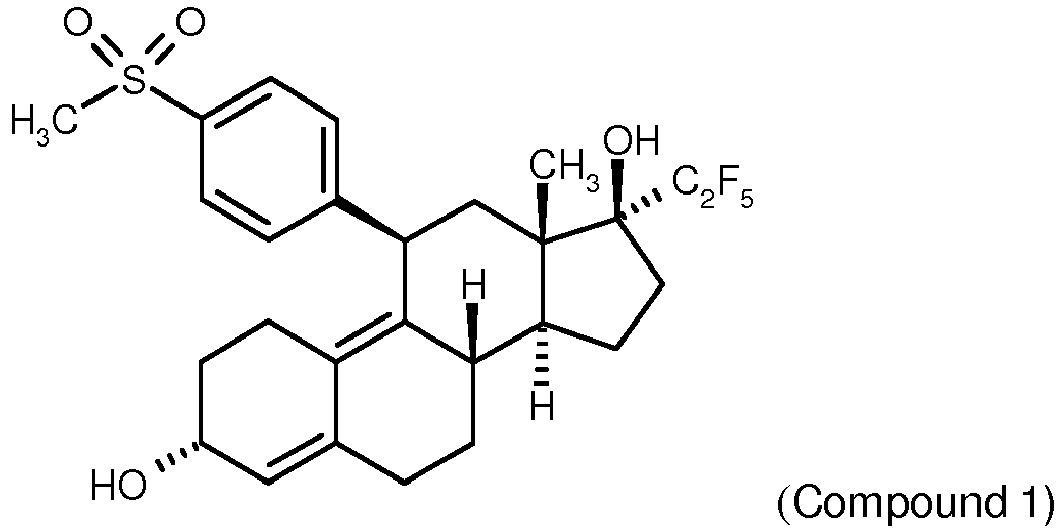
- In a preferred embodiment, the invention is directed to the use of (3α,11β,17β)-11-[4-(methylsulfonyl)phenyl]-17-(pentafluoroethyl)estra-4,9-diene-3,17-diol (Compound 1) for the manufacture of a therapeutical drug for treating and/or prophylaxis of gynaecological disease or for fertility control and emergency contraception.
Preferably, the gynaecological disease is selected from uterine fibroids, endometriosis and hormone-dependent breast cancers. More preferably, the gynaecological disease is selected from uterine fibroids or endometriosis. Even more preferably, the gynaecological disease is uterine fibroids. Even more preferably, the gynaecological disease is endometriosis.
In other words, the invention is directed to a method for the prophylaxis or treatment of disease(s) comprising the step: - Administering to a mammal an effective amount of (3α,11β,17β)-11-[4-(methylsulfonyl)phenyl]-17-(pentafluoroethyl)estra-4,9-diene-3,17-diol (Compound 1).
- Preferably, the prodrug is administered to a patient in need of treatment wherein the administered amount of the prodrug results into the treatment and/or prophylaxis of gynaecological diseases, preferably uterine fibroids, endometriosis or hormone-dependent breast cancers or for fertility control and emergency contraception. Preferably, the gynaecological diseases are selected from uterine fibroids or endometriosis.
- Prodrugs are chemical entities that undergo enzymatic modifications resulting into a biologically active drug. Indeed, the chemical entity is metabolized in the body into an active form. Prodrug technology is an important strategy to target drug action to specific cells and tissues and thereby decrease toxicity or side effects on non-target cells. N. Bodor et al., 22 Ann. Rep. Med. Chem. 303-313 (1987); T. Krenitsky et al., 81 P.N.A.S. USA 3209-3213 (1984); J. Hjelle et al., 229 J. Pharmacol. Exp. Ther. 372-380 (1984); S. Magnan et al., 25 J. Med. Chem. 1018-1021 (1982); M. Orlowski et al., 212 J. Pharmacol. Exp. Ther. 167-172 (1980). Prodrugs are inactive compounds which become therapeutically active by metabolic process(es) in the human or animal body following the intake of the prodrug.
- Prodrugs can be carrier-linked-prodrugs and bioprecursors. The carrier-linked prodrug results from a temporary linkage of the active molecule with a transport moiety. Such prodrugs are less active or inactive compared to the parent active drug. The transport moiety will be chosen for its non-toxicity and its ability to ensure the release of the active principle with efficient kinetics. Whereas the bioprecursors result from a molecular modification of the active principle itself by generation of a new molecule that is capable of being a substrate to the metabolizing enzymes releasing the active principle as a metabolite.
- The term reducing agent refers to compound that donates an electron to another species. Common reducing agents include metals potassium, calcium, barium, sodium and magnesium, and also compounds that contain the H- ion, those being NaH, LiH, LiAlH4 and CaH2. Sodium borohydride (NaBH4) is a preferred reducing agent.
- The term "gynecological diseases" refers to estrogen-dependant conditions selected among the group comprising uterine fibroid, endometriosis, excessive e bleeding, abnormal e bleeding and dysfunctional e bleeding or a combination of one or more of these diseases. e fibroids are benign non-cancerous tumors that originate from the smooth muscle layer, the myometrium and the accompanying connective tissue of the uterus. Uterine fibroid are also known as myoma, uterine hypertrophy, uterine leiomyomata, leiomyoma, myoma, fibromyoma, leiofibromyoma, fibroleiomyoma, fibroma, myometrial hypertrophy, fibrosis uteri, and fibrotic metritis.
- Endometriosis is characterized by the presence of endometrium-like tissue outside the uterus cavity, most frequently in the peritoneal cavity. Endometriosis almost exclusively affects pre-menopausal women and is a highly prevalent and highly underdiagnosed condition.
- The present invention includes pharmaceutical compositions that are comprised of a pharmaceutically acceptable carrier and a pharmaceutically effective amount of a compound, or salt thereof, of the present invention. A pharmaceutically acceptable carrier is preferably a carrier that is relatively non-toxic and innocuous to a patient at concentrations consistent with effective activity of the active ingredient so that any side effects ascribable to the carrier do not vitiate the beneficial effects of the active ingredient. A pharmaceutically effective amount of compound is preferably that amount which produces a result or exerts an influence on the particular condition being treated.
- The active ingredient can be dissolved or suspended in a pharmaceutically acceptable liquid carrier such as water, an organic solvent, a mixture of both. The liquid carrier can contain other suitable pharmaceutical additives such as solubilizers, emulsifiers,
- For oral solid dosage forms (e. g., powders, tablets and capsules), carriers such as starches, sugars, diluents, granulating agents, lubricants, binders can be used as appropriate.
- For parenteral administration, the carrier will typically comprise sterile water, although other ingredients that aid in solubility or serve as preservatives may also be prepared, in which case appropriate liquid carriers, suspending agents and the like will be employed. For parenteral administration, the carrier can also be an oily ester such as ethyl oleate.
- The term prodrug includes a tautomer, an N-oxide, a hydrate, a solvate, or a pharmaceutically acceptable salt thereof, or a mixture of same.
-
WO2011/009531A1 is disclosing Selective Progesterone Receptor Modulators (SPRM) of formula I (herein enclosed) and preferred compounds as disclosed below: - (11β,17β)-17-Hydroxy-11-[4-(methylsulphanyl)phenyl]-17-(pentafluoroethyl)estra-4,9-dien-3-one,
- (11β,17β)-11-[4-(Ethylsulphanyl)phenyl]-17-hydroxy-17-(pentafluoroethyl)estra-4,9-dien-3-one,
- (11β,17β)-17-Hydroxy-11-{4-[(RS)-methylsulphinyl]phenyl}-17-(pentafluoroethyl)estra-4,9-dien-3-one,
- (11β,17β)-17-Hydroxy-11-[4-(methylsulphonyl)phenyl]-17-(pentafluoroethyl)estra-4,9-dien-3-one,
- (11β,17β)-11-[4-(Ethylsulphonyl)phenyl]-17-hydroxy-17-(pentafluoroethyl)estra-4,9-dien-3-one,
- (11β,17β)-11-[4-(Benzylsulphanyl)phenyl]-17-hydroxy-17-(pentafluoroethyl)estra-4,9-dien-3-one,
- N-[{4-[(11β,17β))-17-Hydroxy-3-oxo-17-(pentafluoroethyl)estra-4,9-dien-11-yl]phenyl}(RS)(methyl) oxido-λ6-sulphanylidene]-4-methylbenzene sulphonamide, (11β,17β)-17-Hydroxy-11-[4-(RS-methylsulphonimidoyl)phenyl]-17-(pentafluoroethyl)estra-4,9-dien-3-one,
- (11β,17β)-17-Hydroxy-11-[4'-(methylsulphanyl)biphenyl-4-yl]-17-(pentafluoroethyl)estra-4,9-dien-3-one,
- (11β,17β)-17-Hydroxy-11-[4'-(methylsulphonyl)biphenyl-4-yl]-17-(pentafluoroethyl)estra-4,9-dien-3-one,
- N-[{4'-[(11β,17β)-17-Hydroxy-3-oxo-17-(pentafluoroethyl)estra-4,9-dien-11-yl]biphenyl-4-yl}(RS)(methyl) oxido-λ6-sulphanylidene]-4-methylbenzene sulphonamide, (11β,17β)-17-Hydroxy-11-[4'-(RS-methylsulphonimidoyl)biphenyl-4-yl]-17-(pentafluoroethyl)estra-4,9-dien-3-one,
- (11β,17β)-17-Hydroxy-17-(pentafluoroethyl)-11-(4'-sulphanylbiphenyl-4-yl)estra-4,9-dien-3-one,
- 4'-[(11β,17β)-17-Hydroxy-3-oxo-17-(pentafluoroethyl)estra-4,9-dien-11-yl]-N,N-dimethylbiphenyl-4-sulphonamide,
- 4-[(11β,17β)-17-Hydroxy-3-oxo-17-(pentafluoroethyl)estra-4,9-dien-11-yl]-N,N-dimethylbenzene sulphonamide, all included herein by reference.
- The following examples are provided to explain the invention without restricting it in anyway.
-

- a) Production of the starting material:
- The production of (11β,17β)-17-hydroxy-11-[4-(methylsulfonyl)phenyl]-17-(pentafluoroethyl)estra-4,9-dien-3-one (CAS-No. 1262108-14-4; Compound 2) is described in
WO2011/009531 andDE 102009034362 and can be carried out by analogy with the instructions contained therein.
- The production of (11β,17β)-17-hydroxy-11-[4-(methylsulfonyl)phenyl]-17-(pentafluoroethyl)estra-4,9-dien-3-one (CAS-No. 1262108-14-4; Compound 2) is described in
- b) Production of (3α,11β,17β)-11-[4-(methylsulfonyl)phenyl]-17-(pentafluoroethyl)estra-4,9-diene-3,17-diol (Compound 1):
- 50 g (11β,17β)-17-hydroxy-11-[4-(methylsulfonyl)phenyl]-17-(pentafluoroethyl) estra-4,9-dien-3-one (Compound 2) are dissolved in 500 ml methanol. 3.5 g (1 equiv.) sodium borohydride are added in portions at 0 - 5 °C whils t stirring. After a reaction time of about 6 hours at 5 °C, 170 ml water are slowly added, the resulting mixture is stirred for 1 hour and filtered. The filter cake is dried for 16 hours at 45°C in a vacuum. Interim yield: 46.9 g (mixture of
Compound 1 and the 3-beta isomer in a ratio of ∼ 2 : 1).
- 50 g (11β,17β)-17-hydroxy-11-[4-(methylsulfonyl)phenyl]-17-(pentafluoroethyl) estra-4,9-dien-3-one (Compound 2) are dissolved in 500 ml methanol. 3.5 g (1 equiv.) sodium borohydride are added in portions at 0 - 5 °C whils t stirring. After a reaction time of about 6 hours at 5 °C, 170 ml water are slowly added, the resulting mixture is stirred for 1 hour and filtered. The filter cake is dried for 16 hours at 45°C in a vacuum. Interim yield: 46.9 g (mixture of
- 45.9 g of the above diastereoisomer mixture dissolved in 462 ml dichloromethane and 76 ml methanol were chromatographed in 78 injections on 500 g Kromasil Diol 10MYM/60A with n-hexane/ethyl acetate (55:45 v/v) (column diameter 80 mm, flow rate 160 ml/min, 22°C +/-3'C). The desired fractions were each collected, cl eaned and concentrated to dryness in a vacuum. The residue was dried in a high vacuum. Yield: 25.9 g (3α,11β,17β)-11-[4-(methylsulfonyl)phenyl]-17-(pentafluoro-ethyl)estra-4,9-diene-3,17-diol (Compound 1).
- MS (ESI, neg. mode): 591 m/z (M - H+ + HCOOH)
- 1H-NMR (D6-DMSO; 500.13 MHz): 7.82 ppm (d, 2H, aromat.), 7.46 ppm (d, 2H, aromat.), 5.76 ppm (s, 1 H, OH), 5.42 ppm (bs, 1 H, olefin. 4-H), 4.62 ppm (d, 1 H, OH), 4.48 ppm (m, 1 H, benzyl. H-11), 4.08 ppm (m, 1 H, H-3), 3.18 ppm (s, 3H, CH3-SO2-), 2.58 bis 1.15 ppm (several m, 16H), 0.44 ppm (s, 3H, CH3)
- 13C-NMR (D6-DMSO; 125.8 MHz): 152.28 ppm (s, quart.), 137.73 ppm (s, quart.), 134.05 ppm (s, quart.), 133.13 ppm (s, quart.), 130.87 ppm (s, quart.), 128.03 ppm (s, CH), 127.86 ppm (s, CH), 126.78 ppm (s, CH), 122 - 114 ppm (complex m, CF3-CF2-), 83.21 (t, quart., C-17), 65.20 ppm (s, CH, C-3), 51.46 ppm (d, CH), 50.09 ppm (s, quart., C-13), 43.51 ppm (s, CH3-SO2-), 39.48 ppm (s, CH, C-11), 38.63 ppm (d, CH2), 38.22 ppm (s, CH), 32.48 ppm (s, CH2), 32.28 ppm (s, CH2), 29.90 ppm (s, CH2), 28.35 ppm (s, CH2), 24.60 ppm (s, CH2), 23.74 ppm (s, CH2), 16.29 ppm (s, CH3).
- The abortive test (= abortifacient activity in the early pregnancy of the rat) reported here is the premise that progesterone is essential for an undisturbed pregnancy in all phases of an intra-uterine pregnancy of mammals. For that reason compounds with progesterone antagonistic activity are effective through blockade of the progesterone receptors in the endometrium. This leads to termination of pregnancy.
-
- Species and strain: Wistar Han rat
- Sex and age: female, 9 - 14 weeks old
- Body weight: 180 - 200 g
- Breeder: Charles River, 97633 Sulzfeld, Germany
- Supplier: Charles River, 97633 Sulzfeld, Germany
- Room temperature: 20-22°C
- Relative humidity: 50-70%
- Light period: artificial light; 12-hour day (from 06.00 a.m. to 06.00 p.m.), 12-hour night cycle. Maintenance conditions: conventionally housed in air-conditioned animal rooms
- Caging: animals were kept in Makrolon® cages type IV
- Feed type: Ssniff®, pelleted
- Feeding time: ad libitum
- Water type: tab water via water bottles
- Watering time: ad libitum
- Rats were delivered after mating at d2 (=
day 2 of pregnancy, =d2 p.c.) directly from the animal supplier. Afterwards the animals were randomized to treatment or control groups. The animals received the test compound or vehicle orally once daily from day 5-7 of pregnancy. On the day of autopsy (d9) the animals were sacrificed with CO2. Study was performed with different dosages of test compound that wasCompound 1. - From day 5-7 of pregnancy 6 animals in a group received the same dose of
Compound 1 orally once daily in the morning. There were 4 treatment groups, with dosages of 0.05, 0.2, 0.5, 2.0, 5.0 and 10.0 mg/kg day ofCompound 1 and a vehicle only group.
The progesterone-antagonistic activity was analyzed as follows: The absence of implantation sites was assessed as complete abortion, the presence of regressed and/or hemorrhagic implantation sites (so defined as pathological nidation sites) as incomplete abortion. The total rate of abortion indicates the percentage of animals per group affected by an abortive event (either by pathological implantation sites or by complete abortions). - After oral administration of
Compound 1 at doses of 0.5 mg/kg/day, 1 mg/kg/day, 2 mg/kg/day, 5 mg/kg/day and 10 mg/kg/day, in all animals abortive events have been proven (= total rate of abortion: 100%). At 0.2 mg/kg/d only one animal out of six showed pathological implantation sites and 5 animals were unaffected. See Table 1.Table 1: PR antagonistic activity of Compound 1 in termination of early pregnancy in rats after oral (N=6 animals/group) administration.Compound Route of application Dose [mg/kg*day] Total rate of abortion [%] Complete abortion [%] Pathological nidation sites [%] Compound 1p.o. 0.05 0 0 0 Compound 1p.o. 0.2 17 0 17 Compound 1p.o. 0.5 100 50 50 Compound 1p.o. 1.0 100 83 17 Compound 1p.o. 2.0 100 100 0 Compound 1p.o. 5.0 100 100 0 Compound 1p.o. 10.0 100 100 0 vehicle p.o. - 0 0 0 -
WO2011/009531 reported forCompound 2 similar abortion events. - Example 3: Plasma concentrations and pharmacokinetic parameters of
Compounds
Under the same conditions as described in Example 2 three single dosages of Compound 1 (0.2, 1.0 and 5 mg/kg/day) were administered to rats. Blood samples were taken from the rats at several time-points (1, 2, 4, 7 and 24h, N = 3 animals at each time-point), to allow for calculation of AUC (0-24) and Cmax ofcompound 1 andcompound 2 in rat plasma.
The plasma samples were stored at -15°C until analy sis.Compound compound 1 andcompound 2. The supernatant was analyzed by separation employing high-pressure liquid chromatography and tandem mass spectrometric detection. The lower limit of quantitation (LLOQ) forCompound 1 was 1.00 µg/L, the linear range between 1.00 and 200 µg/L. The lower limit of quantitation (LLOQ) forCompound 2 was 0.200 µg/L, the linear range between 0.200 and 200 µg/L. A sample volume of 0.1 mL plasma was used.
The precision forCompound 1 ranged between 0.97 and 3.73 %, accuracy between 99.8 and 101.3 %, forCompound 2 precision ranged between 2.01 and 6.19 %, accuracy between 92.3 and 96.6 % calculated from the study quality control samples. - The maximum concentration of
Compound 2 in rat plasma after single oral administration ofCompound 1 to female rats was found to be 10.5 µg/L (0.2 mg/kg), 66 µg/L (1.0 mg/kg) and 235 µg/L (5.0 mg/kg), respectively. The AUC (0-24h) was 90.6 µg*h/L (0.2 mg/kg), 435 µg*h/L (1.0 mg/kg) and 2060 µg*h/L (5.0 mg/kg). Only very low amount of remainingcompound 1 was detected in rat plasma with maximum concentration of <1.00 µg/L (0.2 mg/kg), 3.36 µg/L (1.0 mg/kg) and 12.9 µg/kg (5.0 mg/kg), respectively. No AUC ofcompound 1 could be calculated (see Table 2). These results indicate an intensive metabolic conversion ofCompound 1 toCompound 2 in rats.
Hence, the efficacy ofCompound 1 observed in the current test model is due to Progesterone Receptor Antagonistic activity ofCompound 2 which was formed metabolically in rats. The marginal exposure ofCompound 1 observed after its administration to rats indicated, thatCompound 1 has a neglible contribution to the efficacy measured in the abortion test in rat.Table 2: Test Compound Route of application Dose [mg/kg*day] Compound 1Compound 1Compound 2Compound 2Cmax [µg/L]] AUC (0-24 h) [µg*h/L] Cmax [µg/L]] AUC (0-24 h) [µg*h/L] Compound 1p.o. 0.2 < 1.00 n.c. 10.5 90.6 Compound 1p.o. 1.0 3.36 n.c. 66 435 Compound 1p.o. 5.0 12.9 n.c. 235 2060 - A transactivation assay was carried out in SK-N-MC cells (human neuroblastoma cells) stably transfected with a plasmid expressing the human PR-A (pRChPR-A-neo) and a reporter gene (LUC) linked to a hormonally responsive promoter (MMTV). Pre serum-starved cells were grown for 16 hrs. either in the absence (negative control) or presence of increasing concentrations of Compound 1 (5.1 pmol/L, 26 pmol/L, 0.13 nmol/L; 0.64 nmol/L, 3.2 nmol/L, 16 nmol/L, 80 nmol/L, 400 nmol/L, 2 umol/L and 10 µmol/L), to determine agonistic activity. As a positive control for reporter gene induction, cells were treated with the synthetic progestin promegestone (10 pmol/L, 30 pmol/L, 91 pmol/L, 0.27 nmol/L, 0.82 nmol/L, 2.5 nmol/L, 7.4 nmol/L, 22 nmol/L, 67 nmol/L, 200 nmol/L). For the determination of antagonistic activity, cells were treated with 0.1 nmol/L promegestone and in addition, with increasing concentrations of Compound 1 (5.1 pmol/L, 26 pmol/L, 0.13 nmol/L; 0.64 nmol/L, 3.2 nmol/L, 16 nmol/L, 80 nmol/L, 400 nmol/L, 2 umol/L and 10 µmol/L). As a positive control for inhibition of reporter gene transcription, cells were cultured with increasing concentrations of the antiprogestin mifepristone (10 pmol/L, 30 pmol/L, 91 pmol/L, 0.27 nmol/L, 0.82 nmol/L, 2.5 nmol/L, 7.4 nmol/L, 22 nmol/L, 67 nmol/L, 200 nmol/L). LUC activity (LUC = luciferase) was determined in cell lysates and is measured asRLU (relative light units).
Table 3: Progesterone receptor A (PR-A) Potency IC50 [nmol/l] Compound 15.3 - Compound 2: Method as described in
WO2011/009531
SK-N-MC cells (human neuroblastoma cells), which have been stably transfected with plasmids, which express the human progesterone receptor B (pRChPR-B-neo) or the human progesterone receptor A (pRChPR-A-neo) and a reporter construct (pMMTV-LUC), were incubated for 24 hours either in the absence (negative control) or in the presence of increasing amounts of the respective Compound 2 (0.01 nmol/l, 0.1 nmol/l, 1 nmol/l,
10 nmol/l, 100 nmol/l and 1 µmol/l), in order to determine the agonistic efficacy. As positive control of reporter gene induction, the cells were treated with the synthetic gestagen promegestone (0.01 nmol/l, 0.1 nmol/l, 1 nmol/l, 10 nmol/l, 100 nmol/l and 1 µmol/l). For determination of the antagonistic activity, the cells were treated with 0.1 nmol/l promegestone and additionally with increasing amounts of the respective test compound (0.01 nmol/l,
0.1 nmol/l, 1 nmol/l, 10 nmol/l, 100 nmol/l and 1 µmol/l). The activity of the LUC reporter gene (LUC = luciferase) was determined in the cell lysates and was measured as RLU (relative light units).Table 4: Progesterone receptor A (PR-A) Potency IC50 [nmol/l] Compound 20.096 -
-
Compound 2 is a very strong antagonist on both PR isoforms, PR-A and PR-B, with no agonistic activity with an IC50 of 0.096 nM for PR-A. -
Compound 1 exhibits a significantly lower antagonistic activity thanCompound 2. The IC50 is 5.3±1.43 nM for PR-A. -
Human liver microsomes were incubated with (3α,11β,17β)-11-[4-(14C-methylsulfonyl)phenyl]-17-(pentafluoroethyl)estra-4,9-diene-3,17-diol (Compound 1). Incubation buffer 50 mM potassium diphosphate (pH 7.4) NADPH generating system 1.2 mM NADPH 8 mM glucose-6-phosphate 38 mM KCl 5 mM MgCl solution 100 U/mL glucose-6-phosphate dehydrogenase Temperature 37°C shaking water bath, 90 rpm Substrate 1 µM (3α,11β,17β)-11-[4-(methylsulfonyl)phenyl] 17-(pentafluoroethyl)estra-4,9-diene-3,17-diol from a stock solution with 0.1 mM in acetonitrile Protein concentration 0.5 mg/ mL Measurement times 0, 0.25, 0.5, 0.75 h Incubation volume 250 µL - The incubation mixture containing buffer, reconstituting system and microsomal protein was preincubated at 37°C for 3 min. Incubation was started by the addition of the solution containing (3α,11β,17β)-11-[4-(methylsulfonyl)phenyl]-17-(pentafluoroethyl)estra-4,9-diene-3,17-diol (Compound 1). The samples were incubated at 37°C in a continuously operating shaking water bath. The incubation reaction was stopped by the addition of 160 µL acetonitrile. The stopped incubations were centrifuged for 10 minutes at 13000 rpm (4°C) and stored at -18°C until they were subsequently an alysed. 50 µL of the supernatant was examined by chromatography and detected by radiometry and mass spectrometry.
- As a result of this examination a marked decrease was observed in the proportion of (3α,11β,17β)-11-[4-(methylsulfonyl)phenyl]-17-(pentafluoroethyl)estra-4,9-diene-,17- diol (Compound 1) after 1 hour's incubation compared to the sample before the start of incubation (0 hr). A large quantity of (11β,17β)-17-hydroxy-11-[4-(methylsulfonyl)phenyl]-17-penta-fluoroethyl)estra-4,9-dien-3-one (Compound 2) had formed in the incubation sample after 1 hour. This was identified in the samples by mass spectrometric parameters (precise molecular mass [M-H] = 543.162847, MS/MS fragments of m/z 543: 527, 487, 466, 448, 376, 349, 315, 236, 163) and the retention time in the radio chromatogram as well as in the mass chromatogram. These parameters correspond to those of the synthetically produced (11β,17β)-17-hydroxy-11-[4-(methylsulfonyl)phenyl]-17-(pentafluoroethyl)estra-4,9-dien-3-on (Compound 2). See
Figure 1 .
Figure 1: Concentration-time course ofCompound 2 andCompound 1 after incubation ofCompound 1 in human liver microsomes
Claims (9)
- A prodrug of a Selective Progesterone Receptor Modulator (SPRM) wherein the SPRM is selected from (11β,17β)-17-Hydroxy-11-[4-(methylsulphonyl)phenyl]-17-(pentafluoroethyl)estra-4,9-dien-3-one as described below

- The prodrug according to claim 1 where the prodrug is (3α,11β,17β)-11-[4-(methylsulfonyl)phenyl]-17-(pentafluoroethyl)estra-4,9-diene-3,17-diol with the formula as described below

- A method for obtaining a prodrug according to claim 1 or 2.
- The method according to claim 3 wherein the prodrug is as defined in claim 2 comprising a reduction step wherein (11β,17β)-17-hydroxy-11-[4-(methylsulfonyl)phenyl]-17-(pentafluoroethyl)estra-4,9-dien-3-one (Compound 2) is reacted in presence of a reducing agent.
- A pharmaceutical composition comprising a prodrug according to claim 1 or 2 and a pharmaceutically acceptable excipient or carrier.
- The pharmaceutical composition according to claim 5 wherein the prodrug is (3α,11β,17β)-11-[4-(methylsulfonyl)phenyl]-17-(pentafluoroethyl)estra-4,9-diene-3,17-diol (Compound 1).
- Use of a prodrug of a Selective Progesterone Receptor Modulator (SPRM) wherein the SPRM is selected from (11β,17β)-17-Hydroxy-11-[4-(methylsulphonyl)phenyl]-17-(pentafluoroethyl)estra-4,9-dien-3-one with the formula as described below

- The use according to claim 7 wherein the prodrug is (3α,11β,17β)-11-[4-(methylsulfonyl)phenyl]-17-(pentafluoroethyl)estra-4,9-diene-3,17-diol (Compound 1).
- The use according to claim 7 or 8 wherein the gynaecological disease is selected from uterine fibroids, endometriosis and hormone-dependent breast cancers.
Priority Applications (17)
| Application Number | Priority Date | Filing Date | Title |
|---|---|---|---|
| EP16158598.9A EP3214092A1 (en) | 2016-03-04 | 2016-03-04 | Prodrugs of the selective progesterone receptor modulator (sprm) (11.beta.,17.beta.)-17-hydroxy-11-[4-(methylsulphonyl)phenyl]-17-(pentafluoroethyl)estra-4,9-dien-3-one |
| PCT/EP2017/054704 WO2017148977A1 (en) | 2016-03-04 | 2017-03-01 | Prodrugs of the selective progesterone receptor modulator (sprm) (11.beta.,17.beta.)-17-hydroxy-11-[4-(methylsulphonyl)phenyl]-17-(pentafluoroeth yl)estra-4,9-dien-3-one |
| MX2018010658A MX2018010658A (en) | 2016-03-04 | 2017-03-01 | Prodrugs of the selective progesterone receptor modulator (sprm) (11.beta.,17.beta.)-17-hydroxy-11-[4-(methylsulphonyl)phenyl]-1 7-(pentafluoroeth yl)estra-4,9-dien-3-one. |
| BR112018067517A BR112018067517A2 (en) | 2016-03-04 | 2017-03-01 | progesterone receptor selective modulator (sprm) prodrugs (11.beta., 17.beta.) - 17-hydroxy-11- [4- (methylsulfonyl) phenyl] -17- (pentafluoroethyl) estra-4,9 -dien-3-one |
| JP2018546493A JP2019511486A (en) | 2016-03-04 | 2017-03-01 | Prodrug of selective progesterone receptor modulator (SPRM) (11β, 17β) -17-hydroxy-11- [4- (methylsulfonyl) phenyl] -17- (pentafluoroethyl) oestra-4,9-diene-3 -On |
| CONC2018/0009264A CO2018009264A2 (en) | 2016-03-04 | 2017-03-01 | Progesterone receptor selective modulator (msrp) prodrugs (11.beta., 17.beta.) - 17-hydroxy-11- [4- (methylsulfonyl) phenyl] -17- (pentafluoroethyl) estra-4,9- dien-3-one |
| RU2018134045A RU2018134045A (en) | 2016-03-04 | 2017-03-01 | Progesterone receptor selective modulator (SPRM) medications -SHE |
| CA3016369A CA3016369A1 (en) | 2016-03-04 | 2017-03-01 | Prodrugs of the selective progesterone receptor modulator (sprm) (11.beta.,17.beta.)-17-hydroxy-11-[4-(methylsulphonyl)phenyl]-17-(pentafluoroeth yl)estra-4,9-dien-3-one |
| CN201780014127.0A CN108779142A (en) | 2016-03-04 | 2017-03-01 | Selective Progesterone Receptor Modulator (SPRM) (11.β.,17.β.)-17-Hydroxy-11-[4-(methylsulfonyl)phenyl]-17-(pentafluoroethyl) Prodrugs of estro-4,9-dien-3-one |
| KR1020187025053A KR20180118135A (en) | 2016-03-04 | 2017-03-01 | Prodrugs of the selective progesterone receptor modulator (SPRM) (11.beta., 17.beta.) - 17-hydroxy-11- [4- (methylsulfonyl) phenyl] -17- (pentafluoroethyl) -4,9-dien-3-one |
| EP17707881.3A EP3423466A1 (en) | 2016-03-04 | 2017-03-01 | Prodrugs of the selective progesterone receptor modulator (sprm) (11.beta.,17.beta.)-17-hydroxy-11-[4-(methylsulphonyl)phenyl]-17-(pentafluoroeth yl)estra-4,9-dien-3-one |
| SG11201806771RA SG11201806771RA (en) | 2016-03-04 | 2017-03-01 | Prodrugs of the selective progesterone receptor modulator (sprm) (11.beta.,17.beta.)-17-hydroxy-11-[4-(methylsulphonyl)phenyl]-17-(pentafluoroeth yl)estra-4,9-dien-3-one |
| MA043691A MA43691A (en) | 2016-03-04 | 2017-03-01 | PROGESTERONE RECEPTOR MODULATOR (SPRM) MEDICINES (11.BETA., 17.BETA.) - 17-HYDROXY-11- [4- (METHYLSULPHONYL) PHENYL] -17- (PENTAFLUOROETHYL) ESTRA-4,9-DIENE- 3-ONE |
| US16/082,025 US10894805B2 (en) | 2016-03-04 | 2017-03-01 | Prodrugs of the selective progesterone receptor modulator (SPRM) (11.beta.,17.beta.)-17-Hydroxy-11-[4-(methylsulphonyl)phenyl] -17-(pentafluoroethyl)estra-4,9-dien-3-one |
| CR20180426A CR20180426A (en) | 2016-03-04 | 2017-03-01 | PROGESTERONE RECEPTOR SELECTIVE MOCULATOR PROFARMS (MSRP) (11.BETA., 17.BETA) -17-HIDROXI-11- [4- (METILSULFONIL) PHENIL] -17- (PENTAFLUOROETIL) ESTRA-4,9-DIEN -3-ONA |
| AU2017226922A AU2017226922A1 (en) | 2016-03-04 | 2017-03-01 | Prodrugs of the selective progesterone receptor modulator (SPRM) (11.β.,17.β.)-17-hydroxy-11-(4-(methylsulphonyl)phenyl)-17-(pentafluoroethyl)estra-4,9-dien-3-one |
| CL2018002523A CL2018002523A1 (en) | 2016-03-04 | 2018-09-04 | Progesterone receptor selective modulator (msrp) prodrugs (11.beta., 17.beta.) - 17-hydroxy-11- [4- (methylsulfonyl) phenyl] -17- (pentafluoroethyl) estra-4,9- dien-3-one |
Applications Claiming Priority (1)
| Application Number | Priority Date | Filing Date | Title |
|---|---|---|---|
| EP16158598.9A EP3214092A1 (en) | 2016-03-04 | 2016-03-04 | Prodrugs of the selective progesterone receptor modulator (sprm) (11.beta.,17.beta.)-17-hydroxy-11-[4-(methylsulphonyl)phenyl]-17-(pentafluoroethyl)estra-4,9-dien-3-one |
Publications (1)
| Publication Number | Publication Date |
|---|---|
| EP3214092A1 true EP3214092A1 (en) | 2017-09-06 |
Family
ID=55486547
Family Applications (2)
| Application Number | Title | Priority Date | Filing Date |
|---|---|---|---|
| EP16158598.9A Withdrawn EP3214092A1 (en) | 2016-03-04 | 2016-03-04 | Prodrugs of the selective progesterone receptor modulator (sprm) (11.beta.,17.beta.)-17-hydroxy-11-[4-(methylsulphonyl)phenyl]-17-(pentafluoroethyl)estra-4,9-dien-3-one |
| EP17707881.3A Withdrawn EP3423466A1 (en) | 2016-03-04 | 2017-03-01 | Prodrugs of the selective progesterone receptor modulator (sprm) (11.beta.,17.beta.)-17-hydroxy-11-[4-(methylsulphonyl)phenyl]-17-(pentafluoroeth yl)estra-4,9-dien-3-one |
Family Applications After (1)
| Application Number | Title | Priority Date | Filing Date |
|---|---|---|---|
| EP17707881.3A Withdrawn EP3423466A1 (en) | 2016-03-04 | 2017-03-01 | Prodrugs of the selective progesterone receptor modulator (sprm) (11.beta.,17.beta.)-17-hydroxy-11-[4-(methylsulphonyl)phenyl]-17-(pentafluoroeth yl)estra-4,9-dien-3-one |
Country Status (16)
| Country | Link |
|---|---|
| US (1) | US10894805B2 (en) |
| EP (2) | EP3214092A1 (en) |
| JP (1) | JP2019511486A (en) |
| KR (1) | KR20180118135A (en) |
| CN (1) | CN108779142A (en) |
| AU (1) | AU2017226922A1 (en) |
| BR (1) | BR112018067517A2 (en) |
| CA (1) | CA3016369A1 (en) |
| CL (1) | CL2018002523A1 (en) |
| CO (1) | CO2018009264A2 (en) |
| CR (1) | CR20180426A (en) |
| MA (1) | MA43691A (en) |
| MX (1) | MX2018010658A (en) |
| RU (1) | RU2018134045A (en) |
| SG (1) | SG11201806771RA (en) |
| WO (1) | WO2017148977A1 (en) |
Cited By (1)
| Publication number | Priority date | Publication date | Assignee | Title |
|---|---|---|---|---|
| EP3384913A1 (en) * | 2017-04-03 | 2018-10-10 | Bayer Pharma Aktiengesellschaft | Selective progesterone receptor modulators and stabilized estrogen level in patient |
Families Citing this family (1)
| Publication number | Priority date | Publication date | Assignee | Title |
|---|---|---|---|---|
| EP3214092A1 (en) | 2016-03-04 | 2017-09-06 | Bayer Pharma Aktiengesellschaft | Prodrugs of the selective progesterone receptor modulator (sprm) (11.beta.,17.beta.)-17-hydroxy-11-[4-(methylsulphonyl)phenyl]-17-(pentafluoroethyl)estra-4,9-dien-3-one |
Citations (4)
| Publication number | Priority date | Publication date | Assignee | Title |
|---|---|---|---|---|
| EP0057115A2 (en) | 1981-01-09 | 1982-08-04 | Roussel-Uclaf | Steroid derivatives substituted in the 11-beta position, process for their preparation, their utilization as medicaments and compositions containing them |
| WO1998034947A1 (en) | 1997-02-07 | 1998-08-13 | Schering Aktiengesellschaft | ANTIGESTAGENIC STEROIDS WITH A FLUORINATED 17α-ALKYL CHAIN |
| WO2011000953A1 (en) | 2009-07-02 | 2011-01-06 | University College Cork, National University Of Ireland, Cork | Method for the production of a gum base |
| WO2011009531A2 (en) | 2009-07-20 | 2011-01-27 | Bayer Schering Pharma Aktiengesellschaft | 17-hydroxy-17-pentafluorethyl-estra-4,9(10)-dien-11-aryl derivatives, methods for the production thereof and use thereof for treating diseases |
Family Cites Families (12)
| Publication number | Priority date | Publication date | Assignee | Title |
|---|---|---|---|---|
| DE69500542T2 (en) * | 1994-05-19 | 1998-01-02 | Akzo Nobel Nv | 11,21-bisphenyl-19-nor-pregnane derivatives |
| CN1357048A (en) * | 1998-03-06 | 2002-07-03 | 牛津生物医学(英国)有限公司 | Enhanced prodrug activation |
| WO2002067910A2 (en) | 2001-01-09 | 2002-09-06 | Schering Aktiengesellschaft | The use of antigestagens for inhibiting accelerated endometrial maturation during infertility treatment |
| JP2002233378A (en) * | 2001-02-07 | 2002-08-20 | Nihon Nosan Kogyo Kk | Antibodies that recognize human cytochrome P450 molecular species |
| DE102006054535A1 (en) | 2006-11-15 | 2008-05-21 | Bayer Schering Pharma Aktiengesellschaft | Progesterone receptor antagonist |
| DE102010007722A1 (en) * | 2010-02-10 | 2011-08-11 | Bayer Schering Pharma Aktiengesellschaft, 13353 | Progesterone receptor antagonist |
| DE102010007719A1 (en) * | 2010-02-10 | 2011-08-11 | Bayer Schering Pharma Aktiengesellschaft, 13353 | Progesterone receptor antagonist |
| DE102011088270A1 (en) * | 2011-12-12 | 2013-06-13 | Bayer Intellectual Property Gmbh | (11β, 17β) -17-hydroxy-11- [4- (methylsulfonyl) phenyl] -17- (pentafluoroethyl) estra-4,9-dien-3-one for the treatment of Charcot's disease Marie Toot |
| US20160296534A1 (en) | 2013-04-11 | 2016-10-13 | Bayer Pharma Aktiengesellschaft | Progesterone receptor antagonist dosage form |
| MA42103A (en) * | 2015-05-18 | 2018-03-28 | Bayer Pharma AG | SELECTIVE PROGESTERONE RECEPTOR MODULATOR (RPM) DOSAGE REGIME |
| US11596639B2 (en) | 2016-03-04 | 2023-03-07 | Vanderbilt University | Substituted indole Mcl-1 inhibitors |
| EP3214092A1 (en) | 2016-03-04 | 2017-09-06 | Bayer Pharma Aktiengesellschaft | Prodrugs of the selective progesterone receptor modulator (sprm) (11.beta.,17.beta.)-17-hydroxy-11-[4-(methylsulphonyl)phenyl]-17-(pentafluoroethyl)estra-4,9-dien-3-one |
-
2016
- 2016-03-04 EP EP16158598.9A patent/EP3214092A1/en not_active Withdrawn
-
2017
- 2017-03-01 MA MA043691A patent/MA43691A/en unknown
- 2017-03-01 KR KR1020187025053A patent/KR20180118135A/en not_active Ceased
- 2017-03-01 CN CN201780014127.0A patent/CN108779142A/en active Pending
- 2017-03-01 RU RU2018134045A patent/RU2018134045A/en not_active Application Discontinuation
- 2017-03-01 US US16/082,025 patent/US10894805B2/en not_active Expired - Fee Related
- 2017-03-01 AU AU2017226922A patent/AU2017226922A1/en not_active Abandoned
- 2017-03-01 BR BR112018067517A patent/BR112018067517A2/en not_active IP Right Cessation
- 2017-03-01 CO CONC2018/0009264A patent/CO2018009264A2/en unknown
- 2017-03-01 SG SG11201806771RA patent/SG11201806771RA/en unknown
- 2017-03-01 WO PCT/EP2017/054704 patent/WO2017148977A1/en not_active Ceased
- 2017-03-01 CA CA3016369A patent/CA3016369A1/en not_active Abandoned
- 2017-03-01 EP EP17707881.3A patent/EP3423466A1/en not_active Withdrawn
- 2017-03-01 CR CR20180426A patent/CR20180426A/en unknown
- 2017-03-01 MX MX2018010658A patent/MX2018010658A/en unknown
- 2017-03-01 JP JP2018546493A patent/JP2019511486A/en active Pending
-
2018
- 2018-09-04 CL CL2018002523A patent/CL2018002523A1/en unknown
Patent Citations (5)
| Publication number | Priority date | Publication date | Assignee | Title |
|---|---|---|---|---|
| EP0057115A2 (en) | 1981-01-09 | 1982-08-04 | Roussel-Uclaf | Steroid derivatives substituted in the 11-beta position, process for their preparation, their utilization as medicaments and compositions containing them |
| WO1998034947A1 (en) | 1997-02-07 | 1998-08-13 | Schering Aktiengesellschaft | ANTIGESTAGENIC STEROIDS WITH A FLUORINATED 17α-ALKYL CHAIN |
| WO2011000953A1 (en) | 2009-07-02 | 2011-01-06 | University College Cork, National University Of Ireland, Cork | Method for the production of a gum base |
| WO2011009531A2 (en) | 2009-07-20 | 2011-01-27 | Bayer Schering Pharma Aktiengesellschaft | 17-hydroxy-17-pentafluorethyl-estra-4,9(10)-dien-11-aryl derivatives, methods for the production thereof and use thereof for treating diseases |
| DE102009034362A1 (en) | 2009-07-20 | 2011-01-27 | Bayer Schering Pharma Aktiengesellschaft | 17-Hydroxy-17-pentafluoroethyl-estra-4,9 (10) -diene-11-aryl derivatives, process for their preparation and their use for the treatment of diseases |
Non-Patent Citations (11)
| Title |
|---|
| CHENG, L ET AL., J CLIN ENDOCRINOL METAB, vol. 77, 1993, pages 873 - 877 |
| DEBORAH DEMANNO ET AL., STEROIDS, vol. 68, 2003, pages 1019 - 1032 |
| DUMASIA ET AL., 631 MEETING, GUILDFORD, vol. 17, 1989, pages 1 019 - 1 020 |
| ENDO ET AL: "Characterization of rat and mouse NAD<+>-dependent 3alpha/17beta/20alpha-hydroxysteroid dehydrogenases and identification of substrate specificity determinants by site-directed mutagenesis", ARCHIVES OF BIOCHEMISTRY AND BIOPHYSICS, ACADEMIC PRESS, US, vol. 467, no. 1, 25 October 2007 (2007-10-25), pages 76 - 86, XP022314479, ISSN: 0003-9861, DOI: 10.1016/J.ABB.2007.08.011 * |
| FUHRMANN ET AL., J. MED. CHEM., vol. 43, 2000, pages 5010 - 5016 |
| J. HJELLE, J. PHARMACOL. EXP. THER., vol. 229, 1984, pages 372 - 380 |
| M. J. BLOM ET AL: "Metabolism of Norethisterone and Norethisterone Derivatives in Rat Uterus, Vagina, and Aorta", DRUG METABOLISM AND DISPOSITION, vol. 29, no. 7, 1 July 2001 (2001-07-01), US, pages 976 - 982, XP055293725, ISSN: 0090-9556 * |
| M. ORLOWSKI ET AL., J. PHARMACOL. EXP. THER, vol. 212, 1980, pages 167 - 172 |
| N. BODOR ET AL., ANN. REP. MED. CHEM, vol. 22, 1987, pages 303 - 313 |
| S. MAGNAN ET AL., J. MED. CHEM., vol. 25, 1982, pages 1018 - 1021 |
| T. KRENITSKY ET AL., P.N.A.S. USA, vol. 81, 1984, pages 3209 - 3213 |
Cited By (2)
| Publication number | Priority date | Publication date | Assignee | Title |
|---|---|---|---|---|
| EP3384913A1 (en) * | 2017-04-03 | 2018-10-10 | Bayer Pharma Aktiengesellschaft | Selective progesterone receptor modulators and stabilized estrogen level in patient |
| US10485808B2 (en) | 2017-04-03 | 2019-11-26 | Bayer Pharma Aktiengesellschaft | Selective progesterone receptor modulators (SPRM) and stabilized estrogen level in patient |
Also Published As
| Publication number | Publication date |
|---|---|
| RU2018134045A3 (en) | 2020-04-27 |
| KR20180118135A (en) | 2018-10-30 |
| CR20180426A (en) | 2018-11-21 |
| RU2018134045A (en) | 2020-04-06 |
| MA43691A (en) | 2021-03-17 |
| US20190367555A1 (en) | 2019-12-05 |
| CO2018009264A2 (en) | 2018-09-20 |
| WO2017148977A1 (en) | 2017-09-08 |
| CL2018002523A1 (en) | 2018-12-21 |
| BR112018067517A2 (en) | 2019-01-02 |
| AU2017226922A1 (en) | 2018-08-23 |
| US10894805B2 (en) | 2021-01-19 |
| EP3423466A1 (en) | 2019-01-09 |
| CA3016369A1 (en) | 2017-09-08 |
| JP2019511486A (en) | 2019-04-25 |
| MX2018010658A (en) | 2019-01-17 |
| SG11201806771RA (en) | 2018-09-27 |
| CN108779142A (en) | 2018-11-09 |
Similar Documents
| Publication | Publication Date | Title |
|---|---|---|
| EP2039701B1 (en) | 20-Keto-11Beta-Arylsteroids and their Derivatives having agonist or antagonist hormonal activity | |
| EP2456781B1 (en) | 17-hydroxy-17-pentafluorethyl-estra-4,9(10)-dien-11-acyloxyalkylene phenyl derivatives, methods for the production thereof and use thereof for treating diseases | |
| JP4368945B2 (en) | Novel 19-noroop legnene derivatives | |
| EA021946B1 (en) | (11β,17β)-17-HYDROXY-11-[4-(METHYLSULPHONYL)PHENYL]-17-PENTAFLUORETHYL)ESTRA-4,9-DIEN-3-ONE AND MEDICAMENT COMPRISING SAME | |
| JPH02243698A (en) | Pharmaceutical comporition of estrogen nuclear derivative used for suppressing sex steroid activity | |
| EP1525215B1 (en) | Progesterone receptor modulators having an increased antigonadotropic activity for use in female fertility testing and hormone replacement therapy | |
| US6740645B1 (en) | 17β-acyl-17α-propynyl-11β-(cyclic amino) aryl steroids and their derivatives having antagonist hormonal properties | |
| AU621844B2 (en) | 17-methylene-and 17-ethylidene-estratrienes | |
| EP3214092A1 (en) | Prodrugs of the selective progesterone receptor modulator (sprm) (11.beta.,17.beta.)-17-hydroxy-11-[4-(methylsulphonyl)phenyl]-17-(pentafluoroethyl)estra-4,9-dien-3-one | |
| EP1599493B1 (en) | 2-substituted estra-1,3,5(10)-triene-3-yl sulfamate with an anti-tumour action | |
| IE903031A1 (en) | New omega-phenylamino alkanoic acids substituted on the aromatic nucleus by a radical derived from 19-nor steroids, their salts, their preparation process and the intermediates of this process, their use as medicaments and compositions containing them | |
| TWI672142B (en) | Progesterone receptor antagonist dosage form | |
| AU617140B2 (en) | 17-halomethylene estratrienes | |
| JPH02188599A (en) | Novel substance derived from 3-keto-delta-4,9-19- norsteroid and drug comprising same | |
| US6525039B1 (en) | B-ring estratrienes | |
| HK40000077A (en) | Prodrugs of the selective progesterone receptor modulator (sprm) (11.beta.,17.beta.)-17-hydroxy-11-[4-(methylsulphonyl)phenyl]-17-(pentafluoroeth yl)estra-4,9-dien-3-one | |
| US6693207B2 (en) | B-ring estratriene diols | |
| US7473709B2 (en) | 11β-benzaldoxime derivatives of D-homooestra-4,9-dien-3-ones | |
| KR100940054B1 (en) | 17alpha-hydroxy-14beta-steroids with hormonal effect | |
| HK1077832A1 (en) | 17α-ALKYL-17β-OXY-ESTRATRIENES AND INTERMEDIATES FOR THE FRODUCTION THEREOF, AND USE OF SAID 17α-ALKYL-17β-OXY-ESTRATRIENES FOR PRODUCING MEDICAMENTS AND PHARMACEUTICAL PREPARATIONS | |
| HK1077832B (en) | 17α-ALKYL-17β-OXY-ESTRATRIENES AND INTERMEDIATES FOR THE FRODUCTION THEREOF, AND USE OF SAID 17α-ALKYL-17β-OXY-ESTRATRIENES FOR PRODUCING MEDICAMENTS AND PHARMACEUTICAL PREPARATIONS | |
| JP2001526654A (en) | Sulfate of B-ring estratrienediol | |
| HK1124339B (en) | 20-keto-11beta-arylsteroids and their derivatives having agonist or antagonist hormonal activity | |
| HK1079215B (en) | 17α-ALKYL-17β-OXY-ESTRATRIENES, USES THEREOF AND PHARMACEUTICAL PREPARATIONS |
Legal Events
| Date | Code | Title | Description |
|---|---|---|---|
| PUAI | Public reference made under article 153(3) epc to a published international application that has entered the european phase |
Free format text: ORIGINAL CODE: 0009012 |
|
| STAA | Information on the status of an ep patent application or granted ep patent |
Free format text: STATUS: THE APPLICATION HAS BEEN PUBLISHED |
|
| AK | Designated contracting states |
Kind code of ref document: A1 Designated state(s): AL AT BE BG CH CY CZ DE DK EE ES FI FR GB GR HR HU IE IS IT LI LT LU LV MC MK MT NL NO PL PT RO RS SE SI SK SM TR |
|
| AX | Request for extension of the european patent |
Extension state: BA ME |
|
| STAA | Information on the status of an ep patent application or granted ep patent |
Free format text: STATUS: THE APPLICATION IS DEEMED TO BE WITHDRAWN |
|
| 18D | Application deemed to be withdrawn |
Effective date: 20180307 |