EP3213636A1 - Deuterated n-ethyl-n-phenyl-1,2-dihydro-4-hydroxy-5-chloro-1-methyl-2-oxoquinoline-3-carboxamide, salts and uses thereof - Google Patents
Deuterated n-ethyl-n-phenyl-1,2-dihydro-4-hydroxy-5-chloro-1-methyl-2-oxoquinoline-3-carboxamide, salts and uses thereof Download PDFInfo
- Publication number
- EP3213636A1 EP3213636A1 EP16196628.8A EP16196628A EP3213636A1 EP 3213636 A1 EP3213636 A1 EP 3213636A1 EP 16196628 A EP16196628 A EP 16196628A EP 3213636 A1 EP3213636 A1 EP 3213636A1
- Authority
- EP
- European Patent Office
- Prior art keywords
- deuterium
- laquinimod
- compound
- enriched
- pharmaceutically acceptable
- Prior art date
- Legal status (The legal status is an assumption and is not a legal conclusion. Google has not performed a legal analysis and makes no representation as to the accuracy of the status listed.)
- Withdrawn
Links
- 0 C[C@]1CC(C)(C*=C)C*C1 Chemical compound C[C@]1CC(C)(C*=C)C*C1 0.000 description 5
Images


Classifications
-
- C—CHEMISTRY; METALLURGY
- C07—ORGANIC CHEMISTRY
- C07D—HETEROCYCLIC COMPOUNDS
- C07D215/00—Heterocyclic compounds containing quinoline or hydrogenated quinoline ring systems
- C07D215/02—Heterocyclic compounds containing quinoline or hydrogenated quinoline ring systems having no bond between the ring nitrogen atom and a non-ring member or having only hydrogen atoms or carbon atoms directly attached to the ring nitrogen atom
- C07D215/16—Heterocyclic compounds containing quinoline or hydrogenated quinoline ring systems having no bond between the ring nitrogen atom and a non-ring member or having only hydrogen atoms or carbon atoms directly attached to the ring nitrogen atom with hetero atoms or with carbon atoms having three bonds to hetero atoms with at the most one bond to halogen, e.g. ester or nitrile radicals, directly attached to ring carbon atoms
- C07D215/48—Carbon atoms having three bonds to hetero atoms with at the most one bond to halogen
- C07D215/54—Carbon atoms having three bonds to hetero atoms with at the most one bond to halogen attached in position 3
- C07D215/56—Carbon atoms having three bonds to hetero atoms with at the most one bond to halogen attached in position 3 with oxygen atoms in position 4
-
- A—HUMAN NECESSITIES
- A61—MEDICAL OR VETERINARY SCIENCE; HYGIENE
- A61K—PREPARATIONS FOR MEDICAL, DENTAL OR TOILETRY PURPOSES
- A61K31/00—Medicinal preparations containing organic active ingredients
- A61K31/33—Heterocyclic compounds
- A61K31/395—Heterocyclic compounds having nitrogen as a ring hetero atom, e.g. guanethidine or rifamycins
- A61K31/435—Heterocyclic compounds having nitrogen as a ring hetero atom, e.g. guanethidine or rifamycins having six-membered rings with one nitrogen as the only ring hetero atom
- A61K31/47—Quinolines; Isoquinolines
-
- A—HUMAN NECESSITIES
- A61—MEDICAL OR VETERINARY SCIENCE; HYGIENE
- A61K—PREPARATIONS FOR MEDICAL, DENTAL OR TOILETRY PURPOSES
- A61K31/00—Medicinal preparations containing organic active ingredients
-
- A—HUMAN NECESSITIES
- A61—MEDICAL OR VETERINARY SCIENCE; HYGIENE
- A61K—PREPARATIONS FOR MEDICAL, DENTAL OR TOILETRY PURPOSES
- A61K31/00—Medicinal preparations containing organic active ingredients
- A61K31/33—Heterocyclic compounds
-
- A—HUMAN NECESSITIES
- A61—MEDICAL OR VETERINARY SCIENCE; HYGIENE
- A61K—PREPARATIONS FOR MEDICAL, DENTAL OR TOILETRY PURPOSES
- A61K31/00—Medicinal preparations containing organic active ingredients
- A61K31/33—Heterocyclic compounds
- A61K31/395—Heterocyclic compounds having nitrogen as a ring hetero atom, e.g. guanethidine or rifamycins
-
- A—HUMAN NECESSITIES
- A61—MEDICAL OR VETERINARY SCIENCE; HYGIENE
- A61K—PREPARATIONS FOR MEDICAL, DENTAL OR TOILETRY PURPOSES
- A61K31/00—Medicinal preparations containing organic active ingredients
- A61K31/33—Heterocyclic compounds
- A61K31/395—Heterocyclic compounds having nitrogen as a ring hetero atom, e.g. guanethidine or rifamycins
- A61K31/435—Heterocyclic compounds having nitrogen as a ring hetero atom, e.g. guanethidine or rifamycins having six-membered rings with one nitrogen as the only ring hetero atom
-
- A—HUMAN NECESSITIES
- A61—MEDICAL OR VETERINARY SCIENCE; HYGIENE
- A61K—PREPARATIONS FOR MEDICAL, DENTAL OR TOILETRY PURPOSES
- A61K31/00—Medicinal preparations containing organic active ingredients
- A61K31/33—Heterocyclic compounds
- A61K31/395—Heterocyclic compounds having nitrogen as a ring hetero atom, e.g. guanethidine or rifamycins
- A61K31/435—Heterocyclic compounds having nitrogen as a ring hetero atom, e.g. guanethidine or rifamycins having six-membered rings with one nitrogen as the only ring hetero atom
- A61K31/44—Non condensed pyridines; Hydrogenated derivatives thereof
- A61K31/455—Nicotinic acids, e.g. niacin; Derivatives thereof, e.g. esters, amides
-
- A—HUMAN NECESSITIES
- A61—MEDICAL OR VETERINARY SCIENCE; HYGIENE
- A61K—PREPARATIONS FOR MEDICAL, DENTAL OR TOILETRY PURPOSES
- A61K31/00—Medicinal preparations containing organic active ingredients
- A61K31/33—Heterocyclic compounds
- A61K31/395—Heterocyclic compounds having nitrogen as a ring hetero atom, e.g. guanethidine or rifamycins
- A61K31/435—Heterocyclic compounds having nitrogen as a ring hetero atom, e.g. guanethidine or rifamycins having six-membered rings with one nitrogen as the only ring hetero atom
- A61K31/465—Nicotine; Derivatives thereof
-
- A—HUMAN NECESSITIES
- A61—MEDICAL OR VETERINARY SCIENCE; HYGIENE
- A61K—PREPARATIONS FOR MEDICAL, DENTAL OR TOILETRY PURPOSES
- A61K31/00—Medicinal preparations containing organic active ingredients
- A61K31/33—Heterocyclic compounds
- A61K31/395—Heterocyclic compounds having nitrogen as a ring hetero atom, e.g. guanethidine or rifamycins
- A61K31/435—Heterocyclic compounds having nitrogen as a ring hetero atom, e.g. guanethidine or rifamycins having six-membered rings with one nitrogen as the only ring hetero atom
- A61K31/47—Quinolines; Isoquinolines
- A61K31/4704—2-Quinolinones, e.g. carbostyril
-
- A—HUMAN NECESSITIES
- A61—MEDICAL OR VETERINARY SCIENCE; HYGIENE
- A61K—PREPARATIONS FOR MEDICAL, DENTAL OR TOILETRY PURPOSES
- A61K31/00—Medicinal preparations containing organic active ingredients
- A61K31/33—Heterocyclic compounds
- A61K31/395—Heterocyclic compounds having nitrogen as a ring hetero atom, e.g. guanethidine or rifamycins
- A61K31/5545—Heterocyclic compounds having nitrogen as a ring hetero atom, e.g. guanethidine or rifamycins having eight-membered rings not containing additional condensed or non-condensed nitrogen-containing 3-7 membered rings
-
- A—HUMAN NECESSITIES
- A61—MEDICAL OR VETERINARY SCIENCE; HYGIENE
- A61K—PREPARATIONS FOR MEDICAL, DENTAL OR TOILETRY PURPOSES
- A61K9/00—Medicinal preparations characterised by special physical form
- A61K9/20—Pills, tablets, discs, rods
-
- A—HUMAN NECESSITIES
- A61—MEDICAL OR VETERINARY SCIENCE; HYGIENE
- A61K—PREPARATIONS FOR MEDICAL, DENTAL OR TOILETRY PURPOSES
- A61K9/00—Medicinal preparations characterised by special physical form
- A61K9/20—Pills, tablets, discs, rods
- A61K9/2004—Excipients; Inactive ingredients
- A61K9/2013—Organic compounds, e.g. phospholipids, fats
-
- A—HUMAN NECESSITIES
- A61—MEDICAL OR VETERINARY SCIENCE; HYGIENE
- A61P—SPECIFIC THERAPEUTIC ACTIVITY OF CHEMICAL COMPOUNDS OR MEDICINAL PREPARATIONS
- A61P1/00—Drugs for disorders of the alimentary tract or the digestive system
- A61P1/04—Drugs for disorders of the alimentary tract or the digestive system for ulcers, gastritis or reflux esophagitis, e.g. antacids, inhibitors of acid secretion, mucosal protectants
-
- A—HUMAN NECESSITIES
- A61—MEDICAL OR VETERINARY SCIENCE; HYGIENE
- A61P—SPECIFIC THERAPEUTIC ACTIVITY OF CHEMICAL COMPOUNDS OR MEDICINAL PREPARATIONS
- A61P13/00—Drugs for disorders of the urinary system
- A61P13/12—Drugs for disorders of the urinary system of the kidneys
-
- A—HUMAN NECESSITIES
- A61—MEDICAL OR VETERINARY SCIENCE; HYGIENE
- A61P—SPECIFIC THERAPEUTIC ACTIVITY OF CHEMICAL COMPOUNDS OR MEDICINAL PREPARATIONS
- A61P19/00—Drugs for skeletal disorders
- A61P19/02—Drugs for skeletal disorders for joint disorders, e.g. arthritis, arthrosis
-
- A—HUMAN NECESSITIES
- A61—MEDICAL OR VETERINARY SCIENCE; HYGIENE
- A61P—SPECIFIC THERAPEUTIC ACTIVITY OF CHEMICAL COMPOUNDS OR MEDICINAL PREPARATIONS
- A61P25/00—Drugs for disorders of the nervous system
-
- A—HUMAN NECESSITIES
- A61—MEDICAL OR VETERINARY SCIENCE; HYGIENE
- A61P—SPECIFIC THERAPEUTIC ACTIVITY OF CHEMICAL COMPOUNDS OR MEDICINAL PREPARATIONS
- A61P25/00—Drugs for disorders of the nervous system
- A61P25/28—Drugs for disorders of the nervous system for treating neurodegenerative disorders of the central nervous system, e.g. nootropic agents, cognition enhancers, drugs for treating Alzheimer's disease or other forms of dementia
-
- A—HUMAN NECESSITIES
- A61—MEDICAL OR VETERINARY SCIENCE; HYGIENE
- A61P—SPECIFIC THERAPEUTIC ACTIVITY OF CHEMICAL COMPOUNDS OR MEDICINAL PREPARATIONS
- A61P29/00—Non-central analgesic, antipyretic or antiinflammatory agents, e.g. antirheumatic agents; Non-steroidal antiinflammatory drugs [NSAID]
-
- A—HUMAN NECESSITIES
- A61—MEDICAL OR VETERINARY SCIENCE; HYGIENE
- A61P—SPECIFIC THERAPEUTIC ACTIVITY OF CHEMICAL COMPOUNDS OR MEDICINAL PREPARATIONS
- A61P37/00—Drugs for immunological or allergic disorders
-
- A—HUMAN NECESSITIES
- A61—MEDICAL OR VETERINARY SCIENCE; HYGIENE
- A61P—SPECIFIC THERAPEUTIC ACTIVITY OF CHEMICAL COMPOUNDS OR MEDICINAL PREPARATIONS
- A61P37/00—Drugs for immunological or allergic disorders
- A61P37/02—Immunomodulators
-
- A—HUMAN NECESSITIES
- A61—MEDICAL OR VETERINARY SCIENCE; HYGIENE
- A61P—SPECIFIC THERAPEUTIC ACTIVITY OF CHEMICAL COMPOUNDS OR MEDICINAL PREPARATIONS
- A61P37/00—Drugs for immunological or allergic disorders
- A61P37/02—Immunomodulators
- A61P37/06—Immunosuppressants, e.g. drugs for graft rejection
Definitions
- Laquinimod is a compound which has been shown to be effective in the acute experimental autoimmune encephalomyelitis (aEAE) model ( U.S. Patent No. 6,077,851 ). Its chemical name is N-ethyl-N-phenyl-1,2-dihydro-4-hydroxy-5-chloro-1-methyl-2-oxoquinoline-3-carboxamide, and its Chemical Registry number is 248281-84-7.
- the processes of synthesis of laquinimod and the preparation of its sodium salt are disclosed in U.S. Patent No. 6,077,851 .
- An additional process of synthesis of laquinimod is disclosed in U.S. Patent No. 6,875,869 .
- compositions comprising laquinimod sodium are disclosed in PCT International Application Publication No. WO 2005/074899 .
- Laquinimod sodium is a novel synthetic compound with high oral bioavailability, which has been suggested as an oral formulation for the treatment of Multiple Sclerosis (MS).
- MS Multiple Sclerosis
- WO 2010/028015 proposes deuterium-enriched variants of laquinimod.
- WO 2010/028015 cautions that. "[m]etabolic switching can lead to different proportions of known metabolites as well as altogether new metabolites" and such "new metabolic profile may impart more or less toxicity" which "are not predictable a priori for any drug class".
- WO 2010/028015 does not provide at least the dosage for administration of the deuterium-enriched variants of laquinimod, and does not disclose the metabolic profile.
- the subject invention provides a method of treating a human subject afflicted with an autoimmune disease comprising administering to the human subject 0.2 mg - 2.0 mg per day of a deuterium-enriched compound having the structure: wherein each of R1-R10 is independently H or D, and at least one of R1-R10 is D, or a pharmaceutically acceptable salt thereof, effective to treat the subject.
- the subject invention also provides a method of inducing reduced formation of optionally deuterated 5-chloro4-hydroxy-1-methyl-2-oxo-N-phenyl-1,2-dihydroquinoline-3-carboxamide in a human subject comprising administering to the human subject a therapeutically effective amount of a deuterium-enriched compound having the structure: wherein each of R1-R10 is independently H or D, and at least one of R1-R10 is D, or a pharmaceutically acceptable salt thereof, wherein the reduced formation is relative to formation of 5-chloro-4-hydroxy-1-methyl-2-oxo-N-phenyl-1,2-dihydroquinoline-3-carboxamide upon administration of an equivalent molar amount of non-deuterium-enriched laquinimod.
- the subject invention further provides a mixture of at least two deuterium-enriched compounds, each compound having the structure: wherein each of R1-R10 is independently H or D, and each of the at least two deuterium-enriched compounds contains D at a different R1-R10. or pharmaceutically acceptable salts thereof.
- the subject invention yet further provides a pharmaceutical composition
- a pharmaceutical composition comprising the mixture described herein, or a pharmaceutically acceptable salt thereof, and a pharmaceutically acceptable carrier.
- the subject invention yet further provides a pharmaceutical composition
- a pharmaceutical composition comprising a mixture of:
- the subject invention yet further provides a process for preparing the pharmaceutical composition described herein, the process comprises:
- the subject invention yet further provides a process for producing a validated batch of the pharmaceutical composition described herein for distribution, the process comprises:
- the subject invention yet further provides a deuterium-enriched compound having the structure: wherein each of R1-R10 is independently H or D, and at least one of R1-R10 is D, or a pharmaceutically acceptable salt thereof, for use in an amount of 0.2 mg 2 mg per day in treating an autoimmune disease in a human subject.
- the subject invention provides a method of treating a human subject afflicted with an autoimmune disease comprising administering to the human subject 0.2 mg - 2.0 mg per day of a deuterium-enriched compound having the structure: wherein each of R1-R10 is independently H or D, and at least one of R1-R10 is D, or a pharmaceutically acceptable salt thereof, effective to treat the subject.
- the deuterium-enriched compound is or or a pharmaceutically acceptable salt thereof.
- the deuterium-enriched compound is or or a pharmaceutically acceptable salt thereof.
- the deuterium-enriched compound is or a pharmaceutically acceptable salt thereof.
- the autoimmune disease is Multiple Sclerosis, Systemic Lupus Erythematosus, lupus nephritis, lupus arthritis, Crohn's Disease or Rheumatoid arthritis.
- the autoimmune disease is Multiple Sclerosis.
- administration of the deuterium-enriched compound is more effective in treating the autoimmune disease than administration of an equivalent molar amount of non-deuterium-enriched laquinimod.
- the level of optionally deuterated 5-chloro-4-hydroxy-1-methyl-2-oxo-N-phenyl-1,2-dihydroquinoline-3-carboxamide formed in the human subject upon administration of the deuterium-enriched compound is reduced, compared to the level of 5-chloro-4-hydroxy-1-methyl-2-oxo-N-phenyl-1,2-dihydroquinoline-3-carboxamide formed when an equivalent molar amount of non-deuterium-enriched laquinimod is administered to the human subject.
- the level of optionally deuterated 5-chloro-4-hydroxy-1-methyl-2-oxo-N-phenyl-1,2-dihydroquinoline-3-carboxamide is reduced by at least 50%.
- the level of optionally deuterated 5-chloro-4-hydroxy-1-methyl-2-oxo-N-phenyl-1,2-dihydroquinoline-3-carboxamide is reduced by at least 90%.
- the subject invention also provides a method of inducing reduced formation of optionally deuterated 5-chloro-4-hydroxy-1-methyl-2-oxo-N-phenyl-1,2-dihydroquinoline-3-carboxamide in a human subject comprising administering to the human subject a therapeutically effective amount of a deuterium-enriched compound having the structure: wherein each of R1-R10 is independently H or D, and at least one of R1-R10 is D, or a pharmaceutically acceptable salt thereof, wherein the reduced formation is relative to formation of 5-chloro-4-hydroxy-1-methyl-2-oxo-N-phenyl-1,2-dihydroquinoline-3-carboxamide upon administration of an equivalent molar amount of non-deuterium-enriched laquinimod.
- the level of optionally deuterated 5-chloro-4-hydroxy-1-methyl-2-oxo-N-phenyl-1,2-dihydroquinoline-3-carboxamide is reduced by at least 50%, compared to the level of 5-chloro-4-hydroxy-1-methyl-2-oxo-N-phenyl-1,2-dihydroquinoline-3-carboxamide formed when an equivalent molar amount of non-deuterium-enriched laquinimod is administered to the human subject.
- the level of optionally deuterated 5-chloro-4-hydroxy-1-methyl-2-oxo-N-phenyl-1,2-dihydroquinoline-3-carboxamide is reduced by at least 90%.
- the subject invention further provides a mixture of at least two deuterium-enriched compounds, each compound having the structure: wherein each of R1-R10 is independently H or D, and each of the at least two deuterium-enriched compounds contains D at a different R1-R10, or pharmaceutically acceptable salts thereof.
- one of the at least two deuterium-enriched compounds has the structure: or pharmaceutically acceptable salts thereof.
- one of the at least two deuterium-enriched compounds has the structure: or pharmaceutically acceptable salts thereof.
- one of the at least two deuterium-enriched compounds has the structure: or pharmaceutically acceptable salts thereof.
- the subject invention yet further provides a pharmaceutical composition
- a pharmaceutical composition comprising the mixture described herein, or a pharmaceutically acceptable salt thereof, and a pharmaceutically acceptable carrier.
- the subject invention yet further provides a pharmaceutical composition
- a pharmaceutical composition comprising a mixture of:
- the compound is present in an amount less than 3 ppm or less than 2 ppm based on the combined weight of the compound and deuterium-enriched laquinimod.
- the deuterium-enriched laquinimod has the structure: wherein each of R1-R10 is independently H or D, and at least one of R1-R10 is D, or a pharmaceatically acceptable salt thereof.
- each of R1-R5 is D and each of R6-R10 is H, or a pharmaceutically acceptable salt thereof.
- each of R1-R5 is H and each of R6-R10 is D, or a pharmaceutically acceptable salt thereof.
- each of R1-R10 is D, or a pharmaceutically acceptable salt thereof.
- the pharmaceutical composition is in the form of a tablet.
- the pharmaceutical composition when ingested by a human subject, provides a reduced level of optionally deuterated 5-chloro-4-hydroxy-1-methyl-2-oxo-N-phenyl-1,2-dihydroquinoline-3-carboxamide formed in the human subject, relative to the level of 5-chloro-4-hydroxy-1-methyl-2-oxo-N-phenyl-1,2-dihydroquinoline-3-carboxamide formed when an equivalent molar amount of non-deuterium-enriched laquinimod is ingested by the human subject.
- the subject invention yet further provides a process for preparing the pharmaceutical composition described herein, the process comprises:
- the subject invention yet further provides a process for producing a validated batch of the pharmaceutical composition described herein for distribution, the process comprises:
- the subject invention yet further provides a deuterium-enriched compound having the structure: wherein each of R1-R10 is independently H or D, and at least one of R1-R10 is D, or a pharmaceutically acceptable salt thereof, for use in an amount of 0.2 mg -2 mg per day in treating an autoimmune disease in a human subject.
- any range disclosed herein it is meant that all hundredth, tenth and integer unit amounts within the range are specifically disclosed as part of the invention.
- 0.01 mg to 50 mg means that 0.02, 0.03 ... 0.09; 0.1, 0,2 ... 0.9; and 1, 2 ... 49 mg unit amounts are included as embodiments of this invention.
- Deuterium (D or 2H) is a stable, non-radioactive isotope of hydrogen and has an atomic weight of 2.0144. Hydrogen atom in a compound naturally occurs as a mixture of the isotopes 1H (hydrogen or protium), D (2H or deuterium), and T (3H or tritium). The natural abundance of deuterium is 0.0156%. Thus, a compound with a level of deuterium at any site of hydrogen atom in the compound that has been enriched to be greater than its natural abundance of 0.0156%, is novel over its non-enriched counterpart.
- a “deuterium-enriched” compound means that the abundance of deuterium at any relevant site of the compound is more than the abundance of deuterium naturally occurring at that site in an amount of the compound.
- a relevant site in a compound as used above is a site which would be designated as "H” in a chemical structure representation of the compound when not deuterium-enriched.
- Naturally occurring as used above refers to the abundance of deuterium which would be present at a relevant site in a compound if the compound was prepared without any affirmative step to enrich the abundance of deuterium.
- a characteristic of a compound refers to any quality that a compound exhibits, e.g., peaks or retention times, as determined by 1H nuclear magnetic spectroscopy, mass spectroscopy, infrared, ultraviolet or fluorescence spectrophotometry, gas chromatography, thin layer chromatography, high performance liquid chromatography, elemental analysis. Ames test, dissolution, stability and any other quality that can be determined by an analytical method. Once the characteristics of a compound are known, the information can be used to, for example, screen or test for the presence of the compound in a sample.
- a "pharmaceutically acceptable" carrier or excipient is one that is suitable for use with humans and/or animals without undue adverse side effects (such as toxicity, irritation, and allergic response) commensurate with a reasonable benefit/risk ratio.
- drug substance refers to the active ingredient in a drug product, which provides pharmacological activity or other direct effect in the diagnosis, cure, mitigation, treatment, or prevention of disease, or to affect the structure or any function of the body of man or animals.
- drug product refers to the finished dosage form containing the drug substance as well as at least one pharmaceutically acceptable carrier.
- an "isolated" compound is a compound isolated from the crude reaction mixture following an affirmative act of isolation.
- the act of isolation necessarily involves separating the compound from the other known components of the crude reaction mixture, with some impurities, unknown side products and residual amounts of the other known components of the crude reaction mixture permitted to remain. Purification is an example of an affirmative act of isolation.
- composition that is "free" of a chemical entity means that the composition contains, if at all, an amount of the chemical entity which cannot be avoided following an affirmative act intended to eliminate the presence of chemical entity in the composition.
- stability testing refers to tests conducted at specific time intervals and various environmental conditions (e.g., temperature and humidity) to see if and to what extent a drug product degrades over its designated shelf life time.
- the specific conditions and time of the tests are such that they accelerate the conditions the drug product is expected to encounter over its shelf life.
- detailed requirements of stability testing for finished pharmaceuticals are codified in 21 C.F.R ⁇ 211.166, the entire content of which is hereby incorporated by reference.
- Laquinimod is a small molecule having the following chemical structure:
- EAE Experimental Autoimmune Encephalomyelitis
- MS Multiple Sclerosis
- DSS Dextran Sodium Solphate
- IRD Non-Obese Diabetic mice
- EAN Experimental Autoimmune Neuritis
- SLE Systemic Lupus Erythematosus
- SLE Systemic Lupus Erythematosus
- the therapeutic activity of laquinimod in these models results from a variety of mechanistic effects, including reduction of leukocyte infiltration into target tissues by modulation of chemokine-mediated T-cell adhesion, modulation of cytokine balance, down regulation of MHC class II resulting in alteration of antigen presentation, and effects on dendritic cells subpopulations.
- a pharmaceutically acceptable salt of laquinimod includes lithium, sodium, potassium, magnesium, calcium, manganese, copper, zinc, aluminum and iron. Salt formulations of laquinimod and the process for preparing the same are described, e.g., in U.S. Patent Application Publication No. 2005/0192315 and PCT International Application Publication No. WO 2005/074899 , which are hereby incorporated by reference into this application.
- a dosage unit may comprise a single compound or mixtures of compounds thereof.
- a dosage unit can be prepared for oral dosage forms, such as tablets, capsules, pills, powders, and granules.
- Laquinimod, as well as of the deuterated compounds herein can be administered in admixture with suitable pharmaceutical diluents, extenders, excipients, or carriers (collectively referred to herein as a pharmaceutically acceptable carrier) suitably selected with respect to the intended form of administration and as consistent with conventional pharmaceutical practices.
- a pharmaceutically acceptable carrier suitably selected with respect to the intended form of administration and as consistent with conventional pharmaceutical practices.
- the unit is preferably in a form suitable for oral administration.
- Laquinimod, as well as of the deuterated compounds herein can be administered alone but is generally mixed with a pharmaceutically acceptable carrier, and co-administered in the form of a tablet or capsule, liposome, or as an agglomerated powder.
- suitable solid carriers include lactose, sucrose, gelatin and agar.
- Capsule or tablets can be easily formulated and can be made easy to swallow or chew; other solid forms include granules, and bulk powders. Tablets may contain suitable binders, lubricants, disintegrating agents, coloring agents, flavoring agents, flow-inducing agents, and melting agents.
- the active drug component can be combined with an oral, non-toxic, pharmaceutically acceptable, inert carrier such as lactose, gelatin, agar, starch, sucrose, glucose, methyl cellulose, dicalcium phosphate, calcium sulfate, mannitol, sorbitol, microcrystalline cellulose and the like.
- Suitable binders include starch, gelatin, natural sugars such as glucose or beta-lactose, corn starch, natural and synthetic gums such as acacia, tragacanth, or sodium alginate, povidone, carboxymethylcellulose, polyethylene glycol, waxes, and the like.
- Lubricants used in these dosage forms include sodium oleate, sodium stearate, sodium benzoate, sodium acetate, sodium chloride, stearic acid, sodium stearyl fumarate, talc and the like.
- Disintegrators include, without limitation, starch, methyl cellulose, agar, bentonite, xanthan gum, croscarmellose sodium, sodium starch glycolate and the like.
- Metabolites from chemical compounds, whether inherent or pharmaceutical, are formed as part of the natural biochemical process of degrading and eliminating the compounds.
- the rate of degradation of a compound is an important determinant of the duration and intensity of its action.
- Profiling metabolites of pharmaceutical compounds, drug metabolism, is an important part of drug discovery, leading to an understanding of any undesirable side effects.
- Laquinimod has been shown to be slowly metabolized by CYP3A4 (Cytochrome P450 3A4) to form several minor metabolites and some of them may undergo further metabolism by Phase 2 metabolic reactions. See, e.g. Tuvesson et al. "Cytochrome P450 3A4 is the major enzyme responsible for the metabolism of laquinimod, a novel immunomodulator", Drug Metabolism and Disposition, Vol. 33, No. 6, pages 866-872 .
- DELAQ (des-ethyl-laquinimod; 5-chloro-4-hydroxy-1-methyl-2-oxo-N-phenyl-1,2-dihydroquinoline-3-carboxamide), having the following chemical structure, is one of the oxidative metabolites of laquinimod.
- DELAQ levels in human body are at certain constant ratio to the laquinimod levels either in terms of Cmax or AUC. Such a behavior suggests that the formation of the metabolite, DELAQ, is PK "formation rate limited”.
- Deuteration of the phenyl moiety may affect position of the amide-bond relative to CYP catalytic center prior to oxidation of ⁇ -carbon of the ethyl group. This may explain why deuterated laquinimod with various deuteration at ethyl and/or phenyl moieties results in, for example, reduced formation of optionally deuterated DELAQ.
- DELAQ is also an undesirable synthetic by-product of laquinimod synthesis. Any activity of DELAQ has not been fully characterized. It is also generally preferable to minimize the amount of an impurity in a drug substance and the final drug product.
- DELAQ as an impurity in the laquinimod sodium drug substance is tested by a HPLC method and the specification for this impurity is provided as not more than 0.1%.
- the GMP drug substance batches of laquinimod sodium have been tested and the levels of DELAQ in these batches have been found to be less than 3 ppm. Similar parameters are therefore provided for drug product containing compounds of this invention.
- N-Ethyl-aniline (0.01 mole) and MCQCA(1.2-Dihydro-4-hydroxy-5-chloro-1-methyl-2-oxo-quinoline-3-carboxylic acid) (2.03 gr, 0.008 mole) were stirred in dichloromethane (32 ml) and triethylamine (4.2 ml) was added. The mixture was cooled in an ice/water bath under nitrogen and thionyl chloride (1.33 gr) was added dropwise during 30 minutes. The mixture was stirred at 0°C for additional 3 hours and then extracted with cold aqueous 1M sulphuric acid.
- Deuterated laquinimod prepared in Step 2 was suspended in ethanol and treated with 20% aqueous NaOH solution. The precipitated sodium salt was stirred for 3 hours, filtered and washed with ethanol. Drying in vacuum provided deuterated laquinimod sodium salt (92-94% yield). Identity and purity were proven by NMR, MS and HPLC.
- DELAQ is formed as a metabolite in rodents as well as in human body upon administration of laquinimod.
- Several analytical and bioanalytical methods were developed for determination of DELAQ concentrations, as a representative metabolite.
- the current bioanalytical methods for DELAQ analysis in various matrices are based on LC-MS and have sensitivity at the low pg/mL plasma level.
- the following conditions were used in the determination of DELAQ in human plasma.
- the plasma is purified by on-line SPE after precipitation with LUDOX AS-40 colloidal silica solution followed by the analysis with HPLC with MS/MS detection.
- DELAQ in rat plasma was also determined under the following condition.
- the plasma was purified by on-line SPE after precipitation with LUDOX AS-40 colloidal silica solution followed by the analysis with HPLC with MS/MS detection.
- the main objectives of this example were:
- the dose level selected in this example has been used in a pharmacological study previously conducted with laquinimod.
- Rats cannulated at the right common jugular vein by polyethylene tubing were used.
- three cannulated female rats were treated with each of the four test articles at dose of 0.2 mg/kg.
- the SD rat is a suitable rodent species and strain for pharmacokinetic studies and is acceptable to regulatory authorities.
- the pharmacokinetic profile of laquinimod in Sprague Dawley rats is well characterized.
- Each animal was identified by indelible marks on the body.
- the cages were marked with individual cards specifying strain, animal codes, group code, date and time of drug administration, test item and study code.
- Rats were housed in an environmentally controlled room in group caging after the arrival to the facility. Rats were accommodated in individual polycarbonate or polysulphonate cages, with saw chips as matting for the floor.
- Controls were set to maintain temperature at 21 ⁇ 3°C and relative humidity at 30-70 %. A light/dark cycle of 12 hours light /12 hours dark were maintained automatically.
- Altromin VRF1 autoclaved food for rodents was provided ad libitum throughout the study. The diet was periodically analyzed.
- LIGNOCEL (SAWI, wood-shavings) autoclaved bedding was used. The quality of the bedding material is certified by the manufacturer.
- mice judged to be in good health and suitable for testing were assigned to the study based on their body weight. At the randomization the body weights of the animals were within ⁇ 20 % of the overall mean.
- the test item molecular weight ratio is 1.0757 for Compound 1 and Compound 2.
- the test item molecular weight ratio is 1.0898 for Compound 3.
- the test item molecular weight ratio is 1.0616 for Laquinimod sodium.
- Oral administration was performed by oral gavage at a dosage volume of 5 ml/kg using a blunt feeding stainless steel needle (Popper & Sons, USA). Body weights were measured before dose administration and doses were calculated on the basis of individual body weight.
- the dose level selected in this study has already been used in a pharmacological study previously conducted with laquinimod.
- the route of administration will be oral since it is the intended route of human exposure.
- test item was weighed and dissolved in water (vehicle) to achieve the required concentration, which was in each case equivalent to 0.04 mg/mL of non-deuterated laquinimod free acid.
- Dissolution of the test items were achieved by gentle shaking, stirring, low speed vortex or a sonicator. No correction factor was applied to adjust for purity.
- dosing solutions were stored at 2 - 8°C in tightly closed amber glass containers, protected from light. Prior to use formulations were taken from the refrigerator, and then allowed to reach ambient room temperature (15-25°C). Dosing solutions were assumed to be stable for at least 48 h, based on stability data of similar Laquinimod dosing solutions.
- Centrifugation was carried out as soon as practicable and not more than 40 minutes from collection.
- the frozen samples were transferred to Bioanalytical Laboratory for determination of laquinimod concentration where they were stored at nominal -70°C until analysis.
- test items Compound 1, Compound 2, Compound 3 and Laquinimod
- concentration of DELAQ were determined in the plasma samples by using reliable LC/MS/MS assay.
- Pharmacokinetic parameters were calculated and the mean plasma levels versus time curves were evaluated.
- the average plasma concentration of deuterium-enriched laquinimod is comparable to that of non-deuterium-enriched laquinimod.
- the concentration-time profiles of the test items did not differ significantly. Maximal mean concentrations were reached by 1 or 2 hours after the administration, and varied between 703 and 798 ng/mL. The mean concentrations decreased to 194 - 227 ng/mL by 24 hours post dose.
- the AUC values for laquinimod, Compound 1, Compound 2 and Compound 3 were 15506.0, 13783.4, 12289.8 and 15750.2, respectively also indicating no significant difference in exposure. Table 3.
- the amounts of DELAQ formed following oral administration of deuterium-enriched laquinimod is lower than the amount of DELAQ formed following administration of non-deuterium-enriched laquinimod.
- the mean DELAQ concentrations varied between 18.3 and 75.4 pg/mL, and in the group that received laquinimod it varied between 142 and 878 pg/mL.
- the testing results show that deuterium-enriched laquinimod reduces the formation of DELAQ, while maintaining a similar plasma concentration-time profile to that of non-Deuterated laquinimod.
- Example 4 Assessment of efficacy of deuterated laquinimod (Compounds 1,2 and 3) in MOG-induced (myelin-oligodendrocyte-glycoprotein) EAE (experimental autoimmune encephalomyelitis)
- the aim of this study was to assess the efficacy of three deuterated forms of laquinimod, compounds 1, 2 and 3, in comparison to laquinimod, using the MOG induced EAE in C57BL/6 mice.
- EAE is an accepted animal model for multiple sclerosis
- induction with MOG in C57BL/6 is a well established model.
- mice of the C57BL/6 strain obtained from Harlan Animal Breeding Center, Israel on 26.01.2010 were used in the study.
- the body weights of the animals were recorded on the day of delivery.
- Overtly healthy animals were assigned to study groups arbitrarily before treatment commenced.
- the mice were individually identified by using ear tags.
- a color-coded card on each cage gave information including cage number, group number and identification. Animals housing and care conditions were maintained.
- EAE was induced by injecting the encephalitogenic mixture (emulsion) consisting of MOG (150.0 ⁇ g/mouse) and CFA enriched with M. tuberculosis (1 mg/mL CFA).
- a volume of 0.2 ml of emulsion was injected subcutaneously into the flanks of the mice.
- mice were allocated to 6 treatment groups: Vehicle, laquinimod (25 mg/kg and 10 mg/kg), and Compounds 1, 2 and 3, each 10 mg/kg.
- Liquid portion 15.0 mg MOG was diluted in 10.0 ml Normal Saline to yield 1.5 mg/ml MOG stock solution.
- the emulsion was made from equal parts of oil and liquid portions (1:1) in two syringes connected to each other with a Leur lock, transferred to insulin syringe and 0.2 ml was injected to the right flank of each mouse.
- Pertussis toxin 200 ⁇ g/ml was added to 21.945 ml saline to yield 500 ng/ml.
- a concentration of 2.5mg/ml laquinimod was prepared in purified water for dose level 25.0 mg/kg.
- the test formulation was stored at 2 to 8 °C until use in amber colored bottles.
- the mice of the 25mg/kg laquinimod group were administered with the laquinimod at volume dose level of 200 ⁇ l/mouse by oral gavage, once daily (as shown in Table 4b).
- a concentration of 1.0 mg/ml laquinimod was prepared in purified water for conventional laquinimod or Compounds 1, 2 and 3 for dose level 10.0 mg/kg.
- the test formulations were stored at 2 to 8 °C in amber colored bottles until use.
- mice were administered with the conventional laquinimod at volume dose level of 200 ⁇ l/mouse by oral gavage to the laquinimod 10 mg/kg group once daily. Administration of test compounds was performed in a similar fashion.
- the vehicle double distilled water
- mice All animals were examined once daily to detect if any are moribund. Mice were weighed once weekly.
- mice were observed daily from the 10th day post-EAE induction and EAE clinical signs were scored. The scores were recorded on observation cards according to the grades described in Table 4a below. Table 4a: Evaluation of the EAE clinical signs Score Signs Description 0 Normal behavior No neurological signs. 1 Limp tail Part or the whole tail is limp and droopy. 2 righting reflex Animal has difficulties rolling onto his feet when laid on its back 3 Hind leg weakness wobbly walk - when the mouse walks the hind legs are unsteady 4 Hind leg paralysis The mouse drags its hind legs but is able to move around using its fore legs 5 Full paralysis The mouse can't move around, it looks thinner and emaciated. 6 Moribund/Death
- mice with score 1 and above were considered sick. When the first clinical sign appears all mice were given food soaked in water, which was spread on different places on the bedding of the cages. For calculation purposes, the score of animals that were sacrificed or died (6) was carried forward.
- the number of dead or moribund animals in each group were summed.
- the mean delay in onset of disease expressed in days was calculated by subtracting the mean onset of disease in control group from test group.
- MMS mean maximal score
- Table 4b A summary of the incidence, mortality, MMS, GMS, duration of the disease, onset of the disease and the activity of each group is shown in Table 4b below.
- mice 14/15 mice were sick due to EAE in the vehicle treated control group.
- 9/15 mice were sick compared to 13/15, 10/15, and 8/15 in groups treated with compounds 2, 3 and 1 respectively.
- 4/15 mice were sick in the positive control group treated with 25 mg/kg laquinimod. No mortality was observed in any of the treatment groups.
- MMS Mean Maximal Score
- GMS Group Mean Score
- the MMS and GMS of the vehicle treated negative control group were 3.2 ⁇ 1.3 and 2.2 ⁇ 1.0, respectively.
- the positive laquinimod (25 mg/kg) control group exhibited 59.4% and 97.7% inhibition of EAE according to MMS (score 1.3 ⁇ 1.8) and GMS (score 0.5 ⁇ 0.1), respectively.
- the laquinimod (10mg/kg) group exhibited 48.4% activity compared to 64.3%, 59.7% and 66.5% activity in groups treated with Compound 2, 3 and 1 respectively.
- the testing results show that deuterium-enriched laquinimod reduces the formation of metabolites, in particular optionally deuterated DELAQ, while maintaining a similar plasma concentration-time profile to that of non-deuterated laquinimod.
- the testing results also show that deuterium-enriched laquinimod are as active as or better than laquinimod in the inhibition of EAE clinical signs.
- the results of the study permit developing dosing parameters for deuterium-enriched laquinimod.
- the objective of this study was to investigate the effects of treating primary cultures of fresh human hepatocytes with laquinimod or Compound 2 on the expression of CYP enzymes.
- Hepatocytes have proven to be a reliable test system for evaluating the inductive effects of NCEs. Hepatocytes can be isolated from non-transplantable human livers ( Bjornsson et al., (2003), The conduct of in vitro and in vivo drug-drug interaction studies: a Pharmaceutical Research and Manufacturers of America (PhRMA) perspective.
- Drug Metab Dispos 28:664-671 Madan et al., (2003), Effects of prototypical microsomal enzyme inducers on cytochrome P450 expression in cultured human hepatocytes. Drug Metab Dispos 31:421-431 ). For this reason, it is acceptable to use cultured human hepatocytes to determine the potential of NCEs to cause induction of CYP enzymes.
- CYP inducers namely omeprazole (an AhR activator and CYP1A2 inducer) and rifampin (a PXR agonist and inducer of CYP3A4)
- omeprazole an AhR activator and CYP1A2 inducer
- rifampin a PXR agonist and inducer of CYP3A4
- Parkinson and Ogilvie (2008), Biotransformation of xenobiotics, in Casarett & Doull's Toxicology, The Basic Science of Poisons. Seventh Edition, (Klaassen CD ed) pp 161-304, The McGraw Hill Companies, Inc., New York ).
- one preparation of cultured human hepatocytes from one liver was treated once daily for three consecutive days with DMSO (0.1% v/v, vehicle control), one of five concentrations of laquinimod (0.01, 0.05, 0.1,1 or 10 ⁇ M) or Compound 2 (0.01, 0.05, 0.1, or 10 ⁇ M).
- the cells were incubated in situ with marker substrates for the analysis of phenacetin O -dealkylation (marker for CYP1A2) and midazolam 1'-hydroxylation (marker for CYP3A4/5) by LC/MS/MS.
- marker substrates for the analysis of phenacetin O -dealkylation marker for CYP1A2
- midazolam 1'-hydroxylation marker for CYP3A4/5
- LC/MS/MS LC/MS/MS.
- the same hepatocytes from the same treatment groups were harvested with TRIzol to isolate RNA, which was analyzed by qRT-PCR to assess the effect of laquinimod and Compound 2 on CYP1A2 and CYP3A4 mRNA levels.
- Enzyme Reagent use Name Manufacturer CYP1A2 Substrate Phenacetin Sigma-Aldrich Substrate metabolite Acetaminophen Sigma-Aldrich Internal standard Acetaminophen-d 4 Proprietary information CYP3A4/5 Substrate Midazolam Sigma-Aldrich Substrate metabolite 1'-Hydroxymidazolam Cerilliant Internal standard 1'-Hydroxymidazolam-d 4 Proprietary information
- H971 Human hepatocytes
- Hepatocyte cultures were treated daily for three consecutive days and cultured according to SOP L5021.01 (XenoTech, LLC) and previously described methods ( Robertson et al., (2000), In vitro inhibition and induction of human hepatic cytochrome P450 enzymes by modafinil. Drug Metab Dispos 28:664-671 ; Madan et al., (2003), Effects of prototypical microsomal enzyme inducers on cytochrome P450 expression in cultured human hepatocytes. Drug Metab Dispos 31:421-431 ; Paris et al., (2009). In vitro inhibition and induction of human liver cytochrome P450 (CYP) enzymes by milnacipran. Drug Metab Dispos 37:2045-2054 ).
- SOP L5021.01 XenoTech, LLC
- Cultures were treated with supplemented MCM (each well was treated with 0.2 mL) containing 0.1% DMSO (vehicle, negative control), one of five concentrations of laquinimod (0.01, 0.05, 0.1, 1 or 10 ⁇ M) or Compound 2 (0.01, 0.05, 0.1. 1 or 10 ⁇ M), mibefradil (10 ⁇ M) or one of two known human CYP enzyme inducers, namely, omeprazole (100 ⁇ M) and rifampin (10 ⁇ M), positive controls.
- DMSO vehicle, negative control
- hepatocytes were lysed in TRIzol reagent after the in situ marker substrate incubations, and cell lysates were stored at -75 ⁇ 5°C.
- TRIzol reagent For human hepatocyte preparation H971, media from six wells per treatment group was aspirated, and approximately 132 ⁇ L TRIzol were added to each well. The cell lysates were mixed by repeated pipetting. Total RNA was isolated from the cell lysates using the TRIzol protocol (Invitrogen) and was purified using the RNeasy Mini Kit (Qiagen Inc.) according to SOP L6161.02.
- RNA quality and concentration were determined by measuring absorbance at 260 and 280 nm on a BioTek Synergy HT plate reader (BioTek Instruments, Inc.) with KC4 Signature software (version 3.4 Rev 21, BioTek Instruments, Inc.) according to SOP L6162.02.
- the analysis of RNA integrity was carried out with the RNA 6000 Nano Assay Kit on an Agilent 2100 Bioanalyzer (Agilent Technologies, Inc.) according to SOP L6162.02.
- Single-stranded cDNA was prepared from RNA with the RT Master Mix using the AB 7300 Real Time PCR system thermocycling program or AB 7900HT Fast Real Time PCR System thermocycling program (Applied Biosystems) according to SOP L6160.04.
- the RT Master Mix is comprised of 10X RT buffer, 25X deoxyNTPs, 10X Random hexamers, RNase Inhibitor (20 U/ ⁇ L), MultiScribe reverse transcriptase (50 U/ ⁇ L) and RNase-free water.
- the RT Master Mix was added to each RNA sample to complete the components of the reaction. No template controls (NTCs) were included in the analysis.
- NTCs No template controls
- RNase-free water was added in place of the RNA sample.
- the cDNA prepared samples were stored at -20 ⁇ 5°C prior to analysis by qRT-PCR.
- Laquinimod sodium was prepared according to the procedures described in in U.S. Patent No. 6,077,851 and Compound 2 was prepared according to the procedures described in Example 1.
- Quantity received 53.09 mg 50.58 mg
- Molecular mass 378.78 g/mol (sodium salt) 383 g/mol 356.80 g/mol (free acid)
- Purity 100% 95.4%
- Appearance White powder Pale yellow Solvent used for dissolution: High purity sterile water High purity sterile water Concentration of stock solutions: 0.01, 0.05, 0.1, 1, 2, 10 and 20 mM 0.01, 0.05, 0.1, 1 and 10 mM Concentration of working solutions: 0.01, 0.05, 0.1, 1,2, 10 and 20 ⁇ M (stock diluted in supplemented MCM medium; final concentration of
- a solution of laquinimod or Compound 2 (10 mM in high purity sterile water) was prepared by dissolving the appropriate amount of either laquinimod or Compound 2 in high purity sterile water.
- the 10 mM stock solution was diluted with high purity sterile water to 2, 1 and 0.1 ⁇ M. Furthermore, the 1 ⁇ M solution was diluted with high purity sterile water to 0.05 and 0.01 mM.
- the 10 mM stock solution was then diluted with high purity sterile water to 1 and 0.1 ⁇ M. Furthermore, the 1 ⁇ M solution was diluted with high purity sterile water to 0.05 and 0.01 mM.
- spent culture medium (spent dosing media) were collected from the vehicle, laquinimod and Compound 2 treatment groups. Approximately 150 ⁇ L was collected from each of three wells, from each aforementioned treatment groups, and pooled for each sample to a final volume of approximately 450 ⁇ L. These spent media samples were analyzed for residual laquinimod, Compound 2 and the de-ethylated metabolite (DELAQ).
- DELAQ de-ethylated metabolite
- Mibefradil was prepared in high sterile purity water. According to SOP L5021.01 (XenoTech, LLC), working solutions of vehicle and positive controls were prepared fresh from the stock solution less than two hours prior to treatment on each treatment day (approximately 15 minutes to 65 minutes).
- Incubations of hepatocytes with probe substrates were conducted in accordance with SOP L5041.02. Approximately 24 hours after the last treatment, spent media was aspirated from the wells, and each well was rinsed two times with pre-warmed (37 t 2 °C) fresh culture media. Media was aspirated from the wells and reactions were started by addition of 200 ⁇ L pre-warmed media containing the probe substrate to each well. The culture multi-well plates were placed in a humidified culture chamber (37 ⁇ °C at 95% relative humidity, 95/5% air/CO 2 ), and incubations were carried out for 30 minutes (Table 1).
- Table 2 Summary of metabolite analysis by liquid chromatography tandam mass spectrometry Enzyme Metabolite monitored ionization mode a Analytical SOP followed Internal standard Internal standard concentration (ng/mL) a CYP1A2 Acetaminophen ESI- 18120.06 Acetaminophen-d 4 300 CYP3A4/5 1'Hydroxymidazolam ESI+ 18170.05 1'Hydroxymidazolam-d 4 1000 a Indicates the type of ionization (i.e., electro ionization (ESI)) and the
- Metabolites were quantified by reference to a standard calibration curve based on back calculation of a weighted (1/x), linear, least-squares regression. The regression fit was based on the peak ratio of the analyte to internal standard calculated from calibration standard samples, which were prepared from authentic metabolite standards. Peak areas were integrated with Applied Biosystems/MDS SCIEX Analyst data system, version 1.4.2.
- Quantitative RT-PCR was carried out according to SOP L6160.04 (XenoTech, LLC) and the Applied Biosystems protocol. Each PCR was performed in triplicate.
- a Primer Mix was prepared for each Gene Expression assay.
- a typical Primer Mix contained TaqMan Universal Master Mix (IX), Gene Expression Assay (1X, 900 nM forward and reverse primers) and RNase-free water.
- the Reaction Mix was prepared by adding the Primer Mix to cDNA. A percentage of samples (no less than 10%) included NACs.
- NACs are RNA samples that are not reverse transcribed and are used to show that mRNA, not genomic DNA, is the source of PCR's fluorescent signal.
- Reactions were analyzed on an Applied Biosystems Real Time PCR sequence detection system (AB 7300 or AB 7900HT).
- the relative quantity of the target cDNA compared with that of the control cDNA (GAPDH) was determined by the ⁇ Ct method (Applied Biosystems User Bulletin #2).
- Relative quantification measures the change in mRNA expression in a test sample relative to that in a control sample (e.g., DMSO). This method assumes that the efficiency of the target amplification and the efficiency of the endogenous control amplification are approximately equal.
- Percent positive control activity of test article treated cells ⁇ activity of vehicle control activity of positive control ⁇ activity of vehicle control ⁇ 100
- Outliers are considered to be wells with Ct values that differ significantly from associated replicate wells and typically are wells that did not amplify sufficiently if at all.
- CYP activity The effects of treating cultured human hepatocytes with laquinimod, Compound 2 or prototypical inducers on in situ cytochrome P450 (CYP) enzyme activity Enzyme activity (pmol/mg protein/min) a Treatment Concentration Phenacetin O -dealkylation (CYP1A2) Midazolam 1'-hydroxylation (CYP3A4/5) Dimethyl sulfoxide 0.1% (v/v) 2.99 ⁇ 0.13 0.195 ⁇ 0.011 Laquinimod 0.01 ⁇ M 25.2 ⁇ 0.8 0.180 ⁇ 0.023 Laquinimod 0.05 ⁇ M 54.0 ⁇ 4.5 0.161 ⁇ 0.013 Laquinimod 0.1 ⁇ M 65.1 ⁇ 1.9 0.151 ⁇ 0.002 Laquinimod 1 ⁇ M 131 ⁇ 12 0.106 ⁇ 0.004 laquinimod.
- CYP activity fold increase The effects of treating cultured human hepatocytes with laquinimod, Compound 2 or prototypical inducers on in situ cytochrome P450 (CYP) enzyme activity Fold Increase a Treatment Concentration Phenacetin O-dealkylation (CYP1A2) Midazolam 1'-hydroxylation (CYP3A4/5) Dimethyl sulfoxide 0.1%(v/v) 1.00 1.00 Laquinimod 0.01 ⁇ M 8.43 0.92 Laquinimod 0.05 ⁇ M 18.06 0.82 Laquinimod 0.1 ⁇ M 21.75 0.78 Laquinimod 1 ⁇ M 43.79 0.54 Laquinimod 10 ⁇ M 61.02 0.49 Compound 2 0.01 ⁇ M 7.39 0.91 Compound 2 0.05 ⁇ M 10.54 0.77 Compound 2 0.1 ⁇ M 16.12 0.72 Compound 2 1 ⁇ M 30.36 0.56 Compound 2 10 ⁇ M 60.21 0.51 Omeprazole 100 ⁇ M 28.38
- CYP activity percent positive control The effects of treating cultured human hepatocytes with laquinimod, Compound 2 or prototypical inducers on in situ cytochrome P450 (CYP) enzyme activity Percent positive control a Treatment Concentration Phenacetin O -dealkylation (CYP1A2) Midazolam 1'-hydroxylation (CYP3A4/5) Dimethyl sulfoxide 0.1% (v/v) 0 0 Laquinimod 0.01 ⁇ M 27.1 -2.04 Laquinimod 0.05 ⁇ M 62.3 -4.63 Laquinimod 0.1 ⁇ M 75.8 -5.89 Laquinimod 1 ⁇ M 156 -12.0 Laquinimod 10 ⁇ M 219 -13.4 Compound 2 0.01 ⁇ M 23.3 -2.24 Compound 2 0.05 ⁇ M 34.9 -5.94 Compound 2 0.1 ⁇ M 55.2 -7.46 Compound 2 1 ⁇ M 107 -11.5 Compound 2 10 ⁇ M 216
- CYP1A2 the positive control is omeprazole and the vehicle control is DMSO.
- CYP3A4/5 the positive control is rifampin and the vehicle control is DMSO.
- Table 6 mRNA fold increase: The effects of treating cultured human hepatocytes with laquinimod, Compound 2 or prototypical inducers on microsomal cytochrome P450 (CYP) mRNA levels as determined by qRT-PCR (post in situ incubations) Fold increase a Treatment Concentration CYP1A2 CYP3A4 Dimethyl sulfoxide 0.1% (v/v) 1.00 1.00 Laquinimod 0.01 ⁇ M 4.22 0.621 Laquinimod 0.05 ⁇ M 7.90 0.347 Laquinimod 0.1 ⁇ M 9.50 0.427 Laquinimod 1 ⁇ M 16.8 0.286 Laquinimod 10 ⁇ M 20.5 0.636 Compound 2 0.01 ⁇ M 2.84 0.437 Compound 2
- mRNA percent positive control The effects of treating cultured human hepatocytes with laquinimod, Compound 2 or prototypical inducers on microsomal cytochrome P450 (CYP) mRNA levels as determined by qRT-PCR (post in situ incubations) Percent positive control a Treatment Concentration CYP1A2 CYP3A4 Dimethyl sulfoxide 0.1% (v/v) 0 0 Laquinimod 0.01 ⁇ M 425 -10.4 Laquinimod 0.05 ⁇ M 91.1 -18.0 Laquinimod 0.1 ⁇ M 112 -15.8 Laquinimod 1 ⁇ M 209 -19.7 Laquinimod 10 ⁇ M 257 -10.0 Compound 2 0.01 ⁇ M 24.2 -15.5 Compound 2 0.05 ⁇ M 52.5 -15.8 Compound 2 0.1 ⁇ M 81.7 -18.2 Compound 2 1 ⁇ M 159 -20.6 Compound 2 10 ⁇ M 30
- the viability of the human hepatocyte preparation was 70.9%.
- the culture was observed daily by light microscopy and judged to be morphologically normal with confluency adequate for treatment with test and control articles.
- hepatocytes were photographed to document their morphological integrity and any overt signs of toxicity of the test articles. Representative photomicrographs are maintained at the Testing Facility. These photomicrographs show that, in general, human hepatocytes treated with vehicle (DMSO), laquinimod and Compound 2 or known CYP inducers exhibited normal hepatocyte morphology.
- human hepatocyte cultures Prior to and during treatment, human hepatocyte cultures formed confluent monolayers with few intercellular spaces; they were cuboidal and contained intact cell membranes and granular cytoplasm with one or two centrally located nuclei. Treatment of human hepatocyte culture H971 with laquinimod, Compound 2 or laquinimod and mibefradil resulted in no changes in cell morphology.
- phenacetin O -dealkylation is catalyzed by CYP1A2, which is the major omeprazole-inducible CYP enzyme.
- CYP1A2 is the major omeprazole-inducible CYP enzyme.
- Table 3 The effects of treating cultured human hepatocytes with laquinimod or Compound 2 on in situ phenacetin O -dealkylase (CYP1A2) activity are shown in Table 3 and summarized in Table 4.
- Treatment of cultured human hepatocytes once daily for three consecutive days with omeprazole caused, on average, a 28.4-fold increase in phenacetin O -dealkylase (CYP1A2) activity.
- hepatocyte culture H971 with laquinimod caused a concentration-dependent increase, up to 61.0-fold in CYP1A2 activity compared to the vehicle control.
- laquinimod was 21.7% to 291% as effective as the positive control omeprazole, at inducing CYP1A2 activity.
- treatment, once daily for three consecutive days with mibefradil alone resulted in a 3.76-fold increase in CYP1A2 activity.
- CYP1A2 activity Similar to CYP1A2 activity, treatment of hepatocyte culture H971 with laquinimod (up to 10 ⁇ M) caused a concentration-dependent increase up to 20.5-fold in CYP1A2 mRNA levels compared to the vehicle control. At the concentrations tested (0.01 ⁇ M to 10 ⁇ M), laquinimod was 42.5% to 257% as effective as the positive control omeprazole, at inducing CYP1A2 mRNA levels. Contrary to CYP1A2 activity, treatment, once daily for three consecutive days with mibefradil alone caused a 57.7% decrease in CYP1A2 mRNA levels, compared to vehicle control.
- CYP3A4 is the major rifampin-inducible CYP enzyme.
- the effects of treating cultured human hepatocytes with laquinimod and Compound 2 on in situ midazolam 1'-hydroxylase (CYP3A4/5) activity are shown in Table 3 and summarized in Table 4.
- Treatment of cultured human hepatocytes once daily for three consecutive days with rifampin caused an increase (4.82-fold) in midazolam 1'-hydroxylase activity.
- the concentrations of Compound 2, laquinimod and DELAQ were measured in spent media aliquots from media collected just prior to treatment, on each day of treatment, and just prior to incubation of the marker substrates.
- the concentration of formed DELAQ was approximately 2-fold higher in the laquinimod media compared to the Compound 2 media.
- the ratio of Compound 2:DELAQ was on average, 40.9 while the ratio of laquinimod:DELAQ was on average, 15.7. This represents an approximately 3-fold increase in the formation of DELAQ from laquinimod compared to Compound 2 and is explained by the presence of deuterium on the ethyl moiety which results in slower N -deethylation.
Landscapes
- Health & Medical Sciences (AREA)
- Chemical & Material Sciences (AREA)
- Life Sciences & Earth Sciences (AREA)
- Veterinary Medicine (AREA)
- General Health & Medical Sciences (AREA)
- Public Health (AREA)
- Medicinal Chemistry (AREA)
- Pharmacology & Pharmacy (AREA)
- Animal Behavior & Ethology (AREA)
- Organic Chemistry (AREA)
- Epidemiology (AREA)
- Bioinformatics & Cheminformatics (AREA)
- Engineering & Computer Science (AREA)
- Nuclear Medicine, Radiotherapy & Molecular Imaging (AREA)
- General Chemical & Material Sciences (AREA)
- Chemical Kinetics & Catalysis (AREA)
- Immunology (AREA)
- Neurology (AREA)
- Biomedical Technology (AREA)
- Neurosurgery (AREA)
- Rheumatology (AREA)
- Transplantation (AREA)
- Hospice & Palliative Care (AREA)
- Psychiatry (AREA)
- Orthopedic Medicine & Surgery (AREA)
- Physical Education & Sports Medicine (AREA)
- Urology & Nephrology (AREA)
- Pain & Pain Management (AREA)
- Biophysics (AREA)
- Molecular Biology (AREA)
- Pharmaceuticals Containing Other Organic And Inorganic Compounds (AREA)
- Quinoline Compounds (AREA)
Abstract
Description
- This application claims priority of
U.S. Provisional Application No. 61/399,297, filed July 9, 2010 - Throughout this application various publications, published patent applications, and patents are referenced. The disclosures of these documents in their entireties are hereby incorporated by reference into this application in order to more fully describe the state of the art to which this invention pertains.
- Laquinimod is a compound which has been shown to be effective in the acute experimental autoimmune encephalomyelitis (aEAE) model (
U.S. Patent No. 6,077,851 ). Its chemical name is N-ethyl-N-phenyl-1,2-dihydro-4-hydroxy-5-chloro-1-methyl-2-oxoquinoline-3-carboxamide, and its Chemical Registry number is 248281-84-7. The processes of synthesis of laquinimod and the preparation of its sodium salt are disclosed inU.S. Patent No. 6,077,851 . An additional process of synthesis of laquinimod is disclosed inU.S. Patent No. 6,875,869 . - Pharmaceutical compositions comprising laquinimod sodium are disclosed in PCT International Application Publication No.
WO 2005/074899 . - Laquinimod sodium is a novel synthetic compound with high oral bioavailability, which has been suggested as an oral formulation for the treatment of Multiple Sclerosis (MS). (Polman, C. et al., (2005) 'Treatment with laquinimod reduces development of active MRI lesions in relapsing MS", Neurology. 64:987-991; Sandberg-Wollheim M, et al. (2005) "48-week open safety study with high-dose oral laquinimod in patients", Mult Scler. 11:S154) Studies have also shown that laquinimod can reduce development of active MRI lesions in relapsing MS. (Polman, C. et al., (2005) "Treatment with laquinimod reduces development of active MRI lesions in relapsing MS", Neurology. 64:987-991).
- PCT International Application Publication No.
WO 2010/028015 proposes deuterium-enriched variants of laquinimod. However,WO 2010/028015 cautions that. "[m]etabolic switching can lead to different proportions of known metabolites as well as altogether new metabolites" and such "new metabolic profile may impart more or less toxicity" which "are not predictable a priori for any drug class". Thus,WO 2010/028015 does not provide at least the dosage for administration of the deuterium-enriched variants of laquinimod, and does not disclose the metabolic profile. - The subject invention provides a method of treating a human subject afflicted with an autoimmune disease comprising administering to the human subject 0.2 mg - 2.0 mg per day of a deuterium-enriched compound having the structure:

- The subject invention also provides a method of inducing reduced formation of optionally deuterated 5-chloro4-hydroxy-1-methyl-2-oxo-N-phenyl-1,2-dihydroquinoline-3-carboxamide in a human subject comprising administering to the human subject a therapeutically effective amount of a deuterium-enriched compound having the structure:

wherein the reduced formation is relative to formation of 5-chloro-4-hydroxy-1-methyl-2-oxo-N-phenyl-1,2-dihydroquinoline-3-carboxamide upon administration of an equivalent molar amount of non-deuterium-enriched laquinimod. - The subject invention further provides a mixture of at least two deuterium-enriched compounds, each compound having the structure:

- The subject invention yet further provides a pharmaceutical composition comprising the mixture described herein, or a pharmaceutically acceptable salt thereof, and a pharmaceutically acceptable carrier.
- The subject invention yet further provides a pharmaceutical composition comprising a mixture of:
- a) deuterium-enriched laquinimod or a pharmaceutically acceptable salt thereof;
- b) at least one pharmaceutically acceptable carrier; and
- c) a compound having the structure:

- The subject invention yet further provides a process for preparing the pharmaceutical composition described herein, the process comprises:
- a) obtaining a batch of deuterium-enriched laquinimod or a pharmaceutically acceptable salt thereof:
- b) determining by apparatus the total amount of optionally deuterated 5-chloro-4-hydroxy-1-methyl-2-oxo-N-phenyl-1,2-dihydroquinoline-3-carboxamide present in the batch of deuterium-enriched laquinimod or a pharmaceutically acceptable salt thereof; and
- c) preparing the pharmaceutical composition using the batch only if the batch is determined to have less than 0.1% by weight of optionally deuterated 5-chloro-4-hydroxy-1-methyl-2-oxo-N-phenyl-1,2-dihydroquinoline-3-carboxamide.
- The subject invention yet further provides a process for producing a validated batch of the pharmaceutical composition described herein for distribution, the process comprises:
- a) obtaining a batch of the pharmaceutical composition;
- b) determining by apparatus the total amount of optionally deuterated 5-chloro-4-hydroxy-1-methyl-2-oxo-N-phenyl-1,2-dihydroquinoline-3-carboxamide in a sample of the batch; and
- c) validating the batch for distribution only if the sample of the batch is determined to contain less than 0.1% by weight of optionally deuterated 5-chloro-4-hydroxy-1-methyl-2-oxo-N-phenyl-1,2-dihydroquinoline-3-carboxamide relative to the combined weight of laquinimod and 5-chloro-4-hydroxy-1-methyl-2-oxo-N-phenyl-1,2-dihydroquinoline-3-carboxamide.
- The subject invention yet further provides a deuterium-enriched compound having the structure:

for use in an amount of 0.2mg 2 mg per day in treating an autoimmune disease in a human subject. -
-
Figure 1 shows the average plasma concentration-time profile for DELAQ formed from laquinimod vs. Compound 2 following oral administration to rats at 0.2 mg/kg. -
Figure 2 shows the average plasma concentration-time profile for laquinimod vs. Compound 2 following oral administration to rats at 0.2 mg/kg. -
Figure 3 shows Group Mean Score comparison in MOG induced EAE in mice treated with two doses of laquinimod and with Compound 1, 2 and 3 in various doses. - The subject invention provides a method of treating a human subject afflicted with an autoimmune disease comprising administering to the human subject 0.2 mg - 2.0 mg per day of a deuterium-enriched compound having the structure:

- In an embodiment of the method, the deuterium-enriched compound is


- In another embodiment of the method, the deuterium-enriched compound is


- In yet another embodiment of the method, the deuterium-enriched compound is

- In yet another embodiment of the method, the autoimmune disease is Multiple Sclerosis, Systemic Lupus Erythematosus, lupus nephritis, lupus arthritis, Crohn's Disease or Rheumatoid arthritis.
- In yet another embodiment of the method, the autoimmune disease is Multiple Sclerosis.
- In yet another embodiment of the method, administration of the deuterium-enriched compound is more effective in treating the autoimmune disease than administration of an equivalent molar amount of non-deuterium-enriched laquinimod.
- In yet another embodiment of the method, the level of optionally deuterated 5-chloro-4-hydroxy-1-methyl-2-oxo-N-phenyl-1,2-dihydroquinoline-3-carboxamide formed in the human subject upon administration of the deuterium-enriched compound is reduced, compared to the level of 5-chloro-4-hydroxy-1-methyl-2-oxo-N-phenyl-1,2-dihydroquinoline-3-carboxamide formed when an equivalent molar amount of non-deuterium-enriched laquinimod is administered to the human subject.
- In yet another embodiment of the method, the level of optionally deuterated 5-chloro-4-hydroxy-1-methyl-2-oxo-N-phenyl-1,2-dihydroquinoline-3-carboxamide is reduced by at least 50%.
- In yet another embodiment of the method, the level of optionally deuterated 5-chloro-4-hydroxy-1-methyl-2-oxo-N-phenyl-1,2-dihydroquinoline-3-carboxamide is reduced by at least 90%.
- The subject invention also provides a method of inducing reduced formation of optionally deuterated 5-chloro-4-hydroxy-1-methyl-2-oxo-N-phenyl-1,2-dihydroquinoline-3-carboxamide in a human subject comprising administering to the human subject a therapeutically effective amount of a deuterium-enriched compound having the structure:

wherein the reduced formation is relative to formation of 5-chloro-4-hydroxy-1-methyl-2-oxo-N-phenyl-1,2-dihydroquinoline-3-carboxamide upon administration of an equivalent molar amount of non-deuterium-enriched laquinimod. - In an embodiment of the method, the level of optionally deuterated 5-chloro-4-hydroxy-1-methyl-2-oxo-N-phenyl-1,2-dihydroquinoline-3-carboxamide is reduced by at least 50%, compared to the level of 5-chloro-4-hydroxy-1-methyl-2-oxo-N-phenyl-1,2-dihydroquinoline-3-carboxamide formed when an equivalent molar amount of non-deuterium-enriched laquinimod is administered to the human subject.
- In another embodiment of the method, the level of optionally deuterated 5-chloro-4-hydroxy-1-methyl-2-oxo-N-phenyl-1,2-dihydroquinoline-3-carboxamide is reduced by at least 90%.
- The subject invention further provides a mixture of at least two deuterium-enriched compounds, each compound having the structure:

or pharmaceutically acceptable salts thereof. - In an embodiment of the mixture, one of the at least two deuterium-enriched compounds has the structure:

- In another embodiment of the mixture, one of the at least two deuterium-enriched compounds has the structure:

- In yet another embodiment of the mixture, one of the at least two deuterium-enriched compounds has the structure:

- The subject invention yet further provides a pharmaceutical composition comprising the mixture described herein, or a pharmaceutically acceptable salt thereof, and a pharmaceutically acceptable carrier.
- The subject invention yet further provides a pharmaceutical composition comprising a mixture of:
- a) deuterium-enriched laquinimod or a pharmaceutically acceptable salt thereof;
- b) at least one pharmaceutically acceptable carrier; and
- c) a compound having the structure:

- In an embodiment of the pharmaceutical composition, the compound is present in an amount less than 3 ppm or less than 2 ppm based on the combined weight of the compound and deuterium-enriched laquinimod.
- In another embodiment of the pharmaceutical composition, the deuterium-enriched laquinimod has the structure:

- In yet another embodiment of the pharmaceutical composition, in the deuterium-enriched laquinimod, each of R1-R5 is D and each of R6-R10 is H, or a pharmaceutically acceptable salt thereof.
- In yet another embodiment of the pharmaceutical composition, in the deuterium-enriched laquinimod, each of R1-R5 is H and each of R6-R10 is D, or a pharmaceutically acceptable salt thereof.
- In yet another embodiment of the pharmaceutical composition, in the deuterium-enriched laquinimod, each of R1-R10 is D, or a pharmaceutically acceptable salt thereof.
- In yet another embodiment of the pharmaceutical composition, the pharmaceutical composition is in the form of a tablet.
- In yet another embodiment of the pharmaceutical composition, when ingested by a human subject, the pharmaceutical composition provides a reduced level of optionally deuterated 5-chloro-4-hydroxy-1-methyl-2-oxo-N-phenyl-1,2-dihydroquinoline-3-carboxamide formed in the human subject, relative to the level of 5-chloro-4-hydroxy-1-methyl-2-oxo-N-phenyl-1,2-dihydroquinoline-3-carboxamide formed when an equivalent molar amount of non-deuterium-enriched laquinimod is ingested by the human subject.
- The subject invention yet further provides a process for preparing the pharmaceutical composition described herein, the process comprises:
- a) obtaining a batch of deuterium-enriched laquinimod or a pharmaceutically acceptable salt thereof;
- b) determining by apparatus the total amount of optionally deuterated 5-chloro-4-hydroxy-1-methyl-2-oxo-N-phenyl-1,2-dihydroquinoline-3-carboxamide present in the batch of deuterium-enriched laquinimod or a pharmaceutically acceptable salt thereof; and
- c) preparing the pharmaceutical composition using the batch only if the batch is determined to have less than 0.1% by weight of optionally deuterated 5-chloro-4-hydroxy-1-methyl-2-oxo-N-phenyl-1,2-dihydroquinoline-3-carboxamide.
- The subject invention yet further provides a process for producing a validated batch of the pharmaceutical composition described herein for distribution, the process comprises:
- a) obtaining a batch of the pharmaceutical composition;
- b) determining by apparatus the total amount of optionally deuterated 5-chloro-4-hydroxy-1-methyl-2-oxo-N-phenyl-1,2-dihydroquinoline-3-carboxamide in a sample of the batch; and
- c) validating the batch for distribution only if the sample of the batch is determined to contain less than 0.1% by weight of optionally deuterated 5-chloro-4-hydroxy-1-methyl-2-oxo-N-phenyl-1,2-dihydroquinoline-3-carboxamide relative to the combined weight of laquinimod and optionally deuterated 5-chloro-4-hydroxy-1-methyl-2-oxo-N-phenyl-1,2-dihydroquinoline-3-carboxamide.
- The subject invention yet further provides a deuterium-enriched compound having the structure:

for use in an amount of 0.2 mg -2 mg per day in treating an autoimmune disease in a human subject. - By any range disclosed herein, it is meant that all hundredth, tenth and integer unit amounts within the range are specifically disclosed as part of the invention. Thus, for example, 0.01 mg to 50 mg means that 0.02, 0.03 ... 0.09; 0.1, 0,2 ... 0.9; and 1, 2 ... 49 mg unit amounts are included as embodiments of this invention.
- Deuterium (D or 2H) is a stable, non-radioactive isotope of hydrogen and has an atomic weight of 2.0144. Hydrogen atom in a compound naturally occurs as a mixture of the isotopes 1H (hydrogen or protium), D (2H or deuterium), and T (3H or tritium). The natural abundance of deuterium is 0.0156%. Thus, a compound with a level of deuterium at any site of hydrogen atom in the compound that has been enriched to be greater than its natural abundance of 0.0156%, is novel over its non-enriched counterpart.
- As used herein, a "deuterium-enriched" compound means that the abundance of deuterium at any relevant site of the compound is more than the abundance of deuterium naturally occurring at that site in an amount of the compound. A relevant site in a compound as used above is a site which would be designated as "H" in a chemical structure representation of the compound when not deuterium-enriched. Naturally occurring as used above refers to the abundance of deuterium which would be present at a relevant site in a compound if the compound was prepared without any affirmative step to enrich the abundance of deuterium. Thus, in a "deuterium-enriched" compound, the abundance of deuterium at any of its relevant sites can range from more than 0.0156% to 100%. Examples of ways to obtain a deuterium-enriched compound are exchanging hydrogen with deuterium or synthesizing the compound with deuterium-enriched starting materials.
- Obtaining 100% deuteration at any relevant site of a compound in an amount of milligram or greater can be difficult. Therefore, it is understood that some percentage of hydrogen may still be present, even though a deuterium atom is specifically shown in a chemical structure. Thus, when a chemical structure contains a "D", the compound represented by the structure is deuterium-enriched at the site represented by "D".
- A characteristic of a compound refers to any quality that a compound exhibits, e.g., peaks or retention times, as determined by 1H nuclear magnetic spectroscopy, mass spectroscopy, infrared, ultraviolet or fluorescence spectrophotometry, gas chromatography, thin layer chromatography, high performance liquid chromatography, elemental analysis. Ames test, dissolution, stability and any other quality that can be determined by an analytical method. Once the characteristics of a compound are known, the information can be used to, for example, screen or test for the presence of the compound in a sample.
- As used herein, a "pharmaceutically acceptable" carrier or excipient is one that is suitable for use with humans and/or animals without undue adverse side effects (such as toxicity, irritation, and allergic response) commensurate with a reasonable benefit/risk ratio.
- As used herein, "drug substance" refers to the active ingredient in a drug product, which provides pharmacological activity or other direct effect in the diagnosis, cure, mitigation, treatment, or prevention of disease, or to affect the structure or any function of the body of man or animals.
- As used herein, "drug product" refers to the finished dosage form containing the drug substance as well as at least one pharmaceutically acceptable carrier.
- As used herein, an "isolated" compound is a compound isolated from the crude reaction mixture following an affirmative act of isolation. The act of isolation necessarily involves separating the compound from the other known components of the crude reaction mixture, with some impurities, unknown side products and residual amounts of the other known components of the crude reaction mixture permitted to remain. Purification is an example of an affirmative act of isolation.
- As used herein, a composition that is "free" of a chemical entity means that the composition contains, if at all, an amount of the chemical entity which cannot be avoided following an affirmative act intended to eliminate the presence of chemical entity in the composition.
- As used herein, "stability testing" refers to tests conducted at specific time intervals and various environmental conditions (e.g., temperature and humidity) to see if and to what extent a drug product degrades over its designated shelf life time. The specific conditions and time of the tests are such that they accelerate the conditions the drug product is expected to encounter over its shelf life. For example, detailed requirements of stability testing for finished pharmaceuticals are codified in 21 C.F.R §211.166, the entire content of which is hereby incorporated by reference.
- As used herein, "about" in the context of a numerical value or range means ±10% of the numerical value or range recited or claimed.
- Laquinimod is a small molecule having the following chemical structure:

- It is an oral immunomodulator which has demonstrated therapeutic effect in various experimental inflammatory/autoimmune animal models, such as Experimental Autoimmune Encephalomyelitis (EAE), an animal model for Multiple Sclerosis (MS), Dextran Sodium Solphate (DSS) induced colitis for Inflammatory Bowel Disease, Non-Obese Diabetic (NOD) mice for Type I Diabetes (IDDM), Experimental Autoimmune Neuritis (EAN) for Guillain-Barre Syndrome, Systemic Lupus Erythematosus (SLE), lupus nephritis, lupus arthritis, Crohn's Disease and Rheumatoid arthritis. The therapeutic activity of laquinimod in these models results from a variety of mechanistic effects, including reduction of leukocyte infiltration into target tissues by modulation of chemokine-mediated T-cell adhesion, modulation of cytokine balance, down regulation of MHC class II resulting in alteration of antigen presentation, and effects on dendritic cells subpopulations.
- A pharmaceutically acceptable salt of laquinimod, as well as of the deuterated compounds herein, includes lithium, sodium, potassium, magnesium, calcium, manganese, copper, zinc, aluminum and iron. Salt formulations of laquinimod and the process for preparing the same are described, e.g., in
U.S. Patent Application Publication No. 2005/0192315 and PCT International Application Publication No.WO 2005/074899 - A dosage unit may comprise a single compound or mixtures of compounds thereof. A dosage unit can be prepared for oral dosage forms, such as tablets, capsules, pills, powders, and granules.
- Laquinimod, as well as of the deuterated compounds herein, can be administered in admixture with suitable pharmaceutical diluents, extenders, excipients, or carriers (collectively referred to herein as a pharmaceutically acceptable carrier) suitably selected with respect to the intended form of administration and as consistent with conventional pharmaceutical practices. The unit is preferably in a form suitable for oral administration. Laquinimod, as well as of the deuterated compounds herein, can be administered alone but is generally mixed with a pharmaceutically acceptable carrier, and co-administered in the form of a tablet or capsule, liposome, or as an agglomerated powder. Examples of suitable solid carriers include lactose, sucrose, gelatin and agar. Capsule or tablets can be easily formulated and can be made easy to swallow or chew; other solid forms include granules, and bulk powders. Tablets may contain suitable binders, lubricants, disintegrating agents, coloring agents, flavoring agents, flow-inducing agents, and melting agents. For instance, for oral administration in the dosage unit form of a tablet or capsule, the active drug component can be combined with an oral, non-toxic, pharmaceutically acceptable, inert carrier such as lactose, gelatin, agar, starch, sucrose, glucose, methyl cellulose, dicalcium phosphate, calcium sulfate, mannitol, sorbitol, microcrystalline cellulose and the like. Suitable binders include starch, gelatin, natural sugars such as glucose or beta-lactose, corn starch, natural and synthetic gums such as acacia, tragacanth, or sodium alginate, povidone, carboxymethylcellulose, polyethylene glycol, waxes, and the like. Lubricants used in these dosage forms include sodium oleate, sodium stearate, sodium benzoate, sodium acetate, sodium chloride, stearic acid, sodium stearyl fumarate, talc and the like. Disintegrators include, without limitation, starch, methyl cellulose, agar, bentonite, xanthan gum, croscarmellose sodium, sodium starch glycolate and the like.
- Specific examples of the techniques, pharmaceutically acceptable carriers and excipients that may be used to formulate oral dosage forms of the present invention are described, e.g., in
U.S. Patent Application Publication No. 2005/0192315 , PCT International Application Publication Nos.WO 2005/074899 WO 2007/047863 , andWO 2007/146248 . - General techniques and compositions for making dosage forms useful in the present invention are described in the following references: 7 Modem Pharmaceutics, Chapters 9 and 10 (Banker & Rhodes, Editors, 1979); Pharmaceutical Dosage Forms: Tablets (Lieberman et al., 1981); Ansel, Introduction to Pharmaceutical Dosage Forms 2nd Edition (1976); Remington's Pharmaceutical Sciences, 17th ed. (Mack Publishing Company, Easton, Pa., 1985); Advances in Pharmaceutical Sciences (David Ganderton, Trevor Jones, Eds., 1992); Advances in Pharmaceutical Sciences Vol 7. (David Ganderton, Trevor Jones, James McGinity, Eds., 1995); Aqueous Polymeric Coatings for Pharmaceutical Dosage Forms (Drugs and the Pharmaceutical Sciences, Series 36 (James McGinity, Ed., 1989); Pharmaceutical Particulate Carriers: Therapeutic Applications: Drugs and the Pharmaceutical Sciences, Vol 61 (Alain Rolland, Ed., 1993); Drug Delivery to the Gastrointestinal Tract (Ellis Horwood Books in the Biological Sciences. Series in Pharmaceutical Technology; J. G. Hardy, S. S. Davis, Clive G. Wilson, Eds.); Modem Pharmaceutics Drugs and the Pharmaceutical Sciences, Vol. 40 (Gilbert S. Banker, Christopher T. Rhodes, Eds.). These references in their entireties are hereby incorporated by reference into this application.
- Metabolites from chemical compounds, whether inherent or pharmaceutical, are formed as part of the natural biochemical process of degrading and eliminating the compounds. The rate of degradation of a compound is an important determinant of the duration and intensity of its action. Profiling metabolites of pharmaceutical compounds, drug metabolism, is an important part of drug discovery, leading to an understanding of any undesirable side effects.
- Laquinimod has been shown to be slowly metabolized by CYP3A4 (Cytochrome P450 3A4) to form several minor metabolites and some of them may undergo further metabolism by
Phase 2 metabolic reactions. See, e.g. Tuvesson et al. "Cytochrome P450 3A4 is the major enzyme responsible for the metabolism of laquinimod, a novel immunomodulator", Drug Metabolism and Disposition, Vol. 33, No. 6, pages 866-872. DELAQ (des-ethyl-laquinimod; 5-chloro-4-hydroxy-1-methyl-2-oxo-N-phenyl-1,2-dihydroquinoline-3-carboxamide), having the following chemical structure, is one of the oxidative metabolites of laquinimod.
- In addition, clinical data has shown that DELAQ levels in human body are at certain constant ratio to the laquinimod levels either in terms of Cmax or AUC. Such a behavior suggests that the formation of the metabolite, DELAQ, is PK "formation rate limited".
- Described below are experiments showing that the deuterated form of laquinimod is more resistant to metabolic changes, especially those changes mediated by cytochrome P450 systems. Deuteration of the C-H bond to be oxidized may change the pathway of drug metabolism (metabolic switching). The metabolic scheme below illustrates slower CYP3A4-mediated DELAQ formation with deuterated laquinimod:

- Deuteration of the phenyl moiety may affect position of the amide-bond relative to CYP catalytic center prior to oxidation of ά-carbon of the ethyl group. This may explain why deuterated laquinimod with various deuteration at ethyl and/or phenyl moieties results in, for example, reduced formation of optionally deuterated DELAQ.
- DELAQ is also an undesirable synthetic by-product of laquinimod synthesis. Any activity of DELAQ has not been fully characterized. It is also generally preferable to minimize the amount of an impurity in a drug substance and the final drug product.
- DELAQ as an impurity in the laquinimod sodium drug substance is tested by a HPLC method and the specification for this impurity is provided as not more than 0.1%. The GMP drug substance batches of laquinimod sodium have been tested and the levels of DELAQ in these batches have been found to be less than 3 ppm. Similar parameters are therefore provided for drug product containing compounds of this invention.
- Several analytical and bioanalytical methods were developed for determination of optionally deuterated DELAQ concentrations. The current bioanalytical methods for optionally deuterated DELAQ analysis in various matrices are based on LC-MS and have sensitivity at the low pg/mL plasma level.
- This invention will be better understood by reference to the Experimental Details which follow, but those skilled in the art will readily appreciate that the specific experiments detailed are only illustrative of the invention as described more fully in the claims which follow thereafter.
-

-
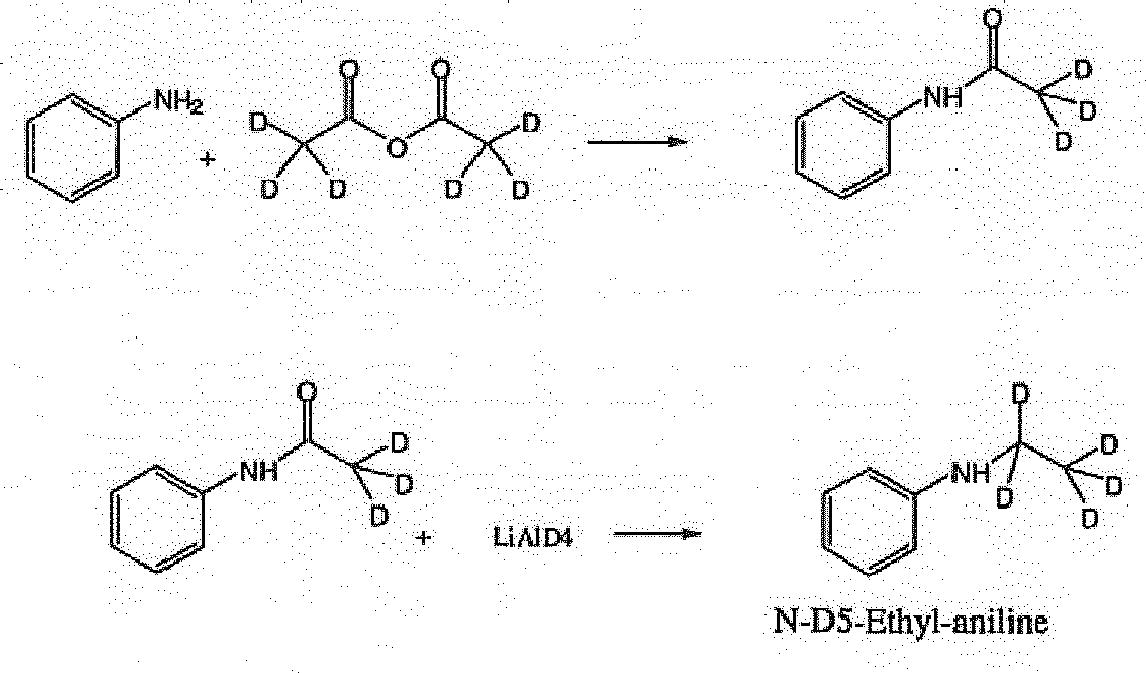
-


- Aniline (0.01 mole) was dissolved in toluene (10 ml), cooled to 0°C under nitrogen, and acetic anhydride (0.02 mole) was added in one portion. The cooling bath was removed and the mixture was stirred for 90 minutes and then evaporated on a rotary evaporator. The intermediate acetanilide was dried in vacuum and then dissolved in THF (20 ml) and cooled to 0°C under nitrogen. Lithium aluminium hydride (0.025 mole) was added during 25 minutes. The mixture was refluxed for 2 hours and then cooled. Silica gel (3 gr) was added followed by addition of 1M NaOH solution (1.8 gr). The mixture was stirred for 30 minutes and then filtered through a pad of sodium sulphate. The filter cake was washed with dimethyl ether and the organic phase was concentrated on a rotary evaporator to give the title compounds.
-

-

-

- N-Ethyl-aniline (0.01 mole) and MCQCA(1.2-Dihydro-4-hydroxy-5-chloro-1-methyl-2-oxo-quinoline-3-carboxylic acid) (2.03 gr, 0.008 mole) were stirred in dichloromethane (32 ml) and triethylamine (4.2 ml) was added. The mixture was cooled in an ice/water bath under nitrogen and thionyl chloride (1.33 gr) was added dropwise during 30 minutes. The mixture was stirred at 0°C for additional 3 hours and then extracted with cold aqueous 1M sulphuric acid. The organic phase was extracted with 1M NaOH solution and the aqueous phase was concentrated a little on a rotary evaporator to remove traces of organic solvents. SM HCl was added to pH 1-1.5 and the resulting suspension stirred for 30 minutes. The precipitated product was filtered, washed with water and dried in vacuum. Deuterated laquinimod was then obtained (86-93% yield).
- Deuterated laquinimod prepared in
Step 2 was suspended in ethanol and treated with 20% aqueous NaOH solution. The precipitated sodium salt was stirred for 3 hours, filtered and washed with ethanol. Drying in vacuum provided deuterated laquinimod sodium salt (92-94% yield). Identity and purity were proven by NMR, MS and HPLC. - Isotopic purity and assay of deuterated compounds 1-3
Compound Isotopic Purity (LC/MS/MS) Assay 1 100.0% 94.0% 2 100.0% 95.4% 3 100.0% 95.6% - DELAQ is formed as a metabolite in rodents as well as in human body upon administration of laquinimod. Several analytical and bioanalytical methods were developed for determination of DELAQ concentrations, as a representative metabolite. The current bioanalytical methods for DELAQ analysis in various matrices are based on LC-MS and have sensitivity at the low pg/mL plasma level.
- The following conditions were used in the determination of DELAQ in human plasma. The plasma is purified by on-line SPE after precipitation with LUDOX AS-40 colloidal silica solution followed by the analysis with HPLC with MS/MS detection.
-
Apparatus LC/MS/MS SCIEX, QTRAP4000 Shimadzu Prominence HPLC System Controller: Shimadzu CBM-20A Pumps: Pump A: Shimadzu LC-20AD Pump B: Shimadzu LC-20AD Pump C: Shimadzu LC-20AB Autosampler: Shimadzu SIL-20AC Column Oven:Shimadzu CTO-20AC Data Acquisition System Analyst 1.4.2 or higher version Column for analysis with Online filter Waters Symmetry Shield RP18, 3.5µm, 2.1 X 100 mm, Javelin 0.2 µm filter (Thermo Electron Corp, No. 88200) or equivalent Column for SPE Phenomenex C18-E, 20µm, 2x20mm Column temperature 30 °C Autosampler temperature: 15 °C Injection volume 160 µL Run time - 7 min (including on-line SPE and analysis) Split ratic None Mobile phase Solution A : 0.01% TFA in Water Solution B : 0.01% TFA in MeOH Rinse liquid 1 200 mM PCA in water Rinse liquid 2Acetone Pretreatment A(Pump A) 0.01% TFA in Water Pretreatment B(Pump B) 0.01% TFA in MeOH -
Apparatus LC/MS/MS SCIEX, QTRAP4000 Shimadzu Prominence HPLC System Controller: Shimadzu CBM-20A Pumps: Pump A: Shimadzu LC-20AD Pump B: Shimadzu LC-20AD Pump C: Shimadzu LC-20AB Autosampler: Shimadzu SIL-20AC Column Oven: Shimadzu CTO-20AC Data Acquisition System Analyst 1.4.2 or higher version Column for analysis with Online filter Waters Symmetry Shield RP18, 3.5µm, 2.1 X 100 mm. Javelin 0.2 µm filter (Thermo Electron Corp, No. 88200) or equivalent Column for SPE Phenomenex C18-E, 20µm, 2x20mm Column temperature 30 °C Autosampler temperature: 15 °C Injection volume 160 µL Run time ∼ 7 min (including on-line SPE and analysis) Split ratio None Mobile phase Solution A : 0.01% TFA in Water Solution B : 0.01% TFA in MeOH Rinse liquid 1 200 mM PCA in water Rinse liquid 2Acetone Pretreatment A (Pump A) 0.01% TFA in Water Pretreatment B (Pump B) 0.01% TFA in MeOH - DELAQ in rat plasma was also determined under the following condition. The plasma was purified by on-line SPE after precipitation with LUDOX AS-40 colloidal silica solution followed by the analysis with HPLC with MS/MS detection.
Apparatus LC/MS/MS SCIEX, QTRAP4000 Shimadzu Prominence HPLC System Controller: Shimadzu CBM-20A Pumps: Pump A: Shimadzu LC-20AD Pump B: Shimadzu LC-20AD Pump C: Shimadzu LC-20AB Autosampler: Shimadzu SIL-20AC Column Oven: Shimadzu CTO-20AC Data Acquisition System Analyst 1.4.2 or higher version Column for analysis with Online filter Waters Symmetry Shield RP18, 3.5µm, 2.1 X 100 mm, Javelin 0.2 µm filter (Thermo Electron Corp, No. 88200) or equivalent Column for SPE Phenomenex C18-E, 20□m, 2x20mm Column temperature 30 °C Autosampler temperature: 15 °C Injection volume 80 µL Run time ∼ 7 min (including on-line SPE and analysis) Split ratio None Mobile phase Solution A : 0.01% TFA in Water Solution B : 0.01% TFA in MeOH Rinse liquid 1 200 mM PCA in water Rinse liquid 2Acetone Pretreatment A (Pump A) 0.01% TFA in Water Pretreatment B (Pump B) 0.01% TFA in MeOH - The main objectives of this example were:
- Quantification of
Compound 1,Compound 2,Compound 3 and Laquinimod in rat plasma using LC/MS/MS bioanalytical method. - Characterization of the pharmacokinetic profile of
Compound 1,Compound 2,Compound 3 and Laquinimod following oral (PO) administration at a dose of 0.2 mg/kg. - The measurement DELAQ concentrations in the collected plasma samples.
- The dose level selected in this example has been used in a pharmacological study previously conducted with laquinimod.
- Rats cannulated at the right common jugular vein by polyethylene tubing were used. In the in-life part, three cannulated female rats were treated with each of the four test articles at dose of 0.2 mg/kg.
- Blood was withdrawn from the rats at five different time points for the preparation of plasma. The concentrations of
Compound 1,Compound 2,Compound 3, laquinimod, and DELAQ were determined in these plasma samples, using applicable LC/MS/MS methods. -
- a. N-ethyl-N-D5-phenyl-1,2-dihydro-4-hydroxy-5-chloro-1-methyl-2-oxoquinoline-3-carboxamide sodium salt (Compound 1) prepared in Example 1:
- Molecular weight: 383.8
- Appearance: White powder
- Storage: 2°-8 °C, protected from light
- Purity: 100 % purity was assumed.
- b. N-D5-ethyl-N-phenyl-1,2-dihydro-4-hydroxy-5-chloro-1-methyl-2-oxoquinoline-3-carboxamide sodium salt (Compound 2) prepared in Example 1:
- Molecular weight: 383,8
- Appearance: White powder
- Storage: 2°-8 °C, protected from light
- Purity: 100 % purity was assumed.
- c. N-D5-ethyl-N-D5-phenyl-1,2-dihydro-4-hydroxy-5-chloro-1-methyl-2-oxoquinoline-3-carboxamide sodium salt (Compound 3) prepared in Example 1:
- Molecular weight: 388.8
- Appearance: White powder
- Storage: 2°-8 °C, protected from light
- Purity: 100 % purity was assumed.
- d. Laquinimod sodium salt
Molecular weight: 378.8
Appearance: White powder
Storage: Controlled room temperature (15°-25 °C), protected from light Assay by HPLC: 100.8 %
Purity: 100 % purity was assumed. - Water, high purity (Direct Q, produced at the laboratory)
-
- Isoflurane for anesthesia (FORANE®, ABBOTT)
- EDTA (Ethylenediaminetetraacetic acid disodium salt dihydrate, Sigma Aldrich, Product No: E4884-100g)
- Heparin sodium salt, From Porcine Intestinal Mucosa, Sigma Aldrich, Product No: H9399-25KU)
-
- Species: rat
- Strain: SD (Sprague Dawley CD rats)
- Health status: SPF
- Age ordered: 8 weeks
- Number of animals: 20 cannulated females
- Weight range ordered: 200-225 g
- Acclimatization: at least 3 days
- At initiation of treatment:
- Number of animals: 12 cannulated females
- Approximate age: 9 weeks
- The SD rat is a suitable rodent species and strain for pharmacokinetic studies and is acceptable to regulatory authorities. In addition, the pharmacokinetic profile of laquinimod in Sprague Dawley rats is well characterized.
- Each animal was identified by indelible marks on the body. The cages were marked with individual cards specifying strain, animal codes, group code, date and time of drug administration, test item and study code.
- The animals were housed in an environmentally controlled room in group caging after the arrival to the facility. Rats were accommodated in individual polycarbonate or polysulphonate cages, with saw chips as matting for the floor.
- Controls were set to maintain temperature at 21±3°C and relative humidity at 30-70 %. A light/dark cycle of 12 hours light /12 hours dark were maintained automatically.
- Tap water filtered through a 0.2µm filter was given ad libitum. The water was routinely analyzed (once every three months) for total microbial count, and for the absence of Pseudomonas aeruginosa, Escherichia coli, and Clostridium sps.
- Altromin VRF1 autoclaved food for rodents was provided ad libitum throughout the study. The diet was periodically analyzed.
- LIGNOCEL (SAWI, wood-shavings) autoclaved bedding was used. The quality of the bedding material is certified by the manufacturer.
- No contaminants were known to be present in the diet, water or bedding at levels which might interfere with the study objectives.
- Each animal was inspected by qualified personnel, and patency of the cannula was verified by the ability to withdraw a blood sample upon animal receipt. Animals judged to be in good health were acclimated for at least 3 days. All animals received a detailed physical examination by the responsible veterinarian on the last day of acclimation period.
- After the acclimation period, animals judged to be in good health and suitable for testing were assigned to the study based on their body weight. At the randomization the body weights of the animals were within ± 20 % of the overall mean.
-
Table 1. Allocation of the cannulated animals to the experimental groups Group-code Dose volume [ml/kg] Administration Test item [0.2 mg/kg*, PO] Dose form [0.04 mg/ml*] Group size/ Animal codes Group 1C 5 Compound 1Compound 13 / 1-3 Group 2C 5 Compound 2Compound 23 / 4-6 Group 3C 5 Compound 3Compound 33 / 7-9 Group code Dose volume [ml/kg] Administration Test item [0.2 mg/kg* PO] Dose form [0.04 mg/ml*] Group size Animal codes Group 4C 5 Laquinimod sodium Laquinimod sodium 3/10-12 *Dose is based on non-deuterated laquinimod free acid form. - The test item molecular weight ratio is 1.0757 for
Compound 1 andCompound 2. The test item molecular weight ratio is 1.0898 forCompound 3. The test item molecular weight ratio is 1.0616 for Laquinimod sodium. These correction factors were applied to adjust the concentrations equivalent to non-deuterated laquinimod free acid. - Oral administration was performed by oral gavage at a dosage volume of 5 ml/kg using a blunt feeding stainless steel needle (Popper & Sons, USA). Body weights were measured before dose administration and doses were calculated on the basis of individual body weight.
- The dose level selected in this study has already been used in a pharmacological study previously conducted with laquinimod. The route of administration will be oral since it is the intended route of human exposure.
- Appropriate amount of the test item was weighed and dissolved in water (vehicle) to achieve the required concentration, which was in each case equivalent to 0.04 mg/mL of non-deuterated laquinimod free acid.
- Dissolution of the test items were achieved by gentle shaking, stirring, low speed vortex or a sonicator. No correction factor was applied to adjust for purity.
- All dosing solutions were stored at 2 - 8°C in tightly closed amber glass containers, protected from light. Prior to use formulations were taken from the refrigerator, and then allowed to reach ambient room temperature (15-25°C). Dosing solutions were assumed to be stable for at least 48 h, based on stability data of similar Laquinimod dosing solutions.
- Before treatment laquinimod concentrations in dosing solutions were determined by validated HPLC methods with UV detection in duplicate samples taken from solutions. The achieved concentrations were within ± 10 % of the nominal concentrations.
- Mortality, sign of illness or severe reaction to treatment was documented.
- Blood were withdrawn from animals at the following time points: 1, 2, 4, 8 and 24 hours after dosing as detailed in the table below. The actual sampling time were recorded.
Table 2. Time points for blood collection Animal codes 1h 2h 4h 8h 24h 1-12 yes yes yes yes yes - Each animal was restrained firmly. After the removal of the seal the port of the cannula was accessed with an appropriate blunted needle mounted on a syringe containing PBS. After having withdrawn approximately 100 µL of blood, the syringe was changed to a clean heparinized syringe. Approximately 250 µL of blood was collected for the preparation of plasma. The first 100 µL fraction of blood was returned and 250 µL of PBS was given to the animal through the catheter. The catheter was filled by heparinized glycerol (100 IU/ml) solution prepared by mixing 10 ml stock heparin (200 IU/ml) with 10 ml of sterile glycerol (d=1.26 g/mL). Blood specimens were mixed immediately and were placed on water ice.
- Centrifugation was carried out as soon as practicable and not more than 40 minutes from collection.
- Whole blood was centrifuged at 2500 g for 10 min at 4°C, and the separated plasma was transferred into pre-labeled polypropylene tubes and the tubes were frozen at -70°C within 70 minutes of collection.
- The frozen samples were transferred to Bioanalytical Laboratory for determination of laquinimod concentration where they were stored at nominal -70°C until analysis.
- The concentrations of test items (
Compound 1,Compound 2,Compound 3 and Laquinimod) and the concentration of DELAQ were determined in the plasma samples by using reliable LC/MS/MS assay. - Pharmacokinetic parameters were calculated and the mean plasma levels versus time curves were evaluated.
- The following pharmacokinetic parameters were determined from the mean plasma concentration-time data (mean of three animals at each time point) of
Compound 1,Compound 2,Compound 3 and Laquinimod.Parameter Definition AUC(0-t) Area under the plasma concentration-time curve from time zero up to time of last detectable concentration (tz) AUC(0-∞) Area under the plasma concentration-time curve from time zero up to infinity Cmax Maximum observed plasma concentration tmax Time of maximum observed plasma concentration t1/2 Apparent terminal elimination half-life - As shown in Tables 3-6 below and in
Figure 2 , the average plasma concentration of deuterium-enriched laquinimod is comparable to that of non-deuterium-enriched laquinimod. - The concentration-time profiles of the test items did not differ significantly. Maximal mean concentrations were reached by 1 or 2 hours after the administration, and varied between 703 and 798 ng/mL. The mean concentrations decreased to 194 - 227 ng/mL by 24 hours post dose. The AUC values for laquinimod,
Compound 1,Compound 2 andCompound 3 were 15506.0, 13783.4, 12289.8 and 15750.2, respectively also indicating no significant difference in exposure.Table 3. Individual and average PK parameters for laquinimod in rats following oral administration at 0.2 mg/kg PK Parameter Cmax (ng/mL) Tmax (hr) T1/2 (hr) AUClast (hr*ng/mL) AUCinf (hr*ng/mL) Rat# 10770.0 2.0 12.0 11013.8 14691.6 Rat# 11 774.8 1.0 12.4 12659.7 17141.8 Rat# 12838.8 2.0 10,9 11487.3 14684.6 Average 794.5 1.7 11.8 11720.3 15506.0 STDEV 38.4 0.6 0.8 847.3 1416.6 Table 4. Individual and average PK parameters for Compound 1 in rats following oral administration at 0.2 mg/kgPK Parameter Cmax (ng/mL) Tmax T1/2 (hr) AUClast (hr*ng/mL) AUCinf (hr*ng/mL) Rat# 1730.7 2.0 12.1 10011.7 13617.9 Rat# 2611.9 2.0 9.5 8039.3 9733.8 Rat# 3809.5 2.0 10.0 10061.6 12447.9 Rat# 13 944.9 1.0 13.4 13681.5 19333.9 Average 774.3 1.8 11.3 10448.5 13783.4 STDEV 139.8 0.5 1.8 2352.1 4042.2 Table 5. Individual and average PK parameters for Compound 2 in rats following oral administration at 0.2 mg/kgPK Parameter Cmax (ng/mL) Tmax T1/2 (hr) AUClast (hr*ng/mL) AUCinf (hr*ng/mL) Rat# 4 827.6 1.0 13.6 10422.1 14699.6 Rat# 5551.4 2.0 13.4 8741.6 12439.0 Rat# 6 816.2 2.0 14.6 11975.3 11975.3 Rat# 15703.6 2.0 13.6 10045.4 10045.4 Average 724.7 1.8 13.8 10296.1 12289.8 STDEV 128.4 0.5 0.5 1331.0 1911.9 Table 6. Individual and average PK parameters for Compound 3 in rats following oral administration at 0.2 mg/kgPK Parameter Cmax (ng/mL) Tmax (hr) T1/2 (hr) AUClast (hr*ng/mL) AUCinf (hr*ng/mL) Rat# 7 728.9 2.0 12.7 11280.4 15225.2 Rat# 8 833.2 1.0 12.0 5317.8 14845.1 Rat# 9 904.3 1.0 11.6 11156.0 14643.7 Rat# 17 907.5 1.0 11.5 12110.0 15790.7 Rat# 18800.4 2.0 14.4 12471.5 18246.2 Average 834.9 1.4 12.4 10467.1 15750.2 STDEV 75.0 0.5 1.2 2931.2 1462.1 - As shown in Tables 7 and 8 below and in
Figure 1 , the amounts of DELAQ formed following oral administration of deuterium-enriched laquinimod is lower than the amount of DELAQ formed following administration of non-deuterium-enriched laquinimod. In average about ten-fold reduction could be observed in the DELAQ concentrations measured in the plasma ofCompound 2 treated animals compared to the plasma of those that were treated with laquinimod. In the former group the mean DELAQ concentrations varied between 18.3 and 75.4 pg/mL, and in the group that received laquinimod it varied between 142 and 878 pg/mL. In both groups the lowest DELAQ concentration was measured at 1 hour following the administration and DELAQ concentrations increased until the last sample was taken at 24 hours post dose.Table 7. Individual and average PK parameters for DELAQ formed from laquinimod in rats following oral administration at 0.2 mg/kg PK Parameter Cmax (pg/mL) Tmax (hr) AUClast (hr*pg/mL) Rat# 10654 24 10369.0 Rat# 11 1123 24 14606.5 Rat# 12858 24 13266.5 Average 878.3 24 12747.3 STDEV 235.2 0 2165.9 Table 8. Individual and average PK parameters for DELAQ formed from Compound 2 in rats following oral administration at 0.2 mg/kgPK Parameter Cmax (pg/mL) Tmax (hr) AUClast (hr*pg/mL) Rat# 4 62.0 24 1146.0 Rat# 582.5 24 1065.3 Rat# 6 77.3 24 1125.5 Rat# 1579.9 24 1318.8 Average 75.4 24 1153.9 STDEV 9.2 0 112.8 - The testing results show that deuterium-enriched laquinimod reduces the formation of DELAQ, while maintaining a similar plasma concentration-time profile to that of non-Deuterated laquinimod.
- The aim of this study was to assess the efficacy of three deuterated forms of laquinimod, compounds 1, 2 and 3, in comparison to laquinimod, using the MOG induced EAE in C57BL/6 mice.
- EAE is an accepted animal model for multiple sclerosis, and induction with MOG in C57BL/6 is a well established model.
- Disease was induced in the mice by the injection of the encephalitogenic emulsion.
-
Compounds -
-
Compounds - laquinimod, manufactured in Teva.
- Purified water (Direct-Q, Millipore).
- Pertussis toxin: Sigma, Code # 2980, lot 044K1449.
- MOG 35-55: Mnf Novatide, lot #90016-71-1.
- Complete Freund's Adjuvant (CFA): Sigma, code: F-5881, lot 104K8930.
- Saline: Mnf- DEMO S.A, Code 05029, lot # 0101610.
- Mycobacterium tuberculosis H37 RA (MT): Mnf- Difco.
- Healthy, nulliparous, non-pregnant female mice of the C57BL/6 strain obtained from Harlan Animal Breeding Center, Israel on 26.01.2010 were used in the study. The animals weighed 15-22 g, and were approximately 7-8 weeks old on arrival. The body weights of the animals were recorded on the day of delivery. Overtly healthy animals were assigned to study groups arbitrarily before treatment commenced. The mice were individually identified by using ear tags. A color-coded card on each cage gave information including cage number, group number and identification. Animals housing and care conditions were maintained.
- EAE was induced by injecting the encephalitogenic mixture (emulsion) consisting of MOG (150.0 µg/mouse) and CFA enriched with M. tuberculosis (1 mg/mL CFA).
- A volume of 0.2 ml of emulsion was injected subcutaneously into the flanks of the mice.
- Pertussis toxin was injected intraperitoneally on the day of induction and 48 hours later (total amount was 0.1 + 0.1=0.200 µg/mouse in 0.2 ml dosage volume).
- The mice were allocated to 6 treatment groups: Vehicle, laquinimod (25 mg/kg and 10 mg/kg), and Compounds 1, 2 and 3, each 10 mg/kg.
- Liquid portion: 15.0 mg MOG was diluted in 10.0 ml Normal Saline to yield 1.5 mg/ml MOG stock solution. The emulsion was made from equal parts of oil and liquid portions (1:1) in two syringes connected to each other with a Leur lock, transferred to insulin syringe and 0.2 ml was injected to the right flank of each mouse.
- 55 µL Pertussis toxin (200 µg/ml) was added to 21.945 ml saline to yield 500 ng/ml. The pertussis toxin was administered intraperitoneally on the day of encephalitogen injection and 48 hours later (100.0 ng/0.2ml/
mouse X 2 = 200.0 ng/mouse). - A concentration of 2.5mg/ml laquinimod was prepared in purified water for dose level 25.0 mg/kg. The test formulation was stored at 2 to 8 °C until use in amber colored bottles. The mice of the 25mg/kg laquinimod group were administered with the laquinimod at volume dose level of 200µl/mouse by oral gavage, once daily (as shown in Table 4b).
- A concentration of 1.0 mg/ml laquinimod was prepared in purified water for conventional laquinimod or
Compounds - The mice were administered with the conventional laquinimod at volume dose level of 200µl/mouse by oral gavage to the laquinimod 10 mg/kg group once daily. Administration of test compounds was performed in a similar fashion. The vehicle (double distilled water) was administered to the negative control group (Group # 1) in a similar manner.
- All animals were examined once daily to detect if any are moribund. Mice were weighed once weekly.
- The mice were observed daily from the 10th day post-EAE induction and EAE clinical signs were scored. The scores were recorded on observation cards according to the grades described in Table 4a below.
Table 4a: Evaluation of the EAE clinical signs Score Signs Description 0 Normal behavior No neurological signs. 1 Limp tail Part or the whole tail is limp and droopy. 2 righting reflex Animal has difficulties rolling onto his feet when laid on its back 3 Hind leg weakness wobbly walk - when the mouse walks the hind legs are unsteady 4 Hind leg paralysis The mouse drags its hind legs but is able to move around using its fore legs 5 Full paralysis The mouse can't move around, it looks thinner and emaciated. 6 Moribund/Death - All mice with
score 1 and above were considered sick. When the first clinical sign appears all mice were given food soaked in water, which was spread on different places on the bedding of the cages. For calculation purposes, the score of animals that were sacrificed or died (6) was carried forward. - The number of sick animals in each group were summed. The incidence of disease was calculated as

- The percent inhibition according to incidence was calculated as

- The number of dead or moribund animals in each group were summed. The mortality of disease was calculated as

- The percent inhibition according to mortality was calculated as

- The mean duration of disease expressed in days was calculated as

- The mean onset of disease expressed in days was calculated as

- The mean delay in onset of disease expressed in days was calculated by subtracting the mean onset of disease in control group from test group.
- The mean maximal score (MMS) of each group was calculated as

- The percent inhibition according to MMS was calculated as

- The daily scores of each mouse in the test group were summed and the individual mean daily score (IMS) was calculated as

- The mean group score (GMS) was calculated as

- The percent inhibition was calculated as

- A summary of the incidence, mortality, MMS, GMS, duration of the disease, onset of the disease and the activity of each group is shown in Table 4b below.
Table 4b. Mortality, incidence, MMS, GMS, Duration and Onset of EAE activity compared to vehicle Treatment Morality Incidence % inhibition 1 MMS value % inhibition GMS value % inhibition 3 Mean Duration (days) Mean Onset (days) Vehicle Water 0/15 14/15 - 3.2±1.3 - 2.21 ± 0.98 - 19.1 ± 5.5 11.9 ± 5.5 laquinimod (25 mg/kg) 0/15 4/15 71.4 % 1.3±1.8 59.4 % (p<0.001) 0.5±0.13 97.7 % (p<0.001) 3.0±5.8 (p<0.001) 28.0±5.8 (p<0.001) Laquinimod (10 mg/kg) 0/15 9/15 35.7 % 2.1±1.9 34.4 % p=0.17) 1.14±0.5 48.4% (p=0.01) 9.3±8.3 (p<0.001) 21.6±8.4 (p<0.001) Compound 2 (10 mg/kg) 0/15 13/15 7.1 % 2.1±1.3 34.4 % (p=0.02) 0.79±0.2 64.3 % (p=0.001) 13.2±7.7 (p=0.004) 15.3±6.8 (p=0.01) Compound 3 (10 mg/kg) 0/15 10/15 28.6 % 1.6±1.6 50.1 % (p=0.01) 0.89±0.94 59.7 % (p=0.001) 9.6±9.4 (p=0.001) 21.5±9-3 (p<0.001) Compound 1 (10 mg/kg) 0/15 8/15 42.9 % 1.5±1.7 53.1 % (p=0.01) 0.74±0.86 66.5 % (p<0.001) 7.9±8.2 (<0.001) 22.1±8.9 (p<0.001) - 14/15 mice were sick due to EAE in the vehicle treated control group. In the group treated with laquinimod (10 mg/kg), 9/15 mice were sick compared to 13/15, 10/15, and 8/15 in groups treated with
compounds - There was a delay in the appearance of clinical signs in all groups treated with laquinimod (10 mg/kg) with onset between 15.3 and 22.1 days compared to control group (onset 11.9±5.5 days). The duration of EAE clinical signs in these treatment groups compared to the vehicle treated control group was between 7.9 and 13.2 days compared to 19.1±5.5 days in control group.
- The MMS and GMS of the vehicle treated negative control group were 3.2±1.3 and 2.2±1.0, respectively. The positive laquinimod (25 mg/kg) control group exhibited 59.4% and 97.7% inhibition of EAE according to MMS (score 1.3±1.8) and GMS (score 0.5±0.1), respectively.
- When the groups treated with
Compound Compound - As shown in
Figure 3 , on GMS scale, the laquinimod (10mg/kg) group exhibited 48.4% activity compared to 64.3%, 59.7% and 66.5% activity in groups treated withCompound - The testing results show that deuterium-enriched laquinimod reduces the formation of metabolites, in particular optionally deuterated DELAQ, while maintaining a similar plasma concentration-time profile to that of non-deuterated laquinimod.
- The testing results also show that deuterium-enriched laquinimod are as active as or better than laquinimod in the inhibition of EAE clinical signs. The results of the study permit developing dosing parameters for deuterium-enriched laquinimod.
- The objective of this study was to investigate the effects of treating primary cultures of fresh human hepatocytes with laquinimod or
Compound 2 on the expression of CYP enzymes. - Cultured hepatocytes have proven to be a reliable test system for evaluating the inductive effects of NCEs. Hepatocytes can be isolated from non-transplantable human livers (Bjornsson et al., (2003), The conduct of in vitro and in vivo drug-drug interaction studies: a Pharmaceutical Research and Manufacturers of America (PhRMA) perspective. Drug Metab Dispos 31:815-832; Mudra and Parkinson, (2001), Preparation of hepatocytes, in Current Protocols in Toxicology, Volume 2 (Maines MD ed) unit 14.2, 13 p, John Wiley and Sons, Inc., New York, New York) and cultured in a confluent monolayer (LeCluyse et al., (1994), Formation of extensive canalicular networks by rat hepatocytes cultured in collagen-sandwich configuration. Am J Physiol 266 (Cell Physiol. 35): C1764-C1774). After two to three days in culture, these cells regain their morphological integrity, and treatment with prototypical inducers results in the induction of appropriate CYP enzymes (LeCluyse et al., (1996), Cultured rat hepatocytes, in Pharmaceutical Biotechnology. Vol. 8, Models for Assessing Drug Absorption and Metabolism. (Borchardt RT, Wilson G and Smith P eds) pp 121-159, Plenum Press, New York; Robertson et al., (2000), In vitro inhibition and induction of human hepatic cytochrome P450 enzymes by modafinil. Drug Metab Dispos 28:664-671; Madan et al., (2003), Effects of prototypical microsomal enzyme inducers on cytochrome P450 expression in cultured human hepatocytes. Drug Metab Dispos 31:421-431). For this reason, it is acceptable to use cultured human hepatocytes to determine the potential of NCEs to cause induction of CYP enzymes.
- This study was designed to allow any inductive effects of the test articles to be classified relative to two mechanistically distinct and clinically relevant CYP inducers, namely omeprazole (an AhR activator and CYP1A2 inducer) and rifampin (a PXR agonist and inducer of CYP3A4) (Parkinson and Ogilvie, (2008), Biotransformation of xenobiotics, in Casarett & Doull's Toxicology, The Basic Science of Poisons. Seventh Edition, (Klaassen CD ed) pp 161-304, The McGraw Hill Companies, Inc., New York). To this end, one preparation of cultured human hepatocytes from one liver was treated once daily for three consecutive days with DMSO (0.1% v/v, vehicle control), one of five concentrations of laquinimod (0.01, 0.05, 0.1,1 or 10 µM) or Compound 2 (0.01, 0.05, 0.1, or 10 µM).
- After treatment, the cells were incubated in situ with marker substrates for the analysis of phenacetin O-dealkylation (marker for CYP1A2) and midazolam 1'-hydroxylation (marker for CYP3A4/5) by LC/MS/MS. Following the in situ incubation, the same hepatocytes from the same treatment groups were harvested with TRIzol to isolate RNA, which was analyzed by qRT-PCR to assess the effect of laquinimod and
Compound 2 on CYP1A2 and CYP3A4 mRNA levels. The study design, the test system and the selection and concentration of probe substrates used in this study were based on recommendations in the FDA's Draft Guidance Document on Drug Interaction Studies-Study Design, Data Analysis, and Implications for Dosing and Labeling and current FDA review articles (Food and Drug Administration, (2006), Draft Guidance for Industry: Drug Interaction Studies--Study Design, Data Analysis, and Implications for Dosing and Labeling, pp 55, U.S. Department of Health and Human Services, Rockville, MD; Huang et al., (2008), New Era in Drug Interactions Evaluation: US Food and Drug Administration Update on CYP Enzymes, Transporters, and the Guidance Process. J Clin Pharmacol 48: 662-670; Zhang et al., (2009), Predicting Drug-Drug Interactions: An FDA Perspective. The AAPS Journal 11:300-306) and the PhRMA perspective on enzyme induction (Chu et al., (2009), In vitro and in vivo induction of cytochrome P450: a survey of the current practices and recommendations: a Pharmaceutical Research and Manufacturers of America (PhRMA) perspectice. Drug Metab Dispos 27029 (87pp) doi: 10.1124/dmd.109.0270). -
Enzyme Reagent use Name Manufacturer CYP1A2 Substrate Phenacetin Sigma-Aldrich Substrate metabolite Acetaminophen Sigma-Aldrich Internal standard Acetaminophen-d4 Proprietary information CYP3A4/5 Substrate Midazolam Sigma-Aldrich Substrate metabolite 1'-Hydroxymidazolam Cerilliant Internal standard 1'-Hydroxymidazolam-d4 Proprietary information -
Assay Name Manufacturer qRT-PCR RNase-free water Fisher Scientific qRT-PCR High-capacity cDNA reverse transcription kit with RNase-inhibitor Applied Biosystems qRT-PCR TaqMan universal master mix Applied Biosystems qRT-PCR TaqMan gene expression assays Applied Biosystems qRT-PCR TRIzol reagent Invitrogen qRT-PCR Chloroform Fisher Scientific qRT-PCR 2-Propanol Fisher Scientific qRT-PCR Ethanol 200 proof Sigma-Aldrich qRT-PCR 1X tris-EDTA, pH 8.0 Ambion qRT-PCR RNeasy mini kit Qiagen qRT-PCR RNase-free DNase set Qiagen qRT-PCR Proteinase K Qiagen qRT-PCR RNA 6000 Nano LabChip kit Agilent Technologies -
Name Manufacturer Aceonitrile Fisher Scientific Ammonium acetate Sigma-Aldrich Carbon dioxide Helget Gas Dexamethasone Sigma-Aldrich DMSO Sigma-Aldrich EDTA Sigma-Aldrich Ethanol Fisher Scientific Formic acid EM Science ITS + BD Biosciences L-Arginine Sigma-Aldrich L-Glutamine Sigma-Aldrich Magnesium chloride Sigma-Aldrich Methanol Fisher Scientific Methylene chloride (dichloromethane) Sigma-Aldrich Mibefradil Sigma-Aldrich Modified Eagle Medium (MCM) (Dr. Chee's Modification) Invitrogen Omeprazole Sigma-Aldrich Penicillin-Streptomycin (Pen-Strep) Invitrogen Potassium hydroxide Fisher Scientific or Gentest Potassium phosphate (monobasic and dibasic) Mallinckrodt Baker Rifampin Sigma-Aldrich Sodium bicarbonate Sigma-Aldrich Sodium carbonate Fisher Scientific Sodium chloride solution (endotoxin tested) Sigma-Aldrich Sodium hydroxide Fisher Scientific Sterile high purity water XenoTech Sucrose Sigma-Aldrich Thymidine Sigma-Aldrich Tris Sigma-Aldrich - One preparation of freshly isolated human hepatocytes (hereafter, referred to as H971) supplied by XenoTech, LLC at 16825 West 116th Street, Lenexa, KS 66219, was treated in this study.
- Hepatocyte cultures were treated daily for three consecutive days and cultured according to SOP L5021.01 (XenoTech, LLC) and previously described methods (Robertson et al., (2000), In vitro inhibition and induction of human hepatic cytochrome P450 enzymes by modafinil. Drug Metab Dispos 28:664-671; Madan et al., (2003), Effects of prototypical microsomal enzyme inducers on cytochrome P450 expression in cultured human hepatocytes. Drug Metab Dispos 31:421-431; Paris et al., (2009). In vitro inhibition and induction of human liver cytochrome P450 (CYP) enzymes by milnacipran. Drug Metab Dispos 37:2045-2054). Cultures were treated with supplemented MCM (each well was treated with 0.2 mL) containing 0.1% DMSO (vehicle, negative control), one of five concentrations of laquinimod (0.01, 0.05, 0.1, 1 or 10 µM) or Compound 2 (0.01, 0.05, 0.1. 1 or 10 µM), mibefradil (10 µM) or one of two known human CYP enzyme inducers, namely, omeprazole (100 µM) and rifampin (10 µM), positive controls.
- Approximately 24 hours after the last treatment, hepatocytes were lysed in TRIzol reagent after the in situ marker substrate incubations, and cell lysates were stored at -75 ± 5°C. For human hepatocyte preparation H971, media from six wells per treatment group was aspirated, and approximately 132 µL TRIzol were added to each well. The cell lysates were mixed by repeated pipetting. Total RNA was isolated from the cell lysates using the TRIzol protocol (Invitrogen) and was purified using the RNeasy Mini Kit (Qiagen Inc.) according to SOP L6161.02. RNA quality and concentration were determined by measuring absorbance at 260 and 280 nm on a BioTek Synergy HT plate reader (BioTek Instruments, Inc.) with KC4 Signature software (version 3.4 Rev 21, BioTek Instruments, Inc.) according to SOP L6162.02. The analysis of RNA integrity was carried out with the RNA 6000 Nano Assay Kit on an Agilent 2100 Bioanalyzer (Agilent Technologies, Inc.) according to SOP L6162.02. Single-stranded cDNA was prepared from RNA with the RT Master Mix using the AB 7300 Real Time PCR system thermocycling program or AB 7900HT Fast Real Time PCR System thermocycling program (Applied Biosystems) according to SOP L6160.04. The RT Master Mix is comprised of 10X RT buffer, 25X deoxyNTPs, 10X Random hexamers, RNase Inhibitor (20 U/µL), MultiScribe reverse transcriptase (50 U/µL) and RNase-free water. The RT Master Mix was added to each RNA sample to complete the components of the reaction. No template controls (NTCs) were included in the analysis. For the NTC reactions, RNase-free water was added in place of the RNA sample. The cDNA prepared samples were stored at -20 ± 5°C prior to analysis by qRT-PCR.
- Laquinimod sodium was prepared according to the procedures described in in
U.S. Patent No. 6,077,851 andCompound 2 was prepared according to the procedures described in Example 1.Laquinimod Compound 2 Storage of test article: Locked storage at 2 to 8 °C), protected from light and Locked storage at 2 to 8 °C), protected from light and moisture moisture Quantity received: 53.09 mg 50.58 mg Molecular mass: 378.78 g/mol (sodium salt) 383 g/mol 356.80 g/mol (free acid) Purity: 100% 95.4% Appearance: White powder Pale yellow Solvent used for dissolution: High purity sterile water High purity sterile water Concentration of stock solutions: 0.01, 0.05, 0.1, 1, 2, 10 and 20 mM 0.01, 0.05, 0.1, 1 and 10 mM Concentration of working solutions: 0.01, 0.05, 0.1, 1,2, 10 and 20 µM (stock diluted in supplemented MCM medium; final concentration of DMSO in culture medium = 0.1% v/v) 0.01, 0.05, 0.1, 1 and 10 µM (stock diluted in supplemented MCM medium ; final concentration of DMSO in culture medium = 0.1% v/v) Storage of stock solutions: -20 ± 5 °C -20 ± 5°C - A solution of laquinimod or Compound 2 (10 mM in high purity sterile water) was prepared by dissolving the appropriate amount of either laquinimod or
Compound 2 in high purity sterile water. For laquinimod, the 10 mM stock solution was diluted with high purity sterile water to 2, 1 and 0.1 µM. Furthermore, the 1 µM solution was diluted with high purity sterile water to 0.05 and 0.01 mM. ForCompound 2, the 10 mM stock solution was then diluted with high purity sterile water to 1 and 0.1 µM. Furthermore, the 1 µM solution was diluted with high purity sterile water to 0.05 and 0.01 mM. The solutions of laquinimod and Compound 2 (all mM concentrations) were divided into a sufficient number of aliquots to be used individually in the study and were protected from light with amber glassware or aluminum foil and stored frozen (-20 ± 5°C) with a two month expiration date. - Prior to treatment each day, an aliquot of the laquinimod and
Compound 2 stock solutions were conditioned to room temperature and gently shaken or vortexed on a low setting. Stock solutions of laquinimod (0.01, 0.05, 0.1, 1 and 10 mM) and Compound 2 (0.01, 0.05, 0.1, 1 and 10 mM) were then diluted in cell culture media (1:1000 dilution) and the resulting working dose solution was added to the hepatocyte cultures to give the final concentrations of laquinimod (0.01, 0.05, 0.1, 1 and 10 µM) and Compound 2 (0.01, 0.05, 0.1, 1 and 10 µM) within two hours of dilution (approximately 15 minutes to 65 minutes). A qualitative visual examination of the stock and dosing solutions was conducted prior to application to the hepatocytes in order to determine solubility in the test system. - Just prior to treatment, on each day of treatment, and just prior to incubation of the marker substrates, spent culture medium (spent dosing media) were collected from the vehicle, laquinimod and
Compound 2 treatment groups. Approximately 150 µL was collected from each of three wells, from each aforementioned treatment groups, and pooled for each sample to a final volume of approximately 450 µL. These spent media samples were analyzed for residual laquinimod,Compound 2 and the de-ethylated metabolite (DELAQ). - The following chemicals or vehicles were used for dosing hepatocytes.
chemical Catalog number Lot number Storage conditionsa Vehicle Purity Supplior DMSO D2650 079K2305 Room Not Not Sigma-Aldrich 089K2310 temperature applicable applicable Omeprazole O104 079K1504 2 to 8 °C DMSO 99% Sigma-Aldrich Rifampin R3501 115K1498 -20 ± 5 °C DMSO 100% Sigma-Aldrich Mibefradil M5441 026K47034 Room temperature High purity water 99% Sigma-Aldrich a Storage conditions of neal compound - Omeprazole and rifampin and were dissolved in DMSO such that the final concentration of DMSO in the culture medium was 0.1% v/v. Mibefradil was prepared in high sterile purity water. According to SOP L5021.01 (XenoTech, LLC), working solutions of vehicle and positive controls were prepared fresh from the stock solution less than two hours prior to treatment on each treatment day (approximately 15 minutes to 65 minutes).
- Incubations of hepatocytes with probe substrates were conducted in accordance with SOP L5041.02. Approximately 24 hours after the last treatment, spent media was aspirated from the wells, and each well was rinsed two times with pre-warmed (37
t 2 °C) fresh culture media. Media was aspirated from the wells and reactions were started by addition of 200 µL pre-warmed media containing the probe substrate to each well. The culture multi-well plates were placed in a humidified culture chamber (37 ± °C at 95% relative humidity, 95/5% air/CO2), and incubations were carried out for 30 minutes (Table 1). At 30 minutes, an aliquot (150 µL) of the incubation mixture was removed and added to a well of a 96-well plate containing 300 µL of stop reagent (acetonitrile) and internal standard (Table 2). The mixtures were mixed thoroughly and allowed to sit for at least 15 minutes at 2 - 8 °C. Samples were centrifuged at 2000 × g for 10 minutes at 2 - 8 °C, and supernatant fractions were analyzed by LC/MS/MS. For each assay, incubations were carried out under the conditions indicated in Table 1.Table 1: Summary of assay conditions to measure microsomal CYP enzyme activity Enzyme Substrate Substrate concentration (µm) Subtrate solvent (v/v, final incubation concentration) Incubation time (min) CYP1A2 Phenacelin 100 Methanol (0.4%) 30 CYP3A4/5 Midazolam 30 Methanol (1%) 30 volume = 200 µL Table 2: Summary of metabolite analysis by liquid chromatography tandam mass spectrometry Enzyme Metabolite monitored ionization modea Analytical SOP followed Internal standard Internal standard concentration (ng/mL)a CYP1A2 Acetaminophen ESI- 18120.06 Acetaminophen-d4 300 CYP3A4/5 1'Hydroxymidazolam ESI+ 18170.05 1'Hydroxymidazolam-d4 1000 a Indicates the type of ionization (i.e., electro ionization (ESI)) and the polarity (+ or -).
b Value indicates the stock concentration of the internal standard. This concentration is when added to the stopped incubation mixture. - Standards and quality control samples were similarly prepared with the addition of authentic metabolite standards.
- All analyses were performed with validated LC/MS/MS methods. The procedures used for the analysis of each metabolite followed the applicable LC/MS/MS analytical method SOPs and are summarized in Table 2. The MS equipment was either an ABI Sciex (Applied Biosystems/MDS SCIEX) API 4000 or API 3000 instrument with Shimadzu HPLC pumps and autosampler systems.
Enzyme Metabolite monitored API instrumenta HPLC columnb CYP1A2 Acetaminophen 3000 Waters Atlantis dC18 CYP3A4/5 1'-Hydroxymidazolam 4000 (5-µm, 100 mm × 2.1 mm) a Model of LC/MS/MS system from Applied Biosystems/MDS SCIEX.
b All HPLC columns were preceded by a Phenomenex Luna C-8 guard column (4.0 mm × 2.0 mm). - Authentic metabolite standards were used, and deuterated metabolites were used as internal standards in all assays. Zero-time incubations served as blanks. Sample analysis, integration and reporting were conducted according to SOP L8013.02, L8020.02 and L8011.02 (XenoTech, LLC), respectively.
- Metabolites were quantified by reference to a standard calibration curve based on back calculation of a weighted (1/x), linear, least-squares regression. The regression fit was based on the peak ratio of the analyte to internal standard calculated from calibration standard samples, which were prepared from authentic metabolite standards. Peak areas were integrated with Applied Biosystems/MDS SCIEX Analyst data system, version 1.4.2.
- Quantitative RT-PCR was carried out according to SOP L6160.04 (XenoTech, LLC) and the Applied Biosystems protocol. Each PCR was performed in triplicate. A Primer Mix was prepared for each Gene Expression assay. A typical Primer Mix contained TaqMan Universal Master Mix (IX), Gene Expression Assay (1X, 900 nM forward and reverse primers) and RNase-free water. The Reaction Mix was prepared by adding the Primer Mix to cDNA. A percentage of samples (no less than 10%) included NACs. (NACs are RNA samples that are not reverse transcribed and are used to show that mRNA, not genomic DNA, is the source of PCR's fluorescent signal.) Reactions were analyzed on an Applied Biosystems Real Time PCR sequence detection system (AB 7300 or AB 7900HT). The relative quantity of the target cDNA compared with that of the control cDNA (GAPDH) was determined by the ΔΔCt method (Applied Biosystems User Bulletin #2). Relative quantification measures the change in mRNA expression in a test sample relative to that in a control sample (e.g., DMSO). This method assumes that the efficiency of the target amplification and the efficiency of the endogenous control amplification are approximately equal.
- Data were processed and graphed with the computer program Microsoft Excel 2003 (Microsoft Inc.). Individual rates of reaction from like treatment groups were averaged, and for those groups with n ≥ 3, standard deviations were determined. Fold increases were determined by dividing the enzymatic rate for each treatment group by that of the vehicle control. Percent positive control was calculated with the following equation:

- For qRT-PCR, data were processed using the Sequence Detection System (SDS) Software version 1.4, for Relative Quantification (Applied Biosystems). This software analyzes relative gene expression using the comparative Ct method (ΔΔCt), which relates the PCR signal of the target transcript to the PCR signal of the target in an untreated control. Both the treated sample and the untreated control signals are normalized to the endogenous control (GAPDH), for which expression is not affected by treatment and expression is constant throughout the tissue being tested. The results of this method are expressed as a fold change in expression with respect to the target transcript expression in the untreated control.
- Calculations are as follows:
- 1. ΔCt = Ct (target) - Ct (endogenous control)
- 2. ΔΔCt = ΔCt (treated sample) - ΔCt (untreated control)
- 3. Fold change in expression = 2-ΔΔCt
- An algorithm within the software automatically removed outliers from analysis. The criteria for acceptance of data are proprietary to Applied Biosystems. Outliers are considered to be wells with Ct values that differ significantly from associated replicate wells and typically are wells that did not amplify sufficiently if at all.
- The level of mRNA expression relative to the positive control was calculated as follows:

- The effects of treating human hepatocytes with laquinimod and
Compound 2 on CYP enzyme activity and mRNA levels are shown in Tables 3-7. Unless otherwise noted, the data in the figures and tables are presented as the mean ± standard deviation of data from triplicate incubations from one human preparation, rounded to three significant figures. The average fold-increases are summarized in Tables 4 and 6. Fold increase is presented either as fraction of control or as fold increase over control, where the control refers to the corresponding vehicle-treated samples. Fold increase was rounded to three significant figures. Comparison of the test article to the prototypical inducer (percent positive control) is shown in Tables 5 and 7, and was rounded to three significant figures.Table 3: CYP activity: The effects of treating cultured human hepatocytes with laquinimod, Compound 2 or prototypical inducers on in situ cytochrome P450 (CYP) enzyme activityEnzyme activity (pmol/mg protein/min)a Treatment Concentration Phenacetin O-dealkylation (CYP1A2) Midazolam 1'-hydroxylation (CYP3A4/5) Dimethyl sulfoxide 0.1% (v/v) 2.99 ± 0.13 0.195 ± 0.011 Laquinimod 0.01 µM 25.2 ± 0.8 0.180 ± 0.023 Laquinimod 0.05 µM 54.0 ± 4.5 0.161 ± 0.013 Laquinimod 0.1 µM 65.1 ± 1.9 0.151 ± 0.002 Laquinimod 1 µM 131 ± 12 0.106 ± 0.004 laquinimod. 10 µM 183 ± 7 0.0957 ± 0.0067 Compound 20.01 µM 22.1 ± 2.7 0.179 ± 0.006 Compound 20.05 µM 31.6 ± 2.6 0.151 ± 0.009 Compound 20.1 µM 48.2 ± 2.4 0.140 ± 0.010 Compound 21 µM 90.8 ± 11.5 0.109 ± 0.010 Compound 210 µM 180 ± 8 0.101 ± 0.003 Omeprazole 100 µM 84.9 ± 5.4 NA Mibefradil 10 µM 11.3 ± 2.1 NA Rifampin 10 µM NA 0.941 ± 0.019 a Values are the mean ± standard deviation of triplicate determinations of human hepatocyte preparation H971 rounded to three significant figures. Table 4: CYP activity fold increase: The effects of treating cultured human hepatocytes with laquinimod, Compound 2 or prototypical inducers on in situ cytochrome P450 (CYP) enzyme activityFold Increasea Treatment Concentration Phenacetin O-dealkylation (CYP1A2) Midazolam 1'-hydroxylation (CYP3A4/5) Dimethyl sulfoxide 0.1%(v/v) 1.00 1.00 Laquinimod 0.01 µM 8.43 0.92 Laquinimod 0.05 µM 18.06 0.82 Laquinimod 0.1 µM 21.75 0.78 Laquinimod 1 µM 43.79 0.54 Laquinimod 10 µM 61.02 0.49 Compound 20.01 µM 7.39 0.91 Compound 20.05 µM 10.54 0.77 Compound 20.1 µM 16.12 0.72 Compound 21 µM 30.36 0.56 Compound 210 µM 60.21 0.51 Omeprazole 100 µM 28.38 NA Mibefradil 10 µM 3.76 NA Rifampin 10 µM NA 4.82 a Values are the results of human hepatocyte preparation H971 rounded to three significant figures. Table 5: CYP activity percent positive control: The effects of treating cultured human hepatocytes with laquinimod, Compound 2 or prototypical inducers on in situ cytochrome P450 (CYP) enzyme activityPercent positive controla Treatment Concentration Phenacetin O-dealkylation (CYP1A2) Midazolam 1'-hydroxylation (CYP3A4/5) Dimethyl sulfoxide 0.1% (v/v) 0 0 Laquinimod 0.01 µM 27.1 -2.04 Laquinimod 0.05 µM 62.3 -4.63 Laquinimod 0.1 µM 75.8 -5.89 Laquinimod 1 µM 156 -12.0 Laquinimod 10 µM 219 -13.4 Compound 20.01 µM 23.3 -2.24 Compound 20.05 µM 34.9 -5.94 Compound 20.1 µM 55.2 -7.46 Compound 21 µM 107 -11.5 Compound 210 µM 216 -12.7 Omeprazole 100 µM 100 ND Mibefradil 10 µM 10.1 ND Rifampin 10 µM ND 100 a Values are the results of human hepatocyte preparation H971 rounded to three significant figures. ND Not determined.
For CYP1A2, the positive control is omeprazole and the vehicle control is DMSO.
For CYP3A4/5, the positive control is rifampin and the vehicle control is DMSO.Table 6: mRNA fold increase: The effects of treating cultured human hepatocytes with laquinimod, Compound 2 or prototypical inducers on microsomal cytochrome P450 (CYP) mRNA levels as determined by qRT-PCR (post in situ incubations)Fold increasea Treatment Concentration CYP1A2 CYP3A4 Dimethyl sulfoxide 0.1% (v/v) 1.00 1.00 Laquinimod 0.01 µM 4.22 0.621 Laquinimod 0.05 µM 7.90 0.347 Laquinimod 0.1 µM 9.50 0.427 Laquinimod 1 µM 16.8 0.286 Laquinimod 10 µM 20.5 0.636 Compound 20.01 µM 2.84 0.437 Compound 20.05 µM 4.98 0.428 Compound 20.1 µM 7.20 0.339 Compound 21 µM 13.1 0.252 Compound 210 µM 24.3 0.689 Omeprazole 100 µM 8.58 NT Mibefradil 10 µM 0.423 NT Rifampin 10 µM NT 4.63 a Values are the results of human hepatocyte preparation H971 rounded to three significant figures. NT Not tested by study design. Table 7: mRNA percent positive control: The effects of treating cultured human hepatocytes with laquinimod, Compound 2 or prototypical inducers on microsomal cytochrome P450 (CYP) mRNA levels as determined by qRT-PCR (post in situ incubations)Percent positive control a Treatment Concentration CYP1A2 CYP3A4 Dimethyl sulfoxide 0.1% (v/v) 0 0 Laquinimod 0.01 µM 425 -10.4 Laquinimod 0.05 µM 91.1 -18.0 Laquinimod 0.1 µM 112 -15.8 Laquinimod 1 µM 209 -19.7 Laquinimod 10 µM 257 -10.0 Compound 20.01 µM 24.2 -15.5 Compound 20.05 µM 52.5 -15.8 Compound 20.1 µM 81.7 -18.2 Compound 21 µM 159 -20.6 Compound 210 µM 307 -8.57 Omeprazole 100 µM 100 ND Mihefradil 10 µM -7.61 ND Rifampin 10 µM ND 100 a Values are the results of human hepatocyte preparation H971 rounded to three significant figures.
ND Not determined
For CYP1A2, the positive control is omeprazole and the vehicle control is DMSO.
For CYP3A4, the positive control is rifampin and the vehicle control is DMSO. - At the time of isolation the viability of the human hepatocyte preparation was 70.9%. During and after the 72-hour adaptation period, the culture was observed daily by light microscopy and judged to be morphologically normal with confluency adequate for treatment with test and control articles. Within 24 hours after the final treatment, hepatocytes were photographed to document their morphological integrity and any overt signs of toxicity of the test articles. Representative photomicrographs are maintained at the Testing Facility. These photomicrographs show that, in general, human hepatocytes treated with vehicle (DMSO), laquinimod and
Compound 2 or known CYP inducers exhibited normal hepatocyte morphology. Prior to and during treatment, human hepatocyte cultures formed confluent monolayers with few intercellular spaces; they were cuboidal and contained intact cell membranes and granular cytoplasm with one or two centrally located nuclei. Treatment of human hepatocyte culture H971 with laquinimod,Compound 2 or laquinimod and mibefradil resulted in no changes in cell morphology. - In cultured human hepatocytes, phenacetin O-dealkylation is catalyzed by CYP1A2, which is the major omeprazole-inducible CYP enzyme. The effects of treating cultured human hepatocytes with laquinimod or
Compound 2 on in situ phenacetin O-dealkylase (CYP1A2) activity are shown in Table 3 and summarized in Table 4. Treatment of cultured human hepatocytes once daily for three consecutive days with omeprazole caused, on average, a 28.4-fold increase in phenacetin O-dealkylase (CYP1A2) activity. - Treatment of hepatocyte culture H971 with laquinimod (up to 10 µM) caused a concentration-dependent increase, up to 61.0-fold in CYP1A2 activity compared to the vehicle control. At the concentrations tested (0.01 µM to 10 µM), laquinimod was 21.7% to 291% as effective as the positive control omeprazole, at inducing CYP1A2 activity. In addition, treatment, once daily for three consecutive days with mibefradil alone resulted in a 3.76-fold increase in CYP1A2 activity.
- Furthermore, treatment of hepatocyte culture H971 with Compound 2 (up to 10 µM) caused a concentration-dependent increase up to 60.2-fold in CYP1A2 activity compared to the vehicle control. At the concentrations tested (0.01 µM to 10 µM),
Compound 2 was 23.3% to 216% as effective as the positive control omeprazole, at inducing CYP1A2 activity. - The effects of treating cultured human hepatocytes with laquinimod and
Compound 2 on CYP1A2 mRNA expression are shown in Table 6. Treatment of cultured human hepatocytes once daily for three consecutive days with omeprazole caused, on average, an 8.58-fold increase in CYP1A2 mRNA levels. - Similar to CYP1A2 activity, treatment of hepatocyte culture H971 with laquinimod (up to 10 µM) caused a concentration-dependent increase up to 20.5-fold in CYP1A2 mRNA levels compared to the vehicle control. At the concentrations tested (0.01 µM to 10 µM), laquinimod was 42.5% to 257% as effective as the positive control omeprazole, at inducing CYP1A2 mRNA levels. Contrary to CYP1A2 activity, treatment, once daily for three consecutive days with mibefradil alone caused a 57.7% decrease in CYP1A2 mRNA levels, compared to vehicle control.
- Furthermore, treatment of hepatocyte culture H971 with Compound 2 (up to 10 µM) caused a concentration-dependent increase, up to 24.3-fold in CYP1A2 mRNA levels compared to the vehicle control. At the concentrations tested (0.01 µM to 10 µM),
Compound 2 was 24.2% to 307% as effective as the positive control omeprazole, at inducing CYP1A2 mRNA levels. - In cultured human hepatocytes, midazolam 1'-hydroxylation is catalyzed by CYP3A4/5. CYP3A4 is the major rifampin-inducible CYP enzyme. The effects of treating cultured human hepatocytes with laquinimod and
Compound 2 on in situ midazolam 1'-hydroxylase (CYP3A4/5) activity are shown in Table 3 and summarized in Table 4. Treatment of cultured human hepatocytes once daily for three consecutive days with rifampin caused an increase (4.82-fold) in midazolam 1'-hydroxylase activity. - Treatment of hepatocyte culture H971 with either laquinimod (up to 10 µM) or Compound 2 (up to 10 µM) caused a concentration-dependent decrease in CYP3A4/5 activity by 50.9% and 48.2%, respectively, compared to the vehicle control.
- The effects of treating cultured human hepatocytes with laquinimod and
Compound 2 on CYP3A4 mRNA expression are shown in Table 6. Treatment of cultured human hepatocytes once daily for three consecutive days with rifampin caused a 4.63-fold increase in CYP3A4 mRNA levels. - Similar to CYP3A4/5 activity, treatment of hepatocyte culture H971 with either laquinimod (up to 10 µM) or Compound 2 (up to 10 µM) caused a concentration-dependent decrease by 36.4% and 31.1% compared to the vehicle control, respectively in CYP3A4 mRNA levels.
- The concentrations of
Compound 2, laquinimod and DELAQ were measured in spent media aliquots from media collected just prior to treatment, on each day of treatment, and just prior to incubation of the marker substrates. The concentration of formed DELAQ was approximately 2-fold higher in the laquinimod media compared to theCompound 2 media. At the 10 µM treatment concentrations of eitherCompound 2 or laquinimod, the ratio of Compound 2:DELAQ was on average, 40.9 while the ratio of laquinimod:DELAQ was on average, 15.7. This represents an approximately 3-fold increase in the formation of DELAQ from laquinimod compared toCompound 2 and is explained by the presence of deuterium on the ethyl moiety which results in slower N-deethylation. - In conclusion, under conditions where prototypical inducers caused anticipated and appropriate increases in CYP activity and mRNA levels, treatment with up to 10 µM laquinimod or Compound 2 (deuterated analog of laquinimod) caused similar concentration-dependent increases in CYP1A2 activity and mRNA levels and a concentration-dependent decrease in CYP3A4/5 activity and CYP3A4 mRNA levels, but an approximate 3-fold difference in the Compound 2:DELAQ to laquinimod:DELAQ ratio was observed.
- 1. A method of treating a human subject afflicted with an autoimmune disease comprising administering to the human subject 0.2 mg - 2.0 mg per day of a deuterium-enriched compound having the structure:

- 2. The method of
clause 1, wherein the deuterium-enriched compound is

- 3. The method of
clause 2, wherein the deuterium-enriched compound is

- 4. The method of
clause 3, wherein the deuterium-enriched compound is
- 5. The method of any one of clauses 1-4, wherein the autoimmune disease is Multiple Sclerosis, Systemic Lupus Erythematosus, lupus nephritis, lupus arthritis, Crohn's Disease or Rheumatoid arthritis.
- 6. The method of
clause 5, wherein the autoimmune disease is Multiple Sclerosis. - 7. The method of any one of clauses 1-6, wherein administration of the deuterium-enriched compound is more effective in treating the autoimmune disease than administration of an equivalent molar amount of non-deuterium-enriched laquinimod.
- 8. The method of any one of clauses 1-7, wherein the level of optionally deuterated 5-chloro-4-hydroxy-1-methyl-2-oxo-N-phenyl-1,2-dihydroquinoline-3-carboxamide formed in the human subject upon administration of the deuterium-enriched compound is reduced, compared to the level of 5-chloro-4-hydroxy-1-methyl-2-oxo-N-phenyl-1,2-dihydroquinoline-3-carboxamide formed when an equivalent molar amount of non-deuterium-enriched laquinimod is administered to the human subject.
- 9. The method of clause 8, wherein the level of optionally deuterated 5-chloro-4-hydroxy-1-methyl-2-oxo-N-phenyl-1,2-dihydroquinoline-3-carboxamide is reduced by at least 50%.
- 10. The method of clause 9, wherein the level of optionally deuterated 5-chloro-4-hydroxy-1-methyl-2-oxo-N-phenyl-1,2-dihydroquinoline-3-carboxamide is reduced by at least 90%.
- 11. A method of inducing reduced formation of optionally deuterated 5-chloro-4-hydroxy-1-methyl-2-oxo-N-phenyl-1,2-dihydroquinoline-3-carboxamide in a human subject comprising administering to the human subject a therapeutically effective amount of a deuterium-enriched compound having the structure:

wherein the reduced formation is relative to formation of 5-chloro-4-hydroxy-1-methyl-2-oxo-N-phenyl-1,2-dihydroquinoline-3-carboxamide upon administration of an equivalent molar amount of non-deuterium-enriched laquinimod. - 12. The method of clause 11, wherein the level of optionally deuterated 5-chloro-4-hydroxy-1-methyl-2-oxo-N-phenyl-1,2-dihydroquinoline-3-carboxamide is reduced by at least 50%, compared to the level of 5-chloro-4-hydroxy-1-methyl-2-oxo-N-phenyl-1,2-dihydroquinoline-3-carboxamide formed when an equivalent molar amount of non-deuterium-enriched laquinimod is administered to the human subject.
- 13. The method of
clause 12, wherein the level of optionally deuterated 5-chloro-4-hydroxy-1-methyl-2-oxo-N-phenyl-1,2-dihydroquinoline-3-carboxamide is reduced by at least 90%. - 14. A mixture of at least two deuterium-enriched compounds, each compound having the structure:
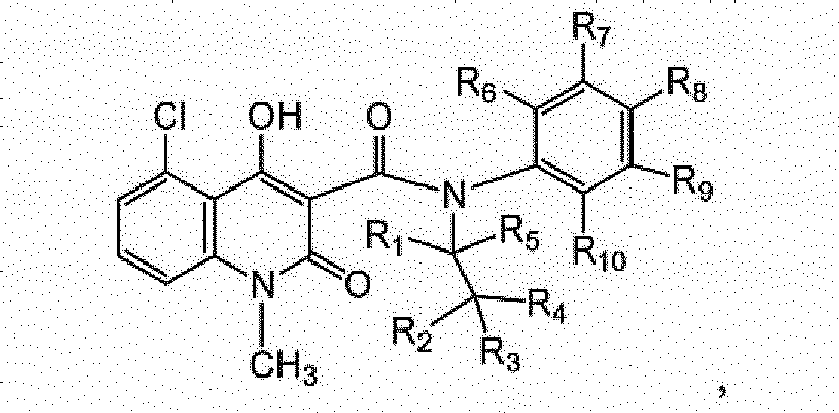
or pharmaceutically acceptable salts thereof. - 15. The mixture of
clause 14, wherein one of the at least two deuterium-enriched compounds has the structure:
- 16. The mixture of
clause 14, wherein one of the at least two deuterium-enriched compounds has the structure:
- 17. The mixture of
clause 14, wherein one of the at least two deuterium-enriched compounds has the structure:
- 18. A pharmaceutical composition comprising the mixture of any one of clauses 14-17, or a pharmaceutical acceptable salt thereof, and a pharmaceutically acceptable carrier.
- 19. A pharmaceutical composition comprising a mixture of:
- a) deuterium-enriched laquinimod or a pharmaceutically acceptable salt thereof;
- b) at least one pharmaceutically acceptable carrier; and
- c) a compound having the structure:

- 20. The pharmaceutical composition of clause 19, wherein the compound is present in an amount less than 3 ppm based on the combined weight of the compound and deuterium-enriched laquinimod.
- 21. The pharmaceutical composition of
clause 20, wherein the compound is present in an amount less than 2 ppm based on the combined weight of the compound and deuterium-enriched laquinimod. - 22. The pharmaceutical composition of any one of clauses 19-21, wherein the deuterium-enriched laquinimod has the structure:

- 23. The pharmaceutical composition of
clause 22, wherein in the deuterium-enriched laquinimod, each of R1-R5 is D and each of R6-R10 is H, or a pharmaceutically acceptable salt thereof. - 24. The pharmaceutical composition of
clause 22, wherein in the deuterium-enriched laquinimod, each of R1-R5 is H and each of R6-R10 is D, or a pharmaceutically acceptable salt thereof. - 25. The pharmaceutical composition of
clause 22, wherein in the deuterium-enriched laquinimod, each of R1-R10 is D, or a pharmaceutically acceptable salt thereof. - 26. The pharmaceutical composition of any of clauses 18-25 in the form of a tablet.
- 27. The pharmaceutical composition of any one of clauses 18-26, which when ingested by a human subject, provides a reduced level of optionally deuterated 5-chloro-4-hydroxy-1-methyl-2-oxo-N-phenyl-1,2-dihydroquinoline-3-carboxamide formed in the human subject, relative to the level of 5-chloro-4-hydroxy-1-methyl-2-oxo-N-phenyl-1,2-dihydroquinoline-3-carboxamide formed when an equivalent molar amount of non-deuterium-enriched laquinimod is ingested by the human subject.
- 28. A process for preparing the pharmaceutical composition of any one of clauses 18-27, comprising:
- a) obtaining a batch of deuterium-enriched laquinimod or a pharmaceutically acceptable salt thereof;
- b) determining by apparatus the total amount of optionally deuterated 5-chloro-4-hydroxy-1-methyl-2-oxo-N-phenyl-1,2-dihydroquinoline-3-carboxamide present in the batch of deuterium-enriched laquinimod or a pharmaceutically acceptable salt thereof; and
- c) preparing the pharmaceutical composition using the batch only if the batch is determined to have less than 0.1% by weight of optionally deuterated 5-chloro-4-hydroxy-1-methyl-2-oxo-N-phenyl-1,2-dihydroquinoline-3-carboxamide.
- 29. A process for producing a validated batch of the pharmaceutical composition of any one of clauses 18-27 for distribution comprising:
- a) obtaining a batch of the pharmaceutical composition;
- b) determining by apparatus the total amount of optionally deuterated 5-chloro-4-hydroxy-1-methyl-2-oxo-N-phenyl-1,2-dihydroquinoline-3-carboxamide in a sample of the batch; and
- c) validating the batch for distribution only if the sample of the batch is determined to contain less than 0.1% by weight of optionally deuterated 5-chloro-4-hydroxy-1-methyl-2-oxo-N-phenyl-1,2-dihydroquinoline-3-carboxamide relative to the combined weight of laquinimod and optionally deuterated 5-chloro-4-hydroxy-1-methyl-2-oxo-N-phenyl-1,2-dihydroquinoline-3-carboxamide.
- 30. A deuterium-enriched compound having the structure:

for use in an amount of 0.2 mg - 2 mg per day in treating an autoimmune disease in a human subject.
Claims (15)
- A deuterium-enriched compound having the structure:

- The deuterium-enriched compound for use according to claim 1, wherein the deuterium-enriched compound is


- The deuterium-enriched compound for use according to claim 2, wherein the deuterium-enriched compound is


- The deuterium-enriched compound for use according to claim 3, wherein the deuterium-enriched compound is

- The deuterium-enriched compound for use according to claim 3, wherein the deuterium-enriched compound is

- The deuterium-enriched compound for use according to any one of claims 1-5, wherein the autoimmune disease is Multiple Sclerosis, Systemic Lupus Erythematosus, lupus nephritis, lupus arthritis, Crohn's Disease or Rheumatoid arthritis.
- The deuterium-enriched compound for use according to claim 6, wherein the autoimmune disease is Multiple Sclerosis.
- A mixture of at least two different deuterium-enriched compounds, each compound having the structure:

or pharmaceutically acceptable salts thereof. - The mixture of claim 8, wherein one of the at least two deuterium-enriched compounds has the structure:


- The mixture of claim 9, wherein one of the at least two deuterium-enriched compounds has the structure:

- A pharmaceutical composition comprising a mixture of:a) the deuterium-enriched compound of any one of claims 1-7 or the mixture of any one of claims 8-10, or a pharmaceutically acceptable salt thereof;b) at least one pharmaceutically acceptable carrier; andc) a compound having the structure:

- The pharmaceutical composition of claim 11, wherein in the deuterium-enriched laquinimod, each of R1-R5 is D and each of R6-R10 is H; each of R1-R5 is H and each of R6-R10 is D; or each of R1-R10 is D, or pharmaceutically acceptable salts thereof.
- The pharmaceutical composition of claims 11 or 12 in the form of a tablet.
- A process for preparing the pharmaceutical composition of any one of claims 11-13, comprising:a) obtaining a batch of deuterium-enriched laquinimod or a pharmaceutically acceptable salt thereof;b) determining by apparatus the total amount of optionally deuterated 5-chloro-4-hydroxy-1-methyl-2-oxo-N-phenyl-1,2-dihydroquinoline-3-carboxamide present in the batch of deuterium-enriched laquinimod or a pharmaceutically acceptable salt thereof; andc) preparing the pharmaceutical composition using the batch only if the batch is determined to have less than 0.1% by weight of optionally deuterated 5-chloro-4-hydroxy-1-methyl-2-oxo-N-phenyl-1,2-dihydroquinoline-3-carboxamide.
- A process for producing a validated batch of the pharmaceutical composition of any one of claims 11-13 for distribution comprising:a) obtaining a batch of the pharmaceutical composition;b) determining by apparatus the total amount of optionally deuterated 5-chloro-4-hydroxy-1-methyl-2-oxo-N-phenyl-1,2-dihydroquinoline-3-carboxamide in a sample of the batch; andc) validating the batch for distribution only if the sample of the batch is determined to contain less than 0.1% by weight of optionally deuterated 5-chloro-4-hydroxy-1-methyl-2-oxoN-phenyl-1,2-dihydroquinoline-3-carboxamide relative to the combined weight of laquinimod and optionally deuterated 5-chloro-4-hydroxy-1-methyl-2-oxo-N-phenyl-1,2-dihydroquinoline-3-carboxamide.
Applications Claiming Priority (2)
| Application Number | Priority Date | Filing Date | Title |
|---|---|---|---|
| US39929710P | 2010-07-09 | 2010-07-09 | |
| EP20110804411 EP2597954A4 (en) | 2010-07-09 | 2011-07-08 | DEUTTERATED N-ETHYL-N-PHENYL-1,2-DIHYDRO-4-HYDROXY-5-CHLORO-1-METHYL-2-OXOQUINOLINE-3-CARBOXAMIDE, SALTS THEREOF AND USES THEREOF |
Related Parent Applications (1)
| Application Number | Title | Priority Date | Filing Date |
|---|---|---|---|
| EP20110804411 Division EP2597954A4 (en) | 2010-07-09 | 2011-07-08 | DEUTTERATED N-ETHYL-N-PHENYL-1,2-DIHYDRO-4-HYDROXY-5-CHLORO-1-METHYL-2-OXOQUINOLINE-3-CARBOXAMIDE, SALTS THEREOF AND USES THEREOF |
Publications (1)
| Publication Number | Publication Date |
|---|---|
| EP3213636A1 true EP3213636A1 (en) | 2017-09-06 |
Family
ID=45439026
Family Applications (2)
| Application Number | Title | Priority Date | Filing Date |
|---|---|---|---|
| EP16196628.8A Withdrawn EP3213636A1 (en) | 2010-07-09 | 2011-07-08 | Deuterated n-ethyl-n-phenyl-1,2-dihydro-4-hydroxy-5-chloro-1-methyl-2-oxoquinoline-3-carboxamide, salts and uses thereof |
| EP20110804411 Withdrawn EP2597954A4 (en) | 2010-07-09 | 2011-07-08 | DEUTTERATED N-ETHYL-N-PHENYL-1,2-DIHYDRO-4-HYDROXY-5-CHLORO-1-METHYL-2-OXOQUINOLINE-3-CARBOXAMIDE, SALTS THEREOF AND USES THEREOF |
Family Applications After (1)
| Application Number | Title | Priority Date | Filing Date |
|---|---|---|---|
| EP20110804411 Withdrawn EP2597954A4 (en) | 2010-07-09 | 2011-07-08 | DEUTTERATED N-ETHYL-N-PHENYL-1,2-DIHYDRO-4-HYDROXY-5-CHLORO-1-METHYL-2-OXOQUINOLINE-3-CARBOXAMIDE, SALTS THEREOF AND USES THEREOF |
Country Status (20)
| Country | Link |
|---|---|
| US (3) | US8580819B2 (en) |
| EP (2) | EP3213636A1 (en) |
| JP (2) | JP2013535437A (en) |
| KR (1) | KR20130092558A (en) |
| CN (2) | CN104610144A (en) |
| AR (1) | AR082150A1 (en) |
| AU (1) | AU2011274496B2 (en) |
| BR (1) | BR112013000599A2 (en) |
| CA (1) | CA2804986A1 (en) |
| CL (1) | CL2013000063A1 (en) |
| EA (1) | EA025377B1 (en) |
| IL (1) | IL251600A0 (en) |
| MX (1) | MX2013000333A (en) |
| NZ (1) | NZ606587A (en) |
| PE (1) | PE20130396A1 (en) |
| PH (1) | PH12013500065A1 (en) |
| SG (2) | SG186948A1 (en) |
| UY (1) | UY33504A (en) |
| WO (1) | WO2012006538A1 (en) |
| ZA (1) | ZA201300956B (en) |
Families Citing this family (27)
| Publication number | Priority date | Publication date | Assignee | Title |
|---|---|---|---|---|
| BRPI0617477A2 (en) * | 2005-10-19 | 2011-07-26 | Teva Pharma | mixture of crystalline particles of sodium laquinimod, composition, process of crystallization of laquinimod sodium, laquinimod sodium, and process for producing a pharmaceutical composition |
| CN101466379B (en) | 2006-06-12 | 2012-10-31 | 泰华制药工业有限公司 | Formulations of stable laquinimod |
| WO2009082471A1 (en) | 2007-12-20 | 2009-07-02 | Teva Pharmaceutical Industries, Ltd. | Stable laquinimod preparations |
| NZ597378A (en) * | 2009-06-19 | 2014-08-29 | Teva Pharma | Treatment of multiple sclerosis with laquinimod |
| BR112012002124A2 (en) * | 2009-07-30 | 2015-09-15 | Teva Pharma | treatment of crohn's disease with laquinimode. |
| WO2011019375A1 (en) | 2009-08-10 | 2011-02-17 | Teva Pharmaceutical Industries Ltd. | Treatment of bdnf-related disorders using laquinimod |
| KR20130006640A (en) * | 2010-03-03 | 2013-01-17 | 테바 파마슈티컬 인더스트리즈 리미티드 | Treatment of lupus nephritis using laquinimod |
| EA201290860A1 (en) * | 2010-03-03 | 2013-04-30 | Тева Фармасьютикал Индастриз Лтд. | TREATMENT OF RHEUMATOID ARTHRITIS BY COMBINATION OF LAKVINIMODA AND METHOREXAT |
| US20110217295A1 (en) * | 2010-03-03 | 2011-09-08 | Asi Haviv | Treatment of lupus arthritis using laquinimod |
| AU2011274496B2 (en) | 2010-07-09 | 2016-03-10 | Teva Pharmaceutical Industries Ltd. | Deuterated N-ethyl-N-phenyl-1,2-dihydro-4-hydroxy-5-chloro-1-methyl-2-oxoquinoline-3-carboxamide, salts and uses thereof |
| SG11201401330YA (en) | 2011-10-12 | 2014-05-29 | Teva Pharma | Treatment of multiple sclerosis with combination of laquinimod and fingolimod |
| WO2013116657A1 (en) * | 2012-02-03 | 2013-08-08 | Teva Pharmaceutical Industries Ltd. | USE OF LAQUINIMOD FOR TREATING CROHN'S DISEASE PATIENTS WHO FAILED FIRST-LINE ANTI-TNFα THERAPY |
| MX2014009889A (en) | 2012-02-16 | 2014-11-13 | Teva Pharma | N-ethyl-n-phenyl-1,2-dihydro-4,5-di-hydroxy-1-methyl-2-oxo-3-qui noline carboxamide, preparation and uses thereof. |
| TW201350467A (en) | 2012-05-08 | 2013-12-16 | Teva Pharma | N-ethyl-4-hydroxyl-1-methyl-5-(methyl(2,3,4,5,6-pentahydroxyhexyl)amino)-2-oxo-N-phenyl-1,2-dihydroquinoline-3-carboxamide |
| TW201400117A (en) | 2012-06-05 | 2014-01-01 | Teva Pharma | Treatment of ocular inflammation with laquinimod |
| TW201410244A (en) | 2012-08-13 | 2014-03-16 | Teva Pharma | Laquinimod for treatment of GABA mediated disorders |
| EA201590788A1 (en) | 2012-11-07 | 2015-12-30 | Тева Фармасьютикал Индастриз Лтд. | AMINAL SALTS LACHINIMODA |
| WO2014086284A1 (en) * | 2012-12-04 | 2014-06-12 | 上海医药集团股份有限公司 | Deuterated 3-cyano quinoline compound, pharmaceutical composition, preparation method and use thereof |
| JP2016514162A (en) | 2013-03-14 | 2016-05-19 | テバ ファーマシューティカル インダストリーズ リミティド | Laquinimod sodium crystals and improved process for their production |
| WO2014152009A1 (en) | 2013-03-14 | 2014-09-25 | Teva Pharmaceutical Industries Ltd. | Transdermal formulations of laquinimod |
| CN103145562B (en) * | 2013-03-18 | 2015-06-17 | 黄河三角洲京博化工研究院有限公司 | N-ethyl aniline preparation method |
| HK1231413A1 (en) | 2014-04-29 | 2017-12-22 | Teva Pharmaceutical Industries Ltd. | Laquinimod for the treatment of relapsing-remitting multiple sclerosis (rrms) patients with a high disability status |
| EP3347006B1 (en) | 2015-03-20 | 2022-07-27 | GABA Therapeutics Inc. | Deuterated analogs of etifoxine, their derivatives and uses therof |
| US11861914B2 (en) * | 2019-08-28 | 2024-01-02 | Nissan Motor Co., Ltd. | Object recognition method and object recognition device |
| WO2021097427A1 (en) | 2019-11-15 | 2021-05-20 | Karuna Therapeutics, Inc. | Xanomeline derivatives and methods for treating neurological disorders |
| CA3157394A1 (en) * | 2019-12-19 | 2021-06-24 | Helena ERIKSSON | Compounds for treatment of eye diseases associated with excessive vascularisation |
| GB202006390D0 (en) * | 2020-04-30 | 2020-06-17 | Aqilion Ab | Novel treatments |
Citations (6)
| Publication number | Priority date | Publication date | Assignee | Title |
|---|---|---|---|---|
| US6077851A (en) | 1998-04-27 | 2000-06-20 | Active Biotech Ab | Quinoline derivatives |
| US6875869B2 (en) | 2002-06-12 | 2005-04-05 | Active Biotech Ab | Process for the manufacture of quinoline derivatives |
| WO2005074899A2 (en) | 2004-02-06 | 2005-08-18 | Active Biotech Ab | New compositions containing quinoline compounds |
| US20070088050A1 (en) * | 2005-10-19 | 2007-04-19 | Anton Frenkel | Crystals of laquinimod sodium, and process for the manufacture thereof |
| WO2007146248A2 (en) | 2006-06-12 | 2007-12-21 | Teva Pharmaceutical Industries, Ltd. | Stable laquinimod preparations |
| US20100055072A1 (en) * | 2008-09-03 | 2010-03-04 | Auspex Pharmaceuticals, Inc. | 2-oxo-1,2-dihydro-quinoline modulators of immune function |
Family Cites Families (23)
| Publication number | Priority date | Publication date | Assignee | Title |
|---|---|---|---|---|
| IE52670B1 (en) | 1981-03-03 | 1988-01-20 | Leo Ab | Heterocyclic carboxamides,compositions containing such compounds,and processes for their preparation |
| SE9801474D0 (en) | 1998-04-27 | 1998-04-27 | Active Biotech Ab | Quinoline Derivatives |
| US6133285A (en) | 1998-07-15 | 2000-10-17 | Active Biotech Ab | Quinoline derivatives |
| US6121287A (en) | 1998-07-15 | 2000-09-19 | Active Biotech Ab | Quinoline derivatives |
| SE9802550D0 (en) | 1998-07-15 | 1998-07-15 | Active Biotech Ab | Quinoline derivatives |
| SE9802549D0 (en) | 1998-07-15 | 1998-07-15 | Active Biotech Ab | Quinoline derivatives |
| EE200100660A (en) | 1999-06-07 | 2003-04-15 | Byk Gulden Lomberg Chemische Fabrik Gmbh | Formulation for acid-labile active substances, unit active ingredient, method of preparation and microsphere |
| US7560557B2 (en) | 2002-06-12 | 2009-07-14 | Active Biotech Ag | Process for the manufacture of quinoline derivatives |
| SE0201778D0 (en) | 2002-06-12 | 2002-06-12 | Active Biotech Ab | Process for the manufacture of quinoline derivatives |
| US8314124B2 (en) | 2004-02-06 | 2012-11-20 | Active Biotech Ab | Crystalline salts of quinoline compounds and methods for preparing them |
| US7514068B2 (en) | 2005-09-14 | 2009-04-07 | Concert Pharmaceuticals Inc. | Biphenyl-pyrazolecarboxamide compounds |
| US7528131B2 (en) | 2007-04-19 | 2009-05-05 | Concert Pharmaceuticals Inc. | Substituted morpholinyl compounds |
| WO2009082471A1 (en) | 2007-12-20 | 2009-07-02 | Teva Pharmaceutical Industries, Ltd. | Stable laquinimod preparations |
| NZ597378A (en) | 2009-06-19 | 2014-08-29 | Teva Pharma | Treatment of multiple sclerosis with laquinimod |
| JP2011001308A (en) * | 2009-06-19 | 2011-01-06 | Research Foundation Itsuu Laboratory | Deuterated carbostyril compound |
| BR112012002124A2 (en) | 2009-07-30 | 2015-09-15 | Teva Pharma | treatment of crohn's disease with laquinimode. |
| WO2011019375A1 (en) | 2009-08-10 | 2011-02-17 | Teva Pharmaceutical Industries Ltd. | Treatment of bdnf-related disorders using laquinimod |
| EA201290860A1 (en) | 2010-03-03 | 2013-04-30 | Тева Фармасьютикал Индастриз Лтд. | TREATMENT OF RHEUMATOID ARTHRITIS BY COMBINATION OF LAKVINIMODA AND METHOREXAT |
| KR20130006640A (en) | 2010-03-03 | 2013-01-17 | 테바 파마슈티컬 인더스트리즈 리미티드 | Treatment of lupus nephritis using laquinimod |
| US20110217295A1 (en) | 2010-03-03 | 2011-09-08 | Asi Haviv | Treatment of lupus arthritis using laquinimod |
| JP5934202B2 (en) | 2010-07-09 | 2016-06-15 | テバ ファーマシューティカル インダストリーズ リミティド | 5-Chloro-4-hydroxy-1-methyl-2-oxo-N-phenyl-1,2-dihydroquinoline-3-carboxamide, its salts and uses thereof |
| AU2011274496B2 (en) | 2010-07-09 | 2016-03-10 | Teva Pharmaceutical Industries Ltd. | Deuterated N-ethyl-N-phenyl-1,2-dihydro-4-hydroxy-5-chloro-1-methyl-2-oxoquinoline-3-carboxamide, salts and uses thereof |
| PE20140872A1 (en) | 2010-12-07 | 2014-08-09 | Teva Pharma | USE OF LAQUINIMOD TO REDUCE FATIGUE, IMPROVE FUNCTIONAL STATUS AND IMPROVE QUALITY OF LIFE IN PATIENTS WITH MULTIPLE SCLEROSIS |
-
2011
- 2011-07-08 AU AU2011274496A patent/AU2011274496B2/en not_active Ceased
- 2011-07-08 EP EP16196628.8A patent/EP3213636A1/en not_active Withdrawn
- 2011-07-08 EA EA201390081A patent/EA025377B1/en not_active IP Right Cessation
- 2011-07-08 CN CN201410831557.XA patent/CN104610144A/en active Pending
- 2011-07-08 CA CA2804986A patent/CA2804986A1/en not_active Abandoned
- 2011-07-08 JP JP2013519724A patent/JP2013535437A/en not_active Withdrawn
- 2011-07-08 SG SG2013000948A patent/SG186948A1/en unknown
- 2011-07-08 MX MX2013000333A patent/MX2013000333A/en unknown
- 2011-07-08 AR ARP110102478A patent/AR082150A1/en unknown
- 2011-07-08 NZ NZ60658711A patent/NZ606587A/en not_active IP Right Cessation
- 2011-07-08 CN CN2011800340883A patent/CN102984939A/en active Pending
- 2011-07-08 KR KR1020137003480A patent/KR20130092558A/en not_active Ceased
- 2011-07-08 SG SG10201505236YA patent/SG10201505236YA/en unknown
- 2011-07-08 PE PE2013000039A patent/PE20130396A1/en not_active Application Discontinuation
- 2011-07-08 EP EP20110804411 patent/EP2597954A4/en not_active Withdrawn
- 2011-07-08 WO PCT/US2011/043383 patent/WO2012006538A1/en not_active Ceased
- 2011-07-08 US US13/178,842 patent/US8580819B2/en not_active Expired - Fee Related
- 2011-07-08 PH PH1/2013/500065A patent/PH12013500065A1/en unknown
- 2011-07-08 BR BR112013000599A patent/BR112013000599A2/en not_active IP Right Cessation
- 2011-07-11 UY UY0001033504A patent/UY33504A/en not_active Application Discontinuation
-
2013
- 2013-01-08 CL CL2013000063A patent/CL2013000063A1/en unknown
- 2013-02-05 ZA ZA2013/00956A patent/ZA201300956B/en unknown
- 2013-10-24 US US14/062,685 patent/US20140051723A1/en not_active Abandoned
-
2014
- 2014-03-14 US US14/213,279 patent/US9102620B2/en not_active Expired - Fee Related
-
2016
- 2016-07-28 JP JP2016148514A patent/JP2017014238A/en active Pending
-
2017
- 2017-04-05 IL IL251600A patent/IL251600A0/en unknown
Patent Citations (8)
| Publication number | Priority date | Publication date | Assignee | Title |
|---|---|---|---|---|
| US6077851A (en) | 1998-04-27 | 2000-06-20 | Active Biotech Ab | Quinoline derivatives |
| US6875869B2 (en) | 2002-06-12 | 2005-04-05 | Active Biotech Ab | Process for the manufacture of quinoline derivatives |
| WO2005074899A2 (en) | 2004-02-06 | 2005-08-18 | Active Biotech Ab | New compositions containing quinoline compounds |
| US20070088050A1 (en) * | 2005-10-19 | 2007-04-19 | Anton Frenkel | Crystals of laquinimod sodium, and process for the manufacture thereof |
| WO2007047863A2 (en) | 2005-10-19 | 2007-04-26 | Teva Pharmaceutical Industries, Ltd. | Crystals of laquinimod sodium, and process for the manufacture thereof |
| WO2007146248A2 (en) | 2006-06-12 | 2007-12-21 | Teva Pharmaceutical Industries, Ltd. | Stable laquinimod preparations |
| US20100055072A1 (en) * | 2008-09-03 | 2010-03-04 | Auspex Pharmaceuticals, Inc. | 2-oxo-1,2-dihydro-quinoline modulators of immune function |
| WO2010028015A2 (en) | 2008-09-03 | 2010-03-11 | Auspex Pharmaceuticals, Inc | 2-oxo-1,2-dihydro-quinoline modulators of immune function |
Non-Patent Citations (32)
Also Published As
| Publication number | Publication date |
|---|---|
| UY33504A (en) | 2012-02-29 |
| US20140051723A1 (en) | 2014-02-20 |
| AU2011274496A1 (en) | 2013-02-28 |
| BR112013000599A2 (en) | 2016-07-05 |
| CN102984939A (en) | 2013-03-20 |
| PH12013500065A1 (en) | 2017-10-25 |
| US20140343096A1 (en) | 2014-11-20 |
| EP2597954A4 (en) | 2014-01-01 |
| NZ606587A (en) | 2015-03-27 |
| SG10201505236YA (en) | 2015-08-28 |
| SG186948A1 (en) | 2013-02-28 |
| EP2597954A1 (en) | 2013-06-05 |
| US20120010238A1 (en) | 2012-01-12 |
| US9102620B2 (en) | 2015-08-11 |
| CN104610144A (en) | 2015-05-13 |
| EA025377B1 (en) | 2016-12-30 |
| KR20130092558A (en) | 2013-08-20 |
| CA2804986A1 (en) | 2012-01-12 |
| JP2013535437A (en) | 2013-09-12 |
| WO2012006538A8 (en) | 2013-05-23 |
| EA201390081A1 (en) | 2013-07-30 |
| MX2013000333A (en) | 2013-02-26 |
| JP2017014238A (en) | 2017-01-19 |
| AU2011274496B2 (en) | 2016-03-10 |
| AR082150A1 (en) | 2012-11-14 |
| WO2012006538A1 (en) | 2012-01-12 |
| PE20130396A1 (en) | 2013-04-19 |
| CL2013000063A1 (en) | 2013-05-03 |
| IL251600A0 (en) | 2017-06-29 |
| US8580819B2 (en) | 2013-11-12 |
| ZA201300956B (en) | 2014-04-30 |
Similar Documents
| Publication | Publication Date | Title |
|---|---|---|
| US9102620B2 (en) | Deuterated N-ethyl-N-phenyl-1,2-dihydro-4-hydroxy-5-chloro-1-methyl-2-oxoquinoline-3-carboxamide, salts and uses thereof | |
| US20180140592A1 (en) | 5-chloro-4-hydroxy-1-methyl-2-oxo-n-phenyl-1,2-dihydroquinoline-3-carboxamide, salts and uses thereof | |
| EP3348557A1 (en) | Compound for treating or preventing hyperuricemia or gout | |
| JP2011529502A (en) | Antimalarial compounds | |
| EP4244362A1 (en) | Novel rna transcript | |
| AU2013259779B2 (en) | N-ethyl-4-hydroxyl-1-methyl-5- (methyl(2,3,4,5,6-pentahydroxyhexyl) amino) -2-oxo-N-phenyl-1,2-dihydroquinoline-3-carboxamide | |
| Zuccato et al. | Everolimus is a potent inducer of erythroid differentiation and γ-globin gene expression in human erythroid cells | |
| KR20230003308A (en) | Analogs of deutetrabenazine, their preparation and use | |
| US10633351B2 (en) | Halogenated compound and axially chiral isomer thereof | |
| HK1236069A1 (en) | Deuterated n-ethyl-n-phenyl-1,2-dihydro-4-hydroxy-5-chloro-1-methyl-2-oxoquinoline-3-carboxamide, salts and uses thereof | |
| US20240058314A1 (en) | Compositions comprising anatabine and uses thereof | |
| CN104583200B (en) | Quinone based compound and its purposes for treatment of cancer | |
| US20240409928A1 (en) | Novel rna transcript | |
| Hoch et al. | PP162--Thorough QT study with ponesimod, a selective S1P1 receptor modulator | |
| RU2429232C2 (en) | Heterocyclic compounds, having antiproliferative activity and method of slowing down tumour cell proliferation |
Legal Events
| Date | Code | Title | Description |
|---|---|---|---|
| PUAI | Public reference made under article 153(3) epc to a published international application that has entered the european phase |
Free format text: ORIGINAL CODE: 0009012 |
|
| STAA | Information on the status of an ep patent application or granted ep patent |
Free format text: STATUS: THE APPLICATION HAS BEEN PUBLISHED |
|
| AC | Divisional application: reference to earlier application |
Ref document number: 2597954 Country of ref document: EP Kind code of ref document: P |
|
| AK | Designated contracting states |
Kind code of ref document: A1 Designated state(s): AL AT BE BG CH CY CZ DE DK EE ES FI FR GB GR HR HU IE IS IT LI LT LU LV MC MK MT NL NO PL PT RO RS SE SI SK SM TR |
|
| AX | Request for extension of the european patent |
Extension state: BA ME |
|
| REG | Reference to a national code |
Ref country code: HK Ref legal event code: DE Ref document number: 1236069 Country of ref document: HK |
|
| STAA | Information on the status of an ep patent application or granted ep patent |
Free format text: STATUS: THE APPLICATION IS DEEMED TO BE WITHDRAWN |
|
| 18D | Application deemed to be withdrawn |
Effective date: 20180307 |
|
| REG | Reference to a national code |
Ref country code: HK Ref legal event code: WD Ref document number: 1236069 Country of ref document: HK |