EP3209673B2 - Mixtures of human milk oligosaccharides - Google Patents
Mixtures of human milk oligosaccharides Download PDFInfo
- Publication number
- EP3209673B2 EP3209673B2 EP15852675.6A EP15852675A EP3209673B2 EP 3209673 B2 EP3209673 B2 EP 3209673B2 EP 15852675 A EP15852675 A EP 15852675A EP 3209673 B2 EP3209673 B2 EP 3209673B2
- Authority
- EP
- European Patent Office
- Prior art keywords
- lnfp
- molar ratio
- lnt
- lnnt
- component
- Prior art date
- Legal status (The legal status is an assumption and is not a legal conclusion. Google has not performed a legal analysis and makes no representation as to the accuracy of the status listed.)
- Active
Links
Classifications
-
- A—HUMAN NECESSITIES
- A61—MEDICAL OR VETERINARY SCIENCE; HYGIENE
- A61K—PREPARATIONS FOR MEDICAL, DENTAL OR TOILETRY PURPOSES
- A61K31/00—Medicinal preparations containing organic active ingredients
- A61K31/70—Carbohydrates; Sugars; Derivatives thereof
- A61K31/702—Oligosaccharides, i.e. having three to five saccharide radicals attached to each other by glycosidic linkages
-
- A—HUMAN NECESSITIES
- A61—MEDICAL OR VETERINARY SCIENCE; HYGIENE
- A61K—PREPARATIONS FOR MEDICAL, DENTAL OR TOILETRY PURPOSES
- A61K31/00—Medicinal preparations containing organic active ingredients
- A61K31/70—Carbohydrates; Sugars; Derivatives thereof
- A61K31/7016—Disaccharides, e.g. lactose, lactulose
-
- A—HUMAN NECESSITIES
- A61—MEDICAL OR VETERINARY SCIENCE; HYGIENE
- A61K—PREPARATIONS FOR MEDICAL, DENTAL OR TOILETRY PURPOSES
- A61K31/00—Medicinal preparations containing organic active ingredients
- A61K31/70—Carbohydrates; Sugars; Derivatives thereof
- A61K31/715—Polysaccharides, i.e. having more than five saccharide radicals attached to each other by glycosidic linkages; Derivatives thereof, e.g. ethers, esters
-
- A—HUMAN NECESSITIES
- A61—MEDICAL OR VETERINARY SCIENCE; HYGIENE
- A61P—SPECIFIC THERAPEUTIC ACTIVITY OF CHEMICAL COMPOUNDS OR MEDICINAL PREPARATIONS
- A61P1/00—Drugs for disorders of the alimentary tract or the digestive system
-
- A—HUMAN NECESSITIES
- A61—MEDICAL OR VETERINARY SCIENCE; HYGIENE
- A61P—SPECIFIC THERAPEUTIC ACTIVITY OF CHEMICAL COMPOUNDS OR MEDICINAL PREPARATIONS
- A61P31/00—Antiinfectives, i.e. antibiotics, antiseptics, chemotherapeutics
-
- A—HUMAN NECESSITIES
- A61—MEDICAL OR VETERINARY SCIENCE; HYGIENE
- A61P—SPECIFIC THERAPEUTIC ACTIVITY OF CHEMICAL COMPOUNDS OR MEDICINAL PREPARATIONS
- A61P37/00—Drugs for immunological or allergic disorders
- A61P37/02—Immunomodulators
- A61P37/04—Immunostimulants
-
- C—CHEMISTRY; METALLURGY
- C07—ORGANIC CHEMISTRY
- C07H—SUGARS; DERIVATIVES THEREOF; NUCLEOSIDES; NUCLEOTIDES; NUCLEIC ACIDS
- C07H5/00—Compounds containing saccharide radicals in which the hetero bonds to oxygen have been replaced by the same number of hetero bonds to halogen, nitrogen, sulfur, selenium, or tellurium
- C07H5/04—Compounds containing saccharide radicals in which the hetero bonds to oxygen have been replaced by the same number of hetero bonds to halogen, nitrogen, sulfur, selenium, or tellurium to nitrogen
- C07H5/06—Aminosugars
-
- C—CHEMISTRY; METALLURGY
- C12—BIOCHEMISTRY; BEER; SPIRITS; WINE; VINEGAR; MICROBIOLOGY; ENZYMOLOGY; MUTATION OR GENETIC ENGINEERING
- C12P—FERMENTATION OR ENZYME-USING PROCESSES TO SYNTHESISE A DESIRED CHEMICAL COMPOUND OR COMPOSITION OR TO SEPARATE OPTICAL ISOMERS FROM A RACEMIC MIXTURE
- C12P19/00—Preparation of compounds containing saccharide radicals
-
- C—CHEMISTRY; METALLURGY
- C12—BIOCHEMISTRY; BEER; SPIRITS; WINE; VINEGAR; MICROBIOLOGY; ENZYMOLOGY; MUTATION OR GENETIC ENGINEERING
- C12P—FERMENTATION OR ENZYME-USING PROCESSES TO SYNTHESISE A DESIRED CHEMICAL COMPOUND OR COMPOSITION OR TO SEPARATE OPTICAL ISOMERS FROM A RACEMIC MIXTURE
- C12P19/00—Preparation of compounds containing saccharide radicals
- C12P19/18—Preparation of compounds containing saccharide radicals produced by the action of a glycosyl transferase, e.g. alpha-, beta- or gamma-cyclodextrins
-
- C—CHEMISTRY; METALLURGY
- C12—BIOCHEMISTRY; BEER; SPIRITS; WINE; VINEGAR; MICROBIOLOGY; ENZYMOLOGY; MUTATION OR GENETIC ENGINEERING
- C12P—FERMENTATION OR ENZYME-USING PROCESSES TO SYNTHESISE A DESIRED CHEMICAL COMPOUND OR COMPOSITION OR TO SEPARATE OPTICAL ISOMERS FROM A RACEMIC MIXTURE
- C12P19/00—Preparation of compounds containing saccharide radicals
- C12P19/26—Preparation of nitrogen-containing carbohydrates
-
- C—CHEMISTRY; METALLURGY
- C12—BIOCHEMISTRY; BEER; SPIRITS; WINE; VINEGAR; MICROBIOLOGY; ENZYMOLOGY; MUTATION OR GENETIC ENGINEERING
- C12Y—ENZYMES
- C12Y204/00—Glycosyltransferases (2.4)
- C12Y204/01—Hexosyltransferases (2.4.1)
- C12Y204/01065—3-Galactosyl-N-acetylglucosaminide 4-alpha-L-fucosyltransferase (2.4.1.65), i.e. alpha-1-3 fucosyltransferase
Definitions
- the present invention relates to mixtures of Human Milk Oligosaccharides ("HMOs”), a process for making the mixtures, and anti-infective compositons comprising the mixtures for use in treating bacterial infections.
- HMOs Human Milk Oligosaccharides
- HMOs have become the subject of much interest in recent years due to their roles in numerous biological processes occurring in the human organism.
- Mammalian milk contains at least 130 of these complex oligosaccharides ( Urashima et al, Milk Oligosaccharides, Nova Biomedical Books, New York, 2011, ISBN: 978-1-61122-831-1 ).
- HMOs the only source of HMOs had been mammalian milk which contains mostly water, together with 55-70 g/l lactose, 24-59 g/l lipids, ca. 13 g/l proteins, 5-15 g/l HMOs and ca. 1.5 g/l minerals.
- LNnT can be made as described in WO 2011/100980 and WO 2013/044928
- LNT can be synthesized as described in WO 2012/155916 and WO 2013/044928
- a mixture of LNT and LNnT can be made as described in WO 2013/091660
- 2'-FL can be made as described in WO 2010/115934 and WO 2010/115935
- 3-FL can be made as described in WO 2013/139344
- 6'-SL and salts thereof can be made as described in WO 2010/100979 .
- WO 01/04341 and WO 2007/101862 describe how to make core human milk oligosaccharides optionally substituted by fucose or sialic acid using genetically modified E. coli.
- WO 2012/158517 and WO 2013/154725 describe prebiotic compositions containing 3-FL, 2'-FL and DFL and WO 2012/112777 describes a mixture of 3-FL, 2'-FL, DFL and lactose produced in a genetically modified E. coli.
- sialylated oligosaccharides can be made as described in EP-A-577580 .
- microbiome the resident community of microbes
- the human digestive tract plays a major role in health and disease.
- the human host can suffer consequences.
- Recent research has implicated microbiome imbalances in disorders as diverse as cancer, obesity, inflammatory bowel disease, psoriasis, asthma, and possibly even autism.
- HMOs are believed to positively modulate the microbiome, and they are of increasing interest for this purpose.
- the remarkable diversity of HMOs, coupled with their lack of availability has hampered studies of the specific functions of individual HMOs.
- a first aspect of this invention relates to a mixture of HMOs consisting essentially of
- a second aspect of this invention relates to a mixture of HMOs consisting essentially of
- a third aspect of this invention relates to a process for making a mixture of HMOs according to the first aspect, by reacting a component A and a component B in the presence of an ⁇ 1-3/4 transfucosidase to produce a reaction mixture containing the components A, B, C and D, and then removing the ⁇ 1-3/4 transfucosidase from the reaction mixture,
- a fourth aspect of this invention relates to a process for obtaining a mixture of HMOs of the second aspect, comprising the steps of reacting 3-FL and a component E in the presence of an ⁇ 1-3/4 transfucosidase to produce a reaction mixture containing 3-FL, lactose and the components E and F, and then removing lactose and the ⁇ 1-3/4 transfucosidase from the reaction mixture, and wherein, where the component E is LNT or LNnT, 3-FL and the component E are reacted in a molar ratio of 3:1 to 1:3 in the presence of an ⁇ 1-3/4 transfucosidase having a conversion rate of from 40% to 70% for the reaction of 3-FL and the component E.
- a fifth aspect of this invention relates to an anti-infective composition for treating bacterial infections.
- the composition consists essentially of:
- each of these anti-infective compositions contains a plurality of different HMOs with novel combinations of properties and biological activities.
- each composition can increase Bifidobacterium abundance and Barnesiella abundance in the microbiome of a human.
- each composition can reduce Firmicutes abundance in the human microbiome, especially Clostridia.
- Each composition can also be used to treat and/or reduce the risk of a broad range of bacterial infections of a human.
- mixture of HMOs can provide an anti-infective composition for treating bacterial infections through specific modulation of the microbiome.
- the mixture increases Bifidobacterium abundance and Barnesiella abundance of the microbiome.
- the mixture also reduces Firmicutes abundance of the microbiome; especially Clostridia.
- Humans having increased abundance of Bifidobacterium and Barnesiella in their microbiome are more resistant to a broad range of infections and recover more quickly from these infections, including from antibiotic resistant infections. It is believed that this improved resistance is attributable to the changes in the microbiome.
- the reduction in Firmicutes in the microbiome especially Clostridia, attributable to this mixture imparts additional health benefits.
- the first aspect is a mixture of HMOs consisting essentially of
- component A is 3-FL.
- component A is 3-FL and component B is LNT or LNnT.
- component A is DFL.
- the molar ratio of the component C relative to (DFL + component B) is at least 1:10, preferably at least 1:7, more preferably at least 1:5, even more preferably at least 1:3.
- the molar ratio of DFL relative to the component B is 0.17-6, preferably 0.25-4, more preferably about 1.
- the mixture of this first aspect can consist essentially of 2'-FL, DFL, LNT and LNFP-II.
- This HMO mixture preferably has a molar ratio of LNFP-II relative to (DFL + LNT) of at least 1:10, more preferably at least 1:7, even more preferably at least 1:5, especially 1:3.
- This HMO mixture also preferably has a molar ratio of DFL relative to LNT of 0.17-6, preferably 0.25-4, more preferably about 1. Also preferably, this mixture has a molar ratio of 2'-FL relative to LNFP-II of about 1.
- the mixture of the first aspect can also consist essentially of 2'-FL, DFL, LNnT and LNFP-III.
- This HMO mixture preferably has a molar ratio of LNFP-III relative to (DFL + LNnT) of at least 1:10, more preferably at least 1:7, even more preferably at least 1:5, especially 1:3.
- This HMO mixture also preferably has a molar ratio of DFL relative to LNnT of 0.17-6, preferably 0.25-4, more preferably about 1. Also preferably, this mixture has a molar ratio of 2'-FL relative to LNFP-III of about 1.
- the mixture of the first aspect can also consist essentially of 2'-FL, DFL, LNFP-I and LNDFH-I.
- This HMO mixture preferably has a molar ratio of LNDFH-I relative to (DFL + LNFP-I) of at least 1:10, more preferably at least 1:7, even more preferably at least 1:5, especially 1:3.
- This HMO mixture also preferably has a molar ratio of DFL relative to LNFP-I of 0.17-6, preferably 0.25-4, more preferably about 1. Also preferably, this mixture has a molar ratio of 2'-FL relative to LNDFH-I of about 1.
- the second aspect is a mixture of HMOs consisting essentially of
- the molar ratio of the component F relative to (3-FL + component E) is at least 1:10, preferably at least 1:7, more preferably at least 1:5, even more preferably at least 1:3, and/or the molar ratio of 3-FL relative to the component E is 0.05-21, preferably 0.13-7.7, more preferably about 1.
- the mixture of the second aspect can consist essentially of 3-FL, LNT and LNFP-II.
- This HMO mixture preferably has a molar ratio of LNFP-II relative to (3-FL + LNT) of at least 1:10, more preferably at least 1:7, even more preferably at least 1:5, especially 1:3.
- This HMO mixture also preferably has a molar ratio of 3-FL relative to LNT of 0.05-21, preferably 0.13-7.7, more preferably about 1.
- the mixture of the second aspect also can consist essentially of 3-FL, LNnT and LNFP-III.
- This HMO mixture preferably has a molar ratio of LNFP-III relative to (3-FL + LNnT) of at least 1:10, more preferably at least 1:7, even more preferably at least 1:5, especially 1:3.
- This HMO mixture also preferably has a molar ratio of 3-FL relative to LNnT of 0.05-21, preferably 0.13-7.7, more preferably about 1.
- the mixture of the second aspect can also consist essentially of 3-FL, LNFP-I and LNDFH-I.
- This HMO mixture preferably has a molar ratio of LNDFH-I relative to (3-FL + LNFP-I) of at least 1:10, more preferably at least 1:7, even more preferably at least 1:5, especially 1:3.
- This HMO mixture also preferably has a molar ratio of 3-FL relative to LNFP-I of 0.05-21, preferably 0.13-7.7, more preferably about 1.
- the third aspect is a process for obtaining a mixture of the first aspect of the invention, including its preferred and the more preferred embodiments, comprising the steps of reacting a component A and a component B in the presence of an ⁇ 1-3/4 transfucosidase to produce a reaction mixture containing the components A, B, C and D, and then removing the ⁇ 1-3/4 transfucosidase from the reaction mixture, wherein, where component A is 3-FL and component B is LNT: 3-FL and the component B are reacted in a molar ratio of 1:3 to 3:1 in the presence of an ⁇ 1-3/4 transfucosidase having a conversion rate of at least 40 % and up to 70 % for the reaction of 3-FL and the component B; wherein, where component A is 3-FL and component B is LNnT, 3-FL and the component B are reacted in a molar ratio of 3:1 to 1:3 in the presence of an ⁇ 1-3/4 transfucosidase having a conversion rate of 40
- the process can be suitably carried out at room temperature (e.g. 15-50, preferably 20-37 °C) at a pH of 6-8, preferably 6.5-7 for 15 min to 24 hours.
- This process involves reacting DFL as a donor and a component B as an acceptor in a molar ratio of 1:5 to 5:1, preferably 1:3 to 3:1, more preferably 1:2 to 2:1, even more preferably 1:1, in the presence of an ⁇ 1-3/4 transfucosidase having a conversion rate of at least 10 %, up to about 60 %, preferably at least 20 %, more preferably at least 30 %, for the reaction of DFL and the component B.
- An HMO mixture of this invention can be readily obtained by this process by treating DFL and LNT with an ⁇ 1-3/4 transfucosidase to produce a reaction mixture and then removing the ⁇ 1-3/4 transfucosidase from the reaction mixture.
- This process preferably comprises the step of contacting DFL and LNT in a molar ratio of preferably 1:5 to 5:1, more preferably 1:3 to 3:1, even more preferably 1:2 to 2:1, yet even more preferably 1:1, with an ⁇ 1-3/4 transfucosidase having a conversion rate of at least 10 %, up to about 60 %, preferably at least 15 %, more preferably at least 20 %, even more preferably at least 25 %, yet more preferably at least 30 %, for the reaction of DFL with LNT.
- the reaction mixture, so-produced, containing LNFP-II, 2'-FL, unreacted DFL, LNT and ⁇ 1-3/4 transfucosidase, is then subjected to conventional purification steps to remove the ⁇ 1-3/4 transfucosidase.
- the ⁇ 1-3/4 transfucosidase can be removed, e.g., by denaturing it followed by centrifugation or ultrafiltration to produce a mixture consisting essentially of DFL, LNT, LNFP-II and 2'-FL.
- an HMO mixture having a molar ratio of (DFL + LNT) to LNFP-II of 2-13 and a molar ratio of DFL to LNT of 0.33-6 can be made.
- an HMO mixture having a molar ratio of (DFL + LNT) to LNFP-II of 2-8 and a molar ratio of DFL to LNT of 1 can be made.
- an HMO mixture having a molar ratio of (DFL + LNT) to LNFP-II of 2-12 and a molar ratio of DFL to LNT of 0.2-5 can be made.
- an HMO mixture having a molar ratio of (DFL + LNT) to LNFP-II of 2-8 and a molar ratio of DFL to LNT of 0.33-3 can be made.
- an HMO mixture having a molar ratio of (DFL + LNT) to LNFP-II of 2-4.67 and a molar ratio of DFL to LNT of 1 can be made.
- an HMO mixture having a molar ratio of (DFL + LNT) to LNFP-II of 3-18 and a molar ratio of DFL to LNT of 0.23-4.33 can be made.
- an HMO mixture having a molar ratio of (DFL + LNT) to LNFP-II of 3-8 and a molar ratio of DFL to LNT of 1 can be made.
- an HMO mixture having a molar ratio of (DFL + LNT) to LNFP-II of 3-13 and a molar ratio of DFL to LNT of 1-2.67 can be made.
- an HMO mixture having a molar ratio of (DFL + LNT) to LNFP-II of 3-13 and a molar ratio of DFL to LNT of 0.38-1 can be made.
- An HMO mixture of this invention can also be readily obtained by this process by treating DFL donor and LNnT with an ⁇ 1-3/4 transfucosidase to produce a reaction mixture and then removing the ⁇ 1-3/4 transfucosidase from the reaction mixture.
- This process preferably comprises the step of contacting DFL and LNnT in a molar ratio of preferably 1:5 to 5:1, more preferably 1:3 to 3:1, even more preferably 1:2 to 2:1, yet even more preferably 1:1, with an ⁇ 1-3/4 transfucosidase having a conversion rate of at least 10 %, up to about 60 %, preferably at least 15 %, more preferably at least 20 %, even more preferably at least 25 %, yet more preferably at least 30 %, for the reaction of DFL with LNnT.
- the reaction mixture, so-produced, containing LNFP-III, 2'-FL, unreacted DFL, LNnT and ⁇ 1-3/4 transfucosidase, is then subjected to conventional purification steps to remove the ⁇ 1-3/4 transfucosidase.
- the ⁇ 1-3/4 transfucosidase can be removed, e.g., by denaturing it followed by centrifugation or ultrafiltration to produce a mixture consisting essentially of DFL, LNnT, LNFP-III and 2'-FL.
- an HMO mixture having a molar ratio of (DFL + LNnT) to LNFP-III of 2-13 and a molar ratio of DFL to LNnT of 0.33-6 can be made.
- an HMO mixture having a molar ratio of (DFL + LNnT) to LNFP-III of 2-8 and a molar ratio of DFL to LNnT of 1 can be made.
- an HMO mixture having a molar ratio of (DFL + LNnT) to LNFP-III of 2-12 and a molar ratio of DFL to LNnT of 0.2-5 can be made.
- an HMO mixture having a molar ratio of (DFL + LNnT) to LNFP-III of 2-8 and a molar ratio of DFL to LNnT of 0.33-3 can be made.
- an HMO mixture having a molar ratio of (DFL + LNnT) to LNFP-III of 2-4.67 and a molar ratio of DFL to LNnT of 1 can be made.
- an HMO mixture having a molar ratio of (DFL + LNnT) to LNFP-III of 3-18 and a molar ratio of DFL to LNnT of 0.23-4.33 can be made.
- an HMO mixture having a molar ratio of (DFL + LNnT) to LNFP-III of 3-13 and a molar ratio of DFL to LNnT of 0.38-2.67 can be made.
- an HMO mixture having a molar ratio of (DFL + LNnT) to LNFP-III of 3-8 and a molar ratio of DFL to LNnT of 1 can be made.
- an HMO mixture having a molar ratio of (DFL + LNnT) to LNFP-III of 4-11.3 and a molar ratio of DFL to LNnT of 2.5-5 can be made.
- an HMO mixture having a molar ratio of (DFL + LNnT) to LNFP-III of 3-13 and a molar ratio of DFL to LNnT of 1-2.67 can be made.
- an HMO mixture having a molar ratio of (DFL + LNnT) to LNFP-III of 3-13 and a molar ratio of DFL to LNnT of 0.38-1 can be made.
- an HMO mixture having a molar ratio of (DFL + LNnT) to LNFP-III of 4-11.3 and a molar ratio of DFL to LNnT of 0.2-0.41 can be made.
- An HMO mixture of this invention can also be readily obtained by this process by treating DFL and LNFP-I with an ⁇ 1-3/4 transfucosidase to produce a reaction mixture and then removing the ⁇ 1-3/4 transfucosidase from the reaction mixture.
- This process preferably comprises the step of contacting DFL and LNFP-I in a molar ratio of preferably 1:5 to 5:1, more preferably 1:3 to 3:1, even more preferably 1:2 to 2:1, yet even more preferably 1:1, with an ⁇ 1-3/4 transfucosidase having a conversion rate of at least 10 %, up to about 60 %, preferably at least 15 %, more preferably at least 20 %, even more preferably at least 25 %, yet more preferably at least 30 %, for the reaction of DFL with LNFP-I.
- the reaction mixture, so-produced, containing LNDFH-I, 2'-FL, unreacted DFL, LNFP-I and ⁇ 1-3/4 transfucosidase, is then subjected to conventional purification steps to remove the ⁇ 1-3/4 transfucosidase.
- the ⁇ 1-3/4 transfucosidase can be removed, e.g., by denaturing it followed by centrifugation or ultrafiltration to produce a mixture consisting essentially of DFL, LNFP-I, LNDFH-I and 2'-FL.
- an HMO mixture having a molar ratio of (DFL + LNFP-I) to LNDFH-I of 2-13 and a molar ratio of DFL to LNFP-I of 0.33-6 can be made.
- an HMO mixture having a molar ratio of (DFL + LNFP-I) to LNDFH-I of 2-8 and a molar ratio of DFL to LNFP-I of 1 can be made.
- an HMO mixture having a molar ratio of (DFL + LNFP-I) to LNDFH-I of 2-12 and a molar ratio of DFL to LNFP-I of 0.2-5 can be made.
- an HMO mixture having a molar ratio of (DFL + LNFP-I) to LNDFH-I of 2-8 and a molar ratio of DFL to LNFP-I of 0.33-3 can be made.
- an HMO mixture having a molar ratio of (DFL + LNFP-I) to LNDFH-I of 2-4.67 and a molar ratio of DFL to LNFP-I of 1 can be made.
- an HMO mixture having a molar ratio of (DFL + LNFP-I) to LNDFH-I of 3-18 and a molar ratio of DFL to LNFP-I of 0.23-4.33 can be made.
- an HMO mixture having a molar ratio of (DFL + LNFP-I) to LNDFH-I of 3-13 and a molar ratio of DFL to LNFP-I of 0.38-2.67 can be made.
- an HMO mixture having a molar ratio of (DFL + LNFP-I) to LNDFH-I of 3-8 and a molar ratio of DFL to LNFP-I of 1 can be made.
- an HMO mixture having a molar ratio of (DFL + LNFP-I) to LNDFH-I of 4-11.3 and a molar ratio of DFL to LNFP-I of 2.5-5 can be made.
- an HMO mixture having a molar ratio of (DFL + LNFP-I) to LNDFH-I of 3-13 and a molar ratio of DFL to LNFP-I of 1-2.67 can be made.
- an HMO mixture having a molar ratio of (DFL + LNFP-I) to LNDFH-I of 3-13 and a molar ratio of DFL to LNFP-I of 0.38-1 can be made.
- an HMO mixture having a molar ratio of (DFL + LNFP-I) to LNDFH-I of 4-11.3 and a molar ratio of DFL to LNFP-I of 0.2-0.41 can be made.
- the process of the third aspect can be carried out with 3-FL as a donor and a component B as an acceptor in a molar ratio of 1:5 to 5:1, preferably 1:3 to 3:1, more preferably 1:2 to 2:1, even more preferably 1:1, in the presence of an ⁇ 1-3/4 transfucosidase having a conversion rate of at least 35 %, up to about 80 %, preferably at least 40 %, more preferably at least 50 %, for the reaction of 3-FL and the component B.
- the reaction mixture, so-produced can then be subjected to conventional purification steps to remove the ⁇ 1-3/4 transfucosidase.
- the ⁇ 1-3/4 transfucosidase can be removed, e.g., by denaturing it followed by centrifugation or ultrafiltration.
- an HMO mixture of this invention can be readily obtained by treating 3-FL and LNFP-I with an ⁇ 1-3/4 transfucosidase to produce a reaction mixture and then removing the ⁇ 1-3/4 transfucosidase from the reaction mixture.
- This process preferably comprises the step of contacting 3-FL and LNFP-I in a molar ratio of 1:3 to 3:1, preferably 1:2 to 2:1, more preferably 1:1, in the presence of an ⁇ 1-3/4 transfucosidase having a conversion rate of at least 35 %, up to about 70 %, preferably at least 40 %, more preferably at least 50 %, for the reaction of 3-FL with LNFP-I.
- an HMO mixture consisting essentially of 3-FL, LNFP-I, LNDFH-I and lactose
- 3-FL and LNFP-I in a molar ratio of preferably 1:5 to 5:1, more preferably 1:3 to 3:1, even more preferably 1:2 to 2:1, yet even more preferably 1:1, with an ⁇ 1-3/4 transfucosidase having a conversion rate of at least 35 %, up to about 70 %, preferably at least 40 %, more preferably at least 50 %, for the reaction of 3-FL with LNFP-I.
- an HMO mixture of this invention can be readily obtained by treating 3-FL and LNT or LNnT with an ⁇ 1-3/4 transfucosidase to produce a reaction mixture and then the ⁇ 1-3/4 transfucosidase is removed from the reaction mixture.
- This process involves reacting 3-FL and LNT or LNnT in a molar ratio of 1:3 to 3:1, preferably 1:2 to 2:1, more preferably 1:1, in the presence of an ⁇ 1-3/4 transfucosidase having a conversion rate of at least 40 %, up to about 70 %, more preferably at least 50 %, for the reaction of 3-FL with LNT or LNnT.
- the fourth aspect is a process for obtaining a mixture of HMOs of the second aspect, including its preferred and the more preferred embodiments, comprising the steps of reacting 3-FL as a donor and a component E as an acceptor in the presence of an ⁇ 1-3/4 transfucosidase to produce a reaction mixture, and then removing lactose and the ⁇ 1-3/4 transfucosidase from the reaction mixture, and wherein, where the component E is LNT or LNnT, 3-FL and the component E are reacted in a molar ratio of 3:1 to 1:3 in the presence of an ⁇ 1-3/4 transfucosidase having a conversion rate of from 40% to 70% for the reaction of 3-FL and the component E.
- the ⁇ 1-3/4 transfucosidase can be removed, e.g. by denaturing it followed by centrifugation or ultrafiltration.
- the lactose can be separated from the 3-FL, component B and component C, e.g. by cascade ultra- and/or nanofiltration, or the lactose can first be treated with lactase to degrade it to glucose and galactose which can then be separated from the 3-FL, component B and component C by ultra- and/or nanofiltration.
- the process can be suitably carried out at room temperature (e.g. 15-50, preferably 20-37 °C) at a pH of 6-8, preferably 6.5-7 for 15 min to 24 hours.
- room temperature e.g. 15-50, preferably 20-37 °C
- a pH of 6-8 preferably 6.5-7 for 15 min to 24 hours.
- the process preferably comprises the step of reacting 3-FL and the component B in a molar ratio of 1:5 to 5:1, preferably 1:3 to 3:1, more preferably 1:2 to 2:1, even more preferably 1:1, in the presence of an ⁇ 1-3/4 transfucosidase having a conversion rate of at least 35 %, up to about 80 %, preferably at least 40 %, more preferably at least 50 %, for the reaction of 3-FL and a component B.
- an HMO mixture consisting essentially of 3-FL, LNT and LNFP-II can be readily obtained by treating 3-FL and LNT with an ⁇ 1-3/4 transfucosidase to produce a reaction mixture and then removing lactose and the ⁇ 1-3/4 transfucosidase from the reaction mixture as described above.
- This process comprises the step of contacting 3-FL and LNT in a molar ratio of 1:3 to 3:1, preferably 1:2 to 2:1, more preferably 1:1, with an ⁇ 1-3/4 transfucosidase having a conversion rate of at least 40 %, up to about 70 %, preferably at least 50 %, for the reaction of 3-FL and LNT.
- an HMO mixture consisting essentially of 3-FL, LNnT and LNFP-III can be readily obtained by treating 3-FL and LNnT with an ⁇ 1-3/4 transfucosidase to produce a reaction mixture and then removing lactose and the ⁇ 1-3/4 transfucosidase from the reaction mixture as described above.
- This process comprises the step of contacting 3-FL and LNnT in a molar ratio of 1:3 to 3:1, more preferably 1:2 to 2:1, even more preferably 1:1, with an ⁇ 1-3/4 transfucosidase having a conversion rate of at least 40 %, up to about 70 %, preferably at least 50 %, for the reaction of 3-FL and LNnT.
- an HMO mixture consisting essentially of 3-FL, LNFP-I, LNDFH-I can be readily obtained by treating 3-FL and LNFP-I with an ⁇ 1-3/4 transfucosidase to produce a reaction mixture and then removing lactose and the ⁇ 1-3/4 transfucosidase from the reaction mixture as described above.
- This process preferably comprises the step of contacting 3-FL and LNFP-I in a molar ratio of preferably 1:5 to 5:1, more preferably 1:3 to 3:1, even more preferably 1:2 to 2:1, yet even more preferably 1:1, with an ⁇ 1-3/4 transfucosidase having a conversion rate of at least 10 %, up to about 70 %, preferably at least 20 %, more preferably at least 35 %, even more preferably at least 40 %, yet more preferably at least 50 %, for the reaction of 3-FL and LNFP-I.
- an HMO mixture consisting essentially of 3-FL, LNT, LNFP-II and lactose, or an HMO mixture consisting essentially of 3-FL, LNT and LNFP-II, respectively, having a molar ratio of (3-FL + LNT) to LNFP-II of 0.8-8 and a molar ratio of 3-FL to LNT of 0.13-7.7 can be made.
- an HMO mixture consisting essentially of 3-FL, LNT, LNFP-II and lactose, or an HMO mixture consisting essentially of 3-FL, LNT and LNFP-II, respectively, having a molar ratio of (3-FL + LNT) to LNFP-II of 0.8-5.5 and a molar ratio of 3-FL to LNT of 0.2-4.5 can be made.
- an HMO mixture consisting essentially of 3-FL, LNT, LNFP-II and lactose, or an HMO mixture consisting essentially of 3-FL, LNT and LNFP-II, respectively, having a molar ratio of (3-FL + LNT) to LNFP-II of 0.8-3 and a molar ratio of 3-FL to LNT of 1 can be made.
- an HMO mixture consisting essentially of 3-FL, LNT, LNFP-II and lactose, or an HMO mixture consisting essentially of 3-FL, LNT and LNFP-II, respectively, having a molar ratio of (3-FL + LNT) to LNFP-II of 0.8-6 and a molar ratio of 3-FL to LNT of 0.13-7.7 can be made.
- an HMO mixture consisting essentially of 3-FL, LNT, LNFP-II and lactose, or an HMO mixture consisting essentially of 3-FL, LNT and LNFP-II, respectively, having a molar ratio of (3-FL + LNT) to LNFP-II of 0.8-4 and a molar ratio of 3-FL to LNT of 0.2-4.5 can be made.
- an HMO mixture consisting essentially of 3-FL, LNT, LNFP-II and lactose, or an HMO mixture consisting essentially of 3-FL, LNT and LNFP-II, respectively, having a molar ratio of (3-FL + LNT) to LNFP-II of 0.8-2 and a molar ratio of 3-FL to LNT of 1 can be made.
- an HMO mixture consisting essentially of 3-FL, LNT, LNFP-II and lactose, or an HMO mixture consisting essentially of 3-FL, LNT and LNFP-II, respectively, having a molar ratio of (3-FL + LNT) to LNFP-II of 1.3-8 and a molar ratio of 3-FL to LNT of 0.17-6 can be made.
- an HMO mixture consisting essentially of 3-FL, LNT, LNFP-II and lactose, or an HMO mixture consisting essentially of 3-FL, LNT and LNFP-II, respectively, having a molar ratio of (3-FL + LNT) to LNFP-II of 2-6.6 and a molar ratio of 3-FL to LNT of 0.25-3.5 can be made.
- an HMO mixture consisting essentially of 3-FL, LNT, LNFP-II and lactose, or an HMO mixture consisting essentially of 3-FL, LNT and LNFP-II, respectively, having a molar ratio of (3-FL + LNT) to LNFP-II of 1.3-3 and a molar ratio of 3-FL to LNT of 1 can be made.
- an HMO mixture consisting essentially of 3-FL, LNT, LNFP-II and lactose, or an HMO mixture consisting essentially of 3-FL, LNT and LNFP-II, respectively, having a molar ratio of (3-FL + LNT) to LNFP-II of 2-8 and a molar ratio of 3-FL to LNT of 2.5-7.7 can be made.
- an HMO mixture consisting essentially of 3-FL, LNT, LNFP-II and lactose, or an HMO mixture consisting essentially of 3-FL, LNT and LNFP-II, respectively, having a molar ratio of (3-FL + LNT) to LNFP-II of 2-8 and a molar ratio of 3-FL to LNT of 0.13-0.4 can be made.
- an HMO mixture consisting essentially of 3-FL, LNnT, LNFP-III and lactose, or an HMO mixture consisting essentially of 3-FL, LNnT and LNFP-III, respectively, having a molar ratio of (3-FL + LNnT) to LNFP-III of 0.8-8 and a molar ratio of 3-FL to LNnT of 0.13-7.7 can be made.
- an HMO mixture consisting essentially of 3-FL, LNnT, LNFP-III and lactose, or an HMO mixture consisting essentially of 3-FL, LNnT and LNFP-III, respectively, having a molar ratio of (3-FL + LNnT) to LNFP-III of 0.8-5.5 and a molar ratio of 3-FL to LNnT of 0.2-4.5 can be made.
- an HMO mixture consisting essentially of 3-FL, LNnT, LNFP-III and lactose, or an HMO mixture consisting essentially of 3-FL, LNnT and LNFP-III, respectively, having a molar ratio of (3-FL + LNnT) to LNFP-III of 0.8-3 and a molar ratio of 3-FL to LNnT of 1 can be made.
- an HMO mixture consisting essentially of 3-FL, LNnT, LNFP-III and lactose, or an HMO mixture consisting essentially of 3-FL, LNnT and LNFP-III, respectively, having a molar ratio of (3-FL + LNnT) to LNFP-III of 0.8-6 and a molar ratio of 3-FL to LNnT of 0.13-7.7 can be made.
- an HMO mixture consisting essentially of 3-FL, LNnT, LNFP-III and lactose, or an HMO mixture consisting essentially of 3-FL, LNnT and LNFP-III, respectively, having a molar ratio of (3-FL + LNnT) to LNFP-III of 0.8-4 and a molar ratio of 3-FL to LNnT of 0.2-4.5 can be made.
- an HMO mixture consisting essentially of 3-FL, LNnT, LNFP-III and lactose, or an HMO mixture consisting essentially of 3-FL, LNnT and LNFP-III, respectively, having a molar ratio of (3-FL + LNnT) to LNFP-III of 0.8-2 and a molar ratio of 3-FL to LNnT of 1 can be made.
- an HMO mixture consisting essentially of 3-FL, LNnT, LNFP-III and lactose, or an HMO mixture consisting essentially of 3-FL, LNnT and LNFP-III, respectively, having a molar ratio of (3-FL + LNnT) to LNFP-III of 1.3-8 and a molar ratio of 3-FL to LNnT of 0.17-6 can be made.
- an HMO mixture consisting essentially of 3-FL, LNnT, LNFP-III and lactose, or an HMO mixture consisting essentially of 3-FL, LNnT and LNFP-III, respectively, having a molar ratio of (3-FL + LNnT) to LNFP-III of 2-6.6 and a molar ratio of 3-FL to LNnT of 0.25-3.5 can be made.
- an HMO mixture consisting essentially of 3-FL, LNnT, LNFP-III and lactose, or an HMO mixture consisting essentially of 3-FL, LNnT and LNFP-III, respectively, having a molar ratio of (3-FL + LNnT) to LNFP-III of 1.3-3 and a molar ratio of 3-FL to LNnT of 1 can be made.
- an HMO mixture consisting essentially of 3-FL, LNnT, LNFP-III and lactose, or an HMO mixture consisting essentially of 3-FL, LNnT and LNFP-III, respectively, having a molar ratio of (3-FL + LNnT) to LNFP-III of 2-8 and a molar ratio of 3-FL to LNnT of 2.5-7.7 can be made.
- an HMO mixture consisting essentially of 3-FL, LNnT, LNFP-III and lactose, or an HMO mixture consisting essentially of 3-FL, LNnT and LNFP-III, respectively, having a molar ratio of (3-FL + LNnT) to LNFP-III of 2-8 and a molar ratio of 3-FL to LNnT of 0.13-0.4 can be made.
- an HMO mixture consisting essentially of 3-FL, LNFP-I, LNDFH-I and lactose, or an HMO mixture consisting essentially of 3-FL, LNFP-I and LNDFH-I, respectively, having a molar ratio of (3-FL + LNFP-I) to LNDFH-I of 0.8-6.6 and a molar ratio of 3-FL to LNFP-I of 0.2-4.5 can be made.
- an HMO mixture consisting essentially of 3-FL, LNFP-I, LNDFH-I and lactose, or an HMO mixture consisting essentially of 3-FL, LNFP-1 and LNDFH-I, respectively, having a molar ratio of (3-FL + LNFP-I) to LNDFH-I of 0.8-3.8 and a molar ratio of 3-FL to LNFP-1 of 1 can be made.
- an HMO mixture consisting essentially of 3-FL, LNFP-I, LNDFH-I and lactose, or an HMO mixture consisting essentially of 3-FL, LNFP-I and LNDFH-I, respectively, having a molar ratio of (3-FL + LNFP-I) to LNDFH-I of 0.8-8 and a molar ratio of 3-FL to LNFP-I of 0.13-7.7 can be made.
- an HMO mixture consisting essentially of 3-FL, LNFP-I, LNDFH-I and lactose, or an HMO mixture consisting essentially of 3-FL, LNFP-I and LNDFH-I, respectively, having a molar ratio of (3-FL + LNFP-I) to LNDFH-I of 0.8-5.5 and a molar ratio of 3-FL to LNFP-I of 0.2-4.5 can be made.
- an HMO mixture consisting essentially of 3-FL, LNFP-I, LNDFH-I and lactose, or an HMO mixture consisting essentially of 3-FL, LNFP-I and LNDFH-I, respectively, having a molar ratio of (3-FL + LNFP-I) to LNDFH-I of 0.8-3 and a molar ratio of 3-FL to LNFP-I of 1 can be made.
- an HMO mixture consisting essentially of 3-FL, LNFP-1, LNDFH-I and lactose, or an HMO mixture consisting essentially of 3-FL, LNFP-I and LNDFH-I, respectively, having a molar ratio of (3-FL + LNFP-I) to LNDFH-I of 0.8-6 and a molar ratio of 3-FL to LNFP-I of 0.13-7.7 can be made.
- an HMO mixture consisting essentially of 3-FL, LNFP-I, LNDFH-I and lactose, or an HMO mixture consisting essentially of 3-FL, LNFP-I and LNDFH-I, respectively, having a molar ratio of (3-FL + LNFP-I) to LNDFH-I of 0.8-4 and a molar ratio of 3-FL to LNFP-I of 0.2-4.5 can be made.
- an HMO mixture consisting essentially of 3-FL, LNFP-I, LNDFH-I and lactose, or an HMO mixture consisting essentially of 3-FL, LNFP-I and LNDFH-I, respectively, having a molar ratio of (3-FL + LNFP-I) to LNDFH-I of 0.8-2 and a molar ratio of 3-FL to LNFP-I of 1 can be made.
- an HMO mixture consisting essentially of 3-FL, LNFP-I, LNDFH-I and lactose, or an HMO mixture consisting essentially of 3-FL, LNFP-I and LNDFH-I, respectively, having a molar ratio of (3-FL + LNFP-I) to LNDFH-I of 1.3-8 and a molar ratio of 3-FL to LNFP-I of 0.17-6 can be made.
- an HMO mixture consisting essentially of 3-FL, LNFP-I, LNDFH-I and lactose, or an HMO mixture consisting essentially of 3-FL, LNFP-I and LNDFH-I, respectively, having a molar ratio of (3-FL + LNFP-I) to LNDFH-I of 2-6.6 and a molar ratio of 3-FL to LNFP-I of 0.25-3.5 can be made.
- an HMO mixture consisting essentially of 3-FL, LNFP-I, LNDFH-I and lactose, or an HMO mixture consisting essentially of 3-FL, LNFP-I and LNDFH-I, respectively, having a molar ratio of (3-FL + LNFP-I) to LNDFH-I of 1.3-3 and a molar ratio of 3-FL to LNFP-I of 1 can be made.
- an HMO mixture consisting essentially of 3-FL, LNFP-I, LNDFH-I and lactose, or an HMO mixture consisting essentially of 3-FL, LNFP-I and LNDFH-I, respectively, having a molar ratio of (3-FL + LNFP-I) to LNDFH-I of 3-10 and a molar ratio of 3-FL to LNFP-I of 5-21 can be made.
- an HMO mixture consisting essentially of 3-FL, LNFP-I, LNDFH-I and lactose, or an HMO mixture consisting essentially of 3-FL, LNFP-I and LNDFH-I, respectively, having a molar ratio of (3-FL + LNFP-I) to LNDFH-I of 2-8 and a molar ratio of 3-FL to LNFP-I of 2.5-7.7 can be made.
- an HMO mixture consisting essentially of 3-FL, LNFP-I, LNDFH-I and lactose, or an HMO mixture consisting essentially of 3-FL, LNFP-I and LNDFH-I, respectively, having a molar ratio of (3-FL + LNFP-I) to LNDFH-I of 1.6-6.6 and a molar ratio of 3-FL to LNFP-I of 1-3.3 can be made.
- an HMO mixture consisting essentially of 3-FL, LNFP-I, LNDFH-I and lactose, or an HMO mixture consisting essentially of 3-FL, LNFP-I and LNDFH-I, respectively, having a molar ratio of (3-FL + LNFP-I) to LNDFH-I of 1.6-6.6 and a molar ratio of 3-FL to LNFP-I of 0.3-1 can be made.
- an HMO mixture consisting essentially of 3-FL, LNFP-I, LNDFH-I and lactose, or an HMO mixture consisting essentially of 3-FL, LNFP-I and LNDFH-I, respectively, having a molar ratio of (3-FL + LNFP-I) to LNDFH-I of 2-8 and a molar ratio of 3-FL to LNFP-I of 0.13-0.4 can be made.
- an HMO mixture consisting essentially of 3-FL, LNFP-I, LNDFH-I and lactose, or an HMO mixture consisting essentially of 3-FL, LNFP-I and LNDFH-I, respectively, having a molar ratio of (3-FL + LNFP-I) to LNDFH-I of 3-10 and a molar ratio of 3-FL to LNFP-I of 0.05-0.2 can be made.
- ⁇ 1-3/4 transfucosidase preferably means any wild type or engineered fucosidase that is able to transfer a fucose residue to the 3-position of the glucose in an acceptor of formula 2, to the 3-position of the N-acetyl-glucosamine in a, preferably terminal, N-acetyl-lactosaminyl group in an acceptor of formula 1, 1a or 1b, or to the 4-position of the N-acetyl-glucosamine in a, preferably terminal, lacto-N-biosyl group, in an acceptor of formula 1, 1a or 1b, where the compounds of formulae 1 and 2 are as follows:
- the compounds of formulae 1a and 1b have one or more of the following linkages and modifications:
- the ⁇ 1-3/4 transfucosidase is preferably selected from ⁇ -L-fucosidases as classified according to EC 3.2.1.111, having transfucosidase activity, such as the ⁇ 1-3/4 fucosidase from Bifidobacterium longum subsp. infantis ATCC 15697 as set forth in US patent 8361756 as protein of SEQ ID No. 18 (SEQ ID No.
- WP_028538247.1 ⁇ -L-fucosidase [ Actinomyces odontolyticus ] WP_003792781.1 ⁇ 1-3/4 fucosidase [ Propionibacterium acidipropionici ] WP_015071771.1 ⁇ -L-fucosidase [ Propionibacterium acidipropionici ] WP_028700846.1 hypothetical protein [ Paenibacillus barengoltzii ] WP_016312877.1 ⁇ -L-fucosidase [Actinomyces sp.
- WP_007588699.1 ⁇ -L-fucosidase [ Propionibacterium jensenit ] WP_028703334.1 ⁇ -L-fucosidase [ Lactobacillus shenzhenensis ] WP_022529554.1 hypothetical protein [Paenibacillus sp.
- WP_019912449.1 putative ⁇ -1 3/4-fucosidase [ Clostridium hathewayi CAG:224] WP_022032399.1 ⁇ -fucosidase [ Clostridium hathewayi ] WP_006775425.1 ⁇ -L-fucosidase [ Janibacter sp. HTCC2649] WP_009776262.1 ⁇ -fucosidase [ Clostridium phytofermentans] WP_012201036.1 ⁇ -L-fucosidase [ Enterococcus gallinarum ] WP_029486307.1 uncharacterized protein [ Blautia sp.
- PAMC 26794 WP_017691196.1 ⁇ -L-fucosidase [ Paenibacillus sp. FSL R5-192] ETT29638.1 ⁇ -fucosidase [ Paenibacillus sp. Y412MC10] WP_015736742.1 ⁇ -L-fucosidase [ Paenibacillus alvei ] WP_021262981.1 ⁇ -fucosidase [ Paenibacillus sp.
- WP_028532504.1 ⁇ -fucosidase [ Paenibacillus alvei ] WP_005546194.1 ⁇ -L-fucosidase [ Paenibacillus alvei ] WP_021254840.1 hypothetical protein [ Paenibacillus terrigena ] WP_018756045.1 ⁇ -fucosidase [ Ruminococcus obeum ] WP_005422251.1 ⁇ -L-fucosidase [ Paenibacillus sp.
- transfucosidase activity of the ⁇ 1-3/4 transfucosidase is greater than its hydrolytic activity.
- the hydrolysis of the component C or component F can become significant at a certain time point, due to the increasing concentration of the component C or component F, which are then degraded into component B or component E, respectively, and fucose.
- the reaction should be stopped before there is significant product hydrolysis. This time point can be easily determined by well-known enzyme kinetic measurements.
- Such enzymes can be made by altering the amino acid sequence of a mainly wild type, ⁇ 1-3/4 fucosidase at one or more amino acid positions, so that the mutated amino acid sequence results in improved transfucosidase activity and/or reduced hydrolytic activity.
- the ⁇ 1-3/4 transfucosidase preferably:
- the fifth aspect of this invention is an anti-infective composition for treating bacterial infections.
- the composition consists essentially of:
- the anti-infective composition of this invention can be a pharmaceutical composition.
- the pharmaceutical composition can contain a pharmaceutically acceptable carrier, e.g. phosphate buffered saline solution, mixtures of ethanol in water, water and emulsions such as an oil/water or water/oil emulsion, as well as various wetting agents or excipients.
- a pharmaceutically acceptable carrier e.g. phosphate buffered saline solution, mixtures of ethanol in water, water and emulsions such as an oil/water or water/oil emulsion, as well as various wetting agents or excipients.
- the pharmaceutical composition can also contain other materials that do not produce an adverse, allergic or otherwise unwanted reaction when administered to a patient.
- the carriers and other materials can include solvents, dispersants, coatings, absorption promoting agents, controlled release agents, and one or more inert excipients, such as starches, polyols, granulating agents, microcrystalline cellulose, diluents, lubricants, binders, and disintegrating agents.
- tablet dosages of the anti-infective compositions can be coated by standard aqueous or non-aqueous techniques.
- the anti-infective compositions of this invention can be administered orally, e.g. as a tablet, capsule, or pellet containing a predetermined amount of the first mixture, or as a powder or granules containing a predetermined concentration of the first mixture or a gel, paste, solution, suspension, emulsion, syrup, bolus, electuary, or slurry, in an aqueous or non-aqueous liquid, containing a predetermined concentration of the first mixture.
- Orally administered compositions can include binders, lubricants, inert diluents, flavouring agents, and humectants.
- Orally administered compositions such as tablets can optionally be coated and can be formulated so as to provide sustained, delayed or controlled release of the first mixture therein.
- compositions of this invention can also be administered by rectal suppository, aerosol tube, naso-gastric tube or direct infusion into the GI tract or stomach.
- Anti-infective pharmaceutical compositions of this invention can also include therapeutic agents such as antiviral agents, antibiotics, probiotics, analgesics, and antiinflammatory agents.
- the proper dosage of these compositions for a patient can be determined in a conventional manner, based upon factors such as the patient's immune status, body weight and age. In some cases, the dosage will be at a concentration similar to thatfound for the HMOs of the composition in human breast milk.
- the required amount would generally be in the range from about 200 mg to about 20 g per day, in certain embodiments from about 300 mg to about 15 g per day, from about 400 mg to about 10 g per day, in certain embodiments from about 500 mg to about 10 g per day, in certain embodiments from about 1 g to about 10 g per day. Appropriate dose regimes can be determined by methods known to those skilled in the art.
- the anti-infective compositions of this invention can also be added to nutritional compositions.
- they can be added to an infant formula, a nutritional composition, a rehydration solution, or a dietary maintenance or supplement for elderly individuals or immunocompromised individuals.
- Macronutrients such as edible fats, carbohydrates and proteins can also be included in such anti-infective compositions.
- Edible fats include, for example, coconut oil, soy oil and monoglycerides and diglycerides.
- Carbohydrates include, for example, glucose, edible lactose and hydrolysed cornstarch.
- Proteins include, for example, soy protein, whey, and skim milk. Vitamins and minerals (e. g.
- Vitamins A, E, D, C, and B complex can also be included in such anti-infective compositions.
- compositions disclosed in the fifth aspect of the invention are useful in modulating the microbiome of a human to increase Bifidobacterium abundance and Barnesiella abundance, and preferably to reduce Firmicutes abundance, especially Clostridia.
- the compositions disclosed in the fifth aspect of the invention are administered to the human to achieve this effect.
- compositions disclosed in the fifth aspect of the invention are useful in preventing or treating bacterial infections in a human, especially antibiotic resistant bacterial infections.
- the compositions disclosed in the fifth aspect of the invention are administed to the human to achieve this effect.
- mutants of Bifidobacterium longum subsp. infantis ATCC 15697 were used for making mixtures of this invention; the positions of mutations are with reference to SEQ ID No. 1 of this application, which is identical with SEQ ID No. 18 of US 8361756 .
- Lactose is equimolar to LN FP-II. mutant conversion, time molar ratio 3-FL LNT LNFP-II N216D 43.9%, 15 min 1.28 1.28 1 V221A 35.6%, 15 min 1.81 1.81 1 V282K 39.7 %, 4 h 1.52 1.52 1 P134A 36.4 %, 4 h 1.75 1.75 1 W135F 44.5 %, 15 min 1.25 1.25 1 W135A 39.5 %, 2 h 1.53 1.53 1 W135A 46.1%, 6.5 h 1.17 1.17 1 W135E 39.4%, 15 min 1.54 1.54 1 W135E 43.2%,30min 1.31 1.31 1 W135E 45.2 %, 1h 1.21 1.21 1 A174S 45.1 %, 15 min 1.22 1.22 1 Q244K 37.6 %, 15min 1.66 1.66 1 Q244K 45.1%, 1h 1.22 1.22 1 Q
- Example 2 The same test was carried out, using the W135F-A174N-N274A-E413 mutant, as in Example 1 with the difference that the 3-FL: LNT ratio varied from 3:1 to 1:3, and the enzyme extract was 0.05 mg/ml).
- the table below shows the composition of mixtures obtained. Lactose is equimolar to LNFP-II. No fucose was detected.
- the table below shows the composition of mixtures obtained for an enzyme extract of 2 mg/ml. Lactose is equimolar to LNFP-III. mutant conversion, time molar ratio 3-FL LNnT LNFP-III N216D 29.73 %, 15 min 2.36 2.36 1 V221A 24.19 %, 15 min 3.13 3.13 1 V282K 38.1 %, 1h 1.62 1.62 1 P134A 40.46 %, 15 min 1.47 1.47 1 W135F 44.57 %, 1h 1.24 1.24 1 W135A 45.58 %, 15 min 1.19 1.19 1 W135E 44.19 %, 1h 1.26 1.26 1 W170F 40.06 %, 15 min 1.50 1.50 1 A174S 38.4 %, 15 min 1.60 1.60 1 A174H 49.3 %, 2 h 1.03 1.03 1
- the table below shows the composition of mixtures obtained for an enzyme extract of 0.5 mg/ml. Lactose is equimolar to LNFP-III. mutant conversion, time molar ratio 3-FL LNnT LNFP-III N216D 29.00 %, 15 min 2.45 2.45 1 V221A 26.00 %, 15 min 2.85 2.85 1 V282K 7.00 %, 4h 2.70 2.70 1 P134A 32.00 %, 1h 2.13 2.13 1 W135F 34.20 %, 4h 1.92 1.92 1 W135A 36.00 %, 2 h 1.78 1.78 1 W135E 36.30 %, 4 h 1.75 1.75 1 W170F 32.00 %, 2h 2.13 2.13 1 A174S 27.30 %, 2h 2.66 2.66 1 A174H 44.00 %, 6.5 h 1.27 1.27 1 Q244K 22.50 %, 15 min 3.44 3.44 1
- Example 3 The same test was carried out as in Example 3 using multi-point mutants.
- the table below shows the composition of mixtures obtained for an enzyme extract of 0.5 mg/ml. Lactose is equimolar to LNFP-III. mutant conversion, time molar ratio 3-FL LNnT LNFP-III S168E-A174H-E413R 51.15 %, 23 h 0.96 0.96 1 S168E-A174F 49.16, 23 h 1.03 1.03 1 S168E-A174H-V282E 51.55 %, 6 h 0.94 0.94 1 S168E-A174H-V221A 51.0 %, 23 h 0.96 0.96 1 S168E-A174H-V221A-V282H 51.08 %, 6 h 0.96 0.96 1 W135E-A174F-V221A 52.77 %, 23 h 0.90 0.90 1 S168E-A174F-V221A-V282R 52.12
- Lactose is equimolar to LNDFH-I. mutant conversion, time molar ratio 3-FL LNFP-I LNDFH-I N216D 43.3 %, 15 min 1.31 1.31 1 V221A 35.5 %, 15 min 1.82 1.82 1 V282K 36.8 %, 25 h 1.72 1.72 1 P134A 45.3 %, 2 h 1.21 1.21 1 W135F 51.9 %, 25 h 0.93 0.93 1 W135A 44.3 %, 6.5 h 1.26 1.26 1 W135E 50.7 %, 25 h 0.97 0.97 1 W170F 44.5 %, 1 h 1.25 1.25 1 A174S 31.7%, 25 h 2.15 2.15 1 Q244K 42.8 %, 15 min 1.34 1.34 1 S168E-A174F 25.72 %, 23 h 2.89 2.89 1 S168E-A174H-V221A 24.75 %,
- Lactose is equimolar to LNDFH-I. mutant conversion, time molar ratio 3-FL LNFP-I LNDFH-I P134A 33 %, 15 min 2.03 2.03 1 P134V 20 %, 15 min 4.0 4.0 1 W135F 37 %, 4.5 h 1.70 1.70 1 W135A 25 %, 4.5 h 3.0 3.0 1 W135E 37%, 4.5 h 1.70 1.70 1 W170F 33 %, 15 min 2.03 2.03 1 A236D 38 %, 15 min 1.63 1.63 1 A236H 39 %, 15 min 1.56 1.56 1 E237N 38%, 4.5h 1.63 1.63 1 Q244L 42 %, 15 min 1.38 1.38 1 Q244H 42 %, 15 min 1.38 1.38 1 Q244K 41 %, 15 min 1.44 1.44 1 Q244R 31 %, 15 min 2.23 2.23 1 Q245E 36
- Lactose is equimolar to DFL. mutant conversion, time molar ratio 3-FL 2'-FL DFL N216D 46 %, 30min 1.17 1.17 1 V282K 51 %, 25 h 0.96 0.96 1 P134A 54 %, 2h 0.85 0.85 1 W135F 59 %, 25h 0.69 0.69 1 W135A 52 %, 6h 0.92 0.92 1 W135E 59 %, 25h 0.69 0.69 1 A174S 41%, 4h 1.44 1.44 1 A174H 30 %, 25H 2.33 2.33 1 Q244K 33 %, 30 min 2.03 2.03 1
- HPLC conditions TSK Gel amide 80 (Tosoh, 3 ⁇ m, 150 x 4.6mm) was used with a flow of 1.1 ml/min using 66 % acetonitrile and 34 % water. The elution of substrates and products was detected by CAD and/or UV detection at 195 nm.
- enzyme extract 0.1 mg/ml time (h) LNFP-II conversion DFL (mol%) LNT (mol%) LNFP-II (mol%) 2'-FL (mol%) 1 10 % 45 % 45 % 5 % 5 % 2 15 % 42.5 % 42.5 % 7.5 % 7.5 % 5 24 % 38 % 38 % 12 % 12 % 8 27 % 36.5 % 36.5 % 13.5 % 13.5 % enzyme extract: 0.25 mg/ml time (h) LNFP-II conversion DFL (mol%) LNT (mol%) LNFP-II (mol%) 2'-FL (mol%) 0.5 10 % 45 % 45 % 5 % 5 % 1 16 % 42 % 42 % 8 % 8 % 2 20 % 40 % 40 % 10 % 10 % 5 28 % 36 % 36 % 14 % 14 % 8 28 % 36 % 36 % 14 % 14 % 14 % 14 % 14 % 14
- HPLC conditions TSK Gel amide 80 (Tosoh, 3 ⁇ m, 150 x 4.6mm) was used with a flow of 1.1 ml/min using 66 % acetonitrile and 34 % water. The elution of substrates and products was detected by CAD and/or UV detection at 195 nm.
- enzyme extract 0.1 mg/ml time (h) LNFP-III conversion DFL (mol%) LNnT (mol%) LNFP-III (mol%) 2'-FL (mol%) 1 7 % 46.5 % 46.5 % 3.5 % 3.5 % 2 11 % 44.5 % 44.5 % 5.5 % 5.5 % 5 19 % 40.5 % 40.5 % 9.5 % 9.5 % 8 21 % 39.5 % 39.5 % 10.5 % 10.5 % enzyme extract: 0.25 mg/ml time (h) LNFP-III conversion DFL (mol%) LNnT (mol%) LNFP-III (mol%) 2'-FL (mol%) 0.5 8 % 46 % 46 % 4 % 4 % 1 12 % 44 % 44 % 6 % 6 % 2 17 % 41.5 % 41.5 % 8.5 % 8.5 % 5 24 % 38 % 38 % 12 % 12 % 8 25
- HPLC conditions TSK Gel amide 80 (Tosoh, 3 ⁇ m, 150 x 4.6mm) was used with a flow of 1.1 ml/min using 66 % acetonitrile and 34 % water. The elution of substrates and products was detected by CAD and/or UV detection at 195 nm.
- enzyme extract 0.1 mg/ml time (h) LNDFH-I conversion DFL (mol%) LNFP-I (mol%) LNDFH-I (mol%) 2'-FL (mol%) 1 11 % 44.5 % 44.5 % 5.5 % 5.5 % 2 16 % 42 % 42 % 8 % 8 % 5 23 % 38.5 % 38.5 % 11.5 % 11.5 % 8 32 % 34 % 34 % 16 % 16 % enzyme extract: 0.25 mg/ml time (h) conversion DFL (mol%) LNFP-I (mol%) LNDFH-I (mol%) 2'-FL (mol%) 0.5 11 % 44.5 % 44.5 % 5.5 % 5.5 % 1 20 % 40 % 40 % 10 % 10 % 2 28 % 36 % 36 % 14 % 14 % 5 36 % 32 % 32 % 32 % 18 % 18 % 8 38 % 31 % 31 % 19
- a total of 80 male and female patients are recruited to participate in the study. After a screening visit and run-in period of 1-2 weeks, the patients are selected and randomized into eight groups, each of 10 patients. Seven groups are each administered a treatment product containing 5 grams of one of the following compositions:
- the patients are eligible to participate if they are at least 18 years of age. All recruited patients are able and willing to understand and comply with the study procedures. Patients are excluded if: they have participated in a clinical study one month prior to screening visit; they have abnormal results in the screening tests which are clinically relevant for study participation; they are suffering for a severe disease such as malignancy, diabetes, severe coronary disease, kidney disease, neurological disease, or severe psychiatric disease or any condition which can confound the results of the study; used highly dosed probiotic supplements (yoghurt allowed) for 3 months prior to the study; consumed antibiotic drugs 3 months prior to the study; consumed on a regular basis any medication that might interfere with symptom evaluation 2 weeks prior to the study; and pregnant or lactating.
- a severe disease such as malignancy, diabetes, severe coronary disease, kidney disease, neurological disease, or severe psychiatric disease or any condition which can confound the results of the study
- used highly dosed probiotic supplements (yoghurt allowed) for 3 months prior to the study
- consumed antibiotic drugs 3 months
- faecal samples are collected and equipment for new samples are distributed. Patients are familiarised with an interactive internet enabled system which records data daily and are provided with either treatment or control products. Subjects are reminded not to change their usual diet during the study. Blood samples are collected for biomarker studies. The faecal samples are stored at -80° C until analysis. Faecal samples are subjected to 16 S RNA sequencing analysis.
- the study runs for 8 weeks with the patients consuming either a placebo or a treatment product daily. Patients are instructed to consume the products in the morning with breakfast. Compliance is monitored through the interactive internet enabled system. The patients also use the system to record:
- This questionnaire includes 15 items covering five dimensions (abdominal pain, indigestion, reflux, diarrhoea, constipation) and uses a seven-graded Likert scale.
- the faecal analysis indicates that the treatment patients have increased abundance of Bifidobacterium and Barnesiella, and reduced abundance of Firmicutes; especially Clostridia.
- mice Eighty 7-week-old C57BL/6J female mice are individually housed to avoid contamination between mice and provided with irradiated food and water. The mice are separated into 8 groups of 10 mice, 7 treatment groups and a placebo group.
- mice are treated with ampicillin (0.5 g/litre) in their drinking water, which is changed every 3 days. After 1 week, the ampicillin addition to the drinking water is terminated. Thereafter one of the following compositions:
- mice of each group is infected by means of oral gavage with a vancomycin-resistant Enterococcus faecium strain (VRE).
- VRE levels are determined at different time points by plating serial dilutions of faecal pellets on Enterococcosel agar plates with vancomycin. VRE colonies are identified by appearance and confirmed by Gram staining. PCR of the vanA gene, which confers resistance to vancomycin, is used to confirm the presence of VRE in infected mice.
- mice are monitored for 2 weeks and are then euthanized. Fresh stool pellets are obtained before the mice are euthanized. The samples are immediately frozen and stored at -80 °C. DNA is extracted using a 96-well PowerSoil DNA Isolation Kit (MO-BIO). A minimum of one sample-well per plate is kept empty to serve as a negative control during PCR. PCR is done with the forward primer S-D-Bact-0341-b-S-17 and reverse primer S-D-Bact-0785-a-A-21 ( Klindworth et al. Nucleic Acids Res. 41, e1 (2013 )) with Illumina adapters attached. These are universal bacterial 16S rDNA primers, which target the V3-V4 region.
- the following PCR program is used: 98°C for 30 sec, 25x (98° C for 10 s, 55°C for 20 s, 72°C for 20 s), 72°C for 5 min. Amplification is verified by running the products on a 1% agarose gel. Barcodes are added in a nested PCR using the Nextera Index Kit V2 (Illumina) with the following PCR program: 98°C for 30 sec, 8x (98° C for 10 s, 55°C for 20 s, 72°C for 20 s), 72°C for 5 min. Attachment of primers is verified by running the products on a 1 % agarose gel.
- VRE colonisation is reduced to undetectable levels within 14 days.
- the density of VRE reduces within 5 days.
- the untreated mice continue to harbour large numbers of VRE in the colon.
- the treatment groups of mice also show an abundance of Porphyromonadaceae, especially Barnesiella.
Landscapes
- Health & Medical Sciences (AREA)
- Chemical & Material Sciences (AREA)
- Life Sciences & Earth Sciences (AREA)
- Organic Chemistry (AREA)
- General Health & Medical Sciences (AREA)
- Engineering & Computer Science (AREA)
- Wood Science & Technology (AREA)
- Zoology (AREA)
- Molecular Biology (AREA)
- Genetics & Genomics (AREA)
- Veterinary Medicine (AREA)
- Public Health (AREA)
- Animal Behavior & Ethology (AREA)
- Biochemistry (AREA)
- Medicinal Chemistry (AREA)
- Pharmacology & Pharmacy (AREA)
- Bioinformatics & Cheminformatics (AREA)
- General Chemical & Material Sciences (AREA)
- Chemical Kinetics & Catalysis (AREA)
- General Engineering & Computer Science (AREA)
- Biotechnology (AREA)
- Epidemiology (AREA)
- Microbiology (AREA)
- Nuclear Medicine, Radiotherapy & Molecular Imaging (AREA)
- Immunology (AREA)
- Communicable Diseases (AREA)
- Oncology (AREA)
- Pharmaceuticals Containing Other Organic And Inorganic Compounds (AREA)
- Saccharide Compounds (AREA)
Description
- The present invention relates to mixtures of Human Milk Oligosaccharides ("HMOs"), a process for making the mixtures, and anti-infective compositons comprising the mixtures for use in treating bacterial infections.
- HMOs have become the subject of much interest in recent years due to their roles in numerous biological processes occurring in the human organism. Mammalian milk contains at least 130 of these complex oligosaccharides (Urashima et al, Milk Oligosaccharides, Nova Biomedical Books, New York, 2011, ISBN: 978-1-61122-831-1).
- Previously, the only source of HMOs had been mammalian milk which contains mostly water, together with 55-70 g/l lactose, 24-59 g/l lipids, ca. 13 g/l proteins, 5-15 g/l HMOs and ca. 1.5 g/l minerals.
- However, efforts to develop processes for synthesizing these oligosaccharides have increased significantly in the last ten years due to their roles in numerous human biological processes. In this regard, processes have been developed for producing HMOs by microbial fermentations, enzymatic processes, chemical syntheses, or combinations of these technologies. For example, by chemical processes, LNnT can be made as described in
WO 2011/100980 andWO 2013/044928 , LNT can be synthesized as described inWO 2012/155916 andWO 2013/044928 , a mixture of LNT and LNnT can be made as described inWO 2013/091660 , 2'-FL can be made as described inWO 2010/115934 andWO 2010/115935 , 3-FL can be made as described inWO 2013/139344 , and 6'-SL and salts thereof can be made as described inWO 2010/100979 . As examples of biotechnological processes,WO 01/04341 WO 2007/101862 describe how to make core human milk oligosaccharides optionally substituted by fucose or sialic acid using genetically modified E. coli.WO 2012/158517 andWO 2013/154725 describe prebiotic compositions containing 3-FL, 2'-FL and DFL andWO 2012/112777 describes a mixture of 3-FL, 2'-FL, DFL and lactose produced in a genetically modified E. coli. As an example of enzymatic processes, sialylated oligosaccharides can be made as described inEP-A-577580 - Efforts have also been made to develop processes for synthesizing enzymatically mixtures of HMO oligosaccharides, without having to synthesize all of the component oligosaccharides of the mixture as described in
WO 2012/156897 andWO 2012/156898 . Such processes have provided reaction mixtures containing a plurality of different oligosaccharides. - However, better processes have been sought for the synthesis of mixtures of HMOs.
- Evidence is accumulating that the resident community of microbes, called the microbiome, in the human digestive tract plays a major role in health and disease. When the normal composition of the microbiome is thrown off balance, the human host can suffer consequences. Recent research has implicated microbiome imbalances in disorders as diverse as cancer, obesity, inflammatory bowel disease, psoriasis, asthma, and possibly even autism. HMOs are believed to positively modulate the microbiome, and they are of increasing interest for this purpose. However, the remarkable diversity of HMOs, coupled with their lack of availability, has hampered studies of the specific functions of individual HMOs. There is a clear need for specific HMOs or combinations of HMOs to modulate the microbiome in a desired manner, so as to address specific human health issues.
- A first aspect of this invention relates to a mixture of HMOs consisting essentially of
- a component A which is 3-FL or DFL,
- a component B which is LNT, LNnT or LNFP-I,
- a component C, which is:
- LNFP-II when component B is LNT, or
- LNFP-III when component B is LNnT, or
- LNDFH-I when component B is LNFP-I, and
- a component D, which is:
- lactose when component A is 3-FL, or
- 2'-FL when component A is DFL,
- i) in the mixture of HMOs consisting essentially of 3-FL, LNT, LNFP-II and lactose:
- the mixture is obtainable by a process comprising the step of reacting 3-FL and LNT in a molar ratio of 3:1 to 1:3 in the presence of an α1-3/4 transfucosidase having a conversion rate of from 40% to 70%;
- the molar ratio of (3-FL + LNT) relative to LNFP-II is 0.8-8, and
- the molar ratio of 3-FL to LNT is 0.13-7.7;
- ii) in the mixture of HMOs consisting essentially of 3-FL, LNnT, LNFP-III and lactose:
- the mixture is obtainable by a process comprising the step of reacting 3-FL and LNnT in a molar ratio of 3:1 to 1:3 in the presence of an α1-3/4 transfucosidase having a conversion rate of from 40% to 70%;
- the molar ratio of (3-FL + LNnT) relative to LNFP-III is 0.8-8, and
- the molar ratio of 3-FL to LNnT is 0.13-7.7. Preferably in the HMO mixture of the first aspect, component A is DFL.
- A second aspect of this invention relates to a mixture of HMOs consisting essentially of
- 3-FL,
- a component E which is LNT, LNnT or LNFP-I, and
- a component F, which is:
- LNFP-II when component E is LNT, or
- LNFP-III when component E is LNnT, or
- LNDFH-I when component E is LNFP-I and wherein
- i) in the mixture of HMOs consisting essentially of 3-FL, LNT, LNFP-II and lactose:
- the mixture is obtainable by a process comprising the step of reacting 3-FL and LNT in a molar ratio of 3:1 to 1:3 in the presence of an α1-3/4 transfucosidase having a conversion rate of from 40% to 70%;
- the molar ratio of (3-FL + LNT) relative to LNFP-II is 0.8-8, and
- the molar ratio of 3-FL to LNT is 0.13-7.7;
- ii) in the mixture of HMOs consisting essentially of 3-FL, LNnT, LNFP-III and lactose:
- the mixture is obtainable by a process comprising the step of reacting 3-FL and LNnT in a molar ratio of 3:1 to 1:3 in the presence of an α1-3/4 transfucosidase having a conversion rate of from 40% to 70%;
- the molar ratio of (3-FL + LNnT) relative to LNFP-III is 0.8-8, and
- the molar ratio of 3-FL to LNnT is 0.13-7.7.
- A third aspect of this invention relates to a process for making a mixture of HMOs according to the first aspect, by reacting a component A and a component B in the presence of an α1-3/4 transfucosidase to produce a reaction mixture containing the components A, B, C and D, and then removing the α1-3/4 transfucosidase from the reaction mixture,
- wherein, where component A is 3-FL and component B is LNT: 3-FL and the component B are reacted in a molar ratio of 1:3 to 3:1 in the presence of an α1-3/4 transfucosidase having a conversion rate of at least 40 % and up to 70 % for the reaction of 3-FL and the component B;
- wherein, where component A is 3-FL and component B is LNnT, 3-FL and the component B are reacted in a molar ratio of 3:1 to 1:3 in the presence of an α1-3/4 transfucosidase having a conversion rate of 40 % to 70 %, for the reaction of 3-FL and the component B.
- A fourth aspect of this invention relates to a process for obtaining a mixture of HMOs of the second aspect, comprising the steps of reacting 3-FL and a component E in the presence of an α1-3/4 transfucosidase to produce a reaction mixture containing 3-FL, lactose and the components E and F, and then removing lactose and the α1-3/4 transfucosidase from the reaction mixture, and wherein, where the component E is LNT or LNnT, 3-FL and the component E are reacted in a molar ratio of 3:1 to 1:3 in the presence of an α1-3/4 transfucosidase having a conversion rate of from 40% to 70% for the reaction of 3-FL and the component E.
- A fifth aspect of this invention relates to an anti-infective composition for treating bacterial infections. The composition consists essentially of:
- DFL,
- a component E which is LNT, LNnT or LNFP-I,
- a component F, which is:
- LNFP-II when component E is LNT, or
- LNFP-III when component E is LNnT, or
- LNDFH-I when component E is LNFP-I, and
- 2'-FL,
or - 3-FL,
- a component B which is LNT, LNnT or LNFP-I, and
- a component C, which is:
- LNFP-II when component B is LNT, or
- LNFP-III when component B is LNnT, or
- LNDFH-I when component B is LNFP-I;
- i) in the mixture of HMOs consisting essentially of 3-FL, LNT and LNFP-II:
- the mixture is obtainable by a process comprising the step of reacting 3-FL and LNT in a molar ratio of 3:1 to 1:3 in the presence of an α1-3/4 transfucosidase having a conversion rate of from 40% to 70%;
- the molar ratio of (3-FL + LNT) relative to LNFP-II is 0.8-8, and
- the molar ratio of 3-FL to LNT is 0.13-7.7;
and
- ii) in the mixture of HMOs consisting essentially of 3-FL, LNnT and LNFP-III:
- the mixture is obtainable by a process comprising the step of reacting 3-FL and LNnT in a molar ratio of 3:1 to 1:3 in the presence of an α1-3/4 transfucosidase having a conversion rate of from 40% to 70%;
- the molar ratio of (3-FL + LNnT) relative to LNFP-III is 0.8-8, and
- the molar ratio of 3-FL to LNnT is 0.13-7.7;
- 3-FL,
- a component B which is LNT, LNnT or LNFP-I,
- a component C, which is:
- LNFP-II when component B is LNT, or
- LNFP-III when component B is LNnT, or
- LNDFH-I when component B is LNFP-I, and
- lactose
and wherein- i) in the mixture of HMOs consisting essentially of 3-FL, LNT, LNFP-II and lactose:
- the mixture is obtainable by a process comprising the step of reacting 3-FL and LNT in a molar ratio of 3:1 to 1:3 in the presence of an α1-3/4 transfucosidase having a conversion rate of from 40% to 70%;
- the molar ratio of (3-FL + LNT) relative to LNFP-II is 0.8-8, and
- the molar ratio of 3-FL to LNT is 0.13-7.7;
- ii) in the mixture of HMOs consisting essentially of 3-FL, LNnT, LNFP-III and lactose:
- the mixture is obtainable by a process comprising the step of reacting 3-FL and LNnT in a molar ratio of 3:1 to 1:3 in the presence of an α1-3/4 transfucosidase having a conversion rate of from 40% to 70%;
- the molar ratio of (3-FL + LNnT) relative to LNFP-III is 0.8-8, and
- the molar ratio of 3-FL to LNnT is 0.13-7.7.
- i) in the mixture of HMOs consisting essentially of 3-FL, LNT, LNFP-II and lactose:
- Each of these anti-infective compositions contains a plurality of different HMOs with novel combinations of properties and biological activities. Specifically, each composition can increase Bifidobacterium abundance and Barnesiella abundance in the microbiome of a human. Preferably, each composition can reduce Firmicutes abundance in the human microbiome, especially Clostridia. Each composition can also be used to treat and/or reduce the risk of a broad range of bacterial infections of a human.
- In accordance with this invention, it has been surprisingly discovered that mixture of HMOs can provide an anti-infective composition for treating bacterial infections through specific modulation of the microbiome. The mixture increases Bifidobacterium abundance and Barnesiella abundance of the microbiome. The mixture also reduces Firmicutes abundance of the microbiome; especially Clostridia. Humans having increased abundance of Bifidobacterium and Barnesiella in their microbiome are more resistant to a broad range of infections and recover more quickly from these infections, including from antibiotic resistant infections. It is believed that this improved resistance is attributable to the changes in the microbiome. The reduction in Firmicutes in the microbiome especially Clostridia, attributable to this mixture, imparts additional health benefits.
- The first aspect is a mixture of HMOs consisting essentially of
- a component A which is 3-FL or DFL,
- a component B which is LNT, LNnT or LNFP-I,
- a component C, which is
- LNFP-II when component B is LNT, or
- LNFP-III when component B is LNnT, or
- LNDFH-I when component B is LNFP-I, and
- a component D, which is
- lactose when component A is 3-FL, or
- 2'-FL when component A is DFL,
- i) in the mixture of HMOs consisting essentially of 3-FL, LNT, LNFP-II and lactose:
- the mixture is obtainable by a process comprising the step of reacting 3-FL and LNT in a molar ratio of 3:1 to 1:3 in the presence of an α1-3/4 transfucosidase having a conversion rate of from 40% to 70%;
- the molar ratio of (3-FL + LNT) relative to LNFP-II is 0.8-8, and
- the molar ratio of 3-FL to LNT is 0.13-7.7;
- ii) in the mixture of HMOs consisting essentially of 3-FL, LNnT, LNFP-III and lactose:
- the mixture is obtainable by a process comprising the step of reacting 3-FL and LNnT in a molar ratio of 3:1 to 1:3 in the presence of an α1-3/4 transfucosidase having a conversion rate of from 40% to 70%;
- the molar ratio of (3-FL + LNnT) relative to LNFP-III is 0.8-8, and
- the molar ratio of 3-FL to LNnT is 0.13-7.7.
- In a preferred embodiment of the mixture of this first aspect, component A is 3-FL.
- In a further preferred embodiment of the mixture of this first aspect, component A is 3-FL and component B is LNT or LNnT.
- In still another preferred embodiment of the mixture of the first aspect, component A is DFL. Preferably, the molar ratio of the component C relative to (DFL + component B) is at least 1:10, preferably at least 1:7, more preferably at least 1:5, even more preferably at least 1:3. Also preferably, the molar ratio of DFL relative to the component B is 0.17-6, preferably 0.25-4, more preferably about 1.
- The mixture of this first aspect can consist essentially of 2'-FL, DFL, LNT and LNFP-II. This HMO mixture preferably has a molar ratio of LNFP-II relative to (DFL + LNT) of at least 1:10, more preferably at least 1:7, even more preferably at least 1:5, especially 1:3. This HMO mixture also preferably has a molar ratio of DFL relative to LNT of 0.17-6, preferably 0.25-4, more preferably about 1. Also preferably, this mixture has a molar ratio of 2'-FL relative to LNFP-II of about 1.
- The mixture of the first aspect can also consist essentially of 2'-FL, DFL, LNnT and LNFP-III. This HMO mixture preferably has a molar ratio of LNFP-III relative to (DFL + LNnT) of at least 1:10, more preferably at least 1:7, even more preferably at least 1:5, especially 1:3. This HMO mixture also preferably has a molar ratio of DFL relative to LNnT of 0.17-6, preferably 0.25-4, more preferably about 1. Also preferably, this mixture has a molar ratio of 2'-FL relative to LNFP-III of about 1.
- The mixture of the first aspect can also consist essentially of 2'-FL, DFL, LNFP-I and LNDFH-I. This HMO mixture preferably has a molar ratio of LNDFH-I relative to (DFL + LNFP-I) of at least 1:10, more preferably at least 1:7, even more preferably at least 1:5, especially 1:3. This HMO mixture also preferably has a molar ratio of DFL relative to LNFP-I of 0.17-6, preferably 0.25-4, more preferably about 1. Also preferably, this mixture has a molar ratio of 2'-FL relative to LNDFH-I of about 1.
- The second aspect is a mixture of HMOs consisting essentially of
- 3-FL,
- a component E which is LNT, LNnT or LNFP-I, and
- a component F which is
- L NFP-II when component E is LNT, or
- L NFP-III when component E is LNnT, or
- L NDFH-I when component E is LNFP-I
- i) in the mixture of HMOs consisting essentially of 3-FL, LNT and LNFP-II:
- the mixture is obtainable by a process comprising the step of reacting 3-FL and LNT in a molar ratio of 3:1 to 1:3 in the presence of an α1-3/4 transfucosidase having a conversion rate of from 40% to 70%;
- the molar ratio of (3-FL + LNT) relative to LNFP-II is 0.8-8, and
- the molar ratio of 3-FL to LNT is 0.13-7.7;
- ii) in the mixture of HMOs consisting essentially of 3-FL, LNnT and LNFP-III:
the mixture is obtainable by a process comprising the step of reacting 3-FL and LNnT in a molar ratio of 3:1 to 1:3 in the presence of an α1-3/4 transfucosidase having a conversion rate of from 40% to 70%;- the molar ratio of (3-FL + LNnT) relative to LNFP-III is 0.8-8, and
- the molar ratio of 3-FL to LNnT is 0.13-7.7.
- Preferably, the molar ratio of the component F relative to (3-FL + component E) is at least 1:10, preferably at least 1:7, more preferably at least 1:5, even more preferably at least 1:3, and/or the molar ratio of 3-FL relative to the component E is 0.05-21, preferably 0.13-7.7, more preferably about 1.
- The mixture of the second aspect can consist essentially of 3-FL, LNT and LNFP-II. This HMO mixture preferably has a molar ratio of LNFP-II relative to (3-FL + LNT) of at least 1:10, more preferably at least 1:7, even more preferably at least 1:5, especially 1:3. This HMO mixture also preferably has a molar ratio of 3-FL relative to LNT of 0.05-21, preferably 0.13-7.7, more preferably about 1.
- The mixture of the second aspect also can consist essentially of 3-FL, LNnT and LNFP-III. This HMO mixture preferably has a molar ratio of LNFP-III relative to (3-FL + LNnT) of at least 1:10, more preferably at least 1:7, even more preferably at least 1:5, especially 1:3. This HMO mixture also preferably has a molar ratio of 3-FL relative to LNnT of 0.05-21, preferably 0.13-7.7, more preferably about 1.
- The mixture of the second aspect can also consist essentially of 3-FL, LNFP-I and LNDFH-I. This HMO mixture preferably has a molar ratio of LNDFH-I relative to (3-FL + LNFP-I) of at least 1:10, more preferably at least 1:7, even more preferably at least 1:5, especially 1:3. This HMO mixture also preferably has a molar ratio of 3-FL relative to LNFP-I of 0.05-21, preferably 0.13-7.7, more preferably about 1.
- The third aspect is a process for obtaining a mixture of the first aspect of the invention, including its preferred and the more preferred embodiments, comprising the steps of reacting a component A and a component B in the presence of an α1-3/4 transfucosidase to produce a reaction mixture containing the components A, B, C and D, and then removing the α1-3/4 transfucosidase from the reaction mixture, wherein, where component A is 3-FL and component B is LNT: 3-FL and the component B are reacted in a molar ratio of 1:3 to 3:1 in the presence of an α1-3/4 transfucosidase having a conversion rate of at least 40 % and up to 70 % for the reaction of 3-FL and the component B;
wherein, where component A is 3-FL and component B is LNnT, 3-FL and the component B are reacted in a molar ratio of 3:1 to 1:3 in the presence of an α1-3/4 transfucosidase having a conversion rate of 40 % to 70 %, for the reaction of 3-FL and the component B. The α1-3/4 transfucosidase can be removed in a conventional manner, e.g., by denaturing the reaction mixture followed by its centrifugation or ultrafiltration. - In carrying out a process of the third aspect this invention, particular relative concentrations of the component A donor, component B acceptor, the α1-3/4 transfucosidase, the aqueous solvent and the incubation buffer (e.g. 50 mM Na3PO4 or 100 mM KHPO4) are not critical. In this regard, the process can be suitably carried out at room temperature (e.g. 15-50, preferably 20-37 °C) at a pH of 6-8, preferably 6.5-7 for 15 min to 24 hours.
- This process involves reacting DFL as a donor and a component B as an acceptor in a molar ratio of 1:5 to 5:1, preferably 1:3 to 3:1, more preferably 1:2 to 2:1, even more preferably 1:1, in the presence of an α1-3/4 transfucosidase having a conversion rate of at least 10 %, up to about 60 %, preferably at least 20 %, more preferably at least 30 %, for the reaction of DFL and the component B.
- An HMO mixture of this invention can be readily obtained by this process by treating DFL and LNT with an α1-3/4 transfucosidase to produce a reaction mixture and then removing the α1-3/4 transfucosidase from the reaction mixture. This process preferably comprises the step of contacting DFL and LNT in a molar ratio of preferably 1:5 to 5:1, more preferably 1:3 to 3:1, even more preferably 1:2 to 2:1, yet even more preferably 1:1, with an α1-3/4 transfucosidase having a conversion rate of at least 10 %, up to about 60 %, preferably at least 15 %, more preferably at least 20 %, even more preferably at least 25 %, yet more preferably at least 30 %, for the reaction of DFL with LNT. The reaction mixture, so-produced, containing LNFP-II, 2'-FL, unreacted DFL, LNT and α1-3/4 transfucosidase, is then subjected to conventional purification steps to remove the α1-3/4 transfucosidase. The α1-3/4 transfucosidase can be removed, e.g., by denaturing it followed by centrifugation or ultrafiltration to produce a mixture consisting essentially of DFL, LNT, LNFP-II and 2'-FL.
- In the following statements beginning "When the process [...] is carried out...", the expression "can be made" is equivalent to the expression "is obtained".
- When the process of this invention is carried out with a molar ratio of DFL to LNT of 2:1 to 1:2 and a conversion rate of 20-50 %, an HMO mixture having a molar ratio of (DFL + LNT) to LNFP-II of 2-13 and a molar ratio of DFL to LNT of 0.33-6 can be made.
- When the process is carried out with a molar ratio of DFL to LNT of 1:1 and a conversion rate of 20-50 %, an HMO mixture having a molar ratio of (DFL + LNT) to LNFP-II of 2-8 and a molar ratio of DFL to LNT of 1 can be made.
- When the process is carried out with a molar ratio of DFL to LNT of 3:1 to 1:3 and a conversion rate of 30-50 %, an HMO mixture having a molar ratio of (DFL + LNT) to LNFP-II of 2-12 and a molar ratio of DFL to LNT of 0.2-5 can be made.
- When the process is carried out with a molar ratio of DFL to LNT of 2:1 to 1:2 and a conversion rate of 30-50 %, an HMO mixture having a molar ratio of (DFL + LNT) to LNFP-II of 2-8 and a molar ratio of DFL to LNT of 0.33-3 can be made.
- When the process is carried out with a molar ratio of DFL to LNT of 1:1 and a conversion rate of 30-50 %, an HMO mixture having a molar ratio of (DFL + LNT) to LNFP-II of 2-4.67 and a molar ratio of DFL to LNT of 1 can be made.
- When the process is carried out with a molar ratio of DFL to LNT of 3:1 to 1:3 and a conversion rate of 20-40 %, an HMO mixture having a molar ratio of (DFL + LNT) to LNFP-II of 3-18 and a molar ratio of DFL to LNT of 0.23-4.33 can be made.
- When the process is carried out with a molar ratio of DFL to LNT of 2:1 to 1:2 and a conversion rate of 20-40 %, an HMO mixture having a molar ratio of (DFL + LNT) to LNFP-II of 3-13 and a molar ratio of DFL to LNT of 0.38-2.67 can be made.
- When the process is carried out with a molar ratio of DFL to LNT of 1:1 and a conversion rate of 20-40 %, an HMO mixture having a molar ratio of (DFL + LNT) to LNFP-II of 3-8 and a molar ratio of DFL to LNT of 1 can be made.
- When the process is carried out with a molar ratio of DFL to LNT of 3:1 to 2:1 and a conversion rate of 30-50 %, an HMO mixture having a molar ratio of (DFL + LNT) to LNFP-II of 4-11.3 and a molar ratio of DFL to LNT of 2.5-5 can be made.
- When the process is carried out with a molar ratio of DFL to LNT of 2:1 to 1:1 and a conversion rate of 20-40 %, an HMO mixture having a molar ratio of (DFL + LNT) to LNFP-II of 3-13 and a molar ratio of DFL to LNT of 1-2.67 can be made.
- When the process is carried out with a molar ratio of DFL to LNT of 1:1 to 1:2 and a conversion rate of 20-40 %, an HMO mixture having a molar ratio of (DFL + LNT) to LNFP-II of 3-13 and a molar ratio of DFL to LNT of 0.38-1 can be made.
- When the process is carried out with a molar ratio of DFL to LNT of 1:2 to 1:3 and a conversion rate of 30-50 %, an HMO mixture having a molar ratio of (DFL + LNT) to LNFP-II of 4-11.3 and a molar ratio of DFL to LNT of 0.2-0.41 can be made.
- An HMO mixture of this invention can also be readily obtained by this process by treating DFL donor and LNnT with an α1-3/4 transfucosidase to produce a reaction mixture and then removing the α1-3/4 transfucosidase from the reaction mixture. This process preferably comprises the step of contacting DFL and LNnT in a molar ratio of preferably 1:5 to 5:1, more preferably 1:3 to 3:1, even more preferably 1:2 to 2:1, yet even more preferably 1:1, with an α1-3/4 transfucosidase having a conversion rate of at least 10 %, up to about 60 %, preferably at least 15 %, more preferably at least 20 %, even more preferably at least 25 %, yet more preferably at least 30 %, for the reaction of DFL with LNnT. The reaction mixture, so-produced, containing LNFP-III, 2'-FL, unreacted DFL, LNnT and α1-3/4 transfucosidase, is then subjected to conventional purification steps to remove the α1-3/4 transfucosidase. The α1-3/4 transfucosidase can be removed, e.g., by denaturing it followed by centrifugation or ultrafiltration to produce a mixture consisting essentially of DFL, LNnT, LNFP-III and 2'-FL.
- In the following statements beginning "When the process [...] is carried out...", the expression "can be made" is equivalent to the expression "is obtained".
- When the process of this invention is carried out with a molar ratio of DFL to LNnT of 2:1 to 1:2 and a conversion rate of 20-50 %, an HMO mixture having a molar ratio of (DFL + LNnT) to LNFP-III of 2-13 and a molar ratio of DFL to LNnT of 0.33-6 can be made.
- When the process is carried out with a molar ratio of DFL to LNnT of 1:1 and a conversion rate of 20-50 %, an HMO mixture having a molar ratio of (DFL + LNnT) to LNFP-III of 2-8 and a molar ratio of DFL to LNnT of 1 can be made.
- When the process is carried out with a molar ratio of DFL to LNnT of 3:1 to 1:3 and a conversion rate of 30-50 %, an HMO mixture having a molar ratio of (DFL + LNnT) to LNFP-III of 2-12 and a molar ratio of DFL to LNnT of 0.2-5 can be made.
- When the process is carried out with a molar ratio of DFL to LNnT of 2:1 to 1:2 and a conversion rate of 30-50 %, an HMO mixture having a molar ratio of (DFL + LNnT) to LNFP-III of 2-8 and a molar ratio of DFL to LNnT of 0.33-3 can be made.
- When the process is carried out with a molar ratio of DFL to LNnT of 1:1 and a conversion rate of 30-50 %, an HMO mixture having a molar ratio of (DFL + LNnT) to LNFP-III of 2-4.67 and a molar ratio of DFL to LNnT of 1 can be made.
- When the process is carried out with a molar ratio of DFL to LNnT of 3:1 to 1:3 and a conversion rate of 20-40 %, an HMO mixture having a molar ratio of (DFL + LNnT) to LNFP-III of 3-18 and a molar ratio of DFL to LNnT of 0.23-4.33 can be made.
- When the process is carried out with a molar ratio of DFL to LNnT of 2:1 to 1:2 and a conversion rate of 20-40 %, an HMO mixture having a molar ratio of (DFL + LNnT) to LNFP-III of 3-13 and a molar ratio of DFL to LNnT of 0.38-2.67 can be made.
- When the process is carried out with a molar ratio of DFL to LNnT of 1:1 and a conversion rate of 20-40 %, an HMO mixture having a molar ratio of (DFL + LNnT) to LNFP-III of 3-8 and a molar ratio of DFL to LNnT of 1 can be made.
- When the process is carried out with a molar ratio of DFL to LNnT of 3:1 to 2:1 and a conversion rate of 30-50 %, an HMO mixture having a molar ratio of (DFL + LNnT) to LNFP-III of 4-11.3 and a molar ratio of DFL to LNnT of 2.5-5 can be made.
- When the process is carried out with a molar ratio of DFL to LNnT of 2:1 to 1:1 and a conversion rate of 20-40 %, an HMO mixture having a molar ratio of (DFL + LNnT) to LNFP-III of 3-13 and a molar ratio of DFL to LNnT of 1-2.67 can be made.
- When the process is carried out with a molar ratio of DFL to LNnT of 1:1 to 1:2 and a conversion rate of 20-40 %, an HMO mixture having a molar ratio of (DFL + LNnT) to LNFP-III of 3-13 and a molar ratio of DFL to LNnT of 0.38-1 can be made.
- When the process is carried out with a molar ratio of DFL to LNnT of 1:2 to 1:3 and a conversion rate of 30-50 %, an HMO mixture having a molar ratio of (DFL + LNnT) to LNFP-III of 4-11.3 and a molar ratio of DFL to LNnT of 0.2-0.41 can be made.
- An HMO mixture of this invention can also be readily obtained by this process by treating DFL and LNFP-I with an α1-3/4 transfucosidase to produce a reaction mixture and then removing the α1-3/4 transfucosidase from the reaction mixture. This process preferably comprises the step of contacting DFL and LNFP-I in a molar ratio of preferably 1:5 to 5:1, more preferably 1:3 to 3:1, even more preferably 1:2 to 2:1, yet even more preferably 1:1, with an α1-3/4 transfucosidase having a conversion rate of at least 10 %, up to about 60 %, preferably at least 15 %, more preferably at least 20 %, even more preferably at least 25 %, yet more preferably at least 30 %, for the reaction of DFL with LNFP-I. The reaction mixture, so-produced, containing LNDFH-I, 2'-FL, unreacted DFL, LNFP-I and α1-3/4 transfucosidase, is then subjected to conventional purification steps to remove the α1-3/4 transfucosidase. The α1-3/4 transfucosidase can be removed, e.g., by denaturing it followed by centrifugation or ultrafiltration to produce a mixture consisting essentially of DFL, LNFP-I, LNDFH-I and 2'-FL.
- In the following statements beginning "When the process [...] is carried out...", the expression "can be made" is equivalent to the expression "is obtained".
- When the process of this invention is carried out with a molar ratio of DFL to LNFP-I of 2:1 to 1:2 and a conversion rate of 20-50 %, an HMO mixture having a molar ratio of (DFL + LNFP-I) to LNDFH-I of 2-13 and a molar ratio of DFL to LNFP-I of 0.33-6 can be made.
- When the process is carried out with a molar ratio of DFL to LNFP-I of 1:1 and a conversion rate of 20-50 %, an HMO mixture having a molar ratio of (DFL + LNFP-I) to LNDFH-I of 2-8 and a molar ratio of DFL to LNFP-I of 1 can be made.
- When the process is carried out with a molar ratio of DFL to LNFP-I of 3:1 to 1:3 and a conversion rate of 30-50 %, an HMO mixture having a molar ratio of (DFL + LNFP-I) to LNDFH-I of 2-12 and a molar ratio of DFL to LNFP-I of 0.2-5 can be made.
- When the process is carried out with a molar ratio of DFL to LNFP-I of 2:1 to 1:2 and a conversion rate of 30-50 %, an HMO mixture having a molar ratio of (DFL + LNFP-I) to LNDFH-I of 2-8 and a molar ratio of DFL to LNFP-I of 0.33-3 can be made.
- When the process is carried out with a molar ratio of DFL to LNFP-I of 1:1 and a conversion rate of 30-50 %, an HMO mixture having a molar ratio of (DFL + LNFP-I) to LNDFH-I of 2-4.67 and a molar ratio of DFL to LNFP-I of 1 can be made.
- When the process is carried out with a molar ratio of DFL to LNFP-I of 3:1 to 1:3 and a conversion rate of 20-40 %, an HMO mixture having a molar ratio of (DFL + LNFP-I) to LNDFH-I of 3-18 and a molar ratio of DFL to LNFP-I of 0.23-4.33 can be made.
- When the process is carried out with a molar ratio of DFL to LNFP-I of 2:1 to 1:2 and a conversion rate of 20-40 %, an HMO mixture having a molar ratio of (DFL + LNFP-I) to LNDFH-I of 3-13 and a molar ratio of DFL to LNFP-I of 0.38-2.67 can be made.
- When the process is carried out with a molar ratio of DFL to LNFP-I of 1:1 and a conversion rate of 20-40 %, an HMO mixture having a molar ratio of (DFL + LNFP-I) to LNDFH-I of 3-8 and a molar ratio of DFL to LNFP-I of 1 can be made.
- When the process is carried out with a molar ratio of DFL to LNFP-I of 3:1 to 2:1 and a conversion rate of 30-50 %, an HMO mixture having a molar ratio of (DFL + LNFP-I) to LNDFH-I of 4-11.3 and a molar ratio of DFL to LNFP-I of 2.5-5 can be made.
- When the process is carried out with a molar ratio of DFL to LNFP-I of 2:1 to 1:1 and a conversion rate of 20-40 %, an HMO mixture having a molar ratio of (DFL + LNFP-I) to LNDFH-I of 3-13 and a molar ratio of DFL to LNFP-I of 1-2.67 can be made.
- When the process is carried out with a molar ratio of DFL to LNFP-I of 1:1 to 1:2 and a conversion rate of 20-40 %, an HMO mixture having a molar ratio of (DFL + LNFP-I) to LNDFH-I of 3-13 and a molar ratio of DFL to LNFP-I of 0.38-1 can be made.
- When the process is carried out with a molar ratio of DFL to LNFP-I of 1:2 to 1:3 and a conversion rate of 30-50 %, an HMO mixture having a molar ratio of (DFL + LNFP-I) to LNDFH-I of 4-11.3 and a molar ratio of DFL to LNFP-I of 0.2-0.41 can be made.
- Alternatively, the process of the third aspect can be carried out with 3-FL as a donor and a component B as an acceptor in a molar ratio of 1:5 to 5:1, preferably 1:3 to 3:1, more preferably 1:2 to 2:1, even more preferably 1:1, in the presence of an α1-3/4 transfucosidase having a conversion rate of at least 35 %, up to about 80 %, preferably at least 40 %, more preferably at least 50 %, for the reaction of 3-FL and the component B. The reaction mixture, so-produced can then be subjected to conventional purification steps to remove the α1-3/4 transfucosidase. The α1-3/4 transfucosidase can be removed, e.g., by denaturing it followed by centrifugation or ultrafiltration.
- In a preferred embodiment of the alternative process of the third aspect, an HMO mixture of this invention can be readily obtained by treating 3-FL and LNFP-I with an α1-3/4 transfucosidase to produce a reaction mixture and then removing the α1-3/4 transfucosidase from the reaction mixture. This process preferably comprises the step of contacting 3-FL and LNFP-I in a molar ratio of 1:3 to 3:1, preferably 1:2 to 2:1, more preferably 1:1, in the presence of an α1-3/4 transfucosidase having a conversion rate of at least 35 %, up to about 70 %, preferably at least 40 %, more preferably at least 50 %, for the reaction of 3-FL with LNFP-I.
- In a more preferred embodiment, an HMO mixture consisting essentially of 3-FL, LNFP-I, LNDFH-I and lactose can be readily obtained by treating 3-FL and LNFP-I in a molar ratio of preferably 1:5 to 5:1, more preferably 1:3 to 3:1, even more preferably 1:2 to 2:1, yet even more preferably 1:1, with an α1-3/4 transfucosidase having a conversion rate of at least 35 %, up to about 70 %, preferably at least 40 %, more preferably at least 50 %, for the reaction of 3-FL with LNFP-I.
- In another preferred embodiment of the alternative process of the third aspect, an HMO mixture of this invention can be readily obtained by treating 3-FL and LNT or LNnT with an α1-3/4 transfucosidase to produce a reaction mixture and then the α1-3/4 transfucosidase is removed from the reaction mixture. This process involves reacting 3-FL and LNT or LNnT in a molar ratio of 1:3 to 3:1, preferably 1:2 to 2:1, more preferably 1:1, in the presence of an α1-3/4 transfucosidase having a conversion rate of at least 40 %, up to about 70 %, more preferably at least 50 %, for the reaction of 3-FL with LNT or LNnT.
- The fourth aspect is a process for obtaining a mixture of HMOs of the second aspect, including its preferred and the more preferred embodiments, comprising the steps of reacting 3-FL as a donor and a component E as an acceptor in the presence of an α1-3/4 transfucosidase to produce a reaction mixture, and then removing lactose and the α1-3/4 transfucosidase from the reaction mixture, and wherein, where the component E is LNT or LNnT, 3-FL and the component E are reacted in a molar ratio of 3:1 to 1:3 in the presence of an α1-3/4 transfucosidase having a conversion rate of from 40% to 70% for the reaction of 3-FL and the component E. The α1-3/4 transfucosidase can be removed, e.g. by denaturing it followed by centrifugation or ultrafiltration. The lactose can be separated from the 3-FL, component B and component C, e.g. by cascade ultra- and/or nanofiltration, or the lactose can first be treated with lactase to degrade it to glucose and galactose which can then be separated from the 3-FL, component B and component C by ultra- and/or nanofiltration.
- In carrying out a process of the fourth aspect of this invention, particular relative concentrations of the 3-FL donor, component B acceptor, the α1-3/4 transfucosidase, the aqueous solvent and the incubation buffer (e.g. 50 mM Na3PO4 or 100 mM KHPO4) are not critical. In this regard, the process can be suitably carried out at room temperature (e.g. 15-50, preferably 20-37 °C) at a pH of 6-8, preferably 6.5-7 for 15 min to 24 hours.
- The process preferably comprises the step of reacting 3-FL and the component B in a molar ratio of 1:5 to 5:1, preferably 1:3 to 3:1, more preferably 1:2 to 2:1, even more preferably 1:1, in the presence of an α1-3/4 transfucosidase having a conversion rate of at least 35 %, up to about 80 %, preferably at least 40 %, more preferably at least 50 %, for the reaction of 3-FL and a component B.
- In a preferred embodiment of the process of the fourth aspect, an HMO mixture consisting essentially of 3-FL, LNT and LNFP-II can be readily obtained by treating 3-FL and LNT with an α1-3/4 transfucosidase to produce a reaction mixture and then removing lactose and the α1-3/4 transfucosidase from the reaction mixture as described above. This process comprises the step of contacting 3-FL and LNT in a molar ratio of 1:3 to 3:1, preferably 1:2 to 2:1, more preferably 1:1, with an α1-3/4 transfucosidase having a conversion rate of at least 40 %, up to about 70 %, preferably at least 50 %, for the reaction of 3-FL and LNT. From the reaction mixture, so-produced, containing LNFP-II, lactose, unreacted 3-FL, LNT and the α1-3/4 transfucosidase, the α1-3/4 transfucosidase and the lactose can then be removed as described above.
- In another preferred embodiment of the process of the fourth aspect, an HMO mixture consisting essentially of 3-FL, LNnT and LNFP-III can be readily obtained by treating 3-FL and LNnT with an α1-3/4 transfucosidase to produce a reaction mixture and then removing lactose and the α1-3/4 transfucosidase from the reaction mixture as described above. This process comprises the step of contacting 3-FL and LNnT in a molar ratio of 1:3 to 3:1, more preferably 1:2 to 2:1, even more preferably 1:1, with an α1-3/4 transfucosidase having a conversion rate of at least 40 %, up to about 70 %, preferably at least 50 %, for the reaction of 3-FL and LNnT. From the reaction mixture, so-produced, containing LNFP-III, lactose, unreacted 3-FL, LNnT and the α1-3/4 transfucosidase, α1-3/4 transfucosidase and the lactose can then be removed as described above.
- In yet another preferred embodiment of the process of the fourth aspect, an HMO mixture consisting essentially of 3-FL, LNFP-I, LNDFH-I can be readily obtained by treating 3-FL and LNFP-I with an α1-3/4 transfucosidase to produce a reaction mixture and then removing lactose and the α1-3/4 transfucosidase from the reaction mixture as described above. This process preferably comprises the step of contacting 3-FL and LNFP-I in a molar ratio of preferably 1:5 to 5:1, more preferably 1:3 to 3:1, even more preferably 1:2 to 2:1, yet even more preferably 1:1, with an α1-3/4 transfucosidase having a conversion rate of at least 10 %, up to about 70 %, preferably at least 20 %, more preferably at least 35 %, even more preferably at least 40 %, yet more preferably at least 50 %, for the reaction of 3-FL and LNFP-I. From the reaction mixture, so-produced, containing LNDFH-I, lactose, unreacted 3-FL, LNFP-I and α1-3/4 transfucosidase, the α1-3/4 transfucosidase and the lactose can then be removed as described above.
- In the following statements beginning "When the process [...] is carried out...", the expression "can be made" is equivalent to the expression "is obtained".
- When a process of the third or the fourth aspect is carried out with a molar ratio of 3-FL to LNT of 3:1 to 1:3 and a conversion rate of 40-70 %, an HMO mixture consisting essentially of 3-FL, LNT, LNFP-II and lactose, or an HMO mixture consisting essentially of 3-FL, LNT and LNFP-II, respectively, having a molar ratio of (3-FL + LNT) to LNFP-II of 0.8-8 and a molar ratio of 3-FL to LNT of 0.13-7.7 can be made.
- When a process of the third or the fourth aspect is carried out with a molar ratio of 3-FL to LNT of 2:1 to 1:2 and a conversion rate of 40-70 %, an HMO mixture consisting essentially of 3-FL, LNT, LNFP-II and lactose, or an HMO mixture consisting essentially of 3-FL, LNT and LNFP-II, respectively, having a molar ratio of (3-FL + LNT) to LNFP-II of 0.8-5.5 and a molar ratio of 3-FL to LNT of 0.2-4.5 can be made.
- When a process of the third or the fourth aspect is carried out with a molar ratio of 3-FL to LNT of 1:1 and a conversion rate of 40-70 %, an HMO mixture consisting essentially of 3-FL, LNT, LNFP-II and lactose, or an HMO mixture consisting essentially of 3-FL, LNT and LNFP-II, respectively, having a molar ratio of (3-FL + LNT) to LNFP-II of 0.8-3 and a molar ratio of 3-FL to LNT of 1 can be made.
- When a process of the third or the fourth aspect is carried out with a molar ratio of 3-FL to LNT of 3:1 to 1:3 and a conversion rate of 50-70 %, an HMO mixture consisting essentially of 3-FL, LNT, LNFP-II and lactose, or an HMO mixture consisting essentially of 3-FL, LNT and LNFP-II, respectively, having a molar ratio of (3-FL + LNT) to LNFP-II of 0.8-6 and a molar ratio of 3-FL to LNT of 0.13-7.7 can be made.
- When a process of the third or the fourth aspect is carried out with a molar ratio of 3-FL to LNT of 2:1 to 1:2 and a conversion rate of 50-70 %, an HMO mixture consisting essentially of 3-FL, LNT, LNFP-II and lactose, or an HMO mixture consisting essentially of 3-FL, LNT and LNFP-II, respectively, having a molar ratio of (3-FL + LNT) to LNFP-II of 0.8-4 and a molar ratio of 3-FL to LNT of 0.2-4.5 can be made.
- When a process of the third or the fourth aspect is carried out with a molar ratio of 3-FL to LNT of 1:1 and a conversion rate of 50-70 %, an HMO mixture consisting essentially of 3-FL, LNT, LNFP-II and lactose, or an HMO mixture consisting essentially of 3-FL, LNT and LNFP-II, respectively, having a molar ratio of (3-FL + LNT) to LNFP-II of 0.8-2 and a molar ratio of 3-FL to LNT of 1 can be made.
- When a process of the third or the fourth aspect is carried out with a molar ratio of 3-FL to LNT of 3:1 to 1:3 and a conversion rate of 40-60 %, an HMO mixture consisting essentially of 3-FL, LNT, LNFP-II and lactose, or an HMO mixture consisting essentially of 3-FL, LNT and LNFP-II, respectively, having a molar ratio of (3-FL + LNT) to LNFP-II of 1.3-8 and a molar ratio of 3-FL to LNT of 0.17-6 can be made.
- When a process of the third or the fourth aspect is carried out with a molar ratio of 3-FL to LNT of 2:1 to 1:2 and a conversion rate of 40-60 %, an HMO mixture consisting essentially of 3-FL, LNT, LNFP-II and lactose, or an HMO mixture consisting essentially of 3-FL, LNT and LNFP-II, respectively, having a molar ratio of (3-FL + LNT) to LNFP-II of 2-6.6 and a molar ratio of 3-FL to LNT of 0.25-3.5 can be made.
- When a process of the third or the fourth aspect is carried out with a molar ratio of 3-FL to LNT of 1:1 and a conversion rate of 40-60 %, an HMO mixture consisting essentially of 3-FL, LNT, LNFP-II and lactose, or an HMO mixture consisting essentially of 3-FL, LNT and LNFP-II, respectively, having a molar ratio of (3-FL + LNT) to LNFP-II of 1.3-3 and a molar ratio of 3-FL to LNT of 1 can be made.
- When a process of the third or the fourth aspect is carried out with a molar ratio of 3-FL to LNT of 3:1 to 2:1 and a conversion rate of 40-70 %, an HMO mixture consisting essentially of 3-FL, LNT, LNFP-II and lactose, or an HMO mixture consisting essentially of 3-FL, LNT and LNFP-II, respectively, having a molar ratio of (3-FL + LNT) to LNFP-II of 2-8 and a molar ratio of 3-FL to LNT of 2.5-7.7 can be made.
- When a process of the third or the fourth aspect is carried out with a molar ratio of 3-FL to LNT of 1:2 to 1:3 and a conversion rate of 40-70 %, an HMO mixture consisting essentially of 3-FL, LNT, LNFP-II and lactose, or an HMO mixture consisting essentially of 3-FL, LNT and LNFP-II, respectively, having a molar ratio of (3-FL + LNT) to LNFP-II of 2-8 and a molar ratio of 3-FL to LNT of 0.13-0.4 can be made.
- When a process of the third or the fourth aspect is carried out with a molar ratio of 3-FL to LNnT of 3:1 to 1:3 and a conversion rate of 40-70 %, an HMO mixture consisting essentially of 3-FL, LNnT, LNFP-III and lactose, or an HMO mixture consisting essentially of 3-FL, LNnT and LNFP-III, respectively, having a molar ratio of (3-FL + LNnT) to LNFP-III of 0.8-8 and a molar ratio of 3-FL to LNnT of 0.13-7.7 can be made.
- When a process of the third or the fourth aspect is carried out with a molar ratio of 3-FL to LNnT of 2:1 to 1:2 and a conversion rate of 40-70 %, an HMO mixture consisting essentially of 3-FL, LNnT, LNFP-III and lactose, or an HMO mixture consisting essentially of 3-FL, LNnT and LNFP-III, respectively, having a molar ratio of (3-FL + LNnT) to LNFP-III of 0.8-5.5 and a molar ratio of 3-FL to LNnT of 0.2-4.5 can be made.
- When a process of the third or the fourth aspect is carried out with a molar ratio of 3-FL to LNnT of 1:1 and a conversion rate of 40-70 %, an HMO mixture consisting essentially of 3-FL, LNnT, LNFP-III and lactose, or an HMO mixture consisting essentially of 3-FL, LNnT and LNFP-III, respectively, having a molar ratio of (3-FL + LNnT) to LNFP-III of 0.8-3 and a molar ratio of 3-FL to LNnT of 1 can be made.
- When a process of the third or the fourth aspect is carried out with a molar ratio of 3-FL to LNnT of 3:1 to 1:3 and a conversion rate of 50-70 %, an HMO mixture consisting essentially of 3-FL, LNnT, LNFP-III and lactose, or an HMO mixture consisting essentially of 3-FL, LNnT and LNFP-III, respectively, having a molar ratio of (3-FL + LNnT) to LNFP-III of 0.8-6 and a molar ratio of 3-FL to LNnT of 0.13-7.7 can be made.
- When a process of the third or the fourth aspect is carried out with a molar ratio of 3-FL to LNnT of 2:1 to 1:2 and a conversion rate of 50-70 %, an HMO mixture consisting essentially of 3-FL, LNnT, LNFP-III and lactose, or an HMO mixture consisting essentially of 3-FL, LNnT and LNFP-III, respectively, having a molar ratio of (3-FL + LNnT) to LNFP-III of 0.8-4 and a molar ratio of 3-FL to LNnT of 0.2-4.5 can be made.
- When a process of the third or the fourth aspect is carried out with a molar ratio of 3-FL to LNnT of 1:1 and a conversion rate of 50-70 %, an HMO mixture consisting essentially of 3-FL, LNnT, LNFP-III and lactose, or an HMO mixture consisting essentially of 3-FL, LNnT and LNFP-III, respectively, having a molar ratio of (3-FL + LNnT) to LNFP-III of 0.8-2 and a molar ratio of 3-FL to LNnT of 1 can be made.
- When a process of the third or the fourth aspect is carried out with a molar ratio of 3-FL to LNnT of 3:1 to 1:3 and a conversion rate of 40-60 %, an HMO mixture consisting essentially of 3-FL, LNnT, LNFP-III and lactose, or an HMO mixture consisting essentially of 3-FL, LNnT and LNFP-III, respectively, having a molar ratio of (3-FL + LNnT) to LNFP-III of 1.3-8 and a molar ratio of 3-FL to LNnT of 0.17-6 can be made.
- When a process of the third or the fourth aspect is carried out with a molar ratio of 3-FL to LNnT of 2:1 to 1:2 and a conversion rate of 40-60 %, an HMO mixture consisting essentially of 3-FL, LNnT, LNFP-III and lactose, or an HMO mixture consisting essentially of 3-FL, LNnT and LNFP-III, respectively, having a molar ratio of (3-FL + LNnT) to LNFP-III of 2-6.6 and a molar ratio of 3-FL to LNnT of 0.25-3.5 can be made.
- When a process of the third or the fourth aspect is carried out with a molar ratio of 3-FL to LNnT of 1:1 and a conversion rate of 40-60 %, an HMO mixture consisting essentially of 3-FL, LNnT, LNFP-III and lactose, or an HMO mixture consisting essentially of 3-FL, LNnT and LNFP-III, respectively, having a molar ratio of (3-FL + LNnT) to LNFP-III of 1.3-3 and a molar ratio of 3-FL to LNnT of 1 can be made.
- When a process of the third or the fourth aspect is carried out with a molar ratio of 3-FL to LNnT of 3:1 to 2:1 and a conversion rate of 40-70 %, an HMO mixture consisting essentially of 3-FL, LNnT, LNFP-III and lactose, or an HMO mixture consisting essentially of 3-FL, LNnT and LNFP-III, respectively, having a molar ratio of (3-FL + LNnT) to LNFP-III of 2-8 and a molar ratio of 3-FL to LNnT of 2.5-7.7 can be made.
- When a process of the third or the fourth aspect is carried out with a molar ratio of 3-FL to LNnT of 1:2 to 1:3 and a conversion rate of 40-70 %, an HMO mixture consisting essentially of 3-FL, LNnT, LNFP-III and lactose, or an HMO mixture consisting essentially of 3-FL, LNnT and LNFP-III, respectively, having a molar ratio of (3-FL + LNnT) to LNFP-III of 2-8 and a molar ratio of 3-FL to LNnT of 0.13-0.4 can be made.
- When a process of the third or the fourth aspect is carried out with a molar ratio of 3-FL to LNFP-I of 2:1 to 1:2 and a conversion rate of 35-70 %, an HMO mixture consisting essentially of 3-FL, LNFP-I, LNDFH-I and lactose, or an HMO mixture consisting essentially of 3-FL, LNFP-I and LNDFH-I, respectively, having a molar ratio of (3-FL + LNFP-I) to LNDFH-I of 0.8-6.6 and a molar ratio of 3-FL to LNFP-I of 0.2-4.5 can be made.
- When a process of the third or the fourth aspect is carried out with a molar ratio of 3-FL to LNFP-I of 1:1 and a conversion rate of 35-70 %, an HMO mixture consisting essentially of 3-FL, LNFP-I, LNDFH-I and lactose, or an HMO mixture consisting essentially of 3-FL, LNFP-1 and LNDFH-I, respectively, having a molar ratio of (3-FL + LNFP-I) to LNDFH-I of 0.8-3.8 and a molar ratio of 3-FL to LNFP-1 of 1 can be made.
- When a process of the third or the fourth aspect is carried out with a molar ratio of 3-FL to LNFP-I of 3:1 to 1:3 and a conversion rate of 40-70 %, an HMO mixture consisting essentially of 3-FL, LNFP-I, LNDFH-I and lactose, or an HMO mixture consisting essentially of 3-FL, LNFP-I and LNDFH-I, respectively, having a molar ratio of (3-FL + LNFP-I) to LNDFH-I of 0.8-8 and a molar ratio of 3-FL to LNFP-I of 0.13-7.7 can be made.
- When a process of the third or the fourth aspect is carried out with a molar ratio of 3-FL to LNFP-I of 2:1 to 1:2 and a conversion rate of 40-70 %, an HMO mixture consisting essentially of 3-FL, LNFP-I, LNDFH-I and lactose, or an HMO mixture consisting essentially of 3-FL, LNFP-I and LNDFH-I, respectively, having a molar ratio of (3-FL + LNFP-I) to LNDFH-I of 0.8-5.5 and a molar ratio of 3-FL to LNFP-I of 0.2-4.5 can be made.
- When a process of the third or the fourth aspect is carried out with a molar ratio of 3-FL to LNFP-I of 1:1 and a conversion rate of 40-70 %, an HMO mixture consisting essentially of 3-FL, LNFP-I, LNDFH-I and lactose, or an HMO mixture consisting essentially of 3-FL, LNFP-I and LNDFH-I, respectively, having a molar ratio of (3-FL + LNFP-I) to LNDFH-I of 0.8-3 and a molar ratio of 3-FL to LNFP-I of 1 can be made.
- When a process of the third or the fourth aspect is carried out with a molar ratio of 3-FL to LNFP-I of 3:1 to 1:3 and a conversion rate of 50-70 %, an HMO mixture consisting essentially of 3-FL, LNFP-1, LNDFH-I and lactose, or an HMO mixture consisting essentially of 3-FL, LNFP-I and LNDFH-I, respectively, having a molar ratio of (3-FL + LNFP-I) to LNDFH-I of 0.8-6 and a molar ratio of 3-FL to LNFP-I of 0.13-7.7 can be made.
- When a process of the third or the fourth aspect is carried out with a molar ratio of 3-FL to LNFP-I of 2:1 to 1:2 and a conversion rate of 50-70 %, an HMO mixture consisting essentially of 3-FL, LNFP-I, LNDFH-I and lactose, or an HMO mixture consisting essentially of 3-FL, LNFP-I and LNDFH-I, respectively, having a molar ratio of (3-FL + LNFP-I) to LNDFH-I of 0.8-4 and a molar ratio of 3-FL to LNFP-I of 0.2-4.5 can be made.
- When a process of the third or the fourth aspect is carried out with a molar ratio of 3-FL to LNFP-I of 1:1 and a conversion rate of 50-70 %, an HMO mixture consisting essentially of 3-FL, LNFP-I, LNDFH-I and lactose, or an HMO mixture consisting essentially of 3-FL, LNFP-I and LNDFH-I, respectively, having a molar ratio of (3-FL + LNFP-I) to LNDFH-I of 0.8-2 and a molar ratio of 3-FL to LNFP-I of 1 can be made.
- When a process of the third or the fourth aspect is carried out with a molar ratio of 3-FL to LNFP-I of 3:1 to 1:3 and a conversion rate of 40-60 %, an HMO mixture consisting essentially of 3-FL, LNFP-I, LNDFH-I and lactose, or an HMO mixture consisting essentially of 3-FL, LNFP-I and LNDFH-I, respectively, having a molar ratio of (3-FL + LNFP-I) to LNDFH-I of 1.3-8 and a molar ratio of 3-FL to LNFP-I of 0.17-6 can be made.
- When a process of the third or the fourth aspect is carried out with a molar ratio of 3-FL to LNFP-I of 2:1 to 1:2 and a conversion rate of 40-60 %, an HMO mixture consisting essentially of 3-FL, LNFP-I, LNDFH-I and lactose, or an HMO mixture consisting essentially of 3-FL, LNFP-I and LNDFH-I, respectively, having a molar ratio of (3-FL + LNFP-I) to LNDFH-I of 2-6.6 and a molar ratio of 3-FL to LNFP-I of 0.25-3.5 can be made.
- When a process of the third or the fourth aspect is carried out with a molar ratio of 3-FL to LNFP-I of 1:1 and a conversion rate of 40-60 %, an HMO mixture consisting essentially of 3-FL, LNFP-I, LNDFH-I and lactose, or an HMO mixture consisting essentially of 3-FL, LNFP-I and LNDFH-I, respectively, having a molar ratio of (3-FL + LNFP-I) to LNDFH-I of 1.3-3 and a molar ratio of 3-FL to LNFP-I of 1 can be made.
- When a process of the third or the fourth aspect is carried out with a molar ratio of 3-FL to LNFP-I of 5:1 to 3:1 and a conversion rate of 50-80 %, an HMO mixture consisting essentially of 3-FL, LNFP-I, LNDFH-I and lactose, or an HMO mixture consisting essentially of 3-FL, LNFP-I and LNDFH-I, respectively, having a molar ratio of (3-FL + LNFP-I) to LNDFH-I of 3-10 and a molar ratio of 3-FL to LNFP-I of 5-21 can be made.
- When a process of the third or the fourth aspect is carried out with a molar ratio of 3-FL to LNFP-I of 3:1 to 2:1 and a conversion rate of 40-70 %, an HMO mixture consisting essentially of 3-FL, LNFP-I, LNDFH-I and lactose, or an HMO mixture consisting essentially of 3-FL, LNFP-I and LNDFH-I, respectively, having a molar ratio of (3-FL + LNFP-I) to LNDFH-I of 2-8 and a molar ratio of 3-FL to LNFP-I of 2.5-7.7 can be made.
- When a process of the third or the fourth aspect is carried out with a molar ratio of 3-FL to LNFP-I of 2:1 to 1:1 and a conversion rate of 35-55 %, an HMO mixture consisting essentially of 3-FL, LNFP-I, LNDFH-I and lactose, or an HMO mixture consisting essentially of 3-FL, LNFP-I and LNDFH-I, respectively, having a molar ratio of (3-FL + LNFP-I) to LNDFH-I of 1.6-6.6 and a molar ratio of 3-FL to LNFP-I of 1-3.3 can be made.
- When a process of the third or the fourth aspect is carried out with a molar ratio of 3-FL to LNFP-I of 1:1 to 1:2 and a conversion rate of 35-55 %, an HMO mixture consisting essentially of 3-FL, LNFP-I, LNDFH-I and lactose, or an HMO mixture consisting essentially of 3-FL, LNFP-I and LNDFH-I, respectively, having a molar ratio of (3-FL + LNFP-I) to LNDFH-I of 1.6-6.6 and a molar ratio of 3-FL to LNFP-I of 0.3-1 can be made.
- When a process of the third or the fourth aspect is carried out with a molar ratio of 3-FL to LNFP-1 of 1:2 to 1:3 and a conversion rate of 40-70 %, an HMO mixture consisting essentially of 3-FL, LNFP-I, LNDFH-I and lactose, or an HMO mixture consisting essentially of 3-FL, LNFP-I and LNDFH-I, respectively, having a molar ratio of (3-FL + LNFP-I) to LNDFH-I of 2-8 and a molar ratio of 3-FL to LNFP-I of 0.13-0.4 can be made.
- When a process of the third or the fourth aspect is carried out with a molar ratio of 3-FL to LNFP-I of 1:3 to 1:5 and a conversion rate of 50-80 %, an HMO mixture consisting essentially of 3-FL, LNFP-I, LNDFH-I and lactose, or an HMO mixture consisting essentially of 3-FL, LNFP-I and LNDFH-I, respectively, having a molar ratio of (3-FL + LNFP-I) to LNDFH-I of 3-10 and a molar ratio of 3-FL to LNFP-I of 0.05-0.2 can be made.
- In the following paragraphs, the expression "may carry" is equivalent with the expression "optionally carries", and the expression "can be substituted" is equivalent with the expression "is optionally substituted".
- In accordance with this invention, the term "α1-3/4 transfucosidase" preferably means any wild type or engineered fucosidase that is able to transfer a fucose residue to the 3-position of the glucose in an acceptor of formula 2, to the 3-position of the N-acetyl-glucosamine in a, preferably terminal, N-acetyl-lactosaminyl group in an acceptor of formula 1, 1a or 1b, or to the 4-position of the N-acetyl-glucosamine in a, preferably terminal, lacto-N-biosyl group, in an acceptor of formula 1, 1a or 1b, where the compounds of formulae 1 and 2 are as follows:

- wherein R1 is fucosyl or H,
- R2 is selected from N-acetyl-lactosaminyl and lacto-N-biosyl groups, wherein the N-acetyl lactosaminyl group may carry a glycosyl residue comprising one or more N-acetyl-lactosaminyl and/or one or more lacto-N-biosyl groups; any N-acetyl-lactosaminyl and lacto-N-biosyl group can be substituted with one or more sialyl and/or fucosyl residue,
- R3 is H or N-acetyl-lactosaminyl group optionally substituted with a glycosyl residue comprising one or more N-acetyl-lactosaminyl and/or one or more lacto-N-biosyl groups; any N-acetyl-lactosaminyl and lacto-N-biosyl group can be substituted with one or more sialyl and/or fucosyl residue, and
- each R4 independently is sialyl or H,
- with the proviso that at least one of R1 or R4 is not H; and the compounds of formulae 1a and 1b are as follows:
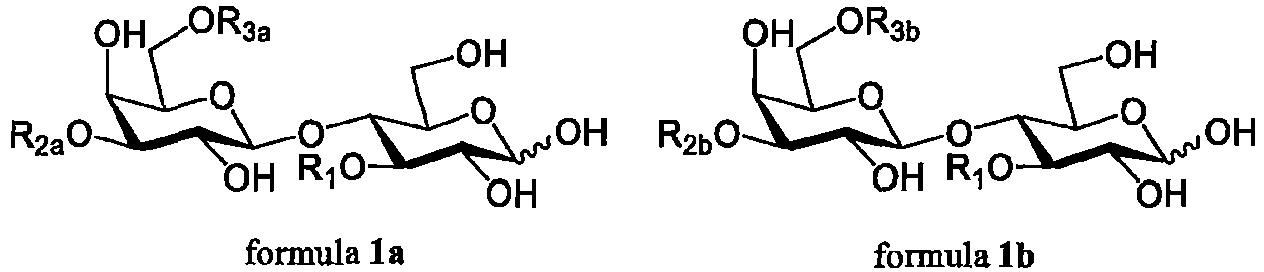
- wherein R1 is as defined above,
- R2a is an N-acetyl-lactosaminyl group optionally substituted with a glycosyl residue comprising one N-acetyl-lactosaminyl and/or one lacto-N-biosyl group; any N-acetyl-lactosaminyl and lacto-N-biosyl group can be substituted with one or more sialyl and/or fucosyl residue, but preferably void of a sialyl and/or fucosyl residue, R3a is H or an N-acetyl-lactosaminyl group optionally substituted with a lacto-N-biosyl group; any N-acetyl-lactosaminyl and lacto-N-biosyl group can be substituted with one or more sialyl and/or fucosyl residue, but preferably void of a sialyl and/or fucosyl residue,
- R2b is a lacto-N-biosyl group optionally substituted with sialyl and/or fucosyl residue, but preferably void of a sialyl and/or fucosyl residue, and
- R3b is H or an N-acetyl-lactosaminyl group optionally substituted with one or two N-acetyl-lactosaminyl and/or one lacto-N-biosyl group; any N-acetyl-lactosaminyl and lacto-N-biosyl group can be substituted with one or more sialyl and/or fucosyl residue, but preferably without a sialyl and/or fucosyl residue.
- Preferably, the compounds of formulae 1a and 1b have one or more of the following linkages and modifications:
- the N-acetyl-lactosaminyl group in the glycosyl residue of R2a in formula 1a is attached to the another N-acetyl-lactosaminyl group by a 1-3 interglycosidic linkage,
- the lacto-N-biosyl group in the glycosyl residue of R2a in formula 1a is attached to the N-acetyl-lactosaminyl group by a 1-3 interglycosidic linkage,
- the lacto-N-biosyl group in the glycosyl residue of R3a in formula 1a is attached to the N-acetyl-lactosaminyl group by a 1-3 interglycosidic linkage,
- the N-acetyl-lactosaminyl group in the glycosyl residue of R3b in formula 1b is attached to another N-acetyl-lactosaminyl group by a 1-3 or 1-6 interglycosidic linkage, and
- the lacto-N-biosyl group in the glycosyl residue of R3b in formula 1b is attached to the N-acetyl-lactosaminyl group by a 1-3 interglycosidic linkage.
- The α1-3/4 transfucosidase is preferably selected from α-L-fucosidases as classified according to EC 3.2.1.111, having transfucosidase activity, such as the α1-3/4 fucosidase from Bifidobacterium longum subsp. infantis ATCC 15697 as set forth in
US patent 8361756 as protein of SEQ ID No. 18 (SEQ ID No. 1 of the present application) and other fucosidases which have at least 60 %, preferably at least 70 %, more preferably at least 80 %, particularly at least 90 %, identity with amino acid positions 56 to 345 of the α1-3/4 fucosidase from Bifidobacterium longum subsp. infantis ATCC 15697. Examples of such other fucosidases are listed below in Table 1.Table 1. Description Accession No. α-L-fucosidase [Bifidobacterium longum subsp. infantis EK3] KEY30716.1 α-L-fucosidase [Bifidobacterium longum] WP_013140205.1 putative α1-3/4 fucosidase [Bifidobacterium kashiwanohense JCM 15439] KFI63931.1 putative α1-3/4 fucosidase [Bifidobacterium scardovii] KFI94501.1 α-L-fucosidase [Gardnerella vaginalis] WP_004574432.1 α-L-fucosidase [Gardnerella vaginalis] WP_019261748.1 hypothetical protein [Gardnerella vaginalis] WP_020759655.1 α-L-fucosidase [Gardnerella vaginalis] WP_009993891.1 α-L-fucosidase [Gardnerella vaginalis] WP_004573610.1 α-L-fucosidase [Gardnerella vaginalis] WP_004120276.1 α-L-fucosidase [Gardnerella vaginalis] WP_004114072.1 α-L-fucosidase [Gardnerella vaginalis] WP_004137675.1 α-L-fucosidase [Gardnerella vaginalis] WP_014554869.1 α-L-fucosidase [Bifidobacterium bifidum CAG:234] WP_022173522.1 α-L-fucosidase [Actinomyces sp. ICM47] WP_009647833.1 hypothetical protein [Streptomyces ipomoeae] WP_009295550.1 α-L-fucosidase [Actinomyces sp. oral taxon 180] WP_009211856.1 hypothetical protein [Actinomyces sp. oral taxon 1721 WP_021611755.1 α-L-fucosidase [Bifidobacterium sp. 7101] WP_029678277.1 hypothetical protein [Actinomyces sp. HPA0247] WP_016461038.1 α-L-fucosidase [Actinomyces sp. ICM54] EWC96238.1 α-L-fucosidase [Actinomyces odontolyticus] WP_003795385.1 α-L-fucosidase [Atopobium sp. ICM58] WP_009055210.1 α-L-fucosidase [Paenibacillus sp. J14] WP_028538247.1 α-L-fucosidase [Actinomyces odontolyticus] WP_003792781.1 α1-3/4 fucosidase [Propionibacterium acidipropionici] WP_015071771.1 α-L-fucosidase [Propionibacterium acidipropionici] WP_028700846.1 hypothetical protein [Paenibacillus barengoltzii] WP_016312877.1 α-L-fucosidase [Actinomyces sp. ICM39] WP_007588699.1 α-L-fucosidase [Propionibacterium jensenit] WP_028703334.1 α-L-fucosidase [Lactobacillus shenzhenensis] WP_022529554.1 hypothetical protein [Paenibacillus sp. HW567] WP_019912449.1 putative α-1 3/4-fucosidase [Clostridium hathewayi CAG:224] WP_022032399.1 α-fucosidase [Clostridium hathewayi] WP_006775425.1 α-L-fucosidase [Janibacter sp. HTCC2649] WP_009776262.1 α-fucosidase [Clostridium phytofermentans] WP_012201036.1 α-L-fucosidase [Enterococcus gallinarum] WP_029486307.1 uncharacterized protein [Blautia sp. CAG:237] WP_022215646.1 MULTISPECIES: α-L-fucosidase [Enterococcus] WP_005470131.1 α-L-fucosidase [Enterococcus gallinarum EG2] EEV33648.1 α-L-fucosidase [Ruminococcus sp. CAG:60] CCY33010.1 α-L-fucosidase [Ruminococcus sp. CAG:9] WP_022380664.1 α-fucosidase [Blautia wexlerae] WP_025580031.1 α-fucosidase [Ruminococcus sp. 5_1_39BFAA] WP_008706707.1 α-fucosidase [Paenibacillus sp. HGF5] WP_009593620.1 α-L-fucosidase [Paenibacillus sp. FSL H8-457] ETT68114.1 hypothetical protein [Clostridium hathewayi] WP_002604401.1 hypothetical protein [Paenibacillus sp. PAMC 26794] WP_017691196.1 α-L-fucosidase [Paenibacillus sp. FSL R5-192] ETT29638.1 α-fucosidase [Paenibacillus sp. Y412MC10] WP_015736742.1 α-L-fucosidase [Paenibacillus alvei] WP_021262981.1 α-fucosidase [Paenibacillus sp. UNC217MF] WP_028532504.1 α-fucosidase [Paenibacillus alvei] WP_005546194.1 α-L-fucosidase [Paenibacillus alvei] WP_021254840.1 hypothetical protein [Paenibacillus terrigena] WP_018756045.1 α-fucosidase [Ruminococcus obeum] WP_005422251.1 α-L-fucosidase [Paenibacillus sp. FSL H7-689] ETT43086.1 α-fucosidase [Paenibacillus lactis] WP_007127626.1 α-fucosidase [Bacillus sp. J13] WP_028406965.1 hypothetical protein [Paenibacillus daejeonensis] WP_020617104.1 hypothetical protein [Clostridium sp. KLE 1755] WP_021638714.1 α-fucosidase [Clostridium sp. ASBs410] WP_025233568.1 α-fucosidase [Paenibacillus vortex] WP_006211772.1 α-L-fucosidase [Paenibacillus sp. FSL R5-808] ETT35249.1 α-fucosidase [Clostridium celerecrescens] KEZ90324.1 α-L-fucosidase [Firmicutes bacterium CAG:94] WP_022336739.1 α-fucosidase [Clostridiales bacterium VE202-27] WP_025488431.1 α-fucosidase [Paenibacillus pasadenensis] WP_028597616.1 MULTISPECIES: α-fucosidase [Paenibacillus] WP_024629466.1 α-fucosidase [Paenibacillus sp. UNC451 MF] WP_028551519.1 α-fucosidase [Paenibacillus sp. PAMC 26794] WP_026081066.1 α-fucosidase [Paenibacillus sp. JDR-2] WP_015843379.1 MULTISPECIES: α-fucosidase [Clostridiales] WP_009250084.1 α-fucosidase [Clostridium saccharolyticum] WP_013273060.1 - It is important that the transfucosidase activity of the α1-3/4 transfucosidase is greater than its hydrolytic activity. In the course of the 3-FL + component B ⇄ component C + Lac or DFL + component E ⇄ component F + 2'-FL reaction the hydrolysis of the component C or component F can become significant at a certain time point, due to the increasing concentration of the component C or component F, which are then degraded into component B or component E, respectively, and fucose. In order to prepare the HMO mixtures of the invention, the reaction should be stopped before there is significant product hydrolysis. This time point can be easily determined by well-known enzyme kinetic measurements.
- Especially preferred α1-3/4 transfucosidases for making the HMO mixtures of this invention are the α1-3/4 transfucosidases that lack hydrolytic activity, or at least have significantly reduced hydrolytic activity. Such enzymes can be made by altering the amino acid sequence of a mainly wild type, α1-3/4 fucosidase at one or more amino acid positions, so that the mutated amino acid sequence results in improved transfucosidase activity and/or reduced hydrolytic activity. In accordance with this invention, the α1-3/4 transfucosidase preferably:
- i) has been mutated at least at one or more of the following amino acid positions of SEQ ID No. 18 of
US 8361756 : 134, 135, 168, 170, 174, 216, 221, 236, 237, 244, 245, 282 and 413, preferably at least at one or more of the following amino acid positions: 134, 135, 174, 216, 221, 282 and 413; and thereby - ii) provides a conversion rate of at least 10 % up to 70 %, preferably at least 20 %, more preferably at least 35 %, even more preferably 40-50 %, for the reaction of
- the 3-FL donor with the LNT acceptor, or
- the 3-FL donor with the LNnT acceptor, or
- the 3-FL donor with the LNFP-I acceptor, or
- the 3-FL donor with the 2'-FL acceptor, or
- the DFL donor with the LNT acceptor, or
- the DFL donor with the LNnT acceptor, or
- the DFL donor with the LNFP-I acceptor.
- The fifth aspect of this invention is an anti-infective composition for treating bacterial infections. The composition consists essentially of:
- DFL,
- a component E which is LNT, LNnT or LNFP-I,
- a component F, which is:
- LNFP-II when component E is LNT, or
- LNFP-III when component E is LNnT, or
- LNDFH-I when component E is LNFP-I, and
- 2'-FL,
or consists essentially of: - 3-FL,
- a component B which is LNT, LNnT or LNFP-I, and
- a component C, which is:
- LNFP-II when component B is LNT, or
- LNFP-III when component B is LNnT, or
- LNDFH-I when component B is LNFP-I
- i) in the mixture of HMOs consisting essentially of 3-FL, LNT and LNFP-II:
- the mixture is obtainable by a process comprising the step of reacting 3-FL and LNT in a molar ratio of 3:1 to 1:3 in the presence of an α1-3/4 transfucosidase having a conversion rate of from 40% to 70%;
- the molar ratio of (3-FL + LNT) relative to LNFP-II is 0.8-8, and
- the molar ratio of 3-FL to LNT is 0.13-7.7;
- ii) in the mixture of HMOs consisting essentially of 3-FL, LNnT and LNFP-III:
- the mixture is obtainable by a process comprising the step of reacting 3-FL and LNnT in a molar ratio of 3:1 to 1:3 in the presence of an α1-3/4 transfucosidase having a conversion rate of from 40% to 70%;
- the molar ratio of (3-FL + LNnT) relative to LNFP-III is 0.8-8, and
- the molar ratio of 3-FL to LNnT is 0.13-7.7;
- 3-FL,
- a component B which is LNT, LNnT or LNFP-I,
- a component C, which is
- LNFP-II when component B is LNT, or
- LNFP-III when component B is LNnT, or
- LNDFH-I when component B is LNFP-I, and
- lactose
and wherein- i) in the mixture of HMOs consisting essentially of 3-FL, LNT, LNFP-II and lactose:
- the mixture is obtainable by a process comprising the step of reacting 3-FL and LNT in a molar ratio of 3:1 to 1:3 in the presence of an α1-3/4 transfucosidase having a conversion rate of from 40% to 70%;
- the molar ratio of (3-FL + LNT) relative to LNFP-II is 0.8-8, and
- the molar ratio of 3-FL to LNT is 0.13-7.7;
- ii) in the mixture of HMOs consisting essentially of 3-FL, LNnT, LNFP-III and lactose:
- the mixture is obtainable by a process comprising the step of reacting 3-FL and LNnT in a molar ratio of 3:1 to 1:3 in the presence of an α1-3/4 transfucosidase having a conversion rate of from 40% to 70%;
- the molar ratio of (3-FL + LNnT) relative to LNFP-III is 0.8-8, and
- the molar ratio of 3-FL to LNnT is 0.13-7.7
- i) in the mixture of HMOs consisting essentially of 3-FL, LNT, LNFP-II and lactose:
- The anti-infective composition of this invention can be a pharmaceutical composition. The pharmaceutical composition can contain a pharmaceutically acceptable carrier, e.g. phosphate buffered saline solution, mixtures of ethanol in water, water and emulsions such as an oil/water or water/oil emulsion, as well as various wetting agents or excipients. The pharmaceutical composition can also contain other materials that do not produce an adverse, allergic or otherwise unwanted reaction when administered to a patient. The carriers and other materials can include solvents, dispersants, coatings, absorption promoting agents, controlled release agents, and one or more inert excipients, such as starches, polyols, granulating agents, microcrystalline cellulose, diluents, lubricants, binders, and disintegrating agents. If desired, tablet dosages of the anti-infective compositions can be coated by standard aqueous or non-aqueous techniques.
- The anti-infective compositions of this invention can be administered orally, e.g. as a tablet, capsule, or pellet containing a predetermined amount of the first mixture, or as a powder or granules containing a predetermined concentration of the first mixture or a gel, paste, solution, suspension, emulsion, syrup, bolus, electuary, or slurry, in an aqueous or non-aqueous liquid, containing a predetermined concentration of the first mixture. Orally administered compositions can include binders, lubricants, inert diluents, flavouring agents, and humectants. Orally administered compositions such as tablets can optionally be coated and can be formulated so as to provide sustained, delayed or controlled release of the first mixture therein.
- The anti-infective compositions of this invention can also be administered by rectal suppository, aerosol tube, naso-gastric tube or direct infusion into the GI tract or stomach.
- Anti-infective pharmaceutical compositions of this invention can also include therapeutic agents such as antiviral agents, antibiotics, probiotics, analgesics, and antiinflammatory agents. The proper dosage of these compositions for a patient can be determined in a conventional manner, based upon factors such as the patient's immune status, body weight and age. In some cases, the dosage will be at a concentration similar to thatfound for the HMOs of the composition in human breast milk. The required amount would generally be in the range from about 200 mg to about 20 g per day, in certain embodiments from about 300 mg to about 15 g per day, from about 400 mg to about 10 g per day, in certain embodiments from about 500 mg to about 10 g per day, in certain embodiments from about 1 g to about 10 g per day. Appropriate dose regimes can be determined by methods known to those skilled in the art.
- The anti-infective compositions of this invention can also be added to nutritional compositions. For example, they can be added to an infant formula, a nutritional composition, a rehydration solution, or a dietary maintenance or supplement for elderly individuals or immunocompromised individuals. Macronutrients such as edible fats, carbohydrates and proteins can also be included in such anti-infective compositions. Edible fats include, for example, coconut oil, soy oil and monoglycerides and diglycerides. Carbohydrates include, for example, glucose, edible lactose and hydrolysed cornstarch. Proteins include, for example, soy protein, whey, and skim milk. Vitamins and minerals (e. g. calcium, phosphorus, potassium, sodium, chloride, magnesium, manganese, iron, copper, zinc, selenium, iodine, and Vitamins A, E, D, C, and B complex) can also be included in such anti-infective compositions.
- The compositions disclosed in the fifth aspect of the invention are useful in modulating the microbiome of a human to increase Bifidobacterium abundance and Barnesiella abundance, and preferably to reduce Firmicutes abundance, especially Clostridia. The compositions disclosed in the fifth aspect of the invention are administered to the human to achieve this effect.
- The compositions disclosed in the fifth aspect of the invention are useful in preventing or treating bacterial infections in a human, especially antibiotic resistant bacterial infections. The compositions disclosed in the fifth aspect of the invention are administed to the human to achieve this effect.
- In this specification, unless expressly otherwise indicated, the word 'or' is used in the sense of an operator that returns a true value when either or both of the stated conditions is met, as opposed to the operator 'exclusive or' which requires that only one of the conditions is met. The word 'comprising' is used in the sense of 'including' rather than in to mean consisting of. No acknowledgement of any prior published document herein should be taken to be an admission or representation that the teaching thereof was common general knowledge in Australia or elsewhere at the date hereof.
- In the examples below, mutants of Bifidobacterium longum subsp. infantis ATCC 15697 were used for making mixtures of this invention; the positions of mutations are with reference to SEQ ID No. 1 of this application, which is identical with SEQ ID No. 18 of
US 8361756 . -
3-FL + LNT ⇄ LNFP-II + Lac
- The test was run in sodium phosphate buffer (50 mM, pH= 6.5, 37°C, 200 µl), [3-FL]= 200 mM, [LNT]= 200 mM, enzyme extract= 0.5 mg/ml. HPLC conditions: TSK Gel amide 80 (Tosoh, 3µm, 150 x 4.6 mm) was used with a flow of 1 ml/min using 56 % acetonitrile and 44 % water. The elution of substrates and products was detected by CAD and/or UV detection at 195 nm.
- The table below shows the composition of mixtures obtained. Lactose is equimolar to LN FP-II.
mutant conversion, time molar ratio 3-FL LNT LNFP-II N216D 43.9%, 15 min 1.28 1.28 1 V221A 35.6%, 15 min 1.81 1.81 1 V282K 39.7 %, 4 h 1.52 1.52 1 P134A 36.4 %, 4 h 1.75 1.75 1 W135F 44.5 %, 15 min 1.25 1.25 1 W135A 39.5 %, 2 h 1.53 1.53 1 W135A 46.1%, 6.5 h 1.17 1.17 1 W135E 39.4%, 15 min 1.54 1.54 1 W135E 43.2%,30min 1.31 1.31 1 W135E 45.2 %, 1h 1.21 1.21 1 A174S 45.1 %, 15 min 1.22 1.22 1 Q244K 37.6 %, 15min 1.66 1.66 1 Q244K 45.1%, 1h 1.22 1.22 1 Q244K 50.5 %, 6.5 h 0.98 0.98 1 S168E-A174H-E413R 41.1%, 2h 1.43 1.43 1 S168E-A174H-E413R 48.7%, 23 h 1.05 1.05 1 S168E-A174H-V282E 37.8%, 1h 1.65 1.65 1 S168E-A174H-V282E 48.5%, 6 h 1.06 1.06 1 S168E-A174H-V221A-V282H 48.5%, 6 h 1.06 1.06 1 W135E-A174F-V221A 47.4%, 6 h 1.11 1.11 1 - The same test was carried out, using the W135F-A174N-N274A-E413 mutant, as in Example 1 with the difference that the 3-FL: LNT ratio varied from 3:1 to 1:3, and the enzyme extract was 0.05 mg/ml). The table below shows the composition of mixtures obtained. Lactose is equimolar to LNFP-II. No fucose was detected.
3-FL/LNT ratio conversion, time molar ratio 3-FL LNT LNFP-II 3:1 42 %, 15 min 6.14 1.38 1 3:1 48 %, 30 min 5.25 1.08 1 3:1 57 %, 1 h 4.26 0.75 1 3:1 65 %, 2 h 3.62 0.54 1 3:1 66 %, 6.5 h 3.55 0.52 1 2:1 34 %, 30 min 4.88 1.94 1 2:1 43 %, 1h 3.65 1.33 1 2:1 57%, 4h 2.51 0.75 1 1:1 34 %, 2 h 1.94 1.94 1 1:1 43%, 6.5 h 1.33 1.33 1 1:2 40%, 1 h 1.5 4 1 1:2 49%, 2h 1.04 3.08 1 1:2 55%, 3h 0.82 2.64 1 1:2 60%, 9h 0.67 2.33 1 1:3 39 %, 15 min 1.56 6.69 1 1:3 53 %, 1h 0.89 4.66 1 1:3 62%, 2h 0.61 3.84 1 1:3 69 %, 6.5 h 0.45 3.35 1 -
3-FL + LNnT ⇆ LNFP-III + Lac
- The test was run in sodium phosphate buffer (50 mM, pH= 6.5, 37 °C, 200 µl), [3-FL]= 200 mM, [LNnT]= 200 mM,. HPLC conditions: TSK Gel amide 80 (Tosoh, 3µm, 150 x 4.6mm) was used with a flow of 1 ml/min using 56 % acetonitrile and 44 % water. The elution of substrates and products was detected by CAD and/or UV detection at 195 nm.
- The table below shows the composition of mixtures obtained for an enzyme extract of 2 mg/ml. Lactose is equimolar to LNFP-III.
mutant conversion, time molar ratio 3-FL LNnT LNFP-III N216D 29.73 %, 15 min 2.36 2.36 1 V221A 24.19 %, 15 min 3.13 3.13 1 V282K 38.1 %, 1h 1.62 1.62 1 P134A 40.46 %, 15 min 1.47 1.47 1 W135F 44.57 %, 1h 1.24 1.24 1 W135A 45.58 %, 15 min 1.19 1.19 1 W135E 44.19 %, 1h 1.26 1.26 1 W170F 40.06 %, 15 min 1.50 1.50 1 A174S 38.4 %, 15 min 1.60 1.60 1 A174H 49.3 %, 2 h 1.03 1.03 1 - The table below shows the composition of mixtures obtained for an enzyme extract of 0.5 mg/ml. Lactose is equimolar to LNFP-III.
mutant conversion, time molar ratio 3-FL LNnT LNFP-III N216D 29.00 %, 15 min 2.45 2.45 1 V221A 26.00 %, 15 min 2.85 2.85 1 V282K 7.00 %, 4h 2.70 2.70 1 P134A 32.00 %, 1h 2.13 2.13 1 W135F 34.20 %, 4h 1.92 1.92 1 W135A 36.00 %, 2 h 1.78 1.78 1 W135E 36.30 %, 4 h 1.75 1.75 1 W170F 32.00 %, 2h 2.13 2.13 1 A174S 27.30 %, 2h 2.66 2.66 1 A174H 44.00 %, 6.5 h 1.27 1.27 1 Q244K 22.50 %, 15 min 3.44 3.44 1 - The same test was carried out as in Example 3 using multi-point mutants. The table below shows the composition of mixtures obtained for an enzyme extract of 0.5 mg/ml. Lactose is equimolar to LNFP-III.
mutant conversion, time molar ratio 3-FL LNnT LNFP-III S168E-A174H-E413R 51.15 %, 23 h 0.96 0.96 1 S168E-A174F 49.16, 23 h 1.03 1.03 1 S168E-A174H-V282E 51.55 %, 6 h 0.94 0.94 1 S168E-A174H-V221A 51.0 %, 23 h 0.96 0.96 1 S168E-A174H-V221A-V282H 51.08 %, 6 h 0.96 0.96 1 W135E-A174F-V221A 52.77 %, 23 h 0.90 0.90 1 S168E-A174F-V221A-V282R 52.12 %, 23 h 0.92 0.92 1 S168E-A174H-N216D 51.65 %, 23 h 0.94 0.94 1 W135E-A174F-N216D-V221A 50.01 %, 6 h 1 1 1 S168E-A174H 51.08 %, 23 h 0.96 0.96 1 -
3-FL + LNFP-I ⇆ LNDFH-I + Lac
- The test was run in sodium phosphate buffer (50 mM, pH= 6.5, 37 °C, 200 µl), [3-FL]= 200 mM, [LNFP-I]= 200 mM, enzyme extract= 0.5 mg/ml. HPLC conditions: TSK Gel amide 80 (Tosoh, 3µm, 150 x 4.6mm) was used with a flow of 1 ml/min using 56 % acetonitrile and 44 % water. The elution of substrates and products was detected by CAD and/or UV detection at 195 nm.
- The following table below shows the composition of mixtures obtained. Lactose is equimolar to LNDFH-I.
mutant conversion, time molar ratio 3-FL LNFP-I LNDFH-I N216D 43.3 %, 15 min 1.31 1.31 1 V221A 35.5 %, 15 min 1.82 1.82 1 V282K 36.8 %, 25 h 1.72 1.72 1 P134A 45.3 %, 2 h 1.21 1.21 1 W135F 51.9 %, 25 h 0.93 0.93 1 W135A 44.3 %, 6.5 h 1.26 1.26 1 W135E 50.7 %, 25 h 0.97 0.97 1 W170F 44.5 %, 1 h 1.25 1.25 1 A174S 31.7%, 25 h 2.15 2.15 1 Q244K 42.8 %, 15 min 1.34 1.34 1 S168E-A174F 25.72 %, 23 h 2.89 2.89 1 S168E-A174H-V221A 24.75 %, 23 h 3.04 3.04 1 W135E-A174F-V221A 41.21 %, 23 h 1.43 1.43 1 W135E-A174F-N2126D-V221A 38.46 %, 23 h 1.60 1.60 1 - Another test was run in sodium phosphate buffer (50 mM, pH= 6.5, 30 °C, 140 µl), [3-FL]= 50 mM, [LNFP-I]= 50 mM, enzyme extract= 10 µl.
- The following table below shows the composition of mixtures obtained. Lactose is equimolar to LNDFH-I.
mutant conversion, time molar ratio 3-FL LNFP-I LNDFH-I P134A 33 %, 15 min 2.03 2.03 1 P134V 20 %, 15 min 4.0 4.0 1 W135F 37 %, 4.5 h 1.70 1.70 1 W135A 25 %, 4.5 h 3.0 3.0 1 W135E 37%, 4.5 h 1.70 1.70 1 W170F 33 %, 15 min 2.03 2.03 1 A236D 38 %, 15 min 1.63 1.63 1 A236H 39 %, 15 min 1.56 1.56 1 E237N 38%, 4.5h 1.63 1.63 1 Q244L 42 %, 15 min 1.38 1.38 1 Q244H 42 %, 15 min 1.38 1.38 1 Q244K 41 %, 15 min 1.44 1.44 1 Q244R 31 %, 15 min 2.23 2.23 1 Q245E 36 %, 15 min 1.78 1.78 1 W135E-A174F-A236E 50 %, 4.5 h 1.00 1.00 1 W135E-A174F-L238A 51 %, 4.5 h 0.96 0.96 1 W135E-A174F-T239H 53 %, 4.5 h 0.89 0.89 1 W135E-A174F-E241 H 52 %, 4.5 h 0.92 0.92 1 - The same test was carried out as in Example 5 in sodium phosphate buffer (50 mM, pH= 6.5, 37 °C 150 µl), [3-FL]= 100 mM, [LNFP-I]= 50 mM, enzyme extract= 10 µl crude extract. HPLC was as in Example 5.
- The following table below shows the composition of mixtures obtained after 220 minutes. Lactose is equimolar to LNDFH-I.
mutant conversion molar ratio 3-FL LNFP-I LNDFH-I W135E-A174F-E413R 40 %, 4.0 1.5 1 W135Y-A174V-E413R 45 % 3.44 1.22 1 W135F-A174F-E413R 41 % 3.88 1.44 1 W135Y-A174F-E413R 52 % 2.85 0.92 1 W135Y-A174G-E413R 43 % 3.65 1.33 1 W135F-A174N-E413R 58 % 2.45 0.72 1 W135Y-A174N-E413R 57 % 2.51 0.75 1 W135Q-A174N-E413R 56 % 2.57 0.79 1 W135Y-A174S-E413R 47 % 3.26 1.13 1 W135F-A174S-E413R 52 % 2.85 0.92 1 -
3-FL + 2'-FL ⇆ DFL + Lac
- The test was run in sodium phosphate buffer (50 mM, pH= 6.5, 37 °C, 200 µl), [3-FL]= 200 mM, [2'-FL]= 200 mM, enzyme extract= 0.5 mg/ml. HPLC conditions: TSK Gel amide 80 (Tosoh, 3µm, 150 × 4.6mm) was used with a flow of 1 ml/min using 56 % acetonitrile and 44 % water. The elution of substrates and products was detected by CAD and/or UV detection at 195 nm.
- The table below shows the composition of mixtures obtained. Lactose is equimolar to DFL.
mutant conversion, time molar ratio 3-FL 2'-FL DFL N216D 46 %, 30min 1.17 1.17 1 V282K 51 %, 25 h 0.96 0.96 1 P134A 54 %, 2h 0.85 0.85 1 W135F 59 %, 25h 0.69 0.69 1 W135A 52 %, 6h 0.92 0.92 1 W135E 59 %, 25h 0.69 0.69 1 A174S 41%, 4h 1.44 1.44 1 A174H 30 %, 25H 2.33 2.33 1 Q244K 33 %, 30 min 2.03 2.03 1 -
DFL + LNT ⇆ LNFP-II + 2'-FL
- The test was run in sodium phosphate buffer (50 mM, pH= 6.5, 37 °C, 200 µl), using the W135F-A174N-N274A-E413R mutant, [DFL]= 200 mM, [LNT]= 200 mM, enzyme extract= 0.1 or 0.25 mg/ml. HPLC conditions: TSK Gel amide 80 (Tosoh, 3µm, 150 x 4.6mm) was used with a flow of 1.1 ml/min using 66 % acetonitrile and 34 % water. The elution of substrates and products was detected by CAD and/or UV detection at 195 nm.
- The tables below show the composition of mixtures obtained.
enzyme extract: 0.1 mg/mltime (h) LNFP-II conversion DFL (mol%) LNT (mol%) LNFP-II (mol%) 2'-FL (mol%) 1 10 % 45 % 45 % 5 % 5 % 2 15 % 42.5 % 42.5 % 7.5 % 7.5 % 5 24 % 38 % 38 % 12 % 12 % 8 27 % 36.5 % 36.5 % 13.5 % 13.5 % time (h) LNFP-II conversion DFL (mol%) LNT (mol%) LNFP-II (mol%) 2'-FL (mol%) 0.5 10 % 45 % 45 % 5 % 5 % 1 16 % 42 % 42 % 8 % 8 % 2 20 % 40 % 40 % 10 % 10 % 5 28 % 36 % 36 % 14 % 14 % 8 28 % 36 % 36 % 14 % 14 % -
DFL + LNnT ⇄ LNFP-III + 2'-FL
- The test was run in sodium phosphate buffer (50 mM, pH= 6.5, 37 °C, 200 µl), using the W135F-A174N-N274A-E413R mutant, [DFL]= 200 mM, [LNnT]= 200 mM, enzyme extract= 0.1 or 0.25 mg/ml. HPLC conditions: TSK Gel amide 80 (Tosoh, 3µm, 150 x 4.6mm) was used with a flow of 1.1 ml/min using 66 % acetonitrile and 34 % water. The elution of substrates and products was detected by CAD and/or UV detection at 195 nm.
- The tables below show the composition of mixtures obtained.
enzyme extract: 0.1 mg/mltime (h) LNFP-III conversion DFL (mol%) LNnT (mol%) LNFP-III (mol%) 2'-FL (mol%) 1 7 % 46.5 % 46.5 % 3.5 % 3.5 % 2 11 % 44.5 % 44.5 % 5.5 % 5.5 % 5 19 % 40.5 % 40.5 % 9.5 % 9.5 % 8 21 % 39.5 % 39.5 % 10.5 % 10.5 % time (h) LNFP-III conversion DFL (mol%) LNnT (mol%) LNFP-III (mol%) 2'-FL (mol%) 0.5 8 % 46 % 46 % 4 % 4 % 1 12 % 44 % 44 % 6 % 6 % 2 17 % 41.5 % 41.5 % 8.5 % 8.5 % 5 24 % 38 % 38 % 12 % 12 % 8 25 % 37.5 % 37.5 % 12.5 % 12.5 % -
DFL + LNFP-I ⇆ LNDFH-I + 2'-FL
- The test was run in sodium phosphate buffer (50 mM, pH= 6.5, 37 °C, 200 µl), using the W135F-A174N-N274A-E413R mutant, [DFL]= 200 mM, [LNFP-I]= 200 mM, enzyme extract= 0.1 or 0.25 mg/ml. HPLC conditions: TSK Gel amide 80 (Tosoh, 3µm, 150 x 4.6mm) was used with a flow of 1.1 ml/min using 66 % acetonitrile and 34 % water. The elution of substrates and products was detected by CAD and/or UV detection at 195 nm.
- The tables below show the composition of mixtures obtained.
enzyme extract: 0.1 mg/mltime (h) LNDFH-I conversion DFL (mol%) LNFP-I (mol%) LNDFH-I (mol%) 2'-FL (mol%) 1 11 % 44.5 % 44.5 % 5.5 % 5.5 % 2 16 % 42 % 42 % 8 % 8 % 5 23 % 38.5 % 38.5 % 11.5 % 11.5 % 8 32 % 34 % 34 % 16 % 16 % time (h) conversion DFL (mol%) LNFP-I (mol%) LNDFH-I (mol%) 2'-FL (mol%) 0.5 11 % 44.5 % 44.5 % 5.5 % 5.5 % 1 20 % 40 % 40 % 10 % 10 % 2 28 % 36 % 36 % 14 % 14 % 5 36 % 32 % 32 % 18 % 18 % 8 38 % 31 % 31 % 19 % 19 % - A total of 80 male and female patients are recruited to participate in the study. After a screening visit and run-in period of 1-2 weeks, the patients are selected and randomized into eight groups, each of 10 patients. Seven groups are each administered a treatment product containing 5 grams of one of the following compositions:
- i) LNT, 3-FL and LNFP-II,
- ii) LNnT, 3-FL and LNFP-III,
- iii) LNFP-I, 3-FL and LNDFH-I,
- iv) 3-FL, 2'-FL and DFL,
- v) 2'-FL, DFL, LNT and LNFP-II,
- vi) 2'-FL, DFL, LNnT and LNFP-III, or
- vii) 2'-FL, DFL, LNFP-I and LNDFH-I,
- The patients are eligible to participate if they are at least 18 years of age. All recruited patients are able and willing to understand and comply with the study procedures. Patients are excluded if: they have participated in a clinical study one month prior to screening visit; they have abnormal results in the screening tests which are clinically relevant for study participation; they are suffering for a severe disease such as malignancy, diabetes, severe coronary disease, kidney disease, neurological disease, or severe psychiatric disease or any condition which can confound the results of the study; used highly dosed probiotic supplements (yoghurt allowed) for 3 months prior to the study; consumed antibiotic drugs 3 months prior to the study; consumed on a regular basis any medication that might interfere with symptom evaluation 2 weeks prior to the study; and pregnant or lactating.
- At the screening visit, medical history and concomitant medication is registered and a blood sample for safety analyses is collected. A faecal sample kit is distributed. Patients are instructed to keep their samples in the freezer until the next visit.
- At the second visit, eligibility criteria are checked and eligible subjects are randomised to the three arms in the trial. The faecal samples are collected and equipment for new samples are distributed. Patients are familiarised with an interactive internet enabled system which records data daily and are provided with either treatment or control products. Subjects are reminded not to change their usual diet during the study. Blood samples are collected for biomarker studies. The faecal samples are stored at -80° C until analysis. Faecal samples are subjected to 16 S RNA sequencing analysis.
- The study runs for 8 weeks with the patients consuming either a placebo or a treatment product daily. Patients are instructed to consume the products in the morning with breakfast. Compliance is monitored through the interactive internet enabled system. The patients also use the system to record:
- Bristol Stool Form Scale (BSF) information,
- symptom information such as abdominal pain, abdominal discomfort, abdominal cramping, abdominal bloating, and abdominal fullness,
- additional Gastrointestinal Symptom Rating Scale (GSRS) information.
- This questionnaire includes 15 items covering five dimensions (abdominal pain, indigestion, reflux, diarrhoea, constipation) and uses a seven-graded Likert scale.
- At the end of the study, each patient has an exit visit with the medical team. Faecal samples and blood samples are collected and analysed as before.
- The faecal analysis indicates that the treatment patients have increased abundance of Bifidobacterium and Barnesiella, and reduced abundance of Firmicutes; especially Clostridia.
- Eighty 7-week-old C57BL/6J female mice are individually housed to avoid contamination between mice and provided with irradiated food and water. The mice are separated into 8 groups of 10 mice, 7 treatment groups and a placebo group.
- The mice are treated with ampicillin (0.5 g/litre) in their drinking water, which is changed every 3 days. After 1 week, the ampicillin addition to the drinking water is terminated. Thereafter one of the following compositions:
- i) LNT, 3-FL and LNFP-II
- ii) LNnT, 3-FL and LNFP-III,
- iii) LNFP-I, 3-FL and LNDFH-I,
- iv) 3-FL, 2'-FL and DFL,
- v) 2'-FL, DFL, LNT and LNFP-II,
- vi) 2'-FL, DFL, LNnT and LNFP-III, or
- vii) 2'-FL, DFL, LNFP-I and LNDFH-I,
- Two days after termination of the ampicillin treatment, mice of each group is infected by means of oral gavage with a vancomycin-resistant Enterococcus faecium strain (VRE). VRE levels are determined at different time points by plating serial dilutions of faecal pellets on Enterococcosel agar plates with vancomycin. VRE colonies are identified by appearance and confirmed by Gram staining. PCR of the vanA gene, which confers resistance to vancomycin, is used to confirm the presence of VRE in infected mice.
- The mice are monitored for 2 weeks and are then euthanized. Fresh stool pellets are obtained before the mice are euthanized. The samples are immediately frozen and stored at -80 °C. DNA is extracted using a 96-well PowerSoil DNA Isolation Kit (MO-BIO). A minimum of one sample-well per plate is kept empty to serve as a negative control during PCR. PCR is done with the forward primer S-D-Bact-0341-b-S-17 and reverse primer S-D-Bact-0785-a-A-21 (Klindworth et al. Nucleic Acids Res. 41, e1 (2013)) with Illumina adapters attached. These are universal bacterial 16S rDNA primers, which target the V3-V4 region. The following PCR program is used: 98°C for 30 sec, 25x (98° C for 10 s, 55°C for 20 s, 72°C for 20 s), 72°C for 5 min. Amplification is verified by running the products on a 1% agarose gel. Barcodes are added in a nested PCR using the Nextera Index Kit V2 (Illumina) with the following PCR program: 98°C for 30 sec, 8x (98° C for 10 s, 55°C for 20 s, 72°C for 20 s), 72°C for 5 min. Attachment of primers is verified by running the products on a 1 % agarose gel.
- Products from the nested PCR are normalized using the SequalPrep Normalization Plate Kit and pooled. Pooled libraries are concentrated by evaporation and the DNA concentration of pooled libraries was measured on a Qubit fluorometer using the Qubit High Sensitivity Assay Kit (Thermo Fisher Scientific). Sequencing is done on a MiSeq desktop sequencer using the MiSeq Reagent Kit V3 (Illumina) for 2x 300 bp paired-end sequencing. The 64-bit version of USEARCH (Edgar, 2013) is used for bioinformatical analysis of the sequence data.
- In the HMO treated mice, VRE colonisation is reduced to undetectable levels within 14 days. The density of VRE reduces within 5 days. The untreated mice continue to harbour large numbers of VRE in the colon. The treatment groups of mice also show an abundance of Porphyromonadaceae, especially Barnesiella.
-
- <110> Glycom A/S
- <120> Mixtures of HMOs
- <130> P19428WO
- <150>
EP15163044.9 - <151> 2015-04-09
- <150>
EP15163045.6 - <151> 2015-04-09
- <150>
EP15163047.2 - <151> 2015-04-09
- <150>
EP15155450.8 - <151> 2015-02-17
- <150>
EP15155454.0 - <151> 2015-02-17
- <150>
EP15155457.3 - <151> 2015-02-17
- <150>
EP15155460.7 - <151> 2015-02-17
- <150>
EP14190374.0 - <151> 2014-10-24
- <160> 1
- <170> BiSSAP 1.3.2
- <210> 1
<211> 478
<212> PRT - <213> Bifidobacterium longum subsp. infantis
- <400> 1

Claims (9)
- A mixture of HMOs consisting essentially of:- a component A which is 3-FL or DFL,- a component B which is LNT, LNnT, or LNFP-I,- a component C, which is:LNFP-II when component B is LNT, orLNFP-III when component B is LNnT, orLNDFH-I when component B is LNFP-I, and- a component D, which is:lactose when component A is 3-FL, or2'-FL when component A is DFL,and whereini) in the mixture of HMOs consisting essentially of 3-FL, LNT, LNFP-II and lactose:- the mixture is obtainable by a process comprising the step of reacting 3-FL and LNT in a molar ratio of 3:1 to 1:3 in the presence of an α1-3/4 transfucosidase having a conversion rate of from 40% to 70%;- the molar ratio of (3-FL + LNT) relative to LNFP-II is 0.8-8, and- the molar ratio of 3-FL to LNT is 0.13-7.7;andii) in the mixture of HMOs consisting essentially of 3-FL, LNnT, LNFP-III and lactose:- the mixture is obtainable by a process comprising the step of reacting 3-FL and LNnT in a molar ratio of 3:1 to 1:3 in the presence of an α1-3/4 transfucosidase having a conversion rate of from 40% to 70%;- the molar ratio of (3-FL + LNnT) relative to LNFP-III is 0.8-8, and- the molar ratio of 3-FL to LNnT is 0.13-7.7.
- The mixture according to claim 1, in which component A is DFL.
- The mixture according to claim 2, in which the molar ratio of the component C relative to (DFL + component B) is at least 1:10, preferably at least 1:7, more preferably at least 1:5, even more preferably at least 1:3.
- The mixture according to claim 3, in which the molar ratio of DFL relative to the component B is 0.17-6, preferably 0.25-4, more preferably about 1.
- A mixture of HMOs consisting essentially of- 3-FL,- a component E which is LNT, LNnT or LNFP-I, and- a component F which isLNFP-II when component E is LNT, orLNFP-III when component E is LNnT, orLNDFH-I when component E is LNFP-I,and whereini) in the mixture of HMOs consisting essentially of 3-FL, LNT and LNFP-II:- the mixture is obtainable by a process comprising the step of reacting 3-FL and LNT in a molar ratio of 3:1 to 1:3 in the presence of an α1-3/4 transfucosidase having a conversion rate of from 40% to 70%;- the molar ratio of (3-FL + LNT) relative to LNFP-II is 0.8-8, and- the molar ratio of 3-FL to LNT is 0.13-7.7;andii) in the mixture of HMOs consisting essentially of 3-FL, LNnT and LNFP-III:
the mixture is obtainable by a process comprising the step of reacting 3-FL and LNnT in a molar ratio of 3:1 to 1:3 in the presence of an α1-3/4 transfucosidase having a conversion rate of from 40% to 70%;- the molar ratio of (3-FL + LNnT) relative to LNFP-III is 0.8-8, and- the molar ratio of 3-FL to LNnT is 0.13-7.7. - A process for obtaining a mixture of HMOs of any of the claims 1 to 4, comprising the steps of: reacting a component A and a component B in the presence of an α1-3/4 transfucosidase to produce a reaction mixture, and then removing the α1-3/4 transfucosidase from the reaction mixture,wherein, where component A is 3-FL and component B is LNT: 3-FL and the component B are reacted in a molar ratio of 1:3 to 3:1 in the presence of an α1-3/4 transfucosidase having a conversion rate of at least 40 % and up to 70 % for the reaction of 3-FL and the component B;wherein, where component A is 3-FL and component B is LNnT, 3-FL and the component B are reacted in a molar ratio of 3:1 to 1:3 in the presence of an α1-3/4 transfucosidase having a conversion rate of 40 % to 70 %, for the reaction of 3-FL and the component B.
- The process according to claim 6 for obtaining a mixture of HMOs of claim 2 or claim 3, comprising the step of: reacting DFL and the component B in a molar ratio of 1:5 to 5:1, preferably 1:3 to 3:1, more preferably 1:2 to 2:1, even more preferably 1:1, in the presence of an α1-3/4 transfucosidase having a conversion rate of at least 10 %, up to about 60 %, preferably at least 20 %, more preferably at least 30 %, for the reaction of DFL and the component B.
- A process for obtaining a mixture of HMOs according to claim 5, comprising the steps of reacting 3-FL and a component E in the presence of an α1-3/4 transfucosidase to produce a reaction mixture, and then removing lactose and the α1-3/4 transfucosidase from the reaction mixture, and wherein, where the component E is LNT or LNnT, 3-FL and the component E are reacted in a molar ratio of 3:1 to 1:3 in the presence of an α1-3/4 transfucosidase having a conversion rate of from 40% to 70% for the reaction of 3-FL and the component E.
- An anti-infective composition for use in treating bacterial infections according to option A, B or C below:A. an anti-infective composition for use in treating bacterial infections consisting essentially of:- 3-FL,- a component B which is LNT, LNnT, or LNFP-I, and- a component C, which is:LNFP-II when component B is LNT, orLNFP-III when component B is LNnT, orLNDFH-I when component B is LNFP-I;and whereini) in the mixture of HMOs consisting essentially of 3-FL, LNT and LNFP-II:- the mixture is obtainable by a process comprising the step of reacting 3-FL and LNT in a molar ratio of 3:1 to 1:3 in the presence of an α1-3/4 transfucosidase having a conversion rate of from 40% to 70%;- the molar ratio of (3-FL + LNT) relative to LNFP-II is 0.8-8, and- the molar ratio of 3-FL to LNT is 0.13-7.7;andii) in the mixture of HMOs consisting essentially of 3-FL, LNnT and LNFP-III:- the mixture is obtainable by a process comprising the step of reacting 3-FL and LNnT in a molar ratio of 3:1 to 1:3 in the presence of an α1-3/4 transfucosidase having a conversion rate of from 40% to 70%;- the molar ratio of (3-FL + LNnT) relative to LNFP-III is 0.8-8, and- the molar ratio of 3-FL to LNnT is 0.13-7.7;B. an anti-infective composition for use in treating bacterial infections consisting essentially of:- 3-FL,- a component B which is LNT, LNnT, LNFP-I,- a component C, which is:LNFP-II when component B is LNT, orLNFP-III when component B is LNnT, orLNDFH-I when component B is LNFP-I, and- lactose;
and whereini) in the mixture of HMOs consisting essentially of 3-FL, LNT, LNFP-II and lactose:- the mixture is obtainable by a process comprising the step of reacting 3-FL and LNT in a molar ratio of 3:1 to 1:3 in the presence of an α1-3/4 transfucosidase having a conversion rate of from 40% to 70%;- the molar ratio of (3-FL + LNT) relative to LNFP-II is 0.8-8, and- the molar ratio of 3-FL to LNT is 0.13-7.7;andii) in the mixture of HMOs consisting essentially of 3-FL, LNnT, LNFP-III and lactose:- the mixture is obtainable by a process comprising the step of reacting 3-FL and LNnT in a molar ratio of 3:1 to 1:3 in the presence of an α1-3/4 transfucosidase having a conversion rate of from 40% to 70%;- the molar ratio of (3-FL + LNnT) relative to LNFP-III is 0.8-8, and- the molar ratio of 3-FL to LNnT is 0.13-7.7;C. an anti-infective composition for use in treating bacterial infections consisting essentially of:- DFL,- a component E which is LNT, LNnT or LNFP-I,- a component F, which isLNFP-II when component E is LNT, orLNFP-III when component E is LNnT, orLNDFH-I when component E is LNFP-I, and- 2'-FL.
Priority Applications (1)
| Application Number | Priority Date | Filing Date | Title |
|---|---|---|---|
| PL15852675.6T PL3209673T5 (en) | 2014-10-24 | 2015-10-23 | MIXTURES OF HMOs |
Applications Claiming Priority (9)
| Application Number | Priority Date | Filing Date | Title |
|---|---|---|---|
| EP14190374 | 2014-10-24 | ||
| EP15155454 | 2015-02-17 | ||
| EP15155460 | 2015-02-17 | ||
| EP15155450 | 2015-02-17 | ||
| EP15155457 | 2015-02-17 | ||
| EP15163045 | 2015-04-09 | ||
| EP15163044 | 2015-04-09 | ||
| EP15163047 | 2015-04-09 | ||
| PCT/IB2015/058198 WO2016063262A1 (en) | 2014-10-24 | 2015-10-23 | MIXTURES OF HMOs |
Publications (4)
| Publication Number | Publication Date |
|---|---|
| EP3209673A1 EP3209673A1 (en) | 2017-08-30 |
| EP3209673A4 EP3209673A4 (en) | 2018-06-13 |
| EP3209673B1 EP3209673B1 (en) | 2020-08-19 |
| EP3209673B2 true EP3209673B2 (en) | 2023-07-26 |
Family
ID=55760374
Family Applications (1)
| Application Number | Title | Priority Date | Filing Date |
|---|---|---|---|
| EP15852675.6A Active EP3209673B2 (en) | 2014-10-24 | 2015-10-23 | Mixtures of human milk oligosaccharides |
Country Status (7)
| Country | Link |
|---|---|
| US (2) | US10314852B2 (en) |
| EP (1) | EP3209673B2 (en) |
| CN (1) | CN107108677B (en) |
| DK (1) | DK3209673T4 (en) |
| ES (1) | ES2824679T5 (en) |
| PL (1) | PL3209673T5 (en) |
| WO (1) | WO2016063262A1 (en) |
Families Citing this family (14)
| Publication number | Priority date | Publication date | Assignee | Title |
|---|---|---|---|---|
| WO2016063262A1 (en) * | 2014-10-24 | 2016-04-28 | Glycom A/S | MIXTURES OF HMOs |
| EP4477262A3 (en) * | 2016-09-07 | 2025-04-23 | Société des Produits Nestlé S.A. | Nutritional compositions for infants and/or young children |
| US11541068B2 (en) | 2017-05-24 | 2023-01-03 | Glycom A/S | HMO compositions and methods for reducing autism spectrum disorder symptoms |
| US11214588B2 (en) | 2017-06-30 | 2022-01-04 | Glycom A/S | Synthesis of oligosaccharides |
| CN111683665A (en) * | 2017-11-30 | 2020-09-18 | 格礼卡姆股份公司 | Human milk oligosaccharides for microbiota modulation and their synthetic compositions |
| EP4076474A4 (en) * | 2019-12-06 | 2024-02-28 | Glycom A/S | COMPOSITION COMPRISING 2'-FL AND DFL FOR USE IN A PAIN REDUCTION METHOD |
| EP4093876A1 (en) * | 2020-01-23 | 2022-11-30 | Glycom A/S | New major facilitator superfamily (mfs) protein (fred) in hmo production |
| US20250361477A1 (en) * | 2020-08-10 | 2025-11-27 | Inbiose N.V. | Production of an oligosaccharide mixture by a cell |
| EP4392014A1 (en) * | 2021-08-24 | 2024-07-03 | DSM IP Assets B.V. | Novel use of at least a human milk oligosaccharide |
| WO2023066907A1 (en) | 2021-10-18 | 2023-04-27 | Dsm Ip Assets B.V. | A method for providing an amorphous hmo product by drying |
| DK202200588A1 (en) | 2022-06-20 | 2024-02-23 | Dsm Ip Assets Bv | Mixture of fucosylated HMOs |
| DK181911B1 (en) * | 2022-07-15 | 2025-03-18 | Dsm Ip Assets Bv | GENETICALLY ENGINEERED CELLS COMPRISING A RECOMBINANT NUCLEIC ACID SEQUNCE ENCODING A FUCOSYLTRANSFERASE FOR IN VIVO SYNTHESIS OF COMPLEX FUCOSYLATED HUMAN MILK OLIGOSACCHARIDES (HMOs) AND METHODS FOR PRODUCING THE HMOs AND USE OF THE ENZYME |
| WO2024042235A1 (en) | 2022-08-25 | 2024-02-29 | Dsm Ip Assets B.V. | Hybrid method for producing complex hmos |
| CN120265786A (en) | 2022-11-25 | 2025-07-04 | 帝斯曼知识产权资产管理有限公司 | Dual-strain system for oligosaccharide production |
Citations (2)
| Publication number | Priority date | Publication date | Assignee | Title |
|---|---|---|---|---|
| WO2012156898A1 (en) † | 2011-05-13 | 2012-11-22 | Glycom A/S | DIVERSIFICATION OF HUMAN MILK OLIGOSACCHARIDES (HMOs) OR PRECURSORS THEREOF |
| WO2012158517A1 (en) † | 2011-05-13 | 2012-11-22 | Glycosyn LLC | The use of purified 2'-fucosyllactose, 3-fucosyllactose and lactodifucotetraose as prebiotics |
Family Cites Families (30)
| Publication number | Priority date | Publication date | Assignee | Title |
|---|---|---|---|---|
| JPH0686684A (en) | 1992-05-26 | 1994-03-29 | Monsanto Co | Synthesis of sialo-conjugate |
| DE19701382A1 (en) * | 1997-01-16 | 1998-07-23 | Nutricia Nv | Carbohydrate mix |
| US6045854A (en) | 1997-03-31 | 2000-04-04 | Abbott Laboraties | Nutritional formulations containing oligosaccharides |
| FR2796082B1 (en) | 1999-07-07 | 2003-06-27 | Centre Nat Rech Scient | PROCESS FOR PRODUCING OLIGOSACCHARIDES |
| EP2497478A3 (en) | 2003-12-05 | 2012-11-07 | Children's Hospital Medical Center | Oligosaccaride compositions and use thereof in the treatment of infection |
| AU2007222375B2 (en) | 2006-03-09 | 2012-12-20 | Centre National De La Recherche Scientifique (Cnrs) | Method of producing sialylated oligosaccharides |
| WO2008033520A2 (en) | 2006-09-15 | 2008-03-20 | The Regents Of The University Of California | Bifidobacterial gene sequences and their use |
| KR101218893B1 (en) | 2009-03-05 | 2013-01-09 | 닛산 지도우샤 가부시키가이샤 | Bipolar secondary battery and method for producing the same |
| CA2758097A1 (en) | 2009-04-07 | 2010-10-14 | Glycom A/S | Synthesis of 2'-o-fucosyllactose |
| EP3241836B1 (en) | 2010-02-19 | 2024-10-30 | Glycom A/S | Polymorph of a tetrasaccharide containing nacetyl-lactosamine |
| EP2536736B1 (en) | 2010-02-19 | 2017-08-16 | Glycom A/S | Production of 6'-o-sialyllactose and intermediates |
| MY191538A (en) | 2010-12-31 | 2022-06-30 | Abbott Lab | Human milk oligosaccharides to promote growth of beneficial bacteria |
| AU2012217650B9 (en) * | 2011-02-16 | 2017-09-14 | Glycosyn LLC | Biosynthesis of human milk oligosaccharides in engineered bacteria |
| US20140323705A1 (en) | 2011-05-13 | 2014-10-30 | Markus Hederos | Manufacture of lacto-n-tetraose |
| EP2522232A1 (en) * | 2011-05-13 | 2012-11-14 | Nestec S.A. | Nutritional products comprising human milk oligosaccharides and methods for manufacture thereof |
| KR20140036227A (en) | 2011-05-13 | 2014-03-25 | 글리콤 에이/에스 | Method for generating human milk oligosaccharides(hmos) or precursors thereof |
| JP5834484B2 (en) * | 2011-05-13 | 2015-12-24 | 味の素株式会社 | Process for producing fucosylated Gal-Glc or a derivative thereof |
| NL2007268C2 (en) * | 2011-08-16 | 2013-02-19 | Friesland Brands Bv | Nutritional compositions comprising human milk oligosaccharides and uses thereof. |
| CN103958537A (en) | 2011-09-30 | 2014-07-30 | 格礼卡姆股份公司 | Synthesis of HMO core structures |
| WO2013091660A1 (en) | 2011-12-23 | 2013-06-27 | Glycom A/S | A method for obtaining crystalline lacto-n-tetraose and lacto-n-neotetraose precursors and mixtures thereof |
| US20150065702A1 (en) | 2012-03-20 | 2015-03-05 | Glycom A/S | Synthesis of the Trisaccharide 3-O-Fucosyllactose and Intermediates Thereof |
| EP2836218A4 (en) | 2012-04-13 | 2015-10-21 | Trustees Boston College | PREBIOTIC COMPOSITIONS AND METHODS OF USE |
| EP2656862A1 (en) | 2012-04-24 | 2013-10-30 | The Procter & Gamble Company | Substrate comprising one or more human milk oligosaccharides and disposable absorbent article comprising the substrate |
| EP2861609A4 (en) * | 2012-06-14 | 2015-11-04 | Glycom As | INCREASING STABILITY AND PURITY AND INCREASING BIOAVAILABILITY OF HUMAN MILK OLIGOSACCHARIDES OR PRECURSORS OR MIXTURES THEREOF |
| US20150183816A1 (en) | 2012-06-22 | 2015-07-02 | Glycom A/S | Modified galactooligosaccharides |
| WO2014090261A1 (en) | 2012-12-14 | 2014-06-19 | Glycom A/S | Mixture of fucosylate lactoses |
| EP2857410A1 (en) | 2013-10-04 | 2015-04-08 | Jennewein Biotechnologie GmbH | Process for purification of 2´-fucosyllactose using simulated moving bed chromatography |
| CN105722409A (en) * | 2013-11-15 | 2016-06-29 | 雀巢产品技术援助有限公司 | Compositions for use in the prevention or treatment of necrotizing enterocolitis in infants and young children |
| WO2016063262A1 (en) * | 2014-10-24 | 2016-04-28 | Glycom A/S | MIXTURES OF HMOs |
| WO2016066175A1 (en) * | 2014-10-29 | 2016-05-06 | Glycom A/S | Synthetic composition and method for treating irritable bowel syndrome |
-
2015
- 2015-10-23 WO PCT/IB2015/058198 patent/WO2016063262A1/en not_active Ceased
- 2015-10-23 DK DK15852675.6T patent/DK3209673T4/en active
- 2015-10-23 EP EP15852675.6A patent/EP3209673B2/en active Active
- 2015-10-23 PL PL15852675.6T patent/PL3209673T5/en unknown
- 2015-10-23 CN CN201580057758.1A patent/CN107108677B/en active Active
- 2015-10-23 US US15/521,582 patent/US10314852B2/en active Active
- 2015-10-23 ES ES15852675T patent/ES2824679T5/en active Active
-
2019
- 2019-06-10 US US16/435,949 patent/US10946032B2/en active Active
Patent Citations (2)
| Publication number | Priority date | Publication date | Assignee | Title |
|---|---|---|---|---|
| WO2012156898A1 (en) † | 2011-05-13 | 2012-11-22 | Glycom A/S | DIVERSIFICATION OF HUMAN MILK OLIGOSACCHARIDES (HMOs) OR PRECURSORS THEREOF |
| WO2012158517A1 (en) † | 2011-05-13 | 2012-11-22 | Glycosyn LLC | The use of purified 2'-fucosyllactose, 3-fucosyllactose and lactodifucotetraose as prebiotics |
Also Published As
| Publication number | Publication date |
|---|---|
| DK3209673T4 (en) | 2023-10-02 |
| CN107108677B (en) | 2020-08-07 |
| PL3209673T5 (en) | 2023-10-23 |
| ES2824679T3 (en) | 2021-05-13 |
| EP3209673A4 (en) | 2018-06-13 |
| PL3209673T3 (en) | 2021-01-25 |
| WO2016063262A1 (en) | 2016-04-28 |
| US10946032B2 (en) | 2021-03-16 |
| CN107108677A (en) | 2017-08-29 |
| EP3209673A1 (en) | 2017-08-30 |
| US20190290667A1 (en) | 2019-09-26 |
| ES2824679T5 (en) | 2023-12-11 |
| US20170312298A1 (en) | 2017-11-02 |
| US10314852B2 (en) | 2019-06-11 |
| EP3209673B1 (en) | 2020-08-19 |
| DK3209673T3 (en) | 2020-11-02 |
Similar Documents
| Publication | Publication Date | Title |
|---|---|---|
| US10946032B2 (en) | Mixtures of HMOs | |
| EP3307752B1 (en) | Ternary mixtures of 6'-sl, lnnt and lst c | |
| US11173171B2 (en) | Mixtures of human milk oligosaccharides comprising 3′-O-sialyllactose | |
| EP3389404B1 (en) | Mixture of hmos | |
| US11419884B2 (en) | Compositions comprising HMOS, their production and use for the prevention and/or treatment of viral and/or bacterial infections | |
| US20190030095A1 (en) | Methods and compositions relating to microbial treatment and diagnosis of disorders | |
| JP6842072B2 (en) | Eggerthella bacteria count suppressant | |
| Wang et al. | Gut microbiota and immune regulation by Lactobacillus delbrueckii subsp. bulgaricus LB42: From preclinical safety assessment to clinical evidence | |
| EP2057992B1 (en) | Renal-function-ameliorating agent | |
| Lundberg et al. | Selection, characterisation and safety of Limosilactobacillus reuteri DSM 32846, an evolved version of DSM 17938 | |
| T BHUSHAN | EXPLORING LACTOBACILLI FOR VITAMIN B |
Legal Events
| Date | Code | Title | Description |
|---|---|---|---|
| STAA | Information on the status of an ep patent application or granted ep patent |
Free format text: STATUS: THE INTERNATIONAL PUBLICATION HAS BEEN MADE |
|
| PUAI | Public reference made under article 153(3) epc to a published international application that has entered the european phase |
Free format text: ORIGINAL CODE: 0009012 |
|
| STAA | Information on the status of an ep patent application or granted ep patent |
Free format text: STATUS: REQUEST FOR EXAMINATION WAS MADE |
|
| 17P | Request for examination filed |
Effective date: 20170523 |
|
| AK | Designated contracting states |
Kind code of ref document: A1 Designated state(s): AL AT BE BG CH CY CZ DE DK EE ES FI FR GB GR HR HU IE IS IT LI LT LU LV MC MK MT NL NO PL PT RO RS SE SI SK SM TR |
|
| AX | Request for extension of the european patent |
Extension state: BA ME |
|
| DAV | Request for validation of the european patent (deleted) | ||
| DAX | Request for extension of the european patent (deleted) | ||
| A4 | Supplementary search report drawn up and despatched |
Effective date: 20180514 |
|
| RIC1 | Information provided on ipc code assigned before grant |
Ipc: A61K 31/715 20060101ALI20180508BHEP Ipc: A61K 31/702 20060101ALI20180508BHEP Ipc: C07H 15/12 20060101ALI20180508BHEP Ipc: A61P 1/00 20060101ALI20180508BHEP Ipc: A61P 31/00 20060101ALI20180508BHEP Ipc: C07H 3/06 20060101AFI20180508BHEP Ipc: C12P 19/18 20060101ALI20180508BHEP Ipc: A61P 37/04 20060101ALI20180508BHEP |
|
| STAA | Information on the status of an ep patent application or granted ep patent |
Free format text: STATUS: EXAMINATION IS IN PROGRESS |
|
| 17Q | First examination report despatched |
Effective date: 20190313 |
|
| GRAP | Despatch of communication of intention to grant a patent |
Free format text: ORIGINAL CODE: EPIDOSNIGR1 |
|
| STAA | Information on the status of an ep patent application or granted ep patent |
Free format text: STATUS: GRANT OF PATENT IS INTENDED |
|
| INTG | Intention to grant announced |
Effective date: 20200407 |
|
| GRAS | Grant fee paid |
Free format text: ORIGINAL CODE: EPIDOSNIGR3 |
|
| GRAA | (expected) grant |
Free format text: ORIGINAL CODE: 0009210 |
|
| STAA | Information on the status of an ep patent application or granted ep patent |
Free format text: STATUS: THE PATENT HAS BEEN GRANTED |
|
| AK | Designated contracting states |
Kind code of ref document: B1 Designated state(s): AL AT BE BG CH CY CZ DE DK EE ES FI FR GB GR HR HU IE IS IT LI LT LU LV MC MK MT NL NO PL PT RO RS SE SI SK SM TR |
|
| RAP1 | Party data changed (applicant data changed or rights of an application transferred) |
Owner name: GLYCOM A/S |
|
| REG | Reference to a national code |
Ref country code: CH Ref legal event code: EP |
|
| REG | Reference to a national code |
Ref country code: DE Ref legal event code: R096 Ref document number: 602015057848 Country of ref document: DE |
|
| REG | Reference to a national code |
Ref country code: AT Ref legal event code: REF Ref document number: 1303814 Country of ref document: AT Kind code of ref document: T Effective date: 20200915 |
|
| REG | Reference to a national code |
Ref country code: IE Ref legal event code: FG4D |
|
| REG | Reference to a national code |
Ref country code: DK Ref legal event code: T3 Effective date: 20201027 |
|
| REG | Reference to a national code |
Ref country code: LT Ref legal event code: MG4D |
|
| REG | Reference to a national code |
Ref country code: NL Ref legal event code: MP Effective date: 20200819 |
|
| PG25 | Lapsed in a contracting state [announced via postgrant information from national office to epo] |
Ref country code: LT Free format text: LAPSE BECAUSE OF FAILURE TO SUBMIT A TRANSLATION OF THE DESCRIPTION OR TO PAY THE FEE WITHIN THE PRESCRIBED TIME-LIMIT Effective date: 20200819 Ref country code: HR Free format text: LAPSE BECAUSE OF FAILURE TO SUBMIT A TRANSLATION OF THE DESCRIPTION OR TO PAY THE FEE WITHIN THE PRESCRIBED TIME-LIMIT Effective date: 20200819 Ref country code: PT Free format text: LAPSE BECAUSE OF FAILURE TO SUBMIT A TRANSLATION OF THE DESCRIPTION OR TO PAY THE FEE WITHIN THE PRESCRIBED TIME-LIMIT Effective date: 20201221 Ref country code: NO Free format text: LAPSE BECAUSE OF FAILURE TO SUBMIT A TRANSLATION OF THE DESCRIPTION OR TO PAY THE FEE WITHIN THE PRESCRIBED TIME-LIMIT Effective date: 20201119 Ref country code: FI Free format text: LAPSE BECAUSE OF FAILURE TO SUBMIT A TRANSLATION OF THE DESCRIPTION OR TO PAY THE FEE WITHIN THE PRESCRIBED TIME-LIMIT Effective date: 20200819 Ref country code: SE Free format text: LAPSE BECAUSE OF FAILURE TO SUBMIT A TRANSLATION OF THE DESCRIPTION OR TO PAY THE FEE WITHIN THE PRESCRIBED TIME-LIMIT Effective date: 20200819 Ref country code: GR Free format text: LAPSE BECAUSE OF FAILURE TO SUBMIT A TRANSLATION OF THE DESCRIPTION OR TO PAY THE FEE WITHIN THE PRESCRIBED TIME-LIMIT Effective date: 20201120 Ref country code: BG Free format text: LAPSE BECAUSE OF FAILURE TO SUBMIT A TRANSLATION OF THE DESCRIPTION OR TO PAY THE FEE WITHIN THE PRESCRIBED TIME-LIMIT Effective date: 20201119 |
|
| REG | Reference to a national code |
Ref country code: AT Ref legal event code: MK05 Ref document number: 1303814 Country of ref document: AT Kind code of ref document: T Effective date: 20200819 |
|
| PG25 | Lapsed in a contracting state [announced via postgrant information from national office to epo] |
Ref country code: LV Free format text: LAPSE BECAUSE OF FAILURE TO SUBMIT A TRANSLATION OF THE DESCRIPTION OR TO PAY THE FEE WITHIN THE PRESCRIBED TIME-LIMIT Effective date: 20200819 Ref country code: NL Free format text: LAPSE BECAUSE OF FAILURE TO SUBMIT A TRANSLATION OF THE DESCRIPTION OR TO PAY THE FEE WITHIN THE PRESCRIBED TIME-LIMIT Effective date: 20200819 Ref country code: RS Free format text: LAPSE BECAUSE OF FAILURE TO SUBMIT A TRANSLATION OF THE DESCRIPTION OR TO PAY THE FEE WITHIN THE PRESCRIBED TIME-LIMIT Effective date: 20200819 Ref country code: IS Free format text: LAPSE BECAUSE OF FAILURE TO SUBMIT A TRANSLATION OF THE DESCRIPTION OR TO PAY THE FEE WITHIN THE PRESCRIBED TIME-LIMIT Effective date: 20201219 |
|
| PG25 | Lapsed in a contracting state [announced via postgrant information from national office to epo] |
Ref country code: EE Free format text: LAPSE BECAUSE OF FAILURE TO SUBMIT A TRANSLATION OF THE DESCRIPTION OR TO PAY THE FEE WITHIN THE PRESCRIBED TIME-LIMIT Effective date: 20200819 Ref country code: RO Free format text: LAPSE BECAUSE OF FAILURE TO SUBMIT A TRANSLATION OF THE DESCRIPTION OR TO PAY THE FEE WITHIN THE PRESCRIBED TIME-LIMIT Effective date: 20200819 Ref country code: SM Free format text: LAPSE BECAUSE OF FAILURE TO SUBMIT A TRANSLATION OF THE DESCRIPTION OR TO PAY THE FEE WITHIN THE PRESCRIBED TIME-LIMIT Effective date: 20200819 Ref country code: CZ Free format text: LAPSE BECAUSE OF FAILURE TO SUBMIT A TRANSLATION OF THE DESCRIPTION OR TO PAY THE FEE WITHIN THE PRESCRIBED TIME-LIMIT Effective date: 20200819 |
|
| REG | Reference to a national code |
Ref country code: ES Ref legal event code: FG2A Ref document number: 2824679 Country of ref document: ES Kind code of ref document: T3 Effective date: 20210513 |
|
| REG | Reference to a national code |
Ref country code: DE Ref legal event code: R026 Ref document number: 602015057848 Country of ref document: DE |
|
| PLBI | Opposition filed |
Free format text: ORIGINAL CODE: 0009260 |
|
| PG25 | Lapsed in a contracting state [announced via postgrant information from national office to epo] |
Ref country code: AL Free format text: LAPSE BECAUSE OF FAILURE TO SUBMIT A TRANSLATION OF THE DESCRIPTION OR TO PAY THE FEE WITHIN THE PRESCRIBED TIME-LIMIT Effective date: 20200819 Ref country code: AT Free format text: LAPSE BECAUSE OF FAILURE TO SUBMIT A TRANSLATION OF THE DESCRIPTION OR TO PAY THE FEE WITHIN THE PRESCRIBED TIME-LIMIT Effective date: 20200819 |
|
| REG | Reference to a national code |
Ref country code: CH Ref legal event code: PL |
|
| PLAX | Notice of opposition and request to file observation + time limit sent |
Free format text: ORIGINAL CODE: EPIDOSNOBS2 |
|
| 26 | Opposition filed |
Opponent name: CHR. HANSEN HMO GMBH Effective date: 20210517 Opponent name: N.V. NUTRICIA Effective date: 20210519 |
|
| PG25 | Lapsed in a contracting state [announced via postgrant information from national office to epo] |
Ref country code: SK Free format text: LAPSE BECAUSE OF FAILURE TO SUBMIT A TRANSLATION OF THE DESCRIPTION OR TO PAY THE FEE WITHIN THE PRESCRIBED TIME-LIMIT Effective date: 20200819 Ref country code: LU Free format text: LAPSE BECAUSE OF NON-PAYMENT OF DUE FEES Effective date: 20201023 Ref country code: MC Free format text: LAPSE BECAUSE OF FAILURE TO SUBMIT A TRANSLATION OF THE DESCRIPTION OR TO PAY THE FEE WITHIN THE PRESCRIBED TIME-LIMIT Effective date: 20200819 |
|
| REG | Reference to a national code |
Ref country code: BE Ref legal event code: MM Effective date: 20201031 |
|
| PG25 | Lapsed in a contracting state [announced via postgrant information from national office to epo] |
Ref country code: LI Free format text: LAPSE BECAUSE OF NON-PAYMENT OF DUE FEES Effective date: 20201031 Ref country code: SI Free format text: LAPSE BECAUSE OF FAILURE TO SUBMIT A TRANSLATION OF THE DESCRIPTION OR TO PAY THE FEE WITHIN THE PRESCRIBED TIME-LIMIT Effective date: 20200819 Ref country code: BE Free format text: LAPSE BECAUSE OF NON-PAYMENT OF DUE FEES Effective date: 20201031 Ref country code: CH Free format text: LAPSE BECAUSE OF NON-PAYMENT OF DUE FEES Effective date: 20201031 |
|
| PLBP | Opposition withdrawn |
Free format text: ORIGINAL CODE: 0009264 |
|
| PG25 | Lapsed in a contracting state [announced via postgrant information from national office to epo] |
Ref country code: IE Free format text: LAPSE BECAUSE OF NON-PAYMENT OF DUE FEES Effective date: 20201023 |
|
| PLBB | Reply of patent proprietor to notice(s) of opposition received |
Free format text: ORIGINAL CODE: EPIDOSNOBS3 |
|
| PG25 | Lapsed in a contracting state [announced via postgrant information from national office to epo] |
Ref country code: MT Free format text: LAPSE BECAUSE OF FAILURE TO SUBMIT A TRANSLATION OF THE DESCRIPTION OR TO PAY THE FEE WITHIN THE PRESCRIBED TIME-LIMIT Effective date: 20200819 Ref country code: CY Free format text: LAPSE BECAUSE OF FAILURE TO SUBMIT A TRANSLATION OF THE DESCRIPTION OR TO PAY THE FEE WITHIN THE PRESCRIBED TIME-LIMIT Effective date: 20200819 |
|
| PG25 | Lapsed in a contracting state [announced via postgrant information from national office to epo] |
Ref country code: MK Free format text: LAPSE BECAUSE OF FAILURE TO SUBMIT A TRANSLATION OF THE DESCRIPTION OR TO PAY THE FEE WITHIN THE PRESCRIBED TIME-LIMIT Effective date: 20200819 |
|
| REG | Reference to a national code |
Ref country code: FR Ref legal event code: PLFP Year of fee payment: 8 |
|
| REG | Reference to a national code |
Ref country code: CH Ref legal event code: PK Free format text: TITEL |
|
| PUAH | Patent maintained in amended form |
Free format text: ORIGINAL CODE: 0009272 |
|
| STAA | Information on the status of an ep patent application or granted ep patent |
Free format text: STATUS: PATENT MAINTAINED AS AMENDED |
|
| P01 | Opt-out of the competence of the unified patent court (upc) registered |
Effective date: 20230520 |
|
| 27A | Patent maintained in amended form |
Effective date: 20230726 |
|
| AK | Designated contracting states |
Kind code of ref document: B2 Designated state(s): AL AT BE BG CH CY CZ DE DK EE ES FI FR GB GR HR HU IE IS IT LI LT LU LV MC MK MT NL NO PL PT RO RS SE SI SK SM TR |
|
| REG | Reference to a national code |
Ref country code: DE Ref legal event code: R102 Ref document number: 602015057848 Country of ref document: DE |
|
| REG | Reference to a national code |
Ref country code: DK Ref legal event code: T4 Effective date: 20230926 |
|
| REG | Reference to a national code |
Ref country code: ES Ref legal event code: DC2A Ref document number: 2824679 Country of ref document: ES Kind code of ref document: T5 Effective date: 20231211 |
|
| PGFP | Annual fee paid to national office [announced via postgrant information from national office to epo] |
Ref country code: PL Payment date: 20240902 Year of fee payment: 10 |
|
| PGFP | Annual fee paid to national office [announced via postgrant information from national office to epo] |
Ref country code: IT Payment date: 20240910 Year of fee payment: 10 |
|
| PGFP | Annual fee paid to national office [announced via postgrant information from national office to epo] |
Ref country code: ES Payment date: 20241106 Year of fee payment: 10 |
|
| PGFP | Annual fee paid to national office [announced via postgrant information from national office to epo] |
Ref country code: TR Payment date: 20241003 Year of fee payment: 10 |
|
| PGFP | Annual fee paid to national office [announced via postgrant information from national office to epo] |
Ref country code: DE Payment date: 20251007 Year of fee payment: 11 |
|
| PGFP | Annual fee paid to national office [announced via postgrant information from national office to epo] |
Ref country code: GB Payment date: 20251016 Year of fee payment: 11 |
|
| PGFP | Annual fee paid to national office [announced via postgrant information from national office to epo] |
Ref country code: DK Payment date: 20251014 Year of fee payment: 11 |
|
| PGFP | Annual fee paid to national office [announced via postgrant information from national office to epo] |
Ref country code: FR Payment date: 20251008 Year of fee payment: 11 |