EP3208313A1 - Polyimide resin composition, polyimide film and laminate - Google Patents
Polyimide resin composition, polyimide film and laminate Download PDFInfo
- Publication number
- EP3208313A1 EP3208313A1 EP15850775.6A EP15850775A EP3208313A1 EP 3208313 A1 EP3208313 A1 EP 3208313A1 EP 15850775 A EP15850775 A EP 15850775A EP 3208313 A1 EP3208313 A1 EP 3208313A1
- Authority
- EP
- European Patent Office
- Prior art keywords
- polyimide resin
- polyimide
- film
- solution
- manufactured
- Prior art date
- Legal status (The legal status is an assumption and is not a legal conclusion. Google has not performed a legal analysis and makes no representation as to the accuracy of the status listed.)
- Granted
Links
- 229920001721 polyimide Polymers 0.000 title claims abstract description 234
- 239000009719 polyimide resin Substances 0.000 title claims abstract description 161
- 239000000203 mixture Substances 0.000 title claims abstract description 48
- VYPSYNLAJGMNEJ-UHFFFAOYSA-N Silicium dioxide Chemical compound O=[Si]=O VYPSYNLAJGMNEJ-UHFFFAOYSA-N 0.000 claims abstract description 79
- 239000000377 silicon dioxide Substances 0.000 claims abstract description 38
- 239000010419 fine particle Substances 0.000 claims abstract description 36
- 239000000758 substrate Substances 0.000 claims description 17
- 239000011521 glass Substances 0.000 claims description 11
- 229910052751 metal Inorganic materials 0.000 claims description 8
- 239000002184 metal Substances 0.000 claims description 8
- 239000011888 foil Substances 0.000 claims description 5
- 239000002985 plastic film Substances 0.000 claims description 5
- 229920006255 plastic film Polymers 0.000 claims description 5
- XUIMIQQOPSSXEZ-UHFFFAOYSA-N Silicon Chemical compound [Si] XUIMIQQOPSSXEZ-UHFFFAOYSA-N 0.000 claims description 4
- 239000010703 silicon Substances 0.000 claims description 4
- 229910052710 silicon Inorganic materials 0.000 claims description 4
- 238000000034 method Methods 0.000 description 68
- 239000010408 film Substances 0.000 description 62
- YEJRWHAVMIAJKC-UHFFFAOYSA-N 4-Butyrolactone Chemical compound O=C1CCCO1 YEJRWHAVMIAJKC-UHFFFAOYSA-N 0.000 description 34
- ZMANZCXQSJIPKH-UHFFFAOYSA-N Triethylamine Chemical compound CCN(CC)CC ZMANZCXQSJIPKH-UHFFFAOYSA-N 0.000 description 33
- 238000006243 chemical reaction Methods 0.000 description 33
- FXHOOIRPVKKKFG-UHFFFAOYSA-N N,N-Dimethylacetamide Chemical compound CN(C)C(C)=O FXHOOIRPVKKKFG-UHFFFAOYSA-N 0.000 description 31
- NVKGJHAQGWCWDI-UHFFFAOYSA-N 4-[4-amino-2-(trifluoromethyl)phenyl]-3-(trifluoromethyl)aniline Chemical compound FC(F)(F)C1=CC(N)=CC=C1C1=CC=C(N)C=C1C(F)(F)F NVKGJHAQGWCWDI-UHFFFAOYSA-N 0.000 description 28
- 239000002114 nanocomposite Substances 0.000 description 25
- -1 alicyclic diamine Chemical class 0.000 description 24
- 239000002904 solvent Substances 0.000 description 24
- 239000003960 organic solvent Substances 0.000 description 23
- 238000011156 evaluation Methods 0.000 description 22
- GTDPSWPPOUPBNX-UHFFFAOYSA-N ac1mqpva Chemical compound CC12C(=O)OC(=O)C1(C)C1(C)C2(C)C(=O)OC1=O GTDPSWPPOUPBNX-UHFFFAOYSA-N 0.000 description 20
- 239000003054 catalyst Substances 0.000 description 20
- 239000007789 gas Substances 0.000 description 20
- ZPAKUZKMGJJMAA-UHFFFAOYSA-N Cyclohexane-1,2,4,5-tetracarboxylic acid Chemical compound OC(=O)C1CC(C(O)=O)C(C(O)=O)CC1C(O)=O ZPAKUZKMGJJMAA-UHFFFAOYSA-N 0.000 description 19
- QYIMZXITLDTULQ-UHFFFAOYSA-N 4-(4-amino-2-methylphenyl)-3-methylaniline Chemical compound CC1=CC(N)=CC=C1C1=CC=C(N)C=C1C QYIMZXITLDTULQ-UHFFFAOYSA-N 0.000 description 18
- ZMXDDKWLCZADIW-UHFFFAOYSA-N N,N-Dimethylformamide Chemical compound CN(C)C=O ZMXDDKWLCZADIW-UHFFFAOYSA-N 0.000 description 18
- YXFVVABEGXRONW-UHFFFAOYSA-N Toluene Chemical compound CC1=CC=CC=C1 YXFVVABEGXRONW-UHFFFAOYSA-N 0.000 description 18
- 239000004642 Polyimide Substances 0.000 description 17
- 239000007787 solid Substances 0.000 description 17
- XEKOWRVHYACXOJ-UHFFFAOYSA-N Ethyl acetate Chemical compound CCOC(C)=O XEKOWRVHYACXOJ-UHFFFAOYSA-N 0.000 description 15
- 238000002834 transmittance Methods 0.000 description 15
- 150000004985 diamines Chemical class 0.000 description 14
- 239000012299 nitrogen atmosphere Substances 0.000 description 14
- SECXISVLQFMRJM-UHFFFAOYSA-N N-Methylpyrrolidone Chemical compound CN1CCCC1=O SECXISVLQFMRJM-UHFFFAOYSA-N 0.000 description 13
- 238000003756 stirring Methods 0.000 description 13
- 230000000052 comparative effect Effects 0.000 description 12
- 150000001875 compounds Chemical class 0.000 description 12
- 239000000126 substance Substances 0.000 description 12
- 150000004984 aromatic diamines Chemical class 0.000 description 11
- 150000003949 imides Chemical class 0.000 description 11
- 238000005033 Fourier transform infrared spectroscopy Methods 0.000 description 10
- 230000008034 disappearance Effects 0.000 description 10
- 239000007858 starting material Substances 0.000 description 10
- UHOVQNZJYSORNB-UHFFFAOYSA-N Benzene Chemical compound C1=CC=CC=C1 UHOVQNZJYSORNB-UHFFFAOYSA-N 0.000 description 9
- OKKJLVBELUTLKV-UHFFFAOYSA-N Methanol Chemical compound OC OKKJLVBELUTLKV-UHFFFAOYSA-N 0.000 description 9
- 239000003795 chemical substances by application Substances 0.000 description 9
- 238000010528 free radical solution polymerization reaction Methods 0.000 description 9
- 239000002250 absorbent Substances 0.000 description 8
- 230000002745 absorbent Effects 0.000 description 8
- 239000002253 acid Substances 0.000 description 8
- 125000002723 alicyclic group Chemical group 0.000 description 8
- 125000003118 aryl group Chemical group 0.000 description 8
- JHIVVAPYMSGYDF-UHFFFAOYSA-N cyclohexanone Chemical compound O=C1CCCCC1 JHIVVAPYMSGYDF-UHFFFAOYSA-N 0.000 description 8
- BGTOWKSIORTVQH-UHFFFAOYSA-N cyclopentanone Chemical compound O=C1CCCC1 BGTOWKSIORTVQH-UHFFFAOYSA-N 0.000 description 8
- 239000011347 resin Substances 0.000 description 8
- 229920005989 resin Polymers 0.000 description 8
- KFZMGEQAYNKOFK-UHFFFAOYSA-N Isopropanol Chemical compound CC(C)O KFZMGEQAYNKOFK-UHFFFAOYSA-N 0.000 description 7
- 125000003277 amino group Chemical group 0.000 description 7
- 150000000000 tetracarboxylic acids Chemical class 0.000 description 7
- ZWEHNKRNPOVVGH-UHFFFAOYSA-N 2-Butanone Chemical compound CCC(C)=O ZWEHNKRNPOVVGH-UHFFFAOYSA-N 0.000 description 6
- LYCAIKOWRPUZTN-UHFFFAOYSA-N Ethylene glycol Chemical compound OCCO LYCAIKOWRPUZTN-UHFFFAOYSA-N 0.000 description 6
- 239000006087 Silane Coupling Agent Substances 0.000 description 6
- 125000001931 aliphatic group Chemical group 0.000 description 6
- 125000003178 carboxy group Chemical group [H]OC(*)=O 0.000 description 6
- 125000002887 hydroxy group Chemical group [H]O* 0.000 description 6
- 238000005259 measurement Methods 0.000 description 6
- 238000004458 analytical method Methods 0.000 description 5
- 238000001035 drying Methods 0.000 description 5
- 238000004519 manufacturing process Methods 0.000 description 5
- 239000002245 particle Substances 0.000 description 5
- ARXJGSRGQADJSQ-UHFFFAOYSA-N 1-methoxypropan-2-ol Chemical compound COCC(C)O ARXJGSRGQADJSQ-UHFFFAOYSA-N 0.000 description 4
- KRPRVQWGKLEFKN-UHFFFAOYSA-N 3-(3-aminopropoxy)propan-1-amine Chemical compound NCCCOCCCN KRPRVQWGKLEFKN-UHFFFAOYSA-N 0.000 description 4
- HLBLWEWZXPIGSM-UHFFFAOYSA-N 4-Aminophenyl ether Chemical compound C1=CC(N)=CC=C1OC1=CC=C(N)C=C1 HLBLWEWZXPIGSM-UHFFFAOYSA-N 0.000 description 4
- IJGRMHOSHXDMSA-UHFFFAOYSA-N Atomic nitrogen Chemical compound N#N IJGRMHOSHXDMSA-UHFFFAOYSA-N 0.000 description 4
- IAZDPXIOMUYVGZ-UHFFFAOYSA-N Dimethylsulphoxide Chemical compound CS(C)=O IAZDPXIOMUYVGZ-UHFFFAOYSA-N 0.000 description 4
- ATUOYWHBWRKTHZ-UHFFFAOYSA-N Propane Chemical compound CCC ATUOYWHBWRKTHZ-UHFFFAOYSA-N 0.000 description 4
- 239000004305 biphenyl Substances 0.000 description 4
- ZUOUZKKEUPVFJK-UHFFFAOYSA-N diphenyl Chemical compound C1=CC=CC=C1C1=CC=CC=C1 ZUOUZKKEUPVFJK-UHFFFAOYSA-N 0.000 description 4
- 239000002612 dispersion medium Substances 0.000 description 4
- 230000000694 effects Effects 0.000 description 4
- 125000000524 functional group Chemical group 0.000 description 4
- 238000010438 heat treatment Methods 0.000 description 4
- NAQMVNRVTILPCV-UHFFFAOYSA-N hexane-1,6-diamine Chemical compound NCCCCCCN NAQMVNRVTILPCV-UHFFFAOYSA-N 0.000 description 4
- RLSSMJSEOOYNOY-UHFFFAOYSA-N m-cresol Chemical compound CC1=CC=CC(O)=C1 RLSSMJSEOOYNOY-UHFFFAOYSA-N 0.000 description 4
- 239000000463 material Substances 0.000 description 4
- KMKWGXGSGPYISJ-UHFFFAOYSA-N 4-[4-[2-[4-(4-aminophenoxy)phenyl]propan-2-yl]phenoxy]aniline Chemical compound C=1C=C(OC=2C=CC(N)=CC=2)C=CC=1C(C)(C)C(C=C1)=CC=C1OC1=CC=C(N)C=C1 KMKWGXGSGPYISJ-UHFFFAOYSA-N 0.000 description 3
- RYGMFSIKBFXOCR-UHFFFAOYSA-N Copper Chemical compound [Cu] RYGMFSIKBFXOCR-UHFFFAOYSA-N 0.000 description 3
- LFQSCWFLJHTTHZ-UHFFFAOYSA-N Ethanol Chemical compound CCO LFQSCWFLJHTTHZ-UHFFFAOYSA-N 0.000 description 3
- 239000004952 Polyamide Substances 0.000 description 3
- FDLQZKYLHJJBHD-UHFFFAOYSA-N [3-(aminomethyl)phenyl]methanamine Chemical compound NCC1=CC=CC(CN)=C1 FDLQZKYLHJJBHD-UHFFFAOYSA-N 0.000 description 3
- 150000007513 acids Chemical class 0.000 description 3
- 125000000217 alkyl group Chemical group 0.000 description 3
- 125000002915 carbonyl group Chemical group [*:2]C([*:1])=O 0.000 description 3
- 239000011248 coating agent Substances 0.000 description 3
- 239000008119 colloidal silica Substances 0.000 description 3
- 229910052802 copper Inorganic materials 0.000 description 3
- 239000010949 copper Substances 0.000 description 3
- 239000003085 diluting agent Substances 0.000 description 3
- 239000006185 dispersion Substances 0.000 description 3
- 229910052736 halogen Inorganic materials 0.000 description 3
- 150000002367 halogens Chemical class 0.000 description 3
- RAXXELZNTBOGNW-UHFFFAOYSA-N imidazole Natural products C1=CNC=N1 RAXXELZNTBOGNW-UHFFFAOYSA-N 0.000 description 3
- VLKZOEOYAKHREP-UHFFFAOYSA-N n-Hexane Chemical compound CCCCCC VLKZOEOYAKHREP-UHFFFAOYSA-N 0.000 description 3
- 239000012788 optical film Substances 0.000 description 3
- 125000001997 phenyl group Chemical group [H]C1=C([H])C([H])=C(*)C([H])=C1[H] 0.000 description 3
- 229920002492 poly(sulfone) Polymers 0.000 description 3
- 229920002647 polyamide Polymers 0.000 description 3
- 229920000515 polycarbonate Polymers 0.000 description 3
- 239000004417 polycarbonate Substances 0.000 description 3
- 229920006393 polyether sulfone Polymers 0.000 description 3
- 238000006116 polymerization reaction Methods 0.000 description 3
- 229920000098 polyolefin Polymers 0.000 description 3
- BDERNNFJNOPAEC-UHFFFAOYSA-N propan-1-ol Chemical compound CCCO BDERNNFJNOPAEC-UHFFFAOYSA-N 0.000 description 3
- 125000001424 substituent group Chemical group 0.000 description 3
- XLYOFNOQVPJJNP-UHFFFAOYSA-N water Substances O XLYOFNOQVPJJNP-UHFFFAOYSA-N 0.000 description 3
- QEGNUYASOUJEHD-UHFFFAOYSA-N 1,1-dimethylcyclohexane Chemical compound CC1(C)CCCCC1 QEGNUYASOUJEHD-UHFFFAOYSA-N 0.000 description 2
- RFFLAFLAYFXFSW-UHFFFAOYSA-N 1,2-dichlorobenzene Chemical compound ClC1=CC=CC=C1Cl RFFLAFLAYFXFSW-UHFFFAOYSA-N 0.000 description 2
- WZCQRUWWHSTZEM-UHFFFAOYSA-N 1,3-phenylenediamine Chemical compound NC1=CC=CC(N)=C1 WZCQRUWWHSTZEM-UHFFFAOYSA-N 0.000 description 2
- CBCKQZAAMUWICA-UHFFFAOYSA-N 1,4-phenylenediamine Chemical compound NC1=CC=C(N)C=C1 CBCKQZAAMUWICA-UHFFFAOYSA-N 0.000 description 2
- PAMIQIKDUOTOBW-UHFFFAOYSA-N 1-methylpiperidine Chemical compound CN1CCCCC1 PAMIQIKDUOTOBW-UHFFFAOYSA-N 0.000 description 2
- VOZKAJLKRJDJLL-UHFFFAOYSA-N 2,4-diaminotoluene Chemical compound CC1=CC=C(N)C=C1N VOZKAJLKRJDJLL-UHFFFAOYSA-N 0.000 description 2
- SBASXUCJHJRPEV-UHFFFAOYSA-N 2-(2-methoxyethoxy)ethanol Chemical compound COCCOCCO SBASXUCJHJRPEV-UHFFFAOYSA-N 0.000 description 2
- ZGDMDBHLKNQPSD-UHFFFAOYSA-N 2-amino-5-(4-amino-3-hydroxyphenyl)phenol Chemical compound C1=C(O)C(N)=CC=C1C1=CC=C(N)C(O)=C1 ZGDMDBHLKNQPSD-UHFFFAOYSA-N 0.000 description 2
- ZBMISJGHVWNWTE-UHFFFAOYSA-N 3-(4-aminophenoxy)aniline Chemical compound C1=CC(N)=CC=C1OC1=CC=CC(N)=C1 ZBMISJGHVWNWTE-UHFFFAOYSA-N 0.000 description 2
- RNLHGQLZWXBQNY-UHFFFAOYSA-N 3-(aminomethyl)-3,5,5-trimethylcyclohexan-1-amine Chemical compound CC1(C)CC(N)CC(C)(CN)C1 RNLHGQLZWXBQNY-UHFFFAOYSA-N 0.000 description 2
- DKKYOQYISDAQER-UHFFFAOYSA-N 3-[3-(3-aminophenoxy)phenoxy]aniline Chemical compound NC1=CC=CC(OC=2C=C(OC=3C=C(N)C=CC=3)C=CC=2)=C1 DKKYOQYISDAQER-UHFFFAOYSA-N 0.000 description 2
- WCXGOVYROJJXHA-UHFFFAOYSA-N 3-[4-[4-(3-aminophenoxy)phenyl]sulfonylphenoxy]aniline Chemical compound NC1=CC=CC(OC=2C=CC(=CC=2)S(=O)(=O)C=2C=CC(OC=3C=C(N)C=CC=3)=CC=2)=C1 WCXGOVYROJJXHA-UHFFFAOYSA-N 0.000 description 2
- YBRVSVVVWCFQMG-UHFFFAOYSA-N 4,4'-diaminodiphenylmethane Chemical compound C1=CC(N)=CC=C1CC1=CC=C(N)C=C1 YBRVSVVVWCFQMG-UHFFFAOYSA-N 0.000 description 2
- DZIHTWJGPDVSGE-UHFFFAOYSA-N 4-[(4-aminocyclohexyl)methyl]cyclohexan-1-amine Chemical compound C1CC(N)CCC1CC1CCC(N)CC1 DZIHTWJGPDVSGE-UHFFFAOYSA-N 0.000 description 2
- WUPRYUDHUFLKFL-UHFFFAOYSA-N 4-[3-(4-aminophenoxy)phenoxy]aniline Chemical compound C1=CC(N)=CC=C1OC1=CC=CC(OC=2C=CC(N)=CC=2)=C1 WUPRYUDHUFLKFL-UHFFFAOYSA-N 0.000 description 2
- JCRRFJIVUPSNTA-UHFFFAOYSA-N 4-[4-(4-aminophenoxy)phenoxy]aniline Chemical compound C1=CC(N)=CC=C1OC(C=C1)=CC=C1OC1=CC=C(N)C=C1 JCRRFJIVUPSNTA-UHFFFAOYSA-N 0.000 description 2
- UTDAGHZGKXPRQI-UHFFFAOYSA-N 4-[4-[4-(4-aminophenoxy)phenyl]sulfonylphenoxy]aniline Chemical compound C1=CC(N)=CC=C1OC1=CC=C(S(=O)(=O)C=2C=CC(OC=3C=CC(N)=CC=3)=CC=2)C=C1 UTDAGHZGKXPRQI-UHFFFAOYSA-N 0.000 description 2
- WXNZTHHGJRFXKQ-UHFFFAOYSA-N 4-chlorophenol Chemical compound OC1=CC=C(Cl)C=C1 WXNZTHHGJRFXKQ-UHFFFAOYSA-N 0.000 description 2
- CSCPPACGZOOCGX-UHFFFAOYSA-N Acetone Chemical compound CC(C)=O CSCPPACGZOOCGX-UHFFFAOYSA-N 0.000 description 2
- MQJKPEGWNLWLTK-UHFFFAOYSA-N Dapsone Chemical compound C1=CC(N)=CC=C1S(=O)(=O)C1=CC=C(N)C=C1 MQJKPEGWNLWLTK-UHFFFAOYSA-N 0.000 description 2
- PIICEJLVQHRZGT-UHFFFAOYSA-N Ethylenediamine Chemical compound NCCN PIICEJLVQHRZGT-UHFFFAOYSA-N 0.000 description 2
- XEEYBQQBJWHFJM-UHFFFAOYSA-N Iron Chemical compound [Fe] XEEYBQQBJWHFJM-UHFFFAOYSA-N 0.000 description 2
- IMNFDUFMRHMDMM-UHFFFAOYSA-N N-Heptane Chemical compound CCCCCCC IMNFDUFMRHMDMM-UHFFFAOYSA-N 0.000 description 2
- UFWIBTONFRDIAS-UHFFFAOYSA-N Naphthalene Chemical compound C1=CC=CC2=CC=CC=C21 UFWIBTONFRDIAS-UHFFFAOYSA-N 0.000 description 2
- PXHVJJICTQNCMI-UHFFFAOYSA-N Nickel Chemical compound [Ni] PXHVJJICTQNCMI-UHFFFAOYSA-N 0.000 description 2
- CTQNGGLPUBDAKN-UHFFFAOYSA-N O-Xylene Chemical compound CC1=CC=CC=C1C CTQNGGLPUBDAKN-UHFFFAOYSA-N 0.000 description 2
- USWMCMSAHICGFU-UHFFFAOYSA-N O-aminosilylhydroxylamine Chemical class NO[SiH2]N USWMCMSAHICGFU-UHFFFAOYSA-N 0.000 description 2
- URLKBWYHVLBVBO-UHFFFAOYSA-N Para-Xylene Chemical group CC1=CC=C(C)C=C1 URLKBWYHVLBVBO-UHFFFAOYSA-N 0.000 description 2
- 239000002202 Polyethylene glycol Substances 0.000 description 2
- JUJWROOIHBZHMG-UHFFFAOYSA-N Pyridine Chemical compound C1=CC=NC=C1 JUJWROOIHBZHMG-UHFFFAOYSA-N 0.000 description 2
- SMWDFEZZVXVKRB-UHFFFAOYSA-N Quinoline Chemical compound N1=CC=CC2=CC=CC=C21 SMWDFEZZVXVKRB-UHFFFAOYSA-N 0.000 description 2
- MCMNRKCIXSYSNV-UHFFFAOYSA-N Zirconium dioxide Chemical compound O=[Zr]=O MCMNRKCIXSYSNV-UHFFFAOYSA-N 0.000 description 2
- QLBRROYTTDFLDX-UHFFFAOYSA-N [3-(aminomethyl)cyclohexyl]methanamine Chemical compound NCC1CCCC(CN)C1 QLBRROYTTDFLDX-UHFFFAOYSA-N 0.000 description 2
- OXIKYYJDTWKERT-UHFFFAOYSA-N [4-(aminomethyl)cyclohexyl]methanamine Chemical compound NCC1CCC(CN)CC1 OXIKYYJDTWKERT-UHFFFAOYSA-N 0.000 description 2
- ISKQADXMHQSTHK-UHFFFAOYSA-N [4-(aminomethyl)phenyl]methanamine Chemical compound NCC1=CC=C(CN)C=C1 ISKQADXMHQSTHK-UHFFFAOYSA-N 0.000 description 2
- NIXOWILDQLNWCW-UHFFFAOYSA-N acrylic acid group Chemical group C(C=C)(=O)O NIXOWILDQLNWCW-UHFFFAOYSA-N 0.000 description 2
- 239000000654 additive Substances 0.000 description 2
- 230000000996 additive effect Effects 0.000 description 2
- 239000003963 antioxidant agent Substances 0.000 description 2
- 230000003078 antioxidant effect Effects 0.000 description 2
- XMSVKICKONKVNM-UHFFFAOYSA-N bicyclo[2.2.1]heptane-3,4-diamine Chemical compound C1CC2(N)C(N)CC1C2 XMSVKICKONKVNM-UHFFFAOYSA-N 0.000 description 2
- 235000010290 biphenyl Nutrition 0.000 description 2
- 238000009835 boiling Methods 0.000 description 2
- MVPPADPHJFYWMZ-UHFFFAOYSA-N chlorobenzene Chemical compound ClC1=CC=CC=C1 MVPPADPHJFYWMZ-UHFFFAOYSA-N 0.000 description 2
- 238000000576 coating method Methods 0.000 description 2
- 229920001577 copolymer Polymers 0.000 description 2
- USIUVYZYUHIAEV-UHFFFAOYSA-N diphenyl ether Chemical compound C=1C=CC=CC=1OC1=CC=CC=C1 USIUVYZYUHIAEV-UHFFFAOYSA-N 0.000 description 2
- KZTYYGOKRVBIMI-UHFFFAOYSA-N diphenyl sulfone Chemical compound C=1C=CC=CC=1S(=O)(=O)C1=CC=CC=C1 KZTYYGOKRVBIMI-UHFFFAOYSA-N 0.000 description 2
- 238000001704 evaporation Methods 0.000 description 2
- 230000009477 glass transition Effects 0.000 description 2
- PCHJSUWPFVWCPO-UHFFFAOYSA-N gold Chemical compound [Au] PCHJSUWPFVWCPO-UHFFFAOYSA-N 0.000 description 2
- 229910052737 gold Inorganic materials 0.000 description 2
- 239000010931 gold Substances 0.000 description 2
- HJOVHMDZYOCNQW-UHFFFAOYSA-N isophorone Chemical compound CC1=CC(=O)CC(C)(C)C1 HJOVHMDZYOCNQW-UHFFFAOYSA-N 0.000 description 2
- AWJUIBRHMBBTKR-UHFFFAOYSA-N isoquinoline Chemical compound C1=NC=CC2=CC=CC=C21 AWJUIBRHMBBTKR-UHFFFAOYSA-N 0.000 description 2
- 239000004611 light stabiliser Substances 0.000 description 2
- IVSZLXZYQVIEFR-UHFFFAOYSA-N m-xylene Chemical group CC1=CC=CC(C)=C1 IVSZLXZYQVIEFR-UHFFFAOYSA-N 0.000 description 2
- 238000002156 mixing Methods 0.000 description 2
- 238000000465 moulding Methods 0.000 description 2
- KQSABULTKYLFEV-UHFFFAOYSA-N naphthalene-1,5-diamine Chemical compound C1=CC=C2C(N)=CC=CC2=C1N KQSABULTKYLFEV-UHFFFAOYSA-N 0.000 description 2
- GOGZBMRXLADNEV-UHFFFAOYSA-N naphthalene-2,6-diamine Chemical compound C1=C(N)C=CC2=CC(N)=CC=C21 GOGZBMRXLADNEV-UHFFFAOYSA-N 0.000 description 2
- 229910052757 nitrogen Inorganic materials 0.000 description 2
- 229920003023 plastic Polymers 0.000 description 2
- 239000004033 plastic Substances 0.000 description 2
- 229920005575 poly(amic acid) Polymers 0.000 description 2
- 229920000728 polyester Polymers 0.000 description 2
- 229920001601 polyetherimide Polymers 0.000 description 2
- 229920001223 polyethylene glycol Polymers 0.000 description 2
- 229920000139 polyethylene terephthalate Polymers 0.000 description 2
- 239000005020 polyethylene terephthalate Substances 0.000 description 2
- 229920001451 polypropylene glycol Polymers 0.000 description 2
- 238000002360 preparation method Methods 0.000 description 2
- 239000001294 propane Substances 0.000 description 2
- 229910052709 silver Inorganic materials 0.000 description 2
- 239000004332 silver Substances 0.000 description 2
- 238000005507 spraying Methods 0.000 description 2
- 238000003860 storage Methods 0.000 description 2
- IMNIMPAHZVJRPE-UHFFFAOYSA-N triethylenediamine Chemical compound C1CN2CCN1CC2 IMNIMPAHZVJRPE-UHFFFAOYSA-N 0.000 description 2
- GETQZCLCWQTVFV-UHFFFAOYSA-N trimethylamine Chemical compound CN(C)C GETQZCLCWQTVFV-UHFFFAOYSA-N 0.000 description 2
- 239000008096 xylene Substances 0.000 description 2
- QNODIIQQMGDSEF-UHFFFAOYSA-N (1-hydroxycyclohexyl)-phenylmethanone Chemical compound C=1C=CC=CC=1C(=O)C1(O)CCCCC1 QNODIIQQMGDSEF-UHFFFAOYSA-N 0.000 description 1
- WYTZZXDRDKSJID-UHFFFAOYSA-N (3-aminopropyl)triethoxysilane Chemical compound CCO[Si](OCC)(OCC)CCCN WYTZZXDRDKSJID-UHFFFAOYSA-N 0.000 description 1
- ONQBOTKLCMXPOF-UHFFFAOYSA-N 1-ethylpyrrolidine Chemical compound CCN1CCCC1 ONQBOTKLCMXPOF-UHFFFAOYSA-N 0.000 description 1
- 239000012956 1-hydroxycyclohexylphenyl-ketone Substances 0.000 description 1
- 238000005160 1H NMR spectroscopy Methods 0.000 description 1
- RNFJDJUURJAICM-UHFFFAOYSA-N 2,2,4,4,6,6-hexaphenoxy-1,3,5-triaza-2$l^{5},4$l^{5},6$l^{5}-triphosphacyclohexa-1,3,5-triene Chemical compound N=1P(OC=2C=CC=CC=2)(OC=2C=CC=CC=2)=NP(OC=2C=CC=CC=2)(OC=2C=CC=CC=2)=NP=1(OC=1C=CC=CC=1)OC1=CC=CC=C1 RNFJDJUURJAICM-UHFFFAOYSA-N 0.000 description 1
- ZXDDPOHVAMWLBH-UHFFFAOYSA-N 2,4-Dihydroxybenzophenone Chemical compound OC1=CC(O)=CC=C1C(=O)C1=CC=CC=C1 ZXDDPOHVAMWLBH-UHFFFAOYSA-N 0.000 description 1
- IGFDJZRYXGAOKQ-UHFFFAOYSA-N 2-(4,6-diphenyl-1,3,5-triazin-2-yl)-5-ethoxyphenol Chemical compound OC1=CC(OCC)=CC=C1C1=NC(C=2C=CC=CC=2)=NC(C=2C=CC=CC=2)=N1 IGFDJZRYXGAOKQ-UHFFFAOYSA-N 0.000 description 1
- UUINYPIVWRZHAG-UHFFFAOYSA-N 2-(4,6-diphenyl-1,3,5-triazin-2-yl)-5-methoxyphenol Chemical compound OC1=CC(OC)=CC=C1C1=NC(C=2C=CC=CC=2)=NC(C=2C=CC=CC=2)=N1 UUINYPIVWRZHAG-UHFFFAOYSA-N 0.000 description 1
- BFSVOASYOCHEOV-UHFFFAOYSA-N 2-diethylaminoethanol Chemical compound CCN(CC)CCO BFSVOASYOCHEOV-UHFFFAOYSA-N 0.000 description 1
- XUSNPFGLKGCWGN-UHFFFAOYSA-N 3-[4-(3-aminopropyl)piperazin-1-yl]propan-1-amine Chemical compound NCCCN1CCN(CCCN)CC1 XUSNPFGLKGCWGN-UHFFFAOYSA-N 0.000 description 1
- HXLAEGYMDGUSBD-UHFFFAOYSA-N 3-[diethoxy(methyl)silyl]propan-1-amine Chemical compound CCO[Si](C)(OCC)CCCN HXLAEGYMDGUSBD-UHFFFAOYSA-N 0.000 description 1
- SJECZPVISLOESU-UHFFFAOYSA-N 3-trimethoxysilylpropan-1-amine Chemical compound CO[Si](OC)(OC)CCCN SJECZPVISLOESU-UHFFFAOYSA-N 0.000 description 1
- JFFVLLDSZLPRHD-UHFFFAOYSA-N 4,5-bis(methoxycarbonyl)cyclohexane-1,2-dicarboxylic acid Chemical compound COC(=O)C1CC(C(O)=O)C(C(O)=O)CC1C(=O)OC JFFVLLDSZLPRHD-UHFFFAOYSA-N 0.000 description 1
- HESXPOICBNWMPI-UHFFFAOYSA-N 4-[2-[4-[2-(4-aminophenyl)propan-2-yl]phenyl]propan-2-yl]aniline Chemical compound C=1C=C(C(C)(C)C=2C=CC(N)=CC=2)C=CC=1C(C)(C)C1=CC=C(N)C=C1 HESXPOICBNWMPI-UHFFFAOYSA-N 0.000 description 1
- DBOSBRHMHBENLP-UHFFFAOYSA-N 4-tert-Butylphenyl Salicylate Chemical compound C1=CC(C(C)(C)C)=CC=C1OC(=O)C1=CC=CC=C1O DBOSBRHMHBENLP-UHFFFAOYSA-N 0.000 description 1
- 229920000178 Acrylic resin Polymers 0.000 description 1
- 239000004925 Acrylic resin Substances 0.000 description 1
- 238000004438 BET method Methods 0.000 description 1
- XDTMQSROBMDMFD-UHFFFAOYSA-N Cyclohexane Chemical compound C1CCCCC1 XDTMQSROBMDMFD-UHFFFAOYSA-N 0.000 description 1
- JHWNWJKBPDFINM-UHFFFAOYSA-N Laurolactam Chemical compound O=C1CCCCCCCCCCCN1 JHWNWJKBPDFINM-UHFFFAOYSA-N 0.000 description 1
- UEEJHVSXFDXPFK-UHFFFAOYSA-N N-dimethylaminoethanol Chemical compound CN(C)CCO UEEJHVSXFDXPFK-UHFFFAOYSA-N 0.000 description 1
- HTLZVHNRZJPSMI-UHFFFAOYSA-N N-ethylpiperidine Chemical compound CCN1CCCCC1 HTLZVHNRZJPSMI-UHFFFAOYSA-N 0.000 description 1
- 229920000299 Nylon 12 Polymers 0.000 description 1
- 229920002292 Nylon 6 Polymers 0.000 description 1
- 229920002302 Nylon 6,6 Polymers 0.000 description 1
- 239000004696 Poly ether ether ketone Substances 0.000 description 1
- 239000004962 Polyamide-imide Substances 0.000 description 1
- 239000004698 Polyethylene Substances 0.000 description 1
- 239000004743 Polypropylene Substances 0.000 description 1
- 239000004793 Polystyrene Substances 0.000 description 1
- BQCADISMDOOEFD-UHFFFAOYSA-N Silver Chemical compound [Ag] BQCADISMDOOEFD-UHFFFAOYSA-N 0.000 description 1
- GWEVSGVZZGPLCZ-UHFFFAOYSA-N Titan oxide Chemical compound O=[Ti]=O GWEVSGVZZGPLCZ-UHFFFAOYSA-N 0.000 description 1
- GSEJCLTVZPLZKY-UHFFFAOYSA-N Triethanolamine Chemical compound OCCN(CCO)CCO GSEJCLTVZPLZKY-UHFFFAOYSA-N 0.000 description 1
- 238000003848 UV Light-Curing Methods 0.000 description 1
- 238000005299 abrasion Methods 0.000 description 1
- PNEYBMLMFCGWSK-UHFFFAOYSA-N aluminium oxide Inorganic materials [O-2].[O-2].[O-2].[Al+3].[Al+3] PNEYBMLMFCGWSK-UHFFFAOYSA-N 0.000 description 1
- 150000001408 amides Chemical class 0.000 description 1
- 150000008064 anhydrides Chemical class 0.000 description 1
- 239000002518 antifoaming agent Substances 0.000 description 1
- 239000002216 antistatic agent Substances 0.000 description 1
- 239000012298 atmosphere Substances 0.000 description 1
- RWCCWEUUXYIKHB-UHFFFAOYSA-N benzophenone Chemical compound C=1C=CC=CC=1C(=O)C1=CC=CC=C1 RWCCWEUUXYIKHB-UHFFFAOYSA-N 0.000 description 1
- 239000012965 benzophenone Substances 0.000 description 1
- 229920006167 biodegradable resin Polymers 0.000 description 1
- 230000015572 biosynthetic process Effects 0.000 description 1
- MQDJYUACMFCOFT-UHFFFAOYSA-N bis[2-(1-hydroxycyclohexyl)phenyl]methanone Chemical compound C=1C=CC=C(C(=O)C=2C(=CC=CC=2)C2(O)CCCCC2)C=1C1(O)CCCCC1 MQDJYUACMFCOFT-UHFFFAOYSA-N 0.000 description 1
- 125000004432 carbon atom Chemical group C* 0.000 description 1
- 238000005266 casting Methods 0.000 description 1
- 239000002131 composite material Substances 0.000 description 1
- 239000000470 constituent Substances 0.000 description 1
- 238000004132 cross linking Methods 0.000 description 1
- 238000001723 curing Methods 0.000 description 1
- 125000004122 cyclic group Chemical group 0.000 description 1
- UKJLNMAFNRKWGR-UHFFFAOYSA-N cyclohexatrienamine Chemical group NC1=CC=C=C[CH]1 UKJLNMAFNRKWGR-UHFFFAOYSA-N 0.000 description 1
- XXKOQQBKBHUATC-UHFFFAOYSA-N cyclohexylmethylcyclohexane Chemical compound C1CCCCC1CC1CCCCC1 XXKOQQBKBHUATC-UHFFFAOYSA-N 0.000 description 1
- 125000004177 diethyl group Chemical group [H]C([H])([H])C([H])([H])* 0.000 description 1
- 125000005442 diisocyanate group Chemical group 0.000 description 1
- CZZYITDELCSZES-UHFFFAOYSA-N diphenylmethane Chemical compound C=1C=CC=CC=1CC1=CC=CC=C1 CZZYITDELCSZES-UHFFFAOYSA-N 0.000 description 1
- ZZTCPWRAHWXWCH-UHFFFAOYSA-N diphenylmethanediamine Chemical compound C=1C=CC=CC=1C(N)(N)C1=CC=CC=C1 ZZTCPWRAHWXWCH-UHFFFAOYSA-N 0.000 description 1
- 238000007598 dipping method Methods 0.000 description 1
- MCPKSFINULVDNX-UHFFFAOYSA-N drometrizole Chemical compound CC1=CC=C(O)C(N2N=C3C=CC=CC3=N2)=C1 MCPKSFINULVDNX-UHFFFAOYSA-N 0.000 description 1
- TUKWPCXMNZAXLO-UHFFFAOYSA-N ethyl 2-nonylsulfanyl-4-oxo-1h-pyrimidine-6-carboxylate Chemical compound CCCCCCCCCSC1=NC(=O)C=C(C(=O)OCC)N1 TUKWPCXMNZAXLO-UHFFFAOYSA-N 0.000 description 1
- 239000005038 ethylene vinyl acetate Substances 0.000 description 1
- 230000008020 evaporation Effects 0.000 description 1
- 238000000605 extraction Methods 0.000 description 1
- 239000003063 flame retardant Substances 0.000 description 1
- 229920001519 homopolymer Polymers 0.000 description 1
- 230000007062 hydrolysis Effects 0.000 description 1
- 238000006460 hydrolysis reaction Methods 0.000 description 1
- 239000003999 initiator Substances 0.000 description 1
- 239000011256 inorganic filler Substances 0.000 description 1
- 229910003475 inorganic filler Inorganic materials 0.000 description 1
- 238000011835 investigation Methods 0.000 description 1
- 229910052742 iron Inorganic materials 0.000 description 1
- 239000007788 liquid Substances 0.000 description 1
- QSHDDOUJBYECFT-UHFFFAOYSA-N mercury Chemical compound [Hg] QSHDDOUJBYECFT-UHFFFAOYSA-N 0.000 description 1
- 229910052753 mercury Inorganic materials 0.000 description 1
- 125000001570 methylene group Chemical group [H]C([H])([*:1])[*:2] 0.000 description 1
- INJVFBCDVXYHGQ-UHFFFAOYSA-N n'-(3-triethoxysilylpropyl)ethane-1,2-diamine Chemical compound CCO[Si](OCC)(OCC)CCCNCCN INJVFBCDVXYHGQ-UHFFFAOYSA-N 0.000 description 1
- IKIPVSDFJVKSLQ-UHFFFAOYSA-N n'-(3-triethoxysilylpropyl)propane-1,3-diamine Chemical compound CCO[Si](OCC)(OCC)CCCNCCCN IKIPVSDFJVKSLQ-UHFFFAOYSA-N 0.000 description 1
- PHQOGHDTIVQXHL-UHFFFAOYSA-N n'-(3-trimethoxysilylpropyl)ethane-1,2-diamine Chemical compound CO[Si](OC)(OC)CCCNCCN PHQOGHDTIVQXHL-UHFFFAOYSA-N 0.000 description 1
- GPYDVGGHRWMVQP-UHFFFAOYSA-N n'-(3-trimethoxysilylpropyl)propane-1,3-diamine Chemical compound CO[Si](OC)(OC)CCCNCCCN GPYDVGGHRWMVQP-UHFFFAOYSA-N 0.000 description 1
- MQWFLKHKWJMCEN-UHFFFAOYSA-N n'-[3-[dimethoxy(methyl)silyl]propyl]ethane-1,2-diamine Chemical compound CO[Si](C)(OC)CCCNCCN MQWFLKHKWJMCEN-UHFFFAOYSA-N 0.000 description 1
- 239000002105 nanoparticle Substances 0.000 description 1
- 229910052759 nickel Inorganic materials 0.000 description 1
- 229910000484 niobium oxide Inorganic materials 0.000 description 1
- URLJKFSTXLNXLG-UHFFFAOYSA-N niobium(5+);oxygen(2-) Chemical compound [O-2].[O-2].[O-2].[O-2].[O-2].[Nb+5].[Nb+5] URLJKFSTXLNXLG-UHFFFAOYSA-N 0.000 description 1
- UMRZSTCPUPJPOJ-KNVOCYPGSA-N norbornane Chemical compound C1C[C@H]2CC[C@@H]1C2 UMRZSTCPUPJPOJ-KNVOCYPGSA-N 0.000 description 1
- 229920001778 nylon Polymers 0.000 description 1
- 230000003287 optical effect Effects 0.000 description 1
- 230000000704 physical effect Effects 0.000 description 1
- 239000004014 plasticizer Substances 0.000 description 1
- 229920001200 poly(ethylene-vinyl acetate) Polymers 0.000 description 1
- 229920000747 poly(lactic acid) Polymers 0.000 description 1
- 229920002401 polyacrylamide Polymers 0.000 description 1
- 229920001281 polyalkylene Polymers 0.000 description 1
- 229920006122 polyamide resin Polymers 0.000 description 1
- 229920002312 polyamide-imide Polymers 0.000 description 1
- 229920001230 polyarylate Polymers 0.000 description 1
- 229920001748 polybutylene Polymers 0.000 description 1
- 229920002530 polyetherether ketone Polymers 0.000 description 1
- 229920000573 polyethylene Polymers 0.000 description 1
- 239000004626 polylactic acid Substances 0.000 description 1
- 238000000710 polymer precipitation Methods 0.000 description 1
- 229920006324 polyoxymethylene Polymers 0.000 description 1
- 229920001955 polyphenylene ether Polymers 0.000 description 1
- 229920001155 polypropylene Polymers 0.000 description 1
- 229920002223 polystyrene Polymers 0.000 description 1
- 229920002451 polyvinyl alcohol Polymers 0.000 description 1
- 235000019422 polyvinyl alcohol Nutrition 0.000 description 1
- 229920000915 polyvinyl chloride Polymers 0.000 description 1
- 239000000843 powder Substances 0.000 description 1
- 238000012545 processing Methods 0.000 description 1
- UMJSCPRVCHMLSP-UHFFFAOYSA-N pyridine Natural products COC1=CC=CN=C1 UMJSCPRVCHMLSP-UHFFFAOYSA-N 0.000 description 1
- 238000003847 radiation curing Methods 0.000 description 1
- 230000003763 resistance to breakage Effects 0.000 description 1
- 150000003839 salts Chemical class 0.000 description 1
- 235000012239 silicon dioxide Nutrition 0.000 description 1
- 229910000679 solder Inorganic materials 0.000 description 1
- 238000003980 solgel method Methods 0.000 description 1
- 239000007790 solid phase Substances 0.000 description 1
- 239000004094 surface-active agent Substances 0.000 description 1
- 150000003512 tertiary amines Chemical class 0.000 description 1
- 238000001029 thermal curing Methods 0.000 description 1
- OGIDPMRJRNCKJF-UHFFFAOYSA-N titanium oxide Inorganic materials [Ti]=O OGIDPMRJRNCKJF-UHFFFAOYSA-N 0.000 description 1
- 238000012546 transfer Methods 0.000 description 1
- IMFACGCPASFAPR-UHFFFAOYSA-N tributylamine Chemical compound CCCCN(CCCC)CCCC IMFACGCPASFAPR-UHFFFAOYSA-N 0.000 description 1
- YFTHZRPMJXBUME-UHFFFAOYSA-N tripropylamine Chemical compound CCCN(CCC)CCC YFTHZRPMJXBUME-UHFFFAOYSA-N 0.000 description 1
- 239000012808 vapor phase Substances 0.000 description 1
- 239000013585 weight reducing agent Substances 0.000 description 1
- 125000006839 xylylene group Chemical group 0.000 description 1
Classifications
-
- C—CHEMISTRY; METALLURGY
- C08—ORGANIC MACROMOLECULAR COMPOUNDS; THEIR PREPARATION OR CHEMICAL WORKING-UP; COMPOSITIONS BASED THEREON
- C08L—COMPOSITIONS OF MACROMOLECULAR COMPOUNDS
- C08L79/00—Compositions of macromolecular compounds obtained by reactions forming in the main chain of the macromolecule a linkage containing nitrogen with or without oxygen or carbon only, not provided for in groups C08L61/00 - C08L77/00
- C08L79/04—Polycondensates having nitrogen-containing heterocyclic rings in the main chain; Polyhydrazides; Polyamide acids or similar polyimide precursors
- C08L79/08—Polyimides; Polyester-imides; Polyamide-imides; Polyamide acids or similar polyimide precursors
-
- C—CHEMISTRY; METALLURGY
- C08—ORGANIC MACROMOLECULAR COMPOUNDS; THEIR PREPARATION OR CHEMICAL WORKING-UP; COMPOSITIONS BASED THEREON
- C08J—WORKING-UP; GENERAL PROCESSES OF COMPOUNDING; AFTER-TREATMENT NOT COVERED BY SUBCLASSES C08B, C08C, C08F, C08G or C08H
- C08J7/00—Chemical treatment or coating of shaped articles made of macromolecular substances
- C08J7/04—Coating
- C08J7/046—Forming abrasion-resistant coatings; Forming surface-hardening coatings
-
- B—PERFORMING OPERATIONS; TRANSPORTING
- B32—LAYERED PRODUCTS
- B32B—LAYERED PRODUCTS, i.e. PRODUCTS BUILT-UP OF STRATA OF FLAT OR NON-FLAT, e.g. CELLULAR OR HONEYCOMB, FORM
- B32B15/00—Layered products comprising a layer of metal
- B32B15/04—Layered products comprising a layer of metal comprising metal as the main or only constituent of a layer, which is next to another layer of the same or of a different material
- B32B15/08—Layered products comprising a layer of metal comprising metal as the main or only constituent of a layer, which is next to another layer of the same or of a different material of synthetic resin
-
- B—PERFORMING OPERATIONS; TRANSPORTING
- B32—LAYERED PRODUCTS
- B32B—LAYERED PRODUCTS, i.e. PRODUCTS BUILT-UP OF STRATA OF FLAT OR NON-FLAT, e.g. CELLULAR OR HONEYCOMB, FORM
- B32B17/00—Layered products essentially comprising sheet glass, or glass, slag, or like fibres
- B32B17/06—Layered products essentially comprising sheet glass, or glass, slag, or like fibres comprising glass as the main or only constituent of a layer, next to another layer of a specific material
- B32B17/10—Layered products essentially comprising sheet glass, or glass, slag, or like fibres comprising glass as the main or only constituent of a layer, next to another layer of a specific material of synthetic resin
-
- B—PERFORMING OPERATIONS; TRANSPORTING
- B32—LAYERED PRODUCTS
- B32B—LAYERED PRODUCTS, i.e. PRODUCTS BUILT-UP OF STRATA OF FLAT OR NON-FLAT, e.g. CELLULAR OR HONEYCOMB, FORM
- B32B27/00—Layered products comprising a layer of synthetic resin
- B32B27/18—Layered products comprising a layer of synthetic resin characterised by the use of special additives
- B32B27/20—Layered products comprising a layer of synthetic resin characterised by the use of special additives using fillers, pigments, thixotroping agents
-
- B—PERFORMING OPERATIONS; TRANSPORTING
- B32—LAYERED PRODUCTS
- B32B—LAYERED PRODUCTS, i.e. PRODUCTS BUILT-UP OF STRATA OF FLAT OR NON-FLAT, e.g. CELLULAR OR HONEYCOMB, FORM
- B32B27/00—Layered products comprising a layer of synthetic resin
- B32B27/28—Layered products comprising a layer of synthetic resin comprising synthetic resins not wholly covered by any one of the sub-groups B32B27/30 - B32B27/42
- B32B27/281—Layered products comprising a layer of synthetic resin comprising synthetic resins not wholly covered by any one of the sub-groups B32B27/30 - B32B27/42 comprising polyimides
-
- C—CHEMISTRY; METALLURGY
- C08—ORGANIC MACROMOLECULAR COMPOUNDS; THEIR PREPARATION OR CHEMICAL WORKING-UP; COMPOSITIONS BASED THEREON
- C08G—MACROMOLECULAR COMPOUNDS OBTAINED OTHERWISE THAN BY REACTIONS ONLY INVOLVING UNSATURATED CARBON-TO-CARBON BONDS
- C08G73/00—Macromolecular compounds obtained by reactions forming a linkage containing nitrogen with or without oxygen or carbon in the main chain of the macromolecule, not provided for in groups C08G12/00 - C08G71/00
- C08G73/06—Polycondensates having nitrogen-containing heterocyclic rings in the main chain of the macromolecule
- C08G73/10—Polyimides; Polyester-imides; Polyamide-imides; Polyamide acids or similar polyimide precursors
-
- C—CHEMISTRY; METALLURGY
- C08—ORGANIC MACROMOLECULAR COMPOUNDS; THEIR PREPARATION OR CHEMICAL WORKING-UP; COMPOSITIONS BASED THEREON
- C08G—MACROMOLECULAR COMPOUNDS OBTAINED OTHERWISE THAN BY REACTIONS ONLY INVOLVING UNSATURATED CARBON-TO-CARBON BONDS
- C08G73/00—Macromolecular compounds obtained by reactions forming a linkage containing nitrogen with or without oxygen or carbon in the main chain of the macromolecule, not provided for in groups C08G12/00 - C08G71/00
- C08G73/06—Polycondensates having nitrogen-containing heterocyclic rings in the main chain of the macromolecule
- C08G73/10—Polyimides; Polyester-imides; Polyamide-imides; Polyamide acids or similar polyimide precursors
- C08G73/1039—Polyimides; Polyester-imides; Polyamide-imides; Polyamide acids or similar polyimide precursors comprising halogen-containing substituents
-
- C—CHEMISTRY; METALLURGY
- C08—ORGANIC MACROMOLECULAR COMPOUNDS; THEIR PREPARATION OR CHEMICAL WORKING-UP; COMPOSITIONS BASED THEREON
- C08J—WORKING-UP; GENERAL PROCESSES OF COMPOUNDING; AFTER-TREATMENT NOT COVERED BY SUBCLASSES C08B, C08C, C08F, C08G or C08H
- C08J5/00—Manufacture of articles or shaped materials containing macromolecular substances
- C08J5/18—Manufacture of films or sheets
-
- C—CHEMISTRY; METALLURGY
- C08—ORGANIC MACROMOLECULAR COMPOUNDS; THEIR PREPARATION OR CHEMICAL WORKING-UP; COMPOSITIONS BASED THEREON
- C08J—WORKING-UP; GENERAL PROCESSES OF COMPOUNDING; AFTER-TREATMENT NOT COVERED BY SUBCLASSES C08B, C08C, C08F, C08G or C08H
- C08J7/00—Chemical treatment or coating of shaped articles made of macromolecular substances
- C08J7/04—Coating
-
- C—CHEMISTRY; METALLURGY
- C08—ORGANIC MACROMOLECULAR COMPOUNDS; THEIR PREPARATION OR CHEMICAL WORKING-UP; COMPOSITIONS BASED THEREON
- C08K—Use of inorganic or non-macromolecular organic substances as compounding ingredients
- C08K3/00—Use of inorganic substances as compounding ingredients
- C08K3/34—Silicon-containing compounds
- C08K3/36—Silica
-
- B—PERFORMING OPERATIONS; TRANSPORTING
- B32—LAYERED PRODUCTS
- B32B—LAYERED PRODUCTS, i.e. PRODUCTS BUILT-UP OF STRATA OF FLAT OR NON-FLAT, e.g. CELLULAR OR HONEYCOMB, FORM
- B32B2264/00—Composition or properties of particles which form a particulate layer or are present as additives
- B32B2264/10—Inorganic particles
- B32B2264/102—Oxide or hydroxide
-
- B—PERFORMING OPERATIONS; TRANSPORTING
- B32—LAYERED PRODUCTS
- B32B—LAYERED PRODUCTS, i.e. PRODUCTS BUILT-UP OF STRATA OF FLAT OR NON-FLAT, e.g. CELLULAR OR HONEYCOMB, FORM
- B32B2307/00—Properties of the layers or laminate
- B32B2307/30—Properties of the layers or laminate having particular thermal properties
- B32B2307/306—Resistant to heat
-
- B—PERFORMING OPERATIONS; TRANSPORTING
- B32—LAYERED PRODUCTS
- B32B—LAYERED PRODUCTS, i.e. PRODUCTS BUILT-UP OF STRATA OF FLAT OR NON-FLAT, e.g. CELLULAR OR HONEYCOMB, FORM
- B32B2307/00—Properties of the layers or laminate
- B32B2307/40—Properties of the layers or laminate having particular optical properties
- B32B2307/412—Transparent
-
- B—PERFORMING OPERATIONS; TRANSPORTING
- B32—LAYERED PRODUCTS
- B32B—LAYERED PRODUCTS, i.e. PRODUCTS BUILT-UP OF STRATA OF FLAT OR NON-FLAT, e.g. CELLULAR OR HONEYCOMB, FORM
- B32B2307/00—Properties of the layers or laminate
- B32B2307/50—Properties of the layers or laminate having particular mechanical properties
- B32B2307/536—Hardness
-
- B—PERFORMING OPERATIONS; TRANSPORTING
- B32—LAYERED PRODUCTS
- B32B—LAYERED PRODUCTS, i.e. PRODUCTS BUILT-UP OF STRATA OF FLAT OR NON-FLAT, e.g. CELLULAR OR HONEYCOMB, FORM
- B32B2307/00—Properties of the layers or laminate
- B32B2307/50—Properties of the layers or laminate having particular mechanical properties
- B32B2307/546—Flexural strength; Flexion stiffness
-
- B—PERFORMING OPERATIONS; TRANSPORTING
- B32—LAYERED PRODUCTS
- B32B—LAYERED PRODUCTS, i.e. PRODUCTS BUILT-UP OF STRATA OF FLAT OR NON-FLAT, e.g. CELLULAR OR HONEYCOMB, FORM
- B32B2457/00—Electrical equipment
- B32B2457/20—Displays, e.g. liquid crystal displays, plasma displays
-
- C—CHEMISTRY; METALLURGY
- C08—ORGANIC MACROMOLECULAR COMPOUNDS; THEIR PREPARATION OR CHEMICAL WORKING-UP; COMPOSITIONS BASED THEREON
- C08J—WORKING-UP; GENERAL PROCESSES OF COMPOUNDING; AFTER-TREATMENT NOT COVERED BY SUBCLASSES C08B, C08C, C08F, C08G or C08H
- C08J2379/00—Characterised by the use of macromolecular compounds obtained by reactions forming in the main chain of the macromolecule a linkage containing nitrogen with or without oxygen, or carbon only, not provided for in groups C08J2361/00 - C08J2377/00
- C08J2379/04—Polycondensates having nitrogen-containing heterocyclic rings in the main chain; Polyhydrazides; Polyamide acids or similar polyimide precursors
- C08J2379/08—Polyimides; Polyester-imides; Polyamide-imides; Polyamide acids or similar polyimide precursors
Definitions
- the present invention relates to a polyimide resin composition, and an optical film and a laminate containing the polyimide resin composition.
- the optical film is worked into a flexible display foreside plate, an organic EL material, an IR cut filter, etc.
- polyimide has heat resistance in solder reflow and can be made to be soluble in solvent and therefore studies thereof for next-generation optical materials are under way.
- a wholly aromatic polyimide yellows owing to intermolecular or intramolecular formation of a charge transfer complex. Accordingly, the use of a fluorine-introduced polyimide, or an alicyclic diamine or an alicyclic acid dianhydride makes it possible to express transparency. It is known that the use of an alicyclic material makes it possible to express solvent solubility, and the resulting polyimide is advantageous in point of easy processability and resin solution storage stability (see PTL 1).
- thermofusible polyimide resin containing a 1,2,4,5-cyclohexanetetracaroxylic acid skeleton in the molecular main chain which is obtained from 1,2,4,5-cyclohexanetetracarboxylic acid dianhydride, which is an alicyclic acid dianhydride, or a reactive derivative thereof (see PTL 2).
- a transparent yellow polyimide resin film having a glass transition temperature of 304°C is produced by reacting 1,2,4,5-cyclohexanetetracarboxylic acid dianhydride or a reactive derivative thereof with diaminodiphenylmethane to give an amide acid, then applying the resultant onto a substrate of glass or the like, followed by imidating it with heating, and further performing pressure-molding with heating. It is disclosed that a film having a glass transition temperature of 400°C or higher and having a total light transmittance of 80% can be formed by reacting 1,2,4,5-cyclohexanetetracarboxylic acid dianhydride and m-tolidine (see PTL 3).
- a polyimide resin having a 1,2,4,5-cyclohexanetetracarboxylic acid skeleton can be readily processed to have an increased molecular weight and can be readily formed into a flexible film and, in addition, the solubility thereof in solvent is sufficiently high, and accordingly the resin is advantageous in point of molding workability into film (see PTL 4).
- a polyimide and a polyimide film thus produced are excellent in heat resistance and transparency, but for use for front panels of flexible displays, these are not always sufficient in point of mechanical strength (elastic modulus) and surface hardness.
- As a method for improving surface hardness there are known a method of coating with a hard coat agent and a method of adding an inorganic filler. However, surface hardness could be improved but flex resistance may worsen as the case may be, and it has been difficult to satisfy all of mechanical strength, surface hardness and flex resistance.
- an object of the present invention is to provide a polyimide resin composition capable of forming a film having heat resistance and transparency and, in addition thereto, having all of mechanical strength, surface hardness and flex resistance that could not be attained in the conventional art, and a polyimide resin, a polyimide film, and a laminate.
- the present inventors have assiduously studied and, as a result, have found that a polyimide resin having a specific repeating unit is good in storage stability in solvent, heat resistance, transparency and compatibility with silica fine particles, and that a polyimide resin composition containing the polyimide resin and silica fine particles can form a film and a laminate excellent in surface hardness, mechanical strength and flex resistance.
- the present invention relates to the following 1 to 7.
- the present invention provides a polyimide resin composition that can form a film having heat resistance and transparency and having, in addition thereto, mechanical strength, surface hardness and flex resistance, a polyimide resin, a polyimide resin film and a laminate.
- the polyimide resin composition of the present invention contains the polyimide resin of the present invention and silica fine particles.
- the components contained in the polyimide resin composition of the present invention are described below.
- the polyimide resin of the present invention contains repeating units represented by the following formula (1) and the following formula (2), wherein the proportion of the repeating unit represented by the formula (2) to the total amount of the repeating units represented by the formula (1) and the formula (2) is from 20 to 60 mol %.
- the repeating unit represented by the formula (1) preferably has a skeleton derived from 1,2,4,5-cycohexanetetracarboxyic acid dianhydride and a skeleton derived from 2,2'-dimethylbenzidine (m-tolidine).
- the repeating unit represented by the formula (2) preferably has a skeleton derived from 1,2,4,5-cyclohexanetetracarboxylic acid dianhydride and a skeleton derived from 2,2'-bis(trifluoromethyl)benzidine.
- the proportion of the repeating unit represented by the formula (2) to the total amount of the repeating units represented by the formula (1) and the formula (2) is from 20 to 60 mol % from the viewpoint of mechanical strength, surface hardness and transparency, and is preferably from 30 to 50 mol %.
- the polyimide resin of the present invention may contain a repeating unit represented by the following formula (3), as a repeating unit other than the repeating units represented by the formula (1) and the formula (2).
- R 1 represents a divalent group derived from the following aromatic diamine except 2,2'-dimethylbenzidine and 2,2'-bis(trifluoromethyl)benzidine, a divalent group derived from an aliphatic diamine or a divalent group derived from an alicyclic diamine.
- the divalent group derived from the aromatic diamine except 2,2'-dimethylbenzidine and 2,2'-bis(trifluoromethyl)benzidine may be any one of divalent aromatic group having 2 to 39 carbon atoms or a combination of the groups.
- the main chain of the aromatic diamine may have at least one functional group selected from the group consisting of -O-, -SO 2 -, -CH 2 -, -C(CH 3 ) 2 -, -OSi(CH 3 ) 2 -, -C 2 H 4 O- and -S-, and may have at least one functional group selected from the group consisting of a carboxyl group, a hydroxyl group and a carbonyl group.
- the aromatic diamine includes, more specifically, those containing a divalent aliphatic group of a polyalkylene, a polyoxyalkylene, a xylylene and alkyl substitutes, halogen substitutes, carboxy substitutes and hydroxyl substitutes thereof, etc.; a divalent alicyclic group derived from a cyclohexane, a dicyclohexylmethane, a dimethylcyclohexane, an isophorone, a norbornane and alkyl substitutes, halogen substitutes, carboxy substitutes and hydroxyl substitutes thereof, etc.; and a divalent aromatic group derived from a benzene, a naphthalene, a biphenyl, a diphenylmethane, a diphenyl ether, a diphenylsulfone, a benzophenone and alkyl substitutes, halogen substitutes, carboxy substitutes and hydroxyl substitutes thereof, etc.
- divalent group derived from an aromatic diamine examples include divalent groups derived from 1,4-phenylenediamine, 1,3-phenylenediamine, 2,4-toluenediamine, 4,4'-diaminodiphenyl ether, 3,4'-diaminodiphenyl ether, 4,4'-diaminodiphenylmethane, 1,4-bis(4-aminophenoxy)benzene, 1,3-bis(4-aminophenoxy)benzene, 1,3-bis(3-aminophenoxy)benzene, ⁇ , ⁇ '-bis(4-aminophenyl)-l,4-diisopropylbenzene, ⁇ , ⁇ '-bis(3-aminophenyl)-1,4-diisoproylbenzene, 2,2-bis[4-(4-aminophenoxy)phenyl]propane, 4,4'-diaminodiphenyl sulf
- divalent group derived from an aliphatic diamine examples include divalent groups derived from ethylenediamine, hexamethylenediamine, polyethylene glycol bis(3-aminopropyl) ether, polypropylene glycol bis(3-aminopropyl) ether, 1,3-bis(aminomethyl)cyclohexane, 1,4-bis(aminomethyl)cyclohexane, p-xylylenediamine, m-xylylenediamine, siloxanediamines.
- divalent group derived from an alicyclic diamine examples include divalent groups derived from 4,4'-diaminodicyclohexylmethane, isophoronediamine, norbornanediamine.
- the proportion of the total of the repeating units represented by the formula (1) and the formula (2) in all the constituent units of the polyimide resin is preferably from 80 to 100 mol %, more preferably from 90 to 100 mol %, even more preferably from 95 to 100 mol %.
- the polyimide resin may be produced according to a solution polymerization method, a method of preparing a polyamic acid solution, then forming it into a film and imidating it, etc.
- a catalyst may be used during production.
- the polyimide resin is used as a polyimide solution, and therefore it is preferable that the molecular weight thereof is expressed as a viscosity, especially logarithmic viscosity.
- the logarithmic viscosity n of the polyimide resin (measured at 30°C using a 0.5 g/dL N-methyl-2-pyrrolidone solution) is preferably from 0.3 dL/g, to 2.0 dL/g. When the logarithmic viscosity is less than 0.3 dL/g, the strength of the polyimide resin itself may be low.
- the logarithmic viscosity is more preferably from 0.3 to 1.5 dL/g, even more preferably from 1.0 to 1.5 dL/g.
- the polyimide resin can be obtained by reacting a diamine component (Z) and a tetracarboxylic acid component (Y).
- the tetracarboxylic acid component (Y) includes 1,2,4,5-cyclohexanetetracarboxylic acid, 1,2,4,5-cyclohexanetetracarboxylic acid dianhydride, 1,2,4,5-cyclohexanecarboxylates.
- the 1,2,4,5-cyclohexanecarboxylates include dimethyl 1,2,4,5-cyclohexanetetracarboxylate, diethyl 1,2,4,5-cyclohxanetetracarboxylate. Isomers of these compounds may be contained.
- 1,2,4,5-cyclohexanetetracarboxylic acid dianhydride is preferred.
- the diamine component (Z) contains 2,2'-dimethylenzidine and 2,2'-bis(trifluoromethyl)benzidine as the main components.
- the proportion of the total of 2,2'-dimethylenzidine and 2,2'-bis(trifluoromethyl)benzidine in the diamine component (Z) is preferably from 80 to 100 mol %, more preferably from 90 to 100 mol %, even more preferably from 95 to 100 mol %.
- the diamine component (Z) may contain any other aromatic diamine, aliphatic diamine and alicyclic diamine than the above-mentioned 2,2'-dimethylenzidine and 2,2'-bis(trifluoromethyl)benzidine.
- aromatic diamine means a diamine in which the amino group directly bonds to the aromatic ring, and may contain an aliphatic group, an alicyclic group, an aromatic group and any other substituent in a part of the structure.
- Aliphatic diamine means a diamine in which the amino group directly bonds to the aliphatic group, and may contain an aliphatic group, an alicyclic group, an aromatic group and any other substituent in a part of the structure, and may have at least one functional group selected from the group consisting of a carboxyl group, a hydroxyl group and a carbonyl group.
- Alicyclic amine means a diamine in which the amino group directly bonds to the alicyclic group, and may contain an aliphatic group, an alicyclic group, an aromatic group and any other substituent in a part of the structure, and may have at least one functional group selected from the group consisting of a carboxyl group, a hydroxyl group and a carbonyl group.
- 2,2'-bis[4-(4-aminophenoxy)phenyl]propane is an aromatic diamine since the amino group directly bonds to the aromatic ring (benzene ring) therein; and m-xylylenediamine is an aliphatic diamine since the amino group directly bonds to the aliphatic group (methylene group) therein.
- Examples of the aromatic diamine except the above-mentioned 2,2'-dimethylenzidine and 2,2'-bis(trifluoromethyl)benzidine include 1,4-phenylenediamine, 1,3-phenylenediamine, 2,4-toluenediamine, 4,4'-diaminodiphenyl ether, 3,4'-diaminodiphenyl ether, 4,4'-diaminodiphenylmethane, 1,4-bis(4-aminophenoxy)benzene, 1,3-bis(4-aminophenoxy)benzene, 1,3-bis(3-aminophenoxy)benzene, ⁇ , ⁇ '-bis(4-aminophenyl)-1,4-diisopropylbenzene, ⁇ , ⁇ '-bis(3-aminophenyl)-1,4-diisoproylbenzene, 2,2-bis[4-(4-aminophenoxy)phenyl]prop
- aliphatic diamine examples include ethylenediamine, hexamethylenediamine, polyethylene glycol bis(3-aminopropyl) ether, polypropylene glycol bis(3-aminopropyl) ether, 1,3-bis(aminomethyl)cyclohexane, 1,4-bis(aminomethyl)cyclohexane, p-xylylenediamine, m-xylylenediamine, siloxanediamines.
- alicyclic diamine examples include 4,4'-diaminodicyclohexylmethane, isophoronediamine, norbornanediamine.
- the diamine component (Z) may contain at least one compound selected from the above-exemplified aliphatic diamines, aromatic diamines and alicyclic diamines in addition to 2,2'-dimethylenzidine and 2,2'-bis(trifluoromethyl)benzidine, and may contain plural compounds.
- the resin may be produced according to (1) a solution polymerization method, (2) a method of preparing a polyamic acid solution, then forming it into a film and imidating it, (3) a method of obtaining a salt such as a half-ester salt of 1,2,4,5-cyclohexanetetracarboxylic acid dianhydride or an imide oligomer and processing it for solid-phase polymerization, (4) a method of reacting a tetracarboxylic acid dianhydride and a diisocyanate, or any other conventional known method. These methods may be combined.
- the reaction of the tetracarboxylic acid (Y) and a diamine component (Z) may be carried out in the presence of a conventional known catalyst of acids, tertiary amines, anhydrides, etc.
- the organic solvent to be used in producing the polyimide resin is preferably a specific organic solvent having solubility for diamines, tetracarboxylic acid dianhydrides, polyamide acids, polyimides.
- Specific examples of such solvent include m-cresol, p-chlorophenol, dimethyl sulfoxide, N,N-dimethylacetamide, N,N-dimethylformamide, diethylene glycol monomethyl ether, N-methylpyrrolidone, ⁇ -butyrolactone, etc. Above all, use of N,N-dimethylacetamide, N,N-dimethylformamide or ⁇ -butyrolactone as an organic solvent is preferred.
- the organic solvent one alone or two or more of the above compounds may be used either singly or as combined.
- the organic solvent is used in such an amount that the concentration of the polyimide resin therein could be preferably from 1 to 50% by mass, more preferably from 5 to 40% by mass.
- a poor solvent such as hexane, heptane, benzene, toluene, xylene, chlorobenzene, o-dichlorobenzene or the like can be used along with the above-mentioned organic solvent, in such a degree that the poor solvent may not cause polymer precipitation.
- the polyimide resin may contain the organic solvent used in production.
- the solution polymerization method preferably has the following steps (I) to (III).
- a catalyst may be used in solution polymerization to produce the polyimide resin.
- the catalyst usable in the solution polymerization may be at least one catalyst selected from tertiary amine compounds such as trimethylamine, triethylamine, tripropylamine, tributylamine, triethanolamine, N,N-dimethylethanolamine, N,N-diethylethanolamine, triethylenediamine, N-methylpyrrolidone, N-ethylpyrrolidine, N-methylpiperidine, N-ethylpiperidine, imidazole, pyridine, quinoline, isoquinoline, etc.
- the amount to be used is preferably from 0.1 to 100 mol % relative to the tetracarboxylic acid component (Y), more preferably from 1 to 50 mol %.
- the polyimide resin can be produced by reacting the tetracarboxylic acid component (Y) in an amount of preferably from 0.66 moles to 1.5 moles relative to 1 mole of the diamine component (Z), more preferably from 0.9 to 1.1 moles, even more preferably from 0.97 to 1.03 moles.
- the method of isolating the polyimide resin from the polyimide resin solution obtained according to the above-mentioned solution polymerization method is not specifically limited so far as the method does not denature the polyimide resin.
- the poor solvent may be any one not having solubility for the polyimide resin. There are mentioned water, methanol, ethanol, 1-propanol, 2-propanol, metaxylene, paraxylene, mixed xylene, toluene, acetone, etc. One alone of a poor solvent or a mixed liquid of two or more kinds of poor solvents may be used.
- the polyimide resin of the present invention may form by itself a polyimide film excellent in point of heat resistance and tensile elastic modulus, but the polyimide resin composition of the present invention may give a polyimide film having further improved surface hardness and tensile elastic modulus, as further containing silica fine particles.
- Silica for the silica fine particles is silicon dioxide (SiO 2 ), and the morphology (crystalline morphology, amorphousness, etc.) thereof is not limited.
- the shape of the silica fine particles is not also limited, including spherical, oval, flat, rod-shaped, fibrous and the like ones.
- the silica fine particles for use in the present invention preferably have a small particle size, from the viewpoint of realizing high light transmittance of the polyimide resin composition and the polyimide film, and the mean particle size thereof preferably falls within a range of from 1 to 100 nm, more preferably from 1 to 50 nm, even more preferably from 5 to 25 nm.
- the mean particle size of the silica fine particles may be measured, for example, according to a BET method.
- the silica fine particles may be surface-treated with a surface-treating agent such as a silane coupling agent or the like, from the viewpoint of the dispersibility thereof in a polyimide resin solution.
- a surface-treating agent such as a silane coupling agent or the like
- any known silane coupling agent is usable. From the viewpoint of the affinity thereof with polyimide resin, an amino group-containing silane coupling agent is preferred.
- the amino group-containing silane coupling agent include 3-(2-aminoethylamino)propyldimethoxymethylsilane, 3-(2-aminoethylamino)propyltrimethoxysilane, 3-(2-aminoethylamino)propyltriethoxysilane, 3-(3-aminopropylamino)propyltriethoxysilane, 3-(3-aminopropylamino)propyltrimethoxysilane, 3-aminopropyldiethoxymethylsilane, 3-aminopropyltriethoxysilane, 3-aminopropyltrimethoxysilane, etc. One alone or two or more of these may be used either singly or as combined.
- the surface-treating method for the silica fine particles with a silane coupling agent is not specifically limited, for which, any known method is employable.
- silica fine particles are dispersed in an organic solvent or the like to prepare a dispersion, and the above-mentioned silane coupling agent is added thereto, and stirred at a temperature falling between room temperature and 80°C or so for several hours.
- a small amount of water may be added to the system to promote the treating reaction.
- the proportion of the silica fine particles to the total amount of the polyimide resin and the silica fine particles in the polyimide resin composition of the present invention is preferably from 1 to 80% by mass, more preferably from 30 to 75% by mass, even more preferably from 35 to 60% by mass, still more preferably from 40 to 60% by mass, further more preferably from 40 to 55% by mass, and still further preferably from 40 to 50% by mass.
- the proportion of the silica fine particles to the total amount of the polyimide resin and the silica fine particles in the polyimide resin composition falls within the above-mentioned range, the flexibility of the polyimide film to be obtained using the polyimide resin composition is good, and the film can be excellent in heat resistance and excellent in surface hardness and tensile elastic modulus.
- the polyimide resin composition of the present invention may contain any other additive than the above-mentioned polyimide resin and silica fine particles, within a range not detracting from the advantageous effects of the present invention.
- the additive include compounds such as an organic solvent, an antioxidant, a light stabilizer, a surfactant, a flame retardant, a plasticizer, any other polyimide resin than the above-mentioned polyimide resin, a polyamide resin, a polyamideimide resin, etc.
- the organic solvent includes compounds exemplified hereinabove for the organic solvent for use in producing the polyimide resin, and compounds to be exemplified hereinunder as a dispersion medium for silica fine particles and as a diluent to be added for controlling the solid concentration of the polyimide resin composition, and the preferred examples thereof are also the same as those of the latter.
- the method for preparing the polyimide resin composition of the present invention is not specifically limited, and a known method is employable. For example, there can be mentioned a method of adding an alkoxysilane or a polyalkoxysilane to a polyimide resin solution, adding thereto a small amount of a hydrolysis accelerator such as water or the like, and dispersing silica fine particles in the solution according to a sol-gel method. Otherwise, a powder of silica fine particles produced as a colloidal silica according to a vapor-phase method may be directly added to a polyimide resin solution and mixed to prepare the composition.
- Organosilica sol is one prepared by dispersing silica fine particles in a dispersion medium in a proportion of 20% by mass or so.
- the dispersion medium for silica fine particles is preferably a good solvent for polyimide resin, and includes N-methyl- 2-pyrrolidone, N,N-dimethylformamide, N,N-dimethylacetamide, ⁇ -butyrolactone, propylene glycol monomethyl ether, cyclopentanone, cyclohexanone, ethyl acetate, toluene, methyl ethyl ketone, ethylene glycol, isopropanol, methanol, etc.
- N-methyl-2-pyrrolidone N,N-dimethylformamide, N,N-dimethylacetamide, ⁇ -butyrolactone, propylene glycol monomethyl ether, cyclopentanone, cyclohexanone, ethyl acetate and toluene are preferred.
- the solid concentration in the polyimide resin composition of the present invention may be suitably selected in accordance with the processability of the composition in forming polyimide films and laminates to be mentioned below.
- the solid concentration and the viscosity of the composition may be suitably controlled by evaporation of the organic solvent for concentration or by addition of a diluent.
- the solid concentration of the polyimide resin composition is preferably from 5 to 60% by mass, more preferably from 10 to 45% by mass.
- the viscosity of the polyimide resin composition is preferably from 1 to 200 Pa ⁇ s, more preferably from 5 to 150 Pa ⁇ s.
- the diluent is not specifically limited so far as it can dissolve polyimide resin, and includes the compounds exemplified hereinabove as the dispersion medium for silica fine particles, and the preferred examples thereof are also the same as those of the latter.
- the present invention provides a polyimide film containing the above-mentioned polyimide resin composition.
- the present invention also provides a polyimide film having a hard coat layer formed on at least one surface of a polyimide film containing the polyimide resin.
- the polyimide film containing the polyimide resin composition may be referred to as a polyimide-nanocomposite film.
- the polyimide film of the present invention can be formed by casting a solution containing the polyimide resin, or the above-mentioned polyimide resin composition containing an organic solvent, onto a smooth support such as a glass plate, a metal plate, a plastic or the like, and heating it for evaporating the solvent component.
- the polyimide resin-containing solution can be obtained by dissolving the polyimide resin in a solvent.
- the solvent may be any one that can dissolve the polyimide resin and includes, though not specifically limited thereto, m-cresol, p-chlorophenol, dimethyl sulfoxide, N-methyl-2-pyrrolidone, N,N-dimethylacetamide, N,N-dimethylformamide, diethylene glycol monomethyl ether, N-methylpyrrolidone, ⁇ -butyrolactone, methanol, isopropanol, ethylene glycol, methyl ethyl ketone, propylene glycol monomethyl ether, cyclopentanone, cyclohexanone, ethyl acetate, toluene, etc.
- N-methyl-2-pyrrolidone N,N-dimethylformamide, N,N-dimethylacetamide, ⁇ -butyrolactone, propylene glycol monomethyl ether, cyclopentanone, cyclohexanone, ethyl acetate and toluene is preferred.
- the polyimide resin-containing solution may be a polyimide resin solution itself obtained according to a polymerization method. Otherwise, it may be one prepared by mixing at least one selected from the compounds exemplified hereinabove as a solvent for dissolving the polyimide resin, in the polyimide resin solution.
- a solvent for dissolving the polyimide resin in the polyimide resin solution.
- a release agent may be applied onto the surface of the support.
- the method of applying the polyimide resin-containing solution or the polyimide resin composition containing an organic solvent onto the support and then heating it to evaporate the solvent component the following method is preferred. Specifically, it is preferable that the solvent is evaporated away at a temperature of 120°C or lower to give a self-supporting film, then the self-supporting film is peeled from the support, the edge of the self-supporting film is fixed, and dried at a temperature not lower than the boiling point of the solvent component and 350°C or lower to produce a polyimide film. Drying in a nitrogen atmosphere is also preferred. The pressure of the drying atmosphere may be any of reduced pressure, normal pressure or increased pressure.
- the thickness of the polyimide film is preferably from 1 to 200 ⁇ m, more preferably from 1 to 100 ⁇ m, even more preferably from 20 to 80 ⁇ m.
- the polyimide film containing the polyimide resin composition of the present invention may have a hard coat layer formed on at least one surface thereof.
- the polyimide film containing the polyimide resin of the present invention has a hard coat layer formed on at least one surface thereof.
- the hard coat layer may be formed entirely or partly on at least one surface of the polyimide film.
- the thickness of the hard coat layer is, from the viewpoint of improving the film surface hardness and attaining high transparency, preferably from 1 to 30 ⁇ m, more preferably from 5 to 20 ⁇ m.
- a known method is employable as a method of forming a hard coat layer on the surface of the polyimide film. For example, there is mentioned a method of applying a solution that contains a hard coat agent onto a surface of the polyimide film to form a film thereon, and then drying it.
- acrylic, urethane-type, epoxy-type, silicone-type or the like crosslinking structure-forming compounds for example, acrylic, urethane-type, epoxy-type, silicone-type or the like crosslinking structure-forming compounds.
- acrylic, urethane-type or epoxy-type compounds are preferred as having a high effect for improving film surface hardness and excellent in abrasion resistance and transparency.
- a known method for applying a solution that contains a hard coat agent onto the surface of a polyimide film to form a film thereon a known method using a spin coater, a bar coater, a gravure coater, dipping, spraying or the like is employable.
- a known technique of UV curing, thermal curing, electron radiation curing or the like can be used.
- the solution that contains a hard coat agent may contain at least one selected from a UV absorbent, a light stabilizer, an antioxidant, an antistatic agent, a leveling agent, a defoaming agent, a tackifiers, an anti-fogging agent and an organic solvent.
- any conventional known one is usable, and examples thereof include benzotriazole-type, benzophenone-type, phenyl salicylate-type or triazine-type compounds, etc.
- the benzotriazole-type UV absorbent includes 2-(5-methyl-2-hydroxyphenyl)benzotriazole, 2-(2'-hydroxy-5'-t-octylphenyl)benzotriazole, etc.
- the benzophenone-type UV absorbent includes 2-hydroxy-4-octoxyenzophenone, 2,4-dihydroxybenzophenone, 2,2-dihydroxy-4-methoxyenzophenone, etc.
- the phenyl salicylate-type UV absorbent includes p-t-butylphenyl salicylate, etc.
- the triazine-type UV absorbent includes 2,4-diphenyl-6-(2-hydroxy-4-ethoxyphenyl)-1,3,5-triazine, 2,4-diphenyl-6-(2-hydroxy-4-methoxyphenyl)-1,3,5-triazine, etc.
- the other UV absorbents include 2-ethylhexyl-2-cyano-3,3'-diphenyl acrylate.
- the present invention provides a laminate having at least one substrate selected from plastic film, silicon wafer, metal foil and glass, and a polyimide resin layer formed on at least one surface of the substrate using the polyimide resin composition.
- the laminate of the present invention may have at least one or two or more such polyimide layers.
- the polyimide resin layer to be formed on at least one surface of the substrate is formed using the polyimide resin composition of the present invention.
- the thickness of the polyimide resin layer may be suitably selected in accordance with the use and the like of the laminate, and is preferably from 0.5 to 50 ⁇ m, more preferably from 1 to 10 ⁇ m.
- the polyimide resin layer may contain, within a range not detracting from the advantageous effects of the present invention, besides titanium oxide fine particles, zirconia fine particles, gold nanoparticles, niobium oxide, alumina fine particles, etc., polycarbonates, polystyrenes, polyamides, polyesters such as polyethylene terephthalate, polyether sulfones, polycarboxylic acids, polyacetals, polyphenylene ethers, polysulfones, polybutylenes, polypropylenes, polyacrylamides, polyvinyl chlorides, etc.
- the substrate for use for the laminate of the present invention is selected from plastic film, silicon wafer, metal foil and glass.
- the resin to constitute the plastic film examples include polyolefins such as homopolymers or copolymers of ethylene, propylene, isobutene, etc.; amorphous polyolefins such as cyclic polyolefins, etc.; polyesters such as polyethylene terephthalate, polyethylene-2,6-naphthalate, etc.; polyamides such as nylon 6, nylon 66, nylon 12, copolymer nylons, etc.; polyvinyl alcohols, ethylene-vinyl acetate copolymer partial hydrolyzates (EVOH), polyimides, polyether imides, polysulfones, polyether sulfones, polyether ether ketones, polycarbonates, polyarylates, fluororesins, acrylic resins; biodegradable resins such as polylactic acid, etc.
- polyethylene 2,6-naphthalate, polyimides, polyether imides, polysulfones, polyether sulfones and polycarbonates are examples of
- any metal may be used with no limitation as long as it has electroconductivity.
- examples thereof include gold, silver, copper, iron and nickel.
- silver or copper is preferred, and copper is more preferred.
- the thickness of the substrate may be suitably selected depending on the use and the like of the laminate, and is preferably within a range of from 0.1 to 500 ⁇ m, more preferably from 1 to 250 ⁇ m.
- the method for producing the laminate of the present invention is not specifically limited, and a known method is usable. For example, there is mentioned a method of applying the polyimide resin composition of the present invention that contains an organic solvent onto the above-mentioned substrate and removing the organic solvent, etc.
- the physical properties of the films (polyimide films, polyimide-nanocomposite films, hard coat-laminated films) obtained in the following Examples were measured according to the following methods.
- a surface texture measurement device "TYPE14FW” manufactured by Shinto Scientific Co., Ltd., was used in accordance with JIS K5600-5-4.
- the measurement was performed according to JIS K7105 using a color/turbidity coincidence measuring instrument (COH 400), manufactured by Nippon Denshoku Industries Co., Ltd..
- the proportion of the structural unit derived from 2,2'-bis(trifluoromethyl)benzidine to the total of the structural unit derived from 2,2'-dimethylbenzidine and the structural unit derived from 2,2'-bis(trifluoromethyl)benzidine in the resultant polyimide resin was 20 mol %.
- FT-IR confirmed disappearance of starting material peaks and appearance of imide skeleton-derived peaks.
- the resultant polyimide resin solution (a) was applied onto a glass substrate, and the solvent was evaporated away under the condition of 60°C for 30 minutes and 100°C for 1 hour to form a self-supporting film, and thereafter the self-supporting film was peeled off from the glass substrate, the edge of the film was fixed, and dried at 280°C in a nitrogen atmosphere for 2 hours to remove the solvent, thereby giving a polyimide film having a thickness of 65 ⁇ m.
- the elastic tensile modulus of the polyimide film was 3.4 GPa, the tensile strength was 121.2 MPa, the surface hardness was ⁇ 6B, the total light transmittance was 90.3%, the YI index was 1.5 and the flex resistance evaluation was on the rank A.
- the solution was applied onto a glass substrate, and the solvent was evaporated away under the condition of 60°C for 30 minutes and 100°C for 1 hour to give a self-supporting film, and then the self-supporting film was peeled away from the glass substrate, the edge of the film was fixed and dried at 280°C in a nitrogen atmosphere for 2 hours to give a polyimide-nanocomposite film A having a thickness of 58 ⁇ m.
- the evaluation results of the polyimide-nanocomposite film A are shown in Table 1.
- a polyimide film having a thickness of 62 ⁇ m was obtained according to the same method as in Example 1 except that the polyimide resin solution (b) was used.
- the elastic tensile modulus of the polyimide film was 3.6 GPa, the surface hardness was ⁇ 6B, the total light transmittance was 90.3%, the YI index was 1.8 and the flex resistance evaluation was on the rank A.
- a polyimide-nanocomposite film B having a thickness of 45 ⁇ m was obtained according to the same method as in Example 1 except that the polyimide resin solution (b) was used.
- the evaluation results of the polyimide-nanocomposite film B are shown in Table 1.
- a polyimide film having a thickness of 64 ⁇ m was obtained according to the same method as in Example 1 except that the polyimide resin solution (c) was used.
- the elastic tensile modulus of the polyimide film was 3.1 GPa, the tensile strength was 132.1 MPa, the surface hardness was ⁇ 6B, the total light transmittance was 90.7%, the YI index was 1.8 and the flex resistance evaluation was on the rank A.
- a polyimide-nanocomposite film C having a thickness of 56 ⁇ m was obtained according to the same method as in Example 1 except that the polyimide resin solution (c) was used.
- the evaluation results of the polyimide-nanocomposite film C are shown in Table 1.
- a polyimide film having a thickness of 55 ⁇ m was obtained according to the same method as in Example 1 except that the polyimide resin solution (d) was used.
- the elastic tensile modulus of the polyimide was 3.3 GPa, the tensile strength was 114.7 MPa, the surface hardness was ⁇ 6B, the total light transmittance was 90.4%, the YI index was 1.8 and the flex resistance evaluation was on the rank A.
- a polyimide-nanocomposite film D having a thickness of 45 ⁇ m was obtained according to the same method as in Example 1 except that the polyimide resin solution (d) was used.
- the evaluation results of the polyimide-nanocomposite film D are shown in Table 1.
- a proper quantity of the hard coat solution prepared in the previous paragraph was dropwise applied onto the polyimide film having a thickness of 60 ⁇ m obtained using the polyimide resin solution (a) according to the same method as in Example 1, and formed into a film using a bar coater #8.
- the formed film was left in a hot air drier previously heated at a temperature of 80°C for 2 minutes to evaporate away the excessive organic solvent, and then using a high-pressure mercury lamp at an output density of 80 W/cm, this was irradiated with UV rays at a position of 10 cm beneath the light source at a conveyor speed of 3.0 m/min, and cured.
- a hard coat-laminated film E was obtained, in which the coating film thickness of the hard coat layer was 6.5 ⁇ m.
- the evaluation results of the hard coat-laminated film E are shown in Table 1.
- Example 5 According to the same method as in Example 5 except that a polyimide-nanocomposite film having a thickness of 57 ⁇ m obtained according to the same method as in Example 1, the hard coat solution was formed into a film to give a hard coat-laminated film F.
- the evaluation results of the hard coat-laminated film F are shown in Table 1.
- the proportion of the structural unit derived from 2,2'-bis(trifluoromethyl)benzidine to the total of the structural unit derived from 2,2'-dimethylbenzidine and the structural unit derived from 2,2'-bis(trifluoromethyl)benzidine in the resultant polyimide resin was 80 mol %.
- FT-IR confirmed disappearance of starting material peaks and appearance of imide skeleton-derived peaks.
- a polyimide film having a thickness of 48 ⁇ m was obtained according to the same method as in Example 1 except that the polyimide resin solution (e) was used.
- the elastic tensile modulus of the polyimide film was 2.8 GPa, the tensile strength was 107.5 MPa, the surface hardness was ⁇ 6B, the total light transmittance was 90.4%, the YI index was 2.2 and the flex resistance evaluation was on the rank A.
- a polyimide-nanocomposite film G having a thickness of 53 ⁇ m was obtained according to the same method as in Example 1 except that the polyimide resin solution (e) was used.
- the evaluation results of the polyimide-nanocomposite film G are shown in Table 1.
- a polyimide film having a thickness of 48 ⁇ m was obtained according to the same method as in Example 1 except that the polyimide resin solution (f) was used.
- the elastic tensile modulus of the polyimide film was 2.9 GPa, the tensile strength was 121.9 MPa, the surface hardness was ⁇ 6B, the total light transmittance was 90.9%, the YI index was 2.0 and the flex resistance was on the rank A.
- a polyimide-nanocomposite film H having a thickness of 48 ⁇ m was obtained according to the same method as in Example 1 except that the polyimide resin solution (f) was used.
- the evaluation results of the polyimide-nanocomposite film H are shown in Table 1.
- a polyimide film having a thickness of 80 ⁇ m was obtained according to the same method as in Example 1 except that the polyimide resin solution (g) was used.
- the elastic tensile modulus of the polyimide film was 3.2 GPa, the tensile strength was 126.9 MPa, the surface hardness was ⁇ 6B, the total light transmittance was 89.9%, the YI index was 1.6 and the flex resistance was on the rank A.
- a polyimide-nanocomposite film I having a thickness of 55 ⁇ m was obtained according to the same method as in Example 1 except that the polyimide resin solution (g) was used.
- the evaluation results of the polyimide-nanocomposite film I are shown in Table 1.
- a polyimide film having a thickness of 50 ⁇ m was obtained according to the same method as in Example 1 except that the polyimide resin solution (h) was used.
- the tensile strength of the polyimide film was 2.2 GPa, the tensile strength was 86.7 MPa, the surface hardness was ⁇ 6B, the total light transmittance was 89.7%, the YI index was 1.3 and the flex resistance evaluation was on the rank A.
- a polyimide-nanocomposite film J having a thickness of 54 ⁇ m was obtained according to the same method as in Example 1 except that the polyimide resin solution (h) was used.
- the evaluation results of the polyimide-nanocomposite film J are shown in Table 1.
- a polyimide film having a thickness of 64 ⁇ m was obtained according to the same method as in Example 1 except that the polyimide resin solution (i) was used.
- the tensile elastic modulus of the polyimide film was 2.6 GPa, the tensile strength was 104.3 MPa, the surface hardness was ⁇ 6B, the total light transmittance was 89.3%, the YI index was 2.5 and the flex resistance evaluation was on the rank A.
- a polyimide-nanocomposite film K having a thickness of 56 ⁇ m was obtained according to the same method as in Example 1 except that the polyimide resin solution (i) was used.
- the evaluation results of the polyimide-nanocomposite film K are shown in Table 1.
- a polyimide film having a thickness of 67 ⁇ m was obtained according to the same method as in Example 1 except that the polyimide resin solution (j) was used.
- the tensile elastic modulus of the polyimide resin film was 3.3 GPa, the tensile strength was 105.8 MPa, the surface hardness was ⁇ 6B, the total light transmittance was 86.2%, the YI index was 8.5 and the flex resistance evaluation was on the rank A.
- a polyimide-nanocomposite film L having a thickness of 53 ⁇ m was obtained according to the same method as in Example 1 except that the polyimide resin solution (j) was used.
- the evaluation results of the polyimide-nanocomposite film L are shown in Table 1.
- a polyimide-nanocomposite film M having a thickness of 45 ⁇ m was obtained according to the same method as in Example 1 except that 20 g of a colloidal silica dispersion ("DMAC-ST" manufactured by Nissan Chemical Industries, Ltd., silica content: 20% by mass, mean particle size: 11 nm, N,N-dimethylacetamide solution) was used.
- the tensile elastic modulus of the polyimide-nanocomposite film M was 4.5 GPa, the tensile strength was 119 MPa, the surface hardness was ⁇ 6B, the total light transmittance was 88%, the YI index was 4.4 and the flex resistance evaluation was on the rank A.
- the polyimide resin of the present invention has solubility in specific solvents, heat resistance and transparency. Therefore, the molecular weight of the resin can be increased easily up to a certain level or more through solution polymerization, and the resin has good affinity for silica fine particles.
- the polyimide resin composition of the present invention contains the polyimide resin having the above-mentioned characteristics and silica fine particles, and can be formed into a film having mechanical strength, surface hardness and flex resistance, and is therefore favorably used for various optical films.
- the polyimide film and the laminate of the present invention exhibit excellent performance as flexible display front panels, organic EL materials, IR cut filters, etc.
Landscapes
- Chemical & Material Sciences (AREA)
- Organic Chemistry (AREA)
- Health & Medical Sciences (AREA)
- Chemical Kinetics & Catalysis (AREA)
- Medicinal Chemistry (AREA)
- Polymers & Plastics (AREA)
- Manufacturing & Machinery (AREA)
- Engineering & Computer Science (AREA)
- Materials Engineering (AREA)
- Macromolecular Compounds Obtained By Forming Nitrogen-Containing Linkages In General (AREA)
- Laminated Bodies (AREA)
- Compositions Of Macromolecular Compounds (AREA)
- Manufacture Of Macromolecular Shaped Articles (AREA)
- Treatments Of Macromolecular Shaped Articles (AREA)
Abstract
Description
- The present invention relates to a polyimide resin composition, and an optical film and a laminate containing the polyimide resin composition. The optical film is worked into a flexible display foreside plate, an organic EL material, an IR cut filter, etc.
- In the field of displays, replacing glass with plastics for the substrate is under investigation from the viewpoint of flexibilization, weight reduction, improvement of resistance to breakage, and improvement of productivity. Above all, polyimide has heat resistance in solder reflow and can be made to be soluble in solvent and therefore studies thereof for next-generation optical materials are under way.
- A wholly aromatic polyimide yellows owing to intermolecular or intramolecular formation of a charge transfer complex. Accordingly, the use of a fluorine-introduced polyimide, or an alicyclic diamine or an alicyclic acid dianhydride makes it possible to express transparency. It is known that the use of an alicyclic material makes it possible to express solvent solubility, and the resulting polyimide is advantageous in point of easy processability and resin solution storage stability (see PTL 1).
- Disclosed is a thermofusible polyimide resin containing a 1,2,4,5-cyclohexanetetracaroxylic acid skeleton in the molecular main chain, which is obtained from 1,2,4,5-cyclohexanetetracarboxylic acid dianhydride, which is an alicyclic acid dianhydride, or a reactive derivative thereof (see PTL 2). In the working example, a transparent yellow polyimide resin film having a glass transition temperature of 304°C is produced by reacting 1,2,4,5-cyclohexanetetracarboxylic acid dianhydride or a reactive derivative thereof with diaminodiphenylmethane to give an amide acid, then applying the resultant onto a substrate of glass or the like, followed by imidating it with heating, and further performing pressure-molding with heating. It is disclosed that a film having a glass transition temperature of 400°C or higher and having a total light transmittance of 80% can be formed by reacting 1,2,4,5-cyclohexanetetracarboxylic acid dianhydride and m-tolidine (see PTL 3).
- A polyimide resin having a 1,2,4,5-cyclohexanetetracarboxylic acid skeleton can be readily processed to have an increased molecular weight and can be readily formed into a flexible film and, in addition, the solubility thereof in solvent is sufficiently high, and accordingly the resin is advantageous in point of molding workability into film (see PTL 4).
- A polyimide and a polyimide film thus produced are excellent in heat resistance and transparency, but for use for front panels of flexible displays, these are not always sufficient in point of mechanical strength (elastic modulus) and surface hardness. As a method for improving surface hardness, there are known a method of coating with a hard coat agent and a method of adding an inorganic filler. However, surface hardness could be improved but flex resistance may worsen as the case may be, and it has been difficult to satisfy all of mechanical strength, surface hardness and flex resistance.
-
- PTL 1:
JP-A 63-128025 - PTL 2:
US Patent 3,639,343 - PTL 3:
JP-A 2006-83209 - PTL 4:
JP-A 2007-326962 - Specifically, an object of the present invention is to provide a polyimide resin composition capable of forming a film having heat resistance and transparency and, in addition thereto, having all of mechanical strength, surface hardness and flex resistance that could not be attained in the conventional art, and a polyimide resin, a polyimide film, and a laminate.
- The present inventors have assiduously studied and, as a result, have found that a polyimide resin having a specific repeating unit is good in storage stability in solvent, heat resistance, transparency and compatibility with silica fine particles, and that a polyimide resin composition containing the polyimide resin and silica fine particles can form a film and a laminate excellent in surface hardness, mechanical strength and flex resistance. On the basis of these findings, the inventors have reached the present invention. Specifically, the present invention relates to the following 1 to 7.
- 1. A polyimide resin composition containing a polyimide resin that contains repeating units represented by the following formula (1) and the following formula (2):


- 2. The polyimide resin composition according to the above 1, wherein the proportion of the silica fine particles to the total amount of the polyimide resin and the silica fine particles is from 40 to 60% by mass.
- 3. A polyimide film containing the polyimide resin composition of the above 1 or 2.
- 4. The polyimide film according to the above 3, wherein a hard coat layer is further formed on at least one surface.
- 5. A laminate having at least one substrate selected from a plastic film, a silicon wafer, a metal foil and glass, and a polyimide resin layer formed on at least one surface of the substrate by the use of the polyimide resin composition of the above 1 or 2.
- 6. A polyimide resin containing repeating units represented by the above-mentioned formula (1) and the above-mentioned formula (2), wherein the proportion of the repeating unit represented by the formula (2) to the total amount of the repeating units represented by the formula (1) and the formula (2) is from 20 to 60 mol %.
- 7. A polyimide film having a hard coat layer formed on at least one surface of a polyimide film that contains the polyimide resin of the above 6.
- The present invention provides a polyimide resin composition that can form a film having heat resistance and transparency and having, in addition thereto, mechanical strength, surface hardness and flex resistance, a polyimide resin, a polyimide resin film and a laminate.
- The polyimide resin composition of the present invention contains the polyimide resin of the present invention and silica fine particles. The components contained in the polyimide resin composition of the present invention are described below.
- The polyimide resin of the present invention contains repeating units represented by the following formula (1) and the following formula (2), wherein the proportion of the repeating unit represented by the formula (2) to the total amount of the repeating units represented by the formula (1) and the formula (2) is from 20 to 60 mol %.
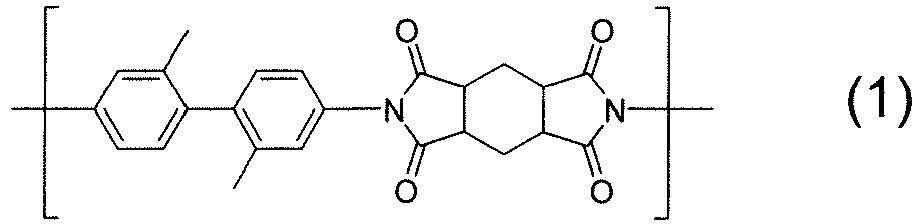

- The repeating unit represented by the formula (1) preferably has a skeleton derived from 1,2,4,5-cycohexanetetracarboxyic acid dianhydride and a skeleton derived from 2,2'-dimethylbenzidine (m-tolidine). The repeating unit represented by the formula (2) preferably has a skeleton derived from 1,2,4,5-cyclohexanetetracarboxylic acid dianhydride and a skeleton derived from 2,2'-bis(trifluoromethyl)benzidine.
- The proportion of the repeating unit represented by the formula (2) to the total amount of the repeating units represented by the formula (1) and the formula (2) is from 20 to 60 mol % from the viewpoint of mechanical strength, surface hardness and transparency, and is preferably from 30 to 50 mol %.
- The polyimide resin of the present invention may contain a repeating unit represented by the following formula (3), as a repeating unit other than the repeating units represented by the formula (1) and the formula (2).

- In the formula (3), R1 represents a divalent group derived from the following aromatic diamine except 2,2'-dimethylbenzidine and 2,2'-bis(trifluoromethyl)benzidine, a divalent group derived from an aliphatic diamine or a divalent group derived from an alicyclic diamine.
- The divalent group derived from the aromatic diamine except 2,2'-dimethylbenzidine and 2,2'-bis(trifluoromethyl)benzidine may be any one of divalent aromatic group having 2 to 39 carbon atoms or a combination of the groups. The main chain of the aromatic diamine may have at least one functional group selected from the group consisting of -O-, -SO2-, -CH2-, -C(CH3)2-, -OSi(CH3)2-, -C2H4O- and -S-, and may have at least one functional group selected from the group consisting of a carboxyl group, a hydroxyl group and a carbonyl group. The aromatic diamine includes, more specifically, those containing a divalent aliphatic group of a polyalkylene, a polyoxyalkylene, a xylylene and alkyl substitutes, halogen substitutes, carboxy substitutes and hydroxyl substitutes thereof, etc.; a divalent alicyclic group derived from a cyclohexane, a dicyclohexylmethane, a dimethylcyclohexane, an isophorone, a norbornane and alkyl substitutes, halogen substitutes, carboxy substitutes and hydroxyl substitutes thereof, etc.; and a divalent aromatic group derived from a benzene, a naphthalene, a biphenyl, a diphenylmethane, a diphenyl ether, a diphenylsulfone, a benzophenone and alkyl substitutes, halogen substitutes, carboxy substitutes and hydroxyl substitutes thereof, etc. For maintaining mechanical characteristics, an aromatic diamine having a biphenyl skeleton is preferred.
- Examples of the divalent group derived from an aromatic diamine include divalent groups derived from 1,4-phenylenediamine, 1,3-phenylenediamine, 2,4-toluenediamine, 4,4'-diaminodiphenyl ether, 3,4'-diaminodiphenyl ether, 4,4'-diaminodiphenylmethane, 1,4-bis(4-aminophenoxy)benzene, 1,3-bis(4-aminophenoxy)benzene, 1,3-bis(3-aminophenoxy)benzene, α,α'-bis(4-aminophenyl)-l,4-diisopropylbenzene, α,α'-bis(3-aminophenyl)-1,4-diisoproylbenzene, 2,2-bis[4-(4-aminophenoxy)phenyl]propane, 4,4'-diaminodiphenyl sulfone, bis[4-(4-aminophenoxy)phenyl] sulfone, bis[4-(3-aminophenoxy)phenyl] sulfone, 2,6-diaminonaphthalene, 1,5-diaminonaphthalene.
- Examples of the divalent group derived from an aliphatic diamine include divalent groups derived from ethylenediamine, hexamethylenediamine, polyethylene glycol bis(3-aminopropyl) ether, polypropylene glycol bis(3-aminopropyl) ether, 1,3-bis(aminomethyl)cyclohexane, 1,4-bis(aminomethyl)cyclohexane, p-xylylenediamine, m-xylylenediamine, siloxanediamines.
- Examples of the divalent group derived from an alicyclic diamine include divalent groups derived from 4,4'-diaminodicyclohexylmethane, isophoronediamine, norbornanediamine.
- The proportion of the total of the repeating units represented by the formula (1) and the formula (2) in all the constituent units of the polyimide resin is preferably from 80 to 100 mol %, more preferably from 90 to 100 mol %, even more preferably from 95 to 100 mol %.
- As describe below, the polyimide resin may be produced according to a solution polymerization method, a method of preparing a polyamic acid solution, then forming it into a film and imidating it, etc. A catalyst may be used during production.
- The polyimide resin is used as a polyimide solution, and therefore it is preferable that the molecular weight thereof is expressed as a viscosity, especially logarithmic viscosity. The logarithmic viscosity n of the polyimide resin (measured at 30°C using a 0.5 g/dL N-methyl-2-pyrrolidone solution) is preferably from 0.3 dL/g, to 2.0 dL/g. When the logarithmic viscosity is less than 0.3 dL/g, the strength of the polyimide resin itself may be low. A solution of the resin having a logarithmic viscosity of more than 2 dL/g extremely worsens in point of flowability, and therefore stirring in polymerization is difficult and handleability is also difficult. For securing the balance of handleability and strength, the logarithmic viscosity is more preferably from 0.3 to 1.5 dL/g, even more preferably from 1.0 to 1.5 dL/g.
- The polyimide resin can be obtained by reacting a diamine component (Z) and a tetracarboxylic acid component (Y).
- The tetracarboxylic acid component (Y) includes 1,2,4,5-cyclohexanetetracarboxylic acid, 1,2,4,5-cyclohexanetetracarboxylic acid dianhydride, 1,2,4,5-cyclohexanecarboxylates. The 1,2,4,5-cyclohexanecarboxylates include dimethyl 1,2,4,5-cyclohexanetetracarboxylate, diethyl 1,2,4,5-cyclohxanetetracarboxylate. Isomers of these compounds may be contained. Among the above, 1,2,4,5-cyclohexanetetracarboxylic acid dianhydride is preferred.
- The diamine component (Z) contains 2,2'-dimethylenzidine and 2,2'-bis(trifluoromethyl)benzidine as the main components. The proportion of the total of 2,2'-dimethylenzidine and 2,2'-bis(trifluoromethyl)benzidine in the diamine component (Z) is preferably from 80 to 100 mol %, more preferably from 90 to 100 mol %, even more preferably from 95 to 100 mol %.
- The diamine component (Z) may contain any other aromatic diamine, aliphatic diamine and alicyclic diamine than the above-mentioned 2,2'-dimethylenzidine and 2,2'-bis(trifluoromethyl)benzidine. In the present invention, "aromatic diamine" means a diamine in which the amino group directly bonds to the aromatic ring, and may contain an aliphatic group, an alicyclic group, an aromatic group and any other substituent in a part of the structure. "Aliphatic diamine" means a diamine in which the amino group directly bonds to the aliphatic group, and may contain an aliphatic group, an alicyclic group, an aromatic group and any other substituent in a part of the structure, and may have at least one functional group selected from the group consisting of a carboxyl group, a hydroxyl group and a carbonyl group. "Alicyclic amine" means a diamine in which the amino group directly bonds to the alicyclic group, and may contain an aliphatic group, an alicyclic group, an aromatic group and any other substituent in a part of the structure, and may have at least one functional group selected from the group consisting of a carboxyl group, a hydroxyl group and a carbonyl group. For example, 2,2'-bis[4-(4-aminophenoxy)phenyl]propane is an aromatic diamine since the amino group directly bonds to the aromatic ring (benzene ring) therein; and m-xylylenediamine is an aliphatic diamine since the amino group directly bonds to the aliphatic group (methylene group) therein.
- Examples of the aromatic diamine except the above-mentioned 2,2'-dimethylenzidine and 2,2'-bis(trifluoromethyl)benzidine include 1,4-phenylenediamine, 1,3-phenylenediamine, 2,4-toluenediamine, 4,4'-diaminodiphenyl ether, 3,4'-diaminodiphenyl ether, 4,4'-diaminodiphenylmethane, 1,4-bis(4-aminophenoxy)benzene, 1,3-bis(4-aminophenoxy)benzene, 1,3-bis(3-aminophenoxy)benzene, α,α'-bis(4-aminophenyl)-1,4-diisopropylbenzene, α,α'-bis(3-aminophenyl)-1,4-diisoproylbenzene, 2,2-bis[4-(4-aminophenoxy)phenyl]propane, 4,4'-diaminodiphenyl sulfone, bis[4-(4-aminophenoxy)phenyl] sulfone, bis[4-(3-aminophenoxy)phenyl] sulfone, 2,6-diaminonaphthalene, 1,5-diaminonaphthalene.
- Examples of the aliphatic diamine include ethylenediamine, hexamethylenediamine, polyethylene glycol bis(3-aminopropyl) ether, polypropylene glycol bis(3-aminopropyl) ether, 1,3-bis(aminomethyl)cyclohexane, 1,4-bis(aminomethyl)cyclohexane, p-xylylenediamine, m-xylylenediamine, siloxanediamines.
- Examples of the alicyclic diamine include 4,4'-diaminodicyclohexylmethane, isophoronediamine, norbornanediamine.
- The diamine component (Z) may contain at least one compound selected from the above-exemplified aliphatic diamines, aromatic diamines and alicyclic diamines in addition to 2,2'-dimethylenzidine and 2,2'-bis(trifluoromethyl)benzidine, and may contain plural compounds.
- Regarding the production method for the polyimide resin, the resin may be produced according to (1) a solution polymerization method, (2) a method of preparing a polyamic acid solution, then forming it into a film and imidating it, (3) a method of obtaining a salt such as a half-ester salt of 1,2,4,5-cyclohexanetetracarboxylic acid dianhydride or an imide oligomer and processing it for solid-phase polymerization, (4) a method of reacting a tetracarboxylic acid dianhydride and a diisocyanate, or any other conventional known method. These methods may be combined. The reaction of the tetracarboxylic acid (Y) and a diamine component (Z) may be carried out in the presence of a conventional known catalyst of acids, tertiary amines, anhydrides, etc.
- The organic solvent to be used in producing the polyimide resin is preferably a specific organic solvent having solubility for diamines, tetracarboxylic acid dianhydrides, polyamide acids, polyimides. Specific examples of such solvent include m-cresol, p-chlorophenol, dimethyl sulfoxide, N,N-dimethylacetamide, N,N-dimethylformamide, diethylene glycol monomethyl ether, N-methylpyrrolidone, γ-butyrolactone, etc. Above all, use of N,N-dimethylacetamide, N,N-dimethylformamide or γ-butyrolactone as an organic solvent is preferred. As the organic solvent, one alone or two or more of the above compounds may be used either singly or as combined. The organic solvent is used in such an amount that the concentration of the polyimide resin therein could be preferably from 1 to 50% by mass, more preferably from 5 to 40% by mass. In the case of solution polymerization, a poor solvent such as hexane, heptane, benzene, toluene, xylene, chlorobenzene, o-dichlorobenzene or the like can be used along with the above-mentioned organic solvent, in such a degree that the poor solvent may not cause polymer precipitation. The polyimide resin may contain the organic solvent used in production.
- Among these methods, a solution polymerization method is preferred since a polyimide resin solution can be directly obtained. The solution polymerization method preferably has the following steps (I) to (III).
- (I) A mixture containing a diamine component (Z), an organic solvent, and optionally a catalyst is stirred at 10 to 600 rpm to form a uniform solution, this is kept at 30 to 90°C, and a tetracarboxylic acid component (Y) and optionally a catalyst are added thereto.
- (II) A mixture containing a tetracarboxylic acid component (Y), an organic solvent, and optionally a catalyst is stirred at 10 to 600 rpm to form a uniform solution, this is kept at 30 to 90°C, and a diamine component (Z) and optionally a catalyst are added thereto.
- (III) After the method (I) or (II), this is heated up to 160 to 230°C, preferably up to 180 to 205°C, taking 0.1 to 6 hours. The temperature depends on the boiling point of the organic solvent used. While the components discharged out of the reaction system are collected, the temperature is kept nearly constant for 0.5 to 24 hours, preferably for 2 to 12 hours. Subsequently, as needed, an organic solvent is further added and cooled to a suitable temperature.
- A catalyst may be used in solution polymerization to produce the polyimide resin. For example, the catalyst usable in the solution polymerization may be at least one catalyst selected from tertiary amine compounds such as trimethylamine, triethylamine, tripropylamine, tributylamine, triethanolamine, N,N-dimethylethanolamine, N,N-diethylethanolamine, triethylenediamine, N-methylpyrrolidone, N-ethylpyrrolidine, N-methylpiperidine, N-ethylpiperidine, imidazole, pyridine, quinoline, isoquinoline, etc. In the case of using a catalyst, the amount to be used is preferably from 0.1 to 100 mol % relative to the tetracarboxylic acid component (Y), more preferably from 1 to 50 mol %.
- The polyimide resin can be produced by reacting the tetracarboxylic acid component (Y) in an amount of preferably from 0.66 moles to 1.5 moles relative to 1 mole of the diamine component (Z), more preferably from 0.9 to 1.1 moles, even more preferably from 0.97 to 1.03 moles.
- The method of isolating the polyimide resin from the polyimide resin solution obtained according to the above-mentioned solution polymerization method is not specifically limited so far as the method does not denature the polyimide resin. For example, there are known methods of (1) a method of dropwise adding a polyimide resin solution to a poor solvent, (2) a method of dropwise adding a polyimide resin solution to a poor solvent with stirring, (3) a method of spraying a polyimide resin solution at a high temperature for rapid drying, etc.
- The poor solvent may be any one not having solubility for the polyimide resin. There are mentioned water, methanol, ethanol, 1-propanol, 2-propanol, metaxylene, paraxylene, mixed xylene, toluene, acetone, etc. One alone of a poor solvent or a mixed liquid of two or more kinds of poor solvents may be used.
- The polyimide resin of the present invention may form by itself a polyimide film excellent in point of heat resistance and tensile elastic modulus, but the polyimide resin composition of the present invention may give a polyimide film having further improved surface hardness and tensile elastic modulus, as further containing silica fine particles.
- Silica for the silica fine particles is silicon dioxide (SiO2), and the morphology (crystalline morphology, amorphousness, etc.) thereof is not limited. The shape of the silica fine particles is not also limited, including spherical, oval, flat, rod-shaped, fibrous and the like ones.
- The silica fine particles for use in the present invention preferably have a small particle size, from the viewpoint of realizing high light transmittance of the polyimide resin composition and the polyimide film, and the mean particle size thereof preferably falls within a range of from 1 to 100 nm, more preferably from 1 to 50 nm, even more preferably from 5 to 25 nm. The mean particle size of the silica fine particles may be measured, for example, according to a BET method.
- The silica fine particles may be surface-treated with a surface-treating agent such as a silane coupling agent or the like, from the viewpoint of the dispersibility thereof in a polyimide resin solution.
- Any known silane coupling agent is usable. From the viewpoint of the affinity thereof with polyimide resin, an amino group-containing silane coupling agent is preferred. Examples of the amino group-containing silane coupling agent include 3-(2-aminoethylamino)propyldimethoxymethylsilane, 3-(2-aminoethylamino)propyltrimethoxysilane, 3-(2-aminoethylamino)propyltriethoxysilane, 3-(3-aminopropylamino)propyltriethoxysilane, 3-(3-aminopropylamino)propyltrimethoxysilane, 3-aminopropyldiethoxymethylsilane, 3-aminopropyltriethoxysilane, 3-aminopropyltrimethoxysilane, etc. One alone or two or more of these may be used either singly or as combined.
- The surface-treating method for the silica fine particles with a silane coupling agent is not specifically limited, for which, any known method is employable. For example, silica fine particles are dispersed in an organic solvent or the like to prepare a dispersion, and the above-mentioned silane coupling agent is added thereto, and stirred at a temperature falling between room temperature and 80°C or so for several hours. A small amount of water may be added to the system to promote the treating reaction.
- The proportion of the silica fine particles to the total amount of the polyimide resin and the silica fine particles in the polyimide resin composition of the present invention is preferably from 1 to 80% by mass, more preferably from 30 to 75% by mass, even more preferably from 35 to 60% by mass, still more preferably from 40 to 60% by mass, further more preferably from 40 to 55% by mass, and still further preferably from 40 to 50% by mass. When the proportion of the silica fine particles to the total amount of the polyimide resin and the silica fine particles in the polyimide resin composition falls within the above-mentioned range, the flexibility of the polyimide film to be obtained using the polyimide resin composition is good, and the film can be excellent in heat resistance and excellent in surface hardness and tensile elastic modulus.
- The polyimide resin composition of the present invention may contain any other additive than the above-mentioned polyimide resin and silica fine particles, within a range not detracting from the advantageous effects of the present invention. Examples of the additive include compounds such as an organic solvent, an antioxidant, a light stabilizer, a surfactant, a flame retardant, a plasticizer, any other polyimide resin than the above-mentioned polyimide resin, a polyamide resin, a polyamideimide resin, etc. The organic solvent includes compounds exemplified hereinabove for the organic solvent for use in producing the polyimide resin, and compounds to be exemplified hereinunder as a dispersion medium for silica fine particles and as a diluent to be added for controlling the solid concentration of the polyimide resin composition, and the preferred examples thereof are also the same as those of the latter.
- The method for preparing the polyimide resin composition of the present invention is not specifically limited, and a known method is employable. For example, there can be mentioned a method of adding an alkoxysilane or a polyalkoxysilane to a polyimide resin solution, adding thereto a small amount of a hydrolysis accelerator such as water or the like, and dispersing silica fine particles in the solution according to a sol-gel method. Otherwise, a powder of silica fine particles produced as a colloidal silica according to a vapor-phase method may be directly added to a polyimide resin solution and mixed to prepare the composition.
- As a preferred example for producing the polyimide resin composition of the present invention, there is mentioned a method of mixing a polyimide resin solution and an organosilica sol to prepare the composition. Organosilica sol is one prepared by dispersing silica fine particles in a dispersion medium in a proportion of 20% by mass or so. The dispersion medium for silica fine particles is preferably a good solvent for polyimide resin, and includes N-methyl- 2-pyrrolidone, N,N-dimethylformamide, N,N-dimethylacetamide, γ-butyrolactone, propylene glycol monomethyl ether, cyclopentanone, cyclohexanone, ethyl acetate, toluene, methyl ethyl ketone, ethylene glycol, isopropanol, methanol, etc. Among these, N-methyl-2-pyrrolidone, N,N-dimethylformamide, N,N-dimethylacetamide, γ-butyrolactone, propylene glycol monomethyl ether, cyclopentanone, cyclohexanone, ethyl acetate and toluene are preferred.
- The solid concentration in the polyimide resin composition of the present invention may be suitably selected in accordance with the processability of the composition in forming polyimide films and laminates to be mentioned below. The solid concentration and the viscosity of the composition may be suitably controlled by evaporation of the organic solvent for concentration or by addition of a diluent. The solid concentration of the polyimide resin composition is preferably from 5 to 60% by mass, more preferably from 10 to 45% by mass. The viscosity of the polyimide resin composition is preferably from 1 to 200 Pa·s, more preferably from 5 to 150 Pa·s. The diluent is not specifically limited so far as it can dissolve polyimide resin, and includes the compounds exemplified hereinabove as the dispersion medium for silica fine particles, and the preferred examples thereof are also the same as those of the latter.
- The present invention provides a polyimide film containing the above-mentioned polyimide resin composition. The present invention also provides a polyimide film having a hard coat layer formed on at least one surface of a polyimide film containing the polyimide resin. In this description, the polyimide film containing the polyimide resin composition may be referred to as a polyimide-nanocomposite film.
- The polyimide film of the present invention can be formed by casting a solution containing the polyimide resin, or the above-mentioned polyimide resin composition containing an organic solvent, onto a smooth support such as a glass plate, a metal plate, a plastic or the like, and heating it for evaporating the solvent component.
- The polyimide resin-containing solution can be obtained by dissolving the polyimide resin in a solvent. The solvent may be any one that can dissolve the polyimide resin and includes, though not specifically limited thereto, m-cresol, p-chlorophenol, dimethyl sulfoxide, N-methyl-2-pyrrolidone, N,N-dimethylacetamide, N,N-dimethylformamide, diethylene glycol monomethyl ether, N-methylpyrrolidone, γ-butyrolactone, methanol, isopropanol, ethylene glycol, methyl ethyl ketone, propylene glycol monomethyl ether, cyclopentanone, cyclohexanone, ethyl acetate, toluene, etc. Above all, use of at least one selected from N-methyl-2-pyrrolidone, N,N-dimethylformamide, N,N-dimethylacetamide, γ-butyrolactone, propylene glycol monomethyl ether, cyclopentanone, cyclohexanone, ethyl acetate and toluene is preferred.
- The polyimide resin-containing solution may be a polyimide resin solution itself obtained according to a polymerization method. Otherwise, it may be one prepared by mixing at least one selected from the compounds exemplified hereinabove as a solvent for dissolving the polyimide resin, in the polyimide resin solution. By controlling the solid concentration and the viscosity of the polyimide resin-containing solution and the polyimide resin composition containing an organic solvent, the thickness of the polyimide film can be easily controlled.
- As needed, a release agent may be applied onto the surface of the support. As the method of applying the polyimide resin-containing solution or the polyimide resin composition containing an organic solvent onto the support and then heating it to evaporate the solvent component, the following method is preferred. Specifically, it is preferable that the solvent is evaporated away at a temperature of 120°C or lower to give a self-supporting film, then the self-supporting film is peeled from the support, the edge of the self-supporting film is fixed, and dried at a temperature not lower than the boiling point of the solvent component and 350°C or lower to produce a polyimide film. Drying in a nitrogen atmosphere is also preferred. The pressure of the drying atmosphere may be any of reduced pressure, normal pressure or increased pressure. The thickness of the polyimide film is preferably from 1 to 200 µm, more preferably from 1 to 100 µm, even more preferably from 20 to 80 µm.
- The polyimide film containing the polyimide resin composition of the present invention may have a hard coat layer formed on at least one surface thereof. The polyimide film containing the polyimide resin of the present invention has a hard coat layer formed on at least one surface thereof. The hard coat layer may be formed entirely or partly on at least one surface of the polyimide film. The thickness of the hard coat layer is, from the viewpoint of improving the film surface hardness and attaining high transparency, preferably from 1 to 30 µm, more preferably from 5 to 20 µm.
- A known method is employable as a method of forming a hard coat layer on the surface of the polyimide film. For example, there is mentioned a method of applying a solution that contains a hard coat agent onto a surface of the polyimide film to form a film thereon, and then drying it.
- As the solution that contains a hard coat agent, for example, there are mentioned acrylic, urethane-type, epoxy-type, silicone-type or the like crosslinking structure-forming compounds. Among these, acrylic, urethane-type or epoxy-type compounds are preferred as having a high effect for improving film surface hardness and excellent in abrasion resistance and transparency.
- As the method for applying a solution that contains a hard coat agent onto the surface of a polyimide film to form a film thereon, a known method using a spin coater, a bar coater, a gravure coater, dipping, spraying or the like is employable. In drying and curing the solution that has been applied to and formed into a film, a known technique of UV curing, thermal curing, electron radiation curing or the like can be used.
- The solution that contains a hard coat agent may contain at least one selected from a UV absorbent, a light stabilizer, an antioxidant, an antistatic agent, a leveling agent, a defoaming agent, a tackifiers, an anti-fogging agent and an organic solvent.
- As the UV absorbent, any conventional known one is usable, and examples thereof include benzotriazole-type, benzophenone-type, phenyl salicylate-type or triazine-type compounds, etc. The benzotriazole-type UV absorbent includes 2-(5-methyl-2-hydroxyphenyl)benzotriazole, 2-(2'-hydroxy-5'-t-octylphenyl)benzotriazole, etc. The benzophenone-type UV absorbent includes 2-hydroxy-4-octoxyenzophenone, 2,4-dihydroxybenzophenone, 2,2-dihydroxy-4-methoxyenzophenone, etc. The phenyl salicylate-type UV absorbent includes p-t-butylphenyl salicylate, etc. The triazine-type UV absorbent includes 2,4-diphenyl-6-(2-hydroxy-4-ethoxyphenyl)-1,3,5-triazine, 2,4-diphenyl-6-(2-hydroxy-4-methoxyphenyl)-1,3,5-triazine, etc. The other UV absorbents include 2-ethylhexyl-2-cyano-3,3'-diphenyl acrylate.
- The present invention provides a laminate having at least one substrate selected from plastic film, silicon wafer, metal foil and glass, and a polyimide resin layer formed on at least one surface of the substrate using the polyimide resin composition. The laminate of the present invention may have at least one or two or more such polyimide layers.
- The polyimide resin layer to be formed on at least one surface of the substrate is formed using the polyimide resin composition of the present invention. The thickness of the polyimide resin layer may be suitably selected in accordance with the use and the like of the laminate, and is preferably from 0.5 to 50 µm, more preferably from 1 to 10 µm.
- The polyimide resin layer may contain, within a range not detracting from the advantageous effects of the present invention, besides titanium oxide fine particles, zirconia fine particles, gold nanoparticles, niobium oxide, alumina fine particles, etc., polycarbonates, polystyrenes, polyamides, polyesters such as polyethylene terephthalate, polyether sulfones, polycarboxylic acids, polyacetals, polyphenylene ethers, polysulfones, polybutylenes, polypropylenes, polyacrylamides, polyvinyl chlorides, etc.
- The substrate for use for the laminate of the present invention is selected from plastic film, silicon wafer, metal foil and glass.
- Examples of the resin to constitute the plastic film include polyolefins such as homopolymers or copolymers of ethylene, propylene, isobutene, etc.; amorphous polyolefins such as cyclic polyolefins, etc.; polyesters such as polyethylene terephthalate, polyethylene-2,6-naphthalate, etc.; polyamides such as nylon 6, nylon 66, nylon 12, copolymer nylons, etc.; polyvinyl alcohols, ethylene-vinyl acetate copolymer partial hydrolyzates (EVOH), polyimides, polyether imides, polysulfones, polyether sulfones, polyether ether ketones, polycarbonates, polyarylates, fluororesins, acrylic resins; biodegradable resins such as polylactic acid, etc. Among those, polyethylene 2,6-naphthalate, polyimides, polyether imides, polysulfones, polyether sulfones and polycarbonates are preferred from the viewpoint of heat resistance and dimensional stability.
- As the metal which constitutes the metal foil, any metal may be used with no limitation as long as it has electroconductivity. Examples thereof include gold, silver, copper, iron and nickel. Among those, silver or copper is preferred, and copper is more preferred.
- The thickness of the substrate may be suitably selected depending on the use and the like of the laminate, and is preferably within a range of from 0.1 to 500 µm, more preferably from 1 to 250 µm.
- The method for producing the laminate of the present invention is not specifically limited, and a known method is usable. For example, there is mentioned a method of applying the polyimide resin composition of the present invention that contains an organic solvent onto the above-mentioned substrate and removing the organic solvent, etc.
- The present invention is described specifically by means of the following Examples. However, the present invention is not whatsoever restricted by these Examples.
- The physical properties of the films (polyimide films, polyimide-nanocomposite films, hard coat-laminated films) obtained in the following Examples were measured according to the following methods.
- For the measurement, a surface texture measurement device, "TYPE14FW" manufactured by Shinto Scientific Co., Ltd., was used in accordance with JIS K5600-5-4.
- For the measurement, a tensile tester, "Strograph VC-1" manufactured by Toyo Seiki Seisaku-Sho Ltd., was used in accordance with ASTM-882-88.
- The measurement was performed according to JIS K7105 using a color/turbidity coincidence measuring instrument (COH 400), manufactured by Nippon Denshoku Industries Co., Ltd..
- For the measurement, a polyimide film was folded once to R = 0 mm, and tested as to whether or not it broke. The measurement was carried out 5 times. In the case where all of the folded five parts did not break, the sample was on the rank A (0 part broke), in the case where even one part did not break, the sample was on the rank B (1 to 4 parts broke), and in the case where all broke, the sample was on the rank C (5 parts broke).
- In a 2-liter five-necked glass-made round-bottomed flask equipped with a stainless half-moon-shaped stirrer, a nitrogen introduction pipe, a condenser-attached Dean Stark unit, a thermometer and a glass-made end cap, 112.68 g (0.530 mol) of 2,2'-dimethylbenzidine (manufactured by Wakayama Seika Kogyo Co., Ltd.), 42.50 g (0.133 mol) of 2,2'-bis(trifluoromethyl)benzidine (manufactured by Wakayama Seika Kogyo Co., Ltd.), 297.15 g of γ-butyrolactone (manufactured by Mitsubishi Chemical Corporation) and, as a catalyst, 33.57 g of triethylamine (manufactured by Kanto Chemical Co., Inc.) were stirred at an internal reaction system temperature of 70°C in a nitrogen atmosphere at 200 rpm to prepare a solution. 147.85 g (0.663 mol) of 1,2,4,5-cyclohexanetetracarboxylic acid dianhydride (manufactured by Mitsubishi Gas Chemical Co., Ltd.) and 74.27 g of N,N-dimethylacetamide (manufactured by Mitsubishi Gas Chemical Co., Ltd.) were added thereto each at a time, and then heated with a mantle heater to thereby raise the internal reaction system temperature up to 190°C, taking about 20 minutes. The distillate component was collected, and while the stirring number was controlled in accordance with the viscosity increase, the internal reaction system temperature was kept at 190°C for 3.5 hours. 48.26 g of N,N-dimethylacetamide was further added and kept at 190°C for 1 hour. Subsequently, 36.18 g of N,N-dimethylacetamide was added, and kept at 190°C for 1 hour. Finally, 664.14 g of N,N-dimethylacetamide was added, and then stirred at around 100°C for about 3 hours to form a uniform solution, thereby giving a polyimide resin solution (a) having a solid concentration of 20% by mass and a relative viscosity of 1.4 dL/g.
- As a result of analysis of the polyimide resin solution (a) according to 1H NMR, the proportion of the structural unit derived from 2,2'-bis(trifluoromethyl)benzidine to the total of the structural unit derived from 2,2'-dimethylbenzidine and the structural unit derived from 2,2'-bis(trifluoromethyl)benzidine in the resultant polyimide resin was 20 mol %. FT-IR confirmed disappearance of starting material peaks and appearance of imide skeleton-derived peaks.
- The resultant polyimide resin solution (a) was applied onto a glass substrate, and the solvent was evaporated away under the condition of 60°C for 30 minutes and 100°C for 1 hour to form a self-supporting film, and thereafter the self-supporting film was peeled off from the glass substrate, the edge of the film was fixed, and dried at 280°C in a nitrogen atmosphere for 2 hours to remove the solvent, thereby giving a polyimide film having a thickness of 65 µm. The elastic tensile modulus of the polyimide film was 3.4 GPa, the tensile strength was 121.2 MPa, the surface hardness was < 6B, the total light transmittance was 90.3%, the YI index was 1.5 and the flex resistance evaluation was on the rank A.
- 50.0 g of the polyimide resin solution (a), and 40 g of a colloidal silica dispersion ("DMAC-ST" manufactured by Nissan Chemical Industries, Ltd., silica content: 20% by mass, mean particle size: 11 nm, N,N-dimethylacetamide solution) were stirred in a rotating/revolving mixer (ARE-250, manufactured by Thinky Corporation) at 2,000 rpm for 2 minutes to give a polyimide-nanosilica composite solution. The solution was applied onto a glass substrate, and the solvent was evaporated away under the condition of 60°C for 30 minutes and 100°C for 1 hour to give a self-supporting film, and then the self-supporting film was peeled away from the glass substrate, the edge of the film was fixed and dried at 280°C in a nitrogen atmosphere for 2 hours to give a polyimide-nanocomposite film A having a thickness of 58 µm. The evaluation results of the polyimide-nanocomposite film A are shown in Table 1.
- In a 300-mL five-necked glass-made round-bottomed flask equipped with a stainless half-moon-shaped stirrer, a nitrogen introduction pipe, a condenser-attached Dean Stark unit, a thermometer and a glass-made end cap, 12.634 g (0.060 mol) of 2,2'-dimethylbenzidine (manufactured by Wakayama Seika Kogyo Co., Ltd.), 12.706 g (0.040 mol) of 2,2'-bis(trifluoromethyl)benzidine (manufactured by Wakayama Seika Kogyo Co., Ltd.), 46.518 g of γ-butyrolactone (manufactured by Mitsubishi Chemical Corporation) and, as a catalyst, 5.018 g of triethylamine (manufactured by Kanto Chemical Co., Inc.) were stirred at an internal reaction system temperature of 70°C in a nitrogen atmosphere at 200 rpm to prepare a solution. 22.235 g (0.099 mol) of 1,2,4,5-cyclohexanetetracarboxylic acid dianhydride (manufactured by Mitsubishi Gas Chemical Co., Ltd.) and 11.629 g of N,N-dimethylacetamide (manufactured by Mitsubishi Gas Chemical Co., Ltd.) were added thereto each at a time, and then heated with a mantle heater to thereby raise the internal reaction system temperature up to 190°C, taking about 20 minutes. The distillate component was collected, and while the stirring number was controlled in accordance with the viscosity increase, the internal reaction system temperature was kept at 190°C for 3.75 hours. 4.92 g of N,N-dimethylacetamide was further added and kept at 190°C for 1.5 hours. Finally, 112.94 g of N,N-dimethylacetamide was added, and then stirred at around 100°C for about 3 hours to form a uniform solution, thereby giving a polyimide resin solution (b) having a solid concentration of 20% by mass and a relative viscosity of 1.3 dL/g.
- As a result of analysis according to the same method as in Example 1, the proportion of the structural unit derived from 2,2'-bis(trifluoromethyl)benzidine to the total of the structural unit derived from 2,2'-dimethylbenzidine and the structural unit derived from 2,2'-bis(trifluoromethyl)benzidine in the resultant polyimide resin was 40 mol %. FT-IR confirmed disappearance of starting material peaks and appearance of imide skeleton-derived peaks.
- A polyimide film having a thickness of 62 µm was obtained according to the same method as in Example 1 except that the polyimide resin solution (b) was used. The elastic tensile modulus of the polyimide film was 3.6 GPa, the surface hardness was < 6B, the total light transmittance was 90.3%, the YI index was 1.8 and the flex resistance evaluation was on the rank A.
- A polyimide-nanocomposite film B having a thickness of 45 µm was obtained according to the same method as in Example 1 except that the polyimide resin solution (b) was used. The evaluation results of the polyimide-nanocomposite film B are shown in Table 1.
- In the same five-necked glass-made round-bottomed flask as that used in Example 2, 8.032 g (0.038 mol) of 2,2'-dimethylbenzidine (manufactured by Wakayama Seika Kogyo Co., Ltd.), 18.174 g (0.057 mol) of 2,2'-bis(trifluoromethyl)benzidine (manufactured by Wakayama Seika Kogyo Co., Ltd.), 46.355 g of γ-butyrolactone (manufactured by Mitsubishi Chemical Corporation) and, as a catalyst, 4.786 g of triethylamine (manufactured by Kanto Chemical Co., Inc.) were stirred at an internal reaction system temperature of 70°C in a nitrogen atmosphere at 200 rpm to prepare a solution. 21.203 g (0.095 mol) of 1,2,4,5-cyclohexanetetracarboxylic acid dianhydride (manufactured by Mitsubishi Gas Chemical Co., Ltd.) and 11.59 g of N,N-dimethylacetamide (manufactured by Mitsubishi Gas Chemical Co., Ltd.) were added thereto each at a time, and then heated with a mantle heater to thereby raise the internal reaction system temperature up to 190°C, taking about 20 minutes. The distillate component was collected, and while the stirring number was controlled in accordance with the viscosity increase, the internal reaction system temperature was kept at 190°C for 5.75 hours to prepare a polyimide solution. Finally, 118.06 g of N,N-dimethylacetamide was added, and then stirred at around 100°C for about 3 hours to form a uniform solution, thereby giving a polyimide resin solution (c) having a solid concentration of 20% by mass and a relative viscosity of 1.3 dL/g.
- As a result of analysis according to the same method as in Example 1, the proportion of the structural unit derived from 2,2'-bis(trifluoromethyl)benzidine to the total of the structural unit derived from 2,2'-dimethylbenzidine and the structural unit derived from 2,2'-bis(trifluoromethyl)benzidine in the resultant polyimide resin was 60 mol %. FT-IR confirmed disappearance of starting material peaks and appearance of imide skeleton-derived peaks.
- A polyimide film having a thickness of 64 µm was obtained according to the same method as in Example 1 except that the polyimide resin solution (c) was used. The elastic tensile modulus of the polyimide film was 3.1 GPa, the tensile strength was 132.1 MPa, the surface hardness was < 6B, the total light transmittance was 90.7%, the YI index was 1.8 and the flex resistance evaluation was on the rank A.
- A polyimide-nanocomposite film C having a thickness of 56 µm was obtained according to the same method as in Example 1 except that the polyimide resin solution (c) was used. The evaluation results of the polyimide-nanocomposite film C are shown in Table 1.
- In the same five-necked glass-made round-bottomed flask as that used in Example 2, 10.278 g (0.048 mol) of 2,2'-dimethylbenzidine (manufactured by Wakayama Seika Kogyo Co., Ltd.), 15.505 g (0.048 mol) of 2,2'-bis(trifluoromethyl)benzidine (manufactured by Wakayama Seika Kogyo Co., Ltd.), 46.435 g of γ-butyrolactone (manufactured by Mitsubishi Chemical Corporation) and, as a catalyst, 4.899 g of triethylamine (manufactured by Kanto Chemical Co., Inc.) were stirred at an internal reaction system temperature of 70°C in a nitrogen atmosphere at 200 rpm to prepare a solution. 21.707 g (0.097 mol) of 1,2,4,5-cyclohexanetetracarboxylic acid dianhydride (manufactured by Mitsubishi Gas Chemical Co., Ltd.) and 11.61 g of N,N-dimethylacetamide (manufactured by Mitsubishi Gas Chemical Co., Ltd.) were added thereto each at a time, and then heated with a mantle heater to thereby raise the internal reaction system temperature up to 190°C, taking about 20 minutes. The distillate component was collected, and while the stirring number was controlled in accordance with the viscosity increase, the internal reaction system temperature was kept at 190°C for 5.75 hours to prepare a polyimide solution. Finally, 117.96 g of N,N-dimethylacetamide was added, and then stirred at around 100°C for about 3 hours to form a uniform solution, thereby giving a polyimide resin solution (d) having a solid concentration of 20% by mass and a relative viscosity of 1.2 dL/g.
- As a result of analysis according to the same method as in Example 1, the proportion of the structural unit derived from 2,2'-bis(trifluoromethyl)benzidine to the total of the structural unit derived from 2,2'-dimethylbenzidine and the structural unit derived from 2,2'-bis(trifluoromethyl)benzidine in the resultant polyimide resin was 50 mol %. FT-IR confirmed disappearance of starting material peaks and appearance of imide skeleton-derived peaks.
- A polyimide film having a thickness of 55 µm was obtained according to the same method as in Example 1 except that the polyimide resin solution (d) was used. The elastic tensile modulus of the polyimide was 3.3 GPa, the tensile strength was 114.7 MPa, the surface hardness was < 6B, the total light transmittance was 90.4%, the YI index was 1.8 and the flex resistance evaluation was on the rank A.
- A polyimide-nanocomposite film D having a thickness of 45 µm was obtained according to the same method as in Example 1 except that the polyimide resin solution (d) was used. The evaluation results of the polyimide-nanocomposite film D are shown in Table 1.
- In the same 300-mL five-necked glass-made round-bottomed flask as that used in Example 2, 102.6 g of a urethane-acrylic hard coating agent (Hitalloid 7902-1, manufactured by Hitachi Chemical Co., Ltd.), 9.4 g of 2'-ethylhexyl-2-cyano-3,3'-diphenyl acrylate (SEESORB 502, manufactured by Shipro Kasei Kaisha, Ltd.) as a UV absorbent, 4.6 g of 1-hydroxycyclohexyl phenyl ketone (IRGACURE 184, manufactured by BASF Japan Corporation) as a photopolymerization initiator, and 83.4 g of ethyl acetate (manufactured by Kanto Chemical Co., Inc.) were stirred in a nitrogen atmosphere at 200 rpm for 30 minutes to prepare a hard coat solution.
- A proper quantity of the hard coat solution prepared in the previous paragraph was dropwise applied onto the polyimide film having a thickness of 60 µm obtained using the polyimide resin solution (a) according to the same method as in Example 1, and formed into a film using a bar coater #8. The formed film was left in a hot air drier previously heated at a temperature of 80°C for 2 minutes to evaporate away the excessive organic solvent, and then using a high-pressure mercury lamp at an output density of 80 W/cm, this was irradiated with UV rays at a position of 10 cm beneath the light source at a conveyor speed of 3.0 m/min, and cured. In that manner, a hard coat-laminated film E was obtained, in which the coating film thickness of the hard coat layer was 6.5 µm. The evaluation results of the hard coat-laminated film E are shown in Table 1.
- <Example 6>
- According to the same method as in Example 5 except that a polyimide-nanocomposite film having a thickness of 57 µm obtained according to the same method as in Example 1, the hard coat solution was formed into a film to give a hard coat-laminated film F. The evaluation results of the hard coat-laminated film F are shown in Table 1.
- In the same five-necked glass-made round-bottomed flask as that used in Example 2, 3.838 g (0.018 mol) of 2,2'-dimethylbenzidine (manufactured by Wakayama Seika Kogyo Co., Ltd.), 23.157 g (0.072 mol) of 2,2'-bis(trifluoromethyl)benzidine (manufactured by Wakayama Seika Kogyo Co., Ltd.), 46.208 g of γ-butyrolactone (manufactured by Mitsubishi Chemical Corporation) and, as a catalyst, 4.573 g of triethylamine (manufactured by Kanto Chemical Co., Inc.) were stirred at an internal reaction system temperature of 70°C in a nitrogen atmosphere at 200 rpm to prepare a solution. 20.263 g (0.090 mol) of 1,2,4,5-cyclohexanetetracarboxylic acid dianhydride (manufactured by Mitsubishi Gas Chemical Co., Ltd.) and 11.55 g of N,N-dimethylacetamide (manufactured by Mitsubishi Gas Chemical Co., Ltd.) were added thereto each at a time, and then heated with a mantle heater to thereby raise the internal reaction system temperature up to 190°C, taking about 20 minutes. The distillate component was collected, and while the stirring number was controlled in accordance with the viscosity increase and while the internal reaction system temperature was kept at 190°C, the system was stirred for 5.75 hours to give a polyimide solution. Finally, 118.242 g of N,N-dimethylacetamide was added, and then stirred at around 100°C for about 3 hours to form a uniform solution, thereby giving a polyimide resin solution (e) having a solid concentration of 20% by mass and a relative viscosity of 1.3 dL/g.
- As a result of analysis according to the same method as in Example 1, the proportion of the structural unit derived from 2,2'-bis(trifluoromethyl)benzidine to the total of the structural unit derived from 2,2'-dimethylbenzidine and the structural unit derived from 2,2'-bis(trifluoromethyl)benzidine in the resultant polyimide resin was 80 mol %. FT-IR confirmed disappearance of starting material peaks and appearance of imide skeleton-derived peaks. A polyimide film having a thickness of 48 µm was obtained according to the same method as in Example 1 except that the polyimide resin solution (e) was used. The elastic tensile modulus of the polyimide film was 2.8 GPa, the tensile strength was 107.5 MPa, the surface hardness was < 6B, the total light transmittance was 90.4%, the YI index was 2.2 and the flex resistance evaluation was on the rank A.
- A polyimide-nanocomposite film G having a thickness of 53 µm was obtained according to the same method as in Example 1 except that the polyimide resin solution (e) was used. The evaluation results of the polyimide-nanocomposite film G are shown in Table 1.
- In the same five-necked glass-made round-bottomed flask as that used in Example 2, 30.237 g (0.094 mol) of 2,2'-bis(trifluoromethyl)benzidine (manufactured by Wakayama Seika Kogyo Co., Ltd.), 50.261 g of γ-butyrolactone (manufactured by Mitsubishi Chemical Corporation) and, as a catalyst, 4.777 g of triethylamine (manufactured by Kanto Chemical Co., Inc.) were stirred at an internal reaction system temperature of 70°C in a nitrogen atmosphere at 200 rpm to prepare a solution. 21.166 g (0.094 mol) of 1,2,4,5-cyclohexanetetracarboxylic acid dianhydride (manufactured by Mitsubishi Gas Chemical Co., Ltd.) and 12.57 g of N,N-dimethylacetamide (manufactured by Mitsubishi Gas Chemical Co., Ltd.) were added thereto each at a time, and then heated with a mantle heater to thereby raise the internal reaction system temperature up to 190°C, taking about 20 minutes. The distillate component was collected, and while the stirring number was controlled in accordance with the viscosity increase, the internal reaction system temperature was kept at 190°C for 5.75 hours. Finally, 129.17 g of N,N-dimethylacetamide was added, and then stirred at around 100°C for about 3 hours to form a uniform solution, thereby giving a polyimide resin solution (f) having a solid concentration of 20% by mass and a relative viscosity of 1.2 dL/g.
- FT-IR confirmed disappearance of starting material peaks and appearance of imide skeleton-derived peaks.
- A polyimide film having a thickness of 48 µm was obtained according to the same method as in Example 1 except that the polyimide resin solution (f) was used. The elastic tensile modulus of the polyimide film was 2.9 GPa, the tensile strength was 121.9 MPa, the surface hardness was < 6B, the total light transmittance was 90.9%, the YI index was 2.0 and the flex resistance was on the rank A.
- A polyimide-nanocomposite film H having a thickness of 48 µm was obtained according to the same method as in Example 1 except that the polyimide resin solution (f) was used. The evaluation results of the polyimide-nanocomposite film H are shown in Table 1.
- In the same five-necked glass-made round-bottomed flask as that used in Example 2, 21.207 g (0.100 mol) of 2,2'-dimethylbenzidine (manufactured by Wakayama Seika Kogyo Co., Ltd.), 46.236 g of γ-butyrolactone (manufactured by Mitsubishi Chemical Corporation) and, as a catalyst, 2.527 g of triethylamine (manufactured by Kanto Chemical Co., Inc.) were stirred at an internal reaction system temperature of 70°C in a nitrogen atmosphere at 200 rpm to prepare a solution. 22.393 g (0.100 mol) of 1,2,4,5-cyclohexanetetracarboxylic acid dianhydride (manufactured by Mitsubishi Gas Chemical Co., Ltd.) and 11.56 g of N,N-dimethylacetamide (manufactured by Mitsubishi Gas Chemical Co., Ltd.) were added thereto each at a time, and then heated with a mantle heater to thereby raise the internal reaction system temperature up to 190°C, taking about 20 minutes. The distillate component was collected, and while the stirring number was controlled in accordance with the viscosity increase, the internal reaction system temperature was kept at 190°C for 4.5 hours to give a polyimide solution. Finally, 102.20 g of N,N-dimethylacetamide was added, and then stirred at around 100°C for about 3 hours to form a uniform solution, thereby giving a polyimide resin solution (g) having a solid concentration of 20% by mass and a relative viscosity of 1.2 dL/g.
- FT-IR confirmed disappearance of starting material peaks and appearance of imide skeleton-derived peaks. A polyimide film having a thickness of 80 µm was obtained according to the same method as in Example 1 except that the polyimide resin solution (g) was used. The elastic tensile modulus of the polyimide film was 3.2 GPa, the tensile strength was 126.9 MPa, the surface hardness was < 6B, the total light transmittance was 89.9%, the YI index was 1.6 and the flex resistance was on the rank A.
- A polyimide-nanocomposite film I having a thickness of 55 µm was obtained according to the same method as in Example 1 except that the polyimide resin solution (g) was used. The evaluation results of the polyimide-nanocomposite film I are shown in Table 1.
- In the same five-necked glass-made round-bottomed flask as that used in Example 2, 30.173 g (0.073 mol) of 2,2'-bis(4-(4-aminophenoxy)phenyl)propane (manufactured by Wakayama Seika Kogyo Co., Ltd.), 45.612 g of γ-butyrolactone (manufactured by Mitsubishi Chemical Corporation) and, as a catalyst, 3.719 g of triethylamine (manufactured by Kanto Chemical Co., Inc.) were stirred at an internal reaction system temperature of 70°C in a nitrogen atmosphere at 200 rpm to prepare a solution. 16.476 g (0.073 mol) of 1,2,4,5-cyclohexanetetracarboxylic acid dianhydride (manufactured by Mitsubishi Gas Chemical Co., Ltd.) and 11.40 g of N,N-dimethylacetamide (manufactured by Mitsubishi Gas Chemical Co., Ltd.) were added thereto each at a time, and then heated with a mantle heater to thereby raise the internal reaction system temperature up to 190°C, taking about 20 minutes. The distillate component was collected, and while the stirring number was controlled in accordance with the viscosity increase, the internal reaction system temperature was kept at 190°C for 4 hours to prepare a polyimide solution. While this was diluted with γ-butyrolactone as needed in accordance with the increase in viscosity (total added amount 29.8 g) and when the total stirring time reached over 5.25 hours, 89.368 g of N,N-dimethylacetamide was added so that the solid concentration could be 20% by mass, and then stirred at around 100°C for about 3 hours to form a uniform solution, thereby giving a polyimide resin solution (h) having a solid concentration of 20% by mass and a relative viscosity of 1.3 dL/g.
- FT-IR confirmed disappearance of starting material peaks and appearance of imide skeleton-derived peaks.
- A polyimide film having a thickness of 50 µm was obtained according to the same method as in Example 1 except that the polyimide resin solution (h) was used. The tensile strength of the polyimide film was 2.2 GPa, the tensile strength was 86.7 MPa, the surface hardness was < 6B, the total light transmittance was 89.7%, the YI index was 1.3 and the flex resistance evaluation was on the rank A.
- A polyimide-nanocomposite film J having a thickness of 54 µm was obtained according to the same method as in Example 1 except that the polyimide resin solution (h) was used. The evaluation results of the polyimide-nanocomposite film J are shown in Table 1.
- In the same five-necked glass-made round-bottomed flask as that used in Example 2, 22.686 g (0.113 mol) of 4,4'-diaminodiphenyl ether (manufactured by Wakayama Seika Kogyo Co., Ltd.), 47.014 g of γ-butyrolactone (manufactured by Mitsubishi Chemical Corporation) and, as a catalyst, 5.732 g of triethylamine (manufactured by Kanto Chemical Co., Inc.) were stirred at an internal reaction system temperature of 70°C in a nitrogen atmosphere at 200 rpm to prepare a solution. 25.397 g (0.113 mol) of 1,2,4,5-cyclohexanetetracarboxylic acid dianhydride (manufactured by Mitsubishi Gas Chemical Co., Ltd.) and 11.75 g of N,N-dimethylacetamide (manufactured by Mitsubishi Gas Chemical Co., Ltd.) were added thereto each at a time, and then heated with a mantle heater to thereby raise the internal reaction system temperature up to 190°C, taking about 20 minutes. The distillate component was collected, and while the stirring number was controlled in accordance with the viscosity increase, the internal reaction system temperature was kept at 190°C for 4.75 hours to prepare a polyimide solution. After 117.206 g of N,N-dimethylacetamide was added, this was stirred at around 100°C for about 3 hours to form a uniform solution, thereby giving a polyimide resin solution (i) having a solid concentration of 20% by mass and a relative viscosity of 1.4 dL/g.
- FT-IR confirmed disappearance of starting material peaks and appearance of imide skeleton-derived peaks.
- A polyimide film having a thickness of 64 µm was obtained according to the same method as in Example 1 except that the polyimide resin solution (i) was used. The tensile elastic modulus of the polyimide film was 2.6 GPa, the tensile strength was 104.3 MPa, the surface hardness was < 6B, the total light transmittance was 89.3%, the YI index was 2.5 and the flex resistance evaluation was on the rank A.
- A polyimide-nanocomposite film K having a thickness of 56 µm was obtained according to the same method as in Example 1 except that the polyimide resin solution (i) was used. The evaluation results of the polyimide-nanocomposite film K are shown in Table 1.
- In the same five-necked glass-made round-bottomed flask as that used in Example 2, 14.034 g (0.044 mol) of 2,2'-bis(trifluoromethyl)benzidine (manufactured by Wakayama Seika Kogyo Co., Ltd.), 9.496 g (0.044 mol) of 3,3'-dihydroxybenzidine (manufactured by Wakayama Seika Kogyo Co., Ltd.), 51.790 g of γ-butyrolactone (manufactured by Mitsubishi Chemical Corporation) and, as a catalyst, 0.967 g of triethylamine (manufactured by Kanto Chemical Co., Inc.) were stirred at an internal reaction system temperature of 100°C in a nitrogen atmosphere at 200 rpm to prepare a solution. 19.757 g (0.088 mol) of 1,2,4,5-cyclohexanetetracarboxylic acid dianhydride (manufactured by Mitsubishi Gas Chemical Co., Ltd.) and 12.95 g of N,N-dimethylacetamide (manufactured by Mitsubishi Gas Chemical Co., Ltd.) were added thereto each at a time, and then heated with a mantle heater to thereby raise the internal reaction system temperature up to 190°C, taking about 20 minutes. The distillate component was collected, and while the stirring number was controlled in accordance with the viscosity increase, the internal reaction system temperature was kept at 190°C for 4.0 hours. Finally, 95.26 g of N,N-dimethylacetamide was added and then stirred at around 100°C for about 3 hours to form a uniform solution, thereby giving a polyimide resin solution (j) having a solid concentration of 20% by mass. As the polyimide resin solution (j) became insolubilized owing to the heat history in solid extraction, and therefore the logarithmic viscosity thereof could not be measured.
- FT-IR confirmed disappearance of starting material peaks and appearance of imide skeleton-derived peaks.
- A polyimide film having a thickness of 67 µm was obtained according to the same method as in Example 1 except that the polyimide resin solution (j) was used. The tensile elastic modulus of the polyimide resin film was 3.3 GPa, the tensile strength was 105.8 MPa, the surface hardness was < 6B, the total light transmittance was 86.2%, the YI index was 8.5 and the flex resistance evaluation was on the rank A.
- A polyimide-nanocomposite film L having a thickness of 53 µm was obtained according to the same method as in Example 1 except that the polyimide resin solution (j) was used. The evaluation results of the polyimide-nanocomposite film L are shown in Table 1.
- A polyimide-nanocomposite film M having a thickness of 45 µm was obtained according to the same method as in Example 1 except that 20 g of a colloidal silica dispersion ("DMAC-ST" manufactured by Nissan Chemical Industries, Ltd., silica content: 20% by mass, mean particle size: 11 nm, N,N-dimethylacetamide solution) was used. The tensile elastic modulus of the polyimide-nanocomposite film M was 4.5 GPa, the tensile strength was 119 MPa, the surface hardness was < 6B, the total light transmittance was 88%, the YI index was 4.4 and the flex resistance evaluation was on the rank A.
[Table 1] Structural Units of Polyimide Resin Polyimide Resin/Silica Fine Particles (ratio by mass) Evaluation of Polyimide Film mTB (mol %) TFMB (mol %) Other Diamine (mol %) Tensile Elastic Modulus (GPa) Tensile Strength (MPa) Surface Hardness Total Light Transmittance (%) YI Flex Resistance Example 1 80 20 - 56/44 5.1 84.7 H 90.5 3.6 A Example 2 60 40 - 56/44 5.3 90.0 H 91.3 1.7 A Example 3 40 60 - 56/44 5.1 84.4 HB 91.3 2.2 A Example 4 50 50 - 56/44 5.4 87.7 H 91.1 2.7 A Example 5 80 20 - 100/0 3.1 90.0 H 91.3 1.5 A Example 6 80 20 - 56/44 4.3 70.6 4H 91.4 3.6 A Comparative Example 1 20 80 - 56/44 4.7 92.6 B 91.3 2.4 B Comparative Example 2 - 100 - 56/44 4.7 79.9 B 91.4 1.7 C Comparative Example 3 100 - - 56/44 4.8 67.8 B 90.1 5.6 B Comparative Example 4 - - BAPP 100 56/44 4.4 85.7 <6B 90.3 1.1 A Comparative Example 5 - - ODA 100 56/44 4.6 81.3 <6B 88.1 9.1 C Comparative Example 6 - 50 HAB 50 56/44 4.7 102.6 <6B 87.5 8.4 A - The abbreviations in the table are as follows.
- mTB: 2,2'-dimethylbenzidine (m-tolidine)
- TFMB: 2,2'-bis(trifluoromethyl)benzidine
- BAPP: 2,2-bis[4-(4-aminophenoxy)phenyl]propane
- ODA: 4,4'-diaminodiphenyl ether
- HAB: 3,3'-dihydroxybenzidine
- The polyimide resin of the present invention has solubility in specific solvents, heat resistance and transparency. Therefore, the molecular weight of the resin can be increased easily up to a certain level or more through solution polymerization, and the resin has good affinity for silica fine particles. The polyimide resin composition of the present invention contains the polyimide resin having the above-mentioned characteristics and silica fine particles, and can be formed into a film having mechanical strength, surface hardness and flex resistance, and is therefore favorably used for various optical films. The polyimide film and the laminate of the present invention exhibit excellent performance as flexible display front panels, organic EL materials, IR cut filters, etc.
Claims (7)
- A polyimide resin composition comprising a polyimide resin that contains repeating units represented by the following formula (1) and the following formula (2):


wherein the proportion of the repeating unit represented by the formula (2) to the total amount of the repeating units represented by the formula (1) and the formula (2) is from 20 to 60 mol %. - The polyimide resin composition according to claim 1, wherein the proportion of the silica fine particles to the total amount of the polyimide resin and the silica fine particles is from 40 to 60% by mass.
- A polyimide film comprising the polyimide resin composition of claim 1 or 2.
- The polyimide film according to claim 3, wherein a hard coat layer is further formed on at least one surface.
- A laminate having at least one substrate selected from a plastic film, a silicon wafer, a metal foil and glass, and a polyimide resin layer which is formed on at least one surface of the substrate by using the polyimide resin composition of claim 1 or 2.
- A polyimide resin containing repeating units represented by the following formula (1) and the following formula (2):


- A polyimide film having a hard coat layer formed on at least one surface of a polyimide film that contains the polyimide resin of claim 6.
Applications Claiming Priority (2)
| Application Number | Priority Date | Filing Date | Title |
|---|---|---|---|
| JP2014212893 | 2014-10-17 | ||
| PCT/JP2015/079227 WO2016060213A1 (en) | 2014-10-17 | 2015-10-15 | Polyimide resin composition, polyimide film and laminate |
Publications (3)
| Publication Number | Publication Date |
|---|---|
| EP3208313A1 true EP3208313A1 (en) | 2017-08-23 |
| EP3208313A4 EP3208313A4 (en) | 2018-03-28 |
| EP3208313B1 EP3208313B1 (en) | 2019-01-30 |
Family
ID=55746753
Family Applications (1)
| Application Number | Title | Priority Date | Filing Date |
|---|---|---|---|
| EP15850775.6A Not-in-force EP3208313B1 (en) | 2014-10-17 | 2015-10-15 | Polyimide resin composition, polyimide film and laminate |
Country Status (7)
| Country | Link |
|---|---|
| US (1) | US20170306093A1 (en) |
| EP (1) | EP3208313B1 (en) |
| JP (1) | JP6579110B2 (en) |
| KR (1) | KR102277807B1 (en) |
| CN (1) | CN106795372B (en) |
| TW (1) | TWI659066B (en) |
| WO (1) | WO2016060213A1 (en) |
Families Citing this family (44)
| Publication number | Priority date | Publication date | Assignee | Title |
|---|---|---|---|---|
| US10288773B2 (en) | 2015-07-17 | 2019-05-14 | Dai Nippon Printing Co., Ltd. | Layered body for optical member and image display device |
| JP6715432B2 (en) * | 2015-07-22 | 2020-07-01 | 住友化学株式会社 | Flexible device front plate |
| CN107356989A (en) * | 2016-05-10 | 2017-11-17 | 住友化学株式会社 | Optical film, the flexible apparatus component and resin combination for possessing the optical film |
| JP6917187B2 (en) * | 2016-05-10 | 2021-08-11 | 住友化学株式会社 | Optical film and flexible devices using it |
| WO2017200042A1 (en) * | 2016-05-20 | 2017-11-23 | 大日本印刷株式会社 | Optical laminated body, and image display device |
| WO2018037489A1 (en) * | 2016-08-23 | 2018-03-01 | リンテック株式会社 | Hard coat film |
| WO2018037488A1 (en) * | 2016-08-23 | 2018-03-01 | リンテック株式会社 | Hard coat film |
| KR20190082281A (en) | 2016-11-11 | 2019-07-09 | 우베 고산 가부시키가이샤 | A laminate comprising a polyimide film and a hard coat layer |
| KR102733573B1 (en) * | 2016-12-19 | 2024-11-21 | 주식회사 두산 | Colorless polyimide film |
| WO2018134974A1 (en) * | 2017-01-20 | 2018-07-26 | 住友化学株式会社 | Resin film, laminate, optical member, gas barrier material and touch sensor substrate |
| JP6944785B2 (en) * | 2017-02-03 | 2021-10-06 | 東京応化工業株式会社 | Laminates, flexible devices and methods for manufacturing laminates |
| JP6872022B2 (en) * | 2017-02-08 | 2021-05-19 | エスケイシー・カンパニー・リミテッドSkc Co., Ltd. | Polyimide film and its manufacturing method |
| JP6862956B2 (en) * | 2017-03-17 | 2021-04-21 | コニカミノルタ株式会社 | Transparent polyimide film for flexible display front plate and its manufacturing method, and organic electroluminescence display |
| JP6926566B2 (en) * | 2017-03-23 | 2021-08-25 | 宇部興産株式会社 | Laminated body containing polyimide film and hard coat layer |
| WO2018186209A1 (en) * | 2017-04-05 | 2018-10-11 | 住友化学株式会社 | Polyimide-based film and display device |
| JP7363019B2 (en) * | 2017-09-27 | 2023-10-18 | 大日本印刷株式会社 | Display materials, touch panel materials, liquid crystal display devices, and organic electroluminescent display devices |
| WO2019065624A1 (en) * | 2017-09-27 | 2019-04-04 | 大日本印刷株式会社 | Film, polyimide film, laminate, member for display, touch panel member, liquid crystal display, and organic electroluminescence display apparatus |
| JP7281887B2 (en) * | 2017-10-19 | 2023-05-26 | 日鉄ケミカル&マテリアル株式会社 | Polyimide precursor and polyimide |
| JP6532929B2 (en) * | 2017-11-28 | 2019-06-19 | リンテック株式会社 | Hard coat film |
| CN111936554B (en) * | 2018-04-10 | 2023-04-28 | 三菱瓦斯化学株式会社 | Polyimide resin, polyimide varnish and polyimide film |
| CN112714931A (en) | 2018-09-21 | 2021-04-27 | 三菱化学株式会社 | Folding display |
| TWI690552B (en) * | 2018-09-21 | 2020-04-11 | 達邁科技股份有限公司 | Method for manufacturing transparent polyimide film |
| KR102802442B1 (en) * | 2018-11-28 | 2025-05-02 | 미쯔비시 가스 케미칼 컴파니, 인코포레이티드 | Polyimide resin, polyimide varnish and polyimide film |
| KR20240144482A (en) * | 2018-12-28 | 2024-10-02 | 다이니폰 인사츠 가부시키가이샤 | Optical film, polarizer protective film, transfer body for polarizer protective film, polarization plate, image display device, and method for manufacturing polarizer protective film |
| JP7512902B2 (en) * | 2019-02-04 | 2024-07-09 | 三菱瓦斯化学株式会社 | Colorless and transparent polyimide film |
| KR102308471B1 (en) * | 2019-05-08 | 2021-10-05 | 에스케이씨 주식회사 | Polyester film and flexible display apparatus comprising same |
| KR102273083B1 (en) | 2019-05-08 | 2021-07-05 | 에스케이씨 주식회사 | Polyester film and flexible display apparatus comprising same |
| CN110218318A (en) * | 2019-06-10 | 2019-09-10 | 慧迈材料科技(广东)有限公司 | A kind of polyimides preparation method |
| JP7547792B2 (en) * | 2019-06-17 | 2024-09-10 | 大日本印刷株式会社 | Laminate, display surface material, touch panel member, liquid crystal display device, and organic electroluminescence display device |
| JP7608731B2 (en) * | 2019-06-17 | 2025-01-07 | 大日本印刷株式会社 | Polyimide film, polyimide varnish, method for producing polyimide film, laminate, display member, touch panel member, liquid crystal display device, and organic electroluminescence display device |
| WO2020255864A1 (en) * | 2019-06-17 | 2020-12-24 | 大日本印刷株式会社 | Polyimide film, polyimide varnish, method for producing polyimide film, multilayer body, member for displays, touch panel member, liquid crystal display device and organic electroluminescent display device |
| KR102735785B1 (en) * | 2019-08-01 | 2024-11-27 | 주식회사 엘지화학 | Polymer resin film, and display device using the same |
| KR102260732B1 (en) * | 2019-08-14 | 2021-06-07 | 에스케이씨 주식회사 | Polyimide-based composite film and display device comprising same |
| KR102346581B1 (en) * | 2019-11-22 | 2022-01-05 | 피아이첨단소재 주식회사 | Method for preparing polyimide film and polyimide film prepared thereby |
| CN114901735B (en) | 2020-03-30 | 2024-12-10 | 三菱化学株式会社 | Biaxially stretched film |
| WO2021221118A1 (en) * | 2020-04-30 | 2021-11-04 | 太陽ホールディングス株式会社 | Resin composition and film using same |
| EP4177647A4 (en) * | 2020-07-02 | 2024-07-31 | Zymergen Inc. | OPTICAL FILM |
| TW202206518A (en) * | 2020-07-02 | 2022-02-16 | 日商住友化學股份有限公司 | Optical film |
| TWI795837B (en) * | 2020-07-10 | 2023-03-11 | 南韓商可隆股份有限公司 | Polyimide-based film with improved filler dispersibility and display device comprising the same |
| TWI824189B (en) * | 2020-10-26 | 2023-12-01 | 南亞塑膠工業股份有限公司 | Method for producing polyimide film |
| EP4257623B1 (en) * | 2020-12-02 | 2026-05-27 | Mitsubishi Gas Chemical Company, Inc. | Photosensitive polyimide resin composition, resin film, and electronic device |
| CN116790016B (en) | 2022-03-21 | 2026-05-08 | 香港科技大学 | Polyethylene composite material for flexible display screens |
| CN114989466B (en) * | 2022-07-20 | 2022-10-21 | 潍坊弘润新材料有限公司 | Corona-resistant polyimide film and preparation method thereof |
| CN122295397A (en) * | 2023-12-08 | 2026-06-26 | 三菱瓦斯化学株式会社 | polyimide resin |
Family Cites Families (21)
| Publication number | Priority date | Publication date | Assignee | Title |
|---|---|---|---|---|
| JP2585552B2 (en) | 1986-11-19 | 1997-02-26 | 三井東圧化学株式会社 | Polyimide |
| JP3639343B2 (en) | 1995-04-03 | 2005-04-20 | 正弘 鈴木 | Plant stock breeding equipment |
| JP4815690B2 (en) * | 2001-04-26 | 2011-11-16 | 新日本理化株式会社 | Polyimide, polyimide precursor and method for producing them |
| JP4003592B2 (en) * | 2002-09-17 | 2007-11-07 | Jsr株式会社 | Liquid crystal aligning agent and liquid crystal display element |
| JP4375533B2 (en) * | 2003-06-26 | 2009-12-02 | 三菱瓦斯化学株式会社 | Method for producing solvent-soluble polyimide |
| JP2005196130A (en) * | 2003-12-12 | 2005-07-21 | Hitachi Cable Ltd | Photosensitive polyimide resin composition, insulating film using the same, method for manufacturing insulating film, and electronic component using insulating film |
| JP2005306940A (en) * | 2004-04-19 | 2005-11-04 | Kaneka Corp | Polyimide film |
| JP4490217B2 (en) * | 2004-09-14 | 2010-06-23 | 富士フイルム株式会社 | Optical film and image display device |
| JP4967465B2 (en) | 2006-06-08 | 2012-07-04 | 三菱瓦斯化学株式会社 | Polyimide resin, polyimide film and polyimide laminate |
| JP2008231327A (en) * | 2007-03-22 | 2008-10-02 | Ihara Chem Ind Co Ltd | Highly transparent polyimide and method for producing the same |
| CN101959935B (en) * | 2008-02-25 | 2012-08-22 | 日立化成杜邦微系统股份有限公司 | Polyimide precursor composition, polyimide film and transparent flexible film |
| JP5182886B2 (en) * | 2009-02-06 | 2013-04-17 | 株式会社カネカ | NOVEL DIAMINE, POLYIMIDE PRECURSOR, POLYIMIDE, COATING OPTICAL COMPENSATION FILM COMPRISING THE SAME, AND METHOD FOR PRODUCING THE SAME |
| JP5849391B2 (en) * | 2010-01-19 | 2016-01-27 | Jsr株式会社 | Liquid crystal aligning agent and liquid crystal display element |
| JP2013082774A (en) * | 2011-10-06 | 2013-05-09 | Kaneka Corp | Transparent polyimide film and production process thereof |
| JP6003883B2 (en) * | 2012-02-01 | 2016-10-05 | 東洋紡株式会社 | LAMINATE, MANUFACTURING METHOD THEREOF, AND DEVICE STRUCTURE MANUFACTURING METHOD USING THE SAME |
| KR101382170B1 (en) * | 2012-07-03 | 2014-04-07 | 주식회사 엘지화학 | Polyamic acid polymer composite and method for producing same |
| WO2014007544A1 (en) * | 2012-07-03 | 2014-01-09 | 주식회사 엘지화학 | Poly(amic acid) polymer composite and preparation method thereof |
| KR102091796B1 (en) * | 2012-09-27 | 2020-03-20 | 미쯔비시 가스 케미칼 컴파니, 인코포레이티드 | Polyimide resin composition |
| US10066058B2 (en) * | 2013-07-05 | 2018-09-04 | Mitsubishi Gas Chemical Company, Inc. | Polyimide resin |
| CN105916910B (en) * | 2014-02-14 | 2019-02-19 | 旭化成株式会社 | Polyimide precursor and resin composition containing the same |
| WO2015152178A1 (en) * | 2014-03-31 | 2015-10-08 | 日産化学工業株式会社 | Method for producing resin thin film, and composition for forming resin thin film |
-
2015
- 2015-10-15 JP JP2016554121A patent/JP6579110B2/en active Active
- 2015-10-15 US US15/518,106 patent/US20170306093A1/en not_active Abandoned
- 2015-10-15 WO PCT/JP2015/079227 patent/WO2016060213A1/en not_active Ceased
- 2015-10-15 EP EP15850775.6A patent/EP3208313B1/en not_active Not-in-force
- 2015-10-15 KR KR1020177009965A patent/KR102277807B1/en active Active
- 2015-10-15 CN CN201580055592.XA patent/CN106795372B/en active Active
- 2015-10-16 TW TW104133960A patent/TWI659066B/en active
Also Published As
| Publication number | Publication date |
|---|---|
| EP3208313B1 (en) | 2019-01-30 |
| KR20170072885A (en) | 2017-06-27 |
| KR102277807B1 (en) | 2021-07-15 |
| WO2016060213A1 (en) | 2016-04-21 |
| CN106795372B (en) | 2019-06-18 |
| TW201620993A (en) | 2016-06-16 |
| JP6579110B2 (en) | 2019-09-25 |
| TWI659066B (en) | 2019-05-11 |
| EP3208313A4 (en) | 2018-03-28 |
| CN106795372A (en) | 2017-05-31 |
| US20170306093A1 (en) | 2017-10-26 |
| JPWO2016060213A1 (en) | 2017-08-03 |
Similar Documents
| Publication | Publication Date | Title |
|---|---|---|
| EP3208313B1 (en) | Polyimide resin composition, polyimide film and laminate | |
| JP6669074B2 (en) | Polyimide film, polyimide precursor, and polyimide | |
| CN106164178B (en) | Composition is used in manufacturing method and the resin film formation of resin film | |
| TWI478958B (en) | Low thermal expansion property block polyimide and precursor thereof and use thereof | |
| JP6254197B2 (en) | Polyimide precursor and resin composition containing the same | |
| EP3453733B1 (en) | Polyimide resin, polyimide resin composition, and polyimide film | |
| US11559923B2 (en) | Method for preparing polyamide-imide film | |
| CN101407590B (en) | A preparation method of polyimide hybrid film with high modulus and low thermal expansion coefficient | |
| KR20190082281A (en) | A laminate comprising a polyimide film and a hard coat layer | |
| KR20160002402A (en) | Surface modified silica particles and polyimide film comprising the same | |
| TWI737893B (en) | Layered body | |
| KR20170072930A (en) | Polyimide precursor, polyimide, and polyimide film | |
| CN108137924A (en) | Resin film formation composition | |
| WO2018225825A1 (en) | Method for producing substrate for flexible device | |
| JP3635883B2 (en) | Aqueous dispersion and method for producing the same | |
| CN111699218A (en) | Hybrid resin composition | |
| JP6926566B2 (en) | Laminated body containing polyimide film and hard coat layer | |
| CN108473764A (en) | Flexible device substrate formation composition | |
| JP3644206B2 (en) | Polyimide aqueous dispersion and method for producing the same | |
| CN113366051A (en) | Colorless transparent polyimide film | |
| KR20160082478A (en) | Polyimide Substrate And Display Substrate Module Including The Same | |
| KR20230129941A (en) | Polymer compositions and coating solutions | |
| TWI880097B (en) | Polyamide-imide-based film, preparation method thereof, and composite film and display device comprising the same | |
| US20240279398A1 (en) | Polyamide-imide-based film, process for preparing the same, and cover window and display device comprising the same | |
| KR100669508B1 (en) | Imide-siloxane polymer prepared by sol-gel reaction of an amic acid-siloxane compound with this compound |
Legal Events
| Date | Code | Title | Description |
|---|---|---|---|
| STAA | Information on the status of an ep patent application or granted ep patent |
Free format text: STATUS: THE INTERNATIONAL PUBLICATION HAS BEEN MADE |
|
| PUAI | Public reference made under article 153(3) epc to a published international application that has entered the european phase |
Free format text: ORIGINAL CODE: 0009012 |
|
| STAA | Information on the status of an ep patent application or granted ep patent |
Free format text: STATUS: REQUEST FOR EXAMINATION WAS MADE |
|
| 17P | Request for examination filed |
Effective date: 20170413 |
|
| AK | Designated contracting states |
Kind code of ref document: A1 Designated state(s): AL AT BE BG CH CY CZ DE DK EE ES FI FR GB GR HR HU IE IS IT LI LT LU LV MC MK MT NL NO PL PT RO RS SE SI SK SM TR |
|
| AX | Request for extension of the european patent |
Extension state: BA ME |
|
| DAV | Request for validation of the european patent (deleted) | ||
| DAX | Request for extension of the european patent (deleted) | ||
| A4 | Supplementary search report drawn up and despatched |
Effective date: 20180222 |
|
| RIC1 | Information provided on ipc code assigned before grant |
Ipc: C08G 73/10 20060101ALI20180217BHEP Ipc: B32B 27/28 20060101ALI20180217BHEP Ipc: C08J 5/18 20060101ALI20180217BHEP Ipc: C08L 79/08 20060101AFI20180217BHEP Ipc: B32B 17/06 20060101ALI20180217BHEP Ipc: B32B 15/08 20060101ALI20180217BHEP Ipc: C08J 7/04 20060101ALI20180217BHEP Ipc: B32B 27/34 20060101ALI20180217BHEP Ipc: C08K 3/36 20060101ALI20180217BHEP Ipc: B32B 27/20 20060101ALI20180217BHEP |
|
| GRAP | Despatch of communication of intention to grant a patent |
Free format text: ORIGINAL CODE: EPIDOSNIGR1 |
|
| STAA | Information on the status of an ep patent application or granted ep patent |
Free format text: STATUS: GRANT OF PATENT IS INTENDED |
|
| RIC1 | Information provided on ipc code assigned before grant |
Ipc: C08J 7/04 20060101ALI20180817BHEP Ipc: C08L 79/08 20060101AFI20180817BHEP Ipc: B32B 27/20 20060101ALI20180817BHEP Ipc: B32B 15/08 20060101ALI20180817BHEP Ipc: C08G 73/10 20060101ALI20180817BHEP Ipc: C08K 3/36 20060101ALI20180817BHEP Ipc: B32B 17/06 20060101ALI20180817BHEP Ipc: C08J 5/18 20060101ALI20180817BHEP Ipc: B32B 27/28 20060101ALI20180817BHEP Ipc: B32B 27/34 20060101ALI20180817BHEP |
|
| INTG | Intention to grant announced |
Effective date: 20180907 |
|
| GRAS | Grant fee paid |
Free format text: ORIGINAL CODE: EPIDOSNIGR3 |
|
| GRAA | (expected) grant |
Free format text: ORIGINAL CODE: 0009210 |
|
| STAA | Information on the status of an ep patent application or granted ep patent |
Free format text: STATUS: THE PATENT HAS BEEN GRANTED |
|
| AK | Designated contracting states |
Kind code of ref document: B1 Designated state(s): AL AT BE BG CH CY CZ DE DK EE ES FI FR GB GR HR HU IE IS IT LI LT LU LV MC MK MT NL NO PL PT RO RS SE SI SK SM TR |
|
| REG | Reference to a national code |
Ref country code: GB Ref legal event code: FG4D |
|
| REG | Reference to a national code |
Ref country code: CH Ref legal event code: EP |
|
| REG | Reference to a national code |
Ref country code: AT Ref legal event code: REF Ref document number: 1093235 Country of ref document: AT Kind code of ref document: T Effective date: 20190215 |
|
| REG | Reference to a national code |
Ref country code: IE Ref legal event code: FG4D |
|
| REG | Reference to a national code |
Ref country code: DE Ref legal event code: R096 Ref document number: 602015024223 Country of ref document: DE |
|
| REG | Reference to a national code |
Ref country code: NL Ref legal event code: FP |
|
| REG | Reference to a national code |
Ref country code: LT Ref legal event code: MG4D |
|
| PG25 | Lapsed in a contracting state [announced via postgrant information from national office to epo] |
Ref country code: FI Free format text: LAPSE BECAUSE OF FAILURE TO SUBMIT A TRANSLATION OF THE DESCRIPTION OR TO PAY THE FEE WITHIN THE PRESCRIBED TIME-LIMIT Effective date: 20190130 Ref country code: SE Free format text: LAPSE BECAUSE OF FAILURE TO SUBMIT A TRANSLATION OF THE DESCRIPTION OR TO PAY THE FEE WITHIN THE PRESCRIBED TIME-LIMIT Effective date: 20190130 Ref country code: PL Free format text: LAPSE BECAUSE OF FAILURE TO SUBMIT A TRANSLATION OF THE DESCRIPTION OR TO PAY THE FEE WITHIN THE PRESCRIBED TIME-LIMIT Effective date: 20190130 Ref country code: LT Free format text: LAPSE BECAUSE OF FAILURE TO SUBMIT A TRANSLATION OF THE DESCRIPTION OR TO PAY THE FEE WITHIN THE PRESCRIBED TIME-LIMIT Effective date: 20190130 Ref country code: ES Free format text: LAPSE BECAUSE OF FAILURE TO SUBMIT A TRANSLATION OF THE DESCRIPTION OR TO PAY THE FEE WITHIN THE PRESCRIBED TIME-LIMIT Effective date: 20190130 Ref country code: PT Free format text: LAPSE BECAUSE OF FAILURE TO SUBMIT A TRANSLATION OF THE DESCRIPTION OR TO PAY THE FEE WITHIN THE PRESCRIBED TIME-LIMIT Effective date: 20190530 Ref country code: NO Free format text: LAPSE BECAUSE OF FAILURE TO SUBMIT A TRANSLATION OF THE DESCRIPTION OR TO PAY THE FEE WITHIN THE PRESCRIBED TIME-LIMIT Effective date: 20190430 |
|
| REG | Reference to a national code |
Ref country code: AT Ref legal event code: MK05 Ref document number: 1093235 Country of ref document: AT Kind code of ref document: T Effective date: 20190130 |
|
| PG25 | Lapsed in a contracting state [announced via postgrant information from national office to epo] |
Ref country code: RS Free format text: LAPSE BECAUSE OF FAILURE TO SUBMIT A TRANSLATION OF THE DESCRIPTION OR TO PAY THE FEE WITHIN THE PRESCRIBED TIME-LIMIT Effective date: 20190130 Ref country code: HR Free format text: LAPSE BECAUSE OF FAILURE TO SUBMIT A TRANSLATION OF THE DESCRIPTION OR TO PAY THE FEE WITHIN THE PRESCRIBED TIME-LIMIT Effective date: 20190130 Ref country code: GR Free format text: LAPSE BECAUSE OF FAILURE TO SUBMIT A TRANSLATION OF THE DESCRIPTION OR TO PAY THE FEE WITHIN THE PRESCRIBED TIME-LIMIT Effective date: 20190501 Ref country code: IS Free format text: LAPSE BECAUSE OF FAILURE TO SUBMIT A TRANSLATION OF THE DESCRIPTION OR TO PAY THE FEE WITHIN THE PRESCRIBED TIME-LIMIT Effective date: 20190530 Ref country code: LV Free format text: LAPSE BECAUSE OF FAILURE TO SUBMIT A TRANSLATION OF THE DESCRIPTION OR TO PAY THE FEE WITHIN THE PRESCRIBED TIME-LIMIT Effective date: 20190130 Ref country code: BG Free format text: LAPSE BECAUSE OF FAILURE TO SUBMIT A TRANSLATION OF THE DESCRIPTION OR TO PAY THE FEE WITHIN THE PRESCRIBED TIME-LIMIT Effective date: 20190430 |
|
| PG25 | Lapsed in a contracting state [announced via postgrant information from national office to epo] |
Ref country code: EE Free format text: LAPSE BECAUSE OF FAILURE TO SUBMIT A TRANSLATION OF THE DESCRIPTION OR TO PAY THE FEE WITHIN THE PRESCRIBED TIME-LIMIT Effective date: 20190130 Ref country code: RO Free format text: LAPSE BECAUSE OF FAILURE TO SUBMIT A TRANSLATION OF THE DESCRIPTION OR TO PAY THE FEE WITHIN THE PRESCRIBED TIME-LIMIT Effective date: 20190130 Ref country code: CZ Free format text: LAPSE BECAUSE OF FAILURE TO SUBMIT A TRANSLATION OF THE DESCRIPTION OR TO PAY THE FEE WITHIN THE PRESCRIBED TIME-LIMIT Effective date: 20190130 Ref country code: AL Free format text: LAPSE BECAUSE OF FAILURE TO SUBMIT A TRANSLATION OF THE DESCRIPTION OR TO PAY THE FEE WITHIN THE PRESCRIBED TIME-LIMIT Effective date: 20190130 Ref country code: SK Free format text: LAPSE BECAUSE OF FAILURE TO SUBMIT A TRANSLATION OF THE DESCRIPTION OR TO PAY THE FEE WITHIN THE PRESCRIBED TIME-LIMIT Effective date: 20190130 Ref country code: IT Free format text: LAPSE BECAUSE OF FAILURE TO SUBMIT A TRANSLATION OF THE DESCRIPTION OR TO PAY THE FEE WITHIN THE PRESCRIBED TIME-LIMIT Effective date: 20190130 Ref country code: DK Free format text: LAPSE BECAUSE OF FAILURE TO SUBMIT A TRANSLATION OF THE DESCRIPTION OR TO PAY THE FEE WITHIN THE PRESCRIBED TIME-LIMIT Effective date: 20190130 |
|
| REG | Reference to a national code |
Ref country code: DE Ref legal event code: R097 Ref document number: 602015024223 Country of ref document: DE |
|
| PG25 | Lapsed in a contracting state [announced via postgrant information from national office to epo] |
Ref country code: SM Free format text: LAPSE BECAUSE OF FAILURE TO SUBMIT A TRANSLATION OF THE DESCRIPTION OR TO PAY THE FEE WITHIN THE PRESCRIBED TIME-LIMIT Effective date: 20190130 |
|
| PLBE | No opposition filed within time limit |
Free format text: ORIGINAL CODE: 0009261 |
|
| STAA | Information on the status of an ep patent application or granted ep patent |
Free format text: STATUS: NO OPPOSITION FILED WITHIN TIME LIMIT |
|
| PG25 | Lapsed in a contracting state [announced via postgrant information from national office to epo] |
Ref country code: AT Free format text: LAPSE BECAUSE OF FAILURE TO SUBMIT A TRANSLATION OF THE DESCRIPTION OR TO PAY THE FEE WITHIN THE PRESCRIBED TIME-LIMIT Effective date: 20190130 |
|
| 26N | No opposition filed |
Effective date: 20191031 |
|
| PG25 | Lapsed in a contracting state [announced via postgrant information from national office to epo] |
Ref country code: SI Free format text: LAPSE BECAUSE OF FAILURE TO SUBMIT A TRANSLATION OF THE DESCRIPTION OR TO PAY THE FEE WITHIN THE PRESCRIBED TIME-LIMIT Effective date: 20190130 |
|
| PG25 | Lapsed in a contracting state [announced via postgrant information from national office to epo] |
Ref country code: TR Free format text: LAPSE BECAUSE OF FAILURE TO SUBMIT A TRANSLATION OF THE DESCRIPTION OR TO PAY THE FEE WITHIN THE PRESCRIBED TIME-LIMIT Effective date: 20190130 |
|
| PG25 | Lapsed in a contracting state [announced via postgrant information from national office to epo] |
Ref country code: MC Free format text: LAPSE BECAUSE OF FAILURE TO SUBMIT A TRANSLATION OF THE DESCRIPTION OR TO PAY THE FEE WITHIN THE PRESCRIBED TIME-LIMIT Effective date: 20190130 |
|
| REG | Reference to a national code |
Ref country code: CH Ref legal event code: PL |
|
| PG25 | Lapsed in a contracting state [announced via postgrant information from national office to epo] |
Ref country code: LI Free format text: LAPSE BECAUSE OF NON-PAYMENT OF DUE FEES Effective date: 20191031 Ref country code: LU Free format text: LAPSE BECAUSE OF NON-PAYMENT OF DUE FEES Effective date: 20191015 Ref country code: CH Free format text: LAPSE BECAUSE OF NON-PAYMENT OF DUE FEES Effective date: 20191031 |
|
| REG | Reference to a national code |
Ref country code: BE Ref legal event code: MM Effective date: 20191031 |
|
| PG25 | Lapsed in a contracting state [announced via postgrant information from national office to epo] |
Ref country code: BE Free format text: LAPSE BECAUSE OF NON-PAYMENT OF DUE FEES Effective date: 20191031 |
|
| PG25 | Lapsed in a contracting state [announced via postgrant information from national office to epo] |
Ref country code: IE Free format text: LAPSE BECAUSE OF NON-PAYMENT OF DUE FEES Effective date: 20191015 |
|
| PGFP | Annual fee paid to national office [announced via postgrant information from national office to epo] |
Ref country code: NL Payment date: 20200915 Year of fee payment: 6 Ref country code: FR Payment date: 20200914 Year of fee payment: 6 |
|
| PGFP | Annual fee paid to national office [announced via postgrant information from national office to epo] |
Ref country code: DE Payment date: 20200929 Year of fee payment: 6 Ref country code: GB Payment date: 20201007 Year of fee payment: 6 |
|
| PG25 | Lapsed in a contracting state [announced via postgrant information from national office to epo] |
Ref country code: CY Free format text: LAPSE BECAUSE OF FAILURE TO SUBMIT A TRANSLATION OF THE DESCRIPTION OR TO PAY THE FEE WITHIN THE PRESCRIBED TIME-LIMIT Effective date: 20190130 |
|
| PG25 | Lapsed in a contracting state [announced via postgrant information from national office to epo] |
Ref country code: MT Free format text: LAPSE BECAUSE OF FAILURE TO SUBMIT A TRANSLATION OF THE DESCRIPTION OR TO PAY THE FEE WITHIN THE PRESCRIBED TIME-LIMIT Effective date: 20190130 Ref country code: HU Free format text: LAPSE BECAUSE OF FAILURE TO SUBMIT A TRANSLATION OF THE DESCRIPTION OR TO PAY THE FEE WITHIN THE PRESCRIBED TIME-LIMIT; INVALID AB INITIO Effective date: 20151015 |
|
| REG | Reference to a national code |
Ref country code: DE Ref legal event code: R119 Ref document number: 602015024223 Country of ref document: DE |
|
| REG | Reference to a national code |
Ref country code: NL Ref legal event code: MM Effective date: 20211101 |
|
| GBPC | Gb: european patent ceased through non-payment of renewal fee |
Effective date: 20211015 |
|
| PG25 | Lapsed in a contracting state [announced via postgrant information from national office to epo] |
Ref country code: MK Free format text: LAPSE BECAUSE OF FAILURE TO SUBMIT A TRANSLATION OF THE DESCRIPTION OR TO PAY THE FEE WITHIN THE PRESCRIBED TIME-LIMIT Effective date: 20190130 |
|
| PG25 | Lapsed in a contracting state [announced via postgrant information from national office to epo] |
Ref country code: NL Free format text: LAPSE BECAUSE OF NON-PAYMENT OF DUE FEES Effective date: 20211101 Ref country code: GB Free format text: LAPSE BECAUSE OF NON-PAYMENT OF DUE FEES Effective date: 20211015 Ref country code: DE Free format text: LAPSE BECAUSE OF NON-PAYMENT OF DUE FEES Effective date: 20220503 |
|
| PG25 | Lapsed in a contracting state [announced via postgrant information from national office to epo] |
Ref country code: FR Free format text: LAPSE BECAUSE OF NON-PAYMENT OF DUE FEES Effective date: 20211031 |