EP3207077B1 - New branched polymers, their preparation process, and uses thereof - Google Patents
New branched polymers, their preparation process, and uses thereof Download PDFInfo
- Publication number
- EP3207077B1 EP3207077B1 EP15781641.4A EP15781641A EP3207077B1 EP 3207077 B1 EP3207077 B1 EP 3207077B1 EP 15781641 A EP15781641 A EP 15781641A EP 3207077 B1 EP3207077 B1 EP 3207077B1
- Authority
- EP
- European Patent Office
- Prior art keywords
- formula
- unit
- repetitive unit
- radical
- following formula
- Prior art date
- Legal status (The legal status is an assumption and is not a legal conclusion. Google has not performed a legal analysis and makes no representation as to the accuracy of the status listed.)
- Not-in-force
Links
- 229920000642 polymer Polymers 0.000 title claims description 143
- 238000002360 preparation method Methods 0.000 title description 4
- 230000003252 repetitive effect Effects 0.000 claims description 169
- 239000000178 monomer Substances 0.000 claims description 49
- 238000000034 method Methods 0.000 claims description 34
- 125000004432 carbon atom Chemical group C* 0.000 claims description 29
- 239000003054 catalyst Substances 0.000 claims description 28
- 238000006116 polymerization reaction Methods 0.000 claims description 23
- FVKFHMNJTHKMRX-UHFFFAOYSA-N 3,4,6,7,8,9-hexahydro-2H-pyrimido[1,2-a]pyrimidine Chemical compound C1CCN2CCCNC2=N1 FVKFHMNJTHKMRX-UHFFFAOYSA-N 0.000 claims description 20
- WQDUMFSSJAZKTM-UHFFFAOYSA-N Sodium methoxide Chemical compound [Na+].[O-]C WQDUMFSSJAZKTM-UHFFFAOYSA-N 0.000 claims description 20
- -1 alkylene radical Chemical class 0.000 claims description 16
- 238000010438 heat treatment Methods 0.000 claims description 16
- DJWUNCQRNNEAKC-UHFFFAOYSA-L zinc acetate Chemical compound [Zn+2].CC([O-])=O.CC([O-])=O DJWUNCQRNNEAKC-UHFFFAOYSA-L 0.000 claims description 13
- 229910007339 Zn(OAc)2 Inorganic materials 0.000 claims description 11
- 125000000217 alkyl group Chemical group 0.000 claims description 10
- HZVOZRGWRWCICA-UHFFFAOYSA-N methanediyl Chemical compound [CH2] HZVOZRGWRWCICA-UHFFFAOYSA-N 0.000 claims description 10
- VXUYXOFXAQZZMF-UHFFFAOYSA-N titanium(IV) isopropoxide Chemical compound CC(C)O[Ti](OC(C)C)(OC(C)C)OC(C)C VXUYXOFXAQZZMF-UHFFFAOYSA-N 0.000 claims description 8
- 125000004051 hexyl group Chemical group [H]C([H])([H])C([H])([H])C([H])([H])C([H])([H])C([H])([H])C([H])([H])* 0.000 claims description 6
- OEBXWWBYZJNKRK-UHFFFAOYSA-N 1-methyl-2,3,4,6,7,8-hexahydropyrimido[1,2-a]pyrimidine Chemical compound C1CCN=C2N(C)CCCN21 OEBXWWBYZJNKRK-UHFFFAOYSA-N 0.000 claims description 5
- 238000004519 manufacturing process Methods 0.000 claims description 5
- JGFBRKRYDCGYKD-UHFFFAOYSA-N dibutyl(oxo)tin Chemical compound CCCC[Sn](=O)CCCC JGFBRKRYDCGYKD-UHFFFAOYSA-N 0.000 claims description 4
- 125000003187 heptyl group Chemical group [H]C([*])([H])C([H])([H])C([H])([H])C([H])([H])C([H])([H])C([H])([H])C([H])([H])[H] 0.000 claims description 4
- 125000001147 pentyl group Chemical group C(CCCC)* 0.000 claims description 4
- QQONPFPTGQHPMA-UHFFFAOYSA-N propylene Natural products CC=C QQONPFPTGQHPMA-UHFFFAOYSA-N 0.000 claims description 4
- VGGSQFUCUMXWEO-UHFFFAOYSA-N Ethene Chemical compound C=C VGGSQFUCUMXWEO-UHFFFAOYSA-N 0.000 claims description 2
- GHPGOEFPKIHBNM-UHFFFAOYSA-N antimony(3+);oxygen(2-) Chemical compound [O-2].[O-2].[O-2].[Sb+3].[Sb+3] GHPGOEFPKIHBNM-UHFFFAOYSA-N 0.000 claims 1
- 150000005840 aryl radicals Chemical class 0.000 claims 1
- JQZRVMZHTADUSY-UHFFFAOYSA-L di(octanoyloxy)tin Chemical compound [Sn+2].CCCCCCCC([O-])=O.CCCCCCCC([O-])=O JQZRVMZHTADUSY-UHFFFAOYSA-L 0.000 claims 1
- 238000006243 chemical reaction Methods 0.000 description 18
- 229920000728 polyester Polymers 0.000 description 16
- OKKJLVBELUTLKV-UHFFFAOYSA-N Methanol Chemical compound OC OKKJLVBELUTLKV-UHFFFAOYSA-N 0.000 description 15
- 125000002887 hydroxy group Chemical group [H]O* 0.000 description 14
- 0 CCCC*C(CC)CC(CC)C(C)C(CC1)CC1C(CCC)CCC Chemical compound CCCC*C(CC)CC(CC)C(C)C(CC1)CC1C(CCC)CCC 0.000 description 10
- 150000004702 methyl esters Chemical class 0.000 description 9
- IJGRMHOSHXDMSA-UHFFFAOYSA-N Atomic nitrogen Chemical compound N#N IJGRMHOSHXDMSA-UHFFFAOYSA-N 0.000 description 8
- DKGAVHZHDRPRBM-UHFFFAOYSA-N Tert-Butanol Chemical compound CC(C)(C)O DKGAVHZHDRPRBM-UHFFFAOYSA-N 0.000 description 8
- 239000004793 Polystyrene Substances 0.000 description 7
- 238000011068 loading method Methods 0.000 description 7
- IAZDPXIOMUYVGZ-UHFFFAOYSA-N Dimethylsulphoxide Chemical compound CS(C)=O IAZDPXIOMUYVGZ-UHFFFAOYSA-N 0.000 description 6
- HEMHJVSKTPXQMS-UHFFFAOYSA-M Sodium hydroxide Chemical compound [OH-].[Na+] HEMHJVSKTPXQMS-UHFFFAOYSA-M 0.000 description 6
- ADCOVFLJGNWWNZ-UHFFFAOYSA-N antimony trioxide Inorganic materials O=[Sb]O[Sb]=O ADCOVFLJGNWWNZ-UHFFFAOYSA-N 0.000 description 6
- 239000000203 mixture Substances 0.000 description 6
- 238000003756 stirring Methods 0.000 description 6
- 238000005160 1H NMR spectroscopy Methods 0.000 description 5
- WHMMVHORNLUTCC-UHFFFAOYSA-N methyl 9,10,12-trihydroxyoctadecanoate Chemical compound CCCCCCC(O)CC(O)C(O)CCCCCCCC(=O)OC WHMMVHORNLUTCC-UHFFFAOYSA-N 0.000 description 5
- 239000012074 organic phase Substances 0.000 description 5
- 238000002411 thermogravimetry Methods 0.000 description 5
- XLYOFNOQVPJJNP-UHFFFAOYSA-N water Substances O XLYOFNOQVPJJNP-UHFFFAOYSA-N 0.000 description 5
- MHAJPDPJQMAIIY-UHFFFAOYSA-N Hydrogen peroxide Chemical compound OO MHAJPDPJQMAIIY-UHFFFAOYSA-N 0.000 description 4
- NBIIXXVUZAFLBC-UHFFFAOYSA-N Phosphoric acid Chemical compound OP(O)(O)=O NBIIXXVUZAFLBC-UHFFFAOYSA-N 0.000 description 4
- 239000008346 aqueous phase Substances 0.000 description 4
- 239000007864 aqueous solution Substances 0.000 description 4
- 238000000113 differential scanning calorimetry Methods 0.000 description 4
- 238000002270 exclusion chromatography Methods 0.000 description 4
- 238000004817 gas chromatography Methods 0.000 description 4
- BDAGIHXWWSANSR-UHFFFAOYSA-N methanoic acid Natural products OC=O BDAGIHXWWSANSR-UHFFFAOYSA-N 0.000 description 4
- RITHLQKJQSKUAO-UHFFFAOYSA-N methyl 9,10-dihydroxyoctadecanoate Chemical compound CCCCCCCCC(O)C(O)CCCCCCCC(=O)OC RITHLQKJQSKUAO-UHFFFAOYSA-N 0.000 description 4
- 229910052757 nitrogen Inorganic materials 0.000 description 4
- 229920002223 polystyrene Polymers 0.000 description 4
- 239000002904 solvent Substances 0.000 description 4
- KSBAEPSJVUENNK-UHFFFAOYSA-L tin(ii) 2-ethylhexanoate Chemical compound [Sn+2].CCCCC(CC)C([O-])=O.CCCCC(CC)C([O-])=O KSBAEPSJVUENNK-UHFFFAOYSA-L 0.000 description 4
- PEDCQBHIVMGVHV-UHFFFAOYSA-N Glycerine Chemical compound OCC(O)CO PEDCQBHIVMGVHV-UHFFFAOYSA-N 0.000 description 3
- XUGISPSHIFXEHZ-GPJXBBLFSA-N [(3r,8s,9s,10r,13r,14s,17r)-10,13-dimethyl-17-[(2r)-6-methylheptan-2-yl]-2,3,4,7,8,9,11,12,14,15,16,17-dodecahydro-1h-cyclopenta[a]phenanthren-3-yl] acetate Chemical compound C1C=C2C[C@H](OC(C)=O)CC[C@]2(C)[C@@H]2[C@@H]1[C@@H]1CC[C@H]([C@H](C)CCCC(C)C)[C@@]1(C)CC2 XUGISPSHIFXEHZ-GPJXBBLFSA-N 0.000 description 3
- 125000003118 aryl group Chemical group 0.000 description 3
- 238000012662 bulk polymerization Methods 0.000 description 3
- YHWCPXVTRSHPNY-UHFFFAOYSA-N butan-1-olate;titanium(4+) Chemical compound [Ti+4].CCCC[O-].CCCC[O-].CCCC[O-].CCCC[O-] YHWCPXVTRSHPNY-UHFFFAOYSA-N 0.000 description 3
- 239000004359 castor oil Substances 0.000 description 3
- 235000019438 castor oil Nutrition 0.000 description 3
- 239000000412 dendrimer Substances 0.000 description 3
- 229920000736 dendritic polymer Polymers 0.000 description 3
- NGDPCAMPVQYGCW-UHFFFAOYSA-N dibenzothiophene 5-oxide Chemical compound C1=CC=C2S(=O)C3=CC=CC=C3C2=C1 NGDPCAMPVQYGCW-UHFFFAOYSA-N 0.000 description 3
- ZEMPKEQAKRGZGQ-XOQCFJPHSA-N glycerol triricinoleate Natural products CCCCCC[C@@H](O)CC=CCCCCCCCC(=O)OC[C@@H](COC(=O)CCCCCCCC=CC[C@@H](O)CCCCCC)OC(=O)CCCCCCCC=CC[C@H](O)CCCCCC ZEMPKEQAKRGZGQ-XOQCFJPHSA-N 0.000 description 3
- 239000007788 liquid Substances 0.000 description 3
- 238000002844 melting Methods 0.000 description 3
- 230000008018 melting Effects 0.000 description 3
- 125000002496 methyl group Chemical group [H]C([H])([H])* 0.000 description 3
- 238000005580 one pot reaction Methods 0.000 description 3
- 239000000843 powder Substances 0.000 description 3
- 239000011541 reaction mixture Substances 0.000 description 3
- 239000007787 solid Substances 0.000 description 3
- YEAUATLBSVJFOY-UHFFFAOYSA-N tetraantimony hexaoxide Chemical compound O1[Sb](O2)O[Sb]3O[Sb]1O[Sb]2O3 YEAUATLBSVJFOY-UHFFFAOYSA-N 0.000 description 3
- 239000010936 titanium Substances 0.000 description 3
- MEHUJCGAYMDLEL-CABCVRRESA-N (9r,10s)-9,10,16-trihydroxyhexadecanoic acid Chemical compound OCCCCCC[C@H](O)[C@H](O)CCCCCCCC(O)=O MEHUJCGAYMDLEL-CABCVRRESA-N 0.000 description 2
- OSWFIVFLDKOXQC-UHFFFAOYSA-N 4-(3-methoxyphenyl)aniline Chemical compound COC1=CC=CC(C=2C=CC(N)=CC=2)=C1 OSWFIVFLDKOXQC-UHFFFAOYSA-N 0.000 description 2
- DPUOLQHDNGRHBS-UHFFFAOYSA-N Brassidinsaeure Natural products CCCCCCCCC=CCCCCCCCCCCCC(O)=O DPUOLQHDNGRHBS-UHFFFAOYSA-N 0.000 description 2
- XDTMQSROBMDMFD-UHFFFAOYSA-N Cyclohexane Chemical compound C1CCCCC1 XDTMQSROBMDMFD-UHFFFAOYSA-N 0.000 description 2
- URXZXNYJPAJJOQ-UHFFFAOYSA-N Erucic acid Natural products CCCCCCC=CCCCCCCCCCCCC(O)=O URXZXNYJPAJJOQ-UHFFFAOYSA-N 0.000 description 2
- MEHUJCGAYMDLEL-UHFFFAOYSA-N Ethyl-triacetylaleuritat Natural products OCCCCCCC(O)C(O)CCCCCCCC(O)=O MEHUJCGAYMDLEL-UHFFFAOYSA-N 0.000 description 2
- OFBQJSOFQDEBGM-UHFFFAOYSA-N Pentane Chemical compound CCCCC OFBQJSOFQDEBGM-UHFFFAOYSA-N 0.000 description 2
- 235000019484 Rapeseed oil Nutrition 0.000 description 2
- 235000019486 Sunflower oil Nutrition 0.000 description 2
- 125000002947 alkylene group Chemical group 0.000 description 2
- 229910000147 aluminium phosphate Inorganic materials 0.000 description 2
- 229940057499 anhydrous zinc acetate Drugs 0.000 description 2
- 230000015572 biosynthetic process Effects 0.000 description 2
- 238000001035 drying Methods 0.000 description 2
- DPUOLQHDNGRHBS-KTKRTIGZSA-N erucic acid Chemical compound CCCCCCCC\C=C/CCCCCCCCCCCC(O)=O DPUOLQHDNGRHBS-KTKRTIGZSA-N 0.000 description 2
- ZYNDJIBBPLNPOW-UHFFFAOYSA-N eurucic acid methyl ester Natural products CCCCCCCCC=CCCCCCCCCCCCC(=O)OC ZYNDJIBBPLNPOW-UHFFFAOYSA-N 0.000 description 2
- 235000019253 formic acid Nutrition 0.000 description 2
- 230000009477 glass transition Effects 0.000 description 2
- 230000007935 neutral effect Effects 0.000 description 2
- ZQPPMHVWECSIRJ-KTKRTIGZSA-N oleic acid group Chemical group C(CCCCCCC\C=C/CCCCCCCC)(=O)O ZQPPMHVWECSIRJ-KTKRTIGZSA-N 0.000 description 2
- 239000012044 organic layer Substances 0.000 description 2
- 239000002244 precipitate Substances 0.000 description 2
- 238000000425 proton nuclear magnetic resonance spectrum Methods 0.000 description 2
- 239000002600 sunflower oil Substances 0.000 description 2
- 238000005292 vacuum distillation Methods 0.000 description 2
- RELMFMZEBKVZJC-UHFFFAOYSA-N 1,2,3-trichlorobenzene Chemical compound ClC1=CC=CC(Cl)=C1Cl RELMFMZEBKVZJC-UHFFFAOYSA-N 0.000 description 1
- YZUPZGFPHUVJKC-UHFFFAOYSA-N 1-bromo-2-methoxyethane Chemical compound COCCBr YZUPZGFPHUVJKC-UHFFFAOYSA-N 0.000 description 1
- BOZRCGLDOHDZBP-UHFFFAOYSA-N 2-ethylhexanoic acid;tin Chemical compound [Sn].CCCCC(CC)C(O)=O BOZRCGLDOHDZBP-UHFFFAOYSA-N 0.000 description 1
- AMOGMTLMADGEOQ-UHFFFAOYSA-N 8-tert-butyl-6,9,12,17-tetrahydroxy-16-methyl-2,4,14,19-tetraoxahexacyclo[8.7.2.0^{1,11}.0^{3,7}.0^{7,11}.0^{13,17}]nonadecane-5,15,18-trione Chemical compound O1C2OC(=O)C(O)C32C24C(O)C5OC(=O)C(C)C5(O)C21C(=O)OC4C(O)C3C(C)(C)C AMOGMTLMADGEOQ-UHFFFAOYSA-N 0.000 description 1
- SNRUBQQJIBEYMU-UHFFFAOYSA-N Dodecane Natural products CCCCCCCCCCCC SNRUBQQJIBEYMU-UHFFFAOYSA-N 0.000 description 1
- IAYPIBMASNFSPL-UHFFFAOYSA-N Ethylene oxide Chemical compound C1CO1 IAYPIBMASNFSPL-UHFFFAOYSA-N 0.000 description 1
- FYYHWMGAXLPEAU-UHFFFAOYSA-N Magnesium Chemical compound [Mg] FYYHWMGAXLPEAU-UHFFFAOYSA-N 0.000 description 1
- ZOIORXHNWRGPMV-UHFFFAOYSA-N acetic acid;zinc Chemical compound [Zn].CC(O)=O.CC(O)=O ZOIORXHNWRGPMV-UHFFFAOYSA-N 0.000 description 1
- 239000000654 additive Substances 0.000 description 1
- 239000000853 adhesive Substances 0.000 description 1
- 125000001931 aliphatic group Chemical group 0.000 description 1
- 125000001118 alkylidene group Chemical group 0.000 description 1
- IYABWNGZIDDRAK-UHFFFAOYSA-N allene Chemical group C=C=C IYABWNGZIDDRAK-UHFFFAOYSA-N 0.000 description 1
- 238000004458 analytical method Methods 0.000 description 1
- 125000002178 anthracenyl group Chemical group C1(=CC=CC2=CC3=CC=CC=C3C=C12)* 0.000 description 1
- 125000004429 atom Chemical group 0.000 description 1
- 125000002619 bicyclic group Chemical group 0.000 description 1
- 238000007664 blowing Methods 0.000 description 1
- 125000000484 butyl group Chemical group [H]C([*])([H])C([H])([H])C([H])([H])C([H])([H])[H] 0.000 description 1
- 229910052799 carbon Inorganic materials 0.000 description 1
- 239000012141 concentrate Substances 0.000 description 1
- 238000004132 cross linking Methods 0.000 description 1
- 239000003431 cross linking reagent Substances 0.000 description 1
- 239000012043 crude product Substances 0.000 description 1
- 125000002704 decyl group Chemical group [H]C([H])([H])C([H])([H])C([H])([H])C([H])([H])C([H])([H])C([H])([H])C([H])([H])C([H])([H])C([H])([H])C([H])([H])* 0.000 description 1
- 239000002270 dispersing agent Substances 0.000 description 1
- 125000003438 dodecyl group Chemical group [H]C([H])([H])C([H])([H])C([H])([H])C([H])([H])C([H])([H])C([H])([H])C([H])([H])C([H])([H])C([H])([H])C([H])([H])C([H])([H])C([H])([H])* 0.000 description 1
- 230000032050 esterification Effects 0.000 description 1
- 238000005886 esterification reaction Methods 0.000 description 1
- 125000001495 ethyl group Chemical group [H]C([H])([H])C([H])([H])* 0.000 description 1
- 239000011552 falling film Substances 0.000 description 1
- 238000001914 filtration Methods 0.000 description 1
- 239000011346 highly viscous material Substances 0.000 description 1
- 150000002430 hydrocarbons Chemical group 0.000 description 1
- 230000001788 irregular Effects 0.000 description 1
- 229920002521 macromolecule Polymers 0.000 description 1
- 239000011777 magnesium Substances 0.000 description 1
- 229910052749 magnesium Inorganic materials 0.000 description 1
- 239000003550 marker Substances 0.000 description 1
- 125000000956 methoxy group Chemical group [H]C([H])([H])O* 0.000 description 1
- ZYNDJIBBPLNPOW-KHPPLWFESA-N methyl erucate Chemical compound CCCCCCCC\C=C/CCCCCCCCCCCC(=O)OC ZYNDJIBBPLNPOW-KHPPLWFESA-N 0.000 description 1
- 125000001624 naphthyl group Chemical group 0.000 description 1
- 239000012299 nitrogen atmosphere Substances 0.000 description 1
- 125000001400 nonyl group Chemical group [H]C([*])([H])C([H])([H])C([H])([H])C([H])([H])C([H])([H])C([H])([H])C([H])([H])C([H])([H])C([H])([H])[H] 0.000 description 1
- 125000002347 octyl group Chemical group [H]C([*])([H])C([H])([H])C([H])([H])C([H])([H])C([H])([H])C([H])([H])C([H])([H])C([H])([H])[H] 0.000 description 1
- 239000012071 phase Substances 0.000 description 1
- 125000001997 phenyl group Chemical group [H]C1=C([H])C([H])=C(*)C([H])=C1[H] 0.000 description 1
- 238000001556 precipitation Methods 0.000 description 1
- 239000000047 product Substances 0.000 description 1
- 125000001436 propyl group Chemical group [H]C([*])([H])C([H])([H])C([H])([H])[H] 0.000 description 1
- 238000010992 reflux Methods 0.000 description 1
- 229920005989 resin Polymers 0.000 description 1
- 239000011347 resin Substances 0.000 description 1
- 239000006254 rheological additive Substances 0.000 description 1
- 125000006413 ring segment Chemical group 0.000 description 1
- 125000001424 substituent group Chemical group 0.000 description 1
- 238000006467 substitution reaction Methods 0.000 description 1
- 238000003786 synthesis reaction Methods 0.000 description 1
- 230000000930 thermomechanical effect Effects 0.000 description 1
- 229920001187 thermosetting polymer Polymers 0.000 description 1
- 239000011701 zinc Substances 0.000 description 1
- 229960000314 zinc acetate Drugs 0.000 description 1
- 239000004246 zinc acetate Substances 0.000 description 1
Classifications
-
- C—CHEMISTRY; METALLURGY
- C08—ORGANIC MACROMOLECULAR COMPOUNDS; THEIR PREPARATION OR CHEMICAL WORKING-UP; COMPOSITIONS BASED THEREON
- C08G—MACROMOLECULAR COMPOUNDS OBTAINED OTHERWISE THAN BY REACTIONS ONLY INVOLVING UNSATURATED CARBON-TO-CARBON BONDS
- C08G63/00—Macromolecular compounds obtained by reactions forming a carboxylic ester link in the main chain of the macromolecule
- C08G63/02—Polyesters derived from hydroxycarboxylic acids or from polycarboxylic acids and polyhydroxy compounds
- C08G63/06—Polyesters derived from hydroxycarboxylic acids or from polycarboxylic acids and polyhydroxy compounds derived from hydroxycarboxylic acids
-
- C—CHEMISTRY; METALLURGY
- C08—ORGANIC MACROMOLECULAR COMPOUNDS; THEIR PREPARATION OR CHEMICAL WORKING-UP; COMPOSITIONS BASED THEREON
- C08L—COMPOSITIONS OF MACROMOLECULAR COMPOUNDS
- C08L47/00—Compositions of homopolymers or copolymers of compounds having one or more unsaturated aliphatic radicals, at least one having two or more carbon-to-carbon double bonds; Compositions of derivatives of such polymers
-
- C—CHEMISTRY; METALLURGY
- C08—ORGANIC MACROMOLECULAR COMPOUNDS; THEIR PREPARATION OR CHEMICAL WORKING-UP; COMPOSITIONS BASED THEREON
- C08L—COMPOSITIONS OF MACROMOLECULAR COMPOUNDS
- C08L67/00—Compositions of polyesters obtained by reactions forming a carboxylic ester link in the main chain; Compositions of derivatives of such polymers
- C08L67/04—Polyesters derived from hydroxycarboxylic acids, e.g. lactones
-
- C—CHEMISTRY; METALLURGY
- C08—ORGANIC MACROMOLECULAR COMPOUNDS; THEIR PREPARATION OR CHEMICAL WORKING-UP; COMPOSITIONS BASED THEREON
- C08L—COMPOSITIONS OF MACROMOLECULAR COMPOUNDS
- C08L67/00—Compositions of polyesters obtained by reactions forming a carboxylic ester link in the main chain; Compositions of derivatives of such polymers
- C08L67/06—Unsaturated polyesters
-
- C—CHEMISTRY; METALLURGY
- C08—ORGANIC MACROMOLECULAR COMPOUNDS; THEIR PREPARATION OR CHEMICAL WORKING-UP; COMPOSITIONS BASED THEREON
- C08G—MACROMOLECULAR COMPOUNDS OBTAINED OTHERWISE THAN BY REACTIONS ONLY INVOLVING UNSATURATED CARBON-TO-CARBON BONDS
- C08G2261/00—Macromolecular compounds obtained by reactions forming a carbon-to-carbon link in the main chain of the macromolecule
- C08G2261/10—Definition of the polymer structure
- C08G2261/13—Morphological aspects
- C08G2261/132—Morphological aspects branched or hyperbranched
-
- C—CHEMISTRY; METALLURGY
- C08—ORGANIC MACROMOLECULAR COMPOUNDS; THEIR PREPARATION OR CHEMICAL WORKING-UP; COMPOSITIONS BASED THEREON
- C08G—MACROMOLECULAR COMPOUNDS OBTAINED OTHERWISE THAN BY REACTIONS ONLY INVOLVING UNSATURATED CARBON-TO-CARBON BONDS
- C08G2261/00—Macromolecular compounds obtained by reactions forming a carbon-to-carbon link in the main chain of the macromolecule
- C08G2261/10—Definition of the polymer structure
- C08G2261/14—Side-groups
- C08G2261/142—Side-chains containing oxygen
- C08G2261/1422—Side-chains containing oxygen containing OH groups
-
- C—CHEMISTRY; METALLURGY
- C08—ORGANIC MACROMOLECULAR COMPOUNDS; THEIR PREPARATION OR CHEMICAL WORKING-UP; COMPOSITIONS BASED THEREON
- C08G—MACROMOLECULAR COMPOUNDS OBTAINED OTHERWISE THAN BY REACTIONS ONLY INVOLVING UNSATURATED CARBON-TO-CARBON BONDS
- C08G2261/00—Macromolecular compounds obtained by reactions forming a carbon-to-carbon link in the main chain of the macromolecule
- C08G2261/10—Definition of the polymer structure
- C08G2261/14—Side-groups
- C08G2261/142—Side-chains containing oxygen
- C08G2261/1424—Side-chains containing oxygen containing ether groups, including alkoxy
Definitions
- the present invention concerns new branched polymers, and in particular branched polyesters, and their process of preparation.
- the present invention also concerns new branched polymers susceptible to be obtained according to the process of the invention, as well as uses thereof.
- Branched polymers belong to a class of synthetic tree-like macromolecules called dendritic polymers (Gao and Yan, 2004). They are polymers with densely branched structure and a large number of end groups. Dendritic polymers include dendrimers which have completely branched star-like topologies and branched polymers which have imperfectly branched or irregular structures.
- branched polymers Due to their unique properties, branched polymers have a wide range of applications. Branched polymers can be used as additives, such as tougheners for thermosets, cross-linking or adhesive agents, dispersers, compatibilizers or rheology modifiers....
- the aim of the present invention is to provide new branched polymers, and more particularly new renewable branched polymers.
- the aim of the present invention is also to provide a process of preparation of branched polymers, easy to be implemented.
- the present invention relates to a polymer comprising:
- the present invention relates to a polymer comprising:
- the polymer when at least one of i or j is different from 0, then the polymer comprises at least one repetitive unit (Q) having the formula (S) and at least one unit (V) having the formula (T), or the polymer comprises at least one repetitive (Q) having the formula (S') and at least one unit (V) having the formula (T).
- the inventors advantageously synthesized new renewable branched polymers, from renewable monomers, having interesting properties.
- the inventors notably developed a facile and efficient process to yield new branched renewable polymers.
- the polymer according to the invention further comprises at least one repetitive unit (W) having the following formula (L): wherein:
- the polymer in the unit (W) having the formula (L), when i is 2, then the polymer comprises two R 1 groups which may be identical or different.
- the polymer according to the invention comprises:
- the polymer according to the invention comprises:
- the polymer according to the invention comprises:
- the repetitive unit (U) has the following formula (D1): wherein A 1 , A 2 , A 3 and A 4 are as defined above.
- the repetitive unit (V) has the following formula (T1): wherein A 1 , A 2 , A 3 and A 4 are as defined above.
- the polymer according to the invention comprises at least one unit (W) having the following formula (L'): wherein:
- the polymer according to the invention comprises:
- the polymer according to the invention comprises at least one repetitive unit (W) having the formula (L1).
- the polymer according to the invention comprises at least one repetitive unit (W) having the formula (L2).
- the polymer according to the invention comprises at least one repetitive unit (W) having the formula (L1) and at least one repetitive unit having the formula (L2).
- the polymer according to the invention comprises at least one unit (W) having the following formula (L"): wherein:
- the polymer according to the invention comprises at least one repetitive unit (Z) having the formula (I): wherein:
- the repetitive unit (Z) has the formula (I) wherein Y is -OMe.
- the repetitive unit (Z) has the formula (I) wherein Y is -OH.
- the above-mentioned repetitive unit (Z) has the formula (I-1): Y, A 1 , A 2 , A 3 and A 4 being as defined above.
- the repetitive unit (Z) has the formula (I) as mentioned above wherein the radical A 1 -A 2 - is an alkyl group comprising 8 carbon atoms.
- the repetitive unit (Z) has the formula (I) as mentioned above wherein the radical A 1 -A 2 - is H (A 2 being a bond and A 1 being H).
- the repetitive unit (Z) has the formula (I) as mentioned above wherein the radical -A 3 -A 4 - is an alkylene radical comprising 11 carbon atoms.
- the repetitive unit (Z) has the formula (I) as mentioned above wherein the radical -A 3 -A 4 - is an alkylene radical comprising 8 carbon atoms.
- the above-mentioned repetitive unit (Z) has the formula (I-1-1):
- the repetitive unit (Z) has the formula (I-1-2):
- the repetitive unit (Z) has the formula (I-1-3):
- the polymer according to the invention comprises:
- the repetitive unit (U) has the following formula (D2): wherein A 1 , A 2 , A 3 and A 4 are as defined above.
- the repetitive unit (V) has the following formula (T2): wherein A 1 , A 2 , A 3 and A 4 are as defined above.
- the polymer according to the invention comprises:
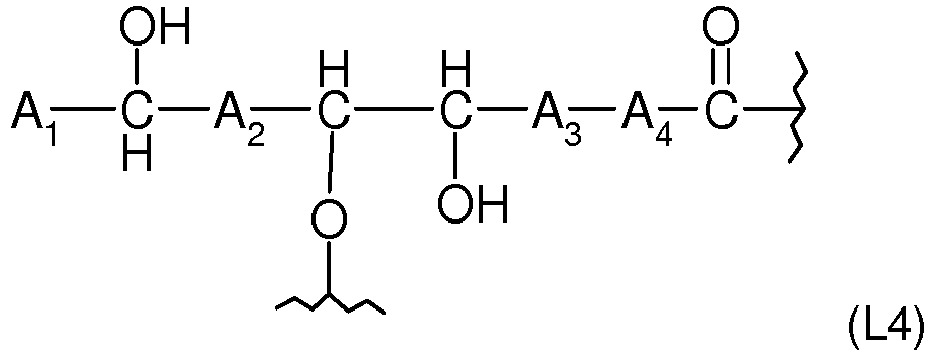
- the polymer according to the invention comprises at least one repetitive unit (W) having the formula (L3) and at least one repetitive unit having the formula (L4) and at least one repetitive unit (W) having the formula (L5).
- the polymer according to the invention comprises at least one repetitive unit (W) having the formula (L3) and at least one repetitive unit having the formula (L4).
- the polymer according to the invention comprises at least one repetitive unit (W) having the formula (L3) and at least one repetitive unit having the formula (L5).
- the polymer according to the invention comprises at least one repetitive unit (W) having the formula (L4) and at least one repetitive unit having the formula (L5).
- the polymer according to the invention comprises at least one repetitive unit (W) having the formula (L3).
- the polymer according to the invention comprises at least one repetitive unit (W) having the formula (L4).
- the polymer according to the invention comprises at least one repetitive unit (W) having the formula (L5).
- the polymer according to the invention comprises at least one repetitive unit (Q) having the formula (S) as defined above.
- the polymer according to the invention comprises:
- the polymer according to the invention comprises at least one repetitive unit (P) having the following formula (II): wherein Y, A 1 , A 2 , A 3 and A 4 are as defined above.
- the above-mentioned repetitive unit (P) has the formula (II-1): Y, A 1 , A 2 , A 3 and A 4 being as defined above.
- the above-mentioned repetitive unit (P) has the formula (II-1-1):
- the above-mentioned repetitive unit (P) has the formula (II-1-2):
- the polymer according to the invention comprises:
- the repetitive unit (U) has the following formula (D3): wherein A 1 , A 2 , A 3 and A 4 are as defined above.
- the repetitive unit (V) has the following formula (T3): wherein A 1 , A 2 , A 3 and A 4 are as defined above.
- the polymer according to the invention comprises:
- the repetitive units of the polymer comprise two groups R 1 which may be identical or different.
- the polymer according to the invention comprises at least one repetitive unit (Q) having the formula (S') as mentioned above.
- the polymer according to the invention comprises:
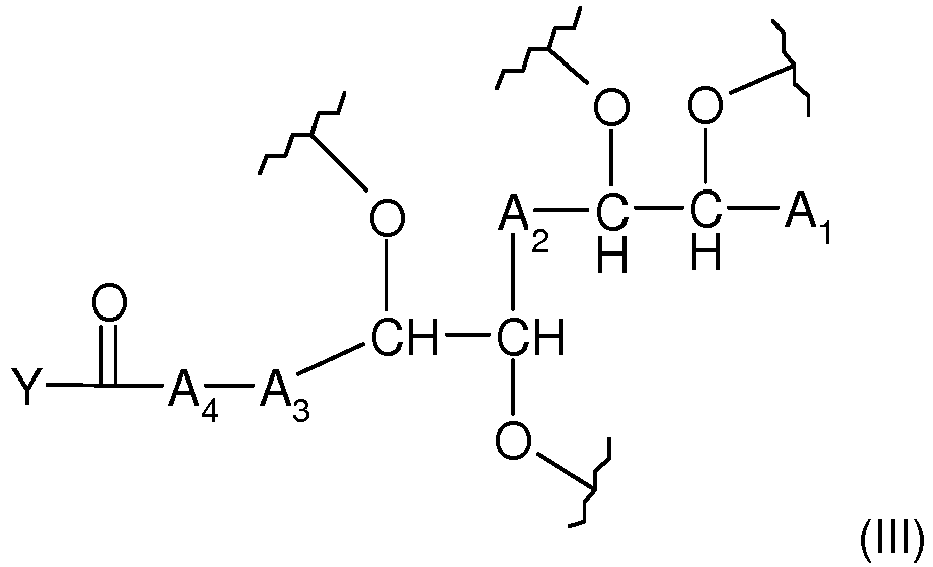
- the polymer according to the invention comprises at least one repetitive unit (R) having the following formula (III): wherein Y, A 1 , A 2 , A 3 and A 4 are as defined above.
- the above-mentioned repetitive unit (R) has the following formula (III-1): wherein Y, A 1 , A 2 , A 3 and A 4 are as defined above.
- the above-mentioned repetitive unit (R) has the following formula (III-1-1):
- the polymer according to the invention comprises:
- a 1 represents a pentyl, hexyl or heptyl group.
- a 4 represents a butylene radical or hexylene radical.
- a 2 represents a methylene, ethylene or pentylene radical.
- a 3 represents a methylene, propylene, pentylene or butylene radical.
- Preferred polymers according to the invention are those wherein A 1 represents H, i is 0, j is 0, A 2 represents a bond, and A 3 and A 4 represent a linear or branched divalent alkylene radical comprising from 1 to 20 carbon atoms.
- a 1 represents H
- i is 1
- j is 0, and
- a 2 , A 3 and A 4 represent, independently of each other, a linear or branched divalent alkylene radical comprising from 1 to 20 carbon atoms.
- a 1 represents H
- a 2 , A 3 and A 4 represent, independently of each other, a linear or branched divalent alkylene radical comprising from 1 to 20 carbon atoms.
- a 1 represents a linear or branched divalent alkyl group comprising from 1 to 20 carbon atoms
- a 2 , A 3 and A 4 represent, independently of each other, a linear or branched divalent alkylene radical comprising from 1 to 20 carbon atoms.
- a 1 represents a linear or branched divalent alkyl group comprising from 1 to 20 carbon atoms
- a 2 , A 3 and A 4 represent, independently of each other, a linear or branched divalent alkylene radical comprising from 1 to 20 carbon atoms.
- a 1 represents a linear or branched divalent alkyl group comprising from 1 to 20 carbon atoms
- a 2 , A 3 and A 4 represent, independently of each other, a linear or branched divalent alkylene radical comprising from 1 to 20 carbon atoms.
- a preferred polymer according to the invention is a polymer wherein A 1 represents H, i is 0, j is 0, A 2 represents a bond, and A 3 and A 4 represent a butylene radical.
- Another preferred polymer according to the invention is a polymer wherein A 1 represents H, i is 1, j is 0, A 2 represents a pentylene radical, A 3 represents a propylene radical and A 4 represents a butylene radical.
- Another preferred polymer according to the invention is a polymer wherein A 1 represents a hexyl group, i is 0, j is 0, A 2 represents an ethylene radical, A 3 represents a pentylene radical and A 4 represents a hexylene radical.
- Another preferred polymer according to the invention is a polymer wherein A 1 represents a pentyl group, i is 2, j is 0, A 2 represents a methylene radical, A 3 represents a propylene radical and A 4 represents a butylene radical.
- Another preferred polymer according to the invention is a polymer wherein A 1 represents a heptyl group, i is 0, j is 0, A 2 represents a methylene radical, A 3 represents a methylene radical and A 4 represents a hexylene radical.
- Another preferred polymer according to the invention is a polymer wherein A 1 represents a hexyl group, i is 1, j is 0, A 2 represents a methylene radical, A 3 represents a methylene radical and A 4 represents a hexylene radical.
- the polymer according to the invention has a number-average molecular weight M n comprised between 3 000 g/mol and 500 000 g/mol.
- the number-average molecular weight M n of the polymer is higher than 3 400 g/mol, preferably higher than 5 000 g/mol.
- number-average molecular weight M n of the polymer is lower than 250 000 g/mol, preferably lower than 100 000 g/mol, and more preferably lower than 20 000 g/mol.
- M n means the number-average molecular weight of the polymer.
- M w means the weight-average molecular weight of the polymer.
- M n and M w are determined by steric exclusion chromatography in THF, using polystyrenes as standard.
- the polymer according to the invention has a dispersity comprised from 1 to 30, preferably from 1 to 20.
- the units (V), (U) and (Q), and optional units (W), have the same definition for A 1 .
- a 1 represents methyl in the unit(s) (U)
- a 1 thus also represents methyl in the unit(s) (V), (W) and (Q).
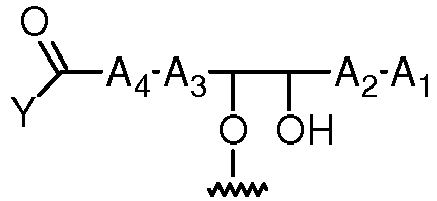
- the polymer according to the invention comprises at least one repetitive unit (R') having one of the following formulae: wherein A 1 , A 2 , A 3 and A 4 are as defined above.
- alkyl means a saturated aliphatic hydrocarbon group, which may be straight or branched, having about 1 to about 20 carbon atoms in the chain. Preferred alkyl groups have 1 to about 10 carbon atoms in the chain. The following alkyl groups may be cited as example: methyl, ethyl, propyl, butyl, pentyl, hexyl, heptyl, octyl, nonyl, decyl, dodecyl.
- alkylene refers to a divalent radical comprising from 1 to 20 carbon atoms, and preferably from 1 to 12 carbon atoms, and more preferably 1 to 6 carbon atoms.
- radical When said radical is linear, it may be represented by the formula (CH 2 ) k wherein k is an integer varying from 1 to 12, and preferably from 1 to 6.
- alkylene may be cited as example: methylene, ethylene, propylene, butylene, pentylene, hexylene, heptylene, octylene, nonylene, decylene, dodecylene.
- aryl refers to an aromatic monocyclic or bicyclic hydrocarbon ring system having from 6 to 22, preferably 5 to 10, carbons atoms, wherein any ring atom capable of substitution may be substituted by a substituent.
- aryl moieties include, but are not limited to, phenyl, naphthyl, and anthracenyl.
- the polymer according to the invention is a branched polymer, in particular a branched polyester, comprising notably a combination of dendritic unit(s) (U), terminal unit(s) (V), optionally linear unit(s) (W) and optionally semi-dendritic unit(s) (Q), said units (U), (V), (W) and (Q) being as defined above.
- the branched polymer of the invention comprises several polymeric chains corresponding notably to the succession of (U), (V), (W) or (Q) units.
- the different units (U), (V), optionally (W) and optionally (Q) of said polymer are linked to each other through which is present on each unit.
- repetitive units of the polymer of the invention comprise -O-moiety(ies) and/or -C(O)- moiety(ies) which are linked together to form ester bonds.
- the moiety in one unit (U), (V), (W) or (Q) is linked to a moiety in another unit.
- one unit (D) may be linked to one unit (T) as follows, through a bond being present on the unit (D) and another which is present on the unit (T), as follows:
- the bold bond (*) thus corresponds to the bond between the -O- moiety of a (D) unit and the -C(O)- moiety of a (T) unit.
- linkage between units in the polymer of the invention is as follows: which corresponds to one unit (L), wherein R 4 represents and R 1 , R 2 and R 3 represent H, linked to one unit (T).
- the bold bond (*) thus corresponds to the bond between the -O- moiety of a (L) unit and the -C(O)- moiety of a (T) unit.
- the units of the polymer of the invention as mentioned above are thus linked together through -C(O)O- bonds, the -C(O)- moiety being part of one unit, and the -O- moiety being part of another unit.
- -C(O)O- bonds for example, when one unit (D) is linked to one unit (T) as mentioned above, there is the formation of a -C(O)O- bond between the unit (U) and the unit (T), wherein the -O- moiety comes from the unit (D) and the -C(O)- comes from the unit (T).
- free hydroxyl group means -OH.
- the moiety is not a free hydroxyl group but a "bound" hydroxyl group, and refers in particular to a -O- radical in one unit which is meant to be linked to a moiety in another unit.
- a unit (U) of the polymer according to the invention is a dendritic unit.
- units (U) of the polymer are units of formulae (D1), (D2) or (D3).
- the dendritic units of the polymer of the invention comprise at least three bonds and in particular 3, 4 or 5 such bonds.
- a dendritic unit (U) of formula (D) is a unit which does not comprise any free hydroxyl group.
- a dendritic unit (U) of formula (D) comprises from 2 to 4 moieties. For example, when i and j are 0, then the dendritic unit (U) comprises 2 moieties, or when i is 2 and j is 0, then the dendritic unit (U) comprises 4 moieties.
- a unit (V) of the polymer according to the invention is a terminal unit.
- units (V) of the polymer are units of formulae (T1), (T2) or (T3).
- the terminal units of the polymer of the invention comprise in particular one bond
- a terminal unit (V) of formula (T) is a unit which only comprises free hydroxyl groups.
- a terminal unit (V) of formula (T) comprises from 2 to 4 free hydroxyl groups. For example, when i and j are 0, then the terminal unit (V) comprises 2 free hydroxyl groups, or when i is 2 and j is 0, then the terminal unit (V) comprises 4 free hydroxyl groups.
- a unit (W) of the polymer according to the invention is a linear unit.
- units (W) of the polymer are units of formulae (L1), (L2), (L3), (L4), (L5), (L6), (L7), (L8) or (L9).
- the linear units of the polymer of the invention comprise two bonds in particular.
- a linear unit (W) of formula (L) is a unit which comprises only one moiety and from 1 to 3 free hydroxyl group(s). For example, when i and j are 0, then the linear unit (W) comprises 1 free hydroxyl group and 1 moiety, or when i is 2 and j is 0, then the linear unit (W) comprises 3 free hydroxyl groups and 1 moiety.
- a unit (Q) of the polymer according to the invention is a semi-dendritic unit.
- unit (Q) of the polymer are units of formulae (S1), (S2), (S3), (S4), (S5), (S6), (S7), (S8), (S9), (S10), (S11), (S12) or (S13).
- the semi-dendritic units of the polymer of the invention comprise in particular at least three bonds and in particular 3 or 4 such bonds.
- a semi-dendritic unit (Q) is a unit which comprises at least two moieties and at least one free hydroxyl group.
- the units (S1), (S2) and (S3) comprises one free hydroxyl group and two moieties
- the units (S4) comprise two free hydroxyl groups and two moieties.
- the present invention also relates to a process for preparing the polymers as defined above. Therefore, the present invention also relates to a process for preparing a polymer as defined above, comprising a step of polymerization of at least one monomer of formula (IV): wherein Y, A 1 , A 2 , A 3 and A 4 are as defined above; said step being carried out in the presence of a catalyst selected from the group consisting of: Zn(OAc) 2 (anhydrous zinc acetate), Ti(OBu) 4 (titanium butoxide), Ti(OiPr) 4 (titanium isopropoxide), Sb 2 O 3 (antimony (III) oxide), stannous octoate, DBTO (dibutyltin oxide), m-TBD (7-methyl-1,5,7-triazabicyclo(4.4.0)dec-5-ene), TBD (1,5,7-triazabicyclo[4.4.0]dec-5-ene). said process optionally comprising a step of
- the present invention also relates to a process for preparing the polymers as defined above. Therefore, the present invention also relates to a process for preparing a polymer as defined above, comprising a step of polymerization of at least one monomer of formula (IV): wherein Y, A 1 , A 2 , A 3 and A 4 are as defined above; said step being carried out in the presence of a catalyst selected from the group consisting of: NaOMe, Zn(OAc) 2 (anhydrous zinc acetate), Ti(OBu) 4 (titanium butoxide), Ti(OiPr) 4 (titanium isopropoxide), Sb 2 O 3 (antimony (III) oxide), stannous octoate, DBTO (dibutyltin oxide), m-TBD (7-methyl-1,5,7-triazabicyclo(4.4.0)dec-5-ene), TBD (1,5,7-triazabicyclo[4.4.0]dec-5-ene). said process optionally comprising
- the catalyst is Zn(OAc) 2 , 1,5,7-triazabicyclo[4.4.0]dec-5-ene, NaOMe or stannous octoate.
- the catalyst is 1,5,7-triazabicyclo[4.4.0]dec-5-ene.
- the catalyst is Zn(OAc) 2 .
- the catalyst is NaOMe.
- NaOMe is advantageous as it allows full conversion, and it is cheap, which is appropriate for an industrial scale process.
- the amount of catalyst is comprised from 0.05% to 10%, preferably from 0.5% to 5%, more preferably from 1% to 2%, and even more preferably from 1.2% to 1.8%, by weight relative to the weight of the monomer of formula (IV) as defined above.
- the monomer of formula (IV) has the formula (IV-1): wherein Y, A 1 , A 2 , A 3 and A 4 are as defined above.
- the monomer of formula (IV) has the formula (IV-2): wherein Y, A 1 , A 2 , A 3 and A 4 are as defined above.
- the monomer of formula (IV) has the formula (IV-3): wherein Y, A 1 , A 2 , A 3 and A 4 are as defined above.
- the monomer of formula (IV) is selected from the group consisting of the following monomers:
- the process provides a polymer according to the invention comprising:
- the process provides a polymer according to the invention comprising:
- the process provides a polymer according to the invention comprising:
- the polymerization of the monomer of formula (IV) is a bulk polymerization.
- bulk polymerization also known as “mass polymerization” means a polymerization carried out in the absence of solvent or dispersant.
- the process of the invention comprises a preliminary step consisting in heating the monomer of formula (IV) alone at a temperature comprised from 50°C to 120°C, preferably at 90°C, in particular above its melting point, under dynamic vacuum. This step allows advantageously to remove all traces of solvents such as water.
- the polymerization step is carried out by heating the monomer of formula (IV) as defined above in the presence of the catalyst, at a temperature T 1 comprised from 90°C to 130°C for 1 hour to 48 hours, then by heating further at a temperature T 2 comprised from 90°C, preferably from 140°C, to 180°C for 1 hour to 48 hours.
- T 1 and T 2 are different.
- the first heating step is carried out under nitrogen atmosphere.
- the second heating step is carried out under dynamic vacuum.
- the polymerization step is carried out by heating the monomer of formula (IV) as defined above in the presence of the catalyst, at a temperature T 1 comprised from 90°C, preferably from 100°C, to 120°C for 1 hour to 48 hours, preferably for 1 to 10 hours, then by heating further at a temperature T 2 comprised from 90°C, preferably from 160°C to 170°C for 1 hour to 48 hours, preferably for 10 to 20 hours.
- the polymerization step is carried out by heating the monomer of formula (IV) as defined above in the presence of the catalyst, at a temperature T 1 comprised from 90°C, preferably from 100°C, to 120°C for 1 hour to 3 hours, then by heating further at a temperature T 2 comprised from 90°C, preferably from 160°C, to 170°C for about 13 hours.
- the polymerization step is carried out under nitrogen at a temperature T 1 comprised from 90°C to 130°C.
- the polymerization step is further heated at a temperature T 2 comprised from 90°C, preferably from 140°C, to 180°C under dynamic vacuum.
- the process of the invention comprises two heating steps, a first step being carried out at a temperature T 1 comprised from 90°C, preferably from 100°C, to 120°C for 1 hour to 48 hours, and then a second step being carried out at a temperature T 2 comprised from 90°C, preferably from 160°C, to 170°C for 1 hour to 48 hours.
- an intermediate oligomer is obtained which is then further heated in order to obtain the polymer of the invention.
- the process is a one-pot process, and in particular a two-steps one-pot process.
- the term "one-pot process” means a process wherein two or more reactions are conducted in a single reaction vessel without isolating or purifying the resulting intermediate(s).
- the present invention also relates to a polymer susceptible to be obtained according to the process as defined above.
- the monomer (1) has been prepared following a two-step procedure. Methyl esters of high oleic sunflower oil and formic acid (0,3 n) were added in a 100L reactor equipped with a mechanical stirrer and a condenser, n being the number of mole of double bond on the methyl esters. The resulting mixture was heated at 70°C for 1 hour under stirring. At 70°C, hydrogen peroxide (35%, 2n) was added slowly to the reactor using a volumetric pump while maintaining the temperature in the reactor close to 75 - 80°C. When the addition was finished, the temperature was risen to 90°C for 2 hours. The reaction was monitored by gas chromatography.
- reaction mixture was then cooled down to 40°C temperature and the aqueous phase was discarded.
- the organic layer was washed with an aqueous solution of sodium hydroxide (0.1N) until the pH becomes neutral.
- the organic phase was finally dried under vacuum to afford a clear and slightly yellow liquid (Oxiran number ⁇ 5.0%).
- 1 portion of epoxydized methyl esters of oleic sunflower oil was placed along with 1/2 portion of an aqueous solution of phosphoric acid (12 % w/w) and 1/3 portion of tert-butanol as solvent in a 100L reactor equipped with a condenser and a mechanical stirrer. The resulting mixture was then heated at 90°C under vigorous stirring. The reaction was monitored by gas chromatography.
- the monomer (2) has been prepared following a two-step procedure. Methyl esters of castor oil and formic acid (0,3 n) were added in a reactor equipped with a mechanical stirrer, a dropping funnel and a condenser, n being the number of mole of double bond of the methyl esters. The resulting mixture was heated at 40°C for 1 hour under stirring condition. At 40°C, hydrogen peroxide (50%, 2n) was added drop wise to the reactor using a dropping funnel while maintaining the temperature in the reactor close to 70 - 75°C. The reaction was monitored by gas chromatography. The reaction mixture was then cooled down to room temperature and the aqueous phase discarded.
- the organic layer was washed with an aqueous solution of sodium hydroxide (0.1N) until the pH becomes neutral.
- the organic phase was then dried under vacuum at 60°C to afford a clear and slightly yellow liquid with a precipitate.
- the precipitate isolated by filtration is the methyl 9, 10, 12-trihydroxystearate, the yellow liquid corresponds to the epoxidized methyl esters of castor oil.
- 1 portions of epoxidized methyl esters of castor oil was placed along with 1/2 portion of an aqueous solution of phosphoric acid (12 % w/w) and 1/3 portion of tert-butanol as solvent in a reactor equipped with a condenser and a mechanical stirrer.
- the monomer (3) has been previously prepared by the process as described in US 5,344,946 .
- the monomer (4) has been prepared by esterification of aleuritic acid in methanol.
- a round-botttomed flask was charged with 5g of aleuritic acid, 50mL of methanol and 1g of Amberlyst 15. The mixture was heated at 70°C under reflux for 24 hours. After reaching rt, the resin was filtered, the methanol removed under vacuum and 100ml of DCM was added. The organic phase was washed twice with water, dried on anhydrous magnesium suflate and DCM was removed under vacuum.
- Monomer (4) was thus obtained as a white solid powder (yield: 75%).
- erucic acid rapeseed oil (800Kg) was heated under stirring condition at 65°C in the presence of methanol (190Kg) and sodium methanolate (19 Kg) for 2 hours. The thus-obtained methyl esters were decanted and the glycerol phase discarded. Methyl esters of erucic acid rapeseed oil were then washed with water, dried under vacuum and distilled on a falling film reactor (200L/hour) in order to concentrate the erucic acid methyl ester up to 95%. The procedure followed to prepare the monomer (5) starting from methyl erucate was identical to the one described earlier to obtain the monomer (1).
- Example 1 Polyester derived from monomer (1)
- the conversion corresponds to the percentage by weight of conversion of the monomer (1).
- M n , M w and ⁇ were determined by steric exclusion chromatography in THF with polystyrene standards, and the degree of branching was determined by RMN 1 H.
- Thermo-mechanical properties of the renewable polymers obtained were characterized by Differential Scanning Calorimetry (DSC) and Thermal Gravimetric Analysis (TGA).
- the resulting polymers provide the following RMN 1 H spectrum: 1 H NMR (400 MHz, DMSO) ⁇ 4.91, 4.71, 4.70, 4.69, 4.60, 4.59, 4.09, 3.57, 3.39, 3.18, 2.50, 2.27, 2.27, 2.25, 2.24, 1.52, 1.37, 1.23, 1.02, 0.87, 0.85, 0.83, 0.62.
- the conversion corresponds to the conversion of the monomer (2).
- Highly branched polyesters displayed amorphous properties with glass transition temperature in the range from -13.2 to 0.6°C for polyesters derived from monomer (2).
- M n , M w and ⁇ were determined by steric exclusion chromatography in THF with polystyrene standards, and the degree of branching was determined by RMN 1 H.
- the resulting polymers provide the following RMN 1 H spectrum: 1 H NMR (400 MHz, DMSO) ⁇ 5.17, 4.98, 4.97, 4.87, 4.77, 4.65, 4.64, 4.53, 4.32, 4.26, 4.20, 4.13, 4.10, 3.70, 3.59, 3.57, 3.49, 3.41, 3.31, 3.25, 3.17, 2.50, 2.22, 1.49, 1.39, 1.32, 1.30, 1.23, 0.85.
- Polyesters were synthesized according to the general procedure as described above. Catalyst a Conv. (%) b M n (g.mol -1 ) c M w (g.mol -1 ) c ⁇ b Zn(OAc) 2 98 2349 5622 2.39 TBD 95 2370 6390 2.70 a Loading in catalyst: 1.5wt%. b SEC in THF. ⁇ : dispersity
- the monomer was firstly dried for one hour alone under dynamic vacuum, above its melting point at 90°C.
- the first step of polymerization was carried out at 120°C for 2 hours and the second step of polymerization was carried out at 140°C for 13 hours.
- a polyester was synthesized according to the general procedure as described above. Catalyst a Conv. (%) b M n (g.mol -1 ) c M w (g.mol -1 ) c ⁇ b TBD 96 3550 8510 2.40 a Loading in catalyst: 1.5wt%. b SEC in THF. ⁇ : dispersity
- the first step of polymerization was carried out at 120°C and the second step of polymerization was carried out at 140°C.
- Another polymerization was also carried out as follows: pre-drying at 90°C under dynamic vacuum, then the first step of polymerization was carried out at 90°C under nitrogen, and the second step of polymerization was carried out at 90°C for x hours under dynamic vacuum.
- the resulting polymer was obtained: Catalyst a x (hours) Conv. (%) b M n (g.mol -1 ) c M w (g.mo -1 ) c ⁇ b T g c (°C) T 10% d (°C) TBD 1h30 99 9270 44630 4.81 -16 358 TBD 1h 100 9300 44 700 4.81 -15.2 358 TBD e 4h 100 13000 75400 5.80 -14.4 342 NaOMe 2 98 4800 13900 2.9 -16.7 350 a Loading in catalyst: 1.5wt%. b SEC in THF. c DSC. d TGA. e loading in TBD : 1w%
- a polyester was synthesized according to the general procedure as described above. Catalyst a Conv. (%) b M n (g.mol -1 ) c M w (g.mol -1 ) c ⁇ b DB C T 10% d (°C) Zn(Ac) 2 95 3000 5800 1.93 0.09 / TBD 100 5600 17100 3.05 0.33 320 NaoMe 100 9200 30100 3.27 0.30 350 a Loading in catalyst: 1.5wt%. b SEC in THF. c 1 H-NMR. d TGA. ⁇ : dispersity, DB: degree of branching
- the first step of polymerization was carried out at 120°C and the second step of polymerization was carried out at 160°C.
Landscapes
- Chemical & Material Sciences (AREA)
- Health & Medical Sciences (AREA)
- Chemical Kinetics & Catalysis (AREA)
- Medicinal Chemistry (AREA)
- Polymers & Plastics (AREA)
- Organic Chemistry (AREA)
- Addition Polymer Or Copolymer, Post-Treatments, Or Chemical Modifications (AREA)
- Compositions Of Macromolecular Compounds (AREA)
Description
- The present invention concerns new branched polymers, and in particular branched polyesters, and their process of preparation.
- The present invention also concerns new branched polymers susceptible to be obtained according to the process of the invention, as well as uses thereof.
- Over the last decades, branched polymers have attracted a growing interest because of their unique architecture.
- Branched polymers belong to a class of synthetic tree-like macromolecules called dendritic polymers (Gao and Yan, 2004). They are polymers with densely branched structure and a large number of end groups. Dendritic polymers include dendrimers which have completely branched star-like topologies and branched polymers which have imperfectly branched or irregular structures.
- Due to their unique properties, branched polymers have a wide range of applications. Branched polymers can be used as additives, such as tougheners for thermosets, cross-linking or adhesive agents, dispersers, compatibilizers or rheology modifiers....
- There is a need for new branched polymers, and more particularly for new renewable branched polymers.
- The aim of the present invention is to provide new branched polymers, and more particularly new renewable branched polymers.
- The aim of the present invention is also to provide a process of preparation of branched polymers, easy to be implemented.
- Therefore, the present invention relates to a polymer comprising:
- i) at least one repetitive unit (V) having the following formula (T):

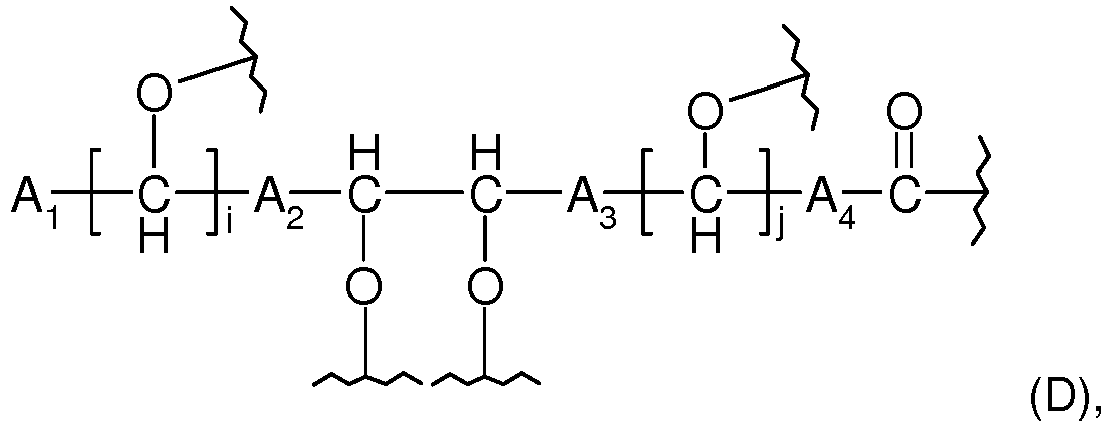
- ii) at least one, preferably at least two, repetitive unit(s) (U) having the following formula (D):
at least one, preferably at least two, repetitive unit(s) (Q) having the following formula (S) :
at least one, preferably at least two, repetitive unit(s) (Q) having the following formula (S') :
- A1 represents H or a linear or branched divalent alkyl group comprising from 1 to 20 carbon atoms, preferably from 2 to 12, and more preferably from 5 to 10;
- A4 represents a linear or branched divalent alkylene radical comprising from 1 to 20 carbon atoms, preferably from 2 to 12, and more preferably from 4 to 10;
- A2 represents a bond or a linear or branched divalent alkylene radical comprising from 1 to 20 carbon atoms, preferably from 1 to 10, and more preferably from 1 to 5;
- A3 represents a linear or branched divalent alkylene radical comprising from 1 to 20 carbon atoms, preferably from 1 to 10, and more preferably from 1 to 5;
- R1, R'1, R2 and R3 are

- i is 0, 1 or 2;
- j is 0 or 1;
when A1 is H and i is 0, then A2 is a bond,
and wherein:- in the unit (U) having the formula (S), only one of R1, R2 and R3 is H ;
- in the unit (U) having the formula (S'), one or two of R1, R'1, R2 and R3 is H.
- In one embodiment, the present invention relates to a polymer comprising:
- at least one repetitive unit (V) having the following formula (T) as defined above, and
- at least one, preferably at least two repetitive unit(s) (U) having the following formula (D) as defined above.
- In one embodiment, when i=j=0, then the polymer comprises at least one repetitive unit (U) having the formula (D) and at least one unit (V) having the formula (T).
- In one embodiment, when at least one of i or j is different from 0, then the polymer comprises at least one repetitive unit (Q) having the formula (S) and at least one unit (V) having the formula (T), or the polymer comprises at least one repetitive (Q) having the formula (S') and at least one unit (V) having the formula (T).
- The inventors advantageously synthesized new renewable branched polymers, from renewable monomers, having interesting properties. The inventors notably developed a facile and efficient process to yield new branched renewable polymers.
- In one embodiment, the polymer according to the invention further comprises at least one repetitive unit (W) having the following formula (L):

- A1, A2, A3, A4, i and j are as defined above;
- R1, R2, R3 and R4 are

- According to an embodiment, in the unit (W) having the formula (L), when i is 2, then the polymer comprises two R1 groups which may be identical or different.
- In one embodiment, the polymer according to the invention comprises:
- at least one, preferably at least two, repetitive unit(s) (U) having the formula (D);
- at least one, preferably at least two, repetitive unit(s) (V) having the formula (T);
- at least one, preferably at least two, repetitive unit(s) (W) having the formula (L); and
- optionally at least one, preferably at least two, repetitive unit(s) (Q) having the formula (S) or (S').
- In one embodiment, the polymer according to the invention comprises:
- at least one, preferably at least two, repetitive unit(s) (Q) having the formula (S);
- at least one, preferably at least two, repetitive unit(s) (V) having the formula (T);
- at least one, preferably at least two, repetitive unit(s) (W) having the formula (L); and
- optionally at least one, preferably at least two, repetitive unit(s) (Q) having the formula (S) or (S').
- In one embodiment, the polymer according to the invention comprises:
- at least one, preferably at least two, repetitive unit(s) (Q) having the formula (S');
- at least one, preferably at least two, repetitive unit(s) (V) having the formula (T);
- at least one, preferably at least two, repetitive unit(s) (W) having the formula (L), and
- optionally at least one, preferably at least two, repetitive unit(s) (Q) having the formula (S) or (S').
- According to one embodiment, in the above formulae (D), (T) and (L), i=j=0.
- According to one embodiment, in the above formulae (D), (T) and (L), i=1 and j=0.
- According to one embodiment, in the above formulae (D), (T) and (L), i=2 and j=0.
- In one embodiment, in the polymer according to the invention, the repetitive unit (U) has the following formula (D1):

- A unit having formula (D1) corresponds to a unit having formula (D) as mentioned above, wherein i=j=0.
- In one embodiment, in the polymer according to the invention, the repetitive unit (V) has the following formula (T1):

- A unit having formula (T1) corresponds to a unit having formula (T) as mentioned above, wherein i=j=0.
- In one embodiment, the polymer according to the invention comprises at least one unit (W) having the following formula (L'):
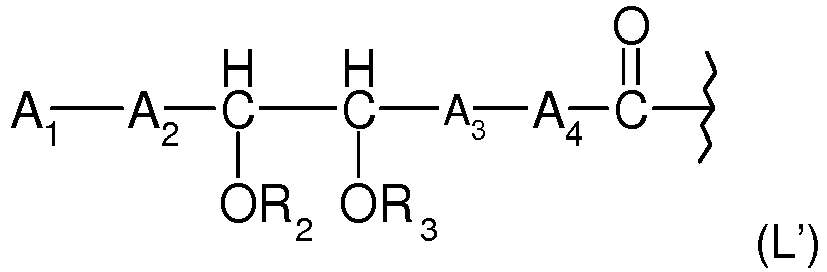
- A1, A2, A3, and A4 are as defined above;
- R2 and R3 are

- A unit having formula (L') corresponds to a unit having formula (L) as mentioned above, wherein i=j=0.
- In one embodiment, the polymer according to the invention comprises:
- at least one repetitive unit (W) having the following formula (L1):

- at least one repetitive unit (W) having the following formula (L2):

- A unit having formula (L1) corresponds to a unit having formula (L') as mentioned above, wherein R3=H.
- A unit having formula (L2) corresponds to a unit having formula (L') as mentioned above, wherein R2=H.
- In one embodiment, the polymer according to the invention comprises at least one repetitive unit (W) having the formula (L1).
- In one embodiment, the polymer according to the invention comprises at least one repetitive unit (W) having the formula (L2).
- In one embodiment, the polymer according to the invention comprises at least one repetitive unit (W) having the formula (L1) and at least one repetitive unit having the formula (L2).
- In one embodiment, the polymer according to the invention comprises at least one unit (W) having the following formula (L"):
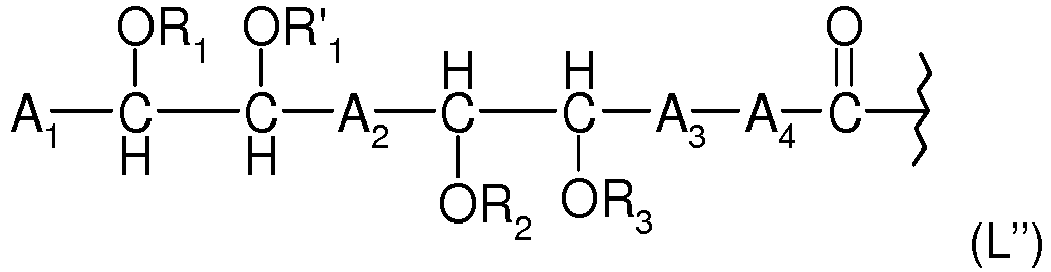
- A1, A2, A3, and A4 are as defined above;
- R1, R'1, R2 and R3 are

- A unit having formula (L") corresponds to a unit having formula (L) as mentioned above, wherein i=2 and j=0.
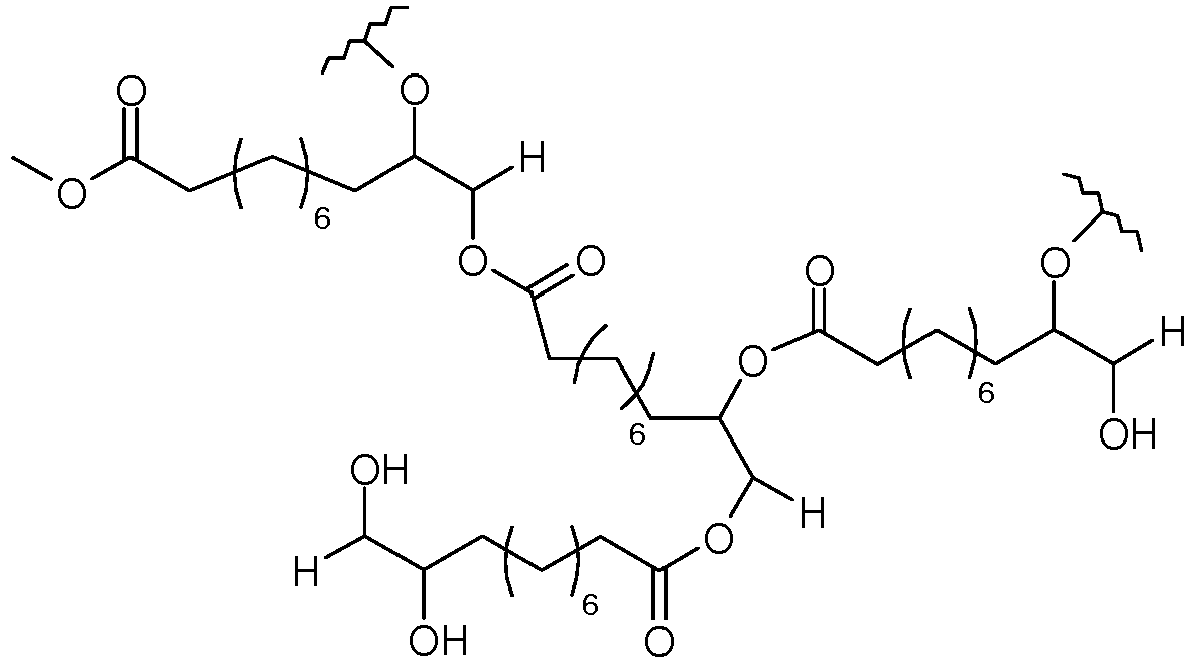
- In one embodiment, the polymer according to the invention comprises at least one repetitive unit (Z) having the formula (I):

- A1, A2, A3, and A4 are as defined above;
- Y represents -ORa, Ra being selected from the group consisting of: H, a linear or branched alkyl group comprising from 1 to 20 carbon atoms and an aryl group comprising from 6 to 22 carbon atoms.
- In one embodiment, in the polymer according to the invention, the repetitive unit (Z) has the formula (I) wherein Y is -OMe.
- In one embodiment, in the polymer according to the invention, the repetitive unit (Z) has the formula (I) wherein Y is -OH.
- In one embodiment, the above-mentioned repetitive unit (Z) has the formula (I-1):

- In one embodiment, the repetitive unit (Z) has the formula (I) as mentioned above wherein the radical A1-A2- is an alkyl group comprising 8 carbon atoms.
- In one embodiment, the repetitive unit (Z) has the formula (I) as mentioned above wherein the radical A1-A2- is H (A2 being a bond and A1 being H).
- In one embodiment, the repetitive unit (Z) has the formula (I) as mentioned above wherein the radical -A3-A4- is an alkylene radical comprising 11 carbon atoms.
- In one embodiment, the repetitive unit (Z) has the formula (I) as mentioned above wherein the radical -A3-A4- is an alkylene radical comprising 8 carbon atoms.
- In one embodiment, the above-mentioned repetitive unit (Z) has the formula (I-1-1):

- In one embodiment, the repetitive unit (Z) has the formula (I-1-2):

- In one embodiment, the repetitive unit (Z) has the formula (I-1-3):
- In one embodiment, the polymer according to the invention comprises:
- at least one repetitive unit (U) having the formula (D1) as defined above;
- at least one repetitive unit (V) having the formula (T1) as defined above;
- at least one repetitive unit (W) having the formula (L1) as defined above;
- at least one repetitive unit (W) having the formula (L2) as defined above; and
- optionally at least one repetitive unit (Z) having the formula (I-1) as defined above, in particular having the formula (I-1-1), (I-1-2) or (I-1-3).
- In another embodiment, in the polymer according to the invention, the repetitive unit (U) has the following formula (D2):

- A unit having formula (D2) corresponds to a unit having formula (D) as mentioned above, wherein i=1 and j=0.
- In one embodiment, in the polymer according to the invention, the repetitive unit (V) has the following formula (T2):

- A unit having formula (T2) corresponds to a unit having formula (T) as mentioned above, wherein i=1 and j=0.
- In one embodiment, the polymer according to the invention comprises:
- at least one repetitive unit (W) having the following formula (L3):

- at least one repetitive unit (W) having the following formula (L4):
- at least one repetitive unit (W) having the following formula (L5):

- A unit having formula (L3) corresponds to a unit having formula (L) as mentioned above, wherein i=1, j=0, and R2=R3=H.
- A unit having formula (L4) corresponds to a unit having formula (L) as mentioned above, wherein i=1, j=0, and R1=R3=H.
- A unit having formula (L5) corresponds to a unit having formula (L) as mentioned above, wherein i=1, j=0, and R1=R2=H.
- In one embodiment, the polymer according to the invention comprises at least one repetitive unit (W) having the formula (L3) and at least one repetitive unit having the formula (L4) and at least one repetitive unit (W) having the formula (L5).
- In one embodiment, the polymer according to the invention comprises at least one repetitive unit (W) having the formula (L3) and at least one repetitive unit having the formula (L4).
- In one embodiment, the polymer according to the invention comprises at least one repetitive unit (W) having the formula (L3) and at least one repetitive unit having the formula (L5).
- In one embodiment, the polymer according to the invention comprises at least one repetitive unit (W) having the formula (L4) and at least one repetitive unit having the formula (L5).
- In one embodiment, the polymer according to the invention comprises at least one repetitive unit (W) having the formula (L3).
- In one embodiment, the polymer according to the invention comprises at least one repetitive unit (W) having the formula (L4).
- In one embodiment, the polymer according to the invention comprises at least one repetitive unit (W) having the formula (L5).
- In one embodiment, the polymer according to the invention comprises at least one repetitive unit (Q) having the formula (S) as defined above.
- In one embodiment, the polymer according to the invention comprises:
- at least one repetitive unit (Q) having the following formula (S1):

- at least one repetitive unit (Q) having the following formula (S2):

- at least one repetitive unit (Q) having the following formula (S3):

- A unit having formula (S1) corresponds to a unit having formula (S) as mentioned above, wherein R1=H.
- A unit having formula (S2) corresponds to a unit having formula (S) as mentioned above, wherein R2=H.
- A unit having formula (S3) corresponds to a unit having formula (S) as mentioned above, wherein R3=H.
- In one embodiment, the polymer according to the invention comprises at least one repetitive unit (P) having the following formula (II):

- In one embodiment, the above-mentioned repetitive unit (P) has the formula (II-1):

- In one embodiment, the above-mentioned repetitive unit (P) has the formula (II-1-1):

- In one embodiment, the above-mentioned repetitive unit (P) has the formula (II-1-2):

- In one embodiment, the polymer according to the invention comprises:
- at least one repetitive unit (V) having the formula (T2) as defined above;
- at least one repetitive unit (W) having the formula (L3) as defined above;
- at least one repetitive unit (W) having the formula (L4) as defined above;
- at least one repetitive unit (W) having the formula (L5) as defined above;
- at least one repetitive unit (Q) having the formula (S1) as defined above;
- at least one repetitive unit (Q) having the formula (S2) as defined above;
- at least one repetitive unit (Q) having the formula (S3) as defined above;
- optionally at least one repetitive unit (P) having the formula (II-1)as defined above, in particular having the formula (II-1-1) or (II-1-2); and
- optionally at least one repetitive unit (U) having the formula (D2) as defined above.
- In another embodiment, in the polymer according to the invention, the repetitive unit (U) has the following formula (D3):

- A unit having formula (D3) corresponds to a unit having formula (D) as mentioned above, wherein i=2 and j=0.
- In one embodiment, in the polymer according to the invention, the repetitive unit (V) has the following formula (T3):

- A unit having formula (T3) corresponds to a unit having formula (T) as mentioned above, wherein i=2 and j=0.
- In one embodiment, the polymer according to the invention comprises:
- at least one repetitive unit (W) having the following formula (L6):

- at least one repetitive unit (W) having the following formula (L7):

- at least one repetitive unit (W) having the following formula (L8):

- at least one repetitive unit (W) having the following formula (L9):

- A unit having formula (L6) corresponds to a unit having formula (L) as mentioned above, wherein i=2, j=0, and R1=R3=R2=H, and to a unit having formula (L") as mentioned above, wherein R1=R2=R3=H.
- A unit having formula (L7) corresponds to a unit having formula (L) as mentioned above, wherein i=2, j=0, and R2=R'1=R3=H and to a unit having formula (L") as mentioned above, wherein R'1=R2=R3=H.
- A unit having formula (L8) corresponds to a unit having formula (L) as mentioned above, wherein i=2, j=0, and R1=R'1=R3=H and to a unit having formula (L") as mentioned above, wherein R'1=R1=R3=H.
- A unit having formula (L9) corresponds to a unit having formula (L) as mentioned above, wherein i=2, j=0, and R1=R2=R'1=H and to a unit having formula (L") as mentioned above, wherein R'1=R2=R1=H.
- According to an embodiment, when i=2, the repetitive units of the polymer comprise two groups R1 which may be identical or different.
- In one embodiment, the polymer according to the invention comprises at least one repetitive unit (Q) having the formula (S') as mentioned above.
- In one embodiment, the polymer according to the invention comprises:
- at least one repetitive unit (Q) having the following formula (S4):

- at least one repetitive unit (Q) having the following formula (S5):

- at least one repetitive unit (Q) having the following formula (S6):

- at least one repetitive unit (Q) having the following formula (S7):

- at least one repetitive unit (Q) having the following formula (S8):

- at least one repetitive unit (Q) having the following formula (S9):

- at least one repetitive unit (Q) having the following formula (S10):

- at least one repetitive unit (Q) having the following formula (S11):

- at least one repetitive unit (Q) having the following formula (S12):

- at least one repetitive unit (Q) having the following formula (S13):

- A unit having formula (S4) corresponds to a unit having formula (S') as mentioned above, wherein R1=R'1=H.
- A unit having formula (S5) corresponds to a unit having formula (S') as mentioned above, wherein R1=H.
- A unit having formula (S6) corresponds to a unit having formula (S') as mentioned above, wherein R'1=H.
- A unit having formula (S7) corresponds to a unit having formula (S') as mentioned above, wherein R3=H.
- A unit having formula (S8) corresponds to a unit having formula (S') as mentioned above, wherein R2=H.
- A unit having formula (S9) corresponds to a unit having formula (S') as mentioned above, wherein R2=R3=H.
- A unit having formula (S10) corresponds to a unit having formula (S') as mentioned above, wherein R'1=R2=H.
- A unit having formula (S11) corresponds to a unit having formula (S') as mentioned above, wherein R'1=R3=H.
- A unit having formula (S12) corresponds to a unit having formula (S') as mentioned above, wherein R1=R3=H.
- A unit having formula (S13) corresponds to a unit having formula (S') as mentioned above, wherein R1=R2=H.
- In one embodiment, the polymer according to the invention comprises at least one repetitive unit (R) having the following formula (III):
- In one embodiment, the above-mentioned repetitive unit (R) has the following formula (III-1):

- In one embodiment, the above-mentioned repetitive unit (R) has the following formula (III-1-1):

- In one embodiment, the polymer according to the invention comprises:
- at least one repetitive unit (V) having the formula (T3) as defined above;
- at least one repetitive unit (W) having the formula (L6) as defined above;
- at least one repetitive unit (W) having the formula (L7) as defined above;
- at least one repetitive unit (W) having the formula (L8) as defined above;
- at least one repetitive unit (W) having the formula (L9) as defined above;
- at least one repetitive unit (Q) having the formula (S4) as defined above;
- at least one repetitive unit (Q) having the formula (S5) as defined above;
- at least one repetitive unit (Q) having the formula (S6) as defined above;
- at least one repetitive unit (Q) having the formula (S7) as defined above;
- at least one repetitive unit (Q) having the formula (S8) as defined above;
- at least one repetitive unit (Q) having the formula (S9) as defined above;
- at least one repetitive unit (Q) having the formula (S10) as defined above;
- at least one repetitive unit (Q) having the formula (S11) as defined above;
- at least one repetitive unit (Q) having the formula (S12) as defined above;
- at least one repetitive unit (Q) having the formula (S13) as defined above;
- optionally at least one repetitive unit (U) having the formula (D3) as defined above; and
- optionally at least one repetitive unit (R) having the formula (III) as defined above.
- In one embodiment, in the polymer according to the invention, A1 represents a pentyl, hexyl or heptyl group.
- In one embodiment, in the polymer according to the invention, A4 represents a butylene radical or hexylene radical.
- In one embodiment, in the polymer according to the invention, A2 represents a methylene, ethylene or pentylene radical.
- In one embodiment, in the polymer according to the invention, A3 represents a methylene, propylene, pentylene or butylene radical.
- Preferred polymers according to the invention are those wherein A1 represents H, i is 0, j is 0, A2 represents a bond, and A3 and A4 represent a linear or branched divalent alkylene radical comprising from 1 to 20 carbon atoms.
- Other preferred polymers according to the invention are those wherein A1 represents H, i is 1, j is 0, and A2, A3 and A4 represent, independently of each other, a linear or branched divalent alkylene radical comprising from 1 to 20 carbon atoms.
- Other preferred polymers according to the invention are those wherein A1 represents H, i is 0, j is 0, and A2, A3 and A4 represent, independently of each other, a linear or branched divalent alkylene radical comprising from 1 to 20 carbon atoms.
- Other preferred polymers according to the invention are those wherein i is 2, j is 0, A1 represents a linear or branched divalent alkyl group comprising from 1 to 20 carbon atoms, and A2, A3 and A4 represent, independently of each other, a linear or branched divalent alkylene radical comprising from 1 to 20 carbon atoms.
- Other preferred polymers according to the invention are those wherein i is 0, j is 0, A1 represents a linear or branched divalent alkyl group comprising from 1 to 20 carbon atoms, and A2, A3 and A4 represent, independently of each other, a linear or branched divalent alkylene radical comprising from 1 to 20 carbon atoms.
- Other preferred polymers according to the invention are those wherein i is 1, j is 0, A1 represents a linear or branched divalent alkyl group comprising from 1 to 20 carbon atoms, and A2, A3 and A4 represent, independently of each other, a linear or branched divalent alkylene radical comprising from 1 to 20 carbon atoms.
- A preferred polymer according to the invention is a polymer wherein A1 represents H, i is 0, j is 0, A2 represents a bond, and A3 and A4 represent a butylene radical.
- Another preferred polymer according to the invention is a polymer wherein A1 represents H, i is 1, j is 0, A2 represents a pentylene radical, A3 represents a propylene radical and A4 represents a butylene radical.
- Another preferred polymer according to the invention is a polymer wherein A1 represents a hexyl group, i is 0, j is 0, A2 represents an ethylene radical, A3 represents a pentylene radical and A4 represents a hexylene radical.
- Another preferred polymer according to the invention is a polymer wherein A1 represents a pentyl group, i is 2, j is 0, A2 represents a methylene radical, A3 represents a propylene radical and A4 represents a butylene radical.
- Another preferred polymer according to the invention is a polymer wherein A1 represents a heptyl group, i is 0, j is 0, A2 represents a methylene radical, A3 represents a methylene radical and A4 represents a hexylene radical.
- Another preferred polymer according to the invention is a polymer wherein A1 represents a hexyl group, i is 1, j is 0, A2 represents a methylene radical, A3 represents a methylene radical and A4 represents a hexylene radical.
- In one embodiment, the polymer according to the invention has a number-average molecular weight Mn comprised between 3 000 g/mol and 500 000 g/mol. In particular, the number-average molecular weight Mn of the polymer is higher than 3 400 g/mol, preferably higher than 5 000 g/mol. In particular, number-average molecular weight Mn of the polymer is lower than 250 000 g/mol, preferably lower than 100 000 g/mol, and more preferably lower than 20 000 g/mol.
- As used herein, the term "Mn" means the number-average molecular weight of the polymer.
- As used herein, the term "Mw" means the weight-average molecular weight of the polymer.
- According to the invention, Mn and Mw are determined by steric exclusion chromatography in THF, using polystyrenes as standard.
- In one embodiment, the polymer according to the invention has a dispersity comprised from 1 to 30, preferably from 1 to 20.
- In the polymer according to the invention, the units (V), (U) and (Q), and optional units (W), have the same definition for A1. The same applies for the definitions of A2, A3, A4, i and j. For example, in a polymer comprising unit(s) (U), (V), (W) and (Q), when A1 represents methyl in the unit(s) (U), A1 thus also represents methyl in the unit(s) (V), (W) and (Q).
- In one embodiment, the polymer according to the invention comprises at least one repetitive unit (R') having one of the following formulae:



- As used herein, the term "alkyl" means a saturated aliphatic hydrocarbon group, which may be straight or branched, having about 1 to about 20 carbon atoms in the chain. Preferred alkyl groups have 1 to about 10 carbon atoms in the chain. The following alkyl groups may be cited as example: methyl, ethyl, propyl, butyl, pentyl, hexyl, heptyl, octyl, nonyl, decyl, dodecyl.
- As used herein, the term "alkylene" (or "alkylidene") refers to a divalent radical comprising from 1 to 20 carbon atoms, and preferably from 1 to 12 carbon atoms, and more preferably 1 to 6 carbon atoms. When said radical is linear, it may be represented by the formula (CH2)k wherein k is an integer varying from 1 to 12, and preferably from 1 to 6. The following alkylene may be cited as example: methylene, ethylene, propylene, butylene, pentylene, hexylene, heptylene, octylene, nonylene, decylene, dodecylene.
- As used herein, the term "aryl" refers to an aromatic monocyclic or bicyclic hydrocarbon ring system having from 6 to 22, preferably 5 to 10, carbons atoms, wherein any ring atom capable of substitution may be substituted by a substituent. Examples of aryl moieties include, but are not limited to, phenyl, naphthyl, and anthracenyl.
- As used herein, the polymer according to the invention is a branched polymer, in particular a branched polyester, comprising notably a combination of dendritic unit(s) (U), terminal unit(s) (V), optionally linear unit(s) (W) and optionally semi-dendritic unit(s) (Q), said units (U), (V), (W) and (Q) being as defined above.
- The branched polymer of the invention comprises several polymeric chains corresponding notably to the succession of (U), (V), (W) or (Q) units.
- In particular, in the polymer according to the invention, the different units (U), (V), optionally (W) and optionally (Q) of said polymer are linked to each other throughwhich is present on each unit.

- In the present invention,represents a bond which is a link between the different repetitive units of the polymer of the invention.
- In particular, the repetitive units of the polymer of the invention comprise -O-moiety(ies) and/or -C(O)- moiety(ies) which are linked together to form ester bonds.
- In particular, the


- For example, one unit (D) may be linked to one unit (T) as follows, through a bond being present on the unit (D) and another which is present on the unit (T), as follows:

- The bold bond (*) thus corresponds to the bond between the -O- moiety of a (D) unit and the -C(O)- moiety of a (T) unit.
- Another example of linkage between units in the polymer of the invention is as follows:


- The bold bond (*) thus corresponds to the bond between the -O- moiety of a (L) unit and the -C(O)- moiety of a (T) unit.
- The units of the polymer of the invention as mentioned above are thus linked together through -C(O)O- bonds, the -C(O)- moiety being part of one unit, and the -O- moiety being part of another unit. For example, when one unit (D) is linked to one unit (T) as mentioned above, there is the formation of a -C(O)O- bond between the unit (U) and the unit (T), wherein the -O- moiety comes from the unit (D) and the -C(O)- comes from the unit (T).
- As used herein, the term "free hydroxyl group" means -OH.
- As used herein, the


- As used herein, a unit (U) of the polymer according to the invention is a dendritic unit. Examples of units (U) of the polymer are units of formulae (D1), (D2) or (D3). The dendritic units of the polymer of the invention comprise at least three bonds

- In particular, a dendritic unit (U) of formula (D) is a unit which does not comprise any free hydroxyl group. In particular, a dendritic unit (U) of formula (D) comprises from 2 to 4


- As used herein, a unit (V) of the polymer according to the invention is a terminal unit. Examples of units (V) of the polymer are units of formulae (T1), (T2) or (T3). The terminal units of the polymer of the invention comprise in particular one bond

- In particular, a terminal unit (V) of formula (T) is a unit which only comprises free hydroxyl groups. In particular, a terminal unit (V) of formula (T) comprises from 2 to 4 free hydroxyl groups. For example, when i and j are 0, then the terminal unit (V) comprises 2 free hydroxyl groups, or when i is 2 and j is 0, then the terminal unit (V) comprises 4 free hydroxyl groups.
- As used herein, a unit (W) of the polymer according to the invention is a linear unit. Examples of units (W) of the polymer are units of formulae (L1), (L2), (L3), (L4), (L5), (L6), (L7), (L8) or (L9). The linear units of the polymer of the invention comprise two bonds

- In particular, a linear unit (W) of formula (L) is a unit which comprises only one


- As used herein, a unit (Q) of the polymer according to the invention is a semi-dendritic unit. Examples of unit (Q) of the polymer are units of formulae (S1), (S2), (S3), (S4), (S5), (S6), (S7), (S8), (S9), (S10), (S11), (S12) or (S13). The semi-dendritic units of the polymer of the invention comprise in particular at least three bonds

- In particular, a semi-dendritic unit (Q) is a unit which comprises at least two


- The present invention also relates to a process for preparing the polymers as defined above. Therefore, the present invention also relates to a process for preparing a polymer as defined above, comprising a step of polymerization of at least one monomer of formula (IV):

said step being carried out in the presence of a catalyst selected from the group consisting of: Zn(OAc)2 (anhydrous zinc acetate), Ti(OBu)4 (titanium butoxide), Ti(OiPr)4 (titanium isopropoxide), Sb2O3 (antimony (III) oxide), stannous octoate, DBTO (dibutyltin oxide), m-TBD (7-methyl-1,5,7-triazabicyclo(4.4.0)dec-5-ene), TBD (1,5,7-triazabicyclo[4.4.0]dec-5-ene).
said process optionally comprising a step of recovering said polymer. - The present invention also relates to a process for preparing the polymers as defined above. Therefore, the present invention also relates to a process for preparing a polymer as defined above, comprising a step of polymerization of at least one monomer of formula (IV):
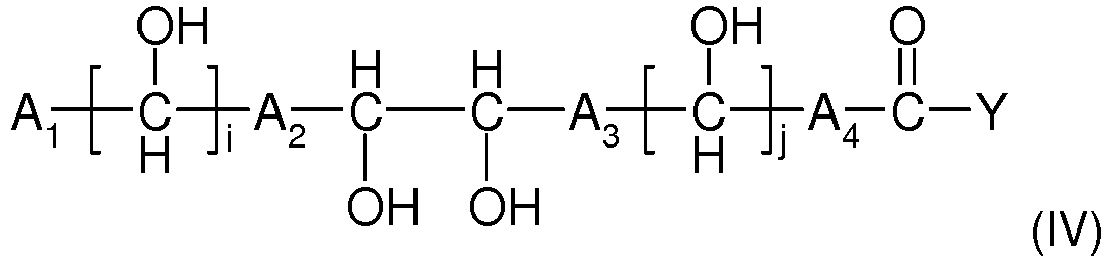
said step being carried out in the presence of a catalyst selected from the group consisting of: NaOMe, Zn(OAc)2 (anhydrous zinc acetate), Ti(OBu)4 (titanium butoxide), Ti(OiPr)4 (titanium isopropoxide), Sb2O3 (antimony (III) oxide), stannous octoate, DBTO (dibutyltin oxide), m-TBD (7-methyl-1,5,7-triazabicyclo(4.4.0)dec-5-ene), TBD (1,5,7-triazabicyclo[4.4.0]dec-5-ene).
said process optionally comprising a step of recovering said polymer. - According to a preferred embodiment, the catalyst is Zn(OAc)2, 1,5,7-triazabicyclo[4.4.0]dec-5-ene, NaOMe or stannous octoate.
- In one embodiment, in the process according to the invention, the catalyst is 1,5,7-triazabicyclo[4.4.0]dec-5-ene.
- In one embodiment, in the process according to the invention, the catalyst is Zn(OAc)2.
- In one embodiment, in the process according to the invention, the catalyst is NaOMe.
- The use of NaOMe is advantageous as it allows full conversion, and it is cheap, which is appropriate for an industrial scale process.
- In one embodiment, the amount of catalyst is comprised from 0.05% to 10%, preferably from 0.5% to 5%, more preferably from 1% to 2%, and even more preferably from 1.2% to 1.8%, by weight relative to the weight of the monomer of formula (IV) as defined above.
- In one embodiment, the monomer of formula (IV) has the formula (IV-1):

- In one embodiment, the monomer of formula (IV) has the formula (IV-2):

- In one embodiment, the monomer of formula (IV) has the formula (IV-3):

- In one embodiment, the monomer of formula (IV) is selected from the group consisting of the following monomers:


- In one embodiment, when the monomer of formula (IV) is a monomer of formula (IV-1), and more particularly a monomer (1), (3) or (5) as mentioned above, then the process provides a polymer according to the invention comprising:
- at least one repetitive unit (U) having the formula (D1) as defined above;
- at least one repetitive unit (V) having the formula (T1) as defined above;
- at least one repetitive unit (W) having the formula (L1) as defined above;
- at least one repetitive unit (W) having the formula (L2) as defined above; and
- optionally at least one repetitive unit (Z) having the formula (I-1) as defined above, in particular having the formula (I-1-1), (I-1-2) or (I-1-3).
- In one embodiment, when the monomer of formula (IV) is a monomer of formula (IV-2), and more particularly a monomer (2) or (4) as mentioned above, then the process provides a polymer according to the invention comprising:
- at least one repetitive unit (V) having the formula (T2) as defined above;
- at least one repetitive unit (W) having the formula (L3) as defined above;
- at least one repetitive unit (W) having the formula (L4) as defined above;
- at least one repetitive unit (W) having the formula (L5) as defined above;
- at least one repetitive unit (Q) having the formula (S1) as defined above;
- at least one repetitive unit (Q) having the formula (S2) as defined above;
- at least one repetitive unit (Q) having the formula (S3) as defined above;
- optionally at least one repetitive unit (U) having the formula (D2) as defined above; and
- optionally at least one repetitive unit (P) having the formula (II-1) as defined above, in particular having the formula (II-1-1) or (II-1-2).
- In one embodiment, when the monomer of formula (IV) is a monomer of formula (IV-3), and more particularly a monomer (6) as mentioned above, then the process provides a polymer according to the invention comprising:
- at least one repetitive unit (V) having the formula (T3) as defined above;
- at least one repetitive unit (W) having the formula (L6) as defined above;
- at least one repetitive unit (W) having the formula (L7) as defined above;
- at least one repetitive unit (W) having the formula (L8) as defined above;
- at least one repetitive unit (W) having the formula (L9) as defined above;
- at least one repetitive unit (Q) having the formula (S4) as defined above;
- at least one repetitive unit (Q) having the formula (S5) as defined above;
- at least one repetitive unit (Q) having the formula (S6) as defined above;
- at least one repetitive unit (Q) having the formula (S7) as defined above;
- at least one repetitive unit (Q) having the formula (S8) as defined above;
- at least one repetitive unit (Q) having the formula (S9) as defined above;
- at least one repetitive unit (Q) having the formula (S10) as defined above;
- at least one repetitive unit (Q) having the formula (S11) as defined above;
- at least one repetitive unit (Q) having the formula (S12) as defined above;
- at least one repetitive unit (Q) having the formula (S13) as defined above;
- optionally at least one repetitive unit (U) having the formula (D3) as defined above; and
- optionally at least one repetitive unit (R) having the formula (III) as defined above.
- In one embodiment, the polymerization of the monomer of formula (IV) is a bulk polymerization.
- As used herein, the term "bulk polymerization" also known as "mass polymerization" means a polymerization carried out in the absence of solvent or dispersant.
- In one embodiment, the process of the invention comprises a preliminary step consisting in heating the monomer of formula (IV) alone at a temperature comprised from 50°C to 120°C, preferably at 90°C, in particular above its melting point, under dynamic vacuum. This step allows advantageously to remove all traces of solvents such as water.
- In one embodiment, the polymerization step is carried out by heating the monomer of formula (IV) as defined above in the presence of the catalyst, at a temperature T1 comprised from 90°C to 130°C for 1 hour to 48 hours, then by heating further at a temperature T2 comprised from 90°C, preferably from 140°C, to 180°C for 1 hour to 48 hours.
- In one embodiment, T1 and T2 are different.
- In one embodiment, the first heating step is carried out under nitrogen atmosphere.
- In one embodiment, the second heating step is carried out under dynamic vacuum.
- In one embodiment, the polymerization step is carried out by heating the monomer of formula (IV) as defined above in the presence of the catalyst, at a temperature T1 comprised from 90°C, preferably from 100°C, to 120°C for 1 hour to 48 hours, preferably for 1 to 10 hours, then by heating further at a temperature T2 comprised from 90°C, preferably from 160°C to 170°C for 1 hour to 48 hours, preferably for 10 to 20 hours.
- In one embodiment, the polymerization step is carried out by heating the monomer of formula (IV) as defined above in the presence of the catalyst, at a temperature T1 comprised from 90°C, preferably from 100°C, to 120°C for 1 hour to 3 hours, then by heating further at a temperature T2 comprised from 90°C, preferably from 160°C, to 170°C for about 13 hours.
- In one embodiment, the polymerization step is carried out under nitrogen at a temperature T1 comprised from 90°C to 130°C.
- In one embodiment, the polymerization step is further heated at a temperature T2 comprised from 90°C, preferably from 140°C, to 180°C under dynamic vacuum.
- In a preferred embodiment, the process of the invention comprises two heating steps, a first step being carried out at a temperature T1 comprised from 90°C, preferably from 100°C, to 120°C for 1 hour to 48 hours, and then a second step being carried out at a temperature T2 comprised from 90°C, preferably from 160°C, to 170°C for 1 hour to 48 hours.
- At the end of the first heating step, an intermediate oligomer is obtained which is then further heated in order to obtain the polymer of the invention.
- In one embodiment, the process is a one-pot process, and in particular a two-steps one-pot process.
- As used herein, the term "one-pot process" means a process wherein two or more reactions are conducted in a single reaction vessel without isolating or purifying the resulting intermediate(s). For example, the intermediate oligomer obtained after the first heating step of the monomer of formula (IV) at a temperature T1 comprised from 90°C to 130°C and the second heating step at a temperature T2 comprised from 90°C, preferably from 140°C, to 180°C.
- The present invention also relates to a polymer susceptible to be obtained according to the process as defined above.
- The invention is described in the foregoing by way of non-limiting examples.
- 1,5,7-triazabicyclo[4.4.0]dec-5-ene (98%), zinc acetate (99.99%), dibutyltin oxide (98%), 7-methyl-1,5,7-triazabicyclo[4.4.0]dec-5-ene, tin (II) 2-ethylhexanoate (95%) were obtained from Sigma Aldrich. Titanium (IV) n-butoxide (99%) and titanium (IV) isopropoxide (98+%) were purchased from Acros Organics. Antimony (III) oxide (99.6% min.) was supplied by Alfa Aesar. All products were used as received.
- The conditions of the steric exclusion chromatography were as follows:
Columns TSKgel TOSOH HXL-L (guard 6*40) G4000HXL (7.8*300) G3000HXL (7.8*300) G2000HXL (7.8*300) Flow 1mL/min Flow marker TCB for trichlorobenzene (1mL/500mL THF) Four 40°C Loop 20µL Calibration Polystyrene standards from polymer laboratories - The following monomers have been used:


- The monomer (1) has been prepared following a two-step procedure. Methyl esters of high oleic sunflower oil and formic acid (0,3 n) were added in a 100L reactor equipped with a mechanical stirrer and a condenser, n being the number of mole of double bond on the methyl esters. The resulting mixture was heated at 70°C for 1 hour under stirring. At 70°C, hydrogen peroxide (35%, 2n) was added slowly to the reactor using a volumetric pump while maintaining the temperature in the reactor close to 75 - 80°C. When the addition was finished, the temperature was risen to 90°C for 2 hours. The reaction was monitored by gas chromatography. The reaction mixture was then cooled down to 40°C temperature and the aqueous phase was discarded. The organic layer was washed with an aqueous solution of sodium hydroxide (0.1N) until the pH becomes neutral. The organic phase was finally dried under vacuum to afford a clear and slightly yellow liquid (Oxiran number ∼5.0%).
In a second step, 1 portion of epoxydized methyl esters of oleic sunflower oil was placed along with 1/2 portion of an aqueous solution of phosphoric acid (12 % w/w) and 1/3 portion of tert-butanol as solvent in a 100L reactor equipped with a condenser and a mechanical stirrer. The resulting mixture was then heated at 90°C under vigorous stirring. The reaction was monitored by gas chromatography. When the reaction was completed the aqueous phase was discarded at 50°C. The tert-butanol was eliminated under vacuum distillation. The organic phase was then washed with hot water until the pH reaches 6-7 and dried under vacuum. The methyl 9,10-dihydroxystearate (1) was recrystallized in cyclohexane to afford a white solid powder. The yield of the two-step synthesis of methyl 9, 10-dihydroxystearate is about 90%. - The monomer (2) has been prepared following a two-step procedure. Methyl esters of castor oil and formic acid (0,3 n) were added in a reactor equipped with a mechanical stirrer, a dropping funnel and a condenser, n being the number of mole of double bond of the methyl esters. The resulting mixture was heated at 40°C for 1 hour under stirring condition. At 40°C, hydrogen peroxide (50%, 2n) was added drop wise to the reactor using a dropping funnel while maintaining the temperature in the reactor close to 70 - 75°C. The reaction was monitored by gas chromatography. The reaction mixture was then cooled down to room temperature and the aqueous phase discarded. The organic layer was washed with an aqueous solution of sodium hydroxide (0.1N) until the pH becomes neutral. The organic phase was then dried under vacuum at 60°C to afford a clear and slightly yellow liquid with a precipitate. The precipitate isolated by filtration is the methyl 9, 10, 12-trihydroxystearate, the yellow liquid corresponds to the epoxidized methyl esters of castor oil.
In a second step, 1 portions of epoxidized methyl esters of castor oil was placed along with 1/2 portion of an aqueous solution of phosphoric acid (12 % w/w) and 1/3 portion of tert-butanol as solvent in a reactor equipped with a condenser and a mechanical stirrer. The resulting mixture was then heated at 90°C under vigorous stirring. The reaction was monitored by gas chromatography. When the reaction was completed the aqueous phase was discarded at 50°C. The tert-butanol was eliminated under vacuum distillation. The organic phase was then washed with hot water until the pH reaches 6-7 and dried under vacuum. The methyl 9, 10, 12-trihydroxystearate (2) was then recrystallized in cyclohexane to afford a white solid powder in a 25% yield. - The monomer (3) has been previously prepared by the process as described in
US 5,344,946 . - The monomer (4) has been prepared by esterification of aleuritic acid in methanol. A round-botttomed flask was charged with 5g of aleuritic acid, 50mL of methanol and 1g of Amberlyst 15. The mixture was heated at 70°C under reflux for 24 hours. After reaching rt, the resin was filtered, the methanol removed under vacuum and 100ml of DCM was added. The organic phase was washed twice with water, dried on anhydrous magnesium suflate and DCM was removed under vacuum. Monomer (4) was thus obtained as a white solid powder (yield: 75%).
- Refined erucic acid rapeseed oil (800Kg) was heated under stirring condition at 65°C in the presence of methanol (190Kg) and sodium methanolate (19 Kg) for 2 hours. The thus-obtained methyl esters were decanted and the glycerol phase discarded. Methyl esters of erucic acid rapeseed oil were then washed with water, dried under vacuum and distilled on a falling film reactor (200L/hour) in order to concentrate the erucic acid methyl ester up to 95%. The procedure followed to prepare the monomer (5) starting from methyl erucate was identical to the one described earlier to obtain the monomer (1).
- 0.500 g of a monomer was added to a Schlenk flask equipped with a magnetic stirrer, a nitrogen inlet tube and an oil-bath heating system. The monomer was firstly dried alone under dynamic vacuum, above its melting point at 90°C. This pre-drying step took one hour, then the reaction mixture was placed under nitrogen blowing, the temperature was raised to 120°C and 7.5 mg (1.5 wt %) of catalyst was introduced in the reaction flask. The mixture was subsequently allowed to react under stirring at 120°C during 2 hours. Finally, the temperature was raised to 160°C or 170°C and dynamic vacuum was applied for 13 hours in order to remove the released methanol. The crude product was obtained as a colorless and highly viscous material. It was purified by precipitation from THF to pentane.
- Six branched polymers were prepared according to the general procedure mentioned above. Such polymers derived from the above-mentioned monomers (1), (2), (3), (4), (5) and (6).
- Different polyesters were synthesized according to the general procedure as described above.
Entry Catalysta T(°C)b Conversion (%)c Mn (g.mol-1)c Mw (g.mol-1)c Ðc DBd 1 Ti(OBu)4 170 64 1300 1490 1.15 0 2 Zn(OAc)2 170 98 6280 96500 > 15.4 0.08 3 DBTO 170 67 1270 1430 1.13 0.06 4 Sb2O3 170 71 1450 1750 1.21 0.08 5 TBD 170 100 4220 14070 3.33 0.23 6 Zn(OAc)2 160 98 3480 9530 2.74 0.02 7 TBD 160 100 4080 10110 2.48 0.21 8 NaOMe 160 100 6 100 18 800 3.08 0.29 a Loading in catalyst: 1.5wt%. b Temperature of the last stage of polymerization.
c SEC in THF, PS calibration.d 1H-NMR. Ð: dispersity, DB: degree of branching - The conversion corresponds to the percentage by weight of conversion of the monomer (1).
- Mn, Mw and Ð were determined by steric exclusion chromatography in THF with polystyrene standards, and the degree of branching was determined by RMN 1H.
- Thermo-mechanical properties of the renewable polymers obtained were characterized by Differential Scanning Calorimetry (DSC) and Thermal Gravimetric Analysis (TGA).
- Highly branched polyesters displayed amorphous properties with glass transition temperature in the range -32.5°C to -20°C for polyesters derived from the polymerization of monomer (1). Some results are provided in the following table:
Catalyst Loading in catalyst (wt%) Conversion (%)a Mn (g.mol-1)a Ða DBb Tg C (°C) T10% d (°C) Stannous octoate 1.5 93 3160 2.04 0.11 -30 284 Zn(OAc)2 1.5 98 3480 2.74 0.02 -27 266 TBD 1.5 100 5340 2.97 0.21 -24 339 TBD 5 100 9825 3.37 0.28 -20 340 a SEC in THF, PS calibration. b 1H-NMR. c DSC. d TGA.
Ð: dispersity, DB: degree of branching - The resulting polymers provide the following RMN1H spectrum:
1H NMR (400 MHz, DMSO) δ 4.91, 4.71, 4.70, 4.69, 4.60, 4.59, 4.09, 3.57, 3.39, 3.18, 2.50, 2.27, 2.27, 2.25, 2.24, 1.52, 1.37, 1.23, 1.02, 0.87, 0.85, 0.83, 0.62. - Different polyesters were synthesized according to the general procedure as described above.
Catalysta T(°C)b Conversiona (%) Mn a (g.mol-1) Ða Tg b (°C) T10% c (°C) Zn(OAc)2 160 97 3800 2.57 - 2.5 271 TBD 160 100 5540 4.09 -0.9 323 NaOMe 160 98 4600 2.83 3.3 320 a SEC in THF, PS calibration b DSC. c TGA. Ð: dispersity - The conversion corresponds to the conversion of the monomer (2).
- Highly branched polyesters displayed amorphous properties with glass transition temperature in the range from -13.2 to 0.6°C for polyesters derived from monomer (2). Mn, Mw and Ð were determined by steric exclusion chromatography in THF with polystyrene standards, and the degree of branching was determined by RMN 1H.
- The resulting polymers provide the following RMN1H spectrum:
1H NMR (400 MHz, DMSO) δ 5.17, 4.98, 4.97, 4.87, 4.77, 4.65, 4.64, 4.53, 4.32, 4.26, 4.20, 4.13, 4.10, 3.70, 3.59, 3.57, 3.49, 3.41, 3.31, 3.25, 3.17, 2.50, 2.22, 1.49, 1.39, 1.32, 1.30, 1.23, 0.85. - Polyesters were synthesized according to the general procedure as described above.
Catalysta Conv. (%)b Mn (g.mol-1)c Mw (g.mol-1)c Ðb Zn(OAc)2 98 2349 5622 2.39 TBD 95 2370 6390 2.70 a Loading in catalyst: 1.5wt%. b SEC in THF. Ð: dispersity - As mentioned above, the monomer was firstly dried for one hour alone under dynamic vacuum, above its melting point at 90°C. The first step of polymerization was carried out at 120°C for 2 hours and the second step of polymerization was carried out at 140°C for 13 hours.
- It can be seen from the above table that the conversions are close to 100%.
- A polyester was synthesized according to the general procedure as described above.
Catalysta Conv. (%)b Mn (g.mol-1)c Mw (g.mol-1)c Ðb TBD 96 3550 8510 2.40 a Loading in catalyst: 1.5wt%. b SEC in THF. Ð: dispersity - As mentioned above, the first step of polymerization was carried out at 120°C and the second step of polymerization was carried out at 140°C.
- The above table corresponds to the polymerization results after two hours.
- Another polymerization was also carried out as follows: pre-drying at 90°C under dynamic vacuum, then the first step of polymerization was carried out at 90°C under nitrogen, and the second step of polymerization was carried out at 90°C for x hours under dynamic vacuum.
- The resulting polymer was obtained:
Catalysta x (hours) Conv. (%)b Mn (g.mol-1)c Mw (g.mo-1)c Ðb Tg c (°C) T10% d (°C) TBD 1h30 99 9270 44630 4.81 -16 358 TBD 1h 100 9300 44 700 4.81 -15.2 358 TBDe 4h 100 13000 75400 5.80 -14.4 342 NaOMe 2 98 4800 13900 2.9 -16.7 350 a Loading in catalyst: 1.5wt%. b SEC in THF. c DSC. d TGA. e loading in TBD : 1w% - A polyester was synthesized according to the general procedure as described above.
Catalysta Conv. (%)b Mn (g.mol-1)c Mw (g.mol-1)c Ðb DBC T10% d (°C) Zn(Ac)2 95 3000 5800 1.93 0.09 / TBD 100 5600 17100 3.05 0.33 320 NaoMe 100 9200 30100 3.27 0.30 350 a Loading in catalyst: 1.5wt%. b SEC in THF. c 1H-NMR. dTGA.
Ð: dispersity, DB: degree of branching - As mentioned above, the first step of polymerization was carried out at 120°C and the second step of polymerization was carried out at 160°C.
Claims (13)
- A polymer comprising:- i) at least one repetitive unit (V) having the following formula (T):
 - ii) at least one, preferably at least two, repetitive unit(s) (U) having the following formula (D):i being 0 when j is 1 and j being 0 when i is 1 or 2;
at least one, preferably at least two, repetitive unit(s) (Q) having the following formula (S) :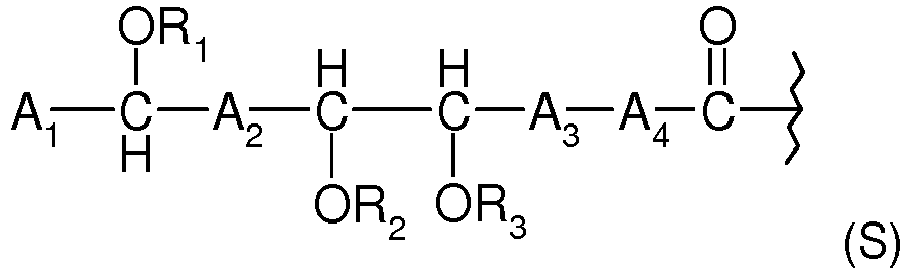
at least one, preferably at least two, repetitive unit(s) (Q) having the following formula (S') : - A1 represents H or a linear or branched divalent alkyl group comprising from 1 to 20 carbon atoms, preferably from 2 to 12, and more preferably from 5 to 10;- A4 represents a linear or branched divalent alkylene radical comprising from 1 to 20 carbon atoms, preferably from 2 to 12, and more preferably from 4 to 10;- A2 represents a bond or a linear or branched divalent alkylene radical comprising from 1 to 20 carbon atoms, preferably from 1 to 10, and more preferably from 1 to 5;- A3 represents a linear or branched divalent alkylene radical comprising from 1 to 20 carbon atoms, preferably from 1 to 10, and more preferably from 1 to 5;- R1, R'1, R2 and R3 are
 - i is 0, 1 or 2;- j is 0 or 1;
when A1 is H and i is 0, then A2 is a bond,
and wherein:in the unit (U) having the formula (S), only one of R1, R2 and R3 is H ;in the unit (U) having the formula (S'), one or two of R1, R'1, R2 and R3 is H. - The polymer according to claim 1, further comprising at least one repetitive unit (W) having the following formula (L):
 - A1, A2, A3, A4, i and j are as defined above;- R1, R2, R3 and R4 being
- The polymer according to claim 1 or 2, wherein the number-average molecular weight Mn is comprised between 3 000 g/mol and 500 000 g/mol.
- The polymer according to any one of claims 1 to 3, comprising at least three repetitive units (V) having the formula (T).
- The polymer according to any one of claims 1 to 4, wherein the repetitive unit (U) has one of the following formulae (D1), (D2) or (D3):

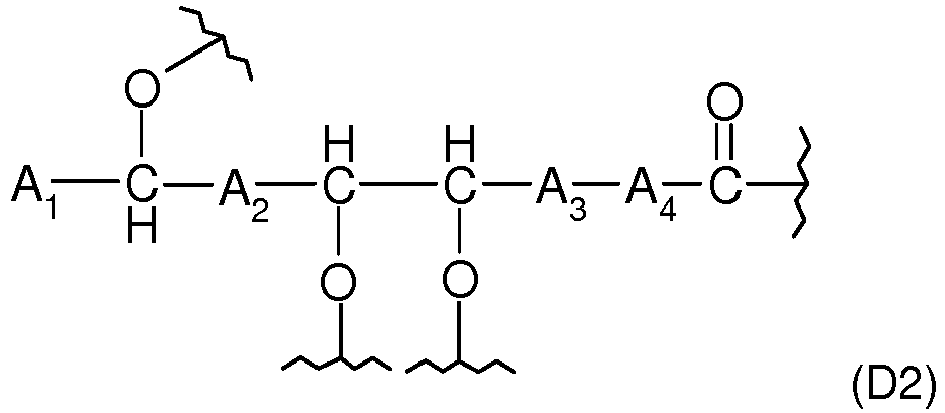

- The polymer according to any one of claim 1 to 5, wherein the repetitive unit (V) has the one of the following formulae (T1), (T2) or (T3):


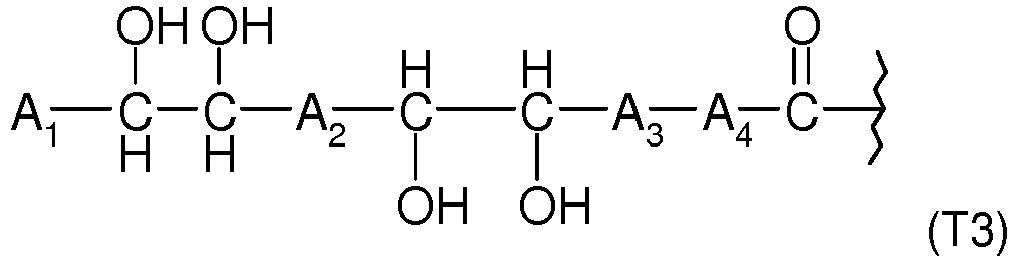
- The polymer according to any one of claims 1 to 6, comprising:- at least one repetitive unit (W) having the following formula (L1):
 - at least one repetitive unit (W) having the following formula (L2):
or- at least one repetitive unit (W) having the following formula (L3): - at least one repetitive unit (W) having the following formula (L4):
 - at least one repetitive unit (W) having the following formula (L5):
or- at least one repetitive unit (W) having the following formula (L6): - at least one repetitive unit (W) having the following formula (L7):
 - at least one repetitive unit (W) having the following formula (L8):
 - at least one repetitive unit (W) having the following formula (L9):
- The polymer according to any one of claims 1 to 7, wherein:- A1 represents H, i is 0, j is 0, A2 represents a bond, and A3 and A4 represent a butylene radical; or- A1 represents H, i is 1, j is 0, A2 represents a pentylene radical, A3 represents a propylene radical and A4 represents a butylene radical; or- A1 represents a hexyl group, i is 0, j is 0, A2 represents an ethylene radical, A3 represents a pentylene radical and A4 represents a hexylene radical; or- A1 represents a pentyl group, i is 2, j is 0, A2 represents a methylene radical, A3 represents a propylene radical and A4 represents a butylene radical; or- A1 represents a heptyl group, i is 0, j is 0, A2 represents a methylene radical, A3 represents a methylene radical and A4 represents a hexylene radical; or- A1 represents a hexyl group, i is 1, j is 0, A2 represents a methylene radical, A3 represents a methylene radical and A4 represents a hexylene radical.
- A process for preparing a polymer according to any one of claims 1 to 8, comprising a step of polymerization of at least one monomer of formula (IV):
 - A1, A2, A3 and A4 are as defined in claim 1;- Y represents -ORa, Ra being a linear or branched alkyl radical comprising from 1 to 20 carbon atoms or an aryl radical comprising from 6 to 22 carbon atoms;said step being carried out in the presence of a catalyst selected from the group consisting of: NaOMe, Zn(OAc)2, Ti(OBu)4, Ti(OiPr)4, Sb2O3, stannous octanoate, dibutyltin oxide, 7-methyl-1,5,7-triazabicyclo(4.4.0)dec-5-ene, and 1,5,7-triazabicyclo[4.4.0]dec-5-ene,
said process optionally comprising a step of recovering said polymer. - The process of claim 9, wherein the catalyst is Zn(OAc)2, NaOMe or 1,5,7-triazabicyclo[4.4.0]dec-5-ene.
- The process according to claim 9 or 10, wherein the amount of catalyst is comprised from 0.05% to 10% by weight relative to the weight of the monomer of formula (IV).
- The process according to any one of claims 9 to 11, wherein the polymerization step is carried out by heating the monomer of formula (IV) as defined in claim 9 in the presence of the catalyst, at a temperature T1 comprised from 90°C to 130°C for 1 hour to 48 hours, then by heating further at a temperature T2 comprised from 90°C to 180°C for 1 hour to 48 hours.
- A polymer susceptible to be obtained according to the process according to any one of claims 9 to 12.
Applications Claiming Priority (2)
| Application Number | Priority Date | Filing Date | Title |
|---|---|---|---|
| EP14306642.1A EP3009464A1 (en) | 2014-10-16 | 2014-10-16 | New branched polymers, their preparation process, and uses thereof |
| PCT/EP2015/074049 WO2016059230A1 (en) | 2014-10-16 | 2015-10-16 | New branched polymers, their preparation process, and uses thereof |
Publications (2)
| Publication Number | Publication Date |
|---|---|
| EP3207077A1 EP3207077A1 (en) | 2017-08-23 |
| EP3207077B1 true EP3207077B1 (en) | 2018-08-01 |
Family
ID=51795589
Family Applications (2)
| Application Number | Title | Priority Date | Filing Date |
|---|---|---|---|
| EP14306642.1A Withdrawn EP3009464A1 (en) | 2014-10-16 | 2014-10-16 | New branched polymers, their preparation process, and uses thereof |
| EP15781641.4A Not-in-force EP3207077B1 (en) | 2014-10-16 | 2015-10-16 | New branched polymers, their preparation process, and uses thereof |
Family Applications Before (1)
| Application Number | Title | Priority Date | Filing Date |
|---|---|---|---|
| EP14306642.1A Withdrawn EP3009464A1 (en) | 2014-10-16 | 2014-10-16 | New branched polymers, their preparation process, and uses thereof |
Country Status (4)
| Country | Link |
|---|---|
| US (1) | US10087281B2 (en) |
| EP (2) | EP3009464A1 (en) |
| CA (1) | CA2964291A1 (en) |
| WO (1) | WO2016059230A1 (en) |
Families Citing this family (6)
| Publication number | Priority date | Publication date | Assignee | Title |
|---|---|---|---|---|
| US10077333B2 (en) | 2016-04-20 | 2018-09-18 | Elevance Renewable Sciences, Inc. | Renewably derived polyesters and methods of making and using the same |
| US10280256B2 (en) | 2016-04-20 | 2019-05-07 | Elevance Renewable Sciences, Inc. | Renewably derived polyesters and methods of making and using the same |
| US10280254B2 (en) | 2016-04-20 | 2019-05-07 | Elevance Renewable Sciences, Inc. | Renewably derived polyesters and methods of making and using the same |
| EP3596152A1 (en) * | 2017-03-16 | 2020-01-22 | Pivert | New branched polymers, their preparation process, and uses thereof |
| EP4148079A1 (en) | 2021-09-08 | 2023-03-15 | Evonik Operations GmbH | Process for preparing a substrate comprising an edible surface coating |
| EP4148080A1 (en) | 2021-09-08 | 2023-03-15 | Evonik Operations GmbH | Polymer comprising aleuritic acid |
Family Cites Families (2)
| Publication number | Priority date | Publication date | Assignee | Title |
|---|---|---|---|---|
| US5344946A (en) | 1991-04-09 | 1994-09-06 | Solvay Interox Gmbh | Process for the preparation of vicinal diols and/or epoxides |
| FR2980794B1 (en) * | 2011-10-03 | 2014-11-07 | Univ Bordeaux 1 | PREPARATION OF POLYURETHANES AND POLYESTERS FROM GLYCOLIPID COMPOUNDS |
-
2014
- 2014-10-16 EP EP14306642.1A patent/EP3009464A1/en not_active Withdrawn
-
2015
- 2015-10-16 EP EP15781641.4A patent/EP3207077B1/en not_active Not-in-force
- 2015-10-16 US US15/518,374 patent/US10087281B2/en not_active Expired - Fee Related
- 2015-10-16 CA CA2964291A patent/CA2964291A1/en not_active Abandoned
- 2015-10-16 WO PCT/EP2015/074049 patent/WO2016059230A1/en not_active Ceased
Also Published As
| Publication number | Publication date |
|---|---|
| EP3207077A1 (en) | 2017-08-23 |
| EP3009464A1 (en) | 2016-04-20 |
| CA2964291A1 (en) | 2016-04-21 |
| WO2016059230A1 (en) | 2016-04-21 |
| US10087281B2 (en) | 2018-10-02 |
| US20170306082A1 (en) | 2017-10-26 |
Similar Documents
| Publication | Publication Date | Title |
|---|---|---|
| US10087281B2 (en) | Branched polymers, their preparation process, and uses therof | |
| Pellis et al. | Enzymatic synthesis of unsaturated polyesters: Functionalization and reversibility of the aza-Michael addition of pendants | |
| EP3328915B1 (en) | New high molecular weight polymers from waste raw materials | |
| CN104797627B (en) | Aliphatic polycarbonate copolymer with high molecular weight and its preparation method | |
| JP2013507495A (en) | Process for producing polyesters and copolyesters from lactones | |
| Zhang et al. | Ring-opening polymerization of ε-caprolactone with recyclable and reusable squaric acid organocatalyst | |
| Bernhard et al. | Synthesis of levulinic acid based poly (amine-co-ester) s | |
| Warlin et al. | Synthesis and chemical recycling of biobased poly (acetal-ester) s with a non-cyclic acetal unit | |
| KR20130016297A (en) | New polyesters from asymmetrical monomers based upon bisanhydrohexitols | |
| WO2017123587A1 (en) | Ferulic acid and p-coumaric acid based polymers and copolymers | |
| JP5081615B2 (en) | Use of catalyst system for (co) oligopolymerization of lactide and glycolide | |
| CN110452518B (en) | Star-like molecular structure hindered phenol compound and application thereof in synthesis of polyesteramide | |
| CN103210016A (en) | Process for preparing star polymers | |
| KR101935938B1 (en) | Polyurethane elastomer compositions comprising dimer acid alkyl ester from vegetable oil, preparation method thereof, and adhesive containing the same | |
| CN111108087A (en) | Catalytic recycle for production of 1, 1-disubstituted olefins | |
| KR101641727B1 (en) | Preparation method of stereoblock polylactide | |
| KR101586457B1 (en) | Method for preparing polyester resin | |
| US20250313658A1 (en) | Copolymers of glycolaldehyde dimers and method of making same | |
| US10053540B2 (en) | Phenolic polymers and preparation processes thereof | |
| KR101889038B1 (en) | Polylactic acid copolymer and method for preparing the same | |
| KR101687395B1 (en) | Novel polyester resin and method for preparation of the same | |
| EP4335888A1 (en) | Method for preparation of poly lactic acid polymer | |
| KR101586458B1 (en) | Novel polyester resin | |
| WO2018167201A1 (en) | New branched polymers, their preparation process, and uses thereof | |
| SU540879A1 (en) | The method of obtaining heterochain copolyesters |
Legal Events
| Date | Code | Title | Description |
|---|---|---|---|
| PUAI | Public reference made under article 153(3) epc to a published international application that has entered the european phase |
Free format text: ORIGINAL CODE: 0009012 |
|
| 17P | Request for examination filed |
Effective date: 20170413 |
|
| AK | Designated contracting states |
Kind code of ref document: A1 Designated state(s): AL AT BE BG CH CY CZ DE DK EE ES FI FR GB GR HR HU IE IS IT LI LT LU LV MC MK MT NL NO PL PT RO RS SE SI SK SM TR |
|
| AX | Request for extension of the european patent |
Extension state: BA ME |
|
| RIN1 | Information on inventor provided before grant (corrected) |
Inventor name: TESTUD, BLANDINE Inventor name: CRAMAIL, HENRI Inventor name: PINTORI, DIDIER Inventor name: GRAU, ETIENNE Inventor name: TATON, DANIEL |
|
| DAV | Request for validation of the european patent (deleted) | ||
| DAX | Request for extension of the european patent (deleted) | ||
| GRAP | Despatch of communication of intention to grant a patent |
Free format text: ORIGINAL CODE: EPIDOSNIGR1 |
|
| INTG | Intention to grant announced |
Effective date: 20180219 |
|
| GRAS | Grant fee paid |
Free format text: ORIGINAL CODE: EPIDOSNIGR3 |
|
| GRAA | (expected) grant |
Free format text: ORIGINAL CODE: 0009210 |
|
| AK | Designated contracting states |
Kind code of ref document: B1 Designated state(s): AL AT BE BG CH CY CZ DE DK EE ES FI FR GB GR HR HU IE IS IT LI LT LU LV MC MK MT NL NO PL PT RO RS SE SI SK SM TR |
|
| REG | Reference to a national code |
Ref country code: GB Ref legal event code: FG4D |
|
| REG | Reference to a national code |
Ref country code: CH Ref legal event code: EP Ref country code: AT Ref legal event code: REF Ref document number: 1024212 Country of ref document: AT Kind code of ref document: T Effective date: 20180815 |
|
| REG | Reference to a national code |
Ref country code: IE Ref legal event code: FG4D |
|
| REG | Reference to a national code |
Ref country code: DE Ref legal event code: R096 Ref document number: 602015014414 Country of ref document: DE |
|
| REG | Reference to a national code |
Ref country code: FR Ref legal event code: PLFP Year of fee payment: 4 |
|
| REG | Reference to a national code |
Ref country code: NL Ref legal event code: FP |
|
| REG | Reference to a national code |
Ref country code: LT Ref legal event code: MG4D |
|
| REG | Reference to a national code |
Ref country code: AT Ref legal event code: MK05 Ref document number: 1024212 Country of ref document: AT Kind code of ref document: T Effective date: 20180801 |
|
| PG25 | Lapsed in a contracting state [announced via postgrant information from national office to epo] |
Ref country code: BG Free format text: LAPSE BECAUSE OF FAILURE TO SUBMIT A TRANSLATION OF THE DESCRIPTION OR TO PAY THE FEE WITHIN THE PRESCRIBED TIME-LIMIT Effective date: 20181101 Ref country code: AT Free format text: LAPSE BECAUSE OF FAILURE TO SUBMIT A TRANSLATION OF THE DESCRIPTION OR TO PAY THE FEE WITHIN THE PRESCRIBED TIME-LIMIT Effective date: 20180801 Ref country code: SE Free format text: LAPSE BECAUSE OF FAILURE TO SUBMIT A TRANSLATION OF THE DESCRIPTION OR TO PAY THE FEE WITHIN THE PRESCRIBED TIME-LIMIT Effective date: 20180801 Ref country code: NO Free format text: LAPSE BECAUSE OF FAILURE TO SUBMIT A TRANSLATION OF THE DESCRIPTION OR TO PAY THE FEE WITHIN THE PRESCRIBED TIME-LIMIT Effective date: 20181101 Ref country code: IS Free format text: LAPSE BECAUSE OF FAILURE TO SUBMIT A TRANSLATION OF THE DESCRIPTION OR TO PAY THE FEE WITHIN THE PRESCRIBED TIME-LIMIT Effective date: 20181201 Ref country code: FI Free format text: LAPSE BECAUSE OF FAILURE TO SUBMIT A TRANSLATION OF THE DESCRIPTION OR TO PAY THE FEE WITHIN THE PRESCRIBED TIME-LIMIT Effective date: 20180801 Ref country code: RS Free format text: LAPSE BECAUSE OF FAILURE TO SUBMIT A TRANSLATION OF THE DESCRIPTION OR TO PAY THE FEE WITHIN THE PRESCRIBED TIME-LIMIT Effective date: 20180801 Ref country code: GR Free format text: LAPSE BECAUSE OF FAILURE TO SUBMIT A TRANSLATION OF THE DESCRIPTION OR TO PAY THE FEE WITHIN THE PRESCRIBED TIME-LIMIT Effective date: 20181102 Ref country code: PL Free format text: LAPSE BECAUSE OF FAILURE TO SUBMIT A TRANSLATION OF THE DESCRIPTION OR TO PAY THE FEE WITHIN THE PRESCRIBED TIME-LIMIT Effective date: 20180801 Ref country code: LT Free format text: LAPSE BECAUSE OF FAILURE TO SUBMIT A TRANSLATION OF THE DESCRIPTION OR TO PAY THE FEE WITHIN THE PRESCRIBED TIME-LIMIT Effective date: 20180801 |
|
| PG25 | Lapsed in a contracting state [announced via postgrant information from national office to epo] |
Ref country code: LV Free format text: LAPSE BECAUSE OF FAILURE TO SUBMIT A TRANSLATION OF THE DESCRIPTION OR TO PAY THE FEE WITHIN THE PRESCRIBED TIME-LIMIT Effective date: 20180801 Ref country code: HR Free format text: LAPSE BECAUSE OF FAILURE TO SUBMIT A TRANSLATION OF THE DESCRIPTION OR TO PAY THE FEE WITHIN THE PRESCRIBED TIME-LIMIT Effective date: 20180801 Ref country code: AL Free format text: LAPSE BECAUSE OF FAILURE TO SUBMIT A TRANSLATION OF THE DESCRIPTION OR TO PAY THE FEE WITHIN THE PRESCRIBED TIME-LIMIT Effective date: 20180801 |
|
| PG25 | Lapsed in a contracting state [announced via postgrant information from national office to epo] |
Ref country code: RO Free format text: LAPSE BECAUSE OF FAILURE TO SUBMIT A TRANSLATION OF THE DESCRIPTION OR TO PAY THE FEE WITHIN THE PRESCRIBED TIME-LIMIT Effective date: 20180801 Ref country code: CZ Free format text: LAPSE BECAUSE OF FAILURE TO SUBMIT A TRANSLATION OF THE DESCRIPTION OR TO PAY THE FEE WITHIN THE PRESCRIBED TIME-LIMIT Effective date: 20180801 Ref country code: ES Free format text: LAPSE BECAUSE OF FAILURE TO SUBMIT A TRANSLATION OF THE DESCRIPTION OR TO PAY THE FEE WITHIN THE PRESCRIBED TIME-LIMIT Effective date: 20180801 Ref country code: EE Free format text: LAPSE BECAUSE OF FAILURE TO SUBMIT A TRANSLATION OF THE DESCRIPTION OR TO PAY THE FEE WITHIN THE PRESCRIBED TIME-LIMIT Effective date: 20180801 Ref country code: IT Free format text: LAPSE BECAUSE OF FAILURE TO SUBMIT A TRANSLATION OF THE DESCRIPTION OR TO PAY THE FEE WITHIN THE PRESCRIBED TIME-LIMIT Effective date: 20180801 |
|
| REG | Reference to a national code |
Ref country code: DE Ref legal event code: R097 Ref document number: 602015014414 Country of ref document: DE |
|
| PG25 | Lapsed in a contracting state [announced via postgrant information from national office to epo] |
Ref country code: SK Free format text: LAPSE BECAUSE OF FAILURE TO SUBMIT A TRANSLATION OF THE DESCRIPTION OR TO PAY THE FEE WITHIN THE PRESCRIBED TIME-LIMIT Effective date: 20180801 Ref country code: SM Free format text: LAPSE BECAUSE OF FAILURE TO SUBMIT A TRANSLATION OF THE DESCRIPTION OR TO PAY THE FEE WITHIN THE PRESCRIBED TIME-LIMIT Effective date: 20180801 Ref country code: DK Free format text: LAPSE BECAUSE OF FAILURE TO SUBMIT A TRANSLATION OF THE DESCRIPTION OR TO PAY THE FEE WITHIN THE PRESCRIBED TIME-LIMIT Effective date: 20180801 |
|
| REG | Reference to a national code |
Ref country code: CH Ref legal event code: PL |
|
| PLBE | No opposition filed within time limit |
Free format text: ORIGINAL CODE: 0009261 |
|
| STAA | Information on the status of an ep patent application or granted ep patent |
Free format text: STATUS: NO OPPOSITION FILED WITHIN TIME LIMIT |
|
| PG25 | Lapsed in a contracting state [announced via postgrant information from national office to epo] |
Ref country code: MC Free format text: LAPSE BECAUSE OF FAILURE TO SUBMIT A TRANSLATION OF THE DESCRIPTION OR TO PAY THE FEE WITHIN THE PRESCRIBED TIME-LIMIT Effective date: 20180801 |
|
| 26N | No opposition filed |
Effective date: 20190503 |
|
| REG | Reference to a national code |
Ref country code: IE Ref legal event code: MM4A |
|
| PG25 | Lapsed in a contracting state [announced via postgrant information from national office to epo] |
Ref country code: LI Free format text: LAPSE BECAUSE OF NON-PAYMENT OF DUE FEES Effective date: 20181031 Ref country code: SI Free format text: LAPSE BECAUSE OF FAILURE TO SUBMIT A TRANSLATION OF THE DESCRIPTION OR TO PAY THE FEE WITHIN THE PRESCRIBED TIME-LIMIT Effective date: 20180801 Ref country code: CH Free format text: LAPSE BECAUSE OF NON-PAYMENT OF DUE FEES Effective date: 20181031 |
|
| PG25 | Lapsed in a contracting state [announced via postgrant information from national office to epo] |
Ref country code: IE Free format text: LAPSE BECAUSE OF NON-PAYMENT OF DUE FEES Effective date: 20181016 |
|
| PGFP | Annual fee paid to national office [announced via postgrant information from national office to epo] |
Ref country code: LU Payment date: 20190913 Year of fee payment: 5 |
|
| PG25 | Lapsed in a contracting state [announced via postgrant information from national office to epo] |
Ref country code: MT Free format text: LAPSE BECAUSE OF NON-PAYMENT OF DUE FEES Effective date: 20181016 |
|
| PG25 | Lapsed in a contracting state [announced via postgrant information from national office to epo] |
Ref country code: TR Free format text: LAPSE BECAUSE OF FAILURE TO SUBMIT A TRANSLATION OF THE DESCRIPTION OR TO PAY THE FEE WITHIN THE PRESCRIBED TIME-LIMIT Effective date: 20180801 |
|
| PGFP | Annual fee paid to national office [announced via postgrant information from national office to epo] |
Ref country code: GB Payment date: 20191018 Year of fee payment: 5 |
|
| PG25 | Lapsed in a contracting state [announced via postgrant information from national office to epo] |
Ref country code: PT Free format text: LAPSE BECAUSE OF FAILURE TO SUBMIT A TRANSLATION OF THE DESCRIPTION OR TO PAY THE FEE WITHIN THE PRESCRIBED TIME-LIMIT Effective date: 20180801 |
|
| PG25 | Lapsed in a contracting state [announced via postgrant information from national office to epo] |
Ref country code: MK Free format text: LAPSE BECAUSE OF NON-PAYMENT OF DUE FEES Effective date: 20180801 Ref country code: HU Free format text: LAPSE BECAUSE OF FAILURE TO SUBMIT A TRANSLATION OF THE DESCRIPTION OR TO PAY THE FEE WITHIN THE PRESCRIBED TIME-LIMIT; INVALID AB INITIO Effective date: 20151016 Ref country code: CY Free format text: LAPSE BECAUSE OF FAILURE TO SUBMIT A TRANSLATION OF THE DESCRIPTION OR TO PAY THE FEE WITHIN THE PRESCRIBED TIME-LIMIT Effective date: 20180801 |
|
| PGFP | Annual fee paid to national office [announced via postgrant information from national office to epo] |
Ref country code: FR Payment date: 20200916 Year of fee payment: 6 |
|
| PGFP | Annual fee paid to national office [announced via postgrant information from national office to epo] |
Ref country code: NL Payment date: 20201014 Year of fee payment: 6 |
|
| PGFP | Annual fee paid to national office [announced via postgrant information from national office to epo] |
Ref country code: DE Payment date: 20201009 Year of fee payment: 6 |
|
| PGFP | Annual fee paid to national office [announced via postgrant information from national office to epo] |
Ref country code: BE Payment date: 20201015 Year of fee payment: 6 |
|
| GBPC | Gb: european patent ceased through non-payment of renewal fee |
Effective date: 20201016 |
|
| PG25 | Lapsed in a contracting state [announced via postgrant information from national office to epo] |
Ref country code: LU Free format text: LAPSE BECAUSE OF NON-PAYMENT OF DUE FEES Effective date: 20201016 |
|
| PG25 | Lapsed in a contracting state [announced via postgrant information from national office to epo] |
Ref country code: GB Free format text: LAPSE BECAUSE OF NON-PAYMENT OF DUE FEES Effective date: 20201016 |
|
| REG | Reference to a national code |
Ref country code: DE Ref legal event code: R119 Ref document number: 602015014414 Country of ref document: DE |
|
| REG | Reference to a national code |
Ref country code: NL Ref legal event code: MM Effective date: 20211101 |
|
| REG | Reference to a national code |
Ref country code: BE Ref legal event code: MM Effective date: 20211031 |
|
| PG25 | Lapsed in a contracting state [announced via postgrant information from national office to epo] |
Ref country code: NL Free format text: LAPSE BECAUSE OF NON-PAYMENT OF DUE FEES Effective date: 20211101 Ref country code: DE Free format text: LAPSE BECAUSE OF NON-PAYMENT OF DUE FEES Effective date: 20220503 Ref country code: BE Free format text: LAPSE BECAUSE OF NON-PAYMENT OF DUE FEES Effective date: 20211031 |
|
| PG25 | Lapsed in a contracting state [announced via postgrant information from national office to epo] |
Ref country code: FR Free format text: LAPSE BECAUSE OF NON-PAYMENT OF DUE FEES Effective date: 20211031 |