EP3206340B1 - Verfahren und netzwerk zum senden von daten über ein netzwerk - Google Patents
Verfahren und netzwerk zum senden von daten über ein netzwerk Download PDFInfo
- Publication number
- EP3206340B1 EP3206340B1 EP16155661.8A EP16155661A EP3206340B1 EP 3206340 B1 EP3206340 B1 EP 3206340B1 EP 16155661 A EP16155661 A EP 16155661A EP 3206340 B1 EP3206340 B1 EP 3206340B1
- Authority
- EP
- European Patent Office
- Prior art keywords
- token
- nodes
- node
- network
- neighboring
- Prior art date
- Legal status (The legal status is an assumption and is not a legal conclusion. Google has not performed a legal analysis and makes no representation as to the accuracy of the status listed.)
- Active
Links
Images



Classifications
-
- H—ELECTRICITY
- H04—ELECTRIC COMMUNICATION TECHNIQUE
- H04L—TRANSMISSION OF DIGITAL INFORMATION, e.g. TELEGRAPHIC COMMUNICATION
- H04L41/00—Arrangements for maintenance, administration or management of data switching networks, e.g. of packet switching networks
- H04L41/04—Network management architectures or arrangements
- H04L41/042—Network management architectures or arrangements comprising distributed management centres cooperatively managing the network
-
- H—ELECTRICITY
- H04—ELECTRIC COMMUNICATION TECHNIQUE
- H04L—TRANSMISSION OF DIGITAL INFORMATION, e.g. TELEGRAPHIC COMMUNICATION
- H04L12/00—Data switching networks
- H04L12/28—Data switching networks characterised by path configuration, e.g. LAN [Local Area Networks] or WAN [Wide Area Networks]
- H04L12/40—Bus networks
- H04L12/407—Bus networks with decentralised control
- H04L12/417—Bus networks with decentralised control with deterministic access, e.g. token passing
-
- H—ELECTRICITY
- H04—ELECTRIC COMMUNICATION TECHNIQUE
- H04L—TRANSMISSION OF DIGITAL INFORMATION, e.g. TELEGRAPHIC COMMUNICATION
- H04L12/00—Data switching networks
- H04L12/28—Data switching networks characterised by path configuration, e.g. LAN [Local Area Networks] or WAN [Wide Area Networks]
- H04L12/42—Loop networks
- H04L12/427—Loop networks with decentralised control
- H04L12/433—Loop networks with decentralised control with asynchronous transmission, e.g. token ring, register insertion
-
- H—ELECTRICITY
- H04—ELECTRIC COMMUNICATION TECHNIQUE
- H04L—TRANSMISSION OF DIGITAL INFORMATION, e.g. TELEGRAPHIC COMMUNICATION
- H04L43/00—Arrangements for monitoring or testing data switching networks
- H04L43/04—Processing captured monitoring data, e.g. for logfile generation
Definitions
- the invention relates to a network, especially to a wireless ad-hoc network, more especially a MANET network, and a method for forwarding at least one token through the network of nodes within a neighborhood.
- some nodes need to take over special roles and perform tasks that do not need to be performed by all nodes. Therefore, these tasks are also called distributed tasks.
- all nodes typically perform some kind of measurement of the environment. However, only a subset of the nodes might then be required to collect the measurement results from their neighboring nodes in order to perform some kind of processing of the raw measurement data. Such a subset of nodes which perform some kind of additional tasks, whether it is processing of sensor data, or something completely different, are referred to here as active nodes.
- the active nodes should be well distributed in the network. Ideally, each node should be close to an active node but at the same time, local accumulations of too many active nodes in a single area of the network should be avoided.
- a token ring control of power electronic interfaces in residential microgrids is disclosed by Paolo Tenti et al: "Distribution Loss Minimization by Token Ring Control of Power Electronic Interfaces in Residential Microgrids", IEEE TRANSACTIONS ON INDUSTRIAL ELECTRONICS, IEEE SERVICE CENTER, PISCATAWAY, NJ, USA, vol. 59, no. 10, 1 October 2012 (2012-10-01), pages 3817-3826 .
- said token ring control approach aims at full exploitation of the microgrid capabilities with marginal investment in the information and communication technology infrastructure.
- randomized sequential algorithms for data aggregation in sensor networks are described by Onur Savas et al: "Randomized Sequential Algorithms for Data Aggregation in Sensor Networks", INFORMATION SCIENCES AND SYSTEMS, 2006 40TH ANNUAL CONFERENCE ON, IEEE, PI, 1 March 2006 (2006-03-01), pages 165-170 .
- two different algorithms called SIMPLE-WALK and COALESCENT, which are generally based on random walks, are considered and finally compared with the (also randomized) GOSSIP-AVE algorithm.
- document CN 1649319 A discloses a method for forwarding multiple tokens between the nodes of a wireless ad-hoc network.
- the forwarding of the tokens according to CN 1649319 A is based on queues.
- this queue based method the same neighboring nodes of the network get a token in the same order.
- a wireless ad-hoc network comprises nodes within a neighborhood, wherein each node has control means, and at least one token, wherein each token is periodically forwarded between the nodes of the network.
- the control means are configured in manner that at each token interval, the at least one token is forwarded from first nodes holding the at least one token within a present token interval to neighboring second nodes, each of which is not a neighboring node of neighboring third nodes having held the at least one token within a previous token interval directly preceding the present token interval.
- this node is selected to perform distributed tasks.
- control means are configured in a manner that the nodes of the network are synchronized in time.
- control means are configured in manner that the at least one token is forwarded to a neighboring node having not had a token for the longest time.
- control means are configured in a manner that the at least one token is forwarded to a neighboring node having the lowest address, especially the lowest MAC (Media-Access-Control) address.
- control means are configured in a manner that a new token is created by a node of the network, if the neighboring nodes of the node are not currently holding a token and/or a predefined time has expired.
- control means are configured in manner that at least one existing token is deleted by merging at least two token into a single token, if a node of the network receives the at least two token from at least two different neighboring nodes.
- control means are configured in a manner that at least one existing token is deleted by discarding the at least one existing token, if there are no second nodes for receiving the at least one existing token available.
- a method comprises forwarding at least one token through a network of nodes within a neighborhood, wherein the at least one token is forwarded periodically at a token interval. Moreover, at each token interval, the at least one token is forwarded from first nodes holding the at least one token within a present token interval to neighboring second nodes, each of which is not a neighboring node of neighboring third nodes having held the at least one token within a previous token interval directly preceding the present token interval.
- this node is selected to perform distributed tasks.
- the nodes of the network are synchronized in time.
- the at least one token is forwarded to a neighboring node having not had a token for the longest time.
- the at least one token is forwarded to neighboring node having the lowest address, especially the MAC address.
- a new token is created by a node of the network, if the neighboring nodes of the node are not currently holding a token and/or a predefined time has expired.
- At least one existing token is deleted by merging at least two token into a single token, if a node of the network receives the at least two token from at least two different neighboring nodes.
- At least one existing token is deleted by discarding the at least one existing token, if there are no second nodes for receiving the at least one exiting token available.
- a computer program with program code means for performing all steps according to the second aspect, if the program is executed on a computer or digital signal processor, is provided.
- the invention allows the responsibility for the above-mentioned distributed tasks to circulate from node to node with little additional overhead.
- a node is selected to perform the distributed tasks while it is holding the token. After a predefined time, it passes the token on to a neighboring node. Since no clusters are formed explicitly, the Directed Geographic Token Algorithm is very robust to changes in the network topology.
- tokens are forwarded through the network in a directed manner: the next token holding node is chosen such that the token is forwarded away from the previous holder of the token. This ensures that a token does not linger in the same region of the network.
- tokens are created and deleted dynamically in order to adapt to the network size and density.
- a wireless network in which a few or all nodes periodically broadcast Hello messages to a few or all of their neighbors. These Hello messages contain a list of the MAC (Media-Access-Control) addresses of all of the node's neighbors. Thus, each node is aware of all nodes in its two-hop neighborhood.
- MAC Media-Access-Control
- NEXT_TOKEN_HOLDER indicates the node that will take over the token at the start of token interval (n+1) .
- the current holder of the token again sets the TOKEN_HOLDER flag to FALSE, and the node indicated as NEXT_TOKEN_HOLDER automatically sets its TOKEN_HOLDER flag to TRUE and itself selects a new token holder for token_interval (n+2) , which it will announce in the NEXT_TOKEN_HOLDER field.
- FIG. 1 depicts a network 10 comprising nodes 11-17 within a neighborhood.
- a node 11- 17 of the network 10 Every time a node 11- 17 of the network 10 receives a Hello message from a neighbor, it checks the TOKEN_HOLDER flag and remembers the current token interval as the last time that this neighbor held a token. When a node 11- 17 must select a neighbor to whom it shall pass a token, it selects the neighboring node which has not had a token (one of the tokens) for the longest time.
- the node 11-17 will prefer to pass the token to a neighbor which is not a neighbor of the token holder in the directly previous token interval. This introduces a directed aspect into the forwarding algorithm. If this still does not provide an unique next token holder, the tie may be broken based on some other property, for example by selecting the neighbor with the lowest MAC address.
- node 11 is initially holding a token - as indicated by the circle around the node 11 - in token_interval (1). Additionally, none of the other nodes 12-17 in the network 10 has had a token yet.
- Token Interval Token Holder Comment 1 A A is assumed as initial holder of token 2 B B,C,D,E all have not had a token yet: A selects B due to the MAC address 3 G A just had the token; C, D, and G all have not had the token yet; G is the only neighbor of B that is not a neighbor of A --> G gets the token 4 F F is not a neighbor of B 5 E E is not a neighbor of G 6 A A has not had the token longer than F 7 C C, D have both not had the token yet; neither is a neighbor of E; C has lower MAC address 8 B B waiting longer than A 9 D D has not had token yet 10 G G has been waiting longer than A or F
- the single existing token travels through the network. Since multiple tokens may be circulating through the network simultaneously, several tokens may end up in the same area of the network. However, as already mentioned above, such a local accumulation of tokens is not desirable. Therefore, in case of multiple tokens forwarded between nodes of network, the following procedure should be applied in order to separate the existing tokens again.
- Fig. 2 shows a network 20 comprising nodes 21-27 within a neighborhood. As indicated by the circles around the nodes 21 and 25, it is assumed that each of these nodes 21 and 25 is holding a token within the same token interval.
- node 21 holding a token finds that one node 22 of its neighbors is also holding a token in the same token interval, node 21 will select the next receiver of its token only among those of its neighbors that are not also neighbors of node 22.
- Node 22 will behave similarly, selecting a node that is not a neighbor of node 21 as the next receiver of its token.
- the two tokens effectively repel each other and will again become separated in the network 20. This helps to achieve the goal of distributing the tokens uniformly in the network 20, avoiding local accumulations of tokens.
- both nodes 21 and 25 are holding a token within the same token interval, respectively in token_interval (n).
- Node 21 knows from the Hello messages received from node 25 that node 25 also has a token, and vice versa. Furthermore, node 21 will only consider nodes 23 and 24 as receivers of its token, since these nodes are neighbors of node 25, or node 25 itself. In an analogous manner, node 25 will only consider node 26 as receiver of its token. Thus, node 25 will pass its token to node 26 and node 21 will pass its token to node 25 in token_interval (n+1) .
- Fig. 3 shows an exemplary interaction 34 between a node 30 and a token 35.
- the node 30 comprises control means 31, and control parameters such as TOKEN_HOLD_TIME 32 and NEW_TOKEN_MAX_JITTER 33.
- the token 35 respectively the Hello message, comprises two additional fields: TOKEN_HOLDER 36 and NEXT_TOKEN_HOLDER 37.
- control parameter NEW_TOKEN_MAX_JITTER 33 is especially utilized in the context of creating new tokens.
- a node if a node discovers that none of its neighbors is currently holding a token, it will create a new token for itself and begin to signal this in its transmitted Hello messages. This can happen at any time, not just at the boundaries between token intervals.
- a node To prevent too many tokens from being created, a node must wait until is has not received a Hello message with an active TOKEN_HOLDER flag 36 for at least TOKEN_HOLD_TIME 32, and then set a timer with a random jitter value between 0 and NEW_TOKEN_MAX_JITTER 33. When the timer expires and still no Hello message with a token has been received, the node shall create a new token. If a token is detected in a Hello message received from another node before the timer expires, the node cancels its timer and does not create a new token.
- NEW_TOKEN_MAX_JITTER 33 influences the average number of tokens active in the network at any time. If a larger value is chosen, the number of tokens will decrease, and vice versa.
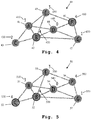
- new tokens cannot only be created but it is also possible to delete already existing tokens in the following two ways, each of which is illustrated with the aid of the respective figure.
- At least two tokens are merged into a single token, if a node receives the at least two tokens from at least two different neighboring nodes. This case may occur, if the at least two neighboring nodes which were previously holding the at least two token are not neighbors of each other.
- Fig. 4 is intended to illustrate the above-mentioned first case and depicts a network 40 comprising nodes 41-47 within a neighborhood. Additionally, the numbers 410-470 above the nodes 41-47 indicate the last token interval, in which the respective node has held a token. For example, according to Fig. 4 , node 41 has held a token in token_interval (3) because the number 410 above the node 41 is 3.
- nodes 42 and 46 of the network 40 are holding a token within the same token interval as indicated by the circles around both nodes 42 and 46.
- nodes 42 and 46 would both select node 44 as the receiver of their token. Therefore, only one token will be left in the network 40 for the next token interval.
- At least one existing token is deleted by discarding it, if a first node discovers that one of its neighbors (a second node) is also holding a token, it will try to pass its own token to a node that is not a neighbor of the second node. However, it is possible that the first node does not have such a neighboring node. In this second case, it will not pass its token on, and the token will be lost. Instead of setting the NEXT_TOKEN_HOLDER field 37 to a valid MAC address of one of its neighbors, the first node will set the field to an invalid value, and the token will not be picked up by any neighboring node.
- Fig. 5 shows a network 50 comprising nodes 51-57 within a neighborhood.
- the numbers 510-570 above the nodes 51-57 indicate the last token interval, in which the respective node has held a token.
- Fig. 5 as indicated by the circles around the nodes 52 and 53, both nodes 52 and 53 are holding a token within the same token interval. It can be seen that node 53 does not have any neighbors that are not also neighbors of node 52. Therefore, node 53 does not forward its token, and the token is lost. Nevertheless, node 52 will forward its token to node 54.
- Fig. 6 shows a flow chart of the inventive method.
- a wireless ad-hoc network comprising nodes within a neighborhood and at least one token periodically forwarded between the nodes at a token interval are provided.
- the at least one token is forwarded form first nodes holding the at least token to neighboring second nodes, each of which is not a neighboring node of third nodes having held the at least one token within the directly previous token interval.
- the at least one token is forwarded again and again according to the steps S61 and S62.
Landscapes
- Engineering & Computer Science (AREA)
- Computer Networks & Wireless Communication (AREA)
- Signal Processing (AREA)
- Data Mining & Analysis (AREA)
- Mobile Radio Communication Systems (AREA)
Claims (15)
- Netzwerk (10, 20, 40, 50) mit Knoten (11-17, 21-27, 30, 41-47, 51-57) innerhalb einer Nachbarschaft,
wobei zumindest ein Token (35) zwischen den Knoten (11-17, 21-27, 30, 41-47, 51-57) des Netzwerks (10, 20, 40, 50) weitergeleitet wird,
wobei jeder Knoten (11-17, 21-27, 30, 41-47, 51-57) Steuermittel (31) aufweist und die Steuermittel (31) derart konfiguriert sind, dass der zumindest eine Token (35) periodisch in einem Token-Intervall weitergeleitet wird,
dadurch gekennzeichnet, dass
die Steuermittel (31) derart konfiguriert sind, dass bei jedem Token-Intervall der zumindest eine Token (35) von ersten Knoten, die den zumindest einen Token (35) innerhalb eines gegenwärtigen Token-Intervalls halten, weitergeleitet wird zu benachbarten zweiten Knoten, von denen jeder kein Nachbarknoten von benachbarten dritten Knoten ist, die den zumindest einen Token (35) in einem vorherigen Token-Intervall, das direkt dem gegenwärtigen Token-Intervall vorausging, gehalten haben,
wobei, während der jeweilige Knoten (11-17, 21-27, 30, 41-47, 51-57) den mindestens einen Token (35) hält, dieser Knoten (11-17, 21-27, 30, 41-47, 51-57) ausgewählt wird, um verteilte Aufgaben auszuführen. - Netzwerk nach Anspruch 1,
dadurch gekennzeichnet, dass
die Steuermittel (31) derart konfiguriert sind, dass die Knoten (11-17, 21-27, 30, 41-47, 51-57) des Netzwerks (10, 20, 40, 50) zeitlich synchronisiert sind. - Netzwerk nach Anspruch 1 oder 2,
dadurch gekennzeichnet, dass
die Steuermittel (31) derart konfiguriert sind, dass der zumindest eine Token (35) zu einem Nachbarknoten weitergeleitet wird, der die längste Zeit keinen Token (35) hatte. - Netzwerk nach einem der Ansprüche 1 bis 3,
dadurch gekennzeichnet, dass
die Steuermittel (31) derart konfiguriert sind, dass der zumindest eine Token (35) zu einem Nachbarknoten weitergeleitet wird, der die niedrigste Adresse, insbesondere die niedrigste MAC-Adresse, aufweist. - Netzwerk nach einem der Ansprüche 1 bis 4,
dadurch gekennzeichnet, dass
die Steuermittel (31) derart konfiguriert sind, dass ein neuer Token (35) von einem Knoten (11-17, 21-27, 30, 41-47, 51-57) des Netzwerks (10, 20, 40, 50) erzeugt wird, wenn die Nachbarknoten des Knotens (11-17, 21-27, 30, 41-47, 51-57) zurzeit keinen Token (35) halten und/oder eine vorgegebene Zeit (33) abgelaufen ist. - Netzwerk nach einem der Ansprüche 1 bis 5,
dadurch gekennzeichnet, dass
die Steuermittel (31) derart konfiguriert sind, dass zumindest ein vorhandener Token (35) durch die Zusammenführung von mindestens zwei Token (35) in einen einzigen Token (35) gelöscht wird, wenn ein Knoten (11-17, 21-27, 30, 41-47, 51-57) des Netzwerks (10, 20, 40, 50) mindestens zwei Token (35) von mindestens zwei verschiedenen Nachbarknoten empfängt. - Netzwerk nach einem der Ansprüche 1 bis 6,
dadurch gekennzeichnet, dass
die Steuermittel (31) derart konfiguriert sind, dass zumindest ein vorhandener Token (35) gelöscht wird, indem der zumindest eine vorhandene Token (35) verworfen wird, wenn keine zweiten Knoten zum Empfangen des mindestens einen vorhandenen Tokens (35) verfügbar sind. - Verfahren zum Weiterleiten zumindest eines Tokens (35) durch einen Netzwerk (10, 20, 40, 50) von Knoten (11-17, 21-27, 30, 41-47, 51-57) innerhalb einer Nachbarschaft,
wobei der zumindest eine Token (35) periodisch in einem Token-Intervall weitergeleitet wird,
dadurch gekennzeichnet, dass
bei jedem Token-Intervall der zumindest eine Token (35) von ersten Knoten, die den zumindest einen Token (35) innerhalb eines gegenwärtigen Token-Intervalls halten, weitergeleitet wird zu benachbarten zweiten Knoten, von denen jeder kein Nachbarknoten von benachbarten dritten Knoten ist, die den zumindest einen Token (35) in einem vorherigen Token-Intervall, das direkt dem gegenwärtigen Token-Intervall vorausging, gehalten haben,
wobei, während der jeweilige Knoten (11-17, 21-27, 30, 41-47, 51-57) den mindestens einen Token (35) hält, dieser Knoten (11-17, 21-27, 30, 41-47, 51-57) ausgewählt wird, um verteilte Aufgaben auszuführen. - Verfahren nach Anspruch 8,
dadurch gekennzeichnet, dass
die Knoten (11-17, 21-27, 30, 41-47, 51-57) des Netzwerks (10, 20, 40, 50) zeitlich synchronisiert sind. - Verfahren nach Anspruch 8 oder 9,
dadurch gekennzeichnet, dass
der zumindest eine Token (35) zu einem Nachbarknoten weitergeleitet wird, der die längste Zeit keinen Token (35) hatte. - Verfahren einem der Ansprüche 8 bis 10,
dadurch gekennzeichnet, dass
der zumindest eine Token (35) zu einem Nachbarknoten weitergeleitet wird, der die niedrigste Adresse, insbesondere die niedrigste MAC-Adresse, aufweist. - Verfahren einem der Ansprüche 8 bis 11,
dadurch gekennzeichnet, dass
ein neuer Token (35) von einem Knoten (11-17, 21-27, 30, 41-47, 51-57) des Netzwerks (10, 20, 40, 50) erzeugt wird, wenn die Nachbarknoten des Knotens (11-17, 21-27, 30, 41-47, 51-57) zurzeit keinen Token (35) halten und/oder eine vorgegebene Zeit (33) abgelaufen ist. - Verfahren einem der Ansprüche 8 bis 12,
dadurch gekennzeichnet, dass
zumindest ein vorhandener Token (35) durch die Zusammenführung von mindestens zwei Token (35) in einen einzigen Token (35) gelöscht wird, wenn ein Knoten (11-17, 21-27, 30, 41-47, 51-57) des Netzwerks (10, 20, 40, 50) die mindestens zwei Token (35) von mindestens zwei verschiedenen Nachbarknoten empfängt. - Verfahren einem der Ansprüche 8 bis 13,
dadurch gekennzeichnet, dass
zumindest ein vorhandener Token (35) gelöscht wird, indem der zumindest eine vorhandene Token (35) verworfen wird, wenn keine zweiten Knoten zum Empfangen des mindestens einen vorhandenen Tokens (35) verfügbar sind. - Computerprogramm mit Programmcodemitteln zum Durchführen aller Schritte nach einem der Ansprüche 8 bis 14, wenn das Programm auf einem Computer oder einem digitalen Signalprozessor der Knoten (11-17, 21-27, 30, 41-47, 51-57) ausgeführt wird.
Priority Applications (1)
| Application Number | Priority Date | Filing Date | Title |
|---|---|---|---|
| EP16155661.8A EP3206340B8 (de) | 2016-02-15 | 2016-02-15 | Verfahren und netzwerk zum senden von daten über ein netzwerk |
Applications Claiming Priority (1)
| Application Number | Priority Date | Filing Date | Title |
|---|---|---|---|
| EP16155661.8A EP3206340B8 (de) | 2016-02-15 | 2016-02-15 | Verfahren und netzwerk zum senden von daten über ein netzwerk |
Publications (3)
| Publication Number | Publication Date |
|---|---|
| EP3206340A1 EP3206340A1 (de) | 2017-08-16 |
| EP3206340B1 true EP3206340B1 (de) | 2021-03-31 |
| EP3206340B8 EP3206340B8 (de) | 2021-05-12 |
Family
ID=55411204
Family Applications (1)
| Application Number | Title | Priority Date | Filing Date |
|---|---|---|---|
| EP16155661.8A Active EP3206340B8 (de) | 2016-02-15 | 2016-02-15 | Verfahren und netzwerk zum senden von daten über ein netzwerk |
Country Status (1)
| Country | Link |
|---|---|
| EP (1) | EP3206340B8 (de) |
Family Cites Families (1)
| Publication number | Priority date | Publication date | Assignee | Title |
|---|---|---|---|---|
| CN100452750C (zh) | 2005-02-04 | 2009-01-14 | 西安电子科技大学 | Ad Hoc网络的令牌传递方法 |
-
2016
- 2016-02-15 EP EP16155661.8A patent/EP3206340B8/de active Active
Non-Patent Citations (1)
| Title |
|---|
| None * |
Also Published As
| Publication number | Publication date |
|---|---|
| EP3206340B8 (de) | 2021-05-12 |
| EP3206340A1 (de) | 2017-08-16 |
Similar Documents
| Publication | Publication Date | Title |
|---|---|---|
| KR101443572B1 (ko) | 멀티 채널 무선 네트워크에서의 채널간 통신 방법 | |
| Soua et al. | Wave: a distributed scheduling algorithm for convergecast in IEEE 802.15. 4e TSCH networks | |
| TWI259013B (en) | Method and system for reducing message instances | |
| AU2007270867B2 (en) | QoS request and information distribution for wireless relay networks | |
| US11979814B2 (en) | Method for updating a number of hops that is to be used for communication between a publisher mesh node and a subscriber mesh node in a wireless mesh network | |
| TW200935927A (en) | Paging user devices in a wireless access network | |
| EP2894812B1 (de) | Verfahren und Vorrichtung zum Einrichten einer virtuellen Schnittstelle für einen Satz von gegenseitigen Hörervorrichtungen | |
| US10785700B2 (en) | Apparatus and method for transmitting beacon messages in a mesh network | |
| CN112383478B (zh) | 报文广播方法及设备 | |
| CN107196859B (zh) | 消息转发方法、广播方法、消息应答方法及通信设备 | |
| JP2021508981A (ja) | 通信方法、装置、およびシステム | |
| US20100271175A1 (en) | Methods and apparatuses for providing a paging process for multicarrier | |
| EP3496431B1 (de) | Nachrichtenübertragungsverfahren und -vorrichtung | |
| CN112740729B (zh) | 用于自主配置网格网络中的中继节点装置的装置和方法 | |
| US9504020B2 (en) | Method for exchanging information between communication terminals, and communication terminal | |
| CN105072586B (zh) | 嵌入式无线自组织网络中对广播消息的转发的管理方法 | |
| US10374881B2 (en) | Method of network subscription in a wireless network | |
| Jayaraman et al. | A trusted water fall model for efficient data transmission in VANET | |
| JP6379883B2 (ja) | タイムスロット割り当て方法及び装置 | |
| EP3206340A1 (de) | Verfahren und netzwerk zum senden von daten über ein netzwerk | |
| KR101694329B1 (ko) | 애드 혹 네트워크에서 데이터를 전송하기 위한 경로 확립 방법 | |
| ES2797729T3 (es) | Método y sistema para reducir el cambio en el DR del protocolo PIM | |
| CN104104746A (zh) | 一种无线自组网的分段式地址分配方法 | |
| CN111193667B (zh) | 自组网的路由方法、叶节点及存储介质 | |
| CN105530669B (zh) | 重选优先级的设置方法及装置 |
Legal Events
| Date | Code | Title | Description |
|---|---|---|---|
| PUAI | Public reference made under article 153(3) epc to a published international application that has entered the european phase |
Free format text: ORIGINAL CODE: 0009012 |
|
| STAA | Information on the status of an ep patent application or granted ep patent |
Free format text: STATUS: REQUEST FOR EXAMINATION WAS MADE |
|
| 17P | Request for examination filed |
Effective date: 20160902 |
|
| AK | Designated contracting states |
Kind code of ref document: A1 Designated state(s): AL AT BE BG CH CY CZ DE DK EE ES FI FR GB GR HR HU IE IS IT LI LT LU LV MC MK MT NL NO PL PT RO RS SE SI SK SM TR |
|
| AX | Request for extension of the european patent |
Extension state: BA ME |
|
| STAA | Information on the status of an ep patent application or granted ep patent |
Free format text: STATUS: EXAMINATION IS IN PROGRESS |
|
| 17Q | First examination report despatched |
Effective date: 20190701 |
|
| GRAP | Despatch of communication of intention to grant a patent |
Free format text: ORIGINAL CODE: EPIDOSNIGR1 |
|
| STAA | Information on the status of an ep patent application or granted ep patent |
Free format text: STATUS: GRANT OF PATENT IS INTENDED |
|
| INTG | Intention to grant announced |
Effective date: 20210118 |
|
| GRAS | Grant fee paid |
Free format text: ORIGINAL CODE: EPIDOSNIGR3 |
|
| GRAA | (expected) grant |
Free format text: ORIGINAL CODE: 0009210 |
|
| STAA | Information on the status of an ep patent application or granted ep patent |
Free format text: STATUS: THE PATENT HAS BEEN GRANTED |
|
| AK | Designated contracting states |
Kind code of ref document: B1 Designated state(s): AL AT BE BG CH CY CZ DE DK EE ES FI FR GB GR HR HU IE IS IT LI LT LU LV MC MK MT NL NO PL PT RO RS SE SI SK SM TR |
|
| REG | Reference to a national code |
Ref country code: GB Ref legal event code: FG4D |
|
| RBV | Designated contracting states (corrected) |
Designated state(s): AL AT BE BG CY CZ DE DK EE ES FI FR GB GR HR HU IS IT LT LU LV MC MK MT NL NO PL PT RO RS SE SI SK SM TR |
|
| REG | Reference to a national code |
Ref country code: DE Ref legal event code: R096 Ref document number: 602016055101 Country of ref document: DE Ref country code: AT Ref legal event code: REF Ref document number: 1378194 Country of ref document: AT Kind code of ref document: T Effective date: 20210415 |
|
| REG | Reference to a national code |
Ref country code: IE Ref legal event code: FG4D |
|
| REG | Reference to a national code |
Ref country code: LT Ref legal event code: MG9D |
|
| PG25 | Lapsed in a contracting state [announced via postgrant information from national office to epo] |
Ref country code: FI Free format text: LAPSE BECAUSE OF FAILURE TO SUBMIT A TRANSLATION OF THE DESCRIPTION OR TO PAY THE FEE WITHIN THE PRESCRIBED TIME-LIMIT Effective date: 20210331 Ref country code: HR Free format text: LAPSE BECAUSE OF FAILURE TO SUBMIT A TRANSLATION OF THE DESCRIPTION OR TO PAY THE FEE WITHIN THE PRESCRIBED TIME-LIMIT Effective date: 20210331 Ref country code: BG Free format text: LAPSE BECAUSE OF FAILURE TO SUBMIT A TRANSLATION OF THE DESCRIPTION OR TO PAY THE FEE WITHIN THE PRESCRIBED TIME-LIMIT Effective date: 20210630 Ref country code: NO Free format text: LAPSE BECAUSE OF FAILURE TO SUBMIT A TRANSLATION OF THE DESCRIPTION OR TO PAY THE FEE WITHIN THE PRESCRIBED TIME-LIMIT Effective date: 20210630 |
|
| PG25 | Lapsed in a contracting state [announced via postgrant information from national office to epo] |
Ref country code: SE Free format text: LAPSE BECAUSE OF FAILURE TO SUBMIT A TRANSLATION OF THE DESCRIPTION OR TO PAY THE FEE WITHIN THE PRESCRIBED TIME-LIMIT Effective date: 20210331 Ref country code: RS Free format text: LAPSE BECAUSE OF FAILURE TO SUBMIT A TRANSLATION OF THE DESCRIPTION OR TO PAY THE FEE WITHIN THE PRESCRIBED TIME-LIMIT Effective date: 20210331 Ref country code: LV Free format text: LAPSE BECAUSE OF FAILURE TO SUBMIT A TRANSLATION OF THE DESCRIPTION OR TO PAY THE FEE WITHIN THE PRESCRIBED TIME-LIMIT Effective date: 20210331 |
|
| REG | Reference to a national code |
Ref country code: NL Ref legal event code: MP Effective date: 20210331 |
|
| REG | Reference to a national code |
Ref country code: AT Ref legal event code: MK05 Ref document number: 1378194 Country of ref document: AT Kind code of ref document: T Effective date: 20210331 |
|
| PG25 | Lapsed in a contracting state [announced via postgrant information from national office to epo] |
Ref country code: NL Free format text: LAPSE BECAUSE OF FAILURE TO SUBMIT A TRANSLATION OF THE DESCRIPTION OR TO PAY THE FEE WITHIN THE PRESCRIBED TIME-LIMIT Effective date: 20210331 Ref country code: LT Free format text: LAPSE BECAUSE OF FAILURE TO SUBMIT A TRANSLATION OF THE DESCRIPTION OR TO PAY THE FEE WITHIN THE PRESCRIBED TIME-LIMIT Effective date: 20210331 Ref country code: CZ Free format text: LAPSE BECAUSE OF FAILURE TO SUBMIT A TRANSLATION OF THE DESCRIPTION OR TO PAY THE FEE WITHIN THE PRESCRIBED TIME-LIMIT Effective date: 20210331 Ref country code: EE Free format text: LAPSE BECAUSE OF FAILURE TO SUBMIT A TRANSLATION OF THE DESCRIPTION OR TO PAY THE FEE WITHIN THE PRESCRIBED TIME-LIMIT Effective date: 20210331 Ref country code: SM Free format text: LAPSE BECAUSE OF FAILURE TO SUBMIT A TRANSLATION OF THE DESCRIPTION OR TO PAY THE FEE WITHIN THE PRESCRIBED TIME-LIMIT Effective date: 20210331 Ref country code: AT Free format text: LAPSE BECAUSE OF FAILURE TO SUBMIT A TRANSLATION OF THE DESCRIPTION OR TO PAY THE FEE WITHIN THE PRESCRIBED TIME-LIMIT Effective date: 20210331 |
|
| PG25 | Lapsed in a contracting state [announced via postgrant information from national office to epo] |
Ref country code: SK Free format text: LAPSE BECAUSE OF FAILURE TO SUBMIT A TRANSLATION OF THE DESCRIPTION OR TO PAY THE FEE WITHIN THE PRESCRIBED TIME-LIMIT Effective date: 20210331 Ref country code: RO Free format text: LAPSE BECAUSE OF FAILURE TO SUBMIT A TRANSLATION OF THE DESCRIPTION OR TO PAY THE FEE WITHIN THE PRESCRIBED TIME-LIMIT Effective date: 20210331 Ref country code: PL Free format text: LAPSE BECAUSE OF FAILURE TO SUBMIT A TRANSLATION OF THE DESCRIPTION OR TO PAY THE FEE WITHIN THE PRESCRIBED TIME-LIMIT Effective date: 20210331 Ref country code: PT Free format text: LAPSE BECAUSE OF FAILURE TO SUBMIT A TRANSLATION OF THE DESCRIPTION OR TO PAY THE FEE WITHIN THE PRESCRIBED TIME-LIMIT Effective date: 20210802 Ref country code: IS Free format text: LAPSE BECAUSE OF FAILURE TO SUBMIT A TRANSLATION OF THE DESCRIPTION OR TO PAY THE FEE WITHIN THE PRESCRIBED TIME-LIMIT Effective date: 20210731 |
|
| REG | Reference to a national code |
Ref country code: DE Ref legal event code: R097 Ref document number: 602016055101 Country of ref document: DE |
|
| PG25 | Lapsed in a contracting state [announced via postgrant information from national office to epo] |
Ref country code: ES Free format text: LAPSE BECAUSE OF FAILURE TO SUBMIT A TRANSLATION OF THE DESCRIPTION OR TO PAY THE FEE WITHIN THE PRESCRIBED TIME-LIMIT Effective date: 20210331 Ref country code: AL Free format text: LAPSE BECAUSE OF FAILURE TO SUBMIT A TRANSLATION OF THE DESCRIPTION OR TO PAY THE FEE WITHIN THE PRESCRIBED TIME-LIMIT Effective date: 20210331 Ref country code: DK Free format text: LAPSE BECAUSE OF FAILURE TO SUBMIT A TRANSLATION OF THE DESCRIPTION OR TO PAY THE FEE WITHIN THE PRESCRIBED TIME-LIMIT Effective date: 20210331 |
|
| PLBE | No opposition filed within time limit |
Free format text: ORIGINAL CODE: 0009261 |
|
| STAA | Information on the status of an ep patent application or granted ep patent |
Free format text: STATUS: NO OPPOSITION FILED WITHIN TIME LIMIT |
|
| 26N | No opposition filed |
Effective date: 20220104 |
|
| PG25 | Lapsed in a contracting state [announced via postgrant information from national office to epo] |
Ref country code: IS Free format text: LAPSE BECAUSE OF FAILURE TO SUBMIT A TRANSLATION OF THE DESCRIPTION OR TO PAY THE FEE WITHIN THE PRESCRIBED TIME-LIMIT Effective date: 20210731 |
|
| PG25 | Lapsed in a contracting state [announced via postgrant information from national office to epo] |
Ref country code: IT Free format text: LAPSE BECAUSE OF FAILURE TO SUBMIT A TRANSLATION OF THE DESCRIPTION OR TO PAY THE FEE WITHIN THE PRESCRIBED TIME-LIMIT Effective date: 20210331 |
|
| PG25 | Lapsed in a contracting state [announced via postgrant information from national office to epo] |
Ref country code: MC Free format text: LAPSE BECAUSE OF FAILURE TO SUBMIT A TRANSLATION OF THE DESCRIPTION OR TO PAY THE FEE WITHIN THE PRESCRIBED TIME-LIMIT Effective date: 20210331 |
|
| REG | Reference to a national code |
Ref country code: BE Ref legal event code: MM Effective date: 20220228 |
|
| PG25 | Lapsed in a contracting state [announced via postgrant information from national office to epo] |
Ref country code: LU Free format text: LAPSE BECAUSE OF NON-PAYMENT OF DUE FEES Effective date: 20220215 |
|
| PG25 | Lapsed in a contracting state [announced via postgrant information from national office to epo] |
Ref country code: BE Free format text: LAPSE BECAUSE OF NON-PAYMENT OF DUE FEES Effective date: 20220228 |
|
| P01 | Opt-out of the competence of the unified patent court (upc) registered |
Effective date: 20230525 |
|
| PG25 | Lapsed in a contracting state [announced via postgrant information from national office to epo] |
Ref country code: HU Free format text: LAPSE BECAUSE OF FAILURE TO SUBMIT A TRANSLATION OF THE DESCRIPTION OR TO PAY THE FEE WITHIN THE PRESCRIBED TIME-LIMIT; INVALID AB INITIO Effective date: 20160215 |
|
| PG25 | Lapsed in a contracting state [announced via postgrant information from national office to epo] |
Ref country code: MK Free format text: LAPSE BECAUSE OF FAILURE TO SUBMIT A TRANSLATION OF THE DESCRIPTION OR TO PAY THE FEE WITHIN THE PRESCRIBED TIME-LIMIT Effective date: 20210331 Ref country code: CY Free format text: LAPSE BECAUSE OF FAILURE TO SUBMIT A TRANSLATION OF THE DESCRIPTION OR TO PAY THE FEE WITHIN THE PRESCRIBED TIME-LIMIT Effective date: 20210331 |
|
| PG25 | Lapsed in a contracting state [announced via postgrant information from national office to epo] |
Ref country code: TR Free format text: LAPSE BECAUSE OF FAILURE TO SUBMIT A TRANSLATION OF THE DESCRIPTION OR TO PAY THE FEE WITHIN THE PRESCRIBED TIME-LIMIT Effective date: 20210331 |
|
| PG25 | Lapsed in a contracting state [announced via postgrant information from national office to epo] |
Ref country code: MT Free format text: LAPSE BECAUSE OF FAILURE TO SUBMIT A TRANSLATION OF THE DESCRIPTION OR TO PAY THE FEE WITHIN THE PRESCRIBED TIME-LIMIT Effective date: 20210331 |
|
| PG25 | Lapsed in a contracting state [announced via postgrant information from national office to epo] |
Ref country code: GR Free format text: LAPSE BECAUSE OF NON-PAYMENT OF DUE FEES Effective date: 20210331 |
|
| PG25 | Lapsed in a contracting state [announced via postgrant information from national office to epo] |
Ref country code: GR Free format text: LAPSE BECAUSE OF NON-PAYMENT OF DUE FEES Effective date: 20210331 |
|
| PGFP | Annual fee paid to national office [announced via postgrant information from national office to epo] |
Ref country code: GB Payment date: 20260219 Year of fee payment: 11 |
|
| PGFP | Annual fee paid to national office [announced via postgrant information from national office to epo] |
Ref country code: DE Payment date: 20260217 Year of fee payment: 11 |
|
| PGFP | Annual fee paid to national office [announced via postgrant information from national office to epo] |
Ref country code: FR Payment date: 20260223 Year of fee payment: 11 |