EP3204360B1 - Therapeutic compounds and uses thereof - Google Patents
Therapeutic compounds and uses thereof Download PDFInfo
- Publication number
- EP3204360B1 EP3204360B1 EP15848282.8A EP15848282A EP3204360B1 EP 3204360 B1 EP3204360 B1 EP 3204360B1 EP 15848282 A EP15848282 A EP 15848282A EP 3204360 B1 EP3204360 B1 EP 3204360B1
- Authority
- EP
- European Patent Office
- Prior art keywords
- mmol
- methyl
- membered
- compound
- alkyl
- Prior art date
- Legal status (The legal status is an assumption and is not a legal conclusion. Google has not performed a legal analysis and makes no representation as to the accuracy of the status listed.)
- Active
Links
- 0 CC1=CC(C=C*=C)=CCC1 Chemical compound CC1=CC(C=C*=C)=CCC1 0.000 description 68
- OIVVZHAGNZVWLO-UHFFFAOYSA-N CC(C)[n]1ncc2cc(C)ccc12 Chemical compound CC(C)[n]1ncc2cc(C)ccc12 OIVVZHAGNZVWLO-UHFFFAOYSA-N 0.000 description 3
- HNIPNANLYHXYDE-UHFFFAOYSA-N CC(Nc1cc(C(F)(F)F)ccc1)=O Chemical compound CC(Nc1cc(C(F)(F)F)ccc1)=O HNIPNANLYHXYDE-UHFFFAOYSA-N 0.000 description 2
- VXDRJHLFQPEJQN-LLVKDONJSA-N C[C@H](C1)Nc(c(C(Nc2ccccc2)=O)ccc2)c2NC1=O Chemical compound C[C@H](C1)Nc(c(C(Nc2ccccc2)=O)ccc2)c2NC1=O VXDRJHLFQPEJQN-LLVKDONJSA-N 0.000 description 2
- MVDOFIXQIOZEMT-GFCCVEGCSA-N C[C@H](C1)Nc(c(C(OCc2ccccc2)=O)ccc2)c2NC1=O Chemical compound C[C@H](C1)Nc(c(C(OCc2ccccc2)=O)ccc2)c2NC1=O MVDOFIXQIOZEMT-GFCCVEGCSA-N 0.000 description 2
- JBYMCGBSFIDODY-LLVKDONJSA-N C[C@H](CC(Nc1ccc2)=O)Nc1c2-c1cc2c[n](C)nc2cc1 Chemical compound C[C@H](CC(Nc1ccc2)=O)Nc1c2-c1cc2c[n](C)nc2cc1 JBYMCGBSFIDODY-LLVKDONJSA-N 0.000 description 2
- PCFCRYVUCIKPFE-GFCCVEGCSA-N C[C@H](CC(Nc1ccc2)=O)Nc1c2C(Nc1cccc(-c2cnc[o]2)c1)=O Chemical compound C[C@H](CC(Nc1ccc2)=O)Nc1c2C(Nc1cccc(-c2cnc[o]2)c1)=O PCFCRYVUCIKPFE-GFCCVEGCSA-N 0.000 description 2
- IWQSPYBKXNAEPA-UHFFFAOYSA-N Cc([n](C)c1c2)cc1ccc2Cl Chemical compound Cc([n](C)c1c2)cc1ccc2Cl IWQSPYBKXNAEPA-UHFFFAOYSA-N 0.000 description 2
- GZHSLFUOJYNMTC-UHFFFAOYSA-N Cc(cc1cn2)ccc1[n]2S(C)(=O)=O Chemical compound Cc(cc1cn2)ccc1[n]2S(C)(=O)=O GZHSLFUOJYNMTC-UHFFFAOYSA-N 0.000 description 2
- CVTJFQYPQYXEFL-UHFFFAOYSA-N Cc1c[n](C)c2cc(S(C)(=O)=O)ccc12 Chemical compound Cc1c[n](C)c2cc(S(C)(=O)=O)ccc12 CVTJFQYPQYXEFL-UHFFFAOYSA-N 0.000 description 2
- FODAUNMFUIXBBO-UHFFFAOYSA-N Cc1cc(cc(cc2)OC)c2[n]1C Chemical compound Cc1cc(cc(cc2)OC)c2[n]1C FODAUNMFUIXBBO-UHFFFAOYSA-N 0.000 description 2
- BFCDUCCWAPLDJQ-UHFFFAOYSA-N Cc1ccc(CC(N2)=O)c2c1 Chemical compound Cc1ccc(CC(N2)=O)c2c1 BFCDUCCWAPLDJQ-UHFFFAOYSA-N 0.000 description 2
- DQCYRLXJSPENPG-UHFFFAOYSA-N Cc1n[n](C)c2c1CCCC2 Chemical compound Cc1n[n](C)c2c1CCCC2 DQCYRLXJSPENPG-UHFFFAOYSA-N 0.000 description 2
- YKTFHFIMLHKOEF-YFHOEESVSA-N C/C(/c(cc1)ccc1C#N)=C(/F)\Br Chemical compound C/C(/c(cc1)ccc1C#N)=C(/F)\Br YKTFHFIMLHKOEF-YFHOEESVSA-N 0.000 description 1
- ZCOBHQOUNFEAKK-YFHOEESVSA-N C/C(/c(cc1)ccc1C#N)=C(/N)\F Chemical compound C/C(/c(cc1)ccc1C#N)=C(/N)\F ZCOBHQOUNFEAKK-YFHOEESVSA-N 0.000 description 1
- UHKQSXSIENPOQL-ONEGZZNKSA-N C/C=C/c1c[n](C)nc1 Chemical compound C/C=C/c1c[n](C)nc1 UHKQSXSIENPOQL-ONEGZZNKSA-N 0.000 description 1
- ZGSJREKXHSRJCY-DUXPYHPUSA-N C/C=C/c1cc(S(N)(=O)=O)ccc1 Chemical compound C/C=C/c1cc(S(N)(=O)=O)ccc1 ZGSJREKXHSRJCY-DUXPYHPUSA-N 0.000 description 1
- MBOAQYOVJDPKMN-ZZXKWVIFSA-N C/C=C/c1ccccc1NC(C)=O Chemical compound C/C=C/c1ccccc1NC(C)=O MBOAQYOVJDPKMN-ZZXKWVIFSA-N 0.000 description 1
- AJCPGZOPLPHHTD-UHFFFAOYSA-N C=CC(C1)=NC(C(C#CC2CCCCC2)=CC#CC2)=C2NC1=O Chemical compound C=CC(C1)=NC(C(C#CC2CCCCC2)=CC#CC2)=C2NC1=O AJCPGZOPLPHHTD-UHFFFAOYSA-N 0.000 description 1
- ORKHCYDXYAVXFM-UHFFFAOYSA-N C=CCc(cc(c(C#N)c1)Br)c1[N+]([O-])=O Chemical compound C=CCc(cc(c(C#N)c1)Br)c1[N+]([O-])=O ORKHCYDXYAVXFM-UHFFFAOYSA-N 0.000 description 1
- XFYAMHPYPGJUDU-DENHBWNVSA-N CC(C)(/C(/N(C)c1c2)=C\C)c1ccc2-c1cccc2c1NCCC[NH+]2[O-] Chemical compound CC(C)(/C(/N(C)c1c2)=C\C)c1ccc2-c1cccc2c1NCCC[NH+]2[O-] XFYAMHPYPGJUDU-DENHBWNVSA-N 0.000 description 1
- LJTOGGNSNDIINV-UHFFFAOYSA-N CC(C)(C)OC(N(C)c1ccc(C)cc1)=O Chemical compound CC(C)(C)OC(N(C)c1ccc(C)cc1)=O LJTOGGNSNDIINV-UHFFFAOYSA-N 0.000 description 1
- WMKIJUGTZNCUGS-UHFFFAOYSA-N CC(C)(C)OC(N(CC1)Cc2c1[s]c(C)c2)=O Chemical compound CC(C)(C)OC(N(CC1)Cc2c1[s]c(C)c2)=O WMKIJUGTZNCUGS-UHFFFAOYSA-N 0.000 description 1
- VZMVGGAQYQVROP-UHFFFAOYSA-N CC(C)(C)OC(Nc1cccc(C)c1)=O Chemical compound CC(C)(C)OC(Nc1cccc(C)c1)=O VZMVGGAQYQVROP-UHFFFAOYSA-N 0.000 description 1
- SMURSSZMVCOKOO-UHFFFAOYSA-N CC(C)(C)OC([n]1c(cccc2)c2c(C)c1)=O Chemical compound CC(C)(C)OC([n]1c(cccc2)c2c(C)c1)=O SMURSSZMVCOKOO-UHFFFAOYSA-N 0.000 description 1
- IFQDQSRJFFYYBS-UHFFFAOYSA-N CC(C)(C)[n]1c(-c(cccc2N3)c2NC2(CC2)CC3=C)c(C)c2ccccc12 Chemical compound CC(C)(C)[n]1c(-c(cccc2N3)c2NC2(CC2)CC3=C)c(C)c2ccccc12 IFQDQSRJFFYYBS-UHFFFAOYSA-N 0.000 description 1
- UJIOACIWOHUNGM-UHFFFAOYSA-N CC(C)(c1cc(C)ccc1N1C)C1=O Chemical compound CC(C)(c1cc(C)ccc1N1C)C1=O UJIOACIWOHUNGM-UHFFFAOYSA-N 0.000 description 1
- BKWMHSGAGCPBAB-UHFFFAOYSA-N CC(C)C(Nc1cccc(OC2COC2)c1)=O Chemical compound CC(C)C(Nc1cccc(OC2COC2)c1)=O BKWMHSGAGCPBAB-UHFFFAOYSA-N 0.000 description 1
- IJIRWLCAGWNHBJ-SNVBAGLBSA-N CC(C)COc(cc1)cc(O[C@H](C)C2)c1NC2=O Chemical compound CC(C)COc(cc1)cc(O[C@H](C)C2)c1NC2=O IJIRWLCAGWNHBJ-SNVBAGLBSA-N 0.000 description 1
- ZZLQUOWBEJLPRS-UHFFFAOYSA-N CC(C)OCc1cnccc1 Chemical compound CC(C)OCc1cnccc1 ZZLQUOWBEJLPRS-UHFFFAOYSA-N 0.000 description 1
- AFNYRXIYGLOWKW-UHFFFAOYSA-N CC(C)OCc1ncccc1 Chemical compound CC(C)OCc1ncccc1 AFNYRXIYGLOWKW-UHFFFAOYSA-N 0.000 description 1
- LZRHWFUIUICNCN-UHFFFAOYSA-N CC(C)Oc1c(N)ncc(C)c1 Chemical compound CC(C)Oc1c(N)ncc(C)c1 LZRHWFUIUICNCN-UHFFFAOYSA-N 0.000 description 1
- WQLIBICVEMGJPS-GFCCVEGCSA-N CC(C)Oc1cc(NC(c(cccc2N3)c2N[C@H](C)CC3=O)=O)cnc1 Chemical compound CC(C)Oc1cc(NC(c(cccc2N3)c2N[C@H](C)CC3=O)=O)cnc1 WQLIBICVEMGJPS-GFCCVEGCSA-N 0.000 description 1
- CJFPISYIEUSNPO-LLVKDONJSA-N CC(C)[n]1ncc(-c2cccc(N3)c2N[C@H](C)CC3=O)c1 Chemical compound CC(C)[n]1ncc(-c2cccc(N3)c2N[C@H](C)CC3=O)c1 CJFPISYIEUSNPO-LLVKDONJSA-N 0.000 description 1
- XBHHKVWZNGPYQD-UHFFFAOYSA-N CC(C)[n]1ncc(C)c1 Chemical compound CC(C)[n]1ncc(C)c1 XBHHKVWZNGPYQD-UHFFFAOYSA-N 0.000 description 1
- OCAYIKDSNZVJJJ-CYBMUJFWSA-N CC(C)[n]1ncc2cc(-c(cccc3N4)c3O[C@H](C)CC4=O)ccc12 Chemical compound CC(C)[n]1ncc2cc(-c(cccc3N4)c3O[C@H](C)CC4=O)ccc12 OCAYIKDSNZVJJJ-CYBMUJFWSA-N 0.000 description 1
- HYFIUDHDPSSCBF-CYBMUJFWSA-N CC(C)c(cc1)ccc1-c(cccc1N2)c1N[C@H](C)CC2=O Chemical compound CC(C)c(cc1)ccc1-c(cccc1N2)c1N[C@H](C)CC2=O HYFIUDHDPSSCBF-CYBMUJFWSA-N 0.000 description 1
- PUPGIYQLBBQXGU-CYBMUJFWSA-N CC(C)c1cc(-c(cccc2N3)c2N[C@H](C)CC3=O)ccc1 Chemical compound CC(C)c1cc(-c(cccc2N3)c2N[C@H](C)CC3=O)ccc1 PUPGIYQLBBQXGU-CYBMUJFWSA-N 0.000 description 1
- MZFCVBARVSFUKI-VXWIUBPCSA-N CC(C1)Nc(c(/C(/NC/C=C\C=C/C(C2)C2OC)=[O]/C)ccc2)c2NC1=O Chemical compound CC(C1)Nc(c(/C(/NC/C=C\C=C/C(C2)C2OC)=[O]/C)ccc2)c2NC1=O MZFCVBARVSFUKI-VXWIUBPCSA-N 0.000 description 1
- PANLRRNDXRFDEM-UHFFFAOYSA-N CC(C1)Nc(c(C(NC(C=C(CC2)Cl)=C2Cl)=O)ccc2)c2NC1=O Chemical compound CC(C1)Nc(c(C(NC(C=C(CC2)Cl)=C2Cl)=O)ccc2)c2NC1=O PANLRRNDXRFDEM-UHFFFAOYSA-N 0.000 description 1
- IXDYTJXMJGLNMA-UHFFFAOYSA-N CC(C1)Nc2c(C(Nc3nccc4c3cccc4)O)cccc2NC1=O Chemical compound CC(C1)Nc2c(C(Nc3nccc4c3cccc4)O)cccc2NC1=O IXDYTJXMJGLNMA-UHFFFAOYSA-N 0.000 description 1
- FLMVBHZCWGEKIP-UHFFFAOYSA-N CC(CC(Nc1ccc2)=O)Nc1c2C(Nc1cc(Cl)ccc1Cl)=O Chemical compound CC(CC(Nc1ccc2)=O)Nc1c2C(Nc1cc(Cl)ccc1Cl)=O FLMVBHZCWGEKIP-UHFFFAOYSA-N 0.000 description 1
- PSUVFZNHKSDCGV-UHFFFAOYSA-N CC(CC(Nc1ccc2)=O)Nc1c2C(O)=O Chemical compound CC(CC(Nc1ccc2)=O)Nc1c2C(O)=O PSUVFZNHKSDCGV-UHFFFAOYSA-N 0.000 description 1
- BJIRPCHZVXAWDW-UHFFFAOYSA-N CC(CC(Nc1ccc2)=O)Oc1c2C(Nc1ccccc1)=O Chemical compound CC(CC(Nc1ccc2)=O)Oc1c2C(Nc1ccccc1)=O BJIRPCHZVXAWDW-UHFFFAOYSA-N 0.000 description 1
- MLMKBCOBWTZPEK-UHFFFAOYSA-N CC(Cc(cccc1)c1N1)CC1=O Chemical compound CC(Cc(cccc1)c1N1)CC1=O MLMKBCOBWTZPEK-UHFFFAOYSA-N 0.000 description 1
- DOAFVGVDXHLEHG-UHFFFAOYSA-N CC(Cc1ccccc11)C(C(OC(C)(C)C)=O)C1=N Chemical compound CC(Cc1ccccc11)C(C(OC(C)(C)C)=O)C1=N DOAFVGVDXHLEHG-UHFFFAOYSA-N 0.000 description 1
- WEASGADRJWKQRE-UHFFFAOYSA-N CC(NC(c1ccccc1)c1ccccc1)=O Chemical compound CC(NC(c1ccccc1)c1ccccc1)=O WEASGADRJWKQRE-UHFFFAOYSA-N 0.000 description 1
- GBVDKICFZNIHOK-UHFFFAOYSA-N CC(Nc1cc(-c2nnc[n]2C)ccc1)=O Chemical compound CC(Nc1cc(-c2nnc[n]2C)ccc1)=O GBVDKICFZNIHOK-UHFFFAOYSA-N 0.000 description 1
- ICZFWTSENFTULW-UHFFFAOYSA-N CC(Nc1cc(Cl)ccc1Cl)=O Chemical compound CC(Nc1cc(Cl)ccc1Cl)=O ICZFWTSENFTULW-UHFFFAOYSA-N 0.000 description 1
- BBLYNDRZXOWCNV-UHFFFAOYSA-N CC(Nc1cc(OC(F)(F)F)ccc1)=O Chemical compound CC(Nc1cc(OC(F)(F)F)ccc1)=O BBLYNDRZXOWCNV-UHFFFAOYSA-N 0.000 description 1
- BTKHGNPSLPZBSO-UHFFFAOYSA-N CC(Nc1n[n](C)c2ccccc12)=O Chemical compound CC(Nc1n[n](C)c2ccccc12)=O BTKHGNPSLPZBSO-UHFFFAOYSA-N 0.000 description 1
- XPJQGYFUJVIUHJ-UHFFFAOYSA-O CC(c1ccccc1)[NH2+]C(C)=C(C=N)c(cccc1N2)c1NC(C)CC2=O Chemical compound CC(c1ccccc1)[NH2+]C(C)=C(C=N)c(cccc1N2)c1NC(C)CC2=O XPJQGYFUJVIUHJ-UHFFFAOYSA-O 0.000 description 1
- LQDAWFKNRJGEAI-UHFFFAOYSA-N CC1(C)OB(C2=CN(c3ccccn3)NC2)OC1(C)C Chemical compound CC1(C)OB(C2=CN(c3ccccn3)NC2)OC1(C)C LQDAWFKNRJGEAI-UHFFFAOYSA-N 0.000 description 1
- VNAFMHREFHINGY-UHFFFAOYSA-N CCC(C1)Nc2c1cccc2 Chemical compound CCC(C1)Nc2c1cccc2 VNAFMHREFHINGY-UHFFFAOYSA-N 0.000 description 1
- DSQZJOMACDAXSL-UHFFFAOYSA-N CCC(Nc1nccc2ccccc12)=O Chemical compound CCC(Nc1nccc2ccccc12)=O DSQZJOMACDAXSL-UHFFFAOYSA-N 0.000 description 1
- WIEMGYACZOJMBJ-YKQKGOFXSA-N CCCNc(ccc(-c(cccc1N2)c1N[C@H](C)CC2=O)c1)c1C(/C(/C=N)=C/NC)=N Chemical compound CCCNc(ccc(-c(cccc1N2)c1N[C@H](C)CC2=O)c1)c1C(/C(/C=N)=C/NC)=N WIEMGYACZOJMBJ-YKQKGOFXSA-N 0.000 description 1
- HPMWYHJIEHQFFW-UHFFFAOYSA-N CCCc1cccc(-c2nnn[nH]2)c1 Chemical compound CCCc1cccc(-c2nnn[nH]2)c1 HPMWYHJIEHQFFW-UHFFFAOYSA-N 0.000 description 1
- YHLSIQNZJCCIIP-UEPGBVMXSA-N CCN/C=C(\C=N)/c(cccc1N2)c1N[C@H](C)CC2=O Chemical compound CCN/C=C(\C=N)/c(cccc1N2)c1N[C@H](C)CC2=O YHLSIQNZJCCIIP-UEPGBVMXSA-N 0.000 description 1
- ZBNIVOSUZQBCMF-UHFFFAOYSA-N CCOCC[n]1c2ccccc2cc1N Chemical compound CCOCC[n]1c2ccccc2cc1N ZBNIVOSUZQBCMF-UHFFFAOYSA-N 0.000 description 1
- OAAPOVWQOQPKRH-JTQLQIEISA-N CC[C@H](C)c(cc1)cc2c1[nH]nc2-c1c[n](C)nc1 Chemical compound CC[C@H](C)c(cc1)cc2c1[nH]nc2-c1c[n](C)nc1 OAAPOVWQOQPKRH-JTQLQIEISA-N 0.000 description 1
- IFBNFOAOWRAHMO-UHFFFAOYSA-N CC[n](c(S(O)O)c1)c2c1cccc2 Chemical compound CC[n](c(S(O)O)c1)c2c1cccc2 IFBNFOAOWRAHMO-UHFFFAOYSA-N 0.000 description 1
- OLGOTNLCPQXGLS-UHFFFAOYSA-N CC[n]1ncc(C)c1 Chemical compound CC[n]1ncc(C)c1 OLGOTNLCPQXGLS-UHFFFAOYSA-N 0.000 description 1
- GXGSTWDXNDGXCL-UHFFFAOYSA-N CCc1cccc(NC(C)=O)c1 Chemical compound CCc1cccc(NC(C)=O)c1 GXGSTWDXNDGXCL-UHFFFAOYSA-N 0.000 description 1
- SPGHJNIYCOHTIU-RVPFDMLBSA-N CN/C=C(\C=N)/C(c1cc(-c2cccc(N3)c2NCCC3=O)ccc1N)=N Chemical compound CN/C=C(\C=N)/C(c1cc(-c2cccc(N3)c2NCCC3=O)ccc1N)=N SPGHJNIYCOHTIU-RVPFDMLBSA-N 0.000 description 1
- JHKNXJXEGJRPRG-OAHLLOKOSA-N CNc(c(C(C1CC1)=N)c1)ccc1-c(cccc1NC(C2)=O)c1O[C@@H]2C=C Chemical compound CNc(c(C(C1CC1)=N)c1)ccc1-c(cccc1NC(C2)=O)c1O[C@@H]2C=C JHKNXJXEGJRPRG-OAHLLOKOSA-N 0.000 description 1
- WLDRUXQGJUUEAE-UHFFFAOYSA-N CS(NCc(cc1)ccc1-c(cccc1N2)c1NC1(CC1)CC2=O)(=O)=O Chemical compound CS(NCc(cc1)ccc1-c(cccc1N2)c1NC1(CC1)CC2=O)(=O)=O WLDRUXQGJUUEAE-UHFFFAOYSA-N 0.000 description 1
- QAPGYFHGMNGXRD-NSHDSACASA-N C[C@@H](C1)Oc(c(C(Nc(cc2)ccc2C#N)=O)ccc2)c2NC1=O Chemical compound C[C@@H](C1)Oc(c(C(Nc(cc2)ccc2C#N)=O)ccc2)c2NC1=O QAPGYFHGMNGXRD-NSHDSACASA-N 0.000 description 1
- OMMNKLCYTOCXTG-PPGNKHEKSA-N C[C@@H](C1)Oc2c(/C=C/c(cc3)ccc3OC)cccc2NC1=O Chemical compound C[C@@H](C1)Oc2c(/C=C/c(cc3)ccc3OC)cccc2NC1=O OMMNKLCYTOCXTG-PPGNKHEKSA-N 0.000 description 1
- FFXOIFIDSYWNDY-CABCVRRESA-N C[C@@H](CC#N)[n]1nc(C2CC2)c2c1ccc(-c(cccc1N3)c1N[C@H](C)CC3=O)c2 Chemical compound C[C@@H](CC#N)[n]1nc(C2CC2)c2c1ccc(-c(cccc1N3)c1N[C@H](C)CC3=O)c2 FFXOIFIDSYWNDY-CABCVRRESA-N 0.000 description 1
- WYXPDZQFPFWNOI-JKSUJKDBSA-N C[C@@H](CC1)c(cc(cc2)-c3c[n](C)nc3)c2N1c(cccc1N2)c1N[C@H](C)CC2=O Chemical compound C[C@@H](CC1)c(cc(cc2)-c3c[n](C)nc3)c2N1c(cccc1N2)c1N[C@H](C)CC2=O WYXPDZQFPFWNOI-JKSUJKDBSA-N 0.000 description 1
- HPJVAXVBIJITDR-SNVBAGLBSA-N C[C@H](C1)Nc(c(-c(cc2)cc(C3)c2NC3=O)ccc2)c2NC1=O Chemical compound C[C@H](C1)Nc(c(-c(cc2)cc(C3)c2NC3=O)ccc2)c2NC1=O HPJVAXVBIJITDR-SNVBAGLBSA-N 0.000 description 1
- FXMYCHBUYFWNRV-GFCCVEGCSA-N C[C@H](C1)Nc(c(-c(cc2)ccc2C(NC2CC2)=O)ccc2)c2NC1=O Chemical compound C[C@H](C1)Nc(c(-c(cc2)ccc2C(NC2CC2)=O)ccc2)c2NC1=O FXMYCHBUYFWNRV-GFCCVEGCSA-N 0.000 description 1
- AWQUFINBGMDMRV-MRXNPFEDSA-N C[C@H](C1)Nc(c(-c(cc2)ccc2OCc2ccccc2)ccc2)c2NC1=O Chemical compound C[C@H](C1)Nc(c(-c(cc2)ccc2OCc2ccccc2)ccc2)c2NC1=O AWQUFINBGMDMRV-MRXNPFEDSA-N 0.000 description 1
- ZEGMWBOLKFYTOC-PEAVLORHSA-N C[C@H](C1)Nc(c(-c(cc2C(/C(/C=N)=C/NC)=N)ccc2NC)ccc2)c2NC1=O Chemical compound C[C@H](C1)Nc(c(-c(cc2C(/C(/C=N)=C/NC)=N)ccc2NC)ccc2)c2NC1=O ZEGMWBOLKFYTOC-PEAVLORHSA-N 0.000 description 1
- NXZTZXBCRGTRNG-LLVKDONJSA-N C[C@H](C1)Nc(c(-c(cc2C(C3CC3)=N)cnc2NC)ccc2)c2NC1=O Chemical compound C[C@H](C1)Nc(c(-c(cc2C(C3CC3)=N)cnc2NC)ccc2)c2NC1=O NXZTZXBCRGTRNG-LLVKDONJSA-N 0.000 description 1
- VEHZCYHWJQAOEH-RFVHGSKJSA-N C[C@H](C1)Nc(c(-c(cc2C3)ccc2NC3=[U])ccc2)c2NC1=O Chemical compound C[C@H](C1)Nc(c(-c(cc2C3)ccc2NC3=[U])ccc2)c2NC1=O VEHZCYHWJQAOEH-RFVHGSKJSA-N 0.000 description 1
- HPSNXSAYALRMQW-LLVKDONJSA-N C[C@H](C1)Nc(c(-c2c[n](C(C)(C)C)nc2)ccc2)c2NC1=O Chemical compound C[C@H](C1)Nc(c(-c2c[n](C(C)(C)C)nc2)ccc2)c2NC1=O HPSNXSAYALRMQW-LLVKDONJSA-N 0.000 description 1
- TWBDATFGXDPWBC-LLVKDONJSA-N C[C@H](C1)Nc(c(-c2cc(S(NC)(=O)=O)ccc2)ccc2)c2NC1=O Chemical compound C[C@H](C1)Nc(c(-c2cc(S(NC)(=O)=O)ccc2)ccc2)c2NC1=O TWBDATFGXDPWBC-LLVKDONJSA-N 0.000 description 1
- YULUINLTRPYWSP-GFCCVEGCSA-N C[C@H](C1)Nc(c(-c2cc(ccc(C(OC)=O)c3)c3[n]2C)ccc2)c2NC1=O Chemical compound C[C@H](C1)Nc(c(-c2cc(ccc(C(OC)=O)c3)c3[n]2C)ccc2)c2NC1=O YULUINLTRPYWSP-GFCCVEGCSA-N 0.000 description 1
- QXUNYMAJNRHZOA-GOSISDBHSA-N C[C@H](C1)Nc(c(-c2cc3ccccc3[n]2CCc2ccccc2)ccc2)c2NC1=O Chemical compound C[C@H](C1)Nc(c(-c2cc3ccccc3[n]2CCc2ccccc2)ccc2)c2NC1=O QXUNYMAJNRHZOA-GOSISDBHSA-N 0.000 description 1
- ZRMBMFKNJXZVOF-LLVKDONJSA-N C[C@H](C1)Nc(c(-c2ccc3[n](C)ncc3c2)ccc2)c2NC1=O Chemical compound C[C@H](C1)Nc(c(-c2ccc3[n](C)ncc3c2)ccc2)c2NC1=O ZRMBMFKNJXZVOF-LLVKDONJSA-N 0.000 description 1
- YEJWNZWVJDEXND-LLVKDONJSA-N C[C@H](C1)Nc(c(-c2cccc(S(C)(=O)=O)c2)ccc2)c2NC1=O Chemical compound C[C@H](C1)Nc(c(-c2cccc(S(C)(=O)=O)c2)ccc2)c2NC1=O YEJWNZWVJDEXND-LLVKDONJSA-N 0.000 description 1
- SWRAUELCCIKBEO-CQSZACIVSA-N C[C@H](C1)Nc(c(-c2n[n](Cc3ccccc3)c(C)c2)ccc2)c2NC1=O Chemical compound C[C@H](C1)Nc(c(-c2n[n](Cc3ccccc3)c(C)c2)ccc2)c2NC1=O SWRAUELCCIKBEO-CQSZACIVSA-N 0.000 description 1
- IBXPAWGSZNFRGS-YPDDLIOESA-N C[C@H](C1)Nc(c(/C(/C)=C/c2ccccc2)ccc2)c2NC1=O Chemical compound C[C@H](C1)Nc(c(/C(/C)=C/c2ccccc2)ccc2)c2NC1=O IBXPAWGSZNFRGS-YPDDLIOESA-N 0.000 description 1
- OMKUXAYWFBYFLS-ZJUCDATASA-N C[C@H](C1)Nc(c(/C(/F)=C(\C)/c(cc2)ccc2N)ccc2)c2NC1=O Chemical compound C[C@H](C1)Nc(c(/C(/F)=C(\C)/c(cc2)ccc2N)ccc2)c2NC1=O OMKUXAYWFBYFLS-ZJUCDATASA-N 0.000 description 1
- TXVXERCFNOJMBN-YUSFRKCESA-N C[C@H](C1)Nc(c(/C(/F)=C/c(cc2)ccc2C#N)ccc2)c2NC1=O Chemical compound C[C@H](C1)Nc(c(/C(/F)=C/c(cc2)ccc2C#N)ccc2)c2NC1=O TXVXERCFNOJMBN-YUSFRKCESA-N 0.000 description 1
- BACDLUMKKBRJFU-YPDDLIOESA-N C[C@H](C1)Nc(c(/C=C(\C)/c2ccccc2)ccc2)c2NC1=O Chemical compound C[C@H](C1)Nc(c(/C=C(\C)/c2ccccc2)ccc2)c2NC1=O BACDLUMKKBRJFU-YPDDLIOESA-N 0.000 description 1
- ZERLCZDJHTXVMU-WTNCMQEWSA-N C[C@H](C1)Nc(c(/C=C/c(cc2)ccc2C#N)ccc2)c2NC1=O Chemical compound C[C@H](C1)Nc(c(/C=C/c(cc2)ccc2C#N)ccc2)c2NC1=O ZERLCZDJHTXVMU-WTNCMQEWSA-N 0.000 description 1
- LXQLANFWBXSWBO-FHLRSCBWSA-N C[C@H](C1)Nc(c(/C=C/c(cc2)ccc2NC(C)=[U])ccc2)c2NC1=O Chemical compound C[C@H](C1)Nc(c(/C=C/c(cc2)ccc2NC(C)=[U])ccc2)c2NC1=O LXQLANFWBXSWBO-FHLRSCBWSA-N 0.000 description 1
- VBDHDDWJVYSLED-XUIVZRPNSA-N C[C@H](C1)Nc(c(/C=C/c2c[n](C)nc2)ccc2)c2NC1=O Chemical compound C[C@H](C1)Nc(c(/C=C/c2c[n](C)nc2)ccc2)c2NC1=O VBDHDDWJVYSLED-XUIVZRPNSA-N 0.000 description 1
- KMPJEBKCMANGGF-ATWMFIQVSA-N C[C@H](C1)Nc(c(/C=C/c2cc(C)ccc2)ccc2)c2NC1=O Chemical compound C[C@H](C1)Nc(c(/C=C/c2cc(C)ccc2)ccc2)c2NC1=O KMPJEBKCMANGGF-ATWMFIQVSA-N 0.000 description 1
- LWVJNMJXUHVHAQ-PLSXKVAHSA-N C[C@H](C1)Nc(c(/C=C/c2ccc(C)cc2)ccc2)c2NC1=O Chemical compound C[C@H](C1)Nc(c(/C=C/c2ccc(C)cc2)ccc2)c2NC1=O LWVJNMJXUHVHAQ-PLSXKVAHSA-N 0.000 description 1
- SRBXIZZAMZXIRI-WTNCMQEWSA-N C[C@H](C1)Nc(c(/C=C/c2cccc(NC(C)=O)c2)ccc2)c2NC1=O Chemical compound C[C@H](C1)Nc(c(/C=C/c2cccc(NC(C)=O)c2)ccc2)c2NC1=O SRBXIZZAMZXIRI-WTNCMQEWSA-N 0.000 description 1
- YKHWVCYRGLBQRP-RDRICISKSA-N C[C@H](C1)Nc(c(/C=C/c2ccccc2S(NC(C)(C)C)(=O)=O)ccc2)c2NC1=O Chemical compound C[C@H](C1)Nc(c(/C=C/c2ccccc2S(NC(C)(C)C)(=O)=O)ccc2)c2NC1=O YKHWVCYRGLBQRP-RDRICISKSA-N 0.000 description 1
- RSTXLCZPIJRMLD-RXMQYKEDSA-N C[C@H](C1)Nc(c(Br)cnc2)c2NC1=O Chemical compound C[C@H](C1)Nc(c(Br)cnc2)c2NC1=O RSTXLCZPIJRMLD-RXMQYKEDSA-N 0.000 description 1
- QFESKGKEWQWNCY-LLVKDONJSA-N C[C@H](C1)Oc(c(-c(cc2)c[n]3c2ncc3)ccc2)c2NC1=O Chemical compound C[C@H](C1)Oc(c(-c(cc2)c[n]3c2ncc3)ccc2)c2NC1=O QFESKGKEWQWNCY-LLVKDONJSA-N 0.000 description 1
- VYEWRHMDXHOYPG-GFCCVEGCSA-N C[C@H](C1)Oc(c(-c(cc2C(C3CC3)=N)ccc2NC)ccc2)c2NC1=O Chemical compound C[C@H](C1)Oc(c(-c(cc2C(C3CC3)=N)ccc2NC)ccc2)c2NC1=O VYEWRHMDXHOYPG-GFCCVEGCSA-N 0.000 description 1
- MGZAQIJJDQPONH-CYBMUJFWSA-N C[C@H](C1)Oc(c(-c2c(C)[n](-c3ccccc3)nc2)ccc2)c2NC1=O Chemical compound C[C@H](C1)Oc(c(-c2c(C)[n](-c3ccccc3)nc2)ccc2)c2NC1=O MGZAQIJJDQPONH-CYBMUJFWSA-N 0.000 description 1
- HLNFOICKTJHEQN-MRXNPFEDSA-N C[C@H](C1)Oc(c(-c2cc(cccc3)c3[n]2S(c2ccccc2)(=O)=O)ccc2)c2NC1=O Chemical compound C[C@H](C1)Oc(c(-c2cc(cccc3)c3[n]2S(c2ccccc2)(=O)=O)ccc2)c2NC1=O HLNFOICKTJHEQN-MRXNPFEDSA-N 0.000 description 1
- GMYIPFCOIGANHT-LLVKDONJSA-N C[C@H](C1)Oc(c(-c2ccc3[n](C)nc(C)c3c2)ccc2)c2NC1=O Chemical compound C[C@H](C1)Oc(c(-c2ccc3[n](C)nc(C)c3c2)ccc2)c2NC1=O GMYIPFCOIGANHT-LLVKDONJSA-N 0.000 description 1
- UJCZBCCGOWGNIR-CYBMUJFWSA-M C[C@H](C1)Oc(c(C([N](C)(C)c2ccccc2)=O)ccc2)c2[N-]C1=O Chemical compound C[C@H](C1)Oc(c(C([N](C)(C)c2ccccc2)=O)ccc2)c2[N-]C1=O UJCZBCCGOWGNIR-CYBMUJFWSA-M 0.000 description 1
- WTQBEBBSIQRVOW-LBFFYKKLSA-N C[C@H](C1)Oc2c(/C=C3/c4ccccc4CCC3)cccc2NC1=O Chemical compound C[C@H](C1)Oc2c(/C=C3/c4ccccc4CCC3)cccc2NC1=O WTQBEBBSIQRVOW-LBFFYKKLSA-N 0.000 description 1
- NKOSTQBFQDUYLB-CYBMUJFWSA-N C[C@H](C1)Oc2cc(OCCc3ccccc3)ccc2NC1=O Chemical compound C[C@H](C1)Oc2cc(OCCc3ccccc3)ccc2NC1=O NKOSTQBFQDUYLB-CYBMUJFWSA-N 0.000 description 1
- NOYHBRVXWFLZQP-LLVKDONJSA-N C[C@H](C1)Oc2cc(OCc3ccncc3)ccc2NC1=O Chemical compound C[C@H](C1)Oc2cc(OCc3ccncc3)ccc2NC1=O NOYHBRVXWFLZQP-LLVKDONJSA-N 0.000 description 1
- FFXOIFIDSYWNDY-HUUCEWRRSA-N C[C@H](CC#N)[n]1nc(C2CC2)c2c1ccc(-c(cccc1N3)c1N[C@H](C)CC3=O)c2 Chemical compound C[C@H](CC#N)[n]1nc(C2CC2)c2c1ccc(-c(cccc1N3)c1N[C@H](C)CC3=O)c2 FFXOIFIDSYWNDY-HUUCEWRRSA-N 0.000 description 1
- NWKMGLXGRXKJBE-LLVKDONJSA-N C[C@H](CC(Nc1c(cc2)Cl)=O)Nc1c2-c(cc1)cc2c1[n](C)nc2C1CC1 Chemical compound C[C@H](CC(Nc1c(cc2)Cl)=O)Nc1c2-c(cc1)cc2c1[n](C)nc2C1CC1 NWKMGLXGRXKJBE-LLVKDONJSA-N 0.000 description 1
- BGTFQWGSQLYOOA-LLVKDONJSA-N C[C@H](CC(Nc1c(cc2)N)=O)Nc1c2-c(cc1)cc(C(C2CC2)=N)c1NC Chemical compound C[C@H](CC(Nc1c(cc2)N)=O)Nc1c2-c(cc1)cc(C(C2CC2)=N)c1NC BGTFQWGSQLYOOA-LLVKDONJSA-N 0.000 description 1
- BNKWCFRPOQBNTL-GFCCVEGCSA-N C[C@H](CC(Nc1c(cc2)OC)=O)Nc1c2-c1ccc2[n](C)nc(C3CC3)c2c1 Chemical compound C[C@H](CC(Nc1c(cc2)OC)=O)Nc1c2-c1ccc2[n](C)nc(C3CC3)c2c1 BNKWCFRPOQBNTL-GFCCVEGCSA-N 0.000 description 1
- NOCUZCYNZHQRCG-RXMQYKEDSA-N C[C@H](CC(Nc1cc(C(F)(F)F)c2)=O)Nc1c2Br Chemical compound C[C@H](CC(Nc1cc(C(F)(F)F)c2)=O)Nc1c2Br NOCUZCYNZHQRCG-RXMQYKEDSA-N 0.000 description 1
- TUDUFFGDXQMAHC-LLVKDONJSA-N C[C@H](CC(Nc1ccc2)=O)Nc1c2-c(cc1)cc(OC)c1OC Chemical compound C[C@H](CC(Nc1ccc2)=O)Nc1c2-c(cc1)cc(OC)c1OC TUDUFFGDXQMAHC-LLVKDONJSA-N 0.000 description 1
- AEFQXNKTCPHZQD-LLVKDONJSA-N C[C@H](CC(Nc1ccc2)=O)Nc1c2-c(cc1)cc2c1OCC2 Chemical compound C[C@H](CC(Nc1ccc2)=O)Nc1c2-c(cc1)cc2c1OCC2 AEFQXNKTCPHZQD-LLVKDONJSA-N 0.000 description 1
- LWOHZQMLDCWVTQ-CQSZACIVSA-N C[C@H](CC(Nc1ccc2)=O)Nc1c2-c(cc1)cc2c1[n](CCO)nc2-c1c[n](C)nc1 Chemical compound C[C@H](CC(Nc1ccc2)=O)Nc1c2-c(cc1)cc2c1[n](CCO)nc2-c1c[n](C)nc1 LWOHZQMLDCWVTQ-CQSZACIVSA-N 0.000 description 1
- ZQSAKZOKYYNMOF-SNVBAGLBSA-N C[C@H](CC(Nc1ccc2)=O)Nc1c2-c(cc1)ccc1C(N)=O Chemical compound C[C@H](CC(Nc1ccc2)=O)Nc1c2-c(cc1)ccc1C(N)=O ZQSAKZOKYYNMOF-SNVBAGLBSA-N 0.000 description 1
- KLMDCZHCGQZABR-OAHLLOKOSA-N C[C@H](CC(Nc1ccc2)=O)Nc1c2-c(cc1)ccc1C(N1CCN(C)CC1)=O Chemical compound C[C@H](CC(Nc1ccc2)=O)Nc1c2-c(cc1)ccc1C(N1CCN(C)CC1)=O KLMDCZHCGQZABR-OAHLLOKOSA-N 0.000 description 1
- DGHWBUAYMGUILM-LLVKDONJSA-N C[C@H](CC(Nc1ccc2)=O)Nc1c2-c(cc1)ccc1NS(C)(=O)=O Chemical compound C[C@H](CC(Nc1ccc2)=O)Nc1c2-c(cc1)ccc1NS(C)(=O)=O DGHWBUAYMGUILM-LLVKDONJSA-N 0.000 description 1
- GXLDMLYZRODQLP-SNVBAGLBSA-N C[C@H](CC(Nc1ccc2)=O)Nc1c2-c(cc1C(N)=N)ccc1NC Chemical compound C[C@H](CC(Nc1ccc2)=O)Nc1c2-c(cc1C(N)=N)ccc1NC GXLDMLYZRODQLP-SNVBAGLBSA-N 0.000 description 1
- OGKAQJYCSGLURH-CYBMUJFWSA-N C[C@H](CC(Nc1ccc2)=O)Nc1c2-c1c[n](-c2ccccc2)nc1 Chemical compound C[C@H](CC(Nc1ccc2)=O)Nc1c2-c1c[n](-c2ccccc2)nc1 OGKAQJYCSGLURH-CYBMUJFWSA-N 0.000 description 1
- LHJKGPAOMSNIHV-GFCCVEGCSA-N C[C@H](CC(Nc1ccc2)=O)Nc1c2-c1cc(CNS(C)(=O)=O)ccc1 Chemical compound C[C@H](CC(Nc1ccc2)=O)Nc1c2-c1cc(CNS(C)(=O)=O)ccc1 LHJKGPAOMSNIHV-GFCCVEGCSA-N 0.000 description 1
- ZIHLWRPTXLDVDL-GFCCVEGCSA-N C[C@H](CC(Nc1ccc2)=O)Nc1c2-c1cc(N(C)C)ccc1 Chemical compound C[C@H](CC(Nc1ccc2)=O)Nc1c2-c1cc(N(C)C)ccc1 ZIHLWRPTXLDVDL-GFCCVEGCSA-N 0.000 description 1
- KIUVCNULALHMCT-CQSZACIVSA-N C[C@H](CC(Nc1ccc2)=O)Nc1c2-c1cc(N2CCOCC2)ccc1 Chemical compound C[C@H](CC(Nc1ccc2)=O)Nc1c2-c1cc(N2CCOCC2)ccc1 KIUVCNULALHMCT-CQSZACIVSA-N 0.000 description 1
- LLRLXAXMZOTDBJ-LLVKDONJSA-N C[C@H](CC(Nc1ccc2)=O)Nc1c2-c1cc2ccccc2[o]1 Chemical compound C[C@H](CC(Nc1ccc2)=O)Nc1c2-c1cc2ccccc2[o]1 LLRLXAXMZOTDBJ-LLVKDONJSA-N 0.000 description 1
- LJDSPXOOAXKIJZ-GFCCVEGCSA-N C[C@H](CC(Nc1ccc2)=O)Nc1c2-c1ccc(C(C)(C)C(N2C)=O)c2c1 Chemical compound C[C@H](CC(Nc1ccc2)=O)Nc1c2-c1ccc(C(C)(C)C(N2C)=O)c2c1 LJDSPXOOAXKIJZ-GFCCVEGCSA-N 0.000 description 1
- MTCUTUUQMFMTAT-GFCCVEGCSA-N C[C@H](CC(Nc1ccc2)=O)Nc1c2-c1ccc(COC)cc1 Chemical compound C[C@H](CC(Nc1ccc2)=O)Nc1c2-c1ccc(COC)cc1 MTCUTUUQMFMTAT-GFCCVEGCSA-N 0.000 description 1
- NFQWCQSJPWPYMF-CQSZACIVSA-N C[C@H](CC(Nc1ccc2)=O)Nc1c2-c1ccc(N2CCN(C)CC2)nc1 Chemical compound C[C@H](CC(Nc1ccc2)=O)Nc1c2-c1ccc(N2CCN(C)CC2)nc1 NFQWCQSJPWPYMF-CQSZACIVSA-N 0.000 description 1
- PSUVFZNHKSDCGV-ZCFIWIBFSA-N C[C@H](CC(Nc1ccc2)=O)Nc1c2C(O)=O Chemical compound C[C@H](CC(Nc1ccc2)=O)Nc1c2C(O)=O PSUVFZNHKSDCGV-ZCFIWIBFSA-N 0.000 description 1
- IREYLQPDWIZBRV-OAHLLOKOSA-N C[C@H](CC(Nc1ccc2)=O)Nc1c2N(CCC1)c(cc2)c1cc2-c1c[n](C)nc1 Chemical compound C[C@H](CC(Nc1ccc2)=O)Nc1c2N(CCC1)c(cc2)c1cc2-c1c[n](C)nc1 IREYLQPDWIZBRV-OAHLLOKOSA-N 0.000 description 1
- NHWDLKQNBHJKCZ-OAHLLOKOSA-N C[C@H](CC(Nc1ccc2)=O)Nc1c2N(CCC1)c2c1cc(-c1c[n](C)nc1)c(C#N)c2 Chemical compound C[C@H](CC(Nc1ccc2)=O)Nc1c2N(CCC1)c2c1cc(-c1c[n](C)nc1)c(C#N)c2 NHWDLKQNBHJKCZ-OAHLLOKOSA-N 0.000 description 1
- PEWSNHABWAWIAB-CQSZACIVSA-N C[C@H](CC(Nc1ccc2)=O)Nc1c2N(CCC1)c2c1cc(-c1c[n](C)nc1)c(C(F)F)c2 Chemical compound C[C@H](CC(Nc1ccc2)=O)Nc1c2N(CCC1)c2c1cc(-c1c[n](C)nc1)c(C(F)F)c2 PEWSNHABWAWIAB-CQSZACIVSA-N 0.000 description 1
- QFKDBDOQGRIRHI-ZNKNOZMVSA-N C[C@H](CC(Nc1ccc2)=O)Nc1c2N(CCCc1c2)c1cc(C(F)F)c2/C(/C=N)=C/NC Chemical compound C[C@H](CC(Nc1ccc2)=O)Nc1c2N(CCCc1c2)c1cc(C(F)F)c2/C(/C=N)=C/NC QFKDBDOQGRIRHI-ZNKNOZMVSA-N 0.000 description 1
- KDHWPJXRJHUNPS-LLVKDONJSA-N C[C@H](CC(Nc1ccc2)=O)Nc1c2N(CCCc1c2)c1cc(C(F)F)c2Br Chemical compound C[C@H](CC(Nc1ccc2)=O)Nc1c2N(CCCc1c2)c1cc(C(F)F)c2Br KDHWPJXRJHUNPS-LLVKDONJSA-N 0.000 description 1
- SYUJKVSVCVHSPF-OAHLLOKOSA-N C[C@H](CC(Nc1ccc2)=O)Nc1c2N1c(cc(c(-c2c[n](C)nc2)c2)C#N)c2N(C)CC1 Chemical compound C[C@H](CC(Nc1ccc2)=O)Nc1c2N1c(cc(c(-c2c[n](C)nc2)c2)C#N)c2N(C)CC1 SYUJKVSVCVHSPF-OAHLLOKOSA-N 0.000 description 1
- LQJHMHATHOYEJE-GFCCVEGCSA-N C[C@H](CC(Nc1ccc2)=O)Oc1c2-c1c(C)c(cccc2)c2[n]1C Chemical compound C[C@H](CC(Nc1ccc2)=O)Oc1c2-c1c(C)c(cccc2)c2[n]1C LQJHMHATHOYEJE-GFCCVEGCSA-N 0.000 description 1
- AMEWNPKRMABAAH-CQSZACIVSA-N C[C@H](CC(Nc1ccc2)=O)Oc1c2-c1c[n](C(OC(C)(C)C)=O)c2ccccc12 Chemical compound C[C@H](CC(Nc1ccc2)=O)Oc1c2-c1c[n](C(OC(C)(C)C)=O)c2ccccc12 AMEWNPKRMABAAH-CQSZACIVSA-N 0.000 description 1
- SKSOUXHUSZWKER-GFCCVEGCSA-N C[C@H](CC(Nc1ccc2)=O)Oc1c2-c1cc(cc(cc2)OC)c2[n]1C Chemical compound C[C@H](CC(Nc1ccc2)=O)Oc1c2-c1cc(cc(cc2)OC)c2[n]1C SKSOUXHUSZWKER-GFCCVEGCSA-N 0.000 description 1
- LXEXKNGUTAFYKW-LLVKDONJSA-N C[C@H](CC(Nc1ccc2)=O)Oc1c2-c1cc2ccccc2[o]1 Chemical compound C[C@H](CC(Nc1ccc2)=O)Oc1c2-c1cc2ccccc2[o]1 LXEXKNGUTAFYKW-LLVKDONJSA-N 0.000 description 1
- HNKBSNWHDADQCV-SNVBAGLBSA-N C[C@H](CC(Nc1ccc2)=O)Oc1c2-c1ccc(C)[o]1 Chemical compound C[C@H](CC(Nc1ccc2)=O)Oc1c2-c1ccc(C)[o]1 HNKBSNWHDADQCV-SNVBAGLBSA-N 0.000 description 1
- WOAWMRQGCINOAW-SNVBAGLBSA-N C[C@H](CC(Nc1ccc2)=O)Oc1c2C#[Si](C)(C)C Chemical compound C[C@H](CC(Nc1ccc2)=O)Oc1c2C#[Si](C)(C)C WOAWMRQGCINOAW-SNVBAGLBSA-N 0.000 description 1
- FHEZCDRXQLVJDY-VCQTYVLVSA-N C[C@H](CC(Nc1ccc2)O)Oc1c2-c1cc2ccccc2[nH]1 Chemical compound C[C@H](CC(Nc1ccc2)O)Oc1c2-c1cc2ccccc2[nH]1 FHEZCDRXQLVJDY-VCQTYVLVSA-N 0.000 description 1
- MJOVPJZOZORYER-LLVKDONJSA-N C[C@H](CC(Nc1cnc2)=O)Nc1c2-c(cc1C(C2CC2)=N)ccc1NC Chemical compound C[C@H](CC(Nc1cnc2)=O)Nc1c2-c(cc1C(C2CC2)=N)ccc1NC MJOVPJZOZORYER-LLVKDONJSA-N 0.000 description 1
- DFWXHJWBJJXGGN-RXMQYKEDSA-N C[C@H](CC(O)=O)Nc(c([N+]([O-])=O)cc(F)c1)c1Br Chemical compound C[C@H](CC(O)=O)Nc(c([N+]([O-])=O)cc(F)c1)c1Br DFWXHJWBJJXGGN-RXMQYKEDSA-N 0.000 description 1
- FYJYBWQZXKKEEZ-LLSWIMAUSA-N C[C@H](Cc1c2)CN(c(cccc3N4)c3N[C@H](C)CC4=O)c1cc(C(F)F)c2/C(/C=N)=C/NC Chemical compound C[C@H](Cc1c2)CN(c(cccc3N4)c3N[C@H](C)CC4=O)c1cc(C(F)F)c2/C(/C=N)=C/NC FYJYBWQZXKKEEZ-LLSWIMAUSA-N 0.000 description 1
- ORPRVEZBBPKRRY-CHWSQXEVSA-N C[C@H](c1ccccc1)Oc(cc1N[C@H](C)C2)ccc1NC2=O Chemical compound C[C@H](c1ccccc1)Oc(cc1N[C@H](C)C2)ccc1NC2=O ORPRVEZBBPKRRY-CHWSQXEVSA-N 0.000 description 1
- LHEUPLSNNZNVSE-UHFFFAOYSA-N C[n](c(c1c2)ccc2-c2cccc(NC(C3)=O)c2NC3C#C)nc1C#N Chemical compound C[n](c(c1c2)ccc2-c2cccc(NC(C3)=O)c2NC3C#C)nc1C#N LHEUPLSNNZNVSE-UHFFFAOYSA-N 0.000 description 1
- STKYZDCESAQMQQ-UHFFFAOYSA-N Cc([n](C)c1c2)cc1ccc2S(C)(=O)=O Chemical compound Cc([n](C)c1c2)cc1ccc2S(C)(=O)=O STKYZDCESAQMQQ-UHFFFAOYSA-N 0.000 description 1
- HGXOOUYEVUAIFK-UHFFFAOYSA-N Cc(c(cccc1)c1[n]1C)c1Br Chemical compound Cc(c(cccc1)c1[n]1C)c1Br HGXOOUYEVUAIFK-UHFFFAOYSA-N 0.000 description 1
- QXOBYWRKNIDHJG-UHFFFAOYSA-N Cc(cc(cc1)F)c1OC Chemical compound Cc(cc(cc1)F)c1OC QXOBYWRKNIDHJG-UHFFFAOYSA-N 0.000 description 1
- TYLPQEIDYXVIPY-UHFFFAOYSA-N Cc(cc1)cc2c1[n](C)nc2 Chemical compound Cc(cc1)cc2c1[n](C)nc2 TYLPQEIDYXVIPY-UHFFFAOYSA-N 0.000 description 1
- UHBGYFCCKRAEHA-UHFFFAOYSA-N Cc(cc1)ccc1C(N)=O Chemical compound Cc(cc1)ccc1C(N)=O UHBGYFCCKRAEHA-UHFFFAOYSA-N 0.000 description 1
- QXMOFZGGGOFRPH-UHFFFAOYSA-N Cc(cc1)ccc1C(N1CCCC1)=O Chemical compound Cc(cc1)ccc1C(N1CCCC1)=O QXMOFZGGGOFRPH-UHFFFAOYSA-N 0.000 description 1
- IKNQPNLSEBWZKX-UHFFFAOYSA-N Cc(cc1Cl)ccc1F Chemical compound Cc(cc1Cl)ccc1F IKNQPNLSEBWZKX-UHFFFAOYSA-N 0.000 description 1
- NFQGQMBFMIIIOR-UHFFFAOYSA-N Cc(cn1)ccc1OC Chemical compound Cc(cn1)ccc1OC NFQGQMBFMIIIOR-UHFFFAOYSA-N 0.000 description 1
- OZFJDMLMNMKWBJ-UHFFFAOYSA-N Cc1c(C)c2c[n](C)nc2cc1 Chemical compound Cc1c(C)c2c[n](C)nc2cc1 OZFJDMLMNMKWBJ-UHFFFAOYSA-N 0.000 description 1
- HWCMIABYHBVAJW-UHFFFAOYSA-N Cc1cc(S(C)(=O)=O)ccc1 Chemical compound Cc1cc(S(C)(=O)=O)ccc1 HWCMIABYHBVAJW-UHFFFAOYSA-N 0.000 description 1
- IGJVRTGOWHNMOJ-UHFFFAOYSA-N Cc1cc(S(NC)(=O)=O)ccc1 Chemical compound Cc1cc(S(NC)(=O)=O)ccc1 IGJVRTGOWHNMOJ-UHFFFAOYSA-N 0.000 description 1
- XFTNRASABNONDV-UHFFFAOYSA-N Cc1cc(c(Cl)ccc2)c2[n]1C Chemical compound Cc1cc(c(Cl)ccc2)c2[n]1C XFTNRASABNONDV-UHFFFAOYSA-N 0.000 description 1
- REDXNVTXCJFOGK-UHFFFAOYSA-N Cc1cc(nc[n]2COCC[Si+](C)(C)C)c2nc1 Chemical compound Cc1cc(nc[n]2COCC[Si+](C)(C)C)c2nc1 REDXNVTXCJFOGK-UHFFFAOYSA-N 0.000 description 1
- WBJKFBZKQNSDJD-UHFFFAOYSA-N Cc1cc2n[n](C)cc2cc1 Chemical compound Cc1cc2n[n](C)cc2cc1 WBJKFBZKQNSDJD-UHFFFAOYSA-N 0.000 description 1
- XPXBFFVGORRXOF-UHFFFAOYSA-N Cc1ccc(COCCCc2cc3c[n](C)nc3cc2C)cc1 Chemical compound Cc1ccc(COCCCc2cc3c[n](C)nc3cc2C)cc1 XPXBFFVGORRXOF-UHFFFAOYSA-N 0.000 description 1
- DCUNRLLJHAWKRZ-UHFFFAOYSA-N Cc1ccc2[nH]ncc2c1 Chemical compound Cc1ccc2[nH]ncc2c1 DCUNRLLJHAWKRZ-UHFFFAOYSA-N 0.000 description 1
- GWZNHKMUSLKULV-UHFFFAOYSA-N Cc1cccc(-c2nnn[nH]2)c1 Chemical compound Cc1cccc(-c2nnn[nH]2)c1 GWZNHKMUSLKULV-UHFFFAOYSA-N 0.000 description 1
- IKWAFPZZUUASMP-UHFFFAOYSA-N Cc1cccc(C(NC2CC2)=O)c1 Chemical compound Cc1cccc(C(NC2CC2)=O)c1 IKWAFPZZUUASMP-UHFFFAOYSA-N 0.000 description 1
- UHUJAWWKPVZAIF-UHFFFAOYSA-N Cc1cccc(C(NN=N)=N)c1 Chemical compound Cc1cccc(C(NN=N)=N)c1 UHUJAWWKPVZAIF-UHFFFAOYSA-N 0.000 description 1
- IKJZQDSSSFNYAB-UHFFFAOYSA-N Cc1cccc2n[n](C)cc12 Chemical compound Cc1cccc2n[n](C)cc12 IKJZQDSSSFNYAB-UHFFFAOYSA-N 0.000 description 1
- RXKGSALPZYDBQC-UHFFFAOYSA-N Cc1n[nH]c2c1CCCC2 Chemical compound Cc1n[nH]c2c1CCCC2 RXKGSALPZYDBQC-UHFFFAOYSA-N 0.000 description 1
- YJMADHMYUJFMQE-UHFFFAOYSA-N Nc(cc1)cc2c1OCC2 Chemical compound Nc(cc1)cc2c1OCC2 YJMADHMYUJFMQE-UHFFFAOYSA-N 0.000 description 1
- KPPSNCKGKBZLPB-UHFFFAOYSA-N O=C(c1cccc(N2)c1OCCC2=O)Nc1cccc(C2OC=NC2)c1 Chemical compound O=C(c1cccc(N2)c1OCCC2=O)Nc1cccc(C2OC=NC2)c1 KPPSNCKGKBZLPB-UHFFFAOYSA-N 0.000 description 1
- QWQPYYRGZJLKOX-UHFFFAOYSA-N O=S(c(cc1)ccc1F)([n]1c2ccccc2cc1I)=O Chemical compound O=S(c(cc1)ccc1F)([n]1c2ccccc2cc1I)=O QWQPYYRGZJLKOX-UHFFFAOYSA-N 0.000 description 1
- XRLQPSXFZIURJX-UHFFFAOYSA-N SOCc1ccncc1 Chemical compound SOCc1ccncc1 XRLQPSXFZIURJX-UHFFFAOYSA-N 0.000 description 1
Classifications
-
- A—HUMAN NECESSITIES
- A61—MEDICAL OR VETERINARY SCIENCE; HYGIENE
- A61K—PREPARATIONS FOR MEDICAL, DENTAL OR TOILETRY PURPOSES
- A61K31/00—Medicinal preparations containing organic active ingredients
- A61K31/33—Heterocyclic compounds
- A61K31/395—Heterocyclic compounds having nitrogen as a ring hetero atom, e.g. guanethidine or rifamycins
- A61K31/55—Heterocyclic compounds having nitrogen as a ring hetero atom, e.g. guanethidine or rifamycins having seven-membered rings, e.g. azelastine, pentylenetetrazole
-
- A—HUMAN NECESSITIES
- A61—MEDICAL OR VETERINARY SCIENCE; HYGIENE
- A61K—PREPARATIONS FOR MEDICAL, DENTAL OR TOILETRY PURPOSES
- A61K31/00—Medicinal preparations containing organic active ingredients
- A61K31/33—Heterocyclic compounds
- A61K31/335—Heterocyclic compounds having oxygen as the only ring hetero atom, e.g. fungichromin
- A61K31/337—Heterocyclic compounds having oxygen as the only ring hetero atom, e.g. fungichromin having four-membered rings, e.g. taxol
-
- A—HUMAN NECESSITIES
- A61—MEDICAL OR VETERINARY SCIENCE; HYGIENE
- A61K—PREPARATIONS FOR MEDICAL, DENTAL OR TOILETRY PURPOSES
- A61K31/00—Medicinal preparations containing organic active ingredients
- A61K31/33—Heterocyclic compounds
- A61K31/395—Heterocyclic compounds having nitrogen as a ring hetero atom, e.g. guanethidine or rifamycins
- A61K31/55—Heterocyclic compounds having nitrogen as a ring hetero atom, e.g. guanethidine or rifamycins having seven-membered rings, e.g. azelastine, pentylenetetrazole
- A61K31/551—Heterocyclic compounds having nitrogen as a ring hetero atom, e.g. guanethidine or rifamycins having seven-membered rings, e.g. azelastine, pentylenetetrazole having two nitrogen atoms, e.g. dilazep
- A61K31/5513—1,4-Benzodiazepines, e.g. diazepam or clozapine
-
- A—HUMAN NECESSITIES
- A61—MEDICAL OR VETERINARY SCIENCE; HYGIENE
- A61K—PREPARATIONS FOR MEDICAL, DENTAL OR TOILETRY PURPOSES
- A61K45/00—Medicinal preparations containing active ingredients not provided for in groups A61K31/00 - A61K41/00
- A61K45/06—Mixtures of active ingredients without chemical characterisation, e.g. antiphlogistics and cardiaca
-
- A—HUMAN NECESSITIES
- A61—MEDICAL OR VETERINARY SCIENCE; HYGIENE
- A61P—SPECIFIC THERAPEUTIC ACTIVITY OF CHEMICAL COMPOUNDS OR MEDICINAL PREPARATIONS
- A61P1/00—Drugs for disorders of the alimentary tract or the digestive system
- A61P1/16—Drugs for disorders of the alimentary tract or the digestive system for liver or gallbladder disorders, e.g. hepatoprotective agents, cholagogues, litholytics
-
- A—HUMAN NECESSITIES
- A61—MEDICAL OR VETERINARY SCIENCE; HYGIENE
- A61P—SPECIFIC THERAPEUTIC ACTIVITY OF CHEMICAL COMPOUNDS OR MEDICINAL PREPARATIONS
- A61P11/00—Drugs for disorders of the respiratory system
-
- A—HUMAN NECESSITIES
- A61—MEDICAL OR VETERINARY SCIENCE; HYGIENE
- A61P—SPECIFIC THERAPEUTIC ACTIVITY OF CHEMICAL COMPOUNDS OR MEDICINAL PREPARATIONS
- A61P11/00—Drugs for disorders of the respiratory system
- A61P11/06—Antiasthmatics
-
- A—HUMAN NECESSITIES
- A61—MEDICAL OR VETERINARY SCIENCE; HYGIENE
- A61P—SPECIFIC THERAPEUTIC ACTIVITY OF CHEMICAL COMPOUNDS OR MEDICINAL PREPARATIONS
- A61P13/00—Drugs for disorders of the urinary system
- A61P13/12—Drugs for disorders of the urinary system of the kidneys
-
- A—HUMAN NECESSITIES
- A61—MEDICAL OR VETERINARY SCIENCE; HYGIENE
- A61P—SPECIFIC THERAPEUTIC ACTIVITY OF CHEMICAL COMPOUNDS OR MEDICINAL PREPARATIONS
- A61P17/00—Drugs for dermatological disorders
-
- A—HUMAN NECESSITIES
- A61—MEDICAL OR VETERINARY SCIENCE; HYGIENE
- A61P—SPECIFIC THERAPEUTIC ACTIVITY OF CHEMICAL COMPOUNDS OR MEDICINAL PREPARATIONS
- A61P17/00—Drugs for dermatological disorders
- A61P17/06—Antipsoriatics
-
- A—HUMAN NECESSITIES
- A61—MEDICAL OR VETERINARY SCIENCE; HYGIENE
- A61P—SPECIFIC THERAPEUTIC ACTIVITY OF CHEMICAL COMPOUNDS OR MEDICINAL PREPARATIONS
- A61P19/00—Drugs for skeletal disorders
- A61P19/06—Antigout agents, e.g. antihyperuricemic or uricosuric agents
-
- A—HUMAN NECESSITIES
- A61—MEDICAL OR VETERINARY SCIENCE; HYGIENE
- A61P—SPECIFIC THERAPEUTIC ACTIVITY OF CHEMICAL COMPOUNDS OR MEDICINAL PREPARATIONS
- A61P25/00—Drugs for disorders of the nervous system
-
- A—HUMAN NECESSITIES
- A61—MEDICAL OR VETERINARY SCIENCE; HYGIENE
- A61P—SPECIFIC THERAPEUTIC ACTIVITY OF CHEMICAL COMPOUNDS OR MEDICINAL PREPARATIONS
- A61P27/00—Drugs for disorders of the senses
- A61P27/02—Ophthalmic agents
-
- A—HUMAN NECESSITIES
- A61—MEDICAL OR VETERINARY SCIENCE; HYGIENE
- A61P—SPECIFIC THERAPEUTIC ACTIVITY OF CHEMICAL COMPOUNDS OR MEDICINAL PREPARATIONS
- A61P29/00—Non-central analgesic, antipyretic or antiinflammatory agents, e.g. antirheumatic agents; Non-steroidal antiinflammatory drugs [NSAID]
-
- A—HUMAN NECESSITIES
- A61—MEDICAL OR VETERINARY SCIENCE; HYGIENE
- A61P—SPECIFIC THERAPEUTIC ACTIVITY OF CHEMICAL COMPOUNDS OR MEDICINAL PREPARATIONS
- A61P3/00—Drugs for disorders of the metabolism
- A61P3/08—Drugs for disorders of the metabolism for glucose homeostasis
- A61P3/10—Drugs for disorders of the metabolism for glucose homeostasis for hyperglycaemia, e.g. antidiabetics
-
- A—HUMAN NECESSITIES
- A61—MEDICAL OR VETERINARY SCIENCE; HYGIENE
- A61P—SPECIFIC THERAPEUTIC ACTIVITY OF CHEMICAL COMPOUNDS OR MEDICINAL PREPARATIONS
- A61P35/00—Antineoplastic agents
-
- A—HUMAN NECESSITIES
- A61—MEDICAL OR VETERINARY SCIENCE; HYGIENE
- A61P—SPECIFIC THERAPEUTIC ACTIVITY OF CHEMICAL COMPOUNDS OR MEDICINAL PREPARATIONS
- A61P35/00—Antineoplastic agents
- A61P35/02—Antineoplastic agents specific for leukemia
-
- A—HUMAN NECESSITIES
- A61—MEDICAL OR VETERINARY SCIENCE; HYGIENE
- A61P—SPECIFIC THERAPEUTIC ACTIVITY OF CHEMICAL COMPOUNDS OR MEDICINAL PREPARATIONS
- A61P37/00—Drugs for immunological or allergic disorders
-
- A—HUMAN NECESSITIES
- A61—MEDICAL OR VETERINARY SCIENCE; HYGIENE
- A61P—SPECIFIC THERAPEUTIC ACTIVITY OF CHEMICAL COMPOUNDS OR MEDICINAL PREPARATIONS
- A61P37/00—Drugs for immunological or allergic disorders
- A61P37/02—Immunomodulators
- A61P37/06—Immunosuppressants, e.g. drugs for graft rejection
-
- A—HUMAN NECESSITIES
- A61—MEDICAL OR VETERINARY SCIENCE; HYGIENE
- A61P—SPECIFIC THERAPEUTIC ACTIVITY OF CHEMICAL COMPOUNDS OR MEDICINAL PREPARATIONS
- A61P9/00—Drugs for disorders of the cardiovascular system
-
- A—HUMAN NECESSITIES
- A61—MEDICAL OR VETERINARY SCIENCE; HYGIENE
- A61P—SPECIFIC THERAPEUTIC ACTIVITY OF CHEMICAL COMPOUNDS OR MEDICINAL PREPARATIONS
- A61P9/00—Drugs for disorders of the cardiovascular system
- A61P9/10—Drugs for disorders of the cardiovascular system for treating ischaemic or atherosclerotic diseases, e.g. antianginal drugs, coronary vasodilators, drugs for myocardial infarction, retinopathy, cerebrovascula insufficiency, renal arteriosclerosis
-
- C—CHEMISTRY; METALLURGY
- C07—ORGANIC CHEMISTRY
- C07D—HETEROCYCLIC COMPOUNDS
- C07D223/00—Heterocyclic compounds containing seven-membered rings having one nitrogen atom as the only ring hetero atom
- C07D223/14—Heterocyclic compounds containing seven-membered rings having one nitrogen atom as the only ring hetero atom condensed with carbocyclic rings or ring systems
- C07D223/16—Benzazepines; Hydrogenated benzazepines
-
- C—CHEMISTRY; METALLURGY
- C07—ORGANIC CHEMISTRY
- C07D—HETEROCYCLIC COMPOUNDS
- C07D243/00—Heterocyclic compounds containing seven-membered rings having two nitrogen atoms as the only ring hetero atoms
- C07D243/06—Heterocyclic compounds containing seven-membered rings having two nitrogen atoms as the only ring hetero atoms having the nitrogen atoms in positions 1 and 4
- C07D243/10—Heterocyclic compounds containing seven-membered rings having two nitrogen atoms as the only ring hetero atoms having the nitrogen atoms in positions 1 and 4 condensed with carbocyclic rings or ring systems
- C07D243/12—1,5-Benzodiazepines; Hydrogenated 1,5-benzodiazepines
-
- C—CHEMISTRY; METALLURGY
- C07—ORGANIC CHEMISTRY
- C07D—HETEROCYCLIC COMPOUNDS
- C07D243/00—Heterocyclic compounds containing seven-membered rings having two nitrogen atoms as the only ring hetero atoms
- C07D243/06—Heterocyclic compounds containing seven-membered rings having two nitrogen atoms as the only ring hetero atoms having the nitrogen atoms in positions 1 and 4
- C07D243/10—Heterocyclic compounds containing seven-membered rings having two nitrogen atoms as the only ring hetero atoms having the nitrogen atoms in positions 1 and 4 condensed with carbocyclic rings or ring systems
- C07D243/14—1,4-Benzodiazepines; Hydrogenated 1,4-benzodiazepines
- C07D243/16—1,4-Benzodiazepines; Hydrogenated 1,4-benzodiazepines substituted in position 5 by aryl radicals
- C07D243/18—1,4-Benzodiazepines; Hydrogenated 1,4-benzodiazepines substituted in position 5 by aryl radicals substituted in position 2 by nitrogen, oxygen or sulfur atoms
- C07D243/24—Oxygen atoms
-
- C—CHEMISTRY; METALLURGY
- C07—ORGANIC CHEMISTRY
- C07D—HETEROCYCLIC COMPOUNDS
- C07D267/00—Heterocyclic compounds containing rings of more than six members having one nitrogen atom and one oxygen atom as the only ring hetero atoms
- C07D267/02—Seven-membered rings
- C07D267/08—Seven-membered rings having the hetero atoms in positions 1 and 4
- C07D267/12—Seven-membered rings having the hetero atoms in positions 1 and 4 condensed with carbocyclic rings or ring systems
- C07D267/14—Seven-membered rings having the hetero atoms in positions 1 and 4 condensed with carbocyclic rings or ring systems condensed with one six-membered ring
-
- C—CHEMISTRY; METALLURGY
- C07—ORGANIC CHEMISTRY
- C07D—HETEROCYCLIC COMPOUNDS
- C07D401/00—Heterocyclic compounds containing two or more hetero rings, having nitrogen atoms as the only ring hetero atoms, at least one ring being a six-membered ring with only one nitrogen atom
- C07D401/02—Heterocyclic compounds containing two or more hetero rings, having nitrogen atoms as the only ring hetero atoms, at least one ring being a six-membered ring with only one nitrogen atom containing two hetero rings
- C07D401/06—Heterocyclic compounds containing two or more hetero rings, having nitrogen atoms as the only ring hetero atoms, at least one ring being a six-membered ring with only one nitrogen atom containing two hetero rings linked by a carbon chain containing only aliphatic carbon atoms
-
- C—CHEMISTRY; METALLURGY
- C07—ORGANIC CHEMISTRY
- C07D—HETEROCYCLIC COMPOUNDS
- C07D401/00—Heterocyclic compounds containing two or more hetero rings, having nitrogen atoms as the only ring hetero atoms, at least one ring being a six-membered ring with only one nitrogen atom
- C07D401/02—Heterocyclic compounds containing two or more hetero rings, having nitrogen atoms as the only ring hetero atoms, at least one ring being a six-membered ring with only one nitrogen atom containing two hetero rings
- C07D401/12—Heterocyclic compounds containing two or more hetero rings, having nitrogen atoms as the only ring hetero atoms, at least one ring being a six-membered ring with only one nitrogen atom containing two hetero rings linked by a chain containing hetero atoms as chain links
-
- C—CHEMISTRY; METALLURGY
- C07—ORGANIC CHEMISTRY
- C07D—HETEROCYCLIC COMPOUNDS
- C07D401/00—Heterocyclic compounds containing two or more hetero rings, having nitrogen atoms as the only ring hetero atoms, at least one ring being a six-membered ring with only one nitrogen atom
- C07D401/14—Heterocyclic compounds containing two or more hetero rings, having nitrogen atoms as the only ring hetero atoms, at least one ring being a six-membered ring with only one nitrogen atom containing three or more hetero rings
-
- C—CHEMISTRY; METALLURGY
- C07—ORGANIC CHEMISTRY
- C07D—HETEROCYCLIC COMPOUNDS
- C07D403/00—Heterocyclic compounds containing two or more hetero rings, having nitrogen atoms as the only ring hetero atoms, not provided for by group C07D401/00
- C07D403/02—Heterocyclic compounds containing two or more hetero rings, having nitrogen atoms as the only ring hetero atoms, not provided for by group C07D401/00 containing two hetero rings
- C07D403/04—Heterocyclic compounds containing two or more hetero rings, having nitrogen atoms as the only ring hetero atoms, not provided for by group C07D401/00 containing two hetero rings directly linked by a ring-member-to-ring-member bond
-
- C—CHEMISTRY; METALLURGY
- C07—ORGANIC CHEMISTRY
- C07D—HETEROCYCLIC COMPOUNDS
- C07D403/00—Heterocyclic compounds containing two or more hetero rings, having nitrogen atoms as the only ring hetero atoms, not provided for by group C07D401/00
- C07D403/02—Heterocyclic compounds containing two or more hetero rings, having nitrogen atoms as the only ring hetero atoms, not provided for by group C07D401/00 containing two hetero rings
- C07D403/06—Heterocyclic compounds containing two or more hetero rings, having nitrogen atoms as the only ring hetero atoms, not provided for by group C07D401/00 containing two hetero rings linked by a carbon chain containing only aliphatic carbon atoms
-
- C—CHEMISTRY; METALLURGY
- C07—ORGANIC CHEMISTRY
- C07D—HETEROCYCLIC COMPOUNDS
- C07D403/00—Heterocyclic compounds containing two or more hetero rings, having nitrogen atoms as the only ring hetero atoms, not provided for by group C07D401/00
- C07D403/14—Heterocyclic compounds containing two or more hetero rings, having nitrogen atoms as the only ring hetero atoms, not provided for by group C07D401/00 containing three or more hetero rings
-
- C—CHEMISTRY; METALLURGY
- C07—ORGANIC CHEMISTRY
- C07D—HETEROCYCLIC COMPOUNDS
- C07D405/00—Heterocyclic compounds containing both one or more hetero rings having oxygen atoms as the only ring hetero atoms, and one or more rings having nitrogen as the only ring hetero atom
- C07D405/02—Heterocyclic compounds containing both one or more hetero rings having oxygen atoms as the only ring hetero atoms, and one or more rings having nitrogen as the only ring hetero atom containing two hetero rings
- C07D405/04—Heterocyclic compounds containing both one or more hetero rings having oxygen atoms as the only ring hetero atoms, and one or more rings having nitrogen as the only ring hetero atom containing two hetero rings directly linked by a ring-member-to-ring-member bond
-
- C—CHEMISTRY; METALLURGY
- C07—ORGANIC CHEMISTRY
- C07D—HETEROCYCLIC COMPOUNDS
- C07D405/00—Heterocyclic compounds containing both one or more hetero rings having oxygen atoms as the only ring hetero atoms, and one or more rings having nitrogen as the only ring hetero atom
- C07D405/02—Heterocyclic compounds containing both one or more hetero rings having oxygen atoms as the only ring hetero atoms, and one or more rings having nitrogen as the only ring hetero atom containing two hetero rings
- C07D405/12—Heterocyclic compounds containing both one or more hetero rings having oxygen atoms as the only ring hetero atoms, and one or more rings having nitrogen as the only ring hetero atom containing two hetero rings linked by a chain containing hetero atoms as chain links
-
- C—CHEMISTRY; METALLURGY
- C07—ORGANIC CHEMISTRY
- C07D—HETEROCYCLIC COMPOUNDS
- C07D413/00—Heterocyclic compounds containing two or more hetero rings, at least one ring having nitrogen and oxygen atoms as the only ring hetero atoms
- C07D413/02—Heterocyclic compounds containing two or more hetero rings, at least one ring having nitrogen and oxygen atoms as the only ring hetero atoms containing two hetero rings
- C07D413/04—Heterocyclic compounds containing two or more hetero rings, at least one ring having nitrogen and oxygen atoms as the only ring hetero atoms containing two hetero rings directly linked by a ring-member-to-ring-member bond
-
- C—CHEMISTRY; METALLURGY
- C07—ORGANIC CHEMISTRY
- C07D—HETEROCYCLIC COMPOUNDS
- C07D413/00—Heterocyclic compounds containing two or more hetero rings, at least one ring having nitrogen and oxygen atoms as the only ring hetero atoms
- C07D413/02—Heterocyclic compounds containing two or more hetero rings, at least one ring having nitrogen and oxygen atoms as the only ring hetero atoms containing two hetero rings
- C07D413/10—Heterocyclic compounds containing two or more hetero rings, at least one ring having nitrogen and oxygen atoms as the only ring hetero atoms containing two hetero rings linked by a carbon chain containing aromatic rings
-
- C—CHEMISTRY; METALLURGY
- C07—ORGANIC CHEMISTRY
- C07D—HETEROCYCLIC COMPOUNDS
- C07D471/00—Heterocyclic compounds containing nitrogen atoms as the only ring hetero atoms in the condensed system, at least one ring being a six-membered ring with one nitrogen atom, not provided for by groups C07D451/00 - C07D463/00
- C07D471/02—Heterocyclic compounds containing nitrogen atoms as the only ring hetero atoms in the condensed system, at least one ring being a six-membered ring with one nitrogen atom, not provided for by groups C07D451/00 - C07D463/00 in which the condensed system contains two hetero rings
- C07D471/04—Ortho-condensed systems
-
- C—CHEMISTRY; METALLURGY
- C07—ORGANIC CHEMISTRY
- C07D—HETEROCYCLIC COMPOUNDS
- C07D495/00—Heterocyclic compounds containing in the condensed system at least one hetero ring having sulfur atoms as the only ring hetero atoms
- C07D495/02—Heterocyclic compounds containing in the condensed system at least one hetero ring having sulfur atoms as the only ring hetero atoms in which the condensed system contains two hetero rings
- C07D495/04—Ortho-condensed systems
Definitions
- the present invention relates to compounds useful as inhibitors of CBP/EP300 and compositions thereof.
- Chromatin is a complex combination of DNA and protein that makes up chromosomes. It is found inside the nuclei of eukaryotic cells and is divided between heterochromatin (condensed) and euchromatin (extended) forms. The major components of chromatin are DNA and proteins. Histones are the chief protein components of chromatin, acting as spools around which DNA winds. The functions of chromatin are to package DNA into a smaller volume to fit in the cell, to strengthen the DNA to allow mitosis and meiosis, and to serve as a mechanism to control expression and DNA replication.
- the chromatin structure is controlled by a series of post-translational modifications to histone proteins, notably histoncs H3 and H4, and most commonly within the "histone tails" which extend beyond the core nucleosome structure.
- Histone tails tend to be free for protein-protein interaction and are also the portion of the histone most prone to post-translational modification. These modifications include acetylation, methylation, phosphorylation, ubiquitinylation, and SUMOylation.
- These epigenetic marks are written and erased by specific enzymes that place the tags on specific residues within the histone tail, thereby forming an epigenetic code, which is then interpreted by the cell to allow gene specific regulation of chromatin structure and thereby transcription.
- histones are amongst the most susceptible to post-translational modification. Histone modifications are dynamic, as they can be added or removed in response to specific stimuli, and these modifications direct both structural changes to chromatin and alterations in gene transcription. Distinct classes of enzymes, namely histone acetyltransferases (HATs) and histone deacetylases (HDACs), acetylate or de-acetylate specific histone lysine residues ( Struhl K., Genes Dev., 1989, 12, 5, 599-606 ).
- HATs histone acetyltransferases
- HDACs histone deacetylases
- Bromodomains which arc approximately 110 amino acids long, arc found in a large number of chromatin-associated proteins and have been identified in approximately 70 human proteins, often adjacent to other protein motifs ( Jeanmougin F., et al., Trends Biochem. Sci., 1997, 22, 5, 151-153 ; and Tamkun J.W., et al., Cell, 1992, 7, 3, 561-572 ). Interactions between bromodomains and modified histones may be an important mechanism underlying chromatin structural changes and gene regulation. Bromodomain-containing proteins have been implicated in disease processes including cancer, inflammation and viral replication. See, e.g., Prinjha et al., Trends Pharm. Sci., 33(3): 146-153 (2012 ) and Muller et al., Expert Rev., 13(29): 1-20 (September 2011 ).
- Bromodomains reside within key chromatin modifying complexes that serve to control distinctive disease-associated transcriptional pathways. This is highlighted by the observation that mutations in bromodomain-containing proteins are linked to cancer, as well as immune and neurologic dysfunction. Hence, the selective inhibition ofbromodomains across a specific family, such as the selective inhibition of a bromodomain of CBP/EP300, creates varied opportunities as novel therapeutic agents in human dysfunction.
- composition comprising a compound of formula (I) or a pharmaceutically acceptable salt thereof, as described in the first aspect, and a pharmaceutically acceptable adjuvant, carrier, or vehicle.
- a compound of formula (I) or a pharmaceutically acceptable salt thereof as described in the first aspect, for use in medical therapy.
- compounds of formula I include enantiomeric, diastereomeric and geometric (or conformational) isomeric forms of a given structure.
- R and S configurations for each asymmetric center, Z and E double bond isomers, Z and E conformational isomers, single stereochemical isomers, as well as enantiomeric, diastereomeric, and geometric (or conformational) mixtures are included.
- all tautomeric forms of structures depicted herein are included.
- structures depicted herein are also meant to include compounds that differ only in the presence of one or more isotopically enriched atoms.
- compounds of formula I wherein the independent replacement or enrichment of one or more hydrogen by deuterium or tritium, carbon by 13 C- or 14 C carbon, nitrogen by a 15 N nitrogen, sulfur by a 33 S, 34 S or 36 S sulfur, oxygen by a 17 O or 18 O oxygen, or fluorine by a 18 F are included.
- Such compounds are useful, for example, as analytical tools, as probes in biological assays, or as therapeutic agents.
- Optically-enriched means that the mixture of enantiomers is made up of a significantly greater proportion of one enantiomer, and may be described by enantiomeric excess (ee %). In certain embodiments, the mixture of enantiomers is made up of at least about 90% by weight of a given enantiomer (about 90% ee).
- the mixture of enantiomers is made up of at least about 95%, 98% or 99% by weight of a given enantiomer (about 95%, 98% or 99% ee).
- Enantiomers and diastereomers may be isolated from racemic mixtures by any method known to those skilled in the art, including recrystallization from solvents in which one stereoisomer is more soluble than the other, chiral high pressure liquid chromatography (HPLC), supercritical fluid chromatography (SFC), the formation and crystallization of chiral salts, which are then separated by any of the above methods, or prepared by asymmetric syntheses and optionally further enriched.
- HPLC high pressure liquid chromatography
- SFC supercritical fluid chromatography
- heteroatom means any atom independently selected from an atom other than carbon or hydrogen, for example, one or more of oxygen, sulfur, nitrogen, phosphorus or silicon (including any oxidized form of nitrogen, sulfur, phosphorus or silicon; and the quaternized form of any nitrogen).
- halo and halogen as used herein refer to an atom selected from fluorine (fluoro, -F), chlorine (chloro, -Cl), bromine (bromo, -Br) and iodine (iodo, -I).
- unsaturated means that a moiety has one or more units of unsaturation.
- carbocyclyl used alone or as part of a larger moiety, refers to a saturated, partially unsaturated, or aromatic ring system having 3 to 20 carbon atoms.
- carbocyclyl includes 3 to 12 carbon atoms (C 3 -C 12 ).
- carbocyclyl includes C 3 -C 8 , C 3 -C 10 or C 5 -C 10 .
- carbocyclyl, as a monocycle includes C 3 -C 8 , C 3 -C 6 or C 5 -C 6 .
- carbocyclyl, as a bicycle includes C 7 -C 12 .
- carbocyclyl as a spiro system, includes C 5 -C 12 .
- monocyclic carbocyclyls include cyclopropyl, cyclobutyl, cyclopentyl, 1-cyclopent-1-enyl, 1-cyclopent-2-enyl, 1-cyclopent-3-enyl, cyclohexyl, perdeuteriocyclohexyl, 1-cyclohex-1-enyl, 1-cyclohex-2-enyl, 1-cyclohex-3-enyl, cyclohexadienyl, cycloheptyl, cyclooctyl, cyclononyl, cyclodecyl, cycloundecyl, phenyl, and cyclododecyl; bicyclic carbocyclyls having 7 to 12 ring atoms include [4,3], [4,4], [4,5], [5,5], [5,6] or [6,6]
- carbocyclyl includes aryl ring systems as defined herein.
- carbocycyl also includes cycloalkyl rings(e.g. saturated or partially unsaturated mono-, bi-, or spiro- carbocycles).
- alkyl refers to a saturated linear or branched-chain hydrocarbon radical.
- the alkyl radical is one to eighteen carbon atoms (C 1 -C 18 ).
- the alkyl radical is C 0 -C 6 , C 0 -C 5 , C 0 -C 3 , C 1 -C 12 , C 1 -C 10 , C 1 -C 8 , C 1 -C 6 , C 1 -C 5 , C 1 -C 4 or C 1 -C 3 .
- C 0 alkyl refers to a bond.
- alkyl groups include methyl (Me, -CH 3 ), ethyl (Et, -CH 2 CH 3 ), 1-propyl (n-Pr, n-propyl, -CH 2 CH 2 CH 3 ), 2-propyl (i-Pr, i-propyl, -CH(CH 3 ) 2 ), 1-butyl (n-Bu, n-butyl, -CH 2 CH 2 CH 2 CH 3 ), 2-methyl-1-propyl (i-Bu, i-butyl, -CH 2 CH(CH 3 ) 2 ), 2-butyl (s-Bu, s-butyl, -CH(CH 3 )CH 2 CH 3 ), 2-methyl-2-propyl (t-Bu, t-butyl, -C(CH 3 ) 3 ), 1-pentyl (n-pentyl, -CH 2 CH 2 CH 2 CH 3 ), 2-pentyl (-CH(CH 3 )CH 2 CH 2 CH 2 CH
- alkenyl denotes a linear or branched-chain hydrocarbon radical with at least one carbon-carbon double bond.
- An alkenyl includes radicals having "cis” and “trans” orientations, or alternatively, "E” and “Z” orientations.
- the alkenyl radical is two to eighteen carbon atoms (C 2 -C 18 ).
- the alkenyl radical is C 2 -C 12 , C 2 -C 10 , C 2 -C 8 , C 2 -C 6 or C 2 -C 3 .
- alkynyl refers to a linear or branched hydrocarbon radical with at least one carbon-carbon triple bond.
- the alkynyl radical is two to eighteen carbon atoms (C 2 -C 18 ).
- the alkynyl radical is C 2 -C 12 , C 2 -C 10 , C 2 -C 8 , C 2 -C 6 or C 2 -C 3 .
- alkoxy refers to a linear or branched radical represented by the formula -OR in which R is alkyl, alkenyl, alkynyl or carbocycyl. Alkoxy groups include methoxy, ethoxy, propoxy, isopropoxy, and cyclopropoxy.
- haloalkyl refers to an alkyl as defined herein that is substituted with one or more (e.g. 1, 2, 3, or 4) halo groups.
- aryl used alone or as part of a larger moiety as in “arylalkyl”, “arylalkoxy”, or “aryloxyalkyl”, refers to a monocyclic, bicyclic or tricyclic, carbon ring system, that includes fused rings, wherein at least one ring in the system is aromatic.
- aryl may be used interchangeably with the term “aryl ring”.
- aryl includes groups having 6-20 carbon atoms (C 6 -C 20 aryl).
- aryl includes groups having 6-10 carbon atoms (C 6 -C 10 aryl).
- aryl groups include phenyl, naphthyl, anthracyl, biphenyl, phenanthrenyl, naphthacenyl, 1,2,3,4-tetrahydronaphthalenyl, 1H-indenyl, 2,3-dihydro-1H-indenyl, and the like, which may be substituted or independently substituted by one or more substituents described herein.
- a particular aryl is phenyl.
- aryl includes an aryl ring fused to one or more carbocyclic rings, such as indanyl, dihydrophenanthryl, or tetrahydronaphthyl, and the like, where the radical or point of attachment is on an aromatic ring.
- heteroaryl used alone or as part of a larger moiety, e.g., “heteroarylalkyl”, or “heteroarylalkoxy”, refers to a monocyclic, bicyclic or tricyclic ring system having 5 to 14 ring atoms, wherein at least one ring is aromatic and contains at least one heteroatom.
- heteroaryl includes 4-6 membered monocyclic aromatic groups where one or more ring atoms is nitrogen, sulfur or oxygen that is independently optionally substituted.
- heteroaryl includes 5-6 membered monocyclic aromatic groups where one or more ring atoms is nitrogen, sulfur or oxygen that is independently optionally substituted.
- the heteroaryl group is a C 1 -C 20 heteroaryl group, where the heteroaryl ring contains 1-20 carbon atoms and the remaining ring atoms include one or more nitrogen, sulfur, or oxygen atoms.
- Example heteroaryl groups include thienyl, furyl, imidazolyl, pyrazolyl, thiazolyl, isothiazolyl, oxazolyl, isoxazolyl, triazolyl, thiadiazolyl, oxadiazolyl, tetrazolyl, thiatriazolyl, oxatriazolyl, pyridyl, pyrimidyl, pyrazinyl, pyridazinyl, triazinyl, tetrazinyl, tetrazolo[1,5-b]pyridazinyl, imidazol[1,2-a]pyrimidinyl, purinyl, benzoxazolyl, benzofuryl
- heteroaryl also includes groups in which a heteroaryl is fused to one or more aryl, carbocyclyl, or heterocyclyl rings, where the radical or point of attachment is on the heteroaryl ring.
- Nonlimiting examples include indolyl, isoindolyl, benzothienyl, benzofuranyl, dibenzofuranyl, indazolyl, benzimidazolyl, benzthiazolyl, quinolyl, isoquinolyl, cinnolinyl, phthalazinyl, quinazolinyl, quinoxalinyl, 4 H -quinolizinyl, carbazolyl, acridinyl, phenazinyl, phenothiazinyl, phenoxazinyl, tetrahydroquinolinyl, and tetrahydroisoquinolinyl.
- a heteroaryl group may be mono-, bi- or tri-cyclic.
- heterocyclyl refers to a "carbocyclyl” as defined herein, wherein one or more ( e.g . 1, 2, 3, or 4) carbon atoms have been replaced with a heteroatom (e.g. O, N, or S).
- a heterocyclyl refers to a saturated ring system, such as a 3 to 12 membered saturated heterocyclyl ring system.
- a heterocyclyl refers to a heteroarylring system, such as a 5 to 14 membered heteroaryl ring system.
- a heterocyclyl can optionally be substituted with one or more substituents independently selected from those defined herein.
- heterocyclyl includes 3-12 ring atoms and includes monocycles, bicycles, tricycles and spiro ring systems, wherein the ring atoms are carbon, and one to five ring atoms is a heteroatom selected from nitrogen, sulfur or oxygen, which is independently optionally substituted by one or more groups.
- heterocyclyl includes 1 to 4 heteroatoms.
- heterocyclyl includes 3- to 7-membered monocycles having one or more heteroatoms selected from nitrogen, sulfur or oxygen.
- heterocyclyl includes 4- to 6-membered monocycles having one or more heteroatoms selected from nitrogen, sulfur or oxygen.
- heterocyclyl includes 3-membered monocycles.
- heterocyclyl includes 4-membered monocycles. In another example, heterocyclyl includes 5-6 membered monocycles. In one example, the heterocyclyl group includes 0 to 3 double bonds. Any nitrogen or sulfur heteroatom may optionally be oxidized (e.g. NO, SO, SO 2 ), and any nitrogen heteroatom may optionally be quaternized (e.g. [NR 4 ] + Cl - , [NR 4 ] + OH - ).
- Example heterocyclyls include oxiranyl, aziridinyl, thiiranyl, azetidinyl, oxetanyl, thietanyl, 1,2-dithietanyl, 1,3-dithietanyl, pyrrolidinyl, dihydro-1H-pyrrolyl, dihydrofuranyl, tetrahydrofuranyl, dihydrothienyl, tetrahydrothienyl, imidazolidinyl, piperidinyl, piperazinyl, morpholinyl, thiomorpholinyl, 1,1-dioxo-thiomorpholinyl, dihydropyranyl, tetrahydropyranyl, hexahydrothiopyranyl, hexahydropyrimidinyl, oxazinanyl, thiazinanyl, thioxanyl, homopiperazinyl, homopiperidinyl,
- Examples of 5-membered heterocyclyls containing a sulfur or oxygen atom and one to three nitrogen atoms are thiazolyl, including thiazol-2-yl and thiazol-2-yl N-oxide, thiadiazolyl, including 1,3,4-thiadiazol-5-yl and 1,2,4-thiadiazol-5-yl, oxazolyl, for example oxazol-2-yl, and oxadiazolyl, such as 1,3,4-oxadiazol-5-yl, and 1,2,4-oxadiazol-5-yl.
- Example 5-membered ring heterocyclyls containing 2 to 4 nitrogen atoms include imidazolyl, such as imidazol-2-yl; triazolyl, such as 1,3,4-triazol-5-yl; 1,2,3-triazol-5-yl, 1,2,4-triazol-5-yl, and tetrazolyl, such as 1H-tetrazol-5-yl.
- Example benzo-fused 5-membered heterocyclyls are benzoxazol-2-yl, benzthiazol-2-yl and benzimidazol-2-yl.
- Example 6-membered heterocyclyls contain one to three nitrogen atoms and optionally a sulfur or oxygen atom, for example pyridyl, such as pyrid-2-yl, pyrid-3-yl, and pyrid-4-yl; pyrimidyl, such as pyrimid-2-yl and pyrimid-4-yl; triazinyl, such as 1,3,4-triazin-2-yl and 1,3,5-triazin-4-yl; pyridazinyl, in particular pyridazin-3-yl, and pyrazinyl.
- pyridyl such as pyrid-2-yl, pyrid-3-yl, and pyrid-4-yl
- pyrimidyl such as pyrimid-2-yl and pyrimid-4-yl
- triazinyl such as 1,3,4-triazin-2-yl and 1,3,5-triazin-4-yl
- pyridine N-oxides and pyridazine N-oxides and the pyridyl, pyrimid-2-yl, pyrimid-4-yl, pyridazinyl and the 1,3,4-triazin-2-yl groups are other example heterocyclyl groups.
- partially unsaturated refers to a ring moiety that includes at least one double or triple bond between ring atoms but the ring moiety is not aromatic.
- an inhibitor refers to a compound that binds to and inhibits thebromodomainof CBP and/or EP300with measurable affinity and activity.
- an inhibitor has an IC 50 or binding constant of less about 20 ⁇ M, less than about 1 ⁇ M, less than about 500 nM, less than about 100 nM, or less than about 10 nM.
- measurable affinity and “measurably inhibit,” as used herein, refer to a measurable reduction in activity (e.g., reduction in recognition of lysine acetyl recognition of chromatin) of the bromodomain of CBP and/or EP300between: (i) a sample comprising a compound of formula I or composition thereof and such bromodomain, and (ii) an equivalent sample comprising such bromodomain, in the absence of said compound, or composition thereof.
- “Pharmaceutically acceptable salts” include both acid and base addition salts. It is to be understood that when a compound or Example herein is shown as a specific salt, the corresponding free-base, as well as other salts of the corresponding free-base (including pharmaceutically acceptable salts of the corresponding free-base) are contemplated.
- “Pharmaceutically acceptable acid addition salt” refers to those salts which retain the biological effectiveness and properties of the free bases and which are not biologically or otherwise undesirable, formed with inorganic acids such as hydrochloric acid, hydrobromic acid, sulfuric acid, nitric acid, carbonic acid, phosphoric acid and the like, and organic acids may be selected from aliphatic, cycloaliphatic, aromatic, araliphatic, heterocyclic, carboxylic, and sulfonic classes of organic acids such as formic acid, acetic acid, propionic acid, glycolic acid, gluconic acid, lactic acid, pyruvic acid, oxalic acid, malic acid, maleic acid, maloneic acid, succinic acid, fumaric acid, tartaric acid, citric acid, aspartic acid, ascorbic acid, glutamic acid, anthranilic acid, benzoic acid, cinnamic acid, mandelic acid, embonic acid, phenylacetic acid, methanes
- “Pharmaceutically acceptable base addition salts” include those derived from inorganic bases such as sodium, potassium, lithium, ammonium, calcium, magnesium, iron, zinc, copper, manganese, aluminum salts and the like. Particularly base addition salts are the ammonium, potassium, sodium, calcium and magnesium salts.
- Salts derived from pharmaceutically acceptable organic nontoxic bases includes salts of primary, secondary, and tertiary amines, substituted amines including naturally occurring substituted amines, cyclic amines and basic ion exchange resins, such as isopropylamine, trimethylamine, diethylamine, triethylamine, tripropylamine, ethanolamine, 2-diethylaminoethanol, tromethamine, dicyclohexylamine, lysine, arginine, histidine, caffeine, procaine, hydrabamine, choline, betaine, ethylenediamine, glucosamine, methylglucamine, theobromine, purines, piperizine, piperidine, N-ethylpiperidine, polyamine resins and the like.
- Particular organic non-toxic bases are isopropylamine, diethylamine, ethanolamine, tromethamine, dicyclohexylamine, choline, and caffeine.
- tautomer or “tautomeric form” refers to structural isomers of different energies which are interconvertible via a low energy barrier.
- proton tautomers also known as prototropic tautomers
- Valence tautomers include interconversions by reorganization of some of the bonding electrons.
- a “solvate” refers to an association or complex of one or more solvent molecules and a compound of the present invention.
- solvents include water, isopropanol, ethanol, methanol, DMSO, ethyl acetate, acetic acid and ethanolamine.
- hydrate refers to the complex where the solvent molecule is water.
- “Therapeutically effective amount” refers to an amount of a compound of the present invention that (i) treats the particular disease, condition or disorder, (ii) attenuates, ameliorates or eliminates one or more symptoms of the particular disease, condition, or disorder, or (iii) delays the onset of one or more symptoms of the particular disease, condition or disorder described herein.
- the therapeutically effective amount of the drug may reduce the number of cancer cells; reduce the tumor size; inhibit (i.e., slow to some extent and preferably stop) cancer cell infiltration into peripheral organs; inhibit (i.e., slow to some extent and preferably stop) tumor metastasis; inhibit, to some extent, tumor growth; and/or relieve to some extent one or more of the symptoms associated with the cancer.
- efficacy can, for example, be measured by assessing the time to disease progression (TTP) and/or determining the response rate (RR).
- TTP time to disease progression
- RR response rate
- the therapeutic effective amount is an amount sufficient to decrease or alleviate an allergic disorder, the symptoms of an autoimmune and/or inflammatory disease, or the symptoms of an acute inflammatory reaction (e.g. asthma).
- Treatment refers to clinical intervention in an attempt to alter the natural course of the individual or cell being treated, and can be performed either for prophylaxis or during the course of clinical pathology. Desirable effects of treatment include one or more of preventing recurrence of disease, alleviation of symptoms, diminishment of any direct or indirect pathological consequences of the disease, stabilized ( i.e., not worsening) state of disease, preventing metastasis, decreasing the rate of disease progression, amelioration or palliation of the disease state, prolonging survival as compared to expected survival if not receiving treatment and remission or improved prognosis.
- a compound of formula I is used to delay development of a disease or disorder or to slow the progression of a disease or disorder.
- Those individuals in need of treatment include those already with the condition or disorder as well as those prone to have the condition or disorder, (for example, through a genetic mutation or abberent expression of a gene or protein).
- CBP/EP300 bromodomain inhibitor or “CBP and/or EP300 bromodomain inhibitor” refers to a compound that binds to the CBP bromodomain and/or EP300 bromodomain and inhibits and/or reduces a biological activity of CBP and/or EP300.
- CBP/EP300 bromodomain inhibitor binds to the CBP and/or EP300 primarily (e.g., solely) through contacts and/or interactions with the CBP bromodomain and/or EP300 bromodomain.
- CBP/EP300 bromodomain inhibitor binds to the CBP and/or EP300 through contacts and/or interactions with the CBP bromodomain and/or EP300 bromodomain as well as additional CBP and/or EP300 residues and/or domains.
- CBP/EP300 bromodomain inhibitor substantially or completely inhibits the biological activity of the CBP and/or EP300.
- the biological activity is binding of the bromodomain of CBP and/or EP300 to chromatin (e.g .,histones associated with DNA) and/or another acetylated protein.
- the CBP/EP300 bromodomain inhibitor blocks CBP/EP300 activity so as to restore a functional reponse by T-cells (e.g. , proliferation, cytokine production, target cell killing) from a dysfunctional state to antigen stimulation.
- the CBP/EP300 bromodomain inhibitor binds to and inhibits CBP bromodomain.
- the CBP/EP300 bromodomain inhibitor binds to and inhibits EP300 bromodomain.
- the compound is a compound of formula (Ia):
- R b is methyl ethyl, ethenyl, ethynyl,
- R b is methyl ethyl, ethenyl, ethynyl,
- the compound is a compound of formula (Ib): wherein:
- the compound is a compound of formula (Ib) wherein R c is: or a salt thereof.
- the compound is a compound of formula (Ic): wherein:
- the compound is a compound of formula (Ic), wherein R d is: or a salt thereof.
- the compound is a compound of formula (Id): wherein:
- the compound is a compound of formula (Id), wherein R cd is or a salt thereof.
- the compound is a compound of formula (Ie): wherein:
- the compound is a compound of formula (Ie), wherein R be is or a salt thereof.
- the compound is a compound of formula (Ie), wherein R be is or a salt thereof.
- the compound is a compound of formula (If): wherein: X is NH, O, S, or --C(R a ) 2 -; and R bf is:
- the compound is a compound selected from the group consisting of: and salts thereof.
- the compound is a compound selected from the group consisting of: and salts thereof.
- the compound is a compound as described in the Examples herein, or a freebase or salt thereof.
- compositions are provided.
- compositions comprising a compound of formula (1) or a pharmaceutically acceptable salt thereof. and a pharmaceutically acceptable carrier, adjuvant, or vehicle.
- the composition further comprises an amount of the compound effective to measurably inhibit a bromodomain of CBP and/or EP300.
- the composition is formulated for administration to a patient in need thereof.
- patient refers to an animal, such as a mammal, such as a human. In one embodiment, patient or individual refers to a human.
- compositions of this invention refers to a non-toxic carrier, adjuvant, or vehicle that does not destroy the pharmacological activity of the compound with which it is formulated.
- Pharmaceutically acceptable carriers, adjuvants or vehicles that may be used in the compositions of this invention include, but are not limited to, ion exchangers, alumina, aluminum stearate, lecithin, serum proteins, such as human serum albumin, buffer substances such as phosphates, glycine, sorbic acid, potassium sorbate, partial glyceride mixtures of saturated vegetable fatty acids, water, salts or electrolytes, such as protamine sulfate, disodium hydrogen phosphate, potassium hydrogen phosphate, sodium chloride, zinc salts, colloidal silica, magnesium trisilicate, polyvinyl pyrrolidone, cellulose-based substances, polyethylene glycol, sodium carboxymethylcellulose, polyacrylates, waxes, polyethylene-polyoxypropylene-block
- compositions comprising a compound of formula I or salt thereof may be administered orally, parenterally, by inhalation spray, topically, transdennally, rectally, nasally, buccally, sublingually, vaginally, intraperitoneal, intrapulmonary, intradermal, epidural or via an implanted reservoir.
- parenteral as used herein includes subcutaneous, intravenous, intramuscular, intra-articular, intra-synovial, intrastemal, intrathecal, intrahepatic, intralesional and intracranial injection or infusion techniques.
- the composition comprising a compound of formula I or salt thereof is formulated as a solid dosage form for oral administration.
- Solid dosage forms for oral administration include capsules, tablets, pills, powders, and granules.
- the solid oral dosage form comprising a compound of formula (I) or a salt thereof further comprises one or more of (i) an inert, pharmaceutically acceptable excipient or carrier, such as sodium citrate or dicalcium phosphate, and (ii) filler or extender such as starches, lactose, sucrose, glucose, mannitol, or silicic acid, (iii) binders such as carboxymethylcellulose, alginates, gelatin, polyvinylpyrrolidinone, sucrose or acacia, (iv) humectants such as glycerol, (v) disintegrating agent such as agar, calcium carbonate, potato or tapioca starch, alginic acid, certain silicates or sodium carbonate, (vi) solution retard
- the solid oral dosage form is formulated as capsules, tablets or pills.
- the solid oral dosage form further comprises buffering agents.
- such compositions for solid oral dosage forms may be formulated as fillers in soft and hard-filled gelatin capsules comprising one or more excipients such as lactose or milk sugar, polyethylene glycols and the like.
- tablets, dragees, capsules, pills and granules of the compositions comprising a compound of formula I or salt thereof optionally comprise coatings or shells such as enteric coatings. They may optionally comprise opacifying agents and can also be of a composition that they release the active ingredient(s) only, or preferentially, in a certain part of the intestinal tract, optionally, in a delayed manner.
- coatings or shells such as enteric coatings.
- opacifying agents can also be of a composition that they release the active ingredient(s) only, or preferentially, in a certain part of the intestinal tract, optionally, in a delayed manner.
- embedding compositions include polymeric substances and waxes, which may also be employed as fillers in soft and hard-filled gelatin capsules using such excipients as lactose or milk sugar as well as high molecular weight polethylene glycols and the like.
- a composition comprises micro-encapsulated compound of formula (I) or salt thereof, and optionally, further comprises one or more excipients.
- compositions comprise liquid dosage formulations comprising a compound of formula I or salt thereof for oral administration, and optionally further comprise one or more of pharmaceutically acceptable emulsions, microemulsions, solutions, suspensions, syrups and elixirs.
- the liquid dosage form optionally, further comprise one or more of an inert diluent such as water or other solvent, a solubilizing agent, and an emulsifier such as ethyl alcohol, isopropyl alcohol, ethyl carbonate, ethyl acetate, benzyl alcohol, benzyl benzoate, propylene glycol, 1,3-butylene glycol, dimethylformamide, oils (in particular, cottonseed, groundnut, corn, germ, olive, castor, and sesame oils), glycerol, tetrahydrofurfuryl alcohol, polyethylene glycols or fatty acid esters of sorbitan, and mixtures thereof.
- liquid oral compositions optionally further comprise one or more adjuvant, such as a wetting agent, a suspending agent, a sweetening agent, a flavoring agent and a perfuming agent.
- sterile injectable aqueous or oleaginous suspensions may be formulated according to the known art using suitable dispersing or wetting agents and suspending agents.
- the sterile injectable preparation may also be a sterile injectable solution, suspension or emulsion in a nontoxic parenterally acceptable diluent or solvent, for example, as a solution in 1,3-butanediol.
- acceptable vehicles and solvents that may be employed are water, Ringer's solution, U.S.P. and isotonic sodium chloride solution.
- sterile, fixed oils are conventionally employed as a solvent or suspending medium.
- any bland fixed oil can be employed including synthetic mono- or diglycerides.
- fatty acids such as oleic acid are used in the preparation of injectables.
- Injectable formulations can be sterilized, for example, by filtration through a bacterial-retaining filter, or by incorporating sterilizing agents in the form of sterile solid compositions which can be dissolved or dispersed in sterile water or other sterile injectable medium prior to use.
- the rate of compound release can be controlled.
- biodegradable polymers include poly(orthoesters) and poly(anhydrides).
- Depot injectable formulations are also prepared by entrapping the compound in liposomes or microemulsions that are compatible with body tissues.
- compositions for rectal or vaginal administration are formulated as suppositories which can be prepared by mixing a compound of formula (I) or a salt thereof with suitable non-irritating excipients or carriers such as cocoa butter, polyethylene glycol or a suppository wax, for example those which are solid at ambient temperature but liquid at body temperature and therefore melt in the rectum or vaginal cavity and release the compound of formula (I),
- suitable non-irritating excipients or carriers such as cocoa butter, polyethylene glycol or a suppository wax, for example those which are solid at ambient temperature but liquid at body temperature and therefore melt in the rectum or vaginal cavity and release the compound of formula (I)
- Example dosage forms for topical or transdermal administration of a compound of formula (I) include ointments, pastes, creams, lotions, gels, powders, solutions, sprays, inhalants or patches.
- the compound of formula (I) or a salt thereof is admixed under sterile conditions with a pharmaceutically acceptable carrier, and optionally preservatives or buffers. Additional formulation examples include an ophthalmic formulation, ear drops, eye drops,. transdermal patches.
- Transdermal dosage forms can be made by dissolving or dispensing the compound of formula (1) or a salt thereof in medium, for example ethanol or dimethylsulfoxide.
- Absorption enhancers can also be used to increase the flux of the compound across the skin. The rate can be controlled by either providing a rate controlling membrane or by dispersing the compound in a polymer matrix or gel.
- Nasal aerosol or inhalation formulations of a compound of formula (I) or a salt thereofinay be prepared as solutions in saline, employing benzyl alcohol or other suitable preservatives, absorption promotors to enhance bioavailability, fluorocarbons, and/or other conventional solubilizing or dispersing agents.
- compositions may be administered with or without food.
- Specific dosage and treatment regimen for any particular patient will depend upon a variety of factors, including age, body weight, general health, sex, diet, time of administration, rate of excretion, drug combination, the judgment of the treating physician, and the severity of the particular disease being treated.
- the amount of a provided compound of formula I or salt thereof in the composition will also depend upon the particular compound in the composition.
- the therapeutically effective amount of the compound of the invention administered parenterally per dose will be in the range of about 0.01-100 mg/kg, alternatively about 0.1 to 20 mg/kg of patient body weight per day, with the typical initial range of compound used being 0.3 to 15 mg/kg/day.
- oral unit dosage forms such as tablets and capsules, contain from about 5 to about 100 mg of the compound of the invention.
- An example tablet oral dosage form comprises about 2 mg, 5 mg, 25mg, 50mg, 100mg, 250mg or 500mg of a compound of formula (I) or salt thereof, and further comprises about 5-30 mg anhydrous lactose, about 5-40 mg sodium croscarmellose, about 5-30mg polyvinylpyrrolidone (PVP) K30 and about 1-10 mg magnesium stearate.
- the process of formulating the tablet comprises mixing the powdered ingredients together and further mixing with a solution of the PVP.
- the resulting composition can be dried, granulated, mixed with the magnesium stearate and compressed to tablet form using conventional equipment.
- An example of an aerosol formulation can be prepared by dissolving about 2-500 mg of a compound of formula I or salt thereof, in a suitable buffer solution, e.g. a phosphate buffer, and adding a tonicifier, e.g. a salt such sodium chloride, if desired.
- a suitable buffer solution e.g. a phosphate buffer
- a tonicifier e.g. a salt such sodium chloride
- the solution may be filtered, e.g. using a 0.2 micron filter, to remove impurities and contaminants.
- Described herein is the use of a compound of formula (I) or a salt thereof for the inhibition of a bromodomain ( in vitro or in vivo ) (e.g., in vitro or in vivo inhibition of the bromodomain of CBP/EP300).
- a method for treating a bromodomain-mediated disorder e.g., CBP/EP300 bromodomain-mediated disorder
- a bromodomain-mediated disorder e.g., CBP/EP300 bromodomain-mediated disorder
- CBP/EP300-mediated disorders include, but are not limited to those disorders described herein.
- Also described herein is a method of increasing efficacy of a cancer treatment comprising a cytotoxic agentin an animal comprising administering to the animal an effective amount of a compound of formula (I) or a pharmaceutically acceptable salt thereof.
- Also described herein is a method of extending the duration of response to a cancer therapy in an animal, comprising administering to an animal undergoing the cancer therapy a compound of formula (I) or a pharmaceutically acceptable salt thereof, wherein the duration of response to the cancer therapy when the compound of formula (I) or the pharmaceutically acceptable salt thereof is administered is extended over the duration of response to the cancer therapy in the absence of the administration of the compound of formula (I) or the pharmaceutically acceptable salt thereof.
- a method of treating cancer in an individual comprising administering to the individual (a) a compound of formula (I) or a pharmaceutically acceptable salt thereof, and (b) a cytotoxic agent.
- the cytotoxic agent is selected from anti-microtubule agents, platinum coordination complexes, alkylating agents, antibiotic agents, topoisomerase II inhibitors, antimetabolites, topoisomerase I inhibitors, hormones and hormonal analogues, signal transduction pathway inhibitors, non-receptor tyrosine kinase angiogenesis inhibitors, immunotherapeutic agents, proapoptotic agents, inhibitors of LDH-A, inhibitors of fatty acid biosynthesis,cell cycle signaling inhibitors, HDAC inhibitors, proteasome inhibitors, and inhibitors of cancer metabolism.
- the cytotoxic agent is a taxane. In one case the taxane is paclitaxel or docetaxel, In one case the cytotoxic agent is a platinum agent. In one case the cytotoxic agentis an antagonist of EGFR. In one case the antagonist of EGFR is N-(3-ethynylphenyl)-6,7-bis(2-methoxyethoxy)quinazolin-4-amine or a pharmaceutically acceptable salt thereof (e.g., erlotinib). In one case the cytotoxic agentis a RAF inhibitor. In one case the RAF inhibitor is a BRAF or CRAF inhibitor. In one case the RAF inhibitor is vemurafenib. In one case the cytotoxic agent is a PI3K inhibitor.
- treatment may be administered after one or more symptoms have developed. In other cases, treatment may be administered in the absence of symptoms. For example, treatment may be administered to a susceptible individual prior to the onset of symptoms (e.g., in light of a history of symptoms and/or in light of genetic or other susceptibility factors). Treatment may also be continued after symptoms have resolved, for example to prevent or delay their recurrence.
- kits for enhancing immune function in an individual having cancer comprising administering an effective amount of any CBP/EP300 bromodomain inhibitors disclosed herein.
- the CD8T cells in the individual have enhanced priming, activation, proliferation, and/or cytolytic activity relative to prior to the administration of the CBP/EP300 bromodomain inhibitor.
- the number of CD8 T cells is elevated relative to prior to administration of the CBP/EP300 bromodomain inhibitors.
- the CD8 T cells have reduced levels of expression of one or more of the following biomarkers: IFNA17,IGF1, FSCN1, SUMO2, CIorf129,EIF2S2, TDGF1, AIDA, CCR4, CD160, MC4R, KRTAP2-2, MTIJP, OR4N2, KRTAP4-5, MTIL // MTIL,ILI3, LCEID, KIR2DL2, LOC158696, LIF, IL28A, TAS2R13, CTLA4, and/or FOXP3 relative to prior to administration of the CBP/EP300 bromodomain inhibitor.
- the CD8 T cells have reduced levels of expression of CD160 and/or KIR2DL2 relative to prior to administration of the CBP/EP300 bromodomain inhibitor.
- the enhanced immune function is characterized by Treg cells in the individual (e.g., at the tumor site(s)) have reduced levels of expression of one or more of the following markers: IL28A, GPR87, ANKRD37, CABLES 1, RAPGEF2, TRIM69, MT1L // MT1L, FAM1138, FOXP3, CSF2, OCM2, GLIPR1, FGFBP2, CTLA4, CST7, GOLGA6L1, IFIT3, FAM13A, APOD, AK2, CLDN1, HSD11B1, DNAJC12, PHEX,IL2, FOXD4L3, GNA15, ZBTB32, RDH10,OR52E5, CYP2A6, GZMH, CCL20, ADM, LOC100131541, RNF122,FAM36A, AMY2B, GPR183, MYOF,IL29, AIDA, SPRYI, ENOPH1, IL1RN, SLAMF1, PGM2L
- the Treg cell biomarker is one or more of LAG3, CTLA4, and/or FOXP3.
- the enhanced immune function is characterized by enhanced naive T cell responsiveness to CD3/CD28 stimulation in the presence of Treg cells.
- the CD8 T cell priming is characterized by increased T cell proliferation and/or enhanced cytolytic activity in CD8 T cells.
- the CD8 T cell activation is characterized by an elevated frequency of T- IFN t CD8 T cells.
- the CD8 T cell is an antigen-specific T-cell. : In some cases, the immune evasion is inhibited.
- CBP/EP300 bromodomain inhibitors for use to enhance T-cell function to upregulate cell-mediated immune responses and for the treatment of T cell dysfunctional disorders, tumor immunity.
- the CBP/EP300 bromodomain inhibitors promote anti-tumor immunity by inhibiting the suppressive function of regulatory T (Treg) cells and/or relieving T cell exhaustion on chronically stimulated CD8 + T cells.
- CBP/EP300 bromodomain inhibitors are further useful in reducing FOXP3 expression during extra-thymic Treg cell differentiation.
- Continual FOXP3 expression is essential to maintain suppressive activity in Treg cells.
- reduced FOXP3 expression through CBP/EP300 bromodomain inhibition impairs Treg cells suppressive activity and promotes tumor antiimmunity.
- Treg cells are highly enriched in tumors derived from multiple cancer indications, including melanoma, NSCLC, renal, overian, colon, pancreatic, hepatocellular, and breast cancer.
- increased intratumoral Treg cell densities are associated with poor patient prognosis.
- These indications include NSCLC, ovarian, pancreatic, hepatocellular, and breat cancer.
- CBP/EP300 bromodomain inhibitors are predicted to impair intrtumoral Treg cell function in these cancer indications to enhance effector T cell activity.
- the CBP/EP300 bromodomain inhibitors may be used to treat infectious diseases, where some pathogens may have evolved to manipulate regulatory T (Treg) cells to immunosuppress the host to ensure survival, such as in retrovial infections (e.g., HIV), mycobacterial infections (e.g., tuberculosis), and parasitic infections (e.g., Leishmania and malaria).
- a "CBP and/or EP300-mediated disorder” is characterized by the participation of the bromodomains of CBP and/or EP300 in the inception, manifestation of one or more symptoms or disease markers, severity, or progression of a disorder.
- the bromodomain-mediated disorder is a CBP bromodomain-mediated disorder.
- the bromodomain-mediated disorder is an EP300 bromodomain-mediated disorder.
- CBP and/or EP300 bromodomain-mediated disorders include cancers, including, but not limited to acoustic neuroma, acute leukemia, acute lymphocytic leukemia, acute myelocytic leukemia (monocytic, myeloblastic, adenocarcinoma, angiosarcoma, astrocytoma, myelomonocytic and promyelocytic), acute T-cell leukemia, basal cell carcinoma, bile duct carcinoma, bladder cancer, brain cancer, breast cancer, bronchogenic carcinoma, cervical cancer, chondrosarcoma, chordoma, choriocarcinoma, chronic leukemia, chronic lymphocytic leukemia, chronic myelocytic (granulocytic) leukemia, chronic myelogenous leukemia, colon cancer, colorectal cancer, craniopharyngioma, cystadenocarcinoma, diffuse large B-cell lymphoma, dysproliterative changes (
- the cancer is lung cancer, breast cancer, pancreatic cancer, colorectal cancer, and/or melanoma.
- the cancer is lung.
- the lung cancer is NSCLC.
- the cancer is breast cancer.
- the cancer is melanoma.
- CBP and/or EP300-mediated disorders also include inflammatory diseases, inflammatory conditions, and autoimmune diseases, including, but not limited to: Addison's disease, acute gout, ankylosing spondylitis, asthma, atherosclerosis, Behcet's disease, bullous skin diseases, chronic obstructive pulmonary disease (COPD), Crohn's disease, dermatitis, eczema, giant cell arteritis, glomerulonephritis, hepatitis, hypophysitis, inflammatory bowel disease, Kawasaki disease, lupus nephritis, multiple sclerosis, myocarditis, myositis, nephritis, organ transplant rejection, osteoarthritis, pancreatitis, pericarditis, Polyarteritis nodosa, pneumonitis, primary biliary cirrhosis, psoriasis, psoriatic arthritis, rheumatoid arthritis,
- CBP and/or EP300-mediated disorders also include AIDS; chronic kidney diseases, including, but are not limited to diabetic nephropathy, hypertensive nephropathy, HIV-associated nephropathy, glomerulonephritis, lupus nephritis, IgA nephropathy, focal segmental glomerulosclerosis, membranous glomerulonephritis, minimal change disease, polycystic kidney disease and tubular interstitial nephritis; acute kidney injury or disease or condition including, but are not limited to ischemia-reperfusion induced, cardiac and major surgery induced, percutaneous coronary intervention induced, radio-contrast agent induced, sepsis induced, pneumonia induced, and drug toxicity induced; obesity; dyslipidemia; hypercholesterolemia; Alzheimer's disease; metabolic syndrome; hepatic steatosis; type II diabetes; insulin resistance; and diabetic retinopathy.
- chronic kidney diseases including, but are not limited
- CBP and/or EP300 inhibitors may also be used to provide male contraception.
- the compounds of formula (I) or salts therof may be employed alone or in combination with other agents for treatment
- the second agent of the pharmaceutical combination formulation or dosing regimen may have complementary activities to the compound of formula (I) such that they do not adversely affect each other.
- the compounds may be administered together in a unitary pharmaceutical composition or separately.
- a compound or a pharmaceutically acceptable salt can be co-administered with a cytotoxic agent to treat proliferative diseases and cancer.
- co-administering refers to either simultaneous administration, or any manner of separate sequential administration, of a compound of formula (I) or a salt thereof, and a further active pharmaceutical ingredient or ingredients, including cytotoxic agents and radiation treatment. If the administration is not simultaneous, the compounds are administered in a close time proximity to each other. Furthermore, it does not matter if the compounds are administered in the same dosage form, e.g. one compound may be administered topically and another compound may be administered orally.
- Those additional agents may be administered separately from an inventive compound-containing composition, as part of a multiple dosage regimen.
- those agents may be part of a single dosage form, mixed together with a compound of this invention in a single composition. If administered as part of a multiple dosage regime, the two active agents may be submitted simultaneously, sequentially or within a period of time from one another normally within five hours from one another.
- the term “combination,” “combined,” and related terms refers to the simultaneous or sequential administration of therapeutic agents in accordance with this invention.
- a compound of the present invention may be administered with another therapeutic agent simultaneously or sequentially in separate unit dosage forms or together in a single unit dosage form.
- the present invention provides a single unit dosage form comprising a compound of formula I , an additional therapeutic agent, and a pharmaceutically acceptable carrier, adjuvant, or vehicle.
- compositions of this invention are formulated such that a dosage of between 0.01 - 100 mg/kg body weight/day of an inventive can be administered.
- any agent that has activity against a disease or condition being treated may be co-administered.
- agents can be found in Cancer Principles and Practice of Oncology by V.T. Devita and S. Hellman (editors), 6th edition (February 15, 2001), Lippincott Williams & Wilkins Publishers .
- a person of ordinary skill in the art would be able to discern which combinations of agents would be useful based on the particular characteristics of the drugs and the disease involved.
- a treatment method includes the co-administration of a compound of formula (I) or a pharmaceutically acceptable salt thereof and at least one cytotoxic agent.
- cytotoxic agent refers to a substance that inhibits or prevents a cellular function and/or causes cell death or destruction.
- Cytotoxic agents include, but are not limited to, radioactive isotopes (e.g., At 211 , I 131 , I 125 , Y 90 , Re 186 , Re 188 , Sm 153 , Bi 212 , P 32 , Pb 212 and radioactive isotopes of Lu); chemotherapeutic agents; growth inhibitory agents; enzymes and fragments thereof such as nucleolytic enzymes; and toxins such as small molecule toxins or enzymatically active toxins of bacterial, fungal, plant or animal origin, including fragments and/or variants thereof.
- radioactive isotopes e.g., At 211 , I 131 , I 125 , Y 90 , Re 186 , Re 188 , Sm 153 , Bi 212 , P 32 , Pb 212 and radioactive isotopes of Lu
- chemotherapeutic agents e.g., At 211 , I 131 , I 125
- Exemplary cytotoxic agents can be selected from anti-microtubule agents, platinum coordination complexes, alkylating agents, antibiotic agents, topoisomerase II inhibitors, antimetabolites, topoisomerase I inhibitors, hormones and hormonal analogues, signal transduction pathway inhibitors, non-receptor tyrosine kinase angiogenesis inhibitors, immunotherapeutic agents, proapoptotic agents, inhibitors of LDH-A; inhibitors of fatty acid biosynthesis;cell cycle signaling inhibitors; HDAC inhibitors, proteasome inhibitors; and inhibitors of cancer metabolism.
- “Chemotherapeutic agent” includes chemical compounds useful in the treatment of cancer.
- chemotherapeutic agents include erlotinib (TARCEVA®, Genentech/OSI Pharm.), bortezomib (VELCADE®, Millennium Pharm.), disulfiram, epigallocatechin gallate , salinosporamide A, carfilzomib, 17-AAG(geldanamycin), radicicol, lactate dehydrogenase A (LDH-A), fulvestrant (FASLODEX®, AstraZeneca), sunitib (SUTENT®, Pfizer/Sugen), letrozole (FEMARA®, Novartis), imatinib mesylate (GLEEVEC®., Novartis), finasunate (VATALANIB®, Novartis), oxaliplatin (ELOXATIN®, Sanofi), 5-FU (5-fluorouracil), leucovorin, Rapamycin (S
- dynemicin including dynemicin A; bisphosphonates, such as clodronate; an esperamicin; as well as neocarzinostatin chromophore and related chromoprotein enediyne antibiotic chromophores), aclacinomysins, actinomycin, authramycin, azaserine, bleomycins, cactinomycin, carabicin, caminomycin, carzinophilin, chromomycinis, dactinomycin, daunorubicin, detorubicin, 6-diazo-5-oxo-L-norleucine, ADRIAMYCIN® (doxorubicin), morpholino-doxorubicin, cyanomorpholino-doxorubicin, 2-pyrrolino-doxorubicin and deoxydoxorubicin), epirubicin,
- Chemotherapeutic agent also includes (i) anti-hormonal agents that act to regulate or inhibit hormone action on tumors such as anti-estrogens and selective estrogen receptor modulators (SERMs), including, for example, tamoxifen (including NOLVADEX®; tamoxifen citrate), raloxifene, droloxifene, iodoxyfene , 4-hydroxytamoxifen, trioxifene, keoxifene, LY117018, onapristone, and FARESTON® (toremifine citrate); (ii) aromatase inhibitors that inhibit the enzyme aromatase, which regulates estrogen production in the adrenal glands, such as, for example, 4(5)-imidazoles, aminoglutethimide, MEGASE® (megestrol acetate), AROMASIN® (exemestane; Pfizer), formestanie, fadrozole, RIVISOR® (vorozole), FEMARA® (
- Chemotherapeutic agent also includes antibodies such as alemtuzumab (Campath), bevacizumab (AVASTIN®, Genentech); cetuximab (ERBITUX®, Imclone); panitumumab (VECTIBIX®, Amgen), rituximab (RITUXAN®, Genentech/Biogen Idec), pertuzumab (OMNITARG®, 2C4, Genentech), trastuzumab (HERCEPTIN®, Genentech), tositumomab (Bexxar, Corixia), and the antibody drug conjugate, gemtuzumab ozogamicin (MYLOTARG®, Wyeth).
- antibodies such as alemtuzumab (Campath), bevacizumab (AVASTIN®, Genentech); cetuximab (ERBITUX®, Imclone); panitumumab (VECTIBIX®, Amgen), rituximab
- Additional humanized monoclonal antibodies with therapeutic potential as agents in combination with the compounds of the invention include: apolizumab, aselizumab, atlizumab, bapineuzumab, bivatuzumab mertansine, cantuzumab mertansine, cedelizumab, certolizumab pegol, cidfusituzumab, cidtuzumab, daclizumab, eculizumab, efalizumab, epratuzumab, erlizumab, felvizumab, fontolizumab, gemtuzumab ozogamicin, inotuzumab ozogamicin, ipilimumab, labetuzumab, lintuzumab, matuzumab, mepolizumab, motavizumab, motovizumab, natalizumab, nimotuzumab, nolovizum
- Chemotherapeutic agent also includes "EGFR inhibitors,” which refers to compounds that bind to or otherwise interact directly with EGFR and prevent or reduce its signaling activity, and is alternatively referred to as an "EGFR antagonist.”
- EGFR inhibitors refers to compounds that bind to or otherwise interact directly with EGFR and prevent or reduce its signaling activity
- Examples of such agents include antibodies and small molecules that bind to EGFR.
- antibodies which bind to EGFR include MAb 579 (ATCC CRL HB 8506), MAb 455 (ATCC CRL HB8507), MAb 225 (ATCC CRL 8508), MAb 528 (ATCC CRL 8509) (see, US Patent No.
- EMD 55900 Stragliotto et al. Eur. J. Cancer 32A:636-640 (1996 )
- EMD7200 (matuzumab) a humanized EGFR antibody directed against EGFR that competes with both EGF and TGF-alpha for EGFR binding (EMD/Merck); human EGFR antibody, HuMax-EGFR (GenMab); fully human antibodies known as E1.1, E2.4, E2.5, E6.2, E6.4, E2.11, E6. 3 and E7.6.
- the anti-EGFR antibody may be conjugated with a cytotoxic agent, thus generating an immunoconjugate (see, e.g. , EP659,439A2 , Merck Patent GmbH).
- EGFR antagonists include small molecules such as compounds described in US Patent Nos: 5,616,582 , 5,457,105 , 5,475,001 , 5,654,307 , 5,679,683 , 6,084,095 , 6,265,410 , 6,455,534 , 6,521,620 , 6,596,726 , 6,713,484 , 5,770,599 , 6,140,332 , 5,866,572 , 6,399,602 , 6,344,459 , 6,602,863 , 6,391,874 , 6,344,455 , 5,760,041 , 6,002,008 , and 5,747,498 , as well as the following PCT publications: WO98/14451 , WO98/50038 , WO99/09016 , and WO99/24037 .
- EGFR antagonists include OSI-774 (CP-358774, erlotinib, TARCEVA® Genentech/OSI Pharmaceuticals); PD 183805 (CI 1033, 2-propenamide, N-[4-[(3-chloro-4-fluorophenyl)amino]-7-[3-(4-morpholinyl)propoxy]-6-quinazolinyl]-, dihydrochloride, Pfizer Inc.); ZD1839, gefitinib (IRESSA®) 4-(3'-Chloro-4'-fluoroanilino)-7-methoxy-6-(3-morpholinopropoxy)quinazoline, AstraZeneca); ZM 105180 ((6-amino-4-(3-methylphenyl-amino)-quinazoline, Zeneca); BIBX-1382 (N8-(3-chloro-4-fluoro-phenyl)-N2-(l-methyl-piperid
- Chemotherapeutic agents also include "tyrosine kinase inhibitors" including the EGFR-targeted drugs noted in the preceding paragraph; small molecule HER2 tyrosine kinase inhibitor such as TAK165 available from Takeda; CP-724,714, an oral selective inhibitor of the ErbB2 receptor tyrosine kinase (Pfizer and OSI); dual-HER inhibitors such as EKB-569 (available from Wyeth) which preferentially binds EGFR but inhibits both HER2 and EGFR-overexpressing cells; lapatinib (GSK572016; available from Glaxo-SmithKline), an oral HER2 and EGFR tyrosine kinase inhibitor; PKI-166 (available from Novartis); pan-HER inhibitors such as canertinib (CI-1033; Pharmacia); Raf-1 inhibitors such as antisense agent ISIS-5132 available from ISIS Pharmaceuticals which inhibit Raf-1 signaling; non-HER targeted
- Chemotherapeutic agents also include dexamethasone, interferons, colchicine, metoprine, cyclosporine, amphotericin, metronidazole, alemtuzumab, alitretinoin, allopurinol, amifostine, arsenic trioxide, asparaginase, BCG live, bevacuzimab, bexarotene, cladribine, clofarabine, darbepoetin alfa, denileukin, dexrazoxane, epoetin alfa, elotinib, filgrastim, histrelin acetate, ibritumomab, interferon alfa-2a, interferon alfa-2b, lenalidomide, levamisole, mesna, methoxsalen, nandrolone, nelarabine, nofetumomab, oprelvekin,
- Chemotherapeutic agents also includehydrocortisone, hydrocortisone acetate, cortisone acetate, tixocortol pivalate, triamcinolone acetonide, triamcinolone alcohol, mometasone, amcinonide, budesonide, desonide, fluocinonide, fluocinolone acetonide, betamethasone, betamethasone sodium phosphate, dexamethasone, dexamethasone sodium phosphate, fluocortolone, hydrocortisone-17-butyrate, hydrocortisone-17-valerate, aclometasone dipropionate, betamethasone valerate, betamethasone dipropionate, prednicarbate, clobetasone-17-butyrate, clobetasol-17-propionate, fluocortolone caproate, fluocortolone pivalate and fluprednidene acetate; immune
- celecoxib or etoricoxib proteosome inhibitor
- CCI-779 tipifarnib (R11577); orafenib, ABT510
- Bcl-2 inhibitor such as oblimersen sodium (GENASENSE®)
- pixantrone farnesyltransferase inhibitors
- SCH 6636 lonafamib
- SARASARTM SARASARTM
- pharmaceutically acceptable salts, acids or derivatives of any of the above as well as combinations of two or more of the above such as CHOP, an abbreviation for a combined therapy of cyclophosphamide, doxorubicin, vincristine, and prednisolone
- FOLFOX an abbreviation for a treatment regimen with oxaliplatin (ELOXATINTM) combined with 5-FU and leucovorin.
- Chemotherapeutic agents also include non-steroidal anti-inflammatory drugswith analgesic, antipyretic and anti-inflammatory effects.
- NSAIDs include non-selective inhibitors of the enzyme cyclooxygenase.
- Specific examples of NSAIDs include aspirin, propionic acid derivatives such as ibuprofen, fenoprofen, ketoprofen, flurbiprofen, oxaprozin and naproxen, acetic acid derivatives such as indomethacin, sulindac, etodolac, diclofenac, enolic acid derivatives such as piroxicam, meloxicam, tenoxicam, droxicam, lomoxicam and isoxicam, fenamic acid derivatives such as mefenamic acid, meclofenamic acid, flufenamic acid, tolfenamic acid, and COX-2 inhibitors such as celecoxib, etoricoxib, lumiracoxi
- NSAIDs can be indicated for the symptomatic relief of conditions such as rheumatoid arthritis, osteoarthritis, inflammatory arthropathies, ankylosing spondylitis, psoriatic arthritis, Reiter's syndrome, acute gout, dysmenorrhea, metastatic bone pain, headache and migraine, postoperative pain, mild-to-moderate pain due to inflammation and tissue injury, pyrexia, ileus, and renal colic.
- conditions such as rheumatoid arthritis, osteoarthritis, inflammatory arthropathies, ankylosing spondylitis, psoriatic arthritis, Reiter's syndrome, acute gout, dysmenorrhea, metastatic bone pain, headache and migraine, postoperative pain, mild-to-moderate pain due to inflammation and tissue injury, pyrexia, ileus, and renal colic.
- chemotherapeutic agents include, but are not limited to, doxorubicin, dexamethasone, vincristine, cyclophosphamide, fluorouracil, topotecan, interferons, platinum derivatives, taxanes (e.g., paclitaxel, docetaxel), vinca alkaloids (e.g., vinblastine), anthracyclines (e.g., doxorubicin), epipodophyllotoxins (e.g., etoposide), cisplatin, an mTOR inhibitor (e.g., a rapamycin), methotrexate, actinomycin D, dolastatin 10, colchicine, trimetrexate, metoprine, cyclosporine, daunorubicin, teniposide, amphotericin, alkylating agents (e.g., chlorambucil), 5-fluorouracil, campthothecin, cisplatin,
- compounds of the present invention are administered in combination with an antiproliferative or chemotherapeutic agent selected from any one or more of abarelix, aldesleukin, alemtuzumab, alitretinoin, allopurinol, altretamine, amifostine, anastrozole, arsenic trioxide, asparaginase, azacitidine, BCG live, bevacuzimab, fluorouracil, bexarotene, bleomycin, bortezomib, busulfan, calusterone, capecitabine, camptothecin, carboplatin, carmustine, cetuximab, chlorambucil, cladribine, clofarabine, cyclophosphamide, cytarabine, dactinomycin, darbepoetin alfa, daunorubicin, denileukin, dexrazoxan
- Chemotherapeutic agents also include treatments for Alzheimer's Disease such as donepezil hydrochloride and rivastigmine; treatments for Parkinson's Disease such as L-DOPA/carbidopa, entacapone, ropinrole, pramipexole, bromocriptine, pergolide, trihexephendyl, and amantadine; agents for treating multiple sclerosis (MS) such as beta interferon (e.g., Avonex® and Rebif®), glatiramer acetate, and mitoxantrone; treatments for asthma such as albuterol and montelukast sodium; agents for treating schizophrenia such as zyprexa, risperdal, seroquel, and haloperidol; anti-inflammatory agents such as corticosteroids, TNF blockers, IL-1 RA, azathioprine, cyclophosphamide, and sulfasalazine; immunomodulatory and immunosuppressive agents such as cycl
- APD-1 axis binding antagonist includes a PD-1 binding antagonist, a PD-L1 binding antagonist and a PD-L2 binding antagonist.
- PD-1 axis binding antagonist is a molecule that inhibits the interaction of a PD-1 axis binding partner with either one or more of its binding partner, so as to remove T-cell dysfunction resulting from signaling on the PD-1 signaling axis - with a result being to restore or enhance T-cell function (e.g ., proliferation, cytokine production, target cell killing).
- a PD-1 axis binding antagonist includes a PD-1 binding antagonist, a PD-L1 binding antagonist and a PD-L2 binding antagonist.
- PD-1 binding antagonists is a molecule that decreases, blocks, inhibits, abrogates or interferes with signal transduction resulting from the interaction of PD-1 with one or more of its binding partners, such as PD-L1, PD-L2.
- the PD-1 binding antagonist is a molecule that inhibits the binding of PD-1 to its binding partners.
- the PD-1 binding antagonist inhibits the binding of PD-1 to PD-L1 and/or PD-L2.
- PD-1 binding antagonists include anti-PD-1 antibodies, antigen binding fragments thereof, immunoadhesins, fusion proteins, oligopeptides and other molecules that decrease, block, inhibit, abrogate or interfere with signal transduction resulting from the interaction of PD-1 with PD-L1 and/or PD-L2.
- a PD-1 binding antagonist reduces the negative co-stimulatory signal mediated by or through cell surface proteins expressed on T lymphocytes mediated signaling through PD-1 so as render a dysfunctional T-cell less dysfunctional (e.g. , enhancing effector responses to antigen recognition).
- the PD-1 binding antagonist is an anti-PD-1 antibody.
- a PD-1 binding antagonist is MDX- 1 106 described herein.
- a PD-1 binding antagonist is Merck 3745 described herein.
- a PD-1 binding antagonist is CT-011 described herein.
- PD-L1 binding antagonists is a molecule that decreases, blocks, inhibits, abrogates or interferes with signal transduction resulting from the interaction of PD-L1 with either one or more of its binding partners, such as PD-1, B7-1.
- a PD-L1 binding antagonist is a molecule that inhibits the binding of PD-L1 to its binding partners.
- the PD-L1 binding antagonist inhibits binding of PD-L1 to PD-1 and/or B7-1.
- the PD-L1 binding antagonists include anti-PD-L1 antibodies, antigen binding fragments thereof, immunoadhesins, fusion proteins, oligopeptides and other molecules that decrease, block, inhibit, abrogate or interfere with signal transduction resulting from the interaction of PD-L1 with one or more of its binding partners, such as PD-1, B7- 1.
- a PD-L1 binding antagonist reduces the negative co-stimulatory signal mediated by or through cell surface proteins expressed on T lymphocytes mediated signaling through PD-L1 so as to render a dysfunctional T-cell less dysfunctional (e.g. , enhancing effector responses to antigen recognition).
- a PD-L1 binding antagonist is an anti-PD-L1 antibody.
- an anti-PD-L1 antibody is YW243.55.S70 described herein.
- an anti-PD-L1 antibody is MDX- 1 105 described herein.
- an anti-PD-L1 antibody is MPDL3280A described herein.
- PD-L2 binding antagonists is a molecule that decreases, blocks, inhibits, abrogates or interferes with signal transduction resulting from the interaction of PD-L2 with either one or more of its binding partners, such as PD-1.
- a PD-L2 binding antagonist is a molecule that inhibits the binding of PD-L2 to its binding partners.
- the PD-L2 binding antagonist inhibits binding of PD-L2 to PD-1.
- the PD-L2 antagonists include anti-PD-L2 antibodies, antigen binding fragments thereof, immunoadhesins, fusion proteins, oligopeptides and other molecules that decrease, block, inhibit, abrogate or interfere with signal transduction resulting from the interaction of PD-L2 with either one or more of its binding partners, such as PD-1.
- a PD-L2 binding antagonist reduces the negative co-stimulatory signal mediated by or through cell surface proteins expressed on T lymphocytes mediated signaling through PD-L2 so as render a dysfunctional T-cell less dysfunctional (e.g., enhancing effector responses to antigen recognition).
- a PD-L2 binding antagonist is an immunoadhesin.
- PD-1 include CD279 and SLEB2.
- Alternative names for "PD-L1” include B7-H 1, B7-4, CD274, and B7-H.
- Alternative names for "PD-L2" include B7-DC, Btdc, and CD273.
- PD-1 , PD-L1 , and PD-L2 are human PD-1 , PD-L1 and PD-L2.
- the PD-1 binding antagonist is a molecule that inhibits the binding of PD-1 to its ligand binding partners.
- the PD-1 ligand binding partners are PD-L1 and/or PD-L2.
- a PD-L1 binding antagonist is a molecule that inhibits the binding of PD-L1 to its binding partners.
- PD-L1 binding partners are PD-1 and/or B7- 1.
- the PD-L2 binding antagonist is a molecule that inhibits the binding of PD-L2 to its binding partners.
- a PD-L2 binding partner is PD-1.
- the antagonist may be an antibody, an antigen binding fragment thereof, an immunoadhesin, a fusion protein, or oligopeptide.
- the PD-1 binding antagonist is an anti-PD-1 antibody (e. g., a human antibody, a humanized antibody, or a chimeric antibody).
- the anti-PD-1 antibody is selected from the group consisting of MDX-1 106, Merck 3475 (also known as: pembrolizumab, lambrolizumab, or MK-3475), nivolumab (BMS-936558), CT-011, and MPDL3280A.
- the PD-1 binding antagonist is an immunoadhesin (e.g ., an immunoadhesin comprising an extracellular or PD-1 binding portion of PD-L1 or PD-L2 fused to a constant region (e.g ., an Fc region of an immunoglobulin sequence).
- the PD-1 binding antagonist is AMP-224.
- the PD-L1 binding antagonist is anti-PD-L1 antibody.
- the anti-PD-L1 binding antagonist is selected from the group consisting of YW243.55.S70, MPDL3280A and MDX-1 105.
- MDX- 1 105 also known as BMS-936559, is an anti-PD-L1 antibody described in WO2007/005874 .
- Antibody YW243.55.S70 (heavy and light chain variable region sequences shown in SEQ ID Nos. 20 and 21, respectively) is an anti-PD-L1 described in WO 2010/077634 A1 .
- MDX-1 106 also known as MDX-1 106-04, ONO-4538 or BMS-936558, is an anti-PD-1 antibody described in WO2006/121168 .
- Merck 3745 also known as MK-3475 or SCH-900475, is an anti-PD-1 antibody described in WO2009/114335 .
- CT-011 also known as hBAT or hBAT-1
- AMP-224 also known as B7-DCIg
- PD-L2- Fc fusion soluble receptor described in WO2010/027827 and WO2011/066342
- the anti-PD-1 antibody is MDX- 1 106.
- Alternative names for "MDX- 1106" include MDX-1 106-04, ONO-4538, BMS-936558 or Nivolumab.
- the anti-PD-1 antibody is Nivolumab ( CAS Registry Number: 946414-94-4 ).
- the cancer is melanoma, NSCLC, and renal cell carcinoma.
- a compound of formula (I) or a pharmaceutically acceptable salt thereof may be co-administered with methotrexate, tofacitinib, 6-mercaptoptirine, azathioprinesulphasalazine, mesalazine, olsalazine chloroquinine/hydroxychloroquinine, penicillamine, aurothiomalate (intramuscular and oral), azathioprine, cochicine, corticosteroids (oral, inhaled, and localinjection), a beta-2adrenoreceptoragonist (salbutamol,tcrbutaline,salmeteral), a xanthine(theophylline, aminopliylline), cromoglycale, nedocromil, ketotifen, ipratropiumandoxitropium, cyctosporm, FK506, rapamycin, mycophenolatemo
- ibuprofen a corticosteroid (e. g. prednisolone), a phosphodiesterase inhibitor, an adensosineagonist, an antithrombotic agent, a complement inhibitor, anadrenergic agent, an agent that interferes with signalling by proinflammatory cytokinessuchas TNForIL-1 (e.g., a NIK ,IKK, p38orMAPkinase inhibitor), an IL-1 convertingenzymeinhihitor, a T-cellsignallinginhibitor (e.g.
- a kinase inhibitor a metalloproteinase inhibitor, sulfasalazine, a 6-inereaptopurine, an angiotensin convertingenzymeinhibitor, a solublecytokinereceptor(e.g.soluble p55 or p75TNF receptors and the derivative sp75TNFRigG (etanercept) and p55TNFRigG (Lenercept),siL-1RI,siL-1 RII, siL-6R), an antiinflammatorycytokine(e.g.IL-4, IL-10, IL-11, IL-13 and TGF), celecoxib, folicacid, hydroxychloroquinesulfate, rofecoxib, etanercept, infliximab, adalimumab, certolizumab, tocilizumab, abatacept, naproxen, valdecoxib.
- a kinase inhibitor
- sulfasalazine methylprednisolone, meloxicam, inethylprednisoloneacetate, goldsodium thiomalate, aspirin, triamcinoloneacetonide, propoxyphenenapsylate/apap, folate, nabumetone, diclofenac, piroxicam, etodolac, diclofenacsodium, oxaprozin, oxycodoneHCl, hydrocodonebitartrate/apap, diclofenacsodium/misoprostol, fentanyl, anakinra, tramadol HCl, salsalate, sulindac, cyanocobalamin/fa/pyridoxine, acetaminophen, alendronatesodium, prednisolone, cortisone, betamethasone, morphinesulfate, lidocainehydrochloride, indomethacin, glu
- RuboxistaurinorAEB-071) or Mesopram in certain cases, a compound of formula (I) or a pharmaceutically acceptable salt thereof may be co-administered with methotrexateorlellunomide. In moderate or severe Rheumatoidarthritiscases, a compound of formula (I) or a pharmaceutically acceptable salt thereof may be co-administered with cyclosporineandanti-TNF antibodies as noted above.
- a compound of formula (I) or a pharmaceutically acceptable salt thereof may also be co-administered with: budenoside; epidermalgrowthfactor; a corticosteroid; cyclosporin, sulfasalazine; an aminosalicylate;6-mercaptopurine; azathioprine; metronidazole; a lipoxygenaseinhibitor; mesalamine; olsalazine; balsalazide; an antioxidant; a thromboxaneinhibitor; an IL-1 receptor antagonist; an anti-IL-1 monoclonalantibody; an anti-IL-6monoctonatautibody; a growth factor; an elastaseinhibitor; a pyridinyl-imidazolecompound; an antibody toorantagonistof other human cytokines or growth factors (e.g.
- prednisolone a phosphodiesterase inhibitor
- an adenosineagonist an antithromboticagent
- a complementinhibitor an adrenergic agent
- an agent that interferes with signalling by proinflammatory cytokinessuchasTNF 5 orIL-1 e.g.
- a NIK,IKK,orMAPkinaseinhibitor an IL-1 convertingenzymeinhibitor; a TNF convertingenzymeinhibitor; a T-cell signalling inhibitor such as kinase inhibitors; a metalloproteinase inhibitor;sulfasalazine;azathioprine; a 6-mercaptopurine;an angiotensin convertingenzymeinhibitor; a solublecytokinereceptor(e.g.soluble p55orp75TNFreceptors,siL-lRI,siL-lRII,siL-6R),andan antiinflammatory cytokine(e.g. IL-4,IL-10IL-11,IL-13 or TGF).
- a NIK,IKK,orMAPkinaseinhibitor an IL-1 convertingenzymeinhibitor
- TNF convertingenzymeinhibitor
- T-cell signalling inhibitor such as kinas
- a compound of formula (I) or a pharmaceutically acceptable salt thereof may be co-administered with a TNF antagonist (e.g. an anti-TNFantibody),D2E7(adalimumab), CA2(infliximab),CDP 571, a TNFR-Igconstruct,(p75TNFRigG (etanercept)), a p55TNFRigG (LENERCEPTTM) inhibitor, or a PDE4inhibitor.
- a TNF antagonist e.g. an anti-TNFantibody
- D2E7(adalimumab) adalimumab
- CA2(infliximab) CDP 571
- a TNFR-Igconstruct e.g. an anti-TNFantibody
- p75TNFRigG etanercept
- LNERCEPTTM p55TNFRigG
- PDE4inhibitor e.g
- a compound of formula (I) or a pharmaceutically acceptable salt thereof may be co-administered with a corticosteroid (e.g. budenoside or dexamethasone); sulfasalazine,5-aminosalicylic acid; olsalazine; an agent that interferes with synthesis or action of proinflammatory cytokines such as IL-1 (e.g. an IL-1 convertingenzymeinhibitor or IL-1ra); a Tcell signalinginhibitor (e.g.
- a corticosteroid e.g. budenoside or dexamethasone
- sulfasalazine,5-aminosalicylic acid olsalazine
- an agent that interferes with synthesis or action of proinflammatory cytokines such as IL-1 (e.g. an IL-1 convertingenzymeinhibitor or IL-1ra); a Tcell signalinginhibi
- a tyrosinekinaseinhibitor 6-mercaptopurine;IL-11; mesalamine;prednisone;azathioprine;mercaptopurine;infliximab;methylprednisolone sodiumsuccinate;diphenoxylate/atrop sulfate;loperamidehydrochloride;methotrexate; omeprazole;folate;ciprofloxacin/dextrose-water;hydrocodonebitartrate/apap;tetracycline hydrochloride;fluocinonide;metronidazole;thimerosal/boricacid;cholestyramine/sucrose; ciprofloxacinhydrochloride;hyoscyaminesulfate;meperidinehydrochloride;midazolam hydrochloride;oxycodoneHCl/acetaminophen;promethazinehydrochloride;sodiumphosphate; sulfamethoxazole/tri
- a compound of formula (I) or a pharmaceutically acceptable salt thereof may be co-administered with a corticosteroid; prednisolone;methylprednisolone;azathioprine;cyclophosphamide;cyclosporine; methotrexate;4-aminopyridine;tizanidine; interferon-la(AVONEX®;Biogen);interferon-lb(BETASERON®;Chiron/Berlex);interferon - n3)(InterferonSciences/Fujimoto), interferon- (AlfaWassermann/J&J),interferon 1A-IF(Serono/Inhale Therapeutics), Peginterferon 2b(Enzon/Schering-Plough),Copolymer1 (Cop-1;COPAXONE®; Teva PharmaceuticalIndustries,Inc.);hyperbaricoxygen;intravenousimmunoglobulin; cladribine
- a compound of formula (I) or a pharmaceutically acceptable salt therof may be co-administered with antibodiesto cell surface molecules such as CD2, CD3, CD4, CD8, CD19, CD20, CD25, CD28, CD30, CD40,CD45,CD69,CD80,CD86,CD90ortheirligands.
- AcompoundofFormula(I)or a pharmaceutically acceptable salt therof may alsobeco-administered with methotrexate,cyclosporine,FK506,rapamycin, mycophenolatemofetil, leflunomide, anS1Plagonist, an NSAID (e.g. ibuprofen), a corticosteroid (e.g.
- prednisolone a phosphodiesterase inhibitor, an adensosineagonist, an antithromboticagent, a complement inhibitor, an adrenergicagent, an agent that interferes with signalling by proinflammatory cytokinessuchasTNF orIL-l (e.g., a NIK,IKK,p38or MAPkinaseinhibitor), an IL-1 convertingenzymeinhibitor, a TACEinhibitor, a T-cell signalinginhibitor (e.g.
- a kinaseinhibitor a metalloproteinase inhibitor,sulfasalazine, azathioprine, a 6-mercaptopurine, an angiotensin converting enzyme inhibitor, a solublecytokine receptor (e.g. solublep55orp75TNFreceptors, siL-lRI, siL-lRII, or siL-6R), or an antiinflammatorycytokine(e.g.IL-4,IL-10,IL-13 or TGF).
- a solublecytokine receptor e.g. solublep55orp75TNFreceptors, siL-lRI, siL-lRII, or siL-6R
- an antiinflammatorycytokine e.g.IL-4,IL-10,IL-13 or TGF.
- a compound of formula (I) or a pharmaceutically acceptable salt thereof may also be co-administered with agents, suchas alemtuzumab,dronabinol,daclizumab,mitoxantrone,xaliprodenhydrochloride,fampridine, glatirameracetate,natalizumab,sinnabidol, immunokineNNS03, ABR-215062, AnergiX.MS,chemokinereceptorantagonists,BBR-2778,calagualine,CPI-1189,LEM (liposome encapsulated mitoxantrone), THC.CBD(cannabinoidagonist),MBP-8298, mesopram(PDE4inhibitor),MNA-715, an anti-IL-6receptorantibody,neurovax,pirfenidone allotrap1258(RDP-1258),sTNF-R1,talampanel,teriflunomide, TGF-beta2,t
- a compound of formula (I) or a pharmaceutically acceptable salt thereof may be co-administered with ibuprofen, diclofenac,misoprostol,naproxen,meloxicam,indomethacin, diclofenac, celecoxib, rofecoxib,sulfasalazine,methotrexate,azathioprine,minocyclin,prednisone, an anti-TNF antibody, D2E7(HUMIRA®), CA2(infliximab), CDP571, a TNFR-Igconstruct, (p75TNFRigG (ENBREL®), or p55TNFRigG (LENERCEPT®).
- a compound of formula (I) or a pharmaceutically acceptable salt thereof may be co-administered with albuterol,salmeterol/fluticasone, montelukastsodium,fluticasonepropionate,budesonide,prednisone,salmeterolxinafoate, levalbuterolHCl,albuterolsulfate/ipratropium, prednisolonesodiumphosphate, triamcinoloneacetonide, beclomethasonedipropionate, ipratropiumbromide, azithromycin, pirbuterolacetate,prednisolone,theophyllineanhydrous,methylprednisolonesodium succinate, clarithromycin, zafirlukast, formoterolfumarate, influenzavirusvaccine, amoxicillintrihydrate,flunisolide,cromolynsodium,fexofenadine hydrochloride,flunisolid
- a compound of formula (I) or a pharmaceutically acceptable salt thereof may be co-administered with albuterolsulfate/ipratropium, ipratropiumbromide,salmeterol/fluticasone,albuterol,salmeterolxinafoate,fluticasone propionate, prednisone, theophyllineanhydrous, methyl prednisolonesodiumsuccinate, montelukastsodium, budesonide, formoterolfumarate, triamcinoloneacetonide,levofloxacin, guaifenesin, azithromycin, beclomethasonedipropionate, levalbuterolHCl, flunisolide, ceftriaxonesodium,amoxicillintrihydrate,gatifloxacin,zafirlukast,amoxicillin/clavulanate, flunisolide/menthol, chlorpheniramine/hydro
- a compound of formula (I) or a pharmaceutically acceptable salt thereof may be co-administered with calcipotriene,clobetasol propionate,triamcinoloneacetonide, halobetasolpropionate,tazarotene,methotrexate, fluocinonide,betamethasonedipropaugmented,fluocinoloneacetonide,acitretin,tar shampoo,betamethasonevalerate,mometasonefuroate,ketoconazole, pramoxine/fluocinolone,hydrocortisonevalerate,flurandrenolide, urea,betamethasone, clobetasolpropionate/emoll,fluticasonepropionate,azithromycin,hydrocortisone, moisturizingformula,folicacid,desonide,pimecrolimus,coaltar,diflorasonediacetate, e
- a compound of formula (I) or a pharmaceutically acceptable salt thereof may be co-administered with methotrexate, etanercept,rofecoxib,celecoxib,folicacid,sulfasalazine,naproxen,leflunomide, methylprednisoloneacetate,indomethacin, hydroxychloroquinesulfate,prednisone,sulindac, betamethasonedipropaugmented,infliximab,methotrexate,folate,triamcinoloneacetonide, diclofenac,dimethylsulfoxide,piroxieam,diclofenacsodium,ketoprofen,meloxieam, methylprednisolone, nabumetone,tolmetinsodium,calcipotriene,cyclosporine,diclofenac sodium/misoprostol, fluo
- a compound of formula (I) or a pharmaceutically acceptable salt thereof may be co-administered with an NSAID (e.g. diclofenac, naproxen,ibuprofen,piroxicam, or indomethacin); a COX2inhibitor (e.g. celecoxib, rofecoxib, or valdecoxib); an anti-malarial (e.g. hydroxychloroquine); a steroid (e.g. prednisone,prednisolone,budenoside, or dexamethasone); a cytotoxic (e.g.
- an NSAID e.g. diclofenac, naproxen,ibuprofen,piroxicam, or indomethacin
- COX2inhibitor e.g. celecoxib, rofecoxib, or valdecoxib
- an anti-malarial e.g. hydroxychloroqu
- azathioprine cyclophosphamide,mycophenolatemofetil, or methotrexate
- an inhibitorofPDE4 or a purine synthesis inhibitor
- a compound of formula (I) or a pharmaceutically acceptable salt thereof maybe co-administered withsulfasalazine,5-aminosalicylic acid, olsalazine, Imuran®, an agent that interferes with the synthesis,production,oractionof a proinflammatorycytokine (e.g. IL-1), or a caspaseinhibitor (e.g. a IL-l convertingenzymeinhibitor or IL-1ra).
- a compound of formula (I) or a pharmaceutically acceptable salt thereof may alsobe co-administered with a Tcell signaling inhibitor (e.g. a tyrosinekinase inhibitor), or a molecule that targets Tcell activation (e.g. CTLA-4-IgG, an anti-B7 family antibody, or an anti-PD-1 family antibody).
- a Tcell signaling inhibitor e.g. a tyrosinekinase inhibitor
- a molecule that targets Tcell activation e.g. CTLA-4-IgG, an anti-B7 family antibody, or an anti-PD-1 family antibody.
- a compound of formula (I) or a pharmaceutically acceptable salt thereof can also be co-administered with an IL-11 antibody, an anti-cytokine antibody (e.g. fonotolizumab(anti-IFNg antibody)), or an anti-receptor receptor antibodies (e.g. an anti-IL-6 receptor antibody or an antibody to a B-cell surface molecule).
- an anti-cytokine antibody e.g. fonotolizumab(anti-IFNg antibody)
- an anti-receptor receptor antibodies e.g. an anti-IL-6 receptor antibody or an antibody to a B-cell surface molecule.
- a compound of formula (I) or a pharmaceutically acceptable salt thereof can also be co-administered withLJP394(abetimus), an agent that depletes or inactivates B-cells (e.g. Rituximab(anti-CD20antibody) or lymphostat-B(anti-BlyS antibody)), a TNF antagonist (e.g. ananti-TNFantibody), D2E7(adalimumab),CA2 (infliximab),CDP571, a TNFR-Igconstruct,(p75TNFRigG (etanercept), or p55TNFRigG (LENERCEPTTM).
- an agent that depletes or inactivates B-cells e.g. Rituximab(anti-CD20antibody) or lymphostat-B(anti-BlyS antibody)
- a TNF antagonist e.g. ananti-TNFantibody
- D2E7(adalimumab) a
- a compound of formula (I) or a pharmaceutically acceptable salt thereof can also be co-administered with one or more agents used in the prevention or treatment of AIDS: an HIV reverse transcriptase inhibitor, an HIV protease inhibitor, an immuno modulator, or another retroviraldrug.
- agents used in the prevention or treatment of AIDS include, butarenot limited to, abacavir, adefovir, didanosine, dipivoxildelavirdine, efavirenz, emtricitabine, lamivudine, nevirapine, rilpivirine, stavudine, tenofovir, zalcitabine, and zidovudine.
- protease inhibitors include, butarenot limited to, amprenavir, atazanavir, darunavir, indinavir, fosamprenavir, lopinavir, nelfinavir, ritonavir, saquinavir, andtipranavir.
- retroviral drugs include, butarenot limited to, elvitegravir, enfuvirtide, maravirocandraltegravir.
- a compound of formula (I) or a pharmaceutically acceptable salt thereof may be co-administered with insulin or insulins that have been modified to improve the duration of action in the body; agents that stimulate insulin secretion such as acetohexamide, chlorpropamide, glyburide, glimepiride, glipizide, glicazide, glycopyramide, gliquidone, rapaglinide, nataglinide, tolazamide or tolbutamide; agents that are glucagon-like peptide agonists such as exanatide, liraglutide or taspoglutide; agents that inhibit dipeptidyl-peptidase IV such as vildagliptin, sitagliptin, saxagliptin, linagliptin, allogliptinor septaglip
- a compound of formula (I) or a pharmaceutically acceptable salt thereof may be co-administered with dopamine, a diuretic (e.g. furosemide), bumetanide, thiazide, mannitol, calciumgluconate, sodiumbicarbonate, albuterol, paricalcitol, doxercalciferol, cinacalcet, or bardoxalone methyl.
- dopamine e.g. furosemide
- bumetanide e.g. furosemide
- thiazide e.g. furosemide
- mannitol calciumgluconate
- sodiumbicarbonate sodiumbicarbonate
- albuterol albuterol
- paricalcitol doxercalciferol
- cinacalcet a chronic kidneydisease
- compositions of this invention are formulated such that a dosage of between 0.01 - 100 mg/kg body weight/day of an inventive can be administered.
- the additional therapeutic agent and the compound of formula (I) may act synergistically. Therefore, the amount of additional therapeutic agent in such compositions may be less than that required in a monotherapy utilizing only that therapeutic agent, or there may be fewer side effects for the patient given that a lower dose is used. In certain cases, in such compositions a dosage of between 0.01 - 1,000 ⁇ g/kg body weight/day of the additional therapeutic agent can be administered.
- the cytotoxic agent is a targeted therapy.
- the targeted therapy is one or more of an EGFR antagonist, RAF inhibitor, and/or PI3K inhibitor.
- the targeted therapy is an EGFR antagonist.
- the EGFR antagonist is N-(3-ethynylphenyl)-6,7-bis(2-methoxyethoxy)-4-quinazolinamine and/or a pharmaceutical acceptable salt thereof.
- the EGFR antagonist is N-(3-ethynylphenyl)-6,7-bis(2-methoxyethoxy)-4-quinazolinamine.
- the EGFR antagonist is N-(4-(3-fluorobenzyloxy)-3-chlorophenyl)-6-(5-((2-(methylsulfonyl)ethylamino)methyl)furan-2-yl)quinazolin-4-amine,di4-methylbenzenesulfonate or a pharmaceutically acceptable salt thereof ( e . g ., lapatinib).
- targeted therapy is a RAF inhibitor.
- the RAF inhibitor is a BRAF inhibitor.
- the RAF inhibitor is a CRAF inhibitor.
- the BRAF inhibitor is vemurafenib.
- the RAF inhibitor is 3-(2-cyanopropan-2-yl)-N-(4-methyl-3-(3-methyl-4-oxo-3,4-dihydroquinazolin-6-ylamino)phenyl)benzamide or a pharmaceutically acceptable salt thereof ( e.g., AZ628 ( CAS# 878739-06-1 )).
- the targeted therapy is a PI3K inhibitor.
- the cytotoxic agent is chemotherapy.
- the chemotherapy is a taxane.
- the taxane is paclitaxel.
- the taxane is docetaxel.
- the cytotoxic agent is a platinum agent.
- the platinum agent is carboplatin. In certain cases the platinum agent is cisplatin. In certain cases of any of the methods, the cytotoxic agent is a taxane and a platinum agent, In certain cases the taxane is paclitaxel. In certain cases the taxane is docetaxel. In certain cases the platinum agent is carboplatin. In certain cases the platinum agent is cisplatin.
- the cytotoxic agent is a vinca alkyloid.
- the vinca alkyloid is vinorelbine.
- the chemotherapy is a nucleoside analog. In certain cases the nucleoside analog is gemcitabine.
- the cytotoxic agent is radiotherapy.
- the compound of formula (I) or a pharmaceutically acceptable salt thereof is concomitantly administered with the cytotoxic agent (e.g., targeted therapy, chemotherapy, and/or radiotherapy).
- the compound of formula (I) or a pharmaceutically acceptable salt thereof is administered prior to and/or concurrently with the cytotoxic agent (e.g., targeted therapy, chemotherapy, and/or radiotherapy).
- Example 3 (4 R )-4-methyl-6-[( E )-2-(4-pyrid
- Example 6 (4 R )-4-methyl
- Example 15 (4 R )-4-methyl-6-(1-methylindol-5-yl)-1,3,4,5-tetrahydro-1,5-benzodiazepin-2-one 1 H NMR (400 MHz,
- Step 1
- Step 2
- Step 3
- Example Compound Name NMR m/z Example 21 N -[3-[( E )-2-[(4 R )-4-methyl-2-oxo-1,3,4,5-tetrahydro-1,5-benzodiazepin-6-yl]vinyl]phenyl]acetamid e 1 H NMR (400 MHz, DMSO- d 6 ) ⁇ 7.86 (s, 1H), 7.48 - 7.32 (m, 5H), 7.08 - 6.95 (m, 3H), 4.20 - 4.18 (m, 1H), 2.59 - 2.55 (m, 1H), 2.33 - 2.17 (m, 1H), 2.17 (s, 3H), 1.39 (d, J 6.0 Hz, 3H) 336
- Step 1
- Example 24 (4 R )-4-methyl-6-(1,3,3-trimethyl-2-oxo-indolin-5-yl)-1,3,4,5-tetrahydro-1,5-benzodiazepin-2-one 1 H NMR (400 MHz, CD 3 OD) ⁇ 7.30
- Example 30 (4 R )-4-methyl
- Example 46 (4 R )-6-[4-(1-hydroxy-1-methyl-ethyl)phenyl]-4-methyl-1,3,4,5-tetrahydro-1,5-benzodiazepin-2-one 1 H NMR (400 MHz, CD 3 OD) ⁇ 7.65 - 7.
- Example 51 4-[( E )-2-fluoro-1-methyl-2-[(4 R )-4-methyl-2-oxo-1,3,4,5-tetrahydro-1,5-benzodiazepin-6-yl]vinyl]benzon
- the reaction vessel was sealed and irradiated in a microwave at 130 °C for 1 h. After cooling the reaction to room temperature, the reaction mixture was concentrated in vacuo. The crude residue was purified by reverse phase chromatography (acetonitrile 28-58% / 0.1% NH 4 HCO 3 in water) to give the title compound (36 mg, 8%) as a white solid.
- the reaction vessel was sealed and irradiated in a microwave at 110 °C for 40 min. After cooling the reaction to room temperature, the reaction mixture was concentrated in vacuo. The crude residue was purified by reverse phase chromatography (acetonitrile 30-60%/0.1% NH 4 HCO 3 in water) to give the title compound (33 mg, 16%) as a white solid.
- Example 65 (4
- Example 68 N -(3-isopropoxyphenyl)-2-methyl-4-oxo-3,5-dihydro-2 H- 1,5-benzoxazepine-9-car
- Step 1
- Step 2
- Step 3
- Step 1
- Step 2
- Step 3
- Step 4
Landscapes
- Chemical & Material Sciences (AREA)
- Organic Chemistry (AREA)
- Health & Medical Sciences (AREA)
- General Health & Medical Sciences (AREA)
- Veterinary Medicine (AREA)
- Public Health (AREA)
- Animal Behavior & Ethology (AREA)
- Medicinal Chemistry (AREA)
- Pharmacology & Pharmacy (AREA)
- Life Sciences & Earth Sciences (AREA)
- Chemical Kinetics & Catalysis (AREA)
- General Chemical & Material Sciences (AREA)
- Nuclear Medicine, Radiotherapy & Molecular Imaging (AREA)
- Bioinformatics & Cheminformatics (AREA)
- Engineering & Computer Science (AREA)
- Epidemiology (AREA)
- Immunology (AREA)
- Pulmonology (AREA)
- Diabetes (AREA)
- Pain & Pain Management (AREA)
- Cardiology (AREA)
- Dermatology (AREA)
- Hematology (AREA)
- Heart & Thoracic Surgery (AREA)
- Urology & Nephrology (AREA)
- Rheumatology (AREA)
- Oncology (AREA)
- Neurosurgery (AREA)
- Obesity (AREA)
- Endocrinology (AREA)
- Emergency Medicine (AREA)
- Gastroenterology & Hepatology (AREA)
- Transplantation (AREA)
- Biomedical Technology (AREA)
- Neurology (AREA)
- Ophthalmology & Optometry (AREA)
- Vascular Medicine (AREA)
- Physical Education & Sports Medicine (AREA)
- Pharmaceuticals Containing Other Organic And Inorganic Compounds (AREA)
- Nitrogen Condensed Heterocyclic Rings (AREA)
Description
- The present invention relates to compounds useful as inhibitors of CBP/EP300 and compositions thereof.
- Chromatin is a complex combination of DNA and protein that makes up chromosomes. It is found inside the nuclei of eukaryotic cells and is divided between heterochromatin (condensed) and euchromatin (extended) forms. The major components of chromatin are DNA and proteins. Histones are the chief protein components of chromatin, acting as spools around which DNA winds. The functions of chromatin are to package DNA into a smaller volume to fit in the cell, to strengthen the DNA to allow mitosis and meiosis, and to serve as a mechanism to control expression and DNA replication. The chromatin structure is controlled by a series of post-translational modifications to histone proteins, notably histoncs H3 and H4, and most commonly within the "histone tails" which extend beyond the core nucleosome structure. Histone tails tend to be free for protein-protein interaction and are also the portion of the histone most prone to post-translational modification. These modifications include acetylation, methylation, phosphorylation, ubiquitinylation, and SUMOylation. These epigenetic marks are written and erased by specific enzymes that place the tags on specific residues within the histone tail, thereby forming an epigenetic code, which is then interpreted by the cell to allow gene specific regulation of chromatin structure and thereby transcription.
- Of all classes of proteins, histones are amongst the most susceptible to post-translational modification. Histone modifications are dynamic, as they can be added or removed in response to specific stimuli, and these modifications direct both structural changes to chromatin and alterations in gene transcription. Distinct classes of enzymes, namely histone acetyltransferases (HATs) and histone deacetylases (HDACs), acetylate or de-acetylate specific histone lysine residues (Struhl K., Genes Dev., 1989, 12, 5, 599-606).
- Bromodomains, which arc approximately 110 amino acids long, arc found in a large number of chromatin-associated proteins and have been identified in approximately 70 human proteins, often adjacent to other protein motifs (Jeanmougin F., et al., Trends Biochem. Sci., 1997, 22, 5, 151-153; and Tamkun J.W., et al., Cell, 1992, 7, 3, 561-572). Interactions between bromodomains and modified histones may be an important mechanism underlying chromatin structural changes and gene regulation. Bromodomain-containing proteins have been implicated in disease processes including cancer, inflammation and viral replication. See, e.g., Prinjha et al., Trends Pharm. Sci., 33(3): 146-153 (2012) and Muller et al., Expert Rev., 13(29): 1-20 (September 2011).
- In Jahangir, Computational and Theoretical Chemistry, 2014, 1044, 15-23 the absolute configuration of a series of 4(R)-methyl-1,3,4,5-tetrahydro-2H-1,5-benzodiazepin-2-ones is assigned by comparison of experimental and calculated CD spectra using time-dependent density functional theory (TDDFT) in combination with four different functionals (B3PW91, CAM-B3LYP, M06-2X, BMK).
- Cell-type specificity and proper tissue functionality requires the tight control of distinct transcriptional programs that are intimately influenced by their environment. Alterations to this transcriptional homeostasis are directly associated with numerous disease states, most notably cancer, immuno-inflammation, neurological disorders, and metabolic diseases. Bromodomains reside within key chromatin modifying complexes that serve to control distinctive disease-associated transcriptional pathways. This is highlighted by the observation that mutations in bromodomain-containing proteins are linked to cancer, as well as immune and neurologic dysfunction. Hence, the selective inhibition ofbromodomains across a specific family, such as the selective inhibition of a bromodomain of CBP/EP300, creates varied opportunities as novel therapeutic agents in human dysfunction.
- There is a need for treatments for cancer, immunological disorders, and other CBP/EP300 bromodomain related diseases.
- In a first aspect there is provided a compound of Formula (I), or a salt thereof, in accordance with the claims.
- In a second aspect there is provided a composition comprising a compound of formula (I) or a pharmaceutically acceptable salt thereof, as described in the first aspect, and a pharmaceutically acceptable adjuvant, carrier, or vehicle.
- In a third aspect there is provided a compound of formula (I) or a pharmaceutically acceptable salt thereof, as described in the first aspect, for use in medical therapy.
- In a fourth aspect there is provided a compound of formula (I) or a pharmaceutically acceptable salt thereof, as described in the first aspect, for use the prophylactic or therapeutic treatment of cancer, an inflammatory disorder, or an autoimmune disease.
- Definitions and terms are described in more detail below. Chemical elements are identified in accordance with the Periodic Table of the Elements, CAS version, Handbook of Chemistry and Physics, 75th Ed.
- Unless otherwise stated, compounds of formula I include enantiomeric, diastereomeric and geometric (or conformational) isomeric forms of a given structure. For example, the R and S configurations for each asymmetric center, Z and E double bond isomers, Z and E conformational isomers, single stereochemical isomers, as well as enantiomeric, diastereomeric, and geometric (or conformational) mixtures are included. Unless otherwise stated, all tautomeric forms of structures depicted herein are included. Additionally, unless otherwise stated, structures depicted herein are also meant to include compounds that differ only in the presence of one or more isotopically enriched atoms. For example, compounds of formula I, wherein the independent replacement or enrichment of one or more hydrogen by deuterium or tritium, carbon by 13C- or 14C carbon, nitrogen by a 15N nitrogen, sulfur by a 33S, 34S or 36S sulfur, oxygen by a 17O or 18O oxygen, or fluorine by a 18F are included. Such compounds are useful, for example, as analytical tools, as probes in biological assays, or as therapeutic agents.
- Where a particular enantiomer is described, it may, in certain embodiments be provided substantially free of the corresponding enantiomer, and may also be referred to as "optically enriched." "Optically-enriched," as used herein, means that the mixture of enantiomers is made up of a significantly greater proportion of one enantiomer, and may be described by enantiomeric excess (ee %). In certain embodiments, the mixture of enantiomers is made up of at least about 90% by weight of a given enantiomer (about 90% ee). In other embodiments, the mixture of enantiomers is made up of at least about 95%, 98% or 99% by weight of a given enantiomer (about 95%, 98% or 99% ee). Enantiomers and diastereomers may be isolated from racemic mixtures by any method known to those skilled in the art, including recrystallization from solvents in which one stereoisomer is more soluble than the other, chiral high pressure liquid chromatography (HPLC), supercritical fluid chromatography (SFC), the formation and crystallization of chiral salts, which are then separated by any of the above methods, or prepared by asymmetric syntheses and optionally further enriched. See, for example, Jacques et al., Enantiomers, Racemates and Resolutions (Wiley Interscience, New York, 1981); Wilen, et al., Tetrahedron 33:2725 (1977); Eliel, E.L. Stereochemistry of Carbon Compounds (McGraw-Hill, NY, 1962); Wilen, S.H. Tables of Resolving Agents and Optical Resolutions p. 268 (E.L. Eliel, Ed., Univ. of Notre Dame Press, Notre Dame, IN 1972).
- The term "heteroatom" means any atom independently selected from an atom other than carbon or hydrogen, for example, one or more of oxygen, sulfur, nitrogen, phosphorus or silicon (including any oxidized form of nitrogen, sulfur, phosphorus or silicon; and the quaternized form of any nitrogen).
- The terms "halo" and "halogen" as used herein refer to an atom selected from fluorine (fluoro, -F), chlorine (chloro, -Cl), bromine (bromo, -Br) and iodine (iodo, -I).
- The term "oxo" refers to =O.
- The term "unsaturated", as used herein, means that a moiety has one or more units of unsaturation.
- The term "carbocyclyl" used alone or as part of a larger moiety, refers to a saturated, partially unsaturated, or aromatic ring system having 3 to 20 carbon atoms. In one embodiment, carbocyclyl includes 3 to 12 carbon atoms (C3-C12). In another embodiment, carbocyclyl includes C3-C8, C3-C10 or C5-C10. In other embodiment, carbocyclyl, as a monocycle, includes C3-C8, C3-C6 or C5-C6. In another embodiment, carbocyclyl, as a bicycle, includes C7-C12. In another embodiment, carbocyclyl, as a spiro system, includes C5-C12. Examples of monocyclic carbocyclyls include cyclopropyl, cyclobutyl, cyclopentyl, 1-cyclopent-1-enyl, 1-cyclopent-2-enyl, 1-cyclopent-3-enyl, cyclohexyl, perdeuteriocyclohexyl, 1-cyclohex-1-enyl, 1-cyclohex-2-enyl, 1-cyclohex-3-enyl, cyclohexadienyl, cycloheptyl, cyclooctyl, cyclononyl, cyclodecyl, cycloundecyl, phenyl, and cyclododecyl; bicyclic carbocyclyls having 7 to 12 ring atoms include [4,3], [4,4], [4,5], [5,5], [5,6] or [6,6] ring systems, for example bicyclo[2.2.1]heptane, bicyclo[2.2.2]octane, naphthalene, and bicyclo[3.2.2]nonane; and spiro carbocyclyls include spiro[2.2]pentane, spiro[2.3]hexane, spiro[2.4]heptane, spiro[2.5]octane and spiro[4.5]decane. The term carbocyclyl includes aryl ring systems as defined herein. The term carbocycyl also includes cycloalkyl rings(e.g. saturated or partially unsaturated mono-, bi-, or spiro- carbocycles).
- The term "alkyl," as used herein, refers to a saturated linear or branched-chain hydrocarbon radical. In one embodiment, the alkyl radical is one to eighteen carbon atoms (C1-C18). In other embodiments, the alkyl radical is C0-C6, C0-C5, C0-C3, C1-C12, C1-C10, C1-C8, C1-C6, C1-C5, C1-C4 or C1-C3. C0 alkyl refers to a bond. Examples of alkyl groups include methyl (Me, -CH3), ethyl (Et, -CH2CH3), 1-propyl (n-Pr, n-propyl, -CH2CH2CH3), 2-propyl (i-Pr, i-propyl, -CH(CH3)2), 1-butyl (n-Bu, n-butyl, -CH2CH2CH2CH3), 2-methyl-1-propyl (i-Bu, i-butyl, -CH2CH(CH3)2), 2-butyl (s-Bu, s-butyl, -CH(CH3)CH2CH3), 2-methyl-2-propyl (t-Bu, t-butyl, -C(CH3)3), 1-pentyl (n-pentyl, -CH2CH2CH2CH2CH3), 2-pentyl (-CH(CH3)CH2CH2CH3), 3-pentyl (-CH(CH2CH3)2), 2-methyl-2-butyl (-C(CH3)2CH2CH3), 3-methyl-2-butyl (-CH(CH3)CH(CH3)2), 3-methyl-1-butyl (-CH2CH2CH(CH3)2), 2-methyl-1-butyl (-CH2CH(CH3)CH2CH3), 1-hexyl (-CH2CH2CH2CH2CH2CH3), 2-hexyl (-CH(CH3)CH2CH2CH2CH3), 3-hexyl (-CH(CH2CH3)(CH2CH2CH3)), 2-methyl-2-pentyl (-C(CH3)2CH2CH2CH3), 3-methyl-2-pentyl (-CH(CH3)CH(CH3)CH2CH3), 4-methyl-2-pentyl (-CH(CH3)CH2CH(CH3)2), 3-methyl-3-pentyl (-C(CH3)(CH2CH3)2), 2-methyl-3-pentyl (-CH(CH2CH3)CH(CH3)2), 2,3-dimethyl-2-butyl (-C(CH3)2CH(CH3)2), 3,3-dimethyl-2-butyl (-CH(CH3)C(CH3)3, heptyl, octyl, nonyl, decyl, undecyl and dodecyl.
- The term "alkenyl," as used herein, denotes a linear or branched-chain hydrocarbon radical with at least one carbon-carbon double bond. An alkenyl includes radicals having "cis" and "trans" orientations, or alternatively, "E" and "Z" orientations.In one example, the alkenyl radical is two to eighteen carbon atoms (C2-C18). In other examples, the alkenyl radical is C2-C12, C2-C10, C2-C8, C2-C6 or C2-C3. Examples include, but are not limited to, ethenyl or vinyl (-CH=CH2), prop-1-enyl (-CH=CHCH3), prop-2-enyl (-CH2CH=CH2), 2-methylprop-l-enyl, but-1-enyl, but-2-enyl, but-3-enyl, buta-1,3-dienyl, 2-methylbuta-1,3-diene, hex-1-enyl, hex-2-enyl, hex-3-enyl, hex-4-enyl and hexa-1,3-dienyl.
- The term "alkynyl," as used herein, refers to a linear or branched hydrocarbon radical with at least one carbon-carbon triple bond. In one example, the alkynyl radical is two to eighteen carbon atoms (C2-C18). In other examples, the alkynyl radical is C2-C12, C2-C10, C2-C8, C2-C6 or C2-C3. Examples include, but are not limited to, ethynyl (-C=CH), prop-1-ynyl (-C≡CCH3), prop-2-ynyl (propargyl, -CH2C≡CH), but-1-ynyl, but-2-ynyl and but-3-ynyl.
- The term "alkoxy" refers to a linear or branched radical represented by the formula -OR in which R is alkyl, alkenyl, alkynyl or carbocycyl. Alkoxy groups include methoxy, ethoxy, propoxy, isopropoxy, and cyclopropoxy.
- The term "haloalkyl," as used herein, refers to an alkyl as defined herein that is substituted with one or more (e.g. 1, 2, 3, or 4) halo groups.
- The term "aryl" used alone or as part of a larger moiety as in "arylalkyl", "arylalkoxy", or "aryloxyalkyl", refers to a monocyclic, bicyclic or tricyclic, carbon ring system, that includes fused rings, wherein at least one ring in the system is aromatic. The term "aryl" may be used interchangeably with the term "aryl ring". In one embodiment, aryl includes groups having 6-20 carbon atoms (C6-C20 aryl). In another embodiment, aryl includes groups having 6-10 carbon atoms (C6-C10 aryl). Examples of aryl groups include phenyl, naphthyl, anthracyl, biphenyl, phenanthrenyl, naphthacenyl, 1,2,3,4-tetrahydronaphthalenyl, 1H-indenyl, 2,3-dihydro-1H-indenyl, and the like, which may be substituted or independently substituted by one or more substituents described herein. A particular aryl is phenyl. In another embodiment aryl includes an aryl ring fused to one or more carbocyclic rings, such as indanyl, dihydrophenanthryl, or tetrahydronaphthyl, and the like, where the radical or point of attachment is on an aromatic ring.
- The term "heteroaryl" used alone or as part of a larger moiety, e.g., "heteroarylalkyl", or "heteroarylalkoxy", refers to a monocyclic, bicyclic or tricyclic ring system having 5 to 14 ring atoms, wherein at least one ring is aromatic and contains at least one heteroatom. In one embodiment, heteroaryl includes 4-6 membered monocyclic aromatic groups where one or more ring atoms is nitrogen, sulfur or oxygen that is independently optionally substituted. In another embodiment, heteroaryl includes 5-6 membered monocyclic aromatic groups where one or more ring atoms is nitrogen, sulfur or oxygen that is independently optionally substituted. In some embodiments, the heteroaryl group is a C1-C20 heteroaryl group, where the heteroaryl ring contains 1-20 carbon atoms and the remaining ring atoms include one or more nitrogen, sulfur, or oxygen atoms. Example heteroaryl groups include thienyl, furyl, imidazolyl, pyrazolyl, thiazolyl, isothiazolyl, oxazolyl, isoxazolyl, triazolyl, thiadiazolyl, oxadiazolyl, tetrazolyl, thiatriazolyl, oxatriazolyl, pyridyl, pyrimidyl, pyrazinyl, pyridazinyl, triazinyl, tetrazinyl, tetrazolo[1,5-b]pyridazinyl, imidazol[1,2-a]pyrimidinyl, purinyl, benzoxazolyl, benzofuryl, benzothiazolyl, benzothiadiazolyl, benzotriazolyl, benzoimidazolyl, indolyl, 1,3-thiazol-2-yl, 1,3,4-triazol-5-yl, 1,3-oxazol-2-yl, 1,3,4-oxadiazol-5-yl, 1,2,4-oxadiazol-5-yl, 1,3,4-thiadiazol-5-yl, 1H-tetrazol-5-yl, 1,2,3-triazol-5-yl, and pyrid-2-yl N-oxide. The terms "heteroaryl" also includes groups in which a heteroaryl is fused to one or more aryl, carbocyclyl, or heterocyclyl rings, where the radical or point of attachment is on the heteroaryl ring. Nonlimiting examples include indolyl, isoindolyl, benzothienyl, benzofuranyl, dibenzofuranyl, indazolyl, benzimidazolyl, benzthiazolyl, quinolyl, isoquinolyl, cinnolinyl, phthalazinyl, quinazolinyl, quinoxalinyl, 4H-quinolizinyl, carbazolyl, acridinyl, phenazinyl, phenothiazinyl, phenoxazinyl, tetrahydroquinolinyl, and tetrahydroisoquinolinyl. A heteroaryl group may be mono-, bi- or tri-cyclic.
- As used herein, the term "heterocyclyl" refers to a "carbocyclyl" as defined herein, wherein one or more (e.g. 1, 2, 3, or 4) carbon atoms have been replaced with a heteroatom (e.g. O, N, or S). In some embodiments, a heterocyclyl refers to a saturated ring system, such as a 3 to 12 membered saturated heterocyclyl ring system. In some embodiments, a heterocyclyl refers to a heteroarylring system, such as a 5 to 14 membered heteroaryl ring system. A heterocyclyl can optionally be substituted with one or more substituents independently selected from those defined herein.
- In one example, heterocyclyl includes 3-12 ring atoms and includes monocycles, bicycles, tricycles and spiro ring systems, wherein the ring atoms are carbon, and one to five ring atoms is a heteroatom selected from nitrogen, sulfur or oxygen, which is independently optionally substituted by one or more groups. In one example, heterocyclyl includes 1 to 4 heteroatoms. In another example, heterocyclyl includes 3- to 7-membered monocycles having one or more heteroatoms selected from nitrogen, sulfur or oxygen. In another example, heterocyclyl includes 4- to 6-membered monocycles having one or more heteroatoms selected from nitrogen, sulfur or oxygen. In another example, heterocyclyl includes 3-membered monocycles. In another example, heterocyclyl includes 4-membered monocycles. In another example, heterocyclyl includes 5-6 membered monocycles. In one example, the heterocyclyl group includes 0 to 3 double bonds. Any nitrogen or sulfur heteroatom may optionally be oxidized (e.g. NO, SO, SO2), and any nitrogen heteroatom may optionally be quaternized (e.g. [NR4]+Cl-, [NR4]+OH-). Example heterocyclyls include oxiranyl, aziridinyl, thiiranyl, azetidinyl, oxetanyl, thietanyl, 1,2-dithietanyl, 1,3-dithietanyl, pyrrolidinyl, dihydro-1H-pyrrolyl, dihydrofuranyl, tetrahydrofuranyl, dihydrothienyl, tetrahydrothienyl, imidazolidinyl, piperidinyl, piperazinyl, morpholinyl, thiomorpholinyl, 1,1-dioxo-thiomorpholinyl, dihydropyranyl, tetrahydropyranyl, hexahydrothiopyranyl, hexahydropyrimidinyl, oxazinanyl, thiazinanyl, thioxanyl, homopiperazinyl, homopiperidinyl, azepanyl, oxepanyl, thiepanyl, oxazepinyl, oxazepanyl, diazepanyl, 1,4-diazepanyl, diazepinyl, thiazepinyl, thiazepanyl, tetrahydrothiopyranyl, oxazolidinyl, thiazolidinyl, isothiazolidinyl, 1,1-dioxoisothiazolidinonyl, oxazolidinonyl, imidazolidinonyl, 4,5,6,7-tetrahydro[2H]indazolyl, tetrahydrobenzoimidazolyl, 4,5,6,7-tetrahydrobenzo[d]imidazolyl, 1,6-dihydroimidazol[4,5-d]pyrrolo[2,3-b]pyridinyl, thiazinyl, oxazinyl, thiadiazinyl, oxadiazinyl, dithiazinyl, dioxazinyl, oxathiazinyl, thiatriazinyl, oxatriazinyl, dithiadiazinyl, imidazolinyl, dihydropyrimidyl, tetrahydropyrimidyl, 1-pyrrolinyl, 2-pyrrolinyl, 3-pyrrolinyl, indolinyl, thiapyranyl, 2H-pyranyl, 4H-pyranyl, dioxanyl, 1,3-dioxolanyl, pyrazolinyl, pyrazolidinyl, dithianyl, dithiolanyl, pyrimidinonyl, pyrimidindionyl, pyrimidin-2,4-dionyl, piperazinonyl, piperazindionyl, pyrazolidinylimidazolinyl, 3-azabicyclo[3.1.0]hexanyl, 3,6-diazabicyclo [3.1.1]heptanyl, 6-azabicyclo[3.1.1]heptanyl, 3-azabicyclo [3.1.1]heptanyl, 3-azabicyclo[4.1.0]heptanyl, azabicyclo[2.2.2]hexanyl, 2-azabicyclo[3.2.1]octanyl, 8-azabicyclo[3.2.1]octanyl, 2-azabicyclo[2.2.2]octanyl, 8-azabicyclo[2.2.2]octanyl, 7-oxabicyclo[2.2.1]heptane, azaspiro[3.5]nonanyl, azaspiro[2.5]octanyl, azaspiro[4.5]decanyl, 1-azaspiro[4.5]decan-2-only, azaspiro[5.5]undecanyl, tetrahydroindolyl, octahydroindolyl, tetrahydroisoindolyl, tetrahydroindazolyl, 1,1-dioxohexahydrothiopyranyl. Examples of 5-membered heterocyclyls containing a sulfur or oxygen atom and one to three nitrogen atoms are thiazolyl, including thiazol-2-yl and thiazol-2-yl N-oxide, thiadiazolyl, including 1,3,4-thiadiazol-5-yl and 1,2,4-thiadiazol-5-yl, oxazolyl, for example oxazol-2-yl, and oxadiazolyl, such as 1,3,4-oxadiazol-5-yl, and 1,2,4-oxadiazol-5-yl. Example 5-membered ring heterocyclyls containing 2 to 4 nitrogen atoms include imidazolyl, such as imidazol-2-yl; triazolyl, such as 1,3,4-triazol-5-yl; 1,2,3-triazol-5-yl, 1,2,4-triazol-5-yl, and tetrazolyl, such as 1H-tetrazol-5-yl. Example benzo-fused 5-membered heterocyclyls are benzoxazol-2-yl, benzthiazol-2-yl and benzimidazol-2-yl. Example 6-membered heterocyclyls contain one to three nitrogen atoms and optionally a sulfur or oxygen atom, for example pyridyl, such as pyrid-2-yl, pyrid-3-yl, and pyrid-4-yl; pyrimidyl, such as pyrimid-2-yl and pyrimid-4-yl; triazinyl, such as 1,3,4-triazin-2-yl and 1,3,5-triazin-4-yl; pyridazinyl, in particular pyridazin-3-yl, and pyrazinyl. The pyridine N-oxides and pyridazine N-oxides and the pyridyl, pyrimid-2-yl, pyrimid-4-yl, pyridazinyl and the 1,3,4-triazin-2-yl groups, are other example heterocyclyl groups.
- As used herein, the term "partially unsaturated" refers to a ring moiety that includes at least one double or triple bond between ring atoms but the ring moiety is not aromatic.
- As used herein, the term "inhibitor" refers to a compound that binds to and inhibits thebromodomainof CBP and/or EP300with measurable affinity and activity. In certain embodiments, an inhibitor has an IC50 or binding constant of less about 20 µM, less than about 1 µM, less than about 500 nM, less than about 100 nM, or less than about 10 nM.
- The terms "measurable affinity" and "measurably inhibit," as used herein, refer to a measurable reduction in activity (e.g., reduction in recognition of lysine acetyl recognition of chromatin) of the bromodomain of CBP and/or EP300between: (i) a sample comprising a compound of formula I or composition thereof and such bromodomain, and (ii) an equivalent sample comprising such bromodomain, in the absence of said compound, or composition thereof.
- "Pharmaceutically acceptable salts" include both acid and base addition salts. It is to be understood that when a compound or Example herein is shown as a specific salt, the corresponding free-base, as well as other salts of the corresponding free-base (including pharmaceutically acceptable salts of the corresponding free-base) are contemplated.
- "Pharmaceutically acceptable acid addition salt" refers to those salts which retain the biological effectiveness and properties of the free bases and which are not biologically or otherwise undesirable, formed with inorganic acids such as hydrochloric acid, hydrobromic acid, sulfuric acid, nitric acid, carbonic acid, phosphoric acid and the like, and organic acids may be selected from aliphatic, cycloaliphatic, aromatic, araliphatic, heterocyclic, carboxylic, and sulfonic classes of organic acids such as formic acid, acetic acid, propionic acid, glycolic acid, gluconic acid, lactic acid, pyruvic acid, oxalic acid, malic acid, maleic acid, maloneic acid, succinic acid, fumaric acid, tartaric acid, citric acid, aspartic acid, ascorbic acid, glutamic acid, anthranilic acid, benzoic acid, cinnamic acid, mandelic acid, embonic acid, phenylacetic acid, methanesulfonic acid, ethanesulfonic acid, benzenesulfonic acid, p-toluenesulfonic acid, salicyclic acid and the like.
- "Pharmaceutically acceptable base addition salts" include those derived from inorganic bases such as sodium, potassium, lithium, ammonium, calcium, magnesium, iron, zinc, copper, manganese, aluminum salts and the like. Particularly base addition salts are the ammonium, potassium, sodium, calcium and magnesium salts. Salts derived from pharmaceutically acceptable organic nontoxic bases includes salts of primary, secondary, and tertiary amines, substituted amines including naturally occurring substituted amines, cyclic amines and basic ion exchange resins, such as isopropylamine, trimethylamine, diethylamine, triethylamine, tripropylamine, ethanolamine, 2-diethylaminoethanol, tromethamine, dicyclohexylamine, lysine, arginine, histidine, caffeine, procaine, hydrabamine, choline, betaine, ethylenediamine, glucosamine, methylglucamine, theobromine, purines, piperizine, piperidine, N-ethylpiperidine, polyamine resins and the like. Particular organic non-toxic bases are isopropylamine, diethylamine, ethanolamine, tromethamine, dicyclohexylamine, choline, and caffeine.
- The term "tautomer" or "tautomeric form" refers to structural isomers of different energies which are interconvertible via a low energy barrier. For example, proton tautomers (also known as prototropic tautomers) include interconversions via migration of a proton, such as keto-enol and imine-enamine isomerizations. Valence tautomers include interconversions by reorganization of some of the bonding electrons.
- A "solvate" refers to an association or complex of one or more solvent molecules and a compound of the present invention. Examples of solvents include water, isopropanol, ethanol, methanol, DMSO, ethyl acetate, acetic acid and ethanolamine. The term "hydrate" refers to the complex where the solvent molecule is water.
- "Therapeutically effective amount" refers to an amount of a compound of the present invention that (i) treats the particular disease, condition or disorder, (ii) attenuates, ameliorates or eliminates one or more symptoms of the particular disease, condition, or disorder, or (iii) delays the onset of one or more symptoms of the particular disease, condition or disorder described herein. In the case of cancer, the therapeutically effective amount of the drug may reduce the number of cancer cells; reduce the tumor size; inhibit (i.e., slow to some extent and preferably stop) cancer cell infiltration into peripheral organs; inhibit (i.e., slow to some extent and preferably stop) tumor metastasis; inhibit, to some extent, tumor growth; and/or relieve to some extent one or more of the symptoms associated with the cancer. For cancer therapy, efficacy can, for example, be measured by assessing the time to disease progression (TTP) and/or determining the response rate (RR). In the case of immunological disorders, the therapeutic effective amount is an amount sufficient to decrease or alleviate an allergic disorder, the symptoms of an autoimmune and/or inflammatory disease, or the symptoms of an acute inflammatory reaction (e.g. asthma).
- "Treatment" (and variations such as "treat" or "treating") refers to clinical intervention in an attempt to alter the natural course of the individual or cell being treated, and can be performed either for prophylaxis or during the course of clinical pathology. Desirable effects of treatment include one or more of preventing recurrence of disease, alleviation of symptoms, diminishment of any direct or indirect pathological consequences of the disease, stabilized (i.e., not worsening) state of disease, preventing metastasis, decreasing the rate of disease progression, amelioration or palliation of the disease state, prolonging survival as compared to expected survival if not receiving treatment and remission or improved prognosis. In certain embodiments, a compound of formula I is used to delay development of a disease or disorder or to slow the progression of a disease or disorder. Those individuals in need of treatment include those already with the condition or disorder as well as those prone to have the condition or disorder, (for example, through a genetic mutation or abberent expression of a gene or protein).
- "CBP/EP300 bromodomain inhibitor" or "CBP and/or EP300 bromodomain inhibitor" refers to a compound that binds to the CBP bromodomain and/or EP300 bromodomain and inhibits and/or reduces a biological activity of CBP and/or EP300. In some embodiments, CBP/EP300 bromodomain inhibitor binds to the CBP and/or EP300 primarily (e.g., solely) through contacts and/or interactions with the CBP bromodomain and/or EP300 bromodomain. In some embodiments, CBP/EP300 bromodomain inhibitor binds to the CBP and/or EP300 through contacts and/or interactions with the CBP bromodomain and/or EP300 bromodomain as well as additional CBP and/or EP300 residues and/or domains. In some embodiments, CBP/EP300 bromodomain inhibitor substantially or completely inhibits the biological activity of the CBP and/or EP300. In some embodiments, the biological activity is binding of the bromodomain of CBP and/or EP300 to chromatin (e.g.,histones associated with DNA) and/or another acetylated protein. In certain embodiments, the CBP/EP300 bromodomain inhibitor blocks CBP/EP300 activity so as to restore a functional reponse by T-cells (e.g., proliferation, cytokine production, target cell killing) from a dysfunctional state to antigen stimulation. In some embodiments, the CBP/EP300 bromodomain inhibitor binds to and inhibits CBP bromodomain. In some embodiments, the CBP/EP300 bromodomain inhibitor binds to and inhibits EP300 bromodomain.
- As used herein, "a" or "an" means one or more, unless clearly indicated otherwise. As used herein, "another" means at least a second or more.
- In certain embodiments the compound is a compound of formula (Ia):

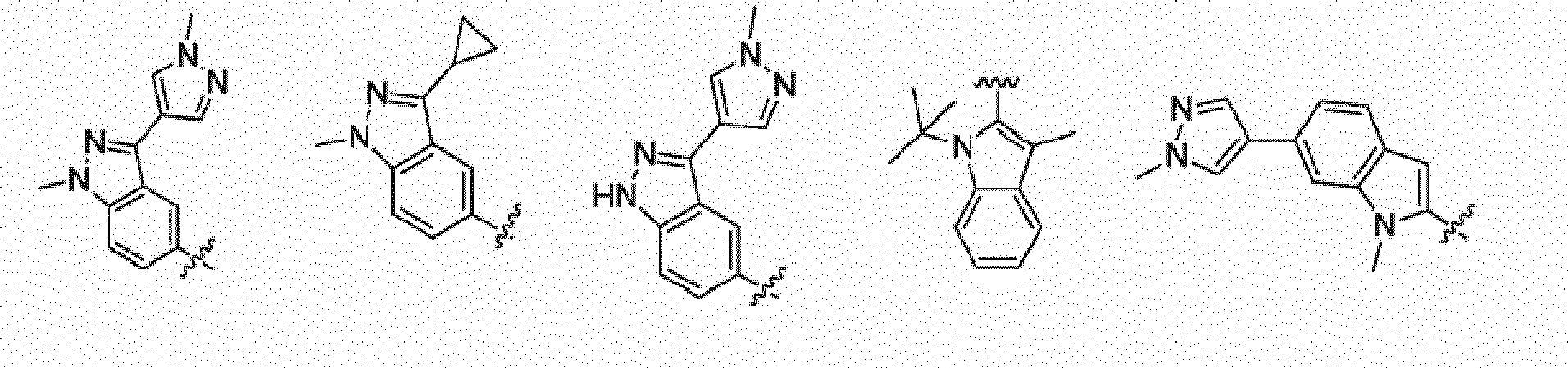


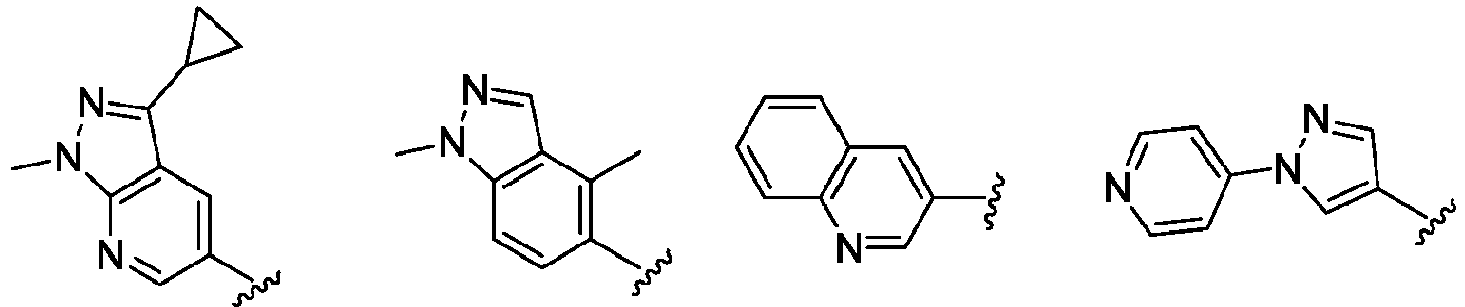








- In certain embodiments Rb is methyl ethyl, ethenyl, ethynyl,


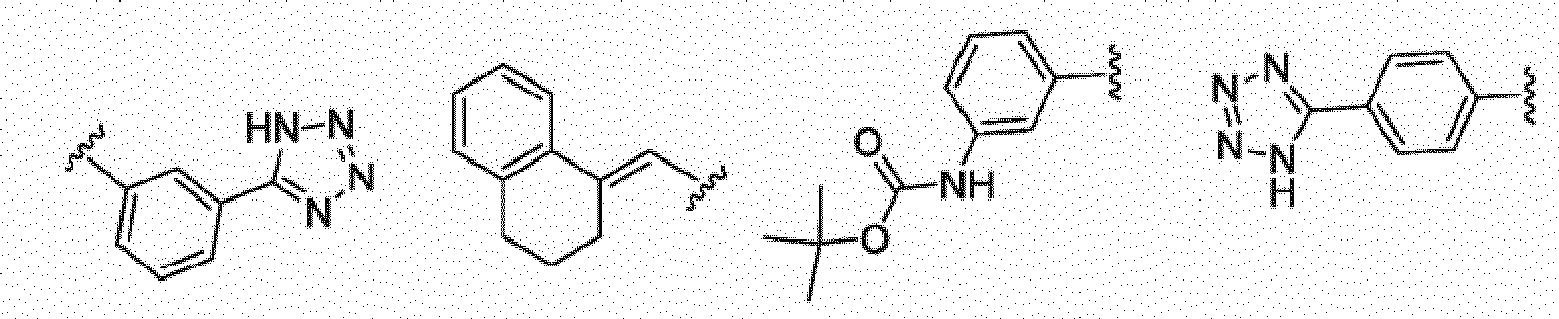


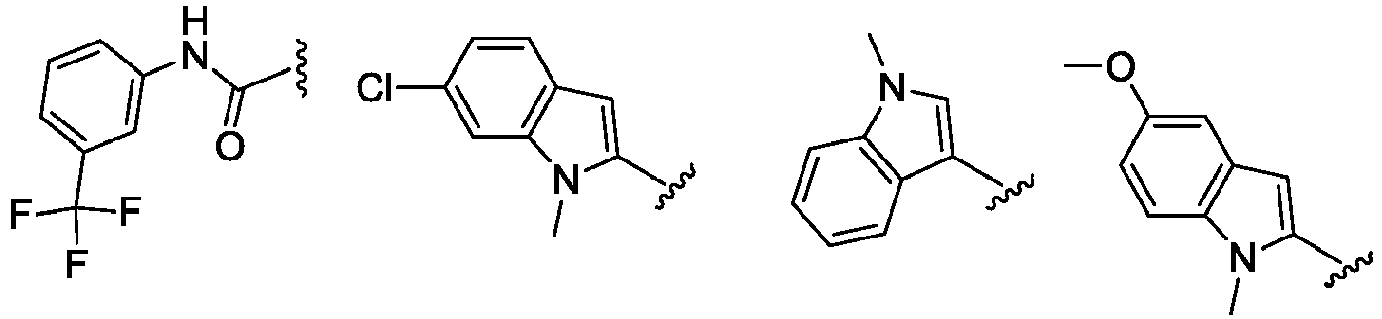








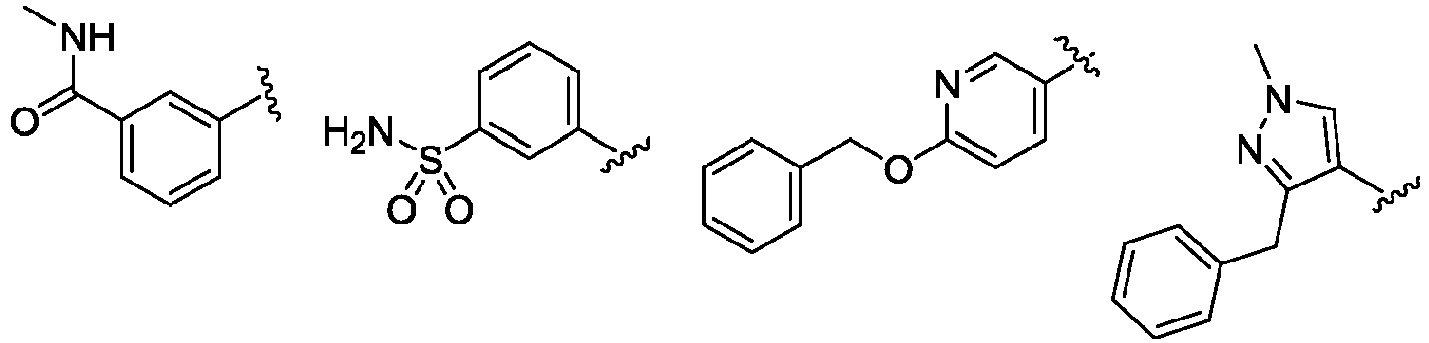








- In certain embodiments the compound is a compound of formula (Ib):

- X is NH, O, or -CH2-;
- Rc is C2-6alkenyl, C2-6alkynyl, 6-10 membered aryl, and 5-14 membered heteroaryl, wherein any C2-6alkenyl, C2-6alkynyl, 6-10 membered aryl, and 5-14 membered heteroaryl is optionally substituted with one or more groups R independently selected from the group consisting ofoxo, 3-20 membered carbocyclyl, 3-20 membered heterocyclyl, halo, -NO2, -N(Rg)2, -CN, -C(O)-N(Rg)2, -S(O)-N(Rg)2, -S(O)2-N(Rg)2, -O-Rg, -S-Rg, -O-C(O)-Rg, -C(O)-Rg, -C(O)-O-Rg, -S(O)-Rg, -S(O)2-Rg, -C(O)-N(Rg)2, -N(Rg)-C(O)-Rg, -Si(Rh)3, -N(Rg)-C(O)-O-Rg, -N(Rg)-S(O)-Rg, N(Rg)-S(O)2-Rg, and C1-6alkyl, which 3-20 membered carbocyclyl, 3-20 membered heterocyclyl, and C1-6alkyl are optionally substituted with one or more groups Ri independently selected from the group consisting of oxo, halo, C1-6alkyl, cyano, -N(R1)2, -O-R1, -S(O)-R1, -S(O)2-R1, -S(O)-N(R1)2, -S(O)2-N(R1)2, -N(R1)-S(O)-R1,-N(R1)-C(O)-R1,-N(R1)-C(O)-O-R1,-N(R1)-S(O)2-R1, 3-20 membered heterocyclyl, and 3-20 membered carbocyclyl that is optionally substituted with one or more groups Rm independently selected from the group consisting of halo, and C1-6alkyl; and
- Rh is is independently selected from the group consisting of H, C1-6alkyl, C2-6alkenyl, C2-6alkynyl, and C3-6carbocyclyl;
or a salt thereof. - In certain embodiments the compound is a compound of formula (Ib) wherein Rc is:





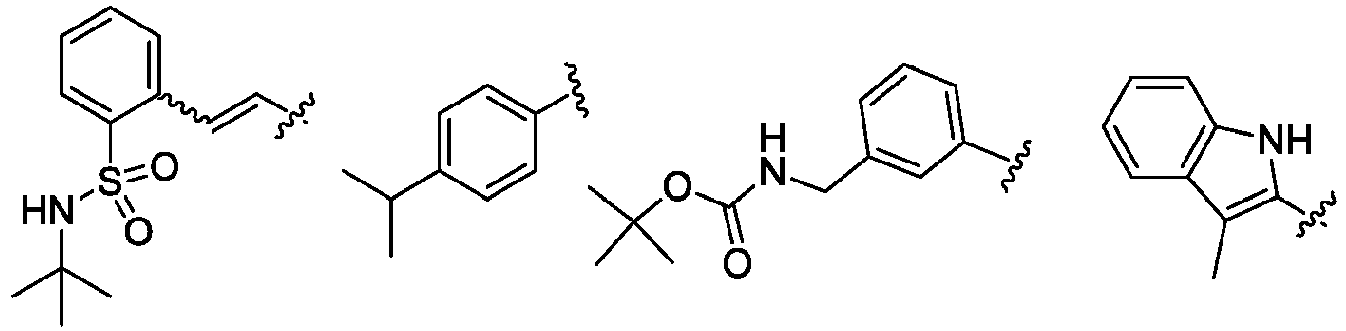


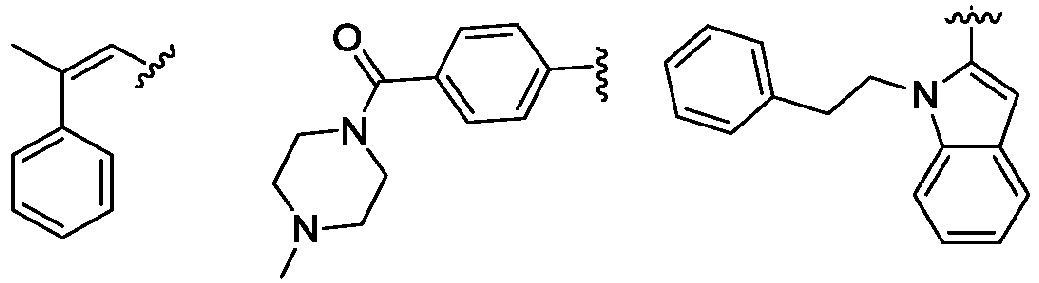
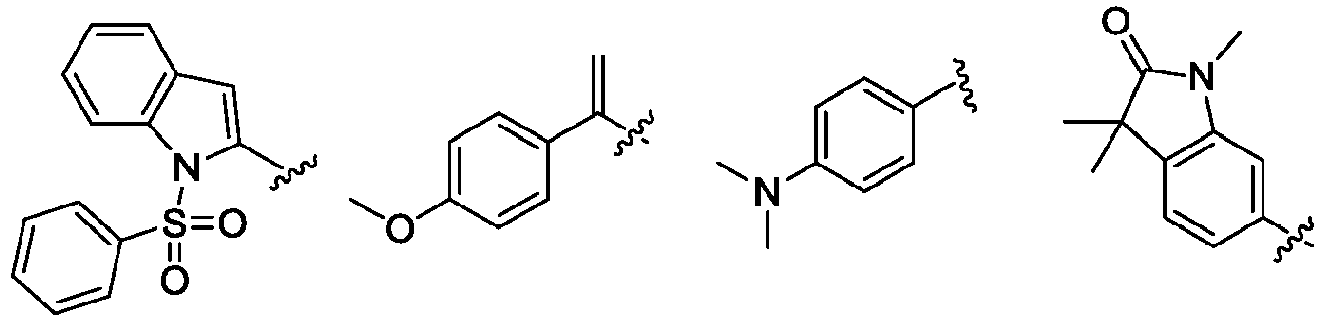


- In certain embodiments the compound is a compound of formula (Ic):

- X is NH or O;
- Rd is C1-6alkyl, 6-10 membered aryl, or 5-10 membered heteroaryl, wherein each C1-6alkyl, 6-10 membered aryl, or 5-10 membered heteroarylis optionally substituted with one or more groups R° independently selected from the group consisting ofoxo, halo, amino, hydroxyl, cyano, -O-Rp, 3-20 membered carbocyclyl, 3-20 membered heterocyclyl, and C1-C6 alkyl, wherein any C1-C6 alkyl, 3-20 membered carbocyclyl and 3-20 membered heterocyclyl is optionally substituted with one or more groups independently selected from the group consisting of oxo, C1-C4alkyl,-O-Rq, and halo;
- Rp is independently selected from the group consisting of hydrogen, C1-6alkyl, C2-6alkenyl, C2-6alkynyl, 3-20 membered carbocyclyl, and 3-20 membered heterocyclyl,wherein each C1-6alkyl, C2-6alkenyl, C2-6alkynyl, C1-6alkoxy, 3-20 membered carbocyclyl, and 3-20 membered heterocyclyl is optionally substituted with one or more halo; Rq is C1-6alkyl is optionally substituted with one or more halo;
or a salt thereof. - In certain embodiments the compound is a compound of formula (Ic), wherein Rd is:







- In certain embodiments the compound is a compound of formula (Id):

- Rcd is -(6-10 membered aryl)-Y, -(6-10 membered aryl)-Y, or 5-14 membered heteroaryl, wherein any 6-10 membered aryl and 5-14 membered heteroaryl is optionally substituted with one or more groups independently selected from the group consisting of oxo, 3-20 membered carbocyclyl, 3-20 membered heterocyclyl, halo, -NO2, -N(Rg)2, -CN, -C(O)-N(Rg)2, -S(O)-N(Rg)2, -S(O)2-N(Rg)2, -O-Rg, -S-Rg, -O-C(O)-Rg, -C(O)-Rg, -C(O)-O-Rg,-S(O)-Rg, -S(O)2-Rg, -C(O)-N(Rg)2, -N(Rg)-C(O)-Rg, -Si(Rh)3, -N(Rs)-C(O)-O-Rg, -N(Rg)-S(O)-Rg, N(Rg)-S(O)2-Rg, and C1-6alkyl, which 3-20 membered carbocyclyl, 3-20 membered heterocyclyl, and C1-6alkyl are optionally substituted with one or more groups Ri;
- Y is (6-10 membered aryl) or (5-14 membered heteroaryl) optionally substituted with one or more groups Ri;
- each Ri is independently selected from the group consisting of oxo, halo, C1-6alkyl, cyano, -N(R1)2, -O-R1, -S(O)-R1, -S(O)2-R1, -S(O)-N(R1)2, -S(O)2-N(R1)2, -N(R1)-S(O)-R1, -N(R1)-C(O)-R1, -N(R1)-C(O)-O-R1, -N(R1)-S(O)2-R1, 3-20 membered heterocyclyl, and 3-20 membered carbocyclyl that is optionally substituted with one or more groups independently selected from the group consisting of halo, and C1-6alkyl;
- each R1 is independently selected from the group consisting of hydrogen, C1-6alkyl, C2-6alkenyl, C2-6alkynyl, 3-20 membered carbocyclyl, and 3-20 membered heterocyclyl, wherein each C1-6alkyl, C2-6alkenyl, C2-6alkynyl, C1-6alkoxy, 3-20 membered carbocyclyl, and 3-20 membered heterocyclyl is optionally substituted with one or more groups Rm ;
- each Rm is independently selected from the group consisting of oxo, halo, amino, hydroxyl, -Si(Rn)3, 3-20 membered carbocyclyl, 3-20 membered heterocyclyl, and C1-C6 alkyl, wherein any 3-20 membered carbocyclyl, 3-20 membered heterocyclyl, and C1-C6 alkyl is optionally substituted with one or more groups independently selected from the group consisting of oxo, C1-C4alkyl, and halo; and
- each Rn is independently selected from the group consisting of H, C1-6alkyl, C2-6alkenyl, C2-6alkynyl, and C3-6carbocyclyl;
or a salt thereof. - In certain embodiments the compound is a compound of formula (Id), wherein Rcd is





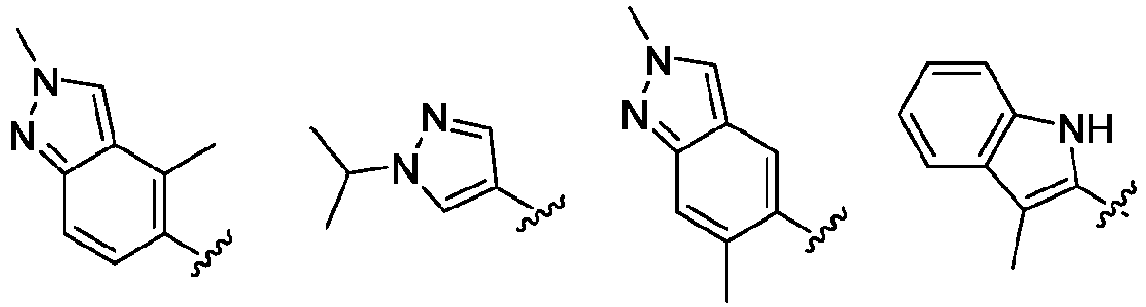
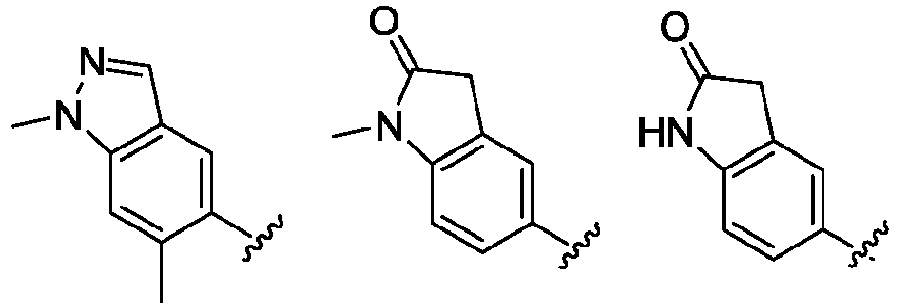


- In certain embodiments the compound is a compound of formula (Ie):

- one of D, E, and F is N and the remaining of D, E, and F are CH; and
- Rbe is 6-10 membered aryl or 5-14 membered heteroaryl, wherein any 6-10 membered aryl and 5-14 membered heteroaryl is optionally substituted with one or more groups independently selected from the group consisting of oxo, 3-20 membered carbocyclyl, 3-20 membered heterocyclyl, halo, -NO2, -N(Rg)2, -CN, -C(O)-N(Rg)2, -S(O)-N(,Rg)2, -S(O)2-N(Rg)2, -O-Rg, -S-Rg, -O-C(O)-Rg, -C(O)-Rg, -C(O)-O-Rg, -S(O)-Rg, -S(O)2-Rg, -C(O)-N(Rg)2, -N(Rg)-C(O)-Rg, -Si(Rh)3, -N(Rg)-C(O)-O-Rg-, -N(Rg)-S(O)-Rg, N(Rg)-S(O)2-Rg, and C1-6alkyl, which 3-20 membered carbocyclyl, 3-20 membered heterocyclyl, and C1-6alkyl are optionally substituted with one or more groups independently selected from the group consisting of oxo, halo, C1-6alkyl, cyano, -N(R1)2, -O-R1, -S(O)-R1, -S(O)2-R1, -S(O)-N(R1)2,-S(O)2-N(R1)2, -N(R1)-S(O)-R1, -N(R1)-C(O)-R1, -N(R1)-C(O)-O-R1, -N(R1)-S(O)2-R1, 3-20 membered heterocyclyl, and 3-20 membered carbocyclyl that is optionally substituted with one or more groups independently selected from the group consisting of halo, and C1-6alkyl; or a salt thereof.
- In certain embodiments the compound is a compound of formula (Ie), wherein Rbe is








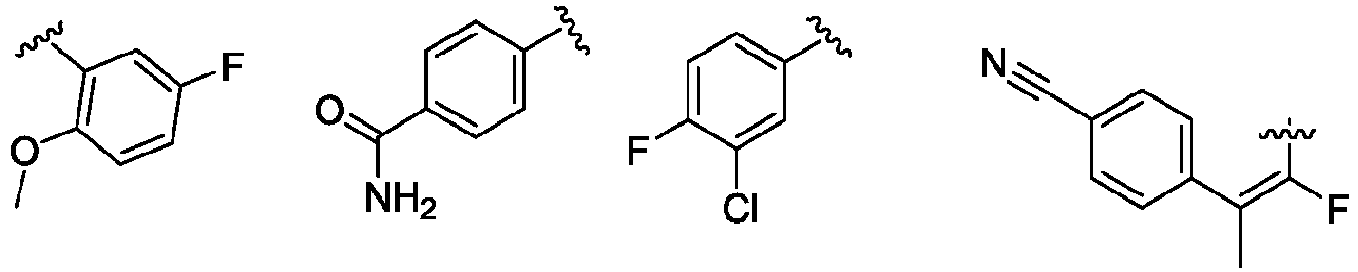


- In certain embodiments the compound is a compound of formula (Ie), wherein Rbe is

- In certain embodiments the compound is a compound of formula (If):

X is NH, O, S, or --C(Ra)2-; and Rbf is: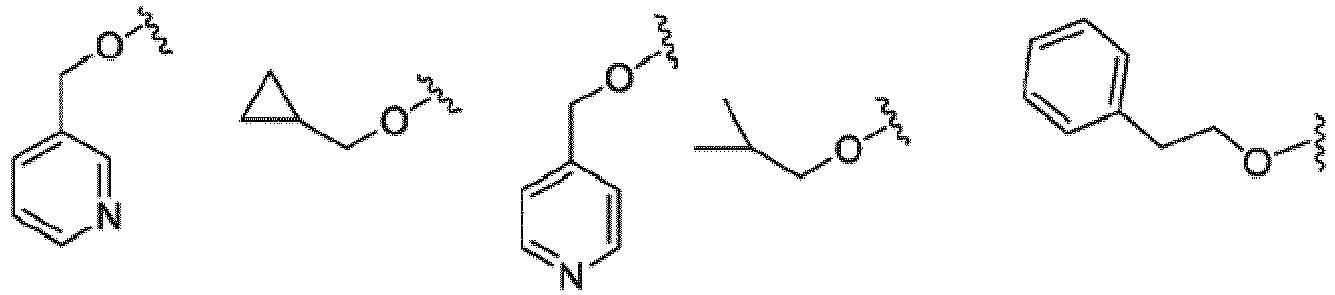


- In certain embodiments the compound is a compound selected from the group consisting of:


- In certain embodiments the compound is a compound selected from the group consisting of:





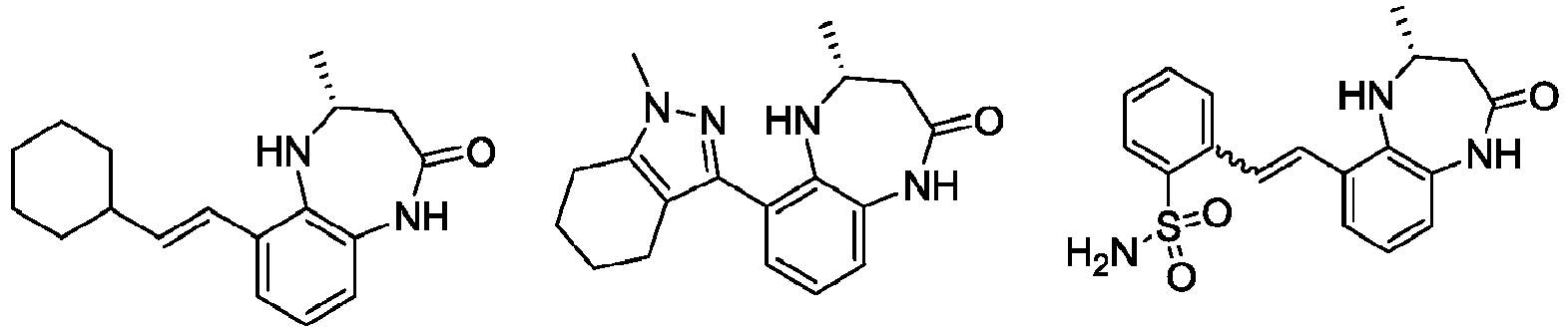
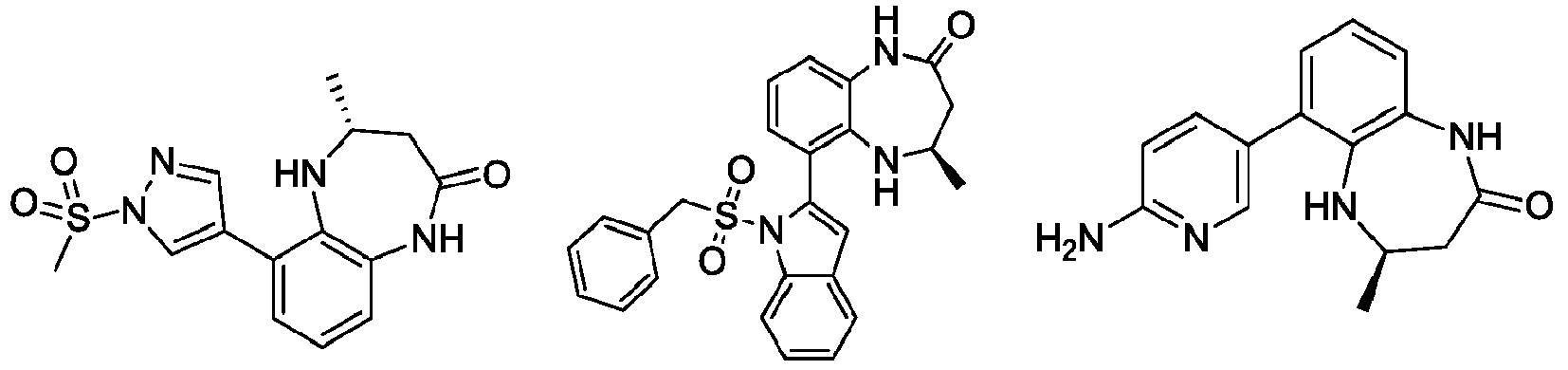

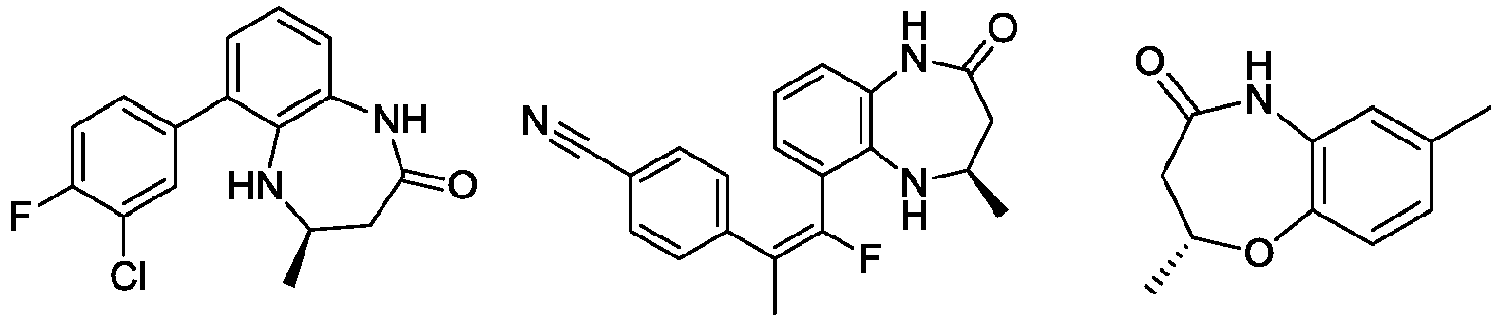

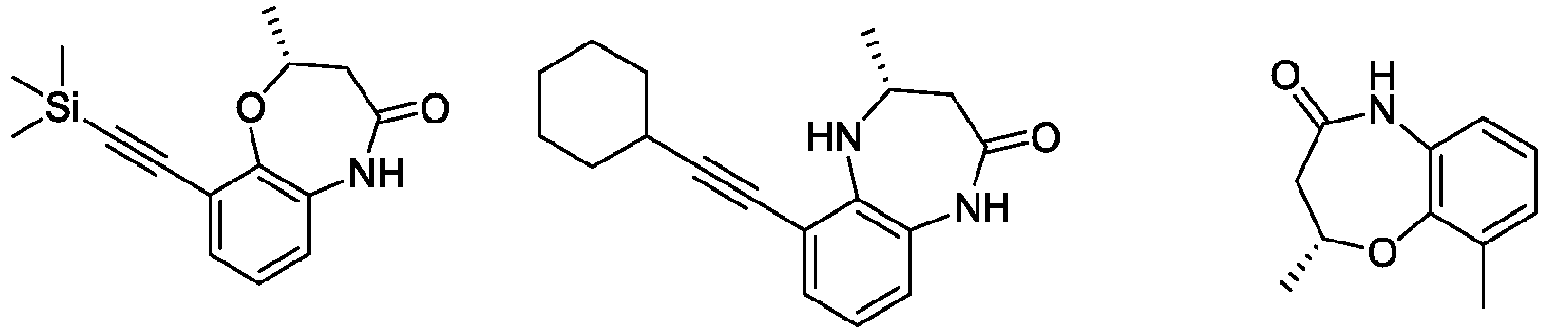


- In certain embodiments the compound is a compound as described in the Examples herein, or a freebase or salt thereof.
- Another aspect includes a pharmaceutical composition comprising a compound of formula (1) or a pharmaceutically acceptable salt thereof. and a pharmaceutically acceptable carrier, adjuvant, or vehicle. In another embodiment, the composition further comprises an amount of the compound effective to measurably inhibit a bromodomain of CBP and/or EP300. In certain embodiments, the composition is formulated for administration to a patient in need thereof.
- The term "patient" or "individual" as used herein, refers to an animal, such as a mammal, such as a human. In one embodiment, patient or individual refers to a human.
- The term "pharmaceutically acceptable carrier, adjuvant, or vehicle" refers to a non-toxic carrier, adjuvant, or vehicle that does not destroy the pharmacological activity of the compound with which it is formulated. Pharmaceutically acceptable carriers, adjuvants or vehicles that may be used in the compositions of this invention include, but are not limited to, ion exchangers, alumina, aluminum stearate, lecithin, serum proteins, such as human serum albumin, buffer substances such as phosphates, glycine, sorbic acid, potassium sorbate, partial glyceride mixtures of saturated vegetable fatty acids, water, salts or electrolytes, such as protamine sulfate, disodium hydrogen phosphate, potassium hydrogen phosphate, sodium chloride, zinc salts, colloidal silica, magnesium trisilicate, polyvinyl pyrrolidone, cellulose-based substances, polyethylene glycol, sodium carboxymethylcellulose, polyacrylates, waxes, polyethylene-polyoxypropylene-block polymers, polyethylene glycol and wool fat.
- Compositions comprising a compound of formula I or salt thereof may be administered orally, parenterally, by inhalation spray, topically, transdennally, rectally, nasally, buccally, sublingually, vaginally, intraperitoneal, intrapulmonary, intradermal, epidural or via an implanted reservoir. The term "parenteral" as used herein includes subcutaneous, intravenous, intramuscular, intra-articular, intra-synovial, intrastemal, intrathecal, intrahepatic, intralesional and intracranial injection or infusion techniques.
- In one embodiment, the composition comprising a compound of formula I or salt thereof is formulated as a solid dosage form for oral administration. Solid dosage forms for oral administration include capsules, tablets, pills, powders, and granules. In certain embodiments, the solid oral dosage form comprising a compound of formula (I) or a salt thereof further comprises one or more of (i) an inert, pharmaceutically acceptable excipient or carrier, such as sodium citrate or dicalcium phosphate, and (ii) filler or extender such as starches, lactose, sucrose, glucose, mannitol, or silicic acid, (iii) binders such as carboxymethylcellulose, alginates, gelatin, polyvinylpyrrolidinone, sucrose or acacia, (iv) humectants such as glycerol, (v) disintegrating agent such as agar, calcium carbonate, potato or tapioca starch, alginic acid, certain silicates or sodium carbonate, (vi) solution retarding agents such as paraffin, (vii) absorption accelerators such as quaternary ammonium salts, (viii) a wetting agent such as cetyl alcohol or glycerol monostearate, (ix) absorbent such as kaolin or bentonite clay, and (x) lubricant such as talc, calcium stearate, magnesium stearate, polyethylene glycols or sodium lauryl sulfate. In certain embodiments, the solid oral dosage form is formulated as capsules, tablets or pills. In certain embodiments, the solid oral dosage form further comprises buffering agents. In certain embodiments, such compositions for solid oral dosage forms may be formulated as fillers in soft and hard-filled gelatin capsules comprising one or more excipients such as lactose or milk sugar, polyethylene glycols and the like.
- In certain embodiments, tablets, dragees, capsules, pills and granules of the compositions comprising a compound of formula I or salt thereof optionally comprise coatings or shells such as enteric coatings. They may optionally comprise opacifying agents and can also be of a composition that they release the active ingredient(s) only, or preferentially, in a certain part of the intestinal tract, optionally, in a delayed manner. Examples of embedding compositions include polymeric substances and waxes, which may also be employed as fillers in soft and hard-filled gelatin capsules using such excipients as lactose or milk sugar as well as high molecular weight polethylene glycols and the like.
- In another embodiment, a composition comprises micro-encapsulated compound of formula (I) or salt thereof, and optionally, further comprises one or more excipients.
- In another embodiment, compositions comprise liquid dosage formulations comprising a compound of formula I or salt thereof for oral administration, and optionally further comprise one or more of pharmaceutically acceptable emulsions, microemulsions, solutions, suspensions, syrups and elixirs. In certain embodiments, the liquid dosage form optionally, further comprise one or more of an inert diluent such as water or other solvent, a solubilizing agent, and an emulsifier such as ethyl alcohol, isopropyl alcohol, ethyl carbonate, ethyl acetate, benzyl alcohol, benzyl benzoate, propylene glycol, 1,3-butylene glycol, dimethylformamide, oils (in particular, cottonseed, groundnut, corn, germ, olive, castor, and sesame oils), glycerol, tetrahydrofurfuryl alcohol, polyethylene glycols or fatty acid esters of sorbitan, and mixtures thereof. In certain embodiments, liquid oral compositions optionally further comprise one or more adjuvant, such as a wetting agent, a suspending agent, a sweetening agent, a flavoring agent and a perfuming agent.
- Injectable preparations, for example, sterile injectable aqueous or oleaginous suspensions may be formulated according to the known art using suitable dispersing or wetting agents and suspending agents. The sterile injectable preparation may also be a sterile injectable solution, suspension or emulsion in a nontoxic parenterally acceptable diluent or solvent, for example, as a solution in 1,3-butanediol. Among the acceptable vehicles and solvents that may be employed are water, Ringer's solution, U.S.P. and isotonic sodium chloride solution. In addition, sterile, fixed oils are conventionally employed as a solvent or suspending medium. For this purpose any bland fixed oil can be employed including synthetic mono- or diglycerides. In addition, fatty acids such as oleic acid are used in the preparation of injectables.
- Injectable formulations can be sterilized, for example, by filtration through a bacterial-retaining filter, or by incorporating sterilizing agents in the form of sterile solid compositions which can be dissolved or dispersed in sterile water or other sterile injectable medium prior to use.
- In order to prolong the effect of a compound of formula (I), it is often desirable to slow the absorption of the compound from subcutaneous or intramuscular injection. This may be accomplished by the use of a liquid suspension of crystalline or amorphous material with poor water solubility. The rate of absorption of the compound then depends upon its rate of dissolution that, in turn, may depend upon crystal size and crystalline form. Alternatively, delayed absorption of a parenterally administered compound form is accomplished by dissolving or suspending the compound in an oil vehicle. Injectable depot forms are made by forming microencapsule matrices of the compound in biodegradable polymers such as polylactide-polyglycolide. Depending upon the ratio of compound to polymer and the nature of the particular polymer employed, the rate of compound release can be controlled. Examples of other biodegradable polymers include poly(orthoesters) and poly(anhydrides). Depot injectable formulations are also prepared by entrapping the compound in liposomes or microemulsions that are compatible with body tissues.
- In certain embodiments, the composition for rectal or vaginal administration are formulated as suppositories which can be prepared by mixing a compound of formula (I) or a salt thereof with suitable non-irritating excipients or carriers such as cocoa butter, polyethylene glycol or a suppository wax, for example those which are solid at ambient temperature but liquid at body temperature and therefore melt in the rectum or vaginal cavity and release the compound of formula (I),
- Example dosage forms for topical or transdermal administration of a compound of formula (I) include ointments, pastes, creams, lotions, gels, powders, solutions, sprays, inhalants or patches. The compound of formula (I) or a salt thereof is admixed under sterile conditions with a pharmaceutically acceptable carrier, and optionally preservatives or buffers. Additional formulation examples include an ophthalmic formulation, ear drops, eye drops,. transdermal patches. Transdermal dosage forms can be made by dissolving or dispensing the compound of formula (1) or a salt thereof in medium, for example ethanol or dimethylsulfoxide. Absorption enhancers can also be used to increase the flux of the compound across the skin. The rate can be controlled by either providing a rate controlling membrane or by dispersing the compound in a polymer matrix or gel.
- Nasal aerosol or inhalation formulations of a compound of formula (I) or a salt thereofinay be prepared as solutions in saline, employing benzyl alcohol or other suitable preservatives, absorption promotors to enhance bioavailability, fluorocarbons, and/or other conventional solubilizing or dispersing agents.
- Pharmaceutical compositions may be administered with or without food.
- Specific dosage and treatment regimen for any particular patient will depend upon a variety of factors, including age, body weight, general health, sex, diet, time of administration, rate of excretion, drug combination, the judgment of the treating physician, and the severity of the particular disease being treated. The amount of a provided compound of formula I or salt thereof in the composition will also depend upon the particular compound in the composition.
- In one embodiment, the therapeutically effective amount of the compound of the invention administered parenterally per dose will be in the range of about 0.01-100 mg/kg, alternatively about 0.1 to 20 mg/kg of patient body weight per day, with the typical initial range of compound used being 0.3 to 15 mg/kg/day. In another embodiment, oral unit dosage forms, such as tablets and capsules, contain from about 5 to about 100 mg of the compound of the invention.
- An example tablet oral dosage form comprises about 2 mg, 5 mg, 25mg, 50mg, 100mg, 250mg or 500mg of a compound of formula (I) or salt thereof, and further comprises about 5-30 mg anhydrous lactose, about 5-40 mg sodium croscarmellose, about 5-30mg polyvinylpyrrolidone (PVP) K30 and about 1-10 mg magnesium stearate. The process of formulating the tablet comprises mixing the powdered ingredients together and further mixing with a solution of the PVP. The resulting composition can be dried, granulated, mixed with the magnesium stearate and compressed to tablet form using conventional equipment. An example of an aerosol formulation can be prepared by dissolving about 2-500 mg of a compound of formula I or salt thereof, in a suitable buffer solution, e.g. a phosphate buffer, and adding a tonicifier, e.g. a salt such sodium chloride, if desired. The solution may be filtered, e.g. using a 0.2 micron filter, to remove impurities and contaminants.
- Described herein is the use of a compound of formula (I) or a salt thereof for the inhibition of a bromodomain (in vitro or in vivo) (e.g., in vitro or in vivo inhibition of the bromodomain of CBP/EP300).
- Also described herein is a method for treating a bromodomain-mediated disorder (e.g., CBP/EP300 bromodomain-mediated disorder) in an animal comprising administering a compound of formula (I), or a pharmaceutically acceptable salt thereof to the animal. CBP/EP300-mediated disorders include, but are not limited to those disorders described herein.
- Also described herein is a method of increasing efficacy of a cancer treatment comprising a cytotoxic agentin an animal comprising administering to the animal an effective amount of a compound of formula (I) or a pharmaceutically acceptable salt thereof.
- Also described herein is a method of extending the duration of response to a cancer therapy in an animal, comprising administering to an animal undergoing the cancer therapy a compound of formula (I) or a pharmaceutically acceptable salt thereof, wherein the duration of response to the cancer therapy when the compound of formula (I) or the pharmaceutically acceptable salt thereof is administered is extended over the duration of response to the cancer therapy in the absence of the administration of the compound of formula (I) or the pharmaceutically acceptable salt thereof.
- Also described herein is a method of treating cancer in an individual comprising administering to the individual (a) a compound of formula (I) or a pharmaceutically acceptable salt thereof, and (b) a cytotoxic agent. In one case the cytotoxic agent is selected from anti-microtubule agents, platinum coordination complexes, alkylating agents, antibiotic agents, topoisomerase II inhibitors, antimetabolites, topoisomerase I inhibitors, hormones and hormonal analogues, signal transduction pathway inhibitors, non-receptor tyrosine kinase angiogenesis inhibitors, immunotherapeutic agents, proapoptotic agents, inhibitors of LDH-A, inhibitors of fatty acid biosynthesis,cell cycle signaling inhibitors, HDAC inhibitors, proteasome inhibitors, and inhibitors of cancer metabolism. In one case the cytotoxic agent is a taxane. In one case the taxane is paclitaxel or docetaxel, In one case the cytotoxic agent is a platinum agent. In one case the cytotoxic agentis an antagonist of EGFR. In one case the antagonist of EGFR is N-(3-ethynylphenyl)-6,7-bis(2-methoxyethoxy)quinazolin-4-amine or a pharmaceutically acceptable salt thereof (e.g., erlotinib). In one case the cytotoxic agentis a RAF inhibitor. In one case the RAF inhibitor is a BRAF or CRAF inhibitor. In one case the RAF inhibitor is vemurafenib. In one case the cytotoxic agent is a PI3K inhibitor.
- In some cases, treatment may be administered after one or more symptoms have developed. In other cases, treatment may be administered in the absence of symptoms. For example, treatment may be administered to a susceptible individual prior to the onset of symptoms (e.g., in light of a history of symptoms and/or in light of genetic or other susceptibility factors). Treatment may also be continued after symptoms have resolved, for example to prevent or delay their recurrence.
- In some cases, provided are methods of enhancing immune function in an individual having cancer comprising administering an effective amount of any CBP/EP300 bromodomain inhibitors disclosed herein. In some of any of the methods, the CD8T cells in the individual have enhanced priming, activation, proliferation, and/or cytolytic activity relative to prior to the administration of the CBP/EP300 bromodomain inhibitor. In some cases, the number of CD8 T cells is elevated relative to prior to administration of the CBP/EP300 bromodomain inhibitors. In some cases, the CD8 T cells have reduced levels of expression of one or more of the following biomarkers: IFNA17,IGF1, FSCN1, SUMO2, CIorf129,EIF2S2, TDGF1, AIDA, CCR4, CD160, MC4R, KRTAP2-2, MTIJP, OR4N2, KRTAP4-5, MTIL // MTIL,ILI3, LCEID, KIR2DL2, LOC158696, LIF, IL28A, TAS2R13, CTLA4, and/or FOXP3 relative to prior to administration of the CBP/EP300 bromodomain inhibitor. In some cases, the CD8 T cells have reduced levels of expression of CD160 and/or KIR2DL2 relative to prior to administration of the CBP/EP300 bromodomain inhibitor.
- In some of the methods of enhancing immune function, the enhanced immune function is characterized by Treg cells in the individual (e.g., at the tumor site(s)) have reduced levels of expression of one or more of the following markers: IL28A, GPR87, ANKRD37, CABLES 1, RAPGEF2, TRIM69, MT1L // MT1L, FAM1138, FOXP3, CSF2, OCM2, GLIPR1, FGFBP2, CTLA4, CST7, GOLGA6L1, IFIT3, FAM13A, APOD, AK2, CLDN1, HSD11B1, DNAJC12, PHEX,IL2, FOXD4L3, GNA15, ZBTB32, RDH10,OR52E5, CYP2A6, GZMH, CCL20, ADM, LOC100131541, RNF122,FAM36A, AMY2B, GPR183, MYOF,IL29, AIDA, SPRYI, ENOPH1, IL1RN, SLAMF1, PGM2L1, SSBP3, MMP23B, HISTIH3J, MYO1B, BEND5, SIPR1, CDK6, GPR56, ZC3HIZA, DOK5, DUSPI, CYB5R2, KCNAB2, LAG3, KLF10, GK, SHC4, IL12RB2, CD109, HAVCR2 (TIM-3), LTA, FAM40B, HMGCSI, HSPAIA, ZNF705A, CMAH, KIF3A, CHN1, KBTBD8, TNF, MOP-1, RASGRP4, INSIG1, SLAMF7, OR10H4, LPL, HIST1H2BJ, LIF, IGF1, IL18RAP, OR52N4, ORID2. CCR4, CXCR5, IL1R1, MICAL2, NRN1, PICALM, B3GNT5, IFI44L, CXCR3,ICOS,IFIT2, NCR3, HSPA1B, CD80, GNG2, C7orf68, GPR171, RPS10P7, IL23A, LOC283174, PLK2, EMP1, FNBP1L, CD226, RBMS3, IL23R, PTGER4, GZMB, F5, and/or HIST I H2BK relative to prior to administration of CBP/EP300 bromodomain inhibitor.
- In some cases, the Treg cell biomarker is one or more of LAG3, CTLA4, and/or FOXP3.In some of the methods of enhancing immune function, the enhanced immune function is characterized by enhanced naive T cell responsiveness to CD3/CD28 stimulation in the presence of Treg cells. In some cases, the CD8 T cell priming is characterized by increased T cell proliferation and/or enhanced cytolytic activity in CD8 T cells. In some cases, the CD8 T cell activation is characterized by an elevated frequency of T- IFNt CD8 T cells. In some cases, the CD8 T cell is an antigen-specific T-cell. : In some cases, the immune evasion is inhibited.
- The methods described herein are useful in treating conditions where enhanced immunogenicity is desired such as increasing tumor immunogenicity for the treatment of cancer. For example, provided herein are CBP/EP300 bromodomain inhibitors for use to enhance T-cell function to upregulate cell-mediated immune responses and for the treatment of T cell dysfunctional disorders, tumor immunity. In some cases, the CBP/EP300 bromodomain inhibitors promote anti-tumor immunity by inhibiting the suppressive function of regulatory T (Treg) cells and/or relieving T cell exhaustion on chronically stimulated CD8+ T cells. CBP/EP300 bromodomain inhibitors are further useful in reducing FOXP3 expression during extra-thymic Treg cell differentiation. Continual FOXP3 expression is essential to maintain suppressive activity in Treg cells. In some cases, reduced FOXP3 expression through CBP/EP300 bromodomain inhibition impairs Treg cells suppressive activity and promotes tumor antiimmunity. Treg cells are highly enriched in tumors derived from multiple cancer indications, including melanoma, NSCLC, renal, overian, colon, pancreatic, hepatocellular, and breast cancer. In a subset of these indications, increased intratumoral Treg cell densities are associated with poor patient prognosis. These indications include NSCLC, ovarian, pancreatic, hepatocellular, and breat cancer. CBP/EP300 bromodomain inhibitors are predicted to impair intrtumoral Treg cell function in these cancer indications to enhance effector T cell activity. In other cases the CBP/EP300 bromodomain inhibitors may be used to treat infectious diseases, where some pathogens may have evolved to manipulate regulatory T (Treg) cells to immunosuppress the host to ensure survival, such as in retrovial infections (e.g., HIV), mycobacterial infections (e.g., tuberculosis), and parasitic infections (e.g., Leishmania and malaria).
- A "CBP and/or EP300-mediated disorder"is characterized by the participation of the bromodomains of CBP and/or EP300 in the inception, manifestation of one or more symptoms or disease markers, severity, or progression of a disorder. In one case the bromodomain-mediated disorder is a CBP bromodomain-mediated disorder. In one case the bromodomain-mediated disorder is an EP300 bromodomain-mediated disorder.
- CBP and/or EP300 bromodomain-mediated disorders include cancers, including, but not limited to acoustic neuroma, acute leukemia, acute lymphocytic leukemia, acute myelocytic leukemia (monocytic, myeloblastic, adenocarcinoma, angiosarcoma, astrocytoma, myelomonocytic and promyelocytic), acute T-cell leukemia, basal cell carcinoma, bile duct carcinoma, bladder cancer, brain cancer, breast cancer, bronchogenic carcinoma, cervical cancer, chondrosarcoma, chordoma, choriocarcinoma, chronic leukemia, chronic lymphocytic leukemia, chronic myelocytic (granulocytic) leukemia, chronic myelogenous leukemia, colon cancer, colorectal cancer, craniopharyngioma, cystadenocarcinoma, diffuse large B-cell lymphoma, dysproliterative changes (dysplasias and metaplasias), embryonal carcinoma, endometrial cancer, endotheliosarcoma, ependymoma, epithelial carcinoma, erythroleukemia, esophageal cancer, estrogen-receptor positive breast cancer, essential thrombocythemia, Ewing's tumor, fibrosarcoma, follicular lymphoma, germ cell testicular cancer, glioma, glioblastoma, gliosarcoma, heavy chain disease, hemangioblastoma, hepatoma, hepatocellular cancer, hormone insensitive prostate cancer, leiomyosarcoma, leukemia, liposarcoma, lung cancer, lymphagioendotheliosarcoma, lymphangiosarcoma, lymphoblastic leukemia, lymphoma (Hodgkin's and non-Hodgkin's), malignancies and hyperproliferative disorders of the bladder, breast, colon, lung, ovaries, pancreas, prostate, skin and uterus, lymphoid malignancies off-cell or B-cell origin, medullary carcinoma, medulloblastoma, melanoma, meningioma, mesothelioma, multiple myeloma, myelogenous leukemia, myeloma, myxosarcoma, neuroblastoma, NUT midline carcinoma (NMC), non-small cell lung cancer, oligodendroglioma, oral cancer, osteogenic sarcoma, ovarian cancer, pancreatic cancer, papillary adenocarcinomas, papillary carcinoma, pinealoma, polycythemia vera, prostate cancer, rectal cancer, renal cell carcinoma, retinoblastoma, rhabdomyosarcoma, sarcoma, sebaceous gland carcinoma, seminoma, skin cancer, small cell lung carcinoma, solid tumors (carcinomas and sarcomas), small cell lung cancer, stomach cancer, squamous cell carcinoma, synovioma, sweat gland carcinoma, thyroid cancer, Waldenstr6m's macroglobulinemia, testicular tumors, uterine cancer and Wilms' tumor.
- In certain embodiments, the cancer is lung cancer, breast cancer, pancreatic cancer, colorectal cancer, and/or melanoma. In certain embodiments, the cancer is lung. In certain embodiments, the lung cancer is NSCLC. In certain embodiments, the cancer is breast cancer.
- In certain embodiments, the cancer is melanoma.
- CBP and/or EP300-mediated disorders also include inflammatory diseases, inflammatory conditions, and autoimmune diseases, including, but not limited to: Addison's disease, acute gout, ankylosing spondylitis, asthma, atherosclerosis, Behcet's disease, bullous skin diseases, chronic obstructive pulmonary disease (COPD), Crohn's disease, dermatitis, eczema, giant cell arteritis, glomerulonephritis, hepatitis, hypophysitis, inflammatory bowel disease, Kawasaki disease, lupus nephritis, multiple sclerosis, myocarditis, myositis, nephritis, organ transplant rejection, osteoarthritis, pancreatitis, pericarditis, Polyarteritis nodosa, pneumonitis, primary biliary cirrhosis, psoriasis, psoriatic arthritis, rheumatoid arthritis, scleritis, sclerosing cholangitis, sepsis, systemic lupus erythematosus, Takayasu's Arteritis, toxic shock, thyroiditis, type I diabetes, ulcerative colitis, uveitis, vitiligo, vasculitis, and Wegener's granulomatosis.
- CBP and/or EP300-mediated disorders also include AIDS; chronic kidney diseases, including, but are not limited to diabetic nephropathy, hypertensive nephropathy, HIV-associated nephropathy, glomerulonephritis, lupus nephritis, IgA nephropathy, focal segmental glomerulosclerosis, membranous glomerulonephritis, minimal change disease, polycystic kidney disease and tubular interstitial nephritis; acute kidney injury or disease or condition including, but are not limited to ischemia-reperfusion induced, cardiac and major surgery induced, percutaneous coronary intervention induced, radio-contrast agent induced, sepsis induced, pneumonia induced, and drug toxicity induced; obesity; dyslipidemia; hypercholesterolemia; Alzheimer's disease; metabolic syndrome; hepatic steatosis; type II diabetes; insulin resistance; and diabetic retinopathy.
- CBP and/or EP300 inhibitors may also be used to provide male contraception.
- The compounds of formula (I) or salts therof may be employed alone or in combination with other agents for treatment For example, the second agent of the pharmaceutical combination formulation or dosing regimen may have complementary activities to the compound of formula (I) such that they do not adversely affect each other. The compounds may be administered together in a unitary pharmaceutical composition or separately. In one case, a compound or a pharmaceutically acceptable salt can be co-administered with a cytotoxic agent to treat proliferative diseases and cancer.
The term "co-administering" refers to either simultaneous administration, or any manner of separate sequential administration, of a compound of formula (I) or a salt thereof, and a further active pharmaceutical ingredient or ingredients, including cytotoxic agents and radiation treatment. If the administration is not simultaneous, the compounds are administered in a close time proximity to each other. Furthermore, it does not matter if the compounds are administered in the same dosage form, e.g. one compound may be administered topically and another compound may be administered orally. - Those additional agents may be administered separately from an inventive compound-containing composition, as part of a multiple dosage regimen. Alternatively, those agents may be part of a single dosage form, mixed together with a compound of this invention in a single composition. If administered as part of a multiple dosage regime, the two active agents may be submitted simultaneously, sequentially or within a period of time from one another normally within five hours from one another.
- As used herein, the term "combination," "combined," and related terms refers to the simultaneous or sequential administration of therapeutic agents in accordance with this invention. For example, a compound of the present invention may be administered with another therapeutic agent simultaneously or sequentially in separate unit dosage forms or together in a single unit dosage form. Accordingly, the present invention provides a single unit dosage form comprising a compound of formula I, an additional therapeutic agent, and a pharmaceutically acceptable carrier, adjuvant, or vehicle.
- The amount of both an inventive compound and additional therapeutic agent (in those compositions which comprise an additional therapeutic agent as described above) that may be combined with the carrier materials to produce a single dosage form will vary depending upon the host treated and the particular mode of administration. In certain embodiments, compositions of this invention are formulated such that a dosage of between 0.01 - 100 mg/kg body weight/day of an inventive can be administered.
- Typically, any agent that has activity against a disease or condition being treated may be co-administered. Examples of such agents can be found in Cancer Principles and Practice of Oncology by V.T. Devita and S. Hellman (editors), 6th edition (February 15, 2001), Lippincott Williams & Wilkins Publishers. A person of ordinary skill in the art would be able to discern which combinations of agents would be useful based on the particular characteristics of the drugs and the disease involved.
- A treatment method includes the co-administration of a compound of formula (I) or a pharmaceutically acceptable salt thereof and at least one cytotoxic agent. The term "cytotoxic agent" as used herein refers to a substance that inhibits or prevents a cellular function and/or causes cell death or destruction. Cytotoxic agents include, but are not limited to, radioactive isotopes (e.g., At211, I131, I125, Y90, Re186, Re188, Sm153, Bi212, P32, Pb212 and radioactive isotopes of Lu); chemotherapeutic agents; growth inhibitory agents; enzymes and fragments thereof such as nucleolytic enzymes; and toxins such as small molecule toxins or enzymatically active toxins of bacterial, fungal, plant or animal origin, including fragments and/or variants thereof.
- Exemplary cytotoxic agents can be selected from anti-microtubule agents, platinum coordination complexes, alkylating agents, antibiotic agents, topoisomerase II inhibitors, antimetabolites, topoisomerase I inhibitors, hormones and hormonal analogues, signal transduction pathway inhibitors, non-receptor tyrosine kinase angiogenesis inhibitors, immunotherapeutic agents, proapoptotic agents, inhibitors of LDH-A; inhibitors of fatty acid biosynthesis;cell cycle signaling inhibitors; HDAC inhibitors, proteasome inhibitors; and inhibitors of cancer metabolism.
- "Chemotherapeutic agent" includes chemical compounds useful in the treatment of cancer. Examples of chemotherapeutic agents include erlotinib (TARCEVA®, Genentech/OSI Pharm.), bortezomib (VELCADE®, Millennium Pharm.), disulfiram, epigallocatechin gallate , salinosporamide A, carfilzomib, 17-AAG(geldanamycin), radicicol, lactate dehydrogenase A (LDH-A), fulvestrant (FASLODEX®, AstraZeneca), sunitib (SUTENT®, Pfizer/Sugen), letrozole (FEMARA®, Novartis), imatinib mesylate (GLEEVEC®., Novartis), finasunate (VATALANIB®, Novartis), oxaliplatin (ELOXATIN®, Sanofi), 5-FU (5-fluorouracil), leucovorin, Rapamycin (Sirolimus, RAPAMUNE®, Wyeth), Lapatinib (TYKERB®, GSK572016, Glaxo Smith Kline), Lonafamib (SCH 66336), sorafenib (NEXAVAR®, Bayer Labs), gefitinib (IRESSA®, AstraZeneca), AG1478, alkylating agents such as thiotepa and CYTOXAN® cyclosphosphamide; alkyl sulfonates such as busulfan, improsulfan and piposulfan; aziridines such as benzodopa, carboquone, meturedopa, and uredopa; ethylenimines and methylamelamines including altretamine, triethylenemelamine, triethylenephosphoramide, triethylenethiophosphoramide and trimethylomelamine; acetogenins (especially bullatacin and bullatacinone); a camptothecin (including topotecan and irinotecan); bryostatin; callystatin; CC-1065 (including its adozelesin, carzelesin and bizelesin synthetic analogs); cryptophycins (particularly cryptophycin 1 and cryptophycin 8); adrenocorticosteroids (including prednisone and prednisolone); cyproterone acetate; 5α-reductases including finasteride and dutasteride); vorinostat, romidepsin, panobinostat, valproic acid, mocetinostat dolastatin; aldesleukin, talc duocarmycin (including the synthetic analogs, KW-2189 and CB1-TM1); eleutherobin; pancratistatin; a sarcodictyin; spongistatin; nitrogen mustards such as chlorambucil, chlomaphazine, chlorophosphamide, estramustine, ifosfamide, mechlorethamine, mechlorethamine oxide hydrochloride, melphalan, novembichin, phenesterine, prednimustine, trofosfamide, uracil mustard; nitrosoureas such as carmustine, chlorozotocin, fotemustine, lomustine, nimustine, and ranimnustine; antibiotics such as the enediyne antibiotics (e.g., calicheamicin, especially calicheamicin γ1I and calicheamicin ω1I (Angew Chem. Intl. Ed. Engl.1994 33:183-186); dynemicin, including dynemicin A; bisphosphonates, such as clodronate; an esperamicin; as well as neocarzinostatin chromophore and related chromoprotein enediyne antibiotic chromophores), aclacinomysins, actinomycin, authramycin, azaserine, bleomycins, cactinomycin, carabicin, caminomycin, carzinophilin, chromomycinis, dactinomycin, daunorubicin, detorubicin, 6-diazo-5-oxo-L-norleucine, ADRIAMYCIN® (doxorubicin), morpholino-doxorubicin, cyanomorpholino-doxorubicin, 2-pyrrolino-doxorubicin and deoxydoxorubicin), epirubicin, esorubicin, idarubicin, marcellomycin, mitomycins such as mitomycin C, mycophenolic acid, nogalamycin, olivomycins, peplomycin, porfiromycin, puromycin, quelamycin, rodorubicin, streptonigrin, streptozocin, tubercidin, ubenimex, zinostatin, zorubicin; anti-metabolites such as methotrexate and 5-fluorouracil (5-FU); folic acid analogs such as denopterin, methotrexate, pteropterin, trimetrexate; purine analogs such as fludarabine, 6-mercaptopurine, thiamiprine, thioguanine; pyrimidine analogs such as ancitabine, azacitidine, 6-azauridine, carmofur, cytarabine, dideoxyuridine, doxifluridine, enocitabine, floxuridine; androgens such as calusterone, dromostanolone propionate, epitiostanol, mepitiostane, testolactone; anti-adrenals such as aminoglutethimide, mitotane, trilostane; folic acid replenisher such as frolinic acid; aceglatone; aldophosphamide glycoside; aminolevulinic acid; eniluracil; amsacrine; bestrabucil; bisantrene; edatraxate; defofamine; demecolcine; diaziquone; elfomithine; elliptinium acetate; an epothilone; etoglucid; gallium nitrate; hydroxyurea; lentinan; lonidainine; maytansinoids such as maytansine and ansamitocins; mitoguazone; mitoxantrone; mopidamnol; nitraerine; pentostatin; phenamet; pirarubicin; losoxantrone; podophyllinic acid; 2-ethylhydrazide; procarbazine; PSK® polysaccharide complex (JHS Natural Products, Eugene, Oreg.); razoxane; rhizoxin; sizofuran; spirogermanium; tenuazonic acid; triaziquone; 2,2',2"-trichlorotriethylamine; trichothecenes (especially T-2 toxin, verracurin A, roridin A and anguidine); urethan; vindesine; dacarbazine; mannomustine; mitobronitol; mitolactol; pipobroman; gacytosine; arabinoside ("Ara-C"); cyclophosphamide; thiotepa; taxoids, e.g., TAXOL (paclitaxel; Bristol-Myers Squibb Oncology, Princeton, N.J.), ABRAXANE® (Cremophor-free), albumin-engineered nanoparticle formulations of paclitaxel (American Pharmaceutical Partners, Schaumberg, Ill.), and TAXOTERE® (docetaxel, doxetaxel; Sanofi-Aventis); chloranmbucil; GEMZAR® (gemcitabine); 6-thioguanine; mercaptopurine; methotrexate; platinum analogs such as cisplatin and carboplatin; vinblastine; etoposide (VP-16); ifosfamide; mitoxantrone; vincristine; NAVELBINE® (vinorelbine); novantrone; teniposide; edatrexate; daunomycin; aminopterin; capecitabine (XELODA®); ibandronate; CPT-11; topoisomerase inhibitor RFS 2000; difluoromethylornithine (DMFO); retinoids such as retinoic acid; and pharmaceutically acceptable salts, acids and derivatives of any of the above.
- Chemotherapeutic agent also includes (i) anti-hormonal agents that act to regulate or inhibit hormone action on tumors such as anti-estrogens and selective estrogen receptor modulators (SERMs), including, for example, tamoxifen (including NOLVADEX®; tamoxifen citrate), raloxifene, droloxifene, iodoxyfene , 4-hydroxytamoxifen, trioxifene, keoxifene, LY117018, onapristone, and FARESTON® (toremifine citrate); (ii) aromatase inhibitors that inhibit the enzyme aromatase, which regulates estrogen production in the adrenal glands, such as, for example, 4(5)-imidazoles, aminoglutethimide, MEGASE® (megestrol acetate), AROMASIN® (exemestane; Pfizer), formestanie, fadrozole, RIVISOR® (vorozole), FEMARA® (letrozole; Novartis), and ARIMIDEX® (anastrozole; AstraZeneca); (iii) anti-androgens such as flutamide, nilutamide, bicalutamide, leuprolide and goserelin; buserelin, tripterelin, medroxyprogesterone acetate, diethylstilbestrol, premarin, fluoxymesterone, all transretionic acid, fenretinide, as well as troxacitabine (a 1,3-dioxolane nucleoside cytosine analog); (iv) protein kinase inhibitors; (v) lipid kinase inhibitors; (vi) antisense oligonucleotides, particularly those which inhibit expression of genes in signaling pathways implicated in aberrant cell proliferation, such as, for example, PKC-alpha, Ralf and H-Ras; (vii) ribozymes such as VEGF expression inhibitors (e.g., ANGIOZYME®) and HER2 expression inhibitors; (viii) vaccines such as gene therapy vaccines, for example, ALLOVECTIN®, LEUVECTIN®, and VAXID®; PROLEUKIN®, rIL-2; a topoisomerase 1 inhibitor such as LURTOTECAN®; ABARELIX® rmRH; and (ix) pharmaceutically acceptable salts, acids and derivatives of any of the above.
- Chemotherapeutic agent also includes antibodies such as alemtuzumab (Campath), bevacizumab (AVASTIN®, Genentech); cetuximab (ERBITUX®, Imclone); panitumumab (VECTIBIX®, Amgen), rituximab (RITUXAN®, Genentech/Biogen Idec), pertuzumab (OMNITARG®, 2C4, Genentech), trastuzumab (HERCEPTIN®, Genentech), tositumomab (Bexxar, Corixia), and the antibody drug conjugate, gemtuzumab ozogamicin (MYLOTARG®, Wyeth). Additional humanized monoclonal antibodies with therapeutic potential as agents in combination with the compounds of the invention include: apolizumab, aselizumab, atlizumab, bapineuzumab, bivatuzumab mertansine, cantuzumab mertansine, cedelizumab, certolizumab pegol, cidfusituzumab, cidtuzumab, daclizumab, eculizumab, efalizumab, epratuzumab, erlizumab, felvizumab, fontolizumab, gemtuzumab ozogamicin, inotuzumab ozogamicin, ipilimumab, labetuzumab, lintuzumab, matuzumab, mepolizumab, motavizumab, motovizumab, natalizumab, nimotuzumab, nolovizumab, numavizumab, ocrelizumab, omalizumab, palivizumab, pascolizumab, pecfusituzumab, pectuzumab, pexelizumab, ralivizumab, ranibizumab, reslivizumab, reslizumab, resyvizumab, rovelizumab, ruplizumab, sibrotuzumab, siplizumab, sontuzumab, tacatuzumab tetraxetan, tadocizumab, talizumab, tefibazumab, tocilizumab, toralizumab, tucotuzumab celmoleukin, tucusituzumab, umavizumab, urtoxazumab, ustekinumab, visilizumab, and the anti-interleukin-12 (ABT-874/J695, Wyeth Research and Abbott Laboratories) which is a recombinant exclusively human-sequence, full-length IgG1 λ antibody genetically modified to recognize interleukin-12 p40 protein.
- Chemotherapeutic agent also includes "EGFR inhibitors," which refers to compounds that bind to or otherwise interact directly with EGFR and prevent or reduce its signaling activity, and is alternatively referred to as an "EGFR antagonist." Examples of such agents include antibodies and small molecules that bind to EGFR. Examples of antibodies which bind to EGFR include MAb 579 (ATCC CRL HB 8506), MAb 455 (ATCC CRL HB8507), MAb 225 (ATCC CRL 8508), MAb 528 (ATCC CRL 8509) (see,
US Patent No. 4,943 ,533 , Mendelsohn et al.) and variants thereof, such as chimerized 225 (C225 or Cetuximab; ERBUTIX®) and reshaped human 225 (H225) (see,WO 96/40210 US Patent No. 5,212,290 ); humanized and chimeric antibodies that bind EGFR as described inUS Patent No. 5,891,996 ; and human antibodies that bind EGFR, such as ABX-EGF or Panitumumab (seeWO98/50433 US 6,235,883 ; MDX-447 (Medarex Inc); and mAb 806 or humanized mAb 806 (Johns et al., J. Biol. Chem. 279(29):30375-30384 (2004)). The anti-EGFR antibody may be conjugated with a cytotoxic agent, thus generating an immunoconjugate (see, e.g.,EP659,439A2 US Patent Nos: 5,616,582 ,5,457,105 ,5,475,001 ,5,654,307 ,5,679,683 ,6,084,095 ,6,265,410 ,6,455,534 ,6,521,620 ,6,596,726 ,6,713,484 ,5,770,599 ,6,140,332 ,5,866,572 ,6,399,602 ,6,344,459 ,6,602,863 ,6,391,874 ,6,344,455 ,5,760,041 ,6,002,008 , and5,747,498 , as well as the followingPCT publications: WO98/14451 WO98/50038 WO99/09016 WO99/24037 - Chemotherapeutic agents also include "tyrosine kinase inhibitors" including the EGFR-targeted drugs noted in the preceding paragraph; small molecule HER2 tyrosine kinase inhibitor such as TAK165 available from Takeda; CP-724,714, an oral selective inhibitor of the ErbB2 receptor tyrosine kinase (Pfizer and OSI); dual-HER inhibitors such as EKB-569 (available from Wyeth) which preferentially binds EGFR but inhibits both HER2 and EGFR-overexpressing cells; lapatinib (GSK572016; available from Glaxo-SmithKline), an oral HER2 and EGFR tyrosine kinase inhibitor; PKI-166 (available from Novartis); pan-HER inhibitors such as canertinib (CI-1033; Pharmacia); Raf-1 inhibitors such as antisense agent ISIS-5132 available from ISIS Pharmaceuticals which inhibit Raf-1 signaling; non-HER targeted TK inhibitors such as imatinib mesylate (GLEEVEC®, available from Glaxo SmithKline); multi-targeted tyrosine kinase inhibitors such as sunitinib (SUTENT®, available from Pfizer); VEGF receptor tyrosine kinase inhibitors such as vatalanib (PTK787/ZK222584, available from Novartis/Schering AG); MAPK extracellular regulated kinase I inhibitor CI-1040 (available from Pharmacia); quinazolines, such as PD 153035,4-(3-chloroanilino) quinazoline; pyridopyrimidines; pyrimidopyrimidines; pyrrolopyrimidines, such as CGP 59326, CGP 60261 and CGP 62706; pyrazolopyrimidines, 4-(phenylamino)-7H-pyrrolo[2,3-d] pyrimidines; curcumin (diferuloyl methane, 4,5-bis (4-fluoroanilino)phthalimide); tyrphostines containing nitrothiophene moieties; PD-0183805 (Warner-Lamber); antisense molecules (e.g. those that bind to HER-encoding nucleic acid); quinoxalines (
US Patent No. 5,804,396 ); tryphostins (US Patent No. 5,804,396 ); ZD6474 (Astra Zeneca); PTK-787 (Novartis/Schering AG); pan-HER inhibitors such as CI-1033 (Pfizer); Affinitac (ISIS 3521; Isis/Lilly); imatinib mesylate (GLEEVEC®); PKI 166 (Novartis); GW2016 (Glaxo SmithKline); CI-1033 (Pfizer); EKB-569 (Wyeth); Semaxinib (Pfizer); ZD6474 (AstraZeneca); PTK-787 (Novartis/Schering AG); INC-1C11 (Imclone), rapamycin (sirolimus, RAPAMUNE®); or as described in any of the following patent publications:US Patent No. 5,804,396 ;WO 1999/09016 WO 1998/43960 WO 1997/38983 WO 1999/06378 WO 1999/06396 WO 1996/30347 WO 1996/33978 WO 1996/3397 WO 1996/33980 - Chemotherapeutic agents also include dexamethasone, interferons, colchicine, metoprine, cyclosporine, amphotericin, metronidazole, alemtuzumab, alitretinoin, allopurinol, amifostine, arsenic trioxide, asparaginase, BCG live, bevacuzimab, bexarotene, cladribine, clofarabine, darbepoetin alfa, denileukin, dexrazoxane, epoetin alfa, elotinib, filgrastim, histrelin acetate, ibritumomab, interferon alfa-2a, interferon alfa-2b, lenalidomide, levamisole, mesna, methoxsalen, nandrolone, nelarabine, nofetumomab, oprelvekin, palifermin, pamidronate, pegademase, pegaspargase, pegfilgrastim, pemetrexed disodium, plicamycin, porfimer sodium, quinacrine, rasburicase, sargramostim, temozolomide, VM-26, 6-TG, toremifene, tretinoin, ATRA, valrubicin, zoledronate, and zoledronic acid, and pharmaceutically acceptable salts thereof.
- Chemotherapeutic agents also includehydrocortisone, hydrocortisone acetate, cortisone acetate, tixocortol pivalate, triamcinolone acetonide, triamcinolone alcohol, mometasone, amcinonide, budesonide, desonide, fluocinonide, fluocinolone acetonide, betamethasone, betamethasone sodium phosphate, dexamethasone, dexamethasone sodium phosphate, fluocortolone, hydrocortisone-17-butyrate, hydrocortisone-17-valerate, aclometasone dipropionate, betamethasone valerate, betamethasone dipropionate, prednicarbate, clobetasone-17-butyrate, clobetasol-17-propionate, fluocortolone caproate, fluocortolone pivalate and fluprednidene acetate; immune selective anti-inflammatory peptides (ImSAIDs) such as phenylalanine-glutamine-glycine (FEG) and its D-isomeric form (feG) (IMULAN BioTherapeutics, LLC); anti-rheumatic drugs such as azathioprine, ciclosporin (cyclosporine A), D-penicillamine, gold salts, hydroxychloroquine, leflunomideminocycline, sulfasalazine, tumor necrosis factor alpha (TNFα) blockers such as etanercept (Enbrel), infliximab (Remicade), adalimumab (Humira), certolizumab pegol (Cimzia), golimumab (Simponi), Interleukin 1 (IL-1) blockers such as anakinra (Kineret), T cell costimulation blockers such as abatacept (Orencia), Interleukin 6 (IL-6) blockers such as tocilizumab (ACTEMERA®); Interleukin 13 (IL-13) blockers such as lebrikizumab; Interferon alpha (IFN) blockers such as Rontalizumab; Beta 7 integrin blockers such as rhuMAb Beta7; IgE pathway blockers such as Anti-M1 prime; Secreted homotrimeric LTa3 and membrane bound heterotrimer LTa1/β2 blockers such as Anti-lymphotoxin alpha (LTa); radioactive isotopes (e.g., At211 , I131, I125, Y90, Re186, Re188, Sm153, Bi212, P32, Pb212 and radioactive isotopes of Lu); miscellaneous investigational agents such as thioplatin, PS-341, phenylbutyrate, ET-18- OCH3, or farnesyl transferase inhibitors (L-739749, L-744832); polyphenols such as quercetin, resveratrol, piceatannol, epigallocatechine gallate, theaflavins, flavanols, procyanidins, betulinic acid and derivatives thereof; autophagy inhibitors such as chloroquine; delta-9-tetrahydrocannabinol (dronabinol, MARINOL®); beta-lapachone; lapachol; colchicines; betulinic acid; acetylcamptothecin, scopolectin, and 9-aminocamptothecin); podophyllotoxin; tegafur (UFTORAL®); bexarotene (TARGRETIN®); bisphosphonates such as clodronate (for example, BONEFOS® or OSTAC®), etidronate (DIDROCAL®), NE-58095, zoledronic acid/zoledronate (ZQMETA®), alendronate (FOSAMAX®), pamidronate (ARED1A®), tiludronate (SKELID®), or risedronate (ACTONEL®); and epidermal growth factor receptor (EGF-R); vaccines such as THERATOPE® vaccine; perifosine, COX-2 inhibitor (e.g. celecoxib or etoricoxib), proteosome inhibitor (e.g. PS341); CCI-779; tipifarnib (R11577); orafenib, ABT510; Bcl-2 inhibitor such as oblimersen sodium (GENASENSE®); pixantrone; farnesyltransferase inhibitors such as lonafamib (SCH 6636, SARASAR™); and pharmaceutically acceptable salts, acids or derivatives of any of the above; as well as combinations of two or more of the above such as CHOP, an abbreviation for a combined therapy of cyclophosphamide, doxorubicin, vincristine, and prednisolone; and FOLFOX, an abbreviation for a treatment regimen with oxaliplatin (ELOXATIN™) combined with 5-FU and leucovorin.
- Chemotherapeutic agents also include non-steroidal anti-inflammatory drugswith analgesic, antipyretic and anti-inflammatory effects. NSAIDs include non-selective inhibitors of the enzyme cyclooxygenase. Specific examples of NSAIDs include aspirin, propionic acid derivatives such as ibuprofen, fenoprofen, ketoprofen, flurbiprofen, oxaprozin and naproxen, acetic acid derivatives such as indomethacin, sulindac, etodolac, diclofenac, enolic acid derivatives such as piroxicam, meloxicam, tenoxicam, droxicam, lomoxicam and isoxicam, fenamic acid derivatives such as mefenamic acid, meclofenamic acid, flufenamic acid, tolfenamic acid, and COX-2 inhibitors such as celecoxib, etoricoxib, lumiracoxib, parecoxib, rofecoxib, rofecoxib, and valdecoxib. NSAIDs can be indicated for the symptomatic relief of conditions such as rheumatoid arthritis, osteoarthritis, inflammatory arthropathies, ankylosing spondylitis, psoriatic arthritis, Reiter's syndrome, acute gout, dysmenorrhea, metastatic bone pain, headache and migraine, postoperative pain, mild-to-moderate pain due to inflammation and tissue injury, pyrexia, ileus, and renal colic.
- In certain cases, chemotherapeutic agents include, but are not limited to, doxorubicin, dexamethasone, vincristine, cyclophosphamide, fluorouracil, topotecan, interferons, platinum derivatives, taxanes (e.g., paclitaxel, docetaxel), vinca alkaloids (e.g., vinblastine), anthracyclines (e.g., doxorubicin), epipodophyllotoxins (e.g., etoposide), cisplatin, an mTOR inhibitor (e.g., a rapamycin), methotrexate, actinomycin D, dolastatin 10, colchicine, trimetrexate, metoprine, cyclosporine, daunorubicin, teniposide, amphotericin, alkylating agents (e.g., chlorambucil), 5-fluorouracil, campthothecin, cisplatin, metronidazole, and imatinib mesylate, among others. In other cases, a compound of the present invention is administered in combination with a biologic agent, such as bevacizumab or panitumumab.
- In certain cases, compounds of the present invention, or a pharmaceutically acceptable composition thereof, are administered in combination with an antiproliferative or chemotherapeutic agent selected from any one or more of abarelix, aldesleukin, alemtuzumab, alitretinoin, allopurinol, altretamine, amifostine, anastrozole, arsenic trioxide, asparaginase, azacitidine, BCG live, bevacuzimab, fluorouracil, bexarotene, bleomycin, bortezomib, busulfan, calusterone, capecitabine, camptothecin, carboplatin, carmustine, cetuximab, chlorambucil, cladribine, clofarabine, cyclophosphamide, cytarabine, dactinomycin, darbepoetin alfa, daunorubicin, denileukin, dexrazoxane, docetaxel, doxorubicin (neutral), doxorubicin hydrochloride, dromostanolone propionate, epirubicin, epoetin alfa, elotinib, estramustine, etoposide phosphate, etoposide, exemestane, filgrastim, floxuridine, fludarabine, fulvestrant, gefitinib, gemcitabine, gemtuzumab, goserelin acetate, histrelin acetate, hydroxyurea, ibritumomab, idarubicin, ifosfamide, imatinib mesylate, interferon alfa-2a, interferon alfa-2b, irinotecan, lenalidomide, letrozole, leucovorin, leuprolide acetate, levamisole, lomustine, megestrol acetate, melphalan, mercaptopurine, 6-MP, mesna, methotrexate, methoxsalen, mitomycin C, mitotane, mitoxantrone, nandrolone, nelarabine, nofetumomab, oprelvekin, oxaliplatin, paclitaxel, palifermin, pamidronate, pegademase, pegaspargase, pegfilgrastim, pemetrexed disodium, pentostatin, pipobroman, plicamycin, porfimer sodium, procarbazine, quinacrine, rasburicase, rituximab, sargramostim, sorafenib, streptozocin, sunitinib maleate, talc, tamoxifen, temozolomide, teniposide, VM-26, testolactone, thioguanine, 6-TG, thiotepa, topotecan, toremifene, tositumomab, trastuzumab, tretinoin, ATRA, uracil mustard, valrubicin, vinblastine, vincristine, vinorelbine, zoledronate, or zoledronic acid.
- Chemotherapeutic agents also include treatments for Alzheimer's Disease such as donepezil hydrochloride and rivastigmine; treatments for Parkinson's Disease such as L-DOPA/carbidopa, entacapone, ropinrole, pramipexole, bromocriptine, pergolide, trihexephendyl, and amantadine; agents for treating multiple sclerosis (MS) such as beta interferon (e.g., Avonex® and Rebif®), glatiramer acetate, and mitoxantrone; treatments for asthma such as albuterol and montelukast sodium; agents for treating schizophrenia such as zyprexa, risperdal, seroquel, and haloperidol; anti-inflammatory agents such as corticosteroids, TNF blockers, IL-1 RA, azathioprine, cyclophosphamide, and sulfasalazine; immunomodulatory and immunosuppressive agents such as cyclosporin, tacrolimus, rapamycin, mycophenolate mofetil, interferons, corticosteroids, cyclophophamide, azathioprine, and sulfasalazine; neurotrophic factors such as acetylcholinesterase inhibitors, MAO inhibitors, interferons, anti-convulsants, ion channel blockers, riluzole, and anti-Parkinsonian agents; agents for treating cardiovascular disease such as beta-blockers, ACE inhibitors, diuretics, nitrates, calcium channel blockers, and statins; agents for treating liver disease such as corticosteroids, cholestyramine, interferons, and anti-viral agents; agents for treating blood disorders such as corticosteroids, anti-leukemic agents, and growth factors; and agents for treating immunodeficiency disorders such as gamma globulin.
Additionally, chemotherapeutic agents include pharmaceutically acceptable salts, acids or derivatives of any of chemotherapeutic agents, described herein, as well as combinations of two or more of them. - Also described herein are methods of using CBP/E-P300 bromodomain inhibitors to treat and/or delay progression of cancer in combination with a PD-1 axis binding antagonist. Further provided herein are methods of enhancing immune function in an individual having cancer comprising administering to the individual an effective amount of a CBP/EP300 bromodomain inhibitor and an effective amount of a PD-1 axis binding antagonist. APD-1 axis binding antagonist includes a PD-1 binding antagonist, a PD-L1 binding antagonist and a PD-L2 binding antagonist.
- The term "PD-1 axis binding antagonist" is a molecule that inhibits the interaction of a PD-1 axis binding partner with either one or more of its binding partner, so as to remove T-cell dysfunction resulting from signaling on the PD-1 signaling axis - with a result being to restore or enhance T-cell function (e.g., proliferation, cytokine production, target cell killing). As used herein, a PD-1 axis binding antagonist includes a PD-1 binding antagonist, a PD-L1 binding antagonist and a PD-L2 binding antagonist.
- The term "PD-1 binding antagonists" is a molecule that decreases, blocks, inhibits, abrogates or interferes with signal transduction resulting from the interaction of PD-1 with one or more of its binding partners, such as PD-L1, PD-L2. In some cases, the PD-1 binding antagonist is a molecule that inhibits the binding of PD-1 to its binding partners. In a specific case, the PD-1 binding antagonist inhibits the binding of PD-1 to PD-L1 and/or PD-L2. For example, PD-1 binding antagonists include anti-PD-1 antibodies, antigen binding fragments thereof, immunoadhesins, fusion proteins, oligopeptides and other molecules that decrease, block, inhibit, abrogate or interfere with signal transduction resulting from the interaction of PD-1 with PD-L1 and/or PD-L2. In one case, a PD-1 binding antagonist reduces the negative co-stimulatory signal mediated by or through cell surface proteins expressed on T lymphocytes mediated signaling through PD-1 so as render a dysfunctional T-cell less dysfunctional (e.g. , enhancing effector responses to antigen recognition). In some cases, the PD-1 binding antagonist is an anti-PD-1 antibody. In a specific case, a PD-1 binding antagonist is MDX- 1 106 described herein. In another specific case, a PD-1 binding antagonist is Merck 3745 described herein. In another specific case, a PD-1 binding antagonist is CT-011 described herein.
- The term "PD-L1 binding antagonists" is a molecule that decreases, blocks, inhibits, abrogates or interferes with signal transduction resulting from the interaction of PD-L1 with either one or more of its binding partners, such as PD-1, B7-1. In some cases, a PD-L1 binding antagonist is a molecule that inhibits the binding of PD-L1 to its binding partners. In a specific case, the PD-L1 binding antagonist inhibits binding of PD-L1 to PD-1 and/or B7-1. In some cases, the PD-L1 binding antagonists include anti-PD-L1 antibodies, antigen binding fragments thereof, immunoadhesins, fusion proteins, oligopeptides and other molecules that decrease, block, inhibit, abrogate or interfere with signal transduction resulting from the interaction of PD-L1 with one or more of its binding partners, such as PD-1, B7- 1. In one In one case, a PD-L1 binding antagonist reduces the negative co-stimulatory signal mediated by or through cell surface proteins expressed on T lymphocytes mediated signaling through PD-L1 so as to render a dysfunctional T-cell less dysfunctional (e.g. , enhancing effector responses to antigen recognition). In some cases, a PD-L1 binding antagonist is an anti-PD-L1 antibody. In a specific case, an anti-PD-L1 antibody is YW243.55.S70 described herein. In another specific case, an anti-PD-L1 antibody is MDX- 1 105 described herein. In still another specific case, an anti-PD-L1 antibody is MPDL3280A described herein.
- The term "PD-L2 binding antagonists" is a molecule that decreases, blocks, inhibits, abrogates or interferes with signal transduction resulting from the interaction of PD-L2 with either one or more of its binding partners, such as PD-1. In some cases, a PD-L2 binding antagonist is a molecule that inhibits the binding of PD-L2 to its binding partners. In a specific case, the PD-L2 binding antagonist inhibits binding of PD-L2 to PD-1. In some cases, the PD-L2 antagonists include anti-PD-L2 antibodies, antigen binding fragments thereof, immunoadhesins, fusion proteins, oligopeptides and other molecules that decrease, block, inhibit, abrogate or interfere with signal transduction resulting from the interaction of PD-L2 with either one or more of its binding partners, such as PD-1. In one case a PD-L2 binding antagonist reduces the negative co-stimulatory signal mediated by or through cell surface proteins expressed on T lymphocytes mediated signaling through PD-L2 so as render a dysfunctional T-cell less dysfunctional (e.g., enhancing effector responses to antigen recognition). In some cases, a PD-L2 binding antagonist is an immunoadhesin.
- Alternative names for "PD-1" include CD279 and SLEB2. Alternative names for "PD-L1" include B7-H 1, B7-4, CD274, and B7-H. Alternative names for "PD-L2" include B7-DC, Btdc, and CD273. In some cases, PD-1 , PD-L1 , and PD-L2 are human PD-1 , PD-L1 and PD-L2. In some cases, the PD-1 binding antagonist is a molecule that inhibits the binding of PD-1 to its ligand binding partners. In a specific case, the PD-1 ligand binding partners are PD-L1 and/or PD-L2. In another case, a PD-L1 binding antagonist is a molecule that inhibits the binding of PD-L1 to its binding partners. In a specific case, PD-L1 binding partners are PD-1 and/or B7- 1. In another case, the PD-L2 binding antagonist is a molecule that inhibits the binding of PD-L2 to its binding partners. In a specific case, a PD-L2 binding partner is PD-1. The antagonist may be an antibody, an antigen binding fragment thereof, an immunoadhesin, a fusion protein, or oligopeptide.
- In some cases, the PD-1 binding antagonist is an anti-PD-1 antibody (e.g., a human antibody, a humanized antibody, or a chimeric antibody). In some cases, the anti-PD-1 antibody is selected from the group consisting of MDX-1 106, Merck 3475 (also known as: pembrolizumab, lambrolizumab, or MK-3475), nivolumab (BMS-936558), CT-011, and MPDL3280A. In some cases, the PD-1 binding antagonist is an immunoadhesin (e.g., an immunoadhesin comprising an extracellular or PD-1 binding portion of PD-L1 or PD-L2 fused to a constant region (e.g., an Fc region of an immunoglobulin sequence). In some cases, the PD-1 binding antagonist is AMP-224. In some cases, the PD-L1 binding antagonist is anti-PD-L1 antibody. In some cases, the anti-PD-L1 binding antagonist is selected from the group consisting of YW243.55.S70, MPDL3280A and MDX-1 105. MDX- 1 105, also known as BMS-936559, is an anti-PD-L1 antibody described in
WO2007/005874 . Antibody YW243.55.S70 (heavy and light chain variable region sequences shown in SEQ ID Nos. 20 and 21, respectively) is an anti-PD-L1 described inWO 2010/077634 A1 . MDX-1 106, also known as MDX-1 106-04, ONO-4538 or BMS-936558, is an anti-PD-1 antibody described inWO2006/121168 . Merck 3745, also known as MK-3475 or SCH-900475, is an anti-PD-1 antibody described inWO2009/114335 . CT-011, also known as hBAT or hBAT-1, is an anti- PD-1 antibody described inWO2009/101611 . AMP-224, also known as B7-DCIg, is a PD-L2- Fc fusion soluble receptor described inWO2010/027827 andWO2011/066342 . In some cases, the anti-PD-1 antibody is MDX- 1 106. Alternative names for "MDX- 1106" include MDX-1 106-04, ONO-4538, BMS-936558 or Nivolumab. In some cases, the anti-PD-1 antibody is Nivolumab (CAS Registry Number: 946414-94-4). In some cases, the cancer is melanoma, NSCLC, and renal cell carcinoma. - For treating an inflammatory disease or an autoimmunedisease, a compound of formula (I) or a pharmaceutically acceptable salt thereof may be co-administered with methotrexate, tofacitinib, 6-mercaptoptirine, azathioprinesulphasalazine, mesalazine, olsalazine chloroquinine/hydroxychloroquinine, penicillamine, aurothiomalate (intramuscular and oral), azathioprine, cochicine, corticosteroids (oral, inhaled, and localinjection), a beta-2adrenoreceptoragonist (salbutamol,tcrbutaline,salmeteral), a xanthine(theophylline, aminopliylline), cromoglycale, nedocromil, ketotifen, ipratropiumandoxitropium, cyctosporm, FK506, rapamycin, mycophenolatemofetil, leflunomide, an NSAID (e.g. ibuprofen), a corticosteroid (e. g. prednisolone), a phosphodiesterase inhibitor, an adensosineagonist, an antithrombotic agent, a complement inhibitor, anadrenergic agent, an agent that interferes with signalling by proinflammatory cytokinessuchas TNForIL-1 (e.g., a NIK ,IKK, p38orMAPkinase inhibitor), an IL-1 convertingenzymeinhihitor, a T-cellsignallinginhibitor (e.g. a kinase inhibitor), a metalloproteinase inhibitor, sulfasalazine, a 6-inereaptopurine, an angiotensin convertingenzymeinhibitor, a solublecytokinereceptor(e.g.soluble p55 or p75TNF receptors and the derivative sp75TNFRigG (etanercept) and p55TNFRigG (Lenercept),siL-1RI,siL-1 RII, siL-6R), an antiinflammatorycytokine(e.g.IL-4, IL-10, IL-11, IL-13 and TGF), celecoxib, folicacid, hydroxychloroquinesulfate, rofecoxib, etanercept, infliximab, adalimumab, certolizumab, tocilizumab, abatacept, naproxen, valdecoxib. sulfasalazine, methylprednisolone, meloxicam, inethylprednisoloneacetate, goldsodium thiomalate, aspirin, triamcinoloneacetonide, propoxyphenenapsylate/apap, folate, nabumetone, diclofenac, piroxicam, etodolac, diclofenacsodium, oxaprozin, oxycodoneHCl, hydrocodonebitartrate/apap, diclofenacsodium/misoprostol, fentanyl, anakinra, tramadol HCl, salsalate, sulindac, cyanocobalamin/fa/pyridoxine, acetaminophen, alendronatesodium, prednisolone, cortisone, betamethasone, morphinesulfate, lidocainehydrochloride, indomethacin, glucosaminesulf/chondroitin, amilriptylineHCl, sulfadiazine, oxycodone HCVacetammophen, olopatadmeHCImisoprostol, naproxensodium, omeprazole, cyclophosphamide, ritaximab, IL-1 TRAP, MRA, CTLA4-IG, IL-18BP, anti-IL-12, Anti- ILIS, BIRB-796, SCI0-469, VX-702, AMG-548, VX-740, Ronumitast, IC-485, CDC-801, S1Plagonists(suchasFTY720), a PKCfamilyinhibitor(e.g. RuboxistaurinorAEB-071) or Mesopram. In certain cases, a compound of formula (I) or a pharmaceutically acceptable salt thereof may be co-administered with methotrexateorlellunomide. In moderate or severe Rheumatoidarthritiscases, a compound of formula (I) or a pharmaceutically acceptable salt thereof may be co-administered with cyclosporineandanti-TNF antibodies as noted above. A compound of formula (I) or a pharmaceutically acceptable salt thereof may also be co-administered with: budenoside; epidermalgrowthfactor; a corticosteroid; cyclosporin, sulfasalazine; an aminosalicylate;6-mercaptopurine; azathioprine; metronidazole; a lipoxygenaseinhibitor; mesalamine; olsalazine; balsalazide; an antioxidant; a thromboxaneinhibitor; an IL-1 receptor antagonist; an anti-IL-1 monoclonalantibody; an anti-IL-6monoctonatautibody; a growth factor; an elastaseinhibitor; a pyridinyl-imidazolecompound; an antibody toorantagonistof other human cytokines or growth factors (e.g. TNF,LT,IL-1,IL-2,IL-6,IL-7,IL-8, IL-12,IL-15,IL-16,IL-23,EMAP-II,GM-CSF,FGF,andPDGF); a cell surface molecule (e.g. CD2,CD3,CD4,CD8,CD25,CD28,CD30,CD40,CD45,CD69, or CD90 or their ligands);methotrexate;cyclosporine;FK506;rapamycin;mycophenolate mofetil;leflunomide; an NSAID (e.g. ibuprofen); a corticosteroid(e.g. prednisolone); a phosphodiesterase inhibitor;an adenosineagonist;an antithromboticagent; a complementinhibitor;an adrenergic agent;an agent that interferes with signalling by proinflammatory cytokinessuchasTNF 5 orIL-1 (e.g. a NIK,IKK,orMAPkinaseinhibitor);an IL-1 convertingenzymeinhibitor; a TNF convertingenzymeinhibitor; a T-cell signalling inhibitor such as kinase inhibitors; a metalloproteinase inhibitor;sulfasalazine;azathioprine; a 6-mercaptopurine;an angiotensin convertingenzymeinhibitor; a solublecytokinereceptor(e.g.soluble p55orp75TNFreceptors,siL-lRI,siL-lRII,siL-6R),andan antiinflammatory cytokine(e.g. IL-4,IL-10IL-11,IL-13 or TGF).
- For treating Crohn's disease, a compound of formula (I) or a pharmaceutically acceptable salt thereof may be co-administered with a TNF antagonist (e.g. an anti-TNFantibody),D2E7(adalimumab), CA2(infliximab),CDP 571, a TNFR-Igconstruct,(p75TNFRigG (etanercept)), a p55TNFRigG (LENERCEPT™) inhibitor, or a PDE4inhibitor.
- For treating inflammatory bowel disease, a compound of formula (I) or a pharmaceutically acceptable salt thereof may be co-administered with a corticosteroid (e.g. budenoside or dexamethasone); sulfasalazine,5-aminosalicylic acid; olsalazine; an agent that interferes with synthesis or action of proinflammatory cytokines such as IL-1 (e.g. an IL-1 convertingenzymeinhibitor or IL-1ra); a Tcell signalinginhibitor (e.g. a tyrosinekinaseinhibitor);6-mercaptopurine;IL-11; mesalamine;prednisone;azathioprine;mercaptopurine;infliximab;methylprednisolone sodiumsuccinate;diphenoxylate/atrop sulfate;loperamidehydrochloride;methotrexate; omeprazole;folate;ciprofloxacin/dextrose-water;hydrocodonebitartrate/apap;tetracycline hydrochloride;fluocinonide;metronidazole;thimerosal/boricacid;cholestyramine/sucrose; ciprofloxacinhydrochloride;hyoscyaminesulfate;meperidinehydrochloride;midazolam hydrochloride;oxycodoneHCl/acetaminophen;promethazinehydrochloride;sodiumphosphate; sulfamethoxazole/trimethoprim; celecoxib;polycarbophil;propoxyphene napsylate;hydrocortisone;multivitamins;balsalazidedisodium;codeinephosphate/apap; colesevelamHCl;cyanocobalamin;folicacid;levofloxacin;methylprednisolone; natalizumab or interferon-gamma.
- For treating multiplesclerosis, a compound of formula (I) or a pharmaceutically acceptable salt thereof may be co-administered with a corticosteroid; prednisolone;methylprednisolone;azathioprine;cyclophosphamide;cyclosporine; methotrexate;4-aminopyridine;tizanidine; interferon-la(AVONEX®;Biogen);interferon-lb(BETASERON®;Chiron/Berlex);interferon - n3)(InterferonSciences/Fujimoto), interferon- (AlfaWassermann/J&J),interferon 1A-IF(Serono/Inhale Therapeutics), Peginterferon 2b(Enzon/Schering-Plough),Copolymer1 (Cop-1;COPAXONE®; Teva PharmaceuticalIndustries,Inc.);hyperbaricoxygen;intravenousimmunoglobulin; cladribine; an antibody to or antagonist of other human cytokines or growth factors and their receptors (e.g. TNF,LT,IL-1,IL-2,IL-6,IL-7,IL-8,IL-12,IL-23,IL-15,IL-16,EMAP-II, GM-CSF,FGF, or PDGF).
- For treating AIDS a compound of formula (I) or a pharmaceutically acceptable salt therof may be co-administered with antibodiesto cell surface molecules such as CD2, CD3, CD4, CD8, CD19, CD20, CD25, CD28, CD30, CD40,CD45,CD69,CD80,CD86,CD90ortheirligands. AcompoundofFormula(I)or a pharmaceutically acceptable salt therof may alsobeco-administered with methotrexate,cyclosporine,FK506,rapamycin, mycophenolatemofetil, leflunomide, anS1Plagonist, an NSAID (e.g. ibuprofen), a corticosteroid (e.g. prednisolone), a phosphodiesterase inhibitor, an adensosineagonist, an antithromboticagent, a complement inhibitor, an adrenergicagent, an agent that interferes with signalling by proinflammatory cytokinessuchasTNF orIL-l (e.g., a NIK,IKK,p38or MAPkinaseinhibitor), an IL-1 convertingenzymeinhibitor, a TACEinhibitor, a T-cell signalinginhibitor (e.g. a kinaseinhibitor), a metalloproteinase inhibitor,sulfasalazine, azathioprine, a 6-mercaptopurine, an angiotensin converting enzyme inhibitor, a solublecytokine receptor (e.g. solublep55orp75TNFreceptors, siL-lRI, siL-lRII, or siL-6R), or an antiinflammatorycytokine(e.g.IL-4,IL-10,IL-13 or TGF).
- A compound of formula (I) or a pharmaceutically acceptable salt thereof may also be co-administered with agents,suchas alemtuzumab,dronabinol,daclizumab,mitoxantrone,xaliprodenhydrochloride,fampridine, glatirameracetate,natalizumab,sinnabidol, immunokineNNS03, ABR-215062, AnergiX.MS,chemokinereceptorantagonists,BBR-2778,calagualine,CPI-1189,LEM (liposome encapsulated mitoxantrone), THC.CBD(cannabinoidagonist),MBP-8298, mesopram(PDE4inhibitor),MNA-715, an anti-IL-6receptorantibody,neurovax,pirfenidone allotrap1258(RDP-1258),sTNF-R1,talampanel,teriflunomide, TGF-beta2,tiplimotide, a VLA-4antagonist(e.g. TR-14035,VLA4Ultrahaler, or Antegran-ELAN/Biogen), an interferongammaantagonist, or an IL-4agonist.
- For treating ankylosingspondylitis a compound of formula (I) or a pharmaceutically acceptable salt thereof may be co-administered with ibuprofen, diclofenac,misoprostol,naproxen,meloxicam,indomethacin, diclofenac, celecoxib, rofecoxib,sulfasalazine,methotrexate,azathioprine,minocyclin,prednisone, an anti-TNF antibody, D2E7(HUMIRA®), CA2(infliximab), CDP571, a TNFR-Igconstruct, (p75TNFRigG (ENBREL®), or p55TNFRigG (LENERCEPT®).
- For treating asthma a compound of formula (I) or a pharmaceutically acceptable salt thereof may be co-administered with albuterol,salmeterol/fluticasone, montelukastsodium,fluticasonepropionate,budesonide,prednisone,salmeterolxinafoate, levalbuterolHCl,albuterolsulfate/ipratropium, prednisolonesodiumphosphate, triamcinoloneacetonide, beclomethasonedipropionate, ipratropiumbromide, azithromycin, pirbuterolacetate,prednisolone,theophyllineanhydrous,methylprednisolonesodium succinate, clarithromycin, zafirlukast, formoterolfumarate, influenzavirusvaccine, amoxicillintrihydrate,flunisolide,cromolynsodium,fexofenadine hydrochloride,flunisolide/menthol, amoxicillin/clavulanate, levofloxacin, guaifenesin, dexamethasonesodiumphosphate, moxifloxacinHCl, doxycycline hyclate,guaifenesin/d-methorphan,p-ephedrine/cod/-chlorphenir,gatifloxacin,cetirizine hydrochloride,mometasonefuroate,salmeterolxinafoate,benzonatate,cephalexin, pe/hydrocodone/chlorphenir, cetirizineHCl/pseudoephed, phenylephrine/cod/promethazine, codeine/promethazine, cefprozil,dexamethasone,guaifenesin/pseudoephedrine, chlorpheniramine/hydrocodone, nedocromilsodium, terbutalinesulfate, epinephrine, methylprednisolone, an anti-IL-13antibody, or metaproterenolsulfate.
- For treating COPD a compound of formula (I) or a pharmaceutically acceptable salt thereof may be co-administered with albuterolsulfate/ipratropium, ipratropiumbromide,salmeterol/fluticasone,albuterol,salmeterolxinafoate,fluticasone propionate, prednisone, theophyllineanhydrous, methyl prednisolonesodiumsuccinate, montelukastsodium, budesonide, formoterolfumarate, triamcinoloneacetonide,levofloxacin, guaifenesin, azithromycin, beclomethasonedipropionate, levalbuterolHCl, flunisolide, ceftriaxonesodium,amoxicillintrihydrate,gatifloxacin,zafirlukast,amoxicillin/clavulanate, flunisolide/menthol, chlorpheniramine/hydrocodone, metaproterenol sulfate, methylprednisolone, mometasonefuroate,p-ephedrine/cod/chlorphenir,pirbuterolacetate,p-ephedrine/loratadine, terbutalinesulfate,tiotropiumbromide,(R,R)-formoterol, TgAAT, cilomilast, or roflumilast.
- For treating psoriasis, a compound of formula (I) or a pharmaceutically acceptable salt thereof may be co-administered with calcipotriene,clobetasol propionate,triamcinoloneacetonide, halobetasolpropionate,tazarotene,methotrexate, fluocinonide,betamethasonedipropaugmented,fluocinoloneacetonide,acitretin,tar shampoo,betamethasonevalerate,mometasonefuroate,ketoconazole, pramoxine/fluocinolone,hydrocortisonevalerate,flurandrenolide, urea,betamethasone, clobetasolpropionate/emoll,fluticasonepropionate,azithromycin,hydrocortisone, moisturizingformula,folicacid,desonide,pimecrolimus,coaltar,diflorasonediacetate, etanerceptfolate,lacticacid,methoxsalen,he/bismuthsubgal/znox/resor, methylprednisolone acetate,prednisone,sunscreen,halcinonide,salicylicacid,anthralin,clocortolonepivalate, coalextract,coaltar/salicylicacid,coaltar/salicylicacid/sulfur,desoximetasone, diazepam, emollient,fluocinonide/emollient,mineraloil/castoroil/nalact,mineraloil/peanutoil, petroleum/isopropylmyristate, psoralen,salicylicacid,soap/tribromsalan, thimerosal/boric acid,celecoxib,infliximab,cyclosporine,alefacept,efalizumab,tacrolimus,pimecrolimus, PUVA,UVB,sulfasalazine,ABT-874or ustekinamab.
- For treating psoriaticarthritis, a compound of formula (I) or a pharmaceutically acceptable salt thereof may be co-administered with methotrexate, etanercept,rofecoxib,celecoxib,folicacid,sulfasalazine,naproxen,leflunomide, methylprednisoloneacetate,indomethacin, hydroxychloroquinesulfate,prednisone,sulindac, betamethasonedipropaugmented,infliximab,methotrexate,folate,triamcinoloneacetonide, diclofenac,dimethylsulfoxide,piroxieam,diclofenacsodium,ketoprofen,meloxieam, methylprednisolone, nabumetone,tolmetinsodium,calcipotriene,cyclosporine,diclofenac sodium/misoprostol, fluocinonide,glucosaminesulfate,goldsodiumthiomalate, hydrocodonebitartrate/apap,ibuprofen,risedronatesodium,sulfadiazine,thioguanine, valdecoxib,alefacept,D2E7(adalimumab),or efalizumab.
- For treating lupus, a compound of formula (I) or a pharmaceutically acceptable salt thereof may be co-administered with an NSAID (e.g. diclofenac, naproxen,ibuprofen,piroxicam, or indomethacin); a COX2inhibitor (e.g. celecoxib, rofecoxib, or valdecoxib); an anti-malarial (e.g. hydroxychloroquine); a steroid (e.g. prednisone,prednisolone,budenoside, or dexamethasone); a cytotoxic (e.g. azathioprine, cyclophosphamide,mycophenolatemofetil, or methotrexate); an inhibitorofPDE4, or a purine synthesis inhibitor (e.g. Cellcept®). For example, a compound of formula (I) or a pharmaceutically acceptable salt thereof maybe co-administered withsulfasalazine,5-aminosalicylic acid, olsalazine, Imuran®, an agent that interferes with the synthesis,production,oractionof a proinflammatorycytokine (e.g. IL-1), or a caspaseinhibitor (e.g. a IL-l convertingenzymeinhibitor or IL-1ra).
- A compound of formula (I) or a pharmaceutically acceptable salt thereofmayalsobe co-administered with a Tcell signaling inhibitor (e.g. a tyrosinekinase inhibitor), or a molecule that targets Tcell activation (e.g. CTLA-4-IgG, an anti-B7 family antibody, or an anti-PD-1 family antibody).
- A compound of formula (I) or a pharmaceutically acceptable salt thereof can also be co-administered with an IL-11 antibody, an anti-cytokine antibody (e.g. fonotolizumab(anti-IFNg antibody)), or an anti-receptor receptor antibodies (e.g. an anti-IL-6 receptor antibody or an antibody to a B-cell surface molecule).
- A compound of formula (I) or a pharmaceutically acceptable salt thereof can also be co-administered withLJP394(abetimus), an agent that depletes or inactivates B-cells (e.g. Rituximab(anti-CD20antibody) or lymphostat-B(anti-BlyS antibody)), a TNF antagonist (e.g. ananti-TNFantibody), D2E7(adalimumab),CA2 (infliximab),CDP571, a TNFR-Igconstruct,(p75TNFRigG (etanercept), or p55TNFRigG (LENERCEPT™).
- A compound of formula (I) or a pharmaceutically acceptable salt thereof can also be co-administered with one or more agents used in the prevention or treatment of AIDS: an HIV reverse transcriptase inhibitor, an HIV protease inhibitor, an immuno modulator, or another retroviraldrug. Examples of reverse transcriptase inhibitors include, butarenot limited to, abacavir, adefovir, didanosine, dipivoxildelavirdine, efavirenz, emtricitabine, lamivudine, nevirapine, rilpivirine, stavudine, tenofovir, zalcitabine, and zidovudine. Examples of protease inhibitors include, butarenot limited to, amprenavir, atazanavir, darunavir, indinavir, fosamprenavir, lopinavir, nelfinavir, ritonavir, saquinavir, andtipranavir. Examples of other retroviral drugs include, butarenot limited to, elvitegravir, enfuvirtide, maravirocandraltegravir.
- For treating typeIIdiabetes,hepaticsteatosis, insulinresistance,metabolicsyndrome or a relateddisorder, a compound of formula (I) or a pharmaceutically acceptable salt thereof may be co-administered with insulin or insulins that have been modified to improve the duration of action in the body; agents that stimulate insulin secretion such as acetohexamide, chlorpropamide, glyburide, glimepiride, glipizide, glicazide, glycopyramide, gliquidone, rapaglinide, nataglinide, tolazamide or tolbutamide; agents that are glucagon-like peptide agonists such as exanatide, liraglutide or taspoglutide; agents that inhibit dipeptidyl-peptidase IV such as vildagliptin, sitagliptin, saxagliptin, linagliptin, allogliptinor septagliptin; agents that bind to the peroxi some proliferator-activated receptor gamma such as rosiglitazone or pioglitazone; agents that decrease insulin resistance such as metformin; or agents that reduce glucose absorbance in the small intestine such as acarbose, miglitolor voglibose.
- For treating acutekidneydisorders or a chronic kidneydisease, a compound of formula (I) or a pharmaceutically acceptable salt thereof may be co-administered with dopamine, a diuretic (e.g. furosemide), bumetanide, thiazide, mannitol, calciumgluconate, sodiumbicarbonate, albuterol, paricalcitol, doxercalciferol, cinacalcet, or bardoxalone methyl.
- The amount of both the compound of formula (I) or salt thereof and additional agent (in those compositions which comprise an additional therapeutic agent as described above) that may be combined with the carrier materials to produce a single dosage form will vary depending upon the host treated and the particular mode of administration. In certain embodiments, compositions of this invention are formulated such that a dosage of between 0.01 - 100 mg/kg body weight/day of an inventive can be administered.
- The additional therapeutic agent and the compound of formula (I) may act synergistically. Therefore, the amount of additional therapeutic agent in such compositions may be less than that required in a monotherapy utilizing only that therapeutic agent, or there may be fewer side effects for the patient given that a lower dose is used. In certain cases, in such compositions a dosage of between 0.01 - 1,000 µg/kg body weight/day of the additional therapeutic agent can be administered.
- Provided herein are methods of extending the duration of response to a cytotoxic agent in an individual with cancer comprising administering to the individual (a) an effective amount of a compound of formula (I) or a pharmaceutically acceptable salt thereof and (b) an effective amount of the cytotoxic agent.
- In certain cases of any of the methods, the cytotoxic agent is a targeted therapy. In certain cases, the targeted therapy is one or more of an EGFR antagonist, RAF inhibitor, and/or PI3K inhibitor.
- In certain cases of any of the methods, the targeted therapy is an EGFR antagonist. In certain cases of any of the methods, the EGFR antagonist is N-(3-ethynylphenyl)-6,7-bis(2-methoxyethoxy)-4-quinazolinamine and/or a pharmaceutical acceptable salt thereof. In certain cases the EGFR antagonist is N-(3-ethynylphenyl)-6,7-bis(2-methoxyethoxy)-4-quinazolinamine. In certain cases, the EGFR antagonist is N-(4-(3-fluorobenzyloxy)-3-chlorophenyl)-6-(5-((2-(methylsulfonyl)ethylamino)methyl)furan-2-yl)quinazolin-4-amine,di4-methylbenzenesulfonate or a pharmaceutically acceptable salt thereof (e.g., lapatinib).
- In certain cases of any of the methods, targeted therapy is a RAF inhibitor. In certain cases, the RAF inhibitor is a BRAF inhibitor. In certain cases, the RAF inhibitor is a CRAF inhibitor.
- In certain cases, the BRAF inhibitor is vemurafenib. In certain cases, the RAF inhibitor is 3-(2-cyanopropan-2-yl)-N-(4-methyl-3-(3-methyl-4-oxo-3,4-dihydroquinazolin-6-ylamino)phenyl)benzamide or a pharmaceutically acceptable salt thereof (e.g., AZ628 (CAS# 878739-06-1)).
- In certain cases of any of the methods, the targeted therapy is a PI3K inhibitor.
- In certain cases of any of the methods, the cytotoxic agent is chemotherapy.
- In certain cases of any of the methods, the chemotherapy is a taxane. In certain cases the taxane is paclitaxel. In certain cases the taxane is docetaxel.
- In certain cases of any of the methods, the cytotoxic agent is a platinum agent.
- In certain cases the platinum agent is carboplatin. In certain cases the platinum agent is cisplatin. In certain cases of any of the methods, the cytotoxic agent is a taxane and a platinum agent, In certain cases the taxane is paclitaxel. In certain cases the taxane is docetaxel. In certain cases the platinum agent is carboplatin. In certain cases the platinum agent is cisplatin.
- In certain cases of any of the methods, the cytotoxic agent is a vinca alkyloid.
- In certain cases the vinca alkyloid is vinorelbine. In certain cases of any of the methods, the chemotherapy is a nucleoside analog. In certain cases the nucleoside analog is gemcitabine.
- In certain cases of any of the methods, the cytotoxic agent is radiotherapy. In certain cases of any of the methods, the compound of formula (I) or a pharmaceutically acceptable salt thereof is concomitantly administered with the cytotoxic agent (e.g., targeted therapy, chemotherapy, and/or radiotherapy). In certain cases the compound of formula (I) or a pharmaceutically acceptable salt thereof is administered prior to and/or concurrently with the cytotoxic agent (e.g., targeted therapy, chemotherapy, and/or radiotherapy).
- As depicted in the Examples below, in certain exemplary embodiments, compounds are prepared according to the following general procedures. It will be appreciated that, although the general methods depict the synthesis of certain compounds of the present invention, the following general methods, and other methods known to one of ordinary skill in the art, can be applied to all compounds and subclasses and species of each of these compounds, as described herein.
-

-

- To a solution of 1-bromo-2-fluoro-3-nitrobenzene (3.0 g, 13.64 mmol) in DMF (50 mL) was added N-ethyl-N-isopropylpropan-2-amine (5.3 g, 40.91 mmol) and (R)-3-aminobutanoic acid(1.7 g, 16.36mmol) portion-wise. The resulting mixture was heated to 80 °C for 10 h. After cooling the reaction to room temperature,water (30 mL) was added and the mixture was acidified with HCl (1N) to pH 6 and then extracted with EtOAc (100 mL x 3). The combined organic layers were dried over anhydrous Na2SO4, filtered and concentrated in vacuo to give the title compound (3.7 g, 90%) as a yellow solid that required no further purification.
-

- To a solution of (R)-3-((2-bromo-6-nitrophenyl)amino)butanoic acid (7.5 g, 24.74mmol) in acetic acid (50 mL) was added Fe powder (7.0 g, 0.125 mol). The mixture was heated to 100 °C for 1 h. After cooling the reaction to room temperature, the reaction mixture was filtered and the filtrate wasconcentrated in vacuo. Water (30 mL) was added and the mixture was extracted with EtOAc (60 mL x 3). The combined organic layers were dried over anhydrous Na2SO4, filtered and concentrated in vacuo. The crude residue was purified by silica gel chromatography (petroleum ether/ EtOAc = 3 / 1) to give the title compound (Intermediate A, 3.2 g, 51%) as a white solid. 1H NMR(400 MHz, DMSO-d 6) δ 9.63 (s, 1H), 7.26 (d, J = 8.0 Hz, 1H), 6.87 (d, J = 7.6 Hz, 1H), 6.71-6.67 (m, 1H), 4.58 (s, 1H), 3.98-3.97 (m, 1H), 2.40-2.41 (m, 1H), 2.21-2.18 (m, 1H), 1.20 (d, J = 6.0 Hz, 3H).
-

- To a solution of (R)-6-bromo-4-methyl-4,5-dihydro-1H-benzo[b][1,4]diazepin-2(3H)-one (1.6 g, 6.27 mmol) in dioxane (25 mL) was added 4,4,4',4',5,5,5',5'-octamethyl-2,2'-bi(1,3,2-dioxaborolane) (2.3 g, 9.41 mmol), KOAc (1.8 g, 18.82 mmol) and [1,1'-bis(diphenylphosphino)ferrocene]dichloropalladium(II) (0.5 g, 0.68mmol). The mixture was heated to 100°C for 16 h under nitrogen atmosphere. After cooling the reaction to room temperature, the mixture was filtered and concentrated in vacuo to give the title compond (Intermediate B, 1.8 g, crude) as a brown solid that required no further purification.
-

-

- To a solution of (R)-6-bromo-4-methyl-4,5-dihydro-1H-benzo[b][1,4]diazepin-2(3H)-one (Intermediate A, 500 mg, 1.96 mmol) in dioxane (3 mL) and H2O (0.8 mL) were added 4,4,5,5-tetramethyl-2-vinyl-1,3,2-dioxaborolane (445mg, 2.94 mmol), [1,1'-bis(diphenylphosphino)ferrocene] dichloropalladium(II) (139 mg, 0.19 mmol) and Cs2CO3 (1.3 g, 3.99 mmol). The reaction mixture was irradiated in a microwave at 100 °C for 0.5 h. After cooling the reaction to room temperature, ice water (15 mL) was added and the mixture was extracted with DCM (20 mL x 3).The combined organic layers were dried over anhydrous Na2SO4, filtered and concentrated in vacuo. The crude residue was purified by silica gel chromatography (petroleum ether/EtOAc =1 / 1) to give the title compound (100 mg, 25%) asa brown solid.
-

- A mixture of (R)-4-methyl-6-vinyl-4,5-dihydro-1H-benzo[b][1,4]diazepin-2(3H)-one (100 mg, 0.49 mmol), 3-bromopyridine (94 mg, 0.59 mmol) and palladium(II) acetate (22 mg, 0.10 mmol) in triethylamine (3 mL) was irradiated in a microwave120°C for 0.5 h. After cooling the reaction to room temperature, ice water (5 mL) was added and extracted with EtOAc (10 mL x 3). The combined organic layers were dried over anhydrous Na2SO4, filtered and concentrated in vacuo. The crude residue was purified by reverse phase chromatography (acetonitrile 17-17% / 0.2% formic acid in water) to give the title compound (6 mg, 4%) asa white solid.1H NMR (400 MHz, CD3OD) δ 8.72 (s, 1H), 8.40 (d, J = 4.8 Hz, 1H), 8.12 (d, J= 8.0 Hz, 1H), 7.59 (d, J = 16.0 Hz, 1H), 7.49-7.45 (m, 2H), 7.10 (d, J = 16.4 Hz, 1H), 6.97-6.94 (m, 2H), 4.18-4.14 (m, 1H), 2.58-2.53 (m, 1H), 2.29-2.24 (m, 1H), 1.35 (d, J = 6.4 Hz,3H). LCMS M/Z (M+H) 280.
- The following compounds were prepared in a similar fashion to Example 1:
-
Example Compound Name NMR m/z Example 2 (4R)-4-methyl-6-[(E)-2-(2-pyridyl)vinyl]-1,3,4,5-tetrahydro-1,5-benzodiazepin-2-one 1H NMR (400 MHz, DMSO-d 6) δ 9.51 (s, 1H), 8.58 (d, J = 4.0 Hz, 1H), 7.87 (d, J = 15.6 Hz, 1H), 7.79-7.67 (m, 2H), 7.43 (t, J = 5.2 Hz, 1H) 7.25-7.11 (m, 2H), 6.88 (d, J = 4.4 Hz, 2H), 5.04 (s, 1H), 4.07-3.97 (m, 1H), 2.51-2.43 (m, 1H), 2.17-2.12 (m, 1H), 1.26 (d, J = 6.0 Hz, 3H) 280 Example 3 (4R)-4-methyl-6-[(E)-2-(4-pyridyl)vinyl]-1,3,4,5-tetrahydro-1,5-benzodiazepin-2-one 1H NMR (400 MHz, DMSO-d 6) δ9.48 (s, 1H), 8.52 (d, J = 6.0 Hz, 2H), 7.74 (d, J = 16.0 Hz, 1H), 7.58 (d, J = 6.0 Hz, 2H), 7.44- 7.41 (m, 1H), 7.07 (d, J = 16.0 Hz, 1H), 6.87- 6.83 (m, 2H), 5.15 (s, 1H), 4.03 - 4.01 (m, 1H), 2.43 - 2.38 (m, 1H), 2.13 - 2.08 (m, 1H), 1.24 (d, J = 6.4 Hz, 3H) 280 -

-

- A mixture of (R)-6-bromo-4-methyl-4,5-dihydro-1H-benzo[b][1,4]diazepin-2(3H)-one (Intermediate A, 500.0 mg, 1.96 mmol), (E)-6-methyl-2-(2-(4,4,5,5-tetramethyl-1,3,2-dioxaborolan-2-yl)vinyl)-1,3,6,2-dioxazaborocane-4,8-dione(968 mg, 3.13 mmol), Cs2CO3(1.6 g, 4.91 mmol), tris(dibenzylideneacetone)dipalladium(0)(183.1 mg, 0.20 mmol) and 2-di-t-butylphosphino-2',4',6'-tri-i-propyl-1,1'-biphenyl (168.2 mg, 0.41 mmol) in MeCN (10 mL)was heated to70 °C for 15 h under nitrogen atmosphere. After cooling the reaction to room temperature, water (20mL) was added and the mixture was extracted with EtOAc (20mL x 2). The combined organic layers were dried over anhydrous Na2SO4, filtered and concentrated in vacuo to give the title compound (800 mg) as brown oil that required no further purification.
-

- A mixture of (R,E)-4-methyl-6-(2-(4,4,5,5-tetramethyl-1,3,2-dioxaborolan-2-yl)vinyl)-4,5-dihydro-1H-benzo[b][1,4]diazepin-2(3H)-one(100.0 mg, 0.30 mmol), 4-bromo-1-methyl-1H-pyrazole(72 mg, 0.45 mmol), tris(dibenzylidene-acetone)dipalladium(27.9 mg, 0.03 mmol) and 2-di-t-butyl-phosphino-2',4',6'-tri-i-propyl-1,1'-biphenyl (25.2 mg, 0.06 mmol) in MeCN (3 mL)wereirradiated in a microwave at95°C for 45 min.After cooling the reaction to room temperature, ice water(10 mL)was added and the mixture was extracted withEtOAc (10 mL x 2). The combined organic layers were concentrated in vacuo. The crude residue was purified by reverse phase chromatography (acetonitrile 8-38% / 0.1% NH4OH in water) to give the title compound (10 mg, 12%) as a white solid. 1H NMR (400 MHz, CD3OD) δ7.79 - 7.76 (m, 2H), 7.41 - 7.35 (m, 1H), 7.19 (d, J = 16.0 Hz, 1H), 7.00 - 6.85 (m, 3H), 4.21 - 4.12 (m, 1H), 3.91 (s, 3H), 2.59 - 2.54 (m, 1H), 2.30 -2.25 (m, 1H), 1.37 (d, J = 6.0 Hz, 3H). LCMS M/Z (M+H) 283.
- The following compounds were prepared in a similar fashion to Example 4:
-
Example Compound Name NMR m/z Example 5 (4R)-4-methyl-6-[(E)-2-(2-methylsulfonylphenyl)vin yl]-1,3,4,5-tetrahydro-1,5-benzodiazepin-2-one 1H NMR (400 MHz, DMSO-d 6) δ 9.53 (s, 1H), 8.13 (d, J = 8.0 Hz, 1H), 7.97 (d, J = 7.5 Hz, 1H), 7.82 - 7.74 (m, 2H), 7.59 - 7.50 (m, 2H), 7.40 -7.32 (m, 1H), 6.95 - 6.89 (m, 2H), 5.17 (s, 1H), 4.08 - 4.05 (m, 1H), 3.23 (s, 3H), 2.48 - 2.43 (m, 1H), 2.17 - 2.12 (m, 1H), 1.26 (d, J = 6.0 Hz, 3H) 357 Example 6 (4R)-4-methyl-6-[(E)-2-(3-methylsulfonylphenyl)vin yl]-1,3,4,5-tetrahydro-1,5-benzodiazepin-2-one 1H NMR (400 MHz, DMSO-d 6) δ9.49 (s, 1H), 8.16 (s, 1H), 8.04 (d, J = 8.0 Hz, 1H), 7.81 - 7.78 (m, 1H), 7.69 - 7.64 (m, 2H), 7.45 - 7.41 (m, 1H), 7.25 - 7.21 (m, 1H), 6.90 - 6.88 (m, 2H), 5.15 (s, 1H), 4.07 - 4.05 (m, 1H), 3.26 (s, 3H), 2.48 - 2.43 (m, 1H), 2.17 - 2.11 (m, 1H), 1.26 (d, J = 6.0 Hz, 3H) 357 Example 7 (4R)-4-methyl-6-[(E)-2-(o-tolyl)vinyl]-1,3,4,5-tetrahydro-1,5-benzodiazepin-2-one 1H NMR (400 MHz, DMSO-d 6) δ9.44 (s, 1H), 7.75 (d, J = 7.6 Hz, 1H), 7.38 - 7.32 (m, 2H), 7.22 - 7.14 (m, 4 H), 6.87 - 6.81 (m, 2H), 4.96 (s, 1H), 4.05 - 3.99 (m, 1H), 2.43 - 2.35 (m, 4 H), 2.13 - 2.08 (m, 1H), 1.22 (d, J = 6.0 Hz, 3H) 293 Example 8 4-[(E)-2-[(4R)-4-methyl-2-oxo-1,3,4,5-tetrahydro-1,5-benzodiazepin-6-yl]vinyl]benzonitrile 1H NMR (400MHz, DMSO-d 6) δ9.47 (s, 1H), 7.82 (s, 4 H), 7.67 (d, J = 16.0 Hz, 1H), 7.43 (t, J = 6.0 Hz, 1H), 7.17 (d, J = 16.0 Hz, 1H), 6.86 (d, J= 6.0 Hz, 2H), 5.14 (s, 1H), 4.03 - 4.01 (m, 1H), 2.43 - 2.38 (m, 1H), 2.13 - 2.07 (m, 1H), 1.23 (d, J = 6.0 Hz, 3H) 304 Example 9 N-[2-[(E)-2-[(4R)-4-methyl-2-oxo-1,3,4,5-tetrahydro-1,5-benzodiazepin-6-yl]vinyl]phenyl]acetamid e 1H NMR (400 MHz, CD3OD) δ7.86 - 7.85 (m, 1H), 7.42 - 7.31 (m, 5H), 7.16 (d, J = 16.0 Hz, 1H), 7.00 - 6.92 (m, 2H), 4.21 - 4.15 (m, 1H), 2.61 - 2.56 (m, 1H), 2.33 - 2.29 (m, 1H), 2.20 (s, 3H), 1.38 (d, J = 6.0 Hz, 3H) 336 Example 10 3-[(E)-2-[(4R)-4-methyl-2-oxo-1,3,4,5-tetrahydro-1,5-benzodiazepin-6-yl]vinyl]benzenesulfona mide 1H NMR (400 MHz, DMSO-d 6) δ9.49 (s, 1H), 8.03 (s, 1H), 7.93 (d, J = 7.6 Hz, 1H), 7.70 (d, J = 7.6 Hz, 1H), 7.62-7.58 (m, 2H) 7.45-7.35 (m, 3H), 7.18 (d, J = 16.0 Hz, 1H), 6.88-6.87 (m, 2H), 5.12 (s, 1H), 4.07-3.07 (m, 1H), 2.46-2.41 (m, 1H), 2.16-2.11 (m, 1H), 1.26 (d, J = 6.4 Hz, 3H) 358 Example 11 2-[(E)-2-[(4R)-4-methyl-2-oxo-1,3,4,5-tetrahydro-1,5-benzodiazepin-6-yl]vinyl]benzenesulfona mide 1H NMR (400 MHz, DMSO-d 6) δ 8.03 - 7.89 (m, 3H),7.65 - 7.61 (m, 1H), 7.45 - 7.39 (m, 3H), 7.01 - 7.97 (m, 2H), 4.24 - 4.17 (m, 1H), 2.63 - 2.58 (m, 1H), 2.32 - 2.27 (m, 1H), 1.38 (d, J = 6.0 Hz, 3H) 358 Example 12 (4R)-4-methyl-6-[(E)-2-(3-oxazol-5-ylphenyl)vinyl]-1,3,4,5-tetrahydro-1,5-benzodiazepin-2-one 1H NMR (400 MHz, CD3OD) δ 8.26 (s, 1H), 7.96 (s, 1H), 7.63 - 7.45 (m, 4 H), 7.13 - 7.10 (m, 1H), 6.97 - 6.93 (m, 2H), 4.19 - 4.14 (m, 1H), 2.58 - 2.53 (m, 1H), 2.29 - 2.24 (m, 1H), 1.36 (d, J = 6.0 Hz, 3H) 346 -

- A mixture of (R)-6-bromo-4-methyl-4,5-dihydro-1H-benzo[b][1,4]diazepin-2(3H)-one (Intermediate A, 100 mg, 392 umol), (E)-(2-cyclohexylvinyl)boronic acid (66 mg, 0.43 mmol), Cs2CO3 (255 mg, 0.78 mmol), [1,1'-bis(diphenylphosphino)ferrocene]dichloropalladium(II) (30 mg, 0.04mmol) in dioxane (2 mL) and H2O (0.5 mL) was heated to 110 °C for 0.5 h under nitrogen atmosphere. After cooling the reaction to room temperature,the solvent was concentrated in vacuo. The crude residue was purified by reverse phase chromatography (acetonitrile 64-74% / 0.1% NH4OH in water) to give the title compound (40 mg, 36%) as a light yellow solid.1H NMR (400 MHz, CD3OD) δ 7.21 - 7.19 (m, 1H), 6.91 - 6.86 (m, 2H), 6.64 - 6.59 (m, 1H), 6.10 - 6.04 (m, 1H), 4.15 - 4.07 (m, 1H), 2.52 - 2.49 (m, 1H), 2.28 - 2.23 (m, 2H), 1.90 - 1.75 (m, 4H), 1.74 - 1.68 (m, 1H), 1.40 - 1.18 (m, 8H). LCMS M/Z (M+H) 285.
- The following compounds were prepared in a similar fashion to Example 13:
-
Example Compound Name NMR m/z Example 14 (4R)-4-methyl-6-(3-methylbenzofuran-2-yl)-1,3,4,5-tetrahydro-1,5-benzodiazepin-2-one 1H NMR (400 MHz, DMSO-d 6) δ 7.63 (d, J = 2.8 Hz, 1H), 7.59 (d, J = 2.8 Hz, 1H), 7.46 - 7.27 (m, 2H), 7.19 (d, J = 2.0 Hz, 1H), 7.07 - 7.02 (m, 2H), 4.08 - 4.03 (m, 1H), 2.62 - 2.58 (m, 1H), 2.35 - 2.27 (m, 4H), 1.14 (d, J = 6.0 Hz, 3H) 307 Example 15 (4R)-4-methyl-6-(1-methylindol-5-yl)-1,3,4,5-tetrahydro-1,5-benzodiazepin-2-one 1H NMR (400 MHz, DMSO-d 6) δ7.49 - 7.46 (m, 2H), 7.22 - 7.21 (m, 1H), 7.15 - 7.13 (m, 1H), 7.06 - 7.04 (m, 1H), 7.04 - 6.95 (m, 1H), 6.47 - 6.46 (m, 2H), 3.95 - 3.89 (m, 1H), 3.84 (s, 3H), 2.72 - 2.67 (m, 1H), 2.30 - 2.25 (m, 1H), 1.09 (d, J = 6.0 Hz, 3H) 306 Example 16 (4R)-6-(1H-indol-2-yl)-4-methyl-1,3,4,5-tetrahydro-1,5-benzodiazepin-2-one 1H NMR (400 MHz, CD3OD) δ 7.58 - 7.55 (m, 1H), 7.40 - 7.38 (m, 1H), 7.27 - 7.25 (m, 1H), 7.15 - 7.08 (m, 1H), 7.05 - 7.01 (m, 4H), 6.57 (s, 1H), 4.13 - 4.06 (m, 1H), 2.76 - 2.71 (m, 2H), 2.35 - 2.29 (m, 1H), 1.24 (d, J = 6.0 Hz, 3H) 292 Example 17 (4R)-4-methyl-6-[(E)-2-(p-tolyl)vinyl]-1,3,4,5-tetrahydro-1,5-benzodiazepin-2-one 1H NMR (400 MHz, DMSO-d 6) δ9.46 (s, 1H), 7.55 (d, J = 8.0 Hz, 2H), 7.48-7.43 (m, 2H), 7.19 (d, J = 7.6 Hz, 1H), 7.05 (d, J = 16.0 Hz, 1H), 6.88-6.83 (m, 1H), 4.99 (s, 1H), 4.04-4.02 (m, 1H), 2.43-2.39 (m, 1H), 2.32 (s, 3H), 2.14-2.09 (m, 1H), 1.25 (d, J = 6.8 Hz, 3H) 293 Example 18 (4R)-6-[(E)-2-(4-methoxyphenyl)vinyl]-4-methyl-1,3,4,5-tetrahydro-1,5-benzodiazepin-2-one 1H NMR (400 MHz, DMSO-d 6) δ7.58-7.53 (m, 2H), 7.46-7.40 (m, 1H), 7.32-7.29 (m, 1H), 7.05-6.89 (m, 5H), 4.19-4.16 (m, 1H), 3.83 (s, 1H), 2.61-2.55 (m, 1H), 2.33-2.25 (m, 1H), 1.33 (d, J = 6.0 Hz, 3H) 309 Example 19 (4R)-4-methyl-6-[(E)-2-(m-tolyl)vinyl]-1,3,4,5-tetrahydro-1,5-benzodiazepin-2-one 1H NMR (400 MHz, CD3OD) δ7.43 - 7.36 (m, 4H), 7.25 - 7.19 (m, 1H), 7.03 - 6.89 (m, 4H), 4.18 - 4.12 (m, 1H), 2.56 - 2.51 (m, 1H), 2.35 (s, 3H), 2.28 - 2.24 (m, 1H), 1.34 (d, J = 6.0 Hz, 3H) 293 -

-

- To a solution of (R)-6-bromo-4-methyl-4,5-dihydro-1H-benzo[b][1,4]diazepin-2(3H)-one (Intermediate A, 300 mg, 1.18 mmol) in TEA (5 mL) was added 1-nitro-4-vinylbenzene (263 mg, 1.76 mmol), palladium(II) acetate (53 mg, 0.24 mmol) and tri-o-tolylphosphine (72 mg, 0.24mmol). The resulting mixture was heated to 120 °C for 1 h under nitrogen atmosphere. After cooling the reaction to room temperature the solvent was concentrated in vacuo. Water (50 mL) was added and the mixture was extracted with EtOAc (50 mL x 3). The combined organic layers werewashed with brine (50 mL), dried over anhydrous Na2SO4, filtered and concentrated in vacuo. The crude residue was purified by silica gel chromatography (petroleum ether/EtOAc = 1/1) to give the title compound (150 mg, 39%) as a yellow solid.
-

- To a solution of (R,E)-4-methyl-6-(4-nitrostyryl)-4,5-dihydro-1H-benzo[b][1,4]diazepin-2(3H)-one (150mg, 0.46 mmol) in EtOH/H2O (15/1, 8 mL) was added NH4Cl (124 mg, 2.3 mmol) and Fepowder (130 mg, 2.3 mmol). The mixture was heated to 80 °C for 1h. After cooling the reaction to room temperature,the solution was filtered and the filtrate was diluted with H2O (20 mL). The mixture was extracted with EtOAc (20 mL x 3). The combined organic layers were washed with sat. aq. sodium chloride and concentrated in vacuo to give the title compound (50 mg, 37%) as a yellow solid that required no further purification.
-

- To a solution of (R,E)-6-(4-aminostyryl)-4-methyl-4,5-dihydro-1H-benzo[b][1,4]diazepin-2(3H)-one (50 mg, 0.17 mmol) in AcOH (5 mL) was added Ac2O (26 mg, 0.26 mmol). The mixture was stirred at 15 °C for 1 h. The mixture was filtered and concentrated in vacuo. The crude residue was purified by reverse phase chromatography (acetonitrile 8-38% / 0.1% NH4OH in water) to give the title compound (5 mg, 9%) as a yellow solid. 1H NMR (400 MHz, CD3OD) δ 7.58 - 7.55 (m, 4H), 7.44 - 7.36 (m, 2H), 7.07 - 6.93 (m, 3H), 4.22 - 4.14 (m, 1H), 2.59 - 2.54 (m, 1H), 2.32 - 2.24 (m, 1H), 2.15 (s, 3H), 1.38 (d, J = 6.4 Hz, 3H). LCMS M/Z (M+H) 336.
- The following compound was prepared in a similar fashion to Example 20:
-
Example Compound Name NMR m/z Example 21 N-[3-[(E)-2-[(4R)-4-methyl-2-oxo-1,3,4,5-tetrahydro-1,5-benzodiazepin-6-yl]vinyl]phenyl]acetamid e 1H NMR (400 MHz, DMSO-d 6) δ 7.86 (s, 1H), 7.48 - 7.32 (m, 5H), 7.08 - 6.95 (m, 3H), 4.20 - 4.18 (m, 1H), 2.59 - 2.55 (m, 1H), 2.33 - 2.17 (m, 1H), 2.17 (s, 3H), 1.39 (d, J = 6.0 Hz, 3H) 336 -

-

- To a solution of 5-bromo-1H-indole (1.0 g, 5.10 mmol) in DMF (10 mL) at 0 °C was added NaH (365 mg, 9.13 mmol). The mixture was stirred at 0 °C for 30min before 2-iodopropane (1.3 g, 7.65 mmol) was added. The mixture was allowed to stir overnight at room temperature. The solution was poured into ice water (20 mL) and the yellow solid was collected by filtration. The precipitate was washed with water and dried in vacuo to give the title compound (1.0 g, 82%) as a yellow solid that required no further purification.
-

- A mixture of 5-bromo-1-isopropyl-1H-indole (500 mg, 2.10 mmol), 4,4,4',4',5,5,5',5'-octamethyl-2,2'-bi(1,3,2-dioxaborolane) (793 mg, 3.12 mmol), AcOK (613 mg, 6.25 mmol) and [1,1'-bis(diphenylphosphino)ferrocene] dichloropalladium(II) (179 mg, 0.21 mmol)in dioxane (15 mL)was heated to 100 °C for 16 h under nitrogen atmosphere.After cooling the reaction to room temperature the solution was concentrated in vacuo. The crude residue was purified by silica gel chromatography (petroleum ether/EtOAc = 5/1) to give the title compound (500mg, 84%) as a yellow solid.
-

- A mixture of (R)-6-bromo-4-methyl-4,5-dihydro-1H-benzo[b][1,4]diazepin-2(3H)-one (Intermediate A, 150 mg, 0.59mmol), 1-isopropyl-5-(4,4,5,5-tetramethyl-1,3,2-dioxaborolan-2-yl)-1H-indole (252 mg, 0.88 mmol), Cs2CO3 (575 mg, 1.76 mmol) and 1,1'-bis(diphenylphosphion) ferrocene dichloride palladium(II) (51 mg, 0.06 mmol)in dioxane (5 mL) and H2O (1 mL)wasirradiated in a microwave at 100 °C for 1 h.After cooling the reaction to room temperature the solvent was concentrated in vacuo. The crude residue waspurified by reverse phase chromatography (acetonitrile 50-60% / 0.1% NH4OH in water) to give the title compound (8 mg, 4%) as a yellow solid. 1H NMR (400 MHz, CD3OD) δ 7.55 - 7.49 (m, 2H), 7.41 (d, J = 3.2 Hz, 1H), 7.12 - 7.04 (m, 2H), 6.96 - 6.95 (m,2H), 6.50 (d, J = 3.2 Hz, 1H), 4.81 - 4.77 (m, 1H), 3.97 - 3.92 (m, 1H), 2.74 - 2.69 (m, 1H), 2.30 - 2.25 (m, 1H), 1.54 (d, J = 6.8 Hz, 3H), 1.12 (d, J = 6.4 Hz, 3H). LCMS M/Z (M+H) 334.
- The following compounds were prepared in a similar fashion to Example 22:
-
Example Compound Name NMR m/z Example 23 (4R)-4-methyl-6-(1-methyl-2-oxo-indolin-5-yl)-1,3,4,5-tetrahydro-1,5-benzodiazepin-2-one 1H NMR (400 MHz, CD3OD) δ 7.30 - 7.27 (m, 2H), 7.09 - 7.06 (m, 1H), 6.99 - 6.94 (m, 3H), 3.98 - 3.91 (m, 1H), 3.61 (s, 2H), 3.25 (s, 3H), 2.72 - 2.67 (m, 1H), 2.30 - 2.25 (m, 1H), 1.15 (d, J = 6.4 Hz, 3H) 322 Example 24 (4R)-4-methyl-6-(1,3,3-trimethyl-2-oxo-indolin-5-yl)-1,3,4,5-tetrahydro-1,5-benzodiazepin-2-one 1H NMR (400 MHz, CD3OD) δ 7.30 - 7.26 (m, 2H), 7.12 - 7.10 (m, 1H), 6.99 - 6.95 (m, 3H), 3.99 - 3.94 (m, 1H), 3.26 (s, 3H), 2.73 - 2.68 (m, 1H), 2.32 - 2.27 (m, 1H), 1.38 - 1.35 (m, 6H), 1.16 (d, J = 6.0 Hz, 3H) 350 Example 25 (4R)-4-methyl-6-(1-methylindolin-5-yl)-1,3,4,5-tetrahydro-1,5-benzodiazepin-2-one 1H NMR (400 MHz, CD3OD) δ 7.02 - 6.90 (m, 5H), 6.60 (d, J = 8.0 Hz, 1H), 3.95 - 3.90 (m, 1H), 3.34 - 3.29 (m, 2H), 2.98 - 2.94 (m, 2H), 2.78 (s, 3H), 2.67 - 2.65 (m, 1H), 2.27 - 2.22 (m, 1H), 1.15 (d, J = 6.4 Hz, 3H) 308 Example 26 (4R)-4-methyl-6-(1,3,3-trimethyl-2-oxo-indolin-6-yl)-1,3,4,5-tetrahydro-1,5-benzodiazepin-2-one 1H NMR (400 MHz, DMSO-d 6) δ 9.59 (s, 1H), 7.43 (d, J = 7.6 Hz, 2H), 7.03-6.88 (m, 5H), 3.92 (s, 2H), 3.15 (s, 3H), 2.65-2.60 (m, 1H), 2.21 - 2.16 (m, 1H), 1.31 (s, 6 H), 1.12 (d, J = 6.4 Hz, 3H) 350 Example 27 (4R)-4-methyl-6-(1-methylindazol-5-yl)-1,3,4,5-tetrahydro-1,5-benzodiazepin-2-one 1H NMR (400 MHz, DMSO-d 6) δ 9.57 (s, 1H), 8.08 (s, 1H),7.74 - 7.70 (m, 2H), 7.39 - 7.36 (m, 1H), 6.94 - 6.89 (m, 3H), 4.08 (s, 3H), 3.90 - 3.83 (m, 1H), 3.81 - 3.80 (m, 1H), 2.65 - 2.60 (m, 1H), 2.21 - 2.18 (m, 1H), 1.07 (d, J = 6.4 Hz, 3H) 307 -

-

- To a suspension of NaH (0.48 g, 12 mmol) in THF (50 mL) at 0 °C was added 1H-indole (1.17 g, 10 mmol) dropwise. The mixture was stirred at 0 °C for 30 min. Iodoethane (1.87 g, 12 mmol) was added and the resulting mixture was allowed to stir at 20 °C for an additional 2 h. Water (50 mL) was added and extracted with EtOAc (100 mL x 3). The combined organic layers were dried over anhydrous Na2SO4, filtered and concentrated in vacuo. The crude residue was purified by silica gel chromatography (petroleum ether/EtOAc = 5/1) to give the title compound (1.2 g, 83 %) as colorless oil.
-
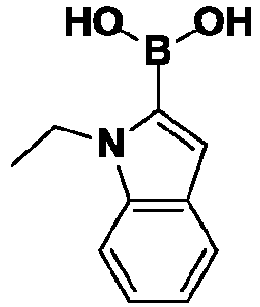
- To a solution of 1-ethyl-1H-indole (580 mg, 4 mmol) in dry THF (20 mL) at 0 °C was added t-BuLi/THF (1.3 M, 5.2 mL, 4 mmol) dropwise. The mixture was stirred at 0 °C for 1 h and then triisopropyl borate(4.7 g, 25 mmol) was added. The mixture stirred at 20 °C for an additional 2 h. The mixture was quenched with sat. aq. ammonium chloride (30 mL) and extracted with EtOAc (50 mL x 3). The combined organic layers were dried over anhydrous Na2SO4, filtered and concentrated in vacuo. The crude residue was purified by silica gel chromatography (petroleum ether/EtOAc = 1/1) to give the title compound (0.5 g, 66 %) as a white solid.
-

- A mixture of (1-ethyl-1H-indol-2-yl)boronic acid (189 mg, 1.0 mmol), (R)-6-bromo-4-methyl-4,5-dihydro-1H-benzo[b][1,4]diazepin-2(3H)-one (Intermediate A, 254 mg, 1.0 mmol), Na2CO3 (212 mg, 2.0 mmol) and tetrakis(triphenylphosphine)palladium(0) (115 mg, 0.1 mmol) in dioxane/water (5 mL/1 mL) was heated to reflux temperature for 2 h.After cooling the reaction to room temperature, the solvent was concentrated in vacuo. Water (30 mL) was added and extracted with EtOAc (50 mL). The combined organic layers were dried over anhydrous Na2SO4, filtered and concentrated in vacuo. The crude residue was purified by reverse phase chromatography (acetonitrile 49-79% / 0.1% NH4OH in water) to give the title compound (44 mg, 14%) as a white solid. 1H NMR (400 MHz, CD3OD) δ 7.59 (d, J = 8.0 Hz, 1H), 7.45 (d, J = 8.4 Hz, 1H), 7.21 (t, J = 8.0 Hz, 1H), 7.11 - 7.07 (m, 3H), 7.00 (t, J = 7.2 Hz, 1H), 6.47 (s, 1H), 4.10 - 3.95 (m, 2H), 3.94 - 3.86 (m, 1H), 2.69 - 2.65 (m, 1H), 2.38 - 2.33 (m, 1H), 1.18 (t, J = 7.0 Hz, 1H), 1.11 (d, J = 6.0 Hz, 3H). LCMS M/Z (M+H) 320.
- The following compounds were prepared in a similar fashion to Example 28:
-
Example Compound Name NMR m/z Example 29 (4R)-4-methyl-6-(1-propylindol-2-yl)-1,3,4,5-tetrahydro-1,5-benzodiazepin-2-one 1H NMR (400 MHz, CD3OD)δ7.60 (d, J = 8.0 Hz, 1H), 7.46 (d, J = 8.4 Hz, 1H), 7.22 (t, J = 8.0 Hz, 1H), 7.12 - 7.08 (m, 3H), 7.01 (t, J = 7.2 Hz, 1H), 6.49 (s, 1H), 4.10 - 3.95 (m, 2H), 3.95 - 3.87 (m, 1H), 2.70 - 2.65 (m, 1H), 2.39 - 2.34 (m, 1H), 1.66 - 1.60 (m, 2H), 1.13 (d, J = 6.4 Hz, 1H), 0.74 (t, J = 7.2 Hz, 3H) 334 Example 30 (4R)-4-methyl-6-[1-(2-phenylethyl)indol-2-yl]-1,3,4,5-tetrahydro-1,5-benzodiazepin-2-one 1H NMR (400 MHz, CD3OD) δ7.60 (d, J = 7.6 Hz, 1H), 7.49 (d, J = 8.4 Hz, 1H), 7.22 (t, J = 8.0 Hz, 1H), 7.14 - 7.04 (m, 5H), 6.88 (t, J = 7.2 Hz, 1H), 6.78 (br.s, 1H), 6.72 (d, J = 7.6 Hz, 1H), 6.44 (s, 1H), 4.10 - 3.95 (m, 2H), 3.91 - 3.85 (m, 1H), 2.90 (br s, 2H), 2.63 - 2.61 (m, 1H), 2.34 - 2.29 (m, 1H), 1.09 (d, J = 6.4 Hz, 3H) 396 Example 31 (4R)-6-[1-(2-ethoxyethyl)indol-2-yl]-4-methyl-1,3,4,5-tetrahydro-1,5-benzodiazepin-2-one 1H NMR (400 MHz, CD3OD) δ 7.59 (d, J = 7.6 Hz, 1H), 7.48 (d, J = 7.6 Hz, 1H), 7.20 (t, J = 6.4 Hz, 1H), 7.13 - 7.06 (m, 3H), 6.97 (t, J = 7.6 Hz, 1H), 6.48 (s, 1H), 4.21 (br s, 2H), 3.95 - 3.91 (m, 1H), 3.56 (t, J = 5.6 Hz, 2H), 3.31 - 3.24 (m, 2H), 2.69 (br s, 1H), 2.35 - 2.31 (m, 1H), 1.14 (d, J = 6.4 Hz, 3H), 1.01 (t, J = 6.6 Hz, 3H) 364 Example 32 (4R)-6-[1-(2-methoxyethyl)indol-2-yl]-4-methyl-1,3,4,5-tetrahydro-1,5-benzodiazepin-2-one 1H NMR (400 MHz, CD3OD) δ 7.58 (d, J = 8.0 Hz, 1H), 7.48 (d, J = 8.0 Hz, 1H), 7.20 (t, J = 6.4 Hz, 1H), 7.11 - 7.06 (m, 3H), 6.98 (t, J = 7.6 Hz, 1H), 6.48 (s, 1H), 4.22 (br. s, 2H), 3.94 - 3.90 (m, 1H), 3.51 (br s, 2H), 3.11 (s, 3H), 2.70 (br s, 1H), 2.34 - 2.30 (m, 1H), 1.14 (d, J = 6.4 Hz, 3H) 350 -

-

- A mixture of 5-bromo-3-iodo-1-methyl-1H-indazole (400 mg, 1.18 mmol), 1-methyl-4-(4,4,5,5-tetramethyl-1,3,2-dioxaborolan-2-yl)-1H-pyrazole (295.4 mg, 1.42 mmol), [1,1'-bis(diphenylphosphino)ferrocene]dichloropalladium(II) (86.2 mg, 0.118 mmol) and potassium carbonate (488.6 mg, 3.54 mmol) in dioxane/H2O (5 mL /0.5 mL) was heated to 100 °C for 16 h under nitrogen atmosphere.After cooling the reaction to room temperature, water (5 mL) was added and the mixture was extracted with EtOAc (10 mL x 3). The combined organic lagers were washed with brine, dried over anhydrous Na2SO4, filtered and concentrated in vacuo. The crude residue was purified by silica gel chromatography (petroleum ether/EtOAc = 3/1 to 1/1) to give the title compound (270 g, 78.1 %) as a white solid. LCMS M/Z (M+H) 291.
-

- A mixture of 5-bromo-1-methyl-3-(1-methyl-1H-pyrazol-4-yl)-1H-indazole (270 mg ,0.798 mmol), 4,4,4',4',5,5,5',5'-octamethyl-2,2'-bi(1,3,2-dioxaborolane) (243.2 mg, 0.957 mmol), [1,1'-bis(diphenylphosphino)ferrocene]dichloropalladium(II)(58.3 mg, 0.0798 mmol) and potassium acetate (234.6 mg, 2.39 mmol) in dioxane (3 mL) was heated to 100 °C for 2 h under nitrogen atmosphere.After cooling the reaction to room temperature, water (5 mL) was added and the mixture was extracted with EtOAc (10 mL x 3). The combined organic lagers were washed with brine, dried over anhydrous Na2SO4, filtered and concentrated in vacuo to give the title compound (320 mg, crude) as brown oil that required no further purification.
-

- A mixture of 1-methyl-3-(1-methy1-1H-pyrazol-4-yl)-5-(4,4,5,5-tetramethy1-1,3,2-dioxaborolan-2-yl)-1H-indazole (320 mg, 0.946 mmol), (R)-6-bromo-4-methyl-4,5-dihydro-1H-benzo[b][1,4]diazepin-2(3H)-one (Intermediate A, 193.1 mg, 0.757 mmol), bis(triphenylphosphine)palladium(II) dichloride (56 mg, 0.08 mmol) and potassium carbonate (313.4 mg, 2.271 mmol) in dioxane/H2O (3 mL /0.3mL) was heated to 100 °C for 12 h under nitrogen atmosphere.After cooling the reaction to room temperature, water (5 mL) was added and the mixture was extracted with EtOAc (10 mL x 3). The combined organic lagers were washed with brine, dried over anhydrous Na2SO4, filtered and concentrated in vacuo. The crude residue was purified by reverse phase chromatography (acetonitrile 26-56% /0.2% formic acid in water) to give the title compound (28 mg, 10 %) as a white solid. 1H NMR (400 MHz, CDCl3) δ8.03 (s, 1 H), 7.93 - 7.89 (m, 1H), 7.83 - 7.81 (m, 1H), 7.53 - 7.49 (m, 1H), 7.43 - 7.39 (m, 1H), 7.13 - 7.07 (m, 1H), 7.01 - 6.92 (m, 2H), 4.15 (s, 3H), 4.01 (s, 3H), 3.99 - 3.96 (m, 1H), 2.82 - 2.75 (m, 1H), 2.51 - 2.45 (m, 1H), 1.19 (d, J= 6.27 Hz, 3H). LCMS M/Z (M+H) 387.
-

-

- A mixture of 5-bromo-1H-indazole (2.5 g, 10.51 mmol), KOH (2.5 g, 10.51 mmol) and iodine (2.5 g, 10.51 mmol) in DMF (15 mL) at 20 °C was stirred for 16 h. The mixture was filtered and the filtrate was concentrated in vacuo. The crude residue waspurified by silica gel chromatography (petroleum ether/EtOAc = 3/1) to give the title compound(2.6 g, 81%) as a yellow solid.
-

- A mixture of 5-bromo-3-iodo-1H-indazole (8.0 g, 33.81 mmol), 1-methyl-4-(4,4,5,5-tetramethyl-1,3,2-dioxaborolan-2-yl)-1H-pyrazole (7.8 g, 50.72 mmol), K2CO3 (9.34 g, 67.60 mmol) and [1,1'-bis(diphenylphosphino)ferrocene]dichloropalladium(II)(2.47 g, 3.38 mmol) in dioxane (60 mL) and H2O (20 mL)was heated to 110 °C for 16 h under nitrogen atmosphere.After cooling the reaction to room temperature, the mixture was filtered and the filtrate was concentrated in vacuo. The crude residue waspurified by silica gel chromatography (DCM/MeOH = 10/1) to give the title compound (6.3 g, 64%)as a brown solid.
-

- A mixture of 5-bromo-3-(1-methyl-1H-pyrazol-4-yl)-1H-indazole (2.6 g, 7.41 mmol), 4,4,4',4',5,5,5',5'-octamethyl-2,2'-bi(1,3,2-dioxaborolane) (2.8 g, 11.10 mmol), NaOAc (1.2 g, 14.81 mmol) and [1,1'-bis(diphenylphosphino)ferrocene]dichloropalladium(II) (541 mg, 0.74 mol) in dioxane (25 mL) was heated to 110 °C for 16 h under nitrogen atmosphere.After cooling the reaction to room temperature, the mixture was filtered and the filtrate was concentrated in vacuo. The crude residue waspurified by silica gel chromatography (petroleum ether/EtOAc = 3/1) to give the title compound (900 mg, 30%) as a yellow solid.
-

- A mixture of 3-(1-methyl-1H-pyrazol-4-yl) pyrazol-4-yl)-5-(4,4,5,5-tetramethyl-1,3,2-dioxaborolan-2-yl)-1H-indazole (400 mg, 1.00 mmol), (R)-6-bromo-4-methyl-4,5-dihydro-1H-benzo[b][1,4]diazepin-2(3H)-one (Intermediate A, 383 mg, 1.5 mmol), K2CO3 (276 mg, 2.00 mmol) and [1,1'-bis(diphenylphosphino)ferrocene]dichloropalladium(II) (73 mg, 0.10 mol) in dioxane (4 mL) and H2O (2 mL) was irradiated in a microwave at 120 °C for 30 min. After cooling the reaction to room temperature, the mixture was filtered and the filtrate was concentrated in vacuo. The crude residue waspurified by reverse phase chromatography (acetonitrile 7-15% / 0.1% NH4OH in water) to give the title compound (340 mg, 75%) as a yellow solid.1H NMR (400 MHz, DMSO-d 6) δ 13.03 (s, 1H), 9.59 (s, 1H), 8.41 (s, 1H), 7.96 - 7.91 (m, 2H), 7.60 (d, J = 8.0 Hz, 1H), 7.34 (d, J = 6.8 Hz, 1H), 6.97 - 6.89 (m, 3H), 3.89 - 3.83 (m, 5H), 2.61 (s, 1H), 2.20 (s, 1H), 1.05 (s, 3H). LCMS M/Z (M+H) 373.
-

-

- A mixture of 3-(1-methyl-1H-pyrazol-4-yl)-5-(4,4,5,5-tetramethyl-1,3,2-dioxaborolan-2-yl)-1H-indazole (330 mg, 1.02 mmol), 1,3-dioxolan-2-one (270 mg, 3.05 mmol) and Cs2CO3 (670 mg, 2.04 mmol) in DMF (3.0 mL) was heated to reflux temperature for 2 h under nitrogen atmosphere. After cooling the reaction to room temperature, water (20 mL) was added and the mixture was extracted with EtOAc (20 mL x 3). The combined organic layers were dried over anhydrous Na2SO4, filtered and concentrated in vacuo. The crude residue was purified by prep-TLC (DCM/MeOH = 20/1) to give the title compound (48 mg, 13%) as a white solid.
-

- To a solution of 2-(3-(1-methyl-1H-pyrazol-4-yl)-5-(4,4,5,5-tetramethyl-1,3,2-dioxaborolan-2-yl)-1H-indazol-1-yl)ethanol (48 mg, 0.13 mmol), (R)-6-bromo-4-methyl-4,5-dihydro-1H-benzo[b][1,4] diazepin-2(3H)-one (Intermediate A, 35 mg, 0.13 mmol) and K2CO3 (37 mg, 0.27 mmol) in dioxane/H2O = 3:1 (3.0 mL) was added [1,1'-bis(diphenylphosphino)ferrocene]dichloropalladium(II) (10 mg, 14 umol). The mixture was stirred at reflux temperature for 30 min. After cooling the reaction to room temperature, water (10 mL) was added and extracted with EtOAc (10 mL x 3). The combined organic layers were washed with sat. aq. sodium bicarbonate (10 mL x 3), dried over anhydrous Na2SO4, filtered and concentrated in vacuo. The crude residue was purified by prep-TLC (DCM/MeOH = 20/1) to give the title compound (4 mg, 5%) as a brown solid. 1H NMR (400 MHz, CDCl3) δ 8.00 (s, 1H), 7.89 (s, 1H), 7.82 (s, 1H), 7.52 (d, J= 8.0 Hz, 1H), 7.43 - 7.39 (m, 2H), 7.07 (d, J= 8.0 Hz, 1H), 6.96 - 6.93 (m, 2H), 4.54 (t, J = 4.8 Hz, 2H), 4.21 - 4.18 (m, 2H), 3.99 (s, 3H), 3.96 (m, 1H), 3.62 (s, 1H), 3.03 (t, J= 4.8 Hz, 1H), 2.79 (m, 1H), 2.75 (m, 1H), 1.19 (d, J = 6.0 Hz, 2H). LCMS M/Z (M+H) 417.
-

-

- To 5-bromo-2-fluorobenzaldehyde (10 g, 49.3 mmol) in THF (60 mL) at 0°C was added cyclopropylmagnesium bromide in THF (118 mL, 0.5 M). The mixture was stirred at room temperature for 3 h. The mixture was concentrated in vacuo and the residue was purified by silica gel chromatography (petroleum ether/EtOAc = 5/1) to give the title product (5 g, 41%) as colorless oil. 1H NMR (400 MHz, CDCl3) δ 7.70 - 7.68 (m, 1H), 7.40 - 7.34 (m, 1H), 6.95 - 6.90 (m, 1H), 4.34 (d, J = 8.0 Hz, 1H), 1.23 - 1.21 (m, 1H), 0.65-0.62 (m, 1H), 0.55-0.45 (m, 3H).
-

- A mixture of 5-bromo-2-fluorobenzaldehyde (5 g, 20.4 mmol) and MnO2(8.87 g, 102 mmol)in DCM (50 mL) was heated to40 °C for 5 h. The mixture was filtered and concentrated in vacuo to givethe title compound (4.8 g, 97%) as a brown solid that required no further purification.1H NMR (400 MHz, CDCl3) δ7.87 - 7.85 (m, 1H), 7.61 - 7.57 (m, 1H), 7.08 - 7.03 (m, 1H), 4.13 - 4.11 (m, 1H), 2.63 - 2.60 (m, 1H), 1.28 - 1.26 (m, 2H), 1.11 - 1.08 (m, 2H).
-

- A mixture of (5-bromo-2-fluorophenyl)(cyclopropyl)methanone (5.0 g, 20.60 mmol), hydrazine (4.0 g, 123.66 mmol), CuO (82 mg, 1.00 mmol) and K2CO3 (5.7 g, 41.01 mmol) in DMF (25 mL) was heated to 110 °C for 16 h. After cooling the reaction to room temperature, the mixture was filtered and the filtrate was concentrated in vacuo. The crude residue was purified by silica gel chromatography (petroleum ether/EtOAc = 5/1) to give the title compound (2.7 g, 55%) as a brown oil.
-

- To a solution of 5-bromo-3-cyclopropyl-1H-indazole (2.5 g, 10.51 mmol) in DMF (15 mL) at 0°C was added NaH (304 mg,12.61 mmo). The resulting mixture was stirred at 0°C for 30 min under nitrogen atmosphere before 2-bromobutane (3.1 g, 15.77 mol) was added. The reaction mixture was stirred at room temperature for an additional 2 h. The mixture was poured into ice-water (50 mL)and extracted with EtOAc (50 mL x 2). The combined organic layers were dried over anhydrous Na2SO4, filtered and concentrated in vacuo to give the crude product that was purified by silica gel chromatography (petroleum ether/EtOAc = 20/1) to give the title compound (2.7 g, 87%) as a yellow solid.
-

- A mixture of 5-bromo-1-(sec-butyl)-3-cyclopropyl-1H-indazole (2.5 g, 8.51 mmol), 4,4,4',4',5,5,5',5'-octamethyl-2,2'-bi(1,3,2-dioxaborolane) (3.6 g, 12.80 mmol), KOAc (1.7 g, 17.01 mmol)and [1,1'-bis(diphenylphosphino)ferrocene]dichloropalladium(II) (625 mg, 0.85 mol) in dioxane (25 mL)was heated to 110 °C for 16 h under nitrogen atmosphere. After cooling the reaction to room temperature, the mixture was filtered and the filtrate was concentrated in vacuo. The crude residue was purified by silica gel chromatography (petroleum ether/EtOAc = 10/1) to give the title product (940 mg, 32%) as a yellow solid.
-

- A mixture of 1-(sec-butyl)-3-cyclopropyl-5-(4,4,5,5-tetramethyl-1,3,2-dioxaborolan-2-yl)-1H-indazole (400 mg, 1.2 mmol), (R)-6-bromo-4-methyl-4,5-dihydro-1H-benzo[b][1,4]diazepin-2(3H)-one (Intermediate A, 450 mg, 1.80 mmol), K2CO3 (325 mg, 2.41 mmol)and [1,1'-bis(diphenylphosphino)ferrocene]dichloropalladium(II) (86 mg, 0.12 mol) in dioxane (4 mL) and H2O (2 mL) was irradiated in a microwave at 120 °C for 30 min.After cooling the reaction to room temperature, the mixture was filtered and the filtrate was concentrated in vacuo. The crude residue was purified by silica gel chromatography (petroleum ether/EtOAc = 3/1)to give the racemiccompound (400 mg, 88%) as a yellow solid that was separated using chiral SFC(AD (250mm∗30mm,10um), 50% IPA+NH3H2O 80 mL/min) to give (R)-6-(1-((R)-sec-butyl)-3-cyclopropy1-1H-indazol-5-yl)-4-methyl-4,5-dihydro-1H-benzo[b][1,4]diazepin-2(3H)-one (124 mg, first peak) as a white solid and (R)-6-(1-((S)-sec-butyl)-3-cyclopropyl-1H-indazol-5-yl)-4-methyl-4,5-dihydro-1H-benzo[b][1,4]diazepin-2(3H)-one (145 mg, second peak) as a white solid.Absolute configuration was arbitrarily assigned to each enantiomer.Example 36:1H NMR (400 MHz, CD3OD) δ7.71 (s, 1H), 7.62 (d, J= 8.4 Hz, 1H), 7.37 - 7.34 (m, 1H), 7.08 (d, J= 6.0 Hz, 1H), 7.02-6.98 (m, 2H), 4.65-4.61 (m, 1H), 4.03-3.99 (m, 1H), 2.78 - 2.74 (m, 1H), 2.36-2.27 (m, 2H), 2.15-2.04 (m, 1H), 1.95-1.85 (m, 1H), 1.54 (d, J = 6.4 Hz, 3H), 1.19 (d, J= 6.0 Hz, 3H), 1.06 - 1.03 (m, 4H), 0.78 (t, J = 7.6Hz, 3H). LCMS M/Z (M+H) 389. Example 37:1H NMR (400 MHz, CD3OD) δ7.71 (s, 1H), 7.63 (d, J= 8.4 Hz, 1H), 7.36 (d, J= 8.0 Hz, 1H), 7.10-7.08 (m, 1H), 7.01-6.98 (m, 2H), 4.65-4.62 (m, 1H), 4.04-3.99 (m, 1H), 2.79 - 2.74 (m, 1H), 2.36-2.24 (m, 2H), 2.15-2.04 (m, 1H), 1.95-1.85 (m, 1H), 1.56 (d, J = 6.4 Hz, 3H), 1.19 (d, J = 6.4 Hz, 3H), 1.06 - 1.03 (m, 4H), 0.78 (t, J= 7.6Hz, 3H). LCMS M/Z (M+H) 389.
-

-

- To a solution of 5-bromo-3-cyclopropyl-1H-indazole (2.5 g, 10.51 mmol) in DMF (15 mL) at 0°C was added NaH (304 mg,12.61 mmo). The resulting mixture was stirred at 0°C for 30 min under nitrogen atmosphere before 3-bromobutanenitrile (2.3 g, 15.81 mmol) was added. The reaction mixture stirred at room temperature for an additional 2 h. The mixture was poured into ice-water (50 mL)and extracted with EtOAc (50 mL x 2). The combined organic layers were dried over anhydrous Na2SO4, filtered and concentrated in vacuo to give the crude product that was purified by silica gel chromatography (petroleum ether/EtOAc = 20/1) to give the title compound (2.6 g, 81%) as a yellow solid.
-

- A mixture of 3-(5-bromo-3-cyclopropyl-1H-indazol-1-yl)butanenitrile (2.6 g, 7.41 mmol), 4,4,4',4',5,5,5',5'-octamethyl-2,2'-bi(1,3,2-dioxaborolane) (2.8 g, 11.10 mmol), NaOAc (1.2 g, 14.81 mmol) and [1,1'-bis(diphenylphosphino)ferrocene]dichloropalladium(II) (541 mg, 0.74 mol) in dioxane (25 mL) was heated to 110 °C for 16 h under nitrogen atmosphere. After cooling the reaction to room temperature, the mixture was filtered and the filtrate was concentrated in vacuo. The crude residue was purified by silica gel chromatography (petroleum ether/EtOAc = 10/1) to give the title product (900 mg, 30%) as a yellow solid.
-

- A mixture of 3-(3-eyclopropyl-5-(4,4,5,5-tetramethyl-1,3,2-dioxaborolan-2-yl)-1H-indazol-1-yl)butanenitrile (400 mg, 1.0 mmol), (R)-6-bromo-4-methyl-4,5-dihydro-1H-benzo[b][1,4]diazepin-2(3H)-one (Intermediate A, 383 mg, 1.5 mmol), K2CO3 (276 mg, 2.0 mmol) and [1,1'-bis(diphenylphosphino)ferrocene]dichloropalladium(II) (73 mg, 0.10 mol) in dioxane (4 mL) and H2O (2 mL) was irradiated in a microwave at 120 °C for 30 min.After cooling the reaction to room temperature, the mixture was filtered and the filtrate was concentrated in vacuo. The crude residue was purified by silica gel chromatography (petroleum ether/EtOAc = 3/1)to give the racemiccompound (340 mg, 75%) as a yellow solid that was separated using chiral SFC(OJ (250mm∗30mm,20um),35% MeOH+NH3H2O 80 mL/min) to give(R)-3-(3-cyclopropy1-5-((R)-4-methyl-2-oxo-2,3,4,5-tetrahydro-1H-benzo[b][1,4]diazepin-6-yl)-1H-indazol-1-yl)butanenitrile (79.8 mg, first peak) as a white solid and (S)-3-(3-cyclopropyl-5-((R)-4-methyl-2-oxo-2,3,4,5-tetrahydro-1H-benzo[b][1,4]diazepin-6-yl)-1H-indazol-1-yl)butanenitrile (93.8 mg, second peak) as a white solid. Absolute configuration was arbitrarily assigned to each enantiomer.Example 38:1H NMR (400 MHz, CD3OD) δ 7.74 (s, 1H), 7.68 (d, J= 8.4 Hz, 1H), 7.40 (d, J= 7.2 Hz, 1H), 7.10 -7.07 (m, 1H), 7.03 - 6.98 (m, 2H), 5.20 - 5.12 (m, 1H), 4.02 - 3.98 (m, 1H), 3.16 - 3.14 (m, 1H), 3.07 - 3.06 (m, 1H), 2.76 - 2.73 (m, 1H), 2.36 - 2.26 (m, 2H), 1.63 (d, J= 6.8 Hz, 3H), 1.18 (d, J = 6.0 Hz, 3H), 1.07 - 1.04 (m, 4H). LCMS M/Z (M+H) 400. Example 39:1H NMR (400 MHz, CD3OD) δ 7.75 (s, 1H), 7.68 (d, J = 8.4 Hz, 1H), 7.40 (d, J = 8.0 Hz, 1H), 7.10 -7.08 (m, 1H), 7.02 - 7.00 (m, 2H), 5.19 - 5.14 (m, 1H), 4.03 - 3.98 (m, 1H), 3.16 - 3.14 (m, 1H), 3.08 - 3.07 (m, 1H), 2.77 - 2.74 (m, 1H), 2.36 - 2.30 (m, 2H), 1.63 (d, J= 6.8 Hz, 3H), 1.18 (d, J = 6.0 Hz, 3H), 1.08 - 1.05 (m, 4H). LCMS M/Z (M+H) 400.
-

-

- To a solution of 4-(4,4,5,5-tetramethyl-1,3,2-dioxaborolan-2-yl)-1H-pyrazole (500 mg, 2.58 mmol) in DMF (5 mL) was added Cs2CO3 (1.68 g, 5.15 mmol) and ethyl 2-bromo-2-methylpropanoate (603mg, 3.09 mmol). The reaction mixturewas stirred at room temperature for 18 h. The mixture was concentrated in vacuo and the crude residue was purified by silica gel chromatography (petroleum ether/EtOAc = 10/1) to give the title compound (300 mg, 38%) as a white solid.
-

- To a solution of 2-methyl-2-(4-(4,4,5,5-tetramethyl-1,3,2-dioxaborolan-2-yl)-1H-pyrazol-1-yl)propanoate (300 mg, 0.98 mmol) in MeOH (5 mL) at room temperutre was added NaBH4 (230 mg, 5.84 mmol). The reaction mixture was stirred at room temperutre for 48 h. The mixture was concentrated in vacuo. Water (10 mL) was added and extracted with EtOAc (30 mL x 3). The combined organic layers were dried over Na2SO4, filtered and concentrated in vacuo to givethe title compound (300 mg, crude) as a white solid that required no further purification.
-

- A mixture of 2-methyl-2-(4-(4,4,5,5-tetramethy1-1,3,2-dioxaborolan-2-yl)-1H-pyrazo1-1-yl)propan-1-ol (300 mg, 0.88 mmol),potassium carbonate (163 mg, 1.18 mmol), [1,1'-bis(diphenylphosphino)ferrocene]dichloropalladium(II) (44 mg, 0.06 mmol) and (R)-6-bromo-4-methyl-4,5-dihydro-1H-benzo[b][1,4]diazepin-2(3H)-one (Intermediate A, 150 mg, 0.59 mmol) in dioxane (8 mL) and H2O (2 mL) was heated to 100 °C for 18 h under nitrogen atmosphere.After cooling the reaction to room temperature, the mixture was concentrated in vacuo and the crude residue was purified by silica gel chromatography (DCM/MeOH = 20/1). The residue was further purified by reverse phase chromatography(acetonitrile 24-54% / 0.1% NH4OH in water) to givethe title compound (18 mg, 18 %) as a white solid.1H NMR (400 MHz, DMSO-d 6)δ 9.50 (s, 1 H), 7.92 (s, 1H), 7.59 (s, 1H), 6.99 - 6.95 (m, 1H), 6.85 - 6.79 (m, 2H), 4.92 (s, 1H), 4.05 - 4.03 (m, 1H), 3.96 - 3.94 (m, 1H), 3.59 (d, J = 4.0 Hz, 2H), 2.20-2.15 (m, 1H), 1.50 (s, 6H), 1.18 (d, J= 6.8 Hz, 3H). LCMS M/Z (M+H) 315.
-

-

- To a solution of 5-bromo-2-fluoronicotinaldehyde (2.0 g, 9.8 mmol) in THF (10 mL) at 0 °C was added cyclopropylmagnesium bromide in THF (0.5 M, 24.0 mL) dropwise. The mixture was allowed to stir at 0 °C for 2 h. The reaction mixture was washed with sat. aq. NH4Cl and extracted with EtOAc (50 mL x 3). The combined organic layers were dried over anhydrous Na2SO4, filtered and concentrated in vacuo.The crude residue was purified by silica gel chromatography (petroleum Ether/EtOAc = 10/1) to give title compound (0.57 g, 24%) as a colorless oil. 1H NMR (400 MHz, CDCl3) δ 8.16 - 8.10 (m, 2H), 4.30 (d, J= 7.6 Hz, 1H), 2.14 (s, 1H), 1.17 - 1.14 (m, 1H), 0.65 - 0.49 (m, 4H).
-

- A mixture of (5-bromo-2-fluoropyridin-3-yl)(cyclopropyl)methanol (0.57 g, 2.32 mmol) and MnO2 (2.01 g, 23.2 mmol) in DCM (10.0 mL) was heated to 40 °C for 16 h. After cooling the reaction to room temperature, the mixture was filtered and concentrated in vacuo to give the title compound (485 mg, 86%) as a white solid.
-

- A mixture of (5-bromo-2-fluoropyridin-3-yl)(cyclopropyl)methanone(0.58 g, 2.38 mmol), methylhydrazine (40% aq., 1.37 g, 11.88 mmol), CuO (9.4 mg, 11.9 umol) and K2CO3 (656.9 mg, 4.75 mmol) in DMF (5.0 mL) was heated to 100 °C for 16 h. After cooling the reaction to room temperature, the mixture was filtered and the filtrate was concentrated in vacuo. The crude residue was purified by silica gel chromatography (petroleum ether/EtOAc = 10/1) to give the title compound (0.37 g, 62%) as a white solid.LCMS M/Z (M+H) 254.
-

- A mixture of 5-bromo-3-cyclopropyl-1-methyl-1H-pyrazolo[3,4-b]pyridine (320 mg, 1.27 mmol), 4,4,4',4',5,5,5',5'-octamethyl-2,2'-bi(1,3,2-dioxaborolane) (386.8 mg, 1.52 mmol), KOAc (249 mg, 2.54 mmol) and [1,1'-bis(diphenylphosphino)ferrocene]dichloropalladium(II) (93 mg, 120 umol) in dioxane (5 mL) was irradiated in a microwave at 120 °C for 30 min. After cooling the reaction to room temperature, water (20 mL) was added and the mixture extracted with EtOAc (20 mL x 3). The combined organic layers were washed with sat. aq. sodium bicarbonate (10 mL x 3), dried over Na2SO4, filtered and concentrated in vacuo. The crude residue was purified by prep-TLC (petroleum ether/EtOAc = 10/1) to give the title compound (100 mg, 26%) as a white solid.
-

- A mixture of 3-cyclopropyl-1-methyl-5-(4,4,5,5-tetramethyl-1,3,2-dioxaborolan-2-yl)-1H-pyrazolo[3,4-b]pyridine(100 mg, 0.33 mmol), (R)-6-bromo-4-methyl-4,5-dihydro-1H-benzo[b][1,4]diazepin-2(3H)-one (Intermediate A, 85.3 mg, 0.33 mmol), K2CO3 (69.3 mg, 0.50 mmol) and [1,1'-bis(diphenylphosphino)ferrocene]dichloropalladium(II) (24 mg, 33 umol) in dioxane (1.5 mL) and H2O (0.5 mL) was irradiated in a microwave at 120 °C for 30 min. After cooling the reaction to room temperature, water (20 mL) was added and extracted with EtOAc (20 mL x 3). The combined organic layers were washed with sat. aq. sodium bicarbonate (10 mL x 3), dried over anhydrous Na2SO4, filtered and concentrated in vacuo. The crude residue was purified by prep-TLC (petroleum ether/EtOAc = 1/1) to give the title compound (21 mg, 18%) as a white solid.1H NMR (400 MHz, CDCl3) δ 8.50 (s, 1H), 8.01 (s, 1H), 7.52 (s, 1H), 7.05 - 6.94 (m, 3H), 4.13 (s, 3H), 3.99 (m, 1H), 3.44 (s, 1H), 2.81 - 2.77 (m, 1H), 2.51 - 2.46 (m, 1H), 2.22 - 2.19 (m, 1H), 1.24 (d, J = 6.0 Hz, 2H), 1.08 - 1.06 (m, 4H). LCMS M/Z (M+H) 348.
-

-

- Amixture of 4-(4,4,5,5-tetramethyl-1,3,2-dioxaborolan-2-yl)-1H-pyrazole (500 mg, 2.57 mmol), 2-fluoropyridine(274 mg, 2.83 mmol) and cesium carbonate(1.67 g, 5.14 mmol) in DMF (10 mL) was heated to 100 °C for 16 h. After cooling the reaction to room temperature, the mixture was treated with EtOAc (20 mL) and water (20 mL). The organic layer was separated, washed by brine (20 mL), dried over anhydrous Na2SO4, filtered and concentrated in vacuo to give the title compound (500 mg, crude) as colorless oil that required no further purification.
-

- A mixture of 2-(4-(4,4,5,5-tetramethyl-1,3,2-dioxaborolan-2-yl)-1H-pyrazol-1-yl)pyridine (250mg, 0.92 mmol), (R)-6-bromo-4-methyl-4,5-dihydro-1H-benzo[b][1,4]diazepin-2(3H)-one (Intermediate A, 235 mg, 0.92 mmol), [1,1'-bis(diphenylphosphino)ferrocene]dichloropalladium(II), complex with dichloromethane(66 mg, 0.09 mmol) and potassium carbonate (149 mg, 1.84 mmol) in 1,4-dioxane (10 ml) and H2O (2 mL) was heated to 100 °C for 4 h under nitrogen atmosphere. After cooling the reaction to room temperature, the mixture was filtered and the filtrate was concentrated in vacuo. The crude residue was purified by reverse phase chromatography (acetonitrile 30-60% /0.2% formic acid in water) to give the title compound (17 mg, 6%) as a white soild. 1H NMR (400 MHz, CDCl3) δ 8.70 (s , 1H), 8.46 (d, J= 4.0 Hz, 1H), 8.05 (d, J = 8.4 Hz, 1H), 7.89 (t, J=7.6 Hz, 1H), 7.85 (s, 1H), 7.38 (s, 1H), 7.28 - 7.22 (m , 1H), 7.14 (d, J = 7.2 Hz, 1H), 7.00 - 6.85 (m, 2H), 4.15 - 3.99 (m, 1H), 3.84 (br s, 1H), 2.82 - 2.76 (m, 1H), 2.52 - 2.47 (m, 1H), 1.35 (d, J= 6.4 Hz, 3H). LCMS M/Z (M+H) 320.
-

-

- To a suspension of NaH (0.49 g, 12.29 mmol) in THF (50 mL) at 0 °C was added 1H-indole (1.2 g, 10.24 mmol) dropwise. The mixture was stirred at 0 °C for 30 min before 4-fluorobenzene-1-sulfonyl chloride (2.33 g, 11.97 mmol) was added and the resulting mixture was allowed to stir at 20 °C for an additional 2 h. Water (50 mL) was added and the mixture was extracted with EtOAc (100 mL x 3). The combined organic layers were dried over anhydrous Na2SO4, filtered and concentrated in vacuo. The crude residue was purified by silica gel chromatography (petroleum ether/EtOAc = 5/1) to give the title compound (2.5 g, 89%) as colorless oil.
-
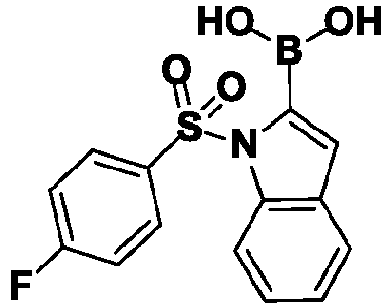
- To a solution of 1-((4-fluorophenyl)sulfonyl)-1H-indole(1.1 g, 4.00 mmol) in dry THF (20 mL) at 0 °C was added t-BuLi/THF (1.3 M, 5.2 mL, 4.00 mmol) dropwise. The mixture was stirred at 0 °C for 1 h and then triisopropyl borate(4.7 g, 24.99 mmol) was added. The mixture was stirred at 20 °C for an additional 2 h. Then the mixture was quenched with sat. aq. ammonium chloride (30 mL) and extracted with EtOAc (50 mL x 3). The combined organic layers were dried over anhydrous Na2SO4, filtered and concentrated in vacuo. The crude residue was purified by silica gel chromatography (petroleum ether/EtOAc = 1/1) to give the title compound (0.4 g, 32%) as a white solid.
-

- A mixture of (1-((4-fluorophenyl)sulfonyl)-1H-indol-2-yl)boronic acid(319 mg, 1.00 mmol), (R)-6-bromo-4-methyl-4,5-dihydro-1H-benzo[b][1,4]diazepin-2(3H)-one (Intermediate A, 255 mg, 1.00 mmol), Na2CO3 (212 mg, 2.00 mmol) and tetrakis(triphenylphosphine)palladium(0) (116 mg, 0.10 mmol) in dioxane/water (5 mL/1 mL) was heated to reflux temperature for 2 h. After cooling the reaction to room temperature, the solvent was concentrated in vacuo. Water (30 mL) was added and extracted with EtOAc (50 mL). The combined organic layers were dried over anhydrous Na2SO4, filtered and concentrated in vacuo. The crude residue was purified by reverse phase chromatography (acetonitrile 45-75% / 0.1% NH4OH in water) to to give the title compound (45 mg, 10%) as a white solid. 1H NMR (400 MHz, CDCl3) δ 7.99 - 7.95 (m, 2H), 7.84 (s, 1H), 7.54 (s, 2H), 7.33 - 7.23 (m, 4H), 6.96 - 6.93 (m, 2H), 6.85 - 6.84 (m, 1H), 6.70 (s, 1H), 3.80 (s, 1H), 2.94 (s, 1H), 2.68 - 2.64 (m, 1H), 2.37 - 2.33 (m, 1H), 0.99 - 0.98 (m, 3H). LCMS M/Z (M+H) 450.
-
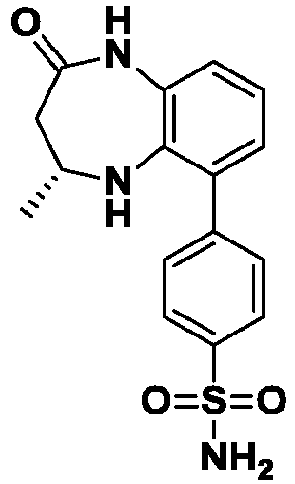
- A mixture of (R)-4-methyl-6-(4,4,5,5-tetramethyl-1,3,2-dioxaborolan-2-yl)-4,5-dihydro-1H-benzo[b][1,4]diazepin-2(3H)-one (Intermediate B,100 mg, 0.33 mmol), 4-bromobenzenesulfonamide (132 mg, 0.56 mmol), Cs2CO3 (323 mg, 0.99 mmol) and 1,1'-bis(diphenylphosphion) ferrocene dichloride palladium(II) (30 mg, 33 umol) in dioxane (3.5 mL) and H2O (0.8 mL) wasirradiated in a microwave at 110 °C for 1 h. After cooling the reaction to room temperature, the reaction mixture was concentrated in vacuo. The crude residue was purified by reverse phase chromatography (acetonitrile 30% / 0.2% formic acid in water) to give the title compound (20 mg, 18%) as a white solid. 1H NMR (400 MHz, CD3OD) δ 8.00 (d, J= 8.4 Hz, 2H), 7.55 (d, J= 8.4 Hz, 2H), 7.03 - 6.97 (m, 3H), 4.02 - 3.96 (m, 1H), 2.76-2.70 (m, 1H), 2.31 - 2.27 (m, 1H), 1.17 (d, J= 6.4 Hz, 3H). LCMS M/Z (M+H) 332.
- The following compounds were prepared in a similar fashion to Example 44:
-
Example Compound Name NMR m/z Example 45 (4R)-6-(1-isopropyl-5-methyl-pyrazol-4-yl)-4-methyl-1,3,4,5-tetrahydro-1,5-benzodiazepin-2-one 1H NMR (400 MHz, CD3OD)δ 7.47 (s, 1H), 6.99 - 6.93 (m, 3H), 4.66 - 4.60 (m, 1H), 4.02 - 3.95(m, 1H), 2.68 - 2.63 (m, 1H), 2.35 - 2.29 (m, 1H), 2.22 (s, 3H), 1.54 - 1.50 (m, 6H), 1.18 (d, J=6.0 Hz, 3H) 299 Example 46 (4R)-6-[4-(1-hydroxy-1-methyl-ethyl)phenyl]-4-methyl-1,3,4,5-tetrahydro-1,5-benzodiazepin-2-one 1H NMR (400 MHz, CD3OD) δ 7.65 - 7.61 (m, 2H), 7.36 - 7.33 (m, 2H), 7.01 - 6.98 (m, 3H), 4.02-3.94 (m, 1H), 2.76 - 2.71 (m, 1H), 2.32 - 2.27 (m, 1H), 1.60 (s, 6H), 1.18 (d, J = 6.4 Hz, 3H) 311 Example 47 (4R)-4-methyl-6-[(E)-2-phenylprop-1-enyl]-1,3,4,5-tetrahydro-1,5-benzodiazepin-2-one 1H NMR (400 MHz, CD3OD) δ7.62 - 7.60 (m, 2H), 7.42 - 7.32 (m, 2H), 7.05 - 6.96 (m, 1H), 6.96 - 6.95 (m, 1H), 6.95 - 6.94 (m, 2H), 6.82 (s, 1H), 4.14 - 4.09 (m, 1H), 2.59 - 2.54 (m, 1H), 2.34 - 2.32 (m, 1H), 2.12 (s, 3H), 1.30 (d, J = 6.4 Hz, 6H) 293 Example 48 (4R)-4-methyl-6-[(Z)-2-phenylprop-1-enyl]-1,3,4,5-tetrahydro-1,5-benzodiazepin-2-one 1H NMR (400 MHz, CD3OD) δ7.17 - 7.14 (m, 4H), 6.77 - 6.74 (m, 1H), 6.62 - 6.61 (m, 2H), 6.53 (s, 1H), 3.88 - 3.83 (m, 1H), 2.48 - 2.43 (m, 1H), 2.30 (s, 3H), 2.20 - 2.15 (m, 1H), 1.30 (d, J = 6.4 Hz, 3H) 293 -

-

- A mixture of 4-acetylbenzonitrile (500 mg, 3.44 mmol), triphenylphosphine (903 mg, 3.44 mmol) and tribromofluoromethane (933 mg, 3.44 mmol) in THF (20 mL) was stirred at 20 °C for 10 h. A solution of diethylzinc (1 M in hexane, 3.4 mL, 3.4 mmol) at 20 °C was added dropwise for 1 h. After being quenched by the addition of methanol (2 mL), the mixture was concentrated in vacuo. The crude residue was purified by silica gel chromatography (petroleum ether/EtOAc = 10/1) to give the title product (500 mg, 60%) as a white solid.
-

- A mixture of (E)-4-(1-bromo-1-fluoroprop-1-en-2-yl)benzonitrile (200 mg, 0.83 mmol), (R)-4-methyl-6-(4,4,5,5-tetramethyl-1,3,2-dioxaborolan-2-yl)-4,5-dihydro-1H-benzo[b][1,4]diazepin-2(3H)-one (Intermediate B, 275 mg, 0.91 mmol), [1,1'-bis(diphenylphosphino)ferrocene]dichloropalladium(II) (60 mg, 0.08 mmol) and Cs2CO3 (547 mg, 1.68 mmol) in 15 mL (dioxane/H2O = 5/1) was heated to 100 °C for 1 h. After cooling the reaction to room temperature, the mixture was concentrated in vacuo and the crude residue was dissolved in EtOAc (20 mL), washed with water (15 mL x 2). The combined organic layers were concentrated in vacuo and the crude product was purified by reverse phase chromatography (acetonitrile 40-60% / 0.1% NH4OH in water) to give the two olefinic isomers, which were further separated using chiral SFC (SFC80; Chiralpak OJ 250×30mm I.D.,5um; Supercritical CO2 / IPA+NH3•H2O= 45/55; 80 mL/min) to give the title compound (10 mg, 3%). 1H NMR (400 MHz, DMSO-d 6) δ 9.63 (s, 1H), 7.88 (d, J= 8.4 Hz, 2H), 7.79 (d, J= 8.0 Hz, 2H), 7.09 - 7.01 (m, 2H), 6.90 - 6.86 (m, 1H), 4.70 (s, 1H), 3.98 (m, 1H), 2.50 - 2.46 (m, 1H), 2.23 - 2.21 (m, 1H), 1.89 (s, 3H), 1.20 (d, J= 6.0 Hz, 3H). LCMS M/Z (M+H) 336.
- The following compounds were prepared in a similar fashion to Example 49:
-
Example Compound Name NMR m/z Example 50 4-[(Z)-2-fluoro-2-[(4R)-4-methyl-2-oxo-1,3,4,5-tetrahydro-1,5-benzodiazepin-6-yl]vinyl]benzonitrile 1H NMR (400 MHz, CD3OD) δ 7.84 - 7.74 (m, 4H), 7.29 - 7.22 (m, 1H), 7.10 - 7.01 (m, 2H), 6.28 (d, J = 38.0 Hz, 1H), 4.16 - 4.11 (m, 1H), 2.69 - 2.64 (m, 1H), 2.36 - 2.34 (m, 1H), 1.37 (d, J = 6.0 Hz, 3H) 3 22 Example 51 4-[(E)-2-fluoro-1-methyl-2-[(4R)-4-methyl-2-oxo-1,3,4,5-tetrahydro-1,5-benzodiazepin-6-yl]vinyl]benzonitrile 1H NMR (400 MHz, DMSO-d 6) δ 9.52 (s, 1H), 7.67 (d, J = 8.0 Hz, 2H), 7.32 (d, J = 8.0 Hz, 2H), 6.87 - 6.85 (m, 1H), 6.72 - 6.61 (m, 2H), 4.81 - 4.78 (m, 1H), 3.72 (m, 1H), 2.29 - 2.26 (m, 1H), 2.15 (s, 3H), 2.07 - 2.04 (m, 1H), 1.17 (d, J = 6.0 Hz, 3H) 3 36 Example 52 (4R)-4-methyl-6-[(E)-1-methyl-2-phenyl-vinyl]-1,3,4,5-tetrahydro-1,5-benzodiazepin-2-one 1H NMR (400 MHz, DMSO-d 6) δ 9.52 (s, 1H), 7.46 - 7.40 (m, 4H), 7.38 - 7.27 (m, 1H), 6.90 - 6.80 (m, 3H), 6.43 (s, 1H), 4.25 (d, J = 2.8 Hz, 1H), 3.95 (s, 1H), 2.57 - 2.53 (m, 1H), 2.18 -2.13 (m, 4H), 1.23 (d, J = 6.8 Hz, 3H) 2 93 -

-

- To a solution of 5-bromo-3-methyl-1H-pyrazole (200 mg, 1.24 mmol) in acetonitrile (15 mL) was added K2CO3 (340 mg, 2.48 mmol). The mixture was stirred at room temperature for 30 min before benzyl bromide (235 mg, 1.37 mmol) was added and heated to 80 °C for 3 h. After cooling the reaction to room temperature, the reaction mixture was filtered and the filtrate wasconcentrated in vacuo. Water (20 mL) was added and extracted with EtOAc (35 mL x 3). The combined organic layers were dried over anhydrous Na2SO4, filtered and concentrated in vacuo to give the title compound (240 mg, crude) that required no further purification.
-

- A mixture of 1-benzyl-5-bromo-3-methyl-1H-pyrazole (150 mg, 0.60 mmol), (R)-4-methyl-6-(4,4,5,5-tetramethyl-1,3,2-dioxaborolan-2-yl)-4,5-dihydro-1H-benzo[b][1,4]diazepin-2(3H)-one (Intermediate B, 200 mg, 0.66 mmol), cesium carbonate (390 mg, 1.20 mmol) and [1,1'-bis(diphenylphosphino)ferrocene] dichloropalladium(II) (22 mg, 0.03 mmol) in dioxane (4 mL) and H2O (1 mL) was irradiated in a microwave at 110 °C for 30 min. After cooling the reaction to room temperature, the reaction mixture was filtered and the filtrate wasconcentrated in vacuo. The crude residue was purified by reverse phase chromatography (acetonitrile 40-60% / 0.1% HCl in water) to give the title compound (18 mg, 8%). 1H NMR (400 MHz, CD3OD) δ 7.41 - 7.40 (m, 4H), 7.34 - 7.32 (m, 2H), 6.95 - 6.94 (m, 2H), 6.46 (s, 1H), 5.36 (s, 2H), 3.92 - 3.91 (m, 1H), 2.31 (s, 3H), 2.18 - 2.16 (m, 1H), 2.54 - 2.53 (m, 1H), 2.36 (s, 3H), 2.28 - 2.25 (m, 1H), 1.09 (d, J = 6.0 Hz, 3H). LCMS M/Z (M+H) 347.
- The following compound was prepared in a similar fashion to Example 53:
Example Compound Name NMR m/z Example 54 (4R)-6-(3-benzyl-1-methyl-pyrazol-4-yl)-4-methyl-1,3,4,5-tetrahydro-1,5-benzodiazepin-2-one 1H NMR (400 MHz, DMSO-d 6) δ 9.50 (s, 1H), 7.67 (s, 1H), 7.18 - 7.10 (m, 3H), 7.02 (d, J = 7.2 Hz, 2H), 6.86 - 6.85 (m, 1H), 6.75 - 6.73 (m, 2H), 6.07 (s, 1H), 3.92 (s, 1H), 3.83 (s, 3H), 3.76 - 3.63 (m, 2 H), 2.43 - 2.41 (m, 1H), 2.10 - 2.08 (m, 1H), 1.01 (d, J = 6.4 Hz, 3H) 347 -

-

- To a solution of ethyltriphenylphosphonium bromide (3.7 g, 10.0 mmol) in dry THF (30 mL) at 0 °C was added t-BuLi/THF (1.3 M, 7.7 mL, 10.0 mmol) dropwise. The mixture was stirred at 0 °C for 1 h before 1-methyl-1H-indole-3-carbaldehyde (1.32 g, 8.33 mmol) was added. The mixture was stirred at 20 °C for an additional 2 h. The mixture was quenched with sat. aq. ammonium chloride (30 mL) and extracted with EtOAc (30 mL x 3). The combined organic layers were dried over anhydrous Na2SO4, filtered and concentrated in vacuo. The crude residue was purified by silica gel chromatography (petroleum ether/EtOAc = 10/1) to give the title compound (0.9 g, 63%) as a white solid.
-

- To a solution of (E)-1-methyl-3-(prop-1-en-1-yl)-1H-indole (342 mg, 2.0 mmol) in MeOH (10 mL) and EtOAc (10 mL) was added Pd/C (5% wt, 0.1 g). The mixture was stirred at 20 °C for 1 h under hydrogen atmosphere (15 psi). Then the mixture was filtered and concentrated in vacuo to give the title compound (250 mg, 72%) as colorless oil.
-

- A mixture of 1-methyl-3-propyl-1H-indole (250 mg, 1.45 mmol), copper(II) bromide (650 mg, 2.9 mmol) and tetrabutylammonium bromide (48 mg, 0.15 mmol) in DCE (5 mL) and water (0.5 mL) was stirred at 20 °C for 2 h. The mixture was filtered and concentrated in vacuo. The crude residue was purified by silica gel chromatography (petroleum ether/EtOAc = 10/1) to give the title compound (200 mg, 55%) as a colorless oil.
-

- A mixture of 2-bromo-1-methyl-3-propyl-1H-indole (200 mg, 0.8 mmol), (R)-4-methyl-6-(4,4,5,5-tetramethyl-1,3,2-dioxaborolan-2-yl)-4,5-dihydro-1H-benzo[b][1,4]diazepin-2(3H)-one (Intermediate B, 242 mg, 0.8 mmol), Na2CO3 (170 mg, 1.6 mmol), and tetrakis(triphenylphosphine)palladium(0) (92 mg, 0.08 mmol) were dissolved in dioxane/water (5 mL/1 mL). The mixture was heated to reflux temperature for 2 h. After cooling the reaction to room temperature, the solvent was concentrated in vacuo. Water (10 mL) was added and the mixture was extracted with EtOAc (10 mL x 2). The combined organic layers were dried over anhydrous Na2SO4, filtered and concentrated in vacuo. The crude residue was purified by reverse phase chromatography (acetonitrile 47-77% / 0.1% NH4OH in water) to give the title compound (15 mg, 5%) as a white solid. 1H NMR (400 MHz, CD3OD) δ 7.61 (d, J= 8.0 Hz, 1H), 7.40 (d, J = 8.8 Hz, 1H), 7.23 (t, J= 8.0 Hz, 1H), 7.12 - 7.09 (m, 2H), 7.04 - 7.00 (m, 2H), 3.93 - 3.85 (m, 1H), 3.49 (s, 3H), 2.75 - 2.65 (m, 2H), 2.50 - 2.35 (m, 2H), 1.63 - 1.58 (m, 2H), 1.12 - 1.03 (m, 3H), 0.90 - 0.83 (m, 3H). LCMS M/Z (M+H) 348.
-

-

- To trimethylsulfonium iodide (6.1 g, 30 mmol) in THF (100 mL) at 0 °C was added t-BuOK (3.4 g, 30mmol). The mixture was warmed to room temperature and stirred for 5 min before 1-(2-fluorophenyl)ethanone (3.5 g, 25 mmol) was added. The mixture was stirred at room temperature for an additional 3 h. The precipitate was filtered, and the filtrate was concentrated in vacuo. The crude residue was purified by silica gel chromatography (petroleum ether/EtOAc = 20/1) to give the title compound (3.0 g, 79%) as colorless oil.
-

- A mixture of 2-(2-fluorophenyl)-2-methyloxirane (1.5 g, 10 mmol) and 2-methylpropan-2-amine (1.46 g, 20 mmol) in DMF (5.0 mL) was irradiated in a microwave at 240 °C for 2 h. After cooling the reaction to room temperature, water (20 mL) was added and extracted with EtOAc (30 mL x 3). The combined organic layers were dried over anhydrous Na2SO4, filtered and concentrated in vacuo. The crude residue was purified by silica gel chromatography (petroleum ether/EtOAc = 20/1) to give the title compound (1.0 g, 53%) ascolorless oil.
-

- To a solution of 1-(tert-butyl)-3-methyl-1H-indole (561 mg, 3.0 mmol) in (trifluoromethyl)benzene (30 mL) was added N-bromosuccinimide(534 mg, 3.0 mmol). The mixture was heated to reflux temperature for 2 h. After cooling the reaction to room temperature, the mixture was concentrated in vacuo. The crude residue was purified by silica gel chromatography (petroleum ether/EtOAc = 10/1) to give the title compound (500 mg, 63%) as colorless oil.
-
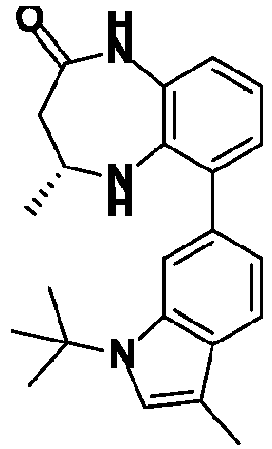
- A mixture of 6-bromo-1-(tert-buty1)-3-methy1-1H-indole (130 mg, 0.5 mmol), (R)-4-methyl-6-(4,4,5,5-tetramethy1-1,3,2-dioxaborolan-2-yl)-4,5-dihydro-1H-benzo[b][1,4]diazepin-2(3H)-one (Intermediate B, 150 mg, 0.5 mmol), bis(triohenylphosphine)palladium(II) dichloride (70 mg, 0.1 mmol) and Na2CO3 (106 mg, 1.0 mmol) in MeCN (5.0 mL) and H2O (1.0 mL) was irradiated in a microwave at 130 °C for 30 min. After cooling the reaction to room temperature, the solvent was concentrated in vacuo. The crude residue was purified by prep-TLC (petroleum ether/EtOAc = 1/1) to give the title compound (27 mg, 15%) as a white solid. 1H NMR (400 MHz, CDCl3) δ 7.69 - 7.64 (m, 1H), 7.55 (s, 1H), 7.37 (s, 1H), 7.14 - 7.08 (m, 3H), 6.96 - 6.91 (m, 2H), 3.97 (s, 1H), 3.86 (s, 1H), 2.83 - 2.79 (m, 1H), 2.46 - 2.42 (m, 1H), 2.36 - 2.32 (m, 3H), 1.76 - 1.72 (m, 9H), 1.22 - 1.18 (m, 3H). LCMS M/Z (M+H) 362.
-

-

- A mixture of (5-bromo-2-fluorophenyl)(cyclopropyl)methanone (5.0 g, 20.60 mmol), methylhydrazine (40% aq., 5.7 g, 123.01 mmol), CuO (82 mg, 1.00 mmol) and K2CO3 (5.7 g, 41.01 mmol) in DMF (25 mL) was heated to 110 °C for 16 h. After cooling the reaction to room temperature, the mixture was filtered and the filtrate was concentrated in vacuo. The crude residue was purified by silica gel chromatography (petroleum ether/EtOAc = 10/1) to give the title product (2.7 g, 52%) as a brown oil. 1H NMR (400 MHz, CDCl3) δ 7.85 (s, 1H), 7.40 (d, J = 8.8 Hz, 1H), 7.16 (d, J = 8.8 Hz, 1H), 3.93 (s, 3H), 2.14 - 2.09 (m, 1H), 1.01 - 1.00 (m, 4H).
-

- A mixture of 5-bromo-3-cyclopropyl-1-methyl-1H-indazole (199 mg, 0.79 mol), (R)-4-methyl-6-(4,4,5,5-tetramethy1-1,3,2-dioxaborolan-2-yl)-4,5-dihydro-1H-benzo[b][1,4]diazepin-2(3H)-one (Intermediate B,200 mg, 0.66 mmol), potassium carbonate (273 mg, 1.78 mmol) and bis(triphenylphosphine)palladium(II) dichloride (49 mg, 0.07 mmol) in 1,4-dioxane (4 mL) and water (1 mL) was heated to 100 °C for 12 h under nitrogen atmosphere. After cooling the reaction mixture to 25 °C, water (20 mL) was added and the mixure extracted with EtOAc (20 mL x 2). The combined organic layers were dried over anhydrous Na2SO4 and concentrated in vacuo. The crude residue was purified by reverse phase chromatography (acetonitrile 26-56% / 0.2% formic acid in water) to give the title compound (46 mg, 20%) as a white solid. 1H NMR (400 MHz, CD3OD) δ7.74 (s, 1H), 7.59 (d, J=8.4 Hz, 1H), 7.42 - 7.39 (m, 1H), 7.10-7.00 (m, 3H), 4.02-3.97 (m, 4H), 2.77-2.72 (m, 1H), 2.37-2.26 (m, 2H), 1.17 (d, J=6.8 Hz, 3H), 1.07-1.03 (m, 4H). LCMS M/Z (M+H) 347.
-

-

- To methyl 5-bromo-1H-indazole-3-carboxylate (762 mg, 3.0 mmol)in acetonitrile (20 ml) at 20 °C was added potassium carbonate (2.0 g, 15 mmol) and methyl iodide (1.1 ml, 15.5 mmol). The mixture was stirred at 20 °C for 10h under nitrogen atmosphere. The mixture was concentrated in vacuo. The crude residue was purified by silica gel chromatography (petroleum ether/EtOAc = 10/1 to 5/1) to give the title compound (600 mg, 75%) as a light yellow solid.
-

- To amixture of 5-bromo-1-methyl-1H-indazole-3-carboxylate (320 mg, 1.2 mmol) in methanol (5 ml) was added aqueous ammonium hydroxide (5 mL). The mixture was heated to90 °C for 10 h under nitrogen atmosphere. After cooling the reaction to room temperature, the mixture was concentrated in vacuo to give the title compound (320 mg, crude) as a white solid that required no further purification.LCMS M/Z (M+H) 254.
-

- To a mixture of 5-bromo-1-methyl-1H-indazole-3-carboxamide (70 mg, 0.28 mmol), cesium carbonate (182 mg, 0.56 mmol) and (R)-4-methyl-6-(4,4,5,5-tetramethyl-1,3,2-dioxaborolan-2-yl)-4,5-dihydro-1H-benzo[b][1,4]diazepin-2(3H)-one (Intermediate B, 84 mg, 0.28 mmol)in dioxane (20 ml)/H2O(4 ml) was added [1,1'-bis(diphenylphosphino)ferrocene]dichloropalladium(II)(22 mg,0.03 mmol). The resulting mixture was heated to 100 °C for 10 h under nitrogen atmosphere. After cooling the reaction to room temperature, the mixture was concentrated in vacuo. The crude residue was purified by reverse phase chromatography (acetonitrile 10-40% / 0.2% formic acid in water) to give the title compound (24 mg, 24%) as a white solid.1H NMR (400 MHz, CD3OD) δ 8.23 (s, 1H), 7.77 - 7.75 (m, 1H), 7.50 - 7.48 (m, 1H), 7.11 - 7.09 (m, 1H), 7.02 - 7.01 (m, 2H), 4.21 (s, 3H), 4.04 - 4.00 (m, 1H), 2.78 - 2.74 (m, 1H), 2.59 - 2.31 (m, 1H), 1.17 - 1.16 (s, 3H).LCMS M/Z (M+H) 350.
-

-

- To asolution of 5-bromo-1-methyl-1H-indazole-3-carboxamide (320 mg, crude) in THF (9 ml) was added trifluoromethanesulfonic anhydride (0.9 ml) and pyridine (0.9 ml). The mixutre was stirred at 20 °C for 10 h. Water (10 mL) was added and the mixture was extracted with EtOAc (15 mL x 3). The combined organic layers were dried over anhydrous Na2SO4, filtered and concentrated in vacuo to give the title compound (320 mg, crude) as a yellow solid that required no further purification.
-

- To a mixture of 5-bromo-1-methy1-1H-indazole-3-carbonitrile (200 mg, crude), cesium carbonate (767 mg, 2.36 mmol) and (R)-4-methyl-6-(4,4,5,5-tetramethyl-1,3,2-dioxaborolan-2-yl)-4,5-dihydro-1H-benzo[b][1,4]diazepin-2(3H)-one (Intermediate B, 300 mg, 1.2 mmol)in dioxane (20 ml)/H2O (4 ml) was added [1,1'-bis(diphenylphosphino)ferrocene]dichloropalladium(II)(87 mg,0.12 mmol). The resulting mixture was heated to 100 °C for 10 h under nitrogen atmosphere. After cooling the reaction to room temperature, the mixture was concentrated in vacuo. The crude residue was purified by reverse phase chromatography (acetonitrile 39-59% / 0.2% formic acid in water) to give the title compound (46 mg, 12%) as a white solid.1H NMR (400 MHz, CD3OD) δ 7.88 (d, J = 8.4 Hz, 1H), 7.79 (s, 1H), 7.60 - 7.58 (m , 1H), 7.09 - 7.08 (m, 1H), 7.06 - 7.02 (m, 2H), 4.25 (s, 3H), 4.03 - 4.01 (m, 1H), 2.79 - 2.75 (m, 1H), 2.37 - 2.33 (m, 1H), 1.19 (s, 3H). LCMS M/Z (M+H) 332.
-

-

- To a solution of 6-bromo-1H-indole (10 g, 51 mmol) in dichloromethane (100 mL) was added 4-dirnethylaminopyridine (623 mg, 5.1 mmol), triethylamine (15.48 g, 153 mmol) and di-tert-butyl dicarbonate (12.3 g, 56 mmol). The reaction mixture was stirred at room temperature for 16 h. The resulting mixture was concentrated in vacuo.Water (100 mL) was added and the mixture was extracted with EtOAc (100 mLx2). The combined organic layers were dried over anhydrous Na2SO4, filtered and concentrated in vacuo to give the crude product that was purified by silica gel chromatography (petroleum ether/EtOAc = 100/1) to give the title compound(15 g, 95%) as a yellow solid.
-

- To a solution of tert-butyl 6-bromo-1H indole-1-carboxylate (5 g, 16.88 mmol) in THF (30 mL) was added lithium diisopropylamidein THF (2M, 21 mmol, 10.5 mL) dropwise at -78 °C. The resulting mixture was stirred at -78 °C for 1 h under nitrogen atmosphere before I2 (4.7 g, 19 mmol) in THF (100 mL) was added.The resulting mixture was stirred at room temperature for 2 h. Water (100 mL) was added and the mixture was extracted with EtOAc (200 mL x 2). The combined organic layers were dried over anhydrous Na2SO4, filtered and concentrated in vacuo to give the crude product that was purified by silica gel chromatography (petroleum ether/EtOAc = 100/1) to give the title compound(5.2 g, 73%) as a yellow solid.
-

- To a solution of tert-butyl 6-bromo-2-iodo-1H indole-1-carboxylate (5.2 g, 12.32 mmol) in MeOH (50 mL) was added sodium hydroxide (5M, 24.6 mL). The reaction mixture was heated to 90 °C for 2 h under nitrogen atmosphere.After cooling the reaction to room temperature, the resulting mixture was concentrated in vacuo. Water (50 mL) was added and the mixture was extracted with EtOAc (100 mL x 2). The combined organic layers were dried over anhydrous Na2SO4, filtered and concentrated in vacuo to give the crude product that was purified by silica gel chromatography (petroleum ether/EtOAc = 50/1) to give the title compound(3 g, 76%) as a yellow solid.
-

- To a solution of 6-bromo-2-iodo-1H-indole (3 g, 9.32 mmol) in THF (20 mL) at 0°C was added NaH (1.1 g, 27.96 mmol). The resulting mixture was stirred at 0°C for 30 min under nitrogen atmosphere. Iodomethane (4 g, 27.96 mmol) was added and the reaction mixture was stirred at room temperature for an additional 2 h. The mixture was poured into ice-water and extracted with EtOAc (50 mL x 2). The combined organic layers were dried over anhydrous Na2SO4, filtered and concentrated in vacuo to give the crude product that was purified by silica gel chromatography (petroleum ether/EtOAc = 50/1) to give the title compound (1.36 g, 43%) as a yellow solid.
-

- To a solution of 6-bromo-2-iodo-1-methy1-1H-indole (860 mg, 2.56 mmol) in dioxane/H2O (10 mL, 5/1) was added (R)-4-methyl-6-(4,4,5,5-tetramethyl-1,3,2-dioxaborolan-2-yl)-4,5-dihydro-1H-benzo[b][1,4]diazepin-2(3H)-one (Intermediate B,773 mg, 2.56 mmol), Na2CO3 (542.6 mg, 5.12 mmol) and [1,1'-bis(diphenylphosphino)ferrocene]dichloro-palladium(II) (150 mg, 0.2 mmol). The reaction mixture was heated to 80 °C for 3 h under nitrogen atmosphere. After cooling the reaction to room temperature, water (20 mL) was added and the mixture was extracted with EtOAc (50 mL x 2). The combined organic layers were dried over anhydrous Na2SO4, filtered and concentrated in vacuo to give the crude product that was purified by silica gel chromatography (petroleum ether/EtOAc = 1/1) to give the title compound (460 mg, 46%) as a yellow solid.
-

- To a solution of (R)-6-(6-bromo-1-methyl-1H-indol-2-yl)-4-methyl-4,5-dihydro-1H-benzo[b][1,4]diazepin-2(3H)-one (460 mg, 1.2 mmol) in dioxane/H2O (5 mL, 5/1) was added 1-methyl-4-(4,4,5,5-tetramethyl-1,3,2-dioxaborolan-2-yl)-1H-pyrazole (274 mg, 1.32 mmol), Na2CO3 (253 mg, 2.39 mmol) and [1,1'-bis(diphenylphosphino)ferrocene]dichloro-palladium(II) (100 mg, 0.12 mmol). The reaction vessel was sealed and irradiated in a microwave at 130 °C for 1 h. After cooling the reaction to room temperature, the reaction mixture was concentrated in vacuo.The crude residue was purified by reverse phase chromatography (acetonitrile 28-58% / 0.1% NH4HCO3 in water) to give the title compound (36 mg, 8%) as a white solid.1H NMR (400 MHz, DMSO-d 6) δ 9.63 (s, 1H), 8.14 (s, 1H), 7.91 (s, 1H), 7.68 (s, 1H), 7.53 (d, J=8.0Hz, 1H), 7.30 (d, J=8.0Hz, 1H), 7.02-6.96 (m, 2H), 6.89-6.85 (m, 1H), 6.43 (s, 1H), 4.27 (s, 1H), 3.91-3.82 (m, 4H), 3.54 (s, 3H), 2.62-2.58 (m, 1H), 2.26-2.21 (m, 1H), 1.05 (s, 3H). LCMS M/Z (M+H) 386.
-
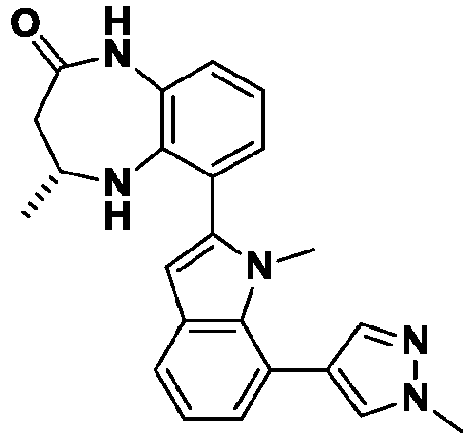
-
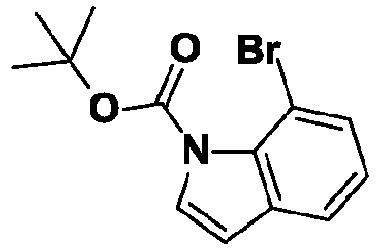
- To a solution of 7-bromo-1H indole (10 g, 51 mmol) in dichloromethane (100 mL) was added 4-dimethylaminopyridine (623 mg, 5.1 mmol), triethylamine (15.48 g, 153 mmol) and di-tert-butyl dicarbonate (12.3 g, 56 mmol). The reaction mixture was stirred at room temperature for 16 h. The resulting mixture was concentrated in vacuo.Water (100 mL) was added and the mixture was extracted with EtOAc (100 mLx2). The combined organic layers were dried over anhydrous Na2SO4, filtered and concentrated in vacuo to give the crude product that was purified by silica gel chromatography (petroleum ether/EtOAc = 100/1) to give the title compound(13.6 g, 90%) as a yellow solid.
-

- To a solution of tert-butyl 7-bromo-1H-indole-1-carboxylate (5 g, 16.88 mmol) in THF (30 mL) at -78 °C was added lithium diisopropylamidein THF (2M, 21 mmol, 10.5 mL) dropwise. The resulting mixture was stirred at -78 °C for 1 h under nitrogen atmosphere before I2 (4.7 g, 19 mmol) in THF (100 mL) was added.The resulting mixture was stirred at room temperature for 2 h. Water (100 mL) was added and the mixture was extracted with EtOAc (200 mL x 2). The combined organic layers were dried over anhydrous Na2SO4, filtered and concentrated in vacuo to give the crude product that was purified by silica gel chromatography (petroleum ether/EtOAc = 100/1) to give the title compound(5.0 g, 70%) as a yellow solid.
-

- To a solution of tert-butyl 7-bromo-2-iodo-1H-indole-1-carboxylate (2 g, 4.74 mmol) in MeOH (20 mL) was added aqueous sodium hydroxide (5M, 9.5 mL). The reaction mixture was heated to90 °C for 2 h under nitrogen atmosphere.After cooling the reaction to room temperature, the resulting mixture was concentrated in vacuo. Water (20 mL) was added and the mixture was extracted with EtOAc (50 mL x 2). The combined organic layers were dried over anhydrous Na2SO4, filtered and concentrated in vacuo to give the crude product that was purified by silica gel chromatography (petroleum ether/EtOAc = 50/1) to give the title compound(1.4 g, 91%) as a yellow solid.
-

- To a solution of 7-bromo-2-iodo-1H-indole (1.4 g, 4.35 mmol) in THF (20 mL) at 0°C was added NaH (0.52 g, 13.05 mmol). The resulting mixture was stirred at 0°C for 30 min under nitrogen atmosphere. Iodomethane (2.47 g, 17.39 mmol) was added and the reaction mixture was stirred at room temperature for an additional 2 h. The mixture was poured into ice-water and extracted with EtOAc (50 mL x 2). The combined organic layers were dried over anhydrous Na2SO4, filtered and concentrated in vacuo to give the crude product that was purified by silica gel chromatography (petroleum ether/EtOAc = 50/1) to give the title compound (0.6 g, 41%) as a yellow solid.
-

- To a solution of 7-bromo-2-iodo-1-methyl-1H indole (600 mg, 1.79 mmol) in dioxane/H2O (10 mL, 5/1) was added (R)-4-methyl-6-(4,4,5,5-tetramethyl-1,3,2-dioxaborolan-2-yl)-4,5-dihydro-1H-benzo[b][1,4]diazepin-2(3H)-one (Intermediate B,647.6 mg, 2.14 mmol), Na2CO3 (378.6 mg, 3.57 mmol) and [1,1'-bis(diphenylphosphino)ferrocene]dichloropalladium(II) (150 mg, 0.2 mmol). The reaction mixture was heated to 80 °C for 3 h under nitrogen atmosphere. After cooling the reaction to room temperature, water (20 mL) was added and the mixture was extracted with EtOAc (50 mL x 2). The combined organic layers were dried over anhydrous Na2SO4, filtered and concentrated in vacuo to give the crude product that was purified by silica gel chromatography (petroleum ether/EtOAc = 1/1) to give the title compound (200 mg, 30%) as a yellow solid.
-

- To a solution of (R)-6-(7-bromo-1-methyl-1H-indol-2-yl)-4-methyl-4,5-dihydro-1H-benzo[b][1,4]diazepin-2(3H)-one (200 mg, 0.52 mmol) in dioxane/H2O (5 mL, 5/1) was added 1-methyl-4-(4,4,5,5-tetramethyl-1,3,2-dioxaborolan-2-yl)-1H-pyrazole (166 mg, 1.56 mmol), Na2CO3 (217 mg, 1.04 mmol) and [1,1'-bis(diphenylphosphino)ferrocene]dichloro-palladium(II) (40 mg, 0.05 mmol). The reaction vessel was sealed and irradiated in a microwave at 110 °C for 40 min. After cooling the reaction to room temperature, the reaction mixture was concentrated in vacuo.The crude residue was purified by reverse phase chromatography (acetonitrile 30-60%/0.1% NH4HCO3 in water) to give the title compound (33 mg, 16%) as a white solid.1H NMR (400 MHz, DMSO-d 6) δ9.61 (s, 1H), 7.88 (s, 1H), 7.60 (s, 1H), 7.54 (d, J=8.0Hz, 1H), 7.07-6.84 (m, 4H), 6.53 (s, 1H), 4.35 (s, 1H), 3.90 (s, 3H), 3.19 (s, 3H), 2.62-2.60 (m, 1H), 2.49-2.20 (m, 2H), 1.09 (s, 3H).LCMS M/Z (M+H) 386.
-

-

- To a solution of 4,5,6,7-tetrahydro-1H-indazole(900 mg, 7.37 mmol) and KOH (827 mg, 14.73 mmol) in DMF (10 ml) was added iodine (3.74 g, 14.73 mmol).The mixture was stirred at room temperature for 8 h.Water (50 mL) was added and the mixture was extracted with EtOAc(50 mL x 3). The combined organic layers were dried over anhydrous Na2SO4, filtered and concentrated in vacuo to give the title compound (1.8 g, 98%) as a yellow solid.
-

- To a solution of 3-iodo-4,5,6,7-tetrahydro-1H-indazole (1.8 g, 7.26 mmol) in THF (20 mL) at 0 °C was added NaH (871 mg, 21.77 mmol). After being stirred at 0 °C for 30 min, MeI (2.6 g, 18.14 mmol) was added and the reaction mixture stirred at room temperature for 1 h. The reaction was quenched by water (20 ml) and the mixture was extracted with EtOAc (20 mL x 2). The combined organic layers were dried over anhydrous Na2SO4, filtered and concentrated in vacuo. The crude product was purified by silica gel chromatography (petroleum ether/EtOAc = 1: 1) to give the title compound (1.2 g, 63%) as a yellow solid. 1H NMR (400 MHz, DMSO-d6 ) δ 3.66 (s, 3H), 2.55 - 2.52 (m, 2H), 2.21 - 2.18 (m, 2H), 1.74 - 1.71 (m, 2H), 1.67 - 1.64 (m, 2H).
-

- A mixture of (R)-4-methyl-6-(4,4,5,5-tetramethy1-1,3,2-dioxaboro1an-2-y1)-4,5-dihydro-1H-benzo[b][1,4]diazepin-2(3H)-one (Intermediate B,100 mg, 0.33 mmol), 3-iodo-1-methyl-4,5,6,7-tetrahydroindazole(104 mg, 0.40), Na2CO3(70 mg, 0.66 mmol) and [1,1'-bis(diphenylphosphino)ferrocene]dichloropalladium(II) (24 mg, 0.03 mmol) in 1,4-dioxane (4 mL) and water (1 mL)was heated to 120 °C for 16 h under nitrogen atmosphere. After cooling the reaction to room temperature, the mixture was concentrated in vacuo and the crude residue was purified by reverse phase chromatography (acetonitrile 26 - 56% / 0.2% formic acid in water) to give the title compound (29 mg, 23%) as a white solid. 1H NMR (400 MHz, DMSO-d6 ) δ 9.47 (s, 1H), 7.11 - 7.04 (m, 1H), 7.01 (s, 1H), 6.86 - 6.79 (m, 2H), 3.86 - 3.84 (m, 1H), 3.73 (s, 3H), 2.65 - 2.62 (m, 2H), 2.51 - 2.50 (m, 2H), 2.39 - 2.38 (m, 1H), 2.20 - 2.18 (m, 1H), 1.80 - 1.78 (m, 2H), 1.70 - 1.64 (m, 2H), 1.09 (d, J = 6.4 Hz, 3H), LCMS M/Z (M+H) 311.
-

-
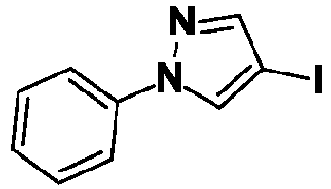
- Amixture of 4-iodo-1H-pyrazole (1.00 g, 5.15 mmol), phenylboronic acid(950 mg, 7.73 mmol), copper acetate (1.87 g, 10.3 mmol) and pyridine (1.48 g, 20.6 mmol) in DMF (20 mL) was heated to80 °C for 16 h under nitrogen atmosphere. After cooling the reaction to room temperature, water (20 mL) was added and the mixture was extracted with EtOAc (20 mL × 3). The combined organic layers were washed by brine (30 mL × 2), dried over anhydrous Na2SO4, filtered and concentrated in vacuo to give the title compound (400 mg, crude) as a white solid that required no further purification. LCMS M/Z (M+H) 271.
-

- A mixture of 4-iodo-1-phenyl-1H-pyrazole (400mg, 1.48 mmol), (R)-4-methyl-6-(4,4,5,5-tetramethyl-1,3,2-dioxaborolan-2-yl)-4,5-dihydro-1H-benzo[b][1,4]diazepin-2(3H)-one (Intermediate B, 535 mg, 1.78 mmol), potassium carbonate (408 mg, 2.96 mmol) and [1,1'-bis(diphenylphosphino)ferrocene]dichloropalladium(II), complex with dichloromethane(109 mg, 0.15 mmol) in dioxane (10 mL) and H2O (2 mL) was heated to 100 °C for 16 h under nitrogen atmosphere.After cooling the reaction to room temperature, the mixture was concentrated in vacuo. The crude residue was purified by reverse phase chromatography (acetonitrile 28-58% / 0.2% formic acid in water) to give the title compound (113 mg, 24 %) as a gray soild. 1H NMR (400 MHz, CDCl3) δ 8.04 (s, 1H), 7.83 (s, 1H), 7.76 (d, J = 7.6 Hz, 1H), 7.52 (t, J = 7.6 Hz, 2H), 7.48 (br s, 1H), 7.37 (t, J = 7.6 Hz, 2H), 7.10 (d, J = 1.6 Hz, 1H), 6.97 - 6.88 (m, 2H), 4.11 - 3.97 (m, 1H), 3.85 (br s, 1H), 2.81 - 2.76 (m, 1H), 2.53 - 2.46 (m, 1H), 1.35 (d, J = 6.4 Hz, 3H). LCMS M/Z (M+H) 319.
- The following compounds were prepared in a similar fashion to Example 63:
-
Example Compound Name NMR m/z Example 64 (4R)-4-methyl-6-[1-(3-pyridyl)pyrazol-4-yl]-1,3,4,5-tetrahydro-1,5-benzodiazepin-2-one 1H NMR (400 MHz, CDCl3) δ 9.06 (d, J = 2.8 Hz, 1H), 8.63 (d, J = 4.8 Hz, 1H), 8.16 - 8.10 (m, 1H), 8.08 (s, 1H), 7.89 (s, 1H), 7.49 - 7.46 (m, 1H), 7.32 (s, 1H), 7.10 (d, J = 7.6 Hz, 1H), 6.99 - 6.84 (m, 2H), 4.15 - 3.96 (m, 1H), 3.78 (br s, 1H), 2.81 - 2.77 (m, 1H), 2.53 - 2.47 (m, 1H), 1.36 (d, J = 6.4 Hz, 3H) 320 Example 65 (4R)-4-methyl-6-[1-(4-pyridyl)pyrazol-4-yl]-1,3,4,5-tetrahydro-1,5-benzodiazepin-2-one 1H NMR (400 MHz, CDCl3) δ 8.74 (d, J = 5.6 Hz, 2H), 8.15 (s, 1H), 7.90 (s, 1H), 7.75 (br s, 1H), 7.70 (d, J = 6.0 Hz, 2H), 7.13 - 7.03 (m, 1H), 7.00 - 6.87 (m, 2H), 4.13 - 3.94 (m, 1H), 3.73 (br s, 1H), 2.79 (dd, J = 13.6, 4.4 Hz, 1H), 2.54 - 2.47 (m, 1H), 1.35 (d, J = 6.4 Hz, 3H) 320 -

-

- To a solution of methyl 2-fluoro-3-nitrobenzoate (4.0 g, 20.09 mmol) in DMF (80 mL)was added N-ethyl-N-isopropylpropan-2-amine (7.8 g, 60.35mmol) and (R)-3-aminobutanoic acid(2.3 g, 22.30mmol). The resulting mixture was heated to 80 °C for 15 h. After cooling the reaction to room temperature, water (50 mL) was added and the mixture was extracted with EtOAc (100 mL x 3). The combined organic layers were dried over anhydrous Na2SO4, filtered and concentrated in vacuo to give the title compound (4.1 g, 73%) as a yellow solid that required no further purification.
-

- A mixture of (R)-3-((2-(methoxycarbonyl)-6-nitrophenyl)amino)butanoic acid (4.1 g, 14.53 mmol) andFepowder (4.2 g, 75.21 mol) in acetic acid (50 mL) was heated to 100 °C for 1 h. After cooling the reaction to room temperature, the reaction mixture was filtered and the filtrate was concentrated in vacuo.Water (20 mL) was added and the mixture was extracted with EtOAc (80 mL x 3). The combined organic layers were dried over anhydrous Na2SO4, filtered and concentrated in vacuo. The crude residue was purified by silica gel chromatography (petroleum ether/EtOAc = 3/1) to give the title compound (1.5 g, 44%) as a white solid.
-

- To a solution of (R)-methyl 4-methyl-2-oxo-2,3,4,5-tetrahydro-1H-benzo[b][1,4]diazepine-6-carboxylate (1.3 g, 5.55mmol) in DMF/H2O (40 mL/10 mL) was added LiOH (720mg, 30.06mmol). The resulting mixture was heated to 80 °C for 15 h. After cooling the reaction to room temperature, the solvent was concentrated in vacuo. Water (20 mL) was added and the mixture was extracted withEtOAc (30 mL x 3).The aqueous phase was acidified with HCl (1N) to pH 3. The resulting precipitate was collected by filtration to give the title compound (Intermediate C, 1.0 g, 82%)as a white solid.
-

- To a solution of (R)-4-methyl-2-oxo-2,3,4,5-tetrahydro-1H-benzo[b][1,4]diazepine-6-carboxylic acid (Intermediate C,100 mg, 0.45 mmol) in DMF (5 mL) was added (2-(trifluoromethoxy)phenyl)methanamine (104 mg, 0.54 mmol),N-ethyl-N-isopropylpropan-2-amine (176 mg, 1.36 mmol) and HATU (131 mg, 0.54 mmol). The reaction mixture was stirred at 15 °C for 15 h. Ice water (5 mL) was added and the mixture was extracted with EtOAc (10 mL x 3). The combined organic layers were concentrated in vacuo. The crude residue was purified by reverse phase chromatography (acetonitrile 40-60% / 0.2% formic acid in water) to give the title compound (30 mg, 17%) as a white solid. 1H NMR (400 MHz, DMSO-d 6) δ 9.54 (s, 1H), 9.02 - 8.99 (m, 1H), 7.42 - 7.33 (m, 5H), 7.01 - 6.99 (m, 1H), 6.80-6.78 (m, 1H), 4.50-4.47 (m, 2H), 3.89-3.85 (m, 1H), 2.41-2.37 (m, 1H), 2.24-2.19 (m, 1H), 1.26 (d, J = 6.0 Hz, 3H). LCMS M/Z (M+H) 394.
- The following compounds were prepared in a similar fashion to Example 66:
-
Example Compound Name NMR m/z Example 67 N-(3-isopropoxyphenyl)-2-methyl-4-oxo-3,5-dihydro-2H-1,5-benzoxazepine-9-carboxamide 1H NMR (400 MHz, DMSO-d 6) 87.52 (d, J = 5.2 Hz, 1H), 7.51 (s, 1H), 7.37-7.13 (m, 4H), 6.69 (d, J = 8.0 Hz, 1H), 4.98-4.93 (m, 1H), 4.62-4.56 (m, 1H), 2.84-2.79 (m, 1H), 2.52-2.48 (m, 1H), 1.44 (d, J = 6.4 Hz, 3H), 1.31 (d, J = 6.0 Hz, 6H) 355 Example 68 N-(3-isopropoxyphenyl)-2-methyl-4-oxo-3,5-dihydro-2H-1,5-benzoxazepine-9-carboxamide 1H NMR (400 MHz, DMSO-d 6) δ7.51 (d, J = 2.0 Hz, 1H), 7.47 (s, 1H), 7.38 -7.17 (m, 4H), 6.70 (d, J = 1.6 Hz, 1H), 4.97 -4.91 (m, 1H), 4.62-4.56 (m, 1H), 2.83 -2.79 (m, 1H), 2.52-2.46 (m, 1H), 1.44 (d, J = 6.4 Hz, 3H), 1.31 (d, J = 6.0 Hz, 6H) 355 Example 69 (4R)-N-benzhydryl-4-methyl-2-oxo-1,3,4,5-tetrahydro-1,5-benzodiazepine-6-carboxamide 1H NMR (400 MHz, DMSO-d 6) δ 9.57 (s, 1H), 9.38 (d, J = 8.8 Hz, 1H), 7.40 -7.27 (m, 11H), 7.02 (d, J = 7.6 Hz, 1H), 6.83 (d, J = 8.0 Hz, 1H), 6.36 (d, J = 8.8 Hz, 1H), 3.89 - 3.85 (m, 1H), 2.38 -2.35 (m, 1H), 2.21 - 2.16 (m, 1H), 1.03 (d, J = 6.4 Hz, 3H) 386 Example 70 (4R)-N-(4-methoxyphenyl)-4-methyl-2-oxo-1,3,4,5-tetrahydro-1,5-benzodiazepine-6-carboxamide 1H NMR (400 MHz, DMSO-d 6) δ 10.2 (s, 1H), 9.6 (s, 1H), 7.58 (d, J = 8.8 Hz, 2H), 7.35 (d, J = 6.4 Hz, 1H), 7.03 (d, J = 6.4 Hz, 1H), 6.90 - 6.83 (m, 3H), 3.92 - 3.89 (m, 1H), 3.71 (s, 3H), 2.44 - 2.39 (m, 1H), 2.24 - 2.18 (m, 1H), 1.14 (d, J = 6.4 Hz, 3H) 326 Example 71 (4R)-N-[(4R)-chroman-4-yl]-4-methyl-2-oxo-1,3,4,5-tetrahydro-1,5-benzodiazepine-6-carboxamide 1H NMR (400 MHz, DMSO-d 6) δ 9.56 (s, 1H), 8.91 (d, J = 8.4 Hz, 1H), 7.30 -7.28 (m, 1H), 7.20 - 7.14 (m, 2H), 7.01 (d, J = 6.8 Hz, 1H), 6.85 - 6.75 (m, 3H), 5.27 - 5.25 (m, 1H), 4.30 - 4.22 (m, 2H), 3.97 - 3.96 (m, 1H), 2.50 - 2.06 (m, 5H), 1.21 (d, J = 6.4 Hz, 3H) 352 Example 72 (4R)-4-methyl-2-oxo-N-[(1R)-1-phenylpropyl]-1,3,4,5-tetrahydro-1,5-benzodiazepine-6-carboxamide 1H NMR (400 MHz, CD3OD) δ 7.37 - 7.32 (m, 5H), 7.30 - 7.28 (m, 1H), 7.22 - 7.06 (m, 1H), 7.05 - 6.96 (m, 1H), 4.90 - 4.92 (m, 1H), 3.97 - 3.92 (m, 1H), 2.46-2.41 (m, 1H), 2.27 - 2.22 (m, 1H), 1.91 - 1.87 (m, 2H), 1.01 - 0.98 (m, 6H) 338 Example 73 (4R)-N-(3-methoxyphenyl)-4-methyl-2-oxo-1,3,4,5-tetrahydro-1,5-benzodiazepine-6-carboxamide 1HNMR(400 MHz, CD3OD) δ 7.49 - 7.47 (m, 1H), 7.38 (s, 1H), 7.27 - 7.24 (m, 1H), 7.22 - 7.18 (m,1H), 7.12-7.11 (m,1H), 7.00 - 6.98 (m, 1H), 6.75 - 6.74 (m, 1H), 4.08-4.05 (m, 1H), 3.83 (s, 3H), 2.61 - 2.56 (m, 1H), 2.38 - 2.33 (m, 1H), 1.30 (d, J = 6.4 Hz, 3H) 326 Example 74 (4R)-N-(3-ethoxyphenyl)-4-methyl-2-oxo-1,3,4,5-tetrahydro-1,5-benzodiazepine-6-carboxamide 1H NMR (400 MHz, CD3OD) δ 7.47 - 7.46 (m, 1H), 7.36 (s, 1H), 7.25 - 7.23 (m, 2H), 7.14-7.11 (m, 1H), 7.00 - 6.98 (m, 1H), 6.74 - 6.71 (m, 1H), 4.09-4.03 (m, 3H), 2.61-2.56 (m, 1H), 2.38 - 2.33 (m, 1H), 1.43 - 1.39 (m, 3H), 1.30 (d, J = 6.4 Hz, 3H) 340 Example 75 (4R)-4-methyl-N-(3-oxazol-5-ylphenyl)-2-oxo-1,3,4,5-tetrahydro-1,5-benzodiazepine-6-carboxamide 1H NMR (400 MHz, CD3OD) δ 8.29 (s, 1H), 8.14 (s, 1H), 7.70 - 7.65 (m, 1H), 7.56 - 7.47 (m, 4H), 7.16 - 7.13 (m, 1H), 7.02 - 6.99 (m, 1H), 4.11 - 4.06 (m, 1H), 2.62 - 2.58 (m, 1H), 2.40 - 2.35 (m, 1H), 1.31 (d, J = 6.4 Hz, 3H) 363 -

-

- To a solution of oxetan-3-ol (500 mg, 6.75 mmol) in DMF (10 mL) at 0 °C was added NaH (405 mg, 10.13 mmol). The mixture was stirred at 0 °C for 30 min before 1-fluoro-3-nitrobenzene (1.14 g, 8.08 mmol) was added. The mixture was allowed to stir overnight at room temperature before it was poured into ice water (20 mL) and extracted with EtOAc (30 mL x3). The combined organic layers were washed with brine (20 mL), dried over anhydrous Na2SO4, filtered and concentrated in vacuo to give the title compound (500 mg, 32%) as yellow oil.
-

- To a solution of 3-(3-nitrophenoxy)oxetane (200 mg, 1.02 mmol) in (20 mL) was added Raney Ni (20 mg, 10%) under nitrogen atmosphere. The suspension was degassed under vacuo and purged with H2 several times. The mixture was stirred under H2(balloon) at room temperature for 2 h. The solid was removed by filtration and the filtrate was concentrated in vacuo to give the title compound (150mg, 89%) as a pale yellow solid.
-

- To a solution of (R)-4-methyl-2-oxo-2,3,4,5-tetrahydro-1H-benzo[b][1,4]diazepine-6-carboxylic acid (Intermediate C,150 mg, 0.68 mmol) in DMF (5 mL) was added 3-(oxetan-3-yloxy)aniline (135 mg, 0.82 mmol), N-ethyl-N-isopropylpropan-2-amine (264 mg, 2.04 mmol) and HATU (297 mg, 0.78 mmol). The mixture was allowed to stir at room temperature for 16 h. The mixture was concentrated in vacuo.The crude residue was purified by reverse phase chromatography (acetonitrile 19-49% / 0.1% NH4OH in water) to give the title copound (105 mg, 42%). 1H NMR (400 MHz, CD3OD) δ 7.45 - 7.43 (m, 1H), 7.24 - 7.22 (m, 3H), 7.11 - 7.08 (m, 1H), 6.96 - 6.92 (m, 1H), 6.55 - 6.53 (m, 1H), 5.28 - 5.24 (m, 1H), 5.02 - 4.98 (m, 2H), 4.70 - 4.67 (m, 2H), 4.04 - 4.03 (m, 1H), 2.57 - 2.52 (m, 1H), 2.35 - 2.30 (m, 1H), 1.26 (d, J = 6.4 Hz, 3H). LCMS M/Z (M+H) 368.
-
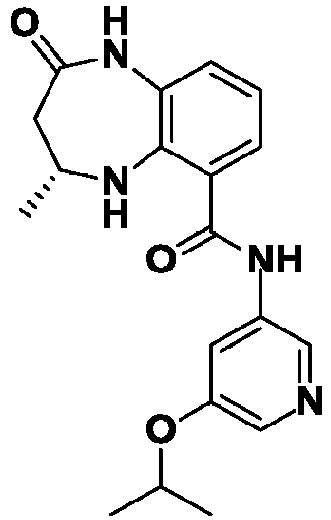
-

- To a solution of 5-bromopyridin-3-ol (500 mg, 2.87 mmol) in DMF (10 mL) at 0 °C was added NaH (133 mg, 3.33 mmol). The mixture was stirred at 0 °C for 30 min before 2-iodopropane (739 mg, 4.35 mmol) was added. The mixture was allowed to stir overnight at room temperature. The solution was poured into ice water (10 mL) and extracted with EtOAc (20 mL x3). The combined organic layers were washed with brine (20 mL), dried over anhydrous Na2SO4, filtered and concentrated in vacuo to give the title compound (280 mg, 45%) as a yellow oil.
-

- A mixture of 3-bromo-5-isopropoxypyridine (280 mg, 1.30 mmol), tert-butyl carbamate (228 mg, 1.95 mmol), CS2CO3 (844 mg, 2.59 mmol), tris(dibenzylidene-acetone)dipalladium(0) (125 mg, 130 umol) and 2-(dicyclohexylphosphino)-2',4',6'-triisopropylbiphenyl (75 mg, 130 umol) dissolved in dioxane (4 mL) and H2O (1 mL) was irradiated in a microwave at 100 °C for 30 min. After cooling the reaction to room temperature,the mixture was filtered and concentrated in vacuo. The crude residue was purified by silica gel chromatography (petroleum ether/EtOAc = 5/1) to give the title compound (150mg, 46%) as white solid.
-

- To a solution of tert-butyl (5-isopropoxypyridin-3-yl)carbamate (150 mg, 0.59 mmol) in (5 mL) was added HCl/MeOHsolution (4M, 10 mL) dropwise. The mixture was stirred at room temperature for 3 h. The mixture was concentrated in vacuo to give the title compound (80 mg, 71%) as white solid.
-

- To a solution of 5-isopropoxypyridin-3-amine hydrochloride (80 mg, 0.42 mmol) in pyridine (5 mL) was added (R)-4-methyl-2-oxo-2,3,4,5-tetrahydro-1H-benzo[b][1,4]diazepine-6-carboxylic acid (Intermediate C,87 mg, 0.40mmol) and 1-(3-dimethylaminopropyl)-3-ethylcarbodiimide hydrochloride (85 mg, 0.66mmol). The resulting mixture was allowed to stir at room temperature for 8 h. The mixture was concentrated in vacuo and the crude residue was purified by reverse phase chromatography (acetonitrile 23-43% / 0.2% formic acid in water)to give the title compound (48 mg, 34%)as a white solid. 1H NMR (400 MHz, CD3OD) δ 8.40 (s, 1H), 7.96 - 7.89 (m, 2H), 7.50 - 7.48 (m, 1H), 7.13 - 7.10 (m, 1H), 6.96 - 6.92 (m, 1H), 4.70 - 4.65 (m, 1H), 4.07 - 4.02 (m, 1H), 2.59 - 2.54 (m, 1H), 2.37 - 2.31 (m, 1H), 1.37 - 1.35 (m, 6H), 1.27 (d, J = 6.4 Hz, 3H). LCMS M/Z (M+H) 355.
-

-

- To a solution of (R)-4-methyl-2-oxo-2,3,4,5-tetrahydro-1H-benzo[b][1,4]diazepine-6-carboxylic acid (Intermediate C,300 mg, 1.36 mmol) in DMF (10 mL) was added 4-bromoaniline (279 mg, 1.62 mmol), HATU (616 mg, 1.62 mmol) and N-ethyl-N-isopropylpropan-2-amine (352mg, 2.72 mmol). The reaction mixture was stirred at 0 °C for 15 h before it was added to ice-cold water (10 mL). The resulting solid was collected by filtration, washed with water (15 mL) and dried in vacuo to give the title compound (300 mg, 59%) as a white solid.
-

- To a solution of (R)-N-(4-bromophenyl)-4-methyl-2-oxo-2,3,4,5-tetrahydro-1H-benzo[b][1,4]diazepine-6-carboxamide (100 mg, 0.27 mmol) in NMP (3 mL) was added CuCN (48 mg, 0.53 mmol) and CuI (25 mg, 0.13 mmol). The reaction mixture wasirradiated in a microwave at200 °C for 0.5 h. After cooling the reaction to room temperature,the mixture was concentrated in vacuo and the crude residue was dissolved in EtOAc (10 mL) and washed with water (10 mL). The organic layer was concentrated in vacuo. The crude residue was purified by reverse phase chromatography (acetonitrile 13-43% / 0.1% NH4OH in water)to give the title compound (15 mg, 18%) asa white solid. 1H NMR (400MHz, DMSO-d 6) δ 10.70 (s, 1H), 9.61 (s, 1H), 7.89 (d, J = 8.8 Hz, 2H), 7.79 (d, J = 8.4 Hz, 2H), 7.38 (d, J = 6.8 Hz, 1H) 7.06 (d, J = 7.2 Hz,1H), 6.85 (t, J = 8.0 Hz, 1H), 6.58 (s, 1H), 3.94 (s, 1H), 2.47-2.42 (m, 1H), 2.25-2.20 (m, 1H), 1.14 (m, J = 6.4 Hz, 2H), LCMS M/Z (M+H) 321.
-

- To a solution of (R)-4-methyl-2-oxo-2,3,4,5-tetrahydro-1H-benzo[b][1,4]diazepine-6-carboxylic acid (Intermediate C, 100 mg, 0.45 mmol) in DMF (5 mL) was added phenylmethanol (60 mg, 0.55 mmol) and triphenylphosphine (179 mg, 0.68 mmol). The solution was degassed with vacuo and purged with N2 for several times before (E)-diisopropyl diazene-1,2-dicarboxylate (180 mg, 0.89 mmol) was added dropwise to the mixture at 0 °C. The resulting mixture was allowed to stir at room temperature for 30 min. The solution was concentrated in vacuo and the crude residue was diluted with water (50 mL) and extracted with EtOAc (50 mL x3). The combined organic layers were washed with brine (50 mL), dried over anhydrous Na2SO4, filtered and concentrated in vacuo. The crude residue was purified by reverse phase chromatography (acetonitrile 25-50% / 0.1% NH4OH in water) to give the title compound (60 mg, 43%). 1H NMR (400 MHz, CD3OD) δ 7.84-7.82 (m, 1H), 7.48 - 7.37 (m, 5H), 7.15 - 7.13 (m, 1H), 6.82 - 6.77 (m, 1H), 5.36 (s, 2H), 4.09 - 4.03 (m, 1H), 2.62 - 2.58 (m, 1H), 2.49 - 2.43 (m, 1H), 1.34 (d, J= 6.0 Hz, 3H). LCMS M/Z (M+H) 311.
-
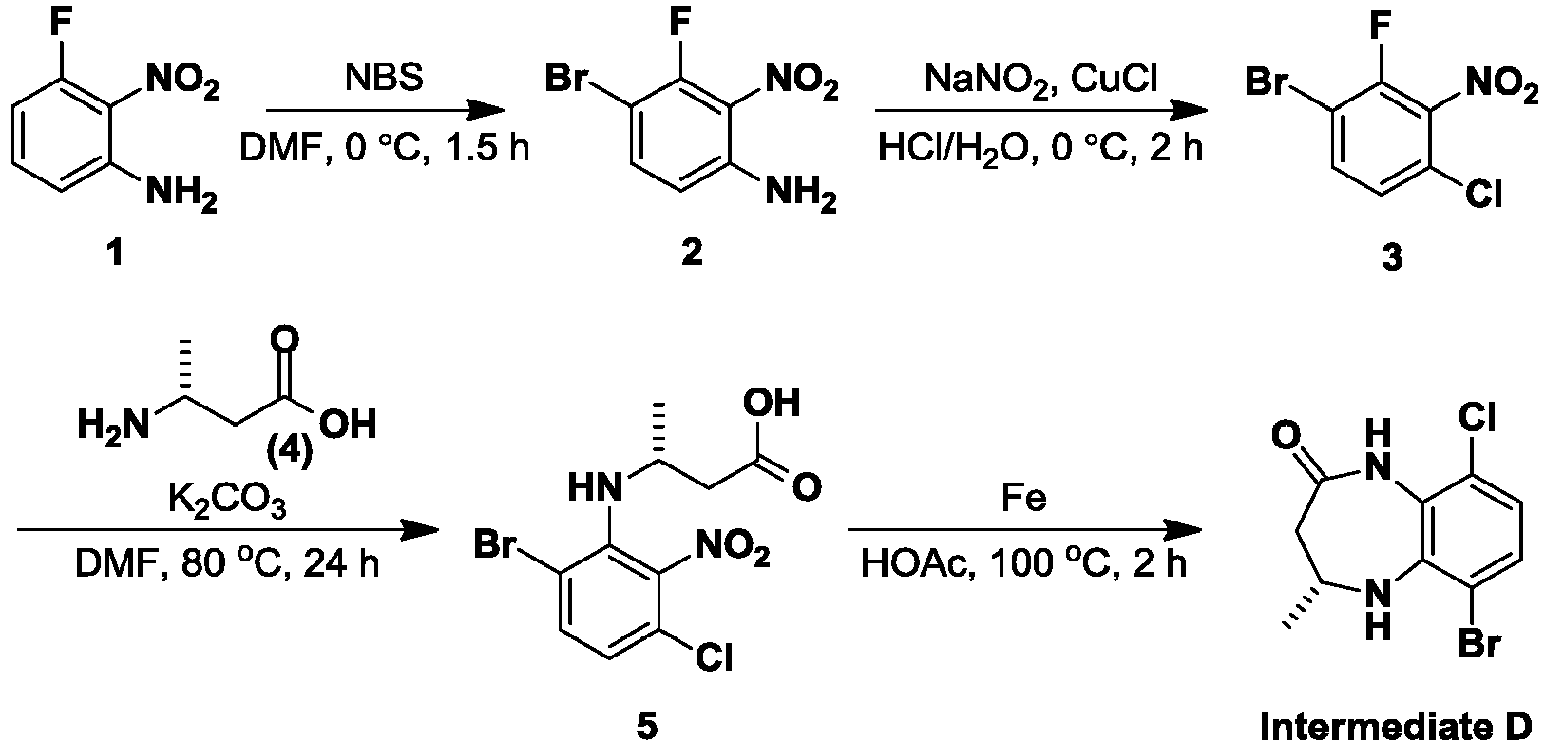
-

- To a solution of 3-fluoro-2-nitroaniline (9.5 g, 60.9 mmol) in dimethyl formamide (100mL) at 0 °C was added 1-bromopyrrolidine-2,5-dione(9.75 g, 54.8 mmol) dropwise and the reaction mixture stirred for 1.5 h. The reaction mixture was quenched with ice water (100 mL) and extracted with EtOAc (100 mL x 3). The organic layers were dried over anhydrous Na2SO4, filtered and concentrated in vacuo. The crude residue was purified by silica gel chromatography (petroleum ether/EtOAc = 10/1) to givethe title compound (13.5 g, 94%) as a yellow solid.1H NMR (400 MHz, DMSO-d 6) 57.54 - 7.50 (m, 1H), 7.16 (s, 2H), 6.76 (d, J = 7.6 Hz, 1H).
-

- To a solution of 4-bromo-3-fluoro-2-nitroaniline(6.0 g, 25.5 mmol) in concentrated HCl (50 mL) at 0 °C was added NaNO2 (1.94 g, 28.1 mmol) dropwise and the reaction mixture stirred for 1 h before CuCl (3.8 g, 38.3 mmol) in concentrated HCl (2mL) was added dropwise. The reaction mixture was stirred at 0 °C for 0.5 h. The mixture was adjusted to pH 7 with sat. aq. NaHCO3 and filtered. The filtrate was extracted with EtOAc (50 mL x 3), washed with brine,dried over anhydrous Na2SO4, filtered and concentrated in vacuo. The crude residue was purified by silica gel chromatography (petroleum ether/EtOAc = 50/1 to 20/1) to give the title compound (4.8 g, 74%) as a brown solid.1H NMR (400 MHz, DMSO-d 6) δ 8.10 - 8.06 (m, 1H), 77.67 -7.65 (m, 1H).
-

- A mixture of1-bromo-4-chloro-2-fluoro-3-nitrobenzene (500 mg, 1.98 mmol), (R)-3-aminobutanoic acid (243 mg, 2.36 mmol) and potassium carbonate (815 mg, 5.9 mmol) in acetonitrile (6 mL) was heated to 80 °C for 16 hunder nitrogen atmosphere. Water (20 mL) was added and the mixture was acidified with HCl (1N) to pH 6 and then extracted with EtOAc (30 mL x 3). The combined organic layers were washed with brine (30 mL × 3), dried over anhydrous Na2SO4, filtered and concentrated in vacuo to give the title compound (520 mg, crude) as a gray solid that required no further purification.
-

- A mixture of (R)-3-((6-bromo-3-chloro-2-nitrophenyl)amino)butanoic acid (520 mg, crude) andFe powder (430 mg, 7.7 mmol) in acetic acid (5 mL) was heated to 100 °C for 2 h under nitrogen atmosphere. After cooling the reaction to room temperature,the mixture was concentrated in vacuo, before water (20 mL) was added. The mixture was adjusted to pH 8 by potassium carbonate and filtered. The filtrate was extracted with EtOAc (20 mL x 3), washed with brine,dried over anhydrous Na2SO4, filtered and concentrated in vacuo to give the title compound (IntermediateD, 550 mg, crude) as a brown solid that required no further purification.
-

-

- A mixture of 5-bromo-3-cyclopropyl-1-methyl-1-1H-indazole (5.0 g, 19.90 mmol), 4,4,4',4',5,5,5',5'-octamethyl-2,2'-bi(1,3,2-dioxaborolane) (6.1 g, 23.90 mmol), KOAc (4.9 g, 59.7 mmol)and [1,1'-bis(diphenylphosphino)ferroceneldichloropalladium(II) (1.5 g, 2.00 mol) in dioxane (25 mL)was heated to 110 °C for 16 h under nitrogen atmosphere. After cooling the reaction to room temperature, the mixture was filtered and the filtrate was concentrated in vacuo. The crude residue was purified by silica gel chromatography (petroleum ether/EtOAc = 10/1) to give the title product (3.0 g, 51%) as a yellow solid.
-

- A mixture of (R)-6-bromo-9-chloro-4-methyl-4,5-dihydro-1H-benzo[b][1,4]diazepin-2(3H)-one (IntermediateD, 241 mg, 0.83 mmol), 3-cyclopropyl-1-methyl-5-(4,4,5,5-tetramethyl-1,3,2-dioxaborolan-2-yl)-1H-indazole (298 mg, 1.0 mmol), bis(triphenylphosphine)palladium(II) dichloride (58.5 mg, 0.08 mmol) and potassium carbonate (229 mg, 1.66 mmol) in dioxane/H2O (10 mL /2mL) was heated to90 °C for 3 h under nitrogen atmosphere. After cooling the reaction to room temperature, water (10 mL) was added and the mixture was extracted with EtOAc (10 mL x 3). The organic lagers were washed with brine, dried over anhydrous Na2SO4, filtered and concentrated in vacuo to afford the crude product that was purified by reverse phase chromatography (acetonitrile 36-66% / 0.2% formic acid in water) to give the title compound(45.0 mg, 14.2%) as a white solid. 1H NMR (400 MHz, CDCl3) δ 7.68 (s, 1H), 7.52 - 7.31 (m, 3H), 7.15 - 6.96 (m, 2H), 4.04 (s, 4H), 3.65 (s, 1H), 2.94-2.65 (m, 1H), 2.58 - 2.35 (m, 1H), 2.30 - 2.08 (m, 1H), 1.32 - 1.15 (m, 3H), 1.13 - 1.00 (m, 4H). LCMS M/Z (M+H) 381.
- The following compound was prepared in a similar fashion to Example 80:
Example Compound Name NMR m/z Example 81 (2R)-9-(1-tert-butylpyrazol-4-yl)-6-chloro-2-methyl-1,2,3,5-tetrahydro-1,5-benzodiazepin-4-one 1H NMR (400 MHz,DMSO-d 6) δ 9.15 (s, 1H), 8.02 (s, 1H) 7.62 (s, 1H), 7.10 - 7.03 (m, 2H), 4.16 - 4.15 (m, 1H), 4.03 - 4.00 (m, 1H), 2.14 - 2.09 (m, 1H), 2.00 - 1.95 (m, 1H), 1.56 (s, 9H), 1.17 (d, J = 6.4 Hz, 3H) 3 33 -

- A mixture of (R)-9-chloro-6-(3-cyc1opropyl-1-methyl-1H-indazol-5-yl)-4-methyl-4,5-dihydro-1H-benzo[b][1,4]diazepin-2(3H)-one (Intermediate D, 250mg, 0.66 mmol), potassium methyltrifluoroborate (242 mg, 1.98 mmol), palladium acetate (12 mg, 0.07 mmol),di(adamantan-1-yl)(butyl)phosphine (46.6 mg, 0.13 mmol) and cesium carbonate (1.29 g, 3.96 mmol) in toluene (20 mL) and water (5 ml) washeated to 100 °C for 16 h under nitrogen atmosphere. After cooling the reaction to room temperature, the mixture was concentrated in vacuo and the residue was purified by reverse phase chromatography (acetonitrile 40-70% / 0.2% formic acid in water) to givethe title compound (29 mg, 12%) as a yellow soild. 1H NMR (400 MHz, CDCl3)87.68 (s, 1 H), 7.42 (d, J = 8.4 Hz, 1H), 7.33 (d, J = 8.4 Hz, 1H), 7.13 - 7.00 (m, 2H), 6.93 (d, J = 7.6 Hz, 1H), 4.14 - 3.94 (m, 4H), 3.55 (br s, 1H), 2.81-2.75 (m, 1H), 2.43 - 2.29 (m, 4H), 2.26 - 2.13 (m, 1H),1.21 (d, J = 6.4 Hz, 3H), 1.12 - 0.98 (m, 4H). LCMS M/Z (M+H) 361.
-

- A mixture of (R)-9-chloro-6-(3-cyclopropyl-1-methyl-1H-indazol-5-yl)-4-methyl-4,5-dihydro-1H-benzo[b][1,4]diazepin-2(3H)-one (Intermediate D, 250mg, 0.66 mmol), potassium ferrocyanide (139 mg, 0.33 mmol), tris(dibenzylideneacetone)dipalladium(64 mg, 0.07 mmol), di-tert-butyl(2',4',6'-triisopropyl-[1,1'-biphenyl]-2-yl)phosphine (55.8 mg, 0.13 mmol) and potassium acetate (129 mg, 1.32 mmol) in dioxane (10 mL) and water (10 ml)was heated to 100 °C for 16 h under nitrogen atmosphere.After cooling the reaction to room temperature, the mixture was filtered and the filtrate was concentrated in vacuo. The residue was purified by reverse phase chromatography (acetonitrile 45-55% / 0.2% formic acid in water) to give the title compound (38 mg, 16%) as a yellow soild. 1H NMR (400 MHz, CDCl3)δ7.70 (s, 1H), 7.53 (s, 1H), 7.46 (d, J = 8.8 Hz, 1H), 7.35 - 7.23 (m, 2H), 7.15 (d, J = 8.0 Hz, 1H), 4.10 - 3.97 (m, 4H), 3.73 (s, 1H), 3.82 (d, J = 13.2 Hz, 1H), 2.55 - 2.50 (m, 1H), 2.28 - 2.12 (m, 1H), 1.24 (d, J = 6.3 Hz, 3H), 1.13 - 1.00 (m, 4H). LCMS M/Z (M+H) 372.
-

-

- A mixture of 1,3-difluoro-2-nitrobenzene (2 g, 12.57 mmol) and 1,3-dibromo-5,5-dimethylimidazolidine-2,4-dione (1.98 g, 6.91 mmol) in concentrated sulfuric acid (20 mL) was stirred at 26°C for 16 h. The reaction mixture was quenched with ice water (20 mL) and extracted with EtOAc (20 mL x 3). The organic lagers were dried over anhydrous Na2SO4, filtered and concentrated in vacuo to givethe title compound (1.5 g, 50 %) as a yellow solid thatrequired no further purification.
-

- A mixture of 1-bromo-2,4-difluoro-3-nitrobenzene (2.0 g, 8.4 mmol), (R)-3-aminobutanoic acid (865 mg, 8.4 mmol) and potassium carbonate (2.32 g, 16.8 mmol) in acetonitrile (30 mL) was heated to80 °C for 5 h under nitrogen atmosphere. After cooling the reaction to room temperature,water (20 mL) was added and the mixture was acidified with HCl (2 N) to pH 2 and then extracted with EtOAc (30 mL x 3). The combined organic layers were washed with brine (30 mL x 3), dried over anhydrous Na2SO4, filtered and concentrated in vacuo to give the title compound (600 mg, crude) as yellow oil that required no further purification.
-

- A mixture of (R)-3-((6-bromo-3-fluoro-2-nitrophenyl)amino)butanoic acid (250 mg, 0.78 mmol) andFe podwer (436 mg, 7.8 mmol) in acetic acid (10 mL) was heated to 100 °C for 2 h under nitrogen atmosphere. After cooling the reaction to room temperature,the mixture was concentrated in vacuo.Water (20 mL) was added. The mixture was adjusted to pH = 8 by potassium carbonate and filtered. The filtrate was extracted with EtOAC (10 mL×3), washed with brine,dried over anhydrous Na2SO4, filtered and concentrated in vacuo to give the title compound (Intermediate E, 130 mg) as yellow oil that required no further purification.
-

-

- A mixture of (R)-6-bromo-9-fluoro-4-methyl-4,5-dihydro-1H-benzo[b][1,4]diazepin-2(3H)-one (Intermediate E, 130 mg, 0.48 mmol), 3-cyclopropyl-1-methyl-5-(4,4,5,5-tetramethyl-1,3,2-dioxaborolan-2-yl)-1H-indazole (170.0 mg, 0.57 mmol), bis(triphenylphosphine)palladium(II) dichloride (36.5 mg, 0.05 mmol) and potassium carbonate (133.0 mg, 0.96 mmol) in dioxane/H2O (2 mL /0.2mL)was heated to 100 °C for 12 h under nitrogen atmosphere. After cooling the reaction to room temperature,water (5 mL) was added and the mixture was extracted with EtOAc (5 mL x 3). The combined organic lagers were washed with brine, dried over anhydrous Na2SO4, filtered and concentrated in vacuo.The crude residue was purified by reverse phase chromatography (acetonitrile 40-70% /0.2% formic acid in water) to give the title compound (28 mg, 11%) as a white solid. 1H NMR (400 MHz, CDCl3) δ 7.68 (s, 1H), 7.42 (d, J = 8.8 Hz, 1H), 7.39 (br s , 1H), 7.31 (d, J = 8.4 Hz, 1H), 6.98 - 6.97 (m, 1H), 6.75 - 6.72 (m, 1H), 4.04 (s, 3H), 4.00 - 3.89 (m, 1H), 3.79 (br s, 1H), 2.84 - 2.81 (m, 1H), 2.61 - 2.56 (m, 1H), 2.27 - 2.15 (m, 1H), 1.22 (d, J = 6.3 Hz, 3H), 1.12 - 0.99 (m, 4H). LCMS M/Z (M+H) 365.
- The following compound was prepared in a similar fashion to Example 84:
-
Example Compound Name NMR m/z Example 85 (2R)-6-fluoro-2-methyl-9-[1-methyl-3-(1-methylpyrazol-4-yl)indazol-5-yl]-1,2,3,5-tetrahydro-1,5-benzodiazepin-4-one 1H NMR (400 MHz, CDCl3) δ8.01 (s, 1H), 7.89 (s, 1H), 7.77 (s, 1H), 7.49 (d, J=8.4Hz, 1H), 7.35 (d, J=8.0Hz, 1H), 7.30 (s, 1H), 6.98-6.95 (m, 1H), 6.75-6.71(m, 1H), 4.14 (s, 3H), 4.00 (s, 3H), 3.93-3.92 (m, 1H), 3.77 (s, 1H), 2.82 - 2.78 (m, 1H), 2.60 - 2.55 (m, 1H), 1.19 (d, J=8.0Hz, 3H) 405 -

-

- A mixture of (R)-3-((6-bromo-3-fluoro-2-nitrophenyl)amino)butanoic acid (300 mg, 0.93 mmol) and sodium methoxide (251 mg, 4.65 mmol) in (10 mL) was heated to60 °C for 16 h. After cooling the reaction to room temperature, the mixture was acidified with HCl (5 N) to pH 2 and then extracted with EtOAc (20 mL x 3). The combined organic layers were washed with brine (20 mL x 3), dried over anhydrous Na2SO4, filtered and concentrated in vacuo to give the title compound (350 mg, crude) as yellow oil that required no further purification.
-

- A mixture of (R)-3-((6-bromo-3-methoxy-2-nitrophenyl)amino)butanoic acid (350 mg, 1.05 mmol) and Fe powder (294 mg, 5.25 mmol) in HOAc (10 mL) washeated to 100 °C for 2 h under nitrogen atmosphere. After cooling the reaction to room temperature,the mixture was adjusted to pH 8 by potassium carbonate and filtered. The filtrate was extracted with EtOAc (10 mL x 3), washed with brine,dried over anhydrous Na2SO4, filtered and concentrated in vacuo to give the title compound (220 mg, crude) as yellow oil that required no further purification.
-

- A mixture of (R)-6-bromo-9-methoxy-4-methyl-4,5-dihydro-1H-benzo[b][1,4]diazepin-2(3H)-one (220 mg, 0.77 mmol), 3-cyclopropyl-1-methyl-5-(4,4,5,5-tetramethyl-l,3,2-dioxaborolan-2-yl)-1H-indazole (230.0 mg, 0.77 mmol), bis(triphenylphosphine)palladium(II) dichloride (56 mg, 0.08 mmol) and potassium carbonate (212.0 mg, 1.54 mmol) in dioxane/H2O (5:1, 18 mL) was heated to 100 °C for 12 h under nitrogen atmosphere. After cooling the reaction to room temperature,water (5 mL) was added and the mixture was extracted with EtOAc (15 mL x 3). The organic lagers were washed with brine, dried over anhydrous Na2SO4, filtered and concentrated in vacuo. The crude residue was purified by reverse phase chromatography (acetonitrile 35-65% / 0.2% formic acid in water) to give the title compound (26 mg, 9%) as a white solid. 1H NMR (400 MHz, CDCl3) δ 7.68 (s, 1H), 7.64 (s, 1H), 7.41 (d, J = 8.0 Hz, 1H), 7.33 (d, J = 8.4 Hz, 1H), 6.98 (d, J = 8.4 Hz, 1H), 6.55 (d, J = 8.4 Hz, 1H), 4.04 (s, 3H), 3.97 - 3.87 (m, 4H), 3.73 (br s, 1H), 2.81 (d, J = 14.0 Hz, 1H), 2.60 - 2.54 (m, 1H), 2.28 - 2.13 (m, 1H), 1.21 (d, J = 6.0 Hz, 3H), 1.13 - 0.98 (m, 4H). LCMS M/Z (M+H) 377.
-

-

- A mixture of 1-bromo-2,5-dichloro-3-nitrobenzene (1.3 g,4.8 mmol), (R)-3-aminobutanoic acid (495 mg, 4.8 mmol) and potassium carbonate (1.32 g, 9.6 mmol) in dimethyl formamide (20 mL) was heated to 80 °C for 24 hunder nitrogen atmosphere. After cooling the reaction to room temperature,water (20 mL) was added and the mixture was acidified with HCl (1N) to pH 6 and then extracted with EtOAc (30 mL x 3). The combined organic layers were washed with brine (30 mL x 3), dried over anhydrous Na2SO4, filtered and concentrated in vacuo to give the title compound (630 mg,39%) as a yellow solid that required no further purification.
-

- A mixture of (R)-3-((2-bromo-4-chloro-6-nitrophenyl)amino)butanoic acid (630 mg, 1.86 mmol) andFe podwer (520.8 mg, 9.3 mmol) in acetic acid (10 mL) was heated to 100 °C for 2 h under nitrogen atmosphere. After cooling the reaction to room temperature,the mixture was concentrated in vacuo before water (20 mL) was added. The mixture was adjusted to pH 8 with potassium carbonate and filtered. The filtrate was extracted with EtOAc (20 mL x 3), washed with brine,dried over anhydrous Na2SO4, filtered and concentrated in vacuo to give crude product that was purified by prep-TLC (petroleum ether/EtOAc = 3/1) to give the title compound (Intermediate F, 103 mg, 20%) as a white solid.
-

- A mixture of (R)-6-bromo-8-chloro-4-methyl-4,5-dihydro-1H-benzo[b][1,4]diazepin-2(3H)-one (Intermediate F,103 mg, 0.356 mmol), 3-cyclopropyl-1-methyl-5-(4,4,5,5-tetramethyl-1,3,2-dioxaborolan-2-yl)-1H-indazole (127.4 mg, 0.427 mmol), bis(triphenylphosphine)palladium(II) dichloride (28 mg, 0.04 mmol) and potassium carbonate (147.4 mg, 1.07 mmol) in dioxane/H2O (2 mL /0.2mL) was heated to 100 °C for 12 h under nitrogen atmosphere. After cooling the reaction to room temperature,water (5 mL) was added and the mixture was extracted with EtOAc (5 mL x 3). The organic lagers were washed with brine, dried over anhydrous Na2SO4, filtered and concentrated in vacuo to give the crude product that was purified by reverse phase chromatography (acetonitrile 38-59% / 0.2% formic acid in water) to give the title compound(13 mg, 10%) as a white solid. 1H NMR (400 MHz, CD3OD) δ 7.77 (s, 1H), 7.63 - 7.59 (m, 1H), 7.44 - 7.38 (m, 1H), 7.09 - 7.01 (m, 2H), 4.69 - 4.60 (m, 1H), 4.02 (s, 4H), 2.80 - 2.73 (m, 1H), 2.40-2.26 (m, 2H), 1.17 (d, J= 6.3 Hz, 3H), 1.11 - 0.99 (m, 4H). LCMS M/Z (M+H) 381.
- The following compound was prepared in a similar fashion to Example 87:
Example Compound Name NMR m/z Example 88 (4R)-6-(1-tert-butylpyrazol-4-yl)-8-chloro-4-methyl-1,3,4,5-tetrahydro-1,5-benzodiazepin-2-one 1H NMR (400 MHz, DMSO-d6 ) δ 9.61 (s, 1H), 8.08 (s, 1H), 7.66 (s, 1H), 7.06 (d, J=2.4 Hz, 1H), 6.86 (d, J=2.4 Hz, 1H), 4.18 (s, 1H), 3.94-3.99 (m, 1H), 2.57 - 2.52 (m, 1H), 2.23 - 2.18 (m, 1H),1.56 (s, 9H), 1.18 (d, J=6.4 Hz, 3H) 333 -

-

- To (R)-3-aminobutanoic acid (2.0 g, 19.0 mmol) in (40 mL) was added SOCl2 (4.6 g, 38.0 mmol). The reaction mixture washeated to 80°C for 3 h under nitrogen atmosphere.After cooling the reaction to room temperature,the mixture was concnetrated in vacuo. The crude residue was dissolved in DCM/MeOH (10:1, 50 mL), washed with sat. aq. NaHCO3 (50 mL) and the aqueous layer was extracted with DCM/MeOH (10:1, 50 mL x 2). The combined organic layers were dried over anhydrous Na2SO4, filtered and concentrated in vacuoto give the title compound (500 mg, 45%) as a pale brown oil. 1H NMR (400 MHz, CDCl3) 83.70 (s, 3H) 3.44-3.36 (m, 1H) 2.46-2.29 (m, 2H) 1.14 (d, J = 6.4 Hz, 2H).
-

- To a solution of 3-bromo-4-chloro-5-nitropyridine (500 mg, 2.0 mmol) and triethylamine (500 mg, 4.5 mmole) in THF (40 mL) was added (R)-methyl 3-aminobutanoate (200 mg, 1.7 mmol). The reaction mixture was stirred at 26 °C for 16 h. The mixture was concnetrated in vacuo. The crude residue was purified bysilica gel chromatography (petroleum ether/ EtOAc = 5/1)to give the title compound (400 mg, 63%) as a pale brown solid. LCMS M/Z (M+H) 318.
-

- A mixture of (R)-methyl 3-((3-bromo-5-nitropyridin-4-yl)amino)butanoate (400 mg, 1.3 mmol) andFe powder (400 mg, 7.1 mmol) in acetic acid (20 mL) was heated to 100 °C for 3 h under nitrogen atmosphere. After cooling the reaction to room temperature,the mixture was concentrated in vacuo before water (20 mL) was added. The mixture was adjusted to pH 8 with potassium carbonate and filtered. The filtrate was extracted with EtOAc (20 mL x 3), washed with brine,dried over anhydrous Na2SO4, filtered and concentrated in vacuo. The crude residue was purified bysilica gel chromatography (petroleum ether/EtOAc = 1/1)to give the title compound (Intermediate G, 260 mg, 81%) as a pale brown solid.
-
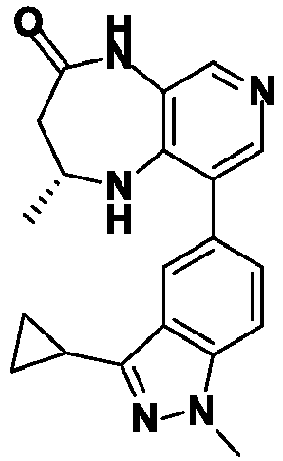
- To a mixture of (R)-9-bromo-2-methyl-2,3-dihydro-1H-pyrido[3,4-b][1,4]diazepin-4(5H)-one (Intermediate G, 100 mg, 0.4 mmol), sodium carbonate (100 mg, 1.0 mmol) and3-cyclopropyl-1-methyl-5-(4,4,5,5-tetramethyl-1,3,2-dioxaborolan-2-yl)-1H-indazole (130 mg, 0.4 mmol)in dioxane (20 mL)/H2O (4 mL) was added [1,1'-bis(diphenylphosphino)ferrocene]dichloropalladium(II), complex with dichloromethane(30 mg, 0.04 mmol). The resulting mixture was heated to 110 °C for 16 h under nitrogen atmosphere. After cooling the reaction to room temperature,the mixture was concentrated in vacuo. The crude residue was purified by prep-TLC (DCM/MeOH =10:1)to give the title compound (94 mg, 68%) as a white solid.1H NMR (400 MHz, DMSO-d 6) δ 9.70 (s, 1H),7.94 (s, 1H), 7.74 - 7.72 (m, 2H), 7.61 (d, J=8.4 Hz, 1H), 7.31 (d, J= 8.8 Hz, 1H), 5.16 (d, J=3.2 Hz, 1H), 3.92 (s, 3H), 3.84 - 3.82 (m, 1H), 2.66 - 2.51 (m, 1H), 2.53 - 2.49 (m, 1H), 2.32 - 2.24 (m, 1H), 1.13 - 1.12 (m, 2H), 1.03 (s, 3H), 0.96 - 0.91 (m, 2H). LCMS M/Z (M+H) 348.
- The following compound was prepared in a similar fashion to Example 89:
Example Compound Name NMR m/z Example 90 (2R)-2-methyl-9-[1-methyl-3-(1-methylpyrazol-4-yl)indazol-5-yl]-1,2,3,5-tetrahydropyrido[3,4-b][1,4]diazepin-4-one 1H NMR (400 MHz, CDCl3) δ 8.04 - 8.00 (m, 3H), 7.91 (s, 1H), 7.83 (s, 1H), 7.52 (d, J=8.4 Hz, 1H), 7.38 (d, J=8.4 Hz, 1H), 4.45(s, 1H), 4.14 (s, 3H), 4.01(s, 3H), 3.98 - 3.93 (m, 1H), 2.76-2.71 (m, 2H), 1.24 (d, J=6.4 Hz, 1H) 388 -

-

- A mixture of 1-chloro-2-nitro-4-(trifluoromethyl)benzene (1.0 g, 4.4 mmol) and 1,3-dibromo-5,5-dimethylimidazolidine-2,4-dione (0.7 g, 2.45 mmol) in concentrated sulfuric acid (4.1 mL) was stirred at 15°C for 18 h. The reaction mixture was quenched with ice water (20 mL) and extracted with EtOAc (20 mL x 3). The organic lagers were dried over anhydrous Na2SO4, filtered and concentrated in vacuo to givethe title compound(1.3 g, 99%) as a white solid thatrequired no further purification. 1H NMR (400 MHz, CDCl3) δ 8.11 (s, 1 H) 8.00 (s, 1 H).
-

- A mixture of 1-bromo-2-chloro-3-nitro-5-(trifluoromethyl)benzene (1.3 g, 4.3 mmol), (R)-3-aminobutanoic acid (484 mg, 2.8 mmol) and potassium carbonate (1.08 g, 7.8 mmol) in dimethyl formamide (30 mL) was heated to 80 °C for 18 h under nitrogen atmosphere. After cooling the reaction to room temperature,water (20 mL) was added and the mixture was acidified with HC1 (2 N) to pH 2 and the mixture was extracted with EtOAc (30 mL x 3). The combined organic layers were washed with brine (30 mL x 3), dried over anhydrous Na2SO4, filtered and concentrated in vacuo to give the title compound (1.35 g, crude) as a brown oil that required no further purification.LCMS M/Z (M+H) 323.
-

- A mixture of (R)-3-((2-bromo-6-nitro-4-(trifluoromethyl)phenyl)amino)butanoic acid (1.3 g, 3.5 mmol) and Fe podwer (2.0 g, 17.5 mmol) in acetic acid (10 mL) was heated to60 °C for 1 h under nitrogen atmosphere. After cooling the reaction to room temperature,the mixture was concentrated in vacuo before water (20 mL) was added. The mixture was adjusted to pH 8 with potassium carbonate and filtered. The filtrate was extracted with EtOAc (10 mL x 3), washed with brine,dried over anhydrous Na2SO4, filtered and concentrated in vacuo to give the title compound (1.1 g, crude) as a brown solid that required no further purification. LCMS M/Z (M+H) 323.
-

- A mixture of (R)-6-bromo-4-methyl-8-(trifluoromethyl)-4,5-dihydro-1H-benzo[b][1,4]diazepin-2(3H)-one (170 mg, 0.5 mmol), 3-cyclopropyl-1-methyl-5-(4,4,5,5-tetramethyl-1,3,2-dioxaborolan-2-yl)-1H-indazole (189 mg, 0.6 mmol), bis(triphenylphosphine)palladium(II) dichloride (35 mg, 0.05 mmol) and potassium carbonate (219 mg, 1.6 mmol) in dioxane/H2O (5:1, 6 mL)was heated to 100 °C for 12 h under nitrogen atmosphere. After cooling the reaction to room temperature,water (5 mL) was added and the mixture was extracted with EtOAc (5 mL x 3). The combined organic lagers were washed with brine, dried over anhydrous Na2SO4, filtered and concentrated in vacuo.The crude residue was purified by reverse phase chromatography (acetonitrile 45-75% / 0.2% formic acid in water) to give the title compound (28 mg, 11%) as a white solid. 1H NMR (400 MHz, CD3OD) δ 7.78 (s, 1H), 7.61 (d, J = 8.8 Hz, 1H), 7.40 (d, J = 7.2 Hz 1H), 7.25 (d, J = 4.8 Hz, 2H), 4.01 (s, 4H), 2.77 - 2.73 (m, 1H), 2.51 - 2.47 (m, 1H), 2.46 - 2.28 (m, 1H), 1.20 (d, J = 6.4 Hz, 3H), 1.06 - 1.01 (m, 4H). LCMS M/Z (M+H) 415.
-

-

- A mixture of 1,4-difluoro-2-nitrobenzene (2 g, 12.6 mmol) and 1,3-dibromo-5,5-dimethylimidazolidine-2,4-dione (2.0 g, 7.0 mmol) in concentrated sulfuric acid (15 mL) was stirred at 20°C for 18 h. The reaction mixture was quenched with ice water (100 mL), extracted with EtOAc (20 mLx 3). The combined organic lagers were dried over anhydrous Na2SO4, filtered and concentrated in vacuo. The residue was purified by silica gel chromatography (petroleum ether) to give the title compound(0.7 g, 23%) as a colorless oil.
-

- A mixture of 1-bromo-2,5-difluoro-3-nitrobenzene (0.7 g, 2.9 mmol), (R)-3-aminobutanoic acid (288 mg, 2.8 mmol) and potassium carbonate (813 g, 5.9 mmol) in acetonitrile (10 mL) was heated to80 °C for 18 h under nitrogen atmosphere. After cooling the reaction to room temperature, water (20 mL) was added and the mixture was acidified with HCl (2 N) to pH 2 and then extracted with EtOAc (20 mL x 3). The combined organic layers were washed with brine (20 mL x 3), dried over anhydrous Na2SO4, filtered and concentrated in vacuo to give the title compound (0.5 g, crude) as a brown oil that required no further purification.LCMS M/Z (M+H) 321.
-

- A mixture of (R)-3-((2-bromo-4-fluoro-6-nitrophenyl)amino)butanoic acid (150 mg, 0.47 mmol) and Fe podwer (130 mg, 2.3 mmol) in acetic acid (5 mL) was heated to60 °C for 1 h under nitrogen atmosphere. After cooling the reaction to room temperature,the solvent was concentrated in vacuo.Water (10 mL) was added. The mixture was adjusted to pH 8 with potassium carbonate and filtered. The filtrate was extracted with EtOAc (10 mL x 3), washed with brine,dried over anhydrous Na2SO4, filtered and concentrated in vacuo to give the title compound (75 mg, crude) as a brown solid that required no further purification. LCMS M/Z (M+H) 273.
-

- A mixture of (R)-6-bromo-4-methyl-8-fluoro-4,5-dihydro-1H-benzo[b][1,4]diazepin-2(3H)-one (75 mg, 0.275 mmol), 3-cyclopropyl-1-methyl-5-(4,4,5,5-tetramethyl-1,3,2-dioxaborolan-2-yl)-1H-indazole (98 mg, 0.33 mmol), bis(triphenylphosphine)palladium(II) dichloride (20 mg, 0.028mmol) and potassium carbonate (114 mg, 0.824 mmol) in dioxane/H2O (5:1, 6 mL)was heated to 100 °C for 12 h under nitrogen atmosphere. After cooling the reaction to room temperature,water (5 mL) was added and the mixture was extracted with EtOAc (5 mL x 3). The combined organic layers were washed with brine, dried over anhydrous Na2SO4, filtered and concentrated in vacuo.The crude residue was purified by reverse phase chromatography (acetonitrile 35-65% / 0.2% formic acid in water) to give the title compound (28.0 mg, 28%) as a white solid. 1H NMR (400 MHz, CD3OD) δ 7.76 (s, 1H), 7.58 (d, J = 7.2 Hz, 1H), 7.41 - 7.38 (m, 1H), 6.87 (d, J = 8.8 Hz, 1H), 6.79 (d, J = 9.2 Hz, 1H), 4.00 - 3.95 (m, 4H), 2.77 - 2.74 (d, J = 7.2 Hz, 1H), 2.32 - 2.27 (m, 2H), 1.14 (d, J = 6.4 Hz, 3H), 1.06 - 1.01 (m, 4H). LCMS M/Z (M+H) 365.
-

-

- To a mixture of 2-ethynylaniline (234 mg, 2.0 mmol) in dry DCM (10 mL) at 20 °C was added pyridine (1.0 mL) and phenylmethanesulfonyl chloride (456 mg, 2.4 mmol). The mixture was stirred at 20 °C for 3 h. The mixture was concentrated in vacuo and extracted with EtOAc (30 mL x 3). The combined organic layers were dried over anhydrous Na2SO4, filtered and concentrated in vacuo. The crude residue was purified by silica gel chromatography (petroleum ether/EtOAc = 5/1) to give the title compound (300 mg, 55%) as a yellow oil.
-

- A mixture of N-(2-ethynylphenyl)-1-phenylmethanesulfonamide (300 mg, 1.1 mmol), (R)-6-bromo-4-methyl-4,5-dihydro-1H-benzo[b][1,4]diazepin-2(3H)-one (279 mg, 1.1 mmol), copper(I) iodide (42 mg, 0.22 mmol) and [1,1'-bis(diphenylphosphino)ferrocene]-dichloropalladium(II) (77 mg, 0.11 mmol) in MeCN/TEA (10 mL/2 mL) was heated to reflux temperature for 2 h. After cooling the reaction to room temperature,the solvent was concentrated in vacuo. Water (10 mL) was added and the mixture was extracted with EtOAc (10 mL). The combined organic layers were dried over anhydrous Na2SO4, filtered and concentrated in vacuo. The crude residue was purified by reverse phase chromatography (acetonitrile 56-86% / 0.1% NH4OH in water) to give the title compound (27 mg, 5%) as a white solid. 1H NMR (400 MHz, CDCl3) 7.99 - 7.97 (m, 1 H), 7.61 (d, J = 8.0 Hz, 1H), 7.38 - 7.26 (m, 4H), 7.18 - 7.16 (m, 2H), 6.90 - 6.86 (m, 1H), 6.75 - 6.73 (m, 3H), 6.54 - 6.52 (m, 1H), 6.23 - 6.21 (m, 1H), 4.46 - 4.43 (m, 1 H), 4.30 - 4.24 (m, 1H), 4.14 - 3.90 (m, 1H), 3.50 - 3.40 (m, 1H), 2.99 - 2.68 (m, 1H), 2.49 - 2.26 (m, 1H), 1.25 (t, J = 6.4 Hz, 3H). LCMS M/Z (M+H) 446.
-

-

- To a solution of 2-chloro-3-fluoro-4-nitropyridine(200 mg, 1.13 mmol), 1-methyl-3- (1-methyl-1H-pyrazol-4-yl)-5-(4,4,5,5-tetramethyl-1,3,2-dioxaborolan-2-yl)-1H-indazole (290 mg, 0.87 mmol) and K2CO3 (157 mg, 1.13 mmol) in dioxane (5 mL) was added [1,1'-bis(diphenylphosphino)ferrocene]dichloropalladium(II) (43 mg, 0.06 mmol). The mixture was stirred at reflux temperature for 30 min. After cooling the reaction to room temperature,the crude mixture was diluted with water (10 mL) and extracted with EtOAc (10 mL x 3). The combined organic layers were washed with sat. aq. sodium bicarbonate (10 mL x 3), dried over anhydrous Na2SO4, filtered and concentrated in vacuo to give the crude product that was purified by silica gel chromatography (petroleum ether/EtOAc = 3/1) to give the title compound (160 mg, 52%) as a yellow solid.
-

- To a solution of 5-(3-fluoro-4-nitropyridin-2-yl)-1-methyl-3-(1-methyl-1H-pyrazol-4-yl)-1H-indazole(160 mg, 0.454 mmol) in THF (5 mL) was added (R)-methyl 3-aminobutanoate(80 mg, 0.68 mmol) and TEA (138 mg, 1.36 mmol). The mixture was heated to reflux temperature for 16 h under nitrogen atmosphere. After cooling the reaction to room temperature, the reaction was concentrated in vacuo. The crude residue was purified by prep-TLC (DCM/MeOH = 20/1) to give the title compound (80 mg, 39%) as a brown solid.
-

- To a solution of (R)-methyl 3-((2-(1-methyl-3-(1-methyl-1H-pyrazol-4-yl)-1H-indazol-5-yl)-4-nitropyridin-3-yl)amino)butanoate (80 mg, 0.18 mmol) in AcOH (3.0 mL) was added Fe powder (49 mg, 0.89 umol). The mixture was heated to 100 °C for 16 h under nitrogen. After cooling the reaction to room temperature, the crude mixture was neutralized with sat. aq. NaHCO3 and extracted with EtOAc (20 mL x 3). The combined organic layers were dried over anhydrous Na2SO4, filtered and concentrated in vacuo. The crude residue was purified by prep-TLC (DCM/MeOH = 20/1) to give the title compound (16 mg, 23 %) as a white solid. 1H NMR (400 MHz, CDCl3) δ 8.13 (d, J = 4.8 Hz, 1H), 8.04 (m, 3H), 7.92 (s, 1H), 7.58 (d, J = 8.4 Hz,1H), 7.52 (d, J = 8.4 Hz, 1H), 6.78 (d, J = 5.2 Hz, 1H),, 4.13 (s, 3H), 3.99 (s, 3H), 3.93 (m, 2H), 2.87 (m, 1H), 2.66 (m, 1H), 3.43 (d, J = 6.0 Hz, 3H). LCMS M/Z (M+H) 388.
-

-

- To a solution of methyl 2-hydroxy-3-nitrobenzoate (10.0 g, 50.72 mmol), pent-4-en-2-ol (4.7 g, 54.57 mmol) and triphenylphosphine (24.0 g, 91.50 mol) in THF (200 mL) was added (E)-di-tert-butyl diazene-1,2-dicarboxylate (21.1 g, 91.64 mmol) in small portions over a period of 1 h. The reaction mixture was stirred at room temperature for 3 h. The reaction mixture was concentrated in vacuo and the crude residue was diluted with water (100 mL) and extracted with EtOAc (200 mL x 3). The combined organic layers were dried over anhydrous Na2SO4, filtered and concentrated in vacuo. The crude residue was purified by silica gel chromatography (petroleum ether/EtOAc =10/1) to give the title compound (5.2 g, 39%) as a yellow solid.
-

- To a solution of methyl 3-nitro-2-(pent-4-en-2-yloxy)benzoate (2.4 g, 9.05 mmol) and oxone (11.7 g, 18.2 mmol) in DMF (50 mL) was added a solution of OsO4 (23 mg, 0.01 mol) in t-BuOH (0.5 mL) dropwise. The reaction mixture was stirred at room temperature for 15 h.Water (150 mL) was added and the mixture was extracted with EtOAc (120 mL x 3). The combined organic layers were dried over anhydrous Na2SO4, filtered and concentrated in vacuo to give the title compound (2.5 g, 98%) as a yellow solid that required no further purification.
-

- To a solution of 3-(2-(methoxycarbonyl)-6-nitrophenoxy)butanoic acid (5.2 g, 18.36 mmol) in acetic acid (100 mL) was added Fe powder (5.1 g, 91.32 mmol). The resulting mixture was heated to 80 °C for 1 h. After cooling the reaction to room temperature, the reaction mixture was filtered and the filtrate was concentrated in vacuo.Water (100 mL) was added and the mixture was extracted with EtOAc (150 mL x 3). The combined organic layers were dried over anhydrous Na2SO4, filtered and concentrated in vacuo. The crude residue was purified by silica gel chromatography (petroleum ether/EtOAc =3/1) to give the title compound (Intermediate H, 2.0 g, 46%). 1H NMR (400 MHz, DMSO-d 6) δ 9.81 (s, 1H), 7.35-7.33 (m, 1H), 6.99 (d, J = 4.4 Hz, 1H), 4.85-4.80 (m, 1H), 2.63-2.58 (m, 1H), 2.42-2.37 (m, 1H), 1.36 (d, J = 6.0 Hz, 3H).
-

- To a solution of aniline (79.2 mg, 0.85 mmol) in DCM (5 mL) at 0 °C was added a solution of AlMe3 (2.0 M in toluene, 0.4 mL, 0.85 mmol). The reaction mixture was allowed to warm to room temperature and stirred for 30 minutes until the gas evolution ceased. A solution of methyl 2-methyl-4-oxo-2,3,4,5-tetrahydrobenzo[b][1,4]oxazepine-9-carboxylate (Intermediate H, 100 mg, 0.43 mmol) in DCM (2 mL) was added and the mixture was heated to reflux temperature for 15 h. After cooling the reaction to room temperature,the reaction mixture carefully quenched with 5% aq HCl (2 mL). The combined organic layers were separated and the aqueous layer was extracted with DCM (10mL x3). The combined organic layers were washed with sat. aq. NaHCO3 (10 mL) and brine (10 mL), dried over anhydrous Na2SO4, filtered and concentrated in vacuo. The crude residue was purified by reverse phase chromatography (acetonitrile 30-50% / 0.2% formic acid in water) to give the title compound (35 mg, 28%) as a white solid.1H NMR (400 MHz, DMSO-d 6) δ 10.23 (s, 1H), 9.83 (s, 1H), 7.70 (d, J = 7.6 Hz, 1H), 7.36-7.28 (m, 3H), 7.18-7.07 (m, 3H), 4.87-4.83 (m, 1H), 2.77-2.72 (m, 1H), 2.50-2.43 (m, 1H), 1.30 (d, J = 7.6 Hz, 3H). LCMS M/Z (M+H) 297.
- The following compounds were prepared in a similar fashion to Example 95:
-
Example Compound Name NMR m/z Example 96 2-methyl-4-oxo-N-phenyl-3,5-dihydro-2H-1,5-benzoxazepine-9-carboxamide 1H NMR (400 MHz, CD3OD) δ 7.67 (d, J = 7.6 Hz, 2H), 7.66 - 7.55 (m, 1H), 7.38 - 7.34 (m, 2H), 7.24 - 7.15 (m, 3H), 4.98 - 4.96 (m, 1H), 2.85 - 2.80 (m, 1H), 2.53 - 2.48 (m, 1H), 1.45 (d, J = 6.4 Hz, 3H) 297 Example 97 2-methyl-4-oxo-N-phenyl-3,5-dihydro-2H-1,5-benzoxazepine-9-carboxamide 1H NMR (400 MHz, CD3OD) δ 7.67 (d, J = 7.6 Hz, 2H), 7.66 - 7.55 (m, 1H), 7.38 - 7.34 (m, 2H), 7.24 - 7.15 (m, 3H), 4.98 - 4.96 (m, 1H), 2.85 - 2.80 (m, 1H), 2.53 - 2.48 (m, 1H), 1.45 (d, J = 6.4 Hz, 3H) 297 Example 98 2-methyl-N-(3-oxazol-5-ylphenyl)-4-oxo-3,5-dibydro-2H-1,5-benzoxazepine-9-carboxamide 1H NMR (400 MHz, DMSO-d 6) δ10.40 (s, 1H), 9.85 (s, 1H), 8.47 (s, 1H), 8.17 (s, 1H), 7.66 - 7.64 (m, 2H), 7.48 - 7.17 (m, 5H), 4.88 - 4.84 (m, 1H), 2.78 -2.73 (m, 1H), 2.46 -2.41 (m, 1H), 1.30 (d, J = 6.4 Hz, 3H) 364 Example 99 2-methyl-N-(3-oxazol-5-ylphenyl)-4-oxo-3,5-dihydro-2H-1,5-benzoxazepine-9-carboxamide 1H NMR (400 MHz, DMSO-d 6) δ10.41 (s, 1H), 9.85 (s, 1H), 8.47 (s, 1H), 8.17 (s, 1H), 7.66 - 7.64 (m, 2H), 7.48 - 7.17 (m, 5H), 4.88 - 4.84 (m, 1H), 2.78 -2.73 (m, 1H), 2.46 -2.41 (m, 1H), 1.30 (d, J = 6.4 Hz, 3H) 364 -

-

- To a solution of 2-bromo-6-nitrophenol (10.0 g, 45.87 mmol), (S)-pent-4-en-2-ol (4.7 g, 54.57 mmol) and triphenylphosphine (24.0 g, 91.50 mol) in THF (200 mL) was added (E)-di-tert-butyl diazene-1,2-dicarboxylate (21.1 g, 91.64 mmol) in small portions over a period of 1 h. The reaction mixture was stirred at room temperature for an additional 3 h. The mixture was concentrated in vacuo. Water (300 mL) was added and the mixture was extracted with EtOAc (200 mL x 3). The combined organic layers were dried over anhydrous Na2SO4, filtered and concentratedin vacuo. The crude residue was purified by silica gel chromatography (petroleum ether/EtOAc = 10/1) to give the title compound (5.2 g, 40%) as a yellow solid.
-

- To a solution of (R)-1-bromo-3-nitro-2-(pent-4-en-2-yloxy)benzene (2.6 g, 9.09 mmol) and oxone (11.7 g, 18.2 mmol) in DMF (50 mL) was added a solution of OsO4 (23 mg, 0.01 mol) in t-BuOH (0.5 mL) dropwise. The reaction mixture was stirred at room temperature for 15 h. Water (150 mL) was added and the mixture was extracted with EtOAc (120 mL x 3). The combined organic layers were dried over anhydrous Na2SO4, filtered and concentrated in vacuo to give the title compound (2.8 g, 100%) as a yellow solid that required no further purification.
-

- A mixture of (R)-3-(2-bromo-6-nitrophenoxy)butanoic acid (5.6 g, 18.42 mmol) and Fe powder (5.1 g, 91.32 mmol)in acetic acid (100 mL) was heated to 80 °C for 1 h. After cooling the reaction to room temperature,the reaction mixture was filtered and the filtrate was concentrated in vacuo. Water (100 mL) was added and the mixture was extracted with EtOAc (150 mL x 3). The combined organic layers were dried over Na2SO4, filtered and concentrated in vacuo. The crude residue was purified by silica gel chromatography (petroleum ether/EtOAc =3/1) to give the title compound (Intermediate I, 2.0 g, 42%). 1H NMR (400 MHz, DMSO-d 6) δ9.81 (s, 1H), 7.35-7.33 (m, 1H), 6.99 (d, J = 4.4 Hz, 1H), 4.85-4.80 (m, 1H), 2.63-2.58 (m, 1H), 2.42-2.37 (m, 1H), 1.36 (d, J = 6.0 Hz, 3H).
-

- A mixture of (R)-9-bromo-2-methyl-2,3-dihydrobenzo[b][1,4]oxazepin-4(5H)-one (Intermediate I, 100 mg, 0.39 mmol), (E)-(4-methoxystyryl)boronic acid (84 mg, 0.32 mmol), 2-(dicyclohexylphosphino)-2',4',6'-triisopropylbiphenyl(18.68 mg, 0.039 mmol), tris(dibenzylideneacetone)dipalladium(0) (35.72 mg, 0.039 mmol) and NaOH (2 M, 1. 6 mL, 3.2 mmol)in MeCN (5 mL) was irradiated in a microwave at 90 °C for 0.5 h. After cooling the reaction to room temperature, ice water (5 mL) was added and the mixture was extracted with EtOAc (10 mL x 3). The combined organic layers were dried over anhydrous Na2SO4, filtered and concentrated in vacuo. The crude residue was purified by reverse phase chromatography (acetonitrile 50-80% / 0.2% formic acid in water). The product was further purified using chiral SFC (SFC80; Chiralpak AS 250×30mm I.D.,5um; Supercritical CO2 / EtOH+NH3•H2O= 30/70; 80 mL/min) to give the title compound (5 mg, 4%) as a yellow solid. 1H NMR (400 MHz, CD3OD) δ 7.56-7.49 (m, 3H), 7.35 (d, J = 16.4 Hz, 1H), 7.19-7.13 (m, 2H), 6.94 (d, J = 8.8 Hz,3H), 4.96-4.93 (m, 1H), 3.83 (s, 3H), 2.76-2.73 (m, 1H), 2.49-2.44 (m, 1H), 1.51 (d, J = 6.0 Hz, 3H). LCMS M/Z (M+H) 310.
- The following compounds were prepared in a similar fashion to Example 100. The intermediate bromide for Examples 101 and 103 was prepared in a similar fashion to Intermediate I using the corresponding (R)-pent-4-en-2-ol instead.
-
Example Compound Name NMR m/z Example 101 (S,E)-9-(4-methoxystyryl)-2-methyl-2,3-dihydrobenzo[b][1,4]oxazepin-4(5H)-one 1H NMR (400 MHz, CD3OD) δ 7.56-7.49 (m, 3H), 7.35 (d, J = 16.4 Hz, 1H), 7.19-7.13 (m, 2H), 6.97 - 6.93 (m,3H), 4.96-4.93 (m, 1H), 3.83 (s, 3H), 2.76-2.73 (m, 1H), 2.49-2.44 (m, 1H), 1.51 (d, J = 6.0 Hz, 3H) 310 Example 102 (R)-9-(1-(4-methoxyphenyl)vinyl)-2-methyl-2,3-dihydrobenzo[b][1,4]oxazepin-4(5H)-one 1H NMR (400 MHz, CD3OD) δ7.21 (d, J = 8.8 Hz, 2H), 7.13 (d, J = 4.4 Hz, 2H), 7.07-7.04 (m, 1H), 6.88-6.66 (m, 2H), 5.57 (s, 1H), 5.16 (s,1H), 4.02-3.96 (s, 1H), 3.80 (s, 3H), 3.94 (s, 1H), 2.77-2.72 (m, 1H), 2.28-2.23 (m, 1H), 1.09 (d, J = 6.4 Hz, 3H) 310 Example 103 (S)-9-(1-(4-methoxyphenyl)vinyl)-2-methyl-2,3-dihydrobenzo[b][1,4]oxazepin-4(5H)-one 1H NMR (400 MHz, CD3OD) δ7.21 (d, J = 7.2 Hz, 2H), 7.14 - 7.12 (m, 2H), 7.07-7.04 (m, 1H), 6.88-6.66 (m, 2H), 5.57 (s, 1H), 5.16 (s, 1H), 4.02-3.96 (s, 1H), 3.80 (s, 3H), 3.94 (s, 1H), 2.77-2.72 (m, 1H), 2.28-2.23 (m, 1H), 1.09 (d, J = 6.4 Hz, 3H) 310 -

- A mixture of (R)-9-bromo-2-methyl-2,3-dihydrobenzo[b][1,4]oxazepin-4(5H)-one (Intermediate I, 100 mg, 0.39 mmol), (5-methylfuran-2-yl)boronic acid (92.00 mg, 0.73 mmol), (2-dicyclohexylphosphino-2',4',6'-triisopropyl-1,1'-biphenyl)[2-(2'-amino-1,1'-biphenyl)]palladium(II)methanesulfonate (32.42 mg, 0.04 mmol) and NaOH (2 M, 1.6 mL, 3.2 mmol)in MeCN (3 mL)was irradiated in a microwave at90 °C for 0.5 h. After cooling the reaction to room temperature,ice water (5 mL) was added and the mixture was extracted with EtOAc (10 mL x 3). The combined organic layers were dried over anhydrous Na2SO4, filtered and concentrated in vacuo. The crude residue was purified by reverse phase chromatography (acetonitrile 35-65% / 0.1% NH4OH in water). The product was further purified using chiral SFC (SFC80; Chiralpak AS 250×30mm I.D.,5um; Supercritical CO2 / EtOH+NH3•H2O= 40/60; 50 mL/min) to to give the title comound (11.7 mg, 12%) as a white solid.1H NMR (400 MHz, DMSO-d 6) δ 9.69 (s, 1H), 7.46 (d, J = 6.4 Hz, 1H), 7.12(t, J = 8.0 Hz, 1H), 6.92 (d, J = 6.4 Hz, 1H), 6.82 (d, J = 3.2 Hz, 1H), 6.22 (d, J = 2.4 Hz, 1H), 4.82-4.78 (m, 1H), 2.79-2.74 (m, 1H), 2.34-2.29 (m, 4H), 1.43 (d, J = 6.0 Hz, 3H). LCMS M/Z (M+H) 258.
-

-

- To a solution of methyl 2-hydroxy-3-nitrobenzoate (9.0 g, 45.65 mmol), pent-4-en-2-ol (4.7 g, 54.57 mmol) and triphenylphosphine (24.0 g, 91.50 mol) in THF (200 mL) was added (E)-di-tert-butyl diazene-1,2-dicarboxylate (21.1 g, 91.64 mmol) in small portions over a period of 1 h. The reaction mixture was stirred at room temperature for 3 h. The mixture was concentrated in vacuo. Water (200 mL) was added and the mixture was extracted with EtOAc (200 mL x 3). The combined organic layers were dried over anhydrous Na2SO4, filtered and concentratedin vacuo. The crude residue was purified by silica gel chromatography (petroleum ether/EtOAc =10/1) to give the title compound (6.0 g, 50%) as a yellow solid.
-

- To a solution of methyl 3-nitro-2-(pent-4-en-2-yloxy)benzoate (9.0 g, 33.93mmol) in THF/H2O (4:1, 200 mL) was added LiOH (4.0 g, 0.17 mol). The resulting mixture was heated to 80 °C for 15 h. After cooling the reaction to room temperature, the reaction was quenched with the addition of sat. aq. NH4Cl solution (10 mL). The mixture was concentrated in vacuo. Water (100 mL) was added and the mixture was extracted with EtOAc (200 mL x 3). The combined organic layers were concentrated in vacuo to give the title compound (8.1 g,95%) as a white solid that required no further purification.
-

- To a solution of 3-nitro-2-(pent-4-en-2-yloxy)benzoic acid (8.1 g, 32.24 mol) in MeCN (100 mL) was added K2CO3 (8.9 g, 64.40mmol) and (bromomethyl)benzene (5.5 g, 32.24mmol). The resulting mixture was heated to 50 °C for 10 h. After cooling the reaction to room temperature, the suspension was filtered and the filtrate was concentrated in vacuo.Water (30 mL) was added and the mixture was extracted with EtOAc (100 mL x 3). The combined organic layers were dried over anhydrous Na2SO4, filtered and concentrated in vacuo to give the title compound (10.1 g, 92%) as a yellow solid that required no further purification.
-

- To a solution of benzyl 3-nitro-2-(pent-4-en-2-yloxy)benzoate (9.3 g, 27.24 mmol) and oxone (35.1 g, 54.6 mmol) in DMF (150 mL) was added a solution of OsO4 (69 mg, 0.27 mol) in t-BuOH (1.5 mL) dropwise. The reaction mixture was stirred at room temperature for 15 h. Water (300 mL) was added and the mixture was extracted with EtOAc (200 mL x 3). The combined organic layers were dried over anhydrous Na2SO4, filtered and concentrated in vacuo to give the title compond (9.8 g, 100%) as a yellow solid that required no further purification.
-

- To a solution of 3-(2-((benzyloxy)carbonyl)-6-nitrophenoxy)butanoic acid (9.8 g, 27.27 mmol) and Fe powder (7.6 g, 136.09 mmol)in acetic acid (150 mL) was heated to 100 °C for 2 h. After cooling the reaction to room temperature,the reaction mixture was filtered and the filtrate was concentrated in vacuo. Water (100 mL) was added and the mixture was extracted with EtOAc (200 mL x 3). The combined organic layers were dried over anhydrous Na2SO4, filtered and concentrated in vacuo. The crude residue was purified by silica gel chromatography (petroleum ether/EtOAc = 3/1) to give the title compond (4.1 g, 48%) as a white solid.
-

- To a solution of 2-methyl-4-oxo-2,3,4,5-tetrahydrobenzo[b][1,4]oxazepine-9-carboxylic acid (3.11 g, 10 mmol) in MeOH (60 mL) was added Pd/C (wt. 5%, 0.6 g) under nitrogen atmosphere. The suspension was degassed under vacuum and then purged with H2. The reaction mixture was stirred at 25 °C for 3 hunder a H2 atmosphere. The reaction mixture was filtered and the filtrate was concentrated in vacuo to give the title compound (Intermediate J, 2.21 g, 100 %) asa white solid.
-

- To a solution of (R)-4-methyl-2-oxo-2,3,4,5-tetrahydro-1H-benzo[b][1,4]diazepine-6-carboxylic acid (Intermediate J, 50 mg, 0.23 mmol) in DMF (3 mL) was added 4-isocyanatobenzonitrile (42 mg, 0.29 mmol) and N-ethyl-N-isopropylpropan-2-amine (64 mg, 0.50 mmol).The reaction mixture was stirred at 25 °C for 0.5 h. Ice water (5 mL) was added and the mixture was extracted with EtOAc (10 mL×3). The combined organic layers were dried over anhydrous Na2SO4, filtered and concentrated in vacuo. The crude residue was purified by reverse phase chromatography (acetonitrile 20-50% / 0.1% NH4OH in water). The residue was further purified using chiral SFC (SFC80; Chiralpak OJ 250×30mm I.D.,5um; Supercritical CO2 / MeOH+NH3•H2O= 40/60; 80 mL/min) to give the title compound (6 mg, 8%) asa white solid.1H NMR (400 MHz, DMSO-d 6) δ10.69 (s, 1H), 9.86 (s, 1H), 7.91-7.81 (m, 4H), 7.30-7.17 (m, 3H), 4.85-4.80 (m, 1H), 2.76-2.71 (m, 1H), 2.47-2.42 (m, 1H), 1.27 (d, J = 6.4 Hz, 3H). LCMS M/Z (M+H) 322.
- The following compound was prepared in a similar fashion to Example 105:
Example Compound Name NMR m/z Examples 106 N-(4-cyanophenyl)-2-methyl-4-oxo-3,5-dihydro-2H-1,5-benzoxazepine-9-carboxamide 1H NMR (400 MHz, DMSO-d 6) δ10.69 (s, 1H), 9.86 (s, 1H), 7.90 (d, J = 8.4 Hz, 2H), 7.82 (d, J = 8.4 Hz, 2H), 7.30-7.16 (m, 3H), 4.85-4.80 (m, 1H), 2.76-2.71 (m, 1H), 2.47-2.43 (m, 1H), 1.27 (d, J = 6.0 Hz, 3H) 322 -

-

- To 1-(2-bromophenyl)propan-2-one (10.0 g, 47.2 mmol) in THF (100 mL)at room temperature was added t-BuOK (7.93 g, 70.8 mmol) and ethyl 2-(diethoxyphosphoryl)acetate (15.9 g, 70.8 mmol). The resulting mixture was heated to80 °C for 2 h under nitrogen atmosphere. After cooling the reaction to room temperature,the mixture was concentrated in vacuo. The crude residue waspurified by silica gel chromatography (petroleum ether/EtOAc = 20/1) to give the title compound (9.0 g, 68%) as clear oil.
-

- To a mixture of ethyl 4-(2-bromophenyl)-3-methylbut-2-enoate (1 g, 3.5 mmol) and platinum dioxide (200mg, 0.88 mmol) in EtOAc (30 ml) was stirred at 23 °C for 10h under hydrogen atmosphere (15 psi).The mixture was filtered and the filtrate was concentrated in vacuo to give the title compound (1.0 g, crude) as a yellow oil that required no further purification.
-

- To a solution of ethyl 4-(2-bromophenyl)-3-methylbutanoate (1 g, crude) in THF (30 ml) and H2O (30 ml) was added lithium hydroxide monohydrate (1 g, 25 mmol). The mixture was heated to60 °C for 10 h. After cooling the reaction to room temperature, the mixture was washed with EtOAc (20 mL). The aqueous layer was acidified with HCl (2 N) to pH 2-3 and the mixture was extracted with EtOAc (20 mL x 3). The combined organic layers were dried over anhydrous Na2SO4, filtered and concentrated in vacuo to give the title compound (1 g, crude) as a yellow oil that required no further purification.
-

- To 4-(2-bromophenyl)-3-methylbutanoic acid (1 g, crude) in polyphosphoric acid (20 g) was heated to 90 °C for 2 h. Then the mixture was cooled to 60 °C and water (50 mL) was added. The mixture was extracted with EtOAc (20 mL x 3). The combined organic layers were dried over anhydrous Na2SO4, filtered and concentrated in vacuo to give the title compound(700 mg, crude) as yellow oil that required no further purification. LCMS M/Z (M+H) 239.
-

- To a mixture of 5-bromo-3-methyl-3,4-dihydronaphthalen-1(2H)-one (700 mg, crude) and hydroxylamine hydrochloride (221 mg, 3.2 mmol) in ethanol (3.6 ml) was added pyridine (2.2 ml). The mixture was heated to 70 °C for 10 h. After cooling the reaction to room temperature, the mixture was concentrated in vacuo to give the title compound (800 mg, crude) as a yellow oil that required no further purification.
-

- A mixture of 5-bromo-3-methyl-3,4-dihydronaphthalen-1(2H)-one oxime (800 mg, crude) and polyphosphoric acid (11 g) was heated to 130 °C for 1 h. After cooling the reaction to room temperature, water (50 mL) was added and the mixture was extracted with EtOAc (50 mL x 3). The combined organic layers were dried over anhydrous Na2SO4, filtered and concentrated in vacuo. The crude residue was purified by silica gel chromatography (petroleum ether/EtOAc = 10/1 to 3/1) to give the title compound (500 mg, 62%) as a light yellow solid. LCMS M/Z (M+H) 254.
-

- A mixture of 6-bromo-4-methyl-4,5-dihydro-1H-benzo[b]azepin-2(3H)-one (500 mg, 2.0 mmol), potassium carbonate (552 mg, 4.0 mmol), bis(triphenylphosphine)palladium(II) dichloride (140 mg, 2 mmol) and 3-cyclopropyl-1-methyl-5-(4,4,5,5-tetramethyl-1,3,2-dioxaborolan-2-yl)-1H-indazole (626 mg, 2 mmol)in dioxane (30 mL)/H2O (4 mL)was heated to 100 °C for 10 h under nitrogen atmosphere. After cooling the reaction to room temperature,the mixture was concentrated in vacuo. The crude residue was purified by reverse phase chromatography (acetonitrile 50-80% / 0.2% formic acid in water) to give the title compound (300 mg, 43%) as a white solid. 1H NMR (400 MHz, CD3OD) δ 7.68 (s, 1 H), 7.54 (d, J = 8.8 Hz, 1H), 7.39 (d, J = 1.6 Hz, 1H), 7.34 - 7.30 (m, 1H), 7.20 - 7.17 (m, 1H), 7.07 (d, J = 8.0 Hz, 1H), 4.01 (s, 3H), 2.75 - 2.72 (m, 1H), 2.62 - 2.59 (m, 2H), 2.39 - 2.25 (m, 2H), 2.09 - 2.07 (m, 1H), 1.07 - 1.01 (m, 7H). LCMS M/Z (M+H) 346.
-

- Racemic 6-(3-cyclopropyl-1-methyl-indazol-5-yl)-4-methyl-1,3,4,5-tetrahydro-1-benzazepin-2-one was separatedusing chiral SFC (SFC80; Chiralpak AD 250×30mm I.D.,5um; Supercritical CO2 / EtOH+NH3•H2O= 75/25; 60 mL/min) to give (4R)-6-(3-cyclopropyl-1-methyl-indazol-5-yl)-4-methyl-1,3,4,5-tetrahydro-1-benzazepin-2-one (71 mg, first peak) and (4S)-6-(3-cyclopropyl-1-methyl-indazol-5-yl)-4-methyl-1,3,4,5-tetrahydro-1-benzazepin-2-one (59 mg, second peak) as a white solid.Absolute configuration was arbitrarily assigned to each enantiomer. Example 108: 1H NMR (400 MHz, CD3OD) δ 7.67 (s, 1 H), 7.54 (d, J = 8.4 Hz, 1H), 7.39 (d, J = 1.2 Hz, 1H), 7.36 - 7.30 (m, 1H), 7.19 - 7.17 (m, 1H), 7.08 (d, J = 8.0 Hz, 1H), 4.02 (s, 3H), 2.75 - 2.72 (m, 1H), 2.62 - 2.59 (m, 2H), 2.39 - 2.27 (m, 2H), 2.08 - 2.05 (m, 1H), 1.07 - 1.01 (m, 7H). LCMS M/Z (M+H) 346. Example 109:1H NMR (400 MHz, CD3OD) δ 7.67 (s, 1 H), 7.53 (d, J = 8.8 Hz, 1H), 7.39 (d, J = 1.6 Hz, 1H), 7.32 - 7.29 (m, 1H), 7.19 - 7.17 (m, 1H), 7.08 (d, J = 8.0 Hz, 1H), 4.01 (s, 3H), 2.76 - 2.71 (m, 1H), 2.62 - 2.59 (m, 2H), 2.38 - 2.26 (m, 2H), 2.08 - 2.06 (m, 1H), 1.07 - 1.01 (m, 7H). LCMS M/Z (M+H) 346.
-

-

- To sodium (R)-3-hydroxybutanoate (1 g, 4.04 mmol, 1 equiv) in DMF at 0 °C was added sodium hydride (170 mg, 4.25 mmol, 1.05 equiv). The mixture was stirred at 0 °C for 30 min before 4-(benzyloxy)-2-fluoro-1-nitrobenzene (536 mg, 4.25 mmol, 1.05 equiv) was added and the mixture stirred for an additional 18 h. The mixture was diluted with EtOAc and washed with IN HCl. The organic layer was dried over anhydrous Na2SO4, filtered and concentrated in vacuo. The crude residue was purified by column chromatography (eluting with hexanes/EtOAc) to give the title compound (140 mg, 10%). LCMS M/Z (M+H) 332.
-

- A mixture of (R)-3-(5-(benzyloxy)-2-nitrophenoxy)butanoic acid (140 mg, 0.423 mmol) and Fe powder (189 mg, 3.38 mmol)in acetic acid (0.5 mL) was heated to 110 °C for 16 h. After cooling the reaction to room temperature,the reaction mixture was filtered and the filtrate was concentrated in vacuo. The crude residue was purified by silica gel chromatography (petroleum ether/EtOAc = 3/1) to give the title compond (75 mg, 63%) as a white solid.LCMS M/Z (M+H) 284.
-

- To a solution of (R)-8-(benzyloxy)-2-methyl-2,3-dihydrobenzo[b][1,4]oxazepin-4(5H)-one (75 mg, 0.265 mmol mmol) in MeOH (2 mL) was added Pd/C (5% wt, 28mg). The mixture was stirred at 20 °C for 2 h under hydrogen atmosphere. The mixture was filtered and concentrated in vacuo to give the title compound (24 mg, 47%) as a white solid. 1H NMR (400 MHz, DMSO-d 6) δ 9.36 (s, 1H), 9.33 (s, 1H), 6.79 (d, J = 8.7 Hz, 1H), 6.47 (dd, J = 8.6, 2.6 Hz, 1H), 6.41 (d, J = 2.7 Hz, 1H), 4.69 (m, 1H), 2.53 (m, 1H), 2.29 (d, J = 7.5 Hz, 1H), 1.28 (d, J = 6.2 Hz, 3H). LCMS M/Z (M+H) 194.
-

- To a solution of triphenylphosphine polymer bound 3.2 mmol/g (162 mg), (R)-8-hydroxy-2-methyl-2,3-dihydrobenzo[b][1,4]oxazepin-4(5H)-one (0.05 g, 0.259 mmol),(R)-1-phenylethanol (0.095 g, 0.776 mmol) in THF (2 mL) at room temperature was added a solution of (E)-di-tert-butyl diazene-1,2-dicarboxylate (0.119 g, 0.518 mmol,) in THF (1 mL) dropwise. The reaction mixture was stirred at room temperature for 18 h. The mixture was filtered through celite and concentrated in vacuo. The residue was purified by silica gel chromatography (eluting with hexanes/EtOAc) to give the title compound (44 mg, 57%)as an amorphous solid. 1H NMR (400 MHz, DMSO-d 6) δ 9.24 - 9.55 (m, 1H), 7.35 (d, J = 17.6 Hz, 4H), 7.17 - 7.28 (m, 1H), 6.78 - 6.87 (m, 1H), 6.58 - 6.67 (m, 1H), 6.43 - 6.57 (m, 1H), 5.32 - 5.49 (m, 1H), 4.56 - 4.72 (m, 1H), 2.51 - 2.54 (m, 1H), 2.26 - 2.35 (m, 1H), 1.50 (d, J = 6.2 Hz, 3H), 1.26 (d, J = 6.2 Hz, 3H). LCMS M/Z (M+H) 298.
- The following compounds were prepared in a similar fashion to Example 111:
-
Example Compound Name NMR m/z Example 112 (2R)-8-(cyclopropylmethoxy)-2-methyl-3,5-dihydro-2H-1,5-benzoxazepin-4-one 1H NMR (400 MHz, DMSO-d 6) δ 9.43 (s, 1H), 6.89 (d, J = 8.7 Hz, 1H), 6.64 (dd, J = 8.7, 2.7 Hz, 1H), 6.56 (d, J = 2.7 Hz, 1H), 4.71 (m, 1H), 3.74 (d, J = 6.9 Hz, 2H), 2.50 - 2.58 (m, 1H), 2.32 (dd, J = 14.1, 7.4 Hz, 1H), 1.29 (d, J = 6.2 Hz, 3H), 1.17 (br s, 1H), 0.48 - 0.59 (m, 2H), 0.23 - 0.32 (m, 2H) 248 Example 113 (2R)-8-isobutoxy-2-methyl-3,5-dihydro-2H-1,5-benzoxazepin-4-one 1H NMR (400 MHz, DMSO- d 6) δ 9.44 (s, 1H), 6.89 (d, J = 8.7 Hz, 1H), 6.65 (dd, J = 8.7, 2.9 Hz, 1H), 6.57 (d, J = 2.9 Hz, 1 H), 4.71 (m, 1 H), 3.67 (d, J = 6.5 Hz, 2H), 2.54 (dd, J = 14.1, 4.7 Hz, 1H), 2.33 (dd, J = 14.1, 7.4 Hz, 1H), 1.90 - 2.02 (m, 1H), 1.29 (d, J = 6.2 Hz, 3H), 0.95 (d, J = 6.7 Hz, 6H) 250 Example 114 (2R)-2-methyl-8-(3-pyridylmethoxy)-3,5-dihydro-2H-1,5-benzoxazepin-4-one 1H NMR (400 MHz, DMSO- d 6) δ 9.48 (s, 1H), 8.65 (br s, 1H), 8.54 (d, J = 3.3 Hz, 1H), 7.85 (d, J = 7.8 Hz, 1H), 7.42 (dd, J = 7.7, 4.8 Hz, 1H), 6.93 (d, J = 8.5 Hz, 1H), 6.76 (dd, J = 8.6, 2.8 Hz, 1H), 6.71 (d, J = 2.9 Hz, 1H), 5.10 (s, 2H), 4.73 (m, 1H), 2.55 (dd, J = 14.1, 4.5 Hz, 1H), 2.35 (dd, J = 14.1, 7.5 Hz, 1H), 1.30 (d, J = 6.2 Hz, 3H) 285 Example 115 (2R)-2-methyl-8-(4-pyridylmethoxy)-3,5-dihydro-2H-1,5-benzoxazepin-4-one 1H NMR (400 MHz, DMSO-d 6) δ 9.48 (s, 1H), 8.57 (d, J = 4.7 Hz, 2H), 7.41 (d, J = 5.4 Hz, 2H), 6.93 (d, J = 8.7 Hz, 1H), 6.72 - 6.78 (m, 1H), 6.69 (d, J = 2.7 Hz, 1H), 5.13 (s, 2H), 4.63 - 4.80 (m, 1H), 2.53 (m, 1H), 2.36 (m, 1H), 1.29 (d, J = 6.2 Hz, 3H) 285 Example 116 (2R)-2-methyl-8-(2-pyridylmethoxy)-3,5-dihydro-2H-1,5-benzoxazepin-4-one 1H NMR (400 MHz, DMSO-d 6) δ 9.47 (s, 1H), 8.56 (d, J = 4.7 Hz, 1H), 7.82 (dt, J = 7.7, 1.6 Hz, 1H), 7.49 (d, J = 7.8 Hz, 1H), 7.33 (dd, J = 7.6, 4.9 Hz, 1H), 6.92 (d, J = 8.7 Hz, 1H), 6.75 (dd, J = 8.7, 2.7 Hz, 1H), 6.69 (d, J = 2.7 Hz, 1H), 5.12 (s, 2H), 4.72 (m, 1H), 2.55 (dd, J = 14.1, 4.5 Hz, 1H), 2.34 (dd, J = 14.1, 7.4 Hz, 1H), 1.29 (d, J = 6.2 Hz, 3H) 285 Example 117 (2R)-2-methyl-8-[(1R)-1-phenylethoxy]-3,5-dihydro-2H-1,5-benzoxazepin-4-one 1H NMR (400 MHz, DMSO-d 6) δ 9.40 (s, 1H), 7.36 - 7.42 (m, 2H), 7.30 - 7.36 (m, 2H), 7.21 - 7.28 (m, 1H), 6.83 (d, J = 8.7 Hz, 1H), 6.63 (dd, J = 8.7, 2.7 Hz, 1H), 6.54 (d, J = 2.7 Hz, 1H), 5.43 (q, J = 6.2 Hz, 1H), 4.67 (dd, J = 11.6, 6.7 Hz, 1H), 2.52 (d, J = 4.9 Hz, 1H), 2.27 (dd, J = 14.1, 7.6 Hz, 1H), 1.52 (d, J = 6.5 Hz, 3H), 1.21 (d, J = 6.2 Hz, 3H) 298 -

- To a solution of (2R)-8-hydroxy-2-methyl-3,5-dihydro-2H-1,5-benzoxazepin-4-one (30 mg, 0.155 mmol)in THF (2.0 mL) was added cyclohexylmethanol (70 mg, 0.62 mmol), di-tert-butyl azodicarboxylate (145 mg, 0.62 mmol) and triphenylphosphine (160 mg, 0.62 mmol). The mixture was heated to 50°C for overnight. After cooling the reaction to room temperature, the reaction mixture was filtered and concentrated in vacuo. The crude residue was purified by prep-HPLC (acetonitrile 5-85% / 0.1% NH4OH in water) to give the title compound (15.2 mg, 34%) as an off-white solid. 1H NMR (400 MHz, DMSO-d 6) δ 9.42 (s, 1H), 6.90 (d, J = 8.7 Hz, 1H), 6.69 - 6.61 (m, 1H), 6.57 (d, J = 2.8 Hz, 1H), 4.79 - 4.66 (m, 1H), 3.72 (d, J = 6.3 Hz, 2H), 2.60 - 2.50 (m, 1H), 2.40 - 2.29 (m, 1H), 1.82 - 1.59 (m, 6H), 1.31 (d, J = 6.2 Hz, 3H), 1.27 - 1.09 (m, 3H), 1.09 - 0.95 (m, 2H). LCMS M/Z (M+H) 290.
- The following compounds were prepared in a similar fashion to Example 118:
-
Example Compound Name NMR m/z Example 119 (2R)-methyl-8-[1-(2-pyridyl)ethoxy]-3,5-dihydro-2H-1,5-benzoxazepin-4-one 1H NMR (400 MHz, DMSO-d 6) δ 9.40 (d, J = 5.7 Hz, 1H), 8.58 - 8.51 (m, 1H), 7.83 - 7.73 (m, 1H), 7.46 - 7.37 (m, 1H), 7.33 - 7.24 (m, 1H), 6.89 - 6.81 (m, 1H), 6.68 - 6.59 (m, 1H), 6.60 - 6.50 (m, 1H), 5.44 - 5.34 (m, 1H), 4.75 - 4.61 (m, 1H), 3.17 (d, J = 4.8 Hz, 1H), 2.39 - 2.23 (m, 1H), 1.62 - 1.51 (m, 3H), 1.33 - 1.17 (m, 3H) 299 Example 120 (2R)-2-methyl-8-(2-phenylethoxy)-3,5-dihydro-2H-1,5-benzoxazepin-4-one 1H NMR (400 MHz, DMSO-d 6) δ 9.43 (s, 1H), 7.35 - 7.25 (m, 4H), 7.25 - 7.17 (m, 1H), 6.90 (d, J = 8.7 Hz, 1H), 6.70 - 6.62 (m, 1H), 6.59 (d, J = 2.8 Hz, 1H), 4.78 - 4.66 (m, 1H), 4.15 (t, J = 6.8 Hz, 2H), 3.00 (t, J = 6.8 Hz, 2H), 2.59 - 2.51 (m, 1H), 2.40 - 2.29 (m, 1H), 1.30 (d, J = 6.2 Hz, 3H) 298 -

-

- To a solution of 3-fluoro-4-nitrophenolin toluenewas added (1-bromoethyl)benzene and silver carbonate. The mixture was heated to 50°C for 30 min. After cooling the reaction to room temperature, the reaction mixture was filtered and concentrated in vacuo.The crude residue was purified by silica gel chromatography to give the title compound. LCMS M/Z (M+H) 262.
-

- To a solution of 2-fluoro-1-nitro-4-(1-phenylethoxy)benzene (0.486 g, 1.860 mmol)in DMSO (10 mL) was added (R)-3-aminobutanoic acid HCl (0.389 g, 2.79 mmol) and potassium carbonate (0.514 g, 3.72 mmol). The mixture was heated to 100°C for 18 h. After cooling the reaction to room temperature, IN HCl was added and the mixture was extracted with EtOAc twice.The combined organic layers were dried over anhydrous MgSO4, filtered and concentrated in vacuo. The crude residue was purified by silica gel chromatography (methanol / DCM) to give the title compound as an amorphous solid.. LCMS M/Z (M+H) 345.
-

- To a solution of (3R)-3-(2-nitro-5-(1-phenylethoxy)phenylamino)butanoic acid (0.133 g, 0.386 mmol) in ethanol (4 mL) and acetic acid (0.4 mL) was added iron powder (0.173 g, 3.09 mmol). The mixture was heated to 110 °C for 3 h. After cooling the reaction to room temperature, the reaction mixture was filtered and the filtrate wasconcentrated in vacuo. The crude residue was purified by prep-HPLC (acetonitrile / 0.1% trifluoroacetic acid in water) to give the title compound (92 mg, 80%) as an off-white amorphous solid mixture of diastereomers. 1HNMR (400 MHz, DMSO-d 6) δ 9.28 (br s, 2H), 7.30 - 7.43 (m, 8H), 7.22 - 7.28 (m, 2H), 6.66 - 6.74 (m, 2H), 6.46 - 6.53 (m, 2H), 6.31 - 6.41 (m, 2H), 5.33 (q, J = 6.3 Hz, 4H), 3.76 - 3.89 (m, 2H), 2.39 (dd, J = 13.5, 4.2 Hz, 2H), 2.10 - 2.19 (m, 2H), 1.51 (d, J = 6.4 Hz, 3H), 1.50 (d, J = 6.4 Hz, 3H), 1.17 (d, J = 6.4 Hz, 3H), 1.14 (d, J = 6.4 Hz, 3H). LCMS M/Z (M+H) 297.
- The following compound was prepared in a similar fashion to Example 121:
-
Example Compound Name NMR m/z Example 122 (4R)-7-benzyloxy-4-methyl-1,3,4,5-tetrahydro-1,5-benzodiazepin-2-one 1H NMR (400 MHz, DMSO-d 6) δ 9.24 (s, 1H), 7.18 - 7.49 (m, 5H), 6.74 (d, J = 8.7 Hz, 1H), 6.50 (d, J = 2.7 Hz, 1H), 6.36 (dd, J = 8.7, 2.7 Hz, 1H), 5.30 (d, J = 2.5 Hz, 1H), 4.97 (s, 2H), 3.78 (dt, J = 6.4, 3.6 Hz, 1H), 2.39 (dd, J = 13.3, 4.0 Hz, 1H), 2.17 (dd, J = 13.2, 7.4 Hz, 1H), 1.15 (d, J = 8.0 Hz, 3H) 283 -
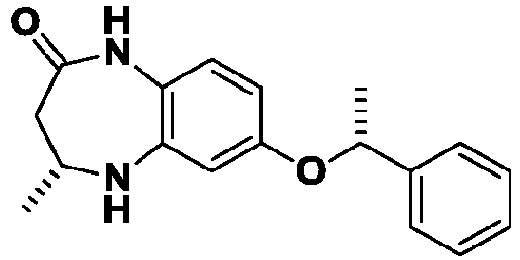
-

- To a solution of 3-fluoro-4-nitrophenol (1.535 g, 9.77 mmol) in DMSO (25 mL) was added (R)-3-aminobutanoic acid, HC1 (1.5 g, 10.75 mmol) and potassium carbonate (2.70 g, 19.54 mmol).
- The mixture was heated to 100 °C for 18 h. After cooling the reaction to room temperature, the reaction mixture was filtered and the filtrate was concentrated in vacuo. The residue was purified by silica gel chromatography (DCM / methanol) to give the title compound (900 mg, 38%) as an orange oil. LCMS M/Z (M+H) 241.
-

- To a solution of (R)-3-(5-hydroxy-2-nitrophenylamino)butanoic acid (0.433, 1.803 mmol)in ethanol (10 mL) and acetic acid (2 mL) was added iron powder (0.805 g, 14.42 mmol). The mixture was heated to 110 °C for 18 h. After cooling the reaction to room temperature, the reaction mixture was filtered and the filtrate wasconcentrated in vacuo. The residue was purified by silica gel chromatography (DCM / methanol)as an amorphous solid that required no further purification. LCMS M/Z (M+H) 193.
-

- To a solution of triphenylphosphine polymer bound 3.2 mmol/g (0.134 g, 0.510 mmol), (R)-7-hydroxy-4-methyl-4,5-dihydro-1H-benzo[b][1,4]diazepin-2(3H)-one (0.049 g, 0.255 mmol),(S)-1-phenylethanol (0.092 ml, 0.765 mmol) in THF (2 mL) at room temperature was added a solution of (E)-di-tert-butyl diazene-1,2-dicarboxylate (0.117 g, 0.510 mmol) in THF (1 mL) dropwise. The reaction mixture was stirred at room temperature for 18 h. The mixture was filtered through celite and concentrated in vacuo. The crude residue was purified by prep-HPLC (acetonitrile / 0.1% trifluoroacetic acid in water) to give the title compound (7.3 mg, 7%) as an off-white amorphous solid. 1H NMR (400 MHz, DMSO-d 6) δ9.28 (s, 1H), 7.30 - 7.40 (m, 4H), 7.21 - 7.28 (m, 1H), 6.70 (d, J = 8.8 Hz, 1H), 6.52 (br s, 1H), 6.36 (d, J = 6.6 Hz, 1H), 5.33 (q, J = 6.3 Hz, 1H), 3.82 (dd, J = 10.7, 6.7 Hz, 1H), 2.39 (dd, J = 13.5, 4.1 Hz, 1H), 2.13 (dd, J = 13.4, 7.3 Hz, 1H), 1.51 (d, J = 6.2 Hz, 3H), 1.14 (d, J = 6.4 Hz, 3H). LCMS M/Z (M+H) 297.
-

- To a solution of (R)-6-bromo-4-methyl-4,5-dihydro-1H-benzo[b][1,4]diazepin-2(3H)-one (Intermediate A, 510 mg, 2.0 mmol) in dimethylacetamide (10 mL) was added styrene (0.25 g, 2.4 mmol), dichloro[1,1'-bis(di-t-butylphosphino)ferrocene]palladium(II) (0.0652 g, 0.1 mmol), tetrabutylammonium chloride (0.0556 g, 0.2 mmol) and triethylamine (0.41 mL, 3 mmol). The reaction mixture was heated to 80 °C for 18 h.After cooling the reaction to room temperature,EtOAc was added and the mixture was washed with brine (x 3).The organic layer was dried over anhydrous Na2SO4, filtered and concentrated in vacuo. The crude residue was purified by silica gel chromatography (hexanes /EtOAc) to give the title compound (472 mg, 85%) as an off-white amorphous solid.1H NMR (400 MHz, DMSO-d 6) δ 9.49 (s, 1H), 8.08 (d, J = 7.8 Hz, 1H), 7.91 (d, J = 7.8 Hz, 1H), 7.78 (d, J = 15.8 Hz, 1H), 7.63 (t, J = 7.5 Hz, 1H), 7.54 (s, 2H), 7.39 - 7.51 (m, 3H), 6.84 - 6.94 (m, 2H), 5.09 (s, 1H), 3.98 - 4.11 (m, 1H), 2.44 (dd, J = 12.8, 4.8 Hz, 1H), 2.14 (dd, J = 12.9, 7.1 Hz, 1H), 1.26 (d, J = 6.0 Hz, 3H). LCMS M/Z (M+H) 279.
- The following compounds were prepared in a similar fashion to Example 124:
-
Example Compound Name NMR m/z Example 125 N-tert-butyl-2-[2-(4-methyl-2-oxo-1,3,4,5-tetrahydro-1,5-benzodiazepin-6-yl)vinyl]benzenesulfonami de 1H NMR (400 MHz, DMSO-d 6) δ 9.50 (s, 1H), 8.08 (d, J = 7.4 Hz, 1H), 7.93 (dd, J = 7.9, 1.2 Hz, 1H), 7.23 - 7.82 (m, 6H), 6.53 - 7.15 (m, 3H), 3.76 - 4.11 (m, 1H), 2.31 - 2.47 (m, 1H), 2.06 - 2.19 (m, 1H), 1.19 - 1.28 (m, 3H), 1.10 - 1.17 (m, 9H) (TFA salt) (rotamers) 414 Example 126 2-[2-(4-methyl-2-oxo-1,3,4,5-tetrahydro-1,5-benzodiazepin-6-yl)vinyl]benzenesulfonami de 1H NMR (400 MHz, DMSO-d 6) δ 9.49 (s, 1H), 8.08 (d, J = 7.8 Hz, 1H), 7.91 (d, J = 7.8 Hz, 1H), 7.78 (d, J = 15.8 Hz, 1H), 7.62 (t, J = 7.5 Hz, 1H), 7.54 (s, 2H), 7.38 - 7.51 (m, 3H), 6.86 - 6.94 (m, 2H), 5.09 (s, 1H), 4.05 (d, J = 6.0 Hz, 1H), 2.44 (dd, J = 12.9, 4.9 Hz, 1H), 2.13 (dd, J = 12.8, 7.3 Hz, 1H), 1.26 (d, J = 6.0 Hz, 3H) 358 - The following compounds were prepared in a similar fashion to Examples 110 & 123 from the corresponding hydroxyl/amino propanoates and appropriately substituted chloro- or fluoro-substituted nitrobenzene:
-
Example Compound Name NMR m/z Example 127 (2R)-2,9-dimethyl-3,5-dihydro-2H-1,5-benzoxazepin-4-one 1H NMR (400 MHz, DMSO-d 6) δ 9.58 (br s, 1H), 6.93 - 6.97 (m, 2H), 6.81 - 6.85 (m, 1H), 4.77 (sxt, J = 6.3 Hz, 1H), 2.57 (dd, J = 13.9, 5.0 Hz, 1H), 2.35 (dd, J = 14.1, 6.95 Hz, 1H), 2.21 (s, 3H), 1.34 (d, J = 6.47 Hz, 3H) 192 Example 128 (2R)-2,7-dimethyl-3,5-dihydro-2H-1,5-benzoxazepin-4-one 1H NMR (400 MHz, DMSO-d 6) δ 9.60 (br s, 1H), 6.79 - 6.92 (m, 3H), 4.64 - 4.75 (m, 1H), 2.56 (dd, J = 14.0, 4.9 Hz, 1H), 2.34 (dd, J = 14.0, 7.6 Hz, 1H), 2.23 (s, 3H), 1.29 (d, J = 6.2 Hz, 3H) 192 Example 129 (4R)-6-benzyloxy-4-methyl-1,3,4,5-tetrahydro-1,5-benzodiazepin-2-one 1H NMR (400 MHz, DMSO-d 6) δ 9.46 (s, 1H), 7.43 - 7.50 (m, 2H), 7.38 (t, J = 7.4 Hz, 2H), 7.32 (d, J = 7.1 Hz, 1H), 6.76 (dd, J = 8.0, 1.1 Hz, 1H), 6.66 (t, J = 8.0 Hz, 1H), 6.50 - 6.57 (m, 1H), 5.12 (s, 2H), 4.48 (d, J = 2.2 Hz, 1H), 3.85 - 3.98 (m, 1 H), 2.41 (dd, J = 13.3, 4.1 Hz, 1H), 2.20 (dd, J = 13.4, 8.0 Hz, 1H), 1.18 (d, J = 6.2 Hz, 3H) 283 Example 130 4,6-dimethyl-1,3,4,5-tetrahydro-1,5-benzodiazepin-2-one 1H NMR (400 MHz, DMSO-d 6) δ 9.36 (s, 1H), 6.84 (dd, J = 7.2, 1.1 Hz, 1H), 6.60 - 6.76 (m, 2H), 4.33 (br s, 1H), 3.85 - 4.01 (m, 1H), 2.35 (dd, J = 13.1, 4.8 Hz, 1H), 2.19 (s, 3H), 2.11 (dd, J = 13.1, 7.7 Hz, 1H), 1.19 (d, J = 6.2 Hz, 3H) 191 Example 131 (2R)-2-methyl-1,2,3,5-tetrahydro-1,5-benzodiazepin-4-one 1H NMR (400 MHz, DMSO-d 6) δ 9.41 (s, 1H), 6.76 - 6.94 (m, 3H), 6.60 - 6.73 (m, 1H), 5.25 (br s, 1H), 3.81 (m, 1H), 2.42 (dd, J = 13.3, 3.9 Hz, 1H), 2.18 (dd, J = 13.3, 7.3 Hz, 1H), 1.17 (d, J = 6.4 Hz, 3H) 177 Example 132 (2R)-2 -ethyl- 1,2,3,5 - tetrahydro-1,5-benzodiazepin-4-one 1H NMR (400 MHz, DMSO-d 6) δ 9.44 (s, 1H), 6.82 - 6.92 (m, 3H), 6.65 - 6.72 (m, 1H), 5.32 (br s, 1H), 3.53 - 3.63 (m, 1H), 2.43 (dd, J = 13.3, 3.7 Hz, 1H), 2.22 - 2.31 191 (m, 1H), 1.45 - 1.61 (m, 2H), 0.90 (t, J = 14.7 Hz, 3H) Example 133 (2S)-2-methyl-1,2,3,5-tetrahydro-1,5-benzodiazepin-4-one 1H NMR (400 MHz, DMSO-d 6) δ 9.41 (s, 1H), 6.77 - 6.91 (m, 3H), 6.63 - 6.74 (m, 1H), 5.25 (br s, 1H), 3.68 - 3.87 (m, 1H), 2.42 (dd, J = 13.3, 3.9 Hz, 1H), 2.18 (dd, J = 13.4, 7.3 Hz, 1H), 1.17 (d, J = 6.2 Hz, 3H) 177 -

- To a solution of (R)-6-chloro-4-methyl-4,5-dihydro-1Hbenzo[b] [1,4]diazepin-2(3H)-one (Intermediate A, 67 mg, 0.318 mmol), dichloropalladium bisacetonitrile (8.25 mg, 0.032 mmol), dicyclohexyl(2',4',6'-triisopropylbiphenyl-2-yl)phosphine (30.3 mg, 0.064 mmol), cesium carbonate (269 mg, 0.827 mmol) under a nitrogen atmosphere was added phenylacetylene (45.4 µl, 0.413 mmol) followed by acetonitrile (1 mL). The mixture was heated to 80 °C for 36 h. After cooling the reaction to room temperature, the reaction mixture was diluted with EtOAc, filtered and concentrated in vacuo.The residue was purified by silica gel chromatography (eluting with hexanes/EtOAc/0.1 % triethylamine) to give the title compound (8.5 mg, 10%)as an off-white amorphous solid. 1H NMR (400 MHz, DMSO-d 6) δ 10.22 - 10.29 (m, 1H), 7.52 - 7.56 (m, 3H), 7.46 - 7.52 (m, 1H), 7.21 - 7.28 (m, 1H), 7.00 (s, 1H), 6.83 - 6.89 (m, 1H), 6.50 (s, 1H), 4.62 - 4.73 (m, 1H), 3.06 - 3.16 (m, 1H), 2.85 - 2.95 (m, 2H), 1.28 (d, J= 6.5 Hz, 3H). LCMS M/Z (M+H) 277.
- The following compounds were prepared in a similar fashion to Example 134:
-
Example Compound Name NMR m/z Example 135 (4R)-6-(2-cyclohexylethynyl)-4-methyl-1,3,4,5-tetrahydro-1,5-benzodiazepin-2-one 1H NMR (400 MHz, DMSO-d 6) δ 9.56 (s, 1H), 7.00 (dd, J = 7.6, 1.3 Hz, 1H), 6.83 - 6.89 (m, 1H), 6.65 - 6.72 (m, 1H), 4.61 (s, 1H), 3.91 - 4.03 (m, 1H), 2.64 - 2.76 (m, 1H), 2.37 - 2.45 (m, 1H), 2.27 - 2.35 (m, 1H), 1.83 (br s, 2H), 1.63 - 1.72 (m, 2H), 1.50 (d, J = 8.9 Hz, 2H), 1.31 - 1.42 (m, 4H), 1.23 (d, J = 6.5 Hz, 3H). 283 Example 136 (4R)-4-methyl-6-(3-phenylprop-l-ynyl)-1,3,4,5-tetrahydro-1,5-benzodiazepin-2-one 1H NMR (400 MHz, DMSO-d 6) δ 10.11 - 10.19 (m, 1H), 7.28 (d, J = 1.6 Hz, 4H), 7.10 - 7.18 (m, 1H), 6.84 - 6.94 (m, 1H), 6.71 - 6.79 (m, 1H), 6.13 (s, 1H), 4.70 - 4.84 (m, 1H), 4.09 - 4.24 (m, 1H), 3.53 - 4.02 (m, 2H), 2.91 - 3.07 (m, 1H), 2.77 - 2.89 (m, 1H), 1.12 (d, J = J = 6.5 Hz, 3H) 291 Example 137 (2R)-2-methyl-9-(2-trimethylsilylethynyl)-3,5-dihydro-2H-1,5-benzoxazepin-4-one 1H NMR (500 MHz, DMSO-d 6) δ 9.74 (br s, 1H), 7.17 (dd, J = 6.4, 2.8 Hz, 1H), 7.04 (d, J = 3.8 Hz, 1H), 7.03 (s, 1H), 4.81 - 4.91 (m, 1H), 2.45 - 2.57 (m, 2H), 1.35 (d, J = 6.2 Hz, 3H), 0.22 (s, 9H) 274 Example 138 (2R)-9-(2-cyclohexylethynyl)-2-methyl-3,5-dihydro-2H-1,5-benzoxazepin-4-one 1H NMR (500 MHz, DMSO-d 6) δ 9.69 (s, 1H), 7.10 (dd, J = 7.6, 1.8 Hz, 1H), 6.99 - 7.04 (m, 1H), 6.96 (dd, J = 7.9, 1.8 Hz, 1H), 4.77 - 4.90 (m, 1H), 2.63 - 2.71 (m, 1H), 2.56 (dd, J = 14.2, 5.0 Hz, 1H), 2.42 (dd, J = 14.2, 7.9 Hz, 1H), 1.75 - 1.86 (m, 2H), 1.63 - 1.75 (m, 2H), 1.48 (s, 3H), 1.30 - 1.41 (m, 6H) 284 -

- A disposable reaction vial was charged with benzofuran-2-ylboronic acid (95 mg, 0.586 mmol), (R)-9-bromo-2-methyl-2,3-dihydrobenzo[b][1,4]oxazepin-4(5H)-one (Intermediate A, 75 mg, 0.293 mmol), potassium carbonate (81 mg, 0.586 mmol), methanesulfonato(2-di-t-butylphosphino-2',4',6'-tri-i-propyl-1,1'-biphenyl)(2'-amino-1,1 '-biphenyl-2-yl)palladium(II) precatalyst (10.82 mg, 0.015 mmol), a stirbar, and 1,4-dioxane/water (19:1) (2 mL) before being degassed (4 vacuum/nitrogen refill cyles) and heated to 100 °C for 6 h. After cooling the reaction to room temperature, the reaction mixture was concentrated in vacuo. The residue was purified by silica gel chromatography (eluting with hexanes/EtOAc) to give the title compound as an off-white amorphous solid. 1H NMR (500 MHz, DMSO-d 6) δ 9.79 (br s, 1H), 7.72 (td, J = 8.0, 1.5 Hz, 2H), 7.62 (d, J= 9.0 Hz, 1H), 7.42 (d, J = 0.9 Hz, 1H), 7.34 (dt, J = 7.7, 1.3 Hz, 1H), 7.27 (dt, J = 7.5, 1.0 Hz, 1H), 7.23 (t, J = 7.8 Hz, 1H), 7.08 (dd, J = 7.9, 1.7 Hz, 1H), 4.89 - 4.97 (m, J = 5.4 Hz, 1H), 2.82 (dd, J = 14.3, 5.6 Hz, 1H), 2.39 (dd, J = 14.3, 4.7 Hz, 1H), 1.49 (d, J = 6.2 Hz, 3H). LCMS M/Z (M+H) 294.
- The following compounds were prepared from either Intermediate A or Intermediate I in a similar fashion to Example 139. Synthesis of selected building blocks is shown prior to the table.
- Mixture of 3-methyl-1-(1-phenylethyl)-4-(4,4,5,5-tetramethyl-1,3,2-dioxaborolan-2-yl)-1H-pyrazole & 5-methyl-l-(1-phenylethyl)-4-(4,4,5,5-tetramethyl-1,3,2-dioxaborolan-2-yl)-1H-pyrazole

- To a solution of 4-bromo-3-methyl-1H-pyrazole (0.805 g, 5 mmol) and cesium carbonate (3.26 g, 10.00 mmol) in acetonitrile (5 mL) was added(1-bromoethyl)benzene (0.682 ml, 5.00 mmol).
- The mixture was heated to 50 °C for 18 h.After cooling the reaction to room temperature, the reaction mixture was filtered and the filtrate wasconcentrated in vacuo. The residue was purified by silica gel chromatography (eluting with hexanes and EtOAc) to give a colorless oil that required no further purification.
- The alkylated indoles and indazoles for Examples 157-160 were prepared using similar conditions as described above.
- To a solution of methanesulfonato(2-dicyclohexylphosphino-2',6'-dimethoxy-1,1'-biphenyl)(2'-amino-1,1'-biphenyl-2-yl)palladium(II) dichloromethane adduct (15.30 mg, 0.020 mmol) and a mixture of 3-methyl-1-(1-phenylethyl)-4-(4,4,5,5-tetramethyl-1,3,2-dioxaborolan-2-yl)-1H-pyrazole and 5-methyl-1-(1-phenylethyl)-4-(4,4,5,5-tetramethyl-1,3,2-dioxaborolan-2-yl)-1H-pyrazole(104 mg, 0.392 mmol)in dioxane (2 mL) under a nitrogen atmosphere was added 4,4,5,5-tetramethyl-1,3,2-dioxaborolane (114 µl, 0.784 mmol) and triethylamine (164 µl, 1.177 mmol). The mixture was heated to 100 °C for 2.5 h.After cooling the reaction to room temperature, the reaction mixture was diluted with EtOAc, filtered and the filtrate wasconcentrated in vacuo. The residue was used in the synthesis of Examples 182 and 183.
-

- To a solution of 4-(4,4,5,5-tetramethyl-1,3,2-dioxaborolan-2-yl)-1H-pyrazole (1 g, 5.15 mmol) and cesium carbonate (2.015 g, 6.18 mmol) in acetonitrile (50 mL) was added 1-bromoethyl)benzene (0.774 ml, 5.67 mmol). The mixture was heated to 50 °C for 18 h.After cooling the reaction to room temperature, the reaction mixture was filtered and the filtrate wasconcentrated in vacuo. The residue was purified by silica gel chromatography (eluting with hexanes and EtOAc) to give the title compound as a colorless oil, which was used in the synthesis of Example 173.
- The following two bromides were prepared as described and then converted into their corresponding pinacol boronates using the same conditions as described for the building block used in Step 1 of Example 80.
-

- The indole bromide used for Example 151 was prepared according to the following literature procedure: Bedford, R. B.; Fey, N.; Haddow, M. F.; Sankey, R. F. Chem. Commun. 2011, 47, 3649-3651.
-

- The bromide used for Example 169 was prepared according to the following literature procedure: Bhorge, Y. R.; Chang, S.-H.; Chang, C.-T.; Yan, T.-H. Tetrahedron2012, 68, 4846-4851.
-
Example Compound Name NMR m/z Example 140 (2R)-9-(benzothiophen-2-yl)-2-methyl-3,5-dihydro-2H-1,5-benzoxazepin-4-one 1H NMR (500 MHz, DMSO-d 6) δ 9.77 (br s, 1H), 7.96 - 7.99 (m, 1H), 7.94 (s, 1H), 7.86 - 7.89 (m, 1H), 7.65 - 7.68 (m, 1H), 7.39 (dt, J = 7.2, 1.3 Hz, 1H), 7.36 (dt, J = 7.2, 1.3 Hz, 1H), 7.20 (t, J = 7.9 Hz, 1H), 7.05 (dd, J = 7.9, 1.5 Hz, 7H), 4.82 - 4.91 (m, 1H), 2.84 (dd, J = 14.0, 6.5 Hz, 1H), 2.30 (ddd, J = 14.0, 4.0, 0.9 Hz, 1H), 1.45 (d, J = 6.2 Hz, 3H) 310 Example 141 (2R)-2-methyl-9-[(E)-styryl]-3,5-dihydro-2H-1,5-benzoxazepin-4-one 1H NMR (500 MHz, DMSO-d 6) δ 9.67 (br s, 1H), 7.59 (d, J = 7.4 Hz, 2H), 7.55 (dd, J = 8.0, 1.0 Hz, 1H), 7.41 - 7.46 (m, J = 10.0 Hz, 1H), 7.39 (t, J = 7.7 Hz, 2H), 7.24 - 7.31 (m, 2H), 7.11 (t, J = 7.8 Hz, 1H), 6.95 (dd, J = 7.8, 1.1 Hz, 1H), 4.83 - 280 4.93 (m, 1H), 2.62 (dd, J = 14.1, 5.1 Hz, 1 H), 2.39 (dd, J = 13.9, 7.0 Hz, 1H), 1.40 (d, J = J = 6.2 Hz, 3H) Example 142 (2R)-2-methyl-9-(1-methylindol-2-yl)-3,5-dihydro-211-1,5-benzoxazepin-4-one 1H NMR (500 MHz, DMSO-d 6) δ 9.81 (br s, 1H), 7.55 (d, J = 7.8 Hz, 1H), 7.44 - 7.48 (m, 1H), 7.13 - 7.22 (m, 4H), 7.05 (ddd, J = 8.0, 7.0, 1.0 Hz, 1H), 6.47 (d, J = 0.8 Hz, 1H), 4.63 (dquin, J = 6.7, 4.9 Hz, 1H), 3.55 (s, 3H), 2.64 (dd, J = 14.2, 4.8 Hz, 1H), 2.39 (dd, J = 14.1, 7.1 Hz, 1H), 0.97 (d, J = 6.2 Hz, 3H) 307 Example 143 tert-butyl 2-[(2R)-2-methyl-4-oxo-3,5-dihydro-2H-1,5-benzoxazepin-9-yl]indole-1-carboxylate 1H NMR (500 MHz, DMSO-d 6) δ 9.80 (s, 1H), 8.09 (d, J = 8.3 Hz, 1H), 7.61 (d, J = J = 7.6 Hz, 1H), 7.32 (dt, J = 7.8, 1.2 Hz, 1H), 7.24 (t, J = 7.5 Hz, 1H), 7.13 - 7.21 (m, 2H), 7.08 (dd, J = 7.5, 2.0 Hz, 1H), 6.68 (s, 1H), 4.43 - 4.62 (m, 1H), 2.52 - 2.61 (m, 1H), 2.28 - 2.40 (m, 1H), 1.25 (s, 9H), 0.89 (s, 3H) 393 Example 144 (2R)-9-[1-(benzenesulfonyl)indol-2-yl]-2-methyl-3,5-dihydro-2H-1,5-benzoxazepin-4-one 1H NMR (500 MHz, DMSO-d 6) δ 9.82 (s, 1H), 7.98 - 8.10 (m, 1H), 7.65 - 7.72 (m, 1H), 7.62 (t, J = 7.3 Hz, 1H), 7.55 (d, J = 7.6 Hz, 2H), 7.47 - 7.52 (m, 2H), 7.35 (t, J = 7.4 Hz, 1H), 7.26 (t, J = 7.5 Hz, 1H), 7.07 - 7.21 (m, 3H), 6.71 - 6.85 (m, 1H), 4.74 - 4.91 (m, 1H), 2.88 (dd, J = 14.5, 3.8 Hz, 1H), 2.38 - 2.49 (m, 1H), 1.20 (d, J = 5.8 Hz, 3H) 433 Example 145 (2R)-2-methyl-9-(3-methyl-1H-indol-2-yl)-3,5-dihydro-2H-1,5-benzoxazepin-4-one 1H NMR (400 MHz, DMSO-d 6) δ 10.85 (s, 1H), 9.77 (s, 1H), 7.49 (d, J = 7.8 Hz, 1H), 7.34 (td, J = 8.0, 0.9 Hz, 1H), 7.20 (s, 1H), 7.19 (d, J = 0.9 Hz, 1H), 7.04 - 7.11 (m, 2H), 6.99 (ddd, J = 7.9, 7.0, 1.1 Hz, 1H), 4.70 (dquin, J = 6.6, 5.1Hz, 1H), 2.63 (dd, J = 13.8, 5.1 Hz, 1H), 2.35 (dd, J = 13.8, 6.9 Hz, 1H), 2.21 (s, 3H), 0.99 (d, J = 6.2 Hz, 3H) 307 Example 146 (2R)-2-methyl-9-(1-methylindol-5-yl)-3,5-dihydro-2H-1,5-benzoxazepin-4-one Not Determined 307 Example 147 (2R)-9-(1-tert-butylpyrazol-4-yl)-2-methyl-3,5-dihydro-2H-1,5-benzoxazepin-4-one 1H NMR (400MHz, DMSO-d 6) δ 9.64 (br s, 1 H), 8.19 (br s, 1 H), 7.89 (br s, 1 H), 7.42 (d, J = 7.4 Hz, 1 H), 7.06 (br s, 1 H), 6.87 (br s, 1 H), 4.74 (br s, 1 H), 2.71 (br s, 1 H), 2.30 (d, J = 14.7 Hz, 1 H), 1.56 (s, 9 H), 1.37 (d, J = 5.6 Hz, 3 H). 300 Example 148 (2R)-2-methyl-9-(3-quinolyl)-3,5-dihydro-2H-1,5-benzoxazepin-4-one 1H NMR (400 MHz, DMSO-d 6) δ 9.81 (s, 1H), 9.03 (d, J = 2.1 Hz, 1H), 8.45 (d, J = 2.0 Hz, 1H), 8.05 (dd, J = 7.9, 3.5 Hz, 2H), 7.79 (ddd, J = 8.4, 7.0, 1.3 Hz, 1H), 7.65 (ddd, J = 8.1, 7.0, 0.8 Hz, 1H), 7.31 (dd, J = 7.6, 1.8 Hz, 1H), 7.24 (t, J = 7.7 Hz, 1H), 7.14 (dd, J = 7.8, 1.6 Hz, 1H), 4.72 (dquin, J = 6.3, 5.0 Hz, 1H), 2.72 (dd, J = 14.3, 4.9 Hz, 1H), 2.39 (dd, J = 14.1, 6.7 Hz, 1H), 1.03 (d, J = 6.2 Hz, 3H) 305 Example 149 tert-butyl 2-[(2R)-2-methyl-4-oxo-3,5-dihydro-2H-1,5-benzoxazepin-9-yl]-6,7-dihydro-4H-thieno[3,2-c]pyridine-5-carboxylate 1H NMR (400 MHz, DMSO-d 6) δ 9.70 (s, 1H), 7.50 (dd, J = 7.9, 1.5 Hz, 1H), 7.38 (s, 1H), 7.11 (t, J = 7.9 Hz, 1H), 6.93 (dd, J = 7.9, 1.5 Hz, 1H), 4.74 - 4.82 (m, 1H), 4.44 (br s, 2H), 3.65 (t, J = 5.8 Hz, 2H), 2.75 - 2.84 (m, 3H), 2.25 (dd, J = 13.7,3.0 Hz, 1H), 1.39 - 1.47 (m, 12H) 415 Example 150 (2R)-2-methyl-9-(1-phenylpyrazol-4-yl)-3,5-dihydro-2H-1,5-benzoxazepin-4-one 11T NMR (400 MHz, DMSO-d 6) δ 9.70 (s, 1H), 8.84 (s, 1H), 8.19 (s, 1H), 7.83 - 7.94 (m, 2H), 7.44 - 7.59 (m, 3H), 7.34 (tt, J = 7.5, 0.8 Hz, 1H), 7.13 (t, J = 7.8 Hz, 1H), 6.94 (dd, J = 8.0, 1.6 Hz, 1H), 4.83 (sxt, J = 6.0 Hz, 1H), 2.74 (dd, J = 14.1, 5.6 Hz, 1H), 2.33 (dd, J = 14.1, 4.9 Hz, 1H), 1.39 (d, J = 6.2 Hz, 3H) 320 Example 151 (2R)-9-(1,3-dimethylindol-2-yl)-2-methyl-3,5-dihydro-2H-1,5-benzoxazepin-4-one 111 NMR (400 MHz, DMSO-d 6) (∼1:1 mixture of rotomers) δ 9.81 (d, J = 4.0 Hz, 2H), 7.52 (d, J = 7.8 Hz, 2H), 7.41 (d, J = 8.0 Hz, 2H), 7.13 - 7.25 (m, 6H), 7.06 (s, 4H), 4.62 - 4.71 (m, 1H), 4.41 - 4.50 (m, 1H), 3.47 (s, 3H), 3.45 (s, 3H), 2.12 (s, 3H), 2.10 (s, 3H), 0.96 (d, J = 6.2 Hz, 3H), 0.78 (d, J = 6.2 Hz, 3H) 321 Example 152 tert-butyl 3-[(2R)-2-methyl-4-oxo-3,5-dihydro-2H-1,5-benzoxazepin-9-yl]indole-1-carboxylate 1H NMR (400 MHz, DMSO-d 6) δ 9.77 (s, 1H), 8.14 (d, J = 8.3 Hz, 1H), 7.86 (s, 1H), 7.64 (td, J = 8.1, 0.9 Hz, 1H), 7.25 - 7.41 (m, 3H), 7.19 (t, J = 7.8 Hz, 1H), 7.06 (dd, J = 7.9, 1.7 Hz, 1H), 4.64 (sxt, J = 6.0 Hz, 1H), 2.70 (dd, J = 14.2, 5.2 Hz, 1H), 2.35 (dd, J = 14.1, 5.8 Hz, 1H), 1.65 (s, 9H), 1.11 (d, J = 6.2 Hz, 3H) 393 Example 153 (2R)-2-methyl-9-(5-methyl-1-phenyl-pyrazol-4-yl)-3,5-dihydro-2H-1,5-benzoxazepin-4-one 1H NMR (400 MHz, DMSO-d 6) δ 9.71 (s, 1H), 7.75 (s, 1H), 7.52 - 7.60 (m, 4H), 7.42 - 7.48 (m, 1H), 7.10 - 7.17 (m, 2H), 7.00 (dd, J = 7.1, 2.5 Hz, 1H), 4.71 (sxt, J = 6.1 Hz, 1H), 2.67 (dd, J = 13.9, 5.2 Hz, 1H), 2.33 (dd, J = 13.9, 6.1 Hz, 1H), 2.29 (s, 3H), 1.17 (d, J = 6.2 Hz, 3H) 334 Example 154 (2R)-9-(1-isopropylpyrazol-4-yl)-2-methyl-3,5-dihydro-2H-1,5-benzoxazepin-4-one 1H NMR (400 MHz, DMSO-d 6) δ 9.64 (s, 1H), 8.14 (s, 1H), 7.87 (s, 1H), 7.39 (dd, J = 7.8, 1.3 Hz, 1H), 7.06 (t, J = 7.8 Hz, 1H), 6.86 (dd, J = 7.9, 1.5 Hz, 1H), 4.69 - 4.80 (m, 1H), 4.54 (td, J = 13.3, 6.6 Hz, 1H), 2.71 (dd, J = 14.1, 5.8 Hz, 1H), 2.29 (dd, J = 13.8, 4.5 Hz, 1H), 1.41 - 1.50 (m, 6H), 1.37 (d, J = 6.2 Hz, 3H) 286 Example 155 (2R)-2-methyl-9-(1-methylindol-3-yl)-3,5-dihydro-2H-1,5-benzoxazepin-4-one 1H NMR (400 MHz, DMSO-d 6) δ 9.67 (s, 1H), 7.70 (d, J = 8.0 Hz, 1H), 7.63 (s, 1H), 7.48 (d, J = 8.0 Hz, 1H), 7.38 (dd, J = 7.7, 1.7 Hz, 1H), 7.07 - 7.23 (m, 3H), 6.93 (dd, J = 7.8, 1.6 Hz, 1H), 4.65 (sxt, J = 5.9 Hz, 1H), 3.86 (s, 3H), 2.67 (dd, J = 13.8, 5.6 Hz, 1H), 2.27 (dd, J = 13.4, 5.4 Hz, 1H), 1.14 (d, J = 6.2 Hz, 3H) 307 Example 156 (2R)-2-methyl-9-(1-methylindazol-5-yl)-3,5-dihydro-2H-1,5-benzoxazepin-4-one 1H NMR (400 MHz, DMSO-d 6) δ 9.73 (s, 1H), 8.08 (s, 1H), 7.81 (s, 1H), 7.66 (d, J = 8.70 Hz, 1H), 7.52 (dd, J = 8.8, 1.2 Hz, 1H), 7.13 - 7.18 (m, 2H), 7.03 (dd, J = 3.57, 5.80 Hz, 1H), 4.65 (sxt, J = 6.0 Hz, 1H), 4.07 (s, 3H), 2.68 (dd, J = 14.1, 5.1 Hz, 1H), 2.32 (dd, J = 13.8, 6.2 Hz, 1H), 1.00 (d, J = 6.2 Hz, 3H) 308 Example 157 (2R)-9-(1,4-dimethylindazol-5-yl)-2-methyl-3,5-dihydro-2H-1,5-benzoxazepin-4-one 1H NMR (400 MHz, DMSO-d 6) δ 9.74 (s, 1H), 8.11 (d, J = 0.9 Hz, 1H), 7.44 (d, J = 8.7 Hz, 1H), 7.20 (br s, 1H), 7.13 (t, J = 7.8 Hz, 1H), 7.05 (dd, J = 8.0, 1.9 Hz, 1H), 6.97 (d, J = 7.1 Hz, 1H), 4.42 - 4.57 (m, 1H), 4.05 (s, 3H), 2.64 - 2.77 (m, 1H), 2.31 (br s, 4H), 0.71 - 1.00 (m, 3H) 322 Example 158 (2R)-9-(2,4-dimethylindazol-5-yl)-2-methyl-3,5-dihydro-2H-1,5-benzoxazepin-4-one 1H NMR (400 MHz, DMSO-d 6) δ 9.73 (s, 1H), 8.38 (s, 1H), 7.39 (d, J = 8.9 Hz, 1H), 7.12 (t, J = 7.6 Hz, 1H), 6.99 - 7.07 (m, 2H), 6.97 (d, J = 7.4 Hz, 1H), 4.51 (qd, J = 11.9,5.9 Hz, 1H), 4.17 (s, 3H), 2.60 - 2.79 (m, 1H), 2.30 - 2.40 (m, 1H), 2.16 - 2.29 (m, 3H), 0.76 - 1.01 (m, 3H) 322 Example 159 (2R)-9-(1,6-dimethylindazol-5-yl)-2-methyl-3,5-dihydro-2H-1,5-benzoxazepin-4-one 1H NMR (400 MHz, DMSO-d 6) (∼1:1 mixture of rotamers) δ 9.74 (s, 2H), 7.96 (d, J = 0.9 Hz, 2H), 7.49 (br s, 4H), 7.13 (t, J = 7.6 Hz, 2H), 7.06 (d, J = 7.6 Hz, 2H), 6.95 (dd, J = 7.4, 1.8 Hz, 2H), 4.48 - 4.63 (m, 1H), 4.31 - 4.45 (m, 1H), 4.03 (s, 6H), 2.64 - 2.80 (m, 1H), 2.37 - 2.48 (m, 2H), 2.23 - 2.34 (m, 1H), 2.04 - 2.23 (m, 6H), 0.96 (br s, 3H), 0.79 (br s, 3H) 322 Example 160 (2R)-9-(2,6-dimethylindazol-5-yl)-2-methyl-3,5-dihydro-2H-1,5-benzoxazepin-4-one 1H NMR (400 MHz, DMSO-d 6) (∼1:1 mixture of rotamers) δ 9.73 (s, 2H), 8.23 (s, 2H), 7.37 - 7.48 (m, 4H), 7.11 (t, J = 7.5 Hz, 2H), 7.04 (d, J = 7.6 Hz, 2H), 6.95 (dd, J = 7.3, 1.7 Hz, 2H), 4.53 - 4.62 (m, 1H), 4.34 - 4.43 (m, 1H), 4.14 (s, 6H), 2.69 - 2.79 (m, 1H), 2.38 - 2.48 (m, 322 2H), 2.22 - 2.31 (m, 1H), 2.08 (br s, 6H), 0.98 (br s, 3H), 0.81 (br s, 3H) Example 161 (2R)-9-(5-methoxy-1-methyl-indol-2-yl)-2-methyl-3,5-dihydro-2H-1,5-benzoxazepin-4-one 1H NMR (400 MHz, DMSO-d 6) δ 9.80 (s, 1H), 7.36 (d, J = 8.9 Hz, 1H), 7.12 - 7.22 (m, 3H), 7.06 (d, J = 2.5 Hz, 1H), 6.80 (dd, J = 8.8, 2.3 Hz, 1H), 6.38 (s, 1H), 4.63 (dquin, J = 6.5, 4.9 Hz, 1H), 3.77 (s, 3H), 3.51 (s, 3H), 2.63 (dd, J = 13.9, 4.8 Hz, 1H), 2.38 (dd, J = 14.2, 7.3 Hz, 1H), 0.97 (d, J = 6.2 Hz, 3H) 337 Example 162 (2R)-9-(4-chloro-1-methyl-indol-2-yl)-2-methyl-3,5-dihydro-2H-1,5-benzoxazepin-4-one 1H NMR (400 MHz, DMSO-d 6) δ 9.84 (s, 1H), 7.49 (td, J = 7.9, 1.0 Hz, 1H), 7.11 - 7.24 (m, 5H), 6.49 (d, J = 0.9 Hz, 1H), 4.58 - 4.68 (m, 1H), 3.57 (s, 3H), 2.65 (dd, J = 14.1, 4.7 Hz, 1H), 2.41 (dd, J = 14.3, 7.1 Hz, 1H), 0.98 (d, J = 6.2 Hz, 3H) 341 Example 163 (2R)-9-(6-chloro-1-methyl-indol-2-yl)-2-methyl-3,5-dihydro-2H-1,5-benzoxazepin-4-one 1H NMR (400 MHz, DMSO-d 6) δ 9.82 (s, 1H), 7.60 (d, J = 1.8 Hz, 1H), 7.56 (d, J = 8.3 Hz, 1H), 7.11 - 7.23 (m, 3H), 7.06 (dd, J = 8.4, 1.9 Hz, 1 H), 6.50 (d, J = 0.7 Hz, 1H), 4.57 - 4.68 (m, 1H), 3.57 (s, 3H), 2.63 (dd, J = 14.2, 4.8 Hz, 1H), 2.40 (dd, J = 14.2, 7.3 Hz, 1H), 0.96 (d, J = 6.2 Hz, 3H) 341 Example 164 (2R)-9-imidazo[1,2-α]pyridin-6-yl-2-methyl-3,5-dihydro-2H-1,5-benzoxazepin-4-one 1H NMR (400 MHz, DMSO-d 6) δ 9.78 (s, 1H), 8.68 (d, J = 0.9 Hz, 1H), 7.99 (d, J = 0.5 Hz, 1H), 7.56 - 7.62 (m, 2H), 7.38 (dd, J = 9.1, 1.6 Hz, 1H), 7.15 - 7.25 (m, 2H), 7.08 (dd, J = 7.6, 2.0 Hz, 1H), 4.71 (qd, J 294 = 11.8, 6.2 Hz, 1H), 2.70 (dd, J = 14.2, 5.0 Hz, 1H), 2.36 (dd, J = 14.2, 6.4 Hz, 1H), 1.11 (d, J = 6.2 Hz, 3H) Example 165 (2R)-9-(1,3-dimethylindazol-5-yl)-2-methyl-3,5-dihydro-2H-1,5-benzoxazepin-4-one 1H NMR (400 MHz, DMSO-d 6) δ 9.73 (s, 1H), 7.75 (s, 1H), 7.57 (d, J = 8.7 Hz, 1H), 7.51 (dd, J = 8.7, 1.5 Hz, 1H), 7.12 - 7.20 (m, 2H), 7.02 (dd, J = 7.4, 2.2 Hz, 1H), 4.64 (qd, J = 11.9, 6.1 Hz, 1H), 3.98 (s, 3H), 2.70 (dd, J = 13.9, 5.2 Hz, 1H), 2.49 (s, 3H), 2.32 (dd, J = 14.1, 6.0 Hz, 1H), 1.03 (d, J = 6.2 Hz, 3H) 322 Example 166 (2R)-9-(3-cyclopropyl-1-methyl-indazol-5-yl)-2-methyl-3,5-dihydro-2H-1,5-benzoxazepin-4-one 1H NMR (400 MHz, DMSO-d 6) δ 9.73 (s, 1H), 7.82 (dd, J = 1.5, 0.8 Hz, 1H), 7.56 (dd, J = 8.7, 0.8 Hz, 1H), 7.49 (dd, J = 8.7, 1.5 Hz, 1H), 7.19 (dd, J = 7.7, 2.1 Hz, 1H), 7.15 (t, J = 7.5 Hz, 1H), 7.03 (dd, J = 7.6, 2.0 Hz, 1H), 4.64 (sxt, J = 5.9 Hz, 1H), 3.95 (s, 3H), 2.71 (dd, J = 13.8, 5.4 Hz, 1H), 2.25 - 2.36 (m, 2H), 1.05 (d, J = 6.2 Hz, 3H), 0.92 - 1.01 (m, 4H) 348 Example 167 (2R)-9-(1-isopropylindazol-5-yl)-2-methyl-3,5-dihydro-2H-1,5-benzoxazepin-4-one 1H NMR (400 MHz, DMSO-d 6) δ 9.73 (s, 1H), 8.09 (s, 1H), 7.81 (dd, J = 1.3, 0.7 Hz, 1H), 7.71 (d, J = 8.9 Hz, 1 H), 7.49 (dd, J = 8.7, 1.6 Hz, 1H), 7.12 - 7.18 (m, 2H), 7.03 (dd, J = 5.6, 4.0 Hz, 1H), 5.01 (spt, J = 6.5 Hz, 1H), 4.66 (sxt, J = 6.0 Hz, 1H), 2.70 (dd, J = 13.9, 5.2 Hz, 1H), 2.32 (dd, J = 13.9, 6.1Hz, 1H), 1.50 (d, J = 6.7 Hz, 6H), 1.03 (d, J = 6.2 Hz, 3H) 336 Example 168 (2R)-9-(1H-indazol-5-yl)-2-methyl-3,5-dihydro-2H-1,5-benzoxazepin-4-one 1H NMR (400 MHz, DMSO-d 6) δ 13.09 (s, 1H), 9.73 (s, 1H), 8.10 (s, 1H), 7.82 (s, 1H), 7.57 (d, J = 8.7 Hz, 1H), 7.47 (dd, J = 8.7, 1.6 Hz, 1H), 7.11 - 7.19 (m, 2H), 7.03 (dd, J = 6.2, 3.3 Hz, 1H), 4.65 (sxt, J = 6.0 Hz, 1H), 2.67 (dd, J = 13.9, 5.2 Hz, 1H), 2.32 (dd, J = 13.9, 6.4 Hz, 1H), 1.00 (d, J = 6.2 Hz, 3H) 294 Example 169 (R,E)-9-((3,4-dihydronaphthalen-1(2H)-ylidene)methyl)-2-methyl-2,3-dihydrobenzo[b][1,4]oxazepin-4(5H)-one 1H NMR (500 MHz, DMSO-d 6) δ 9.66 (s, 1H), 7.67 - 7.76 (m, 1H), 7.18 - 7.22 (m, 2H), 7.07 - 7.16 (m, 4H), 6.95 (dd, J = 7.3, 2.1 Hz, 1H), 4.81 (dd, J = 12.5, 6.2 Hz, 1H), 2.78 - 2.83 (m, 2H), 2.61 - 2.71 (m, 2H), 2.58 (dd, J = 13.7, 4.9 Hz, 1H), 2.40 (dd, J = 13.9, 7.6 Hz, 1H), 1.66-1.82 (m, 2H), 1.25 - 1.32 (m, 3H) 320 Example 170 (4R)-6-(benzofuran-2-yl)-4-methyl-1,3,4,5-tetrahydro-1,5-benzodiazepin-2-one 1H NMR (400 MHz, DMSO-d 6) δ 9.61 (br s, 1H), 7.68 (ddd, J = 7.5, 1.5, 0.7 Hz, 1H), 7.62 (d, J = 8.0 Hz, 1H), 7.38 (dd, J = 7.5, 1.9 Hz, 1H), 7.25 - 7.35 (m, 2H), 7.21 (d, J = 0.9 Hz, 1H), 6.99 (dd, J = 8.0. 1.9 Hz, 1H), 6.95 (q, J = 7.6 Hz, 1H), 4.93 (d, J = 3.0 Hz, 1H), 4.04 - 4.15 (m, 1H), 2.56 (dd, J = 13.5, 4.5 Hz, 1H), 2.24 (dd, J = 13.5, 6.5 Hz, 1H), 1.24 (d, J = 6.2 Hz, 3H) 293 Example 171 (4R)-4-methyl-6-(1-methylindol-2-yl)-1,3,4,5-tetrahydro-1,5-benzodiazepin-2-one 1H NMR (400 MHz, DMSO-d 6) δ 9.63 (s, 1H), 7.58 (d, J = 7.8 Hz, 1H), 7.48 (d, J = 8.0 Hz, 1H), 7.19 (s, 1H), 7.08 (d, J = 7.1 Hz, 1H), 7.02 (dd, J = 7.7, 1.5 Hz, 1H), 6.94 - 6.99 (m, 1H), 6.88 (d, J = 7.8 Hz, 1H), 6.47 (s, 1H), 4.25 (d, J = 3.1 306 Hz, 1H), 3.83 - 3.94 (m, 1H), 2.55 - 2.64 (m, 1H), 2.20 - 2.28 (m, 1H), 1.05 (d, J = 6.2 Hz, 3H) Example 172 (4R)-6-(1-tert-butylpyrazol-4-yl)-4-methyl-1,3,4,5-tetrahydro-1,5-benzodiazepin-2-one 1H NMR (400 MHz, DMSO-d 6) δ 9.50 (s, 1H), 8.00 (s, 1H), 7.60 (s, 1H), 7.00 (dd, J = 6.1, 3.0 Hz, 1H), 6.78 - 6.88 (m, 2H), 4.03 (d, J = 2.7 Hz, 1H), 3.92 - 4.00 (m, 1H), 2.53 (d, J = 4.9 Hz, 1H), 2.20 (d, J = 6.0 Hz, 1H), 1.51 - 1.61 (m, 9H), 1.17 (d, J = 6.2 Hz, 3H) 299 Example 173 4-methyl-6-[1-(1-phenylethyl)pyrazol-4-yl]-1,3,4,5-tetrahydro-1,5-benzodiazepin-2-one 1H NMR (400 MHz, DMSO-d 6) δ 9.50 (s, 1H), 8.07 (d, J = 2.7 Hz, 1H), 7.63 (s, 1H), 7.38 - 7.24 (m, 5H), 6.98 (dd, J = 6.4, 2.8Hz, 1H), 6.87 - 6.79 (m, 2H), 5.65 (d, J= 6.0 Hz, 1H), 3.99 (br s, 1H), 3.93 (br s, 1H), 2.55 - 2.50 (m, 1H), 2.16 (dd, J = 13.2, 6.0 Hz, 1H), 1.85 (d, J = 7.1 Hz, 3H), 1.13 (dd, J = 6.2, 1.8 Hz, 3H) 347 Example 174 (4R)-6-(3,4-dimethylphenyl)-4-methyl-1,3,4,5-tetrahydro-1,5-benzodiazepin-2-one 1H NMR (400 MHz, DMSO-d 6) δ 9.56 (s, 1H), 7.23 (d, J = 7.6 Hz, 1H), 7.13 (s, 1H), 7.05 - 7.10 (m, 1H), 6.83 - 6.93 (m, 3H), 3.86 (d, J = 5.4 Hz, 1H), 3.74 (br s, 1H), 2.59 (dd, J = 13.0, 4.8 Hz, 1H), 2.24 - 2.30 (m, 6H), 2.18 (dd, J = 13.3, 5.9 Hz, 1H), 1.09 (d, J = 6.2 Hz, 3H) 281 Example 175 (4R)-6-(1H-indol-6-yl)-4-methyl-1,3,4,5-tetrahydro-1,5-benzodiazepin-2-one 1H NMR (400 MHz, DMSO-d 6) δ 11.17 (br s, 1H), 9.57 (s, 1H), 7.63 (d, J = 8.0 Hz, 1H), 7.32 - 7.42 (m, 2H), 6.82 - 7.02 (m, 3H), 6.47 (br s, 1H), 3.86 - 3.96 (m, 1H), 3.84 (br s, 1H), 2.63 (dd, J = 13.0, 4.8 Hz, 1H), 2.20 (dd, J = 13.0, 5.5 Hz, 1H), 1.08 (d, J = 6.0 Hz, 3H) 292 Example 176 (4R)-6-(3,4-dimethoxyphenyl)-4-methyl-1,3,4,5-tetrahydro-1,5-benzodiazepin-2-one 1H NMR (400 MHz, DMSO-d 6) δ 9.55 (s, 1H), 7.05 (d, J = 8.25 Hz, 1H), 6.80 - 6.97 (m, 5H), 3.86 - 3.94 (m, 1H), 3.82 (d, J = 2.90 Hz, 1H), 3.80 (s, 3H), 3.77 (s, 3H), 2.61 (dd, J = 13.2, 4.9 Hz, 1H), 2.17 (dd, J = 13.0, 5.5 Hz, 1H), 1.12 (d, J = 6.2 Hz, 3H) 313 Example 177 (4R)-4-methyl-6-(2-oxoindolin-6-yl)-1,3,4,5-tetrahydro-1,5-benzodiazepin-2-one 1H NMR (400 MHz, DMSO-d 6) δ 10.42 (s, 1H), 9.57 (s, 1H), 7.30 (d, J = 7.5 Hz, 1H), 6.81 - 6.98 (m, 4H), 6.75 (s, 1H), 3.84 (br s, 2H), 3.52 (s, 2H), 2.60 (dd, J = 13.3, 4.6 Hz, 1H), 2.18 (dd, J = 12.6, 5.7 Hz, 1H), 1.11 (d, J = 6.0 Hz, 3H) 308 Example 178 (4R)-4-methyl-6-(2-oxoindolin-5-yl)-1,3,4,5-tetrahydro-1,5-benzodiazepin-2-one 1H NMR (400 MHz, DMSO-d 6) δ 10.46 (s, 1H), 9.55 (s, 1H), 7.18 (s, 1H), 7.15 (d, J = 7.8 Hz, 1H), 6.83 - 6.92 (m, 4H), 3.88 (br s, 1H), 3.79 (br s, 1H), 3.52 (s, 2H), 2.60 (dd, J = 13.2, 4.7 Hz, 1H), 2.13 - 2.21 (m, 1H), 1.10 (d, J = 6.2 Hz, 3H) 308 Example 179 (4R)-4-methyl-6-(1-methylsulfonylpyrazol-4-yl)-1,3,4,5-tetrahydro-1,5-benzodiazepin-2-one 1H NMR (400 MHz, DMSO-d 6) δ 9.55 (s, 1H), 8.38 (d, J = 0.9 Hz, 1H), 8.11 (d, J = 0.9 Hz, 1H), 7.00 - 7.11 (m, 1H), 6.81 - 6.96 (m, 2H), 4.35 (br s, 1H), 3.97 (br s, 1H), 3.58 (d, J = 1.3 Hz, 3H), 2.55 (dd, J = 321 13.2, 4.5 Hz, 1H), 2.18 (dd, J = 13.0, 5.9 Hz, 1H), 1.12 - 1.24 (m, 3H) Example 180 3-[(4R)-4-methyl-2-oxo-1,3,4,5-tetrahydro-1,5-benzodiazepin-6-yl]benzenesulfonamide 1H NMR (400 MHz, DMSO-d 6) δ 9.62 (s, 1H), 7.77 - 7.89 (m, 2H), 7.56 - 7.73 (m, 2H), 7.38 (s, 2H), 6.89 - 7.02 (m, 3H), 3.91 (d, J = 1.8 Hz, 2H), 2.63 (dd, J = 12.9, 4.5 Hz, 1H), 2.20 (dd, J = 13.0, 5.2 Hz, 1H), 1.12 (d, J = 5.8 Hz, 3H) 332 Example 181 N-methyl-3-[(4R)-4-methyl-2-oxo-1,3,4,5-tetrahydro-1,5-benzodiazepin-6-yl]benzenesulfonamide 1H NMR (400 MHz, DMSO-d 6) δ 9.61 (s, 1H), 7.61 - 7.82 (m, 4H), 7.49 (q, J= 5.05 Hz, 1H), 6.89 - 7.01 (m, 3H), 4.01 (d, J = 2.45 Hz, 1H), 3.86 - 3.96 (m, 1H), 2.64 (dd, J = 13.0, 4.8 Hz, 1H), 2.45 (d, J = 4.91 Hz, 3H), 2.20 (dd, J = 13.0, 5.5 Hz, 1H), 1.12 (d, J = 6.2 Hz, 3H) 346 Example 182 (4R)-4-methyl-6-[3-methyl-1-[(1S)-1-phenylethyl]pyrazol-4-yl]-1,3,4,5-tetrahydro-1,5-benzodiazepin-2-one 1H NMR (400 MHz, DMSO-d 6) δ 9.55 (s, 1H), 7.86 (s, 1H), 7.31 - 7.38 (m, 2H), 7.24 - 7.30 (m, 3H), 6.78 - 6.93 (m, 3H), 5.55 (q, J = 7.1 Hz, 1H), 3.80 - 3.94 (m, 1H), 2.46 - 2.49 (m, 1H), 2.19 (dd, J = 13.3, 6.8 Hz, 1H), 2.04 (s, 3H), 1.82 (d, J = 7.1 Hz, 3H), 1.05 (d, J = 6.0 Hz, 3H) 361 Example 183 4-methyl-6-[5-methyl-1-(1-phenylethyl)pyrazol-4-yl]-1,3,4,5-tetrahydro-1,5-benzodiazepin-2-one 1H NMR (400 MHz, DMSO-d 6) δ 9.53 (br s, 1H), 7.50 (d, J = 2.5 Hz, 1H), 7.22 - 7.39 (m, 3H), 7.17 (t, J = 6.2 Hz, 2H), 6.84 - 6.92 (m, 1H), 6.74 - 6.83 (m, 2H), 5.65 (quin, J = 7.1 Hz, 1H), 3.74 - 3.93 (m, 1H), 2.42 - 2.48 (m, 1H), 2.13 - 2.24 (m, 1H), 2.02 (d, J = 2.5 Hz, 3H), 1.84 361 (dd, J = 6.9, 2.7 Hz, 3H), 0.93 - 1.11 (m, 3H) Example 184 (4R)-6-(1-benzylpyrazol-4-yl)-4-methyl-1,3,4,5-tetrahydro-1,5-benzodiazepin-2-one 1H NMR (400 MHz, DMSO-d 6) δ 9.51 (s, 1H), 8.05 (s, 1H), 7.63 (s, 1H), 7.25 - 7.40 (m, 3H), 6.97 (dd, J = 6.1, 2.3 Hz, 1H), 6.79 - 6.88 (m, 2H), 5.37 (s, 2H), 3.94 (br. s, 1H), 2.54 (d, J = 4.7 Hz, 1H), 2.15 (dd, J = 13.0, 5.7 Hz, 1H), 1.15 (d, J = 6.2 Hz, 3H) 333 Example 185 (4R)-6-(1-isopropylpyrazol-4-yl)-4-methyl-1,3,4,5-tetrahydro-1,5-benzodiazepin-2-one 1H NMR (400 MHz, DMSO-d 6) δ 9.50 (s, 1H), 7.96 (s, 1H), 7.59 (s, 1H), 6.98 (dd, J = 2.90, 6.02 Hz, 1H), 6.79 - 6.88 (m, 2H), 4.53 (td, J = 13.4, 6.7 Hz, 1H), 3.97 (d, J = 5.8 Hz, 1H), 2.54 (d, J = 4.9 Hz, 1H), 2.17 (dd, J = 13.2, 5.8 Hz, 1H), 1.46 (d, J = 6.7 Hz, 6H), 1.17 (d, J = 6.0 Hz, 3H) 285 Example 186 (4R)-4-methyl-6-[1-(oxetan-3-yl)pyrazol-4-yl]-1,3,4,5-tetrahydro-1,5-benzodiazepin-2-one 1H NMR (400 MHz, DMSO-d 6) δ 9.51 (s, 1H), 8.04 - 8.12 (m, 1H), 7.74 (s, 1H), 6.98 (dd, J = 6.7, 2.7 Hz, 1H), 6.80 - 6.88 (m, 2H), 5.58 - 5.69 (m, 1H), 4.91 - 4.99 (m, 4H), 4.10 (d, J = 2.9 Hz, 1H), 3.97 (td, J = 8.8, 5.7 Hz, 1H), 2.55 (dd, J = 13.0, 5.0 Hz, 1H), 2.16 (dd, J = 13.0, 5.7 Hz, 1H), 1.18 (d, J = 6.2 Hz, 3H) 299 Example 187 (4R)-4-methyl-6-(3-methylsulfonylphenyl)-1,3,4,5-tetrahydro-1,5-benzodiazepin-2-one 1H NMR (400 MHz, DMSO-d 6) δ 9.61 (s, 1H), 7.93 (d, J = 6.7 Hz, 1H), 7.89 (s, 1H), 7.70 - 7.78 (m, 2H), 6.83 - 7.01 (m, 3H), 4.07 (br s, 1H), 3.91 (br s, 1H), 3.26 (s, 3H), 2.65 (dd, J = 13.2, 4.7 Hz, 1H), 2.21 (dd, J = 13.2, 5.6 Hz, 1H), 1.14 (d, J = 6.2 Hz, 3H) 331 -

- To a solution of (R)-6-bromo-4-methyl-4,5-dihydro-1H-berizo[b][1,4]diazepin-2(3H)-one (Intermediate A, 100 mg, 0.392 mmol) in NMP (2 mL) under a nitrogen atmosphere was added methyl 1-methyl-1H-indole-6-carboxylate (0.148 g, 0.784 mmol), diacetoxypalladium (0.009 g, 0.039 mmol), potassium carbonate (0.108 g, 0.784 mmol), and pivalic acid (0.020 g, 0.196 mmol). The reaction mixture was heated to 110 °C for 5 h. After cooling the reaction to room temperature, the reaction mixture was concentrated in vacuo. The residue was purified by flash chromatography followed by preparative HPLC to give the title compound (38 mg, 20%). 1H NMR (400 MHz, DMSO-d 6) 9.58 (s, 1H), 8.17 (d, J = 0.7 Hz, 1H), 7.69 (dd, J = 8.4, 1.5 Hz, 2H), 7.69 (s, 1H), 7.49 (d, J = 8.5 Hz, 1H), 6.85 - 7.01 (m, 3H), 3.94 (s, 3H), 3.89 - 3.92 (m, 1H), 3.88 (s, 3H), 2.66 (dd, J = 13.2, 4.7 Hz, 1H), 2.18 - 2.25 (m, 1H), 1.05 (d, J = 6.2 Hz, 3H). LCMS M/Z (M+H) 364.
- The following compounds were prepared in a similar fashion to Example 188. Synthesis of selected building blocks is shown before the table.
-

- The N-methyl indole starting material used in examples G02792117 and G02792118 was prepared according to the following literature procedure: Hebeisen, P., Kitas, E. A., Minder, R. E., Mohr, P., Wessel, H. P. Animothiazole derivatives.
WO2009068467, June 4, 2009 . -
Example Compound Name NMR m/z Example 189 (4R)-4-methyl-6-(1-methyl-4,5,6,7-tetrahydroindol-2-yl)-1,3,4,5-tetrahydro-1,5-benzodiazepin-2-one 1H NMR (400 MHz, DMSO-d 6) δ 9.54 (s, 1H), 6.89 (dd, J = 7.6, 2.0 Hz, 1H), 6.76 - 6.84 (m, 2H), 5.79 (s, 1H), 4.10 (d, J = 3.1 Hz, 1H), 3.81 - 3.91 (m, 1H), 3.19 (s, 3H), 2.52 - 2.58 (m, 3H), 2.45 (t, J = 5.9 Hz, 2H), 2.20 (dd, J = 13.5, 6.4 Hz, 1H), 1.74 - 1.84 (m, 2H), 1.63 - 1.73 (m, 2H), 1.09 (d, J = 6.5 Hz, 3H) 310 Example 190 1-methyl-2-[(4R)-4-methyl-2-oxo-1,3,4,5-tetrahydro-1,5-benzodiazepin-6-yl]indole-6-carbonitrile 1H NMR (400 MHz, DMSO-d 6) δ 9.64 (s, 1H), 8.12 (s, 1H), 7.74 (d, J = 8.3 Hz, 1H), 7.40 (dd, J = 8.0, 1.3 Hz, 1H), 7.04 (dd, J = 7.8, 1.8 Hz, 1H), 6.96 (dd, J = 7.5, 1.8 Hz, 1H), 6.87 (t, J = 7.8 Hz, 1H), 6.63 (d, J = 0.5 Hz, 1H), 4.38 (d, J = 3.3 Hz, 1H), 3.84 - 3.94 (m, 1H), 3.60 (s, 3H), 2.64 (dd, J = 13.0, 4.1 Hz, 1H), 2.24 (dd, J = 13.2, 6.0 Hz, 1H), 1.06 (d, J = 6.2 Hz, 3H) 331 Example 191 (4R)-4-methyl-6-(1-methyl-6-methylsulfonyl-indol-3-yl)-1,3,4,5-tetrahydro-1,5-benzodiazepin-2-one 1H NMR (400 MHz, DMSO-d 6) δ 9.57 (s, 1H), 8.13 (s, 1H), 7.76 (s, 1H), 7.57 - 7.60 (m, 2H), 6.91 - 7.00 (m, 2H), 6.84 - 6.89 (m, 1H), 3.97 (s, 3H), 3.85 - 3.91 (m, 1H), 3.22 (s, 3H), 2.63 - 2.69 (m, 1H), 2.17 - 2.24 (m, 1H), 1.05 (d, J = 6.2 Hz, 3H) 384 Example 192 (4R)-4-methyl-6-(1-methyl-6-methylsulfonyl-indol-2-yl)-1,3,4,5-tetrahydro-1,5-benzodiazepin-2-one 1H NMR (400 MHz, DMSO-d 6) δ 9.65 (s, 1H), 8.08 (s, 1H), 7.80 (d, J = 8.47 Hz, 1H), 7.59 (dd, J = 8.4, 1.7 Hz, 1H), 7.04 (dd, J = 7.8, 1.6 Hz, 1H), 6.97 (dd, J = 7.6, 1.6 Hz, 1H), 6.88 (t, J = 7.6 Hz, 1H), 6.64 (s, 1H), 3.91 (s, 1H), 3.64 (s, 3H), 3.22 (s, 3H), 2.64 (dd, J = 13.2, 3.8 Hz, 1H), 2.24 (dd, J = 13.3, 6.4 Hz, 1H), 1.07 (d, J = 6.2 Hz, 3H) 384 Example 193 methyl 1-methyl-2-[(4R)-4-methyl-2-oxo-1,3,4,5-tetrahydro-1,5-benzodiazepin-6-yl]indole-6-carboxylate 1H NMR (400 MHz, DMSO-d 6) δ 9.65 (s, 1H), 8.13 (s, 1H), 7.65 - 7.73 (m, 2H), 7.04 (dd, J = 7.8, 1.6 Hz, 1H), 6.97 (dd, J = 7.8, 1.6 Hz, 1H), 6.88 (t, J = 7.8 Hz, 1H), 6.58 (s, 1H), 3.85 - 3.94 (m, 4H), 3.61 (s, 3H), 2.63 (dd, J = 13.2, 4.0 Hz, 1H), 2.24 (dd, J = 13.3, 6.4 Hz, 1H), 1.06 (d, J = 6.2 Hz, 3H) 364 Example 194 1-methyl-3-[(4R)-4-methyl-2-oxo-1,3,4,5-tetrahydro-1,5-benzodiazepin-6-yl]indole-6-carbonitrile 1H NMR (400 MHz, DMSO-d 6) δ 9.56 (s, 1H), 8.17 (dd, J = 1.3, 0.7 Hz, 1H), 7.74 (s, 1H), 7.53 (dd, J = 8.3, 0.7 Hz, 1H), 7.38 (dd, J = 8.3, 1.6 Hz, 1H), 6.96 (dd, J = 7.3, 1.8 Hz, 1H), 6.93 (dd, J = 8.0, 1.8 Hz, 1H), 6.83 - 6.88 (m, 1H), 3.92 (s, 3H), 3.84 - 3.91 (m, 1H), 2.65 (dd, J = 13.2, 4.5 Hz, 1H), 2.20 (dd, J = 13.5, 5.9 Hz, 1H), 1.04 (d, J = 6.2 Hz, 3H) 331 -

-

- To a solution of N,N-diisopropylamine (5.79 mL, 41.0 mmol) in diglyme (1000 mL) at - 78 °C was added butyllithium (16.39 mL, 41.0 mmol)slowly. The reaction mixture was allowed to stirred at 0 °C for 10 min, and then re-cooled to -78 °C. To the reaction mixture was added 2-methylbenzonitrile (2.4 g, 20.49 mmol) over 10 min and stirred for 5 min before (E)-tert-butyl but-2-enoate (2.91 g, 20.49 mmol) was added. After stirring for an additional 15 min at -78 °C, the reaction was allowed to warm to 20 °C and stirred at this temperature for 45 min. The reaction mixture was quenched with sat. aq.NH4Cl and extracted with diethylether (x4). The combined organic layers were dried over anhydrous Na2SO4, filtered and concentrated in vacuo to give the title compound as a yellow oil that required no further purification. LCMS M/Z (M+H) 260.
-

- To a solution of tert-butyl 1-imino-3-methyl-1,2,3,4-tetrahydronaphthalene-2-carboxylate (5 g, 19.28 mmol) in MeOH (20 mL) was added 6N aqueous hydrochloric acid (20 mL, 120 mmol) at room temperature. The reaction was heated to 70 °C (gas evolution was observed) for 1.5 h before the reaction was diluted with water, and the product was extracted with diethylether (repeated 4 times). The combined organic layers were dried over sodium sulfate, filtered, and concentrated in vacuo. The residue was purified by flash chromatography (hexanes/diethylether 19:1 to 8:2) to give the title compound (yield not determined). LCMS M/Z (M+H) 161.
-

- To a solution of 3-methyl-3,4-dihydronaphthalen-1(2H)-one (500 mg, 3.12 mmol) and hydroxylamine hydrochloride (260 mg, 3.75 mmol) in methanol (20 mL) was added sodium hydroxide (150 mg, 3.75 mmol). After the reaction was stirred overnight at room temperature, additional hydroxylamine hydrochloride (108 mg, 1.56 mmol) and sodium hydroxide (62.4 mg, 1.56 mmol) were added. Then the reaction was heated to 70 °C for about 1.5 h before it was concentrated in vacuo. The residue was suspended in a mixture of EtOAc and dichloromethane (9:1), filtered through celite and the filtrate was concentrated in vacuo to give the title compound as a white solid (547 mg, 100%). LCMS M/Z (M+H) 176.
-

- Polyphosphoric acid (10 mL) was added to 3-methyl-3,4-dihydronaphthalen-1(2H)-one oxime (547 mg, 3.12 mmol) and the mixture was heated to 120 °C for 2 h. Then the reaction was cooled to 50 °C before it was quenched with water (200 mL) (exothermic process) (preforming the quench a lower temperature was difficult due to the high viscosity of the reaction mixture). The product was extracted with dichloromethane (repeated 4 times), and the combined organic layers were washed with a saturated solution of sodium bicarbonate, dried over sodium sulfate, filtered and concentrated in vacuo. The residue was purified by silica gel chromatography (hexanes/EtOAc 85:15 to 65:35) to give the title compound as a white solid (425 mg, 78%). 1H NMR (400 MHz, DMSO-d 6) δ 9.53 (br s, 1H), 7.17 - 7.26 (m, 2H), 7.07 (tt, J = 7.5, 1.2 Hz, 1H), 6.95 (d, J = 8.0 Hz, 1H), 2.81 (dd, J = 13.4, 6.7 Hz, 1H), 2.44 - 2.53 (m, 1H), 2.31 (dd, J = 13.3, 6.6 Hz, 1H), 2.21 (dd, J = 12.3, 6.9 Hz, 1H), 1.79 (dd, J = 12.3, 6.9 Hz, 1H), 0.99 (dd, J = 6.7, 1.3 Hz, 3H). LCMS M/Z (M+H) 176.
-
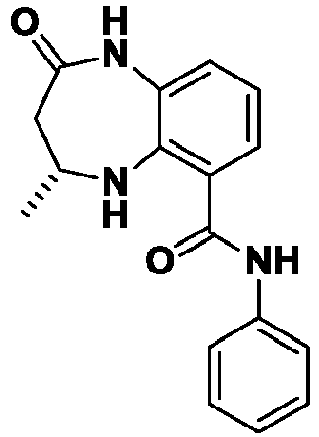
- To a solution of (R)-4-methyl-2-oxo-2,3,4,5-tetrahydro-1H-benzo[b][1,4]diazepine-6-carboxylic acid (Intermediate C, 50 mg, 0.227 mmol) and aniline (106 mg, 1.135 mmol) in dimethylacetamide (2 mL) at 0 °C was added (1-cyano-2-ethoxy-2-oxoethylidenaminooxy)dimethylamino-morpholino-carbenium hexafluorophosphate (COMU, 126 mg, 0.295 mmol). The reaction mixture was stirred at 0 °C for 45 min before additional COMU (50 mg) was added. The mixture was concentrated in vacuo. The residue was purified by silica gel chromatography (eluting with hexanes and EtOAc) to give the title compound (48 mg) as a yellowamorphous solid. 1H NMR (400 MHz, DMSO-d 6) δ 10.34 (s, 1H), 9.61 (s, 1H), 7.66 - 7.75 (m, 2H), 7.39 (dd, J = 7.8, 1.3 Hz, 1H), 7.34 (t, J = 8.0 Hz, 2H), 7.10 (tt, J = 7.4, 1.0 Hz, 1H), 7.07 (dd, J = 7.9, 1.5 Hz, 1H), 6.87 (t, J = 7.8 Hz, 1H), 6.67 (d, J = 2.2 Hz, 1H), 3.89 - 4.01 (m, 1H), 2.45 (dd, J = 13.5, 4.0 Hz, 1H), 2.24 (dd, J= 13.4, 8.0 Hz, 1H), 1.17 (d, J= 6.2 Hz, 3H). LCMS M/Z (M+H) 296.
-

- To a solution of (4R)-6-(benzofuran-2-yl)-4-methyl-1,3,4,5-tetrahydro-1,5-benzodiazepin-2-one (Example 170, 40 mg, 0.137 mmol) in 3:1 EtOAc/acetone mixture (4mL) was added palladium on carbon (36 mg). The reaction was stirred at room temperature for 5 h under an atmosphere of hydrogen (1 atm) then the hydrogen was removed and the reaction filtered through celite. The filtrate was concentrated in vacuo, and the residue was purified silica gel chromatography (hexanes/EtOAc 8:2 to 2:8) and then reverse phase chromatography (acetonitrile/water 10:90 to 100:0 with 0.1% TFA) to give (4R)-6-(2,3-dihydrobenzofuran-2-yl)-4-methyl-4,5-dihydro-1H-benzo[b][1,4]diazepin-2(3H)-one (Example 197, 19 mg, 32%, second peak) and (R)-6-(2-hydroxyphenethyl)-4-methyl-4,5-dihydro-1H-benzo[b][1,4]diazepin-2(3H)-one (Example 198, 10 mg, 18%, first peak). Example 197: 1H NMR ∼1:1 Mixture of diastereomers. (400 MHz, DMSO-d 6) δ 9.49 (s, 1H), 7.24 (t, J = 6.80 Hz, 1H), 7.15 (t, J= 7.5 Hz, 1H), 7.06 (ddd, J = 7.2, 5.4, 1.7 Hz, 1H), 6.78 - 6.91 (m, 4H), 6.05 (q, J = 9.3 Hz, 1H), 3.95 (sxt, J = 5.7 Hz, 1H), 3.73 (dt, J = 16.2, 9.5 Hz, 1H), 2.96 - 3.10 (m, 1H), 2.46 (dd, J = 13.0, 5.0 Hz, 1H), 2.07 - 2.20 (m, 1H), 1.20 (t, J = 6.0 Hz, 3H). LCMS M/Z (M+H) 295. Example 198: 1H NMR (400 MHz, DMSO-d 6) δ 9.75 (s, 1H), 8.67 (t, J = 6.0 Hz, 1H), 7.31 - 7.38 (m, 3H), 7.26 (s, 2H), 7.13 (t, J = 7.6 Hz, 1H), 7.09 (dd, J = 7.8, 1.8 Hz, 1H), 4.75 (q, J = 6.0 Hz, 1H), 4.45 (d, J = 6.0 Hz, 2H), 2.74 (dd, J = 14.3, 5.4 Hz, 1H), 2.30 (dd, J = 14.3, 4.9 Hz, 1H), 1.26 (d, J = 6.2 Hz, 3H). LCMS M/Z (M+H) 297.
-

- To a solution of (2R)-2-methyl-9-(2-trimethylsilylethynyl)-3,5-dihydro-2H-1,5-benzoxazepin-4-one (Example 137, 30 mg, 0.110 mmol) in THF (4 mL) was added water (0.1 mL) and a 1 M TBAF solution in THF (0.13 mL, 0.13 mmol). The reaction was stirred at room temperature for 2.5 h then quenched with MeOH and concentrated in vacuo. The residue was purified by flash chromatography (hexanes/EtOAc 7:3 to 0:10) to give the title compound (12 mg, 55%). 1H NMR (500 MHz, DMSO-d 6) δ 9.74 (s, 1H), 7.21 (dd, J= 6.9, 2.2 Hz, 1H), 7.01 - 7.09 (m, 2H), 4.81 - 4.90 (m, 1H), 4.24 (s, 1H), 2.59 (dd, J = 14.3, 4.7 Hz, 1H), 2.44 (dd, J = 14.2, 7.9 Hz, 1H), 1.36 (d, J = 6.2 Hz, 3H). LCMS M/Z (M+H) 202.
-

- To a solution of tert-butyl 2-[(2R)-2-methyl-4-oxo-3,5-dihydro-2H-1,5-benzoxazepin-9-yl]indole-1-carboxylate (Example 143) in dichloromethane (4 mL) was added trifluoroacetic acid (1.4 mL). The reaction was stirred at room temperature for 1.5 h then concentrated in vacuo. The residue was purified by silica gel chromatography (hexanes/EtOAc 9:1 to 0:10) to give the title compound (24 mg, 92%). 1H NMR (500 MHz, DMSO-d 6) δ 11.22 (s, 1H), 9.72 (s, 1H), 7.57 (dd, J = 7.8, 1.3 Hz, 1H), 7.55 (d, J = 7.8 Hz, 1H), 7.44 (d, J = 8.0 Hz, 1H), 7.20 (t, J = 7.8 Hz, 1H), 7.09 (t, J = 7.5 Hz, 1H), 6.97 - 7.02 (m, 2H), 6.95 (d, J = 2.2 Hz, 1H), 4.85 (sxt, J = 6.0 Hz, 1H), 2.73 (dd, J = 13.9, 5.7 Hz, 1H), 2.33 (dd, J = 13.8, 5.5 Hz, 1H), 1.34 (d, J = 6.2 Hz, 3H). LCMS M/Z (M+H) 293.
-

- To a solution of (2R)-9-(1H-indazol-5-yl)-2-methyl-3,5-dihydro-2H-1,5-benzoxazepin-4-one (Example 168, 0.070 g, 0.24 mmol) in dichloromethane (3 mL) was added pyridine (0.057 g, 0.720 mmol) and methanesulfonyl chloride (0.022 g, 0.192 mmol) at 0°C. The reaction mixture was stirred at 0 °C for 10 min and then warmed to room temperature for 6 h. To the mixture was added additional pyridine (0.057 g, 0.720 mmol) and methanesulfonyl chloride (0.022 g, 0.192 mmol). The reaction was quenched with sat. aq.NH4Cl, and the mixture was extracted with EtOAc (repeated 3 times). The combined organic layers were dried over anhydrous Na2SO4, filtered and concentrated in vacuo. The residue was purified by flash chromatography (hexanes/EtOAc 19:1 to 0:10) to give the title compound (21 mg, 24%). 1H NMR (400 MHz, DMSO-d 6) δ 9.76 (s, 1H), 8.96 (d, J = 0.9 Hz, 1H), 7.84 (t, J = 1.0 Hz, 1H), 7.75 (td, J = 9.3, 0.9 Hz, 1H), 7.56 (dd, J = 9.1, 1.6 Hz, 1H), 7.18 (d, J = 0.5 Hz, 1H), 7.17 (s, 1H), 7.04 - 7.10 (m, 1H), 4.68 (qd, J = 11.8, 6.1 Hz, 1H), 3.76 (s, 3H), 2.69 (dd, J = 14.2, 5.2 Hz, 1H), 2.36 (dd, J = 13.9, 6.6 Hz, 1H), 1.06 (d, J = 6.2 Hz, 3H). LCMS M/Z (M+H) 372.
-

- A disposable reaction tube was charged with 5 mol% Pd/C (68.3 mg, 0.032 mmol) and a stirbar before being evacuated and backfilled with nitrogen. To this mixture was added (R,E)-4-methyl-6-styryl-4,5-dihydro-1H-benzo[b][1,4]diazepin-2(3H)-one (Example 124, 63 mg, 0.161 mmol) in ethyl acetate (2 mL) followed by ethanol (2 mL), and the atmosphere was evacuated and backfilled three times with hydrogen. The mixture was stirred at room temperature for 4 h before the atmosphere was replaced by air. The catalyst was removed by filtration, and the filtrate was concentrated with celite. The residue was for purified by silica gel chromatography (eluting with hexanes/ethyl acetate). Concentration in vacuo yielded the title compound (25.9 mg, 57%) as a white, amorphous solid. 1H NMR (400 MHz, DMSO-d 6) δ 9.34 - 9.43 (m, 1H), 7.23 - 7.31 (m, 4H), 7.15 - 7.22 (m, 1H), 6.86 - 6.92 (m, 1H), 6.75 (s, 2H), 4.40 - 4.46 (m, 1H), 3.85 - 3.95 (m, 1H), 2.82 (s, 4H), 2.33 - 2.41 (m, 1H), 2.02 - 2.11 (m, 1H), 1.22 (d, J = 6.02 Hz, 3H). LCMS M/Z (M+H) 281.
-

-

- To a solution of methyl 2-fluoro-3-nitrobenzoate (534 mg, 2.68 mmol) in DMF (2 mL)was added N-ethyl-N-isopropylpropan-2-amine (1405 µl, 8.04 mmol) and 3-aminobutanoic acid(393 mg, 2.82 mmol). The resulting mixture was heated to 80 °C for 15 h. After cooling the reaction to room temperature, water (50 mL) was added and the mixture was extracted with EtOAc (100 mL x 3). The combined organic layers were dried over anhydrous Na2SO4, filtered and concentrated in vacuo to give the title compound.
-

- A disposable tube was charged with 5 mol% Pd/C (285 mg, 0.134 mmol) and a stirbar before being evacuated and backfilled with nitrogen. To this mixture was added 3-(2-(methoxycarbonyl)-6-nitrophenylamino)butanoic acid (757 mg, 2.68 mmol) in 1:1 ethyl acetate/ethanol (10 mL), and the vessel was evacuated and backfilled with hydrogen three times. The mixture stirred at room temperature for 1 h before the catalyst was filtered off. The mixture was concentrated in vacuo and the crude residue required no further purification. LCMS M/Z (M+H) 253.
-

- A disposable tube was charged with 3-(2-amino-6-(methoxycarbonyl)phenylamino)butanoic acid (677 mg, 2.68 mmol) and a stirbar. Dimethylformamide (5 mL) was added, followed by HATU (1122 mg, 2.95 mmol), and DIEA (937 µl, 5.37 mmol). The mixture was stirred at room temperature 18 h before being diluted with ethyl acetate, washed three times with brine, and concentrated in vacuo with celite. The residue was purified by silica gel chromatography (eluting with hexanes/ethyl acetate) to yield the title compound (0.527 g, 84%). LCMS M/Z (M+H) 235.
-

- To a solution of methyl 4-methyl-2-oxo-2,3,4,5-tetrahydro-1H-benzo[b][1,4]diazepine-6-carboxylate (0.527 g, 2.250 mmol) in THF (5 mL) was added LiOH in water (11.25 ml, 11.25 mmol). The resulting mixture was heated to 80 °C for 15 h. After cooling the reaction to room temperature, the solvent was concentrated in vacuo. Water (20 mL) was added and the mixture was extracted withEtOAc (30 mL x 3).The aqueous phase was acidified with HCl (1N) to pH 3. The resulting precipitate was collected by filtration to give the title compound (Intermediate K, 374 mg, 75%)as a white solid. LCMS M/Z (M+H) 221.
-

- To a solution of 4-methyl-2-oxo-1,3,4,5-tetrahydro-1,5-benzodiazepine-6-carboxylic acid (Intermediate K, 42 mg, 0.19 mmol), 2-methoxyaniline (31 mg, 0.25 mmol) and triethylamine (40 uL, 0.29 mmol) in DMF (1.5 mL) was added HATU (110 mg, 0.29 mmol). The reaction mixture stirred at room temeprature overnight. The mixture was concentrated in vacuo and the residue was dissolved in DCM (5 mL) and water (2mL). The organic layer was separated and concentrated in vacuo. The crude residue was purified by reverse phase chromatography (acetonitrile 5-85% / 0.1% formic acid in water) to give the title compound (4.3 mg, 7%). 1H NMR (400 MHz, DMSO-d 6) δ 9.77 (s, 1H), 9.58 (s, 1H), 7.75 (dd, J = 7.9, 1.6 Hz, 1H), 7.49 (dd, J = 7.8, 1.5 Hz, 1H), 7.18 (ddd, J = 8.2, 7.4, 1.7 Hz, 1H), 7.13 - 7.03 (m, 2H), 7.02 - 6.92 (m, 1H), 6.88 (t, J = 7.8 Hz, 1H), 6.75 (d, J = 3.1 Hz, 1H), 3.99 - 3.86 (m, 1H), 3.83 (s, 3H), 2.48 - 2.42 (m, 1H), 2.31 - 2.21 (m, 1H), 1.19 (d, J = 6.3 Hz, 3H).LCMS M/Z (M+H) 326.
- The following compounds were prepared in a similar fashion to Example 203:
-
Example Compound Name NMR m/z Example 204 4-methyl-N-(1-methylindol-5-yl)-2-oxo-1,3,4,5-tetrahydro-1,5-benzodiazepine-6-carboxamide 1H NMR (400 MHz, DMSO-d 6) δ 10.18 (s, 1H), 9.57 (s, 1H), 7.94 (t, J = 1.4 Hz, 1H), 7.46 - 7.36 (m, 3H), 7.30 (d, J = 3.0 Hz, 1H), 7.09 - 7.02 (m, 1H), 6.87 (t, J = 7.8 Hz, 1H), 6.79 (s, 1H), 6.40 (d, J = 3.0 Hz, 1H), 3.98 - 3.90 (m, 349 1H), 3.78 (s, 3H), 2.44 (d, J = 4.0 Hz, 1H), 2.30 -2.22 (m, 1 H), 1.18 (d, J = 6.2 Hz, 3H) Example 205 N-(1-isoquinolyl)-4-methyl-2-oxo-1,3,4,5-tetrahydro-1,5-benzodiazepine-6-carboxamide Not Determined 347 Example 206 4-methyl-2-oxo-N-[3-(3-pyridyl)phenyl]-1,3,4,5-tetrahydro-1,5-benzodiazepine-6-carboxamide 1H NMR (400 MHz, DMSO-d 6) δ 10.46 (s, 1H), 9.60 (s, 1H), 8.90 (dd, J = 2.4, 0.8 Hz, 1H), 8.63 (dd, J = 4.9, 1.6 Hz, 1H), 8.18 - 8.06 (m, 2H), 7.82 - 7.75 (m, 1H), 7.64 - 7.57 (m, 1H), 7.54 - 7.46 (m, 2H), 7.44 (dd, J = 7.8, 1.5 Hz, 1H), 7.12 - 7.06 (m, 1H), 6.97 - 6.78 (m, 2H), 4.01 - 3.91 (m, 1H), 2.48 - 2.44 (m, 1H), 2.30 - 2.21 (m, 1H), 1.18 (d, J = 6.3 Hz, 3H) 373 Example 207 N-(3-ethylphenyl)-4-methyl-2-oxo-1,3,4,5-tetrahydro-1,5-benzodiazepine-6-carboxamide 1H NMR (400 MHz, DMSO-d 6) δ 10.25 (s, 1H), 9.58 (s, 1H), 7.57 (t, J = 1.9 Hz, 2H), 7.54 - 7.48 (m, 1H), 7.42 - 7.35 (m, 1H), 7.24 (t, J = 7.8 Hz, 1H), 7.10 - 7.03 (m, 1H), 6.99 - 6.92 (m, 1H), 6.86 (t, J = 7.8 Hz, 1H), 6.68 (d, J = 2.6 Hz, 1H), 3.99 - 3.90 (m, 1H), 2.60 (q, J = 7.6 Hz, 2H), 2.51 - 2.42 (m, 1H), 2.29 - 2.19 (m, 1H), 1.23 - 1.14 (m, 6H) 324 Example 208 4-methyl-2-oxo-N-[3-(1,1,2,2-tetrafluoroethoxy)phenyl] -1,3,4,5-tetrahydro-1,5-benzodiazepine-6carboxamide 1H NMR (400 MHz, DMSO-d 6) δ 10.18 (s, 1H), 9.57 (s, 1H), 7.94 (t, J = 1.4 Hz, 1H), 7.46 - 7.36 (m, 3H), 7.30 (d, J = 3.0 Hz, 1H), 7.09 - 7.02 (m, 1H), 6.87 (t, J = 7.8 Hz, 1H), 6.79 (s, 1H), 6.40 (d, J = 3.0 Hz, 1H), 3.98 - 3.90 (m, 1H), 3.78 (s, 3H), 2.44 (d, J = 4.0 Hz, 1H), 2.30 - 2.22 (m, 1H), 1.18 (d, J = 6.2 Hz, 3H) 412 Example 209 N-(3-imidazol-1-ylphenyl)-4-methyl-2-oxo-1,3,4,5-tetrahydro-1,5-benzodiazepine-6-carboxamide 1H NMR (400 MHz, DMSO-d 6) δ 10.56 (s, 1H), 9.61 (s, 1H), 8.56 (s, 1H), 8.06 (t, J = 2.1 Hz, 1H), 7.80 (t, J = 1.5 Hz, 1H), 7.70 (ddd, J = 8.2, 2.0, 1.0 Hz, 1H), 7.53 (t, J = 8.1 Hz, 1H), 7.46 - 7.38 (m, 2H), 7.36 - 7.32 (m, 1H), 7.12 - 7.04 (m, 1H), 6.96 - 6.86 (m, 1H), 6.70 (d, J = 9.3 Hz, 1H), 4.03 - 3.87 (m, 1H), 2.47 - 2.43 (m, 1H), 2.30 - 2.22 (m, 1H), 1.18 (d, J = 6.2 Hz, 3H) 362 Example 210 N-(1,3-benzodioxol-5-yl)-4-methyl-2-oxo-1,3,4,5-tetrahydro-1,5-benzodiazepine-6-carboxamide 1H NMR (400 MHz, DMSO-d 6) δ 10.22 (s, 1H), 9.57 (s, 1H), 7.39 - 7.32 (m, 2H), 7.16 - 7.02 (m, 2H), 6.92 - 6.81 (m, 2H), 6.66 (d, J = 2.6 Hz, 1H), 6.00 (s, 2H), 3.99 - 3.89 (m, 1H), 2.48 - 2.40 (m, 1H), 2.29 - 2.19 (m, 1H), 1.17 (d, J = 6.2 Hz, 3H) 340 Example 211 4-methyl-N-(1-methylindazol-3-yl)-2-oxo-1,3,4,5-tetrahydro-1,5-benzodiazepine-6-carboxamide 1H NMR (400 MHz, DMSO-d 6) δ 10.76 (s, 1H), 9.59 (s, 1H), 7.74 - 7.66 (m, 1H), 7.64 - 7.54 (m, 2H), 7.45 - 7.36 (m, 1H), 7.17 - 7.05 (m, 3H), 6.85 (t, J = 7.8 Hz, 1H), 4.00 - 3.93 (m, 4H), 2.50 - 2.44 (m, 1H), 2.36 - 2.25 (m, 1H), 1.19 (d, J = 6.2 Hz, 3H) 350 Example 212 4-methyl-N-(2-methylindazol-6-yl)-2-oxo-1,3,4,5-tetrahydro-1,5-benzodiazepine-6-carboxamide 1H NMR (400 MHz, DMSO-d 6) δ 10.32 (s, 1H), 9.59 (s, 1H), 8.25 (d, J = 1.0 Hz, 1H), 8.10 - 8.05 (m, 1H), 7.67 - 7.60 (m, 1H), 7.45 - 7.38 (m, 1H), 7.31 - 7.23 (m, 1H), 7.11 - 7.04 (m, 1H), 6.88 (t, J = 7.8 Hz, 1H), 6.68 (d, J = 2.6 Hz, 1H), 4.13 (s, 3H), 4.01 - 3.92 (m, 1H), 2.50 - 2.40 (m, 1H), 2.30 - 2.20 (m, 1H), 1.18 (d, J = 6.2 Hz, 3H) 350 Example 213 N-(3-isopropoxyphenyl)-4-methyl-2-oxo-1,3,4,5-tetrahydro-1,5-benzodiazepine-6-carboxamide Not Determined 354 Example 214 4-methyl-2-oxo-N-[3-(trifluoromethyl)phenyl]-1,3,4,5-tetrahydro-1,5-benzodiazepine-6-carboxamide 1H NMR (400 MHz, DMSO-d 6) δ 10.61 (s, 1H), 9.60 (s, 1H), 8.19 (t, J = 2.1 Hz, 1H), 7.96 (dd, J = 7.8, 1.9 Hz, 1H), 7.65 - 7.53 (m, 1H), 7.50 - 7.39 (m, 2H), 7.09 (dd, J = 7.9, 1.5 Hz, 1H), 6.88 (t, J = 7.8 Hz, 1H), 6.65 (d, J = 2.6 Hz, 1H), 4.03 - 3.89 (m, 1H), 2.48 - 2.43 (m, 1H), 2.25 (dd, J = 13.4, 7.8 Hz, 1H), 1.18 (d, J = 6.2 Hz, 3H) 364 Example 215 4-methyl-2-oxo-N-(3-phenylphenyl)-1,3,4,5-tetrahydro-1,5-benzodiazepine-6-carboxamide 1H NMR (400 MHz, DMSO-d 6) δ 10.41 (s, 1H), 9.59 (s, 1H), 8.04 (t, J = 1.8 Hz, 1H), 7.76 - 7.66 (m, 1H), 7.67 - 7.58 (m, 2H), 7.53 - 7.33 (m, 7H), 7.08 (dd, J = 7.9, 1.5 Hz, 1H), 6.88 (t, J = 7.8 Hz, 1H), 6.71 (d, J = 2.5 Hz, 1H), 4.05 - 3.90 (m, 1H), 2.49 - 2.43 (m, 1H), 2.30-2.20 (m, 1H), 1.18 (d, J = 6.2 Hz, 3H) 372 Example 216 N-(2,5-dichlorophenyl)-4-methyl-2-oxo-1,3,4,5-tetrahydro-1,5 - benzodiazepine-6-carboxamide Not Determined 364 Example 217 4-methyl-2-oxo-N-[3-(trifluoromethoxy)phenyl ]-1,3,4,5-tetrahydro-1,5-benzodiazepine-6-carboxamide 1H NMR (400 MHz, DMSO-d 6) δ 10.57 (s, 1H), 9.60(s, 1H), 7.85 (td, J = 2.1, 1.0 Hz, 1H), 7.73 - 7.66 (m, 1H), 7.47 (t, J = 8.2 Hz, 1H), 7.40 (dd, J = 7.8, 1.5 Hz, 1H), 7.13 - 7.02 (m, 2H), 6.87 (t, J = 7.8 Hz, 1H), 6.62 (d, J = 2.6 Hz, 1H), 4.04 - 3.88 (m, 1H), 2.48 - 2.42 (m, 1H), 2.30 - 2.18 (m, 1H), 1.18 (d, J = 6.3 Hz, 3H) 380 Example 218 4-methyl-N-[3-(4-methyl-1,2,4-triazol-3-yl)phenyl]-2-oxo-1,3,4,5-tetrahydro-1,5-benzodiazepine-6-carboxamide 1H NMR (400 MHz, DMSO-d 6) δ 10.51 (s, 1H), 9.60 (s, 1H), 8.57 (s, 1H), 8.12 (t, J = 1.9 Hz, 1H), 7.91 - 7.83 (m, 1H), 7.56 - 7.40 (m, 3H), 7.08 (dd, J = 7.9, 1.5 Hz, 1H), 6.88 (t, J = 7.8 Hz, 1H), 6.69 (d, J = 2.6 Hz, 1H), 4.03 - 3.90 (m, 1H), 3.76 (s, 3H), 2.45 (d, J = 4.1 Hz, 1H), 2.30 - 2.21 (m, 1 H), 1.18 (d, J = 6.3 Hz, 3H) 377 Example 219 4-methyl-N-(5-methyl-1H-pyrazol-3-yl)-2-oxo-1,3,4,5-tetrahydro-1,5-benzodiazepine-6-carboxamide 1H NMR (400 MHz, DMSO-d 6) δ 12.08 (s, 1H), 10.65 (s, 1H), 9.54 (s, 1H), 7.41 (dd, J = 7.8, 1.5 Hz, 1H), 7.03 (dd, J = 7.8, 1.5 Hz, 1H), 6.97 (d, J = 2.6 Hz, 1H), 6.80 (t, J = 7.8 Hz, 1H), 6.33 (s, 1H), 4.01 - 3.85 (m, 1H), 2.46 - 2.40 (m, 1H), 2.31 - 2.16 (m, 4H), 1.17 (d, J = 6.2 Hz, 3H) 300 Example 220 4-methyl-2-oxo-N-(2-phenoxyphenyl)-1,3,4,5-tetrahydro-1,5 - benzodiazepine-6-carboxamide Not Determined 388 Example 221 4-methyl-N-(5-methyl-3-pyridyl)-2-oxo-1,3,4,5-tetrahydro-1,5-benzodiazepine-6-carboxamide 1H NMR (400 MHz, DMSO-d 6) δ 10.64 (s, 1H), 9.61 (s, 1H), 8.80 (d, J = 2.3 Hz, 1H), 8.29 (dd, J = 1.8, 0.9 Hz, 1H), 8.15 (t, J = 2.1 Hz, 1H), 7.43 (dd, J = 7.8, 1.5 Hz, 1H), 7.10 (dd, J = 7.9, 1.5 Hz, 1H), 6.88 (t, J = 7.8 Hz, 1H), 4.04 - 3.90 (m, 1H), 2.48 - 2.43 (m, 1H), 2.37 (d, J = 0.9 Hz, 3H), 2.31 - 2.21 (m, 1H), 1.19 (d, J = 6.3 Hz, 3H). 311 -

- To a solution of (4R)-6-bromo-4-methyl-1,3,4,5-tetrahydro-1,5-benzodiazepin-2-one (Intermediate A, 51 mg, 0.20 mmol) in MeOH was added (2-methoxyphenyl)boronic acid (30 mg, 0.20 mmol), SiliCat DPP-Pd (50 mg, 0.013 mmol) and K2CO3 (83 mg, 0.60 mmol). The reaction mixture was irradiated in a microwave for 15 min at 110 °C. The mixture was filtered and concentrated. The crude residue was purified by reverse phase chromatography (acetonitrile 5-85% / 0.1% formic acid in water) to give the title compound (9.3 mg, 17%) as a white solid. 1H NMR (400 MHz, DMSO-d 6) δ 9.49 (s, 1H), 7.45 - 7.34 (m, 1H), 7.18 - 7.07 (m, 2H), 7.07 - 7.00 (m, 1H), 6.94 - 6.75 (m, 3H), 3.97 - 3.79 (m, 1H), 3.72 (s, 3H), 3.47 (d, J = 2.9 Hz, 1H), 2.47 - 2.42 (m, 1H), 2.20 - 1.99 (m, 1H), 1.07 - 0.83 (m, 3H).LCMS M/Z (M+H) 283.
- The following compounds were prepared in a similar fashion to Example 222:
-
Example Compound Name NMR m/z Example 223 (4R)-6-(3,4-difluorophenyl)-4-methyl-1,3,4,5-tetrahydro-1,5-benzodiazepin-2-one 1H NMR (400 MHz, DMSO-d 6) δ 9.54 (s, 1H), 7.57 - 7.34 (m, 2H), 7.22 - 7.11 (m, 1H), 6.99-6.81 (m, 3H), 4.01 (d, J = 3.1 Hz, 1H), 3.95 - 3.81 (m, 1H), 2.61 (dd, J = 13.1, 4.8 Hz, 1H), 2.17 (dd, J = 13.1, 5.6 Hz, 1H), 1.12 (d, J = 6.2 Hz, 3H) 289 Example 224 (4R)-4-methyl-6-[3-(1H-tetrazol-5-yl)phenyl]-1,3,4,5-tetrahydro-1,5-benzodiazepin - 2-one Not Determined 321 Example 225 (4R)-6-(5-fluoro-2-methoxy-phenyl)-4-methyl-1,3,4,5-tetrahydro-1,5-benzodiazepin-2-one 1H NMR (400 MHz, DMSO-d 6) δ 9.57 - 9.42 (m, 1H), 7.21 (td, J = 8.7, 3.2 Hz, 1H), 7.10 (dd, J = 9.1, 4.6 Hz, 1H), 7.00 (dd, J = 8.9, 3.2 Hz, 1H), 6.92 (dd, J = 7.5, 1.9 Hz, 1H), 6.88 - 6.76 (m, 2H), 3.97 - 3.74 (m, 1H), 3.70 (s, 3H), 3.62 (d, J = 3.0 Hz, 1H), 2.48 - 2.44 (m, 1H), 2.13 (dd, J = 13.0, 6.8 Hz, 1H), 1.07-0.91 (m, 3H) 301 Example 226 3-[(4R)-4-methyl-2-oxo-1,3,4,5-tetrahydro-1,5-benzodiazepin-6-yl]benzonitrile 1H NMR (400 MHz, DMSO-d 6) δ 9.56 (s, 1H), 7.87 - 7.77 (m, 2H), 7.73 - 7.62 (m, 2H), 7.01 - 6.84 (m, 3H), 4.05 (d, J = 3.1 Hz, 1H), 3.94 - 3.80 (m, 1H), 2.63 (dd, J = 13.1, 4.7 Hz, 1H), 2.25 - 2.14 (m, 1H), 1.11 (d, J = 6.2 Hz, 3H) 278 Example 227 (4R)-6-(2-benzyloxyphenyl)-4-methyl-1,3,4,5-tetrahydro-1,5-benzodiazepin-2-one 1H NMR (400 MHz, DMSO-d 6) δ 9.47 (s, 1H), 7.43 - 7.12 (m, 8H), 7.12 - 7.00 (m, 1H), 6.95 - 6.79 (m, 3H), 5.14 - 5.04 (m, 1H), 3.81 (s, 1H), 3.57 (d, J = 3.1 Hz, 1H), 2.25 (s, 1H), 1.92 (s, 1H), 1.05 -0.82 (m, 3H) 359 -
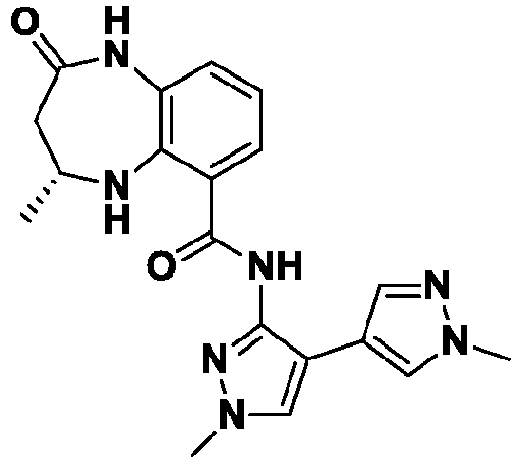
-

- To a solution of (4R)-4-methyl-2-oxo-1,3,4,5-tetrahydro-1,5-benzodiazepine-6-carboxylic acid (Intermediate C, 100 mg, 0.45 mmol) in DMF (2 mL) was added HATU (352 mg, 0.9 mmol) and Triethylamine (92 mg, 0.91 mmol, and the mixture was stirred at room temperature for 10 min. The mixture was then charged with 4-bromo-1-methyl-pyrazol-3-amine (160 mg, 0.9 mmol) and stirred at room temperature for an additional 1 h. The mixture was concentrated in vacuo and diluted with EtOAc and water. The aqueous was discarded and the organic was washed once with water, dried over anhydrous Na2SO4, filtered, and concentrated in vacuo. The residue was purified by silica gel chromatography (1 -10% MeOH in DCM) to afford the title compound (130 mg, 76%).
-

- To a solution of (4R)-N-(4-bromo-1-methyl-pyrazol-3-yl)-4-methyl-2-oxo-1,3,4,5-tetrahydro-1,5-benzodiazepine-6-carboxamide (54 mg, 0.14 mmol) in dioxane (0.5 mL) and 2M aqueous K2CO3(0.5 mL) was added (1-methylpyrazol-4-yl)boronic acid (36 mg, 0.29 mmol) and [1,1'-bis(diphenylphosphino)ferrocene]dichloropalladium(II) (11 mg, 0.015 mmol). The mixture was heated to 120 °C for 10 min. After cooling the reaction to room temperature, the mixture was diluted with EtOAc and water. The aqueous layer was discarded and the organic layer was washed with water, dried over anhydrous Na2SO4, filtered, and concentrated in vacuo. The residue was purified by reverse phase HPLC (acetonitrile 5-85% /0.1% NH4OH in water) to afford the title compound (45 mg, 86%). 1H NMR (400 MHz, DMSO-d 6) δ 9.82 (s, 1H), 9.57 (s, 1H), 7.86 (d, J = 5.9 Hz, 2H), 7.63(s, 1H), 7.50 (dd, J = 7.6, 1.5 Hz, 1H), 7.11 - 7.01 (m, 2H), 6.87 (t, J = 7.8 Hz, 1H), 3.90 (s, 1H), 3.84 (d, J = 5.5 Hz, 6H), 3.29 (d, J = 7.6 Hz, 1H), 3.17 (d, J = 5.2 Hz, 1H), 2.51 - 2.40 (m, 2H), 2.27 (dd, J = 13.4, 8.0 Hz, 1H), 1.15 (d, J = 6.3 Hz, 3H). 3.90 (s, 1H), 3.84 (d, J = 5.5 Hz, 6H), 3.29 (d, J = 7.6 Hz, 1H), 3.17 (d, J = 5.2 Hz, 1H), 2.51 - 2.40 (m, 2H), 2.27 (dd, J = 13.4, 8.0 Hz, 1H), 1.15 (d, J = 6.3 Hz, 3H). LCMS M/Z (M+H) 380.
-

- To a solution of (R)-6-bromo-4-methyl-4,5-dihydro-1H-benzo[b][1,4]diazepin-2(3H)-one (Intermediate A, 50 mg, 0.20 mmol) in dioxane (0.5 ml) was added 4-isopropylphenylboronic acid (38.57 g, 0.52 mmol), 0.5 ml of 2M aqueous potassium carbonate and 1,1'-bis(diphenylphosphino)ferrocene]dichloropalladium(II)(16 mg, 0.02 mmol, 65%). The mixture was then heated to 130 °C for 1 h. The mixture was diluted with EtOAc and washed with water. The organic layer was dried over anhydrous Na2SO4, filtered and concentrated. The crude product was purified by reverse phase HPLC (acetonitrile 5-85% / 0.1% NH4OH in water) to afford the title compound (39 mg, 0.13 mmol). 1H NMR (400 MHz, DMSO-d 6) δ 9.53 (s, 1H), 7.39 - 7.31 (m, 2H), 7.32 - 7.24 (m, 2H), 6.95 - 6.82 (m, 3H), 3.88 (qd, J = 6.0, 3.1 Hz, 1H), 3.75 (d, J = 3.1 Hz, 1H), 2.94 (h, J = 6.9 Hz, 1H), 2.60 (dd, J = 13.1, 4.8 Hz, 1H), 2.18 (dd, J = 13.2, 5.7 Hz, 1H), 1.25 (d, J = 6.9 Hz, 6H), 1.09 (d, J = 6.2 Hz, 3H). LCMS M/Z (M+H) 295.
- The following examples were synthesized in a similar fashion to Example 229:
-
Example Compound Name NMR m/z Example 230 (4R)-6-(3-fluoro-4-methyl-phenyl)-4-methyl-1,3,4,5-tetrahydro-1,5-benzodiazepin-2-one 1H NMR (400 MHz, DMSO-d 6) δ 9.54 (s, 1H), 7.37 (t, J = 8.0 Hz, 1H), 7.16 - 7.05 (m, 2H), 6.97 - 6.81 (m, 3H), 3.92 - 3.83 (m, 2H), 2.60 (dd, J = 13.1, 4.5 Hz, 1H), 2.28 (d, J = 1.9 Hz, 3H), 2.23 - 2.12 (m, 1H), 1.11 (d, J = 5.8 Hz, 3H). 285 Example 231 (4R)-6-[4-(dimethylamino)phen yl]-4-methyl-1,3,4,5-tetrahydro-1,5-benzodiazepin-2-one 1H NMR (400 MHz, DMSO-d 6) δ 9.50 (s, 1H), 7.22 - 7.13 (m, 2H), 6.92 - 6.77 (m, 5H), 3.88 (qd, J = 5.6, 3.2 Hz, 1H), 3.73 (d, J = 3.2 Hz, 1H), 2.94 (s, 6H), 2.60 (dd, J = 13.2, 4.9 Hz, 1H), 2.17 (dd, J = 13.2, 5.5 Hz, 1H), 1.11 (d, J = 6.2 Hz, 3H). 296 Example 232 3-[(4R)-4-methyl-2-oxo-1,3,4,5-tetrahydro-1,5-benzodiazepin-6-yl]benzamide 1H NMR (400 MHz, DMSO-d 6) δ 9.56 (s, 1H), 8.00 (s, 1H), 7.93 - 7.84 (m, 2H), 7.62 - 7.47 (m, 2H), 7.36 (s, 1H), 6.99 - 6.85 (m, 3H), 3.94 - 3.80 (m, 2H), 2.61 (dd, J = 13.1, 4.8 Hz, 1H), 2.20 (dd, J = 13.2, 5.9 Hz, 1H), 1.09 (d, J = 6.2 Hz, 3H). 296 Example 233 4-[(4R)-4-methyl-2-oxo-1,3,4,5-tetrahydro-1,5-benzodiazepin -6-yl]benzamide Not determined 296 Example 234 (4R)-4-methyl-6-(3-quinolyl)-1,3,4,5-tetrahydro-1,5-benzodiazepin-2-one 1H NMR (400 MHz, DMSO-d 6) δ 9.56 (s, 1H), 8.00 (s, 1H), 7.93 - 7.84 (m, 2H), 7.62 - 7.47 (m, 2H), 7.36 (s, 1H), 6.99 - 6.85 (m, 3H), 3.94 - 3.80 (m, 2H), 2.61 (dd, J = 13.1, 4.8 Hz, 1H), 2.20 (dd, J = 13.2, 5.9 Hz, 1H), 1.09 (d, J = 6.2 Hz, 3H). 304 Example 235 (4R)-6-(4-chloro-3-methyl-phenyl)-4-methyl-1,3,4,5-tetrahydro-1,5-benzodiazepin-2-one 1H NMR (400 MHz, DMSO-d 6) δ 9.54 (s, 1H), 7.49 (d, J = 8.2 Hz, 1H), 7.34 (d, J = 2.1 Hz, 1H), 7.20 (dd, J = 8.1, 2.2 Hz, 1H), 6.97 - 6.81 (m, 3H), 3.93 - 3.83 (m, 2H), 2.60 (dd, J = 13.0, 4.5 Hz, 1H), 2.38 (s, 3H), 2.18 (dd, J = 13.1, 5.5 Hz, 1H), 1.11 (d, J = 5.7 Hz, 3H). 301 Example 236 (4R)-6-(3,5-dimethylphenyl)-4-methyl-1,3,4,5-tetrahydro-1,5-benzodiazepin-2-one 1H NMR (400 MHz, DMSO-d 6) δ 9.53 (s, 1H), 7.03 (s, 1H), 6.98 - 6.80 (m, 5H), 3.91 - 3.80 (m, 1H), 3.73 (d, J = 3.0 Hz, 1H), 2.57 (dd, J = 13.2, 4.7 Hz, 1H), 2.32 (s, 6H), 2.20 (dd, J = 13.2, 6.1 Hz, 1H), 1.09 (d, J = 6.2 Hz, 3H). 281 Example 237 N-[4-[(4R)-4-methyl-2-oxo-1,3,4,5-tetrahydro-1,5-benzodiazepin-6-yl]phenyl]methanesul fonamide 1H NMR (400 MHz, DMSO-d 6) δ 9.83 (s, 1H), 9.53 (s, 1H), 7.36 - 7.26 (m, 4H), 6.96 - 6.81 (m, 3H), 3.94 - 3.78 (m, 2H), 3.04 (s, 3H), 2.59 (dd, J = 13.1, 4.9 Hz, 1H), 2.17 (dd, J = 13.1, 5.7 Hz, 1H), 2.07 (s, 2H), 1.10 (d, J = 6.2 Hz, 3H). 346 Example 238 N-[3-[(4R)-4-methyl-2-oxo-1,3,4,5-tetrahydro-1,5-benzodiazepin-6-yl]phenyl]methanesul fonamide 1H NMR (400 MHz, DMSO-d 6) δ 9.70 (s, 1H), 9.54 (s, 1H), 7.44 (t, J = 7.8 Hz, 1H), 7.27 - 7.18 (m, 2H), 7.09 (dt, J = 7.6, 1.3 Hz, 1H), 6.98 - 6.84 (m, 3H), 3.97 - 3.85 (m, 2H), 3.03 (s, 3H), 2.61 (dd, J = 13.1, 4.9 Hz, 1H), 2.16 (dd, J = 13.1, 5.2 Hz, 1H), 1.11 (d, J = 6.1 Hz, 3H). 346 Example 239 (4R)-4-methyl-6-[4-(pyrrolidine-1-carbonyl)phenyl]-1,3,4,5-tetrahydro-1,5-benzodiazepin-2-one 1H NMR (400 MHz, DMSO-d 6) δ 9.56 (s, 1H), 7.64 - 7.57 (m, 2H), 7.46 - 7.37 (m, 2H), 6.98 - 6.85 (m, 3H), 3.89 (dt, J = 13.8, 4.3 Hz, 2H), 3.48 (dt, J = 12.1, 6.4 Hz, 4H), 2.61 (dd, J = 13.2, 4.7 Hz, 1H), 2.19 (dd, J = 13.1, 5.6 Hz, 1H), 1.86 (dt, J = 19.6, 8.2 Hz, 4H), 1.10 (d, J 350 = 6.0 Hz, 3H). Example 240 (4R)-6-(6-amino-3-pyridyl)-4-methyl-1,3,4,5-tetrahydro-1,5-benzodiazepin-2-one 1H NMR (400 MHz, DMSO-d 6) δ 9.50 (s, 1H), 7.87 (dd, J = 2.5, 0.8 Hz, 1H), 7.37 (dd, J = 8.5, 2.5 Hz, 1H), 6.92 - 6.78 (m, 3H), 6.56 - 6.45 (m, 1H), 6.00 (s, 2H), 3.94 - 3.78 (m, 2H), 2.58 (dd, J = 13.1, 4.9 Hz, 1H), 2.16 (dd, J = 13.2, 5.6 Hz, 1H), 1.13 (d, J = 6.1 Hz, 3H). 269 Example 241 (4R)-6-(6-benzyloxy-3-pyridyl)-4-methyl-1,3,4,5-tetrahydro-1,5-benzodiazepin-2-one 1H NMR (400 MHz, DMSO-d 6) δ 9.54 (s, 1H), 8.14 (d, J = 2.3 Hz, 1H), 7.72 (dd, J = 8.5, 2.5 Hz, 1H), 7.52 - 7.29 (m, 5H), 7.00 - 6.82 (m, 4H), 5.39 (s, 2H), 4.00 (d, J = 3.1 Hz, 1H), 3.89 (qd, J = 5.6, 3.3 Hz, 1H), 2.61 (dd, J = 13.1, 4.8 Hz, 1H), 2.17 (dd, J = 13.1, 5.5 Hz, 1H), 1.13 (d, J = 6.2 Hz, 3H). 360 Example 242 (4R)-6-(3-chloro-4-fluoro-phenyl)-4-methyl-1,3,4,5-tetrahydro-1,5-benzodiazepin-2-one 1H NMR (400 MHz, DMSO-d 6) δ 9.55 (s, 1H), 7.58 - 7.44 (m, 2H), 7.35 (ddd, J = 8.5, 4.8, 2.2 Hz, 1H), 6.97 - 6.81 (m, 3H), 4.03 (d, J = 3.0 Hz, 1H), 3.87 (dt, J = 9.0, 5.6 Hz, 1H), 2.61 (dd, J = 13.1, 4.7 Hz, 1H), 2.19 (dd, J = 13.2, 5.7 Hz, 1H), 1.12 (d, J = 6.2 Hz, 3H). 305 Example 243 (4R)-6-(2,3-dihydro-1,4-benzodioxin-6-yl)-4-methyl-1,3,4,5-tetrahydro-1,5-benzodiazepin-2-one 1H NMR (400 MHz, DMSO-d 6) δ 9.51 (s, 1H), 6.98 - 6.76 (m, 6H), 4.28 (s, 2H), 3.86 (s, 2H), 3.81 (s, 1H), 3.19, 2.58 (dd, J = 13.6, 5.1 Hz, 2H), 2.16 (dd, J = 13.6, 5.5 Hz, 1H), 1.10 (d, J = 5.4 Hz, 3H). 311 Example 244 (4R)-6-(3,5-dimethoxyphenyl)-4-methyl-1,3,4,5-tetrahydro-1,5-benzodiazepin-2-one 1H NMR (400 MHz, DMSO-d 6) δ 9.53 (s, 1H), 6.95 - 6.81 (m, 3H), 6.50 (dd, J = 14.6, 2.2 Hz, 3H), 3.87 (dt, J = 13.6, 4.5 Hz, 2H), 3.77 (s, 6H), 2.59 (dd, J = 13.2, 4.7 Hz, 1H), 2.18 (dd, J = 13.1, 5.7 Hz, 1H), 1.11 (d, J = 6.0 Hz, 3H). 313 Example 245 (4R)-4-methyl-6-(3-phenylphenyl)-1,3,4,5-tetrahydro-1,5-benzodiazepin-2-one 1H NMR (400 MHz, DMSO-d 6) δ 9.56 (s, 1H), 7.75 - 7.53 (m, 5H), 7.52 - 7.42 (m, 2H), 7.38 (tt, J = 8.2, 1.4 Hz, 2H), 7.03 - 6.86 (m, 3H), 3.96 - 3.87 (m, 2H), 3.30 (d, J = 10.1 Hz, 1H), 2.63 (dd, J = 13.0, 4.6 Hz, 1H), 2.21 (dd, J = 13.1, 5.6 Hz, 1H), 1.11 (d, J = 5.9 Hz, 3H). 329 Example 246 (4R)-4-methyl-6-(4-phenylphenyl)-1,3,4,5-tetrahydro-1,5-benzodiazepin-2-one 1H NMR (400 MHz, DMSO-d 6) δ 9.56 (s, 1H), 7.82 - 7.70 (m, 4H), 7.54 - 7.34 (m, 5H), 6.98 - 6.85 (m, 3H), 3.92 (dt, J = 12.0, 4.0 Hz, 2H), 2.64 (dd, J = 13.2, 4.8 Hz, 1H), 2.25 - 2.15 (m, 1H), 1.13 (d, J = 5.9 Hz, 3H). 329 Example 247 (4R)-4-methyl-6-[6-(4-methylpiperazin-1-yl)-3-pyridyl]-1,3,4,5-tetrahydro-1,5-benzodiazepin-2-one 1H NMR (400 MHz, DMSO-d 6) δ 9.51 (s, 1H), 8.14 - 8.05 (m, 1H), 7.53 (dd, J = 8.8, 2.5 Hz, 1H), 6.94 - 6.80 (m, 5H), 3.92 - 3.84 (m, 1H), 3.52 (q, J = 6.2, 5.6 Hz, 5H), 2.61 (dd, J = 13.0, 4.6 Hz, 1H), 2.45 - 2.33 (m, 6H), 1.13 (d, J = 5.8 Hz, 3H). 352 Example 248 (4R)-4-methyl-6-(6-morpholino-3-pyridyl)-1,3,4,5-tetrahydro-1,5-benzodiazepin-2-one 1H NMR (400 MHz, DMSO-d 6) δ 9.51 (s, 1H), 8.10 (d, J = 2.3 Hz, 1H), 7.56 (dd, J = 8.7, 2.5 Hz, 1H), 6.95 - 6.80 (m, 4H), 3.90 (d, J = 3.0 Hz, 2H), 3.72 (dd, J = 5.7, 4.0 Hz, 5H), 3.29 (d, J = 14.8 Hz, 1H), 2.61 (dd, J = 13.0, 4.7 Hz, 1H), 2.16 (dd, J = 13.1, 5.2 Hz, 1H), 1.13 (d, J = 5.9 Hz, 3H). 339 Example 249 (4R)-6-[6-amino-5-(cyclopropylmethoxy )-3-pyridyl]-4-methyl-1,3,4,5-tetrahydro-1,5-benzodiazepin-2-one 1H NMR (400 MHz, DMSO-d 6) δ 9.50 (s, 1H), 7.48 (d, J = 1.8 Hz, 1H), 6.98 (d, J = 1.9 Hz, 1H), 6.92 - 6.78 (m, 3H), 5.70 (s, 2H), 4.06 (q, J = 5.3 Hz, 1H), 3.17 (d, J = 5.2 Hz, 3H), 2.60 (dd, J = 13.0, 4.7 Hz, 1H), 1.32 - 1.19 (m, 1H), 1.07 (s, 3H), 0.62 - 0.52 (m, 2H), 0.39 - 0.29 (m, 2H). 339 Example 250 (4R)-6-(6-amino-5-isopropoxy-3-pyridyl)-4-methyl-1,3,4,5-tetrahydro-1,5-benzodiazepin-2-one 1H NMR (400 MHz, DMSO-d 6) δ 9.50 (s, 1H), 7.47 (d, J = 1.8 Hz, 1H), 7.03 (d, J = 1.9 Hz, 1H), 6.92 - 6.79 (m, 3H), 5.74 (s, 2H), 4.62 (hept, J = 6.1 Hz, 1H), 3.96 - 3.86 (m, 2H), 2.16 (dd, J = 13.1, 5.0 Hz, 1H), 1.33 - 1.11 (m, 9H), 1.07 (s, 1H). 327 Example 251 tert-butyl N-methyl-N-[4-[(4R)-4-methyl-2-oxo-1,3,4,5-tetrahydro-1,5-benzodiazepin-6-yl]phenyl]carbamate 1H NMR (400 MHz, DMSO-d 6) δ 9.55 (s, 1H), 7.43 - 7.29 (m, 4H), 6.97 - 6.83 (m, 3H), 3.89 (s, 1H), 3.73 (d, J = 3.0 Hz, 1H), 3.24 (s, 3H), 2.59 (dd, J = 13.2, 4.8 Hz, 1H), 2.19 (dd, J = 13.2, 5.8 Hz, 1H), 1.42 (s, 9H), 1.09 (d, J = 6.2 Hz, 3H). 382 Example 252 2-[3-[(4R)-4-methyl-2-oxo-1,3,4,5-tetrahydro-1,5-benzodiazepin-6-yl]phenyl]acetonitrile 1H NMR (400 MHz, DMSO-d 6) δ 9.56 (s, 1H), 7.51 (t, J = 7.6 Hz, 1H), 7.41 - 7.29 (m, 3H), 6.98 - 6.86 (m, 3H), 4.09 (s, 2H), 3.90 (s, 1H), 3.80 (d, J = 3.1 Hz, 1H), 2.19 (dd, J = 13.7, 5.3 Hz, 1H), 1.10 (d, J = 6.2 Hz, 3H). 292 Example 253 N-cyclopropyl-4-[(4R)-4-methyl-2-oxo-1,3,4,5-tetrahydro-1,5-benzodiazepin-6-yl]benzamide 1H NMR (400 MHz, DMSO-d 6) δ 9.56 (s, 1H), 8.46 (d, J = 4.3 Hz, 1H), 7.91 (d, J = 8.2 Hz, 2H), 7.47 - 7.40 (m, 2H), 6.98 - 6.86 (m, 3H), 3.89 (s, 1H), 3.83 (s, 1H), 3.30 (d, J = 9.7 Hz, 17H), 2.87 (s, 1H), 2.62 (dd, J = 13.2, 4.8 Hz, 1H), 2.18 (dd, J = 13.1, 5.7 Hz, 1H), 1.10 (d, J = 6.1 Hz, 3H), 0.71 (td, J = 7.1, 4.6 Hz, 2H), 0.63 - 0.55 (m, 2H). 336 Example 254 N-cyclopropyl-3-[(4R)-4-methyl-2-oxo-1,3,4,5-tetrahydro-1,5-benzodiazepin-6-yl]benzamide 1H NMR (400 MHz, DMSO-d 6) δ 9.56 (s, 1H), 8.44 (d, J = 4.1 Hz, 1H), 7.88 - 7.78 (m, 2H), 7.59 - 7.46 (m, 2H), 6.99 - 6.85 (m, 3H), 3.87 (s, 1H), 3.81 (d, J = 3.0 Hz, 1H), 2.86 (td, J = 7.4, 3.8 Hz, 1H), 2.59 (dd, J = 13.1, 4.7 Hz, 1H), 2.20 (dd, J = 13.2, 6.0 Hz, 1H), 1.11 - 1.04 (m, 3H), 0.68 (ddd, J = 7.1, 4.9, 2.1 Hz, 2H), 0.56 (tt, J = 5.4, 2.7 Hz, 2H). 336 Example 255 (4R)-6-[4-(methoxymethyl)phen yl]-4-methyl-1,3,4,5-tetrahydro-1,5-benzodiazepin-2-one 1H NMR (400 MHz, DMSO-d 6) δ 9.55 (s, 1H), 7.45 - 7.30 (m, 4H), 6.96 - 6.83 (m, 3H), 4.47 (s, 2H), 3.92 - 3.83 (m, 1H), 3.75 (d, J = 3.2 Hz, 1H), 3.42 - 3.21 (m, 3H), 2.60 (dd, J = 13.1, 4.8 Hz, 1H), 2.18 (dd, J = 13.2, 5.7 Hz, 1H), 1.08 (d, J = 6.2 Hz, 3H). 297 Example 256 tert-butyl N-[[3-[(4R)-4-methyl-2-oxo-1,3,4,5-tetrahydro-1,5-benzodiazepin-6-yl]phenyl]methyl]car bamate 1H NMR (400 MHz, DMSO-d 6) δ 9.55 (s, 1H), 7.47 - 7.35 (m, 2H), 7.29 - 7.19 (m, 3H), 6.97 - 6.85 (m, 3H), 4.18 (d, J = 6.2 Hz, 2H), 3.88 (s, 1H), 3.73 (s, 1H), 3.30 (d, J = 7.0 Hz, 11H), 2.59 (dd, J = 13.2, 4.9 Hz, 1H), 2.17 (dd, J = 13.2, 5.6 Hz, 1H), 1.38 (s, 8H), 1.09 (d, J = 6.2 Hz, 3H). 382 Example 257 (4R)-6-(3-chloro-2-methyl-phenyl)-4-methyl-1,3,4,5-tetrahydro-1,5-benzodiazepin-2-one 1H NMR (400 MHz, DMSO-d 6) δ 9.55 (d, J = 3.6 Hz, 1H), 7.47 (dt, J = 8.0, 1.3 Hz, 1H), 7.29 (t, J = 7.8 Hz, 1H), 7.12 (ddd, J = 7.5, 4.5, 1.3 Hz, 1H), 6.95 (dd, J = 7.9, 1.6 Hz, 1H), 6.89 - 6.70 (m, 2H), 3.64 (dd, J = 10.9, 3.2 Hz, 1H), 3.30 (d, J = 6.7 Hz, 2H), 2.19 (td, J = 13.1, 6.7 Hz, 1H), 2.08 (d, J = 12.8 Hz, 3H), 1.00 (dd, J = 11.2, 6.3 Hz, 3H). 301 Example 258 N-methyl-4-[(4R)-4-methyl-2-oxo-1,3,4,5-tetrahydro-1,5-benzodiazepin-6-yl]benzamide 1H NMR (400 MHz, DMSO-d 6) δ 9.56 (s, 1H), 8.46 (d, J = 5.1 Hz, 1H), 7.98 - 7.88 (m, 2H), 7.49 - 7.41 (m, 2H), 6.99 - 6.85 (m, 3H), 3.87 (dd, J = 18.8, 4.9 Hz, 2H), 3.35 - 3.24 (m, 5H), 2.81 (d, J = 4.5 Hz, 3H), 2.62 (dd, J = 13.1, 4.8 Hz, 1H), 2.19 (dd, J = 13.2, 5.5 Hz, 1H), 1.10 (d, J = 6.1 Hz, 3H). 310 Example 259 (4R)-6-(4-benzyloxyphenyl)-4-methyl-1,3,4,5-tetrahydro-1,5-benzodiazepin-2-one 1H NMR (400 MHz, DMSO-d 6) δ 9.52 (s, 1H), 7.52 - 7.24 (m, 7H), 7.16 - 7.07 (m, 2H), 6.94 - 6.80 (m, 3H), 5.15 (s, 2H), 3.87 (s, 1H), 3.74 (d, J = 3.1 Hz, 1H), 3.35 - 3.23 (m, 5H), 2.59 (dd, J = 13.1, 4.8 Hz, 1H), 2.17 (dd, J = 13.1, 5.8 Hz, 1H), 1.09 (d, J = 6.2 Hz, 3H). 359 Example 260 tert-butyl N-[3-[(4R)-4-methyl-2-oxo-1,3,4,5-tetrahydro-1,5-benzodiazepin-6-yl]phenyl]carbamate 1H NMR (400 MHz, DMSO-d 6) δ 9.54 (s, 1H), 9.43 (s, 1H), 7.53 - 7.40 (m, 3H), 7.35 (t, J = 7.9 Hz, 1H), 6.99 - 6.83 (m, 4H), 3.90 (t, J = 5.2 Hz, 1H), 3.77 (d, J = 3.1 Hz, 1H), 2.58 (dd, J = 13.1, 4.9 Hz, 1H), 2.17 (dd, J = 13.1, 5.7 Hz, 1H), 1.47 (s, 9H), 1.09 (d, J = 6.2 Hz, 3H). 368 Example 261 N-[3-[(4R)-4-methyl-2-oxo-1,3,4,5-tetrahydro-1,5-benzodiazepin-6-yl]phenyl]acetamide 1H NMR (400 MHz, DMSO-d 6) δ 10.00 (s, 1H), 9.55 (s, 1H), 7.66 - 7.52 (m, 2H), 7.39 (t, J = 7.8 Hz, 1H), 7.01 (dt, J = 7.6, 1.3 Hz, 1H), 6.97 - 6.84 (m, 3H), 3.91 (s, 1H), 3.80 (d, J = 3.3 Hz, 1H), 3.30 (d, J = 7.9 Hz, 4H), 2.60 (dd, J = 13.1, 4.9 Hz, 1H), 2.17 (dd,J= 13.2, 5.5 Hz, 1H), 2.05 (s, 3H), 1.09 (d, J = 6.2 Hz, 3H). 310 Example 262 tert-butyl N-[4-[(4R)-4-methyl-2-oxo-1,3,4,5-tetrahydro-1,5-benzodiazepin-6-yl]phenyl]carbamate 1H NMR (400 MHz, DMSO-d 6) δ 9.52 (s, 1H), 9.43 (s, 1H), 7.59 - 7.52 (m, 2H), 7.28 - 7.20 (m, 2H), 6.93 - 6.82 (m, 3H), 3.87 (dt, J = 10.9, 5.5 Hz, 1H), 3.74 (d, J = 3.2 Hz, 1H), 3.28 (d, J = 6.9 Hz, 10H), 2.58 (dd, J = 13.1, 4.9 Hz, 1H), 2.17 (dd, J = 13.1, 5.7 Hz, 1H), 1.49 (s, 9H), 1.09 (d, J = 6.3 Hz, 3H). 368 Example 263 (4R)-6-(6-methoxy-3-pyridyl)-4-methyl-1,3,4,5-tetrahydro-1,5-benzodiazepin-2-one 1H NMR (400 MHz, DMSO-d 6) δ 9.54 (s, 1H), 8.13 (d, J = 2.4 Hz, 1H), 7.69 (dd, J = 8.5, 2.5 Hz, 1H), 6.98 - 6.82 (m, 4H), 3.98 (d, J = 3.0 Hz, 1H), 3.90 (s, 3H), 3.42 - 3.15 (m, 1H), 2.61 (dd, J = 13.1, 4.8 Hz, 1H), 2.17 (dd, J = 13.1, 5.5 Hz, 1H), 1.12 (d, J = 6.2 Hz, 3H). 284 Example 264 (4R)-6-(1-isobutylpyrazol-4-yl)-4-methyl-1,3,4,5-tetrahydro-1,5-benzodiazepin-2-one 1H NMR (400 MHz, DMSO-d 6) δ 9.48 (s, 1H), 7.91 (d, J = 0.9 Hz, 1H), 7.58 (d, J = 0.8 Hz, 1H), 6.97 (dd, J = 6.5, 2.6 Hz, 1H), 6.89 - 6.78 (m, 2H), 4.00 - 3.88 (m, 4H), 2.23 - 2.04 (m, 2H), 1.15 (d, J = 6.0 Hz, 3H), 0.87 (dd, J = 6.7, 1.8 Hz, 6H). 299 Example 265 (4R)-6-[3-(difluoromethyl)phen yl]-4-methyl-1,3,4,5-tetrahydro-1,5-benzodiazepin-2-one 1H NMR (400 MHz, DMSO-d 6) δ 9.57 (s, 1H), 7.67 - 7.51 (m, 4H), 6.99 - 6.85 (m, 3H), 3.94 - 3.81 (m, 2H), 2.61 (dd, J = 13.2, 4.7 Hz, 1H), 2.21 (dd, J = 13.1, 5.7 Hz, 1H), 1.10 (d, J = 6.1 Hz, 3H). 303 Example 266 (4R)-4-methyl-6-(2-methylindazol-4-yl)-1,3,4,5-tetrahydro-1,5-benzodiazepin-2-one 1H NMR (400 MHz, DMSO-d 6) δ 9.58 (s, 1H), 8.11 (s, 1H), 7.61 (d, J = 8.7 Hz, 1H), 7.32 (dd, J = 8.7, 6.7 Hz, 1H), 7.01 - 6.85 (m, 4H), 4.15 (d, J = 10.4 Hz, 3H), 3.78 (q, J = 5.6, 4.4 Hz, 2H), 2.62 (dd, J = 13.4, 4.4 Hz, 1H), 2.20 (dd, J = 13.3, 6.3 Hz, 1H), 0.94 (d, J = 5.9 Hz, 3H). 307 Example 267 (4R)-4-methyl-6-(2-methylindazol-6-yl)-1,3,4,5-tetrahydro-1,5-benzodiazepin-2-one 1H NMR (400 MHz, DMSO-d6 ) δ 9.55 (s, 1H), 8.37 (s, 1H), 7.78 (d, J = 8.5 Hz, 1H), 7.51 (s, 1H), 7.04 - 6.84 (m, 4H), 4.19 (s, 3H), 3.85 (dd, J = 26.7, 4.4 Hz, 2H), 2.62 (dd, J = 13.1, 4.8 Hz, 1H), 2.20 (dd, J = 13.2, 5.8 Hz, 1H), 1.07 (d, J = 6.1 Hz, 3H). 307 Example 268 (4R)-4-methyl-6-[3-(2-trimethylsilylethoxym ethyl)imidazo[4,5-b]pyridin-6-yl]-1,3,4,5-tetrahydro-1,5-benzodiazepin-2-one 1H NMR (400 MHz, DMSO-d 6) δ 9.63 (s, 1H), 8.71 (s, 1H), 8.42 (d, J = 2.0 Hz, 1H), 8.12 (d, J = 2.1 Hz, 1H), 7.07 - 6.92 (m, 3H), 5.75 (s, 2H), 3.96 (d, J = 7.3 Hz, 1H), 3.19 (s, 3H), 2.72 (dd, J = 13.1, 4.8 Hz, 1H), 2.26 (dd, J = 12.9, 5.5 Hz, 1H), 1.15 (d, J = 6.2 Hz, 3H), 1.01 - 0.87 (m, 2H), 0.06 (s, 9H). 424 Example 269 (4R)-4-methyl-6-(2-methyl-4-pyridyl)-1,3,4,5-tetrahydro-1,5-benzodiazepm-2-one 1H NMR (400 MHz, DMSO-d 6) δ 9.57 (s, 1H), 8.50 (d, J = 5.1 Hz, 1H), 7.25 (d, J = 1.7 Hz, 1H), 7.18 (dd, J = 5.0, 1.7 Hz, 1H), 7.01 - 6.85 (m, 3H), 4.05 (d, J = 3.1 Hz, 1H), 3.95 - 3.85 (m, 1H), 2.67 - 2.53 (m, 1H), 2.50 (s, 3H), 2.19 (dd, J = 13.2, 5.6 Hz, 1H), 1.13 (d, J = 6.2 Hz, 3H). 268 Example 270 (4R)-6-(4-tert-butylphenyl)-4-methyl-1,3,4,5-tetrahydro-1,5-benzodiazepin-2-one 1H NMR (400 MHz, DMSO-d 6) δ 9.54 (s, 1H), 7.54 - 7.46 (m, 2H), 7.34 - 7.26 (m, 2H), 6.95 - 6.82 (m, 3H), 3.77 (d, J = 3.2 Hz, 1H), 2.60 (dd, J = 13.2, 4.9 Hz, 1H), 2.18 (dd, J = 13.1, 5.7 Hz, 1H), 1.33 (s, 9H), 1.09 (d, J = 6.2 Hz, 3H). 309 Example 271 (4R)-4-methyl-6-(2-methylindazol-5-yl)-1,3,4,5-tetrahydro-1,5-benzodiazepin-2-one 1H NMR (400 MHz, DMSO-d 6) δ 9.54 (s, 1H), 8.36 (s, 1H), 7.71 - 7.61 (m, 2H), 7.20 (dd, J = 8.8, 1.7 Hz, 1H), 6.97 - 6.83 (m, 3H), 4.19 (s, 3H), 3.89 (q, J = 7.2, 5.4 Hz, 1H), 3.80 (d, J = 30 Hz, 1H), 2.61 (dd, J = 13.1, 4.8 Hz, 1H), 2.20 (dd, J = 13.2, 5.8 Hz, 1H), 1.07 (d, J = 6.2 Hz, 3H). 307 Example 272 (4R)-6-(1H-indazol-4-yl)-4-methyl-1,3,4,5-tetrahydro-1,5-benzodiazepin-2-one 1H NMR (400 MHz, DMSO-d 6) δ 13.20 (s, 1H), 9.59 (s, 1H), 7.78 (s, 1H), 7.57 (d, J = 8.4 Hz, 1H), 7.44 (dd, J = 8.5, 6.9 Hz, 1H), 7.07 - 6.86 (m, 4H), 3.83 - 3.75 (m, 2H), 3.31 (d, J = 5.0 Hz, 12H), 2.67 (dd, J = 12.9, 4.2 Hz, 1H), 2.21 (dd, J = 13.4, 5.9 Hz, 1H), 0.95 (d, J = 6.0 Hz, 3H). 293 Example 273 (4R)-6-(2,3-dihydrobenzofuran-5-yl)-4-methyl-1,3,4,5-tetrahydro-1,5-benzodiazepin-2-one 1H NMR (400 MHz, DMSO-d 6) δ 9.51 (s, 1H), 7.19 (d, J = 1.8 Hz, 1H), 7.05 (dd, J = 8.1, 2.0 Hz, 1H), 6.92 - 6.79 (m, 4H), 4.57 (t, J = 8.7 Hz, 2H), 3.86 (qt, J = 9.1, 4.5 Hz, 1H), 3.75 (d, J = 3.2 Hz, 1H), 3.22 (t, J = 8.8 Hz, 2H), 2.58 (dd, J = 13.2, 4.8 Hz, 1H), 2.17 (dd, J = 13.2, 5.7 Hz, 1H), 1.10 (d, J = 6.1 Hz, 3H). 295 Example 274 (4R)-6-(4-isopropoxyphenyl)-4-methyl-1,3,4,5-tetrahydro-1,5-benzodiazepin-2-one 1H NMR (400 MHz, DMSO-d 6) δ 9.52 (s, 1H), 7.29 - 7.21 (m, 2H), 7.04 - 6.96 (m, 2H), 6.93 - 6.80 (m, 3H), 4.65 (p, J = 6.0 Hz, 1H), 3.87 (ddt, J = 8.9, 5.9, 3.4 Hz, 1H), 3.75 (d, J = 3.1 Hz, 1H), 2.58 (dd, J = 13.1, 4.9 Hz, 1H), 2.17 (dd, J = 13.1, 5.7 Hz, 1H), 1.30 (dd, J = 6.0, 1.4 Hz, 6H), 1.09 (d, J = 6.2 Hz, 3H). 311 Example 275 (4R)-6-(1-ethylpyrazol-4-yl)-4-methyl-1,3,4,5-tetrahydro-1,5-benzodiazepin-2-one 1H NMR (400 MHz, DMSO-d 6) δ 9.47 (s, 1H), 7.92 (s, 1H), 7.58 (s, 1H), 6.96 (dd, J = 6.6, 2.6 Hz, 1H), 6.88 - 6.77 (m, 2H), 4.17 (q, J = 7.3 Hz, 2H), 4.05 - 3.91 (m, 2H), 2.16 (dd, J = 13.1, 5.7 Hz, 1H), 1.42 (t, J = 7.2 Hz, 3H), 1.18 (d, J = 6.3 Hz, 3H). 271 Example 276 (4R)-4-methyl-6-[4-(1 -piperidyl)phenyl] - 1,3,4,5-tetrahydro-1,5-benzodiazepin-2-one 1H NMR (400 MHz, DMSO-d 6) δ 9.50 (s, 1H), 7.23 - 7.14 (m, 2H), 7.05 - 6.97 (m, 2H), 6.91 - 6.79 (m, 3H), 3.93 - 3.83 (m, 1H), 3.74 (d, J = 3.1 Hz, 1H), 3.23 - 3.16 (m, 4H), 2.59 (dd, J = 13.1, 4.9 Hz, 1H), 2.17 (dd, J = 13.3, 5.5 Hz, 1H), 1.68 - 1.51 (m, 6H), 1.10 (d, J = 6.1 Hz, 3H). 336 Example 277 (4R)-4-methyl-6-[4-(1H-tetrazol-5-yl)phenyl]-1,3,4,5-tetrahydro-1,5-benzodiazepin -2-one Not determined 321 Example 278 (4R)-4-methyl-6-[4-(4-methylpiperazine-1 -carbonyl)phenyl] - 1,3,4,5-tetrahydro-1,5-benzodiazepin-2-one 1H NMR (400 MHz, DMSO-d 6) δ 9.56 (s, 1H), 7.52 - 7.38 (m, 4H), 6.98 - 6.84 (m, 3H), 3.91 (q, J = 7.1, 4.9 Hz, 2H), 3.30 (d, J = 9.7 Hz, 4H), 2.62 (dd, J = 13.2, 4.7 Hz, 1H), 2.33 (s, 5H), 2.21 (s, 3H), 1.11 (d, J = 6.0 Hz, 3H). 379 Example 279 N-[[3-[(4R)-4-methyl-2-oxo-1,3,4,5-tetrahydro-1,5-benzodiazepin-6-yl]phenyl]methyl]met hanesulfonamide 1H NMR (400 MHz, DMSO-d 6) δ 9.55 (s, 1H), 7.56 (s, 1H), 7.47 (t, J = 7.6 Hz, 1H), 7.41 - 7.32 (m, 3H), 7.27 (dt, J = 7.3, 1.4 Hz, 1H), 6.98 - 6.84 (m, 3H), 4.25 - 4.18 (m, 2H), 3.76 (d, J = 3.1 Hz, 1H), 2.86 (d, J = 16.7 Hz, 3H), 2.60 (dd, J = 13.2, 4.9 Hz, 1H), 2.18 (dd, J = 13.1, 5.8 Hz, 1H), 1.08 (d, J = 6.2 Hz, 3H). 379 Example 280 N-[[4-[(4R)-4-methyl-2-oxo-1,3,4,5-tetrahydro-1,5-benzodiazepin-6-yl]phenyl]methyl]met hanesulfonamide 1H NMR (400 MHz, DMSO-d 6) δ 9.55 (s, 1H), 7.57 (s, 2H), 7.45 (d, J = 8.1 Hz, 2H), 7.40 - 7.23 (m, 3H), 6.98 - 6.84 (m, 1H), 4.22 (s, 2H), 3.88 (qd, J = 6.0, 3.2 Hz, 1H), 3.73 (d, J = 3.1 Hz, 1H), 2.87 (d, J = 24.4 Hz, 3H), 2.60 (dd, J = 13.2, 4.8 Hz, 1H), 2.18 (dd, J = 13.2, 5.7 Hz, 1H), 1.08 (d, J = 6.2 Hz, 3H). 360 Example 281 (4R)-6-(3-isopropylphenyl)-4-methyl-1,3,4,5-tetrahydro-1,5-benzodiazepin-2-one 1H NMR (400 MHz, DMSO-d 6) δ 9.54 (s, 1H), 7.40 (t, J = 7.6 Hz, 1H), 7.31 - 7.21 (m, 2H), 7.16 (dt, J = 7.5, 1.4 Hz, 1H), 6.96 - 6.83 (m, 3H), 3.88 (qd, J = 6.0, 2.9 Hz, 1H), 3.68 (d, J = 3.0 Hz, 1H), 2.95 (hept, J = 6.9 Hz, 1H), 2.60 (dd, J = 13.2, 4.9 Hz, 1H), 2.20 (dd, J = 13.2, 5.9 Hz, 1H), 1.24 (dd, J = 6.9, 1.9 Hz, 6H), 1.09 (d, J = 6.2 Hz, 3H). 295 Example 282 N-isopropyl-3-[(4R)-4-methyl-2-oxo-1,3,4,5-tetrahydro-1,5-benzodiazepin-6-yl]benzamide 1H NMR (400 MHz, DMSO-d 6) δ 9.57 (s, 1H), 8.24 (d, J = 7.8 Hz, 1H), 7.87 (dt, J = 9.7, 1.8 Hz, 2H), 7.59 - 7.46 (m, 2H), 6.99 - 6.86 (m, 3H), 4.17 - 4.06 (m, 1H), 3.88 (s, 1H), 3.81 (d, J = 3.0 Hz, 1H), 3.30 (d, J = 6.5 Hz, 14H), 2.59 (dd, J = 13.2, 4.7 Hz, 1H), 2.21 (dd, J = 13.1, 6.1 Hz, 1H), 1.20 - 1.05 (m, 9H). 338 Example 283 N-methyl-3-[(4R)-4-methyl-2-oxo-1,3,4,5-tetrahydro-1,5-benzodiazepin-6-yl]benzamide 1H NMR (400 MHz, DMSO-d 6) δ 9.57 (s, 1H), 8.47 (s, 1H), 7.89 - 7.79 (m, 2H), 7.62 - 7.47 (m, 2H), 6.99 - 6.85 (m, 3H), 3.90 - 3.80 (m, 2H), 2.81 (dd, J = 12.1, 4.5 Hz, 3H), 2.60 (dd, J = 13.2, 4.7 Hz, 1H), 2.20 (dd, J = 13.1, 6.0 Hz, 1H), 1.08 (d, J = 6.1 Hz, 3H). 310 Example 284 (4R)-6-[3-(methoxymethyl)phen yl]-4-methyl-1,3,4,5-tetrahydro-1,5-benzodiazepin-2-one 1H NMR (400 MHz, DMSO-d 6) δ 9.55 (s, 1H), 7.46 (t, J = 7.5 Hz, 1H), 7.38 - 7.24 (m, 3H), 6.97 - 6.83 (m, 3H), 4.47 (s, 2H), 3.92 - 3.82 (m, 1H), 3.74 (d, J = 3.1 Hz, 1H), 3.36 - 3.22 (m, 3H), 2.59 (dd, J = 13.2, 4.8 Hz, 1H), 2.19 (dd, J = 13.2, 5.9 Hz, 1H), 1.08 (d, J = 6.2 Hz, 3H). 297 Example 285 (4R)-4-methyl-6-(3-morpholinophenyl)-1,3,4,5-tetrahydro-1,5-benzodiazepin-2-one 1H NMR (400 MHz, DMSO-d 6) δ 9.53 (s, 1H), 7.33 (dd, J = 8.4, 7.4 Hz, 1H), 7.02 - 6.82 (m, 5H), 6.82 - 6.74 (m, 1H), 3.77 - 3.70 (m, 6H), 3.19 - 3.05 (m, 4H), 2.59 (dd, J = 13.1, 4.9 Hz, 1H), 2.18 (dd, J = 13.1, 5.7 Hz, 1H), 1.09 (d, J = 6.1 Hz, 3H). 338 Example 286 (4R)-6-(3-benzyloxyphenyl)-4-methyl-1,3,4,5-tetrahydro-1,5-benzodiazepin-2-one 1H NMR (400 MHz, DMSO-d 6) δ 9.54 (s, 1H), 7.51 - 7.25 (m, 6H), 7.15 - 7.00 (m, 1H), 7.00 - 6.82 (m, 5H), 5.15 (s, 2H), 3.84 - 3.74 (m, 2H), 3.30 (d, J = 7.9 Hz, 4H), 2.57 (dd, J = 13.2, 4.8 Hz, 1H), 2.16 (dd, J = 13.2, 5.8 Hz, 1H), 1.06 (d, J = 6.0 Hz, 3H). 359 Example 287 (4R)-6-[3-(dimethylamino)phen yl]-4-methyl-1,3,4,5-tetrahydro-1,5-benzodiazepin-2-one 1H NMR (400 MHz, DMSO-d 6) δ 9.52 (s, 1H), 7.28 (dd, J = 8.4, 7.3 Hz, 1H), 6.94 - 6.81 (m, 3H), 6.75 (ddd, J = 8.5, 2.6, 0.9 Hz, 1H), 6.66 - 6.57 (m, 2H), 3.86 (qd, J = 6.1, 3.2 Hz, 1H), 3.77 (d, J = 3.1 Hz, 1H), 2.92 (s, 6H), 2.59 (dd, J = 13.2, 4.9 Hz, 1H), 2.18 (dd, J = 13.2, 5.8 Hz, 1H), 1.09 (d, J = 6.2 Hz, 3H). 296 -

- Racemic 4-methyl-6-[1-(1-phenylethyl)pyrazol-4-yl]-1,3,4,5-tetrahydro-1,5-benzodiazepin-2-one (Example 173, 65 mg) was separated using chiral SFC (Regis WhelkO-1(s,s) (150 mm*21.2 mm), 40% Methanol w/ 0.1% NH4OH) to (4R)-methyl-6-[1-(1-phenylethyl)pyrazol-4-yl]-1,3,4,5-tetrahydro-1,5-benzodiazepin-2-one (21 mg, first peak) and (4S)-methyl-6-[1-(1-phenylethyl)pyrazol-4-yl]-1,3,4,5-tetrahydro-1,5-benzodiazepin-2-one (23 mg, second peak). Absolute configuration was arbitrarily assigned to each enantiomer. Example 288: 1H NMR (400 MHz, DMSO-d 6) 9.50 (s, 1H), 8.07 (d, J = 2.7 Hz, 1H), 7.63 (s, 1H), 7.36 - 7.23 (m, 5H), 6.99 (dd, J = 2.8, 6.4 Hz, 1H), 6.87 - 6.79 (m, 2H), 5.65 (d, J = 6.0 Hz, 1H), 3.99 (br s, 1H), 3.93 (br s, 1H), 2.55 - 2.50 (m, 1H), 2.14 (dd, J = 6.0, 13.2 Hz, 1H), 1.85 (d, J = 7.1 Hz, 3H), 1.13 (dd, J = 1.8, 6.2 Hz, 3H). LCMS M/Z (M+H) 347. Example 289: 1H NMR (400 MHz, DMSO-d 6) δ 9.50 (s, 1H), 8.07 (d, J = 2.7 Hz, 1H), 7.63 (s, 1H), 7.38 - 7.24 (m, 5H), 6.98 (dd, J = 2.8, 6.4 Hz, 1H), 6.87 - 6.79 (m, 2H), 5.65 (d, J = 6.0 Hz, 1H), 3.99 (br s, 1H), 3.93 (br s, 1H), 2.55 - 2.50 (m, 1H), 2.16 (dd, J = 6.0, 13.2 Hz, 1H), 1.85 (d, J = 7.1 Hz, 3H), 1.13 (dd, J = 1.8, 6.2 Hz, 3H). LCMS M/Z (M+H) 347.
-

-

- A mixture of 6-bromo-1,2,3,4-tetrahydroquinoline (17.0 g, 80.16 mmol), 1-methyl-4-(4,4,5,5-tetramethyl-1,3,2-dioxaborolan-2-yl)-1H-pyrazole (25.0 g, 120.23 mmol), K2CO3 (33.2 g, 240.47 mmol) and [1,1-bis(diphenylphosphino)ferrocene]dichloropalladium(II) (5.8 g, 8.02 mmol) in dioxane/H2O (5:1, 150 mL) was heated to 120 °C for 16 hours under nitrogen atmosphere. After cooling to room temperature, the mixture was filtered and the filtrate was concentrated in vacuo. The crude residue was purified by silica gel chromatography (petroleum ether/EtOAc = 1/1) to give the title product (8.0 g, 47%) as a yellow solid. 1H NMR (400 MHz, CD3OD) δ 7.71 (s, 1H), 7.62 (s, 1H), 7.08 - 7.06 (m, 2H), 6.50 (d, J = 8.4 Hz, 1H), 3.87 (s, 3H), 3.23 (t, J = 5.2 Hz, 1H), 2.75 (t, J = 6.4 Hz, 1H), 1.94 - 1.88 (m, 2H).
-

- To a solution of (R)-6-bromo-4-methyl-4,5-dihydro-1H-benzo[b][1,4]diazepin-2(3H)-one (Intermediate A, 300 mg, 1.18 mmol) in dioxane (10 mL) was added 6-(1-methyl-1H-pyrazol-4-yl)-1,2,3,4-tetrahydroquinoline (301 mg, 1.41 mmol), t-BuONa (340 mg, 3.53 mmol) and dichloro[1,3-bis(2,6-di-3-pentylphenyl)imidazol-2-ylidene](3-chloropyridyl)palladium(II) (78 mg, 0.1 mmol). The mixture was heated to 120 °C for 16 hours under nitrogen atmosphere. After cooling to room temperature, the mixture was filtered and the filtrate was concentrated in vacuo. The crude residue was diluted with water (10 mL) and the mixture was extracted with EtOAc (10 mL × 3). The combined organic layers were washed with sat. aq. sodium bicarbonate (10 mL x 3), dried over anhydrous Na2SO4 and concentrated in vacuo. The crude residue was purified by reverse phase chromatography (acetonitrile 25-55% / 0.1% NH4HCO3 in water) to give the title compound (70 mg, 15%) as a white solid. 1H NMR (400 MHz, CDCl3) δ 7.65 (s, 1H), 7.48 (s, 1H), 7.36 (s, 1H), 7.17 (S, 1H), 7.02-6.97 (m, 2H), 6.84-6.77 (m, 2H), 6.20-6.10 (m, 1H), 4.55-4.46(m, 1H), 3.97 - 3.91(m, 1H), 3.92 (s, 3H), 3.51 -3.41 (m, 3H), 3.01-2.91 (m, 2H), 2.71-2.68 (m, 1H), 2.54-2.52 (m, 1H), 2.15-2.14 (m, 2H), 1.30-1.20 (m, 3H). LCMS M/Z (M+H) 388.
- Examples 291-304 are synthesized using a similar Pd-coupling procedure as Example 290.


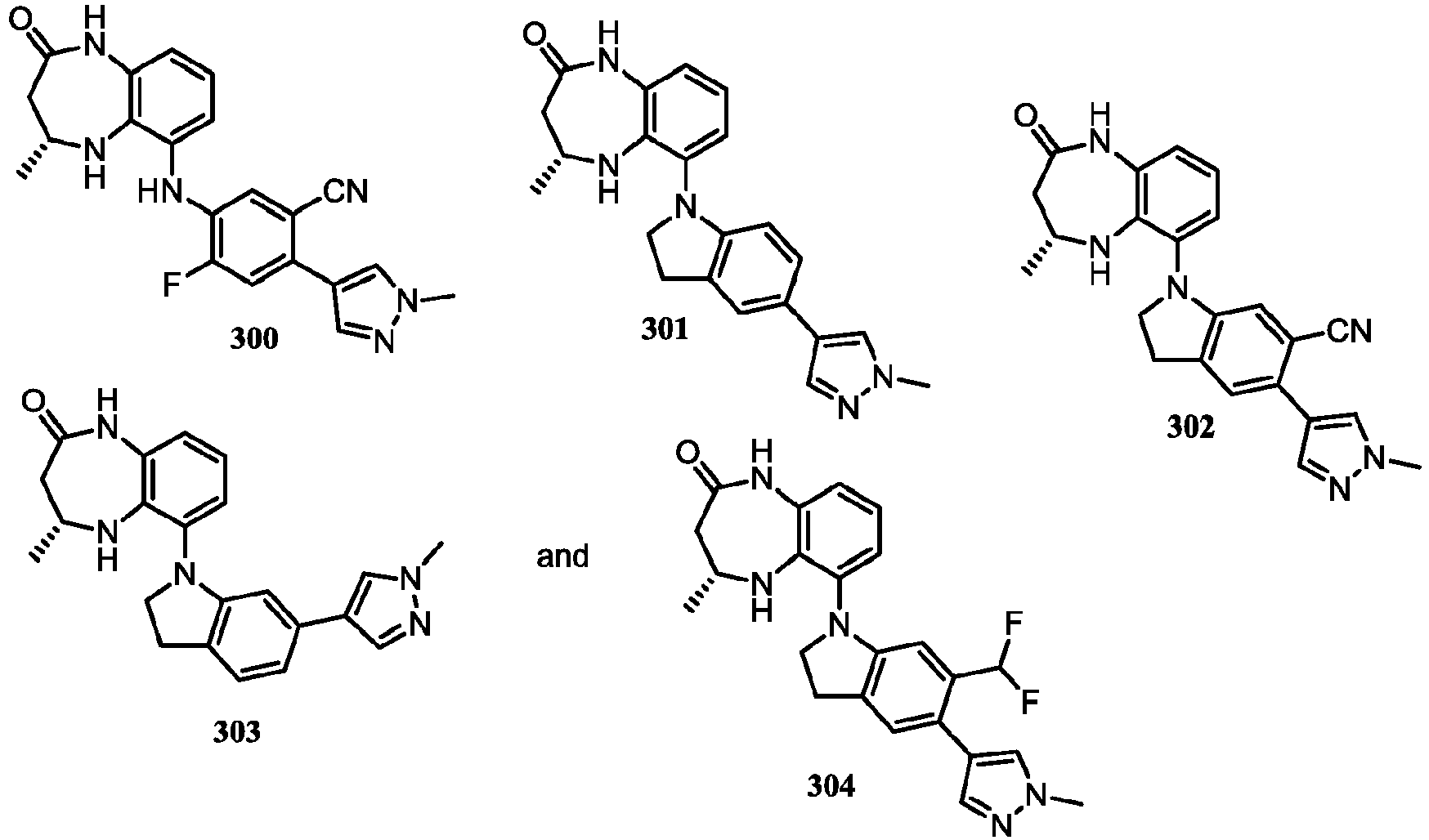
- The following compounds were prepared in a similar fashion to Example 290:
-
Example Compound Name NMR m/z Example 291 (4R)-6-[7-(difluoromethyl)-6-(1-methylpyrazol-4-yl)-3,4-dihydro-2H-quinolin-1-yl]-4-methyl-1,3,4,5-tetrahydro-1,5-benzodiazepin-2-one 1H NMR (400 MHz, CDCl3) δ 7.71 (s, 1H), 7.53 (s, 1H), 7.40 (s, 1H), 7.07 (s, 1H), 6.98 - 6.95 (m, 1H), 6.87 - 6.82 (m, 2H), 6.54 (s, 1H), 6.46 (t, J = 55.6 Hz, 1H), 4.38 - 4.30 (m, 1H), 4.00 - 3.94 (m, 4H), 3.59 - 3.56 (m, 1H), 3.46 - 3.36 (m,1H), 3.05 - 2.97 (m, 1H), 2.95 - 2.85 (m, 1H), 2.79 - 2.60 (m, 1H), 2.58 - 2.44 (m, 1H), 2.15 - 2.08 (m, 2H), 1.27 - 1.17 (m, 3H) 438 Example 292 1-[(4R)-4-methyl-2-oxo-1,3,4,5-tetrahydro-1,5-benzodiazepin-6-yl]-6-(1-methylpyrazol-4-yl)-3,4-dihydro-2H-quinoline-7-carbonitrile 1H NMR (400 MHz, CDCl3) δ 7.85 (s, 1H), 7.74 (s, 1H), 7.44 (d, J = 5.6 Hz, 1H), 7.21 (s, 1H), 6.93 - 6.83 (m, 3H), 6.42 - 6.39 (m, 1H), 4.32 - 4.26 (m, 1H), 3.98 - 3.94 (m, 4H), 3.56 - 3.50 (m, 1H), 3.44 - 3.41 (m, 1H), 3.04 - 3.01 (m, 1H), 3.00 - 2.95 (m, 1H), 2.72 - 2.69 (m, 1H), 2.58 - 2.54 (m, 1H), 2.16 - 2.11 (m, 2H), 1.28 - 1.22 (m, 3H) 413 Example 293 (R, R)-4-methyl-6-[4-methyl-6-(1-methylpyrazol-4-yl)-3,4-dihydro-2H-quinolin-1-yl]-1,3,4,5-tetrahydro-1,5-benzodiazepin-2-one 1H NMR (400MHz,DMSO-d 6) δ 9.62 (s, 1H), 7.96 - 7.80 (m, 1H), 7.70 - 7.56 (m, 1H), 7.37 - 7.17 (m, 1H), 7.08 - 6.95 (m, 1H), 6.92 - 6.64 (m, 3H), 6.05 - 5.86 (m, 1H), 4.71 - 4.44 (m, 1H), 3.96 - 3.68 (m, 4H), 3.57 - 3.35 (m, 2H), 3.22 - 2.88 (m, 2H), 2.32 - 1.69 (m, 3H), 1.42 - 1.28 (m, 3H), 1.18- 1.04 (m, 3H) 402 Example 294 (R, S)-4-methyl-6-[4-methyl-6-(1-methylpyrazol-4-yl)-3,4-dihydro-2H-quinolin-1-yl]-1,3,4,5-tetrahydro-1,5-benzodiazepin-2-one 1H NMR (400MHz,DMSO-d 6)δ 9.61 (s, 1H), 7.88 (s, 1H), 7.75 - 7.56 (m, 1H), 7.36 - 7.15 (m, 1H), 7.00 (d, J=8.4 Hz, 1H), 6.92 - 6.69 (m, 3H), 6.12 - 5.85 (m, 1H), 4.83 - 4.40 (m, 1H), 4.18- 3.69 (m, 5H), 3.49 - 3.21 (m, 1H), 2.34 - 1.43 (m, 2H), 1.41-1.18 (m, 5H), 1.17 - 1.00 (m, 3H), 0.92 - 0.74 (m, 1H) 402 Example 295 (4R)-4-methyl-6-[7-(1-methylpyrazol-4-yl)-3,4-dihydro-2H-quinolin-1-yl]-1,3,4,5-tetrahydro-1,5-benzodiazepin-2-one 1H NMR (400 MHz, DMSO-d6 ) δ9.64 (s, 1H), 7.69 (s, 1H), 7.44 (s., 1H), 6.96 (d, J=8.0 Hz, 1H), 6.93 - 6.70 (m, 4H), 6.14 (s., 1H), 4.76 - 4.55 (m, 1H), 3.97 - 3.80 (m, 1H), 3.76 (s, 3H), 3.48 - 3.44 (m, 2H), 2.95 - 2.71 (m, 2H), 2.33 - 1.80 (m, 4H), 1.21 - 1.01 (m, 3H) 388 Example 296 (4R)-4-methyl-6-[3-(1-methylpyrazol-4-yl)anilino]-1,3,4,5-tetrahydro-1,5-benzodiazepin-2-one 1H NMR (400 MHz, DMSO-d 6) δ 9.51 (s, 1H), 7.97 (s, 1H), 7.69 (s, 1H), 7.35 (s, 1H), 7.12- 6.92 (m, 1H), 6.88-6.87 (m, 3H), 6.76-6.69 (m, 2H), 6.58 (d, J = 8.0 Hz, 1H), 4.45 (s, 1H), 3.93-3.85 (m, 1H), 3.83 (s, 3H), 2.54-2.53 (m, 1H), 2.19-2.15 (m, 1H), 1.12 (d, J = 6.0 Hz, 3H) 348 Example 297 (4R)-4-methyl-6-[4-(1-methylpyrazol-4-yl)anilino]-1,3,4,5-tetrahydro-1,5-benzodiazepin-2-one 1H NMR (400 MHz, DMSO-d 6) δ 9.50 (s, 1H), 7.94 (s, 1H), 7.69 (s, 1H), 7.35-7.33 (m, 3H), 6.88 -6.85 (m, 1H), 6.78 -6.72 (m, 3H), 6.69 -6.67 (m, 1H), 4.44 (s, 1H), 3.91-3.86 (m, 1H), 3.82 (s, 3H), 2.55-2.51 (m, 1H), 2.18-2.13 (m, 1 H), 1.13 (d, J = 6.0 Hz, 3H) 348 Example 298 (4R)-6-[2-fluoro-4-(1-methylpyrazol-4-yl)anilino]-4-methyl-1,3,4,5-tetrahydro-1,5-benzodiazepin-2-one 1H NMR (400 MHz, DMSO-d 6) δ 9.51 (s, 1H), 8.03 (s, 1H), 7.77 (s, 1H), 7.39 (d, J = 12.8 Hz, 3H), 7.19-7.17 (m, 2H), 6.75-6.67 (m, 4H), 4.45 (s, 1H), 3.91-3.85 (m, 1H), 3.82 (s, 3H), 2.49-2.47 (m, 1H), 2.18-2.13 (m, 1H), 1.13 (d, J = 6.0 Hz, 3H) 366 Example 299 (4R)-6-[5-(difluoromethyl)-2-fluoro-4-(1-methylpyrazol-4-yl)anilino]-4-methyl-1,3,4,5-tetrahydro-1,5-benzodiazepin-2-one 1H NMR (400 MHz, DMSO-d 6) δ 9.57 (s, 1H), 7.83 (s, 1H), 7.57 (s, 1H), 7.53 (s, 1H), 7.27 (d, J = 12.0 Hz, 1H), 6.88 -6.76 (m, 4H), 6.86 (t, J = 54.0 Hz, 1H), 4.64 (s, 1H), 3.91 -3.89 (m, 1H), 3.87 (s, 3H), 2.54-2.53 (m, 1H), 2.20-2.15 (m, 1H), 1.11 (d, J = 6.0 Hz, 3H) 416 Example 300 4-fluoro-5-[[(4R)-4-methyl-2-oxo-1,3,4,5-tetrahydro-1,5-benzodiazepin-6-yl]amino]-2-(1-methylpyrazol-4-yl)benzonitrile 1H NMR (400 MHz, DMSO-d 6) δ9.58 (s, 1H), 8.16 (s, 1H), 7.88 (s, 1H), 7.68 (s, 1H), 7.56 (d, J=12.8 Hz, 1H), 6.87 - 6.75 (m, 4H), 4.72 (s, 1H), 3.91 -3.89 (m, 1H),3.88 (s, 3H), 2.43-2.18 (m, 2H), 1.12 (d, J=6.0 Hz, 3H) 391 Example 301 (4R)-4-methyl-6-[5-(1-methylpyrazol-4-yl)indolin-1-yl]-1,3,4,5-tetrahydro-1,5-benzodiazepin-2-one 1H NMR (400 MHz, DMSO-d 6) δ9.61 (s, 1H), 7.93 (s, 1H), 7.69 (s, 1H), 7.36 (s, 1H), 7.14 (d, J = 8.0 Hz, 1H), 6.93 (d, J = 7.6 Hz, 1H), 6.84 - 6.70 (m, 2H), 6.14 (d, J = 7.6 Hz, 1H), 3.97 - 3.96 (m, 1H), 3.82 (s, 3H), 3.12 (t, J = 8.0 Hz, 2H), 2.68 - 2.55 (m, 3H), 2.39-2.23 (m, 1H), 1.20 (d, J = 6.0 Hz, 3H) 374 Example 302 1-[(4R)-4-methyl-2-oxo-1,3,4,5-tetrahydro-1,5-benzodiazepin-6-yl]-5-(1-methylpyrazol-4-yl)indoline-6-carbonitrile 1H NMR (400 MHz, DMSO-d 6) δ9.63 (s, 1H), 8.08 (s, 1H), 7.80 (s, 1H), 7.46 (s, 1H), 6.96 (d, J = 7.6 Hz, 1H), 6.86 (d, J = 6.8 Hz, 1H), 6.80- 6.75 (m, 1H), 6.29 (s, 1H), 5.03 (s, 1H), 4.00 - 3.92 (m, 1H), 3.89 (s, 3H), 3.22 (t, J=8.4 Hz, 2H), 2.67 - 2.55 (m, 2H), 2.45 - 2.28 (m, 2H), 1.20 (d, J=6.0 Hz, 3H) 399 Example 303 (4R)-4-methyl-6-[6-(1-methylpyrazol-4-yl)indolin-1-yl]-1,3,4,5-tetrahydro-1,5-benzodiazepin-2-one 1H NMR (400 MHz, CDCl3) δ7.62 (s, 1H),7.47 (s, 1H),7.27 (s, 1H), 7.20 (d,J=7.6 Hz,1H),7.03 - 7.01 (m, 1H),6.91 (d,J=7.2 Hz,1H), 6.82 - 6.77 (m, 2H), 6.34 (s, 1H),4.85 -4.62 (m, 1H), 4.04-4.02(m, 1H), 3.89 (s, 3H), 3.88-3.80 (m, 1H), 3.70 -3.51 (m, 1H), 3.17 (t, J=8.0Hz, 2H), 2.79 - 2.76 (m, 1H),2.60 -2.54 (m, 1H), 1.62 (t, J=6.4Hz,3H) 374 Example 304 (4R)-6-[6-(difluoromethyl)-5-(1 - methylpyrazol-4-yl)indolin-1-yl]-4-methyl-1,3,4,5-tetrahydro-1,5-benzodiazepin-2-one 1H NMR (400MHz, CDCl3) δ 9.60 (s, 1H), 7.73 (s, 1H), 7.48 (s, 1H), 7.20 (s, 1H), 6.93 (d,J=7.6 Hz,1H), 6.86 - 6.84 (m, 1H),6.78-6.74 (m, 1H), 6.75 (t, J = 53.6 Hz, 1H), 6.29 (s, 1H), 3.98-3.91 (m, 1H), 3.85 (s, 3H), 3.16- 3.09 (m, 3H), 2.59-2.53 (m, 2H), 2.29-2.24 (m, 2H),1.18- 1.15 (m, 3H). 424 -
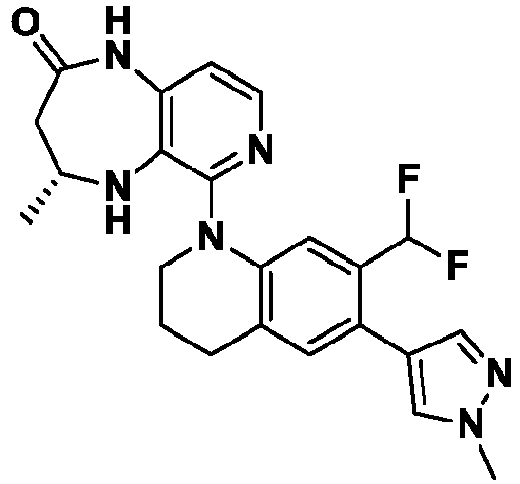
-
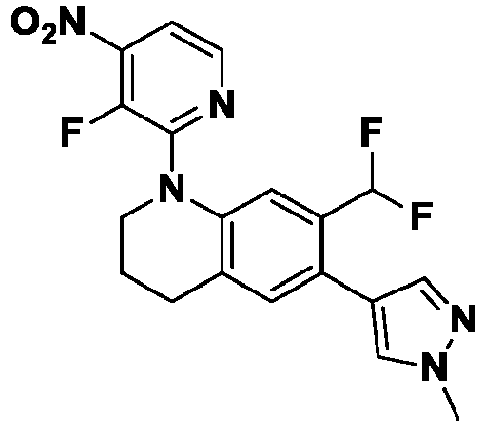
- To a solution of2-chloro-3-fluoro-4-nitro-pyridine (100mg, 0.57mmol)in dioxane (4 mL) was added7-(difluoromethyl)-6-(1-methylpyrazol-4-yl)-1,2,3,4-tetrahydroquinoline (115 mg, 0.44mmol), Cs2CO3(284mg,0.87mmol), 4,5-bis(diphenylphosphino)-9,9-dimethylxanthene (25 mg, 0.4 mmol) and palladium(II) acetate(10 mg, 0.04mmol). The reaction mixture was irradiated in a microwave at 140 °C for 1 h.After cooling the reaction to room temperature, the reaction mixture was concentrated in vacuo. The crude residue was purified bysilica gel chromatography (petroleum ether/EtOAc = 1/1) to give the title compound (24 mg, 11%) as a red solid.LCMS M/Z (M+H) 404.
-

- A mixture of 7-(difluoromethyl)-1-(3 -fluoro-4-nitro-2-pyridyl)-6-(1-methylpyrazol-4-yl)-3,4-dihydro-277-quinoline (100mg, 0.25mmol),triethylamine(0.07mL, 0.50mmol) and methyl (3R)-3-aminobutanoate (44 mg, 0.37mmol) in THF (2 mL) was heated to60 °C for 12 h under a nitrogen atmosphere.After cooling the reaction to room temperature,the reaction mixture was concentrated in vacuo. The crude residue was purified bysilica gel chromatography (petroleum ether/EtOAc = 1/1) to give the title compound(80mg, 65%)as a red solid.LCMS M/Z (M+H)501.
-

- A mixture of (R)-methyl 3-((2-(7-(difluoromethyl)-6-(1-methyl-1H-pyrazol-4-yl)-3,4-dihydroquinolin-1(2H)-yl)-4-nitropyridin-3-yl)amino)butanoate(100mg, 0.20mmol) and Fe powder (56mg, 1mmol) in acetic acid (2 mL) was heated to 100 °C for 12 h under a nitrogen atmosphere.After cooling the reaction to room temperature,the mixture was filtered and the filtrate was concentratedin vacuo. The crude residue was purified by reverse phase chromatography (acetonitrile 15-35/0.2% formic acid in water) to give the title compound (8mg, 9%) as awhite solid.1H NMR (400 MHz, DMSO-d 6) δ10.01 (s, 1H), 7.78 - 7.67 (m, 2H), 7.49 (s, 1H), 7.13 (s, 1H), 6.86 (d, J=5.2 Hz, 1H), 6.76 (t, J = 55.2 Hz, 1H), 6.35 (s, 1H), 5.03 (s, 1H), 3.90 - 3.82 (m, 4H), 3.50- 3.46 (m, 2H), 2.92 - 2.86 (m, 2H), 2.72 - 2.64 (m, 2H), 2.10-2.06 (m, 2H), 1.14 (d, J=6.4 Hz, 3H). LCMS M/Z (M+H)439.
-

-

- To a solution of 2-bromo-4-fluoro-benzonitrile (30g, 150mmol) in sulfuricacid(40mL)at 0°Cwas added potassiumnitrate (16.7g, 165mmol).The reaction mixture was stirred at 18 °C for 1.5h. The mixture was poured into ice water and extracted with EtOAc(60 mL x 3). The combined organic layers werewashed with brine (100 ml), dried over anhydrous Na2SO4, filtered and concentrated in vacuo to give the title compound (36 g, 98%) as a yellow solid that required no further purification. 1H NMR (400 MHz, CD3OD) δ8.67 (d, J = 7.6 Hz, 1H), 8.07 (d, J = 10.4 Hz, 1H).
-

- A mixture of 2-bromo-4-fluoro-5-nitro-benzonitrile (5.0g, 20.41mmol), N,N-diisopropylethylamine (5.27g, 40.81mmol) and 2-(methylamino)ethanol (1.84g, 24.49mmol) in DMF (20mL) was heated to 80 °C for 16 h.After cooling the reaction to room temperature,the reaction mixture was concentrated in vacuo. The crude residue was purified bysilica gel chromatography (petroleum ether/EtOAc = 1/1) to give the title compound(4.5g, 74%)asyellow oil.1H NMR (400 MHz,CDCl3) δ 8.03 (s, 1H), 7.46 (s, 1H), 3.91(t, J = 5.2 Hz, 2H), 3.56(t, J =5.2 Hz, 2H), 2.95 (s, 3H).
-
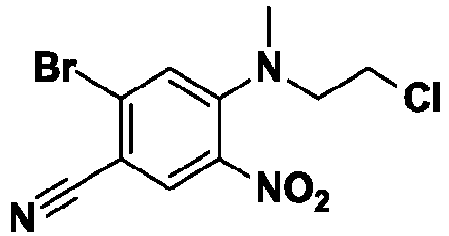
- To a solution of 2-bromo-4-((2-hydroxyethyl)(methyl)amino)-5-nitrobenzonitrile(4.5g, 15mmol) and pyridine (1.21mL, 15mmol) in DCM (50mL) at 0 °C was added thionylchloride (2.18mL, 30mmol) dropwise. The reaction mixture was stirred at 20 °C for 16 h and then concentrated in vacuo.DCM (20mL) was added and the mixture was washed with sat. aq. NaHCO3 (10 mL). The organic phasewas dried over anhydrous Na2SO4, filtered and concentrated in vacuo to give the title compound(4.7 g, 98%)asyellow oilthat required no further purification.
-

- To a solution of2-bromo-4-((2-chloroethyl)(methyl)amino)-5-nitrobenzonitrile(4.7g, 14.75mmol) in acetic acid (40mL) was added Fe powder (4.12g, 73.77mmol). The reaction mixturewas stirred at 20 °C for 1 h.Water (40 mL) was added and the mixture was made basic with sat. aq. NaHCO3 to pH 8 and then extracted with EtOAc (50 mL x3).The combined organic layers were dried over anhydrous Na2SO4, filtered and concentrated in vacuo to give the title compound(4g, 94%)asayellow solidthat required no further purification.
-

- A mixture of 5-amino-2-bromo-4-((2-chloroethyl)(methyl)amino)benzonitrile(4.0g, 13.86mmol), potassium iodide (4.6g, 27.72mmol) and K2CO3 (5.75g, 41.58mmol) in DMF (20mL) was heated to 80 °C for7 h. After cooling the reaction to room temperature,water (40 mL) was added and the mixture was extracted with EtOAc (100 mL x3).The combined organic layers were dried over anhydrous Na2SO4, filtered and concentrated in vacuo to give the title compound(3g,86%) as a brown solid. LCMS M/Z (M+H)251.8.
-

- To a solution of 7-bromo-1-methy1-1,2,3,4-tetrahydroquinoxaline-6-carbonitrile(400mg, 1.59mmol), 1-methyl-4-(4,4,5,5-tetramethyl-1,3,2-dioxaborolan-2-yl)-1H-pyrazole (400mg, 1.9mmol) and Na2CO3 (500mg, 4.76mmol) in THF (10 mL) and H2O (2 mL) was added chloro(2-dicyclohexylphosphino-2',4',6'-tri-i-propyl-1,1'-biphenyl)(2'-amino-1,1'-biphenyl-2-yl)palladium(II)(120 mg, 0.16 mmol) and 2-(dicyclohexylphosphino)-2',4',6'-triisopropylbiphenyl (76 mg, 0.16 mmol). The resulting mixture was heated to 70 °C for 16 h under nitrogen atmosphere. After cooling to room temperature, the mixture was filtered and concentrated in vacuo. The crude residue was purified by silica gel chromatography (petroleum ether/EtOAc = 1/2) to give the title compound (310 mg, 77%) as a brown solid.LCMS M/Z (M+H)254.
-

- To a solution of 1-methyl-7-(1-methyl-1H-pyrazol-4-yl)-1,2,3,4-tetrahydroquinoxaline-6-carbonitrile (150mg, 0.59mmol)and (R)-6-bromo-4-methyl-4,5-dihydro-1H-benzo[b][1,4]diazepin-2(3H)-one (Intermediate A, 166 mg, 0.65 mmol) in 1,4-dioxane (5mL) was added t-BuONa (171mg, 1.78mmol) and dichloro[1,3-bis(2,6-di-3-pentylphenyl)imidazol-2-ylidene](3-chloropyridyl)palladium(II) (47mg, 0.06mmol). The reaction mixture was heated to 120 °C for 16 h under a argon atmosphere. After cooling to room temperature, the mixture was filtered and concentrated in vacuo. The crude residue was purified by reverse phase chromatography (acetonitrile 20-50 % / 0.2% formic acid in water) togive the title compound (21mg, 8%) as a white solid. 1H NMR (400 MHz, CDCl3) δ7.89(s, 1H), 7.76(s, 1H), 7.34(s, 1H), 6.96-6.83(m, 3H), 6.62 (s, 1H), 6.32 (s, 1H), 4.41-4.33 (m, 1H), 3.99 - 3.92 (m, 1H),3.95(s, 3H), 3.80- 3.75 (m, 2H), 3.46- 3.41 (m, 2H), 3.09 (s,3H), 2.76-2.52(m, 2H), 1.28 -1.22(m, 3H). LCMS M/Z (M+H) 428.
-

-

- To a solution of 7-chloro-4-methyl-quinoline (5.0g, 28.15mmol) in toluene (100mL) was added 2,2-difluoro-1-phenyl-ethanone (8.79g, 56.3mmol),chloro[(tricyclohexylphosphine)-2-(2'-aminobiphenyl)]palladium(II) (1.66 g, 2.81mmol) and K3PO4 (23.9g, 112.59mmol). The reaction mixture was heated to 120 °C for 16 h under a nitrogen atmosphere. After cooling to room temperature,water (100 mL) was added and the mixture was extracted with DCM (100 mL x 2). The combined organic layers were dried over anhydrous Na2SO4, filtered and concentrated in vacuo togive the title compound(5 g, crude)asa brown oilthat required no further purification. LCMS M/Z (M+H)298.
-

- To a solution of 2,2-difluoro-2-(4-methyl-7-quinolyl)-1-phenyl-ethanone (5.0g, 16.82mmol) in toluene (100mL) and water (6mL) was added KOH (5.66g, 100.91mmol). The reaction mixture was heated to 100 °C for16 h. After cooling to room temperature,water (100 mL) was added and the mixture was extracted with DCM (100 mL x 2). The combined organic layers were dried over anhydrous Na2SO4, filtered and concentrated in vacuo. The crude residue was purified by silica gel chromatography (petroleum ether/EtOAc = 10/1) to give the title compound(3.7g, 80%) as a yellow oil. LCMS M/Z (M+H)194.
-

- To a solution of 7-(difluoromethyl)-4-methyl-quinoline (3.7g, 19.15mmol) and sodiumcyanoborohydride(6.02g, 95.76 mmol)in MeOH (200mL) at 0 °C was addedboron trifluoride diethyl etherate (20.67mL, 38.30 mmol) dropwise. The reaction mixture was heated to 100 °C for36 hundera nitrogen atmosphere. After cooling the reaction to room temperature, sat. aq. NaHCO3 (100 mL) was added and the mixture was extracted with DCM (100 mL x 2). The combined organic layers were dried over anhydrous Na2SO4, filtered and concentrated in vacuo. The crude residue was purified by silica gel chromatography (petroleum ether/EtOAc = 50/1) to give the mixture of 7-(difluoromethyl)-4-methyl-1,2,3,4-tetrahydroquinoline and 7-(difluoromethyl)-4-methyl-1,2-dihydroquinoline (2.5g, ratio = 7:2)as a brown oil. The resulting mixture was dissloved in MeOH (50 mL) and 10% Pd/C (403 mg, 0.19 mmol) was added. The mixture was stirred at 25°C for 1 h under a hydrogen atmosphere (15 psi).The reaction was filtered and concentrated in vacuo. The crude residue was purified by silica gel chromatography (petroleum ether/EtOAc = 100/1) to give the title compound (1.9g, 50%)as a light yellow oil. LCMS M/Z (M+H)198.
-

- To a solution of 7-(difluoromethyl)-4-methyl-1,2,3,4-tetrahydroquinoline (700 mg, 3.55mmol) in DCM (10mL) at 0 °C was added 1-bromopyrrolidine-2,5-dione(632 mg, 3.55mmol) portionwise. The resulting mixture was stirred at room temperature for 1 h. Water (10 mL) was added and the mixture was extracted with DCM (20 mL x 2). The combined organic layers were dried over anhydrous Na2SO4, filtered and concentrated in vacuoto give the title compound (1g, crude)as a red oil that required no further purification. LCMS M/Z (M+H) 276.
-

- To a solution of 6-bromo-7-(difluoromethyl)-4-methyl-1,2,3,4-tetrahydroquinoline (1.0 g, 3.62mmol), 1-methyl-4-(4,4,5,5-tetramethyl-1,3,2-dioxaborolan-2-yl)-1H-pyrazole (904mg, 4.35mmol) and Na2CO3 (1.15g, 10.86mmol) in THF (15 mL) and H2O (3mL) was added chloro(2-dicyclohexylphosphino-2',4',6'-tri-i-propyl-1,1'-bipheny1)(2'-amino-1,1'-biphenyl-2-yl)palladium(II)(285 mg, 0.36mmol) and 2-(dicyclohexylphosphino)-2',4',6'-triisopropylbiphenyl (173 mg, 0.36mmol). The resulting mixture was heated to 60 °C for 16 h under a nitrogen atmosphere. After cooling to room temperature, the mixture was filtered and concentrated in vacuo. The crude residue was purified by silica gel chromatography (petroleum ether/ EtOAc = 3/1) togive the title compound (400mg, 40%) as a red oil. 1H NMR (400MHz,CDCl3) δ 7.53 (s, 1H), 7.40 (s, 1H), 7.05 (s, 1H), 6.81 (s, 1H), 6.54 (t, J = 55.2 Hz, 1H), 3.95 (s, 3H), 3.45 - 3.23 (m, 2H), 3.00-2.79 (m, 1H), 1.99 - 1.97 (m, 1H), 1.73 - 1.69 (m, 1H), 1.31 (d, J = 6.8 Hz, 3H).
-

- To a solution of 7-(difluoromethyl)-4-methyl-6-(1-methylpyrazol-4-yl)-1,2,3,4-tetrahydroquinoline (300mg, 1.08mmol)and (R)-6-bromo-4-methyl-4,5-dihydro-1H-benzo[b][1,4]diazepin-2(3H)-one (Intermediate A, 304 mg, 1.19mmol) in 1,4-dioxane (5mL) was added t-BuONa (312 mg, 3.25mmol) and dichloro[1,3-bis(2,6-di-3-pentylphenyl)imidazol-2-ylidene](3-chloropyridyl)palladium(II) (86 mg, 0.11mmol). The reaction mixture was heated to 110 °C for 16 h under argon atmosphere. After cooling to room temperature, the mixture was filtered and concentrated in vacuo. The mentioned-above procedures were repeated. The combined crude residue was purified by reverse phase chromatography (acetonitrile 38-68 % / 0.05% NH4OH in water) togive the racemic compound (30mg, 3.1%) as apale yellowsolid that was separated using chiral SFC(SFC80; Chiralpak AS 250 x 30mm, 5 um; Supercritical CO2/EtOH +DEA = 55/45,50 mL/min) to give(R, R)-6-[7-(difluoromethyl)-4-methyl-6-(1-methylpyrazol-4-yl)-3,4-dihydro-2H-quinolin-1-yl]-4-methyl-1,3,4,5-tetrahydro-1,5-benzodiazepin-2-one(8 mg, first peak) as a yellow solid and(R, S)-6-[7-(difluoromethyl)-4-methyl-6-(1-methylpyrazol-4-yl)-3,4-dihydro-2H-quinolin-1-yl]-4-methyl-1,3,4,5-tetrahydro-1,5-benzodiazepin-2-one(12 mg, second peak) as a yellow solid.Absolute configuration was arbitrarily assigned to each enantiomer.Example 307:1H NMR (400 MHz,DMSO-d 6) δ9.66 - 9.65 (m, 1H), 7.74 - 7.73 (m, 1H), 7.48 (s, 1H), 7.17 - 7.15 (m, 1H), 6.95 - 6.72 (m, 4H), 6.30 - 6.29 (m, 1H), 4.72 - 4.63 (m, 1H), 3.90 - 3.85 (m, 4H), 3.62 - 3.44 (m, 1H), 3.28 - 3.04 (m, 2H), 2.30 - 2.20 (m, 2H), 2.08 - 1.80 (m, 1H), 1.37 - 1.34 (m, 3H), 1.30 - 1.23(m, 1H), 1.17- 1.09 (m, 3H). LCMS M/Z (M+H) 452.Example 308:1H NMR (400 MHz,DMSO-d 6)δ 9.67 - 9.65 (m, 1H), 7.74 (s, 1H), 7.48 (s, 1H), 7.19 - 7.15 (m, 1H), 6.92 - 6.71 (m, 4H), 6.29 - 6.25 (m, 1H), 4.80 - 4.55 (m, 1H), 3.90 - 3.85 (m, 4H), 3.57 - 3.49 (m, 1H), 2.29 - 2.22 (m, 2H), 2.08 - 1.80 (m, 1H), 1.38 - 1.20 (m, 5H), 1.18 - 1.07 (m, 3H), 0.90 - 0.83 (m, 1H). LCMS M/Z (M+H) 452.
-
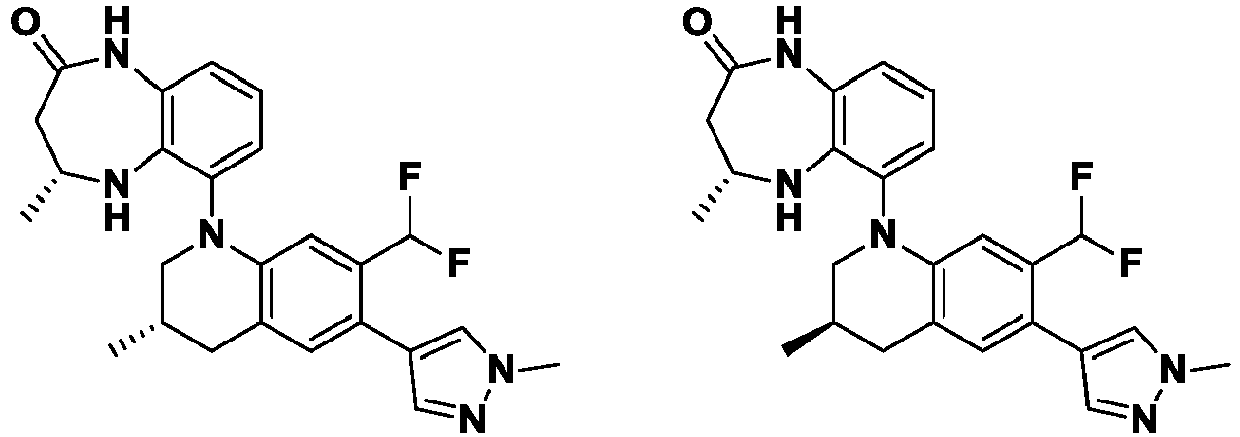
- Example 309 & 310 were prepared in a similar fashion to Examples 307 & 308 using the corresponding 7-bromo-3-methylquinoline instead of 7-chloro-4-methyl-quinoline.(4R)-6-[7-(difluoromethyl)-3-methyl-6-(1-methylpyrazol-4-yl)-3,4-dihydro-2H-quinolin-1-yl]-4-methyl-1,3,4,5-tetrahydro-1,5-benzodiazepin-2-one (10 mg) was separated using chiral SFC (SFC80, Chiralpak AD 250×30mm I.D.,5um; Supercritical CO2 / MEOH+NH3•H2O= 60/40; 80 ml/min) to give (R, S)-6-[7-(difluoromethyl)-3-methyl-6-(1-methylpyrazol-4-yl)-3,4-dihydro-2H-quinolin-1-yl]-4-methyl-1,3,4,5-tetrahydro-1,5-benzodiazepin-2-one(1 mg, first peak) as a white solid and(R, R)-6-[7-(difluoromethyl)-3-methyl-6-(1-methylpyrazol-4-yl)-3,4-dihydro-2H-quinolin-1-yl]-4-methyl-1,3,4,5-tetrahydro-1,5-benzodiazepin-2-one(1 mg, second peak) as a white solid.Absolute configuration was arbitrarily assigned to each enantiomer.Example 309:1H NMR (400MHz, DMSO-d6 ) δ 9.65 (s, 1H), 7.71 (s, 1H), 7.47 (s, 1H), 7.09 - 7.08 (m, 1H), 6.92 - 6.87 (m, 2H), 6.84 - 6.75 (m, 1H), 6.72 (t, J=56.0 Hz, 1H), 6.31 - 6.26 (m, 1H), 5.33 - 5.31 (m, 1H), 3.92 - 3.80 (m, 4H), 3.30 - 3.29 (m, 1H), 3.24 - 2.86 (m, 3H), 2.30 - 2.25 (m, 1H), 2.06 - 1.90 (m, 2H), 1.23 (s, 3H), 1.11 - 1.03 (m, 3H). LCMS M/Z (M+H) 452.Example 310:1H NMR (400MHz, DMSO-d6 ) δ 9.65 - 7.63 (m, 1H), 7.71 (s, 1H), 7.47 - 7.46 (m, 1H), 7.08 (s, 1H), 6.97 - 6.77 (m, 3H), 6.74 - 6.64 (m, 1H), 6.31 - 6.28 (m, 1H), 5.35 - 5.29 (m, 1H), 3.88 - 3.82 (m, 4H), 3.24 - 3.19 (m, 1H), 3.04 - 2.86 (m, 3H), 2.53 - 2.52 (m, 1H), 2.02 - 1.97 (m, 2H), 1.23 (s, 3H), 1.18 - 1.03 (m, 3H).LCMS M/Z (M+H) 452.
-
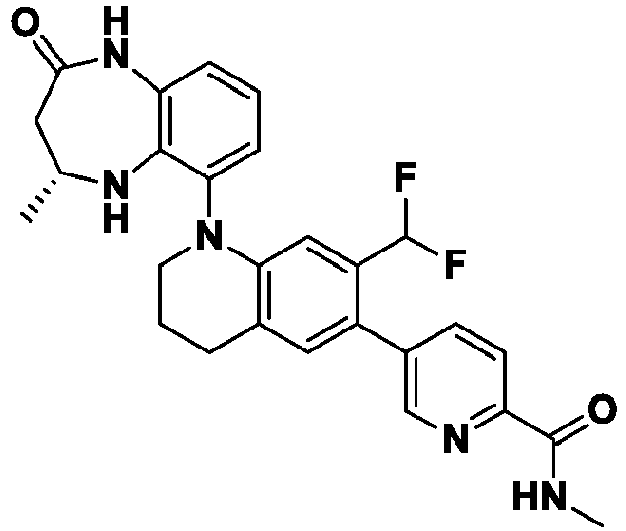
-

- To a solution of 3-bromo-2-fluoronitrobenzene (1.0 g, 4.55 mmol) and 7-(difluoromethyl)-1,2,3,4-tetrahydroquinoline (833 mg, 4.55 mmol) in DMF (20 mL) was added 4,5-bis(diphenylphosphino)-9,9-dimethylxanthene (526 mg, 0.91mmol), Cs2CO3 (4.44 g, 13.64 mmol) and palladium(II) acetate (102 mg, 0.45 mmol). The resulting mixture was heated to 130 °C for 16 h undera nitrogen atmosphere.After cooling the reaction to room temperature, the reaction mixture wasfiltered and concentrated in vacuo. The crude residue was purified bysilica gel chromatography (petroleum ether/EtOAc = 30/1) to give the title compound (450 mg, 31%) as a red solid. 1H NMR (400 MHz, CDCl3) δ 7.87 (d, J = 7.2 Hz, 1H), 7.59 (d, J = 7.2 Hz, 1H), 7.30 - 7.25 (m, 1H), 7.13 (d, J = 7.6 Hz, 1H), 6.87 (d, J = 8.0 Hz, 1H), 6.49 (s, 1H), 6.41 (d, J = 56.8 Hz, 1H), 3.61 (t, J = 5.6 Hz, 2H), 2.91 (t, J = 6.0 Hz, 2H), 2.11 - 2.04 (m, 2H).
-

- To a solution of 7-(difluoromethyl)-1-(2-fluoro-3-nitro-phenyl)-3,4-dihydro-2H-quinoline (450mg, 1.4mmol) in DCM (10mL) at 0 °Cwas added 1-bromopyrrolidine-2,5-dione(249 mg, 1.4mmol)portionwise. The resulting mixture was stirred at room temperature for 1 h. The reaction was quenched with H2O (20 mL) and extracted with DCM (20 mL). The orgainc phase was separated, dried over anhydrou Na2SO4, filtered and concentrated in vacuo. The crude residue was purified by silica gel chromatography(petroleum ether/EtOAc = 30/1) to give the title compound (500mg, 89%) as a red solid. 1H NMR (400MHz, CDCl3) δ 7.97 - 7.87 (m, 1H), 7.66 - 7.55 (m, 1H), 7.36 - 7.28 (m, 2H), 6.74 (t, J = 54.8 Hz, 1H), 6.64 (s, 1H), 3.62 (J = 5.6 Hz, 2H), 2.91 (t, J = 6.0 Hz, 2H), 2.14 - 2.02 (m, 2H).
-

- To a solution of 6-bromo-7-(difluoromethyl)-1-(2-fluoro-3-nitro-phenyl)-3,4-dihydro-2H-quinoline (450mg, 1.12mmol) in DMF (10mL)was added Cs2CO3(1.10 mg, 3.37mmol) and (3R)-3-aminobutanoic acid (174 mg, 1.68mmol). The resulting mixture was heated to 90 °C for 16 h. After cooling to room temperature,water (10 mL) was added and the mixture was extracted with EtOAc (20 mL). The aqueous phase was acidified with HCl (2 N) to pH 3 - 4 and then extracted with EtOAc (20 mL).The orgainc phase was separated, dried over anhydrous Na2SO4, filtered and concentrated in vacuo to give the title compound (200mg, crude)as red oilthat required no further purification.LCMS M/Z (M+H)484.
-
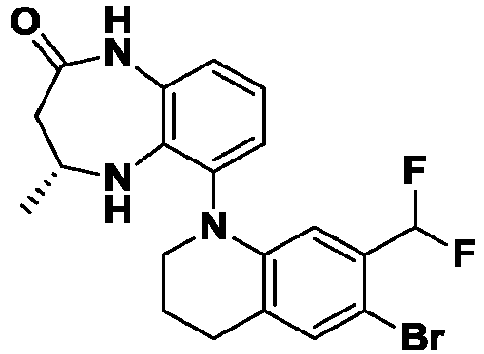
- To a solution of (R)-3-((2-(6-bromo-7-(difluoromethyl)-3,4-dihydroquinolin-1(2H)-yl)-6-nitrophenyl)amino)butanoic acid(150mg, 0.31mmol) in acetic acid (3mL) was added Fe powder(90 mg, 1.55mmol). The resulting mixture was heated to 100 °C for2 h.After cooling to room temperature, the mixture was filtered and filtrate was made basic with sat. aq. NaHCO3 to pH 8 and then extracted with EtOAc (20 mL x 2).The orgainc phase was separated, dried over anhydrous Na2SO4, filtered and concentrated in vacuo to give the title compound (100mg, crude) as red oilthat required no further purification.LCMS M/Z (M+H)436.
-

- To a solution of (R)-6-(6-bromo-7-(difluoromethyl)-3,4-dihydroquinolin-1(2H)-yl)-4-methyl-4,5-dihydro-1H-benzo[b][1,4]diazepin-2(3H)-one(100mg, 0.23mmol) in THF (2mL) and H2O (0.5mL) was added 2-(N-methylaminocarbonyl)pyridine-5-boronicacidpincolester (90mg, 0.34mmol), chloro(2-dicyclohexylphosphino-2',4',6'-tri-i-propyl-1,1'-biphenyl)(2'-amino-1,1'-biphenyl-2-yl) palladium(II)(18mg, 0.02mmol),2-(dicyclohexylphosphino)-2',4',6'-triisopropylbiphenyl(11 mg, 0.02mmol)and Na2CO3(73 mg, 0.69mmol). The reaction mixture was irradiated in a microwave at 60 °C for 0.5 h.The reaction was concentrated in vacuo and the residuewas purified by reverse phase chromatography (acetonitrile 34-64% / 0.05% NH4OH in water) to give the title compound (19mg, 17%)as a white solid. 1H NMR (400MHz, DMSO-d6 ) δ 9.66 (d, J = 4.8 Hz, 1H), 8.80 (d, J = 4.4 Hz, 1H), 8.52 (s, 1H), 8.05 (d, J = 8.0 Hz, 1H), 7.87 (d, J = 8.0 Hz, 1H), 7.12 (s, 1H), 7.00 - 6.89 (m, 2H), 6.86 - 6.83 (m, 1H),6.81 (t, J = 51.2 Hz, 1H), 6.35 (d, J = 7.2 Hz, 1H), 4.87 - 4.64 (m, 1H), 3.98 - 3.80 (m, 1H), 3.61 - 3.40 (m, 2H), 2.98 - 2.93 (m, 2H), 2.84 (d, J = 4.4 Hz, 3H), 2.61 - 2.55 (m, 1H), 2.31 - 2.25 (m, 1H), 2.23 - 1.95 (m, 2H), 1.31 - 1.03 (m, 3H). LCMS M/Z (M+H) 492.
-
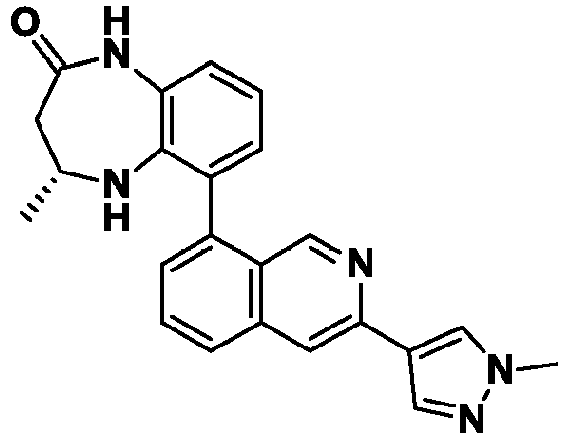
-

- To a solution of 3-bromo-8-chloroisoquinoline (500 mg, 2.1 mmol) in dioxane/H2O (12 mL, 5:1) was added 1-methyl-4-(4,4,5,5-tetramethyl-1,3,2-dioxaborolan-2-yl)-1H-pyrazole (472 mg, 2.3 mmol), [1,1'-bis(diphenylphosphino)ferrocene]dichloropalladium(II) (75 mg, 0.1 mmol) and Na2CO3 (437 mg, 4.1 mmol). The reaction mixture was heated to 90 °C for 16 h under a nitrogen atmosphere. After cooling to room temperature, the mixture was filtered and filtrate was diluted with EtOAc (30 mL) and washed with H2O (20 mL x 2). The organic phase was dried over anhydrous Na2SO4, filtered and concentrated in vacuo.The crude residue was purified by silica gel chromatography(DCM/MeOH = 20/1) to give the title compound (430 mg, 85%) as a yellow solid.1H NMR (400 MHz, DMSO-d6 ) δ9.49 (s, 1H), 8.37 (s, 1H), 8.14 (s, 1H), 8.10 (s, 1H), 7.89 - 7.86 (m, 1H), 7.72 - 7.70 (m, 2H), 3.92 (s, 3H).
-

- To a solution of 8-chloro-3-(1-methy1-1H-pyrazol-4-yl)isoquinoline(300 mg, 1.2 mmol) in DMF (8 mL) was added 4,4,4',4',5,5,5',5'-octamethyl-2,2'-bi(1,3,2-dioxaborolane) (938 mg, 3.7 mmol), [1,1'-bis(diphenylphosphino)ferrocene]dichloropalladium(II) (45 mg, 0.06 mmol) and potassium acetate (242 mg, 2.5 mmol). The reaction mixture was heated to 120 °C for 16h under a nitrogen atmosphere. After cooling to room temperature, the mixture was filtered and the filtrate was diluted with EtOAc (40 mL) and washed with H2O (30 mL x 2). The organic phase was dried over anhydrous Na2SO4, filtered and concentrated in vacuo.The crude residue was purified by silica gel chromatography(DCM/MeOH = 50/1) to give the title compound (240 mg, crude) as a yellow solid that required no further purification. LCMS M/Z (M+H) 336.
-

- Toa solution of 3-(1-methyl-1H-pyrazol-4-yl)-8-(4,4,5,5-tetramethyl-1,3,2-dioxaborolan-2-yl)isoquinoline (100 mg, 0.3 mmol) in THF (10mL) and H2O (2mL)was added (4R)-6-bromo-4-methyl-1,3,4,5-tetrahydro-1,5-benzodiazepin-2-one (91 mg, 0.36 mmol), chloro(2-dicyclohexylphosphino-2',4',6'-tri-i-propyl-1,1'-biphenyl)(2'-amino-1,1'-biphenyl-2-yl) palladium(II)(24 mg, 0.03mmol),2-(dicyclohexylphosphino)-2',4',6'-triisopropylbiphenyl(14mg, 0.03mmol)and Na2CO3(95 mg, 0.9 mmol). The reaction mixture was heated to60 °C for 16 h under a nitrogen atmosphere. After cooling to room temperature,the reaction was concentrated in vacuo and the residuewasdiluted with DCM (10 mL) and washed with H2O (10 mL x 2). The organic phase was dried over anhydrous Na2SO4, filtered and concentrated in vacuo.The crude residue was purified by reverse phase chromatography (acetonitrile 30 -60% / 0.05% NH4OH in water) to give the title compound(32mg,25%) as a white solid. 1H NMR (400MHz, DMSO-d 6) δ9.42 (s, 1H), 8.81 (d, J = 8.0 Hz, 1H), 8.26 (s, 1H), 8.08 (s, 1H), 8.04 (s, 1H), 7.94 (d, J = 8.0 Hz, 1H),7.85 - 7.76 (m, 1H), 7.42 (d, J = 7.2 Hz, 1H), 7.10 (d, J = 4.8 Hz, 1H), 6.96 - 6.89 (m, 2H), 3.92 (s, 3H), 3.76-3.72 (m, 1H), 3.66-3.57(m,2H), 2.29 -2.24 (m, 1H), 0.96-0.79 (m, 3H).LCMS M/Z (M+H) 384.
- His/Flag epitope tagged CBP was cloned, expressed, and purified to homogeneity. CBP binding and inhibition was assessed by monitoring the engagement of a biotinylated small molecule compound with the target using the TR-FRET assay technology (Perkin-Elmer). Specifically, in a 384 well ProxiPlate CBP (4 nM final) was combined with biotin-ligand (60 nM final) in 50 mM HEPES (pH 7.5), 50 mM NaCl, 1 mM TCEP, 0.01% (w/v) BSA, and 0.008% (w/v) Brij-35 either in the presence of DMSO (final 0.2% DMSO) or compound dilution series in DMSO. After 10 minutes incubation at room temperature, a mixture Eu-W1024 Anti-6xHis antibody (Perkin Elmer AD0110) and SureLight™ Allophycocyanin-Streptavidin (APC-SA, Perkin Elmer CR130-100) were added to a final concentrations of 0.2 nMolar antibody and 50 nMolar APC-SA, respectively. After twenty minutes of equilibration, the plates were read on an Envision instrument and IC50s calculated using a four parameter non-linear curve fit.
- His/Flag epitope tagged BRD4 BD142-168 was cloned, expressed, and purified to. BRD4 binding and inhibition was assessed by monitoring the engagement of biotinylated H4-tetraacetyl peptide (New England Peptide, NEP2069-1/13) with the target using the AlphaLisa technology (Perkin-Elmer). Specifically, in a 384 well ProxiPlate BRD4(BD1) (30 nM final) was combined with peptide (200 nM final) in 40 mM HEPES (pH 7.0), 40 mM NaCl, 1 mM DTT, 0.01% (w/v) BSA, and 0.008% (w/v) Brij-35 either in the presence of DMSO (final 1.2% DMSO) or compound dilution series in DMSO. After 20 minutes incubation at room temperature Alpha streptavidin donor beads and AlphaLisa anti-Flag acceptor beads were added to a final concentration of 10 ug/mL each. After three hours equilibration plates were read on an Envision instrument and IC50S calculated using a four parameter non-linear curve fit.
- QuantiGene 2.0 Reagent system, Affymetrix: HUMAN MYCN; V-myc myelocytomatosis viral related oncogene, neuroblastoma derived (avian); NM_005378 SA-15008. 10,000 MV-4-11 cells (GNE in-house) were plated in 75 ul complete media: RPMI-1640 (GNE in-house), 10% FBS (Life Technologies, cat. no. 10082), 1% Pen-strep (GNE in-house), in 96 well clear flat bottom plates (Costar, cat. no. 3595). 25 ul compound was added for 4 hours at 37 deg C in a 1:3 serial dilution 10-point dose response, with a final DMSO concentration = 0.2%. The cells were then lysed according to the assay kit's protocol and frozen at -80 deg C. The following day, an appropriate volume of Working Probe Set was prepared by combining the following reagents in the order listed: Nuclease-free water, Lysis Mixture, Blocking Reagent, and 2.0 Probe Set (MYC or RPL19). 20 ul of the working probe set was added into each assay well on the capture plate, and then 80 ul of the lysates were transferred into the assay plates. The capture plate was placed in a 55 deg C incubator for overnight hybridization (16-20 hours). The following day, wash buffer was prepared according to manufacturer's recommendations. The capture plates were washed with 300 ul per well of 1X wash buffer three times. Then 100 ul Pre-Amplifier was added to the plate for a 60 minute incubation at 55 deg C. After the incubation, the capture plate was washed with 300 ul per well of 1X wash buffer three times, and 100 ul Amplifier was added to the plate for a 60 minute incubation at 55 deg C. The capture plate was again washed with 300 ul per well of 1X wash buffer three times, and 100 ul Label Probe was added to the plate for a 60 minute incubation at 50 deg C. Then the capture plate was washed with 300 ul per well of 1X wash buffer three times, and 100 ul 2.0 Substrate was added to each well of the plate. The plates were incubated at RT for 5 minutes in the dark and read on the Envision using the luminescence protocol, with an integration time set at 0.2 seconds.
- Data for representatitive compounds of formula (I) from the three assays described above is provided in the following table.
Example Compound CBP HTRF IC50 BRD4 Alpha IC50 Myc IC50 1 
0.498 >5.2632 2 
0.704 2.537 3 
0.608 12.464 4 
0.586 5 
0.213 6.877 6 
0.180 7 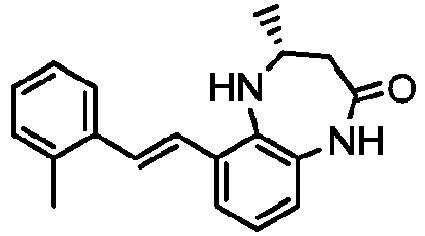
0.166 8 
0.251 20.5 2.214 9 
0.457 15.218 10 
0.229 2.257 11 
0.255 7.014 0.537 12 
0.291 4.752 13 
0.921 6.940 14 
0.224 2.761 15 
0.153 5.836 16 
0.590 2.314 17 
0.261 3.621 18 
0.174 1.473 19 
0.236 3.458 20 
0.221 21 
0.189 4.160 22 
0.252 6.080 2.254 23 
0.503 >19.7 24 
0.820 >19.7 25 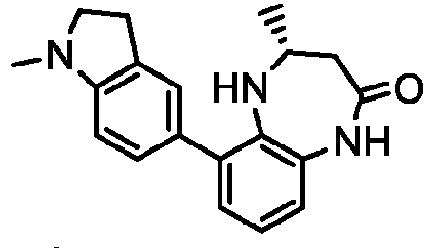
0.509 5.727 26 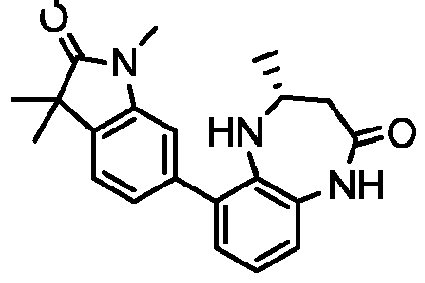
0.560 14.505 27 
0.306 13.011 28 
0.384 5.090 29 
0.331 2.255 30 
0.544 2.726 31 
0.677 3.161 32 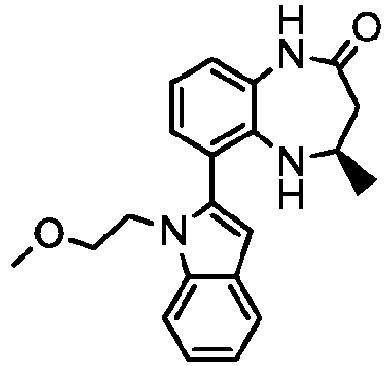
0.696 8.505 33 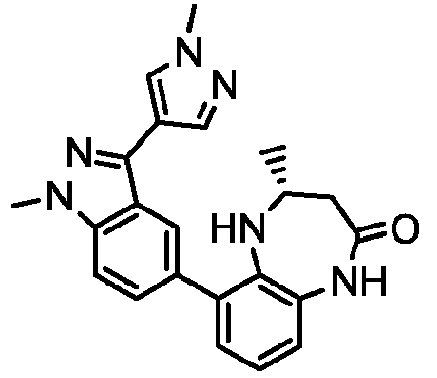
0.019 2.574 0.215 34 
0.027 3.126 0.183 35 
0.057 36 
0.266 4.967 37 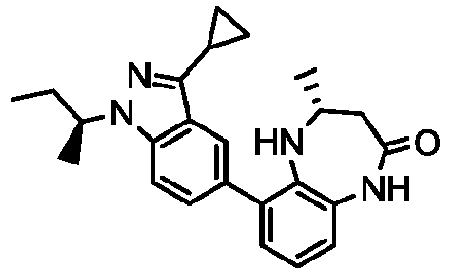
0.125 3.442 38 
0.119 2.742 0.851 39 
0.210 4.760 2.957 40 
0.719 19.7++ 19.763 41 
0.195 6.822 42 
0.235 2.671 43 
0.440 44 
0.690 15.431 45 
0.913 >19.7 46 
1.050 >19.7 47 
0.200 3.250 48 
0.526 3.708 49 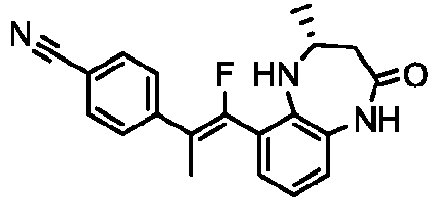
0.736 >19.7 50 
0.310 8.061 51 
1.033 16.612 52 
0.384 4.646 53 
0.588 10.819 54 
0.663 5.181 55 
0.851 >10.5 56 
0.037 0.898 0.428 57 
0.049 4.028 0.495 58 
0.132 5.727 59 
0.385 13.056 60 
0.040 0.637 0.326 61 
0.065 1.801 0.404 62 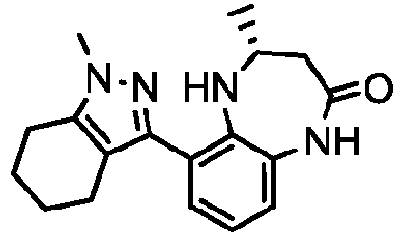
0.936 >19.7 63 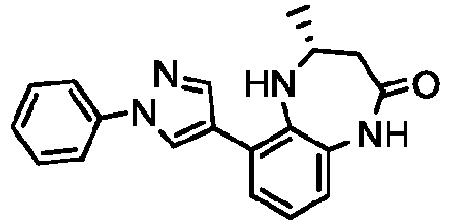
0.149 2.487 64 
0.254 5.974 65 
0.199 5.611 66 
0.616 10.482 67 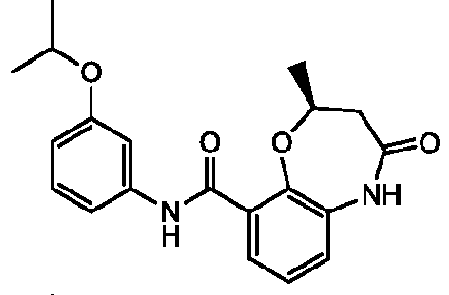
>19.7 >19.7 68 
0.100 4.509 1.530 69 
0.424 >19.7 70 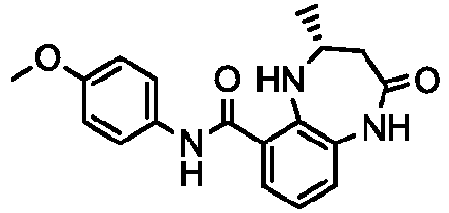
0.994 >10.5 71 
0.910 5.121 72 
0.894 19.7++ 73 
0.320 5.583 1.766 74 
0.266 4.133 1.339 75 
0.192 5.607 0.889 76 
0.377 6.874 2.191 77 
0.157 9.297 2.035 78 
0.483 17.939 79 
0.838 5.067 80 
0.030 1.686 0.217 81 
0.175 6.128 82 
0.099 3.651 83 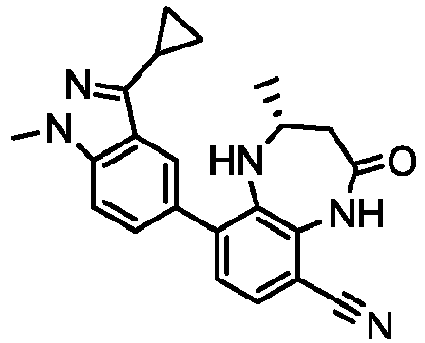
0.082 4.914 0.401 84 
0.026 1.477 85 
0.010 0.995 0.049 86 
0.046 2.778 0.158 87 
0.083 4.688 0.534 88 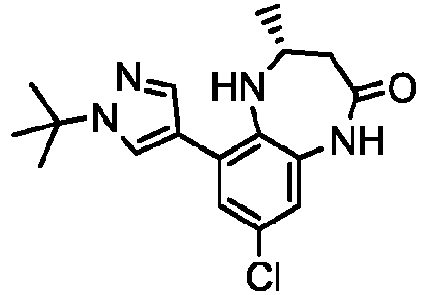
0.265 13.045 89 
0.118 >19.7 0.720 90 
0.052 >19.7 0.413 91 
0.106 13.966 92 
0.098 3.915 0.878 93 
0.967 10.484 94 
0.054 7.744 0.864 95 
0.566 >19.7 96 
>19.7 >19.7 97 
0.506 22.137 98 
>19.7 >19.7 99 
0.100 1.479 100 
0.213 2.128 101 
1.899 5.940 102 
0.548 4.675 103 
>19.7 >19.7 104 
0.840 1.373 105 
>19.7 >19.7 106 
0.303 8.014 1.667 107 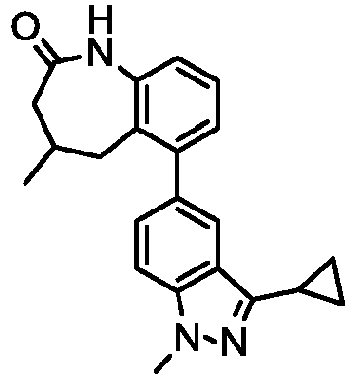
0.122 1.700 108 
6.911 18.773 109 
0.040 0.894 0.327 110 
0.723 18.206 111 
0.394 2.218 >4.0 112 
0.500 9.334 113 
0.538 13.714 114 
0.493 2.172 115 
0.528 7.575 116 
0.563 10.162 117 
0.398 1.822 118 
0.647 3.081 119 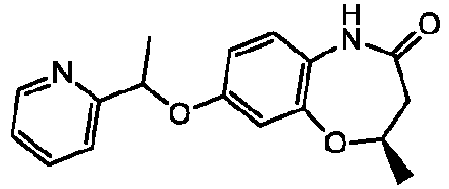
0.691 3.100 120 
0.599 4.280 121 
0.815 11.344 122 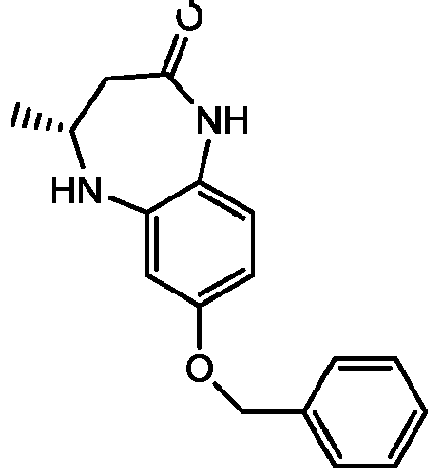
0.844 >19.7 123 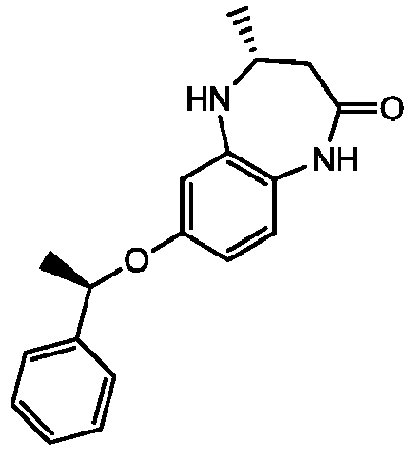
0.652 12.865 124 
0.361 5.560 2.511 125 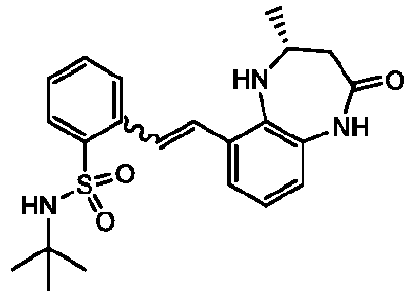
<0.4803 2.176 126 
127 
2.365 7.472 128 
1.036 18.258 129 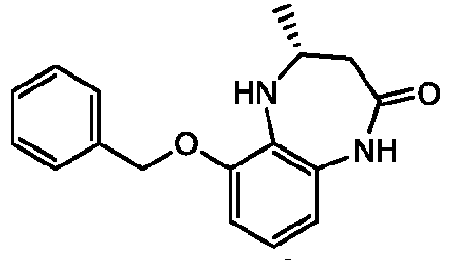
1.326 2.729 130 
13.376 >19.7 131 
2.129 >19.7 132 
8.617 39.8 133 
>19.7 >19.7 134 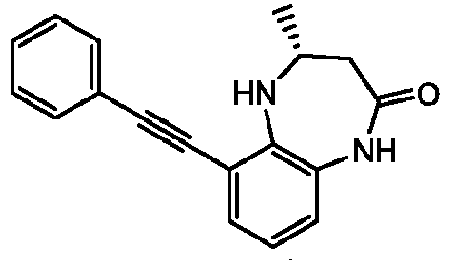
>19.7 >10.5 135 
2.350 16.534 136 
1.191 3.766 137 
2.076 >19.7 138 
1.510 >19.7 139 
0.247 0.658 140 
0.192 0.953 141 
0.154 1.098 142 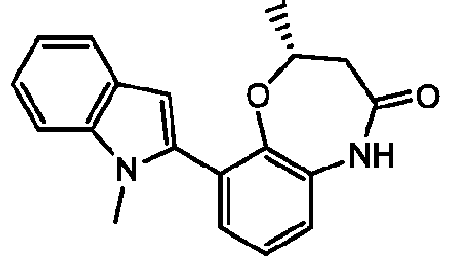
0.200 4.756 1.718 143 
0.265 4.339 144 
0.547 >19.7 145 
0.493 6.578 6.770 146 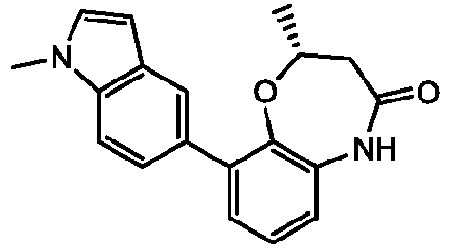
0.320 1.686 147 
0.417 13.898 148 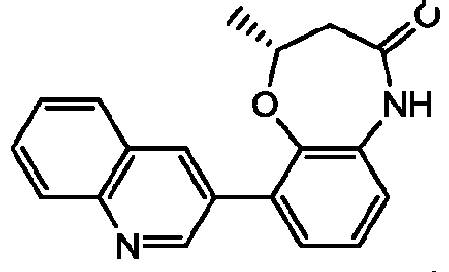
0.197 2.471 149 
0.318 0.396 150 
0.215 1.242 151 
0.843 >19.7 152 
0.412 13.293 153 
0.381 10.261 1.949 154 
0.467 15.207 3.234 155 
0.186 8.072 1.536 156 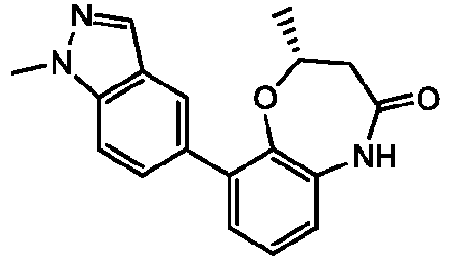
0.143 11.534 1.228 157 
0.265 12.348 0.968 158 
0.451 15.223 2.866 159 
0.502 5.778 160 
0.472 9.222 161 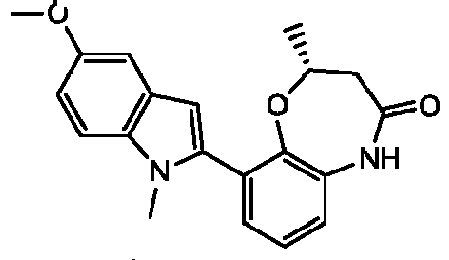
0.161 6.079 1.271 162 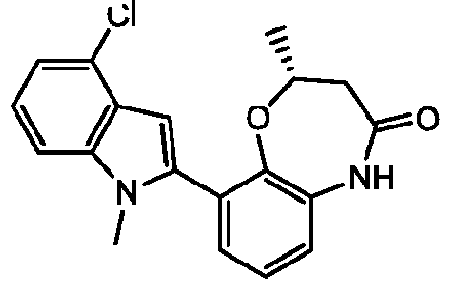
0.313 8.098 163 
0.182 14.944 1.734 164 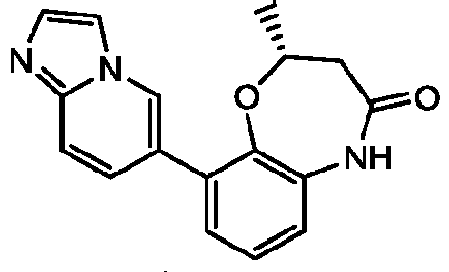
0.776 >19.7 165 
0.163 7.444 0.734 166 
0.086 5.128 0.369 167 
0.304 11.225 2.610 168 
0.154 5.764 1.799 169 
0.106 170 
0.303 3.113 171 
0.447 8.342 5.468 172 
0.456 20.167 6.872 173 
0.336 12.109 174 
0.322 14.044 1.558 175 
0.428 176 
0.270 177 
0.648 15.234 178 
0.504 14.084 179 
0.967 >19.7 180 
0.660 >19.7 181 
0.635 >19.7 182 
0.654 >19.7 183 
0.638 >19.7 184 
0.310 2.973 185 
0.531 19.7 9.030 186 
0.758 18.546 187 
0.635 10.658 188 
0.204 6.402 0.275 189 
0.734 17.808 190 
0.289 17.156 1.733 191 
0.388 >19.7 1.098 192 
0.825 >19.7 193 
0.591 >19.7 194 
0.226 6.891 195 
3.675 >19.7 196 
0.838 15.832 197 
8.038 >19.7 198 
7.583 >19.7 199 
2.599 8.884 200 
0.370 1.753 201 
0.395 5.513 3.839 202 
9.015 >19.7 203 
0.635 22.498 3.268 204 
0.286 4.581 205 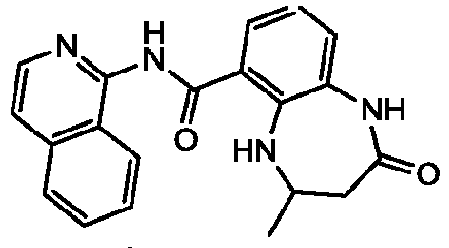
0.561 16.291 206 
0.158 5.592 207 
0.190 6.441 1.730 208 
0.209 4.550 209 
0.226 11.601 3.784 210 
0.351 9.962 211 
0.397 13.197 212 
0.218 9.099 1.665 213 
0.093 5.990 2.099 214 
0.181 6.502 215 
0.159 2.324 216 
0.201 9.671 217 
0.209 5.644 218 
0.403 18.233 219 
0.735 18.759 220 
0.369 13.320 221 
0.826 18.339 222 
0.791 >19.7 223 
0.347 >19.7 224 
0.102 >19.7 >19.9 225 
0.998 >19.7 226 
0.291 >19.7 227 
0.224 5.624 228 
0.126 6.706 0.735 229 
0.487 13.443 230 
0.654 7.405 231 
0.559 12.867 232 
0.744 9.720 233 
1.012 234 
0.353 5.794 235 
0.381 3.589 236 
0.374 3.021 237 
0.503 14.921 238 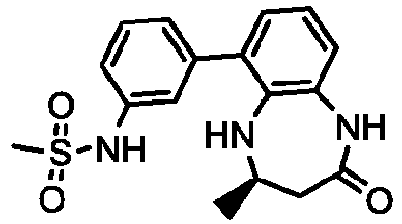
0.772 6.143 239 
0.790 17.448 240 
0.978 11.591 241 
0.661 2.512 242 
1.016 8.551 243 
0.681 6.215 244 
0.297 1.586 245 
0.155 1.252 246 
0.253 2.913 247 
0.607 3.350 248 
0.677 2.571 249 
0.435 1.511 250 
0.509 1.007 251 
0.275 13.481 252 
0.308 2.111 253 
0.503 15.395 254 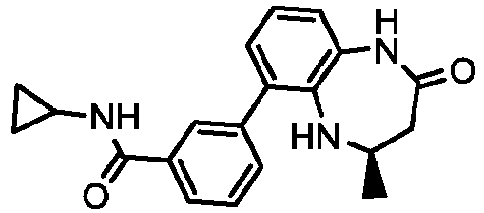
0.445 11.234 255 
0.477 8.546 256 
0.493 4.284 257 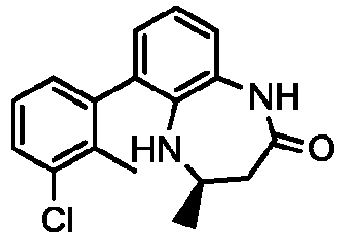
1.039 7.770 258 
0.495 10.771 259 
0.306 2.254 260 
0.113 2.626 261 
0.689 4.774 262 
0.351 3.926 263 
0.521 10.903 264 
0.335 14.346 265 
0.358 3.650 266 
0.425 6.216 267 
0.158 3.023 268 
0.317 3.379 269 
0.995 8.461 270 
0.311 11.572 271 
0.831 >19.7 272 
0.227 6.622 273 
0.561 6.398 274 
0.396 4.140 275 
0.431 7.530 276 
0.440 4.155 277 
0.119 278 
0.542 >19.7 279 
0.391 2.217 280 
0.387 13.946 281 
0.100 3.191 1.942 282 
0.156 10.615 3.909 283 
0.202 10.383 284 
0.176 10.514 285 
0.113 2.598 286 
0.045 1.722 287 
0.210 2.956 1.413 288 
0.268 7.646 289 
0.155 6.920 290 
0.014 3.24 0.376 291 
0.003 5.71 0.055 292 
0.004 4.80 0.029 293 
0.035 9.02 1.812 294 
0.009 2.98 0.950 295 
0.142 14.29 296 
0.009 4.71 0.152 297 
0.020 5.22 0.280 298 
0.040 14.71 0.969 299 
0.006 6.04 0.095 300 
0.012 8.19 0.147 301 
0.046 5.44 302 
0.010 5.30 0.168 303 
0.052 13.77 304 
0.003 3.11 0.047 305 
0.004 5.16 0.044 306 
0.003 4.36 0.009 307 
0.019 11.62 2.813 308 
0.003 3.24 0.311 309 
0.007 3.83 310 
0.015 10.03 311 
0.003 4.18 312 
0.009 4.05 0.222 - While a number of embodiments have been described, these examples may be altered to provide other embodiments that utilize the compounds and methods described herein. Therefore, the scope of this invention is to be defined by the appended claims rather than by the specific embodiments that have been represented by way of example.
Claims (15)
- A compound of formula (Ia), (Ib), (Ic), (Id), (Ie), or (If):
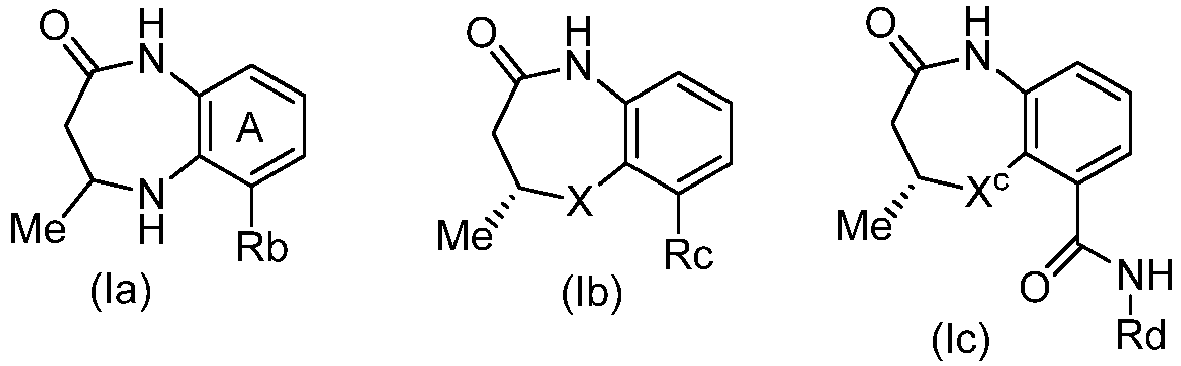
 Rb is methyl, ethyl, ethenyl, ethynyl,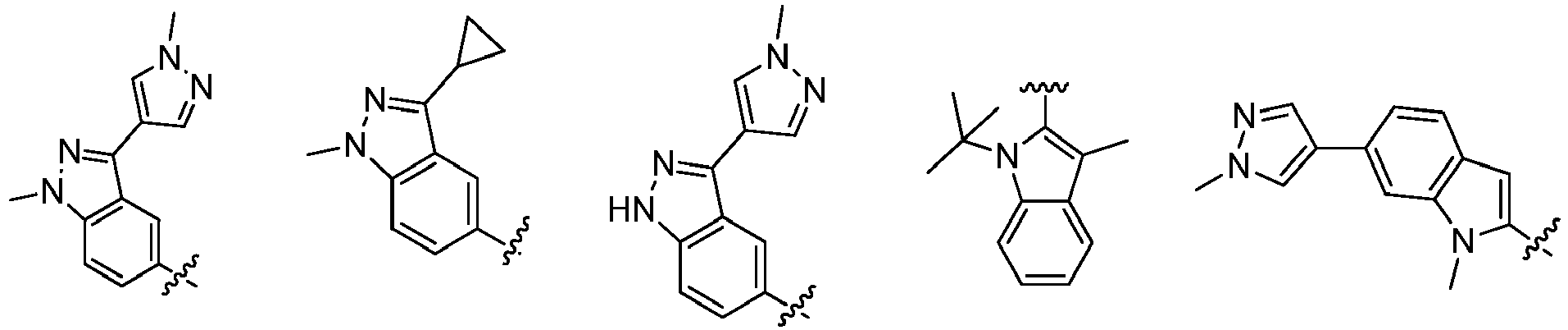


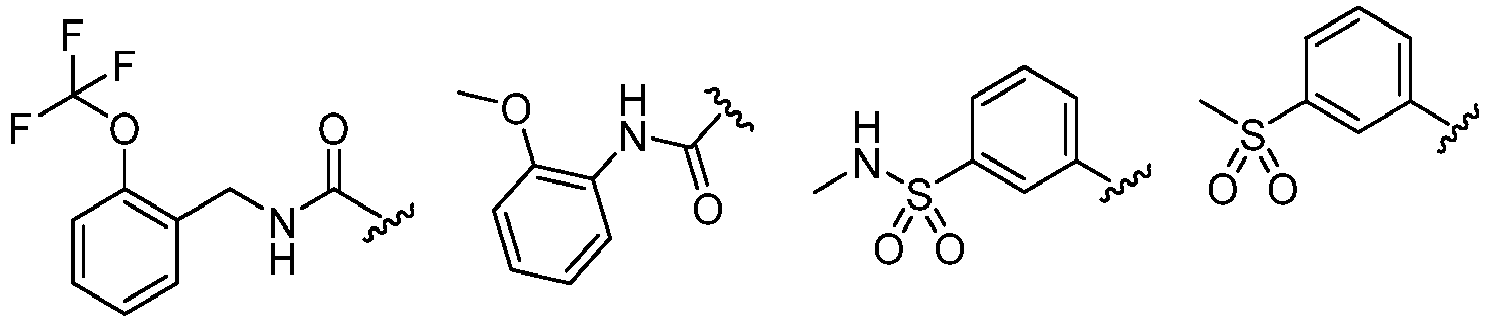

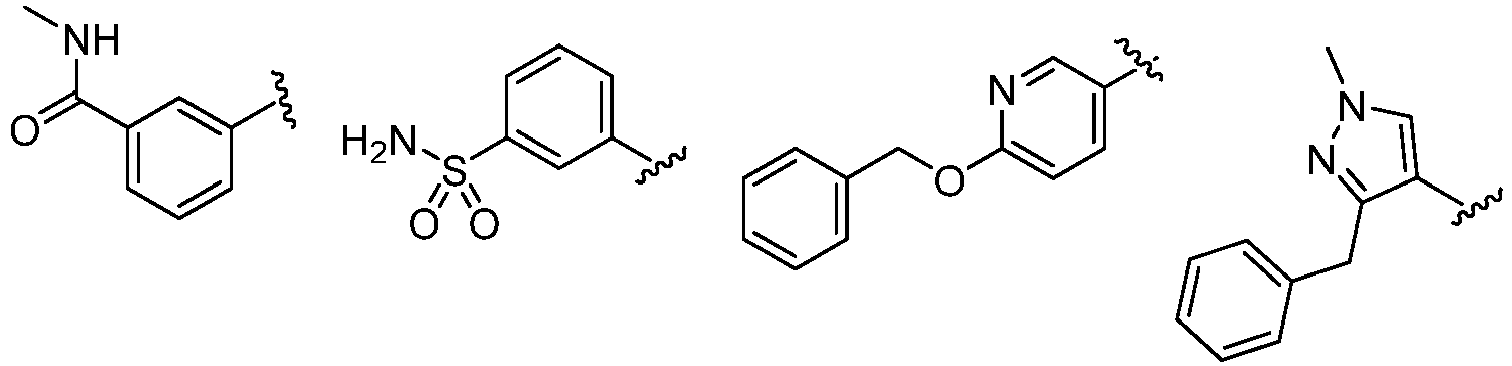






 X is NH, O, or -CH2-;Rc is C2-6alkenyl, C2-6alkynyl, 6-10 membered aryl, and 5-14 membered heteroaryl, wherein any C2-6alkenyl, C2-6alkynyl, 6-10 membered aryl, and 5-14 membered heteroaryl is optionally substituted with one or more groups Rf independently selected from the group consisting of oxo, 3-20 membered carbocyclyl, 3-20 membered heterocyclyl, halo, -NO2, -N(Rg)2, -CN, -C(O)-N(Rg)2, -S(O)-N(Rg)2, -S(O)2-N(Rg)2, -O-Rg, -S-Rg, -O-C(O)-Rg, -C(O)-Rg, -C(O)-O-Rg, -S(O)-Rg, -S(O)2-Rg, -C(O)-N(Rg)2, -N(Rg)-C(O)-Rg, -Si(Rh)3, -N(Rg)-C(O)-O-Rg, -N(Rg)-S(O)-Rg, N(Rg)-S(O)2-Rg, and C1-6alkyl, which 3-20 membered carbocyclyl, 3-20 membered heterocyclyl, and C1-6alkyl are optionally substituted with one or more groups Ri independently selected from the group consisting of oxo, halo, C1-6alkyl, cyano, -N(R1)2, -O-R1, -S(O)-R1, -S(O)2-R1, -S(O)-N(R1)2, -S(O)2-N(R1)2, -N(R1)-S(O)-R1, -N(R1)-C(O)-R1, -N(R1)-C(O)-O-R1, -N(R1)-S(O)2-R1, 3-20 membered heterocyclyl, and 3-20 membered carbocyclyl that is optionally substituted with one or more groups Rm independently selected from the group consisting of halo, and C1-6alkyl;each Rg is independently selected from the group consisting of hydrogen, C1-6alkyl, C2-6alkenyl, C2-6alkynyl, 3-20 membered carbocyclyl, and 3-20 membered heterocyclyl,wherein each C1-6alkyl, C2-6alkenyl, C2-6alkynyl, C1-6alkoxy, 3-20 membered carbocyclyl, and 3-20 membered heterocyclyl is optionally substituted with one or more groups Rj, or two Rg are taken together with the nitrogen to which they are attached to form a 3-20 membered heterocyclyl that is optionally substituted with one or more groups independently selected from the group consisting of oxo, halo and C1-3alkyl that is optionally substituted with one or more groups independently selected from the group consisting of oxo and halo;Rh is independently selected from the group consisting of H, C1-6alkyl, C2-6alkenyl, C2-6alkynyl, and C3-6carbocyclyl;each Rj is independently selected from the group consisting of oxo, halo, amino, hydroxyl, -Si(Rk)3, 3-20 membered carbocyclyl, 3-20 membered heterocyclyl, and C1-C6 alkyl, wherein any 3-20 membered carbocyclyl, 3-20 membered heterocyclyl, and C1-C6 alkyl is optionally substituted with one or more groups independently selected from the group consisting of oxo, C1-C4alkyl, and halo;each Rk is independently selected from the group consisting of H, C1-6alkyl, C2-6alkenyl, C2-6alkynyl, and C3-6carbocyclyl;each R1 is independently selected from the group consisting of hydrogen, C1-6alkyl, C2-6alkenyl, C2-6alkynyl, 3-20 membered carbocyclyl, and 3-20 membered heterocyclyl,wherein each C1-6alkyl, C2-6alkenyl, C2-6alkynyl, C1-6alkoxy, 3-20 membered carbocyclyl, and 3-20 membered heterocyclyl is optionally substituted with one or more groups Rm; or two R1 are taken together with the nitrogen to which they are attached to form a 3-20 membered heterocyclyl that is optionally substituted with one or more groups independently selected from the group consisting of oxo, halo and C1-3alkyl that is optionally substituted with one or more groups independently selected from the group consisting of oxo and halo; andXc is NH or O;Rd is C1-6alkyl, 6-10 membered aryl, or 5-10 membered heteroaryl, wherein each C1-6alkyl, 6-10 membered aryl, or 5-10 membered heteroaryl is optionally substituted with one or more groups Ro independently selected from the group consisting of oxo, halo, amino, hydroxyl, cyano, -O-Rp, 3-20 membered carbocyclyl, 3-20 membered heterocyclyl, and C1-C6 alkyl, wherein any C1-C6 alkyl, 3-20 membered carbocyclyl and 3-20 membered heterocyclyl is optionally substituted with one or more groups independently selected from the group consisting of oxo, C1-C4 alkyl, -O-Rq, and halo;Rp is independently selected from the group consisting of hydrogen, C1-6alkyl, C2-6alkenyl, C2-6alkynyl, 3-20 membered carbocyclyl, and 3-20 membered heterocyclyl, wherein each C1-6alkyl, C2-6alkenyl, C2-6alkynyl, C1-6alkoxy, 3-20 membered carbocyclyl, and 3-20 membered heterocyclyl is optionally substituted with one or more halo;Rq is C1-6alkyl is optionally substituted with one or more halo;Rcd is -(6-10 membered aryl)-Y, -(6-10 membered aryl)-Y, or 5-14 membered heteroaryl, wherein any 6-10 membered aryl and 5-14 membered heteroaryl is optionally substituted with one or more groups independently selected from the group consisting of oxo, 3-20 membered carbocyclyl, 3-20 membered heterocyclyl, halo, -NO2, -N(Rg)2, -CN, -C(O)-N(Rg)2, -S(O)-N(Rg)2, -S(O)2-N(Rg)2, -O-Rg, -S-Rg, -O-C(O)-Rg, -C(O)-Rg, -C(O)-O-Rg, -S(O)-Rg, -S(O)2-Rg, -C(O)-N(Rg)2, -N(Rg)-C(O)-Rg, -Si(Rh)3, -N(Rg)-C(O)-O-Rg, -N(Rg)-S(O)-Rg, N(Rg)-S(O)2-Rg, and C1-6alkyl, which 3-20 membered carbocyclyl, 3-20 membered heterocyclyl, and C1-6alkyl are optionally substituted with one or more groups Ri;Y is (6-10 membered aryl) or (5-14 membered heteroaryl) optionally substituted with one or more groups Ri;each Rid is independently selected from the group consisting of oxo, halo, C1-6alkyl, cyano, -N(Rld)2, -O-Rld, -S(O)-Rld, -S(O)2-Rld, -S(O)-N(Rld)2, -S(O)2-N(Rld)2, -N(Rld)-S(O)-Rld, -N(Rld)-C(O)-Rld, -N(Rld)-C(O)-O-Rld, -N(Rld)-S(O)2-Rld, 3-20 membered heterocyclyl, and 3-20 membered carbocyclyl that is optionally substituted with one or more groups independently selected from the group consisting of halo, and C1-6alkyl;each Rld is independently selected from the group consisting of hydrogen, C1-6alkyl, C2-6alkenyl, C2-6alkynyl, 3-20 membered carbocyclyl, and 3-20 membered heterocyclyl, wherein each C1-6alkyl, C2-6alkenyl, C2-6alkynyl, C1-6alkoxy, 3-20 membered carbocyclyl, and 3-20 membered heterocyclyl is optionally substituted with one or more groups Rmd;each Rmd is independently selected from the group consisting of oxo, halo, amino, hydroxyl, -Si(Rnd)3, 3-20 membered carbocyclyl, 3-20 membered heterocyclyl, and C1-C6 alkyl, wherein any 3-20 membered carbocyclyl, 3-20 membered heterocyclyl, and C1-C6 alkyl is optionally substituted with one or more groups independently selected from the group consisting of oxo, C1-C4alkyl, and halo; andeach Rnd is independently selected from the group consisting of H, C1-6alkyl, C2-6alkenyl, C2-6alkynyl, and C3-6carbocyclyl;one of D, E, and F is N and the remaining of D, E, and F are CH; andRbe is 6-10 membered aryl or 5-14 membered heteroaryl, wherein any 6-10 membered aryl and 5-14 membered heteroaryl is optionally substituted with one or more groups independently selected from the group consisting of oxo, 3-20 membered carbocyclyl, 3-20 membered heterocyclyl, halo, -NO2, -N(Rg)2, -CN, -C(O)-N(Rg)2, -S(O)-N(Rg)2, -S(O)2-N(Rg)2, -O-Rg, -S-Rg, -O-C(O)-Rg, -C(O)-Rg, -C(O)-O-Rg, -S(O)-Rg, -S(O)2-Rg, -C(O)-N(Rg)2, -N(Rg)-C(O)-Rg, -Si(Rh)3, -N(Rg)-C(O)-O-Rg, -N(Rg)-S(O)-Rg, N(Rg)-S(O)2-Rg, and C1-6alkyl, which 3-20 membered carbocyclyl, 3-20 membered heterocyclyl, and C1-6alkyl are optionally substituted with one or more groups independently selected from the group consisting of oxo, halo, C1-6alkyl, cyano, -N(R1)2, -O-R1, -S(O)-R1, -S(O)2-R1, -S(O)-N(R1)2,-S(O)2-N(R1)2, -N(R1)-S(O)-R1, -N(R1)-CO-R1, -N(R1)-C(O)-O-R1, -N(R1)-S(O)2-R1, 3-20 membered heterocyclyl, and 3-20 membered carbocyclyl that is optionally substituted with one or more groups independently selected from the group consisting of halo, and C1-6alkyl;Xf is NH, O, S, or -C(Raf)2-;each Raf is independently selected from the group consisting of H, C1-6alkyl, C2-6alkenyl, C2-6alkynyl, and C3-6carbocyclyl;Rbf is
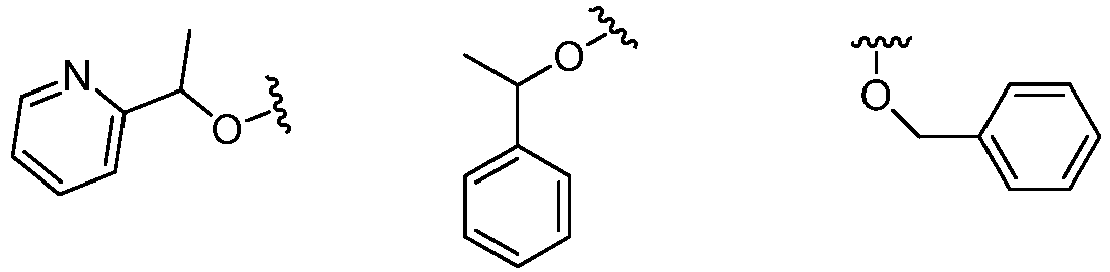


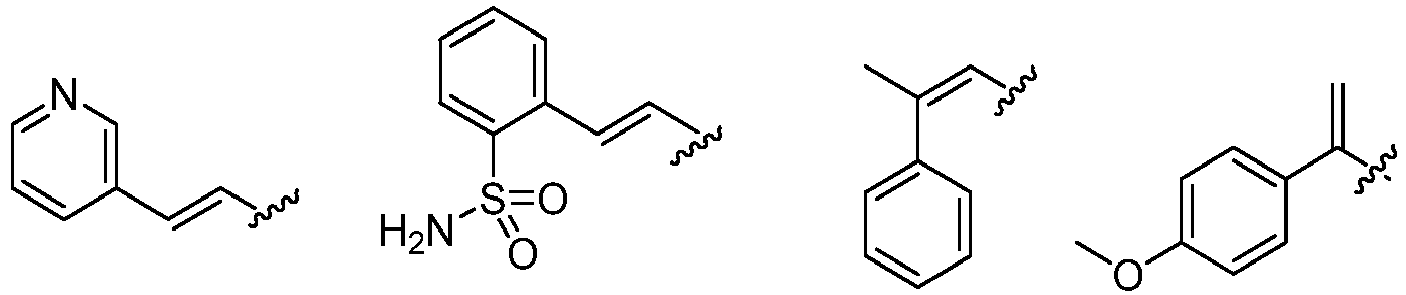


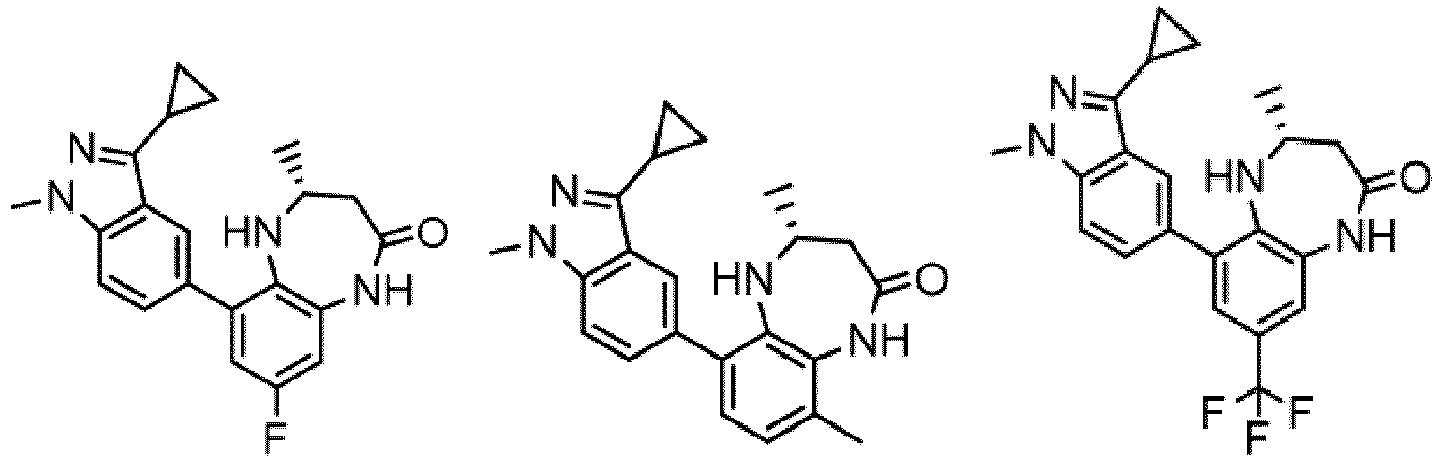
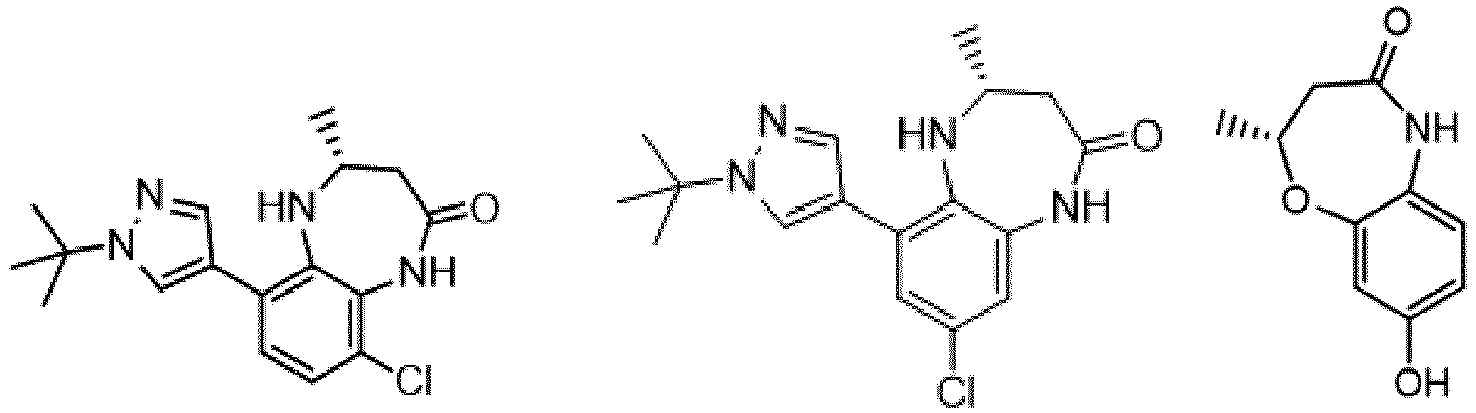

- The compound of claim 1 which is a compound of formula (Ia) or a salt thereof.
- The compound of claim 1 which is a compound of formula (Ib) or a salt thereof.
- The compound of claim 3 wherein Rc is:







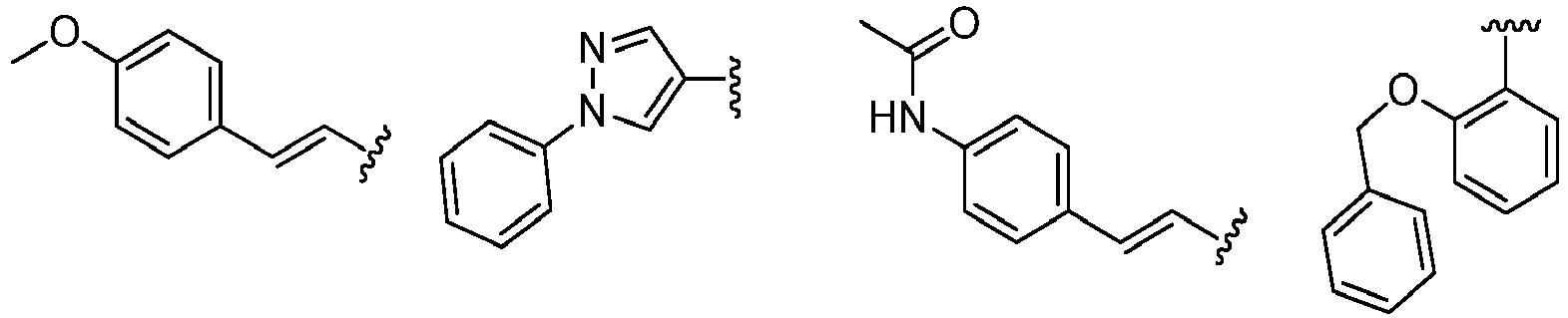


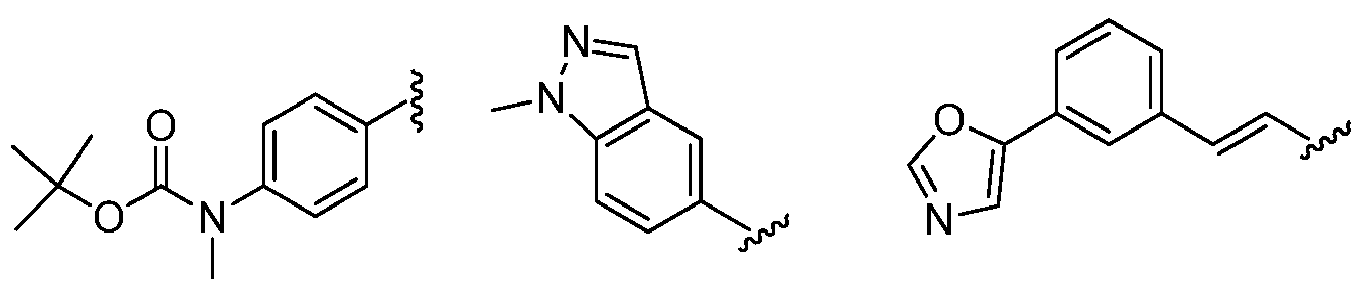


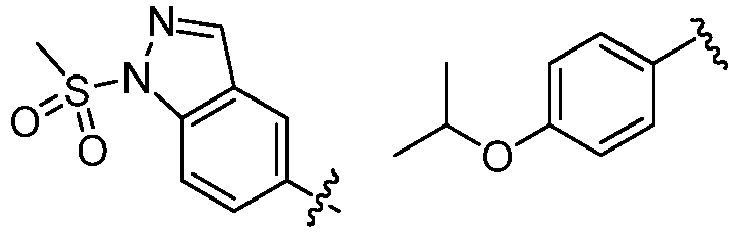


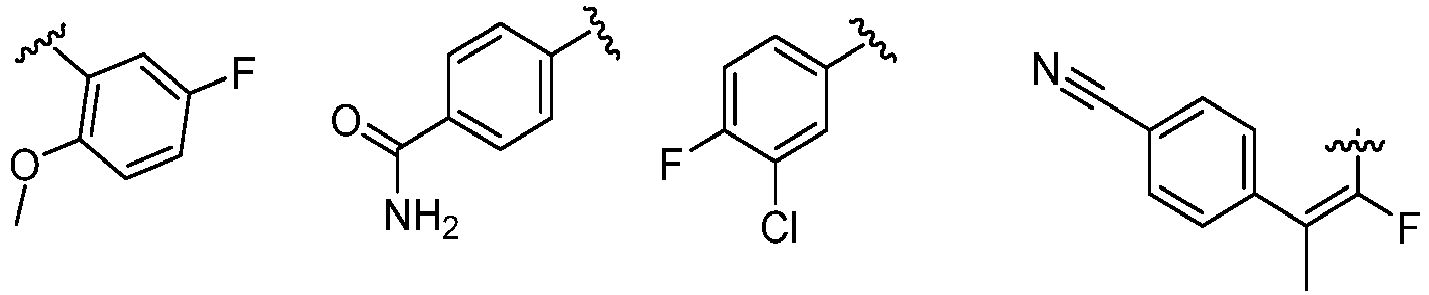


- The compound of claim 1 which is a compound of formula (Ic) or a salt thereof.
- The compound of claim 5 wherein Rd is:





- The compound of claim 1, which is a compound of formula (Id) or a salt thereof.
- The compound of claim 7 wherein Rcd is:





- The compound of claim 1 which is a compound of formula (Ie) or a salt thereof.
- The compound of claim 9 wherein Rbe is:





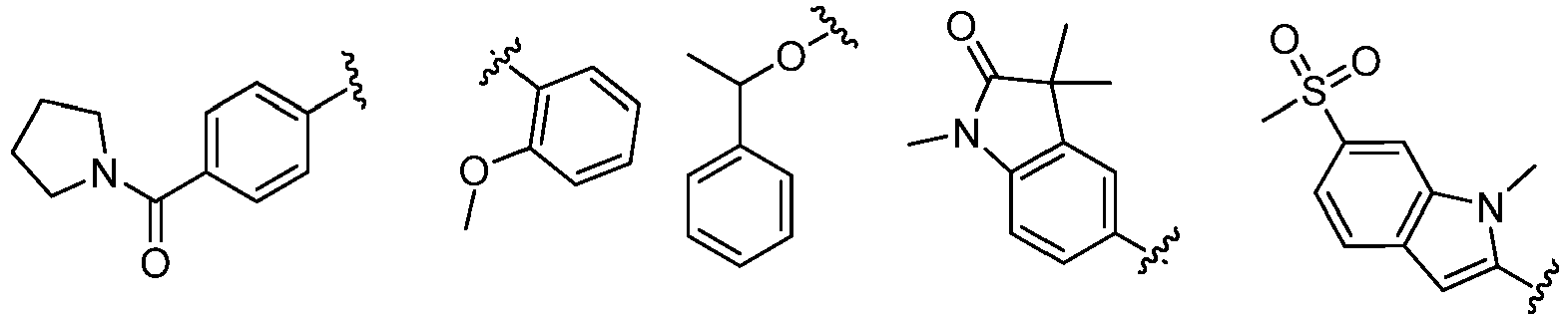


- The compound of claim 1 which is a compound of formula (If) or a salt thereof.
- The compound of claim 1 selected from the group consisting of:


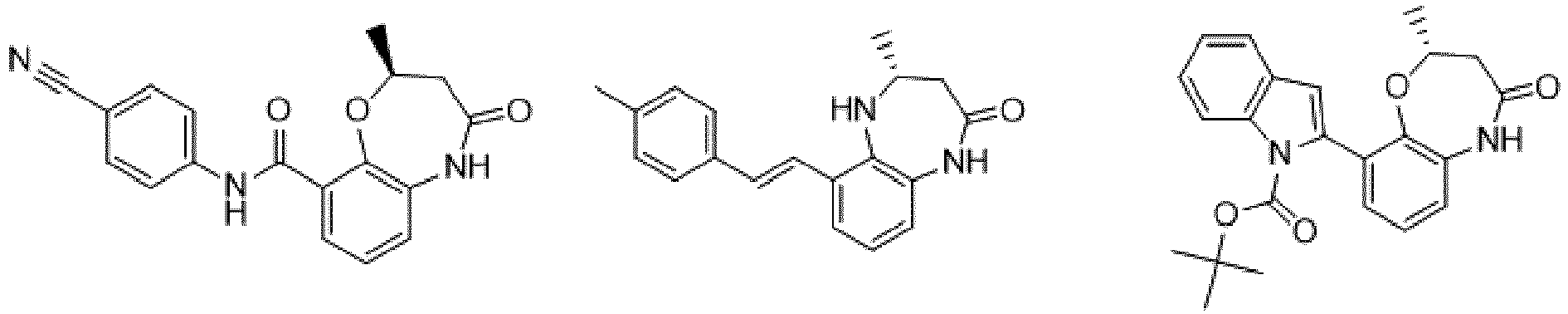







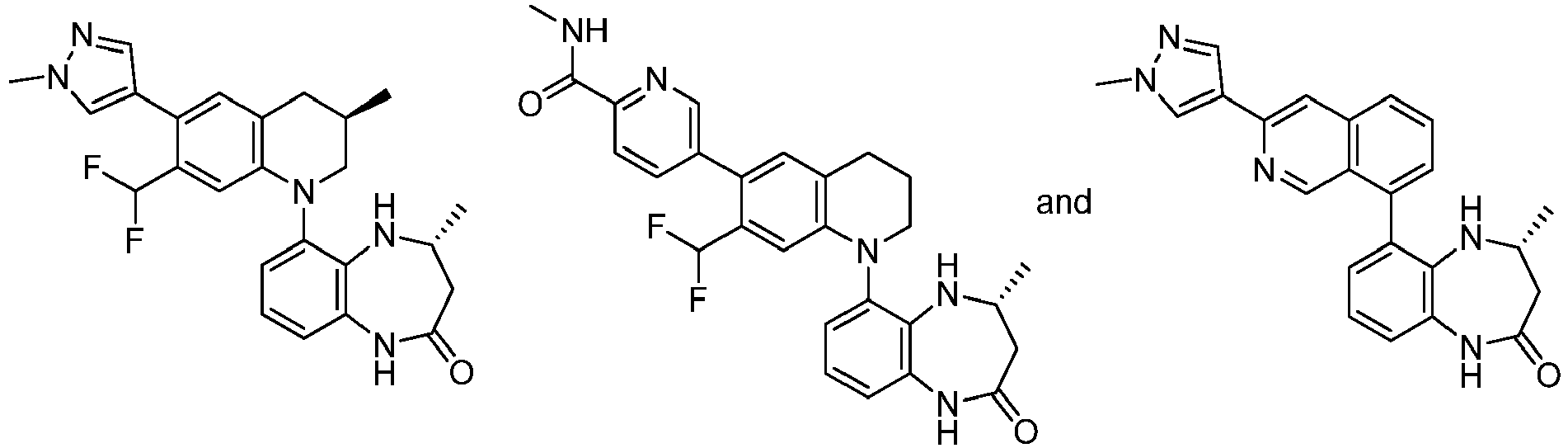
- A composition comprising a compound of formula (I) as described in any one of claims 1-12 or a pharmaceutically acceptable salt thereof, and a pharmaceutically acceptable adjuvant, carrier, or vehicle.
- A compound of formula (I) or a pharmaceutically acceptable salt thereof as described in any one of claims 1-12 for use in medical therapy.
- A compound of formula (I) or a pharmaceutically acceptable salt thereof as described in any one of claims 1-12 for use in the prophylactic or therapeutic treatment of cancer, an inflammatory disorder, or an autoimmune disease.
Applications Claiming Priority (2)
| Application Number | Priority Date | Filing Date | Title |
|---|---|---|---|
| CN2014088315 | 2014-10-10 | ||
| PCT/CN2015/091614 WO2016055028A1 (en) | 2014-10-10 | 2015-10-10 | Therapeutic compounds and uses thereof |
Publications (3)
| Publication Number | Publication Date |
|---|---|
| EP3204360A1 EP3204360A1 (en) | 2017-08-16 |
| EP3204360A4 EP3204360A4 (en) | 2018-03-28 |
| EP3204360B1 true EP3204360B1 (en) | 2020-08-26 |
Family
ID=55652608
Family Applications (1)
| Application Number | Title | Priority Date | Filing Date |
|---|---|---|---|
| EP15848282.8A Active EP3204360B1 (en) | 2014-10-10 | 2015-10-10 | Therapeutic compounds and uses thereof |
Country Status (5)
| Country | Link |
|---|---|
| US (1) | US10206931B2 (en) |
| EP (1) | EP3204360B1 (en) |
| JP (1) | JP6820254B2 (en) |
| CN (1) | CN107108512B (en) |
| WO (1) | WO2016055028A1 (en) |
Families Citing this family (31)
| Publication number | Priority date | Publication date | Assignee | Title |
|---|---|---|---|---|
| EP3218376B1 (en) * | 2014-11-10 | 2019-12-25 | Genentech, Inc. | Bromodomain inhibitors and uses thereof |
| SG10201913587WA (en) | 2016-02-05 | 2020-02-27 | Denali Therapeutics Inc | Inhibitors of receptor-interacting protein kinase 1 |
| WO2017205536A2 (en) * | 2016-05-24 | 2017-11-30 | Genentech, Inc. | Therapeutic compounds and uses thereof |
| AU2017302554A1 (en) | 2016-07-25 | 2019-01-31 | Epizyme, Inc. | CREBBP related cancer therapy |
| DK3552017T3 (en) | 2016-12-09 | 2022-05-16 | Denali Therapeutics Inc | COMPOUNDS USEFUL AS RIPK1 INHIBITORS |
| CN110291089B (en) | 2017-01-17 | 2022-05-27 | 海帕瑞吉尼克斯股份有限公司 | Protein kinase inhibitors for promoting liver regeneration or reducing or preventing liver cell death |
| CN107325092B (en) * | 2017-08-07 | 2021-01-08 | 山东鲁宁药业有限公司 | Novel preparation process of azithromycin |
| CN107643405B (en) * | 2017-09-19 | 2020-07-17 | 上海市肺科医院 | A kind of lung cancer diagnosis kit based on autoantibody detection and its application |
| WO2019070742A1 (en) * | 2017-10-03 | 2019-04-11 | Sidecar Therapeutics, Inc. | Apoptosis signal-regulating kinase 1 (ask 1) inhibitor compounds |
| AU2019245403B2 (en) | 2018-03-29 | 2025-02-06 | Board Of Regents, The University Of Texas System | Imidazopiperazine inhibitors of transcription activating proteins |
| WO2019195846A1 (en) | 2018-04-06 | 2019-10-10 | Board Of Regents, The University Of Texas System | Imidazopiperazinone inhibitors of transcription activating proteins |
| TWI850342B (en) * | 2019-02-27 | 2024-08-01 | 美商星座製藥公司 | P300/cbp hat inhibitors and methods for their use |
| WO2020173440A1 (en) * | 2019-02-27 | 2020-09-03 | Cullgen (Shanghai), Inc. | Cyclic-amp response element binding protein (cbp) and/or adenoviral e1a binding protein of 300 kda (p300) degradation compounds and methods of use |
| NZ780966A (en) | 2019-04-18 | 2026-02-27 | Univ Johns Hopkins | Substituted 2-amino-pyrazolyl-[1,2,4]triazolo[1,5a] pyridine derivatives and use thereof |
| CN114007652A (en) * | 2019-06-18 | 2022-02-01 | 达纳-法伯癌症研究公司 | Small molecule targeted bromo/acetyl protein and application thereof |
| CN110170052B (en) * | 2019-06-21 | 2020-07-10 | 复旦大学 | Application of CBP-P300 inhibitor in intestinal injury diseases |
| TW202120095A (en) * | 2019-08-05 | 2021-06-01 | 美商美國禮來大藥廠 | 7,8-dihydro-4h-pyrazolo[4,3-c]azepine-6-one compounds |
| JP2022549506A (en) | 2019-09-27 | 2022-11-25 | ディスク・メディシン・インコーポレイテッド | Methods for treating myelofibrosis and related conditions |
| WO2021213521A1 (en) * | 2020-04-25 | 2021-10-28 | 南京药石科技股份有限公司 | Cbp/ep300 inhibitor and use thereof |
| KR20230012539A (en) | 2020-05-13 | 2023-01-26 | 디스크 메디슨, 인크. | Anti-hemojuvelin (HJV) antibodies to treat myelofibrosis |
| JP2023529867A (en) | 2020-06-05 | 2023-07-12 | キネート バイオファーマ インク. | Inhibitor of fibroblast growth factor receptor kinase |
| WO2022015938A1 (en) * | 2020-07-15 | 2022-01-20 | Ifm Due, Inc. | Compounds and compositions for treating conditions associated with sting activity |
| CN116348112A (en) | 2020-10-02 | 2023-06-27 | 德州大学系统董事会 | imidazopiperazine inhibitors of transcriptional activators |
| JP2023544173A (en) | 2020-10-02 | 2023-10-20 | ボード オブ レジェンツ,ザ ユニバーシティ オブ テキサス システム | Imidazopiperazine inhibitor of transcriptional activating proteins |
| CN116710442A (en) * | 2021-01-12 | 2023-09-05 | 成都安泰康赛生物科技有限公司 | Compounds, compositions and methods for treating disorders |
| WO2022226172A1 (en) * | 2021-04-21 | 2022-10-27 | The Regents Of The University Of California | Compositions and methods for treating neurodegenerative diseases |
| US20240239768A1 (en) * | 2021-04-27 | 2024-07-18 | Lg Chem, Ltd. | Method for preparing xanthine oxidase inhibitor |
| AR126353A1 (en) * | 2021-07-02 | 2023-10-11 | Lg Chemical Ltd | METHOD FOR PREPARING INTERMEDIATE PRODUCTS TO SYNTHESIZE A XANTHINE OXIDASE INHIBITOR |
| PY2269135A (en) | 2021-08-10 | 2024-01-29 | Ifm Due Inc | COMPOUNDS AND COMPOSITIONS FOR TREATING CONDITIONS ASSOCIATED WITH STING'S ACTIVITY |
| CN118525007A (en) * | 2021-11-19 | 2024-08-20 | 成都安泰康赛生物科技有限公司 | 1H-Benzo[B]azepin-2(3H)-one compounds, compositions and methods for treating cancer |
| WO2023137035A1 (en) | 2022-01-12 | 2023-07-20 | Denali Therapeutics Inc. | Crystalline forms of (s)-5-benzyl-n-(5-methyl-4-oxo-2, 3,4,5- tetrahydropyrido [3,2-b] [l,4]oxazepin-3-yl)-4h-l,2,4-triazole-3-carboxamide |
Family Cites Families (7)
| Publication number | Priority date | Publication date | Assignee | Title |
|---|---|---|---|---|
| US3203952A (en) * | 1962-12-04 | 1965-08-31 | Upjohn Co | Chloromethylsulfonamides of cyclic diamines |
| US3361750A (en) * | 1963-03-21 | 1968-01-02 | Squibb & Sons Inc | Benzothiazepines |
| DE3800386A1 (en) * | 1988-01-09 | 1989-07-20 | Bayer Ag | METHOD FOR PRODUCING BENZOTHIAZEPINONE DERIVATIVES |
| JPWO2006051851A1 (en) * | 2004-11-10 | 2008-05-29 | わかもと製薬株式会社 | 2,3,4,5-Tetrahydro-1H-1,5-benzodiazepine derivative and pharmaceutical composition |
| DE102006051796A1 (en) * | 2006-11-03 | 2008-05-08 | Merck Patent Gmbh | Triaza-benzo [e] azulene derivatives |
| EP2705039B1 (en) * | 2011-05-04 | 2017-07-26 | Constellation Pharmaceuticals, Inc. | Bromodomain inhibitors and uses thereof |
| TWI530499B (en) * | 2013-03-28 | 2016-04-21 | 吉李德科學股份有限公司 | Benzimidazolone derivatives as bromodomain inhibitors |
-
2015
- 2015-10-10 CN CN201580066923.XA patent/CN107108512B/en active Active
- 2015-10-10 WO PCT/CN2015/091614 patent/WO2016055028A1/en not_active Ceased
- 2015-10-10 JP JP2017518804A patent/JP6820254B2/en not_active Expired - Fee Related
- 2015-10-10 EP EP15848282.8A patent/EP3204360B1/en active Active
-
2017
- 2017-04-07 US US15/482,581 patent/US10206931B2/en active Active
Non-Patent Citations (1)
| Title |
|---|
| None * |
Also Published As
| Publication number | Publication date |
|---|---|
| EP3204360A4 (en) | 2018-03-28 |
| WO2016055028A1 (en) | 2016-04-14 |
| US20170312292A1 (en) | 2017-11-02 |
| EP3204360A1 (en) | 2017-08-16 |
| JP6820254B2 (en) | 2021-01-27 |
| JP2017530176A (en) | 2017-10-12 |
| CN107108512A (en) | 2017-08-29 |
| CN107108512B (en) | 2021-05-04 |
| HK1243073A1 (en) | 2018-07-06 |
| US10206931B2 (en) | 2019-02-19 |
Similar Documents
| Publication | Publication Date | Title |
|---|---|---|
| US11168070B2 (en) | Therapeutic compounds and uses thereof | |
| US10206931B2 (en) | Therapeutic compounds and uses thereof | |
| EP3224258B1 (en) | 4,5,6,7-tetrahydro-1h-pyrazolo[4,3-c]pyridin-3-amine compounds as cbp and/or ep300 inhibitors | |
| EP3464286B1 (en) | Pyrazolopyridine derivatives for the treatment of cancer | |
| EP3218375B1 (en) | Substituted pyrrolopyrdines as inhibitors of bromodomain | |
| EP3218374B1 (en) | Substituted pyrrolopyridines as inhibitors of bromodomain | |
| EP3189049B1 (en) | Phthalazine derivatives of formula (i) as pcaf and gcn5 inhibitors for use in the treatment of cancer | |
| EP3189046B1 (en) | Therapeutic compounds and uses thereof | |
| EP3242874B1 (en) | Pyridazinone derivatives and their use in the treatment of cancer | |
| HK1243073B (en) | Therapeutic compounds and uses thereof | |
| HK1248695B (en) | 4,5,6,7-tetrahydro-1h-pyrazolo[4,3-c]pyridin-3-amine compounds as cbp and/or ep300 inhibitors |
Legal Events
| Date | Code | Title | Description |
|---|---|---|---|
| STAA | Information on the status of an ep patent application or granted ep patent |
Free format text: STATUS: THE INTERNATIONAL PUBLICATION HAS BEEN MADE |
|
| PUAI | Public reference made under article 153(3) epc to a published international application that has entered the european phase |
Free format text: ORIGINAL CODE: 0009012 |
|
| STAA | Information on the status of an ep patent application or granted ep patent |
Free format text: STATUS: REQUEST FOR EXAMINATION WAS MADE |
|
| 17P | Request for examination filed |
Effective date: 20170502 |
|
| AK | Designated contracting states |
Kind code of ref document: A1 Designated state(s): AL AT BE BG CH CY CZ DE DK EE ES FI FR GB GR HR HU IE IS IT LI LT LU LV MC MK MT NL NO PL PT RO RS SE SI SK SM TR |
|
| AX | Request for extension of the european patent |
Extension state: BA ME |
|
| A4 | Supplementary search report drawn up and despatched |
Effective date: 20180228 |
|
| RIC1 | Information provided on ipc code assigned before grant |
Ipc: A61K 31/551 20060101ALI20180222BHEP Ipc: C07D 267/14 20060101ALI20180222BHEP Ipc: A61K 31/554 20060101ALI20180222BHEP Ipc: C07D 281/10 20060101ALI20180222BHEP Ipc: A61P 29/00 20060101ALI20180222BHEP Ipc: A61K 31/553 20060101ALI20180222BHEP Ipc: A61P 37/00 20060101ALI20180222BHEP Ipc: C07D 243/12 20060101ALI20180222BHEP Ipc: A61P 35/00 20060101ALI20180222BHEP Ipc: C07D 223/16 20060101AFI20180222BHEP |
|
| STAA | Information on the status of an ep patent application or granted ep patent |
Free format text: STATUS: EXAMINATION IS IN PROGRESS |
|
| 17Q | First examination report despatched |
Effective date: 20190625 |
|
| GRAP | Despatch of communication of intention to grant a patent |
Free format text: ORIGINAL CODE: EPIDOSNIGR1 |
|
| STAA | Information on the status of an ep patent application or granted ep patent |
Free format text: STATUS: GRANT OF PATENT IS INTENDED |
|
| INTG | Intention to grant announced |
Effective date: 20200312 |
|
| GRAS | Grant fee paid |
Free format text: ORIGINAL CODE: EPIDOSNIGR3 |
|
| GRAA | (expected) grant |
Free format text: ORIGINAL CODE: 0009210 |
|
| STAA | Information on the status of an ep patent application or granted ep patent |
Free format text: STATUS: THE PATENT HAS BEEN GRANTED |
|
| AK | Designated contracting states |
Kind code of ref document: B1 Designated state(s): AL AT BE BG CH CY CZ DE DK EE ES FI FR GB GR HR HU IE IS IT LI LT LU LV MC MK MT NL NO PL PT RO RS SE SI SK SM TR |
|
| AX | Request for extension of the european patent |
Extension state: BA ME |
|
| REG | Reference to a national code |
Ref country code: DE Ref legal event code: R081 Ref document number: 602015058135 Country of ref document: DE Owner name: GENENTECH, INC., SOUTH SAN FRANCISCO, US Free format text: FORMER OWNERS: CONSTELLATION PHARMACEUTICALS, INC., CAMBRIDGE, MASS., US; GENENTECH, INC., SOUTH SAN FRANCISCO, CALIF., US Ref country code: DE Ref legal event code: R081 Ref document number: 602015058135 Country of ref document: DE Owner name: CONSTELLATION PHARMACEUTICALS, INC., CAMBRIDGE, US Free format text: FORMER OWNERS: CONSTELLATION PHARMACEUTICALS, INC., CAMBRIDGE, MASS., US; GENENTECH, INC., SOUTH SAN FRANCISCO, CALIF., US Ref country code: GB Ref legal event code: FG4D |
|
| REG | Reference to a national code |
Ref country code: CH Ref legal event code: EP |
|
| REG | Reference to a national code |
Ref country code: AT Ref legal event code: REF Ref document number: 1306241 Country of ref document: AT Kind code of ref document: T Effective date: 20200915 |
|
| REG | Reference to a national code |
Ref country code: IE Ref legal event code: FG4D |
|
| REG | Reference to a national code |
Ref country code: DE Ref legal event code: R096 Ref document number: 602015058135 Country of ref document: DE |
|
| REG | Reference to a national code |
Ref country code: LT Ref legal event code: MG4D |
|
| PG25 | Lapsed in a contracting state [announced via postgrant information from national office to epo] |
Ref country code: LT Free format text: LAPSE BECAUSE OF FAILURE TO SUBMIT A TRANSLATION OF THE DESCRIPTION OR TO PAY THE FEE WITHIN THE PRESCRIBED TIME-LIMIT Effective date: 20200826 Ref country code: HR Free format text: LAPSE BECAUSE OF FAILURE TO SUBMIT A TRANSLATION OF THE DESCRIPTION OR TO PAY THE FEE WITHIN THE PRESCRIBED TIME-LIMIT Effective date: 20200826 Ref country code: FI Free format text: LAPSE BECAUSE OF FAILURE TO SUBMIT A TRANSLATION OF THE DESCRIPTION OR TO PAY THE FEE WITHIN THE PRESCRIBED TIME-LIMIT Effective date: 20200826 Ref country code: PT Free format text: LAPSE BECAUSE OF FAILURE TO SUBMIT A TRANSLATION OF THE DESCRIPTION OR TO PAY THE FEE WITHIN THE PRESCRIBED TIME-LIMIT Effective date: 20201228 Ref country code: SE Free format text: LAPSE BECAUSE OF FAILURE TO SUBMIT A TRANSLATION OF THE DESCRIPTION OR TO PAY THE FEE WITHIN THE PRESCRIBED TIME-LIMIT Effective date: 20200826 Ref country code: GR Free format text: LAPSE BECAUSE OF FAILURE TO SUBMIT A TRANSLATION OF THE DESCRIPTION OR TO PAY THE FEE WITHIN THE PRESCRIBED TIME-LIMIT Effective date: 20201127 Ref country code: NO Free format text: LAPSE BECAUSE OF FAILURE TO SUBMIT A TRANSLATION OF THE DESCRIPTION OR TO PAY THE FEE WITHIN THE PRESCRIBED TIME-LIMIT Effective date: 20201126 Ref country code: BG Free format text: LAPSE BECAUSE OF FAILURE TO SUBMIT A TRANSLATION OF THE DESCRIPTION OR TO PAY THE FEE WITHIN THE PRESCRIBED TIME-LIMIT Effective date: 20201126 |
|
| REG | Reference to a national code |
Ref country code: NL Ref legal event code: MP Effective date: 20200826 |
|
| REG | Reference to a national code |
Ref country code: AT Ref legal event code: MK05 Ref document number: 1306241 Country of ref document: AT Kind code of ref document: T Effective date: 20200826 |
|
| PG25 | Lapsed in a contracting state [announced via postgrant information from national office to epo] |
Ref country code: RS Free format text: LAPSE BECAUSE OF FAILURE TO SUBMIT A TRANSLATION OF THE DESCRIPTION OR TO PAY THE FEE WITHIN THE PRESCRIBED TIME-LIMIT Effective date: 20200826 Ref country code: PL Free format text: LAPSE BECAUSE OF FAILURE TO SUBMIT A TRANSLATION OF THE DESCRIPTION OR TO PAY THE FEE WITHIN THE PRESCRIBED TIME-LIMIT Effective date: 20200826 Ref country code: NL Free format text: LAPSE BECAUSE OF FAILURE TO SUBMIT A TRANSLATION OF THE DESCRIPTION OR TO PAY THE FEE WITHIN THE PRESCRIBED TIME-LIMIT Effective date: 20200826 Ref country code: LV Free format text: LAPSE BECAUSE OF FAILURE TO SUBMIT A TRANSLATION OF THE DESCRIPTION OR TO PAY THE FEE WITHIN THE PRESCRIBED TIME-LIMIT Effective date: 20200826 Ref country code: IS Free format text: LAPSE BECAUSE OF FAILURE TO SUBMIT A TRANSLATION OF THE DESCRIPTION OR TO PAY THE FEE WITHIN THE PRESCRIBED TIME-LIMIT Effective date: 20201226 |
|
| PG25 | Lapsed in a contracting state [announced via postgrant information from national office to epo] |
Ref country code: RO Free format text: LAPSE BECAUSE OF FAILURE TO SUBMIT A TRANSLATION OF THE DESCRIPTION OR TO PAY THE FEE WITHIN THE PRESCRIBED TIME-LIMIT Effective date: 20200826 Ref country code: SM Free format text: LAPSE BECAUSE OF FAILURE TO SUBMIT A TRANSLATION OF THE DESCRIPTION OR TO PAY THE FEE WITHIN THE PRESCRIBED TIME-LIMIT Effective date: 20200826 Ref country code: EE Free format text: LAPSE BECAUSE OF FAILURE TO SUBMIT A TRANSLATION OF THE DESCRIPTION OR TO PAY THE FEE WITHIN THE PRESCRIBED TIME-LIMIT Effective date: 20200826 Ref country code: CZ Free format text: LAPSE BECAUSE OF FAILURE TO SUBMIT A TRANSLATION OF THE DESCRIPTION OR TO PAY THE FEE WITHIN THE PRESCRIBED TIME-LIMIT Effective date: 20200826 Ref country code: DK Free format text: LAPSE BECAUSE OF FAILURE TO SUBMIT A TRANSLATION OF THE DESCRIPTION OR TO PAY THE FEE WITHIN THE PRESCRIBED TIME-LIMIT Effective date: 20200826 |
|
| REG | Reference to a national code |
Ref country code: DE Ref legal event code: R097 Ref document number: 602015058135 Country of ref document: DE |
|
| PG25 | Lapsed in a contracting state [announced via postgrant information from national office to epo] |
Ref country code: ES Free format text: LAPSE BECAUSE OF FAILURE TO SUBMIT A TRANSLATION OF THE DESCRIPTION OR TO PAY THE FEE WITHIN THE PRESCRIBED TIME-LIMIT Effective date: 20200826 Ref country code: AT Free format text: LAPSE BECAUSE OF FAILURE TO SUBMIT A TRANSLATION OF THE DESCRIPTION OR TO PAY THE FEE WITHIN THE PRESCRIBED TIME-LIMIT Effective date: 20200826 Ref country code: AL Free format text: LAPSE BECAUSE OF FAILURE TO SUBMIT A TRANSLATION OF THE DESCRIPTION OR TO PAY THE FEE WITHIN THE PRESCRIBED TIME-LIMIT Effective date: 20200826 |
|
| VS25 | Lapsed in a validation state [announced via postgrant information from nat. office to epo] |
Ref country code: MA Free format text: LAPSE BECAUSE OF FAILURE TO SUBMIT A TRANSLATION OF THE DESCRIPTION OR TO PAY THE FEE WITHIN THE PRESCRIBED TIME-LIMIT Effective date: 20200826 |
|
| PG25 | Lapsed in a contracting state [announced via postgrant information from national office to epo] |
Ref country code: MC Free format text: LAPSE BECAUSE OF FAILURE TO SUBMIT A TRANSLATION OF THE DESCRIPTION OR TO PAY THE FEE WITHIN THE PRESCRIBED TIME-LIMIT Effective date: 20200826 Ref country code: SK Free format text: LAPSE BECAUSE OF FAILURE TO SUBMIT A TRANSLATION OF THE DESCRIPTION OR TO PAY THE FEE WITHIN THE PRESCRIBED TIME-LIMIT Effective date: 20200826 Ref country code: LU Free format text: LAPSE BECAUSE OF NON-PAYMENT OF DUE FEES Effective date: 20201010 |
|
| PLBE | No opposition filed within time limit |
Free format text: ORIGINAL CODE: 0009261 |
|
| STAA | Information on the status of an ep patent application or granted ep patent |
Free format text: STATUS: NO OPPOSITION FILED WITHIN TIME LIMIT |
|
| REG | Reference to a national code |
Ref country code: BE Ref legal event code: MM Effective date: 20201031 |
|
| PG25 | Lapsed in a contracting state [announced via postgrant information from national office to epo] |
Ref country code: IT Free format text: LAPSE BECAUSE OF FAILURE TO SUBMIT A TRANSLATION OF THE DESCRIPTION OR TO PAY THE FEE WITHIN THE PRESCRIBED TIME-LIMIT Effective date: 20200826 |
|
| 26N | No opposition filed |
Effective date: 20210527 |
|
| PG25 | Lapsed in a contracting state [announced via postgrant information from national office to epo] |
Ref country code: SI Free format text: LAPSE BECAUSE OF FAILURE TO SUBMIT A TRANSLATION OF THE DESCRIPTION OR TO PAY THE FEE WITHIN THE PRESCRIBED TIME-LIMIT Effective date: 20200826 Ref country code: BE Free format text: LAPSE BECAUSE OF NON-PAYMENT OF DUE FEES Effective date: 20201031 |
|
| PG25 | Lapsed in a contracting state [announced via postgrant information from national office to epo] |
Ref country code: IE Free format text: LAPSE BECAUSE OF NON-PAYMENT OF DUE FEES Effective date: 20201010 |
|
| PG25 | Lapsed in a contracting state [announced via postgrant information from national office to epo] |
Ref country code: TR Free format text: LAPSE BECAUSE OF FAILURE TO SUBMIT A TRANSLATION OF THE DESCRIPTION OR TO PAY THE FEE WITHIN THE PRESCRIBED TIME-LIMIT Effective date: 20200826 Ref country code: MT Free format text: LAPSE BECAUSE OF FAILURE TO SUBMIT A TRANSLATION OF THE DESCRIPTION OR TO PAY THE FEE WITHIN THE PRESCRIBED TIME-LIMIT Effective date: 20200826 Ref country code: CY Free format text: LAPSE BECAUSE OF FAILURE TO SUBMIT A TRANSLATION OF THE DESCRIPTION OR TO PAY THE FEE WITHIN THE PRESCRIBED TIME-LIMIT Effective date: 20200826 |
|
| PG25 | Lapsed in a contracting state [announced via postgrant information from national office to epo] |
Ref country code: MK Free format text: LAPSE BECAUSE OF FAILURE TO SUBMIT A TRANSLATION OF THE DESCRIPTION OR TO PAY THE FEE WITHIN THE PRESCRIBED TIME-LIMIT Effective date: 20200826 |
|
| PGFP | Annual fee paid to national office [announced via postgrant information from national office to epo] |
Ref country code: GB Payment date: 20240919 Year of fee payment: 10 |
|
| PGFP | Annual fee paid to national office [announced via postgrant information from national office to epo] |
Ref country code: FR Payment date: 20240919 Year of fee payment: 10 |
|
| PGFP | Annual fee paid to national office [announced via postgrant information from national office to epo] |
Ref country code: DE Payment date: 20240919 Year of fee payment: 10 |
|
| PGFP | Annual fee paid to national office [announced via postgrant information from national office to epo] |
Ref country code: CH Payment date: 20241101 Year of fee payment: 10 |