EP3203442B1 - Blockbasierte inhalt-adaptive reshaping für hdr bilder - Google Patents
Blockbasierte inhalt-adaptive reshaping für hdr bilder Download PDFInfo
- Publication number
- EP3203442B1 EP3203442B1 EP17154335.8A EP17154335A EP3203442B1 EP 3203442 B1 EP3203442 B1 EP 3203442B1 EP 17154335 A EP17154335 A EP 17154335A EP 3203442 B1 EP3203442 B1 EP 3203442B1
- Authority
- EP
- European Patent Office
- Prior art keywords
- input
- codewords
- denotes
- bit depth
- values
- Prior art date
- Legal status (The legal status is an assumption and is not a legal conclusion. Google has not performed a legal analysis and makes no representation as to the accuracy of the status listed.)
- Active
Links
Images



Classifications
-
- G—PHYSICS
- G06—COMPUTING OR CALCULATING; COUNTING
- G06T—IMAGE DATA PROCESSING OR GENERATION, IN GENERAL
- G06T5/00—Image enhancement or restoration
- G06T5/90—Dynamic range modification of images or parts thereof
- G06T5/92—Dynamic range modification of images or parts thereof based on global image properties
-
- G—PHYSICS
- G06—COMPUTING OR CALCULATING; COUNTING
- G06T—IMAGE DATA PROCESSING OR GENERATION, IN GENERAL
- G06T5/00—Image enhancement or restoration
- G06T5/20—Image enhancement or restoration using local operators
-
- G—PHYSICS
- G06—COMPUTING OR CALCULATING; COUNTING
- G06T—IMAGE DATA PROCESSING OR GENERATION, IN GENERAL
- G06T7/00—Image analysis
- G06T7/10—Segmentation; Edge detection
- G06T7/11—Region-based segmentation
-
- G—PHYSICS
- G06—COMPUTING OR CALCULATING; COUNTING
- G06T—IMAGE DATA PROCESSING OR GENERATION, IN GENERAL
- G06T7/00—Image analysis
- G06T7/90—Determination of colour characteristics
-
- G—PHYSICS
- G06—COMPUTING OR CALCULATING; COUNTING
- G06T—IMAGE DATA PROCESSING OR GENERATION, IN GENERAL
- G06T9/00—Image coding
-
- G—PHYSICS
- G06—COMPUTING OR CALCULATING; COUNTING
- G06T—IMAGE DATA PROCESSING OR GENERATION, IN GENERAL
- G06T2207/00—Indexing scheme for image analysis or image enhancement
- G06T2207/10—Image acquisition modality
- G06T2207/10016—Video; Image sequence
-
- G—PHYSICS
- G06—COMPUTING OR CALCULATING; COUNTING
- G06T—IMAGE DATA PROCESSING OR GENERATION, IN GENERAL
- G06T2207/00—Indexing scheme for image analysis or image enhancement
- G06T2207/10—Image acquisition modality
- G06T2207/10024—Color image
-
- G—PHYSICS
- G06—COMPUTING OR CALCULATING; COUNTING
- G06T—IMAGE DATA PROCESSING OR GENERATION, IN GENERAL
- G06T2207/00—Indexing scheme for image analysis or image enhancement
- G06T2207/20—Special algorithmic details
- G06T2207/20004—Adaptive image processing
- G06T2207/20008—Globally adaptive
-
- G—PHYSICS
- G06—COMPUTING OR CALCULATING; COUNTING
- G06T—IMAGE DATA PROCESSING OR GENERATION, IN GENERAL
- G06T2207/00—Indexing scheme for image analysis or image enhancement
- G06T2207/20—Special algorithmic details
- G06T2207/20021—Dividing image into blocks, subimages or windows
-
- G—PHYSICS
- G06—COMPUTING OR CALCULATING; COUNTING
- G06T—IMAGE DATA PROCESSING OR GENERATION, IN GENERAL
- G06T2207/00—Indexing scheme for image analysis or image enhancement
- G06T2207/20—Special algorithmic details
- G06T2207/20024—Filtering details
-
- G—PHYSICS
- G06—COMPUTING OR CALCULATING; COUNTING
- G06T—IMAGE DATA PROCESSING OR GENERATION, IN GENERAL
- G06T2207/00—Indexing scheme for image analysis or image enhancement
- G06T2207/20—Special algorithmic details
- G06T2207/20172—Image enhancement details
- G06T2207/20208—High dynamic range [HDR] image processing
Definitions
- the present invention relates generally to images. More particularly, an embodiment of the present invention relates to block-based content-adaptive reshaping of images with high dynamic range.
- ⁇ dynamic range' may relate to a capability of the human visual system (HVS) to perceive a range of intensity (e.g., luminance, luma) in an image, e.g., from darkest grays (blacks) to brightest whites (highlights).
- HVS human visual system
- DR relates to a 'scene-referred' intensity.
- DR may also relate to the ability of a display device to adequately or approximately render an intensity range of a particular breadth. In this sense, DR relates to a 'display-referred' intensity.
- the term may be used in either sense, e.g. interchangeably.
- high dynamic range relates to a DR breadth that spans the some 14-15 orders of magnitude of the human visual system (HVS).
- HVS human visual system
- EDR enhanced dynamic range
- VDR visual dynamic range
- EDR may individually or interchangeably relate to the DR that is perceivable within a scene or image by a human visual system (HVS) that includes eye movements, allowing for some light adaptation changes across the scene or image.
- EDR may relate to a DR that spans 5 to 6 orders of magnitude.
- HDR high dynamic range
- n ⁇ 8 e.g., color 24-bit JPEG images
- images where n > 8 may be considered images of enhanced dynamic range.
- EDR and HDR images may also be stored and distributed using high-precision (e.g., 16-bit) floating-point formats, such as the OpenEXR file format developed by Industrial Light and Magic.
- a reference electro-optical transfer function (EOTF) for a given display characterizes the relationship between color values (e.g., luminance) of an input video signal to output screen color values (e.g., screen luminance) produced by the display.
- color values e.g., luminance
- screen color values e.g., screen luminance
- ITU Rec. ITU-R BT. 1886 "Reference electro-optical transfer function for flat panel displays used in HDTV studio production," (03/2011), which is included herein by reference in its entity, defines the reference EOTF for flat panel displays based on measured characteristics of the Cathode Ray Tube (CRT). Given a video stream, information about its EOTF is typically embedded in the bit stream as metadata.
- Metadata relates to any auxiliary information that is transmitted as part of the coded bitstream and assists a decoder to render a decoded image.
- metadata may include, but are not limited to, color space or gamut information, reference display parameters, and auxiliary signal parameters, as those described herein.
- HDR lower dynamic range
- SDR standard dynamic range
- HDR content may be color graded and displayed on HDR displays that support higher dynamic ranges (e.g., from 1,000 nits to 5,000 nits or more).
- Such displays may be defined using alternative EOTFs that support high luminance capability (e.g., 0 to 10,000 nits).
- An example of such an EOTF is defined in SMPTE ST 2084:2014 "High Dynamic Range EOTF of Mastering Reference Displays ,” which is incorporated herein by reference in its entirety.
- the methods of the present disclosure relate to any dynamic range higher than SDR.
- the term "forward reshaping" denotes the process of mapping (or quantizing) an HDR image from its original bit depth to an image of a lower or the same bit depth to allow compressing the image using existing coding standards or devices.
- the receiver may apply an inverse reshaping function to restore the signal to its original high dynamic range.
- improved techniques for image reshaping of high-dynamic range images are desired.
- WO 2014/204865 A1 discloses an encoder that receives an input enhanced dynamic range (EDR) image to be coded in a layered representation.
- Input images may be gamma-coded or perceptually-coded using a bit-depth format not supported by one or more video encoders.
- the input image is remapped to one or more quantized layers to generate output code words suitable for compression using the available video encoders.
- Algorithms to determine optimum function parameters for linear and non-linear mapping functions are presented. Given a mapping function, the reverse mapping function may be transmitted to a decoder as a look-up table or it may be approximated using a piecewise polynomial approximation.
- a polynomial approximation technique for representing reverse-mapping functions and chromaticity translation schemes to reduce color shifts are also presented.
- HDR high dynamic range
- Example embodiments described herein relate to block-based image reshaping of HDR images.
- a processor for signal reshaping receives an input image with an input bit depth. The image is divided in to blocks and a metric of complexity of each block (such as, its standard deviation) is computed.
- the input codewords are divided into codeword bins and each bin is assigned a metric of complexity value. For each bin, a metric of complexity to bit-depth function is applied to the bin values to generate minimal bit depth values for each codeword bin.
- An output codeword mapping function is generated based on the input bit depth, a target bit depth, and the minimal bit depth values. The codeword mapping function is applied to the input image to generate an output image in the target bit depth.
- the measure of complexity comprises computing the standard deviation of image blocks.
- FIG. 1A depicts an example process of a conventional video delivery pipeline (100) showing various stages from video capture to video content display.
- a sequence of video frames (102) is captured or generated using image generation block (105).
- Video frames (102) may be digitally captured (e.g. by a digital camera) or generated by a computer (e.g. using computer animation) to provide video data (107).
- video frames (102) may be captured on film by a film camera. The film is converted to a digital format to provide video data (107).
- a production phase (110) video data (107) is edited to provide a video production stream (112).
- Block (115) post-production editing may include adjusting or modifying colors or brightness in particular areas of an image to enhance the image quality or achieve a particular appearance for the image in accordance with the video creator's creative intent. This is sometimes called "color timing" or "color grading.”
- Other editing e.g. scene selection and sequencing, image cropping, addition of computer-generated visual special effects, etc.
- video images are viewed on a reference display (125).
- video data of final production (117) may be delivered to encoding block (120) for delivering downstream to decoding and playback devices such as television sets, set-top boxes, movie theaters, and the like.
- coding block (120) may include audio and video encoders, such as those defined by ATSC, DVB, DVD, Blu-Ray, and other delivery formats, to generate coded bit stream (122).
- the coded bit stream (122) is decoded by decoding unit (130) to generate a decoded signal (132) representing an identical or close approximation of signal (117).
- the receiver may be attached to a target display (140) which may have completely different characteristics than the reference display (125).
- a display management block (135) may be used to map the dynamic range of decoded signal (132) to the characteristics of the target display (140) by generating display-mapped signal (137).
- SDI Serial Digital Interface
- H.264 or AVC
- H.265 or HEVC
- PQ perceptual luminance amplitude quantization.
- the human visual system responds to increasing light levels in a very non-linear way. A human's ability to see a stimulus is affected by the luminance of that stimulus, the size of the stimulus, the spatial frequencies making up the stimulus, and the luminance level that the eyes have adapted to at the particular moment one is viewing the stimulus.
- a perceptual quantizer function maps linear input gray levels to output gray levels that better match the contrast sensitivity thresholds in the human visual system.
- An example PQ mapping function is described in SMPTE ST 2084:2014 "High Dynamic Range EOTF of Mastering Reference Displays ,” which is incorporated herein by reference in its entirety, where given a fixed stimulus size, for every luminance level (i.e., the stimulus level), a minimum visible contrast step at that luminance level is selected according to the most sensitive adaptation level and the most sensitive spatial frequency (according to HVS models).
- a PQ curve imitates the true visual response of the human visual system using a relatively simple functional model.
- one 12-bit code value corresponds to a relative change of approximately 0.0048 cd/m 2 ; however, at 1,000 cd/m 2 , one 12-bit code value corresponds to a relative change of approximately 2.24 cd/m 2 .
- This non-linear quantization is needed to accommodate for the non-linear contrast sensitivity of the human visual system (HVS).
- Contrast sensitivity of the HVS does not only depend on luminance but also on masking characteristics of the image content (most particularly noise and texture), as well as the adaptation state of the HVS.
- image content can be quantized with larger quantization steps than those predicted by PQ or gamma quantizers, because texture and noise mask quantization artifacts.
- the PQ quantization describes the best the HVS can do, which occurs when there is no noise or masking in the image. However, for many images (frames of a video), there is significant masking.
- Content-Adaptive PQ or “Content-adaptive reshaping” denote methods to adaptively adjust the perceptually quantization of images based on their content.
- FIG. 1B depicts an example process for content-adaptive reshaping according to an embodiment.
- a forward reshaping block (150) analyzes the input and the coding constrains and generates codeword mapping functions which map input frames (117) to re-quantized output frames (152).
- input (117) may be gamma-coded or PQ-coded according to certain EOTF.
- information about the reshaping process may be communicated to downstream devices (such as decoders) using metadata.
- decoded frames (132) may be processed by a backward reshaping function (160), which converts the re-quantized frames (132) back to the original EOTF domain (e.g., gamma or PQ), for further downstream processing, such as the display management process (135) discussed earlier.
- the backward or inverse reshaping function (160) may be integrated with a de-quantizer in decoder (130), e.g., as part of the de-quantizer in an AVC or HEVC video decoder.
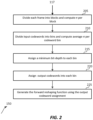
- FIG. 2 depicts an example process for block-based content-adaptive reshaping according to an embodiment of this invention.
- each image is divided into non overlapping blocks and the standard deviation ( ⁇ ) for pixel values in each block is computed.
- ⁇ standard deviation
- step (210) input codewords are divided into bins and the average standard deviation for each bin is computed.
- Block (215) computes the number of minimum bits required for each bin. Based on this information, in block (220), output codewords are assigned to each bin. Finally, in (225), a forward reshaping function is constructed based on the output codeword assignment.
- I j (p) denote the p -th pixel of a color component under quantization (e.g., luminance) in the j -th frame in the input sequence (117), normalized to [0 1).
- All pixels in the k-th block of the j -th frame are associated with the same standard deviation, std j , k .
- H j ( p ) denote the standard deviation associated with pixel p in the j -th frame.
- some pixels in H j ( p ) may be excluded. These pixels may include:
- W bit-depth of the input image
- Signal reshaping functions may be generated at the frame level or at the scene level.
- the terms 'scene' or 'shot' for a video sequence may relate to a series of consecutive frames in the video signal sharing similar color and dynamic range characteristics. Because of the consecutive nature of video prediction in most video compression formats, it may be preferable to adjust the quantization parameters only at boundaries that match the typical boundaries of a video encoder, such as scene changes or a new group of pictures (GOP).
- b m mean b j , m
- j 0,1 , ... , F ⁇ 1 .
- the next step would be to determine the number of bits that need to be allocated for each bin.
- a mapping may be determined based on experimental user study results. For example, in one such study, users were shown to evaluate test images constructed as follows:
- FIG. 3 depicts an example of such results for a set of video data coded according to ST 2084.
- curve (305) represents the worst case results for the tested images, thus representing the worst-case bit-depth requirements as a function of computed average standard deviation. From FIG. 3 , for example, for an average standard deviation of 2 -8 , the required bit depth is about 9.75 bits. As expected, FIG. 3 indicates that image regions with higher levels of complexity can be coded at smaller bit depths. Alternatively, the smoother the image, the more bit depth is needed for an accurate and perceptually lossless representation.
- other interpolation techniques known in the art such as bilinear interpolation, spline interpolation, and the like, could also be used.
- codeword mapping 220
- d i D m for m ⁇ 1 W ⁇ 1 ⁇ mW , denote the number of normalized codewords per input i ⁇ (0, 2 BI - 1), then d i can be considered a lower bound for the number of required codewords per input codeword.
- E j NL i E j NL i / max i E j NL i .
- E j,m denote the mean entropy within each codeword bin m in the j -th frame
- E m mean ( E j,m
- j 0, 1, ... , F - 1) denote the average entropy in each codeword bin within a scene
- the allocation curves may also be smoothed using a low-pass filter or a moving average filter to ensure the curve is smooth and the inverse reshaping function is easy to approximate using a piece-wise polynomial.
- a low-pass filter or a moving average filter to ensure the curve is smooth and the inverse reshaping function is easy to approximate using a piece-wise polynomial.
- FL ( i ) i ( i ⁇ (0, 2 BI -1)
- FL ( i ) values may be stored in a pre-computed look-up table (LUT).
- normalized s jp values may also be mapped to de-normalized values in the range 0 to 2 BT - 1.
- FIG. 4 depicts example plots for codeword allocation according to embodiments.
- FIG. 4 also shows the number of normalized codewords after the final allocation, using both smoothed (620) and unsmoothed (615) curves.
- FIG. 5 depicts an example look-up table for reshaping 16-bit input data into 10-bit output data according to embodiments of this invention.
- backward reshaping (160) may be applied to reverse the effects of forward reshaping (150).
- a look-up table for inverse quantization may be constructed as follows:
- Embodiments of the present invention may be implemented with a computer system, systems configured in electronic circuitry and components, an integrated circuit (IC) device such as a microcontroller, a field programmable gate array (FPGA), or another configurable or programmable logic device (PLD), a discrete time or digital signal processor (DSP), an application specific IC (ASIC), and/or apparatus that includes one or more of such systems, devices or components.
- IC integrated circuit
- FPGA field programmable gate array
- PLD configurable or programmable logic device
- DSP discrete time or digital signal processor
- ASIC application specific IC
- the computer and/or IC may perform, control, or execute instructions relating to the block-based reshaping of images with enhanced dynamic range, such as those described herein.
- the computer and/or IC may compute any of a variety of parameters or values that relate to the block-based reshaping processes described herein.
- the image and video embodiments may be implemented in hardware, software, firmware and various combinations thereof
- Certain implementations of the invention comprise computer processors which execute software instructions which cause the processors to perform a method of the invention.
- processors in a display, an encoder, a set top box, a transcoder or the like may implement methods related to block-based reshaping of HDR images as described above by executing software instructions in a program memory accessible to the processors.
- the invention may also be provided in the form of a program product.
- the program product may comprise any non-transitory medium which carries a set of computer-readable signals comprising instructions which, when executed by a data processor, cause the data processor to execute a method of the invention.
- Program products according to the invention may be in any of a wide variety of forms.
- the program product may comprise, for example, physical media such as magnetic data storage media including floppy diskettes, hard disk drives, optical data storage media including CD ROMs, DVDs, electronic data storage media including ROMs, flash RAM, or the like.
- the computer-readable signals on the program product may optionally be compressed or encrypted.
- a component e.g. a software module, processor, assembly, device, circuit, etc.
- reference to that component should be interpreted as including as equivalents of that component any component which performs the function of the described component (e.g., that is functionally equivalent), including components which are not structurally equivalent to the disclosed structure which performs the function in the illustrated example embodiments of the invention.
Landscapes
- Engineering & Computer Science (AREA)
- Physics & Mathematics (AREA)
- General Physics & Mathematics (AREA)
- Theoretical Computer Science (AREA)
- Computer Vision & Pattern Recognition (AREA)
- Multimedia (AREA)
- Compression Or Coding Systems Of Tv Signals (AREA)
Claims (14)
- Verfahren zur adaptiven Bildumformung eines Eingangsbildes mit hohem Dynamikumfang (HDR) in einer Eingangsbittiefe, um ein entsprechendes Ausgangsbild in einer Zielbittiefe zu erzeugen, die kleiner als oder gleich der Eingangsbittiefe ist, mit einem Prozessor, wobei das Verfahren umfasst:Zugreifen mit einem Prozessor auf das HDR-Eingangsbild in der Eingangsbittiefe;Teilen des HDR-Eingangsbildes in eine Vielzahl von nicht überlappenden Blöcken und Berechnen eines Blockkomplexitätsmaßes ihrer Pixelwerte für jeden der Vielzahl von Blöcken, wobei das Berechnen des jeweiligen Blockkomplexitätsmaßes von Pixelwerten das Berechnen der Standardabweichung gültiger Pixelwerte in dem entsprechenden Block und das Zuordnen des jeweiligen Blockkomplexitätsmaßes von Pixelwerten zu jedem gültigen Pixel des entsprechenden Blocks umfasst, wobei gültige Pixel alle Pixel des Blocks sind, ausschließlich solcher Pixel in Randbereichen des HDR-Eingangsbildes, die bei der Bildumformung als nicht wesentlich erachtet werden;Teilen eines Bereichs von Eingangscodewörtern, die sich auf das gesamte HDR-Eingangsbild beziehen, in eine Vielzahl von Codewortbins;für einen oder mehrere der Codewortbins:Berechnen eines Wertes des Binkomplexitätsmaßes, wobei das Berechnen des Wertes des Binkomplexitätsmaßes das Berechnen des Durchschnittswerts der Blockkomplexitätsmaße umfasst, die den Pixeln des HDR-Eingangsbildes zugeordnet sind, deren Pixelwerte zu dem jeweiligen Codewortbin gehören;Erzeugen einer Funktion des Binkomplexitätsmaßes zur Bittiefe in Bezug auf das gesamte HDR-Eingangsbild gemäß den Ergebnissen einer perzeptuellen Benutzerstudie, wobei die Funktion des Binkomplexitätsmaßes zur Bittiefe einen gegebenen Wert des Binkomplexitätsmaßes auf einen entsprechenden minimalen Bittiefenwert abbildet, der die minimale Bittiefe darstellt, die für eine perzeptuell verlustfreie Bildumformung erforderlich ist;Erzeugen einer Codewort-Abbildungsfunktion auf der Grundlage der Eingangsbittiefe, der minimalen Bittiefenwerte und einer Zielbittiefe, wobei die Codewort-Abbildungsfunktion Eingangscodewörter in der Eingangsbittiefe auf Ausgangscodewörter in der Zielbittiefe abbildet,wobei das Erzeugen der Codewort-Abbildungsfunktion weiter umfasst:für jeden Codewortbin:
Bestimmen einer unteren Grenze für eine normalisierte Anzahl von erforderlichen Codewörtern in der Zielbittiefe auf der Grundlage der minimalen Bittiefenwerte, der Eingangsbittiefe und der Zielbittiefe, wobei die normalisierte Anzahl erforderlicher Codewörter in der Zielbittiefe das Verhältnis der Anzahl von erforderlichen Codewörtern zur Anzahl von verfügbaren Codewörtern in der Zielbittiefe ist;Bestimmen nicht verwendeter Codewörter als die verbleibenden Codewörter in der Zielbittiefe, die nicht Teil der erforderlichen Codewörter in der Zielbittiefe sind;Zuweisen der unbenutzten Codewörter zu jedem Binbild gemäß einem Zuweisungsschema, wodurch die normalisierten Zahlen von erforderlichen Codewörtern auf die aktualisierten normalisierten Zahlen von erforderlichen Codewörtern erhöht wird;Erzeugen der Codewort-Abbildungsfunktion auf der Grundlage der Berechnung einer kumulativen Summe der aktualisierten normalisierten Zahlen von erforderlichen Codewörtern; undAnwenden der Codewort-Abbildungsfunktion auf die Eingangscodewörter des Eingangsbildes in der Eingangsbittiefe, um die Ausgangscodewörter eines entsprechenden Ausgangsbildes in der Zielbittiefe zu erzeugen. - Verfahren nach Anspruch 1, wobei das Teilen eines Bereichs von Eingangscodewörtern in eine Vielzahl von Codewortbins das Teilen des Bereichs von K Eingangscodewörtern in M Codewortbins umfasst, die jeweils eine gleiche Anzahl W von Eingangscodewörtern aufweisen, wobei Bi die Eingangsbittiefe bezeichnet, K = 2 Bi , und W = k/M.
- Verfahren nach Anspruch 1 oder Anspruch 2, wobei die Standardabweichung in Bezug auf den Mittelwert der Pixelwerte in dem Block berechnet wird.
- Verfahren nach einem der Ansprüche 1-3, wobei das HDR-Eingangsbild gemäß Gamma-Codierung oder SMPTE ST 2084 codiert ist.
- Verfahren nach einem der Ansprüche 1-4, wobei das Erzeugen der Funktion des Binkomplexitätsmaßes zur Bittiefe gemäß den Ergebnissen der perzeptuellen Benutzerstudie umfasst:Zugreifen auf eine Vielzahl von HDR-Testbildern in der Eingangsbittiefe;für jedes Testbild in der Vielzahl von HDR-Testbildern:Umwandeln des Testbildes von seinem ursprünglichen Farbraum in einen zweiten Farbraum;Beschneiden des Bildes im zweiten Farbraum, um beschnittene Bilder mit Bittiefen niedriger als die Eingangsbittiefe zu erzeugen;Umwandeln der beschnittenen Bilder in den ursprünglichen Farbraum, um rekonstruierte Bilder zu erzeugen; undBestimmen, für jeden aus einer Vielzahl von verschiedenen Werten des Binkomplexitätsmaßes, des entsprechenden minimalen Bittiefenwertes, für welchen eines der beschnittenen Bilder in dem ursprünglichen Farbraum am besten mit dem Testbild übereinstimmt.
- Verfahren nach einem der Ansprüche 1-5, weiter umfassend das Filtern der aktualisierten normalisierten Zahlen der erforderlichen Codewörter durch einen Tiefpassfilter vor dem Erzeugen der Codewort-Abbildungsfunktion.
- Verfahren nach einem der Ansprüche 1-6, wobei das Zuweisungsschema ein Zuweisungsschema mit konstantem Offset umfasst, wobei für den i-ten Eingangspixelwert

- Verfahren nach einem der Ansprüche 1-6, wobei das Zuweisungsschema die Berechnung umfasst
 wobei d̃i die aktualisierte normalisierte Anzahl von Codewortwerten bezeichnet, di die normalisierte Anzahl von erforderlichen Codewörtern bezeichnet, wenn D die Summe von di Werten bezeichnet, dann bezeichnet U=1-D die normalisierte Anzahl von unbenutzten Codewörtern, vH bezeichnet einen maximalen Eingangspixelwert, vL bezeichnet einen minimalen Eingangspixelwert, und
 wobei α eine Konstante ist.
 - Verfahren nach einem der Ansprüche 1-6, wobei das Zuweisungsschema ein entropiebasiertes Zuweisungsschema umfasst, wobei für den i-ten Eingangspixelwert

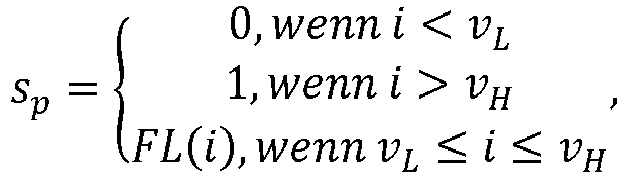
- Verfahren nach einem der Ansprüche 1-9, wobei das Erzeugen der Codewort-Abbildungsfunktion für einen Eingangspixelwert i das Berechnen umfasst von

- Verfahren nach Anspruch 10, wobei das Erzeugen der Ausgangscodewörter des entsprechenden Ausgangsbildes das Berechnen umfasst von:
- Verfahren nach einem der Ansprüche 1-11, wobei die Werte des Binkomplexitätsmaßes auf der Grundlage von Blockkomplexitätswerten berechnet werden, die über mehrere aufeinanderfolgende Frames in einer Videoszene berechnet werden, die das HDR-Eingangsbild beinhaltet.
- Einrichtung, die einen Prozessor umfasst und zur Durchführung des Verfahrens nach einem der Ansprüche 1-12 ausgelegt ist.
- Computerlesbares Speichermedium, auf dem computerausführbare Anweisungen zum Ausführen des Verfahrens nach einem der Ansprüche 1-12 gespeichert sind.
Applications Claiming Priority (2)
| Application Number | Priority Date | Filing Date | Title |
|---|---|---|---|
| US201662290399P | 2016-02-02 | 2016-02-02 | |
| US201662334099P | 2016-05-10 | 2016-05-10 |
Publications (2)
| Publication Number | Publication Date |
|---|---|
| EP3203442A1 EP3203442A1 (de) | 2017-08-09 |
| EP3203442B1 true EP3203442B1 (de) | 2024-11-27 |
Family
ID=57965737
Family Applications (1)
| Application Number | Title | Priority Date | Filing Date |
|---|---|---|---|
| EP17154335.8A Active EP3203442B1 (de) | 2016-02-02 | 2017-02-02 | Blockbasierte inhalt-adaptive reshaping für hdr bilder |
Country Status (3)
| Country | Link |
|---|---|
| US (1) | US10032262B2 (de) |
| EP (1) | EP3203442B1 (de) |
| ES (1) | ES2996933T3 (de) |
Families Citing this family (26)
| Publication number | Priority date | Publication date | Assignee | Title |
|---|---|---|---|---|
| US10032262B2 (en) * | 2016-02-02 | 2018-07-24 | Dolby Laboratories Licensing Corporation | Block-based content-adaptive reshaping for high dynamic range images |
| WO2018044803A1 (en) | 2016-08-30 | 2018-03-08 | Dolby Laboratories Licensing Corporation | Real-time reshaping of single-layer backwards-compatible codec |
| US10701404B2 (en) | 2016-08-30 | 2020-06-30 | Dolby Laboratories Licensing Corporation | Real-time reshaping of single-layer backwards-compatible codec |
| US10575028B2 (en) | 2016-09-09 | 2020-02-25 | Dolby Laboratories Licensing Corporation | Coding of high dynamic range video using segment-based reshaping |
| WO2018049335A1 (en) | 2016-09-09 | 2018-03-15 | Dolby Laboratories Licensing Corporation | Coding of high dynamic range video using segment-based reshaping |
| US10609372B2 (en) | 2017-09-29 | 2020-03-31 | Dolby Laboratories Licensing Corporation | Up-conversion to content adaptive perceptual quantization video signals |
| CN117135355A (zh) | 2018-02-14 | 2023-11-28 | 杜比实验室特许公司 | 在视频编码中利用率失真优化进行图像再成形 |
| CN112106357B (zh) | 2018-05-11 | 2024-03-12 | 杜比实验室特许公司 | 用于对图像数据进行编码和解码的方法及装置 |
| US11341624B2 (en) | 2018-08-10 | 2022-05-24 | Dolby Laboratories Licensing Corporation | Reducing banding artifacts in HDR imaging via adaptive SDR-to-HDR reshaping functions |
| EP3857505B1 (de) | 2018-09-24 | 2022-08-03 | Dolby Laboratories Licensing Corporation | Bildentrauschung in sdr-zu-hdr-bildumwandlung |
| CN109345525B (zh) * | 2018-09-27 | 2022-03-29 | 方玉明 | 一种去鬼影高动态范围图像质量评价方法 |
| US11277646B2 (en) | 2018-10-03 | 2022-03-15 | Dolby Laboratories Licensing Corporation | Reducing banding artifacts in backward-compatible HDR imaging |
| JP7094451B2 (ja) | 2018-12-03 | 2022-07-01 | ドルビー ラボラトリーズ ライセンシング コーポレイション | 再構成関数の補間 |
| PL4046383T3 (pl) * | 2019-10-17 | 2025-04-28 | Dolby Laboratories Licensing Corporation | Regulowany kompromis pomiędzy jakością a złożonością obliczeniową w koderach-dekoderach wideo |
| US12177459B2 (en) * | 2019-11-27 | 2024-12-24 | Dolby Laboratories Licensing Corporation | Rate-control-aware reshaping in HDR imaging |
| US12368964B2 (en) | 2020-04-03 | 2025-07-22 | Dolby Laboratories Licensing Corporation | Blind local reshaping in HDR imaging |
| US12382106B2 (en) | 2020-04-21 | 2025-08-05 | Dolby Laboratories Licensing Corporation | Reshaping functions for HDR imaging with continuity and reversibility constraints |
| JP7472403B2 (ja) * | 2020-10-02 | 2024-04-22 | ドルビー ラボラトリーズ ライセンシング コーポレイション | Sdrからhdrへのアップコンバートのための適応的ローカルリシェーピング |
| US20240171775A1 (en) | 2021-05-21 | 2024-05-23 | Dolby Laboratories Licensing Corporation | Patch-based reshaping and metadata for volumetric video |
| EP4349012A1 (de) * | 2021-06-01 | 2024-04-10 | Dolby Laboratories Licensing Corporation | Drehaktivierte videocodierung mit hohem dynamikbereich |
| PL4352964T3 (pl) | 2021-06-08 | 2025-04-22 | Dolby Laboratories Licensing Corporation | Optymalizacja funkcji łańcuchowego ponownego kształtowania |
| WO2023069585A1 (en) | 2021-10-21 | 2023-04-27 | Dolby Laboratories Licensing Corporation | Context-based reshaping algorithms for encoding video data |
| WO2023215108A1 (en) | 2022-05-05 | 2023-11-09 | Dolby Laboratories Licensing Corporation | Stereoscopic high dynamic range video |
| US20240078648A1 (en) * | 2022-09-06 | 2024-03-07 | Apple Inc. | Tone Mapping for Preserving Contrast of Fine Features in an Image |
| EP4666581A1 (de) | 2023-02-16 | 2025-12-24 | Dolby Laboratories Licensing Corporation | Lokale umformung durch tensorprodukt-b-spline mit video mit breiter koordinatensicht |
| CN120814237A (zh) | 2023-02-22 | 2025-10-17 | 杜比实验室特许公司 | 360度视频内容的基于瓦片的流式传输 |
Family Cites Families (11)
| Publication number | Priority date | Publication date | Assignee | Title |
|---|---|---|---|---|
| US8019150B2 (en) * | 2007-10-11 | 2011-09-13 | Kwe International, Inc. | Color quantization based on desired upper bound for relative quantization step |
| ES2527932T3 (es) | 2008-04-16 | 2015-02-02 | Fraunhofer-Gesellschaft zur Förderung der angewandten Forschung e.V. | Escalabilidad de profundidad de bits |
| TWI479898B (zh) * | 2010-08-25 | 2015-04-01 | 杜比實驗室特許公司 | 擴展影像動態範圍 |
| TWI575933B (zh) * | 2011-11-04 | 2017-03-21 | 杜比實驗室特許公司 | 階層式視覺動態範圍編碼中之層分解技術 |
| US10085020B2 (en) * | 2012-04-05 | 2018-09-25 | Telefonaktiebolaget L M Ericsson (Publ) | Sample adaptive filtering with offsets |
| JP6038360B2 (ja) * | 2013-06-17 | 2016-12-07 | ドルビー ラボラトリーズ ライセンシング コーポレイション | エンハンストダイナミックレンジ信号の階層符号化のための適応的再構成 |
| JP6339691B2 (ja) | 2014-02-26 | 2018-06-06 | ドルビー ラボラトリーズ ライセンシング コーポレイション | ビデオ圧縮のための輝度ベースの符号化ツール |
| JP6484347B2 (ja) | 2015-03-02 | 2019-03-13 | ドルビー ラボラトリーズ ライセンシング コーポレイション | ハイダイナミックレンジ画像のためのコンテンツ適応的な知覚的量子化器 |
| US10311558B2 (en) * | 2015-11-16 | 2019-06-04 | Dolby Laboratories Licensing Corporation | Efficient image processing on content-adaptive PQ signal domain |
| US10032262B2 (en) * | 2016-02-02 | 2018-07-24 | Dolby Laboratories Licensing Corporation | Block-based content-adaptive reshaping for high dynamic range images |
| US10223774B2 (en) * | 2016-02-02 | 2019-03-05 | Dolby Laboratories Licensing Corporation | Single-pass and multi-pass-based polynomial approximations for reshaping functions |
-
2017
- 2017-01-27 US US15/418,199 patent/US10032262B2/en active Active
- 2017-02-02 EP EP17154335.8A patent/EP3203442B1/de active Active
- 2017-02-02 ES ES17154335T patent/ES2996933T3/es active Active
Also Published As
| Publication number | Publication date |
|---|---|
| ES2996933T3 (en) | 2025-02-13 |
| US10032262B2 (en) | 2018-07-24 |
| EP3203442A1 (de) | 2017-08-09 |
| US20170221189A1 (en) | 2017-08-03 |
Similar Documents
| Publication | Publication Date | Title |
|---|---|---|
| EP3203442B1 (de) | Blockbasierte inhalt-adaptive reshaping für hdr bilder | |
| US10419762B2 (en) | Content-adaptive perceptual quantizer for high dynamic range images | |
| US10223774B2 (en) | Single-pass and multi-pass-based polynomial approximations for reshaping functions | |
| EP3281409B1 (de) | In-schleifen-blockbasierte bildumformung in der videocodierung mit hohem dynamikbereich | |
| EP3459248B1 (de) | Chrominanz-neuordnung für bilder mit hohem dynamikbereich | |
| EP3011741B1 (de) | Adaptive umformung für schichtkodierung von signalen mit erweitertem dynamikbereich | |
| US10645403B2 (en) | Chroma reshaping for high dynamic range images | |
| US10165275B2 (en) | Content-adaptive reshaping for high dynamic range images | |
| EP3510772A1 (de) | Codierung von video mit hohem dynamikbereich mittels segmentbasierter neuformung | |
| WO2018049335A1 (en) | Coding of high dynamic range video using segment-based reshaping | |
| US11895416B2 (en) | Electro-optical transfer function conversion and signal legalization | |
| CN108353173B (zh) | 用于高动态范围视频编码的分段线性层间预测器 | |
| HK1243251A1 (en) | Content-adaptive perceptual quantizer for high dynamic range images | |
| HK1243251B (zh) | 用於高动态范围图像的内容自适应感知量化器 | |
| HK1259280B (zh) | 用於高动态范围视频编码的分段线性层间预测器 | |
| HK1259280A1 (zh) | 用於高动态范围视频编码的分段线性层间预测器 |
Legal Events
| Date | Code | Title | Description |
|---|---|---|---|
| PUAI | Public reference made under article 153(3) epc to a published international application that has entered the european phase |
Free format text: ORIGINAL CODE: 0009012 |
|
| STAA | Information on the status of an ep patent application or granted ep patent |
Free format text: STATUS: THE APPLICATION HAS BEEN PUBLISHED |
|
| AK | Designated contracting states |
Kind code of ref document: A1 Designated state(s): AL AT BE BG CH CY CZ DE DK EE ES FI FR GB GR HR HU IE IS IT LI LT LU LV MC MK MT NL NO PL PT RO RS SE SI SK SM TR |
|
| AX | Request for extension of the european patent |
Extension state: BA ME |
|
| STAA | Information on the status of an ep patent application or granted ep patent |
Free format text: STATUS: REQUEST FOR EXAMINATION WAS MADE |
|
| 17P | Request for examination filed |
Effective date: 20180209 |
|
| RBV | Designated contracting states (corrected) |
Designated state(s): AL AT BE BG CH CY CZ DE DK EE ES FI FR GB GR HR HU IE IS IT LI LT LU LV MC MK MT NL NO PL PT RO RS SE SI SK SM TR |
|
| STAA | Information on the status of an ep patent application or granted ep patent |
Free format text: STATUS: EXAMINATION IS IN PROGRESS |
|
| 17Q | First examination report despatched |
Effective date: 20200304 |
|
| RAP3 | Party data changed (applicant data changed or rights of an application transferred) |
Owner name: DOLBY LABORATORIES LICENSING CORPORATION |
|
| P01 | Opt-out of the competence of the unified patent court (upc) registered |
Effective date: 20230417 |
|
| GRAP | Despatch of communication of intention to grant a patent |
Free format text: ORIGINAL CODE: EPIDOSNIGR1 |
|
| STAA | Information on the status of an ep patent application or granted ep patent |
Free format text: STATUS: GRANT OF PATENT IS INTENDED |
|
| INTG | Intention to grant announced |
Effective date: 20240717 |
|
| GRAS | Grant fee paid |
Free format text: ORIGINAL CODE: EPIDOSNIGR3 |
|
| GRAA | (expected) grant |
Free format text: ORIGINAL CODE: 0009210 |
|
| STAA | Information on the status of an ep patent application or granted ep patent |
Free format text: STATUS: THE PATENT HAS BEEN GRANTED |
|
| AK | Designated contracting states |
Kind code of ref document: B1 Designated state(s): AL AT BE BG CH CY CZ DE DK EE ES FI FR GB GR HR HU IE IS IT LI LT LU LV MC MK MT NL NO PL PT RO RS SE SI SK SM TR |
|
| REG | Reference to a national code |
Ref country code: GB Ref legal event code: FG4D |
|
| REG | Reference to a national code |
Ref country code: CH Ref legal event code: EP |
|
| REG | Reference to a national code |
Ref country code: DE Ref legal event code: R096 Ref document number: 602017086341 Country of ref document: DE |
|
| REG | Reference to a national code |
Ref country code: IE Ref legal event code: FG4D |
|
| REG | Reference to a national code |
Ref country code: NL Ref legal event code: FP |
|
| REG | Reference to a national code |
Ref country code: ES Ref legal event code: FG2A Ref document number: 2996933 Country of ref document: ES Kind code of ref document: T3 Effective date: 20250213 |
|
| PGFP | Annual fee paid to national office [announced via postgrant information from national office to epo] |
Ref country code: NL Payment date: 20250121 Year of fee payment: 9 |
|
| REG | Reference to a national code |
Ref country code: LT Ref legal event code: MG9D |
|
| PG25 | Lapsed in a contracting state [announced via postgrant information from national office to epo] |
Ref country code: HR Free format text: LAPSE BECAUSE OF FAILURE TO SUBMIT A TRANSLATION OF THE DESCRIPTION OR TO PAY THE FEE WITHIN THE PRESCRIBED TIME-LIMIT Effective date: 20241127 Ref country code: PT Free format text: LAPSE BECAUSE OF FAILURE TO SUBMIT A TRANSLATION OF THE DESCRIPTION OR TO PAY THE FEE WITHIN THE PRESCRIBED TIME-LIMIT Effective date: 20250327 Ref country code: IS Free format text: LAPSE BECAUSE OF FAILURE TO SUBMIT A TRANSLATION OF THE DESCRIPTION OR TO PAY THE FEE WITHIN THE PRESCRIBED TIME-LIMIT Effective date: 20250327 |
|
| PGFP | Annual fee paid to national office [announced via postgrant information from national office to epo] |
Ref country code: DE Payment date: 20250122 Year of fee payment: 9 |
|
| PG25 | Lapsed in a contracting state [announced via postgrant information from national office to epo] |
Ref country code: FI Free format text: LAPSE BECAUSE OF FAILURE TO SUBMIT A TRANSLATION OF THE DESCRIPTION OR TO PAY THE FEE WITHIN THE PRESCRIBED TIME-LIMIT Effective date: 20241127 |
|
| REG | Reference to a national code |
Ref country code: AT Ref legal event code: MK05 Ref document number: 1746457 Country of ref document: AT Kind code of ref document: T Effective date: 20241127 |
|
| PG25 | Lapsed in a contracting state [announced via postgrant information from national office to epo] |
Ref country code: BG Free format text: LAPSE BECAUSE OF FAILURE TO SUBMIT A TRANSLATION OF THE DESCRIPTION OR TO PAY THE FEE WITHIN THE PRESCRIBED TIME-LIMIT Effective date: 20241127 |
|
| PGFP | Annual fee paid to national office [announced via postgrant information from national office to epo] |
Ref country code: ES Payment date: 20250303 Year of fee payment: 9 |
|
| PG25 | Lapsed in a contracting state [announced via postgrant information from national office to epo] |
Ref country code: NO Free format text: LAPSE BECAUSE OF FAILURE TO SUBMIT A TRANSLATION OF THE DESCRIPTION OR TO PAY THE FEE WITHIN THE PRESCRIBED TIME-LIMIT Effective date: 20250227 |
|
| PG25 | Lapsed in a contracting state [announced via postgrant information from national office to epo] |
Ref country code: LV Free format text: LAPSE BECAUSE OF FAILURE TO SUBMIT A TRANSLATION OF THE DESCRIPTION OR TO PAY THE FEE WITHIN THE PRESCRIBED TIME-LIMIT Effective date: 20241127 Ref country code: GR Free format text: LAPSE BECAUSE OF FAILURE TO SUBMIT A TRANSLATION OF THE DESCRIPTION OR TO PAY THE FEE WITHIN THE PRESCRIBED TIME-LIMIT Effective date: 20250228 Ref country code: AT Free format text: LAPSE BECAUSE OF FAILURE TO SUBMIT A TRANSLATION OF THE DESCRIPTION OR TO PAY THE FEE WITHIN THE PRESCRIBED TIME-LIMIT Effective date: 20241127 |
|
| PG25 | Lapsed in a contracting state [announced via postgrant information from national office to epo] |
Ref country code: PL Free format text: LAPSE BECAUSE OF FAILURE TO SUBMIT A TRANSLATION OF THE DESCRIPTION OR TO PAY THE FEE WITHIN THE PRESCRIBED TIME-LIMIT Effective date: 20241127 |
|
| PGFP | Annual fee paid to national office [announced via postgrant information from national office to epo] |
Ref country code: FR Payment date: 20250121 Year of fee payment: 9 |
|
| PGFP | Annual fee paid to national office [announced via postgrant information from national office to epo] |
Ref country code: GB Payment date: 20250123 Year of fee payment: 9 Ref country code: IT Payment date: 20250121 Year of fee payment: 9 |
|
| PG25 | Lapsed in a contracting state [announced via postgrant information from national office to epo] |
Ref country code: RS Free format text: LAPSE BECAUSE OF FAILURE TO SUBMIT A TRANSLATION OF THE DESCRIPTION OR TO PAY THE FEE WITHIN THE PRESCRIBED TIME-LIMIT Effective date: 20250227 |
|
| PG25 | Lapsed in a contracting state [announced via postgrant information from national office to epo] |
Ref country code: SM Free format text: LAPSE BECAUSE OF FAILURE TO SUBMIT A TRANSLATION OF THE DESCRIPTION OR TO PAY THE FEE WITHIN THE PRESCRIBED TIME-LIMIT Effective date: 20241127 |
|
| PG25 | Lapsed in a contracting state [announced via postgrant information from national office to epo] |
Ref country code: DK Free format text: LAPSE BECAUSE OF FAILURE TO SUBMIT A TRANSLATION OF THE DESCRIPTION OR TO PAY THE FEE WITHIN THE PRESCRIBED TIME-LIMIT Effective date: 20241127 |
|
| PG25 | Lapsed in a contracting state [announced via postgrant information from national office to epo] |
Ref country code: EE Free format text: LAPSE BECAUSE OF FAILURE TO SUBMIT A TRANSLATION OF THE DESCRIPTION OR TO PAY THE FEE WITHIN THE PRESCRIBED TIME-LIMIT Effective date: 20241127 |
|
| PG25 | Lapsed in a contracting state [announced via postgrant information from national office to epo] |
Ref country code: RO Free format text: LAPSE BECAUSE OF FAILURE TO SUBMIT A TRANSLATION OF THE DESCRIPTION OR TO PAY THE FEE WITHIN THE PRESCRIBED TIME-LIMIT Effective date: 20241127 |
|
| PG25 | Lapsed in a contracting state [announced via postgrant information from national office to epo] |
Ref country code: SK Free format text: LAPSE BECAUSE OF FAILURE TO SUBMIT A TRANSLATION OF THE DESCRIPTION OR TO PAY THE FEE WITHIN THE PRESCRIBED TIME-LIMIT Effective date: 20241127 |
|
| PG25 | Lapsed in a contracting state [announced via postgrant information from national office to epo] |
Ref country code: CZ Free format text: LAPSE BECAUSE OF FAILURE TO SUBMIT A TRANSLATION OF THE DESCRIPTION OR TO PAY THE FEE WITHIN THE PRESCRIBED TIME-LIMIT Effective date: 20241127 |
|
| REG | Reference to a national code |
Ref country code: DE Ref legal event code: R097 Ref document number: 602017086341 Country of ref document: DE |
|
| PG25 | Lapsed in a contracting state [announced via postgrant information from national office to epo] |
Ref country code: SE Free format text: LAPSE BECAUSE OF FAILURE TO SUBMIT A TRANSLATION OF THE DESCRIPTION OR TO PAY THE FEE WITHIN THE PRESCRIBED TIME-LIMIT Effective date: 20241127 |
|
| PG25 | Lapsed in a contracting state [announced via postgrant information from national office to epo] |
Ref country code: MC Free format text: LAPSE BECAUSE OF FAILURE TO SUBMIT A TRANSLATION OF THE DESCRIPTION OR TO PAY THE FEE WITHIN THE PRESCRIBED TIME-LIMIT Effective date: 20241127 |
|
| REG | Reference to a national code |
Ref country code: CH Ref legal event code: PL |
|
| PLBE | No opposition filed within time limit |
Free format text: ORIGINAL CODE: 0009261 |
|
| STAA | Information on the status of an ep patent application or granted ep patent |
Free format text: STATUS: NO OPPOSITION FILED WITHIN TIME LIMIT |
|
| PG25 | Lapsed in a contracting state [announced via postgrant information from national office to epo] |
Ref country code: LU Free format text: LAPSE BECAUSE OF NON-PAYMENT OF DUE FEES Effective date: 20250202 |
|
| PG25 | Lapsed in a contracting state [announced via postgrant information from national office to epo] |
Ref country code: CH Free format text: LAPSE BECAUSE OF NON-PAYMENT OF DUE FEES Effective date: 20250228 |
|
| 26N | No opposition filed |
Effective date: 20250828 |
|
| REG | Reference to a national code |
Ref country code: BE Ref legal event code: MM Effective date: 20250228 |
|
| PG25 | Lapsed in a contracting state [announced via postgrant information from national office to epo] |
Ref country code: BE Free format text: LAPSE BECAUSE OF NON-PAYMENT OF DUE FEES Effective date: 20250228 |
|
| PG25 | Lapsed in a contracting state [announced via postgrant information from national office to epo] |
Ref country code: IE Free format text: LAPSE BECAUSE OF NON-PAYMENT OF DUE FEES Effective date: 20250202 |