EP3203055A1 - Control device of the air flow in a throttle body for the supply of an internal combustion engine - Google Patents
Control device of the air flow in a throttle body for the supply of an internal combustion engine Download PDFInfo
- Publication number
- EP3203055A1 EP3203055A1 EP17155068.4A EP17155068A EP3203055A1 EP 3203055 A1 EP3203055 A1 EP 3203055A1 EP 17155068 A EP17155068 A EP 17155068A EP 3203055 A1 EP3203055 A1 EP 3203055A1
- Authority
- EP
- European Patent Office
- Prior art keywords
- toothed
- sector
- driving
- throttle valve
- rotation
- Prior art date
- Legal status (The legal status is an assumption and is not a legal conclusion. Google has not performed a legal analysis and makes no representation as to the accuracy of the status listed.)
- Granted
Links
Images


Classifications
-
- F—MECHANICAL ENGINEERING; LIGHTING; HEATING; WEAPONS; BLASTING
- F02—COMBUSTION ENGINES; HOT-GAS OR COMBUSTION-PRODUCT ENGINE PLANTS
- F02D—CONTROLLING COMBUSTION ENGINES
- F02D9/00—Controlling engines by throttling air or fuel-and-air induction conduits or exhaust conduits
- F02D9/08—Throttle valves specially adapted therefor; Arrangements of such valves in conduits
- F02D9/10—Throttle valves specially adapted therefor; Arrangements of such valves in conduits having pivotally-mounted flaps
- F02D9/1065—Mechanical control linkage between an actuator and the flap, e.g. including levers, gears, springs, clutches, limit stops of the like
-
- F—MECHANICAL ENGINEERING; LIGHTING; HEATING; WEAPONS; BLASTING
- F02—COMBUSTION ENGINES; HOT-GAS OR COMBUSTION-PRODUCT ENGINE PLANTS
- F02D—CONTROLLING COMBUSTION ENGINES
- F02D9/00—Controlling engines by throttling air or fuel-and-air induction conduits or exhaust conduits
- F02D9/08—Throttle valves specially adapted therefor; Arrangements of such valves in conduits
- F02D9/10—Throttle valves specially adapted therefor; Arrangements of such valves in conduits having pivotally-mounted flaps
- F02D9/109—Throttle valves specially adapted therefor; Arrangements of such valves in conduits having pivotally-mounted flaps having two or more flaps
- F02D9/1095—Rotating on a common axis, e.g. having a common shaft
-
- F—MECHANICAL ENGINEERING; LIGHTING; HEATING; WEAPONS; BLASTING
- F02—COMBUSTION ENGINES; HOT-GAS OR COMBUSTION-PRODUCT ENGINE PLANTS
- F02D—CONTROLLING COMBUSTION ENGINES
- F02D9/00—Controlling engines by throttling air or fuel-and-air induction conduits or exhaust conduits
- F02D9/02—Controlling engines by throttling air or fuel-and-air induction conduits or exhaust conduits concerning induction conduits
- F02D2009/0201—Arrangements; Control features; Details thereof
- F02D2009/0252—Opening a special valve-controlled intake passage (by-pass) during starting
Definitions
- the present invention relates to a control device of the air flow in a throttle body for an internal combustion engine.
- throttle body it is meant a device having a main duct through which the combustion primary air is fed toward the combustion chamber and precisely controlled by a throttle valve, while the fuel is fed through a separate injection system.
- Throttle-body devices are well known in the art. They typically include a cast body defining a through duct within which a throttle valve is arranged, controlled in opening/closing to regulate the air flow rate.
- the throttle valve is generally fixed to a drive shaft, rotatably mounted across the duct and adjusted in position by a suitable drive.
- the drive is in the form of an electric motor, which drives said driving shaft via a high-reduction motion transmission and is in turn controlled by an electronic control system.
- valve device typically a conical check valve integral with a rod having an axial movement - adapted to adjust the flow rate of the secondary air, in a finely controlled measure for specific low-load or idling conditions of the internal combustion engine.
- This accurate control of idling condition is dictated not only by the need for a more regular operation of the engine at low load, but it is also necessary to respond to the needs of the increasingly stringent exhaust gas emission standards.
- DE 42 02 406 includes a disc drive, equipped with two distinct circumferential guiding slots, which cooperate with two control rods acting on the respective valves in cooperation with two respective elastic return elements.
- This rod and slots configuration has various drawbacks, especially in relation to the adjustment capacity and the maintenance requirements.
- DE 10 2013 006 044 illustrates another drive configuration with gearings, wherein the control of the driving shaft of the throttle valve takes place in cooperation with two opposed elastic elements (springs), to ensure a phase-shifted opening of the bypass valve and a safe valve return.
- springs opposed elastic elements
- a 'rigid' connection between two elements means a connection where displacement of one element is translated into a displacement of the other element without substantial elastic reaction in between, i.e. with a fixed motion law not depending from the forces acting on the connection.
- the object of the invention is therefore to provide a control device of a throttle body, that is of the geared type, but overcomes the drawbacks of the prior art, in particular is less subject to adjustment and maintenance problems, has a simplified structure and offers a direct drive on the shaft of the throttle valve, which provides an accurate detection of rotation angles and therefore enhanced operation control.
- a throttle body for supplying air to an internal combustion engine comprises, in a per se known manner, at least one duct 1 of the primary air flow regulated by a throttle valve F.
- Fig. 1 represents a variant that comprises a pair of side-by-side ducts 1 but, from the point of view of the invention, one or multiple ducts are equivalent.
- the throttle valve F of the primary air duct comprises a shutter plate or butterfly which is integral with a shaft A rotatably mounted in a direction transverse to the longitudinal axis of the duct 1.
- the two throttle valves have a single common driving shaft, so that their rotation can be controlled by a single driving device.
- the shutter of the throttle valve is able to rotate around its shaft to an angle of about 90°; that is, from a closed, or "almost” closed position, wherein the shutter plate is arranged almost transversely to the respective duct, to an open position, wherein the shutter plate is on a plane substantially aligned with the longitudinal axis of the duct.
- the closed position is defined as “almost closed” for the reason that, in fact, the shutter does not perfectly close the respective duct, but leaves a narrow free gap in order to prevent unwanted jams against the duct walls.
- the throttle valve controls the so-called primary air flow through a primary duct, but in modern throttle bodies there is also provided a bypass channel, external to the primary duct, wherein a secondary air flow is provided.
- the secondary air flow is defined and intended for the "idling" regimes of the engine, while the primary air flow is supplied to the engine in every other power condition.
- the secondary air flow is controlled by its own bypass valve 18, which is traditionally - as in the embodiment of Figs. 1-5B - in the form of a plug check valve P with a longitudinal displacement against spring means.
- This bypass valve although partially illustrated in the figures, will not be described in greater detail because it is known per se.
- the driving device being a single device, both for throttle valves F and for the bypass valve 18, comprises an electric motor 2 and a gear transmission with toothed-wheel gears.
- the drive motor is typically a DC motor or a stepper motor, housed within a case 3 of the throttle body and supported in cantilever fashion by a support plate 4.
- the gear transmission comprises a first pinion 5 keyed onto the end of the shaft of the motor 2, and at least one further intermediate idle gear to obtain a high reduction ratio of the transmission:
- the intermediate idle wheel comprises, for example, a first toothed wheel 6, which engages with the pinion 5, and a second pinion 7 coaxial and integral with the toothed wheel 6.
- the gear transmission further comprises a pair of toothed-sector elements 8 and 9, placed side by side on parallel planes and mounted coaxial to a shaft A of the throttle valve F.
- a first of said toothed sectors 8 is keyed on the shaft A of the throttle valve F and is therefore integral in rotation therewith: it constitutes the throttle valve driving element for the primary air control.
- a second of said toothed-sector elements 9 is mounted coaxial and freely rotatable on said shaft, but is dynamically associated to the first element 8, in the way better described in the following.
- the two toothed-sector elements 8, 9 are adjacent on parallel planes and have a width and a nominal diameter such that both can mesh with the second pinion 7 of the intermediate idle wheel. In other words, they are arranged so that they can take driving motion from the same gear. More precisely, the pinion 7 is in engagement at the same time with both toothings of the first and second toothed-sector elements 8, 9 for at least a central part of their travel.
- the toothings of the two toothed-sector elements 8, 9 are provided on two arcs of circle of different length.
- the teeth of the second toothed-sector element 9 are spread over an arc of circle much shorter than that of the first element 8, in proportion to the amplitude of rotation for which they must exercise their driving action.
- the teeth of the first element 8 are provided on a circle arc of the order of 90°, while the teeth of the second element 9 are provided on a circle arc of only 15°.
- the toothing of the first toothed sector element 8 is extending over an arc of circle of the order of 50-95°
- the toothing of the second toothed sector element 9 is extending over an arc of a circle of the order of 5-30°.
- the toothed-sector element can also be prolonged over a further arc of a circle other than that covered by the teeth, as is shown for a portion 9a of the second element 9.
- the first toothed-sector element 8 is keyed on the common shaft A of the two throttle valves F, so that its movements, controlled by the transmission gear through the pinion 7, drive the throttle valves towards the opening (counter-clockwise movement of the element 8) of the primary air duct 1, or respectively towards the closing (clockwise movement of the element 8).
- the first toothed-sector element 8 cooperates with a return elastic element, such as a spring 10, adapted to perform the function, well known per se, of bringing the throttle valve back towards a home position ( Fig. 2 ), that is, towards the closing position, ensuring the automatic closing of the throttle valve in the case of failure of the drive system.
- the end-of-travel home position, with the throttle valve F closed typically is resulting by a special abutment surface of the element 8 abutting on an appropriate end-of-travel element C fixed with respect to the throttle body case.
- the second toothed-sector element 9 is also mounted rotatably, but idle, on the axle of the common shaft A of the two throttle valves. In the home condition, the toothing of sector 9 meshes with the toothing of the drive pinion 7. As already mentioned above, the sector 9 is coupled dynamically to the first toothed-sector element 8 by the following method.
- the first element 8 has a driving peg 8b, projecting axially from the side facing the second toothed-sector element 9, which peg engages in an arched slot 9b formed in the second element 9: it determines a dragging effect in rotation between the two toothed-sector elements 8 and 9 when their relative rotation brings the peg 8b in abutment at the two opposite ends 9ba and 9bb of the slot 9b.
- the driving peg 8b can be replaced by any other suitable engaging means, for example the pin 8b' shown in the embodiment of fig. 8A .
- an elastic element 11 such as a spiral spring, which causes a torque that tends to rotate counter-clockwise the second element 9 with respect to the first 8, pushing the peg 8b in abutment against home end 9ba of the slot 9b ( Figs. 1 and 2 ).
- the two toothed-sector elements 8 and 9 When the peg 8b is in abutment to the home end 9ba of the slot 9b, the two toothed-sector elements 8 and 9 have at least one tooth mutually aligned (or almost aligned, with a very small phase shift, not exceeding a few tenths of a degree), so that a condition can occur wherein they are properly and simultaneously meshed with the corresponding teeth of the pinion 7.
- the teeth of the second toothed-sector element 9 extend beyond the end of the toothing of the first element 8, for an arc of a circle (of approximately 15°, as seen above) which determines the rotation useful to actuate the bypass valve 18, as will be described further below.
- This portion of the toothing of the second element 9, which extends beyond the ends of the toothing of the first element 8, is called the active portion of the toothing of the second element 9, as it is the one that determines the operational phase of the second toothed-sector element 9.
- the second toothed-sector element 9 also has a driving appendix which, in the first embodiment, is constituted by a portion of a toothed gear represented by a single tooth 9d; the latter is intended to cooperate with a tooth 12a of an opposite rocker lever 12, mounted free in rotation on a pin and intended to control a driven rod of the bypass valve 18 through an appendix 12b opposed to the tooth 12a.
- a driving appendix which, in the first embodiment, is constituted by a portion of a toothed gear represented by a single tooth 9d; the latter is intended to cooperate with a tooth 12a of an opposite rocker lever 12, mounted free in rotation on a pin and intended to control a driven rod of the bypass valve 18 through an appendix 12b opposed to the tooth 12a.
- the pair of toothed-sector elements 8 and 9 is mounted on the control shaft of the throttle valve so that in the home position, only the sector 9 meshes with the pinion toothing 7 and the appendix 9d is in engagement with the tooth 12a.
- the rotation of the tooth 9d is able to displace the rocker lever 12, against the action of a return spring, to an extent sufficient to correctly displace also the check plug P of the bypass valve 18.
- the back displacement is automatically performed by the return spring.
- Figs. 6A-10C show a second embodiment disclosing a different aspect of the invention.
- a driving appendix 9d' of a second toothed sector element 9' is in the shape of a proper toothed sector (including at least three teeth) meshing with a corresponding toothed sector 12a' acting as coupling means of a driving gear 12' for a bypass throttle valve 18'.
- the bypass throttle valve 18' comprises a rotating shutter plate attached to a shaft integral in rotation with driving gear 12'. This latter is biased by a torque spring 13' against an end-of travel abutment 14', toward a position wherein the bypass throttle valve 18' is open.
- the second toothed-sector element 9, 9' supports, in its centre of rotation, an internal magnetic button 13 (well visible in Fig. 2 ), which is intended to cooperate with a position sensor (not shown) external to the case of the throttle body, to provide an angular position signal of the system.
- control device described above is illustrated in the following making reference to the first embodiment, but it is intended that also an embodiment comprising a throttle bypass valve could have a similar operation.
- Figs. 1 , 2 and 5A show a working position corresponding to the closed position of the throttle valves.
- this position - called “home” position as it corresponds to the end of the closing travel of the throttle valve - the first toothed-sector element 8 is biased in a clockwise direction, by the bias of the elastic element 10, against the end of travel C.
- the toothing of the first element 8 is disengaged (see end tooth 8c in Fig. 5A ) from the drive pinion 7, while the second element 9, biased by the spring 11 in such a way that the face 9ba of the slot is pressed against the abutment 8b, has its toothing at least in part meshed with the drive pinion 7.
- a counter-clockwise rotation of the pinion 7 causes the clockwise rotation of the second toothed-sector element 9, which is disengaged from the first element simply by overcoming the elastic reaction of the spring 11 ( Figs. 4 and 5C ).
- the relative rotation between the two is allowed because the driving peg 8b slides freely in the slot 9b, while the first element 8 remains stationary against the end of travel C ( Fig. 4 ).
- This phase of the counter-clockwise rotation of the pinion 7 thus allows to obtain, following the closure of the throttle of the primary air flow, a progressive actuation of the bypass valve by the rod of the plug valve P, which is also gradually closed obtaining the fine adjustment of the engine idling speed.
- the second toothed-sector element 9 follows the movement of the first element 8 due to the mutual coupling kept by the spring 11 (in the closing direction of the throttle) or by dragging due to the abutment 8b engaging the surface 9ba of the slot (in the opening direction of the throttle).
- the second toothed-sector element 9 is devoid of teeth on this rotation arc of the movement (as shown in the figures), to prevent that slight mismatching of the two elements 8 and 9 produce an offset of the toothed sectors that would ultimately cause jams or inaccurate measures of the angular position of the throttle valve.
- the device of the invention allows to fully achieve the purposes stated in the introduction.
- the construction of the drive mechanism is in fact simple and reliable; being based on gearings, it is also robust, reliable and requires low maintenance; thanks to the direct control on the throttle valve, it is possible to obtain a perfect control on the opening/closing of the primary air flow, also by virtue of the magnetic button 13 which provides an excellent detection capability of the displacement angle from the outside of the casing of the throttle body.
- the magnetic button 13 rotates integral with the element 9; furthermore, for the angular positions in which the pinion 7 meshes with the sector 8 only, the latter drags the sector 9 in rotation through the spring 11 or the abutment 8b: this allows, for each configuration, to uniquely detect, through the position sensor, the angular position of the throttle or that of the by-pass valve.
- the detectable element integral in rotation with drive shaft A can take other shapes than the magnetic button 13, but it still has the advantage of supplying a direct information of the angular position of the throttle valve.
Landscapes
- Engineering & Computer Science (AREA)
- Chemical & Material Sciences (AREA)
- Combustion & Propulsion (AREA)
- Mechanical Engineering (AREA)
- General Engineering & Computer Science (AREA)
- Control Of Throttle Valves Provided In The Intake System Or In The Exhaust System (AREA)
Abstract
said toothed gearing transmission (5, 6, 7) is arranged to mesh with a first toothed-sector element (8) integral in rotation with said driving shaft (A) of said throttle valve of the primary air flow duct,
said toothed gearing transmission (5, 6, 7) is arranged to mesh also with a second toothed-sector element (9, 9'), idle with respect to said driving shaft (A) of the throttle valve and apt to be coupled in rotation with said first toothed-sector element (8) by rigid coupling in one direction and through an elastic element (11) in the opposite direction,
said second toothed-sector element (9, 9') having a driving appendix (12a, 12a') of said bypass valve (18, 18').
Description
- The present invention relates to a control device of the air flow in a throttle body for an internal combustion engine.
- With the term "throttle body" it is meant a device having a main duct through which the combustion primary air is fed toward the combustion chamber and precisely controlled by a throttle valve, while the fuel is fed through a separate injection system.
- Throttle-body devices are well known in the art. They typically include a cast body defining a through duct within which a throttle valve is arranged, controlled in opening/closing to regulate the air flow rate. The throttle valve is generally fixed to a drive shaft, rotatably mounted across the duct and adjusted in position by a suitable drive. In modern internal combustion engines, the drive is in the form of an electric motor, which drives said driving shaft via a high-reduction motion transmission and is in turn controlled by an electronic control system.
- In the throttle-body devices of this type, it has occurred that the electronic control of the throttle valve can be implemented very effectively. However, in conditions of "idling engine", i.e. in a low-load range, where the inlet air requirement is much reduced, an adjustment using the throttle valve is not sufficiently accurate for various technological and mechanical reasons. It has therefore already been proposed to provide, in addition to the duct for the primary air, also a channel for secondary air flow which, in the closed throttle valve conditions, is still able to provide a sufficient supply of air flow for the low-load, i.e. idle, operation of the combustion engine, effectively constituting a bypass of the primary air duct.
- In this bypass channel, having a considerably smaller section than the primary air duct, another valve device is provided - typically a conical check valve integral with a rod having an axial movement - adapted to adjust the flow rate of the secondary air, in a finely controlled measure for specific low-load or idling conditions of the internal combustion engine. This accurate control of idling condition is dictated not only by the need for a more regular operation of the engine at low load, but it is also necessary to respond to the needs of the increasingly stringent exhaust gas emission standards.
- For the driving, on the one hand, of the throttle valve and, on the other hand, of the bypass valve, it is theoretically possible to use two separate electric motors, placed under the control of a single electronic control unit. However, also in view of the fact that the bypass valve only intervenes in the engine idling conditions, it is considered preferable - mainly for cost and bulk reasons - to use a single electric motor, which acts on the two drives of the two valves with a suitable sequence.
- Drive mechanisms that perform this function are known for example from documents
DE 42 02 406 ,DE 10 2011 076 446DE 10 2013 006 044 -
DE 42 02 406 includes a disc drive, equipped with two distinct circumferential guiding slots, which cooperate with two control rods acting on the respective valves in cooperation with two respective elastic return elements. This rod and slots configuration has various drawbacks, especially in relation to the adjustment capacity and the maintenance requirements. -
DE 10 2011 076 446 discloses a different system wherein the drawback of driving rods is overcome, for the fact that the driving takes place by means of toothed gears meshing with each other. As the meshing gears continuously receive motion from the electric motor, in order to establish a differentiated intervention sequence on the two valves, the motor drive is not directed to the throttle valve, but occurs through protruding elements that establish driving connection of the elements only upon reaching certain rotation angles of the gearings. This gear construction is more simple and reliable, but still involves some drawbacks related to valve control. -
DE 10 2013 006 044 illustrates another drive configuration with gearings, wherein the control of the driving shaft of the throttle valve takes place in cooperation with two opposed elastic elements (springs), to ensure a phase-shifted opening of the bypass valve and a safe valve return. As a consequence, the motor drive is not rigidly connected to the throttle valve and adjustment and maintenance drawbacks occur. - In the context of this application, a 'rigid' connection between two elements means a connection where displacement of one element is translated into a displacement of the other element without substantial elastic reaction in between, i.e. with a fixed motion law not depending from the forces acting on the connection.
- Finally, other control systems for a throttle body are disclosed in
US 5657731 andJP-H06-167262 - The object of the invention is therefore to provide a control device of a throttle body, that is of the geared type, but overcomes the drawbacks of the prior art, in particular is less subject to adjustment and maintenance problems, has a simplified structure and offers a direct drive on the shaft of the throttle valve, which provides an accurate detection of rotation angles and therefore enhanced operation control.
- This object is achieved by the features mentioned in
claim 1. The dependent claims describe preferred features of the present invention. - Further features and advantages of the invention will anyhow become more evident from the following detailed description of a preferred embodiment, given by mere way of non-limiting example and illustrated in the accompanying drawings, wherein:
-
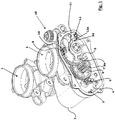
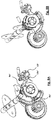
Fig. 1 is a perspective view, with removed parts, of a throttle body according to a first embodiment of the invention with a traditional by-pass valve; -
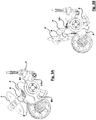
Fig. 2 is an enlarged perspective view of a detail of the pair of toothed gears ofFig. 1 in a home position; -
Figs. 3A and 3B are views similar to that ofFig. 2 , but in two different working position of the pair of toothed wheels, respectively in partial opening and in full opening of the primary air duct throttle; -
Fig. 4 is a view similar to that ofFig. 2 but in an idle condition of the engine with closed throttle and intervention on the bypass valve; -
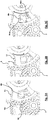
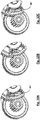
Figs. 5A, 5B and 5C show, still in greater detail and in subsequent working phases, a detail of the engagement of the drive pinion with the pair of terminal toothed gears, respectively in the home position of throttle valve, open position of the throttle valve and open position of the bypass valve; -
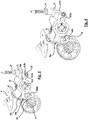
Fig. 6A is a perspective view similar to that ofFig. 1 , of a second embodiment of the invention with a new by-pass valve; -
Fig. 6B is a perspective view with removed parts of the throttle body ofFig. 6 taken along a different view; -
Fig. 7 is a view similar to that ofFig. 2 of the second embodiment; -
Figs. 8A and 8B are views similar to that ofFigs. 3A and 3B respectively, of the second embodiment; -
Fig. 9 is a view similar to that ofFig. 4 of the second embodiment; and -
Figs. 10A-10C are views similar to that ofFigs. 5A-5C of the second embodiment of the invention. - A throttle body for supplying air to an internal combustion engine comprises, in a per se known manner, at least one
duct 1 of the primary air flow regulated by a throttle valve F.Fig. 1 represents a variant that comprises a pair of side-by-side ducts 1 but, from the point of view of the invention, one or multiple ducts are equivalent. - The throttle valve F of the primary air duct comprises a shutter plate or butterfly which is integral with a shaft A rotatably mounted in a direction transverse to the longitudinal axis of the
duct 1. In the case of the arrangement shown, with a pair of side-by-side ducts, the two throttle valves have a single common driving shaft, so that their rotation can be controlled by a single driving device. - Notoriously, the shutter of the throttle valve is able to rotate around its shaft to an angle of about 90°; that is, from a closed, or "almost" closed position, wherein the shutter plate is arranged almost transversely to the respective duct, to an open position, wherein the shutter plate is on a plane substantially aligned with the longitudinal axis of the duct.
- The closed position is defined as "almost closed" for the reason that, in fact, the shutter does not perfectly close the respective duct, but leaves a narrow free gap in order to prevent unwanted jams against the duct walls. Here and in the following, for sake of brevity, the description will only refer to "open valve" and "closed valve" which are intended to be the two maximum and minimum rotation positions of the throttle.
- As well known, the throttle valve controls the so-called primary air flow through a primary duct, but in modern throttle bodies there is also provided a bypass channel, external to the primary duct, wherein a secondary air flow is provided. The secondary air flow is defined and intended for the "idling" regimes of the engine, while the primary air flow is supplied to the engine in every other power condition.
- The secondary air flow is controlled by its
own bypass valve 18, which is traditionally - as in the embodiment ofFigs. 1-5B - in the form of a plug check valve P with a longitudinal displacement against spring means. This bypass valve, although partially illustrated in the figures, will not be described in greater detail because it is known per se. - The driving device, being a single device, both for throttle valves F and for the
bypass valve 18, comprises anelectric motor 2 and a gear transmission with toothed-wheel gears. The drive motor is typically a DC motor or a stepper motor, housed within acase 3 of the throttle body and supported in cantilever fashion by asupport plate 4. - The gear transmission comprises a
first pinion 5 keyed onto the end of the shaft of themotor 2, and at least one further intermediate idle gear to obtain a high reduction ratio of the transmission: the intermediate idle wheel comprises, for example, a first toothed wheel 6, which engages with thepinion 5, and asecond pinion 7 coaxial and integral with the toothed wheel 6. - According to a first aspect of the invention, the gear transmission further comprises a pair of toothed-
sector elements - A first of said
toothed sectors 8 is keyed on the shaft A of the throttle valve F and is therefore integral in rotation therewith: it constitutes the throttle valve driving element for the primary air control. A second of said toothed-sector elements 9 is mounted coaxial and freely rotatable on said shaft, but is dynamically associated to thefirst element 8, in the way better described in the following. - The two toothed-
sector elements second pinion 7 of the intermediate idle wheel. In other words, they are arranged so that they can take driving motion from the same gear. More precisely, thepinion 7 is in engagement at the same time with both toothings of the first and second toothed-sector elements - However, the toothings of the two toothed-
sector elements sector element 9 are spread over an arc of circle much shorter than that of thefirst element 8, in proportion to the amplitude of rotation for which they must exercise their driving action. For example, the teeth of thefirst element 8 are provided on a circle arc of the order of 90°, while the teeth of thesecond element 9 are provided on a circle arc of only 15°. Namely, the toothing of the firsttoothed sector element 8 is extending over an arc of circle of the order of 50-95°, while the toothing of the secondtoothed sector element 9 is extending over an arc of a circle of the order of 5-30°. - For kinematic and structural reasons, the toothed-sector element can also be prolonged over a further arc of a circle other than that covered by the teeth, as is shown for a
portion 9a of thesecond element 9. - The first toothed-
sector element 8 is keyed on the common shaft A of the two throttle valves F, so that its movements, controlled by the transmission gear through thepinion 7, drive the throttle valves towards the opening (counter-clockwise movement of the element 8) of theprimary air duct 1, or respectively towards the closing (clockwise movement of the element 8). The first toothed-sector element 8 cooperates with a return elastic element, such as aspring 10, adapted to perform the function, well known per se, of bringing the throttle valve back towards a home position (Fig. 2 ), that is, towards the closing position, ensuring the automatic closing of the throttle valve in the case of failure of the drive system. The end-of-travel home position, with the throttle valve F closed, typically is resulting by a special abutment surface of theelement 8 abutting on an appropriate end-of-travel element C fixed with respect to the throttle body case. - The second toothed-
sector element 9 is also mounted rotatably, but idle, on the axle of the common shaft A of the two throttle valves. In the home condition, the toothing ofsector 9 meshes with the toothing of thedrive pinion 7. As already mentioned above, thesector 9 is coupled dynamically to the first toothed-sector element 8 by the following method. Thefirst element 8 has a drivingpeg 8b, projecting axially from the side facing the second toothed-sector element 9, which peg engages in an arched slot 9b formed in the second element 9: it determines a dragging effect in rotation between the two toothed-sector elements peg 8b in abutment at the two opposite ends 9ba and 9bb of the slot 9b. - The driving
peg 8b can be replaced by any other suitable engaging means, for example thepin 8b' shown in the embodiment offig. 8A . - In order to determine the static coupling between the two toothed-
sector elements elastic element 11, such as a spiral spring, which causes a torque that tends to rotate counter-clockwise thesecond element 9 with respect to the first 8, pushing thepeg 8b in abutment against home end 9ba of the slot 9b (Figs. 1 and2 ). When thepeg 8b is in abutment to the home end 9ba of the slot 9b, the two toothed-sector elements pinion 7. In this state of coupling between the twoelements sector element 9 extend beyond the end of the toothing of thefirst element 8, for an arc of a circle (of approximately 15°, as seen above) which determines the rotation useful to actuate thebypass valve 18, as will be described further below. This portion of the toothing of thesecond element 9, which extends beyond the ends of the toothing of thefirst element 8, is called the active portion of the toothing of thesecond element 9, as it is the one that determines the operational phase of the second toothed-sector element 9. - The second toothed-
sector element 9 also has a driving appendix which, in the first embodiment, is constituted by a portion of a toothed gear represented by asingle tooth 9d; the latter is intended to cooperate with atooth 12a of anopposite rocker lever 12, mounted free in rotation on a pin and intended to control a driven rod of thebypass valve 18 through anappendix 12b opposed to thetooth 12a. - The pair of toothed-
sector elements sector 9 meshes with thepinion toothing 7 and theappendix 9d is in engagement with thetooth 12a. - The rotation of the
tooth 9d is able to displace therocker lever 12, against the action of a return spring, to an extent sufficient to correctly displace also the check plug P of thebypass valve 18. The back displacement is automatically performed by the return spring. -
Figs. 6A-10C show a second embodiment disclosing a different aspect of the invention. In this case a drivingappendix 9d' of a second toothed sector element 9' is in the shape of a proper toothed sector (including at least three teeth) meshing with a correspondingtoothed sector 12a' acting as coupling means of a driving gear 12' for a bypass throttle valve 18'. Advantageously, the bypass throttle valve 18' comprises a rotating shutter plate attached to a shaft integral in rotation with driving gear 12'. This latter is biased by a torque spring 13' against an end-of travel abutment 14', toward a position wherein the bypass throttle valve 18' is open. When the drivingappendix 9d' of the second toothed sector 9' has meshed with thetoothed sector 12a', a further rotation of the driving gear 12' causes a progressive closing of the throttle bypass valve 18'. - The significant advantage of this embodiment over a traditional bypass valve, resides in that it can be obtained:
- enhanced control over the bypass flow: the flow rate adjustment is more fine and accurate, due to a better drive ratio control of rotation over closing movement of the valve;
- enhanced accuracy of the mechanism: the toothed sector 9' provides direct and rigid control of the rotating shutter shaft: there are no intermediate elements/levers; the lower number of elements compared to the traditional plug valve gives a positive contribution to reduce costs and undesirable plays;
- more reliability: the return from the closed condition to the home position of the bypass throttle valve is assisted by a return spring but it is also positively operated by drive toothed sector 9'.
- Moreover, according to a preferred embodiment, the second toothed-
sector element 9, 9' supports, in its centre of rotation, an internal magnetic button 13 (well visible inFig. 2 ), which is intended to cooperate with a position sensor (not shown) external to the case of the throttle body, to provide an angular position signal of the system. - The operation of the control device described above is illustrated in the following making reference to the first embodiment, but it is intended that also an embodiment comprising a throttle bypass valve could have a similar operation.
-
Figs. 1 ,2 and5A show a working position corresponding to the closed position of the throttle valves. In this position - called "home" position as it corresponds to the end of the closing travel of the throttle valve - the first toothed-sector element 8 is biased in a clockwise direction, by the bias of theelastic element 10, against the end of travel C. The toothing of thefirst element 8 is disengaged (seeend tooth 8c inFig. 5A ) from thedrive pinion 7, while thesecond element 9, biased by thespring 11 in such a way that the face 9ba of the slot is pressed against theabutment 8b, has its toothing at least in part meshed with thedrive pinion 7. - From this position, a counter-clockwise rotation of the
pinion 7 causes the clockwise rotation of the second toothed-sector element 9, which is disengaged from the first element simply by overcoming the elastic reaction of the spring 11 (Figs. 4 and5C ). The relative rotation between the two is allowed because the drivingpeg 8b slides freely in the slot 9b, while thefirst element 8 remains stationary against the end of travel C (Fig. 4 ). This phase of the counter-clockwise rotation of thepinion 7 thus allows to obtain, following the closure of the throttle of the primary air flow, a progressive actuation of the bypass valve by the rod of the plug valve P, which is also gradually closed obtaining the fine adjustment of the engine idling speed. - Conversely, when the
pinion 7 is rotated in the opposite direction (clockwise in the figures) from the home position, a slight counter-clockwise rotation of thesecond element 9 is obtained, sufficient to drag to some degree also the first toothed-sector element 8 coupled with it (due to thepeg 8b abutting the end 9ba of the slot 9b), until theend toot 8c of the firsttoothed sector 8 is meshed with the pinion 7 (Fig. 5B ). A further rotation of thepinion 7 causes a consequent counter-clockwise rotation of the first toothed-sector element 8 (Figs. 3A and 3B ), which goes progressively to open the throttle valve with which it is integral through the shaft A (overcoming the elastic reaction of the return spring 10). - The second toothed-
sector element 9 follows the movement of thefirst element 8 due to the mutual coupling kept by the spring 11 (in the closing direction of the throttle) or by dragging due to theabutment 8b engaging the surface 9ba of the slot (in the opening direction of the throttle). Preferably, the second toothed-sector element 9 is devoid of teeth on this rotation arc of the movement (as shown in the figures), to prevent that slight mismatching of the twoelements - As can be understood from the above description, the device of the invention allows to fully achieve the purposes stated in the introduction. The construction of the drive mechanism is in fact simple and reliable; being based on gearings, it is also robust, reliable and requires low maintenance; thanks to the direct control on the throttle valve, it is possible to obtain a perfect control on the opening/closing of the primary air flow, also by virtue of the
magnetic button 13 which provides an excellent detection capability of the displacement angle from the outside of the casing of the throttle body. - The
magnetic button 13 rotates integral with theelement 9; furthermore, for the angular positions in which thepinion 7 meshes with thesector 8 only, the latter drags thesector 9 in rotation through thespring 11 or theabutment 8b: this allows, for each configuration, to uniquely detect, through the position sensor, the angular position of the throttle or that of the by-pass valve. - The detectable element integral in rotation with drive shaft A can take other shapes than the
magnetic button 13, but it still has the advantage of supplying a direct information of the angular position of the throttle valve. - It is understood, however, that the invention is not to be considered as limited by the particular arrangements illustrated above, which represent only exemplary embodiments thereof, but different other variants are possible, all within the reach of a person skilled in the art, without departing from the scope of the invention itself, as defined by the following claims.
Claims (10)
- Control device of a primary air flow duct and a secondary air channel within a throttle assembly for the air supply to an internal combustion engine, comprising a driving electric motor (2) and a toothed gearing transmission (5, 6, 7) for transferring the motion from said electric motor (2) to a driving shaft (A) of at least one throttle valve for the choking of said primary air flow duct and to a driving element (12, 12') of a bypass valve (18, 18') of said secondary air channel, characterised in that
said toothed gearing transmission (5, 6, 7) is arranged to mesh with a first toothed-sector element (8) integral in rotation with said driving shaft (A) of said throttle valve of the primary air flow duct,
said toothed gearing transmission (5, 6, 7) is arranged to mesh also with a second toothed-sector element (9, 9'), idle with respect to said driving shaft (A) of the throttle valve and apt to be coupled in rotation with said first toothed-sector element (8) by rigid coupling in one direction and through an elastic element (11) in the opposite direction,
said second toothed-sector element (9, 9') having a driving appendix (12a, 12a') of said bypass valve (18, 18'). - Device as in 1, wherein said first element (8) and said second element (9, 9') make up a pair of coaxial and mutually adjacent toothed-sector elements, laying on parallel planes, having a same nominal diameter for meshing with a same pinion (7) of said toothed gearing transmission.
- Device as in 1 or 2, wherein said second toothed-sector element (9, 9') has a toothing which extends beyond a toothing end of said first toothed-sector element (8) when the two elements (8, 9) are coupled in said one direction.
- Device as in 1, 2 or 3, wherein said first toothed-sector element (8) and second toothed-sector element (9, 9') are mutually coupled in rotation by the engagement of an axial driving peg (8b, 8b') with an arched slot (9b) and through an elastic element (11) which biases said axial driving peg (8b) in abutment against a home end (9ba) of said arched slot (9b) determining the coupling in rotation in said one direction.
- Device as in any one of the preceding claims, furthermore comprising elastic return means (10), apt to bias said first toothed-sector element (8) integral with said shaft (A) toward a home position by which the throttle valve is closed.
- Device as in any one of the preceding claims, wherein a toothing of the first toothed-sector element (8) extends across an arc of a circle of the order of 50-95°, while a toothing of the second toothed-sector element (9) extends across an arc of a circle of the order of 5-30°.
- Device as in any one of the preceding claims, wherein a detectable button (13) is provided, integral in rotation with said second toothed-sector element (9, 9'), apt to be contactless detected by a position sensor arranged externally to a device-containing case.
- Device as in 7, wherein said detectable button (13) is made of magnetic material.
- Device as in any one of the preceding claims, wherein said bypass valve is a throttle valve having a rotating shutter (18') attached to a shaft integral in rotation with a driving gear (12') having a toothed portion (12a') meshing with a toothed appendix (9d') of said second toothed sector (9').
- Control device of a primary air flow duct and a secondary air channel within a throttle assembly for the air supply to an internal combustion engine, comprising a driving electric motor (2) and a toothed gearing transmission (5, 6, 7) for transferring the motion from said electric motor (2) to a driving shaft (A) of at least one throttle valve for the choking of said primary air flow duct and to a driving element (12, 12') of a bypass valve (18, 18') of said secondary air channel, characterised in that
said bypass valve is a throttle valve having a rotating shutter (18') rotating integral with a driving gear (12') taking motion from said toothed gearing transmission (5, 6, 7).
Applications Claiming Priority (1)
| Application Number | Priority Date | Filing Date | Title |
|---|---|---|---|
| ITUB2016A000567A ITUB20160567A1 (en) | 2016-02-08 | 2016-02-08 | Air flow control device in a throttle body for supplying an internal combustion engine |
Publications (2)
| Publication Number | Publication Date |
|---|---|
| EP3203055A1 true EP3203055A1 (en) | 2017-08-09 |
| EP3203055B1 EP3203055B1 (en) | 2019-07-24 |
Family
ID=56097189
Family Applications (1)
| Application Number | Title | Priority Date | Filing Date |
|---|---|---|---|
| EP17155068.4A Active EP3203055B1 (en) | 2016-02-08 | 2017-02-07 | Control device of the air flow in a throttle body for the supply of an internal combustion engine |
Country Status (2)
| Country | Link |
|---|---|
| EP (1) | EP3203055B1 (en) |
| IT (1) | ITUB20160567A1 (en) |
Cited By (6)
| Publication number | Priority date | Publication date | Assignee | Title |
|---|---|---|---|---|
| DE102018208685A1 (en) * | 2018-06-01 | 2019-03-21 | Bing Power Systems Gmbh | Intake device for an internal combustion engine |
| JP2019127941A (en) * | 2018-01-23 | 2019-08-01 | 株式会社ミクニ | Throttle device |
| DE102018213237A1 (en) * | 2018-08-07 | 2020-02-13 | Bayerische Motoren Werke Aktiengesellschaft | Suction system for an internal combustion engine |
| CN112610743A (en) * | 2019-10-03 | 2021-04-06 | 马瑞利欧洲公司 | Throttle valve for regulating gas supply to fuel cell and electrically driven vehicle including the same |
| JP2021177077A (en) * | 2020-05-01 | 2021-11-11 | 株式会社ミクニ | Throttle device |
| IT202100019985A1 (en) * | 2021-07-27 | 2023-01-27 | Denso Thermal Systems Spa | Kinematic mechanism with lowered tooth sector |
Citations (6)
| Publication number | Priority date | Publication date | Assignee | Title |
|---|---|---|---|---|
| DE4202406C1 (en) | 1992-01-29 | 1993-03-18 | Mercedes-Benz Aktiengesellschaft, 7000 Stuttgart, De | IC engine air intake control with two intake ducts - has each duct with throttle flap, one for medium and top load, and second for idling |
| JPH06167262A (en) | 1992-11-30 | 1994-06-14 | Mazda Motor Corp | Controller for idle adjusting valve of engine |
| US5657731A (en) | 1994-11-24 | 1997-08-19 | Hyundai Motor Company | Device for adjusting flow through an intake |
| EP1785615A1 (en) * | 2005-11-09 | 2007-05-16 | Keihin Corporation | Air bypass device in multiple throttle body |
| DE102011076446A1 (en) | 2011-05-25 | 2012-11-29 | Bayerische Motoren Werke Aktiengesellschaft | Method for controlling suction device for internal combustion engine, involves adjusting flow cross section of air channel, and actuating throttle element and adjusting device based on idle state of internal combustion engine |
| DE102013006044A1 (en) | 2013-04-06 | 2014-10-09 | Bing Power Systems Gmbh | Intake device for an internal combustion engine |
-
2016
- 2016-02-08 IT ITUB2016A000567A patent/ITUB20160567A1/en unknown
-
2017
- 2017-02-07 EP EP17155068.4A patent/EP3203055B1/en active Active
Patent Citations (6)
| Publication number | Priority date | Publication date | Assignee | Title |
|---|---|---|---|---|
| DE4202406C1 (en) | 1992-01-29 | 1993-03-18 | Mercedes-Benz Aktiengesellschaft, 7000 Stuttgart, De | IC engine air intake control with two intake ducts - has each duct with throttle flap, one for medium and top load, and second for idling |
| JPH06167262A (en) | 1992-11-30 | 1994-06-14 | Mazda Motor Corp | Controller for idle adjusting valve of engine |
| US5657731A (en) | 1994-11-24 | 1997-08-19 | Hyundai Motor Company | Device for adjusting flow through an intake |
| EP1785615A1 (en) * | 2005-11-09 | 2007-05-16 | Keihin Corporation | Air bypass device in multiple throttle body |
| DE102011076446A1 (en) | 2011-05-25 | 2012-11-29 | Bayerische Motoren Werke Aktiengesellschaft | Method for controlling suction device for internal combustion engine, involves adjusting flow cross section of air channel, and actuating throttle element and adjusting device based on idle state of internal combustion engine |
| DE102013006044A1 (en) | 2013-04-06 | 2014-10-09 | Bing Power Systems Gmbh | Intake device for an internal combustion engine |
Cited By (12)
| Publication number | Priority date | Publication date | Assignee | Title |
|---|---|---|---|---|
| JP2019127941A (en) * | 2018-01-23 | 2019-08-01 | 株式会社ミクニ | Throttle device |
| DE102018208685A1 (en) * | 2018-06-01 | 2019-03-21 | Bing Power Systems Gmbh | Intake device for an internal combustion engine |
| DE102018213237A1 (en) * | 2018-08-07 | 2020-02-13 | Bayerische Motoren Werke Aktiengesellschaft | Suction system for an internal combustion engine |
| DE102018213237B4 (en) | 2018-08-07 | 2024-05-02 | Bayerische Motoren Werke Aktiengesellschaft | Motorcycle internal combustion engine with a motorcycle internal combustion engine intake system and method for controlling such a motorcycle internal combustion engine intake system |
| CN112610743A (en) * | 2019-10-03 | 2021-04-06 | 马瑞利欧洲公司 | Throttle valve for regulating gas supply to fuel cell and electrically driven vehicle including the same |
| EP3800716A1 (en) * | 2019-10-03 | 2021-04-07 | Marelli Europe S.p.A. | Throttle valve for adjusting the feeding of a gas to a fuel cell and electric drive vehicle including the throttle valve |
| US11535109B2 (en) | 2019-10-03 | 2022-12-27 | Marelli Europe S.P.A. | Throttle valve for adjusting the feeding of a gas to a fuel cell and electric drive vehicle including the throttle valve |
| CN112610743B (en) * | 2019-10-03 | 2025-04-29 | 马瑞利欧洲公司 | Throttle valve for regulating the gas supply to a fuel cell and electrically driven vehicle comprising the throttle valve |
| JP2021177077A (en) * | 2020-05-01 | 2021-11-11 | 株式会社ミクニ | Throttle device |
| IT202100019985A1 (en) * | 2021-07-27 | 2023-01-27 | Denso Thermal Systems Spa | Kinematic mechanism with lowered tooth sector |
| EP4124777A1 (en) * | 2021-07-27 | 2023-02-01 | DENSO THERMAL SYSTEMS S.p.A. | Kinematic mechanism with recessed toothed sector |
| EP4124777B1 (en) | 2021-07-27 | 2024-06-26 | DENSO THERMAL SYSTEMS S.p.A. | Kinematic mechanism with recessed toothed sector |
Also Published As
| Publication number | Publication date |
|---|---|
| EP3203055B1 (en) | 2019-07-24 |
| ITUB20160567A1 (en) | 2017-08-08 |
Similar Documents
| Publication | Publication Date | Title |
|---|---|---|
| EP3203055B1 (en) | Control device of the air flow in a throttle body for the supply of an internal combustion engine | |
| US9689308B2 (en) | Throttle valve assembly | |
| CN102834634B (en) | Coupling assembly | |
| US20170176044A1 (en) | Dual Shaft Alternating Drive Actuator | |
| US9745901B2 (en) | Valve comprising a movement transformation device | |
| EP2307682B1 (en) | Valve unit for an internal combustion engine and internal combustion engine | |
| US10487925B2 (en) | Adjustment arrangement and valve control device comprising an adjustment arrangement | |
| KR20120092720A (en) | Device for converting rotational movement into translational movement | |
| JP2015068573A5 (en) | ||
| JPS6046255B2 (en) | Linear control flow regulator | |
| DE10304439A1 (en) | Variable valve timing device controller and method thereof | |
| US7775197B2 (en) | Engine sub-system actuators having variable ratio drive mechanisms | |
| DE102006035391A1 (en) | Rotary linear actuator, linear motion shaft mechanism, variable valve actuation mechanism, and variable valve motor | |
| CN106931227A (en) | By gear train move the transmission device and actuating system including transmission device of transmission | |
| WO2011147506A1 (en) | Actuating device for an internal combustion engine valve-train device | |
| US9587555B2 (en) | Transmission system and exhaust gas turbocharger | |
| CN113586786A (en) | Gear train for valve actuator | |
| US6089208A (en) | Throttle valve opening and closing apparatus for a vehicle, and vehicle internal combustion engine using the apparatus | |
| RU56542U1 (en) | ELECTRIC ACTUATOR WITH MANUAL DOUBLE ROTARY VALVE VALVE CONTROLLING PRESSURE IN THE PIPELINE IN AUTOMATIC MODE | |
| US4572932A (en) | Actuating mechanism | |
| DE4021691C2 (en) | Potentiometer | |
| CN113525035A (en) | Air discharge device | |
| CN222351580U (en) | Valve counter | |
| CN106460680B (en) | Fluid flow valve | |
| WO2008089864A1 (en) | Adjusting device for axial adjustment of a camshaft by means of an adjusting actuator |
Legal Events
| Date | Code | Title | Description |
|---|---|---|---|
| PUAI | Public reference made under article 153(3) epc to a published international application that has entered the european phase |
Free format text: ORIGINAL CODE: 0009012 |
|
| STAA | Information on the status of an ep patent application or granted ep patent |
Free format text: STATUS: THE APPLICATION HAS BEEN PUBLISHED |
|
| AK | Designated contracting states |
Kind code of ref document: A1 Designated state(s): AL AT BE BG CH CY CZ DE DK EE ES FI FR GB GR HR HU IE IS IT LI LT LU LV MC MK MT NL NO PL PT RO RS SE SI SK SM TR |
|
| AX | Request for extension of the european patent |
Extension state: BA ME |
|
| STAA | Information on the status of an ep patent application or granted ep patent |
Free format text: STATUS: REQUEST FOR EXAMINATION WAS MADE |
|
| 17P | Request for examination filed |
Effective date: 20180208 |
|
| RBV | Designated contracting states (corrected) |
Designated state(s): AL AT BE BG CH CY CZ DE DK EE ES FI FR GB GR HR HU IE IS IT LI LT LU LV MC MK MT NL NO PL PT RO RS SE SI SK SM TR |
|
| STAA | Information on the status of an ep patent application or granted ep patent |
Free format text: STATUS: EXAMINATION IS IN PROGRESS |
|
| 17Q | First examination report despatched |
Effective date: 20180628 |
|
| GRAP | Despatch of communication of intention to grant a patent |
Free format text: ORIGINAL CODE: EPIDOSNIGR1 |
|
| STAA | Information on the status of an ep patent application or granted ep patent |
Free format text: STATUS: GRANT OF PATENT IS INTENDED |
|
| INTG | Intention to grant announced |
Effective date: 20190328 |
|
| GRAS | Grant fee paid |
Free format text: ORIGINAL CODE: EPIDOSNIGR3 |
|
| GRAA | (expected) grant |
Free format text: ORIGINAL CODE: 0009210 |
|
| STAA | Information on the status of an ep patent application or granted ep patent |
Free format text: STATUS: THE PATENT HAS BEEN GRANTED |
|
| AK | Designated contracting states |
Kind code of ref document: B1 Designated state(s): AL AT BE BG CH CY CZ DE DK EE ES FI FR GB GR HR HU IE IS IT LI LT LU LV MC MK MT NL NO PL PT RO RS SE SI SK SM TR |
|
| REG | Reference to a national code |
Ref country code: GB Ref legal event code: FG4D |
|
| REG | Reference to a national code |
Ref country code: CH Ref legal event code: EP |
|
| REG | Reference to a national code |
Ref country code: DE Ref legal event code: R096 Ref document number: 602017005400 Country of ref document: DE |
|
| REG | Reference to a national code |
Ref country code: AT Ref legal event code: REF Ref document number: 1158478 Country of ref document: AT Kind code of ref document: T Effective date: 20190815 |
|
| REG | Reference to a national code |
Ref country code: IE Ref legal event code: FG4D |
|
| REG | Reference to a national code |
Ref country code: NL Ref legal event code: MP Effective date: 20190724 |
|
| REG | Reference to a national code |
Ref country code: LT Ref legal event code: MG4D |
|
| REG | Reference to a national code |
Ref country code: AT Ref legal event code: MK05 Ref document number: 1158478 Country of ref document: AT Kind code of ref document: T Effective date: 20190724 |
|
| PG25 | Lapsed in a contracting state [announced via postgrant information from national office to epo] |
Ref country code: LT Free format text: LAPSE BECAUSE OF FAILURE TO SUBMIT A TRANSLATION OF THE DESCRIPTION OR TO PAY THE FEE WITHIN THE PRESCRIBED TIME-LIMIT Effective date: 20190724 Ref country code: HR Free format text: LAPSE BECAUSE OF FAILURE TO SUBMIT A TRANSLATION OF THE DESCRIPTION OR TO PAY THE FEE WITHIN THE PRESCRIBED TIME-LIMIT Effective date: 20190724 Ref country code: PT Free format text: LAPSE BECAUSE OF FAILURE TO SUBMIT A TRANSLATION OF THE DESCRIPTION OR TO PAY THE FEE WITHIN THE PRESCRIBED TIME-LIMIT Effective date: 20191125 Ref country code: AT Free format text: LAPSE BECAUSE OF FAILURE TO SUBMIT A TRANSLATION OF THE DESCRIPTION OR TO PAY THE FEE WITHIN THE PRESCRIBED TIME-LIMIT Effective date: 20190724 Ref country code: NO Free format text: LAPSE BECAUSE OF FAILURE TO SUBMIT A TRANSLATION OF THE DESCRIPTION OR TO PAY THE FEE WITHIN THE PRESCRIBED TIME-LIMIT Effective date: 20191024 Ref country code: SE Free format text: LAPSE BECAUSE OF FAILURE TO SUBMIT A TRANSLATION OF THE DESCRIPTION OR TO PAY THE FEE WITHIN THE PRESCRIBED TIME-LIMIT Effective date: 20190724 Ref country code: FI Free format text: LAPSE BECAUSE OF FAILURE TO SUBMIT A TRANSLATION OF THE DESCRIPTION OR TO PAY THE FEE WITHIN THE PRESCRIBED TIME-LIMIT Effective date: 20190724 Ref country code: BG Free format text: LAPSE BECAUSE OF FAILURE TO SUBMIT A TRANSLATION OF THE DESCRIPTION OR TO PAY THE FEE WITHIN THE PRESCRIBED TIME-LIMIT Effective date: 20191024 Ref country code: NL Free format text: LAPSE BECAUSE OF FAILURE TO SUBMIT A TRANSLATION OF THE DESCRIPTION OR TO PAY THE FEE WITHIN THE PRESCRIBED TIME-LIMIT Effective date: 20190724 |
|
| PG25 | Lapsed in a contracting state [announced via postgrant information from national office to epo] |
Ref country code: RS Free format text: LAPSE BECAUSE OF FAILURE TO SUBMIT A TRANSLATION OF THE DESCRIPTION OR TO PAY THE FEE WITHIN THE PRESCRIBED TIME-LIMIT Effective date: 20190724 Ref country code: IS Free format text: LAPSE BECAUSE OF FAILURE TO SUBMIT A TRANSLATION OF THE DESCRIPTION OR TO PAY THE FEE WITHIN THE PRESCRIBED TIME-LIMIT Effective date: 20191124 Ref country code: GR Free format text: LAPSE BECAUSE OF FAILURE TO SUBMIT A TRANSLATION OF THE DESCRIPTION OR TO PAY THE FEE WITHIN THE PRESCRIBED TIME-LIMIT Effective date: 20191025 Ref country code: AL Free format text: LAPSE BECAUSE OF FAILURE TO SUBMIT A TRANSLATION OF THE DESCRIPTION OR TO PAY THE FEE WITHIN THE PRESCRIBED TIME-LIMIT Effective date: 20190724 Ref country code: LV Free format text: LAPSE BECAUSE OF FAILURE TO SUBMIT A TRANSLATION OF THE DESCRIPTION OR TO PAY THE FEE WITHIN THE PRESCRIBED TIME-LIMIT Effective date: 20190724 Ref country code: ES Free format text: LAPSE BECAUSE OF FAILURE TO SUBMIT A TRANSLATION OF THE DESCRIPTION OR TO PAY THE FEE WITHIN THE PRESCRIBED TIME-LIMIT Effective date: 20190724 |
|
| PG25 | Lapsed in a contracting state [announced via postgrant information from national office to epo] |
Ref country code: TR Free format text: LAPSE BECAUSE OF FAILURE TO SUBMIT A TRANSLATION OF THE DESCRIPTION OR TO PAY THE FEE WITHIN THE PRESCRIBED TIME-LIMIT Effective date: 20190724 |
|
| PG25 | Lapsed in a contracting state [announced via postgrant information from national office to epo] |
Ref country code: DK Free format text: LAPSE BECAUSE OF FAILURE TO SUBMIT A TRANSLATION OF THE DESCRIPTION OR TO PAY THE FEE WITHIN THE PRESCRIBED TIME-LIMIT Effective date: 20190724 Ref country code: PL Free format text: LAPSE BECAUSE OF FAILURE TO SUBMIT A TRANSLATION OF THE DESCRIPTION OR TO PAY THE FEE WITHIN THE PRESCRIBED TIME-LIMIT Effective date: 20190724 Ref country code: RO Free format text: LAPSE BECAUSE OF FAILURE TO SUBMIT A TRANSLATION OF THE DESCRIPTION OR TO PAY THE FEE WITHIN THE PRESCRIBED TIME-LIMIT Effective date: 20190724 Ref country code: EE Free format text: LAPSE BECAUSE OF FAILURE TO SUBMIT A TRANSLATION OF THE DESCRIPTION OR TO PAY THE FEE WITHIN THE PRESCRIBED TIME-LIMIT Effective date: 20190724 |
|
| PG25 | Lapsed in a contracting state [announced via postgrant information from national office to epo] |
Ref country code: IS Free format text: LAPSE BECAUSE OF FAILURE TO SUBMIT A TRANSLATION OF THE DESCRIPTION OR TO PAY THE FEE WITHIN THE PRESCRIBED TIME-LIMIT Effective date: 20200224 Ref country code: SM Free format text: LAPSE BECAUSE OF FAILURE TO SUBMIT A TRANSLATION OF THE DESCRIPTION OR TO PAY THE FEE WITHIN THE PRESCRIBED TIME-LIMIT Effective date: 20190724 Ref country code: CZ Free format text: LAPSE BECAUSE OF FAILURE TO SUBMIT A TRANSLATION OF THE DESCRIPTION OR TO PAY THE FEE WITHIN THE PRESCRIBED TIME-LIMIT Effective date: 20190724 Ref country code: SK Free format text: LAPSE BECAUSE OF FAILURE TO SUBMIT A TRANSLATION OF THE DESCRIPTION OR TO PAY THE FEE WITHIN THE PRESCRIBED TIME-LIMIT Effective date: 20190724 |
|
| REG | Reference to a national code |
Ref country code: DE Ref legal event code: R097 Ref document number: 602017005400 Country of ref document: DE |
|
| PLBE | No opposition filed within time limit |
Free format text: ORIGINAL CODE: 0009261 |
|
| STAA | Information on the status of an ep patent application or granted ep patent |
Free format text: STATUS: NO OPPOSITION FILED WITHIN TIME LIMIT |
|
| PG2D | Information on lapse in contracting state deleted |
Ref country code: IS |
|
| 26N | No opposition filed |
Effective date: 20200603 |
|
| PG25 | Lapsed in a contracting state [announced via postgrant information from national office to epo] |
Ref country code: SI Free format text: LAPSE BECAUSE OF FAILURE TO SUBMIT A TRANSLATION OF THE DESCRIPTION OR TO PAY THE FEE WITHIN THE PRESCRIBED TIME-LIMIT Effective date: 20190724 |
|
| REG | Reference to a national code |
Ref country code: CH Ref legal event code: PL |
|
| REG | Reference to a national code |
Ref country code: BE Ref legal event code: MM Effective date: 20200229 |
|
| PG25 | Lapsed in a contracting state [announced via postgrant information from national office to epo] |
Ref country code: MC Free format text: LAPSE BECAUSE OF FAILURE TO SUBMIT A TRANSLATION OF THE DESCRIPTION OR TO PAY THE FEE WITHIN THE PRESCRIBED TIME-LIMIT Effective date: 20190724 Ref country code: LU Free format text: LAPSE BECAUSE OF NON-PAYMENT OF DUE FEES Effective date: 20200207 |
|
| PG25 | Lapsed in a contracting state [announced via postgrant information from national office to epo] |
Ref country code: CH Free format text: LAPSE BECAUSE OF NON-PAYMENT OF DUE FEES Effective date: 20200229 Ref country code: LI Free format text: LAPSE BECAUSE OF NON-PAYMENT OF DUE FEES Effective date: 20200229 |
|
| PG25 | Lapsed in a contracting state [announced via postgrant information from national office to epo] |
Ref country code: FR Free format text: LAPSE BECAUSE OF NON-PAYMENT OF DUE FEES Effective date: 20200229 Ref country code: IE Free format text: LAPSE BECAUSE OF NON-PAYMENT OF DUE FEES Effective date: 20200207 |
|
| PG25 | Lapsed in a contracting state [announced via postgrant information from national office to epo] |
Ref country code: BE Free format text: LAPSE BECAUSE OF NON-PAYMENT OF DUE FEES Effective date: 20200229 |
|
| GBPC | Gb: european patent ceased through non-payment of renewal fee |
Effective date: 20210207 |
|
| PG25 | Lapsed in a contracting state [announced via postgrant information from national office to epo] |
Ref country code: GB Free format text: LAPSE BECAUSE OF NON-PAYMENT OF DUE FEES Effective date: 20210207 |
|
| PG25 | Lapsed in a contracting state [announced via postgrant information from national office to epo] |
Ref country code: MT Free format text: LAPSE BECAUSE OF FAILURE TO SUBMIT A TRANSLATION OF THE DESCRIPTION OR TO PAY THE FEE WITHIN THE PRESCRIBED TIME-LIMIT Effective date: 20190724 Ref country code: CY Free format text: LAPSE BECAUSE OF FAILURE TO SUBMIT A TRANSLATION OF THE DESCRIPTION OR TO PAY THE FEE WITHIN THE PRESCRIBED TIME-LIMIT Effective date: 20190724 |
|
| PG25 | Lapsed in a contracting state [announced via postgrant information from national office to epo] |
Ref country code: MK Free format text: LAPSE BECAUSE OF FAILURE TO SUBMIT A TRANSLATION OF THE DESCRIPTION OR TO PAY THE FEE WITHIN THE PRESCRIBED TIME-LIMIT Effective date: 20190724 |
|
| P01 | Opt-out of the competence of the unified patent court (upc) registered |
Effective date: 20230516 |
|
| PGFP | Annual fee paid to national office [announced via postgrant information from national office to epo] |
Ref country code: DE Payment date: 20260113 Year of fee payment: 10 |
|
| PGFP | Annual fee paid to national office [announced via postgrant information from national office to epo] |
Ref country code: IT Payment date: 20260114 Year of fee payment: 10 |