EP3202196B1 - Verfahren und vorrichtung zur datenübertragung - Google Patents
Verfahren und vorrichtung zur datenübertragung Download PDFInfo
- Publication number
- EP3202196B1 EP3202196B1 EP15905681.1A EP15905681A EP3202196B1 EP 3202196 B1 EP3202196 B1 EP 3202196B1 EP 15905681 A EP15905681 A EP 15905681A EP 3202196 B1 EP3202196 B1 EP 3202196B1
- Authority
- EP
- European Patent Office
- Prior art keywords
- channel
- channel sensing
- sensing
- link
- type
- Prior art date
- Legal status (The legal status is an assumption and is not a legal conclusion. Google has not performed a legal analysis and makes no representation as to the accuracy of the status listed.)
- Active
Links
Images



Classifications
-
- H—ELECTRICITY
- H04—ELECTRIC COMMUNICATION TECHNIQUE
- H04W—WIRELESS COMMUNICATION NETWORKS
- H04W74/00—Wireless channel access
- H04W74/02—Hybrid access
-
- H—ELECTRICITY
- H04—ELECTRIC COMMUNICATION TECHNIQUE
- H04W—WIRELESS COMMUNICATION NETWORKS
- H04W56/00—Synchronisation arrangements
-
- H—ELECTRICITY
- H04—ELECTRIC COMMUNICATION TECHNIQUE
- H04W—WIRELESS COMMUNICATION NETWORKS
- H04W48/00—Access restriction; Network selection; Access point selection
- H04W48/08—Access restriction or access information delivery, e.g. discovery data delivery
-
- H—ELECTRICITY
- H04—ELECTRIC COMMUNICATION TECHNIQUE
- H04W—WIRELESS COMMUNICATION NETWORKS
- H04W72/00—Local resource management
- H04W72/04—Wireless resource allocation
- H04W72/044—Wireless resource allocation based on the type of the allocated resource
- H04W72/0446—Resources in time domain, e.g. slots or frames
-
- H—ELECTRICITY
- H04—ELECTRIC COMMUNICATION TECHNIQUE
- H04W—WIRELESS COMMUNICATION NETWORKS
- H04W72/00—Local resource management
- H04W72/12—Wireless traffic scheduling
- H04W72/121—Wireless traffic scheduling for groups of terminals or users
Definitions
- the non-limiting and exemplary embodiments of the present disclosure generally relate to wireless communications, and specifically to a method, an apparatus, and a computer program product for data transmission between communications devices operable on both a licensed carrier and an unlicensed carrier.
- 3GPP Third Generation Partnership Project
- LTE Long Term Evolution
- the existing and new spectrum licensed for exclusive use by International Mobile Telecommunications (IMT) technologies will remain fundamental for providing seamless coverage, achieving the highest spectral efficiency, and ensuring the highest reliability of cellular networks through careful planning and deployment of high-quality network equipment and devices.
- LAA Licensed-Assisted Access
- An LAA framework builds on carrier aggregation solutions introduced in LTE Release-10 to access the additional bandwidth in the unlicensed spectrum.
- an access point AP
- UE user equipment
- the licensed carrier maintains a radio connection, while the unlicensed carrier is mainly used for data rate boost.
- transmissions on the licensed carrier may be performed based on resource scheduling at the AP according to specifications as defined for LTE systems, while transmissions on the unlicensed carrier may follow the listen before talk (LBT) mechanism as defined for WiFi systems.
- LBT listen before talk
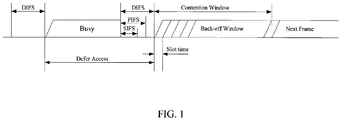
- FIG. 1 shows an example of the LBT mechanism as defined in IEEE (Institute of Electrical and Electronics Engineers) 802.11.
- the transmitter when there is data for transmission from a transmitter to a UE, the transmitter shall first sense a channel for a radio link directed to the UE for a certain time period, e.g. for DIFS (Distributed Coordination Function (DCF) inter-frame space), PIFS (Point Coordination Function (PCF) inter-frame space) or SIFS (Short Inter-frame Space). If the channel is sensed to be busy, then the transmitter shall wait e.g. for a Defer Access period as shown in the figure.
- DIFS Distributed Coordination Function
- PIFS Point Coordination Function
- SIFS Short Inter-frame Space
- the transmitter may generate a random back-off time period, which may be referred to as a contention window or a back-off window, as shown in the figure.
- the channel may be determined to be available for data transmission only if the channel is sensed to be idle during the whole back-off window. Once the channel is determined to be available, the transmitter may start to transmit data over the channel to the UE.
- the beamforming technology has been introduced into the WiFi systems.
- high gain beamforming directional channel sensing with the conventional LBT has been investigated so as to improve spatial multiplexing.
- a transmitter may perform channel sensing for different directions so as to determine channel availability for respective links in these directions.
- analog beamforming antennas are preferably adopted to implement beamforming.
- a precoding matrix is applied by using analog phase shifters after digital-to-analog (DA) conversion.
- DA digital-to-analog
- usage of analog beamforming antennas may reduce the number of Analog-to-Digital (AD)/ DA converters. Since the cost of AD/ DA converters is very high and power efficiency may also form a challenge when too many AD/DA converters are applied, analog beamforming antennas are preferred in implementation of beamforming.
- an analog beamforming antenna can provide a very limited number of Tx/Rx Radio Frequency (RF) chains, while one Tx/Rx RF chain can only generate one main beam and it is impractical to use the same RF chain to generate multiple main beams for multiple users simultaneously since the users are usually located in different directions.
- RF Radio Frequency
- the number of beams that can be generated by the AP is up to the number of TX RF chains of the AP antenna and the number of directions that the AP can sense is up to the number of RX RF chains of the AP antenna.
- the AP may need to perform directional channel sensing to determine channel availability before data transmission to each user on the unlicensed carrier.
- the directional channel sensing may have to be performed sequentially and meanwhile complies with the LTE frame structure used on the licensed carrier, which may cause a large overhead and resource waste, as explained with reference to FIG. 2 and FIG. 3 .
- FIG. 2 shows an LTE frame structure as used on the licensed carrier.
- an LTE radio frame has 10 LTE subframes, while each subframe may have 14 symbols.
- the first three symbols may be used for channel sensing, after which data transmission may be performed.
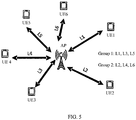
- FIG. 3(a) shows an example of one AP serving three UEs by establishing three radio links L1, L2 and L3 in different directions. It is assumed that the AP equipped with an analog beamforming antenna has a single RX RF chain to serve the three UEs and can sense channels for links L1, L2 and L3 sequentially.
- the AP may have to perform channel sensing for the served UEs one by one. If the AP performs channel sensing for the three UEs (i.e., UE1, UE2 and UE3) sequentially due to the limitation of the RX RF chain at the AP side, the AP may only complete the channel sensing for one UE within one subframe. In this case, if a channel sensed in one subframe is determined to be busy for a UE, then that subframe may not be used for channel sensing of other UEs, although the channel may be available for the other UEs in other directions.
- 3(b) shows an example of a channel sensing sequence, in which mark "X" indicates that the channel being sensed is busy and mark " ⁇ " indicates that the channel being sensed is idle.
- mark "X" indicates that the channel being sensed is busy
- mark " ⁇ " indicates that the channel being sensed is idle.
- the efficiency of resource utilization may be low.
- US2014031054 and US2014112289 both disclose channel sensing for unlicensed spectrum.
- channel sensing can be performed for more than one radio link in parallel.
- the efficiency of radio resource utilization may be enhanced and channel sensing overhead may be reduced.
- references in the specification to "an embodiment,” “another embodiment,” “yet another embodiment,” etc. indicate that the embodiment described may include a particular feature, structure, or characteristic, but every embodiment may not necessarily include the particular feature, structure, or characteristic. Moreover, when a particular feature, structure, or characteristic is described in connection with an embodiment, it is submitted that it is within the knowledge of one skilled in the art to affect such feature, structure, or characteristic in connection with other embodiments whether or not explicitly described.
- first and second etc. may be used herein to describe various elements, these elements should not be limited by these terms. These terms are only used to distinguish one element from another. For example, a first element could be termed a second element, and similarly, a second element could be termed a first element, without departing from the scope of example embodiments.
- the term “and/ or” includes any and all combinations of one or more of the listed terms in association.
- base station used herein may also be referred to as e.g. AP, eNB, eNodeB, NodeB or base transceiver station (BTS) etc. depending on the technology and terminology used.
- UE used herein may refer to any terminal having wireless communications capabilities, including but not limited to, mobile phones, cellular phones, smart phones, or personal digital assistants (PDAs), portable computers, image capture devices such as digital cameras, gaming devices, music storage and playback appliances and any portable units or terminals that have wireless communications capabilities, or Internet appliances permitting wireless Internet access and browsing and the like.
- PDAs personal digital assistants
- the terms "communications device of a first type” and “communications device of a second type” are used in this document to differentiate two communications parties, without necessarily specifying which communications device is a base station or which communications device is a UE.
- FIG. 4 illustrates a flowchart of an example method 400 for data transmission according to an embodiment of the present disclosure.
- the method 400 may be performed at a base station for data transmission to one or more UEs or at a UE for data transmission to one or more base stations.
- the communications device that performs the method 400 will be referred to as a communications device of a first type
- the communications device to which the transmission scheduled according to the method 400 is directed will be referred to as a communications device of a second type.
- the communications device of the first type and the communication device of the second type can operate on both a licensed carrier and an unlicensed carrier.
- the communications of the first type and the communications device of the second device may be an eNB and a UE respectively in an LAA network, in which the eNB serves one or more UEs via a licensed carrier and an unlicensed carrier.
- the licensed carrier may be used to maintain a radio connection, while the unlicensed carrier may be used for data rate boost.
- the communications device of the first type e.g. a base station
- the communications device of the first type is equipped with one RX RF chain and can provide more than one downlink radio links directed to more than one communications devices of the second type.
- the concept and principle of the method 400 may also be applied to the communications device of the first type equipped with more than one RX RF chain.
- the method 400 enters at block 410, in which the communications device of the first type performs channel sensing on the unlicensed carrier, at different sensing slots within a time duration, for respective links directed to at least two communications devices of the second type.
- the time duration may be specified as a portion of a subframe in a frame structure used on the licensed carrier. Taking the frame structure in LTE as an example, the time duration may be specified as a first few symbols of each subframe as shown in FIG. 2 , e.g. the first three symbols.
- the time duration may be specified according to transmission timing on the unlicensed carrier.
- the communications device of the first may schedule transmission on a channel that is determined to be available at block 420.
- links from the communications device of the first type and directed to communications devices of the second type may be grouped into two or more groups at block 401, for example based on direction differences of those links.
- the above mentioned respective links directed to the at least two communications devices of the second type will belong to a same group.
- FIG. 5 illustrates an example of grouping links based on direction differences of the links according to an embodiment of the present disclosure.
- links L1, L3 and L5 may be grouped into a same group, while links L2, L4 and L6 may be grouped into another group.
- any two links with a larger directional difference may be grouped together.
- the channel sensing may be performed within the same group, in which any two links have the larger directional difference, thereby increasing the probability to find one available channel.
- the communications device of the first type may randomly select a back-off window within the time duration at block 402, for each of the links to be sensed.
- Each of the back-off windows may comprise at least one sensing slot.
- the channel sensing is limited within a corresponding back-off window. If a channel is sensed to be idle during the whole back-off window, that channel may be determined to be available. By this way, the channel sensing can be performed within a time period with a random length, and thus transmission may be started randomly, thereby reducing the collision possibility.
- the channel sensing may be performed alternately for the respective links directed to the at least two communications devices of the second type according to channel sensing patterns predefined in respective back-off windows.
- Each of the channel sensing patterns may specify an arrangement of the at least one sensing slot comprised in the corresponding back-off window. Alternate channel sensing according to the predefined channel sensing pattern may be helpful for controlling the period between two sequent channel sensing to be smaller than the minimum length of other transmissions on the unlicensed carrier.
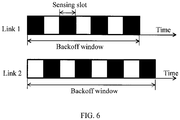
- FIG. 6 illustrates two example channel sensing patterns for link 1 and link 2.
- the channel sensing pattern for link 1 specifies the arrangement of the sensing slots comprised in the first back-off window at the top and the channel sensing pattern for link 2 specifies the arrangement of the sensing slots comprised in the second back-off window at the bottom, wherein black blocks represent the sensing slots while white blocks represent a gap between two sensing slots, during which no channel sensing is performed.
- the channel sensing may be performed for link 1 and link 2 alternately.
- all sensing slots have the same length. However, different lengths may also be applied to the sensing slots.
- the period between two sequent channel sensing for each of the links is preferably smaller than the minimum length of any other transmission on the unlicensed carrier, so that any ongoing transmission which may affect the channel status of the link in discussion, for example transmission on the unlicensed carrier in another network adjacent to link 1 that may cause the channel for link 1 to be busy, will not be missed.
- accuracy of the channel sensing may be guaranteed.
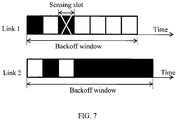
- the operation at block 410 of performing channel sensing may comprise, in response that a result of the channel sensing for a link directed to one of the at least two communications devices of the second type indicates the channel for that link being busy, skipping following channel sensing for that link.
- FIG. 7 illustrates an example of how to skip channel sensing for a link when the channel for that link is sensed to be busy.
- the channel for link 1 is sensed to be busy at the second sensing slot, which is shown with an "X".
- the following channel sensing for link 1 may be skipped, which is shown with all white blocks after the second sensing slot in the channel sensing pattern for link 1.
- the channel sensing is switched to link 2, which is shown with all black blocks after the second white block in the channel sensing pattern for link 2.
- the channel sensing may be further switched to the additional link and then performed alternately between link 2 and the additional link, e.g. according to predefined channel sensing patterns.
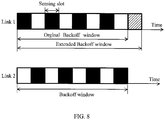
- the back-off window, at the end of which no channel sensing is performed may be extended for further channel sensing so as to confirm availability of the channel that is sensed in that back-off window.
- a channel when a channel is sensed to be busy or idle, it means that that channel is busy or idle during a sensing slot in which this channel sensing is performed, while when a channel is determined to be available, it means that the channel is sensed to be idle during the whole back-off window in which the channel sensing is performed.
- FIG. 8 illustrates how to extend a back-off window for further channel sensing so as to confirm availability of the channel that is sensed in that back-off window.
- the communications device of the first type e.g. the base station
- the communications device of the first type did not perform channel sensing at the end of the original back-off window for link 1, i.e. in the last sensing slot.
- the original back-off window for link 1 may be extended by an additional sensing slot, which is shown with a diagonally-striped block in FIG. 8 , in which further channel sensing may be performed for link 1.
- the channel for link 1 cannot be determined to be available even though that channel has been sensed to be idle in all previous sensing slots comprised in the original back-off window for link 1.
- the communications device of the first type e.g. the base station
- the communications device of the second type e.g. a UE
- the communications device of the first type may schedule transmission on that channel and skip further channel sensing for all other channels.
- the communications device of the first type e.g. the base station may complete the channel sensing within respective back-off windows for all links being sensed. If there are multiple channels that are determined to be available, then the communications device of the first type may select a channel to schedule transmission thereon in consideration of some factors, such as with a highest amount of buffered data, a highest latency requirement, or a lowest received power from interfering channels and the like, aiming to offer better transmission performance.
- FIG. 9 illustrates a schematic block diagram of an apparatus 900 adapted for data transmission according to an embodiment of the present disclosure.
- the apparatus 900 may be embodied at or as at least part of a base station for data transmission to one or more UEs or embodied at or as at least part of a UE for data transmission to one or more base stations.
- the communications device at which the apparatus 900 is embodied or comprising the apparatus 900 will be referred to as a communications device of a first type
- the communications device to which the transmission scheduled by the apparatus 900 is directed will be referred to as a communications device of a second type.
- the communications device of the first type and the communication device of the second type can operate on both a licensed carrier and an unlicensed carrier.
- the communications of the first type and the communications device of the second device may be an eNB and a UE respectively in an LAA network, in which the eNB serves one or more UEs via a licensed carrier and an unlicensed carrier.
- the licensed carrier may be used to maintain a radio connection, while the unlicensed carrier may be used for data rate boost.
- the communications device of the first type e.g. a base station
- the communications device of the first type is equipped with one RX RF chain and can provide more than one downlink radio links directed to more than one communications devices of the second type.
- the concept and principle of embodiments of the apparatus 900 may also be applied to the communications device of the first type equipped with more than one RX RF chain.
- the apparatus 900 comprises a channel sensing unit 910 and a transmission scheduling unit 920.
- the channel sensing unit 910 is configured to perform channel sensing on the unlicensed carrier, at different sensing slots within a time duration, for respective links directed to at least two communications devices of the second type.
- the time duration is specified as a portion of a subframe in a frame structure used on the licensed carrier. For example, the time duration may be specified as a first few symbols of each subframe as shown in FIG. 2 . Alternatively, in WiFi systems without involving transmissions on licensed carriers, the time duration may be specified according to transmission timing on the unlicensed carrier.
- the transmission scheduling unit 920 is configured to schedule transmission on a channel that is determined to be available based on corresponding channel sensing.
- the apparatus 900 may further comprise a link grouping unit 901 that is configured to group links directed to communications devices of the second type into two or more groups, for example based on direction differences of those links.
- a link grouping unit 901 that is configured to group links directed to communications devices of the second type into two or more groups, for example based on direction differences of those links.
- the above mentioned respective links directed to the at least two communications devices of the second type will belong to a same group.
- a period between two sequent channel sensing for each of the respective links may be smaller than a minimum length of any other transmission on the unlicensed carrier, so that any ongoing transmissions which may affect the channel status of the link in discussion will not be missed. Thus, accuracy of the channel sensing may be guaranteed.
- the apparatus 900 may further comprise a back-off window selecting unit 902 that is configured to randomly select a back-off window that comprises at least one sensing slot within the time duration, for each of the respective links directed to the at least two communications devices of the second type.
- a back-off window selecting unit 902 that is configured to randomly select a back-off window that comprises at least one sensing slot within the time duration, for each of the respective links directed to the at least two communications devices of the second type.
- the channel sensing unit 910 may further be configured to perform channel sensing alternately for the respective links according to channel sensing patterns predefined in respective back-off windows.
- Each of the channel sensing patterns specifies an arrangement of the at least one sensing slot comprised in the corresponding back-off window.
- the channel sensing unit 910 may further be configured to extend the back-off window, at the end of which no channel sensing is performed, for further channel sensing so as to confirm availability of the channel being sensed in that back-off window.
- the transmission scheduling unit 920 may further be configured to, in response that the channel for a link for which a back-off window with a shortest length is selected is determined to be available based on the corresponding channel sensing, schedule transmission on the channel for that link without further performing the channel sensing for other links.
- the channel sensing unit 910 may further be configured to, in response that a result of the channel sensing for the link directed to a communications device of the second type indicates the channel for that link being busy, skipping following channel sensing for that link.
- the above units 901, 902, 910 and 920 may be configured to implement corresponding operations or steps and to achieve corresponding technical effects as described with reference to FIG. 4-8 , and thus will not be detailed herein for the purpose of succinctness.
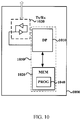
- FIG. 10 illustrates a schematic block diagram of an apparatus 1000 adapted for data transmission according to an embodiment of the present disclosure.
- the apparatus 1000 may be embodied at or as at least part of a base station for data transmission to one or more UEs or embodied at or as at least part of a UE for data transmission to one or more base stations.
- the apparatus 1000 comprises at least one processor 1010, such as a data processor (DP) and at least one memory (MEM) 1020 coupled to the processor 1010.
- the apparatus 1000 may further comprise a transmitter TX and receiver RX 1030 coupled to the processor 1010 for establishing communications with other communications devices.
- the MEM 1020 stores a program (PROG) 1040.
- the PROG 1040 may include instructions that, when executed on the associated processor 1010, enable the apparatus 1000 to operate in accordance with the embodiments of the present disclosure, for example to perform the method 400.
- a combination of the at least one processor 1010 and the at least one MEM 1020 may form processing means 1050 adapted to implement some embodiments of the present disclosure.
- the MEM 1020 may be of any type suitable to the local technical environment and may be implemented using any suitable data storage technology, such as semiconductor based memory devices, magnetic memory devices and systems, optical memory devices and systems, fixed memory and removable memory, as non-limiting examples.
- the processors 1010 may be of any type suitable to the local technical environment, and may include one or more of general purpose computers, special purpose computers, microprocessors, digital signal processors DSPs and processors based on multicore processor architecture, as non-limiting examples.
- the present disclosure may also provide a carrier containing the computer program as mentioned above, wherein the carrier is one of an electronic signal, optical signal, radio signal, or computer readable storage medium.
- the computer readable storage medium can be, for example, an optical compact disk or an electronic memory device like a RAM (random access memory), a ROM (read only memory), Flash memory, magnetic tape, CD-ROM, DVD, Blue-ray disc and the like.
- an apparatus implementing one or more functions of a corresponding apparatus described with an embodiment comprises not only prior art means, but also means for implementing the one or more functions of the corresponding apparatus described with the embodiment and it may comprise separate means for each separate function, or means that may be configured to perform two or more functions.
- these techniques may be implemented in hardware (one or more apparatuses), firmware (one or more apparatuses), software (one or more modules), or combinations thereof.
- firmware or software implementation may be made through modules (e.g., procedures, functions, and so on) that perform the functions described herein.
Landscapes
- Engineering & Computer Science (AREA)
- Computer Networks & Wireless Communication (AREA)
- Signal Processing (AREA)
- Computer Security & Cryptography (AREA)
- Mobile Radio Communication Systems (AREA)
Claims (19)
- Verfahren (400) in einer Kommunikationseinrichtung eines ersten Typs, die sowohl auf einem lizensierten Träger als auch einem nicht lizensierten Träger betrieben werden kann, wobei das Verfahren (400) Folgendes umfasst:Durchführen (410) einer Kanalmessung an dem nicht lizensiertem Träger bei verschiedenen Messchlitzen innerhalb eines Zeitraums für jeweilige Verbindungen, die auf mindestens zwei Kommunikationseinrichtungen eines zweiten Typs gerichtet sind, die sowohl auf dem lizensierten Träger als auch dem nicht lizensierten Träger betrieben werden können; undPlanen (420) einer Übertragung auf einem Kanal, der basierend auf einer entsprechender Kanalmessung als verfügbar bestimmt wurde,dadurch gekennzeichnet, dass die Kanalmessung für die jeweiligen Verbindungen innerhalb des Zeitraums gleichzeitig durchgeführt wird,wobei der Zeitraum als ein Teil eines Unterrahmens in einer Rahmenstruktur spezifiziert ist, die auf dem lizensierten Träger verwendet wird.
- Verfahren (400) nach Anspruch 1, das ferner Folgendes umfasst:Gruppieren (401) von Verbindungen, die auf Kommunikationseinrichtungen des zweiten Typs gerichtet sind, in zwei oder mehr Gruppen;wobei die jeweiligen Verbindungen, die auf die mindestens zwei Kommunikationseinrichtungen des zweiten Typs gerichtet sind, einer gleichen Gruppe angehören.
- Verfahren (400) nach Anspruch 1 oder 2, wobei:
eine Periode zwischen zwei aufeinanderfolgenden Kanalmessungen für jede der jeweiligen Verbindungen kleiner als eine minimale Länge jeder anderen Übertragung auf dem nicht lizensierten Träger ist. - Verfahren (400) nach Anspruch 2, wobei:
die Verbindungen, die auf die Kommunikationseinrichtungen des zweiten Typs gerichtet sind, basierend auf Richtungsunterschieden dieser Verbindungen gruppiert werden. - Verfahren (400) nach einem der Ansprüche 1-4, das ferner Folgendes umfasst:
für jede der jeweiligen Verbindungen, die auf die mindestens zwei Kommunikationseinrichtungen des zweiten Typs gerichtet ist, zufälliges Auswählen (402) eines Back-off-Fensters, das mindestens einen Messschlitz innerhalb des Zeitraums umfasst. - Verfahren (400) nach Anspruch 5, wobei:die Kanalmessung gemäß Kanalmessungsmustern, die in jeweiligen Back-off-Fenstern vordefiniert sind, für die jeweiligen Verbindungen abwechselnd durchgeführt wird, undwobei jedes Kanalmessungsmuster eine Anordnung des mindestens einen Messschlitzes spezifiziert, der in dem entsprechenden Back-off-Fenster enthalten ist.
- Verfahren (400) nach Anspruch 5 oder 6, wobei das Durchführen der Kanalmessung für die jeweiligen Verbindungen ferner Folgendes umfasst:
Erweitern des Back-off-Fensters an dem Ende, an dem keine Kanalmessung durchgeführt wird, zur weiteren Kanalmessung, um eine Verfügbarkeit des in diesem Back-off-Fenster gemessen Kanals zu bestätigen. - Verfahren (400) nach einem der Ansprüche 5-7, wobei:
als Reaktion darauf, dass der Kanal für eine Verbindung, für welche ein Back-off-Fenster mit einer kürzesten Länge ausgewählt wird, basierend auf der entsprechenden Kanalmessung als verfügbar bestimmt wird, eine Übertragung auf dem Kanal für diese Verbindung ohne weiteres Durchführen der Kanalmessung für andere Verbindungen geplant wird. - Verfahren (400) nach einem der Ansprüche 1-8, wobei das Durchführen der Kanalmessung für die jeweiligen Verbindungen Folgendes umfasst:
als Reaktion darauf, dass ein Ergebnis der Kanalmessung für die Verbindung, die auf eine Kommunikationseinrichtung des zweiten Typs gerichtet ist, angibt, dass der Kanal für diese Verbindung belegt ist, Überspringen der nachfolgenden Kanalmessung für diese Verbindung. - Vorrichtung (900) in einer Kommunikationseinrichtung eines ersten Typs, die sowohl auf einem lizensierten Träger als auch einem nicht lizensierten Träger betrieben werden kann, wobei die Vorrichtung (900) Folgendes umfasst:eine Kanalmesseinheit (910), die dazu konfiguriert ist, eine Kanalmessung an dem nicht lizensiertem Träger bei verschiedenen Messchlitzen innerhalb eines Zeitraums für jeweilige Verbindungen durchzuführen, die auf mindestens zwei Kommunikationseinrichtungen eines zweiten Typs gerichtet sind, die sowohl auf dem lizensierten Träger als auch dem nicht lizensierten Träger betrieben werden können; undeine Übertragungsplanungseinheit (920), die dazu konfiguriert ist, eine Übertragung auf einem Kanal zu planen, der basierend auf einer entsprechender Kanalmessung als verfügbar bestimmt wurde,dadurch gekennzeichnet, dass die Kanalmesseinheit (910) dazu ausgelegt ist, die Kanalmessung für die jeweiligen Verbindungen innerhalb des Zeitraums gleichzeitig durchzuführen,wobei der Zeitraum als ein Teil eines Unterrahmens in einer Rahmenstruktur spezifiziert ist, die auf dem lizensierten Träger verwendet wird.
- Vorrichtung (900) nach Anspruch 10, die ferner Folgendes umfasst:eine Verbindungsgruppierungseinheit (901), die dazu konfiguriert ist, Verbindungen, die auf Kommunikationseinrichtungen des zweiten Typs gerichtet sind, in zwei oder mehr Gruppen zu gruppieren,wobei die jeweiligen Verbindungen, die auf die mindestens zwei Kommunikationseinrichtungen des zweiten Typs gerichtet sind, einer gleichen Gruppe angehören.
- Vorrichtung (900) nach Anspruch 10 oder 11, wobei
eine Periode zwischen zwei aufeinanderfolgenden Kanalmessungen für jede der jeweiligen Verbindungen kleiner als eine minimale Länge jeder anderen Übertragung auf dem nicht lizensierten Träger ist. - Vorrichtung (900) nach Anspruch 12, wobei:
die Verbindungsgruppierungseinheit (901) dazu konfiguriert ist, die Verbindungen, die auf die Kommunikationseinrichtungen des zweiten Typs gerichtet sind, basierend auf Richtungsunterschieden dieser Verbindungen zu gruppieren. - Vorrichtung (900) nach einem der Ansprüche 10-13, die ferner Folgendes umfasst:
eine Back-off-Fenster-Auswahleinheit (902), die dazu konfiguriert ist, für jede der jeweiligen Verbindungen, die auf die mindestens zwei Kommunikationseinrichtungen des zweiten Typs gerichtet ist, zufällig ein Back-off-Fenster auszuwählen, das mindestens einen Messschlitz innerhalb des Zeitraums umfasst. - Vorrichtung (900) nach Anspruch 14, wobeidie Kanalmesseinheit (910) dazu konfiguriert ist, die Kanalmessung für die jeweiligen Verbindungen gemäß Kanalmessungsmustern, die in jeweiligen Back-off-Fenstern vordefiniert sind, abwechselnd durchzuführen, undwobei jedes Kanalmessungsmuster eine Anordnung des mindestens einen Messschlitzes spezifiziert, der in dem entsprechenden Back-off-Fenster enthalten ist.
- Vorrichtung (900) nach Anspruch 14 oder 15, wobei die Kanalmesseinheit (910) ferner zu Folgendem konfiguriert ist:
Erweitern des Back-off-Fensters an dem Ende, an dem keine Kanalmessung durchgeführt wird, zur weiteren Kanalmessung, um eine Verfügbarkeit des in diesem Back-off-Fenster gemessen Kanals zu bestätigen. - Vorrichtung (900) nach einem der Ansprüche 14-16, wobei die Übertragungsplanungseinheit (920) ferner zu Folgendem konfiguriert ist:
als Reaktion darauf, dass der Kanal für eine Verbindung, für welche ein Back-off-Fenster mit einer kürzesten Länge ausgewählt wird, basierend auf der entsprechenden Kanalmessung als verfügbar bestimmt wird, Planen einer Übertragung auf dem Kanal für diese Verbindung ohne weiteres Durchführen der Kanalmessung für andere Verbindungen. - Vorrichtung (900) nach einem der Ansprüche 10-17, wobei die Kanalmesseinheit (910) ferner zu Folgendem konfiguriert ist:
als Reaktion darauf, dass ein Ergebnis der Kanalmessung für die Verbindung, die auf eine Kommunikationseinrichtung des zweiten Typs gerichtet ist, angibt, dass der Kanal für diese Verbindung belegt ist, Überspringen der nachfolgenden Kanalmessung für diese Verbindung. - Computerprogrammprodukt, das Anweisungen umfasst, die bei Ausführung durch mindestens einen Prozessor, den mindestens einen Prozessor dazu veranlassen, das Verfahren nach einem der Ansprüche 1-9 auszuführen.
Applications Claiming Priority (1)
| Application Number | Priority Date | Filing Date | Title |
|---|---|---|---|
| PCT/CN2015/091578 WO2017059583A1 (en) | 2015-10-09 | 2015-10-09 | Method and apparatus for data transmission |
Publications (3)
| Publication Number | Publication Date |
|---|---|
| EP3202196A1 EP3202196A1 (de) | 2017-08-09 |
| EP3202196A4 EP3202196A4 (de) | 2017-11-08 |
| EP3202196B1 true EP3202196B1 (de) | 2021-09-29 |
Family
ID=58487179
Family Applications (1)
| Application Number | Title | Priority Date | Filing Date |
|---|---|---|---|
| EP15905681.1A Active EP3202196B1 (de) | 2015-10-09 | 2015-10-09 | Verfahren und vorrichtung zur datenübertragung |
Country Status (4)
| Country | Link |
|---|---|
| US (2) | US10021719B2 (de) |
| EP (1) | EP3202196B1 (de) |
| CN (1) | CN108141831B (de) |
| WO (1) | WO2017059583A1 (de) |
Families Citing this family (7)
| Publication number | Priority date | Publication date | Assignee | Title |
|---|---|---|---|---|
| EP3193525B1 (de) | 2014-09-12 | 2021-02-24 | Nec Corporation | Drahtlose station, drahtloses endgerät und verfahren zur endgerätemessung |
| WO2017113301A1 (zh) * | 2015-12-31 | 2017-07-06 | 华为技术有限公司 | 一种波束赋形方法、接收机、发射机及系统 |
| CN108882340A (zh) * | 2017-05-14 | 2018-11-23 | 深圳市金立通信设备有限公司 | 一种免授权频段随机接入方法和设备 |
| CN110475357B (zh) * | 2018-05-11 | 2024-11-15 | 中兴通讯股份有限公司 | 帧结构的指示方法及装置、存储介质、处理器 |
| US20210345314A1 (en) * | 2018-10-24 | 2021-11-04 | Beijing Xiaomi Mobile Software Co., Ltd. | Method and apparatus for channel detection on unlicensed frequency spectrum, and storage medium |
| US11659402B2 (en) * | 2019-03-15 | 2023-05-23 | Apple Inc. | Enhanced reservation signal for cellular communication in unlicensed spectrum |
| US12382495B2 (en) * | 2020-02-06 | 2025-08-05 | Telefonaktiebolaget Lm Ericsson (Publ) | Receiver assisted directional channel sensing for NR-U |
Family Cites Families (15)
| Publication number | Priority date | Publication date | Assignee | Title |
|---|---|---|---|---|
| US9113483B2 (en) | 2011-04-12 | 2015-08-18 | Broadcom Corporation | Methods and apparatus of spectrum sharing for cellular-controlled offloading using unlicensed band |
| US9854446B2 (en) * | 2011-07-07 | 2017-12-26 | Lg Electronics Inc. | Method and apparatus for transmitting a signal in a wireless communication system |
| US9565593B2 (en) * | 2013-05-20 | 2017-02-07 | Qualcomm Incorporated | Techniques for selecting subframe type or for interleaving signals for wireless communications over unlicensed spectrum |
| CN105519014B (zh) * | 2013-09-04 | 2018-11-02 | Lg电子株式会社 | 用于频分双工和时分双工的聚合的方法和设备 |
| US9763225B2 (en) | 2013-10-07 | 2017-09-12 | Qualcomm Incorporated | LTE-U clear channel assessment operations |
| EP3075187B1 (de) | 2013-11-27 | 2022-11-02 | Apple Inc. | Mechanismen zur koexistenz von lte-u-netzwerken mit sich selbst und mit anderen technologien |
| CN104780544B (zh) | 2014-01-09 | 2018-11-23 | 上海朗帛通信技术有限公司 | 一种利用非授权频谱的通信方法和装置 |
| CN104796934B (zh) | 2014-01-21 | 2018-05-15 | 工业和信息化部电信传输研究所 | 一种频段调度方法和装置 |
| WO2015180162A1 (zh) * | 2014-05-30 | 2015-12-03 | 华为技术有限公司 | 传输方法和通信设备 |
| WO2016085310A1 (ko) * | 2014-11-28 | 2016-06-02 | 엘지전자 주식회사 | 무선 통신 시스템에서 무선 신호 송수신 방법 및 장치 |
| CN104333873A (zh) * | 2014-11-28 | 2015-02-04 | 东莞宇龙通信科技有限公司 | 信道检测方法及系统、具有基站功能的设备和终端 |
| CN104486013B (zh) * | 2014-12-19 | 2017-01-04 | 宇龙计算机通信科技(深圳)有限公司 | 信道检测方法、信道检测系统、终端和基站 |
| CN104717686B (zh) * | 2015-03-31 | 2018-11-30 | 深圳酷派技术有限公司 | 一种未授权频段的信道检测方法及网元设备 |
| US10225859B2 (en) * | 2015-05-14 | 2019-03-05 | Qualcomm Incorporated | Techniques for uplink transmission management |
| US10028151B2 (en) * | 2015-08-07 | 2018-07-17 | Cisco Technology, Inc. | Uplink channel access, reservation and data transmission for licensed assist access long term evolution (LAA-LTE) |
-
2015
- 2015-10-09 CN CN201580083686.8A patent/CN108141831B/zh not_active Expired - Fee Related
- 2015-10-09 EP EP15905681.1A patent/EP3202196B1/de active Active
- 2015-10-09 WO PCT/CN2015/091578 patent/WO2017059583A1/en not_active Ceased
- 2015-10-09 US US15/112,745 patent/US10021719B2/en active Active
-
2018
- 2018-06-22 US US16/015,403 patent/US10560960B2/en not_active Expired - Fee Related
Also Published As
| Publication number | Publication date |
|---|---|
| CN108141831A (zh) | 2018-06-08 |
| US20170238341A1 (en) | 2017-08-17 |
| US20180376502A1 (en) | 2018-12-27 |
| EP3202196A1 (de) | 2017-08-09 |
| US10021719B2 (en) | 2018-07-10 |
| US10560960B2 (en) | 2020-02-11 |
| EP3202196A4 (de) | 2017-11-08 |
| CN108141831B (zh) | 2021-02-12 |
| WO2017059583A1 (en) | 2017-04-13 |
Similar Documents
| Publication | Publication Date | Title |
|---|---|---|
| US10560960B2 (en) | Method and apparatus for data transmission | |
| US10925092B2 (en) | Request to send (RTS)/clear to send (CTS) using a self-contained slot | |
| CN112566276B (zh) | 基于监听的传输的方法和装置 | |
| KR20200099094A (ko) | 2-단계 랜덤 액세스 | |
| TW201737635A (zh) | 正交分頻多工存取無線網路中之跳頻 | |
| JP7473000B2 (ja) | 通信方法、通信装置及び通信用のコンピュータ可読媒体 | |
| US20210400717A1 (en) | Apparatus and method for coordinated spatial reuse in wireless communication | |
| US20230156707A1 (en) | System and methods for dynamic scheduling in new radio with user equipment | |
| EP3799518A1 (de) | Übertragung der anforderung zur verbindungswiederherstellung einer sekundärzelle | |
| US12120674B2 (en) | System and methods for dynamic scheduling in new radio with base station | |
| US12426094B2 (en) | Communication configuration based on random access bandwidth | |
| US12082262B2 (en) | Mechanism for providing multiple transmission opportunities | |
| WO2025039173A1 (en) | Measurement gaps and priorities | |
| WO2024093108A1 (en) | Terminal device and method for sidelink communications | |
| WO2025213431A1 (en) | Determination for uplink repetitions | |
| US12082219B2 (en) | System and methods for dynamic scheduling in new radio with user equipment | |
| WO2024168620A1 (en) | Dynamic resource configuration for sidelink feedback | |
| WO2024020895A1 (en) | Resource selection for sidelink communication | |
| WO2024093111A1 (en) | Device, method and medium for sidelink communications | |
| WO2023240645A1 (en) | Method, device and computer readable medium for communications | |
| WO2024093114A1 (en) | Terminal device and method for sidelink resource selection | |
| WO2021203281A1 (en) | Bandwidth selection for communicating random access information | |
| WO2024170128A1 (en) | Methods and apparatuses of configuring random access response monitoring | |
| CN120835315A (zh) | 使能异构传输类型 | |
| CN118355723A (zh) | 信道占用时间共享 |
Legal Events
| Date | Code | Title | Description |
|---|---|---|---|
| STAA | Information on the status of an ep patent application or granted ep patent |
Free format text: STATUS: THE INTERNATIONAL PUBLICATION HAS BEEN MADE |
|
| PUAI | Public reference made under article 153(3) epc to a published international application that has entered the european phase |
Free format text: ORIGINAL CODE: 0009012 |
|
| STAA | Information on the status of an ep patent application or granted ep patent |
Free format text: STATUS: REQUEST FOR EXAMINATION WAS MADE |
|
| 17P | Request for examination filed |
Effective date: 20170505 |
|
| AK | Designated contracting states |
Kind code of ref document: A1 Designated state(s): AL AT BE BG CH CY CZ DE DK EE ES FI FR GB GR HR HU IE IS IT LI LT LU LV MC MK MT NL NO PL PT RO RS SE SI SK SM TR |
|
| AX | Request for extension of the european patent |
Extension state: BA ME |
|
| A4 | Supplementary search report drawn up and despatched |
Effective date: 20171006 |
|
| RIC1 | Information provided on ipc code assigned before grant |
Ipc: H04W 56/00 20090101AFI20170929BHEP |
|
| REG | Reference to a national code |
Ref country code: HK Ref legal event code: DE Ref document number: 1241628 Country of ref document: HK |
|
| DAV | Request for validation of the european patent (deleted) | ||
| DAX | Request for extension of the european patent (deleted) | ||
| STAA | Information on the status of an ep patent application or granted ep patent |
Free format text: STATUS: EXAMINATION IS IN PROGRESS |
|
| 17Q | First examination report despatched |
Effective date: 20190327 |
|
| GRAP | Despatch of communication of intention to grant a patent |
Free format text: ORIGINAL CODE: EPIDOSNIGR1 |
|
| STAA | Information on the status of an ep patent application or granted ep patent |
Free format text: STATUS: GRANT OF PATENT IS INTENDED |
|
| INTG | Intention to grant announced |
Effective date: 20210315 |
|
| GRAS | Grant fee paid |
Free format text: ORIGINAL CODE: EPIDOSNIGR3 |
|
| GRAA | (expected) grant |
Free format text: ORIGINAL CODE: 0009210 |
|
| STAA | Information on the status of an ep patent application or granted ep patent |
Free format text: STATUS: THE PATENT HAS BEEN GRANTED |
|
| AK | Designated contracting states |
Kind code of ref document: B1 Designated state(s): AL AT BE BG CH CY CZ DE DK EE ES FI FR GB GR HR HU IE IS IT LI LT LU LV MC MK MT NL NO PL PT RO RS SE SI SK SM TR |
|
| REG | Reference to a national code |
Ref country code: GB Ref legal event code: FG4D |
|
| REG | Reference to a national code |
Ref country code: CH Ref legal event code: EP Ref country code: AT Ref legal event code: REF Ref document number: 1435350 Country of ref document: AT Kind code of ref document: T Effective date: 20211015 |
|
| REG | Reference to a national code |
Ref country code: DE Ref legal event code: R096 Ref document number: 602015073818 Country of ref document: DE |
|
| REG | Reference to a national code |
Ref country code: IE Ref legal event code: FG4D |
|
| REG | Reference to a national code |
Ref country code: NL Ref legal event code: FP |
|
| REG | Reference to a national code |
Ref country code: LT Ref legal event code: MG9D |
|
| PG25 | Lapsed in a contracting state [announced via postgrant information from national office to epo] |
Ref country code: HR Free format text: LAPSE BECAUSE OF FAILURE TO SUBMIT A TRANSLATION OF THE DESCRIPTION OR TO PAY THE FEE WITHIN THE PRESCRIBED TIME-LIMIT Effective date: 20210929 Ref country code: SE Free format text: LAPSE BECAUSE OF FAILURE TO SUBMIT A TRANSLATION OF THE DESCRIPTION OR TO PAY THE FEE WITHIN THE PRESCRIBED TIME-LIMIT Effective date: 20210929 Ref country code: RS Free format text: LAPSE BECAUSE OF FAILURE TO SUBMIT A TRANSLATION OF THE DESCRIPTION OR TO PAY THE FEE WITHIN THE PRESCRIBED TIME-LIMIT Effective date: 20210929 Ref country code: LT Free format text: LAPSE BECAUSE OF FAILURE TO SUBMIT A TRANSLATION OF THE DESCRIPTION OR TO PAY THE FEE WITHIN THE PRESCRIBED TIME-LIMIT Effective date: 20210929 Ref country code: BG Free format text: LAPSE BECAUSE OF FAILURE TO SUBMIT A TRANSLATION OF THE DESCRIPTION OR TO PAY THE FEE WITHIN THE PRESCRIBED TIME-LIMIT Effective date: 20211229 Ref country code: NO Free format text: LAPSE BECAUSE OF FAILURE TO SUBMIT A TRANSLATION OF THE DESCRIPTION OR TO PAY THE FEE WITHIN THE PRESCRIBED TIME-LIMIT Effective date: 20211229 Ref country code: FI Free format text: LAPSE BECAUSE OF FAILURE TO SUBMIT A TRANSLATION OF THE DESCRIPTION OR TO PAY THE FEE WITHIN THE PRESCRIBED TIME-LIMIT Effective date: 20210929 |
|
| REG | Reference to a national code |
Ref country code: AT Ref legal event code: MK05 Ref document number: 1435350 Country of ref document: AT Kind code of ref document: T Effective date: 20210929 |
|
| PG25 | Lapsed in a contracting state [announced via postgrant information from national office to epo] |
Ref country code: LV Free format text: LAPSE BECAUSE OF FAILURE TO SUBMIT A TRANSLATION OF THE DESCRIPTION OR TO PAY THE FEE WITHIN THE PRESCRIBED TIME-LIMIT Effective date: 20210929 Ref country code: GR Free format text: LAPSE BECAUSE OF FAILURE TO SUBMIT A TRANSLATION OF THE DESCRIPTION OR TO PAY THE FEE WITHIN THE PRESCRIBED TIME-LIMIT Effective date: 20211230 |
|
| PG25 | Lapsed in a contracting state [announced via postgrant information from national office to epo] |
Ref country code: AT Free format text: LAPSE BECAUSE OF FAILURE TO SUBMIT A TRANSLATION OF THE DESCRIPTION OR TO PAY THE FEE WITHIN THE PRESCRIBED TIME-LIMIT Effective date: 20210929 |
|
| REG | Reference to a national code |
Ref country code: CH Ref legal event code: PL |
|
| PG25 | Lapsed in a contracting state [announced via postgrant information from national office to epo] |
Ref country code: IS Free format text: LAPSE BECAUSE OF FAILURE TO SUBMIT A TRANSLATION OF THE DESCRIPTION OR TO PAY THE FEE WITHIN THE PRESCRIBED TIME-LIMIT Effective date: 20220129 Ref country code: SK Free format text: LAPSE BECAUSE OF FAILURE TO SUBMIT A TRANSLATION OF THE DESCRIPTION OR TO PAY THE FEE WITHIN THE PRESCRIBED TIME-LIMIT Effective date: 20210929 Ref country code: RO Free format text: LAPSE BECAUSE OF FAILURE TO SUBMIT A TRANSLATION OF THE DESCRIPTION OR TO PAY THE FEE WITHIN THE PRESCRIBED TIME-LIMIT Effective date: 20210929 Ref country code: PT Free format text: LAPSE BECAUSE OF FAILURE TO SUBMIT A TRANSLATION OF THE DESCRIPTION OR TO PAY THE FEE WITHIN THE PRESCRIBED TIME-LIMIT Effective date: 20220131 Ref country code: PL Free format text: LAPSE BECAUSE OF FAILURE TO SUBMIT A TRANSLATION OF THE DESCRIPTION OR TO PAY THE FEE WITHIN THE PRESCRIBED TIME-LIMIT Effective date: 20210929 Ref country code: ES Free format text: LAPSE BECAUSE OF FAILURE TO SUBMIT A TRANSLATION OF THE DESCRIPTION OR TO PAY THE FEE WITHIN THE PRESCRIBED TIME-LIMIT Effective date: 20210929 Ref country code: EE Free format text: LAPSE BECAUSE OF FAILURE TO SUBMIT A TRANSLATION OF THE DESCRIPTION OR TO PAY THE FEE WITHIN THE PRESCRIBED TIME-LIMIT Effective date: 20210929 Ref country code: CZ Free format text: LAPSE BECAUSE OF FAILURE TO SUBMIT A TRANSLATION OF THE DESCRIPTION OR TO PAY THE FEE WITHIN THE PRESCRIBED TIME-LIMIT Effective date: 20210929 Ref country code: AL Free format text: LAPSE BECAUSE OF FAILURE TO SUBMIT A TRANSLATION OF THE DESCRIPTION OR TO PAY THE FEE WITHIN THE PRESCRIBED TIME-LIMIT Effective date: 20210929 |
|
| REG | Reference to a national code |
Ref country code: BE Ref legal event code: MM Effective date: 20211031 |
|
| PG25 | Lapsed in a contracting state [announced via postgrant information from national office to epo] |
Ref country code: MC Free format text: LAPSE BECAUSE OF FAILURE TO SUBMIT A TRANSLATION OF THE DESCRIPTION OR TO PAY THE FEE WITHIN THE PRESCRIBED TIME-LIMIT Effective date: 20210929 |
|
| REG | Reference to a national code |
Ref country code: DE Ref legal event code: R097 Ref document number: 602015073818 Country of ref document: DE |
|
| PG25 | Lapsed in a contracting state [announced via postgrant information from national office to epo] |
Ref country code: LU Free format text: LAPSE BECAUSE OF NON-PAYMENT OF DUE FEES Effective date: 20211009 Ref country code: DK Free format text: LAPSE BECAUSE OF FAILURE TO SUBMIT A TRANSLATION OF THE DESCRIPTION OR TO PAY THE FEE WITHIN THE PRESCRIBED TIME-LIMIT Effective date: 20210929 Ref country code: BE Free format text: LAPSE BECAUSE OF NON-PAYMENT OF DUE FEES Effective date: 20211031 |
|
| PLBE | No opposition filed within time limit |
Free format text: ORIGINAL CODE: 0009261 |
|
| STAA | Information on the status of an ep patent application or granted ep patent |
Free format text: STATUS: NO OPPOSITION FILED WITHIN TIME LIMIT |
|
| PG25 | Lapsed in a contracting state [announced via postgrant information from national office to epo] |
Ref country code: LI Free format text: LAPSE BECAUSE OF NON-PAYMENT OF DUE FEES Effective date: 20211031 Ref country code: CH Free format text: LAPSE BECAUSE OF NON-PAYMENT OF DUE FEES Effective date: 20211031 |
|
| 26N | No opposition filed |
Effective date: 20220630 |
|
| PG25 | Lapsed in a contracting state [announced via postgrant information from national office to epo] |
Ref country code: IE Free format text: LAPSE BECAUSE OF NON-PAYMENT OF DUE FEES Effective date: 20211009 |
|
| PG25 | Lapsed in a contracting state [announced via postgrant information from national office to epo] |
Ref country code: SI Free format text: LAPSE BECAUSE OF FAILURE TO SUBMIT A TRANSLATION OF THE DESCRIPTION OR TO PAY THE FEE WITHIN THE PRESCRIBED TIME-LIMIT Effective date: 20210929 Ref country code: FR Free format text: LAPSE BECAUSE OF NON-PAYMENT OF DUE FEES Effective date: 20211129 |
|
| PG25 | Lapsed in a contracting state [announced via postgrant information from national office to epo] |
Ref country code: IT Free format text: LAPSE BECAUSE OF FAILURE TO SUBMIT A TRANSLATION OF THE DESCRIPTION OR TO PAY THE FEE WITHIN THE PRESCRIBED TIME-LIMIT Effective date: 20210929 |
|
| PG25 | Lapsed in a contracting state [announced via postgrant information from national office to epo] |
Ref country code: HU Free format text: LAPSE BECAUSE OF FAILURE TO SUBMIT A TRANSLATION OF THE DESCRIPTION OR TO PAY THE FEE WITHIN THE PRESCRIBED TIME-LIMIT; INVALID AB INITIO Effective date: 20151009 |
|
| PG25 | Lapsed in a contracting state [announced via postgrant information from national office to epo] |
Ref country code: CY Free format text: LAPSE BECAUSE OF FAILURE TO SUBMIT A TRANSLATION OF THE DESCRIPTION OR TO PAY THE FEE WITHIN THE PRESCRIBED TIME-LIMIT Effective date: 20210929 |
|
| PG25 | Lapsed in a contracting state [announced via postgrant information from national office to epo] |
Ref country code: SM Free format text: LAPSE BECAUSE OF FAILURE TO SUBMIT A TRANSLATION OF THE DESCRIPTION OR TO PAY THE FEE WITHIN THE PRESCRIBED TIME-LIMIT Effective date: 20210929 |
|
| PG25 | Lapsed in a contracting state [announced via postgrant information from national office to epo] |
Ref country code: MK Free format text: LAPSE BECAUSE OF FAILURE TO SUBMIT A TRANSLATION OF THE DESCRIPTION OR TO PAY THE FEE WITHIN THE PRESCRIBED TIME-LIMIT Effective date: 20210929 |
|
| REG | Reference to a national code |
Ref country code: HK Ref legal event code: WD Ref document number: 1241628 Country of ref document: HK |
|
| PG25 | Lapsed in a contracting state [announced via postgrant information from national office to epo] |
Ref country code: TR Free format text: LAPSE BECAUSE OF FAILURE TO SUBMIT A TRANSLATION OF THE DESCRIPTION OR TO PAY THE FEE WITHIN THE PRESCRIBED TIME-LIMIT Effective date: 20210929 |
|
| PG25 | Lapsed in a contracting state [announced via postgrant information from national office to epo] |
Ref country code: MT Free format text: LAPSE BECAUSE OF FAILURE TO SUBMIT A TRANSLATION OF THE DESCRIPTION OR TO PAY THE FEE WITHIN THE PRESCRIBED TIME-LIMIT Effective date: 20210929 |
|
| PGFP | Annual fee paid to national office [announced via postgrant information from national office to epo] |
Ref country code: NL Payment date: 20241026 Year of fee payment: 10 |
|
| PGFP | Annual fee paid to national office [announced via postgrant information from national office to epo] |
Ref country code: DE Payment date: 20241029 Year of fee payment: 10 |
|
| PGFP | Annual fee paid to national office [announced via postgrant information from national office to epo] |
Ref country code: GB Payment date: 20241028 Year of fee payment: 10 |