EP3197867B1 - Novel 4-methoxy pyrrole derivatives or salts thereof and pharmaceutical composition comprising the same - Google Patents
Novel 4-methoxy pyrrole derivatives or salts thereof and pharmaceutical composition comprising the same Download PDFInfo
- Publication number
- EP3197867B1 EP3197867B1 EP16786741.5A EP16786741A EP3197867B1 EP 3197867 B1 EP3197867 B1 EP 3197867B1 EP 16786741 A EP16786741 A EP 16786741A EP 3197867 B1 EP3197867 B1 EP 3197867B1
- Authority
- EP
- European Patent Office
- Prior art keywords
- methoxy
- pyrrol
- sulfonyl
- methylmethanamine
- difluorophenyl
- Prior art date
- Legal status (The legal status is an assumption and is not a legal conclusion. Google has not performed a legal analysis and makes no representation as to the accuracy of the status listed.)
- Active
Links
- 0 CC*(c1c(*=C)cc(*=C)cc1)P Chemical compound CC*(c1c(*=C)cc(*=C)cc1)P 0.000 description 1
- PSERTFQBHJCVGH-UHFFFAOYSA-N CNCC(C(C1c(cc(cc2)F)c2F)OC)=CN1S(c1cc(F)ccc1)(=O)=O Chemical compound CNCC(C(C1c(cc(cc2)F)c2F)OC)=CN1S(c1cc(F)ccc1)(=O)=O PSERTFQBHJCVGH-UHFFFAOYSA-N 0.000 description 1
- UXDWYECDOCPCPZ-UHFFFAOYSA-N CNCc(c(OC)c1-c(c(F)cc(F)c2)c2F)c[n]1S(c(cc1)cc(F)c1F)(=O)=O Chemical compound CNCc(c(OC)c1-c(c(F)cc(F)c2)c2F)c[n]1S(c(cc1)cc(F)c1F)(=O)=O UXDWYECDOCPCPZ-UHFFFAOYSA-N 0.000 description 1
- QYKBDEPIIXUTEV-UHFFFAOYSA-N CNCc(c(OC)c1-c(ccc(F)c2)c2F)c[n]1S(c1cc(OC)ccc1)(=O)=O Chemical compound CNCc(c(OC)c1-c(ccc(F)c2)c2F)c[n]1S(c1cc(OC)ccc1)(=O)=O QYKBDEPIIXUTEV-UHFFFAOYSA-N 0.000 description 1
Classifications
-
- C—CHEMISTRY; METALLURGY
- C07—ORGANIC CHEMISTRY
- C07D—HETEROCYCLIC COMPOUNDS
- C07D207/00—Heterocyclic compounds containing five-membered rings not condensed with other rings, with one nitrogen atom as the only ring hetero atom
- C07D207/46—Heterocyclic compounds containing five-membered rings not condensed with other rings, with one nitrogen atom as the only ring hetero atom with hetero atoms directly attached to the ring nitrogen atom
- C07D207/48—Sulfur atoms
-
- A—HUMAN NECESSITIES
- A61—MEDICAL OR VETERINARY SCIENCE; HYGIENE
- A61K—PREPARATIONS FOR MEDICAL, DENTAL OR TOILETRY PURPOSES
- A61K31/00—Medicinal preparations containing organic active ingredients
- A61K31/33—Heterocyclic compounds
- A61K31/395—Heterocyclic compounds having nitrogen as a ring hetero atom, e.g. guanethidine or rifamycins
- A61K31/40—Heterocyclic compounds having nitrogen as a ring hetero atom, e.g. guanethidine or rifamycins having five-membered rings with one nitrogen as the only ring hetero atom, e.g. sulpiride, succinimide, tolmetin, buflomedil
-
- A—HUMAN NECESSITIES
- A61—MEDICAL OR VETERINARY SCIENCE; HYGIENE
- A61P—SPECIFIC THERAPEUTIC ACTIVITY OF CHEMICAL COMPOUNDS OR MEDICINAL PREPARATIONS
- A61P1/00—Drugs for disorders of the alimentary tract or the digestive system
- A61P1/16—Drugs for disorders of the alimentary tract or the digestive system for liver or gallbladder disorders, e.g. hepatoprotective agents, cholagogues, litholytics
-
- A—HUMAN NECESSITIES
- A61—MEDICAL OR VETERINARY SCIENCE; HYGIENE
- A61P—SPECIFIC THERAPEUTIC ACTIVITY OF CHEMICAL COMPOUNDS OR MEDICINAL PREPARATIONS
- A61P31/00—Antiinfectives, i.e. antibiotics, antiseptics, chemotherapeutics
- A61P31/04—Antibacterial agents
Definitions
- the present invention relates to a 4-methoxy pyrrole derivative or a pharmaceutically acceptable salt thereof and a pharmaceutical composition containing the same.
- Gastrointestinal tract ulcer, gastritis, and reflux esophagitis are generated while the balance between offensive factors (for example, gastric acid, Helicobacter bacteria pepsin, stress, alcohol and tobacco, etc.) and defensive factors (for example, gastric mucosa, bicarbonate, prostaglandin, the degree of blood supply, etc.) is destroyed. Therefore, a therapeutic agent for treating gastrointestinal damage such as gastrointestinal tract ulcer, gastritis and reflux esophagitis is divided into a drug for inhibiting the offensive factors and a drug for enhancing the defensive factors.
- offensive factors for example, gastric acid, Helicobacter bacteria pepsin, stress, alcohol and tobacco, etc.
- defensive factors for example, gastric mucosa, bicarbonate, prostaglandin, the degree of blood supply, etc.
- an antacid As the drug for inhibiting the offensive factors, an antacid, an anticholinergic drug, a H 2 receptor antagonist, a proton pump inhibitor (PPI), an acid pump antagonist (APA) also referred to as a reversible proton pump inhibitor, and the like have been known.
- PPI proton pump inhibitor
- APA acid pump antagonist
- drugs having gastric acid pump antagonistic activity WO2006/025716 discloses pyrrolo[2,3-c]pyridine derivatives, and WO2007/072146 discloses benzimidazole derivatives.
- WO2006/036024 discloses pyrrole derivatives having a reversible proton pump inhibitory activity. Arikawa et al.
- CA2891523 relates to a pyrrole sulfonamide derivative and its use as a therapeutic agent, particularly as a gastric acid secretion inhibitor and potassium-competitive acid blockers (P-CABs).
- P-CABs potassium-competitive acid blockers
- H. pylori which is a bacteria present in the stomach, has been known to cause chronic gastritis, gastric ulcer, duodenal ulcer and the like, and a large number of patients with gastrointestinal damages are infected with H. pylori. Therefore, these patients must take antibiotics such as clarithromycin, amoxicillin, metronidazole, tetracycline, together with anti-ulcer agents such as a proton pump inhibitor, or an acid pump antagonist. Consequently, various side effects have been reported.
- antibiotics such as clarithromycin, amoxicillin, metronidazole, tetracycline
- GPCR G-protein coupled receptor
- 5-hydroxytryptamine is an effective factor of gastrointestinal tract, a regulator of platelet and a neurotransmitter of central nervous system, derived from tryptophan, and it can influence on almost all physiological and behavioral functions such as emotion, appetite, cognition, vomiting, endocrine system function, digestive system function, motor function, neurotrophic, perception, sensation function, sex, sleep and cardiovascular function.
- 5-HT is involved in various functions, and the reason has been known to be due to 5-HT cell bodies that are clustered in the brainstem raphe nuclei, an anatomical structure of serotonergic system having a huge neurite that influence on all area of central nervous system neuraxis, a molecular diversity of various 5-HT receptor subtypes present in the cell membrane, and a characteristic cytological distribution ( Mohammad-Zadeh, L. F.; Moses, L.; Gwaltney-Brant, S. Serotonin: a review. J. Vet. Pharmacol. Therap. (2008) 31, 187-199 , Glennon, R. A.; Dukat, M.; Westkaemper, R. B. Psychopharmacology - The Fourth Generation of Progress ).
- 5-HT receptors are classified into seven families (5-HT1 to 5-HT7) including 14 receptor subtypes, depending on the structural, functional and pharmacological standards, among which, except for 5-HT3 receptor which is the opening/closing passage of ligand, all of the receptors correspond to GPCR.
- 5-HT2 receptors are classified into 5-HT2A, 5-HT2B, and 5-HT2C receptors, and all of these receptors increase the production of inositol 1,4,5-triphosphate (IP3) by activating phospholipase C (PLC).
- IP3 inositol 1,4,5-triphosphate
- PLC phospholipase C
- acetylcholine is a neurotransmitter of autonomic nervous system and acts on both the central nervous system and the peripheral nervous system, thereby affecting brain and muscular system.
- Such acetylcholine receptor can be divided into nicotinic acetylcholine receptor (nAChR) as an ionic receptor and a muscarinic acetylcholine receptor (mAChR) as a metabolite receptor.
- nAChR nicotinic acetylcholine receptor
- mAChR muscarinic acetylcholine receptor
- the muscarinic acetylcholine receptor was identified to include five distinct receptor subtypes, each of which are referred to as M1 to M5 receptors, and these also correspond to GPCR.
- M1 receptors are present in the cerebral cortex of the hippocampus, and involved in the autonomic nerve, salivary gland, gastric secretion and the like.
- M2 receptors are present in heart, brain cortex and hippocampus, and involved in a decrease of heart rate, a reduction of atrial contraction force, a decrease in the conduction velocity of AV node, and the like.
- the cortex pyramidal neurons are inhibited through M1 muscarinic receptor linked to an alpha subunit of Gq-type G proteins. Therefore, when the M1 receptor is activated, the calcium stored in the cell is released to occur potassium conduction activated by the release of calcium, thereby the spiking of pyramidal neurons can be inhibited.
- a therapeutic agent for the treatment of a peptic ulcer such as pirenzepine using the effects of preventing the secretion of gastric acid and reducing the stomach cramps
- a therapeutic agent for the treatment of diabetic neuropathy using the effect of reducing a nerve conduction velocity and preventing a tactile allodynia and thermal hypoalgesia, and the like have been known.
- the therapeutic agents for inhibiting the action of M2 receptors a therapeutic agent for the treatment of overactive bladder using the effects of inhibiting allergic reactions induced by M2 receptors, a therapeutic agent for the treatment of asthma, and the like have been known. Therefore, it appears that the muscarinic acetylcholine antagonist is likely to be developed as a therapeutic agent for the treatment of diseases such as peptic ulcer, diabetic neuropathy, asthma, and overactive bladder.
- 4-methoxy pyrrole derivatives or pharmaceutically acceptable salts thereof have excellent anti-ulcer activity (i.e., proton pump inhibitory activity, etc.) and eradication activity against H. pylori and thus are useful in the prevention and treatment of gastrointestinal damage due to gastrointestinal tract ulcer, gastritis, reflux esophagitis or H. pylori.
- the present inventors have found that these 4-methoxy pyrrole derivatives or pharmaceutically acceptable salts thereof have inhibitory activities against GPCRs that cause diseases, for example, 5-HT2A, M1 and M2 muscarinic receptors and the like, and thus can be effectively used for the prevention and treatment of 5-HT receptor or muscarinic acetylcholine receptor-mediated diseases.
- the present invention has been completed on the basis of such a finding.
- a 4-methoxy pyrrole derivative or a pharmaceutically acceptable salt thereof having anti-ulcer activity (i.e., proton pump inhibitory activity, etc.), eradication activity against H. pylori and inhibitory activity against GPCR.
- a pharmaceutical composition for the prevention and treatment of gastrointestinal damage due to gastrointestinal tract ulcer, gastritis, reflux esophagitis or H. pylori comprising the above-mentioned compound or a pharmaceutically acceptable salt thereof
- a pharmaceutical composition for the prevention and treatment of 5-HT receptor-mediated or muscarinic acetylcholine receptor-mediated diseases comprising the above-mentioned compound or a pharmaceutically acceptable salt thereof.
- the compounds according to the present invention that is, 4-methoxy pyrrole derivatives or pharmaceutically acceptable salts thereof, have not only excellent proton pump inhibitory activity, gastric damage-inhibiting activity and defensive factor-enhancing effects, but also excellent eradication activity against H. pylori. Therefore, the 4-methoxy pyrrole derivatives or pharmaceutically acceptable salts thereof can be effectively used for the prevention and treatment of gastrointestinal damage due to gastrointestinal tract ulcer, gastritis, reflux esophagitis or H. pylori.
- the compounds according to the present invention that is, 4-methoxy pyrrole derivatives or pharmaceutically acceptable salts thereof, have inhibitory activities against GPCR and thus can be effectively used for the prevention and treatment of 5-HT receptor-mediated or muscarinic acetylcholine receptor-mediated diseases.
- the disclosure provides a compound represented by the following Chemical Formula Formula 1 or a pharmaceutically acceptable salt thereof: in Chemical Formula 1,
- R 1 , R 2 and R 3 are each independently hydrogen, fluoro, or chloro.
- R 4 and R 5 are each independently hydrogen, chloro, fluoro, methyl, trifluoromethyl, methoxy, or difluoromethoxy.
- R 1 , R 2 and R 3 may be each independently hydrogen, or halogen. However, R 1 , R 2 and R 3 cannot be hydrogen simultaneously.
- R 1 , R 2 and R 3 are each independently hydrogen, fluoro, or chloro.
- R 1 is halogen
- R 2 and R 3 are each independently hydrogen, or halogen.
- R 1 is fluoro
- R 2 and R 3 are each independently hydrogen, fluoro, or chloro; or R 1 is chloro and R 2 and R 3 may be hydrogen.
- R 4 and R 5 are each independently hydrogen, halogen, C 1-4 alkyl, C 1-4 alkoxy, C 1-4 haloalkyl, or C 1-4 haloalkoxy. However, R 4 and R 5 cannot be hydrogen simultaneously.
- R 4 and R 5 are each independently hydrogen, chloro, fluoro, methyl, trifluoromethyl, methoxy, or difluoromethoxy.
- R 4 is hydrogen
- R 5 is chloro, fluoro, methyl, trifluoromethyl, methoxy, or difluoromethoxy; or R 4 and R 5 may be each independently chloro or fluoro.
- R 1 is fluoro
- R 2 and R 3 are each independently hydrogen, or fluoro
- R 4 is hydrogen
- R 5 may be chloro, or trifluoromethyl.
- the above-mentioned compounds can be selected from the group represented by the following Chemical Formulae 1-2 to 1-4, but are not limited thereto: in Chemical Formulae 1-2 to 1-4, R 1 to R 5 are as defined above.
- the above-mentioned compound is selected from the group consisting of the following compounds:
- the compound represented by Chemical Formula 1 or a salt thereof may have a substituent group containing an asymmetric atom.
- the compound of Chemical Formula 1 or a salt thereof may be present as an optical isomer such as (R), (S), or racemate (RS). Therefore, unless otherwise specified, the compound of Chemical Formula 1 or a salt thereof includes all optical isomers such as (R), (S), or racemate (RS).
- the compound represented by Chemical Formula 1 may be in the form of a pharmaceutically acceptable salt.
- the salt includes conventional acid addition salts, for example, salts derived from inorganic acids such as hydrochloric acid, hydrobromic acid, sulfuric acid, sulfamic acid, phosphoric acid, or nitric acid, and salts derived from organic acids such as acetic acid, propionic acid, succinic acid, glycolic acid, stearic acid, maleic acid, hydroxy maleic acid, phenylacetic acid, glutamic acid, benzoic acid, salicylic acid, sulfanilic acid, 2-acetoxy-benzoic acid, fumaric acid, toluenesulfonic acid, methanedisulfonic acid, ethanedisulfonic acid, oxalic acid, or trifluoroacetic acid.
- the salt may be hydrochloride or fumarate salt.
- the compound represented by Chemical Formula 1 may be prepared by the method as shown in the following Reaction Scheme 1: in Reaction Scheme 1, R 1 to R 5 are as defined above.
- the compound represented by Chemical Formula 2 in Reaction Scheme 1 may be prepared by the method as shown in the following Reaction Scheme 2 or 3: in Reaction Schemes 2 and 3, R 1 to R 3 are as defined above, and 'Ac' means acetyl.
- the Step I-1 is a step of reacting dimethyl 2-(methoxymethylene)malonate represented by Chemical Formula 7 with tosylmethyl isocyanate to prepare a compound represented by Chemical Formula 8, which is a step of cyclization reaction of pyrrole.
- the reaction may be carried out in an organic solvent such as acetonitrile.
- the Step I-2 is a step of brominating the compound represented by Chemical Formula 8 to prepare a compound represented by Chemical Formula 9.
- the bromination can be carried out by using a reagent such as N-bromosuccinimide (NBS) which can introduce bromine at the position of hydrogen of pyrrole in the compound represented by Chemical Formula 8. Further, the reaction can be carried out in an organic solvent such as tetrahydrofuran.
- NBS N-bromosuccinimide
- the Step I-3 is a step of reacting the compound represented by Chemical Formula 9 with the compound represented by Chemical Formula 10 in the presence of a metal catalyst to prepare a compound represented by Chemical Formula 2.
- a metal catalyst a conventional palladium (Pd) catalyst can be used.
- Pd palladium
- Non-limiting examples thereof may include Pd(PPh 3 ) 4 , Pd(OAc) 2 , PdCl 2 , PdCh(PPh 3 ) 4 , PdBr 2 , Pd(acac) 2 , Pd 2 (dba) 3 , Pd(dba) 2 and the like.
- 'Ph' means phenyl
- 'acac' means acetylacetonate
- 'dba' means dibenzylideneacetone.
- the reaction may be carried out in a polar solvent such as methanol, ethanol, tert-butanol, acetone, dimethylformamide, acetonitrile, or water.
- the compounds of Chemical Formula 2 can be prepared by Reaction Scheme 3, and the method represented by Reaction Scheme 3 can be carried out via Steps II-I to IIA.
- the Step II-1 is a step of reacting the compound represented by Chemical Formula 11 with dimethyl 2-(methoxymethylene)malonate represented by Chemical Formula 7 to prepare a compound represented by Chemical Formula 12.
- the reaction can be carried out in an alcohol solvent such as methanol, ethanol, or tert-butanol for 1 to 4 hours.
- the Step II-2 is a step of reacting the compound represented by Chemical Formula 12 with acetic anhydride (Ac 2 O) to prepare a compound represented by Chemical Formula 13, which is a step of cyclization reaction of pyrrole.
- the reaction may be carried out in the presence of a base such as triethylamine for 1 to 2 hours.
- the Step II-3 is a step of hydrolyzing the compound represented by Chemical Formula 13 to prepare a compound represented by Chemical Formula 14.
- a hydroxy group can be introduced in pyrrole.
- the hydrolysis can be carried out by using a base such as sodium hydroxide for 10 minutes to 30 minutes.
- the Step II-4 is a step of methylating the compound represented by Chemical Formula 14 to prepare a compound represented by Chemical Formula 2.
- the methylation can be carried out by using a methylating agent such as trimethylsilyl diazomethane (TMS-CH 2 N 2 ), or by reacting with dimethyl sulfate in the presence of sodium hydroxide. Further, the reaction can be carried out in an organic solvent such as dimethylformamide, or diethyl ether for 1 to 48 hours.
- the compound represented by Chemical Formula 1 can be prepared in accordance with Reaction Scheme 1.
- the method represented by Reaction Scheme 1 may be carried out via Steps III-1 to III-4.
- the Step III-1 is a step of reacting the compound represented by Chemical Formula 2 with the compound represented by Chemical Formula 3 to prepare a compound represented by Chemical Formula 4, which is a step of introducing a substituted phenylsulfonyl group in pyrrole of the compound represented by Chemical Formula 2.
- the reaction is carried out in an organic solvent such as dimethylformamide in the presence of sodium hydride for 20 to 30 minutes.
- the Step III-2 is a step of reducing the compound represented by Chemical Formula 4 to prepare a compound represented by Chemical Formula 5.
- the reduction can be carried out in an organic solvent such as tetrahydrofuran using a reducing agent such as diisobutyl aluminum hydride (DIBAL).
- DIBAL diisobutyl aluminum hydride
- the Step III-3 is a step of oxidizing the compound represented by Chemical Formula 5 to prepare a compound represented by Chemical Formula 6.
- the oxidation of an alcohol group of the compound represented by Chemical Formula 5 can be carried out in an organic solvent such as dichloromethane using an oxidizing agent such as pyridinium chlorochromate (PCC) for 30 minutes to 2 hours.
- PCC pyridinium chlorochromate
- the Step III-4 is a step of reacting the compound represented by Chemical Formula 6 with methylamine to prepare a compound represented by Chemical Formula 1, which is a step of reductive animation.
- the reductive amination can be carried out in an organic solvent such as tetrahydrofuran using a reducing agent such as sodium borohydride for 30 minutes to 1 hour.
- the pharmaceutically acceptable acid addition salts such as hydrochloride or fumarate can be prepared by adding an acid such as hydrochloric acid or fumaric acid to the compound represented by Chemical Formula 1 prepared as described above.
- the compound represented by Chemical Formula 1 can be reacted with an acid solution in an organic solvent such as dichloromethane for 1 to 2 hours to prepare an acid addition salt.
- the present invention provides a pharmaceutical composition for the prevention and treatment of gastrointestinal damage due to gastrointestinal tract ulcer, gastritis, reflux esophagitis or H. pylori, comprising the compounds represented by Chemical Formula 1 or pharmaceutically acceptable salts thereof.
- the present invention provides a pharmaceutical composition for the prevention and treatment of 5-HT receptor-mediated or muscarinic acetylcholine receptor-mediated diseases, comprising the compounds represented by Chemical Formula 1 or phannaceutically acceptable salts thereof.
- the 5-HT receptor-mediated or muscarinic acetylcholine receptor-mediated diseases may be depression, manic depression, schizophrenia, autism, obsessive-compulsive neurosis, anxiety disorder, migraine, hypertension, eating disorder, irritable bowel syndrome(IBS), peptic ulcer, diabetic neuropathy, asthma, and overactive bladder.
- the pharmaceutical composition may comprise phannaceutically acceptable carriers that are commonly used, such as excipients, disintegrants, sweetening agents, lubricants or flavoring agents.
- the pharmaceutical composition can be formulated into preparations for oral administration such as tablets, capsules, powders, granules, suspensions, emulsions or syrups; or preparations for parenteral administration such as injections in accordance with conventional methods.
- the preparations can be formulated into various forms, for example, in a single dosage form or multiple dosage fonns.
- the composition may be administered orally, or administered parenterally, including intravenous, intramuscular, intraperitoneal, subcutaneous, rectal and local routes of administration.
- the composition may be preferably administered orally. Therefore, the composition may be formulated into various forms such as tablets, capsules, aqueous solutions or suspensions.
- carriers such as lactose or com starch and lubricants such as magnesium stearate can be commonly added.
- lactose and/or dried com starch can be used as a diluent.
- the active ingredient may be combined with emulsions and/or suspensions.
- compositions for intramuscular, intraperitoneal, subcutaneous and intravenous administration, sterile solutions of the active ingredient are usually prepared, and the pH of the solutions should be suitably adjusted and buffered.
- the total concentration of solutes should be controlled in order to render the preparation isotonic.
- the composition may be in the form of an aqueous solution containing a pharmaceutically acceptable carrier, e.g., saline, at a pH level of 7.4.
- a pharmaceutically acceptable carrier e.g., saline
- the pharmaceutical composition may be administered in a therapeutically effective amount. Therefore, the compound represented by Chemical Formula 1 or a phannaceutically acceptable salt thereof contained in the pharmaceutical composition may be administered in an effective amount ranging from about 0.01 mg/kg to about 100 mg/kg per day to a subject patient. Of course, the dosage may be changed according to the patient's age, weight, susceptibility, symptom or the efficacy of the compound.
- Methyl 5-(2-fluorophenyl)-4-hydroxy-1H-pyrrol-3-carboxylate (30.3 g, 128.7 mmol) prepared in Step 2-3 was dissolved in dimethylformamide (150.0 ml). To the resulting solution. sodium hydride (60%, dispersion in liquid paraffin) (5.2 g, 128.7 mmol) was added at 0°C, and then stirred at 0°C for 30 minutes. Dimethyl sulfate (12.2 ml. 128.7 mmol) was added to the reaction mixture, and then stirred at 0°C for 1 hour. Water was added to the reaction mixture and extracted with ethyl acetate.
- Methyl 5-(2-fluorophenyl)-4-methoxy-1H-pyrrol-3-carboxylate (22.47 g, 90.0 mmol) prepared in Step 2-4 was dissolved in dimethylformamide (113.0 ml).
- sodium hydride (60%, dispersion in liquid paraffin) (4.35 g, 108.2 mmol) was added at 0°C, and then stirred at 0°C for 20 minutes.
- 3-(trifluoromethyl)benzenesulfonyl chloride(28.77 g, 108.2 mmol) was added to the reaction mixture and stirred at room temperature for 30 minutes. Water was added to the reaction mixture and extracted with ethyl acetate.
- Methyl 5-(2-Fluorophenyl)-4-methoxy-1-((3-(trifluoromethyl)phenyl)sulfonyl)-1H-pyrrol-3-carboxylate (27.7 g, 60.8 mmol) prepared in Step 2-5 was dissolved in tetrahydrofuran (140.0 ml). To the resulting solution, diisopropylbutyl aluminum hydride (1.0 M tetrahydrofuran solution) (182.2 ml, 182.2 mmol) was added at 0°C and then stirred at room temperature for 1 hour. Water was added to the reaction mixture at 0°C and then extracted with ethyl acetate.
- 2,4-Difluorophenyl glycine (150.0 g, 801.5 mmol), dimethyl 2-(methoxymethylene)malonate (126.9 g, 728.6 mmol), and sodium acetate (65.8 g, 801.5 mmol) were added to methanol (800.0 ml), and then refluxed at 60°C for 4 hours.
- the reaction mixture was cooled to room temperature, and concentrated under reduced pressure to remove about 70% of methanol, and then filtered.
- the resulting solid was dried reduced pressure to give 190.0 g of the title compound.
- Acetic anhydride (1731.2 ml) and triethylamine (577.1 ml) were added to 2-(2,4-difluorophenyl)-2-((3-methoxy-2-(methoxycarbonyl)-3-oxoprop-1-en-1-yl)amino)acetic acid (190.0 g, 577.1 mmol) prepared in Step 8-1.
- the reaction mixture was refluxed at 140°C for 30 minutes and then cooled to 0°C.
- ice water (577.1 ml) was added at 0°C, stirred at room temperature for 1 hour and then extracted with ethyl acetate.
- the extract was dried over anhydrous magnesium sulfate and then concentrated under reduced pressure.
- the resulting compound was filtered using a silica gel to remove a solid, and then concentrated under reduced pressure.
- Tetrahydrofuran (140.0 ml) and water (120.0 ml) were added to the resulting residue, cooled to 0°C. followed by addition of sodium hydroxide (46.17 g, 1154.2 mmol).
- the reaction mixture was stirred at 0°C for 30 minutes, neutralized using 1N hydrochloric acid aqueous solution and then extracted with ethyl acetate. The extract was dried over anhydrous magnesium sulfate, and then concentrated under reduced pressure.
- Methyl 5-(2,4-difluorophenyl)-4-methoxy-1-((3-fluorophenyl)sulfonyl)-1H-pyrrol-3-carboxylate (26.0 g, 61.1 mmol) prepared in Step 8-4 was dissolved in tetrahydrofuran(300.0 ml).
- Diisobutylaluminium hydride (1.0M tetrahydrofuran solution) (183.4 ml, 183.4 mmol) was added to the resulting solution at 0°C, stirred at room temperature for 1 hour, neutralized using 1N hydrochloric acid solution, and then extracted with ethyl acetate. The extract was dried over anhydrous magnesium sulfate and then concentrated under reduced pressure.
- Step 8-7 Preparation of 1-(5-(2,4-difluorophenyl)-1-((3-fluorophenyl)sulfonyl)4-methoxy-1H-pyrrol-3-yl)- N-methylmethane hydrochloride
- Methyl 4-hydroxy-5-(2,4,6-trifluorophenyl)-1H-pyrrol-3-carboxylate (4.5 g, 16.6 mmol) prepared in Step 22-2 was added to tetrahydrofuran (83.0 ml) and methanol (33.2 ml).
- (Trimethylsilyl)diazomethane(2.0M diethyl ether solution) (33.2 ml) was added to the resulting solution and then stirred at room temperature for 48 hours. Water was added to the reaction mixture and then extracted with ethyl acetate. The extract was dried over anhydrous magnesium sulfate, and then concentrated under reduced pressure.
- Methyl 4-methoxy-5-(2,4,6-trifluorophenyl)-1H-pyrrol-3-carboxylate (3.8 g, 13.3 mmol) prepared in Step 22-3 was dissolved in dimethylformamide (150.0 ml).
- Sodium hydride (60% dispersion in liquid paraffin) (0.78 g, 20.0 mmol) was added to the resulting solution at room temperature, and then stirred at room temperature for 10 minutes.
- 3-fluoro-benzenesulfonyl chloride (2.64 ml, 20.0 mmol) was added to the reaction mixture, and stirred at room temperature for 1 hour. Water was added to the reaction mixture and extracted with ethyl acetate.
- Gastric vesicles were prepared from a hog stomach in accordance with the known method ( Edd C. Rabon et al., Preparation of Gastric H+,K+-ATPase., Methods in enzymology, vol.157 Academic Press Inc.,(1988), pp.649-654 ).
- the protein contents of gastric vesicles thus prepared were quantitatively measured with Bicinchoninic Acid (BCA) kit (Thermo Co.).
- BCA Bicinchoninic Acid
- the inhibition rate(%) was measured from the activity value of the control group and the activity value of the test compound at various concentrations, and the concentration (IC 50 ) that inhibits H + /K + -ATPase activity by 50% was calculated from each % inhibition value of the compounds using Logistic 4-parameter function of Sigmaplot8.0 program. The results are shown in Table 1 below. [Table 1] IC 50 Example 2 0.015 uM Example 8 0.024 uM Example 22 0.014 uM
- Inhibitory effects of the compounds prepared in Examples 2, 8 and 22 on basal gastric acid secretion were measured according to Shay's rat model ( Shay, H., et al., 1945, gastroenterology, 5, p43-61 ).
- control group was administered with 2 mL/kg of 0.5% methyl cellulose (MC) aqueous solution into the duodenum, and the other groups were administered with test compounds suspended in 0.5% methyl cellulose (MC) aqueous solution at a dose of 2.0 mg/kg/2 ml.
- test animals were sacrificed, and gastric contents were removed. The removed contents were centrifuged at 4,000 X g for 10 minutes and the supernatant was separated to obtain the gastric juice. The amount and pH of the gastric juice were measured and the acidity in the gastric juice was measured by 0.1N NaOH volume (ueq/mL) required for the titration of gastric acid to pH 7.0.
- % inhibitory activity of test compounds were calculated according to the following equation, and the results are shown in Table 2.
- % inhibitory activity of test compound total acid output of control group ⁇ total acid output of the group treated with test compounds / total acid output of control group ⁇ 100 [Table 2] % inhibitory activity Example 2 93.5%
- Test Example 3 Gastric damage inhibitory activity against indomethacin-induced gastric damage in rats
- the inhibitory activity against the gastric damage of the compounds prepared in Examples 2 and 8 was measured using indomethacin model ( Chiou., Et al., 2005, gastroenterology, 128, p63-73 ).
- Control group was orally administered with 5 mL/kg of 0.5% methyl cellulose (MC) aqueous solution, and the other groups were orally administered with test compounds suspended in 0.5% methyl cellulose (MC) aqueous solution at a dose of 2.0 mg/kg/5 ml.
- Example 1 34 Comparative Example 1
- the compound of Example 165 Comparative Example 2 in International Patent Publication No. WO2006/036024 were orally administered at a dose of 2.0 mg/kg/5 ml by suspending 0.5% methylcellulose (MC) aqueous solution, respectively.
- MC methylcellulose
- indomethacin was orally administered at a dose of 80 mg/kg/10 ml.
- the test animals were sacrificed to remove the stomach. The surface of the removed stomach was washed with saline solution and then half thereof was incised along a greater curvature of stomach.
- % Inhibitory activity of test compounds was calculated according to the following Equation 2, and the results are shown in Table 3.
- % Inhibitory activity of test compound 1 ⁇ gastric damage area % of the group treated with test compounds / gastric damage area % of control group ⁇ 100 [Table 3] % inhibitory activity
- Example 8 92.2% Comparative Example 1 66.8% Comparative Example 2 44.4%
- Test Example 4 Antimicrobial activity against H . pylori
- H. pylori The antimicrobial activity against H. pylori of the compounds prepared in the Examples 8 and 22 was evaluated by measuring the minimum inhibitory concentration (MIC) values through the susceptibility testing by the agar dilution method.
- H. pylori strains were furnished from Helicobacter isolated strain Bank (HpKTCC, KNMRRC) in the Microbiology Classroom of the Professional graduate School of Medicine in Gyeongsang National University, South Korea.
- the test material dissolved in DMSO was subjected to two fold serial dilution with a sterile buffer to prepare a sample solution. At this time, each concentration of the serially diluted solution was adjusted to become 10 times the concentration used for the susceptibility testing.
- the concentration was adjusted so as to be added at a volume of 1/10 during preparation of the medium.
- 5 ml of the sample solution with each concentration of the serially diluted solution warmed at the same temperature was added to Brucella agar medium (each 45 ml aliquot) containing 10% bovine serum, and prepared to have a final test concentration (test concentration: 5000 ug/ml, 2500 ug/ml, 1250 ug/ml, 625 ug/ml, 312.5 ug/ml, 150 ug/ml, 75 ug/ml, 37.5 ug/ml, 18.75 ug/ml, 9 ug/ml, 4.5 ug/ml, 2.25 ug/ml).
- H. pylori cultured in Brucella agar medium was prepared into each bacterial suspension with PBS (5.0 ⁇ 10 8 CFU/mL), and dispensed in Steers multiple inoculator well.
- Bacterium were inoculated on the surface of the plate medium toward a high concentration side of substance from a low concentration side of substance using steers multiple inoculator. After culturing in 10% CO 2 incubator at 37°C for 5 days, the presence or absence of growth of each bacteria was visually identified to determine the minimum, inhibitory concentration (MIC, the lowest concentration where bacterium have not been observed). The results are shown in Tables 4 and 5 below.
- the inhibitory activity and defensive factor-enhancing effects of the compound prepared in Example 8 were measured using 100% ethanol(EtOH)-induced gastric damage model( Paul V. Tan et al., 2002, Journal of Ethnopharmacology, 82, p 69-74 ).
- Male Sprague Dawley(SD) rats (body weight 180-200g) was fasted for 24 hours with free access to water.
- Control group was orally administered with 5 mL/kg of 0.5% methyl cellulose (MC) aqueous solution, and the other groups were orally administered with test compounds suspended in 0.5% MC aqueous solution at a dose of 3.0, 10.0 and 30.0 mg/kg/5 mL.
- MC methyl cellulose
- Example 134 Comparative Example 1
- Example 165 Comparative Example 2
- Example 166 Comparative Example 3
- Example 3) International Patent Publication No. WO2006/036024
- 1 hour after oral administration 1 mL of 100% EtOH was orally administered.
- 1 hour after EtOH administration the test animals were sacrificed to remove the stomach.
- Table 6 The results were shown in Table 6.
- the compounds according to the present invention had not only excellent proton pump inhibitory activity, gastric damage-inhibiting activity and defensive factor-enhancing effects, but also excellent eradication activity against H. pylori.
- the compound according to the present invention had not only excellent proton pump inhibitory activity, gastric damage-inhibiting activity and defensive factor-enhancing effects, but also excellent eradication activity against H. pylori, as compared with a structurally similar compound, for example, a compound either having no substituent or substituted with methyl at position 4 of pyrrole.
- Calcium Flux assay was performed in an assay plate in which the compounds prepared in the Examples, vehicle controls, and reference compounds were added, using a Fluorometric imaging plate reader (FLIPR tetra) equipment.
- FLIPR tetra Fluorometric imaging plate reader
- GPCR Assay Buffer for Calcium Flux assay was prepared by adding 20 mM of HEPES and 2.5 mM of Probenecid to Hanks Balanced Salt Solution (HBSS) to have pH 7.4.
- HBSS Hanks Balanced Salt Solution
- the Compounds of Examples for evaluation of the GPCR were diluted with DMSO at a concentration of 10 mM to make a stock and then prepared by diluting in the GPCR Assay Buffer at the concentration equivalent to three times the final concentration.
- the inhibitory activity of the compounds of the Examples was evaluated at a single concentration of 10 uM, and then the respective selected targets were four fold-diluted from 10 uM to the low side to calculate 50% inhibitory concentration (IC 50 ), prepared at the total 8 concentrations of 10, 2.5, 0.62, 0.15, 0.04, 0.01, 0.0024, 0.0006 uM, and Calcium Flux assay for GPCR was conducted.
- IC 50 50% inhibitory concentration
- % inhibition rate against GPCR activity before and after treatment of the compounds and the inhibitory activity of the compounds of the Examples were determined.
- the compounds prepared in the Examples had high inhibition rate against 5-HT2A, M1 and M2 receptors and thus could be used as antagonist of these receptors. Further, as shown in Table 9, the compounds having high inhibition rate against 5-HT2A, M1 and M2 receptors exhibited excellent inhibitory effects on the receptors even at a small amount of 3 uM or less.
Landscapes
- Chemical & Material Sciences (AREA)
- Organic Chemistry (AREA)
- Health & Medical Sciences (AREA)
- Veterinary Medicine (AREA)
- Pharmacology & Pharmacy (AREA)
- Public Health (AREA)
- General Health & Medical Sciences (AREA)
- Medicinal Chemistry (AREA)
- Animal Behavior & Ethology (AREA)
- Life Sciences & Earth Sciences (AREA)
- Nuclear Medicine, Radiotherapy & Molecular Imaging (AREA)
- General Chemical & Material Sciences (AREA)
- Chemical Kinetics & Catalysis (AREA)
- Engineering & Computer Science (AREA)
- Bioinformatics & Cheminformatics (AREA)
- Gastroenterology & Hepatology (AREA)
- Communicable Diseases (AREA)
- Oncology (AREA)
- Epidemiology (AREA)
- Pharmaceuticals Containing Other Organic And Inorganic Compounds (AREA)
- Pyrrole Compounds (AREA)
Description
- The present invention relates to a 4-methoxy pyrrole derivative or a pharmaceutically acceptable salt thereof and a pharmaceutical composition containing the same.
- Gastrointestinal tract ulcer, gastritis, and reflux esophagitis are generated while the balance between offensive factors (for example, gastric acid, Helicobacter bacteria pepsin, stress, alcohol and tobacco, etc.) and defensive factors (for example, gastric mucosa, bicarbonate, prostaglandin, the degree of blood supply, etc.) is destroyed. Therefore, a therapeutic agent for treating gastrointestinal damage such as gastrointestinal tract ulcer, gastritis and reflux esophagitis is divided into a drug for inhibiting the offensive factors and a drug for enhancing the defensive factors. As the drug for inhibiting the offensive factors, an antacid, an anticholinergic drug, a H2 receptor antagonist, a proton pump inhibitor (PPI), an acid pump antagonist (APA) also referred to as a reversible proton pump inhibitor, and the like have been known. For example, as drugs having gastric acid pump antagonistic activity,
WO2006/025716 discloses pyrrolo[2,3-c]pyridine derivatives, andWO2007/072146 discloses benzimidazole derivatives. In addition,WO2006/036024 discloses pyrrole derivatives having a reversible proton pump inhibitory activity. Arikawa et al. (Bioorganic & Medicinal Chemistry Letters, 25 (2015) 2037-2040) discloses several five-membered heterocyclic analogues to a 1-sulfonylpyrrole derivative potassium-competitive acid blocker. Nishida et al. (Bioorganic & Medicinal Chemistry Letters, 20 (2012) 3925-3938) discloses the synthesis and H+, K+-ATPasc inhibitory activities and inhibitory action of pyrrole derivatives.EP1803709 discloses compounds reported to be proton pump inhibitors in the body.CA2891523 relates to a pyrrole sulfonamide derivative and its use as a therapeutic agent, particularly as a gastric acid secretion inhibitor and potassium-competitive acid blockers (P-CABs). Blangetti et al. (Organic Letters, vol. 11, No.17, (2009) 3914-3917) discloses a stereoselective approach to the synthesis of (E)-alkoxydienylamines starting from α,β-unsaturated acetals and aryl imines. - On the other hand, it is reported that gastrointestinal tract ulcer, gastritis, and reflux esophagitis occur ulcers even without an increase in secretion of gastric acid. Thus, as much as the offensive factor increases, a reduction in the defensive factor due to a pathological change of the gastric mucosa is thought to play an important role in the occurrence of gastric ulcers. Thus, in addition to drugs for inhibiting the offensive factors, drugs for enhancing the defensive factors are used for the treatment of gastrointestinal tract ulcer and gastritis. As the drugs for enhancing the defensive factors, mucosal protective drugs which are attached to the ulcer site to form a physicochemical membrane, and drugs that promote the synthesis and secretion of mucus have been known.
- On the other hand, Helicobacter pylori (H. pylori), which is a bacteria present in the stomach, has been known to cause chronic gastritis, gastric ulcer, duodenal ulcer and the like, and a large number of patients with gastrointestinal damages are infected with H. pylori. Therefore, these patients must take antibiotics such as clarithromycin, amoxicillin, metronidazole, tetracycline, together with anti-ulcer agents such as a proton pump inhibitor, or an acid pump antagonist. Consequently, various side effects have been reported.
- Therefore, there is a need to develop anti-ulcer drugs which inhibit the secretion of gastric acid (for example, proton pump inhibitory activity) and enhance defensive factors (for example, an increase in mucus secretion) and at the same time have eradication activity against H. pylori.
- Further, studies for G-protein coupled receptor (GPCR) that can cause several diseases have also been performed.
- Specifically, 5-hydroxytryptamine (5-HT, serotonin) is an effective factor of gastrointestinal tract, a regulator of platelet and a neurotransmitter of central nervous system, derived from tryptophan, and it can influence on almost all physiological and behavioral functions such as emotion, appetite, cognition, vomiting, endocrine system function, digestive system function, motor function, neurotrophic, perception, sensation function, sex, sleep and cardiovascular function.
- Like this, 5-HT is involved in various functions, and the reason has been known to be due to 5-HT cell bodies that are clustered in the brainstem raphe nuclei, an anatomical structure of serotonergic system having a huge neurite that influence on all area of central nervous system neuraxis, a molecular diversity of various 5-HT receptor subtypes present in the cell membrane, and a characteristic cytological distribution (Mohammad-Zadeh, L. F.; Moses, L.; Gwaltney-Brant, S. Serotonin: a review. J. Vet. Pharmacol. Therap. (2008) 31, 187-199, Glennon, R. A.; Dukat, M.; Westkaemper, R. B. Psychopharmacology - The Fourth Generation of Progress).
- These 5-HT receptors are classified into seven families (5-HT1 to 5-HT7) including 14 receptor subtypes, depending on the structural, functional and pharmacological standards, among which, except for 5-HT3 receptor which is the opening/closing passage of ligand, all of the receptors correspond to GPCR. In particular, 5-HT2 receptors are classified into 5-HT2A, 5-HT2B, and 5-HT2C receptors, and all of these receptors increase the production of inositol 1,4,5-triphosphate (IP3) by activating phospholipase C (PLC). Thus, recently, most of the drugs that are used for the treatment of psychiatric disorders (for example, depression, manic depression, schizophrenia, autism, obsessive-compulsive neurosis, anxiety disorder, etc.) have been known to act through the serotonergic mechanism. Further, it is reported that diseases such as migraine, hypertension, eating disorders, and irritable bowel syndrome (IBS) are also associated with 5-HT.
- On the other hand, acetylcholine is a neurotransmitter of autonomic nervous system and acts on both the central nervous system and the peripheral nervous system, thereby affecting brain and muscular system. Such acetylcholine receptor can be divided into nicotinic acetylcholine receptor (nAChR) as an ionic receptor and a muscarinic acetylcholine receptor (mAChR) as a metabolite receptor. Among them, the muscarinic acetylcholine receptor (mAChR) was identified to include five distinct receptor subtypes, each of which are referred to as M1 to M5 receptors, and these also correspond to GPCR.
- In particular, M1 receptors are present in the cerebral cortex of the hippocampus, and involved in the autonomic nerve, salivary gland, gastric secretion and the like. M2 receptors are present in heart, brain cortex and hippocampus, and involved in a decrease of heart rate, a reduction of atrial contraction force, a decrease in the conduction velocity of AV node, and the like. Specifically, when exposed to acetylcholine for up to few seconds, the cortex pyramidal neurons are inhibited through M1 muscarinic receptor linked to an alpha subunit of Gq-type G proteins. Therefore, when the M1 receptor is activated, the calcium stored in the cell is released to occur potassium conduction activated by the release of calcium, thereby the spiking of pyramidal neurons can be inhibited.
- By inhibiting the action of these M1 and M2 receptors, various diseases can be prevented or treated. Specifically, as the therapeutic agents for inhibiting the action of M1 receptors, a therapeutic agent for the treatment of a peptic ulcer such as pirenzepine using the effects of preventing the secretion of gastric acid and reducing the stomach cramps, a therapeutic agent for the treatment of diabetic neuropathy using the effect of reducing a nerve conduction velocity and preventing a tactile allodynia and thermal hypoalgesia, and the like have been known. As the therapeutic agents for inhibiting the action of M2 receptors, a therapeutic agent for the treatment of overactive bladder using the effects of inhibiting allergic reactions induced by M2 receptors, a therapeutic agent for the treatment of asthma, and the like have been known. Therefore, it appears that the muscarinic acetylcholine antagonist is likely to be developed as a therapeutic agent for the treatment of diseases such as peptic ulcer, diabetic neuropathy, asthma, and overactive bladder.
- Consequently, in order to prevent and treat diseases associated with 5-HT and acetylcholine, it is necessary to study compounds which can exhibit an inhibitory action on their GPCR, particularly 5-HT2A, M1 and M2 muscarinic receptors.
- Given the above circumstances, the present inventors have conducted numerous studies and found that 4-methoxy pyrrole derivatives or pharmaceutically acceptable salts thereof have excellent anti-ulcer activity (i.e., proton pump inhibitory activity, etc.) and eradication activity against H. pylori and thus are useful in the prevention and treatment of gastrointestinal damage due to gastrointestinal tract ulcer, gastritis, reflux esophagitis or H. pylori. In addition, the present inventors have found that these 4-methoxy pyrrole derivatives or pharmaceutically acceptable salts thereof have inhibitory activities against GPCRs that cause diseases, for example, 5-HT2A, M1 and M2 muscarinic receptors and the like, and thus can be effectively used for the prevention and treatment of 5-HT receptor or muscarinic acetylcholine receptor-mediated diseases. The present invention has been completed on the basis of such a finding.
- It is an object of the present invention to provide a 4-methoxy pyrrole derivative or a pharmaceutically acceptable salt thereof and a pharmaceutical composition comprising the same.
- In accordance with an embodiment of the present invention, there is provided a 4-methoxy pyrrole derivative or a pharmaceutically acceptable salt thereof, having anti-ulcer activity (i.e., proton pump inhibitory activity, etc.), eradication activity against H. pylori and inhibitory activity against GPCR.
- In accordance with an embodiment of the present invention, there are provided a pharmaceutical composition for the prevention and treatment of gastrointestinal damage due to gastrointestinal tract ulcer, gastritis, reflux esophagitis or H. pylori, comprising the above-mentioned compound or a pharmaceutically acceptable salt thereof
- In accordance with an embodiment of the present invention, there is provided a pharmaceutical composition for the prevention and treatment of 5-HT receptor-mediated or muscarinic acetylcholine receptor-mediated diseases, comprising the above-mentioned compound or a pharmaceutically acceptable salt thereof.
- The compounds according to the present invention, that is, 4-methoxy pyrrole derivatives or pharmaceutically acceptable salts thereof, have not only excellent proton pump inhibitory activity, gastric damage-inhibiting activity and defensive factor-enhancing effects, but also excellent eradication activity against H. pylori. Therefore, the 4-methoxy pyrrole derivatives or pharmaceutically acceptable salts thereof can be effectively used for the prevention and treatment of gastrointestinal damage due to gastrointestinal tract ulcer, gastritis, reflux esophagitis or H. pylori. Moreover, the compounds according to the present invention, that is, 4-methoxy pyrrole derivatives or pharmaceutically acceptable salts thereof, have inhibitory activities against GPCR and thus can be effectively used for the prevention and treatment of 5-HT receptor-mediated or muscarinic acetylcholine receptor-mediated diseases.
- The present invention is defined the claims.
- The disclosure provides a compound represented by the following Chemical Formula Formula 1 or a pharmaceutically acceptable salt thereof:

- R1, R2 and R3 are each independently hydrogen, or halogen,
- R4 and R5 are each independently hydrogen, halogen, C1-4 alkyl, C1-4 alkoxy, C1-4 haloalkyl, or C1-4 haloalkoxy,
- with the proviso that R1, R2 and R3 cannot be hydrogen simultaneously, and R4 and R5 cannot be hydrogen simultaneously.
- Preferably, R1, R2 and R3 are each independently hydrogen, fluoro, or chloro.
- Also preferably, R4 and R5 are each independently hydrogen, chloro, fluoro, methyl, trifluoromethyl, methoxy, or difluoromethoxy.
- In accordance with the invention the above-mentioned compounds can be represented by the following Chemical Formula 1-1:
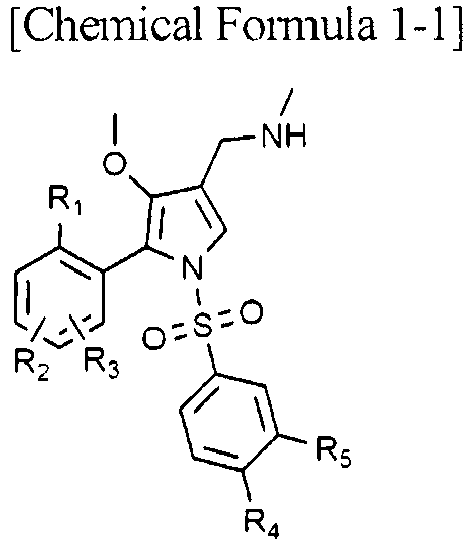
- Preferably, R1, R2 and R3 are each independently hydrogen, fluoro, or chloro.
- Also preferably, R1 is halogen, and R2 and R3 are each independently hydrogen, or halogen.
- Further preferably, R1 is fluoro, and R2 and R3 are each independently hydrogen, fluoro, or chloro; or R1 is chloro and R2 and R3 may be hydrogen.
- In Chemical Formula 1-1, R4 and R5 are each independently hydrogen, halogen, C1-4 alkyl, C1-4 alkoxy, C1-4 haloalkyl, or C1-4 haloalkoxy. However, R4 and R5 cannot be hydrogen simultaneously.
- Preferably, R4 and R5 are each independently hydrogen, chloro, fluoro, methyl, trifluoromethyl, methoxy, or difluoromethoxy.
- Also preferably, R4 is hydrogen, R5 is chloro, fluoro, methyl, trifluoromethyl, methoxy, or difluoromethoxy; or R4 and R5 may be each independently chloro or fluoro.
- Further preferably, R1 is fluoro, and R2 and R3 are each independently hydrogen, or fluoro, R4 is hydrogen, and R5 may be chloro, or trifluoromethyl.
- In accordance with an embodiment, the above-mentioned compounds can be selected from the group represented by the following Chemical Formulae 1-2 to 1-4, but are not limited thereto:


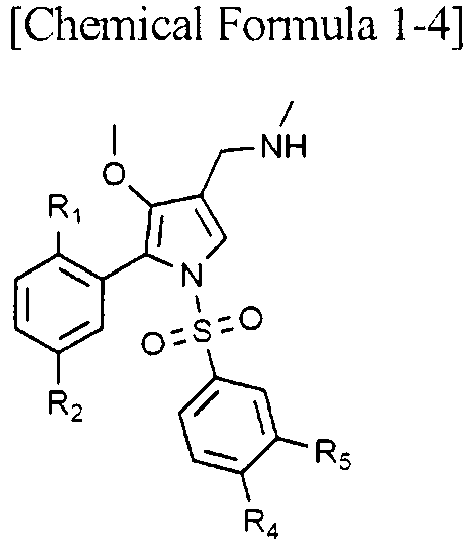
- In accordance with an embodiment, the above-mentioned compound is selected from the group consisting of the following compounds:
- 1) 1-(5-(2-fluorophenyl)-4-methoxy-1-((3-chlorophenyl)sulfonyl)-1H-pyrrol-3-yl)-N-methylmethanamine;
- 2) 1-(5-(2-fluorophenyl)-4-methoxy-1-((3-(trifluoromethyl)phenyl)sulfonyl)-1H-pyrrol-3-yl)-N-methylmethanamine;
- 3) 1-(5-(2-fluorophenyl)-4-methoxy-1-((3-methoxyphenyl)sulfonyl)-1H-pyrrol-3-yl)-N-methylmethanamine;
- 4) 1-(5-(2-ffuorophenyl)-4-methoxy-1-((3-difluoromethoxyphenyl)sulfonyl)-1H-pyrrol-3-yl)-N-methylmethanamine;
- 5) 1-(5-(2-chlorophenyl)-4-methoxy-1-((3-methoxyphenyl)sulfonyl)-1H-pyrrol-3-yl)-N-methylmethanamine;
- 6) 1-(5-(2-fluoro-4-chlorophenyl)-4-methoxy-1-((3-chlorophenyl)sulfonyl)-1H-pyrrol-3-yl)-N-methylmethanamine;
- 7) 1-(5-(2-fluoro-4-chlorophenyl)-4-methoxy-1-((3-(trifluoromethyl)phenyl)sulfonyl)-1H-pyrrol-3-yl)-N-methylmethanamine;
- 8) 1-(5-(2,4-difluorophenyl)-1-((3-fluorophenyl)sulfonyl)-4-methyoxy-1H-pyrrol-3-yl)-N-methylmethanamine;
- 9) 1-(5-(2,4-difluorophenyl)-1-((3-(trifluoromethyl)phenyl)sulfonyl)-4-methoxy-1H-pyrrol-3-yl)-N-methylmethanamine;
- 10) 1-(5-(2,4-difluorophenyl)-1-((3-methylphenyl)sulfonyl)-4-methoxy-1H-pyrrol-3-yl)-N-methylmethanamine;
- 11) 1-(5-(2,4-difluorophenyl)-1-((3-methoxyphenyl)sulfonyl)-4-methoxy-1H-pyrrol-3-yl)-N-methylmethanamine;
- 12) 1-(5-(2,4-difluorophenyl)-1-((3-difluoromethoxyphenyl)sulfonyl)-4-methoxy-1H-pyrrol-3-yl)-N-methylmethanamine;
- 13) 1-(5-(2,6-difluorophenyl)-1-((3-fluorophenyl)sulfonyl)-4-methoxy-1H-pyrrol-3-yl)-N-methylmethanamine;
- 14) 1-(5-(2,6-difluorophenyl)-1-((3-chlorophenyl)sulfonyl)-4-methoxy-1H-pyrrol-3-yl)-N-methylmethanamine;
- 15) 1-(5-(2,6-difluorophenyl)-1-((3-(trifluoromethyl)phenyl)sulfonyl)-4-methoxy-1H-pyrrol-3-yl)-N-methylmethanamine;
- 16) 1-(5-(2,6-difluorophenyl)-1-((3-methylphenyl)sulfonyl)-4-methoxy-1H-pyrrol-3-yl)-N-methylmethanamine;
- 17) 1-(5-(2,6-difluorophenyl)-1-((3-methoxyphenyl)sulfonyl)-4-methoxy-1H-pyrrol-3-yl)-N-methylmethanamine;
- 18) 1-(5-(2,6-difluorophenyl)-1-((3-chloro-4-fluorophenyl)sulfonyl)-4-methoxy-1H-pyrrol-3-yl)-N-methylmethanamine;
- 19) 1-(5-(2,6-difluorophenyl)-1-((3,4-difluorophenyl)sulfonyl)-4-methoxy-1H-pyrrol-3-yl)-N-methylmethanamine;
- 20) 1-(5-(2-fluoro-6-chlorophenyl)-1-((3-fluorophenyl)sulfonyl)-4-methoxy-1H-pyrrol-3-yl)-N-methylmethanamine;
- 21) 1-(5-(2-fluoro-6-chlorophenyl)-1-((3-chlorophenyl)sulfonyl)-4-methoxy-1H-pyrrol-3-yl)-N-methylmethanamine;
- 22) 1-(1-((3-fluorophenyl)sulfonyl)-4-methoxy-5-(2,4,6-trifluorophenyl)-1H-pyrrol-3-yl)-N-methylmethanamine;
- 23) 1-(1-((3-chlorophenyl)sulfonyl)-4-methoxy-5-(2,4,6-trifluorophenyl)-1H-pyrrol-3-yl)-N-methylmethanamine;
- 24) 1-(1-((3-trifluoromethylphenyl)sulfonyl)-4-methoxy-5-(2,4,6-trifluorophenyl)-1H-pyrrol-3-yl)-N-methylmethanalnine;
- 25) 1-(1-((3-methoxyphenyl)sulfonyl)-4-methoxy-5-(2,4,6-trifluorophenyl)-1H-pyrrol-3-yl)-N-methylmethanamine;
- 26) 1-(1-((3,4-difluorophenyl)sulfonyl)-4-methoxy-5-(2,4,6-trifluorophenyl)-1H-pyrrol-3-yl)-N-methanamine;
- 27) 1-(1-((3-fluorophenyl)sulfonyl)-4-methoxy-5-(2,3,6-trifluorophenyl)-1H-pyrrol-3-yl)N-methylmethanamine;
- 28) 1-(1-((3-chlorophenyl)sulfonyl)-4-methoxy-5-(2,3,6-trifluorophenyl)-1H-pyrrol-3-yl)-N-methylmethanamine;
- 29) 1-(1-((3-trifluoromethylphenyl)sulfonyl)-4-methoxy-5-(2,3,6-trifluorophenyl)-1H-pyrrol-3-yl)-N-methylmethanamine;
- 30) 1-(1-((3-methoxyphenyl)sulfonyl)-4-methoxy-5-(2,3,6-trifluorophenyl)-1H-pyrrol-3-yl)-N-methylmethanamine;
- 31) 1-(5-(2,5-difluorophenyl)-1-((3-fluorophenyl)sulfonyl)-4-methoxy-1H-pyrrol-3-yl)-N-methylmethanamine;
- 32) 1-(5-(2,5-difluorophenyl)-1-((3-trifluoromethylphenyl)sulfonyl)-4-methoxy-1H-pyrrol-3-yl)-N-methylmethanamine; and
- 33) 1-(5-(2,5-difluorophenyl)-1-((3-methoxyphenyl)sulfonyl)-4-methoxy-1H-pyrrol-3-yl)-N-methylmethanamine.
- The compound represented by Chemical Formula 1 or a salt thereof may have a substituent group containing an asymmetric atom. In this case, the compound of Chemical Formula 1 or a salt thereof may be present as an optical isomer such as (R), (S), or racemate (RS). Therefore, unless otherwise specified, the compound of Chemical Formula 1 or a salt thereof includes all optical isomers such as (R), (S), or racemate (RS).
- The compound represented by Chemical Formula 1 may be in the form of a pharmaceutically acceptable salt. The salt includes conventional acid addition salts, for example, salts derived from inorganic acids such as hydrochloric acid, hydrobromic acid, sulfuric acid, sulfamic acid, phosphoric acid, or nitric acid, and salts derived from organic acids such as acetic acid, propionic acid, succinic acid, glycolic acid, stearic acid, maleic acid, hydroxy maleic acid, phenylacetic acid, glutamic acid, benzoic acid, salicylic acid, sulfanilic acid, 2-acetoxy-benzoic acid, fumaric acid, toluenesulfonic acid, methanedisulfonic acid, ethanedisulfonic acid, oxalic acid, or trifluoroacetic acid. Preferably, the salt may be hydrochloride or fumarate salt.
- As an example, the compound represented by Chemical Formula 1 may be prepared by the method as shown in the following Reaction Scheme 1:

- Also, the compound represented by Chemical Formula 2 in Reaction Scheme 1 may be prepared by the method as shown in the following Reaction Scheme 2 or 3:


- First, the method represented by Reaction Scheme 2 which can prepare the compounds of Chemical Formula 2 can be carried out via Steps I-1 to I-3.
- The Step I-1 is a step of reacting dimethyl 2-(methoxymethylene)malonate represented by Chemical Formula 7 with tosylmethyl isocyanate to prepare a compound represented by Chemical Formula 8, which is a step of cyclization reaction of pyrrole. The reaction may be carried out in an organic solvent such as acetonitrile.
- The Step I-2 is a step of brominating the compound represented by Chemical Formula 8 to prepare a compound represented by Chemical Formula 9. The bromination can be carried out by using a reagent such as N-bromosuccinimide (NBS) which can introduce bromine at the position of hydrogen of pyrrole in the compound represented by Chemical Formula 8. Further, the reaction can be carried out in an organic solvent such as tetrahydrofuran.
- The Step I-3 is a step of reacting the compound represented by Chemical Formula 9 with the compound represented by Chemical Formula 10 in the presence of a metal catalyst to prepare a compound represented by Chemical Formula 2. As the metal catalyst, a conventional palladium (Pd) catalyst can be used. Non-limiting examples thereof may include Pd(PPh3)4, Pd(OAc)2, PdCl2, PdCh(PPh3)4, PdBr2, Pd(acac)2, Pd2(dba)3, Pd(dba)2 and the like. Here, 'Ph' means phenyl, 'acac' means acetylacetonate, and 'dba' means dibenzylideneacetone. In addition, the reaction may be carried out in a polar solvent such as methanol, ethanol, tert-butanol, acetone, dimethylformamide, acetonitrile, or water.
- Alternatively, the compounds of Chemical Formula 2 can be prepared by Reaction Scheme 3, and the method represented by Reaction Scheme 3 can be carried out via Steps II-I to IIA.
- The Step II-1 is a step of reacting the compound represented by Chemical Formula 11 with dimethyl 2-(methoxymethylene)malonate represented by Chemical Formula 7 to prepare a compound represented by Chemical Formula 12. The reaction can be carried out in an alcohol solvent such as methanol, ethanol, or tert-butanol for 1 to 4 hours.
- The Step II-2 is a step of reacting the compound represented by Chemical Formula 12 with acetic anhydride (Ac2O) to prepare a compound represented by Chemical Formula 13, which is a step of cyclization reaction of pyrrole. The reaction may be carried out in the presence of a base such as triethylamine for 1 to 2 hours.
- The Step II-3 is a step of hydrolyzing the compound represented by Chemical Formula 13 to prepare a compound represented by Chemical Formula 14. Through the Step, a hydroxy group can be introduced in pyrrole. Further, the hydrolysis can be carried out by using a base such as sodium hydroxide for 10 minutes to 30 minutes.
- The Step II-4 is a step of methylating the compound represented by Chemical Formula 14 to prepare a compound represented by Chemical Formula 2. The methylation can be carried out by using a methylating agent such as trimethylsilyl diazomethane (TMS-CH2N2), or by reacting with dimethyl sulfate in the presence of sodium hydroxide. Further, the reaction can be carried out in an organic solvent such as dimethylformamide, or diethyl ether for 1 to 48 hours.
- Then, the compound represented by Chemical Formula 1 can be prepared in accordance with Reaction Scheme 1. The method represented by Reaction Scheme 1 may be carried out via Steps III-1 to III-4.
- The Step III-1 is a step of reacting the compound represented by Chemical Formula 2 with the compound represented by Chemical Formula 3 to prepare a compound represented by Chemical Formula 4, which is a step of introducing a substituted phenylsulfonyl group in pyrrole of the compound represented by Chemical Formula 2. The reaction is carried out in an organic solvent such as dimethylformamide in the presence of sodium hydride for 20 to 30 minutes.
- The Step III-2 is a step of reducing the compound represented by Chemical Formula 4 to prepare a compound represented by Chemical Formula 5. The reduction can be carried out in an organic solvent such as tetrahydrofuran using a reducing agent such as diisobutyl aluminum hydride (DIBAL).
- The Step III-3 is a step of oxidizing the compound represented by Chemical Formula 5 to prepare a compound represented by Chemical Formula 6. The oxidation of an alcohol group of the compound represented by Chemical Formula 5 can be carried out in an organic solvent such as dichloromethane using an oxidizing agent such as pyridinium chlorochromate (PCC) for 30 minutes to 2 hours.
- The Step III-4 is a step of reacting the compound represented by Chemical Formula 6 with methylamine to prepare a compound represented by Chemical Formula 1, which is a step of reductive animation. The reductive amination can be carried out in an organic solvent such as tetrahydrofuran using a reducing agent such as sodium borohydride for 30 minutes to 1 hour.
- If necessary, the pharmaceutically acceptable acid addition salts such as hydrochloride or fumarate can be prepared by adding an acid such as hydrochloric acid or fumaric acid to the compound represented by Chemical Formula 1 prepared as described above. For example, the compound represented by Chemical Formula 1 can be reacted with an acid solution in an organic solvent such as dichloromethane for 1 to 2 hours to prepare an acid addition salt.
- On the other hand, the present invention provides a pharmaceutical composition for the prevention and treatment of gastrointestinal damage due to gastrointestinal tract ulcer, gastritis, reflux esophagitis or H. pylori, comprising the compounds represented by Chemical Formula 1 or pharmaceutically acceptable salts thereof.
- Also, the present invention provides a pharmaceutical composition for the prevention and treatment of 5-HT receptor-mediated or muscarinic acetylcholine receptor-mediated diseases, comprising the compounds represented by Chemical Formula 1 or phannaceutically acceptable salts thereof. In this case, the 5-HT receptor-mediated or muscarinic acetylcholine receptor-mediated diseases may be depression, manic depression, schizophrenia, autism, obsessive-compulsive neurosis, anxiety disorder, migraine, hypertension, eating disorder, irritable bowel syndrome(IBS), peptic ulcer, diabetic neuropathy, asthma, and overactive bladder.
- The pharmaceutical composition may comprise phannaceutically acceptable carriers that are commonly used, such as excipients, disintegrants, sweetening agents, lubricants or flavoring agents. The pharmaceutical composition can be formulated into preparations for oral administration such as tablets, capsules, powders, granules, suspensions, emulsions or syrups; or preparations for parenteral administration such as injections in accordance with conventional methods. The preparations can be formulated into various forms, for example, in a single dosage form or multiple dosage fonns.
- The composition may be administered orally, or administered parenterally, including intravenous, intramuscular, intraperitoneal, subcutaneous, rectal and local routes of administration. The composition may be preferably administered orally. Therefore, the composition may be formulated into various forms such as tablets, capsules, aqueous solutions or suspensions. In the case of tablets for oral administration, carriers such as lactose or com starch and lubricants such as magnesium stearate can be commonly added. In the case of capsules for oral administration, lactose and/or dried com starch can be used as a diluent. When an aqueous suspension is required for oral use, the active ingredient may be combined with emulsions and/or suspensions. If necessary, certain sweetening and/or flavoring agents can be added. For intramuscular, intraperitoneal, subcutaneous and intravenous administration, sterile solutions of the active ingredient are usually prepared, and the pH of the solutions should be suitably adjusted and buffered. For intravenous administration, the total concentration of solutes should be controlled in order to render the preparation isotonic. The composition may be in the form of an aqueous solution containing a pharmaceutically acceptable carrier, e.g., saline, at a pH level of 7.4. The solution may be introduced into a patient's intramuscular blood-stream by local bolus injection.
- In this case, the pharmaceutical composition may be administered in a therapeutically effective amount. Therefore, the compound represented by Chemical Formula 1 or a phannaceutically acceptable salt thereof contained in the pharmaceutical composition may be administered in an effective amount ranging from about 0.01 mg/kg to about 100 mg/kg per day to a subject patient. Of course, the dosage may be changed according to the patient's age, weight, susceptibility, symptom or the efficacy of the compound.
- The analysis of the compounds prepared in Examples below was carried out as follows: Nuclear Magnetic Resonance (NMR) spectrum analysis was performed on Bruker 400 MHz spectrometer, a chemical shift was analyzed in ppm, a column chromatography was performed on silica gel (Merck, 70-230 mesh) (W.C. Still, J. Org. Chem., (43), 2923,1978). And also, the starting materials in each example were synthesized from the known compounds, or were purchased from Sigma Aldrich.
-

- 2-Fluorophenyl glycine (200.0 g, 1.18 mol), dimethyl 2-(methoxymethylene)malonate (187.2 g, 1.07 mol), and sodium acetate (97.0 g, 1.18 mol) were added to methanol (1000.0 ml), and the mixture was then refluxed at 60°C for 4 hours. The reaction mixture was cooled to room temperature, and then filtered. The filtrate was concentrated under reduced pressure. To the resulting residue, water (140.0 ml) and 1N HCl aqueous solution (561.0 ml) were added, and then filtered. The resulting solid was dried under reduced pressure to give 301.0 g of the title compound. (Yield: 81.8%).
1H-NMR (500 MHz, CDCl3): 9.97 (q, 1H), 8.1 (d, 1H), 7.46-7.40 (m, 2H), 7.25 (t, 1H), 7.20 (t, 1H), 5.57 (d, 1H), 3.75 (s, 3H), 3.64 (s, 3H) - Acetic anhydride (1440.0 ml), molecular sieves (4Å, 96.0 g) and triethylamine (960.0 ml) were added to 2-(2-fluorophenyl)-2-((3-methoxy-2-(methoxycarbonyl)-3-oxoprop-1-en-1-yl)amino)acetic acid (301.0 g, 0.96 mol) prepared in Step 2-1. The reaction mixture was refluxed at 140°C for 1 hour and then cooled to 0°C. To the reaction mixture, ice water (2425.0 ml) was added at 0°C, stirred at room temperature for 1 hour, and then extracted with ethyl acetate. The extract was dried over anhydrous magnesium sulfate, and concentrated under reduced pressure. The resulting residue was purified by silica gel column chromatography (ethyl acetate: n-hexane = 1:3 (v/v)) to give 48.8 g of the title compound. (Yield: 15.1 %).
1H-NMR (500 MHz, CDCl3): 7.87 (s, 1H), 7.40-7.38 (q, 1H), 7.30-7.26 (q, 1H), 7.18 (t, 1H), 7.11 (t, 1H), 3.83 (s, 3H), 2.16 (s, 3H), 2.21 (s, 3H) - Tetrahydrofuran (130.0 ml) and water (32.5 ml) were added to methyl 4-acetoxy-1-acetyl-5-(2-fluorophenyl)-1H-pyrrol-3-carboxylate (48.8 g, 152.8 mmol) prepared in Step 2-2. The reaction mixture was cooled to 0°C, to which sodium hydroxide (11.7 g, 305.6 mol) was added and then stirred at 0°C for 10 minutes. The reaction mixture was neutralized using 1N hydrochloric acid aqueous solution and then extracted with ethyl acetate. The extract was dried over anhydrous magnesium sulfate, and concentrated under reduced pressure. The resulting residue was purified by silica gel column chromatography (ethyl acetate: n-hexane =1:4 (v/v)) to give 30.5 g of the title compound. (Yield: 89.05%)
1H-NMR (500 MHz, CDCl3): 8.92 (s, 1H), 8.20-8.16 (m, 2H), 7.20 (t, 1H), 7.14-7.06 (m, 3H), 3.87 (s, 3H) - Methyl 5-(2-fluorophenyl)-4-hydroxy-1H-pyrrol-3-carboxylate (30.3 g, 128.7 mmol) prepared in Step 2-3 was dissolved in dimethylformamide (150.0 ml). To the resulting solution. sodium hydride (60%, dispersion in liquid paraffin) (5.2 g, 128.7 mmol) was added at 0°C, and then stirred at 0°C for 30 minutes. Dimethyl sulfate (12.2 ml. 128.7 mmol) was added to the reaction mixture, and then stirred at 0°C for 1 hour. Water was added to the reaction mixture and extracted with ethyl acetate. The extract was dried over anhydrous magnesium sulfate, and then concentrated under reduced pressure. The resulting residue was purified by silica gel column chromatography (ethyl acetate: n-hexane = 1: 4 (v/v)) to give 22.8 g of the title compound. (Yield: 71.0%)
1H-NMR (500 MHz, CDCl3): 8.91 (s, 1H), 8.17-8.15 (m, 1H), 7.32 (d, 1H), 7.22-7.17 (m, 2H), 7.14-7.09 (m, 1H), 3.89 (s, 3H), 3.86 (s, 3H) - Methyl 5-(2-fluorophenyl)-4-methoxy-1H-pyrrol-3-carboxylate (22.47 g, 90.0 mmol) prepared in Step 2-4 was dissolved in dimethylformamide (113.0 ml). To the resulting solution, sodium hydride (60%, dispersion in liquid paraffin) (4.35 g, 108.2 mmol) was added at 0°C, and then stirred at 0°C for 20 minutes. 3-(trifluoromethyl)benzenesulfonyl chloride(28.77 g, 108.2 mmol) was added to the reaction mixture and stirred at room temperature for 30 minutes. Water was added to the reaction mixture and extracted with ethyl acetate. The extract was dried over anhydrous magnesium sulfate, and then concentrated under reduced pressure. The resulting residue was purified by silica gel column chromatography (ethyl acetate: n-hexane = 1: 4 (v/v)) to give 28.04 g of the title compound. (Yield: 92.2%)
1H-NMR (500 MHz, CDCl3): 8.01 (s, 1H), 7.84 (d, 1H), 7.66 (d, 1H), 7.58 (t, 1H), 7.53 (s, 1H), 7.44-7.42 (m, 1H), 7.17-7.15 (m, 2H), 6.96 (t, 1H), 3.87 (s, 3H), 3.59 (s, 3H) - Methyl 5-(2-Fluorophenyl)-4-methoxy-1-((3-(trifluoromethyl)phenyl)sulfonyl)-1H-pyrrol-3-carboxylate (27.7 g, 60.8 mmol) prepared in Step 2-5 was dissolved in tetrahydrofuran (140.0 ml). To the resulting solution, diisopropylbutyl aluminum hydride (1.0 M tetrahydrofuran solution) (182.2 ml, 182.2 mmol) was added at 0°C and then stirred at room temperature for 1 hour. Water was added to the reaction mixture at 0°C and then extracted with ethyl acetate. The extract was dried over anhydrous magnesium sulfate, and then concentrated under reduced pressure. The resulting residue was purified by silica gel column chromatography (ethyl acetate: n-hexane = 1:4 (v/v)) to give 21.55 g of the title compound. (Yield: 82.6%)
1H-NMR (500 MHz, CDCl3): 7.80 (d, 1H), 7.66 (d, 1H), 7.57-7.54 (m, 2H), 7.40(q, 1H), 7.36 (s, 1H), 7.19-7.12 (m, 2H), 6.98 (t, 1H), 4.57 (d, 2H), 3.46 (s, 3H) - (5-(2-fluorophenyl)-4-methoxy-1-((3-(trifluoromethyl)phenyl)sulfonyl)-1H-pyrrol-3-yl)methanol (21.4 g, 50.0 mmol) prepared in Step 2-6 was dissolved in dichloromethane (214.0 ml). To the resulting solution, pyridinium chlorochromate (32.4 g, 150.0 mmol) was added, stirred at room temperature for 30 minutes, and then filtered through celite pad (32.4 g). The filtrate was concentrated under reduced pressure. The resulting residue was purified by silica gel column chromatography (ethyl acetate: n-hexane = 1:2 (v/v)) to give 15.1 g of the title compound. (Yield: 70.7%)
1H-NMR (500 MHz, CDCl3): 9.91 (s, 1H), 8.02 (s, 1H), 7.86 (d, 1H), 7.66 (d, 1H), 7.59 (t, 1H), 7.47-7.42 (m, 1H), 7.21-7.15 (m, 2H), 6.95 (t, 1H), 3.60 (s, 3H) - 5-(2-fluorophenyl)-4-methoxy-1-((3-(trifluoromethyl)phenyl)sulfonyl)-1H-pyrrol-3-carbaldehyde (14.9 g, 34.9 mmol) prepared in Step 2-7 was dissolved in tetrahydrofuran (74.5 ml). Methylamine (2.0 M tetrahydrofuran solution) (174.2 ml, 348.4 mmol) was added to the resulting solution and stirred at room temperature for 30 minutes. Sodium borohydride (5.27 g, 139.3 mmol) was added to the reaction mixture, stirred at room temperature for 30 minutes, neutralized using 1N hydrochloric acid aqueous solution, and then extracted with ethyl acetate. The extract was dried over anhydrous magnesium sulfate, and then concentrated under reduced pressure. The resulting residue was purified by silica gel column chromatography (ethyl acetate: n-hexane = 1:2 (v/v)) to give 9.2 g of the title compound. (Yield: 70.7%)
1H-NMR (500 MHz, MeOD): 8.01 (s, 1H), 7.78-7.72 (m, 3H), 7.55-7.50 (m, 2H), 7.19 (t, 1H), 7.14 (t, 1H), 7.03 (t, 1H), 4.07 (s, 2H), 3.42 (s, 3H), 2.70 (s, 3H) - 1-(5-(2-fluorophenyl)-4-methoxy-1-((3-(trifluoromethyl)phenyl)sulfonyl)-1H-pyrrol-3-yl)-N-methylmethanamine (9.2 g, 20.8 mmol) prepared in Step 2-8 was dissolved in dichloromethane (18.4 ml). Hydrochloric acid solution (2.0M diethyl ether solution) (21.8 ml, 43.6 mmol) was added to the resulting solution, stirred at 0°C for 1 hour and then filtered. The resulting solid was dried under reduced pressure to give 9.48 g of the title compound. (Yield: 88.5%)
Molecular weight: 478.89
1H-NMR (500 MHz, MeOD): 8.00 (d, 1H), 7.77-7.71 (m, 2H), 7.68 (s, 1H), 7.55 (s, 1H), 7.50 (q, 1H), 7.18 (t, 1H), 7.71 (t, 1H), 7.03 (t, 1H), 4.02 (s, 2H), 3.42 (s, 3H), 2.67 (s, 3H) -

- 2,4-Difluorophenyl glycine (150.0 g, 801.5 mmol), dimethyl 2-(methoxymethylene)malonate (126.9 g, 728.6 mmol), and sodium acetate (65.8 g, 801.5 mmol) were added to methanol (800.0 ml), and then refluxed at 60°C for 4 hours. The reaction mixture was cooled to room temperature, and concentrated under reduced pressure to remove about 70% of methanol, and then filtered. The resulting solid was dried reduced pressure to give 190.0 g of the title compound. (Yield: 79.2%)
1H-NMR (500 MHz, CDCl3): 8.02-7.99 (m, 1H), 7.45-7.40 (m, 1H), 7.00-6.95 (m, 2H), 5.16 (s, 1H), 3.74 (s, 3H), 3.76 (s, 3H) - Acetic anhydride (1731.2 ml) and triethylamine (577.1 ml) were added to 2-(2,4-difluorophenyl)-2-((3-methoxy-2-(methoxycarbonyl)-3-oxoprop-1-en-1-yl)amino)acetic acid (190.0 g, 577.1 mmol) prepared in Step 8-1. The reaction mixture was refluxed at 140°C for 30 minutes and then cooled to 0°C. To the reaction mixture, ice water (577.1 ml) was added at 0°C, stirred at room temperature for 1 hour and then extracted with ethyl acetate. The extract was dried over anhydrous magnesium sulfate and then concentrated under reduced pressure. The resulting compound was filtered using a silica gel to remove a solid, and then concentrated under reduced pressure.
- Tetrahydrofuran (140.0 ml) and water (120.0 ml) were added to the resulting residue, cooled to 0°C. followed by addition of sodium hydroxide (46.17 g, 1154.2 mmol). The reaction mixture was stirred at 0°C for 30 minutes, neutralized using 1N hydrochloric acid aqueous solution and then extracted with ethyl acetate. The extract was dried over anhydrous magnesium sulfate, and then concentrated under reduced pressure. The resulting residue was purified by silica gel column chromatography (ethyl acetate: n-hexane = 1:4 (v/v)) to give 22.0 g of the title compound. (Yield: 15.1%)
1H-NMR (500 MHz, CDCl3): 8.80 (s, 1H), 8.17-8.12 (m, 2H), 7.13 (d, 1H), 6.95 (t, 1H), 6.86-6.83 (m, 1H), 3.88 (s, 3H) - Methyl 5-(2,4-difluorophenyl)-4-hydroxy-1H-pyrrol-3-carboxylate (22.0 g, 86.9 mmol) prepared in Step 8-2 was dissolved in tetrahydrofuran (434.5 ml) and methanol (173.9 ml). (Trimethylsilyl)diazomethane (2.0M diethyl ether solution, 173.8 ml) was added to the reaction mixture and then stirred at room temperature for 48 hours. Water was added to the reaction mixture, and extracted with ethyl acetate. The extract was dried over anhydrous magnesium sulfate, and then concentrated under reduced pressure. The resulting residue was purified by silica gel column chromatography (ethyl acetate: n-hexane = 1: 4 (v/v)) to give 18.1 g of the title compound. (Yield: 75.3%)
1H-NMR (500 MHz, CDCl3): 8.78 (s, 1H), 8.12 (m, 1H), 7.30 (d, 1H), 6.95 (t, 1H), 6.88 (t, 1H), 3.87 (s, 3H), 3.85 (s, 3H) - Methyl 5-(2,4-difluorophenyl)-4-methoxy-1H-pyrrol-3-carboxylate (18.0 g, 67.4 mmol) prepared in Step 8-3 was dissolved in dimethylformamide (335.0 ml). Sodium hydride (60% dispersion in liquid paraffin) (4.0 g, 101.0 mmol) was added to the resulting solution at room temperature, and stirred at room temperature for 10 minutes. 3-Fluoro-benzenesulfonyl chloride (13.37 ml, 101.0 mmol) was added to the reaction mixture and stirred at room temperature for 1 hour. Water was added to the reaction mixture and extracted with ethyl acetate. The extract was dried over anhydrous magnesium sulfate, and then concentrated under reduced pressure. The resulting residue was purified by silica gel column chromatography (ethyl acetate: n-hexane = 1: 4 (v/v)) to give 26.1 g of the title compound. (Yield: 91.1%)
1H-NMR (500 MHz, CDCl3): 7.98 (s, 1H), 7.43-7.39 (m, 1H), 7.30 (t, 1H), 7.23 (d, 1H), 7.15 (q, 1H), 7.67 (q, 1H), 6.91 (t, 1H), 6.77 (t, 1H), 3.87 (s, 3H), 3.61 (s, 3H) - Methyl 5-(2,4-difluorophenyl)-4-methoxy-1-((3-fluorophenyl)sulfonyl)-1H-pyrrol-3-carboxylate (26.0 g, 61.1 mmol) prepared in Step 8-4 was dissolved in tetrahydrofuran(300.0 ml). Diisobutylaluminium hydride (1.0M tetrahydrofuran solution) (183.4 ml, 183.4 mmol) was added to the resulting solution at 0°C, stirred at room temperature for 1 hour, neutralized using 1N hydrochloric acid solution, and then extracted with ethyl acetate. The extract was dried over anhydrous magnesium sulfate and then concentrated under reduced pressure.
- The resulting residue was dissolved in dichloromethane (300.0 ml) to which celite (26.0 g) and pyridinium chlorochromate (39.5 g, 183.4 mmol) were added. The reaction mixture was stirred at room temperature for 1 hour and then filtered to remove a solid. The filtrate was concentrated under reduced pressure. The resulting residue was purified by silica gel column chromatography (ethyl acetate: n-hexane = 1: 2 (v/v)) to give 17.2 g of the title compound. (Yield: 70.9%)
1H-NMR (500 MHz, CDCl3): 9.89 (s, 1H), 7.99 (s, 1H), 7.45-7.41 (m, 1H), 7.33 (s, 1H), 7.25 (d, 1H), 7.18 (q, 1H), 7.05 (s, 1H), 6.92 (t, 1H), 6.77 (t, 1H), 3.63 (s, 3H) - 5-(2,4-difluorophenyl)-4-methoxy-1-((3-fluorophenyl)sulfonyl)-1H-pyrrol-3-carbaldehyde (17.0 g, 43.0 mmol) prepared in Step 8-5 was dissolved in methanol (430.0 ml). Methyl amine (9.8M ethanol solution) (87.8 ml, 860.0 mmol) was added to the resulting solution and then stirred at room temperature for 30 minutes. Sodium borohydride (16.3 g, 430.0 mmol) was added to the reaction mixture and stirred at room temperature for 30 minutes. Water was added to the reaction mixture and then extracted with ethyl acetate. The resulting extract was dried over anhydrous magnesium sulfate, and then concentrated under reduced pressure. The resulting residue was purified by silica gel column chromatography (ethyl acetate: n-hexane = 1: 2 (v/v)) to give 15.2 g of the title compound. (Yield: 86.1 %)
1H-NMR (500 MHz, CDCl3): 7.39-7.35 (m, 1H), 7.26-7.20 (m, 2H), 7.15 (q, 1H), 7.06 (d, 1H), 6.87 (t, 1H), 6.78 (t, 1H), 3.60 (d, 2H), 3.44 (s, 3H), 2.45 (s, 3H) - 1-(5-(2,4-difluorophenyl)-4-methoxy-1-((3-fluorophenyl)sulfonyl)-1H-pyrrol-3-yl)-N-methylmethanamine (15.0 g, 36.6 mmol) prepared in Step 8-6 was dissolved in ethylacetate (36.6 ml) and then hydrochloric acid solution (2.0 M diethylether solvent) (36.6 ml, 73.1 mmol) was added thereto. The reaction mixture was stirred at room temperature for 1 hour and then filtered. The resulting solid was dried under reduced pressure to give 15.1 g of the title compound. (Yield: 92.5%).
Molecular weight: 446.87
1H-NMR (500 MHz, MeOD): 7.69(s, 1H), 7.58-7.53(m, 1H), 7.45(t, 1H), 7.30(d, 1H), 7.20-7.15(m, 2H), 7.02-6.94(m, 2H), 4.07(d, 2H), 3.46(s, 3H), 2.71(s, 3H) -

- Sodium cyanide (16.1 g, 327.9 mmol) and ammonium chloride (17.5 g. 327.9 mmol) were added to water (156 ml) and then stirred at room temperature for 10 minutes. A solution of 2,4,6-trifluorobenzaldehyde (50.0 g, 312.3 mmol) in methanol (156.0 ml) was added to the reaction mixture and then stirred at room temperature for 24 hours. The reaction mixture was concentrated under reduced pressure, and then extracted with dichloromethane. The extract was dried over anhydrous magnesium sulfate, and then concentrated under reduced pressure. 6N hydrochloric acid aqueous solution (312.0 ml) was added to the resulting residue and refluxed at 100°C for 48 hours. The reaction mixture was cooled to room temperature, and then dried under reduced pressure to give 2,4,6-trifluoro-phenyl glycine.
- The obtained 2,4,6-trifluorophenyl glycine, dimethyl-2-(methoxymethylene)malonate (61.5 g, 272.7 mmol) and sodium acetate (24.6 g, 300.0 mmol) were dissolved in methanol (300.0 ml) and then refluxed at 60°C for 4 hours. The reaction mixture was cooled to 0°C and then filtered. Acetic anhydride (900.0 ml) and triethylamine (300.0 ml) were added to the filtrate. The reaction mixture was refluxed at 140°C for 30 minutes and then cooled to 0°C. Ice water (900.0 ml) was added to the reaction mixture at 0°C, stirred at room temperature for one hour and then extracted with ethyl acetate. The extract was dried over anhydrous magnesium sulfate and then concentrated under reduced pressure. The resulting residue was purified by silica gel column chromatography (ethyl acetate: n-hexane = 1: 4 (v/v)) to give 10.3 g of the title compound. (Yield: 9.3%)
1H-NMR (500 MHz, CDCl3): 7.86 (s, 1H), 6.75-6.75 (q, 3H), 3.82 (s, 3H), 2.55 (s, 3H), 2.17 (s, 3H) - Tetrahydrofuran (24.0 ml) and water (6.0 ml) were added to methyl 4-acetoxy-1-acetyl-5-(2,4,6-trifluorophenyl)-1H-pyrrol-3-carboxylate (10.0 g, 28.1 mmol) prepared in Step 22-1. The reaction mixture was cooled to 0°C to which sodium hydroxide (2.3 g, 56.3 mmol) was added. The reaction mixture was stirred at room temperature for 30 minutes, neutralized using 1N hydrochloric acid aqueous solution and then extracted with ethyl acetate. The extract was dried over anhydrous magnesium sulfate, and then concentrated under reduced pressure. The resulting residue was purified by silica gel column chromatography (ethyl acetate: n-hexane = 1: 4 (v/v)) to give 4.7 g of the title compound. (Yield: 61.7%)
1H-NMR (500 MHz, CDCl3): 8.18 (s, 1H), 7.87 (s, 1H), 7.23 (d, 1H), 6.76 (t, 3H), 3.87 (s, 3H) - Methyl 4-hydroxy-5-(2,4,6-trifluorophenyl)-1H-pyrrol-3-carboxylate (4.5 g, 16.6 mmol) prepared in Step 22-2 was added to tetrahydrofuran (83.0 ml) and methanol (33.2 ml). (Trimethylsilyl)diazomethane(2.0M diethyl ether solution) (33.2 ml) was added to the resulting solution and then stirred at room temperature for 48 hours. Water was added to the reaction mixture and then extracted with ethyl acetate. The extract was dried over anhydrous magnesium sulfate, and then concentrated under reduced pressure. The resulting residue was purified by silica gel column chromatography (ethyl acetate: n-hexane = 1: 4 (v/v)) to give 3.9 g of the title compound. (Yield: 81.3%)
1H-NMR (500 MHz, CDCl3): 8.17 (s, 1H), 7.39 (d, 1H), 6.7 (t, 2H), 3.86 (s, 3H), 3.84 (s, 3H) - Methyl 4-methoxy-5-(2,4,6-trifluorophenyl)-1H-pyrrol-3-carboxylate (3.8 g, 13.3 mmol) prepared in Step 22-3 was dissolved in dimethylformamide (150.0 ml). Sodium hydride (60% dispersion in liquid paraffin) (0.78 g, 20.0 mmol) was added to the resulting solution at room temperature, and then stirred at room temperature for 10 minutes. 3-fluoro-benzenesulfonyl chloride (2.64 ml, 20.0 mmol) was added to the reaction mixture, and stirred at room temperature for 1 hour. Water was added to the reaction mixture and extracted with ethyl acetate. The extract was dried over anhydrous magnesium sulfate, and then concentrated under reduced pressure. The resulting residue was purified by silica gel column chromatography (ethyl acetate: n-hexane = 1: 4 (v/v)) to give 4.4 g of the title compound. (Yield: 74.1 %)
1H-NMR (500 MHz, CDCl3): 8.01 (s, 1H), 7.47-7.43 (m, 1H), 7.35-7.30 (m, 2H), 7.15 (d, 1H), 6.69 (t, 2H), 3.87 (s, 3H), 3.67 (s, 3H) - Methyl 1-((3-fluorophenyl)sulfonyl)-4-methoxy-5-(2,4,6-trifluorophenyl)-1H-pyrrol-3-carboxylate (4.3 g, 9.7 mmol) prepared in Step 22-4 was dissolved in tetrahydrofuran (100.0 ml). Diisobutylaluminium hydride (1.0M tetrahydrofuran solution) (29.1 ml, 29.1 mmol) was added to the resulting solution at room temperature. The reaction mixture was stirred at room temperature for 1 hour, neutralized using 1N hydrochloric acid aqueous solution and then extracted with ethyl acetate. The extract was dried over anhydrous magnesium sulfate, and then concentrated under reduced pressure.
- The resulting residue was dissolved in dichloromethane (100.0 ml) to which celite (4.3 g) and pyridinium chlorochromate (6.3 g, 29.1 mmol) were added. The reaction mixture was stirred at room temperature for 1 hour, and then filtered. The filtrate was concentrated under reduced pressure. The resulting residue was purified by silica gel column chromatography (ethyl acetate: n-hexane = 1:2 (v/v)) to give 1.8 g of the title compound. (Yield: 44.9%)
1H-NMR (500 MHz, CDCl3): 9.89(s, 1H), 8.01(s, 1H), 7.49-7.45(m, 1H), 7.37-731(m, 2H), 7.15 (d, 1H), 6.70(t, 2H), 3.68(s, 3H) - 1-((3-fluorophenyl)sulfonyl)-4-methoxy-5-(2,4,6-trifluorophenyl)-1H-pyrrol-3-carbaldehyde (1.5 g, 3.6 mmol) prepared in Step 22-5 was dissolved in methanol(35.0 ml). Methylamine (9.8M methanol solution) (7.4 ml, 72.6 mmol) was added to the resulting solution and stirred at room temperature for 30 minutes. Sodium borohydride (1.4 g, 36.3 mmol) was added to the reaction mixture and stirred at room temperature for 30 minutes. Water was added to the reaction mixture, and extracted with ethyl acetate. The extract was dried over anhydrous magnesium sulfate, and then concentrated under reduced pressure. The resulting residue was purified by silica gel column chromatography (dichloromethane: methanol = 10:1 (v/v)) to give 1.2 g of the title compound. (Yield: 84.9%)
1H-NMR (500 MHz, MeOD): 7.51-7.52 (m, 1H), 7.47 (s, 1H), 7.43 (t, 1H), 7.36 (d, 1H), 7.23 (d, 1H), 6.91 (t, 2H), 3.59 (s, 2H), 3.50 (s, 3H), 2.39 (s, 3H) - 1-(1-((3-fluorophenyl)sulfonyl)-4-methoxy-5-(2,4,6-trifluorophenyl)-1H-pyrrol-3-yl)-N-methylmethanamine (1.2 g, 3.1 mmol) prepared in Step 22-6 was dissolved in ethylacetate (5.0 ml). Hydrochloric acid solution (2.0M diethyl ether solution) (3.1 ml, 6.1 mmol) was added to the resulting solution, stirred at room temperature for 1 hour and then filtered. The resulting solid was dried under reduced pressure to give 1.1 g of the title compound. (Yield: 77.6%)
Molecular weight: 464.86
1H-NMR (500 MHz, MeOD): 7.64 (s, 1H), 7.60-7.56 (m, 1H), 7.49 (t, 1H), 7.37 (d, 1H), 7.26 (d, 1H), 6.95 (t, 2H), 4.08 (s, 2H), 3.52 (s, 3H), 2.70 (s, 3H) - The title compounds of the following additional examples were prepared in the preparation method similar to the method of Examples previously prepared, however, they were prepared by appropriately replacing the starting materials in compliance with the structure of the compounds to be produced with reference to the Reaction Schemes 1 to 3 in specification.
-

1H-NMR (500 MHz, CD3OD) : 7.69 (d, 1H), 7.66 (s, 1H), 7.54 (q, 1H), 7.49 (t, 1H), 7.40 (d, 1H), 7.28 (s, 1H), 7.21 (t, 1H), 7.15 (t, 1H), 7.08 (t, 1H), 4.05 (s, 2H), 3.44 (s, 3H), 2.70 (s, 3H) -

1H-NMR (500 MHz, CD3OD) : 7.67 (s, 1H), 7.50 (q, 1H), 7.38 (t, 1H), 7.15-7.22 (m, 2H), 7.02-7.12 (m, 3H), 6.83 (s, 1H), 4.08 (s, 2H), 3.75 (s, 3H), 3.48 (s, 3H), 2.71 (s, 3H) -

1H-NMR (500 MHz, CD3OD) : 7.70 (s, 1H), 7.52-7.55 (m, 2H), 7.46 (d, 1H), 7.33 (d, 1H), 7.18 (t, 1H), 7.11-7.13 (m, 2H), 7.06 (t, 1H), 6.88 (t, 1H), 4.09 (s, 2H), 3.43 (s, 3H), 2.71 (s, 3H) -

1H-NMR (500 MHz, CD3OD) : 7.66 (s, 1H), 7.45 (t, 1H), 7.36-7.40 (m, 2H), 7.32 (t, 1H), 7.23 (d, 1H), 7.20 (dd, 1H), 7.04 (d, 1H), 6.82 (t, 1H), 4.08 (s, 2H), 3.76 (s, 3H), 3.41 (s, 3H), 2.71 (s, 3H) -

1H-NMR (500 MHz, CD3OD) : 7.70-7.72 (m, 2H), 7.52 (t, 1H), 7.44 (d, 1H), 7.31 (t, 1H), 7.27 (dd, 1H), 7.21 (dd, 1H), 7.15 (t, 1H), 4.08 (s, 2H), 3.46 (s, 3H), 2.71 (s, 3H) -

1H-NMR (500 MHz, CDCl3) : 7.81 (d, 1H), 7.69 (d, 1H), 7.59-7.55 (m, 2H), 7.33 (s, 1H), 7.16-7.11 (m, 2H), 7.05 (d, 1H), 3.63 (s, 2H), 3.45 (s, 3H), 2.46 (s, 3H) -

1H-NMR (500 MHz, CDCl3) : 7.91 (d, 1H), 7.83 (d, 1H), 7.66 (t, H), 7.53 (s, 1H), 7.18-7.13 (q, 1H), 6.88 (t, 1H), 6.74 (t, 1H), 4.04 (s, 2H), 3.43 (s, 3H), 2.67 (s, 3H) -

1H-NMR (500 MHz, CDCl3) : 7.78 (s, 1H), 7.46 (s, 1H), 7.36-7.20 (m, 3H), 7.15-7.10 (q, 1H), 6.86 (t, 1H), 6.74 (t, 1H), 4.03 (s, 2H), 3.47 (s, 3H), 2.65 (t, 3H), 2.33 (s, 3H) -

1H-NMR (500 MHz, DMSO): 7.78 (d, 1H), 7.36 (m, 1H), 7.20-7.05 (m, 3H), 6.87 (m, 2H), 6.74 (t, 1H), 4.03 (d, 2H), 3.75 (d, 3H), 3.42 (d, 3H), 2.65 (s, 3H) -

1H-NMR (500 MHz, CDCl3) : 7.41 (m, 1H), 7.36 (s, 1H), 7.31 (d, 2H), 7.15-7.13 (m, 2H), 6.87 (t, 1H), 6.77 (t, 1H), 6.65-6.37 (t, 1H), 3.67 (s, 2H), 3.44 (s, 3H), 2.48 (s, 3H) -
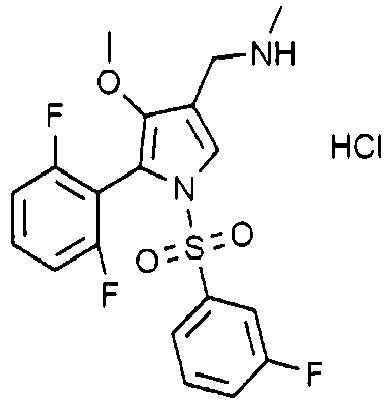
1H-NMR (500 MHz, CD3OD) : 7.74 (s, 1H), 7.53-7.61 (m, 2H), 7.47 (t, 1H), 7.33 (d, 1H), 7.18 (d, 1H), 7.01 (t, 2H), 4.07 (s, 2H), 3.50 (s, 3H), 2.71 (s, 3H) -

1H-NMR (500 MHz, CD3OD) : 7.75 (s, 1H), 7.71 (d, 1H), 7.59-7.62 (m, 1H), 7.51 (t, 1H), 7.46 (d, 1H), 7.36 (s, 1H), 7.02 (t, 2H), 4.08 (s, 2H), 3.50 (s, 3H), 2.71 (s, 3H) -
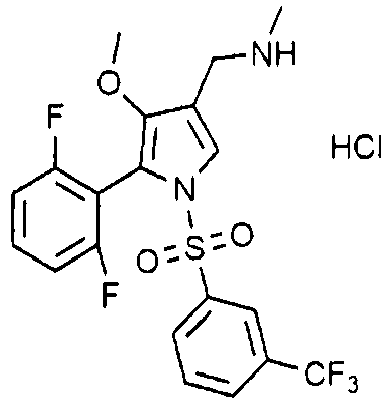
1H-NMR (500 MHz, CD3OD) : 8.03 (d, 1H), 7.83 (d, 1H), 7.76 (t, 1H), 7.64 (s, 1H), 7.59 (t, 1H), 6.99 (t, 1H), 4.05 (s, 2H), 3.49 (s, 3H), 2.69 (s, 3H) -

1H-NMR (500 MHz, CD3OD) : 7.70 (d, 1H), 7.57 (t, 1H), 7.49 (d, 1H), 7.37 (t, 1H), 7.30 (d, 1H), 7.19 (s, 1H), 6.97 (t, 2H), 6.67 (s, 2H), 4.60 (s, 3H), 4.04 (d, 2H), 3.48 (s, 3H), 2.69 (t, 3H), 2.33 (s, 3H) -

1H-NMR (500 MHz, CD3OD) : 7.71 (d, 1H), 7.57 (t, 1H), 7.39 (t, 1H), 7.22 (d, 1H), 7.08 (d, 1H), 6.99 (t, 1H), 6.90 (s, 1H), 4.03 (d, 2H), 3.77 (s, 3H), 3.49 (s, 3H), 2.68 (d, 3H) -

1H-NMR (500 MHz, CD3OD) : 7.71 (s, 1H), 7.65-7.57 (m, 1H), 7.58-7.50 (m, 2H), 7.45 (t, 1H), 7.05 (t, 2H), 4.03 (s, 2H), 3.50 (s, 3H), 2.72 (s, 3H) -

1H-NMR (500 MHz, CD3OD) : 7.73 (s, 1H), 7.61 (t, 1H), 7.58-7.02 (m, 4H), 7.02 (t, 2H), 4.07 (s, 1H), 3.50 (s, 3H), 2.71 (s, 3H) -

1H-NMR (500 MHz, CD3OD) : 7.54-7.48 (m, 3H), 7.42 (t, 1H), 7.35 (d, 1H), 7.27 (d, 1H), 7.17 (d, 1H), 7.12 (t, 1H), 3.65 (s, 2H), 3.45 (s, 3H), 2.43 (s, 3H) -

1H-NMR (500 MHz, CD3OD) : 7.70(s, 2H), 7.56-7.55(m, 3H), 7.51-7.48(m, 1H), 7.30(d, 1H), 7.18-7.16(m, 1H), 4.60(s, 2H), 4.00(s, 3H), 2.66(s, 3H) -

1H-NMR (500 MHz, CD3OD) : 7.74-7.72 (m, 2H), 7.54 (t, 1H), 7.50 (d, 1H), 7.43 (t, 1H), 6.95 (t, 1H), 4.05 (s, 2H), 3.53 (s, 3H), 2.69 (s, 3H) -

1H-NMR (500 MHz, CD3OD) : 8.05 (d, 1H), 7.87 (d, 1H), 7.88-7.78 (m, 2H), 7.69 (s, 1H), 6.94-6.91 (m, 2H), 4.07 (s, 2H), 3.52 (s, 3H), 2.70 (s, 3H) -

1H-NMR (500 MHz, CD3OD) : 7.74 (s, 1H), 7.44 (t, 1H), 7.25 (d, 1H), 7.12 (d, 1H), 6.95-6.91 (m, 3H), 4.07 (s, 2H), 3.80 (s, 3H), 3.52 (s, 3H), 2.71 (s, 3H) -

1H-NMR (500 MHz, CD3OD) : 7.73 (s, 1H), 7.52-7.48 (m, 2H), 7.41-7.39 (m, 1H), 6.99-6.96 (m, 2H), 4.07 (s, 2H), 3.52 (s, 3H), 2.69 (s, 3H) -

1H-NMR (500 MHz, CD3OD) : 7.61 (s, 1H), 7.60∼7.49 (m, 3H), 7.25 (d, 1H), 4.08 (s, 2H), 3.53 (s, 3H), 2.72 (s, 3H) -

1H-NMR (500 MHz, CD3OD) : 7.78 (s, 1H), 7.74 (d, 1H), 7.73-7.48 (m, 3H), 7.42 (d, 1H), 4.08 (s, 2H), 3.53 (s, 3H), 2.72 (s, 3H) -

1H-NMR (500 MHz, CD3OD) : 8.55 (d, 1H), 7.87∼7.77 (m, 3H), 7.68 (s, 1H), 7.55∼7.52 (m, 1H), 7.03∼6.99 (m, 1H), 4.09 (s, 2H), 3.52 (s, 3H), 2.71 (s, 3H) -

1H-NMR (500 MHz, CD3OD) : 7.77 (s, 1H), 7.54-7.48 (m, 1H), 7.43 (t, 1H), 7.26 (d, 1H), 7.11 (d, 1H), 7.04-6.99 (m, 1H), 6.93 (s, 1H), 4.89 (s, 2H), 3.79 (s, 3H), 3.52 (s, 3H), 2.71 (s, 3H) -

1H-NMR (500 MHz, CD3OD) : 7.71 (s, 1H), 7.54-7.58 (m, 1H), 7.47 (t, 1H), 7.32 (d, 1H), 7.27-7.30 (m, 1H), 7.18 (d, 1H), 7.08-7.12 (m, 1H), 6.90-6.93 (m, 1H), 4.08 (s, 2H), 3.49 (s, 3H), 2.72 (s, 3H) -

1H-NMR (500 MHz, CD3OD): 8.02 (d, 1H), 7.84 (d, 1H), 7.76-7.79 (m, 2H), 7.62 (s, 1H), 7.26-7.30 (m, 1H), 7.05-7.10 (m, 1H), 6.91-6.94 (m, 1H), 4.09 (s, 2H), 3.47 (s, 3H), 2.71 (s, 3H) -

1H-NMR (500 MHz, CD3OD) : 7.71 (s, 1H), 7.42 (t, 1H), 7.22-7.27 (m, 2H), 7.07-7.10 (m, 2H), 6.89 (t, 1H), 6.82-6.86 (m, 1H), 4.08 (s, 2H), 3.78 (s, 3H), 3.48 (s, 3H), 2.71 (s, 3H) - The inhibitory effects on proton pump (H+/K+-ATPase) activity of the compounds prepared in Examples 2, 8 and 22 were measured as follows.
- Gastric vesicles were prepared from a hog stomach in accordance with the known method (Edd C. Rabon et al., Preparation of Gastric H+,K+-ATPase., Methods in enzymology, vol.157 Academic Press Inc.,(1988), pp.649-654). The protein contents of gastric vesicles thus prepared were quantitatively measured with Bicinchoninic Acid (BCA) kit (Thermo Co.).
- 80 ul of (a predetermined concentration of a test compound, 0.5% DMSO, 2.5 mM MgCl2, 12.5 mM KCl, 1.25 mM EDTA, 60 mM Tris-HCl, pH7.4) was added to each well of 96-well plate. 10 ul of the reaction solution containing gastric vesicles (60 mmol/l, Tris-HCl buffer solution, pH 7.4), and 10 ul of Tris buffer solution containing adenosine triphosphate (10 mM ATP, Tris-HCl buffer solution, pH 7.4) were added to each well and subjected to enzymatic reaction at 37°C for 40 minutes. 50 ul of malachite green solution (0.12% malachite green solution in 6.2N sulfuric acid, 5.8% ammonium molybdenum and 11% Tween 20 were mixed at a ratio of 100: 67: 2) was added thereto to stop the enzyme reaction, and 50 ul of 15.1% sodium citrate was added thereto. The amount of monophosphate (Pi) in the reaction solution was measured at 570 nm by using a microplate reader (FLUOstar Omega, BMG Co.). The inhibition rate(%) was measured from the activity value of the control group and the activity value of the test compound at various concentrations, and the concentration (IC50) that inhibits H+/K+-ATPase activity by 50% was calculated from each % inhibition value of the compounds using Logistic 4-parameter function of Sigmaplot8.0 program. The results are shown in Table 1 below.
[Table 1] IC50 Example 2 0.015 uM Example 8 0.024 uM Example 22 0.014 uM - Inhibitory effects of the compounds prepared in Examples 2, 8 and 22 on basal gastric acid secretion were measured according to Shay's rat model (Shay, H., et al., 1945, gastroenterology, 5, p43-61). Male Sprague Dawley (SD) rats (body weight 180-220 g) were divided into 4 groups (n=6-7) and fasted for 18 hours with free access to water. Under isoflurane anesthesia, the abdomens of the rats were incised and then the pylorus was ligated. Immediately after ligation, control group was administered with 2 mL/kg of 0.5% methyl cellulose (MC) aqueous solution into the duodenum, and the other groups were administered with test compounds suspended in 0.5% methyl cellulose (MC) aqueous solution at a dose of 2.0 mg/kg/2 ml. 5 hours after ligation, the test animals were sacrificed, and gastric contents were removed. The removed contents were centrifuged at 4,000 X g for 10 minutes and the supernatant was separated to obtain the gastric juice. The amount and pH of the gastric juice were measured and the acidity in the gastric juice was measured by 0.1N NaOH volume (ueq/mL) required for the titration of gastric acid to pH 7.0. Total acid output was measured by multiplying the acidity of the gastric juice by the amount of the gastric juice. % inhibitory activity of test compounds were calculated according to the following equation, and the results are shown in Table 2.

[Table 2] % inhibitory activity Example 2 93.5% Example 8 90.5% Example 22 88.1% - The inhibitory activity against the gastric damage of the compounds prepared in Examples 2 and 8 was measured using indomethacin model (Chiou., Et al., 2005, gastroenterology, 128, p63-73). Male Sprague Dawley (SD) rats (body weight 180-220 g) was divided into 5 groups (n=10) and fasted for 24 hours with free access to water. Control group was orally administered with 5 mL/kg of 0.5% methyl cellulose (MC) aqueous solution, and the other groups were orally administered with test compounds suspended in 0.5% methyl cellulose (MC) aqueous solution at a dose of 2.0 mg/kg/5 ml. For comparison, the compound of Example 1 34 (Comparative Example 1) and the compound of Example 165 (Comparative Example 2) in International Patent Publication No.
WO2006/036024 were orally administered at a dose of 2.0 mg/kg/5 ml by suspending 0.5% methylcellulose (MC) aqueous solution, respectively. 1 hour after oral administration, indomethacin was orally administered at a dose of 80 mg/kg/10 ml. After 4 hours and 30 minutes, the test animals were sacrificed to remove the stomach. The surface of the removed stomach was washed with saline solution and then half thereof was incised along a greater curvature of stomach. The incised stomach was placed on a fixture, fixed by a fixing pin while spreading out using a forcep and then the gastric damage area was measured. % Inhibitory activity of test compounds was calculated according to the following Equation 2, and the results are shown in Table 3.
[Table 3] % inhibitory activity Example 2 91.8% Example 8 92.2% Comparative Example 1 66.8% Comparative Example 2 44.4% - The antimicrobial activity against H. pylori of the compounds prepared in the Examples 8 and 22 was evaluated by measuring the minimum inhibitory concentration (MIC) values through the susceptibility testing by the agar dilution method. H. pylori strains were furnished from Helicobacter isolated strain Bank (HpKTCC, KNMRRC) in the Microbiology Classroom of the Professional Graduate School of Medicine in Gyeongsang National University, South Korea. The test material dissolved in DMSO was subjected to two fold serial dilution with a sterile buffer to prepare a sample solution. At this time, each concentration of the serially diluted solution was adjusted to become 10 times the concentration used for the susceptibility testing. Thus, the concentration was adjusted so as to be added at a volume of 1/10 during preparation of the medium. While warming a water tank to 55 to 60°C, 5 ml of the sample solution with each concentration of the serially diluted solution warmed at the same temperature was added to Brucella agar medium (each 45 ml aliquot) containing 10% bovine serum, and prepared to have a final test concentration (test concentration: 5000 ug/ml, 2500 ug/ml, 1250 ug/ml, 625 ug/ml, 312.5 ug/ml, 150 ug/ml, 75 ug/ml, 37.5 ug/ml, 18.75 ug/ml, 9 ug/ml, 4.5 ug/ml, 2.25 ug/ml). Before the medium was hardened, it was divided and dispensed into two petri dishes to prepare an agar plate medium. H. pylori cultured in Brucella agar medium was prepared into each bacterial suspension with PBS (5.0 × 10⁸ CFU/mL), and dispensed in Steers multiple inoculator well. Bacterium were inoculated on the surface of the plate medium toward a high concentration side of substance from a low concentration side of substance using steers multiple inoculator. After culturing in 10% CO2 incubator at 37°C for 5 days, the presence or absence of growth of each bacteria was visually identified to determine the minimum, inhibitory concentration (MIC, the lowest concentration where bacterium have not been observed). The results are shown in Tables 4 and 5 below.
[Table 4] No. Bank accession number General name (Strain) MIC (ug/ml) Example 8 Example 22 1 HPKTCC B0508 CH24 75 75 2 HPKTCC B0582 CH94 37.5 75 3 HPKTCC B0494 CH173 75 75 4 HPKTCC B0498 CH189 75 75 5 HPKTCC B0500 CH192 75 75 6 HPKTCC B0516 CH272 75 75 7 HPKTCC B0524 CH381 75 75 8 HPKTCC B0536 CH498 75 75 9 HPKTCC B0537 CH502 75 75 10 HPKTCC B0548 CH541 75 75 11 HPKTCC B0558 CH609 75 75 12 HPKTCC B0560 CH631 75 75 13 HPKTCC B0564 CH674 75 75 14 HPKTCC B0556 CH588 75 75 15 HPKTCC B0562 CH635 75 75 16 HPKTCC B0541 CH523 75 75 17 HPKTCC B0522 CH369 75 75 18 HPKTCC B0559 CH612 75 75 19 HPKTCC B0487 CH1056 75 75 20 HPKTCC B0007 52 75 75 21 HPKTCC B0004 45 75 75 22 HPKTCC B0017 118 150 75 23 HPKTCC B0021 127 75 75 24 HPKTCC B0024 134 75 75 25 HPKTCC B0040 164 75 75 26 HPKTCC B0051 193 75 75 27 HPKTCC B0606 CJH7 75 75 28 HPKTCC B0610 CJH9 75 75 29 HPKTCC B0594 CJH31 75 75 30 HPKTCC B0595 CJH33 75 75 [Table 5] No. Bank accession number General name (Strain) MIC (ug/ml) Example 8 Example 22 31 HPKTCC B0599 CJH50 75 75 32 HPKTCC B0596 CJH43 75 75 33 HPKTCC B0589 CJH13 75 75 34 HPKTCC B0587 CJH10 75 75 35 HPKTCC B0608 CJH8 37.5 75 36 HPKTCC B0100 26695 75 75 37 HPKTCC B3412 26695 CHGKG 150 150 38 HPKTCC B0006 51 75 75 39 HPKTCC B0748 J99 75 75 40 HPKTCC B0047 183 150 75 41 HPKTCC B0055 198 75 75 42 HPKTCC B0058 205 75 75 43 HPKTCC B0061 210 75 75 44 HPKTCC B0068 221 75 75 45 HPKTCC B0071 228 75 75 46 HPKTCC B0088 302 75 75 47 HPKTCC B0075 236 75 75 48 HPKTCC B0496 CH175 75 75 49 HPKTCC B0074 235 75 75 50 HPKTCC B0722 G88001 75 75 51 HPKTCC B0725 G88007 75 75 52 HPKTCC B0020 126 150 75 53 HPKTCC B0026 138 75 75 54 HPKTCC B0023 133 37.5 75 55 HPKTCC B0035 156 150 75 56 HPKTCC B0037 159 150 75 57 HPKTCC B0233 92-82-1 75 75 58 HPKTCC B0152 92-157 75 75 59 HPKTCC B0182 92-33-1 75 75 60 HPKTCC B3392 SS1-P4' 37.5 75 - The inhibitory activity and defensive factor-enhancing effects of the compound prepared in Example 8 were measured using 100% ethanol(EtOH)-induced gastric damage model(Paul V. Tan et al., 2002, Journal of Ethnopharmacology, 82, p 69-74). Male Sprague Dawley(SD) rats (body weight 180-200g) was fasted for 24 hours with free access to water. Control group was orally administered with 5 mL/kg of 0.5% methyl cellulose (MC) aqueous solution, and the other groups were orally administered with test compounds suspended in 0.5% MC aqueous solution at a dose of 3.0, 10.0 and 30.0 mg/kg/5 mL. For comparison, the compound of Example 134 (Comparative Example 1), the compound of Example 165 (Comparative Example 2) and the compound of Example 166 (Comparative Example 3) in International Patent Publication No.
WO2006/036024 were orally administered at the same dose by suspending 0.5% MC aqueous solution, respectively. 1 hour after oral administration, 1 mL of 100% EtOH was orally administered. 1 hour after EtOH administration, the test animals were sacrificed to remove the stomach. Ten in the total 20 animals scraped the mucus of stomach with a slide glass and the mucus contents were analyzed to calculate ED50. The results were shown in Table 6. For the remaining 10 animals, the surface of the removed stomach was washed with a saline solution and then half thereof was incised along a greater curvature of stomach. The incised stomach was placed on a fixture, fixed by a fixing pin while spreading out using a forcep and then the gastric damage area was measured to calculate ED50. The results are shown in Table 7.[Table 6] Mucus secretion ED50(mg/kg) Example 8 12.2 Comparative Example 1 26.9 Comparative Example 2 21.6 Comparative Example 3 22. 1 [Table 7] Gastric index ED50(mg/kg) Example 8 13.4 Comparative Example 1 29.5 Comparative Example 2 30.9 Comparative Example 3 19.2 - From the results of Test Examples 1 to 5, it could be seen that the compounds according to the present invention had not only excellent proton pump inhibitory activity, gastric damage-inhibiting activity and defensive factor-enhancing effects, but also excellent eradication activity against H. pylori. In particular, the compound according to the present invention had not only excellent proton pump inhibitory activity, gastric damage-inhibiting activity and defensive factor-enhancing effects, but also excellent eradication activity against H. pylori, as compared with a structurally similar compound, for example, a compound either having no substituent or substituted with methyl at position 4 of pyrrole.
- In order to confirm whether the compounds prepared in the above Examples act as an agonist or antagonist against GPCR Target, Calcium Flux assay was performed in an assay plate in which the compounds prepared in the Examples, vehicle controls, and reference compounds were added, using a Fluorometric imaging plate reader (FLIPR tetra) equipment.
- Calcium Flux assay was evaluated by entrusting the GPCR profiler assay in Safety panel assays with Eurofins. By using the Fluo-8AM calcium dye, excitation was measured at a wavelength in the range of 470 to 495 nm and Emission was measured at a wavelength in the range of 515-575 nm. GPCR Assay Buffer for Calcium Flux assay was prepared by adding 20 mM of HEPES and 2.5 mM of Probenecid to Hanks Balanced Salt Solution (HBSS) to have pH 7.4. The Compounds of Examples for evaluation of the GPCR were diluted with DMSO at a concentration of 10 mM to make a stock and then prepared by diluting in the GPCR Assay Buffer at the concentration equivalent to three times the final concentration. First for the evaluation of GPCRs, the inhibitory activity of the compounds of the Examples was evaluated at a single concentration of 10 uM, and then the respective selected targets were four fold-diluted from 10 uM to the low side to calculate 50% inhibitory concentration (IC50), prepared at the total 8 concentrations of 10, 2.5, 0.62, 0.15, 0.04, 0.01, 0.0024, 0.0006 uM, and Calcium Flux assay for GPCR was conducted. In order to evaluate the agonist and antagonist, % inhibition rate against GPCR activity before and after treatment of the compounds and the inhibitory activity of the compounds of the Examples were determined.
- As a result, when the efficacy of alpha-heth-5-HT and acetylcholine of the compounds prepared in the Examples was 100%, the inhibition rate (%) at a single concentration of 10 uM was evaluated and shown in Table 8. 50% inhibitory concentrations (IC50, uM) for some compounds prepared in the Examples having excellent inhibitory rate was calculated and shown in Table 9 below.
[Table 8] Example 5-HT2A M1 M2 1 96.4 99.6 66.5 2 39.5 92. 7 -4.7 3 94.0 87.0 76.9 4 96.0 55.8 22.0 5 69.1 93.7 75.1 6 101.9 93.1 15.1 7 42.3 65.6 0.8 8 101.7 101.3 100.7 9 61.1 74.7 18.3 10 100.9 96.2 77.6 11 101.7 97.2 79.4 12 101.4 93.1 28.7 13 101.8 100.2 99.4 14 99.9 94.9 48.1 15 30.1 87.1 62.1 16 101.9 95.4 69.7 17 101.9 85.2 60.1 18 98.1 91.2 42.1 19 101.8 100.8 101.8 20 99.2 102.7 90.5 22 102.1 98.0 100.3 24 62.2 93.4 22.0 26 99.0 101.2 89.2 27 99.1 101.1 100.3 28 97.6 99.4 61.9 29 35.7 68.4 19.4 30 100.4 94.3 43.0 31 101.3 100.0 98.6 32 10.6 52.6 10.8 33 96.7 81.5 29.0 [Table 9] Example 5-HT2A M1 M2 1 0.25 1.7 - 3 0.18 - - 4 0.85 - - 6 0.16 ∼3.0 - 8 0.11 0.14 0.65 10 0.36 1.3 - 11 0.2 1.8 - 13 0.076 0.11 0.51 14 0.21 ∼2.2 - 16 0.058 1.9 - 17 2.2 - - 18 0.21 ∼2.1 - 19 0.12 0.43 0.82 22 0.033 0.37 1.0 24 0.062 > 1.0 >10.0 27 0.057 0.051 0.18 28 0.067 0.55 - 30 - 1.4 - 31 0.042 0.073 - 33 1.7 - - - As shown in Table 8, it could be seen that the compounds prepared in the Examples had high inhibition rate against 5-HT2A, M1 and M2 receptors and thus could be used as antagonist of these receptors. Further, as shown in Table 9, the compounds having high inhibition rate against 5-HT2A, M1 and M2 receptors exhibited excellent inhibitory effects on the receptors even at a small amount of 3 uM or less.
Claims (12)
- A compound represented by the following Chemical Formula 1 or a pharmaceutically acceptable salt thereof:
 R1, R2 and R3 are each independently hydrogen or halogen, with the proviso that R1, R2 and R3 cannot be hydrogen simultaneously, andR4 and R5 are each independently hydrogen, halogen, C1-4 alkyl, C1-4 alkoxy, C1-4 haloalkyl, or C1-4 haloalkoxy, with the proviso that R4 and R5 cannot be hydrogen simultaneously.
 - The compound or a pharmaceutically acceptable salt thereof according to claim 1,
wherein R1, R2 and R3 are each independently hydrogen, fluoro, or chloro, with the proviso that R1, R2 and R3 cannot be hydrogen simultaneously. - The compound or a pharmaceutically acceptable salt thereof according to claim 1,
wherein R4 and R5 are each independently hydrogen, chloro, fluoro, methyl, trifluoromethyl, methoxy, or difluoromethoxy, with the proviso that R4 and R5 cannot be hydrogen simultaneously. - The compound or a pharmaceutically acceptable salt thereof according to claim 1,
wherein R1 is halogen, and R2 and R3 are each independently hydrogen, or halogen. - The compound or a pharmaceutically acceptable salt thereof according to claim 1,
wherein R1 is fluoro, and R2 and R3 are each independently hydrogen, fluoro, or chloro, or
R1 is chloro, and R2 and R3 are hydrogen. - The compound or a pharmaceutically acceptable salt thereof according to claim 1,
wherein R4 is halogen, and R5 is chloro, fluoro, methyl, trifluoromethyl, methoxy, or difluoromethoxy, or
R4 and R5 are each independently chloro, or fluoro. - The compound or a pharmaceutically acceptable salt thereof according to claim 1,
wherein R1 is fluoro, and R2 and R3 are each independently hydrogen, or fluoro, R4 is hydrogen, and R5 is chloro, or trifluoromethyl. - The compound or a pharmaceutically acceptable salt thereof according to claim 1,
wherein the compound is selected from the group represented by the following Chemical Formulae 1-2 to 1-4:


R1 to R5 are as defined in claim 1. - The compound or a pharmaceutically acceptable salt thereof according to claim 1,
wherein the compound is selected from the group consisting of the following compounds:1) 1-(5-(2-fluorophenyl)-4-methoxy-1-((3-chlorophenyl)sulfonyl)-1H-pyrrol-3-yl)-N-methylmethanamine;2) 1-(5-(2-fluorophenyl)-4-methoxy-1-((3-(trifluoromethyl)phenyl)sulfonyl)-1H-pyrrol-3-yl)-N-methylmethanamine;3) 1-(5-(2-fluorophenyl)-4-methoxy-1-((3-methoxyphenyl)sulfonyl)-1H-pyrrol-3-yl)-N-methylmethanamine;4) 1-(5-(2-fluorophenyl)-4-methoxy-1-((3-difluoromethoxyphenyl)sulfonyl)-1H-pyrrol-3-yl)-N-methylmethanamine;5) 1-(5-(2-chlorophenyl)-4-methoxy-1-((3-methoxyphenyl)sulfonyl)-1H-pyrrol-3-yl)-N-methylmethanamine;6) 1-(5-(2-fluoro-4-chlorophenyl)-4-methoxy-1-((3-chlorophenyl)sulfonyl)-1H-pyrrol-3-yl)-N-methylmethanamine;7) 1-(5-(2-fluoro-4-chlorophenyl)-4-methoxy-1-((3-(trifluoromethyl)phenyl)sulfonyl)-1H-pyrrol-3-yl)-N-methylmethanamine;8) 1-(5-(2,4-difluorophenyl)-1-((3-fluorophenyl)sulfonyl)-4-methyoxy-1H-pyrrol-3-yl)-N-methylmethanamine;9) 1-(5-(2,4-difluorophenyl)-1-((3-(trifluoromethyl)phenyl)sulfonyl)-4-methoxy-1H-pyrrol-3-yl)-N-methylmethanamine;10) 1-(5-(2,4-difluorophenyl)-1-((3-methylphenyl)sulfonyl)-4-methoxy-1H-pyrrol-3-yl)-N-methylmethanamine;11) 1-(5-(2,4-difluorophenyl)-1-((3-methoxyphenyl)sulfonyl)-4-methoxy-1H-pyrrol-3-yl)-N-methylmethanamine;12) 1-(5-(2,4-difluorophenyl)-1-((3-difluoromethoxyphenyl)sulfonyl)-4-methoxy-1H-pyrrol-3-yl)-N-methylmethanamine;13) 1-(5-(2,6-difluorophenyl)-1-((3-fluorophenyl)sulfonyl)-4-methoxy-1H-pyrrol-3-yl)-N-methylmethanamine;14) 1-(5-(2,6-difluorophenyl)-1-((3-chlorophenyl)sulfonyl)-4-methoxy-1H-pyrrol-3-yl)-N-methylmethanamine;15) 1-(5-(2,6-difluorophenyl)-1-((3-(trifluoromethyl)phenyl)sulfonyl)-4-methoxy-1H-pyrrol-3-yl)-N-methylmethanamine;16) 1-(5-(2,6-difluorophenyl)-1-((3-methylphenyl)sulfonyl)-4-methoxy-1H-pyrrol-3-yl)-N-methylmethanamine;17) 1-(5-(2,6-difluorophenyl)-1-((3-methoxyphenyl)sulfonyl)-4-methoxy-1H-pyrrol-3-yl)-N-methylmethanamine;18) 1-(5-(2,6-difluorophenyl)-1-((3-chloro-4-fluorophenyl)sulfonyl)-4-methoxy-1H-pyrrol-3-yl)-N-methylmethanamine;19) 1-(5-(2,6-difluorophenyl)-1-((3,4-difluorophenyl)sulfonyl)-4-methoxy-1H-pyrrol-3-yl)-N-methylmethanamine;20) 1-(5-(2-fluoro-6-chlorophenyl)-1-((3-fluorophenyl)sulfonyl)-4-methoxy-1H-pyrrol-3-yl)-N-methylmethanamine;21) 1-(5-(2-fluoro-6-chlorophenyl)-1-((3-chlorophenyl)sulfonyl)-4-methoxy-1H-pyrrol-3-yl)-N-methylmethanamine;22) 1-(1-((3-fluorophenyl)sulfonyl)-4-methoxy-5-(2,4,6-trifluorophenyl)-1H-pyrrol-3-yl)-N-methylmethanamine;23) 1-(1-((3-chlorophenyl)sulfonyl)-4-methoxy-5-(2,4,6-trifluorophenyl)-1H-pyrrol-3-yl)-N-methylmethanamine;24) 1-(1-((3-trifluoromethylphenyl)sulfonyl)-4-methoxy-5-(2,4,6-trifluorophenyl)-1H-pyrrol-3-yl)-N-methylmethanamine;25) 1-(1-((3-methoxyphenyl)sulfonyl)-4-methoxy-5-(2,4,6-trifluorophenyl)-1H-pyrrol-3-yl)-N-methylmethanamine;26) 1-(1-((3,4-difluorophenyl)sulfonyl)-4-methoxy-5-(2,4,6-trifluorophenyl)-1H-pyrrol-3-yl)-N-methanamine;27) 1-(1-((3-fluorophenyl)sulfonyl)-4-methoxy-5-(2,3,6-trifluorophenyl)-1H-pyrrol-3-yl)-N-methylmethanamine;28) 1-(1-((3-chlorophenyl)sulfonyl)-4-methoxy-5-(2,3,6-trifluorophenyl)-1H-pyrrol-3-yl)-N-methylmethanamine;29) 1-(1-((3-trifluoromethylphenyl)sulfonyl)-4-methoxy-5-(2,3,6-trifluorophenyl)-1H-pyrrol-3-yl)-N-methylmethanamine;30) 1-(1-((3-methoxyphenyl)sulfonyl)-4-methoxy-5-(2,3,6-trifluorophenyl)-1H-pyrrol-3-yl)-N-methylmethanamine;31) 1-(5-(2,5-difluorophenyl)-1-((3-fluorophenyl)sulfonyl)-4-methoxy-1H-pyrrol-3-yl)-N-methylmethanamine;32) 1-(5-(2,5-difluorophenyl)-1-((3-trifluoromethylphenyl)sulfonyl)-4-methoxy-1H-pyrrol-3-yl)-N-methylmethanamine; and33) 1-(5-(2,5-difluorophenyl)-1-((3-methoxyphenyl)sulfonyl)-4-methoxy-1H-pyrrol-3-yl)-N-methylmethanamine. - The compound or a pharmaceutically acceptable salt thereof according to claim 1,
wherein the pharmaceutically acceptable salt is hydrochloride or fumarate salt. - A pharmaceutical composition for use in the prevention and treatment of gastrointestinal damage due to gastrointestinal tract ulcer, gastritis, reflux esophagitis or H. pylori, comprising the compound or the pharmaceutically acceptable salt thereof according to any one of claims 1 to 10.
- A pharmaceutical composition for use in the prevention and treatment of 5-HT receptor-mediated or muscarinic acetylcholine receptor-mediated diseases selected from depression, manic depression, schizophrenia, autism, obsessive-compulsive neurosis, anxiety disorder, migraine, hypertension, eating disorder, irritable bowel syndrome (IBS), peptic ulcer, diabetic neuropathy, asthma, and overactive bladder, comprising the compound or the pharmaceutically acceptable salt thereof according to any one of claims 1 to 10.
Priority Applications (5)
| Application Number | Priority Date | Filing Date | Title |
|---|---|---|---|
| RS20181555A RS58076B1 (en) | 2015-04-27 | 2016-04-27 | Novel 4-methoxy pyrrole derivatives or salts thereof and pharmaceutical composition comprising the same |
| MA40887A MA40887B1 (en) | 2015-04-27 | 2016-04-27 | Novel 4-methoxy pyrrole derivatives or their salts, and pharmaceutical composition comprising them |
| HRP20182066TT HRP20182066T1 (en) | 2015-04-27 | 2016-04-27 | NEW 4-METHOXES OF PYROLES OR THEIR SALTS AND THE PHARMACEUTICAL PREPARATION CONTAINING THEM |
| SI201630148T SI3197867T1 (en) | 2015-04-27 | 2016-04-27 | Novel 4-methoxy pyrrole derivatives or salts thereof and pharmaceutical composition comprising the same |
| PL16786741T PL3197867T3 (en) | 2015-04-27 | 2016-04-27 | Novel 4-methoxy pyrrole derivatives or salts thereof and pharmaceutical composition comprising the same |
Applications Claiming Priority (3)
| Application Number | Priority Date | Filing Date | Title |
|---|---|---|---|
| KR20150058712 | 2015-04-27 | ||
| KR1020160013588A KR101613245B1 (en) | 2015-04-27 | 2016-02-03 | Novel 4-methoxy pyrrole derivatives or salts thereof and pharmaceutical composition comprising the same |
| PCT/KR2016/004411 WO2016175555A2 (en) | 2015-04-27 | 2016-04-27 | Novel 4-methoxy pyrrole derivatives or salts thereof and pharmaceutical composition comprising the same |
Publications (3)
| Publication Number | Publication Date |
|---|---|
| EP3197867A2 EP3197867A2 (en) | 2017-08-02 |
| EP3197867A4 EP3197867A4 (en) | 2017-09-06 |
| EP3197867B1 true EP3197867B1 (en) | 2018-11-14 |
Family
ID=55916928
Family Applications (1)
| Application Number | Title | Priority Date | Filing Date |
|---|---|---|---|
| EP16786741.5A Active EP3197867B1 (en) | 2015-04-27 | 2016-04-27 | Novel 4-methoxy pyrrole derivatives or salts thereof and pharmaceutical composition comprising the same |
Country Status (29)
| Country | Link |
|---|---|
| US (1) | US10100010B1 (en) |
| EP (1) | EP3197867B1 (en) |
| JP (1) | JP6244498B1 (en) |
| KR (2) | KR101613245B1 (en) |
| CN (1) | CN107001263B (en) |
| AU (1) | AU2016255308B2 (en) |
| CA (1) | CA2977750C (en) |
| CL (1) | CL2017002571A1 (en) |
| CO (1) | CO2017010539A2 (en) |
| DO (2) | DOP2017000230A (en) |
| EC (1) | ECSP17071036A (en) |
| ES (1) | ES2703709T3 (en) |
| HR (1) | HRP20182066T1 (en) |
| HU (1) | HUE042449T2 (en) |
| MA (1) | MA40887B1 (en) |
| MX (1) | MX2017012507A (en) |
| MY (1) | MY193257A (en) |
| NZ (1) | NZ734896A (en) |
| PE (1) | PE20180022A1 (en) |
| PH (1) | PH12017501755B1 (en) |
| PL (1) | PL3197867T3 (en) |
| PT (1) | PT3197867T (en) |
| RS (1) | RS58076B1 (en) |
| RU (1) | RU2663895C1 (en) |
| SA (1) | SA517390127B1 (en) |
| SG (1) | SG11201706877RA (en) |
| SI (1) | SI3197867T1 (en) |
| TN (1) | TN2017000424A1 (en) |
| WO (1) | WO2016175555A2 (en) |
Cited By (2)
| Publication number | Priority date | Publication date | Assignee | Title |
|---|---|---|---|---|
| EP4349324A4 (en) * | 2021-05-26 | 2025-07-02 | Daewoong Pharmaceutical Co Ltd | MEDICINE CONTAINER WITH A LIQUID PHARMACEUTICAL COMPOSITION OF 1-(5-(2,4-DIFLUOROPHENYL)-1-((3-FLUOROPHENYL)SULFONYL)-4-METHOXY-1H-PYRROL-3-YL)-N-METHYLMETHANAMINE |
| RU2852719C2 (en) * | 2021-12-15 | 2025-12-15 | Даевунг Фармасьютикал Ко., Лтд. | Dosing regimen for injectable composition of fexuprazan |
Families Citing this family (27)
| Publication number | Priority date | Publication date | Assignee | Title |
|---|---|---|---|---|
| KR102081920B1 (en) * | 2016-03-25 | 2020-02-26 | 주식회사 대웅제약 | Novel crystalline form of 1-(5-(2,4-difluorophenyl)-1-((3-fluorophenyl)sulfonyl)-4-methoxy-1h-pyrrol-3-yl)-n-methylmethanamine salt |
| KR20170113040A (en) * | 2016-03-25 | 2017-10-12 | 주식회사 대웅제약 | Novel acid addition salt of 1-(5-(2,4-difluorophenyl)-1-((3-fluorophenyl)sulfonyl)-4-methoxy-1h-pyrrol-3-yl)-n-methylmethanamine |
| WO2017164575A1 (en) * | 2016-03-25 | 2017-09-28 | Daewoong Pharmaceutical Co.,Ltd. | Novel acid addition salt of 1-(5-(2,4-difluorophenyl)-1-((3- fluorophenyl)sulfonyl)-4-methoxy-1h-pyrrol-3-yl)-n- methylmethanamine |
| KR102233456B1 (en) * | 2017-05-31 | 2021-03-29 | 주식회사 대웅제약 | Method for preparation of intermediate of 4-methoxypyrrole derivative |
| KR102233455B1 (en) * | 2017-06-21 | 2021-03-29 | 주식회사 대웅제약 | Method for preparation of intermediate of 4-methoxypyrrole derivative |
| KR102126576B1 (en) * | 2018-09-19 | 2020-06-24 | 주식회사 대웅제약 | Manufacturing method for 4-methoxypyrrole derivatives |
| WO2020060213A1 (en) | 2018-09-19 | 2020-03-26 | 주식회사 대웅제약 | Method for producing 4-methoxy pyrrole derivative |
| CA3157981C (en) * | 2019-12-18 | 2024-03-26 | Daewoong Pharmaceutical Co., Ltd. | Liquid pharmaceutical composition of 1-(5-(2,4-difluorophenyl)-1-((3-fluorophenyl)sulfonyl)-4-methoxy-1h-pyrrol-3-yl)-n-methylmethanamine |
| KR20210156235A (en) * | 2020-06-17 | 2021-12-24 | 일동제약(주) | Novel acid secretion inhibitors and use thereof |
| CN112094219B (en) * | 2020-09-10 | 2022-08-05 | 广东莱佛士制药技术有限公司 | Method for preparing intermediate of potassium ion competitive retarder |
| WO2022051979A1 (en) * | 2020-09-10 | 2022-03-17 | 广东莱佛士制药技术有限公司 | Method for preparing potassium ion competitive blocker intermediate |
| DK4245298T3 (en) | 2020-12-18 | 2026-03-30 | Daewoong Pharmaceutical Co Ltd | Hidtil ukendt formulering til oral administration, som omfatter 1-(5-(2,4-difluorphenyl)-1-((3-fluorphenyl)sulfonyl)-4-methoxy-1h-pyrrol-3-yl)-n-methylmethanamin |
| US20240261261A1 (en) | 2021-05-26 | 2024-08-08 | Daewoong Pharmaceutical Co., Ltd. | New formulation for injection comprising 1-(5-(2,4-difluorophenyl)-1-((3-fluorophenyl)sulfonyl)-4-methoxy-1h-pyrrol-3-yl)-n-methylmethanamine |
| MX2023013985A (en) * | 2021-05-26 | 2023-12-12 | Daewoong Pharmaceutical Co Ltd | MEDICINE CONTAINER COMPRISING THE LIQUID PHARMACEUTICAL COMPOSITION OF 1-(5-(2,4-DIFLUOROPHENYL)-1-((3-FLUOROPHENYL)SULFONYL)-4- METHOXY-1H-PYRROL-3-IL)-N-METHYLMETHANAMINE . |
| KR102556500B1 (en) | 2021-11-19 | 2023-07-19 | 하나제약 주식회사 | Pyrrole derivatives or pharmaceutically or food acceptable salts thereof, and composition for preventing, improving or treating gastrointestinal diseases comprising the same as an active ingredient |
| US20250084026A1 (en) * | 2021-12-15 | 2025-03-13 | Ildong Pharmaceutical Co., Ltd. | Novel salt of 1-sulfonyl pyrrole derivative, preparation method thereof and pharmaceutical composition comprising thereof |
| WO2023113487A1 (en) | 2021-12-15 | 2023-06-22 | 주식회사 대웅제약 | Dosage regimen for fexuprazan injection composition |
| WO2023113474A1 (en) * | 2021-12-15 | 2023-06-22 | 일동제약(주) | Novel salt of 1-sulfonyl pyrrole derivative, method for preparing same, and pharmaceutical composition including same |
| KR20230102353A (en) | 2021-12-30 | 2023-07-07 | 주식회사 대웅제약 | Pharmaceutical composition for preventing or treating triple-negative breast cancer |
| US20250268862A1 (en) * | 2022-04-25 | 2025-08-28 | Daewoong Pharmaceutical Co., Ltd. | Potassium-competitive acid blockers for the treatment of pathological hypersecretory conditions |
| TW202411215A (en) * | 2022-05-23 | 2024-03-16 | 南韓商日東製藥股份有限公司 | Method for preparation of 6-methoxypyridine-3-yl derivatives |
| WO2023229323A1 (en) * | 2022-05-23 | 2023-11-30 | 일동제약(주) | Method for preparing 6-methoxypyridin-3-yl derivative |
| CN117820193A (en) * | 2022-09-29 | 2024-04-05 | 安徽皓元药业有限公司 | A kind of ferrazan hydrochloride crystal form A and preparation method thereof |
| CN115557876A (en) * | 2022-10-26 | 2023-01-03 | 四川国康药业有限公司 | A 3-aryl ring sulfonyl-1-N-heteropyrrole derivative for treating peptic ulcer, its preparation method and application |
| KR102938657B1 (en) | 2023-02-15 | 2026-03-12 | 주식회사 대웅제약 | Manufacturing method for 4-methoxypyrrole derivatives |
| KR20250124776A (en) * | 2024-02-13 | 2025-08-20 | 유노비아 주식회사 | Treating method for gastrointestinal diseases comprising 6-methoxypyridine-3-yl derivatives |
| WO2026029625A1 (en) * | 2024-08-02 | 2026-02-05 | 일양약품주식회사 | 4-cyclopropyl pyrrole derivative and use thereof |
Family Cites Families (21)
| Publication number | Priority date | Publication date | Assignee | Title |
|---|---|---|---|---|
| MXPA04004464A (en) | 2001-11-08 | 2004-08-11 | Upjohn Co | Azabicyclic-substituted-heteroaryl compounds for the treatment of disease. |
| MXPA05001688A (en) | 2002-08-12 | 2005-04-19 | Sugen Inc | 3-pyrrolyl-pyridopyrazoles and 3-pyrrolyl-indazoles as novel kinase inhibitors. |
| UY28871A1 (en) | 2004-04-27 | 2005-11-30 | Glaxo Group Ltd | ANTAGONISTS OF THE MUSCARINIC ACETILCOLINE RECEIVER |
| US7705025B2 (en) | 2004-08-23 | 2010-04-27 | Eli Lilly And Company | Histamine H3 receptor agents, preparation and therapeutic uses |
| DK1784404T3 (en) | 2004-09-03 | 2012-02-13 | Yuhan Corp | Pyrrolo [2,3-c] pyridine derivatives as well as processes for their preparation |
| ES2348467T3 (en) | 2004-09-30 | 2010-12-07 | F. Hoffmann-La Roche Ag | DERIVATIVES AND USES OF BENZOXAZINE AND QUINOXALINE. |
| EP2336107B1 (en) | 2004-09-30 | 2015-09-23 | Takeda Pharmaceutical Company Limited | Proton pump inhibitors |
| EP2327692B9 (en) * | 2005-08-30 | 2014-06-04 | Takeda Pharmaceutical Company Limited | 1-heterocyclylsulfonyl, 2-aminomethyl, 5-(hetero-)aryl substituted 1-H-pyrrole derivatives as acid secretion inhibitors |
| DE102005041246A1 (en) | 2005-08-31 | 2007-03-08 | Basf Coatings Ag | Free, molybdenum and tungsten compounds containing cesium compounds, curable mixtures based on blocked polyisocyanates, processes for their preparation and their use |
| BR122020004679B1 (en) | 2005-12-19 | 2021-09-21 | Raqualia Pharma Inc | PHARMACEUTICAL COMPOSITION |
| ES2336275T3 (en) | 2006-05-04 | 2010-04-09 | Solvay Pharmaceuticals B.V. | MUSCARINIC AGONISTS TO TREAT IMPULSE CONTROL DISORDERS. |
| DE102006027229A1 (en) * | 2006-06-09 | 2007-12-20 | Grünenthal GmbH | 1,3-Disubstituted 4-methyl-1H-pyrrole-2-carboxylic acid amides and their use for the preparation of medicaments |
| US8933105B2 (en) * | 2007-02-28 | 2015-01-13 | Takeda Pharmaceutical Company Limited | Pyrrole compounds |
| WO2008131779A1 (en) | 2007-04-26 | 2008-11-06 | H. Lundbeck A/S | Isoquinolinone derivatives as nk3 antagonists |
| RU2591194C2 (en) | 2010-04-22 | 2016-07-10 | Интра-Селлулар Терапиз, Инк. | Organic compounds |
| CN104718189B (en) * | 2012-11-19 | 2017-03-15 | 江苏豪森药业集团有限公司 | Pyrroles's sulphonyl analog derivative, its preparation method and its in application pharmaceutically |
| BR112015021271A2 (en) | 2013-03-15 | 2017-08-22 | Acadia Pharm Inc | MUSCARINIC AGONISTS |
| ITBS20130175A1 (en) | 2013-11-22 | 2015-05-23 | Ind Saleri Italo Spa | ADJUSTABLE COOLING PUMP UNIT WITH ADJUSTABLE IMPELLER |
| WO2015134539A1 (en) | 2014-03-03 | 2015-09-11 | The Regents Of The University Of California | Mcl-1 antagonists |
| CN104447191B (en) | 2014-10-30 | 2016-03-23 | 绵阳达高特新材料有限公司 | Bromo-1, the 2-dihydro cyclobutene of 4-also [α] naphthalene compound and preparation method thereof |
| CN104447491B (en) * | 2014-11-19 | 2017-06-23 | 连云港恒运医药有限公司 | Hemifumarate and its intermediate and medical usage containing pyrrole ring proton pump inhibitor |
-
2016
- 2016-02-03 KR KR1020160013588A patent/KR101613245B1/en active Active
- 2016-04-08 KR KR1020160043522A patent/KR101818704B1/en active Active
- 2016-04-27 CN CN201680003652.8A patent/CN107001263B/en active Active
- 2016-04-27 CA CA2977750A patent/CA2977750C/en active Active
- 2016-04-27 US US15/520,518 patent/US10100010B1/en active Active
- 2016-04-27 PL PL16786741T patent/PL3197867T3/en unknown
- 2016-04-27 WO PCT/KR2016/004411 patent/WO2016175555A2/en not_active Ceased
- 2016-04-27 ES ES16786741T patent/ES2703709T3/en active Active
- 2016-04-27 PE PE2017001632A patent/PE20180022A1/en unknown
- 2016-04-27 AU AU2016255308A patent/AU2016255308B2/en active Active
- 2016-04-27 HU HUE16786741A patent/HUE042449T2/en unknown
- 2016-04-27 RU RU2017133866A patent/RU2663895C1/en active
- 2016-04-27 JP JP2017531371A patent/JP6244498B1/en active Active
- 2016-04-27 PT PT16786741T patent/PT3197867T/en unknown
- 2016-04-27 HR HRP20182066TT patent/HRP20182066T1/en unknown
- 2016-04-27 MY MYPI2017703532A patent/MY193257A/en unknown
- 2016-04-27 EP EP16786741.5A patent/EP3197867B1/en active Active
- 2016-04-27 PH PH1/2017/501755A patent/PH12017501755B1/en unknown
- 2016-04-27 SI SI201630148T patent/SI3197867T1/en unknown
- 2016-04-27 SG SG11201706877RA patent/SG11201706877RA/en unknown
- 2016-04-27 NZ NZ734896A patent/NZ734896A/en unknown
- 2016-04-27 RS RS20181555A patent/RS58076B1/en unknown
- 2016-04-27 MX MX2017012507A patent/MX2017012507A/en active IP Right Grant
- 2016-04-27 TN TNP/2017/000424A patent/TN2017000424A1/en unknown
- 2016-04-27 MA MA40887A patent/MA40887B1/en unknown
-
2017
- 2017-10-03 DO DO2017000230A patent/DOP2017000230A/en unknown
- 2017-10-10 SA SA517390127A patent/SA517390127B1/en unknown
- 2017-10-11 CL CL2017002571A patent/CL2017002571A1/en unknown
- 2017-10-13 CO CONC2017/0010539A patent/CO2017010539A2/en unknown
- 2017-10-25 EC ECIEPI201771036A patent/ECSP17071036A/en unknown
-
2021
- 2021-10-18 DO DO2021000213A patent/DOP2021000213A/en unknown
Non-Patent Citations (1)
| Title |
|---|
| None * |
Cited By (2)
| Publication number | Priority date | Publication date | Assignee | Title |
|---|---|---|---|---|
| EP4349324A4 (en) * | 2021-05-26 | 2025-07-02 | Daewoong Pharmaceutical Co Ltd | MEDICINE CONTAINER WITH A LIQUID PHARMACEUTICAL COMPOSITION OF 1-(5-(2,4-DIFLUOROPHENYL)-1-((3-FLUOROPHENYL)SULFONYL)-4-METHOXY-1H-PYRROL-3-YL)-N-METHYLMETHANAMINE |
| RU2852719C2 (en) * | 2021-12-15 | 2025-12-15 | Даевунг Фармасьютикал Ко., Лтд. | Dosing regimen for injectable composition of fexuprazan |
Also Published As
Similar Documents
| Publication | Publication Date | Title |
|---|---|---|
| US10100010B1 (en) | 4-methoxy pyrrole derivatives or salts thereof and pharmaceutical composition comprising the same | |
| CN103354809B (en) | A kind of aryl urea compounds, its intermediate and application thereof | |
| JP6506322B2 (en) | Novel anti-anxiety drug compounds | |
| JPH08109169A (en) | Non-peptide tachykinin receptor antagonist | |
| EA015516B1 (en) | Inhibitors of 11-beta-hydroxysteroid dehydrogenase 1 | |
| JPWO2017221869A1 (en) | Process for producing substituted polycyclic pyridone derivatives and crystals thereof | |
| JP5063708B2 (en) | Quinolone compounds and pharmaceutical compositions | |
| JP4950157B2 (en) | Novel isoindolinone derivative having activity in T-type calcium channel and method for producing the same | |
| JP7721686B2 (en) | Methionine adenosyltransferase 2A inhibitors | |
| KR101685993B1 (en) | N-(pyrazolylmethyl)arylsulfonamide compounds capable of inhibiting voltage gated calcium ion channel, and pharmaceutical compositions comprising the same | |
| JP2018087173A (en) | Malignant brain tumor drug | |
| CN103265480B (en) | Quinolyl dione analog derivative and its production and use | |
| HK1234746B (en) | Novel 4-methoxy pyrrole derivatives or salts thereof and pharmaceutical composition comprising the same | |
| BR112017020056B1 (en) | 4-METHOXY PYRROL DERIVATIVE COMPOUNDS OR PHARMACEUTICALLY ACCEPTABLE SALTS THEREOF, PHARMACEUTICAL COMPOSITION AND USE THEREOF | |
| HK1234746A1 (en) | Novel 4-methoxy pyrrole derivatives or salts thereof and pharmaceutical composition comprising the same | |
| EP3176165B1 (en) | Crystal of azole benzene derivative as xanthine oxidase inhibitor | |
| EP3176166B1 (en) | Azole benzene derivative and crystal thereof | |
| WO2012014699A1 (en) | Therapeutic agent for neurological diseases | |
| EP4654972A1 (en) | Compounds and methods for yap/tead modulation and indications therefor | |
| WO2018035950A1 (en) | Compound as tyrosine kinase inhibitor | |
| JPWO2019054386A1 (en) | Heterocyclic compounds or salts thereof, GPR35 agonists and pharmaceutical compositions | |
| JP2010155828A (en) | Pharmaceutical agent | |
| HK1237345A1 (en) | Azole benzene derivative and crystal thereof | |
| HK1237345B (en) | Azole benzene derivative and crystal thereof |
Legal Events
| Date | Code | Title | Description |
|---|---|---|---|
| STAA | Information on the status of an ep patent application or granted ep patent |
Free format text: STATUS: THE INTERNATIONAL PUBLICATION HAS BEEN MADE |
|
| PUAI | Public reference made under article 153(3) epc to a published international application that has entered the european phase |
Free format text: ORIGINAL CODE: 0009012 |
|
| STAA | Information on the status of an ep patent application or granted ep patent |
Free format text: STATUS: REQUEST FOR EXAMINATION WAS MADE |
|
| 17P | Request for examination filed |
Effective date: 20170421 |
|
| AK | Designated contracting states |
Kind code of ref document: A2 Designated state(s): AL AT BE BG CH CY CZ DE DK EE ES FI FR GB GR HR HU IE IS IT LI LT LU LV MC MK MT NL NO PL PT RO RS SE SI SK SM TR |
|
| AX | Request for extension of the european patent |
Extension state: BA ME |
|
| RIC1 | Information provided on ipc code assigned before grant |
Ipc: A61K 31/095 20060101ALI20170725BHEP Ipc: A61K 31/40 20060101ALI20170725BHEP Ipc: C07D 207/48 20060101AFI20170725BHEP Ipc: C07D 207/36 20060101ALI20170725BHEP Ipc: C07D 207/335 20060101ALI20170725BHEP Ipc: C07D 207/30 20060101ALI20170725BHEP |
|
| A4 | Supplementary search report drawn up and despatched |
Effective date: 20170808 |
|
| RAV | Requested validation state of the european patent: fee paid |
Extension state: MA Effective date: 20170726 |
|
| RIC1 | Information provided on ipc code assigned before grant |
Ipc: C07D 207/48 20060101AFI20170801BHEP Ipc: A61K 31/095 20060101ALI20170801BHEP Ipc: A61K 31/40 20060101ALI20170801BHEP Ipc: C07D 207/335 20060101ALI20170801BHEP Ipc: C07D 207/30 20060101ALI20170801BHEP Ipc: C07D 207/36 20060101ALI20170801BHEP |
|
| RIN1 | Information on inventor provided before grant (corrected) |
Inventor name: HAN, MI RYEONG Inventor name: KOH, EUN JI Inventor name: LEE, YEON IM Inventor name: EOM, DEOK KI Inventor name: LEE, SEUNG CHUL Inventor name: LEE, CHUN HO |
|
| STAA | Information on the status of an ep patent application or granted ep patent |
Free format text: STATUS: EXAMINATION IS IN PROGRESS |
|
| 17Q | First examination report despatched |
Effective date: 20171129 |
|
| GRAP | Despatch of communication of intention to grant a patent |
Free format text: ORIGINAL CODE: EPIDOSNIGR1 |
|
| STAA | Information on the status of an ep patent application or granted ep patent |
Free format text: STATUS: GRANT OF PATENT IS INTENDED |
|
| DAX | Request for extension of the european patent (deleted) | ||
| INTG | Intention to grant announced |
Effective date: 20180613 |
|
| RIN1 | Information on inventor provided before grant (corrected) |
Inventor name: EOM, DEOK KI Inventor name: KOH, EUN JI Inventor name: HAN, MI RYEONG Inventor name: LEE, YEON IM Inventor name: LEE, SEUNG CHUL Inventor name: LEE, CHUN HO |
|
| RAV | Requested validation state of the european patent: fee paid |
Extension state: MA Effective date: 20170726 |
|
| GRAS | Grant fee paid |
Free format text: ORIGINAL CODE: EPIDOSNIGR3 |
|
| GRAA | (expected) grant |
Free format text: ORIGINAL CODE: 0009210 |
|
| STAA | Information on the status of an ep patent application or granted ep patent |
Free format text: STATUS: THE PATENT HAS BEEN GRANTED |
|
| AK | Designated contracting states |
Kind code of ref document: B1 Designated state(s): AL AT BE BG CH CY CZ DE DK EE ES FI FR GB GR HR HU IE IS IT LI LT LU LV MC MK MT NL NO PL PT RO RS SE SI SK SM TR |
|
| REG | Reference to a national code |
Ref country code: AT Ref legal event code: REF Ref document number: 1064634 Country of ref document: AT Kind code of ref document: T Effective date: 20181115 Ref country code: CH Ref legal event code: EP |
|
| REG | Reference to a national code |
Ref country code: SE Ref legal event code: TRGR |
|
| REG | Reference to a national code |
Ref country code: HR Ref legal event code: TUEP Ref document number: P20182066 Country of ref document: HR |
|
| REG | Reference to a national code |
Ref country code: IE Ref legal event code: FG4D |
|
| REG | Reference to a national code |
Ref country code: DE Ref legal event code: R096 Ref document number: 602016007234 Country of ref document: DE |
|
| REG | Reference to a national code |
Ref country code: RO Ref legal event code: EPE |
|
| REG | Reference to a national code |
Ref country code: PT Ref legal event code: SC4A Ref document number: 3197867 Country of ref document: PT Date of ref document: 20190110 Kind code of ref document: T Free format text: AVAILABILITY OF NATIONAL TRANSLATION Effective date: 20181221 |
|
| REG | Reference to a national code |
Ref country code: MA Ref legal event code: VAGR Ref document number: 40887 Country of ref document: MA Kind code of ref document: B1 Ref country code: CH Ref legal event code: NV Representative=s name: GEVERS SA, CH |
|
| REG | Reference to a national code |
Ref country code: NL Ref legal event code: FP |
|
| REG | Reference to a national code |
Ref country code: HR Ref legal event code: T1PR Ref document number: P20182066 Country of ref document: HR |
|
| REG | Reference to a national code |
Ref country code: NO Ref legal event code: T2 Effective date: 20181114 |
|
| REG | Reference to a national code |
Ref country code: ES Ref legal event code: FG2A Ref document number: 2703709 Country of ref document: ES Kind code of ref document: T3 Effective date: 20190312 |
|
| REG | Reference to a national code |
Ref country code: LT Ref legal event code: MG4D |
|
| REG | Reference to a national code |
Ref country code: HR Ref legal event code: ODRP Ref document number: P20182066 Country of ref document: HR Payment date: 20190403 Year of fee payment: 4 |
|
| REG | Reference to a national code |
Ref country code: GR Ref legal event code: EP Ref document number: 20180403846 Country of ref document: GR Effective date: 20190422 |
|
| PG25 | Lapsed in a contracting state [announced via postgrant information from national office to epo] |
Ref country code: IS Free format text: LAPSE BECAUSE OF FAILURE TO SUBMIT A TRANSLATION OF THE DESCRIPTION OR TO PAY THE FEE WITHIN THE PRESCRIBED TIME-LIMIT Effective date: 20190314 Ref country code: LT Free format text: LAPSE BECAUSE OF FAILURE TO SUBMIT A TRANSLATION OF THE DESCRIPTION OR TO PAY THE FEE WITHIN THE PRESCRIBED TIME-LIMIT Effective date: 20181114 Ref country code: LV Free format text: LAPSE BECAUSE OF FAILURE TO SUBMIT A TRANSLATION OF THE DESCRIPTION OR TO PAY THE FEE WITHIN THE PRESCRIBED TIME-LIMIT Effective date: 20181114 |
|
| PG25 | Lapsed in a contracting state [announced via postgrant information from national office to epo] |
Ref country code: AL Free format text: LAPSE BECAUSE OF FAILURE TO SUBMIT A TRANSLATION OF THE DESCRIPTION OR TO PAY THE FEE WITHIN THE PRESCRIBED TIME-LIMIT Effective date: 20181114 |
|
| REG | Reference to a national code |
Ref country code: CH Ref legal event code: NV Representative=s name: BOVARD SA NEUCHATEL CONSEILS EN PROPRIETE INTE, CH |
|
| REG | Reference to a national code |
Ref country code: HU Ref legal event code: AG4A Ref document number: E042449 Country of ref document: HU |
|
| PG25 | Lapsed in a contracting state [announced via postgrant information from national office to epo] |
Ref country code: DK Free format text: LAPSE BECAUSE OF FAILURE TO SUBMIT A TRANSLATION OF THE DESCRIPTION OR TO PAY THE FEE WITHIN THE PRESCRIBED TIME-LIMIT Effective date: 20181114 |
|
| REG | Reference to a national code |
Ref country code: DE Ref legal event code: R097 Ref document number: 602016007234 Country of ref document: DE |
|
| PG25 | Lapsed in a contracting state [announced via postgrant information from national office to epo] |
Ref country code: EE Free format text: LAPSE BECAUSE OF FAILURE TO SUBMIT A TRANSLATION OF THE DESCRIPTION OR TO PAY THE FEE WITHIN THE PRESCRIBED TIME-LIMIT Effective date: 20181114 Ref country code: SM Free format text: LAPSE BECAUSE OF FAILURE TO SUBMIT A TRANSLATION OF THE DESCRIPTION OR TO PAY THE FEE WITHIN THE PRESCRIBED TIME-LIMIT Effective date: 20181114 Ref country code: SK Free format text: LAPSE BECAUSE OF FAILURE TO SUBMIT A TRANSLATION OF THE DESCRIPTION OR TO PAY THE FEE WITHIN THE PRESCRIBED TIME-LIMIT Effective date: 20181114 |
|
| PLBE | No opposition filed within time limit |
Free format text: ORIGINAL CODE: 0009261 |
|
| STAA | Information on the status of an ep patent application or granted ep patent |
Free format text: STATUS: NO OPPOSITION FILED WITHIN TIME LIMIT |
|
| 26N | No opposition filed |
Effective date: 20190815 |
|
| REG | Reference to a national code |
Ref country code: AT Ref legal event code: UEP Ref document number: 1064634 Country of ref document: AT Kind code of ref document: T Effective date: 20181114 |
|
| PG25 | Lapsed in a contracting state [announced via postgrant information from national office to epo] |
Ref country code: MC Free format text: LAPSE BECAUSE OF FAILURE TO SUBMIT A TRANSLATION OF THE DESCRIPTION OR TO PAY THE FEE WITHIN THE PRESCRIBED TIME-LIMIT Effective date: 20181114 Ref country code: LU Free format text: LAPSE BECAUSE OF NON-PAYMENT OF DUE FEES Effective date: 20190427 |
|
| REG | Reference to a national code |
Ref country code: HR Ref legal event code: ODRP Ref document number: P20182066 Country of ref document: HR Payment date: 20200326 Year of fee payment: 5 |
|
| VSFP | Annual fee paid to validation state [announced via postgrant information from national office to epo] |
Ref country code: MA Payment date: 20190328 Year of fee payment: 4 |
|
| REG | Reference to a national code |
Ref country code: HR Ref legal event code: ODRP Ref document number: P20182066 Country of ref document: HR Payment date: 20210324 Year of fee payment: 6 |
|
| PG25 | Lapsed in a contracting state [announced via postgrant information from national office to epo] |
Ref country code: CY Free format text: LAPSE BECAUSE OF FAILURE TO SUBMIT A TRANSLATION OF THE DESCRIPTION OR TO PAY THE FEE WITHIN THE PRESCRIBED TIME-LIMIT Effective date: 20181114 |
|
| PG25 | Lapsed in a contracting state [announced via postgrant information from national office to epo] |
Ref country code: MT Free format text: LAPSE BECAUSE OF FAILURE TO SUBMIT A TRANSLATION OF THE DESCRIPTION OR TO PAY THE FEE WITHIN THE PRESCRIBED TIME-LIMIT Effective date: 20181114 |
|
| REG | Reference to a national code |
Ref country code: HR Ref legal event code: ODRP Ref document number: P20182066 Country of ref document: HR Payment date: 20220323 Year of fee payment: 7 |
|
| PG25 | Lapsed in a contracting state [announced via postgrant information from national office to epo] |
Ref country code: MK Free format text: LAPSE BECAUSE OF FAILURE TO SUBMIT A TRANSLATION OF THE DESCRIPTION OR TO PAY THE FEE WITHIN THE PRESCRIBED TIME-LIMIT Effective date: 20181114 |
|
| REG | Reference to a national code |
Ref country code: HR Ref legal event code: ODRP Ref document number: P20182066 Country of ref document: HR Payment date: 20230321 Year of fee payment: 8 |
|
| P01 | Opt-out of the competence of the unified patent court (upc) registered |
Effective date: 20230527 |
|
| REG | Reference to a national code |
Ref country code: HR Ref legal event code: ODRP Ref document number: P20182066 Country of ref document: HR Payment date: 20240327 Year of fee payment: 9 |
|
| PGFP | Annual fee paid to national office [announced via postgrant information from national office to epo] |
Ref country code: HR Payment date: 20250320 Year of fee payment: 10 |
|
| PGFP | Annual fee paid to national office [announced via postgrant information from national office to epo] |
Ref country code: IT Payment date: 20250321 Year of fee payment: 10 |
|
| PGFP | Annual fee paid to national office [announced via postgrant information from national office to epo] |
Ref country code: TR Payment date: 20250324 Year of fee payment: 10 |
|
| REG | Reference to a national code |
Ref country code: HR Ref legal event code: ODRP Ref document number: P20182066 Country of ref document: HR Payment date: 20250320 Year of fee payment: 10 |
|
| PGFP | Annual fee paid to national office [announced via postgrant information from national office to epo] |
Ref country code: DE Payment date: 20250320 Year of fee payment: 10 |
|
| PGFP | Annual fee paid to national office [announced via postgrant information from national office to epo] |
Ref country code: ES Payment date: 20250516 Year of fee payment: 10 |
|
| PGFP | Annual fee paid to national office [announced via postgrant information from national office to epo] |
Ref country code: HU Payment date: 20250425 Year of fee payment: 10 |
|
| PGFP | Annual fee paid to national office [announced via postgrant information from national office to epo] |
Ref country code: CH Payment date: 20250501 Year of fee payment: 10 |
|
| PGFP | Annual fee paid to national office [announced via postgrant information from national office to epo] |
Ref country code: AT Payment date: 20250320 Year of fee payment: 10 |
|
| VSFP | Annual fee paid to validation state [announced via postgrant information from national office to epo] |
Ref country code: MA Payment date: 20230418 Year of fee payment: 8 |
|
| VSFP | Annual fee paid to validation state [announced via postgrant information from national office to epo] |
Ref country code: MA Payment date: 20240422 Year of fee payment: 9 Ref country code: MA Payment date: 20220412 Year of fee payment: 7 Ref country code: MA Payment date: 20210406 Year of fee payment: 6 Ref country code: MA Payment date: 20200323 Year of fee payment: 5 |
|
| VSFP | Annual fee paid to validation state [announced via postgrant information from national office to epo] |
Ref country code: MA Payment date: 20250409 Year of fee payment: 10 Ref country code: MA Payment date: 20190328 Year of fee payment: 4 |
|
| REG | Reference to a national code |
Ref country code: CH Ref legal event code: R18 Free format text: ST27 STATUS EVENT CODE: U-0-0-R10-R18 (AS PROVIDED BY THE NATIONAL OFFICE) Effective date: 20260209 |
|
| REG | Reference to a national code |
Ref country code: CH Ref legal event code: R18 Free format text: ST27 STATUS EVENT CODE: U-0-0-R10-R18 (AS PROVIDED BY THE NATIONAL OFFICE) Effective date: 20260320 |
|
| PGFP | Annual fee paid to national office [announced via postgrant information from national office to epo] |
Ref country code: SE Payment date: 20260323 Year of fee payment: 11 |
|
| PGFP | Annual fee paid to national office [announced via postgrant information from national office to epo] |
Ref country code: GB Payment date: 20260324 Year of fee payment: 11 |
|
| PGFP | Annual fee paid to national office [announced via postgrant information from national office to epo] |
Ref country code: NO Payment date: 20260324 Year of fee payment: 11 Ref country code: IE Payment date: 20260323 Year of fee payment: 11 |
|
| PGFP | Annual fee paid to national office [announced via postgrant information from national office to epo] |
Ref country code: RO Payment date: 20260326 Year of fee payment: 11 Ref country code: BE Payment date: 20260323 Year of fee payment: 11 Ref country code: FI Payment date: 20260323 Year of fee payment: 11 |
|
| PGFP | Annual fee paid to national office [announced via postgrant information from national office to epo] |
Ref country code: NL Payment date: 20260324 Year of fee payment: 11 |
|
| PGFP | Annual fee paid to national office [announced via postgrant information from national office to epo] |
Ref country code: RS Payment date: 20260323 Year of fee payment: 11 |
|
| PGFP | Annual fee paid to national office [announced via postgrant information from national office to epo] |
Ref country code: FR Payment date: 20260323 Year of fee payment: 11 |
|
| PGFP | Annual fee paid to national office [announced via postgrant information from national office to epo] |
Ref country code: CZ Payment date: 20260330 Year of fee payment: 11 Ref country code: PT Payment date: 20260324 Year of fee payment: 11 |
|
| PGFP | Annual fee paid to national office [announced via postgrant information from national office to epo] |
Ref country code: GR Payment date: 20260323 Year of fee payment: 11 Ref country code: PL Payment date: 20260324 Year of fee payment: 11 |
|
| PGFP | Annual fee paid to national office [announced via postgrant information from national office to epo] |
Ref country code: SI Payment date: 20260327 Year of fee payment: 11 |
|
| PGFP | Annual fee paid to national office [announced via postgrant information from national office to epo] |
Ref country code: BG Payment date: 20260326 Year of fee payment: 11 |
|
| REG | Reference to a national code |
Ref country code: CH Ref legal event code: U11 Free format text: ST27 STATUS EVENT CODE: U-0-0-U10-U11 (AS PROVIDED BY THE NATIONAL OFFICE) Effective date: 20260501 |
|
| REG | Reference to a national code |
Ref country code: HR Ref legal event code: ODRP Ref document number: P20182066 Country of ref document: HR Payment date: 20260323 Year of fee payment: 11 |