EP3197165A1 - Image prediction method and relevant device - Google Patents
Image prediction method and relevant device Download PDFInfo
- Publication number
- EP3197165A1 EP3197165A1 EP15846328.1A EP15846328A EP3197165A1 EP 3197165 A1 EP3197165 A1 EP 3197165A1 EP 15846328 A EP15846328 A EP 15846328A EP 3197165 A1 EP3197165 A1 EP 3197165A1
- Authority
- EP
- European Patent Office
- Prior art keywords
- picture block
- motion vector
- pixel
- current picture
- pixel samples
- Prior art date
- Legal status (The legal status is an assumption and is not a legal conclusion. Google has not performed a legal analysis and makes no representation as to the accuracy of the status listed.)
- Granted
Links
Images




Classifications
-
- H—ELECTRICITY
- H04—ELECTRIC COMMUNICATION TECHNIQUE
- H04N—PICTORIAL COMMUNICATION, e.g. TELEVISION
- H04N19/00—Methods or arrangements for coding, decoding, compressing or decompressing digital video signals
- H04N19/50—Methods or arrangements for coding, decoding, compressing or decompressing digital video signals using predictive coding
- H04N19/503—Methods or arrangements for coding, decoding, compressing or decompressing digital video signals using predictive coding involving temporal prediction
- H04N19/51—Motion estimation or motion compensation
- H04N19/513—Processing of motion vectors
-
- H—ELECTRICITY
- H04—ELECTRIC COMMUNICATION TECHNIQUE
- H04N—PICTORIAL COMMUNICATION, e.g. TELEVISION
- H04N19/00—Methods or arrangements for coding, decoding, compressing or decompressing digital video signals
- H04N19/10—Methods or arrangements for coding, decoding, compressing or decompressing digital video signals using adaptive coding
- H04N19/169—Methods or arrangements for coding, decoding, compressing or decompressing digital video signals using adaptive coding characterised by the coding unit, i.e. the structural portion or semantic portion of the video signal being the object or the subject of the adaptive coding
- H04N19/17—Methods or arrangements for coding, decoding, compressing or decompressing digital video signals using adaptive coding characterised by the coding unit, i.e. the structural portion or semantic portion of the video signal being the object or the subject of the adaptive coding the unit being an image region, e.g. an object
- H04N19/172—Methods or arrangements for coding, decoding, compressing or decompressing digital video signals using adaptive coding characterised by the coding unit, i.e. the structural portion or semantic portion of the video signal being the object or the subject of the adaptive coding the unit being an image region, e.g. an object the region being a picture, frame or field
-
- H—ELECTRICITY
- H04—ELECTRIC COMMUNICATION TECHNIQUE
- H04N—PICTORIAL COMMUNICATION, e.g. TELEVISION
- H04N19/00—Methods or arrangements for coding, decoding, compressing or decompressing digital video signals
- H04N19/10—Methods or arrangements for coding, decoding, compressing or decompressing digital video signals using adaptive coding
- H04N19/169—Methods or arrangements for coding, decoding, compressing or decompressing digital video signals using adaptive coding characterised by the coding unit, i.e. the structural portion or semantic portion of the video signal being the object or the subject of the adaptive coding
- H04N19/17—Methods or arrangements for coding, decoding, compressing or decompressing digital video signals using adaptive coding characterised by the coding unit, i.e. the structural portion or semantic portion of the video signal being the object or the subject of the adaptive coding the unit being an image region, e.g. an object
- H04N19/176—Methods or arrangements for coding, decoding, compressing or decompressing digital video signals using adaptive coding characterised by the coding unit, i.e. the structural portion or semantic portion of the video signal being the object or the subject of the adaptive coding the unit being an image region, e.g. an object the region being a block, e.g. a macroblock
-
- H—ELECTRICITY
- H04—ELECTRIC COMMUNICATION TECHNIQUE
- H04N—PICTORIAL COMMUNICATION, e.g. TELEVISION
- H04N19/00—Methods or arrangements for coding, decoding, compressing or decompressing digital video signals
- H04N19/10—Methods or arrangements for coding, decoding, compressing or decompressing digital video signals using adaptive coding
- H04N19/169—Methods or arrangements for coding, decoding, compressing or decompressing digital video signals using adaptive coding characterised by the coding unit, i.e. the structural portion or semantic portion of the video signal being the object or the subject of the adaptive coding
- H04N19/182—Methods or arrangements for coding, decoding, compressing or decompressing digital video signals using adaptive coding characterised by the coding unit, i.e. the structural portion or semantic portion of the video signal being the object or the subject of the adaptive coding the unit being a pixel
-
- H—ELECTRICITY
- H04—ELECTRIC COMMUNICATION TECHNIQUE
- H04N—PICTORIAL COMMUNICATION, e.g. TELEVISION
- H04N19/00—Methods or arrangements for coding, decoding, compressing or decompressing digital video signals
- H04N19/50—Methods or arrangements for coding, decoding, compressing or decompressing digital video signals using predictive coding
- H04N19/503—Methods or arrangements for coding, decoding, compressing or decompressing digital video signals using predictive coding involving temporal prediction
- H04N19/51—Motion estimation or motion compensation
-
- H—ELECTRICITY
- H04—ELECTRIC COMMUNICATION TECHNIQUE
- H04N—PICTORIAL COMMUNICATION, e.g. TELEVISION
- H04N19/00—Methods or arrangements for coding, decoding, compressing or decompressing digital video signals
- H04N19/50—Methods or arrangements for coding, decoding, compressing or decompressing digital video signals using predictive coding
- H04N19/503—Methods or arrangements for coding, decoding, compressing or decompressing digital video signals using predictive coding involving temporal prediction
- H04N19/51—Motion estimation or motion compensation
- H04N19/513—Processing of motion vectors
- H04N19/517—Processing of motion vectors by encoding
- H04N19/52—Processing of motion vectors by encoding by predictive encoding
-
- H—ELECTRICITY
- H04—ELECTRIC COMMUNICATION TECHNIQUE
- H04N—PICTORIAL COMMUNICATION, e.g. TELEVISION
- H04N19/00—Methods or arrangements for coding, decoding, compressing or decompressing digital video signals
- H04N19/50—Methods or arrangements for coding, decoding, compressing or decompressing digital video signals using predictive coding
- H04N19/503—Methods or arrangements for coding, decoding, compressing or decompressing digital video signals using predictive coding involving temporal prediction
- H04N19/51—Motion estimation or motion compensation
- H04N19/537—Motion estimation other than block-based
- H04N19/54—Motion estimation other than block-based using feature points or meshes
-
- H—ELECTRICITY
- H04—ELECTRIC COMMUNICATION TECHNIQUE
- H04N—PICTORIAL COMMUNICATION, e.g. TELEVISION
- H04N19/00—Methods or arrangements for coding, decoding, compressing or decompressing digital video signals
- H04N19/50—Methods or arrangements for coding, decoding, compressing or decompressing digital video signals using predictive coding
- H04N19/593—Methods or arrangements for coding, decoding, compressing or decompressing digital video signals using predictive coding involving spatial prediction techniques
-
- H—ELECTRICITY
- H04—ELECTRIC COMMUNICATION TECHNIQUE
- H04N—PICTORIAL COMMUNICATION, e.g. TELEVISION
- H04N19/00—Methods or arrangements for coding, decoding, compressing or decompressing digital video signals
- H04N19/70—Methods or arrangements for coding, decoding, compressing or decompressing digital video signals characterised by syntax aspects related to video coding, e.g. related to compression standards
Definitions
- the present invention relates to the field of picture processing technologies, and specifically, to a picture prediction method and a related apparatus.
- a basic principle of video compression coding is to use correlation between a space domain, a time domain, and a code word to remove redundancy as much as possible.
- a prevalent practice is to use a block-based hybrid video coding framework to implement video compression coding by performing steps of prediction (including intra-frame prediction and inter-frame prediction), transform, quantization, entropy coding, and the like.
- This coding framework shows a high viability, and therefore, HEVC still uses this block-based hybrid video coding framework.
- motion estimation or motion compensation is a key technology that affects coding/decoding efficiency.
- all conventional motion estimation or motion compensation algorithms are block motion compensation algorithms that are established based on a translational model (English: translational motion model).
- a translational model English: translational motion model.
- irregular motion such as scaling up/down, rotation, or parabolic motion is ubiquitous.
- an irregular motion model such as an affine motion model, a rotational motion model, or a scaling motion model
- computational complexity of conventional picture prediction performed based on a non-translational motion model is generally quite high.
- Embodiments of the present invention provide a picture prediction method and a related apparatus, so as to reduce calculation complexity of picture prediction based on a non-translational motion model.
- a first aspect of the present invention provides a picture prediction method, including:
- the K pixel samples include at least two pixel samples in an upper left pixel sample, an upper right pixel sample, or a lower left pixel sample in the current picture block; and the upper left pixel sample in the current picture block is an upper left vertex of the current picture block or a pixel block that is in the current picture block and that includes an upper left vertex of the current picture block, the lower left pixel sample in the current picture block is a lower left vertex of the current picture block or a pixel block that is in the current picture block and that includes a lower left vertex of the current picture block, and the upper right pixel sample in the current picture block is an upper right vertex of the current picture block or a pixel block that is in the current picture block and that includes an upper right vertex of the current picture block.
- the first spatially adjacent picture block is a picture block X1, a picture block X2, or a picture block X3; a motion vector predictor of the upper left pixel sample in the current picture block is obtained based on a motion vector of the picture block X1, the picture block X1 is a spatially adjacent picture block of the current picture block, and the picture block X1 is spatially adjacent to the upper left pixel sample in the current picture block; a motion vector predictor of the upper right pixel sample in the current picture block is obtained based on a motion vector of the picture block X2, the picture block X2 is a spatially adjacent picture block of the current picture block, and the picture block X2 is spatially adjacent to the upper right pixel sample in the current picture block; and a motion vector predictor of the lower left pixel sample in the current picture block is obtained based on a motion vector of the picture block X3, the picture block X3 is
- the first vertex angle pixel sample is the upper left pixel sample in the current picture block
- the first spatially adjacent picture block is the picture block X1
- the picture block X1 is a spatially adjacent picture block on the upper left of the current picture block.
- the picture block X2 is a spatially adjacent picture block above the current picture block; or an absolute value of a difference between a motion vector absolute value of the picture block X2 and a motion vector absolute value of the picture block X1 is greater than or equal to an absolute value of a difference between a motion vector absolute value of the picture block X5 and the motion vector absolute value of the picture block X1, and the picture block X5 is any one of remaining at least some spatially adjacent picture blocks, other than the picture block X2, that are of the current picture block and that are spatially adjacent to the upper right vertex.
- the picture block X3 is a spatially adjacent picture block on the left of the current picture block; or an absolute value of a difference between a motion vector absolute value of the picture block X3 and the motion vector absolute value of the picture block X1 is greater than or equal to an absolute value of a difference between a motion vector absolute value of the picture block X6 and the motion vector absolute value of the picture block X1, and the picture block X6 is any one of remaining at least some spatially adjacent picture blocks, other than the picture block X3, that are of the current picture block and that are spatially adjacent to the lower left vertex.
- the performing, based on a non-translational motion model and the motion vector predictors of the K pixel samples, pixel value prediction on the current picture block includes:
- a pixel sample i is any pixel sample except the first vertex angle pixel sample in the K pixel samples, and if a prediction direction corresponding to a motion vector predictor of the pixel sample i is different from a prediction direction corresponding to the motion vector predictor of the first vertex angle pixel sample, a reference frame index corresponding to the motion vector predictor of the pixel sample i is 0.
- the reference frame Y1 is a reference frame corresponding to the motion vector predictor of the first vertex angle pixel sample
- that the motion vector predictor of the pixel sample i is scaled to the reference frame Y1 includes: if reference frame indexes corresponding to the motion vector predictors of the first vertex angle pixel sample and the pixel sample i are different, the motion vector predictor of the pixel sample i is scaled to the reference frame Y1.
- the performing motion estimation on the K pixel samples by using motion vector predictors of K2 pixel samples and motion vector predictors that are of the K pixel samples and that are scaled to the reference frame Y1, to obtain motion vectors of the K pixel samples includes:
- the non-translational motion model is any one of the following models: an affine transformation model, a parabolic motion model, a rotary motion model, a perspective motion model, a shearing motion model, or a scalable motion model.
- the picture prediction method is applied to a video coding process or the picture prediction method is applied to a video decoding process.
- a first aspect of the present invention provides a picture prediction apparatus, including:
- the K pixel samples include at least two pixel samples in an upper left pixel sample, an upper right pixel sample, or a lower left pixel sample in the current picture block; and the upper left pixel sample in the current picture block is an upper left vertex of the current picture block or a pixel block that is in the current picture block and that includes an upper left vertex of the current picture block, the lower left pixel sample in the current picture block is a lower left vertex of the current picture block or a pixel block that is in the current picture block and that includes a lower left vertex of the current picture block, and the upper right pixel sample in the current picture block is an upper right vertex of the current picture block or a pixel block that is in the current picture block and that includes an upper right vertex of the current picture block.
- the first spatially adjacent picture block is a picture block X1, a picture block X2, or a picture block X3; a motion vector predictor of the upper left pixel sample in the current picture block is obtained based on a motion vector of the picture block X1, the picture block X1 is a spatially adjacent picture block of the current picture block, and the picture block X1 is spatially adjacent to the upper left pixel sample in the current picture block; a motion vector predictor of the upper right pixel sample in the current picture block is obtained based on a motion vector of the picture block X2, the picture block X2 is a spatially adjacent picture block of the current picture block, and the picture block X2 is spatially adjacent to the upper right pixel sample in the current picture block; and a motion vector predictor of the lower left pixel sample in the current picture block is obtained based on a motion vector of the picture block X3, the picture block X3 is
- the first vertex angle pixel sample is the upper left pixel sample in the current picture block
- the first spatially adjacent picture block is the picture block X1
- the picture block X1 is a spatially adjacent picture block on the upper left of the current picture block.
- the picture block X2 is a spatially adjacent picture block above the current picture block; or an absolute value of a difference between a motion vector absolute value of the picture block X2 and a motion vector absolute value of the picture block X1 is greater than or equal to an absolute value of a difference between a motion vector absolute value of the picture block X5 and the motion vector absolute value of the picture block X1, and the picture block X5 is any one of remaining at least some spatially adjacent picture blocks, other than the picture block X2, that are of the current picture block and that are spatially adjacent to the upper right vertex.
- the picture block X3 is a spatially adjacent picture block on the left of the current picture block; or an absolute value of a difference between a motion vector absolute value of the picture block X3 and the motion vector absolute value of the picture block X1 is greater than or equal to an absolute value of a difference between a motion vector absolute value of the picture block X6 and the motion vector absolute value of the picture block X1, and the picture block X6 is any one of remaining at least some spatially adjacent picture blocks, other than the picture block X3, that are of the current picture block and that are spatially adjacent to the lower left vertex.
- the predicting unit is specifically configured to: when reference frames corresponding to motion vector predictors of K1 pixel samples in the K pixel samples are not a reference frame Y1, scale the motion vector predictors of the K1 pixel samples to the reference frame Y1, perform motion estimation on the K pixel samples by using motion vector predictors of K2 pixel samples and motion vector predictors that are of the K pixel samples and that are scaled to the reference frame Y1, to obtain motion vectors of the K pixel samples, and perform pixel value prediction on the current picture block by using the non-translational motion model and the motion vectors of the K pixel samples, where the K2 pixel samples are remaining pixel samples other than the K1 pixel samples in the K pixel samples, and K1 and K2 are positive integers.
- a pixel sample i is any pixel sample except the first vertex angle pixel sample in the K pixel samples, and if a prediction direction corresponding to a motion vector predictor of the pixel sample i is different from a prediction direction corresponding to the motion vector predictor of the first vertex angle pixel sample, a reference frame index corresponding to the motion vector predictor of the pixel sample i is 0.
- the reference frame Y1 is a reference frame corresponding to the motion vector predictor of the first vertex angle pixel sample
- the predicting unit is specifically configured to: if reference frame indexes corresponding to the motion vector predictors of the first vertex angle pixel sample and the pixel sample i are different, scale the motion vector predictor of the pixel sample i to the reference frame Y1.
- the non-translational motion model is any one of the following models: an affine transformation model, a parabolic motion model, a rotary motion model, a perspective motion model, a shearing motion model, or a scalable motion model.
- the picture prediction apparatus is applied to a video coding apparatus or the picture prediction apparatus is applied to a video decoding apparatus.
- determined motion vector predictors of K pixel samples are referenced during pixel value prediction performed, based on a non-translational motion model, on a current picture block.
- the K pixel samples include a first vertex angle pixel sample in the current picture block.
- the motion vector predictors of the K pixel samples are directly used for prediction, a motion vector predictor of the first vertex angle pixel sample in the K pixel samples is obtained based on a motion vector of a preset first spatially adjacent picture block of the current picture block, and there is a single optional case for the motion vector predictors of the K pixel samples.
- the embodiments of the present invention provide a picture prediction method and a related apparatus, so as to reduce calculation complexity of picture prediction based on a non-translational motion model.
- a video sequence includes a series of pictures (English: picture), the pictures are further divided into slices (English: slice), and the slices are further divided into blocks (English: block).
- Video coding is to perform coding processing from left to right and from top to bottom row by row starting from an upper left corner position of a picture by using a block as a unit.
- a concept of a block is further extended.
- coding unit English: coding unit, CU for short
- prediction unit English: prediction unit, PU for short
- transform unit English: transform unit, TU for short
- the CU may be divided into smaller CUs according to a quadtree, and the smaller CU may be further divided, to form a quadtree structure.
- the PU and the TU also have similar tree structures. Regardless of whether a unit is a CU, a PU, or a TU, the unit belongs to the concept of a block in essence.
- the CU is similar to a macroblock MB or a coding block, and is a basic unit for partitioning and coding a coding picture.
- the PU may correspond to a prediction block, and is a basic unit for predictive coding.
- the CU is further divided into multiple PUs according to a division mode.
- the TU may correspond to a transform block, and is a basic unit for transforming a prediction residual.
- the CU, the PU, and the TU may be collectively referred to as coding tree blocks (English: coding tree block, CTB for short), or the like.
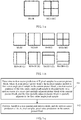
- a size of the coding unit may include four levels: 64 ⁇ 64, 32 ⁇ 32, 16 ⁇ 16, and 8 ⁇ 8. Coding units at each level may be divided into prediction units of different sizes according to intra-frame prediction and inter-frame prediction. For example, as shown in FIG. 1-a and FIG. 1-b, FIG. 1-a shows an example of a prediction unit division manner corresponding to intra-frame prediction. FIG. 1-b shows examples of several prediction unit division manners corresponding to inter-frame prediction.
- a motion vector of a current picture block can be derived by using nearby motion vectors only by adding a skip mode flag to a bit stream, and a value of a reference block is directly copied according to the motion vector as a reconstructed value of the current picture block.
- an encoder may derive the motion vector of the current picture block by using the adjacent motion vectors, and directly copy the value of the reference block according to the motion vector as a predictor of the current picture block, and perform predictive coding on the current picture block by using the predictor in an encoder.
- some new coding tools are introduced to further improve video coding efficiency.
- a merge coding (merge) mode and an adaptive motion vector prediction (English: advanced motion vector prediction, AMVP for short) mode are two important inter-frame prediction tools.
- merge coding a candidate motion information set is constructed by using motion information (including a prediction direction, a motion vector, and a reference frame index) of an adjacent coded block of a current coding block, candidate motion information that enables coding efficiency to be the highest may be selected as motion information of the current coding block by means of comparison, a predictor of the current coding block is found in a reference frame, predictive coding is performed on the current coding block, and an index value indicating an adjacent coded block whose motion information is selected is written into a bitstream.
- a motion vector of an adjacent coded block is used as a motion vector predictor of a current coding block, a motion vector that enables coding efficiency to be the highest may be selected to predict a motion vector of the current coding block, and an index value that indicates a selected adjacent motion vector may be written into a video bitstream.
- the picture prediction method provided in the embodiments of the present invention is executed by a video coding apparatus or a video decoding apparatus.
- the video coding apparatus or the video decoding apparatus may be any apparatus that needs to output or store a video, for example, a laptop computer, a tablet computer, a personal computer, a mobile phone, or a video server.
- the picture prediction method includes: determining motion vector predictors (English: motion vector predictor, MVP for short) of K pixel samples in a current picture block, where K is an integer greater than 1, the K pixel samples include a first vertex angle pixel sample in the current picture block, a motion vector predictor of the first vertex angle pixel sample is obtained based on a motion vector of a preset first spatially adjacent picture block of the current picture block, and the first spatially adjacent picture block is spatially adjacent to the first vertex angle pixel sample; and performing, based on a non-translational motion model and the motion vector predictors of the K pixel samples, pixel value prediction on the current picture block.
- K is an integer greater than 1
- the K pixel samples include a first vertex angle pixel sample in the current picture block, a motion vector predictor of the first vertex angle pixel sample is obtained based on a motion vector of a preset first spatially adjacent picture block of the current picture block, and the first spatially adjacent picture block is spatially adjacent to
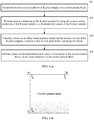
- FIG. 1-c is a schematic flowchart of a picture prediction method according to an embodiment of the present invention. As shown in an example of FIG. 1-c , the picture prediction method provided in this embodiment of the present invention may include the following steps.
- K is an integer greater than 1
- the K pixel samples include a first vertex angle pixel sample in the current picture block, and a motion vector predictor of the first vertex angle pixel sample is obtained based on a motion vector of a preset first spatially adjacent picture block of the current picture block.
- the first spatially adjacent picture block is spatially adjacent to the first vertex angle pixel sample.
- the motion vector predictor of the first vertex angle pixel sample is obtained based on the motion vector of the preset first spatially adjacent picture block of the current picture block.
- the motion vector predictor of the first vertex angle pixel sample may be equal to the motion vector of the preset first spatially adjacent picture block of the current picture block (that is, the motion vector of the preset first spatially adjacent picture block of the current picture block is used as the motion vector predictor of the first vertex angle pixel sample); or a motion vector predictor obtained by performing preset transformation on the motion vector of the preset first spatially adjacent picture block of the current picture block may be used as the motion vector predictor of the first vertex angle pixel sample.
- the non-translational motion model is any one of the following models: an affine transformation model, a parabolic motion model, a rotary motion model, a perspective motion model, a shearing motion model, or a scalable motion model. It may be understood that the non-translational motion model is not limited to the foregoing specific examples, either.
- determined motion vector predictors of K pixel samples are referenced during pixel value prediction performed, based on a non-translational motion model, on a current picture block.
- the K pixel samples include a first vertex angle pixel sample in the current picture block.
- the motion vector predictors of the K pixel samples are directly used for prediction, a motion vector predictor of the first vertex angle pixel sample in the K pixel samples is obtained based on a motion vector of a preset first spatially adjacent picture block of the current picture block, and there is a single optional case for the motion vector predictors of the K pixel samples.
- the first spatially adjacent picture block is spatially adjacent to the first vertex angle pixel sample, and the first spatially adjacent picture block of the current picture block is preset (that is, it may be considered that the first spatially adjacent picture block of the current picture block is agreed or set in advance). In this way, this is helpful in quickly determining the motion vector predictors of the K pixel samples. In addition, because redundancy is removed by making full use of a spatial correlation between picture blocks, this is helpful in further improving coding efficiency.
- the K pixel samples include at least two pixel samples in an upper left pixel sample, an upper right pixel sample, a lower left pixel sample, or a lower right pixel sample in the current picture block.
- a size of the pixel block is, for example, 2 ⁇ 2, 1 ⁇ 2, 4 ⁇ 2, 4 ⁇ 4, or another size.
- the upper left pixel sample in the current picture block is an upper left vertex of the current picture block or a pixel block that is in the current picture block and that includes an upper left vertex of the current picture block.
- the lower left pixel sample in the current picture block is a lower left vertex of the current picture block or a pixel block that is in the current picture block and that includes a lower left vertex of the current picture block.
- the upper right pixel sample in the current picture block is an upper right vertex of the current picture block or a pixel block that is in the current picture block and that includes an upper right vertex of the current picture block.
- the lower right pixel sample in the current picture block is a lower right vertex of the current picture block or a pixel block that is in the current picture block and that includes a lower right vertex of the current picture block.
- the K pixel samples may further include a center pixel sample in the current picture block.
- the center pixel sample in the current picture block may be a center pixel in the current picture block or a pixel block that is in the current picture block and that includes a center pixel in the current picture block.
- the first spatially adjacent picture block may be a picture block X1, a picture block X2, a picture block X3, or a picture block X4.
- a motion vector predictor of the upper left pixel sample in the current picture block may be obtained based on a motion vector of the picture block X1, the picture block X1 is a spatially adjacent picture block of the current picture block, and the picture block X1 is spatially adjacent to the upper left pixel sample in the current picture block.
- a motion vector predictor of the upper right pixel sample in the current picture block may be obtained based on a motion vector of the picture block X2, the picture block X2 is a spatially adjacent picture block of the current picture block, and the picture block X2 is spatially adjacent to the upper right pixel sample in the current picture block.
- a motion vector predictor of the lower left pixel sample in the current picture block may be obtained based on a motion vector of the picture block X3, the picture block X3 is a spatially adjacent picture block of the current picture block, and the picture block X3 is spatially adjacent to the lower left pixel sample in the current picture block.
- a motion vector predictor of the lower right pixel sample in the current picture block may be obtained based on a motion vector of the picture block X4, the picture block X4 is a spatially adjacent picture block of the current picture block, and the picture block X4 is spatially adjacent to the lower right pixel sample in the current picture block.
- the first vertex angle pixel sample may be the upper left pixel sample in the current picture block
- the first spatially adjacent picture block may be the picture block X1.
- the picture block X1 is a spatially adjacent picture block on the upper left of the current picture block, or the picture block X1 is a spatially adjacent picture block on the left of the current picture block, or the picture block X1 is a spatially adjacent picture block above the current picture block.
- the picture block X2 is a spatially adjacent picture block above the current picture block, or the picture block X2 is a spatially adjacent picture block on the upper right of the current picture block, or the picture block X2 is a spatially adjacent picture block on the right of the current picture block.
- an absolute value of a difference between a motion vector absolute value of the picture block X2 and a motion vector absolute value of the picture block X1 is greater than or equal to an absolute value of a difference between a motion vector absolute value of the picture block X5 and the motion vector absolute value of the picture block X1, and the picture block X5 is any one of remaining at least some spatially adjacent picture blocks, other than the picture block X2, that are of the current picture block and that are spatially adjacent to the upper right vertex. That is, a location of the picture block X2 may be determined based on a specific policy, or a location of the picture block X2 may be directly agreed.
- the picture block X3 is a spatially adjacent picture block on the left of the current picture block, or the picture block X3 is a spatially adjacent picture block on the lower left of the current picture block, or the picture block X3 is a spatially adjacent picture block below the current picture block.
- an absolute value of a difference between a motion vector absolute value of the picture block X3 and the motion vector absolute value of the picture block X1 is greater than or equal to an absolute value of a difference between a motion vector absolute value of the picture block X6 and the motion vector absolute value of the picture block X1, and the picture block X6 is any one of remaining at least some spatially adjacent picture blocks, other than the picture block X3, that are of the current picture block and that are spatially adjacent to the lower left vertex. That is, a location of the picture block X3 may be determined based on a specific policy, or a location of the picture block X3 may be directly agreed.
- the picture block X4 is a spatially adjacent picture block on the right of the current picture block, or the picture block X4 is a spatially adjacent picture block on the lower right of the current picture block, or the picture block X4 is a spatially adjacent picture block below the current picture block.
- an absolute value of a difference between a motion vector absolute value of the picture block X4 and the motion vector absolute value of the picture block X1 is greater than or equal to an absolute value of a difference between a motion vector absolute value of the picture block X7 and the motion vector absolute value of the picture block X1, and the picture block X7 is any one of remaining at least some spatially adjacent picture blocks, other than the picture block X4, that are of the current picture block and that are spatially adjacent to the lower left vertex.
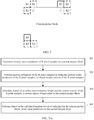
- FIG. 2 shows examples of some possible locations of the picture block X1, the picture block X2, the picture block X3, and the picture block X4.
- the performing, based on a non-translational motion model and the motion vector predictors of the K pixel samples, pixel value prediction on the current picture block may specifically include: if reference frames corresponding to the motion vector predictors of the K pixel samples are a reference frame Y1, performing motion estimation on the K pixel samples by using the motion vector predictors of the K pixel samples, to obtain motion vectors of the K pixel samples; and performing pixel value prediction on the current picture block by using the non-translational motion model and the motion vectors of the K pixel samples.
- the performing, based on a non-translational motion model and the motion vector predictors of the K pixel samples, pixel value prediction on the current picture block may specifically include: when reference frames corresponding to motion vector predictors of K1 pixel samples in the K pixel samples are not a reference frame Y1, scaling the motion vector predictors of the K1 pixel samples to the reference frame Y1; performing motion estimation on the K pixel samples by using motion vector predictors of K2 pixel samples and motion vector predictors that are of the K pixel samples and that are scaled to the reference frame Y1, to obtain motion vectors of the K pixel samples; and performing pixel value prediction on the current picture block by using the non-translational motion model and the motion vectors of the K pixel samples, where the K2 pixel samples are remaining pixel samples other than the K1 pixel samples in the K pixel samples, and K1 and K2 are positive integers.
- the reference frame Y1 may be a reference frame corresponding to the motion vector predictor of the first vertex angle pixel sample, or the reference frame Y1 may be a reference frame corresponding to a motion vector predictor of another pixel sample in the K pixel samples.
- a pixel sample i is any pixel sample except the first vertex angle pixel sample in the K pixel samples, and if a prediction direction corresponding to a motion vector predictor of the pixel sample i is different from a prediction direction corresponding to the motion vector predictor of the first vertex angle pixel sample, a reference frame index corresponding to the motion vector predictor of the pixel sample i is 0.
- that the motion vector predictor of the pixel sample i is scaled to the reference frame Y1 may include: if reference frame indexes corresponding to the motion vector predictors of the first vertex angle pixel sample and the pixel sample i are different, the motion vector predictor of the pixel sample i is scaled to the reference frame Y1.
- the performing motion estimation on the K pixel samples by using motion vector predictors of K2 pixel samples and motion vector predictors that are of the K pixel samples and that are scaled to the reference frame Y1, to obtain motion vectors of the K pixel samples may include: performing motion estimation on the K pixel samples based on an iterative search algorithm (or a motion estimation algorithm of another type) by using the motion vector predictors of the K2 pixel samples and the motion vector predictors that are of the K pixel samples and that are scaled to the reference frame Y1, to obtain the motion vectors of the K pixel samples.
- a step of performing motion estimation on the K pixel samples may be omitted.
- a normalization step may even be omitted. That is, the following step may be omitted: when the reference frames corresponding to the motion vector predictors of the K1 pixel samples in the K pixel samples are not the reference frame Y1, the motion vector predictors of the K1 pixel samples are scaled to the reference frame Y1.
- any one of the foregoing picture prediction methods provided in this embodiment may be applied to a video coding process or a video decoding process.
- FIG. 3-a is a schematic flowchart of another picture prediction method according to another embodiment of the present invention.
- the another picture prediction method provided in the another embodiment of the present invention may include the following steps.
- K 3.
- the K pixel samples include an upper left vertex, an upper right vertex, and a lower left vertex of the current picture block.
- a motion vector predictor of the upper left vertex of the current picture block is equal to a motion vector of an adjacent picture block A on the upper left of the current picture block.
- a motion vector predictor of the upper right vertex of the current picture block is equal to a motion vector of an adjacent picture block B above the current picture block, or a motion vector predictor of the upper right vertex of the current picture block may be equal to a motion vector of an adjacent picture block C on the upper right of the current picture block.
- a motion vector predictor of the lower left vertex of the current picture block may be equal to a motion vector of an adjacent picture block E on the lower left of the current picture block, or a motion vector predictor of the lower left vertex of the current picture block may be equal to a motion vector of an adjacent picture block D on the left of the current picture block.
- mv A represents the motion vector (MV) of the picture block A.
- mvp 1 represents an MV of the upper right vertex of the current picture block
- mv B represents the MV of the picture block B
- mv C represents the MV of the picture block C
- mvp 2 represents the MVP of the upper right vertex of the current picture block
- mv D represents the MV of the picture block D
- mv E represents the MV of the picture block E.
- a picture block that has a larger difference with a motion vector absolute value of the block A is selected from the spatially adjacent picture block B and picture block C.
- a picture block that has a larger difference with the motion vector absolute value of the block A is selected from the spatially adjacent picture block D and picture block E.
- the performing motion estimation on the K pixel samples by using the motion vector predictors of the K1 pixel samples, to obtain motion vectors of the K pixel samples includes: scaling the motion vector predictors of the K1 pixel samples to the reference frame Y1 (that is, performing normalization processing on the motion vector predictors of the K1 pixel samples); and performing motion estimation on the K pixel samples by using motion vector predictors of K2 pixel samples and motion vector predictors that are of the K pixel samples and that are scaled to the reference frame Y1, to obtain the motion vectors of the K pixel samples.
- a reference frame index of a pixel sample i may be first revised.
- the pixel sample i is any pixel sample (for example, the lower left vertex or the upper right vertex), except the upper left vertex of the current picture block, in the K pixel samples.
- a prediction direction corresponding to a motion vector predictor of the pixel sample i is different from a prediction direction corresponding to the motion vector predictor of the upper left vertex (for example, the prediction direction corresponding to the motion vector predictor of the pixel sample i is forward prediction, and the prediction direction corresponding to the motion vector predictor of the upper left vertex is backward prediction; or the prediction direction corresponding to the motion vector predictor of the pixel sample i is backward prediction, and the prediction direction corresponding to the motion vector predictor of the upper left vertex is forward prediction), a reference frame index corresponding to the motion vector predictor of the pixel sample i is 0.
- a method for scaling a motion vector predictor to a reference frame may be as follows: It is assumed that a current coding frame index is CurPoc, and a reference frame of the picture block A (that is, a reference frame corresponding to the MVP of the upper left vertex) is a destination reference frame.
- a destination reference frame index is DesPoc
- a reference frame corresponding to the MVP of the upper right vertex or the lower left vertex is a source reference frame
- a source reference frame index is SrcPoc
- the motion vector predictor corresponding to the upper right vertex or the lower left vertex is MVP
- a motion vector predictor that is of the upper right vertex or the lower left vertex and that is obtained after scaling is MV S .
- reference frames corresponding to the motion vector predictors of the K pixel samples are the reference frame Y1
- no normalization processing is performed on the motion vector predictors of the K1 pixel samples (because the motion vector predictors of the K1 pixel samples have been in a normalized state)
- motion estimation may be performed on the K pixel samples directly by using the motion vector predictors of the K1 pixel samples, to obtain the motion vectors of the K pixel samples.
- motion estimation is performed on the K pixel samples to obtain the motion vectors of the K pixel samples may include: motion estimation is performed on the K pixel samples based on an iterative search algorithm, to obtain the motion vectors of the K pixel samples.
- that motion estimation is performed on the K pixel samples based on each iteration in the iterative search algorithm, to obtain the motion vectors of the K pixel samples may include the following steps.
- a motion vector variation ⁇ x of each of the three pixel samples in the current picture block in the direction x and a motion vector variation ⁇ y of each pixel sample in the direction y in this iteration may be obtained by means of motion estimation.
- One or more iterations are performed based on an iterative manner in the foregoing steps S1 to S4, so that the motion vectors of the K pixel samples in the current picture block can be obtained by means of motion estimation.
- subtraction may be further performed between the motion vectors that are of the K pixel samples and that are obtained by means of motion estimation and the corresponding MVPs, to obtain motion vector differences (English: motion vector difference, MVD for short) of the K pixel samples, and the MVDs of the K pixel samples may be written into a video bitstream.
- motion vector differences English: motion vector difference, MVD for short
- a syntactic element affine_no_MVD_flag may be used to indicate whether to write an MVD corresponding to a pixel sample into the video bitstream. For example, if the MVDs corresponding to the foregoing K pixel samples are all 0, affine_no_MVD_flag may be set to true, and no MVD is written into the video bitstream; or if the MVDs corresponding to the foregoing K pixel samples are not all 0, affine_no_MVD_flag may be set to false, and the MVDs corresponding to the K pixel samples are written into the video bitstream.
- motion vectors ( vx 0 , vy 0 ), ( vx 1 , vy 1 ), and ( vx 2 , vy 2 ) of three vertices whose coordinates are (0,0) ( S 1 ,0), and (0, S 2 ) are calculated by performing step 301 and step 302.
- affine transformation formula (12) A schematic diagram of affine transformation may be shown in FIG. 3-e .
- motion information of each pixel in the current picture block may be used for motion vector prediction for another picture block
- one piece of motion information may be stored for each 4x4 block, and a motion vector of each 4x4 block is stored as motion information of a pixel on an upper left corner or any other pixel in the 4x4 block.
- the affine transformation model is mainly used as an example of a non-translational motion model for description, and a mechanism for calculating, based on another non-translational motion model and the motion vectors of the K pixel samples, the motion vector of each pixel in the current picture block has a similar principle although formulas different from those used in this embodiment may be used in the mechanism. Examples are not listed one by one herein.
- a residual of the current picture block may be obtained by using an original pixel value of the current picture block and a predicted pixel value that is of the current picture block and that is obtained by means of pixel value prediction, and the residual of the current picture block may be written into the video bitstream.
- determined motion vector predictors of K pixel samples are referenced during pixel value prediction performed, based on a non-translational motion model, on a current picture block.
- the K pixel samples include a first vertex angle pixel sample in the current picture block.
- the motion vector predictors of the K pixel samples are directly used for prediction, a motion vector predictor of the first vertex angle pixel sample in the K pixel samples is obtained based on a motion vector of a preset first spatially adjacent picture block of the current picture block, and there is a single optional case for the motion vector predictors of the K pixel samples.
- prediction directions of the MVPs of the K pixel samples in the current picture block are normalized, reference frame indexes are processed, and motion vectors of the MVPs of the K pixel samples are scaled and mapped to a same reference frame according to reference frame indexes.
- a motion vector of each pixel in the current picture block may be calculated according to optimal motion vectors of the K pixel samples by using an affine transformation formula.
- FIG. 4-a is a schematic flowchart of another picture prediction method according to another embodiment of the present invention.
- the another picture prediction method provided in the another embodiment of the present invention may include the following steps.
- K 3.
- the K pixel samples include an upper left vertex, an upper right vertex, and a lower left vertex of the current picture block.
- a motion vector predictor of the upper left vertex of the current picture block is equal to a motion vector of an adjacent picture block A on the upper left of the current picture block.
- a motion vector predictor of the upper right vertex of the current picture block is equal to a motion vector of an adjacent picture block B above the current picture block.
- a motion vector predictor of the lower left vertex of the current picture block may be equal to a motion vector of an adjacent picture block D on the left of the current picture block.
- the performing motion estimation on the K pixel samples by using the motion vector predictors of the K1 pixel samples, to obtain motion vectors of the K pixel samples includes: scaling the motion vector predictors of the K1 pixel samples to the reference frame Y1 (that is, performing normalization processing on the motion vector predictors of the K1 pixel samples); and performing motion estimation on the K pixel samples by using motion vector predictors of K2 pixel samples and motion vector predictors that are of the K pixel samples and that are scaled to the reference frame Y1, to obtain the motion vectors of the K pixel samples.
- a reference frame index of a pixel sample i may be first revised.
- the pixel sample i is any pixel sample (for example, the lower left vertex or the upper right vertex), except the upper left vertex of the current picture block, in the K pixel samples.
- a prediction direction corresponding to a motion vector predictor of the pixel sample i is different from a prediction direction corresponding to the motion vector predictor of the upper left vertex (for example, the prediction direction corresponding to the motion vector predictor of the pixel sample i is forward prediction, and the prediction direction corresponding to the motion vector predictor of the upper left vertex is backward prediction; or the prediction direction corresponding to the motion vector predictor of the pixel sample i is backward prediction, and the prediction direction corresponding to the motion vector predictor of the upper left vertex is forward prediction), a reference frame index corresponding to the motion vector predictor of the pixel sample i is 0.
- a method for scaling a motion vector predictor to a reference frame may be as follows: It is assumed that a current coding frame index is CurPoc, and a reference frame of the picture block A (that is, a reference frame corresponding to the MVP of the upper left vertex) is a destination reference frame.
- a destination reference frame index is DesPoc
- a reference frame corresponding to the MVP of the upper right vertex or the lower left vertex is a source reference frame
- a source reference frame index is SrcPoc
- the motion vector predictor corresponding to the upper right vertex or the lower left vertex is MVP
- a motion vector predictor that is of the upper right vertex or the lower left vertex and that is obtained after scaling is MV S .
- reference frames corresponding to the motion vector predictors of the K pixel samples are the reference frame Y1
- no normalization processing is performed on the motion vector predictors of the K1 pixel samples (because the motion vector predictors of the K1 pixel samples have been in a normalized state)
- motion estimation may be performed on the K pixel samples directly by using the motion vector predictors of the K1 pixel samples, to obtain the motion vectors of the K pixel samples.
- motion estimation is performed on the K pixel samples to obtain the motion vectors of the K pixel samples may include: motion estimation is performed on the K pixel samples based on an iterative search algorithm, to obtain the motion vectors of the K pixel samples.
- an iterative search algorithm For a specific iterative search algorithm, refer to related descriptions in the foregoing embodiment. Details are not described herein again.
- subtraction may be further performed between the motion vectors that are of the K pixel samples and that are obtained by means of motion estimation and the corresponding MVPs, to obtain MVDs of the K pixel samples, and the MVDs of the K pixel samples may be written into a video bitstream.
- a syntactic element affine_no_MVD_flag may be used to indicate whether to write an MVD corresponding to a pixel sample into the video bitstream. For example, if the MVDs corresponding to the foregoing K pixel samples are all 0, affine_no_MVD_flag may be set to true, and no MVD is written into the video bitstream; or if the MVDs corresponding to the foregoing K pixel samples are not all 0, affine_no_MVD_flag may be set to false, and the MVDs corresponding to the K pixel samples are written into the video bitstream.
- motion information of each pixel in the current picture block may be used for motion vector prediction for another picture block
- one piece of motion information may be stored for each 4x4 (or 8x8) block, and a motion vector of each 4x4 (or 8x8) block is stored as motion information of a pixel on an upper left corner or any other pixel in the 4x4 block.
- the motion information may include a motion vector, a prediction direction corresponding to the motion vector, and a reference frame index corresponding to the motion vector.
- the affine transformation model is mainly used as an example of a non-translational motion model for description, and a mechanism for calculating, based on another non-translational motion model and the motion vectors of the K pixel samples, the motion vector of each pixel in the current picture block has a similar principle although formulas different from those used in this embodiment may be used in the mechanism. Examples are not listed one by one herein.
- a residual of the current picture block may be obtained by using an original pixel value of the current picture block and a predicted pixel value that is of the current picture block and that is obtained by means of pixel value prediction, and the residual of the current picture block may be written into the video bitstream.
- determined motion vector predictors of K pixel samples are referenced during pixel value prediction performed, based on a non-translational motion model, on a current picture block.
- the K pixel samples include a first vertex angle pixel sample in the current picture block.
- the motion vector predictors of the K pixel samples are directly used for prediction, a motion vector predictor of the first vertex angle pixel sample in the K pixel samples is obtained based on a motion vector of a preset first spatially adjacent picture block of the current picture block, and there is a single optional case for the motion vector predictors of the K pixel samples.
- prediction directions of the MVPs of the K pixel samples in the current picture block are normalized, reference frame indexes are processed, and motion vectors of the MVPs of the K pixel samples are scaled and mapped to a same reference frame according to reference frame indexes.
- a motion vector of each pixel in the current picture block may be calculated according to optimal motion vectors of the K pixel samples by using an affine transformation formula.
- FIG. 5 is a schematic flowchart of another picture prediction method according to another embodiment of the present invention.
- the another picture prediction method provided in the another embodiment of the present invention may include the following steps.
- K 3.
- the K pixel samples include an upper left vertex, an upper right vertex, and a lower left vertex of the current picture block.
- motion vector predictors of the foregoing K pixel samples as motion vectors of the foregoing K pixel samples, and calculate, based on an affine transformation model and the motion vectors of the K pixel samples, a motion vector of each pixel in the current picture block.
- motion information of each pixel in the current picture block may be used for motion vector prediction for another picture block
- one piece of motion information may be stored for each 4x4 (or 8x8) block, and a motion vector of each 4x4 (or 8x8) block is stored as motion information of a pixel on an upper left corner or any other pixel in the 4x4 block.
- the motion information may include a motion vector, a prediction direction corresponding to the motion vector, and a reference frame index corresponding to the motion vector.
- the affine transformation model is mainly used as an example of a non-translational motion model for description, and a mechanism for calculating, based on another non-translational motion model and the motion vectors of the K pixel samples, the motion vector of each pixel in the current picture block has a similar principle although formulas different from those used in this embodiment may be used in the mechanism. Examples are not listed one by one herein.
- a residual of the current picture block may be obtained by using an original pixel value of the current picture block and a predicted pixel value that is of the current picture block and that is obtained by means of pixel value prediction, and the residual of the current picture block may be written into a video bitstream.
- determined motion vector predictors of K pixel samples are referenced during pixel value prediction performed, based on a non-translational motion model, on a current picture block.
- the K pixel samples include a first vertex angle pixel sample in the current picture block.
- the motion vector predictors of the K pixel samples are directly used for prediction, a motion vector predictor of the first vertex angle pixel sample in the K pixel samples is obtained based on a motion vector of a preset first spatially adjacent picture block of the current picture block, and there is a single optional case for the motion vector predictors of the K pixel samples.
- prediction directions of the MVPs of the K pixel samples in the current picture block are normalized, reference frame indexes are processed, and motion vectors of the MVPs of the K pixel samples are scaled and mapped to a same reference frame according to reference frame indexes.
- the foregoing solution is helpful in resolving a problem that inter-frame prediction accuracy is low in a current video coding standard when a video includes content of a non-translational (for example, lens zooming, object deformation, or moving object rotation) feature.
- FIG. 6 is a schematic flowchart of another picture prediction method according to another embodiment of the present invention.
- the another picture prediction method provided in the another embodiment of the present invention may include the following steps.
- K 3.
- the K pixel samples include an upper left vertex, an upper right vertex, and a lower left vertex of the current picture block.
- the performing motion estimation on the K pixel samples by using the motion vector predictors of the K1 pixel samples, to obtain motion vectors of the K pixel samples includes: scaling the motion vector predictors of the K1 pixel samples to the reference frame Y1 (that is, performing normalization processing on the motion vector predictors of the K1 pixel samples); and performing motion estimation on the K pixel samples by using motion vector predictors of K2 pixel samples and motion vector predictors that are of the K pixel samples and that are scaled to the reference frame Y1, to obtain the motion vectors of the K pixel samples.
- a reference frame index of a pixel sample i may be first revised.
- the pixel sample i is any pixel sample (for example, the lower left vertex or the upper right vertex), except the upper left vertex of the current picture block, in the K pixel samples.
- a prediction direction corresponding to a motion vector predictor of the pixel sample i is different from a prediction direction corresponding to the motion vector predictor of the upper left vertex (for example, the prediction direction corresponding to the motion vector predictor of the pixel sample i is forward prediction, and the prediction direction corresponding to the motion vector predictor of the upper left vertex is backward prediction; or the prediction direction corresponding to the motion vector predictor of the pixel sample i is backward prediction, and the prediction direction corresponding to the motion vector predictor of the upper left vertex is forward prediction), a reference frame index corresponding to the motion vector predictor of the pixel sample i is 0.
- reference frames corresponding to the motion vector predictors of the K pixel samples are the reference frame Y1
- no normalization processing is performed on the motion vector predictors of the K1 pixel samples (because the motion vector predictors of the K1 pixel samples have been in a normalized state)
- motion estimation may be performed on the K pixel samples directly by using the motion vector predictors of the K1 pixel samples, to obtain the motion vectors of the K pixel samples.
- motion estimation is performed on the K pixel samples to obtain the motion vectors of the K pixel samples may include: motion estimation is performed on the K pixel samples based on an iterative search algorithm, to obtain the motion vectors of the K pixel samples.
- an iterative search algorithm For a specific iterative search algorithm, refer to related descriptions in the foregoing embodiment. Details are not described herein again.
- subtraction may be further performed between the motion vectors that are of the K pixel samples and that are obtained by means of motion estimation and the corresponding MVPs, to obtain MVDs of the K pixel samples, and the MVDs of the K pixel samples may be written into a video bitstream.
- a syntactic element affine_no_MVD_flag may be used to indicate whether to write an MVD corresponding to a pixel sample into the video bitstream. For example, if the MVDs corresponding to the foregoing K pixel samples are all 0, affine_no_MVD_flag may be set to true, and no MVD is written into the video bitstream; or if the MVDs corresponding to the foregoing K pixel samples are not all 0, affine_no_MVD_flag may be set to false, and the MVDs corresponding to the K pixel samples are written into the video bitstream.
- motion information of each pixel in the current picture block may be used for motion vector prediction for another picture block
- one piece of motion information may be stored for each 4x4 (or 8x8) block, and a motion vector of each 4x4 (or 8x8) block is stored as motion information of a pixel on an upper left corner or any other pixel in the 4x4 block.
- the motion information may include a motion vector, a prediction direction corresponding to the motion vector, and a reference frame index corresponding to the motion vector.
- the affine transformation model is mainly used as an example of a non-translational motion model for description, and a mechanism for calculating, based on another non-translational motion model and the motion vectors of the K pixel samples, the motion vector of each pixel in the current picture block has a similar principle although formulas different from those used in this embodiment may be used in the mechanism. Examples are not listed one by one herein.
- step 601 to step 603 Calculate a rate-distortion cost of using an affine transformation-based inter-frame prediction mode (step 601 to step 603) for the current prediction unit, and compare the rate-distortion cost with a calculated rate-distortion cost of using an HEVC inter-frame prediction mode.
- an optimal inter-frame prediction mode of the current picture block is set to the affine transformation-based inter-frame prediction mode.
- a syntactic element affine_MC_flag may be set to true to indicate that the optimal inter-frame prediction mode of the current picture block is the affine transformation-based inter-frame prediction mode.
- a syntactic element affine_MC_flag is set to false to indicate that an optimal inter-frame prediction mode of the current picture block is the HEVC inter-frame prediction mode.
- a predicted pixel value of each pixel may be obtained by using an HEVC interpolation filter; or if the motion vector of the pixel is greater than 1/4 pixel precision, predicted pixel values of four 1/4 pixels at the shortest distance from the pixel are first obtained by using an HEVC interpolation filter, and then, bilinear interpolation is performed to obtain a predicted pixel value of the pixel.
- a predicted pixel value is obtained by using the HEVC interpolation filter.
- a residual of the current picture block may be obtained by using an original pixel value of the current picture block and a predicted pixel value that is of the current picture block and that is obtained by means of pixel value prediction, and the residual of the current picture block is written into the video bitstream.
- the residual of the current prediction unit is written into the video bitstream after undergoing transformation, quantization, and entropy encoding.
- determined motion vector predictors of K pixel samples are referenced during pixel value prediction performed, based on a non-translational motion model, on a current picture block.
- the K pixel samples include a first vertex angle pixel sample in the current picture block.
- the motion vector predictors of the K pixel samples are directly used for prediction, a motion vector predictor of the first vertex angle pixel sample in the K pixel samples is obtained based on a motion vector of a preset first spatially adjacent picture block of the current picture block, and there is a single optional case for the motion vector predictors of the K pixel samples.
- prediction directions of the MVPs of the K pixel samples in the current picture block are normalized, reference frame indexes are processed, and motion vectors of the MVPs of the K pixel samples are scaled and mapped to a same reference frame according to reference frame indexes.
- a motion vector of each pixel in the current picture block may be calculated according to optimal motion vectors of the K pixel samples by using an affine transformation formula.
- FIG. 7 is a schematic flowchart of a video decoding method according to an embodiment of the present invention. As shown in an example of FIG. 7 , the video decoding method provided in this embodiment of the present invention may include the following steps.
- a decoder decodes a syntactic element affine_MC_flag in a video bitstream, to determine whether an affine transformation-based inter-frame prediction mode is used for a current picture block.
- the decoder decodes a syntactic element affine_inter_dir_flag in the video bitstream, to determine an inter-frame prediction direction used for the current picture block.
- the decoder determines MVPs of K pixel samples in the current picture block according to the syntactic element affine_inter_dir_flag.
- the K pixel samples in the current picture block may be K pixel samples in a current picture block that are described in any one of the foregoing embodiments.
- the decoder determines, by decoding a syntactic element affine_no_MVD_flag that is in the video bitstream and is corresponding to the current picture block, whether MVDs corresponding to the K pixel samples in the current picture block are 0. If affine_no_MVD_flag is true, it indicates that the MVDs corresponding to the K pixel samples in the current picture block are all 0, and motion vectors of the obtained MVPs of the K pixel samples may be used as motion vectors of the K pixel samples.
- affine_no_MVD_flag is false, it indicates that the MVDs corresponding to the K pixel samples are not all 0, the MVDs corresponding to the K pixel samples are obtained by means of separate decoding, and an MVD corresponding to each pixel sample and a corresponding MVP are added to obtain a motion vector of the pixel sample.
- the decoder decodes a residual coefficient of the current picture block, and performs dequantization and inverse transformation to obtain a residual pixel in the current picture block.
- the decoder calculates, based on an affine transformation model and motion vectors of the K pixel samples, a motion vector of each pixel in the current picture block, and performs, based on the calculated motion vector of each pixel in the current picture block, pixel value prediction on the current picture block, to obtain a predicted pixel value of the current picture block.
- the affine transformation model is mainly used as an example of a non-translational motion model for description, and a mechanism for calculating, based on another non-translational motion model and the motion vectors of the K pixel samples, the motion vector of each pixel in the current picture block has a similar principle although formulas different from those used in this embodiment may be used in the mechanism. Examples are not listed one by one herein.
- the decoder reconstructs the current picture block according to the residual pixel in the current picture block and the predicted pixel value of the current picture block.
- motion information of each pixel in the current picture block may be used for motion vector prediction for another picture block
- one piece of motion information may be stored for each 4x4 (or 8x8) block, and a motion vector of each 4x4 (or 8x8) block is stored as motion information of a pixel on an upper left corner or any other pixel in the 4x4 block.
- the motion information may include a motion vector, a prediction direction corresponding to the motion vector, and a reference frame index corresponding to the motion vector.
- determined motion vector predictors of K pixel samples are referenced during pixel value prediction performed, based on a non-translational motion model, on a current picture block.
- the K pixel samples include a first vertex angle pixel sample in the current picture block.
- the motion vector predictors of the K pixel samples are directly used for prediction, a motion vector predictor of the first vertex angle pixel sample in the K pixel samples is obtained based on a motion vector of a preset first spatially adjacent picture block of the current picture block, and there is a single optional case for the motion vector predictors of the K pixel samples.
- prediction directions of the MVPs of the K pixel samples in the current picture block are normalized, reference frame indexes are processed, and motion vectors of the MVPs of the K pixel samples are scaled and mapped to a same reference frame according to reference frame indexes.
- a motion vector of each pixel in the current picture block may be calculated according to optimal motion vectors of the K pixel samples by using an affine transformation formula.
- An emulation test is performed on some solutions, provided in the embodiments of the present invention, on an encoder HM11.0 of the latest video coding standard HEVC. For example, a test is performed in two configurations: a low delay (LDB) and random access (RA), and performance of the solutions in the embodiments of the present invention is compared with performance of the HM11.0 solution.
- LLB low delay
- RA random access
- Six test sequences whose affine features are relatively apparent are selected for testing. The test sequences are listed in Table 1, and emulation results are shown in Table 2.
- a performance counter BD-rate may be obtained by means of calculation by using results of four points whose QPs are 22, 27, 32, and 37, and peak signal to noise ratios (PSNR) of three components Y, U, and V are respectively calculated.
- PSNR peak signal to noise ratios
- a, b, c, d, e, and f are constant parameters
- (x, y) are original coordinates of a pixel
- ( x ', y ') are coordinates obtained after affine transformation is performed on the pixel
- Vx is a motion vector in an x-axis direction
- Vy is a motion vector in a y-axis direction.
- an embodiment of the present invention further provides a picture prediction apparatus 800, and the picture prediction apparatus 800 may include:
- the motion vector predictor of the first vertex angle pixel sample is obtained based on the motion vector of the preset first spatially adjacent picture block of the current picture block.
- the motion vector predictor of the first vertex angle pixel sample may be equal to the motion vector of the preset first spatially adjacent picture block of the current picture block (that is, the motion vector of the preset first spatially adjacent picture block of the current picture block is used as the motion vector predictor of the first vertex angle pixel sample); or a motion vector predictor obtained by performing preset transformation on the motion vector of the preset first spatially adjacent picture block of the current picture block may be used as the motion vector predictor of the first vertex angle pixel sample.
- the non-translational motion model is any one of the following models: an affine transformation model, a parabolic motion model, a rotary motion model, a perspective motion model, a shearing motion model, or a scalable motion model. It may be understood that the non-translational motion model is not limited to the foregoing specific examples, either.
- the K pixel samples include at least two pixel samples in an upper left pixel sample, an upper right pixel sample, a lower left pixel sample, or a lower right pixel sample in the current picture block.
- a size of the pixel block is, for example, 2 ⁇ 2, 1 ⁇ 2, 4 ⁇ 2, 4 ⁇ 4, or another size.
- the upper left pixel sample in the current picture block is an upper left vertex of the current picture block or a pixel block that is in the current picture block and that includes an upper left vertex of the current picture block.
- the lower left pixel sample in the current picture block is a lower left vertex of the current picture block or a pixel block that is in the current picture block and that includes a lower left vertex of the current picture block.
- the upper right pixel sample in the current picture block is an upper right vertex of the current picture block or a pixel block that is in the current picture block and that includes an upper right vertex of the current picture block.
- the lower right pixel sample in the current picture block is a lower right vertex of the current picture block or a pixel block that is in the current picture block and that includes a lower right vertex of the current picture block.
- the K pixel samples may further include a center pixel sample in the current picture block.
- the center pixel sample in the current picture block may be a center pixel in the current picture block or a pixel block that is in the current picture block and that includes a center pixel in the current picture block.
- the first spatially adjacent picture block may be a picture block X1, a picture block X2, a picture block X3, or a picture block X4.
- a motion vector predictor of the upper left pixel sample in the current picture block may be obtained based on a motion vector of the picture block X1, the picture block X1 is a spatially adjacent picture block of the current picture block, and the picture block X1 is spatially adjacent to the upper left pixel sample in the current picture block.
- a motion vector predictor of the upper right pixel sample in the current picture block may be obtained based on a motion vector of the picture block X2, the picture block X2 is a spatially adjacent picture block of the current picture block, and the picture block X2 is spatially adjacent to the upper right pixel sample in the current picture block.
- a motion vector predictor of the lower left pixel sample in the current picture block may be obtained based on a motion vector of the picture block X3, the picture block X3 is a spatially adjacent picture block of the current picture block, and the picture block X3 is spatially adjacent to the lower left pixel sample in the current picture block.
- a motion vector predictor of the lower right pixel sample in the current picture block may be obtained based on a motion vector of the picture block X4, the picture block X4 is a spatially adjacent picture block of the current picture block, and the picture block X4 is spatially adjacent to the lower right pixel sample in the current picture block.
- the first vertex angle pixel sample may be the upper left pixel sample in the current picture block
- the first spatially adjacent picture block may be the picture block X1.
- the picture block X1 is a spatially adjacent picture block on the upper left of the current picture block, or the picture block X1 is a spatially adjacent picture block on the left of the current picture block, or the picture block X1 is a spatially adjacent picture block above the current picture block.
- the picture block X2 is a spatially adjacent picture block above the current picture block, or the picture block X2 is a spatially adjacent picture block on the upper right of the current picture block, or the picture block X2 is a spatially adjacent picture block on the right of the current picture block.
- an absolute value of a difference between a motion vector absolute value of the picture block X2 and a motion vector absolute value of the picture block X1 is greater than or equal to an absolute value of a difference between a motion vector absolute value of the picture block X5 and the motion vector absolute value of the picture block X1, and the picture block X5 is any one of remaining at least some spatially adjacent picture blocks, other than the picture block X2, that are of the current picture block and that are spatially adjacent to the upper right vertex. That is, a location of the picture block X2 may be determined based on a specific policy, or a location of the picture block X2 may be directly agreed.
- the picture block X3 is a spatially adjacent picture block on the left of the current picture block, or the picture block X3 is a spatially adjacent picture block on the lower left of the current picture block, or the picture block X3 is a spatially adjacent picture block below the current picture block.
- an absolute value of a difference between a motion vector absolute value of the picture block X3 and the motion vector absolute value of the picture block X1 is greater than or equal to an absolute value of a difference between a motion vector absolute value of the picture block X6 and the motion vector absolute value of the picture block X1, and the picture block X6 is any one of remaining at least some spatially adjacent picture blocks, other than the picture block X3, that are of the current picture block and that are spatially adjacent to the lower left vertex. That is, a location of the picture block X3 may be determined based on a specific policy, or a location of the picture block X3 may be directly agreed.
- the picture block X4 is a spatially adjacent picture block on the right of the current picture block, or the picture block X4 is a spatially adjacent picture block on the lower right of the current picture block, or the picture block X4 is a spatially adjacent picture block below the current picture block.
- an absolute value of a difference between a motion vector absolute value of the picture block X4 and the motion vector absolute value of the picture block X1 is greater than or equal to an absolute value of a difference between a motion vector absolute value of the picture block X7 and the motion vector absolute value of the picture block X1, and the picture block X7 is any one of remaining at least some spatially adjacent picture blocks, other than the picture block X4, that are of the current picture block and that are spatially adjacent to the lower left vertex.
- FIG. 2 shows examples of some possible locations of the picture block X1, the picture block X2, the picture block X3, and the picture block X4.
- the predicting unit 820 may be configured to: if reference frames corresponding to the motion vector predictors of the K pixel samples are a reference frame Y1, perform motion estimation on the K pixel samples by using the motion vector predictors of the K pixel samples, to obtain motion vectors of the K pixel samples; and perform pixel value prediction on the current picture block by using the non-translational motion model and the motion vectors of the K pixel samples.
- the predicting unit 820 may be specifically configured to: when reference frames corresponding to motion vector predictors of K1 pixel samples in the K pixel samples are not a reference frame Y1, scale the motion vector predictors of the K1 pixel samples to the reference frame Y1, perform motion estimation on the K pixel samples by using motion vector predictors of K2 pixel samples and motion vector predictors that are of the K pixel samples and that are scaled to the reference frame Y1, to obtain motion vectors of the K pixel samples, and perform pixel value prediction on the current picture block by using the non-translational motion model and the motion vectors of the K pixel samples, where the K2 pixel samples are remaining pixel samples other than the K1 pixel samples in the K pixel samples, and K1 and K2 are positive integers.
- the reference frame Y1 may be a reference frame corresponding to the motion vector predictor of the first vertex angle pixel sample, or the reference frame Y1 may be a reference frame corresponding to a motion vector predictor of another pixel sample in the K pixel samples.
- a pixel sample i is any pixel sample except the first vertex angle pixel sample in the K pixel samples, and if a prediction direction corresponding to a motion vector predictor of the pixel sample i is different from a prediction direction corresponding to the motion vector predictor of the first vertex angle pixel sample, a reference frame index corresponding to the motion vector predictor of the pixel sample i is 0.
- the predicting unit 820 may scale the motion vector predictor of the pixel sample i to the reference frame Y1.
- the performing motion estimation on the K pixel samples by using motion vector predictors of K2 pixel samples and motion vector predictors that are of the K pixel samples and that are scaled to the reference frame Y1, to obtain motion vectors of the K pixel samples may include: performing motion estimation on the K pixel samples based on an iterative search algorithm (or a motion estimation algorithm of another type) by using the motion vector predictors of the K2 pixel samples and the motion vector predictors that are of the K pixel samples and that are scaled to the reference frame Y1, to obtain the motion vectors of the K pixel samples.
- the performing motion estimation on the K pixel samples by using motion vector predictors of K2 pixel samples and motion vector predictors that are of the K pixel samples and that are scaled to the reference frame Y1, to obtain motion vectors of the K pixel samples includes: performing motion estimation on the K pixel samples based on an iterative search algorithm by using the motion vector predictors of the K2 pixel samples and the motion vector predictors that are of the K pixel samples and that are scaled to the reference frame Y1, to obtain the motion vectors of the K pixel samples.
- the picture prediction apparatus 800 is applied to a video coding apparatus or the picture prediction apparatus 800 is applied to a video decoding apparatus.
- the picture prediction apparatus 800 may be any apparatus that needs to output and play a video, for example, a laptop computer, a tablet computer, a personal computer, or a mobile phone.
- determined motion vector predictors of K pixel samples are referenced during pixel value prediction performed, based on a non-translational motion model, on a current picture block.
- the K pixel samples include a first vertex angle pixel sample in the current picture block.
- the motion vector predictors of the K pixel samples are directly used for prediction, a motion vector predictor of the first vertex angle pixel sample in the K pixel samples is obtained based on a motion vector of a preset first spatially adjacent picture block of the current picture block, and there is a single optional case for the motion vector predictors of the K pixel samples.
- the first spatially adjacent picture block is spatially adjacent to the first vertex angle pixel sample, and the first spatially adjacent picture block of the current picture block is preset (that is, it may be considered that the first spatially adjacent picture block of the current picture block is agreed or set in advance). In this way, this is helpful in quickly determining the motion vector predictors of the K pixel samples. In addition, because redundancy is removed by making full use of a spatial correlation between picture blocks, this is helpful in further improving coding efficiency.
- FIG. 9 is a schematic diagram of a picture prediction apparatus 900 according to an embodiment of the present invention.
- the picture prediction apparatus 900 may include at least one bus 901, at least one processor 902 connected to the bus 901, and at least one memory 903 connected to the bus 901.
- the processor 902 invokes, by using the bus 901, code stored in the memory 903, so as to determine motion vector predictors of K pixel samples in a current picture block, where K is an integer greater than 1, the K pixel samples include a first vertex angle pixel sample in the current picture block, a motion vector predictor of the first vertex angle pixel sample is obtained based on a motion vector of a preset first spatially adjacent picture block of the current picture block, and the first spatially adjacent picture block is spatially adjacent to the first vertex angle pixel sample; and perform, based on a non-translational motion model and the motion vector predictors of the K pixel samples, pixel value prediction on the current picture block.
- the motion vector predictor of the first vertex angle pixel sample is obtained based on the motion vector of the preset first spatially adjacent picture block of the current picture block.
- the motion vector predictor of the first vertex angle pixel sample may be equal to the motion vector of the preset first spatially adjacent picture block of the current picture block (that is, the motion vector of the preset first spatially adjacent picture block of the current picture block is used as the motion vector predictor of the first vertex angle pixel sample); or a motion vector predictor obtained by performing preset transformation on the motion vector of the preset first spatially adjacent picture block of the current picture block may be used as the motion vector predictor of the first vertex angle pixel sample.
- the non-translational motion model is any one of the following models: an affine transformation model, a parabolic motion model, a rotary motion model, a perspective motion model, a shearing motion model, or a scalable motion model. It may be understood that the non-translational motion model is not limited to the foregoing specific examples, either.
- the K pixel samples include at least two pixel samples in an upper left pixel sample, an upper right pixel sample, a lower left pixel sample, or a lower right pixel sample in the current picture block.
- a size of the pixel block is, for example, 2 ⁇ 2, 1 ⁇ 2, 4 ⁇ 2, 4 ⁇ 4, or another size.
- the upper left pixel sample in the current picture block is an upper left vertex of the current picture block or a pixel block that is in the current picture block and that includes an upper left vertex of the current picture block.
- the lower left pixel sample in the current picture block is a lower left vertex of the current picture block or a pixel block that is in the current picture block and that includes a lower left vertex of the current picture block.
- the upper right pixel sample in the current picture block is an upper right vertex of the current picture block or a pixel block that is in the current picture block and that includes an upper right vertex of the current picture block.
- the lower right pixel sample in the current picture block is a lower right vertex of the current picture block or a pixel block that is in the current picture block and that includes a lower right vertex of the current picture block.
- the K pixel samples may further include a center pixel sample in the current picture block.
- the center pixel sample in the current picture block may be a center pixel in the current picture block or a pixel block that is in the current picture block and that includes a center pixel in the current picture block.
- the first spatially adjacent picture block may be a picture block X1, a picture block X2, a picture block X3, or a picture block X4.
- a motion vector predictor of the upper left pixel sample in the current picture block may be obtained based on a motion vector of the picture block X1, the picture block X1 is a spatially adjacent picture block of the current picture block, and the picture block X1 is spatially adjacent to the upper left pixel sample in the current picture block.
- a motion vector predictor of the upper right pixel sample in the current picture block may be obtained based on a motion vector of the picture block X2, the picture block X2 is a spatially adjacent picture block of the current picture block, and the picture block X2 is spatially adjacent to the upper right pixel sample in the current picture block.
- a motion vector predictor of the lower left pixel sample in the current picture block may be obtained based on a motion vector of the picture block X3, the picture block X3 is a spatially adjacent picture block of the current picture block, and the picture block X3 is spatially adjacent to the lower left pixel sample in the current picture block.
- a motion vector predictor of the lower right pixel sample in the current picture block may be obtained based on a motion vector of the picture block X4, the picture block X4 is a spatially adjacent picture block of the current picture block, and the picture block X4 is spatially adjacent to the lower right pixel sample in the current picture block.
- the first vertex angle pixel sample may be the upper left pixel sample in the current picture block
- the first spatially adjacent picture block may be the picture block X1.
- the picture block X1 is a spatially adjacent picture block on the upper left of the current picture block, or the picture block X1 is a spatially adjacent picture block on the left of the current picture block, or the picture block X1 is a spatially adjacent picture block above the current picture block.
- the picture block X2 is a spatially adjacent picture block above the current picture block, or the picture block X2 is a spatially adjacent picture block on the upper right of the current picture block, or the picture block X2 is a spatially adjacent picture block on the right of the current picture block.
- an absolute value of a difference between a motion vector absolute value of the picture block X2 and a motion vector absolute value of the picture block X1 is greater than or equal to an absolute value of a difference between a motion vector absolute value of the picture block X5 and the motion vector absolute value of the picture block X1, and the picture block X5 is any one of remaining at least some spatially adjacent picture blocks, other than the picture block X2, that are of the current picture block and that are spatially adjacent to the upper right vertex. That is, a location of the picture block X2 may be determined based on a specific policy, or a location of the picture block X2 may be directly agreed.
- the picture block X3 is a spatially adjacent picture block on the left of the current picture block, or the picture block X3 is a spatially adjacent picture block on the lower left of the current picture block, or the picture block X3 is a spatially adjacent picture block below the current picture block.
- an absolute value of a difference between a motion vector absolute value of the picture block X3 and the motion vector absolute value of the picture block X1 is greater than or equal to an absolute value of a difference between a motion vector absolute value of the picture block X6 and the motion vector absolute value of the picture block X1, and the picture block X6 is any one of remaining at least some spatially adjacent picture blocks, other than the picture block X3, that are of the current picture block and that are spatially adjacent to the lower left vertex. That is, a location of the picture block X3 may be determined based on a specific policy, or a location of the picture block X3 may be directly agreed.
- the picture block X4 is a spatially adjacent picture block on the right of the current picture block, or the picture block X4 is a spatially adjacent picture block on the lower right of the current picture block, or the picture block X4 is a spatially adjacent picture block below the current picture block.
- an absolute value of a difference between a motion vector absolute value of the picture block X4 and the motion vector absolute value of the picture block X1 is greater than or equal to an absolute value of a difference between a motion vector absolute value of the picture block X7 and the motion vector absolute value of the picture block X1, and the picture block X7 is any one of remaining at least some spatially adjacent picture blocks, other than the picture block X4, that are of the current picture block and that are spatially adjacent to the lower left vertex.
- the processor 902 may be configured to: if reference frames corresponding to the motion vector predictors of the K pixel samples are a reference frame Y1, perform motion estimation on the K pixel samples by using the motion vector predictors of the K pixel samples, to obtain motion vectors of the K pixel samples; and perform pixel value prediction on the current picture block by using the non-translational motion model and the motion vectors of the K pixel samples.
- the processor 902 may be configured to: when reference frames corresponding to motion vector predictors of K1 pixel samples in the K pixel samples are not a reference frame Y1, scale the motion vector predictors of the K1 pixel samples to the reference frame Y1, perform motion estimation on the K pixel samples by using motion vector predictors of K2 pixel samples and motion vector predictors that are of the K pixel samples and that are scaled to the reference frame Y1, to obtain motion vectors of the K pixel samples, and perform pixel value prediction on the current picture block by using the non-translational motion model and the motion vectors of the K pixel samples, where the K2 pixel samples are remaining pixel samples other than the K1 pixel samples in the K pixel samples, and K1 and K2 are positive integers.
- the reference frame Y1 may be a reference frame corresponding to the motion vector predictor of the first vertex angle pixel sample, or the reference frame Y1 may be a reference frame corresponding to a motion vector predictor of another pixel sample in the K pixel samples.
- a pixel sample i is any pixel sample except the first vertex angle pixel sample in the K pixel samples, and if a prediction direction corresponding to a motion vector predictor of the pixel sample i is different from a prediction direction corresponding to the motion vector predictor of the first vertex angle pixel sample, a reference frame index corresponding to the motion vector predictor of the pixel sample i is 0.
- the processor 902 may be configured to scale the motion vector predictor of the pixel sample i to the reference frame Y1.
- the processor 902 may be configured to perform motion estimation on the K pixel samples based on an iterative search algorithm (or a motion estimation algorithm of another type) by using the motion vector predictors of the K2 pixel samples and the motion vector predictors that are of the K pixel samples and that are scaled to the reference frame Y1, to obtain the motion vectors of the K pixel samples.
- an iterative search algorithm or a motion estimation algorithm of another type
- the picture prediction apparatus 900 may be any apparatus that needs to output and play a video, for example, a laptop computer, a tablet computer, a personal computer, or a mobile phone.
- determined motion vector predictors of K pixel samples are referenced during pixel value prediction performed, based on a non-translational motion model, on a current picture block.
- the K pixel samples include a first vertex angle pixel sample in the current picture block.
- the motion vector predictors of the K pixel samples are directly used for prediction, a motion vector predictor of the first vertex angle pixel sample in the K pixel samples is obtained based on a motion vector of a preset first spatially adjacent picture block of the current picture block, and there is a single optional case for the motion vector predictors of the K pixel samples.
- the first spatially adjacent picture block is spatially adjacent to the first vertex angle pixel sample, and the first spatially adjacent picture block of the current picture block is preset (that is, it may be considered that the first spatially adjacent picture block of the current picture block is agreed or set in advance). In this way, this is helpful in quickly determining the motion vector predictors of the K pixel samples. In addition, because redundancy is removed by making full use of a spatial correlation between picture blocks, this is helpful in further improving coding efficiency.
- FIG. 10 is a structural block diagram of a picture prediction apparatus 1000 according to another embodiment of the present invention.
- the picture prediction apparatus 1000 may include at least one processor 1001, at least one network interface 1004 or other user interface 1003, a memory 1005, and at least one communications bus 1002.
- the communications bus 1002 is configured to implement a connection and communication between these components.
- the picture prediction apparatus 1000 may optionally include the user interface 1003 that includes a display (for example, a touchscreen, an LCD, holographic imaging (Holographic), a CRT, or projection (Projector)), a click device (for example, a mouse, a trackball (trackball), a touchpad, or a touchscreen), a camera and/or a pickup apparatus, and the like.
- a display for example, a touchscreen, an LCD, holographic imaging (Holographic), a CRT, or projection (Projector)
- a click device for example, a mouse, a trackball (trackball), a touchpad, or a touchscreen
- the memory 1005 may include a read-only memory and a random access memory, and provide an instruction and data for the processor 1001.
- a part of the memory 1005 may further include a nonvolatile random access memory (NVRAM).
- NVRAM nonvolatile random access memory
- the memory 1005 stores the following element: an executable module or a data structure, or a subset thereof, or an extension set thereof:
- the processor 1001 is configured to: determine motion vector predictors of K pixel samples in a current picture block, where K is an integer greater than 1, the K pixel samples include a first vertex angle pixel sample in the current picture block, a motion vector predictor of the first vertex angle pixel sample is obtained based on a motion vector of a preset first spatially adjacent picture block of the current picture block, and the first spatially adjacent picture block is spatially adjacent to the first vertex angle pixel sample; and perform, based on a non-translational motion model and the motion vector predictors of the K pixel samples, pixel value prediction on the current picture block.
- the motion vector predictor of the first vertex angle pixel sample is obtained based on the motion vector of the preset first spatially adjacent picture block of the current picture block.
- the motion vector predictor of the first vertex angle pixel sample may be equal to the motion vector of the preset first spatially adjacent picture block of the current picture block (that is, the motion vector of the preset first spatially adjacent picture block of the current picture block is used as the motion vector predictor of the first vertex angle pixel sample); or a motion vector predictor obtained by performing preset transformation on the motion vector of the preset first spatially adjacent picture block of the current picture block may be used as the motion vector predictor of the first vertex angle pixel sample.
- the non-translational motion model is any one of the following models: an affine transformation model, a parabolic motion model, a rotary motion model, a perspective motion model, a shearing motion model, or a scalable motion model. It may be understood that the non-translational motion model is not limited to the foregoing specific examples, either.
- the K pixel samples include at least two pixel samples in an upper left pixel sample, an upper right pixel sample, a lower left pixel sample, or a lower right pixel sample in the current picture block.
- a size of the pixel block is, for example, 2x2, 1 ⁇ 2, 4x2, 4x4, or another size.
- the upper left pixel sample in the current picture block is an upper left vertex of the current picture block or a pixel block that is in the current picture block and that includes an upper left vertex of the current picture block.
- the lower left pixel sample in the current picture block is a lower left vertex of the current picture block or a pixel block that is in the current picture block and that includes a lower left vertex of the current picture block.
- the upper right pixel sample in the current picture block is an upper right vertex of the current picture block or a pixel block that is in the current picture block and that includes an upper right vertex of the current picture block.
- the lower right pixel sample in the current picture block is a lower right vertex of the current picture block or a pixel block that is in the current picture block and that includes a lower right vertex of the current picture block.
- the K pixel samples may further include a center pixel sample in the current picture block.
- the center pixel sample in the current picture block may be a center pixel in the current picture block or a pixel block that is in the current picture block and that includes a center pixel in the current picture block.
- the first spatially adjacent picture block may be a picture block X1, a picture block X2, a picture block X3, or a picture block X4.
- a motion vector predictor of the upper left pixel sample in the current picture block may be obtained based on a motion vector of the picture block X1, the picture block X1 is a spatially adjacent picture block of the current picture block, and the picture block X1 is spatially adjacent to the upper left pixel sample in the current picture block.
- a motion vector predictor of the upper right pixel sample in the current picture block may be obtained based on a motion vector of the picture block X2, the picture block X2 is a spatially adjacent picture block of the current picture block, and the picture block X2 is spatially adjacent to the upper right pixel sample in the current picture block.
- a motion vector predictor of the lower left pixel sample in the current picture block may be obtained based on a motion vector of the picture block X3, the picture block X3 is a spatially adjacent picture block of the current picture block, and the picture block X3 is spatially adjacent to the lower left pixel sample in the current picture block.
- a motion vector predictor of the lower right pixel sample in the current picture block may be obtained based on a motion vector of the picture block X4, the picture block X4 is a spatially adjacent picture block of the current picture block, and the picture block X4 is spatially adjacent to the lower right pixel sample in the current picture block.
- the first vertex angle pixel sample may be the upper left pixel sample in the current picture block
- the first spatially adjacent picture block may be the picture block X1.
- the picture block X1 is a spatially adjacent picture block on the upper left of the current picture block, or the picture block X1 is a spatially adjacent picture block on the left of the current picture block, or the picture block X1 is a spatially adjacent picture block above the current picture block.
- the picture block X2 is a spatially adjacent picture block above the current picture block, or the picture block X2 is a spatially adjacent picture block on the upper right of the current picture block, or the picture block X2 is a spatially adjacent picture block on the right of the current picture block.
- an absolute value of a difference between a motion vector absolute value of the picture block X2 and a motion vector absolute value of the picture block X1 is greater than or equal to an absolute value of a difference between a motion vector absolute value of the picture block X5 and the motion vector absolute value of the picture block X1, and the picture block X5 is any one of remaining at least some spatially adjacent picture blocks, other than the picture block X2, that are of the current picture block and that are spatially adjacent to the upper right vertex. That is, a location of the picture block X2 may be determined based on a specific policy, or a location of the picture block X2 may be directly agreed.
- the picture block X3 is a spatially adjacent picture block on the left of the current picture block, or the picture block X3 is a spatially adjacent picture block on the lower left of the current picture block, or the picture block X3 is a spatially adjacent picture block below the current picture block.
- an absolute value of a difference between a motion vector absolute value of the picture block X3 and the motion vector absolute value of the picture block X1 is greater than or equal to an absolute value of a difference between a motion vector absolute value of the picture block X6 and the motion vector absolute value of the picture block X1, and the picture block X6 is any one of remaining at least some spatially adjacent picture blocks, other than the picture block X3, that are of the current picture block and that are spatially adjacent to the lower left vertex. That is, a location of the picture block X3 may be determined based on a specific policy, or a location of the picture block X3 may be directly agreed.
- the picture block X4 is a spatially adjacent picture block on the right of the current picture block, or the picture block X4 is a spatially adjacent picture block on the lower right of the current picture block, or the picture block X4 is a spatially adjacent picture block below the current picture block.
- an absolute value of a difference between a motion vector absolute value of the picture block X4 and the motion vector absolute value of the picture block X1 is greater than or equal to an absolute value of a difference between a motion vector absolute value of the picture block X7 and the motion vector absolute value of the picture block X1, and the picture block X7 is any one of remaining at least some spatially adjacent picture blocks, other than the picture block X4, that are of the current picture block and that are spatially adjacent to the lower left vertex.
- the processor 1001 may be configured to: if reference frames corresponding to the motion vector predictors of the K pixel samples are a reference frame Y1, perform motion estimation on the K pixel samples by using the motion vector predictors of the K pixel samples, to obtain motion vectors of the K pixel samples; and perform pixel value prediction on the current picture block by using the non-translational motion model and the motion vectors of the K pixel samples.
- the processor 1001 may be configured to: when reference frames corresponding to motion vector predictors of K1 pixel samples in the K pixel samples are not a reference frame Y1, scale the motion vector predictors of the K1 pixel samples to the reference frame Y1, perform motion estimation on the K pixel samples by using motion vector predictors of K2 pixel samples and motion vector predictors that are of the K pixel samples and that are scaled to the reference frame Y1, to obtain motion vectors of the K pixel samples, and perform pixel value prediction on the current picture block by using the non-translational motion model and the motion vectors of the K pixel samples, where the K2 pixel samples are remaining pixel samples other than the K1 pixel samples in the K pixel samples, and K1 and K2 are positive integers.
- the reference frame Y1 may be a reference frame corresponding to the motion vector predictor of the first vertex angle pixel sample, or the reference frame Y1 may be a reference frame corresponding to a motion vector predictor of another pixel sample in the K pixel samples.
- a pixel sample i is any pixel sample except the first vertex angle pixel sample in the K pixel samples, and if a prediction direction corresponding to a motion vector predictor of the pixel sample i is different from a prediction direction corresponding to the motion vector predictor of the first vertex angle pixel sample, a reference frame index corresponding to the motion vector predictor of the pixel sample i is 0.
- the processor 1001 may be configured to scale the motion vector predictor of the pixel sample i to the reference frame Y1.
- the processor 1001 may be configured to perform motion estimation on the K pixel samples based on an iterative search algorithm (or a motion estimation algorithm of another type) by using the motion vector predictors of the K2 pixel samples and the motion vector predictors that are of the K pixel samples and that are scaled to the reference frame Y1, to obtain the motion vectors of the K pixel samples.
- an iterative search algorithm or a motion estimation algorithm of another type
- the picture prediction apparatus 1000 may be any apparatus that needs to output and play a video, for example, a laptop computer, a tablet computer, a personal computer, or a mobile phone.
- determined motion vector predictors of K pixel samples are referenced during pixel value prediction performed, based on a non-translational motion model, on a current picture block.
- the K pixel samples include a first vertex angle pixel sample in the current picture block.
- the motion vector predictors of the K pixel samples are directly used for prediction, a motion vector predictor of the first vertex angle pixel sample in the K pixel samples is obtained based on a motion vector of a preset first spatially adjacent picture block of the current picture block, and there is a single optional case for the motion vector predictors of the K pixel samples.
- the first spatially adjacent picture block is spatially adjacent to the first vertex angle pixel sample, and the first spatially adjacent picture block of the current picture block is preset (that is, it may be considered that the first spatially adjacent picture block of the current picture block is agreed or set in advance). In this way, this is helpful in quickly determining the motion vector predictors of the K pixel samples. In addition, because redundancy is removed by making full use of a spatial correlation between picture blocks, this is helpful in further improving coding efficiency.
- the disclosed apparatus may be implemented in other manners.
- the described apparatus embodiment is merely an example.
- the unit division is merely logical function division and may be other division in actual implementation.
- a plurality of units or components may be combined or integrated into another system, or some features may be ignored or not performed.
- the displayed or discussed mutual couplings or direct couplings or communication connections may be implemented through some interfaces.
- the indirect couplings or communication connections between the apparatuses or units may be implemented in electronic or other forms.
- the units described as separate parts may or may not be physically separate, and parts displayed as units may or may not be physical units, may be located in one position, or may be distributed on a plurality of network units. Some or all of the units may be selected according to actual needs to achieve the objectives of the solutions in the embodiments.
- functional units in the embodiments of the present invention may be integrated into one processing unit, or each of the units may exist alone physically, or two or more units are integrated into one unit.
- the integrated unit may be implemented in a form of hardware, or may be implemented in a form of a software functional unit.
- the integrated unit When the foregoing integrated unit is implemented in the form of a software functional unit and sold or used as an independent product, the integrated unit may be stored in a computer-readable storage medium. Based on such an understanding, the technical solutions in the present invention essentially, or the part contributing to the prior art, or all or some of the technical solutions may be implemented in the form of a software product.
- the software product is stored in a storage medium and includes instructions for instructing a computer device (which may be a personal computer, a server, or a network device) to perform all or some of the steps of the methods described in the embodiments of the present invention.
- the foregoing storage medium includes: any medium that can store program code, such as a USB flash drive, a read-only memory (ROM, Read-Only Memory), a random access memory (RAM, Random Access Memory), a removable hard disk, a magnetic disk, or an optical disc.
- program code such as a USB flash drive, a read-only memory (ROM, Read-Only Memory), a random access memory (RAM, Random Access Memory), a removable hard disk, a magnetic disk, or an optical disc.
Landscapes
- Engineering & Computer Science (AREA)
- Multimedia (AREA)
- Signal Processing (AREA)
- Compression Or Coding Systems Of Tv Signals (AREA)
Abstract
Description
- This application claims priority to Chinese Patent Application No.
201410526608.8 - The present invention relates to the field of picture processing technologies, and specifically, to a picture prediction method and a related apparatus.
- With development of photoelectric acquisition technologies and continuous increase of requirements for high-definition digital videos, an amount of video data is increasingly large. Due to limited heterogeneous transmission bandwidths and diversified video applications, higher requirements are continuously imposed on video coding efficiency. A task of developing a High Efficiency Video Coding (English: high efficiency video coding, HEVC for short) standard is initiated according to the requirements.
- A basic principle of video compression coding is to use correlation between a space domain, a time domain, and a code word to remove redundancy as much as possible. Currently, a prevalent practice is to use a block-based hybrid video coding framework to implement video compression coding by performing steps of prediction (including intra-frame prediction and inter-frame prediction), transform, quantization, entropy coding, and the like. This coding framework shows a high viability, and therefore, HEVC still uses this block-based hybrid video coding framework.
- In various video coding/decoding solutions, motion estimation or motion compensation is a key technology that affects coding/decoding efficiency. In various conventional video coding/decoding solutions, it is assumed that motion of an object always meets a translational motion, and that motion of every part of the entire object is the same. Basically, all conventional motion estimation or motion compensation algorithms are block motion compensation algorithms that are established based on a translational model (English: translational motion model). However, motion in the real world is diversified, and irregular motion such as scaling up/down, rotation, or parabolic motion is ubiquitous. Since the ninth decade of the last century, video coding experts have realized universality of irregular motion, and wished to introduce an irregular motion model (a non-translational motion model such as an affine motion model, a rotational motion model, or a scaling motion model) to improve video coding efficiency. However, computational complexity of conventional picture prediction performed based on a non-translational motion model is generally quite high.
- Embodiments of the present invention provide a picture prediction method and a related apparatus, so as to reduce calculation complexity of picture prediction based on a non-translational motion model.
- A first aspect of the present invention provides a picture prediction method, including:
- determining motion vector predictors of K pixel samples in a current picture block, where K is an integer greater than 1, the K pixel samples include a first vertex angle pixel sample in the current picture block, a motion vector predictor of the first vertex angle pixel sample is obtained based on a motion vector of a preset first spatially adjacent picture block of the current picture block, and the first spatially adjacent picture block is spatially adjacent to the first vertex angle pixel sample; and
- performing, based on a non-translational motion model and the motion vector predictors of the K pixel samples, pixel value prediction on the current picture block.
- With reference to the first aspect, in a first possible implementation manner of the first aspect, the K pixel samples include at least two pixel samples in an upper left pixel sample, an upper right pixel sample, or a lower left pixel sample in the current picture block; and
the upper left pixel sample in the current picture block is an upper left vertex of the current picture block or a pixel block that is in the current picture block and that includes an upper left vertex of the current picture block, the lower left pixel sample in the current picture block is a lower left vertex of the current picture block or a pixel block that is in the current picture block and that includes a lower left vertex of the current picture block, and the upper right pixel sample in the current picture block is an upper right vertex of the current picture block or a pixel block that is in the current picture block and that includes an upper right vertex of the current picture block. - With reference to the first possible implementation manner of the first aspect, in a second possible implementation manner of the first aspect, the first spatially adjacent picture block is a picture block X1, a picture block X2, or a picture block X3;
a motion vector predictor of the upper left pixel sample in the current picture block is obtained based on a motion vector of the picture block X1, the picture block X1 is a spatially adjacent picture block of the current picture block, and the picture block X1 is spatially adjacent to the upper left pixel sample in the current picture block;
a motion vector predictor of the upper right pixel sample in the current picture block is obtained based on a motion vector of the picture block X2, the picture block X2 is a spatially adjacent picture block of the current picture block, and the picture block X2 is spatially adjacent to the upper right pixel sample in the current picture block; and
a motion vector predictor of the lower left pixel sample in the current picture block is obtained based on a motion vector of the picture block X3, the picture block X3 is a spatially adjacent picture block of the current picture block, and the picture block X3 is spatially adjacent to the lower left pixel sample in the current picture block. - With reference to the second possible implementation manner of the first aspect, in a third possible implementation manner of the first aspect,
the first vertex angle pixel sample is the upper left pixel sample in the current picture block, the first spatially adjacent picture block is the picture block X1, and the picture block X1 is a spatially adjacent picture block on the upper left of the current picture block. - With reference to the third possible implementation manner of the first aspect, in a fourth possible implementation manner of the first aspect,
the picture block X2 is a spatially adjacent picture block above the current picture block; or
an absolute value of a difference between a motion vector absolute value of the picture block X2 and a motion vector absolute value of the picture block X1 is greater than or equal to an absolute value of a difference between a motion vector absolute value of the picture block X5 and the motion vector absolute value of the picture block X1, and the picture block X5 is any one of remaining at least some spatially adjacent picture blocks, other than the picture block X2, that are of the current picture block and that are spatially adjacent to the upper right vertex. - With reference to the third possible implementation manner of the first aspect or the fourth possible implementation manner of the first aspect, in a fifth possible implementation manner of the first aspect,
the picture block X3 is a spatially adjacent picture block on the left of the current picture block; or
an absolute value of a difference between a motion vector absolute value of the picture block X3 and the motion vector absolute value of the picture block X1 is greater than or equal to an absolute value of a difference between a motion vector absolute value of the picture block X6 and the motion vector absolute value of the picture block X1, and the picture block X6 is any one of remaining at least some spatially adjacent picture blocks, other than the picture block X3, that are of the current picture block and that are spatially adjacent to the lower left vertex. - With reference to any one of the first aspect, or the first to the fifth possible implementation manners of the first aspect, in a sixth possible implementation manner of the first aspect, the performing, based on a non-translational motion model and the motion vector predictors of the K pixel samples, pixel value prediction on the current picture block includes:
- when reference frames corresponding to motion vector predictors of K1 pixel samples in the K pixel samples are not a reference frame Y1, scaling the motion vector predictors of the K1 pixel samples to the reference frame Y1, performing motion estimation on the K pixel samples by using motion vector predictors of K2 pixel samples and motion vector predictors that are of the K pixel samples and that are scaled to the reference frame Y1, to obtain motion vectors of the K pixel samples, and performing pixel value prediction on the current picture block by using the non-translational motion model and the motion vectors of the K pixel samples, where the K2 pixel samples are remaining pixel samples other than the K1 pixel samples in the K pixel samples, and K1 and K2 are positive integers.
- With reference to the sixth possible implementation manner of the first aspect, in a seventh possible implementation manner of the first aspect, a pixel sample i is any pixel sample except the first vertex angle pixel sample in the K pixel samples, and if a prediction direction corresponding to a motion vector predictor of the pixel sample i is different from a prediction direction corresponding to the motion vector predictor of the first vertex angle pixel sample, a reference frame index corresponding to the motion vector predictor of the pixel sample i is 0.
- With reference to the seventh possible implementation manner of the first aspect, in an eighth possible implementation manner of the first aspect, the reference frame Y1 is a reference frame corresponding to the motion vector predictor of the first vertex angle pixel sample, and that the motion vector predictor of the pixel sample i is scaled to the reference frame Y1 includes: if reference frame indexes corresponding to the motion vector predictors of the first vertex angle pixel sample and the pixel sample i are different, the motion vector predictor of the pixel sample i is scaled to the reference frame Y1.
- With reference to the sixth possible implementation manner of the first aspect or the seventh possible implementation manner of the first aspect or the eighth possible implementation manner of the first aspect, in a ninth possible implementation manner of the first aspect, the performing motion estimation on the K pixel samples by using motion vector predictors of K2 pixel samples and motion vector predictors that are of the K pixel samples and that are scaled to the reference frame Y1, to obtain motion vectors of the K pixel samples includes:
- performing motion estimation on the K pixel samples based on an iterative search algorithm by using the motion vector predictors of the K2 pixel samples and the motion vector predictors that are of the K pixel samples and that are scaled to the reference frame Y1, to obtain the motion vectors of the K pixel samples.
- With reference to any one of the first aspect, or the first to the ninth possible implementation manners of the first aspect, in a tenth possible implementation manner of the first aspect, the non-translational motion model is any one of the following models: an affine transformation model, a parabolic motion model, a rotary motion model, a perspective motion model, a shearing motion model, or a scalable motion model.
- With reference to any one of the first aspect, or the first to the tenth possible implementation manners of the first aspect, in an eleventh possible implementation manner of the first aspect,
the picture prediction method is applied to a video coding process or the picture prediction method is applied to a video decoding process. - A first aspect of the present invention provides a picture prediction apparatus, including:
- a determining unit, configured to determine motion vector predictors of K pixel samples in a current picture block, where K is an integer greater than 1, the K pixel samples include a first vertex angle pixel sample in the current picture block, a motion vector predictor of the first vertex angle pixel sample is obtained based on a motion vector of a preset first spatially adjacent picture block of the current picture block, and the first spatially adjacent picture block is spatially adjacent to the first vertex angle pixel sample; and
- a predicting unit, configured to perform, based on a non-translational motion model and the motion vector predictors of the K pixel samples, pixel value prediction on the current picture block.
- With reference to the first aspect, in a first possible implementation manner of the first aspect, the K pixel samples include at least two pixel samples in an upper left pixel sample, an upper right pixel sample, or a lower left pixel sample in the current picture block; and
the upper left pixel sample in the current picture block is an upper left vertex of the current picture block or a pixel block that is in the current picture block and that includes an upper left vertex of the current picture block, the lower left pixel sample in the current picture block is a lower left vertex of the current picture block or a pixel block that is in the current picture block and that includes a lower left vertex of the current picture block, and the upper right pixel sample in the current picture block is an upper right vertex of the current picture block or a pixel block that is in the current picture block and that includes an upper right vertex of the current picture block. - With reference to the first possible implementation manner of the first aspect, in a second possible implementation manner of the first aspect, the first spatially adjacent picture block is a picture block X1, a picture block X2, or a picture block X3;
a motion vector predictor of the upper left pixel sample in the current picture block is obtained based on a motion vector of the picture block X1, the picture block X1 is a spatially adjacent picture block of the current picture block, and the picture block X1 is spatially adjacent to the upper left pixel sample in the current picture block;
a motion vector predictor of the upper right pixel sample in the current picture block is obtained based on a motion vector of the picture block X2, the picture block X2 is a spatially adjacent picture block of the current picture block, and the picture block X2 is spatially adjacent to the upper right pixel sample in the current picture block; and
a motion vector predictor of the lower left pixel sample in the current picture block is obtained based on a motion vector of the picture block X3, the picture block X3 is a spatially adjacent picture block of the current picture block, and the picture block X3 is spatially adjacent to the lower left pixel sample in the current picture block. - With reference to the second possible implementation manner of the first aspect, in a third possible implementation manner of the first aspect,
the first vertex angle pixel sample is the upper left pixel sample in the current picture block, the first spatially adjacent picture block is the picture block X1, and the picture block X1 is a spatially adjacent picture block on the upper left of the current picture block. - With reference to the third possible implementation manner of the first aspect, in a fourth possible implementation manner of the first aspect,
the picture block X2 is a spatially adjacent picture block above the current picture block; or
an absolute value of a difference between a motion vector absolute value of the picture block X2 and a motion vector absolute value of the picture block X1 is greater than or equal to an absolute value of a difference between a motion vector absolute value of the picture block X5 and the motion vector absolute value of the picture block X1, and the picture block X5 is any one of remaining at least some spatially adjacent picture blocks, other than the picture block X2, that are of the current picture block and that are spatially adjacent to the upper right vertex. - With reference to the third possible implementation manner of the first aspect or the fourth possible implementation manner of the first aspect, in a fifth possible implementation manner of the first aspect,
the picture block X3 is a spatially adjacent picture block on the left of the current picture block; or
an absolute value of a difference between a motion vector absolute value of the picture block X3 and the motion vector absolute value of the picture block X1 is greater than or equal to an absolute value of a difference between a motion vector absolute value of the picture block X6 and the motion vector absolute value of the picture block X1, and the picture block X6 is any one of remaining at least some spatially adjacent picture blocks, other than the picture block X3, that are of the current picture block and that are spatially adjacent to the lower left vertex. - With reference to any one of the first aspect, or the first to the fifth possible implementation manners of the first aspect, in a sixth possible implementation manner of the first aspect, the predicting unit is specifically configured to: when reference frames corresponding to motion vector predictors of K1 pixel samples in the K pixel samples are not a reference frame Y1, scale the motion vector predictors of the K1 pixel samples to the reference frame Y1, perform motion estimation on the K pixel samples by using motion vector predictors of K2 pixel samples and motion vector predictors that are of the K pixel samples and that are scaled to the reference frame Y1, to obtain motion vectors of the K pixel samples, and perform pixel value prediction on the current picture block by using the non-translational motion model and the motion vectors of the K pixel samples, where the K2 pixel samples are remaining pixel samples other than the K1 pixel samples in the K pixel samples, and K1 and K2 are positive integers.
- With reference to the sixth possible implementation manner of the first aspect, in a seventh possible implementation manner of the first aspect, a pixel sample i is any pixel sample except the first vertex angle pixel sample in the K pixel samples, and if a prediction direction corresponding to a motion vector predictor of the pixel sample i is different from a prediction direction corresponding to the motion vector predictor of the first vertex angle pixel sample, a reference frame index corresponding to the motion vector predictor of the pixel sample i is 0.
- With reference to the sixth possible implementation manner of the first aspect, in a seventh possible implementation manner of the first aspect, the reference frame Y1 is a reference frame corresponding to the motion vector predictor of the first vertex angle pixel sample, and the predicting unit is specifically configured to: if reference frame indexes corresponding to the motion vector predictors of the first vertex angle pixel sample and the pixel sample i are different, scale the motion vector predictor of the pixel sample i to the reference frame Y1.
- With reference to the sixth possible implementation manner of the first aspect or the seventh possible implementation manner of the first aspect or the eighth possible implementation manner of the first aspect, in a ninth possible implementation manner of the first aspect, the non-translational motion model is any one of the following models: an affine transformation model, a parabolic motion model, a rotary motion model, a perspective motion model, a shearing motion model, or a scalable motion model.
- With reference to any one of the first aspect, or the first to the ninth possible implementation manners of the first aspect, in a tenth possible implementation manner of the first aspect, the picture prediction apparatus is applied to a video coding apparatus or the picture prediction apparatus is applied to a video decoding apparatus.
- It may be learned that in the solutions in the embodiments of the present invention, determined motion vector predictors of K pixel samples are referenced during pixel value prediction performed, based on a non-translational motion model, on a current picture block. The K pixel samples include a first vertex angle pixel sample in the current picture block. The motion vector predictors of the K pixel samples are directly used for prediction, a motion vector predictor of the first vertex angle pixel sample in the K pixel samples is obtained based on a motion vector of a preset first spatially adjacent picture block of the current picture block, and there is a single optional case for the motion vector predictors of the K pixel samples. Therefore, a mechanism that is used in a conventional technology and in which motion vector predictors of K pixel samples are selected from multiple optional motion vector predictor sets of the K pixel samples by means of massive calculation is abandoned. This is helpful in avoiding transferring selection information of motion information predictors in a bitstream, is helpful in improving coding efficiency, and is also helpful in significantly reducing calculation complexity of picture prediction based on a non-translational motion model.
-
-
FIG. 1-a is a schematic diagram of a prediction unit division manner corresponding to intra-frame prediction according to an embodiment of the present invention; -
FIG. 1-b is a schematic diagram of several prediction unit division manners corresponding to inter-frame prediction according to an embodiment of the present invention; -
FIG. 1-c is a schematic flowchart of a picture prediction method according to an embodiment of the present invention; -
FIG. 2 is a schematic diagram of possible adjacent reference blocks of a current picture block according to an embodiment of the present invention; -
FIG. 3-a is a schematic flowchart of another picture prediction method according to an embodiment of the present invention; -
FIG. 3-b is another schematic diagram of possible adjacent reference blocks of a current picture block according to an embodiment of the present invention; -
FIG. 3-c is a schematic diagram of a reference frame of a current picture block according to an embodiment of the present invention; -
FIG. 3-d is a schematic diagram of a current picture block according to an embodiment of the present invention; -
FIG. 3-e is a schematic diagram of affine transformation of a picture block according to an embodiment of the present invention; -
FIG. 4-a is a schematic flowchart of another picture prediction method according to an embodiment of the present invention; -
FIG. 4-b is another schematic diagram of adjacent reference blocks of a current picture block according to an embodiment of the present invention; -
FIG. 5 is a schematic flowchart of another picture prediction method according to an embodiment of the present invention; -
FIG. 6 is a schematic flowchart of another picture prediction method according to an embodiment of the present invention; -
FIG. 7 is a schematic flowchart of a video decoding method according to an embodiment of the present invention; -
FIG. 8 is a schematic diagram of another picture prediction apparatus according to an embodiment of the present invention; -
FIG. 9 is a schematic diagram of another picture prediction apparatus according to an embodiment of the present invention; and -
FIG. 10 is a schematic diagram of another picture prediction apparatus according to an embodiment of the present invention. - The embodiments of the present invention provide a picture prediction method and a related apparatus, so as to reduce calculation complexity of picture prediction based on a non-translational motion model.
- To make persons skilled in the art better understand the technical solutions in the present invention, the following clearly and completely describes the technical solutions in the embodiments of the present invention with reference to the accompanying drawings in the embodiments of the present invention. Apparently, the described embodiments are merely some rather than all of the embodiments of the present invention. All other embodiments obtained by persons of ordinary skill in the art based on the embodiments of the present invention without creative efforts shall fall within the protection scope of the present invention.
- The following provides detailed descriptions separately.
- In the specification, claims, and accompanying drawings of the present invention, terms "first", "second", "third", "fourth", and the like are intended to distinguish between different objects but do not indicate a particular order. In addition, terms "include", "have", and any other variant thereof are intended to cover a non-exclusive inclusion. For example, a process, a method, a system, a product, or a device that includes a series of steps or units is not limited to the listed steps or units, but optionally further includes an unlisted step or unit, or optionally further includes another inherent step or unit of the process, the method, the product, or the device.
- The following first describes some concepts that may be involved in the embodiments of the present invention.
- In most coding frameworks, a video sequence includes a series of pictures (English: picture), the pictures are further divided into slices (English: slice), and the slices are further divided into blocks (English: block). Video coding is to perform coding processing from left to right and from top to bottom row by row starting from an upper left corner position of a picture by using a block as a unit. In some new video coding standards, a concept of a block is further extended. There is a macroblock (English: macro block, MB for short) in the H.264 standard, and the MB may be further divided into multiple prediction blocks (English: partition) that may be used for predictive coding. In the HEVC standard, basic concepts such as a coding unit (English: coding unit, CU for short), a prediction unit (English: prediction unit, PU for short), and a transform unit (English: transform unit, TU for short) are used, and multiple units are classified according to functions, and a completely new tree-based structure is used for description. For example, the CU may be divided into smaller CUs according to a quadtree, and the smaller CU may be further divided, to form a quadtree structure. The PU and the TU also have similar tree structures. Regardless of whether a unit is a CU, a PU, or a TU, the unit belongs to the concept of a block in essence. The CU is similar to a macroblock MB or a coding block, and is a basic unit for partitioning and coding a coding picture. The PU may correspond to a prediction block, and is a basic unit for predictive coding. The CU is further divided into multiple PUs according to a division mode. The TU may correspond to a transform block, and is a basic unit for transforming a prediction residual. In the High Efficiency Video Coding (English: high efficiency video coding, HEVC for short) standard, the CU, the PU, and the TU may be collectively referred to as coding tree blocks (English: coding tree block, CTB for short), or the like.
- In the HEVC standard, a size of the coding unit may include four levels: 64×64, 32×32, 16×16, and 8×8. Coding units at each level may be divided into prediction units of different sizes according to intra-frame prediction and inter-frame prediction. For example, as shown in
FIG. 1-a and FIG. 1-b, FIG. 1-a shows an example of a prediction unit division manner corresponding to intra-frame prediction.FIG. 1-b shows examples of several prediction unit division manners corresponding to inter-frame prediction. - During development and evolution of video coding technologies, video coding experts figure out various methods to use temporal and spatial correlation between adjacent coding/decoding blocks to try to improve coding efficiency. In the H264/Advanced Video Coding (English: advanced video coding, AVC for short) standard, a skip mode (skip mode) and a direct mode (direct mode) become effective tools for improving coding efficiency. Blocks of the two coding modes used when a bit rate is low can occupy more than a half of an entire coding sequence. When the skip mode is used, a motion vector of a current picture block can be derived by using nearby motion vectors only by adding a skip mode flag to a bit stream, and a value of a reference block is directly copied according to the motion vector as a reconstructed value of the current picture block. In addition, when the direct mode is used, an encoder may derive the motion vector of the current picture block by using the adjacent motion vectors, and directly copy the value of the reference block according to the motion vector as a predictor of the current picture block, and perform predictive coding on the current picture block by using the predictor in an encoder. In the evolved High Efficiency Video Coding (English: high efficiency video coding, HEVC for short) standard, some new coding tools are introduced to further improve video coding efficiency. A merge coding (merge) mode and an adaptive motion vector prediction (English: advanced motion vector prediction, AMVP for short) mode are two important inter-frame prediction tools. During merge coding (merge), a candidate motion information set is constructed by using motion information (including a prediction direction, a motion vector, and a reference frame index) of an adjacent coded block of a current coding block, candidate motion information that enables coding efficiency to be the highest may be selected as motion information of the current coding block by means of comparison, a predictor of the current coding block is found in a reference frame, predictive coding is performed on the current coding block, and an index value indicating an adjacent coded block whose motion information is selected is written into a bitstream. When the adaptive motion vector prediction mode is used, a motion vector of an adjacent coded block is used as a motion vector predictor of a current coding block, a motion vector that enables coding efficiency to be the highest may be selected to predict a motion vector of the current coding block, and an index value that indicates a selected adjacent motion vector may be written into a video bitstream.
- The technical solutions in the embodiments of the present invention are further discussed in the following.
- The following first describes a picture prediction method provided in the embodiments of the present invention. The picture prediction method provided in the embodiments of the present invention is executed by a video coding apparatus or a video decoding apparatus. The video coding apparatus or the video decoding apparatus may be any apparatus that needs to output or store a video, for example, a laptop computer, a tablet computer, a personal computer, a mobile phone, or a video server.
- In an embodiment of a picture prediction method in the present invention, the picture prediction method includes: determining motion vector predictors (English: motion vector predictor, MVP for short) of K pixel samples in a current picture block, where K is an integer greater than 1, the K pixel samples include a first vertex angle pixel sample in the current picture block, a motion vector predictor of the first vertex angle pixel sample is obtained based on a motion vector of a preset first spatially adjacent picture block of the current picture block, and the first spatially adjacent picture block is spatially adjacent to the first vertex angle pixel sample; and performing, based on a non-translational motion model and the motion vector predictors of the K pixel samples, pixel value prediction on the current picture block.
- Referring to
FIG. 1-c, FIG. 1-c is a schematic flowchart of a picture prediction method according to an embodiment of the present invention. As shown in an example ofFIG. 1-c , the picture prediction method provided in this embodiment of the present invention may include the following steps. - 101. Determine motion vector predictors of K pixel samples in a current picture block.
- K is an integer greater than 1, the K pixel samples include a first vertex angle pixel sample in the current picture block, and a motion vector predictor of the first vertex angle pixel sample is obtained based on a motion vector of a preset first spatially adjacent picture block of the current picture block. The first spatially adjacent picture block is spatially adjacent to the first vertex angle pixel sample.
- Optionally, in some possible implementation manners of the present invention, the motion vector predictor of the first vertex angle pixel sample is obtained based on the motion vector of the preset first spatially adjacent picture block of the current picture block. Specifically, the motion vector predictor of the first vertex angle pixel sample may be equal to the motion vector of the preset first spatially adjacent picture block of the current picture block (that is, the motion vector of the preset first spatially adjacent picture block of the current picture block is used as the motion vector predictor of the first vertex angle pixel sample); or a motion vector predictor obtained by performing preset transformation on the motion vector of the preset first spatially adjacent picture block of the current picture block may be used as the motion vector predictor of the first vertex angle pixel sample.
- 102. Perform, based on a non-translational motion model and the motion vector predictors of the K pixel samples, pixel value prediction on the current picture block.
- Optionally, in some possible implementation manners of the present invention, the non-translational motion model is any one of the following models: an affine transformation model, a parabolic motion model, a rotary motion model, a perspective motion model, a shearing motion model, or a scalable motion model. It may be understood that the non-translational motion model is not limited to the foregoing specific examples, either.
- It may be learned that in the technical solution in this embodiment, determined motion vector predictors of K pixel samples are referenced during pixel value prediction performed, based on a non-translational motion model, on a current picture block. The K pixel samples include a first vertex angle pixel sample in the current picture block. The motion vector predictors of the K pixel samples are directly used for prediction, a motion vector predictor of the first vertex angle pixel sample in the K pixel samples is obtained based on a motion vector of a preset first spatially adjacent picture block of the current picture block, and there is a single optional case for the motion vector predictors of the K pixel samples. Therefore, a mechanism that is used in a conventional technology and in which motion vector predictors of K pixel samples are selected from multiple optional motion vector predictor sets of the K pixel samples by means of massive calculation is abandoned. This is helpful in avoiding transferring selection information of motion information predictors in a bitstream, is helpful in improving coding efficiency, and is also helpful in significantly reducing calculation complexity of picture prediction based on a non-translational motion model.
- Further, the first spatially adjacent picture block is spatially adjacent to the first vertex angle pixel sample, and the first spatially adjacent picture block of the current picture block is preset (that is, it may be considered that the first spatially adjacent picture block of the current picture block is agreed or set in advance). In this way, this is helpful in quickly determining the motion vector predictors of the K pixel samples. In addition, because redundancy is removed by making full use of a spatial correlation between picture blocks, this is helpful in further improving coding efficiency.
- There may be various manners of selecting the K pixel samples.
- Optionally, in some possible implementation manners of the present invention, the K pixel samples include at least two pixel samples in an upper left pixel sample, an upper right pixel sample, a lower left pixel sample, or a lower right pixel sample in the current picture block.
- If the pixel sample is a pixel block, a size of the pixel block is, for example, 2×2, 1×2, 4×2, 4×4, or another size.
- Optionally, in some possible implementation manners of the present invention, the upper left pixel sample in the current picture block is an upper left vertex of the current picture block or a pixel block that is in the current picture block and that includes an upper left vertex of the current picture block. The lower left pixel sample in the current picture block is a lower left vertex of the current picture block or a pixel block that is in the current picture block and that includes a lower left vertex of the current picture block. The upper right pixel sample in the current picture block is an upper right vertex of the current picture block or a pixel block that is in the current picture block and that includes an upper right vertex of the current picture block. The lower right pixel sample in the current picture block is a lower right vertex of the current picture block or a pixel block that is in the current picture block and that includes a lower right vertex of the current picture block.
- Optionally, in some possible implementation manners of the present invention, the K pixel samples may further include a center pixel sample in the current picture block. The center pixel sample in the current picture block may be a center pixel in the current picture block or a pixel block that is in the current picture block and that includes a center pixel in the current picture block.
- Optionally, in some possible implementation manners of the present invention, the first spatially adjacent picture block may be a picture block X1, a picture block X2, a picture block X3, or a picture block X4.
- A motion vector predictor of the upper left pixel sample in the current picture block may be obtained based on a motion vector of the picture block X1, the picture block X1 is a spatially adjacent picture block of the current picture block, and the picture block X1 is spatially adjacent to the upper left pixel sample in the current picture block.
- A motion vector predictor of the upper right pixel sample in the current picture block may be obtained based on a motion vector of the picture block X2, the picture block X2 is a spatially adjacent picture block of the current picture block, and the picture block X2 is spatially adjacent to the upper right pixel sample in the current picture block.
- A motion vector predictor of the lower left pixel sample in the current picture block may be obtained based on a motion vector of the picture block X3, the picture block X3 is a spatially adjacent picture block of the current picture block, and the picture block X3 is spatially adjacent to the lower left pixel sample in the current picture block.
- A motion vector predictor of the lower right pixel sample in the current picture block may be obtained based on a motion vector of the picture block X4, the picture block X4 is a spatially adjacent picture block of the current picture block, and the picture block X4 is spatially adjacent to the lower right pixel sample in the current picture block.
- Optionally, in some possible implementation manners of the present invention, the first vertex angle pixel sample may be the upper left pixel sample in the current picture block, and the first spatially adjacent picture block may be the picture block X1. The picture block X1 is a spatially adjacent picture block on the upper left of the current picture block, or the picture block X1 is a spatially adjacent picture block on the left of the current picture block, or the picture block X1 is a spatially adjacent picture block above the current picture block.
- Optionally, in some possible implementation manners of the present invention, the picture block X2 is a spatially adjacent picture block above the current picture block, or the picture block X2 is a spatially adjacent picture block on the upper right of the current picture block, or the picture block X2 is a spatially adjacent picture block on the right of the current picture block. Still optionally, an absolute value of a difference between a motion vector absolute value of the picture block X2 and a motion vector absolute value of the picture block X1 is greater than or equal to an absolute value of a difference between a motion vector absolute value of the picture block X5 and the motion vector absolute value of the picture block X1, and the picture block X5 is any one of remaining at least some spatially adjacent picture blocks, other than the picture block X2, that are of the current picture block and that are spatially adjacent to the upper right vertex. That is, a location of the picture block X2 may be determined based on a specific policy, or a location of the picture block X2 may be directly agreed.
- Optionally, in some possible implementation manners of the present invention, the picture block X3 is a spatially adjacent picture block on the left of the current picture block, or the picture block X3 is a spatially adjacent picture block on the lower left of the current picture block, or the picture block X3 is a spatially adjacent picture block below the current picture block. Still optionally, an absolute value of a difference between a motion vector absolute value of the picture block X3 and the motion vector absolute value of the picture block X1 is greater than or equal to an absolute value of a difference between a motion vector absolute value of the picture block X6 and the motion vector absolute value of the picture block X1, and the picture block X6 is any one of remaining at least some spatially adjacent picture blocks, other than the picture block X3, that are of the current picture block and that are spatially adjacent to the lower left vertex. That is, a location of the picture block X3 may be determined based on a specific policy, or a location of the picture block X3 may be directly agreed.
- Optionally, in some possible implementation manners of the present invention, the picture block X4 is a spatially adjacent picture block on the right of the current picture block, or the picture block X4 is a spatially adjacent picture block on the lower right of the current picture block, or the picture block X4 is a spatially adjacent picture block below the current picture block. Still optionally, an absolute value of a difference between a motion vector absolute value of the picture block X4 and the motion vector absolute value of the picture block X1 is greater than or equal to an absolute value of a difference between a motion vector absolute value of the picture block X7 and the motion vector absolute value of the picture block X1, and the picture block X7 is any one of remaining at least some spatially adjacent picture blocks, other than the picture block X4, that are of the current picture block and that are spatially adjacent to the lower left vertex.
- Referring to
FIG. 2, FIG. 2 shows examples of some possible locations of the picture block X1, the picture block X2, the picture block X3, and the picture block X4. - Optionally, in some possible implementation manners of the present invention, the performing, based on a non-translational motion model and the motion vector predictors of the K pixel samples, pixel value prediction on the current picture block may specifically include: if reference frames corresponding to the motion vector predictors of the K pixel samples are a reference frame Y1, performing motion estimation on the K pixel samples by using the motion vector predictors of the K pixel samples, to obtain motion vectors of the K pixel samples; and performing pixel value prediction on the current picture block by using the non-translational motion model and the motion vectors of the K pixel samples.
- Optionally, in some possible implementation manners of the present invention, the performing, based on a non-translational motion model and the motion vector predictors of the K pixel samples, pixel value prediction on the current picture block may specifically include: when reference frames corresponding to motion vector predictors of K1 pixel samples in the K pixel samples are not a reference frame Y1, scaling the motion vector predictors of the K1 pixel samples to the reference frame Y1; performing motion estimation on the K pixel samples by using motion vector predictors of K2 pixel samples and motion vector predictors that are of the K pixel samples and that are scaled to the reference frame Y1, to obtain motion vectors of the K pixel samples; and performing pixel value prediction on the current picture block by using the non-translational motion model and the motion vectors of the K pixel samples, where the K2 pixel samples are remaining pixel samples other than the K1 pixel samples in the K pixel samples, and K1 and K2 are positive integers.
- Optionally, in some possible implementation manners of the present invention, the reference frame Y1 may be a reference frame corresponding to the motion vector predictor of the first vertex angle pixel sample, or the reference frame Y1 may be a reference frame corresponding to a motion vector predictor of another pixel sample in the K pixel samples.
- Optionally, in some possible implementation manners of the present invention, a pixel sample i is any pixel sample except the first vertex angle pixel sample in the K pixel samples, and if a prediction direction corresponding to a motion vector predictor of the pixel sample i is different from a prediction direction corresponding to the motion vector predictor of the first vertex angle pixel sample, a reference frame index corresponding to the motion vector predictor of the pixel sample i is 0.
- Optionally, in some possible implementation manners of the present invention, that the motion vector predictor of the pixel sample i is scaled to the reference frame Y1 may include: if reference frame indexes corresponding to the motion vector predictors of the first vertex angle pixel sample and the pixel sample i are different, the motion vector predictor of the pixel sample i is scaled to the reference frame Y1.
- Optionally, in some possible implementation manners of the present invention, the performing motion estimation on the K pixel samples by using motion vector predictors of K2 pixel samples and motion vector predictors that are of the K pixel samples and that are scaled to the reference frame Y1, to obtain motion vectors of the K pixel samples may include: performing motion estimation on the K pixel samples based on an iterative search algorithm (or a motion estimation algorithm of another type) by using the motion vector predictors of the K2 pixel samples and the motion vector predictors that are of the K pixel samples and that are scaled to the reference frame Y1, to obtain the motion vectors of the K pixel samples.
- Certainly, in some other possible application scenarios, a step of performing motion estimation on the K pixel samples may be omitted. A normalization step may even be omitted. That is, the following step may be omitted: when the reference frames corresponding to the motion vector predictors of the K1 pixel samples in the K pixel samples are not the reference frame Y1, the motion vector predictors of the K1 pixel samples are scaled to the reference frame Y1.
- It may be understood that any one of the foregoing picture prediction methods provided in this embodiment may be applied to a video coding process or a video decoding process.
- To help better understand and implement the foregoing solutions in the embodiments of the present invention, the following provides further descriptions with reference to a more specific application scenario.
- Referring to
FIG. 3-a, FIG. 3-a is a schematic flowchart of another picture prediction method according to another embodiment of the present invention. As shown in an example ofFIG. 3-a , the another picture prediction method provided in the another embodiment of the present invention may include the following steps. - 301. Determine motion vector predictors of K pixel samples in a current picture block.
- In an example of this embodiment, K=3.
- In this embodiment, the K pixel samples include an upper left vertex, an upper right vertex, and a lower left vertex of the current picture block.
- As shown in an example of
FIG. 3-b , a motion vector predictor of the upper left vertex of the current picture block is equal to a motion vector of an adjacent picture block A on the upper left of the current picture block. A motion vector predictor of the upper right vertex of the current picture block is equal to a motion vector of an adjacent picture block B above the current picture block, or a motion vector predictor of the upper right vertex of the current picture block may be equal to a motion vector of an adjacent picture block C on the upper right of the current picture block. A motion vector predictor of the lower left vertex of the current picture block may be equal to a motion vector of an adjacent picture block E on the lower left of the current picture block, or a motion vector predictor of the lower left vertex of the current picture block may be equal to a motion vector of an adjacent picture block D on the left of the current picture block. - For example, the motion vector predictors of the upper right vertex and the lower left vertex of the current picture block may be determined based on the following formulas:


- In the foregoing formula (1) and formula (2),
mvA represents the motion vector (MV) of the picture block A. - In the foregoing formula (1),
mvp1 represents an MV of the upper right vertex of the current picture block,mvB represents the MV of the picture block B, andmvC represents the MV of the picture block C. In the foregoing formula (2),mvp2 represents the MVP of the upper right vertex of the current picture block,mvD represents the MV of the picture block D, andmvE represents the MV of the picture block E. - That is, for the MVP of the upper right vertex, a picture block that has a larger difference with a motion vector absolute value of the block A is selected from the spatially adjacent picture block B and picture block C. For the MVP of the lower left vertex, a picture block that has a larger difference with the motion vector absolute value of the block A is selected from the spatially adjacent picture block D and picture block E.
- 302. Perform motion estimation on the K pixel samples by using the motion vector predictors of the K pixel samples, to obtain motion vectors of the K pixel samples.
- When reference frames corresponding to motion vector predictors of K1 pixel samples in the K pixel samples are not a reference frame Y1, the performing motion estimation on the K pixel samples by using the motion vector predictors of the K1 pixel samples, to obtain motion vectors of the K pixel samples includes: scaling the motion vector predictors of the K1 pixel samples to the reference frame Y1 (that is, performing normalization processing on the motion vector predictors of the K1 pixel samples); and performing motion estimation on the K pixel samples by using motion vector predictors of K2 pixel samples and motion vector predictors that are of the K pixel samples and that are scaled to the reference frame Y1, to obtain the motion vectors of the K pixel samples.
- Before normalization processing is performed on the motion vector predictors of the K1 pixel samples, a reference frame index of a pixel sample i may be first revised. The pixel sample i is any pixel sample (for example, the lower left vertex or the upper right vertex), except the upper left vertex of the current picture block, in the K pixel samples. If a prediction direction corresponding to a motion vector predictor of the pixel sample i is different from a prediction direction corresponding to the motion vector predictor of the upper left vertex (for example, the prediction direction corresponding to the motion vector predictor of the pixel sample i is forward prediction, and the prediction direction corresponding to the motion vector predictor of the upper left vertex is backward prediction; or the prediction direction corresponding to the motion vector predictor of the pixel sample i is backward prediction, and the prediction direction corresponding to the motion vector predictor of the upper left vertex is forward prediction), a reference frame index corresponding to the motion vector predictor of the pixel sample i is 0.
- Optionally, in some possible implementation manners of the present invention, a method for scaling a motion vector predictor to a reference frame may be as follows: It is assumed that a current coding frame index is CurPoc, and a reference frame of the picture block A (that is, a reference frame corresponding to the MVP of the upper left vertex) is a destination reference frame. A destination reference frame index is DesPoc, a reference frame corresponding to the MVP of the upper right vertex or the lower left vertex is a source reference frame, a source reference frame index is SrcPoc, the motion vector predictor corresponding to the upper right vertex or the lower left vertex is MVP, and a motion vector predictor that is of the upper right vertex or the lower left vertex and that is obtained after scaling is MVS. As shown in
FIG. 3-c , MVS may be obtained by means of calculation by using the following formulas:

- Particularly, if reference frames corresponding to the motion vector predictors of the K pixel samples are the reference frame Y1, no normalization processing is performed on the motion vector predictors of the K1 pixel samples (because the motion vector predictors of the K1 pixel samples have been in a normalized state), and motion estimation may be performed on the K pixel samples directly by using the motion vector predictors of the K1 pixel samples, to obtain the motion vectors of the K pixel samples.
- Optionally, that motion estimation is performed on the K pixel samples to obtain the motion vectors of the K pixel samples may include: motion estimation is performed on the K pixel samples based on an iterative search algorithm, to obtain the motion vectors of the K pixel samples.
- Optionally, in some possible implementation manners of the present invention, that motion estimation is performed on the K pixel samples based on each iteration in the iterative search algorithm, to obtain the motion vectors of the K pixel samples may include the following steps.
- S1. Calculate φk (p) of each pixel according to formulas (3), (3), and (5).
In φk (p), k=1, 2, 3.
As shown inFIG. 3-d , it is assumed that a size of a current picture block X is S1×S2, and coordinates of each pixel p in the current picture block X are (x, y).


- S2. Calculate manners


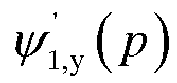


Assuming that coordinates of a current pixel p are (x, y), calculation formulas of


An adjacent pixel of a pixel located on the edge of the current picture block X may not exist, and

- S3. Calculate a prediction error e(p).
It is assumed that the coordinates of the current pixel p are (x, y).
- S4. Assuming that δ x1, δ x2, δ x3, δ y1, δ y2, and δ y3 are respectively motion vector variations of three vertices of a current picture block X in a direction x and a direction y, obtain δ x1, δ y2, δ x3, δ y1, δ y2, and δ y3 by means of calculation by solving a linear equation set (11).


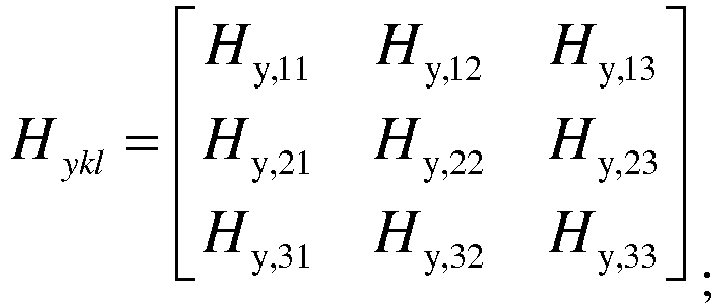


- Based on the foregoing steps S1 to S4, a motion vector variation δx of each of the three pixel samples in the current picture block in the direction x and a motion vector variation δy of each pixel sample in the direction y in this iteration may be obtained by means of motion estimation.
- One or more iterations are performed based on an iterative manner in the foregoing steps S1 to S4, so that the motion vectors of the K pixel samples in the current picture block can be obtained by means of motion estimation.
- Optionally, in some possible implementation manners of the present invention, subtraction may be further performed between the motion vectors that are of the K pixel samples and that are obtained by means of motion estimation and the corresponding MVPs, to obtain motion vector differences (English: motion vector difference, MVD for short) of the K pixel samples, and the MVDs of the K pixel samples may be written into a video bitstream.
- Further, a syntactic element affine_no_MVD_flag may be used to indicate whether to write an MVD corresponding to a pixel sample into the video bitstream. For example, if the MVDs corresponding to the foregoing K pixel samples are all 0, affine_no_MVD_flag may be set to true, and no MVD is written into the video bitstream; or if the MVDs corresponding to the foregoing K pixel samples are not all 0, affine_no_MVD_flag may be set to false, and the MVDs corresponding to the K pixel samples are written into the video bitstream.
- 303. Calculate, based on an affine transformation model and the motion vectors of the K pixel samples, a motion vector of each pixel in the current picture block.
- It is assumed that the size of the current prediction unit X is S1×S2. Motion vectors (vx 0, vy 0), (vx 1, vy 1), and (vx 2, vy 2) of three vertices whose coordinates are (0,0) (S 1,0), and (0,S 2) are calculated by performing
step 301 andstep 302. - The coordinates and the motion vectors of the three vertices are substituted into an affine transformation formula (12), so that the motion vector of each pixel in the current picture block can be calculated. A schematic diagram of affine transformation may be shown in
FIG. 3-e . - A motion vector of the pixel whose coordinates are (x, y) is calculated as follows:
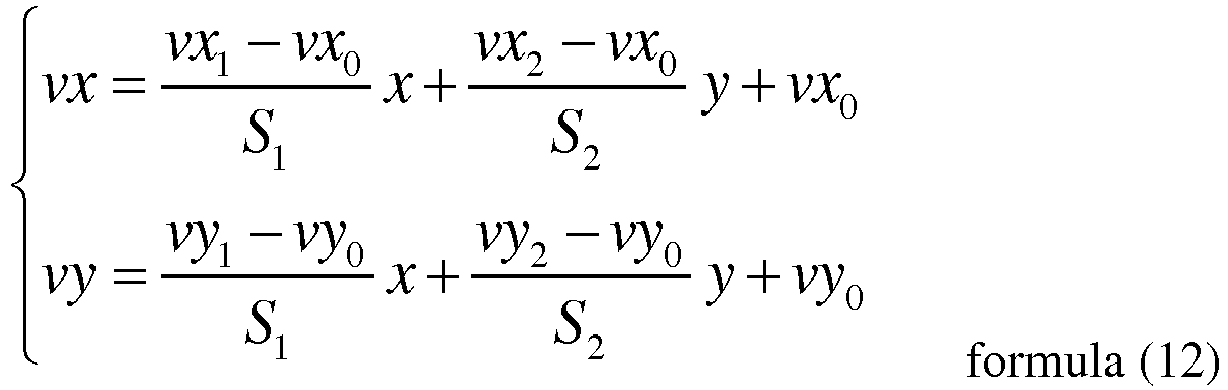
- Further, because motion information of each pixel in the current picture block may be used for motion vector prediction for another picture block, one piece of motion information may be stored for each 4x4 block, and a motion vector of each 4x4 block is stored as motion information of a pixel on an upper left corner or any other pixel in the 4x4 block.
- It should be noted that in this embodiment, the affine transformation model is mainly used as an example of a non-translational motion model for description, and a mechanism for calculating, based on another non-translational motion model and the motion vectors of the K pixel samples, the motion vector of each pixel in the current picture block has a similar principle although formulas different from those used in this embodiment may be used in the mechanism. Examples are not listed one by one herein.
- 304. Perform, based on the calculated motion vector of each pixel in the current picture block, pixel value prediction on the current picture block.
- Further, during video coding, a residual of the current picture block may be obtained by using an original pixel value of the current picture block and a predicted pixel value that is of the current picture block and that is obtained by means of pixel value prediction, and the residual of the current picture block may be written into the video bitstream.
- It may be learned that in the technical solution in this embodiment, determined motion vector predictors of K pixel samples are referenced during pixel value prediction performed, based on a non-translational motion model, on a current picture block. The K pixel samples include a first vertex angle pixel sample in the current picture block. The motion vector predictors of the K pixel samples are directly used for prediction, a motion vector predictor of the first vertex angle pixel sample in the K pixel samples is obtained based on a motion vector of a preset first spatially adjacent picture block of the current picture block, and there is a single optional case for the motion vector predictors of the K pixel samples. Therefore, a mechanism that is used in a conventional technology and in which motion vector predictors of K pixel samples are selected from multiple optional motion vector predictor sets of the K pixel samples by means of massive calculation is abandoned. This is helpful in avoiding transferring selection information of motion information predictors in a bitstream, is helpful in improving coding efficiency, and is also helpful in significantly reducing calculation complexity of picture prediction based on a non-translational motion model.
- Further, prediction directions of the MVPs of the K pixel samples in the current picture block are normalized, reference frame indexes are processed, and motion vectors of the MVPs of the K pixel samples are scaled and mapped to a same reference frame according to reference frame indexes. Further, a motion vector of each pixel in the current picture block may be calculated according to optimal motion vectors of the K pixel samples by using an affine transformation formula. The foregoing solution is helpful in resolving a problem that inter-frame prediction accuracy is low in a current video coding standard when a video includes content of a non-translational feature, for example, lens zooming, object deformation, or moving object rotation. In addition, a disadvantage that an affine transformation technology proposed in the conventional technology is hardly applied to multi-direction prediction and multiple-reference-frames-based prediction is overcome, and this is helpful in making full use of a temporary correlation between video sequences to remove temporary redundancy, thereby improving coding efficiency.
- Referring to
FIG. 4-a, FIG. 4-a is a schematic flowchart of another picture prediction method according to another embodiment of the present invention. As shown in an example ofFIG. 4-a , the another picture prediction method provided in the another embodiment of the present invention may include the following steps. - 401. Determine motion vector predictors of K pixel samples in a current picture block.
- In an example of this embodiment, K=3.
- In this embodiment, the K pixel samples include an upper left vertex, an upper right vertex, and a lower left vertex of the current picture block.
- As shown in an example of
FIG. 4-b , a motion vector predictor of the upper left vertex of the current picture block is equal to a motion vector of an adjacent picture block A on the upper left of the current picture block. A motion vector predictor of the upper right vertex of the current picture block is equal to a motion vector of an adjacent picture block B above the current picture block. A motion vector predictor of the lower left vertex of the current picture block may be equal to a motion vector of an adjacent picture block D on the left of the current picture block. - 402. Perform motion estimation on the K pixel samples by using the motion vector predictors of the K pixel samples, to obtain motion vectors of the K pixel samples.
- When reference frames corresponding to motion vector predictors of K1 pixel samples in the K pixel samples are not a reference frame Y1, the performing motion estimation on the K pixel samples by using the motion vector predictors of the K1 pixel samples, to obtain motion vectors of the K pixel samples includes: scaling the motion vector predictors of the K1 pixel samples to the reference frame Y1 (that is, performing normalization processing on the motion vector predictors of the K1 pixel samples); and performing motion estimation on the K pixel samples by using motion vector predictors of K2 pixel samples and motion vector predictors that are of the K pixel samples and that are scaled to the reference frame Y1, to obtain the motion vectors of the K pixel samples.
- Before normalization processing is performed on the motion vector predictors of the K1 pixel samples, a reference frame index of a pixel sample i may be first revised. The pixel sample i is any pixel sample (for example, the lower left vertex or the upper right vertex), except the upper left vertex of the current picture block, in the K pixel samples. If a prediction direction corresponding to a motion vector predictor of the pixel sample i is different from a prediction direction corresponding to the motion vector predictor of the upper left vertex (for example, the prediction direction corresponding to the motion vector predictor of the pixel sample i is forward prediction, and the prediction direction corresponding to the motion vector predictor of the upper left vertex is backward prediction; or the prediction direction corresponding to the motion vector predictor of the pixel sample i is backward prediction, and the prediction direction corresponding to the motion vector predictor of the upper left vertex is forward prediction), a reference frame index corresponding to the motion vector predictor of the pixel sample i is 0.
- Optionally, in some possible implementation manners of the present invention, a method for scaling a motion vector predictor to a reference frame may be as follows: It is assumed that a current coding frame index is CurPoc, and a reference frame of the picture block A (that is, a reference frame corresponding to the MVP of the upper left vertex) is a destination reference frame. A destination reference frame index is DesPoc, a reference frame corresponding to the MVP of the upper right vertex or the lower left vertex is a source reference frame, a source reference frame index is SrcPoc, the motion vector predictor corresponding to the upper right vertex or the lower left vertex is MVP, and a motion vector predictor that is of the upper right vertex or the lower left vertex and that is obtained after scaling is MVS. MVS may be obtained by means of calculation by using the following formulas:


- Particularly, if reference frames corresponding to the motion vector predictors of the K pixel samples are the reference frame Y1, no normalization processing is performed on the motion vector predictors of the K1 pixel samples (because the motion vector predictors of the K1 pixel samples have been in a normalized state), and motion estimation may be performed on the K pixel samples directly by using the motion vector predictors of the K1 pixel samples, to obtain the motion vectors of the K pixel samples.
- Optionally, that motion estimation is performed on the K pixel samples to obtain the motion vectors of the K pixel samples may include: motion estimation is performed on the K pixel samples based on an iterative search algorithm, to obtain the motion vectors of the K pixel samples. For a specific iterative search algorithm, refer to related descriptions in the foregoing embodiment. Details are not described herein again.
- Optionally, in some possible implementation manners of the present invention, subtraction may be further performed between the motion vectors that are of the K pixel samples and that are obtained by means of motion estimation and the corresponding MVPs, to obtain MVDs of the K pixel samples, and the MVDs of the K pixel samples may be written into a video bitstream.
- Further, a syntactic element affine_no_MVD_flag may be used to indicate whether to write an MVD corresponding to a pixel sample into the video bitstream. For example, if the MVDs corresponding to the foregoing K pixel samples are all 0, affine_no_MVD_flag may be set to true, and no MVD is written into the video bitstream; or if the MVDs corresponding to the foregoing K pixel samples are not all 0, affine_no_MVD_flag may be set to false, and the MVDs corresponding to the K pixel samples are written into the video bitstream.
- 403. Calculate, based on an affine transformation model and the motion vectors of the K pixel samples, a motion vector of each pixel in the current picture block.
- Further, because motion information of each pixel in the current picture block may be used for motion vector prediction for another picture block, one piece of motion information may be stored for each 4x4 (or 8x8) block, and a motion vector of each 4x4 (or 8x8) block is stored as motion information of a pixel on an upper left corner or any other pixel in the 4x4 block.
- The motion information may include a motion vector, a prediction direction corresponding to the motion vector, and a reference frame index corresponding to the motion vector.
- It should be noted that in this embodiment, the affine transformation model is mainly used as an example of a non-translational motion model for description, and a mechanism for calculating, based on another non-translational motion model and the motion vectors of the K pixel samples, the motion vector of each pixel in the current picture block has a similar principle although formulas different from those used in this embodiment may be used in the mechanism. Examples are not listed one by one herein.
- 404. Perform, based on the calculated motion vector of each pixel in the current picture block, pixel value prediction on the current picture block.
- Further, during video coding, a residual of the current picture block may be obtained by using an original pixel value of the current picture block and a predicted pixel value that is of the current picture block and that is obtained by means of pixel value prediction, and the residual of the current picture block may be written into the video bitstream.
- It may be learned that in the technical solution in this embodiment, determined motion vector predictors of K pixel samples are referenced during pixel value prediction performed, based on a non-translational motion model, on a current picture block. The K pixel samples include a first vertex angle pixel sample in the current picture block. The motion vector predictors of the K pixel samples are directly used for prediction, a motion vector predictor of the first vertex angle pixel sample in the K pixel samples is obtained based on a motion vector of a preset first spatially adjacent picture block of the current picture block, and there is a single optional case for the motion vector predictors of the K pixel samples. Therefore, a mechanism that is used in a conventional technology and in which motion vector predictors of K pixel samples are selected from multiple optional motion vector predictor sets of the K pixel samples by means of massive calculation is abandoned. This is helpful in avoiding transferring selection information of motion information predictors in a bitstream, is helpful in improving coding efficiency, and is also helpful in significantly reducing calculation complexity of picture prediction based on a non-translational motion model.
- Further, prediction directions of the MVPs of the K pixel samples in the current picture block are normalized, reference frame indexes are processed, and motion vectors of the MVPs of the K pixel samples are scaled and mapped to a same reference frame according to reference frame indexes. Further, a motion vector of each pixel in the current picture block may be calculated according to optimal motion vectors of the K pixel samples by using an affine transformation formula. The foregoing solution is helpful in resolving a problem that inter-frame prediction accuracy is low in a current video coding standard when a video includes content of a non-translational feature, for example, lens zooming, object deformation, or moving object rotation. In addition, a disadvantage that an affine transformation technology proposed in the conventional technology is hardly applied to multi-direction prediction and multiple-reference-frames-based prediction is overcome, and this is helpful in making full use of a temporary correlation between video sequences to remove temporary redundancy, thereby improving coding efficiency.
- Referring to
FIG. 5, FIG. 5 is a schematic flowchart of another picture prediction method according to another embodiment of the present invention. As shown in an example ofFIG. 5 , the another picture prediction method provided in the another embodiment of the present invention may include the following steps. - 501. Determine motion vector predictors of K pixel samples in a current picture block.
- In an example of this embodiment, K=3.
- In this embodiment, the K pixel samples include an upper left vertex, an upper right vertex, and a lower left vertex of the current picture block.
- For a specific manner of determining the motion vector predictors of the K pixel samples in the current picture block in
step 501, refer to any manner in the foregoing embodiment. - 502. Use the motion vector predictors of the foregoing K pixel samples as motion vectors of the foregoing K pixel samples, and calculate, based on an affine transformation model and the motion vectors of the K pixel samples, a motion vector of each pixel in the current picture block.
- Further, because motion information of each pixel in the current picture block may be used for motion vector prediction for another picture block, one piece of motion information may be stored for each 4x4 (or 8x8) block, and a motion vector of each 4x4 (or 8x8) block is stored as motion information of a pixel on an upper left corner or any other pixel in the 4x4 block.
- The motion information may include a motion vector, a prediction direction corresponding to the motion vector, and a reference frame index corresponding to the motion vector.
- It should be noted that in this embodiment, the affine transformation model is mainly used as an example of a non-translational motion model for description, and a mechanism for calculating, based on another non-translational motion model and the motion vectors of the K pixel samples, the motion vector of each pixel in the current picture block has a similar principle although formulas different from those used in this embodiment may be used in the mechanism. Examples are not listed one by one herein.
- 503. Perform, based on the calculated motion vector of each pixel in the current picture block, pixel value prediction on the current picture block.
- Further, during video coding, a residual of the current picture block may be obtained by using an original pixel value of the current picture block and a predicted pixel value that is of the current picture block and that is obtained by means of pixel value prediction, and the residual of the current picture block may be written into a video bitstream.
- It may be learned that in the technical solution in this embodiment, determined motion vector predictors of K pixel samples are referenced during pixel value prediction performed, based on a non-translational motion model, on a current picture block. The K pixel samples include a first vertex angle pixel sample in the current picture block. The motion vector predictors of the K pixel samples are directly used for prediction, a motion vector predictor of the first vertex angle pixel sample in the K pixel samples is obtained based on a motion vector of a preset first spatially adjacent picture block of the current picture block, and there is a single optional case for the motion vector predictors of the K pixel samples. Therefore, a mechanism that is used in a conventional technology and in which motion vector predictors of K pixel samples are selected from multiple optional motion vector predictor sets of the K pixel samples by means of massive calculation is abandoned. This is helpful in avoiding transferring selection information of motion information predictors in a bitstream, is helpful in improving coding efficiency, and is also helpful in significantly reducing calculation complexity of picture prediction based on a non-translational motion model.
- Further, prediction directions of the MVPs of the K pixel samples in the current picture block are normalized, reference frame indexes are processed, and motion vectors of the MVPs of the K pixel samples are scaled and mapped to a same reference frame according to reference frame indexes. The foregoing solution is helpful in resolving a problem that inter-frame prediction accuracy is low in a current video coding standard when a video includes content of a non-translational (for example, lens zooming, object deformation, or moving object rotation) feature. In addition, a disadvantage that an affine transformation technology proposed in the conventional technology is hardly applied to multi-direction prediction and multiple-reference-frames-based prediction is overcome, and this is helpful in making full use of a temporary correlation between video sequences to remove temporary redundancy, thereby improving coding efficiency.
- Referring to
FIG. 6, FIG. 6 is a schematic flowchart of another picture prediction method according to another embodiment of the present invention. As shown in an example ofFIG. 6 , the another picture prediction method provided in the another embodiment of the present invention may include the following steps. - 601. Determine motion vector predictors of K pixel samples in a current picture block.
- In an example of this embodiment, K=3.
- In this embodiment, the K pixel samples include an upper left vertex, an upper right vertex, and a lower left vertex of the current picture block.
- For a specific manner of determining the motion vector predictors of the K pixel samples in the current picture block in
step 601, refer to any manner in the foregoing embodiment. - 602. Perform motion estimation on the K pixel samples by using the motion vector predictors of the K pixel samples, to obtain motion vectors of the K pixel samples.
- When reference frames corresponding to motion vector predictors of K1 pixel samples in the K pixel samples are not a reference frame Y1, the performing motion estimation on the K pixel samples by using the motion vector predictors of the K1 pixel samples, to obtain motion vectors of the K pixel samples includes: scaling the motion vector predictors of the K1 pixel samples to the reference frame Y1 (that is, performing normalization processing on the motion vector predictors of the K1 pixel samples); and performing motion estimation on the K pixel samples by using motion vector predictors of K2 pixel samples and motion vector predictors that are of the K pixel samples and that are scaled to the reference frame Y1, to obtain the motion vectors of the K pixel samples.
- Before normalization processing is performed on the motion vector predictors of the K1 pixel samples, a reference frame index of a pixel sample i may be first revised. The pixel sample i is any pixel sample (for example, the lower left vertex or the upper right vertex), except the upper left vertex of the current picture block, in the K pixel samples. If a prediction direction corresponding to a motion vector predictor of the pixel sample i is different from a prediction direction corresponding to the motion vector predictor of the upper left vertex (for example, the prediction direction corresponding to the motion vector predictor of the pixel sample i is forward prediction, and the prediction direction corresponding to the motion vector predictor of the upper left vertex is backward prediction; or the prediction direction corresponding to the motion vector predictor of the pixel sample i is backward prediction, and the prediction direction corresponding to the motion vector predictor of the upper left vertex is forward prediction), a reference frame index corresponding to the motion vector predictor of the pixel sample i is 0.
- Particularly, if reference frames corresponding to the motion vector predictors of the K pixel samples are the reference frame Y1, no normalization processing is performed on the motion vector predictors of the K1 pixel samples (because the motion vector predictors of the K1 pixel samples have been in a normalized state), and motion estimation may be performed on the K pixel samples directly by using the motion vector predictors of the K1 pixel samples, to obtain the motion vectors of the K pixel samples.
- Optionally, that motion estimation is performed on the K pixel samples to obtain the motion vectors of the K pixel samples may include: motion estimation is performed on the K pixel samples based on an iterative search algorithm, to obtain the motion vectors of the K pixel samples. For a specific iterative search algorithm, refer to related descriptions in the foregoing embodiment. Details are not described herein again.
- Optionally, in some possible implementation manners of the present invention, subtraction may be further performed between the motion vectors that are of the K pixel samples and that are obtained by means of motion estimation and the corresponding MVPs, to obtain MVDs of the K pixel samples, and the MVDs of the K pixel samples may be written into a video bitstream.
- Further, a syntactic element affine_no_MVD_flag may be used to indicate whether to write an MVD corresponding to a pixel sample into the video bitstream. For example, if the MVDs corresponding to the foregoing K pixel samples are all 0, affine_no_MVD_flag may be set to true, and no MVD is written into the video bitstream; or if the MVDs corresponding to the foregoing K pixel samples are not all 0, affine_no_MVD_flag may be set to false, and the MVDs corresponding to the K pixel samples are written into the video bitstream.
- 603. Calculate, based on an affine transformation model and the motion vectors of the K pixel samples, a motion vector of each pixel in the current picture block.
- Further, because motion information of each pixel in the current picture block may be used for motion vector prediction for another picture block, one piece of motion information may be stored for each 4x4 (or 8x8) block, and a motion vector of each 4x4 (or 8x8) block is stored as motion information of a pixel on an upper left corner or any other pixel in the 4x4 block.
- The motion information may include a motion vector, a prediction direction corresponding to the motion vector, and a reference frame index corresponding to the motion vector.
- It should be noted that in this embodiment, the affine transformation model is mainly used as an example of a non-translational motion model for description, and a mechanism for calculating, based on another non-translational motion model and the motion vectors of the K pixel samples, the motion vector of each pixel in the current picture block has a similar principle although formulas different from those used in this embodiment may be used in the mechanism. Examples are not listed one by one herein.
- 604. Calculate a rate-distortion cost of using an affine transformation-based inter-frame prediction mode (step 601 to step 603) for the current prediction unit, and compare the rate-distortion cost with a calculated rate-distortion cost of using an HEVC inter-frame prediction mode.
- If the rate-distortion cost of using the affine transformation-based inter-frame prediction mode is less than the rate-distortion cost of using the HEVC inter-frame prediction mode, an optimal inter-frame prediction mode of the current picture block is set to the affine transformation-based inter-frame prediction mode. Specifically, a syntactic element affine_MC_flag may be set to true to indicate that the optimal inter-frame prediction mode of the current picture block is the affine transformation-based inter-frame prediction mode. If the rate-distortion cost of using the affine transformation-based inter-frame prediction mode is not less than the rate-distortion cost of using the HEVC inter-frame prediction mode, a syntactic element affine_MC_flag is set to false to indicate that an optimal inter-frame prediction mode of the current picture block is the HEVC inter-frame prediction mode.
- 605. Perform, based on the calculated motion vector of each pixel in the current picture block, pixel value prediction on the current picture block.
- For example, for a luminance component, if the motion vector of the pixel is 1/4 pixel precision, a predicted pixel value of each pixel may be obtained by using an HEVC interpolation filter; or if the motion vector of the pixel is greater than 1/4 pixel precision, predicted pixel values of four 1/4 pixels at the shortest distance from the pixel are first obtained by using an HEVC interpolation filter, and then, bilinear interpolation is performed to obtain a predicted pixel value of the pixel. For a chrominance component, a predicted pixel value is obtained by using the HEVC interpolation filter.
- Further, during video coding, a residual of the current picture block may be obtained by using an original pixel value of the current picture block and a predicted pixel value that is of the current picture block and that is obtained by means of pixel value prediction, and the residual of the current picture block is written into the video bitstream. Specifically, the residual of the current prediction unit is written into the video bitstream after undergoing transformation, quantization, and entropy encoding.
- It may be learned that in the technical solution in this embodiment, determined motion vector predictors of K pixel samples are referenced during pixel value prediction performed, based on a non-translational motion model, on a current picture block. The K pixel samples include a first vertex angle pixel sample in the current picture block. The motion vector predictors of the K pixel samples are directly used for prediction, a motion vector predictor of the first vertex angle pixel sample in the K pixel samples is obtained based on a motion vector of a preset first spatially adjacent picture block of the current picture block, and there is a single optional case for the motion vector predictors of the K pixel samples. Therefore, a mechanism that is used in a conventional technology and in which motion vector predictors of K pixel samples are selected from multiple optional motion vector predictor sets of the K pixel samples by means of massive calculation is abandoned. This is helpful in avoiding transferring selection information of motion information predictors in a bitstream, is helpful in improving coding efficiency, and is also helpful in significantly reducing calculation complexity of picture prediction based on a non-translational motion model.
- Further, prediction directions of the MVPs of the K pixel samples in the current picture block are normalized, reference frame indexes are processed, and motion vectors of the MVPs of the K pixel samples are scaled and mapped to a same reference frame according to reference frame indexes. Further, a motion vector of each pixel in the current picture block may be calculated according to optimal motion vectors of the K pixel samples by using an affine transformation formula. The foregoing solution is helpful in resolving a problem that inter-frame prediction accuracy is low in a current video coding standard when a video includes content of a non-translational feature, for example, lens zooming, object deformation, or moving object rotation. In addition, a disadvantage that an affine transformation technology proposed in the conventional technology is hardly applied to multi-direction prediction and multiple-reference-frames-based prediction is overcome, and this is helpful in making full use of a temporary correlation between video sequences to remove temporary redundancy, thereby improving coding efficiency.
- Referring to
FIG. 7, FIG. 7 is a schematic flowchart of a video decoding method according to an embodiment of the present invention. As shown in an example ofFIG. 7 , the video decoding method provided in this embodiment of the present invention may include the following steps. - 701. A decoder decodes a syntactic element affine_MC_flag in a video bitstream, to determine whether an affine transformation-based inter-frame prediction mode is used for a current picture block.
- 702. If the affine transformation-based inter-frame prediction mode is used for the current picture block, the decoder decodes a syntactic element affine_inter_dir_flag in the video bitstream, to determine an inter-frame prediction direction used for the current picture block.
- 703. The decoder determines MVPs of K pixel samples in the current picture block according to the syntactic element affine_inter_dir_flag.
- The K pixel samples in the current picture block may be K pixel samples in a current picture block that are described in any one of the foregoing embodiments.
- 704. The decoder determines, by decoding a syntactic element affine_no_MVD_flag that is in the video bitstream and is corresponding to the current picture block, whether MVDs corresponding to the K pixel samples in the current picture block are 0. If affine_no_MVD_flag is true, it indicates that the MVDs corresponding to the K pixel samples in the current picture block are all 0, and motion vectors of the obtained MVPs of the K pixel samples may be used as motion vectors of the K pixel samples. If affine_no_MVD_flag is false, it indicates that the MVDs corresponding to the K pixel samples are not all 0, the MVDs corresponding to the K pixel samples are obtained by means of separate decoding, and an MVD corresponding to each pixel sample and a corresponding MVP are added to obtain a motion vector of the pixel sample.
- 705. The decoder decodes a residual coefficient of the current picture block, and performs dequantization and inverse transformation to obtain a residual pixel in the current picture block.
- 706. The decoder calculates, based on an affine transformation model and motion vectors of the K pixel samples, a motion vector of each pixel in the current picture block, and performs, based on the calculated motion vector of each pixel in the current picture block, pixel value prediction on the current picture block, to obtain a predicted pixel value of the current picture block.
- It should be noted that in this embodiment, the affine transformation model is mainly used as an example of a non-translational motion model for description, and a mechanism for calculating, based on another non-translational motion model and the motion vectors of the K pixel samples, the motion vector of each pixel in the current picture block has a similar principle although formulas different from those used in this embodiment may be used in the mechanism. Examples are not listed one by one herein.
- 707. The decoder reconstructs the current picture block according to the residual pixel in the current picture block and the predicted pixel value of the current picture block.
- Further, because motion information of each pixel in the current picture block may be used for motion vector prediction for another picture block, one piece of motion information may be stored for each 4x4 (or 8x8) block, and a motion vector of each 4x4 (or 8x8) block is stored as motion information of a pixel on an upper left corner or any other pixel in the 4x4 block.
- The motion information may include a motion vector, a prediction direction corresponding to the motion vector, and a reference frame index corresponding to the motion vector.
- It may be learned that in the technical solution in this embodiment, determined motion vector predictors of K pixel samples are referenced during pixel value prediction performed, based on a non-translational motion model, on a current picture block. The K pixel samples include a first vertex angle pixel sample in the current picture block. The motion vector predictors of the K pixel samples are directly used for prediction, a motion vector predictor of the first vertex angle pixel sample in the K pixel samples is obtained based on a motion vector of a preset first spatially adjacent picture block of the current picture block, and there is a single optional case for the motion vector predictors of the K pixel samples. Therefore, a mechanism that is used in a conventional technology and in which motion vector predictors of K pixel samples are selected from multiple optional motion vector predictor sets of the K pixel samples by means of massive calculation is abandoned. This is helpful in avoiding transferring selection information of motion information predictors in a bitstream, is helpful in improving coding efficiency, and is also helpful in significantly reducing calculation complexity of picture prediction based on a non-translational motion model.
- Further, prediction directions of the MVPs of the K pixel samples in the current picture block are normalized, reference frame indexes are processed, and motion vectors of the MVPs of the K pixel samples are scaled and mapped to a same reference frame according to reference frame indexes. Further, a motion vector of each pixel in the current picture block may be calculated according to optimal motion vectors of the K pixel samples by using an affine transformation formula. The foregoing solution is helpful in resolving a problem that inter-frame prediction accuracy is low in a current video coding standard when a video includes content of a non-translational feature, for example, lens zooming, object deformation, or moving object rotation. In addition, a disadvantage that an affine transformation technology proposed in the conventional technology is hardly applied to multi-direction prediction and multiple-reference-frames-based prediction is overcome, and this is helpful in making full use of a temporary correlation between video sequences to remove temporary redundancy, thereby improving coding efficiency.
- An emulation test is performed on some solutions, provided in the embodiments of the present invention, on an encoder HM11.0 of the latest video coding standard HEVC. For example, a test is performed in two configurations: a low delay (LDB) and random access (RA), and performance of the solutions in the embodiments of the present invention is compared with performance of the HM11.0 solution. Six test sequences whose affine features are relatively apparent are selected for testing. The test sequences are listed in Table 1, and emulation results are shown in Table 2.
Table 1 Sequence name Resolution Frame rate Sequence length Intotree 1920×1080 50 3 seconds Cactus 1920×1080 50 3 seconds Tractor 1920×1080 25 3 seconds City 1280×720 60 5 seconds Crew 1280×720 60 5 seconds SlideShow 1280×720 20 5 seconds 

- A performance counter BD-rate may be obtained by means of calculation by using results of four points whose QPs are 22, 27, 32, and 37, and peak signal to noise ratios (PSNR) of three components Y, U, and V are respectively calculated.
- It may be learned that for the solutions in the embodiments of the present invention, in the LDB configuration, an average BD-rate (Y) performance increases by 4.5%, and in the RA configuration, an average BD-rate (Y) performance increases by 5.0%, and even by 17.8%. That is, when PSNR quality is the same, compared with the HM11.0 method, the solutions in the embodiments can reduce a bit rate of a maximum of 17.8%.
- The following describes some other non-motion models.
- An affine transformation model is a motion model that meets the following model:

- A rotary motion model may be shown as follows:

- A perspective motion model may be shown as follows:


- A shearing motion model may be shown as follows:


- A scalable motion model may be shown as follows:

- A quadratic motion model may be shown as follows:

- It may be understood that the foregoing examples are only examples of some possible representation forms of various motion models, and certainly, the various motion models may have other forms.
- The following further provides related apparatuses for implementing the foregoing solutions.
- Referring to
FIG. 8 , an embodiment of the present invention further provides apicture prediction apparatus 800, and thepicture prediction apparatus 800 may include: - a determining
unit 810, configured to determine motion vector predictors of K pixel samples in a current picture block, where K is an integer greater than 1, the K pixel samples include a first vertex angle pixel sample in the current picture block, a motion vector predictor of the first vertex angle pixel sample is obtained based on a motion vector predictor of a preset first spatially adjacent picture block of the current picture block, and the first spatially adjacent picture block is spatially adjacent to the first vertex angle pixel sample; and - a predicting
unit 820, configured to perform, based on a non-translational motion model and the motion vector predictors of the K pixel samples, pixel value prediction on the current picture block. - Optionally, in some possible implementation manners of the present invention, the motion vector predictor of the first vertex angle pixel sample is obtained based on the motion vector of the preset first spatially adjacent picture block of the current picture block. Specifically, the motion vector predictor of the first vertex angle pixel sample may be equal to the motion vector of the preset first spatially adjacent picture block of the current picture block (that is, the motion vector of the preset first spatially adjacent picture block of the current picture block is used as the motion vector predictor of the first vertex angle pixel sample); or a motion vector predictor obtained by performing preset transformation on the motion vector of the preset first spatially adjacent picture block of the current picture block may be used as the motion vector predictor of the first vertex angle pixel sample.
- Optionally, in some possible implementation manners of the present invention, the non-translational motion model is any one of the following models: an affine transformation model, a parabolic motion model, a rotary motion model, a perspective motion model, a shearing motion model, or a scalable motion model. It may be understood that the non-translational motion model is not limited to the foregoing specific examples, either.
- There may be various manners of selecting the K pixel samples.
- Optionally, in some possible implementation manners of the present invention, the K pixel samples include at least two pixel samples in an upper left pixel sample, an upper right pixel sample, a lower left pixel sample, or a lower right pixel sample in the current picture block.
- If the pixel sample is a pixel block, a size of the pixel block is, for example, 2×2, 1×2, 4×2, 4×4, or another size.
- Optionally, in some possible implementation manners of the present invention, the upper left pixel sample in the current picture block is an upper left vertex of the current picture block or a pixel block that is in the current picture block and that includes an upper left vertex of the current picture block. The lower left pixel sample in the current picture block is a lower left vertex of the current picture block or a pixel block that is in the current picture block and that includes a lower left vertex of the current picture block. The upper right pixel sample in the current picture block is an upper right vertex of the current picture block or a pixel block that is in the current picture block and that includes an upper right vertex of the current picture block. The lower right pixel sample in the current picture block is a lower right vertex of the current picture block or a pixel block that is in the current picture block and that includes a lower right vertex of the current picture block.
- Optionally, in some possible implementation manners of the present invention, the K pixel samples may further include a center pixel sample in the current picture block. The center pixel sample in the current picture block may be a center pixel in the current picture block or a pixel block that is in the current picture block and that includes a center pixel in the current picture block.
- Optionally, in some possible implementation manners of the present invention, the first spatially adjacent picture block may be a picture block X1, a picture block X2, a picture block X3, or a picture block X4.
- A motion vector predictor of the upper left pixel sample in the current picture block may be obtained based on a motion vector of the picture block X1, the picture block X1 is a spatially adjacent picture block of the current picture block, and the picture block X1 is spatially adjacent to the upper left pixel sample in the current picture block.
- A motion vector predictor of the upper right pixel sample in the current picture block may be obtained based on a motion vector of the picture block X2, the picture block X2 is a spatially adjacent picture block of the current picture block, and the picture block X2 is spatially adjacent to the upper right pixel sample in the current picture block.
- A motion vector predictor of the lower left pixel sample in the current picture block may be obtained based on a motion vector of the picture block X3, the picture block X3 is a spatially adjacent picture block of the current picture block, and the picture block X3 is spatially adjacent to the lower left pixel sample in the current picture block.
- A motion vector predictor of the lower right pixel sample in the current picture block may be obtained based on a motion vector of the picture block X4, the picture block X4 is a spatially adjacent picture block of the current picture block, and the picture block X4 is spatially adjacent to the lower right pixel sample in the current picture block.
- Optionally, in some possible implementation manners of the present invention, the first vertex angle pixel sample may be the upper left pixel sample in the current picture block, and the first spatially adjacent picture block may be the picture block X1. The picture block X1 is a spatially adjacent picture block on the upper left of the current picture block, or the picture block X1 is a spatially adjacent picture block on the left of the current picture block, or the picture block X1 is a spatially adjacent picture block above the current picture block.
- Optionally, in some possible implementation manners of the present invention, the picture block X2 is a spatially adjacent picture block above the current picture block, or the picture block X2 is a spatially adjacent picture block on the upper right of the current picture block, or the picture block X2 is a spatially adjacent picture block on the right of the current picture block. Still optionally, an absolute value of a difference between a motion vector absolute value of the picture block X2 and a motion vector absolute value of the picture block X1 is greater than or equal to an absolute value of a difference between a motion vector absolute value of the picture block X5 and the motion vector absolute value of the picture block X1, and the picture block X5 is any one of remaining at least some spatially adjacent picture blocks, other than the picture block X2, that are of the current picture block and that are spatially adjacent to the upper right vertex. That is, a location of the picture block X2 may be determined based on a specific policy, or a location of the picture block X2 may be directly agreed.
- Optionally, in some possible implementation manners of the present invention, the picture block X3 is a spatially adjacent picture block on the left of the current picture block, or the picture block X3 is a spatially adjacent picture block on the lower left of the current picture block, or the picture block X3 is a spatially adjacent picture block below the current picture block. Still optionally, an absolute value of a difference between a motion vector absolute value of the picture block X3 and the motion vector absolute value of the picture block X1 is greater than or equal to an absolute value of a difference between a motion vector absolute value of the picture block X6 and the motion vector absolute value of the picture block X1, and the picture block X6 is any one of remaining at least some spatially adjacent picture blocks, other than the picture block X3, that are of the current picture block and that are spatially adjacent to the lower left vertex. That is, a location of the picture block X3 may be determined based on a specific policy, or a location of the picture block X3 may be directly agreed.
- Optionally, in some possible implementation manners of the present invention, the picture block X4 is a spatially adjacent picture block on the right of the current picture block, or the picture block X4 is a spatially adjacent picture block on the lower right of the current picture block, or the picture block X4 is a spatially adjacent picture block below the current picture block. Still optionally, an absolute value of a difference between a motion vector absolute value of the picture block X4 and the motion vector absolute value of the picture block X1 is greater than or equal to an absolute value of a difference between a motion vector absolute value of the picture block X7 and the motion vector absolute value of the picture block X1, and the picture block X7 is any one of remaining at least some spatially adjacent picture blocks, other than the picture block X4, that are of the current picture block and that are spatially adjacent to the lower left vertex.
- Referring to
FIG. 2, FIG. 2 shows examples of some possible locations of the picture block X1, the picture block X2, the picture block X3, and the picture block X4. - Optionally, in some possible implementation manners of the present invention, the predicting
unit 820 may be configured to: if reference frames corresponding to the motion vector predictors of the K pixel samples are a reference frame Y1, perform motion estimation on the K pixel samples by using the motion vector predictors of the K pixel samples, to obtain motion vectors of the K pixel samples; and perform pixel value prediction on the current picture block by using the non-translational motion model and the motion vectors of the K pixel samples. - Optionally, the predicting
unit 820 may be specifically configured to: when reference frames corresponding to motion vector predictors of K1 pixel samples in the K pixel samples are not a reference frame Y1, scale the motion vector predictors of the K1 pixel samples to the reference frame Y1, perform motion estimation on the K pixel samples by using motion vector predictors of K2 pixel samples and motion vector predictors that are of the K pixel samples and that are scaled to the reference frame Y1, to obtain motion vectors of the K pixel samples, and perform pixel value prediction on the current picture block by using the non-translational motion model and the motion vectors of the K pixel samples, where the K2 pixel samples are remaining pixel samples other than the K1 pixel samples in the K pixel samples, and K1 and K2 are positive integers. - Optionally, in some possible implementation manners of the present invention, the reference frame Y1 may be a reference frame corresponding to the motion vector predictor of the first vertex angle pixel sample, or the reference frame Y1 may be a reference frame corresponding to a motion vector predictor of another pixel sample in the K pixel samples.
- Optionally, in some possible implementation manners of the present invention, a pixel sample i is any pixel sample except the first vertex angle pixel sample in the K pixel samples, and if a prediction direction corresponding to a motion vector predictor of the pixel sample i is different from a prediction direction corresponding to the motion vector predictor of the first vertex angle pixel sample, a reference frame index corresponding to the motion vector predictor of the pixel sample i is 0.
- Optionally, in some possible implementation manners of the present invention, if reference frame indexes corresponding to the motion vector predictors of the first vertex angle pixel sample and the pixel sample i are different, the predicting
unit 820 may scale the motion vector predictor of the pixel sample i to the reference frame Y1. - Optionally, in some possible implementation manners of the present invention, the performing motion estimation on the K pixel samples by using motion vector predictors of K2 pixel samples and motion vector predictors that are of the K pixel samples and that are scaled to the reference frame Y1, to obtain motion vectors of the K pixel samples may include: performing motion estimation on the K pixel samples based on an iterative search algorithm (or a motion estimation algorithm of another type) by using the motion vector predictors of the K2 pixel samples and the motion vector predictors that are of the K pixel samples and that are scaled to the reference frame Y1, to obtain the motion vectors of the K pixel samples.
- Optionally, in some possible implementation manners of the present invention, the performing motion estimation on the K pixel samples by using motion vector predictors of K2 pixel samples and motion vector predictors that are of the K pixel samples and that are scaled to the reference frame Y1, to obtain motion vectors of the K pixel samples includes: performing motion estimation on the K pixel samples based on an iterative search algorithm by using the motion vector predictors of the K2 pixel samples and the motion vector predictors that are of the K pixel samples and that are scaled to the reference frame Y1, to obtain the motion vectors of the K pixel samples.
- The
picture prediction apparatus 800 is applied to a video coding apparatus or thepicture prediction apparatus 800 is applied to a video decoding apparatus. - It may be understood that functions of all functional modules in the
picture prediction apparatus 800 in this embodiment may be specifically implemented according to the methods in the foregoing method embodiments. For a specific implementation process, refer to related descriptions in the foregoing method embodiments, and details are not described herein again. Thepicture prediction apparatus 800 may be any apparatus that needs to output and play a video, for example, a laptop computer, a tablet computer, a personal computer, or a mobile phone. - It may be learned that in the technical solution in this embodiment, determined motion vector predictors of K pixel samples are referenced during pixel value prediction performed, based on a non-translational motion model, on a current picture block. The K pixel samples include a first vertex angle pixel sample in the current picture block. The motion vector predictors of the K pixel samples are directly used for prediction, a motion vector predictor of the first vertex angle pixel sample in the K pixel samples is obtained based on a motion vector of a preset first spatially adjacent picture block of the current picture block, and there is a single optional case for the motion vector predictors of the K pixel samples. Therefore, a mechanism that is used in a conventional technology and in which motion vector predictors of K pixel samples are selected from multiple optional motion vector predictor sets of the K pixel samples by means of massive calculation is abandoned. This is helpful in avoiding transferring selection information of motion information predictors in a bitstream, is helpful in improving coding efficiency, and is also helpful in significantly reducing calculation complexity of picture prediction based on a non-translational motion model.
- Further, the first spatially adjacent picture block is spatially adjacent to the first vertex angle pixel sample, and the first spatially adjacent picture block of the current picture block is preset (that is, it may be considered that the first spatially adjacent picture block of the current picture block is agreed or set in advance). In this way, this is helpful in quickly determining the motion vector predictors of the K pixel samples. In addition, because redundancy is removed by making full use of a spatial correlation between picture blocks, this is helpful in further improving coding efficiency.
- Referring to
FIG. 9, FIG. 9 is a schematic diagram of apicture prediction apparatus 900 according to an embodiment of the present invention. Thepicture prediction apparatus 900 may include at least onebus 901, at least oneprocessor 902 connected to thebus 901, and at least onememory 903 connected to thebus 901. - The
processor 902 invokes, by using thebus 901, code stored in thememory 903, so as to determine motion vector predictors of K pixel samples in a current picture block, where K is an integer greater than 1, the K pixel samples include a first vertex angle pixel sample in the current picture block, a motion vector predictor of the first vertex angle pixel sample is obtained based on a motion vector of a preset first spatially adjacent picture block of the current picture block, and the first spatially adjacent picture block is spatially adjacent to the first vertex angle pixel sample; and perform, based on a non-translational motion model and the motion vector predictors of the K pixel samples, pixel value prediction on the current picture block. - Optionally, in some possible implementation manners of the present invention, the motion vector predictor of the first vertex angle pixel sample is obtained based on the motion vector of the preset first spatially adjacent picture block of the current picture block. Specifically, the motion vector predictor of the first vertex angle pixel sample may be equal to the motion vector of the preset first spatially adjacent picture block of the current picture block (that is, the motion vector of the preset first spatially adjacent picture block of the current picture block is used as the motion vector predictor of the first vertex angle pixel sample); or a motion vector predictor obtained by performing preset transformation on the motion vector of the preset first spatially adjacent picture block of the current picture block may be used as the motion vector predictor of the first vertex angle pixel sample.
- Optionally, in some possible implementation manners of the present invention, the non-translational motion model is any one of the following models: an affine transformation model, a parabolic motion model, a rotary motion model, a perspective motion model, a shearing motion model, or a scalable motion model. It may be understood that the non-translational motion model is not limited to the foregoing specific examples, either.
- There may be various manners of selecting the K pixel samples.
- Optionally, in some possible implementation manners of the present invention, the K pixel samples include at least two pixel samples in an upper left pixel sample, an upper right pixel sample, a lower left pixel sample, or a lower right pixel sample in the current picture block.
- If the pixel sample is a pixel block, a size of the pixel block is, for example, 2×2, 1×2, 4×2, 4×4, or another size.
- Optionally, in some possible implementation manners of the present invention, the upper left pixel sample in the current picture block is an upper left vertex of the current picture block or a pixel block that is in the current picture block and that includes an upper left vertex of the current picture block. The lower left pixel sample in the current picture block is a lower left vertex of the current picture block or a pixel block that is in the current picture block and that includes a lower left vertex of the current picture block. The upper right pixel sample in the current picture block is an upper right vertex of the current picture block or a pixel block that is in the current picture block and that includes an upper right vertex of the current picture block. The lower right pixel sample in the current picture block is a lower right vertex of the current picture block or a pixel block that is in the current picture block and that includes a lower right vertex of the current picture block.
- Optionally, in some possible implementation manners of the present invention, the K pixel samples may further include a center pixel sample in the current picture block. The center pixel sample in the current picture block may be a center pixel in the current picture block or a pixel block that is in the current picture block and that includes a center pixel in the current picture block.
- Optionally, in some possible implementation manners of the present invention, the first spatially adjacent picture block may be a picture block X1, a picture block X2, a picture block X3, or a picture block X4.
- A motion vector predictor of the upper left pixel sample in the current picture block may be obtained based on a motion vector of the picture block X1, the picture block X1 is a spatially adjacent picture block of the current picture block, and the picture block X1 is spatially adjacent to the upper left pixel sample in the current picture block.
- A motion vector predictor of the upper right pixel sample in the current picture block may be obtained based on a motion vector of the picture block X2, the picture block X2 is a spatially adjacent picture block of the current picture block, and the picture block X2 is spatially adjacent to the upper right pixel sample in the current picture block.
- A motion vector predictor of the lower left pixel sample in the current picture block may be obtained based on a motion vector of the picture block X3, the picture block X3 is a spatially adjacent picture block of the current picture block, and the picture block X3 is spatially adjacent to the lower left pixel sample in the current picture block.
- A motion vector predictor of the lower right pixel sample in the current picture block may be obtained based on a motion vector of the picture block X4, the picture block X4 is a spatially adjacent picture block of the current picture block, and the picture block X4 is spatially adjacent to the lower right pixel sample in the current picture block.
- Optionally, in some possible implementation manners of the present invention, the first vertex angle pixel sample may be the upper left pixel sample in the current picture block, and the first spatially adjacent picture block may be the picture block X1. The picture block X1 is a spatially adjacent picture block on the upper left of the current picture block, or the picture block X1 is a spatially adjacent picture block on the left of the current picture block, or the picture block X1 is a spatially adjacent picture block above the current picture block.
- Optionally, in some possible implementation manners of the present invention, the picture block X2 is a spatially adjacent picture block above the current picture block, or the picture block X2 is a spatially adjacent picture block on the upper right of the current picture block, or the picture block X2 is a spatially adjacent picture block on the right of the current picture block. Still optionally, an absolute value of a difference between a motion vector absolute value of the picture block X2 and a motion vector absolute value of the picture block X1 is greater than or equal to an absolute value of a difference between a motion vector absolute value of the picture block X5 and the motion vector absolute value of the picture block X1, and the picture block X5 is any one of remaining at least some spatially adjacent picture blocks, other than the picture block X2, that are of the current picture block and that are spatially adjacent to the upper right vertex. That is, a location of the picture block X2 may be determined based on a specific policy, or a location of the picture block X2 may be directly agreed.
- Optionally, in some possible implementation manners of the present invention, the picture block X3 is a spatially adjacent picture block on the left of the current picture block, or the picture block X3 is a spatially adjacent picture block on the lower left of the current picture block, or the picture block X3 is a spatially adjacent picture block below the current picture block. Still optionally, an absolute value of a difference between a motion vector absolute value of the picture block X3 and the motion vector absolute value of the picture block X1 is greater than or equal to an absolute value of a difference between a motion vector absolute value of the picture block X6 and the motion vector absolute value of the picture block X1, and the picture block X6 is any one of remaining at least some spatially adjacent picture blocks, other than the picture block X3, that are of the current picture block and that are spatially adjacent to the lower left vertex. That is, a location of the picture block X3 may be determined based on a specific policy, or a location of the picture block X3 may be directly agreed.
- Optionally, in some possible implementation manners of the present invention, the picture block X4 is a spatially adjacent picture block on the right of the current picture block, or the picture block X4 is a spatially adjacent picture block on the lower right of the current picture block, or the picture block X4 is a spatially adjacent picture block below the current picture block. Still optionally, an absolute value of a difference between a motion vector absolute value of the picture block X4 and the motion vector absolute value of the picture block X1 is greater than or equal to an absolute value of a difference between a motion vector absolute value of the picture block X7 and the motion vector absolute value of the picture block X1, and the picture block X7 is any one of remaining at least some spatially adjacent picture blocks, other than the picture block X4, that are of the current picture block and that are spatially adjacent to the lower left vertex.
- Optionally, in some possible implementation manners of the present invention, the
processor 902 may be configured to: if reference frames corresponding to the motion vector predictors of the K pixel samples are a reference frame Y1, perform motion estimation on the K pixel samples by using the motion vector predictors of the K pixel samples, to obtain motion vectors of the K pixel samples; and perform pixel value prediction on the current picture block by using the non-translational motion model and the motion vectors of the K pixel samples. - Optionally, in some possible implementation manners of the present invention, the
processor 902 may be configured to: when reference frames corresponding to motion vector predictors of K1 pixel samples in the K pixel samples are not a reference frame Y1, scale the motion vector predictors of the K1 pixel samples to the reference frame Y1, perform motion estimation on the K pixel samples by using motion vector predictors of K2 pixel samples and motion vector predictors that are of the K pixel samples and that are scaled to the reference frame Y1, to obtain motion vectors of the K pixel samples, and perform pixel value prediction on the current picture block by using the non-translational motion model and the motion vectors of the K pixel samples, where the K2 pixel samples are remaining pixel samples other than the K1 pixel samples in the K pixel samples, and K1 and K2 are positive integers. - Optionally, in some possible implementation manners of the present invention, the reference frame Y1 may be a reference frame corresponding to the motion vector predictor of the first vertex angle pixel sample, or the reference frame Y1 may be a reference frame corresponding to a motion vector predictor of another pixel sample in the K pixel samples.
- Optionally, in some possible implementation manners of the present invention, a pixel sample i is any pixel sample except the first vertex angle pixel sample in the K pixel samples, and if a prediction direction corresponding to a motion vector predictor of the pixel sample i is different from a prediction direction corresponding to the motion vector predictor of the first vertex angle pixel sample, a reference frame index corresponding to the motion vector predictor of the pixel sample i is 0.
- Optionally, in some possible implementation manners of the present invention, if reference frame indexes corresponding to the motion vector predictors of the first vertex angle pixel sample and the pixel sample i are different, the
processor 902 may be configured to scale the motion vector predictor of the pixel sample i to the reference frame Y1. - Optionally, in some possible implementation manners of the present invention, the
processor 902 may be configured to perform motion estimation on the K pixel samples based on an iterative search algorithm (or a motion estimation algorithm of another type) by using the motion vector predictors of the K2 pixel samples and the motion vector predictors that are of the K pixel samples and that are scaled to the reference frame Y1, to obtain the motion vectors of the K pixel samples. - It may be understood that functions of all functional modules in the
picture prediction apparatus 900 in this embodiment may be specifically implemented according to the methods in the foregoing method embodiments. For a specific implementation process, refer to related descriptions in the foregoing method embodiments, and details are not described herein again. Thepicture prediction apparatus 900 may be any apparatus that needs to output and play a video, for example, a laptop computer, a tablet computer, a personal computer, or a mobile phone. - It may be learned that in the technical solution in this embodiment, determined motion vector predictors of K pixel samples are referenced during pixel value prediction performed, based on a non-translational motion model, on a current picture block. The K pixel samples include a first vertex angle pixel sample in the current picture block. The motion vector predictors of the K pixel samples are directly used for prediction, a motion vector predictor of the first vertex angle pixel sample in the K pixel samples is obtained based on a motion vector of a preset first spatially adjacent picture block of the current picture block, and there is a single optional case for the motion vector predictors of the K pixel samples. Therefore, a mechanism that is used in a conventional technology and in which motion vector predictors of K pixel samples are selected from multiple optional motion vector predictor sets of the K pixel samples by means of massive calculation is abandoned. This is helpful in avoiding transferring selection information of motion information predictors in a bitstream, is helpful in improving coding efficiency, and is also helpful in significantly reducing calculation complexity of picture prediction based on a non-translational motion model.
- Further, the first spatially adjacent picture block is spatially adjacent to the first vertex angle pixel sample, and the first spatially adjacent picture block of the current picture block is preset (that is, it may be considered that the first spatially adjacent picture block of the current picture block is agreed or set in advance). In this way, this is helpful in quickly determining the motion vector predictors of the K pixel samples. In addition, because redundancy is removed by making full use of a spatial correlation between picture blocks, this is helpful in further improving coding efficiency.
- Referring to
FIG. 10, FIG. 10 is a structural block diagram of apicture prediction apparatus 1000 according to another embodiment of the present invention. Thepicture prediction apparatus 1000 may include at least oneprocessor 1001, at least onenetwork interface 1004 orother user interface 1003, amemory 1005, and at least onecommunications bus 1002. Thecommunications bus 1002 is configured to implement a connection and communication between these components. Thepicture prediction apparatus 1000 may optionally include theuser interface 1003 that includes a display (for example, a touchscreen, an LCD, holographic imaging (Holographic), a CRT, or projection (Projector)), a click device (for example, a mouse, a trackball (trackball), a touchpad, or a touchscreen), a camera and/or a pickup apparatus, and the like. - The
memory 1005 may include a read-only memory and a random access memory, and provide an instruction and data for theprocessor 1001. A part of thememory 1005 may further include a nonvolatile random access memory (NVRAM). - In some implementation manners, the
memory 1005 stores the following element: an executable module or a data structure, or a subset thereof, or an extension set thereof: - an
operating system 10051, including various system programs, and used to implement various basic services and process hardware-based tasks; and - an
application program module 10052, including various application programs, and used to implement various application services. - In this embodiment of the present invention, by invoking a program or an instruction stored in the
memory 1005, theprocessor 1001 is configured to: determine motion vector predictors of K pixel samples in a current picture block, where K is an integer greater than 1, the K pixel samples include a first vertex angle pixel sample in the current picture block, a motion vector predictor of the first vertex angle pixel sample is obtained based on a motion vector of a preset first spatially adjacent picture block of the current picture block, and the first spatially adjacent picture block is spatially adjacent to the first vertex angle pixel sample; and perform, based on a non-translational motion model and the motion vector predictors of the K pixel samples, pixel value prediction on the current picture block. - Optionally, in some possible implementation manners of the present invention, the motion vector predictor of the first vertex angle pixel sample is obtained based on the motion vector of the preset first spatially adjacent picture block of the current picture block. Specifically, the motion vector predictor of the first vertex angle pixel sample may be equal to the motion vector of the preset first spatially adjacent picture block of the current picture block (that is, the motion vector of the preset first spatially adjacent picture block of the current picture block is used as the motion vector predictor of the first vertex angle pixel sample); or a motion vector predictor obtained by performing preset transformation on the motion vector of the preset first spatially adjacent picture block of the current picture block may be used as the motion vector predictor of the first vertex angle pixel sample.
- Optionally, in some possible implementation manners of the present invention, the non-translational motion model is any one of the following models: an affine transformation model, a parabolic motion model, a rotary motion model, a perspective motion model, a shearing motion model, or a scalable motion model. It may be understood that the non-translational motion model is not limited to the foregoing specific examples, either.
- There may be various manners of selecting the K pixel samples.
- Optionally, in some possible implementation manners of the present invention, the K pixel samples include at least two pixel samples in an upper left pixel sample, an upper right pixel sample, a lower left pixel sample, or a lower right pixel sample in the current picture block.
- If the pixel sample is a pixel block, a size of the pixel block is, for example, 2x2, 1×2, 4x2, 4x4, or another size.
- Optionally, in some possible implementation manners of the present invention, the upper left pixel sample in the current picture block is an upper left vertex of the current picture block or a pixel block that is in the current picture block and that includes an upper left vertex of the current picture block. The lower left pixel sample in the current picture block is a lower left vertex of the current picture block or a pixel block that is in the current picture block and that includes a lower left vertex of the current picture block. The upper right pixel sample in the current picture block is an upper right vertex of the current picture block or a pixel block that is in the current picture block and that includes an upper right vertex of the current picture block. The lower right pixel sample in the current picture block is a lower right vertex of the current picture block or a pixel block that is in the current picture block and that includes a lower right vertex of the current picture block.
- Optionally, in some possible implementation manners of the present invention, the K pixel samples may further include a center pixel sample in the current picture block. The center pixel sample in the current picture block may be a center pixel in the current picture block or a pixel block that is in the current picture block and that includes a center pixel in the current picture block.
- Optionally, in some possible implementation manners of the present invention, the first spatially adjacent picture block may be a picture block X1, a picture block X2, a picture block X3, or a picture block X4.
- A motion vector predictor of the upper left pixel sample in the current picture block may be obtained based on a motion vector of the picture block X1, the picture block X1 is a spatially adjacent picture block of the current picture block, and the picture block X1 is spatially adjacent to the upper left pixel sample in the current picture block.
- A motion vector predictor of the upper right pixel sample in the current picture block may be obtained based on a motion vector of the picture block X2, the picture block X2 is a spatially adjacent picture block of the current picture block, and the picture block X2 is spatially adjacent to the upper right pixel sample in the current picture block.
- A motion vector predictor of the lower left pixel sample in the current picture block may be obtained based on a motion vector of the picture block X3, the picture block X3 is a spatially adjacent picture block of the current picture block, and the picture block X3 is spatially adjacent to the lower left pixel sample in the current picture block.
- A motion vector predictor of the lower right pixel sample in the current picture block may be obtained based on a motion vector of the picture block X4, the picture block X4 is a spatially adjacent picture block of the current picture block, and the picture block X4 is spatially adjacent to the lower right pixel sample in the current picture block.
- Optionally, in some possible implementation manners of the present invention, the first vertex angle pixel sample may be the upper left pixel sample in the current picture block, and the first spatially adjacent picture block may be the picture block X1. The picture block X1 is a spatially adjacent picture block on the upper left of the current picture block, or the picture block X1 is a spatially adjacent picture block on the left of the current picture block, or the picture block X1 is a spatially adjacent picture block above the current picture block.
- Optionally, in some possible implementation manners of the present invention, the picture block X2 is a spatially adjacent picture block above the current picture block, or the picture block X2 is a spatially adjacent picture block on the upper right of the current picture block, or the picture block X2 is a spatially adjacent picture block on the right of the current picture block. Still optionally, an absolute value of a difference between a motion vector absolute value of the picture block X2 and a motion vector absolute value of the picture block X1 is greater than or equal to an absolute value of a difference between a motion vector absolute value of the picture block X5 and the motion vector absolute value of the picture block X1, and the picture block X5 is any one of remaining at least some spatially adjacent picture blocks, other than the picture block X2, that are of the current picture block and that are spatially adjacent to the upper right vertex. That is, a location of the picture block X2 may be determined based on a specific policy, or a location of the picture block X2 may be directly agreed.
- Optionally, in some possible implementation manners of the present invention, the picture block X3 is a spatially adjacent picture block on the left of the current picture block, or the picture block X3 is a spatially adjacent picture block on the lower left of the current picture block, or the picture block X3 is a spatially adjacent picture block below the current picture block. Still optionally, an absolute value of a difference between a motion vector absolute value of the picture block X3 and the motion vector absolute value of the picture block X1 is greater than or equal to an absolute value of a difference between a motion vector absolute value of the picture block X6 and the motion vector absolute value of the picture block X1, and the picture block X6 is any one of remaining at least some spatially adjacent picture blocks, other than the picture block X3, that are of the current picture block and that are spatially adjacent to the lower left vertex. That is, a location of the picture block X3 may be determined based on a specific policy, or a location of the picture block X3 may be directly agreed.
- Optionally, in some possible implementation manners of the present invention, the picture block X4 is a spatially adjacent picture block on the right of the current picture block, or the picture block X4 is a spatially adjacent picture block on the lower right of the current picture block, or the picture block X4 is a spatially adjacent picture block below the current picture block. Still optionally, an absolute value of a difference between a motion vector absolute value of the picture block X4 and the motion vector absolute value of the picture block X1 is greater than or equal to an absolute value of a difference between a motion vector absolute value of the picture block X7 and the motion vector absolute value of the picture block X1, and the picture block X7 is any one of remaining at least some spatially adjacent picture blocks, other than the picture block X4, that are of the current picture block and that are spatially adjacent to the lower left vertex.
- Optionally, in some possible implementation manners of the present invention, the
processor 1001 may be configured to: if reference frames corresponding to the motion vector predictors of the K pixel samples are a reference frame Y1, perform motion estimation on the K pixel samples by using the motion vector predictors of the K pixel samples, to obtain motion vectors of the K pixel samples; and perform pixel value prediction on the current picture block by using the non-translational motion model and the motion vectors of the K pixel samples. - Optionally, in some possible implementation manners of the present invention, the
processor 1001 may be configured to: when reference frames corresponding to motion vector predictors of K1 pixel samples in the K pixel samples are not a reference frame Y1, scale the motion vector predictors of the K1 pixel samples to the reference frame Y1, perform motion estimation on the K pixel samples by using motion vector predictors of K2 pixel samples and motion vector predictors that are of the K pixel samples and that are scaled to the reference frame Y1, to obtain motion vectors of the K pixel samples, and perform pixel value prediction on the current picture block by using the non-translational motion model and the motion vectors of the K pixel samples, where the K2 pixel samples are remaining pixel samples other than the K1 pixel samples in the K pixel samples, and K1 and K2 are positive integers. - Optionally, in some possible implementation manners of the present invention, the reference frame Y1 may be a reference frame corresponding to the motion vector predictor of the first vertex angle pixel sample, or the reference frame Y1 may be a reference frame corresponding to a motion vector predictor of another pixel sample in the K pixel samples.
- Optionally, in some possible implementation manners of the present invention, a pixel sample i is any pixel sample except the first vertex angle pixel sample in the K pixel samples, and if a prediction direction corresponding to a motion vector predictor of the pixel sample i is different from a prediction direction corresponding to the motion vector predictor of the first vertex angle pixel sample, a reference frame index corresponding to the motion vector predictor of the pixel sample i is 0.
- Optionally, in some possible implementation manners of the present invention, if reference frame indexes corresponding to the motion vector predictors of the first vertex angle pixel sample and the pixel sample i are different, the
processor 1001 may be configured to scale the motion vector predictor of the pixel sample i to the reference frame Y1. - Optionally, in some possible implementation manners of the present invention, the
processor 1001 may be configured to perform motion estimation on the K pixel samples based on an iterative search algorithm (or a motion estimation algorithm of another type) by using the motion vector predictors of the K2 pixel samples and the motion vector predictors that are of the K pixel samples and that are scaled to the reference frame Y1, to obtain the motion vectors of the K pixel samples. - It may be understood that functions of all functional modules in the
picture prediction apparatus 1000 in this embodiment may be specifically implemented according to the methods in the foregoing method embodiments. For a specific implementation process, refer to related descriptions in the foregoing method embodiments, and details are not described herein again. Thepicture prediction apparatus 1000 may be any apparatus that needs to output and play a video, for example, a laptop computer, a tablet computer, a personal computer, or a mobile phone. - It may be learned that in the technical solution in this embodiment, determined motion vector predictors of K pixel samples are referenced during pixel value prediction performed, based on a non-translational motion model, on a current picture block. The K pixel samples include a first vertex angle pixel sample in the current picture block. The motion vector predictors of the K pixel samples are directly used for prediction, a motion vector predictor of the first vertex angle pixel sample in the K pixel samples is obtained based on a motion vector of a preset first spatially adjacent picture block of the current picture block, and there is a single optional case for the motion vector predictors of the K pixel samples. Therefore, a mechanism that is used in a conventional technology and in which motion vector predictors of K pixel samples are selected from multiple optional motion vector predictor sets of the K pixel samples by means of massive calculation is abandoned. This is helpful in avoiding transferring selection information of motion information predictors in a bitstream, is helpful in improving coding efficiency, and is also helpful in significantly reducing calculation complexity of picture prediction based on a non-translational motion model.
- Further, the first spatially adjacent picture block is spatially adjacent to the first vertex angle pixel sample, and the first spatially adjacent picture block of the current picture block is preset (that is, it may be considered that the first spatially adjacent picture block of the current picture block is agreed or set in advance). In this way, this is helpful in quickly determining the motion vector predictors of the K pixel samples. In addition, because redundancy is removed by making full use of a spatial correlation between picture blocks, this is helpful in further improving coding efficiency.
- It should be noted that, for ease of description, the foregoing method embodiments are expressed as a series of actions. However, persons skilled in the art should appreciate that the present invention is not limited to the described action sequence, because according to the present invention, some steps may be performed in other sequences or performed simultaneously. In addition, persons skilled in the art should also appreciate that all the embodiments described in the specification are examples of embodiments, and the related actions and modules are not necessarily mandatory to the present invention.
- In the foregoing embodiments, all the embodiments have respective focuses of description. For a part that is not described in detail in an embodiment, refer to related descriptions in other embodiments.
- In the embodiments provided in this application, it should be understood that the disclosed apparatus may be implemented in other manners. For example, the described apparatus embodiment is merely an example. For example, the unit division is merely logical function division and may be other division in actual implementation. For example, a plurality of units or components may be combined or integrated into another system, or some features may be ignored or not performed. In addition, the displayed or discussed mutual couplings or direct couplings or communication connections may be implemented through some interfaces. The indirect couplings or communication connections between the apparatuses or units may be implemented in electronic or other forms.
- The units described as separate parts may or may not be physically separate, and parts displayed as units may or may not be physical units, may be located in one position, or may be distributed on a plurality of network units. Some or all of the units may be selected according to actual needs to achieve the objectives of the solutions in the embodiments.
- In addition, functional units in the embodiments of the present invention may be integrated into one processing unit, or each of the units may exist alone physically, or two or more units are integrated into one unit. The integrated unit may be implemented in a form of hardware, or may be implemented in a form of a software functional unit.
- When the foregoing integrated unit is implemented in the form of a software functional unit and sold or used as an independent product, the integrated unit may be stored in a computer-readable storage medium. Based on such an understanding, the technical solutions in the present invention essentially, or the part contributing to the prior art, or all or some of the technical solutions may be implemented in the form of a software product. The software product is stored in a storage medium and includes instructions for instructing a computer device (which may be a personal computer, a server, or a network device) to perform all or some of the steps of the methods described in the embodiments of the present invention. The foregoing storage medium includes: any medium that can store program code, such as a USB flash drive, a read-only memory (ROM, Read-Only Memory), a random access memory (RAM, Random Access Memory), a removable hard disk, a magnetic disk, or an optical disc.
- The foregoing embodiments are merely intended for describing the technical solutions in the present invention, but not for limiting the present invention. Although the present invention is described in detail with reference to the foregoing embodiments, persons of ordinary skill in the art should understand that they may still make modifications to the technical solutions described in the foregoing embodiments or make equivalent replacements to some technical features thereof, without departing from the spirit and scope of the technical solutions in the embodiments of the present invention.
Claims (23)
- A picture prediction method, comprising:determining motion vector predictors of K pixel samples in a current picture block, wherein K is an integer greater than 1, the K pixel samples comprise a first vertex angle pixel sample in the current picture block, a motion vector predictor of the first vertex angle pixel sample is obtained based on a motion vector of a preset first spatially adjacent picture block of the current picture block, and the first spatially adjacent picture block is spatially adjacent to the first vertex angle pixel sample; andperforming, based on a non-translational motion model and the motion vector predictors of the K pixel samples, pixel value prediction on the current picture block.
- The method according to claim 1, wherein the K pixel samples comprise at least two pixel samples in an upper left pixel sample, an upper right pixel sample, or a lower left pixel sample in the current picture block; and
the upper left pixel sample in the current picture block is an upper left vertex of the current picture block or a pixel block that is in the current picture block and that comprises an upper left vertex of the current picture block, the lower left pixel sample in the current picture block is a lower left vertex of the current picture block or a pixel block that is in the current picture block and that comprises a lower left vertex of the current picture block, and the upper right pixel sample in the current picture block is an upper right vertex of the current picture block or a pixel block that is in the current picture block and that comprises an upper right vertex of the current picture block. - The method according to claim 2, wherein the first spatially adjacent picture block is a picture block X1, a picture block X2, or a picture block X3;
a motion vector predictor of the upper left pixel sample in the current picture block is obtained based on a motion vector of the picture block X1, the picture block X1 is a spatially adjacent picture block of the current picture block, and the picture block X1 is spatially adjacent to the upper left pixel sample in the current picture block;
a motion vector predictor of the upper right pixel sample in the current picture block is obtained based on a motion vector of the picture block X2, the picture block X2 is a spatially adjacent picture block of the current picture block, and the picture block X2 is spatially adjacent to the upper right pixel sample in the current picture block; and
a motion vector predictor of the lower left pixel sample in the current picture block is obtained based on a motion vector of the picture block X3, the picture block X3 is a spatially adjacent picture block of the current picture block, and the picture block X3 is spatially adjacent to the lower left pixel sample in the current picture block. - The method according to claim 3, wherein:the first vertex angle pixel sample is the upper left pixel sample in the current picture block, the first spatially adjacent picture block is the picture block X1, and the picture block X1 is a spatially adjacent picture block on the upper left of the current picture block.
- The method according to claim 4, wherein:the picture block X2 is a spatially adjacent picture block above the current picture block; oran absolute value of a difference between a motion vector absolute value of the picture block X2 and a motion vector absolute value of the picture block X1 is greater than or equal to an absolute value of a difference between a motion vector absolute value of the picture block X5 and the motion vector absolute value of the picture block X1, and the picture block X5 is any one of remaining at least some spatially adjacent picture blocks, other than the picture block X2, that are of the current picture block and that are spatially adjacent to the upper right vertex.
- The method according to claim 4 or 5, wherein:the picture block X3 is a spatially adjacent picture block on the left of the current picture block; oran absolute value of a difference between a motion vector absolute value of the picture block X3 and the motion vector absolute value of the picture block X1 is greater than or equal to an absolute value of a difference between a motion vector absolute value of the picture block X6 and the motion vector absolute value of the picture block X1, and the picture block X6 is any one of remaining at least some spatially adjacent picture blocks, other than the picture block X3, that are of the current picture block and that are spatially adjacent to the lower left vertex.
- The method according to any one of claims 1 to 6, wherein the performing, based on a non-translational motion model and the motion vector predictors of the K pixel samples, pixel value prediction on the current picture block comprises:when reference frames corresponding to motion vector predictors of K1 pixel samples in the K pixel samples are not a reference frame Y1, scaling the motion vector predictors of the K1 pixel samples to the reference frame Y1, performing motion estimation on the K pixel samples by using motion vector predictors of K2 pixel samples and motion vector predictors that are of the K pixel samples and that are scaled to the reference frame Y1, to obtain motion vectors of the K pixel samples, and performing pixel value prediction on the current picture block by using the non-translational motion model and the motion vectors of the K pixel samples, wherein the K2 pixel samples are remaining pixel samples other than the K1 pixel samples in the K pixel samples, and K1 and K2 are positive integers.
- The method according to claim 7, wherein a pixel sample i is any pixel sample except the first vertex angle pixel sample in the K pixel samples, and if a prediction direction corresponding to a motion vector predictor of the pixel sample i is different from a prediction direction corresponding to the motion vector predictor of the first vertex angle pixel sample, a reference frame index corresponding to the motion vector predictor of the pixel sample i is 0.
- The method according to claim 8, wherein the reference frame Y1 is a reference frame corresponding to the motion vector predictor of the first vertex angle pixel sample, and that the motion vector predictor of the pixel sample i is scaled to the reference frame Y1 comprises: if reference frame indexes corresponding to the motion vector predictors of the first vertex angle pixel sample and the pixel sample i are different, the motion vector predictor of the pixel sample i is scaled to the reference frame Y1.
- The method according to any one of claims 7 to 9, wherein the performing motion estimation on the K pixel samples by using motion vector predictors of K2 pixel samples and motion vector predictors that are of the K pixel samples and that are scaled to the reference frame Y1, to obtain motion vectors of the K pixel samples comprises:performing motion estimation on the K pixel samples based on an iterative search algorithm by using the motion vector predictors of the K2 pixel samples and the motion vector predictors that are of the K pixel samples and that are scaled to the reference frame Y1, to obtain the motion vectors of the K pixel samples.
- The method according to any one of claims 1 to 10, wherein the non-translational motion model is any one of the following models: an affine transformation model, a parabolic motion model, a rotary motion model, a perspective motion model, a shearing motion model, or a scalable motion model.
- The method according to any one of claims 1 to 11, wherein:the picture prediction method is applied to a video coding process or the picture prediction method is applied to a video decoding process.
- A picture prediction apparatus, comprising:a determining unit, configured to determine motion vector predictors of K pixel samples in a current picture block, wherein K is an integer greater than 1, the K pixel samples comprise a first vertex angle pixel sample in the current picture block, a motion vector predictor of the first vertex angle pixel sample is obtained based on a motion vector of a preset first spatially adjacent picture block of the current picture block, and the first spatially adjacent picture block is spatially adjacent to the first vertex angle pixel sample; anda predicting unit, configured to perform, based on a non-translational motion model and the motion vector predictors of the K pixel samples, pixel value prediction on the current picture block.
- The apparatus according to claim 13, wherein the K pixel samples comprise at least two pixel samples in an upper left pixel sample, an upper right pixel sample, or a lower left pixel sample in the current picture block; and
the upper left pixel sample in the current picture block is an upper left vertex of the current picture block or a pixel block that is in the current picture block and that comprises an upper left vertex of the current picture block, the lower left pixel sample in the current picture block is a lower left vertex of the current picture block or a pixel block that is in the current picture block and that comprises a lower left vertex of the current picture block, and the upper right pixel sample in the current picture block is an upper right vertex of the current picture block or a pixel block that is in the current picture block and that comprises an upper right vertex of the current picture block. - The apparatus according to claim 14, wherein the first spatially adjacent picture block is a picture block X1, a picture block X2, or a picture block X3;
a motion vector predictor of the upper left pixel sample in the current picture block is obtained based on a motion vector of the picture block X1, the picture block X1 is a spatially adjacent picture block of the current picture block, and the picture block X1 is spatially adjacent to the upper left pixel sample in the current picture block;
a motion vector predictor of the upper right pixel sample in the current picture block is obtained based on a motion vector of the picture block X2, the picture block X2 is a spatially adjacent picture block of the current picture block, and the picture block X2 is spatially adjacent to the upper right pixel sample in the current picture block; and
a motion vector predictor of the lower left pixel sample in the current picture block is obtained based on a motion vector of the picture block X3, the picture block X3 is a spatially adjacent picture block of the current picture block, and the picture block X3 is spatially adjacent to the lower left pixel sample in the current picture block. - The apparatus according to claim 15, wherein:the first vertex angle pixel sample is the upper left pixel sample in the current picture block, the first spatially adjacent picture block is the picture block X1, and the picture block X1 is a spatially adjacent picture block on the upper left of the current picture block.
- The apparatus according to claim 16, wherein:the picture block X2 is a spatially adjacent picture block above the current picture block; oran absolute value of a difference between a motion vector absolute value of the picture block X2 and a motion vector absolute value of the picture block X1 is greater than or equal to an absolute value of a difference between a motion vector absolute value of the picture block X5 and the motion vector absolute value of the picture block X1, and the picture block X5 is any one of remaining at least some spatially adjacent picture blocks, other than the picture block X2, that are of the current picture block and that are spatially adjacent to the upper right vertex.
- The apparatus according to claim 16 or 17, wherein:the picture block X3 is a spatially adjacent picture block on the left of the current picture block; oran absolute value of a difference between a motion vector absolute value of the picture block X3 and the motion vector absolute value of the picture block X1 is greater than or equal to an absolute value of a difference between a motion vector absolute value of the picture block X6 and the motion vector absolute value of the picture block X1, and the picture block X6 is any one of remaining at least some spatially adjacent picture blocks, other than the picture block X3, that are of the current picture block and that are spatially adjacent to the lower left vertex.
- The apparatus according to any one of claims 13 to 18, wherein the predicting unit is specifically configured to: when reference frames corresponding to motion vector predictors of K1 pixel samples in the K pixel samples are not a reference frame Y1, scale the motion vector predictors of the K1 pixel samples to the reference frame Y1, perform motion estimation on the K pixel samples by using motion vector predictors of K2 pixel samples and motion vector predictors that are of the K pixel samples and that are scaled to the reference frame Y1, to obtain motion vectors of the K pixel samples, and perform pixel value prediction on the current picture block by using the non-translational motion model and the motion vectors of the K pixel samples, wherein the K2 pixel samples are remaining pixel samples other than the K1 pixel samples in the K pixel samples, and K1 and K2 are positive integers.
- The apparatus according to claim 19, wherein a pixel sample i is any pixel sample except the first vertex angle pixel sample in the K pixel samples, and if a prediction direction corresponding to a motion vector predictor of the pixel sample i is different from a prediction direction corresponding to the motion vector predictor of the first vertex angle pixel sample, a reference frame index corresponding to the motion vector predictor of the pixel sample i is 0.
- The apparatus according to claim 20, wherein the reference frame Y1 is a reference frame corresponding to the motion vector predictor of the first vertex angle pixel sample, and the predicting unit is specifically configured to: if reference frame indexes corresponding to the motion vector predictors of the first vertex angle pixel sample and the pixel sample i are different, scale the motion vector predictor of the pixel sample i to the reference frame Y1.
- The apparatus according to any one of claims 13 to 21, wherein the non-translational motion model is any one of the following models: an affine transformation model, a parabolic motion model, a rotary motion model, a perspective motion model, a shearing motion model, or a scalable motion model.
- The apparatus according to any one of claims 13 to 22, wherein:the picture prediction apparatus is applied to a video coding apparatus or the picture prediction apparatus is applied to a video decoding apparatus.
Priority Applications (2)
| Application Number | Priority Date | Filing Date | Title |
|---|---|---|---|
| EP20195877.4A EP3836547A1 (en) | 2014-09-30 | 2015-04-15 | Picture prediction method and related apparatus |
| EP20195878.2A EP3836546A1 (en) | 2014-09-30 | 2015-04-15 | Picture prediction method and related apparatus |
Applications Claiming Priority (2)
| Application Number | Priority Date | Filing Date | Title |
|---|---|---|---|
| CN201410526608.8A CN104539966B (en) | 2014-09-30 | 2014-09-30 | Image prediction method and related device |
| PCT/CN2015/076659 WO2016050051A1 (en) | 2014-09-30 | 2015-04-15 | Image prediction method and relevant device |
Related Child Applications (2)
| Application Number | Title | Priority Date | Filing Date |
|---|---|---|---|
| EP20195877.4A Division EP3836547A1 (en) | 2014-09-30 | 2015-04-15 | Picture prediction method and related apparatus |
| EP20195878.2A Division EP3836546A1 (en) | 2014-09-30 | 2015-04-15 | Picture prediction method and related apparatus |
Publications (3)
| Publication Number | Publication Date |
|---|---|
| EP3197165A1 true EP3197165A1 (en) | 2017-07-26 |
| EP3197165A4 EP3197165A4 (en) | 2017-08-02 |
| EP3197165B1 EP3197165B1 (en) | 2020-09-16 |
Family
ID=52855412
Family Applications (3)
| Application Number | Title | Priority Date | Filing Date |
|---|---|---|---|
| EP20195877.4A Pending EP3836547A1 (en) | 2014-09-30 | 2015-04-15 | Picture prediction method and related apparatus |
| EP20195878.2A Pending EP3836546A1 (en) | 2014-09-30 | 2015-04-15 | Picture prediction method and related apparatus |
| EP15846328.1A Active EP3197165B1 (en) | 2014-09-30 | 2015-04-15 | Image prediction method and relevant device |
Family Applications Before (2)
| Application Number | Title | Priority Date | Filing Date |
|---|---|---|---|
| EP20195877.4A Pending EP3836547A1 (en) | 2014-09-30 | 2015-04-15 | Picture prediction method and related apparatus |
| EP20195878.2A Pending EP3836546A1 (en) | 2014-09-30 | 2015-04-15 | Picture prediction method and related apparatus |
Country Status (7)
| Country | Link |
|---|---|
| US (2) | US10827194B2 (en) |
| EP (3) | EP3836547A1 (en) |
| JP (3) | JP6546277B2 (en) |
| KR (3) | KR101945894B1 (en) |
| CN (4) | CN104539966B (en) |
| BR (2) | BR122020019754B1 (en) |
| WO (1) | WO2016050051A1 (en) |
Cited By (1)
| Publication number | Priority date | Publication date | Assignee | Title |
|---|---|---|---|---|
| US10638152B2 (en) | 2016-03-15 | 2020-04-28 | Mediatek Inc. | Method and apparatus of video coding with affine motion compensation |
Families Citing this family (37)
| Publication number | Priority date | Publication date | Assignee | Title |
|---|---|---|---|---|
| AU2015385634B2 (en) | 2015-03-10 | 2019-07-18 | Huawei Technologies Co., Ltd. | Picture prediction method and related apparatus |
| CN106303543B (en) | 2015-05-15 | 2018-10-30 | 华为技术有限公司 | Video image encoding and decoding method, encoding device and decoding device |
| CN106331722B (en) * | 2015-07-03 | 2019-04-26 | 华为技术有限公司 | Image prediction method and related equipment |
| WO2017022973A1 (en) * | 2015-08-04 | 2017-02-09 | 엘지전자 주식회사 | Inter prediction method and device in video coding system |
| CN105163116B (en) | 2015-08-29 | 2018-07-31 | 华为技术有限公司 | Method and device for image prediction |
| CN109274974B (en) | 2015-09-29 | 2022-02-11 | 华为技术有限公司 | Method and device for image prediction |
| CN108886619A (en) * | 2016-01-07 | 2018-11-23 | 联发科技股份有限公司 | Method and device for predicting affine merging mode of video coding and decoding system |
| CN107027040B9 (en) | 2016-01-29 | 2020-08-28 | 华为技术有限公司 | A kind of filtering method and device for removing block effect |
| CN111526360A (en) | 2016-02-06 | 2020-08-11 | 华为技术有限公司 | Image coding and decoding method and device |
| US20190068989A1 (en) * | 2016-02-25 | 2019-02-28 | Kt Corporation | Video signal processing method and device |
| WO2017156705A1 (en) * | 2016-03-15 | 2017-09-21 | Mediatek Inc. | Affine prediction for video coding |
| KR102850817B1 (en) | 2016-03-24 | 2025-08-27 | 엘지전자 주식회사 | Inter prediction method and apparatus in video coding system |
| US10958931B2 (en) * | 2016-05-11 | 2021-03-23 | Lg Electronics Inc. | Inter prediction method and apparatus in video coding system |
| US10560712B2 (en) | 2016-05-16 | 2020-02-11 | Qualcomm Incorporated | Affine motion prediction for video coding |
| HK1255704A1 (en) * | 2016-05-24 | 2019-08-23 | 华为技术有限公司 | Image prediction method and related device |
| US10631002B2 (en) | 2016-09-30 | 2020-04-21 | Qualcomm Incorporated | Frame rate up-conversion coding mode |
| CN108271023B (en) | 2017-01-04 | 2021-11-19 | 华为技术有限公司 | Image prediction method and related device |
| US10701390B2 (en) * | 2017-03-14 | 2020-06-30 | Qualcomm Incorporated | Affine motion information derivation |
| CN107071496B (en) * | 2017-05-14 | 2020-01-17 | 北京工业大学 | A method for fast selection of H.265/HEVC inter-coding unit depth |
| KR102549228B1 (en) * | 2017-08-03 | 2023-06-28 | 엘지전자 주식회사 | Method and apparatus for processing video signal using affine prediction |
| CN109391814B (en) | 2017-08-11 | 2023-06-06 | 华为技术有限公司 | Method, device and equipment for encoding and decoding video image |
| CN107454429B (en) * | 2017-08-21 | 2019-12-24 | 武汉兴图新科电子股份有限公司 | Video Error Concealment Method Based on Motion Vector Extrapolation and Image Gradient Weighting |
| CN109587479B (en) | 2017-09-29 | 2023-11-10 | 华为技术有限公司 | Interframe prediction method, device and codec for video images |
| US11877001B2 (en) * | 2017-10-10 | 2024-01-16 | Qualcomm Incorporated | Affine prediction in video coding |
| CN112055205B (en) | 2017-12-12 | 2021-08-03 | 华为技术有限公司 | Inter-frame prediction method and device for video data, video codec, storage medium |
| US20190208211A1 (en) * | 2018-01-04 | 2019-07-04 | Qualcomm Incorporated | Generated affine motion vectors |
| WO2019191867A1 (en) * | 2018-04-02 | 2019-10-10 | 华为技术有限公司 | Method and apparatus for video encoding and decoding |
| JP7368396B2 (en) | 2018-07-02 | 2023-10-24 | 華為技術有限公司 | Motion vector prediction method and related device |
| WO2020007093A1 (en) * | 2018-07-02 | 2020-01-09 | 华为技术有限公司 | Image prediction method and apparatus |
| CN108960160B (en) * | 2018-07-10 | 2021-03-09 | 深圳地平线机器人科技有限公司 | Method and device for predicting structured state quantities based on unstructured prediction model |
| EP3817382B1 (en) | 2018-07-11 | 2026-03-18 | Huawei Technologies Co., Ltd. | Video encoder, video decoder, and corresponding method |
| WO2020024275A1 (en) * | 2018-08-03 | 2020-02-06 | 华为技术有限公司 | Inter-frame prediction method and device |
| CN110971899B (en) * | 2018-10-01 | 2021-06-01 | 华为技术有限公司 | Method for determining motion information, and inter-frame prediction method and device |
| CN118972593A (en) * | 2018-12-21 | 2024-11-15 | 松下电器(美国)知识产权公司 | Coding device, decoding device, coding method, decoding method, and computer-readable non-transitory storage medium |
| CN109672886B (en) * | 2019-01-11 | 2023-07-04 | 京东方科技集团股份有限公司 | Image frame prediction method and device and head display equipment |
| SG11202109031TA (en) * | 2019-03-18 | 2021-09-29 | Tencent America LLC | Method and apparatus for video coding |
| KR20250140641A (en) * | 2019-06-25 | 2025-09-25 | 광동 오포 모바일 텔레커뮤니케이션즈 코포레이션 리미티드 | Image component prediction method and device, and computer storage medium |
Family Cites Families (25)
| Publication number | Priority date | Publication date | Assignee | Title |
|---|---|---|---|---|
| US5923786A (en) * | 1995-07-17 | 1999-07-13 | Sony Corporation | Method and device for encoding and decoding moving images |
| US5652616A (en) * | 1996-08-06 | 1997-07-29 | General Instrument Corporation Of Delaware | Optimal disparity estimation for stereoscopic video coding |
| US7206346B2 (en) * | 1997-06-25 | 2007-04-17 | Nippon Telegraph And Telephone Corporation | Motion vector predictive encoding method, motion vector decoding method, predictive encoding apparatus and decoding apparatus, and storage media storing motion vector predictive encoding and decoding programs |
| US7016539B1 (en) * | 1998-07-13 | 2006-03-21 | Cognex Corporation | Method for fast, robust, multi-dimensional pattern recognition |
| CN1194544C (en) * | 2003-04-25 | 2005-03-23 | 北京工业大学 | Video Coding Method Based on Time-Space Domain Correlation Motion Vector Prediction |
| JP2010524383A (en) * | 2007-04-09 | 2010-07-15 | エルジー エレクトロニクス インコーポレイティド | Video signal processing method and apparatus |
| CN101350920A (en) * | 2007-07-17 | 2009-01-21 | 北京华辰广正科技发展有限公司 | Method for estimating global motion facing to panorama video |
| CN101198064A (en) * | 2007-12-10 | 2008-06-11 | 武汉大学 | A Motion Vector Prediction Method in Resolution Hierarchical Technology |
| CN101340583B (en) * | 2008-08-08 | 2010-07-28 | 浙江大学 | Mobile Object Detection Device Based on H.264 Coding Domain |
| US20100201870A1 (en) * | 2009-02-11 | 2010-08-12 | Martin Luessi | System and method for frame interpolation for a compressed video bitstream |
| US8363721B2 (en) * | 2009-03-26 | 2013-01-29 | Cisco Technology, Inc. | Reference picture prediction for video coding |
| CN101771878B (en) * | 2010-01-14 | 2011-05-25 | 广西大学 | Self-adaptively selecting global motion estimation method for panoramic video coding |
| EP2559243B1 (en) * | 2010-04-13 | 2014-08-27 | Fraunhofer-Gesellschaft zur Förderung der angewandten Forschung e.V. | A video decoder and a video encoder using motion-compensated prediction |
| FI3703369T3 (en) * | 2010-04-13 | 2024-10-29 | Ge Video Compression Llc | Sample region merging |
| CN103039075B (en) * | 2010-05-21 | 2015-11-25 | Jvc建伍株式会社 | Image encoding device, image encoding method, and image decoding device, image decoding method |
| JP5686018B2 (en) * | 2010-05-21 | 2015-03-18 | 株式会社Jvcケンウッド | Image coding apparatus, image coding method, and image coding program |
| JP5693716B2 (en) * | 2010-07-08 | 2015-04-01 | ドルビー ラボラトリーズ ライセンシング コーポレイション | System and method for multi-layer image and video delivery using reference processing signals |
| SI3833025T1 (en) * | 2010-10-08 | 2025-05-30 | Ge Video Compression, Llc | Picture coding supporting block partitioning and block merging |
| JP5716437B2 (en) | 2011-02-08 | 2015-05-13 | 株式会社Jvcケンウッド | Image coding apparatus, image coding method, and image coding program |
| EP3627839B1 (en) * | 2011-03-21 | 2021-10-20 | LG Electronics Inc. | Method for selecting motion vector predictor |
| US20130170553A1 (en) * | 2012-01-04 | 2013-07-04 | Qualcomm Incorporated | Coding motion vector difference |
| CN103475883B (en) * | 2013-09-26 | 2016-07-06 | 北京航空航天大学 | A kind of HEVC estimation divided based on moving region shifts to an earlier date terminating method |
| JP6614472B2 (en) * | 2013-09-30 | 2019-12-04 | サン パテント トラスト | Image encoding method, image decoding method, image encoding device, and image decoding device |
| US10531116B2 (en) * | 2014-01-09 | 2020-01-07 | Qualcomm Incorporated | Adaptive motion vector resolution signaling for video coding |
| CN103905826A (en) * | 2014-04-10 | 2014-07-02 | 北京工业大学 | Self-adaptation global motion estimation method |
-
2014
- 2014-09-30 CN CN201410526608.8A patent/CN104539966B/en active Active
- 2014-09-30 CN CN201711022009.2A patent/CN107734335B/en active Active
- 2014-09-30 CN CN202010800184.5A patent/CN112087629B/en active Active
- 2014-09-30 CN CN202010800185.XA patent/CN112087630B/en active Active
-
2015
- 2015-04-15 BR BR122020019754-4A patent/BR122020019754B1/en active IP Right Grant
- 2015-04-15 JP JP2017518250A patent/JP6546277B2/en active Active
- 2015-04-15 EP EP20195877.4A patent/EP3836547A1/en active Pending
- 2015-04-15 KR KR1020177007259A patent/KR101945894B1/en active Active
- 2015-04-15 EP EP20195878.2A patent/EP3836546A1/en active Pending
- 2015-04-15 KR KR1020197003118A patent/KR102060184B1/en active Active
- 2015-04-15 BR BR112017006018-3A patent/BR112017006018B1/en active IP Right Grant
- 2015-04-15 WO PCT/CN2015/076659 patent/WO2016050051A1/en not_active Ceased
- 2015-04-15 EP EP15846328.1A patent/EP3197165B1/en active Active
- 2015-04-15 KR KR1020197037916A patent/KR102160564B1/en active Active
-
2017
- 2017-03-16 US US15/461,274 patent/US10827194B2/en active Active
-
2019
- 2019-06-20 JP JP2019114759A patent/JP7123863B2/en active Active
-
2020
- 2020-09-18 US US17/025,901 patent/US20210006818A1/en not_active Abandoned
-
2021
- 2021-07-26 JP JP2021121469A patent/JP7252282B2/en active Active
Cited By (2)
| Publication number | Priority date | Publication date | Assignee | Title |
|---|---|---|---|---|
| US10638152B2 (en) | 2016-03-15 | 2020-04-28 | Mediatek Inc. | Method and apparatus of video coding with affine motion compensation |
| US11375226B2 (en) | 2016-03-15 | 2022-06-28 | Hfi Innovation Inc. | Method and apparatus of video coding with affine motion compensation |
Also Published As
| Publication number | Publication date |
|---|---|
| US20210006818A1 (en) | 2021-01-07 |
| CN107734335A (en) | 2018-02-23 |
| JP2017535162A (en) | 2017-11-24 |
| KR20190014590A (en) | 2019-02-12 |
| US10827194B2 (en) | 2020-11-03 |
| JP2019198092A (en) | 2019-11-14 |
| CN112087629B (en) | 2021-08-20 |
| CN112087630B (en) | 2022-04-08 |
| CN104539966A (en) | 2015-04-22 |
| WO2016050051A1 (en) | 2016-04-07 |
| EP3836547A1 (en) | 2021-06-16 |
| EP3197165A4 (en) | 2017-08-02 |
| KR20170044686A (en) | 2017-04-25 |
| BR122020019754B1 (en) | 2023-12-12 |
| CN112087629A (en) | 2020-12-15 |
| US20170188041A1 (en) | 2017-06-29 |
| KR102060184B1 (en) | 2019-12-27 |
| KR101945894B1 (en) | 2019-02-08 |
| KR102160564B1 (en) | 2020-09-28 |
| KR20190143496A (en) | 2019-12-30 |
| EP3197165B1 (en) | 2020-09-16 |
| JP7123863B2 (en) | 2022-08-23 |
| BR112017006018B1 (en) | 2023-12-19 |
| CN104539966B (en) | 2017-12-22 |
| BR112017006018A2 (en) | 2018-06-26 |
| JP2021182752A (en) | 2021-11-25 |
| JP7252282B2 (en) | 2023-04-04 |
| JP6546277B2 (en) | 2019-07-17 |
| EP3836546A1 (en) | 2021-06-16 |
| CN112087630A (en) | 2020-12-15 |
| CN107734335B (en) | 2020-11-06 |
Similar Documents
| Publication | Publication Date | Title |
|---|---|---|
| EP3197165B1 (en) | Image prediction method and relevant device | |
| JP7335314B2 (en) | Image prediction method and related device | |
| JP7313816B2 (en) | Image prediction method and related device | |
| US20190268616A1 (en) | Picture prediction method and related apparatus | |
| EP3177013A1 (en) | Image prediction method and relevant device |
Legal Events
| Date | Code | Title | Description |
|---|---|---|---|
| STAA | Information on the status of an ep patent application or granted ep patent |
Free format text: STATUS: THE INTERNATIONAL PUBLICATION HAS BEEN MADE |
|
| PUAI | Public reference made under article 153(3) epc to a published international application that has entered the european phase |
Free format text: ORIGINAL CODE: 0009012 |
|
| STAA | Information on the status of an ep patent application or granted ep patent |
Free format text: STATUS: REQUEST FOR EXAMINATION WAS MADE |
|
| 17P | Request for examination filed |
Effective date: 20170221 |
|
| AK | Designated contracting states |
Kind code of ref document: A1 Designated state(s): AL AT BE BG CH CY CZ DE DK EE ES FI FR GB GR HR HU IE IS IT LI LT LU LV MC MK MT NL NO PL PT RO RS SE SI SK SM TR |
|
| AX | Request for extension of the european patent |
Extension state: BA ME |
|
| A4 | Supplementary search report drawn up and despatched |
Effective date: 20170629 |
|
| RIC1 | Information provided on ipc code assigned before grant |
Ipc: H04N 19/513 20140101AFI20170623BHEP Ipc: H04N 19/54 20140101ALI20170623BHEP Ipc: H04N 19/182 20140101ALI20170623BHEP Ipc: H04N 19/176 20140101ALI20170623BHEP Ipc: H04N 19/51 20140101ALI20170623BHEP |
|
| DAV | Request for validation of the european patent (deleted) | ||
| DAX | Request for extension of the european patent (deleted) | ||
| GRAP | Despatch of communication of intention to grant a patent |
Free format text: ORIGINAL CODE: EPIDOSNIGR1 |
|
| STAA | Information on the status of an ep patent application or granted ep patent |
Free format text: STATUS: GRANT OF PATENT IS INTENDED |
|
| INTG | Intention to grant announced |
Effective date: 20200515 |
|
| GRAS | Grant fee paid |
Free format text: ORIGINAL CODE: EPIDOSNIGR3 |
|
| GRAA | (expected) grant |
Free format text: ORIGINAL CODE: 0009210 |
|
| STAA | Information on the status of an ep patent application or granted ep patent |
Free format text: STATUS: THE PATENT HAS BEEN GRANTED |
|
| AK | Designated contracting states |
Kind code of ref document: B1 Designated state(s): AL AT BE BG CH CY CZ DE DK EE ES FI FR GB GR HR HU IE IS IT LI LT LU LV MC MK MT NL NO PL PT RO RS SE SI SK SM TR |
|
| REG | Reference to a national code |
Ref country code: GB Ref legal event code: FG4D |
|
| REG | Reference to a national code |
Ref country code: CH Ref legal event code: EP |
|
| REG | Reference to a national code |
Ref country code: DE Ref legal event code: R096 Ref document number: 602015059302 Country of ref document: DE |
|
| REG | Reference to a national code |
Ref country code: IE Ref legal event code: FG4D |
|
| REG | Reference to a national code |
Ref country code: AT Ref legal event code: REF Ref document number: 1315241 Country of ref document: AT Kind code of ref document: T Effective date: 20201015 |
|
| PG25 | Lapsed in a contracting state [announced via postgrant information from national office to epo] |
Ref country code: BG Free format text: LAPSE BECAUSE OF FAILURE TO SUBMIT A TRANSLATION OF THE DESCRIPTION OR TO PAY THE FEE WITHIN THE PRESCRIBED TIME-LIMIT Effective date: 20201216 Ref country code: HR Free format text: LAPSE BECAUSE OF FAILURE TO SUBMIT A TRANSLATION OF THE DESCRIPTION OR TO PAY THE FEE WITHIN THE PRESCRIBED TIME-LIMIT Effective date: 20200916 Ref country code: NO Free format text: LAPSE BECAUSE OF FAILURE TO SUBMIT A TRANSLATION OF THE DESCRIPTION OR TO PAY THE FEE WITHIN THE PRESCRIBED TIME-LIMIT Effective date: 20201216 Ref country code: GR Free format text: LAPSE BECAUSE OF FAILURE TO SUBMIT A TRANSLATION OF THE DESCRIPTION OR TO PAY THE FEE WITHIN THE PRESCRIBED TIME-LIMIT Effective date: 20201217 Ref country code: FI Free format text: LAPSE BECAUSE OF FAILURE TO SUBMIT A TRANSLATION OF THE DESCRIPTION OR TO PAY THE FEE WITHIN THE PRESCRIBED TIME-LIMIT Effective date: 20200916 Ref country code: SE Free format text: LAPSE BECAUSE OF FAILURE TO SUBMIT A TRANSLATION OF THE DESCRIPTION OR TO PAY THE FEE WITHIN THE PRESCRIBED TIME-LIMIT Effective date: 20200916 |
|
| REG | Reference to a national code |
Ref country code: AT Ref legal event code: MK05 Ref document number: 1315241 Country of ref document: AT Kind code of ref document: T Effective date: 20200916 |
|
| REG | Reference to a national code |
Ref country code: NL Ref legal event code: MP Effective date: 20200916 |
|
| PG25 | Lapsed in a contracting state [announced via postgrant information from national office to epo] |
Ref country code: LV Free format text: LAPSE BECAUSE OF FAILURE TO SUBMIT A TRANSLATION OF THE DESCRIPTION OR TO PAY THE FEE WITHIN THE PRESCRIBED TIME-LIMIT Effective date: 20200916 Ref country code: RS Free format text: LAPSE BECAUSE OF FAILURE TO SUBMIT A TRANSLATION OF THE DESCRIPTION OR TO PAY THE FEE WITHIN THE PRESCRIBED TIME-LIMIT Effective date: 20200916 |
|
| REG | Reference to a national code |
Ref country code: LT Ref legal event code: MG4D |
|
| PG25 | Lapsed in a contracting state [announced via postgrant information from national office to epo] |
Ref country code: LT Free format text: LAPSE BECAUSE OF FAILURE TO SUBMIT A TRANSLATION OF THE DESCRIPTION OR TO PAY THE FEE WITHIN THE PRESCRIBED TIME-LIMIT Effective date: 20200916 Ref country code: RO Free format text: LAPSE BECAUSE OF FAILURE TO SUBMIT A TRANSLATION OF THE DESCRIPTION OR TO PAY THE FEE WITHIN THE PRESCRIBED TIME-LIMIT Effective date: 20200916 Ref country code: SM Free format text: LAPSE BECAUSE OF FAILURE TO SUBMIT A TRANSLATION OF THE DESCRIPTION OR TO PAY THE FEE WITHIN THE PRESCRIBED TIME-LIMIT Effective date: 20200916 Ref country code: PT Free format text: LAPSE BECAUSE OF FAILURE TO SUBMIT A TRANSLATION OF THE DESCRIPTION OR TO PAY THE FEE WITHIN THE PRESCRIBED TIME-LIMIT Effective date: 20210118 Ref country code: EE Free format text: LAPSE BECAUSE OF FAILURE TO SUBMIT A TRANSLATION OF THE DESCRIPTION OR TO PAY THE FEE WITHIN THE PRESCRIBED TIME-LIMIT Effective date: 20200916 Ref country code: CZ Free format text: LAPSE BECAUSE OF FAILURE TO SUBMIT A TRANSLATION OF THE DESCRIPTION OR TO PAY THE FEE WITHIN THE PRESCRIBED TIME-LIMIT Effective date: 20200916 |
|
| PG25 | Lapsed in a contracting state [announced via postgrant information from national office to epo] |
Ref country code: PL Free format text: LAPSE BECAUSE OF FAILURE TO SUBMIT A TRANSLATION OF THE DESCRIPTION OR TO PAY THE FEE WITHIN THE PRESCRIBED TIME-LIMIT Effective date: 20200916 Ref country code: IS Free format text: LAPSE BECAUSE OF FAILURE TO SUBMIT A TRANSLATION OF THE DESCRIPTION OR TO PAY THE FEE WITHIN THE PRESCRIBED TIME-LIMIT Effective date: 20210116 Ref country code: ES Free format text: LAPSE BECAUSE OF FAILURE TO SUBMIT A TRANSLATION OF THE DESCRIPTION OR TO PAY THE FEE WITHIN THE PRESCRIBED TIME-LIMIT Effective date: 20200916 Ref country code: AT Free format text: LAPSE BECAUSE OF FAILURE TO SUBMIT A TRANSLATION OF THE DESCRIPTION OR TO PAY THE FEE WITHIN THE PRESCRIBED TIME-LIMIT Effective date: 20200916 Ref country code: AL Free format text: LAPSE BECAUSE OF FAILURE TO SUBMIT A TRANSLATION OF THE DESCRIPTION OR TO PAY THE FEE WITHIN THE PRESCRIBED TIME-LIMIT Effective date: 20200916 |
|
| REG | Reference to a national code |
Ref country code: DE Ref legal event code: R097 Ref document number: 602015059302 Country of ref document: DE |
|
| PG25 | Lapsed in a contracting state [announced via postgrant information from national office to epo] |
Ref country code: SK Free format text: LAPSE BECAUSE OF FAILURE TO SUBMIT A TRANSLATION OF THE DESCRIPTION OR TO PAY THE FEE WITHIN THE PRESCRIBED TIME-LIMIT Effective date: 20200916 |
|
| PLBE | No opposition filed within time limit |
Free format text: ORIGINAL CODE: 0009261 |
|
| STAA | Information on the status of an ep patent application or granted ep patent |
Free format text: STATUS: NO OPPOSITION FILED WITHIN TIME LIMIT |
|
| 26N | No opposition filed |
Effective date: 20210617 |
|
| PG25 | Lapsed in a contracting state [announced via postgrant information from national office to epo] |
Ref country code: SI Free format text: LAPSE BECAUSE OF FAILURE TO SUBMIT A TRANSLATION OF THE DESCRIPTION OR TO PAY THE FEE WITHIN THE PRESCRIBED TIME-LIMIT Effective date: 20200916 Ref country code: DK Free format text: LAPSE BECAUSE OF FAILURE TO SUBMIT A TRANSLATION OF THE DESCRIPTION OR TO PAY THE FEE WITHIN THE PRESCRIBED TIME-LIMIT Effective date: 20200916 |
|
| PG25 | Lapsed in a contracting state [announced via postgrant information from national office to epo] |
Ref country code: IT Free format text: LAPSE BECAUSE OF FAILURE TO SUBMIT A TRANSLATION OF THE DESCRIPTION OR TO PAY THE FEE WITHIN THE PRESCRIBED TIME-LIMIT Effective date: 20200916 |
|
| PG25 | Lapsed in a contracting state [announced via postgrant information from national office to epo] |
Ref country code: MC Free format text: LAPSE BECAUSE OF FAILURE TO SUBMIT A TRANSLATION OF THE DESCRIPTION OR TO PAY THE FEE WITHIN THE PRESCRIBED TIME-LIMIT Effective date: 20200916 |
|
| PG25 | Lapsed in a contracting state [announced via postgrant information from national office to epo] |
Ref country code: LU Free format text: LAPSE BECAUSE OF NON-PAYMENT OF DUE FEES Effective date: 20210415 |
|
| REG | Reference to a national code |
Ref country code: BE Ref legal event code: MM Effective date: 20210430 |
|
| PG25 | Lapsed in a contracting state [announced via postgrant information from national office to epo] |
Ref country code: LI Free format text: LAPSE BECAUSE OF NON-PAYMENT OF DUE FEES Effective date: 20210430 Ref country code: CH Free format text: LAPSE BECAUSE OF NON-PAYMENT OF DUE FEES Effective date: 20210430 |
|
| PG25 | Lapsed in a contracting state [announced via postgrant information from national office to epo] |
Ref country code: IE Free format text: LAPSE BECAUSE OF NON-PAYMENT OF DUE FEES Effective date: 20210415 |
|
| PG25 | Lapsed in a contracting state [announced via postgrant information from national office to epo] |
Ref country code: IS Free format text: LAPSE BECAUSE OF FAILURE TO SUBMIT A TRANSLATION OF THE DESCRIPTION OR TO PAY THE FEE WITHIN THE PRESCRIBED TIME-LIMIT Effective date: 20210116 |
|
| PG25 | Lapsed in a contracting state [announced via postgrant information from national office to epo] |
Ref country code: BE Free format text: LAPSE BECAUSE OF NON-PAYMENT OF DUE FEES Effective date: 20210430 |
|
| REG | Reference to a national code |
Ref country code: FR Ref legal event code: PLFP Year of fee payment: 9 |
|
| PG25 | Lapsed in a contracting state [announced via postgrant information from national office to epo] |
Ref country code: HU Free format text: LAPSE BECAUSE OF FAILURE TO SUBMIT A TRANSLATION OF THE DESCRIPTION OR TO PAY THE FEE WITHIN THE PRESCRIBED TIME-LIMIT; INVALID AB INITIO Effective date: 20150415 |
|
| PG25 | Lapsed in a contracting state [announced via postgrant information from national office to epo] |
Ref country code: NL Free format text: LAPSE BECAUSE OF NON-PAYMENT OF DUE FEES Effective date: 20200923 Ref country code: CY Free format text: LAPSE BECAUSE OF FAILURE TO SUBMIT A TRANSLATION OF THE DESCRIPTION OR TO PAY THE FEE WITHIN THE PRESCRIBED TIME-LIMIT Effective date: 20200916 |
|
| PG25 | Lapsed in a contracting state [announced via postgrant information from national office to epo] |
Ref country code: MK Free format text: LAPSE BECAUSE OF FAILURE TO SUBMIT A TRANSLATION OF THE DESCRIPTION OR TO PAY THE FEE WITHIN THE PRESCRIBED TIME-LIMIT Effective date: 20200916 |
|
| PG25 | Lapsed in a contracting state [announced via postgrant information from national office to epo] |
Ref country code: TR Free format text: LAPSE BECAUSE OF FAILURE TO SUBMIT A TRANSLATION OF THE DESCRIPTION OR TO PAY THE FEE WITHIN THE PRESCRIBED TIME-LIMIT Effective date: 20200916 |
|
| PG25 | Lapsed in a contracting state [announced via postgrant information from national office to epo] |
Ref country code: MT Free format text: LAPSE BECAUSE OF FAILURE TO SUBMIT A TRANSLATION OF THE DESCRIPTION OR TO PAY THE FEE WITHIN THE PRESCRIBED TIME-LIMIT Effective date: 20200916 |
|
| PGFP | Annual fee paid to national office [announced via postgrant information from national office to epo] |
Ref country code: DE Payment date: 20250305 Year of fee payment: 11 |
|
| PGFP | Annual fee paid to national office [announced via postgrant information from national office to epo] |
Ref country code: GB Payment date: 20260310 Year of fee payment: 12 |
|
| PGFP | Annual fee paid to national office [announced via postgrant information from national office to epo] |
Ref country code: FR Payment date: 20260309 Year of fee payment: 12 |