EP3196230A1 - Powder comprising hydrolyzable resin particles - Google Patents
Powder comprising hydrolyzable resin particles Download PDFInfo
- Publication number
- EP3196230A1 EP3196230A1 EP15839330.6A EP15839330A EP3196230A1 EP 3196230 A1 EP3196230 A1 EP 3196230A1 EP 15839330 A EP15839330 A EP 15839330A EP 3196230 A1 EP3196230 A1 EP 3196230A1
- Authority
- EP
- European Patent Office
- Prior art keywords
- particles
- powder
- acid
- hydrolyzable resin
- polylactic acid
- Prior art date
- Legal status (The legal status is an assumption and is not a legal conclusion. Google has not performed a legal analysis and makes no representation as to the accuracy of the status listed.)
- Withdrawn
Links
Images


Classifications
-
- C—CHEMISTRY; METALLURGY
- C08—ORGANIC MACROMOLECULAR COMPOUNDS; THEIR PREPARATION OR CHEMICAL WORKING-UP; COMPOSITIONS BASED THEREON
- C08J—WORKING-UP; GENERAL PROCESSES OF COMPOUNDING; AFTER-TREATMENT NOT COVERED BY SUBCLASSES C08B, C08C, C08F, C08G or C08H
- C08J3/00—Processes of treating or compounding macromolecular substances
- C08J3/12—Powdering or granulating
-
- C—CHEMISTRY; METALLURGY
- C08—ORGANIC MACROMOLECULAR COMPOUNDS; THEIR PREPARATION OR CHEMICAL WORKING-UP; COMPOSITIONS BASED THEREON
- C08K—Use of inorganic or non-macromolecular organic substances as compounding ingredients
- C08K5/00—Use of organic ingredients
- C08K5/04—Oxygen-containing compounds
- C08K5/10—Esters; Ether-esters
- C08K5/11—Esters; Ether-esters of acyclic polycarboxylic acids
-
- C—CHEMISTRY; METALLURGY
- C08—ORGANIC MACROMOLECULAR COMPOUNDS; THEIR PREPARATION OR CHEMICAL WORKING-UP; COMPOSITIONS BASED THEREON
- C08L—COMPOSITIONS OF MACROMOLECULAR COMPOUNDS
- C08L101/00—Compositions of unspecified macromolecular compounds
- C08L101/16—Compositions of unspecified macromolecular compounds the macromolecular compounds being biodegradable
-
- C—CHEMISTRY; METALLURGY
- C08—ORGANIC MACROMOLECULAR COMPOUNDS; THEIR PREPARATION OR CHEMICAL WORKING-UP; COMPOSITIONS BASED THEREON
- C08L—COMPOSITIONS OF MACROMOLECULAR COMPOUNDS
- C08L67/00—Compositions of polyesters obtained by reactions forming a carboxylic ester link in the main chain; Compositions of derivatives of such polymers
- C08L67/04—Polyesters derived from hydroxycarboxylic acids, e.g. lactones
-
- C—CHEMISTRY; METALLURGY
- C09—DYES; PAINTS; POLISHES; NATURAL RESINS; ADHESIVES; COMPOSITIONS NOT OTHERWISE PROVIDED FOR; APPLICATIONS OF MATERIALS NOT OTHERWISE PROVIDED FOR
- C09K—MATERIALS FOR MISCELLANEOUS APPLICATIONS, NOT PROVIDED FOR ELSEWHERE
- C09K8/00—Compositions for drilling of boreholes or wells; Compositions for treating boreholes or wells, e.g. for completion or for remedial operations
- C09K8/02—Well-drilling compositions
- C09K8/03—Specific additives for general use in well-drilling compositions
- C09K8/035—Organic additives
-
- C—CHEMISTRY; METALLURGY
- C09—DYES; PAINTS; POLISHES; NATURAL RESINS; ADHESIVES; COMPOSITIONS NOT OTHERWISE PROVIDED FOR; APPLICATIONS OF MATERIALS NOT OTHERWISE PROVIDED FOR
- C09K—MATERIALS FOR MISCELLANEOUS APPLICATIONS, NOT PROVIDED FOR ELSEWHERE
- C09K8/00—Compositions for drilling of boreholes or wells; Compositions for treating boreholes or wells, e.g. for completion or for remedial operations
- C09K8/50—Compositions for plastering borehole walls, i.e. compositions for temporary consolidation of borehole walls
- C09K8/504—Compositions based on water or polar solvents
- C09K8/506—Compositions based on water or polar solvents containing organic compounds
- C09K8/508—Compositions based on water or polar solvents containing organic compounds macromolecular compounds
- C09K8/5086—Compositions based on water or polar solvents containing organic compounds macromolecular compounds obtained otherwise than by reactions only involving carbon-to-carbon unsaturated bonds
-
- C—CHEMISTRY; METALLURGY
- C09—DYES; PAINTS; POLISHES; NATURAL RESINS; ADHESIVES; COMPOSITIONS NOT OTHERWISE PROVIDED FOR; APPLICATIONS OF MATERIALS NOT OTHERWISE PROVIDED FOR
- C09K—MATERIALS FOR MISCELLANEOUS APPLICATIONS, NOT PROVIDED FOR ELSEWHERE
- C09K8/00—Compositions for drilling of boreholes or wells; Compositions for treating boreholes or wells, e.g. for completion or for remedial operations
- C09K8/50—Compositions for plastering borehole walls, i.e. compositions for temporary consolidation of borehole walls
- C09K8/516—Compositions for plastering borehole walls, i.e. compositions for temporary consolidation of borehole walls characterised by their form or by the form of their components, e.g. encapsulated material
-
- C—CHEMISTRY; METALLURGY
- C09—DYES; PAINTS; POLISHES; NATURAL RESINS; ADHESIVES; COMPOSITIONS NOT OTHERWISE PROVIDED FOR; APPLICATIONS OF MATERIALS NOT OTHERWISE PROVIDED FOR
- C09K—MATERIALS FOR MISCELLANEOUS APPLICATIONS, NOT PROVIDED FOR ELSEWHERE
- C09K8/00—Compositions for drilling of boreholes or wells; Compositions for treating boreholes or wells, e.g. for completion or for remedial operations
- C09K8/60—Compositions for stimulating production by acting on the underground formation
- C09K8/62—Compositions for forming crevices or fractures
- C09K8/66—Compositions based on water or polar solvents
- C09K8/68—Compositions based on water or polar solvents containing organic compounds
-
- C—CHEMISTRY; METALLURGY
- C09—DYES; PAINTS; POLISHES; NATURAL RESINS; ADHESIVES; COMPOSITIONS NOT OTHERWISE PROVIDED FOR; APPLICATIONS OF MATERIALS NOT OTHERWISE PROVIDED FOR
- C09K—MATERIALS FOR MISCELLANEOUS APPLICATIONS, NOT PROVIDED FOR ELSEWHERE
- C09K8/00—Compositions for drilling of boreholes or wells; Compositions for treating boreholes or wells, e.g. for completion or for remedial operations
- C09K8/60—Compositions for stimulating production by acting on the underground formation
- C09K8/62—Compositions for forming crevices or fractures
- C09K8/70—Compositions for forming crevices or fractures characterised by their form or by the form of their components, e.g. foams
-
- C—CHEMISTRY; METALLURGY
- C09—DYES; PAINTS; POLISHES; NATURAL RESINS; ADHESIVES; COMPOSITIONS NOT OTHERWISE PROVIDED FOR; APPLICATIONS OF MATERIALS NOT OTHERWISE PROVIDED FOR
- C09K—MATERIALS FOR MISCELLANEOUS APPLICATIONS, NOT PROVIDED FOR ELSEWHERE
- C09K8/00—Compositions for drilling of boreholes or wells; Compositions for treating boreholes or wells, e.g. for completion or for remedial operations
- C09K8/60—Compositions for stimulating production by acting on the underground formation
- C09K8/84—Compositions based on water or polar solvents
- C09K8/86—Compositions based on water or polar solvents containing organic compounds
- C09K8/88—Compositions based on water or polar solvents containing organic compounds macromolecular compounds
- C09K8/885—Compositions based on water or polar solvents containing organic compounds macromolecular compounds obtained otherwise than by reactions only involving carbon-to-carbon unsaturated bonds
-
- C—CHEMISTRY; METALLURGY
- C09—DYES; PAINTS; POLISHES; NATURAL RESINS; ADHESIVES; COMPOSITIONS NOT OTHERWISE PROVIDED FOR; APPLICATIONS OF MATERIALS NOT OTHERWISE PROVIDED FOR
- C09K—MATERIALS FOR MISCELLANEOUS APPLICATIONS, NOT PROVIDED FOR ELSEWHERE
- C09K8/00—Compositions for drilling of boreholes or wells; Compositions for treating boreholes or wells, e.g. for completion or for remedial operations
- C09K8/60—Compositions for stimulating production by acting on the underground formation
- C09K8/92—Compositions for stimulating production by acting on the underground formation characterised by their form or by the form of their components, e.g. encapsulated material
-
- C—CHEMISTRY; METALLURGY
- C08—ORGANIC MACROMOLECULAR COMPOUNDS; THEIR PREPARATION OR CHEMICAL WORKING-UP; COMPOSITIONS BASED THEREON
- C08J—WORKING-UP; GENERAL PROCESSES OF COMPOUNDING; AFTER-TREATMENT NOT COVERED BY SUBCLASSES C08B, C08C, C08F, C08G or C08H
- C08J2300/00—Characterised by the use of unspecified polymers
- C08J2300/20—Polymers characterized by their physical structure
-
- C—CHEMISTRY; METALLURGY
- C08—ORGANIC MACROMOLECULAR COMPOUNDS; THEIR PREPARATION OR CHEMICAL WORKING-UP; COMPOSITIONS BASED THEREON
- C08J—WORKING-UP; GENERAL PROCESSES OF COMPOUNDING; AFTER-TREATMENT NOT COVERED BY SUBCLASSES C08B, C08C, C08F, C08G or C08H
- C08J2367/00—Characterised by the use of polyesters obtained by reactions forming a carboxylic ester link in the main chain; Derivatives of such polymers
- C08J2367/04—Polyesters derived from hydroxy carboxylic acids, e.g. lactones
-
- C—CHEMISTRY; METALLURGY
- C08—ORGANIC MACROMOLECULAR COMPOUNDS; THEIR PREPARATION OR CHEMICAL WORKING-UP; COMPOSITIONS BASED THEREON
- C08J—WORKING-UP; GENERAL PROCESSES OF COMPOUNDING; AFTER-TREATMENT NOT COVERED BY SUBCLASSES C08B, C08C, C08F, C08G or C08H
- C08J2401/00—Characterised by the use of cellulose, modified cellulose or cellulose derivatives
- C08J2401/08—Cellulose derivatives
- C08J2401/10—Esters of organic acids
-
- E—FIXED CONSTRUCTIONS
- E21—EARTH OR ROCK DRILLING; MINING
- E21B—EARTH OR ROCK DRILLING; OBTAINING OIL, GAS, WATER, SOLUBLE OR MELTABLE MATERIALS OR A SLURRY OF MINERALS FROM WELLS
- E21B43/00—Methods or apparatus for obtaining oil, gas, water, soluble or meltable materials or a slurry of minerals from wells
- E21B43/16—Enhanced recovery methods for obtaining hydrocarbons
Definitions
- the present invention relates to a powder comprising hydrolyzable resin particles.
- Hydrolyzable resins typified by polylactic acid are excellent in biodegradability and are now under study as substitutes for various plastics in various application fields from the viewpoint of environmental improvement, and some of them have been put to practical use.
- a winze drilling method called “hydraulic fracturing method” is now widely employed to extract underground resources.
- a high pressure is applied to a drilling fluid filled in a winze to form cracks (fractures) in the vicinity of the winze so as to improve permeability (ease of the fluid's flow) in the vicinity of the winze and to expand the effective sectional area through which a resource such as oil or gas flows into the winze, thereby increasing the productivity of the winze.
- This drilling fluid is also called “fracturing fluid” and a viscous fluid such as gel-like gasoline was used.
- polylactic acid is a substance which exhibits hydrolyzabibility and biodegradability and is decomposed by water or an enzyme contained in the ground even if it remains in the ground and therefore does not exert a bad influence on the environment.
- Water used as a dispersion medium can be considered to have almost no influence on the environment as compared with gasoline.
- a drilling fluid containing hydrolyzable resin particles such as polylactic acid dispersed in water
- the resin particles permeate an area in the vicinity of the winze and become a sealing material for the formed fractures to temporarily block a flow channel of a resource such as gas or oil effectively.
- the fluid is also used as a diverting agent for switching a flow channel of a fracturing fluid. Further, since the fluid is hydrolyzed in the winze and disappears, the hydrolyzable particles do not need to be removed in a post-step, thereby making it possible to carry out the drilling of the winze efficiently.
- Patent Document 2 discloses a biodegradable resin composition (polylactic acid composition) comprising polylactic acid having a D-isomer content of 2 mass% or less and lamellar silicate.
- polylactic acid composition polylactic acid having a D-isomer content of 2 mass% or less and lamellar silicate.
- Patent Document 2 is aimed to improve the heat resistance and mechanical properties of this polylactic acid composition and does not investigate its particle shape at all.
- Patent Document 3 discloses a powder comprising polylactic acid having a crystallinity of 30 % or more. This polylactic acid powder has such high mechanical grindability that it can be particulated. However, Patent Document 3 does not investigate its particle shape as well.
- the inventors of the present invention proposed a polylactic acid composition which comprises low crystalline or amorphous polylactic acid having a crystallinity of 40 % or less as a matrix and has a dispersion structure that an organically modified polysaccharide or swollen or expanded layered silicate salt is dispersed as a grinding accelerator in the matrix (Japanese Patent Application No. 2014-47835 ).
- This polylactic acid composition has advantages that it has excellent mechanical grindability and is easily particulated at a low cost to be usable as an additive for drilling fluids. That is, since an agent to be added to a liquid such as a drilling fluid which is used in a large quantity is used in a large quantity as a matter of course, the possibility of preparing it as fine particles which are easy to be injected into a liquid such as water and easy to handle at the time of injection at a low cost brings about a great benefit in terms of cost.
- the inventors of the present invention further proceeded with studies on the mechanical grindability of hydrolyzable resin particles used as the above-described additive for drilling fluids and found that the shapes of the obtained hydrolyzable resin particles exert a great influence on drilling properties and the sealability of a fracture extending from a winze.
- a powder which comprises hydrolyzable resin particles, contains particles which do not pass through a sieve having an opening size of 500 ⁇ m in an amount of 50 mass% or more and has a repose angle of 51° or more.
- the powder of the present invention comprises hydrolyzable resin particles, and a drilling fluid containing this has a feature that the powder has a large repose angle even when the particles have a predetermined diameter.
- the particularly important feature of the powder is that the powder has a content of particles which do not pass through a sieve having an opening size of 500 ⁇ m of 50 mass % or more, a large repose angle of 51° or more and a very low bulk density of 0.30 to 0.54 g/ml.
- the repose angle is a parameter indicative of friction between particles and resistivity to the movement of particles.
- a large repose angle means large friction between particles and the low mobility of particles.
- the particles are hardly filled densely and agglomerates of the particles are hardly compressed and have a hardly flowable shape.
- a drilling fluid prepared by injecting the powder of the present invention into a fluid such as water the powder particles (hydrolyzable resin particles) are hardly separated from one another and behave collectively.
- This behavior state of the particles is shown in a photo of Fig. 6 .
- the particles of this powder are existent collectively in part of the winze and move collectively when a pressure is applied to this drilling fluid, and this powder functions as a sealing material to temporarily seal a fracture and temporarily block a flow channel of a resource such as a gas or oil and a flow channel of a fracturing fluid. That is, by using this sealing material, the winze can be drilled efficiently.
- the powder of the present invention can keep the formation and sealing of a fracture effectively with pressurization by applying a drilling fluid to a winze and can carry out the extraction of a resource such as a shale gas through this fracture effectively as an additive for drilling fluids.
- the above additive for drilling has hydrolyzability like conventionally known additives and hydrolyzes swiftly after the extraction of a resource, thereby causing no environmental contamination.
- the above additive for drilling has low mobility, it is hardly scattered, easy to handle and easily transported and injected into a liquid.
- the powder of the present invention is composed of particles having a predetermined particle diameter and has a predetermined range of repose angle. This particle diameter and this repose angle are derived from an extremely peculiar particle shape.
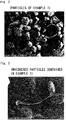
- the particles of this powder include whiskered particles shown in Fig. 3 among particles having a rough surface with a small aspect ratio. Since the particles having a rough surface and the whiskered particles are mixed, the powder of the present invention has a predetermined particle diameter and a predetermined range of repose angle.
- the particles of the powder may include a plurality of particles for one whisker, a plurality of whiskers for one particle or a plurality of particles for a plurality of whiskers. This is because the entanglement of the particles of the powder is strengthened. In Fig. 3 , particles are attached to both ends of one whisker.
- the powder of the present invention contains 50 mass% or more of particles which do not pass through a sieve having an opening size of 500 ⁇ m and has an extremely large repose angle of 51° or more, specifically 55° or more and a low bulk density of 0.30 to 0.54 g/ml.
- the above repose angle is equivalent to the side face angle ⁇ of a conical deposit 5 formed on a disk 1 having a predetermined size when an excessive amount of the powder (particulate) is dropped from a hopper 3 arranged at a fixed height from the disk 1.
- this angle ⁇ (repose angle) becomes larger, friction between particles become larger and the mobility of the particles becomes lower. This is because the existence of whiskered particles restricts the movement of other particles.
- the existence of whiskered particles inhibits the movement of other particles as well, whereby the bulk density falls within the above small range. This is because the particles hardly agglomerate densely. As the number of whiskered particles becomes larger, the bulk density value becomes smaller. For example, with reference to the powder of Comparative Example 2 ( Fig. 5 ) in which whiskered particles are not existent, the bulk density is 0.55 g/ml which is much higher than that of the present invention. Since the movement of particles is not inhibited, particles readily agglomerate densely.
- the mobility of the particles is low.
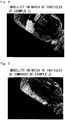
- the mobility of the particles appears in the behavior in water of the particles. That is, as understood from Fig. 6 and Fig. 7 which show the results of tests on the movement behaviors of particles in water which were carried out in Examples and Comparative Examples, the particles move collectively in water in the powders of Examples having the above particle shape whereas the particles move separate from one another in water in the powders of Comparative Examples which do not have the above particle shape.
- the powder of the present invention having the above-described particle shape
- 16-mesh pass opening size of 1,000 ⁇ m
- 20-mesh pass opening size of 850 ⁇ m
- 42-mesh opening size of 355 ⁇ m
- the powder of the present invention comprises hydrolyzable resin particles having the above particle shape. That is, since the hydrolyzable resin is used, after drilling, this additive for drilling fluids hydrolyzes and loses its particle shape, thereby making it possible to avoid an influence on the environment effectively. In a shallow site where an enzyme functions, the additive is also hydrolyzed by the enzyme, thereby making it possible to avoid an influence on the environment more effectively.
- a water-insoluble hydrolyzable resin is used as the hydrolyzable resin. Since a water-soluble hydrolyzable resin cannot develop a function obtained by the above-described particle shape and has too high permeability into the ground and a large influence on the environment, it is not suitable as an additive for use in drilling fluids.
- the water-insoluble hydrolyzable resin is preferably a resin which exhibits appropriate hydrozability at a temperature range of 40 to 200°C, as exemplified by polylactic acid, polyhydroxy alkanoate, polycaprolactone, polybutylene succinate, polybutylene succinate adipate, polybutylene terephthalate adipate, cellulose acetate, thermoplastic starch, polyoxalate and polyglycolic acid. They may be used as a copolymer, alone or in combination of two or more.
- polyoxalate a polymer obtained by polymerizing at least one monomer with oxalic acid in a homopolymer, copolymer or blend material is considered as "polyoxalate”.
- the component forming the copolymer examples include polyhydric alcohols such as ethylene glycol, propylene glycol, butanediol, hexanediol, octanediol, dodecanediol, neopentyl glycol, glycerin, pentaerythritol, sorbitan, bisphenol A and polyethylene glycol; dicarboxylic acids and diesters thereof such as oxalic acid, succinic acid, adipic acid, sebacic acid, glutaric acid, decanedicarboxylic acid, cyclohexanedicarboxylic acid, terephthalic acid, isophthalic acid and anthracenedicarboxylic acid; hydroxycarboxylic acids such as glycolic acid, L-lactic acid, D-lactic acid, hydroxypropionic acid, hydroxybutyric acid, hydroxyvaleric acid, hydroxycaproic acid, mandelic acid and hydroxy
- polylactic acid, polyoxalate, polyglycolic acid and blends thereof are preferred as they exhibit suitable stability at 180°C or lower and keep their particle shape stably during drilling work, and polylactic acid is most suitable as it is inexpensive and easily obtains the above particle shape by mechanical grinding.
- Polylactic acid may be either 100 % poly-L-lactic acid, 100 % poly-D-lactic acid, a molten blend of poly-L-lactic acid and poly-D-lactic acid, or a random copolymer or block copolymer of L-lactic acid and D-lactic acid.
- the above polylactic acid preferably has low crystallinity, for example, a crystallinity of 30 % or less since the above-described particle shape is easily obtained by mechanical grinding. That is, polylactic acid having high crystallinity provides particles having a shape close to an angular shape when it is mechanically ground and it may be difficult to produce the above-described whiskered particles.
- this polylactic acid having low crystallinity is generally a molten blend of poly-L-lactic acid and poly-D-lactic acid, or a random copolymer or block copolymer of L-lactic acid and D-lactic acid, and the ratio (L:D) of L-lactic acid to D-lactic acid is generally 2:98 to 98:2.
- the above-described hydrolyzable resin should serve as a sealing material when it is used as a fracturing fluid and should have a suitable molecular weight in terms of permeability into the ground, generally a weight-average molecular weight of 5,000 to 1,000,000, preferably 10,000 to 500,000.
- the above hydrolyzable resin is mixed with a suitable compounding agent as required, particularly preferably a plasticizer or a compatible material to obtain the above-described particle shape by mechanical grinding.
- plasticizer examples include, not limited to, ester-based plasticizers such as dioctyl phthalate and benzyl-2-(2-methoxyethoxy)ethyl adipate and examples of the compatible material include cellulose-based materials such as cellulose propionate.
- the above plasticizer or compatible material is preferably used in an amount of 1 to 20 parts by mass based on 100 parts by mass of the above hydrolyzable resin.
- amount of the plasticizer is too large, it is difficult to produce particles by mechanical grinding and when the amount of the plasticizer is too small or when the plasticizer is not used, even if particles can be produced by mechanical grinding, it is difficult to form whiskered particles.
- compounding agents may be added to the hydrolyzable resin particles used in the present invention, they should be used as long as the production of particles accompanied by the formation of whiskered particles by mechanical grinding is not inhibited, and a compounding agent such as a pigment, filler or nucleus forming agent should be avoided as the production of particles is inhibited.
- the powder of the present invention which comprises the above-described water-insoluble hydrolyzable resin particles is produced by melt kneading together the above-described hydrolyzable resin with suitably formulated compounding agents in an extruder, pelletizing the extruded molten product to produce a pellet having a size of about 3 mm and mechanically grinding this pellet into particles.
- the above mechanical grinding is carried out by dry system. That is, mechanical grinding using a liquid medium makes it difficult to form whiskered particles. Probably, it is assumed that a load applied to each pellet becomes even in wet grinding with the result that the formation of whiskered particles becomes difficult. That is, it is believed that a load applied to pellets and heat generation tend to become localized in dry grinding, resulting in the formation of whiskers.
- the above mechanical grinding should be carried out by keeping the pellets to be ground at a temperature close to normal temperature of 20 to 100°C.
- a temperature close to normal temperature of 20 to 100°C For example, when it is carried out under heating, it may be difficult to produce particles by mechanical grinding.
- the pellets are mechanically ground while they are kept frozen like freeze grinding, mechanical grindability is enhanced more than required with the result that it is difficult to form whiskered particles even if particles can be produced.
- the grinding time and the grinding pressure are set to ensure that whiskered particles are formed according to the specifications of a grinder in use by conducting preliminary tests.
- the powder obtained by the above mechanical grinding is classified to a suitable size by putting it through a sieve, injected into a drilling fluid typified by water and used for the extraction of an underground resource.
- the amount of the powder injected is preferably 0.01 to 20 wt%, particularly preferably 0.01 to 10 wt% based on the liquid medium (for example, water) in order to carry out the drilling of a winze or hydraulic fracturing smoothly by using this drilling fluid.
- the powder of the present invention When the powder of the present invention is used as an additive for drilling fluids, since the mobility of the particles is low and the particles are not separated from one another and move collectively in a liquid medium, it is very effective as a sealing material for hydraulic fracturing. Further, as it has the function of keeping a fracture formed by hydraulic fracturing effectively, it can carry out the extraction of a resource effectively.
- Polylactic acid (PLA) used in the following experiments, types of compounding agents and the evaluation of characteristic properties are given below.
- Particles are dropped into a 100 ml stainless container to measure the weight so as to calculate bulk density (g/ml) from this weight.
- a 500 ml DURAN bottle was filled with distilled water, and 1 g of sample particles was added and precipitated.
- the DURAN bottle was inclined at 135° to observe the movement behavior of the particles. ⁇ indicates that it is recognized that 50 wt% or more of particles move collectively and ⁇ indicates that it is recognized that the particles move separate from one another.
- the particles were put through a sieve having an opening size of 500 ⁇ m, and the proportion of particles remaining on the sieve was calculated. mass of particles on 500 ⁇ m sieve / mass of all particles ⁇ 100
- the master pellet produced above was ground by using a mechanical grinder (Spiral Mill of Seishin Enterprise Co., Ltd.) under the following conditions.
- the obtained particles were classified between a 20-mesh (opening size of 850 ⁇ m) sieve and a 42-mesh (opening size of 355 ⁇ m) sieve to obtain a powder.
- the obtained powder was measured for bulk density, repose angle and mobility in water, and the measurement results are shown in Table 1.
- FIG. 6 A photo showing mobility in water is shown in Fig. 6 .
- a powder was obtained in the same manner as in Example 1 except that 100 parts by weight of PLA and 3 parts by mass of cellulose propionate (compatible material) were blended.
- the obtained powder was measured for bulk density, repose angle and mobility in water, and the measurement results are shown in Table 1.
- the particles exhibited the behavior of moving collectively, which was not so remarkable as in Example 1.
- a master pellet of PLA alone was immersed in liquid nitrogen to be frozen, and this frozen product was mechanically ground by using the same mechanical grinder as in Example 1 and classified in the same manner as in Example 1 to obtain a powder.
- the crystallinity of the powder was 34 %.
- the obtained powder was measured for bulk density, repose angle and mobility in water, and the measurement results are shown in Table 1.
- a powder was obtained in the same manner as in Comparative Example 1 except that 100 parts by mass of PLA and 3 parts by mass of S-BEN E (grinding accelerator) were blended. The crystallinity of the powder was 38 %.
- the obtained powder was measured for bulk density, repose angle and mobility in water, and the measurement results are shown in Table 1.
- FIG. 5 An SEM photo (60 magnifications) of this powder is shown in Fig. 5 and a photo showing mobility in water is shown in Fig. 7 .
- Table 1 Compounding agent Amount Grinding method Bulk density (g/ml) Repose angle (°) Particle mobility * Ex. 1 Daifatty-101 15 normal temperature 0.45 57.9 ⁇ 72 Ex. 2 Cellulose propionate 3 normal temperature 0.43 53.4 ⁇ 79 Comp. Ex. 1 - - freeze - 49.8 ⁇ - Comp. Ex. 2 S-BEN E 3 freeze 0.55 50.7 ⁇ 83 *: Proportion of particles passing through an opening size of 500 ⁇ m (mass%)
Landscapes
- Chemical & Material Sciences (AREA)
- Organic Chemistry (AREA)
- Life Sciences & Earth Sciences (AREA)
- General Life Sciences & Earth Sciences (AREA)
- Engineering & Computer Science (AREA)
- Materials Engineering (AREA)
- Chemical Kinetics & Catalysis (AREA)
- Health & Medical Sciences (AREA)
- Medicinal Chemistry (AREA)
- Polymers & Plastics (AREA)
- Compositions Of Macromolecular Compounds (AREA)
- Biological Depolymerization Polymers (AREA)
- Processes Of Treating Macromolecular Substances (AREA)
Abstract
Description
- The present invention relates to a powder comprising hydrolyzable resin particles.
- Hydrolyzable resins typified by polylactic acid are excellent in biodegradability and are now under study as substitutes for various plastics in various application fields from the viewpoint of environmental improvement, and some of them have been put to practical use.
- In recent years, use of the resins as additives to be added to drilling fluids used to extract underground resources has been proposed (refer to Patent Document 1).
- For example, a winze drilling method called "hydraulic fracturing method" is now widely employed to extract underground resources. In this drilling method, a high pressure is applied to a drilling fluid filled in a winze to form cracks (fractures) in the vicinity of the winze so as to improve permeability (ease of the fluid's flow) in the vicinity of the winze and to expand the effective sectional area through which a resource such as oil or gas flows into the winze, thereby increasing the productivity of the winze. This drilling fluid is also called "fracturing fluid", and a viscous fluid such as gel-like gasoline was used. However, an aqueous dispersion prepared by dissolving or dispersing polymer particles in water has recently been used due to the development of shale gas produced from shale strata existent at relatively shallow sites in consideration of an influence on the environment. A hydrolyzable resin such as polylactic acid is proposed as this polymer.
- That is, polylactic acid is a substance which exhibits hydrolyzabibility and biodegradability and is decomposed by water or an enzyme contained in the ground even if it remains in the ground and therefore does not exert a bad influence on the environment. Water used as a dispersion medium can be considered to have almost no influence on the environment as compared with gasoline.
- When a drilling fluid containing hydrolyzable resin particles such as polylactic acid dispersed in water is filled in a winze and pressurized, the resin particles permeate an area in the vicinity of the winze and become a sealing material for the formed fractures to temporarily block a flow channel of a resource such as gas or oil effectively. To form new fractures, the fluid is also used as a diverting agent for switching a flow channel of a fracturing fluid. Further, since the fluid is hydrolyzed in the winze and disappears, the hydrolyzable particles do not need to be removed in a post-step, thereby making it possible to carry out the drilling of the winze efficiently.
- By the way, a large number of studies have been made on the heat resistance and mechanical properties of a hydrolyzable resin such as polylactic acid but almost no studies are made on its particle shape.
- For example,
Patent Document 2 discloses a biodegradable resin composition (polylactic acid composition) comprising polylactic acid having a D-isomer content of 2 mass% or less and lamellar silicate. However,Patent Document 2 is aimed to improve the heat resistance and mechanical properties of this polylactic acid composition and does not investigate its particle shape at all. - Patent Document 3 discloses a powder comprising polylactic acid having a crystallinity of 30 % or more. This polylactic acid powder has such high mechanical grindability that it can be particulated. However, Patent Document 3 does not investigate its particle shape as well.
- Further, the inventors of the present invention proposed a polylactic acid composition which comprises low crystalline or amorphous polylactic acid having a crystallinity of 40 % or less as a matrix and has a dispersion structure that an organically modified polysaccharide or swollen or expanded layered silicate salt is dispersed as a grinding accelerator in the matrix (Japanese Patent Application No.
2014-47835 - This polylactic acid composition has advantages that it has excellent mechanical grindability and is easily particulated at a low cost to be usable as an additive for drilling fluids. That is, since an agent to be added to a liquid such as a drilling fluid which is used in a large quantity is used in a large quantity as a matter of course, the possibility of preparing it as fine particles which are easy to be injected into a liquid such as water and easy to handle at the time of injection at a low cost brings about a great benefit in terms of cost.
- Although the mechanical grindability of particles used as an additive for drilling fluids is studied in the above previous application, the particle shape is not investigated at all as well.
-
- Patent Document 1:
US Patent No 7,833,950 - Patent Document 2: Japanese Patent No.
3831278 - Patent Document 3: Japanese Patent No.
5093834 - The inventors of the present invention further proceeded with studies on the mechanical grindability of hydrolyzable resin particles used as the above-described additive for drilling fluids and found that the shapes of the obtained hydrolyzable resin particles exert a great influence on drilling properties and the sealability of a fracture extending from a winze.
- That is, it is an object of the present invention to provide an additive for drilling fluids which comprises hydrolyzable resin particles, enhances the mobility in a winze of the hydrolyzable particles contained in a drilling fluid and can improve the sealability of a fracture extending from the winze.
- According to the present invention, there is provided a powder which comprises hydrolyzable resin particles, contains particles which do not pass through a sieve having an opening size of 500 µm in an amount of 50 mass% or more and has a repose angle of 51° or more.
- In the powder of the present invention, preferably,
- (1) the above hydrolyzable resin particles have a 16-mesh pass particle diameter;
- (2) the powder has a bulk density of 0.30 to 0.54 g/ml;
- (3) the above hydrolyzable resin is polylactic acid; and
- (4) the powder is used as an additive for drilling fluids.
- The powder of the present invention comprises hydrolyzable resin particles, and a drilling fluid containing this has a feature that the powder has a large repose angle even when the particles have a predetermined diameter. The particularly important feature of the powder is that the powder has a content of particles which do not pass through a sieve having an opening size of 500 µm of 50 mass % or more, a large repose angle of 51° or more and a very low bulk density of 0.30 to 0.54 g/ml.
- That is, the repose angle is a parameter indicative of friction between particles and resistivity to the movement of particles. A large repose angle means large friction between particles and the low mobility of particles. In addition, when the bulk density falls within the above small range, the particles are hardly filled densely and agglomerates of the particles are hardly compressed and have a hardly flowable shape.
- Therefore, in a drilling fluid prepared by injecting the powder of the present invention into a fluid such as water, the powder particles (hydrolyzable resin particles) are hardly separated from one another and behave collectively. This behavior state of the particles is shown in a photo of
Fig. 6 . As a result, in the drilling fluid filled in the winze, the particles of this powder are existent collectively in part of the winze and move collectively when a pressure is applied to this drilling fluid, and this powder functions as a sealing material to temporarily seal a fracture and temporarily block a flow channel of a resource such as a gas or oil and a flow channel of a fracturing fluid. That is, by using this sealing material, the winze can be drilled efficiently. - In addition, when a fracture is formed as described above, some of the above powder particles (hydrolyzable particles) are pressed into the fracture. Since conventionally known polylactic acid particles have high flowability, they are removed from the inside of the fracture by the pressure of a resource gas flown into the winze from the fracture. As a result, this fracture is easily removed by pressure in the ground. On the other hand, the powder particles of the present invention have extremely low mobility and are therefore hardly removed from the inside of a fracture. In other words, they are apt to remain in the fracture and keep the sealing of the fracture effectively.
- Therefore, the powder of the present invention can keep the formation and sealing of a fracture effectively with pressurization by applying a drilling fluid to a winze and can carry out the extraction of a resource such as a shale gas through this fracture effectively as an additive for drilling fluids.
- The above additive for drilling has hydrolyzability like conventionally known additives and hydrolyzes swiftly after the extraction of a resource, thereby causing no environmental contamination.
- Further, since the above additive for drilling has low mobility, it is hardly scattered, easy to handle and easily transported and injected into a liquid.
-
-
Fig. 1 is a diagram for explaining the repose angle of particles; -
Fig. 2 shows an SEM photo of the particle shape of the powder of the present invention prepared in Example 1 (20 magnifications); -
Fig. 3 shows an SEM photo of whiskered particles included in the particles of the powder of Example 1 (47 magnifications); -
Fig. 4 shows an SEM photo of whiskered particles included in the particles of the powder of the present invention prepared in Example 2 (47 magnifications); -
Fig. 5 shows an SEM photo of the particle shape of the powder of Comparative Example 2 (60 magnifications); -
Fig. 6 shows a photo of the movement behavior in water of the powder of Example 1; and -
Fig. 7 shows a photo of the movement behavior in water of the powder of Comparative Example 1. - The powder of the present invention is composed of particles having a predetermined particle diameter and has a predetermined range of repose angle. This particle diameter and this repose angle are derived from an extremely peculiar particle shape.
- For example, as understood from an SEM photo of
Fig. 2 which shows the particle shape of the powder prepared in Example 1 which will be described hereinafter, the particles of this powder include whiskered particles shown inFig. 3 among particles having a rough surface with a small aspect ratio. Since the particles having a rough surface and the whiskered particles are mixed, the powder of the present invention has a predetermined particle diameter and a predetermined range of repose angle. The particles of the powder may include a plurality of particles for one whisker, a plurality of whiskers for one particle or a plurality of particles for a plurality of whiskers. This is because the entanglement of the particles of the powder is strengthened. InFig. 3 , particles are attached to both ends of one whisker. - That is, reflecting the above particle structure on repose angle and bulk density, the powder of the present invention contains 50 mass% or more of particles which do not pass through a sieve having an opening size of 500 µm and has an extremely large repose angle of 51° or more, specifically 55° or more and a low bulk density of 0.30 to 0.54 g/ml.
- As shown in
Fig. 1 , the above repose angle is equivalent to the side face angle θ of aconical deposit 5 formed on adisk 1 having a predetermined size when an excessive amount of the powder (particulate) is dropped from a hopper 3 arranged at a fixed height from thedisk 1. As this angle θ (repose angle) becomes larger, friction between particles become larger and the mobility of the particles becomes lower. This is because the existence of whiskered particles restricts the movement of other particles. - For example, even if the surface of each particle is rough, when the above whiskered particles are not existent, the repose angle of the powder is lower and the mobility of the particles is higher than those of the present invention (refer to Comparative Example 2 which will be described hereinafter and
Fig. 7 ). - Further, as for the bulk density, the existence of whiskered particles inhibits the movement of other particles as well, whereby the bulk density falls within the above small range. This is because the particles hardly agglomerate densely. As the number of whiskered particles becomes larger, the bulk density value becomes smaller. For example, with reference to the powder of Comparative Example 2 (
Fig. 5 ) in which whiskered particles are not existent, the bulk density is 0.55 g/ml which is much higher than that of the present invention. Since the movement of particles is not inhibited, particles readily agglomerate densely. - Since the powder of the present invention has the above particle shape, the mobility of the particles is low. The mobility of the particles appears in the behavior in water of the particles. That is, as understood from
Fig. 6 and Fig. 7 which show the results of tests on the movement behaviors of particles in water which were carried out in Examples and Comparative Examples, the particles move collectively in water in the powders of Examples having the above particle shape whereas the particles move separate from one another in water in the powders of Comparative Examples which do not have the above particle shape. - In the powder of the present invention having the above-described particle shape, in general, when the powder is injected into a liquid such as water to be used as a drilling fluid, to make full use of a function obtained by the low mobility of the powder, it is desired that 16-mesh pass (opening size of 1,000 µm), preferably 20-mesh pass (opening size of 850 µm) fine particles should be prepared from the powder and further that 42-mesh (opening size of 355 µm) or less pass fine particles should be removed from the powder from the viewpoint of work efficiency.
- The powder of the present invention comprises hydrolyzable resin particles having the above particle shape. That is, since the hydrolyzable resin is used, after drilling, this additive for drilling fluids hydrolyzes and loses its particle shape, thereby making it possible to avoid an influence on the environment effectively. In a shallow site where an enzyme functions, the additive is also hydrolyzed by the enzyme, thereby making it possible to avoid an influence on the environment more effectively.
- A water-insoluble hydrolyzable resin is used as the hydrolyzable resin. Since a water-soluble hydrolyzable resin cannot develop a function obtained by the above-described particle shape and has too high permeability into the ground and a large influence on the environment, it is not suitable as an additive for use in drilling fluids.
- The water-insoluble hydrolyzable resin is preferably a resin which exhibits appropriate hydrozability at a temperature range of 40 to 200°C, as exemplified by polylactic acid, polyhydroxy alkanoate, polycaprolactone,
polybutylene succinate, polybutylene succinate adipate, polybutylene terephthalate adipate, cellulose acetate, thermoplastic starch, polyoxalate and polyglycolic acid. They may be used as a copolymer, alone or in combination of two or more. - In this text, a polymer obtained by polymerizing at least one monomer with oxalic acid in a homopolymer, copolymer or blend material is considered as "polyoxalate".
- Examples of the component forming the copolymer include polyhydric alcohols such as ethylene glycol, propylene glycol, butanediol, hexanediol, octanediol, dodecanediol, neopentyl glycol, glycerin, pentaerythritol, sorbitan, bisphenol A and polyethylene glycol; dicarboxylic acids and diesters thereof such as oxalic acid, succinic acid, adipic acid, sebacic acid, glutaric acid, decanedicarboxylic acid, cyclohexanedicarboxylic acid, terephthalic acid, isophthalic acid and anthracenedicarboxylic acid; hydroxycarboxylic acids such as glycolic acid, L-lactic acid, D-lactic acid, hydroxypropionic acid, hydroxybutyric acid, hydroxyvaleric acid, hydroxycaproic acid, mandelic acid and hydroxybenzoic acid; and lactones such as glycolide, caprolactone, butyrolactone, valerolactone, propiolactone and undecalactone.
- In the present invention, polylactic acid, polyoxalate, polyglycolic acid and blends thereof are preferred as they exhibit suitable stability at 180°C or lower and keep their particle shape stably during drilling work, and polylactic acid is most suitable as it is inexpensive and easily obtains the above particle shape by mechanical grinding.
- Polylactic acid may be either 100 % poly-L-lactic acid, 100 % poly-D-lactic acid, a molten blend of poly-L-lactic acid and poly-D-lactic acid, or a random copolymer or block copolymer of L-lactic acid and D-lactic acid.
- The above polylactic acid preferably has low crystallinity, for example, a crystallinity of 30 % or less since the above-described particle shape is easily obtained by mechanical grinding. That is, polylactic acid having high crystallinity provides particles having a shape close to an angular shape when it is mechanically ground and it may be difficult to produce the above-described whiskered particles. This crystallinity is obtained from the melting enthalpy ΔHm and crystallization enthalpy ΔHc of polylactic acid measured by DSC and a crystal melting calorie of 93. 6 (J/g) when polylactic acid is 100 % crystallized based on the following equation.

- Further, this polylactic acid having low crystallinity is generally a molten blend of poly-L-lactic acid and poly-D-lactic acid, or a random copolymer or block copolymer of L-lactic acid and D-lactic acid, and the ratio (L:D) of L-lactic acid to D-lactic acid is generally 2:98 to 98:2.
- The above-described hydrolyzable resin should serve as a sealing material when it is used as a fracturing fluid and should have a suitable molecular weight in terms of permeability into the ground, generally a weight-average molecular weight of 5,000 to 1,000,000, preferably 10,000 to 500,000.
- In the present invention, the above hydrolyzable resin is mixed with a suitable compounding agent as required, particularly preferably a plasticizer or a compatible material to obtain the above-described particle shape by mechanical grinding.
- A known plasticizer may be used as the plasticizer. Examples of the plasticizer include, not limited to, ester-based plasticizers such as dioctyl phthalate and benzyl-2-(2-methoxyethoxy)ethyl adipate and examples of the compatible material include cellulose-based materials such as cellulose propionate.
- The above plasticizer or compatible material is preferably used in an amount of 1 to 20 parts by mass based on 100 parts by mass of the above hydrolyzable resin. When the amount of the plasticizer is too large, it is difficult to produce particles by mechanical grinding and when the amount of the plasticizer is too small or when the plasticizer is not used, even if particles can be produced by mechanical grinding, it is difficult to form whiskered particles.
- Although other known compounding agents may be added to the hydrolyzable resin particles used in the present invention, they should be used as long as the production of particles accompanied by the formation of whiskered particles by mechanical grinding is not inhibited, and a compounding agent such as a pigment, filler or nucleus forming agent should be avoided as the production of particles is inhibited.
- The powder of the present invention which comprises the above-described water-insoluble hydrolyzable resin particles is produced by melt kneading together the above-described hydrolyzable resin with suitably formulated compounding agents in an extruder, pelletizing the extruded molten product to produce a pellet having a size of about 3 mm and mechanically grinding this pellet into particles.
- In the present invention, the above mechanical grinding is carried out by dry system. That is, mechanical grinding using a liquid medium makes it difficult to form whiskered particles. Probably, it is assumed that a load applied to each pellet becomes even in wet grinding with the result that the formation of whiskered particles becomes difficult. That is, it is believed that a load applied to pellets and heat generation tend to become localized in dry grinding, resulting in the formation of whiskers.
- Further, it is desired that the above mechanical grinding should be carried out by keeping the pellets to be ground at a temperature close to normal temperature of 20 to 100°C. For example, when it is carried out under heating, it may be difficult to produce particles by mechanical grinding. When the pellets are mechanically ground while they are kept frozen like freeze grinding, mechanical grindability is enhanced more than required with the result that it is difficult to form whiskered particles even if particles can be produced.
- The grinding time and the grinding pressure are set to ensure that whiskered particles are formed according to the specifications of a grinder in use by conducting preliminary tests.
- The powder obtained by the above mechanical grinding is classified to a suitable size by putting it through a sieve, injected into a drilling fluid typified by water and used for the extraction of an underground resource. The amount of the powder injected is preferably 0.01 to 20 wt%, particularly preferably 0.01 to 10 wt% based on the liquid medium (for example, water) in order to carry out the drilling of a winze or hydraulic fracturing smoothly by using this drilling fluid.
- When the powder of the present invention is used as an additive for drilling fluids, since the mobility of the particles is low and the particles are not separated from one another and move collectively in a liquid medium, it is very effective as a sealing material for hydraulic fracturing. Further, as it has the function of keeping a fracture formed by hydraulic fracturing effectively, it can carry out the extraction of a resource effectively.
- The following examples are provided to illustrate the excellent effect of the present invention.
- Polylactic acid (PLA) used in the following experiments, types of compounding agents and the evaluation of characteristic properties are given below.
-
- polylactic acid (PLA);
- Revode 101 polylactic acid of ZHEJIANG HISUN BIOMATERIALS CO., LTD.
- content of D-isomer: 4 %
- melting point: 155°C
- weight-average molecular weight (Mw): 200,000
- Plasticizer;
- Daifatty-101 (benzyl-2-(2-methoxyethoxy)ethyl adipate) of Daihachi Chemical Industry Co., Ltd.
- Compatible material; cellulose propionate of Sigma-Aldrich Co., LLC.
- Others;
- S-BEN E organically treated bentonite (grinding accelerator) of HOJUN Co., Ltd.
- Particles are dropped into a 100 ml stainless container to measure the weight so as to calculate bulk density (g/ml) from this weight.
- This was measured by using the powder tester of Hosokawa Micron Corporation.
-
- Disk diameter: 80 mm
- Height of hopper (distance between hopper and disk): 20cm
- A 500 ml DURAN bottle was filled with distilled water, and 1 g of sample particles was added and precipitated.
- The DURAN bottle was inclined at 135° to observe the movement behavior of the particles. ○ indicates that it is recognized that 50 wt% or more of particles move collectively and × indicates that it is recognized that the particles move separate from one another.
- The particles were put through a sieve having an opening size of 500 µm, and the proportion of particles remaining on the sieve was calculated.

- 15 parts by mass of a plasticizer (Daifatty-101) and 100 parts by mass of PLA were blended and melt mixed together by means of a double-extruder (ULT Nano05-20AG of Technovel Corporation) at 200°C, and the molten extruded product was pelletized to produce a master pellet.
- The master pellet produced above was ground by using a mechanical grinder (Spiral Mill of Seishin Enterprise Co., Ltd.) under the following conditions.
- Clearance between fixed blade and rotary blade: 3 mm
- Number of passes: one
- The obtained particles were classified between a 20-mesh (opening size of 850 µm) sieve and a 42-mesh (opening size of 355 µm) sieve to obtain a powder.
- The obtained powder was measured for bulk density, repose angle and mobility in water, and the measurement results are shown in Table 1.
- An SEM photo of this powder taken at 20 magnifications is shown in
Fig. 2 , and further an SEM photo (47 magnifications) of whiskered particles observed in this powder is shown inFig. 3 . - A photo showing mobility in water is shown in
Fig. 6 . - A powder was obtained in the same manner as in Example 1 except that 100 parts by weight of PLA and 3 parts by mass of cellulose propionate (compatible material) were blended.
- The obtained powder was measured for bulk density, repose angle and mobility in water, and the measurement results are shown in Table 1. In the mobility test in water, the particles exhibited the behavior of moving collectively, which was not so remarkable as in Example 1.
- An SEM photo (47 magnifications) of whiskered particles observed in this powder is shown in
Fig. 4 . - A master pellet of PLA alone was immersed in liquid nitrogen to be frozen, and this frozen product was mechanically ground by using the same mechanical grinder as in Example 1 and classified in the same manner as in Example 1 to obtain a powder. The crystallinity of the powder was 34 %.
- The obtained powder was measured for bulk density, repose angle and mobility in water, and the measurement results are shown in Table 1.
- A powder was obtained in the same manner as in Comparative Example 1 except that 100 parts by mass of PLA and 3 parts by mass of S-BEN E (grinding accelerator) were blended. The crystallinity of the powder was 38 %.
- The obtained powder was measured for bulk density, repose angle and mobility in water, and the measurement results are shown in Table 1.
- An SEM photo (60 magnifications) of this powder is shown in
Fig. 5 and a photo showing mobility in water is shown inFig. 7 .Table 1 Compounding agent Amount Grinding method Bulk density (g/ml) Repose angle (°) Particle mobility * Ex. 1 Daifatty-101 15 normal temperature 0.45 57.9 ○ 72 Ex. 2 Cellulose propionate 3 normal temperature 0.43 53.4 ○ 79 Comp. Ex. 1 - - freeze - 49.8 × - Comp. Ex. 2 S-BEN E 3 freeze 0.55 50.7 × 83 *: Proportion of particles passing through an opening size of 500 µm (mass%) -
- 1:
- supporting powder disk
- 3:
- hopper
- 5:
- deposit
Claims (6)
- A powder comprising hydrolyzable resin particles, containing particles which do not pass through a sieve having an opening size of 500 µm in an amount of 50 mass% or more and having a repose angle of 51° or more.
- The powder according to claim 1, wherein the resin particles have a 16-mesh pass particle diameter.
- The powder according to claim 1 which has a bulk density of 0.30 to 0.54 g/ml.
- The powder according to claim 1, wherein the hydrolyzable resin is polylactic acid.
- The powder according to claim 4, wherein the polylactic acid has a crystallinity of 30 % or less.
- The powder according to claim 1 which is used as an additive for drilling fluids.
Applications Claiming Priority (2)
| Application Number | Priority Date | Filing Date | Title |
|---|---|---|---|
| JP2014183305A JP6451160B2 (en) | 2014-09-09 | 2014-09-09 | Powder consisting of hydrolyzable resin particles |
| PCT/JP2015/072727 WO2016039061A1 (en) | 2014-09-09 | 2015-08-11 | Powder comprising hydrolyzable resin particles |
Publications (2)
| Publication Number | Publication Date |
|---|---|
| EP3196230A1 true EP3196230A1 (en) | 2017-07-26 |
| EP3196230A4 EP3196230A4 (en) | 2018-04-04 |
Family
ID=55458819
Family Applications (1)
| Application Number | Title | Priority Date | Filing Date |
|---|---|---|---|
| EP15839330.6A Withdrawn EP3196230A4 (en) | 2014-09-09 | 2015-08-11 | Powder comprising hydrolyzable resin particles |
Country Status (8)
| Country | Link |
|---|---|
| US (1) | US10385171B2 (en) |
| EP (1) | EP3196230A4 (en) |
| JP (1) | JP6451160B2 (en) |
| CN (1) | CN106687509B (en) |
| AU (1) | AU2015313459C1 (en) |
| CA (1) | CA2960647C (en) |
| RU (1) | RU2666871C1 (en) |
| WO (1) | WO2016039061A1 (en) |
Families Citing this family (11)
| Publication number | Priority date | Publication date | Assignee | Title |
|---|---|---|---|---|
| EP3666849A4 (en) | 2017-08-10 | 2020-08-12 | Mitsubishi Chemical Corporation | DEFLECTION MEANS AND METHOD OF USING THEM TO FILL AN INTERMILL |
| JP7342362B2 (en) * | 2017-12-28 | 2023-09-12 | 三菱ケミカル株式会社 | Diverting agent and method for closing cracks in wellbore using the same |
| JPWO2020138252A1 (en) | 2018-12-27 | 2021-11-18 | 三菱ケミカル株式会社 | Divering agent and method of closing cracks in wells using this |
| CN113227160A (en) | 2018-12-27 | 2021-08-06 | 三菱化学株式会社 | Diverter and method for plugging cracks in well using same |
| CN113412285A (en) | 2019-02-13 | 2021-09-17 | 三菱化学株式会社 | Diverting agent and method for blocking cracks in well using same |
| CN113423741B (en) | 2019-02-13 | 2024-07-19 | 三菱化学株式会社 | Diverter and pit crack plugging method using the same |
| EP3925984A4 (en) | 2019-02-13 | 2022-04-06 | Mitsubishi Chemical Corporation | DEFLECTORS AND METHOD OF CLOSING A FRACTURE IN A BOREHOLE WITH THEM |
| WO2020257112A1 (en) * | 2019-06-19 | 2020-12-24 | Stepan Company | Polyester diverting agents for low-temperature oil wells |
| WO2021002471A1 (en) | 2019-07-03 | 2021-01-07 | 三菱ケミカル株式会社 | Diverting agent and method for blocking fractures in well using same |
| JP7686958B2 (en) * | 2020-11-30 | 2025-06-03 | 富士フイルムビジネスイノベーション株式会社 | Resin particles |
| AU2023425835A1 (en) * | 2023-01-27 | 2025-08-07 | Tohoku University | Method for crushing rock multi-directionally and device for crushing rock multi-directionally |
Family Cites Families (15)
| Publication number | Priority date | Publication date | Assignee | Title |
|---|---|---|---|---|
| JPS576509B2 (en) | 1973-12-24 | 1982-02-05 | ||
| JPH0383127A (en) | 1989-08-28 | 1991-04-09 | Nec Corp | Decimal divider |
| JPH0834019A (en) | 1994-07-26 | 1996-02-06 | Mitsubishi Chem Mkv Co | Blocking prevention method |
| CN1364211A (en) * | 1999-07-26 | 2002-08-14 | 碾磨及筛选有限公司 | Method for injecting dense additive into drilling wells and composition therefor |
| US7275596B2 (en) | 2005-06-20 | 2007-10-02 | Schlumberger Technology Corporation | Method of using degradable fiber systems for stimulation |
| JP2007231154A (en) | 2006-03-01 | 2007-09-13 | Sumitomo Seika Chem Co Ltd | Biodegradable resin composition for powder molding |
| JP5332221B2 (en) * | 2008-02-08 | 2013-11-06 | 東レ株式会社 | Chip-like product made of polylactic acid resin composition |
| JP5332552B2 (en) | 2008-11-27 | 2013-11-06 | 東レ株式会社 | Chip-like product made of polylactic acid resin composition |
| US8945245B2 (en) * | 2009-08-24 | 2015-02-03 | The Michigan Biotechnology Institute | Methods of hydrolyzing pretreated densified biomass particulates and systems related thereto |
| CA2760840C (en) * | 2009-08-24 | 2014-12-02 | Board Of Trustees Of Michigan State University | Pretreated densified biomass products and methods of making and using same |
| WO2012105140A1 (en) | 2011-01-31 | 2012-08-09 | 東レ株式会社 | Method for producing microparticles of polylactic acid-based resin, microparticles of polylactic acid-based resin and cosmetic using same |
| JP6081159B2 (en) | 2011-11-28 | 2017-02-15 | 旭化成アドバンス株式会社 | Cleaning agent and manufacturing method thereof |
| US8720556B2 (en) * | 2011-11-30 | 2014-05-13 | Halliburton Energy Services, Inc. | Methods for initiating new fractures in a completed wellbore having existing fractures present |
| WO2014112479A1 (en) * | 2013-01-18 | 2014-07-24 | 株式会社クレハ | Well treatment fluid material, and well treatment fluid comprising same |
| CN103289339A (en) * | 2013-06-24 | 2013-09-11 | 苏州新区佳合塑胶有限公司 | Biodegradable plastic |
-
2014
- 2014-09-09 JP JP2014183305A patent/JP6451160B2/en not_active Expired - Fee Related
-
2015
- 2015-08-11 CN CN201580048401.7A patent/CN106687509B/en active Active
- 2015-08-11 US US15/508,997 patent/US10385171B2/en active Active
- 2015-08-11 AU AU2015313459A patent/AU2015313459C1/en not_active Ceased
- 2015-08-11 RU RU2017111829A patent/RU2666871C1/en active
- 2015-08-11 CA CA2960647A patent/CA2960647C/en active Active
- 2015-08-11 WO PCT/JP2015/072727 patent/WO2016039061A1/en not_active Ceased
- 2015-08-11 EP EP15839330.6A patent/EP3196230A4/en not_active Withdrawn
Also Published As
| Publication number | Publication date |
|---|---|
| CA2960647C (en) | 2020-01-28 |
| JP2016056272A (en) | 2016-04-21 |
| US10385171B2 (en) | 2019-08-20 |
| AU2015313459A1 (en) | 2017-03-16 |
| CA2960647A1 (en) | 2016-03-17 |
| US20170253703A1 (en) | 2017-09-07 |
| AU2015313459C1 (en) | 2018-03-22 |
| RU2666871C1 (en) | 2018-09-12 |
| JP6451160B2 (en) | 2019-01-16 |
| CN106687509B (en) | 2019-04-23 |
| AU2015313459B2 (en) | 2017-11-09 |
| EP3196230A4 (en) | 2018-04-04 |
| CN106687509A (en) | 2017-05-17 |
| WO2016039061A1 (en) | 2016-03-17 |
Similar Documents
| Publication | Publication Date | Title |
|---|---|---|
| CA2960647C (en) | Powder comprising hydrolyzable resin particles | |
| Mohapatra et al. | Effect of PEG on PLA/PEG blend and its nanocomposites: A study of thermo‐mechanical and morphological characterization | |
| Sungsanit et al. | Properties of linear poly (lactic acid)/polyethylene glycol blends | |
| Ferri et al. | Effect of miscibility on mechanical and thermal properties of poly (lactic acid)/polycaprolactone blends | |
| Shahlari et al. | Mechanical and morphological properties of poly (butylene adipate‐co‐terephthalate) and poly (lactic acid) blended with organically modified silicate layers | |
| Bagheriasl et al. | Development of cellulose nanocrystal‐reinforced polylactide: A comparative study on different preparation methods | |
| CN106573712A (en) | Compound between a thermoplastic polymer and a filler for producing films for packaging foodstuffs, in particular coffee capsules | |
| Díaz-García et al. | Functional, thermal and rheological properties of polymer-based magnetic composite filaments for additive manufacturing | |
| Hao et al. | Viscous and elastic properties of polylactide melts filled with silica particles: Effect of particle size and concentration | |
| CN103740346A (en) | Plugging flexibilizer | |
| CA2892493C (en) | Dispersion solution for drilling and method of extraction using the dispersion solution | |
| Pattamaprom et al. | Improvement in impact resistance of polylactic acid by masticated and compatibilized natural rubber | |
| EP3222808A1 (en) | Mining method for underground resources, and hydrolyzable blocking agent for use in said method | |
| JP6243900B2 (en) | Fracturing injection material and fracturing fluid | |
| Faludi et al. | Fiber association and network formation in PLA/lignocellulosic fiber composites | |
| CN104619773B (en) | Aqueous liquid dispersion and fracturing operation additive | |
| AU2015364898B9 (en) | Polyoxalate copolymer | |
| WO2018189670A1 (en) | Process for preparing polymer-graphene composites | |
| Chen et al. | Effects of plasticization and shear stress on phase structure development and properties of soy protein blends | |
| Liu et al. | Different effects of water and glycerol on morphology and properties of poly (lactic acid)/soy protein concentrate blends | |
| JP7484896B2 (en) | Polylactic acid solid composition and method for producing same | |
| JP2025060485A (en) | Stretched Film | |
| Kirsh et al. | Some Aspects of Bio-Decomposed Polymers and Agriculture’s Waste | |
| JP2025148301A (en) | Compost bags and organic waste disposal methods |
Legal Events
| Date | Code | Title | Description |
|---|---|---|---|
| STAA | Information on the status of an ep patent application or granted ep patent |
Free format text: STATUS: THE INTERNATIONAL PUBLICATION HAS BEEN MADE |
|
| PUAI | Public reference made under article 153(3) epc to a published international application that has entered the european phase |
Free format text: ORIGINAL CODE: 0009012 |
|
| STAA | Information on the status of an ep patent application or granted ep patent |
Free format text: STATUS: REQUEST FOR EXAMINATION WAS MADE |
|
| 17P | Request for examination filed |
Effective date: 20170227 |
|
| AK | Designated contracting states |
Kind code of ref document: A1 Designated state(s): AL AT BE BG CH CY CZ DE DK EE ES FI FR GB GR HR HU IE IS IT LI LT LU LV MC MK MT NL NO PL PT RO RS SE SI SK SM TR |
|
| AX | Request for extension of the european patent |
Extension state: BA ME |
|
| DAV | Request for validation of the european patent (deleted) | ||
| DAX | Request for extension of the european patent (deleted) | ||
| A4 | Supplementary search report drawn up and despatched |
Effective date: 20180306 |
|
| RIC1 | Information provided on ipc code assigned before grant |
Ipc: E21B 43/16 20060101ALI20180228BHEP Ipc: C08J 3/12 20060101AFI20180228BHEP Ipc: C09K 8/22 20060101ALI20180228BHEP Ipc: C08L 101/16 20060101ALI20180228BHEP |
|
| STAA | Information on the status of an ep patent application or granted ep patent |
Free format text: STATUS: THE APPLICATION HAS BEEN WITHDRAWN |
|
| 18W | Application withdrawn |
Effective date: 20191011 |