EP3196199B1 - Substituted n-(pyrrolidine-3-yl)-7h-pyrrolo[2,3-d]pyrimidine-4-amine as janus kinase inhibitor - Google Patents
Substituted n-(pyrrolidine-3-yl)-7h-pyrrolo[2,3-d]pyrimidine-4-amine as janus kinase inhibitor Download PDFInfo
- Publication number
- EP3196199B1 EP3196199B1 EP15835571.9A EP15835571A EP3196199B1 EP 3196199 B1 EP3196199 B1 EP 3196199B1 EP 15835571 A EP15835571 A EP 15835571A EP 3196199 B1 EP3196199 B1 EP 3196199B1
- Authority
- EP
- European Patent Office
- Prior art keywords
- methyl
- pyrrolo
- azaspiro
- pyrimidin
- alkyl
- Prior art date
- Legal status (The legal status is an assumption and is not a legal conclusion. Google has not performed a legal analysis and makes no representation as to the accuracy of the status listed.)
- Active
Links
- 229940122245 Janus kinase inhibitor Drugs 0.000 title description 12
- 150000001875 compounds Chemical class 0.000 claims description 162
- 102000015617 Janus Kinases Human genes 0.000 claims description 54
- 108010024121 Janus Kinases Proteins 0.000 claims description 54
- 150000003839 salts Chemical class 0.000 claims description 50
- 208000037265 diseases, disorders, signs and symptoms Diseases 0.000 claims description 49
- 125000004169 (C1-C6) alkyl group Chemical group 0.000 claims description 46
- 201000010099 disease Diseases 0.000 claims description 46
- 238000000034 method Methods 0.000 claims description 41
- 230000000694 effects Effects 0.000 claims description 40
- 239000012453 solvate Substances 0.000 claims description 33
- 238000006243 chemical reaction Methods 0.000 claims description 29
- 125000000008 (C1-C10) alkyl group Chemical group 0.000 claims description 27
- 238000011282 treatment Methods 0.000 claims description 25
- 125000006413 ring segment Chemical group 0.000 claims description 24
- 239000008194 pharmaceutical composition Substances 0.000 claims description 23
- 125000001424 substituent group Chemical group 0.000 claims description 19
- 125000001997 phenyl group Chemical group [H]C1=C([H])C([H])=C(*)C([H])=C1[H] 0.000 claims description 17
- ZUOUZKKEUPVFJK-UHFFFAOYSA-N diphenyl Chemical group C1=CC=CC=C1C1=CC=CC=C1 ZUOUZKKEUPVFJK-UHFFFAOYSA-N 0.000 claims description 16
- 125000003118 aryl group Chemical group 0.000 claims description 15
- 125000001072 heteroaryl group Chemical group 0.000 claims description 15
- 206010039073 rheumatoid arthritis Diseases 0.000 claims description 15
- 125000000171 (C1-C6) haloalkyl group Chemical group 0.000 claims description 12
- 125000006272 (C3-C7) cycloalkyl group Chemical group 0.000 claims description 12
- 125000000592 heterocycloalkyl group Chemical group 0.000 claims description 11
- 229910003827 NRaRb Inorganic materials 0.000 claims description 10
- 206010028980 Neoplasm Diseases 0.000 claims description 8
- 235000010290 biphenyl Nutrition 0.000 claims description 8
- 239000004305 biphenyl Chemical group 0.000 claims description 8
- 125000002541 furyl group Chemical group 0.000 claims description 8
- 125000003386 piperidinyl group Chemical group 0.000 claims description 8
- 208000023275 Autoimmune disease Diseases 0.000 claims description 7
- 125000000304 alkynyl group Chemical group 0.000 claims description 7
- 201000011510 cancer Diseases 0.000 claims description 7
- 125000001624 naphthyl group Chemical group 0.000 claims description 7
- 125000004076 pyridyl group Chemical group 0.000 claims description 7
- 206010035226 Plasma cell myeloma Diseases 0.000 claims description 6
- 230000001105 regulatory effect Effects 0.000 claims description 6
- 125000000882 C2-C6 alkenyl group Chemical group 0.000 claims description 5
- 125000003601 C2-C6 alkynyl group Chemical group 0.000 claims description 5
- 208000022559 Inflammatory bowel disease Diseases 0.000 claims description 5
- 208000034578 Multiple myelomas Diseases 0.000 claims description 5
- 239000003937 drug carrier Substances 0.000 claims description 5
- 230000004064 dysfunction Effects 0.000 claims description 5
- 208000024908 graft versus host disease Diseases 0.000 claims description 5
- 210000000987 immune system Anatomy 0.000 claims description 5
- 238000000338 in vitro Methods 0.000 claims description 5
- 230000003612 virological effect Effects 0.000 claims description 5
- GNHJYSKWNQBQKV-AWEZNQCLSA-N C(CCC)N1CC2(CC2)[C@H](C1)N(C=1C2=C(N=CN=1)NC=C2)C Chemical compound C(CCC)N1CC2(CC2)[C@H](C1)N(C=1C2=C(N=CN=1)NC=C2)C GNHJYSKWNQBQKV-AWEZNQCLSA-N 0.000 claims description 4
- 241000701044 Human gammaherpesvirus 4 Species 0.000 claims description 4
- 241000701806 Human papillomavirus Species 0.000 claims description 4
- 201000004681 Psoriasis Diseases 0.000 claims description 4
- 125000002757 morpholinyl group Chemical group 0.000 claims description 4
- 229910052701 rubidium Inorganic materials 0.000 claims description 4
- 208000017520 skin disease Diseases 0.000 claims description 4
- 125000006374 C2-C10 alkenyl group Chemical group 0.000 claims description 3
- VCBQNQKWRAHHIR-LBPRGKRZSA-N CN([C@H]1CN(CC11CC1)C(CC#N)=O)C=1C2=C(N=CN=1)NC=C2 Chemical compound CN([C@H]1CN(CC11CC1)C(CC#N)=O)C=1C2=C(N=CN=1)NC=C2 VCBQNQKWRAHHIR-LBPRGKRZSA-N 0.000 claims description 3
- 208000009329 Graft vs Host Disease Diseases 0.000 claims description 3
- 206010059176 Juvenile idiopathic arthritis Diseases 0.000 claims description 3
- 206010025135 lupus erythematosus Diseases 0.000 claims description 3
- 201000006417 multiple sclerosis Diseases 0.000 claims description 3
- RMQMEDACIRBQTG-LBPRGKRZSA-N C(C)N1CC2(CC2)[C@H](C1)N(C=1C2=C(N=CN=1)NC=C2)C Chemical compound C(C)N1CC2(CC2)[C@H](C1)N(C=1C2=C(N=CN=1)NC=C2)C RMQMEDACIRBQTG-LBPRGKRZSA-N 0.000 claims description 2
- HQBFYPGGEFCITG-UHFFFAOYSA-N C(C)S(=O)(=O)N1CC2(CC2)C(C1)N(C=1C2=C(N=CN=1)NC=C2)C Chemical compound C(C)S(=O)(=O)N1CC2(CC2)C(C1)N(C=1C2=C(N=CN=1)NC=C2)C HQBFYPGGEFCITG-UHFFFAOYSA-N 0.000 claims description 2
- HQBFYPGGEFCITG-GFCCVEGCSA-N C(C)S(=O)(=O)N1CC2(CC2)[C@@H](C1)N(C=1C2=C(N=CN=1)NC=C2)C Chemical compound C(C)S(=O)(=O)N1CC2(CC2)[C@@H](C1)N(C=1C2=C(N=CN=1)NC=C2)C HQBFYPGGEFCITG-GFCCVEGCSA-N 0.000 claims description 2
- HQBFYPGGEFCITG-LBPRGKRZSA-N C(C)S(=O)(=O)N1CC2(CC2)[C@H](C1)N(C=1C2=C(N=CN=1)NC=C2)C Chemical compound C(C)S(=O)(=O)N1CC2(CC2)[C@H](C1)N(C=1C2=C(N=CN=1)NC=C2)C HQBFYPGGEFCITG-LBPRGKRZSA-N 0.000 claims description 2
- AFTJCCVUPUEBEX-AWEZNQCLSA-N C(CCC)NC(=O)N1CC2(CC2)[C@H](C1)N(C=1C2=C(N=CN=1)NC=C2)C Chemical compound C(CCC)NC(=O)N1CC2(CC2)[C@H](C1)N(C=1C2=C(N=CN=1)NC=C2)C AFTJCCVUPUEBEX-AWEZNQCLSA-N 0.000 claims description 2
- BWPLYMKALPDBAA-ZDUSSCGKSA-N C1(CC1)C(=O)N1CC2(CC2)[C@H](C1)N(C=1C2=C(N=CN=1)NC=C2)C Chemical compound C1(CC1)C(=O)N1CC2(CC2)[C@H](C1)N(C=1C2=C(N=CN=1)NC=C2)C BWPLYMKALPDBAA-ZDUSSCGKSA-N 0.000 claims description 2
- ZBOAMZJNYRMYAY-INIZCTEOSA-N C1(CCCCC1)NC(=O)N1CC2(CC2)[C@H](C1)N(C=1C2=C(N=CN=1)NC=C2)C Chemical compound C1(CCCCC1)NC(=O)N1CC2(CC2)[C@H](C1)N(C=1C2=C(N=CN=1)NC=C2)C ZBOAMZJNYRMYAY-INIZCTEOSA-N 0.000 claims description 2
- RAQWQNOQURLRFU-AWEZNQCLSA-N CC(CC(=O)N1CC2(CC2)[C@H](C1)N(C=1C2=C(N=CN=1)NC=C2)C)C Chemical compound CC(CC(=O)N1CC2(CC2)[C@H](C1)N(C=1C2=C(N=CN=1)NC=C2)C)C RAQWQNOQURLRFU-AWEZNQCLSA-N 0.000 claims description 2
- PFZIIDVSMULVAE-UHFFFAOYSA-N CN(C1CN(CC11CC1)C(=O)OCC(C)C)C=1C2=C(N=CN=1)NC=C2 Chemical compound CN(C1CN(CC11CC1)C(=O)OCC(C)C)C=1C2=C(N=CN=1)NC=C2 PFZIIDVSMULVAE-UHFFFAOYSA-N 0.000 claims description 2
- VCBQNQKWRAHHIR-UHFFFAOYSA-N CN(C1CN(CC11CC1)C(CC#N)=O)C=1C2=C(N=CN=1)NC=C2 Chemical compound CN(C1CN(CC11CC1)C(CC#N)=O)C=1C2=C(N=CN=1)NC=C2 VCBQNQKWRAHHIR-UHFFFAOYSA-N 0.000 claims description 2
- HPAFFYYHJGRTJG-UHFFFAOYSA-N CN(C1CN(CC11CC1)C(CC#N)=S)C=1C2=C(N=CN=1)NC=C2 Chemical compound CN(C1CN(CC11CC1)C(CC#N)=S)C=1C2=C(N=CN=1)NC=C2 HPAFFYYHJGRTJG-UHFFFAOYSA-N 0.000 claims description 2
- AZEACNHUQATBKE-UHFFFAOYSA-N CN(C1CN(CC11CC1)C(CC)=O)C=1C2=C(N=CN=1)NC=C2 Chemical compound CN(C1CN(CC11CC1)C(CC)=O)C=1C2=C(N=CN=1)NC=C2 AZEACNHUQATBKE-UHFFFAOYSA-N 0.000 claims description 2
- UCJJHBAXMVOLTL-UHFFFAOYSA-N CN(C1CN(CC11CC1)C(CNC(C)=O)=O)C=1C2=C(N=CN=1)NC=C2 Chemical compound CN(C1CN(CC11CC1)C(CNC(C)=O)=O)C=1C2=C(N=CN=1)NC=C2 UCJJHBAXMVOLTL-UHFFFAOYSA-N 0.000 claims description 2
- IIIQBCNQLZDAAG-HNNXBMFYSA-N CN(C=1C2=C(N=CN=1)NC=C2)[C@H]1CN(CC11CC1)CCCCC Chemical compound CN(C=1C2=C(N=CN=1)NC=C2)[C@H]1CN(CC11CC1)CCCCC IIIQBCNQLZDAAG-HNNXBMFYSA-N 0.000 claims description 2
- YWFDKNDOPAAQCS-JTQLQIEISA-N CN(C=1C2=C(N=CN=1)NC=C2)[C@H]1CN(CC11CC1)S(=O)(=O)C(F)(F)F Chemical compound CN(C=1C2=C(N=CN=1)NC=C2)[C@H]1CN(CC11CC1)S(=O)(=O)C(F)(F)F YWFDKNDOPAAQCS-JTQLQIEISA-N 0.000 claims description 2
- JZLDVKHEWADZAR-INIZCTEOSA-N CN(C=1C2=C(N=CN=1)NC=C2)[C@H]1CN(CC11CC1)S(=O)(=O)C1=C(C=CC=C1)[N+](=O)[O-] Chemical compound CN(C=1C2=C(N=CN=1)NC=C2)[C@H]1CN(CC11CC1)S(=O)(=O)C1=C(C=CC=C1)[N+](=O)[O-] JZLDVKHEWADZAR-INIZCTEOSA-N 0.000 claims description 2
- BKGKPMLTBUNMAR-INIZCTEOSA-N CN(C=1C2=C(N=CN=1)NC=C2)[C@H]1CN(CC11CC1)S(=O)(=O)C1=CC(=CC=C1)[N+](=O)[O-] Chemical compound CN(C=1C2=C(N=CN=1)NC=C2)[C@H]1CN(CC11CC1)S(=O)(=O)C1=CC(=CC=C1)[N+](=O)[O-] BKGKPMLTBUNMAR-INIZCTEOSA-N 0.000 claims description 2
- BWIYKGGUYWCIKC-FQEVSTJZSA-N CN(C=1C2=C(N=CN=1)NC=C2)[C@H]1CN(CC11CC1)S(=O)(=O)C1=CC2=CC=CC=C2C=C1 Chemical compound CN(C=1C2=C(N=CN=1)NC=C2)[C@H]1CN(CC11CC1)S(=O)(=O)C1=CC2=CC=CC=C2C=C1 BWIYKGGUYWCIKC-FQEVSTJZSA-N 0.000 claims description 2
- NAZHNUFMGCGNTD-INIZCTEOSA-N CN(C=1C2=C(N=CN=1)NC=C2)[C@H]1CN(CC11CC1)S(=O)(=O)C1=CC=C(C=C1)C(F)(F)F Chemical compound CN(C=1C2=C(N=CN=1)NC=C2)[C@H]1CN(CC11CC1)S(=O)(=O)C1=CC=C(C=C1)C(F)(F)F NAZHNUFMGCGNTD-INIZCTEOSA-N 0.000 claims description 2
- ZJDUQKPBAGGECL-INIZCTEOSA-N CN(C=1C2=C(N=CN=1)NC=C2)[C@H]1CN(CC11CC1)S(=O)(=O)C1=CC=C(C=C1)[N+](=O)[O-] Chemical compound CN(C=1C2=C(N=CN=1)NC=C2)[C@H]1CN(CC11CC1)S(=O)(=O)C1=CC=C(C=C1)[N+](=O)[O-] ZJDUQKPBAGGECL-INIZCTEOSA-N 0.000 claims description 2
- MWCVRSQNXAOLSO-INIZCTEOSA-N CN(C=1C2=C(N=CN=1)NC=C2)[C@H]1CN(CC11CC1)S(=O)(=O)C1=CC=CC=C1 Chemical compound CN(C=1C2=C(N=CN=1)NC=C2)[C@H]1CN(CC11CC1)S(=O)(=O)C1=CC=CC=C1 MWCVRSQNXAOLSO-INIZCTEOSA-N 0.000 claims description 2
- ONQULHWPVWQCNN-KRWDZBQOSA-N CN(C=1C2=C(N=CN=1)NC=C2)[C@H]1CN(CC11CC1)S(=O)(=O)C=1C=C(C=CC=1)C Chemical compound CN(C=1C2=C(N=CN=1)NC=C2)[C@H]1CN(CC11CC1)S(=O)(=O)C=1C=C(C=CC=1)C ONQULHWPVWQCNN-KRWDZBQOSA-N 0.000 claims description 2
- VWKWBBBQXXHROI-ZDUSSCGKSA-N CN(C=1C2=C(N=CN=1)NC=C2)[C@H]1CN(CC11CC1)S(=O)(=O)CCC Chemical compound CN(C=1C2=C(N=CN=1)NC=C2)[C@H]1CN(CC11CC1)S(=O)(=O)CCC VWKWBBBQXXHROI-ZDUSSCGKSA-N 0.000 claims description 2
- NBYARQVBEYSQNL-HNNXBMFYSA-N CN(C=1C2=C(N=CN=1)NC=C2)[C@H]1CN(CC11CC1)S(=O)(=O)N1CCCCC1 Chemical compound CN(C=1C2=C(N=CN=1)NC=C2)[C@H]1CN(CC11CC1)S(=O)(=O)N1CCCCC1 NBYARQVBEYSQNL-HNNXBMFYSA-N 0.000 claims description 2
- QOUNQBWBLJJNBW-AWEZNQCLSA-N CN(C=1C2=C(N=CN=1)NC=C2)[C@H]1CN(CC11CC1)S(=O)(=O)N1CCOCC1 Chemical compound CN(C=1C2=C(N=CN=1)NC=C2)[C@H]1CN(CC11CC1)S(=O)(=O)N1CCOCC1 QOUNQBWBLJJNBW-AWEZNQCLSA-N 0.000 claims description 2
- IVYZKJYSZOVZGL-QGZVFWFLSA-N CN([C@@H]1CN(CC11CC1)C(=O)C1=CC=C(C#N)C=C1)C=1C2=C(N=CN=1)NC=C2 Chemical compound CN([C@@H]1CN(CC11CC1)C(=O)C1=CC=C(C#N)C=C1)C=1C2=C(N=CN=1)NC=C2 IVYZKJYSZOVZGL-QGZVFWFLSA-N 0.000 claims description 2
- PFZIIDVSMULVAE-CQSZACIVSA-N CN([C@@H]1CN(CC11CC1)C(=O)OCC(C)C)C=1C2=C(N=CN=1)NC=C2 Chemical compound CN([C@@H]1CN(CC11CC1)C(=O)OCC(C)C)C=1C2=C(N=CN=1)NC=C2 PFZIIDVSMULVAE-CQSZACIVSA-N 0.000 claims description 2
- VCBQNQKWRAHHIR-GFCCVEGCSA-N CN([C@@H]1CN(CC11CC1)C(CC#N)=O)C=1C2=C(N=CN=1)NC=C2 Chemical compound CN([C@@H]1CN(CC11CC1)C(CC#N)=O)C=1C2=C(N=CN=1)NC=C2 VCBQNQKWRAHHIR-GFCCVEGCSA-N 0.000 claims description 2
- HPAFFYYHJGRTJG-GFCCVEGCSA-N CN([C@@H]1CN(CC11CC1)C(CC#N)=S)C=1C2=C(N=CN=1)NC=C2 Chemical compound CN([C@@H]1CN(CC11CC1)C(CC#N)=S)C=1C2=C(N=CN=1)NC=C2 HPAFFYYHJGRTJG-GFCCVEGCSA-N 0.000 claims description 2
- ZTRZZGYGAQSCON-INIZCTEOSA-N CN([C@H]1CN(CC11CC1)C(=O)C1=C(C=CC=C1)C(F)(F)F)C=1C2=C(N=CN=1)NC=C2 Chemical compound CN([C@H]1CN(CC11CC1)C(=O)C1=C(C=CC=C1)C(F)(F)F)C=1C2=C(N=CN=1)NC=C2 ZTRZZGYGAQSCON-INIZCTEOSA-N 0.000 claims description 2
- UNVBHOFLSGJYDE-INIZCTEOSA-N CN([C@H]1CN(CC11CC1)C(=O)C1=CC(=CC=C1)C(F)(F)F)C=1C2=C(N=CN=1)NC=C2 Chemical compound CN([C@H]1CN(CC11CC1)C(=O)C1=CC(=CC=C1)C(F)(F)F)C=1C2=C(N=CN=1)NC=C2 UNVBHOFLSGJYDE-INIZCTEOSA-N 0.000 claims description 2
- IVYZKJYSZOVZGL-KRWDZBQOSA-N CN([C@H]1CN(CC11CC1)C(=O)C1=CC=C(C#N)C=C1)C=1C2=C(N=CN=1)NC=C2 Chemical compound CN([C@H]1CN(CC11CC1)C(=O)C1=CC=C(C#N)C=C1)C=1C2=C(N=CN=1)NC=C2 IVYZKJYSZOVZGL-KRWDZBQOSA-N 0.000 claims description 2
- WTLXPXUKKTVUIR-INIZCTEOSA-N CN([C@H]1CN(CC11CC1)C(=O)C1=CC=CC=C1)C=1C2=C(N=CN=1)NC=C2 Chemical compound CN([C@H]1CN(CC11CC1)C(=O)C1=CC=CC=C1)C=1C2=C(N=CN=1)NC=C2 WTLXPXUKKTVUIR-INIZCTEOSA-N 0.000 claims description 2
- OCMXVQWXVVAJMF-HNNXBMFYSA-N CN([C@H]1CN(CC11CC1)C(=O)C1=CC=NC=C1)C=1C2=C(N=CN=1)NC=C2 Chemical compound CN([C@H]1CN(CC11CC1)C(=O)C1=CC=NC=C1)C=1C2=C(N=CN=1)NC=C2 OCMXVQWXVVAJMF-HNNXBMFYSA-N 0.000 claims description 2
- BSLBVTSKCBBAKT-KRWDZBQOSA-N CN([C@H]1CN(CC11CC1)C(=O)C=1C=C(C#N)C=CC=1)C=1C2=C(N=CN=1)NC=C2 Chemical compound CN([C@H]1CN(CC11CC1)C(=O)C=1C=C(C#N)C=CC=1)C=1C2=C(N=CN=1)NC=C2 BSLBVTSKCBBAKT-KRWDZBQOSA-N 0.000 claims description 2
- MUGXUBLUVDIGGY-HNNXBMFYSA-N CN([C@H]1CN(CC11CC1)C(=O)C=1C=NC=CC=1)C=1C2=C(N=CN=1)NC=C2 Chemical compound CN([C@H]1CN(CC11CC1)C(=O)C=1C=NC=CC=1)C=1C2=C(N=CN=1)NC=C2 MUGXUBLUVDIGGY-HNNXBMFYSA-N 0.000 claims description 2
- PFZIIDVSMULVAE-AWEZNQCLSA-N CN([C@H]1CN(CC11CC1)C(=O)OCC(C)C)C=1C2=C(N=CN=1)NC=C2 Chemical compound CN([C@H]1CN(CC11CC1)C(=O)OCC(C)C)C=1C2=C(N=CN=1)NC=C2 PFZIIDVSMULVAE-AWEZNQCLSA-N 0.000 claims description 2
- HPAFFYYHJGRTJG-LBPRGKRZSA-N CN([C@H]1CN(CC11CC1)C(CC#N)=S)C=1C2=C(N=CN=1)NC=C2 Chemical compound CN([C@H]1CN(CC11CC1)C(CC#N)=S)C=1C2=C(N=CN=1)NC=C2 HPAFFYYHJGRTJG-LBPRGKRZSA-N 0.000 claims description 2
- UCJJHBAXMVOLTL-ZDUSSCGKSA-N CN([C@H]1CN(CC11CC1)C(CNC(C)=O)=O)C=1C2=C(N=CN=1)NC=C2 Chemical compound CN([C@H]1CN(CC11CC1)C(CNC(C)=O)=O)C=1C2=C(N=CN=1)NC=C2 UCJJHBAXMVOLTL-ZDUSSCGKSA-N 0.000 claims description 2
- QXXFPVNHPWYPOG-KRWDZBQOSA-N CN([C@H]1CN(CC11CC1)S(=O)(=O)C1=C(C#N)C=CC=C1)C=1C2=C(N=CN=1)NC=C2 Chemical compound CN([C@H]1CN(CC11CC1)S(=O)(=O)C1=C(C#N)C=CC=C1)C=1C2=C(N=CN=1)NC=C2 QXXFPVNHPWYPOG-KRWDZBQOSA-N 0.000 claims description 2
- VYIZYCLNYGUXSI-KRWDZBQOSA-N CN([C@H]1CN(CC11CC1)S(=O)(=O)C1=CC=C(C#N)C=C1)C=1C2=C(N=CN=1)NC=C2 Chemical compound CN([C@H]1CN(CC11CC1)S(=O)(=O)C1=CC=C(C#N)C=C1)C=1C2=C(N=CN=1)NC=C2 VYIZYCLNYGUXSI-KRWDZBQOSA-N 0.000 claims description 2
- DHEBFJJCQBLOPI-KRWDZBQOSA-N CN([C@H]1CN(CC11CC1)S(=O)(=O)C=1C=C(C#N)C=CC=1)C=1C2=C(N=CN=1)NC=C2 Chemical compound CN([C@H]1CN(CC11CC1)S(=O)(=O)C=1C=C(C#N)C=CC=1)C=1C2=C(N=CN=1)NC=C2 DHEBFJJCQBLOPI-KRWDZBQOSA-N 0.000 claims description 2
- QMBJJEKRHOUGNT-UHFFFAOYSA-N CNC(CC(=O)N1CC2(CC2)C(C1)N(C=1C2=C(N=CN=1)NC=C2)C)=O Chemical compound CNC(CC(=O)N1CC2(CC2)C(C1)N(C=1C2=C(N=CN=1)NC=C2)C)=O QMBJJEKRHOUGNT-UHFFFAOYSA-N 0.000 claims description 2
- QMBJJEKRHOUGNT-GFCCVEGCSA-N CNC(CC(=O)N1CC2(CC2)[C@@H](C1)N(C=1C2=C(N=CN=1)NC=C2)C)=O Chemical compound CNC(CC(=O)N1CC2(CC2)[C@@H](C1)N(C=1C2=C(N=CN=1)NC=C2)C)=O QMBJJEKRHOUGNT-GFCCVEGCSA-N 0.000 claims description 2
- QMBJJEKRHOUGNT-LBPRGKRZSA-N CNC(CC(=O)N1CC2(CC2)[C@H](C1)N(C=1C2=C(N=CN=1)NC=C2)C)=O Chemical compound CNC(CC(=O)N1CC2(CC2)[C@H](C1)N(C=1C2=C(N=CN=1)NC=C2)C)=O QMBJJEKRHOUGNT-LBPRGKRZSA-N 0.000 claims description 2
- GFHLUVWVWMNJTF-KRWDZBQOSA-N COC1=CC=C(C=C1)S(=O)(=O)N1CC2(CC2)[C@H](C1)N(C=1C2=C(N=CN=1)NC=C2)C Chemical compound COC1=CC=C(C=C1)S(=O)(=O)N1CC2(CC2)[C@H](C1)N(C=1C2=C(N=CN=1)NC=C2)C GFHLUVWVWMNJTF-KRWDZBQOSA-N 0.000 claims description 2
- DPOYHGNZKHQRGF-UHFFFAOYSA-N COCC(=O)N1CC2(CC2)C(C1)N(C=1C2=C(N=CN=1)NC=C2)C Chemical compound COCC(=O)N1CC2(CC2)C(C1)N(C=1C2=C(N=CN=1)NC=C2)C DPOYHGNZKHQRGF-UHFFFAOYSA-N 0.000 claims description 2
- 201000006082 Chickenpox Diseases 0.000 claims description 2
- BTBDKMZBCONPKN-INIZCTEOSA-N ClC1=C(C=C(C=C1)Cl)NC(=O)N1CC2(CC2)[C@H](C1)N(C=1C2=C(N=CN=1)NC=C2)C Chemical compound ClC1=C(C=C(C=C1)Cl)NC(=O)N1CC2(CC2)[C@H](C1)N(C=1C2=C(N=CN=1)NC=C2)C BTBDKMZBCONPKN-INIZCTEOSA-N 0.000 claims description 2
- KRNMWFLASUZVPJ-INIZCTEOSA-N ClC1=C(C=CC(=C1)Cl)NC(=O)N1CC2(CC2)[C@H](C1)N(C=1C2=C(N=CN=1)NC=C2)C Chemical compound ClC1=C(C=CC(=C1)Cl)NC(=O)N1CC2(CC2)[C@H](C1)N(C=1C2=C(N=CN=1)NC=C2)C KRNMWFLASUZVPJ-INIZCTEOSA-N 0.000 claims description 2
- VVJCMTUCIUSSNV-HNNXBMFYSA-N ClC1=C(C=CC=C1Cl)NC(=O)N1CC2(CC2)[C@H](C1)N(C=1C2=C(N=CN=1)NC=C2)C Chemical compound ClC1=C(C=CC=C1Cl)NC(=O)N1CC2(CC2)[C@H](C1)N(C=1C2=C(N=CN=1)NC=C2)C VVJCMTUCIUSSNV-HNNXBMFYSA-N 0.000 claims description 2
- QOGLFESXILBSFS-KRWDZBQOSA-N ClC=1C=C(C=CC=1C)NC(=O)N1CC2(CC2)[C@H](C1)N(C=1C2=C(N=CN=1)NC=C2)C Chemical compound ClC=1C=C(C=CC=1C)NC(=O)N1CC2(CC2)[C@H](C1)N(C=1C2=C(N=CN=1)NC=C2)C QOGLFESXILBSFS-KRWDZBQOSA-N 0.000 claims description 2
- RUFXLBQGCLKUHP-INIZCTEOSA-N ClC=1C=C(C=CC=1Cl)NC(=O)N1CC2(CC2)[C@H](C1)N(C=1C2=C(N=CN=1)NC=C2)C Chemical compound ClC=1C=C(C=CC=1Cl)NC(=O)N1CC2(CC2)[C@H](C1)N(C=1C2=C(N=CN=1)NC=C2)C RUFXLBQGCLKUHP-INIZCTEOSA-N 0.000 claims description 2
- 208000011231 Crohn disease Diseases 0.000 claims description 2
- IRTRJLQCXCTQBK-INIZCTEOSA-N FC(C=1C=C(C=C(C=1)C(F)(F)F)NC(=S)N1CC2(CC2)[C@H](C1)N(C=1C2=C(N=CN=1)NC=C2)C)(F)F Chemical compound FC(C=1C=C(C=C(C=1)C(F)(F)F)NC(=S)N1CC2(CC2)[C@H](C1)N(C=1C2=C(N=CN=1)NC=C2)C)(F)F IRTRJLQCXCTQBK-INIZCTEOSA-N 0.000 claims description 2
- SPCAFPJRCLLTAO-INIZCTEOSA-N FC1=C(C=CC=C1)S(=O)(=O)N1CC2(CC2)[C@H](C1)N(C=1C2=C(N=CN=1)NC=C2)C Chemical compound FC1=C(C=CC=C1)S(=O)(=O)N1CC2(CC2)[C@H](C1)N(C=1C2=C(N=CN=1)NC=C2)C SPCAFPJRCLLTAO-INIZCTEOSA-N 0.000 claims description 2
- BMUSWQPRPCCJGZ-INIZCTEOSA-N FC1=CC=C(C=C1)NC(=O)N1CC2(CC2)[C@H](C1)N(C=1C2=C(N=CN=1)NC=C2)C Chemical compound FC1=CC=C(C=C1)NC(=O)N1CC2(CC2)[C@H](C1)N(C=1C2=C(N=CN=1)NC=C2)C BMUSWQPRPCCJGZ-INIZCTEOSA-N 0.000 claims description 2
- UHNGDIVYWJWQCO-INIZCTEOSA-N FC1=CC=C(C=C1)S(=O)(=O)N1CC2(CC2)[C@H](C1)N(C=1C2=C(N=CN=1)NC=C2)C Chemical compound FC1=CC=C(C=C1)S(=O)(=O)N1CC2(CC2)[C@H](C1)N(C=1C2=C(N=CN=1)NC=C2)C UHNGDIVYWJWQCO-INIZCTEOSA-N 0.000 claims description 2
- XTBSBHXMIZMKNF-INIZCTEOSA-N FC=1C=C(C=CC=1)S(=O)(=O)N1CC2(CC2)[C@H](C1)N(C=1C2=C(N=CN=1)NC=C2)C Chemical compound FC=1C=C(C=CC=1)S(=O)(=O)N1CC2(CC2)[C@H](C1)N(C=1C2=C(N=CN=1)NC=C2)C XTBSBHXMIZMKNF-INIZCTEOSA-N 0.000 claims description 2
- 208000005176 Hepatitis C Diseases 0.000 claims description 2
- 208000007514 Herpes zoster Diseases 0.000 claims description 2
- 241000598436 Human T-cell lymphotropic virus Species 0.000 claims description 2
- 208000003456 Juvenile Arthritis Diseases 0.000 claims description 2
- 206010025323 Lymphomas Diseases 0.000 claims description 2
- XHYWZSFCPCGCCZ-UHFFFAOYSA-N N(=[N+]=[N-])CC(=O)N1CC2(CC2)C(C1)N(C=1C2=C(N=CN=1)NC=C2)C Chemical compound N(=[N+]=[N-])CC(=O)N1CC2(CC2)C(C1)N(C=1C2=C(N=CN=1)NC=C2)C XHYWZSFCPCGCCZ-UHFFFAOYSA-N 0.000 claims description 2
- XHYWZSFCPCGCCZ-NSHDSACASA-N N(=[N+]=[N-])CC(=O)N1CC2(CC2)[C@H](C1)N(C=1C2=C(N=CN=1)NC=C2)C Chemical compound N(=[N+]=[N-])CC(=O)N1CC2(CC2)[C@H](C1)N(C=1C2=C(N=CN=1)NC=C2)C XHYWZSFCPCGCCZ-NSHDSACASA-N 0.000 claims description 2
- JSCHNWFCLLFLKI-UHFFFAOYSA-N NCCC(=O)N1CC2(CC2)C(C1)N(C=1C2=C(N=CN=1)NC=C2)C Chemical compound NCCC(=O)N1CC2(CC2)C(C1)N(C=1C2=C(N=CN=1)NC=C2)C JSCHNWFCLLFLKI-UHFFFAOYSA-N 0.000 claims description 2
- JZZDSWXLUPSZBS-UHFFFAOYSA-N NCCS(=O)(=O)N1CC2(CC2)C(C1)N(C=1C2=C(N=CN=1)NC=C2)C Chemical compound NCCS(=O)(=O)N1CC2(CC2)C(C1)N(C=1C2=C(N=CN=1)NC=C2)C JZZDSWXLUPSZBS-UHFFFAOYSA-N 0.000 claims description 2
- CUDWPBVJWSJYCS-AWEZNQCLSA-N O1C(=CC=C1)C(=O)N1CC2(CC2)[C@H](C1)N(C=1C2=C(N=CN=1)NC=C2)C Chemical compound O1C(=CC=C1)C(=O)N1CC2(CC2)[C@H](C1)N(C=1C2=C(N=CN=1)NC=C2)C CUDWPBVJWSJYCS-AWEZNQCLSA-N 0.000 claims description 2
- 206010060862 Prostate cancer Diseases 0.000 claims description 2
- 208000000236 Prostatic Neoplasms Diseases 0.000 claims description 2
- 206010067584 Type 1 diabetes mellitus Diseases 0.000 claims description 2
- 206010046980 Varicella Diseases 0.000 claims description 2
- 241000700605 Viruses Species 0.000 claims description 2
- 208000010928 autoimmune thyroid disease Diseases 0.000 claims description 2
- 208000002672 hepatitis B Diseases 0.000 claims description 2
- 208000032839 leukemia Diseases 0.000 claims description 2
- 125000001475 halogen functional group Chemical group 0.000 claims 7
- RHJRMSRICKVSAN-ZDUSSCGKSA-N C(C)(C)S(=O)(=O)N1CC2(CC2)[C@H](C1)N(C=1C2=C(N=CN=1)NC=C2)C Chemical compound C(C)(C)S(=O)(=O)N1CC2(CC2)[C@H](C1)N(C=1C2=C(N=CN=1)NC=C2)C RHJRMSRICKVSAN-ZDUSSCGKSA-N 0.000 claims 1
- ZACQRMUGJYRBHB-QFIPXVFZSA-N C1(=C(C=CC=C1)NC(=O)N1CC2(CC2)[C@H](C1)N(C=1C2=C(N=CN=1)NC=C2)C)C1=CC=CC=C1 Chemical compound C1(=C(C=CC=C1)NC(=O)N1CC2(CC2)[C@H](C1)N(C=1C2=C(N=CN=1)NC=C2)C)C1=CC=CC=C1 ZACQRMUGJYRBHB-QFIPXVFZSA-N 0.000 claims 1
- FWXSIDOZNKTNTP-ZDUSSCGKSA-N CC(C(=O)N1CC2(CC2)[C@H](C1)N(C=1C2=C(N=CN=1)NC=C2)C)C Chemical compound CC(C(=O)N1CC2(CC2)[C@H](C1)N(C=1C2=C(N=CN=1)NC=C2)C)C FWXSIDOZNKTNTP-ZDUSSCGKSA-N 0.000 claims 1
- MWCVRSQNXAOLSO-MRXNPFEDSA-N CN(C=1C2=C(N=CN=1)NC=C2)[C@@H]1CN(CC11CC1)S(=O)(=O)C1=CC=CC=C1 Chemical compound CN(C=1C2=C(N=CN=1)NC=C2)[C@@H]1CN(CC11CC1)S(=O)(=O)C1=CC=CC=C1 MWCVRSQNXAOLSO-MRXNPFEDSA-N 0.000 claims 1
- AZEACNHUQATBKE-GFCCVEGCSA-N CN([C@@H]1CN(CC11CC1)C(CC)=O)C=1C2=C(N=CN=1)NC=C2 Chemical compound CN([C@@H]1CN(CC11CC1)C(CC)=O)C=1C2=C(N=CN=1)NC=C2 AZEACNHUQATBKE-GFCCVEGCSA-N 0.000 claims 1
- USCOQMAJRKUEFA-KRWDZBQOSA-N CN([C@H]1CN(CC11CC1)C(=O)C1CCN(CC1)C(C)=O)C=1C2=C(N=CN=1)NC=C2 Chemical compound CN([C@H]1CN(CC11CC1)C(=O)C1CCN(CC1)C(C)=O)C=1C2=C(N=CN=1)NC=C2 USCOQMAJRKUEFA-KRWDZBQOSA-N 0.000 claims 1
- RKIQMMHUMJWNKZ-INIZCTEOSA-N CN([C@H]1CN(CC11CC1)C(=O)NC1=CC=CC=C1)C=1C2=C(N=CN=1)NC=C2 Chemical compound CN([C@H]1CN(CC11CC1)C(=O)NC1=CC=CC=C1)C=1C2=C(N=CN=1)NC=C2 RKIQMMHUMJWNKZ-INIZCTEOSA-N 0.000 claims 1
- XHYWZSFCPCGCCZ-LLVKDONJSA-N N(=[N+]=[N-])CC(=O)N1CC2(CC2)[C@@H](C1)N(C=1C2=C(N=CN=1)NC=C2)C Chemical compound N(=[N+]=[N-])CC(=O)N1CC2(CC2)[C@@H](C1)N(C=1C2=C(N=CN=1)NC=C2)C XHYWZSFCPCGCCZ-LLVKDONJSA-N 0.000 claims 1
- HGVTWRWWMQRRIU-UHFFFAOYSA-N N1(C=NC=C1)CC(=O)N1CC2(CC2)C(C1)N(C=1C2=C(N=CN=1)NC=C2)C Chemical compound N1(C=NC=C1)CC(=O)N1CC2(CC2)C(C1)N(C=1C2=C(N=CN=1)NC=C2)C HGVTWRWWMQRRIU-UHFFFAOYSA-N 0.000 claims 1
- HEDRZPFGACZZDS-MICDWDOJSA-N Trichloro(2H)methane Chemical compound [2H]C(Cl)(Cl)Cl HEDRZPFGACZZDS-MICDWDOJSA-N 0.000 description 148
- 238000005160 1H NMR spectroscopy Methods 0.000 description 75
- 101000997835 Homo sapiens Tyrosine-protein kinase JAK1 Proteins 0.000 description 44
- 102100033438 Tyrosine-protein kinase JAK1 Human genes 0.000 description 43
- 239000000243 solution Substances 0.000 description 33
- 101000997832 Homo sapiens Tyrosine-protein kinase JAK2 Proteins 0.000 description 32
- 101000934996 Homo sapiens Tyrosine-protein kinase JAK3 Proteins 0.000 description 32
- 102100033444 Tyrosine-protein kinase JAK2 Human genes 0.000 description 31
- 102100025387 Tyrosine-protein kinase JAK3 Human genes 0.000 description 31
- OKKJLVBELUTLKV-UHFFFAOYSA-N Methanol Chemical compound OC OKKJLVBELUTLKV-UHFFFAOYSA-N 0.000 description 30
- 102100032028 Non-receptor tyrosine-protein kinase TYK2 Human genes 0.000 description 26
- 108010010057 TYK2 Kinase Proteins 0.000 description 26
- -1 i.e. Proteins 0.000 description 23
- 230000002401 inhibitory effect Effects 0.000 description 22
- 125000004432 carbon atom Chemical group C* 0.000 description 19
- NBIIXXVUZAFLBC-UHFFFAOYSA-N Phosphoric acid Chemical compound OP(O)(O)=O NBIIXXVUZAFLBC-UHFFFAOYSA-N 0.000 description 18
- 230000005764 inhibitory process Effects 0.000 description 18
- 239000000463 material Substances 0.000 description 18
- 238000012360 testing method Methods 0.000 description 18
- 239000003814 drug Substances 0.000 description 17
- 125000005843 halogen group Chemical group 0.000 description 13
- 230000003053 immunization Effects 0.000 description 11
- 238000002649 immunization Methods 0.000 description 11
- 208000024891 symptom Diseases 0.000 description 11
- 239000002904 solvent Substances 0.000 description 10
- QTBSBXVTEAMEQO-UHFFFAOYSA-N Acetic acid Chemical compound CC(O)=O QTBSBXVTEAMEQO-UHFFFAOYSA-N 0.000 description 9
- 102000004127 Cytokines Human genes 0.000 description 9
- 108090000695 Cytokines Proteins 0.000 description 9
- ZMXDDKWLCZADIW-UHFFFAOYSA-N N,N-Dimethylformamide Chemical compound CN(C)C=O ZMXDDKWLCZADIW-UHFFFAOYSA-N 0.000 description 9
- 229910000147 aluminium phosphate Inorganic materials 0.000 description 9
- 239000000203 mixture Substances 0.000 description 9
- 238000003786 synthesis reaction Methods 0.000 description 9
- 229940124597 therapeutic agent Drugs 0.000 description 9
- 108091000080 Phosphotransferase Proteins 0.000 description 8
- 102000020233 phosphotransferase Human genes 0.000 description 8
- 125000003367 polycyclic group Chemical group 0.000 description 8
- YMWUJEATGCHHMB-UHFFFAOYSA-N Dichloromethane Chemical compound ClCCl YMWUJEATGCHHMB-UHFFFAOYSA-N 0.000 description 7
- KCXVZYZYPLLWCC-UHFFFAOYSA-N EDTA Chemical compound OC(=O)CN(CC(O)=O)CCN(CC(O)=O)CC(O)=O KCXVZYZYPLLWCC-UHFFFAOYSA-N 0.000 description 7
- 206010030113 Oedema Diseases 0.000 description 7
- 125000004429 atom Chemical group 0.000 description 7
- 229940079593 drug Drugs 0.000 description 7
- 238000001035 drying Methods 0.000 description 7
- XLYOFNOQVPJJNP-UHFFFAOYSA-N water Substances O XLYOFNOQVPJJNP-UHFFFAOYSA-N 0.000 description 7
- DVLFYONBTKHTER-UHFFFAOYSA-N 3-(N-morpholino)propanesulfonic acid Chemical compound OS(=O)(=O)CCCN1CCOCC1 DVLFYONBTKHTER-UHFFFAOYSA-N 0.000 description 6
- 0 C*1c2c(C)cnc(N(*)C3C(*)(*)CN(*)C3)c2C=C1 Chemical compound C*1c2c(C)cnc(N(*)C3C(*)(*)CN(*)C3)c2C=C1 0.000 description 6
- IAZDPXIOMUYVGZ-UHFFFAOYSA-N Dimethylsulphoxide Chemical compound CS(C)=O IAZDPXIOMUYVGZ-UHFFFAOYSA-N 0.000 description 6
- LFQSCWFLJHTTHZ-UHFFFAOYSA-N Ethanol Chemical compound CCO LFQSCWFLJHTTHZ-UHFFFAOYSA-N 0.000 description 6
- PEDCQBHIVMGVHV-UHFFFAOYSA-N Glycerine Chemical compound OCC(O)CO PEDCQBHIVMGVHV-UHFFFAOYSA-N 0.000 description 6
- 102000004889 Interleukin-6 Human genes 0.000 description 6
- 108090001005 Interleukin-6 Proteins 0.000 description 6
- 241000699666 Mus <mouse, genus> Species 0.000 description 6
- 125000000217 alkyl group Chemical group 0.000 description 6
- 206010003246 arthritis Diseases 0.000 description 6
- 230000015572 biosynthetic process Effects 0.000 description 6
- 230000014509 gene expression Effects 0.000 description 6
- 229910052751 metal Inorganic materials 0.000 description 6
- 239000000758 substrate Substances 0.000 description 6
- 239000012153 distilled water Substances 0.000 description 5
- 125000000524 functional group Chemical group 0.000 description 5
- 239000000543 intermediate Substances 0.000 description 5
- 230000037361 pathway Effects 0.000 description 5
- 239000000546 pharmaceutical excipient Substances 0.000 description 5
- 125000004527 pyrimidin-4-yl group Chemical group N1=CN=C(C=C1)* 0.000 description 5
- 230000002829 reductive effect Effects 0.000 description 5
- 239000000126 substance Substances 0.000 description 5
- SYIKUFDOYJFGBQ-YLAFAASESA-N tofacitinib citrate Chemical compound OC(=O)CC(O)(C(O)=O)CC(O)=O.C[C@@H]1CCN(C(=O)CC#N)C[C@@H]1N(C)C1=NC=NC2=C1C=CN2 SYIKUFDOYJFGBQ-YLAFAASESA-N 0.000 description 5
- 229960004247 tofacitinib citrate Drugs 0.000 description 5
- 125000006583 (C1-C3) haloalkyl group Chemical group 0.000 description 4
- IJGRMHOSHXDMSA-UHFFFAOYSA-N Atomic nitrogen Chemical compound N#N IJGRMHOSHXDMSA-UHFFFAOYSA-N 0.000 description 4
- ULCHDBVNIRJZFJ-KRWDZBQOSA-N C(C1=CC=CC=C1)N1CC2(CC2)[C@H](C1)N(C=1C2=C(N=CN=1)NC=C2)C Chemical compound C(C1=CC=CC=C1)N1CC2(CC2)[C@H](C1)N(C=1C2=C(N=CN=1)NC=C2)C ULCHDBVNIRJZFJ-KRWDZBQOSA-N 0.000 description 4
- 102000000503 Collagen Type II Human genes 0.000 description 4
- 108010041390 Collagen Type II Proteins 0.000 description 4
- 208000009386 Experimental Arthritis Diseases 0.000 description 4
- 102000042838 JAK family Human genes 0.000 description 4
- 108091082332 JAK family Proteins 0.000 description 4
- JGFZNNIVVJXRND-UHFFFAOYSA-N N,N-Diisopropylethylamine (DIPEA) Chemical compound CCN(C(C)C)C(C)C JGFZNNIVVJXRND-UHFFFAOYSA-N 0.000 description 4
- 239000004480 active ingredient Substances 0.000 description 4
- 125000003342 alkenyl group Chemical group 0.000 description 4
- 208000026935 allergic disease Diseases 0.000 description 4
- 239000007864 aqueous solution Substances 0.000 description 4
- 238000003556 assay Methods 0.000 description 4
- 210000004027 cell Anatomy 0.000 description 4
- 229940125904 compound 1 Drugs 0.000 description 4
- 125000000753 cycloalkyl group Chemical group 0.000 description 4
- 239000013024 dilution buffer Substances 0.000 description 4
- 238000002474 experimental method Methods 0.000 description 4
- 230000006870 function Effects 0.000 description 4
- 230000002757 inflammatory effect Effects 0.000 description 4
- 239000003112 inhibitor Substances 0.000 description 4
- 238000005259 measurement Methods 0.000 description 4
- 230000007246 mechanism Effects 0.000 description 4
- 125000002496 methyl group Chemical group [H]C([H])([H])* 0.000 description 4
- 125000002950 monocyclic group Chemical group 0.000 description 4
- 239000013642 negative control Substances 0.000 description 4
- 230000003287 optical effect Effects 0.000 description 4
- 238000006366 phosphorylation reaction Methods 0.000 description 4
- BWHMMNNQKKPAPP-UHFFFAOYSA-L potassium carbonate Chemical compound [K+].[K+].[O-]C([O-])=O BWHMMNNQKKPAPP-UHFFFAOYSA-L 0.000 description 4
- 238000002360 preparation method Methods 0.000 description 4
- 230000008569 process Effects 0.000 description 4
- 108090000765 processed proteins & peptides Proteins 0.000 description 4
- 125000006239 protecting group Chemical group 0.000 description 4
- 230000001225 therapeutic effect Effects 0.000 description 4
- YNCGOADUTRPLFV-ZDUSSCGKSA-N (7R)-5-benzyl-N-methyl-5-azaspiro[2.4]heptan-7-amine Chemical compound C(C1=CC=CC=C1)N1CC2(CC2)[C@H](C1)NC YNCGOADUTRPLFV-ZDUSSCGKSA-N 0.000 description 3
- IKHGUXGNUITLKF-UHFFFAOYSA-N Acetaldehyde Chemical compound CC=O IKHGUXGNUITLKF-UHFFFAOYSA-N 0.000 description 3
- ZCFLUVSCHALOQV-JTQLQIEISA-N CN(C=1C2=C(N=CN=1)NC=C2)[C@H]1CNCC11CC1 Chemical compound CN(C=1C2=C(N=CN=1)NC=C2)[C@H]1CNCC11CC1 ZCFLUVSCHALOQV-JTQLQIEISA-N 0.000 description 3
- 102000004190 Enzymes Human genes 0.000 description 3
- 108090000790 Enzymes Proteins 0.000 description 3
- 206010061218 Inflammation Diseases 0.000 description 3
- 241000699670 Mus sp. Species 0.000 description 3
- MUBZPKHOEPUJKR-UHFFFAOYSA-N Oxalic acid Chemical compound OC(=O)C(O)=O MUBZPKHOEPUJKR-UHFFFAOYSA-N 0.000 description 3
- OFOBLEOULBTSOW-UHFFFAOYSA-N Propanedioic acid Natural products OC(=O)CC(O)=O OFOBLEOULBTSOW-UHFFFAOYSA-N 0.000 description 3
- 206010052779 Transplant rejections Diseases 0.000 description 3
- 230000009471 action Effects 0.000 description 3
- 239000002671 adjuvant Substances 0.000 description 3
- 238000010171 animal model Methods 0.000 description 3
- 230000002917 arthritic effect Effects 0.000 description 3
- 239000003153 chemical reaction reagent Substances 0.000 description 3
- 125000001309 chloro group Chemical group Cl* 0.000 description 3
- KRKNYBCHXYNGOX-UHFFFAOYSA-N citric acid Chemical compound OC(=O)CC(O)(C(O)=O)CC(O)=O KRKNYBCHXYNGOX-UHFFFAOYSA-N 0.000 description 3
- 238000007796 conventional method Methods 0.000 description 3
- 208000035475 disorder Diseases 0.000 description 3
- 239000000839 emulsion Substances 0.000 description 3
- 238000003818 flash chromatography Methods 0.000 description 3
- 125000001188 haloalkyl group Chemical group 0.000 description 3
- 125000005842 heteroatom Chemical group 0.000 description 3
- 210000000548 hind-foot Anatomy 0.000 description 3
- 150000002430 hydrocarbons Chemical group 0.000 description 3
- 125000002883 imidazolyl group Chemical group 0.000 description 3
- 230000028993 immune response Effects 0.000 description 3
- 208000026278 immune system disease Diseases 0.000 description 3
- 230000004054 inflammatory process Effects 0.000 description 3
- 238000001990 intravenous administration Methods 0.000 description 3
- 239000002184 metal Substances 0.000 description 3
- 230000008506 pathogenesis Effects 0.000 description 3
- 230000026731 phosphorylation Effects 0.000 description 3
- 239000011541 reaction mixture Substances 0.000 description 3
- 230000019491 signal transduction Effects 0.000 description 3
- 239000007858 starting material Substances 0.000 description 3
- LENZDBCJOHFCAS-UHFFFAOYSA-N tris Chemical compound OCC(N)(CO)CO LENZDBCJOHFCAS-UHFFFAOYSA-N 0.000 description 3
- 125000006273 (C1-C3) alkyl group Chemical group 0.000 description 2
- MPPPKRYCTPRNTB-UHFFFAOYSA-N 1-bromobutane Chemical compound CCCCBr MPPPKRYCTPRNTB-UHFFFAOYSA-N 0.000 description 2
- KDCGOANMDULRCW-UHFFFAOYSA-N 7H-purine Chemical compound N1=CNC2=NC=NC2=C1 KDCGOANMDULRCW-UHFFFAOYSA-N 0.000 description 2
- 208000031261 Acute myeloid leukaemia Diseases 0.000 description 2
- 108091003079 Bovine Serum Albumin Proteins 0.000 description 2
- 229920002261 Corn starch Polymers 0.000 description 2
- AOJJSUZBOXZQNB-TZSSRYMLSA-N Doxorubicin Chemical compound O([C@H]1C[C@@](O)(CC=2C(O)=C3C(=O)C=4C=CC=C(C=4C(=O)C3=C(O)C=21)OC)C(=O)CO)[C@H]1C[C@H](N)[C@H](O)[C@H](C)O1 AOJJSUZBOXZQNB-TZSSRYMLSA-N 0.000 description 2
- VZCYOOQTPOCHFL-OWOJBTEDSA-N Fumaric acid Chemical compound OC(=O)\C=C\C(O)=O VZCYOOQTPOCHFL-OWOJBTEDSA-N 0.000 description 2
- AEMRFAOFKBGASW-UHFFFAOYSA-N Glycolic acid Chemical compound OCC(O)=O AEMRFAOFKBGASW-UHFFFAOYSA-N 0.000 description 2
- 241000282412 Homo Species 0.000 description 2
- VEXZGXHMUGYJMC-UHFFFAOYSA-N Hydrochloric acid Chemical compound Cl VEXZGXHMUGYJMC-UHFFFAOYSA-N 0.000 description 2
- UFHFLCQGNIYNRP-UHFFFAOYSA-N Hydrogen Chemical compound [H][H] UFHFLCQGNIYNRP-UHFFFAOYSA-N 0.000 description 2
- 108010002352 Interleukin-1 Proteins 0.000 description 2
- 102000000589 Interleukin-1 Human genes 0.000 description 2
- KFZMGEQAYNKOFK-UHFFFAOYSA-N Isopropanol Chemical compound CC(C)O KFZMGEQAYNKOFK-UHFFFAOYSA-N 0.000 description 2
- 229940123241 Janus kinase 3 inhibitor Drugs 0.000 description 2
- GUBGYTABKSRVRQ-QKKXKWKRSA-N Lactose Natural products OC[C@H]1O[C@@H](O[C@H]2[C@H](O)[C@@H](O)C(O)O[C@@H]2CO)[C@H](O)[C@@H](O)[C@H]1O GUBGYTABKSRVRQ-QKKXKWKRSA-N 0.000 description 2
- 241001465754 Metazoa Species 0.000 description 2
- AFVFQIVMOAPDHO-UHFFFAOYSA-N Methanesulfonic acid Chemical compound CS(O)(=O)=O AFVFQIVMOAPDHO-UHFFFAOYSA-N 0.000 description 2
- 208000033776 Myeloid Acute Leukemia Diseases 0.000 description 2
- 208000014767 Myeloproliferative disease Diseases 0.000 description 2
- UFWIBTONFRDIAS-UHFFFAOYSA-N Naphthalene Chemical compound C1=CC=CC2=CC=CC=C21 UFWIBTONFRDIAS-UHFFFAOYSA-N 0.000 description 2
- KDLHZDBZIXYQEI-UHFFFAOYSA-N Palladium Chemical compound [Pd] KDLHZDBZIXYQEI-UHFFFAOYSA-N 0.000 description 2
- RWRDLPDLKQPQOW-UHFFFAOYSA-N Pyrrolidine Chemical group C1CCNC1 RWRDLPDLKQPQOW-UHFFFAOYSA-N 0.000 description 2
- 229940124639 Selective inhibitor Drugs 0.000 description 2
- QAOWNCQODCNURD-UHFFFAOYSA-N Sulfuric acid Chemical compound OS(O)(=O)=O QAOWNCQODCNURD-UHFFFAOYSA-N 0.000 description 2
- DTQVDTLACAAQTR-UHFFFAOYSA-N Trifluoroacetic acid Chemical compound OC(=O)C(F)(F)F DTQVDTLACAAQTR-UHFFFAOYSA-N 0.000 description 2
- 108060008682 Tumor Necrosis Factor Proteins 0.000 description 2
- 239000002253 acid Substances 0.000 description 2
- 125000003277 amino group Chemical group 0.000 description 2
- 239000002246 antineoplastic agent Substances 0.000 description 2
- 208000006673 asthma Diseases 0.000 description 2
- WPYMKLBDIGXBTP-UHFFFAOYSA-N benzoic acid Chemical compound OC(=O)C1=CC=CC=C1 WPYMKLBDIGXBTP-UHFFFAOYSA-N 0.000 description 2
- 125000004196 benzothienyl group Chemical group S1C(=CC2=C1C=CC=C2)* 0.000 description 2
- 125000001584 benzyloxycarbonyl group Chemical group C(=O)(OCC1=CC=CC=C1)* 0.000 description 2
- 229940098773 bovine serum albumin Drugs 0.000 description 2
- 125000001246 bromo group Chemical group Br* 0.000 description 2
- 125000000484 butyl group Chemical group [H]C([*])([H])C([H])([H])C([H])([H])C([H])([H])[H] 0.000 description 2
- 239000011203 carbon fibre reinforced carbon Substances 0.000 description 2
- 239000007795 chemical reaction product Substances 0.000 description 2
- 238000002648 combination therapy Methods 0.000 description 2
- 208000010247 contact dermatitis Diseases 0.000 description 2
- 239000008120 corn starch Substances 0.000 description 2
- 125000000113 cyclohexyl group Chemical group [H]C1([H])C([H])([H])C([H])([H])C([H])(*)C([H])([H])C1([H])[H] 0.000 description 2
- 125000001559 cyclopropyl group Chemical group [H]C1([H])C([H])([H])C1([H])* 0.000 description 2
- 102000003675 cytokine receptors Human genes 0.000 description 2
- 108010057085 cytokine receptors Proteins 0.000 description 2
- 230000001086 cytosolic effect Effects 0.000 description 2
- 230000006378 damage Effects 0.000 description 2
- 238000010511 deprotection reaction Methods 0.000 description 2
- 229960003957 dexamethasone Drugs 0.000 description 2
- UREBDLICKHMUKA-CXSFZGCWSA-N dexamethasone Chemical compound C1CC2=CC(=O)C=C[C@]2(C)[C@]2(F)[C@@H]1[C@@H]1C[C@@H](C)[C@@](C(=O)CO)(O)[C@@]1(C)C[C@@H]2O UREBDLICKHMUKA-CXSFZGCWSA-N 0.000 description 2
- 239000003085 diluting agent Substances 0.000 description 2
- XBDQKXXYIPTUBI-UHFFFAOYSA-N dimethylselenoniopropionate Natural products CCC(O)=O XBDQKXXYIPTUBI-UHFFFAOYSA-N 0.000 description 2
- 239000003995 emulsifying agent Substances 0.000 description 2
- 125000001495 ethyl group Chemical group [H]C([H])([H])C([H])([H])* 0.000 description 2
- 239000000796 flavoring agent Substances 0.000 description 2
- 235000013355 food flavoring agent Nutrition 0.000 description 2
- 210000002683 foot Anatomy 0.000 description 2
- 150000002367 halogens Chemical group 0.000 description 2
- 229910052739 hydrogen Inorganic materials 0.000 description 2
- 239000001257 hydrogen Substances 0.000 description 2
- 230000003463 hyperproliferative effect Effects 0.000 description 2
- 230000006698 induction Effects 0.000 description 2
- 208000027866 inflammatory disease Diseases 0.000 description 2
- 230000028709 inflammatory response Effects 0.000 description 2
- 238000007918 intramuscular administration Methods 0.000 description 2
- 238000007912 intraperitoneal administration Methods 0.000 description 2
- 125000000959 isobutyl group Chemical group [H]C([H])([H])C([H])(C([H])([H])[H])C([H])([H])* 0.000 description 2
- 238000002955 isolation Methods 0.000 description 2
- 125000001449 isopropyl group Chemical group [H]C([H])([H])C([H])(*)C([H])([H])[H] 0.000 description 2
- 239000008101 lactose Substances 0.000 description 2
- 239000000314 lubricant Substances 0.000 description 2
- 210000004698 lymphocyte Anatomy 0.000 description 2
- HQKMJHAJHXVSDF-UHFFFAOYSA-L magnesium stearate Chemical compound [Mg+2].CCCCCCCCCCCCCCCCCC([O-])=O.CCCCCCCCCCCCCCCCCC([O-])=O HQKMJHAJHXVSDF-UHFFFAOYSA-L 0.000 description 2
- SGDBTWWWUNNDEQ-LBPRGKRZSA-N melphalan Chemical compound OC(=O)[C@@H](N)CC1=CC=C(N(CCCl)CCCl)C=C1 SGDBTWWWUNNDEQ-LBPRGKRZSA-N 0.000 description 2
- 229960001924 melphalan Drugs 0.000 description 2
- 206010028537 myelofibrosis Diseases 0.000 description 2
- 125000001971 neopentyl group Chemical group [H]C([*])([H])C(C([H])([H])[H])(C([H])([H])[H])C([H])([H])[H] 0.000 description 2
- 229910052757 nitrogen Inorganic materials 0.000 description 2
- 210000000056 organ Anatomy 0.000 description 2
- 239000012074 organic phase Substances 0.000 description 2
- 229910052760 oxygen Inorganic materials 0.000 description 2
- 125000001147 pentyl group Chemical group C(CCCC)* 0.000 description 2
- 229910000027 potassium carbonate Inorganic materials 0.000 description 2
- 239000002243 precursor Substances 0.000 description 2
- 230000002062 proliferating effect Effects 0.000 description 2
- UFUASNAHBMBJIX-UHFFFAOYSA-N propan-1-one Chemical compound CC[C]=O UFUASNAHBMBJIX-UHFFFAOYSA-N 0.000 description 2
- 125000001436 propyl group Chemical group [H]C([*])([H])C([H])([H])C([H])([H])[H] 0.000 description 2
- 238000000746 purification Methods 0.000 description 2
- 230000009467 reduction Effects 0.000 description 2
- 238000010992 reflux Methods 0.000 description 2
- YGSDEFSMJLZEOE-UHFFFAOYSA-N salicylic acid Chemical compound OC(=O)C1=CC=CC=C1O YGSDEFSMJLZEOE-UHFFFAOYSA-N 0.000 description 2
- 238000007920 subcutaneous administration Methods 0.000 description 2
- 125000000547 substituted alkyl group Chemical group 0.000 description 2
- 238000006467 substitution reaction Methods 0.000 description 2
- 229910052717 sulfur Inorganic materials 0.000 description 2
- 239000000375 suspending agent Substances 0.000 description 2
- 125000000999 tert-butyl group Chemical group [H]C([H])([H])C(*)(C([H])([H])[H])C([H])([H])[H] 0.000 description 2
- 125000005931 tert-butyloxycarbonyl group Chemical group [H]C([H])([H])C(OC(*)=O)(C([H])([H])[H])C([H])([H])[H] 0.000 description 2
- 238000004809 thin layer chromatography Methods 0.000 description 2
- VZCYOOQTPOCHFL-UHFFFAOYSA-N trans-butenedioic acid Natural products OC(=O)C=CC(O)=O VZCYOOQTPOCHFL-UHFFFAOYSA-N 0.000 description 2
- 125000004950 trifluoroalkyl group Chemical group 0.000 description 2
- 229930195735 unsaturated hydrocarbon Natural products 0.000 description 2
- DGVVWUTYPXICAM-UHFFFAOYSA-N β‐Mercaptoethanol Chemical compound OCCS DGVVWUTYPXICAM-UHFFFAOYSA-N 0.000 description 2
- MZOFCQQQCNRIBI-VMXHOPILSA-N (3s)-4-[[(2s)-1-[[(2s)-1-[[(1s)-1-carboxy-2-hydroxyethyl]amino]-4-methyl-1-oxopentan-2-yl]amino]-5-(diaminomethylideneamino)-1-oxopentan-2-yl]amino]-3-[[2-[[(2s)-2,6-diaminohexanoyl]amino]acetyl]amino]-4-oxobutanoic acid Chemical compound OC[C@@H](C(O)=O)NC(=O)[C@H](CC(C)C)NC(=O)[C@H](CCCN=C(N)N)NC(=O)[C@H](CC(O)=O)NC(=O)CNC(=O)[C@@H](N)CCCCN MZOFCQQQCNRIBI-VMXHOPILSA-N 0.000 description 1
- 125000006592 (C2-C3) alkenyl group Chemical group 0.000 description 1
- 125000006593 (C2-C3) alkynyl group Chemical group 0.000 description 1
- BJEPYKJPYRNKOW-REOHCLBHSA-N (S)-malic acid Chemical compound OC(=O)[C@@H](O)CC(O)=O BJEPYKJPYRNKOW-REOHCLBHSA-N 0.000 description 1
- 125000003088 (fluoren-9-ylmethoxy)carbonyl group Chemical group 0.000 description 1
- 125000004514 1,2,4-thiadiazolyl group Chemical group 0.000 description 1
- FTNJQNQLEGKTGD-UHFFFAOYSA-N 1,3-benzodioxole Chemical compound C1=CC=C2OCOC2=C1 FTNJQNQLEGKTGD-UHFFFAOYSA-N 0.000 description 1
- LBLYYCQCTBFVLH-UHFFFAOYSA-N 2-Methylbenzenesulfonic acid Chemical compound CC1=CC=CC=C1S(O)(=O)=O LBLYYCQCTBFVLH-UHFFFAOYSA-N 0.000 description 1
- RNUXIZKXJOGYQP-UHFFFAOYSA-N 2-[3-[[4-(4-methoxyphenyl)-5-pyridin-4-yl-1,2,4-triazol-3-yl]sulfanyl]propyl]benzo[de]isoquinoline-1,3-dione Chemical compound C1=CC(OC)=CC=C1N1C(C=2C=CN=CC=2)=NN=C1SCCCN(C1=O)C(=O)C2=C3C1=CC=CC3=CC=C2 RNUXIZKXJOGYQP-UHFFFAOYSA-N 0.000 description 1
- JKMHFZQWWAIEOD-UHFFFAOYSA-N 2-[4-(2-hydroxyethyl)piperazin-1-yl]ethanesulfonic acid Chemical compound OCC[NH+]1CCN(CCS([O-])(=O)=O)CC1 JKMHFZQWWAIEOD-UHFFFAOYSA-N 0.000 description 1
- QKNYBSVHEMOAJP-UHFFFAOYSA-N 2-amino-2-(hydroxymethyl)propane-1,3-diol;hydron;chloride Chemical compound Cl.OCC(N)(CO)CO QKNYBSVHEMOAJP-UHFFFAOYSA-N 0.000 description 1
- WLJVXDMOQOGPHL-PPJXEINESA-N 2-phenylacetic acid Chemical compound O[14C](=O)CC1=CC=CC=C1 WLJVXDMOQOGPHL-PPJXEINESA-N 0.000 description 1
- FWMNVWWHGCHHJJ-SKKKGAJSSA-N 4-amino-1-[(2r)-6-amino-2-[[(2r)-2-[[(2r)-2-[[(2r)-2-amino-3-phenylpropanoyl]amino]-3-phenylpropanoyl]amino]-4-methylpentanoyl]amino]hexanoyl]piperidine-4-carboxylic acid Chemical compound C([C@H](C(=O)N[C@H](CC(C)C)C(=O)N[C@H](CCCCN)C(=O)N1CCC(N)(CC1)C(O)=O)NC(=O)[C@H](N)CC=1C=CC=CC=1)C1=CC=CC=C1 FWMNVWWHGCHHJJ-SKKKGAJSSA-N 0.000 description 1
- PXACTUVBBMDKRW-UHFFFAOYSA-M 4-bromobenzenesulfonate Chemical compound [O-]S(=O)(=O)C1=CC=C(Br)C=C1 PXACTUVBBMDKRW-UHFFFAOYSA-M 0.000 description 1
- BPTCCCTWWAUJRK-UHFFFAOYSA-N 4-chloro-7h-pyrrolo[2,3-d]pyrimidine Chemical compound ClC1=NC=NC2=C1C=CN2 BPTCCCTWWAUJRK-UHFFFAOYSA-N 0.000 description 1
- SPXOTSHWBDUUMT-UHFFFAOYSA-M 4-nitrobenzenesulfonate Chemical compound [O-][N+](=O)C1=CC=C(S([O-])(=O)=O)C=C1 SPXOTSHWBDUUMT-UHFFFAOYSA-M 0.000 description 1
- ZCYVEMRRCGMTRW-UHFFFAOYSA-N 7553-56-2 Chemical group [I] ZCYVEMRRCGMTRW-UHFFFAOYSA-N 0.000 description 1
- 208000024893 Acute lymphoblastic leukemia Diseases 0.000 description 1
- NFDVJAKFMXHJEQ-HERUPUMHSA-N Ala-Asp-Trp Chemical compound C[C@@H](C(=O)N[C@@H](CC(=O)O)C(=O)N[C@@H](CC1=CNC2=CC=CC=C21)C(=O)O)N NFDVJAKFMXHJEQ-HERUPUMHSA-N 0.000 description 1
- OTKUAVXGMREHRX-CFMVVWHZSA-N Asp-Tyr-Ile Chemical compound CC[C@H](C)[C@@H](C(O)=O)NC(=O)[C@@H](NC(=O)[C@@H](N)CC(O)=O)CC1=CC=C(O)C=C1 OTKUAVXGMREHRX-CFMVVWHZSA-N 0.000 description 1
- BSYNRYMUTXBXSQ-UHFFFAOYSA-N Aspirin Chemical compound CC(=O)OC1=CC=CC=C1C(O)=O BSYNRYMUTXBXSQ-UHFFFAOYSA-N 0.000 description 1
- 239000005711 Benzoic acid Substances 0.000 description 1
- 206010006187 Breast cancer Diseases 0.000 description 1
- 208000026310 Breast neoplasm Diseases 0.000 description 1
- DCERHCFNWRGHLK-UHFFFAOYSA-N C[Si](C)C Chemical compound C[Si](C)C DCERHCFNWRGHLK-UHFFFAOYSA-N 0.000 description 1
- OYPRJOBELJOOCE-UHFFFAOYSA-N Calcium Chemical compound [Ca] OYPRJOBELJOOCE-UHFFFAOYSA-N 0.000 description 1
- KXDHJXZQYSOELW-UHFFFAOYSA-M Carbamate Chemical compound NC([O-])=O KXDHJXZQYSOELW-UHFFFAOYSA-M 0.000 description 1
- 229920002134 Carboxymethyl cellulose Polymers 0.000 description 1
- 208000005024 Castleman disease Diseases 0.000 description 1
- 208000006545 Chronic Obstructive Pulmonary Disease Diseases 0.000 description 1
- 206010009900 Colitis ulcerative Diseases 0.000 description 1
- 102000008186 Collagen Human genes 0.000 description 1
- 108010035532 Collagen Proteins 0.000 description 1
- 238000011763 DBA/1J (JAX™ mouse strain) Methods 0.000 description 1
- 206010012438 Dermatitis atopic Diseases 0.000 description 1
- 206010012442 Dermatitis contact Diseases 0.000 description 1
- YZCKVEUIGOORGS-OUBTZVSYSA-N Deuterium Chemical compound [2H] YZCKVEUIGOORGS-OUBTZVSYSA-N 0.000 description 1
- FEWJPZIEWOKRBE-JCYAYHJZSA-N Dextrotartaric acid Chemical compound OC(=O)[C@H](O)[C@@H](O)C(O)=O FEWJPZIEWOKRBE-JCYAYHJZSA-N 0.000 description 1
- 206010012735 Diarrhoea Diseases 0.000 description 1
- 206010052804 Drug tolerance Diseases 0.000 description 1
- 206010058314 Dysplasia Diseases 0.000 description 1
- 208000010201 Exanthema Diseases 0.000 description 1
- 206010016654 Fibrosis Diseases 0.000 description 1
- 208000004262 Food Hypersensitivity Diseases 0.000 description 1
- 206010016946 Food allergy Diseases 0.000 description 1
- WHUUTDBJXJRKMK-UHFFFAOYSA-N Glutamic acid Natural products OC(=O)C(N)CCC(O)=O WHUUTDBJXJRKMK-UHFFFAOYSA-N 0.000 description 1
- 239000007995 HEPES buffer Substances 0.000 description 1
- 101000844245 Homo sapiens Non-receptor tyrosine-protein kinase TYK2 Proteins 0.000 description 1
- 206010048643 Hypereosinophilic syndrome Diseases 0.000 description 1
- 238000004566 IR spectroscopy Methods 0.000 description 1
- DGAQECJNVWCQMB-PUAWFVPOSA-M Ilexoside XXIX Chemical compound C[C@@H]1CC[C@@]2(CC[C@@]3(C(=CC[C@H]4[C@]3(CC[C@@H]5[C@@]4(CC[C@@H](C5(C)C)OS(=O)(=O)[O-])C)C)[C@@H]2[C@]1(C)O)C)C(=O)O[C@H]6[C@@H]([C@H]([C@@H]([C@H](O6)CO)O)O)O.[Na+] DGAQECJNVWCQMB-PUAWFVPOSA-M 0.000 description 1
- 102000014150 Interferons Human genes 0.000 description 1
- 108010050904 Interferons Proteins 0.000 description 1
- 102000018682 Interleukin Receptor Common gamma Subunit Human genes 0.000 description 1
- 108010066719 Interleukin Receptor Common gamma Subunit Proteins 0.000 description 1
- 102000049772 Interleukin-16 Human genes 0.000 description 1
- 101800003050 Interleukin-16 Proteins 0.000 description 1
- 241000581650 Ivesia Species 0.000 description 1
- 206010060820 Joint injury Diseases 0.000 description 1
- 208000007766 Kaposi sarcoma Diseases 0.000 description 1
- 208000008839 Kidney Neoplasms Diseases 0.000 description 1
- WHUUTDBJXJRKMK-VKHMYHEASA-N L-glutamic acid Chemical compound OC(=O)[C@@H](N)CCC(O)=O WHUUTDBJXJRKMK-VKHMYHEASA-N 0.000 description 1
- RCFDOSNHHZGBOY-UHFFFAOYSA-N L-isoleucyl-L-alanine Natural products CCC(C)C(N)C(=O)NC(C)C(O)=O RCFDOSNHHZGBOY-UHFFFAOYSA-N 0.000 description 1
- WHXSMMKQMYFTQS-UHFFFAOYSA-N Lithium Chemical compound [Li] WHXSMMKQMYFTQS-UHFFFAOYSA-N 0.000 description 1
- 206010058467 Lung neoplasm malignant Diseases 0.000 description 1
- FYYHWMGAXLPEAU-UHFFFAOYSA-N Magnesium Chemical compound [Mg] FYYHWMGAXLPEAU-UHFFFAOYSA-N 0.000 description 1
- 241000124008 Mammalia Species 0.000 description 1
- 201000002481 Myositis Diseases 0.000 description 1
- 125000004633 N-oxo-pyridyl group Chemical group 0.000 description 1
- SOIJUXPVJKHUFH-UHFFFAOYSA-N N1CC(CC1)NC=1C2=C(N=CN=1)NC=C2 Chemical class N1CC(CC1)NC=1C2=C(N=CN=1)NC=C2 SOIJUXPVJKHUFH-UHFFFAOYSA-N 0.000 description 1
- 238000005481 NMR spectroscopy Methods 0.000 description 1
- GRYLNZFGIOXLOG-UHFFFAOYSA-N Nitric acid Chemical compound O[N+]([O-])=O GRYLNZFGIOXLOG-UHFFFAOYSA-N 0.000 description 1
- 206010030216 Oesophagitis Diseases 0.000 description 1
- 229940124780 PI3K delta inhibitor Drugs 0.000 description 1
- 208000002193 Pain Diseases 0.000 description 1
- 206010061902 Pancreatic neoplasm Diseases 0.000 description 1
- 102000005877 Peptide Initiation Factors Human genes 0.000 description 1
- 108010044843 Peptide Initiation Factors Proteins 0.000 description 1
- ZLMJMSJWJFRBEC-UHFFFAOYSA-N Potassium Chemical compound [K] ZLMJMSJWJFRBEC-UHFFFAOYSA-N 0.000 description 1
- 208000006664 Precursor Cell Lymphoblastic Leukemia-Lymphoma Diseases 0.000 description 1
- 102000004022 Protein-Tyrosine Kinases Human genes 0.000 description 1
- 108090000412 Protein-Tyrosine Kinases Proteins 0.000 description 1
- 206010038389 Renal cancer Diseases 0.000 description 1
- 206010039085 Rhinitis allergic Diseases 0.000 description 1
- 108010044012 STAT1 Transcription Factor Proteins 0.000 description 1
- 102000006381 STAT1 Transcription Factor Human genes 0.000 description 1
- 108010017324 STAT3 Transcription Factor Proteins 0.000 description 1
- 102000005886 STAT4 Transcription Factor Human genes 0.000 description 1
- 108010019992 STAT4 Transcription Factor Proteins 0.000 description 1
- 108010011005 STAT6 Transcription Factor Proteins 0.000 description 1
- 102100024040 Signal transducer and activator of transcription 3 Human genes 0.000 description 1
- 102100023980 Signal transducer and activator of transcription 6 Human genes 0.000 description 1
- VYPSYNLAJGMNEJ-UHFFFAOYSA-N Silicium dioxide Chemical compound O=[Si]=O VYPSYNLAJGMNEJ-UHFFFAOYSA-N 0.000 description 1
- 206010040880 Skin irritation Diseases 0.000 description 1
- FAPWRFPIFSIZLT-UHFFFAOYSA-M Sodium chloride Chemical compound [Na+].[Cl-] FAPWRFPIFSIZLT-UHFFFAOYSA-M 0.000 description 1
- 235000021355 Stearic acid Nutrition 0.000 description 1
- 208000005718 Stomach Neoplasms Diseases 0.000 description 1
- KDYFGRWQOYBRFD-UHFFFAOYSA-N Succinic acid Natural products OC(=O)CCC(O)=O KDYFGRWQOYBRFD-UHFFFAOYSA-N 0.000 description 1
- 210000001744 T-lymphocyte Anatomy 0.000 description 1
- FEWJPZIEWOKRBE-UHFFFAOYSA-N Tartaric acid Natural products [H+].[H+].[O-]C(=O)C(O)C(O)C([O-])=O FEWJPZIEWOKRBE-UHFFFAOYSA-N 0.000 description 1
- 239000004012 Tofacitinib Substances 0.000 description 1
- 239000007983 Tris buffer Substances 0.000 description 1
- YZCKVEUIGOORGS-NJFSPNSNSA-N Tritium Chemical compound [3H] YZCKVEUIGOORGS-NJFSPNSNSA-N 0.000 description 1
- 102000000852 Tumor Necrosis Factor-alpha Human genes 0.000 description 1
- 201000006704 Ulcerative Colitis Diseases 0.000 description 1
- 208000027418 Wounds and injury Diseases 0.000 description 1
- 238000002835 absorbance Methods 0.000 description 1
- 238000010521 absorption reaction Methods 0.000 description 1
- 125000003668 acetyloxy group Chemical group [H]C([H])([H])C(=O)O[*] 0.000 description 1
- 239000012190 activator Substances 0.000 description 1
- 125000005073 adamantyl group Chemical group C12(CC3CC(CC(C1)C3)C2)* 0.000 description 1
- 210000005006 adaptive immune system Anatomy 0.000 description 1
- 239000000654 additive Substances 0.000 description 1
- 230000000996 additive effect Effects 0.000 description 1
- 125000003545 alkoxy group Chemical group 0.000 description 1
- 230000029936 alkylation Effects 0.000 description 1
- 238000005804 alkylation reaction Methods 0.000 description 1
- 238000005905 alkynylation reaction Methods 0.000 description 1
- 230000000172 allergic effect Effects 0.000 description 1
- 201000010105 allergic rhinitis Diseases 0.000 description 1
- HSFWRNGVRCDJHI-UHFFFAOYSA-N alpha-acetylene Natural products C#C HSFWRNGVRCDJHI-UHFFFAOYSA-N 0.000 description 1
- BJEPYKJPYRNKOW-UHFFFAOYSA-N alpha-hydroxysuccinic acid Natural products OC(=O)C(O)CC(O)=O BJEPYKJPYRNKOW-UHFFFAOYSA-N 0.000 description 1
- 125000002178 anthracenyl group Chemical group C1(=CC=CC2=CC3=CC=CC=C3C=C12)* 0.000 description 1
- 229940121363 anti-inflammatory agent Drugs 0.000 description 1
- 239000002260 anti-inflammatory agent Substances 0.000 description 1
- 239000000427 antigen Substances 0.000 description 1
- 102000036639 antigens Human genes 0.000 description 1
- 108091007433 antigens Proteins 0.000 description 1
- 239000003963 antioxidant agent Substances 0.000 description 1
- 230000003078 antioxidant effect Effects 0.000 description 1
- 239000007900 aqueous suspension Substances 0.000 description 1
- 125000006615 aromatic heterocyclic group Chemical group 0.000 description 1
- 125000002029 aromatic hydrocarbon group Chemical group 0.000 description 1
- 125000003710 aryl alkyl group Chemical group 0.000 description 1
- 201000008937 atopic dermatitis Diseases 0.000 description 1
- 208000010668 atopic eczema Diseases 0.000 description 1
- 210000003719 b-lymphocyte Anatomy 0.000 description 1
- 125000003785 benzimidazolyl group Chemical group N1=C(NC2=C1C=CC=C2)* 0.000 description 1
- BNBQRQQYDMDJAH-UHFFFAOYSA-N benzodioxan Chemical compound C1=CC=C2OCCOC2=C1 BNBQRQQYDMDJAH-UHFFFAOYSA-N 0.000 description 1
- 125000004618 benzofuryl group Chemical group O1C(=CC2=C1C=CC=C2)* 0.000 description 1
- 235000010233 benzoic acid Nutrition 0.000 description 1
- 229960004365 benzoic acid Drugs 0.000 description 1
- 125000001164 benzothiazolyl group Chemical group S1C(=NC2=C1C=CC=C2)* 0.000 description 1
- 239000011230 binding agent Substances 0.000 description 1
- 230000000903 blocking effect Effects 0.000 description 1
- 230000037396 body weight Effects 0.000 description 1
- 238000009835 boiling Methods 0.000 description 1
- GXJABQQUPOEUTA-RDJZCZTQSA-N bortezomib Chemical compound C([C@@H](C(=O)N[C@@H](CC(C)C)B(O)O)NC(=O)C=1N=CC=NC=1)C1=CC=CC=C1 GXJABQQUPOEUTA-RDJZCZTQSA-N 0.000 description 1
- SXDBWCPKPHAZSM-UHFFFAOYSA-N bromic acid Chemical compound OBr(=O)=O SXDBWCPKPHAZSM-UHFFFAOYSA-N 0.000 description 1
- 229910052794 bromium Inorganic materials 0.000 description 1
- 239000000872 buffer Substances 0.000 description 1
- 239000007853 buffer solution Substances 0.000 description 1
- KDYFGRWQOYBRFD-NUQCWPJISA-N butanedioic acid Chemical compound O[14C](=O)CC[14C](O)=O KDYFGRWQOYBRFD-NUQCWPJISA-N 0.000 description 1
- 229910052791 calcium Inorganic materials 0.000 description 1
- 239000011575 calcium Substances 0.000 description 1
- 239000002775 capsule Substances 0.000 description 1
- 125000002837 carbocyclic group Chemical group 0.000 description 1
- 210000000845 cartilage Anatomy 0.000 description 1
- 239000003054 catalyst Substances 0.000 description 1
- 230000010261 cell growth Effects 0.000 description 1
- 230000005754 cellular signaling Effects 0.000 description 1
- 230000008859 change Effects 0.000 description 1
- PBAYDYUZOSNJGU-UHFFFAOYSA-N chelidonic acid Natural products OC(=O)C1=CC(=O)C=C(C(O)=O)O1 PBAYDYUZOSNJGU-UHFFFAOYSA-N 0.000 description 1
- 229910052801 chlorine Inorganic materials 0.000 description 1
- 238000004587 chromatography analysis Methods 0.000 description 1
- 229920001436 collagen Polymers 0.000 description 1
- 239000003086 colorant Substances 0.000 description 1
- 125000006165 cyclic alkyl group Chemical group 0.000 description 1
- 125000001995 cyclobutyl group Chemical group [H]C1([H])C([H])([H])C([H])(*)C1([H])[H] 0.000 description 1
- 125000002188 cycloheptatrienyl group Chemical group C1(=CC=CC=CC1)* 0.000 description 1
- 125000000582 cycloheptyl group Chemical group [H]C1([H])C([H])([H])C([H])([H])C([H])([H])C([H])(*)C([H])([H])C1([H])[H] 0.000 description 1
- 125000003678 cyclohexadienyl group Chemical group C1(=CC=CCC1)* 0.000 description 1
- 125000000596 cyclohexenyl group Chemical group C1(=CCCCC1)* 0.000 description 1
- 125000001511 cyclopentyl group Chemical group [H]C1([H])C([H])([H])C([H])([H])C([H])(*)C1([H])[H] 0.000 description 1
- 229940127089 cytotoxic agent Drugs 0.000 description 1
- 229910052805 deuterium Inorganic materials 0.000 description 1
- 238000011161 development Methods 0.000 description 1
- IJKVHSBPTUYDLN-UHFFFAOYSA-N dihydroxy(oxo)silane Chemical compound O[Si](O)=O IJKVHSBPTUYDLN-UHFFFAOYSA-N 0.000 description 1
- 238000010790 dilution Methods 0.000 description 1
- 239000012895 dilution Substances 0.000 description 1
- 239000007884 disintegrant Substances 0.000 description 1
- 231100000673 dose–response relationship Toxicity 0.000 description 1
- 229960004679 doxorubicin Drugs 0.000 description 1
- 239000003651 drinking water Substances 0.000 description 1
- 235000020188 drinking water Nutrition 0.000 description 1
- 238000001647 drug administration Methods 0.000 description 1
- 208000006881 esophagitis Diseases 0.000 description 1
- 125000004185 ester group Chemical group 0.000 description 1
- 125000002534 ethynyl group Chemical group [H]C#C* 0.000 description 1
- 238000011156 evaluation Methods 0.000 description 1
- 201000005884 exanthem Diseases 0.000 description 1
- 238000013401 experimental design Methods 0.000 description 1
- RWTNPBWLLIMQHL-UHFFFAOYSA-N fexofenadine Chemical group C1=CC(C(C)(C(O)=O)C)=CC=C1C(O)CCCN1CCC(C(O)(C=2C=CC=CC=2)C=2C=CC=CC=2)CC1 RWTNPBWLLIMQHL-UHFFFAOYSA-N 0.000 description 1
- 230000004761 fibrosis Effects 0.000 description 1
- 239000000945 filler Substances 0.000 description 1
- 239000000706 filtrate Substances 0.000 description 1
- 229910052731 fluorine Inorganic materials 0.000 description 1
- 125000001153 fluoro group Chemical group F* 0.000 description 1
- 235000020932 food allergy Nutrition 0.000 description 1
- 235000003599 food sweetener Nutrition 0.000 description 1
- 125000002485 formyl group Chemical group [H]C(*)=O 0.000 description 1
- 238000007710 freezing Methods 0.000 description 1
- 230000008014 freezing Effects 0.000 description 1
- 239000001530 fumaric acid Substances 0.000 description 1
- 206010017758 gastric cancer Diseases 0.000 description 1
- 238000007429 general method Methods 0.000 description 1
- 208000005017 glioblastoma Diseases 0.000 description 1
- 239000004220 glutamic acid Substances 0.000 description 1
- 235000013922 glutamic acid Nutrition 0.000 description 1
- 229960002989 glutamic acid Drugs 0.000 description 1
- 229910052736 halogen Inorganic materials 0.000 description 1
- 201000010536 head and neck cancer Diseases 0.000 description 1
- 208000014829 head and neck neoplasm Diseases 0.000 description 1
- 238000010438 heat treatment Methods 0.000 description 1
- 125000004446 heteroarylalkyl group Chemical group 0.000 description 1
- 125000004051 hexyl group Chemical group [H]C([H])([H])C([H])([H])C([H])([H])C([H])([H])C([H])([H])C([H])([H])* 0.000 description 1
- 238000004128 high performance liquid chromatography Methods 0.000 description 1
- 229940088597 hormone Drugs 0.000 description 1
- 239000005556 hormone Substances 0.000 description 1
- 102000049918 human JAK1 Human genes 0.000 description 1
- 102000049921 human JAK2 Human genes 0.000 description 1
- 102000049912 human JAK3 Human genes 0.000 description 1
- 102000047536 human TYK2 Human genes 0.000 description 1
- 150000004677 hydrates Chemical class 0.000 description 1
- 230000036046 immunoreaction Effects 0.000 description 1
- 239000003018 immunosuppressive agent Substances 0.000 description 1
- 229940125721 immunosuppressive agent Drugs 0.000 description 1
- 238000010874 in vitro model Methods 0.000 description 1
- 238000001727 in vivo Methods 0.000 description 1
- 125000003453 indazolyl group Chemical group N1N=C(C2=C1C=CC=C2)* 0.000 description 1
- 125000003387 indolinyl group Chemical group N1(CCC2=CC=CC=C12)* 0.000 description 1
- 125000001041 indolyl group Chemical group 0.000 description 1
- 230000000977 initiatory effect Effects 0.000 description 1
- 238000002347 injection Methods 0.000 description 1
- 239000007924 injection Substances 0.000 description 1
- 208000014674 injury Diseases 0.000 description 1
- 229910017053 inorganic salt Inorganic materials 0.000 description 1
- 229940079322 interferon Drugs 0.000 description 1
- 230000003834 intracellular effect Effects 0.000 description 1
- 125000002346 iodo group Chemical group I* 0.000 description 1
- 125000001972 isopentyl group Chemical group [H]C([H])([H])C([H])(C([H])([H])[H])C([H])([H])C([H])([H])* 0.000 description 1
- 125000000555 isopropenyl group Chemical group [H]\C([H])=C(\*)C([H])([H])[H] 0.000 description 1
- 125000005956 isoquinolyl group Chemical group 0.000 description 1
- 125000004628 isothiazolidinyl group Chemical group S1N(CCC1)* 0.000 description 1
- 125000001786 isothiazolyl group Chemical group 0.000 description 1
- 239000007951 isotonicity adjuster Substances 0.000 description 1
- 208000018937 joint inflammation Diseases 0.000 description 1
- 201000010982 kidney cancer Diseases 0.000 description 1
- 210000003127 knee Anatomy 0.000 description 1
- 238000011813 knockout mouse model Methods 0.000 description 1
- 210000002414 leg Anatomy 0.000 description 1
- 229910052744 lithium Inorganic materials 0.000 description 1
- 201000007270 liver cancer Diseases 0.000 description 1
- 208000014018 liver neoplasm Diseases 0.000 description 1
- 201000005202 lung cancer Diseases 0.000 description 1
- 208000020816 lung neoplasm Diseases 0.000 description 1
- 208000003747 lymphoid leukemia Diseases 0.000 description 1
- 229910052749 magnesium Inorganic materials 0.000 description 1
- 239000011777 magnesium Substances 0.000 description 1
- 235000019359 magnesium stearate Nutrition 0.000 description 1
- VZCYOOQTPOCHFL-UPHRSURJSA-N maleic acid Chemical compound OC(=O)\C=C/C(O)=O VZCYOOQTPOCHFL-UPHRSURJSA-N 0.000 description 1
- 239000011976 maleic acid Substances 0.000 description 1
- 239000001630 malic acid Substances 0.000 description 1
- 235000011090 malic acid Nutrition 0.000 description 1
- 229940099690 malic acid Drugs 0.000 description 1
- 208000015486 malignant pancreatic neoplasm Diseases 0.000 description 1
- 238000004949 mass spectrometry Methods 0.000 description 1
- 230000035800 maturation Effects 0.000 description 1
- 229940098779 methanesulfonic acid Drugs 0.000 description 1
- 230000011987 methylation Effects 0.000 description 1
- 238000007069 methylation reaction Methods 0.000 description 1
- 238000002156 mixing Methods 0.000 description 1
- 230000004048 modification Effects 0.000 description 1
- 238000012986 modification Methods 0.000 description 1
- 238000010172 mouse model Methods 0.000 description 1
- 208000025113 myeloid leukemia Diseases 0.000 description 1
- 201000000050 myeloid neoplasm Diseases 0.000 description 1
- LNOPIUAQISRISI-UHFFFAOYSA-N n'-hydroxy-2-propan-2-ylsulfonylethanimidamide Chemical compound CC(C)S(=O)(=O)CC(N)=NO LNOPIUAQISRISI-UHFFFAOYSA-N 0.000 description 1
- 125000004108 n-butyl group Chemical group [H]C([H])([H])C([H])([H])C([H])([H])C([H])([H])* 0.000 description 1
- 125000003136 n-heptyl group Chemical group [H]C([H])([H])C([H])([H])C([H])([H])C([H])([H])C([H])([H])C([H])([H])C([H])([H])* 0.000 description 1
- 125000001280 n-hexyl group Chemical group C(CCCCC)* 0.000 description 1
- 125000000740 n-pentyl group Chemical group [H]C([H])([H])C([H])([H])C([H])([H])C([H])([H])C([H])([H])* 0.000 description 1
- 125000004123 n-propyl group Chemical group [H]C([H])([H])C([H])([H])C([H])([H])* 0.000 description 1
- 229910017604 nitric acid Inorganic materials 0.000 description 1
- 125000002868 norbornyl group Chemical group C12(CCC(CC1)C2)* 0.000 description 1
- 238000010534 nucleophilic substitution reaction Methods 0.000 description 1
- QIQXTHQIDYTFRH-UHFFFAOYSA-N octadecanoic acid Chemical compound CCCCCCCCCCCCCCCCCC(O)=O QIQXTHQIDYTFRH-UHFFFAOYSA-N 0.000 description 1
- OQCDKBAXFALNLD-UHFFFAOYSA-N octadecanoic acid Natural products CCCCCCCC(C)CCCCCCCCC(O)=O OQCDKBAXFALNLD-UHFFFAOYSA-N 0.000 description 1
- 229940100691 oral capsule Drugs 0.000 description 1
- 229940096978 oral tablet Drugs 0.000 description 1
- 239000007935 oral tablet Substances 0.000 description 1
- 150000007524 organic acids Chemical class 0.000 description 1
- 201000008482 osteoarthritis Diseases 0.000 description 1
- 235000006408 oxalic acid Nutrition 0.000 description 1
- 125000000160 oxazolidinyl group Chemical group 0.000 description 1
- 125000002971 oxazolyl group Chemical group 0.000 description 1
- 230000036407 pain Effects 0.000 description 1
- 201000002528 pancreatic cancer Diseases 0.000 description 1
- 208000008443 pancreatic carcinoma Diseases 0.000 description 1
- FJKROLUGYXJWQN-UHFFFAOYSA-N papa-hydroxy-benzoic acid Natural products OC(=O)C1=CC=C(O)C=C1 FJKROLUGYXJWQN-UHFFFAOYSA-N 0.000 description 1
- 230000036961 partial effect Effects 0.000 description 1
- 230000001575 pathological effect Effects 0.000 description 1
- 125000001792 phenanthrenyl group Chemical group C1(=CC=CC=2C3=CC=CC=C3C=CC12)* 0.000 description 1
- UYWQUFXKFGHYNT-UHFFFAOYSA-N phenylmethyl ester of formic acid Natural products O=COCC1=CC=CC=C1 UYWQUFXKFGHYNT-UHFFFAOYSA-N 0.000 description 1
- 125000004193 piperazinyl group Chemical group 0.000 description 1
- 150000003053 piperidines Chemical class 0.000 description 1
- 239000013641 positive control Substances 0.000 description 1
- 229910052700 potassium Inorganic materials 0.000 description 1
- 239000011591 potassium Substances 0.000 description 1
- 229960004618 prednisone Drugs 0.000 description 1
- XOFYZVNMUHMLCC-ZPOLXVRWSA-N prednisone Chemical compound O=C1C=C[C@]2(C)[C@H]3C(=O)C[C@](C)([C@@](CC4)(O)C(=O)CO)[C@@H]4[C@@H]3CCC2=C1 XOFYZVNMUHMLCC-ZPOLXVRWSA-N 0.000 description 1
- 239000003755 preservative agent Substances 0.000 description 1
- 230000002335 preservative effect Effects 0.000 description 1
- 230000002265 prevention Effects 0.000 description 1
- 125000002924 primary amino group Chemical group [H]N([H])* 0.000 description 1
- 239000000047 product Substances 0.000 description 1
- 230000000750 progressive effect Effects 0.000 description 1
- 238000011321 prophylaxis Methods 0.000 description 1
- 235000019260 propionic acid Nutrition 0.000 description 1
- 235000018102 proteins Nutrition 0.000 description 1
- 108090000623 proteins and genes Proteins 0.000 description 1
- 102000004169 proteins and genes Human genes 0.000 description 1
- 125000000561 purinyl group Chemical group N1=C(N=C2N=CNC2=C1)* 0.000 description 1
- 125000003373 pyrazinyl group Chemical group 0.000 description 1
- 125000003072 pyrazolidinyl group Chemical group 0.000 description 1
- 125000003226 pyrazolyl group Chemical group 0.000 description 1
- 125000001725 pyrenyl group Chemical group 0.000 description 1
- 125000002098 pyridazinyl group Chemical group 0.000 description 1
- 229940083082 pyrimidine derivative acting on arteriolar smooth muscle Drugs 0.000 description 1
- 150000003230 pyrimidines Chemical class 0.000 description 1
- 125000000714 pyrimidinyl group Chemical group 0.000 description 1
- 125000000719 pyrrolidinyl group Chemical group 0.000 description 1
- IUVKMZGDUIUOCP-BTNSXGMBSA-N quinbolone Chemical compound O([C@H]1CC[C@H]2[C@H]3[C@@H]([C@]4(C=CC(=O)C=C4CC3)C)CC[C@@]21C)C1=CCCC1 IUVKMZGDUIUOCP-BTNSXGMBSA-N 0.000 description 1
- 125000005493 quinolyl group Chemical group 0.000 description 1
- 230000002285 radioactive effect Effects 0.000 description 1
- 239000012857 radioactive material Substances 0.000 description 1
- 206010037844 rash Diseases 0.000 description 1
- 239000000376 reactant Substances 0.000 description 1
- 102000005962 receptors Human genes 0.000 description 1
- 108020003175 receptors Proteins 0.000 description 1
- 238000011084 recovery Methods 0.000 description 1
- 229960004889 salicylic acid Drugs 0.000 description 1
- 229930195734 saturated hydrocarbon Natural products 0.000 description 1
- 230000028327 secretion Effects 0.000 description 1
- 230000011664 signaling Effects 0.000 description 1
- 230000036556 skin irritation Effects 0.000 description 1
- 231100000475 skin irritation Toxicity 0.000 description 1
- 231100000046 skin rash Toxicity 0.000 description 1
- 229910052708 sodium Inorganic materials 0.000 description 1
- 239000011734 sodium Substances 0.000 description 1
- 239000011780 sodium chloride Substances 0.000 description 1
- 238000002798 spectrophotometry method Methods 0.000 description 1
- 238000004611 spectroscopical analysis Methods 0.000 description 1
- 239000003381 stabilizer Substances 0.000 description 1
- 239000008117 stearic acid Substances 0.000 description 1
- 239000008174 sterile solution Substances 0.000 description 1
- 201000011549 stomach cancer Diseases 0.000 description 1
- 239000000725 suspension Substances 0.000 description 1
- 239000003765 sweetening agent Substances 0.000 description 1
- 230000002195 synergetic effect Effects 0.000 description 1
- 239000003826 tablet Substances 0.000 description 1
- 230000008685 targeting Effects 0.000 description 1
- 239000011975 tartaric acid Substances 0.000 description 1
- 235000002906 tartaric acid Nutrition 0.000 description 1
- 229960001367 tartaric acid Drugs 0.000 description 1
- ILMRJRBKQSSXGY-UHFFFAOYSA-N tert-butyl(dimethyl)silicon Chemical compound C[Si](C)C(C)(C)C ILMRJRBKQSSXGY-UHFFFAOYSA-N 0.000 description 1
- 125000001981 tert-butyldimethylsilyl group Chemical group [H]C([H])([H])[Si]([H])(C([H])([H])[H])[*]C(C([H])([H])[H])(C([H])([H])[H])C([H])([H])[H] 0.000 description 1
- 125000003718 tetrahydrofuranyl group Chemical group 0.000 description 1
- 125000005958 tetrahydrothienyl group Chemical group 0.000 description 1
- 125000003831 tetrazolyl group Chemical group 0.000 description 1
- 238000002560 therapeutic procedure Methods 0.000 description 1
- 230000004797 therapeutic response Effects 0.000 description 1
- 125000001984 thiazolidinyl group Chemical group 0.000 description 1
- 125000000335 thiazolyl group Chemical group 0.000 description 1
- 239000002562 thickening agent Substances 0.000 description 1
- 125000001544 thienyl group Chemical group 0.000 description 1
- 125000004568 thiomorpholinyl group Chemical group 0.000 description 1
- 210000001519 tissue Anatomy 0.000 description 1
- 229960001350 tofacitinib Drugs 0.000 description 1
- UJLAWZDWDVHWOW-YPMHNXCESA-N tofacitinib Chemical compound C[C@@H]1CCN(C(=O)CC#N)C[C@@H]1N(C)C1=NC=NC2=C1C=CN2 UJLAWZDWDVHWOW-YPMHNXCESA-N 0.000 description 1
- JOXIMZWYDAKGHI-UHFFFAOYSA-N toluene-4-sulfonic acid Chemical compound CC1=CC=C(S(O)(=O)=O)C=C1 JOXIMZWYDAKGHI-UHFFFAOYSA-N 0.000 description 1
- 231100000419 toxicity Toxicity 0.000 description 1
- 230000001988 toxicity Effects 0.000 description 1
- 238000013518 transcription Methods 0.000 description 1
- 230000035897 transcription Effects 0.000 description 1
- 125000004306 triazinyl group Chemical group 0.000 description 1
- 125000001425 triazolyl group Chemical group 0.000 description 1
- 125000000026 trimethylsilyl group Chemical group [H]C([H])([H])[Si]([*])(C([H])([H])[H])C([H])([H])[H] 0.000 description 1
- 229910052722 tritium Inorganic materials 0.000 description 1
- 125000002221 trityl group Chemical group [H]C1=C([H])C([H])=C([H])C([H])=C1C([*])(C1=C(C(=C(C(=C1[H])[H])[H])[H])[H])C1=C([H])C([H])=C([H])C([H])=C1[H] 0.000 description 1
- 102000003390 tumor necrosis factor Human genes 0.000 description 1
- 102000042287 type II cytokine receptor family Human genes 0.000 description 1
- 108091052254 type II cytokine receptor family Proteins 0.000 description 1
- 229940099039 velcade Drugs 0.000 description 1
- 125000000391 vinyl group Chemical group [H]C([*])=C([H])[H] 0.000 description 1
Images

Classifications
-
- C—CHEMISTRY; METALLURGY
- C07—ORGANIC CHEMISTRY
- C07D—HETEROCYCLIC COMPOUNDS
- C07D487/00—Heterocyclic compounds containing nitrogen atoms as the only ring hetero atoms in the condensed system, not provided for by groups C07D451/00 - C07D477/00
- C07D487/02—Heterocyclic compounds containing nitrogen atoms as the only ring hetero atoms in the condensed system, not provided for by groups C07D451/00 - C07D477/00 in which the condensed system contains two hetero rings
- C07D487/04—Ortho-condensed systems
-
- A—HUMAN NECESSITIES
- A61—MEDICAL OR VETERINARY SCIENCE; HYGIENE
- A61K—PREPARATIONS FOR MEDICAL, DENTAL OR TOILETRY PURPOSES
- A61K31/00—Medicinal preparations containing organic active ingredients
- A61K31/33—Heterocyclic compounds
- A61K31/395—Heterocyclic compounds having nitrogen as a ring hetero atom, e.g. guanethidine or rifamycins
- A61K31/495—Heterocyclic compounds having nitrogen as a ring hetero atom, e.g. guanethidine or rifamycins having six-membered rings with two or more nitrogen atoms as the only ring heteroatoms, e.g. piperazine or tetrazines
- A61K31/505—Pyrimidines; Hydrogenated pyrimidines, e.g. trimethoprim
- A61K31/519—Pyrimidines; Hydrogenated pyrimidines, e.g. trimethoprim ortho- or peri-condensed with heterocyclic rings
-
- A—HUMAN NECESSITIES
- A61—MEDICAL OR VETERINARY SCIENCE; HYGIENE
- A61P—SPECIFIC THERAPEUTIC ACTIVITY OF CHEMICAL COMPOUNDS OR MEDICINAL PREPARATIONS
- A61P17/00—Drugs for dermatological disorders
-
- A—HUMAN NECESSITIES
- A61—MEDICAL OR VETERINARY SCIENCE; HYGIENE
- A61P—SPECIFIC THERAPEUTIC ACTIVITY OF CHEMICAL COMPOUNDS OR MEDICINAL PREPARATIONS
- A61P17/00—Drugs for dermatological disorders
- A61P17/06—Antipsoriatics
-
- A—HUMAN NECESSITIES
- A61—MEDICAL OR VETERINARY SCIENCE; HYGIENE
- A61P—SPECIFIC THERAPEUTIC ACTIVITY OF CHEMICAL COMPOUNDS OR MEDICINAL PREPARATIONS
- A61P19/00—Drugs for skeletal disorders
- A61P19/02—Drugs for skeletal disorders for joint disorders, e.g. arthritis, arthrosis
-
- A—HUMAN NECESSITIES
- A61—MEDICAL OR VETERINARY SCIENCE; HYGIENE
- A61P—SPECIFIC THERAPEUTIC ACTIVITY OF CHEMICAL COMPOUNDS OR MEDICINAL PREPARATIONS
- A61P3/00—Drugs for disorders of the metabolism
- A61P3/08—Drugs for disorders of the metabolism for glucose homeostasis
- A61P3/10—Drugs for disorders of the metabolism for glucose homeostasis for hyperglycaemia, e.g. antidiabetics
-
- A—HUMAN NECESSITIES
- A61—MEDICAL OR VETERINARY SCIENCE; HYGIENE
- A61P—SPECIFIC THERAPEUTIC ACTIVITY OF CHEMICAL COMPOUNDS OR MEDICINAL PREPARATIONS
- A61P31/00—Antiinfectives, i.e. antibiotics, antiseptics, chemotherapeutics
- A61P31/12—Antivirals
-
- A—HUMAN NECESSITIES
- A61—MEDICAL OR VETERINARY SCIENCE; HYGIENE
- A61P—SPECIFIC THERAPEUTIC ACTIVITY OF CHEMICAL COMPOUNDS OR MEDICINAL PREPARATIONS
- A61P35/00—Antineoplastic agents
-
- A—HUMAN NECESSITIES
- A61—MEDICAL OR VETERINARY SCIENCE; HYGIENE
- A61P—SPECIFIC THERAPEUTIC ACTIVITY OF CHEMICAL COMPOUNDS OR MEDICINAL PREPARATIONS
- A61P37/00—Drugs for immunological or allergic disorders
- A61P37/02—Immunomodulators
- A61P37/06—Immunosuppressants, e.g. drugs for graft rejection
-
- C—CHEMISTRY; METALLURGY
- C07—ORGANIC CHEMISTRY
- C07D—HETEROCYCLIC COMPOUNDS
- C07D403/00—Heterocyclic compounds containing two or more hetero rings, having nitrogen atoms as the only ring hetero atoms, not provided for by group C07D401/00
- C07D403/02—Heterocyclic compounds containing two or more hetero rings, having nitrogen atoms as the only ring hetero atoms, not provided for by group C07D401/00 containing two hetero rings
- C07D403/12—Heterocyclic compounds containing two or more hetero rings, having nitrogen atoms as the only ring hetero atoms, not provided for by group C07D401/00 containing two hetero rings linked by a chain containing hetero atoms as chain links
Definitions
- the present disclosure relates to substituted N -(pyrrolidin-3-yl)-7 H -pyrrolo[2,3- d ]pyrimidin-4-amine and its use as a Janus kinase (JAK) inhibitor.
- JNK Janus kinase
- JAK Janus kinase
- STAT signal transducers and activators of transcription
- JAK is widely involved across the overall mechanism of cytokine expression initiation.
- JAK proteins JAK1, JAK2, JAK3, and tyrosine kinase 2 (TYK2)
- TYK2 tyrosine kinase 2
- JAK family proteins play important roles in intrinsic and adaptive immune systems. It has been found that in the pathogenesis of rheumatoid arthritis, cytokine receptors containing the common gamma-chain are related to the expression of JAK1 and JAK3 proteins. It has also been found that the expression of a large number of cytokines and hormones are involved in the cytoplasmic signalling system.
- JAK1 and JAK3 may be useful in the treatment of multiple allergic diseases, inflammation and autoimmune diseases, including rheumatoid arthritis, lupus erythematosus, pauciarticular juvenile rheumatoid arthritis, arthritis, asthma, chronic obstructive pulmonary disease (COPD), tissue fibrosis (for example, myelofibrosis), eosinophilic leukocytosis inflammation, esophagitis, inflammatory bowel disease, organ transplant rejection, graft-versus-host disease, psoriasis, myositis, and multiple sclerosis.
- COPD chronic obstructive pulmonary disease
- Rheumatoid arthritis is a progressive autoimmune disease that causes intraarticular inflammation, pain, and injury.
- Inflammatory precursor cytokines for example, tumor necrosis factors
- JAK JAK1 and JAK3
- STAT relays the action of STAT from the inflammatory precursor cytokines and induces secretion of intracellular cytokines, causing joint inflammation and injury.
- IL-1, IL-6, and IL-16 are related to the growth of cells which mediate immune inflammatory responses, and also are likely closely related to the onset of rheumatoid arthritis.
- Many studies conducted on humans and animals have also revealed that gene expression through the JAK-STAT mechanism plays a significant role in inflammatory response control.
- JAK1-knockout mice died within 24 hours after birth due to immaturity of lymphocytes, since JAK1 plays an absolutely essential role in the development and maturation of lymphocytes.
- JAK1-negative cells due to non-functioning of type II cytokine receptors, the gamma-c subunit did not function, and consequently, related cytokine receptors, i.e., receptors using the gp130 subunit, did not function.
- JAK2 is particularly related to myeloproliferative disorders. That is, inhibition of JAK2 may likely be helpful in the treatment of myeloproliferative disorders.
- JAK1, JAK2, and JAK3 proteins are all related to cancer, and were found to be useful for the treatment of tumors, and in particular, myelogenous leukemia (for example, acute myelogenous leukemia (AML)), and lymphoblastic leukemia (for example, acute lymphoblastic leukemia (ALL)).
- myelogenous leukemia for example, acute myelogenous leukemia (AML)
- lymphoblastic leukemia for example, acute lymphoblastic leukemia (ALL)
- rheumatoid arthritis In rheumatoid arthritis, from the understanding that inflammatory arthritis symptoms may be relieved by inhibiting the expression of STAT1, STAT3, STAT4, and STAT6 in the JAK-STAT signal transduction pathway, inhibition of the JAK-STAT signalling pathway by inhibiting the generation of inflammatory cytokines (for example, TNF- ⁇ , IL-1, and IL-6) which may increase manifestation of symptoms was found to be ideal. Targeting multiple signal transduction pathways is effective to inhibit pathological disease symptoms of rheumatoid arthritis.
- inflammatory cytokines for example, TNF- ⁇ , IL-1, and IL-6
- WO 2013/091539 A1 discloses pyrole heteroaryl derivatives and uses as JAK inhibitor. Flanagan et al. J. Med. Chem. 53 (2010) 8468-8484 discloses a JAK inhibitor.
- WO 2010/014930 A3 discloses piperidine derivatives as JAK3 inhibitors.
- WO 2014/075393 A1 discloses purine inhibitors of PI3K-delta inhibitors.
- WO 2007/012953 A3 discloses pyrolo[2,3-D]pyrimidine derivatives.
- the present invention provides a compound of Formula 1, or a pharmaceutically acceptable salt, solvate, or stereoisomer thereof.
- the present invention provides a pharmaceutical composition that includes the compound of Formula 1, or a pharmaceutically acceptable salt, solvate, or stereoisomer thereof, and a pharmaceutically acceptable carrier.
- the present invention provides a method of regulating the activity of a Janus kinase (JAK) in vitro by using the compound of Formula 1, or a pharmaceutically acceptable salt, solvate, or stereoisomer thereof.
- JK Janus kinase
- the present invention provides a pharmaceutical composition for use in the treatment of a disease associated with a JAK in a subject by administering a therapeutically effective amount of the compound of Formula 1, or a pharmaceutically acceptable salt, solvate, or stereoisomer thereof, to a subject.
- the present invention provides a method of preparing the compound of Formula 2.
- a compound of Formula 1, or a pharmaceutically acceptable salt, solvate, or stereoisomer thereof, is provided.
- R 1 may be a linear or branched C 1-6 alkyl, for example, a linear or branched C 1-3 alkyl.
- the C 1-6 alkyl may be, for example, methyl, ethyl, propyl, isopropyl, butyl, isobutyl, tert-butyl, pentyl, neopentyl, or hexyl.
- R 1 may also be a linear or branched C 2-6 alkenyl, for example, C 2-3 alkenyl.
- R 1 may be a linear or branched C 2-6 alkynyl, for example, C 2-3 alkynyl.
- R 2 and R 3 taken together may form -(C 2-6 linear or branched alkyl)-.
- R 2 and R 3 taken together may form -(CH 2 ) n -, where n may be 2 to 6.
- R 2 and R 3 taken together may form -(C 2-6 linear or branched alkenyl)-.
- the compound of Formula 1 may be represented by Formula 2:
- the compound of Formula 1 may be substituted with a detectable label.
- the detectable label may be an optical label, an electrical label, a magnetic label, or an indirect label.
- the optical label as a material generating a detectable optical signal, may be a radioactive material or a chromogenic material such as a fluorescent material.
- the indirect label may refer to a material that may generate a detectable label by binding to a specific material such as an enzyme which converts a substrate into a chromogenic material, a substrate thereof, or a particular material such as an antibody or an antigen.
- the optical label may be an isotope of any element that constitutes the compound of Formula 1.
- the compound of Formula 1 may be substituted with an isotope, for example, a radioactive isotope, of at least one of the elements which constitute the compound of Formula 1.
- the isotope may include 2 H (represented also as D for deuterium), 3 H (represented also as T for tritium), 11 C, 13 C, 14 C, 13 N, 15 N, 15 O 17 O, 18 O 18 F, 35 S, 36 Cl, 82 Br, 75 Br, 76 Br, 77 Br, 123 I, 124 I, 125 I, and 131 I.
- the compound of Formula 1 substituted with a detectable label may be used to identify the location of JAK in a cell or subject.
- the compound of Formula 1 substituted with a detectable label may be used to identify and treat a site of diseases related to increased activity of JAK.
- the compound according to any of the embodiments may be in the form of a pharmaceutically acceptable salt thereof.
- the salt may be a common acid addition salt used in the art of JAK inhibitors, for example, a salt derived from an inorganic salt such as hydrochloric acid, bromic acid, sulfuric acid, sulfamic acid, phosphoric acid, or nitric acid; or a salt derived from an organic acid such as acetic acid, propionic acid, succinic acid, glycolic acid, stearic acid, citric acid, maleic acid, malonic acid, methanesulfonic acid, tartaric acid, malic acid, phenylacetic acid, glutamic acid, benzoic acid, salicylic acid, 2-acetoxybenzoic acid, fumaric acid, toluenesulfonic acid, oxalic acid, or trifluoroacetic acid.
- the salt may be in the form of a common metal salt, for example, a salt derived from a metal such
- the compound according to any of the embodiments may be in the form of a solvate thereof.
- a "solvate” refers to a complex or aggregate of at least one solute molecule, that is, the compound of Formula 1 or a pharmaceutically acceptable salt thereof, and at least one solvent molecule.
- the solvate may be a complex or aggregate of the compound of Formula 1 or a pharmaceutically acceptable salt thereof, with, for example, water, methanol, ethanol, isopropanol, or acetic acid.
- the compound according to any of the embodiments may be in the form of a stereoisomer thereof.
- the stereoisomer may be any stereoisomer, including an enantiomer or a diastereomer.
- the compound according to any of the embodiments may be in a stereoisomerically pure form or a mixture of at least one stereoisomer, for example, a racemic mixture. Isolation of specific stereoisomers may be carried out by one of conventional methods known in the art.
- the compound may be in the form of a stereoisomer thereof having a greater JAK inhibition effect, for example, by 3 to 40 fold, relative to that of a racemic mixture thereof.
- compositions, and methods according to embodiments of the present disclosure may have the following meanings unless stated otherwise.
- alkyl as used herein may refer to a linear or branched monovalent saturated hydrocarbon group. Unless stated otherwise, in general the alkyl group may include 1 to 10 carbon atoms, 1 to 8 carbon atoms, 1 to 6 carbon atoms, 1 to 4 carbon atoms, or 1 to 3 carbon atoms.
- alkyl group may include methyl, ethyl, propyl (for example, n-propyl and isopropyl), butyl (for example, n-butyl, iso-butyl, or t-butyl), pentyl (for example, n-pentyl, isopentyl, and neopentyl), n-hexyl, n-heptyl, n-octyl, n-nonyl, and n-decyl.
- alkenyl may refer to a linear or branched monovalent unsaturated hydrocarbon group having at least one carbon-carbon double bond. Unless stated otherwise, in general the alkenyl group may include 2 to 10 carbon atoms, 2 to 8 carbon atoms, 2 to 6 carbon atoms, 2 to 4 carbon atoms, or 2 to 3 carbon atoms. Examples of the alkenyl group may include ethenyl, n-propenyl, isopropenyl, n-but-2-enyl, cyclohexenyl, and n-hex-3-enyl.
- alkynyl may refer to a linear or branched monovalent unsaturated hydrocarbon group having at least one carbon-carbon triple bond. Unless stated otherwise, in general the alkynyl group may include 2 to 10 carbon atoms, 2 to 8 carbon atoms, 2 to 6 carbon atoms, 2 to 4 carbon atoms, or 2 to 3 carbon atoms. Examples of the alkynyl group may include ethynyl, n-propynyl, n-but-2-ynyl, and n-hex-3-ynyl.
- haloalkyl may refer to an alkyl group having at least one halogen substituent group.
- examples of the haloalkyl may include -CF 3 , -C 2 F 5 , -CHF 2 , -CCl 3 , - CHCl 2 , and -C 2 Cl 5 .
- the haloalkyl group may include 1 to 6 carbon atoms, 1 to 4 carbon atoms, or 1 to 3 carbon atoms.
- aryl may refer to an aromatic hydrocarbon group having a monocyclic or polycyclic ring.
- the polycyclic ring may have a fused ring (for example, naphthalene) and/or a non-fused ring (for example, biphenyl).
- the polycyclic ring may have, for example, 2, 3, or 4 rings.
- the aryl group may have 5 to 20 ring carbon atoms), 6 to 15 carbocyclic atoms, 6 to 12 carbocyclic atoms, or 6 to 10 carbocyclic atoms.
- aryl group may include phenyl, naphthalenyl (for example, naphthalene-1-yl and naphthalene-2-yl), biphenyl, anthracenyl, and phenanthrenyl.
- cycloalkyl may refer to a non-aromatic carbocyclic group, for example, a cyclic alkyl, alkenyl or alkynyl group.
- the cycloalkyl group may include a monocyclic or polycyclic ring.
- the polycyclic ring may have, for example, 2, 3, or 4 fused rings.
- the cycloalkyl group may include 3 to 10 carbocyclic atoms, or 3 to 7 carbocyclic atoms.
- Examples of the cycloalkyl group may include cyclopropyl, cyclobutyl, cyclopentyl, cyclohexyl, cycloheptyl, cyclohexadienyl, cycloheptatrienyl, norbornyl, norcarnyl, and adamantyl.
- heterocycloalkyl may refer to a non-aromatic heterocyclic group containing at least one heteroatom selected from N, O, and S as a ring-forming member.
- the heterocycloalkyl group may include a monocyclic or polycyclic structure having, for example, 2, 3, or 4 fused rings.
- heterocycloalkyl group may include morpholinyl, thiomorpholinyl, piperazinyl, tetrahydrofuranyl, tetrahydrothienyl, 2,3-dihydro-benzofuryl, 1,3-benzodioxol, benzo-1,4-dioxane, piperidinyl, pyrrolidinyl, isooxazolidinyl, isothiazolidinyl, pyrazolidinyl, oxazolidinyl, and thiazolidinyl.
- the heterocycloalkyl group may include 3 to 10 ring-forming atoms, 3 to 7 ring-forming atoms, 5 to 7 ring-forming atoms, or 5 to 6 ring-forming atoms.
- heteroaryl may refer to a monovalent aromatic group including at least one heteroatom selected from N, O, and S as a ring-forming atom.
- the heteroaryl group may include a monocyclic or polycyclic structure.
- the polycyclic ring may have, for example, 2, 3, or 4 condensed rings.
- the heteroaryl group may include 3 to 10 ring atoms, 3 to 7 ring atoms, or 3 to 5 ring atoms.
- the heteroaryl group may include 1, 2, or 3 heteroatoms.
- heteroaryl group may include pyridyl, N -oxopyridyl, pyrimidinyl, pyrazinyl, pyridazinyl, triazinyl, furyl, quinolyl, isoquinolyl, thienyl, imidazolyl, furanyl, thiazolyl, indolyl, pyryl, oxazolyl, benzofuryl, benzothienyl, benzthiazolyl, iso-oxazolyl, pyrazolyl, triazolyl, tetrazolyl, indazolyl, 1,2,4-thiadiazolyl, isothiazolyl, benzothienyl, purinyl, benzimidazolyl, and indolinyl.
- halo or halogen may refer to fluoro, chloro, bromo, or iodo.
- arylalkyl may refer to a substituted alkyl group including an aryl group as a substituent.
- aryl and alkyl are the same as defined above.
- heteroarylalkyl may refer to a substituted alkyl group including a heteroaryl group as a substituent.
- heteroaryl and alkyl are the same as defined above.
- a pharmaceutical composition including a therapeutically effective amount of the compound of Formula 1, or a pharmaceutically acceptable salt, solvate, or stereoisomer thereof, as defined above, and a pharmaceutically acceptable carrier.
- the pharmaceutical composition may be for the treatment of a JAK-related disease.
- the disease may be an autoimmune disease, an immune system dysfunction, a viral disease, an allergic disease, a skin disease, an IL-6 pathway-related disease, an immune response, a hyperproliferative disorder, or a cancer.
- the autoimmune disease may be, for example, skin disease, multiple sclerosis, rheumatoid arthritis, juvenile arthritis, type I diabetes, lupus, psoriasis, inflammatory bowel disease, ulcerative colitis, Crohn's disease, or autoimmune thyroid disease.
- the immune system dysfunction may be, for example, allograft rejection, a graft-versus-host disease, an allograft rejection reaction, or a graft-versus-host reaction.
- the viral disease may be, for example, Epstein-Barr virus (EBV), hepatitis B, hepatitis C, HIV, HTLV 1, chickenpox, herpes zoster virus (VZV), or human papillomavirus (HPV) disease.
- the cancer may be, for example, prostate cancer, kidney cancer, liver cancer, pancreatic cancer, gastric cancer, breast cancer, lung cancer, head and neck cancer, glioblastoma, leukemia, lymphoma, or multiple myeloma.
- the immune response may be, for example, diarrhea, skin irritation, skin rash, contact dermatitis, or allergic contact hypersensitivity.
- the allergic disease may be asthma, food allergy, atopic dermatitis, or rhinitis.
- Examples of the IL-6 pathway-related disease may include Castleman's disease and Kaposi's sarcoma
- the term "therapeutically effective amount” may refer to an amount sufficient to exhibit a therapeutic effect when administered to a subject in need of treatment.
- treatment may refer to treatment of a disease or a medical symptom, for example, a JAK-related disease, in a mammal, including humans, and may include the following: (a) preventing the occurrence of a disease or medical symptom, i.e., prophylactic treatment of a patient; (b) alleviating a disease or medical symptom, i.e., removal or recovery of a disease or medical condition in a patient; (c) suppressing a disease or medical symptom, i.e., slowing or stopping the progression of a disease or medical symptom in a subject; or (d) alleviating a disease or medical symptom in a subject.
- the term "effective amount” may be properly chosen by one of ordinary skill in the art.
- the "effective amount” may be about 0.01 mg to about 10,000 mg, about 0.1 mg to about 1,000 mg, about 1 mg to about 100 mg, about 0.01 mg to about 1,000 mg, about 0.01 mg to about 100 mg, about 0.01 mg to about 10 mg, or about 0.01 mg to about 1 mg.
- the compound and the pharmaceutically acceptable salt, solvate, or stereoisomer thereof may be the same as described above.
- the "pharmaceutically acceptable carrier” may refer to a material, in general, an inert material used in combination with an active ingredient to help application of the active ingredient.
- the carrier may include a common pharmaceutically acceptable excipient, additive, or diluent.
- the carrier may include, for example, at least one selected from a filler, a binder, a disintegrant, a buffer, a preservative, an antioxidant, a lubricant, a flavoring agent, a thickener, a coloring agent, an emulsifier, a suspending agent, a stabilizer, and an isotonic agent.
- the pharmaceutical composition may be orally or non-orally administered.
- the non-oral administration may include, for example, intravenous, intraperitoneal, subcutaneous, rectal, or local administration. Therefore, in some embodiments, the pharmaceutical composition may be formulated in any of a variety of forms, including as a tablet, a capsule, an aqueous solution, or a suspension.
- an excipient such as lactose or corn starch, and a lubricating agent such as magnesium stearate may be added.
- lactose and/or dried corn starch may be used as a diluent.
- the active ingredient may be bound with an emulsifier and/or a suspending agent.
- an emulsifier and/or a suspending agent for example, a certain sweetening agent and/or flavoring agent may be added, if needed.
- a sterile solution of the active ingredient may be prepared. It may be required that the pH of this solution be adjusted to a suitable level, and that the solution is buffered.
- a total concentration of solute may need to be adjusted to render the preparation isotonic.
- the pharmaceutical composition may be in the form of an aqueous solution including a pharmaceutically acceptable carrier such as saline at a pH level of 7.4. This solution may be introduced into an intramuscular bloodstream of a patient by local bolus injection.
- the compound of Formula 1 defined in any of the embodiments of the present invention may have an effect of inhibiting the activity of one or more JAKs.
- the term “inhibition” may refer to reducing the activity of one or two or more kinases.
- the "JAK” as used herein may include any enzyme in the Janus kinase family.
- the compound may inhibit the activity of JAK1, JAK2, JAK3, and TYK2.
- the compound may selectively inhibit the activity of JAK1, JAK2, and TYK2.
- the compound may selectively inhibit the activity of JAK1 alone.
- a compound of Example 44 may inhibit the activity of JAK1, JAK2, JAK3, and TYK2.
- the compound of Example 44 may inhibit the activities of JAK1, JAK2, JAK3, and TYK2 by 100%, 96%, 96%, and 98%, respectively, at a concentration of 1 uM.
- a compound of Example 39 may selectively inhibit the activity of JAK1, JAK2, and TYK2.
- the compound of Example 39 may inhibit the activities of JAK1, JAK2, and TYK2 by 99%, 95%, and 93%, respectively, at a concentration of 1 uM, while the compound of Example 39 may inhibit the activity of JAK3 by only 65%.
- a compound of Example 60 may selectively inhibit the activity of JAK1.
- the compound of Example 60 may inhibit the activities of JAK2, JAK3, and TYK2 by -3%, -14%, and 0%, respectively, at a concentration of 1 uM inhibition, while inhibiting the activity of JAK1 by 96%.
- the inhibition effect was evaluated according to the degree to which JAK inhibits the conversion of ATP to ADP in the presence of a compound according to an embodiment.
- the inhibition effect has a negative value lower than a negative control value, which substantially indicates a 0% inhibition effect having no inhibitory efficacy.
- a compound according to any of the embodiments may be selective for a particular type of JAK.
- the term “selective” or “selectively” as used herein may indicate that a certain compound according to an embodiment has a greater inhibitory effect on a specific JAK than on at least one other JAK.
- the compound according to an embodiment may be an inhibitor selective for JAK1 or JAK2, as compared to JAK3 or TYK2.
- the compound according to an embodiment may be an inhibitor selective for JAK1, as compared to JAK2, JAK3, and/or TYK2.
- a JAK2-selective inhibitor may be used in treating cancer such as myeloma or myelofibrosis without an immune inhibitory side effect.
- Selectivity for a specific JAK may be at least about 5 fold, 10 fold, 20 fold, 40 fold, 100 fold, 200 fold, 500 fold, or 1000 fold that of other JAKs.
- a compound according to an embodiment may have 44-fold selectivity for JAK1 over JAK2 (-91 ⁇ JAK1(%)/JAK2(%) ⁇ 44).
- the compound may have 40-fold selectivity for JAK1 over JAK3 (-65 ⁇ JAK1 (%)/JAK3(%) ⁇ 40). In some other embodiments, the compound may have 62-fold selectivity for JAK1 over JAK2 (-19.75 ⁇ JAK1 (%)/TYK2(%) ⁇ 62).
- the selectivity may be measured by any of conventional methods known in the art. The selectivity may be tested at the K m of each enzyme.
- the pharmaceutical composition according to any of the embodiments may be used in combination with at least one other therapeutic agent used for the treatment of JAK-related diseases.
- the therapeutic agent may include a chemotherapeutic agent, an anti-inflammatory agent, an immunosuppressive agent, and an anti-cancer agent.
- Combined use of the pharmaceutical composition according to any of the embodiments with a therapeutic agent for the treatment of multiple myeloma may improve therapeutic response without additional toxicity problems, as compared to when a JAK inhibitor is prescribed alone.
- Examples of the therapeutic agent that may be used in combination for the treatment of multiple myeloma may include melphalan, a melphalan and prednisone combination, doxorubicin, dexamethasone, and Velcade.
- Such combination therapy may provide a synergistic effect.
- the compound according to any of the embodiments may solve a drug tolerance problem of dexamethasone in the treatment of multiple myeloma.
- the therapeutic agent used in the combination therapy may be administered at once or continuously in combination with a JAK inhibitor.
- the therapeutic agent and a JAK inhibitor may be administered simultaneously or sequentially, for example, separately from each other.
- a use of the compound of Formula 1, or a pharmaceutically acceptable salt, solvate, or stereoisomer thereof, in the treatment of a JAK-related disease is provided.
- a use of the compound of Formula 1, or a pharmaceutically acceptable salt, solvate, or stereoisomer thereof, in preparation of a medicine for the treatment of a JAK-related disease is provided.
- a method of inhibiting the activity of a JAK including inhibiting the activity of the JAK by contacting, with the JAK, the compound of Formula 1 or a pharmaceutically acceptable salt, solvate, or stereoisomer thereof as defined above.
- the contacting is performed in vitro. It is disclosed that the contacting may be performed in vivo.
- the JAK may be present in the cell.
- the JAK may be JAK1, JAK2, JAK3, or TYK2.
- the inhibiting may be reducing the activity of the JAK.
- the inhibiting may be reducing the activity of a particular type of JAK by a higher degree, as compared to that of other types of JAK.
- the inhibiting may include selectively inhibiting JAK1 when in the presence of JAK1 and at least one of JAK2, JAK3, and TYK2.
- a compound for use in the treatment of a JAK-associated disease in a subject including administering a therapeutically effective amount of the compound of Formula 1, or a pharmaceutically acceptable salt, solvate, or stereoisomer thereof, as defined above, to a subject.
- a suitable administration route for the compound for use of the invention may be selected by one of ordinary skill in the art depending on the condition of a subject.
- the administering may be by oral, non-oral, or local administration.
- a dosage amount may be varied depending on various factors, including the condition of a patient, an administration route, and a doctor's decision.
- a therapeutically effective amount may be estimated based on a dose-response curve obtained through an in vitro or animal model test.
- a ratio and concentration of the compound according to any of the embodiments in a pharmaceutical composition to be administered may be determined according to chemical properties of the compound, the administration route, and a therapeutic dosage amount.
- a dosage administered to a subject may be about 1 ⁇ g/kg to about 1 g/kg per day, or about 0.1 mg/kg to about 500 mg/kg per day.
- the dosage level may be varied depending on the age, weight, susceptibility, or condition of the individual.
- the disease may be a JAK-related disease.
- the disease may be an autoimmune disease, an immune system dysfunction, a viral disease, an allergic disease, a skin disease, a IL-6 pathway-related disease, an immune response, a hyperproliferative disorder, or a cancer as described above.
- a therapeutically effective amount of the compound of Formula 1 according to any of the embodiments, or a pharmaceutically acceptable salt, solvate, or stereoisomer thereof may be administered in combination with at least one other therapeutic agent for the treatment of JAK-related diseases.
- This therapeutic agent may be the same as described above.
- a compound of Formula 1, or a pharmaceutically acceptable salt, solvate, or stereoisomer thereof according to embodiments, may be prepared by a method illustrated in Reaction Scheme 1.
- L 1 and L 2 in Formulae 3, 4, 5, 6, 7, and 8 may be a leaving group
- Pr 1 and Pr 2 may be an amino-protecting group
- X may be F, Cl, Br, or I
- R 1 , R 2 , R 3 , and R 4 may be the same as described above in connection with Formula 1.
- the method of preparing the compound of Formula 1 according to an embodiment may include:
- the step (a) including the "reacting a compound of Formula 3 or a salt thereof with a compound of the formula R 1 -X 1 to form a compound of Formula 4" and the "reacting the compound of Formula 4 with 6-halo-7-deazapurine to form a compound of Formula 6" may include, for example, alkylation (for example, methylation), alkenylation, or alkynylation.
- the "reacting the compound of Formula 4 with 6-halo-7-deazapurine to form generating a compound of Formula 6" in step (a) and the "reacting a compound of Formula 3 or a salt thereof with 6-halo-7-deazapurine Formula 3 to form a compound of Formula 5" in step (b) may be performed in a suitable solvent while being heated or under reflux conditions.
- the 6-halo-7-deazapurine may be commercially purchased for use.
- the halo may be, for example, chloro.
- the step (c) of "deprotecting a nitrogen of a pyrrolidine ring in the compound of Formula 6 to form a compound of Formula 7"; and the step (e) of "deprotecting the compound of Formula 8 to prepare the compound of Formula 1" may be performed by any known deprotection method.
- the step (d) of "reacting the compound of Formula 7 with a compound of the formula R 4 -X 2 to form a compound of Formula 8" may be performed by substitution of X 2 with N.
- the term "leaving group” as used herein may refer to a functional group or atom that may be replaceable by another functional group or atom in a substitution reaction, for example, a nucleophilic substitution reaction.
- typical examples of the leaving groups may include a chloro group, a bromo group, and an iodine group; a sulfonic ester group, for example, tosylate, brosylate, nosylate, and the like; and an alkyloxy group, for example, acetoxy, trifluoroacetoxy, and the like.
- protected may indicate that at least one functional group of a compound is protected from undesirable reactions by using a protecting group or blocking group.
- Functional groups that may be protected may include a carbamate (for example, tert-butoxycarbonyl), which is a typical protecting group for an amino group.
- amino-protecting group may refer to a suitable protecting group for preventing undesirable reactions at an amino group.
- Typical examples of the amino-protecting group may include tert-butoxycarbonyl (BOC), trityl (Tr), benzyloxycarbonyl (Cbz), 9-fluorenylmethoxycarbonyl (Fmoc), formyl, trimethylsilyl (TMS), and tert-butyldimethylsilyl (TBS).
- a method of preparing a compound of Formula 1 including reacting a compound of Formula 9 or a salt thereof with a compound of the formula R 4 -L 2 to form the compound of Formula 2.
- R 7 may be H or an amino-protecting group
- L 2 may be a leaving group
- R 4 may be the same as described above in connection with Formula 1.
- the compound of Formula 9 may be prepared by a method known in the art.
- the compound of Formula 9 may be prepared by reacting ( R )-5-benzyl- N- methyl-5-azaspiro[2.4]heptan-7-amine and 6-halo-7-deazapurine in the presence of potassium carbonate while heating or refluxing, to obtain ( R )- N -(5-benzyl-5-azaspiro[2.4]heptan-7-yl)- N -methyl-7 H -pyrrolo[2,3-d]pyrimidin-4-amine, and then by reacting the obtained product with hydrogen in the presence of palladium/carbon as a catalyst.
- R 7 is an amino-protecting group
- this amino-protecting group may be introduced by a common method.
- the ( R )-5-benzyl- N -methyl-5-azaspiro[2.4]heptan-7-amine and the 6-halo-7-deazapurine may be synthesized by one of ordinary skill in the art or commercially purchased for use.
- R 7 is an amino-protecting group
- the method may optionally further include a deprotection step.
- the compound of Formula 2 may be prepared by reacting a compound of Formula 9 or a salt thereof with a compound of the formula R 4 -L 2 in a suitable solvent such as N,N -dimethylformamide.
- a suitable solvent such as N,N -dimethylformamide.
- R N -(5-butyl-5-azaspiro[2.4]heptan-7-yl)- N -methyl-7 H -pyrrolo[2,3- d ]pyrimidin-4-amine may be prepared.
- the compounds according to embodiments may be prepared using a general method or process, or may be prepared from a starting material which is easily obtainable, based on other information easily available to one of ordinary skill in the art. Detailed synthesis processes of the compounds according to embodiments are described in examples which will be described later.
- the compounds according to embodiments including salts thereof and solvates thereof, including hydrates thereof, may be prepared using a general organic synthesis method widely known in the art, through one of the available multiple synthesis pathways.
- Synthesis reactions of compounds according to embodiments may be performed in a suitable solvent that may be easily chosen by one of ordinary skill in the art of organic synthesis.
- the suitable solvent may be substantially non-reactive to a starting material or reactant, an intermediate, or a reaction product in a reaction temperature range, i.e., from the freezing point to the boiling point of the solvent.
- the given reaction may be performed in a solvent or in a mixture of at least two solvents.
- a suitable solvent may be selected for each specific reaction stage.
- Synthesis of a compound according to any of the embodiments may include protecting and deprotecting various chemical functional groups. Whether or not there is a need to perform a protecting and deprotecting process, and selection of a suitable protecting group, may be easily determined by one of ordinary skill in the art.
- the synthesis reaction may be observed using any suitable method known in the art.
- formation of reaction products may be observed by spectroscopy, for example, nuclear magnetic resonance spectroscopy (for example, 1 H or 13 C), infrared spectroscopy, spectrophotometry (for example, UV-visible), or mass spectrometry; or chromatography, for example, high-performance liquid chromatography (HPLC) or thin layer chromatography (TLC).
- spectroscopy for example, nuclear magnetic resonance spectroscopy (for example, 1 H or 13 C), infrared spectroscopy, spectrophotometry (for example, UV-visible), or mass spectrometry
- chromatography for example, high-performance liquid chromatography (HPLC) or thin layer chromatography (TLC).
- HPLC high-performance liquid chromatography
- TLC thin layer chromatography
- a compound of Formula 1 according to any of the embodiments, or a pharmaceutically acceptable salt, solvate, or stereoisomer thereof, may be used as a JAK inhibitor.
- a pharmaceutical composition including the compound of Formula 1 according to any of the embodiments, or a pharmaceutically acceptable salt, solvate, or stereoisomer thereof, may be used in treating JAK-related diseases.
- the activity of the JAK may be efficiently regulated.
- the disease of the subject may be efficiently treated (not according to the invention).
- the compound of Formula 2 may be efficiently prepared.
- FIG. 1 is a graph of hind paw edema volume in arthritic model mice with respect to drug administration time (days) after the first immunization.
- reagents, starting materials, and solvents used in the following examples were purchased from commercial providers (for example, Aldrich, Fluka, Sigma, Acros, DAEJUNG Chemicals & Metals Co., Ltd., TCI, and the like), and used without additional purification. Purification involved in synthesis processes was performed by flash column chromatography using Silica gel 60 (0.040 ⁇ 0.063 mm) (available from Merck).
- Example 20 isobutyl ( R )-7-(methyl(7 H -pyrrolo[2,3-d]pyrimidin-4-yl)amino)-5-azaspiro[2.4]heptane-5-carboxylate
- Example 52 1-(7-(methyl(7 H -pyrrolo[2,3- d ]pyrimidin-4-yl)amino)-5-azaspiro[2.4]heptan-5-yl)propan-1-one
- Example 60 3-(7-(methyl(7 H -pyrrolo[2,3- d ]pyrimidin-4-yl)amino)-5-azaspiro[2.4]heptan-5-yl)-3-thioxopropanenitrile
- Example 61 isobutyl 7-(methyl(7 H -pyrrolo[2,3- d ]pyrimidin-4-yl)amino)-5-azaspiro[2.4]heptane-5-carboxylate
- Example 70 isobutyl ( S )-7-(methyl(7 H -pyrrolo[2,3- d ]pyrimidin-4-yl)amino)-5-azaspiro[2.4]heptane-5-carboxylate
- kinases used were human-derived JAK1, JAK2, JAK3, and TYK2 (Millipore, Germany). Each of these kinases was diluted with a suitable buffer solution as described below, and then mixed with reagents.
- Tris(hydroxymethyl)aminomethane (TRIS) and ethylenediaminetetraacetic acid (EDTA) were dissolved in distilled water at a concentration of 20 mM and 0.2 mM, respectively, and 100 uL of ⁇ -mercaptoethanol, 10 uL of Brij-35TM, and 5 mL of glycerol, each per 100 mL of the solution, were added to the solution, thereby preparing a JAK1 dilution buffer solution.
- 3-morpholinopropane-1-sulfonic acid (MOPS) and EDTA were dissolved in distilled water at a concentration of 20 mM and 1 mM, respectively, and 100 uL of ⁇ -mercaptoethanol, 10 uL of Brij-35TM, 5 mL of glycerol, and 100 mg of bovine serum albumin (BSA), each per 100 mL of the solution, were added to the solution, thereby preparing a JAK2, JAK3, and TYK2 dilution buffer solution.
- MOPS 3-morpholinopropane-1-sulfonic acid
- BSA bovine serum albumin
- Each compound was dissolved in a 100% DMSO solution at a 50 uM concentration. This solution was reacted with reagents in wells on a 96-well plate to reach a final concentration of 1 uM. Detailed experimental methods for each kinase are described below.
- ⁇ - 33 P-ATP prepared from non-radiolabelled ATP (available from Sigma, Cat. no. A-7699) was used. After reaction for about 40 minutes at room temperature, the reaction was stopped by adding 5 uL of a 3% (v/v) phosphoric acid solution. After the termination of the reaction, 10 uL of the solution was spotted onto a GF/P30 filtermat (available from PerkinElmerTM, 1450-523), and then washed three times for about 5 minutes in a 75 mM phosphoric acid solution, followed by methanol drying and scintillation assay. The methanol drying is a drying process using an azeotropic effect, wherein methanol is added into an aqueous solution for drying.
- ⁇ - 33 P-ATP prepared from non-radiolabelled ATP (available from Sigma, Cat. no. A-7699) was used. After reaction for about 40 minutes at room temperature, the reaction was stopped by adding 5 uL of a 3% (v/v) phosphoric acid solution. After the termination of the reaction, 10 uL of the solution was spotted onto a GF/P30 filtermat (available from PerkinElmerTM, 1450-523), and then washed three times for about 5 minutes in a 75 mM phosphoric acid solution, followed by methanol drying and scintillation assay.
- a GF/P30 filtermat available from PerkinElmerTM, 1450-523
- ⁇ - 33 P-ATP prepared from non-radiolabelled ATP (available from Sigma, Cat. no. A-7699) was used. After reaction for about 40 minutes at room temperature, the reaction was stopped by adding 5 uL of a 3% (v/v) phosphoric acid solution. After the termination of the reaction, 10 uL of the solution was spotted onto a GF/P30 filtermat (available from PerkinElmerTM, 1450-523), and then washed three times for about 5 minutes in a 75 mM phosphoric acid solution, followed by methanol drying and scintillation assay.
- a GF/P30 filtermat available from PerkinElmerTM, 1450-523
- ⁇ - 33 P-ATP prepared from non-radiolabelled ATP (available from Sigma, Cat. no. A-7699) was used. After reaction for about 40 minutes at room temperature, the reaction was stopped by adding 5 uL of a 3% (v/v) phosphoric acid solution. After the termination of the reaction, 10 uL of the solution was spotted onto a GF/P30 filtermat (available from PerkinElmerTM, 1450-523), and then washed three times for about 5 minutes in a 75 mM phosphoric acid solution, followed by methanol drying and scintillation assay.
- a GF/P30 filtermat available from PerkinElmerTM, 1450-523
- Tables 5 and 6 show the results of measuring JAK1, JAK2, JAK3, and TYK2 phosphorylation inhibitory levels of the compounds synthesized in Examples 1 to 73, by the above-described method.
- the numbers in the "Example” column which are identification numbers of the examples, indicate the compounds synthesized in the corresponding examples
- the values in the "JAK1", “JAK2", “JAK3”, and "TYK2” columns represent kinase-phosphorylation inhibitory levels as a percentage (%) of the compounds synthesized in the corresponding examples at a 1 uM concentration.
- negative values substantially indicate no inhibitory effect.
- the inhibitory levels represent a percentage of reduction in phosphorylation activity in each test group with respect to the phosphorylation activity of a corresponding kinase in a negative control group lacking any of the compounds synthesized in the examples.
- % inhibition [(Scintillation value of Test compound non-treatment group - Scintillation value of Test compound treatment group)/(Scintillation value of Test compound non-treatment group)] x100
- control group 1 uM of tofacitinib citrate (available from Hangzhou Tacon Co., Ltd.) was used.
- the %inhibition values of the control group for JAK1, JAK2, JAK3, and TYK2 were 99%, 98%, 99%, and 100%, respectively.
- Table 7 represents IC 50 values of the compounds of Examples 5, 55, 66, 41, and 62 for JAK1, JAK2, JAK3, and TYK2 activity.
- the compound of Example 5 having an R-configuration had about 3.5-fold higher JAK1 inhibitory activity, as compared to the compound of Example 55 which is a racemic mixture of the compound of Example 5. Therefore, by isolating a specific stereoisomer having a high JAK inhibitory effect, for example, an enantiomer or a diastereomer, JAK-related diseases may be efficiently treated.
- DBA/1J mice (6 weeks old, male) were purchased from Japan SLC, Inc., and maintained under controlled lighting in a 12-hour light/dark cycle (07:00-19:00). The temperature was maintained at about 22°C, and the mice were allowed to freely have feed and drinking water.
- Type II collagen (dissolved in 0.05 M acetic acid (2 mg/mL)) was kept at 4°C prior to induction.
- a complete Freund's adjuvant and type II collagen in an equal ratio were homogenized in a cooled tube using a homogenizer to obtain an emulsion of the type II collagen and the Freund's adjuvant.
- 0.1 mL of the emulsion was injected into mouse tails for the first immunization.
- an emulsion was prepared by mixing an incomplete Freund's adjuvant and type II collagen in the same manner as described above, and then injected in the same manner as used for the first immunization.
- This CIA model generation method was implemented by partial modification of a method described in a published journal ( David D Brand et al., Nature Protocols 2, 1269-1275 (2007 )).
- Therapeutic efficacy of the compounds according to embodiments was determined using a collagen-induced mouse animal model.
- the mice were randomly grouped with 8 to 9 mice per group. On the start day and 21 st day of the experiment, every mouse was subjected to immunization in the same manner as described in Section (2) to induce rheumatoid arthritis.
- test drugs compounds
- a negative control and each drug were orally administered once a day from the 22 nd day to the 50 th day of the experiment.
- an aqueous solution of 0.45 v/v% carboxymethyl cellulose (CMC) from Sigma Aldrich, Cat. No.
- Tofacitinib citrate (available from Hangzhou Tacon Co., Ltd.) as a JAK inhibitor family drug is approved for the treatment of rheumatoid arthritis (RA) in the U.S.A and Russia, and is undergoing clinical testing for use in the treatment of psoriasis, inflammatory bowel disease (IBD) and other immune disorders, and the prevention of organ transplant rejection.
- Tofacitinib is considered to be effective in the treatment of RA through inhibitory action on JAK3 and JAK1.
- the degree of arthritic disease was determined based on the degree of paw edema obtained by measuring a volume of mouse hind paws of the experimental animals. A volume change in the hind paws was measured using a volume measuring flowmeter (Plethysmometer, Havard apparatus, USA, Cat no. 760220), wherein the volume was measured by putting the mouse hind legs into a measurement cell, from knee to paw. The volumes of both paws were measured, and a larger volume value between the two was used as a representative value. The first volume measurement was performed one day early, before oral administration, and the volumes were measured at an interval of 2-3 days and recorded.
- FIG. 1 is a graph of hind paw volume (degree of edema) with respect to time (days) after the first immunization.
- the control group refers to the mouse group into which tofacitinib citrate was administered from the 21 st day after the first immunization
- the test group refers to the mouse group into which ( R )-3-(7-(methyl(7 H -pyrrolo[2,3- d ]pyrimidin-4-yl)amino)-5-azaspiro[2.4]heptan-5-yl)-3-oxopropanenitrile synthesized in Example 5 was administered (50 mg/kg per body weight) from the 21 st day after the first immunization.
- the hind paw edema volume of the control group sharply increased.
- edema caused from arthritis was significantly inhibited from the 31 st day onwards by about 60% or greater, as compared to the control group, even by about 64% on the 49 th day when the measurement ended.
- the results of FIG. 1 indicate that the compound of Example 5 inhibits edema which is known as a typical arthritic symptom, and thus is an effective therapeutic agent for arthritis.
- a compound of Formula 1 according to any of the embodiments, or a pharmaceutically acceptable salt, solvate, or stereoisomer thereof, may be used as a JAK inhibitor.
- a pharmaceutical composition including the compound of Formula 1 according to any of the embodiments, or a pharmaceutically acceptable salt, solvate, or stereoisomer thereof, may be used in treating JAK-related diseases.
- the activity of the JAK may be efficiently regulated.
- the disease of the individual may be efficiently treated.
Landscapes
- Health & Medical Sciences (AREA)
- Chemical & Material Sciences (AREA)
- Organic Chemistry (AREA)
- Life Sciences & Earth Sciences (AREA)
- Veterinary Medicine (AREA)
- Pharmacology & Pharmacy (AREA)
- Public Health (AREA)
- General Health & Medical Sciences (AREA)
- Medicinal Chemistry (AREA)
- Animal Behavior & Ethology (AREA)
- Nuclear Medicine, Radiotherapy & Molecular Imaging (AREA)
- General Chemical & Material Sciences (AREA)
- Chemical Kinetics & Catalysis (AREA)
- Bioinformatics & Cheminformatics (AREA)
- Engineering & Computer Science (AREA)
- Immunology (AREA)
- Diabetes (AREA)
- Dermatology (AREA)
- Physical Education & Sports Medicine (AREA)
- Epidemiology (AREA)
- Rheumatology (AREA)
- Emergency Medicine (AREA)
- Endocrinology (AREA)
- Hematology (AREA)
- Obesity (AREA)
- Transplantation (AREA)
- Virology (AREA)
- Communicable Diseases (AREA)
- Oncology (AREA)
- Orthopedic Medicine & Surgery (AREA)
- Pharmaceuticals Containing Other Organic And Inorganic Compounds (AREA)
- Nitrogen Condensed Heterocyclic Rings (AREA)
- Peptides Or Proteins (AREA)
Description
- The present disclosure relates to substituted N-(pyrrolidin-3-yl)-7H-pyrrolo[2,3-d]pyrimidin-4-amine and its use as a Janus kinase (JAK) inhibitor.
- Janus kinase (hereinafter, also referred to as "JAK") performs some of the various functions of tyrosine kinases on cytoplasmic protein. A series of various functions of the JAK are carried out through the action of signal transducers and activators of transcription ("STAT"), and are important as a trigger of the cellular signalling system initiated by cytokines.
- JAK is widely involved across the overall mechanism of cytokine expression initiation. Four JAK proteins (JAK1, JAK2, JAK3, and tyrosine kinase 2 (TYK2)) and 7 STAT molecules are known initiation factors. In particular, JAK family proteins play important roles in intrinsic and adaptive immune systems. It has been found that in the pathogenesis of rheumatoid arthritis, cytokine receptors containing the common gamma-chain are related to the expression of JAK1 and JAK3 proteins. It has also been found that the expression of a large number of cytokines and hormones are involved in the cytoplasmic signalling system. Pathologically, these facts suggest the likelihood of reduction in the expression of pathogenesis-related cytokines by inhibition of JAK1 and JAK3. Accordingly, compounds that may inhibit JAK proteins such as JAK1 and JAK3 may be useful in the treatment of multiple allergic diseases, inflammation and autoimmune diseases, including rheumatoid arthritis, lupus erythematosus, pauciarticular juvenile rheumatoid arthritis, arthritis, asthma, chronic obstructive pulmonary disease (COPD), tissue fibrosis (for example, myelofibrosis), eosinophilic leukocytosis inflammation, esophagitis, inflammatory bowel disease, organ transplant rejection, graft-versus-host disease, psoriasis, myositis, and multiple sclerosis.
- Rheumatoid arthritis is a progressive autoimmune disease that causes intraarticular inflammation, pain, and injury. Inflammatory precursor cytokines (for example, tumor necrosis factors) are secreted by the action of T lymphocytes and B lymphocytes, and JAK (JAK1 and JAK3) relays the action of STAT from the inflammatory precursor cytokines and induces secretion of intracellular cytokines, causing joint inflammation and injury. Of a number of cytokines, IL-1, IL-6, and IL-16 are related to the growth of cells which mediate immune inflammatory responses, and also are likely closely related to the onset of rheumatoid arthritis. Many studies conducted on humans and animals have also revealed that gene expression through the JAK-STAT mechanism plays a significant role in inflammatory response control.
- Vandeghinste et al. (
WO 2005/124342 ) discovered that inhibition of JAK1 is a target mechanism useful for the treatment of various diseases, including osteoarthritis. According to an experimental result, JAK1-knockout mice died within 24 hours after birth due to immaturity of lymphocytes, since JAK1 plays an absolutely essential role in the development and maturation of lymphocytes. In JAK1-negative cells, due to non-functioning of type II cytokine receptors, the gamma-c subunit did not function, and consequently, related cytokine receptors, i.e., receptors using the gp130 subunit, did not function. - Among JAK family proteins, JAK2 is particularly related to myeloproliferative disorders. That is, inhibition of JAK2 may likely be helpful in the treatment of myeloproliferative disorders. JAK1, JAK2, and JAK3 proteins are all related to cancer, and were found to be useful for the treatment of tumors, and in particular, myelogenous leukemia (for example, acute myelogenous leukemia (AML)), and lymphoblastic leukemia (for example, acute lymphoblastic leukemia (ALL)).
- In rheumatoid arthritis, from the understanding that inflammatory arthritis symptoms may be relieved by inhibiting the expression of STAT1, STAT3, STAT4, and STAT6 in the JAK-STAT signal transduction pathway, inhibition of the JAK-STAT signalling pathway by inhibiting the generation of inflammatory cytokines (for example, TNF-α, IL-1, and IL-6) which may increase manifestation of symptoms was found to be ideal. Targeting multiple signal transduction pathways is effective to inhibit pathological disease symptoms of rheumatoid arthritis.
- A perfect therapy for rheumatoid arthritis has not yet been developed, and studies on related mechanisms are ongoing. In the pathogenesis of rheumatoid arthritis, multiple factors related to other immune and inflammatory diseases are involved. For this reason, if a drug for rheumatoid arthritis is developed, the drug may more likely be applicable in other immune and inflammatory diseases (for example, proliferative disease, graft-versus-transplant rejection, cartilage proliferative disorder, dysplasia, and IL-6 and interferon hypersecretion-related diseases). Therefore, through the present invention, it is possible to synthesize, produce, and formulate a material applicable to such diseases and symptoms as described above, and thus develop mass-producible medicines.
-
WO 2013/091539 A1 discloses pyrole heteroaryl derivatives and uses as JAK inhibitor. Flanagan et al. J. Med. Chem. 53 (2010) 8468-8484 discloses a JAK inhibitor. -
WO 2010/014930 A3 discloses piperidine derivatives as JAK3 inhibitors. -
WO 2014/075393 A1 discloses purine inhibitors of PI3K-delta inhibitors. -
WO 2007/012953 A3 discloses pyrolo[2,3-D]pyrimidine derivatives. - The present invention provides a compound of Formula 1, or a pharmaceutically acceptable salt, solvate, or stereoisomer thereof.
- The present invention provides a pharmaceutical composition that includes the compound of Formula 1, or a pharmaceutically acceptable salt, solvate, or stereoisomer thereof, and a pharmaceutically acceptable carrier.
- The present invention provides a method of regulating the activity of a Janus kinase (JAK) in vitro by using the compound of Formula 1, or a pharmaceutically acceptable salt, solvate, or stereoisomer thereof.
- The present invention provides a pharmaceutical composition for use in the treatment of a disease associated with a JAK in a subject by administering a therapeutically effective amount of the compound of Formula 1, or a pharmaceutically acceptable salt, solvate, or stereoisomer thereof, to a subject.
- The present invention provides a method of preparing the compound of Formula 2.
- In an aspect of the present disclosure, a compound of Formula 1, or a pharmaceutically acceptable salt, solvate, or stereoisomer thereof, is provided.

- In Formula 1, R1 may be C1-6 alkyl, C2-6 alkenyl, or C2-6 alkynyl,
- R2 and R3 taken together form -(C2-6 alkyl)- or -(C2-6 alkenyl)-,
- R4 may be -W1-R6;
- W1 may be absent, or may be -C(=O)-, -C(=S)-, -C(=O)O-, -C(=O)NR5-, - C(=S)NR5-, -S(=O)-, or -S(=O)2-;
- R5 may be H or C1-6 alkyl;
- R6 may be H; halo; CN; NO2; N3; C1-10 alkyl; C2-10 alkenyl; C2-10 alkynyl; C1-6 haloalkyl; C5-20 aryl optionally substituted with at least one substituent selected from the group consisting of C1-10 alkyl, C1-6 haloalkyl, halo, CN, NO2, and -O-(C1-10 alkyl); C3-7 cycloalkyl; heterocycloalkyl having 3 to 7 ring atoms, optionally substituted with - C(C=O)(C1-6 alkyl); heteroaryl having 3 to 7 ring atoms; heteroaryl-(C1-10 alkyl) having 3 to 7 ring atoms; -(C1-10 alkyl)-CN; -(C1-10 alkyl)-N3; -(C1-10 alkyl)-O-(C1-6 alkyl); -(C1-10 alkyl)-C(=O)NRaRb; or -(C1-10 alkyl)-NRaC(=O)Rb or -(C1-10 alkyl)-NRcRd, wherein Ra, Rb, Rc, and Rd may each independently be H or C1-6 alkyl.
- In some embodiments, in Formula 1, R1 may be a linear or branched C1-6 alkyl, for example, a linear or branched C1-3 alkyl. The C1-6 alkyl may be, for example, methyl, ethyl, propyl, isopropyl, butyl, isobutyl, tert-butyl, pentyl, neopentyl, or hexyl. In Formula 1, R1 may also be a linear or branched C2-6 alkenyl, for example, C2-3 alkenyl. In Formula 1, R1 may be a linear or branched C2-6 alkynyl, for example, C2-3 alkynyl.
- In some embodiments, R2 and R3 taken together may form -(C2-6 linear or branched alkyl)-. For example, R2 and R3 taken together may form -(CH2)n-, where n may be 2 to 6. For example, R2 and R3 taken together may form -(C2-6 linear or branched alkenyl)-.
- In some embodiments, W1 may be absent, or may be -C(=O)-, -C(=S)-, -C(=O)O-, -C(=O)NR5-, -C(=S)NR5-, or -S(=O)2-.
- In some embodiments, R6 may be C1-10 alkyl (for example, C1-6 alkyl); C2-10 alkenyl (for example, C2-6 alkenyl); C2-10 alkynyl (for example, C2-6 alkynyl); C1-6 haloalkyl (for example, C1-3 haloalkyl); C5-20 aryl (for example, C6-12 aryl) optionally substituted with at least one substituent selected from the group consisting of C1-10 alkyl (for example, C1-6 alkyl), C1-6 haloalkyl (for example, C1-3 haloalkyl), halo, CN, NO2, and -O-(C1-10 alkyl) (for example, -O-(C1-6 alkyl)); C3-7 cycloalkyl; heterocycloalkyl (for example, piperidinyl) having 3 to 7 ring atoms, optionally substituted with -C(C=O)(C1-6 alkyl); heteroaryl (for example, furanyl, pyridinyl, or imidazolyl) having 3 to 7 ring atoms; heteroaryl (for example, furanyl, pyridinyl, or imidazolyl)-(C1-10 alkyl) having 3 to 7 ring atoms; -(C1-10 alkyl)-CN; -(C1-10 alkyl)-N3; -(C1-10 alkyl)-O-(C1-6 alkyl); (C1-10 alkyl)-C(=O)NRaRb; or -(C1-10 alkyl)-NRaC(=O)Rb or -(C1-10 alkyl)-NRcRd, wherein Ra, Rb, Rc, and Rd may each independently be H or C1-6 alkyl. For example, R6 may be C1-6 alkyl; C2-6 alkenyl; C2-6 alkynyl; C1-3 haloalkyl (for example, C1-3 trifluoroalkyl); C6-12 aryl (for example, phenyl, naphthalenyl, or biphenyl) optionally substituted with at least one substituent selected from the group consisting of C1-6 alkyl, C1-3 haloalkyl (for example, C1-3 trifluoroalkyl), halo, CN, NO2, and -O-(C1-6 alkyl); C3-7 cycloalkyl (for example, cyclopropyl, or cyclohexyl); heterocycloalkyl (for example, piperidinyl) having 3 to 7 ring atoms, optionally substituted with -C(C=O)(C1-6 alkyl); heteroaryl (for example, furanyl, pyridinyl, or imidazolyl) having 3 to 7 ring atoms; heteroaryl-(C1-6 alkyl) having 3 to 7 ring atoms (for example, furanyl-(C1-6 alkyl), pyridinyl-(C1-6 alkyl), or imidazolyl-(C1-6 alkyl)); - (C1-6 alkyl)-CN; -(C1-6 alkyl)-N3; -(C1-6 alkyl)-O-(C1-3 alkyl); (C1-6 alkyl)-C(=O)NRaRb; or - (C1-6 alkyl)-NRaC(=O)Rb or -(C1-6 alkyl)-NRcRd, wherein Ra, Rb, Rc, and Rd may each independently be H or C1-3 alkyl.
- In some embodiments, in the compound of Formula 1, or a pharmaceutically acceptable salt, solvate, or stereoisomer thereof,
R1 in Formula 1 may be C1-6 alkyl,
R2 and R3 taken together may form -(C2-6 alkyl)-,
R4 may be -W1-R6,
W1 may be absent, or may be -C(=O)-, -C(=S)-, -C(=O)O-, -C(=O)NR5- - C(=S)NR5-, or -S(=O)2-,
R5 may be H or C1-6 alkyl, and
R6 may be C1-10 alkyl; C1-6 haloalkyl; C5-20 aryl optionally substituted with at least one substituent selected from the group consisting of C1-10 alkyl, C1-6 haloalkyl, halo, CN, NO2, and -O-(C1-10 alkyl); C3-7 cycloalkyl; heterocycloalkyl having 3 to 7 ring atoms, optionally substituted with -C(C=O)(C1-6 alkyl); heteroaryl having 3 to 7 ring atoms; heteroaryl-(C1-10 alkyl) having 3 to 7 ring atoms; -(C1-10 alkyl)-CN; -(C1-10 alkyl)-N3; -(C1-10 alkyl)-O-(C1-6 alkyl); (C1-10 alkyl)-C(=O)NRaRb; -(C1-10 alkyl)-NRaC(=O)Rb; or -(C1-10 alkyl)-NRcRd , wherein Ra, Rb, Rc, and Rd may each independently be H or C1-6 alkyl. - In some other embodiments, in the compound of Formula 1, or a pharmaceutically acceptable salt, solvate, or stereoisomer thereof,
R1 in Formula 1 may be a methyl,
R2 and R3 taken together may form -CH2CH2-,
R4 may be -W1-R6,
W1 may be absent, or may be -C(=O)-, -C(=S)-, -C(=O)O-, -C(=O)NR5-, - C(=S)NR5-, or -S(=O)2-,
R5 may be H or C1-6 alkyl, and
R6 may be C1-10 alkyl; C1-6 haloalkyl; C5-20 aryl optionally substituted with at least one selected from the group consisting of C1-10 alkyl, C1-6 haloalkyl, halo, CN, NO2, and -O-(C1-10 alkyl); C3-7 cycloalkyl; heterocycloalkyl having 3 to 7 ring atoms, optionally substituted with -C(C=O)(C1-6 alkyl); heteroaryl having 3 to 7 ring atoms; heteroaryl-(C1-10 alkyl) having 3 to 7 ring atoms; -(C1-10 alkyl)-CN; -(C1-10 alkyl)-N3; -(C1-10 alkyl)-O-(C1-6 alkyl); (C1-10 alkyl)-C(=O)NRaRb; -(C1-10 alkyl)-NRaC(=O)Rb; or -(C1-10 alkyl)-NRcRd, wherein Ra, Rb, Rc, and Rd may each independently be H or C1-6 alkyl. - In some other embodiments, in the compound of Formula 1, or a pharmaceutically acceptable salt, solvate, or stereoisomer thereof,
R1 in Formula 1 may be methyl,
R2 and R3 taken together may form -CH2CH2-,
R4 may be -W1-R6,
W1 may be absent, or may be -C(=O)-, -C(=S)-, -C(=O)O-, -C(=O)NR5-,-C(=S)NR5-, or -S(=O)2-,
R5 may be H or C1-6 alkyl,
R6 may be C1-10 alkyl; trifluoro-(C1-3 alkyl); phenyl, naphthalenyl, or biphenyl, optionally substituted with at least one substituent selected from the group consisting of C1-10 alkyl, trifluoro-(C1-3 alkyl), halo, CN, NO2, and -O-(C1-10 alkyl); C3-7 cycloalkyl; piperidinyl or morpholinyl, optionally substituted with -C(C=O)(C1-6 alkyl); furanyl; pyridinyl; an imidazolyl-(C1-10 alkyl); -(C1-10 alkyl)-CN; -(C1-10 alkyl)-N3; -(C1-10 alkyl)-O-(C1-6 alkyl); (C1-10 alkyl)-C(=O)NRaRb; -(C1-10 alkyl)-NRaC(=O)Rb; or -(C1-10 alkyl)-NRcRd, wherein Ra, Rb, Rc, and Rd may each independently be H or C1-6 alkyl. - In some other embodiments, in the compound of Formula 1, or a pharmaceutically acceptable salt, solvate, or stereoisomer thereof, the compound of Formula 1 may be represented by Formula 2:

- wherein, in Formula 2,
- R4 may be -W1-R6,
- W1 may be absent, or may be -C(=O)-, -C(=S)-, -C(=O)O-, -C(=O)NR5-, - C(=S)NR5-, or -S(=O)2-,
- R5 may be H or C1-6 alkyl, and
- R6 may be C1-10 alkyl, when W1 is absent;
- C1-10 alkyl; C3-7 cycloalkyl; -(C1-10 alkyl)-CN; -(C1-10 alkyl)-N3; -(C1-10 alkyl)-NRaC(=O)Rb, wherein Ra and Rb may each independently be H or C1-6 alkyl; -(C1-10 alkyl)-C(=O)NRaRb, wherein Ra and Rb may each independently be H or C1-6 alkyl; phenyl; phenyl substituted with at least one substituent selected from the group consisting of -CF3 and CN; piperidinyl substituted with -C(C=O)(C1-6 alkyl); furanyl; pyridinyl; imidazolyl-(C1-10 alkyl); -(C1-10 alkyl)-O-(C1-6 alkyl); or -(C1-10 alkyl)-NRcRd, wherein Rc and Rd may each independently be H or C1-6 alkyl, when W1 is -C(=O)-;
- -(C1-10 alkyl)-CN, when W1 is -C(=S)-;
- -(C1-10 alkyl), when W1 is -C(=O)O-;
- -(C1-10 alkyl); C3-7 cycloalkyl; phenyl; phenyl substituted with at least one substituent selected from the group consisting of halo and C1-10 alkyl; biphenyl; or biphenyl substituted with at least one substituent selected from the group consisting of halo and C1-10 alkyl, when W1 is -C(=O)NR5;
- phenyl substituted with at least one -CF3, when W1 is -C(=S)NR5; or
- -(C1-10 alkyl); -CF3; piperidinyl; morpholinyl; -(C1-10 alkyl)-NRcRd, wherein Rc and Rd may each independently be H or C1-6 alkyl; phenyl; phenyl substituted with at least one substituent selected from -(C1-10 alkyl), -O-(C1-6 alkyl), -CF3, NO2, CN, and halo; naphthalenyl; or naphthalenyl substituted with at least one substituent selected from - (C1-10 alkyl), -O-(C1-6 alkyl), -(C1-6 haloalkyl), NO2, CN, and halo, when W1 is -S(=O)2-.
- The compound of Formula 1 according to any of the embodiments may be substituted with a detectable label. The detectable label may be an optical label, an electrical label, a magnetic label, or an indirect label. The optical label, as a material generating a detectable optical signal, may be a radioactive material or a chromogenic material such as a fluorescent material. The indirect label may refer to a material that may generate a detectable label by binding to a specific material such as an enzyme which converts a substrate into a chromogenic material, a substrate thereof, or a particular material such as an antibody or an antigen. The optical label may be an isotope of any element that constitutes the compound of Formula 1. Accordingly, the compound of Formula 1 may be substituted with an isotope, for example, a radioactive isotope, of at least one of the elements which constitute the compound of Formula 1. Examples of the isotope may include 2H (represented also as D for deuterium), 3H (represented also as T for tritium), 11C, 13C, 14C, 13N, 15N, 15O 17O, 18O 18F, 35S, 36Cl, 82Br, 75Br, 76Br, 77Br, 123I, 124I, 125I, and 131I. The compound of Formula 1 substituted with a detectable label, according to an embodiment, may be used to identify the location of JAK in a cell or subject. Thus, the compound of Formula 1 substituted with a detectable label may be used to identify and treat a site of diseases related to increased activity of JAK.
- The compound according to any of the embodiments may be in the form of a pharmaceutically acceptable salt thereof. The salt may be a common acid addition salt used in the art of JAK inhibitors, for example, a salt derived from an inorganic salt such as hydrochloric acid, bromic acid, sulfuric acid, sulfamic acid, phosphoric acid, or nitric acid; or a salt derived from an organic acid such as acetic acid, propionic acid, succinic acid, glycolic acid, stearic acid, citric acid, maleic acid, malonic acid, methanesulfonic acid, tartaric acid, malic acid, phenylacetic acid, glutamic acid, benzoic acid, salicylic acid, 2-acetoxybenzoic acid, fumaric acid, toluenesulfonic acid, oxalic acid, or trifluoroacetic acid. The salt may be in the form of a common metal salt, for example, a salt derived from a metal such as lithium, sodium, potassium, magnesium, or calcium. The acid addition salt or the metal salt may be prepared by a conventional method.
- The compound according to any of the embodiments may be in the form of a solvate thereof. A "solvate" refers to a complex or aggregate of at least one solute molecule, that is, the compound of Formula 1 or a pharmaceutically acceptable salt thereof, and at least one solvent molecule. The solvate may be a complex or aggregate of the compound of Formula 1 or a pharmaceutically acceptable salt thereof, with, for example, water, methanol, ethanol, isopropanol, or acetic acid.
- The compound according to any of the embodiments may be in the form of a stereoisomer thereof. The stereoisomer may be any stereoisomer, including an enantiomer or a diastereomer. The compound according to any of the embodiments may be in a stereoisomerically pure form or a mixture of at least one stereoisomer, for example, a racemic mixture. Isolation of specific stereoisomers may be carried out by one of conventional methods known in the art. In some embodiments, the compound may be in the form of a stereoisomer thereof having a greater JAK inhibition effect, for example, by 3 to 40 fold, relative to that of a racemic mixture thereof. By using a specific stereoisomer of the compound, a dose of the compound may be reduced. For example, a compound of Example 5 (IC50 value=8.5 nM) having the R configuration may have about 3.5-fold greater JAK1 inhibition activity than that of a compound of Example 55 (IC50 value=29.3 nM), which is a racemic mixture of the compound of Example 5. Accordingly, by isolation of a specific stereoisomer, for example, an enantiomer or a diastereomer, having a greater JAK inhibition effect, JAK-related diseases may be more efficiently treated.
- With regard to the compounds according to any of the embodiments, pharmaceutical compositions, and methods according to embodiments of the present disclosure, the following terms may have the following meanings unless stated otherwise.
- The term "alkyl" as used herein may refer to a linear or branched monovalent saturated hydrocarbon group. Unless stated otherwise, in general the alkyl group may include 1 to 10 carbon atoms, 1 to 8 carbon atoms, 1 to 6 carbon atoms, 1 to 4 carbon atoms, or 1 to 3 carbon atoms. Examples of the alkyl group may include methyl, ethyl, propyl (for example, n-propyl and isopropyl), butyl (for example, n-butyl, iso-butyl, or t-butyl), pentyl (for example, n-pentyl, isopentyl, and neopentyl), n-hexyl, n-heptyl, n-octyl, n-nonyl, and n-decyl.
- The term "alkenyl" may refer to a linear or branched monovalent unsaturated hydrocarbon group having at least one carbon-carbon double bond. Unless stated otherwise, in general the alkenyl group may include 2 to 10 carbon atoms, 2 to 8 carbon atoms, 2 to 6 carbon atoms, 2 to 4 carbon atoms, or 2 to 3 carbon atoms. Examples of the alkenyl group may include ethenyl, n-propenyl, isopropenyl, n-but-2-enyl, cyclohexenyl, and n-hex-3-enyl.
- The term "alkynyl" may refer to a linear or branched monovalent unsaturated hydrocarbon group having at least one carbon-carbon triple bond. Unless stated otherwise, in general the alkynyl group may include 2 to 10 carbon atoms, 2 to 8 carbon atoms, 2 to 6 carbon atoms, 2 to 4 carbon atoms, or 2 to 3 carbon atoms. Examples of the alkynyl group may include ethynyl, n-propynyl, n-but-2-ynyl, and n-hex-3-ynyl.
- The term "haloalkyl" may refer to an alkyl group having at least one halogen substituent group. Examples of the haloalkyl may include -CF3, -C2F5, -CHF2, -CCl3, - CHCl2, and -C2Cl5. Unless stated otherwise, in general the haloalkyl group may include 1 to 6 carbon atoms, 1 to 4 carbon atoms, or 1 to 3 carbon atoms.
- The term "aryl" may refer to an aromatic hydrocarbon group having a monocyclic or polycyclic ring. The polycyclic ring may have a fused ring (for example, naphthalene) and/or a non-fused ring (for example, biphenyl). The polycyclic ring may have, for example, 2, 3, or 4 rings. Unless stated otherwise, in general the aryl group may have 5 to 20 ring carbon atoms), 6 to 15 carbocyclic atoms, 6 to 12 carbocyclic atoms, or 6 to 10 carbocyclic atoms. Examples of the aryl group may include phenyl, naphthalenyl (for example, naphthalene-1-yl and naphthalene-2-yl), biphenyl, anthracenyl, and phenanthrenyl.
- The term "cycloalkyl" may refer to a non-aromatic carbocyclic group, for example, a cyclic alkyl, alkenyl or alkynyl group. The cycloalkyl group may include a monocyclic or polycyclic ring. The polycyclic ring may have, for example, 2, 3, or 4 fused rings. Unless stated otherwise, in general the cycloalkyl group may include 3 to 10 carbocyclic atoms, or 3 to 7 carbocyclic atoms. Examples of the cycloalkyl group may include cyclopropyl, cyclobutyl, cyclopentyl, cyclohexyl, cycloheptyl, cyclohexadienyl, cycloheptatrienyl, norbornyl, norcarnyl, and adamantyl.
- The term "heterocycloalkyl" may refer to a non-aromatic heterocyclic group containing at least one heteroatom selected from N, O, and S as a ring-forming member. The heterocycloalkyl group may include a monocyclic or polycyclic structure having, for example, 2, 3, or 4 fused rings. Examples of the heterocycloalkyl group may include morpholinyl, thiomorpholinyl, piperazinyl, tetrahydrofuranyl, tetrahydrothienyl, 2,3-dihydro-benzofuryl, 1,3-benzodioxol, benzo-1,4-dioxane, piperidinyl, pyrrolidinyl, isooxazolidinyl, isothiazolidinyl, pyrazolidinyl, oxazolidinyl, and thiazolidinyl. Unless stated otherwise, the heterocycloalkyl group may include 3 to 10 ring-forming atoms, 3 to 7 ring-forming atoms, 5 to 7 ring-forming atoms, or 5 to 6 ring-forming atoms.
- The term "heteroaryl" may refer to a monovalent aromatic group including at least one heteroatom selected from N, O, and S as a ring-forming atom. The heteroaryl group may include a monocyclic or polycyclic structure. The polycyclic ring may have, for example, 2, 3, or 4 condensed rings. Unless stated otherwise, in general the heteroaryl group may include 3 to 10 ring atoms, 3 to 7 ring atoms, or 3 to 5 ring atoms. The heteroaryl group may include 1, 2, or 3 heteroatoms. Examples of the heteroaryl group may include pyridyl, N-oxopyridyl, pyrimidinyl, pyrazinyl, pyridazinyl, triazinyl, furyl, quinolyl, isoquinolyl, thienyl, imidazolyl, furanyl, thiazolyl, indolyl, pyryl, oxazolyl, benzofuryl, benzothienyl, benzthiazolyl, iso-oxazolyl, pyrazolyl, triazolyl, tetrazolyl, indazolyl, 1,2,4-thiadiazolyl, isothiazolyl, benzothienyl, purinyl, benzimidazolyl, and indolinyl.
- The term "halo" or "halogen" may refer to fluoro, chloro, bromo, or iodo.
- The term "arylalkyl" may refer to a substituted alkyl group including an aryl group as a substituent. The terms "aryl" and "alkyl" are the same as defined above.
- The term "heteroarylalkyl" may refer to a substituted alkyl group including a heteroaryl group as a substituent. The terms "heteroaryl" and "alkyl" are the same as defined above.
- In another aspect of the present disclosure, there is provided a pharmaceutical composition including a therapeutically effective amount of the compound of Formula 1, or a pharmaceutically acceptable salt, solvate, or stereoisomer thereof, as defined above, and a pharmaceutically acceptable carrier.
- The pharmaceutical composition may be for the treatment of a JAK-related disease. The disease may be an autoimmune disease, an immune system dysfunction, a viral disease, an allergic disease, a skin disease, an IL-6 pathway-related disease, an immune response, a hyperproliferative disorder, or a cancer. The autoimmune disease may be, for example, skin disease, multiple sclerosis, rheumatoid arthritis, juvenile arthritis, type I diabetes, lupus, psoriasis, inflammatory bowel disease, ulcerative colitis, Crohn's disease, or autoimmune thyroid disease. The immune system dysfunction may be, for example, allograft rejection, a graft-versus-host disease, an allograft rejection reaction, or a graft-versus-host reaction. The viral disease may be, for example, Epstein-Barr virus (EBV), hepatitis B, hepatitis C, HIV, HTLV 1, chickenpox, herpes zoster virus (VZV), or human papillomavirus (HPV) disease. The cancer may be, for example, prostate cancer, kidney cancer, liver cancer, pancreatic cancer, gastric cancer, breast cancer, lung cancer, head and neck cancer, glioblastoma, leukemia, lymphoma, or multiple myeloma. The immune response may be, for example, diarrhea, skin irritation, skin rash, contact dermatitis, or allergic contact hypersensitivity. The allergic disease may be asthma, food allergy, atopic dermatitis, or rhinitis. Examples of the IL-6 pathway-related disease may include Castleman's disease and Kaposi's sarcoma
- In the pharmaceutical composition, the term "therapeutically effective amount" may refer to an amount sufficient to exhibit a therapeutic effect when administered to a subject in need of treatment. The term "treatment" may refer to treatment of a disease or a medical symptom, for example, a JAK-related disease, in a mammal, including humans, and may include the following: (a) preventing the occurrence of a disease or medical symptom, i.e., prophylactic treatment of a patient; (b) alleviating a disease or medical symptom, i.e., removal or recovery of a disease or medical condition in a patient; (c) suppressing a disease or medical symptom, i.e., slowing or stopping the progression of a disease or medical symptom in a subject; or (d) alleviating a disease or medical symptom in a subject. The term "effective amount" may be properly chosen by one of ordinary skill in the art. For example, the "effective amount" may be about 0.01 mg to about 10,000 mg, about 0.1 mg to about 1,000 mg, about 1 mg to about 100 mg, about 0.01 mg to about 1,000 mg, about 0.01 mg to about 100 mg, about 0.01 mg to about 10 mg, or about 0.01 mg to about 1 mg.
- In the pharmaceutical composition, the compound and the pharmaceutically acceptable salt, solvate, or stereoisomer thereof may be the same as described above.
- In the pharmaceutical composition, the "pharmaceutically acceptable carrier" may refer to a material, in general, an inert material used in combination with an active ingredient to help application of the active ingredient. The carrier may include a common pharmaceutically acceptable excipient, additive, or diluent. The carrier may include, for example, at least one selected from a filler, a binder, a disintegrant, a buffer, a preservative, an antioxidant, a lubricant, a flavoring agent, a thickener, a coloring agent, an emulsifier, a suspending agent, a stabilizer, and an isotonic agent.
- The pharmaceutical composition may be orally or non-orally administered. The non-oral administration may include, for example, intravenous, intraperitoneal, subcutaneous, rectal, or local administration. Therefore, in some embodiments, the pharmaceutical composition may be formulated in any of a variety of forms, including as a tablet, a capsule, an aqueous solution, or a suspension. For example, in an oral tablet of the pharmaceutical composition, in general an excipient such as lactose or corn starch, and a lubricating agent such as magnesium stearate may be added. In an oral capsule of the pharmaceutical composition, lactose and/or dried corn starch may be used as a diluent. To formulate an oral aqueous suspension, the active ingredient may be bound with an emulsifier and/or a suspending agent. For example, a certain sweetening agent and/or flavoring agent may be added, if needed. For intramuscular, intraperitoneal, subcutaneous, and intravenous administration, usually a sterile solution of the active ingredient may be prepared. It may be required that the pH of this solution be adjusted to a suitable level, and that the solution is buffered. For intravenous administration, a total concentration of solute may need to be adjusted to render the preparation isotonic. The pharmaceutical composition may be in the form of an aqueous solution including a pharmaceutically acceptable carrier such as saline at a pH level of 7.4. This solution may be introduced into an intramuscular bloodstream of a patient by local bolus injection.
- The compound of Formula 1 defined in any of the embodiments of the present invention may have an effect of inhibiting the activity of one or more JAKs. The term "inhibition" may refer to reducing the activity of one or two or more kinases.
- The "JAK" as used herein may include any enzyme in the Janus kinase family. In some embodiments, the compound may inhibit the activity of JAK1, JAK2, JAK3, and TYK2. In some embodiments, the compound may selectively inhibit the activity of JAK1, JAK2, and TYK2. In some other embodiments, the compound may selectively inhibit the activity of JAK1 alone. For example, a compound of Example 44 may inhibit the activity of JAK1, JAK2, JAK3, and TYK2. For example, the compound of Example 44 may inhibit the activities of JAK1, JAK2, JAK3, and TYK2 by 100%, 96%, 96%, and 98%, respectively, at a concentration of 1 uM. A compound of Example 39 may selectively inhibit the activity of JAK1, JAK2, and TYK2. For example, the compound of Example 39 may inhibit the activities of JAK1, JAK2, and TYK2 by 99%, 95%, and 93%, respectively, at a concentration of 1 uM, while the compound of Example 39 may inhibit the activity of JAK3 by only 65%. A compound of Example 60 may selectively inhibit the activity of JAK1. For example, the compound of Example 60 may inhibit the activities of JAK2, JAK3, and TYK2 by -3%, -14%, and 0%, respectively, at a concentration of 1 uM inhibition, while inhibiting the activity of JAK1 by 96%. Here, the inhibition effect was evaluated according to the degree to which JAK inhibits the conversion of ATP to ADP in the presence of a compound according to an embodiment. When a measured absorbance is lower than that of a standard absorption curve, the inhibition effect has a negative value lower than a negative control value, which substantially indicates a 0% inhibition effect having no inhibitory efficacy.
- A compound according to any of the embodiments may be selective for a particular type of JAK. The term "selective" or "selectively" as used herein may indicate that a certain compound according to an embodiment has a greater inhibitory effect on a specific JAK than on at least one other JAK. In some embodiments, the compound according to an embodiment may be an inhibitor selective for JAK1 or JAK2, as compared to JAK3 or TYK2. In some embodiments, the compound according to an embodiment may be an inhibitor selective for JAK1, as compared to JAK2, JAK3, and/or TYK2. In particular, since a JAK3 inhibitor may exhibit an immune inhibition effect, a JAK2-selective inhibitor, as opposed to the JAK3-selective inhibitor, may be used in treating cancer such as myeloma or myelofibrosis without an immune inhibitory side effect. Selectivity for a specific JAK may be at least about 5 fold, 10 fold, 20 fold, 40 fold, 100 fold, 200 fold, 500 fold, or 1000 fold that of other JAKs. In comparison of a inhibitory capacity (%) at 1 uM, a compound according to an embodiment may have 44-fold selectivity for JAK1 over JAK2 (-91 < JAK1(%)/JAK2(%)< 44). In some embodiments, the compound may have 40-fold selectivity for JAK1 over JAK3 (-65 < JAK1 (%)/JAK3(%) < 40). In some other embodiments, the compound may have 62-fold selectivity for JAK1 over JAK2 (-19.75< JAK1 (%)/TYK2(%) <62). The selectivity may be measured by any of conventional methods known in the art. The selectivity may be tested at the Km of each enzyme.
- The pharmaceutical composition according to any of the embodiments may be used in combination with at least one other therapeutic agent used for the treatment of JAK-related diseases. Examples of the therapeutic agent may include a chemotherapeutic agent, an anti-inflammatory agent, an immunosuppressive agent, and an anti-cancer agent. Combined use of the pharmaceutical composition according to any of the embodiments with a therapeutic agent for the treatment of multiple myeloma may improve therapeutic response without additional toxicity problems, as compared to when a JAK inhibitor is prescribed alone. Examples of the therapeutic agent that may be used in combination for the treatment of multiple myeloma may include melphalan, a melphalan and prednisone combination, doxorubicin, dexamethasone, and Velcade. Such combination therapy may provide a synergistic effect. Furthermore, the compound according to any of the embodiments may solve a drug tolerance problem of dexamethasone in the treatment of multiple myeloma. The therapeutic agent used in the combination therapy may be administered at once or continuously in combination with a JAK inhibitor. In some embodiments, the therapeutic agent and a JAK inhibitor may be administered simultaneously or sequentially, for example, separately from each other.
- In another aspect of the present disclosure, a use of the compound of Formula 1, or a pharmaceutically acceptable salt, solvate, or stereoisomer thereof, in the treatment of a JAK-related disease, is provided.
- In another aspect of the present disclosure, a use of the compound of Formula 1, or a pharmaceutically acceptable salt, solvate, or stereoisomer thereof, in preparation of a medicine for the treatment of a JAK-related disease, is provided.
- In another aspect of the present disclosure, a method of inhibiting the activity of a JAK is provided, the method including inhibiting the activity of the JAK by contacting, with the JAK, the compound of Formula 1 or a pharmaceutically acceptable salt, solvate, or stereoisomer thereof as defined above.
- The contacting is performed in vitro. It is disclosed that the contacting may be performed in vivo. In some embodiments of the method, the JAK may be present in the cell. The JAK may be JAK1, JAK2, JAK3, or TYK2.
- The inhibiting may be reducing the activity of the JAK. The inhibiting may be reducing the activity of a particular type of JAK by a higher degree, as compared to that of other types of JAK. For example, the inhibiting may include selectively inhibiting JAK1 when in the presence of JAK1 and at least one of JAK2, JAK3, and TYK2.
- In another aspect of the present invention, a compound for use in the treatment of a JAK-associated disease in a subject is provided, including administering a therapeutically effective amount of the compound of Formula 1, or a pharmaceutically acceptable salt, solvate, or stereoisomer thereof, as defined above, to a subject.
- A suitable administration route for the compound for use of the invention may be selected by one of ordinary skill in the art depending on the condition of a subject. The administering may be by oral, non-oral, or local administration.
- In some embodiments of the compound for use, a dosage amount may be varied depending on various factors, including the condition of a patient, an administration route, and a doctor's decision. A therapeutically effective amount may be estimated based on a dose-response curve obtained through an in vitro or animal model test. A ratio and concentration of the compound according to any of the embodiments in a pharmaceutical composition to be administered may be determined according to chemical properties of the compound, the administration route, and a therapeutic dosage amount. A dosage administered to a subject may be about 1 µg/kg to about 1 g/kg per day, or about 0.1 mg/kg to about 500 mg/kg per day. The dosage level may be varied depending on the age, weight, susceptibility, or condition of the individual.
- In some embodiments of the pharmaceutical composition for use in the treatment of a disease, the disease may be a JAK-related disease. The disease may be an autoimmune disease, an immune system dysfunction, a viral disease, an allergic disease, a skin disease, a IL-6 pathway-related disease, an immune response, a hyperproliferative disorder, or a cancer as described above. In some embodiments, a therapeutically effective amount of the compound of Formula 1 according to any of the embodiments, or a pharmaceutically acceptable salt, solvate, or stereoisomer thereof, may be administered in combination with at least one other therapeutic agent for the treatment of JAK-related diseases. This therapeutic agent may be the same as described above.
- A compound of Formula 1, or a pharmaceutically acceptable salt, solvate, or stereoisomer thereof according to embodiments, may be prepared by a method illustrated in Reaction Scheme 1.

- The method of preparing the compound of Formula 1 according to an embodiment may include:
- (a) reacting a compound of Formula 3 or a salt thereof with a compound of the formula R1-X1 to form a compound of Formula 4; and reacting the compound of Formula 4 with 6-halo-7-deazapurine to form a compound of Formula 6 by; or
- (b) reacting a compound of Formula 3 or a salt thereof with 6-halo-7-deazapurine to form a compound of Formula 5; and reacting the compound of Formula 5 with a compound of the formula R1-X1 to form a compound of Formula 6;
- (c) deprotecting a nitrogen of a pyrrolidine ring in the compound of Formula 6 to form a compound of Formula 7;
- (d) reacting the compound of Formula 7 with a compound of the formula R4-X2 to form a compound of Formula 8; and
- (e) deprotecting the compound of Formula 8 to prepare the compound of Formula 1.
- In the method, the step (a) including the "reacting a compound of Formula 3 or a salt thereof with a compound of the formula R1-X1 to form a compound of Formula 4" and the "reacting the compound of Formula 4 with 6-halo-7-deazapurine to form a compound of Formula 6" may include, for example, alkylation (for example, methylation), alkenylation, or alkynylation.
- In the method, the "reacting the compound of Formula 4 with 6-halo-7-deazapurine to form generating a compound of Formula 6" in step (a) and the "reacting a compound of Formula 3 or a salt thereof with 6-halo-7-deazapurine Formula 3 to form a compound of Formula 5" in step (b) may be performed in a suitable solvent while being heated or under reflux conditions. The 6-halo-7-deazapurine may be commercially purchased for use. The halo may be, for example, chloro.
- In the method, the step (c) of "deprotecting a nitrogen of a pyrrolidine ring in the compound of Formula 6 to form a compound of Formula 7"; and the step (e) of "deprotecting the compound of Formula 8 to prepare the compound of Formula 1" may be performed by any known deprotection method.
- In the method, the step (d) of "reacting the compound of Formula 7 with a compound of the formula R4-X2 to form a compound of Formula 8" may be performed by substitution of X2 with N.
- With regard to the above-described method, the term "leaving group" as used herein may refer to a functional group or atom that may be replaceable by another functional group or atom in a substitution reaction, for example, a nucleophilic substitution reaction. For examples, typical examples of the leaving groups may include a chloro group, a bromo group, and an iodine group; a sulfonic ester group, for example, tosylate, brosylate, nosylate, and the like; and an alkyloxy group, for example, acetoxy, trifluoroacetoxy, and the like.
- The term "protected" may indicate that at least one functional group of a compound is protected from undesirable reactions by using a protecting group or blocking group. Functional groups that may be protected may include a carbamate (for example, tert-butoxycarbonyl), which is a typical protecting group for an amino group.
- The term "amino-protecting group" as used herein may refer to a suitable protecting group for preventing undesirable reactions at an amino group. Typical examples of the amino-protecting group may include tert-butoxycarbonyl (BOC), trityl (Tr), benzyloxycarbonyl (Cbz), 9-fluorenylmethoxycarbonyl (Fmoc), formyl, trimethylsilyl (TMS), and tert-butyldimethylsilyl (TBS).
- In another aspect of the present disclosure, a method of preparing a compound of Formula 1 according to an embodiment is provided, the method including reacting a compound of Formula 9 or a salt thereof with a compound of the formula R4-L2 to form the compound of Formula 2.

- In Reaction Scheme 2, R7 may be H or an amino-protecting group, L2 may be a leaving group, and R4 may be the same as described above in connection with Formula 1.
- The compound of Formula 9 may be prepared by a method known in the art. For example, the compound of Formula 9 may be prepared by reacting (R)-5-benzyl-N-methyl-5-azaspiro[2.4]heptan-7-amine and 6-halo-7-deazapurine in the presence of potassium carbonate while heating or refluxing, to obtain (R)-N-(5-benzyl-5-azaspiro[2.4]heptan-7-yl)-N-methyl-7H-pyrrolo[2,3-d]pyrimidin-4-amine, and then by reacting the obtained product with hydrogen in the presence of palladium/carbon as a catalyst. When R7 is an amino-protecting group, this amino-protecting group may be introduced by a common method. The (R)-5-benzyl-N-methyl-5-azaspiro[2.4]heptan-7-amine and the 6-halo-7-deazapurine may be synthesized by one of ordinary skill in the art or commercially purchased for use. When R7 is an amino-protecting group, the method may optionally further include a deprotection step.
- The compound of Formula 2 may be prepared by reacting a compound of Formula 9 or a salt thereof with a compound of the formula R4-L2 in a suitable solvent such as N,N-dimethylformamide. For example, by reacting the compound of Formula 9 or a salt thereof with 1-bromobutane in N,N-dimethylformamide in the presence of N,N-diisopropylethylamine at room temperature, (R)-N-(5-butyl-5-azaspiro[2.4]heptan-7-yl)-N-methyl-7H-pyrrolo[2,3-d]pyrimidin-4-amine may be prepared.
- In the above-described methods, the compounds according to embodiments may be prepared using a general method or process, or may be prepared from a starting material which is easily obtainable, based on other information easily available to one of ordinary skill in the art. Detailed synthesis processes of the compounds according to embodiments are described in examples which will be described later.
- The compounds according to embodiments, including salts thereof and solvates thereof, including hydrates thereof, may be prepared using a general organic synthesis method widely known in the art, through one of the available multiple synthesis pathways.
- Synthesis reactions of compounds according to embodiments may be performed in a suitable solvent that may be easily chosen by one of ordinary skill in the art of organic synthesis. The suitable solvent may be substantially non-reactive to a starting material or reactant, an intermediate, or a reaction product in a reaction temperature range, i.e., from the freezing point to the boiling point of the solvent. The given reaction may be performed in a solvent or in a mixture of at least two solvents. A suitable solvent may be selected for each specific reaction stage.
- Synthesis of a compound according to any of the embodiments may include protecting and deprotecting various chemical functional groups. Whether or not there is a need to perform a protecting and deprotecting process, and selection of a suitable protecting group, may be easily determined by one of ordinary skill in the art.
- The synthesis reaction may be observed using any suitable method known in the art. For example, formation of reaction products may be observed by spectroscopy, for example, nuclear magnetic resonance spectroscopy (for example, 1H or 13C), infrared spectroscopy, spectrophotometry (for example, UV-visible), or mass spectrometry; or chromatography, for example, high-performance liquid chromatography (HPLC) or thin layer chromatography (TLC). Compounds according to the embodiments may be synthesized through numerous known synthesis pathways disclosed in documents.
- In an aspect of the present disclosure, a compound of Formula 1 according to any of the embodiments, or a pharmaceutically acceptable salt, solvate, or stereoisomer thereof, may be used as a JAK inhibitor.
- In another aspect of the present disclosure, a pharmaceutical composition including the compound of Formula 1 according to any of the embodiments, or a pharmaceutically acceptable salt, solvate, or stereoisomer thereof, may be used in treating JAK-related diseases.
- In another aspect of the present disclosure, by a method of regulating the activity of a JAK in vitro by using the compound of Formula 1 according to the any of the embodiments, or a pharmaceutically acceptable salt, solvate, or stereoisomer thereof, the activity of the JAK may be efficiently regulated.
- In another aspect of the present disclosure, by a method of treating a disease in a subject by administering the compound of Formula 1 according to any of the embodiments, or a pharmaceutically acceptable salt, solvate, or stereoisomer thereof, to a subject, the disease of the subject may be efficiently treated (not according to the invention).
- In another aspect of the present disclosure, by a method of preparing the compound of Formula 2 according to any of the embodiments, the compound of Formula 2 may be efficiently prepared.
-
FIG. 1 is a graph of hind paw edema volume in arthritic model mice with respect to drug administration time (days) after the first immunization. - One or more embodiments of the present disclosure will now be described in detail with reference to the following examples. However, these examples are only for illustrative purposes and are not intended to limit the scope of the one or more embodiments of the present disclosure.
- Unless stated otherwise in the following examples, reagents, starting materials, and solvents used in the following examples were purchased from commercial providers (for example, Aldrich, Fluka, Sigma, Acros, DAEJUNG Chemicals & Metals Co., Ltd., TCI, and the like), and used without additional purification. Purification involved in synthesis processes was performed by flash column chromatography using Silica gel 60 (0.040∼0.063 mm) (available from Merck).
- Some compounds used in the following examples were synthesized using intermediates which were synthesized as follows.
-

- 2.000 g of (R)-5-benzyl-N-methyl-5-azaspiro[2.4]heptan-7-amine (available from Sundia, China) was placed into a 100-mL round-bottomed flask, and 40.0 mL of distilled water was added thereto. After 1.490 g of 6-chloro-7-deazapurine (available from Acros) was added thereto, 2.560 g of potassium carbonate was added to the reaction mixture. The resulting mixture was refluxed for about 36 hours, and then cooled down at room temperature. The resulting reaction mixture was extracted three times with 40.0 mL of dichloromethane to collect an organic phase. The collected organic phase was concentrated under reduced pressure. The obtained residue was purified by flash column chromatography (MeOH:DCM=2:98).
- As a result, 2.370 g of (R)-N-(5-benzyl-5-azaspiro[2.4]heptan-7-yl)-N-methyl-7H-pyrrolo[2,3-d]pyrimidin-4-amine was obtained with a yield of 77.0%.
- 1H NMR (400 MHz, CDCl3) δ 11.20 (s, 1H), 8.21 (s, 1H), 7.45-7.19 (m, 5H), 7.03 (s, 1H), 6.57 (s, 1H), 5.57 (s, 1H), 3.64 (dd, J = 31.2, 12.8 Hz, 2H), 3.52 (s, 3H), 2.95 (s, 2H), 2.76 (d, J = 8.8 Hz, 1H), 2.51 (d, J = 8.8 Hz, 1H), 0.95 (d, J = 9.3 Hz, 1H), 0.63 (s, 2H), 0.47 (d, J = 9.7 Hz, 1H).
-

- 2.350 g of (R)-N-(5-benzyl-5-azaspiro[2.4]heptan-7-yl)-N-methyl-7H-pyrrolo[2,3-d]pyrimidin-4-amine was placed into a 50-mL round-bottomed flask and then dissolved with 25.0 mL of methanol. After 2.350 g of a 10w/w% palladium/carbon (available from Acros) was added thereto, a hydrogen-containing balloon was installed on the reaction flask. The reaction mixture was vigorously stirred for about 39 hours, and then filtered using a Celite 545 filter (Celite™ 545) (available from DAEJUNG Chemicals & Metals Co., Ltd.). The resulting filtrate was concentrated under reduced pressure.
- As a result, 1.510 g of (R)-N-methyl-N-(5-azaspiro[2.4]heptan-7-yl)-7H-pyrrolo[2,3-d]pyrimidin-4-amine was obtained with a yield of 88.0%.
- 1H NMR (400 MHz, CDCl3) δ 10.77 (s, 1H), 8.25 (s, 1H), 7.07 (d, J = 3.5 Hz, 1H), 6.58 (d, J = 3.5 Hz, 1H), 5.38 (dd, J = 23.1, 16.5 Hz, 1H), 3.72-3.56 (m, 1H), 3.49 (d, J = 11.7 Hz, 4H), 3.30-3.11 (m, 2H), 2.92 (d, J = 11.2 Hz, 1H), 0.93 (d, J = 10.9 Hz, 1H), 0.82-0.68 (m, 2H), 0.68-0.46 (m, 1H).
-

- 70.0 mg of (R)-N-methyl-N-(5-azaspiro[2.4]heptan-7-yl)-7H-pyrrolo[2,3-d]pyrimidin-4-amine was placed into a 5-mL round-bottomed flask, and then dissolved with 1.0 mL of N,N-dimethylformamide. After 59.3 mg of 1-bromobutane (available from Sigma-Aldrich) was added to the solution, 0.100 mL of N,N-diisopropylethylamine (available from DAEJUNG Chemicals & Metals Co., Ltd.) was added thereto. The resulting reaction solution was stirred at room temperature overnight, and then concentrated under reduced pressure. The resulting residue was purified by flash column chromatography (MeOH:DCM=2:98). The collected fraction was concentrated under reduced pressure, and then further under vacuum. As a result, 35.0 mg of (R)-N-(5-butyl-5-azaspiro[2.4]heptan-7-yl)-N-methyl-7H-pyrrolo[2,3-d]pyrimidin-4-amine was obtained with a yield of 40.7%.
- 1H NMR (400 MHz, CDCl3) δ 9.51 (s, 1H), 8.23 (s, 1H), 7.02 (s, 1H), 6.61 (s, 1H), 5.56 (s, 1H), 3.49 (s, 3H), 2.96 (s, 2H), 2.78 (s, 1H), 2.52 (s, 3H), 1.53-1.51 (m, 2H), 1.44-1.35 (m, 2H), 0.97 (t, J = 7.2 Hz, 4H), 0.74 (s, 2H), 0.51 (d, J = 9.2 Hz, 1H). LRMS (ESI) calcd for (C17H25N5 + H+) 300.2, found 300.2.
- Additional compounds according to embodiments described below were synthesized in a similar manner as described in Example 1.
-

- 1H NMR (400 MHz, CDCl3) δ 11.29 (s, 1H), 8.20 (s, 1H), 7.06 (d, J = 3.2 Hz, 1H), 6.60 (d, J = 3.2 Hz, 1H), 5.57 (s, 1H), 3.49 (s, 3H), 3.14-2.99 (m, 2H), 2.81 (s, 1H), 2.57-2.48 (m, 3H), 1.71-1.66 (m, 4H), 1.37-1.33 (m, 2H), 0.97-0.91 (m, 4H), 0.79-0.66 (m, 2H), 0.55-0.50 (m, 1H). LRMS (ESI) calcd for (C18H27N5 + H+) 314.2, found 314.2.
-

- 1H NMR (400 MHz, CDCl3) δ 10.12 (s, 1H), 10.00 (s, 1H), 8.27 (d, J = 6.8 Hz, 1H), 7.09-7.02 (m, 1H), 6.60-6.57 (m, 1H), 5.54-5.41 (m, 1H), 4.20-3.79 (m, 2H), 3.48-3.38 (m, 4H), 2.74-2.59 (m, 1H), 1.20-1.15 (m, 6H), 1.10-1.01 (m, 1H), 0.90-0.65 (m, 3H). LRMS (ESI) calcd for (C17H23N5O + H+) 314.2, found 314.2.
-

- 1H NMR (400 MHz, CDCl3) δ 9.39 (s, 1H), 8.25 (d, J = 3.2 Hz, 1H), 7.09-7.02 (m, 1H), 6.70-6.59 (m, 1H), 5.52-5.44 (m, 1H), 4.16-4.07 (m, 1H), 3.99-3.85 (m, 3H), 3.84-3.57 (m, 2H), 3.55-3.32 (m, 3H), 1.15-1.00 (m, 1H), 0.92-0.74 (m, 3H). LRMS (ESI) calcd for (C15H18N8O + H+) 327.2, found 327.1.
-

- 1H NMR (400 MHz, CDCl3) δ 10.24 (s, 1H), 8.24 (d, J = 4.6 Hz, 1H), 7.16-6.95 (m, 1H), 6.57 (dd, J = 7.2, 3.5 Hz, 1H), 5.63-5.34 (m, 1H), 4.27-4.02 (m, 1H), 4.01-3.83 (m, 1H), 3.76 (dd, J = 11.4, 2.3 Hz, 1H), 3.51 (d, J = 12.4 Hz, 2H), 3.48-3.35 (m, 4H), 1.17-0.96 (m, 1H), 0.84 (ddd, J = 19.4, 10.7, 4.3 Hz, 3H). LRMS (ESI) calcd for (C16H18N6O + H+) 311.2, found 311.2.
-

- 1H NMR (400 MHz, CDCl3) δ 9.51 (s, 1H), 8.27 (d, J = 6.8 Hz, 1H), 7.07-7.02 (m, 1H), 6.60 (d, J = 8.8 Hz, 1H), 5.47-5.36 (m, 1H), 4.16-3.74 (m, 3H), 3.49-3.38 (m, 4H), 2.29-2.18 (m, 3H), 1.09-0.98 (m, 7H), 0.90-0.73 (m, 3H). LRMS (ESI) calcd for (C18H25N5O + H+) 328.2, found 328.2.
-

- 1H NMR (400 MHz, CDCl3) δ 10.53 (d, J = 14.4 Hz, 1H), 8.27 (d, J = 5.6 Hz, 1H), 7.11 (s, 1H), 6.72 (d, J = 18.4 Hz, 1H), 6.58 (s, 1H), 5.46 (dd, J = 31.6, 6.4 Hz, 1H), 4.13-4.06 (m, 2H), 4.01-3.94 (m, 1H), 3.92-3.83 (m, 1H), 3.73 (d, J = 11.6 Hz, 1H), 3.52 (d, J = 12.4 Hz, 1H), 3.43-3.40 (m, 3H), 2.07 (d, J = 4.0 Hz, 3H), 1.11-1.01 (m, 1H), 0.90-0.80 (m, 3H). LRMS (ESI) calcd for (C17H22N6O2 + H+) 343.2, found 343.1.
-

- 1H NMR (400 MHz, CDCl3) δ 11.96 (d, J = 30.6 Hz, 1H), 8.24 (dd, J = 6.6, 1.8 Hz, 1H), 8.13 (s, 1H), 7.11 (s, 1H), 6.54 (s, 1H), 5.51-5.34 (m, 1H), 4.13 (ddd, J = 21.2, 12.6, 7.5 Hz, 1H), 4.00-3.80 (m, 2H), 3.49 (t, J = 11.6 Hz, 1H), 3.40 (d, J = 14.5 Hz, 3H), 3.35 (t, J = 19.8 Hz, 2H), 2.83 (dd, J = 4.5, 2.1 Hz, 3H), 1.11-0.94 (m, 1H), 0.90-0.68 (m, 3H). LRMS (ESI) calcd for (C17H22N6O2 + H+) 343.2, found 343.1.
-

- 1H NMR (400 MHz, CDCl3) δ 10.32 (s, 1H), 8.26 (d, J = 8.0 Hz, 1H), 7.07 (d, J = 8.0 Hz, 1H), 6.59 (d, J = 11.6 Hz, 1H), 5.56-5.39 (m, 1H), 4.36-3.86 (m, 3H), 3.65-3.36 (m, 4H), 1.69-1.55 (m, 1H), 1.11-0.94 (m, 3H), 0.81-0.71 (m, 5H). LRMS (ESI) calcd for (C17H21N5O + H+) 312.2, found 312.1.
-

- 1H NMR (400 MHz, CDCl3) δ 9.80 (s, 1H), 8.28 (dd, J = 9.6, 3.2 Hz, 1H), 7.08 (d, J = 9.2 Hz, 1H), 6.60 (d, J = 2.9 Hz, 1H), 5.49-5.40 (m, 1H), 4.64 (t, J = 12.4 Hz, 1H), 4.23-4.02 (m, 1H), 4.00-3.78 (m, 3H), 3.52-3.49 (m, 1H), 3.46 (s, 3H), 3.39 (s, 1H), 3.15-3.10 (m, 1H), 2.66-2.56 (m, 2H), 2.13-2.04 (m, 3H), 1.88-1.70 (m, 2H), 1.12-1.00 (m, 1H), 0.94-0.76 (m, 4H). LRMS (ESI) calcd for (C21H28N6O2 + H+) 397.2, found 397.2.
-

- 1H NMR (400 MHz, CDCl3) δ 9.91 (s, 1H), 8.28 (s, 1H), 7.54 (s, 1H), 7.17 (d, J = 2.8 Hz, 1H), 7.08 (t, J = 2.8 Hz, 1H), 6.60 (s, 1H), 6.53 (s, 1H), 5.49 (d, J = 6.8 Hz, 1H), 4.26 (d, J = 10.4 Hz, 1H), 4.15-4.10 (m, 1H), 3.84-3.64 (m, 1H), 3.45 (s, 3H), 1.06 (s, 1H), 0.90-0.80 (m, 3H). LRMS (ESI) calcd for (C18H19N5O2 + H+) 338.2, found 338.1.
-

- 1H NMR (400 MHz, CDCl3) δ 9.31 (s, 1H), 8.83 (s, 1H), 8.69 (s, 1H), 8.27 (d, J = 25.2 Hz, 1H), 7.91 (d, J = 8.0 Hz, 1H), 7.39 (s, 1H), 7.05 (s, 1H), 6.61 (d, J = 21.6 Hz, 1H), 5.59-5.35 (m, 1H), 4.29-4.10 (m, 2H), 3.88-3.43 (m, 5H), 1.08-1.05 (m, 1H), 0.91-0.80 (m, 2H), 0.69 (s, 1H). LRMS (ESI) calcd for (C19H20N6O + H+) 349.2, found 349.2.
-

- 1H NMR (400 MHz, CDCl3) δ 9.58 (s, 1H), 8.23 (d, J = 26.8 Hz, 1H), 7.56 (d, J = 7.6 Hz, 2H), 7.44 (s, 3H), 7.04 (d, J = 11.6 Hz, 1H), 6.59 (d, J = 22.0 Hz, 1H), 5.47 (d, J = 78.0 Hz, 1H), 4.27-4.11 (m, 2H), 3.84-3.62 (m, 2H), 3.45 (d, J = 20.0 Hz, 3H), 1.05 (s, 1H), 0.89-0.66 (m, 3H). LRMS (ESI) calcd for (C20H21N5O + H+) 348.2, found 348.2.
-

- 1H NMR (400 MHz, CDCl3) δ 10.49 (s, 1H), 8.75 (dd, J = 11.6, 5.6 Hz, 2H), 8.28 (d, J = 26.0 Hz, 1H), 7.42-7.41 (m, 2H), 7.10 (d, J = 8.8 Hz, 1H), 6.60 (d, J = 17.6 Hz, 1H), 5.58-5.36 (m, 1H), 4.31-4.08 (m, 2H), 3.77-3.42 (m, 5H), 1.08-1.05 (m, 1H), 0.99-0.80 (m, 2H), 0.72-0.61 (m, 1H). LRMS (ESI) calcd for (C19H20N6O + H+) 349.2, found 349.1.
-

- 1H NMR (400 MHz, CDCl3) δ 9.63 (s, 1H), 8.25 (d, J = 24.4 Hz, 1H), 7.86 (s, 1H), 7.82-7.73 (m, 2H), 7.58-7.54 (m, 1H), 7.07-7.02 (m, 1H), 6.61-6.57 (m, 1H), 5.60-5.35 (m, 1H), 4.29-4.09 (m, 2H), 3.84-3.63 (m, 1H), 3.44-3.42 (m, 3H), 1.27 (s, 1H), 1.09-1.04 (m, 1H), 0.94-0.79(m, 3H). LRMS (ESI) calcd for (C21H20N6O + H+) 373.2, found 373.1.
-

- 1H NMR (400 MHz, CDCl3) δ 10.15 (s, 1H), 8.28 (d, J = 26.8 Hz, 1H), 7.77-7.72 (m, 2H), 7.67 (d, J = 8.0 Hz, 2H), 7.10 (d, J = 10.4 Hz, 1H), 6.60 (d, J = 20.4 Hz, 1H), 5.59 (m, 1H), 4.36-4.02 (m, 2H), 3.79-3.18 (m, 5H), 1.08-1.05 (m, 1H), 0.99-0.73 (m, 2H), 0.68 (s, 1H). LRMS (ESI) calcd for (C21H20N6O + H+) 373.2, found 373.2.
-

- 1H NMR (400 MHz, CDCl3) δ 10.02 (s, 1H), 8.35 (d, J = 32.4 Hz, 1H), 7.80-7.51 (m, 3H), 7.43 (d, J = 7.2 Hz, 1H), 7.08 (d, J = 9.6 Hz, 1H), 6.61 (d, J = 16.8 Hz, 1H), 5.63-5.36 (m, 1H), 4.27-3.86 (m, 2H), 3.69-3.11 (m, 5H), 1.15-1.05 (m, 1H), 0.94-0.81 (m, 2H), 0.75-0.54 (m, 1H). LRMS (ESI) calcd for (C21H20F3N5O + H+) 416.2, found 416.1.
-

- 1H NMR (400 MHz, CDCl3) δ 9.96 (s, 1H), 8.27 (d, J = 26.0 Hz, 1H), 7.84 (s, 1H), 7.76-7.70 (m, 2H), 7.61-7.56 (m, 1H), 7.09 (d, J = 10.4 Hz, 1H), 6.61 (d, J = 20.4 Hz, 1H), 5.64-5.37 (m, 1H), 4.36-4.05 (m, 2H), 3.86-3.37 (m, 5H), 1.11 (d, J = 13.6 Hz, 1H), 0.99-0.69 (m, 3H). LRMS (ESI) calcd for (C21H20F3N5O+H+) 416.2, found 416.1.
-

- 1H NMR (400 MHz, CDCl3) δ 12.07 (s, 1H), 8.27 (d, J = 3.4 Hz, 1H), 7.20-7.08 (m, 1H), 6.57 (dd, J = 5.7, 3.7 Hz, 1H), 5.45 (tt, J = 186.7, 93.9 Hz, 1H), 4.42-4.25 (m, 1H), 4.20 (dd, J = 131.3, 13.0 Hz, 1H), 4.01 (dd, J = 162.4, 14.4 Hz, 1H), 3.98-3.85 (m, 2H), 3.90 (dd, J = 211.1, 11.8 Hz, 1H), 3.44 (t, J = 19.7 Hz, 3H), 1.16-1.00 (m, 1H), 0.97-0.74 (m, 3H). LRMS (ESI) calcd for (C16H18N6S + H+) 327.1, found 327.1.
-

- 1H NMR (400 MHz, CDCl3) δ 10.72 (s, 1H), 8.26 (s, 1H), 7.09 (s, 1H), 6.58 (s, 1H), 5.42 (d, J = 5.6 Hz, 1H), 4.06-4.02 (m, 1H), 3.93 (d, J = 5.6 Hz, 2H), 3.81-3.72 (m, 2H), 3.43-3.34 (m, 4H), 2.01-1.91 (m, 1H), 1.02-0.88 (m, 7H), 0.78 (d, J = 9.6 Hz, 3H). LRMS (ESI) calcd for (C18H25N5O2 + H+) 344.2, found 344.2.
-

- 1H NMR (400 MHz, CDCl3) δ 12.20 (s, 1H), 8.25 (s, 1H), 7.09 (d, J = 3.3 Hz, 1H), 6.54 (s, 1H), 5.39 (d, J = 6.4 Hz, 1H), 4.36 (s, 1H), 3.97 (dd, J = 10.9, 7.4 Hz, 1H), 3.74 (d, J = 9.8 Hz, 1H), 3.65 (dd, J = 11.0, 1.6 Hz, 1H), 3.41 (s, 3H), 3.33 (d, J = 9.9 Hz, 1H), 3.26 (dd, J = 13.2, 6.4 Hz, 2H), 1.66-1.42 (m, 2H), 1.35 (dq, J = 14.2, 7.3 Hz, 2H), 0.99 (d, J = 9.2 Hz, 1H), 0.92 (dd, J = 7.8, 6.7 Hz, 3H), 0.75 (s, 3H). LRMS (ESI) calcd for (C18H26N6O + H+) 343.2, found 343.2.
-
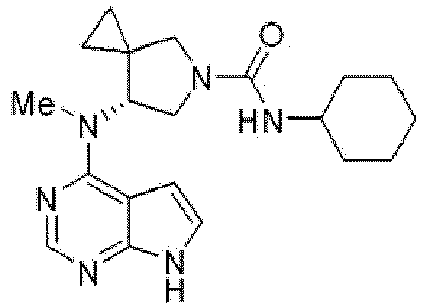
- 1H NMR (400 MHz, CDCl3) δ 11.87 (s, 1H), 8.26 (s, 1H), 7.09 (d, J = 3.5 Hz, 1H), 6.56 (d, J = 2.9 Hz, 1H), 5.39 (d, J = 6.4 Hz, 1H), 4.11 (d, J = 7.8 Hz, 1H), 3.97 (dd, J = 10.9, 7.4 Hz, 1H), 3.74 (d, J = 9.9 Hz, 1H), 3.71-3.66 (m, 1H), 3.63 (dd, J = 11.0, 1.7 Hz, 1H), 3.42 (s, 3H), 3.33 (d, J = 9.9 Hz, 1H), 1.97 (d, J = 11.5 Hz, 2H), 1.69 (dd, J = 8.7, 4.1 Hz, 2H), 1.61 (d, J = 12.7 Hz, 1H), 1.37 (dd, J = 23.1, 11.4 Hz, 2H), 1.21-1.03 (m, 3H), 0.99 (dd, J = 15.2, 8.0 Hz, 1H), 0.77 (s, 3H). LRMS (ESI) calcd for (C20H28N6O + H+) 369.2, found 369.2.
-

- 1H NMR (400 MHz, CDCl3) δ 11.98 (s, 1H), 8.27 (s, 1H), 7.43 (d, J = 7.7 Hz, 2H), 7.27 (dd, J = 9.1, 6.7 Hz, 2H), 7.09 (d, J = 3.3 Hz, 1H), 7.02 (t, J = 7.4 Hz, 1H), 6.55 (d, J = 3.0 Hz, 1H), 6.44 (s, 1H), 5.42 (d, J = 6.5 Hz, 1H), 4.09 (dd, J = 10.9, 7.5 Hz, 1H), 3.86 (d, J = 10.0 Hz, 1H), 3.82-3.73 (m, 1H), 3.45 (s, 1H), 3.43 (s, 3H), 1.08-0.99 (m, 1H), 0.78 (s, 3H). LRMS (ESI) calcd for (C20H22N6O + H+) 363.2, found 363.2.
-

- 1H NMR (400 MHz, CDCl3) δ 10.16 (s, 1H), 8.27 (s, 1H), 7.40-7.37 (m, 2H), 7.10-7.09 (m, 1H), 7.03-6.99 (m, 2H), 6.61 (s, 1H), 6.19 (s, 1H), 5.46 (d, J = 5.6 Hz, 1H), 4.15 (dd, J = 10.8, 7.2 Hz, 1H), 3.91 (d, J = 10.0 Hz, 1H), 3.81 (dd, J = 11.2, 2.0 Hz, 1H), 3.48-3.46 (m, 4H), 1.11-1.02 (m, 1H), 0.90-0.84 (m, 3H). LRMS (ESI) calcd for (C20H21FN6O + H+) 381.2, found 381.2.
-

- 1H NMR (400 MHz, CDCl3) δ 10.08 (s, 1H), 8.32 (d, J = 9.2 Hz, 1H), 8.27 (s, 1H), 7.37 (d, J = 2.4 Hz, 1H), 7.27-7.24 (m, 1H), 7.10 (t, J = 2.8 Hz, 1H), 6.83 (s, 1H), 6.61 (s, 1H), 5.53 (d, J = 6.4 Hz, 1H), 4.20 (dd, J = 11.2, 7.6 Hz, 1H), 3.92 (d, J = 9.6 Hz, 1H), 3.85 (d, J = 10.0 Hz, 1H), 3.50 (m, 4H), 1.11 (d, J = 11.2 Hz, 1H), 0.90-0.85 (m, 3H). LRMS (ESI) calcd for (C20H20Cl2N6O + H+) 431.1, found 431.1.
-

- 1H NMR (400 MHz, CDCl3) δ 9.96 (s, 1H), 8.27 (s, 1H), 7.70 (d, J = 2.4 Hz, 1H), 7.35 (d, J = 8.8 Hz, 1H), 7.27 (d, J = 2.8 Hz, 1H), 7.10-7.09 (m, 1H), 6.61 (d, J = 2.0 Hz, 1H), 6.26 (s, 1H), 5.45 (d, J = 5.6 Hz, 1H), 4.14 (dd, J = 10.8, 7,2 Hz, 1H), 3.90 (d, J = 10.4 Hz, 1H), 3.80 (d, J = 11.2 Hz, 1H), 3.48 (s, 3H), 3.46 (s, 1H), 1.09-1.06 (m, 1H), 0.90-0.85 (m, 3H). LRMS (ESI) calcd for (C20H20Cl2N6O + H+) 431.1, found 431.1.
-

- 1H NMR (400 MHz, CDCl3) δ 9.92 (s, 1H), 8.47 (d, J = 2.4 Hz, 1H), 8.28 (s, 1H), 7.27 (s, 1H), 7.09 (t, J = 2.0 Hz, 1H), 6.97 (dd, J = 8.4, 2.4 Hz, 1H), 6.89 (s, 1H), 6.62 (d, J = 1.6 Hz, 1H), 5.55 (d, J = 6.4 Hz, 1H), 4.19 (dd, J = 11.2, 7.6 Hz, 1H), 3.92 (d, J = 10.0 Hz, 1H), 3.85 (d, J = 11.2 Hz, 1H), 3.51 (s, 1H), 3.49 (s, 3H), 1.10 (d, J = 11.2 Hz, 1H), 0.94-0.85 (m, 3H). LRMS (ESI) calcd for (C20H20Cl2N6O + H+) 431.1, found 431.1.
-

- 1H NMR (400 MHz, CDCl3) δ 12.03 (s, 1H), 8.39-8.21 (m, 2H), 7.19 (t, J = 8.2 Hz, 1H), 7.13 (dd, J = 3.9, 3.3 Hz, 2H), 6.97 (s, 1H), 6.58 (d, J = 3.4 Hz, 1H), 5.55 (d, J = 6.3 Hz, 1H), 4.17 (dd, J = 11.2, 7.5 Hz, 1H), 3.88 (dd, J = 22.4, 10.5 Hz, 2H), 3.50 (s, 1H), 3.47 (s, 3H), 1.14-1.01 (m, 1H), 0.84 (s, 3H). LRMS (ESI) calcd for (C20H20Cl2N6O + H+) 431.1, found 431.0.
-

- 1H NMR (400 MHz, CDCl3) δ 11.92 (s, 1H), 8.25 (s, 1H), 7.49 (d, J = 2.0 Hz, 1H), 7.19 (dd, J = 8.3, 2.1 Hz, 1H), 7.08 (s, 1H), 7.06 (d, J = 5.2 Hz, 1H), 6.56 (s, 1H), 6.53 (d, J = 3.4 Hz, 1H), 5.39 (d, J = 6.2 Hz, 1H), 4.06 (dd, J = 11.1, 7.4 Hz, 1H), 3.82 (d, J = 10.1 Hz, 1H), 3.77 (dd, J = 11.1, 1.5 Hz, 1H), 3.46-3.35 (m, 4H), 2.28 (s, 3H), 1.05-0.96 (m, 1H), 0.82-0.71 (m, 3H). LRMS (ESI) calcd for (C21H23ClN6O + H+) 411.2, found 411.1.
-

- 1H NMR (400 MHz, CDCl3) δ 11.27 (s, 1H), 8.24 (s, 1H), 8.20 (d, J = 8.3 Hz, 1H), 7.51-7.30 (m, 6H), 7.21 (d, J = 7.2 Hz, 1H), 7.10 (dd, J = 9.2, 5.5 Hz, 2H), 6.55 (d, J = 2.9 Hz, 1H), 6.38 (s, 1H), 5.34 (d, J = 6.4 Hz, 1H), 3.82 (dd, J = 10.9, 7.5 Hz, 1H), 3.64 (d, J = 10.0 Hz, 1H), 3.48 (d, J = 10.1 Hz, 1H), 3.38 (s, 3H), 3.20 (d, J = 9.9 Hz, 1H), 1.04-0.95 (m, 1H), 0.78-0.59 (m, 3H). LRMS (ESI) calcd for (C26H26N6O + H+) 439.2, found 439.2.
-

- 1H NMR (400 MHz, CDCl3) δ 11.64 (s, 1H), 8.25 (s, 1H), 7.96 (s, 2H), 7.65 (s, 1H), 7.41 (s, 1H), 7.10 (d, J = 3.4 Hz, 1H), 6.57 (d, J = 3.4 Hz, 1H), 5.44 (d, J = 5.0 Hz, 1H), 4.31 (s, 1H), 4.17 (s, 1H), 4.08 (s, 1H), 3.75 (s, 1H), 3.46 (s, 3H), 1.05 (d, J = 5.7 Hz, 1H), 0.87 (d, J = 8.1 Hz, 3H). LRMS (ESI) calcd for (C22H20F6N6S + H+) 515.1, found 515.1.
-

- 1H NMR (400 MHz, CDCl3) δ 10.34 (s, 1H), 8.26 (s, 1H), 7.12 (s, 1H), 6.61 (s, 1H), 5.56 (dd, J = 7.6, 3.2 Hz, 1H), 4.19 (dd, J = 11.6, 7.6 Hz, 1H), 3.93-3.85 (m, 2H), 3.53-3.49 (m, 4H), 1.12-1.05 (m, 1H), 0.89-0.83 (m, 3H). LRMS (ESI) calcd for (C14H16F3N5O2S + H+) 376.1, found 376.1.
-

- 1H NMR (400 MHz, CDCl3) δ 10.53 (s, 1H), 8.25 (s, 1H), 7.10-7.09 (m, 1H), 6.61 (s, 1H), 5.58 (dd, J = 5.3, 2.8 Hz, 1H), 3.96 (dd, J = 11.2, 7.6 Hz, 1H), 3.72-3.68 (m, 2H), 3.50 (s, 3H), 3.37 (d, J = 9.6 Hz, 1H), 3.12 (q, J = 7.0 Hz, 2H), 1.47 (t, J = 7.4 Hz, 3H), 1.10-1.03 (m, 1H), 0.86-0.72 (m, 3H). LRMS (ESI) calcd for (C15H21N5O2S + H+) 336.2, found 336.1.
-
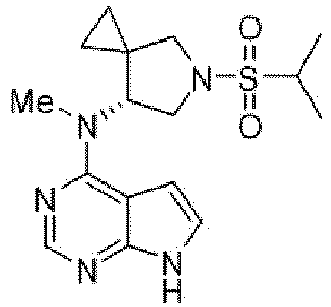
- 1H NMR (400 MHz, CDCl3) δ 9.60 (s, 1H), 8.25 (s, 1H), 7.07 (s, 1H), 6.60 (s, 1H), 5.53 (d, J = 4.4 Hz, 1H), 4.01 (dd, J = 11.2, 7.6 Hz, 1H), 3.77-3.71 (m, 2H), 3.49 (s, 3H), 3.40 (d, J = 9.6 Hz, 1H), 3.33-3.27 (m, 1H), 1.44 (d, J = 6.4 Hz, 6H), 1.11-1.01 (m, 1H), 0.90-0.75 (m, 3H). LRMS (ESI) calcd for (C16H23N5O2S + H+) 350.2, found 350.2.
-

- 1H NMR (400 MHz, CDCl3) δ 10.38 (s, 1H), 8.25 (s, 1H), 7.09 (s, 1H), 6.60 (s, 1H), 5.82-5.55 (m, 1H), 3.92 (dd, J = 10.8, 7.6 Hz, 1H), 3.70-3.67 (m, 2H), 3.50 (s, 3H), 3.35 (d, J = 10.0 Hz, 1H), 3.05-3.01 (m, 2H), 2.06-1.90 (m, 2H), 1.13 (t, J = 7.6 Hz, 3H), 1.07-1.02 (m, 1H), 0.86-0.71 (m, 3H). LRMS (ESI) calcd for (C16H23N5O2S + H+) 350.2, found 350.1.
-

- 1H NMR (400 MHz, CDCl3) δ 10.68 (s, 1H), 8.18 (s, 1H), 7.87 (d, J = 7.2 Hz, 2H), 7.74-7.57 (m, 3H), 7.05 (s, 1H), 6.56 (s, 1H), 5.45 (t, J = 5.0 Hz, 1H), 3.68-3.59 (m, 2H), 3.57 (d, J = 5.6 Hz, 1H), 3.36 (s, 3H), 3.10 (d, J = 9.6 Hz, 1H), 0.93-0.87 (m, 1H), 0.84-0.72 (m, 1H), 0.67-0.59 (m, 2H). LRMS (ESI) calcd for (C19H21N5O2S + H+) 384.2, found 384.1.
-

- 1H NMR (400 MHz, CDCl3) δ 9.52 (s, 1H), 8.19 (s, 1H), 7.95-7.91 (m, 1H), 7.66-7.61 (m, 1H), 7.34-7.25 (m, 2H), 7.25 (s, 1H), 6.57 (s, 1H), 5.49-5.46 (m, 1H), 3.85 (dd, J = 11.2, 7.6 Hz, 1H), 3.72-3.69 (m, 2H), 3.43 (s, 3H), 3.30 (d, J = 9.6 Hz, 1H), 0.98-0.88 (m, 1H), 0.82-0.77 (m, 1H), 0.74-0.65 (m, 2H). LRMS (ESI) calcd for (C19H20FN5O2S + H+) 402.1, found 402.1.
-

- 1H NMR (400 MHz, CDCl3) δ 9.30 (s, 1H), 8.18 (s, 1H), 7.67-7.54 (m, 3H), 7.40-7.33 (m, 1H), 7.06-7.02 (m, 1H), 6.57-6.56 (m, 1H), 5.46-5.44 (m, 1H), 3.65-3.62 (m, 2H), 3.59 (d, J = 9.6 Hz, 1H), 3.38 (s, 3H), 3.12 (d, J = 9.6 Hz, 1H), 0.96-0.91 (m, 1H), 0.80-0.74 (m, 1H), 0.69-0.68 (m, 2H). LRMS (ESI) calcd for (C19H20FN5O2S + H+) 402.1, found 402.1.
-
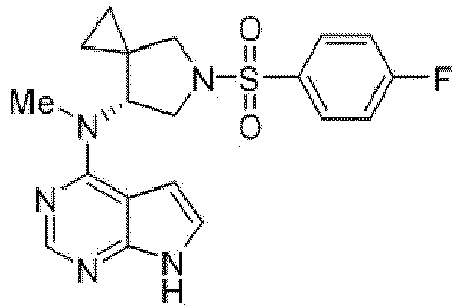
- 1H NMR (400 MHz, CDCl3) δ 9.62 (s, 1H), 8.18 (s, 1H), 7.94-7.85 (m, 2H), 7.27-7.24 (m, 2H), 7.06-6.99 (m, 1H), 6.57-6.55 (m, 1H), 5.46 (dd, J = 6.4, 1.6 Hz, 1H), 3.71-3.53 (m, 3H), 3.38 (s, 3H), 3.09 (d, J = 9.6 Hz, 1H), 0.95-0.88 (m, 1H), 0.82-0.74 (m, 1H), 0.69-0.60 (m, 2H). LRMS (ESI) calcd for (C19H20FN5O2S + H+) 402.1, found 402.1.
-

- 1H NMR (400 MHz, CDCl3) δ 10.10 (s, 1H), 8.19 (s, 1H), 8.13 (dd, J = 8.0, 1.6 Hz, 1H), 7.95 (dd, J = 7.2, 1.2 Hz, 1H), 7.81-7.73 (m, 2H), 7.08-7.02 (m, 1H), 6.58-6.56 (m, 1H), 5.52 (dd, J = 7.6, 6.8 Hz, 1H), 3.85-3.74 (m, 2H), 3.72 (dd, J = 10.8, 3.0 Hz, 1H), 3.43 (s, 3H), 3.41 (d, J = 10.0 Hz, 1H), 1.06-0.94 (m, 1H), 0.88-0.69 (m, 3H). LRMS (ESI) calcd for (C20H20N6O2S + H+) 409.1, found 409.1.
-

- 1H NMR (400 MHz, CDCl3) δ 10.12 (s, 1H), 8.18 (s, 1H), 8.17 (s, 1H), 8.09-8.07 (m, 1H), 7.95-7.93 (m, 1H), 7.75 (t, J = 8.0 Hz, 1H), 7.08-7.02 (m, 1H), 6.56-6.55 (m, 1H), 5.44-5.32 (m, 1H), 3.69-3.61 (m, 3H), 3.39 (s, 3H), 3.13 (d, J = 9.6 Hz, 1H), 0.98-0.88 (m, 1H), 0.84-0.77 (m, 1H), 0.73-0.63 (m, 2H). LRMS (ESI) calcd for (C20H20N6O2S + H+) 409.1, found 409.1.
-

- 1H NMR (400 MHz, CDCl3) δ 9.99 (s, 1H), 8.19 (s, 1H), 7.97 (d, J = 8.0 Hz, 2H), 7.87 (d, J = 8.4 Hz, 2H), 7.08 (s, 1H), 6.55 (s, 1H), 5.39-5.37 (m, 1H), 3.68-3.65 (m, 2H), 3.62 (d, J = 9.6 Hz, 1H), 3.36 (s, 3H), 3.13 (d, J = 9.6 Hz, 1H), 0.99-0.91 (m, 1H), 0.85-0.74 (m, 1H), 0.72-0.62 (m, 2H). LRMS (ESI) calcd for (C20H20N6O2S + H+) 409.1, found 409.1.
-

- 1H NMR (400 MHz, CDCl3) δ 9.67 (s, 1H), 8.22 (s, 1H), 8.05 (dd, J = 7.6, 1.6 Hz, 1H), 7.78-7.66 (m, 3H), 7.07 (t, J = 2.4 Hz, 1H), 6.58 (t, J = 2.0 Hz, 1H), 5.52 (dd, J = 7.6, 2.4 Hz, 1H), 3.96 (dd, J = 10.8, 7.6 Hz, 1H), 3.80-3.75 (m, 2H), 3.43 (s, 3H), 3.41 (s, 1H), 1.03-0.99 (m, 1H), 0.92-0.72 (m, 3H). LRMS (ESI) calcd for (C19H20N6O4S + H+) 429.1, found 429.1.
-
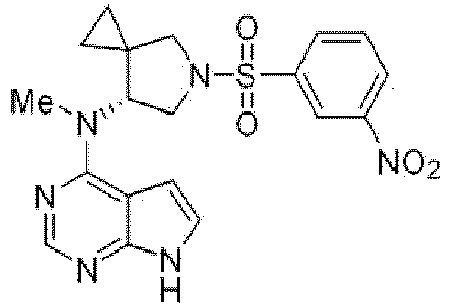
- 1H NMR (400 MHz, CDCl3) δ 9.88 (s, 1H), 8.22 (s, 1H), 8.05 (dd, J = 7.6, 1.6 Hz, 1H), 7.78-7.66 (m, 3H), 7.07 (t, J = 2.4 Hz, 1H), 6.58 (t, J = 2.0 Hz, 1H), 5.52 (dd, J = 7.6, 2.4 Hz, 1H), 3.96 (dd, J = 10.8, 7.6 Hz, 1H), 3.80-3.75 (m, 2H), 3.43 (s, 3H), 3.41 (s, 1H), 1.03-0.99 (m, 1H), 0.92-0.72 (m, 3H). LRMS (ESI) calcd for (C19H20N6O4S + H+) 429.1, found 429.1.
-

- 1H NMR (400 MHz, CDCl3) δ 9.76 (s, 1H), 8.41 (d, J = 8.4 Hz, 2H), 8.19 (s, 1H), 8.04 (d, J = 8.8 Hz, 2H), 7.07 (t, J = 2.4 Hz, 1H), 6.53 (t, J = 1.6 Hz, 1H), 5.39-5.36 (m, 1H), 3.72-3.67 (m, 2H), 3.64 (d, J = 9.6 Hz, 1H), 3.38 (s, 3H), 3.14 (d, J = 9.6 Hz, 1H), 0.96-0.89 (m, 1H), 0.88-0.79 (m, 1H), 0.75-0.63 (m, 2H). LRMS (ESI) calcd for (C19H20N6O4S + H+) 429.1, found 429.1.
-

- 1H NMR (400 MHz, CDCl3) δ 10.10 (s, 1H), 8.19 (s, 1H), 7.66 (s, 2H), 7.47-7.46 (m, 2H), 7.06 (s, 1H), 6.55 (s, 1H), 5.45-5.43 (m, 1H), 3.61-3.52 (m, 3H), 3.37 (s, 3H), 3.10-3.07 (d, J = 9.6 Hz, 1H), 2.46 (s, 3H), 0.93-0.88 (m, 1H), 0.79-0.73 (m, 1H), 0.67-0.59 (m, 2H). LRMS (ESI) calcd for (C29H23N5O2S + H+) 398.2, found 398.1.
-

- 1H NMR (400 MHz, CDCl3) δ 9.82 (s, 1H), 8.24 (s, 1H), 7.81 (d, J = 8.0 Hz, 2H), 7.05 (d, J = 8.0 Hz, 3H), 6.61 (s, 1H), 5.46 (s, 1H), 3.92 (s, 3H), 3.61-3.55 (m, 2H), 3.53 (m, 1H), 3.38 (s, 3H), 3.07 (d, J = 9.6 Hz, 1H), 0.94-0.90 (m, 1H), 0.82-0.72 (m, 1H), 0.66-0.59 (m, 2H). LRMS (ESI) calcd for (C29H23N5O3S + H+) 414.2, found 414.1.
-

- 1H NMR (400 MHz, CDCl3) δ 10.10 (s, 1H), 8.18 (s, 1H), 8.00 (d, J = 8.0 Hz, 2H), 7.80 (d, J = 8.8 Hz, 2H), 7.08 (s, 1H), 6.54 (s, 1H), 5.43-5.32 (m, 1H), 3.69-3.58 (m, 3H), 3.37 (s, 3H), 3.13 (d, J = 9.60 Hz, 1H), 0.97-0.88 (m, 1H), 0.81-0.75 (m, 1H), 0.71-0.62 (m, 2H). LRMS (ESI) calcd for (C20H20F3N5O2S + H+) 452.1, found 452.1.
-

- 1H NMR (400 MHz, CDCl3) δ 9.76 (s, 1H), 8.43 (s, 1H), 8.16 (s, 1H), 8.03-7.96 (m, 3H), 7.87 (dd, J = 8.8, 5.6 Hz, 1H), 7.72-7.59 (m, 2H), 7.03 (s, 1H), 6.57 (s, 1H), 5.54-5.41 (m, 1H), 3.75-3.63 (m, 2H), 3.62 (d, J = 9.6 Hz, 1H), 3.36 (s, 3H), 3.17 (d, J = 9.6 Hz, 1H), 0.90-0.84 (m, 1H), 0.78-0.72 (m, 1H), 0.68-0.57 (m, 2H). LRMS (ESI) calcd for (C23H23N5O2S + H+) 434.2, found 434.1.
-

- 1H NMR (400 MHz, CDCl3) δ 9.81 (s, 1H), 8.24 (s, 1H), 7.07-7.00 (m, 1H), 6.60-6.59 (m, 1H), 5.52 (d, J = 5.2 Hz, 1H), 3.87 (dd, J = 10.8, 7.6 Hz, 1H), 3.57-3.54 (m, 2H), 3.49 (s, 3H), 3.31-3.28 (m, 4H), 1.81-1.58 (m, 7H), 1.04-1.01 (m, 1H), 0.82-0.74 (m, 2H), 0.71-0.68 (m, 1H). LRMS (ESI) calcd for (C18H26N6O2S + H+) 391.2, found 391.1.
-

- 1H NMR (400 MHz, CDCl3) δ 9.65 (s, 1H), 8.25 (s, 1H), 7.08-7.07 (m, 1H), 6.65-6.59 (m, 1H), 5.58 (dd, J = 7.6, 2.8 Hz, 1H), 3.93 (dd, J = 10.8, 7.6 Hz, 1H), 3.78 (t, J = 4.8 Hz, 4H), 3.65-3.59 (m, 2H), 3.48 (s, 3H), 3.34-3.30 (m, 5H), 1.10-1.02 (m, 1H), 0.83-0.72 (m, 3H). LRMS (ESI) calcd for (C17H24N6O3S + H+) 393.2, found 393.1.
-

- 1H NMR (400 MHz, CDCl3) δ 10.02 (s, 1H), 8.32-8.16 (m, 1H), 7.07 (s, 1H), 6.57 (s, 1H), 5.63-5.31 (m, 1H), 4.19-3.97 (m, 2H), 3.97-3.66 (m, 2H), 3.55-3.43 (m, 1H), 3.43-3.26 (m, 3H), 2.32 (dq, J = 14.4, 7.3 Hz, 1H), 1.23-1.12 (m, 2H), 1.10-0.93 (m, 1H), 0.91-0.63 (m, 3H). LRMS (ESI) calcd for (C16H21N5O + H+) 300.2, found 300.3.
-

- 1H NMR (400 MHz, CDCl3) δ 10.09 (s, 1H), 8.23 (s, 1H), 7.05 (d, J = 2.3 Hz, 1H), 6.57 (d, J = 3.1 Hz, 1H), 5.38 (d, J = 5.7 Hz, 1H), 4.07 (d, J = 7.5 Hz, 1H), 3.96 (dd, J = 11.0, 7.4 Hz, 1H), 3.73 (d, J = 9.9 Hz, 1H), 3.62 (dd, J = 11.0, 2.2 Hz, 1H), 3.42 (s, 3H), 1.44-1.30 (m, 2H), 1.21-1.04 (m, 3H), 1.03-0.95 (m, 1H), 0.84-0.68 (m, 3H). LRMS (ESI) calcd for (C16H21N5O2 + H+) 316.2, found 316.1.
-

- 1H NMR (400 MHz, CDCl3) δ 10.98 (s, 1H), 8.37-8.03 (m, 1H), 7.17-6.97 (m, 1H), 6.69-6.45 (m, 1H), 5.63-5.32 (m, 1H), 4.15-4.00 (m, 1H), 3.99-3.75 (m, 3H), 3.69-3.48 (m, 2H), 3.48-3.27 (m, 3H), 1.04-0.93 (m, 1H), 0.91-0.64 (m, 3H). LRMS (ESI) calcd for (C15H18N8O + H+) 327.2, found 327.2.
-

- 1H NMR (400 MHz, CDCl3) δ 9.55 (s, 1H), 8.27 (d, J = 4.8 Hz, 1H), 7.15-7.03 (m, 1H), 6.61 (s, 1H), 5.58-5.35 (m, 1H), 4.26-4.03 (m, 1H), 4.02-3.91 (m, 1H), 3.89-3.72 (m, 1H), 3.72-3.51 (m, 2H), 3.48 (d, J = 7.7 Hz, 2H), 3.45-3.32 (m, 2H), 1.19-0.99 (m, 1H), 0.95-0.68 (m, 3H). LRMS (ESI) calcd for (C16H18N6O + H+) 311.2, found 311.2.
-

- 1H NMR (400 MHz, CDCl3) δ 10.18 (d, J = 14.5 Hz, 1H), 8.26 (d, J= 5.3 Hz, 1H), 7.08 (dd, J = 18.0, 14.6 Hz, 1H), 6.68 (d, J = 17.3 Hz, 1H), 6.58 (d, J = 3.1 Hz, 1H), 5.55-5.35 (m, 1H), 4.17-4.03 (m, 2H), 4.03-3.93 (m, 1H), 3.87 (dd, J = 27.0, 11.3 Hz, 1H), 3.78-3.68 (m, 1H), 3.57-3.48 (m, 1H), 3.46-3.33 (m, 3H), 2.08 (d, J = 4.2 Hz, 3H), 1.14-0.97 (m, 1H), 0.94-0.72 (m, 3H). LRMS (ESI) calcd for (C17H22N6O2 + H+) 343.2, found 343.2.
-

- 1H NMR (400 MHz, CDCl3) δ 11.89 (s, 1H), 8.24 (d, J = 4.2 Hz, 1H), 8.08 (s, 1H), 7.17-7.05 (m, 1H), 6.54 (d, J = 2.0 Hz, 1H), 5.43 (t, J = 7.8 Hz, 1H), 5.30 (s, 1H), 4.13 (ddd, J = 21.2, 12.7, 7.5 Hz, 1H), 3.91 (dd, J = 46.8, 11.7 Hz, 1H), 3.99-3.81 (m, 1H), 3.49 (t, J = 11.0 Hz, 1H), 3.42 (s, 1H), 3.37 (t, J = 10.0 Hz, 3H), 2.84 (dd, J = 4.7, 2.5 Hz, 3H), 1.10-0.95 (m, 1H), 0.89-0.72 (m, 3H). LRMS (ESI) calcd for (C17H22N6O2 + H+) 343.2, found 343.1.
-

- 1H NMR (400 MHz, DMSO) δ 11.75 (s, 1H), 8.08 (d, J = 3.1 Hz, 1H), 7.92 (s, 2H), 7.17 (d, J = 2.4 Hz, 1H), 6.61 (s, 1H), 5.39-5.06 (m, 1H), 4.20-3.57 (m, 3H), 3.32-3.24 (m, 4H), 3.11-2.90 (m, 2H), 2.87-2.56 (m, 2H), 0.96-0.68 (m, 3H), 0.68-0.44 (m, 1H). LRMS (ESI) calcd for (C16H22N6O + H+) 315.2, found 315.2.
-

- 1H NMR (400 MHz, CDCl3) δ 9.51 (s, 1H), 8.26 (d, J = 10.0 Hz, 1H), 7.56 (d, J = 5.7 Hz, 1H), 7.20-6.96 (m, 3H), 6.60 (d, J = 10.0 Hz, 1H), 5.60-5.35 (m, 1H), 4.75 (d, J = 6.7 Hz, 2H), 4.02-3.88 (m, 1H), 3.77 (dd, J = 27.1, 10.8 Hz, 1H), 3.59-3.49 (m, 1H), 3.49-3.30 (m, 3H), 1.18-1.08 (m, 1H), 1.08-0.96 (m, J = 9.5 Hz, 1H), 0.96-0.72 (m, 3H). LRMS (ESI) calcd for (C18H21N7O + H+) 352.2, found 352.1.
-

- 1H NMR (400 MHz, CDCl3) δ 11.35 (s, 1H), 8.26 (d, J = 2.2 Hz, 1H), 7.16-7.07 (m, 1H), 6.58 (dd, J = 5.6, 3.7 Hz, 1H), 5.52 (ddd, J = 9.0, 7.3, 2.4 Hz, 1H), 4.44-4.20 (m, 2H), 4.11 (dd, J = 55.2, 12.4 Hz, 1H), 3.91 (d, J = 9.3 Hz, 2H), 3.73 (dd, J = 68.2, 12.8 Hz, 1H), 3.42 (d, J = 22.7 Hz, 3H), 1.18-1.01 (m, 1H), 0.98-0.75 (m, 3H). LRMS (ESI) calcd for (C16H18N6S + H+) 327.1, found 327.1.
-

- 1H NMR (400 MHz, CDCl3) δ 9.24 (s, 1H), 8.24 (s, 1H), 7.05 (s, 1H), 6.59 (s, 1H), 5.40 (s, 1H), 4.04 (dd, J = 12.3, 7.5 Hz, 1H), 3.92 (d, J = 5.3 Hz, 2H), 3.85-3.62 (m, 2H), 3.51-3.23 (m, 4H), 2.05-1.86 (m, 1H), 1.13-0.86 (m, 7H), 0.77 (d, J = 8.0 Hz, 3H). LRMS (ESI) calcd for (C18H25N5O2 + H+) 344.2, found 344.1.
-

- 1H NMR (400 MHz, CDCl3) δ 10.01 (s, 1H), 8.24 (s, 1H), 7.08 (d, J = 2.2 Hz, 1H), 6.61 (d, J = 3.0 Hz, 1H), 5.57 (dd, J = 7.5, 3.1 Hz, 1H), 3.94 (dd, J = 11.0, 7.5 Hz, 1H), 3.74-3.64 (m, 2H), 3.55-3.47 (m, 3H), 3.36 (d, J = 9.8 Hz, 1H), 3.16-3.04 (m, 2H), 1.45 (t, J = 7.4 Hz, 3H), 1.10-1.03 (m, 1H), 0.86-0.71 (m, 3H). LRMS (ESI) calcd for (C15H21N5O2S + H+) 336.2, found 336.2.
-

- 1H NMR (400 MHz, CDCl3) δ 11.81 (s, 1H), 8.24 (s, 1H), 7.10 (d, J = 3.6 Hz, 1H), 6.57 (d, J = 3.6 Hz, 1H), 5.54 (dd, J = 7.4, 2.9 Hz, 1H), 3.92 (dd, J = 11.0, 7.6 Hz, 1H), 3.76-3.59 (m, 2H), 3.48 (s, 3H), 3.33 (d, J = 9.9 Hz, 1H), 3.30-3.22 (m, 2H), 3.22-3.02 (m, 2H), 1.88 (s, 2H), 1.04 (dd, J = 7.3, 4.2 Hz, 1H), 0.91-0.58 (m, 3H). LRMS (ESI) calcd for (C15H22N6O2S + H+) 351.2, found 351.2.
-

- 1H NMR (400 MHz, CDCl3) δ 9.49 (s, 1H), 8.23 (d, J = 5.8 Hz, 1H), 7.04 (s, 1H), 6.58 (s, 1H), 5.48-5.32 (m, 1H), 4.18-3.98 (m, 1H), 3.82 (ddd, J = 47.3, 32.5, 11.5 Hz, 2H), 3.51-3.28 (m, 4H), 2.32 (td, J = 14.9, 7.6 Hz, 2H), 1.27 (d, J = 9.7 Hz, 1H), 1.22-1.11 (m, 2H), 1.11-0.93 (m, 1H), 0.93-0.61 (m, 3H). LRMS (ESI) calcd for (C16H21N5O + H+) 300.2, found 300.1.
-

- 1H NMR (400 MHz, CDCl3) δ 9.58 (s, 1H), 8.23 (d, J = 3.6 Hz, 1H), 7.03 (d, J = 23.7 Hz, 1H), 6.66-6.45 (m, 1H), 5.43 (dd, J = 47.4, 5.3 Hz, 1H), 4.15-4.01 (m, 1H), 3.99-3.74 (m, 3H), 3.58 (dd, J = 58.3, 11.9 Hz, 1H), 3.46-3.31 (m, 4H), 1.13-0.94 (m, 1H), 0.92-0.66 (m, 3H). LRMS (ESI) calcd for (C15H18N8O + H+) 327.2, found 327.2.
-

- 1H NMR (400 MHz, CDCl3) δ 11.37 (s, 1H), 8.26 (d, J = 4.5 Hz, 1H), 7.16-7.02 (m, 1H), 6.57 (dd, J = 7.0, 3.5 Hz, 1H), 5.45 (ddd, J = 38.6, 7.3, 2.3 Hz, 1H), 4.14 (ddd, J = 21.4, 12.5, 7.5 Hz, 1H), 3.91 (t, J = 11.5 Hz, 1H), 3.85 (ddd, J = 13.7, 12.7, 2.6 Hz, 1H), 3.48 (q, J = 13.5 Hz, 1H), 3.45 (s, 3H), 3.39 (s, 2H), 1.14-0.98 (m, 1H), 0.92-0.73 (m, 3H). LRMS (ESI) calcd for (C16H18N6O + H+) 311.2, found 311.2.
-

- 1H NMR (500 MHz, CDCl3) δ 11.85 (d, J = 9.2 Hz, 1H), 8.24 (d, J = 8.8 Hz, 1H), 8.10 (d, J = 11.0 Hz, 1H), 7.11 (d, J = 3.0 Hz, 1H), 6.55 (s, 1H), 5.43 (dd, J = 16.7, 6.3 Hz, 1H), 4.13 (ddd, J = 21.1, 12.5, 7.5 Hz, 1H), 4.00-3.81 (m, 2H), 3.49 (t, J = 11.4 Hz, 1H), 3.40 (d, J = 18.6 Hz, 3H), 3.37 (d, J = 29.0 Hz, 2H), 2.86 (t, J = 11.0 Hz, 3H), 1.09-0.97 (m, 1H), 0.86-0.69 (m, 3H). LRMS (ESI) calcd for (C17H22N6O2 + H+) 343.2, found 343.1.
-

- 1H NMR (400 MHz, CDCl3) δ 9.48 (s, 1H), 8.24 (d, J = 27.2 Hz, 1H), 7.85-7.55 (m, 4H), 7.07 (d, J = 7.4 Hz, 1H), 6.59 (d, J = 19.0 Hz, 1H), 5.64-5.34 (m, 1H), 4.37-4.03 (m, 2H), 3.84-3.27 (m, 5H), 1.16-1.00 (m, 1H), 0.98-0.60 (m, 3H). LRMS (ESI) calcd for (C21H20N6O + H+) 373.2, found 373.2.
-

- 1H NMR (400 MHz, CDCl3) δ 11.13 (s, 1H), 8.18 (s, 1H), 7.11-6.97 (m, 1H), 6.59-6.44 (m, 1H), 5.56-5.34 (m, 1H), 4.38-3.92 (m, 3H), 3.92-3.78 (m, 2H), 3.66 (dd, J = 67.4, 13.0 Hz, 1H), 3.36 (d, J = 22.9 Hz, 3H), 1.09-0.94 (m, 1H), 0.91-0.58 (m, 3H). LRMS (ESI) calcd for (C16H18N6S + H+) 327.1, found 327.1.
-

- 1H NMR (400 MHz, CDCl3) δ 10.26 (s, 1H), 8.25 (s, 1H), 7.07 (d, J = 3.2 Hz, 1H), 6.58 (d, J = 2.8 Hz, 1H), 5.51-5.50 (m, 1H), 4.11-4.04 (m, 1H), 3.93 (d, J = 1.2 Hz, 2H), 3.91-3.74 (m, 2H), 3.42-3.38 (m, 4H), 2.01-1.90 (m, 1H), 1.01-0.95 (m, 7H), 0.77-0.75 (d, J = 10.0 Hz, 3H). LRMS (ESI) calcd for (C18H25N5O2 + H+) 344.2, found 344.3.
-

- 1H NMR (400 MHz, CDCl3) δ 10.45 (s, 1H), 8.23 (s, 1H), 7.07 (d, J = 3.1 Hz, 1H), 6.58 (d, J = 3.4 Hz, 1H), 5.55 (dd, J = 7.5, 3.0 Hz, 1H), 3.92 (dd, J = 11.0, 7.6 Hz, 1H), 3.80-3.57 (m, 2H), 3.48 (s, 3H), 3.33 (d, J = 9.8 Hz, 1H), 3.08 (q, J = 7.4 Hz, 2H), 1.43 (t, J = 7.4 Hz, 3H), 1.11-0.90 (m, 1H), 0.90-0.60 (m, 3H). LRMS (ESI) calcd for (C15H21N5O2S + H+) 336.2, found 336.1.
-

- 1H NMR (400 MHz, CDCl3) δ 9.97 (s, 1H), 8.16 (s, 1H), 7.85 (d, J = 8.0 Hz, 2H), 7.65 (t, J = 6.9 Hz, 1H), 7.57 (t, J = 7.8 Hz, 2H), 7.04 (s, 1H), 6.53 (s, 1H), 5.46-5.36 (m, 1H), 3.68-3.56 (m, 2H), 3.52 (d, J = 9.6 Hz, 1H), 3.34 (s, 3H), 3.07 (d, J = 9.5 Hz, 1H), 0.93-0.83 (m, 1H), 0.78-0.68 (m, 1H), 0.65-0.55 (m, 2H). LRMS (ESI) calcd for (C19H21N5O2S + H+) 384.2, found 384.0.
-
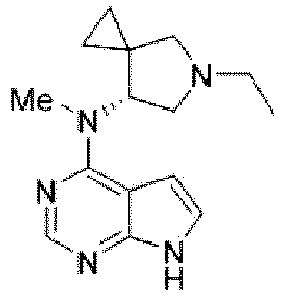
- 1H NMR (400 MHz, CDCl3) δ 10.17 (s, 1H), 8.29 (s, 1H), 7.04 (d, J = 3.6 Hz, 1H), 6.60 (d, J = 3.6 Hz, 1H), 5.57 (s, 1H), 3.47 (s, 3H), 3.16 (s, 1H), 3.03 (s, 1H), 2.92 (d, J = 7.6 Hz, 1H), 2.66 (d, J = 9.2 Hz, 3H), 1.23 (t, J = 7.2 Hz, 3H), 0.98-0.94 (m, 1H), 0.77-0.68 (m, 2H), 0.55-0.53 (m, 1H). LRMS (ESI) calcd for (C15H21N5 + H+) 272.2, found 272.1.
- Kinases used were human-derived JAK1, JAK2, JAK3, and TYK2 (Millipore, Germany). Each of these kinases was diluted with a suitable buffer solution as described below, and then mixed with reagents.
- Tris(hydroxymethyl)aminomethane (TRIS) and ethylenediaminetetraacetic acid (EDTA) were dissolved in distilled water at a concentration of 20 mM and 0.2 mM, respectively, and 100 uL of β-mercaptoethanol, 10 uL of Brij-35™, and 5 mL of glycerol, each per 100 mL of the solution, were added to the solution, thereby preparing a JAK1 dilution buffer solution.
- 3-morpholinopropane-1-sulfonic acid (MOPS) and EDTA were dissolved in distilled water at a concentration of 20 mM and 1 mM, respectively, and 100 uL of β-mercaptoethanol, 10 uL of Brij-35™, 5 mL of glycerol, and 100 mg of bovine serum albumin (BSA), each per 100 mL of the solution, were added to the solution, thereby preparing a JAK2, JAK3, and TYK2 dilution buffer solution.
- Each compound was dissolved in a 100% DMSO solution at a 50 uM concentration. This solution was reacted with reagents in wells on a 96-well plate to reach a final concentration of 1 uM. Detailed experimental methods for each kinase are described below.
- Final concentrations of materials included in 25 uL of the reaction solution are shown in Table 1.
[Table 1] Materials Concentration Human JAK1 1 unit Tris HCl (pH7.5) 20 mM EDTA 0.2 mM Peptide of SEQ ID NO: 1 /100 mM HEPES 1 mM MgAcetate (available from BDH, Cat. # 101484T) 10 mM γ-33P-ATP 2 mM Test compound 1 uM - γ-33P-ATP prepared from non-radiolabelled ATP (available from Sigma, Cat. no. A-7699) was used. After reaction for about 40 minutes at room temperature, the reaction was stopped by adding 5 uL of a 3% (v/v) phosphoric acid solution. After the termination of the reaction, 10 uL of the solution was spotted onto a GF/P30 filtermat (available from PerkinElmer™, 1450-523), and then washed three times for about 5 minutes in a 75 mM phosphoric acid solution, followed by methanol drying and scintillation assay. The methanol drying is a drying process using an azeotropic effect, wherein methanol is added into an aqueous solution for drying.
- Final concentrations of materials included in 25 uL of the reaction solution are shown in Table 2.
[Table 2] Materials Concentration Human JAK2 1 unit MOPS (pH7.0) 8 mM EDTA 0.2 mM Peptide of SEQ ID NO: 2 / 50mM Tris pH8.0 100 uM MgAcetate (available from BDH, Cat. # 101484T) 10 mM γ-33P-ATP 2 mM Test compound 1 uM - γ-33P-ATP prepared from non-radiolabelled ATP (available from Sigma, Cat. no. A-7699) was used. After reaction for about 40 minutes at room temperature, the reaction was stopped by adding 5 uL of a 3% (v/v) phosphoric acid solution. After the termination of the reaction, 10 uL of the solution was spotted onto a GF/P30 filtermat (available from PerkinElmer™, 1450-523), and then washed three times for about 5 minutes in a 75 mM phosphoric acid solution, followed by methanol drying and scintillation assay.
- Final concentrations of materials included in 25 uL of the reaction solution are shown in Table 3.
[Table 3] Materials Concentration Human JAK3 1 unit MOPS (pH7.0) 8 mM EDTA 0.2 mM Peptide of SEQ ID NO: 3 / 20 mM MOPS pH7.0 50 uM MgAcetate (available from BDH, Cat. # 101484T) 10 mM γ-33P-ATP 2 mM Test compound 1 uM - γ-33P-ATP prepared from non-radiolabelled ATP (available from Sigma, Cat. no. A-7699) was used. After reaction for about 40 minutes at room temperature, the reaction was stopped by adding 5 uL of a 3% (v/v) phosphoric acid solution. After the termination of the reaction, 10 uL of the solution was spotted onto a GF/P30 filtermat (available from PerkinElmer™, 1450-523), and then washed three times for about 5 minutes in a 75 mM phosphoric acid solution, followed by methanol drying and scintillation assay.
- Final concentrations of materials included in 25 uL of the reaction solution are shown in Table 4.
[Table 4] Materials concentration Human TYK2 1 unit MOPS (pH7.0) 8 mM EDTA 0.2 mM Peptide of SEQ ID NO: 4 / water 250 uM MgAcetate (available from BDH, Cat. # 101484T) 10 mM γ-33P-ATP 2 mM Test compound 1 uM - γ-33P-ATP prepared from non-radiolabelled ATP (available from Sigma, Cat. no. A-7699) was used. After reaction for about 40 minutes at room temperature, the reaction was stopped by adding 5 uL of a 3% (v/v) phosphoric acid solution. After the termination of the reaction, 10 uL of the solution was spotted onto a GF/P30 filtermat (available from PerkinElmer™, 1450-523), and then washed three times for about 5 minutes in a 75 mM phosphoric acid solution, followed by methanol drying and scintillation assay.
- Kinase-activity inhibitory effects of some of the compounds of Examples 1 to 73 (for example, Examples 5, 55, and 66) for JAK1, JAK2, JAK3, and TYK2 were measured at various concentrations by the above-described method, and IC50 values were determined. The IC50 values of the test compounds were calculated from %inhibition values of the compounds, by the Cheng-Prusoff method (Biochem. Pharmacol. (1973) 22, 3099-3108).
- Tables 5 and 6 show the results of measuring JAK1, JAK2, JAK3, and TYK2 phosphorylation inhibitory levels of the compounds synthesized in Examples 1 to 73, by the above-described method. In Tables 5 and 6, the numbers in the "Example" column, which are identification numbers of the examples, indicate the compounds synthesized in the corresponding examples, the values in the "JAK1", "JAK2", "JAK3", and "TYK2" columns represent kinase-phosphorylation inhibitory levels as a percentage (%) of the compounds synthesized in the corresponding examples at a 1 uM concentration. In Tables 5 and 6, negative values substantially indicate no inhibitory effect.
- The inhibitory levels (%inhibition) represent a percentage of reduction in phosphorylation activity in each test group with respect to the phosphorylation activity of a corresponding kinase in a negative control group lacking any of the compounds synthesized in the examples.
- % inhibition = [(Scintillation value of Test compound non-treatment group - Scintillation value of Test compound treatment group)/(Scintillation value of Test compound non-treatment group)] x100
- As the control group, 1 uM of tofacitinib citrate (available from Hangzhou Tacon Co., Ltd.) was used. The %inhibition values of the control group for JAK1, JAK2, JAK3, and TYK2 were 99%, 98%, 99%, and 100%, respectively.
[Table 5] Example JAK1 JAK2 JAK3 TYK2 1 79 -14 8 -4 2 77 -19 7 3 3 83 25 16 49 4 95 72 57 78 5 95 79 50 82 6 90 21 18 46 7 70 -17 8 8 8 61 -7 3 11 9 90 10 13 70 10 88 2 23 52 11 93 10 15 61 12 80 -11 2 26 13 81 -11 13 30 14 84 -14 12 15 15 76 -15 13 43 16 79 13 15 23 17 65 -14 -1 39 18 71 -17 5 37 19 98 80 82 91 20 93 27 27 43 21 94 -3 31 30 22 90 -5 16 15 23 98 52 50 78 24 94 6 48 47 25 88 5 25 48 26 94 13 51 42 27 91 -1 17 27 28 91 23 40 39 29 92 19 39 43 30 80 -11 14 27 31 62 -26 13 1 32 97 68 59 86 33 98 84 70 88 34 97 76 56 72 35 99 78 77 89 36 97 90 52 91 37 98 84 61 90 38 100 97 84 97 39 99 95 65 93 40 94 64 47 72 [Table 6] 41 99 99 77 97 42 97 49 33 68 43 97 70 75 78 44 100 96 96 98 45 100 84 60 88 46 98 81 62 92 47 99 69 39 71 48 98 36 28 66 49 98 65 55 75 50 98 56 60 81 51 97 60 49 69 52 58 -22 17 20 53 76 -18 3 7 54 94 60 73 72 55 95 53 30 58 56 9 -37 9 -10 57 55 7 -9 11 58 34 2 -9 -4 59 72 -17 20 -8 60 96 -3 -14 0 61 85 -9 29 22 62 95 59 59 67 63 91 43 7 29 64 16 -9 -1 0 65 41 12 -16 14 66 65 -15 17 -16 67 5 -7 0 -4 68 14 -5 -7 2 69 58 6 9 36 70 31 24 -3 5 71 40 13 -22 12 72 55 10 -1 28 73 42 -6 1 -7 - Table 7 represents IC50 values of the compounds of Examples 5, 55, 66, 41, and 62 for JAK1, JAK2, JAK3, and TYK2 activity.
[Table 7] Example Configuration JAK1 IC50(nM) JAK2 IC50(nM) JAK3 IC50(nM) TYK2 IC50(nM) 5 R 8.5 412.3 1092 251.7 55 Racemic 29.3 148.5 694.5 40.4 66 S 787.4 >1000 >1000 >1000 41 R 5.8 58.6 109.6 24.7 62 Racemic 2.8 421.8 >1000 198.2 - Referring to Table 7, the compound of Example 5 having an R-configuration had about 3.5-fold higher JAK1 inhibitory activity, as compared to the compound of Example 55 which is a racemic mixture of the compound of Example 5. Therefore, by isolating a specific stereoisomer having a high JAK inhibitory effect, for example, an enantiomer or a diastereomer, JAK-related diseases may be efficiently treated.
- DBA/1J mice (6 weeks old, male) were purchased from Japan SLC, Inc., and maintained under controlled lighting in a 12-hour light/dark cycle (07:00-19:00). The temperature was maintained at about 22°C, and the mice were allowed to freely have feed and drinking water.
- Type II collagen (dissolved in 0.05 M acetic acid (2 mg/mL)) was kept at 4°C prior to induction. On the first day of induction, prior to a first immunization, a complete Freund's adjuvant and type II collagen in an equal ratio were homogenized in a cooled tube using a homogenizer to obtain an emulsion of the type II collagen and the Freund's adjuvant. 0.1 mL of the emulsion was injected into mouse tails for the first immunization. To enhance the immunoreaction, after 21 days of the first immunization, an emulsion was prepared by mixing an incomplete Freund's adjuvant and type II collagen in the same manner as described above, and then injected in the same manner as used for the first immunization. This CIA model generation method was implemented by partial modification of a method described in a published journal (David D Brand et al., Nature Protocols 2, 1269-1275 (2007)).
- Therapeutic efficacy of the compounds according to embodiments was determined using a collagen-induced mouse animal model. The mice were randomly grouped with 8 to 9 mice per group. On the start day and 21st day of the experiment, every mouse was subjected to immunization in the same manner as described in Section (2) to induce rheumatoid arthritis. To determine the therapeutic efficacy of test drugs (compounds), a negative control and each drug were orally administered once a day from the 22nd day to the 50th day of the experiment. As an excipient of the drugs administered, an aqueous solution of 0.45 v/v% carboxymethyl cellulose (CMC) (from Sigma Aldrich, Cat. No. C5678, 0.5 v/v% in distilled water) and 10 v/v% ethanol in distilled water was used. 1 mL of the excipient (per 100 g of weight) only was administered into the negative control group. For the positive control group, 1 mL of a solution of tofacitinib citrate in the excipient (50 mg/10 mL) was administrated per 100 g of weight (50 mg as tofacitinib citrate per 1kg of weight). Each test compound was prepared at different concentrations (15 mg/10 mL and 50 mg/10 mL), and administered at 1 mL per 100 g of weight (15 mg as per 1 kg of weight, and 50 mg as per 1 kg of weight).
- Tofacitinib citrate (available from Hangzhou Tacon Co., Ltd.) as a JAK inhibitor family drug is approved for the treatment of rheumatoid arthritis (RA) in the U.S.A and Russia, and is undergoing clinical testing for use in the treatment of psoriasis, inflammatory bowel disease (IBD) and other immune disorders, and the prevention of organ transplant rejection. Tofacitinib is considered to be effective in the treatment of RA through inhibitory action on JAK3 and JAK1.
- The degree of arthritic disease was determined based on the degree of paw edema obtained by measuring a volume of mouse hind paws of the experimental animals. A volume change in the hind paws was measured using a volume measuring flowmeter (Plethysmometer, Havard apparatus, USA, Cat no. 760220), wherein the volume was measured by putting the mouse hind legs into a measurement cell, from knee to paw. The volumes of both paws were measured, and a larger volume value between the two was used as a representative value. The first volume measurement was performed one day early, before oral administration, and the volumes were measured at an interval of 2-3 days and recorded.
-
FIG. 1 is a graph of hind paw volume (degree of edema) with respect to time (days) after the first immunization. InFIG. 1 , the control group refers to the mouse group into which tofacitinib citrate was administered from the 21st day after the first immunization, and the test group refers to the mouse group into which (R)-3-(7-(methyl(7H-pyrrolo[2,3-d]pyrimidin-4-yl)amino)-5-azaspiro[2.4]heptan-5-yl)-3-oxopropanenitrile synthesized in Example 5 was administered (50 mg/kg per body weight) from the 21st day after the first immunization. Referring toFIG. 1 , around the 34th day after the first immunization, the hind paw edema volume of the control group sharply increased. On the other hand, in the test group, from the 31st day after the first immunization and when edema had started to increase in the control group, edema caused from arthritis was significantly inhibited from the 31st day onwards by about 60% or greater, as compared to the control group, even by about 64% on the 49th day when the measurement ended. The results ofFIG. 1 indicate that the compound of Example 5 inhibits edema which is known as a typical arthritic symptom, and thus is an effective therapeutic agent for arthritis. - In an aspect of the present disclosure, a compound of Formula 1 according to any of the embodiments, or a pharmaceutically acceptable salt, solvate, or stereoisomer thereof, may be used as a JAK inhibitor.
- In another aspect of the present disclosure, a pharmaceutical composition including the compound of Formula 1 according to any of the embodiments, or a pharmaceutically acceptable salt, solvate, or stereoisomer thereof, may be used in treating JAK-related diseases.
- In another aspect of the present disclosure, by a method of regulating the activity of a JAK by using the compound of Formula 1 according to the any of the embodiments, or a pharmaceutically acceptable salt, solvate, or stereoisomer thereof, the activity of the JAK may be efficiently regulated.
- In another aspect of the present disclosure, by a method of treating a disease in a subject by administering a therapeutically effective amount of the compound of Formula 1 according to any of the embodiments, or a pharmaceutically acceptable salt, solvate, or stereoisomer thereof to a subject, the disease of the individual may be efficiently treated.
- <110> Yang Ji Chemical Co., Ltd.
- <120> Substituted N-(pyrrolidin-3-yl-7H-pyrrolo[2,3-d]primidin-4-amines as Janus kinase inhibitor
- <130> PX049637OV
- <160> 4
- <170> KopatentIn 2.0
- <210> 1
<211> 14
<212> PRT
<213> Artificial Sequence - <220>
<223> JAK1 substrate - <400> 1

- <210> 2
<211> 39
<212> PRT
<213> Artificial Sequence - <220>
<223> JAK2 substrate - <400> 2
Asp Tyr Ile Ala Asp Trp Cys 35

- <210> 3
<211> 15
<212> PRT
<213> Artificial Sequence - <220>
<223> JAK3 substrate - <400> 3

- <210> 4
<211> 16
<212> PRT
<213> Artificial Sequence - <220>
<223> TYK2 substrate - <400> 4

Claims (11)
- A compound of Formula 1, a pharmaceutically acceptable salt thereof, a solvate thereof, or a stereoisomer thereof,
 wherein R1 is C1-6 alkyl, C2-6 alkenyl, or C2-6 alkynyl,R2 and R3 taken together form -(C2-6 alkyl)- or -(C2-6 alkenyl)-,R4 is -W1-R6;W1 is absent, or is -C(=O)-, -C(=S)-, -C(=O)O-, -C(=O)NR5-, -C(=S)NR5-, -S(=O)-, or -S(=O)2-;R5 is H or C1-6 alkyl;R6 is H; halo; CN; NO2; N3; C1-10 alkyl; C2-10 alkenyl; C2-10 alkynyl; C1-6 haloalkyl; C5-20 aryl optionally substituted with at least one substituent selected from the group consisting of C1-10 alkyl, C1-6 haloalkyl, halo, CN, NO2, and -O-(C1-10 alkyl); C3-7 cycloalkyl; heterocycloalkyl having 3 to 7 ring atoms, optionally substituted with -C(C=O)(C1-6 alkyl); heteroaryl having 3 to 7 ring atoms; heteroaryl-(C1-10 alkyl) having 3 to 7 ring atoms; -(C1-10 alkyl)-CN; -(C1-10 alkyl)-N3; -(C1-10 alkyl)-O-(C1-6 alkyl); -(C1-10 alkyl)-C(=O)NRaRb; or-(C1-10 alkyl)-NRaC(=O)Rb or -(C1-10 alkyl)-NRcRd, wherein Ra, Rb, Rc, and Rd are each independently H or C1-6 alkyl.
 - The compound of claim 1, wherein R1 is C1-6 alkyl, and R2 and R3 taken together form -(C2-6 alkyl)-.
- The compound of claim 1, wherein W1 is absent, or is -C(=O)-, -C(=S)-, - C(=O)O-, -C(=O)NR5-, -C(=S)NR5-, or -S(=O)2-;
R5 is H or C1-6 alkyl; and
R6 is C1-10 alkyl; C1-6 haloalkyl; C5-20 aryl optionally substituted with at least one substituent selected from the group consisting of C1-10 alkyl, C1-6 haloalkyl, halo, CN, NO2, and -O-(C1-10 alkyl); C3-7 cycloalkyl; heterocycloalkyl having 3 to 7 ring atoms, optionally substituted with -C(C=O)(C1-6 alkyl); heteroaryl having 3 to 7 ring atoms; -heteroaryl-(C1-10 alkyl) having 3 to 7 ring atoms; -(C1-10 alkyl)-CN; -(C1-10 alkyl)-N3; -(C1-10 alkyl)-O-(C1-6 alkyl); -(C1-10 alkyl)-C(=O)NRaRb; or -(C1-10 alkyl)-NRaC(=O)Rb or -(C1-10 alkyl)-NRcRd, wherein Ra, Rb, Rc, and Rd are each independently H or C1-6 alkyl. - The compound of claim 1, wherein the compound is a compound represented by Formula 2,
 R4 is -W1-R6,W1 is absent, or is -C(=O)-, -C(=S)-, -C(=O)O-, -C(=O)NR5-, -C(=S)NR5-, or - S(=O)2-,R5 is H or C1-6 alkyl,R6 is C1-10 alkyl, when W1 is absent;C1-10 alkyl; C3-7 cycloalkyl; -(C1-10 alkyl)-CN; -(C1-10 alkyl)-N3; -(C1-10 alkyl)-NRaC(=O)Rb, wherein Ra and Rb are each independently H or C1-6 alkyl; -(C1-10 alkyl)-C(=O)NRaRb, wherein Ra and Rb are each independently H or C1-6 alkyl; phenyl; phenyl substituted with at least one substituent selected from the group consisting of -CF3 and CN; piperidinyl substituted with -C(C=O)(C1-6 alkyl); furanyl; pyridinyl; imidazolyl-(C1-10 alkyl); -(C1-10 alkyl)-O-(C1-6 alkyl); or -(C1-10 alkyl)-NRcRd, wherein Rc and Rd are each independently H or C1-6 alkyl, when W1 is -C(=O)-;-(C1-10 alkyl)-CN, when W1 is -C(=S)-;-(C1-10 alkyl), when W1 is -C(=O)O-;-(C1-10 alkyl); C3-7 cycloalkyl; phenyl; phenyl substituted with at least one substituent selected from the group consisting of halo and C1-10 alkyl; biphenyl; or biphenyl substituted with at least one substituent selected from the group consisting of halo and C1-10 alkyl, when W1 is -C(=O)NR5;phenyl substituted with at least one -CF3, when W1 is -C(=S)NR5; or-C1-10 alkyl; -CF3; piperidinyl; morpholinyl; -(C1-10 alkyl)-NRcRd, wherein Rc and Rd are each independently H or C1-6 alkyl; phenyl; phenyl substituted with at least one substituent selected from the group consisting of -(C1-10 alkyl), -O-(C1-6 alkyl), -CF3, NO2, CN, and halo; naphthalenyl; or naphthalenyl substituted with at least one substituent selected from the group consisting of -(C1-10 alkyl), -O-(C1-6 alkyl), -(C1-6 haloalkyl), NO2, CN, and halo, when W1 is -S(=O)2-.
 - The compound of claim 1, wherein the compound is
(R)-N-(5-butyl-5-azaspiro[2.4]heptan-7-yl)-N-methyl-7H-pyrrolo[2,3-d]pyrimidin-4-amine;
(R)-N-methyl-N-(5-pentyl-5-azaspiro[2.4]heptan-7-yl)-7H-pyrrolo[2,3-d]pyrimidin-4-amine;
(R)-2-methyl-1-(7-(methyl(7H-pyrrolo[2,3-d]pyrimidin-4-yl)amino)-5-azaspiro[2.4]heptan-5-yl)propan-1-one;
(R)-2-azido-1-(7-(methyl(7H-pyrrolo[2,3-d]pyrimidin-4-yl)amino)-5-azaspiro[2.4]heptan-5-yl)ethan-1-one;
(R)-3-(7-(methyl(7H-pyrrolo[2,3-d]pyrimidin-4-yl)amino)-5-azaspiro[2.4]heptan-5-yl)-3-oxopropanenitrile;
(R)-3-methyl-1-(7-(methyl(7H-pyrrolo[2,3-d]pyrimidin-4-yl)amino)-5-azaspiro[2.4]heptan-5-yl)butan-1-one;
(R)-N-(2-(7-(methyl(7H-pyrrolo[2,3-d]pyrimidin-4-yl)amino)-5-azaspiro[2.4]heptan-5-yl)-2-oxoethyl)acetamide;
(R)-N-methyl-3-(7-(methyl(7H-pyrrolo[2,3-d]pyrimidin-4-yl)amino)-5-azaspiro[2.4]heptan-5-yl)-3-oxopropanamide;
(R)-cyclopropyl(7-(methyl(7H-pyrrolo[2,3-d]pyrimidin-4-yl)amino)-5-azaspiro[2.4]heptan-5-yl)methanone;
(R)-1-(4-(7-(methyl(7H-pyrrolo[2,3-d]pyrimidin-4-yl)amino)-5-azaspiro[2.4]heptane-5-carbonyl)piperidin-1-yl)ethan-1-one;
(R)-furan-2-yl(7-(methyl(7H-pyrrolo[2,3-d]pyrimidin-4-yl)amino)-5-azaspiro[2.4]heptan-5-yl)methanone;
(R)-(7-(methyl(7H-pyrrolo[2,3-d]pyrimidin-4-yl)amino)-5-azaspiro[2.4]heptan-5-yl)(pyridin-3-yl)methanone;
(R)-(7-(methyl(7H-pyrrolo[2,3-d]pyrimidin-4-yl)amino)-5-azaspiro[2.4]heptan-5-yl)(phenyl)methanone;
(R)-(7-(methyl(7H-pyrrolo[2,3-d]pyrimidin-4-yl)amino)-5-azaspiro[2.4]heptan-5-yl)(pyridin-4-yl)methanone;
(R)-3-(7-(methyl(7H-pyrrolo[2,3-d]pyrimidin-4-yl)amino)-5-azaspiro[2.4]heptane-5-carbonyl)benzonitrile;
(R)-4-(7-(methyl(7H-pyrrolo[2,3-d]pyrimidin-4-yl)amino)-5-azaspiro[2.4]heptane-5-carbonyl)benzonitrile;
(R)-(7-(methyl(7H-pyrrolo[2,3-d]pyrimidin-4-yl)amino)-5-azaspiro[2.4]heptan-5-yl)(2-(trifluoromethyl)phenyl)methanone;
(R)-(7-(methyl(7H-pyrrolo[2,3-d]pyrimidin-4-yl)amino)-5-azaspiro[2.4]heptan-5-yl)(3-(trifluoromethyl)phenyl)methanone;
(R)-3-(7-(methyl(7H-pyrrolo[2,3-d]pyrimidin-4-yl)amino)-5-azaspiro[2.4]heptan-5-yl)-3-thioxopropanenitrile;
isobutyl (R)-7-(methyl(7H-pyrrolo[2,3-d]pyrimidin-4-yl)amino)-5-azaspiro[2.4]heptane-5-carboxylate;
(R)-N-butyl-7-(methyl(7H-pyrrolo[2,3-d]pyrimidin-4-yl)amino)-5-azaspiro[2.4]heptane-5-carboxamide;
(R)-N-cyclohexyl-7-(methyl(7H-pyrrolo[2,3-d]pyrimidin-4-yl)amino)-5-azaspiro[2.4]heptane-5-carboxamide;
(R)-7-(methyl(7H-pyrrolo[2,3-d]pyrimidin-4-yl)amino)-N-phenyl-5-azaspiro[2.4]heptane-5-carboxamide;
(R)-N-(4-fluorophenyl)-7-(methyl(7H-pyrrolo[2,3-d]pyrimidin-4-yl)amino)-5-azaspiro[2.4]heptane-5-carboxamide;
(R)-N-(2,4-dichlorophenyl)-7-(methyl(7H-pyrrolo[2,3-d]pyrimidin-4-yl)amino)-5-azaspiro[2.4]heptane-5-carboxamide;
(R)-N-(3,4-dichlorophenyl)-7-(methyl(7H-pyrrolo[2,3-d]pyrimidin-4-yl)amino)-5-azaspiro[2.4]heptane-5-carboxamide;
(R)-N-(2,5-dichlorophenyl)-7-(methyl(7H-pyrrolo[2,3-d]pyrimidin-4-yl)amino)-5-azaspiro[2.4]heptane-5-carboxamide;
(R)-N-(2,3-dichlorophenyl)-7-(methyl(7H-pyrrolo[2,3-d]pyrimidin-4-yl)amino)-5-azaspiro[2.4]heptane-5-carboxamide;
(R)-N-(3-chloro-4-methylphenyl)-7-(methyl(7H-pyrrolo[2,3-d]pyrimidin-4-yl)amino)-5-azaspiro[2.4]heptane-5-carboxamide;
(R)-N-([1,1'-biphenyl]-2-yl)-7-(methyl(7H-pyrrolo[2,3-d]pyrimidin-4-yl)amino)-5-azaspiro[2.4]heptane-5-carboxamide;
(R)-N-(3,5-bis(trifluoromethyl)phenyl)-7-(methyl(7H-pyrrolo[2,3-d]pyrimidin-4-yl)amino)-5-azaspiro[2.4]heptane-5-carbothioamide;
(R)-N-methyl-N-(5-((trifluoromethyl)sulfonyl)-5-azaspiro[2.4]heptan-7-yl)-7H-pyrrolo[2,3-d]pyrimidin-4-amine;
(R)-N-(5-(ethylsulfonyl)-5-azaspiro[2.4]heptan-7-yl)-N-methyl-7H-pyrrolo[2,3-d]pyrimidin-4-amine;
(R)-N-(5-(isopropylsulfonyl)-5-azaspiro[2.4]heptan-7-yl)-N-methyl-7H-pyrrolo[2,3-d]pyrimidin-4-amine;
(R)-N-methyl-N-(5-(propylsulfonyl)-5-azaspiro[2.4]heptan-7-yl)-7H-pyrrolo[2,3-d]pyrimidin-4-amine;
(R)-N-methyl-N-(5-(phenylsulfonyl)-5-azaspiro[2.4]heptan-7-yl)-7H-pyrrolo[2,3-d]pyrimidin-4-amine;
(R)-N-(5-((2-fluorophenyl)sulfonyl)-5-azaspiro[2.4]heptan-7-yl)-N-methyl-7H-pyrrolo[2,3-d]pyrimidin-4-amine;
(R)-N-(5-((3-fluorophenyl)sulfonyl)-5-azaspiro[2.4]heptan-7-yl)-N-methyl-7H-pyrrolo[2,3-d]pyrimidin-4-amine;
(R)-N-(5-((4-fluorophenyl)sulfonyl)-5-azaspiro[2.4]heptan-7-yl)-N-methyl-7H-pyrrolo[2,3-d]pyrimidin-4-amine;
(R)-2-((7-(methyl(7H-pyrrolo[2,3-d]pyrimidin-4-yl)amino)-5-azaspiro[2.4]heptan-5-yl)sulfonyl)benzonitrile;
(R)-3-((7-(methyl(7H-pyrrolo[2,3-d]pyrimidin-4-yl)amino)-5-azaspiro[2.4]heptan-5-yl)sulfonyl)benzonitrile;
(R)-4-((7-(methyl(7H-pyrrolo[2,3-d]pyrimidin-4-yl)amino)-5-azaspiro[2.4]heptan-5-yl)sulfonyl)benzonitrile;
(R)-N-methyl-N-(5-((2-nitrophenyl)sulfonyl)-5-azaspiro[2.4]heptan-7-yl)-7H-pyrrolo[2,3-d]pyrimidin-4-amine;
(R)-N-methyl-N-(5-((3-nitrophenyl)sulfonyl)-5-azaspiro[2.4]heptan-7-yl)-7H-pyrrolo[2,3-d]pyrimidin-4-amine;
(R)-N-methyl-N-(5-((4-nitrophenyl)sulfonyl)-5-azaspiro[2.4]heptan-7-yl)-7H-pyrrolo[2,3-d]pyrimidin-4-amine;
(R)-N-methyl-N-(5-(m-tolylsulfonyl)-5-azaspiro[2.4]heptan-7-yl)-7H-pyrrolo[2,3-d]pyrimidin-4-amine;
(R)-N-(5-((4-methoxyphenyl)sulfonyl)-5-azaspiro[2.4]heptan-7-yl)-N-methyl-7H-pyrrolo[2,3-d]pyrimidin-4-amine;
(R)-N-methyl-N-(5-((4-(trifluoromethyl)phenyl)sulfonyl)-5-azaspiro[2.4]heptan-7-yl)-7H-pyrrolo[2,3-d]pyrimidin-4-amine;
(R)-N-methyl-N-(5-(naphthalen-2-ylsulfonyl)-5-azaspiro[2.4]heptan-7-yl)-7H-pyrrolo[2,3-d]pyrimidin-4-amine;
(R)-N-methyl-N-(5-(piperidin-1-ylsulfonyl)-5-azaspiro[2.4]heptan-7-yl)-7H-pyrrolo[2,3-d]pyrimidin-4-amine;
(R)-N-methyl-N-(5-(morpholinosulfonyl)-5-azaspiro[2.4]heptan-7-yl)-7H-pyrrolo[2,3-d]pyrimidin-4-amine;
1-(7-(methyl(7H-pyrrolo[2,3-d]pyrimidin-4-yl)amino)-5-azaspiro[2.4]heptan-5-yl)propan-1-one;
2-methoxy-1-(7-(methyl(7H-pyrrolo[2,3-d]pyrimidin-4-yl)amino)-5-azaspiro[2.4]heptan-5-yl)ethan-1-one;
2-azido-1-(7-(methyl(7H-pyrrolo[2,3-d]pyrimidin-4-yl)amino)-5-azaspiro[2.4]heptan-5-yl)ethan-1-one;
3-(7-(methyl(7H-pyrrolo[2,3-d]pyrimidin-4-yl)amino)-5-azaspiro[2.4]heptan-5-yl)-3-oxopropanenitrile;
N-(2-(7-(methyl(7H-pyrrolo[2,3-d]pyrimidin-4-yl)amino)-5-azaspiro[2.4]heptan-5-yl)-2-oxoethyl)acetamide;
N-methyl-3-(7-(methyl(7H-pyrrolo[2,3-d]pyrimidin-4-yl)amino)-5-azaspiro[2.4]heptan-5-yl)-3-oxopropanamide;
3-amino-1-(7-(methyl(7H-pyrrolo[2,3-d]pyrimidin-4-yl)amino)-5-azaspiro[2.4]heptan-5-yl)propan-1-one;
2-(1H-imidazol-1-yl)-1-(7-(methyl(7H-pyrrolo[2,3-d]pyrimidin-4-yl)amino)-5-azaspiro[2.4]heptan-5-yl)ethan-1-one;
3-(7-(methyl(7H-pyrrolo[2,3-d]pyrimidin-4-yl)amino)-5-azaspiro[2.4]heptan-5-yl)-3-thioxopropanenitrile;
isobutyl 7-(methyl(7H-pyrrolo[2,3-d]pyrimidin-4-yl)amino)-5-azaspiro[2.4]heptane-5-carboxylate;
N-(5-(ethylsulfonyl)-5-azaspiro[2.4]heptan-7-yl)-N-methyl-7H-pyrrolo[2,3-d]pyrimidin-4-amine;
N-(5-((2-aminoethyl)sulfonyl)-5-azaspiro[2.4]heptan-7-yl)-N-methyl-7H-pyrrolo[2,3-d]pyrimidin-4-amine;
(S)-1-(7-(methyl(7H-pyrrolo[2,3-d]pyrimidin-4-yl)amino)-5-azaspiro[2.4]heptan-5-yl)propan-1-one;
(S)-2-azido-1-(7-(methyl(7H-pyrrolo[2,3-d]pyrimidin-4-yl)amino)-5-azaspiro[2.4]heptan-5-yl)ethan-1-one;
(S)-3-(7-(methyl(7H-pyrrolo[2,3-d]pyrimidin-4-yl)amino)-5-azaspiro[2.4]heptan-5-yl)-3-oxopropanenitrile;
(S)-N-methyl-3-(7-(methyl(7H-pyrrolo[2,3-d]pyrimidin-4-yl)amino)-5-azaspiro[2.4]heptan-5-yl)-3-oxopropanamide;
(S)-4-(7-(methyl(7H-pyrrolo[2,3-d]pyrimidin-4-yl)amino)-5-azaspiro[2.4]heptane-5-carbonyl)benzonitrile;
(S)-3-(7-(methyl(7H-pyrrolo[2,3-d]pyrimidin-4-yl)amino)-5-azaspiro[2.4]heptan-5-yl)-3-thioxopropanenitrile;
Isobutyl (S)-7-(methyl(7H-pyrrolo[2,3-d]pyrimidin-4-yl)amino)-5-azaspiro[2.4]heptane-5-carboxylate;
(S)-N-(5-(ethylsulfonyl)-5-azaspiro[2.4]heptan-7-yl)-N-methyl-7H-pyrrolo[2,3-d]pyrimidin-4-amine;
(S)-N-methyl-N-(5-(phenylsulfonyl)-5-azaspiro[2.4]heptan-7-yl)-7H-pyrrolo[2,3-d]pyrimidin-4-amine;
(R)-N-(5-ethyl-5-azaspiro[2.4]heptan-7-yl)-N-methyl-7H-pyrrolo[2,3-d]pyrimidin-4-amine; or
a pharmaceutically acceptable salt, solvate, or stereoisomer thereof. - A pharmaceutical composition comprising the compound of claim 1, a pharmaceutically acceptable salt thereof, a solvate thereof, or a stereoisomer thereof, and a pharmaceutically acceptable carrier.
- The pharmaceutical composition of claim 6 for use in the treatment of a disease associated with a Janus kinase (JAK).
- The pharmaceutical composition for use of claim 6, wherein the disease is an autoimmune disease, an immune system dysfunction, a viral disease, or a cancer.
- The pharmaceutical composition for use of claim 8, wherein the autoimmune disease is skin disease, multiple sclerosis, rheumatoid arthritis, juvenile arthritis, type I diabetes, lupus, psoriasis, inflammatory bowel disease, Crohn's disease, or autoimmune thyroid disease; the immune system dysfunction is an allograft rejection, a graft-versus-host disease, an allograft rejection reaction, or a graft-versus-host reaction; the viral disease is Epstein-Barr virus (EBV), hepatitis B, hepatitis C, HIV, HTLV 1, chickenpox, herpes zoster virus (VZV), or human papillomavirus (HPV); and the cancer is prostate cancer, lymphoma, leukemia, or multiple myeloma.
- A method of regulating the activity of a Janus kinase (JAK) in-vitro, the method comprising contacting the compound of claim 1, or a pharmaceutically acceptable salt, solvate or stereoisomer thereof, with the JAK to regulate the activity of the JAK.
- A method of preparing a compound of Formula 2, the method comprising generating the compound of Formula 2 by reacting a compound of Formula 9 or a salt thereof with a compound of a formula R4-L2:

Applications Claiming Priority (2)
| Application Number | Priority Date | Filing Date | Title |
|---|---|---|---|
| KR1020140114516A KR101710127B1 (en) | 2014-08-29 | 2014-08-29 | Substituted N-(pyrrolidin-3-yl)-7H-pyrrolo[2,3-d]pyrimidin-4-amines as Janus kinase inhibitor |
| PCT/KR2015/008880 WO2016032209A2 (en) | 2014-08-29 | 2015-08-25 | Substituted n-(pyrrolidine-3-yl)-7h-pyrrolo[2,3-d]pyrimidine-4-amine as janus kinase inhibitor |
Publications (3)
| Publication Number | Publication Date |
|---|---|
| EP3196199A2 EP3196199A2 (en) | 2017-07-26 |
| EP3196199A4 EP3196199A4 (en) | 2018-04-18 |
| EP3196199B1 true EP3196199B1 (en) | 2020-01-08 |
Family
ID=55400785
Family Applications (1)
| Application Number | Title | Priority Date | Filing Date |
|---|---|---|---|
| EP15835571.9A Active EP3196199B1 (en) | 2014-08-29 | 2015-08-25 | Substituted n-(pyrrolidine-3-yl)-7h-pyrrolo[2,3-d]pyrimidine-4-amine as janus kinase inhibitor |
Country Status (7)
| Country | Link |
|---|---|
| US (1) | US10081635B2 (en) |
| EP (1) | EP3196199B1 (en) |
| JP (1) | JP6334066B2 (en) |
| KR (1) | KR101710127B1 (en) |
| CN (1) | CN107108630B (en) |
| ES (1) | ES2784308T3 (en) |
| WO (1) | WO2016032209A2 (en) |
Families Citing this family (6)
| Publication number | Priority date | Publication date | Assignee | Title |
|---|---|---|---|---|
| US10104603B2 (en) | 2014-05-30 | 2018-10-16 | Nec Corporation | Apparatus, system and method for dedicated core network |
| KR102329162B1 (en) | 2016-06-30 | 2021-11-22 | 주식회사 대웅제약 | pyrazolopyrimidine derivatives as kinase inhibitor |
| EP3585790A1 (en) * | 2017-02-27 | 2020-01-01 | Janssen Pharmaceutica NV | [1,2,4]-triazolo [1,5-a]-pyrimidinyl derivatives substituted with piperidine, morpholine or piperazine as oga inhibitors |
| EP3942045A1 (en) | 2019-03-21 | 2022-01-26 | Onxeo | A dbait molecule in combination with kinase inhibitor for the treatment of cancer |
| EP4054579A1 (en) | 2019-11-08 | 2022-09-14 | Institut National de la Santé et de la Recherche Médicale (INSERM) | Methods for the treatment of cancers that have acquired resistance to kinase inhibitors |
| WO2021148581A1 (en) | 2020-01-22 | 2021-07-29 | Onxeo | Novel dbait molecule and its use |
Family Cites Families (11)
| Publication number | Priority date | Publication date | Assignee | Title |
|---|---|---|---|---|
| EA006227B1 (en) * | 1999-12-10 | 2005-10-27 | Пфайзер Продактс Инк. | PIRROLO(2,3-d)PYRIMIDINE COMPOUNDS |
| EA006153B1 (en) * | 2000-06-26 | 2005-10-27 | Пфайзер Продактс Инк. | PYRROLO[2,3-d]PYRIMIDINE COMPOUNDS AS IMMUNOSUPPRESSIVE AGENTS |
| JP2008503712A (en) | 2004-06-21 | 2008-02-07 | ガラパゴス・ナムローゼ・フェンノートシャップ | Methods and means for treatment of osteoarthritis |
| CN101233138A (en) * | 2005-07-29 | 2008-07-30 | 辉瑞产品公司 | Pyrrolo[2,3-d]pyrimidine derivatives, intermediates and synthetic methods thereof |
| EP2324020A2 (en) * | 2008-08-01 | 2011-05-25 | Biocryst Pharmaceuticals, Inc. | Piperidine derivatives as jak3 inhibitors |
| WO2012058645A1 (en) * | 2010-10-29 | 2012-05-03 | Biogen Idec Ma Inc. | Heterocyclic tyrosine kinase inhibitors |
| US8987268B2 (en) * | 2011-03-17 | 2015-03-24 | Bristol-Myers Squibb Company | Pyrrolopyridazine JAK3 inhibitors and their use for the treatment of inflammatory and autoimmune diseases |
| PL2796460T3 (en) * | 2011-12-21 | 2018-12-31 | Jiangsu Hengrui Medicine Co. Ltd. | Pyrrole six-membered heteroaryl ring derivative, preparation method therefor, and medicinal uses thereof |
| JP6322200B2 (en) * | 2012-11-16 | 2018-05-09 | メルク・シャープ・アンド・ドーム・コーポレーションMerck Sharp & Dohme Corp. | Purine inhibitors of human phosphatidylinositol 3-kinase delta |
| CN103896946B (en) * | 2012-12-28 | 2018-04-03 | 浙江导明医药科技有限公司 | For preventing and treating the noval chemical compound of various autoimmune disease |
| CN104672250B (en) * | 2013-11-29 | 2017-11-07 | 广东东阳光药业有限公司 | Substituted heteroaryl compound and combinations thereof and purposes |
-
2014
- 2014-08-29 KR KR1020140114516A patent/KR101710127B1/en active Active
-
2015
- 2015-08-25 JP JP2017531431A patent/JP6334066B2/en not_active Expired - Fee Related
- 2015-08-25 WO PCT/KR2015/008880 patent/WO2016032209A2/en not_active Ceased
- 2015-08-25 ES ES15835571T patent/ES2784308T3/en active Active
- 2015-08-25 US US15/507,409 patent/US10081635B2/en not_active Expired - Fee Related
- 2015-08-25 CN CN201580059177.1A patent/CN107108630B/en not_active Expired - Fee Related
- 2015-08-25 EP EP15835571.9A patent/EP3196199B1/en active Active
Non-Patent Citations (1)
| Title |
|---|
| None * |
Also Published As
| Publication number | Publication date |
|---|---|
| JP6334066B2 (en) | 2018-05-30 |
| CN107108630B (en) | 2019-10-15 |
| ES2784308T3 (en) | 2020-09-24 |
| JP2017530190A (en) | 2017-10-12 |
| KR101710127B1 (en) | 2017-02-27 |
| EP3196199A4 (en) | 2018-04-18 |
| US10081635B2 (en) | 2018-09-25 |
| US20170283421A1 (en) | 2017-10-05 |
| WO2016032209A2 (en) | 2016-03-03 |
| EP3196199A2 (en) | 2017-07-26 |
| CN107108630A (en) | 2017-08-29 |
| WO2016032209A3 (en) | 2016-08-25 |
| KR20160026297A (en) | 2016-03-09 |
Similar Documents
| Publication | Publication Date | Title |
|---|---|---|
| JP7248256B2 (en) | JAK Kinase Inhibitors, Preparation Methods Thereof, and Uses Thereof in the Pharmaceutical Field | |
| KR101879422B1 (en) | Compound inhibiting activities of btk and/or jak3 kinases | |
| AU2015225745B2 (en) | Heterocyclic compounds | |
| EP3083620B1 (en) | Tetrahydropyridopyrazines modulators of gpr6 | |
| JP7644023B2 (en) | Phosphatidylinositol 3-kinase inhibitors | |
| EP3196199A2 (en) | Substituted n-(pyrrolidine-3-yl)-7h-pyrrolo[2,3-d]pyrimidine-4-amine as janus kinase inhibitor | |
| KR20240055788A (en) | Novel RAS inhibitors | |
| CN113735856A (en) | Macrocyclic JAK inhibitors and their applications | |
| JP2022551972A (en) | Heteroaryl-biphenylamines for the treatment of PD-L1 disease | |
| WO2009152325A1 (en) | Diamino-pyridine, pyrimidine, and pyridazine modulators of the histamine h4 receptor | |
| KR102548543B1 (en) | Novel amino-imidazopyridine derivatives as Janus kinase inhibitors and their pharmaceutical uses | |
| EP3686197B1 (en) | 2-substituted pyrazole amino-4-substituted amino-5-pyrimidine formamide compound, composition, and application thereof | |
| KR20150090044A (en) | Azaquinazoline carboxamide derivatives | |
| WO2024230828A1 (en) | Compounds, preparation methods and uses thereof | |
| KR102833011B1 (en) | Furo[3,4-b]pyrrole-containing BTK inhibitor | |
| JP6605121B2 (en) | Janus kinase 1 selective inhibitor and pharmaceutical use thereof | |
| CN111718332B (en) | 2-substituted pyrazol amino-4-substituted amino-5-pyrimidine formamide compound, composition and application thereof | |
| CN114644633A (en) | Heterocyclic JAK inhibitors | |
| WO2026033474A1 (en) | Deuterated compounds and uses thereof | |
| KR20170101724A (en) | Use of Substituted N-(pyrrolidin-3-yl)-7H-pyrrolo[2,3-d]pyrimidin-4-amines as Janus kinase inhibitor | |
| HK40055926A (en) | Furo[3,4-b]pyrrole-containing btk inhibitor | |
| BR112019014191B1 (en) | Pharmaceutical compound and composition | |
| EA040675B1 (en) | ACTIVIN-LIKE RECEPTOR KINASE INHIBITORS | |
| HK1230176A1 (en) | Tetrahydropyridopyrazines modulators of gpr6 | |
| HK1230176B (en) | Tetrahydropyridopyrazines modulators of gpr6 |
Legal Events
| Date | Code | Title | Description |
|---|---|---|---|
| STAA | Information on the status of an ep patent application or granted ep patent |
Free format text: STATUS: THE INTERNATIONAL PUBLICATION HAS BEEN MADE |
|
| PUAI | Public reference made under article 153(3) epc to a published international application that has entered the european phase |
Free format text: ORIGINAL CODE: 0009012 |
|
| STAA | Information on the status of an ep patent application or granted ep patent |
Free format text: STATUS: REQUEST FOR EXAMINATION WAS MADE |
|
| 17P | Request for examination filed |
Effective date: 20170228 |
|
| AK | Designated contracting states |
Kind code of ref document: A2 Designated state(s): AL AT BE BG CH CY CZ DE DK EE ES FI FR GB GR HR HU IE IS IT LI LT LU LV MC MK MT NL NO PL PT RO RS SE SI SK SM TR |
|
| AX | Request for extension of the european patent |
Extension state: BA ME |
|
| DAV | Request for validation of the european patent (deleted) | ||
| DAX | Request for extension of the european patent (deleted) | ||
| REG | Reference to a national code |
Ref country code: DE Ref legal event code: R079 Ref document number: 602015045327 Country of ref document: DE Free format text: PREVIOUS MAIN CLASS: C07D0403120000 Ipc: C07D0487040000 |
|
| A4 | Supplementary search report drawn up and despatched |
Effective date: 20180319 |
|
| RIC1 | Information provided on ipc code assigned before grant |
Ipc: A61P 19/02 20060101ALI20180313BHEP Ipc: A61K 31/519 20060101ALI20180313BHEP Ipc: A61P 17/00 20060101ALI20180313BHEP Ipc: A61P 3/10 20060101ALI20180313BHEP Ipc: A61P 17/06 20060101ALI20180313BHEP Ipc: C07D 487/04 20060101AFI20180313BHEP Ipc: A61P 31/12 20060101ALI20180313BHEP Ipc: A61P 35/00 20060101ALI20180313BHEP |
|
| STAA | Information on the status of an ep patent application or granted ep patent |
Free format text: STATUS: EXAMINATION IS IN PROGRESS |
|
| 17Q | First examination report despatched |
Effective date: 20181220 |
|
| GRAP | Despatch of communication of intention to grant a patent |
Free format text: ORIGINAL CODE: EPIDOSNIGR1 |
|
| STAA | Information on the status of an ep patent application or granted ep patent |
Free format text: STATUS: GRANT OF PATENT IS INTENDED |
|
| INTG | Intention to grant announced |
Effective date: 20190715 |
|
| GRAS | Grant fee paid |
Free format text: ORIGINAL CODE: EPIDOSNIGR3 |
|
| GRAA | (expected) grant |
Free format text: ORIGINAL CODE: 0009210 |
|
| STAA | Information on the status of an ep patent application or granted ep patent |
Free format text: STATUS: THE PATENT HAS BEEN GRANTED |
|
| AK | Designated contracting states |
Kind code of ref document: B1 Designated state(s): AL AT BE BG CH CY CZ DE DK EE ES FI FR GB GR HR HU IE IS IT LI LT LU LV MC MK MT NL NO PL PT RO RS SE SI SK SM TR |
|
| REG | Reference to a national code |
Ref country code: GB Ref legal event code: FG4D |
|
| REG | Reference to a national code |
Ref country code: CH Ref legal event code: EP |
|
| REG | Reference to a national code |
Ref country code: DE Ref legal event code: R096 Ref document number: 602015045327 Country of ref document: DE |
|
| REG | Reference to a national code |
Ref country code: IE Ref legal event code: FG4D |
|
| REG | Reference to a national code |
Ref country code: AT Ref legal event code: REF Ref document number: 1222568 Country of ref document: AT Kind code of ref document: T Effective date: 20200215 |
|
| REG | Reference to a national code |
Ref country code: NL Ref legal event code: MP Effective date: 20200108 |
|
| REG | Reference to a national code |
Ref country code: LT Ref legal event code: MG4D |
|
| PG25 | Lapsed in a contracting state [announced via postgrant information from national office to epo] |
Ref country code: RS Free format text: LAPSE BECAUSE OF FAILURE TO SUBMIT A TRANSLATION OF THE DESCRIPTION OR TO PAY THE FEE WITHIN THE PRESCRIBED TIME-LIMIT Effective date: 20200108 Ref country code: PT Free format text: LAPSE BECAUSE OF FAILURE TO SUBMIT A TRANSLATION OF THE DESCRIPTION OR TO PAY THE FEE WITHIN THE PRESCRIBED TIME-LIMIT Effective date: 20200531 Ref country code: LT Free format text: LAPSE BECAUSE OF FAILURE TO SUBMIT A TRANSLATION OF THE DESCRIPTION OR TO PAY THE FEE WITHIN THE PRESCRIBED TIME-LIMIT Effective date: 20200108 Ref country code: NL Free format text: LAPSE BECAUSE OF FAILURE TO SUBMIT A TRANSLATION OF THE DESCRIPTION OR TO PAY THE FEE WITHIN THE PRESCRIBED TIME-LIMIT Effective date: 20200108 Ref country code: FI Free format text: LAPSE BECAUSE OF FAILURE TO SUBMIT A TRANSLATION OF THE DESCRIPTION OR TO PAY THE FEE WITHIN THE PRESCRIBED TIME-LIMIT Effective date: 20200108 Ref country code: NO Free format text: LAPSE BECAUSE OF FAILURE TO SUBMIT A TRANSLATION OF THE DESCRIPTION OR TO PAY THE FEE WITHIN THE PRESCRIBED TIME-LIMIT Effective date: 20200408 |
|
| PG25 | Lapsed in a contracting state [announced via postgrant information from national office to epo] |
Ref country code: BG Free format text: LAPSE BECAUSE OF FAILURE TO SUBMIT A TRANSLATION OF THE DESCRIPTION OR TO PAY THE FEE WITHIN THE PRESCRIBED TIME-LIMIT Effective date: 20200408 Ref country code: GR Free format text: LAPSE BECAUSE OF FAILURE TO SUBMIT A TRANSLATION OF THE DESCRIPTION OR TO PAY THE FEE WITHIN THE PRESCRIBED TIME-LIMIT Effective date: 20200409 Ref country code: HR Free format text: LAPSE BECAUSE OF FAILURE TO SUBMIT A TRANSLATION OF THE DESCRIPTION OR TO PAY THE FEE WITHIN THE PRESCRIBED TIME-LIMIT Effective date: 20200108 Ref country code: LV Free format text: LAPSE BECAUSE OF FAILURE TO SUBMIT A TRANSLATION OF THE DESCRIPTION OR TO PAY THE FEE WITHIN THE PRESCRIBED TIME-LIMIT Effective date: 20200108 Ref country code: SE Free format text: LAPSE BECAUSE OF FAILURE TO SUBMIT A TRANSLATION OF THE DESCRIPTION OR TO PAY THE FEE WITHIN THE PRESCRIBED TIME-LIMIT Effective date: 20200108 Ref country code: IS Free format text: LAPSE BECAUSE OF FAILURE TO SUBMIT A TRANSLATION OF THE DESCRIPTION OR TO PAY THE FEE WITHIN THE PRESCRIBED TIME-LIMIT Effective date: 20200508 |
|
| REG | Reference to a national code |
Ref country code: ES Ref legal event code: FG2A Ref document number: 2784308 Country of ref document: ES Kind code of ref document: T3 Effective date: 20200924 |
|
| REG | Reference to a national code |
Ref country code: DE Ref legal event code: R097 Ref document number: 602015045327 Country of ref document: DE |
|
| PG25 | Lapsed in a contracting state [announced via postgrant information from national office to epo] |
Ref country code: SK Free format text: LAPSE BECAUSE OF FAILURE TO SUBMIT A TRANSLATION OF THE DESCRIPTION OR TO PAY THE FEE WITHIN THE PRESCRIBED TIME-LIMIT Effective date: 20200108 Ref country code: RO Free format text: LAPSE BECAUSE OF FAILURE TO SUBMIT A TRANSLATION OF THE DESCRIPTION OR TO PAY THE FEE WITHIN THE PRESCRIBED TIME-LIMIT Effective date: 20200108 Ref country code: DK Free format text: LAPSE BECAUSE OF FAILURE TO SUBMIT A TRANSLATION OF THE DESCRIPTION OR TO PAY THE FEE WITHIN THE PRESCRIBED TIME-LIMIT Effective date: 20200108 Ref country code: EE Free format text: LAPSE BECAUSE OF FAILURE TO SUBMIT A TRANSLATION OF THE DESCRIPTION OR TO PAY THE FEE WITHIN THE PRESCRIBED TIME-LIMIT Effective date: 20200108 Ref country code: SM Free format text: LAPSE BECAUSE OF FAILURE TO SUBMIT A TRANSLATION OF THE DESCRIPTION OR TO PAY THE FEE WITHIN THE PRESCRIBED TIME-LIMIT Effective date: 20200108 Ref country code: CZ Free format text: LAPSE BECAUSE OF FAILURE TO SUBMIT A TRANSLATION OF THE DESCRIPTION OR TO PAY THE FEE WITHIN THE PRESCRIBED TIME-LIMIT Effective date: 20200108 |
|
| PGFP | Annual fee paid to national office [announced via postgrant information from national office to epo] |
Ref country code: FR Payment date: 20200827 Year of fee payment: 6 Ref country code: DE Payment date: 20200831 Year of fee payment: 6 Ref country code: ES Payment date: 20200917 Year of fee payment: 6 Ref country code: GB Payment date: 20200828 Year of fee payment: 6 |
|
| PLBE | No opposition filed within time limit |
Free format text: ORIGINAL CODE: 0009261 |
|
| STAA | Information on the status of an ep patent application or granted ep patent |
Free format text: STATUS: NO OPPOSITION FILED WITHIN TIME LIMIT |
|
| REG | Reference to a national code |
Ref country code: AT Ref legal event code: MK05 Ref document number: 1222568 Country of ref document: AT Kind code of ref document: T Effective date: 20200108 |
|
| PGFP | Annual fee paid to national office [announced via postgrant information from national office to epo] |
Ref country code: IT Payment date: 20200826 Year of fee payment: 6 |
|
| 26N | No opposition filed |
Effective date: 20201009 |
|
| PG25 | Lapsed in a contracting state [announced via postgrant information from national office to epo] |
Ref country code: AT Free format text: LAPSE BECAUSE OF FAILURE TO SUBMIT A TRANSLATION OF THE DESCRIPTION OR TO PAY THE FEE WITHIN THE PRESCRIBED TIME-LIMIT Effective date: 20200108 |
|
| PG25 | Lapsed in a contracting state [announced via postgrant information from national office to epo] |
Ref country code: SI Free format text: LAPSE BECAUSE OF FAILURE TO SUBMIT A TRANSLATION OF THE DESCRIPTION OR TO PAY THE FEE WITHIN THE PRESCRIBED TIME-LIMIT Effective date: 20200108 Ref country code: PL Free format text: LAPSE BECAUSE OF FAILURE TO SUBMIT A TRANSLATION OF THE DESCRIPTION OR TO PAY THE FEE WITHIN THE PRESCRIBED TIME-LIMIT Effective date: 20200108 |
|
| PG25 | Lapsed in a contracting state [announced via postgrant information from national office to epo] |
Ref country code: MC Free format text: LAPSE BECAUSE OF FAILURE TO SUBMIT A TRANSLATION OF THE DESCRIPTION OR TO PAY THE FEE WITHIN THE PRESCRIBED TIME-LIMIT Effective date: 20200108 |
|
| REG | Reference to a national code |
Ref country code: CH Ref legal event code: PL |
|
| PG25 | Lapsed in a contracting state [announced via postgrant information from national office to epo] |
Ref country code: LU Free format text: LAPSE BECAUSE OF NON-PAYMENT OF DUE FEES Effective date: 20200825 Ref country code: LI Free format text: LAPSE BECAUSE OF NON-PAYMENT OF DUE FEES Effective date: 20200831 Ref country code: CH Free format text: LAPSE BECAUSE OF NON-PAYMENT OF DUE FEES Effective date: 20200831 |
|
| REG | Reference to a national code |
Ref country code: BE Ref legal event code: MM Effective date: 20200831 |
|
| PG25 | Lapsed in a contracting state [announced via postgrant information from national office to epo] |
Ref country code: BE Free format text: LAPSE BECAUSE OF NON-PAYMENT OF DUE FEES Effective date: 20200831 Ref country code: IE Free format text: LAPSE BECAUSE OF NON-PAYMENT OF DUE FEES Effective date: 20200825 |
|
| REG | Reference to a national code |
Ref country code: DE Ref legal event code: R119 Ref document number: 602015045327 Country of ref document: DE |
|
| GBPC | Gb: european patent ceased through non-payment of renewal fee |
Effective date: 20210825 |
|
| PG25 | Lapsed in a contracting state [announced via postgrant information from national office to epo] |
Ref country code: TR Free format text: LAPSE BECAUSE OF FAILURE TO SUBMIT A TRANSLATION OF THE DESCRIPTION OR TO PAY THE FEE WITHIN THE PRESCRIBED TIME-LIMIT Effective date: 20200108 Ref country code: MT Free format text: LAPSE BECAUSE OF FAILURE TO SUBMIT A TRANSLATION OF THE DESCRIPTION OR TO PAY THE FEE WITHIN THE PRESCRIBED TIME-LIMIT Effective date: 20200108 Ref country code: CY Free format text: LAPSE BECAUSE OF FAILURE TO SUBMIT A TRANSLATION OF THE DESCRIPTION OR TO PAY THE FEE WITHIN THE PRESCRIBED TIME-LIMIT Effective date: 20200108 |
|
| PG25 | Lapsed in a contracting state [announced via postgrant information from national office to epo] |
Ref country code: MK Free format text: LAPSE BECAUSE OF FAILURE TO SUBMIT A TRANSLATION OF THE DESCRIPTION OR TO PAY THE FEE WITHIN THE PRESCRIBED TIME-LIMIT Effective date: 20200108 Ref country code: AL Free format text: LAPSE BECAUSE OF FAILURE TO SUBMIT A TRANSLATION OF THE DESCRIPTION OR TO PAY THE FEE WITHIN THE PRESCRIBED TIME-LIMIT Effective date: 20200108 |
|
| PG25 | Lapsed in a contracting state [announced via postgrant information from national office to epo] |
Ref country code: IT Free format text: LAPSE BECAUSE OF NON-PAYMENT OF DUE FEES Effective date: 20210825 Ref country code: GB Free format text: LAPSE BECAUSE OF NON-PAYMENT OF DUE FEES Effective date: 20210825 Ref country code: FR Free format text: LAPSE BECAUSE OF NON-PAYMENT OF DUE FEES Effective date: 20210831 Ref country code: DE Free format text: LAPSE BECAUSE OF NON-PAYMENT OF DUE FEES Effective date: 20220301 |
|
| REG | Reference to a national code |
Ref country code: ES Ref legal event code: FD2A Effective date: 20220930 |
|
| PG25 | Lapsed in a contracting state [announced via postgrant information from national office to epo] |
Ref country code: ES Free format text: LAPSE BECAUSE OF NON-PAYMENT OF DUE FEES Effective date: 20210826 |