EP3196189A1 - Method for producing 2-amino-substituted benzaldehyde compound - Google Patents
Method for producing 2-amino-substituted benzaldehyde compound Download PDFInfo
- Publication number
- EP3196189A1 EP3196189A1 EP15837423.1A EP15837423A EP3196189A1 EP 3196189 A1 EP3196189 A1 EP 3196189A1 EP 15837423 A EP15837423 A EP 15837423A EP 3196189 A1 EP3196189 A1 EP 3196189A1
- Authority
- EP
- European Patent Office
- Prior art keywords
- group
- hydrogen atom
- bonded
- benzaldehyde
- halogeno
- Prior art date
- Legal status (The legal status is an assumption and is not a legal conclusion. Google has not performed a legal analysis and makes no representation as to the accuracy of the status listed.)
- Granted
Links
- 0 CC1*(C)CC*1 Chemical compound CC1*(C)CC*1 0.000 description 5
Classifications
-
- C—CHEMISTRY; METALLURGY
- C07—ORGANIC CHEMISTRY
- C07C—ACYCLIC OR CARBOCYCLIC COMPOUNDS
- C07C221/00—Preparation of compounds containing amino groups and doubly-bound oxygen atoms bound to the same carbon skeleton
-
- C—CHEMISTRY; METALLURGY
- C07—ORGANIC CHEMISTRY
- C07C—ACYCLIC OR CARBOCYCLIC COMPOUNDS
- C07C223/00—Compounds containing amino and —CHO groups bound to the same carbon skeleton
- C07C223/06—Compounds containing amino and —CHO groups bound to the same carbon skeleton having amino groups bound to carbon atoms of six-membered aromatic rings of the carbon skeleton
-
- C—CHEMISTRY; METALLURGY
- C07—ORGANIC CHEMISTRY
- C07B—GENERAL METHODS OF ORGANIC CHEMISTRY; APPARATUS THEREFOR
- C07B51/00—Introduction of protecting groups or activating groups, not provided for in the preceding groups
-
- C—CHEMISTRY; METALLURGY
- C07—ORGANIC CHEMISTRY
- C07B—GENERAL METHODS OF ORGANIC CHEMISTRY; APPARATUS THEREFOR
- C07B61/00—Other general methods
-
- C—CHEMISTRY; METALLURGY
- C07—ORGANIC CHEMISTRY
- C07D—HETEROCYCLIC COMPOUNDS
- C07D317/00—Heterocyclic compounds containing five-membered rings having two oxygen atoms as the only ring hetero atoms
- C07D317/08—Heterocyclic compounds containing five-membered rings having two oxygen atoms as the only ring hetero atoms having the hetero atoms in positions 1 and 3
- C07D317/10—Heterocyclic compounds containing five-membered rings having two oxygen atoms as the only ring hetero atoms having the hetero atoms in positions 1 and 3 not condensed with other rings
- C07D317/14—Heterocyclic compounds containing five-membered rings having two oxygen atoms as the only ring hetero atoms having the hetero atoms in positions 1 and 3 not condensed with other rings with substituted hydrocarbon radicals attached to ring carbon atoms
- C07D317/16—Radicals substituted by halogen atoms or nitro radicals
-
- C—CHEMISTRY; METALLURGY
- C07—ORGANIC CHEMISTRY
- C07D—HETEROCYCLIC COMPOUNDS
- C07D317/00—Heterocyclic compounds containing five-membered rings having two oxygen atoms as the only ring hetero atoms
- C07D317/08—Heterocyclic compounds containing five-membered rings having two oxygen atoms as the only ring hetero atoms having the hetero atoms in positions 1 and 3
- C07D317/10—Heterocyclic compounds containing five-membered rings having two oxygen atoms as the only ring hetero atoms having the hetero atoms in positions 1 and 3 not condensed with other rings
- C07D317/14—Heterocyclic compounds containing five-membered rings having two oxygen atoms as the only ring hetero atoms having the hetero atoms in positions 1 and 3 not condensed with other rings with substituted hydrocarbon radicals attached to ring carbon atoms
- C07D317/28—Radicals substituted by nitrogen atoms
Definitions
- the present invention relates to a method for producing a 2-amino-substituted benzaldehyde compound.
- Amino benzaldehyde compounds are useful as agrochemical/pharmaceutical intermediates as disclosed in Patent Document 3 or Patent Document 4.
- Various methods for producing amino benzaldehyde compounds have been proposed.
- Patent Document 1 discloses a method for producing a 2-amino benzaldehyde compound by reacting triazanonane with an acid (see formulae (1)).
- Patent Document 2 discloses a 3-fluoro-4-chloro-6-aminobenzaldehyde. The compound is obtained by conducting contact hydrogen reduction of 3-fluoro-4-chloro-6-nitrobenzaldehyde using a platinum-containing catalyst or a ruthenium-containing catalyst in an organic solvent under increased pressure.
- Patent Document 3 discloses 2-amino-3-methoxybenzaldehyde derivatives.
- a 2-amino-3-halogeno-benzaldehyde or a 2-amino-3-alkoxy-benzaldehyde is a compound having an unstable structure in which a formyl group, an amino group, and either a halogeno group or an alkoxy group are substituted adjacently in a benzene ring. Condensation easily occurs between molecules in the compound. Accordingly, it is difficult to obtain a 2-amino-3-halogeno-benzaldehyde or a 2-amino-3-alkoxy-benzaldehyde under mild conditions in high yield.
- An object of the present invention is to provide a method for producing a 2-amino-substituted benzaldehyde compound (see formula (III)) under mild conditions in high yield.
- R 3 represents a halogeno group or an alkoxy group.
- R 4 , R 5 , and R 6 each independently represent a hydrogen atom, an alkyl group, a halogeno group, an alkoxy group, or a cyano group.
- the 2-amino-3, 4-dihalobenzaldehyde (see formula (III-1)) according to the present invention is a novel compound.
- the 2-amino-3, 4-dihalobenzaldehyde according to the present invention is useful as an agrochemical/pharmaceutical intermediate.
- the production method according to the present invention makes it possible to obtain a 2-amino-substituted benzaldehyde compound (see formula (III)) useful as an agrochemical/pharmaceutical intermediate, such as a 2-amino-3, 4-dihalobenzaldehyde, in high yield.
- a 2-amino-substituted benzaldehyde compound obtained in accordance with a production method according to the present invention is a benzaldehyde in which an amino group is bonded in a 2 position, a halogeno group or an alkoxy group is bonded in a 3 position, and a hydrogen atom, an alkyl group, a halogeno group, an alkoxy group, or a cyano group is bonded independently in each of 4, 5, and 6 positions.
- the 2-amino-substituted benzaldehyde compound is a compound of formula (III).
- R 3 represents a halogeno group or an alkoxy group.
- R 4 , R 5 , and R 6 each independently represent a hydrogen atom, an alkyl group, a halogeno group, an alkoxy group, or a cyano group.
- a compound of formula (III-1) is a novel compound.
- X 3 and X 4 each independently represent a halogeno group.
- the compound of formula (III) is useful as an agrochemical/pharmaceutical intermediate.
- the method for producing a 2-amino-substituted benzaldehyde compound according to the first aspect of the present invention is a method containing: preparing a 2-unsubstituted benzaldehyde (I-1), acetal-protecting a formyl group in the 2-unsubstituted benzaldehyde (I-1), sequentially performing lithiation, azidation, and amination of the 2 position, and subsequently performing acetal deportection.
- the 2-unsubstituted benzaldehyde (I-1) available in the present invention is a benzaldehyde in which a halogeno group or an alkoxy group is bonded in the 3 position, a hydrogen atom is bonded in the 2 position, and a hydrogen atom, an alkyl group, a halogeno group, an alkoxy group, or a cyano group is bonded independently in each of the 4, 5, and 6 positions so that lithiation reaction is most active at the 2 position.
- the 2-unsubstituted benzaldehyde (I-1) is a compound of formula (I-1).
- R 3 represents a halogeno group or an alkoxy group
- R 4 , R 5 , and R 6 each independently represent a hydrogen atom, an alkyl group, a halogeno group, an alkoxy group, or a cyano group.
- the 2-unsubstituted benzaldehyde (I-1) preferably available in the present invention is a compound of formula (I-12). (In the formula (I-12),
- the 2-unsubstituted benzaldehyde (I-1) may be obtained, for example, by performing chloromethylation of a benzene in which a halogeno group or an alkoxy group is bonded in the 3 position, a hydrogen atom is bonded in the 2 position, and a hydrogen atom, an alkyl group, a halogeno group, an alkoxy group, or a cyano group is bonded independently in each of the 4, 5, and 6 positions so that lithiation reaction is most active at the 2 position using a conventional method, and then oxidizing the resultant (see formulae (A)).
- the process of acetal-protecting a formyl group in the 2-unsubstituted benzaldehyde (I-1) may be performed using a conventional method.
- a method in which a diol is reacted under acidic conditions As the diol, a 1,2-diol such as ethylene glycol, or a 1, 3-diol such as 1, 3-propanediol is preferably used.
- a monovalent alcohol having 1 to 6 carbon atoms is preferably used.
- a monovalent alcohol having 1 to 6 carbon atoms a monovalent alcohol having 1 to 3 carbon atoms is more preferably used, and methanol or ethanol is even more preferably used.
- the reaction is often used to protect a carbonyl group. Since the reaction is a reversible reaction, it is preferable to use the diol or the monovalent alcohol excessively or remove by-product water to complete the reaction.
- the processes of lithiation, azidation, and amination of the 2 position and acetal deportection may be performed using conventional methods.
- the process of lithiation may be performed by the action of an organolithium compound such as n-butyllithium, for example.
- the process of azidation may be performed by the action of an azide compound such as tosyl azide, for example.
- the process of amination may be performed, for example, by conducting reduction reaction in the presence of a palladium catalyst.
- the process of acetal deportection may be performed, for example, by conducting water-addition.
- Examples of the production method according to the first aspect of the present invention include a method containing: reacting a 3, 4-disubstituted benzaldehyde with a diol to obtain a 3, 4-disubstituted phenyl-cyclic acetal, subjecting the 3, 4-disubstituted phenyl-cyclic acetal to lithiation, reacting the resultant with an azidation agent to obtain a (2-azido-3, 4-disubsituted phenyl)-cyclic acetal, reducing the (2-azido-3, 4-disubsituted phenyl)-cyclic acetal to obtain a (2-amino-3, 4-disubstituted phenyl)-cyclic acetal, and then removing the diol from the (2-amino-3, 4-disubstituted phenyl)-cyclic acetal (see formulae (C)).
- R 3 and R 4 are substituents. It is preferable that the substituents be inactive or low-active against the diols, azide, or reductant. As the substituent, a halogeno group is preferable, and a fluoro group is more preferable.
- benzaldehyde a commercially-available one or one that may be produced using a conventional method by those skilled in the art may be used.
- a 3, 4-difluorobenzaldehyde may be obtained by making hydrogen peroxide act on 4-chloromethyl-1, 2-difluorobenzene obtained by: reacting carbon monoxide with 4-bromo-1, 2-difluorobenzene obtained by brominating 1, 2-difluorobenzene; or making sodium salt, sulfuric acid, and paraformaldehyde act on 1, 2-difluorobenzene.
- the 3, 4-disubstituted benzaldehyde be reacted with a diol under acidic conditions.
- a diol a 1, 2-diol such as ethylene glycol, or a 1, 3-diol such as 1, 3-propanediol is preferably used.
- the reaction is often used to protect a carbonyl group. Since the reaction is a reversible reaction, it is preferable to use the diol excessively or remove by-product water to complete the reaction.
- an azido group is introduced into a benzene ring by nucleophilic substitution induced by an azidation agent such as toluenesulfonyl azide, or trifluoromethanesulfonyl azide.
- An azido group is preferentially introduced in the 2 position.
- the azido group may be made to be an amino group by making a hydrogen gas act on (2-azido-3, 4-disubstituted phenyl)-cyclic acetal in the presence of palladium catalyst, or making a reductant such as lithium aluminum hydride or a phosphorus compound act thereon.
- the reaction may be conducted in the presence of water under acidic conditions.
- a method for producing a 2-amino-substituted benzaldehyde compound according to the second aspect of the present invention includes: preparing a 2-unsubstituted benzaldehyde (I-2), acetal-protecting a formyl group in the 2-unsubstituted benzaldehyde (I-2), sequentially performing boration, azidation, and amination of the 2 position, and subsequently performing acetal deportection.
- the 2-unsubstituted benzaldehyde (I-2) available in the present invention is a benzaldehyde in which a halogeno group or an alkoxy group is bonded in the 3 position, a hydrogen atom is bonded in the 2 position, and a hydrogen atom, an alkyl group, a halogeno group, an alkoxy group, or a cyano group is bonded independently in each of the 4, 5, and 6 positions so that boration reaction is most active at the 2 position.
- the compound is a compound of formula (1-2).
- R 3 represents a halogeno group or an alkoxy group.
- R 4 , R 5 , and R 6 each independently represent a hydrogen atom, an alkyl group, a halogeno group, an alkoxy group, or a cyano group.
- the 2-unsubstituted benzaldehyde (1-2) preferably used in the present invention is a compound of formula (I-12).
- the 2-unsubstituted benzaldehyde (I-2) may be produced using the same method as that used to produce the 2-unsubstituted benzaldehyde (I-1).
- the process of acetal-protecting a formyl group in the 2-unsubstituted benzaldehyde (I-2) may be conducted using the same method as that mentioned in the first aspect.
- the processes of boration, azidation, and amination of the 2 position, and acetal deportection may be conducted using conventional methods.
- the process of boration may be conducted by the action of a borate reactant, for example.
- the process of azidation may be conducted by the action of an azide compound such as tosyl azide, for example.
- the process of amination may be conducted by reduction reaction in the presence of palladium catalyst.
- the process of acetal deportection may be conducted by water-addition, for example.
- Examples of the production method according to the second aspect of the present invention include a method containing: reacting a 3, 4-disubstituted benzaldehyde with a diol to obtain a 3, 4-disubstituted phenyl-cyclic acetal; making a borate reactant act on the 3, 4-disubstituted phenyl-cyclic acetal to obtain a (2-dihydroxyboryl-3, 4-disubstituted phenyl)-cyclic acetal; reacting the (2-dihydroxyboryl-3, 4-disubstituted phenyl)-cyclic acetal with an azidation agent and then reducing the resultant to obtain a (2-amino-3, 4-disubstituted phenyl)-cyclic acetal; and then eliminating a diol from the (2-amino-3, 4-disubstituted phenyl)-cyclic acetal.
- substituents at the 3 position or the 4 position be inactive or low-active against the diol, borate agent, azidation agent, and reductant.
- substituents a halogeno group is preferable, and a fluoro group is more preferable.
- the production method according to the second aspect is different from that of the first aspect in terms that the 3, 4-disubstituted phenyl-cyclic acetal is borated instead of lithiated.
- the borate reactant is a material composed of an organolithium such as n-BuLi and trialkoxy borane. The reaction produces a (2-dihydroxyboryl-3, 4-disubstituted phenyl)-cyclic acetal.
- An azide and a reductant such as NaBH 4 are made to act on the produced (2-dihydroxyboryl-3, 4-disubstituted phenyl)-cyclic acetal in the presence of a copper catalyst to progress the conversion and deprotection into an amino group.
- the above-mentioned reactions proceed under mild conditions, and condensation reaction between molecules hardly occurs.
- the method according to the present invention makes it possible to obtain compounds of formula (III) such as a 2-amino-3, 4-disubstituted benzaldehyde in high yield.
- liquid A and a 1.6 M hexane solution of n-butyllithium were sucked using 50 mL gas tight syringes, respectively, and set to syringe pumps to connect to a flow reactor.
- the flow rates of the pumps were set so that the retention time of the mixture liquid was 30 seconds and the amount of n-butyllithium relative to the substrate was 1.1 equivalents.
- a pre-cooling portion and a lithiation retention portion of the flow reactor was cooled to -30°C, and transfer of the liquid A and the liquid B was started at the same time. The transfer process was continued until the mixture liquid of the liquid A and liquid B flowed out, and then the transfer process was stopped once.
- a reaction container containing 22.5 mL (15.2 mmol) of 15% toluene solution of tosyl azide was cooled to 0°C under a nitrogen stream, and then connected to the flow reactor to restart transfer of the liquids. Transfer of both the liquid A and the liquid B was stopped when transfer of 23.54 mL (substrate 10.0 mmol) of the liquid A was completed. The total amount of the sent liquid B was 6.883 mL (n-butyllithium 11.0 mmol).
- the production method according to the present invention makes it possible to obtain a 2-amino-substituted benzaldehyde compound useful as an agrochemical/pharmaceutical intermediate, such as 2-amino-3, 4-dihalobenzaldehyde, in high yield. Accordingly, the present invention is extremely useful in industrially.
Landscapes
- Chemical & Material Sciences (AREA)
- Organic Chemistry (AREA)
- Organic Low-Molecular-Weight Compounds And Preparation Thereof (AREA)
Abstract
Description
- The present invention relates to a method for producing a 2-amino-substituted benzaldehyde compound.
- The present invention claims priority on the basis of Japanese Patent Application No.
2014-177563 - Amino benzaldehyde compounds are useful as agrochemical/pharmaceutical intermediates as disclosed in Patent Document 3 or Patent Document 4. Various methods for producing amino benzaldehyde compounds have been proposed.
- For example, Patent Document 1 discloses a method for producing a 2-amino benzaldehyde compound by reacting triazanonane with an acid (see formulae (1)).

- Patent Document 2 discloses a 3-fluoro-4-chloro-6-aminobenzaldehyde. The compound is obtained by conducting contact hydrogen reduction of 3-fluoro-4-chloro-6-nitrobenzaldehyde using a platinum-containing catalyst or a ruthenium-containing catalyst in an organic solvent under increased pressure. Patent Document 3 discloses 2-amino-3-methoxybenzaldehyde derivatives.
-
- Patent Document 1: Japanese Unexample Patent Application, First Publication No.
Hei 5-255211 - Patent Document 2: Japanese Unexample Patent Application, First Publication No.
Hei 8-283217 - Patent Document 3:
WO 2007/117607 A1 - Patent Document 4: Japanese Laid-Open Patent Application No.
2013-237648 - A 2-amino-3-halogeno-benzaldehyde or a 2-amino-3-alkoxy-benzaldehyde is a compound having an unstable structure in which a formyl group, an amino group, and either a halogeno group or an alkoxy group are substituted adjacently in a benzene ring. Condensation easily occurs between molecules in the compound. Accordingly, it is difficult to obtain a 2-amino-3-halogeno-benzaldehyde or a 2-amino-3-alkoxy-benzaldehyde under mild conditions in high yield.
- An object of the present invention is to provide a method for producing a 2-amino-substituted benzaldehyde compound (see formula (III)) under mild conditions in high yield.

- In the formula (III), R3 represents a halogeno group or an alkoxy group. R4, R5, and R6 each independently represent a hydrogen atom, an alkyl group, a halogeno group, an alkoxy group, or a cyano group.
- Studies have been conducted in order to solve the above-described problems, and as a result, the present invention including the following aspects have been completed.
-
- (1) A method for producing a benzaldehyde in which an amino group is bonded in a 2 position, a halogeno group or an alkoxy group is bonded in a 3 position, and a hydrogen atom, an alkyl group, a halogeno group, an alkoxy group, or a cyano group is bonded independently in each of 4, 5, and 6 positions, the method containing:
- preparing a benzaldehyde in which the halogeno group or the alkoxy group is bonded in the 3 position, a hydrogen atom is bonded in the 2 position, and the hydrogen atom, the alkyl group, the halogeno group, the alkoxy group, or the cyano group is bonded independently in each of the 4, 5, and 6 positions so that a lithiation reaction is most active at the 2 position (hereinafter, abbreviated as 2-unsubstituted benzaldehyde (I-1));
- acetal-protecting a formyl group in the 2-unsubstituted benzaldehyde (I-1);
- sequentially performing lithiation, azidation, and amination of the 2 position; and
- subsequently performing acetal deportection.
- (2) A method for producing a benzaldehyde in which an amino group is bonded in a 2 position, a halogeno group or an alkoxy group is bonded in a 3 position, and a hydrogen atom, an alkyl group, a halogeno group, an alkoxy group, or a cyano group is bonded independently in each of 4, 5, and 6 positions, the method containing:
- preparing a benzaldehyde in which the halogeno group or the alkoxy group is bonded in the 3 position, a hydrogen atom is bonded in the 2 position, and the hydrogen atom, the alkyl group, the halogeno group, the alkoxy group, or the cyano group is bonded independently in each of the 4, 5, and 6 positions so that a boration reaction is most active at the 2 position (hereinafter, abbreviated as 2-unsubstituted benzaldehyde (I-2));
- acetal-protecting a formyl group in the 2-unsubstituted benzaldehyde (I-2);
- sequentially performing boration, azidation, and amination of the 2 position; and subsequently performing acetal deportection.
- (3) The method according to (1) or (2), wherein the 2-unsubstituted benzaldehyde (I-1) or (I-2) is a compound of formula (I-12):

- R3 represents a halogeno group or an alkoxy group,
- R4, R5, and R6 each independently represent a hydrogen atom, an alkyl group, a halogeno group, an alkoxy group, or a cyano group,
- wherein in a case where R4 is a hydrogen atom, R5 is a hydrogen atom, an alkyl group, or a cyano group,
- in a case where R5 is a hydrogen atom, at least one of R4 and R6 is a hydrogen atom, an alkyl group, or a cyano group, and
- in a case where R6 is a hydrogen atom, R5 is a hydrogen atom, an alkyl group, or a cyano group).
- (4) A compound of of formula (III-1):

- The 2-amino-3, 4-dihalobenzaldehyde (see formula (III-1)) according to the present invention is a novel compound. The 2-amino-3, 4-dihalobenzaldehyde according to the present invention is useful as an agrochemical/pharmaceutical intermediate. The production method according to the present invention makes it possible to obtain a 2-amino-substituted benzaldehyde compound (see formula (III)) useful as an agrochemical/pharmaceutical intermediate, such as a 2-amino-3, 4-dihalobenzaldehyde, in high yield.
- A 2-amino-substituted benzaldehyde compound obtained in accordance with a production method according to the present invention is a benzaldehyde in which an amino group is bonded in a 2 position, a halogeno group or an alkoxy group is bonded in a 3 position, and a hydrogen atom, an alkyl group, a halogeno group, an alkoxy group, or a cyano group is bonded independently in each of 4, 5, and 6 positions. The 2-amino-substituted benzaldehyde compound is a compound of formula (III).

- In the formula (III), R3 represents a halogeno group or an alkoxy group. R4, R5, and R6 each independently represent a hydrogen atom, an alkyl group, a halogeno group, an alkoxy group, or a cyano group.
- Among the compounds of formula (III), a compound of formula (III-1) is a novel compound.

- In the formula (III-1), X3 and X4 each independently represent a halogeno group.
- The compound of formula (III) is useful as an agrochemical/pharmaceutical intermediate.
- The method for producing a 2-amino-substituted benzaldehyde compound according to the first aspect of the present invention is a method containing: preparing a 2-unsubstituted benzaldehyde (I-1), acetal-protecting a formyl group in the 2-unsubstituted benzaldehyde (I-1), sequentially performing lithiation, azidation, and amination of the 2 position, and subsequently performing acetal deportection.
- The 2-unsubstituted benzaldehyde (I-1) available in the present invention is a benzaldehyde in which a halogeno group or an alkoxy group is bonded in the 3 position, a hydrogen atom is bonded in the 2 position, and a hydrogen atom, an alkyl group, a halogeno group, an alkoxy group, or a cyano group is bonded independently in each of the 4, 5, and 6 positions so that lithiation reaction is most active at the 2 position. Specifically, the 2-unsubstituted benzaldehyde (I-1) is a compound of formula (I-1).

- In the formula (I-1), R3 represents a halogeno group or an alkoxy group, and R4, R5, and R6 each independently represent a hydrogen atom, an alkyl group, a halogeno group, an alkoxy group, or a cyano group.
- The 2-unsubstituted benzaldehyde (I-1) preferably available in the present invention is a compound of formula (I-12).

- R3 represents a halogeno group or an alkoxy group, and
- R4, R5, and R6 each independently represent a hydrogen atom, an alkyl group, a halogeno group, an alkoxy group, or a cyano group,
- provided that
- in the case where R4is a hydrogen atom, R5 is a hydrogen atom, an alkyl group, or a cyano group,
- in the case where R5 is a hydrogen atom, at least one of R4 and R6 is a hydrogen atom, an alkyl group, or a cyano group, and
- in the case where R6 is a hydrogen atom, R5 is a hydrogen atom, an alkyl group, or a cyano group.)
- The 2-unsubstituted benzaldehyde (I-1) may be obtained, for example, by performing chloromethylation of a benzene in which a halogeno group or an alkoxy group is bonded in the 3 position, a hydrogen atom is bonded in the 2 position, and a hydrogen atom, an alkyl group, a halogeno group, an alkoxy group, or a cyano group is bonded independently in each of the 4, 5, and 6 positions so that lithiation reaction is most active at the 2 position using a conventional method, and then oxidizing the resultant (see formulae (A)).

- The process of acetal-protecting a formyl group in the 2-unsubstituted benzaldehyde (I-1) may be performed using a conventional method. Examples thereof include a method in which a diol is reacted under acidic conditions. As the diol, a 1,2-diol such as ethylene glycol, or a 1, 3-diol such as 1, 3-propanediol is preferably used. Alternatively, a monovalent alcohol having 1 to 6 carbon atoms is preferably used. Among the monovalent alcohol having 1 to 6 carbon atoms, a monovalent alcohol having 1 to 3 carbon atoms is more preferably used, and methanol or ethanol is even more preferably used. The reaction is often used to protect a carbonyl group. Since the reaction is a reversible reaction, it is preferable to use the diol or the monovalent alcohol excessively or remove by-product water to complete the reaction.

- The processes of lithiation, azidation, and amination of the 2 position and acetal deportection may be performed using conventional methods. The process of lithiation may be performed by the action of an organolithium compound such as n-butyllithium, for example. The process of azidation may be performed by the action of an azide compound such as tosyl azide, for example. The process of amination may be performed, for example, by conducting reduction reaction in the presence of a palladium catalyst. The process of acetal deportection may be performed, for example, by conducting water-addition.
- Examples of the production method according to the first aspect of the present invention include a method containing: reacting a 3, 4-disubstituted benzaldehyde with a diol to obtain a 3, 4-disubstituted phenyl-cyclic acetal, subjecting the 3, 4-disubstituted phenyl-cyclic acetal to lithiation, reacting the resultant with an azidation agent to obtain a (2-azido-3, 4-disubsituted phenyl)-cyclic acetal, reducing the (2-azido-3, 4-disubsituted phenyl)-cyclic acetal to obtain a (2-amino-3, 4-disubstituted phenyl)-cyclic acetal, and then removing the diol from the (2-amino-3, 4-disubstituted phenyl)-cyclic acetal (see formulae (C)).
- In the formulae (C), R3 and R4 are substituents. It is preferable that the substituents be inactive or low-active against the diols, azide, or reductant. As the substituent, a halogeno group is preferable, and a fluoro group is more preferable.

- As the 3, 4-disubstituted benzaldehyde, a commercially-available one or one that may be produced using a conventional method by those skilled in the art may be used. For example, a 3, 4-difluorobenzaldehyde may be obtained by making hydrogen peroxide act on 4-chloromethyl-1, 2-difluorobenzene obtained by: reacting carbon monoxide with 4-bromo-1, 2-difluorobenzene obtained by brominating 1, 2-difluorobenzene; or making sodium salt, sulfuric acid, and paraformaldehyde act on 1, 2-difluorobenzene.
- It is preferable that the 3, 4-disubstituted benzaldehyde be reacted with a diol under acidic conditions. As the diol, a 1, 2-diol such as ethylene glycol, or a 1, 3-diol such as 1, 3-propanediol is preferably used. The reaction is often used to protect a carbonyl group. Since the reaction is a reversible reaction, it is preferable to use the diol excessively or remove by-product water to complete the reaction.
- Then, the 2 position lithiated by the action of a base such as n-BuLi. Then, an azido group is introduced into a benzene ring by nucleophilic substitution induced by an azidation agent such as toluenesulfonyl azide, or trifluoromethanesulfonyl azide. An azido group is preferentially introduced in the 2 position.
- The azido group may be made to be an amino group by making a hydrogen gas act on (2-azido-3, 4-disubstituted phenyl)-cyclic acetal in the presence of palladium catalyst, or making a reductant such as lithium aluminum hydride or a phosphorus compound act thereon.
- Then, the diol is eliminated from the cyclic acetal structure serving as a protective group to bring back to a carbonyl group. The reaction may be conducted in the presence of water under acidic conditions.
- A method for producing a 2-amino-substituted benzaldehyde compound according to the second aspect of the present invention includes: preparing a 2-unsubstituted benzaldehyde (I-2), acetal-protecting a formyl group in the 2-unsubstituted benzaldehyde (I-2), sequentially performing boration, azidation, and amination of the 2 position, and subsequently performing acetal deportection.
- The 2-unsubstituted benzaldehyde (I-2) available in the present invention is a benzaldehyde in which a halogeno group or an alkoxy group is bonded in the 3 position, a hydrogen atom is bonded in the 2 position, and a hydrogen atom, an alkyl group, a halogeno group, an alkoxy group, or a cyano group is bonded independently in each of the 4, 5, and 6 positions so that boration reaction is most active at the 2 position. Specifically, the compound is a compound of formula (1-2).

- In the formula (I-2), R3 represents a halogeno group or an alkoxy group. R4, R5, and R6 each independently represent a hydrogen atom, an alkyl group, a halogeno group, an alkoxy group, or a cyano group. The 2-unsubstituted benzaldehyde (1-2) preferably used in the present invention is a compound of formula (I-12). The 2-unsubstituted benzaldehyde (I-2) may be produced using the same method as that used to produce the 2-unsubstituted benzaldehyde (I-1).
- The process of acetal-protecting a formyl group in the 2-unsubstituted benzaldehyde (I-2) may be conducted using the same method as that mentioned in the first aspect.
- The processes of boration, azidation, and amination of the 2 position, and acetal deportection may be conducted using conventional methods. The process of boration may be conducted by the action of a borate reactant, for example. The process of azidation may be conducted by the action of an azide compound such as tosyl azide, for example. The process of amination may be conducted by reduction reaction in the presence of palladium catalyst. The process of acetal deportection may be conducted by water-addition, for example.
- Examples of the production method according to the second aspect of the present invention include a method containing: reacting a 3, 4-disubstituted benzaldehyde with a diol to obtain a 3, 4-disubstituted phenyl-cyclic acetal; making a borate reactant act on the 3, 4-disubstituted phenyl-cyclic acetal to obtain a (2-dihydroxyboryl-3, 4-disubstituted phenyl)-cyclic acetal; reacting the (2-dihydroxyboryl-3, 4-disubstituted phenyl)-cyclic acetal with an azidation agent and then reducing the resultant to obtain a (2-amino-3, 4-disubstituted phenyl)-cyclic acetal; and then eliminating a diol from the (2-amino-3, 4-disubstituted phenyl)-cyclic acetal. It is preferable that substituents at the 3 position or the 4 position be inactive or low-active against the diol, borate agent, azidation agent, and reductant. As the substituents, a halogeno group is preferable, and a fluoro group is more preferable.
- The production method according to the second aspect is different from that of the first aspect in terms that the 3, 4-disubstituted phenyl-cyclic acetal is borated instead of lithiated. The borate reactant is a material composed of an organolithium such as n-BuLi and trialkoxy borane. The reaction produces a (2-dihydroxyboryl-3, 4-disubstituted phenyl)-cyclic acetal.
- An azide and a reductant such as NaBH4 are made to act on the produced (2-dihydroxyboryl-3, 4-disubstituted phenyl)-cyclic acetal in the presence of a copper catalyst to progress the conversion and deprotection into an amino group.
- The above-mentioned reactions proceed under mild conditions, and condensation reaction between molecules hardly occurs. The method according to the present invention makes it possible to obtain compounds of formula (III) such as a 2-amino-3, 4-disubstituted benzaldehyde in high yield.
- The present invention will be explained in more detail by showing examples. However, the technical scope of the present invention is not limited to the examples.
-

- 50.22 g of 3, 4-difluorobenzaldehyde (purity 99.7%, 352 mmol) was dissolved in 176 mL of toluene. 23 mL (389 mmol) of ethylene glycol was added to the solution. The reaction system was purged with nitrogen, and refluxed for 2.4 hours while dehydrating using a Dean-Stark apparatus. Thereafter, the reaction liquid was cooled to 94°C, 0.33 g (1.73 mmol) of p-toluenesulfonic acid monohydrate was added thereto, and then the mixture was refluxed for 1.7 hours. 4.2 mL (71.0 mmol) of ethylene glycol was further added to the resultant, and the mixture was refluxed for 2.5 hours. The reaction liquid was cooled to room temperature. 100 mL of 5% aqueous solution of sodium hydroxide was added to the resultant. The aqueous phase was separated, the product was extracted with 50 mL of toluene, the organic phase was corrected, and then washed with 50 mL of water. Then, the resultant was washed with 50 mL of saturated saline, dried with magnesium sulfate, and filtered. As a result of the analysis of the filtrate by HPLC, the yield of 2-(3, 4-difluorophenyl)-1, 3-dioxolane was 94.1%.
- The result of 1H-NMR analysis of the obtained compound was shown below. 1H-NMR (400 MHz, CDCl3) δ 7.33-7.12 (m, 3H), 5.75 (s, 1H), 4.12-4.00 (m, 4H).
-
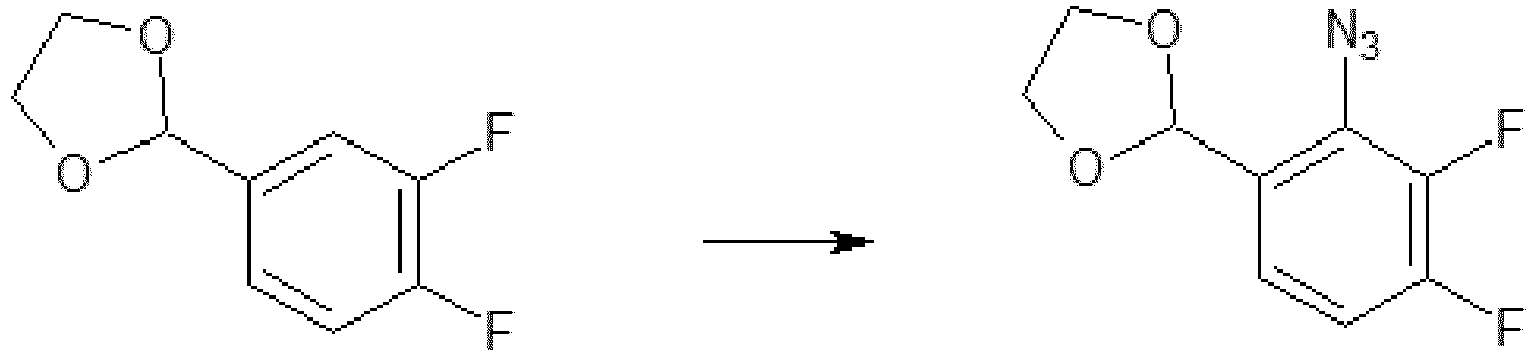
- 1.93 g of 2-(3, 4-difluorophenyl)-1, 3-dioxolane (purity 96.1%, 9.96 mmol) was dissolved in 20 mL of toluene under a nitrogen stream. The reaction liquid was cooled to -78°C. 1.65 mL (11.1 mmol) of N, N, N', N'-tetramethylethylenediamine was added to the resultant, and then 6.9 mL (11.0 mmol) of 1.6M hexane solution of n-butyllithium was added dropwise over 8 minutes. The resultant was stirred for 1 hour at -78°C.
- Thereafter, 22.5 mL (15.2 mmol) of 15% toluene solution of tosyl azide was added dropwise over 5 minutes, and then the reaction solution was warmed to 0°C and then stirred for 1 hour. 50 mL of water was added thereto, and the toluene phase was separated. The product was extracted from the toluene phase with 20 mL of water. The aqueous phase was corrected, and extracted four times with 20 mL of ethyl acetate. The ethyl acetate phase was corrected and combined, washed with 20 mL of saturated saline, dried with magnesium sulfate, and then filtered. As a result of the analysis of the filtrate by HPLC, the yield of 2-(2-azido-3, 4-difluorophenyl)-1, 3-dioxolane was 83.7%.
-
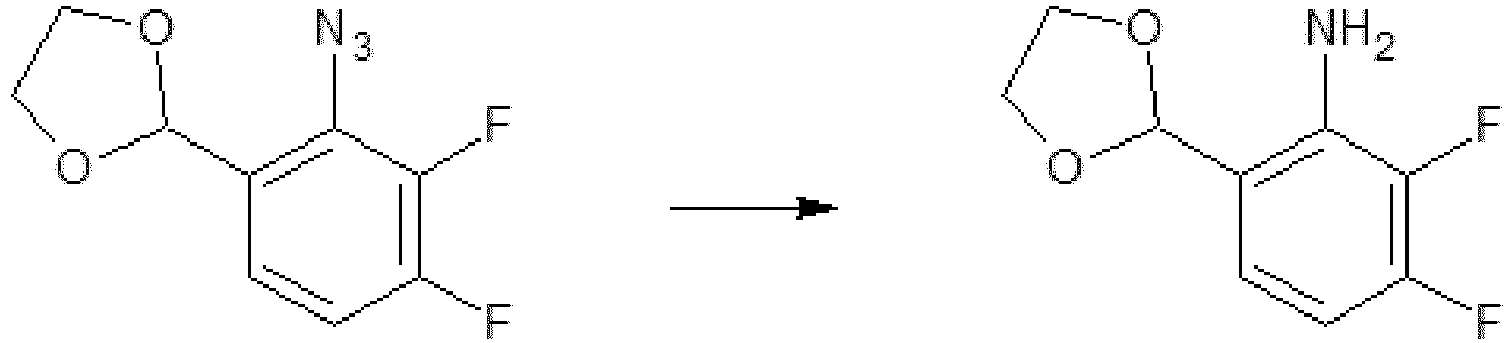
- 22.3 mg of 10% palladium carbon (moisture 55.24%, palladium pure content 9.3 µmol) was added to 11.30 g (10.0 mmol) of 20.2% ethyl acetate solution of 2-(2-azido-3, 4-difluorophenyl)-1, 3-dioxolan. The inside of the system was replaced with nitrogen, and then replaced with hydrogen. Thereafter, the reaction solution was heated to 40°C, and then stirred for 3 hours. The reaction solution was cooled to room temperature, the inside of the system was replaced with nitrogen, the catalyst was filtered off, and then the resultant was washed with ethyl acetate. As a result of the quantitative analysis of the filtrate, the yield of 6-(1, 3-dioxolan-2-yl)-2, 3-difluoroaniline was 95.5%.
- The result of 1H-NMR analysis of the obtained compound was shown below. 1H-NMR (400 MHz, CDCl3) δ 7.03-6.99 (m, 1H), 6.53-6.47 (m, 1H), 5.78 (s, 1H), 4.40 (br, 2H), 4.13-4.03 (m, 4H).
-

- 1.01 g of 6-(1, 3-dioxolan-2-yl)-2, 3-difluoroaniline (purity 99.5%, 5.00 mmol) was dissolved in 15 mL of a mixture composed of acetone and water at a ratio of 1:1. The reaction solution was heated to 30°C, 14.7 mg (0.0584 mmol) of pyridinium p-toluenesulfonate was added thereto, and the mixture was stirred for 2.7 hours. Thereafter, the reaction solution was heated to 40°C and then stirred for 2 hours. The reaction liquid was cooled to room temperature, left still over night, and then acetone was added thereto to obtain a homogeneous solution. As a result of the quantitative analysis of the solution, the yield of 2-amino-3, 4-difluorobenzaldehyde was 96.5%.
- The result of 1H-NMR analysis of the obtained compound was shown below. 1H-NMR (400 MHz, CDCl3) δ 9.82 (d, J = 1.6 Hz, 1H), 7.30-7.26 (m, 1H), 6.58-6.52 (m, 1H), 6.30 (br, 2H).
- 2-amino-3, 4-difluorobenzaldehyde was produced in the same manner as in Example 1, except that Step 2 was carried out in a flow reaction mentioned below.
- 4.14 g of 2-(3, 4-difluorophenyl)-1, 3-dioxolane (purity 96.0%, 21.2 mmol) and 2.72 g (23.4 mmol) of N, N, N', N'-tetramethylethylenediamine were weighted in a 50 mL measuring flask, and diluted with toluene to 50 mL total to obtain a solution (referred to as liquid A).
- The liquid A and a 1.6 M hexane solution of n-butyllithium (referred to as liquid B) were sucked using 50 mL gas tight syringes, respectively, and set to syringe pumps to connect to a flow reactor. The flow rates of the pumps were set so that the retention time of the mixture liquid was 30 seconds and the amount of n-butyllithium relative to the substrate was 1.1 equivalents. A pre-cooling portion and a lithiation retention portion of the flow reactor was cooled to -30°C, and transfer of the liquid A and the liquid B was started at the same time. The transfer process was continued until the mixture liquid of the liquid A and liquid B flowed out, and then the transfer process was stopped once. A reaction container containing 22.5 mL (15.2 mmol) of 15% toluene solution of tosyl azide was cooled to 0°C under a nitrogen stream, and then connected to the flow reactor to restart transfer of the liquids. Transfer of both the liquid A and the liquid B was stopped when transfer of 23.54 mL (substrate 10.0 mmol) of the liquid A was completed. The total amount of the sent liquid B was 6.883 mL (n-butyllithium 11.0 mmol).
- Thereafter, the resultant was stirred at 0°C for 1 hour. 50 mL of water was added thereto, the toluene phase was separated, and the product was extracted with 20 mL of water. The aqueous phase was corrected, and extracted four times with 20 mL of ethyl acetate. The ethyl acetate phase was corrected and combined, washed with 20 mL of saturated saline, dried with magnesium sulfate, and then filtered. As a result of the analysis of the filtrate by HPLC, the yield of 2-(2-azido-3, 4-difluorophenyl)-1, 3-dioxolane was 94.1 %.
- The result of 1H-NMR analysis of the obtained compound was shown below. 1H-NMR (400 MHz, CDCl3) δ 7.30 (ddd, J = 8.8, 6.0, 2.4 Hz, 1H), 6.95 (dt, J = 8.8, 7.2 Hz, 1H), 5.96 (s, 1H), 4.15-4.02 (m, 4H).
- The production method according to the present invention makes it possible to obtain a 2-amino-substituted benzaldehyde compound useful as an agrochemical/pharmaceutical intermediate, such as 2-amino-3, 4-dihalobenzaldehyde, in high yield. Accordingly, the present invention is extremely useful in industrially.
Claims (4)
- A method for producing a benzaldehyde in which an amino group is bonded in a 2 position, a halogeno group or an alkoxy group is bonded in a 3 position, and a hydrogen atom, an alkyl group, a halogeno group, an alkoxy group, or a cyano group is bonded independently in each of 4, 5, and 6 positions, the method comprising:preparing a benzaldehyde in which the halogeno group or the alkoxy group is bonded in the 3 position, a hydrogen atom is bonded in the 2 position, and the hydrogen atom, the alkyl group, the halogeno group, the alkoxy group, or the cyano group is bonded independently in each of the 4, 5, and 6 positions so that a lithiation reaction is most active at the 2 position (hereinafter, abbreviated as 2-unsubstituted benzaldehyde (I-1));acetal-protecting a formyl group in the 2-unsubstituted benzaldehyde (I-1);sequentially performing lithiation, azidation, and amination of the 2 position; andsubsequently performing acetal deportection.
- A method for producing a benzaldehyde in which an amino group is bonded in a 2 position, a halogeno group or an alkoxy group is bonded in a 3 position, and a hydrogen atom, an alkyl group, a halogeno group, an alkoxy group, or a cyano group is bonded independently in each of 4, 5, and 6 positions, the method comprising:preparing a benzaldehyde in which the halogeno group or the alkoxy group is bonded in the 3 position, a hydrogen atom is bonded in the 2 position, and the hydrogen atom, the alkyl group, the halogeno group, the alkoxy group, or the cyano group is bonded independently in each of the 4, 5, and 6 positions so that a boration reaction is most active at the 2 position (hereinafter, abbreviated as 2-unsubstituted benzaldehyde (I-2));acetal-protecting a formyl group in the 2-unsubstituted benzaldehyde (I-2);sequentially performing boration, azidation, and amination of the 2 position; andsubsequently performing acetal deportection.
- The method according to Claim 1 or 2, wherein the 2-unsubstituted benzaldehyde (I-1) or (I-2) is a compound of formula (I-12):
 R3 represents a halogeno group or an alkoxy group,R4, R5, and R6 each independently represent a hydrogen atom, an alkyl group, a halogeno group, an alkoxy group, or a cyano group,wherein in a case where R4 is a hydrogen atom, R5 is a hydrogen atom, an alkyl group, or a cyano group,in a case where R5 is a hydrogen atom, at least one of R4 and R6 is a hydrogen atom, an alkyl group, or a cyano group, andin a case where R6 is a hydrogen atom, R5 is a hydrogen atom, an alkyl group, or a cyano group).
 - A compound of of formula (III-1):

Applications Claiming Priority (2)
| Application Number | Priority Date | Filing Date | Title |
|---|---|---|---|
| JP2014177563 | 2014-09-01 | ||
| PCT/JP2015/073836 WO2016035609A1 (en) | 2014-09-01 | 2015-08-25 | Method for producing 2-amino-substituted benzaldehyde compound |
Publications (3)
| Publication Number | Publication Date |
|---|---|
| EP3196189A1 true EP3196189A1 (en) | 2017-07-26 |
| EP3196189A4 EP3196189A4 (en) | 2018-01-24 |
| EP3196189B1 EP3196189B1 (en) | 2020-09-23 |
Family
ID=55439675
Family Applications (1)
| Application Number | Title | Priority Date | Filing Date |
|---|---|---|---|
| EP15837423.1A Active EP3196189B1 (en) | 2014-09-01 | 2015-08-25 | Method for producing 2-amino-substituted benzaldehyde compound |
Country Status (6)
| Country | Link |
|---|---|
| US (1) | US10047037B2 (en) |
| EP (1) | EP3196189B1 (en) |
| JP (1) | JP6225358B2 (en) |
| KR (1) | KR101879143B1 (en) |
| CN (1) | CN106573874B (en) |
| WO (1) | WO2016035609A1 (en) |
Families Citing this family (4)
| Publication number | Priority date | Publication date | Assignee | Title |
|---|---|---|---|---|
| CN113773204B (en) * | 2021-10-20 | 2024-04-16 | 上海万溯药业有限公司 | Preparation method of fluoroaniline |
| CN114230547A (en) * | 2021-12-29 | 2022-03-25 | 江苏广域化学有限公司 | Synthesis method of substituted benzaldehyde acetal |
| CN114409556B (en) * | 2022-01-28 | 2024-10-18 | 兰州康鹏威耳化工有限公司 | A preparation method of 3,4-disubstituted-2-aminobenzaldehyde |
| CN115963204B (en) * | 2022-12-30 | 2025-09-09 | 贵州健安德科技有限公司 | Method for detecting 2-amino-3, 4-difluorobenzaldehyde in water and algae culture medium by utilizing ultra-high liquid chromatography |
Family Cites Families (8)
| Publication number | Priority date | Publication date | Assignee | Title |
|---|---|---|---|---|
| DE2306919A1 (en) * | 1973-02-13 | 1974-08-15 | Bayer Ag | Amino-chlorobenzaldehydes in high-yields - prepd using acid hydrolysis of chloro-dichloromethyl-phenylisocyanide dichloride |
| DE4142173A1 (en) | 1991-12-20 | 1993-06-24 | Basf Ag | METHOD FOR PRODUCING 2-AMINOBENZALDEHYDES |
| JP3577775B2 (en) | 1995-04-14 | 2004-10-13 | 宇部興産株式会社 | 4,5-Dihaloaniline derivative and method for producing the same |
| JP2000007627A (en) * | 1998-06-19 | 2000-01-11 | Tosoh Corp | Method for producing formyltriarylamine |
| DE60003031T2 (en) * | 1999-06-30 | 2003-12-24 | Aventis Pharma S.A., Antony Cedex | BENZO [F] NAPHTHYRIDINE DERIVATIVES, THEIR PRODUCTION AND THE PHARMACEUTICAL COMPOSITIONS CONTAINING THE SAME |
| TW200808739A (en) | 2006-04-06 | 2008-02-16 | Novartis Vaccines & Diagnostic | Quinazolines for PDK1 inhibition |
| CN103030568A (en) * | 2011-10-08 | 2013-04-10 | 侯召羽 | Synthesis process of amino vanillin |
| JP2013237648A (en) * | 2012-05-16 | 2013-11-28 | Mitsui Chemicals Agro Inc | Method for production of 3-cyanoquinoline derivative |
-
2015
- 2015-08-25 KR KR1020177002258A patent/KR101879143B1/en active Active
- 2015-08-25 WO PCT/JP2015/073836 patent/WO2016035609A1/en not_active Ceased
- 2015-08-25 JP JP2016546566A patent/JP6225358B2/en active Active
- 2015-08-25 CN CN201580044966.8A patent/CN106573874B/en active Active
- 2015-08-25 EP EP15837423.1A patent/EP3196189B1/en active Active
- 2015-08-25 US US15/504,499 patent/US10047037B2/en active Active
Also Published As
| Publication number | Publication date |
|---|---|
| JP6225358B2 (en) | 2017-11-08 |
| KR101879143B1 (en) | 2018-07-16 |
| US10047037B2 (en) | 2018-08-14 |
| CN106573874A (en) | 2017-04-19 |
| EP3196189B1 (en) | 2020-09-23 |
| WO2016035609A1 (en) | 2016-03-10 |
| US20170226046A1 (en) | 2017-08-10 |
| EP3196189A4 (en) | 2018-01-24 |
| KR20170023158A (en) | 2017-03-02 |
| JPWO2016035609A1 (en) | 2017-04-27 |
| CN106573874B (en) | 2018-06-12 |
Similar Documents
| Publication | Publication Date | Title |
|---|---|---|
| Meyers et al. | Efficient chirality transfer between a chiral 4-methyl-1, 4-dihydropyridine and benzoylformic ester. An example of a pure intermolecular self-immolative process | |
| CN1444565A (en) | Efficient ligand-mediated ullmann coupling of anilines and azoles | |
| EP3196189B1 (en) | Method for producing 2-amino-substituted benzaldehyde compound | |
| CN104370755A (en) | Preparation method for optical activity active 3-amino butanol and optical activity 3-amino butyric acid | |
| EP2123661A1 (en) | Chiral iridium aqua complex and method for producing optically active hydroxy compound by using the same | |
| CN113461629A (en) | Preparation method of 5-hydroxymethyl-oxazolidine-2-ketone compound | |
| KR100355916B1 (en) | New manufacturing method of diisopinocampal chloroborane | |
| US20170283380A1 (en) | Intermediate for Synthesizing Paroxetine, Method for Preparing the same, and Uses Thereof | |
| KR100926844B1 (en) | A process for the synthesis of sphingosine | |
| US7049455B2 (en) | Process for producing shogaols and intermediates for the synthesis thereof | |
| CN119528849A (en) | Asymmetric synthesis method of efinaconazole intermediate | |
| KR20260047658A (en) | Novel synthetic options towards the manufacture of (6r,10s)-10-{4-[5-chloro-2-(4-chloro-1h-1,2,3-triazol-1-yl)phenyl]-6-oxo-1(6h)- pyrimidinyl}-1-(difluoromethyl)-6-methyl-1,4,7,8,9,10-hexahydro-11,15-(metheno)pyrazolo[4,3-b][1,7]diazacyclotetradecin-5(6h)-one | |
| WO2015122502A1 (en) | Method for producing optically active compound, and novel metal-diamine complex | |
| CN113754605B (en) | A kind of nitrogen-containing ligand and its preparation method and application | |
| CN102627571B (en) | Preparation and synthesis method for chiral ammonium salt | |
| CN109705014B (en) | Novel chiral amine oxide ligand and preparation method thereof | |
| CN115521238B (en) | Preparation method of N-methyl-2- (2-chloroethyl) pyrrolidine | |
| JP5134883B2 (en) | Asymmetric catalyst having fluorine substituent and method for producing optically active compound | |
| EP3666751A1 (en) | Method for preparing latanoprostene bunod, and intermediate therefor | |
| EP3246322A1 (en) | Furoxan compound, and manufacturing method for same | |
| CN116606232A (en) | Novel monofluoroalkyl compounds, preparation method and application thereof | |
| JP5233675B2 (en) | Process for producing optically active 2- (2'-piperidinyl) acetate | |
| KR20180050091A (en) | A method for preparation of (S)-N1-(2-aminoethyl)-3-(4-alkoxyphenyl)propane-1,2-diamine trihydrocholoride | |
| CN119161341A (en) | A green synthesis method for polycyclic dihydroquinazolinone derivatives with antiviral activity | |
| CN116874419A (en) | Synthesis of an antifungal pathogen reagent |
Legal Events
| Date | Code | Title | Description |
|---|---|---|---|
| STAA | Information on the status of an ep patent application or granted ep patent |
Free format text: STATUS: THE INTERNATIONAL PUBLICATION HAS BEEN MADE |
|
| PUAI | Public reference made under article 153(3) epc to a published international application that has entered the european phase |
Free format text: ORIGINAL CODE: 0009012 |
|
| STAA | Information on the status of an ep patent application or granted ep patent |
Free format text: STATUS: REQUEST FOR EXAMINATION WAS MADE |
|
| 17P | Request for examination filed |
Effective date: 20170221 |
|
| AK | Designated contracting states |
Kind code of ref document: A1 Designated state(s): AL AT BE BG CH CY CZ DE DK EE ES FI FR GB GR HR HU IE IS IT LI LT LU LV MC MK MT NL NO PL PT RO RS SE SI SK SM TR |
|
| AX | Request for extension of the european patent |
Extension state: BA ME |
|
| DAV | Request for validation of the european patent (deleted) | ||
| DAX | Request for extension of the european patent (deleted) | ||
| A4 | Supplementary search report drawn up and despatched |
Effective date: 20180104 |
|
| RIC1 | Information provided on ipc code assigned before grant |
Ipc: C07C 221/00 20060101AFI20171221BHEP Ipc: C07D 317/16 20060101ALI20171221BHEP Ipc: C07B 51/00 20060101ALI20171221BHEP Ipc: C07D 317/28 20060101ALI20171221BHEP Ipc: C07B 61/00 20060101ALI20171221BHEP Ipc: C07C 223/06 20060101ALI20171221BHEP |
|
| STAA | Information on the status of an ep patent application or granted ep patent |
Free format text: STATUS: EXAMINATION IS IN PROGRESS |
|
| 17Q | First examination report despatched |
Effective date: 20181126 |
|
| GRAP | Despatch of communication of intention to grant a patent |
Free format text: ORIGINAL CODE: EPIDOSNIGR1 |
|
| STAA | Information on the status of an ep patent application or granted ep patent |
Free format text: STATUS: GRANT OF PATENT IS INTENDED |
|
| INTG | Intention to grant announced |
Effective date: 20200603 |
|
| GRAS | Grant fee paid |
Free format text: ORIGINAL CODE: EPIDOSNIGR3 |
|
| GRAA | (expected) grant |
Free format text: ORIGINAL CODE: 0009210 |
|
| STAA | Information on the status of an ep patent application or granted ep patent |
Free format text: STATUS: THE PATENT HAS BEEN GRANTED |
|
| AK | Designated contracting states |
Kind code of ref document: B1 Designated state(s): AL AT BE BG CH CY CZ DE DK EE ES FI FR GB GR HR HU IE IS IT LI LT LU LV MC MK MT NL NO PL PT RO RS SE SI SK SM TR |
|
| REG | Reference to a national code |
Ref country code: GB Ref legal event code: FG4D |
|
| REG | Reference to a national code |
Ref country code: CH Ref legal event code: EP |
|
| REG | Reference to a national code |
Ref country code: IE Ref legal event code: FG4D |
|
| REG | Reference to a national code |
Ref country code: DE Ref legal event code: R096 Ref document number: 602015059626 Country of ref document: DE Ref country code: AT Ref legal event code: REF Ref document number: 1316261 Country of ref document: AT Kind code of ref document: T Effective date: 20201015 |
|
| PG25 | Lapsed in a contracting state [announced via postgrant information from national office to epo] |
Ref country code: FI Free format text: LAPSE BECAUSE OF FAILURE TO SUBMIT A TRANSLATION OF THE DESCRIPTION OR TO PAY THE FEE WITHIN THE PRESCRIBED TIME-LIMIT Effective date: 20200923 Ref country code: HR Free format text: LAPSE BECAUSE OF FAILURE TO SUBMIT A TRANSLATION OF THE DESCRIPTION OR TO PAY THE FEE WITHIN THE PRESCRIBED TIME-LIMIT Effective date: 20200923 Ref country code: BG Free format text: LAPSE BECAUSE OF FAILURE TO SUBMIT A TRANSLATION OF THE DESCRIPTION OR TO PAY THE FEE WITHIN THE PRESCRIBED TIME-LIMIT Effective date: 20201223 Ref country code: GR Free format text: LAPSE BECAUSE OF FAILURE TO SUBMIT A TRANSLATION OF THE DESCRIPTION OR TO PAY THE FEE WITHIN THE PRESCRIBED TIME-LIMIT Effective date: 20201224 Ref country code: NO Free format text: LAPSE BECAUSE OF FAILURE TO SUBMIT A TRANSLATION OF THE DESCRIPTION OR TO PAY THE FEE WITHIN THE PRESCRIBED TIME-LIMIT Effective date: 20201223 Ref country code: SE Free format text: LAPSE BECAUSE OF FAILURE TO SUBMIT A TRANSLATION OF THE DESCRIPTION OR TO PAY THE FEE WITHIN THE PRESCRIBED TIME-LIMIT Effective date: 20200923 |
|
| REG | Reference to a national code |
Ref country code: AT Ref legal event code: MK05 Ref document number: 1316261 Country of ref document: AT Kind code of ref document: T Effective date: 20200923 |
|
| PG25 | Lapsed in a contracting state [announced via postgrant information from national office to epo] |
Ref country code: RS Free format text: LAPSE BECAUSE OF FAILURE TO SUBMIT A TRANSLATION OF THE DESCRIPTION OR TO PAY THE FEE WITHIN THE PRESCRIBED TIME-LIMIT Effective date: 20200923 Ref country code: LV Free format text: LAPSE BECAUSE OF FAILURE TO SUBMIT A TRANSLATION OF THE DESCRIPTION OR TO PAY THE FEE WITHIN THE PRESCRIBED TIME-LIMIT Effective date: 20200923 |
|
| REG | Reference to a national code |
Ref country code: NL Ref legal event code: MP Effective date: 20200923 |
|
| REG | Reference to a national code |
Ref country code: LT Ref legal event code: MG4D |
|
| PG25 | Lapsed in a contracting state [announced via postgrant information from national office to epo] |
Ref country code: LT Free format text: LAPSE BECAUSE OF FAILURE TO SUBMIT A TRANSLATION OF THE DESCRIPTION OR TO PAY THE FEE WITHIN THE PRESCRIBED TIME-LIMIT Effective date: 20200923 Ref country code: SM Free format text: LAPSE BECAUSE OF FAILURE TO SUBMIT A TRANSLATION OF THE DESCRIPTION OR TO PAY THE FEE WITHIN THE PRESCRIBED TIME-LIMIT Effective date: 20200923 Ref country code: PT Free format text: LAPSE BECAUSE OF FAILURE TO SUBMIT A TRANSLATION OF THE DESCRIPTION OR TO PAY THE FEE WITHIN THE PRESCRIBED TIME-LIMIT Effective date: 20210125 Ref country code: RO Free format text: LAPSE BECAUSE OF FAILURE TO SUBMIT A TRANSLATION OF THE DESCRIPTION OR TO PAY THE FEE WITHIN THE PRESCRIBED TIME-LIMIT Effective date: 20200923 Ref country code: EE Free format text: LAPSE BECAUSE OF FAILURE TO SUBMIT A TRANSLATION OF THE DESCRIPTION OR TO PAY THE FEE WITHIN THE PRESCRIBED TIME-LIMIT Effective date: 20200923 Ref country code: CZ Free format text: LAPSE BECAUSE OF FAILURE TO SUBMIT A TRANSLATION OF THE DESCRIPTION OR TO PAY THE FEE WITHIN THE PRESCRIBED TIME-LIMIT Effective date: 20200923 |
|
| PG25 | Lapsed in a contracting state [announced via postgrant information from national office to epo] |
Ref country code: ES Free format text: LAPSE BECAUSE OF FAILURE TO SUBMIT A TRANSLATION OF THE DESCRIPTION OR TO PAY THE FEE WITHIN THE PRESCRIBED TIME-LIMIT Effective date: 20200923 Ref country code: AT Free format text: LAPSE BECAUSE OF FAILURE TO SUBMIT A TRANSLATION OF THE DESCRIPTION OR TO PAY THE FEE WITHIN THE PRESCRIBED TIME-LIMIT Effective date: 20200923 Ref country code: AL Free format text: LAPSE BECAUSE OF FAILURE TO SUBMIT A TRANSLATION OF THE DESCRIPTION OR TO PAY THE FEE WITHIN THE PRESCRIBED TIME-LIMIT Effective date: 20200923 Ref country code: PL Free format text: LAPSE BECAUSE OF FAILURE TO SUBMIT A TRANSLATION OF THE DESCRIPTION OR TO PAY THE FEE WITHIN THE PRESCRIBED TIME-LIMIT Effective date: 20200923 Ref country code: IS Free format text: LAPSE BECAUSE OF FAILURE TO SUBMIT A TRANSLATION OF THE DESCRIPTION OR TO PAY THE FEE WITHIN THE PRESCRIBED TIME-LIMIT Effective date: 20210123 |
|
| REG | Reference to a national code |
Ref country code: DE Ref legal event code: R097 Ref document number: 602015059626 Country of ref document: DE |
|
| PG25 | Lapsed in a contracting state [announced via postgrant information from national office to epo] |
Ref country code: SK Free format text: LAPSE BECAUSE OF FAILURE TO SUBMIT A TRANSLATION OF THE DESCRIPTION OR TO PAY THE FEE WITHIN THE PRESCRIBED TIME-LIMIT Effective date: 20200923 |
|
| PLBE | No opposition filed within time limit |
Free format text: ORIGINAL CODE: 0009261 |
|
| STAA | Information on the status of an ep patent application or granted ep patent |
Free format text: STATUS: NO OPPOSITION FILED WITHIN TIME LIMIT |
|
| PG25 | Lapsed in a contracting state [announced via postgrant information from national office to epo] |
Ref country code: DK Free format text: LAPSE BECAUSE OF FAILURE TO SUBMIT A TRANSLATION OF THE DESCRIPTION OR TO PAY THE FEE WITHIN THE PRESCRIBED TIME-LIMIT Effective date: 20200923 Ref country code: SI Free format text: LAPSE BECAUSE OF FAILURE TO SUBMIT A TRANSLATION OF THE DESCRIPTION OR TO PAY THE FEE WITHIN THE PRESCRIBED TIME-LIMIT Effective date: 20200923 |
|
| 26N | No opposition filed |
Effective date: 20210624 |
|
| PG25 | Lapsed in a contracting state [announced via postgrant information from national office to epo] |
Ref country code: IT Free format text: LAPSE BECAUSE OF FAILURE TO SUBMIT A TRANSLATION OF THE DESCRIPTION OR TO PAY THE FEE WITHIN THE PRESCRIBED TIME-LIMIT Effective date: 20200923 |
|
| REG | Reference to a national code |
Ref country code: CH Ref legal event code: PL |
|
| PG25 | Lapsed in a contracting state [announced via postgrant information from national office to epo] |
Ref country code: MC Free format text: LAPSE BECAUSE OF FAILURE TO SUBMIT A TRANSLATION OF THE DESCRIPTION OR TO PAY THE FEE WITHIN THE PRESCRIBED TIME-LIMIT Effective date: 20200923 |
|
| REG | Reference to a national code |
Ref country code: BE Ref legal event code: MM Effective date: 20210831 |
|
| PG25 | Lapsed in a contracting state [announced via postgrant information from national office to epo] |
Ref country code: LI Free format text: LAPSE BECAUSE OF NON-PAYMENT OF DUE FEES Effective date: 20210831 Ref country code: CH Free format text: LAPSE BECAUSE OF NON-PAYMENT OF DUE FEES Effective date: 20210831 |
|
| PG25 | Lapsed in a contracting state [announced via postgrant information from national office to epo] |
Ref country code: LU Free format text: LAPSE BECAUSE OF NON-PAYMENT OF DUE FEES Effective date: 20210825 |
|
| PG25 | Lapsed in a contracting state [announced via postgrant information from national office to epo] |
Ref country code: IE Free format text: LAPSE BECAUSE OF NON-PAYMENT OF DUE FEES Effective date: 20210825 Ref country code: BE Free format text: LAPSE BECAUSE OF NON-PAYMENT OF DUE FEES Effective date: 20210831 |
|
| PG25 | Lapsed in a contracting state [announced via postgrant information from national office to epo] |
Ref country code: HU Free format text: LAPSE BECAUSE OF FAILURE TO SUBMIT A TRANSLATION OF THE DESCRIPTION OR TO PAY THE FEE WITHIN THE PRESCRIBED TIME-LIMIT; INVALID AB INITIO Effective date: 20150825 |
|
| P01 | Opt-out of the competence of the unified patent court (upc) registered |
Effective date: 20230509 |
|
| PG25 | Lapsed in a contracting state [announced via postgrant information from national office to epo] |
Ref country code: NL Free format text: LAPSE BECAUSE OF NON-PAYMENT OF DUE FEES Effective date: 20200923 Ref country code: CY Free format text: LAPSE BECAUSE OF FAILURE TO SUBMIT A TRANSLATION OF THE DESCRIPTION OR TO PAY THE FEE WITHIN THE PRESCRIBED TIME-LIMIT Effective date: 20200923 |
|
| PG25 | Lapsed in a contracting state [announced via postgrant information from national office to epo] |
Ref country code: MK Free format text: LAPSE BECAUSE OF FAILURE TO SUBMIT A TRANSLATION OF THE DESCRIPTION OR TO PAY THE FEE WITHIN THE PRESCRIBED TIME-LIMIT Effective date: 20200923 |
|
| PG25 | Lapsed in a contracting state [announced via postgrant information from national office to epo] |
Ref country code: MT Free format text: LAPSE BECAUSE OF FAILURE TO SUBMIT A TRANSLATION OF THE DESCRIPTION OR TO PAY THE FEE WITHIN THE PRESCRIBED TIME-LIMIT Effective date: 20200923 |
|
| PGFP | Annual fee paid to national office [announced via postgrant information from national office to epo] |
Ref country code: DE Payment date: 20250820 Year of fee payment: 11 |
|
| PGFP | Annual fee paid to national office [announced via postgrant information from national office to epo] |
Ref country code: GB Payment date: 20250821 Year of fee payment: 11 |
|
| PGFP | Annual fee paid to national office [announced via postgrant information from national office to epo] |
Ref country code: FR Payment date: 20250829 Year of fee payment: 11 |
|
| PG25 | Lapsed in a contracting state [announced via postgrant information from national office to epo] |
Ref country code: TR Free format text: LAPSE BECAUSE OF FAILURE TO SUBMIT A TRANSLATION OF THE DESCRIPTION OR TO PAY THE FEE WITHIN THE PRESCRIBED TIME-LIMIT Effective date: 20200923 |