EP3194575B1 - Process and compositions for achieving mammalian energy balance - Google Patents
Process and compositions for achieving mammalian energy balance Download PDFInfo
- Publication number
- EP3194575B1 EP3194575B1 EP15888720.8A EP15888720A EP3194575B1 EP 3194575 B1 EP3194575 B1 EP 3194575B1 EP 15888720 A EP15888720 A EP 15888720A EP 3194575 B1 EP3194575 B1 EP 3194575B1
- Authority
- EP
- European Patent Office
- Prior art keywords
- adipogenesis
- cells
- forskolin
- adipocytes
- medium
- Prior art date
- Legal status (The legal status is an assumption and is not a legal conclusion. Google has not performed a legal analysis and makes no representation as to the accuracy of the status listed.)
- Active
Links
Images

Classifications
-
- A—HUMAN NECESSITIES
- A61—MEDICAL OR VETERINARY SCIENCE; HYGIENE
- A61K—PREPARATIONS FOR MEDICAL, DENTAL OR TOILETRY PURPOSES
- A61K31/00—Medicinal preparations containing organic active ingredients
- A61K31/33—Heterocyclic compounds
- A61K31/335—Heterocyclic compounds having oxygen as the only ring hetero atom, e.g. fungichromin
- A61K31/35—Heterocyclic compounds having oxygen as the only ring hetero atom, e.g. fungichromin having six-membered rings with one oxygen as the only ring hetero atom
- A61K31/352—Heterocyclic compounds having oxygen as the only ring hetero atom, e.g. fungichromin having six-membered rings with one oxygen as the only ring hetero atom condensed with carbocyclic rings, e.g. methantheline
-
- A—HUMAN NECESSITIES
- A61—MEDICAL OR VETERINARY SCIENCE; HYGIENE
- A61K—PREPARATIONS FOR MEDICAL, DENTAL OR TOILETRY PURPOSES
- A61K35/00—Medicinal preparations containing materials or reaction products thereof with undetermined constitution
- A61K35/12—Materials from mammals; Compositions comprising non-specified tissues or cells; Compositions comprising non-embryonic stem cells; Genetically modified cells
- A61K35/35—Fat tissue; Adipocytes; Stromal cells; Connective tissues
-
- A—HUMAN NECESSITIES
- A61—MEDICAL OR VETERINARY SCIENCE; HYGIENE
- A61P—SPECIFIC THERAPEUTIC ACTIVITY OF CHEMICAL COMPOUNDS OR MEDICINAL PREPARATIONS
- A61P3/00—Drugs for disorders of the metabolism
- A61P3/04—Anorexiants; Antiobesity agents
-
- A—HUMAN NECESSITIES
- A61—MEDICAL OR VETERINARY SCIENCE; HYGIENE
- A61P—SPECIFIC THERAPEUTIC ACTIVITY OF CHEMICAL COMPOUNDS OR MEDICINAL PREPARATIONS
- A61P3/00—Drugs for disorders of the metabolism
- A61P3/06—Antihyperlipidemics
-
- A—HUMAN NECESSITIES
- A61—MEDICAL OR VETERINARY SCIENCE; HYGIENE
- A61P—SPECIFIC THERAPEUTIC ACTIVITY OF CHEMICAL COMPOUNDS OR MEDICINAL PREPARATIONS
- A61P43/00—Drugs for specific purposes, not provided for in groups A61P1/00-A61P41/00
-
- C—CHEMISTRY; METALLURGY
- C12—BIOCHEMISTRY; BEER; SPIRITS; WINE; VINEGAR; MICROBIOLOGY; ENZYMOLOGY; MUTATION OR GENETIC ENGINEERING
- C12N—MICROORGANISMS OR ENZYMES; COMPOSITIONS THEREOF; PROPAGATING, PRESERVING, OR MAINTAINING MICROORGANISMS; MUTATION OR GENETIC ENGINEERING; CULTURE MEDIA
- C12N5/00—Undifferentiated human, animal or plant cells, e.g. cell lines; Tissues; Cultivation or maintenance thereof; Culture media therefor
- C12N5/06—Animal cells or tissues; Human cells or tissues
- C12N5/0602—Vertebrate cells
- C12N5/0652—Cells of skeletal and connective tissues; Mesenchyme
- C12N5/0653—Adipocytes; Adipose tissue
-
- G—PHYSICS
- G01—MEASURING; TESTING
- G01N—INVESTIGATING OR ANALYSING MATERIALS BY DETERMINING THEIR CHEMICAL OR PHYSICAL PROPERTIES
- G01N33/00—Investigating or analysing materials by specific methods not covered by groups G01N1/00 - G01N31/00
- G01N33/48—Biological material, e.g. blood, urine; Haemocytometers
- G01N33/50—Chemical analysis of biological material, e.g. blood, urine; Testing involving biospecific ligand binding methods; Immunological testing
- G01N33/5005—Chemical analysis of biological material, e.g. blood, urine; Testing involving biospecific ligand binding methods; Immunological testing involving human or animal cells
- G01N33/5008—Chemical analysis of biological material, e.g. blood, urine; Testing involving biospecific ligand binding methods; Immunological testing involving human or animal cells for testing or evaluating the effect of chemical or biological compounds, e.g. drugs, cosmetics
- G01N33/5044—Chemical analysis of biological material, e.g. blood, urine; Testing involving biospecific ligand binding methods; Immunological testing involving human or animal cells for testing or evaluating the effect of chemical or biological compounds, e.g. drugs, cosmetics involving specific cell types
-
- C—CHEMISTRY; METALLURGY
- C12—BIOCHEMISTRY; BEER; SPIRITS; WINE; VINEGAR; MICROBIOLOGY; ENZYMOLOGY; MUTATION OR GENETIC ENGINEERING
- C12N—MICROORGANISMS OR ENZYMES; COMPOSITIONS THEREOF; PROPAGATING, PRESERVING, OR MAINTAINING MICROORGANISMS; MUTATION OR GENETIC ENGINEERING; CULTURE MEDIA
- C12N2501/00—Active agents used in cell culture processes, e.g. differentation
- C12N2501/01—Modulators of cAMP or cGMP, e.g. non-hydrolysable analogs, phosphodiesterase inhibitors, cholera toxin
-
- C—CHEMISTRY; METALLURGY
- C12—BIOCHEMISTRY; BEER; SPIRITS; WINE; VINEGAR; MICROBIOLOGY; ENZYMOLOGY; MUTATION OR GENETIC ENGINEERING
- C12N—MICROORGANISMS OR ENZYMES; COMPOSITIONS THEREOF; PROPAGATING, PRESERVING, OR MAINTAINING MICROORGANISMS; MUTATION OR GENETIC ENGINEERING; CULTURE MEDIA
- C12N2506/00—Differentiation of animal cells from one lineage to another; Differentiation of pluripotent cells
- C12N2506/13—Differentiation of animal cells from one lineage to another; Differentiation of pluripotent cells from connective tissue cells, from mesenchymal cells
-
- G—PHYSICS
- G01—MEASURING; TESTING
- G01N—INVESTIGATING OR ANALYSING MATERIALS BY DETERMINING THEIR CHEMICAL OR PHYSICAL PROPERTIES
- G01N2333/00—Assays involving biological materials from specific organisms or of a specific nature
- G01N2333/435—Assays involving biological materials from specific organisms or of a specific nature from animals; from humans
- G01N2333/475—Assays involving growth factors
- G01N2333/51—Bone morphogenetic factor; Osteogenins; Osteogenic factor; Bone-inducing factor
-
- G—PHYSICS
- G01—MEASURING; TESTING
- G01N—INVESTIGATING OR ANALYSING MATERIALS BY DETERMINING THEIR CHEMICAL OR PHYSICAL PROPERTIES
- G01N2333/00—Assays involving biological materials from specific organisms or of a specific nature
- G01N2333/435—Assays involving biological materials from specific organisms or of a specific nature from animals; from humans
- G01N2333/475—Assays involving growth factors
- G01N2333/515—Angiogenesic factors; Angiogenin
Definitions
- the invention in general relates to dietary supplements. More specifically, the present invention relates to a method of achieving optimal mammalian energy balance using forskolin on a particular physiological and developmental stage of the mammalian cellular system.
- US 2005/0158706 A1 discloses methods and compositions for a differentiation of human pre-adipocytes into adipocytes.
- the methods comprise incubation of isolated human pre-adipocytes in a medium containing glucose, a cyclic AMP inducer such as isobutylmethylxanthine or forskolin, a glucocorticoid or glucocorticoid analogue, insulin or an insulin analogue and a PPAR ⁇ agonist or RXR agonist.
- a cyclic AMP inducer such as isobutylmethylxanthine or forskolin
- a glucocorticoid or glucocorticoid analogue insulin or an insulin analogue and a PPAR ⁇ agonist or RXR agonist.
- the document also concerns methods for determining the ability of a compound to affect the differentiation of pre-adipocytes to adipocytes.
- the present disclosure relates to the potential of forskolin to mediate mammalian energy balance. Accordingly, it is the principle objective of the present disclosure to disclose,
- the present invention fulfils the aforesaid objectives and provides further related advantages.
- the advantages of the present disclosure includes the demonstration of a method to achieve mammalian energy balance using forskolin on a particular physiological and developmental stage of the mammalian cellular system wherein forskolin evinces increased potential to (i) inhibit adipogenesis; and (ii) enhance the expression of secreted factors that selectively recruit brown adipose tissue (BAT) like bone morphogenetic protein-7 (BMP-7), bone morphogenetic protein-4 (BMP-4), vascular endothelial growth factor-A (VEGF-A) and mitochondrial uncoupling protein (UCP1) when brought into contact or administered to pre-adipocytes rather than to mature adipocytes.
- BAT brown adipose tissue
- BMP-7 bone morphogenetic protein-7
- BMP-4 bone morphogenetic protein-4
- VEGF-A vascular endothelial growth factor-A
- UCP1 mitochondrial uncoupling protein
- the present disclosure relates to a method of achieving mammalian energy balance using forskolin in a process of adipogenesis inhibition wherein forskolin is added separately to pre-adipocytes before differentiation and also to mature adipocytes to comparatively evaluate adipogenesis inhibition potential of, said process comprising steps of:
- the present disclosure also relates to a method of mammalian energy balance using forskolin in a process of promoting the expression of secreted factors that selectively recruit brown adipose tissue (BAT) like bone morphogenetic protein-7 (BMP-7), bone morphogenetic protein-4 (BMP-4), vascular endothelial growth factor-A (VEGF-A) and mitochondrial uncoupling protein (UCP1) wherein said expression of secreted factors that selectively recruit brown adipose tissue (BAT) is remarkably enhanced as measured when forskolin is administered (brought into contact) to pre-adipocytes than to mature adipocytes, said method incorporating the steps of ,
- the present disclosure also relates to a method of achieving energy balance in mammalian adipose cellular systems, said method comprising step of administering forskolin in effective amounts targeted towards mammalian pre-adipocytes to achieve effects of (a) increased inhibition of adipogenesis and (b) increased expression of secretory factors that function individually or in combination to specifically recruit brown adipocytes or brown like (beige or brite) adipocytes.
- the secretory factors are selected from the group consisting of bone morphogenetic protein-7 (BMP-7), bone morphogenetic protein-4 (BMP-4), vascular endothelial growth factor-A (VEGF-A) and mitochondrial uncoupling protein (UCP1).
- the present disclosure also relates to forskolin for use in therapy for obesity wherein said therapy involves achieving energy balance in mammalian adipocytes by administering forskolin in effective amounts targeted towards mammalian pre-adipocytes to bring about the effects of (a) increased inhibition of adipogenesis and (b) increased expression of secretory factors that function individually or in combination to specifically recruit brown adipocytes or brown like (beige or brite) adipocytes.
- the secretory factors are selected from the group consisting of bone morphogenetic protein-7 (BMP-7), bone morphogenetic protein-4 (BMP-4), vascular endothelial growth factor-A (VEGF-A) and mitochondrial uncoupling protein (UCP1)
- the present disclosure also relates to a method to induce the brown like phenotype (beige or brite adipocytes) in white adipocyte depots in mammals said method comprising step of administering effective amount of forskolin to obese mammals with depots of fully differentiated white adipocytes to achieve effect of increase in secretory factors that bring about the development of brown like phenotype (beige or brown adipocytes) within white adipocyte depots.
- the secretory factors are vascular endothelial growth factor-A (VEGF-A) and mitochondrial uncoupling protein (UCP1).
- the present disclosure also relates to Forskolin for use in the therapy of obesity characterised in that forskolin is administered in effective amounts targeting mammalian white adipocyte depots to achieve effect of increased expression of secretory factors vascular endothelial growth factor-A (VEGF-A) and mitochondrial uncoupling protein (UCP1) that cause the development of brown like phenotype (beige or brite adipocytes) in white adipocyte depots in mammals.
- VEGF-A vascular endothelial growth factor-A
- UCP1 mitochondrial uncoupling protein
- the present disclosure also relates to a method of achieving energy balance in mammalian adipose cellular systems, said method comprising step of administering forskolin in effective amounts targeted towards mammalian pre-adipocytes to bring about of the effect of enhanced expression of mitochondria uncoupling protein 1 (UCP-1) to result in increased mitochondrial thermiogenesis in differentiated brown adipocytes and brown like (beige or brite) adipocytes.
- UCP-1 mitochondria uncoupling protein 1
- the present disclosure also relates to forskolin for use in therapy for obesity wherein said therapy involves achieving energy balance in mammalian adipocytes by administering forskolin in effective amounts targeted towards mammalian pre-adipocytes to bring about the effects of enhanced expression of secretory factor mitochondria uncoupling protein 1 (UCP-1) to result in increased mitochondrial thermiogenesis in differentiated brown adipocytes and brown like (beige or brite) adipocytes.
- UCP-1 secretory factor mitochondria uncoupling protein 1
- Table A shows that at each tested concentration of forskolin, the administration of forskolin at the mammalian pre-adipocyte stage has a profound effect on preventing adipogenesis that when administered after the differentiation of pre-adipocytes to adipocytes. Double or more than double the % inhibition of adipogenesis was observed when forskolin was administered at the pre-adipocyte stage as compared to administration at the adipocyte stage.
- Immunoassays Enzyme linked immunosorbent assay for the quantification of BMP-7 in the cell culture supernatant when forskolin (50 ⁇ g/ml and 100 ⁇ g/ml) was administered at the pre-adipocyte stage and once the differentiation to adipocytes occurred indicated that forskolin profoundly increased BMP-7 expression in at the pre-adipocyte stage than at the adipocyte stage.
- Fig. 1 provides substantiation to the disclosed most preferred embodiment that forskolin directs the selective differentiation of mammalian pre-adipocytes to brown adipocytes by allowing the expression of secretory factor BMP-7.
- BMP-4 is a new adipokine and acts on adipogenesis and white to brown transition ( Qian S Wet al Proc Natl Acad Sci USA 110: E798-807, 2013 ).
- Immunoassays Enzyme linked immunosorbent assay for the quantification of BMP-4 in the cell culture supernatant when forskolin (50 ⁇ g/ml and 100 ⁇ g/ml) was administered at the pre-adipocyte stage and once the differentiation to adipocytes occurred indicated that forskolin profoundly increased BMP-4 expression in at the pre-adipocyte stage than at the adipocyte stage.
- VEGF-A over expression leads to an increase in brown adipose tissue (BAT) thermogenesis and also promotes a "BAT-like" phenotype in white adipose tissue depots.
- BAT brown adipose tissue
- introducing VEGF-A locally in BAT rescues capillary rarefaction, ameliorates brown adipocyte dysfunction, and improves deleterious effects on glucose and lipid metabolism caused by a high-fat diet challenge.
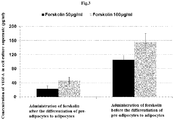
- Immunoassays Enzyme linked immunosorbent assay for the quantification of VEGF-A in the cell culture supernatant when forskolin (50 ⁇ g/ml and 100 ⁇ g/ml) was administered at the pre-adipocyte stage and once the differentiation to adipocytes occurred indicated that forskolin profoundly increased VEGF-A expression in the pre-adipocyte stage than at the adipocyte stage.
- forskolin evinces greater potential for conversion of white pre-adipocytes to the brown adipocyte like (brite or beige) cells ( Fig. 3 ) among white adipocyte depots in the mammalian body.
- thermogenesis that evolved to protect the body from hypothermia is based upon the uncoupling of oxidative phosphorylation in brown adipocytes by the mitochondrial uncoupling protein (UCP-1). It has been shown that up-regulation of UCP1 by genetic manipulations or pharmacological agents can reduce obesity and improve insulin sensitivity ( International Journal of Obesity (2008) 32, S32-S38; doi:10.1038/ijo.2008.236 UCP1: its involvement and utility in obesity. L P Kozak and R Anunciado-Koza ).
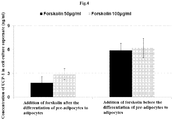
- Immunoassays Enzyme linked immunosorbent assay for the quantification of UCP-1 in the cell culture supernatant when forskolin (50 ⁇ g/ml and 100 ⁇ g/ml) was administered at the pre-adipocyte stage and once the differentiation to adipocytes occurred indicated that forskolin profoundly increased UCP-1 expression in the pre-adipocyte stage than at the adipocyte stage.
- forskolin evinces greater potential for conversion of pre-adipocytes to the BAT-like or brown adipocytes and enhanced UCP-1 expression in these cells can be expected to enhance bringing about energy balance through appropriate energy expenditure ( Fig. 4 ).
Landscapes
- Health & Medical Sciences (AREA)
- Life Sciences & Earth Sciences (AREA)
- Engineering & Computer Science (AREA)
- Biomedical Technology (AREA)
- Chemical & Material Sciences (AREA)
- General Health & Medical Sciences (AREA)
- Bioinformatics & Cheminformatics (AREA)
- Cell Biology (AREA)
- Immunology (AREA)
- Biotechnology (AREA)
- Medicinal Chemistry (AREA)
- Organic Chemistry (AREA)
- Hematology (AREA)
- Zoology (AREA)
- Pharmacology & Pharmacy (AREA)
- Animal Behavior & Ethology (AREA)
- Public Health (AREA)
- Veterinary Medicine (AREA)
- Microbiology (AREA)
- Wood Science & Technology (AREA)
- Urology & Nephrology (AREA)
- Molecular Biology (AREA)
- Genetics & Genomics (AREA)
- Biochemistry (AREA)
- Epidemiology (AREA)
- Pathology (AREA)
- Analytical Chemistry (AREA)
- General Physics & Mathematics (AREA)
- General Engineering & Computer Science (AREA)
- Toxicology (AREA)
- Physics & Mathematics (AREA)
- Tropical Medicine & Parasitology (AREA)
- Food Science & Technology (AREA)
- Rheumatology (AREA)
- General Chemical & Material Sciences (AREA)
- Nuclear Medicine, Radiotherapy & Molecular Imaging (AREA)
- Chemical Kinetics & Catalysis (AREA)
- Obesity (AREA)
- Diabetes (AREA)
- Developmental Biology & Embryology (AREA)
Description
- This application is the PCT filing drawing priority from
U.S. non-provisional patent application 14936830 filed on November 10, 2015 - Field of the invention: The invention in general relates to dietary supplements. More specifically, the present invention relates to a method of achieving optimal mammalian energy balance using forskolin on a particular physiological and developmental stage of the mammalian cellular system.
- Description of Prior Art: Disruption of mammalian energy balance has been implicated as the cause for worldwide epidemics of metabolic diseases that calls for modifications in life style and food habits and also therapeutic intervention. Current diet regimens, exercise, health care awareness or drug strategies however are often unable to tackle homeostasis of energy in the mammalian body where optimally, a perfect balance between energy accumulation and energy expenditure is sought (Elattar.S and Satyanarayana, "Can Brown Fat Win the Battle against White Fat?", J Cell Physiol. 2015 Mar 11, Zafrir B, "Brown adipose tissue: research milestones of a potential player in human energy balance and obesity", Horm Metab Res. 2013 Oct;45(11):774-85). An impetus to the understanding of critical biological processes controlling brown adipocyte activity and differentiation has been in vogue in view of developing brown adipose tissue (BAT) focussed therapies for energy homeostasis (Giralt M, "White, brown, beige/brite: different adipose cells for different functions? Endocrinology. 2013 Sep; 154(9):2992-3000) where undue energy abundance is effectively countered by optimal energy expenditure.
-
US 2005/0158706 A1 discloses methods and compositions for a differentiation of human pre-adipocytes into adipocytes. The methods comprise incubation of isolated human pre-adipocytes in a medium containing glucose, a cyclic AMP inducer such as isobutylmethylxanthine or forskolin, a glucocorticoid or glucocorticoid analogue, insulin or an insulin analogue and a PPARγ agonist or RXR agonist. The document also concerns methods for determining the ability of a compound to affect the differentiation of pre-adipocytes to adipocytes. - Li, F. et al., Cell Research (2008), vol. 18, pages 311 to 323 disclose that a stimulation of protein kinase A activity suppresses adipogenesis and inhibition of protein kinase A activity markedly accelerates the adipogenic process in cells of pre-adipocyte cell line 3T3-L1. Furthermore, the document discloses that forskolin at high concentrations can significantly increase dexamethasone and insulin-induced adipogenesis and that pretreatment of cells with forskolin inhibited adipogenesis in a dose-dependent manner.
- The present disclosure relates to the potential of forskolin to mediate mammalian energy balance. Accordingly, it is the principle objective of the present disclosure to disclose,
- A. The ability of forskolin to prevent the formation of lipids within adult adipocytes during the differentiation of pre-adipocytes to adipocytes wherein the adipogenesis (fat deposition) inhibition is remarkably enhanced when forskolin is administered (brought into contact) to pre-adipocytes rather than to mature adipocytes;
- B. The ability of forskolin to enhance the expression of secreted factors that selectively recruit brown adipose tissue (BAT) like bone morphogenetic protein-7 (BMP-7), bone morphogenetic protein-4 (BMP-4), vascular endothelial growth factor (VEGF-A) and mitochondrial uncoupling protein (UCP1) wherein said enhanced expression of secreted factors that selectively recruit brown adipose tissue (BAT) is remarkably more enhanced when forskolin is administered (brought into contact) to pre-adipocytes than to mature adipocytes. In other words, forskolin treated pre-adipocytes are selectively able to differentiate into BAT.
- The present invention fulfils the aforesaid objectives and provides further related advantages.
- The present invention is defined in the appended claims. This disclosure relates to:
- (A) The ability of forskolin to prevent the formation of lipids within adult adipocytes during the differentiation of pre-adipocytes to adipocytes wherein the adipogenesis (fat deposition) inhibition is remarkably more enhanced when forskolin is administered (brought into contact) to pre-adipocytes than to mature adipocytes;
- (B) The ability of forskolin to enhance the expression of secreted factors that selectively recruit brown adipose tissue (BAT) like bone morphogenetic protein-7 (BMP-7), bone morphogenetic protein-4 (BMP-4), vascular endothelial growth factor-A (VEGF-A) and mitochondrial uncoupling protein (UCP1) wherein said enhanced expression of secreted factors that selectively recruit brown adipose tissue (BAT) is remarkably enhanced when forskolin is administered (brought into contact) to pre-adipocytes than to mature adipocytes. In other words, forskolin treated pre-adipocytes are selectively able to differentiate into BAT.
- The advantages of the present disclosure includes the demonstration of a method to achieve mammalian energy balance using forskolin on a particular physiological and developmental stage of the mammalian cellular system wherein forskolin evinces increased potential to (i) inhibit adipogenesis; and (ii) enhance the expression of secreted factors that selectively recruit brown adipose tissue (BAT) like bone morphogenetic protein-7 (BMP-7), bone morphogenetic protein-4 (BMP-4), vascular endothelial growth factor-A (VEGF-A) and mitochondrial uncoupling protein (UCP1) when brought into contact or administered to pre-adipocytes rather than to mature adipocytes.
- Other features and advantages of the present disclosure will become apparent from the following more detailed description, taken in conjunction with the accompanying images, which illustrate, by way of example, the principle of the invention.
-
-
Fig. 1 shows the graphical representation of BMP-7 in cell culture supernatant of cultured 3T3-L1 adipocytes when forskolin (50 µg/ml and 100 µg/ml) are respectively added before the differentiation of pre-adipocytes to adipocytes and after the differentiation of pre-adipocytes to adipocytes. -
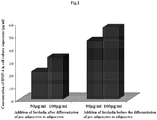
Fig. 2 shows the graphical representation of BMP-4 in cell culture supernatant of cultured 3T3-L1 adipocytes when forskolin (50 µg/ml and 100 µg/ml) are respectively added before the differentiation of pre-adipocytes to adipocytes and after the differentiation of pre-adipocytes to adipocytes. -
Fig. 3 shows the graphical representation of VEGF-A in cell culture supernatant of cultured 3T3-L1 adipocytes when forskolin (50 µg/ml and 100 µg/ml) are respectively added before the differentiation of pre-adipocytes to adipocytes and after the differentiation of pre-adipocytes to adipocytes. -
Fig. 4 shows the graphical representation of UCP1 in cell culture supernatant of cultured 3T3-L1 adipocytes when forskolin (50 µg/ml and 100 µg/ml) are respectively added before the differentiation of pre-adipocytes to adipocytes and after the differentiation of pre-adipocytes to adipocytes. - In the most preferred aspect, the present disclosure relates to a method of achieving mammalian energy balance using forskolin in a process of adipogenesis inhibition wherein forskolin is added separately to pre-adipocytes before differentiation and also to mature adipocytes to comparatively evaluate adipogenesis inhibition potential of, said process comprising steps of:
- a) Seeding mammalian adipocyte precursor cells (pre-adipocytes) in wells of microplates wherein approximately 60×104 cells are seeded for 48-72 hours to get 70-80% confluence;
- b) Adding forskolin at concentrations of 50 µg/ml and 100 µg/ml in the pre-seeded microplates of step a containing undifferentiated pre-adipocytes;
- c) Adding 200 µl of freshly prepared Adipogenesis induction medium to the wells;
- d) Adding 200 µl of freshly prepared Adipogenesis progression medium after 72 hours of incubation with the Adipogenesis induction medium in step c;
- e) Incubating the cells treated with forskolin (step b), adipogenesis induction medium (step c) and adipogenesis progression medium (step d) for 48 hours in a humidified atmosphere (37 deg. C.) of 5% CO2 and 95% air;
- f) Fixing the cells of step e by adding 100 µl of 10% formalin and staining using the Oil Red O technique;
- g) Reading the optical density of cells of step f at 492 nm in a microplate reader and expressing the results as inhibitory concentration (IC50) values using the graph pad prism software;
- h) Calculating the percentage inhibition of adipogenesis in the cells of steps f and g using the formula, C-T/T×100, wherein C is the absorbance of Oil Red O in differentiating/undifferentiated cells and T is the absorbance of Oil Red O in sample treated differentiating/undifferentiated cells.
- i) Adding 200 µl of freshly prepared Adipogenesis induction medium to the wells of step a.
- j) Adding 200 µl of freshly prepared Adipogenesis progression medium comprising graded concentrations of forskolin (50 µg/ml and 100 µg/ml respectively) to the wells of step i after 72 hours of incubation with the Adipogenesis induction medium;
- k) Incubating the cells treated with forskolin (step j), adipogenesis induction medium (step i) and adipogenesis progression medium (step j) for 48 hours in a humidified atmosphere (37 deg. C.) of 5% CO2 and 95% air;
- l) Fixing the cells of step I by adding 100 µl of 10% formalin and staining using the Oil Red O technique;
- m) Reading the optical density of cells of step m at 492 nm in a microplate reader and expressing the results as inhibitory concentration (IC50) values using the graph pad prism software;
- n) Calculating the percentage inhibition of adipogenesis in the cells of steps m and n using the formula, C-T/T×100, wherein C is the absorbance of Oil Red O in differentiating/undifferentiated cells and T is the absorbance of Oil Red O in sample treated differentiating/undifferentiated cells; and
- o) Comparing percentage inhibition of adipogenesis in the cells of steps h and o.
- In another most preferred aspect, the present disclosure also relates to a method of mammalian energy balance using forskolin in a process of promoting the expression of secreted factors that selectively recruit brown adipose tissue (BAT) like bone morphogenetic protein-7 (BMP-7), bone morphogenetic protein-4 (BMP-4), vascular endothelial growth factor-A (VEGF-A) and mitochondrial uncoupling protein (UCP1) wherein said expression of secreted factors that selectively recruit brown adipose tissue (BAT) is remarkably enhanced as measured when forskolin is administered (brought into contact) to pre-adipocytes than to mature adipocytes, said method incorporating the steps of ,
- a) Seeding mammalian adipocyte precursor cells (pre-adipocytes) in wells of microplates wherein approximately 60×104 cells are seeded for 48-72 hours to get 70-80% confluence;
- b) Adding forskolin at concentrations of 50 µg/ml and 100 µg/ml in the pre-seeded microplates of step a containing undifferentiated pre-adipocytes;
- c) Adding 200 µl of freshly prepared Adipogenesis induction medium to the wells;
- d) Adding 200 µl of freshly prepared Adipogenesis progression medium after 72 hours of incubation with the Adipogenesis induction medium in step c;
- e) Incubating the cells treated with forskolin (step b), adipogenesis induction medium (step c) and adipogenesis progression medium (step d) for 48 hours in a humidified atmosphere (37 deg. C.) of 5% CO2 and 95% air;
- f) Quantitatively determining by appropriate immunoassay techniques the expressions of BMP-7, BMP-4, VEGF-A and UCP-1 in the cell supernatant;
- g) Adding 200 µl of freshly prepared Adipogenesis induction medium to the wells of step a;
- h) Adding 200 µl of freshly prepared Adipogenesis progression medium comprising graded concentrations of forskolin (50 µg/ml and 100 µg/ml respectively) to the wells of step g after 72 hours of incubation with the Adipogenesis induction medium;
- i) Incubating the cells treated with forskolin (step h), adipogenesis induction medium (step g) and adipogenesis progression medium (step h) for 48 hours in a humidified atmosphere (37 deg. C.) of 5% CO2 and 95% air; and
- j) Quantitatively determining by appropriate immunoassay techniques the expressions of BMP-7, BMP-4, VEGF-A and UCP-1 in the cell supernatant.
- The present disclosure also relates to a method of achieving energy balance in mammalian adipose cellular systems, said method comprising step of administering forskolin in effective amounts targeted towards mammalian pre-adipocytes to achieve effects of (a) increased inhibition of adipogenesis and (b) increased expression of secretory factors that function individually or in combination to specifically recruit brown adipocytes or brown like (beige or brite) adipocytes. In specific embodiments, the secretory factors are selected from the group consisting of bone morphogenetic protein-7 (BMP-7), bone morphogenetic protein-4 (BMP-4), vascular endothelial growth factor-A (VEGF-A) and mitochondrial uncoupling protein (UCP1).
- The present disclosure also relates to forskolin for use in therapy for obesity wherein said therapy involves achieving energy balance in mammalian adipocytes by administering forskolin in effective amounts targeted towards mammalian pre-adipocytes to bring about the effects of (a) increased inhibition of adipogenesis and (b) increased expression of secretory factors that function individually or in combination to specifically recruit brown adipocytes or brown like (beige or brite) adipocytes. In specific embodiments, the secretory factors are selected from the group consisting of bone morphogenetic protein-7 (BMP-7), bone morphogenetic protein-4 (BMP-4), vascular endothelial growth factor-A (VEGF-A) and mitochondrial uncoupling protein (UCP1)
- The present disclosure also relates to a method to induce the brown like phenotype (beige or brite adipocytes) in white adipocyte depots in mammals said method comprising step of administering effective amount of forskolin to obese mammals with depots of fully differentiated white adipocytes to achieve effect of increase in secretory factors that bring about the development of brown like phenotype (beige or brown adipocytes) within white adipocyte depots. In specific embodiment, the secretory factors are vascular endothelial growth factor-A (VEGF-A) and mitochondrial uncoupling protein (UCP1). The present disclosure also relates to Forskolin for use in the therapy of obesity characterised in that forskolin is administered in effective amounts targeting mammalian white adipocyte depots to achieve effect of increased expression of secretory factors vascular endothelial growth factor-A (VEGF-A) and mitochondrial uncoupling protein (UCP1) that cause the development of brown like phenotype (beige or brite adipocytes) in white adipocyte depots in mammals.
- The present disclosure also relates to a method of achieving energy balance in mammalian adipose cellular systems, said method comprising step of administering forskolin in effective amounts targeted towards mammalian pre-adipocytes to bring about of the effect of enhanced expression of mitochondria uncoupling protein 1 (UCP-1) to result in increased mitochondrial thermiogenesis in differentiated brown adipocytes and brown like (beige or brite) adipocytes.
- The present disclosure also relates to forskolin for use in therapy for obesity wherein said therapy involves achieving energy balance in mammalian adipocytes by administering forskolin in effective amounts targeted towards mammalian pre-adipocytes to bring about the effects of enhanced expression of secretory factor mitochondria uncoupling protein 1 (UCP-1) to result in increased mitochondrial thermiogenesis in differentiated brown adipocytes and brown like (beige or brite) adipocytes.
- As illustrative examples of the most preferred aspects outlined herein above in paragraphs [0011]-[0017], the following results are presented to show that forskolin when administered in increasing concentration is more effective in (a) preventing adipogenesis and (b) also in promoting the expression of secreted factors like BMP-7, BMP-4, VEGF-A and UCP-1 that recruit the brown adipocytes thereby creating energy balance in mammalian cell systems, when administered at the pre-adipocyte stage than once the transformation of pre-adipocytes to adipocytes has occurred.
-
Table A CONCENTRATION (µg/ml) % inhibition of adipogenesis when forskolin is added at the pre-adipocyte stage (before differentiation into the adipocyte stage) % inhibition of adipogenesis when forskolin is added after differentiation of pre-adipocytes to the adipocyte stage 6.25 10.2 1.2 12.50 12.8 6.8 25 19.7 10.6 50 35.5 12.9 100 41.8 18.5 - Table A shows that at each tested concentration of forskolin, the administration of forskolin at the mammalian pre-adipocyte stage has a profound effect on preventing adipogenesis that when administered after the differentiation of pre-adipocytes to adipocytes. Double or more than double the % inhibition of adipogenesis was observed when forskolin was administered at the pre-adipocyte stage as compared to administration at the adipocyte stage.
- The biological role of BMP-7 as a recruiter of the brown adipocyte lineage has been discussed in the following scientific literature.
- 1. Mathew Harms and Patrick Seale, "Brown and beige fat: development, function and therapeutic potential", Nature Medicine, Volume 19, Number 10, October 2013, pages 1252-1263;
- 2. BMP7 Activates Brown Adipose Tissue and Reduces Diet-Induced Obesity at Sub thermoneutrality .Mariëtte R. Boon Published: September 16, 2013; PLOS One.
- 3. New role of bone .
- 4. Transcriptional Control of Brown Fat Development; Kajimure et al. Cell Metabolism; Volume 11, .
- Immunoassays (Enzyme linked immunosorbent assay) for the quantification of BMP-7 in the cell culture supernatant when forskolin (50 µg/ml and 100 µg/ml) was administered at the pre-adipocyte stage and once the differentiation to adipocytes occurred indicated that forskolin profoundly increased BMP-7 expression in at the pre-adipocyte stage than at the adipocyte stage.
- Thus, in correlation with the literature cited above, it may be deduced that forskolin evinces greater potential for brown fat conversion of pre-adipocytes (
Fig. 1 ) rather than fully differentiated white adipocytes. The example exemplified byFig. 1 provides substantiation to the disclosed most preferred embodiment that forskolin directs the selective differentiation of mammalian pre-adipocytes to brown adipocytes by allowing the expression of secretory factor BMP-7. - Acting along with BMP-7, BMP-4 is a new adipokine and acts on adipogenesis and white to brown transition (Qian S Wet al Proc Natl Acad Sci USA 110: E798-807, 2013). Immunoassays (Enzyme linked immunosorbent assay) for the quantification of BMP-4 in the cell culture supernatant when forskolin (50 µg/ml and 100 µg/ml) was administered at the pre-adipocyte stage and once the differentiation to adipocytes occurred indicated that forskolin profoundly increased BMP-4 expression in at the pre-adipocyte stage than at the adipocyte stage.
- Thus, in correlation with the literature cited above, it may be deduced that forskolin evinces greater potential for conversion of white pre-adipocytes to the brite/beige adipocyte (brown adipocyte like) (
Fig. 2 ) by the combined increased expressions and biological actions of secretory factors BMP-4 and BMP-7. The example exemplified byFig. 2 provides substantiation to the most preferred embodiment that forskolin brings about the transformation of white pre-adipocytes to brite or beige adipocytes. - VEGF-A over expression leads to an increase in brown adipose tissue (BAT) thermogenesis and also promotes a "BAT-like" phenotype in white adipose tissue depots. In diet-induced obese mice, introducing VEGF-A locally in BAT rescues capillary rarefaction, ameliorates brown adipocyte dysfunction, and improves deleterious effects on glucose and lipid metabolism caused by a high-fat diet challenge. These results demonstrate a direct positive role of VEGF-A in the activation and expansion of BAT. VEGF-A over expression also exerts its action on macrophages by increasing the recruitment of M2 anti-inflammatory macrophages to fat depots. The decreased obesity and the anti-inflammatory milieu induced by VEGF-A in adipose tissue is responsible for the reduction of insulin resistance in transgenic mice (Bagchi et al, "Vascular endothelial growth factor is important for brown adipose tissue development and maintenance", FASEB J. 27, 3257-3271 (2013 ). Immunoassays (Enzyme linked immunosorbent assay) for the quantification of VEGF-A in the cell culture supernatant when forskolin (50 µg/ml and 100 µg/ml) was administered at the pre-adipocyte stage and once the differentiation to adipocytes occurred indicated that forskolin profoundly increased VEGF-A expression in the pre-adipocyte stage than at the adipocyte stage. Thus, in correlation with the literature cited above, it may be deduced that forskolin evinces greater potential for conversion of white pre-adipocytes to the brown adipocyte like (brite or beige) cells (
Fig. 3 ) among white adipocyte depots in the mammalian body. - A system of thermogenesis that evolved to protect the body from hypothermia is based upon the uncoupling of oxidative phosphorylation in brown adipocytes by the mitochondrial uncoupling protein (UCP-1). It has been shown that up-regulation of UCP1 by genetic manipulations or pharmacological agents can reduce obesity and improve insulin sensitivity (International Journal of Obesity (2008) 32, S32-S38; doi:10.1038/ijo.2008.236 UCP1: its involvement and utility in obesity. L P Kozak and R Anunciado-Koza). Immunoassays (Enzyme linked immunosorbent assay) for the quantification of UCP-1 in the cell culture supernatant when forskolin (50 µg/ml and 100 µg/ml) was administered at the pre-adipocyte stage and once the differentiation to adipocytes occurred indicated that forskolin profoundly increased UCP-1 expression in the pre-adipocyte stage than at the adipocyte stage. Thus, in correlation with the literature cited above, it may be deduced that forskolin evinces greater potential for conversion of pre-adipocytes to the BAT-like or brown adipocytes and enhanced UCP-1 expression in these cells can be expected to enhance bringing about energy balance through appropriate energy expenditure (
Fig. 4 ). - It is already reported that administration of forskolin in humans apparently does not cause clinically significant side effects (Shonteh Henderson et al, Effect of Coleus forskolii supplementation on body composition and haematological profiles in mildly overweight women, J Int Soc Sports Nutr. 2005; 2(2): 54-62). The study elucidates that supplementation with forskolin dietary supplement Forslean® [250 mg of 10% Coleus forskolii extract, 25 mg of forskolin] two times a day for 12 weeks apparently had no clinical side effects. It may thus be inferred that the illustrative in-vitro examples included herein above to achieve energy balance in mammalian adipocyte systems is also applicable in vivo studies in animals (mammals) including human beings.
Claims (2)
- A method of comparatively evaluating adipogenesis inhibition potential of forskolin, wherein forskolin is added separately to pre-adipocytes before differentiation and also to mature adipocytes, said process comprising steps of:a) Seeding mammalian adipocyte precursor cells (pre-adipocytes) in wells of microplates, wherein approximately 60×104 cells are seeded for 48-72 hours to get 70-80% confluence;b) Adding forskolin at concentrations of 50 µg/ml and 100 µg/ml, respectively, in the pre-seeded microplates of step a containing undifferentiated pre-adipocytes;c) Adding 200 µl of freshly prepared adipogenesis induction medium to the wells;d) Adding 200 µl of freshly prepared adipogenesis progression medium after 72 hours of incubation with the adipogenesis induction medium in step c;e) Incubating the cells treated with forskolin (step b), adipogenesis induction medium (step c) and adipogenesis progression medium (step d) for 48 hours in a humidified atmosphere of 5% CO2 and 95% air at 37 deg. C;f) Fixing the cells of step e by adding 100 µl of 10% formalin and staining using the Oil Red O technique;g) Reading the optical density of cells of step f at 492 nm in a microplate reader and expressing the results as inhibitory concentration (IC50) values using the graph pad prism software;h) Calculating the percentage inhibition of adipogenesis in the cells of steps f and g using the formula, C-T/T×100, wherein C is the absorbance of Oil Red O in differentiating/undifferentiated cells and T is the absorbance of Oil Red O in sample treated differentiating/undifferentiated cells;i) Adding 200 µl of freshly prepared adipogenesis induction medium to the wells of step a, which wells comprise the cells;j) Adding 200 µl of freshly prepared adipogenesis progression medium comprising graded concentrations of forskolin (50 µg/ml and 100 µg/ml respectively) to the wells of step i after 72 hours of incubation with the adipogenesis induction medium;k) Incubating the cells treated with forskolin (step j), adipogenesis induction medium (step i) and adipogenesis progression medium (step j) for 48 hours in a humidified atmosphere of 5% CO2 and 95% air at 37 deg. C;l) Fixing the cells of step k by adding 100 µl of 10% formalin and staining using the Oil Red O technique;m) Reading the optical density of cells of step I at 492 nm in a microplate reader and expressing the results as inhibitory concentration (IC50) values using the graph pad prism software;n) Calculating the percentage inhibition of adipogenesis in the cells of steps I and m using the formula, C-T/T×100, wherein C is the absorbance of Oil Red O in differentiating/undifferentiated cells and T is the absorbance of Oil Red O in sample treated differentiating/undifferentiated cells; ando) Comparing percentage inhibition of adipogenesis in the cells of steps h and n.
- A method of determining the expression of secreted factors that selectively recruit brown adipose tissue (BAT), wherein forskolin is added separately to pre-adipocytes before differentiation and also to mature adipocytes, said method incorporating the steps of:a) Seeding mammalian adipocyte precursor cells (pre-adipocytes) in wells of microplates, wherein approximately 60×104 cells are seeded for 48-72 hours to get 70-80% confluence;b) Adding forskolin at concentrations of 50 µg/ml and 100 µg/ml, respectively, in the pre-seeded microplates of step a containing undifferentiated pre-adipocytes;c) Adding 200 µl of freshly prepared adipogenesis induction medium to the wells;d) Adding 200 µl of freshly prepared adipogenesis progression medium after 72 hours of incubation with the adipogenesis induction medium in step c;e) Incubating the cells treated with forskolin (step b), adipogenesis induction medium (step c) and adipogenesis progression medium (step d) for 48 hours in a humidified atmosphere of 5% CO2 and 95% air at 37 deg. C;f) Quantitatively determining by appropriate immunoassay techniques the expressions of bone morphogenetic protein-7 (BMP-7), bone morphogenetic protein-4 (BMP-4), vascular endothelial growth factor-A (VEGF-A) and mitochondrial uncoupling protein (UCP-1) in the cell supernatant;g) Adding 200 µl of freshly prepared adipogenesis induction medium to the wells of step a, which wells comprise the cells;h) Adding 200 µl of freshly prepared adipogenesis progression medium comprising graded concentrations of forskolin (50 µg/ml and 100 µg/ml respectively) to the wells of step g after 72 hours of incubation with the adipogenesis induction medium;i) Incubating the cells treated with forskolin (step h), adipogenesis induction medium (step g) and adipogenesis progression medium (step h) for 48 hours in a humidified atmosphere of 5% CO2 and 95% air at 37 deg. C; andj) Quantitatively determining by appropriate immunoassay techniques the expressions of BMP-7, BMP-4, VEGF-A and UCP-1 in the cell supernatant.
Priority Applications (1)
| Application Number | Priority Date | Filing Date | Title |
|---|---|---|---|
| PL15888720T PL3194575T3 (en) | 2015-11-10 | 2015-11-11 | METHOD AND COMPOSITIONS FOR ACHIEVING AN ENERGY BALANCE IN MAMMALS |
Applications Claiming Priority (2)
| Application Number | Priority Date | Filing Date | Title |
|---|---|---|---|
| US14/936,830 US10085963B2 (en) | 2015-11-10 | 2015-11-10 | Process and compositions for achieving mammalian energy balance |
| PCT/US2015/060176 WO2017082896A1 (en) | 2015-11-10 | 2015-11-11 | Process and compositions for achieving mammalian energy balance |
Publications (3)
| Publication Number | Publication Date |
|---|---|
| EP3194575A1 EP3194575A1 (en) | 2017-07-26 |
| EP3194575A4 EP3194575A4 (en) | 2017-12-27 |
| EP3194575B1 true EP3194575B1 (en) | 2020-04-29 |
Family
ID=58668245
Family Applications (1)
| Application Number | Title | Priority Date | Filing Date |
|---|---|---|---|
| EP15888720.8A Active EP3194575B1 (en) | 2015-11-10 | 2015-11-11 | Process and compositions for achieving mammalian energy balance |
Country Status (12)
| Country | Link |
|---|---|
| US (1) | US10085963B2 (en) |
| EP (1) | EP3194575B1 (en) |
| JP (1) | JP6472453B2 (en) |
| KR (1) | KR102169620B1 (en) |
| CN (1) | CN108138141B (en) |
| AU (1) | AU2015351423B2 (en) |
| EA (1) | EA038685B1 (en) |
| MX (1) | MX389328B (en) |
| MY (1) | MY188869A (en) |
| PL (1) | PL3194575T3 (en) |
| SG (1) | SG11201801873TA (en) |
| WO (1) | WO2017082896A1 (en) |
Families Citing this family (2)
| Publication number | Priority date | Publication date | Assignee | Title |
|---|---|---|---|---|
| RU2747887C1 (en) | 2017-10-11 | 2021-05-17 | Телефонактиеболагет Лм Эрикссон (Пабл) | Grantless pusch uci |
| JP2023554642A (en) * | 2020-12-17 | 2023-12-28 | サミ-サビンサ グループ リミテッド | Anti-obesity ability of bisdemethoxycurcumin composition |
Citations (1)
| Publication number | Priority date | Publication date | Assignee | Title |
|---|---|---|---|---|
| US20050158706A1 (en) * | 1999-01-29 | 2005-07-21 | Artecel Sciences, Inc. | Methods and compositions for the differentiation of human preadipocytes into adipocytes |
Family Cites Families (12)
| Publication number | Priority date | Publication date | Assignee | Title |
|---|---|---|---|---|
| JPH06133731A (en) * | 1992-10-23 | 1994-05-17 | Zenetsukusu Kk | Diet food |
| US6153432A (en) * | 1999-01-29 | 2000-11-28 | Zen-Bio, Inc | Methods for the differentiation of human preadipocytes into adipocytes |
| JP4432069B2 (en) * | 2002-09-03 | 2010-03-17 | ビーエイチエヌ株式会社 | Obesity inhibitor |
| US20090098220A1 (en) * | 2007-10-12 | 2009-04-16 | Lance Ashworth | Liquid pharmaceutical preparation comprising forskolin for promoting lean body mass |
| FR2960549B1 (en) * | 2010-05-25 | 2015-06-19 | Univ Paris Curie | PROCESS FOR CULTIVATION OF ADIPOCYTES |
| US8577013B1 (en) * | 2011-01-10 | 2013-11-05 | West Corporation | Automatic communications forwarding to displaced employees |
| US20130224318A1 (en) * | 2012-02-29 | 2013-08-29 | Avon Products, Inc. | Use of CPT-1 Modulators and Compositions Thereof |
| SG11201405257WA (en) * | 2012-03-12 | 2014-09-26 | Univ Singapore | Generation of brown adipose tissue (bat) from mesenchymal cells |
| WO2013188138A1 (en) * | 2012-06-11 | 2013-12-19 | The Regents Of The University Of California | Inhibitors of hippo-yap signaling pathway |
| WO2014025974A1 (en) * | 2012-08-09 | 2014-02-13 | Brown University | Autologous cell-based therapy for treating obesity |
| US10012070B2 (en) * | 2012-08-31 | 2018-07-03 | Halliburton Energy Services, Inc. | System and method for measuring gaps using an opto-analytical device |
| EP3116516A4 (en) * | 2014-03-13 | 2017-11-15 | The J. David Gladstone Institutes, A Testamentary Trust Established under The Will of J. David Gladstone | Inducing brown fat fate and function |
-
2015
- 2015-11-10 US US14/936,830 patent/US10085963B2/en active Active
- 2015-11-11 MX MX2018004735A patent/MX389328B/en unknown
- 2015-11-11 CN CN201580083933.4A patent/CN108138141B/en active Active
- 2015-11-11 MY MYPI2018700903A patent/MY188869A/en unknown
- 2015-11-11 JP JP2016547618A patent/JP6472453B2/en active Active
- 2015-11-11 EP EP15888720.8A patent/EP3194575B1/en active Active
- 2015-11-11 AU AU2015351423A patent/AU2015351423B2/en not_active Ceased
- 2015-11-11 PL PL15888720T patent/PL3194575T3/en unknown
- 2015-11-11 KR KR1020187012914A patent/KR102169620B1/en active Active
- 2015-11-11 EA EA201791155A patent/EA038685B1/en unknown
- 2015-11-11 SG SG11201801873TA patent/SG11201801873TA/en unknown
- 2015-11-11 WO PCT/US2015/060176 patent/WO2017082896A1/en not_active Ceased
Patent Citations (1)
| Publication number | Priority date | Publication date | Assignee | Title |
|---|---|---|---|---|
| US20050158706A1 (en) * | 1999-01-29 | 2005-07-21 | Artecel Sciences, Inc. | Methods and compositions for the differentiation of human preadipocytes into adipocytes |
Non-Patent Citations (6)
| Title |
|---|
| ANGELIKI KARAMITRI ET AL: "Combinatorial Transcription Factor Regulation of the Cyclic AMP-response Element on the Pgc-1 [alpha] Promoter in White 3T3-L1 and Brown HIB-1B Preadipocytes", JOURNAL OF BIOLOGICAL CHEMISTRY, vol. 284, no. 31, 31 July 2009 (2009-07-31), US, pages 20738 - 20752, XP055513219, ISSN: 0021-9258, DOI: 10.1074/jbc.M109.021766 * |
| GEORGIOS KARAMANLIDIS ET AL: "C/EBP[beta] Reprograms White 3T3-L1 Preadipocytes to a Brown Adipocyte Pattern of Gene Expression", JOURNAL OF BIOLOGICAL CHEMISTRY, vol. 282, no. 34, 24 August 2007 (2007-08-24), US, pages 24660 - 24669, XP055513238, ISSN: 0021-9258, DOI: 10.1074/jbc.M703101200 * |
| JUN WU ET AL: "Beige Adipocytes Are a Distinct Type of Thermogenic Fat Cell in Mouse and Human", CELL, vol. 150, no. 2, 1 July 2012 (2012-07-01), pages 366 - 376, XP055088017, ISSN: 0092-8674, DOI: 10.1016/j.cell.2012.05.016 * |
| KAI SUN ET AL: "Brown adipose tissue derived VEGF-A modulates cold tolerance and energy expenditure", MOLECULAR METABOLISM, vol. 3, no. 4, 1 July 2014 (2014-07-01), pages 474 - 483, XP055381550, ISSN: 2212-8778, DOI: 10.1016/j.molmet.2014.03.010 * |
| SHU-WEN QIAN ET AL: "BMP4-mediated brown fat-like changes in white adipose tissue alter glucose and energy homeostasis", PROCEEDINGS OF THE NATIONAL ACADEMY OF SCIENCES OF THE UNITED STATES OF AMERICA, vol. 110, no. 9, 26 February 2013 (2013-02-26), pages E798 - E807, XP055381553, ISSN: 0027-8424, DOI: 10.1073/pnas.1215236110 * |
| XP055513261, Retrieved from the Internet <URL:https://www.google.de/url?sa=t&rct=j&q=&esrc=s&source=web&cd=1&ved=2ahUKEwj1yMy93PbdAhVHDuwKHTDUAeEQFjAAegQIBxAC&url=http%3A%2F%2Fbio.lonza.com%2Fgo%2Fliterature%2F5162.pdf&usg=AOvVaw1P7meX9k8FLFsovnDfcafb> [retrieved on 20181008] * |
Also Published As
| Publication number | Publication date |
|---|---|
| AU2015351423A2 (en) | 2017-08-24 |
| EA038685B1 (en) | 2021-10-05 |
| MX2018004735A (en) | 2018-07-06 |
| AU2015351423A1 (en) | 2017-05-25 |
| MY188869A (en) | 2022-01-11 |
| PL3194575T3 (en) | 2020-11-02 |
| NZ720422A (en) | 2019-08-30 |
| CN108138141B (en) | 2021-12-03 |
| EP3194575A1 (en) | 2017-07-26 |
| SG11201801873TA (en) | 2018-05-30 |
| MX389328B (en) | 2025-03-20 |
| AU2015351423B2 (en) | 2018-08-09 |
| JP6472453B2 (en) | 2019-02-20 |
| JP2018508179A (en) | 2018-03-29 |
| CN108138141A (en) | 2018-06-08 |
| WO2017082896A1 (en) | 2017-05-18 |
| KR102169620B1 (en) | 2020-10-23 |
| KR20180057718A (en) | 2018-05-30 |
| EP3194575A4 (en) | 2017-12-27 |
| EA201791155A1 (en) | 2017-09-29 |
| US20170128410A1 (en) | 2017-05-11 |
| US10085963B2 (en) | 2018-10-02 |
Similar Documents
| Publication | Publication Date | Title |
|---|---|---|
| Huo et al. | Contribution of muscle satellite cells to sarcopenia | |
| Li et al. | Succinate causes α-SMA production through GPR91 activation in hepatic stellate cells | |
| Fisher et al. | Activation of AMP kinase enhances sensitivity of muscle glucose transport to insulin | |
| Fang et al. | Baicalin against obesity and insulin resistance through activation of AKT/AS160/GLUT4 pathway | |
| Görtz et al. | Hypoxia-dependent HIF-1 activation impacts on tissue remodeling in Graves’ ophthalmopathy—implications for smoking | |
| Bei et al. | Lymphangiogenesis contributes to exercise-induced physiological cardiac growth | |
| Bodles et al. | Pioglitazone increases secretion of high-molecular-weight adiponectin from adipocytes | |
| Li et al. | Myokine IL-15 regulates the crosstalk of co-cultured porcine skeletal muscle satellite cells and preadipocytes | |
| Wu et al. | AMP-activated protein kinase mediates effects of oxidative stress on embryo gene expression in a mouse model of diabetic embryopathy | |
| Yeganeh et al. | Trans-10, cis-12 conjugated linoleic acid (t10-c12 CLA) treatment and caloric restriction differentially affect adipocyte cell turnover in obese and lean mice | |
| Fang et al. | Beneficial effect of baicalin on insulin sensitivity in adipocytes of diet-induced obese mice | |
| Um et al. | Bone morphogenic protein 9 is a novel thermogenic hepatokine secreted in response to cold exposure | |
| Fang et al. | Effect of baicalin on GLUT4 expression and glucose uptake in myotubes of rats | |
| Lu et al. | Downregulated hypoxia-inducible factor 1α improves myoblast differentiation under hypoxic condition in mouse genioglossus | |
| Durmaz et al. | Does vitamin D deficiency lead to insulin resistance in obese individuals | |
| Park et al. | Extracellular vimentin alters energy metabolism and induces adipocyte hypertrophy | |
| Zhao et al. | Pioglitazone can improve liver sex hormone-binding globulin levels and lipid metabolism in polycystic ovary syndrome by regulating hepatocyte nuclear factor-4α | |
| JP7850416B2 (en) | Production and use of ENAMPT contained in extracellular vesicles | |
| Chiu et al. | Carnitine and dehydroepiandrosterone sulfate induce protein synthesis in porcine primary osteoblast-like cells | |
| US10085963B2 (en) | Process and compositions for achieving mammalian energy balance | |
| Guo et al. | Adiponectin regulates proliferation and differentiation of chicken skeletal muscle satellite cells via ERK1/2 and p38 signaling pathways | |
| Kartika et al. | Role of myostatin protein in sarcopenia (aging muscle) after conditioned medium umbilical cord mesenchymal stem cells (secretome) therapy: mini review | |
| Naito et al. | Administration of granulocyte colony-stimulating factor facilitates the regenerative process of injured mice skeletal muscle via the activation of Akt/GSK3αβ signals | |
| CN104224766A (en) | Application of acetoacetic acid in treatment of muscle disease | |
| Stafeev et al. | Chemical inducers of obesity-associated metabolic stress activate inflammation and reduce insulin sensitivity in 3T3-L1 adipocytes |
Legal Events
| Date | Code | Title | Description |
|---|---|---|---|
| STAA | Information on the status of an ep patent application or granted ep patent |
Free format text: STATUS: UNKNOWN |
|
| STAA | Information on the status of an ep patent application or granted ep patent |
Free format text: STATUS: THE INTERNATIONAL PUBLICATION HAS BEEN MADE |
|
| PUAI | Public reference made under article 153(3) epc to a published international application that has entered the european phase |
Free format text: ORIGINAL CODE: 0009012 |
|
| STAA | Information on the status of an ep patent application or granted ep patent |
Free format text: STATUS: REQUEST FOR EXAMINATION WAS MADE |
|
| 17P | Request for examination filed |
Effective date: 20161020 |
|
| AK | Designated contracting states |
Kind code of ref document: A1 Designated state(s): AL AT BE BG CH CY CZ DE DK EE ES FI FR GB GR HR HU IE IS IT LI LT LU LV MC MK MT NL NO PL PT RO RS SE SI SK SM TR |
|
| AX | Request for extension of the european patent |
Extension state: BA ME |
|
| R17P | Request for examination filed (corrected) |
Effective date: 20161020 |
|
| A4 | Supplementary search report drawn up and despatched |
Effective date: 20171129 |
|
| RIC1 | Information provided on ipc code assigned before grant |
Ipc: A61P 3/06 20060101ALI20171120BHEP Ipc: C12N 5/0775 20100101AFI20171120BHEP Ipc: A61P 3/04 20060101ALI20171120BHEP |
|
| RAP1 | Party data changed (applicant data changed or rights of an application transferred) |
Owner name: SAMI LABS LIMITED |
|
| RIN1 | Information on inventor provided before grant (corrected) |
Inventor name: BANI, SARANG Inventor name: PANDEY, ANJALI Inventor name: NAGABHUSHANAM, KALYANAM Inventor name: MAJEED, MUHAMMED |
|
| REG | Reference to a national code |
Ref country code: HK Ref legal event code: DE Ref document number: 1238675 Country of ref document: HK |
|
| STAA | Information on the status of an ep patent application or granted ep patent |
Free format text: STATUS: EXAMINATION IS IN PROGRESS |
|
| 17Q | First examination report despatched |
Effective date: 20181012 |
|
| DAV | Request for validation of the european patent (deleted) | ||
| DAX | Request for extension of the european patent (deleted) | ||
| GRAP | Despatch of communication of intention to grant a patent |
Free format text: ORIGINAL CODE: EPIDOSNIGR1 |
|
| STAA | Information on the status of an ep patent application or granted ep patent |
Free format text: STATUS: GRANT OF PATENT IS INTENDED |
|
| INTG | Intention to grant announced |
Effective date: 20191108 |
|
| GRAJ | Information related to disapproval of communication of intention to grant by the applicant or resumption of examination proceedings by the epo deleted |
Free format text: ORIGINAL CODE: EPIDOSDIGR1 |
|
| STAA | Information on the status of an ep patent application or granted ep patent |
Free format text: STATUS: EXAMINATION IS IN PROGRESS |
|
| GRAR | Information related to intention to grant a patent recorded |
Free format text: ORIGINAL CODE: EPIDOSNIGR71 |
|
| GRAS | Grant fee paid |
Free format text: ORIGINAL CODE: EPIDOSNIGR3 |
|
| STAA | Information on the status of an ep patent application or granted ep patent |
Free format text: STATUS: GRANT OF PATENT IS INTENDED |
|
| GRAA | (expected) grant |
Free format text: ORIGINAL CODE: 0009210 |
|
| STAA | Information on the status of an ep patent application or granted ep patent |
Free format text: STATUS: THE PATENT HAS BEEN GRANTED |
|
| INTC | Intention to grant announced (deleted) | ||
| AK | Designated contracting states |
Kind code of ref document: B1 Designated state(s): AL AT BE BG CH CY CZ DE DK EE ES FI FR GB GR HR HU IE IS IT LI LT LU LV MC MK MT NL NO PL PT RO RS SE SI SK SM TR |
|
| INTG | Intention to grant announced |
Effective date: 20200323 |
|
| REG | Reference to a national code |
Ref country code: GB Ref legal event code: FG4D |
|
| REG | Reference to a national code |
Ref country code: CH Ref legal event code: EP |
|
| REG | Reference to a national code |
Ref country code: AT Ref legal event code: REF Ref document number: 1263323 Country of ref document: AT Kind code of ref document: T Effective date: 20200515 |
|
| REG | Reference to a national code |
Ref country code: DE Ref legal event code: R096 Ref document number: 602015051927 Country of ref document: DE |
|
| REG | Reference to a national code |
Ref country code: IE Ref legal event code: FG4D |
|
| REG | Reference to a national code |
Ref country code: SE Ref legal event code: TRGR |
|
| REG | Reference to a national code |
Ref country code: NL Ref legal event code: MP Effective date: 20200429 |
|
| REG | Reference to a national code |
Ref country code: LT Ref legal event code: MG4D |
|
| PG25 | Lapsed in a contracting state [announced via postgrant information from national office to epo] |
Ref country code: LT Free format text: LAPSE BECAUSE OF FAILURE TO SUBMIT A TRANSLATION OF THE DESCRIPTION OR TO PAY THE FEE WITHIN THE PRESCRIBED TIME-LIMIT Effective date: 20200429 Ref country code: NO Free format text: LAPSE BECAUSE OF FAILURE TO SUBMIT A TRANSLATION OF THE DESCRIPTION OR TO PAY THE FEE WITHIN THE PRESCRIBED TIME-LIMIT Effective date: 20200729 Ref country code: IS Free format text: LAPSE BECAUSE OF FAILURE TO SUBMIT A TRANSLATION OF THE DESCRIPTION OR TO PAY THE FEE WITHIN THE PRESCRIBED TIME-LIMIT Effective date: 20200829 Ref country code: PT Free format text: LAPSE BECAUSE OF FAILURE TO SUBMIT A TRANSLATION OF THE DESCRIPTION OR TO PAY THE FEE WITHIN THE PRESCRIBED TIME-LIMIT Effective date: 20200831 Ref country code: FI Free format text: LAPSE BECAUSE OF FAILURE TO SUBMIT A TRANSLATION OF THE DESCRIPTION OR TO PAY THE FEE WITHIN THE PRESCRIBED TIME-LIMIT Effective date: 20200429 Ref country code: GR Free format text: LAPSE BECAUSE OF FAILURE TO SUBMIT A TRANSLATION OF THE DESCRIPTION OR TO PAY THE FEE WITHIN THE PRESCRIBED TIME-LIMIT Effective date: 20200730 |
|
| REG | Reference to a national code |
Ref country code: AT Ref legal event code: MK05 Ref document number: 1263323 Country of ref document: AT Kind code of ref document: T Effective date: 20200429 |
|
| PG25 | Lapsed in a contracting state [announced via postgrant information from national office to epo] |
Ref country code: LV Free format text: LAPSE BECAUSE OF FAILURE TO SUBMIT A TRANSLATION OF THE DESCRIPTION OR TO PAY THE FEE WITHIN THE PRESCRIBED TIME-LIMIT Effective date: 20200429 Ref country code: HR Free format text: LAPSE BECAUSE OF FAILURE TO SUBMIT A TRANSLATION OF THE DESCRIPTION OR TO PAY THE FEE WITHIN THE PRESCRIBED TIME-LIMIT Effective date: 20200429 Ref country code: BG Free format text: LAPSE BECAUSE OF FAILURE TO SUBMIT A TRANSLATION OF THE DESCRIPTION OR TO PAY THE FEE WITHIN THE PRESCRIBED TIME-LIMIT Effective date: 20200729 Ref country code: RS Free format text: LAPSE BECAUSE OF FAILURE TO SUBMIT A TRANSLATION OF THE DESCRIPTION OR TO PAY THE FEE WITHIN THE PRESCRIBED TIME-LIMIT Effective date: 20200429 |
|
| PG25 | Lapsed in a contracting state [announced via postgrant information from national office to epo] |
Ref country code: NL Free format text: LAPSE BECAUSE OF FAILURE TO SUBMIT A TRANSLATION OF THE DESCRIPTION OR TO PAY THE FEE WITHIN THE PRESCRIBED TIME-LIMIT Effective date: 20200429 Ref country code: AL Free format text: LAPSE BECAUSE OF FAILURE TO SUBMIT A TRANSLATION OF THE DESCRIPTION OR TO PAY THE FEE WITHIN THE PRESCRIBED TIME-LIMIT Effective date: 20200429 |
|
| PG25 | Lapsed in a contracting state [announced via postgrant information from national office to epo] |
Ref country code: CZ Free format text: LAPSE BECAUSE OF FAILURE TO SUBMIT A TRANSLATION OF THE DESCRIPTION OR TO PAY THE FEE WITHIN THE PRESCRIBED TIME-LIMIT Effective date: 20200429 Ref country code: RO Free format text: LAPSE BECAUSE OF FAILURE TO SUBMIT A TRANSLATION OF THE DESCRIPTION OR TO PAY THE FEE WITHIN THE PRESCRIBED TIME-LIMIT Effective date: 20200429 Ref country code: IT Free format text: LAPSE BECAUSE OF FAILURE TO SUBMIT A TRANSLATION OF THE DESCRIPTION OR TO PAY THE FEE WITHIN THE PRESCRIBED TIME-LIMIT Effective date: 20200429 Ref country code: AT Free format text: LAPSE BECAUSE OF FAILURE TO SUBMIT A TRANSLATION OF THE DESCRIPTION OR TO PAY THE FEE WITHIN THE PRESCRIBED TIME-LIMIT Effective date: 20200429 Ref country code: DK Free format text: LAPSE BECAUSE OF FAILURE TO SUBMIT A TRANSLATION OF THE DESCRIPTION OR TO PAY THE FEE WITHIN THE PRESCRIBED TIME-LIMIT Effective date: 20200429 Ref country code: ES Free format text: LAPSE BECAUSE OF FAILURE TO SUBMIT A TRANSLATION OF THE DESCRIPTION OR TO PAY THE FEE WITHIN THE PRESCRIBED TIME-LIMIT Effective date: 20200429 Ref country code: SM Free format text: LAPSE BECAUSE OF FAILURE TO SUBMIT A TRANSLATION OF THE DESCRIPTION OR TO PAY THE FEE WITHIN THE PRESCRIBED TIME-LIMIT Effective date: 20200429 Ref country code: EE Free format text: LAPSE BECAUSE OF FAILURE TO SUBMIT A TRANSLATION OF THE DESCRIPTION OR TO PAY THE FEE WITHIN THE PRESCRIBED TIME-LIMIT Effective date: 20200429 |
|
| REG | Reference to a national code |
Ref country code: DE Ref legal event code: R097 Ref document number: 602015051927 Country of ref document: DE |
|
| PG25 | Lapsed in a contracting state [announced via postgrant information from national office to epo] |
Ref country code: SK Free format text: LAPSE BECAUSE OF FAILURE TO SUBMIT A TRANSLATION OF THE DESCRIPTION OR TO PAY THE FEE WITHIN THE PRESCRIBED TIME-LIMIT Effective date: 20200429 |
|
| PLBE | No opposition filed within time limit |
Free format text: ORIGINAL CODE: 0009261 |
|
| STAA | Information on the status of an ep patent application or granted ep patent |
Free format text: STATUS: NO OPPOSITION FILED WITHIN TIME LIMIT |
|
| 26N | No opposition filed |
Effective date: 20210201 |
|
| PG25 | Lapsed in a contracting state [announced via postgrant information from national office to epo] |
Ref country code: SI Free format text: LAPSE BECAUSE OF FAILURE TO SUBMIT A TRANSLATION OF THE DESCRIPTION OR TO PAY THE FEE WITHIN THE PRESCRIBED TIME-LIMIT Effective date: 20200429 |
|
| PG25 | Lapsed in a contracting state [announced via postgrant information from national office to epo] |
Ref country code: MC Free format text: LAPSE BECAUSE OF FAILURE TO SUBMIT A TRANSLATION OF THE DESCRIPTION OR TO PAY THE FEE WITHIN THE PRESCRIBED TIME-LIMIT Effective date: 20200429 |
|
| REG | Reference to a national code |
Ref country code: CH Ref legal event code: PL |
|
| PG25 | Lapsed in a contracting state [announced via postgrant information from national office to epo] |
Ref country code: LU Free format text: LAPSE BECAUSE OF NON-PAYMENT OF DUE FEES Effective date: 20201111 |
|
| REG | Reference to a national code |
Ref country code: BE Ref legal event code: MM Effective date: 20201130 |
|
| PG25 | Lapsed in a contracting state [announced via postgrant information from national office to epo] |
Ref country code: LI Free format text: LAPSE BECAUSE OF NON-PAYMENT OF DUE FEES Effective date: 20201130 Ref country code: CH Free format text: LAPSE BECAUSE OF NON-PAYMENT OF DUE FEES Effective date: 20201130 |
|
| PG25 | Lapsed in a contracting state [announced via postgrant information from national office to epo] |
Ref country code: MT Free format text: LAPSE BECAUSE OF FAILURE TO SUBMIT A TRANSLATION OF THE DESCRIPTION OR TO PAY THE FEE WITHIN THE PRESCRIBED TIME-LIMIT Effective date: 20200429 Ref country code: CY Free format text: LAPSE BECAUSE OF FAILURE TO SUBMIT A TRANSLATION OF THE DESCRIPTION OR TO PAY THE FEE WITHIN THE PRESCRIBED TIME-LIMIT Effective date: 20200429 |
|
| PG25 | Lapsed in a contracting state [announced via postgrant information from national office to epo] |
Ref country code: MK Free format text: LAPSE BECAUSE OF FAILURE TO SUBMIT A TRANSLATION OF THE DESCRIPTION OR TO PAY THE FEE WITHIN THE PRESCRIBED TIME-LIMIT Effective date: 20200429 |
|
| PG25 | Lapsed in a contracting state [announced via postgrant information from national office to epo] |
Ref country code: BE Free format text: LAPSE BECAUSE OF NON-PAYMENT OF DUE FEES Effective date: 20201130 |
|
| P01 | Opt-out of the competence of the unified patent court (upc) registered |
Effective date: 20230507 |
|
| PGFP | Annual fee paid to national office [announced via postgrant information from national office to epo] |
Ref country code: SE Payment date: 20231123 Year of fee payment: 9 |
|
| REG | Reference to a national code |
Ref country code: SE Ref legal event code: EUG |
|
| PG25 | Lapsed in a contracting state [announced via postgrant information from national office to epo] |
Ref country code: SE Free format text: LAPSE BECAUSE OF NON-PAYMENT OF DUE FEES Effective date: 20241112 |
|
| PGFP | Annual fee paid to national office [announced via postgrant information from national office to epo] |
Ref country code: DE Payment date: 20251118 Year of fee payment: 11 |
|
| PGFP | Annual fee paid to national office [announced via postgrant information from national office to epo] |
Ref country code: GB Payment date: 20251120 Year of fee payment: 11 |
|
| PGFP | Annual fee paid to national office [announced via postgrant information from national office to epo] |
Ref country code: FR Payment date: 20251125 Year of fee payment: 11 |
|
| PGFP | Annual fee paid to national office [announced via postgrant information from national office to epo] |
Ref country code: TR Payment date: 20251107 Year of fee payment: 11 |
|
| PGFP | Annual fee paid to national office [announced via postgrant information from national office to epo] |
Ref country code: IE Payment date: 20251120 Year of fee payment: 11 |
|
| PGFP | Annual fee paid to national office [announced via postgrant information from national office to epo] |
Ref country code: PL Payment date: 20251030 Year of fee payment: 11 |