EP3194472B1 - Functionalized polyoxyalkylene-siloxane polymers and copolymers made therefrom - Google Patents
Functionalized polyoxyalkylene-siloxane polymers and copolymers made therefrom Download PDFInfo
- Publication number
- EP3194472B1 EP3194472B1 EP15775303.9A EP15775303A EP3194472B1 EP 3194472 B1 EP3194472 B1 EP 3194472B1 EP 15775303 A EP15775303 A EP 15775303A EP 3194472 B1 EP3194472 B1 EP 3194472B1
- Authority
- EP
- European Patent Office
- Prior art keywords
- group
- carbon atoms
- independently
- group containing
- hydrogen
- Prior art date
- Legal status (The legal status is an assumption and is not a legal conclusion. Google has not performed a legal analysis and makes no representation as to the accuracy of the status listed.)
- Active
Links
- 0 *(C1C=CC=CC1)C1=CC=*CC=C1 Chemical compound *(C1C=CC=CC1)C1=CC=*CC=C1 0.000 description 4
Classifications
-
- C—CHEMISTRY; METALLURGY
- C08—ORGANIC MACROMOLECULAR COMPOUNDS; THEIR PREPARATION OR CHEMICAL WORKING-UP; COMPOSITIONS BASED THEREON
- C08G—MACROMOLECULAR COMPOUNDS OBTAINED OTHERWISE THAN BY REACTIONS ONLY INVOLVING UNSATURATED CARBON-TO-CARBON BONDS
- C08G77/00—Macromolecular compounds obtained by reactions forming a linkage containing silicon with or without sulfur, nitrogen, oxygen or carbon in the main chain of the macromolecule
- C08G77/42—Block-or graft-polymers containing polysiloxane sequences
- C08G77/46—Block-or graft-polymers containing polysiloxane sequences containing polyether sequences
-
- C—CHEMISTRY; METALLURGY
- C08—ORGANIC MACROMOLECULAR COMPOUNDS; THEIR PREPARATION OR CHEMICAL WORKING-UP; COMPOSITIONS BASED THEREON
- C08G—MACROMOLECULAR COMPOUNDS OBTAINED OTHERWISE THAN BY REACTIONS ONLY INVOLVING UNSATURATED CARBON-TO-CARBON BONDS
- C08G77/00—Macromolecular compounds obtained by reactions forming a linkage containing silicon with or without sulfur, nitrogen, oxygen or carbon in the main chain of the macromolecule
- C08G77/04—Polysiloxanes
- C08G77/14—Polysiloxanes containing silicon bound to oxygen-containing groups
-
- C—CHEMISTRY; METALLURGY
- C08—ORGANIC MACROMOLECULAR COMPOUNDS; THEIR PREPARATION OR CHEMICAL WORKING-UP; COMPOSITIONS BASED THEREON
- C08G—MACROMOLECULAR COMPOUNDS OBTAINED OTHERWISE THAN BY REACTIONS ONLY INVOLVING UNSATURATED CARBON-TO-CARBON BONDS
- C08G77/00—Macromolecular compounds obtained by reactions forming a linkage containing silicon with or without sulfur, nitrogen, oxygen or carbon in the main chain of the macromolecule
- C08G77/42—Block-or graft-polymers containing polysiloxane sequences
- C08G77/448—Block-or graft-polymers containing polysiloxane sequences containing polycarbonate sequences
-
- C—CHEMISTRY; METALLURGY
- C08—ORGANIC MACROMOLECULAR COMPOUNDS; THEIR PREPARATION OR CHEMICAL WORKING-UP; COMPOSITIONS BASED THEREON
- C08L—COMPOSITIONS OF MACROMOLECULAR COMPOUNDS
- C08L83/00—Compositions of macromolecular compounds obtained by reactions forming in the main chain of the macromolecule a linkage containing silicon with or without sulfur, nitrogen, oxygen or carbon only; Compositions of derivatives of such polymers
- C08L83/10—Block- or graft-copolymers containing polysiloxane sequences
-
- C—CHEMISTRY; METALLURGY
- C08—ORGANIC MACROMOLECULAR COMPOUNDS; THEIR PREPARATION OR CHEMICAL WORKING-UP; COMPOSITIONS BASED THEREON
- C08G—MACROMOLECULAR COMPOUNDS OBTAINED OTHERWISE THAN BY REACTIONS ONLY INVOLVING UNSATURATED CARBON-TO-CARBON BONDS
- C08G77/00—Macromolecular compounds obtained by reactions forming a linkage containing silicon with or without sulfur, nitrogen, oxygen or carbon in the main chain of the macromolecule
- C08G77/70—Siloxanes defined by use of the MDTQ nomenclature
-
- C—CHEMISTRY; METALLURGY
- C08—ORGANIC MACROMOLECULAR COMPOUNDS; THEIR PREPARATION OR CHEMICAL WORKING-UP; COMPOSITIONS BASED THEREON
- C08L—COMPOSITIONS OF MACROMOLECULAR COMPOUNDS
- C08L69/00—Compositions of polycarbonates; Compositions of derivatives of polycarbonates
-
- C—CHEMISTRY; METALLURGY
- C08—ORGANIC MACROMOLECULAR COMPOUNDS; THEIR PREPARATION OR CHEMICAL WORKING-UP; COMPOSITIONS BASED THEREON
- C08L—COMPOSITIONS OF MACROMOLECULAR COMPOUNDS
- C08L83/00—Compositions of macromolecular compounds obtained by reactions forming in the main chain of the macromolecule a linkage containing silicon with or without sulfur, nitrogen, oxygen or carbon only; Compositions of derivatives of such polymers
- C08L83/10—Block- or graft-copolymers containing polysiloxane sequences
- C08L83/12—Block- or graft-copolymers containing polysiloxane sequences containing polyether sequences
Definitions
- the invention is directed to ⁇ , ⁇ - functionalized polyoxyalkylene-siloxane polymers and copolymers made therefrom.
- Polycarbonate resins are well-known thermoplastic resins which have long been used in a variety of applications, including medical applications, due to their very high optical clarity, resistance to impact, high dimensional stability, and heat resistance.
- polycarbonate can sometimes have adverse effects in medical applications where they are in contact with blood, protein, and lipid solutions.
- a layer of protein is sometimes deposited on the surface of the polymer.
- Previous attempts have used a hydrophilic polycarbonate surface coating, such as a layer of hydrophilic hemocompatible coatings. However, this requires the added step of coating following extruding and molding of the articles.
- U.S. Pat. No. 8,426,532 discloses the use of sulfonation techniques to introduce hydrophilic functionality on the molecules.
- Different additives can also be added to increase the hydrophilicity, some additives become surface active only after conditioning under specific conditions, while some additives are miscible with polycarbonate. However, these reduce the glass transition which will affect the processing. Further, even if these additives are thermally stable and surface active, they may not be permanent due to the lack of chemical bonding between the polymer matrix and additive.
- U.S. Patent No. 8,426,532 discloses polycarbonate graft copolymers comprising polycarbonate in the backbone and pendant chains grafted to polycarbonate backbone. These pendant chains are derived from a radically polymerizable unsaturated monomer of vinylpyrorolidone, an acrylate, styrene, dialkyl siloxane and perfluorinated vinyl compound.
- U.S. Patent No. 7,888,447 discloses the preparation of polycarbonate-polysiloxane copolymeric compositions with poly (oxyalkyl) group as pendant and material made having improved hemocompatibility. However, this type of copolymer could have random distribution of the hydrophilic moiety.
- US-A-2013/289193 patent discloses a functionalized alkylene-silicone copolymer used to modifiy a polycarbonate.
- the functionalized alkylene-silicone copolymer contains a C1 to C18 alkylene group.
- US-A-2010/010135 patent describes oligo- and poly-carbonates terminated with a silicon containing group comprising a polyoxyalkylene unit thereby forming a silicon-polyoxyalkylene monoalcohol. Such compounds are incorporated into a polycarbonate to form compositions.
- EP-A-0896975 patent relates to a polycarbonate having silicone blocks and alkylene or alkyleneoxyalkylene as linking groups.
- EP-A-0778305 patent discloses a silicone compound containing a trialkylsiloxy group at one end and on the other end two phenolic groups bonded to the silicon atom through an alkylene linking group or an alkyleneoxyalkylene containing only one oxygen atom.
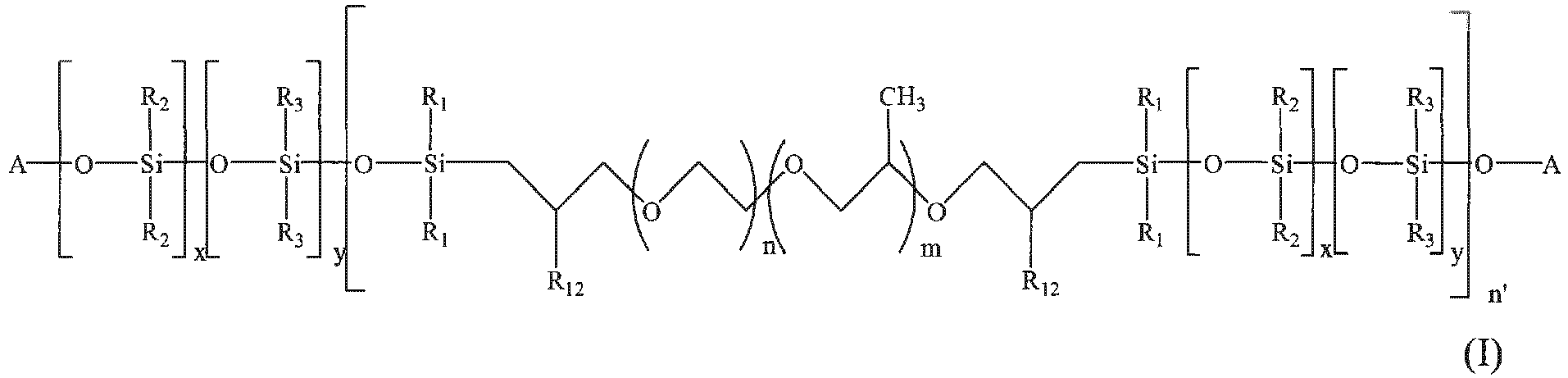
- the ⁇ , ⁇ - functionalized polyoxyalkylene-siloxane polymers of the present invention have the structural Formula (I):
- the present invention is directed to a copolymer comprising the following structural unit of Formula (II):
- the present invention relates to a method of preparing a polysiloxane copolymer, wherein said method comprises polymerizing a ⁇ , ⁇ -functionalized polyoxyalkylene-siloxane polymer represented by the structural Formula (I):
- the present invention generally relates to siloxane compositions with hydrophilic substituents in the backbone and the polycarbonate-polysiloxane copolymers obtained therefrom that result in a decreased contact angle and an increased hemocompatibility.
- the present invention herein is directed to an ⁇ , ⁇ - functionalized polyoxyalkylene-siloxane polymer having the structural formula referred to as structural Formula (I):
- the present invention is also directed to polymer blends including the ⁇ , ⁇ - functionalized polyoxyalkylene-siloxane polymers described above.
- the present invention also provides for a method of preparing ⁇ , ⁇ - functionalized polyoxyalkylene-siloxane polymers of the structural Formula (I), where p is 1, shown and described above.
- the method includes obtaining a hydride terminated siloxane from cyclic oligomers, e.g. a cyclic siloxane.
- the hydride terminated siloxanes can be obtained through ring opening polymerization of a cyclic siloxane with disiloxane hydride in presence of acidic and/or basic catalyst.
- a hydride terminated siloxane represented by the structural Formula (IV): wherein each R, R 1 , R 2 and R 3 is independently a linear or branched aliphatic group containing from 1 to 20 carbon atoms, a substituted or unsubstituted aryl group containing 6 to 16 carbon atoms, an alicyclic group containing 3 to 16 carbon atoms, a heteronuclear aromatic group containing 3 to 16 carbon atoms, a hydrocarbyl group having from 3 to 16 carbon atoms and containing at least one heteroatom of oxygen, nitrogen or sulfur and/or containing at least one ester, nitrile or halo group, wherein at least one R 2 is different from at least one R 3 ; and x is an integer from 1 to 300 and y is an integer from 0 to 100.
- each R, R 1 , R 2 and R 3 is independently a linear or branched aliphatic group containing from 1 to 20 carbon atoms, a substituted or unsubstituted aryl group containing 6 to 16 carbon atoms, an alicyclic group containing 3 to 16 carbon atoms, a heteronuclear aromatic group containing 3 to 16 carbon atoms, a hydrocarbyl group having from 3 to 16 carbon atoms and containing at least one heteroatom of oxygen, nitrogen or sulfur and/or containing at least one ester, nitrile or halo group, wherein R 2 , and R 3 are not the same; R 12 is independently hydrogen or methyl
- R 13 is independently a divalent linear or branched alkylene group having from 1 to 8 carbon atoms, an aralkylene group having from 7 to 10 carbon atoms, an unsubstituted or substituted arylene group having from 6 to 16 carbon atoms, hydrocarbylene group having from 2 to 8 carbon atoms and containing at least one heteroatom of oxygen
- R 5 is independently a hydrogen, a halogen, an aliphatic group containing from 1 to 12 carbon atoms, an aromatic group containing from 6 to 12 carbon atoms, an alkoxy group containing form 1 to 12 carbon atoms or an aryloxy group containing from 6 to 12 carbon atoms
- R 6 is independently a hydroxyl group, an amine group, a carboxylic acid chloride group or a sulfon
- the obtained ⁇ , ⁇ - functionalized polyoxyalkylene-siloxane polymers may further be purified to remove organics.
- the purification is conducted at a reduced pressure of less than 500 mmHg at a temperature of about 150 to 300 °C. to obtain the ⁇ , ⁇ -functionalized polyoxyalkylene-siloxane polymer with reduced volatile compounds.
- the present invention is also directed to a copolymer comprising the following structural unit Formula (II):
- Formula I is combined with a polycarbonate homopolymer, a polycarbonate copolymer, a polycarbonate-polyester, a polyester, polysulfones, polyethersulfones, polyetheretherketones, polyimides, and polyetherimides or combinations thereof to form a copolymer composition or polymer blend.
- the present invention is also directed to a composition, including ⁇ , ⁇ - functionalized polyoxyalkylene-siloxane polymers of Formula (I) or a copolymer including the units of Formula (II) and structural Formula (VII): wherein each R 7 is independently a hydrocarbon radical having 1 to 60 carbon atoms, a divalent hydrocarbon group, or a group derived from the structural unit having the Formula (IV): where R 8 is independently a hydrogen, a halogen, an aliphatic group having from 1 to 6 carbon atoms, an aromatic group having 6 to 8 carbon atoms, an alkoxy group having from 1 to 6 carbon atoms, or an aryloxy group; and R 9 is independently a hydroxyl group, an amine group, an acid chloride group, or a sulfonyl halide group; and X is a compound represented by a structural formula selected from the group consisting of: wherein R 10 and R 11 are independently a hydrogen, a halogen
- R 9 can be an hydroxy group and R 10 can be an alkyl group of from 1 to 6 carbon atoms.
- the copolymer of the present invention may be prepared by polymerizing an ⁇ , ⁇ - functionalized polyoxyalkylene-siloxane polymer and dihydroxyaromatic compound in the presence of a carbonate precursor, such as phosgene.
- a carbonate precursor such as phosgene.
- the dihydroxy aromatic compound is bisphenol A
- the ⁇ , ⁇ -functionalized polyoxyalkylene-siloxane polymer is a polymer having the structural Formula (I):
- the carbonate precursor may be chosen from phosgene, diphosgene, triphosgene and diarylcarbonates, bis(methylsalicyl)carbonate, or combinations thereof.
- the polymerization reaction is an interfacial polymerization process conducted in the presence of a solvent and optionally one or more catalysts.
- the polymerization reaction is an interfacial polymerization process conducted in the presence of a solvent that includes chlorinated aliphatic organic liquid, methylene chloride, chloroform, carbon tetrachloride, 1,2-dichloroethane, trichloroethane, tetrachloroethane, dichloropropane, 1,2-dichloroethylene, chlorobenzene, dichlorobenzene, chlorine-containing aromatic solvents, toluene, various chlorotoluenes and the like, aqueous solvents such as de-ionized water and optionally one or more catalysts.
- a solvent that includes chlorinated aliphatic organic liquid, methylene chloride, chloroform, carbon tetrachloride, 1,2-dichloroethane, trichloroethane, tetrachloroethane, dichloropropane, 1,2-dichloroethylene, chlorobenzene, dichlorobenzene
- the polymerization reaction is an interfacial polymerization process conducted in the presence of a solvent, a caustic, and optionally one or more catalysts.
- the carbonate precursor may be phosgene, diphosgene and diarylcarbonates, bis(methylsalicyl)carbonate, or a combination thereof.
- Suitable catalysts for the interfacial polymerization reaction may include aliphatic amines such as tertiary amine catalysts, trialkylamine; phase transfer catalyst such as catalysts of the formula (X 3 ) 4 L + Y - , wherein each X is independently an alkyl group having 1 to 26 carbon atoms, an aralkyl group having 7 to 20 carbon atoms or an aryl group having 6 to 12 carbon atoms; L is a nitrogen or phosphorus atom; and Y is a halide, or an alkoxy group having 1 to 8 carbon atoms or an aryloxy group having 6 to 18 carbon atoms. Combinations of such catalysts are also effective.
- the polymerization reaction may be performed by reacting dihydroxyaromatic compounds, such as bisphenol A, with triphosgene in a biphasic solvent in the presence of a phase transfer catalyst to form a bischloroformate; and adding the ⁇ , ⁇ -functionalized polyoxyalkylene-siloxane polymer to form the copolymer.
- dihydroxyaromatic compounds such as bisphenol A
- triphosgene in a biphasic solvent
- a phase transfer catalyst to form a phase transfer catalyst
- ⁇ , ⁇ -functionalized polyoxyalkylene-siloxane polymer to form the copolymer.
- chloroformates of dihydroxy aromatic compounds are formed in a tube reactor, and then added into an interfacial polycondensation reactor with a catalyst.
- Articles of manufacture can be made using the copolymers of the present invention, and particularly using polymer blend compositions containing the copolymers of the invention (for example, in combination with a polycarbonate homopolymer).
- polymer blend compositions may comprise copolymers of the present invention in amounts from about 0.01weight percent to about 25 weight percent, preferably about 0.01 weight percent to about 10 weight percent and more preferably about 0.01 weight percent to about 7 weight percent, based on the sum of the weight of the copolymer of the present invention and thermoplastic resin, such as polycarbonate homopolymer.
- Such articles of manufacture include but are not limited to medical articles, medical tubes, medical bags, mobile phone housings, frozen food service equipment, personal safety applications including helmets, automotive and motorcycle windshields, automotive sunroofs, other automotive applications including dashboards allowing for robust airbag deployment without fragmenting, and automotive headlamp or electronics screen applications, where clarity, flame retardance, and impact resistance are beneficial.
- the ⁇ , ⁇ - functionalized polyoxyalkylene-siloxane polymer of Formula (I) and the structure unit of Formula (II) of the copolymer are defined wherein R is independently hydrogen, an alkyl group of from 1 to 4 carbon atoms or phenyl and more specifically methyl; R 1 is independently an alkyl group of from 1 to 4 carbon atoms or phenyl and more specifically methyl; R 2 is independently an alkyl group of from 1 to 4 carbon atoms or phenyl and more specifically methyl, R 3 is independently an alkyl group of from 1 to 16 carbon atoms, phenyl, 2-phenylethyl, 2,2-diphenylethyl, 2-phenyl-2-methylethyl, 3-phenylpropyl, 3-phenyl-2-methylpropyl, or phenyl-4-oxabutyl, and more specifically methyl or phenyl, and even more specifically, phenyl; R 4 is independently an alkylene
- the ⁇ , ⁇ - functionalized polyoxyalkylene-siloxane polymer of Formula (I) and the structure unit of Formula (II) of the copolymer are define wherein R is hydrogen; R 1 is methyl; R 2 is methyl, R 3 is independently methyl or phenyl and more specifically phenyl; R 4 is -CH 2 CH 2 -, -CH(CH 3 )CH 2 -, -CH 2 CH 2 CH 2 - or -CH 2 CH(CH 3 )CH 2 -; R 5 is independently hydrogen or methoxy; R 6 is -OH; W is -O-; ; the subscripts m, n, n', p, q, x and y are integers, where m is from 0 to 100; n is from 1 to 100; n' is from 1 to 3; p is 1; q is 1; x is from 1 to 275; and y is from 0 to 80.
- Example 2 is a repeat of Example 1. The structural information is presented in Table 1.
- Example 3 prepared a ⁇ , ⁇ -bis-[3-(4-hydroxy-3-methoxyphenyl)propyl-terminated polydimethylsiloxane-polyalkylene oxide polymer in accordance with the procedure of Example 1, except a 2-methylprop-1-enyl-terminated poly(ethylene oxide/propylene oxide) polymer containing 50 weight percent ethylene oxide and 50 weight percent propylene oxide was used.
- the structural information is presented in Table 1.
- Example 4 prepared ⁇ , ⁇ -bis-[3-(4-hydroxy-3-methoxyphenyl)propyl-terminated poly(dimethylsiloxane/diphenylsiloxane)-polyalkylene oxide polymer according to the procedure in Example 1, except the starting silicon hydride-terminated poly(dimethylsiloxane/diphenylsiloxane) had the chemical structure, H-Si(CH 3 ) 2 [OSi(CH 3 ) 21 [OSi(C 6 H 5 ) 2 ] 2 OSi(CH 3 ) 2 -H and the 2-methylprop-1-enyl-terminated poly(ethylene oxide/propylene oxide) polymer containing 50 weight percent ethylene oxide and 50 weight percent propylene oxide was used.
- Table 1 The structural information is presented in Table 1.
- Example 5 prepared ⁇ , ⁇ -bis-[3-(4-hydroxy-3-methoxyphenyl)propyl-terminated poly(dimethylsiloxane/diphenylsiloxane)-polyalkylene oxide polymer according to the procedure in Example 1, except the starting silicon hydride-terminated poly(dimethylsiloxane/diphenylsiloxane) had the chemical structure, H-Si(CH 3 ) 2 [OSi(CH 3 ) 2 ] 24 [OSi(C 6 H 5 ) 2 ] 4 OSi(CH 3 ) 2 -H and the 2-methylprop-1-enyl-terminated poly(ethylene oxide/propylene oxide) polymer containing 50 weight percent ethylene oxide and 50 weight percent propylene oxide was used.
- Table 1 The structural information is presented in Table 1.
- Table 1 Structural information on the ⁇ , ⁇ - functionalized polyoxyalkylene-siloxane polymers prepared according to Examples 1 to 5 and Comparative Example A.
- Both triphosgene and the aqueous NaOH solution were added to the reaction mixture simultaneously with vigorous stirring, with the stirring blade rotating at 300-400 rpm.
- the addition of the aqueous NaOH solution was carefully added in such a way that the pH of the reaction mixture was maintained between 5 and 6.
- the stirring was continued for another 40 to 60 minutes.
- the pH of the solution was increased to a pH of 10-11 using the aqueous NaOH solution.
- the reaction mixture was stirred for an additional 5-10 minutes.
Landscapes
- Chemical & Material Sciences (AREA)
- Health & Medical Sciences (AREA)
- Chemical Kinetics & Catalysis (AREA)
- Medicinal Chemistry (AREA)
- Polymers & Plastics (AREA)
- Organic Chemistry (AREA)
- Silicon Polymers (AREA)
- Compositions Of Macromolecular Compounds (AREA)
- Other Resins Obtained By Reactions Not Involving Carbon-To-Carbon Unsaturated Bonds (AREA)
Description
- The invention is directed to α,ω- functionalized polyoxyalkylene-siloxane polymers and copolymers made therefrom.
- Polycarbonate resins are well-known thermoplastic resins which have long been used in a variety of applications, including medical applications, due to their very high optical clarity, resistance to impact, high dimensional stability, and heat resistance. However, polycarbonate can sometimes have adverse effects in medical applications where they are in contact with blood, protein, and lipid solutions. For instance, when blood comes into contact with a conventional polycarbonate, there is a possibility of a reduction in the platelet count of the blood. When a solution containing protein contacts conventional polycarbonate, a layer of protein is sometimes deposited on the surface of the polymer. Previous attempts have used a hydrophilic polycarbonate surface coating, such as a layer of hydrophilic hemocompatible coatings. However, this requires the added step of coating following extruding and molding of the articles.
- Relevant surface treatments are disclosed in
EP 2559806(A1 ). A method is disclosed of improving hydrophilicity of a polycarbonate by a surface plasma treatment involving an He, Hs, Kr, Ne, N2, and Xe gas mixture. -
U.S. Patent No. 5,661,202 ,EP 0570208A2 ,U.S. Patent No. 7,709,581 ,U.S. Patent Pub. No. 20080081860 , discloses Eugenol terminated fluids with different substituents in the backbone or pendant broadly. -
U.S. Pat. No. 8,426,532 discloses the use of sulfonation techniques to introduce hydrophilic functionality on the molecules. Different additives can also be added to increase the hydrophilicity, some additives become surface active only after conditioning under specific conditions, while some additives are miscible with polycarbonate. However, these reduce the glass transition which will affect the processing. Further, even if these additives are thermally stable and surface active, they may not be permanent due to the lack of chemical bonding between the polymer matrix and additive. -
U.S. Patent No. 8,426,532 discloses polycarbonate graft copolymers comprising polycarbonate in the backbone and pendant chains grafted to polycarbonate backbone. These pendant chains are derived from a radically polymerizable unsaturated monomer of vinylpyrorolidone, an acrylate, styrene, dialkyl siloxane and perfluorinated vinyl compound. -
U.S. Patent No. 7,888,447 discloses the preparation of polycarbonate-polysiloxane copolymeric compositions with poly (oxyalkyl) group as pendant and material made having improved hemocompatibility. However, this type of copolymer could have random distribution of the hydrophilic moiety. -
US-A-2013/289193 patent discloses a functionalized alkylene-silicone copolymer used to modifiy a polycarbonate. The functionalized alkylene-silicone copolymer contains a C1 to C18 alkylene group. -
US-A-2010/010135 patent describes oligo- and poly-carbonates terminated with a silicon containing group comprising a polyoxyalkylene unit thereby forming a silicon-polyoxyalkylene monoalcohol. Such compounds are incorporated into a polycarbonate to form compositions. -
EP-A-0896975 patent relates to a polycarbonate having silicone blocks and alkylene or alkyleneoxyalkylene as linking groups. - Finally,
EP-A-0778305 patent discloses a silicone compound containing a trialkylsiloxy group at one end and on the other end two phenolic groups bonded to the silicon atom through an alkylene linking group or an alkyleneoxyalkylene containing only one oxygen atom. - There remains a need for a polycarbonate composition with improved hemocompatibility and hydrophilicity and better pigment dispersion in-polycarbonate-polysiloxane copolymeric composition that exhibits improved hemocompatibility and hydrophilicity.
- Accordingly, it has been found that certain polycarbonate-polyoxyalkylene siloxane copolymer compositions having a random siloxane block structure that can provide tunable properties in addition to improved hydrophilicity and hemocompatibility compared to conventional blends, additives, and copolymers.
- The α,ω- functionalized polyoxyalkylene-siloxane polymers of the present invention have the structural Formula (I):

- wherein each R, R1, R2 and R3 is independently a linear or branched aliphatic group containing from 1 to 20 carbon atoms, a substituted or unsubstituted aryl group containing 6 to 16 carbon atoms, an alicyclic group containing 3 to 16 carbon atoms, a heteronuclear aromatic group containing 3 to 16 carbon atoms, a hydrocarbyl group having from 3 to 16 carbon atoms and containing at least one heteroatom of oxygen, nitrogen or sulfur and/or containing at least one ester, nitrile or halo group, wherein at least one R2 is different from at least one R3; R12 is independently hydrogen or methyl;
- A is

- In an embodiment, the present invention is directed to a copolymer comprising the following structural unit of Formula (II):

- wherein each R, R1, R2 and R3 is independently a linear or branched aliphatic group containing from 1 to 20 carbon atoms, a substituted or unsubstituted aryl group containing 6 to 16 carbon atoms, an alicyclic group containing 3 to 16 carbon atoms, a heteronuclear aromatic group containing 3 to 16 carbon atoms, a hydrocarbyl group having from 3 to 16 carbon atoms and containing at least one heteroatom of oxygen, nitrogen or sulfur and/or containing at least one ester, nitrile or halo group, wherein at least one R2 is different from at least one R3; R12 is independently hydrogen or methyl;
- A1 is

- In another embodiment, the present invention relates to a method of preparing a polysiloxane copolymer, wherein said method comprises polymerizing a α,ω-functionalized polyoxyalkylene-siloxane polymer represented by the structural Formula (I):

- wherein each R, R1, R2 and R3 is independently a linear or branched aliphatic group containing from 1 to 20 carbon atoms, a substituted or unsubstituted aryl group containing 6 to 16 carbon atoms, an alicyclic group containing 3 to 16 carbon atoms, a heteronuclear aromatic group containing 3 to 16 carbon atoms, a hydrocarbyl group having from 3 to 16 carbon atoms and containing at least one heteroatom of oxygen, nitrogen or sulfur and/or containing at least one ester, nitrile or halo group, wherein at least one R2 is different from at least one R3; R12 is independently hydrogen or methyl;
- A is
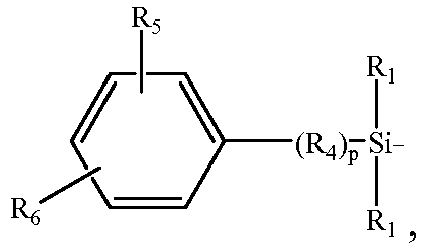


- The present invention generally relates to siloxane compositions with hydrophilic substituents in the backbone and the polycarbonate-polysiloxane copolymers obtained therefrom that result in a decreased contact angle and an increased hemocompatibility.
- In an aspect, the present invention herein is directed to an α,ω- functionalized polyoxyalkylene-siloxane polymer having the structural formula referred to as structural Formula (I):

- wherein each R, R1, R2 and R3 is independently a linear or branched aliphatic group containing from 1 to 20 carbon atoms, a substituted or unsubstituted aryl group containing 6 to 16 carbon atoms, an alicyclic group containing 3 to 16 carbon atoms, a heteronuclear aromatic group containing 3 to 16 carbon atoms, a hydrocarbyl group having from 3 to 16 carbon atoms and containing at least one heteroatom of oxygen, nitrogen or sulfur and/or containing at least one ester, nitrile or halo group, wherein at least one R2 is different from at least one R3; R12 is independently hydrogen or methyl;
- A is

- In another aspect, the present invention is also directed to polymer blends including the α,ω- functionalized polyoxyalkylene-siloxane polymers described above.
- In a further aspect, the present invention also provides for a method of preparing α,ω- functionalized polyoxyalkylene-siloxane polymers of the structural Formula (I), where p is 1, shown and described above. The method includes obtaining a hydride terminated siloxane from cyclic oligomers, e.g. a cyclic siloxane. The hydride terminated siloxanes can be obtained through ring opening polymerization of a cyclic siloxane with disiloxane hydride in presence of acidic and/or basic catalyst. In an embodiment, a hydride terminated siloxane is disclosed represented by the structural Formula (IV):


- wherein each R, R1, R2 and R3 is independently a linear or branched aliphatic group containing from 1 to 20 carbon atoms, a substituted or unsubstituted aryl group containing 6 to 16 carbon atoms, an alicyclic group containing 3 to 16 carbon atoms, a heteronuclear aromatic group containing 3 to 16 carbon atoms, a hydrocarbyl group having from 3 to 16 carbon atoms and containing at least one heteroatom of oxygen, nitrogen or sulfur and/or containing at least one ester, nitrile or halo group, wherein at least one R2 is different from at least one R3; R12 is independently hydrogen or methyl;
- A is

- The obtained α,ω- functionalized polyoxyalkylene-siloxane polymers may further be purified to remove organics. The purification is conducted at a reduced pressure of less than 500 mmHg at a temperature of about 150 to 300 °C. to obtain the α,ω-functionalized polyoxyalkylene-siloxane polymer with reduced volatile compounds.
- In an embodiment, the present invention is also directed to a copolymer comprising the following structural unit Formula (II):

- wherein each R, R1, R2 and R3 is independently a linear or branched aliphatic group containing from 1 to 20 carbon atoms, a substituted or unsubstituted aryl group containing 6 to 16 carbon atoms, an alicyclic group containing 3 to 16 carbon atoms, a heteronuclear aromatic group containing 3 to 16 carbon atoms, a hydrocarbyl group having from 3 to 16 carbon atoms and containing at least one heteroatom of oxygen, nitrogen or sulfur and/or containing at least one ester, nitrile or halo group, wherein at least one R2 is different from at least one R3; R12 is independently hydrogen or methyl;
- A1 is

- In embodiments, Formula I is combined with a polycarbonate homopolymer, a polycarbonate copolymer, a polycarbonate-polyester, a polyester, polysulfones, polyethersulfones, polyetheretherketones, polyimides, and polyetherimides or combinations thereof to form a copolymer composition or polymer blend.
- In further embodiments, the present invention is also directed to a composition, including α,ω- functionalized polyoxyalkylene-siloxane polymers of Formula (I) or a copolymer including the units of Formula (II) and structural Formula (VII):


- In embodiments of the copolymer disclosed above R9 can be an hydroxy group and R10 can be an alkyl group of from 1 to 6 carbon atoms.
- In an embodiment, the copolymer of the present invention may be prepared by polymerizing an α,ω- functionalized polyoxyalkylene-siloxane polymer and dihydroxyaromatic compound in the presence of a carbonate precursor, such as phosgene. In one embodiment, the dihydroxy aromatic compound is bisphenol A, and the α,ω-functionalized polyoxyalkylene-siloxane polymer is a polymer having the structural Formula (I):

- wherein each R, R1, R2 and R3 is independently a linear or branched aliphatic group containing from 1 to 20 carbon atoms, a substituted or unsubstituted aryl group containing 6 to 16 carbon atoms, an alicyclic group containing 3 to 16 carbon atoms, a heteronuclear aromatic group containing 3 to 16 carbon atoms, a hydrocarbyl group having from 3 to 16 carbon atoms and containing at least one heteroatom of oxygen, nitrogen or sulfur and/or containing at least one ester, nitrile or halo group, wherein at least one R2 is different from at least one R3; R12 is independently hydrogen or methyl;
- A is

- The carbonate precursor may be chosen from phosgene, diphosgene, triphosgene and diarylcarbonates, bis(methylsalicyl)carbonate, or combinations thereof.
- In embodiments, the polymerization reaction is an interfacial polymerization process conducted in the presence of a solvent and optionally one or more catalysts.
- In further embodiments, the polymerization reaction is an interfacial polymerization process conducted in the presence of a solvent that includes chlorinated aliphatic organic liquid, methylene chloride, chloroform, carbon tetrachloride, 1,2-dichloroethane, trichloroethane, tetrachloroethane, dichloropropane, 1,2-dichloroethylene, chlorobenzene, dichlorobenzene, chlorine-containing aromatic solvents, toluene, various chlorotoluenes and the like, aqueous solvents such as de-ionized water and optionally one or more catalysts.
- In embodiments, the polymerization reaction is an interfacial polymerization process conducted in the presence of a solvent, a caustic, and optionally one or more catalysts. The carbonate precursor may be phosgene, diphosgene and diarylcarbonates, bis(methylsalicyl)carbonate, or a combination thereof. Suitable catalysts for the interfacial polymerization reaction may include aliphatic amines such as tertiary amine catalysts, trialkylamine; phase transfer catalyst such as catalysts of the formula (X3)4L+Y-, wherein each X is independently an alkyl group having 1 to 26 carbon atoms, an aralkyl group having 7 to 20 carbon atoms or an aryl group having 6 to 12 carbon atoms; L is a nitrogen or phosphorus atom; and Y is a halide, or an alkoxy group having 1 to 8 carbon atoms or an aryloxy group having 6 to 18 carbon atoms. Combinations of such catalysts are also effective.
- In an embodiment, the polymerization reaction may be performed by reacting dihydroxyaromatic compounds, such as bisphenol A, with triphosgene in a biphasic solvent in the presence of a phase transfer catalyst to form a bischloroformate; and adding the α,ω-functionalized polyoxyalkylene-siloxane polymer to form the copolymer. In embodiments, chloroformates of dihydroxy aromatic compounds are formed in a tube reactor, and then added into an interfacial polycondensation reactor with a catalyst.
- Articles of manufacture can be made using the copolymers of the present invention, and particularly using polymer blend compositions containing the copolymers of the invention (for example, in combination with a polycarbonate homopolymer). In an embodiment, polymer blend compositions may comprise copolymers of the present invention in amounts from about 0.01weight percent to about 25 weight percent, preferably about 0.01 weight percent to about 10 weight percent and more preferably about 0.01 weight percent to about 7 weight percent, based on the sum of the weight of the copolymer of the present invention and thermoplastic resin, such as polycarbonate homopolymer.
- Examples of such articles of manufacture include but are not limited to medical articles, medical tubes, medical bags, mobile phone housings, frozen food service equipment, personal safety applications including helmets, automotive and motorcycle windshields, automotive sunroofs, other automotive applications including dashboards allowing for robust airbag deployment without fragmenting, and automotive headlamp or electronics screen applications, where clarity, flame retardance, and impact resistance are beneficial.
- In specific embodiments, the α,ω- functionalized polyoxyalkylene-siloxane polymer of Formula (I) and the structure unit of Formula (II) of the copolymer are defined wherein R is independently hydrogen, an alkyl group of from 1 to 4 carbon atoms or phenyl and more specifically methyl; R1 is independently an alkyl group of from 1 to 4 carbon atoms or phenyl and more specifically methyl; R2 is independently an alkyl group of from 1 to 4 carbon atoms or phenyl and more specifically methyl, R3 is independently an alkyl group of from 1 to 16 carbon atoms, phenyl, 2-phenylethyl, 2,2-diphenylethyl, 2-phenyl-2-methylethyl, 3-phenylpropyl, 3-phenyl-2-methylpropyl, or phenyl-4-oxabutyl, and more specifically methyl or phenyl, and even more specifically, phenyl; R4 is independently an alkylene group of 1 to 6 carbon atoms, more specifically -CH2-, -CH2CH2-, -CH(CH3)CH2-, - CH2CH2CH2-,
-CH2CH(CH3)CH2- or -CH2C(CH3)2CH2CH2-, and even more specifically -CH2CH2CH2-; R5 is independently hydrogen, chloro, methoxy, ethoxy and more specifically hydrogen or methoxy; R6 is independently -OH, -NH2 or -C(=O)Cl, and more specifically -OH; W is -O- or -NH- and more specifically -OH; R12 is methyl; R13 is -CH2-; the subscripts m, n, n', p, q, x and y are integers, where m is from 0 to 100 and more specifically from 0 to 60, and even more specifically from 1 to 15; n is from 1 to 100, more specifically n is from 1 to 60 and even more specifically, n is from 5 to 30; n' is from 1 to 6, and even more specifically from 1 to 3; p is 1; q is 1; x is from 1 to 275, more specifically from 1 to 250, and even more specifically from 3 to 25; and y is from 0 to 80, more specifically from 0 to 40 and even more specifically from 0 to 25. - In an embodiment, the α,ω- functionalized polyoxyalkylene-siloxane polymer of Formula (I) and the structure unit of Formula (II) of the copolymer are define wherein R is hydrogen; R1 is methyl; R2 is methyl, R3 is independently methyl or phenyl and more specifically phenyl; R4 is -CH2CH2-, -CH(CH3)CH2-, -CH2CH2CH2- or -CH2CH(CH3)CH2-; R5 is independently hydrogen or methoxy; R6 is -OH; W is -O-; ; the subscripts m, n, n', p, q, x and y are integers, where m is from 0 to 100; n is from 1 to 100; n' is from 1 to 3; p is 1; q is 1; x is from 1 to 275; and y is from 0 to 80.
- Specific embodiments will now be described in detail. These examples are intended to be illustrative, and not limited to the materials, conditions, or process parameters set forth in these embodiments. All parts are percentages by solid weight unless otherwise indicated.
- The Examples described below illustrate the invention:
- Into a round bottom flask equipped with a condenser and nitrogen line, was charged octamethyltetracyclosiloxane (D4, 200 grams, 0.674 mole), 15 grams of 1,1,3,3-tetramethyldisiloxane, (TMDS, 0.112 mole), and a few drops of concentrated H2SO4 catalyst. The reaction mixture was heated to 60°C and stirred under N2 overnight. Thereafter, reaction mixture was neutralized and filtered through Celite filtering aid. The residual low boiling components were removed under elevated temperatures and reduced pressure (150°C/5mbar) to give a colorless viscous fluid of HMD35MH, where M is H(CH3)2SiO1/2 and D is (CH3)2SiO2/2.
- Into a 250-ml round bottom flask was charged 100 grams (0.036 mole) of HMD35MH, and 2-methylprop-1-enyl-terminated poly(ethylene oxide/propylene oxide) polymer containing 60 weight percent ethylene oxide and 40 weight percent propylene oxide (60H1500, 0.018 mole) and 0.065 grams of Speier's catalyst (H2PtCl6). The reaction mixture was heated at 110°C for 10 hours, cooled and filtered through diatomaceous earth. The residual materials were removed under reduced pressure (150°C/5mbar) to give a colorless very viscous fluid of Si-H terminated polysiloxane-polyethylene blocked copolymer having the nominal structure, H-Si(CH3)2[OSi(CH3)2]35OSi(CH3)2-CH2CH(CH3)CH2(OCH2CH2)20(OCH2CH(CH3)10-OCH2CH(CH3)CH2Si(CH3)2[OSi(CH3)2]35OSi(CH3)2-H.
- Into a 250mL reaction flask was charged with 100 grams of the Si-H terminated polysiloxane-polyethylene blocked copolymer prepared above and 0.065 grams of Speier's catalyst (H2PtCl6). The mixture was stirred under N2, and heated to 80°C. Thereafter, stoichiometric amount of eugenol (0.036 moles) were charged to an addition funnel and added drop-wise at a rate to maintain a reaction temperature of 100°C. Following the addition, the reaction was heated to 120°C and maintained for 2 hours. The reaction mixture was allowed to cool to room temperature, treated with Celite filtering aid and filtered. The residual materials were removed under reduced pressure (150°C/5mbar) to give a colorless very viscous fluid having the nominal structure, A-Si(CH3)2[OSi(CH3)2]35OSi(CH3)2CH2CH(CH3)CH2(OCH2CH2)n-(OCH2CH(CH3)mOCH2CH(CH3)CH2Si(CH3)2[OSi(CH3)2]35OSi(CH3)-A, where A is

- Example 2 is a repeat of Example 1. The structural information is presented in Table 1.
- Example 3 prepared a α,ω-bis-[3-(4-hydroxy-3-methoxyphenyl)propyl-terminated polydimethylsiloxane-polyalkylene oxide polymer in accordance with the procedure of Example 1, except a 2-methylprop-1-enyl-terminated poly(ethylene oxide/propylene oxide) polymer containing 50 weight percent ethylene oxide and 50 weight percent propylene oxide was used. The structural information is presented in Table 1.
- Example 4 prepared α,ω-bis-[3-(4-hydroxy-3-methoxyphenyl)propyl-terminated poly(dimethylsiloxane/diphenylsiloxane)-polyalkylene oxide polymer according to the procedure in Example 1, except the starting silicon hydride-terminated poly(dimethylsiloxane/diphenylsiloxane) had the chemical structure, H-Si(CH3)2[OSi(CH3)21[OSi(C6H5)2]2OSi(CH3)2-H and the 2-methylprop-1-enyl-terminated poly(ethylene oxide/propylene oxide) polymer containing 50 weight percent ethylene oxide and 50 weight percent propylene oxide was used. The structural information is presented in Table 1.
- Example 5 prepared α,ω-bis-[3-(4-hydroxy-3-methoxyphenyl)propyl-terminated poly(dimethylsiloxane/diphenylsiloxane)-polyalkylene oxide polymer according to the procedure in Example 1, except the starting silicon hydride-terminated poly(dimethylsiloxane/diphenylsiloxane) had the chemical structure, H-Si(CH3)2[OSi(CH3)2]24[OSi(C6H5)2]4OSi(CH3)2-H and the 2-methylprop-1-enyl-terminated poly(ethylene oxide/propylene oxide) polymer containing 50 weight percent ethylene oxide and 50 weight percent propylene oxide was used. The structural information is presented in Table 1.
- The following is a Comparative Example:
- Into a round bottom flask was charged 100 grams of a silicon hydride-terminated poly(dimethylsiloxane) having the structure MHD45MH (0.029 moles) and 0.065 grams of Speier's catalyst (H2PtCl6). The mixture was stirred under N2, and heated to 80°C. Thereafter, stoichiometric amount of eugenol (0.058 moles) were charged to an addition funnel and added drop-wise at a rate to maintain a reaction temperature of 100°C. Following the addition, the reaction was heated to 120°C and maintained for 2 hours. The reaction mixture was allowed to cool to room temperature, treated with Celite filtering aid and filtered. The residual materials were removed under reduced pressure (150°C/5mbar) to give a colorless very viscous fluid. The structural information is presented in Table 1.
Table 1: Structural information on the α,ω- functionalized polyoxyalkylene-siloxane polymers prepared according to Examples 1 to 5 and Comparative Example A. Reactions R1 R2 R3 D-units PEG's MW PDI Viscosity (Pas) Td(°C) Tg (°C) RI x y Example 1 Me - - 35 - PEG-1 8,500 2.26 8.942 - - - Example 2 Me - - 35 - 8.003 - - - Example 3 Me - - 35 - PEG2 5,130 2.42 9.243 405 -119, -79 1.4376 Example 4 Me Me Ph 21 2 7,100 2.92 0.785 397 -76 1.4566 Example 5 Me Me Ph 24 4 13,000 2.20 9.535 379 -114 1.4690 Comparative Example A Me - - 45 - - 5,700 1.32 0.097 448 -118 1.4210 Me: Methyl,
Ph: phenyl;
PEG1 (bismethallyl polyalkyleneglycol, MW 3000 with 60 % EO);
PEG2 (bismethallyl polyalkyleneglycol, MW 3000 with 50 % EO);
MW: weight average molecular weight, PDI: polydispersity both values obtained from GPC calibrated with PS standards with Chloroform as eluent at 1 ml/minute.;
Comparative example 1 EuMD45MEu; Eu- eugenol - 9.132 grams of bis-phenol-A (BPA), 2.283 grams of α,ω-functionalized polyoxyalkylene-siloxane polymer prepared in Example 1 and 0.113 grams of phase transfer catalyst, phenyltriethylammonium chloride, were added to a four necked round bottom flask containing 50 mL each of water and dichloromethane. 7.56 grams of triphosgene was weighed in a glass vial under nitrogen atmosphere, dissolved in 25ml of dichloromethane, and transferred to an addition funnel connected to the round bottom flask. 25mL of 25-30 weight percent NaOH aqueous solution was transferred to a second additional funnel fixed in the reactor. Both triphosgene and the aqueous NaOH solution were added to the reaction mixture simultaneously with vigorous stirring, with the stirring blade rotating at 300-400 rpm. The addition of the aqueous NaOH solution was carefully added in such a way that the pH of the reaction mixture was maintained between 5 and 6. After the addition of the aqueous NaOH solution, the stirring was continued for another 40 to 60 minutes. The pH of the solution was increased to a pH of 10-11 using the aqueous NaOH solution. The reaction mixture was stirred for an additional 5-10 minutes. 0.2123 grams of 4-cumyl phenol (para-cumyl-phenol) and 50.6 milligrams of triethyl amine were added, the mixture was stirred for an additional 5-10 minutes, and the pH was adjusted to a pH of 12 by adding the aqueous NaOH solution. The reaction was stopped and the organic layer was separated from aqueous layer using a separating funnel. The polymer (organic layer) was washed with IN HCl and precipitated in 3 to 4 liters of methanol. The final product was dried overnight in a vacuum oven under reduced pressure and a temperature of 60-70°C. The compositional data are presented in Table 2, and referred to as PC-Siloxane-Copolymer -1.
- A series of polycarbonate / α,ω-functionalized polyoxyalkylene-siloxane copolymers were prepared using the α,ω-functionalized polyoxyalkylene-siloxane copolymers of Examples 2, 3 and 5 and Comparative Example A and in accordance with the procedure of Example 6. The compositional data are presented in Table 2.
Table 2: Compositional data on the polycarbonate / α,ω-functionalized polyoxyalkylene-siloxane copolymers. Samples Siloxane fluid (wt%) in copolymer Mw (SEC) PDI % endcapped of copolymer Tg Td PC-Siloxane-Copolymer - 1 (using example 1) 7.10 28,000 1.75 84.7 148 474 PC-Siloxane-Copolymer - 2 (using example 2) 9.20 89,800 2.10 85.1 149 483 PC-Siloxane-Copolymer - 3 (using example 3) 9.9 49133 2.50 63.0 121 440 PC-Siloxane-Copolymer - 5 (using example 5) 11 51,368 2.40 82 144 423 PC-Siloxane-Copolymer - 6 (using comparative example A) 7.0 64852 1.50 91 149 471 PC homopolymer - 106492 >2.0 97.6 154 476 Mw: weight average molecular weight,
PDI: polydispersity both values obtained from GPC calibrated with PS standards with chloroform as eluent at 1 ml/minute. - Five weight percent of the polycarbonate/α,ω-functionalized polyoxyalkylene-siloxane copolymers made above were melt blended in Haake batch mixer with approximately 95 weight percent of polycarbonate at 270-290°C for 7 minutes. The molten strands were collected and used for morphological characterization followed by preparation of a molded article therefrom.
Claims (15)
- An α,ω- functionalized polyoxyalkylene-siloxane polymer having the structural Formula (I):
 each R, R1, R2 and R3 is independently a linear or branched aliphatic group containing from 1 to 20 carbon atoms, a substituted or unsubstituted aryl group containing 6 to 16 carbon atoms, an alicyclic group containing 3 to 16 carbon atoms, a heteronuclear aromatic group containing 3 to 16 carbon atoms, a hydrocarbyl group having from 3 to 16 carbon atoms and containing at least one heteroatom of oxygen, nitrogen or sulfur and/or containing at least one ester, nitrile or halo group, wherein at least one R2 is different from at least one R3;R12 is independently hydrogen or methyl;A is
 wherein m, n, n', x and y are integers, and wherein m is from 0 to 120, n is from 1 to 120, n' is from 1 to 10, x is from 1 to 300, and y is from 0 to 100, with the proviso that the sum of n + m is greater than or equal to 2.
 - The α,ω- functionalized polyoxyalkylene-siloxane polymer of claim 1, wherein R is independently hydrogen, an alkyl group of from 1 to 4 carbon atoms or phenyl; R1 is independently an alkyl group of from 1 to 4 carbon atoms or phenyl; R2 is independently an alkyl group of from 1 to 4 carbon atoms or phenyl; R3 is independently an alkyl group of from 1 to 16 carbon atoms, phenyl, 2-phenylethyl, 2,2-diphenylethyl, 2-phenyl-2-methylethyl, 3-phenylpropyl, 3-phenyl-2-methylpropyl, or phenyl-4-oxabutyl; R4 is independently an alkylene group of 1 to 6 carbon atoms; R5 is independently hydrogen, chloro, methoxy, ethoxy; R6 is independently -OH, -NH2 or -C(=O)Cl; R12 is methyl; wherein m, n, n', p, x and y are integers, and wherein m is from 0 to 100; n is from 1 to 100; n' is from 1 to 6; p is 1; x is from 1 to 275; and y is from 0 to 80.
- The α,ω- functionalized polyoxyalkylene-siloxane polymer of claim 2, wherein R1 is methyl; R2 is methyl, R3 is independently methyl or phenyl; R4 is -CH2CH2-, -CH(CH3)CH2-, -CH2CH2CH2- or -CH2CH(CH3)CH2-; R5 is independently hydrogen or methoxy; R6 is -OH; wherein m, n, n', p, x and y are integers, and wherein m is from 0 to 100; n is from 1 to 100; n' is from 1 to 3; p is 1; x is from 1 to 275; and y is from 0 to 80.
- A composition comprising an α,ω- functionalized polyoxyalkylene-siloxane polymer of claim 1 and at least one polymer selected from the group consisting of polycarbonate homopolymers, polycarbonate copolymers, polycarbonate-polyesters, polyesters, polysulfones, polyethersulfones, polyetheretherketones, polyimides and polyetherimides and combinations thereof.
- An article comprising the composition of claim 4, wherein the article is one or more of a medical article, a medical tube, a medical bag, a mobile phone housing, a frozen food service equipment article, a helmet, an automotive windshield, a motorcycle windshield, an automotive sunroof, a dashboard, a headlamp, or an electric screen.
- A method of making an article comprising molding, shaping, or forming the composition of claim 4 into the article.
- A method of preparing an α,ω- functionalized polyoxyalkylene-siloxane polymer having the structural Formula (I):
 each R, R1, R2 and R3 is independently a linear or branched aliphatic group containing from 1 to 20 carbon atoms, a substituted or unsubstituted aryl group containing 6 to 16 carbon atoms, an alicyclic group containing 3 to 16 carbon atoms, a heteronuclear aromatic group containing 3 to 16 carbon atoms, a hydrocarbyl group having from 3 to 16 carbon atoms and containing at least one heteroatom of oxygen, nitrogen or sulfur and/or containing at least one ester, nitrile or halo group, wherein at least one R2 is different from at least one R3;R12 is independently hydrogen or methyl;A is
wherein m, n, n', x and y are integers, and wherein m is from 0 to 120, n is from 1 to 120, n' is from 1 to 10, x is from 1 to 300, and y is from 0 to 100, with the proviso that the sum of n + m is greater than or equal to 2, comprising:(a) reacting a hydride terminated siloxane represented by the structural Formula (IV):
 each R, R1, R2 and R3 is independently a linear or branched aliphatic group containing from 1 to 20 carbon atoms, a substituted or unsubstituted aryl group containing 6 to 16 carbon atoms, an alicyclic group containing 3 to 16 carbon atoms, a heteronuclear aromatic group containing 3 to 16 carbon atoms, a hydrocarbyl group having from 3 to 16 carbon atoms and containing at least one heteroatom of oxygen, nitrogen or sulfur and/or containing at least one ester, nitrile or halo group, wherein R2, and R3 are not the same;R12 is independently hydrogen or methyl;wherein m, n, n', x and y are integers, and wherein m is from 0 to 120, n is from 1 to 120, n' is from 1 to 10, x is from 1 to 300, and y is from 0 to 100, with the proviso that the sum of n + m is greater than or equal to 2; and(b) reacting the hydride terminated polyoxyalkylene siloxane of step (a) with substituted phenyl containing a carbon-carbon double bond, represented by the Formula (VI):
- The method of claim 7, further comprising purifying the α,ω- functionalized polyoxyalkylene-siloxane polymer.
- A copolymer comprising a structural unit of Formula (II):
 each R, R1, R2 and R3 is independently a linear or branched aliphatic group containing from 1 to 20 carbon atoms, a substituted or unsubstituted aryl group containing 6 to 16 carbon atoms, an alicyclic group containing 3 to 16 carbon atoms, a heteronuclear aromatic group containing 3 to 16 carbon atoms, a hydrocarbyl group having from 3 to 16 carbon atoms and containing at least one heteroatom of oxygen, nitrogen or sulfur and/or containing at least one ester, nitrile or halo group, wherein at least one R2 is different from at least one R3;R12 is independently hydrogen or methyl;A1 is
wherein m, n, n', x and y are integers, wherein m is from 0 to 120, n is from 1 to 120, n' is from 1 to 10, x is from 1 to 300, and y is from 0 to 100, with the proviso that the sum of n + m is greater than or equal to 2. - The copolymer of claim 9, further comprising a structural unit having the Formula (VII):


- A composition comprising the copolymer of claim 9 and at least one of a polycarbonate homopolymer, a polycarbonate-polyester, a polyester, a polysulfone, a polyethersulfone, a polyetheretherketone, a polyimide, a polyetherimide, a polycarbonate copolymer.
- An article comprising the composition of claim 11, wherein the article is one or more of a medical article, a medical tube, a medical bag, a mobile phone housing, a frozen food service equipment, a helmet, an automotive windshield, a motorcycle windshield, an automotive sunroof, a dashboard, a headlamp, or an electric screen.
- A method of making an article comprising: molding, shaping, or forming a composition of claim 11 to obtain the article.
- A method of preparing a copolymer comprising polymerizing α,ω-functionalized polyoxyalkylene-siloxane polymer having the structural Formula (I):
 each R, R1, R2 and R3 is independently a linear or branched aliphatic group containing from 1 to 20 carbon atoms, a substituted or unsubstituted aryl group containing 6 to 16 carbon atoms, an alicyclic group containing 3 to 16 carbon atoms, a heteronuclear aromatic group containing 3 to 16 carbon atoms, a hydrocarbyl group having from 3 to 16 carbon atoms and containing at least one heteroatom of oxygen, nitrogen or sulfur and/or containing at least one ester, nitrile or halo group, wherein at least one R2 is different from at least one R3;R12 is independently hydrogen or methyl;A is
 wherein m, n, n', x and y are integers, and wherein m is from 0 to 120, n is from 1 to 120, n' is from 1 to 10, x is from 1 to 300, and y is from 0 to 100, with the proviso that the sum of n + m is greater than or equal to 2,with a compound of Formula (III):


- The method of claim 14, wherein the method comprises at least one member selected from the group consisting of (i) to (v):(i) the carbonate precursor is chosen from phosgene, diphosgene, diarylcarbonates, bis(methylsalicyl)carbonate, or a combination thereof;(ii) the polymerizing step is an interfacial polymerization process conducted in the presence of a solvent and optionally one or more catalysts;(iii) the polymerizing step is an interfacial polymerization process conducted in the presence of a solvent, a caustic, and optionally one or more catalysts, and wherein the carbonate precursor is chosen from phosgene, diphosgene, triphosgene, diarylcarbonates, bis(methylsalicyl)carbonate, or a combination thereof;(iv) the polymerizing step comprises reacting bisphenol A with triphosgene in a biphasic solvent in the presence of a phase transfer catalyst to form a bischloroformate; and adding the α,ω- functionalized polyoxyalkylene-siloxane polymer to form the copolymer; and(v) the polymerizing step comprises reacting bisphenol A with triphosgene in a biphasic solvent in the presence of a phase transfer catalyst to form a bischloroformate and adding the α,ω-functionalized polyoxyalkylene-siloxane polymer to form the copolymer, wherein the bischloroformate is formed in a tube reactor, and then added to an interfacial polycondensation reactor with a catalyst.
Applications Claiming Priority (2)
| Application Number | Priority Date | Filing Date | Title |
|---|---|---|---|
| US201462052068P | 2014-09-18 | 2014-09-18 | |
| PCT/US2015/050883 WO2016044696A1 (en) | 2014-09-18 | 2015-09-18 | αω-FUNCTIONALIZED POLYOXYALKYLENE-SILOXANE POLYMERS AND COPOLYMERS MADE THEREFROM |
Publications (2)
| Publication Number | Publication Date |
|---|---|
| EP3194472A1 EP3194472A1 (en) | 2017-07-26 |
| EP3194472B1 true EP3194472B1 (en) | 2018-07-11 |
Family
ID=54252386
Family Applications (1)
| Application Number | Title | Priority Date | Filing Date |
|---|---|---|---|
| EP15775303.9A Active EP3194472B1 (en) | 2014-09-18 | 2015-09-18 | Functionalized polyoxyalkylene-siloxane polymers and copolymers made therefrom |
Country Status (5)
| Country | Link |
|---|---|
| US (1) | US9428617B2 (en) |
| EP (1) | EP3194472B1 (en) |
| JP (1) | JP6705813B2 (en) |
| CN (1) | CN107075124B (en) |
| WO (1) | WO2016044696A1 (en) |
Families Citing this family (9)
| Publication number | Priority date | Publication date | Assignee | Title |
|---|---|---|---|---|
| JP7160850B2 (en) | 2017-06-26 | 2022-10-25 | ダウ シリコーンズ コーポレーション | SILICONE POLYETHER COPOLYMERS, SEALANTS CONTAINING SAME, AND RELATED METHODS |
| US11760841B2 (en) | 2018-12-21 | 2023-09-19 | Dow Silicones Corporation | Silicone-polycarbonate copolymer, sealants comprising same, and related methods |
| WO2020131705A1 (en) | 2018-12-21 | 2020-06-25 | Dow Silicones Corporation | Silicone-polyester copolymer, sealants comprising same, and related methods |
| EP3898780A2 (en) | 2018-12-21 | 2021-10-27 | Dow Silicones Corporation | Silicone-organic copolymer, sealants comprising same, and related methods |
| JP7469311B2 (en) | 2018-12-21 | 2024-04-16 | ダウ シリコーンズ コーポレーション | Silicone-polyacrylate copolymers, sealants containing same, and related methods - Patents.com |
| KR20220112765A (en) | 2019-12-06 | 2022-08-11 | 이데미쓰 고산 가부시키가이샤 | Polycarbonate-polyorganosiloxane copolymer and resin composition comprising the copolymer |
| KR20220113691A (en) * | 2019-12-06 | 2022-08-16 | 이데미쓰 고산 가부시키가이샤 | Polycarbonate-polyorganosiloxane copolymer and resin composition comprising the copolymer |
| CN114746472A (en) | 2019-12-06 | 2022-07-12 | 出光兴产株式会社 | Polycarbonate-polyorganosiloxane copolymer and resin composition comprising the same |
| EP3957674A1 (en) * | 2020-08-20 | 2022-02-23 | Idemitsu Kosan Co.,Ltd. | Polycarbonate-polyorganosiloxane copolymer, method for producing the same, and resin composition comprising the copolymer |
Family Cites Families (24)
| Publication number | Priority date | Publication date | Assignee | Title |
|---|---|---|---|---|
| US3836560A (en) * | 1971-03-08 | 1974-09-17 | Union Carbide Corp | Organosilicone polymers |
| US5214118A (en) * | 1990-10-05 | 1993-05-25 | General Electric Company | Process for synthesis of polyestercarbonate-siloxane copolymers |
| EP0522751B1 (en) * | 1991-07-01 | 1998-04-01 | General Electric Company | Polycarbonate-polysiloxane block copolymers |
| JP2542152B2 (en) * | 1991-10-30 | 1996-10-09 | ゼネラル・エレクトリック・カンパニイ | Method for producing thermoplastic silicone-polyphenylene ether block copolymer |
| EP0570208A2 (en) | 1992-05-14 | 1993-11-18 | General Electric Company | Phenol-modified silicones |
| JPH09151253A (en) | 1995-11-29 | 1997-06-10 | Toray Dow Corning Silicone Co Ltd | Heat-resistant agent for organopolysiloxane and heat-resistant organopolysiloxane composition |
| JP3756576B2 (en) * | 1995-11-29 | 2006-03-15 | 東レ・ダウコーニング株式会社 | Hydroxyphenyl group-containing polyorganosiloxane |
| JP3350341B2 (en) * | 1996-04-01 | 2002-11-25 | 信越化学工業株式会社 | Polysiloxane / polyether block copolymer and method for producing the copolymer |
| JPH09296045A (en) * | 1996-05-02 | 1997-11-18 | Nippon Unicar Co Ltd | Resin composition containing silicone block copolymer |
| JP3730349B2 (en) * | 1997-02-20 | 2006-01-05 | 出光興産株式会社 | Electrophotographic photoreceptor |
| US5869727A (en) * | 1997-08-08 | 1999-02-09 | Osi Specialties, Inc. | Vacuum process for the manufacture of siloxane-oxyalkylene copolymers |
| JPH11217442A (en) * | 1998-01-30 | 1999-08-10 | Dow Corning Toray Silicone Co Ltd | Hydroxyphenyl group-containing silalkalylene compounds and silalkalylene-modified organic resins |
| US6833422B2 (en) * | 2002-08-16 | 2004-12-21 | General Electric Company | Method of preparing transparent silicone-containing copolycarbonates |
| JP5503869B2 (en) * | 2005-06-13 | 2014-05-28 | チバ ホールディング インコーポレーテッド | Oligo- and poly-carbonates terminated with silicon-containing groups as surface modifiers |
| ATE484623T1 (en) * | 2006-06-07 | 2010-10-15 | Dow Corning | TREATMENT OF TEXTILES WITH SILICONE POLYETHERAMID BLOCK COPOLYMERS |
| US8871865B2 (en) * | 2006-08-01 | 2014-10-28 | Sabic Global Technologies B.V. | Flame retardant thermoplastic polycarbonate compositions |
| US7709581B2 (en) | 2006-09-29 | 2010-05-04 | Sabic Innovative Plastics Ip B.V. | Polycarbonate-polysiloxane copolymer compositions and articles formed therefrom |
| US7709562B2 (en) | 2006-09-29 | 2010-05-04 | Sabic Innovative Plastics Ip B.V. | Thermoplastic compositions, methods of making, and articles formed therefrom |
| US7888447B2 (en) | 2007-03-29 | 2011-02-15 | Sabic Innovative Plastics Ip B.V. | Polycarbonate-polysiloxane copolymers, methods for the preparation thereof, and articles derived therefrom |
| GB0708347D0 (en) * | 2007-05-01 | 2007-06-06 | Dow Corning | Polymer compositions |
| US8426532B2 (en) | 2010-09-17 | 2013-04-23 | Sabic Innovative Plastics Ip B.V. | Polycarbonate graft copolymers |
| KR101281575B1 (en) * | 2010-11-05 | 2013-07-03 | 제일모직주식회사 | Polycarbonate Resin and Thermoplastic Resin Composition Comprising Same |
| KR101335290B1 (en) * | 2010-12-30 | 2013-12-02 | 제일모직주식회사 | Polycarbonate Resin Composition With Excellent Chemical Resistance |
| EP2559806A1 (en) | 2011-08-17 | 2013-02-20 | Center of Excellence Polymer Materials and Technologies (Polimat) | Method for increasing the hydrophilicity of polymeric materials |
-
2015
- 2015-09-18 US US14/858,169 patent/US9428617B2/en active Active
- 2015-09-18 EP EP15775303.9A patent/EP3194472B1/en active Active
- 2015-09-18 CN CN201580050577.6A patent/CN107075124B/en active Active
- 2015-09-18 JP JP2017515044A patent/JP6705813B2/en active Active
- 2015-09-18 WO PCT/US2015/050883 patent/WO2016044696A1/en not_active Ceased
Non-Patent Citations (1)
| Title |
|---|
| None * |
Also Published As
| Publication number | Publication date |
|---|---|
| US20160083528A1 (en) | 2016-03-24 |
| WO2016044696A1 (en) | 2016-03-24 |
| EP3194472A1 (en) | 2017-07-26 |
| CN107075124A (en) | 2017-08-18 |
| US9428617B2 (en) | 2016-08-30 |
| CN107075124B (en) | 2020-10-23 |
| JP2017528574A (en) | 2017-09-28 |
| JP6705813B2 (en) | 2020-06-03 |
Similar Documents
| Publication | Publication Date | Title |
|---|---|---|
| US9428617B2 (en) | α,ω-functionalized polyoxyalkylene-siloxane polymers and copolymers made therefrom | |
| JP6250632B2 (en) | Process for producing controlled structure functional siloxanes | |
| EP0729997B1 (en) | Method for preparation of block copolysiloxanecarbonates | |
| US9434820B2 (en) | Polysiloxane co- or terpolymers and polymers made therefrom | |
| US9376534B2 (en) | Phenyl-containing functional polysiloxanes and polycarbonate-polysiloxane copolymers made therefrom | |
| EP3164447B1 (en) | Ester-functional polysiloxanes and copolymers made therefrom | |
| EP3164446B1 (en) | Uv-active chromophore functionalized polyiloxanes and copolymers made therefrom | |
| JP2017528574A5 (en) | ||
| EP2134771A2 (en) | Silicone compositions and methods for preparing them | |
| CN107406592B (en) | Reactive polysiloxanes and copolymers made therefrom | |
| EP3406650B1 (en) | Copolycarbonate and resin composition comprising same | |
| EP3406649B1 (en) | Copolycarbonate and resin composition comprising same | |
| CN111057232A (en) | High molecular weight polyphenylene ether and process for producing the same | |
| KR20250009441A (en) | Polysiloxane-polycarbonate block cocondensate formed from specially terminated siloxane blocks | |
| KR20130116667A (en) | Polycarbonate-polysiloxane copolymer and method for preparing the same |
Legal Events
| Date | Code | Title | Description |
|---|---|---|---|
| PUAI | Public reference made under article 153(3) epc to a published international application that has entered the european phase |
Free format text: ORIGINAL CODE: 0009012 |
|
| 17P | Request for examination filed |
Effective date: 20170314 |
|
| AK | Designated contracting states |
Kind code of ref document: A1 Designated state(s): AL AT BE BG CH CY CZ DE DK EE ES FI FR GB GR HR HU IE IS IT LI LT LU LV MC MK MT NL NO PL PT RO RS SE SI SK SM TR |
|
| AX | Request for extension of the european patent |
Extension state: BA ME |
|
| DAV | Request for validation of the european patent (deleted) | ||
| DAX | Request for extension of the european patent (deleted) | ||
| GRAP | Despatch of communication of intention to grant a patent |
Free format text: ORIGINAL CODE: EPIDOSNIGR1 |
|
| INTG | Intention to grant announced |
Effective date: 20180209 |
|
| GRAS | Grant fee paid |
Free format text: ORIGINAL CODE: EPIDOSNIGR3 |
|
| GRAJ | Information related to disapproval of communication of intention to grant by the applicant or resumption of examination proceedings by the epo deleted |
Free format text: ORIGINAL CODE: EPIDOSDIGR1 |
|
| GRAL | Information related to payment of fee for publishing/printing deleted |
Free format text: ORIGINAL CODE: EPIDOSDIGR3 |
|
| GRAR | Information related to intention to grant a patent recorded |
Free format text: ORIGINAL CODE: EPIDOSNIGR71 |
|
| GRAA | (expected) grant |
Free format text: ORIGINAL CODE: 0009210 |
|
| INTC | Intention to grant announced (deleted) | ||
| AK | Designated contracting states |
Kind code of ref document: B1 Designated state(s): AL AT BE BG CH CY CZ DE DK EE ES FI FR GB GR HR HU IE IS IT LI LT LU LV MC MK MT NL NO PL PT RO RS SE SI SK SM TR |
|
| INTG | Intention to grant announced |
Effective date: 20180605 |
|
| REG | Reference to a national code |
Ref country code: GB Ref legal event code: FG4D |
|
| REG | Reference to a national code |
Ref country code: CH Ref legal event code: EP |
|
| REG | Reference to a national code |
Ref country code: AT Ref legal event code: REF Ref document number: 1016803 Country of ref document: AT Kind code of ref document: T Effective date: 20180715 |
|
| REG | Reference to a national code |
Ref country code: IE Ref legal event code: FG4D |
|
| REG | Reference to a national code |
Ref country code: DE Ref legal event code: R096 Ref document number: 602015013516 Country of ref document: DE |
|
| REG | Reference to a national code |
Ref country code: NL Ref legal event code: FP |
|
| REG | Reference to a national code |
Ref country code: FR Ref legal event code: PLFP Year of fee payment: 4 |
|
| REG | Reference to a national code |
Ref country code: LT Ref legal event code: MG4D |
|
| REG | Reference to a national code |
Ref country code: AT Ref legal event code: MK05 Ref document number: 1016803 Country of ref document: AT Kind code of ref document: T Effective date: 20180711 |
|
| PG25 | Lapsed in a contracting state [announced via postgrant information from national office to epo] |
Ref country code: SE Free format text: LAPSE BECAUSE OF FAILURE TO SUBMIT A TRANSLATION OF THE DESCRIPTION OR TO PAY THE FEE WITHIN THE PRESCRIBED TIME-LIMIT Effective date: 20180711 Ref country code: AT Free format text: LAPSE BECAUSE OF FAILURE TO SUBMIT A TRANSLATION OF THE DESCRIPTION OR TO PAY THE FEE WITHIN THE PRESCRIBED TIME-LIMIT Effective date: 20180711 Ref country code: NO Free format text: LAPSE BECAUSE OF FAILURE TO SUBMIT A TRANSLATION OF THE DESCRIPTION OR TO PAY THE FEE WITHIN THE PRESCRIBED TIME-LIMIT Effective date: 20181011 Ref country code: RS Free format text: LAPSE BECAUSE OF FAILURE TO SUBMIT A TRANSLATION OF THE DESCRIPTION OR TO PAY THE FEE WITHIN THE PRESCRIBED TIME-LIMIT Effective date: 20180711 Ref country code: FI Free format text: LAPSE BECAUSE OF FAILURE TO SUBMIT A TRANSLATION OF THE DESCRIPTION OR TO PAY THE FEE WITHIN THE PRESCRIBED TIME-LIMIT Effective date: 20180711 Ref country code: GR Free format text: LAPSE BECAUSE OF FAILURE TO SUBMIT A TRANSLATION OF THE DESCRIPTION OR TO PAY THE FEE WITHIN THE PRESCRIBED TIME-LIMIT Effective date: 20181012 Ref country code: PL Free format text: LAPSE BECAUSE OF FAILURE TO SUBMIT A TRANSLATION OF THE DESCRIPTION OR TO PAY THE FEE WITHIN THE PRESCRIBED TIME-LIMIT Effective date: 20180711 Ref country code: IS Free format text: LAPSE BECAUSE OF FAILURE TO SUBMIT A TRANSLATION OF THE DESCRIPTION OR TO PAY THE FEE WITHIN THE PRESCRIBED TIME-LIMIT Effective date: 20181111 Ref country code: BG Free format text: LAPSE BECAUSE OF FAILURE TO SUBMIT A TRANSLATION OF THE DESCRIPTION OR TO PAY THE FEE WITHIN THE PRESCRIBED TIME-LIMIT Effective date: 20181011 Ref country code: LT Free format text: LAPSE BECAUSE OF FAILURE TO SUBMIT A TRANSLATION OF THE DESCRIPTION OR TO PAY THE FEE WITHIN THE PRESCRIBED TIME-LIMIT Effective date: 20180711 |
|
| PG25 | Lapsed in a contracting state [announced via postgrant information from national office to epo] |
Ref country code: AL Free format text: LAPSE BECAUSE OF FAILURE TO SUBMIT A TRANSLATION OF THE DESCRIPTION OR TO PAY THE FEE WITHIN THE PRESCRIBED TIME-LIMIT Effective date: 20180711 Ref country code: LV Free format text: LAPSE BECAUSE OF FAILURE TO SUBMIT A TRANSLATION OF THE DESCRIPTION OR TO PAY THE FEE WITHIN THE PRESCRIBED TIME-LIMIT Effective date: 20180711 Ref country code: HR Free format text: LAPSE BECAUSE OF FAILURE TO SUBMIT A TRANSLATION OF THE DESCRIPTION OR TO PAY THE FEE WITHIN THE PRESCRIBED TIME-LIMIT Effective date: 20180711 |
|
| REG | Reference to a national code |
Ref country code: DE Ref legal event code: R097 Ref document number: 602015013516 Country of ref document: DE |
|
| PG25 | Lapsed in a contracting state [announced via postgrant information from national office to epo] |
Ref country code: EE Free format text: LAPSE BECAUSE OF FAILURE TO SUBMIT A TRANSLATION OF THE DESCRIPTION OR TO PAY THE FEE WITHIN THE PRESCRIBED TIME-LIMIT Effective date: 20180711 Ref country code: ES Free format text: LAPSE BECAUSE OF FAILURE TO SUBMIT A TRANSLATION OF THE DESCRIPTION OR TO PAY THE FEE WITHIN THE PRESCRIBED TIME-LIMIT Effective date: 20180711 Ref country code: CZ Free format text: LAPSE BECAUSE OF FAILURE TO SUBMIT A TRANSLATION OF THE DESCRIPTION OR TO PAY THE FEE WITHIN THE PRESCRIBED TIME-LIMIT Effective date: 20180711 Ref country code: RO Free format text: LAPSE BECAUSE OF FAILURE TO SUBMIT A TRANSLATION OF THE DESCRIPTION OR TO PAY THE FEE WITHIN THE PRESCRIBED TIME-LIMIT Effective date: 20180711 Ref country code: MC Free format text: LAPSE BECAUSE OF FAILURE TO SUBMIT A TRANSLATION OF THE DESCRIPTION OR TO PAY THE FEE WITHIN THE PRESCRIBED TIME-LIMIT Effective date: 20180711 |
|
| REG | Reference to a national code |
Ref country code: CH Ref legal event code: PL |
|
| PLBE | No opposition filed within time limit |
Free format text: ORIGINAL CODE: 0009261 |
|
| STAA | Information on the status of an ep patent application or granted ep patent |
Free format text: STATUS: NO OPPOSITION FILED WITHIN TIME LIMIT |
|
| PG25 | Lapsed in a contracting state [announced via postgrant information from national office to epo] |
Ref country code: SM Free format text: LAPSE BECAUSE OF FAILURE TO SUBMIT A TRANSLATION OF THE DESCRIPTION OR TO PAY THE FEE WITHIN THE PRESCRIBED TIME-LIMIT Effective date: 20180711 Ref country code: SK Free format text: LAPSE BECAUSE OF FAILURE TO SUBMIT A TRANSLATION OF THE DESCRIPTION OR TO PAY THE FEE WITHIN THE PRESCRIBED TIME-LIMIT Effective date: 20180711 Ref country code: DK Free format text: LAPSE BECAUSE OF FAILURE TO SUBMIT A TRANSLATION OF THE DESCRIPTION OR TO PAY THE FEE WITHIN THE PRESCRIBED TIME-LIMIT Effective date: 20180711 |
|
| 26N | No opposition filed |
Effective date: 20190412 |
|
| REG | Reference to a national code |
Ref country code: IE Ref legal event code: MM4A |
|
| PG25 | Lapsed in a contracting state [announced via postgrant information from national office to epo] |
Ref country code: LU Free format text: LAPSE BECAUSE OF NON-PAYMENT OF DUE FEES Effective date: 20180918 |
|
| PG25 | Lapsed in a contracting state [announced via postgrant information from national office to epo] |
Ref country code: IE Free format text: LAPSE BECAUSE OF NON-PAYMENT OF DUE FEES Effective date: 20180918 |
|
| PG25 | Lapsed in a contracting state [announced via postgrant information from national office to epo] |
Ref country code: SI Free format text: LAPSE BECAUSE OF FAILURE TO SUBMIT A TRANSLATION OF THE DESCRIPTION OR TO PAY THE FEE WITHIN THE PRESCRIBED TIME-LIMIT Effective date: 20180711 Ref country code: CH Free format text: LAPSE BECAUSE OF NON-PAYMENT OF DUE FEES Effective date: 20180930 Ref country code: LI Free format text: LAPSE BECAUSE OF NON-PAYMENT OF DUE FEES Effective date: 20180930 |
|
| PGFP | Annual fee paid to national office [announced via postgrant information from national office to epo] |
Ref country code: IT Payment date: 20190920 Year of fee payment: 5 Ref country code: FR Payment date: 20190925 Year of fee payment: 5 |
|
| PG25 | Lapsed in a contracting state [announced via postgrant information from national office to epo] |
Ref country code: MT Free format text: LAPSE BECAUSE OF NON-PAYMENT OF DUE FEES Effective date: 20180918 |
|
| PG25 | Lapsed in a contracting state [announced via postgrant information from national office to epo] |
Ref country code: TR Free format text: LAPSE BECAUSE OF FAILURE TO SUBMIT A TRANSLATION OF THE DESCRIPTION OR TO PAY THE FEE WITHIN THE PRESCRIBED TIME-LIMIT Effective date: 20180711 |
|
| PG25 | Lapsed in a contracting state [announced via postgrant information from national office to epo] |
Ref country code: PT Free format text: LAPSE BECAUSE OF FAILURE TO SUBMIT A TRANSLATION OF THE DESCRIPTION OR TO PAY THE FEE WITHIN THE PRESCRIBED TIME-LIMIT Effective date: 20180711 |
|
| PG25 | Lapsed in a contracting state [announced via postgrant information from national office to epo] |
Ref country code: MK Free format text: LAPSE BECAUSE OF NON-PAYMENT OF DUE FEES Effective date: 20180711 Ref country code: CY Free format text: LAPSE BECAUSE OF FAILURE TO SUBMIT A TRANSLATION OF THE DESCRIPTION OR TO PAY THE FEE WITHIN THE PRESCRIBED TIME-LIMIT Effective date: 20180711 Ref country code: HU Free format text: LAPSE BECAUSE OF FAILURE TO SUBMIT A TRANSLATION OF THE DESCRIPTION OR TO PAY THE FEE WITHIN THE PRESCRIBED TIME-LIMIT; INVALID AB INITIO Effective date: 20150918 |
|
| PG25 | Lapsed in a contracting state [announced via postgrant information from national office to epo] |
Ref country code: FR Free format text: LAPSE BECAUSE OF NON-PAYMENT OF DUE FEES Effective date: 20200930 |
|
| PG25 | Lapsed in a contracting state [announced via postgrant information from national office to epo] |
Ref country code: IT Free format text: LAPSE BECAUSE OF NON-PAYMENT OF DUE FEES Effective date: 20200918 |
|
| P01 | Opt-out of the competence of the unified patent court (upc) registered |
Effective date: 20230513 |
|
| PGFP | Annual fee paid to national office [announced via postgrant information from national office to epo] |
Ref country code: DE Payment date: 20250926 Year of fee payment: 11 |
|
| PGFP | Annual fee paid to national office [announced via postgrant information from national office to epo] |
Ref country code: NL Payment date: 20250925 Year of fee payment: 11 |
|
| PGFP | Annual fee paid to national office [announced via postgrant information from national office to epo] |
Ref country code: BE Payment date: 20250925 Year of fee payment: 11 Ref country code: GB Payment date: 20250923 Year of fee payment: 11 |