EP0778305A1 - Hydroxyphenyl-containing polyorganosiloxanes - Google Patents
Hydroxyphenyl-containing polyorganosiloxanes Download PDFInfo
- Publication number
- EP0778305A1 EP0778305A1 EP96119094A EP96119094A EP0778305A1 EP 0778305 A1 EP0778305 A1 EP 0778305A1 EP 96119094 A EP96119094 A EP 96119094A EP 96119094 A EP96119094 A EP 96119094A EP 0778305 A1 EP0778305 A1 EP 0778305A1
- Authority
- EP
- European Patent Office
- Prior art keywords
- group
- compound according
- hydroxyphenyl
- groups
- methoxyphenyl
- Prior art date
- Legal status (The legal status is an assumption and is not a legal conclusion. Google has not performed a legal analysis and makes no representation as to the accuracy of the status listed.)
- Granted
Links
Classifications
-
- C—CHEMISTRY; METALLURGY
- C08—ORGANIC MACROMOLECULAR COMPOUNDS; THEIR PREPARATION OR CHEMICAL WORKING-UP; COMPOSITIONS BASED THEREON
- C08G—MACROMOLECULAR COMPOUNDS OBTAINED OTHERWISE THAN BY REACTIONS ONLY INVOLVING UNSATURATED CARBON-TO-CARBON BONDS
- C08G77/00—Macromolecular compounds obtained by reactions forming a linkage containing silicon with or without sulfur, nitrogen, oxygen or carbon in the main chain of the macromolecule
- C08G77/04—Polysiloxanes
- C08G77/12—Polysiloxanes containing silicon bound to hydrogen
-
- C—CHEMISTRY; METALLURGY
- C08—ORGANIC MACROMOLECULAR COMPOUNDS; THEIR PREPARATION OR CHEMICAL WORKING-UP; COMPOSITIONS BASED THEREON
- C08G—MACROMOLECULAR COMPOUNDS OBTAINED OTHERWISE THAN BY REACTIONS ONLY INVOLVING UNSATURATED CARBON-TO-CARBON BONDS
- C08G77/00—Macromolecular compounds obtained by reactions forming a linkage containing silicon with or without sulfur, nitrogen, oxygen or carbon in the main chain of the macromolecule
- C08G77/48—Macromolecular compounds obtained by reactions forming a linkage containing silicon with or without sulfur, nitrogen, oxygen or carbon in the main chain of the macromolecule in which at least two but not all the silicon atoms are connected by linkages other than oxygen atoms
-
- C—CHEMISTRY; METALLURGY
- C08—ORGANIC MACROMOLECULAR COMPOUNDS; THEIR PREPARATION OR CHEMICAL WORKING-UP; COMPOSITIONS BASED THEREON
- C08G—MACROMOLECULAR COMPOUNDS OBTAINED OTHERWISE THAN BY REACTIONS ONLY INVOLVING UNSATURATED CARBON-TO-CARBON BONDS
- C08G77/00—Macromolecular compounds obtained by reactions forming a linkage containing silicon with or without sulfur, nitrogen, oxygen or carbon in the main chain of the macromolecule
- C08G77/48—Macromolecular compounds obtained by reactions forming a linkage containing silicon with or without sulfur, nitrogen, oxygen or carbon in the main chain of the macromolecule in which at least two but not all the silicon atoms are connected by linkages other than oxygen atoms
- C08G77/50—Macromolecular compounds obtained by reactions forming a linkage containing silicon with or without sulfur, nitrogen, oxygen or carbon in the main chain of the macromolecule in which at least two but not all the silicon atoms are connected by linkages other than oxygen atoms by carbon linkages
Definitions
- This invention relates to novel hydroxyphenyl-functional polyorganosiloxanes. More particularly, this invention relates to novel hydroxyphenyl-functional polyorganosiloxanes that have at least two hydroxyphenyl groups at one molecular chain terminal.
- Organofunctional polyorganosiloxanes have a variety of uses, namely as surfactants, fiber-treatment agents, and as additives for organic polymers.
- the chemical structures of organofunctional polyorganosiloxanes can be differentiated based on the type, number, and bonding position of the organofunctionality, and the nature of the particular application determines the selection of the suitable chemical structure.
- Organofunctional polyorganosiloxanes for example, can have organofunctionality at both molecular chain terminals or can have one organofunctional group at one and only one molecular chain terminal.
- Polyorganosiloxanes having organofunctionality at both molecular chain terminals are used as additives for organic polymers prepared mainly by polycondensation, for example, polyesters, polyamides, polycarbonates, and polysulfones.
- the copolymerization of this type of polyorganosiloxane with the monomer precursor for the organic polymer cannot give a copolymer in which the polyorganosiloxane chain branches from the molecular chain of the organic polymer, that is, a so-called graft copolymer.
- the use of polyorganosiloxanes having one organofunctional group at one and only one molecular chain terminal do not yield a satisfactory improvement in the properties of the organic polymer product.
- Japanese Patent Application Laid-Open No. 4-323222 (323,222/1992) discloses polyorganosiloxanes having at least two organofunctional groups at one and only one molecular chain terminal.
- the polyorganosiloxane described cannot be used as an additive for organic polymers such as polycarbonates and polysulfones because its organofunctional group is limited to an amino, carboxyl, hydroxyl, or epoxy group.
- This invention relates to a novel hydroxyphenyl-functional polyorganosiloxanes having at least two hydroxyphenyl groups at one molecular chain terminal.
- the present invention relates to a hydroxyphenyl-functional polyorganosiloxane having the formula wherein each R is independently a monovalent hydrocarbon group free of aliphatic unsaturation, A is a substituted or unsubstituted hydroxyphenyl group, B is selected from the group consisting of alkyleneoxyalkylene groups having at least two carbon atoms and alkylene groups having at least 2 carbon atoms, m is zero or 1, and n is an integer from 0 to 400.
- each R is independently selected from monovalent hydrocarbon groups which are free of aliphatic unsaturation.
- R are alkyl groups exemplified by methyl, ethyl, propyl, butyl, pentyl, or hexyl, aryl groups exemplified by phenyl, tolyl, or xylyl, and aralkyl groups exemplified by benzyl or phenethyl.
- the group A is a substituted or unsubstituted hydroxyphenyl group.
- the group A preferably is a group having the formula: wherein R 1 is selected from the group consisting of an alkyl group having from 1 to 4 carbon atoms and an alkoxy group having from 1 to 4 carbon atoms, and a is an integer having a value of 0 to 4.
- the group A is exemplified by 2-hydroxyphenyl, 3-hydroxyphenyl, 4-hydroxyphenyl, 4-hydroxy-3-methoxyphenyl, 4-hydroxy-2-methoxyphenyl, 3-hydroxy-4-methoxyphenyl, 3-hydroxy-2-methoxyphenyl, 2-hydroxy-4-methoxyphenyl, or 2-hydroxy-3-methoxyphenyl.
- the group B is an alkyleneoxyalkylene group or alkylene group having at least 2 carbons.
- Hydroxyphenyl-functional polyorganosiloxanes according to this invention are exemplified by:
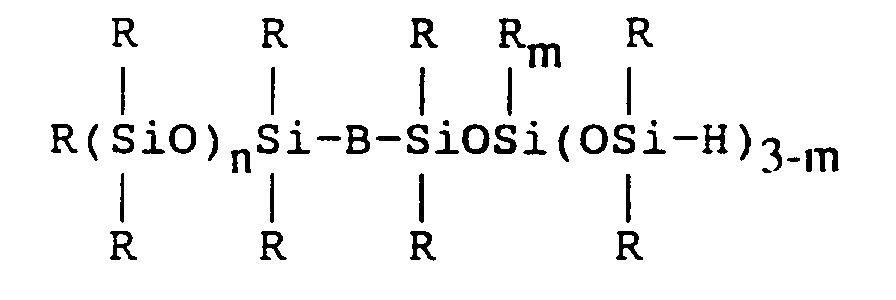
- the hydroxyphenyl-functional polyorganosiloxanes of this invention can be prepared, for example, by an addition reaction in the presence of hydrosilylation catalyst, for example, a platinum catalyst, between a polyorganosiloxane having at least 2 silicon-bonded hydrogen atoms at the one molecular chain terminal which are exemplified by compounds having the formula wherein R, B, m, and n are as defined hereinabove, and an aliphatically unsaturated hydrocarbon compound whose molecule contains a phenol group whose hydroxyl group is protected, for example, by a triorganosilyl group, and by subsequently removing the triorganosilyl group by adding an alcohol exemplified by methanol, and heating the mixture in the presence of an acid catalyst.
- the preparation of the compounds of this invention can also employ an aliphatically unsaturated hydrocarbon compound which contains a phenol group whose hydroxyl group is not protected, for example by a triorganosilyl group.
- Polyorganosiloxanes having at least 2 silicon-bonded hydrogen atoms at the one molecular chain terminal can be prepared, for example, by a condensation reaction between an organosilane having the formula wherein R and n are defined as above and X is a hydrogen or lithium atom, or a siloxane having the formula wherein R, B, and m are defined as above and Y is a halogen atom, such as is taught in Japanese Patent Application Laid-Open No. 4-353523 (353,523/1992).
- the polyorganosiloxanes of this invention have two or more hydroxyphenyl groups at one but only one molecular chain terminal, its copolymerization with monomer precursors for organic polymers will give organic polymers in which the polyorganosiloxane chain is bonded in graft form.
- the polyorganosiloxanes of this invention are therefore useful as surfactants or as additives for organic polymers exemplified by polycarbonates, polysulfones, polyacrylates, or epoxy resins.
- a mixture of 240 ml of isopropyl alcohol, 120 ml of concentrated hydrochloric acid, and 240 ml of water was cooled on an ice water bath to reach a liquid temperature not exceeding 10°C. This was followed by the introduction of 120.6 grams (g) of 1,1,3,3-tetramethyldisiloxane and then the dropwise addition of 54.5 (g) of methyltrimethoxysilane. After the completion of this addition, the ice water bath was removed and the reaction was stirred for 1 hour. The aqueous layer was then removed and the organic layer was neutralized by the addition of sodium bicarbonate and repeatedly washed with water until the aqueous layer was neutral, and then dried over sodium sulfate.
- methyltris(dimethylsiloxy)silane 120 (g) of the methyltris(dimethylsiloxy)silane was placed in a four-neck flask equipped with a stirrer and a sufficient amount of platinum-tetramethyldivinyldisiloxane complex was introduced to give 20 ppm platinum metal based on the total weight of the reaction mixture (methyltris(dimethylsiloxy)silane plus dimethylvinylchlorosilane).
- the resulting mixture was heated to 80°C, and then 21.5 (g) of dimethylvinylchlorosilane was added dropwise and the reaction mixture was stirred at 90°C to 100°C for 1 hour after the completion of this addition.
- polymer 1 a polyorganosiloxane, designated hereinafter as polymer 1, having the average formula having an SiH group weight% of 0.093%, having a number-average molecular weight (Mn) of 2,288, and a dispersity of 1.13.
- the hexamethylcyclotrisiloxane conversion was 98.6% after six hours, at which point 0.22 (g) triethylamine and then 4.63 (g) of polymer T as described above were added in order to terminate the polymerization reaction. Filtration of the salt by-product and distillation of the solvent and low boilers by heating under reduced pressure then gave a colorless and transparent reaction product. Analysis of this reaction product by NMR, IR, and GPC and iodometric determination of the weight percent of SiH confirmed it to be a polyorganosiloxane, designated hereinafter as polymer 2, having the formula having 0.034 weight% SiH groups, a number-average molecular weight (Mn) of 7,218, and a dispersity of 1.08.
Landscapes
- Chemical & Material Sciences (AREA)
- Health & Medical Sciences (AREA)
- Chemical Kinetics & Catalysis (AREA)
- Medicinal Chemistry (AREA)
- Polymers & Plastics (AREA)
- Organic Chemistry (AREA)
- Silicon Polymers (AREA)
Abstract
Description
- This invention relates to novel hydroxyphenyl-functional polyorganosiloxanes. More particularly, this invention relates to novel hydroxyphenyl-functional polyorganosiloxanes that have at least two hydroxyphenyl groups at one molecular chain terminal.
- Organofunctional polyorganosiloxanes have a variety of uses, namely as surfactants, fiber-treatment agents, and as additives for organic polymers. The chemical structures of organofunctional polyorganosiloxanes can be differentiated based on the type, number, and bonding position of the organofunctionality, and the nature of the particular application determines the selection of the suitable chemical structure. For example, with regard to an application as an additive for organic polymers and specifically in the case where the organofunctional polyorganosiloxane is used as a precursor to a copolymer in which the polyorganosiloxane is inserted into the organic polymer molecule, one must select an organofunctional group that is copolymerizable with the organic polymer and must very carefully control the group's frequency of occurrence and bonding position. Organofunctional polyorganosiloxanes, for example, can have organofunctionality at both molecular chain terminals or can have one organofunctional group at one and only one molecular chain terminal. Polyorganosiloxanes having organofunctionality at both molecular chain terminals are used as additives for organic polymers prepared mainly by polycondensation, for example, polyesters, polyamides, polycarbonates, and polysulfones. However, the copolymerization of this type of polyorganosiloxane with the monomer precursor for the organic polymer cannot give a copolymer in which the polyorganosiloxane chain branches from the molecular chain of the organic polymer, that is, a so-called graft copolymer. Also, the use of polyorganosiloxanes having one organofunctional group at one and only one molecular chain terminal, do not yield a satisfactory improvement in the properties of the organic polymer product.
- In order to solve this problem, Japanese Patent Application Laid-Open No. 4-323222 (323,222/1992) discloses polyorganosiloxanes having at least two organofunctional groups at one and only one molecular chain terminal. However, the polyorganosiloxane described cannot be used as an additive for organic polymers such as polycarbonates and polysulfones because its organofunctional group is limited to an amino, carboxyl, hydroxyl, or epoxy group.
- This invention relates to a novel hydroxyphenyl-functional polyorganosiloxanes having at least two hydroxyphenyl groups at one molecular chain terminal.
- It is an object of the present invention to provide novel polyorganosiloxanes having at least two hydroxyphenyl groups at one molecular chain terminal.
- The present invention relates to a hydroxyphenyl-functional polyorganosiloxane having the formula

- In the formula above, each R is independently selected from monovalent hydrocarbon groups which are free of aliphatic unsaturation. Specific examples of R are alkyl groups exemplified by methyl, ethyl, propyl, butyl, pentyl, or hexyl, aryl groups exemplified by phenyl, tolyl, or xylyl, and aralkyl groups exemplified by benzyl or phenethyl. The group A is a substituted or unsubstituted hydroxyphenyl group. The group A preferably is a group having the formula:

- Hydroxyphenyl-functional polyorganosiloxanes according to this invention are exemplified by:

- The hydroxyphenyl-functional polyorganosiloxanes of this invention can be prepared, for example, by an addition reaction in the presence of hydrosilylation catalyst, for example, a platinum catalyst, between a polyorganosiloxane having at least 2 silicon-bonded hydrogen atoms at the one molecular chain terminal which are exemplified by compounds having the formula
- Polyorganosiloxanes having at least 2 silicon-bonded hydrogen atoms at the one molecular chain terminal can be prepared, for example, by a condensation reaction between an organosilane having the formula


- Since the polyorganosiloxanes of this invention have two or more hydroxyphenyl groups at one but only one molecular chain terminal, its copolymerization with monomer precursors for organic polymers will give organic polymers in which the polyorganosiloxane chain is bonded in graft form. The polyorganosiloxanes of this invention are therefore useful as surfactants or as additives for organic polymers exemplified by polycarbonates, polysulfones, polyacrylates, or epoxy resins.
- A mixture of 240 ml of isopropyl alcohol, 120 ml of concentrated hydrochloric acid, and 240 ml of water was cooled on an ice water bath to reach a liquid temperature not exceeding 10°C. This was followed by the introduction of 120.6 grams (g) of 1,1,3,3-tetramethyldisiloxane and then the dropwise addition of 54.5 (g) of methyltrimethoxysilane. After the completion of this addition, the ice water bath was removed and the reaction was stirred for 1 hour. The aqueous layer was then removed and the organic layer was neutralized by the addition of sodium bicarbonate and repeatedly washed with water until the aqueous layer was neutral, and then dried over sodium sulfate. Subsequent distillation under reduced pressure gave 45.5 (g) of a fraction at 97-98°C/83 mmHg. This fraction was confirmed to be methyltris(dimethylsiloxy)silane by 1H-nuclear magnetic resonance analysis (NMR) and infrared spectrochemical analysis (IR).
- Next, 120 (g) of the methyltris(dimethylsiloxy)silane was placed in a four-neck flask equipped with a stirrer and a sufficient amount of platinum-tetramethyldivinyldisiloxane complex was introduced to give 20 ppm platinum metal based on the total weight of the reaction mixture (methyltris(dimethylsiloxy)silane plus dimethylvinylchlorosilane). Next, the resulting mixture was heated to 80°C, and then 21.5 (g) of dimethylvinylchlorosilane was added dropwise and the reaction mixture was stirred at 90°C to 100°C for 1 hour after the completion of this addition. Analysis of the reaction mixture at this point by gas chromatography (GLC) demonstrated that the peak for the starting dimethylvinylchlorosilane had disappeared, which confirmed completion of the reaction. Distillation under reduced pressure then gave 47.6 (g) of a fraction at 89-91°C/1 mmHg. Analysis of this fraction by NMR and IR confirmed it to be a silicone compound, designated hereinafter as polymer T, having the average formula

- Next, 60 (g) of hexamethylcyclotrisiloxane and 60 (g) of tetrahydrofuran were introduced into a four-neck flask equipped with a stirrer and were cooled with ice water to a liquid temperature not exceeding 20°C. While stirring under a dry nitrogen blanket 32.43 mmol n-butyllithium in n-hexane solution was introduced and stirring was then continued at room temperature. The development of the polymerization reaction during stirring was monitored by GLC analysis of the reaction mixture. The hexamethylcyclotrisiloxane conversion was 98.4% after six hours, at which point 0.66 (g) of triethylamine and then 13.89 (g) of polymer T were added in order to terminate the polymerization reaction. Filtration of the salt by-product and distillation of the solvent and low boilers by heating under reduced pressure then gave a colorless and transparent reaction product. Analysis of this reaction product by NMR, IR, and GPC and iodometric determination of the SiH group weight% confirmed it to be a polyorganosiloxane, designated hereinafter as polymer 1, having the average formula

- Next, 60 (g) of hexamethylcyclotrisiloxane and 60 (g) tetrahydrofuran were introduced into a four-neck flask equipped with a stirrer and were cooled with ice water to a liquid temperature not exceeding 20°C. While stirring under a dry nitrogen blanket 10.81 mmol of n-butyllithium in n-hexane solution was introduced and stirring was then continued at room temperature. The development of the polymerization reaction during stirring was monitored by GLC analysis of the reaction mixture. The hexamethylcyclotrisiloxane conversion was 98.6% after six hours, at which point 0.22 (g) triethylamine and then 4.63 (g) of polymer T as described above were added in order to terminate the polymerization reaction. Filtration of the salt by-product and distillation of the solvent and low boilers by heating under reduced pressure then gave a colorless and transparent reaction product. Analysis of this reaction product by NMR, IR, and GPC and iodometric determination of the weight percent of SiH confirmed it to be a polyorganosiloxane, designated hereinafter as polymer 2, having the formula

- Next, the following were heated together for 2 hours at 100°C: 30 (g) of polymer 1 (having 27.9 milliequivalents of SiH) as described above, 8.64 (g) of trimethylsilyl-o-allylphenol, and a sufficient amount of platinum-tetramethyldivinyldisiloxane complex to give 10 ppm platinum metal. IR analysis of the resulting reaction mixture then confirmed that the characteristic absorption of the SiH group had disappeared. Distillation of the low boilers from the reaction mixture by heating under reduced pressure then yielded a transparent fluid. Analysis of this fluid by NMR and IR confirmed it to be polyorganosiloxane having the formula

- Next, 30 g of this polyorganosiloxane and 7.97 g methanol were mixed and then stirred at 50°C for 3 hours. Subsequent distillation of the low boilers by heating under reduced pressure yielded a transparent fluid. Analysis by NMR and IR and titrimetric determination of the weight% of phenolic hydroxyl groups confirmed this fluid product to be a polyorganosiloxane having the formula

- The following were heated together for 2 hours at 100°C, 50 (g) of polymer 2 (having 10.2 milliequivalents of SiH) as described above, 3.16 g of trimethylsilyl-o-allylphenol, and a sufficient amount of platinum-tetramethyldivinyldisiloxane complex to give 10 ppm platinum metal. IR analysis of the resulting reaction mixture then confirmed that the characteristic absorption of the SiH group had disappeared. Distillation of the low boilers from the reaction mixture by heating under reduced pressure then yielded a transparent fluid. Analysis of this fluid by NMR and IR confirmed it to be a polyorganosiloxane having the formula

- Next, about 30 g of this polyorganosiloxane and 7.97 g of methanol were mixed and then stirred at 50°C for 3 hours. Subsequent distillation of the low boilers by heating under reduced pressure yielded a transparent fluid. Analysis by NMR and IR and titrimetric determination of the weight% of phenolic hydroxyl groups confirmed this fluid product to be polyorganosiloxane having the formula

Claims (14)
- A hydroxyphenyl-functional polyorganosiloxane compound having the formula

- A compound according to Claim 1, wherein R is independently selected from the group consisting of alkyl groups, aryl groups, and aralkyl groups.
- A compound according to Claim 2, wherein the alkyl group is selected from the group consisting of methyl, ethyl, propyl, butyl, pentyl, and hexyl.
- A compound according to Claim 2, wherein the aryl group is selected from the group consisting of phenyl, tolyl, and xylyl.
- A compound according to Claim 2, wherein the aralkyl group is selected from the group consisting of benzyl and phenethyl.
- A compound according to Claim 1, wherein A is a group having the formula:

- A compound according to Claim 1, wherein A is selected from the group consisting of 2-hydroxyphenyl, 3-hydroxyphenyl, 4-hydroxyphenyl, 4-hydroxy-3-methoxyphenyl, 4-hydroxy-2-methoxyphenyl, 3-hydroxy-4-methoxyphenyl, 3-hydroxy-2-methoxyphenyl, 2-hydroxy-4-methoxyphenyl, and 2-hydroxy-3-methoxyphenyl.
- A compound according to Claim 1, wherein B is an alkylene group.
- A compound according to Claim 8, wherein the alkylene group is selected from the group consisting of ethylene, propylene, butylene, pentylene, and hexylene.
- A compound according to Claim 1, wherein B is an alkyleneoxyalkylene group.
- A compound according to Claim 10, wherein the alkyleneoxyalkylene group is selected from the group consisting of ethyleneoxypropylene and ethyleneoxybutylene.
- A compound according to Claim 1, wherein m has a value of 1.
- A compound according to Claim 1, where n is an integer of 1 to 200.
- A compound according to Claim 1, wherein the hydroxyphenyl-functional polyorganosiloxane is selected from the group consisting of

Applications Claiming Priority (4)
| Application Number | Priority Date | Filing Date | Title |
|---|---|---|---|
| JP33400595 | 1995-11-29 | ||
| JP334005/95 | 1995-11-29 | ||
| JP18398696A JP3756576B2 (en) | 1995-11-29 | 1996-06-25 | Hydroxyphenyl group-containing polyorganosiloxane |
| JP183986/96 | 1996-06-25 |
Publications (2)
| Publication Number | Publication Date |
|---|---|
| EP0778305A1 true EP0778305A1 (en) | 1997-06-11 |
| EP0778305B1 EP0778305B1 (en) | 1999-04-07 |
Family
ID=26502211
Family Applications (1)
| Application Number | Title | Priority Date | Filing Date |
|---|---|---|---|
| EP96119094A Expired - Lifetime EP0778305B1 (en) | 1995-11-29 | 1996-11-28 | Hydroxyphenyl-containing polyorganosiloxanes |
Country Status (6)
| Country | Link |
|---|---|
| US (1) | US5726271A (en) |
| EP (1) | EP0778305B1 (en) |
| JP (1) | JP3756576B2 (en) |
| CA (1) | CA2191292A1 (en) |
| DE (1) | DE69601997T2 (en) |
| MX (1) | MX9605939A (en) |
Cited By (1)
| Publication number | Priority date | Publication date | Assignee | Title |
|---|---|---|---|---|
| WO2016044696A1 (en) * | 2014-09-18 | 2016-03-24 | Momentive Performance Materials Inc. | αω-FUNCTIONALIZED POLYOXYALKYLENE-SILOXANE POLYMERS AND COPOLYMERS MADE THEREFROM |
Families Citing this family (10)
| Publication number | Priority date | Publication date | Assignee | Title |
|---|---|---|---|---|
| US6136521A (en) * | 1997-02-20 | 2000-10-24 | Idemitsu Kosan Co., Ltd. | Polycarbonate, and molding and electrophotographic photoreceptor prepared therefrom |
| US6015869A (en) * | 1998-03-17 | 2000-01-18 | Battelle Memorial Institute | Strongly hydrogen-bond acidic polymer and methods of making and using |
| US6252029B1 (en) * | 1998-09-30 | 2001-06-26 | Dow Corning Toray Silicone Co. Ltd. | Hydroxyphenyl group-containing organosilicon compound, and method for manufacturing same |
| JP4408982B2 (en) * | 1999-03-31 | 2010-02-03 | 東レ・ダウコーニング株式会社 | Phenol group-containing organosilicon compound and method for producing the same |
| US8084765B2 (en) * | 2007-05-07 | 2011-12-27 | Xerox Corporation | Electronic device having a dielectric layer |
| KR101332434B1 (en) * | 2010-08-26 | 2013-11-22 | 제일모직주식회사 | Bishydroxyarylsilxoane and preparation method thereof |
| CN103827217A (en) | 2012-02-03 | 2014-05-28 | Lg化学株式会社 | Novel polyorganosiloxane, polycarbonate resin composition comprising same, and modified polycarbonate resin |
| JP6150945B2 (en) | 2013-07-01 | 2017-06-21 | エルジー・ケム・リミテッド | Polyorganosiloxane compound, production method and copolycarbonate resin containing the same |
| KR101579618B1 (en) * | 2013-09-17 | 2015-12-22 | 주식회사 엘지화학 | Copolycarbonate resin and article containing the same |
| EP3164447B1 (en) | 2014-07-03 | 2019-10-09 | Momentive Performance Materials Inc. | Ester-functional polysiloxanes and copolymers made therefrom |
Citations (6)
| Publication number | Priority date | Publication date | Assignee | Title |
|---|---|---|---|---|
| EP0385732A1 (en) * | 1989-02-27 | 1990-09-05 | Shin-Etsu Chemical Co., Ltd. | Hydroxyphenyl-containing group siloxane compounds |
| EP0412550A2 (en) * | 1989-08-10 | 1991-02-13 | Dow Corning Toray Silicone Company, Limited | Organopolysiloxane and method for its preparation |
| EP0433746A2 (en) * | 1989-12-22 | 1991-06-26 | General Electric Company | Thermoplastic flame retardant silicone polyphenylene ether graft copolymers |
| EP0516143A1 (en) * | 1991-05-31 | 1992-12-02 | Dow Corning Toray Silicone Company, Limited | Method for the preparation of organopolysiloxane |
| EP0540273A1 (en) * | 1991-10-30 | 1993-05-05 | General Electric Company | Thermoplastic silicone-polyphenylene ether block copolymers |
| US5262506A (en) * | 1991-04-23 | 1993-11-16 | Dow Corning Toray Silicone Co., Ltd. | Organopolysiloxane and method for its preparation |
Family Cites Families (3)
| Publication number | Priority date | Publication date | Assignee | Title |
|---|---|---|---|---|
| DE2102811A1 (en) * | 1971-02-04 | 1972-08-03 | Mironow, Wladimir Florowitsch; Fedotow, Nikolaj Semjonowitsch; Koslikow, Wadim Lwowitsch; Moskau | 1,3-bis (hydroxyaryl) tetraorganodisiloxanes and processes for their preparation |
| US3879433A (en) * | 1972-12-29 | 1975-04-22 | Union Carbide Corp | Hydroxyalkylsiloxane rigid urethane foam stabilizers |
| US5204438A (en) * | 1989-12-22 | 1993-04-20 | General Electric Company | Silicone macromers and thermoplastic flame retardant silicone-polyphenylene ether graft copolymers obtained therefrom |
-
1996
- 1996-06-25 JP JP18398696A patent/JP3756576B2/en not_active Expired - Fee Related
- 1996-11-25 US US08/755,921 patent/US5726271A/en not_active Expired - Fee Related
- 1996-11-26 CA CA002191292A patent/CA2191292A1/en not_active Abandoned
- 1996-11-28 DE DE69601997T patent/DE69601997T2/en not_active Expired - Fee Related
- 1996-11-28 MX MX9605939A patent/MX9605939A/en unknown
- 1996-11-28 EP EP96119094A patent/EP0778305B1/en not_active Expired - Lifetime
Patent Citations (6)
| Publication number | Priority date | Publication date | Assignee | Title |
|---|---|---|---|---|
| EP0385732A1 (en) * | 1989-02-27 | 1990-09-05 | Shin-Etsu Chemical Co., Ltd. | Hydroxyphenyl-containing group siloxane compounds |
| EP0412550A2 (en) * | 1989-08-10 | 1991-02-13 | Dow Corning Toray Silicone Company, Limited | Organopolysiloxane and method for its preparation |
| EP0433746A2 (en) * | 1989-12-22 | 1991-06-26 | General Electric Company | Thermoplastic flame retardant silicone polyphenylene ether graft copolymers |
| US5262506A (en) * | 1991-04-23 | 1993-11-16 | Dow Corning Toray Silicone Co., Ltd. | Organopolysiloxane and method for its preparation |
| EP0516143A1 (en) * | 1991-05-31 | 1992-12-02 | Dow Corning Toray Silicone Company, Limited | Method for the preparation of organopolysiloxane |
| EP0540273A1 (en) * | 1991-10-30 | 1993-05-05 | General Electric Company | Thermoplastic silicone-polyphenylene ether block copolymers |
Cited By (2)
| Publication number | Priority date | Publication date | Assignee | Title |
|---|---|---|---|---|
| WO2016044696A1 (en) * | 2014-09-18 | 2016-03-24 | Momentive Performance Materials Inc. | αω-FUNCTIONALIZED POLYOXYALKYLENE-SILOXANE POLYMERS AND COPOLYMERS MADE THEREFROM |
| US9428617B2 (en) | 2014-09-18 | 2016-08-30 | Momentive Performance Material Inc. | α,ω-functionalized polyoxyalkylene-siloxane polymers and copolymers made therefrom |
Also Published As
| Publication number | Publication date |
|---|---|
| MX9605939A (en) | 1998-04-30 |
| US5726271A (en) | 1998-03-10 |
| DE69601997D1 (en) | 1999-05-12 |
| JPH09208703A (en) | 1997-08-12 |
| DE69601997T2 (en) | 1999-09-16 |
| CA2191292A1 (en) | 1997-05-30 |
| EP0778305B1 (en) | 1999-04-07 |
| JP3756576B2 (en) | 2006-03-15 |
Similar Documents
| Publication | Publication Date | Title |
|---|---|---|
| US11359056B2 (en) | Linear polydimethylsiloxane-polyoxyalkylene block copolymers of the structure type ABA | |
| US6133394A (en) | Method for the preparation of organofunctional organopentasiloxane, organic resin modifier and organic resins | |
| US5965683A (en) | Process for preparing hydrogen siloxane copolymers | |
| KR20150010725A (en) | Process for producing functional siloxanes of controlled structure | |
| US5726271A (en) | Hydroxyphenyl-containing polyorganosiloxanes | |
| EP0465262A2 (en) | Polysilethylenesiloxane | |
| EP0431409B1 (en) | A nonaqueous method for making silicone polymers | |
| US6214961B1 (en) | Method of producing branched silicone oil | |
| MXPA96005939A (en) | Polygeranosiloxanes containing hidroxifen | |
| US5262506A (en) | Organopolysiloxane and method for its preparation | |
| US5169909A (en) | Method for the preparation of organopolysiloxane | |
| EP0516143B1 (en) | Method for the preparation of organopolysiloxane | |
| KR100249446B1 (en) | Method for producing linear organopolysiloxane having a hydroxyl group at the molecular chain end | |
| JP3661810B2 (en) | Method for producing hydroxyl group-containing siloxane compound | |
| JP3848260B2 (en) | Method for producing hydroxyalkylpolysiloxane | |
| EP0412550B1 (en) | Organopolysiloxane and method for its preparation | |
| EP0577047A1 (en) | Fluorosilicone polymers and methods for preparation | |
| JP3779187B2 (en) | Method for producing hydroxylcarbyl group-containing polyorganosiloxane | |
| JP2544033B2 (en) | Method for producing carboxy functional silicone | |
| EP0693521A1 (en) | Method for the preparation of diphenylsiloxane-dimethylsiloxane copolymers | |
| EP0693520B1 (en) | Method for the preparation of organopolysiloxanes | |
| JPH09165453A (en) | Production of hydroxylated siloxane compound | |
| JPH10324749A (en) | Epoxy group-bearing organopolysilsesquioxane and its production | |
| JP2587226B2 (en) | Hydroxyl-containing polysiloxane compound | |
| JPH11152337A (en) | Production of hydroxyl-containing siloxane compound |
Legal Events
| Date | Code | Title | Description |
|---|---|---|---|
| PUAI | Public reference made under article 153(3) epc to a published international application that has entered the european phase |
Free format text: ORIGINAL CODE: 0009012 |
|
| AK | Designated contracting states |
Kind code of ref document: A1 Designated state(s): DE FR GB |
|
| 17P | Request for examination filed |
Effective date: 19970814 |
|
| 17Q | First examination report despatched |
Effective date: 19971021 |
|
| GRAG | Despatch of communication of intention to grant |
Free format text: ORIGINAL CODE: EPIDOS AGRA |
|
| GRAG | Despatch of communication of intention to grant |
Free format text: ORIGINAL CODE: EPIDOS AGRA |
|
| GRAG | Despatch of communication of intention to grant |
Free format text: ORIGINAL CODE: EPIDOS AGRA |
|
| GRAH | Despatch of communication of intention to grant a patent |
Free format text: ORIGINAL CODE: EPIDOS IGRA |
|
| GRAH | Despatch of communication of intention to grant a patent |
Free format text: ORIGINAL CODE: EPIDOS IGRA |
|
| GRAA | (expected) grant |
Free format text: ORIGINAL CODE: 0009210 |
|
| AK | Designated contracting states |
Kind code of ref document: B1 Designated state(s): DE FR GB |
|
| REF | Corresponds to: |
Ref document number: 69601997 Country of ref document: DE Date of ref document: 19990512 |
|
| ET | Fr: translation filed | ||
| PLBE | No opposition filed within time limit |
Free format text: ORIGINAL CODE: 0009261 |
|
| STAA | Information on the status of an ep patent application or granted ep patent |
Free format text: STATUS: NO OPPOSITION FILED WITHIN TIME LIMIT |
|
| 26N | No opposition filed | ||
| REG | Reference to a national code |
Ref country code: GB Ref legal event code: IF02 |
|
| PGFP | Annual fee paid to national office [announced via postgrant information from national office to epo] |
Ref country code: GB Payment date: 20031006 Year of fee payment: 8 |
|
| PGFP | Annual fee paid to national office [announced via postgrant information from national office to epo] |
Ref country code: DE Payment date: 20031007 Year of fee payment: 8 |
|
| PGFP | Annual fee paid to national office [announced via postgrant information from national office to epo] |
Ref country code: FR Payment date: 20041109 Year of fee payment: 9 |
|
| PG25 | Lapsed in a contracting state [announced via postgrant information from national office to epo] |
Ref country code: GB Free format text: LAPSE BECAUSE OF NON-PAYMENT OF DUE FEES Effective date: 20041128 |
|
| PG25 | Lapsed in a contracting state [announced via postgrant information from national office to epo] |
Ref country code: DE Free format text: LAPSE BECAUSE OF NON-PAYMENT OF DUE FEES Effective date: 20050601 |
|
| GBPC | Gb: european patent ceased through non-payment of renewal fee |
Effective date: 20041128 |
|
| PG25 | Lapsed in a contracting state [announced via postgrant information from national office to epo] |
Ref country code: FR Free format text: LAPSE BECAUSE OF NON-PAYMENT OF DUE FEES Effective date: 20060731 |
|
| REG | Reference to a national code |
Ref country code: FR Ref legal event code: ST Effective date: 20060731 |