EP3192527A1 - Cancer-cell-specific antibody, anticancer agent, and cancer testing method - Google Patents
Cancer-cell-specific antibody, anticancer agent, and cancer testing method Download PDFInfo
- Publication number
- EP3192527A1 EP3192527A1 EP15840271.9A EP15840271A EP3192527A1 EP 3192527 A1 EP3192527 A1 EP 3192527A1 EP 15840271 A EP15840271 A EP 15840271A EP 3192527 A1 EP3192527 A1 EP 3192527A1
- Authority
- EP
- European Patent Office
- Prior art keywords
- amino acid
- seq
- acid sequence
- heavy chain
- light chain
- Prior art date
- Legal status (The legal status is an assumption and is not a legal conclusion. Google has not performed a legal analysis and makes no representation as to the accuracy of the status listed.)
- Pending
Links
Images


Classifications
-
- A—HUMAN NECESSITIES
- A61—MEDICAL OR VETERINARY SCIENCE; HYGIENE
- A61K—PREPARATIONS FOR MEDICAL, DENTAL OR TOILETRY PURPOSES
- A61K39/00—Medicinal preparations containing antigens or antibodies
- A61K39/395—Antibodies; Immunoglobulins; Immune serum, e.g. antilymphocytic serum
- A61K39/39533—Antibodies; Immunoglobulins; Immune serum, e.g. antilymphocytic serum against materials from animals
- A61K39/39558—Antibodies; Immunoglobulins; Immune serum, e.g. antilymphocytic serum against materials from animals against tumor tissues, cells, antigens
-
- A—HUMAN NECESSITIES
- A61—MEDICAL OR VETERINARY SCIENCE; HYGIENE
- A61K—PREPARATIONS FOR MEDICAL, DENTAL OR TOILETRY PURPOSES
- A61K39/00—Medicinal preparations containing antigens or antibodies
- A61K39/395—Antibodies; Immunoglobulins; Immune serum, e.g. antilymphocytic serum
-
- A—HUMAN NECESSITIES
- A61—MEDICAL OR VETERINARY SCIENCE; HYGIENE
- A61K—PREPARATIONS FOR MEDICAL, DENTAL OR TOILETRY PURPOSES
- A61K39/00—Medicinal preparations containing antigens or antibodies
- A61K39/0005—Vertebrate antigens
- A61K39/0011—Cancer antigens
-
- A—HUMAN NECESSITIES
- A61—MEDICAL OR VETERINARY SCIENCE; HYGIENE
- A61K—PREPARATIONS FOR MEDICAL, DENTAL OR TOILETRY PURPOSES
- A61K45/00—Medicinal preparations containing active ingredients not provided for in groups A61K31/00 - A61K41/00
-
- A—HUMAN NECESSITIES
- A61—MEDICAL OR VETERINARY SCIENCE; HYGIENE
- A61K—PREPARATIONS FOR MEDICAL, DENTAL OR TOILETRY PURPOSES
- A61K47/00—Medicinal preparations characterised by the non-active ingredients used, e.g. carriers or inert additives; Targeting or modifying agents chemically bound to the active ingredient
- A61K47/50—Medicinal preparations characterised by the non-active ingredients used, e.g. carriers or inert additives; Targeting or modifying agents chemically bound to the active ingredient the non-active ingredient being chemically bound to the active ingredient, e.g. polymer-drug conjugates
-
- A—HUMAN NECESSITIES
- A61—MEDICAL OR VETERINARY SCIENCE; HYGIENE
- A61P—SPECIFIC THERAPEUTIC ACTIVITY OF CHEMICAL COMPOUNDS OR MEDICINAL PREPARATIONS
- A61P35/00—Antineoplastic agents
-
- A—HUMAN NECESSITIES
- A61—MEDICAL OR VETERINARY SCIENCE; HYGIENE
- A61P—SPECIFIC THERAPEUTIC ACTIVITY OF CHEMICAL COMPOUNDS OR MEDICINAL PREPARATIONS
- A61P43/00—Drugs for specific purposes, not provided for in groups A61P1/00-A61P41/00
-
- C—CHEMISTRY; METALLURGY
- C07—ORGANIC CHEMISTRY
- C07K—PEPTIDES
- C07K16/00—Immunoglobulins [IG], e.g. monoclonal or polyclonal antibodies
- C07K16/18—Immunoglobulins [IG], e.g. monoclonal or polyclonal antibodies against material from animals or humans
-
- C—CHEMISTRY; METALLURGY
- C07—ORGANIC CHEMISTRY
- C07K—PEPTIDES
- C07K16/00—Immunoglobulins [IG], e.g. monoclonal or polyclonal antibodies
- C07K16/18—Immunoglobulins [IG], e.g. monoclonal or polyclonal antibodies against material from animals or humans
- C07K16/28—Immunoglobulins [IG], e.g. monoclonal or polyclonal antibodies against material from animals or humans against receptors, cell surface antigens or cell surface determinants
- C07K16/30—Immunoglobulins [IG], e.g. monoclonal or polyclonal antibodies against material from animals or humans against receptors, cell surface antigens or cell surface determinants from tumour cells
-
- C—CHEMISTRY; METALLURGY
- C07—ORGANIC CHEMISTRY
- C07K—PEPTIDES
- C07K16/00—Immunoglobulins [IG], e.g. monoclonal or polyclonal antibodies
- C07K16/18—Immunoglobulins [IG], e.g. monoclonal or polyclonal antibodies against material from animals or humans
- C07K16/28—Immunoglobulins [IG], e.g. monoclonal or polyclonal antibodies against material from animals or humans against receptors, cell surface antigens or cell surface determinants
- C07K16/30—Immunoglobulins [IG], e.g. monoclonal or polyclonal antibodies against material from animals or humans against receptors, cell surface antigens or cell surface determinants from tumour cells
- C07K16/3046—Stomach, Intestines
-
- C—CHEMISTRY; METALLURGY
- C12—BIOCHEMISTRY; BEER; SPIRITS; WINE; VINEGAR; MICROBIOLOGY; ENZYMOLOGY; MUTATION OR GENETIC ENGINEERING
- C12N—MICROORGANISMS OR ENZYMES; COMPOSITIONS THEREOF; PROPAGATING, PRESERVING, OR MAINTAINING MICROORGANISMS; MUTATION OR GENETIC ENGINEERING; CULTURE MEDIA
- C12N15/00—Mutation or genetic engineering; DNA or RNA concerning genetic engineering, vectors, e.g. plasmids, or their isolation, preparation or purification; Use of hosts therefor
- C12N15/09—Recombinant DNA-technology
-
- C—CHEMISTRY; METALLURGY
- C12—BIOCHEMISTRY; BEER; SPIRITS; WINE; VINEGAR; MICROBIOLOGY; ENZYMOLOGY; MUTATION OR GENETIC ENGINEERING
- C12N—MICROORGANISMS OR ENZYMES; COMPOSITIONS THEREOF; PROPAGATING, PRESERVING, OR MAINTAINING MICROORGANISMS; MUTATION OR GENETIC ENGINEERING; CULTURE MEDIA
- C12N15/00—Mutation or genetic engineering; DNA or RNA concerning genetic engineering, vectors, e.g. plasmids, or their isolation, preparation or purification; Use of hosts therefor
- C12N15/09—Recombinant DNA-technology
- C12N15/63—Introduction of foreign genetic material using vectors; Vectors; Use of hosts therefor; Regulation of expression
-
- G—PHYSICS
- G01—MEASURING; TESTING
- G01N—INVESTIGATING OR ANALYSING MATERIALS BY DETERMINING THEIR CHEMICAL OR PHYSICAL PROPERTIES
- G01N33/00—Investigating or analysing materials by specific methods not covered by groups G01N1/00 - G01N31/00
- G01N33/48—Biological material, e.g. blood, urine; Haemocytometers
- G01N33/50—Chemical analysis of biological material, e.g. blood, urine; Testing involving biospecific ligand binding methods; Immunological testing
- G01N33/53—Immunoassay; Biospecific binding assay; Materials therefor
- G01N33/575—Immunoassay; Biospecific binding assay; Materials therefor for cancer
-
- G—PHYSICS
- G01—MEASURING; TESTING
- G01N—INVESTIGATING OR ANALYSING MATERIALS BY DETERMINING THEIR CHEMICAL OR PHYSICAL PROPERTIES
- G01N33/00—Investigating or analysing materials by specific methods not covered by groups G01N1/00 - G01N31/00
- G01N33/48—Biological material, e.g. blood, urine; Haemocytometers
- G01N33/50—Chemical analysis of biological material, e.g. blood, urine; Testing involving biospecific ligand binding methods; Immunological testing
- G01N33/53—Immunoassay; Biospecific binding assay; Materials therefor
- G01N33/575—Immunoassay; Biospecific binding assay; Materials therefor for cancer
- G01N33/57535—Immunoassay; Biospecific binding assay; Materials therefor for cancer of the large intestine, e.g. colon, rectum or anus
-
- A—HUMAN NECESSITIES
- A61—MEDICAL OR VETERINARY SCIENCE; HYGIENE
- A61K—PREPARATIONS FOR MEDICAL, DENTAL OR TOILETRY PURPOSES
- A61K39/00—Medicinal preparations containing antigens or antibodies
- A61K2039/505—Medicinal preparations containing antigens or antibodies comprising antibodies
-
- C—CHEMISTRY; METALLURGY
- C07—ORGANIC CHEMISTRY
- C07K—PEPTIDES
- C07K2317/00—Immunoglobulins specific features
- C07K2317/20—Immunoglobulins specific features characterized by taxonomic origin
- C07K2317/24—Immunoglobulins specific features characterized by taxonomic origin containing regions, domains or residues from different species, e.g. chimeric, humanized or veneered
-
- C—CHEMISTRY; METALLURGY
- C07—ORGANIC CHEMISTRY
- C07K—PEPTIDES
- C07K2317/00—Immunoglobulins specific features
- C07K2317/50—Immunoglobulins specific features characterized by immunoglobulin fragments
- C07K2317/51—Complete heavy chain or Fd fragment, i.e. VH + CH1
-
- C—CHEMISTRY; METALLURGY
- C07—ORGANIC CHEMISTRY
- C07K—PEPTIDES
- C07K2317/00—Immunoglobulins specific features
- C07K2317/50—Immunoglobulins specific features characterized by immunoglobulin fragments
- C07K2317/515—Complete light chain, i.e. VL + CL
-
- C—CHEMISTRY; METALLURGY
- C07—ORGANIC CHEMISTRY
- C07K—PEPTIDES
- C07K2317/00—Immunoglobulins specific features
- C07K2317/50—Immunoglobulins specific features characterized by immunoglobulin fragments
- C07K2317/56—Immunoglobulins specific features characterized by immunoglobulin fragments variable (Fv) region, i.e. VH and/or VL
- C07K2317/565—Complementarity determining region [CDR]
-
- C—CHEMISTRY; METALLURGY
- C07—ORGANIC CHEMISTRY
- C07K—PEPTIDES
- C07K2317/00—Immunoglobulins specific features
- C07K2317/70—Immunoglobulins specific features characterized by effect upon binding to a cell or to an antigen
- C07K2317/73—Inducing cell death, e.g. apoptosis, necrosis or inhibition of cell proliferation
Definitions
- the present invention relates to a novel anti-TMEM-180 antibody, an anticancer drug containing an anti-TMEM-180 antibody, a cancer testing method involving measuring TMEM-180 in a sample, and the like.
- Colon cancer is manifest from cells of the intestinal mucosa.
- Cetuximab has previously been developed for use against colon cancer as an antibody drug that targets epidermal growth factor receptor (EGFR) (Non-Patent Documents 1 to 3).
- EGFR epidermal growth factor receptor
- Cetuximab also has the potential to act on normal tissue, thereby resulting in the desire to develop a molecular targeted drug that targets molecules more specifically expressed during colon cancer.
- EGFR epidermal growth factor receptor
- An object of the present invention is to provide an anticancer drug capable of treating cancer by finding a target molecule specifically expressed in cancer cells and by specifically acting on the target molecule, and to provide a cancer testing method comprising a step of measuring the target molecule in a sample.
- transmembrane protein 180 (TMEM-180) was identified as a protein that is expressed in all colon cancer cell lines but which is not observed to be expressed in the cells of healthy subjects.
- TMEM-180 was also confirmed to not be expressed in prominent normal tissues, thereby confirming TMEM-180 to be an ideal molecule for use as a target of anticancer drugs and as an indicator in cancer testing.
- Antibody to TMEM-180 was produced, and this antibody was confirmed to demonstrate a cytocidal effect on colon cancer cells as well as be able to detect recurrence in particular with greater sensitivity than conventional colon cancer markers, thereby leading to completion of the present invention.
- the anticancer drug containing an anti-TMEM-180 antibody or an antigen-binding fragment thereof according to the present invention targets TMEM-180, which is a protein specifically expressed in certain cancers but is not expressed in normal tissue, and is thought to allow the obtaining of a potent effect specific to cancer cells with few adverse side effects.
- TMEM-180 is specifically expressed in certain cancers but not expressed in normal tissue
- a cancer testing method and testing kit that uses the anti-TMEM-180 antibody or antigen-binding fragment thereof according to the present invention enables cancer testing to be carried out easily.
- the cancer testing method and testing kit according to the present invention are able to detect recurrence of cancer in particular with greater sensitivity in comparison with conventional colon cancer markers.
- an anticancer drug containing an anti-TMEM-180 antibody having a substance having anticancer activity bound thereto, or an antigen-binding fragment thereof according to the present invention, that anticancer drug can be specifically delivered to cancer cells expressing TMEM-180, thereby facilitating the use of a highly toxic substance for the substance having anticancer activity.
- One aspect of the anticancer drug according to the present invention contains an anti-TMEM-180 antibody, or an antigen-binding fragment thereof, as active ingredient.
- the anti-TMEM-180 antibody refers to an antibody that specifically binds to transmembrane protein 180 (TMEM-180).
- TMEM-180 in the case of referring to TMEM-180, the TMEM-180 may be TMEM-180 derived from any animal, and may be a mutant thereof provided it serves as a target of an anticancer drug or an indicator of a cancer testing method.
- the amino acid sequence of human TMEM-180 is indicated in SEQ ID NO: 17 as an example of TMEM-180.
- an “antibody” refers to a protein having a structure of the association of two heavy chains (H chains) and two light chains (L chains) that are stabilized by a pair of disulfide bonds.
- the heavy chains are formed from a heavy chain variable region VH, heavy chain constant regions CH1, CH2 and CH3, and a hinge region between CH1 and CH2, while the light chains are formed from a light chain variable region VL and a light chain constant region CL.
- a variable region fragment (Fv) formed of VH and VL is directly involved in antigen binding and is a region that provides the antibody with diversity.
- an antigen-binding region formed of VL, CL, VH and CH1 is referred to as the Fab region, while the region formed of the hinge region, CH2 and CH3 is referred to as the Fc region.
- variable regions the region that makes direct contact with antigen undergoes considerable change in particular, and is referred to as a complementarity-determining region (CDR).
- CDR complementarity-determining region
- FR framework region
- the anti-TMEM-180 antibody according to the present invention may be a monoclonal antibody or polyclonal antibody.
- the anti-TMEM-180 antibody of the present invention may be an isotype of any of IgG, IgM, IgA, IgD or IgE. It may also be that produced by immunizing a non-human animal such as a mouse, rat, hamster, guinea pig, rabbit or chicken, or may be a recombinant antibody, chimeric antibody, humanized antibody, fully human antibody or the like.
- a chimeric antibody refers to an antibody in which fragments of antibodies from different species are linked.
- a “humanized antibody” refers to an antibody in which a location corresponding to human antibody has been substituted with an amino acid sequence specific to an antibody from a non-human origin, and an example thereof is an antibody that has the heavy chain CDR1 to CDR3 and light chain CDR1 to CDR3 of an antibody produced by immunizing a mouse or rat, and in which all other regions, including each of the four framework regions (FR) of the heavy chain and light chain, are derived from human antibody. This type of antibody may also be referred to as a CDR-grafted antibody.
- the term "humanized antibody” may also include human chimeric antibody.
- an "antigen-binding fragment" of the anti-TMEM-180 antibody refers to a fragment of the anti-TMEM-180 antibody that binds to TMEM-180. More specifically, examples thereof include, but are not limited to, Fab formed of a VL, VH, CL and CH1 region, F(ab')2 obtained by linking two Fab in a hinge region with disulfide bonds, Fv formed of VL and VH, single-stranded antibody in the form of scFv, in which VL and VH are linked with an artificial polypeptide linker, as well as bispecific antibodies such as diabodies, scDb, tandem sdFv and leucine zippers.
- One aspect of the anti-TMEM-180 antibody according to the present invention has at least one of the six CDRs indicated below. These CDRs are the CDR sequences of anti-TMEM-180 antibody clone 98 indicated in the examples to be subsequently described.
- One aspect of the anti-TMEM-180 antibody according to the present invention has at least one of the six CDRs indicated below. These CDRs are the CDR sequences of anti-TMEM-180 antibody clone 101 indicated in the examples to be subsequently described.
- One aspect of the anti-TMEM-180 antibody according to the present invention has at least one of the six CDRs indicated below. These CDRs are the CDR sequences of anti-TMEM-180 antibody clone 212 indicated in the examples to be subsequently described.
- One aspect of the anti-TMEM-180 antibody according to the present invention has at least one of the six CDRs indicated below. These CDRs are the CDR sequences of anti-TMEM-180 antibody clone 129 indicated in the examples to be subsequently described.
- One aspect of the anti-TMEM-180 antibody according to the present invention has at least one of the six CDRs indicated below. These CDRs are the CDR sequences of anti-TMEM-180 antibody clone 382 indicated in the examples to be subsequently described.
- One aspect of the anti-TMEM-180 antibody according to the present invention has at least one of the six CDRs indicated below. These CDRs are the CDR sequences of anti-TMEM-180 antibody clone 1361 indicated in the examples to be subsequently described.
- One aspect of the anti-TMEM-180 antibody according to the present invention has at least one of the six CDRs indicated below. These CDRs are the CDR sequences of anti-TMEM-180 antibody clone 669 indicated in the examples to be subsequently described.
- One aspect of the anti-TMEM-180 antibody according to the present invention has at least one of the six CDRs indicated below. These CDRs are the CDR sequences of anti-TMEM-180 antibody clone 699 indicated in the examples to be subsequently described.
- One aspect of the anti-TMEM-180 antibody according to the present invention has at least one of the six CDRs indicated below. These CDRs are the CDR sequences of anti-TMEM-180 antibody clone 1052 indicated in the examples to be subsequently described.
- One aspect of the anti-TMEM-180 antibody according to the present invention has at least one of the six CDRs indicated below. These CDRs are the CDR sequences of anti-TMEM-180 antibody clone 1105 indicated in the examples to be subsequently described.
- the anti-TMEM-180 antibody may contain any of the six CDRs provided the effects of the present invention are demonstrated, it can also contain, for example, two or more, three or more, four or more, five or more or all six of the six CDRs.
- At least one of heavy chain CDR1 to CDR3 and light chain CDR1 to CDR3 may contain one to several amino acid additions, substitutions or deletions.
- amino acid in the broadest sense, and includes artificial amino acid variants and derivatives in addition to naturally-occurring amino acids.
- Amino acids may be indicated using customary one-letter or three-letter codes.
- examples of amino acids or derivatives thereof include natural protein L-amino acids, unnatural amino acids, and chemically synthesized compounds having properties widely known in the art to be properties of amino acids.
- unnatural amino acids include, but are not limited to, ⁇ , ⁇ -disubstituted amino acids (such as ⁇ -methylalanine), N-alkyl- ⁇ -amino acids, D-amino acids, ⁇ -amino acids and ⁇ -hydroxy acids having main chain structures that differ from those occurring naturally, amino acids having side chain structures that differ from those occurring naturally (such as norleucine or homohistidine), amino acids having a surplus methylene in a side chain thereof (such as homoamino acid, homophenylalanine or homohistidine), and amino acids in which a carboxylic acid functional group has been substituted with a sulfonic acid group in a side chain thereof (such as cysteic acid).
- ⁇ , ⁇ -disubstituted amino acids such as ⁇ -methylalanine
- N-alkyl- ⁇ -amino acids such as D-amino acids, ⁇ -amino acids and ⁇ -hydroxy acids having main chain structures that differ from those occurring naturally
- At least one of the heavy chain CDR1 to CDR3 and light chain CDR1 to CDR3 may have an amino acid sequence having identity of 80% or more with the original amino acid sequences of the heavy chain CDR1 to CDR3 and light chain CDR1 to CDR3.
- having identity of 80% or more means that the number of common amino acid residues is 80% or more of the amino acids of the original sequence when the amino acid sequence of a polypeptide having the original sequence is aligned with the amino acid sequence of a polypeptide having a mutated sequence so that there is maximum agreement between the two.
- Identity may be of any percentage of 80% or more that retains the function of a CDR, and can be, for example, 85% or more, 90% or more, 95% or more, 98% or more or 99% or more.
- a CDR comprising an amino acid sequence in which an amino acid has been added, substituted or deleted in the amino acid sequences of heavy chain CDR1 to CDR3 and light chain CDR1 to CDR3, or a CDR having sequence identity of 80% or more with the amino acid sequences of heavy chain CDR1 to CDR3 and light chain CDR1 to CDR3, can be produced using a known method such as site-specific mutagenesis, random mutagenesis, chain shuffling or CDR walking.
- antibody or antigen fragments having various mutations in the CDR thereof can be presented on a phage surface by phage display, and CDRs having a higher degree of affinity maturation are well known among persons with ordinary skill in the art to be obtained by screening using antigen (see, for example, Wu, et al., PNAS, 95: 6037-6042 (1998 ); Schier, R., et al., J. Mol. Biol., 263, 551-567 (1996 ); Schier, R., et al., J. Mol. Biol., 255, 28-43 (1996 ); Yang, W. P., et al., J. Mol. Biol., 254, 392-403 (1995 )).
- Another aspect of the anti-TMEM-180 antibody according to the present invention contains:
- amino acid sequence represented by SEQ ID NO: 13 is an amino acid sequence of the heavy chain variable region of anti-TMEM-180 antibody clone 98.
- the number of amino acids that are added, substituted or deleted can be, for example, one, two, three, four, five, six, seven, eight, nine, or ten. Other terms are as previously described.
- Another aspect of the anti-TMEM-180 antibody according to the present invention contains:
- amino acid sequence represented by SEQ ID NO: 14 is an amino acid sequence of the light chain variable region of anti-TMEM-180 antibody clone 98.
- the anti-TMEM-180 antibody according to the present invention may contain a heavy chain containing the amino acid sequence represented by SEQ ID NO: 13, a heavy chain containing an amino acid sequence containing one to several amino acid additions, substitutions or deletions in the amino acid sequence represented by SEQ ID NO: 13, or a heavy chain containing an amino acid sequence having identity of 80% or more with the amino acid sequence represented by SEQ ID NO: 13, and a light chain containing the amino acid sequence represented by SEQ ID NO: 14, a light chain containing an amino acid sequence containing one to several amino acid additions, substitutions or deletions in the amino acid sequence represented by SEQ ID NO: 14, or a light chain containing an amino acid sequence having identity of 80% or more with the amino acid sequence represented by SEQ ID NO: 14.
- Another aspect of the anti-TMEM-180 antibody according to the present invention contains:
- the amino acid sequence represented by SEQ ID NO: 15 is an amino acid sequence of the heavy chain variable region of anti-TMEM-180 antibody clone 101.
- Another aspect of the anti-TMEM-180 antibody according to the present invention contains:
- the amino acid sequence represented by SEQ ID NO: 16 is an amino acid sequence of the light chain variable region of anti-TMEM-180 antibody clone 101.
- Another aspect of the anti-TMEM-180 antibody according to the present invention may contain a heavy chain containing the amino acid sequence represented by SEQ ID NO: 15, a heavy chain containing an amino acid sequence containing one to several amino acid additions, substitutions or deletions in the amino acid sequence represented by SEQ ID NO: 15, or a heavy chain containing an amino acid sequence having identity of 80% or more with the amino acid sequence represented by SEQ ID NO: 15, and a light chain containing the amino acid sequence represented by SEQ ID NO: 16, a light chain containing an amino acid sequence containing one to several amino acid additions, substitutions or deletions in the amino acid sequence represented by SEQ ID NO: 16, or a light chain containing an amino acid sequence having identity of 80% or more with the amino acid sequence represented by SEQ ID NO: 16.
- Another aspect of the anti-TMEM-180 antibody according to the present invention contains:
- the amino acid sequence represented by SEQ ID NO: 46 is an amino acid sequence of the heavy chain variable region of anti-TMEM-180 antibody clone 212.
- Another aspect of the anti-TMEM-180 antibody according to the present invention contains:
- the amino acid sequence represented by SEQ ID NO: 47 is an amino acid sequence of the light chain variable region of anti-TMEM-180 antibody clone 212.
- Another aspect of the anti-TMEM-180 antibody according to the present invention may contain a heavy chain containing the amino acid sequence represented by SEQ ID NO: 46, a heavy chain containing an amino acid sequence containing one to several amino acid additions, substitutions or deletions in the amino acid sequence represented by SEQ ID NO: 46, or a heavy chain containing an amino acid sequence having identity of 80% or more with the amino acid sequence represented by SEQ ID NO: 46, and a light chain containing the amino acid sequence represented by SEQ ID NO: 47, a light chain containing an amino acid sequence containing one to several amino acid additions, substitutions or deletions in the amino acid sequence represented by SEQ ID NO: 47, or a light chain containing an amino acid sequence having identity of 80% or more with the amino acid sequence represented by SEQ ID NO: 47.
- Another aspect of the anti-TMEM-180 antibody according to the present invention contains:
- the amino acid sequence represented by SEQ ID NO: 54 is an amino acid sequence of the heavy chain variable region of anti-TMEM-180 antibody clone 129.
- Another aspect of the anti-TMEM-180 antibody according to the present invention contains:
- the amino acid sequence represented by SEQ ID NO: 55 is an amino acid sequence of the light chain variable region of anti-TMEM-180 antibody clone 129.
- Another aspect of the anti-TMEM-180 antibody according to the present invention may contain a heavy chain containing the amino acid sequence represented by SEQ ID NO: 54, a heavy chain containing an amino acid sequence containing one to several amino acid additions, substitutions or deletions in the amino acid sequence represented by SEQ ID NO: 54, or a heavy chain containing an amino acid sequence having identity of 80% or more with the amino acid sequence represented by SEQ ID NO: 54, and a light chain containing the amino acid sequence represented by SEQ ID NO: 55, a light chain containing an amino acid sequence containing one to several amino acid additions, substitutions or deletions in the amino acid sequence represented by SEQ ID NO: 55, or a light chain containing an amino acid sequence having identity of 80% or more with the amino acid sequence represented by SEQ ID NO: 55.
- Another aspect of the anti-TMEM-180 antibody according to the present invention contains:
- amino acid sequence represented by SEQ ID NO: 62 is an amino acid sequence of the heavy chain variable region of anti-TMEM-180 antibody clone 382.
- Another aspect of the anti-TMEM-180 antibody according to the present invention contains:
- amino acid sequence represented by SEQ ID NO: 63 is an amino acid sequence of the light chain variable region of anti-TMEM-180 antibody clone 382.
- Another aspect of the anti-TMEM-180 antibody according to the present invention may contain a heavy chain containing the amino acid sequence represented by SEQ ID NO: 62, a heavy chain containing an amino acid sequence containing one to several amino acid additions, substitutions or deletions in the amino acid sequence represented by SEQ ID NO: 62, or a heavy chain containing an amino acid sequence having identity of 80% or more with the amino acid sequence represented by SEQ ID NO: 62, and a light chain containing the amino acid sequence represented by SEQ ID NO: 63, a light chain containing an amino acid sequence containing one to several amino acid additions, substitutions or deletions in the amino acid sequence represented by SEQ ID NO: 63, or a light chain containing an amino acid sequence having identity of 80% or more with the amino acid sequence represented by SEQ ID NO: 63.
- Another aspect of the anti-TMEM-180 antibody according to the present invention contains:
- the amino acid sequence represented by SEQ ID NO: 70 is an amino acid sequence of the heavy chain variable region of anti-TMEM-180 antibody clone 1361.
- Another aspect of the anti-TMEM-180 antibody according to the present invention contains:
- amino acid sequence represented by SEQ ID NO: 71 is an amino acid sequence of the light chain variable region of anti-TMEM-180 antibody clone 1361.
- Another aspect of the anti-TMEM-180 antibody according to the present invention may contain a heavy chain containing the amino acid sequence represented by SEQ ID NO: 70, a heavy chain containing an amino acid sequence containing one to several amino acid additions, substitutions or deletions in the amino acid sequence represented by SEQ ID NO: 70, or a heavy chain containing an amino acid sequence having identity of 80% or more with the amino acid sequence represented by SEQ ID NO: 70, and a light chain containing the amino acid sequence represented by SEQ ID NO: 71, a light chain containing an amino acid sequence containing one to several amino acid additions, substitutions or deletions in the amino acid sequence represented by SEQ ID NO: 71, or a light chain containing an amino acid sequence having identity of 80% or more with the amino acid sequence represented by SEQ ID NO: 71.
- Another aspect of the anti-TMEM-180 antibody according to the present invention contains:
- amino acid sequence represented by SEQ ID NO: 78 is an amino acid sequence of the heavy chain variable region of anti-TMEM-180 antibody clone 669.
- Another aspect of the anti-TMEM-180 antibody according to the present invention contains:
- amino acid sequence represented by SEQ ID NO: 79 is an amino acid sequence of the light chain variable region of anti-TMEM-180 antibody clone 669.
- Another aspect of the anti-TMEM-180 antibody according to the present invention may contain a heavy chain containing the amino acid sequence represented by SEQ ID NO: 78, a heavy chain containing an amino acid sequence containing one to several amino acid additions, substitutions or deletions in the amino acid sequence represented by SEQ ID NO: 78, or a heavy chain containing an amino acid sequence having identity of 80% or more with the amino acid sequence represented by SEQ ID NO: 78, and a light chain containing the amino acid sequence represented by SEQ ID NO: 79, a light chain containing an amino acid sequence containing one to several amino acid additions, substitutions or deletions in the amino acid sequence represented by SEQ ID NO: 79, or a light chain containing an amino acid sequence having identity of 80% or more with the amino acid sequence represented by SEQ ID NO: 79.
- Another aspect of the anti-TMEM-180 antibody according to the present invention contains:
- amino acid sequence represented by SEQ ID NO: 86 is an amino acid sequence of the heavy chain variable region of anti-TMEM-180 antibody clone 699.
- Another aspect of the anti-TMEM-180 antibody according to the present invention contains:
- amino acid sequence represented by SEQ ID NO: 87 is an amino acid sequence of the light chain variable region of anti-TMEM-180 antibody clone 699.
- Another aspect of the anti-TMEM-180 antibody according to the present invention may contain a heavy chain containing the amino acid sequence represented by SEQ ID NO: 86, a heavy chain containing an amino acid sequence containing one to several amino acid additions, substitutions or deletions in the amino acid sequence represented by SEQ ID NO: 86, or a heavy chain containing an amino acid sequence having identity of 80% or more with the amino acid sequence represented by SEQ ID NO: 86, and a light chain containing the amino acid sequence represented by SEQ ID NO: 87, a light chain containing an amino acid sequence containing one to several amino acid additions, substitutions or deletions in the amino acid sequence represented by SEQ ID NO: 87, or a light chain containing an amino acid sequence having identity of 80% or more with the amino acid sequence represented by SEQ ID NO: 87.
- Another aspect of the anti-TMEM-180 antibody according to the present invention contains:
- amino acid sequence represented by SEQ ID NO: 94 is an amino acid sequence of the heavy chain variable region of anti-TMEM-180 antibody clone 1052.
- Another aspect of the anti-TMEM-180 antibody according to the present invention contains:
- amino acid sequence represented by SEQ ID NO: 95 is an amino acid sequence of the light chain variable region of anti-TMEM-180 antibody clone 1052.
- Another aspect of the anti-TMEM-180 antibody according to the present invention may contain a heavy chain containing the amino acid sequence represented by SEQ ID NO: 94, a heavy chain containing an amino acid sequence containing one to several amino acid additions, substitutions or deletions in the amino acid sequence represented by SEQ ID NO: 94, or a heavy chain containing an amino acid sequence having identity of 80% or more with the amino acid sequence represented by SEQ ID NO: 94, and a light chain containing the amino acid sequence represented by SEQ ID NO: 95, a light chain containing an amino acid sequence containing one to several amino acid additions, substitutions or deletions in the amino acid sequence represented by SEQ ID NO: 95, or a light chain containing an amino acid sequence having identity of 80% or more with the amino acid sequence represented by SEQ ID NO: 95.
- Another aspect of the anti-TMEM-180 antibody according to the present invention contains:
- amino acid sequence represented by SEQ ID NO: 102 is an amino acid sequence of the heavy chain variable region of anti-TMEM-180 antibody clone 1105.
- Another aspect of the anti-TMEM-180 antibody according to the present invention contains:
- amino acid sequence represented by SEQ ID NO: 103 is an amino acid sequence of the light chain variable region of anti-TMEM-180 antibody clone 1105.
- Another aspect of the anti-TMEM-180 antibody according to the present invention may contain a heavy chain containing the amino acid sequence represented by SEQ ID NO: 102, a heavy chain containing an amino acid sequence containing one to several amino acid additions, substitutions or deletions in the amino acid sequence represented by SEQ ID NO: 102, or a heavy chain containing an amino acid sequence having identity of 80% or more with the amino acid sequence represented by SEQ ID NO: 102, and a light chain containing the amino acid sequence represented by SEQ ID NO: 103, a light chain containing an amino acid sequence containing one to several amino acid additions, substitutions or deletions in the amino acid sequence represented by SEQ ID NO: 103, or a light chain containing an amino acid sequence having identity of 80% or more with the amino acid sequence represented by SEQ ID NO: 103.
- the anti-TMEM-180 antibody according to the present invention may be an antibody in which one or more N-linked oligosaccharides are bound to the Fc region, and fucose is not bound to N-acetylglucosamine on the reducing end of the N-linked oligosaccharide.
- N-linked oligosaccharides refer to oligosaccharides bound to Asn of the sequence Asn-X-Ser/Thr that have the common structure of Man3GlcNAc2-Asn. These are classified into high mannose types, mixed types, complex types and the like depending on the type of oligosaccharide that binds to the two mannose (Man) on the non-reducing end.
- fucose can be bound to N-acetylglucosamine (GlcNAc) on the reducing end of N-linked oligosaccharides
- ADCC activity is known to increase considerably in the case fucose is not bound to this site in comparison with the case in which it is bound thereto. This finding is described in, for example, WO 2002/031140 , and the disclosure thereof is incorporated in the present description in its entirety by reference.
- One aspect of the anticancer drug according to the present invention contains, as an active ingredient thereof, an anti-TMEM-180 antibody having a substance having anticancer activity bound thereto, or an antigen-binding fragment thereof.
- the anti-TMEM-180 antibody or antigen-binding fragment thereof may also have anticancer activity per se or may only have the ability to bind to TMEM-180 without exhibiting anticancer activity.
- a “substance having anticancer activity” refers to a substance that causes at least one of a reduction (delay or interruption) of tumor size, inhibition of tumor metastasis, inhibition (delay or interruption) of tumor growth and alleviation of one or multiple symptoms associated with cancer. More specifically, examples thereof include, but are not limited to, toxins, anticancer drugs and radioisotopes.
- toxins having anticancer activity examples include Pseudomonas exotoxin (PE) and cytotoxic fragments thereof (such as PE38), diphtheria toxin and lysin A. Since these toxins having anticancer activity demonstrate toxicity only in cells recognized by the anti-TMEM-180 antibody, namely cancer cells expressing TMEM-180, they offer the advantage of allowing the obtaining of specific effects without having a detrimental effect on surrounding cells.
- PE Pseudomonas exotoxin
- cytotoxic fragments thereof such as PE38
- diphtheria toxin diphtheria toxin
- lysin A diphtheria toxin
- anticancer drugs include low molecular weight compounds such as adriamycin, daunomycin, mitomycin, cisplatin, vincristine, epirubicin, methotrexate, 5-fluorouracil, aclacinomycin, nitrogen mustard, cyclophosphamide, bleomycin, daunorubicin, doxorubicin, vincristine, vinblastine, vindesine, tamoxifen or dexamethasone, and proteins such as cytokines that activate immunocompetent cells (such as human interleukin 2, human granulocyte-macrophage colony stimulating factor, human macrophage colony stimulating factor or human interleukin 12).
- cytokines that activate immunocompetent cells such as human interleukin 2, human granulocyte-macrophage colony stimulating factor, human macrophage colony stimulating factor or human interleukin 12).
- radioisotopes having anticancer activity examples include 32 P, 14 C, 125 I, 3 H, 131 I, 211 At and 90 Y.
- Substances having anticancer activity are able to bind to the anti-TMEM-180 antibody either directly or through a linker according to a known method or method in compliance therewith.
- a substance having anticancer activity may be enclosed in a carrier such as a micelle or liposome and then bind the liposome to the anti-TMEM-180 antibody or an antigen-binding fragment thereof.
- the above-mentioned substance having anticancer activity is a protein or polypeptide
- it may also be expressed in the form of a fusion protein formed of the substance having anticancer activity and an anti-TMEM-180 antibody by linking a nucleic acid encoding the anti-TMEM-180 antibody of the present invention to be subsequently described, encoding a substance having anticancer activity using DNA, and then inserting into a suitable expression vector.
- an "anticancer drug” refers to a pharmaceutical that causes at least one of a reduction (delay or interruption) of tumor size, inhibition of tumor metastasis, inhibition (delay or interruption) of tumor growth and alleviation of one or multiple symptoms associated with cancer.
- the anticancer drug according to the present invention may also contain a pharmaceutically acceptable carrier or additive in addition to the active ingredient.
- carriers and additives include, but are not limited to, pharmaceutically acceptable organic solvents such as water, saltwater, phosphate buffer, dextrose, glycerol and ethanol, as well as collagen, polyvinyl alcohol, polyvinylpyrrolidone, carboxyvinyl polymer, carboxymethyl cellulose sodium, sodium polyacrylate, sodium alginate, water-soluble dextran, sodium carboxymethyl starch, pectin, methyl cellulose, ethyl cellulose, xanthan gum, gum arabic, casein, agar, polyethylene glycol, diglycerin, glycerin, propylene glycol, Vaseline, paraffin, stearyl alcohol, stearic acid, human serum albumin, mannitol, sorbitol, lactose and surfactants.
- pharmaceutically acceptable organic solvents such as water, saltwater, phosphate buffer, dextrose, glycerol and ethanol, as well as collagen, polyvinyl alcohol, polyviny
- the pharmaceutical composition of the present invention can adopt various forms, such as a liquid (e.g. injection preparation), dispersion, suspension, tablet, pill, powder or suppository.
- a liquid e.g. injection preparation
- dispersion e.g. suspension
- tablet e.g., a tablet
- pill e.g., a pill
- suppository e.g., a suppository
- the pharmaceutical composition is preferably in the form of an injection preparation, and is preferably administered parenterally (such as intravenously, percutaneously, intraperitoneally or intramuscularly).
- the pharmaceutical composition of the present invention is effective for treatment of cancer expressing TMEM-180.
- cancer expressing TMEM-180 include, but are not limited to, colon cancer and brain tumors.
- the present invention also includes a method for treating cancer that involves administering the anticancer drug according to the present invention.
- the dosage of the anticancer drug of the present invention is such that, for example, the dosage of the anti-TMEM-180 antibody or antigen-binding fragment thereof is 0.025 mg/kg to 50 mg/kg, preferably 0.1 mg/kg to 0 mg/kg, more preferably 0.1 mg/kg to 25 mg/kg, and even more preferably 0.1 mg/kg to 10 mg/kg or 0.1 mg/kg to 3 mg/kg, although not limited thereto.
- the anticancer drug according to the present invention may be combined with other cancer therapy.
- other cancer therapy include administration of the above-mentioned other anticancer drugs, radiotherapy, surgery and cancer vaccine therapy.
- cancer vaccine therapy refers to a method for preventing or treating cancer that involves enhancing the immunity of a patient per se against cancer cells by administering a cancer antigen to the patient or stimulating patient-derived immune cells in vitro with a cancer antigen and then returning the cells to the patient.
- a peptide derived from a protein specifically expressed by cancer cells is used as an example of a cancer antigen used in cancer vaccine therapy.
- a cancer antigen-derived peptide activates cytotoxic T lymphocytes (CTL) as a result of binding to human leukocyte antigen (HLA) on the surface of antigen-presenting cells such as dendritic cells and being presented on the CTL. Activated CTL then attack and eliminate cancer cells expressing the same antigen as the peptide.
- HLA molecules have a high degree of genetic diversity and demonstrate different genotypes depending on the individual. The sequences of those peptides having the possibility of being derived from a certain cancer antigen protein and binding to an HLA molecule of a specific genotype can be determined with known software or the like.
- cancer vaccine therapy using these peptides since CTL can be activated to attack cancer cells expressing TMEM-180 protein, cancer cells can be efficiently attacked by using in combination with the anticancer drug according to the present invention that targets TMEM-180, thereby making it possible to prevent or treat cancer.
- Cancer vaccine compositions containing these peptides can be prepared by a person with ordinary skill in the art in accordance with known methods.
- HLA molecule type A_0201 Cutoff Score : 10 (Estimate of Half Time of Disassociation of a Molecule Containing This Subsequence) Rank Start Position Sequence SEQ ID NO 1 132 CLYDgFLTLV 104 2 33 FLLYyVDTFV 105 3 266 FLWFvSMDLV 106 4 322 FLSLcRRWGV 107 5 339 FLLKIGLSLL 108 6 376 KLLTIVVTDL 109 7 401 ALLFgMVALV 110 8 23 ALFTtILHNV 111 9 9 WLLGIPTAVV 112 10 482 QLFTwSQFTL 113 11 109 LALSfLAFWV 114 12 342 KLGLsLLMLL 115 13 2 GLGQpQAWLL 116 14 490 TLHGrRLHMV 117 15 60 LLWNsLNDPL 118 16 64 SLNDpLFGWL 119 17 139 TLVDIHHHAL 120 18 49 KMAFw
- the present invention also includes a nucleic acid that encodes the anti-TMEM-180 antibody, or antigen-binding fragment thereof, according to the present invention.
- the nucleic acid may be a naturally-occurring nucleic acid or artificial nucleic acid, and examples thereof include, but are not limited to, DNA, RNA and chimeras of DNA and RNA.
- the base sequence of a nucleic acid encoding the anti-TMEM-180 antibody or antigen-binding fragment thereof can be determined by a person with ordinary skill in the art in accordance with a known method or method complying therewith, and can also be prepared using a known method or method complying therewith.
- nucleic acids encoding the anti-TMEM-180 antibody or antigen-binding fragment thereof include, but are not limited to, nucleic acid containing DNA encoding a heavy chain or light chain of anti-TMEM-180 antibody clone 98, nucleic acid containing DNA encoding any of heavy chain CDR1 to CDR3 and light chain CDR1 to CDR3 of anti-TMEM-180 antibody clone 98, nucleic acid containing DNA encoding a heavy chain or light chain of anti-TMEM-180 antibody clone 101, nucleic acid containing DNA encoding any of heavy chain CDR1 to CDR3 and light chain CDR1 to CDR3 of anti-TMEM-180 antibody clone 101, nucleic acid containing DNA encoding a heavy chain or light chain of anti-TMEM-180 antibody clone 212, and nucleic acid containing DNA encoding any of heavy chain CDR1 to CDR3 and light chain CDR1 to CDR
- the expression vector according to the present invention contains nucleic acid encoding the anti-TMEM-180 antibody, or antigen-binding fragment thereof, according to the present invention.
- the expression vector can be suitably selected according to the host cells used, and examples thereof include plant virus vectors such as a plasmid, retrovirus vector, adenovirus vector, adeno-associated virus (AAV) vector, cauliflower mosaic virus vector or tobacco mosaic virus vector, as well as a cosmid, YAC or EBV-derived episomal vector.
- Nucleic acid encoding the anti-TMEM-180 antibody of the present invention can be inserted into these expression vectors using a known method (such as a method using a restriction enzyme).
- the expression vector according to the present invention can further contain a promoter for regulating expression of antibody gene, a replication origin or a selection marker gene and the like.
- the promoter and replication origin can be suitably selected according to the types of host cells and vector.
- the transformant according to the present invention contains the vector according to the present invention.
- a transformant can be obtained by transfecting suitable host cells with the vector of the present invention.
- suitable host cells include eukaryotic cells in the manner of mammalian cells (such as CHO cells, COS cells, myeloma cells, HeLa cells or Vero cells), insect cells, plant cells and fungal cells (such as cells of fungi belonging to the genii Saccharomyces and Aspergillus), and prokaryotic cells in the manner of Escherichia coli (E. coli) or Bacillus subtilis cells.
- anti-TMEM-180 monoclonal antibody for example, can be obtained by isolating antibody-producing cells from a non-human mammal immunized with TMEM-180 or a fragment thereof, fusing these cells with myeloma cells or the like to produce a hybridoma, and then purifying antibody produced by this hybridoma.
- anti-TMEM-180 polyclonal antibody can be obtained from the serum of an animal immunized with TMEM-180 or a fragment thereof.
- a suitable host is transformed with an expression vector containing the nucleic acid according to the present invention and this transformant is then cultured under suitable conditions to express antibody followed by isolating and purifying the antibody in accordance with known methods.
- isolation and purification methods include an affinity column using Protein A or the like, other chromatography column, filter, ultrafiltration, salting out and dialysis, and these methods can also be suitably combined.
- Human chimeric antibody and human CDR-grafted antibody can be produced by cloning antibody gene from mRNA of a hybridoma that produces antibody of an animal other than a human, and then linking this with a portion of a human antibody gene using genetic recombination technology.
- cDNA is synthesized from the mRNA of a hybridoma producing mouse antibody using reverse transcriptase, and the heavy chain variable region (VH) and light chain variable region (LH) are cloned by PCR followed by analysis of the sequences thereof.
- VH heavy chain variable region
- LH light chain variable region
- 5'-primers containing a leader sequence are produced starting with the antibody base sequence having the highest identity rate, and the region from the signal sequence to the 3'-end of the variable region is cloned by PCR from the above-mentioned cDNA by the 5'-primer and variable region 3'-primer.
- the constant regions of the heavy chain and light chain of human IgG1 are cloned, and the variable portions derived from mouse antibody and the constant regions derived from human antibody are linked for each of heavy chain and light chain by PCR using the overlapping hanging method and then amplified.
- the resulting DNA can then be inserted into a suitable vector followed by transformation thereof to obtain human chimeric antibody.
- variable portion of mouse antibody used and the variable portion of human antibody demonstrating the highest homology are selected and cloned followed by modifying the base sequence of the CDR by site-directed mutagenesis using the megaprimer method.
- amino acids of a portion of the framework region may be converted from human amino acids to rat amino acids.
- CDRs comprising an amino acid sequence having one or two amino acid deletions, substitutions or additions in the original sequence, and CDRs comprising an amino acid sequence having identity of X% or more with the original sequence can be produced using a known method such as site-specific mutagenesis, random mutagenesis, chain shuffling or CDR walking.
- CDRs having a higher degree of affinity maturation are well known among persons with ordinary skill in the art to be obtained by presenting antibodies or antibody fragments having various mutations in the CDR thereof on a phage surface by phage display followed by screening using antigen (see, for example, Wu, et al., PNAS, 95, 6037-6042 (1998 ); Schier, R., et al., J. Mol. Biol., 263, 551-567 (1996 ); Schier, R., et al., J. Mol. Biol., 255, 28-43 (1996 ); Yang, W. P., et al., J. Mol. Biol., 254, 392-403 (1995 )).
- the present invention also includes an antibody containing the CDR subjected to affinity maturation using such methods.
- Examples of other antibody production methods include the Adlib method, by which an antibody-producing line is acquired from a chicken B cell-derived DT40 cell line treated with trichostatin A ( Seo, H., et al., Nat. Biotechnol., 6, 731-736, 2002 ), and a method involving immunizing KM mice introduced with human antibody gene following destruction of mouse antibody gene to produce human antibody ( Itoh, K., et al., Jpn. J. Cancer Res., 92, 1313-1321, 2001 ; Koide, A., et al., J. Mol. Biol., 284, 1141-1151, 1998 ), and these methods can be applied to production of the antibody according to the present invention.
- Adlib method by which an antibody-producing line is acquired from a chicken B cell-derived DT40 cell line treated with trichostatin A ( Seo, H., et al., Nat. Biotechnol., 6, 731-736, 2002 ), and a method involving
- An antigen-binding fragment of the anti-TMEM-180 antibody according to the present invention may be expressed according to the above-mentioned methods using DNA encoding the fragment, or by fragmenting the full-length antibody by treating with an enzyme such as papain or pepsin.
- the anti-TMEM-180 antibody according to the present invention can vary in terms of amino acid sequence, molecular weight, isoelectric point, presence or absence of oligosaccharide or form and the like according to the production method or purification method.
- the resulting antibody is included in the present invention provided it has a function that is equivalent to that of the antibody of the present invention.
- a methionine residue is added to the N-terminal of the amino acid sequence of the original antibody. This antibody is also included in the present invention.
- the anti-TMEM-180 antibody according to the present invention is an antibody having an N-linked oligosaccharide in which fucose is not bound to N-acetylglucosamine of the reducing end
- the antibody can be produced in accordance with a known method or method complying therewith. Methods for producing this antibody are described in, for example, WO 2002/031140 and Japanese Patent Application Publication No. 2009-225781 , and the disclosure thereof is incorporated in the present description in its entirety by reference.
- the anti-TMEM-180 antibody according to the present invention can be obtained, for example, by transforming cells deficient in or lacking enzyme activity involved in synthesis of GDP-fucose or ⁇ -1,6-fucosyl transferase activity using a vector containing DNA encoding the anti-TMEM-180 antibody according to the present invention, and then culturing the resulting transformant followed by purifying the target anti-TMEM-180 antibody.
- GDP-fucose examples include GDP-mannose 4,6-dehydratase (GMP), GDP-keto-6-deoxymannose 3,5-epimerase, 4-reductase (Fx) and GDP-beta-L-fucose pyrophosphorylase (GFPP).
- GMP GDP-mannose 4,6-dehydratase
- Fx 4-reductase
- GFPP GDP-beta-L-fucose pyrophosphorylase
- the cells are preferably mammalian cells, and for example, CHO cells deficient in or lacking the above-mentioned enzyme activity can be used.
- an antibody composition obtained according to the above-mentioned method may contain antibody in which fucose is bound to N-acetylglucosamine on the reducing end
- the proportion of antibody in which fucose is bound in this manner is 20% by weight or less, preferably 10% by weight or less, more preferably 5% by weight or less, and most preferably 3% by weight or less of total antibody weight.
- antibody having an N-linked oligosaccharide in which fucose is not bound to N-acetylglucosamine on the reducing end can be obtained by introducing a vector containing DNA encoding the anti-TMEM-180 antibody according to the present invention into insect eggs, allowing the eggs to hatch and grow into insects, and then crossbreeding the insects as necessary to produce transgenic insects followed by extracting the anti-TMEM-180 antibody from the transgenic insects or secretions thereof.
- Silkworms can be used as the transgenic insects and in this case, antibody can be extracted from the cocoon.
- an antibody composition obtained according to this method may contain antibody in which fucose is bound to N-acetylglucosamine of the reducing end
- the proportion antibody in which fucose is bound in this manner is 20% by weight or less, preferably 10% by weight or less, more preferably 5% by weight or less, and most preferably 3% by weight or less of total antibody weight.
- the mechanism of the efficacy of an antibody drug is based on two types of biological activity associated with the antibody.
- the first is binding activity specific to a target antigen in which the function of a target antigen molecule is neutralized as a result of binding thereto. Neutralization of the function of a target antigen molecule is demonstrated via the Fab region.
- effector activity is antibody biological activity referred to as effector activity. Effector activity is demonstrated via the antibody Fc region in the form of, for example, antibody-dependent cellular cytotoxicity (ADCC), complement-dependent cytotoxicity (CDC) or direction induction of apoptosis.
- ADCC antibody-dependent cellular cytotoxicity
- CDC complement-dependent cytotoxicity
- Activity of the anti-TMEM-180 antibody according to the present invention can be measured using the methods indicated below.
- Antibody binding activity can be measured using a known method such as enzyme-linked immunosorbent assay (ELISA), enzyme immunoassay (EIA), radioimmunoassay (RIA), fluorescent antibody technique or FACS.
- ELISA enzyme-linked immunosorbent assay
- EIA enzyme immunoassay
- RIA radioimmunoassay
- FACS fluorescent antibody technique
- ADCC activity refers to activity that causes damage to a target cell when the antibody of the present invention has bound to an antigen on the surface of a target cell and an Fc ⁇ receptor-retaining cell (effector cell) binds to the Fc moiety thereof via an Fc ⁇ receptor.
- ADCC activity can be determined by mixing a target cell expressing TMEM-180, an effector cell and the antibody of the present invention and measuring the degree of ADCC.
- effector cells include mouse spleen cells and monocytes isolated from human peripheral blood or bone marrow.
- TMEM-180-positive colon cancer mucosal cells for example, can be used as target cells.
- the target cells are preliminarily labeled with a label such as 51 Cr and the antibody of the present invention is then added thereto and incubated, followed by adding a suitable ratio of effector cells to the target cells and incubating. Following incubation, the supernatant is collected and ADCC activity can be measured by counting the level of the above-mentioned label in the supernatant.
- CDC activity refers to cytotoxic activity involving complement.
- CDC activity can be measured by using complement instead of effector cells in a test of ADCC activity.
- Tumor growth inhibitory activity can be measured using tumor model animals.
- the antibody of the present invention is administered after having transplanted a tumor beneath the skin of a mouse.
- Tumor growth inhibitory effect can be measured by comparing the volume of tumor tissue between a non-dose group and dose group.
- tumor growth inhibitory activity of the present invention may be that occurring as a result of inhibiting the growth of individual cells or that occurring as a result of inducting cell death.
- the cancer testing method according to the present invention includes a step of measuring the amount of TMEM-180 in a sample collected from a subject.
- the sample collected from a subject can be any sample suitable for cancer testing, and can be suitably determined and collected according to the type of cancer by a person with ordinary skill in the art.
- samples include, but are not limited to, serum, plasma, whole blood, urine, stool, coelomic fluid and tissue.
- the sample may be tissue collected from the subject with a colon endoscope or the like, or mucosal cells contained in washings following colonoscopy.
- Carcinoembryonic antigen has conventionally been widely used as a marker for colon cancer.
- plasma CEA levels decrease due to treatment such as surgical excision of the cancer, since they increase again accompanying recurrence or metastasis, measurement of CEA level is used to monitor progress following treatment.
- follow-up examinations involving abdominal ultrasonography and abdominal CT are required.
- patients having cancer of a type that does not exhibit an increase in CEA level must undergo several rounds of follow-up examinations in order to monitor their progress.
- plasma TMEM-180 levels increase even in patients not exhibiting increases in CEA levels and are lower after surgery than before surgery as is indicated in the examples to be subsequently described.
- plasma TMEM-180 levels are also observed to temporarily decrease after surgery and then exhibit a significant increase at the time of recurrence. This increase has been shown to be observed particularly in patients who do not exhibit an increase in CEA levels at the time of recurrence. Thus, this is considered to be an extremely useful marker capable of being used in a wide range of cancer patients.
- the cancer testing method according to the present invention may be used for cancer diagnosis or may be used to confirm recurrence or metastasis when monitoring progress following surgery or other treatment.
- the "step for measuring the amount of TMEM-180 in a sample” includes not only a step of quantifying the amount of TMEM-180, but also includes a step of detecting for the presence or absence of TMEM-180, a step of determining a change in the amount of TMEM-180, and a step of comparing with the amount of TMEM-180 present in another sample.
- the amount of TMEM-180 in a sample can be measured using any method used to measure the amount of a specific protein in a sample, and examples thereof include, but are not limited to, immunoassay (including agglutination and turbidimetry), western blotting and surface plasmon resonance (SPR). Among these, immunoassay using an anti-TMEM-180 antibody or an antigen-binding fragment thereof is both easy and useful.
- TMEM-180 is a membrane protein
- the amount thereof may be measured after having solubilized the membrane protein by treating with a commercially available cell lysis buffer, nonionic surfactant, membrane protein solubilizing reagent or the like.
- Immunoassay uses an anti-TMEM-180 antibody labeled to allow subsequent detection and/or an antibody to the anti-TMEM-180 antibody labeled to allow subsequent detection (secondary antibody).
- Antibody labeling methods are classified into enzyme immunoassay (EIA or ELISA), radioimmunoassay (RIA), fluorescent immunoassay (FIA), fluorescence polarization immunoassay (FPIA), chemiluminescence immunoassay (CUA), fluorescence enzyme immunoassay (FLEIA), chemiluminescence enzyme immunoassay (CLEIA), electrochemiluminescence immunoassay (ECLIA) and the like, and any of these methods can be used in the method of the present invention.
- enzyme immunoassay EIA or ELISA
- RIA radioimmunoassay
- FIA fluorescent immunoassay
- FPIA fluorescence polarization immunoassay
- CUA chemiluminescence immunoassay
- an antibody labeled with an enzyme such as peroxidase or alkaline phosphatase is used in the ELISA method
- an antibody labeled with a radioactive substance such as 125 I, 131 I, 35 S or 3 H is used in the RIA method
- an antibody labeled with a fluorescent substance such as fluorescein isocyanate, rhodamine, dansyl chloride, phycoerythrin, tetramethylrhodamine isothiocyanate or near-infrared fluorescent material is used in the FPIA method
- an antibody labeled with a luminescent substance such as luciferase, luciferin or aequorin is used in the CLIA method.
- Antibodies labeled with other substances in the manner of nanoparticles such as metal colloids or quantum dots can also be detected.
- the anti-TMEM-180 antibody can also be detected by labeling with biotin and then binding with avidin or streptavidin labeled with an enzyme and the like.
- the ELISA method using an enzyme label enables antigen to be measured both easily and quickly.
- the ELISA method includes a competitive method and a sandwich method.
- an anti-TMEM-180 antibody or an antigen-binding fragment thereof is immobilized on a microplate or other solid-phase support, and a sample and enzyme-labeled TMEM-180 are added thereto followed by allowing an antigen-antibody reaction to occur. After having washed the support, the antigen-antibody complex is allowed to react with the enzyme substrate resulting in the generation of color followed by measurement of optical absorbance. Since coloring is lighter if a large amount of TMEM-180 is contained in the sample and darker if only a small amount thereof is contained in the sample, the amount of TMEM-180 can be determined using a calibration curve.
- an anti-TMEM-180 antibody or an antigen-binding fragment thereof is immobilized on a solid-phase support, and after adding a sample and allowing to react, an enzyme-labeled anti-TMEM-180 antibody that recognizes a different epitope is further added and allowed to react. After washing, the resulting complex is allowed to react with the enzyme substrate to generate color followed by measurement of optical absorbance to determine the amount of TMEM-180.
- an unlabeled antibody primary antibody
- enzyme-labeling an antibody to this unlabeled antibody secondary antibody
- enzyme substrates examples include 3,3'-diaminobenzidine (DAB), 3,3',5,5'-tetramethylbenzidine (TMB) and o-phenylenediamine (OPD), while examples of substrates in the case the enzyme is alkaline phosphatase include p-nitropheny phosphate (NPP).
- DAB 3,3'-diaminobenzidine
- TMB 3,3',5,5'-tetramethylbenzidine
- OPD o-phenylenediamine
- alkaline phosphatase examples include p-nitropheny phosphate (NPP).
- TMEM-180 antigen in a sample may be immobilized directly on a microtiter plate or other solid-phase support, and after carrying out the required blocking, an unlabeled antibody (primary antibody) is added followed by enzyme-labeling and further adding an antibody to this unlabeled antibody (secondary antibody).
- primary antibody unlabeled antibody
- secondary antibody an antibody to this unlabeled antibody
- solid-phase support is a support that is capable of immobilizing antibody thereon, and examples thereof include microtiter plates made of glass, metal, resin or the like, substrates, beads, nitrocellulose membranes, nylon membranes and PVDF membranes, and a target substance can be immobilized on these solid-phase supports in accordance with known methods.
- agglutination methods are preferable since they enable a trace amount of protein to be detected easily.
- agglutination methods include latex agglutination that uses latex particles bound to antibody.
- antigen concentration can be determined by quantifying the amount of agglomerate by irradiating the sample with near-infrared light and measuring optical absorbance (turbidimetry) or measuring scattered light (nephelometry).
- the previously described anti-TMEM-180 antibody, or antigen-binding fragment thereof, having the previously listed CDR sequences may be used for the anti-TMEM-180 antibody or antigen-binding fragment thereof.
- the cancer testing kit according to the present invention is a kit for testing for cancer using the above-mentioned testing method, and contains an anti-TMEM-180 antibody or antigen-binding fragment thereof.
- the cancer testing kit according to the present invention may also contain reagents and apparatuses required to measure the amount of TMEM-180 in a sample by immunoassay.
- One aspect of a testing kit is that for measuring TMEM-180 according to the sandwich method, and contains a microtiter plate, anti-TMEM-180 capture antibody or antigen-binding fragment thereof, an anti-TMEM-180 antibody or antigen-binding fragment thereof labeled with alkaline phosphatase or peroxidase, and alkaline phosphatase substrate (such as NPP) or peroxidase substrate (such as DAB, TMB or OPD).
- alkaline phosphatase substrate such as NPP
- peroxidase substrate such as DAB, TMB or OPD
- the capture antibody and labeled antibody recognize different epitopes.
- the capture antibody is first immobilized on a microtiter plate followed by suitably diluting a sample and adding thereto, incubating, removing the sample and washing. Next, the labeled antibody is added followed by incubating and adding substrate to develop color.
- the amount of TMEM-180 can be determined by measuring the degree of coloring using a microtiter plate reader and the like.
- Another aspect of the testing kit is for measuring TMEM-180 according to the sandwich method using secondary antibody, and contains a microtiter plate, anti-TMEM-180 capture antibody, primary antibody in the form of anti-TMEM-180 antibody, secondary antibody in the form of alkaline phosphatase- or peroxidase-labeled anti-TMEM-180 antibody, and alkaline phosphatase substrate (such as NPP) or peroxidase substrate (such as DAB, TMB or OPD).
- alkaline phosphatase substrate such as NPP
- peroxidase substrate such as DAB, TMB or OPD
- the capture antibody and primary antibody recognize different epitopes.
- the capture antibody is first immobilized on a microtiter plate followed by suitably diluting a sample and adding thereto, incubating, removing the sample and washing. Continuing, the primary antibody is added followed by incubating and washing, after which the enzyme-labeled secondary antibody is added and incubated followed by adding the substrate to develop color.
- the amount of TMEM-180 can be determined by measuring the degree of coloring using a microtiter plate reader and the like. The use of secondary antibody makes it possible to amplify the reaction and enhance detection sensitivity.
- the testing kit may further contain a required buffer solution, enzyme reaction stopping solution or microplate reader and the like.
- the labeled antibody is not limited to an enzyme-labeled antibody, but rather may also be an antibody labeled with a radioactive substance (such as 25 I, 131 I, 35 S or 3 H), fluorescent substance (such as fluorescein isocyanate, rhodamine, dansyl chloride, phycoerythrin, tetramethylrhodamine isothiocyanate or near-infrared fluorescent material), luminescent substance (such as luciferase, luciferin or aequorin), nanoparticles (such as metal colloids or quantum dots) or the like.
- a radioactive substance such as 25 I, 131 I, 35 S or 3 H
- fluorescent substance such as fluorescein isocyanate, rhodamine, dansyl chloride, phycoerythrin, tetramethylrhodamine isothiocyanate or near-infrared fluorescent material
- luminescent substance such as luciferase, lucifer
- testing kit used to measure the amount of TMEM-180 by latex agglutination.
- This kit contains anti-TMEM-180 antibody-sensitized latex, and agglomerates are quantified by an optical method after mixing with a sample and an anti-TMEM-180 antibody.
- An agglutination reaction plate for visualizing the agglutination reaction is also preferably contained in the kit.
- TMEM-180 was selected as a colon cancer cell-specific surface marker for which expression was observed in the five types of human colon cancer cell lines but not observed in the two types of healthy subject colon cells ( Fig. 1A ).
- Colon cancer cell tissue sample cDNA (Clontech Laboratories, Inc.) was analyzed with the ABI 7500Fast analyzer (Applied Biosystems) using adjacent normal colon tissue as a negative control for the colon cancer surgical specimens of five patients. 10 ⁇ L of 2X TaqMan Fast Universal PCR Master Mix (Applied Biosystems) and 1 ⁇ L of 20X TaqMan Gene Expression Assay (Applied Biosystems) were used in 20 ⁇ L of reaction solution. In addition, quantitative PCR was carried out with a fast run under conditions of 40 cycles of AmpliTaq Gold Enzyme activation at 95°C and 20 seconds per cycle, denaturation at 95°C for 3 seconds, and annealing/extending for 30 seconds at 62°C.
- TMEM-180 was confirmed to be strongly expressed in colon cancer tissue as compared with normal colon tissue.
- a colon cancer tissue paraffin section (Genostaff Co., Ltd.) was subjected to dewaxing treatment with xylene and then hydrated with ethanol and PBS. The section was then fixed for 15 minutes with 4% para-formaldehyde in PBS. After treating with PBS containing 7 ⁇ g/mL of Proteinase K (F. Hoffmann-La Roche Ltd.), the section was again fixed with 4% para-formaldehyde in PBS. The section was acetylated with 0.1 M Tris-HCl (pH 8.0) containing 0.25% acetic anhydride. After washing with PBS, the section was dehydrated with ethanol.
- the section was then subjected to a hybridization reaction with 300 ng/mL of an RNA probe of digoxigenin-labeled TMEM-180 (475 bp sequence from the 1314th nucleotide to the 1789th nucleotide of GeneBank Accession No. NM_024789, Genostaff Co., Ltd.) for 16 hours at 60°C. After washing, the section was treated with 50 ⁇ g/mL of RNaseA, 10 mM Tris-HCl (pH 8.0), 0.1 M NaCl and 1 mM EDTA. After washing again, the section was allowed to react using 0.5% blocking reaction solution (F.
- TMEM-180 was confirmed to be positive in all five types of the colon cancer tissue and negative in normal colon mucosa.
- TMEM-180 A search was made for TMEM-180 using the public database, PaxDB, in the form of a comprehensive absolute protein abundance database (http://pax-db.org/#!home, which measures the expression level of each protein by analyzing unique peptides by LC/MS/MS) to investigate measured values in each type of normal tissue. Other than TMEM-180, esxpression of the following molecules was also investigated as controls.
- TMEM-180 is rarely expressed normally (Fig. 2A ) and was observed to be only slightly expressed in platelets when sensitivity was increased, expression was much lower than the conventional antibody drug target molecules of EGFR and HER2 ( Fig. 2B ), thereby confirming that TMEM-180 is specifically expressed in cancer tissue.
- PCT amplification was carried out on a tag sequence incorporated in pET21 b using the primers indicated below.
- Ndel (Takara Bio Inc.) and Xhol (Takara Bio Inc.) were reacted for 2 hours with expression vector pET21 b and the PCR products in accordance with the manufacturer's protocol, and carrying out 1% agarose gel electrophoresis, the products were purified using the Promega Wizard SV Gal and PCR Clean-up System kit.
- Transformation was carried out using Competent High DH5 ⁇ (Toyobo Co., Ltd.) followed by culturing in plates containing LB medium (50 ⁇ g/mL).
- the plasmid was extracted from the transformed E. coli and the sequence was analyzed to confirm the target sequence.
- BL21(DE3) was transformed with the plasmid inserted with the target sequence.
- the transformed E. coli was inoculated into 10 mL of LB medium and cultured for 16 hours at 37°C followed by transferring the medium to 1 L of LB medium and culturing at 37°C. IPTG was added to a final concentration of 1 mM when the OD value at 600 nm reached 0.6 followed by additionally culturing for 4 hours.
- Sediment of the disrupted E. coli was suspended in 50 mM Tris-HCl, 500 mM NaCl and 6 M GdnHCl followed by recovering supernatant from the sample after shaking for 16 hours and purifying with a nickel column.
- Refolding was carried out according to the following steps under the conditions indicated below.
- the dialysis solution of the above-mentioned sample was replaced with 50 mM phosphate buffer (pH 8.0) and 500 mM NaCl using an ultrafiltration membrane (Amicon-Ultra 10K).
- Helix content was confirmed to approach the theoretical value using a circular dichroic disperser (JASCO Corporation, J-725) in order to confirm whether the refolded immunizing antigen retained its steric structure.
- An emulsion prepared by mixing immunizing antigen 1 or immunizing antigen 2, diluted to 100 ⁇ g/mL with PBS, with Freund's Complete Adjuvant in a 1:1 ratio was administered in 100 ⁇ L aliquots at both sides of the base of the caudal vein in rats (Japan SLC, Inc., Wistar, females, age 6 to 8 weeks). Blood was collected from the caudal vein at 12 to 13 days after immunization and serum antibody titers were evaluated by ELISA using the prepared antiserum and immunizing antigen for the solid phase or by flow cytometry using DLD-1 cells and K562 cells to select individuals for use in cell fusion.
- Iliac lymph nodes, inguinal lymph nodes, axillary lymph nodes and popliteal lymph nodes were dissected from individuals selected at 14 days after immunization, and lymph node cells and mouse myeloma cells p3X63 were fused according to the PEG method. Culture supernatant was recovered 10 to 14 days after fusion and antibody-producing hybridoma cells that were positive for DLD-1 cells and negative for K562 cells were selected by flow cytometry. The selected antibody-producing hybridoma cells were single-cloned and established by limiting dilution. Antibody isotypes were identified by isotype-specific ELISA (Bethyl Laboratories).
- the single-cloned clones were clone 98, clone 101, clone 212 (which are IgM antibodies), clone 129, clone 382, clone 1361 (which are IgG antibodies), clone 669, clone 699, clone 1052 and clone 1105 (which are IgM antibodies).
- Cancer cells targeted for measurement were cultured in medium and then added to a V-bottom 96-well plate (Corning Incorporated) to a concentration of 1 ⁇ 10 5 cells/well.
- the plate was centrifuged for 3 minutes at 440 ⁇ g and 4°C followed by removing the supernatant, adding antibody-producing hybridoma culture supernatant or antibody solution to the cell pellet at 50 ⁇ L/well and suspending therein. After allowing to react for 45 minutes on ice, the plate was washed three times with a mixture of 0.1% BSA, 2 mM EDTA and PBS at 200 ⁇ L/well. The supernatant was removed and secondary antibody was added to the cell pellet at 50 ⁇ L/well followed by suspending the cells therein.
- AlexaFluor 647 goat anti-rat IgG (H-L) (Life Technologies Corporation) was used for the secondary antibody after diluting 400-fold with a mixture of 0.1 % BSA, 2 mM EDTA and PBS. After allowing to react for 45 minutes on ice, the plate was washed three times with a mixture of 0.1 % BSA, 2 mM EDTA and PBS at 200 ⁇ L/well. After removing the supernatant, 50 ng/mL of propidium iodide, 0.1% BSA, 2 mM EDTA and PBS were added to the cell pellet at 250 ⁇ L/well followed by suspending therein.
- the cells stained in this manner were measured using a flow cytometer such as the Guava easyCyte 8HT (Merck Millipore Corporation) followed by analysis of the resulting data using FlowJO (Tomy Digital Biology Co., Ltd.). FACS analysis was carried out using colon cancer, brain tumor and hematologic cancer.
- Fig. 3 The results of FACS analysis using the acquired anti-TMEM-180 IgM antibody are shown in Fig. 3 .
- Clone 98 was positive for all six types of colon cancers and all four types of brain tumors while clone 101 was positive for four types of colon cancers and negative for all of the brain tumors.
- Clone 212 was positive for all six types of colon cancers and was positive for only one type of brain tumor. All of the clones were negative for hematologic tumors.
- DLD-1 cells were added to a 96-well plate (Corning Incorporated, CellBIND) to a concentration of 5 ⁇ 10 3 cells/well and subjected to cell staining after culturing for 2 days.
- the cells were subjected to fixation and permeation treatment in the manner indicated below. After washing the cell culturing plate twice with PBS at 200 ⁇ L/well, the washings were removed followed by the addition of 4% para-formaldehyde-phosphate buffer (Wako Pure Chemical Industries, Ltd.) containing 0.1% Triton X-100 (Wako Pure Chemical Industries, Ltd.) at 100 ⁇ L/well while cooling with ice and fixing the cells for 10 minutes.
- 4% para-formaldehyde-phosphate buffer (Wako Pure Chemical Industries, Ltd.) containing 0.1% Triton X-100 (Wako Pure Chemical Industries, Ltd.) at 100 ⁇ L/well while cooling with ice and fixing the cells for 10 minutes.
- the plate was washed once with PBS at 200 ⁇ L/well and once with a mixture of 1% FBS in PBS at 200 ⁇ L/well to obtain a cell-immobilized plate.
- the cells were stained in the manner indicated below. Namely, after removing medium from the non-immobilized cell culturing plate and removing washings from the cell-immobilized plate, cell-producing hybridoma culture supernatant or diluted antibody solution was added at 50 ⁇ L/well. After allowing to react for 1 hour on ice, the plate was washed once with PBS at 200 ⁇ L/well and twice with a mixture of 1% FBS in PBS at 200 ⁇ L/well.
- Fig. 4 The results of fluorescent immunostaining using clones 98, 101 and 212 of anti-TMEM-180 IgM antibody are shown in Fig. 4 .
- Clone 98 was stained primarily in the membrane.
- Clones 101 and 212 exhibited weaker fluorescence intensity than clone 98 and the cytoplasm was also stained.
- the cells were subjected to limiting dilution in a 96-well plate. Genome purification was carried out on those wells containing only a single cell colony using the PureLink Genomic DNA Mini Kit (Invitrogen Corporation) followed by determining knockout cells by confirming the target sequence.
- Rat IgM antibody clone 98 used as primary antibody was used after diluting antibody-producing hybridoma culture supernatant to 1 ⁇ g/mL.
- the supernatant of a culture of hybridoma producing rat IgM antibody clone 365 was used as a negative control after similarly diluting to 1 ⁇ g/mL.
- Rat-human chimeric antibody clone 98 was used after diluting the culture supernatant of chimeric antibody constantly-expressing cells two-fold.
- Human tissue factor antibody clone hTF1849, rat anti-human EpCAM antibody clone B8-4, mouse anti-human CD44v6 antibody clone 2F10 (Medical & Biological Laboratories Co., Ltd.) and mouse-human chimeric anti-EGFR antibody (trade name: Erbitux) were respectively used as positive controls after diluting to 1 ⁇ g/mL.
- a mixture of RPMI and 10% FBS was used to dilute each of the antibodies.
- antibody concentration in the hybridoma culture supernatant was measured by rat IgM-specific ELISA (Bethyl Laboratories).
- secondary antibody formed of any of AlexaFluor 647 goat anti-rat IgG (H+L), AlexaFluor 647 goat anti-human IgG (H+L) or AlexaFluor 647 goat anti-mouse IgG (H+L) (Life Technologies Corporation) was used corresponding to the origin of the primary antibody after diluting 400-fold with a mixture of 0.1 % BSA, 2 mM EDTA and PBS.
- RNA was extracted from the hybridoma cell lines and cDNA of variable regions of antibody H chain and variable regions of antibody L chain was synthesized with the SMARTer RACE cDNAAmplification Kit (Takara Bio Inc.) using the 5'-end rapid amplification of cDNA ends (RACE) method.
- RACE 5'-end rapid amplification of cDNA ends
- the synthesized cDNA was subjected to amplification by PCR and cloned to pUC19 (Invitrogen Corporation).
- the variable regions of the H chain and variable regions of the L chain are shown in subsequently indicated Tables 3 to 22.
- variable region of the H chain was inserted into pQCxIP incorporating a constant region (Clontech Laboratories, Inc.) while the variable region of the L chain was inserted into pQCxIH incorporating a constant region (Clontech Laboratories, Inc.) to complete the expression vector.
- the expression vector was then transfected into 293T cells using Lipofectamine 2000 (Invitrogen Corporation). Human anti-TMEM-180 antibody constantly expressing cell line was subjected to drug selection using puromycin (Sigma-Aldrich Co.
- hygromycin B Invitrogen Corporation
- the established cell line was subjected to maintenance culturing in DMEM (sigma) with 10% FBS, 1% penicillin-streptomycin (Invitrogen Corporation), 10 ⁇ g/mL of puromycin and 1 mg/mL of hygromycin B.
- FACS was carried out on the colon cancer DLD-1 parent line and the TMEM-180 knockout line using rat IgM antibody clone 98 and human chimeric IgG antibody. The results are shown in Fig. 5 .
- the rat IgM antibody clone 98 and human chimeric IgG antibody both demonstrated a considerable left shift. There were no differences between the parent line and knockout line in FACS using anti-tissue factor antibody, anti-EpCAM antibody, anti-CD44v6 antibody and anti-EGFR antibody as controls. This indicates that both rat IgM antibody clone 98 and human chimeric IgG antibody specifically recognize TMEM-180.
- Anti-TMEM-180 IgM rat antibody (clone 98) was reacted with a colon cancer formalin-fixed section at 1 ⁇ g/mL. HRP-labeled anti-rat antibody was used as secondary antibody and the section was stained with DAB followed by post-staining with hematoxylin. The result is shown in Fig. 6 . Colon cancer was shown to be stained specifically. Both the cell membrane and cytoplasm of the colon cancer cells were stained.
- DLD-1 cells and K562 cells were added to a 96-well plate at 1 ⁇ 10 3 cells/100 ⁇ L/well followed by culturing for 24 hours. 50 ⁇ L of medium were removed from each well of the 96-well plate followed by the addition of rat IgM antibody clone 98-producing hybridoma culture supernatant or rat IgM antibody clone 101-producing hybridoma culture supernatant, in which antibody concentration had been adjusted to 80 ⁇ g/mL, 20 ⁇ g/mL or 5 ⁇ g/mL, at 50 ⁇ L/well.
- n number in each culture condition was 3, and wells containing medium only were prepared as controls.
- Cytocidal effects were also observed for other colon cancer cells Difi, Car1, SW480 and Colo201. In addition, similar effects were observed for brain tumor LN229 cells and breast cancer MCF7 cells. Cytocidal effects are therefore predicted to be demonstrated against a wide range of cancers other than hematologic tumors.
- cDNA was synthesized with the SMARTer RACE cDNA Amplification Kit (Takara Bio Inc.) according to the 5'-end rapid amplification of cDNA ends (RACE) method using the total RNA obtained in the manner described above.
- RACE 5'-end rapid amplification of cDNA ends
- the target gene was amplified by using PrimeStar HS DNA Polymerase (Takara Bio Inc.) on the above-mentioned cDNA. Amplification was carried out by touchdown PCR under amplification condition of 5 cycles of denaturing for 10 seconds at 98°C and annealing/extending for 90 seconds at 72°C, 5 cycles of denaturing for 10 seconds at 98°C, annealing for 5 seconds at 67°C and extending for 90 seconds at 72°C, and 25 cycles of denaturing for 10 seconds at 98°C, annealing for 5 seconds at 62°C and extending for 90 seconds at 72°C.
- PrimeStar HS DNA Polymerase Takara Bio Inc.
- the amplified PCR products of the H chain and L chain were phosphorylated using T4 Polynucleotide Kinase (Takara Bio Inc.).
- the phosphorylated PCR products were inserted into pUC19 (Invitrogen Corporation) cleaved at the Smal site using Ligation High reagent (Toyobo Co., Ltd.).
- the PCR products were transformed to DH5 ⁇ (Toyobo Co., Ltd.) and plasmids were extracted from single colonies using the Plasmid Mini Kit (Qiagen).
- Antibody culture supernatant or human serum (diluted 1/10 and 1/50) was added to a 96-well plate at 50 ⁇ L/well followed by incubating overnight at 4°C.
- the antigen-immobilized plate was repeatedly washed five times with plate washing solution at 200 ⁇ L/well. Blocking was then carried out with blocking solution at 200 ⁇ L/well followed by incubating for 1 hour at room temperature.
- the antigen-immobilized plate was repeatedly washed five times with plate washing solution at 200 ⁇ L/well.
- IgM 98 antibody solution was then added at 100 ⁇ L/well and 10 ⁇ g/mL followed by incubating for 1 hour at room temperature.
- the antigen-immobilized plate was repeatedly washed five times with plate washing solution at 200 ⁇ L/well. Secondary antibody diluted 4000-fold was added at 100 ⁇ L/well followed by incubating for 1 hour at room temperature.
- the antigen-immobilized plate was repeated washed five times with plate washing solution at 200 ⁇ L/well. Color developing solution was then added at 100 ⁇ L/well followed by incubating for 15 minutes at room temperature. Stopping solution was then added at 100 ⁇ L/well.
- Colon cancer cell line DLD-1 that forcibly expresses TMEM-180, the parent line and the TMEM-180 knockdown line were cultured and washed with PBS after nearly reaching confluency. The medium was replaced with serum-free DMEM medium followed by culturing overnight and recovering the supernatant on the following day. This supernatant was used as sample antigen and immobilized on a 96-well plate followed by carrying out ELISA according to the method described in section 1). In addition, a similar experiment was conducted on brain tumor cell line LN229.
- TMEM-180 exhibited high levels in all of the samples.
- the forced expression cell line, parent cell line and knockdown cell line demonstrated high levels in that order in colon cancer DLD-1. High levels were also demonstrated in brain tumor cells.
- Fig. 10 The results are shown in Fig. 10 . In comparison with normal plasma, high levels were demonstrated in all of the patient samples. In addition, plasma TMEM-180 levels were positive (higher than normal) even in patients #2 and #4 who were negative for CEA.
- TMEM-180 protein in the plasma of stage III colon cancer patients before and after surgery was measured using the same method as section 3).
- TMEM-180 levels decreased after surgery in comparison with before surgery in all of the patients.
- TMEM-180 protein and the colon cancer tumor marker, CEA were measured in the plasma of stage III, II, IV and IIIa colon cancer patients before and after surgery and at the time of recurrence.
- Measurement of TMEM-180 was carried out by sandwich ELISA using clone 669 and clone 1361.
- the average of the levels of TMEM-180 in the normal plasma of 8 subjects as measured by ELISA in the same manner as in the case of the patient samples was used for the TMEM-180 cutoff value.
- the normal value used at the National Cancer Center Japan was used for the CEA cutoff value.
- stage II patients were positive for TMEM-180 despite being negative for CEA level prior to surgery.
- stage IIIa patients remained negative for CEA even after confirmation of recurrence by CT, TMEM-180 levels increased again.
- Immobilized antibody clone 669 diluted with 0.1 M phosphate buffer was added to a 96-well plate at 50 ⁇ l/well followed by incubating overnight at 4°C.
- the antibody-immobilized plate was repeatedly washed three times with plate washing solution at 200 ⁇ L/well. Blocking was carried out with blocking solution at 200 ⁇ L/well followed by incubating for 30 minutes or more at room temperature.
- the antibody-immobilized plate was repeatedly washed three times with plate washing solution at 200 ⁇ L/well. A measurement sample was added to the antibody-immobilized plate at 50 ⁇ L/well followed by incubating for 1 hour at room temperature.
- the antibody-immobilized plate was repeatedly washed three times with plate washing solution at 200 ⁇ L/well.
- Biotin-labeled clone 1361 prepared using an established method was added to the 96-well plate at 50 ⁇ L/well after diluting with diluent followed by incubating for 1 hour at room temperature.
- the antibody-immobilized plate was repeatedly washed three times with plate washing solution at 200 ⁇ L/well. Streptavidin HRP diluent was added at 50 ⁇ L/well followed by incubating for 1 hour at room temperature.
- the antibody-immobilized plate was repeatedly washed three times with plate washing solution at 200 ⁇ L/well. Color developing solution was added at 100 ⁇ L/well followed by incubating for 20 minutes at room temperature. Stopping solution was added at 50 ⁇ L/well.
Landscapes
- Health & Medical Sciences (AREA)
- Life Sciences & Earth Sciences (AREA)
- Chemical & Material Sciences (AREA)
- Immunology (AREA)
- Engineering & Computer Science (AREA)
- Medicinal Chemistry (AREA)
- General Health & Medical Sciences (AREA)
- Organic Chemistry (AREA)
- Molecular Biology (AREA)
- Biomedical Technology (AREA)
- Genetics & Genomics (AREA)
- Biochemistry (AREA)
- Microbiology (AREA)
- Pharmacology & Pharmacy (AREA)
- Animal Behavior & Ethology (AREA)
- Public Health (AREA)
- Veterinary Medicine (AREA)
- Urology & Nephrology (AREA)
- Hematology (AREA)
- Bioinformatics & Cheminformatics (AREA)
- Biotechnology (AREA)
- Biophysics (AREA)
- Cell Biology (AREA)
- Epidemiology (AREA)
- Physics & Mathematics (AREA)
- Proteomics, Peptides & Aminoacids (AREA)
- Mycology (AREA)
- Oncology (AREA)
- Analytical Chemistry (AREA)
- General Physics & Mathematics (AREA)
- Food Science & Technology (AREA)
- Pathology (AREA)
- Zoology (AREA)
- Wood Science & Technology (AREA)
- General Engineering & Computer Science (AREA)
- Plant Pathology (AREA)
- General Chemical & Material Sciences (AREA)
- Nuclear Medicine, Radiotherapy & Molecular Imaging (AREA)
- Chemical Kinetics & Catalysis (AREA)
- Peptides Or Proteins (AREA)
Abstract
Description
- The present invention relates to a novel anti-TMEM-180 antibody, an anticancer drug containing an anti-TMEM-180 antibody, a cancer testing method involving measuring TMEM-180 in a sample, and the like.
- Recently, numerous molecular targeted drugs that act specifically on a specific molecule have been developed for use as anticancer drugs. In particular, development has been proceeding on various antibody drugs having, as antigens, molecules specifically expressed in certain cancer cells or molecules exhibiting increased expression in cancer cells. In the development of such antibody drugs, a comparison is first made between expression of mRNA in cancer tissue collected at the time of surgery and expression of mRNA in normal tissue collected from a nearby site, molecules specifically expressed only in cancer tissue or molecules exhibiting increased expression in cancer tissue are identified, and antibodies are then prepared by using those molecules as antigens.
- Colon cancer is manifest from cells of the intestinal mucosa. Cetuximab has previously been developed for use against colon cancer as an antibody drug that targets epidermal growth factor receptor (EGFR) (Non-Patent
Documents 1 to 3). However, since EGFR is also expressed in normal tissue, Cetuximab also has the potential to act on normal tissue, thereby resulting in the desire to develop a molecular targeted drug that targets molecules more specifically expressed during colon cancer. With regard to this point, since there is only a small amount of mucosal tissue in which colon cancer occurs, there has been the problem of it being difficult to identify a target molecule by comparing cancerous mucosal cells and normal mucosal cells. -
- Non-Patent Document 1: Cunningham, D., et al., The New England Journal of Medicine, Vol. 351, No. 4, 2004, pp. 337-345
- Non-Patent Document 2: Goldstein, N. I., et al., Clin. Cancer Res., Vol. 1, 1311-1318, 1995
- Non-Patent Document 3: Karapetis, C. S., et al., The New Engl. J. Med., Vol. 359, 1757-1765
- An object of the present invention is to provide an anticancer drug capable of treating cancer by finding a target molecule specifically expressed in cancer cells and by specifically acting on the target molecule, and to provide a cancer testing method comprising a step of measuring the target molecule in a sample. Solution to Problem
- In order to solve the above-mentioned problems, the inventors of the present invention compared mRNA expression between various types of colon cancer cell lines and normal mucosal cells contained in the washing liquid obtained during colonoscopy by analyzing using a DNA microarray to seek out molecules that are only expressed in colon cancer cell lines. As a result, transmembrane protein 180 (TMEM-180) was identified as a protein that is expressed in all colon cancer cell lines but which is not observed to be expressed in the cells of healthy subjects. Moreover, in addition to confirming that TMEM-180 is not expressed in normal colon tissue by quantitative PCR and in situ hybridization, TMEM-180 was also confirmed to not be expressed in prominent normal tissues, thereby confirming TMEM-180 to be an ideal molecule for use as a target of anticancer drugs and as an indicator in cancer testing.
- Antibody to TMEM-180 was produced, and this antibody was confirmed to demonstrate a cytocidal effect on colon cancer cells as well as be able to detect recurrence in particular with greater sensitivity than conventional colon cancer markers, thereby leading to completion of the present invention.
- Namely, the present invention is as indicated below.
- [1] An anticancer drug containing, as an active ingredient thereof, an anti-transmembrane protein 180 (TMEM-180) antibody or an antigen-binding fragment thereof.
- [2] An anticancer drug containing, as an active ingredient thereof, an anti-TMEM-180 antibody having a substance having anticancer activity bound thereto, or an antigen-binding fragment thereof.
- [3] The anticancer drug described in [1] or [2] above, wherein the anti-TMEM-180 antibody has at least one of the six CDRs indicated below:
- heavy chain CDR1: GFSLTRYNVH (SEQ ID NO: 1);
- heavy chain CDR2: VIWTGGSTD (SEQ ID NO: 2);
- heavy chain CDR3: DLGY (SEQ ID NO: 3);
- light chain CDR1: KSSQSLKYRDGKTYLN (SEQ ID NO: 4);
- light chain CDR2: QVSKLDS (SEQ ID NO: 5); and
- light chain CDR3: CQGSYSPHT (SEQ ID NO: 6).
- [4] The anticancer drug described in [1] or [2] above, wherein the anti-TMEM-180 antibody has at least one of the six CDRs indicated below:
- heavy chain CDR1: GFSLTSYYMQ (SEQ ID NO: 7);
- heavy chain CDR2: FIRSGGSTE (SEQ ID NO: 8);
- heavy chain CDR3: AFYGGYYFDY (SEQ ID NO: 9);
- light chain CDR1: KASQNVGSNVD (SEQ ID NO: 10);
- light chain CDR2: KASNRYT (SEQ ID NO: 11); and
- light chain CDR3: MQSNTKYT (SEQ ID NO: 12).
- [5] The anticancer drug described in [1] or [2] above, wherein the anti-TMEM-180 antibody has at least one of the six CDRs indicated below:
- heavy chain CDR1: GFTFSDYAMA (SEQ ID NO: 40);
- heavy chain CDR2: TIIYDGSST (SEQ ID NO: 41);
- heavy chain CDR3: HWYWYFDF (SEQ ID NO: 42);
- light chain CDR1: LASEGISNDLA (SEQ ID NO: 43);
- light chain CDR2: AASRLQD (SEQ ID NO: 44); and
- light chain CDR3: QQSYKYPLT (SEQ ID NO: 45).
- [6] The anticancer drug described in [1] or [2] above, wherein the anti-TMEM-180 antibody has at least one of the six CDRs indicated below:
- heavy chain CDR1: DCALN (SEQ ID NO: 48);
- heavy chain CDR2: WINTQTGKPTYADDF (SEQ ID NO: 49);
- heavy chain CDR3: EDYGYFDY (SEQ ID NO: 50);
- light chain CDR1: QASQNINKFIA (SEQ ID NO: 51);
- light chain CDR2: YTSTLVS (SEQ ID NO: 52); and
- light chain CDR3: LQYDNLR (SEQ ID NO: 53).
- [7] The anticancer drug described in [1] or [2] above, wherein the anti-TMEM-180 antibody has at least one of the six CDRs indicated below:
- heavy chain CDR1: NYGMH (SEQ ID NO: 56);
- heavy chain CDR2: SISPSGGSTYYRDSV (SEQ ID NO: 57);
- heavy chain CDR3: SASITAYYYVMDA (SEQ ID NO: 58);
- light chain CDR1: KASQNVGSNVD (SEQ ID NO: 59);
- light chain CDR2: KASNRYT (SEQ ID NO: 60); and
- light chain CDR3: MQSNSYPPT (SEQ ID NO: 61).
- [8] The anticancer drug described in [1] or [2] above, wherein the anti-TMEM-180 antibody has at least one of the six CDRs indicated below:
- heavy chain CDR1: NYWMT (SEQ ID NO: 64);
- heavy chain CDR2: SITNTGGSTYYPDSV (SEQ ID NO: 65);
- heavy chain CDR3: AGYSSYPDYFDY (SEQ ID NO: 66);
- light chain CDR1: KAGQNIYNYLA (SEQ ID NO: 67);
- light chain CDR2: NANSLQT (SEQ ID NO: 68); and
- light chain CDR3: QQYSSGW (SEQ ID NO: 69).
- [9] The anticancer drug described in [1] or [2] above, wherein the anti-TMEM-180 antibody has at least one of the six CDRs indicated below:
- heavy chain CDR1: DYWVS (SEQ ID NO: 72);
- heavy chain CDR2: EIYPNSGATNFNENFK (SEQ ID NO: 73);
- heavy chain CDR3: DGTMGIAYYFDY (SEQ ID NO: 74);
- light chain CDR1: KASQNINRYLN (SEQ ID NO: 75);
- light chain CDR2: NANSLQT (SEQ ID NO: 76); and
- light chain CDR3: LQHNSWPYT (SEQ ID NO: 77).
- [10] The anticancer drug described in [1] or [2] above, wherein the anti-TMEM-180 antibody has at least one of the six CDRs indicated below:
- heavy chain CDR1: SYDIS (SEQ ID NO: 80);
- heavy chain CDR2: AINPGSGGTGYNEKFKGK (SEQ ID NO: 81);
- heavy chain CDR3: IHGGYRYWFAY (SEQ ID NO: 82);
- light chain CDR1: RASSSVSYMH (SEQ ID NO: 83);
- light chain CDR2: DTSKLAS (SEQ ID NO: 84); and
- light chain CDR3: LQRSSYPPT (SEQ ID NO: 85).
- [11] The anticancer drug described in [1] or [2] above, wherein the anti-TMEM-180 antibody has at least one of the six CDRs indicated below:
- heavy chain CDR1: SNGVG (SEQ ID NO: 88);
- heavy chain CDR2: TIWTGGGTNYNSGVQS (SEQ ID NO: 89);
- heavy chain CDR3: EYMGFDY (SEQ ID NO: 90);
- light chain CDR1: KASQNVGINVG (SEQ ID NO: 91);
- light chain CDR2: WASNRDT (SEQ ID NO: 92); and
- light chain CDR3: LQHNSYPRT (SEQ ID NO: 93).
- [12] The anticancer drug described in [1] or [2] above, wherein the anti-TMEM-180 antibody has at least one of the six CDRs indicated below:
- heavy chain CDR1: SNGVG (SEQ ID NO: 96);
- heavy chain CDR2: TIWSGGGTNYNSAVQS (SEQ ID NO: 97);
- heavy chain CDR3: EEKGFAY (SEQ ID NO: 98);
- light chain CDR1: KASQNVGINVG (SEQ ID NO: 99);
- light chain CDR2: WASNRDT (SEQ ID NO: 100); and
- light chain CDR3: LQHNSYPRA (SEQ ID NO: 101).
- [13] The anticancer drug described in any one of [3] to [12] above, wherein the anti-TMEM-180 antibody is such that
at least one of the heavy chain CDR1 to CDR3 and light chain CDR1 to CDR3 contains one to several amino acid additions, substitutions or deletions, or
at least one of the heavy chain CDR1 to CDR3 and light chain CDR1 to CDR3 has an amino acid sequence having identity of 80% or more with the amino acid sequences of the heavy chain CDR1 to CDR3 and light chain CDR1 to CDR3. - [14] The anticancer drug described in [1] or [2] above, wherein the anti-TMEM-180 antibody contains:
- a heavy chain containing the amino acid sequence represented by SEQ ID NO: 13;
- a heavy chain containing an amino acid sequence containing one to several amino acid additions, substitutions or deletions in the amino acid sequence represented by SEQ ID NO: 13; or
- a heavy chain containing an amino acid sequence having identity of 80% or more with the amino acid sequence represented by SEQ ID NO: 13, and/or
- a light chain containing the amino acid sequence represented by SEQ ID NO: 14;
- a light chain containing an amino acid sequence containing one to several amino acid additions, substitutions or deletions in the amino acid sequence represented by SEQ ID NO: 14; or
- a light chain containing an amino acid sequence having identity of 80% or more with the amino acid sequence represented by SEQ ID NO: 14.
- [15] The anticancer drug described in [1] or [2] above, wherein the anti-TMEM-180 antibody contains:
- a heavy chain containing the amino acid sequence represented by SEQ ID NO: 15;
- a heavy chain containing an amino acid sequence containing one to several amino acid additions, substitutions or deletions in the amino acid sequence represented by SEQ ID NO: 15; or
- a heavy chain containing an amino acid sequence having identity of 80% or more with the amino acid sequence represented by SEQ ID NO: 15, and/or
- a light chain containing the amino acid sequence represented by SEQ ID NO: 16;
- a light chain containing an amino acid sequence containing one to several amino acid additions, substitutions or deletions in the amino acid sequence represented by SEQ ID NO: 16; or
- a light chain containing an amino acid sequence having identity of 80% or more with the amino acid sequence represented by SEQ ID NO: 16.
- [16] The anticancer drug described in [1] or [2] above, wherein the anti-TMEM-180 antibody contains:
- a heavy chain containing the amino acid sequence represented by SEQ ID NO: 46;
- a heavy chain containing an amino acid sequence containing one to several amino acid additions, substitutions or deletions in the amino acid sequence represented by SEQ ID NO: 46; or
- a heavy chain containing an amino acid sequence having identity of 80% or more with the amino acid sequence represented by SEQ ID NO: 46, and/or
- a light chain containing the amino acid sequence represented by SEQ ID NO: 47;
- a light chain containing an amino acid sequence containing one to several amino acid additions, substitutions or deletions in the amino acid sequence represented by SEQ ID NO: 47; or
- a light chain containing an amino acid sequence having identity of 80% or more with the amino acid sequence represented by SEQ ID NO: 47.
- [17] The anticancer drug described in [1] or [2] above, wherein the anti-TMEM-180 antibody contains:
- a heavy chain containing the amino acid sequence represented by SEQ ID NO: 54;
- a heavy chain containing an amino acid sequence containing one to several amino acid additions, substitutions or deletions in the amino acid sequence represented by SEQ ID NO: 54; or
- a heavy chain containing an amino acid sequence having identity of 80% or more with the amino acid sequence represented by SEQ ID NO: 54, and/or
- a light chain containing the amino acid sequence represented by SEQ ID NO: 55;
- a light chain containing an amino acid sequence containing one to several amino acid additions, substitutions or deletions in the amino acid sequence represented by SEQ ID NO: 55; or
- a light chain containing an amino acid sequence having identity of 80% or more with the amino acid sequence represented by SEQ ID NO: 55.
- [18] The anticancer drug described in
claim - a heavy chain containing the amino acid sequence represented by SEQ ID NO: 62;
- a heavy chain containing an amino acid sequence containing one to several amino acid additions, substitutions or deletions in the amino acid sequence represented by SEQ ID NO: 62; or
- a heavy chain containing an amino acid sequence having identity of 80% or more with the amino acid sequence represented by SEQ ID NO: 62, and/or
- a light chain containing the amino acid sequence represented by SEQ ID NO: 63;
- a light chain containing an amino acid sequence containing one to several amino acid additions, substitutions or deletions in the amino acid sequence represented by SEQ ID NO: 63; or
- a light chain containing an amino acid sequence having identity of 80% or more with the amino acid sequence represented by SEQ ID NO: 63.
- [19] The anticancer drug described in [1] or [2] above, wherein the anti-TMEM-180 antibody contains:
- a heavy chain containing the amino acid sequence represented by SEQ ID NO: 70;
- a heavy chain containing an amino acid sequence containing one to several amino acid additions, substitutions or deletions in the amino acid sequence represented by SEQ ID NO: 70; or
- a heavy chain containing an amino acid sequence having identity of 80% or more with the amino acid sequence represented by SEQ ID NO: 70, and/or
- a light chain containing the amino acid sequence represented by SEQ ID NO: 71;
- a light chain containing an amino acid sequence containing one to several amino acid additions, substitutions or deletions in the amino acid sequence represented by SEQ ID NO: 71; or
- a light chain containing an amino acid sequence having identity of 80% or more with the amino acid sequence represented by SEQ ID NO: 71.
- [20] The anticancer drug described in [1] or [2] above, wherein the anti-TMEM-180 antibody contains:
- a heavy chain containing the amino acid sequence represented by SEQ ID NO: 78;
- a heavy chain containing an amino acid sequence containing one to several amino acid additions, substitutions or deletions in the amino acid sequence represented by SEQ ID NO: 78; or
- a heavy chain containing an amino acid sequence having identity of 80% or more with the amino acid sequence represented by SEQ ID NO: 78, and/or
- a light chain containing the amino acid sequence represented by SEQ ID NO: 79;
- a light chain containing an amino acid sequence containing one to several amino acid additions, substitutions or deletions in the amino acid sequence represented by SEQ ID NO: 79; or
- a light chain containing an amino acid sequence having identity of 80% or more with the amino acid sequence represented by SEQ ID NO: 79.
- [21] The anticancer drug described in [1] or [2] above, wherein the anti-TMEM-180 antibody contains:
- a heavy chain containing the amino acid sequence represented by SEQ ID NO: 86;
- a heavy chain containing an amino acid sequence containing one to several amino acid additions, substitutions or deletions in the amino acid sequence represented by SEQ ID NO: 86; or
- a heavy chain containing an amino acid sequence having identity of 80% or more with the amino acid sequence represented by SEQ ID NO: 86, and/or
- a light chain containing the amino acid sequence represented by SEQ ID NO: 87;
- a light chain containing an amino acid sequence containing one to several amino acid additions, substitutions or deletions in the amino acid sequence represented by SEQ ID NO: 87; or
- a light chain containing an amino acid sequence having identity of 80% or more with the amino acid sequence represented by SEQ ID NO: 87.
- [22] The anticancer drug described in [1] or [2] above, wherein the anti-TMEM-180 antibody contains:
- a heavy chain containing the amino acid sequence represented by SEQ ID NO: 94;
- a heavy chain containing an amino acid sequence containing one to several amino acid additions, substitutions or deletions in the amino acid sequence represented by SEQ ID NO: 94; or
- a heavy chain containing an amino acid sequence having identity of 80% or more with the amino acid sequence represented by SEQ ID NO: 94, and/or
- a light chain containing the amino acid sequence represented by SEQ ID NO: 95;
- a light chain containing an amino acid sequence containing one to several amino acid additions, substitutions or deletions in the amino acid sequence represented by SEQ ID NO: 95; or
- a light chain containing an amino acid sequence having identity of 80% or more with the amino acid sequence represented by SEQ ID NO: 95.
- [23] The anticancer drug described in [1] or [2] above, wherein the anti-TMEM-180 antibody contains:
- a heavy chain containing the amino acid sequence represented by SEQ ID NO: 102;
- a heavy chain containing an amino acid sequence containing one to several amino acid additions, substitutions or deletions in the amino acid sequence represented by SEQ ID NO: 102; or
- a heavy chain containing an amino acid sequence having identity of 80% or more with the amino acid sequence represented by SEQ ID NO: 102, and/or
- a light chain containing the amino acid sequence represented by SEQ ID NO: 103;
- a light chain containing an amino acid sequence containing one to several amino acid additions, substitutions or deletions in the amino acid sequence represented by SEQ ID NO: 103; or
- a light chain containing an amino acid sequence having identity of 80% or more with the amino acid sequence represented by SEQ ID NO: 103.
- [24] The anticancer drug described in any one of [1] to [23] above, wherein the anti-TMEM-180 antibody has one or more N-linked oligosaccharides bound to the Fc region and fucose is not bound to N-acetylglucosamine on the reducing end of the N-linked oligosaccharide.
- [25] The anticancer drug described in any one of [1] to [24] above, which is targeted at cancer expressing TMEM-180.
- [26] The anticancer drug described in any one of [1] to [24] above, which is targeted at colon cancer.
- [27] The anticancer drug described in any one of [1] to [24] above, which is administered concomitantly with vaccine therapy using a composition containing at least one peptide comprising an amino acid sequence represented by SEQ ID NOs: 104 to 170.
- [28] An anti-TMEM-180 antibody described in any one of [3] to [24] above or an antigen-binding fragment thereof.
- [29] A nucleic acid encoding any one of the heavy chains CDR1 to CDR3 and light chains CDR1 to CDR3 described in any one of [3] to [13] above.
- [30] A nucleic acid encoding any one of the heavy chains and light chains described in any one of [14] to [23] above.
- [31] An expression vector containing the nucleic acid described in [29] or [30] above.
- [32] A transformant containing the expression vector described in [31] above.
- [33] A method for producing an anti-TMEM-180 antibody, or an antigen-binding fragment thereof, the method comprising the steps of:
- expressing an antibody in the transformant described in [32] above; and
- recovering the antibody.
- [34] A cancer testing method, comprising a step of measuring the amount of TMEM-180 in a sample collected from a subject.
- [35] The cancer testing method described in [34] above, wherein the amount of TMEM-180 is measured by immunoassay using an anti-TMEM-180 antibody or an antigen-binding fragment thereof.
- [36] The cancer testing method described in [35] above, wherein the anti-TMEM-180 antibody or antigen-binding fragment thereof is the anti-TMEM-180 antibody or antigen-binding fragment thereof described in [28] above.
- [37] The cancer testing method described in any one of [34] to [36] above, which is targeted at colon cancer.
- [38] The cancer testing method described in [34] to [37], which is used to test for recurrence or metastasis following treatment.
- [39] A cancer testing kit containing an anti-TMEM-180 antibody or an antigen-binding fragment thereof.
- [40] The cancer testing kit described in [39] above, wherein the anti-TMEM-180 antibody or antigen-binding fragment thereof is the anti-TMEM-180 antibody or antigen-binding fragment thereof described in [28] above.
- [41] The cancer testing kit described in [39] or [40] above, which is targeted at colon cancer.
- The anticancer drug containing an anti-TMEM-180 antibody or an antigen-binding fragment thereof according to the present invention targets TMEM-180, which is a protein specifically expressed in certain cancers but is not expressed in normal tissue, and is thought to allow the obtaining of a potent effect specific to cancer cells with few adverse side effects.
- Since TMEM-180 is specifically expressed in certain cancers but not expressed in normal tissue, a cancer testing method and testing kit that uses the anti-TMEM-180 antibody or antigen-binding fragment thereof according to the present invention enables cancer testing to be carried out easily. The cancer testing method and testing kit according to the present invention are able to detect recurrence of cancer in particular with greater sensitivity in comparison with conventional colon cancer markers.
- In addition, according to the anticancer drug containing an anti-TMEM-180 antibody having a substance having anticancer activity bound thereto, or an antigen-binding fragment thereof, according to the present invention, that anticancer drug can be specifically delivered to cancer cells expressing TMEM-180, thereby facilitating the use of a highly toxic substance for the substance having anticancer activity.
-
-
Fig. 1A indicates expression levels of TMEM-180 obtained as a result of conducting an exhaustive expression analysis on human colon cancer cell lines and colon mucosal cells obtained from healthy subjects by DNA microarray analysis.Fig. 1B indicates the results of analyzing expression of TMEM-180 in colon cancer cells and adjacent normal colon tissue by quantitative PCR.Figs. 1C and 1D indicate the results of investigating expression of TMEM-180 at cancerous sites and normal sites by in situ hybridization. -
Fig. 2A indicates the results of investigating expression of TMEM-180 in various normal tissues using a database.Fig. 2B indicates the results of investigating expression of trace amounts of TMEM-180 for molecules targeted by TMEM-180 and conventional anticancer drugs using the same method as inFig. 2A . -
Fig. 3 indicates the results of a flow cytometry analysis of various colon cancer, brain tumor and hematologic cancer cell lines using anti-TMEM-180antibody clones -
Fig. 4 indicates the results of immunofluorescent staining of colon cancer cells by anti-TMEM-180antibody clones -
Fig. 5 indicates the results of investigating the reactivity of ratIgM antibody clone 98 and rat-humanchimeric antibody clone 98 with colon cancer cell line DLD-1 and a TMEM-180 knockout line thereof by flow cytometry. -
Fig. 6 indicates the results of staining human colon cancer and nearby normal tissue using ratIgM antibody clone 98. -
Fig. 7 indicates the results of a cytotoxicity test using culture supernatant of a hybridoma producing ratIgM antibody clone 98. Antibody concentration in the hybridoma culture supernatant was measured by ELISA using IgM-specific antibody. -
Fig. 8 indicates the results of a cytotoxicity test using culture supernatant of a hybridoma producing ratIgM antibody clone 101. Antibody concentration in the hybridoma culture supernatant was measured by ELISA using IgM-specific antibody. -
Fig. 9 indicates the results of measuring TMEM-180 protein concentration in culture supernatants of cancer cells. -
Fig. 10 indicates the results of measuring plasma TMEM-180 protein concentrations in four stage IV colon cancer patients. In addition, the table shown to the right of the graph indicates the results of measuring CEA levels in specimens collected from the same patients. -
Fig. 11 indicates the results of measuring plasma TMEM-180 protein concentrations before and after surgery in three stage III colon cancer patients. -
Fig. 12 indicates the results of measuring plasma TMEM-180 protein concentrations and CEA concentrations before surgery, after surgery and at the time of recurrence in colon cancer patients at various stages. - One aspect of the anticancer drug according to the present invention contains an anti-TMEM-180 antibody, or an antigen-binding fragment thereof, as active ingredient.
- In the present description, the anti-TMEM-180 antibody refers to an antibody that specifically binds to transmembrane protein 180 (TMEM-180). In the present description, in the case of referring to TMEM-180, the TMEM-180 may be TMEM-180 derived from any animal, and may be a mutant thereof provided it serves as a target of an anticancer drug or an indicator of a cancer testing method. The amino acid sequence of human TMEM-180 is indicated in SEQ ID NO: 17 as an example of TMEM-180.
- In the present description, an "antibody" refers to a protein having a structure of the association of two heavy chains (H chains) and two light chains (L chains) that are stabilized by a pair of disulfide bonds. The heavy chains are formed from a heavy chain variable region VH, heavy chain constant regions CH1, CH2 and CH3, and a hinge region between CH1 and CH2, while the light chains are formed from a light chain variable region VL and a light chain constant region CL. Among these chains, a variable region fragment (Fv) formed of VH and VL is directly involved in antigen binding and is a region that provides the antibody with diversity. In addition, an antigen-binding region formed of VL, CL, VH and CH1 is referred to as the Fab region, while the region formed of the hinge region, CH2 and CH3 is referred to as the Fc region.
- Among the variable regions, the region that makes direct contact with antigen undergoes considerable change in particular, and is referred to as a complementarity-determining region (CDR). The region other than CDR that remains comparatively unchanged is referred to as the framework region (FR). Three CDRs each are present in the variable regions of the light chain and heavy chain, and are referred to as heavy chain CDR1 to CDR3 and light chain CDR1 to CDR3, respectively, in order starting from the side of the N-terminal.
- The anti-TMEM-180 antibody according to the present invention may be a monoclonal antibody or polyclonal antibody. In addition, the anti-TMEM-180 antibody of the present invention may be an isotype of any of IgG, IgM, IgA, IgD or IgE. It may also be that produced by immunizing a non-human animal such as a mouse, rat, hamster, guinea pig, rabbit or chicken, or may be a recombinant antibody, chimeric antibody, humanized antibody, fully human antibody or the like. A chimeric antibody refers to an antibody in which fragments of antibodies from different species are linked.
- A "humanized antibody" refers to an antibody in which a location corresponding to human antibody has been substituted with an amino acid sequence specific to an antibody from a non-human origin, and an example thereof is an antibody that has the heavy chain CDR1 to CDR3 and light chain CDR1 to CDR3 of an antibody produced by immunizing a mouse or rat, and in which all other regions, including each of the four framework regions (FR) of the heavy chain and light chain, are derived from human antibody. This type of antibody may also be referred to as a CDR-grafted antibody. The term "humanized antibody" may also include human chimeric antibody.
- In the present description, an "antigen-binding fragment" of the anti-TMEM-180 antibody refers to a fragment of the anti-TMEM-180 antibody that binds to TMEM-180. More specifically, examples thereof include, but are not limited to, Fab formed of a VL, VH, CL and CH1 region, F(ab')2 obtained by linking two Fab in a hinge region with disulfide bonds, Fv formed of VL and VH, single-stranded antibody in the form of scFv, in which VL and VH are linked with an artificial polypeptide linker, as well as bispecific antibodies such as diabodies, scDb, tandem sdFv and leucine zippers.
- One aspect of the anti-TMEM-180 antibody according to the present invention has at least one of the six CDRs indicated below. These CDRs are the CDR sequences of anti-TMEM-180
antibody clone 98 indicated in the examples to be subsequently described. - Heavy chain CDR1: GFSLTRYNVH (SEQ ID NO: 1)
- Heavy chain CDR2: VIWTGGSTD (SEQ ID NO: 2)
- Heavy chain CDR3: DLGY (SEQ ID NO: 3)
- Light chain CDR1: KSSQSLKYRDGKTYLN (SEQ ID NO: 4)
- Light chain CDR2: QVSKLDS (SEQ ID NO: 5)
- Light chain CDR3: CQGSYSPHT (SEQ ID NO: 6)
- One aspect of the anti-TMEM-180 antibody according to the present invention has at least one of the six CDRs indicated below. These CDRs are the CDR sequences of anti-TMEM-180
antibody clone 101 indicated in the examples to be subsequently described. - Heavy chain CDR1: GFSLTSYYMQ (SEQ ID NO: 7)
- Heavy chain CDR2: FIRSGGSTE (SEQ ID NO: 8)
- Heavy chain CDR3: AFYGGYYFDY (SEQ ID NO: 9)
- Light chain CDR1: KASQNVGSNVD (SEQ ID NO: 10)
- Light chain CDR2: KASNRYT (SEQ ID NO: 11)
- Light chain CDR3: MQSNTKYT (SEQ ID NO: 12)
- One aspect of the anti-TMEM-180 antibody according to the present invention has at least one of the six CDRs indicated below. These CDRs are the CDR sequences of anti-TMEM-180
antibody clone 212 indicated in the examples to be subsequently described. - Heavy chain CDR1: GFTFSDYAMA (SEQ ID NO: 40)
- Heavy chain CDR2: TIIYDGSST (SEQ ID NO: 41)
- Heavy chain CDR3: HWYWYFDF (SEQ ID NO: 42)
- Light chain CDR1: LASEGISNDLA (SEQ ID NO: 43)
- Light chain CDR2: AASRLQD (SEQ ID NO: 44)
- Light chain CDR3: QQSYKYPLT (SEQ ID NO: 45)
- One aspect of the anti-TMEM-180 antibody according to the present invention has at least one of the six CDRs indicated below. These CDRs are the CDR sequences of anti-TMEM-180 antibody clone 129 indicated in the examples to be subsequently described.
- Heavy chain CDR1: DCALN (SEQ ID NO: 48)
- Heavy chain CDR2: WINTQTGKPTYADDF (SEQ ID NO: 49)
- Heavy chain CDR3: EDYGYFDY (SEQ ID NO: 50)
- Light chain CDR1: QASQNINKFIA (SEQ ID NO: 51)
- Light chain CDR2: YTSTLVS (SEQ ID NO: 52)
- Light chain CDR3: LQYDNLR (SEQ ID NO: 53)
- One aspect of the anti-TMEM-180 antibody according to the present invention has at least one of the six CDRs indicated below. These CDRs are the CDR sequences of anti-TMEM-180 antibody clone 382 indicated in the examples to be subsequently described.
- Heavy chain CDR1: NYGMH (SEQ ID NO: 56)
- Heavy chain CDR2: SISPSGGSTYYRDSV (SEQ ID NO: 57)
- Heavy chain CDR3: SASITAYYYVMDA (SEQ ID NO: 58)
- Light chain CDR1: KASQNVGSNVD (SEQ ID NO: 59)
- Light chain CDR2: KASNRYT (SEQ ID NO: 60)
- Light chain CDR3: MQSNSYPPT (SEQ ID NO: 61)
- One aspect of the anti-TMEM-180 antibody according to the present invention has at least one of the six CDRs indicated below. These CDRs are the CDR sequences of anti-TMEM-180 antibody clone 1361 indicated in the examples to be subsequently described.
- Heavy chain CDR1: NYWMT (SEQ ID NO: 64)
- Heavy chain CDR2: SITNTGGSTYYPDSV (SEQ ID NO: 65)
- Heavy chain CDR3: AGYSSYPDYFDY (SEQ ID NO: 66)
- Light chain CDR1: KAGQNIYNYLA (SEQ ID NO: 67)
- Light chain CDR2: NANSLQT (SEQ ID NO: 68)
- Light chain CDR3: QQYSSGW (SEQ ID NO: 69)
- One aspect of the anti-TMEM-180 antibody according to the present invention has at least one of the six CDRs indicated below. These CDRs are the CDR sequences of anti-TMEM-180 antibody clone 669 indicated in the examples to be subsequently described.
- Heavy chain CDR1: DYWVS (SEQ ID NO: 72)
- Heavy chain CDR2: EIYPNSGATNFNENFK (SEQ ID NO: 73)
- Heavy chain CDR3: DGTMGIAYYFDY (SEQ ID NO: 74)
- Light chain CDR1: KASQNINRYLN (SEQ ID NO: 75)
- Light chain CDR2: NANSLQT (SEQ ID NO: 76)
- Light chain CDR3: LQHNSWPYT (SEQ ID NO: 77)
- One aspect of the anti-TMEM-180 antibody according to the present invention has at least one of the six CDRs indicated below. These CDRs are the CDR sequences of anti-TMEM-180 antibody clone 699 indicated in the examples to be subsequently described.
- Heavy chain CDR1: SYDIS (SEQ ID NO: 80)
- Heavy chain CDR2: AINPGSGGTGYNEKFKGK (SEQ ID NO: 81)
- Heavy chain CDR3: IHGGYRYWFAY (SEQ ID NO: 82)
- Light chain CDR1: RASSSVSYMH (SEQ ID NO: 83)
- Light chain CDR2: DTSKLAS (SEQ ID NO: 84)
- Light chain CDR3: LQRSSYPPT (SEQ ID NO: 85)
- One aspect of the anti-TMEM-180 antibody according to the present invention has at least one of the six CDRs indicated below. These CDRs are the CDR sequences of anti-TMEM-180 antibody clone 1052 indicated in the examples to be subsequently described.
- Heavy chain CDR1: SNGVG (SEQ ID NO: 88)
- Heavy chain CDR2: TIWTGGGTNYNSGVQS (SEQ ID NO: 89)
- Heavy chain CDR3: EYMGFDY (SEQ ID NO: 90)
- Light chain CDR1: KASQNVGINVG (SEQ ID NO: 91)
- Light chain CDR2: WASNRDT (SEQ ID NO: 92)
- Light chain CDR3: LQHNSYPRT (SEQ ID NO: 93)
- One aspect of the anti-TMEM-180 antibody according to the present invention has at least one of the six CDRs indicated below. These CDRs are the CDR sequences of anti-TMEM-180 antibody clone 1105 indicated in the examples to be subsequently described.
- Heavy chain CDR1: SNGVG (SEQ ID NO: 96)
- Heavy chain CDR2: TIWSGGGTNYNSAVQS (SEQ ID NO: 97)
- Heavy chain CDR3: EEKGFAY (SEQ ID NO: 98)
- Light chain CDR1: KASQNVGINVG (SEQ ID NO: 99)
- Light chain CDR2: WASNRDT (SEQ ID NO: 100)
- Light chain CDR3: LQHNSYPRA (SEQ ID NO: 101)
- In each of the above-mentioned aspects, although the anti-TMEM-180 antibody may contain any of the six CDRs provided the effects of the present invention are demonstrated, it can also contain, for example, two or more, three or more, four or more, five or more or all six of the six CDRs.
- In each of the above-mentioned aspects, at least one of heavy chain CDR1 to CDR3 and light chain CDR1 to CDR3 may contain one to several amino acid additions, substitutions or deletions.
- In the present description, an "amino acid" is used in the broadest sense, and includes artificial amino acid variants and derivatives in addition to naturally-occurring amino acids. Amino acids may be indicated using customary one-letter or three-letter codes. In the present description, examples of amino acids or derivatives thereof include natural protein L-amino acids, unnatural amino acids, and chemically synthesized compounds having properties widely known in the art to be properties of amino acids. Examples of unnatural amino acids include, but are not limited to, α,α-disubstituted amino acids (such as α-methylalanine), N-alkyl-α-amino acids, D-amino acids, β-amino acids and α-hydroxy acids having main chain structures that differ from those occurring naturally, amino acids having side chain structures that differ from those occurring naturally (such as norleucine or homohistidine), amino acids having a surplus methylene in a side chain thereof (such as homoamino acid, homophenylalanine or homohistidine), and amino acids in which a carboxylic acid functional group has been substituted with a sulfonic acid group in a side chain thereof (such as cysteic acid).
- In the present description, in the case of referring to "having one to several amino acid additions, substitutions or deletions", although there are no particular limitations on the number of, for example, added, substituted or deleted amino acids provided the polypeptide obtained as a result thereof retains the function of a CDR, examples thereof include one, two, three or four amino acid additions, substitutions or deletions. The substituted or added amino acids may be unnatural amino acids or amino acid analogs in addition to natural protein amino acids. The location of an amino acid deletion, substitution or addition may be at any location of the original CDR sequence provided the function of a CDR is retained.
- In each of the aspects of the above-mentioned anti-TMEM-180 antibody, at least one of the heavy chain CDR1 to CDR3 and light chain CDR1 to CDR3 may have an amino acid sequence having identity of 80% or more with the original amino acid sequences of the heavy chain CDR1 to CDR3 and light chain CDR1 to CDR3.
- In the present description, "having identity of 80% or more" means that the number of common amino acid residues is 80% or more of the amino acids of the original sequence when the amino acid sequence of a polypeptide having the original sequence is aligned with the amino acid sequence of a polypeptide having a mutated sequence so that there is maximum agreement between the two.
- Identity may be of any percentage of 80% or more that retains the function of a CDR, and can be, for example, 85% or more, 90% or more, 95% or more, 98% or more or 99% or more.
- A CDR comprising an amino acid sequence in which an amino acid has been added, substituted or deleted in the amino acid sequences of heavy chain CDR1 to CDR3 and light chain CDR1 to CDR3, or a CDR having sequence identity of 80% or more with the amino acid sequences of heavy chain CDR1 to CDR3 and light chain CDR1 to CDR3, can be produced using a known method such as site-specific mutagenesis, random mutagenesis, chain shuffling or CDR walking. According to these methods, antibody or antigen fragments having various mutations in the CDR thereof can be presented on a phage surface by phage display, and CDRs having a higher degree of affinity maturation are well known among persons with ordinary skill in the art to be obtained by screening using antigen (see, for example, Wu, et al., PNAS, 95: 6037-6042 (1998); Schier, R., et al., J. Mol. Biol., 263, 551-567 (1996); Schier, R., et al., J. Mol. Biol., 255, 28-43 (1996); Yang, W. P., et al., J. Mol. Biol., 254, 392-403 (1995)).
- Another aspect of the anti-TMEM-180 antibody according to the present invention contains:
- a heavy chain containing the amino acid sequence represented by SEQ ID NO: 13;
- a heavy chain containing an amino acid sequence containing one to several amino acid additions, substitutions or deletions in the amino acid sequence represented by SEQ ID NO: 13; or
- a heavy chain containing an amino acid sequence having identity of 80% or more with the amino acid sequence represented by SEQ ID NO: 13.
- The amino acid sequence represented by SEQ ID NO: 13 is an amino acid sequence of the heavy chain variable region of anti-TMEM-180
antibody clone 98. - In the present description, in the case of one to several amino acid additions, substitutions or deletions in the amino acid sequence of the heavy chain or light chain, the number of amino acids that are added, substituted or deleted can be, for example, one, two, three, four, five, six, seven, eight, nine, or ten. Other terms are as previously described.
- Another aspect of the anti-TMEM-180 antibody according to the present invention contains:
- a light chain containing the amino acid sequence represented by SEQ ID NO: 14;
- a light chain containing an amino acid sequence containing one to several amino acid additions, substitutions or deletions in the amino acid sequence represented by SEQ ID NO: 14; or
- a light chain containing an amino acid sequence having identity of 80% or more with the amino acid sequence represented by SEQ ID NO: 14.
- The amino acid sequence represented by SEQ ID NO: 14 is an amino acid sequence of the light chain variable region of anti-TMEM-180
antibody clone 98. - The anti-TMEM-180 antibody according to the present invention may contain a heavy chain containing the amino acid sequence represented by SEQ ID NO: 13, a heavy chain containing an amino acid sequence containing one to several amino acid additions, substitutions or deletions in the amino acid sequence represented by SEQ ID NO: 13, or a heavy chain containing an amino acid sequence having identity of 80% or more with the amino acid sequence represented by SEQ ID NO: 13, and
a light chain containing the amino acid sequence represented by SEQ ID NO: 14, a light chain containing an amino acid sequence containing one to several amino acid additions, substitutions or deletions in the amino acid sequence represented by SEQ ID NO: 14, or a light chain containing an amino acid sequence having identity of 80% or more with the amino acid sequence represented by SEQ ID NO: 14. - Another aspect of the anti-TMEM-180 antibody according to the present invention contains:
- a heavy chain containing the amino acid sequence represented by SEQ ID NO: 15;
- a heavy chain containing an amino acid sequence containing one to several amino acid additions, substitutions or deletions in the amino acid sequence represented by SEQ ID NO: 15; or
- a heavy chain containing an amino acid sequence having identity of 80% or more with the amino acid sequence represented by SEQ ID NO: 15.
- The amino acid sequence represented by SEQ ID NO: 15 is an amino acid sequence of the heavy chain variable region of anti-TMEM-180
antibody clone 101. - Another aspect of the anti-TMEM-180 antibody according to the present invention contains:
- a light chain containing the amino acid sequence represented by SEQ ID NO: 16;
- a light chain containing an amino acid sequence containing one to several amino acid additions, substitutions or deletions in the amino acid sequence represented by SEQ ID NO: 16; or
- a light chain containing an amino acid sequence having identity of 80% or more with the amino acid sequence represented by SEQ ID NO: 16.
- The amino acid sequence represented by SEQ ID NO: 16 is an amino acid sequence of the light chain variable region of anti-TMEM-180
antibody clone 101. - Another aspect of the anti-TMEM-180 antibody according to the present invention may contain a heavy chain containing the amino acid sequence represented by SEQ ID NO: 15, a heavy chain containing an amino acid sequence containing one to several amino acid additions, substitutions or deletions in the amino acid sequence represented by SEQ ID NO: 15, or a heavy chain containing an amino acid sequence having identity of 80% or more with the amino acid sequence represented by SEQ ID NO: 15, and
a light chain containing the amino acid sequence represented by SEQ ID NO: 16, a light chain containing an amino acid sequence containing one to several amino acid additions, substitutions or deletions in the amino acid sequence represented by SEQ ID NO: 16, or a light chain containing an amino acid sequence having identity of 80% or more with the amino acid sequence represented by SEQ ID NO: 16. - Another aspect of the anti-TMEM-180 antibody according to the present invention contains:
- a heavy chain containing the amino acid sequence represented by SEQ ID NO: 46;
- a heavy chain containing an amino acid sequence containing one to several amino acid additions, substitutions or deletions in the amino acid sequence represented by SEQ ID NO: 46; or
- a heavy chain containing an amino acid sequence having identity of 80% or more with the amino acid sequence represented by SEQ ID NO: 46.
- The amino acid sequence represented by SEQ ID NO: 46 is an amino acid sequence of the heavy chain variable region of anti-TMEM-180
antibody clone 212. - Another aspect of the anti-TMEM-180 antibody according to the present invention contains:
- a light chain containing the amino acid sequence represented by SEQ ID NO: 47;
- a light chain containing an amino acid sequence containing one to several amino acid additions, substitutions or deletions in the amino acid sequence represented by SEQ ID NO: 47; or
- a light chain containing an amino acid sequence having identity of 80% or more with the amino acid sequence represented by SEQ ID NO: 47.
- The amino acid sequence represented by SEQ ID NO: 47 is an amino acid sequence of the light chain variable region of anti-TMEM-180
antibody clone 212. - Another aspect of the anti-TMEM-180 antibody according to the present invention may contain a heavy chain containing the amino acid sequence represented by SEQ ID NO: 46, a heavy chain containing an amino acid sequence containing one to several amino acid additions, substitutions or deletions in the amino acid sequence represented by SEQ ID NO: 46, or a heavy chain containing an amino acid sequence having identity of 80% or more with the amino acid sequence represented by SEQ ID NO: 46, and
a light chain containing the amino acid sequence represented by SEQ ID NO: 47, a light chain containing an amino acid sequence containing one to several amino acid additions, substitutions or deletions in the amino acid sequence represented by SEQ ID NO: 47, or a light chain containing an amino acid sequence having identity of 80% or more with the amino acid sequence represented by SEQ ID NO: 47. - Another aspect of the anti-TMEM-180 antibody according to the present invention contains:
- a heavy chain containing the amino acid sequence represented by SEQ ID NO: 54;
- a heavy chain containing an amino acid sequence containing one to several amino acid additions, substitutions or deletions in the amino acid sequence represented by SEQ ID NO: 54; or
- a heavy chain containing an amino acid sequence having identity of 80% or more with the amino acid sequence represented by SEQ ID NO: 54.
- The amino acid sequence represented by SEQ ID NO: 54 is an amino acid sequence of the heavy chain variable region of anti-TMEM-180 antibody clone 129.
- Another aspect of the anti-TMEM-180 antibody according to the present invention contains:
- a light chain containing the amino acid sequence represented by SEQ ID NO: 55;
- a light chain containing an amino acid sequence containing one to several amino acid additions, substitutions or deletions in the amino acid sequence represented by SEQ ID NO: 55; or
- a light chain containing an amino acid sequence having identity of 80% or more with the amino acid sequence represented by SEQ ID NO: 55.
- The amino acid sequence represented by SEQ ID NO: 55 is an amino acid sequence of the light chain variable region of anti-TMEM-180 antibody clone 129.
- Another aspect of the anti-TMEM-180 antibody according to the present invention may contain a heavy chain containing the amino acid sequence represented by SEQ ID NO: 54, a heavy chain containing an amino acid sequence containing one to several amino acid additions, substitutions or deletions in the amino acid sequence represented by SEQ ID NO: 54, or a heavy chain containing an amino acid sequence having identity of 80% or more with the amino acid sequence represented by SEQ ID NO: 54, and
a light chain containing the amino acid sequence represented by SEQ ID NO: 55, a light chain containing an amino acid sequence containing one to several amino acid additions, substitutions or deletions in the amino acid sequence represented by SEQ ID NO: 55, or a light chain containing an amino acid sequence having identity of 80% or more with the amino acid sequence represented by SEQ ID NO: 55. - Another aspect of the anti-TMEM-180 antibody according to the present invention contains:
- a heavy chain containing the amino acid sequence represented by SEQ ID NO: 62;
- a heavy chain containing an amino acid sequence containing one to several amino acid additions, substitutions or deletions in the amino acid sequence represented by SEQ ID NO: 62; or
- a heavy chain containing an amino acid sequence having identity of 80% or more with the amino acid sequence represented by SEQ ID NO: 62.
- The amino acid sequence represented by SEQ ID NO: 62 is an amino acid sequence of the heavy chain variable region of anti-TMEM-180 antibody clone 382.
- Another aspect of the anti-TMEM-180 antibody according to the present invention contains:
- a light chain containing the amino acid sequence represented by SEQ ID NO: 63;
- a light chain containing an amino acid sequence containing one to several amino acid additions, substitutions or deletions in the amino acid sequence represented by SEQ ID NO: 63; or
- a light chain containing an amino acid sequence having identity of 80% or more with the amino acid sequence represented by SEQ ID NO: 63.
- The amino acid sequence represented by SEQ ID NO: 63 is an amino acid sequence of the light chain variable region of anti-TMEM-180 antibody clone 382.
- Another aspect of the anti-TMEM-180 antibody according to the present invention may contain a heavy chain containing the amino acid sequence represented by SEQ ID NO: 62, a heavy chain containing an amino acid sequence containing one to several amino acid additions, substitutions or deletions in the amino acid sequence represented by SEQ ID NO: 62, or a heavy chain containing an amino acid sequence having identity of 80% or more with the amino acid sequence represented by SEQ ID NO: 62, and
a light chain containing the amino acid sequence represented by SEQ ID NO: 63, a light chain containing an amino acid sequence containing one to several amino acid additions, substitutions or deletions in the amino acid sequence represented by SEQ ID NO: 63, or a light chain containing an amino acid sequence having identity of 80% or more with the amino acid sequence represented by SEQ ID NO: 63. - Another aspect of the anti-TMEM-180 antibody according to the present invention contains:
- a heavy chain containing the amino acid sequence represented by SEQ ID NO: 70;
- a heavy chain containing an amino acid sequence containing one to several amino acid additions, substitutions or deletions in the amino acid sequence represented by SEQ ID NO: 70; or
- a heavy chain containing an amino acid sequence having identity of 80% or more with the amino acid sequence represented by SEQ ID NO: 70.
- The amino acid sequence represented by SEQ ID NO: 70 is an amino acid sequence of the heavy chain variable region of anti-TMEM-180 antibody clone 1361.
- Another aspect of the anti-TMEM-180 antibody according to the present invention contains:
- a light chain containing the amino acid sequence represented by SEQ ID NO: 71;
- a light chain containing an amino acid sequence containing one to several amino acid additions, substitutions or deletions in the amino acid sequence represented by SEQ ID NO: 71; or
- a light chain containing an amino acid sequence having identity of 80% or more with the amino acid sequence represented by SEQ ID NO: 71.
- The amino acid sequence represented by SEQ ID NO: 71 is an amino acid sequence of the light chain variable region of anti-TMEM-180 antibody clone 1361.
- Another aspect of the anti-TMEM-180 antibody according to the present invention may contain a heavy chain containing the amino acid sequence represented by SEQ ID NO: 70, a heavy chain containing an amino acid sequence containing one to several amino acid additions, substitutions or deletions in the amino acid sequence represented by SEQ ID NO: 70, or a heavy chain containing an amino acid sequence having identity of 80% or more with the amino acid sequence represented by SEQ ID NO: 70, and
a light chain containing the amino acid sequence represented by SEQ ID NO: 71, a light chain containing an amino acid sequence containing one to several amino acid additions, substitutions or deletions in the amino acid sequence represented by SEQ ID NO: 71, or a light chain containing an amino acid sequence having identity of 80% or more with the amino acid sequence represented by SEQ ID NO: 71. - Another aspect of the anti-TMEM-180 antibody according to the present invention contains:
- a heavy chain containing the amino acid sequence represented by SEQ ID NO: 78;
- a heavy chain containing an amino acid sequence containing one to several amino acid additions, substitutions or deletions in the amino acid sequence represented by SEQ ID NO: 78; or
- a heavy chain containing an amino acid sequence having identity of 80% or more with the amino acid sequence represented by SEQ ID NO: 78.
- The amino acid sequence represented by SEQ ID NO: 78 is an amino acid sequence of the heavy chain variable region of anti-TMEM-180 antibody clone 669.
- Another aspect of the anti-TMEM-180 antibody according to the present invention contains:
- a light chain containing the amino acid sequence represented by SEQ ID NO: 79;
- a light chain containing an amino acid sequence containing one to several amino acid additions, substitutions or deletions in the amino acid sequence represented by SEQ ID NO: 79; or
- a light chain containing an amino acid sequence having identity of 80% or more with the amino acid sequence represented by SEQ ID NO: 79.
- The amino acid sequence represented by SEQ ID NO: 79 is an amino acid sequence of the light chain variable region of anti-TMEM-180 antibody clone 669.
- Another aspect of the anti-TMEM-180 antibody according to the present invention may contain a heavy chain containing the amino acid sequence represented by SEQ ID NO: 78, a heavy chain containing an amino acid sequence containing one to several amino acid additions, substitutions or deletions in the amino acid sequence represented by SEQ ID NO: 78, or a heavy chain containing an amino acid sequence having identity of 80% or more with the amino acid sequence represented by SEQ ID NO: 78, and
a light chain containing the amino acid sequence represented by SEQ ID NO: 79, a light chain containing an amino acid sequence containing one to several amino acid additions, substitutions or deletions in the amino acid sequence represented by SEQ ID NO: 79, or a light chain containing an amino acid sequence having identity of 80% or more with the amino acid sequence represented by SEQ ID NO: 79. - Another aspect of the anti-TMEM-180 antibody according to the present invention contains:
- a heavy chain containing the amino acid sequence represented by SEQ ID NO: 86;
- a heavy chain containing an amino acid sequence containing one to several amino acid additions, substitutions or deletions in the amino acid sequence represented by SEQ ID NO: 86; or
- a heavy chain containing an amino acid sequence having identity of 80% or more with the amino acid sequence represented by SEQ ID NO: 86.
- The amino acid sequence represented by SEQ ID NO: 86 is an amino acid sequence of the heavy chain variable region of anti-TMEM-180 antibody clone 699.
- Another aspect of the anti-TMEM-180 antibody according to the present invention contains:
- a light chain containing the amino acid sequence represented by SEQ ID NO: 87;
- a light chain containing an amino acid sequence containing one to several amino acid additions, substitutions or deletions in the amino acid sequence represented by SEQ ID NO: 87; or
- a light chain containing an amino acid sequence having identity of 80% or more with the amino acid sequence represented by SEQ ID NO: 87.
- The amino acid sequence represented by SEQ ID NO: 87 is an amino acid sequence of the light chain variable region of anti-TMEM-180 antibody clone 699.
- Another aspect of the anti-TMEM-180 antibody according to the present invention may contain a heavy chain containing the amino acid sequence represented by SEQ ID NO: 86, a heavy chain containing an amino acid sequence containing one to several amino acid additions, substitutions or deletions in the amino acid sequence represented by SEQ ID NO: 86, or a heavy chain containing an amino acid sequence having identity of 80% or more with the amino acid sequence represented by SEQ ID NO: 86, and
a light chain containing the amino acid sequence represented by SEQ ID NO: 87, a light chain containing an amino acid sequence containing one to several amino acid additions, substitutions or deletions in the amino acid sequence represented by SEQ ID NO: 87, or a light chain containing an amino acid sequence having identity of 80% or more with the amino acid sequence represented by SEQ ID NO: 87. - Another aspect of the anti-TMEM-180 antibody according to the present invention contains:
- a heavy chain containing the amino acid sequence represented by SEQ ID NO: 94;
- a heavy chain containing an amino acid sequence containing one to several amino acid additions, substitutions or deletions in the amino acid sequence represented by SEQ ID NO: 94; or
- a heavy chain containing an amino acid sequence having identity of 80% or more with the amino acid sequence represented by SEQ ID NO: 94.
- The amino acid sequence represented by SEQ ID NO: 94 is an amino acid sequence of the heavy chain variable region of anti-TMEM-180 antibody clone 1052.
- Another aspect of the anti-TMEM-180 antibody according to the present invention contains:
- a light chain containing the amino acid sequence represented by SEQ ID NO: 95;
- a light chain containing an amino acid sequence containing one to several amino acid additions, substitutions or deletions in the amino acid sequence represented by SEQ ID NO: 95; or
- a light chain containing an amino acid sequence having identity of 80% or more with the amino acid sequence represented by SEQ ID NO: 95.
- The amino acid sequence represented by SEQ ID NO: 95 is an amino acid sequence of the light chain variable region of anti-TMEM-180 antibody clone 1052.
- Another aspect of the anti-TMEM-180 antibody according to the present invention may contain a heavy chain containing the amino acid sequence represented by SEQ ID NO: 94, a heavy chain containing an amino acid sequence containing one to several amino acid additions, substitutions or deletions in the amino acid sequence represented by SEQ ID NO: 94, or a heavy chain containing an amino acid sequence having identity of 80% or more with the amino acid sequence represented by SEQ ID NO: 94, and
a light chain containing the amino acid sequence represented by SEQ ID NO: 95, a light chain containing an amino acid sequence containing one to several amino acid additions, substitutions or deletions in the amino acid sequence represented by SEQ ID NO: 95, or a light chain containing an amino acid sequence having identity of 80% or more with the amino acid sequence represented by SEQ ID NO: 95. - Another aspect of the anti-TMEM-180 antibody according to the present invention contains:
- a heavy chain containing the amino acid sequence represented by SEQ ID NO: 102;
- a heavy chain containing an amino acid sequence containing one to several amino acid additions, substitutions or deletions in the amino acid sequence represented by SEQ ID NO: 102; or
- a heavy chain containing an amino acid sequence having identity of 80% or more with the amino acid sequence represented by SEQ ID NO: 102.
- The amino acid sequence represented by SEQ ID NO: 102 is an amino acid sequence of the heavy chain variable region of anti-TMEM-180 antibody clone 1105.
- Another aspect of the anti-TMEM-180 antibody according to the present invention contains:
- a light chain containing the amino acid sequence represented by SEQ ID NO: 103;
- a light chain containing an amino acid sequence containing one to several amino acid additions, substitutions or deletions in the amino acid sequence represented by SEQ ID NO: 103; or
- a light chain containing an amino acid sequence having identity of 80% or more with the amino acid sequence represented by SEQ ID NO: 103.
- The amino acid sequence represented by SEQ ID NO: 103 is an amino acid sequence of the light chain variable region of anti-TMEM-180 antibody clone 1105.
- Another aspect of the anti-TMEM-180 antibody according to the present invention may contain a heavy chain containing the amino acid sequence represented by SEQ ID NO: 102, a heavy chain containing an amino acid sequence containing one to several amino acid additions, substitutions or deletions in the amino acid sequence represented by SEQ ID NO: 102, or a heavy chain containing an amino acid sequence having identity of 80% or more with the amino acid sequence represented by SEQ ID NO: 102, and
a light chain containing the amino acid sequence represented by SEQ ID NO: 103, a light chain containing an amino acid sequence containing one to several amino acid additions, substitutions or deletions in the amino acid sequence represented by SEQ ID NO: 103, or a light chain containing an amino acid sequence having identity of 80% or more with the amino acid sequence represented by SEQ ID NO: 103. - The anti-TMEM-180 antibody according to the present invention may be an antibody in which one or more N-linked oligosaccharides are bound to the Fc region, and fucose is not bound to N-acetylglucosamine on the reducing end of the N-linked oligosaccharide.
- For example, two N-linked oligosaccharide binding sites are present in the Fc region of IgG antibody and a complex oligosaccharide is bound to this site. N-linked oligosaccharides refer to oligosaccharides bound to Asn of the sequence Asn-X-Ser/Thr that have the common structure of Man3GlcNAc2-Asn. These are classified into high mannose types, mixed types, complex types and the like depending on the type of oligosaccharide that binds to the two mannose (Man) on the non-reducing end.
- Although fucose can be bound to N-acetylglucosamine (GlcNAc) on the reducing end of N-linked oligosaccharides, ADCC activity is known to increase considerably in the case fucose is not bound to this site in comparison with the case in which it is bound thereto. This finding is described in, for example,
WO 2002/031140 , and the disclosure thereof is incorporated in the present description in its entirety by reference. - Since the dosage of an antibody can be reduced in the case of using as a pharmaceutical due to this considerable increase in ADCC activity, in addition to making it possible to reduce adverse side effects, medical expenses can also be reduced.
- One aspect of the anticancer drug according to the present invention contains, as an active ingredient thereof, an anti-TMEM-180 antibody having a substance having anticancer activity bound thereto, or an antigen-binding fragment thereof. In this aspect, the anti-TMEM-180 antibody or antigen-binding fragment thereof may also have anticancer activity per se or may only have the ability to bind to TMEM-180 without exhibiting anticancer activity.
- In the present description, a "substance having anticancer activity" refers to a substance that causes at least one of a reduction (delay or interruption) of tumor size, inhibition of tumor metastasis, inhibition (delay or interruption) of tumor growth and alleviation of one or multiple symptoms associated with cancer. More specifically, examples thereof include, but are not limited to, toxins, anticancer drugs and radioisotopes.
- Examples of toxins having anticancer activity include Pseudomonas exotoxin (PE) and cytotoxic fragments thereof (such as PE38), diphtheria toxin and lysin A. Since these toxins having anticancer activity demonstrate toxicity only in cells recognized by the anti-TMEM-180 antibody, namely cancer cells expressing TMEM-180, they offer the advantage of allowing the obtaining of specific effects without having a detrimental effect on surrounding cells.
- Examples of anticancer drugs include low molecular weight compounds such as adriamycin, daunomycin, mitomycin, cisplatin, vincristine, epirubicin, methotrexate, 5-fluorouracil, aclacinomycin, nitrogen mustard, cyclophosphamide, bleomycin, daunorubicin, doxorubicin, vincristine, vinblastine, vindesine, tamoxifen or dexamethasone, and proteins such as cytokines that activate immunocompetent cells (such as
human interleukin 2, human granulocyte-macrophage colony stimulating factor, human macrophage colony stimulating factor or human interleukin 12). - Examples of radioisotopes having anticancer activity include 32P, 14C, 125I, 3H, 131I, 211At and 90Y.
- Substances having anticancer activity are able to bind to the anti-TMEM-180 antibody either directly or through a linker according to a known method or method in compliance therewith. A substance having anticancer activity may be enclosed in a carrier such as a micelle or liposome and then bind the liposome to the anti-TMEM-180 antibody or an antigen-binding fragment thereof.
- In the case the above-mentioned substance having anticancer activity is a protein or polypeptide, it may also be expressed in the form of a fusion protein formed of the substance having anticancer activity and an anti-TMEM-180 antibody by linking a nucleic acid encoding the anti-TMEM-180 antibody of the present invention to be subsequently described, encoding a substance having anticancer activity using DNA, and then inserting into a suitable expression vector.
- In the present description, an "anticancer drug" refers to a pharmaceutical that causes at least one of a reduction (delay or interruption) of tumor size, inhibition of tumor metastasis, inhibition (delay or interruption) of tumor growth and alleviation of one or multiple symptoms associated with cancer.
- The anticancer drug according to the present invention may also contain a pharmaceutically acceptable carrier or additive in addition to the active ingredient.
- Examples of carriers and additives include, but are not limited to, pharmaceutically acceptable organic solvents such as water, saltwater, phosphate buffer, dextrose, glycerol and ethanol, as well as collagen, polyvinyl alcohol, polyvinylpyrrolidone, carboxyvinyl polymer, carboxymethyl cellulose sodium, sodium polyacrylate, sodium alginate, water-soluble dextran, sodium carboxymethyl starch, pectin, methyl cellulose, ethyl cellulose, xanthan gum, gum arabic, casein, agar, polyethylene glycol, diglycerin, glycerin, propylene glycol, Vaseline, paraffin, stearyl alcohol, stearic acid, human serum albumin, mannitol, sorbitol, lactose and surfactants.
- The pharmaceutical composition of the present invention can adopt various forms, such as a liquid (e.g. injection preparation), dispersion, suspension, tablet, pill, powder or suppository. The pharmaceutical composition is preferably in the form of an injection preparation, and is preferably administered parenterally (such as intravenously, percutaneously, intraperitoneally or intramuscularly).
- The pharmaceutical composition of the present invention is effective for treatment of cancer expressing TMEM-180. Examples of cancer expressing TMEM-180 include, but are not limited to, colon cancer and brain tumors.
- The present invention also includes a method for treating cancer that involves administering the anticancer drug according to the present invention.
- The dosage of the anticancer drug of the present invention is such that, for example, the dosage of the anti-TMEM-180 antibody or antigen-binding fragment thereof is 0.025 mg/kg to 50 mg/kg, preferably 0.1 mg/kg to 0 mg/kg, more preferably 0.1 mg/kg to 25 mg/kg, and even more preferably 0.1 mg/kg to 10 mg/kg or 0.1 mg/kg to 3 mg/kg, although not limited thereto.
- The anticancer drug according to the present invention may be combined with other cancer therapy. Examples of other cancer therapy include administration of the above-mentioned other anticancer drugs, radiotherapy, surgery and cancer vaccine therapy.
- In the present description, "cancer vaccine therapy" refers to a method for preventing or treating cancer that involves enhancing the immunity of a patient per se against cancer cells by administering a cancer antigen to the patient or stimulating patient-derived immune cells in vitro with a cancer antigen and then returning the cells to the patient. A peptide derived from a protein specifically expressed by cancer cells (cancer antigen-derived peptide) is used as an example of a cancer antigen used in cancer vaccine therapy.
- A cancer antigen-derived peptide activates cytotoxic T lymphocytes (CTL) as a result of binding to human leukocyte antigen (HLA) on the surface of antigen-presenting cells such as dendritic cells and being presented on the CTL. Activated CTL then attack and eliminate cancer cells expressing the same antigen as the peptide. HLA molecules have a high degree of genetic diversity and demonstrate different genotypes depending on the individual. The sequences of those peptides having the possibility of being derived from a certain cancer antigen protein and binding to an HLA molecule of a specific genotype can be determined with known software or the like.
- For example, those peptides derived from TMEM-180 protein and having the possibility of binding to HLA type A2 or HLA type A24 commonly found among Japanese were predicted as indicated below using HLA Peptide Binding Predictions published by the Bioinformatics and Molecular Analysis Section of the U.S. National Institutes of Health (http://www-bimas.cit.nih.gov/cgi-bin/molbio/ken_parker_comboform). In the tables, "Start position" indicates the location in the amino acid sequence set forth in SEQ ID NO: 17.
- According to cancer vaccine therapy using these peptides, since CTL can be activated to attack cancer cells expressing TMEM-180 protein, cancer cells can be efficiently attacked by using in combination with the anticancer drug according to the present invention that targets TMEM-180, thereby making it possible to prevent or treat cancer. Cancer vaccine compositions containing these peptides can be prepared by a person with ordinary skill in the art in accordance with known methods.
[Table 1-1] HLA molecule type : A_0201 Cutoff Score : 10 (Estimate of Half Time of Disassociation of a Molecule Containing This Subsequence) Rank Start Position Sequence SEQ ID NO 1 132 CLYDgFLTLV 104 2 33 FLLYyVDTFV 105 3 266 FLWFvSMDLV 106 4 322 FLSLcRRWGV 107 5 339 FLLKIGLSLL 108 6 376 KLLTIVVTDL 109 7 401 ALLFgMVALV 110 8 23 ALFTtILHNV 111 9 9 WLLGIPTAVV 112 10 482 QLFTwSQFTL 113 11 109 LALSfLAFWV 114 12 342 KLGLsLLMLL 115 13 2 GLGQpQAWLL 116 14 490 TLHGrRLHMV 117 15 60 LLWNsLNDPL 118 16 64 SLNDpLFGWL 119 17 139 TLVDIHHHAL 120 18 49 KMAFwVGETV 121 19 469 YLLVIVPITC 122 20 505 NLSQaQTLDV 123 21 377 LLTLvVTDLV 124 22 294 LLSDhISLST 125 23 348 LMLLaGPDHL 126 24 258 RQLArHRNFL 127 25 130 CLCLyDGFLT 128 26 425 LLCFyTGHDL 129 [Table 1-2] 27 472 VLVPiTCALL 130 28 350 LLAGpDHLSL 131 29 70 FGWLsDRQFL 132 30 324 SLCRrWGVYA 133 31 481 LQLFtWSQFT 134 32 78 FLSSqPRSGA 135 33 204 GLGFlGATQL 136 34 124 GLQFlLCLCL 137 35 153 ALSAhDRTHL 138 36 212 QLLRrRVEAA 139 37 17 VVYGsLALFT 140 38 470 LLVLvPITCA 141 39 402 LLFGmVALVT 142 40 271 SMDLvQVFHC 143 41 147 ALLAdLALSA 144 42 332 YAVVrGLFLL 145 43 45 YKINkMAFWV 146 44 282 FNSNfFPLFL 147 45 471 LVLVpITCAL 148 46 88 GLSSrAVVLA 149 47 417 FAPLlGTWLL 150 [Table 2] HLA molecule type : A24 Cutoff Score : 10 (Estimate of Half Time of Disassociation of a Molecule Containing This Subsequence) Rank Start Position Sequence SEQ ID NO 1 311 SYVApHLNNL 151 2 331 VYAVvRGLFL 152 3 180 SYAFwNKEDF 153 4 265 NFLWfVSMDL 154 5 286 FFPLfLEHLL 155 6 338 LFLLkLGLSL 156 7 416 TFAPlLGTWL 157 8 369 VFTEgTCKLL 158 9 285 NFFPIFLEHL 159 10 51 AFWVgETVFL 160 11 281 HFNSnFFPLF 161 12 376 KLLTIVVTDL 162 13 32 VFLLyYVDTF 163 14 258 RQLArHRNFL 164 15 336 RGLFILKLGL 165 16 503 RQNLsQAQTL 166 17 24 LFTTiLHNVF 167 18 64 SLNDpLFGWL 168 19 277 VFHChFNSNF 169 20 69 LFGWlSDRQF 170 - The present invention also includes a nucleic acid that encodes the anti-TMEM-180 antibody, or antigen-binding fragment thereof, according to the present invention. The nucleic acid may be a naturally-occurring nucleic acid or artificial nucleic acid, and examples thereof include, but are not limited to, DNA, RNA and chimeras of DNA and RNA. The base sequence of a nucleic acid encoding the anti-TMEM-180 antibody or antigen-binding fragment thereof can be determined by a person with ordinary skill in the art in accordance with a known method or method complying therewith, and can also be prepared using a known method or method complying therewith.
- Examples of nucleic acids encoding the anti-TMEM-180 antibody or antigen-binding fragment thereof according to the present invention include, but are not limited to, nucleic acid containing DNA encoding a heavy chain or light chain of anti-TMEM-180
antibody clone 98, nucleic acid containing DNA encoding any of heavy chain CDR1 to CDR3 and light chain CDR1 to CDR3 of anti-TMEM-180antibody clone 98, nucleic acid containing DNA encoding a heavy chain or light chain of anti-TMEM-180antibody clone 101, nucleic acid containing DNA encoding any of heavy chain CDR1 to CDR3 and light chain CDR1 to CDR3 of anti-TMEM-180antibody clone 101, nucleic acid containing DNA encoding a heavy chain or light chain of anti-TMEM-180antibody clone 212, and nucleic acid containing DNA encoding any of heavy chain CDR1 to CDR3 and light chain CDR1 to CDR3 of anti-TMEM-180antibody clone 212. - The expression vector according to the present invention contains nucleic acid encoding the anti-TMEM-180 antibody, or antigen-binding fragment thereof, according to the present invention. The expression vector can be suitably selected according to the host cells used, and examples thereof include plant virus vectors such as a plasmid, retrovirus vector, adenovirus vector, adeno-associated virus (AAV) vector, cauliflower mosaic virus vector or tobacco mosaic virus vector, as well as a cosmid, YAC or EBV-derived episomal vector. Nucleic acid encoding the anti-TMEM-180 antibody of the present invention can be inserted into these expression vectors using a known method (such as a method using a restriction enzyme).
- The expression vector according to the present invention can further contain a promoter for regulating expression of antibody gene, a replication origin or a selection marker gene and the like. The promoter and replication origin can be suitably selected according to the types of host cells and vector.
- The transformant according to the present invention contains the vector according to the present invention. A transformant can be obtained by transfecting suitable host cells with the vector of the present invention. Examples of host cells that can be used include eukaryotic cells in the manner of mammalian cells (such as CHO cells, COS cells, myeloma cells, HeLa cells or Vero cells), insect cells, plant cells and fungal cells (such as cells of fungi belonging to the genii Saccharomyces and Aspergillus), and prokaryotic cells in the manner of Escherichia coli (E. coli) or Bacillus subtilis cells.
- Although there are no particular limitations on the method used to produce the anti-TMEM-180 antibody or antigen-binding fragment thereof according to the present invention, anti-TMEM-180 monoclonal antibody, for example, can be obtained by isolating antibody-producing cells from a non-human mammal immunized with TMEM-180 or a fragment thereof, fusing these cells with myeloma cells or the like to produce a hybridoma, and then purifying antibody produced by this hybridoma. In addition, anti-TMEM-180 polyclonal antibody can be obtained from the serum of an animal immunized with TMEM-180 or a fragment thereof.
- In the case of producing the anti-TMEM-180 antibody according to the present invention by genetic recombination, for example, a suitable host is transformed with an expression vector containing the nucleic acid according to the present invention and this transformant is then cultured under suitable conditions to express antibody followed by isolating and purifying the antibody in accordance with known methods.
- Examples of isolation and purification methods include an affinity column using Protein A or the like, other chromatography column, filter, ultrafiltration, salting out and dialysis, and these methods can also be suitably combined.
- Human chimeric antibody and human CDR-grafted antibody can be produced by cloning antibody gene from mRNA of a hybridoma that produces antibody of an animal other than a human, and then linking this with a portion of a human antibody gene using genetic recombination technology.
- For example, in the case of human chimeric antibody, cDNA is synthesized from the mRNA of a hybridoma producing mouse antibody using reverse transcriptase, and the heavy chain variable region (VH) and light chain variable region (LH) are cloned by PCR followed by analysis of the sequences thereof. Next, 5'-primers containing a leader sequence are produced starting with the antibody base sequence having the highest identity rate, and the region from the signal sequence to the 3'-end of the variable region is cloned by PCR from the above-mentioned cDNA by the 5'-primer and variable region 3'-primer. On the other hand, the constant regions of the heavy chain and light chain of human IgG1 are cloned, and the variable portions derived from mouse antibody and the constant regions derived from human antibody are linked for each of heavy chain and light chain by PCR using the overlapping hanging method and then amplified. The resulting DNA can then be inserted into a suitable vector followed by transformation thereof to obtain human chimeric antibody.
- In the case of CDR-grafted antibody, the variable portion of mouse antibody used and the variable portion of human antibody demonstrating the highest homology are selected and cloned followed by modifying the base sequence of the CDR by site-directed mutagenesis using the megaprimer method. In cases in which antigen cannot be bound specifically following humanization of the amino acid sequence that composes the framework region, the amino acids of a portion of the framework region may be converted from human amino acids to rat amino acids.
- CDRs comprising an amino acid sequence having one or two amino acid deletions, substitutions or additions in the original sequence, and CDRs comprising an amino acid sequence having identity of X% or more with the original sequence can be produced using a known method such as site-specific mutagenesis, random mutagenesis, chain shuffling or CDR walking.
- According to these methods, CDRs having a higher degree of affinity maturation are well known among persons with ordinary skill in the art to be obtained by presenting antibodies or antibody fragments having various mutations in the CDR thereof on a phage surface by phage display followed by screening using antigen (see, for example, Wu, et al., PNAS, 95, 6037-6042 (1998); Schier, R., et al., J. Mol. Biol., 263, 551-567 (1996); Schier, R., et al., J. Mol. Biol., 255, 28-43 (1996); Yang, W. P., et al., J. Mol. Biol., 254, 392-403 (1995)). The present invention also includes an antibody containing the CDR subjected to affinity maturation using such methods.
- Examples of other antibody production methods include the Adlib method, by which an antibody-producing line is acquired from a chicken B cell-derived DT40 cell line treated with trichostatin A (Seo, H., et al., Nat. Biotechnol., 6, 731-736, 2002), and a method involving immunizing KM mice introduced with human antibody gene following destruction of mouse antibody gene to produce human antibody (Itoh, K., et al., Jpn. J. Cancer Res., 92, 1313-1321, 2001; Koide, A., et al., J. Mol. Biol., 284, 1141-1151, 1998), and these methods can be applied to production of the antibody according to the present invention.
- An antigen-binding fragment of the anti-TMEM-180 antibody according to the present invention may be expressed according to the above-mentioned methods using DNA encoding the fragment, or by fragmenting the full-length antibody by treating with an enzyme such as papain or pepsin.
- The anti-TMEM-180 antibody according to the present invention can vary in terms of amino acid sequence, molecular weight, isoelectric point, presence or absence of oligosaccharide or form and the like according to the production method or purification method. However, the resulting antibody is included in the present invention provided it has a function that is equivalent to that of the antibody of the present invention. For example, in the case the antibody of the present invention has been expressed in E. coli or other prokaryotic cells, a methionine residue is added to the N-terminal of the amino acid sequence of the original antibody. This antibody is also included in the present invention.
- In the case the anti-TMEM-180 antibody according to the present invention is an antibody having an N-linked oligosaccharide in which fucose is not bound to N-acetylglucosamine of the reducing end, the antibody can be produced in accordance with a known method or method complying therewith. Methods for producing this antibody are described in, for example,
WO 2002/031140 and Japanese Patent Application Publication No.2009-225781 - More specifically, the anti-TMEM-180 antibody according to the present invention can be obtained, for example, by transforming cells deficient in or lacking enzyme activity involved in synthesis of GDP-fucose or α-1,6-fucosyl transferase activity using a vector containing DNA encoding the anti-TMEM-180 antibody according to the present invention, and then culturing the resulting transformant followed by purifying the target anti-TMEM-180 antibody.
- Examples of enzymes involved in synthesis of GDP-fucose include GDP-
mannose 4,6-dehydratase (GMP), GDP-keto-6-deoxymannose 3,5-epimerase, 4-reductase (Fx) and GDP-beta-L-fucose pyrophosphorylase (GFPP). - Here, although there are no particular limitations thereon, the cells are preferably mammalian cells, and for example, CHO cells deficient in or lacking the above-mentioned enzyme activity can be used.
- Although there are cases in which an antibody composition obtained according to the above-mentioned method may contain antibody in which fucose is bound to N-acetylglucosamine on the reducing end, the proportion of antibody in which fucose is bound in this manner is 20% by weight or less, preferably 10% by weight or less, more preferably 5% by weight or less, and most preferably 3% by weight or less of total antibody weight.
- In addition, antibody having an N-linked oligosaccharide in which fucose is not bound to N-acetylglucosamine on the reducing end can be obtained by introducing a vector containing DNA encoding the anti-TMEM-180 antibody according to the present invention into insect eggs, allowing the eggs to hatch and grow into insects, and then crossbreeding the insects as necessary to produce transgenic insects followed by extracting the anti-TMEM-180 antibody from the transgenic insects or secretions thereof. Silkworms can be used as the transgenic insects and in this case, antibody can be extracted from the cocoon.
- Although there are also cases in which an antibody composition obtained according to this method may contain antibody in which fucose is bound to N-acetylglucosamine of the reducing end, the proportion antibody in which fucose is bound in this manner is 20% by weight or less, preferably 10% by weight or less, more preferably 5% by weight or less, and most preferably 3% by weight or less of total antibody weight.
- The mechanism of the efficacy of an antibody drug is based on two types of biological activity associated with the antibody. The first is binding activity specific to a target antigen in which the function of a target antigen molecule is neutralized as a result of binding thereto. Neutralization of the function of a target antigen molecule is demonstrated via the Fab region.
- The other type of biological activity is antibody biological activity referred to as effector activity. Effector activity is demonstrated via the antibody Fc region in the form of, for example, antibody-dependent cellular cytotoxicity (ADCC), complement-dependent cytotoxicity (CDC) or direction induction of apoptosis.
- Activity of the anti-TMEM-180 antibody according to the present invention can be measured using the methods indicated below.
- Antibody binding activity can be measured using a known method such as enzyme-linked immunosorbent assay (ELISA), enzyme immunoassay (EIA), radioimmunoassay (RIA), fluorescent antibody technique or FACS.
- ADCC activity refers to activity that causes damage to a target cell when the antibody of the present invention has bound to an antigen on the surface of a target cell and an Fcγ receptor-retaining cell (effector cell) binds to the Fc moiety thereof via an Fcγ receptor.
- ADCC activity can be determined by mixing a target cell expressing TMEM-180, an effector cell and the antibody of the present invention and measuring the degree of ADCC. Examples of effector cells that can be used include mouse spleen cells and monocytes isolated from human peripheral blood or bone marrow. TMEM-180-positive colon cancer mucosal cells, for example, can be used as target cells. The target cells are preliminarily labeled with a label such as 51Cr and the antibody of the present invention is then added thereto and incubated, followed by adding a suitable ratio of effector cells to the target cells and incubating. Following incubation, the supernatant is collected and ADCC activity can be measured by counting the level of the above-mentioned label in the supernatant.
- CDC activity refers to cytotoxic activity involving complement.
- CDC activity can be measured by using complement instead of effector cells in a test of ADCC activity.
- Tumor growth inhibitory activity can be measured using tumor model animals. For example, the antibody of the present invention is administered after having transplanted a tumor beneath the skin of a mouse. Tumor growth inhibitory effect can be measured by comparing the volume of tumor tissue between a non-dose group and dose group.
- Furthermore, the tumor growth inhibitory activity of the present invention may be that occurring as a result of inhibiting the growth of individual cells or that occurring as a result of inducting cell death.
- As was previously described, TMEM-180 is only expressed in specific cancer cells. Thus, the cancer testing method according to the present invention includes a step of measuring the amount of TMEM-180 in a sample collected from a subject.
- In the present description, the sample collected from a subject can be any sample suitable for cancer testing, and can be suitably determined and collected according to the type of cancer by a person with ordinary skill in the art. Examples of samples include, but are not limited to, serum, plasma, whole blood, urine, stool, coelomic fluid and tissue. In the case of testing for colon cancer, the sample may be tissue collected from the subject with a colon endoscope or the like, or mucosal cells contained in washings following colonoscopy.
- Carcinoembryonic antigen (CEA) has conventionally been widely used as a marker for colon cancer. Although plasma CEA levels decrease due to treatment such as surgical excision of the cancer, since they increase again accompanying recurrence or metastasis, measurement of CEA level is used to monitor progress following treatment. In cases in which CEA level has been observed to rise again, follow-up examinations involving abdominal ultrasonography and abdominal CT are required. However, since only 45% of colon cancer patients demonstrate an increase in CEA level, patients having cancer of a type that does not exhibit an increase in CEA level must undergo several rounds of follow-up examinations in order to monitor their progress.
- In contrast, plasma TMEM-180 levels increase even in patients not exhibiting increases in CEA levels and are lower after surgery than before surgery as is indicated in the examples to be subsequently described. Moreover, plasma TMEM-180 levels are also observed to temporarily decrease after surgery and then exhibit a significant increase at the time of recurrence. This increase has been shown to be observed particularly in patients who do not exhibit an increase in CEA levels at the time of recurrence. Thus, this is considered to be an extremely useful marker capable of being used in a wide range of cancer patients.
- The cancer testing method according to the present invention may be used for cancer diagnosis or may be used to confirm recurrence or metastasis when monitoring progress following surgery or other treatment.
- In the present description, the "step for measuring the amount of TMEM-180 in a sample" includes not only a step of quantifying the amount of TMEM-180, but also includes a step of detecting for the presence or absence of TMEM-180, a step of determining a change in the amount of TMEM-180, and a step of comparing with the amount of TMEM-180 present in another sample.
- The amount of TMEM-180 in a sample can be measured using any method used to measure the amount of a specific protein in a sample, and examples thereof include, but are not limited to, immunoassay (including agglutination and turbidimetry), western blotting and surface plasmon resonance (SPR). Among these, immunoassay using an anti-TMEM-180 antibody or an antigen-binding fragment thereof is both easy and useful.
- Since TMEM-180 is a membrane protein, the amount thereof may be measured after having solubilized the membrane protein by treating with a commercially available cell lysis buffer, nonionic surfactant, membrane protein solubilizing reagent or the like.
- Immunoassay uses an anti-TMEM-180 antibody labeled to allow subsequent detection and/or an antibody to the anti-TMEM-180 antibody labeled to allow subsequent detection (secondary antibody). Antibody labeling methods are classified into enzyme immunoassay (EIA or ELISA), radioimmunoassay (RIA), fluorescent immunoassay (FIA), fluorescence polarization immunoassay (FPIA), chemiluminescence immunoassay (CUA), fluorescence enzyme immunoassay (FLEIA), chemiluminescence enzyme immunoassay (CLEIA), electrochemiluminescence immunoassay (ECLIA) and the like, and any of these methods can be used in the method of the present invention.
- An antibody labeled with an enzyme such as peroxidase or alkaline phosphatase is used in the ELISA method, an antibody labeled with a radioactive substance such as 125I, 131I, 35S or 3H is used in the RIA method, an antibody labeled with a fluorescent substance such as fluorescein isocyanate, rhodamine, dansyl chloride, phycoerythrin, tetramethylrhodamine isothiocyanate or near-infrared fluorescent material is used in the FPIA method, and an antibody labeled with a luminescent substance such as luciferase, luciferin or aequorin is used in the CLIA method. Antibodies labeled with other substances in the manner of nanoparticles such as metal colloids or quantum dots can also be detected.
- In addition, when using an immunoassay, the anti-TMEM-180 antibody can also be detected by labeling with biotin and then binding with avidin or streptavidin labeled with an enzyme and the like.
- Among these immunoassays, the ELISA method using an enzyme label enables antigen to be measured both easily and quickly.
- The ELISA method includes a competitive method and a sandwich method. In the competitive method, an anti-TMEM-180 antibody or an antigen-binding fragment thereof is immobilized on a microplate or other solid-phase support, and a sample and enzyme-labeled TMEM-180 are added thereto followed by allowing an antigen-antibody reaction to occur. After having washed the support, the antigen-antibody complex is allowed to react with the enzyme substrate resulting in the generation of color followed by measurement of optical absorbance. Since coloring is lighter if a large amount of TMEM-180 is contained in the sample and darker if only a small amount thereof is contained in the sample, the amount of TMEM-180 can be determined using a calibration curve.
- In the sandwich method, an anti-TMEM-180 antibody or an antigen-binding fragment thereof is immobilized on a solid-phase support, and after adding a sample and allowing to react, an enzyme-labeled anti-TMEM-180 antibody that recognizes a different epitope is further added and allowed to react. After washing, the resulting complex is allowed to react with the enzyme substrate to generate color followed by measurement of optical absorbance to determine the amount of TMEM-180. In the sandwich method, after having reacted TMEM-180 in a sample with antibody immobilized on a solid-phase support, an unlabeled antibody (primary antibody) may be added followed by enzyme-labeling an antibody to this unlabeled antibody (secondary antibody) and further adding thereto.
- Examples of enzyme substrates that can be used in the case the enzyme is peroxidase include 3,3'-diaminobenzidine (DAB), 3,3',5,5'-tetramethylbenzidine (TMB) and o-phenylenediamine (OPD), while examples of substrates in the case the enzyme is alkaline phosphatase include p-nitropheny phosphate (NPP).
- Alternatively, TMEM-180 antigen in a sample may be immobilized directly on a microtiter plate or other solid-phase support, and after carrying out the required blocking, an unlabeled antibody (primary antibody) is added followed by enzyme-labeling and further adding an antibody to this unlabeled antibody (secondary antibody).
- In the present description, there are no particular limitations on the "solid-phase support" provided it is a support that is capable of immobilizing antibody thereon, and examples thereof include microtiter plates made of glass, metal, resin or the like, substrates, beads, nitrocellulose membranes, nylon membranes and PVDF membranes, and a target substance can be immobilized on these solid-phase supports in accordance with known methods.
- In addition, among these immunoassays, agglutination methods are preferable since they enable a trace amount of protein to be detected easily. Examples of agglutination methods include latex agglutination that uses latex particles bound to antibody.
- When the anti-TMEM-180 antibody is allowed to bind to the latex particles and then mixed with a suitably treated sample, antibody-bound latex particles end up agglutinating if TMEM-180 is present. Therefore, antigen concentration can be determined by quantifying the amount of agglomerate by irradiating the sample with near-infrared light and measuring optical absorbance (turbidimetry) or measuring scattered light (nephelometry).
- The previously described anti-TMEM-180 antibody, or antigen-binding fragment thereof, having the previously listed CDR sequences may be used for the anti-TMEM-180 antibody or antigen-binding fragment thereof.
- The cancer testing kit according to the present invention is a kit for testing for cancer using the above-mentioned testing method, and contains an anti-TMEM-180 antibody or antigen-binding fragment thereof. In addition to the anti-TMEM-180 antibody or antigen-binding fragment thereof, the cancer testing kit according to the present invention may also contain reagents and apparatuses required to measure the amount of TMEM-180 in a sample by immunoassay.
- One aspect of a testing kit is that for measuring TMEM-180 according to the sandwich method, and contains a microtiter plate, anti-TMEM-180 capture antibody or antigen-binding fragment thereof, an anti-TMEM-180 antibody or antigen-binding fragment thereof labeled with alkaline phosphatase or peroxidase, and alkaline phosphatase substrate (such as NPP) or peroxidase substrate (such as DAB, TMB or OPD).
- The capture antibody and labeled antibody recognize different epitopes.
- In this type of kit, the capture antibody is first immobilized on a microtiter plate followed by suitably diluting a sample and adding thereto, incubating, removing the sample and washing. Next, the labeled antibody is added followed by incubating and adding substrate to develop color. The amount of TMEM-180 can be determined by measuring the degree of coloring using a microtiter plate reader and the like.
- Another aspect of the testing kit is for measuring TMEM-180 according to the sandwich method using secondary antibody, and contains a microtiter plate, anti-TMEM-180 capture antibody, primary antibody in the form of anti-TMEM-180 antibody, secondary antibody in the form of alkaline phosphatase- or peroxidase-labeled anti-TMEM-180 antibody, and alkaline phosphatase substrate (such as NPP) or peroxidase substrate (such as DAB, TMB or OPD).
- The capture antibody and primary antibody recognize different epitopes.
- In this type of kit, the capture antibody is first immobilized on a microtiter plate followed by suitably diluting a sample and adding thereto, incubating, removing the sample and washing. Continuing, the primary antibody is added followed by incubating and washing, after which the enzyme-labeled secondary antibody is added and incubated followed by adding the substrate to develop color. The amount of TMEM-180 can be determined by measuring the degree of coloring using a microtiter plate reader and the like. The use of secondary antibody makes it possible to amplify the reaction and enhance detection sensitivity.
- The testing kit may further contain a required buffer solution, enzyme reaction stopping solution or microplate reader and the like.
- The labeled antibody is not limited to an enzyme-labeled antibody, but rather may also be an antibody labeled with a radioactive substance (such as 25I, 131I, 35S or 3H), fluorescent substance (such as fluorescein isocyanate, rhodamine, dansyl chloride, phycoerythrin, tetramethylrhodamine isothiocyanate or near-infrared fluorescent material), luminescent substance (such as luciferase, luciferin or aequorin), nanoparticles (such as metal colloids or quantum dots) or the like. In addition, biotinated antibody can be used for the labeled antibody and labeled avidin or streptavidin can be added to the kit.
- Still another aspect of the testing kit is a testing kit used to measure the amount of TMEM-180 by latex agglutination. This kit contains anti-TMEM-180 antibody-sensitized latex, and agglomerates are quantified by an optical method after mixing with a sample and an anti-TMEM-180 antibody. An agglutination reaction plate for visualizing the agglutination reaction is also preferably contained in the kit.
- Disclosures of all patent documents and non-patent documents cited in the present description are incorporated in the present description in their entirety by reference.
- Although the following provides a detailed explanation of the present invention based on examples thereof, the present invention is not limited thereto. A person with ordinary skill in the art would be able to modify the present invention in various forms without deviating from the significance of the present invention, and all such modifications are included within the scope of the present invention.
- 10 µg aliquots of mRNA were used that were respectively derived from five types of human colon cancer cell lines (HT29, SW480, LOVO, HCT116 and DLD-1) and two types of free colon cells derived from healthy human subjects. Biotin-labeled cRNA was synthesized after obtaining double-stranded cDNA from RNA in accordance with the instructions of the manufacturer (Affymetrix, Inc.). Following fragmentation, the fragments were hybridized with the GeneChip Human Genome U133 Plus 2.0 Array (Affymetrix, Inc.). The hybrids were scanned using the GeneChip Scanner 3000 7G (Affymetrix, Inc.). CEL data was acquired and then subjected to statistical processing to calculate the signal value of each sample. TMEM-180 was selected as a colon cancer cell-specific surface marker for which expression was observed in the five types of human colon cancer cell lines but not observed in the two types of healthy subject colon cells (
Fig. 1A ). - Colon cancer cell tissue sample cDNA (Clontech Laboratories, Inc.) was analyzed with the ABI 7500Fast analyzer (Applied Biosystems) using adjacent normal colon tissue as a negative control for the colon cancer surgical specimens of five patients. 10 µL of 2X TaqMan Fast Universal PCR Master Mix (Applied Biosystems) and 1 µL of 20X TaqMan Gene Expression Assay (Applied Biosystems) were used in 20 µL of reaction solution. In addition, quantitative PCR was carried out with a fast run under conditions of 40 cycles of AmpliTaq Gold Enzyme activation at 95°C and 20 seconds per cycle, denaturation at 95°C for 3 seconds, and annealing/extending for 30 seconds at 62°C. The results were analyzed with 7500 Fast System SDS Software Version 1.3. The results of calculating the ratio of the amount of RNA in colon cancer tissue to the amount of RNA in normal tissue are shown in
Fig. 1B for each case. In each of the cases, TMEM-180 was confirmed to be strongly expressed in colon cancer tissue as compared with normal colon tissue. - A colon cancer tissue paraffin section (Genostaff Co., Ltd.) was subjected to dewaxing treatment with xylene and then hydrated with ethanol and PBS. The section was then fixed for 15 minutes with 4% para-formaldehyde in PBS. After treating with PBS containing 7 µg/mL of Proteinase K (F. Hoffmann-La Roche Ltd.), the section was again fixed with 4% para-formaldehyde in PBS. The section was acetylated with 0.1 M Tris-HCl (pH 8.0) containing 0.25% acetic anhydride. After washing with PBS, the section was dehydrated with ethanol. The section was then subjected to a hybridization reaction with 300 ng/mL of an RNA probe of digoxigenin-labeled TMEM-180 (475 bp sequence from the 1314th nucleotide to the 1789th nucleotide of GeneBank Accession No. NM_024789, Genostaff Co., Ltd.) for 16 hours at 60°C. After washing, the section was treated with 50 µg/mL of RNaseA, 10 mM Tris-HCl (pH 8.0), 0.1 M NaCl and 1 mM EDTA. After washing again, the section was allowed to react using 0.5% blocking reaction solution (F. Hoffmann-La Roche Ltd.) followed by reacting for 1 hour in blocking reaction solution containing 20% heat-treated sheep serum (Sigma-Aldrich Co. LLC.). AP-labeled anti-DIG antibody (F. Hoffmann-La Roche Ltd.) was then added and allowed to react for 2 hours at room temperature. After washing, color was developed in NBT/NCIP solution (F. Hoffmann-La Roche Ltd.). The results of enclosure and microscopic observation are shown in
Figs. 1C and 1D . TMEM-180 was confirmed to be positive in all five types of the colon cancer tissue and negative in normal colon mucosa. - A search was made for TMEM-180 using the public database, PaxDB, in the form of a comprehensive absolute protein abundance database (http://pax-db.org/#!home, which measures the expression level of each protein by analyzing unique peptides by LC/MS/MS) to investigate measured values in each type of normal tissue. Other than TMEM-180, esxpression of the following molecules was also investigated as controls.
- β-actin (βACT) (housekeeping molecule)
- Glyceraldehyde 3-phosphate dehydrogenase (GAPDH) (housekeeping molecule)
- Epidermal growth factor receptor (EGFR) (target molecule of antibody drug)
- HER2 (target molecule of antibody drug)
- Carcinoembryonic antigen (CEA) (typical tumor marker molecule)
- The results of entering the data into an Excel (2010, Microsoft Corporation) file and generating graphs are shown in
Fig. 2 . Although TMEM-180 is rarely expressed normally (Fig. 2A ) and was observed to be only slightly expressed in platelets when sensitivity was increased, expression was much lower than the conventional antibody drug target molecules of EGFR and HER2 (Fig. 2B ), thereby confirming that TMEM-180 is specifically expressed in cancer tissue. - PCT amplification was carried out on a tag sequence incorporated in pET21 b using the primers indicated below.
PCR enzyme used: PrimeStar HS DNA polymerase (Takara Bio Inc., R010A)
Primer sequences for producing immunizing antigen 1: - (i)
cagacctgcacctgaacgtggttgagagctgaggaattgacggtcactgagggactgtaatgctgcacttcgc (SEQ ID NO: 18) - (ii)
caaccacgttcaggtgcaggtctgtcttcacgtgctgttgtactggctcgtgttcaagagttcaaactggaggacctg (SEQ ID NO: 19) - (iii) gagatatacatatgtcggaggtgactcgtagtc (SEQ ID NO: 20)
- (iv) tggtgctcgagaataggctgaacatcaaatg (SEQ ID NO: 21)
- (i) gcgaagtgcagcattacagtccgatcatctgagtctgctgtgcctcttcattgc (SEQ ID NO: 22)
- (ii) caggtcctccagtttgaactcagaagctgcttgcttacgatgattcagcaccaggtcctcgtctac (SEQ ID NO: 23)
- (iii) gagatatacatatgtcggaggtgactcgtagtc (SEQ ID NO: 24)
- (iv) tggtgctcgagaataggctgaacatcaaatg (SEQ ID NO: 25)
- Ndel (Takara Bio Inc.) and Xhol (Takara Bio Inc.) were reacted for 2 hours with expression vector pET21 b and the PCR products in accordance with the manufacturer's protocol, and carrying out 1% agarose gel electrophoresis, the products were purified using the Promega Wizard SV Gal and PCR Clean-up System kit.
- A vector and insert were reacted for 30 minutes using Ligation High (Toyobo Co., Ltd.).
- Transformation was carried out using Competent High DH5α (Toyobo Co., Ltd.) followed by culturing in plates containing LB medium (50 µg/mL).
- The plasmid was extracted from the transformed E. coli and the sequence was analyzed to confirm the target sequence.
- BL21(DE3) was transformed with the plasmid inserted with the target sequence.
- The transformed E. coli was inoculated into 10 mL of LB medium and cultured for 16 hours at 37°C followed by transferring the medium to 1 L of LB medium and culturing at 37°C. IPTG was added to a final concentration of 1 mM when the OD value at 600 nm reached 0.6 followed by additionally culturing for 4 hours.
- Sediment of the disrupted E. coli was suspended in 50 mM Tris-HCl, 500 mM NaCl and 6 M GdnHCl followed by recovering supernatant from the sample after shaking for 16 hours and purifying with a nickel column.
- Since the target antigen had been denatured as a result of dissolving with 6 M GdnHCl, refolding (protein unwinding) was carried out by dialysis.
- Refolding was carried out according to the following steps under the conditions indicated below.
- (1) 50 mM Tris-HCl, pH 8.5, 500 mM NaCl, 1 mM EDTA, 1 mM DTT, 3 M GdnHCl, 6 hours
- (2) 50 mM Tris-HCl, pH 8.5, 500 mM NaCl, 1 mM EDTA, 1 mM DTT, 2 M GdnHCl, 6 hours
- (3) 50 mM Tris-HCl, pH 8.5, 500 mM NaCl, 1 mM EDTA, 1 mM DTT, 1 M GdnHCl, 12 hours
- (4) 50 mM Tris-HCl, pH 8.5, 500 mM NaCl, 1 mM EDTA, 1 mM DTT, 0.5 M GdnHCl, 12 hours
- (5) 50 mM Tris-HCl, pH 8.5, 150 mM NaCl, 50 mM L-Arg, 6 hours
- (6) 50 mM Tris-HCl, pH 8.5, 150 mM NaCl, 50 mM L-Arg, 6 hours
- The dialysis solution of the above-mentioned sample was replaced with 50 mM phosphate buffer (pH 8.0) and 500 mM NaCl using an ultrafiltration membrane (Amicon-Ultra 10K).
- Helix content was confirmed to approach the theoretical value using a circular dichroic disperser (JASCO Corporation, J-725) in order to confirm whether the refolded immunizing antigen retained its steric structure.
- An emulsion prepared by mixing immunizing
antigen 1 or immunizingantigen 2, diluted to 100 µg/mL with PBS, with Freund's Complete Adjuvant in a 1:1 ratio was administered in 100 µL aliquots at both sides of the base of the caudal vein in rats (Japan SLC, Inc., Wistar, females,age 6 to 8 weeks). Blood was collected from the caudal vein at 12 to 13 days after immunization and serum antibody titers were evaluated by ELISA using the prepared antiserum and immunizing antigen for the solid phase or by flow cytometry using DLD-1 cells and K562 cells to select individuals for use in cell fusion. Iliac lymph nodes, inguinal lymph nodes, axillary lymph nodes and popliteal lymph nodes were dissected from individuals selected at 14 days after immunization, and lymph node cells and mouse myeloma cells p3X63 were fused according to the PEG method. Culture supernatant was recovered 10 to 14 days after fusion and antibody-producing hybridoma cells that were positive for DLD-1 cells and negative for K562 cells were selected by flow cytometry. The selected antibody-producing hybridoma cells were single-cloned and established by limiting dilution. Antibody isotypes were identified by isotype-specific ELISA (Bethyl Laboratories). - The single-cloned clones were
clone 98,clone 101, clone 212 (which are IgM antibodies), clone 129, clone 382, clone 1361 (which are IgG antibodies), clone 669, clone 699, clone 1052 and clone 1105 (which are IgM antibodies). - Cancer cells targeted for measurement were cultured in medium and then added to a V-bottom 96-well plate (Corning Incorporated) to a concentration of 1 × 10⁵ cells/well. The plate was centrifuged for 3 minutes at 440 × g and 4°C followed by removing the supernatant, adding antibody-producing hybridoma culture supernatant or antibody solution to the cell pellet at 50 µL/well and suspending therein. After allowing to react for 45 minutes on ice, the plate was washed three times with a mixture of 0.1% BSA, 2 mM EDTA and PBS at 200 µL/well. The supernatant was removed and secondary antibody was added to the cell pellet at 50 µL/well followed by suspending the cells therein. AlexaFluor 647 goat anti-rat IgG (H-L) (Life Technologies Corporation) was used for the secondary antibody after diluting 400-fold with a mixture of 0.1 % BSA, 2 mM EDTA and PBS. After allowing to react for 45 minutes on ice, the plate was washed three times with a mixture of 0.1 % BSA, 2 mM EDTA and PBS at 200 µL/well. After removing the supernatant, 50 ng/mL of propidium iodide, 0.1% BSA, 2 mM EDTA and PBS were added to the cell pellet at 250 µL/well followed by suspending therein. The cells stained in this manner were measured using a flow cytometer such as the Guava easyCyte 8HT (Merck Millipore Corporation) followed by analysis of the resulting data using FlowJO (Tomy Digital Biology Co., Ltd.). FACS analysis was carried out using colon cancer, brain tumor and hematologic cancer.
- The results of FACS analysis using the acquired anti-TMEM-180 IgM antibody are shown in
Fig. 3 .Clone 98 was positive for all six types of colon cancers and all four types of brain tumors whileclone 101 was positive for four types of colon cancers and negative for all of the brain tumors.Clone 212 was positive for all six types of colon cancers and was positive for only one type of brain tumor. All of the clones were negative for hematologic tumors. - DLD-1 cells were added to a 96-well plate (Corning Incorporated, CellBIND) to a concentration of 5 × 10³ cells/well and subjected to cell staining after culturing for 2 days. The cells were subjected to fixation and permeation treatment in the manner indicated below. After washing the cell culturing plate twice with PBS at 200 µL/well, the washings were removed followed by the addition of 4% para-formaldehyde-phosphate buffer (Wako Pure Chemical Industries, Ltd.) containing 0.1% Triton X-100 (Wako Pure Chemical Industries, Ltd.) at 100 µL/well while cooling with ice and fixing the cells for 10 minutes. After removing the fixation solution, the plate was washed once with PBS at 200 µL/well and once with a mixture of 1% FBS in PBS at 200 µL/well to obtain a cell-immobilized plate. The cells were stained in the manner indicated below. Namely, after removing medium from the non-immobilized cell culturing plate and removing washings from the cell-immobilized plate, cell-producing hybridoma culture supernatant or diluted antibody solution was added at 50 µL/well. After allowing to react for 1 hour on ice, the plate was washed once with PBS at 200 µL/well and twice with a mixture of 1% FBS in PBS at 200 µL/well. After removing the washings, a mixture of 5 µg/mL AlexaFluor 647 goat anti-rat IgG (H-L), 2 µg/
mL Hoechst 33342 and 1% FBS/PBS was added at 50 µL/well. After allowing to react for 1 hour on ice, the plate was washed twice with PBS at 200 µL/well. PBS was then added at 50 µL/well followed by measuring with ArrayScan (Thermo Fisher Scientific Inc.). - The results of fluorescent
immunostaining using clones Fig. 4 .Clone 98 was stained primarily in the membrane.Clones clone 98 and the cytoplasm was also stained. - 2.5 µg of Sigma CRISPR/Cas9 System (HS0000468201) plasmid were diluted with 0.5 mL of Opti-MEM (Invitrogen Corporation) followed by the addition of 11 µL of Lipofectionamine LTX. After allowing to stand undisturbed for 30 minutes at room temperature, DLD-1 cells (6.26 × 10⁵ cells/well, 6-well plate (Corning Incorporated)) were added to the DNA-Lipofection preparation.
- Cells cultured for 2 days after transfection were subjected to cell sorting using the FACSAria Cell Sorter (BD) to acquire only cells that express GFP.
- After culturing the GFP-expressing cells and confirming that GFP was no longer expressed, the cells were subjected to limiting dilution in a 96-well plate. Genome purification was carried out on those wells containing only a single cell colony using the PureLink Genomic DNA Mini Kit (Invitrogen Corporation) followed by determining knockout cells by confirming the target sequence.
- Flow cytometry was carried out in accordance with the procedure described in the above-mentioned
section 3. RatIgM antibody clone 98 used as primary antibody was used after diluting antibody-producing hybridoma culture supernatant to 1 µg/mL. The supernatant of a culture of hybridoma producing rat IgM antibody clone 365 was used as a negative control after similarly diluting to 1 µg/mL. Rat-humanchimeric antibody clone 98 was used after diluting the culture supernatant of chimeric antibody constantly-expressing cells two-fold. Human tissue factor antibody clone hTF1849, rat anti-human EpCAM antibody clone B8-4, mouse anti-human CD44v6 antibody clone 2F10 (Medical & Biological Laboratories Co., Ltd.) and mouse-human chimeric anti-EGFR antibody (trade name: Erbitux) were respectively used as positive controls after diluting to 1 µg/mL. A mixture of RPMI and 10% FBS was used to dilute each of the antibodies. Furthermore, antibody concentration in the hybridoma culture supernatant was measured by rat IgM-specific ELISA (Bethyl Laboratories). In addition, secondary antibody formed of any of AlexaFluor 647 goat anti-rat IgG (H+L), AlexaFluor 647 goat anti-human IgG (H+L) or AlexaFluor 647 goat anti-mouse IgG (H+L) (Life Technologies Corporation) was used corresponding to the origin of the primary antibody after diluting 400-fold with a mixture of 0.1 % BSA, 2 mM EDTA and PBS. - Total RNA was extracted from the hybridoma cell lines and cDNA of variable regions of antibody H chain and variable regions of antibody L chain was synthesized with the SMARTer RACE cDNAAmplification Kit (Takara Bio Inc.) using the 5'-end rapid amplification of cDNA ends (RACE) method.
- The synthesized cDNA was subjected to amplification by PCR and cloned to pUC19 (Invitrogen Corporation). The variable regions of the H chain and variable regions of the L chain are shown in subsequently indicated Tables 3 to 22.
- After amplifying the variable regions of the H chain and L chain by PCR, the variable region of the H chain was inserted into pQCxIP incorporating a constant region (Clontech Laboratories, Inc.) while the variable region of the L chain was inserted into pQCxIH incorporating a constant region (Clontech Laboratories, Inc.) to complete the expression vector. The expression vector was then transfected into 293T cells using Lipofectamine 2000 (Invitrogen Corporation). Human anti-TMEM-180 antibody constantly expressing cell line was subjected to drug selection using puromycin (Sigma-Aldrich Co. LLC.) at 10 µg/mL and hygromycin B (Invitrogen Corporation) at 1 mg/mL and established by acquiring a cell line resistant to both drugs. The established cell line was subjected to maintenance culturing in DMEM (sigma) with 10% FBS, 1% penicillin-streptomycin (Invitrogen Corporation), 10 µg/mL of puromycin and 1 mg/mL of hygromycin B.
- FACS was carried out on the colon cancer DLD-1 parent line and the TMEM-180 knockout line using rat
IgM antibody clone 98 and human chimeric IgG antibody. The results are shown inFig. 5 . The ratIgM antibody clone 98 and human chimeric IgG antibody both demonstrated a considerable left shift. There were no differences between the parent line and knockout line in FACS using anti-tissue factor antibody, anti-EpCAM antibody, anti-CD44v6 antibody and anti-EGFR antibody as controls. This indicates that both ratIgM antibody clone 98 and human chimeric IgG antibody specifically recognize TMEM-180. - Anti-TMEM-180 IgM rat antibody (clone 98) was reacted with a colon cancer formalin-fixed section at 1 µg/mL. HRP-labeled anti-rat antibody was used as secondary antibody and the section was stained with DAB followed by post-staining with hematoxylin. The result is shown in
Fig. 6 . Colon cancer was shown to be stained specifically. Both the cell membrane and cytoplasm of the colon cancer cells were stained. - DLD-1 cells and K562 cells were added to a 96-well plate at 1 × 10³ cells/100 µL/well followed by culturing for 24 hours. 50 µL of medium were removed from each well of the 96-well plate followed by the addition of rat IgM antibody clone 98-producing hybridoma culture supernatant or rat IgM antibody clone 101-producing hybridoma culture supernatant, in which antibody concentration had been adjusted to 80 µg/mL, 20 µg/mL or 5 µg/mL, at 50 µL/well. Here, n number in each culture condition was 3, and wells containing medium only were prepared as controls. is added After culturing for 96 hours, WST-8 (Dojindo Laboratories, Cell Counting Kit-8) was added at 10 µL/well followed by measuring absorbance at 450 nm with a microplate reader after culturing for 3 hours. The relative values of absorbance at each antibody concentration were plotted by plotting antibody concentration on the horizontal axis and assigning a value of 1 to the optical absorbance of the well containing medium only. The results are shown in
Figs. 7 and 8 . Bothclone 98 andclone 101 only demonstrated cytocidal effects against colon cancer DLD-1 cells and did not demonstrate cytocidal effects against hematologic tumor K562 cells. Cytocidal effects were also observed for other colon cancer cells Difi, Car1, SW480 and Colo201. In addition, similar effects were observed for brain tumor LN229 cells and breast cancer MCF7 cells. Cytocidal effects are therefore predicted to be demonstrated against a wide range of cancers other than hematologic tumors. - Total RNA was extracted from each antibody-producing hybridoma using the RNeasy Mini Kit (Qiagen).
- cDNA was synthesized with the SMARTer RACE cDNA Amplification Kit (Takara Bio Inc.) according to the 5'-end rapid amplification of cDNA ends (RACE) method using the total RNA obtained in the manner described above.
- The target gene was amplified by using PrimeStar HS DNA Polymerase (Takara Bio Inc.) on the above-mentioned cDNA. Amplification was carried out by touchdown PCR under amplification condition of 5 cycles of denaturing for 10 seconds at 98°C and annealing/extending for 90 seconds at 72°C, 5 cycles of denaturing for 10 seconds at 98°C, annealing for 5 seconds at 67°C and extending for 90 seconds at 72°C, and 25 cycles of denaturing for 10 seconds at 98°C, annealing for 5 seconds at 62°C and extending for 90 seconds at 72°C.
- PCR device: Takara PCR Thermal Cycler Dice Gradient
- Primer sequences used:
- H chain primer:
- Forward primer: CTAATACGACTCACTATAGGGCAAGCAGTGGTATCAACGCAGAGT (SEQ ID NO: 26)
- Forward primer: CTAATACGACTCACTATAGGGC (SEQ ID NO: 27)
- Reverse primer: CCCATGGCCACCARATTCTYATCAGACAG (SEQ ID NO: 28)
- L chain primer:
- Forward primer: CTAATACGACTCACTATAGGGCAAGCAGTGGTATCAACGCAGAGT (SEQ ID NO: 29)
- Forward primer: CTAATACGACTCACTATAGGGC (SEQ ID NO: 30)
- Reverse primer: GTTGTTCAWGARGCACACGACTGAGGCA (SEQ ID NO: 31)
- H chain primer:
- The amplified PCR products of the H chain and L chain were phosphorylated using T4 Polynucleotide Kinase (Takara Bio Inc.). The phosphorylated PCR products were inserted into pUC19 (Invitrogen Corporation) cleaved at the Smal site using Ligation High reagent (Toyobo Co., Ltd.). Following insertion, the PCR products were transformed to DH5α (Toyobo Co., Ltd.) and plasmids were extracted from single colonies using the Plasmid Mini Kit (Qiagen).
- Genes of each of the cloned H chains and L chains were analyzed for gene base sequence using the ABI Prism 3100 Genetic Analyzer. The sequences of the H chain variable region and L chain variable region of each clone are shown in Tables 3 to 22.
Clone 98 H Chain (SEQ ID NO: 13)


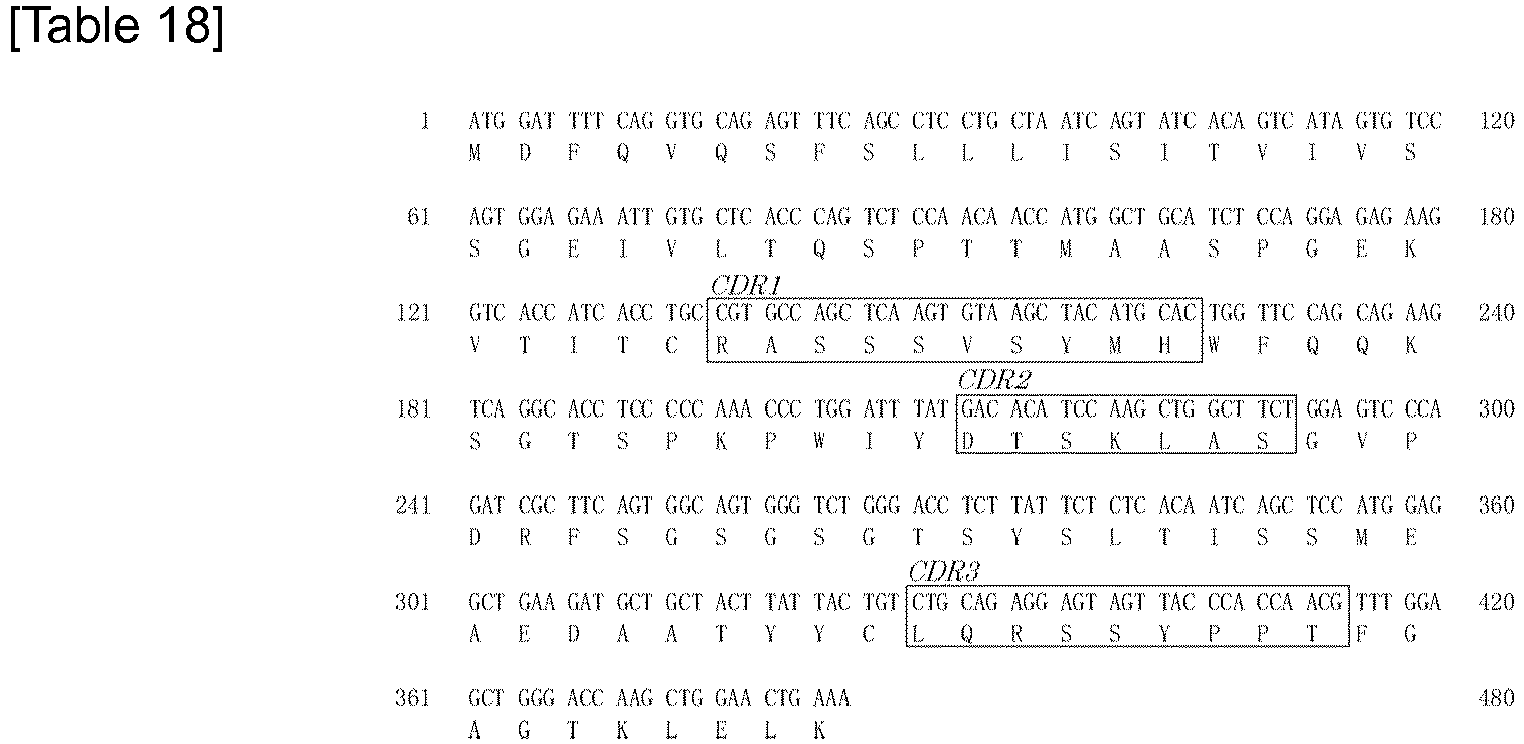


- First, the following indicates the protocol for the ELISA method used in the following examples.
- The following reagents were used.
- 96-well plate: C8 Maxi Breakapart (Nunc Co., Ltd. #473768)
- Plate washing solution: PBS/0.05
% Tween 20 - Blocking solution: PBS/1% BSA
- Antibody diluent: PBS/0.05
% Tween 20/1% BSA - Primary antibody: IgM 98 (hybridoma culture supernatant)
- Secondary antibody: Polyclonal rabbit anti-rat immunoglobulins/HRP (Dako #P0450)
- Color developing solution: 1-Step Slow TMB-ELISA (Thermo Fisher Scientific Inc. #34024)
- Stopping solution: 2N H2SO4
- Testing was carried out according to the procedure indicated below.
- Antibody culture supernatant or human serum (diluted 1/10 and 1/50) was added to a 96-well plate at 50 µL/well followed by incubating overnight at 4°C.
- The antigen-immobilized plate was repeatedly washed five times with plate washing solution at 200 µL/well. Blocking was then carried out with blocking solution at 200 µL/well followed by incubating for 1 hour at room temperature.
- The antigen-immobilized plate was repeatedly washed five times with plate washing solution at 200 µL/well.
IgM 98 antibody solution was then added at 100 µL/well and 10 µg/mL followed by incubating for 1 hour at room temperature. - The antigen-immobilized plate was repeatedly washed five times with plate washing solution at 200 µL/well. Secondary antibody diluted 4000-fold was added at 100 µL/well followed by incubating for 1 hour at room temperature.
- The antigen-immobilized plate was repeated washed five times with plate washing solution at 200 µL/well. Color developing solution was then added at 100 µL/well followed by incubating for 15 minutes at room temperature. Stopping solution was then added at 100 µL/well.
- Absorbance at 450 nm was measured after stopping the reaction.
- Colon cancer cell line DLD-1 that forcibly expresses TMEM-180, the parent line and the TMEM-180 knockdown line were cultured and washed with PBS after nearly reaching confluency. The medium was replaced with serum-free DMEM medium followed by culturing overnight and recovering the supernatant on the following day. This supernatant was used as sample antigen and immobilized on a 96-well plate followed by carrying out ELISA according to the method described in section 1). In addition, a similar experiment was conducted on brain tumor cell line LN229.
- The results are shown in
Fig. 9 . In comparison with the normal control (medium only), TMEM-180 exhibited high levels in all of the samples. The forced expression cell line, parent cell line and knockdown cell line demonstrated high levels in that order in colon cancer DLD-1. High levels were also demonstrated in brain tumor cells. - After diluting human plasma collected in EDTA (formed of four samples from stage IV patients and normal subjects) at dilution factors of 1/10 and 1/50, the plasma was used as sample antigen and immobilized on a 96-well plate followed by carrying out ELISA according to the method described in section 1).
- The results are shown in
Fig. 10 . In comparison with normal plasma, high levels were demonstrated in all of the patient samples. In addition, plasma TMEM-180 levels were positive (higher than normal) even inpatients # 2 and #4 who were negative for CEA. - The amount of TMEM-180 protein in the plasma of stage III colon cancer patients before and after surgery was measured using the same method as section 3).
- The results are shown in
Fig. 11 . TMEM-180 levels decreased after surgery in comparison with before surgery in all of the patients. - 5) The amount of TMEM-180 protein and the colon cancer tumor marker, CEA, were measured in the plasma of stage III, II, IV and IIIa colon cancer patients before and after surgery and at the time of recurrence. Measurement of TMEM-180 was carried out by sandwich ELISA using clone 669 and clone 1361. The average of the levels of TMEM-180 in the normal plasma of 8 subjects as measured by ELISA in the same manner as in the case of the patient samples was used for the TMEM-180 cutoff value. The normal value used at the National Cancer Center Japan was used for the CEA cutoff value.
- The results are shown in
Fig. 12 . Stage II patients were positive for TMEM-180 despite being negative for CEA level prior to surgery. In addition, although stage IIIa patients remained negative for CEA even after confirmation of recurrence by CT, TMEM-180 levels increased again. - Furthermore, the protocol of the sandwich ELISA procedure used in the example of section 5) is indicated below.
- The following reagents were used.
- 96-well plate: Maxisoap (Nunc Co., Ltd. #442404)
- 0.1 M phosphate buffer
- Plate washing solution: 10 mM TBS (pH 7.2)/0.05
% Tween 20/140 mM NaCl - Blocking solution: 10 mM TBS (pH 7.2)/0.05
% Tween 20/140 mM NaCl/1% BSA - Diluent: 10 mM TBS (pH 7.2)/0.05
% Tween 20/140 mM NaCl/1% BSA - Immobilized antibody: Clone 669
- Labeled antibody: Clone 1361
- Streptavidin HRP (Vector Laboratories #SA-5004)
- Color developing solution: 1-Step Slow TMB-ELISA (Thermo Fisher Scientific Inc. #34024)
- Stopping solution: 2 N H2SO4
- Measurement was carried out according to the procedure indicated below.
- Immobilized antibody clone 669 diluted with 0.1 M phosphate buffer was added to a 96-well plate at 50 µl/well followed by incubating overnight at 4°C.
- The antibody-immobilized plate was repeatedly washed three times with plate washing solution at 200 µL/well. Blocking was carried out with blocking solution at 200 µL/well followed by incubating for 30 minutes or more at room temperature.
- The antibody-immobilized plate was repeatedly washed three times with plate washing solution at 200 µL/well. A measurement sample was added to the antibody-immobilized plate at 50 µL/well followed by incubating for 1 hour at room temperature.
- The antibody-immobilized plate was repeatedly washed three times with plate washing solution at 200 µL/well. Biotin-labeled clone 1361 prepared using an established method was added to the 96-well plate at 50 µL/well after diluting with diluent followed by incubating for 1 hour at room temperature.
- The antibody-immobilized plate was repeatedly washed three times with plate washing solution at 200 µL/well. Streptavidin HRP diluent was added at 50 µL/well followed by incubating for 1 hour at room temperature.
- The antibody-immobilized plate was repeatedly washed three times with plate washing solution at 200 µL/well. Color developing solution was added at 100 µL/well followed by incubating for 20 minutes at room temperature. Stopping solution was added at 50 µL/well.
-
- SEQ ID NOs: 1 to 3 respectively indicate the amino acid sequences of
clone 98 heavy chain CDR1 to CDR3. - SEQ ID NOs: 4 to 6 respectively indicate the amino acid sequences of
clone 98 light chain CDR1 to CDR3. - SEQ ID NOs: 7 to 9 respectively indicate the amino acid sequences of
clone 101 heavy chain CDR1 to CDR3. - SEQ ID NOs: 10 to 12 respectively indicate the amino acid sequences of
clone 101 light chain CDR1 to CDR3. - SEQ ID NOs: 13 and 14 respectively indicate the amino acid sequences of the heavy chain variable region and light chain variable region of
clone 98. - SEQ ID NOs: 15 and 16 respectively indicate the amino acid sequences of the heavy chain variable region and light chain variable region of
clone 101. - SEQ ID NO: 17 indicates the amino acid sequence of human TMEM-180 protein.
- SEQ ID NOs: 18 to 21 respectively indicate primers (i) to (iv) for producing immunizing
antigen 1. - SEQ ID NOs: 22 to 25 respectively indicate primers (i) to (iv) for producing immunizing
antigen 2. - SEQ ID NOs: 26 to 31 indicate primers used for cloning an anti-TMEM-180 antibody.
- SEQ ID NOs: 40 to 42 respectively indicate the amino acid sequences of
clone 212 heavy chain CDR1 to CDR3. - SEQ ID NOs: 43 to 45 respectively indicate the amino acid sequences of
clone 212 light chain CDR1 to CDR3. - SEQ ID NOs: 46 and 47 respectively indicate the amino acid sequences of the heavy chain variable region and light chain variable region of
clone 212. - SEQ ID NOs: 48 to 50 respectively indicate the amino acid sequences of clone 129 heavy chain CDR1 to CDR3.
- SEQ ID NOs: 51 to 53 respectively indicate the amino acid sequences of clone 129 light chain CDR1 to CDR3.
- SEQ ID NOs: 54 and 55 respectively indicate the amino acid sequences of the heavy chain variable region and light chain variable region of clone 129.
- SEQ ID NOs: 56 to 58 respectively indicate the amino acid sequences of clone 382 heavy chain CDR1 to CDR3.
- SEQ ID NOs: 59 to 61 respectively indicate the amino acid sequences of clone 382 light chain CDR1 to CDR3.
- SEQ ID NOs: 62 and 63 respectively indicate the amino acid sequences of the heavy chain variable region and light chain variable region of clone 382.
- SEQ ID NOs: 64 to 66 respectively indicate the amino acid sequences of clone 1361 heavy chain CDR1 to CDR3.
- SEQ ID NOs: 67 to 69 respectively indicate the amino acid sequences of clone 1361 light chain CDR1 to CDR3.
- SEQ ID NOs: 70 and 71 respectively indicate the amino acid sequences of the heavy chain variable region and light chain variable region of clone 1361.
- SEQ ID NOs: 72 to 74 respectively indicate the amino acid sequences of clone 669 heavy chain CDR1 to CDR3.
- SEQ ID NOs: 75 to 77 respectively indicate the amino acid sequences of clone 669 light chain CDR1 to CDR3.
- SEQ ID NOs: 78 and 79 respectively indicate the amino acid sequences of the heavy chain variable region and light chain variable region of clone 669.
- SEQ ID NOs: 80 to 82 respectively indicate the amino acid sequences of clone 699 heavy chain CDR1 to CDR3.
- SEQ ID NOs: 83 to 85 respectively indicate the amino acid sequences of clone 699 light chain CDR1 to CDR3.
- SEQ ID NOs: 86 and 87 respectively indicate the amino acid sequences of the heavy chain variable region and light chain variable region of clone 699.
- SEQ ID NOs: 88 to 90 respectively indicate the amino acid sequences of clone 1052 heavy chain CDR1 to CDR3.
- SEQ ID NOs: 91 to 93 respectively indicate the amino acid sequences of clone 1052 light chain CDR1 to CDR3.
- SEQ ID NOs: 94 and 95 respectively indicate the amino acid sequences of the heavy chain variable region and light chain variable region of clone 1052.
- SEQ ID NOs: 96 to 98 respectively indicate the amino acid sequences of clone 1105 heavy chain CDR1 to CDR3.
- SEQ ID NOs: 99 to 101 respectively indicate the amino acid sequences of clone 1105 light chain CDR1 to CDR3.
- SEQ ID NOs: 102 and 103 respectively indicate the amino acid sequences of the heavy chain variable region and light chain variable region of clone 1105.
- SEQ ID NOs: 104 to 150 indicate the amino acid sequences of TMEM-180-derived peptides binding to HLA type A2 as predicted by HLA Peptide Binding Predictions.
- SEQ ID NOs: 151 to 170 indicate the amino acid sequences of TMEM-180-derived peptides binding to HLA type A24 as predicted by HLA Peptide Binding Predictions.


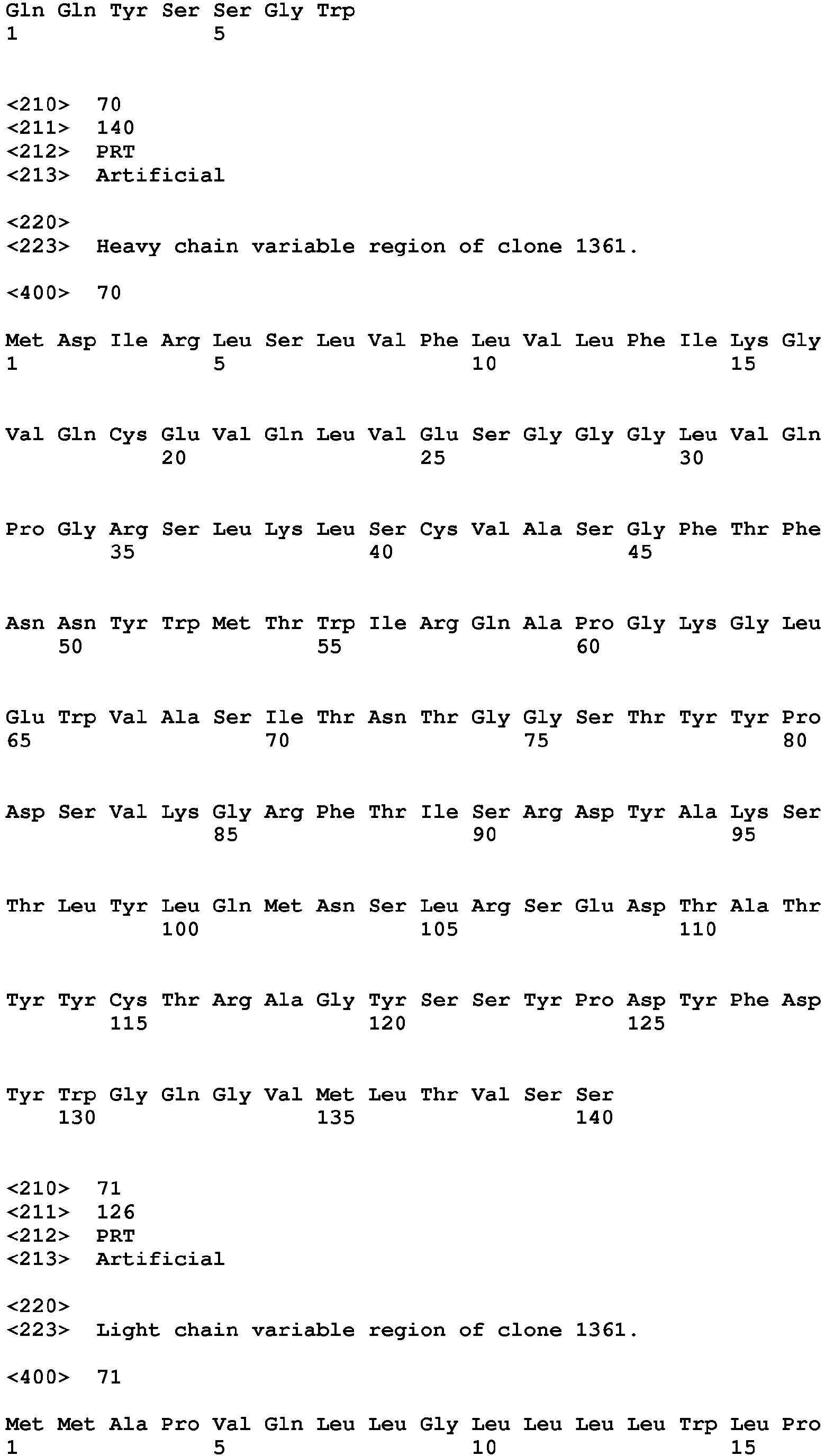


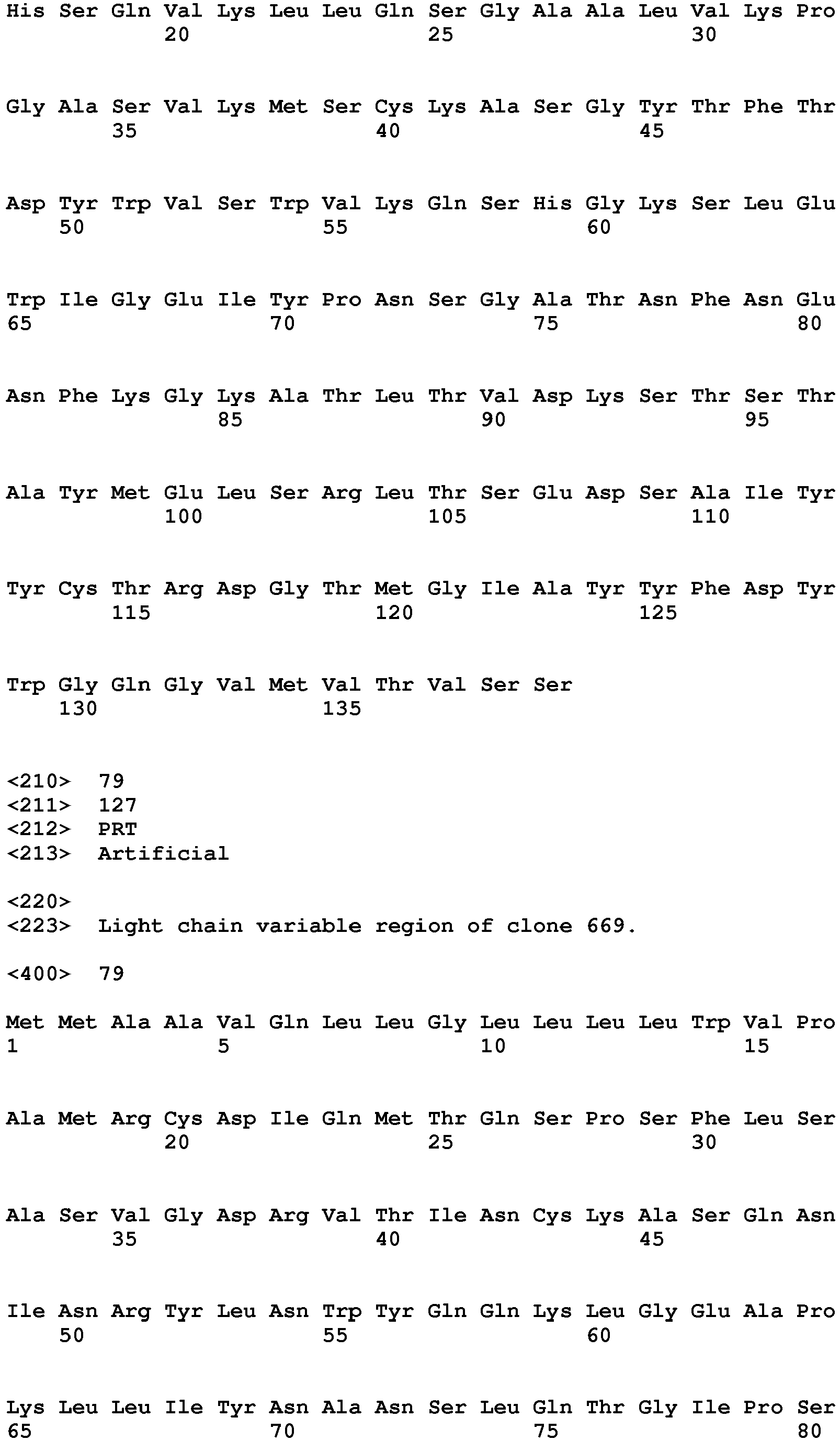


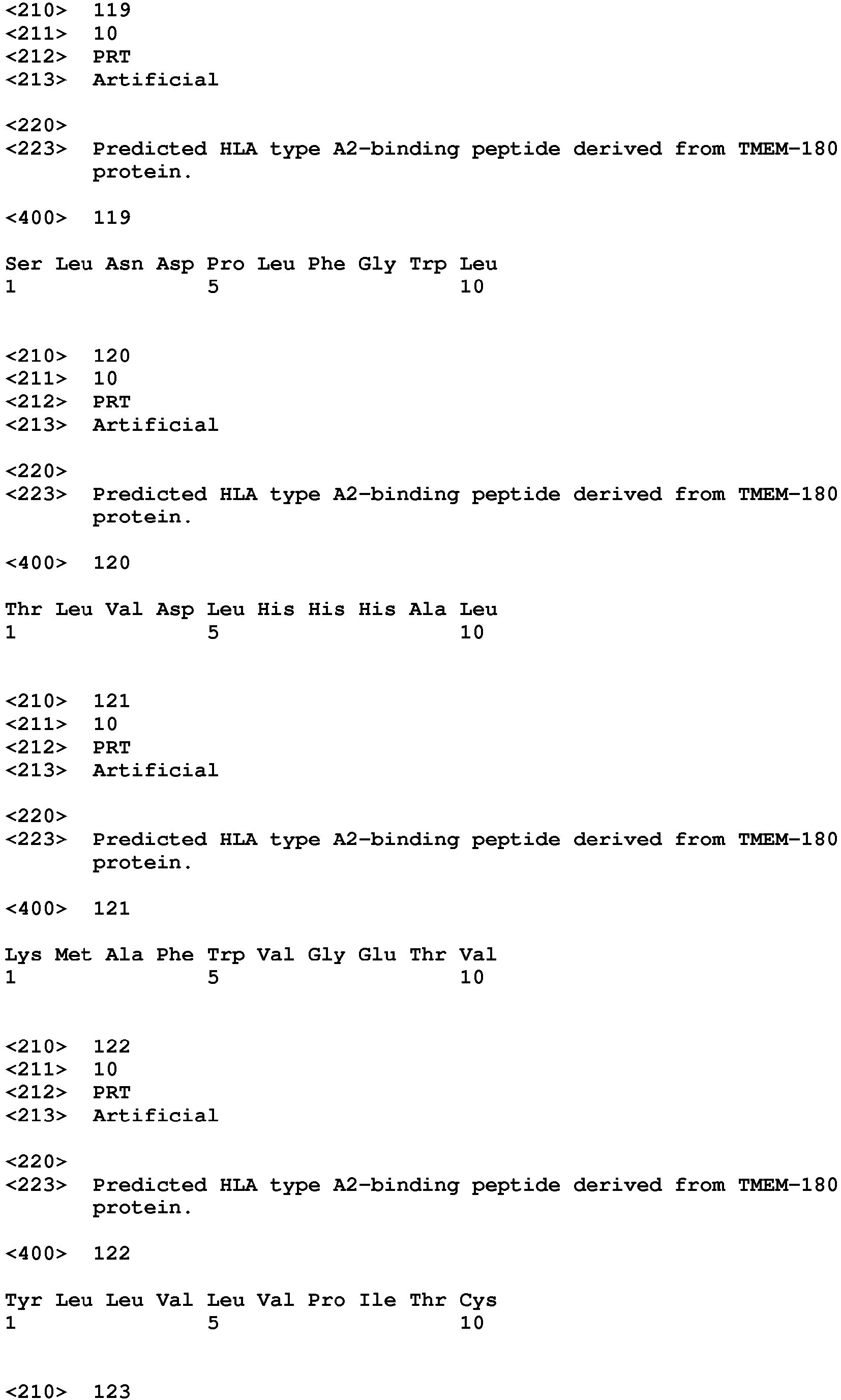
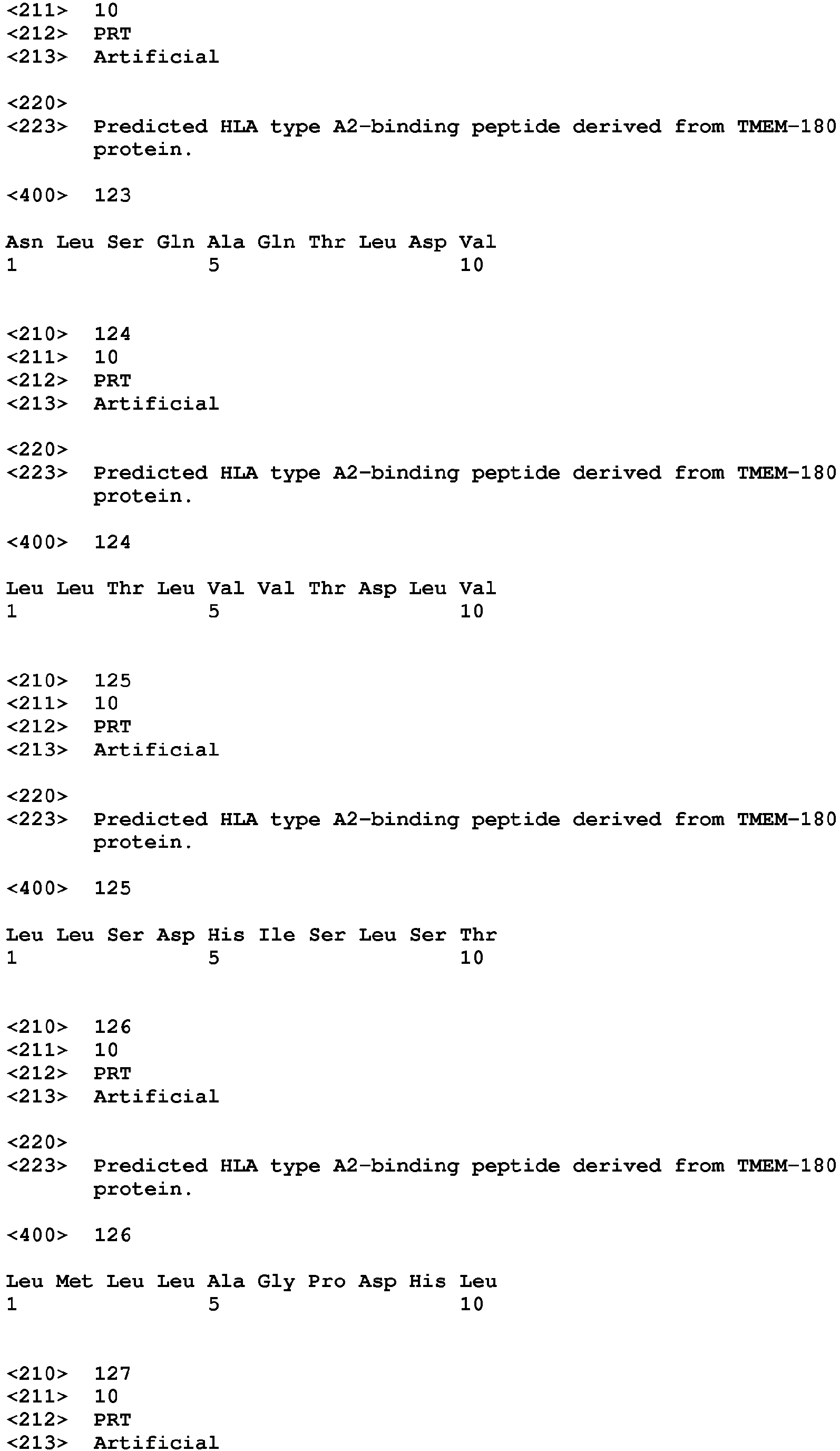


Claims (41)
- An anticancer drug containing, as an active ingredient thereof, an anti-transmembrane protein 180 (TMEM-180) antibody or an antigen-binding fragment thereof.
- An anticancer drug containing, as an active ingredient thereof, an anti-TMEM-180 antibody having a substance having anticancer activity bound thereto, or an antigen-binding fragment thereof.
- The anticancer drug according to claim 1 or 2, wherein the anti-TMEM-180 antibody has at least one of the six CDRs indicated below:heavy chain CDR1: GFSLTRYNVH (SEQ ID NO: 1);heavy chain CDR2: VIWTGGSTD (SEQ ID NO: 2);heavy chain CDR3: DLGY (SEQ ID NO: 3);light chain CDR1: KSSQSLKYRDGKTYLN (SEQ ID NO: 4);light chain CDR2: QVSKLDS (SEQ ID NO: 5); andlight chain CDR3: CQGSYSPHT (SEQ ID NO: 6).
- The anticancer drug according to claim 1 or 2, wherein the anti-TMEM-180 antibody has at least one of the six CDRs indicated below:heavy chain CDR1: GFSLTSYYMQ (SEQ ID NO: 7);heavy chain CDR2: FIRSGGSTE (SEQ ID NO: 8);heavy chain CDR3: AFYGGYYFDY (SEQ ID NO: 9);light chain CDR1: KASQNVGSNVD (SEQ ID NO: 10);light chain CDR2: KASNRYT (SEQ ID NO: 11); andlight chain CDR3: MQSNTKYT (SEQ ID NO: 12).
- The anticancer drug according to claim 1 or 2, wherein the anti-TMEM-180 antibody has at least one of the six CDRs indicated below:heavy chain CDR1: GFTFSDYAMA (SEQ ID NO: 40);heavy chain CDR2: TIIYDGSST (SEQ ID NO: 41);heavy chain CDR3: HWYWYFDF (SEQ ID NO: 42);light chain CDR1: LASEGISNDLA (SEQ ID NO: 43);light chain CDR2: AASRLQD (SEQ ID NO: 44); andlight chain CDR3: QQSYKYPLT (SEQ ID NO: 45).
- The anticancer drug according to claim 1 or 2, wherein the anti-TMEM-180 antibody has at least one of the six CDRs indicated below:heavy chain CDR1: DCALN (SEQ ID NO: 48);heavy chain CDR2: WINTQTGKPTYADDF (SEQ ID NO: 49);heavy chain CDR3: EDYGYFDY (SEQ ID NO: 50);light chain CDR1: QASQNINKFIA (SEQ ID NO: 51);light chain CDR2: YTSTLVS (SEQ ID NO: 52); andlight chain CDR3: LQYDNLR (SEQ ID NO: 53).
- The anticancer drug according to claim 1 or 2, wherein the anti-TMEM-180 antibody has at least one of the six CDRs indicated below:heavy chain CDR1: NYGMH (SEQ ID NO: 56);heavy chain CDR2: SISPSGGSTYYRDSV (SEQ ID NO: 57);heavy chain CDR3: SASITAYYYVMDA (SEQ ID NO: 58);light chain CDR1: KASQNVGSNVD (SEQ ID NO: 59);light chain CDR2: KASNRYT (SEQ ID NO: 60); andlight chain CDR3: MQSNSYPPT (SEQ ID NO: 61).
- The anticancer drug according to claim 1 or 2, wherein the anti-TMEM-180 antibody has at least one of the six CDRs indicated below:heavy chain CDR1: NYWMT (SEQ ID NO: 64);heavy chain CDR2: SITNTGGSTYYPDSV (SEQ ID NO: 65);heavy chain CDR3: AGYSSYPDYFDY (SEQ ID NO: 66);light chain CDR1: KAGQNIYNYLA (SEQ ID NO: 67);light chain CDR2: NANSLQT (SEQ ID NO: 68); andlight chain CDR3: QQYSSGW (SEQ ID NO: 69).
- The anticancer drug according to claim 1 or 2, wherein the anti-TMEM-180 antibody has at least one of the six CDRs indicated below:heavy chain CDR1: DYWVS (SEQ ID NO: 72);heavy chain CDR2: EIYPNSGATNFNENFK (SEQ ID NO: 73);heavy chain CDR3: DGTMGIAYYFDY (SEQ ID NO: 74);light chain CDR1: KASQNINRYLN (SEQ ID NO: 75);light chain CDR2: NANSLQT (SEQ ID NO: 76); andlight chain CDR3: LQHNSWPYT (SEQ ID NO: 77).
- The anticancer drug according to claim 1 or 2, wherein the anti-TMEM-180 antibody has at least one of the six CDRs indicated below:heavy chain CDR1: SYDIS (SEQ ID NO: 80);heavy chain CDR2: AINPGSGGTGYNEKFKGK (SEQ ID NO: 81);heavy chain CDR3: IHGGYRYWFAY (SEQ ID NO: 82);light chain CDR1: RASSSVSYMH (SEQ ID NO: 83);light chain CDR2: DTSKLAS (SEQ ID NO: 84); andlight chain CDR3: LQRSSYPPT (SEQ ID NO: 85).
- The anticancer drug according to claim 1 or 2, wherein the anti-TMEM-180 antibody has at least one of the six CDRs indicated below:heavy chain CDR1: SNGVG (SEQ ID NO: 88);heavy chain CDR2: TIWTGGGTNYNSGVQS (SEQ ID NO: 89);heavy chain CDR3: EYMGFDY (SEQ ID NO: 90);light chain CDR1: KASQNVGINVG (SEQ ID NO: 91);light chain CDR2: WASNRDT (SEQ ID NO: 92); andlight chain CDR3: LQHNSYPRT (SEQ ID NO: 93).
- The anticancer drug according to claim 1 or 2, wherein the anti-TMEM-180 antibody has at least one of the six CDRs indicated below:heavy chain CDR1: SNGVG (SEQ ID NO: 96);heavy chain CDR2: TIWSGGGTNYNSAVQS (SEQ ID NO: 97);heavy chain CDR3: EEKGFAY (SEQ ID NO: 98);light chain CDR1: KASQNVGINVG (SEQ ID NO: 99);light chain CDR2: WASNRDT (SEQ ID NO: 100); andlight chain CDR3: LQHNSYPRA (SEQ ID NO: 101).
- The anticancer drug according to any one of claims 3 to 12, wherein the anti-TMEM-180 antibody is such that
at least one of the heavy chain CDR1 to CDR3 and light chain CDR1 to CDR3 contains one to several amino acid additions, substitutions or deletions, or
at least one of the heavy chain CDR1 to CDR3 and light chain CDR1 to CDR3 has an amino acid sequence having identity of 80% or more with the amino acid sequences of the heavy chain CDR1 to CDR3 and light chain CDR1 to CDR3. - The anticancer drug according to claim 1 or 2, wherein the anti-TMEM-180 antibody contains:a heavy chain containing the amino acid sequence represented by SEQ ID NO: 13;a heavy chain containing an amino acid sequence containing one to several amino acid additions, substitutions or deletions in the amino acid sequence represented by SEQ ID NO: 13; ora heavy chain containing an amino acid sequence having identity of 80% or more with the amino acid sequence represented by SEQ ID NO: 13, and/ora light chain containing the amino acid sequence represented by SEQ ID NO: 14;a light chain containing an amino acid sequence containing one to several amino acid additions, substitutions or deletions in the amino acid sequence represented by SEQ ID NO: 14; ora light chain containing an amino acid sequence having identity of 80% or more with the amino acid sequence represented by SEQ ID NO: 14.
- The anticancer drug according to claim 1 or 2, wherein the anti-TMEM-180 antibody contains:a heavy chain containing the amino acid sequence represented by SEQ ID NO: 15;a heavy chain containing an amino acid sequence containing one to several amino acid additions, substitutions or deletions in the amino acid sequence represented by SEQ ID NO: 15; ora heavy chain containing an amino acid sequence having identity of 80% or more with the amino acid sequence represented by SEQ ID NO: 15, and/ora light chain containing the amino acid sequence represented by SEQ ID NO: 16;a light chain containing an amino acid sequence containing one to several amino acid additions, substitutions or deletions in the amino acid sequence represented by SEQ ID NO: 16; ora light chain containing an amino acid sequence having identity of 80% or more with the amino acid sequence represented by SEQ ID NO: 16.
- The anticancer drug according to claim 1 or 2, wherein the anti-TMEM-180 antibody contains:a heavy chain containing the amino acid sequence represented by SEQ ID NO: 46;a heavy chain containing an amino acid sequence containing one to several amino acid additions, substitutions or deletions in the amino acid sequence represented by SEQ ID NO: 46; ora heavy chain containing an amino acid sequence having identity of 80% or more with the amino acid sequence represented by SEQ ID NO: 46, and/ora light chain containing the amino acid sequence represented by SEQ ID NO: 47;a light chain containing an amino acid sequence containing one to several amino acid additions, substitutions or deletions in the amino acid sequence represented by SEQ ID NO: 47; ora light chain containing an amino acid sequence having identity of 80% or more with the amino acid sequence represented by SEQ ID NO: 47.
- The anticancer drug according to claim 1 or 2, wherein the anti-TMEM-180 antibody contains:a heavy chain containing the amino acid sequence represented by SEQ ID NO: 54;a heavy chain containing an amino acid sequence containing one to several amino acid additions, substitutions or deletions in the amino acid sequence represented by SEQ ID NO: 54; ora heavy chain containing an amino acid sequence having identity of 80% or more with the amino acid sequence represented by SEQ ID NO: 54, and/ora light chain containing the amino acid sequence represented by SEQ ID NO: 55;a light chain containing an amino acid sequence containing one to several amino acid additions, substitutions or deletions in the amino acid sequence represented by SEQ ID NO: 55; ora light chain containing an amino acid sequence having identity of 80% or more with the amino acid sequence represented by SEQ ID NO: 55.
- The anticancer drug according to claim 1 or 2, wherein the anti-TMEM-180 antibody contains:a heavy chain containing the amino acid sequence represented by SEQ ID NO: 62;a heavy chain containing an amino acid sequence containing one to several amino acid additions, substitutions or deletions in the amino acid sequence represented by SEQ ID NO: 62; ora heavy chain containing an amino acid sequence having identity of 80% or more with the amino acid sequence represented by SEQ ID NO: 62, and/ora light chain containing the amino acid sequence represented by SEQ ID NO: 63;a light chain containing an amino acid sequence containing one to several amino acid additions, substitutions or deletions in the amino acid sequence represented by SEQ ID NO: 63; ora light chain containing an amino acid sequence having identity of 80% or more with the amino acid sequence represented by SEQ ID NO: 63.
- The anticancer drug according to claim 1 or 2, wherein the anti-TMEM-180 antibody contains:a heavy chain containing the amino acid sequence represented by SEQ ID NO: 70;a heavy chain containing an amino acid sequence containing one to several amino acid additions, substitutions or deletions in the amino acid sequence represented by SEQ ID NO: 70; ora heavy chain containing an amino acid sequence having identity of 80% or more with the amino acid sequence represented by SEQ ID NO: 70, and/ora light chain containing the amino acid sequence represented by SEQ ID NO: 71;a light chain containing an amino acid sequence containing one to several amino acid additions, substitutions or deletions in the amino acid sequence represented by SEQ ID NO: 71; ora light chain containing an amino acid sequence having identity of 80% or more with the amino acid sequence represented by SEQ ID NO: 71.
- The anticancer drug according to claim 1 or 2, wherein the anti-TMEM-180 antibody contains:a heavy chain containing the amino acid sequence represented by SEQ ID NO: 78;a heavy chain containing an amino acid sequence containing one to several amino acid additions, substitutions or deletions in the amino acid sequence represented by SEQ ID NO: 78; ora heavy chain containing an amino acid sequence having identity of 80% or more with the amino acid sequence represented by SEQ ID NO: 78, and/ora light chain containing the amino acid sequence represented by SEQ ID NO: 79;a light chain containing an amino acid sequence containing one to several amino acid additions, substitutions or deletions in the amino acid sequence represented by SEQ ID NO: 79; ora light chain containing an amino acid sequence having identity of 80% or more with the amino acid sequence represented by SEQ ID NO: 79.
- The anticancer drug according to claim 1 or 2, wherein the anti-TMEM-180 antibody contains:a heavy chain containing the amino acid sequence represented by SEQ ID NO: 86;a heavy chain containing an amino acid sequence containing one to several amino acid additions, substitutions or deletions in the amino acid sequence represented by SEQ ID NO: 86; ora heavy chain containing an amino acid sequence having identity of 80% or more with the amino acid sequence represented by SEQ ID NO: 86, and/ora light chain containing the amino acid sequence represented by SEQ ID NO: 87;a light chain containing an amino acid sequence containing one to several amino acid additions, substitutions or deletions in the amino acid sequence represented by SEQ ID NO: 87; ora light chain containing an amino acid sequence having identity of 80% or more with the amino acid sequence represented by SEQ ID NO: 87.
- The anticancer drug according to claim 1 or 2, wherein the anti-TMEM-180 antibody contains:a heavy chain containing the amino acid sequence represented by SEQ ID NO: 94;a heavy chain containing an amino acid sequence containing one to several amino acid additions, substitutions or deletions in the amino acid sequence represented by SEQ ID NO: 94; ora heavy chain containing an amino acid sequence having identity of 80% or more with the amino acid sequence represented by SEQ ID NO: 94, and/ora light chain containing the amino acid sequence represented by SEQ ID NO: 95;a light chain containing an amino acid sequence containing one to several amino acid additions, substitutions or deletions in the amino acid sequence represented by SEQ ID NO: 95; ora light chain containing an amino acid sequence having identity of 80% or more with the amino acid sequence represented by SEQ ID NO: 95.
- The anticancer drug according to claim 1 or 2, wherein the anti-TMEM-180 antibody contains:a heavy chain containing the amino acid sequence represented by SEQ ID NO: 102;a heavy chain containing an amino acid sequence containing one to several amino acid additions, substitutions or deletions in the amino acid sequence represented by SEQ ID NO: 102; ora heavy chain containing an amino acid sequence having identity of 80% or more with the amino acid sequence represented by SEQ ID NO: 102, and/ora light chain containing the amino acid sequence represented by SEQ ID NO: 103;a light chain containing an amino acid sequence containing one to several amino acid additions, substitutions or deletions in the amino acid sequence represented by SEQ ID NO: 103; ora light chain containing an amino acid sequence having identity of 80% or more with the amino acid sequence represented by SEQ ID NO: 103.
- The anticancer drug according to any one of claims 1 to 23, wherein the anti-TMEM-180 antibody has one or more N-linked oligosaccharides bound to the Fc region and fucose is not bound to N-acetylglucosamine on the reducing end of the N-linked oligosaccharide.
- The anticancer drug according to any one of claims 1 to 24, which is targeted at cancer expressing TMEM-180.
- The anticancer drug according to any one of claims 1 to 24, which is targeted at colon cancer.
- The anticancer drug according to any one of claims 1 to 24, which is administered concomitantly with vaccine therapy using a composition containing at least one peptide comprising an amino acid sequence represented by SEQ ID NOs: 104 to 170.
- An anti-TMEM-180 antibody according to any one of claims 3 to 24 or an antigen-binding fragment thereof.
- A nucleic acid encoding any one of the heavy chains CDR1 to CDR3 and light chains CDR1 to CDR3 according to any one of claims 3 to 13.
- A nucleic acid encoding any one of the heavy chains and light chains according to any one of claims 14 to 23.
- An expression vector containing the nucleic acid according to claim 29 or 30.
- A transformant containing the expression vector according to claim 31.
- A method for producing an anti-TMEM-180 antibody, or an antigen-binding fragment thereof, comprising the steps of:expressing an antibody in the transformant according to claim 32; andrecovering the antibody.
- A cancer testing method, comprising a step of measuring the amount of TMEM-180 in a sample collected from a subject.
- The cancer testing method according to claim 34, wherein the amount of TMEM-180 is measured by immunoassay using an anti-TMEM-180 antibody or an antigen-binding fragment thereof.
- The cancer testing method according to claim 35, wherein the anti-TMEM-180 antibody or antigen-binding fragment thereof is the anti-TMEM-180 antibody or antigen-binding fragment thereof according to claim 28.
- The cancer testing method according to any one of claims 34 to 36, which is targeted at colon cancer.
- The cancer testing method according to any one of claims 34 to 37, which is used to test for recurrence or metastasis following treatment.
- A cancer testing kit containing an anti-TMEM-180 antibody or an antigen-binding fragment thereof.
- The cancer testing kit according to claim 39, wherein the anti-TMEM-180 antibody or antigen-binding fragment thereof is the anti-TMEM-180 antibody or antigen-binding fragment thereof according to claim 28.
- The cancer testing kit according to claim 39 or 40, which is targeted at colon cancer.
Applications Claiming Priority (3)
| Application Number | Priority Date | Filing Date | Title |
|---|---|---|---|
| JP2014182760 | 2014-09-08 | ||
| JP2014260727 | 2014-12-24 | ||
| PCT/JP2015/075425 WO2016039321A1 (en) | 2014-09-08 | 2015-09-08 | Cancer-cell-specific antibody, anticancer agent, and cancer testing method |
Publications (2)
| Publication Number | Publication Date |
|---|---|
| EP3192527A1 true EP3192527A1 (en) | 2017-07-19 |
| EP3192527A4 EP3192527A4 (en) | 2018-04-11 |
Family
ID=55459067
Family Applications (1)
| Application Number | Title | Priority Date | Filing Date |
|---|---|---|---|
| EP15840271.9A Pending EP3192527A4 (en) | 2014-09-08 | 2015-09-08 | Cancer-cell-specific antibody, anticancer agent, and cancer testing method |
Country Status (12)
| Country | Link |
|---|---|
| US (2) | US10471146B2 (en) |
| EP (1) | EP3192527A4 (en) |
| JP (2) | JP6781507B2 (en) |
| KR (1) | KR102029248B1 (en) |
| CN (1) | CN106999576B (en) |
| AU (2) | AU2015313268B2 (en) |
| CA (1) | CA2960466C (en) |
| IL (1) | IL250848B (en) |
| MY (1) | MY187050A (en) |
| RU (1) | RU2753512C2 (en) |
| SG (1) | SG11201701809UA (en) |
| WO (1) | WO2016039321A1 (en) |
Cited By (2)
| Publication number | Priority date | Publication date | Assignee | Title |
|---|---|---|---|---|
| EP3434765A4 (en) * | 2016-03-08 | 2019-11-20 | National Cancer Center Japan | ANTI-TMEM-180 ANTIBODY, ANTICANCER AGENT AND METHOD OF TESTING CANCER |
| WO2023105087A1 (en) * | 2021-12-10 | 2023-06-15 | Tubulis Gmbh | Novel flt3 antibodies and antibody-drug-conjugates based thereon, therapeutic methods and uses thereof in combination with tyrosine kinase inhibitors |
Families Citing this family (10)
| Publication number | Priority date | Publication date | Assignee | Title |
|---|---|---|---|---|
| JP7209284B2 (en) | 2016-08-15 | 2023-01-20 | 国立研究開発法人国立がん研究センター | Antibody that binds to TMEM132A, anticancer agent, and method for testing cancer |
| CN117347612A (en) | 2017-03-31 | 2024-01-05 | 广津生物科学株式会社 | Prediction of treatment response and/or recurrence monitoring in cancer patients |
| GB201710835D0 (en) | 2017-07-05 | 2017-08-16 | Ucl Business Plc | ROR1 Antibodies |
| GB201710836D0 (en) | 2017-07-05 | 2017-08-16 | Ucl Business Plc | ROR1 Car T-Cells |
| GB201710838D0 (en) | 2017-07-05 | 2017-08-16 | Ucl Business Plc | Bispecific antibodies |
| WO2019136300A2 (en) * | 2018-01-05 | 2019-07-11 | Immunext, Inc. | Anti-mct1 antibodies and uses thereof |
| WO2021087114A1 (en) * | 2019-10-29 | 2021-05-06 | University Of Florida Research Foundation, Incorporated | Anti-angiopoietin-like 4 (angptl4) antibodies and methods of use |
| US20220135690A1 (en) * | 2020-11-03 | 2022-05-05 | Twist Bioscience Corporation | Methods and compositions relating to chemokine receptor variants |
| CN116769729B (en) * | 2023-06-05 | 2024-07-02 | 中国科学技术大学 | Antibodies or antigen binding fragments targeting CD150 and uses thereof |
| CN117567635B (en) * | 2024-01-16 | 2024-05-14 | 恺佧生物科技(上海)有限公司 | Antibodies against Cas9 enzymes and uses thereof |
Family Cites Families (10)
| Publication number | Priority date | Publication date | Assignee | Title |
|---|---|---|---|---|
| US20110244501A1 (en) * | 2006-08-02 | 2011-10-06 | Biogen Idec Ma Inc. | Cancer stem cells |
| TW201008574A (en) * | 2008-08-19 | 2010-03-01 | Oncotherapy Science Inc | INHBB epitope peptides and vaccines containing the same |
| CN102216452B (en) * | 2008-09-26 | 2013-08-21 | 尤里卡治疗公司 | Cell lines and proteins with variant glycosylation pattern |
| EP2177615A1 (en) * | 2008-10-10 | 2010-04-21 | Fraunhofer-Gesellschaft zur Förderung der angewandten Forschung e.V. | Method for a genome wide identification of expression regulatory sequences and use of genes and molecules derived thereof for the diagnosis and therapy of metabolic and/or tumorous diseases |
| CA2753388C (en) * | 2009-03-23 | 2016-11-29 | Quark Pharmaceuticals, Inc. | Endo180 antibody to treat cancer and fibrotic disease |
| US20110195848A1 (en) * | 2010-01-08 | 2011-08-11 | Roopra Avtar S | Gene expression and breast cancer |
| CA2813314A1 (en) * | 2010-10-05 | 2012-04-12 | Daiichi Sankyo Company, Limited | Antibody targeting osteoclast-related protein siglec-15 |
| WO2013133450A1 (en) * | 2012-03-06 | 2013-09-12 | 株式会社バイオマトリックス研究所 | Pharmaceutical composition for treating cancer |
| WO2014041185A2 (en) * | 2012-09-17 | 2014-03-20 | Ait Austrian Institute Of Technology Gmbh | Colon cancer diagnostic method and means |
| EP3434765A4 (en) * | 2016-03-08 | 2019-11-20 | National Cancer Center Japan | ANTI-TMEM-180 ANTIBODY, ANTICANCER AGENT AND METHOD OF TESTING CANCER |
-
2015
- 2015-09-08 WO PCT/JP2015/075425 patent/WO2016039321A1/en not_active Ceased
- 2015-09-08 RU RU2017111584A patent/RU2753512C2/en active
- 2015-09-08 AU AU2015313268A patent/AU2015313268B2/en active Active
- 2015-09-08 MY MYPI2017700758A patent/MY187050A/en unknown
- 2015-09-08 US US15/509,269 patent/US10471146B2/en active Active
- 2015-09-08 IL IL250848A patent/IL250848B/en unknown
- 2015-09-08 JP JP2016547444A patent/JP6781507B2/en active Active
- 2015-09-08 CA CA2960466A patent/CA2960466C/en active Active
- 2015-09-08 EP EP15840271.9A patent/EP3192527A4/en active Pending
- 2015-09-08 CN CN201580048202.6A patent/CN106999576B/en active Active
- 2015-09-08 KR KR1020177008443A patent/KR102029248B1/en active Active
- 2015-09-08 SG SG11201701809UA patent/SG11201701809UA/en unknown
-
2018
- 2018-12-05 AU AU2018274932A patent/AU2018274932B2/en active Active
-
2019
- 2019-09-23 US US16/578,861 patent/US11524074B2/en active Active
-
2020
- 2020-10-13 JP JP2020172408A patent/JP6980075B2/en active Active
Cited By (4)
| Publication number | Priority date | Publication date | Assignee | Title |
|---|---|---|---|---|
| EP3434765A4 (en) * | 2016-03-08 | 2019-11-20 | National Cancer Center Japan | ANTI-TMEM-180 ANTIBODY, ANTICANCER AGENT AND METHOD OF TESTING CANCER |
| US11633499B2 (en) | 2016-03-08 | 2023-04-25 | National Cancer Center Japan | Anti-TMEM-180 antibody, anticancer drug and cancer testing method |
| EP4549574A3 (en) * | 2016-03-08 | 2025-07-30 | National Cancer Center Japan | Anti-tmem-180 antibody, anticancer drug and cancer testing method |
| WO2023105087A1 (en) * | 2021-12-10 | 2023-06-15 | Tubulis Gmbh | Novel flt3 antibodies and antibody-drug-conjugates based thereon, therapeutic methods and uses thereof in combination with tyrosine kinase inhibitors |
Also Published As
| Publication number | Publication date |
|---|---|
| RU2017111584A3 (en) | 2018-10-10 |
| JP6980075B2 (en) | 2021-12-15 |
| CA2960466A1 (en) | 2016-03-17 |
| CA2960466C (en) | 2023-09-05 |
| US20170260284A1 (en) | 2017-09-14 |
| IL250848A0 (en) | 2017-04-30 |
| MY187050A (en) | 2021-08-27 |
| US20200078458A1 (en) | 2020-03-12 |
| US10471146B2 (en) | 2019-11-12 |
| SG11201701809UA (en) | 2017-04-27 |
| JPWO2016039321A1 (en) | 2017-06-22 |
| BR112017004446A2 (en) | 2018-02-27 |
| KR20170047351A (en) | 2017-05-04 |
| RU2753512C2 (en) | 2021-08-17 |
| IL250848B (en) | 2022-07-01 |
| RU2017111584A (en) | 2018-10-10 |
| AU2018274932B2 (en) | 2020-11-05 |
| CN106999576B (en) | 2021-09-03 |
| AU2015313268A1 (en) | 2017-03-23 |
| CN106999576A (en) | 2017-08-01 |
| WO2016039321A1 (en) | 2016-03-17 |
| EP3192527A4 (en) | 2018-04-11 |
| AU2018274932A1 (en) | 2019-01-03 |
| JP6781507B2 (en) | 2020-11-04 |
| KR102029248B1 (en) | 2019-10-08 |
| US11524074B2 (en) | 2022-12-13 |
| JP2021019616A (en) | 2021-02-18 |
| AU2015313268B2 (en) | 2018-12-20 |
Similar Documents
| Publication | Publication Date | Title |
|---|---|---|
| US11524074B2 (en) | Cancer-cell-specific anti-TMEM-180 monoclonal antibody, anticancer drug, and cancer testing method | |
| EP2078732B1 (en) | Method of identifying a candidate diagnostic or therapeutic antibody using flow cytometry | |
| EP2096122A1 (en) | Anti-human dlk-1 antibody showing anti-tumor activity in vivo | |
| US20240148893A1 (en) | Anti-tmem-180 antibody, anticancer agent, and test method for cancer | |
| EP2905335B1 (en) | Anti-human dlk-1 antibody having anti-tumor activity in vivo | |
| CA3150807A1 (en) | Anti-vsig4 antibody or antigen binding fragment and uses thereof | |
| WO2020038404A1 (en) | Anti-human claudin 18.2 monoclonal antibody and application thereof | |
| RU2853818C9 (en) | Method for treating diseases using gremlin1 antagonists | |
| CN115403670B (en) | Anti-CD 40 antibodies and uses thereof | |
| BR112017004446B1 (en) | ANTI-TMEM-180 ANTIBODY, ANTI-CANCER DRUG, USE OF SAID DRUG TO TREAT CANCER, NUCLEIC ACIDS, EXPRESSION VECTOR, TRANSFORMANT, METHOD AND TEST KIT FOR FINDING CANCER AND METHOD FOR PRODUCING SAID ANTIBODY | |
| EP4177272A1 (en) | Use of regulator of itpripl1 in preparation of drug that regulates immune responses or fights tumors | |
| HK40088111A (en) | Use of regulator of itpripl1 in preparation of drug that regulates immune responses or fights tumors | |
| WO2018034259A1 (en) | Antibody binding to tmem132a, anticancer agent, and cancer test method |
Legal Events
| Date | Code | Title | Description |
|---|---|---|---|
| STAA | Information on the status of an ep patent application or granted ep patent |
Free format text: STATUS: THE INTERNATIONAL PUBLICATION HAS BEEN MADE |
|
| PUAI | Public reference made under article 153(3) epc to a published international application that has entered the european phase |
Free format text: ORIGINAL CODE: 0009012 |
|
| STAA | Information on the status of an ep patent application or granted ep patent |
Free format text: STATUS: REQUEST FOR EXAMINATION WAS MADE |
|
| 17P | Request for examination filed |
Effective date: 20170407 |
|
| AK | Designated contracting states |
Kind code of ref document: A1 Designated state(s): AL AT BE BG CH CY CZ DE DK EE ES FI FR GB GR HR HU IE IS IT LI LT LU LV MC MK MT NL NO PL PT RO RS SE SI SK SM TR |
|
| AX | Request for extension of the european patent |
Extension state: BA ME |
|
| DAV | Request for validation of the european patent (deleted) | ||
| DAX | Request for extension of the european patent (deleted) | ||
| A4 | Supplementary search report drawn up and despatched |
Effective date: 20180313 |
|
| RIC1 | Information provided on ipc code assigned before grant |
Ipc: C07K 16/30 20060101AFI20180307BHEP Ipc: C07K 16/18 20060101ALI20180307BHEP Ipc: G01N 33/574 20060101ALI20180307BHEP Ipc: C12N 15/09 20060101ALI20180307BHEP Ipc: A61P 35/00 20060101ALI20180307BHEP |
|
| STAA | Information on the status of an ep patent application or granted ep patent |
Free format text: STATUS: EXAMINATION IS IN PROGRESS |
|
| 17Q | First examination report despatched |
Effective date: 20200512 |