EP3192503B1 - Novel pharmaceutical composition containing hydroxamic acid derivative or salt thereof - Google Patents
Novel pharmaceutical composition containing hydroxamic acid derivative or salt thereof Download PDFInfo
- Publication number
- EP3192503B1 EP3192503B1 EP15840105.9A EP15840105A EP3192503B1 EP 3192503 B1 EP3192503 B1 EP 3192503B1 EP 15840105 A EP15840105 A EP 15840105A EP 3192503 B1 EP3192503 B1 EP 3192503B1
- Authority
- EP
- European Patent Office
- Prior art keywords
- cyclodextrin
- pharmaceutical composition
- acid
- methyl
- composition according
- Prior art date
- Legal status (The legal status is an assumption and is not a legal conclusion. Google has not performed a legal analysis and makes no representation as to the accuracy of the status listed.)
- Not-in-force
Links
- 239000008194 pharmaceutical composition Substances 0.000 title claims description 84
- 239000002253 acid Substances 0.000 title claims description 56
- NEAQRZUHTPSBBM-UHFFFAOYSA-N 2-hydroxy-3,3-dimethyl-7-nitro-4h-isoquinolin-1-one Chemical compound C1=C([N+]([O-])=O)C=C2C(=O)N(O)C(C)(C)CC2=C1 NEAQRZUHTPSBBM-UHFFFAOYSA-N 0.000 title claims description 41
- 150000003839 salts Chemical class 0.000 title claims description 29
- 239000012669 liquid formulation Substances 0.000 claims description 104
- 239000007864 aqueous solution Substances 0.000 claims description 71
- 239000000243 solution Substances 0.000 claims description 52
- 239000002904 solvent Substances 0.000 claims description 51
- XLYOFNOQVPJJNP-UHFFFAOYSA-N water Substances O XLYOFNOQVPJJNP-UHFFFAOYSA-N 0.000 claims description 46
- 229920000858 Cyclodextrin Polymers 0.000 claims description 40
- 238000004519 manufacturing process Methods 0.000 claims description 39
- LFQSCWFLJHTTHZ-UHFFFAOYSA-N Ethanol Chemical compound CCO LFQSCWFLJHTTHZ-UHFFFAOYSA-N 0.000 claims description 33
- 239000012931 lyophilized formulation Substances 0.000 claims description 28
- IAZDPXIOMUYVGZ-UHFFFAOYSA-N Dimethylsulphoxide Chemical compound CS(C)=O IAZDPXIOMUYVGZ-UHFFFAOYSA-N 0.000 claims description 23
- 238000000034 method Methods 0.000 claims description 21
- FBPFZTCFMRRESA-KVTDHHQDSA-N D-Mannitol Chemical compound OC[C@@H](O)[C@@H](O)[C@H](O)[C@H](O)CO FBPFZTCFMRRESA-KVTDHHQDSA-N 0.000 claims description 16
- 150000001413 amino acids Chemical class 0.000 claims description 16
- 150000005846 sugar alcohols Polymers 0.000 claims description 15
- 125000004432 carbon atom Chemical group C* 0.000 claims description 13
- 150000007524 organic acids Chemical class 0.000 claims description 13
- HFHDHCJBZVLPGP-UHFFFAOYSA-N schardinger α-dextrin Chemical group O1C(C(C2O)O)C(CO)OC2OC(C(C2O)O)C(CO)OC2OC(C(C2O)O)C(CO)OC2OC(C(O)C2O)C(CO)OC2OC(C(C2O)O)C(CO)OC2OC2C(O)C(O)C1OC2CO HFHDHCJBZVLPGP-UHFFFAOYSA-N 0.000 claims description 13
- 235000010355 mannitol Nutrition 0.000 claims description 11
- 150000001408 amides Chemical class 0.000 claims description 10
- 150000007513 acids Chemical class 0.000 claims description 9
- 150000001298 alcohols Chemical class 0.000 claims description 9
- 239000004094 surface-active agent Substances 0.000 claims description 9
- 229920001450 Alpha-Cyclodextrin Polymers 0.000 claims description 8
- 229940043377 alpha-cyclodextrin Drugs 0.000 claims description 8
- 235000005985 organic acids Nutrition 0.000 claims description 8
- YZOUYRAONFXZSI-SBHWVFSVSA-N (1S,3R,5R,6R,8R,10R,11R,13R,15R,16R,18R,20R,21R,23R,25R,26R,28R,30R,31S,33R,35R,36R,37S,38R,39S,40R,41S,42R,43S,44R,45S,46R,47S,48R,49S)-5,10,15,20,25,30,35-heptakis(hydroxymethyl)-37,39,40,41,42,43,44,45,46,47,48,49-dodecamethoxy-2,4,7,9,12,14,17,19,22,24,27,29,32,34-tetradecaoxaoctacyclo[31.2.2.23,6.28,11.213,16.218,21.223,26.228,31]nonatetracontane-36,38-diol Chemical compound O([C@@H]([C@H]([C@@H]1OC)OC)O[C@H]2[C@@H](O)[C@@H]([C@@H](O[C@@H]3[C@@H](CO)O[C@@H]([C@H]([C@@H]3O)OC)O[C@@H]3[C@@H](CO)O[C@@H]([C@H]([C@@H]3OC)OC)O[C@@H]3[C@@H](CO)O[C@@H]([C@H]([C@@H]3OC)OC)O[C@@H]3[C@@H](CO)O[C@@H]([C@H]([C@@H]3OC)OC)O3)O[C@@H]2CO)OC)[C@H](CO)[C@H]1O[C@@H]1[C@@H](OC)[C@H](OC)[C@H]3[C@@H](CO)O1 YZOUYRAONFXZSI-SBHWVFSVSA-N 0.000 claims description 7
- PCWPQSDFNIFUPO-VDQKLNDWSA-N (1S,3R,5R,6S,8R,10R,11S,13R,15R,16S,18R,20R,21S,23R,25R,26S,28R,30R,31S,33R,35R,36R,37S,38R,39S,40R,41S,42R,43S,44R,45S,46R,47S,48R,49S)-37,39,41,43,45,47,49-heptakis(2-hydroxyethoxy)-5,10,15,20,25,30,35-heptakis(hydroxymethyl)-2,4,7,9,12,14,17,19,22,24,27,29,32,34-tetradecaoxaoctacyclo[31.2.2.23,6.28,11.213,16.218,21.223,26.228,31]nonatetracontane-36,38,40,42,44,46,48-heptol Chemical compound OCCO[C@H]1[C@H](O)[C@@H]2O[C@H]3O[C@H](CO)[C@@H](O[C@H]4O[C@H](CO)[C@@H](O[C@H]5O[C@H](CO)[C@@H](O[C@H]6O[C@H](CO)[C@@H](O[C@H]7O[C@H](CO)[C@@H](O[C@H]8O[C@H](CO)[C@@H](O[C@H]1O[C@@H]2CO)[C@@H](O)[C@@H]8OCCO)[C@@H](O)[C@@H]7OCCO)[C@@H](O)[C@@H]6OCCO)[C@@H](O)[C@@H]5OCCO)[C@@H](O)[C@@H]4OCCO)[C@@H](O)[C@@H]3OCCO PCWPQSDFNIFUPO-VDQKLNDWSA-N 0.000 claims description 7
- XYGACYZKHBVOLP-XXBNENTESA-N (2s)-2-[[4-[2-[4-[(1s)-1,2-dihydroxyethyl]phenyl]ethynyl]benzoyl]-methylamino]-n-hydroxy-n',2-dimethylpropanediamide Chemical compound C1=CC(C(=O)N(C)[C@@](C)(C(=O)NC)C(=O)NO)=CC=C1C#CC1=CC=C([C@H](O)CO)C=C1 XYGACYZKHBVOLP-XXBNENTESA-N 0.000 claims description 7
- QFSFPJHBIGWPMD-PBVGKYIBSA-N 104723-60-6 Chemical compound O[C@@H]1[C@@H](O)[C@H](O)[C@@H](CO)O[C@@H]1O[C@@H]1[C@@H](CO)O[C@H](OC[C@@H]2[C@H]3O[C@@H]4[C@H](O)[C@@H](O)[C@@H]([C@H](O4)CO)O[C@@H]4[C@H](O)[C@@H](O)[C@@H]([C@H](O4)CO)O[C@@H]4[C@H](O)[C@@H](O)[C@@H]([C@H](O4)CO)OC4[C@H](O)[C@@H](O)[C@@H]([C@H](O4)CO)O[C@@H]4[C@H](O)[C@@H](O)[C@@H]([C@H](O4)CO)O[C@@H]4[C@H](O)[C@@H](O)[C@@H]([C@H](O4)CO)O[C@H]([C@@H]([C@H]3O)O)O2)[C@H](O)[C@H]1O QFSFPJHBIGWPMD-PBVGKYIBSA-N 0.000 claims description 7
- 239000002585 base Substances 0.000 claims description 7
- 150000002009 diols Chemical class 0.000 claims description 7
- DSDAICPXUXPBCC-MWDJDSKUSA-N trimethyl-β-cyclodextrin Chemical compound COC[C@H]([C@H]([C@@H]([C@H]1OC)OC)O[C@H]2O[C@@H]([C@@H](O[C@H]3O[C@H](COC)[C@H]([C@@H]([C@H]3OC)OC)O[C@H]3O[C@H](COC)[C@H]([C@@H]([C@H]3OC)OC)O[C@H]3O[C@H](COC)[C@H]([C@@H]([C@H]3OC)OC)O[C@H]3O[C@H](COC)[C@H]([C@@H]([C@H]3OC)OC)O3)[C@H](OC)[C@H]2OC)COC)O[C@@H]1O[C@H]1[C@H](OC)[C@@H](OC)[C@@H]3O[C@@H]1COC DSDAICPXUXPBCC-MWDJDSKUSA-N 0.000 claims description 7
- 239000001116 FEMA 4028 Substances 0.000 claims description 6
- 229930195725 Mannitol Natural products 0.000 claims description 6
- 229960004853 betadex Drugs 0.000 claims description 6
- 239000000594 mannitol Substances 0.000 claims description 6
- 150000003462 sulfoxides Chemical class 0.000 claims description 6
- JVFGXECLSQXABC-UHFFFAOYSA-N ac1l3obq Chemical compound O1C(C(C2O)O)C(COCC(C)O)OC2OC(C(C2O)O)C(COCC(C)O)OC2OC(C(C2O)O)C(COCC(C)O)OC2OC(C(C2O)O)C(COCC(C)O)OC2OC(C(C2O)O)C(COCC(C)O)OC2OC(C(O)C2O)C(COCC(O)C)OC2OC(C(C2O)O)C(COCC(C)O)OC2OC2C(O)C(O)C1OC2COCC(C)O JVFGXECLSQXABC-UHFFFAOYSA-N 0.000 claims description 5
- GDSRMADSINPKSL-HSEONFRVSA-N gamma-cyclodextrin Chemical compound OC[C@H]([C@H]([C@@H]([C@H]1O)O)O[C@H]2O[C@@H]([C@@H](O[C@H]3O[C@H](CO)[C@H]([C@@H]([C@H]3O)O)O[C@H]3O[C@H](CO)[C@H]([C@@H]([C@H]3O)O)O[C@H]3O[C@H](CO)[C@H]([C@@H]([C@H]3O)O)O[C@H]3O[C@H](CO)[C@H]([C@@H]([C@H]3O)O)O[C@H]3O[C@H](CO)[C@H]([C@@H]([C@H]3O)O)O3)[C@H](O)[C@H]2O)CO)O[C@@H]1O[C@H]1[C@H](O)[C@@H](O)[C@@H]3O[C@@H]1CO GDSRMADSINPKSL-HSEONFRVSA-N 0.000 claims description 5
- 229940080345 gamma-cyclodextrin Drugs 0.000 claims description 5
- 229940097346 sulfobutylether-beta-cyclodextrin Drugs 0.000 claims description 5
- ODLHGICHYURWBS-LKONHMLTSA-N trappsol cyclo Chemical compound CC(O)COC[C@H]([C@H]([C@@H]([C@H]1O)O)O[C@H]2O[C@@H]([C@@H](O[C@H]3O[C@H](COCC(C)O)[C@H]([C@@H]([C@H]3O)O)O[C@H]3O[C@H](COCC(C)O)[C@H]([C@@H]([C@H]3O)O)O[C@H]3O[C@H](COCC(C)O)[C@H]([C@@H]([C@H]3O)O)O[C@H]3O[C@H](COCC(C)O)[C@H]([C@@H]([C@H]3O)O)O3)[C@H](O)[C@H]2O)COCC(O)C)O[C@@H]1O[C@H]1[C@H](O)[C@@H](O)[C@@H]3O[C@@H]1COCC(C)O ODLHGICHYURWBS-LKONHMLTSA-N 0.000 claims description 5
- XYGACYZKHBVOLP-CVDCTZTESA-N (2s)-2-[[4-[2-[4-[(1r)-1,2-dihydroxyethyl]phenyl]ethynyl]benzoyl]-methylamino]-n-hydroxy-n',2-dimethylpropanediamide Chemical compound C1=CC(C(=O)N(C)[C@@](C)(C(=O)NC)C(=O)NO)=CC=C1C#CC1=CC=C([C@@H](O)CO)C=C1 XYGACYZKHBVOLP-CVDCTZTESA-N 0.000 claims description 4
- PNLQFYNPWAEUJY-YKSBVNFPSA-N (2s)-n-hydroxy-2-[[4-[2-[4-[(1s)-1-hydroxy-2-methoxyethyl]phenyl]ethynyl]benzoyl]-methylamino]-n',2-dimethylpropanediamide Chemical compound C1=CC(C(=O)N(C)[C@@](C)(C(=O)NC)C(=O)NO)=CC=C1C#CC1=CC=C([C@H](O)COC)C=C1 PNLQFYNPWAEUJY-YKSBVNFPSA-N 0.000 claims description 4
- 239000004599 antimicrobial Substances 0.000 claims description 4
- QGKBSGBYSPTPKJ-UZMKXNTCSA-N 2,6-di-o-methyl-β-cyclodextrin Chemical compound COC[C@H]([C@H]([C@@H]([C@H]1OC)O)O[C@H]2O[C@@H]([C@@H](O[C@H]3O[C@H](COC)[C@H]([C@@H]([C@H]3OC)O)O[C@H]3O[C@H](COC)[C@H]([C@@H]([C@H]3OC)O)O[C@H]3O[C@H](COC)[C@H]([C@@H]([C@H]3OC)O)O[C@H]3O[C@H](COC)[C@H]([C@@H]([C@H]3OC)O)O3)[C@H](O)[C@H]2OC)COC)O[C@@H]1O[C@H]1[C@H](O)[C@@H](OC)[C@@H]3O[C@@H]1COC QGKBSGBYSPTPKJ-UZMKXNTCSA-N 0.000 claims description 3
- 229940123346 LpxC inhibitor Drugs 0.000 claims description 3
- HFHDHCJBZVLPGP-RWMJIURBSA-N alpha-cyclodextrin Chemical compound OC[C@H]([C@H]([C@@H]([C@H]1O)O)O[C@H]2O[C@@H]([C@@H](O[C@H]3O[C@H](CO)[C@H]([C@@H]([C@H]3O)O)O[C@H]3O[C@H](CO)[C@H]([C@@H]([C@H]3O)O)O[C@H]3O[C@H](CO)[C@H]([C@@H]([C@H]3O)O)O3)[C@H](O)[C@H]2O)CO)O[C@@H]1O[C@H]1[C@H](O)[C@@H](O)[C@@H]3O[C@@H]1CO HFHDHCJBZVLPGP-RWMJIURBSA-N 0.000 claims description 3
- WHGYBXFWUBPSRW-FOUAGVGXSA-N beta-cyclodextrin Chemical compound OC[C@H]([C@H]([C@@H]([C@H]1O)O)O[C@H]2O[C@@H]([C@@H](O[C@H]3O[C@H](CO)[C@H]([C@@H]([C@H]3O)O)O[C@H]3O[C@H](CO)[C@H]([C@@H]([C@H]3O)O)O[C@H]3O[C@H](CO)[C@H]([C@@H]([C@H]3O)O)O[C@H]3O[C@H](CO)[C@H]([C@@H]([C@H]3O)O)O3)[C@H](O)[C@H]2O)CO)O[C@@H]1O[C@H]1[C@H](O)[C@@H](O)[C@@H]3O[C@@H]1CO WHGYBXFWUBPSRW-FOUAGVGXSA-N 0.000 claims description 3
- 235000011175 beta-cyclodextrine Nutrition 0.000 claims description 3
- XEKOWRVHYACXOJ-UHFFFAOYSA-N Ethyl acetate Chemical compound CCOC(C)=O XEKOWRVHYACXOJ-UHFFFAOYSA-N 0.000 description 123
- 238000012360 testing method Methods 0.000 description 82
- HEMHJVSKTPXQMS-UHFFFAOYSA-M Sodium hydroxide Chemical group [OH-].[Na+] HEMHJVSKTPXQMS-UHFFFAOYSA-M 0.000 description 72
- 150000001875 compounds Chemical class 0.000 description 68
- 235000002639 sodium chloride Nutrition 0.000 description 53
- 229940126062 Compound A Drugs 0.000 description 52
- NLDMNSXOCDLTTB-UHFFFAOYSA-N Heterophylliin A Natural products O1C2COC(=O)C3=CC(O)=C(O)C(O)=C3C3=C(O)C(O)=C(O)C=C3C(=O)OC2C(OC(=O)C=2C=C(O)C(O)=C(O)C=2)C(O)C1OC(=O)C1=CC(O)=C(O)C(O)=C1 NLDMNSXOCDLTTB-UHFFFAOYSA-N 0.000 description 52
- VEXZGXHMUGYJMC-UHFFFAOYSA-N Hydrochloric acid Chemical compound Cl VEXZGXHMUGYJMC-UHFFFAOYSA-N 0.000 description 52
- FAPWRFPIFSIZLT-UHFFFAOYSA-M Sodium chloride Chemical compound [Na+].[Cl-] FAPWRFPIFSIZLT-UHFFFAOYSA-M 0.000 description 48
- 238000002360 preparation method Methods 0.000 description 45
- 239000000203 mixture Substances 0.000 description 43
- 239000012528 membrane Substances 0.000 description 31
- QTBSBXVTEAMEQO-UHFFFAOYSA-N Acetic acid Chemical compound CC(O)=O QTBSBXVTEAMEQO-UHFFFAOYSA-N 0.000 description 30
- 239000012044 organic layer Substances 0.000 description 29
- 239000011780 sodium chloride Substances 0.000 description 29
- KRKNYBCHXYNGOX-UHFFFAOYSA-N citric acid Chemical compound OC(=O)CC(O)(C(O)=O)CC(O)=O KRKNYBCHXYNGOX-UHFFFAOYSA-N 0.000 description 27
- 241000589517 Pseudomonas aeruginosa Species 0.000 description 25
- OKKJLVBELUTLKV-UHFFFAOYSA-N Methanol Chemical compound OC OKKJLVBELUTLKV-UHFFFAOYSA-N 0.000 description 24
- 239000007788 liquid Substances 0.000 description 24
- VLKZOEOYAKHREP-UHFFFAOYSA-N n-Hexane Chemical compound CCCCCC VLKZOEOYAKHREP-UHFFFAOYSA-N 0.000 description 24
- 235000011121 sodium hydroxide Nutrition 0.000 description 24
- 239000011541 reaction mixture Substances 0.000 description 23
- 230000002829 reductive effect Effects 0.000 description 23
- UIIMBOGNXHQVGW-UHFFFAOYSA-M Sodium bicarbonate Chemical compound [Na+].OC([O-])=O UIIMBOGNXHQVGW-UHFFFAOYSA-M 0.000 description 22
- WYURNTSHIVDZCO-UHFFFAOYSA-N Tetrahydrofuran Chemical compound C1CCOC1 WYURNTSHIVDZCO-UHFFFAOYSA-N 0.000 description 22
- 210000004027 cell Anatomy 0.000 description 22
- YXFVVABEGXRONW-UHFFFAOYSA-N Toluene Chemical compound CC1=CC=CC=C1 YXFVVABEGXRONW-UHFFFAOYSA-N 0.000 description 21
- ZMANZCXQSJIPKH-UHFFFAOYSA-N Triethylamine Chemical compound CCN(CC)CC ZMANZCXQSJIPKH-UHFFFAOYSA-N 0.000 description 21
- 239000003814 drug Substances 0.000 description 21
- 150000004682 monohydrates Chemical class 0.000 description 21
- 239000007787 solid Substances 0.000 description 19
- WVDDGKGOMKODPV-UHFFFAOYSA-N Benzyl alcohol Chemical compound OCC1=CC=CC=C1 WVDDGKGOMKODPV-UHFFFAOYSA-N 0.000 description 18
- MBBZMMPHUWSWHV-BDVNFPICSA-N N-methylglucamine Chemical compound CNC[C@H](O)[C@@H](O)[C@H](O)[C@H](O)CO MBBZMMPHUWSWHV-BDVNFPICSA-N 0.000 description 18
- 208000015181 infectious disease Diseases 0.000 description 18
- 229960003194 meglumine Drugs 0.000 description 18
- 229920006395 saturated elastomer Polymers 0.000 description 18
- 229940079593 drug Drugs 0.000 description 17
- 239000008215 water for injection Substances 0.000 description 17
- WEVYAHXRMPXWCK-UHFFFAOYSA-N Acetonitrile Chemical compound CC#N WEVYAHXRMPXWCK-UHFFFAOYSA-N 0.000 description 16
- -1 DMβCD Chemical compound 0.000 description 15
- WPYMKLBDIGXBTP-UHFFFAOYSA-N benzoic acid Chemical compound OC(=O)C1=CC=CC=C1 WPYMKLBDIGXBTP-UHFFFAOYSA-N 0.000 description 15
- 239000010410 layer Substances 0.000 description 15
- NLXLAEXVIDQMFP-UHFFFAOYSA-N Ammonia chloride Chemical compound [NH4+].[Cl-] NLXLAEXVIDQMFP-UHFFFAOYSA-N 0.000 description 14
- DHMQDGOQFOQNFH-UHFFFAOYSA-N Glycine Chemical compound NCC(O)=O DHMQDGOQFOQNFH-UHFFFAOYSA-N 0.000 description 14
- 241000699670 Mus sp. Species 0.000 description 14
- CDBYLPFSWZWCQE-UHFFFAOYSA-L Sodium Carbonate Chemical compound [Na+].[Na+].[O-]C([O-])=O CDBYLPFSWZWCQE-UHFFFAOYSA-L 0.000 description 14
- HEDRZPFGACZZDS-MICDWDOJSA-N Trichloro(2H)methane Chemical compound [2H]C(Cl)(Cl)Cl HEDRZPFGACZZDS-MICDWDOJSA-N 0.000 description 14
- 229940024606 amino acid Drugs 0.000 description 14
- 235000001014 amino acid Nutrition 0.000 description 14
- LVTJOONKWUXEFR-FZRMHRINSA-N protoneodioscin Natural products O(C[C@@H](CC[C@]1(O)[C@H](C)[C@@H]2[C@]3(C)[C@H]([C@H]4[C@@H]([C@]5(C)C(=CC4)C[C@@H](O[C@@H]4[C@H](O[C@H]6[C@@H](O)[C@@H](O)[C@@H](O)[C@H](C)O6)[C@@H](O)[C@H](O[C@H]6[C@@H](O)[C@@H](O)[C@@H](O)[C@H](C)O6)[C@H](CO)O4)CC5)CC3)C[C@@H]2O1)C)[C@H]1[C@H](O)[C@H](O)[C@H](O)[C@@H](CO)O1 LVTJOONKWUXEFR-FZRMHRINSA-N 0.000 description 14
- HNDVDQJCIGZPNO-YFKPBYRVSA-N L-histidine Chemical compound OC(=O)[C@@H](N)CC1=CN=CN1 HNDVDQJCIGZPNO-YFKPBYRVSA-N 0.000 description 13
- 238000001816 cooling Methods 0.000 description 13
- 230000002401 inhibitory effect Effects 0.000 description 13
- 239000000047 product Substances 0.000 description 13
- 238000005160 1H NMR spectroscopy Methods 0.000 description 12
- WQZGKKKJIJFFOK-GASJEMHNSA-N Glucose Natural products OC[C@H]1OC(O)[C@H](O)[C@@H](O)[C@@H]1O WQZGKKKJIJFFOK-GASJEMHNSA-N 0.000 description 12
- KWYUFKZDYYNOTN-UHFFFAOYSA-M Potassium hydroxide Chemical compound [OH-].[K+] KWYUFKZDYYNOTN-UHFFFAOYSA-M 0.000 description 12
- QAOWNCQODCNURD-UHFFFAOYSA-N Sulfuric acid Chemical compound OS(O)(=O)=O QAOWNCQODCNURD-UHFFFAOYSA-N 0.000 description 12
- 230000001580 bacterial effect Effects 0.000 description 12
- 230000000694 effects Effects 0.000 description 12
- 239000000706 filtrate Substances 0.000 description 12
- 239000002054 inoculum Substances 0.000 description 12
- XOAAWQZATWQOTB-UHFFFAOYSA-N taurine Chemical compound NCCS(O)(=O)=O XOAAWQZATWQOTB-UHFFFAOYSA-N 0.000 description 12
- 241000699666 Mus <mouse, genus> Species 0.000 description 11
- 238000010898 silica gel chromatography Methods 0.000 description 11
- 235000017557 sodium bicarbonate Nutrition 0.000 description 11
- 229910000030 sodium bicarbonate Inorganic materials 0.000 description 11
- YLQBMQCUIZJEEH-UHFFFAOYSA-N tetrahydrofuran Natural products C=1C=COC=1 YLQBMQCUIZJEEH-UHFFFAOYSA-N 0.000 description 11
- 238000011282 treatment Methods 0.000 description 11
- CIWBSHSKHKDKBQ-JLAZNSOCSA-N Ascorbic acid Chemical compound OC[C@H](O)[C@H]1OC(=O)C(O)=C1O CIWBSHSKHKDKBQ-JLAZNSOCSA-N 0.000 description 10
- HEDRZPFGACZZDS-UHFFFAOYSA-N Chloroform Chemical compound ClC(Cl)Cl HEDRZPFGACZZDS-UHFFFAOYSA-N 0.000 description 10
- AFVFQIVMOAPDHO-UHFFFAOYSA-N Methanesulfonic acid Chemical compound CS(O)(=O)=O AFVFQIVMOAPDHO-UHFFFAOYSA-N 0.000 description 10
- FXHOOIRPVKKKFG-UHFFFAOYSA-N N,N-Dimethylacetamide Chemical compound CN(C)C(C)=O FXHOOIRPVKKKFG-UHFFFAOYSA-N 0.000 description 10
- DFPAKSUCGFBDDF-UHFFFAOYSA-N Nicotinamide Chemical compound NC(=O)C1=CC=CN=C1 DFPAKSUCGFBDDF-UHFFFAOYSA-N 0.000 description 10
- 235000011054 acetic acid Nutrition 0.000 description 10
- 229960000583 acetic acid Drugs 0.000 description 10
- 238000006243 chemical reaction Methods 0.000 description 10
- 239000003480 eluent Substances 0.000 description 10
- 239000011343 solid material Substances 0.000 description 10
- LENZDBCJOHFCAS-UHFFFAOYSA-N tris Chemical compound OCC(N)(CO)CO LENZDBCJOHFCAS-UHFFFAOYSA-N 0.000 description 10
- 229960000281 trometamol Drugs 0.000 description 10
- CSCPPACGZOOCGX-UHFFFAOYSA-N Acetone Chemical compound CC(C)=O CSCPPACGZOOCGX-UHFFFAOYSA-N 0.000 description 9
- 102000004190 Enzymes Human genes 0.000 description 9
- 108090000790 Enzymes Proteins 0.000 description 9
- DNIAPMSPPWPWGF-UHFFFAOYSA-N Propylene glycol Chemical compound CC(O)CO DNIAPMSPPWPWGF-UHFFFAOYSA-N 0.000 description 9
- UCMIRNVEIXFBKS-UHFFFAOYSA-N beta-alanine Chemical compound NCCC(O)=O UCMIRNVEIXFBKS-UHFFFAOYSA-N 0.000 description 9
- 235000015165 citric acid Nutrition 0.000 description 9
- 229960004106 citric acid Drugs 0.000 description 9
- 238000002474 experimental method Methods 0.000 description 9
- 239000008103 glucose Substances 0.000 description 9
- 238000005259 measurement Methods 0.000 description 9
- XMIIGOLPHOKFCH-UHFFFAOYSA-N 3-phenylpropionic acid Chemical compound OC(=O)CCC1=CC=CC=C1 XMIIGOLPHOKFCH-UHFFFAOYSA-N 0.000 description 8
- RGHNJXZEOKUKBD-SQOUGZDYSA-N D-gluconic acid Chemical compound OC[C@@H](O)[C@@H](O)[C@H](O)[C@@H](O)C(O)=O RGHNJXZEOKUKBD-SQOUGZDYSA-N 0.000 description 8
- NBIIXXVUZAFLBC-UHFFFAOYSA-N Phosphoric acid Chemical compound OP(O)(O)=O NBIIXXVUZAFLBC-UHFFFAOYSA-N 0.000 description 8
- 239000000654 additive Substances 0.000 description 8
- WNLRTRBMVRJNCN-UHFFFAOYSA-N adipic acid Chemical compound OC(=O)CCCCC(O)=O WNLRTRBMVRJNCN-UHFFFAOYSA-N 0.000 description 8
- 238000001914 filtration Methods 0.000 description 8
- 229960002885 histidine Drugs 0.000 description 8
- 229940090044 injection Drugs 0.000 description 8
- 238000002347 injection Methods 0.000 description 8
- 239000007924 injection Substances 0.000 description 8
- 238000011081 inoculation Methods 0.000 description 8
- JVTAAEKCZFNVCJ-UHFFFAOYSA-N lactic acid Chemical compound CC(O)C(O)=O JVTAAEKCZFNVCJ-UHFFFAOYSA-N 0.000 description 8
- 239000003002 pH adjusting agent Substances 0.000 description 8
- NMHMNPHRMNGLLB-UHFFFAOYSA-N phloretic acid Chemical compound OC(=O)CCC1=CC=C(O)C=C1 NMHMNPHRMNGLLB-UHFFFAOYSA-N 0.000 description 8
- 108090000623 proteins and genes Proteins 0.000 description 8
- JOXIMZWYDAKGHI-UHFFFAOYSA-N toluene-4-sulfonic acid Chemical compound CC1=CC=C(S(O)(=O)=O)C=C1 JOXIMZWYDAKGHI-UHFFFAOYSA-N 0.000 description 8
- MTCFGRXMJLQNBG-REOHCLBHSA-N (2S)-2-Amino-3-hydroxypropansäure Chemical compound OC[C@H](N)C(O)=O MTCFGRXMJLQNBG-REOHCLBHSA-N 0.000 description 7
- 241000894006 Bacteria Species 0.000 description 7
- 239000005711 Benzoic acid Substances 0.000 description 7
- 239000004471 Glycine Substances 0.000 description 7
- ROHFNLRQFUQHCH-YFKPBYRVSA-N L-leucine Chemical compound CC(C)C[C@H](N)C(O)=O ROHFNLRQFUQHCH-YFKPBYRVSA-N 0.000 description 7
- COLNVLDHVKWLRT-QMMMGPOBSA-N L-phenylalanine Chemical compound OC(=O)[C@@H](N)CC1=CC=CC=C1 COLNVLDHVKWLRT-QMMMGPOBSA-N 0.000 description 7
- AYFVYJQAPQTCCC-GBXIJSLDSA-N L-threonine Chemical compound C[C@@H](O)[C@H](N)C(O)=O AYFVYJQAPQTCCC-GBXIJSLDSA-N 0.000 description 7
- 235000019270 ammonium chloride Nutrition 0.000 description 7
- 230000000845 anti-microbial effect Effects 0.000 description 7
- 235000010233 benzoic acid Nutrition 0.000 description 7
- 229960004365 benzoic acid Drugs 0.000 description 7
- 229940093915 gynecological organic acid Drugs 0.000 description 7
- 239000002609 medium Substances 0.000 description 7
- 229910000029 sodium carbonate Inorganic materials 0.000 description 7
- 235000017550 sodium carbonate Nutrition 0.000 description 7
- ATTRMYMZQWIZOR-RRKCRQDMSA-N 4-amino-1-[(2r,4s,5r)-4-hydroxy-5-(hydroxymethyl)oxolan-2-yl]-6-methyl-1,3,5-triazin-2-one Chemical compound CC1=NC(N)=NC(=O)N1[C@@H]1O[C@H](CO)[C@@H](O)C1 ATTRMYMZQWIZOR-RRKCRQDMSA-N 0.000 description 6
- QGZKDVFQNNGYKY-UHFFFAOYSA-N Ammonia Chemical compound N QGZKDVFQNNGYKY-UHFFFAOYSA-N 0.000 description 6
- UHOVQNZJYSORNB-UHFFFAOYSA-N Benzene Chemical compound C1=CC=CC=C1 UHOVQNZJYSORNB-UHFFFAOYSA-N 0.000 description 6
- OKKJLVBELUTLKV-MZCSYVLQSA-N Deuterated methanol Chemical compound [2H]OC([2H])([2H])[2H] OKKJLVBELUTLKV-MZCSYVLQSA-N 0.000 description 6
- YMWUJEATGCHHMB-UHFFFAOYSA-N Dichloromethane Chemical compound ClCCl YMWUJEATGCHHMB-UHFFFAOYSA-N 0.000 description 6
- IAZDPXIOMUYVGZ-WFGJKAKNSA-N Dimethyl sulfoxide Chemical compound [2H]C([2H])([2H])S(=O)C([2H])([2H])[2H] IAZDPXIOMUYVGZ-WFGJKAKNSA-N 0.000 description 6
- KFZMGEQAYNKOFK-UHFFFAOYSA-N Isopropanol Chemical compound CC(C)O KFZMGEQAYNKOFK-UHFFFAOYSA-N 0.000 description 6
- QNAYBMKLOCPYGJ-REOHCLBHSA-N L-alanine Chemical compound C[C@H](N)C(O)=O QNAYBMKLOCPYGJ-REOHCLBHSA-N 0.000 description 6
- CKLJMWTZIZZHCS-REOHCLBHSA-N L-aspartic acid Chemical compound OC(=O)[C@@H](N)CC(O)=O CKLJMWTZIZZHCS-REOHCLBHSA-N 0.000 description 6
- KDXKERNSBIXSRK-YFKPBYRVSA-N L-lysine Chemical compound NCCCC[C@H](N)C(O)=O KDXKERNSBIXSRK-YFKPBYRVSA-N 0.000 description 6
- QIVBCDIJIAJPQS-VIFPVBQESA-N L-tryptophane Chemical compound C1=CC=C2C(C[C@H](N)C(O)=O)=CNC2=C1 QIVBCDIJIAJPQS-VIFPVBQESA-N 0.000 description 6
- TWRXJAOTZQYOKJ-UHFFFAOYSA-L Magnesium chloride Chemical compound [Mg+2].[Cl-].[Cl-] TWRXJAOTZQYOKJ-UHFFFAOYSA-L 0.000 description 6
- CSNNHWWHGAXBCP-UHFFFAOYSA-L Magnesium sulfate Chemical compound [Mg+2].[O-][S+2]([O-])([O-])[O-] CSNNHWWHGAXBCP-UHFFFAOYSA-L 0.000 description 6
- DZTHIGRZJZPRDV-LBPRGKRZSA-N N-acetyl-L-tryptophan Chemical compound C1=CC=C2C(C[C@H](NC(=O)C)C(O)=O)=CNC2=C1 DZTHIGRZJZPRDV-LBPRGKRZSA-N 0.000 description 6
- WCUXLLCKKVVCTQ-UHFFFAOYSA-M Potassium chloride Chemical compound [Cl-].[K+] WCUXLLCKKVVCTQ-UHFFFAOYSA-M 0.000 description 6
- 229930006000 Sucrose Natural products 0.000 description 6
- XSQUKJJJFZCRTK-UHFFFAOYSA-N Urea Chemical compound NC(N)=O XSQUKJJJFZCRTK-UHFFFAOYSA-N 0.000 description 6
- 229960003767 alanine Drugs 0.000 description 6
- 229960005261 aspartic acid Drugs 0.000 description 6
- MTHSVFCYNBDYFN-UHFFFAOYSA-N diethylene glycol Chemical compound OCCOCCO MTHSVFCYNBDYFN-UHFFFAOYSA-N 0.000 description 6
- 239000000284 extract Substances 0.000 description 6
- 150000007529 inorganic bases Chemical class 0.000 description 6
- 239000003921 oil Substances 0.000 description 6
- 150000007530 organic bases Chemical class 0.000 description 6
- KJIFKLIQANRMOU-UHFFFAOYSA-N oxidanium;4-methylbenzenesulfonate Chemical compound O.CC1=CC=C(S(O)(=O)=O)C=C1 KJIFKLIQANRMOU-UHFFFAOYSA-N 0.000 description 6
- 210000002966 serum Anatomy 0.000 description 6
- 239000005720 sucrose Substances 0.000 description 6
- 235000000346 sugar Nutrition 0.000 description 6
- 229960003080 taurine Drugs 0.000 description 6
- CWERGRDVMFNCDR-UHFFFAOYSA-N thioglycolic acid Chemical compound OC(=O)CS CWERGRDVMFNCDR-UHFFFAOYSA-N 0.000 description 6
- ONIBWKKTOPOVIA-UHFFFAOYSA-N Proline Natural products OC(=O)C1CCCN1 ONIBWKKTOPOVIA-UHFFFAOYSA-N 0.000 description 5
- GSEJCLTVZPLZKY-UHFFFAOYSA-N Triethanolamine Chemical compound OCCN(CCO)CCO GSEJCLTVZPLZKY-UHFFFAOYSA-N 0.000 description 5
- QIVBCDIJIAJPQS-UHFFFAOYSA-N Tryptophan Natural products C1=CC=C2C(CC(N)C(O)=O)=CNC2=C1 QIVBCDIJIAJPQS-UHFFFAOYSA-N 0.000 description 5
- 230000000996 additive effect Effects 0.000 description 5
- 229960005070 ascorbic acid Drugs 0.000 description 5
- 235000010323 ascorbic acid Nutrition 0.000 description 5
- 239000011668 ascorbic acid Substances 0.000 description 5
- 235000003704 aspartic acid Nutrition 0.000 description 5
- 235000019445 benzyl alcohol Nutrition 0.000 description 5
- OQFSQFPPLPISGP-UHFFFAOYSA-N beta-carboxyaspartic acid Natural products OC(=O)C(N)C(C(O)=O)C(O)=O OQFSQFPPLPISGP-UHFFFAOYSA-N 0.000 description 5
- 230000015572 biosynthetic process Effects 0.000 description 5
- ZBCBWPMODOFKDW-UHFFFAOYSA-N diethanolamine Chemical compound OCCNCCO ZBCBWPMODOFKDW-UHFFFAOYSA-N 0.000 description 5
- 229940043237 diethanolamine Drugs 0.000 description 5
- 238000009472 formulation Methods 0.000 description 5
- 229960002449 glycine Drugs 0.000 description 5
- 238000004128 high performance liquid chromatography Methods 0.000 description 5
- 229910052500 inorganic mineral Inorganic materials 0.000 description 5
- GZQKNULLWNGMCW-PWQABINMSA-N lipid A (E. coli) Chemical compound O1[C@H](CO)[C@@H](OP(O)(O)=O)[C@H](OC(=O)C[C@@H](CCCCCCCCCCC)OC(=O)CCCCCCCCCCCCC)[C@@H](NC(=O)C[C@@H](CCCCCCCCCCC)OC(=O)CCCCCCCCCCC)[C@@H]1OC[C@@H]1[C@@H](O)[C@H](OC(=O)C[C@H](O)CCCCCCCCCCC)[C@@H](NC(=O)C[C@H](O)CCCCCCCCCCC)[C@@H](OP(O)(O)=O)O1 GZQKNULLWNGMCW-PWQABINMSA-N 0.000 description 5
- 229940098779 methanesulfonic acid Drugs 0.000 description 5
- 125000002496 methyl group Chemical group [H]C([H])([H])* 0.000 description 5
- 235000010755 mineral Nutrition 0.000 description 5
- 239000011707 mineral Substances 0.000 description 5
- 235000005152 nicotinamide Nutrition 0.000 description 5
- 239000011570 nicotinamide Substances 0.000 description 5
- 239000012299 nitrogen atmosphere Substances 0.000 description 5
- 229960005190 phenylalanine Drugs 0.000 description 5
- COLNVLDHVKWLRT-UHFFFAOYSA-N phenylalanine Natural products OC(=O)C(N)CC1=CC=CC=C1 COLNVLDHVKWLRT-UHFFFAOYSA-N 0.000 description 5
- 229920001223 polyethylene glycol Polymers 0.000 description 5
- 235000018102 proteins Nutrition 0.000 description 5
- 102000004169 proteins and genes Human genes 0.000 description 5
- 239000011734 sodium Substances 0.000 description 5
- 239000001488 sodium phosphate Substances 0.000 description 5
- ZIBGPFATKBEMQZ-UHFFFAOYSA-N triethylene glycol Chemical compound OCCOCCOCCO ZIBGPFATKBEMQZ-UHFFFAOYSA-N 0.000 description 5
- RYFMWSXOAZQYPI-UHFFFAOYSA-K trisodium phosphate Chemical compound [Na+].[Na+].[Na+].[O-]P([O-])([O-])=O RYFMWSXOAZQYPI-UHFFFAOYSA-K 0.000 description 5
- 229910000406 trisodium phosphate Inorganic materials 0.000 description 5
- 235000019801 trisodium phosphate Nutrition 0.000 description 5
- 229960004418 trolamine Drugs 0.000 description 5
- 229960004799 tryptophan Drugs 0.000 description 5
- HDTRYLNUVZCQOY-UHFFFAOYSA-N α-D-glucopyranosyl-α-D-glucopyranoside Natural products OC1C(O)C(O)C(CO)OC1OC1C(O)C(O)C(O)C(CO)O1 HDTRYLNUVZCQOY-UHFFFAOYSA-N 0.000 description 4
- PUPZLCDOIYMWBV-UHFFFAOYSA-N (+/-)-1,3-Butanediol Chemical compound CC(O)CCO PUPZLCDOIYMWBV-UHFFFAOYSA-N 0.000 description 4
- YSKDPQVCVRTKID-IBYPIGCZSA-N (2s)-2-[(4-iodobenzoyl)-methylamino]-n,2-dimethyl-n'-(oxan-2-yloxy)propanediamide Chemical compound CN([C@@](C)(C(=O)NC)C(=O)NOC1OCCCC1)C(=O)C1=CC=C(I)C=C1 YSKDPQVCVRTKID-IBYPIGCZSA-N 0.000 description 4
- WBYWAXJHAXSJNI-VOTSOKGWSA-M .beta-Phenylacrylic acid Natural products [O-]C(=O)\C=C\C1=CC=CC=C1 WBYWAXJHAXSJNI-VOTSOKGWSA-M 0.000 description 4
- HZAXFHJVJLSVMW-UHFFFAOYSA-N 2-Aminoethan-1-ol Chemical compound NCCO HZAXFHJVJLSVMW-UHFFFAOYSA-N 0.000 description 4
- CYDQOEWLBCCFJZ-UHFFFAOYSA-N 4-(4-fluorophenyl)oxane-4-carboxylic acid Chemical compound C=1C=C(F)C=CC=1C1(C(=O)O)CCOCC1 CYDQOEWLBCCFJZ-UHFFFAOYSA-N 0.000 description 4
- 239000004475 Arginine Substances 0.000 description 4
- CURLTUGMZLYLDI-UHFFFAOYSA-N Carbon dioxide Chemical compound O=C=O CURLTUGMZLYLDI-UHFFFAOYSA-N 0.000 description 4
- WBYWAXJHAXSJNI-SREVYHEPSA-N Cinnamic acid Chemical compound OC(=O)\C=C/C1=CC=CC=C1 WBYWAXJHAXSJNI-SREVYHEPSA-N 0.000 description 4
- YASYEJJMZJALEJ-UHFFFAOYSA-N Citric acid monohydrate Chemical compound O.OC(=O)CC(O)(C(O)=O)CC(O)=O YASYEJJMZJALEJ-UHFFFAOYSA-N 0.000 description 4
- FBPFZTCFMRRESA-FSIIMWSLSA-N D-Glucitol Natural products OC[C@H](O)[C@H](O)[C@@H](O)[C@H](O)CO FBPFZTCFMRRESA-FSIIMWSLSA-N 0.000 description 4
- QNAYBMKLOCPYGJ-UHFFFAOYSA-N D-alpha-Ala Natural products CC([NH3+])C([O-])=O QNAYBMKLOCPYGJ-UHFFFAOYSA-N 0.000 description 4
- FBPFZTCFMRRESA-JGWLITMVSA-N D-glucitol Chemical compound OC[C@H](O)[C@@H](O)[C@H](O)[C@H](O)CO FBPFZTCFMRRESA-JGWLITMVSA-N 0.000 description 4
- RGHNJXZEOKUKBD-UHFFFAOYSA-N D-gluconic acid Natural products OCC(O)C(O)C(O)C(O)C(O)=O RGHNJXZEOKUKBD-UHFFFAOYSA-N 0.000 description 4
- FEWJPZIEWOKRBE-JCYAYHJZSA-N Dextrotartaric acid Chemical compound OC(=O)[C@H](O)[C@@H](O)C(O)=O FEWJPZIEWOKRBE-JCYAYHJZSA-N 0.000 description 4
- LYCAIKOWRPUZTN-UHFFFAOYSA-N Ethylene glycol Chemical compound OCCO LYCAIKOWRPUZTN-UHFFFAOYSA-N 0.000 description 4
- 229930091371 Fructose Natural products 0.000 description 4
- 239000005715 Fructose Substances 0.000 description 4
- RFSUNEUAIZKAJO-ARQDHWQXSA-N Fructose Chemical compound OC[C@H]1O[C@](O)(CO)[C@@H](O)[C@@H]1O RFSUNEUAIZKAJO-ARQDHWQXSA-N 0.000 description 4
- WHUUTDBJXJRKMK-UHFFFAOYSA-N Glutamic acid Natural products OC(=O)C(N)CCC(O)=O WHUUTDBJXJRKMK-UHFFFAOYSA-N 0.000 description 4
- PEDCQBHIVMGVHV-UHFFFAOYSA-N Glycerine Chemical compound OCC(O)CO PEDCQBHIVMGVHV-UHFFFAOYSA-N 0.000 description 4
- ONIBWKKTOPOVIA-BYPYZUCNSA-N L-Proline Chemical compound OC(=O)[C@@H]1CCCN1 ONIBWKKTOPOVIA-BYPYZUCNSA-N 0.000 description 4
- ODKSFYDXXFIFQN-BYPYZUCNSA-N L-arginine Chemical compound OC(=O)[C@@H](N)CCCN=C(N)N ODKSFYDXXFIFQN-BYPYZUCNSA-N 0.000 description 4
- ODKSFYDXXFIFQN-BYPYZUCNSA-P L-argininium(2+) Chemical compound NC(=[NH2+])NCCC[C@H]([NH3+])C(O)=O ODKSFYDXXFIFQN-BYPYZUCNSA-P 0.000 description 4
- WHUUTDBJXJRKMK-VKHMYHEASA-N L-glutamic acid Chemical compound OC(=O)[C@@H](N)CCC(O)=O WHUUTDBJXJRKMK-VKHMYHEASA-N 0.000 description 4
- AGPKZVBTJJNPAG-WHFBIAKZSA-N L-isoleucine Chemical compound CC[C@H](C)[C@H](N)C(O)=O AGPKZVBTJJNPAG-WHFBIAKZSA-N 0.000 description 4
- 239000004472 Lysine Substances 0.000 description 4
- LRHPLDYGYMQRHN-UHFFFAOYSA-N N-Butanol Chemical compound CCCCO LRHPLDYGYMQRHN-UHFFFAOYSA-N 0.000 description 4
- IMNFDUFMRHMDMM-UHFFFAOYSA-N N-Heptane Chemical compound CCCCCCC IMNFDUFMRHMDMM-UHFFFAOYSA-N 0.000 description 4
- 229920002565 Polyethylene Glycol 400 Polymers 0.000 description 4
- OFOBLEOULBTSOW-UHFFFAOYSA-N Propanedioic acid Natural products OC(=O)CC(O)=O OFOBLEOULBTSOW-UHFFFAOYSA-N 0.000 description 4
- PMZURENOXWZQFD-UHFFFAOYSA-L Sodium Sulfate Chemical compound [Na+].[Na+].[O-]S([O-])(=O)=O PMZURENOXWZQFD-UHFFFAOYSA-L 0.000 description 4
- CZMRCDWAGMRECN-UGDNZRGBSA-N Sucrose Chemical compound O[C@H]1[C@H](O)[C@@H](CO)O[C@@]1(CO)O[C@@H]1[C@H](O)[C@@H](O)[C@H](O)[C@@H](CO)O1 CZMRCDWAGMRECN-UGDNZRGBSA-N 0.000 description 4
- FEWJPZIEWOKRBE-UHFFFAOYSA-N Tartaric acid Natural products [H+].[H+].[O-]C(=O)C(O)C(O)C([O-])=O FEWJPZIEWOKRBE-UHFFFAOYSA-N 0.000 description 4
- 239000004473 Threonine Substances 0.000 description 4
- HDTRYLNUVZCQOY-WSWWMNSNSA-N Trehalose Natural products O[C@@H]1[C@@H](O)[C@@H](O)[C@@H](CO)O[C@@H]1O[C@@H]1[C@H](O)[C@@H](O)[C@@H](O)[C@@H](CO)O1 HDTRYLNUVZCQOY-WSWWMNSNSA-N 0.000 description 4
- TVXBFESIOXBWNM-UHFFFAOYSA-N Xylitol Natural products OCCC(O)C(O)C(O)CCO TVXBFESIOXBWNM-UHFFFAOYSA-N 0.000 description 4
- 239000001361 adipic acid Substances 0.000 description 4
- 229960000250 adipic acid Drugs 0.000 description 4
- 235000011037 adipic acid Nutrition 0.000 description 4
- HDTRYLNUVZCQOY-LIZSDCNHSA-N alpha,alpha-trehalose Chemical compound O[C@@H]1[C@@H](O)[C@H](O)[C@@H](CO)O[C@@H]1O[C@@H]1[C@H](O)[C@@H](O)[C@H](O)[C@@H](CO)O1 HDTRYLNUVZCQOY-LIZSDCNHSA-N 0.000 description 4
- 229910000147 aluminium phosphate Inorganic materials 0.000 description 4
- ODKSFYDXXFIFQN-UHFFFAOYSA-N arginine Natural products OC(=O)C(N)CCCNC(N)=N ODKSFYDXXFIFQN-UHFFFAOYSA-N 0.000 description 4
- 229960003121 arginine Drugs 0.000 description 4
- 235000009697 arginine Nutrition 0.000 description 4
- WQZGKKKJIJFFOK-VFUOTHLCSA-N beta-D-glucose Chemical compound OC[C@H]1O[C@@H](O)[C@H](O)[C@@H](O)[C@@H]1O WQZGKKKJIJFFOK-VFUOTHLCSA-N 0.000 description 4
- 229940000635 beta-alanine Drugs 0.000 description 4
- OSASVXMJTNOKOY-UHFFFAOYSA-N chlorobutanol Chemical compound CC(C)(O)C(Cl)(Cl)Cl OSASVXMJTNOKOY-UHFFFAOYSA-N 0.000 description 4
- 235000013985 cinnamic acid Nutrition 0.000 description 4
- 229930016911 cinnamic acid Natural products 0.000 description 4
- 229960002303 citric acid monohydrate Drugs 0.000 description 4
- 235000014113 dietary fatty acids Nutrition 0.000 description 4
- LVTYICIALWPMFW-UHFFFAOYSA-N diisopropanolamine Chemical compound CC(O)CNCC(C)O LVTYICIALWPMFW-UHFFFAOYSA-N 0.000 description 4
- 229940043276 diisopropanolamine Drugs 0.000 description 4
- 201000010099 disease Diseases 0.000 description 4
- 208000037265 diseases, disorders, signs and symptoms Diseases 0.000 description 4
- 235000019262 disodium citrate Nutrition 0.000 description 4
- 239000002526 disodium citrate Substances 0.000 description 4
- BNIILDVGGAEEIG-UHFFFAOYSA-L disodium hydrogen phosphate Chemical compound [Na+].[Na+].OP([O-])([O-])=O BNIILDVGGAEEIG-UHFFFAOYSA-L 0.000 description 4
- CEYULKASIQJZGP-UHFFFAOYSA-L disodium;2-(carboxymethyl)-2-hydroxybutanedioate Chemical group [Na+].[Na+].[O-]C(=O)CC(O)(C(=O)O)CC([O-])=O CEYULKASIQJZGP-UHFFFAOYSA-L 0.000 description 4
- 229930195729 fatty acid Natural products 0.000 description 4
- 239000000194 fatty acid Substances 0.000 description 4
- 230000014509 gene expression Effects 0.000 description 4
- 239000000174 gluconic acid Substances 0.000 description 4
- 235000012208 gluconic acid Nutrition 0.000 description 4
- 229950006191 gluconic acid Drugs 0.000 description 4
- 239000004220 glutamic acid Substances 0.000 description 4
- 235000013922 glutamic acid Nutrition 0.000 description 4
- 229960002989 glutamic acid Drugs 0.000 description 4
- HNDVDQJCIGZPNO-UHFFFAOYSA-N histidine Natural products OC(=O)C(N)CC1=CN=CN1 HNDVDQJCIGZPNO-UHFFFAOYSA-N 0.000 description 4
- 235000014304 histidine Nutrition 0.000 description 4
- 238000001727 in vivo Methods 0.000 description 4
- 229960000310 isoleucine Drugs 0.000 description 4
- 210000003734 kidney Anatomy 0.000 description 4
- 229960000448 lactic acid Drugs 0.000 description 4
- 235000014655 lactic acid Nutrition 0.000 description 4
- 239000004310 lactic acid Substances 0.000 description 4
- 229960003136 leucine Drugs 0.000 description 4
- 210000004072 lung Anatomy 0.000 description 4
- 229960003646 lysine Drugs 0.000 description 4
- VZCYOOQTPOCHFL-UPHRSURJSA-N maleic acid Chemical compound OC(=O)\C=C/C(O)=O VZCYOOQTPOCHFL-UPHRSURJSA-N 0.000 description 4
- 239000011976 maleic acid Substances 0.000 description 4
- 229940098895 maleic acid Drugs 0.000 description 4
- HEBKCHPVOIAQTA-UHFFFAOYSA-N meso ribitol Natural products OCC(O)C(O)C(O)CO HEBKCHPVOIAQTA-UHFFFAOYSA-N 0.000 description 4
- WBYWAXJHAXSJNI-UHFFFAOYSA-N methyl p-hydroxycinnamate Natural products OC(=O)C=CC1=CC=CC=C1 WBYWAXJHAXSJNI-UHFFFAOYSA-N 0.000 description 4
- JLFNLZLINWHATN-UHFFFAOYSA-N pentaethylene glycol Chemical compound OCCOCCOCCOCCOCCO JLFNLZLINWHATN-UHFFFAOYSA-N 0.000 description 4
- 239000008055 phosphate buffer solution Substances 0.000 description 4
- 229940068886 polyethylene glycol 300 Drugs 0.000 description 4
- 229940068918 polyethylene glycol 400 Drugs 0.000 description 4
- 229940057838 polyethylene glycol 4000 Drugs 0.000 description 4
- 229940057847 polyethylene glycol 600 Drugs 0.000 description 4
- 235000011118 potassium hydroxide Nutrition 0.000 description 4
- 230000003389 potentiating effect Effects 0.000 description 4
- 229960002429 proline Drugs 0.000 description 4
- YGSDEFSMJLZEOE-UHFFFAOYSA-N salicylic acid Chemical compound OC(=O)C1=CC=CC=C1O YGSDEFSMJLZEOE-UHFFFAOYSA-N 0.000 description 4
- 229960001153 serine Drugs 0.000 description 4
- WXMKPNITSTVMEF-UHFFFAOYSA-M sodium benzoate Chemical compound [Na+].[O-]C(=O)C1=CC=CC=C1 WXMKPNITSTVMEF-UHFFFAOYSA-M 0.000 description 4
- 235000010234 sodium benzoate Nutrition 0.000 description 4
- 239000004299 sodium benzoate Substances 0.000 description 4
- 239000001509 sodium citrate Substances 0.000 description 4
- NLJMYIDDQXHKNR-UHFFFAOYSA-K sodium citrate Chemical compound O.O.[Na+].[Na+].[Na+].[O-]C(=O)CC(O)(CC([O-])=O)C([O-])=O NLJMYIDDQXHKNR-UHFFFAOYSA-K 0.000 description 4
- 235000011083 sodium citrates Nutrition 0.000 description 4
- 239000001540 sodium lactate Substances 0.000 description 4
- 235000011088 sodium lactate Nutrition 0.000 description 4
- 229940005581 sodium lactate Drugs 0.000 description 4
- 229960002920 sorbitol Drugs 0.000 description 4
- 238000003756 stirring Methods 0.000 description 4
- 239000000126 substance Substances 0.000 description 4
- 239000000758 substrate Substances 0.000 description 4
- 150000008163 sugars Chemical class 0.000 description 4
- 239000006228 supernatant Substances 0.000 description 4
- 229960001367 tartaric acid Drugs 0.000 description 4
- 235000002906 tartaric acid Nutrition 0.000 description 4
- 239000011975 tartaric acid Substances 0.000 description 4
- FPGGTKZVZWFYPV-UHFFFAOYSA-M tetrabutylammonium fluoride Chemical compound [F-].CCCC[N+](CCCC)(CCCC)CCCC FPGGTKZVZWFYPV-UHFFFAOYSA-M 0.000 description 4
- 229960002898 threonine Drugs 0.000 description 4
- VZCYOOQTPOCHFL-UHFFFAOYSA-N trans-butenedioic acid Natural products OC(=O)C=CC(O)=O VZCYOOQTPOCHFL-UHFFFAOYSA-N 0.000 description 4
- 239000000811 xylitol Substances 0.000 description 4
- HEBKCHPVOIAQTA-SCDXWVJYSA-N xylitol Chemical compound OC[C@H](O)[C@@H](O)[C@H](O)CO HEBKCHPVOIAQTA-SCDXWVJYSA-N 0.000 description 4
- 235000010447 xylitol Nutrition 0.000 description 4
- 229960002675 xylitol Drugs 0.000 description 4
- BJEPYKJPYRNKOW-REOHCLBHSA-N (S)-malic acid Chemical compound OC(=O)[C@@H](O)CC(O)=O BJEPYKJPYRNKOW-REOHCLBHSA-N 0.000 description 3
- JKMHFZQWWAIEOD-UHFFFAOYSA-N 2-[4-(2-hydroxyethyl)piperazin-1-yl]ethanesulfonic acid Chemical compound OCC[NH+]1CCN(CCS([O-])(=O)=O)CC1 JKMHFZQWWAIEOD-UHFFFAOYSA-N 0.000 description 3
- 229920001817 Agar Polymers 0.000 description 3
- 0 CNC(C(C(N*)=O)N(C)C(c(cc1)ccc1C#CC1(C=CCCC1)O)=O)=O Chemical compound CNC(C(C(N*)=O)N(C)C(c(cc1)ccc1C#CC1(C=CCCC1)O)=O)=O 0.000 description 3
- 229910021595 Copper(I) iodide Inorganic materials 0.000 description 3
- 108010081668 Cytochrome P-450 CYP3A Proteins 0.000 description 3
- 102100039205 Cytochrome P450 3A4 Human genes 0.000 description 3
- RTZKZFJDLAIYFH-UHFFFAOYSA-N Diethyl ether Chemical compound CCOCC RTZKZFJDLAIYFH-UHFFFAOYSA-N 0.000 description 3
- KCXVZYZYPLLWCC-UHFFFAOYSA-N EDTA Chemical compound OC(=O)CN(CC(O)=O)CCN(CC(O)=O)CC(O)=O KCXVZYZYPLLWCC-UHFFFAOYSA-N 0.000 description 3
- PIICEJLVQHRZGT-UHFFFAOYSA-N Ethylenediamine Chemical compound NCCN PIICEJLVQHRZGT-UHFFFAOYSA-N 0.000 description 3
- RYECOJGRJDOGPP-UHFFFAOYSA-N Ethylurea Chemical compound CCNC(N)=O RYECOJGRJDOGPP-UHFFFAOYSA-N 0.000 description 3
- 239000007995 HEPES buffer Substances 0.000 description 3
- QNAYBMKLOCPYGJ-UWTATZPHSA-N L-Alanine Natural products C[C@@H](N)C(O)=O QNAYBMKLOCPYGJ-UWTATZPHSA-N 0.000 description 3
- XUJNEKJLAYXESH-REOHCLBHSA-N L-Cysteine Chemical compound SC[C@H](N)C(O)=O XUJNEKJLAYXESH-REOHCLBHSA-N 0.000 description 3
- ZDXPYRJPNDTMRX-VKHMYHEASA-N L-glutamine Chemical compound OC(=O)[C@@H](N)CCC(N)=O ZDXPYRJPNDTMRX-VKHMYHEASA-N 0.000 description 3
- 229930182844 L-isoleucine Natural products 0.000 description 3
- 239000004395 L-leucine Substances 0.000 description 3
- 235000019454 L-leucine Nutrition 0.000 description 3
- KZSNJWFQEVHDMF-BYPYZUCNSA-N L-valine Chemical compound CC(C)[C@H](N)C(O)=O KZSNJWFQEVHDMF-BYPYZUCNSA-N 0.000 description 3
- ZMXDDKWLCZADIW-UHFFFAOYSA-N N,N-Dimethylformamide Chemical compound CN(C)C=O ZMXDDKWLCZADIW-UHFFFAOYSA-N 0.000 description 3
- SJRJJKPEHAURKC-UHFFFAOYSA-N N-Methylmorpholine Chemical compound CN1CCOCC1 SJRJJKPEHAURKC-UHFFFAOYSA-N 0.000 description 3
- DZTHIGRZJZPRDV-UHFFFAOYSA-N Nalpha-Acetyltryptophan Natural products C1=CC=C2C(CC(NC(=O)C)C(O)=O)=CNC2=C1 DZTHIGRZJZPRDV-UHFFFAOYSA-N 0.000 description 3
- GRYLNZFGIOXLOG-UHFFFAOYSA-N Nitric acid Chemical compound O[N+]([O-])=O GRYLNZFGIOXLOG-UHFFFAOYSA-N 0.000 description 3
- 229920003171 Poly (ethylene oxide) Polymers 0.000 description 3
- VYPSYNLAJGMNEJ-UHFFFAOYSA-N Silicium dioxide Chemical compound O=[Si]=O VYPSYNLAJGMNEJ-UHFFFAOYSA-N 0.000 description 3
- SLINHMUFWFWBMU-UHFFFAOYSA-N Triisopropanolamine Chemical compound CC(O)CN(CC(C)O)CC(C)O SLINHMUFWFWBMU-UHFFFAOYSA-N 0.000 description 3
- 239000008272 agar Substances 0.000 description 3
- 235000004279 alanine Nutrition 0.000 description 3
- BJEPYKJPYRNKOW-UHFFFAOYSA-N alpha-hydroxysuccinic acid Natural products OC(=O)C(O)CC(O)=O BJEPYKJPYRNKOW-UHFFFAOYSA-N 0.000 description 3
- 229910021529 ammonia Inorganic materials 0.000 description 3
- 239000004202 carbamide Substances 0.000 description 3
- 239000004359 castor oil Substances 0.000 description 3
- 235000019438 castor oil Nutrition 0.000 description 3
- 239000007795 chemical reaction product Substances 0.000 description 3
- LSXDOTMGLUJQCM-UHFFFAOYSA-M copper(i) iodide Chemical compound I[Cu] LSXDOTMGLUJQCM-UHFFFAOYSA-M 0.000 description 3
- ZPWVASYFFYYZEW-UHFFFAOYSA-L dipotassium hydrogen phosphate Chemical compound [K+].[K+].OP([O-])([O-])=O ZPWVASYFFYYZEW-UHFFFAOYSA-L 0.000 description 3
- 238000001035 drying Methods 0.000 description 3
- 238000007710 freezing Methods 0.000 description 3
- 230000008014 freezing Effects 0.000 description 3
- 239000011521 glass Substances 0.000 description 3
- 229940093181 glucose injection Drugs 0.000 description 3
- 229960002743 glutamine Drugs 0.000 description 3
- ZEMPKEQAKRGZGQ-XOQCFJPHSA-N glycerol triricinoleate Natural products CCCCCC[C@@H](O)CC=CCCCCCCCC(=O)OC[C@@H](COC(=O)CCCCCCCC=CC[C@@H](O)CCCCCC)OC(=O)CCCCCCCC=CC[C@H](O)CCCCCC ZEMPKEQAKRGZGQ-XOQCFJPHSA-N 0.000 description 3
- GOQYKNQRPGWPLP-UHFFFAOYSA-N heptadecan-1-ol Chemical compound CCCCCCCCCCCCCCCCCO GOQYKNQRPGWPLP-UHFFFAOYSA-N 0.000 description 3
- 230000005764 inhibitory process Effects 0.000 description 3
- 239000002198 insoluble material Substances 0.000 description 3
- 229910001629 magnesium chloride Inorganic materials 0.000 description 3
- 239000001630 malic acid Substances 0.000 description 3
- 235000011090 malic acid Nutrition 0.000 description 3
- 229940099690 malic acid Drugs 0.000 description 3
- 239000002207 metabolite Substances 0.000 description 3
- 229930182817 methionine Natural products 0.000 description 3
- 235000006109 methionine Nutrition 0.000 description 3
- 229910000402 monopotassium phosphate Inorganic materials 0.000 description 3
- 235000019796 monopotassium phosphate Nutrition 0.000 description 3
- 229910000403 monosodium phosphate Inorganic materials 0.000 description 3
- 235000019799 monosodium phosphate Nutrition 0.000 description 3
- 229950006780 n-acetylglucosamine Drugs 0.000 description 3
- 229940116191 n-acetyltryptophan Drugs 0.000 description 3
- 229910017604 nitric acid Inorganic materials 0.000 description 3
- SECPZKHBENQXJG-FPLPWBNLSA-N palmitoleic acid Chemical compound CCCCCC\C=C/CCCCCCCC(O)=O SECPZKHBENQXJG-FPLPWBNLSA-N 0.000 description 3
- WQEPLUUGTLDZJY-UHFFFAOYSA-N pentadecanoic acid Chemical compound CCCCCCCCCCCCCCC(O)=O WQEPLUUGTLDZJY-UHFFFAOYSA-N 0.000 description 3
- PJNZPQUBCPKICU-UHFFFAOYSA-N phosphoric acid;potassium Chemical compound [K].OP(O)(O)=O PJNZPQUBCPKICU-UHFFFAOYSA-N 0.000 description 3
- 239000001103 potassium chloride Substances 0.000 description 3
- 235000011164 potassium chloride Nutrition 0.000 description 3
- 235000013772 propylene glycol Nutrition 0.000 description 3
- 230000002685 pulmonary effect Effects 0.000 description 3
- 229960003885 sodium benzoate Drugs 0.000 description 3
- 229960001790 sodium citrate Drugs 0.000 description 3
- AJPJDKMHJJGVTQ-UHFFFAOYSA-M sodium dihydrogen phosphate Chemical compound [Na+].OP(O)([O-])=O AJPJDKMHJJGVTQ-UHFFFAOYSA-M 0.000 description 3
- 239000012086 standard solution Substances 0.000 description 3
- 230000001954 sterilising effect Effects 0.000 description 3
- 238000004659 sterilization and disinfection Methods 0.000 description 3
- QOISWWBTZMFUEL-NSHDSACASA-N tert-butyl (2s)-2-amino-3-phenylpropanoate Chemical compound CC(C)(C)OC(=O)[C@@H](N)CC1=CC=CC=C1 QOISWWBTZMFUEL-NSHDSACASA-N 0.000 description 3
- ZJXHVYSDMUKUCA-UHFFFAOYSA-N tert-butyl 3-aminopropanoate Chemical compound CC(C)(C)OC(=O)CCN ZJXHVYSDMUKUCA-UHFFFAOYSA-N 0.000 description 3
- 208000019206 urinary tract infection Diseases 0.000 description 3
- 239000003981 vehicle Substances 0.000 description 3
- HIIVDSOYLGXXCI-JTQLQIEISA-N (1r)-1-(4-ethynylphenyl)ethane-1,2-diol Chemical compound OC[C@H](O)C1=CC=C(C#C)C=C1 HIIVDSOYLGXXCI-JTQLQIEISA-N 0.000 description 2
- HIIVDSOYLGXXCI-SNVBAGLBSA-N (1s)-1-(4-ethynylphenyl)ethane-1,2-diol Chemical compound OC[C@@H](O)C1=CC=C(C#C)C=C1 HIIVDSOYLGXXCI-SNVBAGLBSA-N 0.000 description 2
- CHHHBXFFEGOFMX-GICMACPYSA-N (2S)-2-(4-ethynylphenyl)-2-(oxan-2-yloxy)ethanol Chemical compound C(#C)C1=CC=C(C=C1)[C@@H](CO)OC1OCCCC1 CHHHBXFFEGOFMX-GICMACPYSA-N 0.000 description 2
- OOAOEDYRNJJSGE-LRFIKDIPSA-N (2s)-2-[[4-[2-[4-[(1r)-1,2-dihydroxyethyl]phenyl]ethynyl]benzoyl]-methylamino]-n,2-dimethyl-n'-(oxan-2-yloxy)propanediamide Chemical compound CN([C@@](C)(C(=O)NC)C(=O)NOC1OCCCC1)C(=O)C(C=C1)=CC=C1C#CC1=CC=C([C@@H](O)CO)C=C1 OOAOEDYRNJJSGE-LRFIKDIPSA-N 0.000 description 2
- OOAOEDYRNJJSGE-YOTUBDBVSA-N (2s)-2-[[4-[2-[4-[(1s)-1,2-dihydroxyethyl]phenyl]ethynyl]benzoyl]-methylamino]-n,2-dimethyl-n'-(oxan-2-yloxy)propanediamide Chemical compound CN([C@@](C)(C(=O)NC)C(=O)NOC1OCCCC1)C(=O)C(C=C1)=CC=C1C#CC1=CC=C([C@H](O)CO)C=C1 OOAOEDYRNJJSGE-YOTUBDBVSA-N 0.000 description 2
- SGFKERUAFUZLIJ-VSNPMHIASA-N (2s)-2-[[4-[2-[4-[(1s)-2-methoxy-1-(oxan-2-yloxy)ethyl]phenyl]ethynyl]benzoyl]-methylamino]-n,2-dimethyl-n'-(oxan-2-yloxy)propanediamide Chemical compound O([C@H](COC)C1=CC=C(C=C1)C#CC1=CC=C(C=C1)C(=O)N(C)[C@@](C)(C(=O)NC)C(=O)NOC1OCCCC1)C1CCCCO1 SGFKERUAFUZLIJ-VSNPMHIASA-N 0.000 description 2
- HOMROMWVNDUGRI-RVZXSAGBSA-N (2s)-2-aminopentanedioic acid;(2s)-2,6-diaminohexanoic acid Chemical compound NCCCC[C@H](N)C(O)=O.OC(=O)[C@@H](N)CCC(O)=O HOMROMWVNDUGRI-RVZXSAGBSA-N 0.000 description 2
- RUDATBOHQWOJDD-UHFFFAOYSA-N (3beta,5beta,7alpha)-3,7-Dihydroxycholan-24-oic acid Natural products OC1CC2CC(O)CCC2(C)C2C1C1CCC(C(CCC(O)=O)C)C1(C)CC2 RUDATBOHQWOJDD-UHFFFAOYSA-N 0.000 description 2
- KBPLFHHGFOOTCA-UHFFFAOYSA-N 1-Octanol Chemical compound CCCCCCCCO KBPLFHHGFOOTCA-UHFFFAOYSA-N 0.000 description 2
- PAMIQIKDUOTOBW-UHFFFAOYSA-N 1-methylpiperidine Chemical compound CN1CCCCC1 PAMIQIKDUOTOBW-UHFFFAOYSA-N 0.000 description 2
- OWEGMIWEEQEYGQ-UHFFFAOYSA-N 100676-05-9 Natural products OC1C(O)C(O)C(CO)OC1OCC1C(O)C(O)C(O)C(OC2C(OC(O)C(O)C2O)CO)O1 OWEGMIWEEQEYGQ-UHFFFAOYSA-N 0.000 description 2
- IZBCEIGWRAHUGI-AAFJCEBUSA-N 2-[(1s)-1-(4-ethynylphenyl)-2-methoxyethoxy]oxane Chemical compound O([C@H](COC)C=1C=CC(=CC=1)C#C)C1CCCCO1 IZBCEIGWRAHUGI-AAFJCEBUSA-N 0.000 description 2
- QDGAVODICPCDMU-UHFFFAOYSA-N 2-amino-3-[3-[bis(2-chloroethyl)amino]phenyl]propanoic acid Chemical compound OC(=O)C(N)CC1=CC=CC(N(CCCl)CCCl)=C1 QDGAVODICPCDMU-UHFFFAOYSA-N 0.000 description 2
- RXGJTUSBYWCRBK-UHFFFAOYSA-M 5-methylphenazinium methyl sulfate Chemical compound COS([O-])(=O)=O.C1=CC=C2[N+](C)=C(C=CC=C3)C3=NC2=C1 RXGJTUSBYWCRBK-UHFFFAOYSA-M 0.000 description 2
- 102100031126 6-phosphogluconolactonase Human genes 0.000 description 2
- 108010029731 6-phosphogluconolactonase Proteins 0.000 description 2
- GUBGYTABKSRVRQ-XLOQQCSPSA-N Alpha-Lactose Chemical compound O[C@@H]1[C@@H](O)[C@@H](O)[C@@H](CO)O[C@H]1O[C@@H]1[C@@H](CO)O[C@H](O)[C@H](O)[C@H]1O GUBGYTABKSRVRQ-XLOQQCSPSA-N 0.000 description 2
- QFOHBWFCKVYLES-UHFFFAOYSA-N Butylparaben Chemical compound CCCCOC(=O)C1=CC=C(O)C=C1 QFOHBWFCKVYLES-UHFFFAOYSA-N 0.000 description 2
- OKTJSMMVPCPJKN-UHFFFAOYSA-N Carbon Chemical compound [C] OKTJSMMVPCPJKN-UHFFFAOYSA-N 0.000 description 2
- 108010074922 Cytochrome P-450 CYP1A2 Proteins 0.000 description 2
- 108010026925 Cytochrome P-450 CYP2C19 Proteins 0.000 description 2
- 108010000561 Cytochrome P-450 CYP2C8 Proteins 0.000 description 2
- 108010000543 Cytochrome P-450 CYP2C9 Proteins 0.000 description 2
- 108010001237 Cytochrome P-450 CYP2D6 Proteins 0.000 description 2
- 102100026533 Cytochrome P450 1A2 Human genes 0.000 description 2
- 102100029363 Cytochrome P450 2C19 Human genes 0.000 description 2
- 102100029359 Cytochrome P450 2C8 Human genes 0.000 description 2
- 102100029358 Cytochrome P450 2C9 Human genes 0.000 description 2
- 102100021704 Cytochrome P450 2D6 Human genes 0.000 description 2
- 239000004470 DL Methionine Substances 0.000 description 2
- 206010059866 Drug resistance Diseases 0.000 description 2
- 241000192125 Firmicutes Species 0.000 description 2
- BDAGIHXWWSANSR-UHFFFAOYSA-M Formate Chemical compound [O-]C=O BDAGIHXWWSANSR-UHFFFAOYSA-M 0.000 description 2
- 108010018962 Glucosephosphate Dehydrogenase Proteins 0.000 description 2
- SQUHHTBVTRBESD-UHFFFAOYSA-N Hexa-Ac-myo-Inositol Natural products CC(=O)OC1C(OC(C)=O)C(OC(C)=O)C(OC(C)=O)C(OC(C)=O)C1OC(C)=O SQUHHTBVTRBESD-UHFFFAOYSA-N 0.000 description 2
- LCWXJXMHJVIJFK-UHFFFAOYSA-N Hydroxylysine Natural products NCC(O)CC(N)CC(O)=O LCWXJXMHJVIJFK-UHFFFAOYSA-N 0.000 description 2
- PMMYEEVYMWASQN-DMTCNVIQSA-N Hydroxyproline Chemical compound O[C@H]1CN[C@H](C(O)=O)C1 PMMYEEVYMWASQN-DMTCNVIQSA-N 0.000 description 2
- DGAQECJNVWCQMB-PUAWFVPOSA-M Ilexoside XXIX Chemical compound C[C@@H]1CC[C@@]2(CC[C@@]3(C(=CC[C@H]4[C@]3(CC[C@@H]5[C@@]4(CC[C@@H](C5(C)C)OS(=O)(=O)[O-])C)C)[C@@H]2[C@]1(C)O)C)C(=O)O[C@H]6[C@@H]([C@H]([C@@H]([C@H](O6)CO)O)O)O.[Na+] DGAQECJNVWCQMB-PUAWFVPOSA-M 0.000 description 2
- 235000019766 L-Lysine Nutrition 0.000 description 2
- 229930064664 L-arginine Natural products 0.000 description 2
- 235000014852 L-arginine Nutrition 0.000 description 2
- 229930182816 L-glutamine Natural products 0.000 description 2
- GUBGYTABKSRVRQ-QKKXKWKRSA-N Lactose Natural products OC[C@H]1O[C@@H](O[C@H]2[C@H](O)[C@@H](O)C(O)O[C@@H]2CO)[C@H](O)[C@@H](O)[C@H]1O GUBGYTABKSRVRQ-QKKXKWKRSA-N 0.000 description 2
- KDXKERNSBIXSRK-UHFFFAOYSA-N Lysine Natural products NCCCCC(N)C(O)=O KDXKERNSBIXSRK-UHFFFAOYSA-N 0.000 description 2
- GUBGYTABKSRVRQ-PICCSMPSSA-N Maltose Natural products O[C@@H]1[C@@H](O)[C@H](O)[C@@H](CO)O[C@@H]1O[C@@H]1[C@@H](CO)OC(O)[C@H](O)[C@H]1O GUBGYTABKSRVRQ-PICCSMPSSA-N 0.000 description 2
- BAVYZALUXZFZLV-UHFFFAOYSA-N Methylamine Chemical compound NC BAVYZALUXZFZLV-UHFFFAOYSA-N 0.000 description 2
- YNAVUWVOSKDBBP-UHFFFAOYSA-N Morpholine Chemical compound C1COCCN1 YNAVUWVOSKDBBP-UHFFFAOYSA-N 0.000 description 2
- JLTDJTHDQAWBAV-UHFFFAOYSA-N N,N-dimethylaniline Chemical compound CN(C)C1=CC=CC=C1 JLTDJTHDQAWBAV-UHFFFAOYSA-N 0.000 description 2
- KDLHZDBZIXYQEI-UHFFFAOYSA-N Palladium Chemical compound [Pd] KDLHZDBZIXYQEI-UHFFFAOYSA-N 0.000 description 2
- 239000002202 Polyethylene glycol Substances 0.000 description 2
- JUJWROOIHBZHMG-UHFFFAOYSA-N Pyridine Chemical compound C1=CC=NC=C1 JUJWROOIHBZHMG-UHFFFAOYSA-N 0.000 description 2
- REFJWTPEDVJJIY-UHFFFAOYSA-N Quercetin Chemical compound C=1C(O)=CC(O)=C(C(C=2O)=O)C=1OC=2C1=CC=C(O)C(O)=C1 REFJWTPEDVJJIY-UHFFFAOYSA-N 0.000 description 2
- VMHLLURERBWHNL-UHFFFAOYSA-M Sodium acetate Chemical compound [Na+].CC([O-])=O VMHLLURERBWHNL-UHFFFAOYSA-M 0.000 description 2
- MUMGGOZAMZWBJJ-DYKIIFRCSA-N Testostosterone Chemical compound O=C1CC[C@]2(C)[C@H]3CC[C@](C)([C@H](CC4)O)[C@@H]4[C@@H]3CCC2=C1 MUMGGOZAMZWBJJ-DYKIIFRCSA-N 0.000 description 2
- DTQVDTLACAAQTR-UHFFFAOYSA-N Trifluoroacetic acid Chemical compound OC(=O)C(F)(F)F DTQVDTLACAAQTR-UHFFFAOYSA-N 0.000 description 2
- XJLXINKUBYWONI-DQQFMEOOSA-N [[(2r,3r,4r,5r)-5-(6-aminopurin-9-yl)-3-hydroxy-4-phosphonooxyoxolan-2-yl]methoxy-hydroxyphosphoryl] [(2s,3r,4s,5s)-5-(3-carbamoylpyridin-1-ium-1-yl)-3,4-dihydroxyoxolan-2-yl]methyl phosphate Chemical compound NC(=O)C1=CC=C[N+]([C@@H]2[C@H]([C@@H](O)[C@H](COP([O-])(=O)OP(O)(=O)OC[C@@H]3[C@H]([C@@H](OP(O)(O)=O)[C@@H](O3)N3C4=NC=NC(N)=C4N=C3)O)O2)O)=C1 XJLXINKUBYWONI-DQQFMEOOSA-N 0.000 description 2
- 238000002835 absorbance Methods 0.000 description 2
- 230000000844 anti-bacterial effect Effects 0.000 description 2
- SRSXLGNVWSONIS-UHFFFAOYSA-N benzenesulfonic acid Chemical compound OS(=O)(=O)C1=CC=CC=C1 SRSXLGNVWSONIS-UHFFFAOYSA-N 0.000 description 2
- GUBGYTABKSRVRQ-QUYVBRFLSA-N beta-maltose Chemical compound OC[C@H]1O[C@H](O[C@H]2[C@H](O)[C@@H](O)[C@H](O)O[C@@H]2CO)[C@H](O)[C@@H](O)[C@@H]1O GUBGYTABKSRVRQ-QUYVBRFLSA-N 0.000 description 2
- 239000007853 buffer solution Substances 0.000 description 2
- WERYXYBDKMZEQL-UHFFFAOYSA-N butane-1,4-diol Chemical compound OCCCCO WERYXYBDKMZEQL-UHFFFAOYSA-N 0.000 description 2
- DKPFZGUDAPQIHT-UHFFFAOYSA-N butyl acetate Chemical compound CCCCOC(C)=O DKPFZGUDAPQIHT-UHFFFAOYSA-N 0.000 description 2
- 229960001436 calcium saccharate Drugs 0.000 description 2
- UGZVNIRNPPEDHM-SBBOJQDXSA-L calcium;(2s,3s,4s,5r)-2,3,4,5-tetrahydroxyhexanedioate Chemical compound [Ca+2].[O-]C(=O)[C@@H](O)[C@@H](O)[C@H](O)[C@@H](O)C([O-])=O UGZVNIRNPPEDHM-SBBOJQDXSA-L 0.000 description 2
- 125000003917 carbamoyl group Chemical group [H]N([H])C(*)=O 0.000 description 2
- 230000010261 cell growth Effects 0.000 description 2
- 238000005119 centrifugation Methods 0.000 description 2
- 239000003795 chemical substances by application Substances 0.000 description 2
- 229960004926 chlorobutanol Drugs 0.000 description 2
- GJWSUKYXUMVMGX-UHFFFAOYSA-N citronellic acid Chemical compound OC(=O)CC(C)CCC=C(C)C GJWSUKYXUMVMGX-UHFFFAOYSA-N 0.000 description 2
- DDRJAANPRJIHGJ-UHFFFAOYSA-N creatinine Chemical compound CN1CC(=O)NC1=N DDRJAANPRJIHGJ-UHFFFAOYSA-N 0.000 description 2
- 239000013078 crystal Substances 0.000 description 2
- 229960002433 cysteine Drugs 0.000 description 2
- MWKFXSUHUHTGQN-UHFFFAOYSA-N decan-1-ol Chemical compound CCCCCCCCCCO MWKFXSUHUHTGQN-UHFFFAOYSA-N 0.000 description 2
- GHVNFZFCNZKVNT-UHFFFAOYSA-N decanoic acid Chemical compound CCCCCCCCCC(O)=O GHVNFZFCNZKVNT-UHFFFAOYSA-N 0.000 description 2
- 230000007123 defense Effects 0.000 description 2
- YSMODUONRAFBET-UHFFFAOYSA-N delta-DL-hydroxylysine Natural products NCC(O)CCC(N)C(O)=O YSMODUONRAFBET-UHFFFAOYSA-N 0.000 description 2
- KXGVEGMKQFWNSR-LLQZFEROSA-N deoxycholic acid Chemical compound C([C@H]1CC2)[C@H](O)CC[C@]1(C)[C@@H]1[C@@H]2[C@@H]2CC[C@H]([C@@H](CCC(O)=O)C)[C@@]2(C)[C@@H](O)C1 KXGVEGMKQFWNSR-LLQZFEROSA-N 0.000 description 2
- KXGVEGMKQFWNSR-UHFFFAOYSA-N deoxycholic acid Natural products C1CC2CC(O)CCC2(C)C2C1C1CCC(C(CCC(O)=O)C)C1(C)C(O)C2 KXGVEGMKQFWNSR-UHFFFAOYSA-N 0.000 description 2
- 229960003964 deoxycholic acid Drugs 0.000 description 2
- SZXQTJUDPRGNJN-UHFFFAOYSA-N dipropylene glycol Chemical compound OCCCOCCCO SZXQTJUDPRGNJN-UHFFFAOYSA-N 0.000 description 2
- PXEDJBXQKAGXNJ-QTNFYWBSSA-L disodium L-glutamate Chemical compound [Na+].[Na+].[O-]C(=O)[C@@H](N)CCC([O-])=O PXEDJBXQKAGXNJ-QTNFYWBSSA-L 0.000 description 2
- PMMYEEVYMWASQN-UHFFFAOYSA-N dl-hydroxyproline Natural products OC1C[NH2+]C(C([O-])=O)C1 PMMYEEVYMWASQN-UHFFFAOYSA-N 0.000 description 2
- POULHZVOKOAJMA-UHFFFAOYSA-N dodecanoic acid Chemical compound CCCCCCCCCCCC(O)=O POULHZVOKOAJMA-UHFFFAOYSA-N 0.000 description 2
- YSMODUONRAFBET-UHNVWZDZSA-N erythro-5-hydroxy-L-lysine Chemical compound NC[C@H](O)CC[C@H](N)C(O)=O YSMODUONRAFBET-UHNVWZDZSA-N 0.000 description 2
- NUVBSKCKDOMJSU-UHFFFAOYSA-N ethylparaben Chemical compound CCOC(=O)C1=CC=C(O)C=C1 NUVBSKCKDOMJSU-UHFFFAOYSA-N 0.000 description 2
- 239000012091 fetal bovine serum Substances 0.000 description 2
- 238000004108 freeze drying Methods 0.000 description 2
- BRZYSWJRSDMWLG-CAXSIQPQSA-N geneticin Chemical compound O1C[C@@](O)(C)[C@H](NC)[C@@H](O)[C@H]1O[C@@H]1[C@@H](O)[C@H](O[C@@H]2[C@@H]([C@@H](O)[C@H](O)[C@@H](C(C)O)O2)N)[C@@H](N)C[C@H]1N BRZYSWJRSDMWLG-CAXSIQPQSA-N 0.000 description 2
- 235000011187 glycerol Nutrition 0.000 description 2
- KEMQGTRYUADPNZ-UHFFFAOYSA-N heptadecanoic acid Chemical compound CCCCCCCCCCCCCCCCC(O)=O KEMQGTRYUADPNZ-UHFFFAOYSA-N 0.000 description 2
- BXWNKGSJHAJOGX-UHFFFAOYSA-N hexadecan-1-ol Chemical compound CCCCCCCCCCCCCCCCO BXWNKGSJHAJOGX-UHFFFAOYSA-N 0.000 description 2
- IPCSVZSSVZVIGE-UHFFFAOYSA-N hexadecanoic acid Chemical compound CCCCCCCCCCCCCCCC(O)=O IPCSVZSSVZVIGE-UHFFFAOYSA-N 0.000 description 2
- QJHBJHUKURJDLG-UHFFFAOYSA-N hydroxy-L-lysine Natural products NCCCCC(NO)C(O)=O QJHBJHUKURJDLG-UHFFFAOYSA-N 0.000 description 2
- 229960002591 hydroxyproline Drugs 0.000 description 2
- 238000000338 in vitro Methods 0.000 description 2
- CDAISMWEOUEBRE-GPIVLXJGSA-N inositol Chemical compound O[C@H]1[C@H](O)[C@@H](O)[C@H](O)[C@H](O)[C@@H]1O CDAISMWEOUEBRE-GPIVLXJGSA-N 0.000 description 2
- 229960000367 inositol Drugs 0.000 description 2
- 238000007912 intraperitoneal administration Methods 0.000 description 2
- 239000008101 lactose Substances 0.000 description 2
- 238000001294 liquid chromatography-tandem mass spectrometry Methods 0.000 description 2
- 210000004185 liver Anatomy 0.000 description 2
- 210000001853 liver microsome Anatomy 0.000 description 2
- 235000018977 lysine Nutrition 0.000 description 2
- 239000001755 magnesium gluconate Substances 0.000 description 2
- 235000015778 magnesium gluconate Nutrition 0.000 description 2
- 229960003035 magnesium gluconate Drugs 0.000 description 2
- IAKLPCRFBAZVRW-XRDLMGPZSA-L magnesium;(2r,3s,4r,5r)-2,3,4,5,6-pentahydroxyhexanoate;hydrate Chemical compound O.[Mg+2].OC[C@@H](O)[C@@H](O)[C@H](O)[C@@H](O)C([O-])=O.OC[C@@H](O)[C@@H](O)[C@H](O)[C@@H](O)C([O-])=O IAKLPCRFBAZVRW-XRDLMGPZSA-L 0.000 description 2
- BDAGIHXWWSANSR-UHFFFAOYSA-N methanoic acid Natural products OC=O BDAGIHXWWSANSR-UHFFFAOYSA-N 0.000 description 2
- FFEARJCKVFRZRR-UHFFFAOYSA-N methionine Chemical compound CSCCC(N)C(O)=O FFEARJCKVFRZRR-UHFFFAOYSA-N 0.000 description 2
- 238000010172 mouse model Methods 0.000 description 2
- ZWRUINPWMLAQRD-UHFFFAOYSA-N nonan-1-ol Chemical compound CCCCCCCCCO ZWRUINPWMLAQRD-UHFFFAOYSA-N 0.000 description 2
- FBUKVWPVBMHYJY-UHFFFAOYSA-N nonanoic acid Chemical compound CCCCCCCCC(O)=O FBUKVWPVBMHYJY-UHFFFAOYSA-N 0.000 description 2
- GLDOVTGHNKAZLK-UHFFFAOYSA-N octadecan-1-ol Chemical compound CCCCCCCCCCCCCCCCCCO GLDOVTGHNKAZLK-UHFFFAOYSA-N 0.000 description 2
- WWZKQHOCKIZLMA-UHFFFAOYSA-N octanoic acid Chemical compound CCCCCCCC(O)=O WWZKQHOCKIZLMA-UHFFFAOYSA-N 0.000 description 2
- CTSLXHKWHWQRSH-UHFFFAOYSA-N oxalyl chloride Chemical compound ClC(=O)C(Cl)=O CTSLXHKWHWQRSH-UHFFFAOYSA-N 0.000 description 2
- FJKROLUGYXJWQN-UHFFFAOYSA-N papa-hydroxy-benzoic acid Natural products OC(=O)C1=CC=C(O)C=C1 FJKROLUGYXJWQN-UHFFFAOYSA-N 0.000 description 2
- REIUXOLGHVXAEO-UHFFFAOYSA-N pentadecan-1-ol Chemical compound CCCCCCCCCCCCCCCO REIUXOLGHVXAEO-UHFFFAOYSA-N 0.000 description 2
- 239000000546 pharmaceutical excipient Substances 0.000 description 2
- CPJSUEIXXCENMM-UHFFFAOYSA-N phenacetin Chemical compound CCOC1=CC=C(NC(C)=O)C=C1 CPJSUEIXXCENMM-UHFFFAOYSA-N 0.000 description 2
- 239000008389 polyethoxylated castor oil Substances 0.000 description 2
- 229940093430 polyethylene glycol 1500 Drugs 0.000 description 2
- 238000003752 polymerase chain reaction Methods 0.000 description 2
- 229920000136 polysorbate Polymers 0.000 description 2
- 229940068965 polysorbates Drugs 0.000 description 2
- 239000013641 positive control Substances 0.000 description 2
- BWHMMNNQKKPAPP-UHFFFAOYSA-L potassium carbonate Chemical compound [K+].[K+].[O-]C([O-])=O BWHMMNNQKKPAPP-UHFFFAOYSA-L 0.000 description 2
- 239000002244 precipitate Substances 0.000 description 2
- 239000003755 preservative agent Substances 0.000 description 2
- BDERNNFJNOPAEC-UHFFFAOYSA-N propan-1-ol Chemical compound CCCO BDERNNFJNOPAEC-UHFFFAOYSA-N 0.000 description 2
- 229960004889 salicylic acid Drugs 0.000 description 2
- CDAISMWEOUEBRE-UHFFFAOYSA-N scyllo-inosotol Natural products OC1C(O)C(O)C(O)C(O)C1O CDAISMWEOUEBRE-UHFFFAOYSA-N 0.000 description 2
- 229940083542 sodium Drugs 0.000 description 2
- 229910052708 sodium Inorganic materials 0.000 description 2
- 239000001632 sodium acetate Substances 0.000 description 2
- 235000017281 sodium acetate Nutrition 0.000 description 2
- 229960004249 sodium acetate Drugs 0.000 description 2
- 229940083608 sodium hydroxide Drugs 0.000 description 2
- 241000894007 species Species 0.000 description 2
- 239000003381 stabilizer Substances 0.000 description 2
- 238000003860 storage Methods 0.000 description 2
- 239000000725 suspension Substances 0.000 description 2
- 230000009885 systemic effect Effects 0.000 description 2
- HLZKNKRTKFSKGZ-UHFFFAOYSA-N tetradecan-1-ol Chemical compound CCCCCCCCCCCCCCO HLZKNKRTKFSKGZ-UHFFFAOYSA-N 0.000 description 2
- FGMPLJWBKKVCDB-UHFFFAOYSA-N trans-L-hydroxy-proline Natural products ON1CCCC1C(O)=O FGMPLJWBKKVCDB-UHFFFAOYSA-N 0.000 description 2
- SZHOJFHSIKHZHA-UHFFFAOYSA-N tridecanoic acid Chemical compound CCCCCCCCCCCCC(O)=O SZHOJFHSIKHZHA-UHFFFAOYSA-N 0.000 description 2
- GETQZCLCWQTVFV-UHFFFAOYSA-N trimethylamine Chemical compound CN(C)C GETQZCLCWQTVFV-UHFFFAOYSA-N 0.000 description 2
- ZDPHROOEEOARMN-UHFFFAOYSA-N undecanoic acid Chemical compound CCCCCCCCCCC(O)=O ZDPHROOEEOARMN-UHFFFAOYSA-N 0.000 description 2
- KJIOQYGWTQBHNH-UHFFFAOYSA-N undecanol Chemical compound CCCCCCCCCCCO KJIOQYGWTQBHNH-UHFFFAOYSA-N 0.000 description 2
- RUDATBOHQWOJDD-UZVSRGJWSA-N ursodeoxycholic acid Chemical compound C([C@H]1C[C@@H]2O)[C@H](O)CC[C@]1(C)[C@@H]1[C@@H]2[C@@H]2CC[C@H]([C@@H](CCC(O)=O)C)[C@@]2(C)CC1 RUDATBOHQWOJDD-UZVSRGJWSA-N 0.000 description 2
- 229960001661 ursodiol Drugs 0.000 description 2
- 229960004295 valine Drugs 0.000 description 2
- 210000003501 vero cell Anatomy 0.000 description 2
- AHOUBRCZNHFOSL-YOEHRIQHSA-N (+)-Casbol Chemical compound C1=CC(F)=CC=C1[C@H]1[C@H](COC=2C=C3OCOC3=CC=2)CNCC1 AHOUBRCZNHFOSL-YOEHRIQHSA-N 0.000 description 1
- DNIAPMSPPWPWGF-VKHMYHEASA-N (+)-propylene glycol Chemical compound C[C@H](O)CO DNIAPMSPPWPWGF-VKHMYHEASA-N 0.000 description 1
- ZDPJGAWPRHNQHI-QMMMGPOBSA-N (1r)-1-(4-bromophenyl)ethane-1,2-diol Chemical compound OC[C@H](O)C1=CC=C(Br)C=C1 ZDPJGAWPRHNQHI-QMMMGPOBSA-N 0.000 description 1
- ZDPJGAWPRHNQHI-MRVPVSSYSA-N (1s)-1-(4-bromophenyl)ethane-1,2-diol Chemical compound OC[C@@H](O)C1=CC=C(Br)C=C1 ZDPJGAWPRHNQHI-MRVPVSSYSA-N 0.000 description 1
- WZKNEIXCEVIWTN-LJQANCHMSA-N (1s)-1-[4-[2-tri(propan-2-yl)silylethynyl]phenyl]ethane-1,2-diol Chemical compound CC(C)[Si](C(C)C)(C(C)C)C#CC1=CC=C([C@H](O)CO)C=C1 WZKNEIXCEVIWTN-LJQANCHMSA-N 0.000 description 1
- ALSTYHKOOCGGFT-KTKRTIGZSA-N (9Z)-octadecen-1-ol Chemical compound CCCCCCCC\C=C/CCCCCCCCO ALSTYHKOOCGGFT-KTKRTIGZSA-N 0.000 description 1
- JXNPEDYJTDQORS-HZJYTTRNSA-N (9Z,12Z)-octadecadien-1-ol Chemical compound CCCCC\C=C/C\C=C/CCCCCCCCO JXNPEDYJTDQORS-HZJYTTRNSA-N 0.000 description 1
- IKYKEVDKGZYRMQ-PDBXOOCHSA-N (9Z,12Z,15Z)-octadecatrien-1-ol Chemical compound CC\C=C/C\C=C/C\C=C/CCCCCCCCO IKYKEVDKGZYRMQ-PDBXOOCHSA-N 0.000 description 1
- WRIDQFICGBMAFQ-UHFFFAOYSA-N (E)-8-Octadecenoic acid Natural products CCCCCCCCCC=CCCCCCCC(O)=O WRIDQFICGBMAFQ-UHFFFAOYSA-N 0.000 description 1
- GMHKMTDVRCWUDX-LBPRGKRZSA-N (S)-Mephenytoin Chemical compound C=1C=CC=CC=1[C@]1(CC)NC(=O)N(C)C1=O GMHKMTDVRCWUDX-LBPRGKRZSA-N 0.000 description 1
- GCORITRBZMICMI-CMDGGOBGSA-N (e)-dodec-4-enoic acid Chemical compound CCCCCCC\C=C\CCC(O)=O GCORITRBZMICMI-CMDGGOBGSA-N 0.000 description 1
- YPFDHNVEDLHUCE-UHFFFAOYSA-N 1,3-propanediol Substances OCCCO YPFDHNVEDLHUCE-UHFFFAOYSA-N 0.000 description 1
- RYHBNJHYFVUHQT-UHFFFAOYSA-N 1,4-Dioxane Chemical compound C1COCCO1 RYHBNJHYFVUHQT-UHFFFAOYSA-N 0.000 description 1
- XFRVVPUIAFSTFO-UHFFFAOYSA-N 1-Tridecanol Chemical compound CCCCCCCCCCCCCO XFRVVPUIAFSTFO-UHFFFAOYSA-N 0.000 description 1
- OOSZCNKVJAVHJI-UHFFFAOYSA-N 1-[(4-fluorophenyl)methyl]piperazine Chemical compound C1=CC(F)=CC=C1CN1CCNCC1 OOSZCNKVJAVHJI-UHFFFAOYSA-N 0.000 description 1
- FRPZMMHWLSIFAZ-UHFFFAOYSA-N 10-undecenoic acid Chemical compound OC(=O)CCCCCCCCC=C FRPZMMHWLSIFAZ-UHFFFAOYSA-N 0.000 description 1
- AEQDJSLRWYMAQI-UHFFFAOYSA-N 2,3,9,10-tetramethoxy-6,8,13,13a-tetrahydro-5H-isoquinolino[2,1-b]isoquinoline Chemical compound C1CN2CC(C(=C(OC)C=C3)OC)=C3CC2C2=C1C=C(OC)C(OC)=C2 AEQDJSLRWYMAQI-UHFFFAOYSA-N 0.000 description 1
- SPSPIUSUWPLVKD-UHFFFAOYSA-N 2,3-dibutyl-6-methylphenol Chemical compound CCCCC1=CC=C(C)C(O)=C1CCCC SPSPIUSUWPLVKD-UHFFFAOYSA-N 0.000 description 1
- SGTNSNPWRIOYBX-UHFFFAOYSA-N 2-(3,4-dimethoxyphenyl)-5-{[2-(3,4-dimethoxyphenyl)ethyl](methyl)amino}-2-(propan-2-yl)pentanenitrile Chemical compound C1=C(OC)C(OC)=CC=C1CCN(C)CCCC(C#N)(C(C)C)C1=CC=C(OC)C(OC)=C1 SGTNSNPWRIOYBX-UHFFFAOYSA-N 0.000 description 1
- IEQAICDLOKRSRL-UHFFFAOYSA-N 2-[2-[2-[2-[2-[2-[2-[2-[2-[2-[2-[2-[2-[2-[2-[2-[2-[2-[2-[2-[2-[2-(2-dodecoxyethoxy)ethoxy]ethoxy]ethoxy]ethoxy]ethoxy]ethoxy]ethoxy]ethoxy]ethoxy]ethoxy]ethoxy]ethoxy]ethoxy]ethoxy]ethoxy]ethoxy]ethoxy]ethoxy]ethoxy]ethoxy]ethoxy]ethanol Chemical compound CCCCCCCCCCCCOCCOCCOCCOCCOCCOCCOCCOCCOCCOCCOCCOCCOCCOCCOCCOCCOCCOCCOCCOCCOCCOCCOCCO IEQAICDLOKRSRL-UHFFFAOYSA-N 0.000 description 1
- LQJBNNIYVWPHFW-UHFFFAOYSA-N 20:1omega9c fatty acid Natural products CCCCCCCCCCC=CCCCCCCCC(O)=O LQJBNNIYVWPHFW-UHFFFAOYSA-N 0.000 description 1
- LYPSVQXMCZIRGP-UHFFFAOYSA-N 3-(1h-indol-3-yl)propan-1-ol Chemical compound C1=CC=C2C(CCCO)=CNC2=C1 LYPSVQXMCZIRGP-UHFFFAOYSA-N 0.000 description 1
- CDOUZKKFHVEKRI-UHFFFAOYSA-N 3-bromo-n-[(prop-2-enoylamino)methyl]propanamide Chemical compound BrCCC(=O)NCNC(=O)C=C CDOUZKKFHVEKRI-UHFFFAOYSA-N 0.000 description 1
- OSWFIVFLDKOXQC-UHFFFAOYSA-N 4-(3-methoxyphenyl)aniline Chemical compound COC1=CC=CC(C=2C=CC(N)=CC=2)=C1 OSWFIVFLDKOXQC-UHFFFAOYSA-N 0.000 description 1
- NJAKCIUOTIPYED-UHFFFAOYSA-N 4-iodobenzoyl chloride Chemical compound ClC(=O)C1=CC=C(I)C=C1 NJAKCIUOTIPYED-UHFFFAOYSA-N 0.000 description 1
- SQDAZGGFXASXDW-UHFFFAOYSA-N 5-bromo-2-(trifluoromethoxy)pyridine Chemical compound FC(F)(F)OC1=CC=C(Br)C=N1 SQDAZGGFXASXDW-UHFFFAOYSA-N 0.000 description 1
- QSBYPNXLFMSGKH-UHFFFAOYSA-N 9-Heptadecensaeure Natural products CCCCCCCC=CCCCCCCCC(O)=O QSBYPNXLFMSGKH-UHFFFAOYSA-N 0.000 description 1
- OVCDSSHSILBFBN-UHFFFAOYSA-N Amodiaquine Chemical compound C1=C(O)C(CN(CC)CC)=CC(NC=2C3=CC=C(Cl)C=C3N=CC=2)=C1 OVCDSSHSILBFBN-UHFFFAOYSA-N 0.000 description 1
- DCXYFEDJOCDNAF-UHFFFAOYSA-N Asparagine Natural products OC(=O)C(N)CC(N)=O DCXYFEDJOCDNAF-UHFFFAOYSA-N 0.000 description 1
- 239000005528 B01AC05 - Ticlopidine Substances 0.000 description 1
- 108010017384 Blood Proteins Proteins 0.000 description 1
- 102000004506 Blood Proteins Human genes 0.000 description 1
- 108091003079 Bovine Serum Albumin Proteins 0.000 description 1
- HIIVDSOYLGXXCI-UHFFFAOYSA-N C#Cc1ccc(C(CO)O)cc1 Chemical compound C#Cc1ccc(C(CO)O)cc1 HIIVDSOYLGXXCI-UHFFFAOYSA-N 0.000 description 1
- OLOGLNYAZNSLKX-UHFFFAOYSA-N CNC(C(C(NO)=O)N(C)C(c(cc1)ccc1C#Cc1ccc(CCO)cc1)=O)=O Chemical compound CNC(C(C(NO)=O)N(C)C(c(cc1)ccc1C#Cc1ccc(CCO)cc1)=O)=O OLOGLNYAZNSLKX-UHFFFAOYSA-N 0.000 description 1
- OYPRJOBELJOOCE-UHFFFAOYSA-N Calcium Chemical compound [Ca] OYPRJOBELJOOCE-UHFFFAOYSA-N 0.000 description 1
- UXVMQQNJUSDDNG-UHFFFAOYSA-L Calcium chloride Chemical compound [Cl-].[Cl-].[Ca+2] UXVMQQNJUSDDNG-UHFFFAOYSA-L 0.000 description 1
- 239000005632 Capric acid (CAS 334-48-5) Substances 0.000 description 1
- 239000005635 Caprylic acid (CAS 124-07-2) Substances 0.000 description 1
- 229920001287 Chondroitin sulfate Polymers 0.000 description 1
- 208000031404 Chromosome Aberrations Diseases 0.000 description 1
- 229930008398 Citronellate Natural products 0.000 description 1
- 241000699802 Cricetulus griseus Species 0.000 description 1
- CMSMOCZEIVJLDB-UHFFFAOYSA-N Cyclophosphamide Chemical compound ClCCN(CCCl)P1(=O)NCCCO1 CMSMOCZEIVJLDB-UHFFFAOYSA-N 0.000 description 1
- CKLJMWTZIZZHCS-UHFFFAOYSA-N D-OH-Asp Natural products OC(=O)C(N)CC(O)=O CKLJMWTZIZZHCS-UHFFFAOYSA-N 0.000 description 1
- COLNVLDHVKWLRT-MRVPVSSYSA-N D-phenylalanine Chemical compound OC(=O)[C@H](N)CC1=CC=CC=C1 COLNVLDHVKWLRT-MRVPVSSYSA-N 0.000 description 1
- QIVBCDIJIAJPQS-SECBINFHSA-N D-tryptophane Chemical compound C1=CC=C2C(C[C@@H](N)C(O)=O)=CNC2=C1 QIVBCDIJIAJPQS-SECBINFHSA-N 0.000 description 1
- 229920002307 Dextran Polymers 0.000 description 1
- 239000012848 Dextrorphan Substances 0.000 description 1
- BWLUMTFWVZZZND-UHFFFAOYSA-N Dibenzylamine Chemical compound C=1C=CC=CC=1CNCC1=CC=CC=C1 BWLUMTFWVZZZND-UHFFFAOYSA-N 0.000 description 1
- XBPCUCUWBYBCDP-UHFFFAOYSA-N Dicyclohexylamine Chemical compound C1CCCCC1NC1CCCCC1 XBPCUCUWBYBCDP-UHFFFAOYSA-N 0.000 description 1
- BUDQDWGNQVEFAC-UHFFFAOYSA-N Dihydropyran Chemical compound C1COC=CC1 BUDQDWGNQVEFAC-UHFFFAOYSA-N 0.000 description 1
- ZAFNJMIOTHYJRJ-UHFFFAOYSA-N Diisopropyl ether Chemical compound CC(C)OC(C)C ZAFNJMIOTHYJRJ-UHFFFAOYSA-N 0.000 description 1
- 241000588724 Escherichia coli Species 0.000 description 1
- 108090000371 Esterases Proteins 0.000 description 1
- 235000010469 Glycine max Nutrition 0.000 description 1
- 244000068988 Glycine max Species 0.000 description 1
- 101001047090 Homo sapiens Potassium voltage-gated channel subfamily H member 2 Proteins 0.000 description 1
- UFHFLCQGNIYNRP-UHFFFAOYSA-N Hydrogen Chemical compound [H][H] UFHFLCQGNIYNRP-UHFFFAOYSA-N 0.000 description 1
- VHJLVAABSRFDPM-IMJSIDKUSA-N L-1,4-dithiothreitol Chemical compound SC[C@H](O)[C@@H](O)CS VHJLVAABSRFDPM-IMJSIDKUSA-N 0.000 description 1
- CKLJMWTZIZZHCS-UWTATZPHSA-N L-Aspartic acid Natural products OC(=O)[C@H](N)CC(O)=O CKLJMWTZIZZHCS-UWTATZPHSA-N 0.000 description 1
- DCXYFEDJOCDNAF-REOHCLBHSA-N L-asparagine Chemical compound OC(=O)[C@@H](N)CC(N)=O DCXYFEDJOCDNAF-REOHCLBHSA-N 0.000 description 1
- 235000013878 L-cysteine Nutrition 0.000 description 1
- 239000004201 L-cysteine Substances 0.000 description 1
- LEVWYRKDKASIDU-IMJSIDKUSA-N L-cystine Chemical compound [O-]C(=O)[C@@H]([NH3+])CSSC[C@H]([NH3+])C([O-])=O LEVWYRKDKASIDU-IMJSIDKUSA-N 0.000 description 1
- FFEARJCKVFRZRR-BYPYZUCNSA-N L-methionine Chemical compound CSCC[C@H](N)C(O)=O FFEARJCKVFRZRR-BYPYZUCNSA-N 0.000 description 1
- OUYCCCASQSFEME-QMMMGPOBSA-N L-tyrosine Chemical compound OC(=O)[C@@H](N)CC1=CC=C(O)C=C1 OUYCCCASQSFEME-QMMMGPOBSA-N 0.000 description 1
- 239000005639 Lauric acid Substances 0.000 description 1
- ROHFNLRQFUQHCH-UHFFFAOYSA-N Leucine Natural products CC(C)CC(N)C(O)=O ROHFNLRQFUQHCH-UHFFFAOYSA-N 0.000 description 1
- NNJVILVZKWQKPM-UHFFFAOYSA-N Lidocaine Chemical compound CCN(CC)CC(=O)NC1=C(C)C=CC=C1C NNJVILVZKWQKPM-UHFFFAOYSA-N 0.000 description 1
- GCORITRBZMICMI-UHFFFAOYSA-N Linderic acid Natural products CCCCCCCC=CCCC(O)=O GCORITRBZMICMI-UHFFFAOYSA-N 0.000 description 1
- OYHQOLUKZRVURQ-HZJYTTRNSA-N Linoleic acid Chemical compound CCCCC\C=C/C\C=C/CCCCCCCC(O)=O OYHQOLUKZRVURQ-HZJYTTRNSA-N 0.000 description 1
- 239000000232 Lipid Bilayer Substances 0.000 description 1
- FYYHWMGAXLPEAU-UHFFFAOYSA-N Magnesium Chemical compound [Mg] FYYHWMGAXLPEAU-UHFFFAOYSA-N 0.000 description 1
- SECXISVLQFMRJM-UHFFFAOYSA-N N-Methylpyrrolidone Chemical compound CN1CCCC1=O SECXISVLQFMRJM-UHFFFAOYSA-N 0.000 description 1
- 239000005642 Oleic acid Substances 0.000 description 1
- ZQPPMHVWECSIRJ-UHFFFAOYSA-N Oleic acid Natural products CCCCCCCCC=CCCCCCCCC(O)=O ZQPPMHVWECSIRJ-UHFFFAOYSA-N 0.000 description 1
- 235000021314 Palmitic acid Nutrition 0.000 description 1
- 235000021319 Palmitoleic acid Nutrition 0.000 description 1
- AHOUBRCZNHFOSL-UHFFFAOYSA-N Paroxetine hydrochloride Natural products C1=CC(F)=CC=C1C1C(COC=2C=C3OCOC3=CC=2)CNCC1 AHOUBRCZNHFOSL-UHFFFAOYSA-N 0.000 description 1
- 239000005643 Pelargonic acid Substances 0.000 description 1
- ALQSHHUCVQOPAS-UHFFFAOYSA-N Pentane-1,5-diol Chemical compound OCCCCCO ALQSHHUCVQOPAS-UHFFFAOYSA-N 0.000 description 1
- 229920001214 Polysorbate 60 Polymers 0.000 description 1
- ZLMJMSJWJFRBEC-UHFFFAOYSA-N Potassium Chemical compound [K] ZLMJMSJWJFRBEC-UHFFFAOYSA-N 0.000 description 1
- 102100022807 Potassium voltage-gated channel subfamily H member 2 Human genes 0.000 description 1
- ZVOLCUVKHLEPEV-UHFFFAOYSA-N Quercetagetin Natural products C1=C(O)C(O)=CC=C1C1=C(O)C(=O)C2=C(O)C(O)=C(O)C=C2O1 ZVOLCUVKHLEPEV-UHFFFAOYSA-N 0.000 description 1
- HWTZYBCRDDUBJY-UHFFFAOYSA-N Rhynchosin Natural products C1=C(O)C(O)=CC=C1C1=C(O)C(=O)C2=CC(O)=C(O)C=C2O1 HWTZYBCRDDUBJY-UHFFFAOYSA-N 0.000 description 1
- MTCFGRXMJLQNBG-UHFFFAOYSA-N Serine Natural products OCC(N)C(O)=O MTCFGRXMJLQNBG-UHFFFAOYSA-N 0.000 description 1
- DWAQJAXMDSEUJJ-UHFFFAOYSA-M Sodium bisulfite Chemical compound [Na+].OS([O-])=O DWAQJAXMDSEUJJ-UHFFFAOYSA-M 0.000 description 1
- DBMJMQXJHONAFJ-UHFFFAOYSA-M Sodium laurylsulphate Chemical compound [Na+].CCCCCCCCCCCCOS([O-])(=O)=O DBMJMQXJHONAFJ-UHFFFAOYSA-M 0.000 description 1
- 235000021355 Stearic acid Nutrition 0.000 description 1
- KDYFGRWQOYBRFD-UHFFFAOYSA-N Succinic acid Natural products OC(=O)CCC(O)=O KDYFGRWQOYBRFD-UHFFFAOYSA-N 0.000 description 1
- AYFVYJQAPQTCCC-UHFFFAOYSA-N Threonine Natural products CC(O)C(N)C(O)=O AYFVYJQAPQTCCC-UHFFFAOYSA-N 0.000 description 1
- JLRGJRBPOGGCBT-UHFFFAOYSA-N Tolbutamide Chemical compound CCCCNC(=O)NS(=O)(=O)C1=CC=C(C)C=C1 JLRGJRBPOGGCBT-UHFFFAOYSA-N 0.000 description 1
- 108010003026 UDP-3-O-acyl-N-acetylglucosamine deacetylase Proteins 0.000 description 1
- KZSNJWFQEVHDMF-UHFFFAOYSA-N Valine Natural products CC(C)C(N)C(O)=O KZSNJWFQEVHDMF-UHFFFAOYSA-N 0.000 description 1
- 235000010724 Wisteria floribunda Nutrition 0.000 description 1
- VFRROHXSMXFLSN-VANKVMQKSA-N [(2s,3s,4r,5s)-2,3,4,5-tetrahydroxy-6-oxohexyl] dihydrogen phosphate Chemical compound OP(=O)(O)OC[C@H](O)[C@H](O)[C@@H](O)[C@H](O)C=O VFRROHXSMXFLSN-VANKVMQKSA-N 0.000 description 1
- 238000010521 absorption reaction Methods 0.000 description 1
- 125000002777 acetyl group Chemical group [H]C([H])([H])C(*)=O 0.000 description 1
- 230000004913 activation Effects 0.000 description 1
- 229910052783 alkali metal Inorganic materials 0.000 description 1
- 150000001340 alkali metals Chemical class 0.000 description 1
- 229910052784 alkaline earth metal Inorganic materials 0.000 description 1
- 150000001342 alkaline earth metals Chemical class 0.000 description 1
- 125000003277 amino group Chemical group 0.000 description 1
- 229940126575 aminoglycoside Drugs 0.000 description 1
- 150000003863 ammonium salts Chemical class 0.000 description 1
- 229960001444 amodiaquine Drugs 0.000 description 1
- 239000003242 anti bacterial agent Substances 0.000 description 1
- 229940088710 antibiotic agent Drugs 0.000 description 1
- 229960001230 asparagine Drugs 0.000 description 1
- 235000009582 asparagine Nutrition 0.000 description 1
- 239000012298 atmosphere Substances 0.000 description 1
- UPABQMWFWCMOFV-UHFFFAOYSA-N benethamine Chemical compound C=1C=CC=CC=1CNCCC1=CC=CC=C1 UPABQMWFWCMOFV-UHFFFAOYSA-N 0.000 description 1
- 229960000686 benzalkonium chloride Drugs 0.000 description 1
- JUHORIMYRDESRB-UHFFFAOYSA-N benzathine Chemical compound C=1C=CC=CC=1CNCCNCC1=CC=CC=C1 JUHORIMYRDESRB-UHFFFAOYSA-N 0.000 description 1
- UREZNYTWGJKWBI-UHFFFAOYSA-M benzethonium chloride Chemical compound [Cl-].C1=CC(C(C)(C)CC(C)(C)C)=CC=C1OCCOCC[N+](C)(C)CC1=CC=CC=C1 UREZNYTWGJKWBI-UHFFFAOYSA-M 0.000 description 1
- 229960001950 benzethonium chloride Drugs 0.000 description 1
- VXJABHHJLXLNMP-UHFFFAOYSA-N benzoic acid [2-methyl-2-(propylamino)propyl] ester Chemical compound CCCNC(C)(C)COC(=O)C1=CC=CC=C1 VXJABHHJLXLNMP-UHFFFAOYSA-N 0.000 description 1
- 229960004217 benzyl alcohol Drugs 0.000 description 1
- HSDAJNMJOMSNEV-UHFFFAOYSA-N benzyl chloroformate Chemical compound ClC(=O)OCC1=CC=CC=C1 HSDAJNMJOMSNEV-UHFFFAOYSA-N 0.000 description 1
- CADWTSSKOVRVJC-UHFFFAOYSA-N benzyl(dimethyl)azanium;chloride Chemical compound [Cl-].C[NH+](C)CC1=CC=CC=C1 CADWTSSKOVRVJC-UHFFFAOYSA-N 0.000 description 1
- 230000037396 body weight Effects 0.000 description 1
- 238000002815 broth microdilution Methods 0.000 description 1
- 229950006886 bufuralol Drugs 0.000 description 1
- BMRWNKZVCUKKSR-UHFFFAOYSA-N butane-1,2-diol Chemical compound CCC(O)CO BMRWNKZVCUKKSR-UHFFFAOYSA-N 0.000 description 1
- OWBTYPJTUOEWEK-UHFFFAOYSA-N butane-2,3-diol Chemical compound CC(O)C(C)O OWBTYPJTUOEWEK-UHFFFAOYSA-N 0.000 description 1
- KDYFGRWQOYBRFD-NUQCWPJISA-N butanedioic acid Chemical compound O[14C](=O)CC[14C](O)=O KDYFGRWQOYBRFD-NUQCWPJISA-N 0.000 description 1
- 235000010354 butylated hydroxytoluene Nutrition 0.000 description 1
- 239000011575 calcium Substances 0.000 description 1
- 229910052791 calcium Inorganic materials 0.000 description 1
- 239000001110 calcium chloride Substances 0.000 description 1
- 229910001628 calcium chloride Inorganic materials 0.000 description 1
- 244000309466 calf Species 0.000 description 1
- KHAVLLBUVKBTBG-UHFFFAOYSA-N caproleic acid Natural products OC(=O)CCCCCCCC=C KHAVLLBUVKBTBG-UHFFFAOYSA-N 0.000 description 1
- YZBQHRLRFGPBSL-RXMQYKEDSA-N carbapenem Chemical compound C1C=CN2C(=O)C[C@H]21 YZBQHRLRFGPBSL-RXMQYKEDSA-N 0.000 description 1
- 235000011089 carbon dioxide Nutrition 0.000 description 1
- 239000006285 cell suspension Substances 0.000 description 1
- 229960000541 cetyl alcohol Drugs 0.000 description 1
- 230000008859 change Effects 0.000 description 1
- YZIYKJHYYHPJIB-UUPCJSQJSA-N chlorhexidine gluconate Chemical compound OC[C@@H](O)[C@@H](O)[C@H](O)[C@@H](O)C(O)=O.OC[C@@H](O)[C@@H](O)[C@H](O)[C@@H](O)C(O)=O.C1=CC(Cl)=CC=C1NC(=N)NC(=N)NCCCCCCNC(=N)NC(=N)NC1=CC=C(Cl)C=C1 YZIYKJHYYHPJIB-UUPCJSQJSA-N 0.000 description 1
- 229960003333 chlorhexidine gluconate Drugs 0.000 description 1
- 229940059329 chondroitin sulfate Drugs 0.000 description 1
- 229940006423 chondroitin sulfate sodium Drugs 0.000 description 1
- 239000013611 chromosomal DNA Substances 0.000 description 1
- 231100000005 chromosome aberration Toxicity 0.000 description 1
- SECPZKHBENQXJG-UHFFFAOYSA-N cis-palmitoleic acid Natural products CCCCCCC=CCCCCCCCC(O)=O SECPZKHBENQXJG-UHFFFAOYSA-N 0.000 description 1
- AFGUVBVUFZMJMX-KTKRTIGZSA-N cis-tetradec-5-enoic acid Chemical compound CCCCCCCC\C=C/CCCC(O)=O AFGUVBVUFZMJMX-KTKRTIGZSA-N 0.000 description 1
- 239000012230 colorless oil Substances 0.000 description 1
- 230000001010 compromised effect Effects 0.000 description 1
- 238000012790 confirmation Methods 0.000 description 1
- 239000000470 constituent Substances 0.000 description 1
- 229920001577 copolymer Polymers 0.000 description 1
- 229940109239 creatinine Drugs 0.000 description 1
- 210000004748 cultured cell Anatomy 0.000 description 1
- 229940097362 cyclodextrins Drugs 0.000 description 1
- 229960004397 cyclophosphamide Drugs 0.000 description 1
- XUJNEKJLAYXESH-UHFFFAOYSA-N cysteine Natural products SCC(N)C(O)=O XUJNEKJLAYXESH-UHFFFAOYSA-N 0.000 description 1
- 235000018417 cysteine Nutrition 0.000 description 1
- 229960003067 cystine Drugs 0.000 description 1
- 230000002999 depolarising effect Effects 0.000 description 1
- 238000001514 detection method Methods 0.000 description 1
- JAQUASYNZVUNQP-PVAVHDDUSA-N dextrorphan Chemical compound C1C2=CC=C(O)C=C2[C@@]23CCN(C)[C@@H]1[C@H]2CCCC3 JAQUASYNZVUNQP-PVAVHDDUSA-N 0.000 description 1
- 229950006878 dextrorphan Drugs 0.000 description 1
- CSLQAXTUGPUBCW-UHFFFAOYSA-N diethyl 2-bromo-2-methylpropanedioate Chemical compound CCOC(=O)C(C)(Br)C(=O)OCC CSLQAXTUGPUBCW-UHFFFAOYSA-N 0.000 description 1
- HPNMFZURTQLUMO-UHFFFAOYSA-N diethylamine Chemical compound CCNCC HPNMFZURTQLUMO-UHFFFAOYSA-N 0.000 description 1
- 235000019329 dioctyl sodium sulphosuccinate Nutrition 0.000 description 1
- WDRWZVWLVBXVOI-QTNFYWBSSA-L dipotassium;(2s)-2-aminopentanedioate Chemical compound [K+].[K+].[O-]C(=O)[C@@H](N)CCC([O-])=O WDRWZVWLVBXVOI-QTNFYWBSSA-L 0.000 description 1
- LQZZUXJYWNFBMV-UHFFFAOYSA-N dodecan-1-ol Chemical compound CCCCCCCCCCCCO LQZZUXJYWNFBMV-UHFFFAOYSA-N 0.000 description 1
- 229960001484 edetic acid Drugs 0.000 description 1
- 238000000132 electrospray ionisation Methods 0.000 description 1
- 235000020776 essential amino acid Nutrition 0.000 description 1
- 239000003797 essential amino acid Substances 0.000 description 1
- 235000010228 ethyl p-hydroxybenzoate Nutrition 0.000 description 1
- 239000004403 ethyl p-hydroxybenzoate Substances 0.000 description 1
- DEFVIWRASFVYLL-UHFFFAOYSA-N ethylene glycol bis(2-aminoethyl)tetraacetic acid Chemical compound OC(=O)CN(CC(O)=O)CCOCCOCCN(CC(O)=O)CC(O)=O DEFVIWRASFVYLL-UHFFFAOYSA-N 0.000 description 1
- 229940012017 ethylenediamine Drugs 0.000 description 1
- KZGWPHUWNWRTEP-UHFFFAOYSA-N ethynyl-tri(propan-2-yl)silane Chemical group CC(C)[Si](C#C)(C(C)C)C(C)C KZGWPHUWNWRTEP-UHFFFAOYSA-N 0.000 description 1
- 238000011156 evaluation Methods 0.000 description 1
- 230000005284 excitation Effects 0.000 description 1
- 210000002950 fibroblast Anatomy 0.000 description 1
- 238000003818 flash chromatography Methods 0.000 description 1
- ZFKJVJIDPQDDFY-UHFFFAOYSA-N fluorescamine Chemical compound C12=CC=CC=C2C(=O)OC1(C1=O)OC=C1C1=CC=CC=C1 ZFKJVJIDPQDDFY-UHFFFAOYSA-N 0.000 description 1
- 235000019253 formic acid Nutrition 0.000 description 1
- 239000012737 fresh medium Substances 0.000 description 1
- 210000001035 gastrointestinal tract Anatomy 0.000 description 1
- 231100000025 genetic toxicology Toxicity 0.000 description 1
- 230000001738 genotoxic effect Effects 0.000 description 1
- 235000001727 glucose Nutrition 0.000 description 1
- ZDXPYRJPNDTMRX-UHFFFAOYSA-N glutamine Natural products OC(=O)C(N)CCC(N)=O ZDXPYRJPNDTMRX-UHFFFAOYSA-N 0.000 description 1
- 235000004554 glutamine Nutrition 0.000 description 1
- 208000027096 gram-negative bacterial infections Diseases 0.000 description 1
- 230000012010 growth Effects 0.000 description 1
- 239000001257 hydrogen Substances 0.000 description 1
- 229910052739 hydrogen Inorganic materials 0.000 description 1
- 230000002209 hydrophobic effect Effects 0.000 description 1
- WGCNASOHLSPBMP-UHFFFAOYSA-N hydroxyacetaldehyde Natural products OCC=O WGCNASOHLSPBMP-UHFFFAOYSA-N 0.000 description 1
- 238000001802 infusion Methods 0.000 description 1
- 239000003112 inhibitor Substances 0.000 description 1
- 238000001990 intravenous administration Methods 0.000 description 1
- INQOMBQAUSQDDS-UHFFFAOYSA-N iodomethane Chemical compound IC INQOMBQAUSQDDS-UHFFFAOYSA-N 0.000 description 1
- AGPKZVBTJJNPAG-UHFFFAOYSA-N isoleucine Natural products CCC(C)C(N)C(O)=O AGPKZVBTJJNPAG-UHFFFAOYSA-N 0.000 description 1
- 235000014705 isoleucine Nutrition 0.000 description 1
- FZWBNHMXJMCXLU-BLAUPYHCSA-N isomaltotriose Chemical compound O[C@@H]1[C@@H](O)[C@H](O)[C@@H](CO)O[C@@H]1OC[C@@H]1[C@@H](O)[C@H](O)[C@@H](O)[C@@H](OC[C@@H](O)[C@@H](O)[C@H](O)[C@@H](O)C=O)O1 FZWBNHMXJMCXLU-BLAUPYHCSA-N 0.000 description 1
- QXJSBBXBKPUZAA-UHFFFAOYSA-N isooleic acid Natural products CCCCCCCC=CCCCCCCCCC(O)=O QXJSBBXBKPUZAA-UHFFFAOYSA-N 0.000 description 1
- MWDZOUNAPSSOEL-UHFFFAOYSA-N kaempferol Natural products OC1=C(C(=O)c2cc(O)cc(O)c2O1)c3ccc(O)cc3 MWDZOUNAPSSOEL-UHFFFAOYSA-N 0.000 description 1
- 229940124280 l-arginine Drugs 0.000 description 1
- 235000005772 leucine Nutrition 0.000 description 1
- 229960004194 lidocaine Drugs 0.000 description 1
- 235000020778 linoleic acid Nutrition 0.000 description 1
- OYHQOLUKZRVURQ-IXWMQOLASA-N linoleic acid Natural products CCCCC\C=C/C\C=C\CCCCCCCC(O)=O OYHQOLUKZRVURQ-IXWMQOLASA-N 0.000 description 1
- JXNPEDYJTDQORS-UHFFFAOYSA-N linoleyl alcohol Natural products CCCCCC=CCC=CCCCCCCCCO JXNPEDYJTDQORS-UHFFFAOYSA-N 0.000 description 1
- 229910052749 magnesium Inorganic materials 0.000 description 1
- 239000011777 magnesium Substances 0.000 description 1
- 229940091250 magnesium supplement Drugs 0.000 description 1
- 210000001161 mammalian embryo Anatomy 0.000 description 1
- 230000010534 mechanism of action Effects 0.000 description 1
- 229950007594 meprylcaine Drugs 0.000 description 1
- 230000002503 metabolic effect Effects 0.000 description 1
- 229960004452 methionine Drugs 0.000 description 1
- 235000010270 methyl p-hydroxybenzoate Nutrition 0.000 description 1
- 239000004292 methyl p-hydroxybenzoate Substances 0.000 description 1
- LXCFILQKKLGQFO-UHFFFAOYSA-N methylparaben Chemical compound COC(=O)C1=CC=C(O)C=C1 LXCFILQKKLGQFO-UHFFFAOYSA-N 0.000 description 1
- 229960002216 methylparaben Drugs 0.000 description 1
- DDLIGBOFAVUZHB-UHFFFAOYSA-N midazolam Chemical compound C12=CC(Cl)=CC=C2N2C(C)=NC=C2CN=C1C1=CC=CC=C1F DDLIGBOFAVUZHB-UHFFFAOYSA-N 0.000 description 1
- 229960003793 midazolam Drugs 0.000 description 1
- 150000007522 mineralic acids Chemical class 0.000 description 1
- 231100000150 mutagenicity / genotoxicity testing Toxicity 0.000 description 1
- 229940043348 myristyl alcohol Drugs 0.000 description 1
- PSHKMPUSSFXUIA-UHFFFAOYSA-N n,n-dimethylpyridin-2-amine Chemical compound CN(C)C1=CC=CC=N1 PSHKMPUSSFXUIA-UHFFFAOYSA-N 0.000 description 1
- RIWRFSMVIUAEBX-UHFFFAOYSA-N n-methyl-1-phenylmethanamine Chemical compound CNCC1=CC=CC=C1 RIWRFSMVIUAEBX-UHFFFAOYSA-N 0.000 description 1
- NLXXVSKHVGDQAT-UHFFFAOYSA-N o-(oxan-2-yl)hydroxylamine Chemical compound NOC1CCCCO1 NLXXVSKHVGDQAT-UHFFFAOYSA-N 0.000 description 1
- ZWLPBLYKEWSWPD-UHFFFAOYSA-N o-toluic acid Chemical compound CC1=CC=CC=C1C(O)=O ZWLPBLYKEWSWPD-UHFFFAOYSA-N 0.000 description 1
- QIQXTHQIDYTFRH-UHFFFAOYSA-N octadecanoic acid Chemical compound CCCCCCCCCCCCCCCCCC(O)=O QIQXTHQIDYTFRH-UHFFFAOYSA-N 0.000 description 1
- OQCDKBAXFALNLD-UHFFFAOYSA-N octadecanoic acid Natural products CCCCCCCC(C)CCCCCCCCC(O)=O OQCDKBAXFALNLD-UHFFFAOYSA-N 0.000 description 1
- 229960002446 octanoic acid Drugs 0.000 description 1
- ZQPPMHVWECSIRJ-KTKRTIGZSA-N oleic acid Chemical compound CCCCCCCC\C=C/CCCCCCCC(O)=O ZQPPMHVWECSIRJ-KTKRTIGZSA-N 0.000 description 1
- 235000021313 oleic acid Nutrition 0.000 description 1
- 229940055577 oleyl alcohol Drugs 0.000 description 1
- XMLQWXUVTXCDDL-UHFFFAOYSA-N oleyl alcohol Natural products CCCCCCC=CCCCCCCCCCCO XMLQWXUVTXCDDL-UHFFFAOYSA-N 0.000 description 1
- 239000003960 organic solvent Substances 0.000 description 1
- 238000007911 parenteral administration Methods 0.000 description 1
- 229960002296 paroxetine Drugs 0.000 description 1
- 230000010412 perfusion Effects 0.000 description 1
- 229960003893 phenacetin Drugs 0.000 description 1
- WVDDGKGOMKODPV-ZQBYOMGUSA-N phenyl(114C)methanol Chemical compound O[14CH2]C1=CC=CC=C1 WVDDGKGOMKODPV-ZQBYOMGUSA-N 0.000 description 1
- 229940093429 polyethylene glycol 6000 Drugs 0.000 description 1
- 239000000244 polyoxyethylene sorbitan monooleate Substances 0.000 description 1
- 235000010482 polyoxyethylene sorbitan monooleate Nutrition 0.000 description 1
- 229920002503 polyoxyethylene-polyoxypropylene Polymers 0.000 description 1
- 229940068968 polysorbate 80 Drugs 0.000 description 1
- 229920000053 polysorbate 80 Polymers 0.000 description 1
- 229920000166 polytrimethylene carbonate Polymers 0.000 description 1
- 239000001267 polyvinylpyrrolidone Substances 0.000 description 1
- 229920000036 polyvinylpyrrolidone Polymers 0.000 description 1
- 235000013855 polyvinylpyrrolidone Nutrition 0.000 description 1
- 229910052700 potassium Inorganic materials 0.000 description 1
- 239000011591 potassium Substances 0.000 description 1
- 229910000027 potassium carbonate Inorganic materials 0.000 description 1
- RWPGFSMJFRPDDP-UHFFFAOYSA-L potassium metabisulfite Chemical compound [K+].[K+].[O-]S(=O)S([O-])(=O)=O RWPGFSMJFRPDDP-UHFFFAOYSA-L 0.000 description 1
- 229940043349 potassium metabisulfite Drugs 0.000 description 1
- 235000010263 potassium metabisulphite Nutrition 0.000 description 1
- 230000002335 preservative effect Effects 0.000 description 1
- MFDFERRIHVXMIY-UHFFFAOYSA-N procaine Chemical compound CCN(CC)CCOC(=O)C1=CC=C(N)C=C1 MFDFERRIHVXMIY-UHFFFAOYSA-N 0.000 description 1
- 229960004919 procaine Drugs 0.000 description 1
- 230000008569 process Effects 0.000 description 1
- 238000011321 prophylaxis Methods 0.000 description 1
- 235000010232 propyl p-hydroxybenzoate Nutrition 0.000 description 1
- 239000004405 propyl p-hydroxybenzoate Substances 0.000 description 1
- QELSKZZBTMNZEB-UHFFFAOYSA-N propylparaben Chemical compound CCCOC(=O)C1=CC=C(O)C=C1 QELSKZZBTMNZEB-UHFFFAOYSA-N 0.000 description 1
- 238000000425 proton nuclear magnetic resonance spectrum Methods 0.000 description 1
- UMJSCPRVCHMLSP-UHFFFAOYSA-N pyridine Natural products COC1=CC=CN=C1 UMJSCPRVCHMLSP-UHFFFAOYSA-N 0.000 description 1
- ZDYVRSLAEXCVBX-UHFFFAOYSA-N pyridinium p-toluenesulfonate Chemical compound C1=CC=[NH+]C=C1.CC1=CC=C(S([O-])(=O)=O)C=C1 ZDYVRSLAEXCVBX-UHFFFAOYSA-N 0.000 description 1
- 238000011002 quantification Methods 0.000 description 1
- 229960001285 quercetin Drugs 0.000 description 1
- 235000005875 quercetin Nutrition 0.000 description 1
- LISFMEBWQUVKPJ-UHFFFAOYSA-N quinolin-2-ol Chemical compound C1=CC=C2NC(=O)C=CC2=C1 LISFMEBWQUVKPJ-UHFFFAOYSA-N 0.000 description 1
- 238000010992 reflux Methods 0.000 description 1
- 239000013557 residual solvent Substances 0.000 description 1
- XWGJFPHUCFXLBL-UHFFFAOYSA-M rongalite Chemical compound [Na+].OCS([O-])=O XWGJFPHUCFXLBL-UHFFFAOYSA-M 0.000 description 1
- 235000003441 saturated fatty acids Nutrition 0.000 description 1
- 150000004671 saturated fatty acids Chemical class 0.000 description 1
- 235000004400 serine Nutrition 0.000 description 1
- 239000000741 silica gel Substances 0.000 description 1
- 229910002027 silica gel Inorganic materials 0.000 description 1
- 235000015424 sodium Nutrition 0.000 description 1
- 229940001593 sodium carbonate Drugs 0.000 description 1
- 229940074545 sodium dihydrogen phosphate dihydrate Drugs 0.000 description 1
- FQENQNTWSFEDLI-UHFFFAOYSA-J sodium diphosphate Chemical compound [Na+].[Na+].[Na+].[Na+].[O-]P([O-])(=O)OP([O-])([O-])=O FQENQNTWSFEDLI-UHFFFAOYSA-J 0.000 description 1
- HRZFUMHJMZEROT-UHFFFAOYSA-L sodium disulfite Chemical compound [Na+].[Na+].[O-]S(=O)S([O-])(=O)=O HRZFUMHJMZEROT-UHFFFAOYSA-L 0.000 description 1
- 239000000176 sodium gluconate Substances 0.000 description 1
- 235000012207 sodium gluconate Nutrition 0.000 description 1
- 229940005574 sodium gluconate Drugs 0.000 description 1
- 229940079827 sodium hydrogen sulfite Drugs 0.000 description 1
- 235000010267 sodium hydrogen sulphite Nutrition 0.000 description 1
- 235000019333 sodium laurylsulphate Nutrition 0.000 description 1
- 229940001584 sodium metabisulfite Drugs 0.000 description 1
- 235000010262 sodium metabisulphite Nutrition 0.000 description 1
- 229940048086 sodium pyrophosphate Drugs 0.000 description 1
- AKHNMLFCWUSKQB-UHFFFAOYSA-L sodium thiosulfate Chemical compound [Na+].[Na+].[O-]S([O-])(=O)=S AKHNMLFCWUSKQB-UHFFFAOYSA-L 0.000 description 1
- 229940001474 sodium thiosulfate Drugs 0.000 description 1
- 235000019345 sodium thiosulphate Nutrition 0.000 description 1
- 230000003381 solubilizing effect Effects 0.000 description 1
- 238000013112 stability test Methods 0.000 description 1
- 238000010561 standard procedure Methods 0.000 description 1
- 239000008117 stearic acid Substances 0.000 description 1
- 229960005322 streptomycin Drugs 0.000 description 1
- 230000004083 survival effect Effects 0.000 description 1
- 238000003786 synthesis reaction Methods 0.000 description 1
- FDMCEXDXULPJPG-MERQFXBCSA-N tert-butyl (2s)-2-amino-3-phenylpropanoate;hydrochloride Chemical compound Cl.CC(C)(C)OC(=O)[C@@H](N)CC1=CC=CC=C1 FDMCEXDXULPJPG-MERQFXBCSA-N 0.000 description 1
- DOMTZTVJNZKUNX-UHFFFAOYSA-N tert-butyl 3-aminopropanoate;hydrochloride Chemical compound Cl.CC(C)(C)OC(=O)CCN DOMTZTVJNZKUNX-UHFFFAOYSA-N 0.000 description 1
- BCNZYOJHNLTNEZ-UHFFFAOYSA-N tert-butyldimethylsilyl chloride Chemical compound CC(C)(C)[Si](C)(C)Cl BCNZYOJHNLTNEZ-UHFFFAOYSA-N 0.000 description 1
- 125000001981 tert-butyldimethylsilyl group Chemical group [H]C([H])([H])[Si]([H])(C([H])([H])[H])[*]C(C([H])([H])[H])(C([H])([H])[H])C([H])([H])[H] 0.000 description 1
- 229960003604 testosterone Drugs 0.000 description 1
- TUNFSRHWOTWDNC-HKGQFRNVSA-N tetradecanoic acid Chemical compound CCCCCCCCCCCCC[14C](O)=O TUNFSRHWOTWDNC-HKGQFRNVSA-N 0.000 description 1
- 235000019818 tetrasodium diphosphate Nutrition 0.000 description 1
- 239000001577 tetrasodium phosphonato phosphate Substances 0.000 description 1
- UEUXEKPTXMALOB-UHFFFAOYSA-J tetrasodium;2-[2-[bis(carboxylatomethyl)amino]ethyl-(carboxylatomethyl)amino]acetate Chemical compound [Na+].[Na+].[Na+].[Na+].[O-]C(=O)CN(CC([O-])=O)CCN(CC([O-])=O)CC([O-])=O UEUXEKPTXMALOB-UHFFFAOYSA-J 0.000 description 1
- 238000002560 therapeutic procedure Methods 0.000 description 1
- 235000008521 threonine Nutrition 0.000 description 1
- PHWBOXQYWZNQIN-UHFFFAOYSA-N ticlopidine Chemical compound ClC1=CC=CC=C1CN1CC(C=CS2)=C2CC1 PHWBOXQYWZNQIN-UHFFFAOYSA-N 0.000 description 1
- 229960005001 ticlopidine Drugs 0.000 description 1
- AGHANLSBXUWXTB-UHFFFAOYSA-N tienilic acid Chemical compound ClC1=C(Cl)C(OCC(=O)O)=CC=C1C(=O)C1=CC=CS1 AGHANLSBXUWXTB-UHFFFAOYSA-N 0.000 description 1
- 229960000356 tienilic acid Drugs 0.000 description 1
- 229960005371 tolbutamide Drugs 0.000 description 1
- 230000001052 transient effect Effects 0.000 description 1
- IMFACGCPASFAPR-UHFFFAOYSA-N tributylamine Chemical compound CCCCN(CCCC)CCCC IMFACGCPASFAPR-UHFFFAOYSA-N 0.000 description 1
- 229940087291 tridecyl alcohol Drugs 0.000 description 1
- 150000004072 triols Chemical class 0.000 description 1
- OUYCCCASQSFEME-UHFFFAOYSA-N tyrosine Natural products OC(=O)C(N)CC1=CC=C(O)C=C1 OUYCCCASQSFEME-UHFFFAOYSA-N 0.000 description 1
- 229960004441 tyrosine Drugs 0.000 description 1
- 238000000108 ultra-filtration Methods 0.000 description 1
- 229940057402 undecyl alcohol Drugs 0.000 description 1
- 229960002703 undecylenic acid Drugs 0.000 description 1
- 238000010977 unit operation Methods 0.000 description 1
- 235000021122 unsaturated fatty acids Nutrition 0.000 description 1
- 150000004670 unsaturated fatty acids Chemical class 0.000 description 1
- 210000003708 urethra Anatomy 0.000 description 1
- 239000004474 valine Substances 0.000 description 1
- 235000014393 valine Nutrition 0.000 description 1
- 229960001722 verapamil Drugs 0.000 description 1
- 239000003643 water by type Substances 0.000 description 1
Classifications
-
- A—HUMAN NECESSITIES
- A61—MEDICAL OR VETERINARY SCIENCE; HYGIENE
- A61K—PREPARATIONS FOR MEDICAL, DENTAL OR TOILETRY PURPOSES
- A61K47/00—Medicinal preparations characterised by the non-active ingredients used, e.g. carriers or inert additives; Targeting or modifying agents chemically bound to the active ingredient
- A61K47/30—Macromolecular organic or inorganic compounds, e.g. inorganic polyphosphates
- A61K47/36—Polysaccharides; Derivatives thereof, e.g. gums, starch, alginate, dextrin, hyaluronic acid, chitosan, inulin, agar or pectin
- A61K47/40—Cyclodextrins; Derivatives thereof
-
- A—HUMAN NECESSITIES
- A61—MEDICAL OR VETERINARY SCIENCE; HYGIENE
- A61K—PREPARATIONS FOR MEDICAL, DENTAL OR TOILETRY PURPOSES
- A61K31/00—Medicinal preparations containing organic active ingredients
- A61K31/16—Amides, e.g. hydroxamic acids
-
- A—HUMAN NECESSITIES
- A61—MEDICAL OR VETERINARY SCIENCE; HYGIENE
- A61K—PREPARATIONS FOR MEDICAL, DENTAL OR TOILETRY PURPOSES
- A61K31/00—Medicinal preparations containing organic active ingredients
- A61K31/16—Amides, e.g. hydroxamic acids
- A61K31/165—Amides, e.g. hydroxamic acids having aromatic rings, e.g. colchicine, atenolol, progabide
- A61K31/166—Amides, e.g. hydroxamic acids having aromatic rings, e.g. colchicine, atenolol, progabide having the carbon of a carboxamide group directly attached to the aromatic ring, e.g. procainamide, procarbazine, metoclopramide, labetalol
-
- A—HUMAN NECESSITIES
- A61—MEDICAL OR VETERINARY SCIENCE; HYGIENE
- A61K—PREPARATIONS FOR MEDICAL, DENTAL OR TOILETRY PURPOSES
- A61K9/00—Medicinal preparations characterised by special physical form
- A61K9/0012—Galenical forms characterised by the site of application
- A61K9/0019—Injectable compositions; Intramuscular, intravenous, arterial, subcutaneous administration; Compositions to be administered through the skin in an invasive manner
-
- A—HUMAN NECESSITIES
- A61—MEDICAL OR VETERINARY SCIENCE; HYGIENE
- A61K—PREPARATIONS FOR MEDICAL, DENTAL OR TOILETRY PURPOSES
- A61K9/00—Medicinal preparations characterised by special physical form
- A61K9/08—Solutions
-
- A—HUMAN NECESSITIES
- A61—MEDICAL OR VETERINARY SCIENCE; HYGIENE
- A61K—PREPARATIONS FOR MEDICAL, DENTAL OR TOILETRY PURPOSES
- A61K9/00—Medicinal preparations characterised by special physical form
- A61K9/14—Particulate form, e.g. powders, Processes for size reducing of pure drugs or the resulting products, Pure drug nanoparticles
- A61K9/19—Particulate form, e.g. powders, Processes for size reducing of pure drugs or the resulting products, Pure drug nanoparticles lyophilised, i.e. freeze-dried, solutions or dispersions
-
- A—HUMAN NECESSITIES
- A61—MEDICAL OR VETERINARY SCIENCE; HYGIENE
- A61P—SPECIFIC THERAPEUTIC ACTIVITY OF CHEMICAL COMPOUNDS OR MEDICINAL PREPARATIONS
- A61P31/00—Antiinfectives, i.e. antibiotics, antiseptics, chemotherapeutics
- A61P31/04—Antibacterial agents
-
- A—HUMAN NECESSITIES
- A61—MEDICAL OR VETERINARY SCIENCE; HYGIENE
- A61P—SPECIFIC THERAPEUTIC ACTIVITY OF CHEMICAL COMPOUNDS OR MEDICINAL PREPARATIONS
- A61P43/00—Drugs for specific purposes, not provided for in groups A61P1/00-A61P41/00
Definitions
- the present invention relates to pharmaceutical compositions comprising novel hydroxamic acid derivatives or the salt thereof.
- Gram-negative bacteria have an outer membrane composed of a lipid bilayer, which does not exist in Gram-positive bacteria, and therefore tend to have stronger drug resistance, as compared to Gram-positive bacteria. Gram-negative bacteria are also known to have a plurality of drug efflux proteins, which are involved in drug resistance ( Antimicrobial Resistance, 2002, Mar. 1, 34, pp. 634-640 ).
- Pseudomonas aeruginosa Among Gram-negative bacteria, Pseudomonas aeruginosa , in particular, has a strong tendency to show intrinsic resistance to various antimicrobial drugs. In recent years, Pseudomonas aeruginosa which has gained resistance to carbapenem drugs, quinolone drugs, aminoglycoside drugs, or the like has been often isolated in medical settings ( J. Antimicrob. Chemother., 2003, Vol. 51, pp. 347-352 ). Moreover, multi-drug resistant Pseudomonas aeruginosa has been isolated ( Jpn. J. Antibiotics, 2006, Vol. 59, No. 5, pp. 355-363 ) and has posed worldwide major problems.
- UDP-3-O-acyl-N-acetylglucosamine deacetylase is an enzyme in charge of the synthesis of lipid A (the hydrophobic anchor of LPS, which is the constituent of the outer membrane).
- Lipid A biosynthesis consists of reactions in 10 stages, and LpxC catalyzes the second stage to remove the acetyl group of UDP-3-O-acyl-N-acetylglucosamine ( J. Biol. Chem., 1995, Vol. 270, pp. 30384-30391 ).
- Lipid A is a component essential for the formation of the outer membrane, and is indispensable for the survival of Gram-negative bacteria ( J. Bacteriol., 1987, Vol. 169, pp. 5408-5415 ).
- LpxC is one of the rate-determining important enzymes during the process of lipid A biosynthesis, and is an indispensable enzyme for lipid A biosynthesis.
- a drug inhibiting the activity of LpxC is highly expected to be capable of becoming an antimicrobial agent effective against Gram-negative bacteria including Pseudomonas aeruginosa , particularly against drug resistant Pseudomonas aeruginosa , because such a drug has a mechanism of action different from those of conventional drugs.
- Patent Documents 1 to 7 Compounds having LpxC inhibitory activity have been known so far (Patent Documents 1 to 7).
- a drug is required to dissolve at an absorption site.
- the drug may be insufficiently absorbed from the gastrointestinal tract and have a difficulty in providing its medicinal efficacy.
- parenteral administration particularly intravenous administration, the drug is required to be administered in a dissolved form.
- Cyclodextrins (sometimes referred to as “CDs” hereinbelow), or cyclodextrin derivatives (sometimes referred to as “CD derivatives” hereinbelow), are known to be used for solubilizing compounds ( International J. Pharmaceutics., 2013, Vol. 453, pp. 167-180 ; Yakugaku Zasshi, 2012, Vol. 132, No. 1, pp. 85-105 ).
- WO 2014/142298 discloses hydroxamic acid derivatives.
- WO 2013/170165 discloses antibacterial compounds having anti-LpxC activity.
- compositions that contain hydroxamic acid derivatives selected from (2S)-2-((4-((4-((1S)-1,2-dihydroxyethyl)phenyl)ethynyl)benzoyl)(methyl)amino)-N-hydroxy-N',2-dimethylmalonamide (sometimes referred to as "Compound A” hereinbelow), (2S)-2-((4-((4-((1R)-1,2-dihydroxyethyl)phenyl)ethynyl)benzoyl)(methyl)amino)-N-hydroxy-N',2-dimethylmalonamide (sometimes referred to as "Compound B” hereinbelow) and (2S)-N-hydroxy-2-((4-((4-((1S)-1-hydroxy-2-methoxyethyl)phenyl)ethynyl)benzoyl)(methyl)amino)-
- an excellently stable liquid formulation can be produced by obtaining an aqueous solution of a hydroxamic acid derivative or a salt thereof and a solubilizing agent and then, adjusting the pH of the obtained aqueous solution to 3 to 8, and thereby have completed the present invention.
- the present invention provides the following.
- the pharmaceutical composition comprising the hydroxamic acid derivative of the present invention or a salt thereof and a solubilizing agent exhibits potent antimicrobial activity, has excellent water solubility, and is useful as a medicine. Furthermore, the production method according to the present invention is useful as a method for producing a liquid formulation comprising a pharmaceutical composition having excellent stability.
- Treatment means prophylaxis, therapy or the like against diseases.
- the hydroxamic acid derivative is selected from Compound A, Compound B and Compound C, or a salt thereof, and Compound A is preferred.
- the hydroxamic acid derivative can be produced in accordance with, for example, Production Examples described below.
- salts with alkali metal such as sodium and potassium
- salts with alkaline earth metal such as calcium and magnesium
- ammonium salts such as sodium and potassium
- salts with alkaline earth metal such as calcium and magnesium
- ammonium salts such as sodium and potassium
- salts with nitrogen-containing organic bases such as trimethylamine, triethylamine, tributylamine, pyridine, N,N-dimethylaniline, N-methylpiperidine, N-methylmorpholine, diethylamine, dicyclohexylamine, dibenzylamine, N-benzyl- ⁇ -phenethylamine, 1-ephenamine and N,N'-dibenzylethylenediamine.
- Preferred salts among the salts described above include pharmacologically acceptable salts.
- Administration methods, doses and frequency of administration of the hydroxamic acid derivative or a salt thereof may be selected as appropriate depending on the age, body weight and condition of a patient. Usually for adults, it may be orally or parenterally (for example, by injection, infusion, or administration to the rectal site) administered in an amount of 0.01 to 1000 mg/kg/day in one to several portions.
- a solubilizing agent can be used to achieve excellent solubility of the hydroxamic acid derivative or a salt thereof.
- solubilizing agents examples include monoalcohols, polyhydric alcohols, amides, sulfoxides, amino acids, surfactants, acids, bases, CDs and CD derivatives.
- Examples of the monoalcohols include alcohols having 1 to 6 carbon atoms, such as ethanol, propanol, 2-propanol, butanol and chlorobutanol; alcohols having 7 to 20 carbon atoms, such as 3-indolepropanol, benzyl alcohol, octanol, nonanol, decanol, undecyl alcohol, lauryl alcohol, tridecyl alcohol, myristyl alcohol, pentadecyl alcohol, cetyl alcohol, heptadecyl alcohol and stearyl alcohol; and unsaturated alcohols having 7 to 20 carbon atoms, such as oleyl alcohol, linoleyl alcohol and linolenyl alcohol.
- alcohols having 1 to 6 carbon atoms such as ethanol, propanol, 2-propanol, butanol and chlorobutanol
- alcohols having 7 to 20 carbon atoms such as 3-indolepropanol,
- Preferred monoalcohols include alcohols having 1 to 6 carbon atoms and alcohols having 7 to 20 carbon atoms. Alcohols having 1 to 6 carbon atoms and benzyl alcohol are preferred, ethanol, propanol, 2-propanol, butanol and benzyl alcohol are more preferred, ethanol and benzyl alcohol are further preferred, and ethanol is particularly preferred.
- polyhydric alcohols examples include diols, such as ethylene glycol, propylene glycol, 1,3-propanediol, 1,2-butanediol, 1,3-butanediol, 1,4-butanediol, 2,3-butanediol, 1,5-pentanediol, dipropylene glycol, diethylene glycol, triethylene glycol, polyethylene glycol 300, polyethylene glycol 400, polyethylene glycol 600, polyethylene glycol 1500, polyethylene glycol 4000 and alpha-thioglycerin; and triols, such as glycerin.
- diols such as ethylene glycol, propylene glycol, 1,3-propanediol, 1,2-butanediol, 1,3-butanediol, 1,4-butanediol, 2,3-butanediol, 1,5-pentanediol, dipropylene glycol, diethylene
- Preferred polyhydric alcohols include diols. Propylene glycol, 1,3-butanediol, dipropylene glycol, diethylene glycol, triethylene glycol, polyethylene glycol 300, polyethylene glycol 400, polyethylene glycol 600, polyethylene glycol 1500 and polyethylene glycol 4000 are more preferred, and triethylene glycol and polyethylene glycol 400 are further preferred.
- amides examples include N,N-dimethylacetamide, polyvinyl pyrrolidone, urea, ethyl urea and nicotinic acid amide.
- Preferred amides include N,N-dimethylacetamide, urea, ethyl urea and nicotinic acid amide. N,N-dimethylacetamide and nicotinic acid amide are more preferred.
- Examples of the sulfoxides include dimethyl sulfoxide.
- amino acids examples include amino acids, such as glycine, alanine, ⁇ -alanine, valine, leucine, isoleucine, serine, threonine, cysteine, methionine, aspartic acid, glutamic acid, asparagine, glutamine, arginine, lysine, histidine, hydroxylysine, phenylalanine, tyrosine, tryptophan, N-acetyltryptophan, proline, hydroxyproline, cystine, L-glutamic acid L-lysine, taurine, ⁇ -alanine tert-butyl ester and phenylalanine tert-butyl ester, derivatives thereof, and salts thereof.
- amino acids such as glycine, alanine, ⁇ -alanine, valine, leucine, isoleucine, serine, threonine, cysteine, methionine, aspartic acid, glutamic acid
- Preferred amino acids include glycine, alanine, ⁇ -alanine, aspartic acid, glutamic acid, arginine, lysine, histidine, hydroxylysine, phenylalanine, tryptophan, N-acetyltryptophan, proline, hydroxyproline, taurine, ⁇ -alanine tert-butyl ester and phenylalanine tert-butyl ester.
- ⁇ -Alanine, arginine, histidine, phenylalanine, tryptophan, N-acetyltryptophan, proline, taurine, ⁇ -alanine tert-butyl ester and phenylalanine tert-butyl ester are more preferred, and ⁇ -alanine, phenylalanine and tryptophan are further preferred.
- surfactants examples include sodium lauryl sulfate, dioctyl sodium sulfosuccinate, polysorbates, polyoxyethylene hydrogenated castor oil, Cremophor and sucrose fatty acid esters.
- Preferred surfactants include polysorbates, polyoxyethylene hydrogenated castor oil, Cremophor and sucrose fatty acid esters.
- acids examples include organic acids, such as maleic acid, benzoic acid, ascorbic acid, methanesulfonic acid, acetic acid, malic acid, lactic acid, tartaric acid, citric acid, gluconic acid, adipic acid, succinic acid, thioglycolic acid, deoxycholic acid, ursodeoxycholic acid, edetic acid, salicylic acid, meta-sulfobenzoic acid, cinnamic acid, 3-phenylpropionic acid, 3-(4-hydroxyphenyl)propionic acid, besylic acid, p-toluenesulfonic acid, sugar acid and chondroitin sulfate; saturated fatty acids having 8 to 20 carbon atoms, such as caprylic acid, pelargonic acid, capric acid, undecylic acid, lauric acid, tridecylic acid, myristic acid, pentadecylic acid, palmitic acid, margaric acid and
- Preferred acids include organic acids. Maleic acid, benzoic acid, ascorbic acid, methanesulfonic acid, acetic acid, lactic acid, tartaric acid, citric acid, gluconic acid, adipic acid, thioglycolic acid, deoxycholic acid, ursodeoxycholic acid, salicylic acid, meta-sulfobenzoic acid, cinnamic acid, 3-phenylpropionic acid, 3-(4-hydroxyphenyl)propionic acid, besylic acid and p-toluenesulfonic acid are more preferred, benzoic acid, citric acid, cinnamic acid, 3-phenylpropionic acid, 3-(4-hydroxyphenyl)propionic acid and p-toluenesulfonic acid are further preferred, and benzoic acid is particularly preferred.
- bases examples include salts of organic acids, such as disodium citrate, sodium citrate, sodium acetate, sodium lactate, magnesium gluconate, calcium saccharate and sodium benzoate; organic bases, such as monoethanolamine, diethanolamine, trometamol, diisopropanolamine, triethanolamine, triisopropanolamine, ethylenediamine and meglumine; and inorganic bases, such as sodium hydroxide, potassium hydroxide, sodium carbonate, potassium carbonate, sodium hydrogen carbonate, disodium hydrogen phosphate, dipotassium hydrogen phosphate, trisodium phosphate and ammonia.
- organic acids such as disodium citrate, sodium citrate, sodium acetate, sodium lactate, magnesium gluconate, calcium saccharate and sodium benzoate
- organic bases such as monoethanolamine, diethanolamine, trometamol, diisopropanolamine, triethanolamine, triisopropanolamine, ethylenediamine and meglumine
- inorganic bases such as
- Preferred bases include disodium citrate, sodium citrate, sodium acetate, sodium lactate, magnesium gluconate, calcium saccharate, sodium benzoate, diethanolamine, trometamol, diisopropanolamine, triethanolamine, ethylenediamine, meglumine, sodium hydroxide, sodium carbonate, sodium hydrogen carbonate, disodium hydrogen phosphate and trisodium phosphate.
- Sodium citrate, sodium lactate, sodium benzoate, trometamol, meglumine and sodium hydroxide are more preferred.
- CDs examples include ⁇ CD, ⁇ -cyclodextrin (sometimes referred to as " ⁇ CD” hereinbelow), or ⁇ CD.
- CD derivatives examples include HP ⁇ CD, dimethyl- ⁇ -cyclodextrin, SBE ⁇ CD, 2,3,6-triacetyl- ⁇ -cyclodextrin, 2,3,6-tri-O-methyl- ⁇ -cyclodextrin, hydroxyethyl- ⁇ -cyclodextrin, HP ⁇ CD, DM ⁇ CD, 6-O- ⁇ -maltosyl- ⁇ -cyclodextrin, methyl- ⁇ -cyclodextrin, monoacetyl- ⁇ -cyclodextrin, monochlorotriazino- ⁇ -cyclodextrin, or HP ⁇ CD.
- CDs or CD derivatives include ⁇ CD, ⁇ CD, HP ⁇ CD, SBE ⁇ CD, 2,3,6-tri-O-methyl- ⁇ -cyclodextrin, hydroxyethyl- ⁇ -cyclodextrin, HP ⁇ CD, DM ⁇ CD, 6-O- ⁇ -maltosyl- ⁇ -cyclodextrin, methyl- ⁇ -cyclodextrin, or HP ⁇ CD.
- ⁇ CD, ⁇ CD, HP ⁇ CD, SBE ⁇ CD, HP ⁇ CD, or HP ⁇ CD is more preferred.
- Preferred solubilizing agents of the present invention include CDs and CD derivatives.
- preferred solubilizing agents of the present invention include one or more selected from monoalcohols, polyhydric alcohols, amides, sulfoxides, amino acids, surfactants, acids and bases.
- a combination of one or more selected from alcohols having 1 to 6 carbon atoms, diols, amino acids and organic acids with an amide is more preferred.
- the pharmaceutical composition of the present invention is provided as a liquid formulation, a frozen liquid formulation, or a lyophilized formulation.
- the liquid formulation can be produced by dissolving a hydroxamic acid derivative or a salt thereof and a solubilizing agent in water.
- the hydroxamic acid derivative is preferably Compound A.
- the solubilizing agent is preferably a CD or a CD derivative.
- the amount of the solubilizing agent should be sufficient to dissolve the hydroxamic acid derivative or the salt thereof.
- the amount may be usually 1 to 20 molar times, and is preferably 1.2 to 10 molar times, and more preferably 1.5 to 5 molar times, relative to the hydroxamic acid derivative or the salt thereof.
- the preferred solubilizing agent is one or more selected from monoalcohols, polyhydric alcohols, amides, sulfoxides, amino acids, surfactants, acids and bases.
- sterilization treatment and the like in the production of the liquid formulation of the present invention may be conducted in accordance with the procedures usually performed.
- the pH of a liquid formulation of the present invention is preferably from 3 to 8, more preferably from 3.5 to 7.5, and further preferably from 4.0 to 6.5.
- the pH of the liquid formulation is preferably adjusted to from 3 to 8, more preferably to from 3.5 to 7.5, and further preferably to from 4.0 to 6.5 by adding a pH adjuster as required.
- pH adjuster used examples include one or more selected from mineral acids, organic acids, inorganic bases and organic bases.
- Examples of the mineral acid used as the pH adjuster include hydrochloric acid, sulfuric acid, phosphoric acid and nitric acid. Hydrochloric acid, sulfuric acid and phosphoric acid are preferred, and hydrochloric acid and sulfuric acid are more preferred.
- organic acid used as the pH adjuster examples include maleic acid, benzoic acid, ascorbic acid, methanesulfonic acid, acetic acid, malic acid, lactic acid, tartaric acid, citric acid, gluconic acid, glutamic acid, aspartic acid and adipic acid.
- Ascorbic acid, methanesulfonic acid, acetic acid, citric acid and aspartic acid are preferred, and acetic acid and citric acid are more preferred.
- Examples of the inorganic base used as the pH adjuster include sodium hydroxide, potassium hydroxide, sodium carbonate, sodium hydrogen carbonate, sodium dihydrogen phosphate, potassium dihydrogen phosphate, disodium hydrogen phosphate, dipotassium hydrogen phosphate, trisodium phosphate and ammonia.
- Sodium hydroxide, sodium carbonate, sodium hydrogen carbonate and trisodium phosphate are preferred, and sodium hydroxide and sodium carbonate are more preferred.
- organic base used as the pH adjuster examples include disodium citrate, monoethanolamine, diethanolamine, trometamol, diisopropanolamine, triethanolamine, triisopropanolamine, L-arginine, L-histidine, L-lysine and meglumine.
- Monoethanolamine, diethanolamine, trometamol, triethanolamine and meglumine are preferred, and trometamol and meglumine are more preferred.
- Additives usually used such as osmo-regulators, stabilizers, surfactants, soothing agents, excipients and/or preservatives, may be added to the liquid formulation of the present invention, as required.
- osmo-regulator examples include glucose, sodium chloride, D-mannitol, glycerin and propylene glycol.
- the stabilizer examples include sodium hydrogen sulfite, sodium metabisulfite, potassium metabisulfite, sodium pyrophosphate, sodium thiosulfate, sodium metasulfobenzoate, sodium formaldehydesulfoxylate, ethylenediamine, disodium edetate, thioglycolic acid, sodium gluconate, potassium L-glutamate, L-lysine-L-glutamate, chondroitin sulfate sodium, L-aspartic acid, L-cysteine and dibutylhydroxytoluene.
- surfactant examples include sorbitan fatty acid esters, polyoxyethylene hydrogenated castor oil, polyoxyethylene sorbitan fatty acid esters and polyoxyethylene-polyoxypropylene glycol copolymers.
- Examples of the soothing agent include lidocaine, procaine, meprylcaine and benzyl alcohol.
- excipient examples include sugars such as trehalose, maltose, glucose, lactose, sucrose and fructose, sugar alcohols such as D-sorbitol, xylitol, inositol and D-mannitol, or amino acids such as glycine, L-alanine, L-phenylalanine, L-leucine, L-isoleucine, taurine, DL-methionine, L-serine, L-threonine, L-glutamine, sodium L-glutamate, acetyltryptophan and L-histidine.
- sugars such as trehalose, maltose, glucose, lactose, sucrose and fructose
- sugar alcohols such as D-sorbitol, xylitol, inositol and D-mannitol
- amino acids such as glycine, L-alanine, L-phenylalanine, L-leucine, L-
- preservative examples include methyl parahydroxybenzoate, ethyl parahydroxybenzoate, propyl parahydroxybenzoate, butyl parahydroxybenzoate, disodium edetate, tetrasodium edetate, chlorobutanol, chlorhexidine gluconate, benzalkonium chloride and benzethonium chloride.
- the liquid formulation of the present invention can be provided as an injection liquid formulation.
- the content of the hydroxamic acid derivative in the liquid formulation of the present invention is preferably from 1 to 100 mg/mL, more preferably from 2 to 50 mg/mL.
- the dose of the hydroxamic acid derivative is determined as appropriate, depending on usages, the age and sex of the patient, disease forms, other conditions, and the like. Usually, the derivative may be administered in an amount of 0.1 to 1000 mg/kg/day to an adult.
- the frozen liquid formulation can be produced by freezing the liquid formulation obtained by the method described in Production method 1.
- the temperature of the freezing step should be temperatures at which the liquid formulation can be frozen, and the temperature is preferably from -78 to -15°C.
- the time period of the freezing step may be, but not particularly limited to, from 1 to 24 hours.
- sterilization treatment and the like in the production of the frozen liquid formulation of the present invention may be conducted in accordance with the procedures usually performed.
- the frozen liquid formulation of the present invention can be thawed to be provided as an injection liquid formulation.
- the pH of the frozen liquid formulation when thawed is preferably from 3 to 8, more preferably from 3.5 to 7.5, and further preferably from 4.0 to 6.5.
- the content of the hydroxamic acid derivative in the frozen liquid formulation when thawed is preferably from 1 to 100 mg/mL, more preferably from 2 to 50 mg/mL.
- the dose of the hydroxamic acid derivative is determined as appropriate, depending on usages, the age and sex of the patient, disease forms, other conditions, and the like. Usually, the derivative may be administered in an amount of 0.1 to 1000mg/kg/day to an adult.
- the lyophilized formulation can be provided by lyophilizing the liquid formulation obtained by the method described in Production method 1.
- This step may be conducted in accordance with a lyophilized method usually conducted.
- the step can be conducted in accordance with "15.2 Touketsu kansou no jissai (Practical lyophilization)" described in "Iyakuhin no jissai (Practical pharmaceuticals),” Vol. 11, Seizai no tanisousa to kikai (Unit operation and machines for pharmaceutical), edited by Yoshinobu Nakai, pp. 388 to 396 (1988, Hirokawa Shoten Co. ).
- additives can be added to improve the solubility and/or appearance.
- additives examples include amino acids, polyethylene glycols, sugars, sugar alcohols, urea, ethyl urea, creatinine, trometamol, purified soya lecitin and polysorbate 80. These can be used singly or in mixture of two or more.
- Preferred additives include amino acids, polyethylene glycols, sugars and sugar alcohols. Amino acids, sugars and sugar alcohols are more preferred, and sugar alcohols are further preferred.
- amino acid used as an additive examples include glycine, L-alanine, L-phenylalanine, L-valine, L-leucine, L-isoleucine, taurine, DL-methionine, L-serine, L-threonine, L-glutamine, sodium L-glutamate, acetyltryptophan and L-histidine.
- Glycine, L-serine, L-threonine, L-alanine, L-leucine and L-isoleucine are preferred, and glycine is more preferred.
- polyethylene glycol used as an additive examples include polyethylene glycol 300, polyethylene glycol 400, polyethylene glycol 600, polyethylene glycol 4000 and polyethylene glycol 6000.
- Polyethylene glycol 300, polyethylene glycol 600 and polyethylene glycol 4000 are preferred.
- sugar used as an additive examples include trehalose, maltose, glucose, lactose, sucrose, fructose and dextran. Trehalose, glucose, sucrose and fructose are preferred.
- sugar alcohol used as an additive examples include D-sorbitol, xylitol, inositol and D-mannitol.
- D-sorbitol, xylitol and D-mannitol are preferred.
- the sterilization treatment and the like may be conducted in accordance with the procedures usually performed.
- the lyophilized formulation of the present invention can be dissolved with water for injection and the like to be provided as an injection formulation.
- the pH of the injection formulation prepared from the lyophilized formulation is preferably from 3 to 8, more preferably from 3.5 to 7.5, and further preferably from 4.0 to 6.5.
- the content of the hydroxamic acid derivative in the injection formulation prepared from the lyophilized formulation is preferably from 1 to 100 mg/mL, more preferably from 2 to 50 mg/mL.
- the dose of the hydroxamic acid derivative is determined as appropriate, depending on usages, the age and sex of the patient, disease forms, other conditions, and the like. Usually, the derivative may be administered in an amount of 0.1 to 1000 mg/kg/day to an adult.
- liquid formulation, frozen liquid formulation and lyophilized formulation of the present invention are preferably produced without using organic solvent.
- these formulations contain no residual solvent and are safe for human bodies.
- silica gel column chromatography is flash column chromatography, and its carrier is B.W. silica gel BW-300, Fuji Silysia Chemical Ltd.
- the mixture ratio in the eluant is the volume ratio.
- the conditions of lyophilization are as follows.
- a vial is cooled to -60°C to freeze its content. Then, the shelf temperature is increased to -10°C in vacuo (50 Pa or less), and primary drying is carried out at the same pressure and temperature. When the product temperature has reached -10°C or more, the shelf temperature is increased to 20°C, and secondary drying is carried out at the same pressure and temperature. The drying is considered to be completed when the product temperature approximately corresponds to the setting temperature and exhibits no change.
- the pH was adjusted to 3 with 6 mol/L hydrochloric acid and a 20% sodium hydroxide aqueous solution, and the aqueous layer was separated.
- 1250 mL of ethyl acetate was added, and 210 mL of a 20% sodium hydroxide aqueous solution was added.
- 1450 g of sodium chloride was added, and the resultant solution was warmed to 30°C.
- the organic layer was separated, and the aqueous layer was extracted with 750 mL of ethyl acetate.
- the organic layer and the extract solution were combined, and the solvent was distilled off under reduced pressure.
- 250 mL of toluene was added.
- the solvent was distilled off under reduced pressure to obtain 215 g of an orange oily product.
- the solid was filtered off and washed with an ethyl acetate/toluene mixture (1:1, 300 mL) to obtain 206 g of a brown solid. After 2000 mL of ethyl acetate was added to the obtained brown solid and stirred at 40°C for an hour, the mixture was cooled under ice cooling, and the solid was filtered off.
- the reaction mixture was cooled, a saturated aqueous solution of ammonium chloride was added, the pH was adjusted to 6.2 with 6 mol/L hydrochloric acid, then Celpure and ethyl acetate were added, and then the insoluble material was filtered off.
- the organic layer of the filtrate was separated, washed with a saturated aqueous solution of sodium chloride, and then dried over anhydrous magnesium sulfate.
- a saturated aqueous solution of ammonium chloride and ethyl acetate were added to the reaction mixture, and the pH was adjusted to 6.4 with 1 mol/L hydrochloric acid.
- the organic layer was separated, and the aqueous layer was extracted with ethyl acetate.
- the organic layer was combined with the extract, washed with a saturated aqueous solution of sodium chloride, and then dried over anhydrous sodium sulfate.
- the organic layer was separated, ethyl acetate and sodium chloride were added to the aqueous layer, and the solid material was collected by filtration.
- the organic layer of the filtrate was separated, ethyl acetate and sodium chloride were added to the aqueous layer, and the solid material was collected by filtration.
- the organic layer of the filtrate was separated, the organic layer and the solid material thus obtained were combined together, and then the solvent was distilled off under reduced pressure.
- the organic layer was separated, and the aqueous layer was extracted with ethyl acetate twice.
- Sodium chloride was added to the aqueous layer, and the solid material was collected by filtration.
- Sodium chloride and ethyl acetate were added to the filtrate, and the solid material was collected by filtration.
- the organic layer of the filtrate was separated, the organic layer, the extract, and the solid material thus obtained were combined together, and then the solvent was distilled off under reduced pressure.
- a saturated aqueous solution of ammonium chloride and ethyl acetate were added to the reaction mixture, and the pH was adjusted to 4.0 with 6 mol/L hydrochloric acid.
- the organic layer was separated, washed with a saturated aqueous solution of sodium chloride, and then dried over anhydrous magnesium sulfate.
- the solvent was distilled off under reduced pressure to obtain 3.70 g of a brown oil.
- a saturated aqueous solution of ammonium chloride and ethyl acetate were added to the reaction mixture, and the pH was adjusted to 6.0 with 6 mol/L hydrochloric acid.
- the organic layer was separated, washed with a saturated aqueous solution of sodium chloride, and then dried over anhydrous magnesium sulfate.
- Example 2 To 10 mL of the liquid formulation obtained in Example 1, 50 ⁇ L of 0.1 mol/L hydrochloric acid and 250 ⁇ L of 0.01 mol/L hydrochloric acid were added. The resultant was filtered through a 0.22 ⁇ m membrane filter to obtain a liquid formulation. The liquid formulation had a pH of 3.0.
- Example 2 To 10 mL of the liquid formulation obtained in Example 1, 70 ⁇ L of 0.01 mol/L hydrochloric acid was added. The resultant was filtered through a 0.22 ⁇ m membrane filter to obtain a liquid formulation.
- the liquid formulation had a pH of 4.0.
- Example 2 To 10 mL of the liquid formulation obtained in Example 1, 20 ⁇ L of a 0.01 mol/L sodium hydroxide aqueous solution was added. The resultant was filtered through a 0.22 ⁇ m membrane filter to obtain a liquid formulation.
- the liquid formulation had a pH of 5.1.
- Example 2 To 10 mL of the liquid formulation obtained in Example 1, 160 ⁇ L of a 0.01 mol/L sodium hydroxide aqueous solution was added. The resultant was filtered through a 0.22 ⁇ m membrane filter to obtain a liquid formulation.
- the liquid formulation had a pH of 6.0.
- Example 2 To 10 mL of the liquid formulation obtained in Example 1, 90 ⁇ L of a 0.1 mol/L sodium hydroxide aqueous solution and 50 ⁇ L of a 0.01 mol/L sodium hydroxide aqueous solution were added. The resultant was filtered through a 0.22 ⁇ m membrane filter to obtain a liquid formulation. The liquid formulation had a pH of 7.0.
- Example 2 To 10 mL of the liquid formulation obtained in Example 1, 60 ⁇ L of a 1 mol/L sodium hydroxide aqueous solution and 80 ⁇ L of a 0.1 mol/L sodium hydroxide aqueous solution were added. The resultant was filtered through a 0.22 ⁇ m membrane filter to obtain a liquid formulation.
- the liquid formulation had a pH of 8.0.
- Example 2 To 10 mL of the liquid formulation obtained in Example 1, 40 ⁇ L of a 10% citric acid monohydrate aqueous solution was added. The resultant was filtered through a 0.22 ⁇ m membrane filter to obtain a liquid formulation.
- the liquid formulation had a pH of 3.0.
- Example 2 To 10 mL of the liquid formulation obtained in Example 1, 2 ⁇ L of a 10% citric acid monohydrate aqueous solution was added. The resultant was filtered through a 0.22 ⁇ m membrane filter to obtain a liquid formulation.
- the liquid formulation had a pH of 3.9.
- Example 2 To 10 mL of the liquid formulation obtained in Example 1, 5 ⁇ L of a 1% meglumine aqueous solution was added. The resultant was filtered through a 0.22 ⁇ m membrane filter to obtain a liquid formulation.
- the liquid formulation had a pH of 5.1.
- Example 2 To 10 mL of the liquid formulation obtained in Example 1, 25 ⁇ L of a 1% meglumine aqueous solution was added. The resultant was filtered through a 0.22 ⁇ m membrane filter to obtain a liquid formulation.
- the liquid formulation had a pH of 5.9.
- Example 2 To 10 mL of the liquid formulation obtained in Example 1, 20 ⁇ L of a 10% meglumine aqueous solution was added. The resultant was filtered through a 0.22 ⁇ m membrane filter to obtain a liquid formulation.
- the liquid formulation had a pH of 6.9.
- Example 2 To 10 mL of the liquid formulation obtained in Example 1, 19 mg of meglumine was added and stirred. The resultant was then filtered through a 0.22 ⁇ m membrane filter to obtain a liquid formulation.
- the liquid formulation had a pH of 8.0.
- Example 14 To 10 mL of the preparation obtained in Example 14, a 5% glucose aqueous solution (Otsuka Glucose Injection 5%, Otsuka Pharmaceutical Factory, Inc.) was added to achieve a total amount of 100 mL. This preparation was frozen at -78°C to obtain a frozen liquid formulation.
- a 5% glucose aqueous solution Otsuka Glucose Injection 5%, Otsuka Pharmaceutical Factory, Inc.
- Example 14 To 20 mL of the preparation obtained in Example 14, a portion of 5% glucose aqueous solution (Otsuka Glucose Injection 5%, Otsuka Pharmaceutical Factory, Inc.) was added to achieve a total amount of 100 mL. This preparation was frozen at -78°C to obtain a frozen liquid formulation.
- Otsuka Glucose Injection 5% Otsuka Pharmaceutical Factory, Inc.
- Example 17 To 23 mL of the liquid preparation obtained in Example 17, 2.31 g of D-mannitol was added, and stirred. Then, the resultant was filtered through a 0.22 ⁇ m membrane filter to obtain a liquid preparation. Two mL of this preparation was filled into a vial, and lyophilized. Then, the vial was hermetically sealed to obtain a lyophilized formulation.
- Example 17 To 23 mL of the liquid preparation obtained in Example 17, 2.31 g of D-sorbitol was added, and stirred. Then, the resultant was filtered through a 0.22 ⁇ m membrane filter to obtain a liquid preparation. Two mL of this preparation was filled into a vial, and lyophilized. Then, the vial was hermetically sealed to obtain a lyophilized formulation.
- Example 17 To 23 mL of the liquid preparation obtained in Example 17, 2.31 g of xylitol was added, and stirred. Then, the resultant was filtered through a 0.22 ⁇ m membrane filter to obtain a liquid preparation. Two mL of this preparation was filled into a vial, and lyophilized. Then, the vial was hermetically sealed to obtain a lyophilized formulation.
- Example 17 To 23 mL of the preparation obtained in Example 17, 2.30 g of trehalose was added, and stirred. Then, the resultant was filtered through a 0.22 ⁇ m membrane filter to obtain a liquid preparation. Two mL of this preparation was filled into a vial, and lyophilized. Then, the vial was hermetically sealed to obtain a lyophilized formulation.
- Example 17 To 23 mL of the liquid preparation obtained in Example 17, 2.29 g of glucose was added, and stirred. Then, the resultant was filtered through a 0.22 ⁇ m membrane filter to obtain a liquid preparation. Two mL of this preparation was filled into a vial, and lyophilized. Then, the vial was hermetically sealed to obtain a lyophilized formulation.
- Example 17 To 23 mL of the liquid preparation obtained in Example 17, 2.31 g of fructose was added, and stirred. Then, the resultant was filtered through a 0.22 ⁇ m membrane filter to obtain a liquid preparation. Two mL of this preparation was filled into a vial, and lyophilized. Then, the vial was hermetically sealed to obtain a lyophilized formulation.
- Example 17 To 23 mL of the liquid preparation obtained in Example 17, 2.30 g of sucrose was added, and stirred. Then, the resultant was filtered through a 0.22 ⁇ m membrane filter to obtain a liquid preparation. Two mL of this preparation was filled into a vial, and lyophilized. Then, the vial was hermetically sealed to obtain a lyophilized formulation.
- Example 17 To 23 mL of the liquid preparation obtained in Example 17, 2.29 g of glycine was added, and stirred. Then, the resultant was filtered through a 0.22 ⁇ m membrane filter to obtain a liquid preparation. Two mL of this preparation was filled into a vial, and lyophilized. Then, the vial was hermetically sealed to obtain a lyophilized formulation.
- Example 17 To 24 mL of the liquid preparation obtained in the same manner as in Example 17, 40 ⁇ L of a 0.01 mol/L sodium hydroxide aqueous solution was added. This aqueous solution had a pH of 5.0. This aqueous solution was filtered through a 0.22 ⁇ m membrane filter to obtain a liquid preparation. Two mL of this preparation was filled into a vial, and lyophilized. Then, the vial was hermetically sealed to obtain a lyophilized formulation.
- Example 2 To 10 mL of the liquid formulation obtained in Example 1, 50 ⁇ L of 1 mol/L hydrochloric acid and 350 ⁇ L of 0.1 mol/L hydrochloric acid were added to obtain a liquid formulation.
- the liquid formulation had a pH of 2.0.
- Example 2 To 10 mL of the liquid formulation obtained in Example 1, 300 ⁇ L of a 1 mol/L sodium hydroxide aqueous solution was added to obtain a liquid formulation.
- the liquid formulation had a pH of 9.0.
- Example 2 To 10 mL of the liquid formulation obtained in Example 1, 20 mg of citric acid monohydrate and 225 ⁇ L of a 10% citric acid monohydrate aqueous solution were added to obtain a liquid formulation.
- the liquid formulation had a pH of 2.0.
- Example 2 To 10 mL of the liquid formulation obtained in Example 1, 100 mg of meglumine was added to obtain a liquid formulation.
- the liquid formulation had a pH of 9.0.
- Test Example 1 Test to evaluate Pseudomonas aeruginosa LpxC enzyme inhibitory activity Compound A, Compound B and Compound C were used as a test compound.
- the Pseudomonas aeruginosa LpxC enzyme activity was measured by reacting LpxC with its substrate UDP-3-O-(R-3-hydroxydecanoyl)-N-acetylglucosamine and measuring the amount of the reaction product by the quantification of an amino group present in the product. This measurement was carried out according to a method described in, for example, International Publication No. WO 11/132712 pamphlet or a method similar thereto.
- Pseudomonas aeruginosa LpxC enzyme which was obtained by preparing chromosomal DNA from Pseudomonas aeruginosa, obtaining the Pseudomonas aeruginosa LpxC gene by PCR (polymerase chain reaction) using LpxC-specific primers, and incorporating this gene into a vector, followed by gene expression using Escherichia coli ), 20 ⁇ mol/L UDP-3-O-(R-3-hydroxydecanoyl)-N-acetylglucosamine (Wako Pure Chemical Industries, Ltd.) was added, and the mixture was incubated at 25°C for 1 hour.
- This reaction was carried out in a 40 mmol/L HEPES buffer solution (pH 8.0) containing 0.02% Brij 35 and 80 ⁇ mol/L dithiothreitol.
- the reaction was terminated by the addition of 20% acetic acid (final concentration: 0.95%) to the reaction solution.
- fluorescamine final concentration: 1.6 mg/mL
- Each test compound was allowed to coexist at various concentrations in the reaction to obtain an inhibition curve. From the inhibition curve, the concentration at which the test compound inhibited 50% of the amount of the reaction product (IC 50 value) was determined and used as an index for Pseudomonas aeruginosa LpxC enzyme inhibitory activity.
- test compounds exhibited an excellent Pseudomonas aeruginosa LpxC enzyme inhibitory activity.
- the minimum inhibitory concentration (MIC) was measured according to the CLSI (Clinical and Laboratory Standards Institute) standard method using a broth microdilution method given below.
- the bacteria used were a Pseudomonas aeruginosa ATCC27853 strain.
- test bacterial cells of each strain cultured overnight in a Mueller-Hinton agar medium were scraped off and suspended at the McFarland 0.5 standard, and this suspension was diluted 10-fold to prepare an inoculum solution.
- the inoculum solution (0.005 mL) was inoculated to a cation-adjusted Mueller-Hinton medium containing each test compound and cultured at 35°C for 16 to 20 hours.
- the minimum drug concentration at which bacterial growth was not visible to the naked eye was defined as MIC.
- test compounds exhibited an excellent antimicrobial activity against Pseudomonas aeruginosa.
- Test Example 3 Test on defense against mouse systemic infection using Pseudomonas aeruginosa
- mice used were male ICR SPF mice (4 weeks old: 5 individuals per group).
- a Pseudomonas aeruginosa clinical isolate (S-3232 strain) cultured overnight at 37°C on a Mueller-Hinton agar plate was cultured for 4 hours in a cation-adjusted Mueller-Hinton medium and then diluted 10-fold with a 10% mucin/phosphate buffer solution to prepare the inoculum solution.
- Infection was induced by the intraperitoneal inoculation of 0.5 mL of the inoculum solution (approximately 10 4 CFU/mouse) to each mouse.
- Each test compound was dissolved in a 10% HP ⁇ CD /2.5% mannitol aqueous solution and subcutaneously administered a single dose of 12.5 mg/kg at 1 hour after the infection. Three days after the infection, the number of survivors was recorded.
- mice died.
- the test compound was administered, 80% or more of the mice were observed to survive 3 days after the bacterial inoculation, and an in vivo anti- Pseudomonas aeruginosa activity was confirmed.
- 6.25 mg/kg of the test compound was administered, 80% or more of the mice were observed to survive 3 days after the bacterial inoculation, and an excellent in vivo anti- Pseudomonas aeruginosa activity was confirmed.
- Test Example 4 Test on defense against mouse systemic infection using multidrug-resistant Pseudomonas aeruginosa
- mice used were male ICR SPF mice (4 weeks old: 5 individuals per group).
- a multidrug-resistant Pseudomonas aeruginosa clinical isolate (S-2838 strain) cultured overnight at 37°C on a Mueller-Hinton agar plate was cultured for 5 hours in a cation-adjusted Mueller-Hinton medium and then diluted 10-fold with a 10% mucin/phosphate buffer solution to prepare the inoculum solution.
- Infection was induced by the intraperitoneal inoculation of 0.5 mL of the inoculum solution (approximately 10 6 CFU/mouse) to each mouse.
- Each test compound was dissolved in a 10% HP ⁇ CD /2.5% mannitol aqueous solution and intravenously administered to the tail a single dose of 50 mg/kg at 1 hour after the infection. Three days after the infection, the number of survivors was recorded.
- Test Example 5 Test on mouse model with urinary tract infection by multidrug-resistant Pseudomonas aeruginosa
- mice used were female ICR SPF mice (5 weeks old: 5 individuals per group).
- a Pseudomonas aeruginosa clinical isolate (S-2838 strain) was suspended in sterile saline.
- Infection was induced by the inoculation of 0.2 mL of the inoculum solution (approximately 10 3 CFU/mouse) through the urethra of each mouse.
- Each test compound was dissolved in a 10% HP ⁇ CD /2.5% mannitol aqueous solution and intravenously administered to the tail at a dose of 25 mg/kg once 2 hours after the infection.
- the numbers of bacterial colonies of the next day of the infection in the kidneys were recorded, and an average thereof was calculated.
- Test Example 6 Test on mouse model with pulmonary infection by multidrug-resistant Pseudomonas aeruginosa
- mice used were male ICR SPF mice (4.5 weeks old at the time of infection: 5 individuals per group).
- cyclophosphamide was intraperitoneally administered at a dose of 200 mg/kg to each mouse 4 days before injection.
- a Pseudomonas aeruginosa clinical isolate (S-2838 strain) was suspended in sterile saline.
- Infection was induced by the inoculation of 0.05 mL of the inoculum solution (approximately 10 5 CFU/mouse) to each mouse intranasally.
- Each test compound was dissolved in a 10% HP ⁇ CD /2.5% mannitol aqueous solution and intravenously administered to the tail at a dose of 50 mg/kg twice 2 and 8 hours after the infection.
- the numbers of bacterial colonies of the next day of the infection in the lungs were recorded, and an average thereof was calculated.
- test compound was dissolved in dimethyl sulfoxide, adjusted to each concentration using E'MEM, and then dispensed at 0.1 mL/well to 96-well microplates.
- the Vero cell suspension was prepared at 3 ⁇ 10 4 cells/mL using E'MEM supplemented with 20% FBS, inoculated thereto at 0.1 mL/well, and cultured at 37°C for 3 days under 5% CO 2 .
- PBS supplemented with 1 mg/mL 2,3-bis-(2-methoxy-4-nitro-5-sulfophenyl)-5-((phenylamino)carbonyl)-2H-tetrazolium inner salt monosodium salt (XTT) and 25 ⁇ M phenazine methosulfate (PMS) was prepared and added thereto at 50 ⁇ L/well. Approximately 2 hours later, the absorbance at 450 nm was measured using a microplate reader.
- the absorbance ratio between a test compound-non-supplemented control and each well was calculated to calculate the concentration at which the compound inhibited 50% of cell growth (CC 50 ; ⁇ g/mL).
- all the CC 50 s of the test compounds were 100 ⁇ g/mL or more.
- HEK 293 cells human embryo kidney 293 cells, Cytomyx LLC
- hERG gene human ether-a-go-go related gene
- the culture solution used was a MEM medium containing 10% fetal bovine serum and 1% non-essential amino acid and further supplemented with Geneticin at a concentration of 400 ⁇ g/mL.
- the cells were cultured in a carbonic acid gas incubator (37.0°C, 5% CO 2 ).
- the hERG current was measured by a whole cell clamp method.
- a glass cover with the cells for measurement attached thereto was placed in a dish and perfused at a rate of 2 mL/min with a perfusate (composition: 137 mmol/L NaCl, 4 mmol/L KCl, 10 mmol/L HEPES, 1.8 mmol/L CaCl 2 , 1 mmol/L MgCl 2 , 10 mmol/L glucose, pH 7.4).
- the inside temperature of the perfusion chamber was kept at 25°C.
- the cells were contacted with a glass electrode (2.0 to 8.0 M ⁇ ) charged with an internal solution (composition: 130 mmol/L KCl, 1 mmol/L MgCl 2 , 5 mmol/L EGTA, 10 mmol/L HEPES, 5 mmol/L MgATP, pH 7.2) to break the patch membranes, followed by the measurement of the hERG current using a patch clamp amplifier (EPC-7 Plus, HEKA) via patch clamp software pClamp 10 (Molecular Devices Corporation).
- the pulse protocol involved a holding potential of -80 mV, a depolarizing pulse of +20 mV for 1.5 seconds and a repolarizing pulse of -50 mV for 1.5 seconds. After confirmation that a stable current waveform was obtained, each test compound was applied thereto.
- the peak value of tail current in the hERG current waveform was analyzed to calculate the ratio of the value 10 minutes after the application to the value before the application (relative value, %).
- Test Example 9 In vitro micronucleus test for examining the presence or absence of genotoxicity
- Compound A was used as a test compound.
- the in vitro micronucleus test was carried out. This test was carried out by a short-time treatment method (in the presence and absence of a metabolic activation) and a 30-hour treatment method using Chinese hamster lung fibroblasts (CHL/IU cells). The concentration of the test compound was set to 1.00 mmol/L as the maximum dose with reference to the "Guidance on Genotoxicity Testing and Data Interpretation for Pharmaceuticals Intended for Human Use". Specimens were observed as to doses of 0.25, 0.50 and 1.00 mmol/L.
- the cells were inoculated at 15 ⁇ 10 4 cells to a 60-mm dish (IWAKI) and precultured at 37°C for 24 hours under 5% CO 2 using a MEM medium (Sigma-Aldrich Co., Ltd.) containing 10% newborn calf serum (Sigma-Aldrich Co., Ltd.) and 50 U/mL-50 ⁇ g/mL Penicillin-Streptomycin (Sigma-Aldrich Co., Ltd.). After the completion of the preculture, a vehicle (DMSO) or each test compound was added thereto.
- DMSO DMSO
- the cells were washed with PBS(-) (Sigma-Aldrich Co., Ltd.), and then, the medium was replaced with a fresh medium, followed by further culture for 24 hours.
- the 30-hour treatment method after the addition of the test compound, the cells were cultured for 30 hours. After the completion of the culture, the cells were dissociated using a 0.05% trypsin-EDTA solution (Sigma-Aldrich Co., Ltd.). After centrifugation, the supernatant was removed, and 3 mL of a 0.075 mol/L aqueous potassium chloride solution was added to the cells.
- the test compound was confirmed to be positive.
- this frequency of appearance was equivalent to that of the vehicle control, the test compound was confirmed to be negative.
- test compound was negative at the dose of 1 mmol/L or less.
- test compound was added to human serum to prepare a 1 ⁇ g/mL spiked serum, which was then left standing at room temperature for 1 hour or longer.
- a filtrate (20 ⁇ L) was collected by a centrifugal ultrafiltration method (molecular weight cutoff: 10,000, 1500 ⁇ g, 25°C, 10 min), then human serum and an internal standard solution (furosemide-acetonitrile solution) were added thereto.
- PBS and an internal standard solution were added to the compound-spiked serum.
- concentration in the supernatant was determined by LC-MS/MS.
- Ratio of protein binding % 1 ⁇ Concentration of the filtrate / Concentration of the compound-spiked serum ⁇ 100
- reaction solutions were incubated at 37°C for 30 minutes. Then, the substrates were added thereto and reacted at 37°C for 10 minutes. The reaction was terminated by the addition of a 1.5-fold volume of an internal standard solution (acetonitrile solution containing 0.25 mmol/L dextrorphan and 2% formic acid). Then, the solution was centrifuged, and the concentration of metabolites in the supernatant was determined by LC-MS/MS.
- an internal standard solution acetonitrile solution containing 0.25 mmol/L dextrorphan and 2% formic acid
- Ratio of inhibitory activity % 1 ⁇ Concentration of CYP metabolites in the presence of the test compound / Concentration of CYP metabolites in the absence of the test compound ⁇ 100
- the liquid formulations obtained in Examples 2 to 13 and 30 to 33 were stored at 25°C for 24 hours.
- the concentration of Compound A after storage was measured by the HPLC method to determine the residual ratio.
- Residual ratio % Concentration of Compound A after storage / Concentration of Compound A at the beginning of the test ⁇ 100
- the residual ratios of the liquid formulations in Examples were 90% or more. Particularly, the residual ratios of the liquid formulations in Examples in which the pH was from 3 to 8 were 95% or more.
- the liquid formulations in Examples were stable.
- Compound A exhibited excellent solubility due to the CD or CD derivative.
- the pharmaceutical composition comprising the hydroxamic acid derivative of the present invention or a salt thereof and a solubilizing agent exhibits a potent antimicrobial activity, has excellent solubility, and is useful as a medicine.
Landscapes
- Health & Medical Sciences (AREA)
- Chemical & Material Sciences (AREA)
- Veterinary Medicine (AREA)
- Medicinal Chemistry (AREA)
- Pharmacology & Pharmacy (AREA)
- Life Sciences & Earth Sciences (AREA)
- Animal Behavior & Ethology (AREA)
- General Health & Medical Sciences (AREA)
- Public Health (AREA)
- Epidemiology (AREA)
- Engineering & Computer Science (AREA)
- Bioinformatics & Cheminformatics (AREA)
- Inorganic Chemistry (AREA)
- Dermatology (AREA)
- General Chemical & Material Sciences (AREA)
- Nuclear Medicine, Radiotherapy & Molecular Imaging (AREA)
- Organic Chemistry (AREA)
- Chemical Kinetics & Catalysis (AREA)
- Communicable Diseases (AREA)
- Oncology (AREA)
- Medicinal Preparation (AREA)
- Acyclic And Carbocyclic Compounds In Medicinal Compositions (AREA)
- Pharmaceuticals Containing Other Organic And Inorganic Compounds (AREA)
- Organic Low-Molecular-Weight Compounds And Preparation Thereof (AREA)
Description
- The present invention relates to pharmaceutical compositions comprising novel hydroxamic acid derivatives or the salt thereof.
- Gram-negative bacteria have an outer membrane composed of a lipid bilayer, which does not exist in Gram-positive bacteria, and therefore tend to have stronger drug resistance, as compared to Gram-positive bacteria. Gram-negative bacteria are also known to have a plurality of drug efflux proteins, which are involved in drug resistance (Antimicrobial Resistance, 2002, Mar. 1, 34, pp. 634-640).
- Among Gram-negative bacteria, Pseudomonas aeruginosa, in particular, has a strong tendency to show intrinsic resistance to various antimicrobial drugs. In recent years, Pseudomonas aeruginosa which has gained resistance to carbapenem drugs, quinolone drugs, aminoglycoside drugs, or the like has been often isolated in medical settings (J. Antimicrob. Chemother., 2003, Vol. 51, pp. 347-352). Moreover, multi-drug resistant Pseudomonas aeruginosa has been isolated (Jpn. J. Antibiotics, 2006, Vol. 59, No. 5, pp. 355-363) and has posed worldwide major problems.
- UDP-3-O-acyl-N-acetylglucosamine deacetylase (LpxC) is an enzyme in charge of the synthesis of lipid A (the hydrophobic anchor of LPS, which is the constituent of the outer membrane).
- Lipid A biosynthesis consists of reactions in 10 stages, and LpxC catalyzes the second stage to remove the acetyl group of UDP-3-O-acyl-N-acetylglucosamine (J. Biol. Chem., 1995, Vol. 270, pp. 30384-30391). Lipid A is a component essential for the formation of the outer membrane, and is indispensable for the survival of Gram-negative bacteria (J. Bacteriol., 1987, Vol. 169, pp. 5408-5415). LpxC is one of the rate-determining important enzymes during the process of lipid A biosynthesis, and is an indispensable enzyme for lipid A biosynthesis. Thus, a drug inhibiting the activity of LpxC is highly expected to be capable of becoming an antimicrobial agent effective against Gram-negative bacteria including Pseudomonas aeruginosa, particularly against drug resistant Pseudomonas aeruginosa, because such a drug has a mechanism of action different from those of conventional drugs.
- Compounds having LpxC inhibitory activity have been known so far (Patent Documents 1 to 7).
- To provide its medicinal efficacy, a drug is required to dissolve at an absorption site. Thus, when a sparingly water-soluble drug is orally administered, the drug may be insufficiently absorbed from the gastrointestinal tract and have a difficulty in providing its medicinal efficacy. Also, in the case of parenteral administration, particularly intravenous administration, the drug is required to be administered in a dissolved form.
- Cyclodextrins (sometimes referred to as "CDs" hereinbelow), or cyclodextrin derivatives (sometimes referred to as "CD derivatives" hereinbelow), are known to be used for solubilizing compounds (International J. Pharmaceutics., 2013, Vol. 453, pp. 167-180; Yakugaku Zasshi, 2012, Vol. 132, No. 1, pp. 85-105).
-
- Patent Document 1: International Publication No.
WO 04/062601 - Patent Document 2: International Publication No.
WO 07/069020 - Patent Document 3: International Publication No.
WO 08/154642 - Patent Document 4: International Publication No.
WO 10/031750 - Patent Document 5: International Publication No.
WO 10/017060 - Patent Document 6: International Publication No.
WO 10/032147 - Patent Document 7: International Publication No.
WO 11/132712 -
WO 2014/142298 (prior art according to Art. 54(3) EPC) discloses hydroxamic acid derivatives.
WO 2013/170165 discloses antibacterial compounds having anti-LpxC activity. - An object of the present invention is to provide a pharmaceutical composition that exhibits potent antimicrobial activity against Gram-negative bacteria, including Pseudomonas aeruginosa and their drug resistant strains, by inhibiting LpxC, and has excellent water solubility. Another object of the present invention is to provide a method for producing an excellently stable liquid formulation comprising the pharmaceutical composition.
- Under such circumstances, the present inventors have intensively studied to find that pharmaceutical compositions that contain hydroxamic acid derivatives selected from (2S)-2-((4-((4-((1S)-1,2-dihydroxyethyl)phenyl)ethynyl)benzoyl)(methyl)amino)-N-hydroxy-N',2-dimethylmalonamide (sometimes referred to as "Compound A" hereinbelow), (2S)-2-((4-((4-((1R)-1,2-dihydroxyethyl)phenyl)ethynyl)benzoyl)(methyl)amino)-N-hydroxy-N',2-dimethylmalonamide (sometimes referred to as "Compound B" hereinbelow) and (2S)-N-hydroxy-2-((4-((4-((1S)-1-hydroxy-2-methoxyethyl)phenyl)ethynyl)benzoyl)(methyl)amino)-N',2-dimethylmalonamide (sometimes referred to as "Compound C" hereinbelow), or salts thereof, and a solubilizing agent have potent antimicrobial activity and excellent solubility and are useful as medicines. Additionally, the inventors have found that an excellently stable liquid formulation can be produced by obtaining an aqueous solution of a hydroxamic acid derivative or a salt thereof and a solubilizing agent and then, adjusting the pH of the obtained aqueous solution to 3 to 8, and thereby have completed the present invention.
- That is, the present invention provides the following.
- [1] A pharmaceutical composition comprising a hydroxamic acid derivative selected from Compound A, Compound B and Compound C, or a salt thereof, and a solubilizing agent, with the proviso that a 10% hydroxypropylated β-cyclodextrin/2.5% mannitol aqueous solution of the hydroxamic acid derivative or a solution of the hydroxamic acid derivative in dimethyl sulfoxide are not covered.
- [2] The pharmaceutical composition according to [1], wherein the solubilizing agent is a CD or a CD derivative.
- [3] The pharmaceutical composition according to [1] or [2], wherein the hydroxamic acid derivative is Compound A.
- [4] The pharmaceutical composition according to [2] or [3], wherein the CD or the CD derivative is one or more selected from α-cyclodextrin (sometimes referred to as "αCD" hereinbelow), γ-cyclodextrin (sometimes referred to as "γCD" hereinbelow), hydroxypropyl-α-cyclodextrin (sometimes referred to as "HPαCD" hereinbelow), sulfobutylether-β-cyclodextrin (sometimes referred to as "SBEβCD" hereinbelow), 2,3,6-tri-O-methyl-β-cyclodextrin, hydroxyethyl-β-cyclodextrin, hydroxypropyl-β-cyclodextrin (sometimes referred to as "HPβCD" hereinbelow), heptakis-2,6-di-O-methyl-β-cyclodextrin (sometimes referred to as "DMβCD" hereinbelow), 6-O-α-maltosyl-β-cyclodextrin, methyl-β-cyclodextrin and hydroxypropyl-γ-cyclodextrin (sometimes referred to as "HPγCD" hereinbelow).
- [5] The pharmaceutical composition according to [2] or [3], wherein the CD or the CD derivative is one or more selected from αCD, γCD, HPαCD, SBEβCD, HPβCD and HPγCD.
- [6] The pharmaceutical composition according to any one of [1] to [5], wherein the pharmaceutical composition is a liquid formulation.
- [7] The pharmaceutical composition according to [6], wherein a pH of the liquid formulation is from 3 to 8.
- [8] The pharmaceutical composition according to any one of [1] to [5], wherein the pharmaceutical composition is a frozen liquid formulation.
- [9] The pharmaceutical composition according to [8], wherein a pH of the frozen liquid formulation when thawed is from 3 to 8.
- [10] The pharmaceutical composition according to any one of [1] to [5], wherein the pharmaceutical composition is a lyophilized formulation.
- [11] The pharmaceutical composition according to [10], wherein a pH of an aqueous solution of the lyophilized formulation is from 3 to 8.
- [12] The pharmaceutical composition according to [1], wherein the solubilizing agent is one or more selected from monoalcohols, polyhydric alcohols, amides, sulfoxides, amino acids, surfactants, acids and bases.
- [13] The pharmaceutical composition according to [12], wherein the hydroxamic acid derivative is Compound A.
- [14] The pharmaceutical composition according to [12] or [13], wherein the monoalcohol is an alcohol having 1 to 6 carbon atoms; the polyhydric alcohol is a diol; and the acid is an organic acid.
- [15] The pharmaceutical composition according to [12] or [13], wherein the solubilizing agent is one or more selected from alcohols having 1 to 6 carbon atoms, diols, amino acids and organic acids in combination with an amide.
- [16] The pharmaceutical composition according to any one of [12] to [15], wherein the pharmaceutical composition is a liquid formulation.
- [17] The pharmaceutical composition according to any one of [1] to [16], wherein the pharmaceutical composition is a pharmaceutical composition used as an LpxC inhibitor.
- [18] The pharmaceutical composition according to any one of [1] to [16], wherein the pharmaceutical composition is a pharmaceutical composition used as an antimicrobial agent.
- [19] A method for producing a liquid formulation comprising a hydroxamic acid derivative or a salt thereof and a solubilizing agent, the method comprising: a step of dissolving the hydroxamic acid derivative selected from Compound A, Compound B and Compound C or a salt thereof and the solubilizing agent in water to obtain an aqueous solution of the hydroxamic acid derivative or the salt thereof, followed by adjusting a pH of the obtained aqueous solution to from 3 to 8.
- [20] The production method according to [19], wherein the solubilizing agent is CD or a CD derivative.
- [21] The production method according to [19] or [20], wherein the hydroxamic acid derivative is Compound A.
- [22] The production method according to [20] or [21], wherein the CD or the CD derivative is one or more selected from αCD, γCD, HPαCD, SBEβCD, 2,3,6-tri-O-methyl-β-cyclodextrin, hydroxyethyl-β-cyclodextrin, HPβCD, DMβCD, 6-O-α-maltosyl-β-cyclodextrin, methyl-β-cyclodextrin and HPγCD.
- [23] The production method according to [20] or [21], wherein the CD or the CD derivative is one or more selected from αCD, γCD, HPαCD, SBEβCD, HPβCD and HPγCD.
The present invention also provides the following. - [24] The pharmaceutical composition according to any one of [1] to [11], further comprising a pH adjuster.
- [25] The pharmaceutical composition according to [24], wherein the pH adjuster is one or more selected from mineral acids, organic acids, inorganic bases and organic bases.
- [26] The pharmaceutical composition according to [25], wherein the mineral acid is hydrochloric acid, sulfuric acid, phosphoric acid and nitric acid; the organic acid is maleic acid, benzoic acid, ascorbic acid, methanesulfonic acid, acetic acid, malic acid, lactic acid, tartaric acid, citric acid, gluconic acid, glutamic acid, aspartic acid and adipic acid; the inorganic base is sodium hydroxide, potassium hydroxide, sodium carbonate, sodium hydrogen carbonate, sodium dihydrogen phosphate, potassium dihydrogen phosphate, disodium hydrogen phosphate, dipotassium hydrogen phosphate, trisodium phosphate and ammonia; and the organic base is disodium citrate, monoethanolamine, diethanolamine, trometamol, diisopropanolamine, triethanolamine, triisopropanolamine, L-arginine, L-histidine, L-lysine and meglumine.
- [27] The pharmaceutical composition according to [25], wherein the mineral acid is hydrochloric acid and sulfuric acid; the organic acid is acetic acid and citric acid; the inorganic base is sodium hydroxide and sodium carbonate; and the organic base is trometamol and meglumine.
- [28] The pharmaceutical composition according to any one of [24] to [27], wherein the pharmaceutical composition is a liquid formulation.
- [29] The pharmaceutical composition according to [28], wherein a pH of the liquid formulation is from 3 to 8.
- [30] The pharmaceutical composition according to any one of [24] to [27], wherein the pharmaceutical composition is a frozen liquid formulation.
- [31] The pharmaceutical composition according to [30], wherein a pH of the frozen liquid formulation when thawed is from 3 to 8.
- [32] The pharmaceutical composition according to any one of [24] to [27], wherein the pharmaceutical composition is a lyophilized formulation.
- [33] The pharmaceutical composition according to [32], wherein a pH of an injection formulation prepared from the lyophilized formulation is from 3 to 8.
- [34] The pharmaceutical composition according to any one of [24] to [33], wherein the pharmaceutical composition is a pharmaceutical composition used as an LpxC inhibitor.
- [35] The pharmaceutical composition according to any one of [24] to [33], wherein the pharmaceutical composition is a pharmaceutical composition used as an antimicrobial agent.
- [36] The pharmaceutical composition according to any one of [1] to [16] and [24] to [33], wherein the pharmaceutical composition is a pharmaceutical composition used for treatment of Gram-negative bacterial infection.
- The pharmaceutical composition comprising the hydroxamic acid derivative of the present invention or a salt thereof and a solubilizing agent exhibits potent antimicrobial activity, has excellent water solubility, and is useful as a medicine. Furthermore, the production method according to the present invention is useful as a method for producing a liquid formulation comprising a pharmaceutical composition having excellent stability.
- The present invention will be described in detail below.
- "%" means herein "% by mass," unless otherwise indicated.
- Treatment means prophylaxis, therapy or the like against diseases.
- According to the invention, the hydroxamic acid derivative is selected from Compound A, Compound B and Compound C, or a salt thereof, and Compound A is preferred.
- The hydroxamic acid derivative can be produced in accordance with, for example, Production Examples described below.
- Examples of the salt of the hydroxamic acid derivative include salts with alkali metal, such as sodium and potassium; salts with alkaline earth metal, such as calcium and magnesium; ammonium salts; and salts with nitrogen-containing organic bases, such as trimethylamine, triethylamine, tributylamine, pyridine, N,N-dimethylaniline, N-methylpiperidine, N-methylmorpholine, diethylamine, dicyclohexylamine, dibenzylamine, N-benzyl-β-phenethylamine, 1-ephenamine and N,N'-dibenzylethylenediamine.
- Preferred salts among the salts described above include pharmacologically acceptable salts.
- Administration methods, doses and frequency of administration of the hydroxamic acid derivative or a salt thereof may be selected as appropriate depending on the age, body weight and condition of a patient. Usually for adults, it may be orally or parenterally (for example, by injection, infusion, or administration to the rectal site) administered in an amount of 0.01 to 1000 mg/kg/day in one to several portions.
- In the present invention, a solubilizing agent can be used to achieve excellent solubility of the hydroxamic acid derivative or a salt thereof.
- Examples of the solubilizing agents include monoalcohols, polyhydric alcohols, amides, sulfoxides, amino acids, surfactants, acids, bases, CDs and CD derivatives.
- Examples of the monoalcohols include alcohols having 1 to 6 carbon atoms, such as ethanol, propanol, 2-propanol, butanol and chlorobutanol; alcohols having 7 to 20 carbon atoms, such as 3-indolepropanol, benzyl alcohol, octanol, nonanol, decanol, undecyl alcohol, lauryl alcohol, tridecyl alcohol, myristyl alcohol, pentadecyl alcohol, cetyl alcohol, heptadecyl alcohol and stearyl alcohol; and unsaturated alcohols having 7 to 20 carbon atoms, such as oleyl alcohol, linoleyl alcohol and linolenyl alcohol.
- Preferred monoalcohols include alcohols having 1 to 6 carbon atoms and alcohols having 7 to 20 carbon atoms. Alcohols having 1 to 6 carbon atoms and benzyl alcohol are preferred, ethanol, propanol, 2-propanol, butanol and benzyl alcohol are more preferred, ethanol and benzyl alcohol are further preferred, and ethanol is particularly preferred.
- Examples of the polyhydric alcohols include diols, such as ethylene glycol, propylene glycol, 1,3-propanediol, 1,2-butanediol, 1,3-butanediol, 1,4-butanediol, 2,3-butanediol, 1,5-pentanediol, dipropylene glycol, diethylene glycol, triethylene glycol, polyethylene glycol 300, polyethylene glycol 400, polyethylene glycol 600, polyethylene glycol 1500, polyethylene glycol 4000 and alpha-thioglycerin; and triols, such as glycerin.
- Preferred polyhydric alcohols include diols. Propylene glycol, 1,3-butanediol, dipropylene glycol, diethylene glycol, triethylene glycol, polyethylene glycol 300, polyethylene glycol 400, polyethylene glycol 600, polyethylene glycol 1500 and polyethylene glycol 4000 are more preferred, and triethylene glycol and polyethylene glycol 400 are further preferred.
- Examples of the amides include N,N-dimethylacetamide, polyvinyl pyrrolidone, urea, ethyl urea and nicotinic acid amide.
- Preferred amides include N,N-dimethylacetamide, urea, ethyl urea and nicotinic acid amide. N,N-dimethylacetamide and nicotinic acid amide are more preferred.
- Examples of the sulfoxides include dimethyl sulfoxide.
- Examples of the amino acids include amino acids, such as glycine, alanine, β-alanine, valine, leucine, isoleucine, serine, threonine, cysteine, methionine, aspartic acid, glutamic acid, asparagine, glutamine, arginine, lysine, histidine, hydroxylysine, phenylalanine, tyrosine, tryptophan, N-acetyltryptophan, proline, hydroxyproline, cystine, L-glutamic acid L-lysine, taurine, β-alanine tert-butyl ester and phenylalanine tert-butyl ester, derivatives thereof, and salts thereof.
- Preferred amino acids include glycine, alanine, β-alanine, aspartic acid, glutamic acid, arginine, lysine, histidine, hydroxylysine, phenylalanine, tryptophan, N-acetyltryptophan, proline, hydroxyproline, taurine, β-alanine tert-butyl ester and phenylalanine tert-butyl ester. β-Alanine, arginine, histidine, phenylalanine, tryptophan, N-acetyltryptophan, proline, taurine, β-alanine tert-butyl ester and phenylalanine tert-butyl ester are more preferred, and β-alanine, phenylalanine and tryptophan are further preferred.
- Examples of the surfactants include sodium lauryl sulfate, dioctyl sodium sulfosuccinate, polysorbates, polyoxyethylene hydrogenated castor oil, Cremophor and sucrose fatty acid esters.
- Preferred surfactants include polysorbates, polyoxyethylene hydrogenated castor oil, Cremophor and sucrose fatty acid esters.
- Examples of the acids include organic acids, such as maleic acid, benzoic acid, ascorbic acid, methanesulfonic acid, acetic acid, malic acid, lactic acid, tartaric acid, citric acid, gluconic acid, adipic acid, succinic acid, thioglycolic acid, deoxycholic acid, ursodeoxycholic acid, edetic acid, salicylic acid, meta-sulfobenzoic acid, cinnamic acid, 3-phenylpropionic acid, 3-(4-hydroxyphenyl)propionic acid, besylic acid, p-toluenesulfonic acid, sugar acid and chondroitin sulfate; saturated fatty acids having 8 to 20 carbon atoms, such as caprylic acid, pelargonic acid, capric acid, undecylic acid, lauric acid, tridecylic acid, myristic acid, pentadecylic acid, palmitic acid, margaric acid and stearic acid; unsaturated fatty acids having 8 to 20 carbon atoms, such as citronellic acid, undecylenic acid, linderic acid, physeteric acid, zoomaric acid, palmitoleic acid, oleic acid and linoleic acid; and inorganic acids, such as hydrochloric acid, sulfuric acid, phosphoric acid, nitric acid, sodium dihydrogen phosphate and potassium dihydrogen phosphate.
- Preferred acids include organic acids. Maleic acid, benzoic acid, ascorbic acid, methanesulfonic acid, acetic acid, lactic acid, tartaric acid, citric acid, gluconic acid, adipic acid, thioglycolic acid, deoxycholic acid, ursodeoxycholic acid, salicylic acid, meta-sulfobenzoic acid, cinnamic acid, 3-phenylpropionic acid, 3-(4-hydroxyphenyl)propionic acid, besylic acid and p-toluenesulfonic acid are more preferred, benzoic acid, citric acid, cinnamic acid, 3-phenylpropionic acid, 3-(4-hydroxyphenyl)propionic acid and p-toluenesulfonic acid are further preferred, and benzoic acid is particularly preferred.
- Examples of the bases include salts of organic acids, such as disodium citrate, sodium citrate, sodium acetate, sodium lactate, magnesium gluconate, calcium saccharate and sodium benzoate; organic bases, such as monoethanolamine, diethanolamine, trometamol, diisopropanolamine, triethanolamine, triisopropanolamine, ethylenediamine and meglumine; and inorganic bases, such as sodium hydroxide, potassium hydroxide, sodium carbonate, potassium carbonate, sodium hydrogen carbonate, disodium hydrogen phosphate, dipotassium hydrogen phosphate, trisodium phosphate and ammonia.
- Preferred bases include disodium citrate, sodium citrate, sodium acetate, sodium lactate, magnesium gluconate, calcium saccharate, sodium benzoate, diethanolamine, trometamol, diisopropanolamine, triethanolamine, ethylenediamine, meglumine, sodium hydroxide, sodium carbonate, sodium hydrogen carbonate, disodium hydrogen phosphate and trisodium phosphate. Sodium citrate, sodium lactate, sodium benzoate, trometamol, meglumine and sodium hydroxide are more preferred.
- Examples of the CDs include αCD, β-cyclodextrin (sometimes referred to as "βCD" hereinbelow), or γCD.
- Examples of the CD derivative include HPαCD, dimethyl-β-cyclodextrin, SBEβCD, 2,3,6-triacetyl-β-cyclodextrin, 2,3,6-tri-O-methyl-β-cyclodextrin, hydroxyethyl-β-cyclodextrin, HPβCD, DMβCD, 6-O-α-maltosyl-β-cyclodextrin, methyl-β-cyclodextrin, monoacetyl-β-cyclodextrin, monochlorotriazino-β-cyclodextrin, or HPγCD.
- Preferred CDs or CD derivatives include αCD, γCD, HPαCD, SBEβCD, 2,3,6-tri-O-methyl-β-cyclodextrin, hydroxyethyl-β-cyclodextrin, HPβCD, DMβCD, 6-O-α-maltosyl-β-cyclodextrin, methyl-β-cyclodextrin, or HPγCD. αCD, γCD, HPαCD, SBEβCD, HPβCD, or HPγCD is more preferred.
- Preferred solubilizing agents of the present invention include CDs and CD derivatives.
- Additionally, preferred solubilizing agents of the present invention include one or more selected from monoalcohols, polyhydric alcohols, amides, sulfoxides, amino acids, surfactants, acids and bases. A combination of one or more selected from alcohols having 1 to 6 carbon atoms, diols, amino acids and organic acids with an amide is more preferred.
- The pharmaceutical composition of the present invention is provided as a liquid formulation, a frozen liquid formulation, or a lyophilized formulation.
- Subsequently, the method for producing the pharmaceutical composition of the present invention will be described.
- The liquid formulation can be produced by dissolving a hydroxamic acid derivative or a salt thereof and a solubilizing agent in water.
- The hydroxamic acid derivative is preferably Compound A.
- The solubilizing agent is preferably a CD or a CD derivative.
- The amount of the solubilizing agent should be sufficient to dissolve the hydroxamic acid derivative or the salt thereof. The amount may be usually 1 to 20 molar times, and is preferably 1.2 to 10 molar times, and more preferably 1.5 to 5 molar times, relative to the hydroxamic acid derivative or the salt thereof.
- In another aspect, the preferred solubilizing agent is one or more selected from monoalcohols, polyhydric alcohols, amides, sulfoxides, amino acids, surfactants, acids and bases.
- It should be noted that sterilization treatment and the like in the production of the liquid formulation of the present invention may be conducted in accordance with the procedures usually performed.
- The pH of a liquid formulation of the present invention is preferably from 3 to 8, more preferably from 3.5 to 7.5, and further preferably from 4.0 to 6.5.
- The pH of the liquid formulation is preferably adjusted to from 3 to 8, more preferably to from 3.5 to 7.5, and further preferably to from 4.0 to 6.5 by adding a pH adjuster as required.
- Examples of the pH adjuster used include one or more selected from mineral acids, organic acids, inorganic bases and organic bases.
- Examples of the mineral acid used as the pH adjuster include hydrochloric acid, sulfuric acid, phosphoric acid and nitric acid. Hydrochloric acid, sulfuric acid and phosphoric acid are preferred, and hydrochloric acid and sulfuric acid are more preferred.
- Examples of the organic acid used as the pH adjuster include maleic acid, benzoic acid, ascorbic acid, methanesulfonic acid, acetic acid, malic acid, lactic acid, tartaric acid, citric acid, gluconic acid, glutamic acid, aspartic acid and adipic acid. Ascorbic acid, methanesulfonic acid, acetic acid, citric acid and aspartic acid are preferred, and acetic acid and citric acid are more preferred.
- Examples of the inorganic base used as the pH adjuster include sodium hydroxide, potassium hydroxide, sodium carbonate, sodium hydrogen carbonate, sodium dihydrogen phosphate, potassium dihydrogen phosphate, disodium hydrogen phosphate, dipotassium hydrogen phosphate, trisodium phosphate and ammonia. Sodium hydroxide, sodium carbonate, sodium hydrogen carbonate and trisodium phosphate are preferred, and sodium hydroxide and sodium carbonate are more preferred.
- Examples of the organic base used as the pH adjuster include disodium citrate, monoethanolamine, diethanolamine, trometamol, diisopropanolamine, triethanolamine, triisopropanolamine, L-arginine, L-histidine, L-lysine and meglumine. Monoethanolamine, diethanolamine, trometamol, triethanolamine and meglumine are preferred, and trometamol and meglumine are more preferred.
- Additives usually used, such as osmo-regulators, stabilizers, surfactants, soothing agents, excipients and/or preservatives, may be added to the liquid formulation of the present invention, as required.
- Examples of the osmo-regulator include glucose, sodium chloride, D-mannitol, glycerin and propylene glycol.
- Examples of the stabilizer include sodium hydrogen sulfite, sodium metabisulfite, potassium metabisulfite, sodium pyrophosphate, sodium thiosulfate, sodium metasulfobenzoate, sodium formaldehydesulfoxylate, ethylenediamine, disodium edetate, thioglycolic acid, sodium gluconate, potassium L-glutamate, L-lysine-L-glutamate, chondroitin sulfate sodium, L-aspartic acid, L-cysteine and dibutylhydroxytoluene.
- Examples of the surfactant include sorbitan fatty acid esters, polyoxyethylene hydrogenated castor oil, polyoxyethylene sorbitan fatty acid esters and polyoxyethylene-polyoxypropylene glycol copolymers.
- Examples of the soothing agent include lidocaine, procaine, meprylcaine and benzyl alcohol.
- Examples of the excipient include sugars such as trehalose, maltose, glucose, lactose, sucrose and fructose, sugar alcohols such as D-sorbitol, xylitol, inositol and D-mannitol, or amino acids such as glycine, L-alanine, L-phenylalanine, L-leucine, L-isoleucine, taurine, DL-methionine, L-serine, L-threonine, L-glutamine, sodium L-glutamate, acetyltryptophan and L-histidine.
- Examples of the preservative include methyl parahydroxybenzoate, ethyl parahydroxybenzoate, propyl parahydroxybenzoate, butyl parahydroxybenzoate, disodium edetate, tetrasodium edetate, chlorobutanol, chlorhexidine gluconate, benzalkonium chloride and benzethonium chloride.
- The liquid formulation of the present invention can be provided as an injection liquid formulation.
- The content of the hydroxamic acid derivative in the liquid formulation of the present invention is preferably from 1 to 100 mg/mL, more preferably from 2 to 50 mg/mL.
- The dose of the hydroxamic acid derivative is determined as appropriate, depending on usages, the age and sex of the patient, disease forms, other conditions, and the like. Usually, the derivative may be administered in an amount of 0.1 to 1000 mg/kg/day to an adult.
- The frozen liquid formulation can be produced by freezing the liquid formulation obtained by the method described in Production method 1.
- The temperature of the freezing step should be temperatures at which the liquid formulation can be frozen, and the temperature is preferably from -78 to -15°C.
- The time period of the freezing step may be, but not particularly limited to, from 1 to 24 hours.
- It should be noted that sterilization treatment and the like in the production of the frozen liquid formulation of the present invention may be conducted in accordance with the procedures usually performed.
- The frozen liquid formulation of the present invention can be thawed to be provided as an injection liquid formulation.
- The pH of the frozen liquid formulation when thawed is preferably from 3 to 8, more preferably from 3.5 to 7.5, and further preferably from 4.0 to 6.5.
- The content of the hydroxamic acid derivative in the frozen liquid formulation when thawed is preferably from 1 to 100 mg/mL, more preferably from 2 to 50 mg/mL.
- The dose of the hydroxamic acid derivative is determined as appropriate, depending on usages, the age and sex of the patient, disease forms, other conditions, and the like. Usually, the derivative may be administered in an amount of 0.1 to 1000mg/kg/day to an adult.
- The lyophilized formulation can be provided by lyophilizing the liquid formulation obtained by the method described in Production method 1.
- This step may be conducted in accordance with a lyophilized method usually conducted. For example, the step can be conducted in accordance with "15.2 Touketsu kansou no jissai (Practical lyophilization)" described in "Iyakuhin no jissai (Practical pharmaceuticals)," Vol. 11, Seizai no tanisousa to kikai (Unit operation and machines for pharmaceutical), edited by Yoshinobu Nakai, pp. 388 to 396 (1988, Hirokawa Shoten Co.).
- To the lyophilized formulation of the present invention, additives can be added to improve the solubility and/or appearance.
- Examples of the additive include amino acids, polyethylene glycols, sugars, sugar alcohols, urea, ethyl urea, creatinine, trometamol, purified soya lecitin and polysorbate 80. These can be used singly or in mixture of two or more.
- Preferred additives include amino acids, polyethylene glycols, sugars and sugar alcohols. Amino acids, sugars and sugar alcohols are more preferred, and sugar alcohols are further preferred.
- Examples of the amino acid used as an additive include glycine, L-alanine, L-phenylalanine, L-valine, L-leucine, L-isoleucine, taurine, DL-methionine, L-serine, L-threonine, L-glutamine, sodium L-glutamate, acetyltryptophan and L-histidine. Glycine, L-serine, L-threonine, L-alanine, L-leucine and L-isoleucine are preferred, and glycine is more preferred.
- Examples of the polyethylene glycol used as an additive include polyethylene glycol 300, polyethylene glycol 400, polyethylene glycol 600, polyethylene glycol 4000 and polyethylene glycol 6000. Polyethylene glycol 300, polyethylene glycol 600 and polyethylene glycol 4000 are preferred.
- Examples of the sugar used as an additive include trehalose, maltose, glucose, lactose, sucrose, fructose and dextran. Trehalose, glucose, sucrose and fructose are preferred.
- Examples of the sugar alcohol used as an additive include D-sorbitol, xylitol, inositol and D-mannitol. D-sorbitol, xylitol and D-mannitol are preferred.
- In the production of the lyophilized formulation of the present invention, the sterilization treatment and the like may be conducted in accordance with the procedures usually performed.
- The lyophilized formulation of the present invention can be dissolved with water for injection and the like to be provided as an injection formulation.
- The pH of the injection formulation prepared from the lyophilized formulation is preferably from 3 to 8, more preferably from 3.5 to 7.5, and further preferably from 4.0 to 6.5.
- The content of the hydroxamic acid derivative in the injection formulation prepared from the lyophilized formulation is preferably from 1 to 100 mg/mL, more preferably from 2 to 50 mg/mL.
- The dose of the hydroxamic acid derivative is determined as appropriate, depending on usages, the age and sex of the patient, disease forms, other conditions, and the like. Usually, the derivative may be administered in an amount of 0.1 to 1000 mg/kg/day to an adult.
- The liquid formulation, frozen liquid formulation and lyophilized formulation of the present invention are preferably produced without using organic solvent. Thus, these formulations contain no residual solvent and are safe for human bodies.
- The present invention will be described referring to Production Examples, Examples and Test Examples, but the present invention is not intended to be limited to these.
- Unless specifically mentioned, the silica gel column chromatography is flash column chromatography, and its carrier is B.W. silica gel BW-300, Fuji Silysia Chemical Ltd.
- The mixture ratio in the eluant is the volume ratio.
- The conditions of lyophilization are as follows.
- A vial is cooled to -60°C to freeze its content. Then, the shelf temperature is increased to -10°C in vacuo (50 Pa or less), and primary drying is carried out at the same pressure and temperature. When the product temperature has reached -10°C or more, the shelf temperature is increased to 20°C, and secondary drying is carried out at the same pressure and temperature. The drying is considered to be completed when the product temperature approximately corresponds to the setting temperature and exhibits no change.
- Each abbreviation has the following meaning.
- DMSO-d6: Heavy dimethyl sulfoxide
- ESI: Electrospray ionization
- IPE: Diisopropyl ether
- Me: Methyl
- TBS: tert-Butyldimethylsilyl
- THP: Tetrahydro-2H-pyran-2-yl
- s: Singlet
- d: Doublet
- dd: Double doublet
- m: Multiplet
- In a 1H-NMR spectrum, for example, the description of [1.81], 1.82 (3H, s) indicates that peaks derived from each diastereomer in a diastereomer mixture are observed at 1.81 and 1.82 as a singlet, and the total number of protons is 3H.
-

- To 1000 mL of N-methylpyrrolidone, 421 g of N-methylbenzylamine and 400 g of diethyl 2-bromo-2-methylmalonate were added and stirred at 100°C for an hour. Then, the reaction mixture was cooled. After 1.5 L of toluene and 1.5 L of water were added sequentially, 70 mL of hydrochloric acid was added. The organic layer was separated, and the solvent was distilled off under reduced pressure to obtain 499 g of a colorless oily product.
- To 400 g of the obtained oily product, 2.0 L of ethyl acetate, 32 g of 10% palladium on carbon (50% wet) and 81.9 g of acetic acid were added sequentially and stirred under hydrogen atmosphere (0.5 MPa) at 45°C for 18 hours and 30 minutes. After the reaction mixture was cooled and filtered over celite, the residue was washed with 400 mL of ethyl acetate. To the filtrate, 1200 mL of water was added. Hydrochloric acid was used to adjust the pH to 2 or less, and the aqueous layer was separated. To the obtained aqueous layer, 1200 mL of ethyl acetate was added, and a 20% sodium hydroxide aqueous solution was used to adjust the pH to 9. The organic layer was separated and the solvent was distilled off under reduced pressure to obtain 204 g of a colorless oily product.
- To 200 g of the obtained oily product, 1.0 L of acetonitrile and 198 g of sodium hydrogen carbonate were added. Then, 168 g of benzyl chloroformate was added dropwise under ice cooling over 25 minutes. The reaction mixture was warmed to room temperature, stirred for 7 hours and 45 minutes, and allowed to stand overnight. Then, the reaction mixture was stirred at 40 to 45°C for 1 hour and 30 minutes, and cooled, and then, an insoluble material was filtered off. The residue was washed with 200 mL of acetonitrile. The filtrate and the washed solution were combined and concentrated under reduced pressure to obtain 324 g of a colorless oily product.
- To 1968 mL of water, 15.36 g of sodium dihydrogen phosphate dihydrate was added, and 1125 mL of a 0.05 mol/L sodium hydroxide aqueous solution was added. To this aqueous solution, a mixture of 120 g of the obtained oily product and 360 mL of acetonitrile was added at 24 °C, stirred at the same temperature for 2 hours and 45 minutes, and then, allowed to stand overnight. Additionally, the reaction mixture was stirred at the same temperature for 6 hours, and then, allowed to stand for 22 hours. Subsequently, 30 mL of a 0.05 mol/L phosphate buffer solution (pH 7.4) was added to 2.9 g (20 units/mg) of porcine liver esterase and subjected to ultrasonic irradiation for 30 minutes to provide a suspension solution, which was added to the reaction mixture at 25 °C. The reaction mixture, of which pH was adjusted with a 1 mol/L sodium hydroxide aqueous solution within the range of 6.7 to 7.1, was stirred at 26 °C for 5 hours. To the reaction mixture, 1200 mL of ethyl acetate was added, and 37 mL of hydrochloric acid, 300 g of sodium chloride and 48 g of Celpure were added sequentially under ice cooling. After stirring at the same temperature for an hour, an insoluble material was filtered off. The residue was washed with 240 mL of ethyl acetate, and the filtrate and the washed solution were combined. The organic layer was separated, and the aqueous layer was extracted with 180 mL of ethyl acetate. The organic layer and the extract solution were combined, and 48 g of anhydrous sodium sulfate and 1.2 g of activated carbon were added. After stirring for 30 minutes, the mixture was filtered over celite. The residue was washed with 180 mL of ethyl acetate, and the filtrate and the washed solution were combined. Then, 1540 mL of the solvent was distilled off under reduced pressure. To the obtained residue, 240 mL of heptane was added and cooled to 18 °C over 2 hours. The solid was filtered off and washed with 120 mL of heptane twice to obtain 88.18 g (>99.9% ee) of (((((2R)-2-carboxy-1-ethoxy-1-oxopropan-2-yl)(methyl)carbamoyl)oxy)methyl)benzene as colorless crystals.
1H-NMR (400 MHz, DMSO-d6) δ: 1.15-1.20 (3H, m), 1.61 (3H, s), 2.86 (3H, s), 3.95-4.15 (2H, m), 5.07 (2H, s), 7.28-7.43 (5H, m) -
- Column: 4.6 × 150 mm CHIRALPAK IA 5 µm
- Measurement wavelength: 210 nm
- Column temperature: 40°C
- Mobile phase: hexane:ethanol = 95:5 (0.1% trifluoroacetic acid)
- Flow rate: 0.7 mL/minute
-
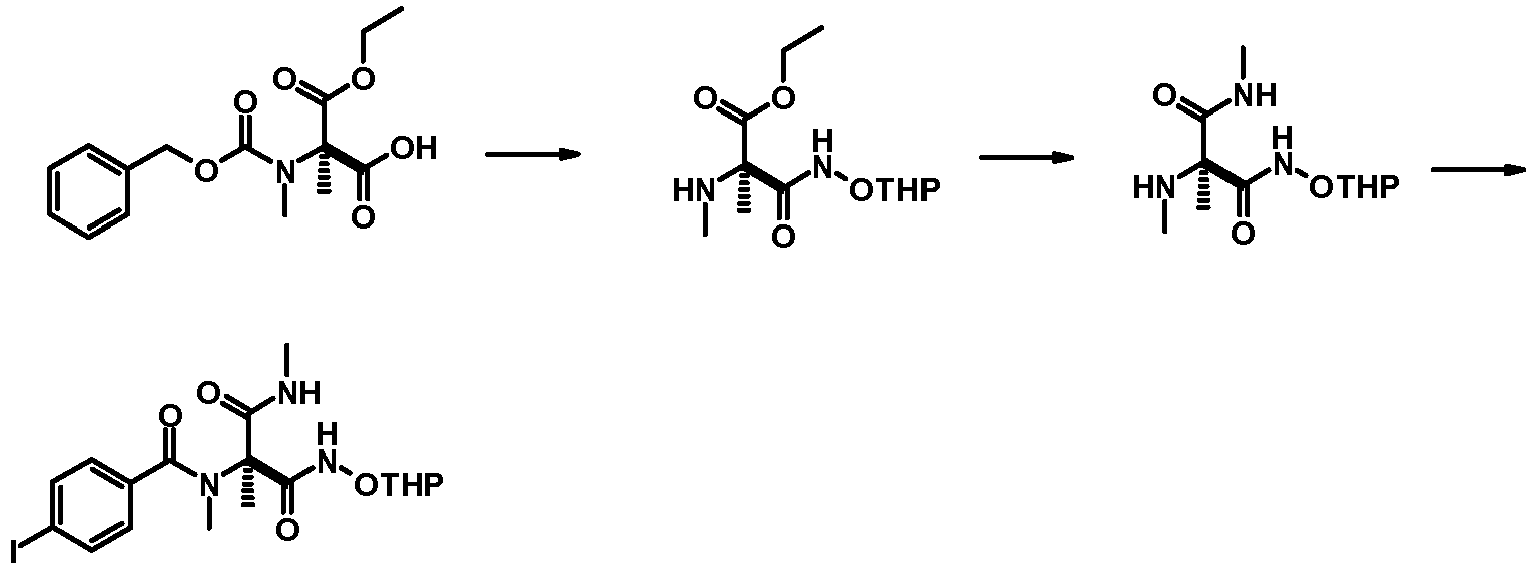
- To 250 g of (((((2R)-2-carboxy-1-ethoxy-1-oxopropan-2-yl)(methyl)carbamoyl)oxy)methyl)benzene, 1300 mL of ethyl acetate and 1.0 mL of N,N-dimethylformamide were added. After 133 g of oxalyl chloride was added dropwise at 5 °C over 20 minutes, 200 mL of ethyl acetate was added. The reaction mixture was warmed to 20 °C and stirred for 4 hours. Under reduced pressure, 1395 mL of the solvent was distilled off. To the obtained residue, 1000 mL of tetrahydrofuran was added and cooled to 8 °C. At the same temperature, 94.1 g of triethylamine and 109 g of O-(tetrahydro-2H-pyran-2-yl)hydroxylamine were added sequentially, and warmed to 20 °C over 3 hours with stirring. After the reaction mixture was allowed to stand overnight, 225 mL of acetone was added and stirred for 40 minutes. Subsequently, 750 mL of toluene and 1000 mL water were added and cooled to 10 °C. Then 62 mL of hydrochloric acid was added. Additionally, the pH was adjusted to 3 with 6 mol/L hydrochloric acid and a 20% sodium hydroxide aqueous solution, and the aqueous layer was separated. To the obtained aqueous layer, 1250 mL of ethyl acetate was added, and 210 mL of a 20% sodium hydroxide aqueous solution was added. Subsequently, 1450 g of sodium chloride was added, and the resultant solution was warmed to 30°C. The organic layer was separated, and the aqueous layer was extracted with 750 mL of ethyl acetate. The organic layer and the extract solution were combined, and the solvent was distilled off under reduced pressure. To the obtained residue, 250 mL of toluene was added. The solvent was distilled off under reduced pressure to obtain 215 g of an orange oily product.
- To 213 g of the obtained oily product, a 40% methylamine/methanol solution was added at room temperature, stirred at 40 to 43°C for 8 hours and 30 minutes, and then, allowed to stand overnight. Additionally, after stirring at 45°C for 5 hours, the solvent was distilled off under reduced pressure. To the obtained residue, toluene was added, and the solvent was distilled off under reduced pressure. Subsequently, tetrahydrofuran was added to the obtained residue, and the solvent was distilled off under reduced pressure to obtain 203 g of a yellow oily product.
- To 203 g of the obtained oily product, 1400 mL of tetrahydrofuran was added, and 117 g of sodium hydrogen carbonate was added at 35°C. Subsequently, a mixture of 168 g of 4-iodobenzoyl chloride and 200 mL of tetrahydrofuran, and 100 mL of tetrahydrofuran were added at the same temperature and stirred for 5 hours. After 58.2 g of sodium hydrogen carbonate and 29 mL of morpholine were added to the reaction mixture at the same temperature and stirred for 2 hours, the mixture was allowed to stand overnight at room temperature. To the reaction mixture, 1370 mL of ethyl acetate, 1700 mL of water and 170 g of sodium chloride were added sequentially, and the organic layer was separated. After 860 mL of water and 42.7 g of sodium chloride were added to the obtained organic layer and stirred for 15 minutes, the organic layer was separated. The obtained organic layer was filtered, and the solvent of the filtrate was distilled off under reduced pressure. After 300 mL of ethyl acetate and 300 mL of toluene were added to the obtained residue and stirred at 30°C for an hour, the mixture was allowed to stand overnight. The solid was filtered off and washed with an ethyl acetate/toluene mixture (1:1, 300 mL) to obtain 206 g of a brown solid. After 2000 mL of ethyl acetate was added to the obtained brown solid and stirred at 40°C for an hour, the mixture was cooled under ice cooling, and the solid was filtered off. The solid was washed with ethyl acetate to obtain 148.9 g (>99.9% ee) of (2S)-2-((4-iodobenzoyl)(methyl)amino)-N,2-dimethyl-N'-(tetrahydro-2H-pyran-2-yloxy)malonamide as colorless crystals.
1H-NMR (400 MHz, DMSO-d6) δ: 1.40-1.75 (6H, m), 1.61 (3H, s), [2.62] 2.63 (3H, d, J=3.7 Hz), 2.99 (3H, d, J=2.7 Hz), 3.40-3.60 (1H, m), [3.82-3.92] 3.92-4.02 (1H, m), [4.74-4.80] 4.80-4.86 (1H, m), [7.31] 7.33 (2H, d, J=8.2 Hz), 7.85 (2H, d, J=8.3 Hz), [8.25-8.33] 8.35-8.43 (1H, m), 11.52 (1H, s) -
- Column: 4.6 × 250 mm CHIRALPAK ID 5 µm
- Measurement wavelength: 230 nm
- Column temperature: 40°C
- Mobile phase: hexane:ethanol = 85:15
- Flow rate: 1.0 mL/minute
-

- To a mixture of 1.08 g of (1S)-1-(4-bromophenyl)ethane-1,2-diol, 350 mg of bis-triphenylphosphinepalladium(II) dichloride, 190 mg of copper(I) iodide, and 10 mL of n-butyl acetate, 7.8 mL of triisopropylsilylacetylene and 7.0 mL of triethylamine were added under a nitrogen atmosphere, and the resulting mixture was stirred under reflux for 1 hour. The reaction mixture was cooled, a saturated aqueous solution of ammonium chloride was added, the pH was adjusted to 6.2 with 6 mol/L hydrochloric acid, then Celpure and ethyl acetate were added, and then the insoluble material was filtered off. The organic layer of the filtrate was separated, washed with a saturated aqueous solution of sodium chloride, and then dried over anhydrous magnesium sulfate. The solvent was distilled off under reduced pressure, and the obtained residue was subjected to silica gel column chromatography [eluent; ethyl acetate:hexane = 40:60 -→ 45:55] to obtain 1.32 g of a yellow oil.
- To a mixture of 1.32 g of the obtained yellow oil and 13 mL of tetrahydrofuran, 6.2 mL of a 1 mol/L solution of tetra-n-butylammonium fluoride in tetrahydrofuran was added under ice cooling, and the resulting mixture was stirred at the same temperature for 30 minutes and then at room temperature for 45 minutes. A saturated aqueous solution of ammonium chloride was added to the reaction mixture, the pH was adjusted to 2.0 with 1 mol/L hydrochloric acid, and then ethyl acetate was added. The organic layer was separated, and the aqueous layer was extracted with ethyl acetate twice. The organic layer was combined with the extract, washed with a saturated aqueous solution of sodium chloride, and then dried over anhydrous magnesium sulfate. The solvent was distilled off under reduced pressure, and the obtained residue was purified by silica gel column chromatography [eluent; ethyl acetate:hexane = 50:50 -→ 70:30] to obtain 513 mg of a light brown solid. Hexane was added thereto, and the solid material was collected by filtration to obtain 466 mg of (1S)-1-(4-ethynylphenyl)ethane-1,2-diol as a light brown solid.
1H-NMR (400 MHz, CDCl3) δ: 1.97-2.07 (1H, m), 2.56 (1H, d, J = 3.4 Hz), 3.08 (1H, s), 3.56-3.70 (1H, m), 3.71-3.82 (1H, m), 4.79-4.88 (1H, m), 7.34 (2H, d, J = 8.3 Hz), 7.49 (2H, d, J = 8.3 Hz) -

- To a mixture of 587 mg of (2S)-2-((4-iodobenzoyl)(methyl)amino)-N,2-dimethyl-N'-(tetrahydro-2H-pyran-2-yloxy)malonamide, 253 mg of (1S)-1-(4-ethynylphenyl)ethane-1,2-diol, 84 mg of bis-triphenylphosphinepalladium(II) dichloride, 46 mg of copper(I) iodide, and 6.0 mL of tetrahydrofuran, 0.59 mL of triethylamine was added under a nitrogen atmosphere and under ice cooling, and the resulting mixture was stirred at the same temperature for 2 hours. A saturated aqueous solution of ammonium chloride and ethyl acetate were added to the reaction mixture, and the pH was adjusted to 6.4 with 1 mol/L hydrochloric acid. The organic layer was separated, and the aqueous layer was extracted with ethyl acetate. The organic layer was combined with the extract, washed with a saturated aqueous solution of sodium chloride, and then dried over anhydrous sodium sulfate. The solvent was distilled off under reduced pressure, and the obtained residue was purified by silica gel column chromatography [eluent; acetone:chloroform = 40:60] to obtain 767 mg of (2S)-2-((4-((4-((1S)-1,2-dihydroxyethyl)phenyl)ethynyl)benzoyl)(methyl)amino)-N,2-dimethyl-N'-(tetrahydro-2H-pyran-2-yloxy)malonamide as a pale yellow foamy solid.
1H-NMR (400 MHz, CDCl3) δ: 1.50-1.68 (3H, m), 1.71-1.92 (3H, m), [1.82], 1.83 (3H, s), 2.08-2.14 (1H, m), 2.63-2.68 (1H, m), [2.86], 2.87 (3H, d, J = 4.1 Hz), [3.17], 3.20 (3H, s), 3.53-3.83 (3H, m), 3.83-4.07 (1H, m), 4.83-4.89 (1H, m), 4.93-5.03 (1H, m), 7.37 (2H, d, J = 8.0 Hz), 7.48-7.61 (6H, m), [6.97-7.04], 7.61-7.67 (1H, m), [10.10], 10.51 (1H, s) -

- To a mixture of 767 mg of (2S)-2-((4-((4-((1S)-1,2-dihydroxyethyl)phenyl)ethynyl)benzoyl)(methyl)amino)-N,2-dimethyl-N'-(tetrahydro-2H-pyran-2-yloxy)malonamide and 6.0 mL of methanol, 46 mg of p-toluenesulfonic acid monohydrate was added under ice cooling, and the resulting mixture was stirred at the same temperature for 40 minutes and then at room temperature for 1 hour. Water and ethyl acetate were added to the reaction mixture, and the resulting mixture was neutralized with a saturated aqueous solution of sodium hydrogen carbonate. The organic layer was separated, ethyl acetate and sodium chloride were added to the aqueous layer, and the solid material was collected by filtration. The organic layer of the filtrate was separated, ethyl acetate and sodium chloride were added to the aqueous layer, and the solid material was collected by filtration. The organic layer of the filtrate was separated, the organic layer and the solid material thus obtained were combined together, and then the solvent was distilled off under reduced pressure. The obtained residue was purified by silica gel column chromatography [eluent; methanol:chloroform = 10:90 -→ 15:85] to obtain 585 mg of a yellow foamy solid. Ethyl acetate and IPE were added thereto, and the solid material was collected by filtration to obtain 463 mg of (2S)-2-((4-((4-((1S)-1,2-dihydroxyethyl)phenyl)ethynyl)benzoyl)(methyl)amino)-N-hydroxy-N',2-dimethyl-malonamide (Compound A) as a yellow solid.
1H-NMR (400 MHz, CD3OD) δ: 1.77 (3H, s), 2.79 (3H, s), 3.17 (3H, s), 3.55-3.68 (2H, m), 4.67-4.74 (1H, m), 7.41 (2H, d, J = 8.3 Hz), 7.51 (2H, d, J = 8.3 Hz), 7.55 (2H, d, J = 8.5 Hz), 7.68 (2H, d, J = 8.5 Hz); MS (ESI): 462[M+Na]+, 438[M-H]- -

- In the same manner as in Production Example 3, from 1.09 g of (1R)-1-(4-bromophenyl)ethane-1,2-diol, 558 mg of (1R)-1-(4-ethynylphenyl)ethane-1,2-diol was obtained as a white solid.
1H-NMR (400 MHz, CDCl3) δ: 2.00 (1H, dd, J = 7.1, 4.9 Hz), 2.54 (1H, d, J = 3.4 Hz), 3.08 (1H, s), 3.60-3.68 (1H, m), 3.73-3.81 (1H, m), 4.80-4.88 (1H, m), 7.34 (2H, d, J = 8.1 Hz), 7.49 (2H, d, J = 8.0 Hz) -

- In the same manner as in Production Example 4, from 587 mg of (2S)-2-((4-iodobenzoyl)(methyl)amino)-N,2-dimethyl-N'-(tetrahydro-2H-pyran-2-yloxy)malonamide and 291 mg of (1R)-1-(4-ethynylphenyl)ethane-1,2-diol, 797 mg of (2S)-2-((4-((4-((1R)-1,2-dihydroxyethyl)phenyl)ethynyl)benzoyl)(methyl)amino)-N,2-dimethyl-N'-(tetrahydro-2H-pyran-2-yloxy)malonamide was obtained as a light brown foamy solid.
1H-NMR (400 MHz, CDCl3) δ: 1.53-1.69 (3H, m), 1.76-1.92 (3H, m), [1.81], 1.82 (3H, s), 2.27-2.37 (1H, m), 2.83-2.91 (4H, m), [3.17], 3.19 (3H, s), 3.53-3.83 (3H, m), [3.83-3.92], 3.98-4.08 (1H, m), 4.81-4.88 (1H, m), 4.94-5.04 (1H, m), 7.35 (2H, d, J = 8.1 Hz), 7.45-7.59 (6H, m), [6.96-7.06], 7.59-7.68 (1H, m), [10.14], 10.56 (1H, s) -

- To a mixture of 797 mg of (2S)-2-((4-((4-((1R)-1,2-dihydroxyethyl)phenyl)ethynyl)benzoyl)(methyl)amino)-N,2-dimethyl-N'-(tetrahydro-2H-pyran-2-yloxy)malonamide and 6.3 mL of methanol, 46 mg of p-toluenesulfonic acid monohydrate was added under ice cooling, and the resulting mixture was stirred at the same temperature for 30 minutes and then at room temperature for 45 minutes. Water and ethyl acetate were added to the reaction mixture, and the resulting mixture was neutralized with a saturated aqueous solution of sodium hydrogen carbonate. The organic layer was separated, and the aqueous layer was extracted with ethyl acetate twice. Sodium chloride was added to the aqueous layer, and the solid material was collected by filtration. Sodium chloride and ethyl acetate were added to the filtrate, and the solid material was collected by filtration. The organic layer of the filtrate was separated, the organic layer, the extract, and the solid material thus obtained were combined together, and then the solvent was distilled off under reduced pressure. The obtained residue was purified by silica gel column chromatography [eluent; methanol:chloroform = 10:90 -→ 15:85] to obtain 556 mg of a yellow foamy solid. Ethyl acetate and IPE were added thereto, and the solid material was collected by filtration to obtain 458 mg of (2S)-2-((4-((4-((1R)-1,2-dihydroxyethyl)phenyl)ethynyl)benzoyl)(methyl)amino)-N-hydroxy-N',2-dimethyl-malonamide (Compound B) as a yellow solid.
1H-NMR (400 MHz, CD3OD) δ: 1.78 (3H, s), 2.80 (3H, s), 3.17 (3H, s), 3.57-3.67 (2H, m), 4.68-4.74 (1H, m), 7.42 (2H, d, J = 8.3 Hz), 7.52 (2H, d, J = 8.3 Hz), 7.56 (2H, d, J = 8.6 Hz), 7.61 (2H, d, J = 8.6 Hz); MS (ESI): 462[M+Na]+, 438[M-H]- -

- To a mixture of 2.79 g of (1S)-1-(4-((triisopropylsilyl)ethynyl)phenyl)ethane-1,2-diol, 28 mL of dichloromethane, 2.7 mL of triethylamine, and 213 mg of N,N-dimethylaminopyridine obtained in the same manner as in Production Example 3, 1.45 g of tert-butyldimethylsilyl chloride was added under a nitrogen atmosphere and under ice cooling, and the resulting mixture was stirred at room temperature for 2 hours, and then was allowed to stand at the same temperature overnight. A saturated aqueous solution of ammonium chloride and ethyl acetate were added to the reaction mixture, and the pH was adjusted to 4.0 with 6 mol/L hydrochloric acid. The organic layer was separated, washed with a saturated aqueous solution of sodium chloride, and then dried over anhydrous magnesium sulfate. The solvent was distilled off under reduced pressure to obtain 3.70 g of a brown oil.
- To 3.70 g of the obtained brown oil, 28 mL of dichloromethane and 439 mg of pyridinium p-toluenesulfonate were added, 2.4 mL of 3,4-dihydro-2H-pyran was added under ice cooling, and then the resulting mixture was stirred at room temperature for 5 hours. To the reaction mixture, 3.0 mL of triethylamine was added, and the solvent was distilled off under reduced pressure. Water and ethyl acetate were added to the obtained residue. The organic layer was separated, washed with a saturated aqueous solution of sodium chloride, and then dried over anhydrous magnesium sulfate. The solvent was distilled off under reduced pressure, and the obtained residue was purified by silica gel column chromatography [eluent; diethyl ether:hexane = 10:90] to obtain 3.65 g of a yellow oil.
- To 3.65 g of the obtained yellow oil, 18 mL of tetrahydrofuran was added, then 17 mL of a 1 mol/L solution of tetra-n-butylammonium fluoride in tetrahydrofuran was added under ice cooling, and the resulting mixture was stirred at room temperature for 1 hour. A saturated aqueous solution of ammonium chloride and ethyl acetate were added to the reaction mixture. The organic layer was separated, washed with a saturated aqueous solution of sodium chloride, and then dried over anhydrous sodium sulfate. The solvent was distilled off under reduced pressure, and the obtained residue was purified by silica gel column chromatography [eluent; ethyl acetate:hexane = 30:70 -→ 40:60] to obtain 1.78 g of (2S)-2-(4-ethynylphenyl)-2-(tetrahydro-2H-pyran-2-yloxy)ethanol as a white solid.
1H-NMR (400 MHz, CDCl3) δ: 1.40-1.93 (6H, m), 2.11-2.20 (1H, m), [3.06], 3.07 (1H, s), 3.51-3.61 (1H, m), 3.62-3.76 (2H, m), [3.25-3.34], 3.92-4.07 (1H, m), [4.48-4.53], 4.79-4.86 (1H, m), [4.70-4.75], 4.87-4.93 (1H, m), [7.29], 7.35 (2H, d, J = 8.3 Hz), 7.45 (2H, d, J = 8.0 Hz) -

- To a mixture of 800 mg of (2S)-2-(4-ethynylphenyl)-2-(tetrahydro-2H-pyran-2-yloxy)ethanol, 4.0 mL of dimethyl sulfoxide, and 0.4 mL of methyl iodide, 545 mg of potassium hydroxide was added under a nitrogen atmosphere and under ice cooling, and the resulting mixture was stirred at room temperature for 1 hour and 30 minutes. Toluene and a saturated aqueous solution of ammonium chloride were added to the reaction mixture, and the pH was adjusted to 6.1 with 6 mol/L hydrochloric acid. The organic layer was separated, washed with a saturated aqueous solution of sodium chloride, and then dried over anhydrous magnesium sulfate. The solvent was distilled off under reduced pressure, and the obtained residue was purified by silica gel column chromatography [eluent; ethyl acetate:hexane = 10:90] to obtain 836 mg of 2-((1S)-1-(4-ethynylphenyl)-2-methoxyethoxy)tetrahydro-2H-pyran as a colorless oil.
1H-NMR (400 MHz, CDCl3) δ: 1.40-1.94 (6H, m), [3.05], 3.07 (1H, s), [3.36], 3.39 (3H, s), 3.45-3.56 (2H, m), [3.56-3.62], 3.62-3.69 (1H, m), [3.28-3.35], 3.97-4.06 (1H, m), [4.80-4.85], 4.91-4.97 (1H, m), [4.41-4.46], 4.97-5.01 (1H, m), [7.30], 7.37 (2H, d, J = 8.4 Hz), 7.44-7.51 (2H, m) -

- To a mixture of 478 mg of 2-((1S)-1-(4-ethynylphenyl)-2-methoxyethoxy)tetrahydro-2H-pyran, 3.0 mL of tetrahydrofuran, 300 mg of (2S)-2-((4-iodobenzoyl)(methyl)amino)-N,2-dimethyl-N'-(tetrahydro-2H-pyran-2-yloxy)malonamide, 43 mg of bis-triphenylphosphinepalladium(II) dichloride, and 23 mg of copper(I) iodide, 0.51 mL of triethylamine was added under a nitrogen atmosphere and under ice cooling, and the resulting mixture was stirred at the same temperature for 2 hours and 30 minutes. A saturated aqueous solution of ammonium chloride and ethyl acetate were added to the reaction mixture, and the pH was adjusted to 6.0 with 6 mol/L hydrochloric acid. The organic layer was separated, washed with a saturated aqueous solution of sodium chloride, and then dried over anhydrous magnesium sulfate. The solvent was distilled off under reduced pressure, and the obtained residue was purified by silica gel column chromatography [eluent; acetone:chloroform = 10:90] to obtain 485 mg of (2S)-2-((4-((4-((1S)-2-methoxy-1-(tetrahydro-2H-pyran-2-yloxy)ethyl)phenyl)ethynyl)benzoyl)(methyl)amino)-N,2-dimethyl-N'-(tetrahydro-2H-pyran-2-yloxy)malonamide as a brown foamy solid.
1H-NMR (400 MHz, CDCl3) δ: 1.42-1.94 (12H, m), [1.81], 1.82 (3H, s), [2.85], 2.86 (3H, d, J = 4.4 Hz), [3.17], 3.20 (3H, s), [3.37], 3.40 (3H, s), 3.47-3.72 (4H, m), [3.29-3.36], 3.83-3.91 (1H, m), 3.97-4.07 (1H, m), [4.43-4.48], 4.93-4.98 (1H, m), [4.84], 4.95 (1H, dd, J = 7.3, 4.2 Hz), 4.98-5.03 (1H, m), [7.34], 7.41 (2H, d, J = 8.3 Hz), 7.44-7.61 (6H, m), [6.96-7.04], 7.62-7.72 (1H, m), [10.01], 10.53 (1H, s) -

- To a mixture of 485 mg of (2S)-2-((4-((4-((1S)-2-methoxy-1-(tetrahydro-2H-pyran-2-yloxy)ethyl)phenyl)ethynyl)benzoyl)(methyl)amino)-N,2-dimethyl-N'-(tetrahydro-2H-pyran-2-yloxy)malonamide and 4.8 mL of methanol, 23 mg of p-toluenesulfonic acid monohydrate was added under ice cooling, and the resulting mixture was stirred at the same temperature for 10 minutes and then at room temperature for 1 hour. Water and ethyl acetate were added to the reaction mixture, and the resulting mixture was neutralized with a saturated aqueous solution of sodium hydrogen carbonate. The organic layer was separated, and the obtained aqueous layer was extracted with ethyl acetate. Sodium chloride was added to the aqueous layer, and the aqueous layer was extracted with ethyl acetate twice. The organic layer was combined with the extract, and then dried over anhydrous sodium sulfate. The solvent was distilled off under reduced pressure, and the obtained residue was purified by silica gel column chromatography [eluent; methanol:chloroform = 4:96 -→ 6:94] to obtain 288 mg of a brown solid. Ethyl acetate and IPE were added thereto, and the solid material was collected by filtration to obtain 240 mg of (2S)-N-hydroxy-2-((4-((4-((1S)-1-hydroxy-2-methoxyethyl)phenyl)ethynyl)benzoyl)(methyl)amino)-N',2-dimethyl-malonamide (Compound C) as a brown solid.
1H-NMR (400 MHz, CD3OD) δ: 1.77 (3H, s), 2.79 (3H, s), 3.17 (3H, s), 3.37 (3H, s), 3.50 (2H, d, J = 5.9 Hz), 7.41 (2H, d, J = 8.3 Hz), 7.47-7.65 (6H, m); MS (ESI): 476[M+Na]+, 452[M-H]- - To a solution of 72.0 g of HPβCD (HPB-EC, NIHON SHOKUHIN KAKO CO., LTD.) in 130 mL of water for injection, 7.2 g of Compound A monohydrate was added, and then stirred at room temperature to obtain an aqueous solution of Compound A. To this solution, a portion of water for injection was added to achieve a total amount of 200 mL. The resultant was filtered through a 0.22 µm membrane filter to obtain a liquid formulation. The liquid formulation had a pH of 4.5.
- To 10 mL of the liquid formulation obtained in Example 1, 50 µL of 0.1 mol/L hydrochloric acid and 250 µL of 0.01 mol/L hydrochloric acid were added. The resultant was filtered through a 0.22 µm membrane filter to obtain a liquid formulation. The liquid formulation had a pH of 3.0.
- To 10 mL of the liquid formulation obtained in Example 1, 70 µL of 0.01 mol/L hydrochloric acid was added. The resultant was filtered through a 0.22 µm membrane filter to obtain a liquid formulation. The liquid formulation had a pH of 4.0.
- To 10 mL of the liquid formulation obtained in Example 1, 20 µL of a 0.01 mol/L sodium hydroxide aqueous solution was added. The resultant was filtered through a 0.22 µm membrane filter to obtain a liquid formulation. The liquid formulation had a pH of 5.1.
- To 10 mL of the liquid formulation obtained in Example 1, 160 µL of a 0.01 mol/L sodium hydroxide aqueous solution was added. The resultant was filtered through a 0.22 µm membrane filter to obtain a liquid formulation. The liquid formulation had a pH of 6.0.
- To 10 mL of the liquid formulation obtained in Example 1, 90 µL of a 0.1 mol/L sodium hydroxide aqueous solution and 50 µL of a 0.01 mol/L sodium hydroxide aqueous solution were added. The resultant was filtered through a 0.22 µm membrane filter to obtain a liquid formulation. The liquid formulation had a pH of 7.0.
- To 10 mL of the liquid formulation obtained in Example 1, 60 µL of a 1 mol/L sodium hydroxide aqueous solution and 80 µL of a 0.1 mol/L sodium hydroxide aqueous solution were added. The resultant was filtered through a 0.22 µm membrane filter to obtain a liquid formulation. The liquid formulation had a pH of 8.0.
- To 10 mL of the liquid formulation obtained in Example 1, 40 µL of a 10% citric acid monohydrate aqueous solution was added. The resultant was filtered through a 0.22 µm membrane filter to obtain a liquid formulation. The liquid formulation had a pH of 3.0.
- To 10 mL of the liquid formulation obtained in Example 1, 2 µL of a 10% citric acid monohydrate aqueous solution was added. The resultant was filtered through a 0.22 µm membrane filter to obtain a liquid formulation. The liquid formulation had a pH of 3.9.
- To 10 mL of the liquid formulation obtained in Example 1, 5 µL of a 1% meglumine aqueous solution was added. The resultant was filtered through a 0.22 µm membrane filter to obtain a liquid formulation. The liquid formulation had a pH of 5.1.
- To 10 mL of the liquid formulation obtained in Example 1, 25 µL of a 1% meglumine aqueous solution was added. The resultant was filtered through a 0.22 µm membrane filter to obtain a liquid formulation. The liquid formulation had a pH of 5.9.
- To 10 mL of the liquid formulation obtained in Example 1, 20 µL of a 10% meglumine aqueous solution was added. The resultant was filtered through a 0.22 µm membrane filter to obtain a liquid formulation. The liquid formulation had a pH of 6.9.
- To 10 mL of the liquid formulation obtained in Example 1, 19 mg of meglumine was added and stirred. The resultant was then filtered through a 0.22 µm membrane filter to obtain a liquid formulation. The liquid formulation had a pH of 8.0.
- To a solution of 14.4 g of HPβCD (HPB-EC, NIHON SHOKUHIN KAKO CO., LTD.) in 25 mL of water for injection, 1.44 g of Compound A monohydrate was added, and then stirred at room temperature to obtain an aqueous solution of Compound A. To this solution, a portion of water for injection was added to achieve a total amount of 40 mL. The resultant was filtered through a 0.22 µm membrane filter to obtain a preparation. To 5 mL of this preparation, a portion of 5% glucose aqueous solution (Otsuka Glucose Injection 5%, Otsuka Pharmaceutical Factory, Inc.) was added to achieve a total amount of 100 mL. This preparation was frozen at - 78°C to obtain a frozen liquid formulation.
- To 10 mL of the preparation obtained in Example 14, a 5% glucose aqueous solution (Otsuka Glucose Injection 5%, Otsuka Pharmaceutical Factory, Inc.) was added to achieve a total amount of 100 mL. This preparation was frozen at -78°C to obtain a frozen liquid formulation.
- To 20 mL of the preparation obtained in Example 14, a portion of 5% glucose aqueous solution (Otsuka Glucose Injection 5%, Otsuka Pharmaceutical Factory, Inc.) was added to achieve a total amount of 100 mL. This preparation was frozen at -78°C to obtain a frozen liquid formulation.
- To a solution of 115.0 g of HPβCD (HPB-EC, NIHON SHOKUHIN KAKO CO., LTD.) in 200 mL of water for injection, 11.5 g of Compound A monohydrate was added and then, stirred at room temperature to obtain an aqueous solution of Compound A. To this solution, a portion of water for injection was added to achieve a total amount of 320 mL. The resultant was filtered through a 0.22 µm membrane filter to obtain a liquid preparation. Two mL of this preparation was filled into a vial, and lyophilized. Then, the vial was hermetically sealed to obtain a lyophilized formulation.
- To 23 mL of the liquid preparation obtained in Example 17, 2.31 g of D-mannitol was added, and stirred. Then, the resultant was filtered through a 0.22 µm membrane filter to obtain a liquid preparation. Two mL of this preparation was filled into a vial, and lyophilized. Then, the vial was hermetically sealed to obtain a lyophilized formulation.
- To 23 mL of the liquid preparation obtained in Example 17, 2.31 g of D-sorbitol was added, and stirred. Then, the resultant was filtered through a 0.22 µm membrane filter to obtain a liquid preparation. Two mL of this preparation was filled into a vial, and lyophilized. Then, the vial was hermetically sealed to obtain a lyophilized formulation.
- To 23 mL of the liquid preparation obtained in Example 17, 2.31 g of xylitol was added, and stirred. Then, the resultant was filtered through a 0.22 µm membrane filter to obtain a liquid preparation. Two mL of this preparation was filled into a vial, and lyophilized. Then, the vial was hermetically sealed to obtain a lyophilized formulation.
- To 23 mL of the preparation obtained in Example 17, 2.30 g of trehalose was added, and stirred. Then, the resultant was filtered through a 0.22 µm membrane filter to obtain a liquid preparation. Two mL of this preparation was filled into a vial, and lyophilized. Then, the vial was hermetically sealed to obtain a lyophilized formulation.
- To 23 mL of the liquid preparation obtained in Example 17, 2.29 g of glucose was added, and stirred. Then, the resultant was filtered through a 0.22 µm membrane filter to obtain a liquid preparation. Two mL of this preparation was filled into a vial, and lyophilized. Then, the vial was hermetically sealed to obtain a lyophilized formulation.
- To 23 mL of the liquid preparation obtained in Example 17, 2.31 g of fructose was added, and stirred. Then, the resultant was filtered through a 0.22 µm membrane filter to obtain a liquid preparation. Two mL of this preparation was filled into a vial, and lyophilized. Then, the vial was hermetically sealed to obtain a lyophilized formulation.
- To 23 mL of the liquid preparation obtained in Example 17, 2.30 g of sucrose was added, and stirred. Then, the resultant was filtered through a 0.22 µm membrane filter to obtain a liquid preparation. Two mL of this preparation was filled into a vial, and lyophilized. Then, the vial was hermetically sealed to obtain a lyophilized formulation.
- To 23 mL of the liquid preparation obtained in Example 17, 2.29 g of glycine was added, and stirred. Then, the resultant was filtered through a 0.22 µm membrane filter to obtain a liquid preparation. Two mL of this preparation was filled into a vial, and lyophilized. Then, the vial was hermetically sealed to obtain a lyophilized formulation.
- To 24 mL of the liquid preparation obtained in the same manner as in Example 17, 40 µL of a 0.01 mol/L sodium hydroxide aqueous solution was added. This aqueous solution had a pH of 5.0. This aqueous solution was filtered through a 0.22 µm membrane filter to obtain a liquid preparation. Two mL of this preparation was filled into a vial, and lyophilized. Then, the vial was hermetically sealed to obtain a lyophilized formulation.
- To 24 mL of the liquid preparation obtained in the same manner as in Example 17, 100 µL of a 0.1 mol/L sodium hydroxide aqueous solution, 40 µL of a 0.01 mol/L sodium hydroxide aqueous solution and 95 µL of 0.1 mol/L hydrochloric acid were added. This aqueous solution had a pH of 5.0. This aqueous solution was filtered through a 0.22 µm membrane filter to obtain a liquid preparation. Two mL of this preparation was filled into a vial, and lyophilized. Then, the vial was hermetically sealed to obtain a lyophilized formulation.
- To 24 mL of the liquid preparation obtained in the same manner as in Example 17, 10 µL of a 1% meglumine aqueous solution was added. This aqueous solution had a pH of 5.0. This aqueous solution was filtered through a 0.22 µm membrane filter to obtain a liquid preparation. Two mL of this preparation was filled into a vial, and lyophilized. Then, the vial was hermetically sealed to obtain a lyophilized formulation.
- To 24 mL of the liquid preparation obtained in the same manner as in Example 17, 20 µL of a 10% meglumine aqueous solution, 5 µL of a 1% meglumine aqueous solution and 10 µL of 0.1 mol/L hydrochloric acid were added. This aqueous solution had a pH of 5.0. This aqueous solution was filtered through a 0.22 µm membrane filter to obtain a liquid preparation. Two mL of this preparation was filled into a vial, and lyophilized. Then, the vial was hermetically sealed to obtain a lyophilized formulation.
- To 10 mL of the liquid formulation obtained in Example 1, 50 µL of 1 mol/L hydrochloric acid and 350 µL of 0.1 mol/L hydrochloric acid were added to obtain a liquid formulation. The liquid formulation had a pH of 2.0.
- To 10 mL of the liquid formulation obtained in Example 1, 300 µL of a 1 mol/L sodium hydroxide aqueous solution was added to obtain a liquid formulation. The liquid formulation had a pH of 9.0.
- To 10 mL of the liquid formulation obtained in Example 1, 20 mg of citric acid monohydrate and 225 µL of a 10% citric acid monohydrate aqueous solution were added to obtain a liquid formulation. The liquid formulation had a pH of 2.0.
- To 10 mL of the liquid formulation obtained in Example 1, 100 mg of meglumine was added to obtain a liquid formulation. The liquid formulation had a pH of 9.0.
- In accordance with the following experimental procedures, liquid formulations of Examples 34 to 75 were obtained.
- Each abbreviation in tables has the following meaning.
- Ac-L-Trp-OH: N-acetyl-L-tryptophan
- Ala: Alanine
- Arg: Arginine
- BnOH: Benzyl alcohol
- DMAc: N,N-dimethylacetamide
- DMSO: Dimethylsulfoxide
- EtOH: Ethanol
- His: Histidine
- L-Phe-OBu(t)HCl: L-phenylalanine tert-butyl ester hydrochloride
- PEG: Polyethylene glycol
- Phe: Phenylalanine
- Pro: Proline
- Trp: Tryptophan
- β-Ala-OBu(t)HCl: β-alanine tert-butyl ester hydrochloride
- Compound A monohydrate, saline or water for injection, and a solubilizing agent, were mixed and then, stirred at room temperature to obtain a liquid formulation. When this liquid formulation was allowed to stand at room temperature for 2 hours, no precipitate was observed.
- Compound A monohydrate, saline or water for injection, and a solubilizing agent, were mixed and ultrasonicated to be dispersed. This mixture was warmed to 40 to 50°C to dissolve Compound A monohydrate, and then, left to room temperature to obtain a liquid formulation. When this liquid formulation was allowed to stand at room temperature for 2 hours, no precipitate was observed.
[Table 1] Water for injection, Compound A monohydrate Example 34 35 36 37 38 39 40 Experimental procedure A A A A B B B Compound A monohydrate (mg) 20 20 40 40 61 63 61 Saline (mL) 1 1 1 1 Water for injection (mL) 1.2 1.2 1.2 BnOH (mL) 0.3 0.2 EtOH (mL) 0.5 0.3 DMAc (mL) 0.5 0.6 0.3 0.6 PEG400 (mL) 1.2 1.2 Triethylene glycol (mL) 1.2 L-Arg (mg) 140 Trometamol (mg) 600 [Table 2] Water for injection, Compound A monohydrate Example 41 42 43 44 45 46 Experimental procedure B A A A A A Compound A monohydrate (mg) 61 40 40 40 40 40 Saline (mL) 1 1 1 1 1 Water for injection (mL) 1.2 BnOH (mL) 0.4 0.02 EtOH (mL) 0.3 DMAc (mL) 0.3 0.65 0.68 0.25 PEG400 (mL) 0.6 Triethylene glycol (mL) 1.2 DMSO (mL) 0.6 Meglumine (mg) 17.2 17.3 NaOH (mg) 3.6 3.6 [Table 3] Water for injection, Compound A monohydrate Example 47 48 49 50 51 52 53 54 Experimental procedure A A A A A A A A Compound A monohydrate (mg) 40 40 40 40 40 40 40 40 Saline (mL) 1 1 1 1 1 1 1 1 Water for injection (mL) EtOH (mL) DMAc (mL) 0.9 0.5 0.6 0.95 0.6 0.9 0.9 0.9 PEG400 (mL) Meglumine (mg) 17.2 34.6 17.2 17.2 17.2 Benzoic acid (mg) 10.7 2.4 Sodium benzoate (mg) 12.7 12.6 Citric acid (mg) 18.7 Sodium citrate (mg) 25.8 Nicotinic acid amide (mg) 10.8 10.7 [Table 4] Water for injection, Compound A monohydrate Example 55 56 57 58 59 60 Experimental procedure A B B B B B Compound A monohydrate (mg) 40 20 20 21 20 21 Saline (mL) 1 0.7 Water for injection (mL) 0.5 0.4 0.7 0.6 EtOH (mL) 0.2 DMAc (mL) 0.9 0.3 0.1 0.3 0.4 PEG400 (mL) 0.4 0.4 Benzoic acid (mg) 70 Sodium lactate (mg) 26.3 Nicotinic acid amide (mg) 203 206 206 121 [Table 5] Compound A monohydrate Example 61 62 63 64 65 66 67 68 Experimental procedure A A A A A A A A Compound A monohydrate (mg) 40 40 40 40 40 40 40 40 Saline (mL) 1 1 1 1 1 1 1 1 DMAc (mL) 0.9 0.9 0.9 0.9 0.9 0.9 0.9 0.9 L-His (mg) 13.7 L-Phe (mg) 14.7 L-Trp (mg) 18.0 DL-Pro (mg) 10.2 β -Ala (mg) 7.9 D-Phe (mg) 14.5 D-Trp (mg) 17.9 Cinnamic acid (mg) 13.1 [Table 6] Compound A monohydrate Example 69 70 71 72 73 74 75 Experimental procedure A A A A A A A Compound A monohydrate (mg) 40 40 40 40 40 40 40 Saline (mL) 1 1 1 1 1 1 1 DMAc (mL) 0.9 0.9 0.9 0.9 0.9 0.9 0.9 3-Phenylpropionic acid (mg) 13.2 3-(4-Hydroxyphenyl) propionic acid (mg) 14.7 Ac-L-Trp-OH (mg) 21.6 β-Ala-OBu(t)HCl (mg) 15.9 L-Phe-OBu(t)HCl (mg) 22.6 Taurine (mg) 11.0 p-Toluenesulfonic acid monohycrate (mg) 16.9 - The Pseudomonas aeruginosa LpxC enzyme activity was measured by reacting LpxC with its substrate UDP-3-O-(R-3-hydroxydecanoyl)-N-acetylglucosamine and measuring the amount of the reaction product by the quantification of an amino group present in the product. This measurement was carried out according to a method described in, for example, International Publication No.
WO 11/132712 - Specifically, to the Pseudomonas aeruginosa LpxC enzyme (which was obtained by preparing chromosomal DNA from Pseudomonas aeruginosa, obtaining the Pseudomonas aeruginosa LpxC gene by PCR (polymerase chain reaction) using LpxC-specific primers, and incorporating this gene into a vector, followed by gene expression using Escherichia coli), 20 µmol/L UDP-3-O-(R-3-hydroxydecanoyl)-N-acetylglucosamine (Wako Pure Chemical Industries, Ltd.) was added, and the mixture was incubated at 25°C for 1 hour. This reaction was carried out in a 40 mmol/L HEPES buffer solution (pH 8.0) containing 0.02% Brij 35 and 80 µmol/L dithiothreitol. The reaction was terminated by the addition of 20% acetic acid (final concentration: 0.95%) to the reaction solution. Then, fluorescamine (final concentration: 1.6 mg/mL) dissolved in anhydrous dioxane was added thereto. The amount of the reaction product was detected at an excitation wavelength/fluorescence wavelength = 390 nm/495 nm. Each test compound was allowed to coexist at various concentrations in the reaction to obtain an inhibition curve. From the inhibition curve, the concentration at which the test compound inhibited 50% of the amount of the reaction product (IC50 value) was determined and used as an index for Pseudomonas aeruginosa LpxC enzyme inhibitory activity.
- As a result, all the IC50 values of the test compounds were less than 50 nM.
- The test compounds exhibited an excellent Pseudomonas aeruginosa LpxC enzyme inhibitory activity.
- Compound A, Compound B and Compound C were used as a test compound.
- The minimum inhibitory concentration (MIC) was measured according to the CLSI (Clinical and Laboratory Standards Institute) standard method using a broth microdilution method given below.
- The bacteria used were a Pseudomonas aeruginosa ATCC27853 strain.
- Test bacterial cells of each strain cultured overnight in a Mueller-Hinton agar medium were scraped off and suspended at the McFarland 0.5 standard, and this suspension was diluted 10-fold to prepare an inoculum solution. The inoculum solution (0.005 mL) was inoculated to a cation-adjusted Mueller-Hinton medium containing each test compound and cultured at 35°C for 16 to 20 hours. The minimum drug concentration at which bacterial growth was not visible to the naked eye was defined as MIC.
- As a result, all the MICs of the test compounds were 1 µg/mL.
- The test compounds exhibited an excellent antimicrobial activity against Pseudomonas aeruginosa.
- Compound A and Compound B were used as a test compound.
- The mice used were male ICR SPF mice (4 weeks old: 5 individuals per group).
- To prepare a bacterial inoculum solution, a Pseudomonas aeruginosa clinical isolate (S-3232 strain) cultured overnight at 37°C on a Mueller-Hinton agar plate was cultured for 4 hours in a cation-adjusted Mueller-Hinton medium and then diluted 10-fold with a 10% mucin/phosphate buffer solution to prepare the inoculum solution.
- Infection was induced by the intraperitoneal inoculation of 0.5 mL of the inoculum solution (approximately 104 CFU/mouse) to each mouse. Each test compound was dissolved in a 10% HPβCD /2.5% mannitol aqueous solution and subcutaneously administered a single dose of 12.5 mg/kg at 1 hour after the infection. Three days after the infection, the number of survivors was recorded.
- As a result, in the control group wherein the test compound was not administered, all the mice died. In the groups wherein the test compound was administered, 80% or more of the mice were observed to survive 3 days after the bacterial inoculation, and an in vivo anti-Pseudomonas aeruginosa activity was confirmed. Also, in the group wherein 6.25 mg/kg of the test compound was administered, 80% or more of the mice were observed to survive 3 days after the bacterial inoculation, and an excellent in vivo anti-Pseudomonas aeruginosa activity was confirmed.
- Compound A, Compound B and Compound C were used as a test compound.
- The mice used were male ICR SPF mice (4 weeks old: 5 individuals per group).
- To prepare a bacterial inoculum solution, a multidrug-resistant Pseudomonas aeruginosa clinical isolate (S-2838 strain) cultured overnight at 37°C on a Mueller-Hinton agar plate was cultured for 5 hours in a cation-adjusted Mueller-Hinton medium and then diluted 10-fold with a 10% mucin/phosphate buffer solution to prepare the inoculum solution.
- Infection was induced by the intraperitoneal inoculation of 0.5 mL of the inoculum solution (approximately 106 CFU/mouse) to each mouse. Each test compound was dissolved in a 10% HPβCD /2.5% mannitol aqueous solution and intravenously administered to the tail a single dose of 50 mg/kg at 1 hour after the infection. Three days after the infection, the number of survivors was recorded.
- As a result, in the control group wherein the test compound was not administered, all the mice died. In all the groups wherein the test compound was administered, 100% of the mice were observed to survive 3 days after the bacterial inoculation, and an in vivo anti-multidrug-resistant Pseudomonas aeruginosa activity was confirmed. Also, in the group wherein 25 mg/kg of Test Compound A was administered, 60% or more of the mice were observed to survive 3 days after the bacterial inoculation, and an excellent in vivo anti-multidrug-resistant Pseudomonas aeruginosa activity was confirmed.
- Compound A, Compound B and Compound C were used as a test compound.
- The mice used were female ICR SPF mice (5 weeks old: 5 individuals per group).
- To prepare a bacterial inoculum solution, a Pseudomonas aeruginosa clinical isolate (S-2838 strain) was suspended in sterile saline.
- Infection was induced by the inoculation of 0.2 mL of the inoculum solution (approximately 103 CFU/mouse) through the urethra of each mouse. Each test compound was dissolved in a 10% HPβCD /2.5% mannitol aqueous solution and intravenously administered to the tail at a dose of 25 mg/kg once 2 hours after the infection. The numbers of bacterial colonies of the next day of the infection in the kidneys were recorded, and an average thereof was calculated.
- As a result, in all the groups wherein the test compound was administered, as compared to the control group wherein the test compound was not administered, a decrease of 2 log CFU/kidney or more in the intrarenal viable cell count was observed, and an anti-Pseudomonas aeruginosa activity in the urinary tract infection model was confirmed. Also, in the group wherein 12.5 mg/kg of Test Compound A was administered, as compared to the control group wherein the test compound was not administered, a decrease of 2 log CFU/kidney or more in the intrarenal viable cell count was observed, and an excellent anti-Pseudomonas aeruginosa activity in the urinary tract infection model was confirmed.
- Compound A, Compound B and Compound C were used as a test compound.
- The mice used were male ICR SPF mice (4.5 weeks old at the time of infection: 5 individuals per group). In order to achieve a transient compromised state, cyclophosphamide was intraperitoneally administered at a dose of 200 mg/kg to each mouse 4 days before injection.
- To prepare a bacterial inoculum solution, a Pseudomonas aeruginosa clinical isolate (S-2838 strain) was suspended in sterile saline.
- Infection was induced by the inoculation of 0.05 mL of the inoculum solution (approximately 105 CFU/mouse) to each mouse intranasally. Each test compound was dissolved in a 10% HPβCD /2.5% mannitol aqueous solution and intravenously administered to the tail at a dose of 50 mg/kg twice 2 and 8 hours after the infection. The numbers of bacterial colonies of the next day of the infection in the lungs were recorded, and an average thereof was calculated.
- As a result, in all the groups wherein the test compound was administered, as compared to the control group wherein the test compound was not administered, a decrease of 2 log CFU/lung or more in the intrapulmonary viable cell count was observed, and an anti-Pseudomonas aeruginosa activity in the pulmonary infection model was confirmed. Also, in the group wherein 25 mg/kg of Test Compound A was administered, as compared to the control group wherein the test compound was not administered, a decrease of 2 log CFU/lung or more in the intrapulmonary viable cell count was observed, and an excellent anti-Pseudomonas aeruginosa activity in the pulmonary infection model was confirmed.
- Compound A, Compound B and Compound C were used as a test compound.
- Each test compound was dissolved in dimethyl sulfoxide, adjusted to each concentration using E'MEM, and then dispensed at 0.1 mL/well to 96-well microplates. The Vero cell suspension was prepared at 3 × 10⁴ cells/mL using E'MEM supplemented with 20% FBS, inoculated thereto at 0.1 mL/well, and cultured at 37°C for 3 days under 5% CO2. At the completion of the culture, PBS supplemented with 1 mg/mL 2,3-bis-(2-methoxy-4-nitro-5-sulfophenyl)-5-((phenylamino)carbonyl)-2H-tetrazolium inner salt monosodium salt (XTT) and 25 µM phenazine methosulfate (PMS) was prepared and added thereto at 50 µL/well. Approximately 2 hours later, the absorbance at 450 nm was measured using a microplate reader.
- The absorbance ratio between a test compound-non-supplemented control and each well was calculated to calculate the concentration at which the compound inhibited 50% of cell growth (CC50; µg/mL).
- As a result, all the CC50s of the test compounds were 100 µg/mL or more.
- Compound A and Compound C were used as a test compound.
- HEK 293 cells (human embryo kidney 293 cells, Cytomyx LLC) transfected with hERG gene (human ether-a-go-go related gene) were used.
- The culture solution used was a MEM medium containing 10% fetal bovine serum and 1% non-essential amino acid and further supplemented with Geneticin at a concentration of 400 µg/mL. The cells were cultured in a carbonic acid gas incubator (37.0°C, 5% CO2).
- The hERG current was measured by a whole cell clamp method. A glass cover with the cells for measurement attached thereto was placed in a dish and perfused at a rate of 2 mL/min with a perfusate (composition: 137 mmol/L NaCl, 4 mmol/L KCl, 10 mmol/L HEPES, 1.8 mmol/L CaCl2, 1 mmol/L MgCl2, 10 mmol/L glucose, pH 7.4). The inside temperature of the perfusion chamber was kept at 25°C. The cells were contacted with a glass electrode (2.0 to 8.0 MΩ) charged with an internal solution (composition: 130 mmol/L KCl, 1 mmol/L MgCl2, 5 mmol/L EGTA, 10 mmol/L HEPES, 5 mmol/L MgATP, pH 7.2) to break the patch membranes, followed by the measurement of the hERG current using a patch clamp amplifier (EPC-7 Plus, HEKA) via patch clamp software pClamp 10 (Molecular Devices Corporation). The pulse protocol involved a holding potential of -80 mV, a depolarizing pulse of +20 mV for 1.5 seconds and a repolarizing pulse of -50 mV for 1.5 seconds. After confirmation that a stable current waveform was obtained, each test compound was applied thereto.
- Before the application and 10 minutes after the application, the peak value of tail current in the hERG current waveform was analyzed to calculate the ratio of the value 10 minutes after the application to the value before the application (relative value, %).
- As a result, none of the test compounds exhibited an hERG inhibitory activity up to 300 µmol/L.
- Compound A was used as a test compound.
- In order to examine the inducibility of the chromosomal aberrations by each test compound in cultured cells, the in vitro micronucleus test was carried out. This test was carried out by a short-time treatment method (in the presence and absence of a metabolic activation) and a 30-hour treatment method using Chinese hamster lung fibroblasts (CHL/IU cells). The concentration of the test compound was set to 1.00 mmol/L as the maximum dose with reference to the "Guidance on Genotoxicity Testing and Data Interpretation for Pharmaceuticals Intended for Human Use". Specimens were observed as to doses of 0.25, 0.50 and 1.00 mmol/L.
- The cells were inoculated at 15 × 104 cells to a 60-mm dish (IWAKI) and precultured at 37°C for 24 hours under 5% CO2 using a MEM medium (Sigma-Aldrich Co., Ltd.) containing 10% newborn calf serum (Sigma-Aldrich Co., Ltd.) and 50 U/mL-50 µg/mL Penicillin-Streptomycin (Sigma-Aldrich Co., Ltd.). After the completion of the preculture, a vehicle (DMSO) or each test compound was added thereto. In the short-time treatment method, 6 hours after the culture, the cells were washed with PBS(-) (Sigma-Aldrich Co., Ltd.), and then, the medium was replaced with a fresh medium, followed by further culture for 24 hours. In the 30-hour treatment method, after the addition of the test compound, the cells were cultured for 30 hours. After the completion of the culture, the cells were dissociated using a 0.05% trypsin-EDTA solution (Sigma-Aldrich Co., Ltd.). After centrifugation, the supernatant was removed, and 3 mL of a 0.075 mol/L aqueous potassium chloride solution was added to the cells. After hypotonic treatment at room temperature for 5 minutes, the cells were fixed with an ice-cold fixing solution (methanol:acetic acid = 19:1) to prepare a glass slide specimen (giemsa-stained (Merck)). Two thousand cells per dose were observed to measure the number of cells having the micronucleus. When the frequency of appearance of the micronucleus in the test compound group was significantly increased as compared with the vehicle control group, the test compound was confirmed to be positive. When this frequency of appearance was equivalent to that of the vehicle control, the test compound was confirmed to be negative.
- As a result, in either treatment method, the test compound was negative at the dose of 1 mmol/L or less.
- Compound A and Compound C were used as a test compound.
- Each test compound was added to human serum to prepare a 1 µg/mL spiked serum, which was then left standing at room temperature for 1 hour or longer. A filtrate (20 µL) was collected by a centrifugal ultrafiltration method (molecular weight cutoff: 10,000, 1500 × g, 25°C, 10 min), then human serum and an internal standard solution (furosemide-acetonitrile solution) were added thereto. To the compound-spiked serum, PBS and an internal standard solution were added. Each mixture was stirred and then centrifuged, and the concentration in the supernatant was determined by LC-MS/MS.
- The ratio of protein binding was determined according to the following calculation expression:

- As a result, all the protein binding ratios of the test compounds were 80% or less.
- Compound A and Compound C were used as a test compound.
- Pooled human liver microsomes were used. Substrates and their final concentrations as well as the positive controls and their final concentrations were as described in Tables 7 and 8. The reaction was carried out in a phosphate buffer solution (100 mmol/L, pH 7.4), and the final concentrations of the reaction system were set to 0.5 mg/mL human liver microsome protein, 1.55 mmol/L oxidized form of nicotinamide adenine dinucleotide phosphate (NADP+), 3.3 mmol/L glucose-6-phosphate, 3.3 mmol/L magnesium chloride and 0.4 Units/mL glucose-6-phosphate dehydrogenase (G6PDH). The final concentration of each compound in the reaction solution was set to 100 µM. Each of these reaction solutions was incubated at 37°C for 30 minutes. Then, the substrates were added thereto and reacted at 37°C for 10 minutes. The reaction was terminated by the addition of a 1.5-fold volume of an internal standard solution (acetonitrile solution containing 0.25 mmol/L dextrorphan and 2% formic acid). Then, the solution was centrifuged, and the concentration of metabolites in the supernatant was determined by LC-MS/MS.
- The ratio of inhibitory activity by addition of the inhibitor was determined according to the following calculation expression:

- As a result, all the inhibitory activity ratios of the test compounds were 30% or less.
[Table 7] Molecular species Substrate name Final concentration (µ mol/L) CYP1A2 Phenacetin 10 CYP2C8 Amodiaquine 0.2 CYP2C9 Tolbutamide 100 CYP2C19 (S)-Mephenytoin 40 CYP2D6 (±) - Bufuralol 4 CYP3A4 Midazolam 1 CYP3A4 Testosterone 5 [Table 8] Molecular species Positive control Final concentration (µ mol/L) CYP1A2 Furafyline 10 CYP2C8 Quercetin 10 CYP2C9 Tienilic acid 1 CYP2C19 Ticlopidine 1 CYP2D6 Paroxetine 2 CYP3A4 Verapamil 10 - The liquid formulations obtained in Examples 2 to 13 and 30 to 33 were stored at 25°C for 24 hours. The concentration of Compound A after storage was measured by the HPLC method to determine the residual ratio.
- The results are shown in Table 9.
- The residual ratio was determined by the following expression.

-
- Detector: LC-2010CHT (SHIMADZU CORPORATION)
- Detection at: 254 nm
- Column: XBridge C18 4.6 × 150 mm (Waters Corporation)
- Precolumn: Develosil ODS-HG 4.0 × 10 mm (Nomura Chemical Co., Ltd.)
- Column temperature: 40°C
- Flow rate: 1.0 mL/minute
- Mobile phase A: water/(0.2 mol/L formate buffer solution (pH 3)) = 90/10
- Mobile phase B: acetonitrile/(0.2 mol/L formate buffer solution (pH 3)) = 90/10
- Gradient cycle: 0 min (A solution/B solution = 90/10), 15 min (A solution/B solution = 70/30), 20 min (A solution/B solution = 0/100), 30 min (A solution/B solution = 0/100)
- The residual ratios of the liquid formulations in Examples were 90% or more. Particularly, the residual ratios of the liquid formulations in Examples in which the pH was from 3 to 8 were 95% or more. The liquid formulations in Examples were stable.
- Compound A monohydrate was used as a test compound.
- To 5 mL of a 10% CD or CD derivative solution, about 100 mg of Compound A monohydrate was added, and stirred at room temperature for 24 hours. To the solutions in which αCD, HPαCD, DMβCD and methyl-β-cyclodextrin were used, about 100 mg of Compound A monohydrate was added after 6 hours. After centrifugation (3000 rpm, 10 minutes), the supernatant was filtered with a filter, and the solubility was measured by the HPLC method.
- The results are shown in Table 10.
[Table 10] CD or CD derivative Solubility (mg/mL) None 0.2 α CD (NIHON SHOKUHIN KAKO CO., LTD.) 30.2 β CD (NIHON SHOKUHIN KAKO CO., LTD.) 5.9 γ CD (ASHLAND) 14.4 HP α CD (NIHON SHOKUHIN KAKO CO., LTD.) 25.7 SBE β CD (ChemScene) 8.9 2,3,6-Tri-O-methyl-β-cyclodextrin (Wako Pure Chemical Industries, Ltd.) 4.7 Hydroxyethyl-β-cyclodextrin (Sigma-Aldrich) 11.9 HP β CD (NIHON SHOKUHIN KAKO CO., LTD.) 11.6 DM β CD (Sigma-Aldrich) 16.6 6-O-α-maltosyl-β-cyclodextrin (Wako Pure Chemical Industries, Ltd.) 10.0 Methyl-β-cyclodextrin (Sigma-Aldrich) 17.5 HP γ CD (ASHLAND) 8.8 - Compound A exhibited excellent solubility due to the CD or CD derivative.
- The pharmaceutical composition comprising the hydroxamic acid derivative of the present invention or a salt thereof and a solubilizing agent exhibits a potent antimicrobial activity, has excellent solubility, and is useful as a medicine.
| pH | Residual ratio (%) | |
| Example 2 | 3.0 | 96.9 |
| Example 3 | 4.0 | 99.4 |
| Example 4 | 5.1 | 100.0 |
| Example 5 | 6.0 | 99.4 |
| Example 6 | 7.0 | 98.8 |
| Example 7 | 8.0 | 97.8 |
| Example 8 | 3.0 | 97.6 |
| Example 9 | 3.9 | 99.7 |
| Example 10 | 5.1 | 101.9 |
| Example 11 | 5.9 | 100.4 |
| Example 12 | 6.9 | 98.2 |
| Example 13 | 8.0 | 101.0 |
| Example 30 | 2.0 | 93.0 |
| Example 31 | 9.0 | 92.6 |
| Example 32 | 2.0 | 93.5 |
| Example 33 | 9.0 | 92.1 |
Claims (23)
- A pharmaceutical composition comprising a hydroxamic acid derivative selected from (2S)-2-((4-((4-((1S)-1,2-dihydroxyethyl)phenyl)ethynyl)benzoyl)(methyl)amino)-N-hydroxy-N',2-dimethylmalonamide, (2S)-2-((4-((4-((1R)-1,2-dihydroxyethyl)phenyl)ethynyl)benzoyl)(methyl)amino)-N-hydroxy-N',2-dimethylmalonamide and (2S)-N-hydroxy-2-((4-((4-((1S)-1-hydroxy-2-methoxyethyl)phenyl)ethynyl)benzoyl)(methyl)amino)-N',2-dimethylmalonamide, or a salt thereof, and a solubilizing agent, with the proviso that a 10% hydroxypropylated β-cyclodextrin/2.5% mannitol aqueous solution of the hydroxamic acid derivative or a solution of the hydroxamic acid derivative in dimethyl sulfoxide are not covered.
- The pharmaceutical composition according to claim 1, wherein the solubilizing agent is a cyclodextrin or a cyclodextrin derivative.
- The pharmaceutical composition according to claim 1 or 2, wherein the hydroxamic acid derivative is (2S)-2-((4-((4-((1S)-1,2-dihydroxyethyl)phenyl)ethynyl)benzoyl)(methyl)amino)-N-hydroxy-N',2-dimethylmalonamide.
- The pharmaceutical composition according to claim 2 or 3, wherein the cyclodextrin or the cyclodextrin derivative is one or more selected from α-cyclodextrin, γ-cyclodextrin, hydroxypropyl-α-cyclodextrin, sulfobutylether-β-cyclodextrin, 2,3,6-tri-O-methyl-β-cyclodextrin, hydroxyethyl-β-cyclodextrin, hydroxypropyl-β-cyclodextrin, heptakis-2,6-di-O-methyl-β-cyclodextrin, 6-O-α-maltosyl-β-cyclodextrin, methyl-β-cyclodextrin and hydroxypropyl-γ-cyclodextrin.
- The pharmaceutical composition according to claim 2 or 3, wherein the cyclodextrin or the cyclodextrin derivative is one or more selected from α-cyclodextrin, γ-cyclodextrin, hydroxypropyl-α-cyclodextrin, sulfobutylether-β-cyclodextrin, hydroxypropyl-β-cyclodextrin and hydroxypropyl-γ-cyclodextrin.
- The pharmaceutical composition according to any one of claims 1 to 5, wherein the pharmaceutical composition is a liquid formulation.
- The pharmaceutical composition according to claim 6, wherein a pH of the liquid formulation is from 3 to 8.
- The pharmaceutical composition according to any one of claims 1 to 5, wherein the pharmaceutical composition is a frozen liquid formulation.
- The pharmaceutical composition according to claim 8, wherein a pH of the frozen liquid formulation when thawed is from 3 to 8.
- The pharmaceutical composition according to any one of claims 1 to 5, wherein the pharmaceutical composition is a lyophilized formulation.
- The pharmaceutical composition according to claim 10, wherein a pH of an aqueous solution of the lyophilized formulation is from 3 to 8.
- The pharmaceutical composition according to claim 1, wherein the solubilizing agent is one or more selected from monoalcohols, polyhydric alcohols, amides, sulfoxides, amino acids, surfactants, acids and bases.
- The pharmaceutical composition according to claim 12, wherein the hydroxamic acid derivative is (2S)-2-((4-((4-((1S)-1,2-dihydroxyethyl)phenyl)ethynyl)benzoyl)(methyl)amino)-N-hydroxy-N',2-dimethylmalonamide.
- The pharmaceutical composition according to claim 12 or 13, wherein the monoalcohol is an alcohol having 1 to 6 carbon atoms; the polyhydric alcohol is a diol; and the acid is an organic acid.
- The pharmaceutical composition according to claim 12 or 13, wherein the solubilizing agent is one or more selected from alcohols having 1 to 6 carbon atoms, diols, amino acids and organic acids in combination with an amide.
- The pharmaceutical composition according to any one of claims 12 to 15, wherein the pharmaceutical composition is a liquid formulation.
- The pharmaceutical composition according to any one of claims 1 to 16, wherein the pharmaceutical composition is a pharmaceutical composition used as an LpxC inhibitor.
- The pharmaceutical composition according to any one of claims 1 to 16, wherein the pharmaceutical composition is a pharmaceutical composition used as an antimicrobial agent.
- A method for producing a liquid formulation comprising a hydroxamic acid derivative or a salt thereof and a solubilizing agent, the method comprising: a step of dissolving the hydroxamic acid derivative selected from (2S)-2-((4-((4-((1S)-1,2-dihydroxyethyl)phenyl)ethynyl)benzoyl)(methyl)amino)-N-hydroxy-N',2-dimethylmalonamide, (2S)-2-((4-((4-((1R)-1,2-dihydroxyethyl)phenyl)ethynyl)benzoyl)(methyl)amino)-N-hydroxy-N',2-dimethylmalonamide and (2S)-N-hydroxy-2-((4-((4-((1S)-1-hydroxy-2-methoxyethyl)phenyl)ethynyl)benzoyl)(methyl)amino)-N',2-dimethylmalonamide, or the salt thereof, and the solubilizing agent in water to obtain an aqueous solution of the hydroxamic acid derivative or the salt thereof, followed by adjusting a pH of the obtained aqueous solution to 3 to 8.
- The production method according to claim 19, wherein the solubilizing agent is a cyclodextrin or a cyclodextrin derivative.
- The production method according to claim 19 or 20, wherein the hydroxamic acid derivative is (2S)-2-((4-((4-((1S)-1,2-dihydroxyethyl)phenyl)ethynyl)benzoyl)(methyl)amino)-N-hydroxy-N',2-dimethylmalonamide.
- The production method according to claim 20 or 21, wherein the cyclodextrin or the cyclodextrin derivative is one or more selected from α-cydodextrin, γ-cyclodextrin, hydroxypropyl-α-cyclodextrin, sulfobutylether-β-cyclodextrin, 2,3,6-tri-O-methyl-β-cyclodextrin, hydroxyethyl-β-cyclodextrin, hydroxypropyl-β-cyclodextrin, heptakis-2,6-di-O-methyl-β-cyclodextrin, 6-O-α-maltosyl-β-cyclodextrin, methyl-P-cyclodextrin and hydroxypropyl-γ-cyclodextrin.
- The production method according to claim 20 or 21, wherein the cyclodextrin or the cyclodextrin derivative is one or more selected from α-cydodextrin, γ-cyclodextrin, hydroxypropyl-α-cyclodextrin, sulfobutylether-β-cyclodextrin, hydroxypropyl-β-cyclodextrin and hydroxypropyl-γ-cyclodextrin.
Applications Claiming Priority (3)
| Application Number | Priority Date | Filing Date | Title |
|---|---|---|---|
| JP2014186570 | 2014-09-12 | ||
| JP2015108356 | 2015-05-28 | ||
| PCT/JP2015/075779 WO2016039433A1 (en) | 2014-09-12 | 2015-09-11 | Novel pharmaceutical composition containing hydroxamic acid derivative or salt thereof |
Publications (3)
| Publication Number | Publication Date |
|---|---|
| EP3192503A1 EP3192503A1 (en) | 2017-07-19 |
| EP3192503A4 EP3192503A4 (en) | 2018-04-18 |
| EP3192503B1 true EP3192503B1 (en) | 2019-08-14 |
Family
ID=55459177
Family Applications (1)
| Application Number | Title | Priority Date | Filing Date |
|---|---|---|---|
| EP15840105.9A Not-in-force EP3192503B1 (en) | 2014-09-12 | 2015-09-11 | Novel pharmaceutical composition containing hydroxamic acid derivative or salt thereof |
Country Status (14)
| Country | Link |
|---|---|
| US (2) | US10149911B2 (en) |
| EP (1) | EP3192503B1 (en) |
| JP (1) | JPWO2016039433A1 (en) |
| KR (1) | KR20170048546A (en) |
| CN (1) | CN106794160A (en) |
| AU (1) | AU2015316401A1 (en) |
| BR (1) | BR112017004798A2 (en) |
| CA (1) | CA2960949A1 (en) |
| IL (1) | IL250882A0 (en) |
| MX (1) | MX2017002967A (en) |
| RU (1) | RU2017112319A (en) |
| SG (1) | SG11201701956TA (en) |
| TW (1) | TW201613568A (en) |
| WO (1) | WO2016039433A1 (en) |
Families Citing this family (16)
| Publication number | Priority date | Publication date | Assignee | Title |
|---|---|---|---|---|
| JPWO2017170884A1 (en) * | 2016-03-31 | 2019-02-14 | 富士フイルム富山化学株式会社 | Process for producing novel hydroxamic acid derivatives and intermediates thereof |
| WO2017170885A1 (en) * | 2016-03-31 | 2017-10-05 | 富山化学工業株式会社 | Crystals of novel hydroxamic acid derivative, method for producing same, and pharmaceutical composition |
| CN110248950A (en) | 2017-01-31 | 2019-09-17 | 富士胶片富山化学株式会社 | Compound as prodrug of hydroxamic acid or salt thereof, freeze-dried preparation, LpxC inhibitor and antibacterial agent |
| US10085999B1 (en) | 2017-05-10 | 2018-10-02 | Arixa Pharmaceuticals, Inc. | Beta-lactamase inhibitors and uses thereof |
| MX2020004071A (en) | 2017-10-02 | 2020-07-28 | Arixa Pharmaceuticals Inc | Aztreonam derivatives and uses thereof. |
| CA3113226A1 (en) | 2018-09-20 | 2020-03-26 | Forge Therapeutics, Inc. | Antibacterial compounds |
| US11180500B2 (en) | 2018-10-01 | 2021-11-23 | Arixa Pharmaceuticals, Inc. | Derivatives of relebactam and uses thereof |
| MX2021011026A (en) | 2019-03-12 | 2021-10-13 | Arixa Pharmaceuticals Inc | Crystalline form of an avibactam derivative. |
| WO2020219258A1 (en) | 2019-04-25 | 2020-10-29 | Arixa Pharmaceuticals, Inc. | Methods of synthesizing aztreonam derivatives |
| CA3157999A1 (en) * | 2019-11-22 | 2021-05-27 | Pradeep SHIVAKUMAR | Injectable compositions of ursodeoxycholic acid |
| WO2021195258A1 (en) * | 2020-03-25 | 2021-09-30 | Forge Therapeutics, Inc. | Lpxc inhibitor, formulations, and uses thereof |
| WO2021195260A1 (en) | 2020-03-25 | 2021-09-30 | Forge Therapeutics, Inc. | Lpxc inhibitor and methods of making |
| CA3233328A1 (en) | 2021-09-28 | 2023-04-06 | Min Teng | Lpxc inhibitors and uses thereof |
| CN114558004B (en) * | 2022-03-29 | 2023-08-11 | 奎马特里克斯有限公司 | QTX125 pharmaceutical formulations |
| WO2025171492A1 (en) | 2024-02-14 | 2025-08-21 | Alpha-9 Oncology Inc. | Stable radiopharmaceutical compositions and uses thereof |
| CN119395201B (en) * | 2024-10-31 | 2025-10-31 | 广西壮族自治区水产科学研究院(广西壮族自治区渔业病害防治环境监测和质量检验中心、广西壮族自治区水生野生动物救护中心) | A method for constructing a MeIQx generative simulation system |
Family Cites Families (14)
| Publication number | Priority date | Publication date | Assignee | Title |
|---|---|---|---|---|
| SG159388A1 (en) | 2003-01-08 | 2010-03-30 | Chiron Corp | Antibacterial agents |
| EP2338878A3 (en) | 2005-12-15 | 2011-11-16 | Vicuron Pharmaceuticals, Inc. | N-hydroxyamide derivatives possessing antibacterial activity |
| BRPI0713013A2 (en) | 2006-06-26 | 2012-04-03 | Novartis Ag | organic compounds |
| JP5227304B2 (en) * | 2007-02-28 | 2013-07-03 | 大正製薬株式会社 | Novel hydroxamic acid derivatives |
| CA2934114A1 (en) | 2007-06-12 | 2008-12-18 | Achaogen, Inc. | Antibacterial agents |
| EP2315746A1 (en) | 2008-08-04 | 2011-05-04 | Schering Corporation | Urea derivatives as antibacterial agents |
| JP5455913B2 (en) * | 2008-08-27 | 2014-03-26 | 大正製薬株式会社 | Novel hydroxamic acid derivatives having naphthyridine-N-oxide |
| US8372885B2 (en) | 2008-09-17 | 2013-02-12 | Novartis Ag | Organic compounds and their uses |
| US8722686B2 (en) | 2008-09-19 | 2014-05-13 | Pfizer Inc. | Hydroxamic acid derivatives useful as antibacterial agents |
| SG184958A1 (en) * | 2010-04-20 | 2012-11-29 | Taisho Pharmaceutical Co Ltd | Novel hydroxamic acid derivative |
| EP2847168A1 (en) | 2012-05-10 | 2015-03-18 | Achaogen, Inc. | Antibacterial agents |
| LT2975022T (en) * | 2013-03-15 | 2019-07-25 | Fujifilm Toyama Chemical Co., Ltd. | NEW HYDROXAMIC ACID OR ITS SALT |
| TW201602065A (en) * | 2013-10-18 | 2016-01-16 | 大正製藥股份有限公司 | Hydroxamic acid derivative |
| JP2016210683A (en) * | 2013-10-18 | 2016-12-15 | 大正製薬株式会社 | Hydroxamic acid derivative |
-
2015
- 2015-09-11 JP JP2016547509A patent/JPWO2016039433A1/en not_active Abandoned
- 2015-09-11 EP EP15840105.9A patent/EP3192503B1/en not_active Not-in-force
- 2015-09-11 BR BR112017004798A patent/BR112017004798A2/en not_active Application Discontinuation
- 2015-09-11 US US15/510,487 patent/US10149911B2/en not_active Expired - Fee Related
- 2015-09-11 RU RU2017112319A patent/RU2017112319A/en not_active Application Discontinuation
- 2015-09-11 CA CA2960949A patent/CA2960949A1/en not_active Abandoned
- 2015-09-11 CN CN201580055266.9A patent/CN106794160A/en active Pending
- 2015-09-11 WO PCT/JP2015/075779 patent/WO2016039433A1/en not_active Ceased
- 2015-09-11 KR KR1020177009107A patent/KR20170048546A/en not_active Withdrawn
- 2015-09-11 TW TW104130040A patent/TW201613568A/en unknown
- 2015-09-11 AU AU2015316401A patent/AU2015316401A1/en not_active Abandoned
- 2015-09-11 MX MX2017002967A patent/MX2017002967A/en unknown
- 2015-09-11 SG SG11201701956TA patent/SG11201701956TA/en unknown
-
2017
- 2017-03-02 IL IL250882A patent/IL250882A0/en unknown
-
2018
- 2018-10-23 US US16/167,746 patent/US20190054179A1/en not_active Abandoned
Non-Patent Citations (1)
| Title |
|---|
| None * |
Also Published As
| Publication number | Publication date |
|---|---|
| EP3192503A1 (en) | 2017-07-19 |
| US20190054179A1 (en) | 2019-02-21 |
| MX2017002967A (en) | 2017-05-30 |
| AU2015316401A1 (en) | 2017-04-06 |
| US10149911B2 (en) | 2018-12-11 |
| EP3192503A4 (en) | 2018-04-18 |
| IL250882A0 (en) | 2017-04-30 |
| RU2017112319A (en) | 2018-10-12 |
| CA2960949A1 (en) | 2016-03-17 |
| KR20170048546A (en) | 2017-05-08 |
| WO2016039433A1 (en) | 2016-03-17 |
| JPWO2016039433A1 (en) | 2017-06-22 |
| RU2017112319A3 (en) | 2019-04-11 |
| SG11201701956TA (en) | 2017-04-27 |
| US20170290918A1 (en) | 2017-10-12 |
| TW201613568A (en) | 2016-04-16 |
| BR112017004798A2 (en) | 2017-12-12 |
| CN106794160A (en) | 2017-05-31 |
Similar Documents
| Publication | Publication Date | Title |
|---|---|---|
| US10149911B2 (en) | Pharmaceutical composition containing hydroxamic acid derivative or salt thereof | |
| US11377473B2 (en) | Albumin-binding prodrugs of auristatin E derivatives | |
| KR20120087878A (en) | Methods, compounds, and compositions for delivering 1,3-propanedisulfonic acid | |
| US12454527B2 (en) | Conjugate monomethyl auristatin E to obtain a composition for treatment of prostate cancer | |
| AU2016364624B2 (en) | Carbon monoxide releasing norbornenone compounds | |
| EP4488264A1 (en) | Keto amide derivatives and pharmaceutical use thereof | |
| CN105960399B (en) | Enzyme inhibitor epoxy ketone compound | |
| EP3512846A1 (en) | Ketone inhibitors of lysine gingipain | |
| CN103183722B (en) | Glyoxalase I inhibitor, preparation method and medical application thereof | |
| CN115974849B (en) | Indoleoxyacetamide derivative, pharmaceutical composition containing the same and application thereof | |
| CN110248950A (en) | Compound as prodrug of hydroxamic acid or salt thereof, freeze-dried preparation, LpxC inhibitor and antibacterial agent | |
| HK1232791A1 (en) | Novel pharmaceutical composition containing hydroxamic acid derivative or salt thereof | |
| JPWO2013122112A1 (en) | Prodrug using nitroimidazole | |
| JP2023116063A (en) | Cancer cell growth inhibitor and cancer cell growth inhibitory effect enhancer | |
| CA3083983C (en) | Albumin-binding prodrugs of auristatin e derivatives | |
| WO2020055360A2 (en) | The parenteral composition comprising carfilzomib | |
| HK40110772A (en) | Albumin-binding prodrugs of auristatin e derivatives | |
| RU2795101C2 (en) | Albumin-binding prodrugs based on auristatin e derivatives | |
| HK40040808A (en) | Albumin-binding prodrugs of auristatin e derivatives | |
| HK40040808B (en) | Albumin-binding prodrugs of auristatin e derivatives | |
| CN106146612A (en) | One class GLO-I irreversible inhibitor and its production and use | |
| WO2015158306A1 (en) | Glyoxalase i irreversible inhibitor, preparation method therefor, and uses thereof |
Legal Events
| Date | Code | Title | Description |
|---|---|---|---|
| STAA | Information on the status of an ep patent application or granted ep patent |
Free format text: STATUS: THE INTERNATIONAL PUBLICATION HAS BEEN MADE |
|
| PUAI | Public reference made under article 153(3) epc to a published international application that has entered the european phase |
Free format text: ORIGINAL CODE: 0009012 |
|
| STAA | Information on the status of an ep patent application or granted ep patent |
Free format text: STATUS: REQUEST FOR EXAMINATION WAS MADE |
|
| 17P | Request for examination filed |
Effective date: 20170317 |
|
| AK | Designated contracting states |
Kind code of ref document: A1 Designated state(s): AL AT BE BG CH CY CZ DE DK EE ES FI FR GB GR HR HU IE IS IT LI LT LU LV MC MK MT NL NO PL PT RO RS SE SI SK SM TR |
|
| AX | Request for extension of the european patent |
Extension state: BA ME |
|
| DAV | Request for validation of the european patent (deleted) | ||
| DAX | Request for extension of the european patent (deleted) | ||
| REG | Reference to a national code |
Ref country code: DE Ref legal event code: R079 Ref document number: 602015036000 Country of ref document: DE Free format text: PREVIOUS MAIN CLASS: A61K0031160000 Ipc: A61K0009080000 |
|
| A4 | Supplementary search report drawn up and despatched |
Effective date: 20180316 |
|
| RIC1 | Information provided on ipc code assigned before grant |
Ipc: A61K 47/69 20170101ALI20180312BHEP Ipc: A61K 9/08 20060101AFI20180312BHEP Ipc: A61K 31/16 20060101ALI20180312BHEP Ipc: A61K 9/19 20060101ALI20180312BHEP Ipc: A61P 31/04 20060101ALI20180312BHEP Ipc: A61K 47/40 20060101ALI20180312BHEP Ipc: A61P 43/00 20060101ALI20180312BHEP |
|
| RAP1 | Party data changed (applicant data changed or rights of an application transferred) |
Owner name: FUJIFILM TOYAMA CHEMICAL CO., LTD. |
|
| GRAP | Despatch of communication of intention to grant a patent |
Free format text: ORIGINAL CODE: EPIDOSNIGR1 |
|
| STAA | Information on the status of an ep patent application or granted ep patent |
Free format text: STATUS: GRANT OF PATENT IS INTENDED |
|
| INTG | Intention to grant announced |
Effective date: 20190314 |
|
| GRAS | Grant fee paid |
Free format text: ORIGINAL CODE: EPIDOSNIGR3 |
|
| GRAA | (expected) grant |
Free format text: ORIGINAL CODE: 0009210 |
|
| STAA | Information on the status of an ep patent application or granted ep patent |
Free format text: STATUS: THE PATENT HAS BEEN GRANTED |
|
| RIN1 | Information on inventor provided before grant (corrected) |
Inventor name: ONO, KOHEI Inventor name: KOSEKI, YU Inventor name: SUZUMURA, YUKO Inventor name: HONDA, TATSUYA Inventor name: KATO, TOMOYA |
|
| AK | Designated contracting states |
Kind code of ref document: B1 Designated state(s): AL AT BE BG CH CY CZ DE DK EE ES FI FR GB GR HR HU IE IS IT LI LT LU LV MC MK MT NL NO PL PT RO RS SE SI SK SM TR |
|
| REG | Reference to a national code |
Ref country code: GB Ref legal event code: FG4D |
|
| REG | Reference to a national code |
Ref country code: CH Ref legal event code: EP Ref country code: AT Ref legal event code: REF Ref document number: 1166170 Country of ref document: AT Kind code of ref document: T Effective date: 20190815 |
|
| REG | Reference to a national code |
Ref country code: IE Ref legal event code: FG4D |
|
| REG | Reference to a national code |
Ref country code: DE Ref legal event code: R096 Ref document number: 602015036000 Country of ref document: DE |
|
| REG | Reference to a national code |
Ref country code: NL Ref legal event code: MP Effective date: 20190814 |
|
| REG | Reference to a national code |
Ref country code: LT Ref legal event code: MG4D |
|
| PG25 | Lapsed in a contracting state [announced via postgrant information from national office to epo] |
Ref country code: FI Free format text: LAPSE BECAUSE OF FAILURE TO SUBMIT A TRANSLATION OF THE DESCRIPTION OR TO PAY THE FEE WITHIN THE PRESCRIBED TIME-LIMIT Effective date: 20190814 Ref country code: LT Free format text: LAPSE BECAUSE OF FAILURE TO SUBMIT A TRANSLATION OF THE DESCRIPTION OR TO PAY THE FEE WITHIN THE PRESCRIBED TIME-LIMIT Effective date: 20190814 Ref country code: HR Free format text: LAPSE BECAUSE OF FAILURE TO SUBMIT A TRANSLATION OF THE DESCRIPTION OR TO PAY THE FEE WITHIN THE PRESCRIBED TIME-LIMIT Effective date: 20190814 Ref country code: PT Free format text: LAPSE BECAUSE OF FAILURE TO SUBMIT A TRANSLATION OF THE DESCRIPTION OR TO PAY THE FEE WITHIN THE PRESCRIBED TIME-LIMIT Effective date: 20191216 Ref country code: NO Free format text: LAPSE BECAUSE OF FAILURE TO SUBMIT A TRANSLATION OF THE DESCRIPTION OR TO PAY THE FEE WITHIN THE PRESCRIBED TIME-LIMIT Effective date: 20191114 Ref country code: NL Free format text: LAPSE BECAUSE OF FAILURE TO SUBMIT A TRANSLATION OF THE DESCRIPTION OR TO PAY THE FEE WITHIN THE PRESCRIBED TIME-LIMIT Effective date: 20190814 Ref country code: SE Free format text: LAPSE BECAUSE OF FAILURE TO SUBMIT A TRANSLATION OF THE DESCRIPTION OR TO PAY THE FEE WITHIN THE PRESCRIBED TIME-LIMIT Effective date: 20190814 Ref country code: BG Free format text: LAPSE BECAUSE OF FAILURE TO SUBMIT A TRANSLATION OF THE DESCRIPTION OR TO PAY THE FEE WITHIN THE PRESCRIBED TIME-LIMIT Effective date: 20191114 |
|
| REG | Reference to a national code |
Ref country code: AT Ref legal event code: MK05 Ref document number: 1166170 Country of ref document: AT Kind code of ref document: T Effective date: 20190814 |
|
| PG25 | Lapsed in a contracting state [announced via postgrant information from national office to epo] |
Ref country code: ES Free format text: LAPSE BECAUSE OF FAILURE TO SUBMIT A TRANSLATION OF THE DESCRIPTION OR TO PAY THE FEE WITHIN THE PRESCRIBED TIME-LIMIT Effective date: 20190814 Ref country code: AL Free format text: LAPSE BECAUSE OF FAILURE TO SUBMIT A TRANSLATION OF THE DESCRIPTION OR TO PAY THE FEE WITHIN THE PRESCRIBED TIME-LIMIT Effective date: 20190814 Ref country code: LV Free format text: LAPSE BECAUSE OF FAILURE TO SUBMIT A TRANSLATION OF THE DESCRIPTION OR TO PAY THE FEE WITHIN THE PRESCRIBED TIME-LIMIT Effective date: 20190814 Ref country code: IS Free format text: LAPSE BECAUSE OF FAILURE TO SUBMIT A TRANSLATION OF THE DESCRIPTION OR TO PAY THE FEE WITHIN THE PRESCRIBED TIME-LIMIT Effective date: 20191214 Ref country code: RS Free format text: LAPSE BECAUSE OF FAILURE TO SUBMIT A TRANSLATION OF THE DESCRIPTION OR TO PAY THE FEE WITHIN THE PRESCRIBED TIME-LIMIT Effective date: 20190814 Ref country code: GR Free format text: LAPSE BECAUSE OF FAILURE TO SUBMIT A TRANSLATION OF THE DESCRIPTION OR TO PAY THE FEE WITHIN THE PRESCRIBED TIME-LIMIT Effective date: 20191115 |
|
| PG25 | Lapsed in a contracting state [announced via postgrant information from national office to epo] |
Ref country code: TR Free format text: LAPSE BECAUSE OF FAILURE TO SUBMIT A TRANSLATION OF THE DESCRIPTION OR TO PAY THE FEE WITHIN THE PRESCRIBED TIME-LIMIT Effective date: 20190814 |
|
| REG | Reference to a national code |
Ref country code: DE Ref legal event code: R119 Ref document number: 602015036000 Country of ref document: DE |
|
| PG25 | Lapsed in a contracting state [announced via postgrant information from national office to epo] |
Ref country code: EE Free format text: LAPSE BECAUSE OF FAILURE TO SUBMIT A TRANSLATION OF THE DESCRIPTION OR TO PAY THE FEE WITHIN THE PRESCRIBED TIME-LIMIT Effective date: 20190814 Ref country code: DK Free format text: LAPSE BECAUSE OF FAILURE TO SUBMIT A TRANSLATION OF THE DESCRIPTION OR TO PAY THE FEE WITHIN THE PRESCRIBED TIME-LIMIT Effective date: 20190814 Ref country code: PL Free format text: LAPSE BECAUSE OF FAILURE TO SUBMIT A TRANSLATION OF THE DESCRIPTION OR TO PAY THE FEE WITHIN THE PRESCRIBED TIME-LIMIT Effective date: 20190814 Ref country code: IT Free format text: LAPSE BECAUSE OF FAILURE TO SUBMIT A TRANSLATION OF THE DESCRIPTION OR TO PAY THE FEE WITHIN THE PRESCRIBED TIME-LIMIT Effective date: 20190814 Ref country code: RO Free format text: LAPSE BECAUSE OF FAILURE TO SUBMIT A TRANSLATION OF THE DESCRIPTION OR TO PAY THE FEE WITHIN THE PRESCRIBED TIME-LIMIT Effective date: 20190814 Ref country code: AT Free format text: LAPSE BECAUSE OF FAILURE TO SUBMIT A TRANSLATION OF THE DESCRIPTION OR TO PAY THE FEE WITHIN THE PRESCRIBED TIME-LIMIT Effective date: 20190814 |
|
| PG25 | Lapsed in a contracting state [announced via postgrant information from national office to epo] |
Ref country code: SK Free format text: LAPSE BECAUSE OF FAILURE TO SUBMIT A TRANSLATION OF THE DESCRIPTION OR TO PAY THE FEE WITHIN THE PRESCRIBED TIME-LIMIT Effective date: 20190814 Ref country code: SM Free format text: LAPSE BECAUSE OF FAILURE TO SUBMIT A TRANSLATION OF THE DESCRIPTION OR TO PAY THE FEE WITHIN THE PRESCRIBED TIME-LIMIT Effective date: 20190814 Ref country code: IS Free format text: LAPSE BECAUSE OF FAILURE TO SUBMIT A TRANSLATION OF THE DESCRIPTION OR TO PAY THE FEE WITHIN THE PRESCRIBED TIME-LIMIT Effective date: 20200224 Ref country code: MC Free format text: LAPSE BECAUSE OF FAILURE TO SUBMIT A TRANSLATION OF THE DESCRIPTION OR TO PAY THE FEE WITHIN THE PRESCRIBED TIME-LIMIT Effective date: 20190814 Ref country code: CZ Free format text: LAPSE BECAUSE OF FAILURE TO SUBMIT A TRANSLATION OF THE DESCRIPTION OR TO PAY THE FEE WITHIN THE PRESCRIBED TIME-LIMIT Effective date: 20190814 |
|
| REG | Reference to a national code |
Ref country code: CH Ref legal event code: PL |
|
| PLBE | No opposition filed within time limit |
Free format text: ORIGINAL CODE: 0009261 |
|
| STAA | Information on the status of an ep patent application or granted ep patent |
Free format text: STATUS: NO OPPOSITION FILED WITHIN TIME LIMIT |
|
| PG2D | Information on lapse in contracting state deleted |
Ref country code: IS |
|
| PG25 | Lapsed in a contracting state [announced via postgrant information from national office to epo] |
Ref country code: LU Free format text: LAPSE BECAUSE OF NON-PAYMENT OF DUE FEES Effective date: 20190911 Ref country code: CH Free format text: LAPSE BECAUSE OF NON-PAYMENT OF DUE FEES Effective date: 20190930 Ref country code: IE Free format text: LAPSE BECAUSE OF NON-PAYMENT OF DUE FEES Effective date: 20190911 Ref country code: LI Free format text: LAPSE BECAUSE OF NON-PAYMENT OF DUE FEES Effective date: 20190930 Ref country code: DE Free format text: LAPSE BECAUSE OF NON-PAYMENT OF DUE FEES Effective date: 20200401 |
|
| REG | Reference to a national code |
Ref country code: BE Ref legal event code: MM Effective date: 20190930 |
|
| 26N | No opposition filed |
Effective date: 20200603 |
|
| PG25 | Lapsed in a contracting state [announced via postgrant information from national office to epo] |
Ref country code: SI Free format text: LAPSE BECAUSE OF FAILURE TO SUBMIT A TRANSLATION OF THE DESCRIPTION OR TO PAY THE FEE WITHIN THE PRESCRIBED TIME-LIMIT Effective date: 20190814 Ref country code: BE Free format text: LAPSE BECAUSE OF NON-PAYMENT OF DUE FEES Effective date: 20190930 |
|
| GBPC | Gb: european patent ceased through non-payment of renewal fee |
Effective date: 20191114 |
|
| PG25 | Lapsed in a contracting state [announced via postgrant information from national office to epo] |
Ref country code: GB Free format text: LAPSE BECAUSE OF NON-PAYMENT OF DUE FEES Effective date: 20191114 Ref country code: FR Free format text: LAPSE BECAUSE OF NON-PAYMENT OF DUE FEES Effective date: 20191014 |
|
| PG25 | Lapsed in a contracting state [announced via postgrant information from national office to epo] |
Ref country code: CY Free format text: LAPSE BECAUSE OF FAILURE TO SUBMIT A TRANSLATION OF THE DESCRIPTION OR TO PAY THE FEE WITHIN THE PRESCRIBED TIME-LIMIT Effective date: 20190814 |
|
| PG25 | Lapsed in a contracting state [announced via postgrant information from national office to epo] |
Ref country code: MT Free format text: LAPSE BECAUSE OF FAILURE TO SUBMIT A TRANSLATION OF THE DESCRIPTION OR TO PAY THE FEE WITHIN THE PRESCRIBED TIME-LIMIT Effective date: 20190814 Ref country code: HU Free format text: LAPSE BECAUSE OF FAILURE TO SUBMIT A TRANSLATION OF THE DESCRIPTION OR TO PAY THE FEE WITHIN THE PRESCRIBED TIME-LIMIT; INVALID AB INITIO Effective date: 20150911 |
|
| PG25 | Lapsed in a contracting state [announced via postgrant information from national office to epo] |
Ref country code: MK Free format text: LAPSE BECAUSE OF FAILURE TO SUBMIT A TRANSLATION OF THE DESCRIPTION OR TO PAY THE FEE WITHIN THE PRESCRIBED TIME-LIMIT Effective date: 20190814 |