EP3192000B1 - System und verfahren zur kontrollierbaren veröffentlichung von empfindlichen daten - Google Patents
System und verfahren zur kontrollierbaren veröffentlichung von empfindlichen daten Download PDFInfo
- Publication number
- EP3192000B1 EP3192000B1 EP15839431.2A EP15839431A EP3192000B1 EP 3192000 B1 EP3192000 B1 EP 3192000B1 EP 15839431 A EP15839431 A EP 15839431A EP 3192000 B1 EP3192000 B1 EP 3192000B1
- Authority
- EP
- European Patent Office
- Prior art keywords
- policy
- disclosure
- data
- dataset
- conditions
- Prior art date
- Legal status (The legal status is an assumption and is not a legal conclusion. Google has not performed a legal analysis and makes no representation as to the accuracy of the status listed.)
- Active
Links
Images







Classifications
-
- G—PHYSICS
- G06—COMPUTING OR CALCULATING; COUNTING
- G06F—ELECTRIC DIGITAL DATA PROCESSING
- G06F21/00—Security arrangements for protecting computers, components thereof, programs or data against unauthorised activity
- G06F21/60—Protecting data
- G06F21/62—Protecting access to data via a platform, e.g. using keys or access control rules
- G06F21/6218—Protecting access to data via a platform, e.g. using keys or access control rules to a system of files or objects, e.g. local or distributed file system or database
- G06F21/6245—Protecting personal data, e.g. for financial or medical purposes
- G06F21/6254—Protecting personal data, e.g. for financial or medical purposes by anonymising data, e.g. decorrelating personal data from the owner's identification
-
- G—PHYSICS
- G06—COMPUTING OR CALCULATING; COUNTING
- G06F—ELECTRIC DIGITAL DATA PROCESSING
- G06F2221/00—Indexing scheme relating to security arrangements for protecting computers, components thereof, programs or data against unauthorised activity
- G06F2221/21—Indexing scheme relating to G06F21/00 and subgroups addressing additional information or applications relating to security arrangements for protecting computers, components thereof, programs or data against unauthorised activity
- G06F2221/2101—Auditing as a secondary aspect
Definitions
- the present invention relates to selective disclosure of data - a requirement of privacy and security regimens, e.g. in medicine, finance, national intelligence and many other fields.
- US2012159637 discloses a de-identification system for converting original messages into de-identified messages.
- the de-identification system leverages original message-inception-functionality which operates as a gateway for providing original messages for use by a production environment.
- the de-identification system includes a transformation module that receives the original messages from the original message-inception functionality. The transformation module then converts instances of sensitive information contained in the original messages into non-sensitive information, to produce the de-identified messages.
- a de-identified environment can consume the de-identified messages with high confidence that the messages have been properly sanitized. This is because the de-identification work has been performed at a well-contained quarantine level of the message processing functionality
- US2014122442 discloses a distributed anonymization device capable of executing a distributed anonymization process without the risk of leaking data of users to other parties.
- This distributed anonymization device is provided with: a storing means for storing a user identifier and personal information in association with one another; a setting means for setting, as a dummy identifier, the identifier that does not correspond to the user identifier from among all of the externally-notified identifiers; a separating means for separating all the identifiers including the dummy identifier into groups; a transmitting means for transmitting to another device, the separation information indicating the content of the identifiers in each group; and a determining means for determining, each of groups, whether the proportion of identifiers in the abovementioned distributed anonymization device and the other device satisfy a predetermined anonymity index.
- US2010192220 (A1 ) discloses apparatuses, methods and systems for providing a virtual development and deployment environment including real and synthetic data (“SYNONYM”) which provides a development and test environment with reduced database storage requirements that uses synthetic data based on anonymized real data.
- SYNONYM allows the use of sensitive data for testing while protecting such data as required by privacy laws, secrecy laws and company policies.
- US2012131030 discloses an information management apparatus including: a confidential data storing section configured to store a plurality of individual identifies (IDs) and data which is related to each of the plurality of individual IDs as confidential data.
- a receiving section is configured to receive a first search condition used to acquire desired confidential data to be transmitted from a first service providing unit.
- a searching section is configured to extract first candidate data which matches to the first search condition from the confidential data storing section.
- a transmission record storing section is configured to store a plurality of anonymized data which has been already transmitted to the first service providing unit.
- An anonymizing section is configured to generate first transmission data by carrying out processing to contain said first candidate data and the first data of the plurality of anonymized data based on first data which has data of a same kind as the first candidate data.
- a transmitting section is configured to transmit the first transmission data to the first service providing unit.
- ALEXANDROS KARAKASIDIS ET AL "Privacy Preserving Record Linkage Using Phonetic Codes", INFORMATICS, 2009. BCI '09. FOURTH BALKAN CONFERENCE IN, IEEE, PISCATAWAY, NJ, USA, (20090917), ISBN 978-0-7695-3783-2 discloses phonetic codes such as Soundex and Metaphone used to address the Record Linkage Problem. More specifically, discussion within this context in relation to privacy assurance during the matching process is disclosed. Phonetic codes have an interesting feature which can be cornerstone to providing privacy. They are mappings of strings which do not exhibit the one-to-one property.
- VATSALAN DINUSHA ET AL "A taxonomy of privacy-preserving record linkage techniques", INFORMATION SYSTEMS, PERGAMON PRESS, OXFORD, GB, (20121128), vol. 38, no. 6, doi:10.1016/J.IS.2012.11.005, ISSN 0306-4379 discloses that the process of identifying which records in two or more databases correspond to the same entity is an important aspect of data quality activities such as data pre-processing and data integration.
- record linkage, data matching or entity resolution this process has attracted interest from researchers in fields such as databases and data warehousing, data mining, information systems, and machine learning. Record linkage has various challenges, including scalability to large databases, accurate matching and classification, and privacy and confidentiality.
- the present disclosure provides computer-implemented methods as detailed in independent claims 1, 8, 9, and 15, and computer-implemented systems according to independent claims 10, 12, and 17. Advantageous features are provided in dependent claims.
- the present invention addresses the problems through use of an adjusted system that produces a collection of possibilities by generating synthetic items ("phantoms") the recipient(s) could believe and combining the synthetic items either with or without the unprotected truth (i.e., the information provider's starting dataset.)
- the system takes a policy that defines; what information is possible, what information a recipient would believe, what information is sensitive (i.e., where the sender/provider's goal is not to share, but to protect), what information is disclosable (i.e., when the sender/provider's goal is to share), and what degree of variability sufficiently protects sensitive information.
- Each dataset must be something the recipient believes is possible and must agree on the disclosable information. These per dataset conditions are validity conditions.
- the collection of datasets must include enough diversity in the sensitive information are sufficiency conditions.
- a solution candidate is comprised of the truth and any number of phantoms. Much of the discussion focuses on solution candidates as including the truth is both more difficult and guarantees that any query result is accurate as protection takes the form of ambiguity rather than noisy or incorrect items.
- a collection of datasets that does not necessarily include the truth is a collection of datasets. By construction, all datasets are valid as defined by the validity conditions and agree on disclosable information. The collection of datasets (whether it is or is not a solution candidate) contains enough ambiguity on sensitive information to adhere by the sufficiency conditions. The sender is assured the protected dataset does not reveal any sensitive information. This allows a recipient to query the collection of datasets as long as they like without requiring any arbiter or notification.
- One option to perform querying is to query each dataset individually and then combine the results. If the collection is a solution candidate (must contain the truth), any result that is consistent across datasets must be accurate. Variation in query results introduces ambiguity. Again, for solution candidates the correct answer must appear as one of the query results. If the collection of datasets is not a solution candidate the result may be representative, but there is no guarantee it is.
- the sensitive data disclosure system includes the following components: an alternate encoding of a policy, a new protected representation, a certificate that proves compliance with a policy, a mechanism for enforcing the protections and optionally producing certificates in the process, and a standalone protocol for auditing that can validate and/or generate certificates.
- the system applies to structured data including tabular and relational data such as spreadsheets and databases as well as annotated graph data.
- Salient properties include:
- Auditing and proving adherence to a policy consists of proving both validity and sufficiency.
- Proving validity consists of creating an association between data items in a dataset and variables in the policy that satisfy all the conditions of the policy. Such a mapping that is called a witness because it attests to the proof that such a mapping exists. Determining the meaning of the various policy conditions and whether they are met is captured in the satisfies relationship. A dataset that adheres to the policy satisfies that policy and the set of all such dataset that adhere to a policy are the satisfying set a policy defines. A witness proves a dataset adheres to the validity conditions. Similarly, proving compliance with sufficiency conditions involves demonstrating the existence of values for the variables in the sufficiency condition so that all the conditions evaluate to true. Together the witnesses and sufficiency condition assignments form a certificate that proves compliance with a policy.
- a novel aspect of certain embodiments derives from the use of a set of objects and by virtue of producing a proof of the security properties in that resulting set rather than saying anything formally about the process used to produce the set (as might be done when proving that a transformation approach achieves some goal in its transformation).
- Application to annotated graphs demonstrates provides particularly powerful advantages. Securing annotated graphs introduces challenges not well studied in tabular data because the annotated graph encoding is both non-local and overlapping.
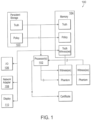
- FIG. 1 depicts a simplified implementation of a computing system 100 in accordance with an embodiment of the invention.
- Computing system 100 includes one or more processors 102, persistent storage 103, memory 104, input/output (I/O) interface(s) 106, and a network adaptor 108.
- the computing system 100 also includes a display 110.
- the one or more processors can be microprocessors, or other types of processing logic that may interpret, execute, and/or otherwise process information contained in, for example, the memory 104.
- the information may include computer-executable instructions and/or data that may implement one or more embodiments.
- the computing system 100 may include a variety of hardware.
- the hardware may include, for example, some combination of one or more processors, microprocessors, field programmable gate arrays (FPGAs), application specific instruction set processors (ASIPs), application specific integrated circuits (ASICs), complex programmable logic devices (CPLDs), graphics processing units (GPUs), reduced instruction set computing (RISC)-based processing devices (e.g., ARM processors), or other types of processing logic that may interpret, execute, manipulate, and/or otherwise process the information.
- the computing system may include a single core or multiple cores.
- the computing system 100 may comprise a system-on-chip (SoC), system-in-package (SiP), etc.
- SoC system-on-chip
- SiP system-in-package
- the I/O interface(s) 106 can be any device that receives inputs and/or provides outputs. Examples of such a device include a keyboard, a mouse, an audio input device, a touch screen, and an infrared input interface.
- the I/O interface(s) 106 can also be an interface for receiving and sending data to a user device or to another system, e.g., through a network.
- the I/O interface(s) 106 can be an internet interface, a wireless interface, a data reader, or a printer.
- the input interface receives data, such as commands, user specifications, and truth data.
- the output interface outputs information, such as a compliance certificate. Components shown individually in the figure can be combined if desired.
- a touch screen can have the combined capabilities of the I/O interface 106 and the display 110.
- the network adapter 108 can allow the system 100 to exchange information with external networks.
- Examples of the network adapter 108 include a network interface card (NIC), such as, for example, wireless wide area network (WWAN) adapter, a local area network (LAN) adapter, etc.
- NIC network interface card
- WWAN wireless wide area network
- LAN local area network
- system 100 may be used entirely within the computing network of a single entity, while in other implementations system 100 resides at only one or at both computing systems of different entities.
- an end user may own a client device, and another party owns a server device.
- the server device can provide an assurance of selective disclosure of sensitive information service to the client device.
- the server device may include a device operating in a remote computing environment, e.g., a cloud computing environment. Additionally, or alternatively, the server device may perform one, more, or all operations described elsewhere herein as being performed by a client device.
- Figure 2A illustrates an example implementation of a method 200 for selectively disclosing sensitive data, with the associated hardware architecture for practicing the method.
- the method 200 is comprised of an ingest stage 210, generation stage 220, audit stage 230, and finalization 240.
- Ingest stage 210 may be implemented by an ingestion processor 115 (which may be the same as one or more processors 102), and involves ingesting truth data 112 and at least one policy 118 from persistent storage 103 and producing and storing in memory 104 a truth representation 120 and policy representation 122.
- True data 112 is comprised of sensitive data 114 and disclosable data 116.
- Ingestion processor 115 also produces at least one truth witness 119 associating policy variables specified in the policy 118 (for example, policy variables 129 and 130 as shown in Figure 2B ) with the data items 114 and 116 in the truth data 112 (which will be utilized in the audit stage 230.)
- the in memory representations 120 and 122 are used after this point in method 200.
- Generation stage 220 may be performed by one or a plurality of generation processing units 222A-222C that may be the same as one or more processors 102 and involves producing one or more phantoms 224A-224C (i.e., synthetic datasets) and respective sets of associated phantom witnesses 226A-226C associating the variables in the policy representation 122 with the data items in the phantoms 224A-224C. As indicated, more than one phantom 224A and associated witness(es) 226 may be produced by any particular generation processing unit 222A.
- Audit stage 230 may be performed by one or a plurality of auditing processing units 232A-232B that may be the same as one or more processors 102, and operates to check if the truth witnesses 119 and phantom witnesses 226A-226C (and indirectly the phantoms 224A-224C and truth data 112) together (e.g., in some implementations optionally combined into a candidate disclosure dataset for evaluation) pass sufficiency conditions 130 defined by the at least one policy 118 . If they do not, the method 200 repeats generation stage 220 to generate another phantom 224N (and witness 226N).
- the method 200 proceeds to finalization stage 240 where one of a number of actions may take place, including the production of a certificate132 indicating that the collection of witness datasets adhere to both the validity conditions 129 and sufficiency conditions 130 of the policy.
- phantoms are generated and disclose those.
- the truth data is not guaranteed to be included.
- a disadvantage is that it does not necessarily reveal any specific facts i.e. there is no definitive statement as to the veracity of any query issues to such a collection of phantoms.
- Another option may be to mandate inclusion of the truth data.
- the disadvantage is that there is now something very real to protect and it might not be easy to achieve that protection.
- the advantage is that querying the collection of items always results in a truthful answer (specifically as truthful as the input truth dataset) with ambiguity but nothing that is incorrect.
- Datasets 127 include at least one truth dataset (e.g., the associated book variable 121A and author variable 123A) or one phantom dataset (e.g., the associated book variable 121B and author variable 123B). From theses, truth witnesses and/or phantom witnesses, shown in the set of witnesses 226 may be generated for evaluation.
- Policy 118 contains the validity conditions 129 comprised of validity policy variables, and sufficiency conditions 130 comprised of sufficiency policy variables, such as CardMin 130A.
- a certificate of compliance 132 may be generated if the collection of candidate disclosure possibilities (datasets) result in witnesses passing the sufficiency audit.
- Figure 2A depicts how the steps of method 200 can be parallelized to leverage various hardware resources to accomplish the goal of sharing information while protecting sensitive portions.
- Ingest stage 210 operations may precede any other operations.
- the system 100 Given the policy (or policies) 118 and truth data 112 on persistent storage 103 (or provided via a network through network adapter 108), the system 100 first reads these data in, optionally optimizes them (as described below), and produces in memory 104 truth representation 120 and policy representation 122, which are accessible to all processing units (computer processors - including CPUs and/or graphics processors) in the system 100.
- Each generation processor 222A-222C takes the policy representation 122 and produces synthetic data (phantoms 224A-224C) and witnesses 226A-226C that associate policy variables with entities in the phantoms 224A-224C.
- witnesses 226A-226C comprise associations that prove that a synthetic data item adheres to the policy representation 122 and provide the entity mappings to evaluate the sufficiency conditions 130 (i.e., whether the collection of values for a variable contain sufficient diversity).
- Generation processors 222A-222C can proceed completely in parallel producing phantoms and witnesses.
- Audit stage 230 may be invoked independently where it makes sure a truth representation 120 adheres to a policy representation 122 by constructing a witness. Presuming that succeeds, the one or more auditing processor 232A-232C repeatedly checks to see if the sufficiency conditions 130 are met, and if not it adds one or more additional witnesses 226 from those produced by the generation processor 222A-222C. The auditing stage 230 repeats as long as the sufficiency conditions fail. When the conditions succeed, the method 200 enters finalization stage 240. During finalization, a certificate of compliance 130 may be generated by corralling the relevant witnesses and sufficiency condition checks the audit process used. The system 100 then may collect the associated phantoms and truth and either sorts or randomizes the order of those datasets. The collection of datasets and certificate constitute the output of the system. Note that while the figure envisions multiple processing units these could be one or more physical entities.
- Figures 2A , 2B , 3 and 9 depict an example embodiment of method 200 as a workflow.
- the start of an information sharing session may commence by a Policy Specification Stage 205.
- Ingest processor 115 may utilize two parsers (labeled 11 and 12 in Figure 2A ). Parser I1 may read truth data 112 and produce in memory truth representation 120. Parser I2 may read the policy (or policies) 118 and produces in memory policy representation(s) 122. Ingest processor 115 may take additional measures to optimize the truth data or policy to make them smaller or otherwise easier to work with.
- generation stage 220 may then repeatedly attempt to create a phantom 224.
- generation stage 220 i.e., one or more generation processors 222
- Generation stage 220 may include an instantiation step 250 and reification step 252.
- Instantiation step 250 sets the cardinality of each policy variable and reification step 252 assigns elements to each variable.
- Instantiation selects from the distribution specified in the policy 244 to assign a cardinality to the variable.
- the variable papers is specified to represent 2 to 7 papers where the exact count is selected uniformly at random.
- Instantiation would sample from a random distribution to select the actual number.
- the policy 244 might specify a weighted uniform distribution where each possible choice between 2 and 7 is weighted by the number of ways to select that number of papers. Other distributions are also possible. Regardless of how selected, assume that instantiation results in the papers variable representing three papers .
- Reification step 252 selects individual elements using a second distribution (again possibly uniform, normal, etc.). After the reification step, papers might be associated with papers ⁇ X,Y,Z ⁇ .
- reification step 252 also may create the dataset or phantom. The output of reification is therefore both at least one phantom witness 226 associated with a phantom 224.
- Complexities in generation stage 220 may arise from impossibilities and optimizations. For example, if the policy (118 or 244) specifies a subset of papers called award-winners, then instantiation step 250 and reification step 252 must respectively ensure that award-winners is smaller (or equal) to papers and that every paper in award-winners is also present in papers. Enforcing these criteria can also influence selection criteria. A naive implementation of the selective sensitive data disclosure method and system may skip all such optimizations, but will likely result in a high failure rate leading to no phantom generation and a need to restart the process. A reduction in or avoidance of such failure rates may be achieved by propagating the implications of one selection criteria to other policy variables. For example, instantiating papers with size 5 can propagate by setting the maximum size of award-winners to 5. Audit Stage 230
- Audit stage 230 may comprise steps for checking that each dataset is valid, and checking that the group of datasets provide the specified protection. These are addressed respectively by finding witnesses and analyzing in light of sufficiency conditions 130. For any data object that lacks a witness, one may be created (e.g., as truth witness 119 is created in Figure 2 ). Generation processor(s) 222 produces witnesses 226 as part of phantom 224 generation, obviating the need to create a witness for each phantom. However, the truth representation 120 has no witness yet, thus finding one is required.
- the (phantom and truth) datasets may not already have associated witnesses, especially if the policy used to protect the data differs from the policy being enforced as part of the audit.
- Checking sufficiency conditions 130 ensures that the collection of data items comprising the set of phantom witness(es) 226 and/or truth witness(es) 119 being evaluated as a candidate disclosure includes enough diversity to protect the sensitive data 114 to the extent specified by the policy 118.
- the truth captures multiple datasets and might be safe to disclose on its own. For example, if one has a collection of experiments in a virtual lab notebook where in each case five subjects were run through some process and the five people are different in each and every case. It is possible that the truth on its own contains sufficient diversity so no phantoms need be added. This is not the typical case, and would be identifiable.
- a truth or phantom data item may have multiple witnesses (e.g., phantom witness 226A comprises three witnesses), and adding a witness may lead to retrogression.
- a single dataset must have at least one witness and may have multiple witnesses because there may be more than one way to assign data elements to policy variables so as to adhere to the policy 118.
- a policy 118 that states that there are at least three authors to a paper and the audit is run on a paper with authors ⁇ A,B,C,D,E ⁇ then there are multiple witnesses to the existence of at least three authors including ⁇ A,B,C ⁇ , ⁇ A,B,D ⁇ , ⁇ A,B,E ⁇ etc.
- FIG. 4 depicts a workflow 242 for a standalone (independently invocable) version of audit stage 230.
- Standalone audit stage 230A differs from the sharing version of audit stage 230 in that every (truth and phantom) dataset 246A...246N lacks a witness.
- Standalone audit stage 230A searches for one (or more) witnesses 248A...248N for each dataset 246A...246N input. Once witnesses 248A...248N exist, the two versions of audit stage 230, 230A may proceed identically as they simply check compliance with the sufficiency conditions 130.
- Sufficiency conditions 130 can be checked iteratively as shown in Figure 5 as follows:
- Auditing supports three use cases: running within generation to decide when to stop generating phantoms, auditing with witnesses - where in addition to the policy and the set of datasets there are witnesses that associate datasets with policies, and auditing without witnesses in the case that there is a policy and a set of graphs. These three cases differ in which witnesses are provided. During generation, there are witnesses for the phantoms (because producing a phantom implicitly defines a witness) but not for the truth, for audits with witnesses, all witnesses are available, and for audit without witnesses none of the witnesses are available. To support these cases, audit provides two operations-finding witnesses and checking sufficient conditions. Finding witnesses takes a specific policy and a graph and produces witnesses that assign element variables to elements of the graph.
- Checking sufficiency conditions takes the sufficiency conditions and a set of witnesses and determines whether the set of witnesses complies with the sufficiency conditions.
- Each sufficiency condition specifies a diversity condition on one or more policy variables
- a sufficiency condition can be expressed as a predicate on one or more sets of values - potentially with additional constants. Deciding sufficiency begins by aggregating the values of the policy variable over all witnesses producing a set of sets of data items. Checking one sufficiency condition devolves into comparing the number of sets of data items that meet a condition with one or more constants. If the set of witnesses meets all the sufficiency conditions the audit passes, otherwise the audit fails. Note that with the exception of finding witnesses for the truth, the system does not identify the truth to either the generator or the auditor. The only portion of the system that inspects the truth is the part that generates witnesses to ensure that the truth complies with the validity portion of the policy.
- no truth witnesses or no phantom witnesses may become part of the candidate disclosure possibility.
- two or more dissimilar policies might be enforced. Any two policies can be combined to produce a single combined policy. When composing policies, intersect the constraints and union the sufficiency conditions. As a result, the combination of two policies may yield a policy that cannot be satisfied.
- the ++ concatenation operator simply concatenates and performs alpha-renaming (variables are systematically renamed so as to avoid a collision if two policies happened to use the same variable names). For example, two distinct policies may be employed by the provider of the information.
- one or more recipients may have their own policy to be enforced against a dataset that a data provider/disclosing party has already passed through audit under their own policy.
- the party would have one or more datasets and may also receive a collection of witnesses. If there are no witnesses, witnesses can be created as described earlier. This provides sufficient information to perform an audit -- in fact it is the process used for standalone audits.
- the collection of datasets can be immediately remediated even though the party cannot identify which dataset represents the truth (or potentially whether the truth is even in the collection of datasets).
- the party proceeds with the generation process as described with respect to Figures 1-6 , starting with multiple datasets and multiple witnesses and proceeding as usual. In short, the startup is slightly different as instead of seeding the system with one dataset the system is seeded with multiple - otherwise the proceeds proceeds in the same way.
- Mandy 702 is twenty-three years of age, has brown eye color and blond hair color and
- Nick 704 is of age twenty-six and has blue eye color and brown hair color.
- Figure 7 depicts this information in tabular form as a single table - one could also use a collection of tables.
- Figure 8 contains a table that demonstrates how to reveal their names 706, ages 708 and hair colors 712 without revealing their eye colors 710. The sufficiency conditions for this policy would be that for each unique individual there are at least two distinct eye colors 714A, 714B.
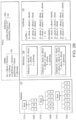
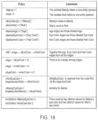
- Figure 18 depicts a policy that expresses this condition.
- FIG. 10-12 Figure 11 generalizing to an anonymous data display
- the researchers compare the assignments for the same cohort of students during two consecutive years (e.g. , Georgia 264 and Indiana 266).
- the dataset consists of rooming assignments and student directory data.
- Rooming assignments specify what room 262A-262I each of the students 260A-260G lived in for each of the two years, and implicitly with whom they lived.
- the first year of rooming assignments represents the students freshman 264 year where students generally know few if any of their fellow students. Since students do not know each other, the university assigns students to rooms.
- Student directory data contains portions of the rooming data for those students that chose to publish their information. A student can choose: not to appear in the directory; provide their name 270A-270E only; provide their name and dorm 268A-268D; or provide their name, dorm and their specific room. Each student makes a choice for each year.
- additional facts that are assumed public. For example, Harvard University does not allow coed dormitories. At the conclusion of their study, the researchers are required to disclose their data to the community at large. Existing attempts to anonymize the data may violate federal regulations on student privacy (Family Educational Rights and Privacy Act (FERPA), 20 U.S.C.
- FERPA Federal Educational Rights and Privacy Act
- a student's privacy must be protected even in light of the choices made by other students. For example, a student's decision to include his room assignment in the directory does not eliminate his roommate's right to privacy.
- the funding agency demands that the researchers either release their data or return the funds.
- the dataset for this example comprises two consecutive years of rooming assignments for the same 1283 students. Students occupied 514 rooms Georgia year and a disjoint set of 597 rooms Indiana year. All names, rooms and dorms have been replaced by unique identifiers. One can tell if a unique identifier refers to a student, Georgia room, Georgia dorm, sophomore room, skilled dorm, but not which student, room, or dorm it represents. To make this clearer, Figure 11 uses alphabetical fictitious names and arbitrarily assigns dorm names rather than unique identifying numbers. An actual application might preferably use anonymous numbering throughout. One can clearly see that the roommate data forms a graph 272.
- edges 278A-278C distinguished by their labels. Freshman labeled edges 278A (depicted as solid lines in the figures) depict Georgia rooming assignment and similarly skilled labeled edges 278B (depicted as dashed lines in the figures) depict constitutional assignments. Containment relationships relate rooms and dorms (depicted as squiggly black lines).
- Students' rooming assignments are also partially disclosed in the student directory that includes a student's name and room assignment, as shown in Figure 12 , representing the student directory data table 280 for this illustrative example. Students may choose to exclude part or all of their information from the public directory.
- Each row 282 in the table 280 represents a student 260. Each student may specify: a name, a dorm, and room for each of Georgia and sophomore years. Any of the data table cells 284 can be empty except that if a room is specified the dorm must be too - because room numbers implicitly identify the dorm.
- last names are "real" names since first names are unique identifiers.
- auxiliary knowledge In addition to the data encoded in the dataset itself, there are additional facts that limit the space of possibilities, which may be referred to as auxiliary knowledge. The following is a list of auxiliary knowledge that may be applicable to this student housing example:
- a goal may be to disclose as much as possible about the student rooming assignments without violating student privacy as mandated by regulations.
- the FERPA is a Federal law that protects the privacy of student education records. A student's right to privacy must remain intact regardless of the privacy choices made by their roommates.
- a graph G 286 may contain sets of vertices V 288, edges E 290, attributes A 292 and labels L 294 (selected from universes V, E, A, L).
- E may represent a set of edges comprised of one source vertex (in V), one destination vertex (also in V) and one label (in L).
- M may be the attribute mapping function that, for every vertex in V, associates exactly one attribute in A.
- the formalism supports both cyclic and acyclic graphs. It assumes directed edges, but one can model an undirected edge as a pair of edges connecting the same vertices in opposite directions.
- This graph model mandates that every vertex 274 has exactly one attribute and every edge 278 has exactly one label. It can support unattributed vertices and unlabeled edges by introducing an attribute "no attribute” and a label "no label”. It can also provide limited support for multiple annotations. Should one want to distinguish students based on name and date of birth, annotations could be pairs capturing both. For example, one could assign both name and date-of-birth attributes to each policy variable by constructing an annotation out of a series of name/value pairs. In this case, the vertex 274 representing Alex, might be annotated with name: Alex, dob: 1 / 1 / 94.
- a collection of user studies determined that, in practice, people use annotations in two ways. Sometimes they uniquely identify a graph object - an edge or vertex - whereas other times they denote group membership. This corresponds to associating a vertex either with the annotation "Canaday dorm" 277 to uniquely identify the dorm or with "Dorm” to identify its group. This distinction can fade when group membership uniquely identifies an object. For example, one of the dorms on campus has separate entryways with one room per floor per entryway. In that dorm, knowing the dorm, entryway and floor uniquely identifies the room.
- annotations can encode arbitrary meaning.
- an annotation could contain the statement "Alex and Ben were Georgia roommates” and could include Alex and Ben's digital signatures. Since the system cannot infer the meaning of an arbitrary string in an arbitrary context, it cannot prevent an annotation from revealing information that should be protected. The goal is to protect annotations in as much as they interact with the graph, but one cannot reasonably consider any possible way an annotation could encode information.
- the formalism supports treating annotations as either unique identifiers or as indicators of group membership, but not as conveying arbitrary meanings.
- An advantage of the selective disclosure of sensitive data implementations is that it reframes the challenge of partial disclosure by a disclosing party through use of a constraint based policy language and generation of synthetic data that a recipient would believe, in order to create richer and provably compliant partial disclosure.
- Implementations described herein make use of a constraint language to express a privacy policy.
- the policy answers the four questions listed above.
- This constraint language can concisely describe a set of objects ranging from graphs to more traditional tabular and otherwise structured data. Since graphs represent the most complex case, the language description is in terms of graphs. For non-graph data, the variables may be limited to vertices (and optionally attributes) and the edge and graph operations (sources, targets, labels, etc.) may be removed.
- the set of objects the policy describes are called "valid objects" and the sufficiency conditions specify the degree of variability required to protect sensitive information. Constraints place restrictions on the vertices, edges, attributes, and labels of a graph.
- Constraints may include free variables that range over sets of vertices and sets of edges. For example, a graph G satisfies a set of constraints if there is an assignment of variables to the vertices and edges of G that satisfies all of the constraints. This assignment of variables to graph elements may be referred to as mapping.
- subset constraints specify that one policy variable is a subset of another policy variable.
- Cardinality constraints bound the minimum and maximum cardinality (how many data items it can represent) of a policy variable.
- Figure 14 defines the exemplary syntax for sets of vertices V 288, edges E 290, attributes A 292 and labels L 294.
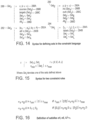
- Figure 15 presents the syntax of constraints placing restrictions on those sets. Subset constraints require that one set is a subset of another. Expressions A and B may refer to sets of vertices, edges, attributes of vertices, or labels of edges. Cardinality constraints place bounds on the size of a set J.
- Vertex set expressions describe sets of vertices (Set_V) 288, edges (Set_E) 290, attributes of vertices (Set_A) 292, and labels of edges (Set_L) 294.
- Vertex set expressions Set_V 288 include variables x ⁇ V 288A that range over sets of vertices. For generality, assume graphs are directed and encode undirected graphs by using two directed edges in opposite directions to encode an undirected edge.
- the expression sources (Set_E) 288B represents the set of source vertices of the edges described by edge set expression Set_E.
- targets (Set_E) 288C represents the set of target vertices of the edges described by Set_E.
- All V 288D represents the set of all vertices of a graph. Vertex set expressions (and other set expressions) are closed under the union U and intersection ⁇ operators. Note that intersections bind more tightly than unions.
- Edge set expressions Set_E 290 include variables y ⁇ E 290A that range over sets of edges.
- the expression ins(Set_V) 290B represents the set of edges that have a target vertex in the set of vertices described by vertex set expression Set_V, and outs(Set_V) 290C represents the set of edges that have a source vertex in the set described by Set_V.
- the expression All E 290D represents the set of all edges of a graph.
- Attribute set expressions Set_A 292 include constant sets of attributes ⁇ a1,...,aN ⁇ 292A, and attrs(Set_V) 292B, the set of attributes of the vertices described by Set_V.
- the expression attrs(All_V) 292B refers to the set of all attributes of a graph, and thus do not require a special expression.
- label set expressions Set_L 294 include constant sets of labels ⁇ l1, ..., lN ⁇ 294Aand labels(Set_E) 294B, the set of labels of the edges described by Set_E. As with attribute sets, there is no need for a special expression to refer to the set of all labels of a graph, as the expression labels(All E ) is equivalent.
- A B is shorthand for the pair of constraints A ⁇ B and B ⁇ A.
- cardinality(A) n is shorthand for n ⁇ cardinality(A) ⁇ n .
- A ⁇ is shorthand for 0 ⁇ cardinality(A) ⁇ 0.
- G (V,E,M) satisfies set of constraints C if and only if there exists a function ⁇ V from V to P(V) and a function ⁇ E from E to P(E) such that for all c ⁇ C, ⁇ V, ⁇ E,G ⁇ c. Since there are no free attribute or label variables there is no need for ⁇ A or ⁇ L.
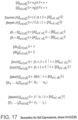
- Figure 17 defines the denotational semantics of set expressions: ⁇ A ⁇ ⁇ V , ⁇ E , G is the set of vertices, edges, attributes, or labels of G to which set expression A refers. Constraints are an expressive yet concise means of specifying a set of graphs and bind variables that are useful for specifying sufficiency conditions.
- Hidden V and HiddenE Using two variables Hidden V and HiddenE, enables explicit definition regarding how much information is hidden. To hide the maximum amount of information, the bounds on HiddenV and HiddenE would be left unspecified, thus placing no bounds on how many vertices or edges are assigned to these hidden variables. These hidden variables precisely describe hidden information. Similarly, one can choose to be explicit about how many vertices one is hiding. For example, to reveal that one is hiding exactly three vertices one would bound the cardinality of HiddenV to exactly three. Thus, even though the invention imposes strict requirements on constraints, the users have options for deciding both how much to reveal and how much to say about what they are not revealing.
- sufficiency conditions 130 express requirements on the degree of variability in the set of data items comprising a disclosure candidate necessary to protect sensitive data 114.
- An earlier example specified one such condition as: at least two thirds of papers 121A-121C must have at least three authors 123.
- Overall a sufficiency condition 130 takes as input one or more policy variables and optionally any number of constants. For example, min_ratio(CardMin(authors,3,2 / 3) would specify that at least 2/3 of authors have at least "3" authors (e.g., at policy variable CardMin 130A).
- min_cardinality selects items with the specified cardinality and min_ratio is a Boolean function that determines whether the specific ratio is met.
- the invention supports adding an arbitrary set of such conditions.
- k-anonymity requires that any entry in the output could represent at least k entities in the input (including consideration for quasi identifiers etc.).
- k-anonymity requires that any entry in the output could represent at least k entities in the input (including consideration for quasi identifiers etc.).
- k-anonymity there are at least two definitions for k-anonymity.
- k-anonymity for sets provides diversity in the possible constituents of a set whereas k-anonymity for elements and d-deniability protect the constituents of the set.
- Edson Arantes do Nascimento (better known as Pele).
- K-anonymity for sets protects the identity of the team as a whole but not the individual members.
- k-anonymity for elements applies when protecting the assignment of players in an expansion draft; where one seeks to provide each player assignments to several teams.
- d-deniability provides each player with plausible deniability so they can each provide at least D scenarios where they are not being sent to the Houston Dash.
- a k-anonymity for sets condition specifies a set variable and an integer value for k to specify that the variable must correspond to at least k distinct sets of values. For example, a k-anonymity for sets condition on variable VRoom101 with a k of 3, would be satisfied if VRoom 101 could contain any of ⁇ Dana,Eve,Fran ⁇ , ⁇ Dana,Eve,Gail ⁇ , or ⁇ Dana,Fran,Gail ⁇ .
- a k-anonymity for elements condition specifies a set variable V, a list of set variables ws, and an integer value for k to specify that each of the elements in V must be associated with at least k distinct variables in ws.
- VRoom101 contains ⁇ Alex,Ben,Chris ⁇ .
- VRoom100 contains ⁇ Alex ⁇ and VRoom200 contains ⁇ Ben,Chris ⁇ .
- VRoom100 contains ⁇ Ben ⁇ and VRoom200 contains ⁇ Alex,Chris ⁇ .
- VRoom100 contains ⁇ Chris ⁇ and VRoom200 contains ⁇ Ben,Chris ⁇ . It is probably easier to see this if looked at it "in reverse" (hence referring to this as a condition in the opposite direction) from the student to the room, where each student lives in either VRoom100, VRoom101, or VRoom200.
- a d-deniability condition specifies a set variable V and an integer value for D to specify that each value assigned to V must have at least D cases where it is not assigned to V.
- a d-deniability condition on VRoom100 with a D of 1 would be satisfied by three scenarios. In scenarios one, VRoom100 contains ⁇ Dana ⁇ and VRoom200 contains ⁇ Eve,Fran ⁇ . In graph scenarios, VRoom100 contains ⁇ Eve ⁇ and VRoom200 contains ⁇ Dana,Fran ⁇ . In graph scenarios, VRoom100 contains ⁇ Fran ⁇ and VRoom200 contains ⁇ Eve,Fran ⁇ . Again, this is probably more easily seen "in reverse” by noting that each student lived in either YRaom100 or VRoom200 and therefore each possible inhabitant of VRoom100 had one case where they did not inhabit room VRnom100.
- RandomSAT TM a random satisfiability solver created by the inventor, finds random solutions to constraint problems.
- the problem of finding solutions to the constraints is provably NP-complete (nondeterministic in polynomial time).
- RandomSAT TM differs from known random satisfiability solvers in that it allows specification of the sampling distribution for each variable in the constraints. Whereas existing random solvers allow selecting a uniformly random variable between a minimum and a maximum, RandomSAT TM allows a range of distributions in addition to uniform.
- Exemplary implementations of the methods and systems described herein use a parser to read the truth data 112, at least one policy 118 as written in the constraint language described herein, invoking RandomSAT TM to generate the synthetic data phantoms 224, and calling to the auditing processor(s) 232 to determine both when to stop generating phantoms 224 and to prove the result complies with the policy 118.
- An exemplary architecture 300 shown in Figure 19 , may include the RandomSAT TM algorithm 302, a parser input reader 306, to parse and transform policies 118, and a loop 308 that repeatedly invokes RandomSAT TM and an audit stage algorithm 310.
- the input reader 306 takes in the policy 118 from a file and transforms it into an in-memory representation (not shown).
- RandomSAT TM 302 takes the policy representation and produces a phantom.
- the auditing stage algorithm 310 takes a solution candidate 312 (a set of datasets consisting of the truth and the phantoms produced so far) and the policy representation and either produces a certificate of compliance 314 or fails the audit.
- RandomSAT TM 302 may be invoked to generate an additional phantom.
- the solution candidate 312 is seeded with the truth, invokes RandomSAT TM 302 to generate sufficient phantoms for the audit stage algorithm 310 to deem the solution candidate 312 compliant.
- each set variable is associated with a distribution description that describes how to select elements to fill the set - for example: uniformly at random, from a normal distribution with certain parameters, etc.
- a valid assignment is an assignment that adheres to the constraints (i.e., the same meaning of valid defined earlier). This assumption is meant to provide a basis for developing more formalism where the policy writer could specify a distribution.
- the input reader 306 parses the policy 118, simplifies the expressions in the policy, transforms the policy into an in-memory policy representation 122, and minimizes the policy by limiting the values the policy expressions represent.
- a straightforward transformation converts the A-normalized policy into the in-memory policy representation 122. Any existing environment and constraints are read, adding the appropriate policy variables to the policy representation 122. For clarification purposes, a brief description of the accounting involved will be provided in the context of the various maps and other information that define the in-memory policy representation 122.
- the in-memory representation 122 operates on policy variables, where each policy variable represents a vertex, edge, attribute or label expression ( note that a variable is also an expression).
- the associations may be: relationships, membership, names, intersections, unions, element mappings, in degree, out degree. Relationships keep track of how one policy variable is related to another. For example, it identifies the attribute policy variable associated with a vertex policy variable. Membership keeps the information about which element variables the polic variable represents. Names maintains a list of names for each policy variable. Names are used solely for debugging output and final display.
- the relationships maps maintain an accounting of the relationships among policy variables. Attribute maps relate vertex policy variables and their corresponding attribute policy variables . Edges may have three maps - one each for sources, targets, and labels that relate an edge policy variable to a vertex policy variable, vertex policy variable, and label policy variable respectively. Union, intersection, and subset maps relate between policy variables of the same type --- vertex to vertex, edge to edge, attribute to attribute, or label to label.
- a policy variable contains membership information including a cardinality range and a division of the graph elements into: includes, excludes and unknowns.
- a cardinality range may comprise a lower and upper bound. If the two values are the same, the cardinality is exact. Includes are elements that must be included in the set, excludes must be excluded and unknowns are those whose inclusion or exclusion is not yet known.
- a policy variable is fully specified if the cardinality range specifies the exact cardinality and there are no unknowns; if any of these conditions is not true, the policy variable is partially specified. Any operation that either tightens the cardinality bounds or reduces the number of unknowns further specifies the policy variable.
- the relationship maps simply list A as the target of unions whose sources are B, C, D, and E , but that does not represent the entire relationship. Therefore, the system maintains two aggregate maps --- one for intersections and one for unions --- that associate a list of sets of policy variables for each policy variable, where each set of policy variables represents a single aggregate.
- Element mappings keep track of the relationships between element variables --- not to be confused with the relationships between policy variable . As the system gathers more information about what elements a policy variable represents, it also gathers information about the relationships among its elements. For example, if processing restricts a policy variable to representing exactly one vertex and the associated attribute policy variable represents exactly one vertex, then determining which vertex and attribute the respective policy variables represent also specifies the association between a vertex element and an attribute element. Recording this information saves time later --- during the generation stage. It also eliminates certain possibilities. For example, if knowing that the element mappings for a vertex and another policy variable contains that vertex that might instruct more information about the other elements that policy variable represents. The implementation updates and uses element mappings to further restrict the values of various elements .
- the policy representation 122 maintains the in and out degree range for each vertex element. These ranges are necessary as they sometimes allow inference about the in or out degree range where otherwise there would be no place to store that information. For example, in the roommate dataset, that specifies the capacity of a room by fixing the cardinality of the edges that egress the room set variable. In the input policy file, the in degree of the room variable is attached to the in edges, not the room. Since there might be several sets of edges that have the same room variable as their target, it is not always obvious where to find the in degree. Keeping track of the in degree also makes it possible to improve performance by dropping some policy variables - such as the edge policy variable that specifies the room capacity. While reading the policy, the implementations build the degree mappings and updates those mapping whenever ranges are constrained.
- Graph information describes the universe of graph elements for the policy 118. It records the upper bound on the number of vertices and edges.
- attribute directory that enables resolving between attribute policy variables (remember a policy variable is an identifier) and the string that policy variable represents as well as in the reverse direction.
- label directory for resolving between a label policy variable and the string it represents.
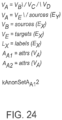
- the all policy variables are: AllV, AllE, AllA (technically attrs(AllV)), AllL (technically labels(AllE)), AllSrcs (technically sources(AllE)), AllTgts (technically targets(AllE)), AllSrcsA (technically attrs(sources(AllE))), and AllTgtsA (technically attrs(targets(AllE)).
- the glob information provides a caller a fast way to request an all policy variable by "name”.
- Sufficiencies are encoded precisely as described in the formalism. Note that the implementation does need to keep them with the policy representation 122 because they occasionally need updating. Any time the system renumbers a policy variable, it needs to reflect that change in the sufficiencies.
- Figure 25 illustrates a minimization process, which depicts the workflow of an operation performed on policy representation 122 that does two things: first, it removes unneeded policy variables and second, it restricts the values a policy variable can represent.
- There are at least two ways to reduce the number of policy variables (a) by removing policy variables that are not connected to any other policy variable and (b) by merging policy variables that must be identical.
- Restricting the values a policy variable can represent involves tightening the cardinality bounds and/or refining the membership of a policy variable (i.e., the members of includes, excludes, and unknowns).
- Policy variables that are subsets of each other must be identical, the challenge is finding such sets of policy variables.
- Policy variables that are subsets of each other form a cycle of subsets in the policy.
- intersections are a form of subset and unions are a form of superset.
- To collapse cycles filter the graph by considering only subset, union and intersection edges, temporarily reverse the direction of union edges, and perform a strongly connected component analysis on the filtered graph. All policy variables in a strongly connected component are identical and can be merged.
- Relationships can also identify policy variables as identical.
- the attributes relationships is one such case because a set of vertices possesses a unique set of attributes. If the set of vertices is connected by attrs edges to two distinct attribute policy variables, the two attribute policy variables must be identical. Similarly, a set of edges defines a set of sources, a set of targets and a set of labels. Regardless as to how policy variables are identified as duplicates, the solution is to merge the duplicate policy variables. Merging a list of policy variables involves: creating a new policy variable, removing internal edges, reattaching edges, computing membership information, replacing references to the policy variables being merged, deleting the old policy variables, and updating sufficiency conditions. All of these steps are straightforward with the exception of computing membership information.
- Adding a new policy variable is a basic operation on the graph. Removing internal edges is a matter of finding the edges whose sources and targets are both included in the list of policy variables being merged. If one end of the edge is in the list of policy variables being merged, replace that end with the new policy variable. Union and intersection lists in adjacent policy variables might refer to the policy variables being merged leading us to replace those references with a reference to the new policy variable. If a policy variable A contains a union or intersection list consisting of a single policy variable B, then policy variable A and B must be identical and are therefore merged. In addition, references to the policy variables being merged must be replaced in adjacent policy variables. For example, consider merging policy variables A and B to produce AB .
- the membership information for a merged policy variable combines the information from all the policy variables being merged.
- the cardinality range is the intersection of all cardinality ranges.
- the include list is the union of all include lists.
- the exclude list is the intersection of all exclude lists.
- the unknown list is whatever remains of the universe not already in the include or exclude list.
- Restricting the values a policy variable can represent involves either tightening the cardinality bounds or further specifying the graph elements the policy variable represents. Processing union, intersection and subset relationships can update both bounds and inclusion. Unions and intersections are processed per policy variable whereas subset relationships are processed per edge. The remaining cases tighten cardinality ranges - and updates inclusion only in cases where changing the cardinality specifies the membership. For example, if a vertex policy variable must contain 1 and 2, does not contain 3 and 4 and the inclusion of 5 and 6 is unknown, then if specifying the cardinality is exactly 2 (thereby excluding 5 and 6) or exactly 4 (thereby including 5 and 6) the entire policy variable becomes fully specified. Of the cardinality cases, edges are the most complex, because an edge policy variable is associated with three other entities: sources, targets and labels. The relationship between a vertex and its attributes is simpler.
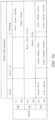
- Figure 20 illustrates the update rules for unions. If all three sets are fully specified, verify that the union holds. If both arguments to the union are fully specified, compute the union and the cardinality. If one argument (assume A) and the result X are fully specified, compute the remaining argument B by including any elements in X but not in A and excluding any elements excluded in X. Then update the cardinality so it is bounded by the size of the includes and the sum of the size of the includes and unknowns. If one argument is fully specified (assume A), update B to include elements in the result X but excluded from A and to exclude elements excluded by X. Then update the cardinality so it is bounded by the size of the includes and the sum of the size of the includes and unknowns.
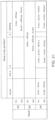
- Figure 21 describes the update rules for intersections. If all three sets are fully specified, verify that the intersection holds. If both arguments to the intersection are fully specified, compute the intersection and the cardinality. If one argument (assume A ) and the result X are fully specified, compute the remaining argument B by including any elements in the result X and excluding any elements excluded in the result X but included in the other argument B. Then update the cardinality so it is bounded by the size of the includes and the sum of the size of the includes and unknowns. If one argument is fully specified (assume A ), update B to include elements in the result X and to exclude elements excluded by the result X but included in the other argument A.
- Figure 22 describes the update rules for subset relationships. If both the superset and the subset are fully specified, verify that the subset relationship holds. If the superset is fully specified, add its excludes to the subset while removing those excludes from the unknowns. The subset's minimum is adjusted to be consistent with the include set while the maximum is capped by the size of the superset and further adjusted to reflect the new number of unknowns. If the subset is fully specified, add it's includes to the superset while removing those elements from the unknowns. The superset's minimum cardinality is the largest of its old minimum, the number of its includes, and the size of the subset. If neither set is fully specified, perform both of the updates just described.
- Edges are the most complex of the cardinality cases.
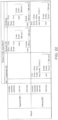
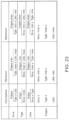
- Figure 23 illustrates the cardinality update rules for edge policy variables.
- the minimum number of sources corresponds to picking the fewest edges with the most targets and labels and is computed as the floor of the minimum number of edges divided by the product of the maximum number of targets and labels.
- the maximum number of sources corresponds to picking the largest number of edges with the fewest targets and labels and is computed as the ceiling of the maximum number of edges divided by the product of the minimum number of targets and labels.
- the cases for targets and labels are symmetrical. For edges, compute the product of sources, targets and labels. To compute the minimum number of edges multiply the minimum number of sources, targets and labels and for the maximum multiply the maximums.
- Vertices and attributes are simpler because there are only two sets involved and a set of vertices uniquely identifies a set of attributes.
- a set of vertices uniquely identifies a set of attributes.
- Many vertices can share the same attribute and that each vertex has exactly one attribute. If either set is empty the other set must also be empty. Consider the remaining cases where neither set is empty.
- Each vertex must have exactly one attribute but all the vertices could have the same attribute.
- Attributes provide a lower bound but not an upper bound on the number of vertices. There must be at least as many vertices as attributes for those vertices. No information is learned about the upper bounds of either vertices or attributes.
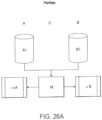
- Matching applications refer to identifying whether entries in different databases refer to the same thing.
- a and B each have a database - A1 and B1 respectively.
- A wants to know if that entry also appears in B1.
- the databases often contain different fields, determining whether two entries match is not always straightforward. For example, if one database has name, city and date of birth and the second has social security number, gender, and place of birth the identification of matches need not be simple.
- some match condition M that given an entry from each database reports true if the entries match and false otherwise.
- the match condition might be provide by A, B, agreement between the parties, or even some third party C.
- the parties agree to share their information and agree on a location where the data sharing will be done (this could be at party A, B or with some third party C).
- the options as to what party provides the matching criteria include: A, B, in agreement between the two or some party C.
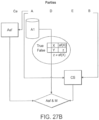
- party A provides the matching criteria M. Both parties securely transfer their data to the sharing location. Recall that the matching procedure is provided by an entry from A1 and an entry from B1 and responds true if and only if it determines that A1 and B1 constitute a match.
- the data flowing to A is enforced to include A1 plus the information as to whether there is a match and includes a proof of compliance.
- the data flowing to B is enforced to include B1 plus the information as to whether there is a match and includes a proof of compliance.
- the parties perform the match using an authenticity check.
- Each party creates an authenticity function which given a data entry produces an authenticity code. Given the same data the authenticity function must always produce the same value.
- the parties do agree to have a third parties Ca and Cb (optionally both the same party C) keep their authenticity functions and each provides their authenticity function (Aaf and Baf respectively) to Ca and Cb respectively.
- each party creates real and fictitious data and appends authenticity codes to the real data and values that are not valid authenticity codes to the fictitious data. Both parties share the superset consisting of the data and the fake data.
- This sharing can occur at party A, B, Ca, Cb, or even at party D. They then provide the matching function to party E (which could optionally be one of the previously identified parties).
- party E which could optionally be one of the previously identified parties.
- a match occurs if Ca reports the data is authentic and Cb reports the data is authentic and party E reports a match. Again this can be combined with the data sharing method described earlier to allow increased sharing (beyond match no match) and/or to create certificates to prove information shared adheres to agreements. (See “ Chaffing and Winnowing: Confidential without Encryption", Ronald L. Rivest, March 18, 1998 .)
- selection criteria scenarios refer to cases where party A holds a collection of data in database A1 and party B wants to select a portion of the data in A1. A does not want to share all the information in A1 with B and B does not want to provide A the selection criteria. For example, consider a pharmaceutical company that wishes to identify people between twenty and twenty-five who are obese and on anti-depressants. Hospitals have this data but may not wish to share it either due to lack of patient consent or for a variety of other reasons.
- Each of the schemes just described for matching can also apply for selection criteria. In fact this is a degenerate case of matching where one party has no information to share and the matching function's response depends on the data from only one party. Recall that a matching function receives an entry from A1 and B1 and evaluates to true to signify a match and reports false otherwise.
- a selection criteria function is a matching function that ignores one of its arguments. All the rest proceeds as in each of the cases described for matching.
- Recombination refers to combining datasets to gather additional information. Just as this invention can be used to share information, it can also be used to combine disparate datasets to re-identify protected data or make inferences through data combination. To use it for this purpose, the goal is to find cases where the invention cannot find a witness. Recall that witness searches are exhaustive, so if finding a witness fails there is no way to comply with the validity portion of the policy. Using the invention to combine data relies on encoding one or more datasets into the policy and then searching for witnesses for an additional policy. The set of witnesses constitute the set of possibilities.
- determining the degree of overlap in customers without identifying the customers would be a potential application of matching.
- Other uses of data rooms such as sharing among government agencies could also be expedited and enriched. More generally the speed, auditability and richness of data this enables enhances opportunities for all sorts of business partnerships including in regulated or in relationships that lack trust.
- Operational data such as pharmacy or other stock information is often shared up and down the supply chain. In addition to operational uses, this information is often also useful for marketing, competitive and partnership reasons yet sharing is often prevented by regulations, competitive risk and lack of trust. Partial sharing may allow more uses in a legal way without requiring the trust relationship.
Landscapes
- Engineering & Computer Science (AREA)
- Theoretical Computer Science (AREA)
- Health & Medical Sciences (AREA)
- Bioethics (AREA)
- General Health & Medical Sciences (AREA)
- Computer Security & Cryptography (AREA)
- Computer Hardware Design (AREA)
- Software Systems (AREA)
- Physics & Mathematics (AREA)
- General Engineering & Computer Science (AREA)
- General Physics & Mathematics (AREA)
- Databases & Information Systems (AREA)
- Medical Informatics (AREA)
- Storage Device Security (AREA)
- Arrangements For Transmission Of Measured Signals (AREA)
Claims (9)
- Computerimplementiertes Verfahren zum Gewährleisten einer selektiven Offenlegung vertraulicher Daten, das die folgenden von einem oder mehreren Prozessoren (115) durchgeführten Schritte umfasst:(a) Empfangen von mindestens einer Richtlinie (118), bestehend aus Richtlinienvariablen, die angeben, welche Datenelemente vertraulich sind (114), welche Datenelemente offengelegt werden können (116), Gültigkeitsbedingungen (129) dafür, dass ein potenzieller Offenlegungsdatensatz für einen Empfänger glaubwürdig ist, und Angemessenheitsbedingungen (130), die ein Maß an Variabilität angeben, das zwischen Datenobjekten in einem potenziellen Offenlegungsdatensatz erforderlich ist, um die vertraulichen Daten (114) zu schützen, sowie aus einem oder mehreren Sätzen von Wahrheitsdatenelementen (112);(b) Überprüfen des einen oder der mehreren Sätze von Wahrheitsdatenelementen (112) auf Einhaltung der mindestens einen Richtlinie (118) und Erzeugen einer Sammlung von Offenlegungsmöglichkeiten (224A-224C) synthetischer Datensätze, die die Gültigkeitsbedingungen (129) erfüllen, wenn der eine oder die mehreren Sätze von Wahrheitsdatenelementen (112) die mindestens eine Richtlinie (118) nicht einhalten;(c) Erzeugen einer oder mehrerer Assoziationen zwischen den Richtlinienvariablen und jedem des einen oder der mehreren Sätze von Wahrheitsdatenelementen (112) und jeder der Offenlegungsmöglichkeiten (224A-224C) synthetischer Datensätze, die die Gültigkeitsbedingung erfüllen;(d) Generieren von mindestens einem potenziellen Offenlegungsdatensatz, der mindestens einen der Sätze von Wahrheitsdatenelementen (112) und mindestens eine der Offenlegungsmöglichkeiten (224A-224C) synthetischer Datensätze umfasst; und(e) Wiederholen der Erzeugungsschritte und des Generierungsschritts, bis mindestens ein potenzieller Offenlegungsdatensatz, dessen Assoziationen die Gültigkeitsbedingungen (129) erfüllen, die Angemessenheitsbedingungen (130) erfüllt.
- Verfahren nach Anspruch 1, wobei der Erstellungsschritt iteratives Hinzufügen einer Offenlegungsmöglichkeit (224A-224C) synthetischer Datensätze zur Sammlung umfasst, wenn die Angemessenheitsbedingungen (130) oder die Gültigkeitsbedingungen (129) nicht erfüllt sind.
- Verfahren nach Anspruch 1, wobei der mindestens eine Prozessor (115) die eine oder die mehreren Assoziationen zufällig oder parallel erzeugt.
- Verfahren nach Anspruch 1, wobei der eine oder die mehreren Prozessoren (115) mindestens die Richtlinie (118) und den einen oder die mehreren Wahrheitsdatensätze (112) optimieren.
- Verfahren nach Anspruch 1, wobei der eine oder die mehreren Prozessoren (115) die Sammlung von Offenlegungsmöglichkeiten synthetischer Datensätze (224A-224C) erzeugen, indem sie den Richtlinienvariablen Werte zuweisen, die mindestens einer Auswahl einer Verteilungsfunktion und einer Kardinalität entsprechen.
- Verfahren nach Anspruch 1, wobei die jeweiligen Werte der Sammlung von Offenlegungsmöglichkeiten (224A-224C) synthetischer Datensätze mindestens um das in den Angemessenheitsbedingungen (130) angegebene Maß voneinander abweichen.
- Verfahren nach Anspruch 1, wobei:
die mindestens eine Richtlinie (118) eine Vielzahl von Richtlinien umfasst, die unterschiedliche Anforderungen in Bezug auf das Bereitstellen und Schützen von vertraulichen Daten (114) darstellen; wobei der eine oder die mehreren Prozessoren (115) die unterschiedlichen Anforderungen abgleichen. - Computerimplementiertes Verfahren zum Gewährleisten einer selektiven Offenlegung vertraulicher Daten (114), das die folgenden von einem oder mehreren Prozessoren (115) durchgeführten Schritte umfasst:(a) Empfangen von mindestens einer Richtlinie (118), bestehend aus Richtlinienvariablen, die angeben, welche Datenelemente vertraulich sind (114), welche Datenelemente offengelegt werden können (116), Gültigkeitsbedingungen (129) dafür, dass ein potenzieller Offenlegungsdatensatz für einen Empfänger glaubwürdig ist, und Angemessenheitsbedingungen (130), die ein Maß an Variabilität angeben, das zwischen Datenobjekten in einem potenziellen Offenlegungsdatensatz erforderlich ist, um die vertraulichen Daten (114) zu schützen, sowie aus einem oder mehreren Sätzen von Wahrheitsdatenelementen (112);(b) Überprüfen des einen oder der mehreren Sätze von Wahrheitsdatenelementen (112) auf Einhaltung der mindestens einen Richtlinie (118) und Erzeugen einer Sammlung von Offenlegungsmöglichkeiten (224A-224C) synthetischer Datensätze, die die Gültigkeitsbedingungen (129) erfüllen, wenn der eine oder die mehreren Sätze von Wahrheitsdatenelementen (112) die mindestens eine Richtlinie (118) nicht einhalten;(c) Erzeugen einer oder mehrerer Assoziationen zwischen den Richtlinienvariablen und jeder der Offenlegungsmöglichkeiten (224A-224C) synthetischer Datensätze, die die Gültigkeitsbedingungen (129) erfüllen;(d) Generieren von mindestens einem potenziellen Offenlegungsdatensatz, der mindestens eine der Offenlegungsmöglichkeiten (224A-224C) synthetischer Datensätze umfasst, wobei der mindestens eine potenzielle Offenlegungsdatensatz dahingehend eingeschränkt ist, dass er den einen oder die mehreren Sätze von Wahrheitsdatenelementen (112) nicht enthält; und(e) Wiederholen der Erzeugungsschritte und des Generierungsschritts, bis mindestens ein potenzieller Offenlegungsdatensatz, dessen Assoziationen die Gültigkeitsbedingungen (129) erfüllen, die Angemessenheitsbedingungen (130) erfüllt.
- Computerimplementiertes Verfahren zum Überprüfen der Einhaltung von mindestens einer Richtlinie (118) einer Menge von zuvor instanziierten Datensätzen von selektiv offenzulegenden vertraulichen Daten (114), das die folgenden von einem oder mehreren Prozessoren (115) durchgeführten Schritte umfasst:(a) Empfangen von mindestens einer Richtlinie (118), bestehend aus Richtlinienvariablen, die angeben, welche Datenelemente vertraulich sind (114), welche Datenelemente offengelegt werden können (116), Gültigkeitsbedingungen (129) dafür, dass ein potenzieller Offenlegungsdatensatz für einen Empfänger glaubwürdig ist, und Angemessenheitsbedingungen (130), die ein Maß an Variabilität angeben, das zwischen Datenobjekten in einem potenziellen Offenlegungsdatensatz erforderlich ist, um die vertraulichen Daten (114) zu schützen, und
aus mindestens einen potenziellen Offenlegungsdatensatz;(b) Erzeugen einer Sammlung von Offenlegungsmöglichkeiten synthetischer Datensätze (224A-224C), die die Gültigkeitsbedingungen erfüllen (129);(c) Generieren einer oder mehrerer Assoziationen zwischen den Richtlinienvariablen und einem oder mehreren Wahrheitsdatensätzen (112) und jeder der Offenlegungssatzmöglichkeiten synthetischer Datensätze, die die Gültigkeitsbedingungen (129) erfüllen; und(d) Bestimmen, ob der mindestens eine potenzielle Offenlegungsdatensatz, dessen Assoziationen die Gültigkeitsbedingungen erfüllen (129), die Angemessenheitsbedingungen (130) erfüllt.
Priority Applications (1)
| Application Number | Priority Date | Filing Date | Title |
|---|---|---|---|
| EP24181336.9A EP4407500A3 (de) | 2014-09-08 | 2015-09-08 | System und verfahren zur kontrollierten offenlegung sensibler daten |
Applications Claiming Priority (2)
| Application Number | Priority Date | Filing Date | Title |
|---|---|---|---|
| US201462047430P | 2014-09-08 | 2014-09-08 | |
| PCT/US2015/049034 WO2016040386A1 (en) | 2014-09-08 | 2015-09-08 | System and method of controllably disclosing sensitive data |
Related Child Applications (1)
| Application Number | Title | Priority Date | Filing Date |
|---|---|---|---|
| EP24181336.9A Division EP4407500A3 (de) | 2014-09-08 | 2015-09-08 | System und verfahren zur kontrollierten offenlegung sensibler daten |
Publications (4)
| Publication Number | Publication Date |
|---|---|
| EP3192000A1 EP3192000A1 (de) | 2017-07-19 |
| EP3192000A4 EP3192000A4 (de) | 2018-07-11 |
| EP3192000B1 true EP3192000B1 (de) | 2024-06-12 |
| EP3192000C0 EP3192000C0 (de) | 2024-06-12 |
Family
ID=55437769
Family Applications (2)
| Application Number | Title | Priority Date | Filing Date |
|---|---|---|---|
| EP15839431.2A Active EP3192000B1 (de) | 2014-09-08 | 2015-09-08 | System und verfahren zur kontrollierbaren veröffentlichung von empfindlichen daten |
| EP24181336.9A Pending EP4407500A3 (de) | 2014-09-08 | 2015-09-08 | System und verfahren zur kontrollierten offenlegung sensibler daten |
Family Applications After (1)
| Application Number | Title | Priority Date | Filing Date |
|---|---|---|---|
| EP24181336.9A Pending EP4407500A3 (de) | 2014-09-08 | 2015-09-08 | System und verfahren zur kontrollierten offenlegung sensibler daten |
Country Status (4)
| Country | Link |
|---|---|
| US (2) | US9710672B2 (de) |
| EP (2) | EP3192000B1 (de) |
| IL (2) | IL294898A (de) |
| WO (1) | WO2016040386A1 (de) |
Cited By (1)
| Publication number | Priority date | Publication date | Assignee | Title |
|---|---|---|---|---|
| US20220284126A1 (en) * | 2020-01-14 | 2022-09-08 | Mitsubishi Electric Corporation | Anonymization-processing evaluation system, anonymization-processing evaluation method, and computer readable medium |
Families Citing this family (25)
| Publication number | Priority date | Publication date | Assignee | Title |
|---|---|---|---|---|
| US10841337B2 (en) | 2016-11-28 | 2020-11-17 | Secureworks Corp. | Computer implemented system and method, and computer program product for reversibly remediating a security risk |
| US10735470B2 (en) | 2017-11-06 | 2020-08-04 | Secureworks Corp. | Systems and methods for sharing, distributing, or accessing security data and/or security applications, models, or analytics |
| US10594713B2 (en) | 2017-11-10 | 2020-03-17 | Secureworks Corp. | Systems and methods for secure propagation of statistical models within threat intelligence communities |
| US11003718B2 (en) | 2018-06-12 | 2021-05-11 | Secureworks Corp. | Systems and methods for enabling a global aggregated search, while allowing configurable client anonymity |
| US10785238B2 (en) | 2018-06-12 | 2020-09-22 | Secureworks Corp. | Systems and methods for threat discovery across distinct organizations |
| US11265348B2 (en) | 2019-01-14 | 2022-03-01 | International Business Machines Corporation | Ongoing and on-demand secure verification of audit compliance |
| US11654635B2 (en) | 2019-04-18 | 2023-05-23 | The Research Foundation For Suny | Enhanced non-destructive testing in directed energy material processing |
| US11310268B2 (en) | 2019-05-06 | 2022-04-19 | Secureworks Corp. | Systems and methods using computer vision and machine learning for detection of malicious actions |
| US11418524B2 (en) | 2019-05-07 | 2022-08-16 | SecureworksCorp. | Systems and methods of hierarchical behavior activity modeling and detection for systems-level security |
| US12223259B1 (en) * | 2019-09-30 | 2025-02-11 | Amazon Technologies, Inc. | Managing access to sensitive data in transcriptions |
| US11381589B2 (en) | 2019-10-11 | 2022-07-05 | Secureworks Corp. | Systems and methods for distributed extended common vulnerabilities and exposures data management |
| US11522877B2 (en) | 2019-12-16 | 2022-12-06 | Secureworks Corp. | Systems and methods for identifying malicious actors or activities |
| US12443925B2 (en) | 2020-06-02 | 2025-10-14 | MyScholar. LLC | Methodology for blinded messaging as a recruitment tool |
| US12294570B2 (en) * | 2020-06-02 | 2025-05-06 | Myscholar, Llc | Methodology for blinded messaging |
| US11874946B2 (en) * | 2020-08-05 | 2024-01-16 | International Business Machines Corporation | Database map restructuring for data security |
| US11588834B2 (en) | 2020-09-03 | 2023-02-21 | Secureworks Corp. | Systems and methods for identifying attack patterns or suspicious activity in client networks |
| US11983291B2 (en) * | 2020-12-14 | 2024-05-14 | International Business Machines Corporation | Policy-driven views of datasets |
| US11528294B2 (en) | 2021-02-18 | 2022-12-13 | SecureworksCorp. | Systems and methods for automated threat detection |
| US12135789B2 (en) | 2021-08-04 | 2024-11-05 | Secureworks Corp. | Systems and methods of attack type and likelihood prediction |
| US12034751B2 (en) | 2021-10-01 | 2024-07-09 | Secureworks Corp. | Systems and methods for detecting malicious hands-on-keyboard activity via machine learning |
| US20230259918A1 (en) * | 2022-02-15 | 2023-08-17 | Paypal, Inc. | Decentralized Identity on Blockchain for a Multi-sided Network |
| US12556566B2 (en) | 2022-05-11 | 2026-02-17 | Secureworks Corp. | Systems and methods for dynamic vulnerability scoring |
| US12015623B2 (en) | 2022-06-24 | 2024-06-18 | Secureworks Corp. | Systems and methods for consensus driven threat intelligence |
| US12609969B2 (en) | 2022-11-03 | 2026-04-21 | Secureworks Corp. | Systems and methods for detecting security threats |
| CN117153325B (zh) * | 2023-10-30 | 2024-01-30 | 佛山科学技术学院 | 一种基于图对比学习的抗癌药物有效性评估方法及系统 |
Family Cites Families (110)
| Publication number | Priority date | Publication date | Assignee | Title |
|---|---|---|---|---|
| US5131186A (en) | 1989-06-29 | 1992-07-21 | Tim Lamont | Portable security grill apparatus |
| US5161186A (en) | 1991-09-06 | 1992-11-03 | International Business Machines Corporation | System for secure and private communication in a triple-connected network |
| US5164988A (en) * | 1991-10-31 | 1992-11-17 | International Business Machines Corporation | Method to establish and enforce a network cryptographic security policy in a public key cryptosystem |
| US5513354A (en) | 1992-12-18 | 1996-04-30 | International Business Machines Corporation | Fault tolerant load management system and method |
| US5539826A (en) | 1993-12-29 | 1996-07-23 | International Business Machines Corporation | Method for message authentication from non-malleable crypto systems |
| US6658568B1 (en) * | 1995-02-13 | 2003-12-02 | Intertrust Technologies Corporation | Trusted infrastructure support system, methods and techniques for secure electronic commerce transaction and rights management |
| US7133846B1 (en) * | 1995-02-13 | 2006-11-07 | Intertrust Technologies Corp. | Digital certificate support system, methods and techniques for secure electronic commerce transaction and rights management |
| US7165174B1 (en) * | 1995-02-13 | 2007-01-16 | Intertrust Technologies Corp. | Trusted infrastructure support systems, methods and techniques for secure electronic commerce transaction and rights management |
| CA2212574C (en) * | 1995-02-13 | 2010-02-02 | Electronic Publishing Resources, Inc. | Systems and methods for secure transaction management and electronic rights protection |
| US5978482A (en) | 1995-08-21 | 1999-11-02 | International Business Machines Corporation | Method and system for protection of digital information |
| US5682470A (en) | 1995-09-01 | 1997-10-28 | International Business Machines Corporation | Method and system for achieving collective consistency in detecting failures in a distributed computing system |
| US5926551A (en) | 1995-12-28 | 1999-07-20 | International Business Machines Corporation | System and method for certifying content of hard-copy documents |
| US6081610A (en) | 1995-12-29 | 2000-06-27 | International Business Machines Corporation | System and method for verifying signatures on documents |
| US6126203A (en) | 1997-03-11 | 2000-10-03 | International Business Machines Corporation | Machine-readable checks |
| US6324650B1 (en) * | 1998-03-16 | 2001-11-27 | John W.L. Ogilvie | Message content protection and conditional disclosure |
| US8074256B2 (en) * | 2000-01-07 | 2011-12-06 | Mcafee, Inc. | Pdstudio design system and method |
| US7237116B1 (en) | 2000-01-19 | 2007-06-26 | International Business Machines Corporation | Digital signature system and method based on hard lattice problem |
| US8677505B2 (en) * | 2000-11-13 | 2014-03-18 | Digital Doors, Inc. | Security system with extraction, reconstruction and secure recovery and storage of data |
| US7669051B2 (en) * | 2000-11-13 | 2010-02-23 | DigitalDoors, Inc. | Data security system and method with multiple independent levels of security |
| US7194618B1 (en) * | 2001-03-05 | 2007-03-20 | Suominen Edwin A | Encryption and authentication systems and methods |
| WO2002084531A2 (en) | 2001-04-10 | 2002-10-24 | Univ Carnegie Mellon | Systems and methods for deidentifying entries in a data source |
| US7188106B2 (en) | 2001-05-01 | 2007-03-06 | International Business Machines Corporation | System and method for aggregating ranking results from various sources to improve the results of web searching |
| US7069427B2 (en) * | 2001-06-19 | 2006-06-27 | International Business Machines Corporation | Using a rules model to improve handling of personally identifiable information |
| GB2390703A (en) * | 2002-07-02 | 2004-01-14 | Ascent Group Ltd | Storage and authentication of data transactions |
| WO2004040390A1 (de) | 2002-10-23 | 2004-05-13 | Siemens Aktiengesellschaft | Verfahren und anordnung sowie computerprogramm mit programmcode-mitteln und computerprogramm-produkt zur bildung einer graphenstruktur zur beschreibung einer fläche mit einer freifläche und einer belegtfläche |
| US7552176B2 (en) | 2003-03-12 | 2009-06-23 | Microsoft Corporation | Reducing unwanted and unsolicited electronic messages by exchanging electronic message transmission policies and solving and verifying solutions to computational puzzles |
| US20060085454A1 (en) * | 2004-10-06 | 2006-04-20 | Blegen John L | Systems and methods to relate multiple unit level datasets without retention of unit identifiable information |
| US7797725B2 (en) * | 2004-12-02 | 2010-09-14 | Palo Alto Research Center Incorporated | Systems and methods for protecting privacy |
| US7653615B2 (en) | 2005-01-18 | 2010-01-26 | Microsoft Corporation | Preserving privacy when statistically analyzing a large database |
| US7676454B2 (en) | 2005-03-01 | 2010-03-09 | Microsoft Corporation | Private clustering and statistical queries while analyzing a large database |
| US7810142B2 (en) * | 2005-03-21 | 2010-10-05 | International Business Machines Corporation | Auditing compliance with a hippocratic database |
| US7483896B2 (en) * | 2005-06-06 | 2009-01-27 | Oracle International Corporation | Architecture for computer-implemented authentication and authorization |
| US8239682B2 (en) * | 2005-09-28 | 2012-08-07 | Nl Systems, Llc | Method and system for digital rights management of documents |
| US8005821B2 (en) | 2005-10-06 | 2011-08-23 | Microsoft Corporation | Noise in secure function evaluation |
| US20070113288A1 (en) * | 2005-11-17 | 2007-05-17 | Steven Blumenau | Systems and Methods for Digital Asset Policy Reconciliation |
| US7769707B2 (en) | 2005-11-30 | 2010-08-03 | Microsoft Corporation | Data diameter privacy policies |
| US7562071B2 (en) | 2005-12-02 | 2009-07-14 | Microsoft Corporation | Exponential noise distribution to optimize database privacy and output utility |
| US7363192B2 (en) | 2005-12-09 | 2008-04-22 | Microsoft Corporation | Noisy histograms |
| US7698250B2 (en) | 2005-12-16 | 2010-04-13 | Microsoft Corporation | Differential data privacy |
| US7818335B2 (en) | 2005-12-22 | 2010-10-19 | Microsoft Corporation | Selective privacy guarantees |
| US8429708B1 (en) * | 2006-06-23 | 2013-04-23 | Sanjay Tandon | Method and system for assessing cumulative access entitlements of an entity in a system |
| US8577933B2 (en) * | 2006-08-02 | 2013-11-05 | Crossix Solutions Inc. | Double blinded privacy-safe distributed data mining protocol |
| US8775402B2 (en) * | 2006-08-15 | 2014-07-08 | Georgia State University Research Foundation, Inc. | Trusted query network systems and methods |
| US8060931B2 (en) * | 2006-09-08 | 2011-11-15 | Microsoft Corporation | Security authorization queries |
| US7814534B2 (en) * | 2006-09-08 | 2010-10-12 | Microsoft Corporation | Auditing authorization decisions |
| US8938783B2 (en) * | 2006-09-11 | 2015-01-20 | Microsoft Corporation | Security language expressions for logic resolution |
| US20080066147A1 (en) * | 2006-09-11 | 2008-03-13 | Microsoft Corporation | Composable Security Policies |
| GB0622149D0 (en) * | 2006-11-07 | 2006-12-20 | Singlepoint Holdings Ltd | System and method to validate and authenticate digital data |
| KR100851976B1 (ko) * | 2006-11-14 | 2008-08-12 | 삼성전자주식회사 | 신뢰할 수 있는 장치를 사용하여 개인정보를 전송하는 방법및 장치 |
| US8170957B2 (en) * | 2007-08-08 | 2012-05-01 | Sinart Points Technology, Inc. | System and method for managing digital interactions |
| US7975308B1 (en) * | 2007-09-28 | 2011-07-05 | Symantec Corporation | Method and apparatus to secure user confidential data from untrusted browser extensions |
| GB2460275B (en) * | 2008-05-23 | 2012-12-19 | Exacttrak Ltd | A Communications and Security Device |
| US10169546B2 (en) * | 2008-05-28 | 2019-01-01 | International Business Machines Corporation | Generating document processing workflows configured to route documents based on document conceptual understanding |
| CH702260B1 (de) * | 2008-09-08 | 2014-06-30 | Credit Suisse Securities Usa Llc | Umgebungsentwicklungsvorrichtung. |
| US8532978B1 (en) * | 2008-10-31 | 2013-09-10 | Afrl/Rij | Natural language interface, compiler and de-compiler for security policies |
| US8941466B2 (en) * | 2009-01-05 | 2015-01-27 | Polytechnic Institute Of New York University | User authentication for devices with touch sensitive elements, such as touch sensitive display screens |
| US8392972B2 (en) | 2009-02-11 | 2013-03-05 | Sophos Plc | Protected access control method for shared computer resources |
| US8656303B2 (en) * | 2009-02-17 | 2014-02-18 | Larry J. Hughes, JR. | Method and system for certifying webforms |
| US8837718B2 (en) * | 2009-03-27 | 2014-09-16 | Microsoft Corporation | User-specified sharing of data via policy and/or inference from a hierarchical cryptographic store |
| US8464046B1 (en) * | 2009-06-03 | 2013-06-11 | James F. Kragh | Emergency medical data access system and associated methods |
| US9280684B1 (en) * | 2009-06-03 | 2016-03-08 | James F. Kragh | Identity validation and verification system and associated methods |
| US8984282B1 (en) * | 2009-06-03 | 2015-03-17 | James F. Kragh | Identity validation and verification system and associated methods |
| CN102473227B (zh) * | 2009-07-31 | 2015-06-24 | 日本电气株式会社 | 信息管理设备、信息管理方法和信息管理程序 |
| US8312273B2 (en) | 2009-10-07 | 2012-11-13 | Microsoft Corporation | Privacy vault for maintaining the privacy of user profiles |
| EP2348449A3 (de) * | 2009-12-18 | 2013-07-10 | CompuGroup Medical AG | Computerimplementiertes Verfahren zur Erzeugung eines Pseudonyms, computerlesbares Speichermedium und Computersystem |
| US8713688B2 (en) * | 2010-03-24 | 2014-04-29 | Microsoft Corporation | Automated security analysis for federated relationship |
| US8544103B2 (en) * | 2010-05-04 | 2013-09-24 | Intertrust Technologies Corporation | Policy determined accuracy of transmitted information |
| US8577029B2 (en) * | 2010-09-10 | 2013-11-05 | International Business Machines Corporation | Oblivious transfer with hidden access control lists |
| US9191408B2 (en) * | 2010-11-08 | 2015-11-17 | Axiomatics Ab | System and method for performing partial evaluation in order to construct a simplified policy |
| US8996863B2 (en) * | 2010-12-03 | 2015-03-31 | Yacov Yacobi | Attribute-based access-controlled data-storage system |
| US8510850B2 (en) * | 2010-12-17 | 2013-08-13 | Microsoft Corporation | Functionality for providing de-identified data |
| US9646164B2 (en) * | 2010-12-30 | 2017-05-09 | Aziomatics Ab | System and method for evaluating a reverse query |
| US8655824B1 (en) * | 2011-03-07 | 2014-02-18 | The Boeing Company | Global policy framework analyzer |
| US9317690B2 (en) * | 2011-03-28 | 2016-04-19 | Mcafee, Inc. | System and method for firmware based anti-malware security |
| CA2837848A1 (en) * | 2011-06-02 | 2012-12-06 | Nec Corporation | Distributed anonymization system, distributed anonymization device, and distributed anonymization method |
| US9224000B1 (en) * | 2011-06-14 | 2015-12-29 | Ionic Security, Inc. | Systems and methods for providing information security using context-based keys |
| WO2013009290A1 (en) * | 2011-07-11 | 2013-01-17 | Hewlett-Packard Development Company, Lp | Policy based data management |
| US9251342B2 (en) * | 2011-07-29 | 2016-02-02 | Microsoft Technology Licensing, Llc | Evaluating detectability of information in authorization policies |
| CA2846471A1 (en) * | 2011-08-25 | 2013-02-28 | Nec Corporation | Anonymization device, anonymization method and recording medium recoding program therefor |
| US8838556B1 (en) * | 2011-08-30 | 2014-09-16 | Emc Corporation | Managing data sets by reasoning over captured metadata |
| EP2764654A4 (de) * | 2011-09-08 | 2015-09-23 | Dts Steering Group Ab | Verfahren zur durchführung einer sicheren transaktion zwischen einer ersten vorrichtung und einer zweiten vorrichtung |
| US8689281B2 (en) * | 2011-10-31 | 2014-04-01 | Hewlett-Packard Development Company, L.P. | Management of context-aware policies |
| US9053297B1 (en) * | 2011-12-06 | 2015-06-09 | Amazon Technologies, Inc. | Filtering communications |
| WO2013101215A1 (en) * | 2011-12-30 | 2013-07-04 | Intel Corporation | Cloud based real time app privacy dashboard |
| US8943079B2 (en) * | 2012-02-01 | 2015-01-27 | Telefonaktiebolaget L M Ericsson (Publ) | Apparatus and methods for anonymizing a data set |
| EP2817917B1 (de) * | 2012-02-20 | 2018-04-11 | KL Data Security Pty Ltd | Kryptografisches verfahren und system |
| US9503512B2 (en) * | 2012-03-21 | 2016-11-22 | Intertrust Technologies Corporation | Distributed computation systems and methods |
| GB201206203D0 (en) * | 2012-04-05 | 2012-05-23 | Dunbridge Ltd | Authentication in computer networks |
| US9225743B1 (en) * | 2012-04-12 | 2015-12-29 | Symantec Corporation | Automatic generation of policy from a group of SSL server certificates |
| US9053329B2 (en) * | 2012-05-24 | 2015-06-09 | Lockbox Llc | Systems and methods for validated secure data access |
| JP5137046B1 (ja) * | 2012-05-31 | 2013-02-06 | 株式会社イースティル | 系列データ保護方法および系列データ保護プログラム |
| US20140013297A1 (en) * | 2012-07-03 | 2014-01-09 | Microsoft Corporation | Query-Based Software System Design Representation |
| US9876775B2 (en) * | 2012-11-09 | 2018-01-23 | Ent Technologies, Inc. | Generalized entity network translation (GENT) |
| EP2755158A1 (de) * | 2013-01-09 | 2014-07-16 | Thomson Licensing | Verfahren und Vorrichtung zur Datenverarbeitung unter Berücksichtigung der Privatsphäre |
| US9043867B2 (en) * | 2013-01-11 | 2015-05-26 | The Court Of Edinburgh Napier University | Information sharing |
| US9852275B2 (en) * | 2013-03-15 | 2017-12-26 | NSS Lab Works LLC | Security device, methods, and systems for continuous authentication |
| US9009780B2 (en) * | 2013-03-15 | 2015-04-14 | Facebook, Inc. | Privacy verification tool |
| US9768962B2 (en) * | 2013-03-15 | 2017-09-19 | Microsoft Technology Licensing, Llc | Minimal disclosure credential verification and revocation |
| US20140281491A1 (en) * | 2013-03-15 | 2014-09-18 | Microsoft Corporation | Identity escrow management for minimal disclosure credentials |
| US20140304181A1 (en) * | 2013-04-05 | 2014-10-09 | Microsoft Corporation | Badge authentication |
| US10152607B2 (en) * | 2013-06-07 | 2018-12-11 | A9.Com Inc. | Secure access to hierarchical documents in a sorted, distributed key/value data store |
| WO2015102711A2 (en) * | 2013-10-14 | 2015-07-09 | Indiana University Research And Technology Corporation | A method and system of enforcing privacy policies for mobile sensory devices |
| US9292705B2 (en) * | 2014-02-21 | 2016-03-22 | Lens Ventures, Llc | Management of drone operations and security in a pervasive computing environment |
| JP6541688B2 (ja) * | 2014-05-01 | 2019-07-10 | インタートラスト テクノロジーズ コーポレイション | 安全なコンピューティングシステム及び方法 |
| US9438428B2 (en) * | 2014-05-12 | 2016-09-06 | CertiPath, Inc. | Method and system for email identity validation |
| US9959285B2 (en) * | 2014-08-08 | 2018-05-01 | International Business Machines Corporation | Restricting sensitive query results in information management platforms |
| US9984242B2 (en) * | 2014-08-13 | 2018-05-29 | Adobe Systems Incorporated | Attestation for electronic signatures |
| US20170011077A1 (en) * | 2015-07-07 | 2017-01-12 | Socrata, Inc. | Scalable annotation architecture |
| US20170039376A1 (en) * | 2015-08-05 | 2017-02-09 | Dell Products L.P. | Systems and methods for providing secure data |
| US9935777B2 (en) * | 2015-08-31 | 2018-04-03 | Adobe Systems Incorporated | Electronic signature framework with enhanced security |
-
2015
- 2015-09-08 EP EP15839431.2A patent/EP3192000B1/de active Active
- 2015-09-08 EP EP24181336.9A patent/EP4407500A3/de active Pending
- 2015-09-08 IL IL294898A patent/IL294898A/en unknown
- 2015-09-08 US US14/848,300 patent/US9710672B2/en active Active
- 2015-09-08 WO PCT/US2015/049034 patent/WO2016040386A1/en not_active Ceased
- 2015-09-08 IL IL251008A patent/IL251008B/en unknown
-
2017
- 2017-07-14 US US15/650,500 patent/US10210346B2/en active Active
Non-Patent Citations (1)
| Title |
|---|
| ALEXANDROS KARAKASIDIS ET AL: "Fake Injection Strategies for Private Phonetic Matching", 15 September 2011, DATA PRIVACY MANAGEMENT AND AUTONOMOUS SPONTANEUS SECURITY, SPRINGER BERLIN HEIDELBERG, BERLIN, HEIDELBERG, PAGE(S) 9 - 24, ISBN: 978-3-642-28878-4, XP019174283 * |
Cited By (1)
| Publication number | Priority date | Publication date | Assignee | Title |
|---|---|---|---|---|
| US20220284126A1 (en) * | 2020-01-14 | 2022-09-08 | Mitsubishi Electric Corporation | Anonymization-processing evaluation system, anonymization-processing evaluation method, and computer readable medium |
Also Published As
| Publication number | Publication date |
|---|---|
| US9710672B2 (en) | 2017-07-18 |
| US10210346B2 (en) | 2019-02-19 |
| EP4407500A3 (de) | 2024-10-23 |
| IL251008B (en) | 2022-08-01 |
| EP4407500A2 (de) | 2024-07-31 |
| IL251008A0 (en) | 2017-04-30 |
| EP3192000A1 (de) | 2017-07-19 |
| US20160070928A1 (en) | 2016-03-10 |
| EP3192000A4 (de) | 2018-07-11 |
| US20170337398A1 (en) | 2017-11-23 |
| WO2016040386A1 (en) | 2016-03-17 |
| EP3192000C0 (de) | 2024-06-12 |
| IL294898A (en) | 2022-09-01 |
Similar Documents
| Publication | Publication Date | Title |
|---|---|---|
| US10210346B2 (en) | System for and method of controllably disclosing sensitive data | |
| Gadotti et al. | Anonymization: The imperfect science of using data while preserving privacy | |
| Near et al. | Guidelines for evaluating differential privacy guarantees | |
| Mustafa et al. | [Retracted] Perceived Security Risk Based on Moderating Factors for Blockchain Technology Applications in Cloud Storage to Achieve Secure Healthcare Systems | |
| Wu | Protecting personal data in E-government: A cross-country study | |
| Zichichi et al. | Decentralized personal data marketplaces: How participation in a DAO can support the production of citizen-generated data | |
| Tempini et al. | Concealment and discovery: The role of information security in biomedical data re-use | |
| Fan et al. | Abnormal event detection via heterogeneous information network embedding | |
| Zhang et al. | Increased Information Leakage from Text. | |
| Task et al. | What should we protect? Defining differential privacy for social network analysis | |
| Dey et al. | Profiling high-school students with facebook: how online privacy laws can actually increase minors' risk | |
| Jha et al. | Big data security and privacy: A review on issues challenges and privacy preserving methods | |
| Biran et al. | PolicyCLOUD: A prototype of a cloud serverless ecosystem for policy analytics | |
| Ganai et al. | Finding information diffusion’s seed nodes in online social networks using a special degree centrality | |
| Jiang et al. | Healthcare Big Data Privacy Protection Model Based on Risk‐Adaptive Access Control | |
| Carrillo et al. | Personal Data Flows and Privacy Policy Traceability in Third-party LLM Apps in the GPT Ecosystem | |
| Vatsalan | Scalable and approximate privacy-preserving record linkage | |
| Ninggal et al. | Privacy threat analysis of social network data | |
| Task | Privacy-preserving social network analysis | |
| Matthew et al. | The Pervasiveness of Digital Identity: Surveying Themes, Trends, and Ontological Foundations | |
| Tiwari et al. | Synthetic Data as a Catalyst: Applications in Healthcare, Environment, and Beyond | |
| Kan et al. | Event log privacy based on differential petri nets | |
| Bano et al. | DECODE | |
| Tao | Distributed Common Data Environment for Secure BIM-Based Collaborative Design Using Blockchain Technology | |
| Abuhashim | Improving Smart Contracts Management and Designs for Blockchain Systems |
Legal Events
| Date | Code | Title | Description |
|---|---|---|---|
| STAA | Information on the status of an ep patent application or granted ep patent |
Free format text: STATUS: THE INTERNATIONAL PUBLICATION HAS BEEN MADE |
|
| PUAI | Public reference made under article 153(3) epc to a published international application that has entered the european phase |
Free format text: ORIGINAL CODE: 0009012 |
|
| STAA | Information on the status of an ep patent application or granted ep patent |
Free format text: STATUS: REQUEST FOR EXAMINATION WAS MADE |
|
| 17P | Request for examination filed |
Effective date: 20170410 |
|
| AK | Designated contracting states |
Kind code of ref document: A1 Designated state(s): AL AT BE BG CH CY CZ DE DK EE ES FI FR GB GR HR HU IE IS IT LI LT LU LV MC MK MT NL NO PL PT RO RS SE SI SK SM TR |
|
| AX | Request for extension of the european patent |
Extension state: BA ME |
|
| DAV | Request for validation of the european patent (deleted) | ||
| DAX | Request for extension of the european patent (deleted) | ||
| RIC1 | Information provided on ipc code assigned before grant |
Ipc: G06F 21/60 20130101AFI20180308BHEP |
|
| A4 | Supplementary search report drawn up and despatched |
Effective date: 20180611 |
|
| RIC1 | Information provided on ipc code assigned before grant |
Ipc: G06F 21/60 20130101AFI20180605BHEP Ipc: G06F 21/62 20130101ALI20180605BHEP |
|
| STAA | Information on the status of an ep patent application or granted ep patent |
Free format text: STATUS: EXAMINATION IS IN PROGRESS |
|
| 17Q | First examination report despatched |
Effective date: 20190903 |
|
| GRAP | Despatch of communication of intention to grant a patent |
Free format text: ORIGINAL CODE: EPIDOSNIGR1 |
|
| STAA | Information on the status of an ep patent application or granted ep patent |
Free format text: STATUS: GRANT OF PATENT IS INTENDED |
|
| INTG | Intention to grant announced |
Effective date: 20240104 |
|
| GRAS | Grant fee paid |
Free format text: ORIGINAL CODE: EPIDOSNIGR3 |
|
| GRAA | (expected) grant |
Free format text: ORIGINAL CODE: 0009210 |
|
| STAA | Information on the status of an ep patent application or granted ep patent |
Free format text: STATUS: THE PATENT HAS BEEN GRANTED |
|
| AK | Designated contracting states |
Kind code of ref document: B1 Designated state(s): AL AT BE BG CH CY CZ DE DK EE ES FI FR GB GR HR HU IE IS IT LI LT LU LV MC MK MT NL NO PL PT RO RS SE SI SK SM TR |
|
| REG | Reference to a national code |
Ref country code: GB Ref legal event code: FG4D |
|
| REG | Reference to a national code |
Ref country code: CH Ref legal event code: EP |
|
| REG | Reference to a national code |
Ref country code: IE Ref legal event code: FG4D |
|
| REG | Reference to a national code |
Ref country code: DE Ref legal event code: R096 Ref document number: 602015088979 Country of ref document: DE |
|
| U01 | Request for unitary effect filed |
Effective date: 20240625 |
|
| U07 | Unitary effect registered |
Designated state(s): AT BE BG DE DK EE FI FR IT LT LU LV MT NL PT RO SE SI Effective date: 20240902 |
|
| PG25 | Lapsed in a contracting state [announced via postgrant information from national office to epo] |
Ref country code: HR Free format text: LAPSE BECAUSE OF FAILURE TO SUBMIT A TRANSLATION OF THE DESCRIPTION OR TO PAY THE FEE WITHIN THE PRESCRIBED TIME-LIMIT Effective date: 20240612 |
|
| PG25 | Lapsed in a contracting state [announced via postgrant information from national office to epo] |
Ref country code: GR Free format text: LAPSE BECAUSE OF FAILURE TO SUBMIT A TRANSLATION OF THE DESCRIPTION OR TO PAY THE FEE WITHIN THE PRESCRIBED TIME-LIMIT Effective date: 20240913 |
|
| PG25 | Lapsed in a contracting state [announced via postgrant information from national office to epo] |
Ref country code: ES Free format text: LAPSE BECAUSE OF FAILURE TO SUBMIT A TRANSLATION OF THE DESCRIPTION OR TO PAY THE FEE WITHIN THE PRESCRIBED TIME-LIMIT Effective date: 20240612 |
|
| U20 | Renewal fee for the european patent with unitary effect paid |
Year of fee payment: 10 Effective date: 20240926 |
|
| PG25 | Lapsed in a contracting state [announced via postgrant information from national office to epo] |
Ref country code: NO Free format text: LAPSE BECAUSE OF FAILURE TO SUBMIT A TRANSLATION OF THE DESCRIPTION OR TO PAY THE FEE WITHIN THE PRESCRIBED TIME-LIMIT Effective date: 20240912 Ref country code: HR Free format text: LAPSE BECAUSE OF FAILURE TO SUBMIT A TRANSLATION OF THE DESCRIPTION OR TO PAY THE FEE WITHIN THE PRESCRIBED TIME-LIMIT Effective date: 20240612 Ref country code: GR Free format text: LAPSE BECAUSE OF FAILURE TO SUBMIT A TRANSLATION OF THE DESCRIPTION OR TO PAY THE FEE WITHIN THE PRESCRIBED TIME-LIMIT Effective date: 20240913 Ref country code: ES Free format text: LAPSE BECAUSE OF FAILURE TO SUBMIT A TRANSLATION OF THE DESCRIPTION OR TO PAY THE FEE WITHIN THE PRESCRIBED TIME-LIMIT Effective date: 20240612 Ref country code: RS Free format text: LAPSE BECAUSE OF FAILURE TO SUBMIT A TRANSLATION OF THE DESCRIPTION OR TO PAY THE FEE WITHIN THE PRESCRIBED TIME-LIMIT Effective date: 20240912 |
|
| PG25 | Lapsed in a contracting state [announced via postgrant information from national office to epo] |
Ref country code: PL Free format text: LAPSE BECAUSE OF FAILURE TO SUBMIT A TRANSLATION OF THE DESCRIPTION OR TO PAY THE FEE WITHIN THE PRESCRIBED TIME-LIMIT Effective date: 20240612 |
|
| PG25 | Lapsed in a contracting state [announced via postgrant information from national office to epo] |
Ref country code: IS Free format text: LAPSE BECAUSE OF FAILURE TO SUBMIT A TRANSLATION OF THE DESCRIPTION OR TO PAY THE FEE WITHIN THE PRESCRIBED TIME-LIMIT Effective date: 20241012 |
|
| PG25 | Lapsed in a contracting state [announced via postgrant information from national office to epo] |
Ref country code: CZ Free format text: LAPSE BECAUSE OF FAILURE TO SUBMIT A TRANSLATION OF THE DESCRIPTION OR TO PAY THE FEE WITHIN THE PRESCRIBED TIME-LIMIT Effective date: 20240612 |
|
| PG25 | Lapsed in a contracting state [announced via postgrant information from national office to epo] |
Ref country code: SK Free format text: LAPSE BECAUSE OF FAILURE TO SUBMIT A TRANSLATION OF THE DESCRIPTION OR TO PAY THE FEE WITHIN THE PRESCRIBED TIME-LIMIT Effective date: 20240612 |
|
| PG25 | Lapsed in a contracting state [announced via postgrant information from national office to epo] |
Ref country code: SM Free format text: LAPSE BECAUSE OF FAILURE TO SUBMIT A TRANSLATION OF THE DESCRIPTION OR TO PAY THE FEE WITHIN THE PRESCRIBED TIME-LIMIT Effective date: 20240612 |
|
| PG25 | Lapsed in a contracting state [announced via postgrant information from national office to epo] |
Ref country code: SM Free format text: LAPSE BECAUSE OF FAILURE TO SUBMIT A TRANSLATION OF THE DESCRIPTION OR TO PAY THE FEE WITHIN THE PRESCRIBED TIME-LIMIT Effective date: 20240612 Ref country code: SK Free format text: LAPSE BECAUSE OF FAILURE TO SUBMIT A TRANSLATION OF THE DESCRIPTION OR TO PAY THE FEE WITHIN THE PRESCRIBED TIME-LIMIT Effective date: 20240612 Ref country code: PL Free format text: LAPSE BECAUSE OF FAILURE TO SUBMIT A TRANSLATION OF THE DESCRIPTION OR TO PAY THE FEE WITHIN THE PRESCRIBED TIME-LIMIT Effective date: 20240612 Ref country code: IS Free format text: LAPSE BECAUSE OF FAILURE TO SUBMIT A TRANSLATION OF THE DESCRIPTION OR TO PAY THE FEE WITHIN THE PRESCRIBED TIME-LIMIT Effective date: 20241012 Ref country code: CZ Free format text: LAPSE BECAUSE OF FAILURE TO SUBMIT A TRANSLATION OF THE DESCRIPTION OR TO PAY THE FEE WITHIN THE PRESCRIBED TIME-LIMIT Effective date: 20240612 |
|
| PLBE | No opposition filed within time limit |
Free format text: ORIGINAL CODE: 0009261 |
|
| STAA | Information on the status of an ep patent application or granted ep patent |
Free format text: STATUS: NO OPPOSITION FILED WITHIN TIME LIMIT |
|
| PG25 | Lapsed in a contracting state [announced via postgrant information from national office to epo] |
Ref country code: MC Free format text: LAPSE BECAUSE OF FAILURE TO SUBMIT A TRANSLATION OF THE DESCRIPTION OR TO PAY THE FEE WITHIN THE PRESCRIBED TIME-LIMIT Effective date: 20240612 |
|
| REG | Reference to a national code |
Ref country code: CH Ref legal event code: PL |
|
| 26N | No opposition filed |
Effective date: 20250313 |
|
| PG25 | Lapsed in a contracting state [announced via postgrant information from national office to epo] |
Ref country code: CH Free format text: LAPSE BECAUSE OF NON-PAYMENT OF DUE FEES Effective date: 20240930 |
|
| U20 | Renewal fee for the european patent with unitary effect paid |
Year of fee payment: 11 Effective date: 20250909 |
|
| PGFP | Annual fee paid to national office [announced via postgrant information from national office to epo] |
Ref country code: GB Payment date: 20250904 Year of fee payment: 11 |
|
| PGFP | Annual fee paid to national office [announced via postgrant information from national office to epo] |
Ref country code: IE Payment date: 20250909 Year of fee payment: 11 |
|
| PG25 | Lapsed in a contracting state [announced via postgrant information from national office to epo] |
Ref country code: CY Free format text: LAPSE BECAUSE OF FAILURE TO SUBMIT A TRANSLATION OF THE DESCRIPTION OR TO PAY THE FEE WITHIN THE PRESCRIBED TIME-LIMIT; INVALID AB INITIO Effective date: 20150908 |
|
| PG25 | Lapsed in a contracting state [announced via postgrant information from national office to epo] |
Ref country code: HU Free format text: LAPSE BECAUSE OF FAILURE TO SUBMIT A TRANSLATION OF THE DESCRIPTION OR TO PAY THE FEE WITHIN THE PRESCRIBED TIME-LIMIT; INVALID AB INITIO Effective date: 20150908 |