EP3191561B1 - Fast and elastic adhesive - Google Patents
Fast and elastic adhesive Download PDFInfo
- Publication number
- EP3191561B1 EP3191561B1 EP15774712.2A EP15774712A EP3191561B1 EP 3191561 B1 EP3191561 B1 EP 3191561B1 EP 15774712 A EP15774712 A EP 15774712A EP 3191561 B1 EP3191561 B1 EP 3191561B1
- Authority
- EP
- European Patent Office
- Prior art keywords
- component
- group
- agent
- weight
- castor oil
- Prior art date
- Legal status (The legal status is an assumption and is not a legal conclusion. Google has not performed a legal analysis and makes no representation as to the accuracy of the status listed.)
- Active
Links
- JEZPYTOIOOBXDP-UHFFFAOYSA-N CC(CCOC(C)=N)C(C)(C)OC(C)=O Chemical compound CC(CCOC(C)=N)C(C)(C)OC(C)=O JEZPYTOIOOBXDP-UHFFFAOYSA-N 0.000 description 1
Classifications
-
- C—CHEMISTRY; METALLURGY
- C09—DYES; PAINTS; POLISHES; NATURAL RESINS; ADHESIVES; COMPOSITIONS NOT OTHERWISE PROVIDED FOR; APPLICATIONS OF MATERIALS NOT OTHERWISE PROVIDED FOR
- C09J—ADHESIVES; NON-MECHANICAL ASPECTS OF ADHESIVE PROCESSES IN GENERAL; ADHESIVE PROCESSES NOT PROVIDED FOR ELSEWHERE; USE OF MATERIALS AS ADHESIVES
- C09J4/00—Adhesives based on organic non-macromolecular compounds having at least one polymerisable carbon-to-carbon unsaturated bond ; adhesives, based on monomers of macromolecular compounds of groups C09J183/00 - C09J183/16
-
- C—CHEMISTRY; METALLURGY
- C09—DYES; PAINTS; POLISHES; NATURAL RESINS; ADHESIVES; COMPOSITIONS NOT OTHERWISE PROVIDED FOR; APPLICATIONS OF MATERIALS NOT OTHERWISE PROVIDED FOR
- C09J—ADHESIVES; NON-MECHANICAL ASPECTS OF ADHESIVE PROCESSES IN GENERAL; ADHESIVE PROCESSES NOT PROVIDED FOR ELSEWHERE; USE OF MATERIALS AS ADHESIVES
- C09J11/00—Features of adhesives not provided for in group C09J9/00, e.g. additives
- C09J11/02—Non-macromolecular additives
- C09J11/06—Non-macromolecular additives organic
-
- C—CHEMISTRY; METALLURGY
- C09—DYES; PAINTS; POLISHES; NATURAL RESINS; ADHESIVES; COMPOSITIONS NOT OTHERWISE PROVIDED FOR; APPLICATIONS OF MATERIALS NOT OTHERWISE PROVIDED FOR
- C09J—ADHESIVES; NON-MECHANICAL ASPECTS OF ADHESIVE PROCESSES IN GENERAL; ADHESIVE PROCESSES NOT PROVIDED FOR ELSEWHERE; USE OF MATERIALS AS ADHESIVES
- C09J11/00—Features of adhesives not provided for in group C09J9/00, e.g. additives
- C09J11/08—Macromolecular additives
-
- C—CHEMISTRY; METALLURGY
- C09—DYES; PAINTS; POLISHES; NATURAL RESINS; ADHESIVES; COMPOSITIONS NOT OTHERWISE PROVIDED FOR; APPLICATIONS OF MATERIALS NOT OTHERWISE PROVIDED FOR
- C09J—ADHESIVES; NON-MECHANICAL ASPECTS OF ADHESIVE PROCESSES IN GENERAL; ADHESIVE PROCESSES NOT PROVIDED FOR ELSEWHERE; USE OF MATERIALS AS ADHESIVES
- C09J4/00—Adhesives based on organic non-macromolecular compounds having at least one polymerisable carbon-to-carbon unsaturated bond ; adhesives, based on monomers of macromolecular compounds of groups C09J183/00 - C09J183/16
- C09J4/06—Organic non-macromolecular compounds having at least one polymerisable carbon-to-carbon unsaturated bond in combination with a macromolecular compound other than an unsaturated polymer of groups C09J159/00 - C09J187/00
-
- C—CHEMISTRY; METALLURGY
- C09—DYES; PAINTS; POLISHES; NATURAL RESINS; ADHESIVES; COMPOSITIONS NOT OTHERWISE PROVIDED FOR; APPLICATIONS OF MATERIALS NOT OTHERWISE PROVIDED FOR
- C09J—ADHESIVES; NON-MECHANICAL ASPECTS OF ADHESIVE PROCESSES IN GENERAL; ADHESIVE PROCESSES NOT PROVIDED FOR ELSEWHERE; USE OF MATERIALS AS ADHESIVES
- C09J5/00—Adhesive processes in general; Adhesive processes not provided for elsewhere, e.g. relating to primers
-
- B—PERFORMING OPERATIONS; TRANSPORTING
- B29—WORKING OF PLASTICS; WORKING OF SUBSTANCES IN A PLASTIC STATE IN GENERAL
- B29C—SHAPING OR JOINING OF PLASTICS; SHAPING OF MATERIAL IN A PLASTIC STATE, NOT OTHERWISE PROVIDED FOR; AFTER-TREATMENT OF THE SHAPED PRODUCTS, e.g. REPAIRING
- B29C65/00—Joining or sealing of preformed parts, e.g. welding of plastics materials; Apparatus therefor
- B29C65/48—Joining or sealing of preformed parts, e.g. welding of plastics materials; Apparatus therefor using adhesives, i.e. using supplementary joining material; solvent bonding
- B29C65/4805—Joining or sealing of preformed parts, e.g. welding of plastics materials; Apparatus therefor using adhesives, i.e. using supplementary joining material; solvent bonding characterised by the type of adhesives
- B29C65/483—Reactive adhesives, e.g. chemically curing adhesives
- B29C65/484—Moisture curing adhesives
-
- B—PERFORMING OPERATIONS; TRANSPORTING
- B32—LAYERED PRODUCTS
- B32B—LAYERED PRODUCTS, i.e. PRODUCTS BUILT-UP OF STRATA OF FLAT OR NON-FLAT, e.g. CELLULAR OR HONEYCOMB, FORM
- B32B37/00—Methods or apparatus for laminating, e.g. by curing or by ultrasonic bonding
- B32B37/12—Methods or apparatus for laminating, e.g. by curing or by ultrasonic bonding characterised by using adhesives
- B32B2037/1253—Methods or apparatus for laminating, e.g. by curing or by ultrasonic bonding characterised by using adhesives curable adhesive
- B32B2037/1261—Methods or apparatus for laminating, e.g. by curing or by ultrasonic bonding characterised by using adhesives curable adhesive moisture curable
-
- C—CHEMISTRY; METALLURGY
- C08—ORGANIC MACROMOLECULAR COMPOUNDS; THEIR PREPARATION OR CHEMICAL WORKING-UP; COMPOSITIONS BASED THEREON
- C08F—MACROMOLECULAR COMPOUNDS OBTAINED BY REACTIONS ONLY INVOLVING CARBON-TO-CARBON UNSATURATED BONDS
- C08F222/00—Copolymers of compounds having one or more unsaturated aliphatic radicals, each having only one carbon-to-carbon double bond, and at least one being terminated by a carboxyl radical and containing at least one other carboxyl radical in the molecule; Salts, anhydrides, esters, amides, imides, or nitriles thereof
- C08F222/30—Nitriles
- C08F222/32—Alpha-cyano-acrylic acid; Esters thereof
- C08F222/327—Alpha-cyano-acrylic acid alkoxy ester
-
- C—CHEMISTRY; METALLURGY
- C09—DYES; PAINTS; POLISHES; NATURAL RESINS; ADHESIVES; COMPOSITIONS NOT OTHERWISE PROVIDED FOR; APPLICATIONS OF MATERIALS NOT OTHERWISE PROVIDED FOR
- C09J—ADHESIVES; NON-MECHANICAL ASPECTS OF ADHESIVE PROCESSES IN GENERAL; ADHESIVE PROCESSES NOT PROVIDED FOR ELSEWHERE; USE OF MATERIALS AS ADHESIVES
- C09J2433/00—Presence of (meth)acrylic polymer
Definitions
- the present invention relates to a fast and elastic two component adhesive, which is also low odour, and is used for bonding substrates requiring a certain degree of flexibility, as well as for sealing joints.
- Cyanoacrylate is the generic name for a family of resistant, fast acting adhesives based on esters of 2-cyanoacrylic acid.
- the structure of the monomer is as follows: wherein R is usually an alkyl group such as, for example, methyl, ethyl, butyl, or octyl, or an alkoxyalkyl group, for example, 2-methoxymethyl or 2-ethoxyethyl.
- Cyanoacrylate monomers are generally low viscosity liquids at room temperature, although solid monomers are also known as, for example, neopentyl cyanoacrylate.
- Liquid compositions of these monomers have some drawbacks, as they are not suited for applying the adhesive on vertical or inclined surfaces, as they sag. They also show difficulties for bonding porous surfaces since the liquid adhesive is absorbed into them. With the inclusion of organic polymers or inorganic fillers as thickeners, the preparation of thixotropic adhesives that do not sag from inclined surfaces has been described.
- cyanoacrylates are brittle materials once cured. At least, this is the case for the methyl and ethyl esters, which form glassy polymers with a glass transition temperature higher than 160° C. As the chain length of the ester group increases, the cyanoacrylate becomes more flexible.
- n-butyl and 2-octyl cyanoacrylates are used for skin closures, where the flexibility is important, without the use of sutures.
- plasticizers have been described to improve the fragility of cyanoacrylates, for example, in the U.S. patent US2784127 .
- alkyl esters of mono- or dicarboxylic acids, and aliphatic or aromatic phosphonates are disclosed.
- EP-A-0239890 adhesive compositions are described that include a semicompatible plasticizer, that is, completely compatible with the cyanoacrylate monomer, but incompatible with the cyanoacrylate polymer.
- This plasticizer is, for example, partially hydrogenated terphenyl, or triethylene glycol di-2-ethylhexanoate.
- the adhesives derived from monomers comprising an ester of the alkoxyalkyl type are more flexible than those derived from short chain C 1 -C 4 alkyl cyanoacrylates, as described, for example, in the European patent application EP-A-0323720 or in Mirzrahi et al., Elasticity and safety of alkoxyethyl cyanoacrylate tissue adhesives, Acta Biomat., 2011, 7(8), 3150-3157 .
- Elastic adhesives are important in applications where the substrates to be bonded can be easily broken by impact or shock, or where some freedom for substrates to move relative to one another is needed because of differences in linear expansion coefficients, especially for bonding large pieces that experience cyclic fluctuations in temperature on a regular basis.
- Elastic adhesives not only allow the bonding of substrates, but they can also perform a sealing function, which also requires the curing in volume in relatively thick sections.
- silicone polymers sometimes epoxy modified, such as, for example, the CEMEDINE® PM series, which can reach up to 200% elongation, or THREEBOND® 1220, 1530 and 3950. While silicone adhesives are suitable for bonding substrates and mass curing for effective sealing, they are slow curing, as the curing time can be from several hours to one day, and they often release toxic or corrosive by-products during the curing.
- US4837260 discloses a cyanoacrylate composition.
- the adhesives comprising monomers of the alkoxyalkyl type are more flexible, and in prior art one-component gel adhesives have been described containing them. They have the advantage of being odourless, non-lachrymatory and non-irritant. In Mirzrahi et al ., op . cit ., it has also been suggested that polymers cured from these monomers are elastic, if they are in the form of a thin layer.
- German patent application DE-A-102008033378 discloses an adhesive composition for use in surgical therapy, which comprises the following components:
- US patent US6617385 relates to a single component CA formulation and describes use of glycerol triacetate (GTA) as a plasticizer.
- GTA glycerol triacetate
- US patent application US-A-2010/0062008 relates to an anaerobic adhesive, which comprises reducing agents.
- the object of the present invention is a cyanoacrylate composition. Also part of the object of the invention is an adhesive comprising this cyanoacrylate composition. Also part of the object of the invention is a bonding/repair/sealing method. Also part of the object of the invention is an elastic material obtainable according to this method. Also part of the object of the invention is the use of the cyanoacrylate composition.
- the object of the present invention is a cyanoacrylate composition
- a cyanoacrylate composition comprising:
- a cyanoacrylate composition which allows the preparation of an elastic fast-curing adhesive that cures in volume, so that its elastic properties can be modulated according to the composition to adapt to the technical requirements of the bonding.
- This composition includes a monomer that has an alkoxyalkyl ester, which is non-irritating, non-lachrymatory, is practically odourless, and does not produce white deposits on the substrate to be bonded.
- the percentages (%) are expressed by weight based on the total weight of component A or component B, unless otherwise indicated, and in the compositions, the sum of the percentages of the different ingredients of component A or component B are adjusted to add up to 100%.
- cyanoacrylate includes cyanoacrylates, compounds of general formula (I) wherein A is the CN group, and methylidene malonates, wherein A is the CO 2 Me or CO 2 Et group.
- an elastic material means a material having an elongation at break not less than 175%, a Young's Modulus not higher than 6 MPa and that recovers its original dimensions when subjected to a tensile stress below the elongation at break.
- the component A is a composition comprising the rapid polymerization monomer, a thickener, a thixotropic agent, and a stabilizing agent. It can further include other optional components such as a plasticizing agent, an adhesion promoter, a filler, or mixtures thereof. When the thixotropic agent is organic, the component A can further include an accelerating agent.
- the component A includes a compound of general formula (I), mentioned above, which is a monomer that polymerizes rapidly because the groups A and D polarize the molecule making it susceptible to a nucleophilic attack.
- This monomer is substantially odour-free, this means that either it has zero odours, or that its odour is very low.
- A is the CN group, is a cyanoacrylate; when A is the CO 2 Me group, is methylidene malonate methyl ester, and when A is the CO 2 Et group, is methylidene malonate ethyl ester.
- esters of general formula (II) can be defined generically as alkoxyalkyl esters, among which the following can be mentioned: 2-methoxyethyl, 2-ethoxyethyl, 2-propoxyethyl, 2-butoxyethyl, 2-isopropoxyethyl, 2-hexyloxyethyl, 2-amyloxyethyl, 2-ethoxybutyl, 2-methoxypropyl, and 2-(1-methoxy)propyl, among others.
- alkoxyalkyl type monomers are described in the U.S. patent US6977278 .
- A is the CN group.
- R 1 is H and R 2 is Me or Et.
- n is 1.
- A is the CN group, R 1 is H, R 2 is Me or Et, and n is 1, that is, in this more preferred embodiment the compound of general formula (I) is 2-methoxyethyl cyanoacrylate or 2-ethoxyethyl cyanoacrylate.
- A is the CN group, R 1 is Me, R 2 is Me, and n is 1, that is, the compound of general formula (I) is 2-(1-methoxy)propyl cyanoacrylate.
- the adhesive of the invention includes a compound of general formula (III), mentioned above, which is a monomer that rapidly polymerizes because the groups E and G polarize the molecule making it susceptible to a nucleophilic attack.
- E is CN.
- R 3 is an acrylic ester moiety, it means a compound of formula (IV): wherein T is: (CH 2 ) z , wherein z is comprised between 2 and 12, preferably between 2 and 8, and more preferably 2 and 6; C 3 -C 12 branched alkyl chain, preferably C 3 -C 8 , and more preferably C 3 -C 6 ; cyclohexyl; bisphenyl; bisphenol, and R 4 is H, Me, CN or CO 2 R 5 , wherein R 5 is a C 1 -C 10 alkyl group.
- R 4 is H or Me, is an acrylate or methacrylate moiety, respectively.
- R 4 is CN is a cyanoacrylate moiety.
- An example is 1,6-hexyl biscyanoacrylate, wherein in the compound of general formula (III), E is CN.
- This monomer may be substantially odour-free, low odour or may have an odour.
- substantially odour-free or low odour are also included those monomers which are not lachrymatory, and those whose vapours do not polymerize, so that they do not produce white deposits on the substrates to be bonded. These features are associated with low vapour pressures.
- R 3 in the compound of general formula (III) is 2-ethylhexyl, furfuryl, cyclohexyl, cyclohexenyl, trimethylsilylmethyl or trimethylsilylethyl
- the monomer is substantially odour-free or low odour.
- the optional monomer of general formula (III) has a certain odour, its amount should not significantly influence the overall volatility of the composition.
- the possible presence of this monomer of general formula (III) may be desirable for a variety of reasons such as, for example, the following: the addition of small amounts of ethyl cyanoacrylate is suitable to optimise cost or modulate reactivity; the inclusion of butyl or 2-ethylhexyl cyanoacrylate enhances the solvency for additional components; crosslinking may be achieved by bifunctional cyanoacrylates; adjusting glass transition temperature can be performed by adding 2-octyl cyanoacrylate, and for enhancing hydrophobicity partially fluorinated or silylated alkyl cyanoacrylates may be added.
- the adhesive of the invention can include the combination of two or more monomers to adjust its applicative properties.
- E is the CN group.
- G is a carboxylic ester moiety CO 2 R 3 , wherein R 3 is selected from the group consisting of: C 1 -C 18 straight or branched alkyl chain, trimethylsilylated C 1 -C 3 alkyl chain, cyclohexyl, cyclohexenyl, and furfuryl, more preferably from Me, Et, i -Pr, Bu, 2-ethylhexyl, and 2-octyl.
- the adhesive of the invention comprises a compound of general formula (III) in which E is the CN group, and G is a carboxylic ester moiety CO 2 R 3 , wherein R 3 is selected from the group consisting of Me, Et, i -Pr, Bu, 2-ethylhexyl, and 2-octyl.
- the monomers used in the adhesive of the invention can be obtained, for example, according to the method described in the U.S. patent US6245933 and the references mentioned therein, or with the method described in the European patent application EP14382127.0 .
- a suitable thickening agent for component A can be selected from those which are compatible with the monomers that it contains.
- poly(meth)acrylates for example cellulose acetate, polyvinyl acetates, partially hydrolysed polyvinyl acetates, polyvinylpyrrolidones, polyoxylates, polycaprolactones, polycyanoacrylates, vinyl acetate copolymers, for example, with vinyl chloride, copolymers of (meth)acrylates with butadiene and styrene, copolymers of vinyl chloride and acrylonitrile, copolymers of ethylene and vinyl acetate, poly[butyleneterephthalate-co-polyethyleneglycolterephthalate] and copolymers of lactic acid and caprolactone.
- thickening agents are well known to the skilled in the art and have been described in the prior art.
- poly(meth)acrylates are disclosed in the U.S. patents US3282773 , US3572841 and US3692752 ; copolymers of (meth)acrylates with butadiene and styrene, and copolymers of vinyl chloride and acrylonitrile in the U.S.
- patent US4102945 polyoxylates (polyesters of oxalic acid), polycaprolactones and copolymers of lactic acid and caprolactone in the international patent application WO-A-01/12243 ; poly[butyleneterephthalate-co-polyethyleneglycolterephthalate] polymer in the international patent application WO-A-2007/049258 , polycyanoacrylates in U.S. patent US2794788 ; the acylated cellulose polymers in the U.S. patent US3699127 , and copolymers of vinyl acetate and vinyl chloride in the international patent application WO-A-2004/061030 .
- the thickener is selected from the group consisting of poly(meth)acrylates, polyvinylpyrrolidones, polyvinyl acetates, partially hydrolysed polyvinyl acetates, vinyl acetate copolymers, and acylated cellulose polymers; more preferably is a poly(meth)acrylate, still more preferably is methyl polymethacrylate, and still more preferably is methyl polymethacrylate with an average molecular weight comprised between 400,000 and 500,000.
- the thickener should be dry and substantially free of peroxides to prevent a premature polymerization of the monomer, as described in the European patent application EP-A-0323720 .
- the thickener is usually present in a percentage comprised between 2% and 8% by weight, preferably between 4 and 6% by weight based on the total weight of component A.
- the component A comprises a thixotropic agent, organic or inorganic, selected from the group consisting of hydrogenated castor oil, hydrogenated castor oil modified by reaction with an amine, polyamides, and silica.
- Silica is an inorganic thixotropic agent, and can be selected from the group consisting of fumed silica, hydrophobic fumed silica, hydrophilic fumed silica and precipitated silica.
- the thixotropic agent is selected from the group consisting of hydrogenated castor oil, hydrogenated castor oil modified by reaction with an amine and hydrophobic fumed silica.
- the modified castor oil is preferably the product resulting from the reaction between hydrogenated castor oil and an aliphatic diamine, more preferably selected from the group consisting of 1,2-ethanediamine, 1,3-propanediamine and 1,6-hexanediamine, and still more preferably is 1,2-ethanediamine.
- the product of the reaction between hydrogenated castor oil and an amine is a complex mixture comprising glycerides and amides, and is substantially free of diamine to avoid stability problems in the adhesive.
- the hydrogenated castor oil is commercially available in micronized form under the trade name THIXIN® R (Elementis Specialties), or CRAYVALLAC® ANTISETTLE CVP (Arkema).
- the modified hydrogenated castor oil is commercially available, for example, under the trade name EFKA® RM 1900 or 1920 (BASF) in micronized powder form with a mean particle size comprised between 5 and 9 ⁇ m; CRAYVALLAC® SF or MT (Arkema), or under the trade name THIXATROL® ST (Elementis Specialties), when the amine is 1,2-ethanediamine.
- the thixotropic agent is preferably selected from the group consisting of hydrogenated castor oil, THIXATROL® ST, EFKA® RM 1900 or EFKA® RM 1920, CRAYVALLAC® SF and CRAYVALLAC® MT, and more preferably is EFKA® RM 1900 or EFKA® RM 1920, which is well known to the skilled in the art in the field of polymers, such as paints, varnishes and adhesives.
- Polyamides are thixotropic agents also well known to the skilled in the art. They are commercially available under the trade name THIXATROL® (Elementis Specialties) and DISPARLON® (Kusumoto Chemicals). Polyamides may require to be activated, that is, dispersed and solvated in the composition, by the action of heat before providing the thixotropic effect. Among them can be mentioned, for example, the polyamides THIXATROL® MAX, DISPARLON® 6100, 6200, 6500, 6600, 6650 or 6750. The activation temperature is provided by the supplier of the polyamide, being generally comprised between 30° C and 100° C.
- the polyamide is pre-activated or it may be pre-activated and may be dispersed directly in the composition, and does not require the action of heat to confer thixotropy to the system.
- DISPARLON® A603-20x, A650-20X, A670-20M, A671-EZ, 6900-20X, or F-9030 can be mentioned, for example, DISPARLON® A603-20x, A650-20X, A670-20M, A671-EZ, 6900-20X, or F-9030.
- the organic thixotropic agent is generally present in an amount comprised between 2% and 6% by weight, preferably between 2.5% and 5% by weight.
- Hydrophilic fumed silica is commercially available, for example, as AEROSIL® 90, 130, 200 or 380 (Evonik), hydrophobic fumed silica as AEROSIL® R104, R202, R208, R816 or R974 (Evonik), precipitated silica as EBROSIL® PD/GR, S-125PD/GR or SA-60 (IQE), and fumed silica as CAB-O-SIL® CT-1111G, HP-60, or HS-5 (Cabot).
- the silica is generally present in an amount comprised between 3.5% and 5% by weight, more preferably between 3.8% and 4.5% by weight based on the total weight of component A.
- the hydrophobic fumed silica can be included in component A, when it does not comprise an accelerating agent.
- Component A comprises a stabilizing agent selected from the group consisting of radical stabilizing agents, acid stabilizing agents, and mixtures thereof.
- the radical stabilizers help to prevent premature polymerization due to radical mechanisms
- the acid stabilizers also known as anionic stabilizers, help to prevent premature polymerization of the adhesive due to anionic mechanisms.
- the acid stabilizers are those that stabilize in vapour phase to prevent the polymerization of the monomer in the empty space of the containers.
- the radical stabilizing agents are radical polymerization inhibitors, and are preferably selected from the group consisting of 4-methoxyphenol, hydroquinone, hydroquinone monomethyl ether, hydroxytoluene butyl ether, hydroxyanisole butyl ether, 2,2'-methylene-bis-(6- tert -butyl-4-methylphenol), and mixtures thereof; more preferably from hydroquinone monomethyl ether, 2,2'-methylene-bis-(6- tert- butyl-4-methylphenol), and mixtures thereof.
- the content of the radical stabilizing agent is generally comprised between 0.03% and 0.7% by weight.
- hydroquinone monomethyl ether it is preferably used in a range comprised between 0.03% and 0.07% by weight, more preferably between 0.04% and 0.06% by weight based on the total weight of component A, and 2,2'-methylene-bis-(6- tert -butyl-4-methylphenol) is preferably used in a range comprised between 0.3% and 0.7% by weight, and more preferably between 0.4% and 0.6% by weight based on the total weight of component A.
- the acid stabilizing agents are inhibitors of anionic polymerization, and are selected from the group consisting of Bronsted acids, Lewis acids, and mixtures thereof.
- the acid stabilizing agents are selected preferably from the group consisting of methanesulfonic acid, p-toluenesulfonic acid, p-toluenesulfonic acid anhydride, boron trifluoride, boron trifluoride etherate complex, sulfur dioxide, and mixtures thereof, more preferably from boron trifluoride etherate complex, sulfur dioxide, and mixtures thereof, and still more preferably is boron trifluoride etherate, alone or in combination with sulfur dioxide.
- the content of acid stabilizing agent is generally comprised between 0.0004% and 0.0037% by weight, equivalent to 4 and 37 ppm respectively, based on the total weight of component A.
- the stabilizing agent is a combination of boron trifluoride etherate complex, alone or in combination with sulfur dioxide, as acid stabilizing agent, and hydroquinone monomethyl ether, 2,2'-methylene-bis-(6- tert -butyl-4-methylphenol) or mixtures thereof, as radical stabilizing agent; being more preferred the combination of between 0.0004% and 0.0012% by weight, equivalent to 4 and 12 ppm respectively, more preferably between 0.0005% and 0.001% by weight, equivalent to 5 and 10 ppm respectively, of boron trifluoride etherate complex based on the total weight of component A, optionally combined with between 0.0008% and 0.003% by weight, equivalent to 8 and 30 ppm respectively, preferably between 0.0015% and 0.0025% by weight, equivalent to 15 and 25 ppm respectively, of sulfur dioxide based on the total weight of component A, as acid stabilizing agent, and between 0.03% and 0.07% by weight, more preferably between 0.04%
- methanesulfonic acid can be used as acid stabilizing agent, preferably between 0.0005% and 0.0018% by weight, more preferably between 0.00075% and 0.0016% by weight, based on the total weight of component A, in combination with sulfur dioxide, preferably between 0.0008% and 0.003% by weight, and more preferably between 0.0015% and 0.0025% by weight, based on the total weight of component A.
- the component A can further comprise a plasticizing agent.
- Plasticizers suited for use in compositions containing cyanoacrylates are described in the international patent application WO-A-2010/046412 . Among them can be mentioned: acetates such as triacetin; phthalates, such as dioctyl phthalate; trimellitates such as trioctyl trimellitate; adipates such as dimethyl adipate; and benzoates such as diethylene glycol dibenzoate.
- the plasticizers to be used in the adhesive of the invention are selected from the group consisting of esters of C 2 -C 4 carboxylic acids with C 2 -C 5 alkyl alcohols having 2-4 hydroxyl groups, for example, ethylene glycol, propylene glycol, glycerine, trimethylolpropane, or pentaerythritol, optionally ethoxylated, preferably from acetates of C 2 -C 5 alkyl alcohols having 2-4 hydroxyl groups, optionally ethoxylated, and more preferably from acetates of C 2 -C 3 alkyl alcohols having 2-3 hydroxyl groups, such as, for example, glycerine triacetate or ethylene glycol diacetate.
- the plasticizing agent is selected from triacetin and ethylene glycol acetate.
- plasticizers are commercially available, for example, through the company Oleon Chemicals (Netherlands).
- the plasticizing agent in component A is usually present in a percentage comprised between 10% and 20% by weight, preferably between 15% and 18% by weight, based on the total weight of component A.
- a plasticizing agent is not included in component A.
- the plasticizing agent may be replaced in the adhesive by the use of a monomer of general formula (III) which is internally plasticized such as, for example, 2-ethylhexyl cyanoacrylate.
- the component A may also further include a non-reactive filler such as, for example, low density polyethylene powder, polyvinylidene fluoride (PVDF), or polytetrafluoroethylene (PTFE).
- a non-reactive filler such as, for example, low density polyethylene powder, polyvinylidene fluoride (PVDF), or polytetrafluoroethylene (PTFE).
- component A Usually the filler content in component A is comprised between 2% and 4% by weight based on the total weight of component A.
- the component A may further include an adhesion promoter for glass, ceramics, porcelain, plastics and/or metal, for example, alkoxysilane compounds.
- the content of the adhesion promoter in the component A is comprised between 0.05% and 0.1% by weight, preferably between 0.06% and 0.08% by weight, based on the total weight of component A.
- the component A comprises a thixotropic agent selected from the group consisting of hydrogenated castor oil, hydrogenated castor oil modified by reaction with an amine, and polyamides, in combination with an accelerating agent and a plasticizing agent.
- This accelerating agent improves the adhesion of the adhesive between the substrates.
- the presence of the accelerating agent is recommendable in the case of porous or deactivating substrates, such as some types of wood, leather, cork, paper, cardboard.
- Accelerating agents are well known in prior art and are described, for example, in the U.S. patents US4171416 , US4837260 , US4980086 and US4906317 .
- the accelerating agents suitable for the adhesive of the present invention are preferably selected from the group consisting of crown ethers, such as, for example, 18-crown-6 ether and dibenzo-18-crown-6 ether; silylated crown ethers; calixarenes tetra- t -butyl esters; and dimethyl ethers of PEG 400, PEG 500, PEG 600 and PEG 1000; more preferably is a crown ether, still more preferably is selected from 18-crown-6 ether and dibenzo-18-crown-6 ether; and still more preferably is dibenzo-18-crown-6.
- accelerating agents are well known to the skilled in the art and are commercially available.
- crown ethers and calixarenes tetra- t -butyl esters through the company Alfa Aesar
- dimethyl ethers of PEG through the company Sigma Aldrich.
- the accelerating agent is usually present in an amount comprised between 0.05% and 0.2% by weight based on the total weight of component A.
- the accelerating agent is dibenzo-18-crown-6, it is generally present in an amount comprised between 0.08% and 0.2% by weight, preferably between 0.1% and 0.15% by weight based on the total weight of component A; and when the accelerating agent is 18-crown-6, it is generally present in an amount comprised between 0.05% and 0.15% by weight, preferably between 0.07% and 0.1% by weight based on the total weight of component A.
- the total percentage of monomers is generally comprised between 85% and 92.5% by weight, preferably between 88% and 91% by weight based on the total weight of component A, when that component does not include a plasticizing agent.
- the total content of monomers is comprised between 65% and 80% by weight, preferably between 68% and 75% by weight based on the total weight of component A.
- the compound of general formula (III) usually represents between 0% and 50% by weight based on the total weight of the monomers (compounds of formula (I) and (III)).
- the thixotropic agent is silica, in the quantities and preferences indicated.
- This composition may further include a filler, an adhesion promoter, and mixtures thereof as stated above.
- the component A essentially consists of the following components: compound of general formula (I), optionally in combination with a compound of general formula (III), a thickener, a thixotropic agent and a stabilizing agent.
- component A does not include an inorganic thixotropic agent, and further includes an accelerating agent and a plasticizing agent, and comprises:
- the expressed percentages indicate the weight based on the total weight of component A.
- This composition can further include a filler, an adhesion promoter, and mixtures thereof as stated above.
- the component A essentially consists of the following components: compound of general formula (I), optionally in combination with a compound of general formula (III), a thickener, a thixotropic agent, a stabilizing agent, a plasticizing agent and an accelerating agent.
- the component B includes a plasticizing agent, an initiating agent, and a thixotropic agent. It can further include other optional components such as an adhesion promoter, a non-reactive filler, a reactive inorganic filler, a biocide, a pigment or colorant, an accelerating agent, pharmaceutically active ingredients, refreshing agents such as menthol, for example, or mixtures thereof.
- an adhesion promoter such as an adhesion promoter, a non-reactive filler, a reactive inorganic filler, a biocide, a pigment or colorant, an accelerating agent, pharmaceutically active ingredients, refreshing agents such as menthol, for example, or mixtures thereof.
- plasticizers to be used in component B are the same described for component A and with the same preferred embodiments.
- the plasticizing agent in component B is usually present in a percentage comprised between 85% and 96% by weight, preferably between 87% and 92% by weight based on the total weight of component B.
- xanthines for example, caffeine
- caffeine as initiating agent in cyanoacrylate compositions of two components
- the initiating agent of the present invention is selected from the group consisting of xanthines, quaternary ammonium salts, metal salts of carboxylic acids, and mixtures thereof.
- Xanthines are compounds that belong to a chemical group denominated purine bases, which includes among others, guanine, adenine, hypoxanthine, caffeine, theobromine and theophylline. Xanthines selected from the group consisting of caffeine and theobromine are preferably used.
- quaternary ammonium salts can also be used as initiators in the component B, choline chloride is preferably used.
- the carboxylic acids are preferably selected from monocarboxylic acids having C 2 -C 20 linear or branched, saturated or unsaturated chain, preferably acetic acid, 2-ethylhexanoic acid, palmitic acid, and stearic acid; acrylic acid, and methacrylic acid.
- the metal salts are preferably selected from alkali salts, alkaline earth salts, aluminium salts, and zinc (II) salts, more preferably from lithium, sodium, potassium, calcium, magnesium, barium, aluminium, and zinc salts.
- the metal salts are selected from the group consisting of lithium stearate, sodium stearate, potassium stearate, zinc stearate, calcium stearate, magnesium stearate, barium stearate, lithium 2-ethylhexanoate, sodium 2-ethylhexanoate, potassium 2-ethylhexanoate, zinc 2-ethylhexanoate, calcium 2-ethylhexanoate, magnesium 2-ethylhexanoate, barium 2-ethylhexanoate, sodium acetate, calcium acetate, zinc acetate, calcium (meth)acrylate, barium (meth)acrylate, aluminium (meth)acrylate, and zinc (meth)acrylate; more preferably is calcium stearate, barium stearate, calcium acrylate, barium acrylate.
- the commercial metal salts of stearic acid are generally mixtures of palmitic and stearic acids in different proportions, although the
- the initiating agent is selected from the group consisting of caffeine, calcium acrylate, barium acrylate, a combination of caffeine and calcium stearate, a combination of caffeine and calcium acrylate, a combination of caffeine and barium stearate, and a combination of caffeine and barium acrylate.
- the initiating agent in component B is usually present in a percentage comprised between 0.15% and 1% by weight, preferably between 0.25% and 0.8% by weight based on the total weight of component B.
- a combination of initiators comprising a metal salt
- it is generally comprised between 0.1% and 0.7% by weight, preferably between 0.2% and 0.6% by weight based on the total weight of component B.
- the component B may include a salt of a Lewis acid that is generally comprised between 0.05% and 0.2% by weight based on the total weight of the component B.
- the component B comprises a thixotropic agent, organic or inorganic selected from the group consisting of hydrogenated castor oil, hydrogenated castor oil modified by reaction with an amine, polyamides, and silica, as described for the component A, and with the same preferred embodiments.
- the organic thixotropic agent is generally present in an amount comprised between 10% and 15% by weight, preferably between 11% and 13% by weight based on the total weight of component B.
- the inorganic thixotropic agent that is, silica, is generally present in an amount comprised between 3% and 10% by weight, preferably between 4% and 9% by weight based on the total weight of component B.
- the component B can also further include a non-reactive filler, like component A, but it can also include a reactive filler, because in component B the polymerizing monomer is not present.
- the filler content in component B when it is non-reactive, is comprised between 3% and 10% by weight, preferably between 4% and 9% by weight based on the total weight of component B.
- a reactive inorganic filler such as, for example, PROMAXON® D, described in the Spanish patent application P201331566 , it is generally comprised between 0.5% and 3% by weight, more preferably between 1% and 2% by weight based on the total weight of component B.
- component B can further include an adhesion promoter for glass, ceramics, porcelain, plastics and/or metal such as, for example, alkoxysilane compounds, citric acid, lithium tetrafluoroborate, lithium hexafluorophosphate, an aromatic carboxylic acid or anhydride or an ⁇ -substituted acrylic acid, optionally in form of anhydride.
- an adhesion promoter for glass, ceramics, porcelain, plastics and/or metal such as, for example, alkoxysilane compounds, citric acid, lithium tetrafluoroborate, lithium hexafluorophosphate, an aromatic carboxylic acid or anhydride or an ⁇ -substituted acrylic acid, optionally in form of anhydride.
- trimellitic acid trimellitic anhydride
- pyromellitic acid trimellitic anhydride
- pyromellitic anhydride 3,3',4,4'-benzophenonetetracarboxylic acid dianhydride
- itaconic acid itaconic anhydride
- 3-buten-1,2,3-tricarboxylic acid trimellitic anhydride
- the content of the adhesion promoter in component B is comprised between 0.05% and 0.3% by weight, preferably between 0.06% and 0.2% by weight based on the total weight of component B.
- the component B can include a biocide to face contamination by microorganisms, moulds and fungi.
- a biocide to face contamination by microorganisms, moulds and fungi can be used, for example, choline chloride, quaternary ammonium salts, pyridinium salts, optionally in combination with polymeric antifungal compounds as those described, for example, in the U.S. patent US7473474 .
- biocides are used to increase the efficacy.
- the biocide is generally present in an amount comprised between 1% and 2% by weight based on the total weight of component B.
- the component B can further include pigments or colorants which are appropriate for sealing applications. Among them may be mentioned titanium dioxide (81X DELITO®, Boud) and black iron oxides (BAYERFERROX® 318A, Bayer).
- component B it is generally present in an amount comprised between 1% and 3.5% by weight, preferably between 2% and 2.5% by weight based on the total weight of component B.
- the component B can further include an accelerating agent, as described for component A, and with the same particular embodiments.
- Component B additionally includes an accelerating agent when component A includes an inorganic thixotropic agent such as, for example, silica.
- the accelerating agent is generally present between 0.03% and 0.2% by weight, preferably between 0.05% and 0.15% by weight based on the total weight of component B.
- the accelerating agent can be present in both the component A and the component B.
- the amount of accelerating agent can be divided between the two components A and B, preferably the larger amount is included in the component B, which does not have the polymerizing monomer.
- Different accelerating agents can also be used in each component in order to adjust the characteristics of use of the adhesive after mixing component A and component B.
- the expressed percentages indicate the weight based on the total weight of component B.
- the component B can include other optional components such as an adhesion promoter, a non-reactive filler, a reactive inorganic filler, a biocide, a pigment or colorant, an accelerating agent, a pharmaceutically active ingredient, refreshing agents such as menthol, for example, or mixtures thereof.
- an adhesion promoter such as an adhesion promoter, a non-reactive filler, a reactive inorganic filler, a biocide, a pigment or colorant, an accelerating agent, a pharmaceutically active ingredient, refreshing agents such as menthol, for example, or mixtures thereof.
- component B it essentially consists of a plasticizing agent, an initiating agent, and a thixotropic agent.
- the adhesives obtained form highly elastic materials with elongations at break of at least 200 %. These materials recover the initial dimensions once the deformation ceases.
- the extension of the elongation can be controlled by the structure of the monomer, the incorporation of additional monomers, the selection of the plasticizing agent, and the mixture ratio between the monomer and the plasticizing agent. In this way, the elasticity of the adhesive can be controlled to adapt it to the technical needs of the bonding.
- the adhesive obtained with these monomers is non-lachrymatory, non-irritating, and its vapours do not polymerize, so it does not form white deposits on the substrates to be bonded, repaired or sealed.
- the usual method for preparing the component A of the invention comprises a first step wherein the radical stabilizer, the acid stabilizer and the adhesion promoter, if present, are mixed with the monomer of general formula (I), optionally mixed with the monomer of formula general (III).
- the mixture is heated to a temperature comprised between 50° C and 75° C, preferably 60° C, and the dry and peroxide-free thickening agent is added.
- the mixture is kept under stirring usually for a period comprised between 60 and 90 min until complete dissolution of the polymer.
- the adhesive is stored, for example, in stoppered high-density polyethylene bottles.
- the organic thixotropic agent is a polyamide
- the organic thixotropic agent is a polyamide
- it is washed with a dilute solution of methanesulfonic acid in acetone at 1% by weight/weight, it is rinsed with acetone, and it is dried.
- the component B can be prepared by dissolution or dispersion of the initiating agent and of the thixotropic agent in the plasticizing agent at room temperature under stirring for about 20 - 40 minutes.
- an adhesive comprising the cyanoacrylate composition.
- This adhesive is composed of from 1 to 4 parts of component A and approximately 1 part of component B, preferably 1 part, which are intimately mixed before proceeding to the use of the adhesive, preferably 4 parts of component A and 1 part of component B are combined.
- Also part of the object of the invention is a syringe or a cartridge comprising the cyanoacrylate composition.
- the syringe or the cartridge are a syringe or a cartridge with two chambers each of different volume, one for component A and another one for component B.
- the component A is placed in the chamber of larger volume, because the adhesive is obtained by mixing in volume from 1 to 4 parts of component A and 1 part of component B.
- the preparation of the adhesive is made by the mixture of component A with component B by hand pressure, or assisted by a gun, on the plungers of the syringe or the cartridge, which forces the content of the chambers, the components A and B, to enter into the static mixer and, thus, at its outlet the adhesive of the invention is obtained.
- the two components A and B are intimately mixed.
- Also part of the object of the invention is a bonding, repair, or sealing method comprising:
- part of the object of the invention is an elastic material obtainable according to this method.
- Part of the object of the invention is the use the cyanoacrylate composition for bonding substrates, repairing depressions, cracks or holes in a substrate or between substrates and for sealing joints.
- the composition is suitable for various types of substrates such as, for example, metal (aluminium, steel,...), glass, ceramics, plastics (PVC, ABS, polycarbonate, methyl polymethacrylate,%), stone, rubber, leather, textiles, wood.
- the composition of the invention is suitable for repairs and sealings in the car, household objects, sealing of small boxes for components, for bonding parts that may move relative to one another, as in joints of speaker cones, for flexible bonding in leather goods such as handbags, belts, wallets, clothing, industrial fabrics, sports shoes, for shoe repairing, for bonding large surfaces of substrates having different thermal expansion, in which it is not recommendable to use adhesives that generate odours or are lachrymatory.
- the bonds in leather pieces require an adhesive with high elasticity, odourless, and non-lachrymatory and that do not form white deposits on the substrates, such as the one of the invention.
- This elasticity allows the simple and durable assembly of leather pieces such as shoulders, sleeves, lapels or collars pieces, without losing the leather flexibility.
- the use of the instant or fast-curing adhesives of prior art usually results in a rigid and not flexible laminate, and in some cases in the formation of white residues on expensive leather pieces, due to the polymerization of vapours of the adhesive on the substrate.
- Application tests of the adhesive of the invention can be made according to methods well known to the skilled on the art. For example, by applying a given amount of the adhesive to a substrate and assembling a second identical substrate atop. The two substrates are clamped with clips and the timer starts.
- the fixture time is the minimum time necessary for the so-bonded substrates, free from clips, to hold a 3 kg weight for a minimum of 10 seconds in a vertical orientation without breaking. Each test is usually repeated at least 3 times.
- the tensile strength is expressed in MPa (or N/mm 2 ). Peel strength, expressed in N/mm, can also be tested on various substrates, including leather.
- the elasticity of the material obtained by curing the composition of the invention can be determined by tests well known to the skilled in the art, for example, % elongation at break relative to the initial length, the mechanical load determined at the sample break and the Young's Modulus calculated from recorded stress-strain test data.
- the invention comprises the following:
- Diethylene glycol monoethyl ether cyanoacetate was prepared by transesterification between ethyl cyanoacetate and diethylene glycol monoethyl ether, as described in the U.S. patent US4364876 .
- compositions of the component A of the adhesive of the invention were prepared according to the method described below.
- the monomers were directly mixed with the radical and the acid stabilizing agents (with the exception of sulfur dioxide, in case of being present) in a high-density polyethylene container, which previously had been washed with an acid, rinsed with water and dried.
- the mixture was heated to approximately 60 ° C and the thickening agent was added slowly under mechanical stirring, until complete dissolution. Then, the mixture was left to cool to room temperature and the remaining components were added. Finally, the sulfur dioxide was added.
- the percentages are expressed by weight based on the total weight of component A.
- component B of the adhesive of the invention were prepared according to the method described below.
- the initiating agent and the thixotropic agent were dissolved or dispersed in the plasticizer at room temperature under stirring for approximately 30 minutes.
- compositions of component B that were prepared according to the invention: TABLE III Formulation Component 2.1 2.2 2.3 2.4 2.5 Plasticizer TGA 93.0 TGA 95.1 EGDA 95.1 TGA 91.0 TGA 87.2 Initiator Calcium stearate 0.6 - - - - Initiator Caffeine 0.4 Caffeine 0.4 Caffeine 0.4 Caffeine 0.4 Hydrophobic fumed silica 6 4.5 4.5 - - Hydrophilic fumed silica - - - 8.6 - Modified hydrogenated castor oil 3 - - - - 12.4 3 EFKA® RM1920
- the percentages are expressed by weight based on the total weight of component B.
- the application tests of the adhesives of the invention were made by mixing the component A and the component B at a specified ratio, selected from 1:1, 2:1, 4:1 or 10:1, using double-plunger syringes available, for example, through Sulzer Mixpac, Switzerland.
- the component A was always placed in the chamber of higher volume.
- the proximal ends of the chambers were closed with respective appropriate pistons immediately after the filling, while the distal ends were capped with a removable stopper before proceeding to filling the chambers.
- the mixing of component A with component B was performed by removing the caps of the two chambers of the syringe and fitting a nozzle with static mixer elements at the distal end.
- This nozzle is designed specifically for each syringe, and is supplied as a kit which includes the syringe, the plungers, and the nozzle, through Sulzer Mixpac, Switzerland.
- the mixing ratio by volume was of 4 parts of component A and 1 part of component B.
- the adhesive composition resulting from mixing components A and B was dispensed from the tip of the static mixer onto one part of the substrate to be bonded.
- the second part of the substrate was assembled atop the first bearing the adhesive composition with an overlap area of 250 mm 2 .
- the two assembled parts were clamped with clips and kept at room temperature for 24 hours, unless otherwise stated.
- Tensile strength of the assembled parts was determined by destructive testing.
- Working time (WT), expressed in minutes, usage time (UT), expressed in minutes, were determined and also the average tensile strength was determined on a mild steel substrate after remaining 24 hours at room temperature, expressed in MPa.
- the adhesive composition resulting from mixing the components A and B was dispensed from the tip of the static mixer into PFTE moulds of 30 mm x 10 mm x 5 mm, and allowed to set for 24 hours, even if cure was faster than that.
- the cured adhesive blocks were trimmed to be uniform and regular if necessary, and were subjected to mechanical testing.
- the elasticity was measured by % elongation at break relative to the initial length.
- the mechanical load was recorded at sample break and the Young's Modulus was calculated from recorded stress-strain data.
- an elastic behaviour is characterized by a low Young's Modulus and a high percentage of elongation at break.
- Table IV shows the tests carried out with the adhesive of the invention, the components A and B used in each case, the mixing ratio, and the results of stress-strain test.
- elastic materials can be obtained by combining in different proportions the component A and the component B according to the invention, that is, they have a high elongation at break and low Young's Modulus.
- an organic or inorganic thixotropic agent (examples 3.1 and 3.3, or 3.15 and 3.16), as well as the use of different compounds of general formula (III) in combination with alkoxyalkyl cyanoacrylates (examples 3.7 and 3.11), and different mixing ratios (examples 3.1 and 3.12) leads to elastic materials with different degrees of elasticity.
- Table V illustrate the bonding properties of an odourless and elastic adhesive according to the invention prepared according to Example 3.1 on a variety of substrates: TABLE V Substrates Pine wood Beech wood Mild steel Stainless steel A316 Aluminum A5754 ABS PC PVC Fixture time (s) 180 9-120 60 60 90 45 60 60 60 Tensile strength (MPa) 4.6 6.3 7.1 6.3 3.1 6.1 5.6 3.0
- this adhesive showed an elongation at break of 267% and a low Young's Modulus of 1.6 MPa.
- This adhesive was also subjected to a peel strength test on leather substrates and showed a value of 2.5 N/mm.
Landscapes
- Chemical & Material Sciences (AREA)
- Organic Chemistry (AREA)
- Adhesives Or Adhesive Processes (AREA)
Description
- The present invention relates to a fast and elastic two component adhesive, which is also low odour, and is used for bonding substrates requiring a certain degree of flexibility, as well as for sealing joints.
- Cyanoacrylate is the generic name for a family of resistant, fast acting adhesives based on esters of 2-cyanoacrylic acid. The structure of the monomer is as follows:

- Such compounds have been well known for some time, as described in, for example, S. Ebnesajjad Ed., Adhesives Technology Handbook, William Andrew, Norwich, 2008.
- Other monomers which are also used as fast acting adhesives are methylidene malonates, as those described in the Korean patent applications
KR-A-2012-0128004 KR-A-2012-0131802 - In many industrial and domestic applications these compounds are used in form of one-component, as they polymerize rapidly when they form a thin film between two substrates in the presence of anions or nucleophilic species. The speed at which the bond is formed and the ease of use have contributed to their popularity.
- Cyanoacrylate monomers are generally low viscosity liquids at room temperature, although solid monomers are also known as, for example, neopentyl cyanoacrylate.
- Liquid compositions of these monomers have some drawbacks, as they are not suited for applying the adhesive on vertical or inclined surfaces, as they sag. They also show difficulties for bonding porous surfaces since the liquid adhesive is absorbed into them. With the inclusion of organic polymers or inorganic fillers as thickeners, the preparation of thixotropic adhesives that do not sag from inclined surfaces has been described.
- In general, it is considered that cyanoacrylates are brittle materials once cured. At least, this is the case for the methyl and ethyl esters, which form glassy polymers with a glass transition temperature higher than 160° C. As the chain length of the ester group increases, the cyanoacrylate becomes more flexible. Thus, for example, n-butyl and 2-octyl cyanoacrylates are used for skin closures, where the flexibility is important, without the use of sutures.
- In prior art, the use of plasticizers has been described to improve the fragility of cyanoacrylates, for example, in the U.S. patent
US2784127 . In particular, alkyl esters of mono- or dicarboxylic acids, and aliphatic or aromatic phosphonates are disclosed. In the European patent applicationEP-A-0239890 adhesive compositions are described that include a semicompatible plasticizer, that is, completely compatible with the cyanoacrylate monomer, but incompatible with the cyanoacrylate polymer. This plasticizer is, for example, partially hydrogenated terphenyl, or triethylene glycol di-2-ethylhexanoate. - The adhesives derived from monomers comprising an ester of the alkoxyalkyl type are more flexible than those derived from short chain C1-C4 alkyl cyanoacrylates, as described, for example, in the European patent application
EP-A-0323720 or in Mirzrahi et al., Elasticity and safety of alkoxyethyl cyanoacrylate tissue adhesives, Acta Biomat., 2011, 7(8), 3150-3157. - It is important to point out that flexibility is not the same property as elasticity. For example, paper is flexible, but is not elastic, while silicones, rubbers and natural rubber can be both flexible and elastic. Elasticity is a property of the solid bodies, by which they more or less completely recover its extension and shape as soon as the action of the force that distorted them stops. The materials that are flexible and elastic may be strong or weak, and are characterized by the load they can support during the extension, the resistance against breaking and the Young's Modulus.
- Elastic adhesives are important in applications where the substrates to be bonded can be easily broken by impact or shock, or where some freedom for substrates to move relative to one another is needed because of differences in linear expansion coefficients, especially for bonding large pieces that experience cyclic fluctuations in temperature on a regular basis.
- Elastic adhesives not only allow the bonding of substrates, but they can also perform a sealing function, which also requires the curing in volume in relatively thick sections.
- Commercial elastic adhesives are generally silicone polymers, occasionally epoxy modified, such as, for example, the CEMEDINE® PM series, which can reach up to 200% elongation, or THREEBOND® 1220, 1530 and 3950. While silicone adhesives are suitable for bonding substrates and mass curing for effective sealing, they are slow curing, as the curing time can be from several hours to one day, and they often release toxic or corrosive by-products during the curing.
US4837260 discloses a cyanoacrylate composition. - As stated above, the adhesives comprising monomers of the alkoxyalkyl type are more flexible, and in prior art one-component gel adhesives have been described containing them. They have the advantage of being odourless, non-lachrymatory and non-irritant. In Mirzrahi et al., op. cit., it has also been suggested that polymers cured from these monomers are elastic, if they are in the form of a thin layer.
- International patent application
WO-A-2014/140804 describes a two part CA adhesive employing: - a) a first part comprising a CA component and a cationic catalyst, and
- b) a second part comprising a cationically curable component, such as an epoxy component, an episulfide component, an oxetane component, a vinyl ether component, and combinations thereof and an initiator component.
- German patent application
DE-A-102008033378 discloses an adhesive composition for use in surgical therapy, which comprises the following components: - a) a liquid mixture including cyanoacrylate monomers and at least one plasticizer, where the proportion of the at least one plasticizer in component a) is greater than 10% by weight based on the total weight of component a), and
- b) an aqueous: liquid including: at least one compound selected from the group consisting of borate salt, basic amino acid, gelatine and gelatine derivative.
- International patent application
WO-A-2012/035112 describes a two part CA adhesive employing: - a) a first part comprising a CA component and a cationic catalyst, and
- b) a second part comprising a cationically curable component, such as an epoxy component, an episulfide component, an oxetane component, a vinyl ether component, and combinations thereof.
- International patent application
WO-A-2010/046412 describes initiating systems for 2K CA adhesive systems. - US patent
US6617385 relates to a single component CA formulation and describes use of glycerol triacetate (GTA) as a plasticizer. - US patent application
US-A-2010/0062008 relates to an anaerobic adhesive, which comprises reducing agents. - Thus, there remains the need of having flexible and elastic adhesives of fast curing in volume for solving bonding and sealing problems, both permanent and temporary, and that also do not have odour, are non-lachrymatory and non-irritant, and do not produce white deposits on the substrates to be bonded.
- The object of the present invention is a cyanoacrylate composition. Also part of the object of the invention is an adhesive comprising this cyanoacrylate composition. Also part of the object of the invention is a bonding/repair/sealing method. Also part of the object of the invention is an elastic material obtainable according to this method. Also part of the object of the invention is the use of the cyanoacrylate composition.
- The object of the present invention is a cyanoacrylate composition comprising:
- 1) a component A comprising:
- a. a compound of general formula (I) as disclosed in claim 1 wherein.
- A is selected from the group consisting of CN, CO2Me and CO2Et, and
- D is a group defined by the general formula (II)

- R1 is selected from the group consisting of H and Me,
- R2 is selected from the group consisting of Si(Me3)3, and a C1-C6 linear or branched alkyl chain, and
- n is comprised between1 and 3,

- E is selected from the group consisting of CN, CO2Me and CO2Et, and
- G is a carboxylic ester moiety CO2R3, wherein R3 is selected from the group consisting of: C1-C18 linear or branched alkyl chain, trimethylsilylated C1-C3 alkyl chain, allyl, propargyl, cyclohexyl, cyclohexenyl, methylcyclohexyl, methylcyclohexenyl, ethylcyclohexyl, ethylcyclohexenyl, furfuryl, phenylethyl, phenoxyethyl, and acrylic ester moiety.
- b. a thickener,
- c. a thixotropic agent selected from the group consisting of hydrogenated castor oil, hydrogenated castor oil modified by reaction with an amine, polyamides, and silica,
- d. a stabilizing agent, and
- a. a compound of general formula (I) as disclosed in claim 1 wherein.
- 2) a component B comprising:
- a. a plasticizing agent selected from the group consisting of esters of C2-C4 carboxylic acids with C2-C5 alkyl alcohols having 2-4 hydroxyl groups,
- b. an initiating agent, and
- c. a thixotropic agent selected from the group consisting of hydrogenated castor oil, hydrogenated castor oil modified by reaction with an amine, polyamides, and silica.
- The authors of the present invention have developed a cyanoacrylate composition which allows the preparation of an elastic fast-curing adhesive that cures in volume, so that its elastic properties can be modulated according to the composition to adapt to the technical requirements of the bonding. This composition includes a monomer that has an alkoxyalkyl ester, which is non-irritating, non-lachrymatory, is practically odourless, and does not produce white deposits on the substrate to be bonded.
- In the present description, as well as in the claims, the singular forms "a" and "an" include also the plural reference, unless the context clearly indicates otherwise.
- In this description, the percentages (%) are expressed by weight based on the total weight of component A or component B, unless otherwise indicated, and in the compositions, the sum of the percentages of the different ingredients of component A or component B are adjusted to add up to 100%.
- In the context of the invention the term "cyanoacrylate" includes cyanoacrylates, compounds of general formula (I) wherein A is the CN group, and methylidene malonates, wherein A is the CO2Me or CO2Et group.
- In the context of the invention, an elastic material means a material having an elongation at break not less than 175%, a Young's Modulus not higher than 6 MPa and that recovers its original dimensions when subjected to a tensile stress below the elongation at break.
- The component A is a composition comprising the rapid polymerization monomer, a thickener, a thixotropic agent, and a stabilizing agent. It can further include other optional components such as a plasticizing agent, an adhesion promoter, a filler, or mixtures thereof. When the thixotropic agent is organic, the component A can further include an accelerating agent.
- The component A includes a compound of general formula (I), mentioned above, which is a monomer that polymerizes rapidly because the groups A and D polarize the molecule making it susceptible to a nucleophilic attack. This monomer is substantially odour-free, this means that either it has zero odours, or that its odour is very low.
- When A is the CN group, is a cyanoacrylate; when A is the CO2Me group, is methylidene malonate methyl ester, and when A is the CO2Et group, is methylidene malonate ethyl ester.
- The esters of general formula (II) can be defined generically as alkoxyalkyl esters, among which the following can be mentioned: 2-methoxyethyl, 2-ethoxyethyl, 2-propoxyethyl, 2-butoxyethyl, 2-isopropoxyethyl, 2-hexyloxyethyl, 2-amyloxyethyl, 2-ethoxybutyl, 2-methoxypropyl, and 2-(1-methoxy)propyl, among others. Other examples of alkoxyalkyl type monomers are described in the U.S. patent
US6977278 . - In a preferred embodiment, in the compound of general formula (I), A is the CN group. In another preferred embodiment R1 is H and R2 is Me or Et. In another preferred embodiment n is 1. In a more preferred embodiment A is the CN group, R1 is H, R2 is Me or Et, and n is 1, that is, in this more preferred embodiment the compound of general formula (I) is 2-methoxyethyl cyanoacrylate or 2-ethoxyethyl cyanoacrylate. In another preferred embodiment A is the CN group, R1 is Me, R2 is Me, and n is 1, that is, the compound of general formula (I) is 2-(1-methoxy)propyl cyanoacrylate.
- Optionally, the adhesive of the invention includes a compound of general formula (III), mentioned above, which is a monomer that rapidly polymerizes because the groups E and G polarize the molecule making it susceptible to a nucleophilic attack. Preferably E is CN.
- When R3 is an acrylic ester moiety, it means a compound of formula (IV):

- This monomer may be substantially odour-free, low odour or may have an odour. In the context of the invention, within the monomers substantially odour-free or low odour are also included those monomers which are not lachrymatory, and those whose vapours do not polymerize, so that they do not produce white deposits on the substrates to be bonded. These features are associated with low vapour pressures. Thus, for example, when R3 in the compound of general formula (III) is 2-ethylhexyl, furfuryl, cyclohexyl, cyclohexenyl, trimethylsilylmethyl or trimethylsilylethyl, the monomer is substantially odour-free or low odour.
- In the case that the optional monomer of general formula (III) has a certain odour, its amount should not significantly influence the overall volatility of the composition. The possible presence of this monomer of general formula (III) may be desirable for a variety of reasons such as, for example, the following: the addition of small amounts of ethyl cyanoacrylate is suitable to optimise cost or modulate reactivity; the inclusion of butyl or 2-ethylhexyl cyanoacrylate enhances the solvency for additional components; crosslinking may be achieved by bifunctional cyanoacrylates; adjusting glass transition temperature can be performed by adding 2-octyl cyanoacrylate, and for enhancing hydrophobicity partially fluorinated or silylated alkyl cyanoacrylates may be added. The adhesive of the invention can include the combination of two or more monomers to adjust its applicative properties.
- In a preferred embodiment, in the compound of general formula (III), E is the CN group. In another preferred embodiment G is a carboxylic ester moiety CO2R3, wherein R3 is selected from the group consisting of: C1-C18 straight or branched alkyl chain, trimethylsilylated C1-C3 alkyl chain, cyclohexyl, cyclohexenyl, and furfuryl, more preferably from Me, Et, i-Pr, Bu, 2-ethylhexyl, and 2-octyl.
- In another more preferred embodiment, the adhesive of the invention comprises a compound of general formula (III) in which E is the CN group, and G is a carboxylic ester moiety CO2R3, wherein R3 is selected from the group consisting of Me, Et, i-Pr, Bu, 2-ethylhexyl, and 2-octyl.
- The monomers used in the adhesive of the invention can be obtained, for example, according to the method described in the U.S. patent
US6245933 and the references mentioned therein, or with the method described in the European patent applicationEP14382127.0 - A suitable thickening agent for component A can be selected from those which are compatible with the monomers that it contains. Among them can be mentioned poly(meth)acrylates, acylated cellulose polymers, for example cellulose acetate, polyvinyl acetates, partially hydrolysed polyvinyl acetates, polyvinylpyrrolidones, polyoxylates, polycaprolactones, polycyanoacrylates, vinyl acetate copolymers, for example, with vinyl chloride, copolymers of (meth)acrylates with butadiene and styrene, copolymers of vinyl chloride and acrylonitrile, copolymers of ethylene and vinyl acetate, poly[butyleneterephthalate-co-polyethyleneglycolterephthalate] and copolymers of lactic acid and caprolactone.
- These thickening agents are well known to the skilled in the art and have been described in the prior art. Thus, for example, poly(meth)acrylates are disclosed in the U.S. patents
US3282773 ,US3572841 andUS3692752 ; copolymers of (meth)acrylates with butadiene and styrene, and copolymers of vinyl chloride and acrylonitrile in the U.S. patentUS4102945 ; polyoxylates (polyesters of oxalic acid), polycaprolactones and copolymers of lactic acid and caprolactone in the international patent applicationWO-A-01/12243 WO-A-2007/049258 , polycyanoacrylates in U.S. patentUS2794788 ; the acylated cellulose polymers in the U.S. patentUS3699127 , and copolymers of vinyl acetate and vinyl chloride in the international patent applicationWO-A-2004/061030 . - Preferably, in the adhesive of the invention the thickener is selected from the group consisting of poly(meth)acrylates, polyvinylpyrrolidones, polyvinyl acetates, partially hydrolysed polyvinyl acetates, vinyl acetate copolymers, and acylated cellulose polymers; more preferably is a poly(meth)acrylate, still more preferably is methyl polymethacrylate, and still more preferably is methyl polymethacrylate with an average molecular weight comprised between 400,000 and 500,000.
- The thickener should be dry and substantially free of peroxides to prevent a premature polymerization of the monomer, as described in the European patent application
EP-A-0323720 . - In component A, the thickener is usually present in a percentage comprised between 2% and 8% by weight, preferably between 4 and 6% by weight based on the total weight of component A.
- The component A comprises a thixotropic agent, organic or inorganic, selected from the group consisting of hydrogenated castor oil, hydrogenated castor oil modified by reaction with an amine, polyamides, and silica.
- Silica is an inorganic thixotropic agent, and can be selected from the group consisting of fumed silica, hydrophobic fumed silica, hydrophilic fumed silica and precipitated silica.
- Preferably the thixotropic agent is selected from the group consisting of hydrogenated castor oil, hydrogenated castor oil modified by reaction with an amine and hydrophobic fumed silica.
- The modified castor oil is preferably the product resulting from the reaction between hydrogenated castor oil and an aliphatic diamine, more preferably selected from the group consisting of 1,2-ethanediamine, 1,3-propanediamine and 1,6-hexanediamine, and still more preferably is 1,2-ethanediamine.
- The product of the reaction between hydrogenated castor oil and an amine is a complex mixture comprising glycerides and amides, and is substantially free of diamine to avoid stability problems in the adhesive.
- The hydrogenated castor oil is commercially available in micronized form under the trade name THIXIN® R (Elementis Specialties), or CRAYVALLAC® ANTISETTLE CVP (Arkema).
- The modified hydrogenated castor oil is commercially available, for example, under the trade name EFKA® RM 1900 or 1920 (BASF) in micronized powder form with a mean particle size comprised between 5 and 9 µm; CRAYVALLAC® SF or MT (Arkema), or under the trade name THIXATROL® ST (Elementis Specialties), when the amine is 1,2-ethanediamine.
- In the adhesive of the invention the thixotropic agent is preferably selected from the group consisting of hydrogenated castor oil, THIXATROL® ST, EFKA® RM 1900 or EFKA® RM 1920, CRAYVALLAC® SF and CRAYVALLAC® MT, and more preferably is EFKA® RM 1900 or EFKA® RM 1920, which is well known to the skilled in the art in the field of polymers, such as paints, varnishes and adhesives.
- Polyamides are thixotropic agents also well known to the skilled in the art. They are commercially available under the trade name THIXATROL® (Elementis Specialties) and DISPARLON® (Kusumoto Chemicals). Polyamides may require to be activated, that is, dispersed and solvated in the composition, by the action of heat before providing the thixotropic effect. Among them can be mentioned, for example, the polyamides THIXATROL® MAX, DISPARLON® 6100, 6200, 6500, 6600, 6650 or 6750. The activation temperature is provided by the supplier of the polyamide, being generally comprised between 30° C and 100° C. In other cases, the polyamide is pre-activated or it may be pre-activated and may be dispersed directly in the composition, and does not require the action of heat to confer thixotropy to the system. Among them can be mentioned, for example, DISPARLON® A603-20x, A650-20X, A670-20M, A671-EZ, 6900-20X, or F-9030.
- In the component A, the organic thixotropic agent is generally present in an amount comprised between 2% and 6% by weight, preferably between 2.5% and 5% by weight.
- Hydrophilic fumed silica is commercially available, for example, as AEROSIL® 90, 130, 200 or 380 (Evonik), hydrophobic fumed silica as AEROSIL® R104, R202, R208, R816 or R974 (Evonik), precipitated silica as EBROSIL® PD/GR, S-125PD/GR or SA-60 (IQE), and fumed silica as CAB-O-SIL® CT-1111G, HP-60, or HS-5 (Cabot).
- In component A, the silica is generally present in an amount comprised between 3.5% and 5% by weight, more preferably between 3.8% and 4.5% by weight based on the total weight of component A. The hydrophobic fumed silica can be included in component A, when it does not comprise an accelerating agent.
- Component A comprises a stabilizing agent selected from the group consisting of radical stabilizing agents, acid stabilizing agents, and mixtures thereof. The radical stabilizers help to prevent premature polymerization due to radical mechanisms, while the acid stabilizers, also known as anionic stabilizers, help to prevent premature polymerization of the adhesive due to anionic mechanisms. Among the acid stabilizers are those that stabilize in vapour phase to prevent the polymerization of the monomer in the empty space of the containers.
- The radical stabilizing agents are radical polymerization inhibitors, and are preferably selected from the group consisting of 4-methoxyphenol, hydroquinone, hydroquinone monomethyl ether, hydroxytoluene butyl ether, hydroxyanisole butyl ether, 2,2'-methylene-bis-(6-tert-butyl-4-methylphenol), and mixtures thereof; more preferably from hydroquinone monomethyl ether, 2,2'-methylene-bis-(6-tert-butyl-4-methylphenol), and mixtures thereof.
- In the component A, the content of the radical stabilizing agent is generally comprised between 0.03% and 0.7% by weight. In the case of using hydroquinone monomethyl ether, it is preferably used in a range comprised between 0.03% and 0.07% by weight, more preferably between 0.04% and 0.06% by weight based on the total weight of component A, and 2,2'-methylene-bis-(6-tert-butyl-4-methylphenol) is preferably used in a range comprised between 0.3% and 0.7% by weight, and more preferably between 0.4% and 0.6% by weight based on the total weight of component A.
- The acid stabilizing agents are inhibitors of anionic polymerization, and are selected from the group consisting of Bronsted acids, Lewis acids, and mixtures thereof. The acid stabilizing agents are selected preferably from the group consisting of methanesulfonic acid, p-toluenesulfonic acid, p-toluenesulfonic acid anhydride, boron trifluoride, boron trifluoride etherate complex, sulfur dioxide, and mixtures thereof, more preferably from boron trifluoride etherate complex, sulfur dioxide, and mixtures thereof, and still more preferably is boron trifluoride etherate, alone or in combination with sulfur dioxide.
- In the component A, the content of acid stabilizing agent is generally comprised between 0.0004% and 0.0037% by weight, equivalent to 4 and 37 ppm respectively, based on the total weight of component A.
- In an especially preferred embodiment of the adhesive, in the component A the stabilizing agent is a combination of boron trifluoride etherate complex, alone or in combination with sulfur dioxide, as acid stabilizing agent, and hydroquinone monomethyl ether, 2,2'-methylene-bis-(6-tert-butyl-4-methylphenol) or mixtures thereof, as radical stabilizing agent; being more preferred the combination of between 0.0004% and 0.0012% by weight, equivalent to 4 and 12 ppm respectively, more preferably between 0.0005% and 0.001% by weight, equivalent to 5 and 10 ppm respectively, of boron trifluoride etherate complex based on the total weight of component A, optionally combined with between 0.0008% and 0.003% by weight, equivalent to 8 and 30 ppm respectively, preferably between 0.0015% and 0.0025% by weight, equivalent to 15 and 25 ppm respectively, of sulfur dioxide based on the total weight of component A, as acid stabilizing agent, and between 0.03% and 0.07% by weight, more preferably between 0.04% and 0.06% by weight of hydroquinone monomethyl ether, between 0.3% and 0.7% by weight, preferably between 0.4% and 0.6% by weight of 2,2'-methylene-bis-(6-tert-butyl-4-methylphenol) based on the total weight of component A, or mixtures thereof, as radical stabilizing agent.
- In the component A, methanesulfonic acid can be used as acid stabilizing agent, preferably between 0.0005% and 0.0018% by weight, more preferably between 0.00075% and 0.0016% by weight, based on the total weight of component A, in combination with sulfur dioxide, preferably between 0.0008% and 0.003% by weight, and more preferably between 0.0015% and 0.0025% by weight, based on the total weight of component A.
- The component A can further comprise a plasticizing agent.
- Plasticizers suited for use in compositions containing cyanoacrylates are described in the international patent application
WO-A-2010/046412 . Among them can be mentioned: acetates such as triacetin; phthalates, such as dioctyl phthalate; trimellitates such as trioctyl trimellitate; adipates such as dimethyl adipate; and benzoates such as diethylene glycol dibenzoate. - The plasticizers to be used in the adhesive of the invention are selected from the group consisting of esters of C2-C4 carboxylic acids with C2-C5 alkyl alcohols having 2-4 hydroxyl groups, for example, ethylene glycol, propylene glycol, glycerine, trimethylolpropane, or pentaerythritol, optionally ethoxylated, preferably from acetates of C2-C5 alkyl alcohols having 2-4 hydroxyl groups, optionally ethoxylated, and more preferably from acetates of C2-C3 alkyl alcohols having 2-3 hydroxyl groups, such as, for example, glycerine triacetate or ethylene glycol diacetate.
- Preferably the plasticizing agent is selected from triacetin and ethylene glycol acetate.
- These plasticizers are commercially available, for example, through the company Oleon Chemicals (Netherlands).
- In the case of being present, the plasticizing agent in component A is usually present in a percentage comprised between 10% and 20% by weight, preferably between 15% and 18% by weight, based on the total weight of component A.
- Preferably, a plasticizing agent is not included in component A.
- Occasionally, the plasticizing agent may be replaced in the adhesive by the use of a monomer of general formula (III) which is internally plasticized such as, for example, 2-ethylhexyl cyanoacrylate.
- The component A may also further include a non-reactive filler such as, for example, low density polyethylene powder, polyvinylidene fluoride (PVDF), or polytetrafluoroethylene (PTFE).
- Usually the filler content in component A is comprised between 2% and 4% by weight based on the total weight of component A.
- The component A may further include an adhesion promoter for glass, ceramics, porcelain, plastics and/or metal, for example, alkoxysilane compounds.
- Usually the content of the adhesion promoter in the component A is comprised between 0.05% and 0.1% by weight, preferably between 0.06% and 0.08% by weight, based on the total weight of component A.
- In a preferred embodiment, the component A comprises a thixotropic agent selected from the group consisting of hydrogenated castor oil, hydrogenated castor oil modified by reaction with an amine, and polyamides, in combination with an accelerating agent and a plasticizing agent.
- This accelerating agent improves the adhesion of the adhesive between the substrates. The presence of the accelerating agent is recommendable in the case of porous or deactivating substrates, such as some types of wood, leather, cork, paper, cardboard.
- Accelerating agents are well known in prior art and are described, for example, in the U.S. patents
US4171416 ,US4837260 ,US4980086 andUS4906317 . The accelerating agents suitable for the adhesive of the present invention are preferably selected from the group consisting of crown ethers, such as, for example, 18-crown-6 ether and dibenzo-18-crown-6 ether; silylated crown ethers; calixarenes tetra-t-butyl esters; and dimethyl ethers of PEG 400, PEG 500, PEG 600 and PEG 1000; more preferably is a crown ether, still more preferably is selected from 18-crown-6 ether and dibenzo-18-crown-6 ether; and still more preferably is dibenzo-18-crown-6. - These accelerating agents are well known to the skilled in the art and are commercially available. For example, crown ethers and calixarenes tetra-t-butyl esters through the company Alfa Aesar, and dimethyl ethers of PEG through the company Sigma Aldrich.
- The accelerating agent is usually present in an amount comprised between 0.05% and 0.2% by weight based on the total weight of component A. When the accelerating agent is dibenzo-18-crown-6, it is generally present in an amount comprised between 0.08% and 0.2% by weight, preferably between 0.1% and 0.15% by weight based on the total weight of component A; and when the accelerating agent is 18-crown-6, it is generally present in an amount comprised between 0.05% and 0.15% by weight, preferably between 0.07% and 0.1% by weight based on the total weight of component A.
- In the component A, the total percentage of monomers (compounds of formula (I) and (III)) is generally comprised between 85% and 92.5% by weight, preferably between 88% and 91% by weight based on the total weight of component A, when that component does not include a plasticizing agent. In the case that the component A includes a plasticizing agent, the total content of monomers is comprised between 65% and 80% by weight, preferably between 68% and 75% by weight based on the total weight of component A. The compound of general formula (III) usually represents between 0% and 50% by weight based on the total weight of the monomers (compounds of formula (I) and (III)).
- A preferred embodiment of component A comprises:
- between 85% and 92.5% by weight of the compound of general formula (I), optionally combined with the compound of general formula (III), being the compound of general formula (I) preferably selected from 2-ethoxyethyl cyanoacrylate, 2-methoxyethyl cyanoacrylate, and 2-(1-methoxy)propyl cyanoacrylate;
- between 2% and 6% by weight of a thixotropic agent selected from the group consisting of hydrogenated castor oil, hydrogenated castor oil modified by reaction with an amine, and polyamides, wherein where the modified castor oil is preferably the product resulting from the reaction between hydrogenated castor oil and an aliphatic diamine, more preferably selected from the group consisting of 1,2-ethanediamine, 1,3-propanediamine and 1,6-hexanediamine, and still more preferably is 1,2-ethanediamine, or between 3.5% and 5% by weight of silica, preferably hydrophobic fumed silica,
- between 2% and 8% by weight of a thickener, preferably methyl polymethacrylate, more preferably with an average molecular weight comprised between 400,000 and 500,000.
- between 0.03% and 0.7% by weight of a radical stabilizing agent, preferably selected from hydroquinone monomethyl ether, 2,2'-methylene-bis-(6-tert-butyl-4-methylphenol), and mixtures thereof, and
- between 0.0004% and 0.0012% by weight, equivalent to 4 and 12 ppm respectively, of an acid stabilizing agent, preferably the BF3.etherate complex, between 0.0005% and 0.0018% by weight of methanesulfonic acid, or mixtures thereof, optionally in combination with between 0.0008% and 0.003% by weight of sulfur dioxide.
- More preferably, the thixotropic agent is silica, in the quantities and preferences indicated.
- This composition may further include a filler, an adhesion promoter, and mixtures thereof as stated above.
- In a particularly preferred embodiment, the component A essentially consists of the following components: compound of general formula (I), optionally in combination with a compound of general formula (III), a thickener, a thixotropic agent and a stabilizing agent.
- Another preferred embodiment of the component A does not include an inorganic thixotropic agent, and further includes an accelerating agent and a plasticizing agent, and comprises:
- between 65% and 80% by weight of the compound of general formula (I), optionally combined with the compound of general formula (III), being the compound of general formula (I) preferably selected from 2-ethoxyethyl cyanoacrylate, 2-methoxyethyl cyanoacrylate, and 2-(1-methoxy)propyl cyanoacrylate,
- between 2% and 6% by weight of a thixotropic agent selected from the group consisting of hydrogenated castor oil, hydrogenated castor oil modified by reaction with an amine, and polyamides, wherein where the modified castor oil is preferably the product resulting from the reaction between hydrogenated castor oil and an aliphatic diamine, more preferably selected from the group consisting of 1,2-ethanediamine, 1,3-propanediamine and 1,6-hexanediamine, and still more preferably is 1,2-ethanediamine,
- between 2% and 8% by weight of a thickener, preferably methyl polymethacrylate, more preferably with an average molecular weight comprised between 400,000 and 500,000,
- between 0.03% and 0.7% by weight of a radical stabilizing agent, preferably selected from hydroquinone monomethyl ether, 2,2'-methylene-bis-(6-tert-butyl-4-methylphenol), and mixtures thereof,
- between 0.0004% and 0.0012% by weight, equivalent to 4 and 12 ppm respectively, of an acid stabilizing agent, preferably the BF3.etherate complex, between 0.0005% and 0.0018% by weight of methanesulfonic acid, or mixtures thereof, optionally in combination with between 0.0008% and 0.003% by weight of sulfur dioxide,
- between 10% and 20% of a plasticizing agent selected from the group consisting of esters of C2-C4 carboxylic acids with C2-C5 alkyl alcohols having 2-4 hydroxyl groups, preferably selected from glycerine triacetate and ethylene glycol diacetate, and
- between 0.08% and 0.2% by weight of an accelerating agent, preferably a crown ether, more preferably selected from the group consisting of dibenzo-18-crown-6 ether and 18-crown-6 ether.
- The expressed percentages indicate the weight based on the total weight of component A.
- This composition can further include a filler, an adhesion promoter, and mixtures thereof as stated above.
- In a particularly preferred embodiment, the component A essentially consists of the following components: compound of general formula (I), optionally in combination with a compound of general formula (III), a thickener, a thixotropic agent, a stabilizing agent, a plasticizing agent and an accelerating agent.
- The component B includes a plasticizing agent, an initiating agent, and a thixotropic agent. It can further include other optional components such as an adhesion promoter, a non-reactive filler, a reactive inorganic filler, a biocide, a pigment or colorant, an accelerating agent, pharmaceutically active ingredients, refreshing agents such as menthol, for example, or mixtures thereof.
- The plasticizers to be used in component B are the same described for component A and with the same preferred embodiments.
- The plasticizing agent in component B is usually present in a percentage comprised between 85% and 96% by weight, preferably between 87% and 92% by weight based on the total weight of component B.
- The use of xanthines, for example, caffeine, as initiating agent in cyanoacrylate compositions of two components is described in, for example, the U.S. patent
US4042442 and also in the Spanish patent applicationP201331566 - The initiating agent of the present invention is selected from the group consisting of xanthines, quaternary ammonium salts, metal salts of carboxylic acids, and mixtures thereof.
- Xanthines are compounds that belong to a chemical group denominated purine bases, which includes among others, guanine, adenine, hypoxanthine, caffeine, theobromine and theophylline. Xanthines selected from the group consisting of caffeine and theobromine are preferably used.
- The quaternary ammonium salts can also be used as initiators in the component B, choline chloride is preferably used.
- The carboxylic acids are preferably selected from monocarboxylic acids having C2-C20 linear or branched, saturated or unsaturated chain, preferably acetic acid, 2-ethylhexanoic acid, palmitic acid, and stearic acid; acrylic acid, and methacrylic acid. The metal salts are preferably selected from alkali salts, alkaline earth salts, aluminium salts, and zinc (II) salts, more preferably from lithium, sodium, potassium, calcium, magnesium, barium, aluminium, and zinc salts. Still more preferably, the metal salts are selected from the group consisting of lithium stearate, sodium stearate, potassium stearate, zinc stearate, calcium stearate, magnesium stearate, barium stearate, lithium 2-ethylhexanoate, sodium 2-ethylhexanoate, potassium 2-ethylhexanoate, zinc 2-ethylhexanoate, calcium 2-ethylhexanoate, magnesium 2-ethylhexanoate, barium 2-ethylhexanoate, sodium acetate, calcium acetate, zinc acetate, calcium (meth)acrylate, barium (meth)acrylate, aluminium (meth)acrylate, and zinc (meth)acrylate; more preferably is calcium stearate, barium stearate, calcium acrylate, barium acrylate. The commercial metal salts of stearic acid are generally mixtures of palmitic and stearic acids in different proportions, although the skilled in the art denominates them stearates.
- In a particularly preferred embodiment, the initiating agent is selected from the group consisting of caffeine, calcium acrylate, barium acrylate, a combination of caffeine and calcium stearate, a combination of caffeine and calcium acrylate, a combination of caffeine and barium stearate, and a combination of caffeine and barium acrylate.
- The initiating agent in component B is usually present in a percentage comprised between 0.15% and 1% by weight, preferably between 0.25% and 0.8% by weight based on the total weight of component B. When a combination of initiators is used comprising a metal salt, it is generally comprised between 0.1% and 0.7% by weight, preferably between 0.2% and 0.6% by weight based on the total weight of component B. Occasionally, the component B may include a salt of a Lewis acid that is generally comprised between 0.05% and 0.2% by weight based on the total weight of the component B.
- The component B comprises a thixotropic agent, organic or inorganic selected from the group consisting of hydrogenated castor oil, hydrogenated castor oil modified by reaction with an amine, polyamides, and silica, as described for the component A, and with the same preferred embodiments.
- In component B, the organic thixotropic agent is generally present in an amount comprised between 10% and 15% by weight, preferably between 11% and 13% by weight based on the total weight of component B. The inorganic thixotropic agent, that is, silica, is generally present in an amount comprised between 3% and 10% by weight, preferably between 4% and 9% by weight based on the total weight of component B.
- The component B can also further include a non-reactive filler, like component A, but it can also include a reactive filler, because in component B the polymerizing monomer is not present. Usually, the filler content in component B, when it is non-reactive, is comprised between 3% and 10% by weight, preferably between 4% and 9% by weight based on the total weight of component B. When a reactive inorganic filler is used, such as, for example, PROMAXON® D, described in the Spanish patent application
P201331566 - Analogously to component A, component B can further include an adhesion promoter for glass, ceramics, porcelain, plastics and/or metal such as, for example, alkoxysilane compounds, citric acid, lithium tetrafluoroborate, lithium hexafluorophosphate, an aromatic carboxylic acid or anhydride or an α-substituted acrylic acid, optionally in form of anhydride. Among the acids and anhydrides can be mentioned trimellitic acid, trimellitic anhydride, pyromellitic acid, pyromellitic anhydride, 3,3',4,4'-benzophenonetetracarboxylic acid dianhydride, itaconic acid, itaconic anhydride, and 3-buten-1,2,3-tricarboxylic acid.
- Usually the content of the adhesion promoter in component B is comprised between 0.05% and 0.3% by weight, preferably between 0.06% and 0.2% by weight based on the total weight of component B.
- The component B can include a biocide to face contamination by microorganisms, moulds and fungi. For this purpose can be used, for example, choline chloride, quaternary ammonium salts, pyridinium salts, optionally in combination with polymeric antifungal compounds as those described, for example, in the
U.S. patent US7473474 . Usually, combinations of biocides are used to increase the efficacy. - In component B, the biocide is generally present in an amount comprised between 1% and 2% by weight based on the total weight of component B.
- The component B can further include pigments or colorants which are appropriate for sealing applications. Among them may be mentioned titanium dioxide (81X DELITO®, Boud) and black iron oxides (BAYERFERROX® 318A, Bayer).
- In the component B, it is generally present in an amount comprised between 1% and 3.5% by weight, preferably between 2% and 2.5% by weight based on the total weight of component B.
- The component B can further include an accelerating agent, as described for component A, and with the same particular embodiments.
- Component B additionally includes an accelerating agent when component A includes an inorganic thixotropic agent such as, for example, silica.
- In component B, the accelerating agent is generally present between 0.03% and 0.2% by weight, preferably between 0.05% and 0.15% by weight based on the total weight of component B.
- When component A includes an organic thixotropic agent, the accelerating agent can be present in both the component A and the component B. In this case, the amount of accelerating agent can be divided between the two components A and B, preferably the larger amount is included in the component B, which does not have the polymerizing monomer. Different accelerating agents can also be used in each component in order to adjust the characteristics of use of the adhesive after mixing component A and component B.
- A preferred embodiment of component B comprises:
- between 10% and 15% by weight of a thixotropic agent selected from the group consisting of hydrogenated castor oil, hydrogenated castor oil modified by reaction with an amine, and polyamides, wherein the modified castor oil is preferably the product resulting from the reaction between hydrogenated castor oil and an aliphatic diamine, more preferably selected from the group consisting of 1,2-ethanediamine, 1,3-propanediamine and 1,6-hexanediamine, and still more preferably is 1,2-ethanediamine, or between 2% and 10% by weight of silica, preferably hydrophobic fumed silica,
- between 85% and 96% of a plasticizing agent selected from the group consisting of esters of C2-C4 carboxylic acids with C2-C5 alkyl alcohols having 2-4 hydroxyl groups, preferably selected from glycerine triacetate and ethylene glycol diacetate,
- between 0.15% and 1% by weight of an initiating agent selected from the group consisting of xanthines, quaternary ammonium salts, metal salts of carboxylic acids, and mixtures thereof, preferably is selected from the group consisting of caffeine, calcium acrylate, barium acrylate, a combination of caffeine and calcium stearate, a combination of caffeine and calcium acrylate, a combination of caffeine and barium stearate, and a combination of caffeine and barium acrylate.
- The expressed percentages indicate the weight based on the total weight of component B.
- Furthermore, the component B can include other optional components such as an adhesion promoter, a non-reactive filler, a reactive inorganic filler, a biocide, a pigment or colorant, an accelerating agent, a pharmaceutically active ingredient, refreshing agents such as menthol, for example, or mixtures thereof.
- In a preferred embodiment of component B, it essentially consists of a plasticizing agent, an initiating agent, and a thixotropic agent.
- Surprisingly, it has been found that when combining a monomer that comprises an alkoxyalkyl type ester with specific plasticizing agents, as those described above, the adhesives obtained form highly elastic materials with elongations at break of at least 200 %. These materials recover the initial dimensions once the deformation ceases. The extension of the elongation can be controlled by the structure of the monomer, the incorporation of additional monomers, the selection of the plasticizing agent, and the mixture ratio between the monomer and the plasticizing agent. In this way, the elasticity of the adhesive can be controlled to adapt it to the technical needs of the bonding. Furthermore, the adhesive obtained with these monomers is non-lachrymatory, non-irritating, and its vapours do not polymerize, so it does not form white deposits on the substrates to be bonded, repaired or sealed.
- The usual method for preparing the component A of the invention comprises a first step wherein the radical stabilizer, the acid stabilizer and the adhesion promoter, if present, are mixed with the monomer of general formula (I), optionally mixed with the monomer of formula general (III). The mixture is heated to a temperature comprised between 50° C and 75° C, preferably 60° C, and the dry and peroxide-free thickening agent is added. The mixture is kept under stirring usually for a period comprised between 60 and 90 min until complete dissolution of the polymer.
- Subsequently, it is allowed to cool naturally to room temperature and the thixotropic agent and the rest of additional components, if any, are added and, finally, the acid stabilizer in vapour phase. The adhesive is stored, for example, in stoppered high-density polyethylene bottles.
- In some cases, when the organic thixotropic agent is a polyamide, before adding it to the component A, it is washed with a dilute solution of methanesulfonic acid in acetone at 1% by weight/weight, it is rinsed with acetone, and it is dried.
- The component B can be prepared by dissolution or dispersion of the initiating agent and of the thixotropic agent in the plasticizing agent at room temperature under stirring for about 20 - 40 minutes.
- Also part of the object of the invention is an adhesive comprising the cyanoacrylate composition.
- This adhesive is composed of from 1 to 4 parts of component A and approximately 1 part of component B, preferably 1 part, which are intimately mixed before proceeding to the use of the adhesive, preferably 4 parts of component A and 1 part of component B are combined.
- Also part of the object of the invention is a syringe or a cartridge comprising the cyanoacrylate composition.
- Preferably the syringe or the cartridge are a syringe or a cartridge with two chambers each of different volume, one for component A and another one for component B. The component A is placed in the chamber of larger volume, because the adhesive is obtained by mixing in volume from 1 to 4 parts of component A and 1 part of component B. The preparation of the adhesive is made by the mixture of component A with component B by hand pressure, or assisted by a gun, on the plungers of the syringe or the cartridge, which forces the content of the chambers, the components A and B, to enter into the static mixer and, thus, at its outlet the adhesive of the invention is obtained. In the adhesive, the two components A and B are intimately mixed.
- Also part of the object of the invention is a bonding, repair, or sealing method comprising:
- 1) combining from 1 to 4 parts by volume of component A of the composition of the invention and 1 part by volume of component B of the composition of the invention,
- 2) applying this mixture to a joint or on the upper part of a substrate and, optionally
- 3) assembling a second substrate atop the first substrate.
- Also part of the object of the invention is an elastic material obtainable according to this method.
- Part of the object of the invention is the use the cyanoacrylate composition for bonding substrates, repairing depressions, cracks or holes in a substrate or between substrates and for sealing joints. The composition is suitable for various types of substrates such as, for example, metal (aluminium, steel,...), glass, ceramics, plastics (PVC, ABS, polycarbonate, methyl polymethacrylate,...), stone, rubber, leather, textiles, wood. In particular, the composition of the invention is suitable for repairs and sealings in the car, household objects, sealing of small boxes for components, for bonding parts that may move relative to one another, as in joints of speaker cones, for flexible bonding in leather goods such as handbags, belts, wallets, clothing, industrial fabrics, sports shoes, for shoe repairing, for bonding large surfaces of substrates having different thermal expansion, in which it is not recommendable to use adhesives that generate odours or are lachrymatory. The bonds in leather pieces require an adhesive with high elasticity, odourless, and non-lachrymatory and that do not form white deposits on the substrates, such as the one of the invention. This elasticity allows the simple and durable assembly of leather pieces such as shoulders, sleeves, lapels or collars pieces, without losing the leather flexibility. The use of the instant or fast-curing adhesives of prior art usually results in a rigid and not flexible laminate, and in some cases in the formation of white residues on expensive leather pieces, due to the polymerization of vapours of the adhesive on the substrate.
- Application tests of the adhesive of the invention can be made according to methods well known to the skilled on the art. For example, by applying a given amount of the adhesive to a substrate and assembling a second identical substrate atop. The two substrates are clamped with clips and the timer starts. In the context of the invention, the fixture time is the minimum time necessary for the so-bonded substrates, free from clips, to hold a 3 kg weight for a minimum of 10 seconds in a vertical orientation without breaking. Each test is usually repeated at least 3 times. The tensile strength is expressed in MPa (or N/mm2). Peel strength, expressed in N/mm, can also be tested on various substrates, including leather.
- The elasticity of the material obtained by curing the composition of the invention can be determined by tests well known to the skilled in the art, for example, % elongation at break relative to the initial length, the mechanical load determined at the sample break and the Young's Modulus calculated from recorded stress-strain test data.
- The invention comprises the following
- 1.- A cyanoacrylate composition characterized in that it comprises:
- 1) a component A comprising:
- a. a compound of general formula (I)

- A is selected from the group consisting of CN, CO2Me and CO2Et, and
- D is a group defined by the general formula (II)

- R1 is selected from the group consisting of H and Me,
- R2 is selected from the group consisting of Si(Me3)3, and a C1-C6 linear or branched alkyl chain, and
- n is comprised between1 and 3,

- E is selected from the group consisting of CN, CO2Me and CO2Et, and
- G is a carboxylic ester moiety CO2R3, wherein R3 is selected from the group consisting of: C1-C18 linear or branched alkyl chain, trimethylsilylated C1-C3 alkyl chain, allyl, propargyl, cyclohexyl, cyclohexenyl, methylcyclohexyl, methylcyclohexenyl, ethylcyclohexyl, ethylcyclohexenyl, furfuryl, phenylethyl, phenoxyethyl, and acrylic ester moiety.
- b. a thickener,
- c. a thixotropic agent selected from the group consisting of hydrogenated castor oil, hydrogenated castor oil modified by reaction with an amine, polyamides, and silica,
- d. a stabilizing agent, and
- a. a compound of general formula (I)
- 2) a component B comprising:
- a. a plasticizing agent selected from the group consisting of esters of C2-C4 carboxylic acids with C2-C5 alkyl alcohols having 2-4 hydroxyl groups,
- b. an initiating agent, and
- c. a thixotropic agent selected from the group consisting of hydrogenated castor oil, hydrogenated castor oil modified by reaction with an amine, polyamides, and silica.
- 1) a component A comprising:
- 2.- Composition characterized in that in the compound of general formula (I), A is the CN group.
- 3.- Composition characterized in that R1 is H and R2 is Me or Et.
- 4.- Composition characterized in that n is 1.
- 5.- Composition characterized in that the compound of general formula (I) is 2-methoxyethyl cyanoacrylate, 2-ethoxyethyl cyanoacrylate, or 2 (1-methoxy)propyl cyanoacrylate.
- 6.- Composition characterized in that in the compound of general formula (III), E is CN, and R3 is selected from the group consisting of: C1-C18 linear or branched alkyl chain, trimethylsilylated C1-C3 alkyl chain, cyclohexyl, cyclohexenyl, and furfuryl.
- 7.- Composition characterized in that R3 is selected from the group consisting of Me, Et, i-Pr, Bu, 2-ethylhexyl, and 2-octyl.
- 8.- Composition characterized in that the thickener is selected from the group consisting of poly(meth)acrylates, polyvinylpyrrolidones, polyvinyl acetates, partially hydrolyzed polyvinyl acetates, vinyl acetate copolymers, and acylated cellulose polymers.
- 9.- Composition characterized in that the thickener is methyl polymethacrylate.
- 10.- Composition characterized in that the thickener is present in a percentage comprised between 2% and 8% by weight based on the total weight of component A.
- 11.- Composition characterized in that the thixotropic agent is silica selected from the group consisting of fumed silica, hydrophobic fumed silica, hydrophilic fumed silica and precipitated silica.
- 12.- Composition characterized in that the silica is hydrophobic fumed silica.
- 13.- Composition characterized in that the thixotropic agent is selected from the group consisting of hydrogenated castor oil, hydrogenated castor oil modified by reaction with an amine, and polyamides.
- 14.- Composition characterized in that the modified castor oil is the product resulting from the reaction between hydrogenated castor oil and an aliphatic diamine, selected from the group consisting of 1,2-ethanediamine, 1,3-propanediamine and 1,6-hexanediamine.
- 15.- Composition characterized in that the organic thixotropic agent is present in an amount comprised between 2% and 6% by weight based on the total weight of component A, and the silica is present in an amount comprised between 3.5% and 5% by weight based on the total weight of component A.
- 16.- Composition characterized in that the stabilizing agent is selected from the group consisting of radical stabilizing agents, acid stabilizing agents, and mixtures thereof.
- 17.- Composition characterized in that the radical stabilizing agent is selected from the group consisting of 4-methoxyphenol, hydroquinone, hydroquinone monomethyl ether, hydroxytoluene butyl ether, hydroxyanisole butyl ether, 2,2'-methylene-bis-(6-tert-butyl-4-methylphenol), and mixtures thereof.
- 18.- Composition characterized in that the acid stabilizing agent is selected from the group consisting of methanesulfonic acid, p-toluenesulfonic acid, p-toluenesulfonic acid anhydride, boron trifluoride, boron trifluoride-etherate complex, sulfur dioxide, and mixtures thereof.
- 19.- Composition characterized in that the content of radical stabilizing agent is comprised between 0.03% and 0.7% by weight, and the content of acid stabilizing agent is comprised between 0.0004% and 0.0037% by weight based on the total weight of component A.
- 20.- Composition characterized in that it further comprises a non-reactive filler, an adhesion promoter or mixtures thereof.
- 21.- Composition characterized in that the total percentage of the compounds of general formula (I) and (III) is comprised between 85% and 92.5% by weight based on the total weight of component A.
- 22. Composition characterized in that it further comprises an accelerating agent and a plasticizing agent.
- 23.- Composition characterized in that the accelerating agent is selected from the group consisting of crown ethers; silylated crown ethers; calixarenes tetra-t-butyl esters; and dimethyl ethers of PEG 400, PEG 500, PEG 600, and PEG 1000.
- 24.- Composition characterized in that the accelerating agent is present in an amount comprised between 0.05% and 0.2% by weight based on the total weight of component A..
- 25.- Composition characterized in that the plasticizing agent is selected from the group consisting of esters of C2-C4 carboxylic acids with C2-C5 alkyl alcohols having 2-4 hydroxyl groups.
- 26.- Composition characterized in that the plasticizing agent is glycerine triacetate or ethylene glycol diacetate.
- 27.- Composition characterized in that the total percentage of the compounds of general formula (I) and (III) is comprised between 65% and 80% by weight based on the total weight of component A.
- 28.- Composition characterized in that component A comprises:
- between 85% and 92.5% by weight of the compound of general formula (I), optionally combined with the compound of general formula (III),
- between 2% and 6% by weight of a thixotropic agent selected from the group consisting of hydrogenated castor oil, hydrogenated castor oil modified by reaction with an amine, and polyamides, or between 3.5% and 5% by weight of silica,
- between 2% and 8% by weight of a thickener,
- between 0.03% and 0.7% by weight of a radical stabilizing agent, and
- between 0.0004% and 0.0012% by weight, equivalent to 4 and 12 ppm respectively, of an acid stabilizing agent,
- 29.- Composition characterized in that the thixotropic agent is silica.
- 30.- Composition characterized in that component A comprises:
- between 65% and 80% by weight of the compound of general formula (I), optionally combined with the compound of general formula (III),
- between 2% and 6% by weight of a thixotropic agent selected from the group consisting of hydrogenated castor oil, hydrogenated castor oil modified by reaction with an amine, and polyamides,
- between 2% and 8% by weight of a thickener,
- between 0.03% and 0.7% by weight of a radical stabilizing agent,
- between 0.0004% and 0.0012% by weight, equivalent to 4 and 12 ppm respectively, of an acid stabilizing agent,
- between 10% and 20% by weight of a plasticizing agent selected from the group consisting of esters of C2-C4 carboxylic acids with C2-C5 alkyl alcohols having 2-4 hydroxyl groups, and
- between 0.08% and 0.2% by weight of an accelerating agent,
- 31.- Composition characterized in that component B comprises a plasticizing agent selected from glycerine triacetate and ethylene glycol diacetate.
- 32.- Composition characterized in that the plasticizing agent is present in a percentage comprised between 85% and 96% by weight based on the total weight of component B.
- 33.- Composition characterized in that the initiating agent is selected from the group consisting of xanthines, quaternary ammonium salts, metal salts of carboxylic acids, and mixtures thereof.
- 34.- Composition characterized in that the initiating agent is selected from the group consisting of caffeine, calcium acrylate, barium acrylate, a combination of caffeine and calcium stearate, a combination of caffeine and calcium acrylate, a combination of caffeine and barium stearate, and a combination of caffeine barium acrylate.
- 35.- Composition characterized in that in the component B the organic thixotropic agent is comprised between 10% and 15% by weight based on the total weight of component B, and the inorganic thixotropic agent is comprised between 3% and 10% by weight based on the total weight of component B.
- 36.- Composition characterized in that component B further includes a component selected from the group consisting on a non-reactive filler, a reactive inorganic filler, an adhesion promoter, a biocide, a pigment or colorant, an accelerating agent, pharmaceutically active ingredients, refreshing agents, or mixtures thereof.
- 37.- Composition characterized in that component B comprises:
- between 10% and 15% by weight of a thixotropic agent selected from the group consisting of hydrogenated castor oil, hydrogenated castor oil modified by reaction with an amine, and polyamides, or between 2% and 10% by weight of silica,
- between 85% and 96% by weight of a plasticizing agent selected from the group consisting of esters of C2-C4 carboxylic acids with C2-C5 alkyl alcohols having 2-4 hydroxyl groups,
- between 0.15% and 1% by weight of a initiating agent selected from the group consisting of xanthines, quaternary ammonium salts, metal salts of carboxylic acids, and mixtures thereof,
- 38.- An adhesive characterized in that it comprises the composition.
- 39.- Adhesive characterized in that it is composed of from 1 to 4 parts of component A and approximately 1 part of component B.
- 40.- A syringe or cartridge characterized in that it comprises the composition.
- 41.- A bonding, repair or sealing method characterized in that it comprises:
- 1) combining from 1 to 4 parts by volume of component A and 1 part by volume of component B of the composition of any of embodiments 1 to 37,
- 2) applying this mixture to a joint or on the upper part of a substrate and, optionally,
- 3) assembling a second substrate atop the first substrate.
- 42.- An elastic material obtainable according to the method.
- 43.- Use of the composition for bonding substrates, repairing depressions, cracks or holes in a substrate or between substrates, and for sealing joints.
- 44.- Use characterised in that the composition is used for repairs and sealings in the car, household objects, sealing of small boxes for components, for bonding parts that can move relative to one another, flexible bonding in leather goods such as handbags, belts, wallets, clothing, industrial fabrics, sport shoes, for shoe repairing, and for bonding large surfaces of substrates having different thermal expansion.
-
Preparative example: Preparation of diethylene glycol monoethyl ether cyanoacrylate (compound of general formula (I) wherein A is CN. and D is COO(CH 2 CH 2 O) 2 Et) 
- Diethylene glycol monoethyl ether cyanoacetate was prepared by transesterification between ethyl cyanoacetate and diethylene glycol monoethyl ether, as described in the U.S. patent
US4364876 . - Subsequently, to a 500 ml flask equipped with a magnetic stirrer, were added 100 g (0.5 moles) of diethylene glycol monoethyl ether cyanoacetate and 131.5 g (1 mol) of methylene diacetate, obtained for example according to the method described in the European patent application
14382127 - Different compositions of the component A of the adhesive of the invention were prepared according to the method described below.
- The monomers were directly mixed with the radical and the acid stabilizing agents (with the exception of sulfur dioxide, in case of being present) in a high-density polyethylene container, which previously had been washed with an acid, rinsed with water and dried. The mixture was heated to approximately 60 ° C and the thickening agent was added slowly under mechanical stirring, until complete dissolution. Then, the mixture was left to cool to room temperature and the remaining components were added. Finally, the sulfur dioxide was added.
- In Tables I and II the components A prepared according to the invention are shown:
TABLE I Formulation Component 1.1 1.2 1.3 1.4 1.5 1.6 Compound of formula (I) EECA2 89.996 EECA2 88.996 EECA2 88.996 MECA1 89.996 MECA1 88.996 MECA1 88.996 Compound of formula (III) - - C6Bis2 1.0 - - C6Bis2 1 PMMA 6 6 6 6 6 6 Hydrophobic fumed silica 4 - 4 4 - 4 Modified hydrogenated castor oil3 - 5 - - 5 - MSA 0.0015 0.0015 0.0015 0.0015 0.0015 0.0015 Sulfur dioxide 0.0025 0.0025 0.0025 0.0025 0.0025 0.0025 TABLE II Formulation Component 1.7 1.8 1.9 1.10 1.11 1.12 Compound of formula (I) MECA1 71.446 MECA1 71.446 MECA1 72.446 MECA1 44.495 MECA1 71.345 PECA2 89.996 Compound of formula (III) TSCA2 17.55 BCA2 17.55 EHCA2 17.55 EHCA2 44.495 PMMA 6 6 6 6 8 6 Hydrophobic fumed silica - - 4 4 - 4 Modified hydrogenated castor oil 5 5 - - 3 - 18-Dibenzocrown-6 ether - - - - 0.1 - MBETBP - - - - 0.5 - MEHQ - - - - 0.05 - MSA 0.0015 0.0015 0.0015 0.0015 0.0015 0.0015 BF3 - - - - 0.001 - Sulfur dioxide 0.0025 0.0025 0.0025 0.0025 0.0025 0.0025 Triacetin - - - - 17 - 1 Commercial sample of Henkel Ireland Ltd.
2 Products prepared according to the method described in the European patent application14382127
3 EFKA® RM1920 - The percentages are expressed by weight based on the total weight of component A.
- The abbreviations listed in the tables above refer to the following compounds:
- EECA: ethoxyethyl cyanoacrylate
- MECA: methoxyethyl cyanoacrylate
- PECA: diethyleneglycol monoethyl ether cyanoacrylate
- C6Bis: 1,6-hexyl biscyanoacrylate
- TSCA: trimethylsilylmethyl cyanoacrylate
- BCA: butyl cyanoacrylate
- EHCA: 2-ethylhexyl cyanoacrylate
- PMMA: poly(methyl methacrylate), (also known as methyl polymethacrylate)
- MBETBP: 2,2'-methylene bis(6-tert-butyl-4-methylphenol)
- MEHQ: hydroquinone monomethyl ether
- MSA: methanesulfonic acid
- Different compositions of component B of the adhesive of the invention were prepared according to the method described below.
- The initiating agent and the thixotropic agent were dissolved or dispersed in the plasticizer at room temperature under stirring for approximately 30 minutes.
- In the Table III are shown the compositions of component B that were prepared according to the invention:
TABLE III Formulation Component 2.1 2.2 2.3 2.4 2.5 Plasticizer TGA 93.0 TGA 95.1 EGDA 95.1 TGA 91.0 TGA 87.2 Initiator Calcium stearate 0.6 - - - - Initiator Caffeine 0.4 Caffeine 0.4 Caffeine 0.4 Caffeine 0.4 Caffeine 0.4 Hydrophobic fumed silica 6 4.5 4.5 - - Hydrophilic fumed silica - - - 8.6 - Modified hydrogenated castor oil3 - - - - 12.4 3 EFKA® RM1920 - The percentages are expressed by weight based on the total weight of component B.
- The abbreviations listed in the above tables refer to the following compounds:
- TGA: triacetin (glycerine triacetate)
- EGDA: ethylene glycol diacetate
- The application tests of the adhesives of the invention were made by mixing the component A and the component B at a specified ratio, selected from 1:1, 2:1, 4:1 or 10:1, using double-plunger syringes available, for example, through Sulzer Mixpac, Switzerland. The component A was always placed in the chamber of higher volume. The proximal ends of the chambers were closed with respective appropriate pistons immediately after the filling, while the distal ends were capped with a removable stopper before proceeding to filling the chambers. The mixing of component A with component B was performed by removing the caps of the two chambers of the syringe and fitting a nozzle with static mixer elements at the distal end. This nozzle is designed specifically for each syringe, and is supplied as a kit which includes the syringe, the plungers, and the nozzle, through Sulzer Mixpac, Switzerland.
- In the bonding tests done the mixing ratio by volume was of 4 parts of component A and 1 part of component B. The adhesive composition resulting from mixing components A and B was dispensed from the tip of the static mixer onto one part of the substrate to be bonded. The second part of the substrate was assembled atop the first bearing the adhesive composition with an overlap area of 250 mm2. The two assembled parts were clamped with clips and kept at room temperature for 24 hours, unless otherwise stated. Tensile strength of the assembled parts was determined by destructive testing. Working time (WT), expressed in minutes, usage time (UT), expressed in minutes, were determined and also the average tensile strength was determined on a mild steel substrate after remaining 24 hours at room temperature, expressed in MPa.
- To perform the mechanical tests, the adhesive composition resulting from mixing the components A and B was dispensed from the tip of the static mixer into PFTE moulds of 30 mm x 10 mm x 5 mm, and allowed to set for 24 hours, even if cure was faster than that.
- The cured adhesive blocks were trimmed to be uniform and regular if necessary, and were subjected to mechanical testing. The elasticity was measured by % elongation at break relative to the initial length. The mechanical load was recorded at sample break and the Young's Modulus was calculated from recorded stress-strain data.
- As discussed above, an elastic behaviour is characterized by a low Young's Modulus and a high percentage of elongation at break.
- Table IV shows the tests carried out with the adhesive of the invention, the components A and B used in each case, the mixing ratio, and the results of stress-strain test.
TABLE IV Example Comp. A Comp. B A:B % Elongation Load (N) Young's Mod (MPa) 3.1 1.4 2.2 4:1 267 167 1.61 3.2 1.4 2.4 4:1 307 76 1.00 3.3 1.4 2.5 4:1 262 92 1.60 3.4 1.4 2.3 4:1 309 30 0.70 3.5 1.5 2.2 4:1 326 97 1.30 3.6 1.11 2.2 4:1 628 25 0.13 3.7 1.6 2.2 4:1 230 172 2.37 3.8 1.7 2.2 4:1 220 81 2.15 3.9 1.8 2.2 4:1 255 75 1.48 3.10 1.9 2.2 4:1 1020 7 0.06 3.11 1.10 2.2 4:1 333 52 0.77 3.12 1.4 2.2 2:1 1047 12 0.07 3.13 1.4 2.2 1:1 1027 2 0.06 3.14 1.4 2.1 1:1 619 1.5 0.04 3.15 1.1 2.2 4:1 1516 4 0.14 3.16 1.2 2.2 4:1 1093 6 0.20 3.17 1.1 2.2 1:1 -1 -1 -1 3.18 1.3 2.2 4:1 367 21 0.20 3.19 1.12 2.2 10:1 -1 -1 -1 1 Could not be measured because the material obtained was rubber type. - In these examples it can be observed that elastic materials can be obtained by combining in different proportions the component A and the component B according to the invention, that is, they have a high elongation at break and low Young's Modulus. It is also noted that the use of an organic or inorganic thixotropic agent (examples 3.1 and 3.3, or 3.15 and 3.16), as well as the use of different compounds of general formula (III) in combination with alkoxyalkyl cyanoacrylates (examples 3.7 and 3.11), and different mixing ratios (examples 3.1 and 3.12) leads to elastic materials with different degrees of elasticity.
- Comparing the results of examples 3.13 and 3.14, it can be observed that by using two initiating agents, although the curing rate is increased, the degree of elasticity of the material obtained is reduced.
- It is also observed that when EECA monomer is used instead of MECA monomer, a greater elasticity is obtained (examples 3.15 and 3.16 vs. 3.1).
- By increasing the amount of plasticizer (example 3.1 vs. 3.12), that is, when changing from 4:1 to 2:1 ratio, a more elastic product is obtained, even obtaining a rubber type product (example 3.15 vs. 3.17).
- The results shown in Table V illustrate the bonding properties of an odourless and elastic adhesive according to the invention prepared according to Example 3.1 on a variety of substrates:
TABLE V Substrates Pine wood Beech wood Mild steel Stainless steel A316 Aluminum A5754 ABS PC PVC Fixture time (s) 180 9-120 60 60 90 45 60 60 Tensile strength (MPa) 4.6 6.3 7.1 6.3 3.1 6.1 5.6 3.0 - The abbreviations listed in the tables above refer to the following materials:
- ABS = acrylonitrile-butadiene-styrene polymer
- PC = polycarbonate
- PVC = polyvinyl chloride
- As it has already been stated in Table IV, this adhesive showed an elongation at break of 267% and a low Young's Modulus of 1.6 MPa.
- This adhesive was also subjected to a peel strength test on leather substrates and showed a value of 2.5 N/mm.
Claims (15)
- A cyanoacrylate composition characterized in that it comprises:1) a component A comprising:a. a compound of general formula (I)
 A is selected from the group consisting of CN, CO2Me and CO2Et, andD is a group defined by the general formula (II)optionally combined with a compound of general formula (III)
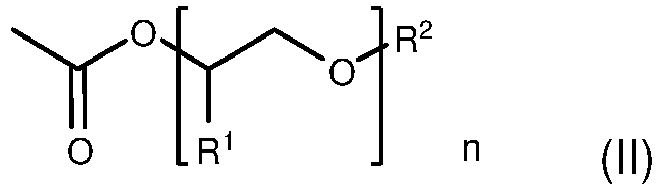 R1 is selected from the group consisting of H and Me,R2 is selected from the group consisting of Si(Me3)3, and a C1-C6 linear or branched alkyl chain, andn is comprised between 1 and 3,
 E is selected from the group consisting of CN, CO2Me and CO2Et, andG is a carboxylic ester moiety CO2R3, wherein R3 is selected from the group consisting of: C1-C18 linear or branched alkyl chain, trimethylsilylated C1-C3 alkyl chain, allyl, propargyl, cyclohexyl, cyclohexenyl, methylcyclohexyl, methylcyclohexenyl, ethylcyclohexyl, ethylcyclohexenyl, furfuryl, phenylethyl, phenoxyethyl, and acrylic ester moiety.b. a thickener,c. a thixotropic agent selected from the group consisting of hydrogenated castor oil, hydrogenated castor oil modified by reaction with an amine, polyamides, and silica,d. a stabilizing agent, and2) a component B comprising:a. a plasticizing agent selected from the group consisting of esters of C2-C4 carboxylic acids with C2-C5 alkyl alcohols having 2-4 hydroxyl groups,b. an initiating agent, andc. a thixotropic agent selected from the group consisting of hydrogenated castor oil, hydrogenated castor oil modified by reaction with an amine, polyamides, and silica.
 - Composition according to claim 1, characterized in that the compound of general formula (I) is 2-methoxyethyl cyanoacrylate, 2-ethoxyethyl cyanoacrylate, or 2-(1-methoxy)propyl cyanoacrylate.
- Composition according to claims 1 or 2, characterized in that the thickener is selected from the group consisting of poly(meth)acrylates, polyvinylpyrrolidones, polyvinyl acetates, partially hydrolysed polyvinyl acetates, vinyl acetate copolymers, and acylated cellulose polymers.
- Composition according to claim 1, characterized in that the thixotropic agent is silica selected from the group consisting of fumed silica, hydrophobic fumed silica, hydrophilic fumed silica and precipitated silica.
- Composition according to claim 1, characterized in that the thixotropic agent is selected from the group consisting of hydrogenated castor oil, hydrogenated castor oil modified by reaction with an amine, and polyamides.
- Composition according to any of claims 1 to 5, characterized in that the stabilizing agent is selected from the group consisting of radical stabilizing agents, acid stabilizing agents, and mixtures thereof.
- Composition according to claim 5, characterized in that it further comprises an accelerating agent and a plasticizing agent.
- Composition according to claim 7, characterized in that the accelerating agent is selected from the group consisting of crown ethers, silylated crown ethers; calixarenes tetra-t-butyl esters; and dimethyl ethers of PEG 400, PEG 500, PEG 600 and PEG 1000.
- Composition according to claim 7, characterized in that the plasticizing agent is selected from the group consisting of esters of C2-C4 carboxylic acids with C2-C5 alkyl alcohols having 2-4 hydroxyl groups.
- Composition according to claim 1, characterized in that the component B comprises a plasticizing agent selected from glycerine triacetate and ethylene glycol diacetate.
- Composition according to claim 1, characterized in that the initiating agent is selected from the group consisting of xanthines, quaternary ammonium salts, metal salts of carboxylic acids, and mixtures thereof.
- An adhesive characterized in that it comprises the composition of any of the claims 1 to 11.
- A bonding, repair, or sealing method characterized in that it comprises:1) combining from 1 to 4 parts by volume of component A and 1 part by volume of component B of the composition of any of claims 1 to 11,2) applying this mixture to a joint or on the upper part of a substrate and, optionally3) assembling a second substrate atop the first substrate.
- An elastic material obtainable according to the method of claim 13.
- Use of the composition according to any of claims 1 to 11 for bonding substrates, repairing depressions, cracks or holes in a substrate or between substrates and for sealing of joints.
Priority Applications (1)
| Application Number | Priority Date | Filing Date | Title |
|---|---|---|---|
| PL15774712T PL3191561T3 (en) | 2014-09-12 | 2015-09-03 | Fast and elastic adhesive |
Applications Claiming Priority (2)
| Application Number | Priority Date | Filing Date | Title |
|---|---|---|---|
| EP14382343.3A EP2995663A1 (en) | 2014-09-12 | 2014-09-12 | Fast and elastic adhesive |
| PCT/IB2015/056697 WO2016038514A1 (en) | 2014-09-12 | 2015-09-03 | Fast and elastic adhesive |
Publications (2)
| Publication Number | Publication Date |
|---|---|
| EP3191561A1 EP3191561A1 (en) | 2017-07-19 |
| EP3191561B1 true EP3191561B1 (en) | 2020-05-06 |
Family
ID=51868160
Family Applications (2)
| Application Number | Title | Priority Date | Filing Date |
|---|---|---|---|
| EP14382343.3A Withdrawn EP2995663A1 (en) | 2014-09-12 | 2014-09-12 | Fast and elastic adhesive |
| EP15774712.2A Active EP3191561B1 (en) | 2014-09-12 | 2015-09-03 | Fast and elastic adhesive |
Family Applications Before (1)
| Application Number | Title | Priority Date | Filing Date |
|---|---|---|---|
| EP14382343.3A Withdrawn EP2995663A1 (en) | 2014-09-12 | 2014-09-12 | Fast and elastic adhesive |
Country Status (5)
| Country | Link |
|---|---|
| US (1) | US10626299B2 (en) |
| EP (2) | EP2995663A1 (en) |
| ES (1) | ES2808852T3 (en) |
| PL (1) | PL3191561T3 (en) |
| WO (1) | WO2016038514A1 (en) |
Families Citing this family (20)
| Publication number | Priority date | Publication date | Assignee | Title |
|---|---|---|---|---|
| US10830665B2 (en) * | 2016-08-15 | 2020-11-10 | University Of Manitoba | Damage detection with self-powered wireless smart coating sensor |
| CN107227118A (en) * | 2017-06-13 | 2017-10-03 | 合肥远科服装设计有限公司 | A kind of leather shoe sole adhesive and preparation method thereof |
| KR20190011169A (en) * | 2017-07-24 | 2019-02-01 | 삼성전자주식회사 | Electronic device and manufacturing method for housing of the same |
| GB2567867B (en) * | 2017-10-27 | 2020-09-16 | Henkel IP & Holding GmbH | Toughened, low odor/low bloom cyanoacrylate compositions |
| GB2567869B (en) * | 2017-10-27 | 2021-08-11 | Henkel IP & Holding GmbH | Toughened humidity/thermal resistant cyanoacrylate compositions |
| GB2567868B (en) | 2017-10-27 | 2020-05-06 | Henkel IP & Holding GmbH | Toughened low odour cyanoacrylate compositions |
| JP7255606B2 (en) * | 2018-10-23 | 2023-04-11 | 東亞合成株式会社 | Method for producing 2-cyanoacrylate compound and method for producing photocurable adhesive composition |
| MX2021010879A (en) * | 2019-03-19 | 2022-01-19 | Bostik Sa | Two-part curable composition. |
| EP4133020A4 (en) * | 2020-04-07 | 2023-12-06 | Henkel AG & Co. KGaA | Low odour cyanoacrylate composition |
| JP6965968B1 (en) * | 2020-07-01 | 2021-11-10 | 東亞合成株式会社 | Coated wire sealing composition and covered wire |
| CN112467228A (en) * | 2020-12-15 | 2021-03-09 | 江苏中兴派能电池有限公司 | Laminated naked battery cell, preparation method and application thereof |
| EP4086294A1 (en) * | 2021-05-07 | 2022-11-09 | Bostik SA | Two-part curable composition |
| EP4089124A1 (en) * | 2021-05-12 | 2022-11-16 | Unecol Adhesive Ideas, S.L. | Method for bonding a thermoplastic piping system without the use of solvent-based adhesives, and associated adhesive without the use of solvents |
| WO2023286709A1 (en) * | 2021-07-12 | 2023-01-19 | 東亞合成株式会社 | 2-cyanoacrylate adhesive composition |
| JP7740338B2 (en) * | 2021-07-12 | 2025-09-17 | 東亞合成株式会社 | 2-cyanoacrylate adhesive composition |
| EP4377089A4 (en) | 2021-07-30 | 2025-07-23 | Temperpack Tech Inc | INSULATION PRODUCTS AND METHODS AND MACHINES FOR THE MANUFACTURE OF INSULATION PRODUCTS |
| EP4257648A1 (en) | 2022-04-04 | 2023-10-11 | Bostik SA | Two-part curable composition |
| EP4286369A1 (en) | 2022-06-03 | 2023-12-06 | Bostik SA | Biobased cyanoacrylate compound |
| EP4567051A1 (en) | 2023-12-04 | 2025-06-11 | Bostik SA | Photocurable composition comprising n-heptylcyanoacrylate, n-hexylcyanoacrylate or n-octylcyanoacrylate |
| EP4567084A1 (en) * | 2023-12-04 | 2025-06-11 | Bostik SA | Composition comprising n-heptylcyanoacrylate |
Family Cites Families (31)
| Publication number | Priority date | Publication date | Assignee | Title |
|---|---|---|---|---|
| US2794788A (en) | 1952-11-01 | 1957-06-04 | Eastman Kodak Co | Adhesive compositions containing alkyl esters of cyanoacrylic acid |
| US2784127A (en) | 1954-06-02 | 1957-03-05 | Eastman Kodak Co | Plasticized monomeric adhesive compositions and articles prepared therefrom |
| US3282773A (en) | 1961-07-20 | 1966-11-01 | Eastman Kodak Co | Adhesive composition and method of bonding using alpha-cyanoacrylate esters and vinyl aromatics |
| US3692752A (en) | 1968-10-31 | 1972-09-19 | Matsumoto Seiyaku Kogyo Kk | Adhesive composition containing {60 -cyanoacrylate as its main ingredient |
| US3572841A (en) | 1969-01-15 | 1971-03-30 | Norton Co | Material pickup for groove cutters |
| NL163797C (en) | 1969-10-10 | Loctite Ireland Ltd | PROCESS FOR PREPARING ADHESIVE COMPOSITIONS BASED ON ALPHA-CYANACRYLIC ACID ESTERS CONTAINING A SOFT-CONTAINER. | |
| IE45626B1 (en) | 1976-07-14 | 1982-10-20 | Loctite Ltd | Filled cyanoacrylate adhesive compositions |
| US4042442A (en) | 1976-11-29 | 1977-08-16 | Eastman Kodak Company | 2-Cyanoacrylate adhesive composition |
| JPS53129231A (en) | 1977-04-19 | 1978-11-11 | Toagosei Chem Ind Co Ltd | Adhesion composition |
| JPS56135455A (en) | 1980-03-27 | 1981-10-22 | Toagosei Chem Ind Co Ltd | Novel 2-cyanoacrylate and curable composition |
| US4906317A (en) | 1983-11-10 | 1990-03-06 | Loctite Corporation | Instant adhesive composition and bonding method employing same |
| US4980086A (en) | 1985-10-16 | 1990-12-25 | Toagosei Chemical Industry, Co., Ltd. | Curable composition |
| EP0239890A3 (en) | 1986-03-25 | 1989-07-12 | National Starch and Chemical Corporation | Opaque cyanoacrylate adhesives and coatings |
| US4837260A (en) | 1986-05-23 | 1989-06-06 | Toagosei Chemical Industry Co., Ltd. | Cyanoacrylate compositions |
| GB8729140D0 (en) | 1987-12-14 | 1988-01-27 | Lingner & Fischer Gmbh | Adhesive |
| DE19752893A1 (en) * | 1997-11-28 | 1999-08-12 | Henkel Kgaa | Cyanoacrylate adhesive with an ester additive |
| US6310166B1 (en) | 1999-08-12 | 2001-10-30 | Closure Medical Corporation | Sterilized cyanoacrylate solutions containing thickeners |
| US6245933B1 (en) | 1999-11-19 | 2001-06-12 | Closure Medical Corporation | Transesterification method for making cyanoacrylates |
| US6977278B1 (en) | 2001-01-08 | 2005-12-20 | Loctite (R&D) Ltd. | Cyanoacrylate compositions curable to flexible polymeric materials |
| US20040131827A1 (en) | 2003-01-06 | 2004-07-08 | Loctite (R&D) Limited | Toughened cyanoacrylate compositions |
| WO2004076770A1 (en) | 2003-02-25 | 2004-09-10 | Quick-Med Technologies, Inc. | Improved antifungal gypsum board |
| US8192731B2 (en) | 2005-10-25 | 2012-06-05 | Loctite (R&D) Limited | Thickened cyanoacrylate compositions |
| EP2148893A4 (en) * | 2007-05-22 | 2011-12-21 | Henkel Corp | Anaerobically curable compositions |
| DE102008033378A1 (en) * | 2008-07-10 | 2010-01-14 | Aesculap Ag | Adhesive composition, useful in surgical medicine for closure of wounds and to glue animal or human tissues, comprises liquid mixture of cyanoacrylate monomers and plasticizer and an aqueous liquid component comprising e.g. amino acid |
| US8153743B2 (en) * | 2008-07-31 | 2012-04-10 | Closure Medical Corporation | Controlled exotherm of cyanoacrylate formulations |
| JP5785083B2 (en) | 2008-10-21 | 2015-09-24 | ヘンケル アイピー アンド ホールディング ゲゼルシャフト ミット ベシュレンクテル ハフツング | Activators for two-part cyanoacrylate adhesives |
| PL2616520T3 (en) * | 2010-09-15 | 2018-08-31 | Henkel IP & Holding GmbH | Two-part, cyanoacrylate/cationically curable adhesive systems |
| KR101336774B1 (en) | 2011-05-16 | 2013-12-04 | 대흥화학공업주식회사 | Dimethyl 2-methylenemalonate process |
| KR101336775B1 (en) | 2011-05-26 | 2013-12-04 | 대흥화학공업주식회사 | Super glue composite using Dimethyl 2-methylenemalonate |
| US8981027B2 (en) * | 2013-03-15 | 2015-03-17 | Henkel IP & Holding GmbH | Two-part, cyanoacrylate/cationically curable adhesive systems |
| ES2534727B1 (en) | 2013-10-24 | 2016-02-05 | Afinitica Technologies, S. L. | Cyanoacrylate composition |
-
2014
- 2014-09-12 EP EP14382343.3A patent/EP2995663A1/en not_active Withdrawn
-
2015
- 2015-09-03 WO PCT/IB2015/056697 patent/WO2016038514A1/en not_active Ceased
- 2015-09-03 ES ES15774712T patent/ES2808852T3/en active Active
- 2015-09-03 US US15/506,963 patent/US10626299B2/en active Active
- 2015-09-03 EP EP15774712.2A patent/EP3191561B1/en active Active
- 2015-09-03 PL PL15774712T patent/PL3191561T3/en unknown
Non-Patent Citations (1)
| Title |
|---|
| None * |
Also Published As
| Publication number | Publication date |
|---|---|
| EP3191561A1 (en) | 2017-07-19 |
| EP2995663A1 (en) | 2016-03-16 |
| US10626299B2 (en) | 2020-04-21 |
| WO2016038514A1 (en) | 2016-03-17 |
| PL3191561T3 (en) | 2020-11-02 |
| ES2808852T3 (en) | 2021-03-02 |
| US20170260422A1 (en) | 2017-09-14 |
Similar Documents
| Publication | Publication Date | Title |
|---|---|---|
| US10626299B2 (en) | Fast and elastic adhesive | |
| US10144851B2 (en) | Cyanoacrylate composition | |
| KR101667862B1 (en) | Cyanoacrylate compositions | |
| KR101107405B1 (en) | Shock resistant cyanoacrylate compositions | |
| CA2525011C (en) | Cyanoacrylate compositions | |
| ES2663570T3 (en) | Cationically curable adhesive systems / two-part cyanoacrylate | |
| ES2909652T3 (en) | Cyanoacrylate compositions | |
| US12466981B2 (en) | Curable two-part adhesive composition | |
| WO2022234017A1 (en) | Two-part curable composition | |
| EP2995664B1 (en) | Fast and universal adhesive | |
| US11939493B2 (en) | Two-part curable composition | |
| US12157784B2 (en) | Two-part curable composition | |
| JP4190225B2 (en) | 2-Cyanoacrylate adhesive composition | |
| JP2005089532A (en) | 2-cyanoacrylate-based adhesive composition | |
| TWI806962B (en) | Cyanoacrylate compositions |
Legal Events
| Date | Code | Title | Description |
|---|---|---|---|
| STAA | Information on the status of an ep patent application or granted ep patent |
Free format text: STATUS: THE INTERNATIONAL PUBLICATION HAS BEEN MADE |
|
| PUAI | Public reference made under article 153(3) epc to a published international application that has entered the european phase |
Free format text: ORIGINAL CODE: 0009012 |
|
| STAA | Information on the status of an ep patent application or granted ep patent |
Free format text: STATUS: REQUEST FOR EXAMINATION WAS MADE |
|
| 17P | Request for examination filed |
Effective date: 20170316 |
|
| AK | Designated contracting states |
Kind code of ref document: A1 Designated state(s): AL AT BE BG CH CY CZ DE DK EE ES FI FR GB GR HR HU IE IS IT LI LT LU LV MC MK MT NL NO PL PT RO RS SE SI SK SM TR |
|
| AX | Request for extension of the european patent |
Extension state: BA ME |
|
| DAV | Request for validation of the european patent (deleted) | ||
| DAX | Request for extension of the european patent (deleted) | ||
| GRAP | Despatch of communication of intention to grant a patent |
Free format text: ORIGINAL CODE: EPIDOSNIGR1 |
|
| STAA | Information on the status of an ep patent application or granted ep patent |
Free format text: STATUS: GRANT OF PATENT IS INTENDED |
|
| INTG | Intention to grant announced |
Effective date: 20191212 |
|
| GRAS | Grant fee paid |
Free format text: ORIGINAL CODE: EPIDOSNIGR3 |
|
| GRAA | (expected) grant |
Free format text: ORIGINAL CODE: 0009210 |
|
| STAA | Information on the status of an ep patent application or granted ep patent |
Free format text: STATUS: THE PATENT HAS BEEN GRANTED |
|
| AK | Designated contracting states |
Kind code of ref document: B1 Designated state(s): AL AT BE BG CH CY CZ DE DK EE ES FI FR GB GR HR HU IE IS IT LI LT LU LV MC MK MT NL NO PL PT RO RS SE SI SK SM TR |
|
| REG | Reference to a national code |
Ref country code: GB Ref legal event code: FG4D |
|
| REG | Reference to a national code |
Ref country code: AT Ref legal event code: REF Ref document number: 1266683 Country of ref document: AT Kind code of ref document: T Effective date: 20200515 Ref country code: CH Ref legal event code: EP |
|
| REG | Reference to a national code |
Ref country code: DE Ref legal event code: R096 Ref document number: 602015052306 Country of ref document: DE |
|
| REG | Reference to a national code |
Ref country code: IE Ref legal event code: FG4D |
|
| REG | Reference to a national code |
Ref country code: NL Ref legal event code: FP |
|
| REG | Reference to a national code |
Ref country code: LT Ref legal event code: MG4D |
|
| PG25 | Lapsed in a contracting state [announced via postgrant information from national office to epo] |
Ref country code: GR Free format text: LAPSE BECAUSE OF FAILURE TO SUBMIT A TRANSLATION OF THE DESCRIPTION OR TO PAY THE FEE WITHIN THE PRESCRIBED TIME-LIMIT Effective date: 20200807 Ref country code: SE Free format text: LAPSE BECAUSE OF FAILURE TO SUBMIT A TRANSLATION OF THE DESCRIPTION OR TO PAY THE FEE WITHIN THE PRESCRIBED TIME-LIMIT Effective date: 20200506 Ref country code: IS Free format text: LAPSE BECAUSE OF FAILURE TO SUBMIT A TRANSLATION OF THE DESCRIPTION OR TO PAY THE FEE WITHIN THE PRESCRIBED TIME-LIMIT Effective date: 20200906 Ref country code: FI Free format text: LAPSE BECAUSE OF FAILURE TO SUBMIT A TRANSLATION OF THE DESCRIPTION OR TO PAY THE FEE WITHIN THE PRESCRIBED TIME-LIMIT Effective date: 20200506 Ref country code: LT Free format text: LAPSE BECAUSE OF FAILURE TO SUBMIT A TRANSLATION OF THE DESCRIPTION OR TO PAY THE FEE WITHIN THE PRESCRIBED TIME-LIMIT Effective date: 20200506 Ref country code: NO Free format text: LAPSE BECAUSE OF FAILURE TO SUBMIT A TRANSLATION OF THE DESCRIPTION OR TO PAY THE FEE WITHIN THE PRESCRIBED TIME-LIMIT Effective date: 20200806 Ref country code: PT Free format text: LAPSE BECAUSE OF FAILURE TO SUBMIT A TRANSLATION OF THE DESCRIPTION OR TO PAY THE FEE WITHIN THE PRESCRIBED TIME-LIMIT Effective date: 20200907 |
|
| PG25 | Lapsed in a contracting state [announced via postgrant information from national office to epo] |
Ref country code: LV Free format text: LAPSE BECAUSE OF FAILURE TO SUBMIT A TRANSLATION OF THE DESCRIPTION OR TO PAY THE FEE WITHIN THE PRESCRIBED TIME-LIMIT Effective date: 20200506 Ref country code: RS Free format text: LAPSE BECAUSE OF FAILURE TO SUBMIT A TRANSLATION OF THE DESCRIPTION OR TO PAY THE FEE WITHIN THE PRESCRIBED TIME-LIMIT Effective date: 20200506 Ref country code: HR Free format text: LAPSE BECAUSE OF FAILURE TO SUBMIT A TRANSLATION OF THE DESCRIPTION OR TO PAY THE FEE WITHIN THE PRESCRIBED TIME-LIMIT Effective date: 20200506 Ref country code: BG Free format text: LAPSE BECAUSE OF FAILURE TO SUBMIT A TRANSLATION OF THE DESCRIPTION OR TO PAY THE FEE WITHIN THE PRESCRIBED TIME-LIMIT Effective date: 20200806 |
|
| REG | Reference to a national code |
Ref country code: AT Ref legal event code: MK05 Ref document number: 1266683 Country of ref document: AT Kind code of ref document: T Effective date: 20200506 |
|
| PG25 | Lapsed in a contracting state [announced via postgrant information from national office to epo] |
Ref country code: AL Free format text: LAPSE BECAUSE OF FAILURE TO SUBMIT A TRANSLATION OF THE DESCRIPTION OR TO PAY THE FEE WITHIN THE PRESCRIBED TIME-LIMIT Effective date: 20200506 |
|
| PG25 | Lapsed in a contracting state [announced via postgrant information from national office to epo] |
Ref country code: CZ Free format text: LAPSE BECAUSE OF FAILURE TO SUBMIT A TRANSLATION OF THE DESCRIPTION OR TO PAY THE FEE WITHIN THE PRESCRIBED TIME-LIMIT Effective date: 20200506 Ref country code: AT Free format text: LAPSE BECAUSE OF FAILURE TO SUBMIT A TRANSLATION OF THE DESCRIPTION OR TO PAY THE FEE WITHIN THE PRESCRIBED TIME-LIMIT Effective date: 20200506 Ref country code: EE Free format text: LAPSE BECAUSE OF FAILURE TO SUBMIT A TRANSLATION OF THE DESCRIPTION OR TO PAY THE FEE WITHIN THE PRESCRIBED TIME-LIMIT Effective date: 20200506 Ref country code: DK Free format text: LAPSE BECAUSE OF FAILURE TO SUBMIT A TRANSLATION OF THE DESCRIPTION OR TO PAY THE FEE WITHIN THE PRESCRIBED TIME-LIMIT Effective date: 20200506 Ref country code: RO Free format text: LAPSE BECAUSE OF FAILURE TO SUBMIT A TRANSLATION OF THE DESCRIPTION OR TO PAY THE FEE WITHIN THE PRESCRIBED TIME-LIMIT Effective date: 20200506 Ref country code: SM Free format text: LAPSE BECAUSE OF FAILURE TO SUBMIT A TRANSLATION OF THE DESCRIPTION OR TO PAY THE FEE WITHIN THE PRESCRIBED TIME-LIMIT Effective date: 20200506 |
|
| REG | Reference to a national code |
Ref country code: DE Ref legal event code: R097 Ref document number: 602015052306 Country of ref document: DE |
|
| PG25 | Lapsed in a contracting state [announced via postgrant information from national office to epo] |
Ref country code: SK Free format text: LAPSE BECAUSE OF FAILURE TO SUBMIT A TRANSLATION OF THE DESCRIPTION OR TO PAY THE FEE WITHIN THE PRESCRIBED TIME-LIMIT Effective date: 20200506 |
|
| REG | Reference to a national code |
Ref country code: ES Ref legal event code: FG2A Ref document number: 2808852 Country of ref document: ES Kind code of ref document: T3 Effective date: 20210302 |
|
| PLBE | No opposition filed within time limit |
Free format text: ORIGINAL CODE: 0009261 |
|
| STAA | Information on the status of an ep patent application or granted ep patent |
Free format text: STATUS: NO OPPOSITION FILED WITHIN TIME LIMIT |
|
| 26N | No opposition filed |
Effective date: 20210209 |
|
| PG25 | Lapsed in a contracting state [announced via postgrant information from national office to epo] |
Ref country code: MC Free format text: LAPSE BECAUSE OF FAILURE TO SUBMIT A TRANSLATION OF THE DESCRIPTION OR TO PAY THE FEE WITHIN THE PRESCRIBED TIME-LIMIT Effective date: 20200506 |
|
| REG | Reference to a national code |
Ref country code: CH Ref legal event code: PL |
|
| PG25 | Lapsed in a contracting state [announced via postgrant information from national office to epo] |
Ref country code: SI Free format text: LAPSE BECAUSE OF FAILURE TO SUBMIT A TRANSLATION OF THE DESCRIPTION OR TO PAY THE FEE WITHIN THE PRESCRIBED TIME-LIMIT Effective date: 20200506 |
|
| REG | Reference to a national code |
Ref country code: BE Ref legal event code: MM Effective date: 20200930 |
|
| PG25 | Lapsed in a contracting state [announced via postgrant information from national office to epo] |
Ref country code: LU Free format text: LAPSE BECAUSE OF NON-PAYMENT OF DUE FEES Effective date: 20200903 |
|
| PG25 | Lapsed in a contracting state [announced via postgrant information from national office to epo] |
Ref country code: CH Free format text: LAPSE BECAUSE OF NON-PAYMENT OF DUE FEES Effective date: 20200930 Ref country code: BE Free format text: LAPSE BECAUSE OF NON-PAYMENT OF DUE FEES Effective date: 20200930 Ref country code: LI Free format text: LAPSE BECAUSE OF NON-PAYMENT OF DUE FEES Effective date: 20200930 |
|
| PG25 | Lapsed in a contracting state [announced via postgrant information from national office to epo] |
Ref country code: TR Free format text: LAPSE BECAUSE OF FAILURE TO SUBMIT A TRANSLATION OF THE DESCRIPTION OR TO PAY THE FEE WITHIN THE PRESCRIBED TIME-LIMIT Effective date: 20200506 Ref country code: MT Free format text: LAPSE BECAUSE OF FAILURE TO SUBMIT A TRANSLATION OF THE DESCRIPTION OR TO PAY THE FEE WITHIN THE PRESCRIBED TIME-LIMIT Effective date: 20200506 Ref country code: CY Free format text: LAPSE BECAUSE OF FAILURE TO SUBMIT A TRANSLATION OF THE DESCRIPTION OR TO PAY THE FEE WITHIN THE PRESCRIBED TIME-LIMIT Effective date: 20200506 |
|
| PG25 | Lapsed in a contracting state [announced via postgrant information from national office to epo] |
Ref country code: MK Free format text: LAPSE BECAUSE OF FAILURE TO SUBMIT A TRANSLATION OF THE DESCRIPTION OR TO PAY THE FEE WITHIN THE PRESCRIBED TIME-LIMIT Effective date: 20200506 |
|
| PGFP | Annual fee paid to national office [announced via postgrant information from national office to epo] |
Ref country code: NL Payment date: 20220819 Year of fee payment: 8 |
|
| PGFP | Annual fee paid to national office [announced via postgrant information from national office to epo] |
Ref country code: IT Payment date: 20220811 Year of fee payment: 8 |
|
| PGFP | Annual fee paid to national office [announced via postgrant information from national office to epo] |
Ref country code: PL Payment date: 20220830 Year of fee payment: 8 |
|
| P01 | Opt-out of the competence of the unified patent court (upc) registered |
Effective date: 20230530 |
|
| REG | Reference to a national code |
Ref country code: NL Ref legal event code: MM Effective date: 20231001 |
|
| PG25 | Lapsed in a contracting state [announced via postgrant information from national office to epo] |
Ref country code: NL Free format text: LAPSE BECAUSE OF NON-PAYMENT OF DUE FEES Effective date: 20231001 |
|
| PG25 | Lapsed in a contracting state [announced via postgrant information from national office to epo] |
Ref country code: NL Free format text: LAPSE BECAUSE OF NON-PAYMENT OF DUE FEES Effective date: 20231001 |
|
| PG25 | Lapsed in a contracting state [announced via postgrant information from national office to epo] |
Ref country code: IT Free format text: LAPSE BECAUSE OF NON-PAYMENT OF DUE FEES Effective date: 20230903 |
|
| PG25 | Lapsed in a contracting state [announced via postgrant information from national office to epo] |
Ref country code: IT Free format text: LAPSE BECAUSE OF NON-PAYMENT OF DUE FEES Effective date: 20230903 |
|
| PG25 | Lapsed in a contracting state [announced via postgrant information from national office to epo] |
Ref country code: PL Free format text: LAPSE BECAUSE OF NON-PAYMENT OF DUE FEES Effective date: 20230903 |
|
| PGFP | Annual fee paid to national office [announced via postgrant information from national office to epo] |
Ref country code: DE Payment date: 20250730 Year of fee payment: 11 |
|
| PGFP | Annual fee paid to national office [announced via postgrant information from national office to epo] |
Ref country code: GB Payment date: 20250731 Year of fee payment: 11 |
|
| PGFP | Annual fee paid to national office [announced via postgrant information from national office to epo] |
Ref country code: FR Payment date: 20250808 Year of fee payment: 11 |
|
| PGFP | Annual fee paid to national office [announced via postgrant information from national office to epo] |
Ref country code: IE Payment date: 20250812 Year of fee payment: 11 |
|
| PGFP | Annual fee paid to national office [announced via postgrant information from national office to epo] |
Ref country code: ES Payment date: 20251014 Year of fee payment: 11 |