EP3190463A1 - Photosensitive electroless plating undercoat agent - Google Patents
Photosensitive electroless plating undercoat agent Download PDFInfo
- Publication number
- EP3190463A1 EP3190463A1 EP15837379.5A EP15837379A EP3190463A1 EP 3190463 A1 EP3190463 A1 EP 3190463A1 EP 15837379 A EP15837379 A EP 15837379A EP 3190463 A1 EP3190463 A1 EP 3190463A1
- Authority
- EP
- European Patent Office
- Prior art keywords
- group
- metal
- meth
- primer
- photosensitive
- Prior art date
- Legal status (The legal status is an assumption and is not a legal conclusion. Google has not performed a legal analysis and makes no representation as to the accuracy of the status listed.)
- Withdrawn
Links
- 238000007772 electroless plating Methods 0.000 title claims abstract description 55
- 229910052751 metal Inorganic materials 0.000 claims abstract description 133
- 239000002184 metal Substances 0.000 claims abstract description 133
- 238000007747 plating Methods 0.000 claims abstract description 88
- 229920000587 hyperbranched polymer Polymers 0.000 claims abstract description 83
- 150000001875 compounds Chemical class 0.000 claims abstract description 71
- 239000000463 material Substances 0.000 claims abstract description 65
- 125000003647 acryloyl group Chemical group O=C([*])C([H])=C([H])[H] 0.000 claims abstract description 58
- 239000010419 fine particle Substances 0.000 claims abstract description 57
- QGZKDVFQNNGYKY-UHFFFAOYSA-O ammonium group Chemical group [NH4+] QGZKDVFQNNGYKY-UHFFFAOYSA-O 0.000 claims abstract description 40
- 238000000034 method Methods 0.000 claims abstract description 40
- 239000003999 initiator Substances 0.000 claims abstract description 16
- 238000000206 photolithography Methods 0.000 claims abstract description 16
- 230000008569 process Effects 0.000 claims abstract description 10
- -1 acrylate compound Chemical class 0.000 claims description 122
- JOYRKODLDBILNP-UHFFFAOYSA-N Ethyl urethane Chemical compound CCOC(N)=O JOYRKODLDBILNP-UHFFFAOYSA-N 0.000 claims description 43
- KDLHZDBZIXYQEI-UHFFFAOYSA-N Palladium Chemical compound [Pd] KDLHZDBZIXYQEI-UHFFFAOYSA-N 0.000 claims description 38
- 125000002496 methyl group Chemical group [H]C([H])([H])* 0.000 claims description 33
- PXHVJJICTQNCMI-UHFFFAOYSA-N Nickel Chemical compound [Ni] PXHVJJICTQNCMI-UHFFFAOYSA-N 0.000 claims description 29
- 239000010949 copper Substances 0.000 claims description 15
- 125000005702 oxyalkylene group Chemical group 0.000 claims description 15
- 125000002947 alkylene group Chemical group 0.000 claims description 14
- BASFCYQUMIYNBI-UHFFFAOYSA-N platinum Chemical compound [Pt] BASFCYQUMIYNBI-UHFFFAOYSA-N 0.000 claims description 14
- 125000004435 hydrogen atom Chemical group [H]* 0.000 claims description 13
- 229910052802 copper Inorganic materials 0.000 claims description 12
- RTZKZFJDLAIYFH-UHFFFAOYSA-N ether Substances CCOCC RTZKZFJDLAIYFH-UHFFFAOYSA-N 0.000 claims description 12
- 229910052759 nickel Inorganic materials 0.000 claims description 12
- 229910052757 nitrogen Inorganic materials 0.000 claims description 12
- RYGMFSIKBFXOCR-UHFFFAOYSA-N Copper Chemical compound [Cu] RYGMFSIKBFXOCR-UHFFFAOYSA-N 0.000 claims description 11
- 239000010931 gold Substances 0.000 claims description 11
- 239000002245 particle Substances 0.000 claims description 11
- 125000004122 cyclic group Chemical group 0.000 claims description 10
- 229910052763 palladium Inorganic materials 0.000 claims description 10
- 125000004432 carbon atom Chemical group C* 0.000 claims description 9
- 239000011135 tin Substances 0.000 claims description 9
- BQCADISMDOOEFD-UHFFFAOYSA-N Silver Chemical compound [Ag] BQCADISMDOOEFD-UHFFFAOYSA-N 0.000 claims description 8
- PCHJSUWPFVWCPO-UHFFFAOYSA-N gold Chemical compound [Au] PCHJSUWPFVWCPO-UHFFFAOYSA-N 0.000 claims description 8
- 229910052737 gold Inorganic materials 0.000 claims description 8
- 229910052709 silver Inorganic materials 0.000 claims description 8
- 239000004332 silver Substances 0.000 claims description 8
- XEEYBQQBJWHFJM-UHFFFAOYSA-N Iron Chemical compound [Fe] XEEYBQQBJWHFJM-UHFFFAOYSA-N 0.000 claims description 7
- 125000003710 aryl alkyl group Chemical group 0.000 claims description 7
- 125000002887 hydroxy group Chemical group [H]O* 0.000 claims description 7
- 125000003837 (C1-C20) alkyl group Chemical group 0.000 claims description 6
- ATJFFYVFTNAWJD-UHFFFAOYSA-N Tin Chemical compound [Sn] ATJFFYVFTNAWJD-UHFFFAOYSA-N 0.000 claims description 6
- 229910052799 carbon Inorganic materials 0.000 claims description 6
- 125000003178 carboxy group Chemical group [H]OC(*)=O 0.000 claims description 6
- 125000004093 cyano group Chemical group *C#N 0.000 claims description 6
- 125000004433 nitrogen atom Chemical group N* 0.000 claims description 6
- 229910052718 tin Inorganic materials 0.000 claims description 6
- 125000003860 C1-C20 alkoxy group Chemical group 0.000 claims description 4
- 125000000217 alkyl group Chemical group 0.000 claims description 4
- 150000001450 anions Chemical class 0.000 claims description 4
- 239000010941 cobalt Substances 0.000 claims description 4
- 229910017052 cobalt Inorganic materials 0.000 claims description 4
- GUTLYIVDDKVIGB-UHFFFAOYSA-N cobalt atom Chemical compound [Co] GUTLYIVDDKVIGB-UHFFFAOYSA-N 0.000 claims description 4
- 125000006165 cyclic alkyl group Chemical group 0.000 claims description 4
- 229910052697 platinum Inorganic materials 0.000 claims description 4
- 125000003545 alkoxy group Chemical group 0.000 claims description 3
- 125000003277 amino group Chemical group 0.000 claims description 3
- 125000000449 nitro group Chemical group [O-][N+](*)=O 0.000 claims description 3
- 230000015572 biosynthetic process Effects 0.000 abstract description 6
- 239000002585 base Substances 0.000 description 56
- 239000000243 solution Substances 0.000 description 52
- HEDRZPFGACZZDS-UHFFFAOYSA-N Chloroform Chemical compound ClC(Cl)Cl HEDRZPFGACZZDS-UHFFFAOYSA-N 0.000 description 50
- 239000010408 film Substances 0.000 description 47
- 239000002904 solvent Substances 0.000 description 46
- LFQSCWFLJHTTHZ-UHFFFAOYSA-N Ethanol Chemical compound CCO LFQSCWFLJHTTHZ-UHFFFAOYSA-N 0.000 description 39
- NIXOWILDQLNWCW-UHFFFAOYSA-M Acrylate Chemical compound [O-]C(=O)C=C NIXOWILDQLNWCW-UHFFFAOYSA-M 0.000 description 38
- WYURNTSHIVDZCO-UHFFFAOYSA-N Tetrahydrofuran Chemical compound C1CCOC1 WYURNTSHIVDZCO-UHFFFAOYSA-N 0.000 description 34
- KFZMGEQAYNKOFK-UHFFFAOYSA-N Isopropanol Chemical compound CC(C)O KFZMGEQAYNKOFK-UHFFFAOYSA-N 0.000 description 30
- 239000011248 coating agent Substances 0.000 description 28
- 238000000576 coating method Methods 0.000 description 28
- BDERNNFJNOPAEC-UHFFFAOYSA-N propan-1-ol Chemical compound CCCO BDERNNFJNOPAEC-UHFFFAOYSA-N 0.000 description 24
- 238000006243 chemical reaction Methods 0.000 description 22
- 229910021645 metal ion Inorganic materials 0.000 description 19
- OKKJLVBELUTLKV-UHFFFAOYSA-N Methanol Chemical compound OC OKKJLVBELUTLKV-UHFFFAOYSA-N 0.000 description 18
- 239000000203 mixture Substances 0.000 description 18
- 239000000047 product Substances 0.000 description 17
- YLQBMQCUIZJEEH-UHFFFAOYSA-N tetrahydrofuran Natural products C=1C=COC=1 YLQBMQCUIZJEEH-UHFFFAOYSA-N 0.000 description 17
- YMWUJEATGCHHMB-UHFFFAOYSA-N Dichloromethane Chemical compound ClCCl YMWUJEATGCHHMB-UHFFFAOYSA-N 0.000 description 16
- SECXISVLQFMRJM-UHFFFAOYSA-N N-Methylpyrrolidone Chemical compound CN1CCCC1=O SECXISVLQFMRJM-UHFFFAOYSA-N 0.000 description 16
- ZMXDDKWLCZADIW-UHFFFAOYSA-N N,N-Dimethylformamide Chemical compound CN(C)C=O ZMXDDKWLCZADIW-UHFFFAOYSA-N 0.000 description 15
- YXFVVABEGXRONW-UHFFFAOYSA-N Toluene Chemical compound CC1=CC=CC=C1 YXFVVABEGXRONW-UHFFFAOYSA-N 0.000 description 15
- 238000004519 manufacturing process Methods 0.000 description 15
- 239000000126 substance Substances 0.000 description 15
- 239000007864 aqueous solution Substances 0.000 description 13
- 125000001309 chloro group Chemical group Cl* 0.000 description 13
- 230000018109 developmental process Effects 0.000 description 13
- 150000003839 salts Chemical class 0.000 description 13
- ZWEHNKRNPOVVGH-UHFFFAOYSA-N 2-Butanone Chemical compound CCC(C)=O ZWEHNKRNPOVVGH-UHFFFAOYSA-N 0.000 description 12
- WEVYAHXRMPXWCK-UHFFFAOYSA-N Acetonitrile Chemical compound CC#N WEVYAHXRMPXWCK-UHFFFAOYSA-N 0.000 description 12
- IJGRMHOSHXDMSA-UHFFFAOYSA-N Atomic nitrogen Chemical compound N#N IJGRMHOSHXDMSA-UHFFFAOYSA-N 0.000 description 12
- 239000005977 Ethylene Substances 0.000 description 12
- IAYPIBMASNFSPL-UHFFFAOYSA-N Ethylene oxide Chemical compound C1CO1 IAYPIBMASNFSPL-UHFFFAOYSA-N 0.000 description 12
- 125000005843 halogen group Chemical group 0.000 description 12
- ARXJGSRGQADJSQ-UHFFFAOYSA-N 1-methoxypropan-2-ol Chemical compound COCC(C)O ARXJGSRGQADJSQ-UHFFFAOYSA-N 0.000 description 11
- LYCAIKOWRPUZTN-UHFFFAOYSA-N Ethylene glycol Chemical compound OCCO LYCAIKOWRPUZTN-UHFFFAOYSA-N 0.000 description 11
- 230000000052 comparative effect Effects 0.000 description 10
- VLKZOEOYAKHREP-UHFFFAOYSA-N n-Hexane Chemical compound CCCCCC VLKZOEOYAKHREP-UHFFFAOYSA-N 0.000 description 10
- CSCPPACGZOOCGX-UHFFFAOYSA-N Acetone Chemical compound CC(C)=O CSCPPACGZOOCGX-UHFFFAOYSA-N 0.000 description 9
- UHOVQNZJYSORNB-UHFFFAOYSA-N Benzene Chemical compound C1=CC=CC=C1 UHOVQNZJYSORNB-UHFFFAOYSA-N 0.000 description 9
- 239000003638 chemical reducing agent Substances 0.000 description 9
- XLYOFNOQVPJJNP-UHFFFAOYSA-N water Substances O XLYOFNOQVPJJNP-UHFFFAOYSA-N 0.000 description 9
- 150000001298 alcohols Chemical class 0.000 description 8
- LLHKCFNBLRBOGN-UHFFFAOYSA-N propylene glycol methyl ether acetate Chemical compound COCC(C)OC(C)=O LLHKCFNBLRBOGN-UHFFFAOYSA-N 0.000 description 8
- 239000011347 resin Substances 0.000 description 8
- 229920005989 resin Polymers 0.000 description 8
- 239000003446 ligand Substances 0.000 description 7
- IAZDPXIOMUYVGZ-UHFFFAOYSA-N Dimethylsulphoxide Chemical compound CS(C)=O IAZDPXIOMUYVGZ-UHFFFAOYSA-N 0.000 description 6
- XEKOWRVHYACXOJ-UHFFFAOYSA-N Ethyl acetate Chemical compound CCOC(C)=O XEKOWRVHYACXOJ-UHFFFAOYSA-N 0.000 description 6
- IMNFDUFMRHMDMM-UHFFFAOYSA-N N-Heptane Chemical compound CCCCCCC IMNFDUFMRHMDMM-UHFFFAOYSA-N 0.000 description 6
- KWYUFKZDYYNOTN-UHFFFAOYSA-M Potassium hydroxide Chemical compound [OH-].[K+] KWYUFKZDYYNOTN-UHFFFAOYSA-M 0.000 description 6
- DNIAPMSPPWPWGF-UHFFFAOYSA-N Propylene glycol Chemical compound CC(O)CO DNIAPMSPPWPWGF-UHFFFAOYSA-N 0.000 description 6
- HEMHJVSKTPXQMS-UHFFFAOYSA-M Sodium hydroxide Chemical compound [OH-].[Na+] HEMHJVSKTPXQMS-UHFFFAOYSA-M 0.000 description 6
- HEDRZPFGACZZDS-MICDWDOJSA-N Trichloro(2H)methane Chemical compound [2H]C(Cl)(Cl)Cl HEDRZPFGACZZDS-MICDWDOJSA-N 0.000 description 6
- ZMANZCXQSJIPKH-UHFFFAOYSA-N Triethylamine Chemical compound CCN(CC)CC ZMANZCXQSJIPKH-UHFFFAOYSA-N 0.000 description 6
- 239000000654 additive Substances 0.000 description 6
- JHIVVAPYMSGYDF-UHFFFAOYSA-N cyclohexanone Chemical compound O=C1CCCCC1 JHIVVAPYMSGYDF-UHFFFAOYSA-N 0.000 description 6
- VFHVQBAGLAREND-UHFFFAOYSA-N diphenylphosphoryl-(2,4,6-trimethylphenyl)methanone Chemical compound CC1=CC(C)=CC(C)=C1C(=O)P(=O)(C=1C=CC=CC=1)C1=CC=CC=C1 VFHVQBAGLAREND-UHFFFAOYSA-N 0.000 description 6
- 125000001495 ethyl group Chemical group [H]C([H])([H])C([H])([H])* 0.000 description 6
- 239000011521 glass Substances 0.000 description 6
- 229920000642 polymer Polymers 0.000 description 6
- 239000000843 powder Substances 0.000 description 6
- 238000007639 printing Methods 0.000 description 6
- 238000006722 reduction reaction Methods 0.000 description 6
- 239000004094 surface-active agent Substances 0.000 description 6
- 239000002966 varnish Substances 0.000 description 6
- JWUJQDFVADABEY-UHFFFAOYSA-N 2-methyltetrahydrofuran Chemical compound CC1CCCO1 JWUJQDFVADABEY-UHFFFAOYSA-N 0.000 description 5
- HVVWZTWDBSEWIH-UHFFFAOYSA-N [2-(hydroxymethyl)-3-prop-2-enoyloxy-2-(prop-2-enoyloxymethyl)propyl] prop-2-enoate Chemical compound C=CC(=O)OCC(CO)(COC(=O)C=C)COC(=O)C=C HVVWZTWDBSEWIH-UHFFFAOYSA-N 0.000 description 5
- 230000001588 bifunctional effect Effects 0.000 description 5
- 238000009835 boiling Methods 0.000 description 5
- DKVNPHBNOWQYFE-UHFFFAOYSA-N carbamodithioic acid Chemical group NC(S)=S DKVNPHBNOWQYFE-UHFFFAOYSA-N 0.000 description 5
- 239000003054 catalyst Substances 0.000 description 5
- 239000012295 chemical reaction liquid Substances 0.000 description 5
- 239000003795 chemical substances by application Substances 0.000 description 5
- 239000000084 colloidal system Substances 0.000 description 5
- 150000004292 cyclic ethers Chemical class 0.000 description 5
- 238000005227 gel permeation chromatography Methods 0.000 description 5
- 150000008282 halocarbons Chemical class 0.000 description 5
- 239000007788 liquid Substances 0.000 description 5
- 125000004108 n-butyl group Chemical group [H]C([H])([H])C([H])([H])C([H])([H])C([H])([H])* 0.000 description 5
- 125000001280 n-hexyl group Chemical group C(CCCCC)* 0.000 description 5
- 239000003960 organic solvent Substances 0.000 description 5
- WXZMFSXDPGVJKK-UHFFFAOYSA-N pentaerythritol Chemical compound OCC(CO)(CO)CO WXZMFSXDPGVJKK-UHFFFAOYSA-N 0.000 description 5
- 230000009467 reduction Effects 0.000 description 5
- 239000000758 substrate Substances 0.000 description 5
- 150000003512 tertiary amines Chemical class 0.000 description 5
- 229940042596 viscoat Drugs 0.000 description 5
- LVEYOSJUKRVCCF-UHFFFAOYSA-N 1,3-bis(diphenylphosphino)propane Chemical compound C=1C=CC=CC=1P(C=1C=CC=CC=1)CCCP(C=1C=CC=CC=1)C1=CC=CC=C1 LVEYOSJUKRVCCF-UHFFFAOYSA-N 0.000 description 4
- YNQLUTRBYVCPMQ-UHFFFAOYSA-N Ethylbenzene Chemical compound CCC1=CC=CC=C1 YNQLUTRBYVCPMQ-UHFFFAOYSA-N 0.000 description 4
- CERQOIWHTDAKMF-UHFFFAOYSA-N Methacrylic acid Chemical compound CC(=C)C(O)=O CERQOIWHTDAKMF-UHFFFAOYSA-N 0.000 description 4
- NTIZESTWPVYFNL-UHFFFAOYSA-N Methyl isobutyl ketone Chemical compound CC(C)CC(C)=O NTIZESTWPVYFNL-UHFFFAOYSA-N 0.000 description 4
- UIHCLUNTQKBZGK-UHFFFAOYSA-N Methyl isobutyl ketone Natural products CCC(C)C(C)=O UIHCLUNTQKBZGK-UHFFFAOYSA-N 0.000 description 4
- FXHOOIRPVKKKFG-UHFFFAOYSA-N N,N-Dimethylacetamide Chemical compound CN(C)C(C)=O FXHOOIRPVKKKFG-UHFFFAOYSA-N 0.000 description 4
- XYFCBTPGUUZFHI-UHFFFAOYSA-N Phosphine Chemical compound P XYFCBTPGUUZFHI-UHFFFAOYSA-N 0.000 description 4
- 229920003171 Poly (ethylene oxide) Polymers 0.000 description 4
- CDBYLPFSWZWCQE-UHFFFAOYSA-L Sodium Carbonate Chemical compound [Na+].[Na+].[O-]C([O-])=O CDBYLPFSWZWCQE-UHFFFAOYSA-L 0.000 description 4
- DHXVGJBLRPWPCS-UHFFFAOYSA-N Tetrahydropyran Chemical compound C1CCOCC1 DHXVGJBLRPWPCS-UHFFFAOYSA-N 0.000 description 4
- XLOMVQKBTHCTTD-UHFFFAOYSA-N Zinc monoxide Chemical compound [Zn]=O XLOMVQKBTHCTTD-UHFFFAOYSA-N 0.000 description 4
- 125000002723 alicyclic group Chemical group 0.000 description 4
- 229910052783 alkali metal Inorganic materials 0.000 description 4
- 150000001408 amides Chemical class 0.000 description 4
- KVNRLNFWIYMESJ-UHFFFAOYSA-N butyronitrile Chemical compound CCCC#N KVNRLNFWIYMESJ-UHFFFAOYSA-N 0.000 description 4
- 150000002170 ethers Chemical class 0.000 description 4
- 238000011156 evaluation Methods 0.000 description 4
- 238000009616 inductively coupled plasma Methods 0.000 description 4
- QSHDDOUJBYECFT-UHFFFAOYSA-N mercury Chemical compound [Hg] QSHDDOUJBYECFT-UHFFFAOYSA-N 0.000 description 4
- 229910052753 mercury Inorganic materials 0.000 description 4
- 125000002950 monocyclic group Chemical group 0.000 description 4
- UQKAOOAFEFCDGT-UHFFFAOYSA-N n,n-dimethyloctan-1-amine Chemical group CCCCCCCCN(C)C UQKAOOAFEFCDGT-UHFFFAOYSA-N 0.000 description 4
- 238000001127 nanoimprint lithography Methods 0.000 description 4
- 150000002825 nitriles Chemical class 0.000 description 4
- 229920005862 polyol Polymers 0.000 description 4
- 150000003077 polyols Chemical class 0.000 description 4
- BWHMMNNQKKPAPP-UHFFFAOYSA-L potassium carbonate Chemical compound [K+].[K+].[O-]C([O-])=O BWHMMNNQKKPAPP-UHFFFAOYSA-L 0.000 description 4
- 238000002360 preparation method Methods 0.000 description 4
- WGYKZJWCGVVSQN-UHFFFAOYSA-N propylamine Chemical compound CCCN WGYKZJWCGVVSQN-UHFFFAOYSA-N 0.000 description 4
- 238000000746 purification Methods 0.000 description 4
- 238000001226 reprecipitation Methods 0.000 description 4
- 238000005507 spraying Methods 0.000 description 4
- GETQZCLCWQTVFV-UHFFFAOYSA-N trimethylamine Chemical compound CN(C)C GETQZCLCWQTVFV-UHFFFAOYSA-N 0.000 description 4
- RFFLAFLAYFXFSW-UHFFFAOYSA-N 1,2-dichlorobenzene Chemical compound ClC1=CC=CC=C1Cl RFFLAFLAYFXFSW-UHFFFAOYSA-N 0.000 description 3
- HZAXFHJVJLSVMW-UHFFFAOYSA-N 2-Aminoethan-1-ol Chemical compound NCCO HZAXFHJVJLSVMW-UHFFFAOYSA-N 0.000 description 3
- TXBCBTDQIULDIA-UHFFFAOYSA-N 2-[[3-hydroxy-2,2-bis(hydroxymethyl)propoxy]methyl]-2-(hydroxymethyl)propane-1,3-diol Chemical compound OCC(CO)(CO)COCC(CO)(CO)CO TXBCBTDQIULDIA-UHFFFAOYSA-N 0.000 description 3
- QTBSBXVTEAMEQO-UHFFFAOYSA-N Acetic acid Chemical compound CC(O)=O QTBSBXVTEAMEQO-UHFFFAOYSA-N 0.000 description 3
- PEDCQBHIVMGVHV-UHFFFAOYSA-N Glycerine Chemical compound OCC(O)CO PEDCQBHIVMGVHV-UHFFFAOYSA-N 0.000 description 3
- 239000005057 Hexamethylene diisocyanate Substances 0.000 description 3
- 239000004793 Polystyrene Substances 0.000 description 3
- GOOHAUXETOMSMM-UHFFFAOYSA-N Propylene oxide Chemical group CC1CO1 GOOHAUXETOMSMM-UHFFFAOYSA-N 0.000 description 3
- JUJWROOIHBZHMG-UHFFFAOYSA-N Pyridine Chemical group C1=CC=NC=C1 JUJWROOIHBZHMG-UHFFFAOYSA-N 0.000 description 3
- 239000002253 acid Substances 0.000 description 3
- 125000001931 aliphatic group Chemical group 0.000 description 3
- 150000001338 aliphatic hydrocarbons Chemical class 0.000 description 3
- 229910052784 alkaline earth metal Inorganic materials 0.000 description 3
- 150000004945 aromatic hydrocarbons Chemical class 0.000 description 3
- 239000012298 atmosphere Substances 0.000 description 3
- 238000001636 atomic emission spectroscopy Methods 0.000 description 3
- 230000005540 biological transmission Effects 0.000 description 3
- BTANRVKWQNVYAZ-UHFFFAOYSA-N butan-2-ol Chemical compound CCC(C)O BTANRVKWQNVYAZ-UHFFFAOYSA-N 0.000 description 3
- KRKNYBCHXYNGOX-UHFFFAOYSA-N citric acid Chemical compound OC(=O)CC(O)(C(O)=O)CC(O)=O KRKNYBCHXYNGOX-UHFFFAOYSA-N 0.000 description 3
- 239000008139 complexing agent Substances 0.000 description 3
- 238000002508 contact lithography Methods 0.000 description 3
- UAOMVDZJSHZZME-UHFFFAOYSA-N diisopropylamine Chemical compound CC(C)NC(C)C UAOMVDZJSHZZME-UHFFFAOYSA-N 0.000 description 3
- 230000000694 effects Effects 0.000 description 3
- 150000002334 glycols Chemical class 0.000 description 3
- 238000010438 heat treatment Methods 0.000 description 3
- RRAMGCGOFNQTLD-UHFFFAOYSA-N hexamethylene diisocyanate Chemical compound O=C=NCCCCCCN=C=O RRAMGCGOFNQTLD-UHFFFAOYSA-N 0.000 description 3
- RAXXELZNTBOGNW-UHFFFAOYSA-N imidazole Natural products C1=CNC=N1 RAXXELZNTBOGNW-UHFFFAOYSA-N 0.000 description 3
- 239000012948 isocyanate Substances 0.000 description 3
- 150000002513 isocyanates Chemical class 0.000 description 3
- 150000002576 ketones Chemical class 0.000 description 3
- 238000001459 lithography Methods 0.000 description 3
- 239000002932 luster Substances 0.000 description 3
- 150000002739 metals Chemical class 0.000 description 3
- 239000011259 mixed solution Substances 0.000 description 3
- 239000012299 nitrogen atmosphere Substances 0.000 description 3
- YJVFFLUZDVXJQI-UHFFFAOYSA-L palladium(ii) acetate Chemical compound [Pd+2].CC([O-])=O.CC([O-])=O YJVFFLUZDVXJQI-UHFFFAOYSA-L 0.000 description 3
- 239000003505 polymerization initiator Substances 0.000 description 3
- 229920001296 polysiloxane Polymers 0.000 description 3
- 229920002223 polystyrene Polymers 0.000 description 3
- 238000000425 proton nuclear magnetic resonance spectrum Methods 0.000 description 3
- 230000005855 radiation Effects 0.000 description 3
- 239000007870 radical polymerization initiator Substances 0.000 description 3
- 150000003335 secondary amines Chemical class 0.000 description 3
- 238000004528 spin coating Methods 0.000 description 3
- 239000003381 stabilizer Substances 0.000 description 3
- 239000010409 thin film Substances 0.000 description 3
- KZPYGQFFRCFCPP-UHFFFAOYSA-N 1,1'-bis(diphenylphosphino)ferrocene Chemical compound [Fe+2].C1=CC=C[C-]1P(C=1C=CC=CC=1)C1=CC=CC=C1.C1=CC=C[C-]1P(C=1C=CC=CC=1)C1=CC=CC=C1 KZPYGQFFRCFCPP-UHFFFAOYSA-N 0.000 description 2
- WSLDOOZREJYCGB-UHFFFAOYSA-N 1,2-Dichloroethane Chemical compound ClCCCl WSLDOOZREJYCGB-UHFFFAOYSA-N 0.000 description 2
- RYHBNJHYFVUHQT-UHFFFAOYSA-N 1,4-Dioxane Chemical compound C1COCCO1 RYHBNJHYFVUHQT-UHFFFAOYSA-N 0.000 description 2
- KHUFHLFHOQVFGB-UHFFFAOYSA-N 1-aminoanthracene-9,10-dione Chemical class O=C1C2=CC=CC=C2C(=O)C2=C1C=CC=C2N KHUFHLFHOQVFGB-UHFFFAOYSA-N 0.000 description 2
- RUFPHBVGCFYCNW-UHFFFAOYSA-N 1-naphthylamine Chemical compound C1=CC=C2C(N)=CC=CC2=C1 RUFPHBVGCFYCNW-UHFFFAOYSA-N 0.000 description 2
- XNWFRZJHXBZDAG-UHFFFAOYSA-N 2-METHOXYETHANOL Chemical compound COCCO XNWFRZJHXBZDAG-UHFFFAOYSA-N 0.000 description 2
- NIXOWILDQLNWCW-UHFFFAOYSA-N 2-Propenoic acid Natural products OC(=O)C=C NIXOWILDQLNWCW-UHFFFAOYSA-N 0.000 description 2
- WMYINDVYGQKYMI-UHFFFAOYSA-N 2-[2,2-bis(hydroxymethyl)butoxymethyl]-2-ethylpropane-1,3-diol Chemical compound CCC(CO)(CO)COCC(CC)(CO)CO WMYINDVYGQKYMI-UHFFFAOYSA-N 0.000 description 2
- YIJYFLXQHDOQGW-UHFFFAOYSA-N 2-[2,4,6-trioxo-3,5-bis(2-prop-2-enoyloxyethyl)-1,3,5-triazinan-1-yl]ethyl prop-2-enoate Chemical compound C=CC(=O)OCCN1C(=O)N(CCOC(=O)C=C)C(=O)N(CCOC(=O)C=C)C1=O YIJYFLXQHDOQGW-UHFFFAOYSA-N 0.000 description 2
- POAOYUHQDCAZBD-UHFFFAOYSA-N 2-butoxyethanol Chemical compound CCCCOCCO POAOYUHQDCAZBD-UHFFFAOYSA-N 0.000 description 2
- ZNQVEEAIQZEUHB-UHFFFAOYSA-N 2-ethoxyethanol Chemical compound CCOCCO ZNQVEEAIQZEUHB-UHFFFAOYSA-N 0.000 description 2
- YIWUKEYIRIRTPP-UHFFFAOYSA-N 2-ethylhexan-1-ol Chemical compound CCCCC(CC)CO YIWUKEYIRIRTPP-UHFFFAOYSA-N 0.000 description 2
- KDSNLYIMUZNERS-UHFFFAOYSA-N 2-methylpropanamine Chemical compound CC(C)CN KDSNLYIMUZNERS-UHFFFAOYSA-N 0.000 description 2
- PAYRUJLWNCNPSJ-UHFFFAOYSA-N Aniline Chemical compound NC1=CC=CC=C1 PAYRUJLWNCNPSJ-UHFFFAOYSA-N 0.000 description 2
- XKRFYHLGVUSROY-UHFFFAOYSA-N Argon Chemical compound [Ar] XKRFYHLGVUSROY-UHFFFAOYSA-N 0.000 description 2
- DKPFZGUDAPQIHT-UHFFFAOYSA-N Butyl acetate Natural products CCCCOC(C)=O DKPFZGUDAPQIHT-UHFFFAOYSA-N 0.000 description 2
- 0 C*Cc1c(*C)c(*)c(*)c(C)c1I Chemical compound C*Cc1c(*C)c(*)c(*)c(C)c1I 0.000 description 2
- VTYYLEPIZMXCLO-UHFFFAOYSA-L Calcium carbonate Chemical compound [Ca+2].[O-]C([O-])=O VTYYLEPIZMXCLO-UHFFFAOYSA-L 0.000 description 2
- XDTMQSROBMDMFD-UHFFFAOYSA-N Cyclohexane Chemical compound C1CCCCC1 XDTMQSROBMDMFD-UHFFFAOYSA-N 0.000 description 2
- ZAFNJMIOTHYJRJ-UHFFFAOYSA-N Diisopropyl ether Chemical compound CC(C)OC(C)C ZAFNJMIOTHYJRJ-UHFFFAOYSA-N 0.000 description 2
- XTHFKEDIFFGKHM-UHFFFAOYSA-N Dimethoxyethane Chemical compound COCCOC XTHFKEDIFFGKHM-UHFFFAOYSA-N 0.000 description 2
- ROSDSFDQCJNGOL-UHFFFAOYSA-N Dimethylamine Chemical compound CNC ROSDSFDQCJNGOL-UHFFFAOYSA-N 0.000 description 2
- KCXVZYZYPLLWCC-UHFFFAOYSA-N EDTA Chemical compound OC(=O)CN(CC(O)=O)CCN(CC(O)=O)CC(O)=O KCXVZYZYPLLWCC-UHFFFAOYSA-N 0.000 description 2
- QUSNBJAOOMFDIB-UHFFFAOYSA-N Ethylamine Chemical compound CCN QUSNBJAOOMFDIB-UHFFFAOYSA-N 0.000 description 2
- UFHFLCQGNIYNRP-UHFFFAOYSA-N Hydrogen Chemical compound [H][H] UFHFLCQGNIYNRP-UHFFFAOYSA-N 0.000 description 2
- CPELXLSAUQHCOX-UHFFFAOYSA-N Hydrogen bromide Chemical compound Br CPELXLSAUQHCOX-UHFFFAOYSA-N 0.000 description 2
- BAVYZALUXZFZLV-UHFFFAOYSA-N Methylamine Chemical compound NC BAVYZALUXZFZLV-UHFFFAOYSA-N 0.000 description 2
- YNAVUWVOSKDBBP-UHFFFAOYSA-N Morpholine Chemical compound C1COCCN1 YNAVUWVOSKDBBP-UHFFFAOYSA-N 0.000 description 2
- KWYHDKDOAIKMQN-UHFFFAOYSA-N N,N,N',N'-tetramethylethylenediamine Chemical compound CN(C)CCN(C)C KWYHDKDOAIKMQN-UHFFFAOYSA-N 0.000 description 2
- JGFZNNIVVJXRND-UHFFFAOYSA-N N,N-Diisopropylethylamine (DIPEA) Chemical compound CCN(C(C)C)C(C)C JGFZNNIVVJXRND-UHFFFAOYSA-N 0.000 description 2
- LRHPLDYGYMQRHN-UHFFFAOYSA-N N-Butanol Chemical compound CCCCO LRHPLDYGYMQRHN-UHFFFAOYSA-N 0.000 description 2
- UOIWOHLIGKIYFE-UHFFFAOYSA-N N-n-pentyl-N-methylamine Natural products CCCCCNC UOIWOHLIGKIYFE-UHFFFAOYSA-N 0.000 description 2
- CTQNGGLPUBDAKN-UHFFFAOYSA-N O-Xylene Chemical compound CC1=CC=CC=C1C CTQNGGLPUBDAKN-UHFFFAOYSA-N 0.000 description 2
- BHHGXPLMPWCGHP-UHFFFAOYSA-N Phenethylamine Chemical compound NCCC1=CC=CC=C1 BHHGXPLMPWCGHP-UHFFFAOYSA-N 0.000 description 2
- FQYUMYWMJTYZTK-UHFFFAOYSA-N Phenyl glycidyl ether Chemical compound C1OC1COC1=CC=CC=C1 FQYUMYWMJTYZTK-UHFFFAOYSA-N 0.000 description 2
- GLUUGHFHXGJENI-UHFFFAOYSA-N Piperazine Chemical compound C1CNCCN1 GLUUGHFHXGJENI-UHFFFAOYSA-N 0.000 description 2
- NQRYJNQNLNOLGT-UHFFFAOYSA-N Piperidine Chemical compound C1CCNCC1 NQRYJNQNLNOLGT-UHFFFAOYSA-N 0.000 description 2
- 239000004696 Poly ether ether ketone Substances 0.000 description 2
- 239000004721 Polyphenylene oxide Substances 0.000 description 2
- KYQCOXFCLRTKLS-UHFFFAOYSA-N Pyrazine Chemical compound C1=CN=CC=N1 KYQCOXFCLRTKLS-UHFFFAOYSA-N 0.000 description 2
- KAESVJOAVNADME-UHFFFAOYSA-N Pyrrole Chemical compound C=1C=CNC=1 KAESVJOAVNADME-UHFFFAOYSA-N 0.000 description 2
- SMWDFEZZVXVKRB-UHFFFAOYSA-N Quinoline Chemical compound N1=CC=CC2=CC=CC=C21 SMWDFEZZVXVKRB-UHFFFAOYSA-N 0.000 description 2
- UIIMBOGNXHQVGW-UHFFFAOYSA-M Sodium bicarbonate Chemical compound [Na+].OC([O-])=O UIIMBOGNXHQVGW-UHFFFAOYSA-M 0.000 description 2
- 239000004147 Sorbitan trioleate Substances 0.000 description 2
- PRXRUNOAOLTIEF-ADSICKODSA-N Sorbitan trioleate Chemical compound CCCCCCCC\C=C/CCCCCCCC(=O)OC[C@@H](OC(=O)CCCCCCC\C=C/CCCCCCCC)[C@H]1OC[C@H](O)[C@H]1OC(=O)CCCCCCC\C=C/CCCCCCCC PRXRUNOAOLTIEF-ADSICKODSA-N 0.000 description 2
- DAKWPKUUDNSNPN-UHFFFAOYSA-N Trimethylolpropane triacrylate Chemical compound C=CC(=O)OCC(CC)(COC(=O)C=C)COC(=O)C=C DAKWPKUUDNSNPN-UHFFFAOYSA-N 0.000 description 2
- OKKRPWIIYQTPQF-UHFFFAOYSA-N Trimethylolpropane trimethacrylate Chemical compound CC(=C)C(=O)OCC(CC)(COC(=O)C(C)=C)COC(=O)C(C)=C OKKRPWIIYQTPQF-UHFFFAOYSA-N 0.000 description 2
- 150000001252 acrylic acid derivatives Chemical class 0.000 description 2
- XECAHXYUAAWDEL-UHFFFAOYSA-N acrylonitrile butadiene styrene Chemical compound C=CC=C.C=CC#N.C=CC1=CC=CC=C1 XECAHXYUAAWDEL-UHFFFAOYSA-N 0.000 description 2
- 229920000122 acrylonitrile butadiene styrene Polymers 0.000 description 2
- 239000004676 acrylonitrile butadiene styrene Substances 0.000 description 2
- 150000008044 alkali metal hydroxides Chemical class 0.000 description 2
- 229910045601 alloy Inorganic materials 0.000 description 2
- 239000000956 alloy Substances 0.000 description 2
- AZDRQVAHHNSJOQ-UHFFFAOYSA-N alumane Chemical class [AlH3] AZDRQVAHHNSJOQ-UHFFFAOYSA-N 0.000 description 2
- 150000001412 amines Chemical class 0.000 description 2
- YUENFNPLGJCNRB-UHFFFAOYSA-N anthracen-1-amine Chemical class C1=CC=C2C=C3C(N)=CC=CC3=CC2=C1 YUENFNPLGJCNRB-UHFFFAOYSA-N 0.000 description 2
- 150000003974 aralkylamines Chemical class 0.000 description 2
- 150000004982 aromatic amines Chemical class 0.000 description 2
- QVGXLLKOCUKJST-UHFFFAOYSA-N atomic oxygen Chemical compound [O] QVGXLLKOCUKJST-UHFFFAOYSA-N 0.000 description 2
- WGQKYBSKWIADBV-UHFFFAOYSA-N benzylamine Chemical compound NCC1=CC=CC=C1 WGQKYBSKWIADBV-UHFFFAOYSA-N 0.000 description 2
- 125000002619 bicyclic group Chemical group 0.000 description 2
- MUALRAIOVNYAIW-UHFFFAOYSA-N binap Chemical group C1=CC=CC=C1P(C=1C(=C2C=CC=CC2=CC=1)C=1C2=CC=CC=C2C=CC=1P(C=1C=CC=CC=1)C=1C=CC=CC=1)C1=CC=CC=C1 MUALRAIOVNYAIW-UHFFFAOYSA-N 0.000 description 2
- DMVOXQPQNTYEKQ-UHFFFAOYSA-N biphenyl-4-amine Chemical group C1=CC(N)=CC=C1C1=CC=CC=C1 DMVOXQPQNTYEKQ-UHFFFAOYSA-N 0.000 description 2
- KBPLFHHGFOOTCA-UHFFFAOYSA-N caprylic alcohol Natural products CCCCCCCCO KBPLFHHGFOOTCA-UHFFFAOYSA-N 0.000 description 2
- 238000001460 carbon-13 nuclear magnetic resonance spectrum Methods 0.000 description 2
- 125000002915 carbonyl group Chemical group [*:2]C([*:1])=O 0.000 description 2
- 229910052801 chlorine Inorganic materials 0.000 description 2
- MVPPADPHJFYWMZ-UHFFFAOYSA-N chlorobenzene Chemical compound ClC1=CC=CC=C1 MVPPADPHJFYWMZ-UHFFFAOYSA-N 0.000 description 2
- HGCIXCUEYOPUTN-UHFFFAOYSA-N cyclohexene Chemical compound C1CCC=CC1 HGCIXCUEYOPUTN-UHFFFAOYSA-N 0.000 description 2
- 125000000113 cyclohexyl group Chemical group [H]C1([H])C([H])([H])C([H])([H])C([H])(*)C([H])([H])C1([H])[H] 0.000 description 2
- PAFZNILMFXTMIY-UHFFFAOYSA-N cyclohexylamine Chemical compound NC1CCCCC1 PAFZNILMFXTMIY-UHFFFAOYSA-N 0.000 description 2
- BGTOWKSIORTVQH-UHFFFAOYSA-N cyclopentanone Chemical compound O=C1CCCC1 BGTOWKSIORTVQH-UHFFFAOYSA-N 0.000 description 2
- JQVDAXLFBXTEQA-UHFFFAOYSA-N dibutylamine Chemical compound CCCCNCCCC JQVDAXLFBXTEQA-UHFFFAOYSA-N 0.000 description 2
- 238000000979 dip-pen nanolithography Methods 0.000 description 2
- DMBHHRLKUKUOEG-UHFFFAOYSA-N diphenylamine Chemical compound C=1C=CC=CC=1NC1=CC=CC=C1 DMBHHRLKUKUOEG-UHFFFAOYSA-N 0.000 description 2
- 238000007598 dipping method Methods 0.000 description 2
- 239000002270 dispersing agent Substances 0.000 description 2
- 238000009826 distribution Methods 0.000 description 2
- 238000001035 drying Methods 0.000 description 2
- 150000002148 esters Chemical class 0.000 description 2
- UHESRSKEBRADOO-UHFFFAOYSA-N ethyl carbamate;prop-2-enoic acid Chemical compound OC(=O)C=C.CCOC(N)=O UHESRSKEBRADOO-UHFFFAOYSA-N 0.000 description 2
- XLLIQLLCWZCATF-UHFFFAOYSA-N ethylene glycol monomethyl ether acetate Natural products COCCOC(C)=O XLLIQLLCWZCATF-UHFFFAOYSA-N 0.000 description 2
- 125000000816 ethylene group Chemical group [H]C([H])([*:1])C([H])([H])[*:2] 0.000 description 2
- 125000004836 hexamethylene group Chemical group [H]C([H])([*:2])C([H])([H])C([H])([H])C([H])([H])C([H])([H])C([H])([H])[*:1] 0.000 description 2
- ZSIAUFGUXNUGDI-UHFFFAOYSA-N hexan-1-ol Chemical compound CCCCCCO ZSIAUFGUXNUGDI-UHFFFAOYSA-N 0.000 description 2
- FUZZWVXGSFPDMH-UHFFFAOYSA-N hexanoic acid Chemical compound CCCCCC(O)=O FUZZWVXGSFPDMH-UHFFFAOYSA-N 0.000 description 2
- 239000001257 hydrogen Substances 0.000 description 2
- 229910052739 hydrogen Inorganic materials 0.000 description 2
- WGCNASOHLSPBMP-UHFFFAOYSA-N hydroxyacetaldehyde Natural products OCC=O WGCNASOHLSPBMP-UHFFFAOYSA-N 0.000 description 2
- 238000007654 immersion Methods 0.000 description 2
- 239000011261 inert gas Substances 0.000 description 2
- 229910052742 iron Inorganic materials 0.000 description 2
- 230000001678 irradiating effect Effects 0.000 description 2
- 125000001449 isopropyl group Chemical group [H]C([H])([H])C([H])(*)C([H])([H])[H] 0.000 description 2
- 125000001570 methylene group Chemical group [H]C([H])([*:1])[*:2] 0.000 description 2
- RIVIDPPYRINTTH-UHFFFAOYSA-N n-ethylpropan-2-amine Chemical compound CCNC(C)C RIVIDPPYRINTTH-UHFFFAOYSA-N 0.000 description 2
- 125000000740 n-pentyl group Chemical group [H]C([H])([H])C([H])([H])C([H])([H])C([H])([H])C([H])([H])* 0.000 description 2
- SJWFXCIHNDVPSH-UHFFFAOYSA-N octan-2-ol Chemical compound CCCCCCC(C)O SJWFXCIHNDVPSH-UHFFFAOYSA-N 0.000 description 2
- 239000001301 oxygen Substances 0.000 description 2
- 229910052760 oxygen Inorganic materials 0.000 description 2
- 125000004430 oxygen atom Chemical group O* 0.000 description 2
- DPBLXKKOBLCELK-UHFFFAOYSA-N pentan-1-amine Chemical compound CCCCCN DPBLXKKOBLCELK-UHFFFAOYSA-N 0.000 description 2
- 150000003003 phosphines Chemical class 0.000 description 2
- 229910000073 phosphorus hydride Inorganic materials 0.000 description 2
- 230000000704 physical effect Effects 0.000 description 2
- 229920003207 poly(ethylene-2,6-naphthalate) Polymers 0.000 description 2
- 229920000570 polyether Polymers 0.000 description 2
- 229920002530 polyetherether ketone Polymers 0.000 description 2
- 239000011112 polyethylene naphthalate Substances 0.000 description 2
- 229920000139 polyethylene terephthalate Polymers 0.000 description 2
- 239000005020 polyethylene terephthalate Substances 0.000 description 2
- 229910000027 potassium carbonate Inorganic materials 0.000 description 2
- 239000002244 precipitate Substances 0.000 description 2
- 150000003141 primary amines Chemical class 0.000 description 2
- QQONPFPTGQHPMA-UHFFFAOYSA-N propylene Natural products CC=C QQONPFPTGQHPMA-UHFFFAOYSA-N 0.000 description 2
- 125000004805 propylene group Chemical group [H]C([H])([H])C([H])([*:1])C([H])([H])[*:2] 0.000 description 2
- 230000001681 protective effect Effects 0.000 description 2
- 230000035484 reaction time Effects 0.000 description 2
- 230000007261 regionalization Effects 0.000 description 2
- 239000011369 resultant mixture Substances 0.000 description 2
- 150000003333 secondary alcohols Chemical class 0.000 description 2
- NDVLTYZPCACLMA-UHFFFAOYSA-N silver oxide Chemical compound [O-2].[Ag+].[Ag+] NDVLTYZPCACLMA-UHFFFAOYSA-N 0.000 description 2
- SQGYOTSLMSWVJD-UHFFFAOYSA-N silver(1+) nitrate Chemical compound [Ag+].[O-]N(=O)=O SQGYOTSLMSWVJD-UHFFFAOYSA-N 0.000 description 2
- 229910000029 sodium carbonate Inorganic materials 0.000 description 2
- 235000019337 sorbitan trioleate Nutrition 0.000 description 2
- 229960000391 sorbitan trioleate Drugs 0.000 description 2
- 238000003756 stirring Methods 0.000 description 2
- KDYFGRWQOYBRFD-UHFFFAOYSA-N succinic acid Chemical compound OC(=O)CCC(O)=O KDYFGRWQOYBRFD-UHFFFAOYSA-N 0.000 description 2
- 150000003462 sulfoxides Chemical class 0.000 description 2
- 229910052717 sulfur Inorganic materials 0.000 description 2
- 125000004434 sulfur atom Chemical group 0.000 description 2
- YBBRCQOCSYXUOC-UHFFFAOYSA-N sulfuryl dichloride Chemical compound ClS(Cl)(=O)=O YBBRCQOCSYXUOC-UHFFFAOYSA-N 0.000 description 2
- WGTYBPLFGIVFAS-UHFFFAOYSA-M tetramethylammonium hydroxide Chemical compound [OH-].C[N+](C)(C)C WGTYBPLFGIVFAS-UHFFFAOYSA-M 0.000 description 2
- 125000000383 tetramethylene group Chemical group [H]C([H])([*:1])C([H])([H])C([H])([H])C([H])([H])[*:2] 0.000 description 2
- XOLBLPGZBRYERU-UHFFFAOYSA-N tin dioxide Chemical compound O=[Sn]=O XOLBLPGZBRYERU-UHFFFAOYSA-N 0.000 description 2
- 229910001887 tin oxide Inorganic materials 0.000 description 2
- DVKJHBMWWAPEIU-UHFFFAOYSA-N toluene 2,4-diisocyanate Chemical compound CC1=CC=C(N=C=O)C=C1N=C=O DVKJHBMWWAPEIU-UHFFFAOYSA-N 0.000 description 2
- 238000002834 transmittance Methods 0.000 description 2
- 125000003258 trimethylene group Chemical group [H]C([H])([*:2])C([H])([H])C([H])([H])[*:1] 0.000 description 2
- RIOQSEWOXXDEQQ-UHFFFAOYSA-N triphenylphosphine Chemical compound C1=CC=CC=C1P(C=1C=CC=CC=1)C1=CC=CC=C1 RIOQSEWOXXDEQQ-UHFFFAOYSA-N 0.000 description 2
- 238000005406 washing Methods 0.000 description 2
- 239000008096 xylene Substances 0.000 description 2
- 239000011787 zinc oxide Substances 0.000 description 2
- PUPZLCDOIYMWBV-UHFFFAOYSA-N (+/-)-1,3-Butanediol Chemical compound CC(O)CCO PUPZLCDOIYMWBV-UHFFFAOYSA-N 0.000 description 1
- FFJCNSLCJOQHKM-CLFAGFIQSA-N (z)-1-[(z)-octadec-9-enoxy]octadec-9-ene Chemical compound CCCCCCCC\C=C/CCCCCCCCOCCCCCCCC\C=C/CCCCCCCC FFJCNSLCJOQHKM-CLFAGFIQSA-N 0.000 description 1
- QYGBYAQGBVHMDD-XQRVVYSFSA-N (z)-2-cyano-3-thiophen-2-ylprop-2-enoic acid Chemical compound OC(=O)C(\C#N)=C/C1=CC=CS1 QYGBYAQGBVHMDD-XQRVVYSFSA-N 0.000 description 1
- ZORQXIQZAOLNGE-UHFFFAOYSA-N 1,1-difluorocyclohexane Chemical compound FC1(F)CCCCC1 ZORQXIQZAOLNGE-UHFFFAOYSA-N 0.000 description 1
- QFMZQPDHXULLKC-UHFFFAOYSA-N 1,2-bis(diphenylphosphino)ethane Chemical compound C=1C=CC=CC=1P(C=1C=CC=CC=1)CCP(C=1C=CC=CC=1)C1=CC=CC=C1 QFMZQPDHXULLKC-UHFFFAOYSA-N 0.000 description 1
- LEEANUDEDHYDTG-UHFFFAOYSA-N 1,2-dimethoxypropane Chemical compound COCC(C)OC LEEANUDEDHYDTG-UHFFFAOYSA-N 0.000 description 1
- OCJBOOLMMGQPQU-UHFFFAOYSA-N 1,4-dichlorobenzene Chemical compound ClC1=CC=C(Cl)C=C1 OCJBOOLMMGQPQU-UHFFFAOYSA-N 0.000 description 1
- VYXHVRARDIDEHS-UHFFFAOYSA-N 1,5-cyclooctadiene Chemical compound C1CC=CCCC=C1 VYXHVRARDIDEHS-UHFFFAOYSA-N 0.000 description 1
- 239000004912 1,5-cyclooctadiene Substances 0.000 description 1
- FJLUATLTXUNBOT-UHFFFAOYSA-N 1-Hexadecylamine Chemical compound CCCCCCCCCCCCCCCCN FJLUATLTXUNBOT-UHFFFAOYSA-N 0.000 description 1
- HYLLZXPMJRMUHH-UHFFFAOYSA-N 1-[2-(2-methoxyethoxy)ethoxy]butane Chemical compound CCCCOCCOCCOC HYLLZXPMJRMUHH-UHFFFAOYSA-N 0.000 description 1
- KSEPMOMKAQKOSM-UHFFFAOYSA-N 1-aminofluoren-9-one Chemical compound C12=CC=CC=C2C(=O)C2=C1C=CC=C2N KSEPMOMKAQKOSM-UHFFFAOYSA-N 0.000 description 1
- JPZYXGPCHFZBHO-UHFFFAOYSA-N 1-aminopentadecane Chemical compound CCCCCCCCCCCCCCCN JPZYXGPCHFZBHO-UHFFFAOYSA-N 0.000 description 1
- DURPTKYDGMDSBL-UHFFFAOYSA-N 1-butoxybutane Chemical compound CCCCOCCCC DURPTKYDGMDSBL-UHFFFAOYSA-N 0.000 description 1
- RWNUSVWFHDHRCJ-UHFFFAOYSA-N 1-butoxypropan-2-ol Chemical compound CCCCOCC(C)O RWNUSVWFHDHRCJ-UHFFFAOYSA-N 0.000 description 1
- RRQYJINTUHWNHW-UHFFFAOYSA-N 1-ethoxy-2-(2-ethoxyethoxy)ethane Chemical compound CCOCCOCCOCC RRQYJINTUHWNHW-UHFFFAOYSA-N 0.000 description 1
- JOLQKTGDSGKSKJ-UHFFFAOYSA-N 1-ethoxypropan-2-ol Chemical compound CCOCC(C)O JOLQKTGDSGKSKJ-UHFFFAOYSA-N 0.000 description 1
- BMVXCPBXGZKUPN-UHFFFAOYSA-N 1-hexanamine Chemical compound CCCCCCN BMVXCPBXGZKUPN-UHFFFAOYSA-N 0.000 description 1
- RERATEUBWLKDFE-UHFFFAOYSA-N 1-methoxy-2-[2-(2-methoxypropoxy)propoxy]propane Chemical compound COCC(C)OCC(C)OCC(C)OC RERATEUBWLKDFE-UHFFFAOYSA-N 0.000 description 1
- MCTWTZJPVLRJOU-UHFFFAOYSA-N 1-methyl-1H-imidazole Chemical compound CN1C=CN=C1 MCTWTZJPVLRJOU-UHFFFAOYSA-N 0.000 description 1
- RHNJVKIVSXGYBD-UHFFFAOYSA-N 10-prop-2-enoyloxydecyl prop-2-enoate Chemical compound C=CC(=O)OCCCCCCCCCCOC(=O)C=C RHNJVKIVSXGYBD-UHFFFAOYSA-N 0.000 description 1
- 238000001644 13C nuclear magnetic resonance spectroscopy Methods 0.000 description 1
- KWVGIHKZDCUPEU-UHFFFAOYSA-N 2,2-dimethoxy-2-phenylacetophenone Chemical compound C=1C=CC=CC=1C(OC)(OC)C(=O)C1=CC=CC=C1 KWVGIHKZDCUPEU-UHFFFAOYSA-N 0.000 description 1
- XJEVHMGJSYVQBQ-UHFFFAOYSA-N 2,3-dihydro-1h-inden-1-amine Chemical class C1=CC=C2C(N)CCC2=C1 XJEVHMGJSYVQBQ-UHFFFAOYSA-N 0.000 description 1
- LEWZOBYWGWKNCK-UHFFFAOYSA-N 2,3-dihydro-1h-inden-5-amine Chemical compound NC1=CC=C2CCCC2=C1 LEWZOBYWGWKNCK-UHFFFAOYSA-N 0.000 description 1
- SMZOUWXMTYCWNB-UHFFFAOYSA-N 2-(2-methoxy-5-methylphenyl)ethanamine Chemical compound COC1=CC=C(C)C=C1CCN SMZOUWXMTYCWNB-UHFFFAOYSA-N 0.000 description 1
- SBASXUCJHJRPEV-UHFFFAOYSA-N 2-(2-methoxyethoxy)ethanol Chemical compound COCCOCCO SBASXUCJHJRPEV-UHFFFAOYSA-N 0.000 description 1
- GJKGAPPUXSSCFI-UHFFFAOYSA-N 2-Hydroxy-4'-(2-hydroxyethoxy)-2-methylpropiophenone Chemical compound CC(C)(O)C(=O)C1=CC=C(OCCO)C=C1 GJKGAPPUXSSCFI-UHFFFAOYSA-N 0.000 description 1
- RJBIZCOYFBKBIM-UHFFFAOYSA-N 2-[2-(2-methoxyethoxy)ethoxy]propane Chemical compound COCCOCCOC(C)C RJBIZCOYFBKBIM-UHFFFAOYSA-N 0.000 description 1
- WAEVWDZKMBQDEJ-UHFFFAOYSA-N 2-[2-(2-methoxypropoxy)propoxy]propan-1-ol Chemical compound COC(C)COC(C)COC(C)CO WAEVWDZKMBQDEJ-UHFFFAOYSA-N 0.000 description 1
- PTJWCLYPVFJWMP-UHFFFAOYSA-N 2-[[3-hydroxy-2-[[3-hydroxy-2,2-bis(hydroxymethyl)propoxy]methyl]-2-(hydroxymethyl)propoxy]methyl]-2-(hydroxymethyl)propane-1,3-diol Chemical compound OCC(CO)(CO)COCC(CO)(CO)COCC(CO)(CO)CO PTJWCLYPVFJWMP-UHFFFAOYSA-N 0.000 description 1
- UHFFVFAKEGKNAQ-UHFFFAOYSA-N 2-benzyl-2-(dimethylamino)-1-(4-morpholin-4-ylphenyl)butan-1-one Chemical compound C=1C=C(N2CCOCC2)C=CC=1C(=O)C(CC)(N(C)C)CC1=CC=CC=C1 UHFFVFAKEGKNAQ-UHFFFAOYSA-N 0.000 description 1
- WBIQQQGBSDOWNP-UHFFFAOYSA-N 2-dodecylbenzenesulfonic acid Chemical compound CCCCCCCCCCCCC1=CC=CC=C1S(O)(=O)=O WBIQQQGBSDOWNP-UHFFFAOYSA-N 0.000 description 1
- QDZOFZFDBDYWJX-UHFFFAOYSA-N 2-ethoxy-n-(2-ethoxyethyl)ethanamine Chemical compound CCOCCNCCOCC QDZOFZFDBDYWJX-UHFFFAOYSA-N 0.000 description 1
- BPGIOCZAQDIBPI-UHFFFAOYSA-N 2-ethoxyethanamine Chemical compound CCOCCN BPGIOCZAQDIBPI-UHFFFAOYSA-N 0.000 description 1
- ASUDFOJKTJLAIK-UHFFFAOYSA-N 2-methoxyethanamine Chemical compound COCCN ASUDFOJKTJLAIK-UHFFFAOYSA-N 0.000 description 1
- LWRBVKNFOYUCNP-UHFFFAOYSA-N 2-methyl-1-(4-methylsulfanylphenyl)-2-morpholin-4-ylpropan-1-one Chemical compound C1=CC(SC)=CC=C1C(=O)C(C)(C)N1CCOCC1 LWRBVKNFOYUCNP-UHFFFAOYSA-N 0.000 description 1
- RIWRBSMFKVOJMN-UHFFFAOYSA-N 2-methyl-1-phenylpropan-2-ol Chemical compound CC(C)(O)CC1=CC=CC=C1 RIWRBSMFKVOJMN-UHFFFAOYSA-N 0.000 description 1
- CRWNQZTZTZWPOF-UHFFFAOYSA-N 2-methyl-4-phenylpyridine Chemical compound C1=NC(C)=CC(C=2C=CC=CC=2)=C1 CRWNQZTZTZWPOF-UHFFFAOYSA-N 0.000 description 1
- NJBCRXCAPCODGX-UHFFFAOYSA-N 2-methyl-n-(2-methylpropyl)propan-1-amine Chemical compound CC(C)CNCC(C)C NJBCRXCAPCODGX-UHFFFAOYSA-N 0.000 description 1
- JBIJLHTVPXGSAM-UHFFFAOYSA-N 2-naphthylamine Chemical compound C1=CC=CC2=CC(N)=CC=C21 JBIJLHTVPXGSAM-UHFFFAOYSA-N 0.000 description 1
- QCDWFXQBSFUVSP-UHFFFAOYSA-N 2-phenoxyethanol Chemical compound OCCOC1=CC=CC=C1 QCDWFXQBSFUVSP-UHFFFAOYSA-N 0.000 description 1
- TWBPWBPGNQWFSJ-UHFFFAOYSA-N 2-phenylaniline Chemical group NC1=CC=CC=C1C1=CC=CC=C1 TWBPWBPGNQWFSJ-UHFFFAOYSA-N 0.000 description 1
- 125000000094 2-phenylethyl group Chemical group [H]C1=C([H])C([H])=C(C([H])=C1[H])C([H])([H])C([H])([H])* 0.000 description 1
- LORAMPMRWHHNFL-UHFFFAOYSA-N 2-propoxy-n-(2-propoxyethyl)ethanamine Chemical compound CCCOCCNCCOCCC LORAMPMRWHHNFL-UHFFFAOYSA-N 0.000 description 1
- CXMYWOCYTPKBPP-UHFFFAOYSA-N 3-(3-hydroxypropylamino)propan-1-ol Chemical compound OCCCNCCCO CXMYWOCYTPKBPP-UHFFFAOYSA-N 0.000 description 1
- QCAHUFWKIQLBNB-UHFFFAOYSA-N 3-(3-methoxypropoxy)propan-1-ol Chemical compound COCCCOCCCO QCAHUFWKIQLBNB-UHFFFAOYSA-N 0.000 description 1
- MFKRHJVUCZRDTF-UHFFFAOYSA-N 3-methoxy-3-methylbutan-1-ol Chemical compound COC(C)(C)CCO MFKRHJVUCZRDTF-UHFFFAOYSA-N 0.000 description 1
- VATRWWPJWVCZTA-UHFFFAOYSA-N 3-oxo-n-[2-(trifluoromethyl)phenyl]butanamide Chemical compound CC(=O)CC(=O)NC1=CC=CC=C1C(F)(F)F VATRWWPJWVCZTA-UHFFFAOYSA-N 0.000 description 1
- MWVTWFVJZLCBMC-UHFFFAOYSA-N 4,4'-bipyridine Chemical group C1=NC=CC(C=2C=CN=CC=2)=C1 MWVTWFVJZLCBMC-UHFFFAOYSA-N 0.000 description 1
- CSDQQAQKBAQLLE-UHFFFAOYSA-N 4-(4-chlorophenyl)-4,5,6,7-tetrahydrothieno[3,2-c]pyridine Chemical compound C1=CC(Cl)=CC=C1C1C(C=CS2)=C2CCN1 CSDQQAQKBAQLLE-UHFFFAOYSA-N 0.000 description 1
- OBXXZXAJRPJPRT-UHFFFAOYSA-N 4-(4-methyl-3h-pyridin-4-yl)pyridine Chemical group C=1C=NC=CC=1C1(C)CC=NC=C1 OBXXZXAJRPJPRT-UHFFFAOYSA-N 0.000 description 1
- FFWCEONGEXZNFU-UHFFFAOYSA-N 4-aminofluoren-9-one Chemical compound O=C1C2=CC=CC=C2C2=C1C=CC=C2N FFWCEONGEXZNFU-UHFFFAOYSA-N 0.000 description 1
- OGIQUQKNJJTLSZ-UHFFFAOYSA-N 4-butylaniline Chemical compound CCCCC1=CC=C(N)C=C1 OGIQUQKNJJTLSZ-UHFFFAOYSA-N 0.000 description 1
- WGENWPANMZLPIH-UHFFFAOYSA-N 4-decylaniline Chemical compound CCCCCCCCCCC1=CC=C(N)C=C1 WGENWPANMZLPIH-UHFFFAOYSA-N 0.000 description 1
- KLPPPIIIEMUEGP-UHFFFAOYSA-N 4-dodecylaniline Chemical compound CCCCCCCCCCCCC1=CC=C(N)C=C1 KLPPPIIIEMUEGP-UHFFFAOYSA-N 0.000 description 1
- ORKQJTBYQZITLA-UHFFFAOYSA-N 4-octylaniline Chemical compound CCCCCCCCC1=CC=C(N)C=C1 ORKQJTBYQZITLA-UHFFFAOYSA-N 0.000 description 1
- WRDWWAVNELMWAM-UHFFFAOYSA-N 4-tert-butylaniline Chemical compound CC(C)(C)C1=CC=C(N)C=C1 WRDWWAVNELMWAM-UHFFFAOYSA-N 0.000 description 1
- WKYFQPQIOXXPGE-UHFFFAOYSA-N 4-tetradecylaniline Chemical compound CCCCCCCCCCCCCCC1=CC=C(N)C=C1 WKYFQPQIOXXPGE-UHFFFAOYSA-N 0.000 description 1
- DTVYNUOOZIKEEX-UHFFFAOYSA-N 5-aminoisoquinoline Chemical compound N1=CC=C2C(N)=CC=CC2=C1 DTVYNUOOZIKEEX-UHFFFAOYSA-N 0.000 description 1
- XZIIFPSPUDAGJM-UHFFFAOYSA-N 6-chloro-2-n,2-n-diethylpyrimidine-2,4-diamine Chemical compound CCN(CC)C1=NC(N)=CC(Cl)=N1 XZIIFPSPUDAGJM-UHFFFAOYSA-N 0.000 description 1
- CYSPWCARDHRYJX-UHFFFAOYSA-N 9h-fluoren-1-amine Chemical class C12=CC=CC=C2CC2=C1C=CC=C2N CYSPWCARDHRYJX-UHFFFAOYSA-N 0.000 description 1
- CFRFHWQYWJMEJN-UHFFFAOYSA-N 9h-fluoren-2-amine Chemical compound C1=CC=C2C3=CC=C(N)C=C3CC2=C1 CFRFHWQYWJMEJN-UHFFFAOYSA-N 0.000 description 1
- 229920000178 Acrylic resin Polymers 0.000 description 1
- 239000004925 Acrylic resin Substances 0.000 description 1
- 229910001316 Ag alloy Inorganic materials 0.000 description 1
- 229910000838 Al alloy Inorganic materials 0.000 description 1
- 101001074560 Arabidopsis thaliana Aquaporin PIP1-2 Proteins 0.000 description 1
- CIWBSHSKHKDKBQ-JLAZNSOCSA-N Ascorbic acid Natural products OC[C@H](O)[C@H]1OC(=O)C(O)=C1O CIWBSHSKHKDKBQ-JLAZNSOCSA-N 0.000 description 1
- ROFVEXUMMXZLPA-UHFFFAOYSA-N Bipyridyl Chemical group N1=CC=CC=C1C1=CC=CC=N1 ROFVEXUMMXZLPA-UHFFFAOYSA-N 0.000 description 1
- 229910001369 Brass Inorganic materials 0.000 description 1
- 229910000906 Bronze Inorganic materials 0.000 description 1
- VYZAMTAEIAYCRO-UHFFFAOYSA-N Chromium Chemical compound [Cr] VYZAMTAEIAYCRO-UHFFFAOYSA-N 0.000 description 1
- 229910021012 Co2(CO)8 Inorganic materials 0.000 description 1
- 229910019813 Cr(CO)6 Inorganic materials 0.000 description 1
- 229910000881 Cu alloy Inorganic materials 0.000 description 1
- 229910000570 Cupronickel Inorganic materials 0.000 description 1
- MHZGKXUYDGKKIU-UHFFFAOYSA-N Decylamine Chemical compound CCCCCCCCCCN MHZGKXUYDGKKIU-UHFFFAOYSA-N 0.000 description 1
- BWLUMTFWVZZZND-UHFFFAOYSA-N Dibenzylamine Chemical compound C=1C=CC=CC=1CNCC1=CC=CC=C1 BWLUMTFWVZZZND-UHFFFAOYSA-N 0.000 description 1
- XBPCUCUWBYBCDP-UHFFFAOYSA-N Dicyclohexylamine Chemical compound C1CCCCC1NC1CCCCC1 XBPCUCUWBYBCDP-UHFFFAOYSA-N 0.000 description 1
- 229910000737 Duralumin Inorganic materials 0.000 description 1
- 239000004593 Epoxy Substances 0.000 description 1
- PIICEJLVQHRZGT-UHFFFAOYSA-N Ethylenediamine Chemical compound NCCN PIICEJLVQHRZGT-UHFFFAOYSA-N 0.000 description 1
- 229910000640 Fe alloy Inorganic materials 0.000 description 1
- 229910017147 Fe(CO)5 Inorganic materials 0.000 description 1
- YCKRFDGAMUMZLT-UHFFFAOYSA-N Fluorine atom Chemical compound [F] YCKRFDGAMUMZLT-UHFFFAOYSA-N 0.000 description 1
- WJYIASZWHGOTOU-UHFFFAOYSA-N Heptylamine Chemical compound CCCCCCCN WJYIASZWHGOTOU-UHFFFAOYSA-N 0.000 description 1
- VEXZGXHMUGYJMC-UHFFFAOYSA-N Hydrochloric acid Chemical compound Cl VEXZGXHMUGYJMC-UHFFFAOYSA-N 0.000 description 1
- 239000005058 Isophorone diisocyanate Substances 0.000 description 1
- 101100389975 Mus musculus Ezhip gene Proteins 0.000 description 1
- DJEQZVQFEPKLOY-UHFFFAOYSA-N N,N-dimethylbutylamine Chemical compound CCCCN(C)C DJEQZVQFEPKLOY-UHFFFAOYSA-N 0.000 description 1
- QCOGKXLOEWLIDC-UHFFFAOYSA-N N-methylbutylamine Chemical compound CCCCNC QCOGKXLOEWLIDC-UHFFFAOYSA-N 0.000 description 1
- 229910000990 Ni alloy Inorganic materials 0.000 description 1
- BRZANEXCSZCZCI-UHFFFAOYSA-N Nifenazone Chemical compound O=C1N(C=2C=CC=CC=2)N(C)C(C)=C1NC(=O)C1=CC=CN=C1 BRZANEXCSZCZCI-UHFFFAOYSA-N 0.000 description 1
- REYJJPSVUYRZGE-UHFFFAOYSA-N Octadecylamine Chemical compound CCCCCCCCCCCCCCCCCCN REYJJPSVUYRZGE-UHFFFAOYSA-N 0.000 description 1
- PCNDJXKNXGMECE-UHFFFAOYSA-N Phenazine Natural products C1=CC=CC2=NC3=CC=CC=C3N=C21 PCNDJXKNXGMECE-UHFFFAOYSA-N 0.000 description 1
- OAICVXFJPJFONN-UHFFFAOYSA-N Phosphorus Chemical compound [P] OAICVXFJPJFONN-UHFFFAOYSA-N 0.000 description 1
- 229930182556 Polyacetal Natural products 0.000 description 1
- 239000002202 Polyethylene glycol Substances 0.000 description 1
- 239000004743 Polypropylene Substances 0.000 description 1
- 229920001213 Polysorbate 20 Polymers 0.000 description 1
- 229920001214 Polysorbate 60 Polymers 0.000 description 1
- ZLMJMSJWJFRBEC-UHFFFAOYSA-N Potassium Chemical compound [K] ZLMJMSJWJFRBEC-UHFFFAOYSA-N 0.000 description 1
- WUGQZFFCHPXWKQ-UHFFFAOYSA-N Propanolamine Chemical compound NCCCO WUGQZFFCHPXWKQ-UHFFFAOYSA-N 0.000 description 1
- CZPWVGJYEJSRLH-UHFFFAOYSA-N Pyrimidine Chemical compound C1=CN=CN=C1 CZPWVGJYEJSRLH-UHFFFAOYSA-N 0.000 description 1
- KEAYESYHFKHZAL-UHFFFAOYSA-N Sodium Chemical compound [Na] KEAYESYHFKHZAL-UHFFFAOYSA-N 0.000 description 1
- IYFATESGLOUGBX-YVNJGZBMSA-N Sorbitan monopalmitate Chemical compound CCCCCCCCCCCCCCCC(=O)OC[C@@H](O)[C@H]1OC[C@H](O)[C@H]1O IYFATESGLOUGBX-YVNJGZBMSA-N 0.000 description 1
- HVUMOYIDDBPOLL-XWVZOOPGSA-N Sorbitan monostearate Chemical compound CCCCCCCCCCCCCCCCCC(=O)OC[C@@H](O)[C@H]1OC[C@H](O)[C@H]1O HVUMOYIDDBPOLL-XWVZOOPGSA-N 0.000 description 1
- PLZVEHJLHYMBBY-UHFFFAOYSA-N Tetradecylamine Chemical compound CCCCCCCCCCCCCCN PLZVEHJLHYMBBY-UHFFFAOYSA-N 0.000 description 1
- ZJCCRDAZUWHFQH-UHFFFAOYSA-N Trimethylolpropane Chemical compound CCC(CO)(CO)CO ZJCCRDAZUWHFQH-UHFFFAOYSA-N 0.000 description 1
- 238000003848 UV Light-Curing Methods 0.000 description 1
- BZHJMEDXRYGGRV-UHFFFAOYSA-N Vinyl chloride Chemical compound ClC=C BZHJMEDXRYGGRV-UHFFFAOYSA-N 0.000 description 1
- LFOXEOLGJPJZAA-UHFFFAOYSA-N [(2,6-dimethoxybenzoyl)-(2,4,4-trimethylpentyl)phosphoryl]-(2,6-dimethoxyphenyl)methanone Chemical compound COC1=CC=CC(OC)=C1C(=O)P(=O)(CC(C)CC(C)(C)C)C(=O)C1=C(OC)C=CC=C1OC LFOXEOLGJPJZAA-UHFFFAOYSA-N 0.000 description 1
- IJCWFDPJFXGQBN-RYNSOKOISA-N [(2R)-2-[(2R,3R,4S)-4-hydroxy-3-octadecanoyloxyoxolan-2-yl]-2-octadecanoyloxyethyl] octadecanoate Chemical compound CCCCCCCCCCCCCCCCCC(=O)OC[C@@H](OC(=O)CCCCCCCCCCCCCCCCC)[C@H]1OC[C@H](O)[C@H]1OC(=O)CCCCCCCCCCCCCCCCC IJCWFDPJFXGQBN-RYNSOKOISA-N 0.000 description 1
- SEEVRZDUPHZSOX-WPWMEQJKSA-N [(e)-1-[9-ethyl-6-(2-methylbenzoyl)carbazol-3-yl]ethylideneamino] acetate Chemical compound C=1C=C2N(CC)C3=CC=C(C(\C)=N\OC(C)=O)C=C3C2=CC=1C(=O)C1=CC=CC=C1C SEEVRZDUPHZSOX-WPWMEQJKSA-N 0.000 description 1
- YPCHGLDQZXOZFW-UHFFFAOYSA-N [2-[[4-methyl-3-[[3-prop-2-enoyloxy-2,2-bis(prop-2-enoyloxymethyl)propoxy]carbonylamino]phenyl]carbamoyloxymethyl]-3-prop-2-enoyloxy-2-(prop-2-enoyloxymethyl)propyl] prop-2-enoate Chemical compound CC1=CC=C(NC(=O)OCC(COC(=O)C=C)(COC(=O)C=C)COC(=O)C=C)C=C1NC(=O)OCC(COC(=O)C=C)(COC(=O)C=C)COC(=O)C=C YPCHGLDQZXOZFW-UHFFFAOYSA-N 0.000 description 1
- MPIAGWXWVAHQBB-UHFFFAOYSA-N [3-prop-2-enoyloxy-2-[[3-prop-2-enoyloxy-2,2-bis(prop-2-enoyloxymethyl)propoxy]methyl]-2-(prop-2-enoyloxymethyl)propyl] prop-2-enoate Chemical compound C=CC(=O)OCC(COC(=O)C=C)(COC(=O)C=C)COCC(COC(=O)C=C)(COC(=O)C=C)COC(=O)C=C MPIAGWXWVAHQBB-UHFFFAOYSA-N 0.000 description 1
- ULGYAEQHFNJYML-UHFFFAOYSA-N [AlH3].[Ca] Chemical compound [AlH3].[Ca] ULGYAEQHFNJYML-UHFFFAOYSA-N 0.000 description 1
- GANNOFFDYMSBSZ-UHFFFAOYSA-N [AlH3].[Mg] Chemical compound [AlH3].[Mg] GANNOFFDYMSBSZ-UHFFFAOYSA-N 0.000 description 1
- 230000009471 action Effects 0.000 description 1
- 238000001994 activation Methods 0.000 description 1
- 238000004220 aggregation Methods 0.000 description 1
- 230000002776 aggregation Effects 0.000 description 1
- 238000007605 air drying Methods 0.000 description 1
- 229910000288 alkali metal carbonate Inorganic materials 0.000 description 1
- 150000008041 alkali metal carbonates Chemical class 0.000 description 1
- 229910000102 alkali metal hydride Inorganic materials 0.000 description 1
- 150000008046 alkali metal hydrides Chemical class 0.000 description 1
- 229910000272 alkali metal oxide Inorganic materials 0.000 description 1
- 229910001860 alkaline earth metal hydroxide Inorganic materials 0.000 description 1
- 229910000287 alkaline earth metal oxide Inorganic materials 0.000 description 1
- 150000001342 alkaline earth metals Chemical class 0.000 description 1
- 150000001336 alkenes Chemical class 0.000 description 1
- 150000001346 alkyl aryl ethers Chemical class 0.000 description 1
- 150000005215 alkyl ethers Chemical class 0.000 description 1
- 150000004791 alkyl magnesium halides Chemical class 0.000 description 1
- 229910052782 aluminium Inorganic materials 0.000 description 1
- XAGFODPZIPBFFR-UHFFFAOYSA-N aluminium Chemical compound [Al] XAGFODPZIPBFFR-UHFFFAOYSA-N 0.000 description 1
- 239000000908 ammonium hydroxide Substances 0.000 description 1
- 150000001448 anilines Chemical class 0.000 description 1
- YCSBALJAGZKWFF-UHFFFAOYSA-N anthracen-2-amine Chemical compound C1=CC=CC2=CC3=CC(N)=CC=C3C=C21 YCSBALJAGZKWFF-UHFFFAOYSA-N 0.000 description 1
- 229910052786 argon Inorganic materials 0.000 description 1
- 229960005070 ascorbic acid Drugs 0.000 description 1
- 235000010323 ascorbic acid Nutrition 0.000 description 1
- 239000011668 ascorbic acid Substances 0.000 description 1
- CHIHQLCVLOXUJW-UHFFFAOYSA-N benzoic anhydride Chemical class C=1C=CC=CC=1C(=O)OC(=O)C1=CC=CC=C1 CHIHQLCVLOXUJW-UHFFFAOYSA-N 0.000 description 1
- 239000012965 benzophenone Substances 0.000 description 1
- 150000008366 benzophenones Chemical class 0.000 description 1
- 125000001797 benzyl group Chemical group [H]C1=C([H])C([H])=C(C([H])=C1[H])C([H])([H])* 0.000 description 1
- 229910052790 beryllium Inorganic materials 0.000 description 1
- ATBAMAFKBVZNFJ-UHFFFAOYSA-N beryllium atom Chemical compound [Be] ATBAMAFKBVZNFJ-UHFFFAOYSA-N 0.000 description 1
- DMFGNRRURHSENX-UHFFFAOYSA-N beryllium copper Chemical compound [Be].[Cu] DMFGNRRURHSENX-UHFFFAOYSA-N 0.000 description 1
- 229920001400 block copolymer Polymers 0.000 description 1
- 239000010951 brass Substances 0.000 description 1
- 239000010974 bronze Substances 0.000 description 1
- HQABUPZFAYXKJW-UHFFFAOYSA-N butan-1-amine Chemical compound CCCCN HQABUPZFAYXKJW-UHFFFAOYSA-N 0.000 description 1
- CQEYYJKEWSMYFG-UHFFFAOYSA-N butyl acrylate Chemical compound CCCCOC(=O)C=C CQEYYJKEWSMYFG-UHFFFAOYSA-N 0.000 description 1
- QHIWVLPBUQWDMQ-UHFFFAOYSA-N butyl prop-2-enoate;methyl 2-methylprop-2-enoate;prop-2-enoic acid Chemical compound OC(=O)C=C.COC(=O)C(C)=C.CCCCOC(=O)C=C QHIWVLPBUQWDMQ-UHFFFAOYSA-N 0.000 description 1
- 229910000019 calcium carbonate Inorganic materials 0.000 description 1
- AXCZMVOFGPJBDE-UHFFFAOYSA-L calcium dihydroxide Chemical compound [OH-].[OH-].[Ca+2] AXCZMVOFGPJBDE-UHFFFAOYSA-L 0.000 description 1
- 239000000920 calcium hydroxide Substances 0.000 description 1
- 229910001861 calcium hydroxide Inorganic materials 0.000 description 1
- BRPQOXSCLDDYGP-UHFFFAOYSA-N calcium oxide Chemical compound [O-2].[Ca+2] BRPQOXSCLDDYGP-UHFFFAOYSA-N 0.000 description 1
- 239000000292 calcium oxide Substances 0.000 description 1
- ODINCKMPIJJUCX-UHFFFAOYSA-N calcium oxide Inorganic materials [Ca]=O ODINCKMPIJJUCX-UHFFFAOYSA-N 0.000 description 1
- 230000003197 catalytic effect Effects 0.000 description 1
- 239000000919 ceramic Substances 0.000 description 1
- 239000003153 chemical reaction reagent Substances 0.000 description 1
- LNAMMBFJMYMQTO-FNEBRGMMSA-N chloroform;(1e,4e)-1,5-diphenylpenta-1,4-dien-3-one;palladium Chemical compound [Pd].[Pd].ClC(Cl)Cl.C=1C=CC=CC=1\C=C\C(=O)\C=C\C1=CC=CC=C1.C=1C=CC=CC=1\C=C\C(=O)\C=C\C1=CC=CC=C1.C=1C=CC=CC=1\C=C\C(=O)\C=C\C1=CC=CC=C1 LNAMMBFJMYMQTO-FNEBRGMMSA-N 0.000 description 1
- OEYIOHPDSNJKLS-UHFFFAOYSA-N choline Chemical compound C[N+](C)(C)CCO OEYIOHPDSNJKLS-UHFFFAOYSA-N 0.000 description 1
- 229960001231 choline Drugs 0.000 description 1
- 229910052804 chromium Inorganic materials 0.000 description 1
- 239000011651 chromium Substances 0.000 description 1
- MJSNUBOCVAKFIJ-LNTINUHCSA-N chromium;(z)-4-oxoniumylidenepent-2-en-2-olate Chemical compound [Cr].C\C(O)=C\C(C)=O.C\C(O)=C\C(C)=O.C\C(O)=C\C(C)=O MJSNUBOCVAKFIJ-LNTINUHCSA-N 0.000 description 1
- 229920006026 co-polymeric resin Polymers 0.000 description 1
- 150000004696 coordination complex Chemical class 0.000 description 1
- 229910000365 copper sulfate Inorganic materials 0.000 description 1
- KUNSUQLRTQLHQQ-UHFFFAOYSA-N copper tin Chemical compound [Cu].[Sn] KUNSUQLRTQLHQQ-UHFFFAOYSA-N 0.000 description 1
- XTVVROIMIGLXTD-UHFFFAOYSA-N copper(II) nitrate Chemical compound [Cu+2].[O-][N+]([O-])=O.[O-][N+]([O-])=O XTVVROIMIGLXTD-UHFFFAOYSA-N 0.000 description 1
- ARUVKPQLZAKDPS-UHFFFAOYSA-L copper(II) sulfate Chemical compound [Cu+2].[O-][S+2]([O-])([O-])[O-] ARUVKPQLZAKDPS-UHFFFAOYSA-L 0.000 description 1
- OPQARKPSCNTWTJ-UHFFFAOYSA-L copper(ii) acetate Chemical compound [Cu+2].CC([O-])=O.CC([O-])=O OPQARKPSCNTWTJ-UHFFFAOYSA-L 0.000 description 1
- 125000002933 cyclohexyloxy group Chemical group C1(CCCCC1)O* 0.000 description 1
- NISGSNTVMOOSJQ-UHFFFAOYSA-N cyclopentanamine Chemical compound NC1CCCC1 NISGSNTVMOOSJQ-UHFFFAOYSA-N 0.000 description 1
- 125000001511 cyclopentyl group Chemical group [H]C1([H])C([H])([H])C([H])([H])C([H])(*)C1([H])[H] 0.000 description 1
- 238000000354 decomposition reaction Methods 0.000 description 1
- WMKGGPCROCCUDY-PHEQNACWSA-N dibenzylideneacetone Chemical compound C=1C=CC=CC=1\C=C\C(=O)\C=C\C1=CC=CC=C1 WMKGGPCROCCUDY-PHEQNACWSA-N 0.000 description 1
- 229940117389 dichlorobenzene Drugs 0.000 description 1
- 238000007607 die coating method Methods 0.000 description 1
- 235000014113 dietary fatty acids Nutrition 0.000 description 1
- ZBCBWPMODOFKDW-UHFFFAOYSA-N diethanolamine Chemical compound OCCNCCO ZBCBWPMODOFKDW-UHFFFAOYSA-N 0.000 description 1
- HPNMFZURTQLUMO-UHFFFAOYSA-N diethylamine Chemical compound CCNCC HPNMFZURTQLUMO-UHFFFAOYSA-N 0.000 description 1
- 229940019778 diethylene glycol diethyl ether Drugs 0.000 description 1
- 229940028356 diethylene glycol monobutyl ether Drugs 0.000 description 1
- SBZXBUIDTXKZTM-UHFFFAOYSA-N diglyme Chemical compound COCCOCCOC SBZXBUIDTXKZTM-UHFFFAOYSA-N 0.000 description 1
- 229940043279 diisopropylamine Drugs 0.000 description 1
- NAPSCFZYZVSQHF-UHFFFAOYSA-N dimantine Chemical compound CCCCCCCCCCCCCCCCCCN(C)C NAPSCFZYZVSQHF-UHFFFAOYSA-N 0.000 description 1
- REQPQFUJGGOFQL-UHFFFAOYSA-N dimethylcarbamothioyl n,n-dimethylcarbamodithioate Chemical class CN(C)C(=S)SC(=S)N(C)C REQPQFUJGGOFQL-UHFFFAOYSA-N 0.000 description 1
- LAWOZCWGWDVVSG-UHFFFAOYSA-N dioctylamine Chemical compound CCCCCCCCNCCCCCCCC LAWOZCWGWDVVSG-UHFFFAOYSA-N 0.000 description 1
- 238000003618 dip coating Methods 0.000 description 1
- WEHWNAOGRSTTBQ-UHFFFAOYSA-N dipropylamine Chemical compound CCCNCCC WEHWNAOGRSTTBQ-UHFFFAOYSA-N 0.000 description 1
- JRBPAEWTRLWTQC-UHFFFAOYSA-N dodecylamine Chemical compound CCCCCCCCCCCCN JRBPAEWTRLWTQC-UHFFFAOYSA-N 0.000 description 1
- 238000010894 electron beam technology Methods 0.000 description 1
- 238000005516 engineering process Methods 0.000 description 1
- 239000003822 epoxy resin Substances 0.000 description 1
- 125000001301 ethoxy group Chemical group [H]C([H])([H])C([H])([H])O* 0.000 description 1
- LIWAQLJGPBVORC-UHFFFAOYSA-N ethylmethylamine Chemical compound CCNC LIWAQLJGPBVORC-UHFFFAOYSA-N 0.000 description 1
- 239000000194 fatty acid Substances 0.000 description 1
- 229930195729 fatty acid Natural products 0.000 description 1
- 238000011049 filling Methods 0.000 description 1
- 238000007647 flexography Methods 0.000 description 1
- 229910052731 fluorine Inorganic materials 0.000 description 1
- 239000011737 fluorine Substances 0.000 description 1
- 238000007646 gravure printing Methods 0.000 description 1
- 229940093915 gynecological organic acid Drugs 0.000 description 1
- 150000004820 halides Chemical class 0.000 description 1
- LNEPOXFFQSENCJ-UHFFFAOYSA-N haloperidol Chemical compound C1CC(O)(C=2C=CC(Cl)=CC=2)CCN1CCCC(=O)C1=CC=C(F)C=C1 LNEPOXFFQSENCJ-UHFFFAOYSA-N 0.000 description 1
- KAJZYANLDWUIES-UHFFFAOYSA-N heptadecan-1-amine Chemical compound CCCCCCCCCCCCCCCCCN KAJZYANLDWUIES-UHFFFAOYSA-N 0.000 description 1
- 150000002429 hydrazines Chemical class 0.000 description 1
- 229910000042 hydrogen bromide Inorganic materials 0.000 description 1
- IXCSERBJSXMMFS-UHFFFAOYSA-N hydrogen chloride Substances Cl.Cl IXCSERBJSXMMFS-UHFFFAOYSA-N 0.000 description 1
- 229910000041 hydrogen chloride Inorganic materials 0.000 description 1
- XMBWDFGMSWQBCA-UHFFFAOYSA-N hydrogen iodide Chemical compound I XMBWDFGMSWQBCA-UHFFFAOYSA-N 0.000 description 1
- 229910000043 hydrogen iodide Inorganic materials 0.000 description 1
- 150000002443 hydroxylamines Chemical class 0.000 description 1
- BUHXFUSLEBPCEB-UHFFFAOYSA-N icosan-1-amine Chemical compound CCCCCCCCCCCCCCCCCCCCN BUHXFUSLEBPCEB-UHFFFAOYSA-N 0.000 description 1
- 230000001771 impaired effect Effects 0.000 description 1
- 229910003437 indium oxide Inorganic materials 0.000 description 1
- PJXISJQVUVHSOJ-UHFFFAOYSA-N indium(iii) oxide Chemical compound [O-2].[O-2].[O-2].[In+3].[In+3] PJXISJQVUVHSOJ-UHFFFAOYSA-N 0.000 description 1
- 238000002354 inductively-coupled plasma atomic emission spectroscopy Methods 0.000 description 1
- 239000003112 inhibitor Substances 0.000 description 1
- 150000002484 inorganic compounds Chemical class 0.000 description 1
- 229910010272 inorganic material Inorganic materials 0.000 description 1
- KZLHPYLCKHJIMM-UHFFFAOYSA-K iridium(3+);triacetate Chemical compound [Ir+3].CC([O-])=O.CC([O-])=O.CC([O-])=O KZLHPYLCKHJIMM-UHFFFAOYSA-K 0.000 description 1
- 125000000959 isobutyl group Chemical group [H]C([H])([H])C([H])(C([H])([H])[H])C([H])([H])* 0.000 description 1
- 238000002955 isolation Methods 0.000 description 1
- NIMLQBUJDJZYEJ-UHFFFAOYSA-N isophorone diisocyanate Chemical compound CC1(C)CC(N=C=O)CC(C)(CN=C=O)C1 NIMLQBUJDJZYEJ-UHFFFAOYSA-N 0.000 description 1
- 125000003253 isopropoxy group Chemical group [H]C([H])([H])C([H])(O*)C([H])([H])[H] 0.000 description 1
- JJWLVOIRVHMVIS-UHFFFAOYSA-N isopropylamine Chemical compound CC(C)N JJWLVOIRVHMVIS-UHFFFAOYSA-N 0.000 description 1
- OSILBMSORKFRTB-UHFFFAOYSA-N isoquinolin-1-amine Chemical class C1=CC=C2C(N)=NC=CC2=C1 OSILBMSORKFRTB-UHFFFAOYSA-N 0.000 description 1
- TYQCGQRIZGCHNB-JLAZNSOCSA-N l-ascorbic acid Chemical compound OC[C@H](O)[C@H]1OC(O)=C(O)C1=O TYQCGQRIZGCHNB-JLAZNSOCSA-N 0.000 description 1
- 238000007644 letterpress printing Methods 0.000 description 1
- 239000004973 liquid crystal related substance Substances 0.000 description 1
- 239000012280 lithium aluminium hydride Substances 0.000 description 1
- XGZVUEUWXADBQD-UHFFFAOYSA-L lithium carbonate Chemical compound [Li+].[Li+].[O-]C([O-])=O XGZVUEUWXADBQD-UHFFFAOYSA-L 0.000 description 1
- 229910052808 lithium carbonate Inorganic materials 0.000 description 1
- FUJCRWPEOMXPAD-UHFFFAOYSA-N lithium oxide Chemical compound [Li+].[Li+].[O-2] FUJCRWPEOMXPAD-UHFFFAOYSA-N 0.000 description 1
- 229910001947 lithium oxide Inorganic materials 0.000 description 1
- CRGZYKWWYNQGEC-UHFFFAOYSA-N magnesium;methanolate Chemical compound [Mg+2].[O-]C.[O-]C CRGZYKWWYNQGEC-UHFFFAOYSA-N 0.000 description 1
- 230000014759 maintenance of location Effects 0.000 description 1
- 229910001507 metal halide Inorganic materials 0.000 description 1
- 150000005309 metal halides Chemical class 0.000 description 1
- 229910044991 metal oxide Inorganic materials 0.000 description 1
- 150000004706 metal oxides Chemical class 0.000 description 1
- TWXDDNPPQUTEOV-FVGYRXGTSA-N methamphetamine hydrochloride Chemical compound Cl.CN[C@@H](C)CC1=CC=CC=C1 TWXDDNPPQUTEOV-FVGYRXGTSA-N 0.000 description 1
- 125000000956 methoxy group Chemical group [H]C([H])([H])O* 0.000 description 1
- 238000000813 microcontact printing Methods 0.000 description 1
- 238000002156 mixing Methods 0.000 description 1
- 239000000178 monomer Substances 0.000 description 1
- UFFQZCPLBHYOFV-UHFFFAOYSA-N n,n-diethyldecan-1-amine Chemical compound CCCCCCCCCCN(CC)CC UFFQZCPLBHYOFV-UHFFFAOYSA-N 0.000 description 1
- DIAIBWNEUYXDNL-UHFFFAOYSA-N n,n-dihexylhexan-1-amine Chemical compound CCCCCCN(CCCCCC)CCCCCC DIAIBWNEUYXDNL-UHFFFAOYSA-N 0.000 description 1
- YWWNNLPSZSEZNZ-UHFFFAOYSA-N n,n-dimethyldecan-1-amine Chemical compound CCCCCCCCCCN(C)C YWWNNLPSZSEZNZ-UHFFFAOYSA-N 0.000 description 1
- YWFWDNVOPHGWMX-UHFFFAOYSA-N n,n-dimethyldodecan-1-amine Chemical compound CCCCCCCCCCCCN(C)C YWFWDNVOPHGWMX-UHFFFAOYSA-N 0.000 description 1
- DAZXVJBJRMWXJP-UHFFFAOYSA-N n,n-dimethylethylamine Chemical compound CCN(C)C DAZXVJBJRMWXJP-UHFFFAOYSA-N 0.000 description 1
- NHLUVTZJQOJKCC-UHFFFAOYSA-N n,n-dimethylhexadecan-1-amine Chemical compound CCCCCCCCCCCCCCCCN(C)C NHLUVTZJQOJKCC-UHFFFAOYSA-N 0.000 description 1
- QMHNQZGXPNCMCO-UHFFFAOYSA-N n,n-dimethylhexan-1-amine Chemical compound CCCCCCN(C)C QMHNQZGXPNCMCO-UHFFFAOYSA-N 0.000 description 1
- AYNZRGVSQNDHIX-UHFFFAOYSA-N n,n-dimethylicosan-1-amine Chemical compound CCCCCCCCCCCCCCCCCCCCN(C)C AYNZRGVSQNDHIX-UHFFFAOYSA-N 0.000 description 1
- SFBHPFQSSDCYSL-UHFFFAOYSA-N n,n-dimethyltetradecan-1-amine Chemical compound CCCCCCCCCCCCCCN(C)C SFBHPFQSSDCYSL-UHFFFAOYSA-N 0.000 description 1
- XTAZYLNFDRKIHJ-UHFFFAOYSA-N n,n-dioctyloctan-1-amine Chemical compound CCCCCCCCN(CCCCCCCC)CCCCCCCC XTAZYLNFDRKIHJ-UHFFFAOYSA-N 0.000 description 1
- OOHAUGDGCWURIT-UHFFFAOYSA-N n,n-dipentylpentan-1-amine Chemical compound CCCCCN(CCCCC)CCCCC OOHAUGDGCWURIT-UHFFFAOYSA-N 0.000 description 1
- TVMXDCGIABBOFY-UHFFFAOYSA-N n-Octanol Natural products CCCCCCCC TVMXDCGIABBOFY-UHFFFAOYSA-N 0.000 description 1
- OBYVIBDTOCAXSN-UHFFFAOYSA-N n-butan-2-ylbutan-2-amine Chemical compound CCC(C)NC(C)CC OBYVIBDTOCAXSN-UHFFFAOYSA-N 0.000 description 1
- MJCJUDJQDGGKOX-UHFFFAOYSA-N n-dodecyldodecan-1-amine Chemical compound CCCCCCCCCCCCNCCCCCCCCCCCC MJCJUDJQDGGKOX-UHFFFAOYSA-N 0.000 description 1
- GNVRJGIVDSQCOP-UHFFFAOYSA-N n-ethyl-n-methylethanamine Chemical compound CCN(C)CC GNVRJGIVDSQCOP-UHFFFAOYSA-N 0.000 description 1
- QHCCDDQKNUYGNC-UHFFFAOYSA-N n-ethylbutan-1-amine Chemical compound CCCCNCC QHCCDDQKNUYGNC-UHFFFAOYSA-N 0.000 description 1
- SDQCOADWEMMSGK-UHFFFAOYSA-N n-ethyloctan-1-amine Chemical compound CCCCCCCCNCC SDQCOADWEMMSGK-UHFFFAOYSA-N 0.000 description 1
- ICVFPLUSMYSIFO-UHFFFAOYSA-N n-ethylpentan-1-amine Chemical compound CCCCCNCC ICVFPLUSMYSIFO-UHFFFAOYSA-N 0.000 description 1
- 125000003136 n-heptyl group Chemical group [H]C([H])([H])C([H])([H])C([H])([H])C([H])([H])C([H])([H])C([H])([H])C([H])([H])* 0.000 description 1
- NQYKSVOHDVVDOR-UHFFFAOYSA-N n-hexadecylhexadecan-1-amine Chemical compound CCCCCCCCCCCCCCCCNCCCCCCCCCCCCCCCC NQYKSVOHDVVDOR-UHFFFAOYSA-N 0.000 description 1
- PXSXRABJBXYMFT-UHFFFAOYSA-N n-hexylhexan-1-amine Chemical compound CCCCCCNCCCCCC PXSXRABJBXYMFT-UHFFFAOYSA-N 0.000 description 1
- IKVDMBQGHZVMRN-UHFFFAOYSA-N n-methyldecan-1-amine Chemical compound CCCCCCCCCCNC IKVDMBQGHZVMRN-UHFFFAOYSA-N 0.000 description 1
- OMEMQVZNTDHENJ-UHFFFAOYSA-N n-methyldodecan-1-amine Chemical compound CCCCCCCCCCCCNC OMEMQVZNTDHENJ-UHFFFAOYSA-N 0.000 description 1
- IHFXMTOFDQKABX-UHFFFAOYSA-N n-methylhexadecan-1-amine Chemical compound CCCCCCCCCCCCCCCCNC IHFXMTOFDQKABX-UHFFFAOYSA-N 0.000 description 1
- SZEGKVHRCLBFKJ-UHFFFAOYSA-N n-methyloctadecan-1-amine Chemical compound CCCCCCCCCCCCCCCCCCNC SZEGKVHRCLBFKJ-UHFFFAOYSA-N 0.000 description 1
- SEGJNMCIMOLEDM-UHFFFAOYSA-N n-methyloctan-1-amine Chemical compound CCCCCCCCNC SEGJNMCIMOLEDM-UHFFFAOYSA-N 0.000 description 1
- GVWISOJSERXQBM-UHFFFAOYSA-N n-methylpropan-1-amine Chemical compound CCCNC GVWISOJSERXQBM-UHFFFAOYSA-N 0.000 description 1
- QWERMLCFPMTLTG-UHFFFAOYSA-N n-methyltetradecan-1-amine Chemical compound CCCCCCCCCCCCCCNC QWERMLCFPMTLTG-UHFFFAOYSA-N 0.000 description 1
- HKUFIYBZNQSHQS-UHFFFAOYSA-N n-octadecyloctadecan-1-amine Chemical compound CCCCCCCCCCCCCCCCCCNCCCCCCCCCCCCCCCCCC HKUFIYBZNQSHQS-UHFFFAOYSA-N 0.000 description 1
- 125000003935 n-pentoxy group Chemical group [H]C([H])([H])C([H])([H])C([H])([H])C([H])([H])C([H])([H])O* 0.000 description 1
- JACMPVXHEARCBO-UHFFFAOYSA-N n-pentylpentan-1-amine Chemical compound CCCCCNCCCCC JACMPVXHEARCBO-UHFFFAOYSA-N 0.000 description 1
- 125000004123 n-propyl group Chemical group [H]C([H])([H])C([H])([H])C([H])([H])* 0.000 description 1
- 238000005329 nanolithography Methods 0.000 description 1
- 150000005002 naphthylamines Chemical class 0.000 description 1
- MOFOBJHOKRNACT-UHFFFAOYSA-N nickel silver Chemical compound [Ni].[Ag] MOFOBJHOKRNACT-UHFFFAOYSA-N 0.000 description 1
- 239000010956 nickel silver Substances 0.000 description 1
- 150000002829 nitrogen Chemical class 0.000 description 1
- INAMEDPXUAWNKL-UHFFFAOYSA-N nonadecan-1-amine Chemical compound CCCCCCCCCCCCCCCCCCCN INAMEDPXUAWNKL-UHFFFAOYSA-N 0.000 description 1
- FJDUDHYHRVPMJZ-UHFFFAOYSA-N nonan-1-amine Chemical compound CCCCCCCCCN FJDUDHYHRVPMJZ-UHFFFAOYSA-N 0.000 description 1
- 239000002736 nonionic surfactant Substances 0.000 description 1
- 229920001778 nylon Polymers 0.000 description 1
- IOQPZZOEVPZRBK-UHFFFAOYSA-N octan-1-amine Chemical compound CCCCCCCCN IOQPZZOEVPZRBK-UHFFFAOYSA-N 0.000 description 1
- 229920002114 octoxynol-9 Polymers 0.000 description 1
- 125000002347 octyl group Chemical group [H]C([*])([H])C([H])([H])C([H])([H])C([H])([H])C([H])([H])C([H])([H])C([H])([H])C([H])([H])[H] 0.000 description 1
- 238000007645 offset printing Methods 0.000 description 1
- JRZJOMJEPLMPRA-UHFFFAOYSA-N olefin Natural products CCCCCCCC=C JRZJOMJEPLMPRA-UHFFFAOYSA-N 0.000 description 1
- 150000007524 organic acids Chemical class 0.000 description 1
- 235000005985 organic acids Nutrition 0.000 description 1
- 150000002902 organometallic compounds Chemical class 0.000 description 1
- 125000002524 organometallic group Chemical group 0.000 description 1
- JCGNDDUYTRNOFT-UHFFFAOYSA-N oxolane-2,4-dione Chemical compound O=C1COC(=O)C1 JCGNDDUYTRNOFT-UHFFFAOYSA-N 0.000 description 1
- 125000006353 oxyethylene group Chemical group 0.000 description 1
- 239000003002 pH adjusting agent Substances 0.000 description 1
- 239000006179 pH buffering agent Substances 0.000 description 1
- PIBWKRNGBLPSSY-UHFFFAOYSA-L palladium(II) chloride Chemical compound Cl[Pd]Cl PIBWKRNGBLPSSY-UHFFFAOYSA-L 0.000 description 1
- GPNDARIEYHPYAY-UHFFFAOYSA-N palladium(ii) nitrate Chemical compound [Pd+2].[O-][N+]([O-])=O.[O-][N+]([O-])=O GPNDARIEYHPYAY-UHFFFAOYSA-N 0.000 description 1
- 238000000059 patterning Methods 0.000 description 1
- CXZOCEZMGWOOFD-UHFFFAOYSA-N phenanthren-1-amine Chemical class C1=CC2=CC=CC=C2C2=C1C(N)=CC=C2 CXZOCEZMGWOOFD-UHFFFAOYSA-N 0.000 description 1
- KIHQWOBUUIPWAN-UHFFFAOYSA-N phenanthren-9-amine Chemical compound C1=CC=C2C(N)=CC3=CC=CC=C3C2=C1 KIHQWOBUUIPWAN-UHFFFAOYSA-N 0.000 description 1
- 229940117803 phenethylamine Drugs 0.000 description 1
- 125000001997 phenyl group Chemical group [H]C1=C([H])C([H])=C(*)C([H])=C1[H] 0.000 description 1
- XKJCHHZQLQNZHY-UHFFFAOYSA-N phthalimide Chemical compound C1=CC=C2C(=O)NC(=O)C2=C1 XKJCHHZQLQNZHY-UHFFFAOYSA-N 0.000 description 1
- CLSUSRZJUQMOHH-UHFFFAOYSA-L platinum dichloride Chemical compound Cl[Pt]Cl CLSUSRZJUQMOHH-UHFFFAOYSA-L 0.000 description 1
- 229920006122 polyamide resin Polymers 0.000 description 1
- 229920005668 polycarbonate resin Polymers 0.000 description 1
- 239000004431 polycarbonate resin Substances 0.000 description 1
- 229920000647 polyepoxide Polymers 0.000 description 1
- 229920001223 polyethylene glycol Polymers 0.000 description 1
- 229920013716 polyethylene resin Polymers 0.000 description 1
- 229920001721 polyimide Polymers 0.000 description 1
- 239000009719 polyimide resin Substances 0.000 description 1
- 239000005056 polyisocyanate Substances 0.000 description 1
- 229920001228 polyisocyanate Polymers 0.000 description 1
- 238000006116 polymerization reaction Methods 0.000 description 1
- 229920000259 polyoxyethylene lauryl ether Polymers 0.000 description 1
- 239000000256 polyoxyethylene sorbitan monolaurate Substances 0.000 description 1
- 235000010486 polyoxyethylene sorbitan monolaurate Nutrition 0.000 description 1
- 239000000249 polyoxyethylene sorbitan monopalmitate Substances 0.000 description 1
- 235000010483 polyoxyethylene sorbitan monopalmitate Nutrition 0.000 description 1
- 239000001818 polyoxyethylene sorbitan monostearate Substances 0.000 description 1
- 235000010989 polyoxyethylene sorbitan monostearate Nutrition 0.000 description 1
- 229920002503 polyoxyethylene-polyoxypropylene Polymers 0.000 description 1
- 229920006324 polyoxymethylene Polymers 0.000 description 1
- 229920001155 polypropylene Polymers 0.000 description 1
- 229910052700 potassium Inorganic materials 0.000 description 1
- 239000011591 potassium Substances 0.000 description 1
- NTTOTNSKUYCDAV-UHFFFAOYSA-N potassium hydride Chemical compound [KH] NTTOTNSKUYCDAV-UHFFFAOYSA-N 0.000 description 1
- 229910000105 potassium hydride Inorganic materials 0.000 description 1
- 125000000075 primary alcohol group Chemical group 0.000 description 1
- 150000003138 primary alcohols Chemical class 0.000 description 1
- 125000003373 pyrazinyl group Chemical group 0.000 description 1
- UMJSCPRVCHMLSP-UHFFFAOYSA-N pyridine Natural products COC1=CC=CN=C1 UMJSCPRVCHMLSP-UHFFFAOYSA-N 0.000 description 1
- 125000000714 pyrimidinyl group Chemical group 0.000 description 1
- 125000001453 quaternary ammonium group Chemical group 0.000 description 1
- 125000002943 quinolinyl group Chemical group N1=C(C=CC2=CC=CC=C12)* 0.000 description 1
- 239000002994 raw material Substances 0.000 description 1
- 239000000376 reactant Substances 0.000 description 1
- 239000011541 reaction mixture Substances 0.000 description 1
- 230000001603 reducing effect Effects 0.000 description 1
- 238000010992 reflux Methods 0.000 description 1
- SVOOVMQUISJERI-UHFFFAOYSA-K rhodium(3+);triacetate Chemical compound [Rh+3].CC([O-])=O.CC([O-])=O.CC([O-])=O SVOOVMQUISJERI-UHFFFAOYSA-K 0.000 description 1
- SONJTKJMTWTJCT-UHFFFAOYSA-K rhodium(iii) chloride Chemical compound [Cl-].[Cl-].[Cl-].[Rh+3] SONJTKJMTWTJCT-UHFFFAOYSA-K 0.000 description 1
- OJLCQGGSMYKWEK-UHFFFAOYSA-K ruthenium(3+);triacetate Chemical compound [Ru+3].CC([O-])=O.CC([O-])=O.CC([O-])=O OJLCQGGSMYKWEK-UHFFFAOYSA-K 0.000 description 1
- YBCAZPLXEGKKFM-UHFFFAOYSA-K ruthenium(iii) chloride Chemical compound [Cl-].[Cl-].[Cl-].[Ru+3] YBCAZPLXEGKKFM-UHFFFAOYSA-K 0.000 description 1
- 238000007650 screen-printing Methods 0.000 description 1
- 125000002914 sec-butyl group Chemical group [H]C([H])([H])C([H])([H])C([H])(*)C([H])([H])[H] 0.000 description 1
- BHRZNVHARXXAHW-UHFFFAOYSA-N sec-butylamine Chemical compound CCC(C)N BHRZNVHARXXAHW-UHFFFAOYSA-N 0.000 description 1
- QZAYGJVTTNCVMB-UHFFFAOYSA-N serotonin Chemical compound C1=C(O)C=C2C(CCN)=CNC2=C1 QZAYGJVTTNCVMB-UHFFFAOYSA-N 0.000 description 1
- 229910001961 silver nitrate Inorganic materials 0.000 description 1
- 229910001923 silver oxide Inorganic materials 0.000 description 1
- ODZPKZBBUMBTMG-UHFFFAOYSA-N sodium amide Chemical compound [NH2-].[Na+] ODZPKZBBUMBTMG-UHFFFAOYSA-N 0.000 description 1
- 229910000030 sodium bicarbonate Inorganic materials 0.000 description 1
- 235000017557 sodium bicarbonate Nutrition 0.000 description 1
- 239000012279 sodium borohydride Substances 0.000 description 1
- 229910000033 sodium borohydride Inorganic materials 0.000 description 1
- 239000012312 sodium hydride Substances 0.000 description 1
- 229910000104 sodium hydride Inorganic materials 0.000 description 1
- 239000007787 solid Substances 0.000 description 1
- 229940035044 sorbitan monolaurate Drugs 0.000 description 1
- 239000001593 sorbitan monooleate Substances 0.000 description 1
- 235000011069 sorbitan monooleate Nutrition 0.000 description 1
- 229940035049 sorbitan monooleate Drugs 0.000 description 1
- 239000001570 sorbitan monopalmitate Substances 0.000 description 1
- 235000011071 sorbitan monopalmitate Nutrition 0.000 description 1
- 229940031953 sorbitan monopalmitate Drugs 0.000 description 1
- 239000001587 sorbitan monostearate Substances 0.000 description 1
- 235000011076 sorbitan monostearate Nutrition 0.000 description 1
- 229940035048 sorbitan monostearate Drugs 0.000 description 1
- 239000001589 sorbitan tristearate Substances 0.000 description 1
- 235000011078 sorbitan tristearate Nutrition 0.000 description 1
- 229960004129 sorbitan tristearate Drugs 0.000 description 1
- 238000001228 spectrum Methods 0.000 description 1
- 238000009987 spinning Methods 0.000 description 1
- 238000003892 spreading Methods 0.000 description 1
- 230000007480 spreading Effects 0.000 description 1
- 229910001220 stainless steel Inorganic materials 0.000 description 1
- 239000001384 succinic acid Substances 0.000 description 1
- BDHFUVZGWQCTTF-UHFFFAOYSA-M sulfonate Chemical compound [O-]S(=O)=O BDHFUVZGWQCTTF-UHFFFAOYSA-M 0.000 description 1
- 125000000999 tert-butyl group Chemical group [H]C([H])([H])C(*)(C([H])([H])[H])C([H])([H])[H] 0.000 description 1
- AOCSUUGBCMTKJH-UHFFFAOYSA-N tert-butyl n-(2-aminoethyl)carbamate Chemical compound CC(C)(C)OC(=O)NCCN AOCSUUGBCMTKJH-UHFFFAOYSA-N 0.000 description 1
- POHWAQLZBIMPRN-UHFFFAOYSA-N tert-butyl n-(3-aminopropyl)carbamate Chemical compound CC(C)(C)OC(=O)NCCCN POHWAQLZBIMPRN-UHFFFAOYSA-N 0.000 description 1
- ZFQWJXFJJZUVPI-UHFFFAOYSA-N tert-butyl n-(4-aminobutyl)carbamate Chemical compound CC(C)(C)OC(=O)NCCCCN ZFQWJXFJJZUVPI-UHFFFAOYSA-N 0.000 description 1
- YBRBMKDOPFTVDT-UHFFFAOYSA-N tert-butylamine Chemical compound CC(C)(C)N YBRBMKDOPFTVDT-UHFFFAOYSA-N 0.000 description 1
- 229940073455 tetraethylammonium hydroxide Drugs 0.000 description 1
- LRGJRHZIDJQFCL-UHFFFAOYSA-M tetraethylazanium;hydroxide Chemical compound [OH-].CC[N+](CC)(CC)CC LRGJRHZIDJQFCL-UHFFFAOYSA-M 0.000 description 1
- CZDYPVPMEAXLPK-UHFFFAOYSA-N tetramethylsilane Chemical compound C[Si](C)(C)C CZDYPVPMEAXLPK-UHFFFAOYSA-N 0.000 description 1
- 238000005979 thermal decomposition reaction Methods 0.000 description 1
- 230000008719 thickening Effects 0.000 description 1
- HPGGPRDJHPYFRM-UHFFFAOYSA-J tin(iv) chloride Chemical compound Cl[Sn](Cl)(Cl)Cl HPGGPRDJHPYFRM-UHFFFAOYSA-J 0.000 description 1
- IFXORIIYQORRMJ-UHFFFAOYSA-N tribenzylphosphane Chemical compound C=1C=CC=CC=1CP(CC=1C=CC=CC=1)CC1=CC=CC=C1 IFXORIIYQORRMJ-UHFFFAOYSA-N 0.000 description 1
- IMFACGCPASFAPR-UHFFFAOYSA-N tributylamine Chemical compound CCCCN(CCCC)CCCC IMFACGCPASFAPR-UHFFFAOYSA-N 0.000 description 1
- TUQOTMZNTHZOKS-UHFFFAOYSA-N tributylphosphine Chemical compound CCCCP(CCCC)CCCC TUQOTMZNTHZOKS-UHFFFAOYSA-N 0.000 description 1
- DANYXEHCMQHDNX-UHFFFAOYSA-K trichloroiridium Chemical compound Cl[Ir](Cl)Cl DANYXEHCMQHDNX-UHFFFAOYSA-K 0.000 description 1
- WLPUWLXVBWGYMZ-UHFFFAOYSA-N tricyclohexylphosphine Chemical compound C1CCCCC1P(C1CCCCC1)C1CCCCC1 WLPUWLXVBWGYMZ-UHFFFAOYSA-N 0.000 description 1
- ABVVEAHYODGCLZ-UHFFFAOYSA-N tridecan-1-amine Chemical compound CCCCCCCCCCCCCN ABVVEAHYODGCLZ-UHFFFAOYSA-N 0.000 description 1
- SWZDQOUHBYYPJD-UHFFFAOYSA-N tridodecylamine Chemical compound CCCCCCCCCCCCN(CCCCCCCCCCCC)CCCCCCCCCCCC SWZDQOUHBYYPJD-UHFFFAOYSA-N 0.000 description 1
- BDZBKCUKTQZUTL-UHFFFAOYSA-N triethyl phosphite Chemical compound CCOP(OCC)OCC BDZBKCUKTQZUTL-UHFFFAOYSA-N 0.000 description 1
- JLGLQAWTXXGVEM-UHFFFAOYSA-N triethylene glycol monomethyl ether Chemical compound COCCOCCOCCO JLGLQAWTXXGVEM-UHFFFAOYSA-N 0.000 description 1
- YFNKIDBQEZZDLK-UHFFFAOYSA-N triglyme Chemical compound COCCOCCOCCOC YFNKIDBQEZZDLK-UHFFFAOYSA-N 0.000 description 1
- QXJQHYBHAIHNGG-UHFFFAOYSA-N trimethylolethane Chemical group OCC(C)(CO)CO QXJQHYBHAIHNGG-UHFFFAOYSA-N 0.000 description 1
- YFTHZRPMJXBUME-UHFFFAOYSA-N tripropylamine Chemical compound CCCN(CCC)CCC YFTHZRPMJXBUME-UHFFFAOYSA-N 0.000 description 1
- KCTAHLRCZMOTKM-UHFFFAOYSA-N tripropylphosphane Chemical compound CCCP(CCC)CCC KCTAHLRCZMOTKM-UHFFFAOYSA-N 0.000 description 1
- QFKMMXYLAPZKIB-UHFFFAOYSA-N undecan-1-amine Chemical compound CCCCCCCCCCCN QFKMMXYLAPZKIB-UHFFFAOYSA-N 0.000 description 1
- 238000011179 visual inspection Methods 0.000 description 1
- 229910052724 xenon Inorganic materials 0.000 description 1
- FHNFHKCVQCLJFQ-UHFFFAOYSA-N xenon atom Chemical compound [Xe] FHNFHKCVQCLJFQ-UHFFFAOYSA-N 0.000 description 1
- PAPBSGBWRJIAAV-UHFFFAOYSA-N ε-Caprolactone Chemical compound O=C1CCCCCO1 PAPBSGBWRJIAAV-UHFFFAOYSA-N 0.000 description 1
Images


Classifications
-
- G—PHYSICS
- G03—PHOTOGRAPHY; CINEMATOGRAPHY; ANALOGOUS TECHNIQUES USING WAVES OTHER THAN OPTICAL WAVES; ELECTROGRAPHY; HOLOGRAPHY
- G03F—PHOTOMECHANICAL PRODUCTION OF TEXTURED OR PATTERNED SURFACES, e.g. FOR PRINTING, FOR PROCESSING OF SEMICONDUCTOR DEVICES; MATERIALS THEREFOR; ORIGINALS THEREFOR; APPARATUS SPECIALLY ADAPTED THEREFOR
- G03F7/00—Photomechanical, e.g. photolithographic, production of textured or patterned surfaces, e.g. printing surfaces; Materials therefor, e.g. comprising photoresists; Apparatus specially adapted therefor
- G03F7/004—Photosensitive materials
-
- C—CHEMISTRY; METALLURGY
- C09—DYES; PAINTS; POLISHES; NATURAL RESINS; ADHESIVES; COMPOSITIONS NOT OTHERWISE PROVIDED FOR; APPLICATIONS OF MATERIALS NOT OTHERWISE PROVIDED FOR
- C09D—COATING COMPOSITIONS, e.g. PAINTS, VARNISHES OR LACQUERS; FILLING PASTES; CHEMICAL PAINT OR INK REMOVERS; INKS; CORRECTING FLUIDS; WOODSTAINS; PASTES OR SOLIDS FOR COLOURING OR PRINTING; USE OF MATERIALS THEREFOR
- C09D151/00—Coating compositions based on graft polymers in which the grafted component is obtained by reactions only involving carbon-to-carbon unsaturated bonds; Coating compositions based on derivatives of such polymers
- C09D151/003—Coating compositions based on graft polymers in which the grafted component is obtained by reactions only involving carbon-to-carbon unsaturated bonds; Coating compositions based on derivatives of such polymers grafted on to macromolecular compounds obtained by reactions only involving unsaturated carbon-to-carbon bonds
-
- C—CHEMISTRY; METALLURGY
- C08—ORGANIC MACROMOLECULAR COMPOUNDS; THEIR PREPARATION OR CHEMICAL WORKING-UP; COMPOSITIONS BASED THEREON
- C08F—MACROMOLECULAR COMPOUNDS OBTAINED BY REACTIONS ONLY INVOLVING CARBON-TO-CARBON UNSATURATED BONDS
- C08F220/00—Copolymers of compounds having one or more unsaturated aliphatic radicals, each having only one carbon-to-carbon double bond, and only one being terminated by only one carboxyl radical or a salt, anhydride ester, amide, imide or nitrile thereof
- C08F220/02—Monocarboxylic acids having less than ten carbon atoms; Derivatives thereof
- C08F220/10—Esters
- C08F220/20—Esters of polyhydric alcohols or phenols, e.g. 2-hydroxyethyl (meth)acrylate or glycerol mono-(meth)acrylate
-
- C—CHEMISTRY; METALLURGY
- C08—ORGANIC MACROMOLECULAR COMPOUNDS; THEIR PREPARATION OR CHEMICAL WORKING-UP; COMPOSITIONS BASED THEREON
- C08F—MACROMOLECULAR COMPOUNDS OBTAINED BY REACTIONS ONLY INVOLVING CARBON-TO-CARBON UNSATURATED BONDS
- C08F8/00—Chemical modification by after-treatment
- C08F8/30—Introducing nitrogen atoms or nitrogen-containing groups
-
- C—CHEMISTRY; METALLURGY
- C09—DYES; PAINTS; POLISHES; NATURAL RESINS; ADHESIVES; COMPOSITIONS NOT OTHERWISE PROVIDED FOR; APPLICATIONS OF MATERIALS NOT OTHERWISE PROVIDED FOR
- C09D—COATING COMPOSITIONS, e.g. PAINTS, VARNISHES OR LACQUERS; FILLING PASTES; CHEMICAL PAINT OR INK REMOVERS; INKS; CORRECTING FLUIDS; WOODSTAINS; PASTES OR SOLIDS FOR COLOURING OR PRINTING; USE OF MATERIALS THEREFOR
- C09D4/00—Coating compositions, e.g. paints, varnishes or lacquers, based on organic non-macromolecular compounds having at least one polymerisable carbon-to-carbon unsaturated bond ; Coating compositions, based on monomers of macromolecular compounds of groups C09D183/00 - C09D183/16
-
- C—CHEMISTRY; METALLURGY
- C23—COATING METALLIC MATERIAL; COATING MATERIAL WITH METALLIC MATERIAL; CHEMICAL SURFACE TREATMENT; DIFFUSION TREATMENT OF METALLIC MATERIAL; COATING BY VACUUM EVAPORATION, BY SPUTTERING, BY ION IMPLANTATION OR BY CHEMICAL VAPOUR DEPOSITION, IN GENERAL; INHIBITING CORROSION OF METALLIC MATERIAL OR INCRUSTATION IN GENERAL
- C23C—COATING METALLIC MATERIAL; COATING MATERIAL WITH METALLIC MATERIAL; SURFACE TREATMENT OF METALLIC MATERIAL BY DIFFUSION INTO THE SURFACE, BY CHEMICAL CONVERSION OR SUBSTITUTION; COATING BY VACUUM EVAPORATION, BY SPUTTERING, BY ION IMPLANTATION OR BY CHEMICAL VAPOUR DEPOSITION, IN GENERAL
- C23C18/00—Chemical coating by decomposition of either liquid compounds or solutions of the coating forming compounds, without leaving reaction products of surface material in the coating; Contact plating
- C23C18/16—Chemical coating by decomposition of either liquid compounds or solutions of the coating forming compounds, without leaving reaction products of surface material in the coating; Contact plating by reduction or substitution, e.g. electroless plating
- C23C18/18—Pretreatment of the material to be coated
-
- C—CHEMISTRY; METALLURGY
- C23—COATING METALLIC MATERIAL; COATING MATERIAL WITH METALLIC MATERIAL; CHEMICAL SURFACE TREATMENT; DIFFUSION TREATMENT OF METALLIC MATERIAL; COATING BY VACUUM EVAPORATION, BY SPUTTERING, BY ION IMPLANTATION OR BY CHEMICAL VAPOUR DEPOSITION, IN GENERAL; INHIBITING CORROSION OF METALLIC MATERIAL OR INCRUSTATION IN GENERAL
- C23C—COATING METALLIC MATERIAL; COATING MATERIAL WITH METALLIC MATERIAL; SURFACE TREATMENT OF METALLIC MATERIAL BY DIFFUSION INTO THE SURFACE, BY CHEMICAL CONVERSION OR SUBSTITUTION; COATING BY VACUUM EVAPORATION, BY SPUTTERING, BY ION IMPLANTATION OR BY CHEMICAL VAPOUR DEPOSITION, IN GENERAL
- C23C18/00—Chemical coating by decomposition of either liquid compounds or solutions of the coating forming compounds, without leaving reaction products of surface material in the coating; Contact plating
- C23C18/16—Chemical coating by decomposition of either liquid compounds or solutions of the coating forming compounds, without leaving reaction products of surface material in the coating; Contact plating by reduction or substitution, e.g. electroless plating
- C23C18/31—Coating with metals
-
- G—PHYSICS
- G03—PHOTOGRAPHY; CINEMATOGRAPHY; ANALOGOUS TECHNIQUES USING WAVES OTHER THAN OPTICAL WAVES; ELECTROGRAPHY; HOLOGRAPHY
- G03F—PHOTOMECHANICAL PRODUCTION OF TEXTURED OR PATTERNED SURFACES, e.g. FOR PRINTING, FOR PROCESSING OF SEMICONDUCTOR DEVICES; MATERIALS THEREFOR; ORIGINALS THEREFOR; APPARATUS SPECIALLY ADAPTED THEREFOR
- G03F7/00—Photomechanical, e.g. photolithographic, production of textured or patterned surfaces, e.g. printing surfaces; Materials therefor, e.g. comprising photoresists; Apparatus specially adapted therefor
- G03F7/004—Photosensitive materials
- G03F7/0047—Photosensitive materials characterised by additives for obtaining a metallic or ceramic pattern, e.g. by firing
-
- G—PHYSICS
- G03—PHOTOGRAPHY; CINEMATOGRAPHY; ANALOGOUS TECHNIQUES USING WAVES OTHER THAN OPTICAL WAVES; ELECTROGRAPHY; HOLOGRAPHY
- G03F—PHOTOMECHANICAL PRODUCTION OF TEXTURED OR PATTERNED SURFACES, e.g. FOR PRINTING, FOR PROCESSING OF SEMICONDUCTOR DEVICES; MATERIALS THEREFOR; ORIGINALS THEREFOR; APPARATUS SPECIALLY ADAPTED THEREFOR
- G03F7/00—Photomechanical, e.g. photolithographic, production of textured or patterned surfaces, e.g. printing surfaces; Materials therefor, e.g. comprising photoresists; Apparatus specially adapted therefor
- G03F7/004—Photosensitive materials
- G03F7/027—Non-macromolecular photopolymerisable compounds having carbon-to-carbon double bonds, e.g. ethylenic compounds
-
- G—PHYSICS
- G03—PHOTOGRAPHY; CINEMATOGRAPHY; ANALOGOUS TECHNIQUES USING WAVES OTHER THAN OPTICAL WAVES; ELECTROGRAPHY; HOLOGRAPHY
- G03F—PHOTOMECHANICAL PRODUCTION OF TEXTURED OR PATTERNED SURFACES, e.g. FOR PRINTING, FOR PROCESSING OF SEMICONDUCTOR DEVICES; MATERIALS THEREFOR; ORIGINALS THEREFOR; APPARATUS SPECIALLY ADAPTED THEREFOR
- G03F7/00—Photomechanical, e.g. photolithographic, production of textured or patterned surfaces, e.g. printing surfaces; Materials therefor, e.g. comprising photoresists; Apparatus specially adapted therefor
- G03F7/004—Photosensitive materials
- G03F7/027—Non-macromolecular photopolymerisable compounds having carbon-to-carbon double bonds, e.g. ethylenic compounds
- G03F7/028—Non-macromolecular photopolymerisable compounds having carbon-to-carbon double bonds, e.g. ethylenic compounds with photosensitivity-increasing substances, e.g. photoinitiators
-
- G—PHYSICS
- G03—PHOTOGRAPHY; CINEMATOGRAPHY; ANALOGOUS TECHNIQUES USING WAVES OTHER THAN OPTICAL WAVES; ELECTROGRAPHY; HOLOGRAPHY
- G03F—PHOTOMECHANICAL PRODUCTION OF TEXTURED OR PATTERNED SURFACES, e.g. FOR PRINTING, FOR PROCESSING OF SEMICONDUCTOR DEVICES; MATERIALS THEREFOR; ORIGINALS THEREFOR; APPARATUS SPECIALLY ADAPTED THEREFOR
- G03F7/00—Photomechanical, e.g. photolithographic, production of textured or patterned surfaces, e.g. printing surfaces; Materials therefor, e.g. comprising photoresists; Apparatus specially adapted therefor
- G03F7/004—Photosensitive materials
- G03F7/027—Non-macromolecular photopolymerisable compounds having carbon-to-carbon double bonds, e.g. ethylenic compounds
- G03F7/028—Non-macromolecular photopolymerisable compounds having carbon-to-carbon double bonds, e.g. ethylenic compounds with photosensitivity-increasing substances, e.g. photoinitiators
- G03F7/031—Organic compounds not covered by group G03F7/029
-
- G—PHYSICS
- G03—PHOTOGRAPHY; CINEMATOGRAPHY; ANALOGOUS TECHNIQUES USING WAVES OTHER THAN OPTICAL WAVES; ELECTROGRAPHY; HOLOGRAPHY
- G03F—PHOTOMECHANICAL PRODUCTION OF TEXTURED OR PATTERNED SURFACES, e.g. FOR PRINTING, FOR PROCESSING OF SEMICONDUCTOR DEVICES; MATERIALS THEREFOR; ORIGINALS THEREFOR; APPARATUS SPECIALLY ADAPTED THEREFOR
- G03F7/00—Photomechanical, e.g. photolithographic, production of textured or patterned surfaces, e.g. printing surfaces; Materials therefor, e.g. comprising photoresists; Apparatus specially adapted therefor
- G03F7/004—Photosensitive materials
- G03F7/027—Non-macromolecular photopolymerisable compounds having carbon-to-carbon double bonds, e.g. ethylenic compounds
- G03F7/032—Non-macromolecular photopolymerisable compounds having carbon-to-carbon double bonds, e.g. ethylenic compounds with binders
- G03F7/033—Non-macromolecular photopolymerisable compounds having carbon-to-carbon double bonds, e.g. ethylenic compounds with binders the binders being polymers obtained by reactions only involving carbon-to-carbon unsaturated bonds, e.g. vinyl polymers
-
- G—PHYSICS
- G03—PHOTOGRAPHY; CINEMATOGRAPHY; ANALOGOUS TECHNIQUES USING WAVES OTHER THAN OPTICAL WAVES; ELECTROGRAPHY; HOLOGRAPHY
- G03F—PHOTOMECHANICAL PRODUCTION OF TEXTURED OR PATTERNED SURFACES, e.g. FOR PRINTING, FOR PROCESSING OF SEMICONDUCTOR DEVICES; MATERIALS THEREFOR; ORIGINALS THEREFOR; APPARATUS SPECIALLY ADAPTED THEREFOR
- G03F7/00—Photomechanical, e.g. photolithographic, production of textured or patterned surfaces, e.g. printing surfaces; Materials therefor, e.g. comprising photoresists; Apparatus specially adapted therefor
- G03F7/004—Photosensitive materials
- G03F7/09—Photosensitive materials characterised by structural details, e.g. supports, auxiliary layers
- G03F7/11—Photosensitive materials characterised by structural details, e.g. supports, auxiliary layers having cover layers or intermediate layers, e.g. subbing layers
-
- G—PHYSICS
- G03—PHOTOGRAPHY; CINEMATOGRAPHY; ANALOGOUS TECHNIQUES USING WAVES OTHER THAN OPTICAL WAVES; ELECTROGRAPHY; HOLOGRAPHY
- G03F—PHOTOMECHANICAL PRODUCTION OF TEXTURED OR PATTERNED SURFACES, e.g. FOR PRINTING, FOR PROCESSING OF SEMICONDUCTOR DEVICES; MATERIALS THEREFOR; ORIGINALS THEREFOR; APPARATUS SPECIALLY ADAPTED THEREFOR
- G03F7/00—Photomechanical, e.g. photolithographic, production of textured or patterned surfaces, e.g. printing surfaces; Materials therefor, e.g. comprising photoresists; Apparatus specially adapted therefor
- G03F7/16—Coating processes; Apparatus therefor
- G03F7/162—Coating on a rotating support, e.g. using a whirler or a spinner
-
- G—PHYSICS
- G03—PHOTOGRAPHY; CINEMATOGRAPHY; ANALOGOUS TECHNIQUES USING WAVES OTHER THAN OPTICAL WAVES; ELECTROGRAPHY; HOLOGRAPHY
- G03F—PHOTOMECHANICAL PRODUCTION OF TEXTURED OR PATTERNED SURFACES, e.g. FOR PRINTING, FOR PROCESSING OF SEMICONDUCTOR DEVICES; MATERIALS THEREFOR; ORIGINALS THEREFOR; APPARATUS SPECIALLY ADAPTED THEREFOR
- G03F7/00—Photomechanical, e.g. photolithographic, production of textured or patterned surfaces, e.g. printing surfaces; Materials therefor, e.g. comprising photoresists; Apparatus specially adapted therefor
- G03F7/20—Exposure; Apparatus therefor
- G03F7/2002—Exposure; Apparatus therefor with visible light or UV light, through an original having an opaque pattern on a transparent support, e.g. film printing, projection printing; by reflection of visible or UV light from an original such as a printed image
- G03F7/2004—Exposure; Apparatus therefor with visible light or UV light, through an original having an opaque pattern on a transparent support, e.g. film printing, projection printing; by reflection of visible or UV light from an original such as a printed image characterised by the use of a particular light source, e.g. fluorescent lamps or deep UV light
-
- G—PHYSICS
- G03—PHOTOGRAPHY; CINEMATOGRAPHY; ANALOGOUS TECHNIQUES USING WAVES OTHER THAN OPTICAL WAVES; ELECTROGRAPHY; HOLOGRAPHY
- G03F—PHOTOMECHANICAL PRODUCTION OF TEXTURED OR PATTERNED SURFACES, e.g. FOR PRINTING, FOR PROCESSING OF SEMICONDUCTOR DEVICES; MATERIALS THEREFOR; ORIGINALS THEREFOR; APPARATUS SPECIALLY ADAPTED THEREFOR
- G03F7/00—Photomechanical, e.g. photolithographic, production of textured or patterned surfaces, e.g. printing surfaces; Materials therefor, e.g. comprising photoresists; Apparatus specially adapted therefor
- G03F7/26—Processing photosensitive materials; Apparatus therefor
-
- G—PHYSICS
- G03—PHOTOGRAPHY; CINEMATOGRAPHY; ANALOGOUS TECHNIQUES USING WAVES OTHER THAN OPTICAL WAVES; ELECTROGRAPHY; HOLOGRAPHY
- G03F—PHOTOMECHANICAL PRODUCTION OF TEXTURED OR PATTERNED SURFACES, e.g. FOR PRINTING, FOR PROCESSING OF SEMICONDUCTOR DEVICES; MATERIALS THEREFOR; ORIGINALS THEREFOR; APPARATUS SPECIALLY ADAPTED THEREFOR
- G03F7/00—Photomechanical, e.g. photolithographic, production of textured or patterned surfaces, e.g. printing surfaces; Materials therefor, e.g. comprising photoresists; Apparatus specially adapted therefor
- G03F7/26—Processing photosensitive materials; Apparatus therefor
- G03F7/40—Treatment after imagewise removal, e.g. baking
-
- G—PHYSICS
- G03—PHOTOGRAPHY; CINEMATOGRAPHY; ANALOGOUS TECHNIQUES USING WAVES OTHER THAN OPTICAL WAVES; ELECTROGRAPHY; HOLOGRAPHY
- G03F—PHOTOMECHANICAL PRODUCTION OF TEXTURED OR PATTERNED SURFACES, e.g. FOR PRINTING, FOR PROCESSING OF SEMICONDUCTOR DEVICES; MATERIALS THEREFOR; ORIGINALS THEREFOR; APPARATUS SPECIALLY ADAPTED THEREFOR
- G03F7/00—Photomechanical, e.g. photolithographic, production of textured or patterned surfaces, e.g. printing surfaces; Materials therefor, e.g. comprising photoresists; Apparatus specially adapted therefor
- G03F7/26—Processing photosensitive materials; Apparatus therefor
- G03F7/40—Treatment after imagewise removal, e.g. baking
- G03F7/405—Treatment with inorganic or organometallic reagents after imagewise removal
Definitions
- the present invention relates to a photosensitive primer including a hyperbranched polymer, metal fine particles, a polymerizable compound, and a photopolymerization initiator.
- Recent miniaturization of devices such as personal computers, mobile phones, and wearable terminals has required techniques for easily forming fine-pitch wiring patterns in order to increase the density of patterns and form wiring with high transmittance and high visibility on transparent substrates.
- a method is disclosed as one of the means for forming fine-pitch wiring, in which electroless plating is performed after an electroless plating catalyst is patterned by photolithography (Patent Document 1). Specifically, a material including a photosensitive resin mixed with a metal complex, metal ion, metal colloid, or the like serving as a catalyst for electroless plating is used to form an undercoat with any given pattern such as a grid-like pattern by UV exposure through a photomask and development, and electroless plating is applied on this undercoat to obtain a conductive pattern.
- compositions including a hyperbranched polymer having an ammonium group and Pd fine particles is used as a primer for electroless plating whereby an electroless plating is formed simply by direct immersion in an electroless plating solution without passing through an activation process after coating application (Patent Document 2).
- Patent Document 1 a protective colloid such as PVP, a surfactant such as dodecylbenzenesulphonic acid, or the like is used as a stabilizer for the metal colloid.
- a protective colloid such as PVP
- a surfactant such as dodecylbenzenesulphonic acid
- plating is deposited on the unintended part.
- This Patent Document merely discusses the transmittance and resistance values of the resultant transparent conductive film and does not mention the details of the line width (shape) of the resultant pattern.
- Transparent electrodes for use in liquid crystal display devices and the like require visibility of images.
- the formed metal coating film has metallic luster, which reflects external light and makes it difficult to produce a display device that has inconspicuous metal wiring and has high and clear image visibility.
- metallic luster which reflects external light and makes it difficult to produce a display device that has inconspicuous metal wiring and has high and clear image visibility.
- the present invention is then aimed to provide a new primer for electroless plating for use in a pretreatment process of electroless plating, which is environmentally friendly, can be treated in fewer process steps, and can facilitate formation of fine-pitch wiring with a width of a few ⁇ m by photolithography.
- a layer obtained by producing a photosensitive primer including a hyperbranched polymer having an ammonium group at a molecular terminal and metal fine particles in combination with a certain polymerizable compound and a photopolymerization initiator and applying this photosensitive primer on a base material can be patterned by photolithography to yield a patterned primer layer for electroless metal plating, and that the primer layer has excellent platability and serves as a useful layer for improving adhesion between the metal plating film and the plated base material.
- the inventors also have found that when the patterned primer layer for electroless metal plating is formed on a transparent base material such as glass and a metal plating coating film is formed thereon, the back surface of the plating coating film-formed portion exhibits a black color. The finding has led to completion of the present invention.
- the present invention relates to a photosensitive primer for forming a metal plating film on a base material through an electroless plating process.
- the primer comprises:
- the present invention relates to the photosensitive primer according to the first aspect, in which the polymerizable compound (c) is a compound having three or more (meth)acryloyl groups in a molecule and having an oxyalkylene group.
- the present invention relates to the photosensitive primer according to the first aspect or the second aspect, in which the photosensitive primer further comprises (e) a urethane (meth)acrylate compound having one or two (meth)acryloyl groups in a molecule.
- the present invention relates to the photosensitive primer according to any one of the first aspect to the third aspect, in which the hyperbranched polymer (a) is a hyperbranched polymer of Formula [1]: (where R 1 are each independently a hydrogen atom or a methyl group, R 2 to R 4 are each independently a hydrogen atom, a linear, branched, or cyclic alkyl group having a carbon atom number of 1 to 20, a C 7-20 arylalkyl group, or -(CH 2 CH 2 O) n R 5 (where R 5 is a hydrogen atom or methyl group, and m is an integer of 2 to 100) (the alkyl group and the arylalkyl group are optionally substituted with an alkoxy group, a hydroxy group, an ammonium group, a carboxy group, or a cyano group), or optionally, two groups of R 2 to R 4 together are a linear, branched, or cyclic alkylene group, or R 2
- the present invention relates the photosensitive primer according to the fourth aspect, in which the hyperbranched polymer (a) is a hyperbranched polymer of Formula [3]: (where R 1 to R 4 and n have the same meanings as described above).
- the present invention relates to the photosensitive primer according to any one of the first aspect to the fifth aspect, in which the metal fine particles (b) are fine particles of at least one of metal species selected from the group consisting of iron (Fe), cobalt (Co), nickel (Ni), copper (Cu), palladium (Pd), silver (Ag), tin (Sn), platinum (Pt), and gold (Au).
- the metal fine particles (b) are fine particles of at least one of metal species selected from the group consisting of iron (Fe), cobalt (Co), nickel (Ni), copper (Cu), palladium (Pd), silver (Ag), tin (Sn), platinum (Pt), and gold (Au).
- the present invention relates to the photosensitive primer according to the sixth aspect, in which the metal fine particles (b) are palladium fine particles.
- the present invention relates to the photosensitive primer according to any one of the first aspect to the seventh aspect, in which the metal fine particles (b) are fine particles having an average particle diameter of 1 to 100 nm.
- the present invention relates to the photosensitive primer according to any one of the first aspect to the eighth aspect, in which a pattern is able to be formed by photolithography.
- the present invention relates to a primer layer for electroless plating obtained by forming the photosensitive primer as described in any one of the first aspect to the ninth aspect into a layer and performing photolithography on the layer.
- the present invention relates to a metal plating film formed on the primer layer for electroless plating as described in the tenth aspect by performing electroless plating on the primer layer.
- the present invention relates to a metal-coated base material comprising a base material, the primer layer for electroless plating as described in the tenth aspect formed on the base material, and the metal plating film as described in the eleventh aspect formed on the primer layer for electroless plating.
- the present invention relates to a method of producing a metal-coated base material, comprising:
- a patterned primer layer for electroless metal plating can be easily formed by applying the photosensitive primer of the present invention on a base material and performing photolithography through a mask.
- the photosensitive primer of the present invention can form a primer layer having excellent adhesion to a base material without forming a primer layer, which is conventionally formed on a base material in order to enhance the adhesion to a metal plating film. Furthermore, the photosensitive primer of the present invention can form a plating primer layer patterned on the order of ⁇ m and can be suitably used in a variety of wiring techniques.
- a metal plating film can be easily formed only by immersing the primer layer for electroless metal plating formed of the photosensitive primer of the present invention in an electroless plating path, and a metal-coated base material including a base material and a primer layer as well as a metal plating film can be easily obtained.
- the metal plating film has excellent adhesion to the underlying primer layer.
- a metal plating film having excellent adhesion to a base material can be formed by forming a primer layer on a base material using the photosensitive primer of the present invention.
- a metal plating film is formed on the photosensitive primer of the present invention, its back surface exhibits a black color. Therefore, when the metal plating film and the photosensitive primer are formed on a transparent base material such as a glass substrate, a transparent electrode with high image visibility can be expected.
- the hyperbranched polymer (a) for use in the photosensitive primer of the present invention is a polymer having an ammonium group at a molecular terminal and a weight-average molecular weight of 1,000 to 5,000,000. Specific examples thereof include a hyperbranched polymer of Formula [1].
- R 1 are each independently a hydrogen atom or a methyl group.
- R 2 to R 4 are each independently a hydrogen atom, a linear, branched, or cyclic alkyl group having a carbon atom number of 1 to 20, a C 7-20 arylalkyl group, or -(CH 2 CH 2 O) m R 5 (where R 5 is a hydrogen atom or methyl group, and m is any integer of 2 to 100).
- the alkyl group and the arylalkyl group are optionally substituted with an alkoxy group, a hydroxy group, an ammonium group, a carboxy group, or a cyano group.
- two groups of R 2 to R 4 may together be a linear, branched, or cyclic alkylene group, or R 2 to R 4 together with the nitrogen atom to which R 2 to R 4 are bonded optionally form a ring.
- X - is an anion
- n is the number of repeating unit structures and an integer of 5 to 100,000.
- Examples of the linear C 1-20 alkyl group in R 2 to R 4 include methyl group, ethyl group, n-propyl group, n-butyl group, n-pentyl group, n-hexyl group, n-heptyl group, n-octyl group, n-nonyl group, n-decyl group, n-undecyl group, n-dodecyl group, n-tridecyl group, n-tetradecyl group, n-pentadecyl group, n-hexadecyl group, n-heptadecyl group, n-octadecyl group, n-nonadecyl group, and n-eicosyl group.
- a group having eight or more carbon atoms is preferred because the primer with such a group is sparingly soluble in an electroless plating solution and, in particular, n-octyl group is preferred.
- Examples of the branched alkyl group include isopropyl group, isobutyl group, sec-butyl group, and tert-butyl group.
- Examples of the cyclic alkyl group include groups having a cyclopentyl ring or cyclohexyl ring structure.
- Examples of the C 7-20 arylalkyl group in R 2 to R 4 include benzyl group and phenethyl group.
- Examples of the linear alkylene group that two groups of R 2 to R 4 together form include methylene group, ethylene group, trimethylene group, tetramethylene group, and hexamethylene group.
- Examples of the branched alkylene group include methyl ethylene group, butane-1,3-diyl group, and 2-methyl propane-1,3-diyl group.
- Examples of the cyclic alkylene group include monocyclic, multicyclic, bridged cyclic C 3-30 alicyclic aliphatic groups. Specific examples thereof include groups having four or more carbon atoms with monocyclic, bicyclic, tricyclic, tetracyclic, or pentacyclic structures. These alkylene groups may contain a nitrogen atom, a sulfur atom, or an oxygen atom in the groups.
- the ring that R 2 to R 4 together with the nitrogen atom to which R 2 to R 4 are bonded form in the structure of Formula [1] may contain a nitrogen atom, a sulfur atom, or an oxygen atom in the ring, and examples thereof include pyridine ring, pyrimidine ring, pyrazine ring, quinoline ring, and bipyridyl ring.
- R 2 to R 4 examples include [methyl group, methyl group, methyl group], [methyl group, methyl group, ethyl group], [methyl group, methyl group, n-butyl group], [methyl group, methyl group, n-hexyl group], [methyl group, methyl group, n-octyl group], [methyl group, methyl group, n-decyl group], [methyl group, methyl group, n-dodecyl group], [methyl group, methyl group, n-tetradecyl group], [methyl group, methyl group, n-hexadecyl group], [methyl group, methyl group, n-octadecyl group], [ethyl group, ethyl group, ethyl group], [n-butyl group, n-butyl group, n-butyl group], [n-hexyl group, n-hexyl group, n-hexyl group,
- anion X - include a halogen atom, PF 6 - , BF 4 - , or perfluoroalkane sulfonate.
- a 1 is a structure of Formula [2].
- a 2 is a linear, branched, or cyclic alkylene group having a carbon atom number of 1 to 30 optionally containing an ether bond or an ester bond.
- Y 1 to Y 4 are each independently a hydrogen atom, a C 1-20 alkyl group, a C 1-20 alkoxy group, a nitro group, a hydroxy group, an amino group, a carboxy group, or a cyano group.
- alkylene group of A 2 examples include linear alkylene group such as methylene group, ethylene group, trimethylene group, tetramethylene group, and hexamethylene group, and branched alkylene group such as methylethylene group, butane-1,3-diyl group, and 2-methylpropane-1,3-diyl group.
- cyclic alkylene group examples include monocyclic, multicyclic, and bridged cyclic C 3-30 alicyclic aliphatic groups. Specific examples thereof include groups having four or more carbon atoms with monocyclic, bicyclic, tricyclic, tetracyclic, and pentacyclic structures. For example, structural examples of the alicyclic moieties (a) to (s) in the alicyclic aliphatic groups are shown below.
- examples of the C 1-20 alkyl group of Y 1 to Y 4 include methyl group, ethyl group, isopropyl group, n-pentyl group, and cyclohexyl group.
- examples of the C 1-20 alkoxy group include methoxy group, ethoxy group, isopropoxy group, n-pentyloxy group, and cyclohexyloxy group.
- Y 1 to Y 4 are preferably a hydrogen atom or a C 1-20 alkyl group.
- examples of the hyperbranched polymer for use in the present invention include a hyperbranched polymer of Formula [3].
- R 1 , R 2 , R 4 and n have the same meanings as described above.
- the hyperbranched polymer having an ammonium group at a molecular terminal for use in the present invention can be obtained, for example, by allowing a hyperbranched polymer having a halogen atom at a molecular terminal to react with an amine compound.
- a hyperbranched polymer having a halogen atom at a molecular terminal can be produced from a hyperbranched polymer having a dithiocarbamate group at a molecular terminal according to the description of WO2008/029688 Pamphlet.
- the hyperbranched polymer having a dithiocarbamate group at a molecular terminal is commercially available, and HYPERTECH (registered trademark) HPS-200 manufactured by Nissan Chemical Industries, Ltd. and the like can be suitably used.
- Examples of the amine compound that can be used in the reaction include primary amines including: aliphatic amines such as methylamine, ethylamine, n-propylamine, isopropylamine, n-butylamine, isobutylamine, sec-butylamine, tert-butylamine, n-pentylamine, n-hexylamine, n-heptylamine, n-octylamine, n-nonylamine, n-decylamine, n-undecylamine, n-dodecylamine, n-tridecylamine, n-tetradecylamine, n-pentadecylamine, n-hexadecylamine, n-heptadecylamine, n-octadecylamine, n-nonadecylamine, and n-eicosylamine;
- amine compounds such as N-(tert-butoxycarbonyl)-1,2-ethylenediamine, N-(tert-butoxycarbonyl)-1,3-propylenediamine, N-(tert-butoxycarbonyl)-1,4-butylenediamine, N-(tert-butoxycarbonyl)-1,5-pentamethylenediamine, N-(tert-butoxycarbonyl)-1,6-hexamethylenediamine, N-(2-hydroxyethyl)amine, N-(3-hydroxypropyl)amine, N-(2-methoxyethyl)amine, and N-(2-ethoxyethyl)amine.
- amine compounds such as N-(tert-butoxycarbonyl)-1,2-ethylenediamine, N-(tert-butoxycarbonyl)-1,3-propylenediamine, N-(tert-butoxycarbonyl)-1,4-butylenediamine, N-(tert-butoxycarbon
- secondary amines include aliphatic amines such as dimethylamine, diethylamine, di-n-propylamine, diisopropylamine, di-n-butylamine, diisobutylamine, di-sec-butylamine, di-n-pentylamine, ethylmethylamine, methyl-n-propylamine, methyl-n-butylamine, methyl-n-pentylamine, ethylisopropylamine, ethyl-n-butylamine, ethyl-n-pentylamine, methyl-n-octylamine, methyl-n-decylamine, methyl-n-dodecylamine, methyl-n-tetradecylamine, methyl-n-hexadecylamine, methyl-n-octadecylamine, ethylisopropylamine, ethyl-n-n
- tertiary amines include aliphatic amines such as trimethylamine, triethylamine, tri-n-propylamine, tri-n-butylamine, tri-n-pentylamine, tri-n-hexylamine, tri-n-octylamine, tri-n-dodecylamine, dimethylethylamine, dimethyl-n-butylamine, dimethyl-n-hexylamine, dimethyl-n-octylamine, dimethyl-n-decylamine, diethyl-n-decylamine, dimethyl-n-dodecylamine, dimethyl-n-tetradecylamine, dimethyl-n-hexadecylamine, dimethyl-n-octadecylamine, and dimethyl-n-eicosylamine; and nitrogen-containing heterocyclic compounds such as pyridine, pyrazine, pyrimidine, quinoline, 1-methyl-
- the amine compound can be used in the reaction in 0.1 molar equivalent to 20 molar equivalents, preferably 0.5 molar equivalent to 10 molar equivalents, and more preferably 1 molar equivalent to 5 molar equivalents per mole of halogen atom of the hyperbranched polymer having a halogen atom at a molecular terminal.
- the reaction between the hyperbranched polymer having a halogen atom at a molecular terminal and the amine compound can be carried out in water or an organic solvent in the presence or absence of a base.
- the solvent used is preferably capable of dissolving the hyperbranched polymer having a halogen atom at a molecular terminal and the amine compound.
- a solvent capable of dissolving the hyperbranched polymer having a halogen atom at a molecular terminal and the amine compound and incapable of dissolving a hyperbranched polymer having an ammonium group at a molecular terminal is more suitable for easy isolation.
- Any solvent may be used in the reaction as long as the solvent does not substantially inhibit the progress of the reaction, and examples thereof include water; alcohols such as 2-propanol; organic acids such as acetic acid; aromatic hydrocarbons such as benzene, toluene, xylene, ethylbenzene, and 1,2-dichlorobenzene; ethers such as tetrahydrofuran (THF) and diethyl ether; ketones such as acetone, methyl ethyl ketone (MEK), methyl isobutyl ketone (MIBK), and cyclohexanone; halides such as chloroform, dichloromethane, and 1,2-dichloroethane; aliphatic hydrocarbons such as n-hexane, n-heptane, and cyclohexane; and amides such as N,N-dimethylformamide (DMF), N,N-dimethylacetamide, and N-
- solvents may be used singly or in combination of two or more.
- the amount of the solvent used is 0.2 to 1,000 times, preferably 1 to 500 times, more preferably 5 to 100 times, and most preferably 5 to 50 times the mass of the hyperbranched polymer having a halogen atom at a molecular terminal.
- inorganic compounds including alkali metal hydroxides and alkaline-earth metal hydroxides (for example, sodium hydroxide, potassium hydroxide, and calcium hydroxide), alkali metal oxides and alkaline-earth metal oxides (for example, lithium oxide, and calcium oxide), alkali metal hydrides and alkaline-earth metal hydrides (for example, sodium hydride, potassium hydride, and calcium hydride), alkali metal amides (for example, sodium amide), alkali metal carbonates and alkaline-earth metal carbonates (for example, lithium carbonate, sodium carbonate, potassium carbonate, and calcium carbonate), and alkali metal bicarbonates (for example, sodium bicarbonate), and organometallic compounds including alkali metal alkyls, alkyl magnesium halides, alkali metal alkoxides, alkaline-earth metal alkoxides, and dimethoxymagnesium.
- organometallic compounds including alkali metal alkyls, alkyl magnesium
- Potassium carbonate and sodium carbonate are particularly preferable. It is preferable that the base is used in 0.2 molar equivalent to 10 molar equivalents, preferably 0.5 molar equivalent to 10 molar equivalents, and most preferably 1 molar equivalent to 5 molar equivalents per mole of halogen atom of the hyperbranched polymer having a halogen atom at a molecular terminal.
- reaction condition is appropriately selected from the reaction time of 0.01 hour to 100 hours and the reaction temperature of 0°C to 300°C.
- reaction time is 0.1 hour to 72 hours, and the reaction temperature is 20°C to 150°C.
- the hyperbranched polymer of Formula [1] can be obtained whether or not a base is present.
- a hyperbranched polymer with a terminal ammonium group in which the corresponding secondary amine terminal group or tertiary amine terminal group of hyperbranched polymer is protonated, can be obtained.
- the reactant may be mixed with an aqueous solution of an acid such as hydrogen chloride, hydrogen bromide, and hydrogen iodide in an organic solvent to obtain a hyperbranched polymer with a terminal ammonium group, in which the corresponding secondary amine terminal group or tertiary amine terminal group of the corresponding hyperbranched polymer is protonated.
- an acid such as hydrogen chloride, hydrogen bromide, and hydrogen iodide
- the weight-average molecular weight Mw of the hyperbranched polymer measured by gel permeation chromatography in terms of polystyrene is 1,000 to 5,000,000, more preferably 2,000 to 200,000, and most preferably 3,000 to 100,000.
- the degree of distribution Mw (weight-average molecular weight)/Mn (number-average molecular weight) is 1.0 to 7.0, preferably 1.1 to 6.0, and more preferably 1.2 to 5.0.
- the metal fine particles (b) for use in the photosensitive primer of the present invention are not limited, and examples of metal species include iron (Fe), cobalt (Co), nickel (Ni), copper (Cu), palladium (Pd), silver (Ag), tin (Sn), platinum (Pt), and gold (Au), and alloys thereof. These metals may be used singly or in combination of two or more. Among these, preferable metal fine particles include palladium fine particles. Oxides of the metals may also be used as metal fine particles.
- the metal fine particles are obtained by reduction of a metal ion, for example, by irradiating an aqueous solution of a metal salt with a high-pressure mercury lamp or adding a compound having a reducing action (reducing agent) to the aqueous solution.
- a metal ion may be reduced by, for example, adding an aqueous solution of a metal salt to a solution in which the hyperbranched polymer is dissolved and irradiating the resultant mixture with ultraviolet light or adding an aqueous solution of a metal salt and a reducing agent to the hyperbranched polymer solution, to form a complex of the hyperbranched polymer and the metal fine particles, concurrently with the preparation of a primer including the hyperbranched polymer and the metal fine particles.
- the reducing agent is not limited, and various reducing agents can be used.
- a reducing agent is preferably selected depending on, for example, the metal species added in the intended primer.
- the reducing agent that can be used include metal borohydrides such as sodium borohydride and potassium borohydride; aluminum hydrides such as lithium aluminum hydride, potassium aluminum hydride, cesium aluminum hydride, beryllium aluminum hydride, magnesium aluminum hydride, and calcium aluminum hydride; hydrazine compounds; citric acid and salts thereof; succinic acid and salts thereof; ascorbic acid and salts thereof; primary or secondary alcohols such as methanol, ethanol, 2-propanol, and polyol; tertiary amines such as trimethylamine, triethylamine, diisopropylethylamine, diethylmethylamine, tetramethylethylenediamine (TMEDA), and ethylenediaminetetraacetic acid (EDTA); hydroxylamines; and
- the average particle diameter of the metal fine particles is preferably 1 nm to 100 nm. When an average particle diameter of the metal fine particles is 100 nm or smaller, the surface area is less reduced, and a satisfactory catalytic activity is achieved.
- the average particle diameter is further preferably 75 nm or smaller and particularly preferably 1 nm to 30 nm.
- the amount of the hyperbranched polymer (a) in the photosensitive primer of the present invention is preferably 50 parts by mass to 2,000 parts by mass with respect to 100 parts by mass of the metal fine particles (b). With 50 parts by mass or more, the metal fine particles can be sufficiently dispersed. With 2,000 parts by mass or less, any problems in physical properties resulting from the increase in organic contents can be prevented. More preferably, the amount of the hyperbranched polymer is 100 parts by mass to 1,000 parts by mass.
- polymerizable compound having three or more (meth)acryloyl groups in a molecule (c) for use in the photosensitive primer of the present invention include compounds having three or more (meth)acryloyl groups in a molecule and having an oxyalkylene group.
- the oxyalkylene group include C 2-4 oxyalkylene groups, and among those, oxyethylene group [-OCH 2 CH 2 -] or oxypropylene group [-OCH 2 C(CH 3 )H-] are preferable.
- a plurality of oxyalkylene groups may be coupled to form a poly(oxyalkylene)group.
- one kind of the oxyalkylene groups may be used singly or two or more kinds may be used in combination.
- the bonding thereof may be either one of block bonding and random bonding.
- the meth(acrylate) compound refers to both an acrylate compound and a methacrylate compound.
- (meth)acrylic acid refers to acrylic acid and methacrylic acid.
- polymerizable compound examples include polyfunctional monomers containing three or more (meth)acryloyl groups, such as urethane-acrylic, epoxy acrylic, and various kinds of (meth)acrylate compounds.
- compounds having three or more (meth)acryloyl groups and having an oxyalkylene group and polyfunctional urethane (meth)acrylate compounds having three or more (meth)acryloyl groups are preferable.
- Examples of a compound having three (meth)acryloyl groups and having an oxyalkylene structure include ethylene oxide-modified 1,1,1-trimethylolethane tri(meth)acrylate [the number of moles of ethylene oxide added: 3 to 30], ethylene oxide-modified trimethylolpropane tri(meth)acrylate [the number of moles of ethylene oxide added: 3 to 30], propylene oxide-modified trimethylolpropane tri(meth)acrylate [the number of moles of propylene oxide added: 3 to 30], ethylene oxide-modified glycerol tri(meth)acrylate [the number of moles of ethylene oxide added: 3 to 30], propylene oxide-modified glycerol tri(meth)acrylate [the number of moles of propylene oxide added: 3 to 30], tris(2-(acryloyloxy)ethyl)isocyanurate, and ⁇ -caprolactone-modified tris(2-(acryloyl)(me
- a commercially available product can be suitably used, and examples thereof include Viscoat #360 [manufactured by Osaka Organic Chemical Industry Ltd.]; NK Ester A-GLY-9E, NK Ester A-GLY-20E, NK Ester AT-20E [all of the above are manufactured by Shin-Nakamura Chemical Co., Ltd.]; and TMPEOTA, OTA480, and EBECRYL (registered trademark) 135 [all of the above are manufactured by DAICEL-ALLNEX LTD.].
- Examples of a compound having four (meth)acryloyl groups and having an oxyalkylene structure include ethylene oxide-modified ditrimethylolpropane tetra(meth)acrylate [the number of moles of ethylene oxide added: 4 to 40] and ethylene oxide-modified pentaerythritol tetra(meth)acrylate [the number of moles of ethylene oxide added: 4 to 40].
- tetrafunctional compound a commercially available product can be suitably used, and examples thereof include NK Ester ATM-4E, and NK Ester ATM-35E [all of the above are manufactured by Shin-Nakamura Chemical Co., Ltd.]; and EBECRYL (registered trademark) 40 [manufactured by DAICEL-ALLNEX LTD.].
- Examples of a compound having five or more (meth)acryloyl groups and having an oxyalkylene structure include ethylene oxide-modified dipentaerythritol hexa (meth)acrylate [the number of moles of ethylene oxide added: 6 to 60] and ethylene oxide-modified tripentaerythritol octa (meth)acrylate [the number of moles of ethylene oxide added: 6 to 60].
- a commercially available product can be suitably used, and examples thereof include NK Ester A-DPH-12E, NK Ester A-DPH-48E, and NK Ester A-DPH-96E [manufactured by Shin-Nakamura Chemical Co., Ltd.].
- Examples of a polyfunctional urethane (meth)acrylate compound having five or more (meth)acryloyl groups include a urethane product of pentaerythritol tri(meth)acrylate and hexamethylene diisocyanate, a urethane product of pentaerythritol tri(meth)acrylate and toluene diisocyanate, a urethane product of pentaerythritol tri(meth)acrylate and isophorone diisocyanate, and a urethane product of dipentaerythritol penta(meth)acrylate and hexamethylene diisocyanate.
- a commercially available product can be suitably used as the penta- or more functional urethane (meth)acrylate.
- examples thereof include UA-306H, UA-306T, UA-306I, and UA-510H [all of the above are manufactured by KYOEISHA CHEMICAL Co.,LTD]; NK Oligo U-6LPA, NK Oligo U-10HA, NK Oligo U-10PA, NK Oligo U-1100H, NK Oligo U-15HA, NK Oligo UA-53H, and NK Oligo UA-33H [all of the above are manufactured by Shin-Nakamura Chemical Co., Ltd.]; EBECRYL (registered trademark) 220, EBECRYL 1290, EBECRYL 5129, EBECRYL 8254, EBECRYL 8301R, KRM (registered trademark) 8200, KRM 8200AE, KRM 8904, and KRM 8452 [all of the above are manufactured by DA
- Examples of compounds preferred as the polymerizable compound (c) of the present invention, other than the compound having three or more (meth)acryloyl groups and having an oxyalkylene structure and the polyfunctional urethane (meth)acrylate compound having three or more (meth)acryloyl groups, are presented below.
- Examples of a compound having three (meth)acryloyl groups include 1,1,1-trimethylolethane tri(meth)acrylate, trimethylolpropane tri(meth)acrylate, ditrimethylolpropane tri(meth)acrylate, pentaerythritol tri(meth)acrylate, and glycerol tri(meth)acrylate.
- a commercially available product can be suitably used as the compound having three (meth)acryloyl groups.
- examples thereof include Viscoat #295 and Viscoat #300 [all of the above are manufactured by Osaka Organic Chemical Industry Ltd.]; LIGHT ACRYLATE TMP-A, LIGHT ACRYLATE PE-3A, and LIGHT ESTER TMP [all of the above are manufactured by KYOEISHA CHEMICAL Co.,LTD]; NK Ester A-9300, NK Ester A-9300-1CL, NK Ester A-TMM-3, NK Ester A-TMM-3L, NK Ester A-TMM-3 LM-N, NK Ester A-TMPT, and NK Ester TMPT [all of the above are manufactured by Shin-Nakamura Chemical Co., Ltd.]; and PETIA, PETRA, TMPTA, and EBECRYL (registered trademark) 180 [all of the above are manufactured by DAICEL-ALLNEX LTD.].
- Examples of a compound having four (meth)acryloyl groups include ditrimethylolpropane tetra(meth)acrylate and pentaerythritol tetra(meth)acrylate.
- a commercially available product can be suitably used as the compound having four (meth)acryloyl groups.
- examples thereof include Viscoat #300 [manufactured by Osaka Organic Chemical Industry Ltd.]; LIGHT ACRYLATE PE-4A [manufactured by KYOEISHA CHEMICAL Co.,LTD]; NK Ester AD-TMP and NK Ester A-TMMT [all of the above are manufactured by Shin-Nakamura Chemical Co., Ltd.]; and EBECRYL (registered trademark) 140, EBECRYL 1142, and EBECRYL 180 [all of the above are manufactured by DAICEL-ALLNEX LTD.].
- Examples of a compound having five or more (meth)acryloyl groups include dipentaerythritol penta (meth)acrylate, dipentaerythritol hexa (meth)acrylate, and tripentaerythritol octa (meth)acrylate.
- a commercially available product can be suitably used as the compound having five or more (meth)acryloyl groups.
- examples thereof include Viscoat #802 [manufactured by Osaka Organic Chemical Industry Ltd.]; LIGHT ACRYLATE DPE-6A [manufactured by KYOEISHA CHEMICAL Co.,LTD]; NK Ester A-9550 and NK Ester A-DPH [all of the above are manufactured by Shin-Nakamura Chemical Co., Ltd.]; and DPHA [manufactured by DAICEL-ALLNEX LTD.].
- the amount of the polymerizable compound (c) blended in the photosensitive primer of the present invention is preferably 10 parts by mass to 10,000 parts by mass with respect to 100 parts by mass of a complex formed of the hyperbranched polymer and the metal fine particles described later. More preferably, the amount of the polymerizable compound (c) is 100 parts by mass to 2,000 parts by mass. If the amount of the polymerizable compound (c) blended is less than 10 parts by mass, pattern formation of the plating primer layer by photolithography as described later is difficult. If the polymerizable compound (c) blended exceeds 10,000 parts by mass, a metal plating coating film may have a risk of not being formed on the primer layer formed with the primer.
- the photosensitive primer of the present invention includes a urethane (meth)acrylate compound having one or two (meth)acryloyl groups in a molecule (e) described later
- these components (c) and (e) are blended such that the total amount of the polymerizable compound (c) and the urethane (meth)acrylate compound having one or two (meth)acryloyl groups in a molecule (e) is 10 parts by mass to 10,000 parts by mass, more preferably 100 parts by mass to 2,000 parts by mass with respect to 100 parts by mass of the complex formed of the hyperbranched polymer and the metal fine particles as described later.
- the photopolymerization initiator (d) for use in the photosensitive primer of the present invention a known one may be used. Examples thereof include alkylphenones, benzophenones, acylphosphine oxides, Michler's benzoyl benzoates, oxime esters, tetramethylthiuram monosulfides, and thioxanthones.
- photofragmentation-type photo radical polymerization initiators are preferred.
- Examples of the photofragmentation-type photo radical polymerization initiator include those described in "The Latest UV Curing Technique" (page 159; Publisher: Kazuhiro Takausu; Publishing company: Technical Information Institute Co. Ltd.; published in 1991).
- Examples of the commercially available photo radical polymerization initiator include, but not limited to, IRGACURE (registered trademark) 184, IRGACURE 369, IRGACURE 500, IRGACURE 651, IRGACURE 784, IRGACURE 819, IRGACURE 907, IRGACURE 1000, IRGACURE 1300, IRGACURE 1700, IRGACURE 1800, IRGACURE 1850, IRGACURE 2959, IRGACURE CGI1700, IRGACURE CGI1750, IRGACURE CGI1850, IRGACURE CG24-61, IRGACURE TPO, IRGACURE OXE-01, IRGACURE OXE-02, Darocur (registered trademark) 1116, and Darocur 1173 [all of the above are manufactured by BASF Japan Ltd.], and ESACURE KIP150, ESACURE KIP65LT, ESACURE KIP100F, ESACURE KT37, ESACURE KT55, ESACURE
- the amount of the photopolymerization initiator (d) blended in the photosensitive primer of the present invention is, for example, 0.1 % by mass to 100% by mass, preferably 1% by mass to 50% by mass, more preferably 10% by mass to 30% by mass with respect to the polymerizable compound (c), or with respect to the total mass of the polymerizable compound (c) and the urethane (meth)acrylate compound having one or two (meth)acryloyl groups in a molecule (e) when the urethane (meth)acrylate compound having one or two (meth)acryloyl groups in a molecule (e) described later is included in the photosensitive primer.
- the photosensitive primer of the present invention may further include a urethane (meth)acrylate compound having one or two (meth)acryloyl groups in a molecule in combination.
- a polyfunctional urethane (meth)acrylate compound having three or more (meth)acryloyl groups in a molecule is used in the polymerizable compound (c), or the urethane (meth)acrylate compound having one or two (meth)acryloyl groups in a molecule (e) is used in combination, because if so, blackening of the back surface of the metal plating coating film described later can be achieved after the coating film is formed.
- a monofunctional urethane (meth)acrylate compound is not limited to specific examples.
- polyisocyanate (isocyanate component) is reacted with monool (active hydrogen component) to obtain an isocyanate terminal prepolymer, which is then reacted with a compound having a (meth)acryloyl group and a group reactive with isocyanate to yield a urethane (meth)acrylate having one (meth)acryloyl group on average per molecule.
- Polyol may be used instead of monool. In this case, manipulation is necessary such that (meth)acryloyloxy group is not introduced to part of the terminal hydroxy group of the polyol.
- Examples of a bifunctional urethane (meth)acrylate include a urethane product of a (meth)acrylic acid adduct of phenyl glycidyl ether and hexamethylene diisocyanate, and a urethane product of a (meth)acrylic acid adduct of phenyl glycidyl ether and toluene diisocyanate.
- bifunctional urethane (meth)acrylate a commercially available product can be suitably used.
- examples thereof include AH-600 and AT-600 [all of the above are manufactured by KYOEISHA CHEMICAL Co.,LTD]; NK Oligo U-2PPA, NK Oligo U-200PA, NK Oligo UA-160TM, NK Oligo UA-290TM, NK Oligo UA-4200, NK Oligo UA-4400, NK Oligo UA-122P, and NK Oligo UA-W2A [all of the above are manufactured by Shin-Nakamura Chemical Co., Ltd.]; EBECRYL (registered trademark) 210, EBECRYL 215, EBECRYL 230, EBECRYL 244, EBECRYL 245, EBECRYL 270, EBECRYL 280/15IB, EBECRYL 284, EBECRYL 285, EBECRYL 4858, EBECRYL 8307, EB
- the amount blended is 200 parts by mass or less with respect to 100 parts by mass of the polymerizable compound (c), preferably 10 parts by mass to 200 parts by mass, more preferably 20 parts by mass to 100 parts by mass.
- the urethane (meth)acrylate compound (e) is blended in an amount less than 10 parts by mass, it is difficult to achieve blackening of the back surface of the metal plating coating film. If the urethane (meth)acrylate compound (e) is blended in an amount exceeding 200 parts by mass, pattern formation of the plating primer layer by photolithography may be difficult.
- the photosensitive primer of the present invention includes the hyperbranched polymer having an ammonium group at a molecular terminal (a), the metal fine particles (b), the polymerizable compound (c), and the photopolymerization initiator (d), optionally the urethane (meth)acrylate compound having one or two (meth)acryloyl groups in a molecule (e), and further includes other components.
- the hyperbranched polymer and the metal fine particles form a complex.
- the term complex means a state in which the hyperbranched polymer coexists with the metal fine particles so as to be in contact with or in proximity to the metal fine particles through the action of the ammonium group at the terminal of the hyperbranched polymer to form a particulate form.
- the complex has a structure in which the ammonium group of the hyperbranched polymer is attached to or coordinates with the metal fine particles.
- the "complex" in the present invention includes a complex in which the metal fine particles and the hyperbranched polymer are bonded to form a complex as well as a complex in which the metal fine particles and the hyperbranched polymer exist independently without forming bonds.
- the formation of a complex of the hyperbranched polymer having an ammonium group and the metal fine particles is performed concurrently with the preparation of the primer including the hyperbranched polymer and the metal fine particles.
- the method include a method in which metal fine particles stabilized to a certain degree with a lower ammonium ligand are manufactured and the ligand is exchanged with the hyperbranched polymer, and a method in which a metal ion is directly reduced in a solution of the hyperbranched polymer having an ammonium group to form a complex.
- an aqueous solution of a metal salt is added to a solution in which the hyperbranched polymer is dissolved, and the resultant mixture is irradiated with ultraviolet light.
- an aqueous solution of a metal salt and a reducing agent are added to the hyperbranched polymer solution to reduce the metal ion to form a complex.
- the raw material that is metal fine particles stabilized to a certain degree with a lower ammonium ligand can be manufactured, for example, by the method described in Jounal of Organometallic Chemistry 1996, 520, 143 to 162 .
- a hyperbranched polymer having an ammonium group is dissolved in the resultant reaction mixed solution of the metal fine particles, and the mixture is stirred at room temperature (approximately 25°C) or stirred with heating to obtain the intended metal fine particle complex.
- Any solvent may be used as long as the solvent is capable of dissolving the metal fine particles and the hyperbranched polymer having an ammonium group at the necessary concentrations or higher.
- Specific examples thereof include alcohols such as ethanol, n-propanol, and 2-propanol; halogenated hydrocarbons such as methylene chloride and chloroform; cyclic ethers such as tetrahydrofuran (THF), 2-methyltetrahydrofuran, and tetrahydropyran; nitriles such as acetonitrile and butyronitrile, and a mixture of these solvents.
- THF tetrahydrofuran
- 2-methyltetrahydrofuran 2-methyltetrahydrofuran
- tetrahydropyran nitriles such as acetonitrile and butyronitrile, and a mixture of these solvents.
- tetrahydrofuran is used.
- the temperature at which the reaction mixture of the metal fine particles and the hyperbranched polymer having an ammonium group are mixed may be generally from 0°C to the boiling point of the solvent, and preferably in a range of room temperature (approximately 25°C) to 60°C
- a phosphine dispersant (phosphine ligand) may be used instead of the amine dispersant (lower ammonium ligand) to stabilize metal fine particles to a certain degree beforehand.
- a metal ion and a hyperbranched polymer having an ammonium group are dissolved in a solvent, and reduction is performed with a primary or secondary alcohol such as methanol, ethanol, 2-propanol, and polyols to obtain the intended metal fine particle complex.
- a primary or secondary alcohol such as methanol, ethanol, 2-propanol, and polyols
- the source of the metal ion used includes the above-noted metal salts.
- any solvent may be used as long as the solvent is capable of dissolving the metal ion and the hyperbranched polymer having an ammonium group to the necessary concentrations or higher.
- Specific examples thereof include alcohols such as methanol, ethanol, propanol, and 2-propanol; halogenated hydrocarbons such as methylene chloride and chloroform; cyclic ethers such as tetrahydrofuran (THF), 2-methyltetrahydrofuran, and tetrahydropyran; nitriles such as acetonitrile and butyronitrile; amides such as N,N-dimethylformamide (DMF) and N-methyl-2-pyrrolidone (NMP); sulfoxides such as dimethylsulfoxide, and a mixture of these solvents.
- alcohols, halogenated hydrocarbons, and cyclic ethers are used. More preferably, ethanol, 2-propanol, chloroform, tetrahydrofuran
- the temperature for the reduction reaction can be generally from 0°C to the boiling point of the solvent, preferably in a range of room temperature (approximately 25°C) to 60°C.
- a metal ion and a hyperbranched polymer having an ammonium group are dissolved in a solvent and allowed to react in a hydrogen atmosphere to obtain the intended metal fine particle complex.
- the source of the metal ion used includes the above-noted metal salts and metal carbonyl complexes such as hexacarbonylchromium [Cr(CO) 6 ], pentacarbonyliron [Fe(CO) 5 ], octacarbonyldicobalt [Co 2 (CO) 8 ], and tetracarbonylnickel [Ni(CO) 4 ].
- metal carbonyl complexes such as hexacarbonylchromium [Cr(CO) 6 ], pentacarbonyliron [Fe(CO) 5 ], octacarbonyldicobalt [Co 2 (CO) 8 ], and tetracarbonylnickel [Ni(CO) 4 ].
- Zero-valent metal complexes such as metal olefin complexes, metal phosphine complexes, and metal nitrogen complexes may also be used.
- Any solvent may be used as long as the solvent is capable of dissolving the metal ion and the hyperbranched polymer having an ammonium group to the necessary concentrations or higher.
- Specific examples thereof include alcohols such as ethanol and propanol; halogenated hydrocarbons such as methylene chloride and chloroform; cyclic ethers such as tetrahydrofuran, 2-methyltetrahydrofuran, and tetrahydropyran; nitriles such as acetonitrile and butyronitrile, and a mixture of these solvents.
- tetrahydrofuran is used.
- the temperature at which the metal ion and the hyperbranched polymer having an ammonium group are mixed may be generally from 0°C to the boiling point of the solvent.
- a metal ion and a hyperbranched polymer having an ammonium group may be dissolved in a solvent and subjected to thermal decomposition to obtain the intended metal fine particle complex.
- the source of the metal ion used includes the above-noted metal salts, metal complexes such as metal carbonyl complexes and other zero-valent metal complexes, and metal oxides such as silver oxide.
- Any solvent may be used as long as the solvent is capable of dissolving the metal ion and the hyperbranched polymer having an ammonium group to the necessary concentrations or higher.
- Specific examples thereof include alcohols such as methanol, ethanol, n-propanol, 2-propanol, and ethylene glycol; halogenated hydrocarbons such as methylene chloride and chloroform; cyclic ethers such as tetrahydrofuran (THF), 2-methyltetrahydrofuran, and tetrahydropyran; nitriles such as acetonitrile and butyronitrile; aromatic hydrocarbons such as benzene and toluene, and a mixture of these solvents.
- toluene is used.
- the temperature at which the metal ion and the hyperbranched polymer having an ammonium group are mixed may be generally from 0°C to the boiling point of the solvent.
- the temperature is preferably close to the boiling point of the solvent, for example, 110°C (heating at reflux) in the case of toluene.
- the complex of the hyperbranched polymer having an ammonium group and the metal fine particles thus obtained can be formed as a solid such as powder after purification such as reprecipitation.
- the photosensitive primer of the present invention includes the hyperbranched polymer having an ammonium group (a) and the metal fine particles (b) (preferably, a complex formed thereof), the polymerizable compound (c) and the photopolymerization initiator (d), optionally the urethane (meth)acrylate compound having one or two (meth)acryloyl groups in a molecule (e), and other components, and may be in the form of varnish that is used for forming the [primer layer for electroless plating] as described later.
- the photosensitive primer of the present invention may further appropriately contain additives such as a surfactant and various kinds of surface conditioners and additives such as a sensitizer, a polymerization inhibitor, and a polymerization initiator as long as the effect of the present invention is not impaired.
- additives such as a surfactant and various kinds of surface conditioners and additives such as a sensitizer, a polymerization inhibitor, and a polymerization initiator as long as the effect of the present invention is not impaired.
- surfactant examples include polyoxyethylene alkyl ethers such as polyoxyethylene lauryl ether, polyoxyethylene stearyl ether, polyoxyethylene cetyl ether, and polyoxyethylene oleyl ether; polyoxyethylene alkylaryl ethers such as polyoxyethylene octylphenyl ether and polyoxyethylene nonylphenyl ether; polyoxyethylene-polyoxypropylene block copolymers; sorbitan fatty acid esters such as sorbitan monolaurate, sorbitan monopalmitate, sorbitan monostearate, sorbitan monooleate, sorbitan tristearate, and sorbitan trioleate; polyoxyethylene nonionic surfactants such as polyoxyethylene sorbitan monolaurate, polyoxyethylene sorbitan monopalmitate, polyoxyethylene sorbitan monostearate, and polyoxyethylene sorbitan trioleate; and fluorine-based surfactants such as EFTOP (registered trademark)
- the surface conditioner examples include silicone-based leveling agents such as Shin-Etsu Silicone (registered trademark) KP-341 [manufacture by Shin-Etsu Chemical Co., Ltd.]; and silicone-based surface conditioners such as BYK (registered trademark)-302, BYK-307, BYK-322, BYK-323, BYK-330, BYK-333, BYK-370, BYK-375, and BYK-378 [manufactured by BYK Japan KK].
- silicone-based leveling agents such as Shin-Etsu Silicone (registered trademark) KP-341 [manufacture by Shin-Etsu Chemical Co., Ltd.]
- silicone-based surface conditioners such as BYK (registered trademark)-302, BYK-307, BYK-322, BYK-323, BYK-330, BYK-333, BYK-370, BYK-375, and BYK-378 [manufacture
- additives may be used singly or may be used in combination of two or more.
- the additives are used in an amount of preferably 0.001 part by mass to 50 parts by mass, more preferably 0.005 part by mass to 10 parts by mass, and even more preferably 0.01 part by mass to 5 parts by mass with respect to 100 parts by mass of the complex formed of the hyperbranched polymer and the metal fine particles.
- the photosensitive primer of the present invention may be applied on a base material to form a thin film, which is then subjected to photolithography to form a patterned primer layer for electroless plating.
- the present invention is also directed to the primer layer.
- the base material is not limited, and a nonconducting base material or a conducting base material may be preferably used.
- nonconducting base material examples include glass, ceramics; polyethylene resins, polypropylene resins, vinyl chloride resins, nylons (polyamide resins), polyimide resins, polycarbonate resins, acrylic resins, PEN (polyethylene naphthalate) resins, PET (polyethylene terephthalate) resins, PEEK (polyether ether ketone) resins, ABS (acrylonitrile-butadiene-styrene copolymer) resins, epoxy resins, and polyacetal resins; and paper.
- the nonconducting base material is suitably used in the form of sheet, film, or the like, and in these cases, the thickness is not limited.
- the conducting base material examples include metals such as ITO (tin-doped indium oxide), ATO (antimony-doped tin oxide), FTO (fluorine-doped tin oxide), AZO (aluminum-doped zinc oxide), GZO (gallium-doped zinc oxide), various stainless steels, aluminum and aluminum alloys such as duralumin, iron and iron alloys, copper and copper alloys such as brass, phosphor bronze, cupronickel, and beryllium copper, nickel and nickel alloys, and silver and silver alloys such as nickel silver.
- metals such as ITO (tin-doped indium oxide), ATO (antimony-doped tin oxide), FTO (fluorine-doped tin oxide), AZO (aluminum-doped zinc oxide), GZO (gallium-doped zinc oxide), various stainless steels, aluminum and aluminum alloys such as duralumin, iron and iron alloys, copper and copper alloys such as brass
- a base material in which a thin film of any of these conducting base materials is formed on the nonconducting base material is also usable.
- the base material may also be a three-dimensionally formed body.
- the specific method to form a primer layer for electroless plating from the photosensitive primer containing the hyperbranched polymer having an ammonium group, the metal fine particles, the polymerizable compound, and the photopolymerization initiator is as follows. First, the hyperbranched polymer having an ammonium group and the metal fine particles (preferably a complex formed thereof), the polymerizable compound, and the photopolymerization initiator are dissolved or dispersed in a suitable solvent to form a varnish.
- the varnish is applied on a base material on which a metal plating coating film is to be formed, for example, by spin coating; blade coating; dip coating; roll coating; bar coating; die coating; spray coating; ink jet method; pen lithography such as fountain-pen nanolithography (FPN) and dip-pen nanolithography (DPN); relief printing such as letterpress printing, flexography, resin relief printing, contact printing, microcontact printing ( ⁇ CP), nanoimprinting lithography (NIL), and nanotransfer printing (nTP); intaglio printing such as gravure printing and engraving; planographic printing; stencil printing such as screen printing and mimeograph; or offset printing.
- pen lithography such as fountain-pen nanolithography (FPN) and dip-pen nanolithography (DPN)
- relief printing such as letterpress printing, flexography, resin relief printing, contact printing, microcontact printing ( ⁇ CP), nanoimprinting lithography (NIL), and nanotransfer printing (nTP)
- intaglio printing such as gravure printing and engraving
- spin coating spin coating, spray coating, ink jet method, pen lithography, contact printing, ⁇ CP, NIL, and nTP are preferred.
- Spin coating has advantages in that a highly volatile solution can be used because the application requires a short time and that a highly uniform coating can be obtained.
- Spray coating needs only a very small amount of vanish to obtain a highly uniform coating, which is industrially very advantageous.
- Inkjet method, pen lithography, contact printing, ⁇ CP, NIL, and nTP can form (draw), for example, fine patterns such as wiring efficiently, which is industrially very advantageous.
- Any solvent can be used as long as the solvent dissolves or disperses the complex, the polymerizable compound, and the photosensitive initiator.
- examples thereof include water; aromatic hydrocarbons such as benzene, toluene, xylene, ethylbenzene, chlorobenzene, and dichlorobenzene; alcohols such as methanol, ethanol, n-propanol, 2-propanol, n-butanol, 2-butanol, n-hexanol, n-octanol, 2-octanol, and 2-ethylhexanol; cellosolves such as methyl cellosolve, ethyl cellosolve, butyl cellosolve, and phenyl cellosolve; glycol ethers such as propylene glycol monomethyl ether (PGME), propylene glycol monoethyl ether, propylene glycol monobutyl ether, diethylene glyco
- the complex, the polymerizable compound, and the photosensitive initiator are dissolved or dispersed in the solvent at any concentration.
- concentration of the non-solvent components in the varnish is 0.05% by mass to 90% by mass, preferably 0.1 % by mass to 80% by mass.
- the method for drying the solvent is not limited.
- a hotplate or an oven can be used to evaporate the solvent in an appropriate atmosphere, that is, air, inert gas such as nitrogen, or in vacuum. This can provide a primer layer having a uniformly formed film surface.
- the baking temperature is not limited as long as the solvent can be evaporated, and a temperature of 40°C to 250°C is preferably used.
- the thus obtained thin film is subsequently exposed through a mask having a predetermined pattern with exposure energy of approximately 10 mJ/cm 2 to 3,000 mJ/cm 2 and then developed using a developer to wash out the exposed portion.
- the patterned primer layer for electroless plating is thus obtained.
- ultraviolet radiation of mercury lamps or the like far-ultraviolet radiation, electron beams, X-rays, or the like is used.
- the light source for ultraviolet radiation include sunlight, chemical lamps, low-pressure mercury lamps, high-pressure mercury lamps, metal halide lamps, xenon lamps, and UV-LEDs.
- the development method is not limited to any particular method. Known methods such as a liquid filling method, a puddle method, a dipping method, a spraying method, and a vibration dipping method can be used.
- the development temperature is preferably from 20°C to 50°C, and the development time is for example, 10 seconds to 10 minutes.
- an organic solvent such as an organic solvent, an alkaline aqueous solution, or the like may be used.
- the organic solvent include alcohols such as methanol, ethanol, n-propanol, and 2-propanol; glycol ethers such as methyl cellosolve, ethyl cellosolve, butyl cellosolve, propylene glycol monomethyl ether (PGME), and 3-methoxy-3-methyl-1-butanol; ethers such as diethyl ether, diisopropyl ether, dibutyl ether, tetrahydrofuran (THF), and 1,4-dioxane; ether esters such as propylene glycol monomethyl ether acetate (PGMEA); esters such as ethyl acetate and butyl acetate; ketones such as acetone and cyclohexanone; amides such as N-methyl-2-pyrrolidone (NMP) and N,N-di
- alkaline aqueous solution examples include an aqueous solution of an alkali metal hydroxide such as potassium hydroxide and sodium hydroxide; an aqueous solution of a quaternary ammonium hydroxide such as tetramethylammonium hydroxide, tetraethylammonium hydroxide, and choline; and an aqueous solution of an amine such as ethanolamine, propylamine, ethylenediamine, and morpholine.
- an alkali metal hydroxide such as potassium hydroxide and sodium hydroxide
- a quaternary ammonium hydroxide such as tetramethylammonium hydroxide, tetraethylammonium hydroxide, and choline
- an aqueous solution of an amine such as ethanolamine, propylamine, ethylenediamine, and morpholine.
- the mixed solution include a PGME/PGMEA mixed solution (mass ratio of 7:3).
- glycols such as ethylene glycol, propylene glycol, and polyethylene glycol may be added to these developers to control the development characteristic.
- a surfactant and the like may be added.
- a commercially available product can be suitably used. Examples thereof include OK73 Thinner [TOKYO OHKA KOGYO CO., LTD.].
- washing with water or a common organic solvent is preferably performed for, for example, about 20 seconds to 90 seconds.
- the moisture on the base material is thereafter removed by using compressed air or compressed nitrogen or by air drying by spinning. If necessary, drying with heating is performed using a hot plate or an oven to obtain a patterned primer layer for electroless plating.
- the primer layer for electroless plating formed on the base material thus obtained is subjected to electroless plating to form a metal plating film on the primer layer for electroless plating.
- the present invention is also directed to the metal plating film thus obtained as well as the metal-coated base material having a primer layer for electroless plating and a metal plating film in this order on a base material.
- the electroless plating process is not limited, and any commonly known electroless plating process may be used.
- the common method involves using a conventionally known electroless plating solution and immersing a primer layer for electroless plating formed on the base material in the plating solution (bath).
- the electroless plating solution mainly contains a metal ion (a metal salt), a complexing agent, and a reducing agent.
- a metal ion a metal salt
- a complexing agent a complexing agent
- a reducing agent a pH adjusting agent, a pH buffering agent, a reaction accelerator (a second complexing agent), a stabilizer, a surfactant (used for, for example, giving a luster to the plating film and improving wettability of the surface to be treated), and other agents are contained as appropriate.
- Examples of the metal for use for the metal plating film formed by electroless plating include iron, cobalt, nickel, copper, palladium, silver, tin, platinum, gold, and alloys thereof.
- the metal is appropriately selected depending on the purpose.
- the complexing agent and the reducing agent may be appropriately selected depending on the metal ion.
- the electroless plating solution may be a commercially available plating solution.
- Preferable examples thereof include electroless nickel plating agents (Melplate (registered trademark) NI series) and electroless copper plating agents (Melplate (registered trademark) CU series) manufactured by Meltex Inc.; electroless nickel plating solutions (ICP Nicoron (registered trademark) series, Top Piena 650), electroless copper plating solutions (OPC-700 electroless copper M-K, ATS Addcopper IW, ATS Addcopper CT, OPC Copper (registered trademark) AF series, OPC Copper HFS, and OPC Copper NCA), an electroless tin plating solution (Substar SN-5), and electroless gold plating solutions (Flash Gold 330, and Self Gold OTK-IT), an electroless silver plating solution (MUDEN SILVER) manufactured by Okuno Chemical Industries Co., Ltd.; an electroless palladium plating solution (Pallet II) and electroless gold plating solutions (Dip G series
- plating bath temperature, pH, immersion time, concentration of metal ion, presence or absence of stirring and stirring speed, presence or absence of feeding of air or oxygen and feeding speed, and other conditions may be adjusted to control the forming speed of a metal coating film and the thickness of the film.
- the surface seen when the transparent base material is observed from the surface opposite to the metal coating film-formed side can exhibit a black color.
- the base material can be used as a transparent electrode with high image visibility.
- the HPS/chloroform solution was added with a feeding pump from the 300-mL reaction flask containing the HPS/chloroform solution to the sulfuryl chloride/chloroform solution cooled to 0°C in a nitrogen stream over 60 minutes so that the temperature of the reaction liquid was from -5°C to 5°C. After the addition was completed, the reaction liquid was stirred for 6 hours while the temperature was kept at -5°C to 5°C.
- the 1 H NMR spectrum of the obtained HPS-Cl is illustrated in FIG. 1 . Since the peaks derived from the dithiocarbamate group (4.0 ppm, 3.7 ppm) disappeared, it was found that almost all the dithiocarbamate groups at the molecular terminals of the HPS were replaced with chlorine atoms in the obtained HPS-Cl.
- the weight-average molecular weight Mw of the obtained HPS-Cl measured by GPC in terms of polystyrene was 14,000, and the degree of distribution Mw/Mn was 2.9.
- the 13 C NMR spectrum of the obtained HPS-N(Me) 2 OctCl is illustrated in FIG 2 . From the peak of the benzene ring and the peak of the methyl group of the octyl group terminal, it was found that, in the obtained HPS-N(Me) 2 OctCl the chlorine atoms at the molecular terminals of HPS-Cl were replaced with ammonium groups substantially quantitatively.
- the weight-average molecular weight (Mw) of HPS-N(Me) 2 OctCl calculated from Mw (14,000) of HPS-Cl and the degree of introduction of ammonium group (100%) was 28,000.
- the result of ICP atomic emission spectroscopy indicated that the Pd content of the resultant Pd[HPS-N(Me) 2 OctCl] (HBP-Pd-1) was 20% by mass.
- the TEM (transmission electron microscope) image indicated that the Pd particles had a particle diameter of approximately 2 nm to 4 nm.
- the result of ICP atomic emission spectroscopy indicated that the Pd content of the resultant Pd[HPS-N(Me) 2 OctCl] (HBP-Pd-2) was 10% by mass.
- the TEM (transmission electron microscope) image indicated that the Pd particles had a particle diameter of approximately 2 nm to 4 nm.
- a 2-L beaker was charged with 40 mL of Kanigen (registered trademark) BLUE SUMER [manufactured by Japan Kanigen Co., Ltd.], to which pure water was further added to obtain a total of 200 mL of a solution. This solution was stirred to obtain an electroless nickel plating solution.
- Kanigen registered trademark
- BLUE SUMER manufactured by Japan Kanigen Co., Ltd.
- a photosensitive primer for electroless plating having a concentration of non-solvent components (all components excluding the solvent in the mixture) of 1% by mass was prepared by mixing 8 parts by mass of HBP-Pd-1 produced in Production Example 3 as a Pd catalyst, 80 parts by mass of T3A-20E as a polymerizable compound, 18 parts by mass of TPO as a polymerization initiator, and PrOH as a solvent.
- the components were dissolved beforehand in part of the amount of PrOH used so that they are easily mixed uniformly.
- the resultant primer layer was irradiated with i-ray with a luminance of 9.5 mW/cm 2 such that exposure energy was 800 mJ/cm 2 for exposure using a mask aligner equipped with a photomask having a 3 ⁇ m-width pattern, in an air atmosphere.
- the exposed base material was developed using a development apparatus equipped with a shower nozzle.
- the base material was washed with a PGMEA/PGME solution (mass ratio of 3:7) for 60 seconds, then with 27% by mass PrOH aqueous solution for 60 seconds, and with water for 40 seconds, and thereafter the rotation speed was increased to 2,000 rpm to shake off water.
- This base material was dried on a hot plate at 65°C for 30 seconds and then dried on a hot plate at 150°C for 5 minutes to obtain a base material having the patterned primer layer for electroless plating on the base material.
- the resultant base material was immersed in the electroless nickel plating solution prepared in Reference Example 1 and heated to 80°C, for 3 minutes. Subsequently, the base material was taken out and washed with water, and dried on a hot plate at 100°C for 3 minutes to obtain a plated base material.
- the plating formation state and the blackening state of the plating coating film-formed portion observed from the back side of the glass substrate were evaluated by visual inspection according to the criteria below. The results are also listed in Table 1.
- Example 5 The digital microscopic image of the metal plating film obtained in Example 5 is illustrated in FIG. 3
- the digital microscopic image of the metal plating film obtained in Example 7 is illustrated in FIG. 4 .
- Example 1 The manipulation and the evaluation were conducted in the same manner as in Example 1 except that the components of the photosensitive primer were changed as listed in Table 1. The results are also listed in Table 1. In any case, a patterned plating coating film was not formed, and the back surface blackening was not evaluated.
- Comparative Example 1 using a compound having one (meth)acryloyl group in a molecule alone as a polymerizable compound
- Comparative Example 2 using a compound having two (meth)acryloyl groups in a molecule alone
- Comparative Example 4 using a urethane (meth)acrylate compound having two (meth)acryloyl groups in a molecule alone
- a patterned plating primer layer was not formed.
- Comparative Example 3 using a compound having an oxyalkylene group and having two (meth)acryloyl groups in a molecule alone a plating primer layer was patterned, but a plating coating film was not formed thereon. In such ways, a patterned plating coating film was not formed in any of Comparative Examples.
- the photosensitive primer of the present invention is capable of forming a plating primer layer patterned by photolithography and is advantageous in that a fine-pitch metal plating film with a width of a few ⁇ m is obtained.
Landscapes
- Chemical & Material Sciences (AREA)
- Physics & Mathematics (AREA)
- General Physics & Mathematics (AREA)
- Chemical Kinetics & Catalysis (AREA)
- Organic Chemistry (AREA)
- Engineering & Computer Science (AREA)
- Spectroscopy & Molecular Physics (AREA)
- Materials Engineering (AREA)
- General Chemical & Material Sciences (AREA)
- Health & Medical Sciences (AREA)
- Medicinal Chemistry (AREA)
- Polymers & Plastics (AREA)
- Structural Engineering (AREA)
- Architecture (AREA)
- Metallurgy (AREA)
- Mechanical Engineering (AREA)
- Wood Science & Technology (AREA)
- Life Sciences & Earth Sciences (AREA)
- Inorganic Chemistry (AREA)
- Ceramic Engineering (AREA)
- Materials For Photolithography (AREA)
- Chemically Coating (AREA)
- Photosensitive Polymer And Photoresist Processing (AREA)
- Polymerisation Methods In General (AREA)
- Graft Or Block Polymers (AREA)
- Macromonomer-Based Addition Polymer (AREA)
- Addition Polymer Or Copolymer, Post-Treatments, Or Chemical Modifications (AREA)
- Paints Or Removers (AREA)
- Manufacturing Of Printed Wiring (AREA)
Abstract
Description
- The present invention relates to a photosensitive primer including a hyperbranched polymer, metal fine particles, a polymerizable compound, and a photopolymerization initiator.
- Recent miniaturization of devices such as personal computers, mobile phones, and wearable terminals has required techniques for easily forming fine-pitch wiring patterns in order to increase the density of patterns and form wiring with high transmittance and high visibility on transparent substrates.
- A method is disclosed as one of the means for forming fine-pitch wiring, in which electroless plating is performed after an electroless plating catalyst is patterned by photolithography (Patent Document 1). Specifically, a material including a photosensitive resin mixed with a metal complex, metal ion, metal colloid, or the like serving as a catalyst for electroless plating is used to form an undercoat with any given pattern such as a grid-like pattern by UV exposure through a photomask and development, and electroless plating is applied on this undercoat to obtain a conductive pattern.
- Another example is disclosed, in which a composition including a hyperbranched polymer having an ammonium group and Pd fine particles is used as a primer for electroless plating whereby an electroless plating is formed simply by direct immersion in an electroless plating solution without passing through an activation process after coating application (Patent Document 2).
-
- Patent Document 1: Japanese Patent Application Publication No.
H11-170421 JP H11-170421 A - Patent Document 2:
WO2012/14121 - In Patent Document 1 above, a protective colloid such as PVP, a surfactant such as dodecylbenzenesulphonic acid, or the like is used as a stabilizer for the metal colloid. However, there is a concern of stability of varnish due to decomposition of the protective colloid and aggregation of the metal colloid, and, moreover, washing the catalyst during development is often difficult in the process. In addition, during electroless plating, plating is deposited on the unintended part. Furthermore, because of the use of a water-soluble resist and a metal stabilizer, there is a problem of retention of pattern shapes, such as spreading of patterns and thickening of lines. This Patent Document merely discusses the transmittance and resistance values of the resultant transparent conductive film and does not mention the details of the line width (shape) of the resultant pattern.
- Transparent electrodes for use in liquid crystal display devices and the like require visibility of images. However, when metal wiring is formed by electroless plating, the formed metal coating film has metallic luster, which reflects external light and makes it difficult to produce a display device that has inconspicuous metal wiring and has high and clear image visibility. For those reasons, in the technique of forming transparent electrodes by electroless plating, there is a demand for preventing metallic luster by blackening on the back surface (transparent base material surface) of the formed metal plating coating film.
- In view of such problems, the present invention is then aimed to provide a new primer for electroless plating for use in a pretreatment process of electroless plating, which is environmentally friendly, can be treated in fewer process steps, and can facilitate formation of fine-pitch wiring with a width of a few µm by photolithography. Means for Solving the Problem
- The inventors of the present invention have conducted elaborate studies in order to achieve the object above and have found that a layer obtained by producing a photosensitive primer including a hyperbranched polymer having an ammonium group at a molecular terminal and metal fine particles in combination with a certain polymerizable compound and a photopolymerization initiator and applying this photosensitive primer on a base material can be patterned by photolithography to yield a patterned primer layer for electroless metal plating, and that the primer layer has excellent platability and serves as a useful layer for improving adhesion between the metal plating film and the plated base material. The inventors also have found that when the patterned primer layer for electroless metal plating is formed on a transparent base material such as glass and a metal plating coating film is formed thereon, the back surface of the plating coating film-formed portion exhibits a black color. The finding has led to completion of the present invention.
- More specifically, according to a first aspect, the present invention relates to a photosensitive primer for forming a metal plating film on a base material through an electroless plating process. The primer comprises:
- (a) a hyperbranched polymer having an ammonium group at a molecular terminal and a weight-average molecular weight of 1,000 to 5,000,000;
- (b) metal fine particles;
- (c) a polymerizable compound having three or more (meth)acryloyl groups in a molecule; and
- (d) a photopolymerization initiator.
- According to a second aspect, the present invention relates to the photosensitive primer according to the first aspect, in which the polymerizable compound (c) is a compound having three or more (meth)acryloyl groups in a molecule and having an oxyalkylene group.
- According to a third aspect, the present invention relates to the photosensitive primer according to the first aspect or the second aspect, in which the photosensitive primer further comprises (e) a urethane (meth)acrylate compound having one or two (meth)acryloyl groups in a molecule.
- According to a fourth aspect, the present invention relates to the photosensitive primer according to any one of the first aspect to the third aspect, in which the hyperbranched polymer (a) is a hyperbranched polymer of Formula [1]:


- According to a fifth aspect, the present invention relates the photosensitive primer according to the fourth aspect, in which the hyperbranched polymer (a) is a hyperbranched polymer of Formula [3]:

- According to a sixth aspect, the present invention relates to the photosensitive primer according to any one of the first aspect to the fifth aspect, in which the metal fine particles (b) are fine particles of at least one of metal species selected from the group consisting of iron (Fe), cobalt (Co), nickel (Ni), copper (Cu), palladium (Pd), silver (Ag), tin (Sn), platinum (Pt), and gold (Au).
- According to a seventh aspect, the present invention relates to the photosensitive primer according to the sixth aspect, in which the metal fine particles (b) are palladium fine particles.
- According to an eighth aspect, the present invention relates to the photosensitive primer according to any one of the first aspect to the seventh aspect, in which the metal fine particles (b) are fine particles having an average particle diameter of 1 to 100 nm.
- According to a ninth aspect, the present invention relates to the photosensitive primer according to any one of the first aspect to the eighth aspect, in which a pattern is able to be formed by photolithography.
- According to a tenth aspect, the present invention relates to a primer layer for electroless plating obtained by forming the photosensitive primer as described in any one of the first aspect to the ninth aspect into a layer and performing photolithography on the layer.
- According to an eleventh aspect, the present invention relates to a metal plating film formed on the primer layer for electroless plating as described in the tenth aspect by performing electroless plating on the primer layer.
- According to a twelfth aspect, the present invention relates to a metal-coated base material comprising a base material, the primer layer for electroless plating as described in the tenth aspect formed on the base material, and the metal plating film as described in the eleventh aspect formed on the primer layer for electroless plating.
- According to a thirteenth aspect, the present invention relates to a method of producing a metal-coated base material, comprising:
- step A: applying the photosensitive primer as described in any one of the first aspect to the ninth aspect on a base material to provide a primer layer;
- step B: forming a primer layer having a desired pattern by photolithography; and
- step C: immersing the base material having the patterned primer layer in an electroless plating bath to form a metal plating film.
- A patterned primer layer for electroless metal plating can be easily formed by applying the photosensitive primer of the present invention on a base material and performing photolithography through a mask.
- The photosensitive primer of the present invention can form a primer layer having excellent adhesion to a base material without forming a primer layer, which is conventionally formed on a base material in order to enhance the adhesion to a metal plating film. Furthermore, the photosensitive primer of the present invention can form a plating primer layer patterned on the order of µm and can be suitably used in a variety of wiring techniques.
- A metal plating film can be easily formed only by immersing the primer layer for electroless metal plating formed of the photosensitive primer of the present invention in an electroless plating path, and a metal-coated base material including a base material and a primer layer as well as a metal plating film can be easily obtained.
- The metal plating film has excellent adhesion to the underlying primer layer.
- That is, a metal plating film having excellent adhesion to a base material can be formed by forming a primer layer on a base material using the photosensitive primer of the present invention.
- Furthermore, when a metal plating film is formed on the photosensitive primer of the present invention, its back surface exhibits a black color. Therefore, when the metal plating film and the photosensitive primer are formed on a transparent base material such as a glass substrate, a transparent electrode with high image visibility can be expected.
-
- [
FIG. 1] FIG. 1 shows the 1H NMR spectrum of a hyperbranched polymer having a chlorine atom at a molecular terminal (HPS-Cl) obtained in Production Example 1. - [
FIG. 2] FIG. 2 shows the 13C NMR spectrum of a hyperbranched polymer having a dimethyloctylammonium group at a molecular terminal (HPS-N(Me)2OctCl) produced in Production Example 2. - [
FIG. 3] FIG. 3 shows a digital microscopic image of a metal plating film obtained in Example 5. - [
FIG. 4] FIG. 4 shows a digital microscopic image of a metal plating film obtained in Example 7. - The hyperbranched polymer (a) for use in the photosensitive primer of the present invention is a polymer having an ammonium group at a molecular terminal and a weight-average molecular weight of 1,000 to 5,000,000. Specific examples thereof include a hyperbranched polymer of Formula [1].

- In Formula [1] above, R1 are each independently a hydrogen atom or a methyl group.
- R2 to R4 are each independently a hydrogen atom, a linear, branched, or cyclic alkyl group having a carbon atom number of 1 to 20, a C7-20 arylalkyl group, or -(CH2CH2O)mR5 (where R5 is a hydrogen atom or methyl group, and m is any integer of 2 to 100). The alkyl group and the arylalkyl group are optionally substituted with an alkoxy group, a hydroxy group, an ammonium group, a carboxy group, or a cyano group. Alternatively, two groups of R2 to R4 may together be a linear, branched, or cyclic alkylene group, or R2 to R4 together with the nitrogen atom to which R2 to R4 are bonded optionally form a ring.
- X- is an anion, and n is the number of repeating unit structures and an integer of 5 to 100,000.
- Examples of the linear C1-20 alkyl group in R2 to R4 include methyl group, ethyl group, n-propyl group, n-butyl group, n-pentyl group, n-hexyl group, n-heptyl group, n-octyl group, n-nonyl group, n-decyl group, n-undecyl group, n-dodecyl group, n-tridecyl group, n-tetradecyl group, n-pentadecyl group, n-hexadecyl group, n-heptadecyl group, n-octadecyl group, n-nonadecyl group, and n-eicosyl group. A group having eight or more carbon atoms is preferred because the primer with such a group is sparingly soluble in an electroless plating solution and, in particular, n-octyl group is preferred. Examples of the branched alkyl group include isopropyl group, isobutyl group, sec-butyl group, and tert-butyl group. Examples of the cyclic alkyl group include groups having a cyclopentyl ring or cyclohexyl ring structure.
- Examples of the C7-20 arylalkyl group in R2 to R4 include benzyl group and phenethyl group.
- Examples of the linear alkylene group that two groups of R2 to R4 together form include methylene group, ethylene group, trimethylene group, tetramethylene group, and hexamethylene group. Examples of the branched alkylene group include methyl ethylene group, butane-1,3-diyl group, and 2-methyl propane-1,3-diyl group. Examples of the cyclic alkylene group include monocyclic, multicyclic, bridged cyclic C3-30 alicyclic aliphatic groups. Specific examples thereof include groups having four or more carbon atoms with monocyclic, bicyclic, tricyclic, tetracyclic, or pentacyclic structures. These alkylene groups may contain a nitrogen atom, a sulfur atom, or an oxygen atom in the groups.
- The ring that R2 to R4 together with the nitrogen atom to which R2 to R4 are bonded form in the structure of Formula [1] may contain a nitrogen atom, a sulfur atom, or an oxygen atom in the ring, and examples thereof include pyridine ring, pyrimidine ring, pyrazine ring, quinoline ring, and bipyridyl ring.
- Examples of the combination of R2 to R4 include [methyl group, methyl group, methyl group], [methyl group, methyl group, ethyl group], [methyl group, methyl group, n-butyl group], [methyl group, methyl group, n-hexyl group], [methyl group, methyl group, n-octyl group], [methyl group, methyl group, n-decyl group], [methyl group, methyl group, n-dodecyl group], [methyl group, methyl group, n-tetradecyl group], [methyl group, methyl group, n-hexadecyl group], [methyl group, methyl group, n-octadecyl group], [ethyl group, ethyl group, ethyl group], [n-butyl group, n-butyl group, n-butyl group], [n-hexyl group, n-hexyl group, n-hexyl group], and [n-octyl group, n-octyl group, n-octyl group]. Among them, the combinations of [methyl group, methyl group, n-octyl group] and [n-octyl group, n-octyl group, n-octyl group] are preferable.
- Preferable examples of the anion X- include a halogen atom, PF6 -, BF4 -, or perfluoroalkane sulfonate.
- In Formula [1], A1 is a structure of Formula [2].

- In Formula [2], A2 is a linear, branched, or cyclic alkylene group having a carbon atom number of 1 to 30 optionally containing an ether bond or an ester bond.
- Y1 to Y4 are each independently a hydrogen atom, a C1-20 alkyl group, a C1-20 alkoxy group, a nitro group, a hydroxy group, an amino group, a carboxy group, or a cyano group.
- Specific examples of the alkylene group of A2 include linear alkylene group such as methylene group, ethylene group, trimethylene group, tetramethylene group, and hexamethylene group, and branched alkylene group such as methylethylene group, butane-1,3-diyl group, and 2-methylpropane-1,3-diyl group. Examples of the cyclic alkylene group include monocyclic, multicyclic, and bridged cyclic C3-30 alicyclic aliphatic groups. Specific examples thereof include groups having four or more carbon atoms with monocyclic, bicyclic, tricyclic, tetracyclic, and pentacyclic structures. For example, structural examples of the alicyclic moieties (a) to (s) in the alicyclic aliphatic groups are shown below.


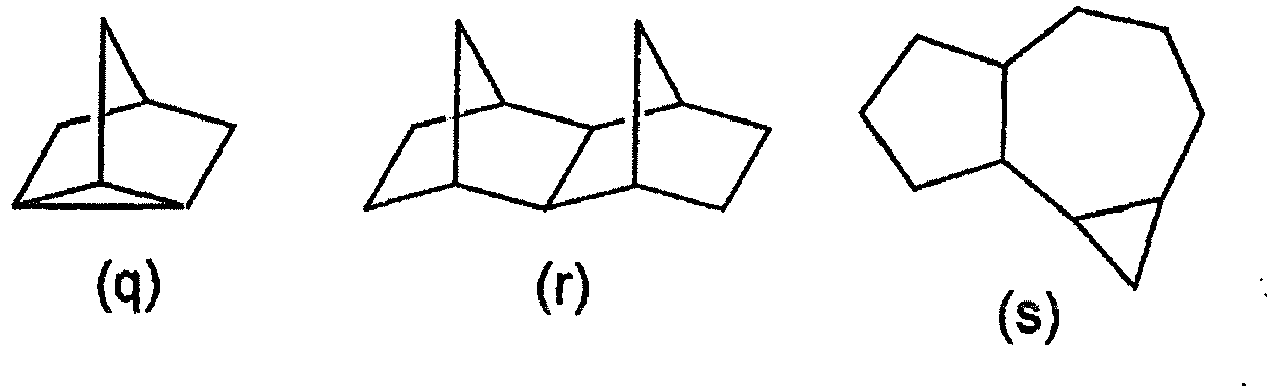
- In Formula [2] above, examples of the C1-20 alkyl group of Y1 to Y4 include methyl group, ethyl group, isopropyl group, n-pentyl group, and cyclohexyl group. Examples of the C1-20 alkoxy group include methoxy group, ethoxy group, isopropoxy group, n-pentyloxy group, and cyclohexyloxy group. Y1 to Y4 are preferably a hydrogen atom or a C1-20 alkyl group.
- Preferably, examples of the hyperbranched polymer for use in the present invention include a hyperbranched polymer of Formula [3].

- In Formula [3] above, R1, R2, R4 and n have the same meanings as described above.
- The hyperbranched polymer having an ammonium group at a molecular terminal for use in the present invention can be obtained, for example, by allowing a hyperbranched polymer having a halogen atom at a molecular terminal to react with an amine compound.
- A hyperbranched polymer having a halogen atom at a molecular terminal can be produced from a hyperbranched polymer having a dithiocarbamate group at a molecular terminal according to the description of
WO2008/029688 Pamphlet. The hyperbranched polymer having a dithiocarbamate group at a molecular terminal is commercially available, and HYPERTECH (registered trademark) HPS-200 manufactured by Nissan Chemical Industries, Ltd. and the like can be suitably used. - Examples of the amine compound that can be used in the reaction include primary amines including: aliphatic amines such as methylamine, ethylamine, n-propylamine, isopropylamine, n-butylamine, isobutylamine, sec-butylamine, tert-butylamine, n-pentylamine, n-hexylamine, n-heptylamine, n-octylamine, n-nonylamine, n-decylamine, n-undecylamine, n-dodecylamine, n-tridecylamine, n-tetradecylamine, n-pentadecylamine, n-hexadecylamine, n-heptadecylamine, n-octadecylamine, n-nonadecylamine, and n-eicosylamine; alicyclic amines such as cyclopentylamine and cyclohexylamine; aralkyl amines such as benzylamine and phenethylamine; and aromatic amines, for example, anilines such as aniline, p-n-butylaniline, p-tert-butylaniline, p-n-octylaniline, p-n-decylaniline, p-n-dodecylaniline, and p-n-tetradecylaniline, naphthylamines such as 1-naphthylamine and 2-naphthylamine, aminoanthracenes such as 1-aminoanthracene and 2-aminoanthracene, aminoanthraquinones such as 1-aminoanthraquinone, aminobiphenyls such as 4-aminobiphenyl and 2-aminobiphenyl, aminofluorenes such as 2-aminofluorene, 1-amino-9-fluorenone, and 4-amino-9-fluorenone, aminoindanes such as 5-aminoindane, aminoisoquinolines such as 5-aminoisoquinoline, and aminophenanthrenes such as 9-aminophenanthrene. Further examples thereof include amine compounds such as N-(tert-butoxycarbonyl)-1,2-ethylenediamine, N-(tert-butoxycarbonyl)-1,3-propylenediamine,
N-(tert-butoxycarbonyl)-1,4-butylenediamine,
N-(tert-butoxycarbonyl)-1,5-pentamethylenediamine,
N-(tert-butoxycarbonyl)-1,6-hexamethylenediamine, N-(2-hydroxyethyl)amine,
N-(3-hydroxypropyl)amine, N-(2-methoxyethyl)amine, and N-(2-ethoxyethyl)amine. - Examples of secondary amines include aliphatic amines such as dimethylamine, diethylamine, di-n-propylamine, diisopropylamine, di-n-butylamine, diisobutylamine, di-sec-butylamine, di-n-pentylamine, ethylmethylamine, methyl-n-propylamine, methyl-n-butylamine, methyl-n-pentylamine, ethylisopropylamine, ethyl-n-butylamine, ethyl-n-pentylamine, methyl-n-octylamine, methyl-n-decylamine, methyl-n-dodecylamine, methyl-n-tetradecylamine, methyl-n-hexadecylamine, methyl-n-octadecylamine, ethylisopropylamine, ethyl-n-octylamine, di-n-hexylamine, di-n-octylamine, di-n-dodecylamine, di-n-hexadecylamine, and di-n-octadecylamine; alicyclic amines such as dicyclohexylamine; aralkyl amines such as dibenzylamine; aromatic amines such as diphenylamine; and nitrogen-containing heterocyclic compounds such as phthalimide, pyrrole, piperidine, piperazine, and imidazole. Further examples thereof include bis(2-hydroxyethyl)amine, bis(3-hydroxypropyl)amine, bis(2-ethoxyethyl)amine, and bis(2-propoxyethyl)amine.
- Examples of tertiary amines include aliphatic amines such as trimethylamine, triethylamine, tri-n-propylamine, tri-n-butylamine, tri-n-pentylamine, tri-n-hexylamine, tri-n-octylamine, tri-n-dodecylamine, dimethylethylamine, dimethyl-n-butylamine, dimethyl-n-hexylamine, dimethyl-n-octylamine, dimethyl-n-decylamine, diethyl-n-decylamine, dimethyl-n-dodecylamine, dimethyl-n-tetradecylamine, dimethyl-n-hexadecylamine, dimethyl-n-octadecylamine, and dimethyl-n-eicosylamine; and nitrogen-containing heterocyclic compounds such as pyridine, pyrazine, pyrimidine, quinoline, 1-methylimidazole, 4,4'-bipyridyl, and 4-methyl-4,4'-bipyridyl.
- The amine compound can be used in the reaction in 0.1 molar equivalent to 20 molar equivalents, preferably 0.5 molar equivalent to 10 molar equivalents, and more preferably 1 molar equivalent to 5 molar equivalents per mole of halogen atom of the hyperbranched polymer having a halogen atom at a molecular terminal.
- The reaction between the hyperbranched polymer having a halogen atom at a molecular terminal and the amine compound can be carried out in water or an organic solvent in the presence or absence of a base. The solvent used is preferably capable of dissolving the hyperbranched polymer having a halogen atom at a molecular terminal and the amine compound. A solvent capable of dissolving the hyperbranched polymer having a halogen atom at a molecular terminal and the amine compound and incapable of dissolving a hyperbranched polymer having an ammonium group at a molecular terminal is more suitable for easy isolation.
- Any solvent may be used in the reaction as long as the solvent does not substantially inhibit the progress of the reaction, and examples thereof include water; alcohols such as 2-propanol; organic acids such as acetic acid; aromatic hydrocarbons such as benzene, toluene, xylene, ethylbenzene, and 1,2-dichlorobenzene; ethers such as tetrahydrofuran (THF) and diethyl ether; ketones such as acetone, methyl ethyl ketone (MEK), methyl isobutyl ketone (MIBK), and cyclohexanone; halides such as chloroform, dichloromethane, and 1,2-dichloroethane; aliphatic hydrocarbons such as n-hexane, n-heptane, and cyclohexane; and amides such as N,N-dimethylformamide (DMF), N,N-dimethylacetamide, and N-methyl-2-pyrrolidone (NMP). These solvents may be used singly or in combination of two or more. The amount of the solvent used is 0.2 to 1,000 times, preferably 1 to 500 times, more preferably 5 to 100 times, and most preferably 5 to 50 times the mass of the hyperbranched polymer having a halogen atom at a molecular terminal.
- As a suitable base, commonly used are inorganic compounds including alkali metal hydroxides and alkaline-earth metal hydroxides (for example, sodium hydroxide, potassium hydroxide, and calcium hydroxide), alkali metal oxides and alkaline-earth metal oxides (for example, lithium oxide, and calcium oxide), alkali metal hydrides and alkaline-earth metal hydrides (for example, sodium hydride, potassium hydride, and calcium hydride), alkali metal amides (for example, sodium amide), alkali metal carbonates and alkaline-earth metal carbonates (for example, lithium carbonate, sodium carbonate, potassium carbonate, and calcium carbonate), and alkali metal bicarbonates (for example, sodium bicarbonate), and organometallic compounds including alkali metal alkyls, alkyl magnesium halides, alkali metal alkoxides, alkaline-earth metal alkoxides, and dimethoxymagnesium. Potassium carbonate and sodium carbonate are particularly preferable. It is preferable that the base is used in 0.2 molar equivalent to 10 molar equivalents, preferably 0.5 molar equivalent to 10 molar equivalents, and most preferably 1 molar equivalent to 5 molar equivalents per mole of halogen atom of the hyperbranched polymer having a halogen atom at a molecular terminal.
- In this reaction, oxygen in the reaction system is preferably sufficiently removed before this reaction is started, and the system may be purged with inert gases such as nitrogen and argon. The reaction condition is appropriately selected from the reaction time of 0.01 hour to 100 hours and the reaction temperature of 0°C to 300°C. Preferably, the reaction time is 0.1 hour to 72 hours, and the reaction temperature is 20°C to 150°C.
- When a tertiary amine is used, the hyperbranched polymer of Formula [1] can be obtained whether or not a base is present.
- When a primary amine or a secondary amine compound is reacted with a hyperbranched polymer having a halogen atom at a molecular terminal in the absence of a base, a hyperbranched polymer with a terminal ammonium group, in which the corresponding secondary amine terminal group or tertiary amine terminal group of hyperbranched polymer is protonated, can be obtained. Even when a base is used in the reaction, the reactant may be mixed with an aqueous solution of an acid such as hydrogen chloride, hydrogen bromide, and hydrogen iodide in an organic solvent to obtain a hyperbranched polymer with a terminal ammonium group, in which the corresponding secondary amine terminal group or tertiary amine terminal group of the corresponding hyperbranched polymer is protonated.
- The weight-average molecular weight Mw of the hyperbranched polymer measured by gel permeation chromatography in terms of polystyrene is 1,000 to 5,000,000, more preferably 2,000 to 200,000, and most preferably 3,000 to 100,000. The degree of distribution Mw (weight-average molecular weight)/Mn (number-average molecular weight) is 1.0 to 7.0, preferably 1.1 to 6.0, and more preferably 1.2 to 5.0.
- The metal fine particles (b) for use in the photosensitive primer of the present invention are not limited, and examples of metal species include iron (Fe), cobalt (Co), nickel (Ni), copper (Cu), palladium (Pd), silver (Ag), tin (Sn), platinum (Pt), and gold (Au), and alloys thereof. These metals may be used singly or in combination of two or more. Among these, preferable metal fine particles include palladium fine particles. Oxides of the metals may also be used as metal fine particles.
- The metal fine particles are obtained by reduction of a metal ion, for example, by irradiating an aqueous solution of a metal salt with a high-pressure mercury lamp or adding a compound having a reducing action (reducing agent) to the aqueous solution. For example, a metal ion may be reduced by, for example, adding an aqueous solution of a metal salt to a solution in which the hyperbranched polymer is dissolved and irradiating the resultant mixture with ultraviolet light or adding an aqueous solution of a metal salt and a reducing agent to the hyperbranched polymer solution, to form a complex of the hyperbranched polymer and the metal fine particles, concurrently with the preparation of a primer including the hyperbranched polymer and the metal fine particles.
- Examples of the metal salt include chloroauric acid, silver nitrate, copper sulfate, copper nitrate, copper acetate, tin chloride, platinous chloride, chloroplatinic acid, Pt(dba)2 [dba=dibenzylideneacetone], Pt(cod)2 [cod=1,5-cyclooctadiene], Pt(CH3)2(cod), palladium chloride, palladium acetate (Pd(OC(=O)CH3)2), palladium nitrate, Pd2(dba)3.CHCl3, Pd(dba)2, rhodium chloride, rhodium acetate, ruthenium chloride, ruthenium acetate, Ru(cod)(cot) [cot=cyclooctatriene], iridium chloride, iridium acetate, and Ni(cod)2.
- The reducing agent is not limited, and various reducing agents can be used. A reducing agent is preferably selected depending on, for example, the metal species added in the intended primer. Examples of the reducing agent that can be used include metal borohydrides such as sodium borohydride and potassium borohydride; aluminum hydrides such as lithium aluminum hydride, potassium aluminum hydride, cesium aluminum hydride, beryllium aluminum hydride, magnesium aluminum hydride, and calcium aluminum hydride; hydrazine compounds; citric acid and salts thereof; succinic acid and salts thereof; ascorbic acid and salts thereof; primary or secondary alcohols such as methanol, ethanol, 2-propanol, and polyol; tertiary amines such as trimethylamine, triethylamine, diisopropylethylamine, diethylmethylamine, tetramethylethylenediamine (TMEDA), and ethylenediaminetetraacetic acid (EDTA); hydroxylamines; and phosphines such as tri-n-propylphosphine, tri-n-butylphosphine, tricyclohexylphosphine, tribenzylphosphine, triphenylphosphine, triethoxyphosphine,
1,2-bis(diphenylphosphino)ethane (DPPE), 1,3-bis(diphenylphosphino)propane (DPPP), 1,1'-bis(diphenylphosphino)ferrocene (DPPF), and
2,2'-bis(diphenylphosphino)-1,1'-binaphthyl (BINAP). - The average particle diameter of the metal fine particles is preferably 1 nm to 100 nm. When an average particle diameter of the metal fine particles is 100 nm or smaller, the surface area is less reduced, and a satisfactory catalytic activity is achieved. The average particle diameter is further preferably 75 nm or smaller and particularly preferably 1 nm to 30 nm.
- The amount of the hyperbranched polymer (a) in the photosensitive primer of the present invention is preferably 50 parts by mass to 2,000 parts by mass with respect to 100 parts by mass of the metal fine particles (b). With 50 parts by mass or more, the metal fine particles can be sufficiently dispersed. With 2,000 parts by mass or less, any problems in physical properties resulting from the increase in organic contents can be prevented. More preferably, the amount of the hyperbranched polymer is 100 parts by mass to 1,000 parts by mass.
- Preferable examples of the polymerizable compound having three or more (meth)acryloyl groups in a molecule (c) (hereinafter simply referred to as polymerizable compound) for use in the photosensitive primer of the present invention include compounds having three or more (meth)acryloyl groups in a molecule and having an oxyalkylene group.
- Preferable examples of the oxyalkylene group include C2-4 oxyalkylene groups, and among those, oxyethylene group [-OCH2CH2-] or oxypropylene group [-OCH2C(CH3)H-] are preferable. A plurality of oxyalkylene groups may be coupled to form a poly(oxyalkylene)group. In this case, one kind of the oxyalkylene groups may be used singly or two or more kinds may be used in combination. When different kinds of oxyalkylene groups are included, the bonding thereof may be either one of block bonding and random bonding.
- As used in the present invention, the meth(acrylate) compound refers to both an acrylate compound and a methacrylate compound. For example, (meth)acrylic acid refers to acrylic acid and methacrylic acid.
- Examples of the polymerizable compound include polyfunctional monomers containing three or more (meth)acryloyl groups, such as urethane-acrylic, epoxy acrylic, and various kinds of (meth)acrylate compounds.
- Among those polymerizable compounds, compounds having three or more (meth)acryloyl groups and having an oxyalkylene group and polyfunctional urethane (meth)acrylate compounds having three or more (meth)acryloyl groups are preferable.
- Although examples of preferable compounds as the polymerizable compound (c) in the present invention will be presented below, the polymerizable compound (c) is not limited to those examples.
- Examples of a compound having three (meth)acryloyl groups and having an oxyalkylene structure (trifunctional compound) include ethylene oxide-modified 1,1,1-trimethylolethane tri(meth)acrylate [the number of moles of ethylene oxide added: 3 to 30], ethylene oxide-modified trimethylolpropane tri(meth)acrylate [the number of moles of ethylene oxide added: 3 to 30], propylene oxide-modified trimethylolpropane tri(meth)acrylate [the number of moles of propylene oxide added: 3 to 30], ethylene oxide-modified glycerol tri(meth)acrylate [the number of moles of ethylene oxide added: 3 to 30], propylene oxide-modified glycerol tri(meth)acrylate [the number of moles of propylene oxide added: 3 to 30], tris(2-(acryloyloxy)ethyl)isocyanurate, and ε-caprolactone-modified tris(2-(acryloyloxy)ethyl)isocyanurate [the number of moles of ε-caprolactone added: 1 to 30].
- As the trifunctional compound, a commercially available product can be suitably used, and examples thereof include Viscoat #360 [manufactured by Osaka Organic Chemical Industry Ltd.]; NK Ester A-GLY-9E, NK Ester A-GLY-20E, NK Ester AT-20E [all of the above are manufactured by Shin-Nakamura Chemical Co., Ltd.]; and TMPEOTA, OTA480, and EBECRYL (registered trademark) 135 [all of the above are manufactured by DAICEL-ALLNEX LTD.].
- Examples of a compound having four (meth)acryloyl groups and having an oxyalkylene structure (tetrafunctional compound) include ethylene oxide-modified ditrimethylolpropane tetra(meth)acrylate [the number of moles of ethylene oxide added: 4 to 40] and ethylene oxide-modified pentaerythritol tetra(meth)acrylate [the number of moles of ethylene oxide added: 4 to 40].
- As the tetrafunctional compound, a commercially available product can be suitably used, and examples thereof include NK Ester ATM-4E, and NK Ester ATM-35E [all of the above are manufactured by Shin-Nakamura Chemical Co., Ltd.]; and EBECRYL (registered trademark) 40 [manufactured by DAICEL-ALLNEX LTD.].
- Examples of a compound having five or more (meth)acryloyl groups and having an oxyalkylene structure (penta- or more functional compound) include ethylene oxide-modified dipentaerythritol hexa (meth)acrylate [the number of moles of ethylene oxide added: 6 to 60] and ethylene oxide-modified tripentaerythritol octa (meth)acrylate [the number of moles of ethylene oxide added: 6 to 60].
- As the penta- or more functional compound, a commercially available product can be suitably used, and examples thereof include NK Ester A-DPH-12E, NK Ester A-DPH-48E, and NK Ester A-DPH-96E [manufactured by Shin-Nakamura Chemical Co., Ltd.].
- [Polyfunctional urethane (meth)acrylate compound having three or more (meth)acryloyl groups]
- Specific examples of commercially available products of a polyfunctional urethane (meth)acrylate compound having three (meth)acryloyl groups include NK Oligo UA-7100 [manufactured by Shin-Nakamura Chemical Co., Ltd.]; EBECRYL (registered trademark) 204, EBECRYL 205, EBECRYL 264, EBECRYL 265, EBECRYL 294/25HD, EBECRYL 1259, EBECRYL 4820, EBECRYL 8311, EBECRYL 8465, EBECRYL 8701, EBECRYL 9260, KRM (registered trademark) 8296, and KRM 8667 [all of the above are manufactured by DAICEL-ALLNEX LTD.]; and SHIKOH (registered trademark) UV-7550B, SHIKOH UV-7000B, SHIKOH UV-7510B, SHIKOH UV-7461TE, and SHIKOH UV-2750B [all of the above are manufactured by The Nippon Synthetic Chemical Industry Co., Ltd.].
- Specific examples of commercially available products of a polyfunctional urethane (meth)acrylate compound having four (meth)acryloyl groups include EBECRYL (registered trademark) 8210, EBECRYL 8405, and KRM (registered trademark) 8528 [all of the above are manufactured by DAICEL-ALLNEX LTD.]; and SHIKOH (registered trademark) UV-7650B [manufactured by The Nippon Synthetic Chemical Industry Co., Ltd.].
- Examples of a polyfunctional urethane (meth)acrylate compound having five or more (meth)acryloyl groups (penta- or more functional urethane (meth)acrylate) include a urethane product of pentaerythritol tri(meth)acrylate and hexamethylene diisocyanate, a urethane product of pentaerythritol tri(meth)acrylate and toluene diisocyanate, a urethane product of pentaerythritol tri(meth)acrylate and isophorone diisocyanate, and a urethane product of dipentaerythritol penta(meth)acrylate and hexamethylene diisocyanate.
- As the penta- or more functional urethane (meth)acrylate, a commercially available product can be suitably used. Examples thereof include UA-306H, UA-306T, UA-306I, and UA-510H [all of the above are manufactured by KYOEISHA CHEMICAL Co.,LTD]; NK Oligo U-6LPA, NK Oligo U-10HA, NK Oligo U-10PA, NK Oligo U-1100H, NK Oligo U-15HA, NK Oligo UA-53H, and NK Oligo UA-33H [all of the above are manufactured by Shin-Nakamura Chemical Co., Ltd.]; EBECRYL (registered trademark) 220, EBECRYL 1290, EBECRYL 5129, EBECRYL 8254, EBECRYL 8301R, KRM (registered trademark) 8200, KRM 8200AE, KRM 8904, and KRM 8452 [all of the above are manufactured by DAICEL-ALLNEX LTD.]; and SHIKOH (registered trademark) UV-1700B, SHIKOH UV-6300B, SHIKOH UV-7600B, SHIKOH UV-7605B, SHIKOH UV-7610B, SHIKOH UV-7620EA, SHIKOH UV-7630B, SHIKOH UV-7640B, and SHIKOH UV-7650B [all of the above are manufactured by The Nippon Synthetic Chemical Industry Co., Ltd.].
- Examples of compounds preferred as the polymerizable compound (c) of the present invention, other than the compound having three or more (meth)acryloyl groups and having an oxyalkylene structure and the polyfunctional urethane (meth)acrylate compound having three or more (meth)acryloyl groups, are presented below.
- Examples of a compound having three (meth)acryloyl groups include 1,1,1-trimethylolethane tri(meth)acrylate, trimethylolpropane tri(meth)acrylate, ditrimethylolpropane tri(meth)acrylate, pentaerythritol tri(meth)acrylate, and glycerol tri(meth)acrylate.
- As the compound having three (meth)acryloyl groups, a commercially available product can be suitably used. Examples thereof include Viscoat #295 and Viscoat #300 [all of the above are manufactured by Osaka Organic Chemical Industry Ltd.]; LIGHT ACRYLATE TMP-A, LIGHT ACRYLATE PE-3A, and LIGHT ESTER TMP [all of the above are manufactured by KYOEISHA CHEMICAL Co.,LTD]; NK Ester A-9300, NK Ester A-9300-1CL, NK Ester A-TMM-3, NK Ester A-TMM-3L, NK Ester A-TMM-3 LM-N, NK Ester A-TMPT, and NK Ester TMPT [all of the above are manufactured by Shin-Nakamura Chemical Co., Ltd.]; and PETIA, PETRA, TMPTA, and EBECRYL (registered trademark) 180 [all of the above are manufactured by DAICEL-ALLNEX LTD.].
- Examples of a compound having four (meth)acryloyl groups include ditrimethylolpropane tetra(meth)acrylate and pentaerythritol tetra(meth)acrylate.
- As the compound having four (meth)acryloyl groups, a commercially available product can be suitably used. Examples thereof include Viscoat #300 [manufactured by Osaka Organic Chemical Industry Ltd.]; LIGHT ACRYLATE PE-4A [manufactured by KYOEISHA CHEMICAL Co.,LTD]; NK Ester AD-TMP and NK Ester A-TMMT [all of the above are manufactured by Shin-Nakamura Chemical Co., Ltd.]; and EBECRYL (registered trademark) 140, EBECRYL 1142, and EBECRYL 180 [all of the above are manufactured by DAICEL-ALLNEX LTD.].
- Examples of a compound having five or more (meth)acryloyl groups include dipentaerythritol penta (meth)acrylate, dipentaerythritol hexa (meth)acrylate, and tripentaerythritol octa (meth)acrylate.
- As the compound having five or more (meth)acryloyl groups, a commercially available product can be suitably used. Examples thereof include Viscoat #802 [manufactured by Osaka Organic Chemical Industry Ltd.]; LIGHT ACRYLATE DPE-6A [manufactured by KYOEISHA CHEMICAL Co.,LTD]; NK Ester A-9550 and NK Ester A-DPH [all of the above are manufactured by Shin-Nakamura Chemical Co., Ltd.]; and DPHA [manufactured by DAICEL-ALLNEX LTD.].
- The amount of the polymerizable compound (c) blended in the photosensitive primer of the present invention is preferably 10 parts by mass to 10,000 parts by mass with respect to 100 parts by mass of a complex formed of the hyperbranched polymer and the metal fine particles described later. More preferably, the amount of the polymerizable compound (c) is 100 parts by mass to 2,000 parts by mass. If the amount of the polymerizable compound (c) blended is less than 10 parts by mass, pattern formation of the plating primer layer by photolithography as described later is difficult. If the polymerizable compound (c) blended exceeds 10,000 parts by mass, a metal plating coating film may have a risk of not being formed on the primer layer formed with the primer.
- When the photosensitive primer of the present invention includes a urethane (meth)acrylate compound having one or two (meth)acryloyl groups in a molecule (e) described later, these components (c) and (e) are blended such that the total amount of the polymerizable compound (c) and the urethane (meth)acrylate compound having one or two (meth)acryloyl groups in a molecule (e) is 10 parts by mass to 10,000 parts by mass, more preferably 100 parts by mass to 2,000 parts by mass with respect to 100 parts by mass of the complex formed of the hyperbranched polymer and the metal fine particles as described later.
- As the photopolymerization initiator (d) for use in the photosensitive primer of the present invention, a known one may be used. Examples thereof include alkylphenones, benzophenones, acylphosphine oxides, Michler's benzoyl benzoates, oxime esters, tetramethylthiuram monosulfides, and thioxanthones.
- In particular, photofragmentation-type photo radical polymerization initiators are preferred. Examples of the photofragmentation-type photo radical polymerization initiator include those described in "The Latest UV Curing Technique" (page 159; Publisher: Kazuhiro Takausu; Publishing company: Technical Information Institute Co. Ltd.; published in 1991).
- Examples of the commercially available photo radical polymerization initiator include, but not limited to, IRGACURE (registered trademark) 184, IRGACURE 369, IRGACURE 500, IRGACURE 651, IRGACURE 784, IRGACURE 819, IRGACURE 907, IRGACURE 1000, IRGACURE 1300, IRGACURE 1700, IRGACURE 1800, IRGACURE 1850, IRGACURE 2959, IRGACURE CGI1700, IRGACURE CGI1750, IRGACURE CGI1850, IRGACURE CG24-61, IRGACURE TPO, IRGACURE OXE-01, IRGACURE OXE-02, Darocur (registered trademark) 1116, and Darocur 1173 [all of the above are manufactured by BASF Japan Ltd.], and ESACURE KIP150, ESACURE KIP65LT, ESACURE KIP100F, ESACURE KT37, ESACURE KT55, ESACURE KTO46, and ESACURE KIP75 [all of the above are manufactured by Lamberti S.p.A.]. These polymerization initiators may be used in combination.
- The amount of the photopolymerization initiator (d) blended in the photosensitive primer of the present invention is, for example, 0.1 % by mass to 100% by mass, preferably 1% by mass to 50% by mass, more preferably 10% by mass to 30% by mass with respect to the polymerizable compound (c), or with respect to the total mass of the polymerizable compound (c) and the urethane (meth)acrylate compound having one or two (meth)acryloyl groups in a molecule (e) when the urethane (meth)acrylate compound having one or two (meth)acryloyl groups in a molecule (e) described later is included in the photosensitive primer.
- The photosensitive primer of the present invention may further include a urethane (meth)acrylate compound having one or two (meth)acryloyl groups in a molecule in combination.
- In the photosensitive primer of the present invention, it is preferable that a polyfunctional urethane (meth)acrylate compound having three or more (meth)acryloyl groups in a molecule is used in the polymerizable compound (c), or the urethane (meth)acrylate compound having one or two (meth)acryloyl groups in a molecule (e) is used in combination, because if so, blackening of the back surface of the metal plating coating film described later can be achieved after the coating film is formed.
- A monofunctional urethane (meth)acrylate compound is not limited to specific examples. For example, polyisocyanate (isocyanate component) is reacted with monool (active hydrogen component) to obtain an isocyanate terminal prepolymer, which is then reacted with a compound having a (meth)acryloyl group and a group reactive with isocyanate to yield a urethane (meth)acrylate having one (meth)acryloyl group on average per molecule. Polyol may be used instead of monool. In this case, manipulation is necessary such that (meth)acryloyloxy group is not introduced to part of the terminal hydroxy group of the polyol.
- Examples of a bifunctional urethane (meth)acrylate include a urethane product of a (meth)acrylic acid adduct of phenyl glycidyl ether and hexamethylene diisocyanate, and a urethane product of a (meth)acrylic acid adduct of phenyl glycidyl ether and toluene diisocyanate.
- As the bifunctional urethane (meth)acrylate, a commercially available product can be suitably used. Examples thereof include AH-600 and AT-600 [all of the above are manufactured by KYOEISHA CHEMICAL Co.,LTD]; NK Oligo U-2PPA, NK Oligo U-200PA, NK Oligo UA-160TM, NK Oligo UA-290TM, NK Oligo UA-4200, NK Oligo UA-4400, NK Oligo UA-122P, and NK Oligo UA-W2A [all of the above are manufactured by Shin-Nakamura Chemical Co., Ltd.]; EBECRYL (registered trademark) 210, EBECRYL 215, EBECRYL 230, EBECRYL 244, EBECRYL 245, EBECRYL 270, EBECRYL 280/15IB, EBECRYL 284, EBECRYL 285, EBECRYL 4858, EBECRYL 8307, EBECRYL 8402, EBECRYL 8411, EBECRYL 8804, EBECRYL 8807, EBECRYL 9227EA, EBECRYL 9270, and KRM (registered trademark) 7735 [all of the above are manufactured by DAICEL-ALLNEX LTD.]; and SHIKOH (registered trademark) UV-6630B, SHIKOH UV-7000B, SHIKOH UV-7461TE, SHIKOH UV-2000B, SHIKOH UV-2750B, SHIKOH UV-3000, SHIKOH UV-3200B, SHIKOH UV-3210EA, SHIKOH UV-3300B, SHIKOH UV-3310B, SHIKOH UV-3500BA, SHIKOH UV-3520TL, SHIKOH UV-3700B, and SHIKOH UV-6640B [all of the above are manufactured by The Nippon Synthetic Chemical Industry Co., Ltd.].
- In the photosensitive primer of the present invention, when the urethane (meth)acrylate compound having one or two (meth)acryloyl groups in a molecule (e) is used, the amount blended is 200 parts by mass or less with respect to 100 parts by mass of the polymerizable compound (c), preferably 10 parts by mass to 200 parts by mass, more preferably 20 parts by mass to 100 parts by mass. When the urethane (meth)acrylate compound (e) is blended in an amount less than 10 parts by mass, it is difficult to achieve blackening of the back surface of the metal plating coating film. If the urethane (meth)acrylate compound (e) is blended in an amount exceeding 200 parts by mass, pattern formation of the plating primer layer by photolithography may be difficult.
- The photosensitive primer of the present invention includes the hyperbranched polymer having an ammonium group at a molecular terminal (a), the metal fine particles (b), the polymerizable compound (c), and the photopolymerization initiator (d), optionally the urethane (meth)acrylate compound having one or two (meth)acryloyl groups in a molecule (e), and further includes other components. Here, it is preferable that the hyperbranched polymer and the metal fine particles form a complex.
- As used herein, the term complex means a state in which the hyperbranched polymer coexists with the metal fine particles so as to be in contact with or in proximity to the metal fine particles through the action of the ammonium group at the terminal of the hyperbranched polymer to form a particulate form. In other words, the complex has a structure in which the ammonium group of the hyperbranched polymer is attached to or coordinates with the metal fine particles.
- Accordingly, the "complex" in the present invention includes a complex in which the metal fine particles and the hyperbranched polymer are bonded to form a complex as well as a complex in which the metal fine particles and the hyperbranched polymer exist independently without forming bonds.
- The formation of a complex of the hyperbranched polymer having an ammonium group and the metal fine particles is performed concurrently with the preparation of the primer including the hyperbranched polymer and the metal fine particles. Examples of the method include a method in which metal fine particles stabilized to a certain degree with a lower ammonium ligand are manufactured and the ligand is exchanged with the hyperbranched polymer, and a method in which a metal ion is directly reduced in a solution of the hyperbranched polymer having an ammonium group to form a complex. For example, an aqueous solution of a metal salt is added to a solution in which the hyperbranched polymer is dissolved, and the resultant mixture is irradiated with ultraviolet light. Alternatively, an aqueous solution of a metal salt and a reducing agent are added to the hyperbranched polymer solution to reduce the metal ion to form a complex.
- In the ligand exchange method, the raw material that is metal fine particles stabilized to a certain degree with a lower ammonium ligand can be manufactured, for example, by the method described in Jounal of Organometallic Chemistry 1996, 520, 143 to 162. A hyperbranched polymer having an ammonium group is dissolved in the resultant reaction mixed solution of the metal fine particles, and the mixture is stirred at room temperature (approximately 25°C) or stirred with heating to obtain the intended metal fine particle complex.
- Any solvent may be used as long as the solvent is capable of dissolving the metal fine particles and the hyperbranched polymer having an ammonium group at the necessary concentrations or higher. Specific examples thereof include alcohols such as ethanol, n-propanol, and 2-propanol; halogenated hydrocarbons such as methylene chloride and chloroform; cyclic ethers such as tetrahydrofuran (THF), 2-methyltetrahydrofuran, and tetrahydropyran; nitriles such as acetonitrile and butyronitrile, and a mixture of these solvents. Preferably, tetrahydrofuran is used.
- The temperature at which the reaction mixture of the metal fine particles and the hyperbranched polymer having an ammonium group are mixed may be generally from 0°C to the boiling point of the solvent, and preferably in a range of room temperature (approximately 25°C) to 60°C
- In the ligand exchange method, a phosphine dispersant (phosphine ligand) may be used instead of the amine dispersant (lower ammonium ligand) to stabilize metal fine particles to a certain degree beforehand.
- In the direct reduction method, a metal ion and a hyperbranched polymer having an ammonium group are dissolved in a solvent, and reduction is performed with a primary or secondary alcohol such as methanol, ethanol, 2-propanol, and polyols to obtain the intended metal fine particle complex.
- The source of the metal ion used includes the above-noted metal salts.
- Any solvent may be used as long as the solvent is capable of dissolving the metal ion and the hyperbranched polymer having an ammonium group to the necessary concentrations or higher. Specific examples thereof include alcohols such as methanol, ethanol, propanol, and 2-propanol; halogenated hydrocarbons such as methylene chloride and chloroform; cyclic ethers such as tetrahydrofuran (THF), 2-methyltetrahydrofuran, and tetrahydropyran; nitriles such as acetonitrile and butyronitrile; amides such as N,N-dimethylformamide (DMF) and N-methyl-2-pyrrolidone (NMP); sulfoxides such as dimethylsulfoxide, and a mixture of these solvents. Preferably, alcohols, halogenated hydrocarbons, and cyclic ethers are used. More preferably, ethanol, 2-propanol, chloroform, tetrahydrofuran, and the like are used.
- The temperature for the reduction reaction can be generally from 0°C to the boiling point of the solvent, preferably in a range of room temperature (approximately 25°C) to 60°C.
- As another direct reduction method, a metal ion and a hyperbranched polymer having an ammonium group are dissolved in a solvent and allowed to react in a hydrogen atmosphere to obtain the intended metal fine particle complex.
- The source of the metal ion used includes the above-noted metal salts and metal carbonyl complexes such as hexacarbonylchromium [Cr(CO)6], pentacarbonyliron [Fe(CO)5], octacarbonyldicobalt [Co2(CO)8], and tetracarbonylnickel [Ni(CO)4]. Zero-valent metal complexes such as metal olefin complexes, metal phosphine complexes, and metal nitrogen complexes may also be used.
- Any solvent may be used as long as the solvent is capable of dissolving the metal ion and the hyperbranched polymer having an ammonium group to the necessary concentrations or higher. Specific examples thereof include alcohols such as ethanol and propanol; halogenated hydrocarbons such as methylene chloride and chloroform; cyclic ethers such as tetrahydrofuran, 2-methyltetrahydrofuran, and tetrahydropyran; nitriles such as acetonitrile and butyronitrile, and a mixture of these solvents. Preferably, tetrahydrofuran is used.
- The temperature at which the metal ion and the hyperbranched polymer having an ammonium group are mixed may be generally from 0°C to the boiling point of the solvent.
- As the direct reduction method, a metal ion and a hyperbranched polymer having an ammonium group may be dissolved in a solvent and subjected to thermal decomposition to obtain the intended metal fine particle complex.
- The source of the metal ion used includes the above-noted metal salts, metal complexes such as metal carbonyl complexes and other zero-valent metal complexes, and metal oxides such as silver oxide.
- Any solvent may be used as long as the solvent is capable of dissolving the metal ion and the hyperbranched polymer having an ammonium group to the necessary concentrations or higher. Specific examples thereof include alcohols such as methanol, ethanol, n-propanol, 2-propanol, and ethylene glycol; halogenated hydrocarbons such as methylene chloride and chloroform; cyclic ethers such as tetrahydrofuran (THF), 2-methyltetrahydrofuran, and tetrahydropyran; nitriles such as acetonitrile and butyronitrile; aromatic hydrocarbons such as benzene and toluene, and a mixture of these solvents. Preferably, toluene is used.
- The temperature at which the metal ion and the hyperbranched polymer having an ammonium group are mixed may be generally from 0°C to the boiling point of the solvent. The temperature is preferably close to the boiling point of the solvent, for example, 110°C (heating at reflux) in the case of toluene.
- The complex of the hyperbranched polymer having an ammonium group and the metal fine particles thus obtained can be formed as a solid such as powder after purification such as reprecipitation.
- The photosensitive primer of the present invention includes the hyperbranched polymer having an ammonium group (a) and the metal fine particles (b) (preferably, a complex formed thereof), the polymerizable compound (c) and the photopolymerization initiator (d), optionally the urethane (meth)acrylate compound having one or two (meth)acryloyl groups in a molecule (e), and other components, and may be in the form of varnish that is used for forming the [primer layer for electroless plating] as described later.
- The photosensitive primer of the present invention may further appropriately contain additives such as a surfactant and various kinds of surface conditioners and additives such as a sensitizer, a polymerization inhibitor, and a polymerization initiator as long as the effect of the present invention is not impaired.
- Examples of the surfactant include polyoxyethylene alkyl ethers such as polyoxyethylene lauryl ether, polyoxyethylene stearyl ether, polyoxyethylene cetyl ether, and polyoxyethylene oleyl ether; polyoxyethylene alkylaryl ethers such as polyoxyethylene octylphenyl ether and polyoxyethylene nonylphenyl ether; polyoxyethylene-polyoxypropylene block copolymers; sorbitan fatty acid esters such as sorbitan monolaurate, sorbitan monopalmitate, sorbitan monostearate, sorbitan monooleate, sorbitan tristearate, and sorbitan trioleate; polyoxyethylene nonionic surfactants such as polyoxyethylene sorbitan monolaurate, polyoxyethylene sorbitan monopalmitate, polyoxyethylene sorbitan monostearate, and polyoxyethylene sorbitan trioleate; and fluorine-based surfactants such as EFTOP (registered trademark) EF-301, EFTOP EF-303, and EFTOP EF-352 [manufactured by Mitsubishi Materials Electronic Chemicals Co., Ltd.], MEGAFAC (registered trademark) F-171, MEGAFAC F-173, MEGAFAC R-08, and MEGAFAC R-30 [manufactured by DIC Corporation], Novec (registered trademark) FC-430 and Novec FC-431 [manufactured by Sumitomo 3M Ltd.], ASAHI GUARD (registered trademark) AG-710 [manufactured by Asahi Glass Co., Ltd.], and SURFLON (registered trademark) S-382 [manufactured by AGC Seimi Chemical Co., Ltd.].
- Examples of the surface conditioner include silicone-based leveling agents such as Shin-Etsu Silicone (registered trademark) KP-341 [manufacture by Shin-Etsu Chemical Co., Ltd.]; and silicone-based surface conditioners such as BYK (registered trademark)-302, BYK-307, BYK-322, BYK-323, BYK-330, BYK-333, BYK-370, BYK-375, and BYK-378 [manufactured by BYK Japan KK].
- These additives may be used singly or may be used in combination of two or more. The additives are used in an amount of preferably 0.001 part by mass to 50 parts by mass, more preferably 0.005 part by mass to 10 parts by mass, and even more preferably 0.01 part by mass to 5 parts by mass with respect to 100 parts by mass of the complex formed of the hyperbranched polymer and the metal fine particles.
- The photosensitive primer of the present invention may be applied on a base material to form a thin film, which is then subjected to photolithography to form a patterned primer layer for electroless plating. The present invention is also directed to the primer layer.
- The base material is not limited, and a nonconducting base material or a conducting base material may be preferably used.
- Examples of the nonconducting base material include glass, ceramics; polyethylene resins, polypropylene resins, vinyl chloride resins, nylons (polyamide resins), polyimide resins, polycarbonate resins, acrylic resins, PEN (polyethylene naphthalate) resins, PET (polyethylene terephthalate) resins, PEEK (polyether ether ketone) resins, ABS (acrylonitrile-butadiene-styrene copolymer) resins, epoxy resins, and polyacetal resins; and paper. The nonconducting base material is suitably used in the form of sheet, film, or the like, and in these cases, the thickness is not limited.
- Examples of the conducting base material include metals such as ITO (tin-doped indium oxide), ATO (antimony-doped tin oxide), FTO (fluorine-doped tin oxide), AZO (aluminum-doped zinc oxide), GZO (gallium-doped zinc oxide), various stainless steels, aluminum and aluminum alloys such as duralumin, iron and iron alloys, copper and copper alloys such as brass, phosphor bronze, cupronickel, and beryllium copper, nickel and nickel alloys, and silver and silver alloys such as nickel silver.
- Furthermore, a base material in which a thin film of any of these conducting base materials is formed on the nonconducting base material is also usable.
- The base material may also be a three-dimensionally formed body.
- The specific method to form a primer layer for electroless plating from the photosensitive primer containing the hyperbranched polymer having an ammonium group, the metal fine particles, the polymerizable compound, and the photopolymerization initiator is as follows. First, the hyperbranched polymer having an ammonium group and the metal fine particles (preferably a complex formed thereof), the polymerizable compound, and the photopolymerization initiator are dissolved or dispersed in a suitable solvent to form a varnish. The varnish is applied on a base material on which a metal plating coating film is to be formed, for example, by spin coating; blade coating; dip coating; roll coating; bar coating; die coating; spray coating; ink jet method; pen lithography such as fountain-pen nanolithography (FPN) and dip-pen nanolithography (DPN); relief printing such as letterpress printing, flexography, resin relief printing, contact printing, microcontact printing (µCP), nanoimprinting lithography (NIL), and nanotransfer printing (nTP); intaglio printing such as gravure printing and engraving; planographic printing; stencil printing such as screen printing and mimeograph; or offset printing. The solvent is then evaporated and dried to form a thin layer.
- Among these application methods, spin coating, spray coating, ink jet method, pen lithography, contact printing, µCP, NIL, and nTP are preferred. Spin coating has advantages in that a highly volatile solution can be used because the application requires a short time and that a highly uniform coating can be obtained. Spray coating needs only a very small amount of vanish to obtain a highly uniform coating, which is industrially very advantageous. Inkjet method, pen lithography, contact printing, µCP, NIL, and nTP can form (draw), for example, fine patterns such as wiring efficiently, which is industrially very advantageous.
- Any solvent can be used as long as the solvent dissolves or disperses the complex, the polymerizable compound, and the photosensitive initiator. Examples thereof include water; aromatic hydrocarbons such as benzene, toluene, xylene, ethylbenzene, chlorobenzene, and dichlorobenzene; alcohols such as methanol, ethanol, n-propanol, 2-propanol, n-butanol, 2-butanol, n-hexanol, n-octanol, 2-octanol, and 2-ethylhexanol; cellosolves such as methyl cellosolve, ethyl cellosolve, butyl cellosolve, and phenyl cellosolve; glycol ethers such as propylene glycol monomethyl ether (PGME), propylene glycol monoethyl ether, propylene glycol monobutyl ether, diethylene glycol monomethyl ether, diethylene glycol monobutyl ether, dipropylene glycol monomethyl ether, triethylene glycol monomethyl ether, tripropylene glycol monomethyl ether, ethylene glycol dimethyl ether, propylene glycol dimethyl ether, diethylene glycol dimethyl ether, diethylene glycol diethyl ether, diethylene glycol dibutyl ether, diethylene glycol ethyl methyl ether, diethylene glycol butyl methyl ether, diethylene glycol isopropyl methyl ether, dipropylene glycol dimethyl ether, triethylene glycol dimethyl ether, and tripropylene glycol dimethyl ether; glycol esters such as ethylene glycol monomethyl ether acetate, and propylene glycol monomethyl ether acetate (PGMEA); ethers such as tetrahydrofuran (THF), methyltetrahydrofuran, 1,4-dioxane, and diethyl ether; esters such as ethyl acetate and butyl acetate; ketones such as acetone, methyl ethyl ketone (MEK), methyl isobutyl ketone (MIBK), cyclopentanone, and cyclohexanone; aliphatic hydrocarbons such as n-heptane, n-hexane, and cyclohexane; halogenated aliphatic hydrocarbons such as 1,2-dichloroethane and chloroform; amides such as N-methyl-2-pyrrolidone (NMP), N,N-dimethylformamide (DMF), and N,N-dimethylacetamide; and dimethyl sulfoxide. These solvents may be used singly, or two or more solvents may be mixed. Glycols such as ethylene glycol, propylene glycol, and butylene glycol may be added to adjust the viscosity of the varnish.
- The complex, the polymerizable compound, and the photosensitive initiator are dissolved or dispersed in the solvent at any concentration. The concentration of the non-solvent components in the varnish [the concentration of all components included in the photosensitive primer, excluding the solvent (the hyperbranched polymer and the metal fine particles (preferably a complex thereof), the polymerizable compound, the photopolymerization initiator, optionally the urethane (meth)acrylate compound, and other additives)] is 0.05% by mass to 90% by mass, preferably 0.1 % by mass to 80% by mass.
- The method for drying the solvent is not limited. For example, a hotplate or an oven can be used to evaporate the solvent in an appropriate atmosphere, that is, air, inert gas such as nitrogen, or in vacuum. This can provide a primer layer having a uniformly formed film surface. The baking temperature is not limited as long as the solvent can be evaporated, and a temperature of 40°C to 250°C is preferably used.
- The thus obtained thin film is subsequently exposed through a mask having a predetermined pattern with exposure energy of approximately 10 mJ/cm2 to 3,000 mJ/cm2 and then developed using a developer to wash out the exposed portion. The patterned primer layer for electroless plating is thus obtained.
- In the exposure, ultraviolet radiation of mercury lamps or the like, far-ultraviolet radiation, electron beams, X-rays, or the like is used. Examples of the light source for ultraviolet radiation include sunlight, chemical lamps, low-pressure mercury lamps, high-pressure mercury lamps, metal halide lamps, xenon lamps, and UV-LEDs.
- The development method is not limited to any particular method. Known methods such as a liquid filling method, a puddle method, a dipping method, a spraying method, and a vibration dipping method can be used. The development temperature is preferably from 20°C to 50°C, and the development time is for example, 10 seconds to 10 minutes.
- As the developer, an organic solvent, an alkaline aqueous solution, or the like may be used. Examples of the organic solvent include alcohols such as methanol, ethanol, n-propanol, and 2-propanol; glycol ethers such as methyl cellosolve, ethyl cellosolve, butyl cellosolve, propylene glycol monomethyl ether (PGME), and 3-methoxy-3-methyl-1-butanol; ethers such as diethyl ether, diisopropyl ether, dibutyl ether, tetrahydrofuran (THF), and 1,4-dioxane; ether esters such as propylene glycol monomethyl ether acetate (PGMEA); esters such as ethyl acetate and butyl acetate; ketones such as acetone and cyclohexanone; amides such as N-methyl-2-pyrrolidone (NMP) and N,N-dimethylacetamide (DMAc); and sulfoxides such as dimethyl sulfoxide.
- Examples of the alkaline aqueous solution include an aqueous solution of an alkali metal hydroxide such as potassium hydroxide and sodium hydroxide; an aqueous solution of a quaternary ammonium hydroxide such as tetramethylammonium hydroxide, tetraethylammonium hydroxide, and choline; and an aqueous solution of an amine such as ethanolamine, propylamine, ethylenediamine, and morpholine.
- These developers may be used singly or two or more kinds may be mixed. Preferable examples of the mixed solution include a PGME/PGMEA mixed solution (mass ratio of 7:3).
- Water; and glycols such as ethylene glycol, propylene glycol, and polyethylene glycol may be added to these developers to control the development characteristic. In order to enhance the removability of the unexposed portion, a surfactant and the like may be added.
- As the developer, a commercially available product can be suitably used. Examples thereof include OK73 Thinner [TOKYO OHKA KOGYO CO., LTD.].
- After development, washing with water or a common organic solvent is preferably performed for, for example, about 20 seconds to 90 seconds. The moisture on the base material is thereafter removed by using compressed air or compressed nitrogen or by air drying by spinning. If necessary, drying with heating is performed using a hot plate or an oven to obtain a patterned primer layer for electroless plating.
- [Electroless Plating Process, Metal Plating Film, Metal-Coated Base Material]
- The primer layer for electroless plating formed on the base material thus obtained is subjected to electroless plating to form a metal plating film on the primer layer for electroless plating. The present invention is also directed to the metal plating film thus obtained as well as the metal-coated base material having a primer layer for electroless plating and a metal plating film in this order on a base material.
- The electroless plating process (step) is not limited, and any commonly known electroless plating process may be used. For example, the common method involves using a conventionally known electroless plating solution and immersing a primer layer for electroless plating formed on the base material in the plating solution (bath).
- The electroless plating solution mainly contains a metal ion (a metal salt), a complexing agent, and a reducing agent. Depending on the application, a pH adjusting agent, a pH buffering agent, a reaction accelerator (a second complexing agent), a stabilizer, a surfactant (used for, for example, giving a luster to the plating film and improving wettability of the surface to be treated), and other agents are contained as appropriate.
- Examples of the metal for use for the metal plating film formed by electroless plating include iron, cobalt, nickel, copper, palladium, silver, tin, platinum, gold, and alloys thereof. The metal is appropriately selected depending on the purpose.
- The complexing agent and the reducing agent may be appropriately selected depending on the metal ion.
- The electroless plating solution may be a commercially available plating solution. Preferable examples thereof include electroless nickel plating agents (Melplate (registered trademark) NI series) and electroless copper plating agents (Melplate (registered trademark) CU series) manufactured by Meltex Inc.; electroless nickel plating solutions (ICP Nicoron (registered trademark) series, Top Piena 650), electroless copper plating solutions (OPC-700 electroless copper M-K, ATS Addcopper IW, ATS Addcopper CT, OPC Copper (registered trademark) AF series, OPC Copper HFS, and OPC Copper NCA), an electroless tin plating solution (Substar SN-5), and electroless gold plating solutions (Flash Gold 330, and Self Gold OTK-IT), an electroless silver plating solution (MUDEN SILVER) manufactured by Okuno Chemical Industries Co., Ltd.; an electroless palladium plating solution (Pallet II) and electroless gold plating solutions (Dip G series, NC Gold series) manufactured by Kojima Chemicals Co., Ltd.; an electroless silver plating solution (S-DIA AG-40) manufactured by SASAKI CHEMICAL CO., LTD.; electroless nickel plating solutions (Kanigen (registered trademark) series, SUMER (registered trademark) series, and SUMER (registered trademark) KANIBLACK (registered trademark) series), and an electroless palladium plating solution (S-KPD) manufactured by JAPAN KANIGEN CO., LTD.; electroless copper plating solutions (CUPOSIT (registered trademark) COPPER MIX series, and CIRCUPOSIT (registered trademark) series), electroless palladium plating solutions (PALLAMERSE (registered trademark) series), electroless nickel plating solutions (DURAPOSIT (registered trademark) series), electroless gold plating solutions (AUROLECTROLESS (registered trademark) series), and electroless tin plating solutions (TINPOSIT (registered trademark) series) manufactured by The Dow Chemical Company; electroless copper plating solutions (THRU-CUP (registered trademark) ELC-SP, THRU-CUP PSY, THRU-CUP PCY, THRU-CUP PGT, THRU-CUP PSR, THRU-CUP PEA, and THRU-CUP PMK) manufactured by C. Uyemura & Co., Ltd., and electroless copper plating solutions (Printganth (registered trademark) PV, and Printganth PVE) manufactured by Atotech Japan K.K.
- In the electroless plating process, plating bath temperature, pH, immersion time, concentration of metal ion, presence or absence of stirring and stirring speed, presence or absence of feeding of air or oxygen and feeding speed, and other conditions may be adjusted to control the forming speed of a metal coating film and the thickness of the film.
- In the metal-coated base material of the present invention in which a metal plating film is formed on the primer layer thus obtained using the photosensitive primer of the present invention, when a transparent base material is used as the base material, the surface seen when the transparent base material is observed from the surface opposite to the metal coating film-formed side can exhibit a black color.
- Therefore, since a metal plating film is applied on the primer layer patterned by photolithography to obtain a metal-coated base material in which the back surface of the patterned plating coating film-formed portion is black, the base material can be used as a transparent electrode with high image visibility.
- The present invention will be described more specifically with reference to Examples, which are not intended to limit the present invention. In Examples, physical properties of the samples were measured by using the following apparatuses under the following conditions.
-
- (1) GPC (Gel Permeation Chromatography)
- Apparatus: HLC-8220GPC manufactured by Tosoh Corporation
- Column: Shodex (registered trademark) GPC KF-804L + KF-803L manufactured by Showa Denko K.K.
- Column temperature: 40°C
- Solvent: tetrahydrofuran
- Detector: UV (254 nm), RI
- (2) 1H NMR Spectrum
- Apparatus: JNM-L400 manufactured by JEOL Ltd.
- Solvent: CDCl3
- Reference peak: tetramethylsilane (0.00 ppm)
- (3) 13CNMR Spectrum
- Apparatus: JNM-ECA700 manufactured by JEOL Ltd.
- Solvent: CDCl3
- Relaxation reagent: chromium trisacetylacetonate (Cr(acac)3)
- Reference peak: CDCl3 (77.0 ppm)
- (4) ICP Atomic Emission Spectroscopy (inductively coupled plasma atomic emission spectroscopy)
- Apparatus: ICPM-8500 manufactured by Shimadzu Corporation
- (5) TEM (transmission electron microscope) Image
- Apparatus: H-8000 manufactured by Hitachi High-Technologies Corporation
- (6) Pattern Exposure (mask aligner)
- Apparatus: MA6 manufactured by SUSS MICROTEC AG.
- (7) Development
- Apparatus: Compact development apparatus ADE-3000S manufactured by Actes Kyosan inc.
- (8) Digital Microscopic Image
- Apparatus: VHX-2000 manufactured by Keyence Corporation
-
- HPS: hyperbranched polystyrene [HYPERTECH (registered trademark) HPS-200 manufactured by Nissan Chemical Industries, Ltd.]
- BA: butyl acrylate [manufactured by Tokyo Chemical Industry Co., Ltd.]
- BP2A-4E: ethylene oxide-modified bisphenol A diacrylate (the number of moles of ethylene oxide added: 4) [NK Ester A-BPE-4 manufactured by Shin-Nakamura Chemical Co., Ltd.]
- DD2A: 1,10-decanediol diacrylate [NK Ester A-DOD-N manufactured by Shin-Nakamura Chemical Co., Ltd.]
- DP6A-12E: ethylene oxide-modified dipentaerythritol hexaacrylate (the number of moles of ethylene oxide added: 12) [NK Ester A-DPH-12E manufactured by Shin-Nakamura Chemical Co., Ltd.]
- G3A-20E: ethylene oxide-modified glycerol triacrylate (the number of moles of ethylene oxide added: 20) [NK Ester A-GLY-20E manufactured by Shin-Nakamura Chemical Co., Ltd.]
- P4A-35E: ethylene oxide-modified pentaerythritol tetraacrylate (the number of moles of ethylene oxide added: 35) [NK Ester ATM-35E manufactured by Shin-Nakamura Chemical Co., Ltd.]
- T3A-20E: ethylene oxide-modified trimethylolpropane triacrylate (the number of moles of ethylene oxide added: 20) [NK Ester AT-20E manufactured by Shin-Nakamura Chemical Co., Ltd.]
- UA4200: polyether skeleton bifunctional urethane acrylate [NK Oligo UA-4200 manufactured by Shin-Nakamura Chemical Co., Ltd.]
- UA7100: polyether skeleton trifunctional urethane acrylate [NK Oligo UA-7100 manufactured by Shin-Nakamura Chemical Co., Ltd.]
- TPO: diphenyl(2,4,6-trimethylbenzoyl)phosphine oxide (photopolymerization initiator) [IRGACURE (registered trademark) TPO manufactured by BASF Japan Ltd.]
- IPA: 2-propanol
- IPE: diisopropyl ether
- PGME: propylene glycol monomethyl ether
- PGMEA: propylene glycol monomethyl ether acetate
- PrOH: n-propanol
-


- A 500-mL reaction flask was charged with 27 g of sulfuryl chloride [manufactured by KISHIDA CHEMICAL CO., LTD.] and 50 g of chloroform, and the mixture was stirred to be uniformly dissolved. This solution was cooled to 0°C in a nitrogen stream.
- Another 300-mL reaction flask was charged with 15 g of a hyperbranched polymer HPS having a dithiocarbamate group at a molecular terminal and 150 g of chloroform, and the mixture was stirred in a nitrogen stream until it became uniform.
- The HPS/chloroform solution was added with a feeding pump from the 300-mL reaction flask containing the HPS/chloroform solution to the sulfuryl chloride/chloroform solution cooled to 0°C in a nitrogen stream over 60 minutes so that the temperature of the reaction liquid was from -5°C to 5°C. After the addition was completed, the reaction liquid was stirred for 6 hours while the temperature was kept at -5°C to 5°C.
- A solution in which 16 g of cyclohexene [manufactured by Tokyo Chemical Industry Co., Ltd.] was dissolved in 50 g of chloroform was added to this reaction liquid so that the temperature of the reaction liquid became from -5°C to 5°C. After the addition was completed, this reaction liquid was added to 1,200 g of IPA to precipitate the polymer. This precipitate was filtered to obtain a white powder, which was dissolved in 100 g of chloroform. The liquid was added to 500 g of IPA to reprecipitate the polymer. This precipitate was filtered under reduced pressure and vacuum-dried to obtain 8.5 g of a hyperbranched polymer having a chlorine atom at a molecular terminal (HPS-Cl) as a white powder (yield 99%).
- The 1H NMR spectrum of the obtained HPS-Cl is illustrated in
FIG. 1 . Since the peaks derived from the dithiocarbamate group (4.0 ppm, 3.7 ppm) disappeared, it was found that almost all the dithiocarbamate groups at the molecular terminals of the HPS were replaced with chlorine atoms in the obtained HPS-Cl. The weight-average molecular weight Mw of the obtained HPS-Cl measured by GPC in terms of polystyrene was 14,000, and the degree of distribution Mw/Mn was 2.9. -

- A 100-mL reaction flask equipped with a condenser was charged with 4.6 g (30 mmol) of HPS-Cl produced in Production Example 1 and 15g of chloroform, and the mixture was stirred until it became uniform. To this solution, a solution in which 5.0 g (31.5 mmol) of dimethyloctylamine [FARMIN (registered trademark) DM0898 manufactured by Kao Corporation] was dissolved in 7.5 g of chloroform was added, and 7.5 g of IPA was further added thereto. This mixture was stirred in a nitrogen atmosphere at 65°C for 40 hours.
- After the mixture was cooled to a liquid temperature of 30°C, the solvent was distilled off. The resultant residue was dissolved in 60 g of chloroform, and the solution was added to 290 g of IPE for purification by reprecipitation. The precipitated polymer was filtered under reduced pressure and vacuum-dried at 50°C to obtain 9.3 g of a hyperbranched polymer having a dimethyloctylammonium group at a molecular terminal (HPS-N(Me)2OctCl) as a white powder.
- The 13C NMR spectrum of the obtained HPS-N(Me)2OctCl is illustrated in
FIG 2 . From the peak of the benzene ring and the peak of the methyl group of the octyl group terminal, it was found that, in the obtained HPS-N(Me)2OctCl the chlorine atoms at the molecular terminals of HPS-Cl were replaced with ammonium groups substantially quantitatively. The weight-average molecular weight (Mw) of HPS-N(Me)2OctCl calculated from Mw (14,000) of HPS-Cl and the degree of introduction of ammonium group (100%) was 28,000. - A 100-mL reaction flask equipped with a condenser was charged with 4.2 g of palladium acetate [manufactured by Kawaken Fine Chemicals Co., Ltd.] and 40 g of chloroform, and the mixture was stirred until it became uniform. To this solution, a solution in which 8.0 g of HPS-N(Me)2OctCl produced in Production Example 2 was dissolved in 100 g of chloroform was added with a dropping funnel. The inside of the dropping funnel was washed with 20 g of chloroform and 40 g of ethanol and the resultant chloroform and ethanol were added to the reaction flask. This mixture was stirred in a nitrogen atmosphere at 60°C for 8 hours.
- After the mixture was cooled to a liquid temperature of 30°C, this solution was added to 2,000 g of an IPE/hexane solution (mass ratio: 10:1) for purification by reprecipitation. The precipitated polymer was filtered under reduced pressure and vacuum-dried at 50°C to obtain 8.9 g of a complex of the hyperbranched polymer having an ammonium group at a molecular terminal and Pd particles (Pd[HPS-N(Me)2OctCl]) as a black powder (HBP-Pd-1).
- The result of ICP atomic emission spectroscopy indicated that the Pd content of the resultant Pd[HPS-N(Me)2OctCl] (HBP-Pd-1) was 20% by mass. The TEM (transmission electron microscope) image indicated that the Pd particles had a particle diameter of approximately 2 nm to 4 nm.
- A 100-mL reaction flask equipped with a condenser was charged with 2.1 g of palladium acetate [manufactured by Kawaken Fine Chemicals Co., Ltd.] and 20 g of chloroform, and the mixture was stirred until it became uniform. To this solution, a solution in which 9.0 g of HPS-N(Me)2OctCl produced in Production Example 2 was dissolved in 120 g of chloroform was added with a dropping funnel. The inside of the dropping funnel was washed with 20 g of chloroform and 40 g of ethanol and the resultant chloroform and ethanol were added to the reaction flask. This mixture was stirred in a nitrogen atmosphere at 60°C for 8 hours.
- After the mixture was cooled to a liquid temperature of 30°C, this solution was added to 2,000 g of an IPE/hexane solution (mass ratio: 10:1) for purification by reprecipitation. The precipitated polymer was filtered under reduced pressure and vacuum-dried at 50°C to obtain 9.3 g of a complex of the hyperbranched polymer having an ammonium group at a molecular terminal and Pd particles (Pd[HPS-N(Me)2OctCl] as a black powder (HBP-Pd-2).
- The result of ICP atomic emission spectroscopy indicated that the Pd content of the resultant Pd[HPS-N(Me)2OctCl] (HBP-Pd-2) was 10% by mass. The TEM (transmission electron microscope) image indicated that the Pd particles had a particle diameter of approximately 2 nm to 4 nm.
- A 2-L beaker was charged with 40 mL of Kanigen (registered trademark) BLUE SUMER [manufactured by Japan Kanigen Co., Ltd.], to which pure water was further added to obtain a total of 200 mL of a solution. This solution was stirred to obtain an electroless nickel plating solution.
- A photosensitive primer for electroless plating having a concentration of non-solvent components (all components excluding the solvent in the mixture) of 1% by mass was prepared by mixing 8 parts by mass of HBP-Pd-1 produced in Production Example 3 as a Pd catalyst, 80 parts by mass of T3A-20E as a polymerizable compound, 18 parts by mass of TPO as a polymerization initiator, and PrOH as a solvent. The components were dissolved beforehand in part of the amount of PrOH used so that they are easily mixed uniformly.
- On a 4-inch wafer-shaped glass substrate, 2.4 mL of the photosensitive primer was spin-coated (200 rpm×5 seconds, followed by 2,000rpm×25 seconds). This base material was dried on a hot plate at 65°C for one minute to obtain a base material having a primer layer on the entire surface of the base material.
- The resultant primer layer was irradiated with i-ray with a luminance of 9.5 mW/cm2 such that exposure energy was 800 mJ/cm2 for exposure using a mask aligner equipped with a photomask having a 3 µm-width pattern, in an air atmosphere.
- The exposed base material was developed using a development apparatus equipped with a shower nozzle. In the development, while being rotated at 300 rpm, the base material was washed with a PGMEA/PGME solution (mass ratio of 3:7) for 60 seconds, then with 27% by mass PrOH aqueous solution for 60 seconds, and with water for 40 seconds, and thereafter the rotation speed was increased to 2,000 rpm to shake off water.
- This base material was dried on a hot plate at 65°C for 30 seconds and then dried on a hot plate at 150°C for 5 minutes to obtain a base material having the patterned primer layer for electroless plating on the base material.
- The resultant base material was immersed in the electroless nickel plating solution prepared in Reference Example 1 and heated to 80°C, for 3 minutes. Subsequently, the base material was taken out and washed with water, and dried on a hot plate at 100°C for 3 minutes to obtain a plated base material.
- For the metal plating film of this plated base material, the plating formation state and the blackening state of the plating coating film-formed portion observed from the back side of the glass substrate were evaluated by visual inspection according to the criteria below. The results are also listed in Table 1.
-
- A: Plating coating film was formed as intended with mask pattern
- B: Plating coating film was formed substantially as intended with mask pattern
- C: Fail to form patterned plating coating film
-
- A: Sufficiently blackened
- B: Look brown
- C: No effect found
- The manipulation and the evaluation were conducted in the same manner as in Example 1 except that the components of the photosensitive primer were changed as listed in Table 1. The results are also listed in Table 1.
- The digital microscopic image of the metal plating film obtained in Example 5 is illustrated in
FIG. 3 , and the digital microscopic image of the metal plating film obtained in Example 7 is illustrated inFIG. 4 . - The manipulation and the evaluation were conducted in the same manner as in Example 1 except that the components of the photosensitive primer were changed as listed in Table 1. The results are also listed in Table 1. In any case, a patterned plating coating film was not formed, and the back surface blackening was not evaluated.
- [Table 1]
Table 1 Photosensitive primer Plating formation Back surface blackening Pd catalyst Polymerizable compound Mono/bifunctional urethane (meth)acrylate TPO [phr] Solvent Type [phr] Type [phr] Type [phr] Example 1 HBP-Pd-1 8 T3A-20E 80 none - 18 PrOH B C Example 2 HBP-Pd-1 8 G3A-20E 80 none - 18 PrOH B C Example 3 HBP-Pd-1 8 P4A-35E 80 none - 18 PGME B C Example 4 HBP-Pd-2 8 UA7100 80 none - 18 PGME B A Example 5 HBP-Pd-2 8 P4A-35E 50 none - 18 PGME A A UA7100 30 Example 6 HBP-Pd-1 8.5 P4A-35E 50 UA4200 20 18.5 PrOH A B Example 7 HBP-Pd-1 8.5 P4A-35E DP6A-12E 35 15 UA4200 25 20 PrOH A B Comparative Example 1 HBP-Pd-1 8 BA 80 none - 18 PrOH C - Comparative Example 2 HBP-Pd-1 8 DD2A 80 none - 18 PrOH C - Comparative Example 3 HBP-Pd-1 8 BP2A-4E 80 none - 18 PrOH C - Comparative Example 4 HBP-Pd-1 8 None - UA4200 80 18 PrOH C - - As listed in Table 1, when a plating film was formed on the patterned primer layer for electroless plating obtained by forming a primer layer using the photosensitive primer of the present invention and exposing the primer layer through a mask, followed by development (Example 1 to Example 7), a plating coating film was formed substantially as intended with the mask pattern (see
FIG. 3 and FIG. 4 ). In Example 4 and Example 5 using the polyfunctional urethane (meth)acrylate compound (UA7100) having three or more (meth)acryloyl groups in a molecule as the polymerizable compound (c), and in Example 6 and Example 7 using the urethane (meth)acrylate compound having one or two (meth)acryloyl groups in a molecule (e) (UA4200) in combination, each plating coating film-formed portion observed from the back side of the glass substrate exhibited a black or brown color. - By contrast, in Comparative Example 1 using a compound having one (meth)acryloyl group in a molecule alone as a polymerizable compound, in Comparative Example 2 using a compound having two (meth)acryloyl groups in a molecule alone, and in Comparative Example 4 using a urethane (meth)acrylate compound having two (meth)acryloyl groups in a molecule alone, a patterned plating primer layer was not formed. In Comparative Example 3 using a compound having an oxyalkylene group and having two (meth)acryloyl groups in a molecule alone, a plating primer layer was patterned, but a plating coating film was not formed thereon. In such ways, a patterned plating coating film was not formed in any of Comparative Examples.
- Based on the results above, it has been found that the photosensitive primer of the present invention is capable of forming a plating primer layer patterned by photolithography and is advantageous in that a fine-pitch metal plating film with a width of a few µm is obtained.
Claims (13)
- A photosensitive primer for forming a metal plating film on a base material through an electroless plating process, the primer comprising:(a) a hyperbranched polymer having an ammonium group at a molecular terminal and a weight-average molecular weight of 1,000 to 5,000,000;(b) metal fine particles;(c) a polymerizable compound having three or more (meth)acryloyl groups in a molecule; and(d) a photopolymerization initiator.
- The photosensitive primer according to claim 1, wherein the polymerizable compound (c) is a compound having three or more (meth)acryloyl groups in a molecule and having an oxyalkylene group.
- The photosensitive primer according to claim 1 or 2, further comprising (e) a urethane (meth)acrylate compound having one or two (meth)acryloyl groups in a molecule.
- The photosensitive primer according to any one of claims 1 to 3, wherein the hyperbranched polymer (a) is a hyperbranched polymer of Formula [1]:


- The photosensitive primer according to claim 4, wherein the hyperbranched polymer (a) is a hyperbranched polymer of Formula [3]:

- The photosensitive primer according to any one of claims 1 to 5, wherein the metal fine particles (b) are fine particles of at least one of metal species selected from the group consisting of iron (Fe), cobalt (Co), nickel (Ni), copper (Cu), palladium (Pd), silver (Ag), tin (Sn), platinum (Pt), and gold (Au).
- The photosensitive primer according to claim 6, wherein the metal fine particles (b) are palladium fine particles.
- The photosensitive primer according to any one of claims 1 to 7, wherein the metal fine particles (b) are fine particles having an average particle diameter of 1 to 100 nm.
- The photosensitive primer according to any one of claims 1 to 8, wherein a pattern is able to be formed by photolithography.
- A primer layer for electroless plating obtained by forming the photosensitive primer as claimed in any one of claims 1 to 9 into a layer and performing photolithography on the layer.
- A metal plating film formed on the primer layer for electroless plating as claimed in claim 10 by performing electroless plating on the primer layer.
- A metal-coated base material comprising:a base material;the primer layer for electroless plating as claimed in claim 10 formed on the base material; andthe metal plating film as claimed in claim 11 formed on the primer layer for electroless plating.
- A method of producing a metal-coated base material, comprising:step A: applying the photosensitive primer as claimed in any one of claims 1 to 9 on a base material to provide a primer layer;step B: forming a primer layer having a desired pattern by photolithography; andstep C: immersing the base material having the patterned primer layer in an electroless plating bath to form a metal plating film.
Applications Claiming Priority (2)
| Application Number | Priority Date | Filing Date | Title |
|---|---|---|---|
| JP2014181497 | 2014-09-05 | ||
| PCT/JP2015/075367 WO2016035897A1 (en) | 2014-09-05 | 2015-09-07 | Photosensitive electroless plating undercoat agent |
Publications (2)
| Publication Number | Publication Date |
|---|---|
| EP3190463A1 true EP3190463A1 (en) | 2017-07-12 |
| EP3190463A4 EP3190463A4 (en) | 2018-05-30 |
Family
ID=55439949
Family Applications (1)
| Application Number | Title | Priority Date | Filing Date |
|---|---|---|---|
| EP15837379.5A Withdrawn EP3190463A4 (en) | 2014-09-05 | 2015-09-07 | Photosensitive electroless plating undercoat agent |
Country Status (7)
| Country | Link |
|---|---|
| US (1) | US20170240764A1 (en) |
| EP (1) | EP3190463A4 (en) |
| JP (2) | JP6687907B2 (en) |
| KR (1) | KR102520886B1 (en) |
| CN (1) | CN106662812B (en) |
| TW (1) | TWI683866B (en) |
| WO (1) | WO2016035897A1 (en) |
Cited By (1)
| Publication number | Priority date | Publication date | Assignee | Title |
|---|---|---|---|---|
| EP3190207A4 (en) * | 2014-09-05 | 2018-05-30 | Nissan Chemical Industries, Ltd. | Photocurable electroless plating primer |
Families Citing this family (6)
| Publication number | Priority date | Publication date | Assignee | Title |
|---|---|---|---|---|
| WO2017154919A1 (en) * | 2016-03-09 | 2017-09-14 | 日産化学工業株式会社 | Electroless plating undercoat agent including metal microparticles and hyperbranched polymer |
| US20190341515A1 (en) * | 2016-12-08 | 2019-11-07 | Kaneka Corporation | Solar cell module |
| JP2018150584A (en) * | 2017-03-13 | 2018-09-27 | パナック株式会社 | Transparent substrate with large conductive pattern |
| JPWO2019022151A1 (en) * | 2017-07-25 | 2020-07-09 | 日産化学株式会社 | Method for producing metal fine particle composite |
| JP7268028B2 (en) * | 2018-08-02 | 2023-05-02 | 三菱製紙株式会社 | Photosensitive resin composition, plating method, and method for producing metal pattern |
| WO2023032208A1 (en) * | 2021-09-06 | 2023-03-09 | シャープ株式会社 | Nanoparticle composition, nanoparticle-containing film, light emitting element, wavelength conversion member, display device and method for producing nanoparticle-containing film |
Family Cites Families (21)
| Publication number | Priority date | Publication date | Assignee | Title |
|---|---|---|---|---|
| JPH0699496B2 (en) * | 1987-01-16 | 1994-12-07 | 富士写真フイルム株式会社 | Photopolymerizable composition |
| JPH11170421A (en) | 1997-12-17 | 1999-06-29 | Sumitomo Osaka Cement Co Ltd | Transparent conductive film and its production |
| US6290881B1 (en) * | 1999-04-14 | 2001-09-18 | Allied Photochemical, Inc. | Ultraviolet curable silver composition and related method |
| US7157507B2 (en) * | 1999-04-14 | 2007-01-02 | Allied Photochemical, Inc. | Ultraviolet curable silver composition and related method |
| JP2001303255A (en) * | 2000-04-27 | 2001-10-31 | Mitsuboshi Belting Ltd | Plating catalyst and method for manufacturing plastic plated substrate |
| JP2004054085A (en) * | 2002-07-23 | 2004-02-19 | Toray Ind Inc | Photosensitive conductor paste |
| US7691886B2 (en) * | 2003-07-11 | 2010-04-06 | Merck Patent Gmbh | Benzimidazole derivatives as raf kinase inhibitors |
| KR100529371B1 (en) * | 2003-07-29 | 2005-11-21 | 주식회사 엘지화학 | Catalyst precursor resin composition and preparation method of light-penetrating electro-magnetic interference shielding material using the same |
| US7879535B2 (en) * | 2004-03-26 | 2011-02-01 | Fujifilm Corporation | Pattern forming method, graft pattern material, conductive pattern forming method and conductive pattern material |
| JP2006030897A (en) * | 2004-07-21 | 2006-02-02 | Fuji Photo Film Co Ltd | Pattern-forming material, pattern-forming apparatus and pattern-forming method |
| JP2007248843A (en) * | 2006-03-16 | 2007-09-27 | Fujifilm Corp | Photosensitive composition, photosensitive film, photosensitive laminate, permanent pattern forming method, and printed circuit board |
| WO2007119966A1 (en) * | 2006-04-13 | 2007-10-25 | Lg Chem, Ltd. | Resin composition comprising catalyst precursor for electroless plating to form electromagnetic wave shielding layer, methods for forming metal patterns using the resin composition and metal patterns formed by the methods |
| CN102167756B (en) * | 2006-09-01 | 2012-12-26 | 日产化学工业株式会社 | Hyperbranched polymer and method for producing the same |
| KR101680259B1 (en) * | 2008-08-22 | 2016-11-29 | 닛산 가가쿠 고교 가부시키 가이샤 | Metal Microparticle-Dispersing Agent Comprising Branched Polymeric Compound Having Ammonium Group |
| JP6020833B2 (en) * | 2011-04-12 | 2016-11-02 | 日産化学工業株式会社 | Electroless plating base material containing hyperbranched polymer and fine metal particles |
| JP6021804B2 (en) * | 2011-04-12 | 2016-11-09 | 国立大学法人九州大学 | Electroless plating base material containing hyperbranched polymer, metal fine particles and organic acid |
| GB2499663A (en) * | 2012-02-27 | 2013-08-28 | Conductive Inkjet Tech Ltd | Protective coatings for photo-resists that are separately applied with different solvents but removed together using same solvent |
| JP2014011281A (en) * | 2012-06-29 | 2014-01-20 | Shinwa Industry Co Ltd | Conductive pattern forming method and electric wiring circuit board manufactured using the same |
| KR102157192B1 (en) * | 2012-09-13 | 2020-09-18 | 닛산 가가쿠 가부시키가이샤 | Electroless plating base agent |
| JP6108079B2 (en) * | 2013-02-20 | 2017-04-05 | 日産化学工業株式会社 | Catalyst ink for screen printing |
| JP6649631B2 (en) * | 2014-09-05 | 2020-02-19 | 日産化学株式会社 | Photocurable electroless plating base agent |
-
2015
- 2015-09-07 JP JP2016546712A patent/JP6687907B2/en active Active
- 2015-09-07 WO PCT/JP2015/075367 patent/WO2016035897A1/en not_active Ceased
- 2015-09-07 US US15/508,969 patent/US20170240764A1/en not_active Abandoned
- 2015-09-07 KR KR1020177006893A patent/KR102520886B1/en active Active
- 2015-09-07 CN CN201580047153.4A patent/CN106662812B/en active Active
- 2015-09-07 TW TW104129602A patent/TWI683866B/en active
- 2015-09-07 EP EP15837379.5A patent/EP3190463A4/en not_active Withdrawn
-
2019
- 2019-08-27 JP JP2019154504A patent/JP6871538B2/en active Active
Cited By (1)
| Publication number | Priority date | Publication date | Assignee | Title |
|---|---|---|---|---|
| EP3190207A4 (en) * | 2014-09-05 | 2018-05-30 | Nissan Chemical Industries, Ltd. | Photocurable electroless plating primer |
Also Published As
| Publication number | Publication date |
|---|---|
| JP6871538B2 (en) | 2021-05-12 |
| JPWO2016035897A1 (en) | 2017-06-22 |
| EP3190463A4 (en) | 2018-05-30 |
| KR20170053634A (en) | 2017-05-16 |
| TW201623483A (en) | 2016-07-01 |
| WO2016035897A1 (en) | 2016-03-10 |
| TWI683866B (en) | 2020-02-01 |
| JP6687907B2 (en) | 2020-04-28 |
| KR102520886B1 (en) | 2023-04-14 |
| US20170240764A1 (en) | 2017-08-24 |
| CN106662812A (en) | 2017-05-10 |
| CN106662812B (en) | 2020-10-02 |
| JP2020073946A (en) | 2020-05-14 |
Similar Documents
| Publication | Publication Date | Title |
|---|---|---|
| JP6871538B2 (en) | Photosensitive electroless plating base material | |
| EP2896720B1 (en) | Electroless plating base agent | |
| EP3190207B1 (en) | Photocurable electroless plating primer | |
| EP2698448A1 (en) | Electroless plating primer including hyperbranched polymer and metallic microparticles | |
| JP6687912B2 (en) | Photosensitive electroless plating base material | |
| JP2014159620A (en) | Catalyst ink for screen printing | |
| JP6892635B2 (en) | Photosensitive electroless plating base material | |
| JP6882721B2 (en) | Electroless plating base material containing highly branched polymer and metal fine particles |
Legal Events
| Date | Code | Title | Description |
|---|---|---|---|
| PUAI | Public reference made under article 153(3) epc to a published international application that has entered the european phase |
Free format text: ORIGINAL CODE: 0009012 |
|
| 17P | Request for examination filed |
Effective date: 20170405 |
|
| AK | Designated contracting states |
Kind code of ref document: A1 Designated state(s): AL AT BE BG CH CY CZ DE DK EE ES FI FR GB GR HR HU IE IS IT LI LT LU LV MC MK MT NL NO PL PT RO RS SE SI SK SM TR |
|
| AX | Request for extension of the european patent |
Extension state: BA ME |
|
| DAV | Request for validation of the european patent (deleted) | ||
| DAX | Request for extension of the european patent (deleted) | ||
| A4 | Supplementary search report drawn up and despatched |
Effective date: 20180426 |
|
| RIC1 | Information provided on ipc code assigned before grant |
Ipc: G03F 7/004 20060101ALI20180420BHEP Ipc: G03F 7/027 20060101ALI20180420BHEP Ipc: G03F 7/11 20060101ALI20180420BHEP Ipc: G03F 7/033 20060101AFI20180420BHEP Ipc: C08F 220/20 20060101ALI20180420BHEP Ipc: G03F 7/40 20060101ALI20180420BHEP Ipc: C08F 8/30 20060101ALI20180420BHEP |
|
| RAP1 | Party data changed (applicant data changed or rights of an application transferred) |
Owner name: NISSAN CHEMICAL CORPORATION |
|
| GRAP | Despatch of communication of intention to grant a patent |
Free format text: ORIGINAL CODE: EPIDOSNIGR1 |
|
| RIC1 | Information provided on ipc code assigned before grant |
Ipc: G03F 7/027 20060101ALI20181205BHEP Ipc: C08F 220/20 20060101ALI20181205BHEP Ipc: G03F 7/004 20060101ALI20181205BHEP Ipc: G03F 7/40 20060101ALI20181205BHEP Ipc: G03F 7/11 20060101ALI20181205BHEP Ipc: G03F 7/033 20060101AFI20181205BHEP Ipc: C08F 8/30 20060101ALI20181205BHEP |
|
| INTG | Intention to grant announced |
Effective date: 20190107 |
|
| STAA | Information on the status of an ep patent application or granted ep patent |
Free format text: STATUS: THE APPLICATION IS DEEMED TO BE WITHDRAWN |
|
| 18D | Application deemed to be withdrawn |
Effective date: 20190518 |