EP3184588A1 - Liquid epoxy resin composition - Google Patents
Liquid epoxy resin composition Download PDFInfo
- Publication number
- EP3184588A1 EP3184588A1 EP16205938.0A EP16205938A EP3184588A1 EP 3184588 A1 EP3184588 A1 EP 3184588A1 EP 16205938 A EP16205938 A EP 16205938A EP 3184588 A1 EP3184588 A1 EP 3184588A1
- Authority
- EP
- European Patent Office
- Prior art keywords
- epoxy resin
- mass
- rubber particles
- liquid
- parts
- Prior art date
- Legal status (The legal status is an assumption and is not a legal conclusion. Google has not performed a legal analysis and makes no representation as to the accuracy of the status listed.)
- Withdrawn
Links
- 239000000203 mixture Substances 0.000 title claims abstract description 59
- 239000004850 liquid epoxy resins (LERs) Substances 0.000 title claims abstract description 52
- 239000002245 particle Substances 0.000 claims abstract description 103
- 229920001971 elastomer Polymers 0.000 claims abstract description 64
- 239000005060 rubber Substances 0.000 claims abstract description 64
- 239000003822 epoxy resin Substances 0.000 claims abstract description 58
- 229920000647 polyepoxide Polymers 0.000 claims abstract description 58
- 239000003795 chemical substances by application Substances 0.000 claims abstract description 39
- 239000011256 inorganic filler Substances 0.000 claims abstract description 13
- 229910003475 inorganic filler Inorganic materials 0.000 claims abstract description 13
- 125000003700 epoxy group Chemical group 0.000 claims description 16
- 229920000800 acrylic rubber Polymers 0.000 claims description 13
- 229920000058 polyacrylate Polymers 0.000 claims description 13
- 229920002379 silicone rubber Polymers 0.000 claims description 13
- 239000004945 silicone rubber Substances 0.000 claims description 13
- 229920002857 polybutadiene Polymers 0.000 claims description 9
- 239000005062 Polybutadiene Substances 0.000 claims description 8
- 229920006311 Urethane elastomer Polymers 0.000 claims description 4
- 229920003048 styrene butadiene rubber Polymers 0.000 claims description 4
- 230000001747 exhibiting effect Effects 0.000 abstract description 5
- LNEPOXFFQSENCJ-UHFFFAOYSA-N haloperidol Chemical compound C1CC(O)(C=2C=CC(Cl)=CC=2)CCN1CCCC(=O)C1=CC=C(F)C=C1 LNEPOXFFQSENCJ-UHFFFAOYSA-N 0.000 abstract description 5
- 239000007788 liquid Substances 0.000 description 28
- IISBACLAFKSPIT-UHFFFAOYSA-N bisphenol A Chemical compound C=1C=C(O)C=CC=1C(C)(C)C1=CC=C(O)C=C1 IISBACLAFKSPIT-UHFFFAOYSA-N 0.000 description 20
- 229930185605 Bisphenol Natural products 0.000 description 17
- 230000000052 comparative effect Effects 0.000 description 15
- KXGFMDJXCMQABM-UHFFFAOYSA-N 2-methoxy-6-methylphenol Chemical compound [CH]OC1=CC=CC([CH])=C1O KXGFMDJXCMQABM-UHFFFAOYSA-N 0.000 description 13
- 230000009477 glass transition Effects 0.000 description 13
- 229920001568 phenolic resin Polymers 0.000 description 13
- 239000005011 phenolic resin Substances 0.000 description 13
- -1 polydimethylsiloxane Polymers 0.000 description 13
- VYPSYNLAJGMNEJ-UHFFFAOYSA-N Silicium dioxide Chemical compound O=[Si]=O VYPSYNLAJGMNEJ-UHFFFAOYSA-N 0.000 description 8
- RIOQSEWOXXDEQQ-UHFFFAOYSA-N triphenylphosphine Chemical compound C1=CC=CC=C1P(C=1C=CC=CC=1)C1=CC=CC=C1 RIOQSEWOXXDEQQ-UHFFFAOYSA-N 0.000 description 8
- 238000000034 method Methods 0.000 description 7
- 238000002156 mixing Methods 0.000 description 7
- 238000003756 stirring Methods 0.000 description 7
- 239000004593 Epoxy Substances 0.000 description 6
- 238000005452 bending Methods 0.000 description 6
- 239000003063 flame retardant Substances 0.000 description 6
- 150000002500 ions Chemical class 0.000 description 6
- 229920005989 resin Polymers 0.000 description 6
- 239000011347 resin Substances 0.000 description 6
- ISWSIDIOOBJBQZ-UHFFFAOYSA-N Phenol Chemical compound OC1=CC=CC=C1 ISWSIDIOOBJBQZ-UHFFFAOYSA-N 0.000 description 5
- 150000008065 acid anhydrides Chemical class 0.000 description 5
- 239000000654 additive Substances 0.000 description 5
- 238000010438 heat treatment Methods 0.000 description 5
- 239000006082 mold release agent Substances 0.000 description 5
- 239000011342 resin composition Substances 0.000 description 5
- 230000035882 stress Effects 0.000 description 5
- 239000000126 substance Substances 0.000 description 5
- RTZKZFJDLAIYFH-UHFFFAOYSA-N Diethyl ether Chemical compound CCOCC RTZKZFJDLAIYFH-UHFFFAOYSA-N 0.000 description 4
- UFWIBTONFRDIAS-UHFFFAOYSA-N Naphthalene Chemical compound C1=CC=CC2=CC=CC=C21 UFWIBTONFRDIAS-UHFFFAOYSA-N 0.000 description 4
- 150000001412 amines Chemical class 0.000 description 4
- ZUOUZKKEUPVFJK-UHFFFAOYSA-N diphenyl Chemical group C1=CC=CC=C1C1=CC=CC=C1 ZUOUZKKEUPVFJK-UHFFFAOYSA-N 0.000 description 4
- NIHNNTQXNPWCJQ-UHFFFAOYSA-N fluorene Chemical compound C1=CC=C2CC3=CC=CC=C3C2=C1 NIHNNTQXNPWCJQ-UHFFFAOYSA-N 0.000 description 4
- UTOPWMOLSKOLTQ-UHFFFAOYSA-N octacosanoic acid Chemical compound CCCCCCCCCCCCCCCCCCCCCCCCCCCC(O)=O UTOPWMOLSKOLTQ-UHFFFAOYSA-N 0.000 description 4
- RNFJDJUURJAICM-UHFFFAOYSA-N 2,2,4,4,6,6-hexaphenoxy-1,3,5-triaza-2$l^{5},4$l^{5},6$l^{5}-triphosphacyclohexa-1,3,5-triene Chemical compound N=1P(OC=2C=CC=CC=2)(OC=2C=CC=CC=2)=NP(OC=2C=CC=CC=2)(OC=2C=CC=CC=2)=NP=1(OC=1C=CC=CC=1)OC1=CC=CC=C1 RNFJDJUURJAICM-UHFFFAOYSA-N 0.000 description 3
- CDAWCLOXVUBKRW-UHFFFAOYSA-N 2-aminophenol Chemical compound NC1=CC=CC=C1O CDAWCLOXVUBKRW-UHFFFAOYSA-N 0.000 description 3
- ULKLGIFJWFIQFF-UHFFFAOYSA-N 5K8XI641G3 Chemical compound CCC1=NC=C(C)N1 ULKLGIFJWFIQFF-UHFFFAOYSA-N 0.000 description 3
- LYCAIKOWRPUZTN-UHFFFAOYSA-N Ethylene glycol Chemical compound OCCO LYCAIKOWRPUZTN-UHFFFAOYSA-N 0.000 description 3
- 239000004698 Polyethylene Substances 0.000 description 3
- ZMANZCXQSJIPKH-UHFFFAOYSA-N Triethylamine Chemical compound CCN(CC)CC ZMANZCXQSJIPKH-UHFFFAOYSA-N 0.000 description 3
- GTDPSWPPOUPBNX-UHFFFAOYSA-N ac1mqpva Chemical compound CC12C(=O)OC(=O)C1(C)C1(C)C2(C)C(=O)OC1=O GTDPSWPPOUPBNX-UHFFFAOYSA-N 0.000 description 3
- 125000002723 alicyclic group Chemical group 0.000 description 3
- 239000004615 ingredient Substances 0.000 description 3
- 239000000463 material Substances 0.000 description 3
- AFEQENGXSMURHA-UHFFFAOYSA-N oxiran-2-ylmethanamine Chemical compound NCC1CO1 AFEQENGXSMURHA-UHFFFAOYSA-N 0.000 description 3
- 229920000573 polyethylene Polymers 0.000 description 3
- 239000000377 silicon dioxide Substances 0.000 description 3
- KUBDPQJOLOUJRM-UHFFFAOYSA-N 2-(chloromethyl)oxirane;4-[2-(4-hydroxyphenyl)propan-2-yl]phenol Chemical compound ClCC1CO1.C=1C=C(O)C=CC=1C(C)(C)C1=CC=C(O)C=C1 KUBDPQJOLOUJRM-UHFFFAOYSA-N 0.000 description 2
- LFQSCWFLJHTTHZ-UHFFFAOYSA-N Ethanol Chemical compound CCO LFQSCWFLJHTTHZ-UHFFFAOYSA-N 0.000 description 2
- PEDCQBHIVMGVHV-UHFFFAOYSA-N Glycerine Chemical compound OCC(O)CO PEDCQBHIVMGVHV-UHFFFAOYSA-N 0.000 description 2
- 229920000459 Nitrile rubber Polymers 0.000 description 2
- XUIMIQQOPSSXEZ-UHFFFAOYSA-N Silicon Chemical compound [Si] XUIMIQQOPSSXEZ-UHFFFAOYSA-N 0.000 description 2
- 235000021355 Stearic acid Nutrition 0.000 description 2
- HCHKCACWOHOZIP-UHFFFAOYSA-N Zinc Chemical compound [Zn] HCHKCACWOHOZIP-UHFFFAOYSA-N 0.000 description 2
- XLOMVQKBTHCTTD-UHFFFAOYSA-N Zinc monoxide Chemical compound [Zn]=O XLOMVQKBTHCTTD-UHFFFAOYSA-N 0.000 description 2
- 239000004844 aliphatic epoxy resin Substances 0.000 description 2
- PNEYBMLMFCGWSK-UHFFFAOYSA-N aluminium oxide Inorganic materials [O-2].[O-2].[O-2].[Al+3].[Al+3] PNEYBMLMFCGWSK-UHFFFAOYSA-N 0.000 description 2
- 125000003710 aryl alkyl group Chemical group 0.000 description 2
- 239000011324 bead Substances 0.000 description 2
- 235000010290 biphenyl Nutrition 0.000 description 2
- 239000004305 biphenyl Substances 0.000 description 2
- 230000015556 catabolic process Effects 0.000 description 2
- 125000004122 cyclic group Chemical group 0.000 description 2
- 238000006731 degradation reaction Methods 0.000 description 2
- 230000000694 effects Effects 0.000 description 2
- 239000003365 glass fiber Substances 0.000 description 2
- 230000001771 impaired effect Effects 0.000 description 2
- 238000005259 measurement Methods 0.000 description 2
- 238000002844 melting Methods 0.000 description 2
- 230000008018 melting Effects 0.000 description 2
- 125000001624 naphthyl group Chemical group 0.000 description 2
- OQCDKBAXFALNLD-UHFFFAOYSA-N octadecanoic acid Natural products CCCCCCCC(C)CCCCCCCCC(O)=O OQCDKBAXFALNLD-UHFFFAOYSA-N 0.000 description 2
- 229920001296 polysiloxane Polymers 0.000 description 2
- 238000002360 preparation method Methods 0.000 description 2
- GHMLBKRAJCXXBS-UHFFFAOYSA-N resorcinol Chemical compound OC1=CC=CC(O)=C1 GHMLBKRAJCXXBS-UHFFFAOYSA-N 0.000 description 2
- 239000004065 semiconductor Substances 0.000 description 2
- 229910052710 silicon Inorganic materials 0.000 description 2
- 239000010703 silicon Substances 0.000 description 2
- 239000008117 stearic acid Substances 0.000 description 2
- MXSVLWZRHLXFKH-UHFFFAOYSA-N triphenylborane Chemical compound C1=CC=CC=C1B(C=1C=CC=CC=1)C1=CC=CC=C1 MXSVLWZRHLXFKH-UHFFFAOYSA-N 0.000 description 2
- 239000011701 zinc Substances 0.000 description 2
- 229910052725 zinc Inorganic materials 0.000 description 2
- FKBMTBAXDISZGN-BOJSHJERSA-N (3ar,7as)-5-methyl-3a,4,5,6,7,7a-hexahydro-2-benzofuran-1,3-dione Chemical compound C1C(C)CC[C@@H]2C(=O)OC(=O)[C@H]12 FKBMTBAXDISZGN-BOJSHJERSA-N 0.000 description 1
- MUTGBJKUEZFXGO-OLQVQODUSA-N (3as,7ar)-3a,4,5,6,7,7a-hexahydro-2-benzofuran-1,3-dione Chemical compound C1CCC[C@@H]2C(=O)OC(=O)[C@@H]21 MUTGBJKUEZFXGO-OLQVQODUSA-N 0.000 description 1
- GQVMHMFBVWSSPF-SOYUKNQTSA-N (4E,6E)-2,6-dimethylocta-2,4,6-triene Chemical compound C\C=C(/C)\C=C\C=C(C)C GQVMHMFBVWSSPF-SOYUKNQTSA-N 0.000 description 1
- WZCQRUWWHSTZEM-UHFFFAOYSA-N 1,3-phenylenediamine Chemical compound NC1=CC=CC(N)=C1 WZCQRUWWHSTZEM-UHFFFAOYSA-N 0.000 description 1
- CBCKQZAAMUWICA-UHFFFAOYSA-N 1,4-phenylenediamine Chemical compound NC1=CC=C(N)C=C1 CBCKQZAAMUWICA-UHFFFAOYSA-N 0.000 description 1
- VLDPXPPHXDGHEW-UHFFFAOYSA-N 1-chloro-2-dichlorophosphoryloxybenzene Chemical compound ClC1=CC=CC=C1OP(Cl)(Cl)=O VLDPXPPHXDGHEW-UHFFFAOYSA-N 0.000 description 1
- GQHTUMJGOHRCHB-UHFFFAOYSA-N 2,3,4,6,7,8,9,10-octahydropyrimido[1,2-a]azepine Chemical compound C1CCCCN2CCCN=C21 GQHTUMJGOHRCHB-UHFFFAOYSA-N 0.000 description 1
- VOZKAJLKRJDJLL-UHFFFAOYSA-N 2,4-diaminotoluene Chemical compound CC1=CC=C(N)C=C1N VOZKAJLKRJDJLL-UHFFFAOYSA-N 0.000 description 1
- QIRNGVVZBINFMX-UHFFFAOYSA-N 2-allylphenol Chemical compound OC1=CC=CC=C1CC=C QIRNGVVZBINFMX-UHFFFAOYSA-N 0.000 description 1
- LXBGSDVWAMZHDD-UHFFFAOYSA-N 2-methyl-1h-imidazole Chemical compound CC1=NC=CN1 LXBGSDVWAMZHDD-UHFFFAOYSA-N 0.000 description 1
- ZCUJYXPAKHMBAZ-UHFFFAOYSA-N 2-phenyl-1h-imidazole Chemical compound C1=CNC(C=2C=CC=CC=2)=N1 ZCUJYXPAKHMBAZ-UHFFFAOYSA-N 0.000 description 1
- 125000003903 2-propenyl group Chemical group [H]C([*])([H])C([H])=C([H])[H] 0.000 description 1
- WGCKYCGUJYPRCV-UHFFFAOYSA-N 4,5-dimethyl-7-(2-methylprop-1-enyl)-3a,4,7,7a-tetrahydro-2-benzofuran-1,3-dione Chemical compound CC(C)=CC1C=C(C)C(C)C2C(=O)OC(=O)C12 WGCKYCGUJYPRCV-UHFFFAOYSA-N 0.000 description 1
- AIVVXPSKEVWKMY-UHFFFAOYSA-N 4-(3,4-dicarboxyphenoxy)phthalic acid Chemical compound C1=C(C(O)=O)C(C(=O)O)=CC=C1OC1=CC=C(C(O)=O)C(C(O)=O)=C1 AIVVXPSKEVWKMY-UHFFFAOYSA-N 0.000 description 1
- IWXCYYWDGDDPAC-UHFFFAOYSA-N 4-[(3,4-dicarboxyphenyl)methyl]phthalic acid Chemical compound C1=C(C(O)=O)C(C(=O)O)=CC=C1CC1=CC=C(C(O)=O)C(C(O)=O)=C1 IWXCYYWDGDDPAC-UHFFFAOYSA-N 0.000 description 1
- OMHOXRVODFQGCA-UHFFFAOYSA-N 4-[(4-amino-3,5-dimethylphenyl)methyl]-2,6-dimethylaniline Chemical compound CC1=C(N)C(C)=CC(CC=2C=C(C)C(N)=C(C)C=2)=C1 OMHOXRVODFQGCA-UHFFFAOYSA-N 0.000 description 1
- GEYAGBVEAJGCFB-UHFFFAOYSA-N 4-[2-(3,4-dicarboxyphenyl)propan-2-yl]phthalic acid Chemical compound C=1C=C(C(O)=O)C(C(O)=O)=CC=1C(C)(C)C1=CC=C(C(O)=O)C(C(O)=O)=C1 GEYAGBVEAJGCFB-UHFFFAOYSA-N 0.000 description 1
- VQVIHDPBMFABCQ-UHFFFAOYSA-N 5-(1,3-dioxo-2-benzofuran-5-carbonyl)-2-benzofuran-1,3-dione Chemical compound C1=C2C(=O)OC(=O)C2=CC(C(C=2C=C3C(=O)OC(=O)C3=CC=2)=O)=C1 VQVIHDPBMFABCQ-UHFFFAOYSA-N 0.000 description 1
- TYOXIFXYEIILLY-UHFFFAOYSA-N 5-methyl-2-phenyl-1h-imidazole Chemical compound N1C(C)=CN=C1C1=CC=CC=C1 TYOXIFXYEIILLY-UHFFFAOYSA-N 0.000 description 1
- MWSKJDNQKGCKPA-UHFFFAOYSA-N 6-methyl-3a,4,5,7a-tetrahydro-2-benzofuran-1,3-dione Chemical compound C1CC(C)=CC2C(=O)OC(=O)C12 MWSKJDNQKGCKPA-UHFFFAOYSA-N 0.000 description 1
- 239000004925 Acrylic resin Substances 0.000 description 1
- 229920000178 Acrylic resin Polymers 0.000 description 1
- 229910052582 BN Inorganic materials 0.000 description 1
- PZNSFCLAULLKQX-UHFFFAOYSA-N Boron nitride Chemical compound N#B PZNSFCLAULLKQX-UHFFFAOYSA-N 0.000 description 1
- 240000007594 Oryza sativa Species 0.000 description 1
- 235000007164 Oryza sativa Nutrition 0.000 description 1
- 239000004743 Polypropylene Substances 0.000 description 1
- 229910052581 Si3N4 Inorganic materials 0.000 description 1
- GWEVSGVZZGPLCZ-UHFFFAOYSA-N Titan oxide Chemical compound O=[Ti]=O GWEVSGVZZGPLCZ-UHFFFAOYSA-N 0.000 description 1
- 238000010521 absorption reaction Methods 0.000 description 1
- ZGACYOKNEKDSNK-UHFFFAOYSA-N ac1mjht3 Chemical compound C1CC2(C)C3C(=O)OC(=O)C3C1(C(C)C)C=C2 ZGACYOKNEKDSNK-UHFFFAOYSA-N 0.000 description 1
- 125000004018 acid anhydride group Chemical group 0.000 description 1
- 230000000996 additive effect Effects 0.000 description 1
- 150000001298 alcohols Chemical class 0.000 description 1
- WNROFYMDJYEPJX-UHFFFAOYSA-K aluminium hydroxide Chemical compound [OH-].[OH-].[OH-].[Al+3] WNROFYMDJYEPJX-UHFFFAOYSA-K 0.000 description 1
- 125000003277 amino group Chemical group 0.000 description 1
- 150000008064 anhydrides Chemical class 0.000 description 1
- 230000003466 anti-cipated effect Effects 0.000 description 1
- 239000003963 antioxidant agent Substances 0.000 description 1
- 230000003078 antioxidant effect Effects 0.000 description 1
- 229940049676 bismuth hydroxide Drugs 0.000 description 1
- 239000004204 candelilla wax Substances 0.000 description 1
- 235000013868 candelilla wax Nutrition 0.000 description 1
- 229940073532 candelilla wax Drugs 0.000 description 1
- 239000004203 carnauba wax Substances 0.000 description 1
- 235000013869 carnauba wax Nutrition 0.000 description 1
- 238000006243 chemical reaction Methods 0.000 description 1
- GQVMHMFBVWSSPF-UHFFFAOYSA-N cis-alloocimene Natural products CC=C(C)C=CC=C(C)C GQVMHMFBVWSSPF-UHFFFAOYSA-N 0.000 description 1
- 239000011248 coating agent Substances 0.000 description 1
- 238000000576 coating method Methods 0.000 description 1
- 239000003086 colorant Substances 0.000 description 1
- 150000001875 compounds Chemical class 0.000 description 1
- PMHQVHHXPFUNSP-UHFFFAOYSA-M copper(1+);methylsulfanylmethane;bromide Chemical compound Br[Cu].CSC PMHQVHHXPFUNSP-UHFFFAOYSA-M 0.000 description 1
- 239000011258 core-shell material Substances 0.000 description 1
- 239000007822 coupling agent Substances 0.000 description 1
- 229910052906 cristobalite Inorganic materials 0.000 description 1
- 229910002026 crystalline silica Inorganic materials 0.000 description 1
- 238000010586 diagram Methods 0.000 description 1
- ZBCBWPMODOFKDW-UHFFFAOYSA-N diethanolamine Chemical compound OCCNCCO ZBCBWPMODOFKDW-UHFFFAOYSA-N 0.000 description 1
- 239000004205 dimethyl polysiloxane Substances 0.000 description 1
- BVURNMLGDQYNAF-UHFFFAOYSA-N dimethyl(1-phenylethyl)amine Chemical compound CN(C)C(C)C1=CC=CC=C1 BVURNMLGDQYNAF-UHFFFAOYSA-N 0.000 description 1
- XXBDWLFCJWSEKW-UHFFFAOYSA-N dimethylbenzylamine Chemical compound CN(C)CC1=CC=CC=C1 XXBDWLFCJWSEKW-UHFFFAOYSA-N 0.000 description 1
- 238000009826 distribution Methods 0.000 description 1
- 238000002296 dynamic light scattering Methods 0.000 description 1
- 238000007720 emulsion polymerization reaction Methods 0.000 description 1
- 238000005538 encapsulation Methods 0.000 description 1
- 238000005516 engineering process Methods 0.000 description 1
- 238000011156 evaluation Methods 0.000 description 1
- 230000002349 favourable effect Effects 0.000 description 1
- 125000000524 functional group Chemical group 0.000 description 1
- 235000011187 glycerol Nutrition 0.000 description 1
- IUJAMGNYPWYUPM-UHFFFAOYSA-N hentriacontane Chemical compound CCCCCCCCCCCCCCCCCCCCCCCCCCCCCCC IUJAMGNYPWYUPM-UHFFFAOYSA-N 0.000 description 1
- 125000000623 heterocyclic group Chemical group 0.000 description 1
- BHEPBYXIRTUNPN-UHFFFAOYSA-N hydridophosphorus(.) (triplet) Chemical class [PH] BHEPBYXIRTUNPN-UHFFFAOYSA-N 0.000 description 1
- 125000002887 hydroxy group Chemical group [H]O* 0.000 description 1
- 150000002460 imidazoles Chemical class 0.000 description 1
- 239000012535 impurity Substances 0.000 description 1
- 230000010354 integration Effects 0.000 description 1
- 239000004973 liquid crystal related substance Substances 0.000 description 1
- VTHJTEIRLNZDEV-UHFFFAOYSA-L magnesium dihydroxide Chemical compound [OH-].[OH-].[Mg+2] VTHJTEIRLNZDEV-UHFFFAOYSA-L 0.000 description 1
- 239000000347 magnesium hydroxide Substances 0.000 description 1
- 229910001862 magnesium hydroxide Inorganic materials 0.000 description 1
- 239000000395 magnesium oxide Substances 0.000 description 1
- CPLXHLVBOLITMK-UHFFFAOYSA-N magnesium oxide Inorganic materials [Mg]=O CPLXHLVBOLITMK-UHFFFAOYSA-N 0.000 description 1
- AXZKOIWUVFPNLO-UHFFFAOYSA-N magnesium;oxygen(2-) Chemical compound [O-2].[Mg+2] AXZKOIWUVFPNLO-UHFFFAOYSA-N 0.000 description 1
- 238000004519 manufacturing process Methods 0.000 description 1
- VYKXQOYUCMREIS-UHFFFAOYSA-N methylhexahydrophthalic anhydride Chemical compound C1CCCC2C(=O)OC(=O)C21C VYKXQOYUCMREIS-UHFFFAOYSA-N 0.000 description 1
- 229910000476 molybdenum oxide Inorganic materials 0.000 description 1
- 239000012170 montan wax Substances 0.000 description 1
- 238000000465 moulding Methods 0.000 description 1
- 229920003986 novolac Polymers 0.000 description 1
- LYRFLYHAGKPMFH-UHFFFAOYSA-N octadecanamide Chemical compound CCCCCCCCCCCCCCCCCC(N)=O LYRFLYHAGKPMFH-UHFFFAOYSA-N 0.000 description 1
- QIQXTHQIDYTFRH-UHFFFAOYSA-N octadecanoic acid Chemical compound CCCCCCCCCCCCCCCCCC(O)=O QIQXTHQIDYTFRH-UHFFFAOYSA-N 0.000 description 1
- 229920000620 organic polymer Polymers 0.000 description 1
- PQQKPALAQIIWST-UHFFFAOYSA-N oxomolybdenum Chemical compound [Mo]=O PQQKPALAQIIWST-UHFFFAOYSA-N 0.000 description 1
- 238000004806 packaging method and process Methods 0.000 description 1
- 239000004033 plastic Substances 0.000 description 1
- 229920003023 plastic Polymers 0.000 description 1
- 229920000435 poly(dimethylsiloxane) Polymers 0.000 description 1
- 229920001921 poly-methyl-phenyl-siloxane Polymers 0.000 description 1
- 229920000642 polymer Polymers 0.000 description 1
- 239000003505 polymerization initiator Substances 0.000 description 1
- 229920001155 polypropylene Polymers 0.000 description 1
- 229910001404 rare earth metal oxide Inorganic materials 0.000 description 1
- 235000009566 rice Nutrition 0.000 description 1
- 230000035939 shock Effects 0.000 description 1
- 235000012239 silicon dioxide Nutrition 0.000 description 1
- HQVNEWCFYHHQES-UHFFFAOYSA-N silicon nitride Chemical compound N12[Si]34N5[Si]62N3[Si]51N64 HQVNEWCFYHHQES-UHFFFAOYSA-N 0.000 description 1
- 229920002050 silicone resin Polymers 0.000 description 1
- 239000007787 solid Substances 0.000 description 1
- 239000000454 talc Substances 0.000 description 1
- 229910052623 talc Inorganic materials 0.000 description 1
- USFPINLPPFWTJW-UHFFFAOYSA-N tetraphenylphosphonium Chemical compound C1=CC=CC=C1[P+](C=1C=CC=CC=1)(C=1C=CC=CC=1)C1=CC=CC=C1 USFPINLPPFWTJW-UHFFFAOYSA-N 0.000 description 1
- 230000008646 thermal stress Effects 0.000 description 1
- OGIDPMRJRNCKJF-UHFFFAOYSA-N titanium oxide Inorganic materials [Ti]=O OGIDPMRJRNCKJF-UHFFFAOYSA-N 0.000 description 1
- TUQOTMZNTHZOKS-UHFFFAOYSA-N tributylphosphine Chemical compound CCCCP(CCCC)CCCC TUQOTMZNTHZOKS-UHFFFAOYSA-N 0.000 description 1
- IUURMAINMLIZMX-UHFFFAOYSA-N tris(2-nonylphenyl)phosphane Chemical compound CCCCCCCCCC1=CC=CC=C1P(C=1C(=CC=CC=1)CCCCCCCCC)C1=CC=CC=C1CCCCCCCCC IUURMAINMLIZMX-UHFFFAOYSA-N 0.000 description 1
- WXAZIUYTQHYBFW-UHFFFAOYSA-N tris(4-methylphenyl)phosphane Chemical compound C1=CC(C)=CC=C1P(C=1C=CC(C)=CC=1)C1=CC=C(C)C=C1 WXAZIUYTQHYBFW-UHFFFAOYSA-N 0.000 description 1
- 239000001993 wax Substances 0.000 description 1
- 239000011787 zinc oxide Substances 0.000 description 1
- IHPKGUQCSIINRJ-UHFFFAOYSA-N β-ocimene Natural products CC(C)=CCC=C(C)C=C IHPKGUQCSIINRJ-UHFFFAOYSA-N 0.000 description 1
Images
Classifications
-
- C—CHEMISTRY; METALLURGY
- C08—ORGANIC MACROMOLECULAR COMPOUNDS; THEIR PREPARATION OR CHEMICAL WORKING-UP; COMPOSITIONS BASED THEREON
- C08L—COMPOSITIONS OF MACROMOLECULAR COMPOUNDS
- C08L63/00—Compositions of epoxy resins; Compositions of derivatives of epoxy resins
-
- C—CHEMISTRY; METALLURGY
- C08—ORGANIC MACROMOLECULAR COMPOUNDS; THEIR PREPARATION OR CHEMICAL WORKING-UP; COMPOSITIONS BASED THEREON
- C08G—MACROMOLECULAR COMPOUNDS OBTAINED OTHERWISE THAN BY REACTIONS ONLY INVOLVING UNSATURATED CARBON-TO-CARBON BONDS
- C08G59/00—Polycondensates containing more than one epoxy group per molecule; Macromolecules obtained by polymerising compounds containing more than one epoxy group per molecule using curing agents or catalysts which react with the epoxy groups
- C08G59/18—Macromolecules obtained by polymerising compounds containing more than one epoxy group per molecule using curing agents or catalysts which react with the epoxy groups ; e.g. general methods of curing
- C08G59/20—Macromolecules obtained by polymerising compounds containing more than one epoxy group per molecule using curing agents or catalysts which react with the epoxy groups ; e.g. general methods of curing characterised by the epoxy compounds used
- C08G59/22—Di-epoxy compounds
-
- C—CHEMISTRY; METALLURGY
- C08—ORGANIC MACROMOLECULAR COMPOUNDS; THEIR PREPARATION OR CHEMICAL WORKING-UP; COMPOSITIONS BASED THEREON
- C08G—MACROMOLECULAR COMPOUNDS OBTAINED OTHERWISE THAN BY REACTIONS ONLY INVOLVING UNSATURATED CARBON-TO-CARBON BONDS
- C08G59/00—Polycondensates containing more than one epoxy group per molecule; Macromolecules obtained by polymerising compounds containing more than one epoxy group per molecule using curing agents or catalysts which react with the epoxy groups
- C08G59/18—Macromolecules obtained by polymerising compounds containing more than one epoxy group per molecule using curing agents or catalysts which react with the epoxy groups ; e.g. general methods of curing
- C08G59/20—Macromolecules obtained by polymerising compounds containing more than one epoxy group per molecule using curing agents or catalysts which react with the epoxy groups ; e.g. general methods of curing characterised by the epoxy compounds used
- C08G59/32—Epoxy compounds containing three or more epoxy groups
-
- C—CHEMISTRY; METALLURGY
- C08—ORGANIC MACROMOLECULAR COMPOUNDS; THEIR PREPARATION OR CHEMICAL WORKING-UP; COMPOSITIONS BASED THEREON
- C08G—MACROMOLECULAR COMPOUNDS OBTAINED OTHERWISE THAN BY REACTIONS ONLY INVOLVING UNSATURATED CARBON-TO-CARBON BONDS
- C08G59/00—Polycondensates containing more than one epoxy group per molecule; Macromolecules obtained by polymerising compounds containing more than one epoxy group per molecule using curing agents or catalysts which react with the epoxy groups
- C08G59/18—Macromolecules obtained by polymerising compounds containing more than one epoxy group per molecule using curing agents or catalysts which react with the epoxy groups ; e.g. general methods of curing
- C08G59/40—Macromolecules obtained by polymerising compounds containing more than one epoxy group per molecule using curing agents or catalysts which react with the epoxy groups ; e.g. general methods of curing characterised by the curing agents used
-
- C—CHEMISTRY; METALLURGY
- C08—ORGANIC MACROMOLECULAR COMPOUNDS; THEIR PREPARATION OR CHEMICAL WORKING-UP; COMPOSITIONS BASED THEREON
- C08G—MACROMOLECULAR COMPOUNDS OBTAINED OTHERWISE THAN BY REACTIONS ONLY INVOLVING UNSATURATED CARBON-TO-CARBON BONDS
- C08G59/00—Polycondensates containing more than one epoxy group per molecule; Macromolecules obtained by polymerising compounds containing more than one epoxy group per molecule using curing agents or catalysts which react with the epoxy groups
- C08G59/18—Macromolecules obtained by polymerising compounds containing more than one epoxy group per molecule using curing agents or catalysts which react with the epoxy groups ; e.g. general methods of curing
- C08G59/40—Macromolecules obtained by polymerising compounds containing more than one epoxy group per molecule using curing agents or catalysts which react with the epoxy groups ; e.g. general methods of curing characterised by the curing agents used
- C08G59/42—Polycarboxylic acids; Anhydrides, halides or low molecular weight esters thereof
-
- C—CHEMISTRY; METALLURGY
- C08—ORGANIC MACROMOLECULAR COMPOUNDS; THEIR PREPARATION OR CHEMICAL WORKING-UP; COMPOSITIONS BASED THEREON
- C08G—MACROMOLECULAR COMPOUNDS OBTAINED OTHERWISE THAN BY REACTIONS ONLY INVOLVING UNSATURATED CARBON-TO-CARBON BONDS
- C08G59/00—Polycondensates containing more than one epoxy group per molecule; Macromolecules obtained by polymerising compounds containing more than one epoxy group per molecule using curing agents or catalysts which react with the epoxy groups
- C08G59/18—Macromolecules obtained by polymerising compounds containing more than one epoxy group per molecule using curing agents or catalysts which react with the epoxy groups ; e.g. general methods of curing
- C08G59/40—Macromolecules obtained by polymerising compounds containing more than one epoxy group per molecule using curing agents or catalysts which react with the epoxy groups ; e.g. general methods of curing characterised by the curing agents used
- C08G59/50—Amines
- C08G59/5033—Amines aromatic
-
- C—CHEMISTRY; METALLURGY
- C08—ORGANIC MACROMOLECULAR COMPOUNDS; THEIR PREPARATION OR CHEMICAL WORKING-UP; COMPOSITIONS BASED THEREON
- C08G—MACROMOLECULAR COMPOUNDS OBTAINED OTHERWISE THAN BY REACTIONS ONLY INVOLVING UNSATURATED CARBON-TO-CARBON BONDS
- C08G59/00—Polycondensates containing more than one epoxy group per molecule; Macromolecules obtained by polymerising compounds containing more than one epoxy group per molecule using curing agents or catalysts which react with the epoxy groups
- C08G59/18—Macromolecules obtained by polymerising compounds containing more than one epoxy group per molecule using curing agents or catalysts which react with the epoxy groups ; e.g. general methods of curing
- C08G59/40—Macromolecules obtained by polymerising compounds containing more than one epoxy group per molecule using curing agents or catalysts which react with the epoxy groups ; e.g. general methods of curing characterised by the curing agents used
- C08G59/62—Alcohols or phenols
- C08G59/621—Phenols
-
- C—CHEMISTRY; METALLURGY
- C08—ORGANIC MACROMOLECULAR COMPOUNDS; THEIR PREPARATION OR CHEMICAL WORKING-UP; COMPOSITIONS BASED THEREON
- C08K—Use of inorganic or non-macromolecular organic substances as compounding ingredients
- C08K3/00—Use of inorganic substances as compounding ingredients
- C08K3/01—Use of inorganic substances as compounding ingredients characterized by their specific function
- C08K3/013—Fillers, pigments or reinforcing additives
-
- C—CHEMISTRY; METALLURGY
- C08—ORGANIC MACROMOLECULAR COMPOUNDS; THEIR PREPARATION OR CHEMICAL WORKING-UP; COMPOSITIONS BASED THEREON
- C08L—COMPOSITIONS OF MACROMOLECULAR COMPOUNDS
- C08L13/00—Compositions of rubbers containing carboxyl groups
-
- C—CHEMISTRY; METALLURGY
- C08—ORGANIC MACROMOLECULAR COMPOUNDS; THEIR PREPARATION OR CHEMICAL WORKING-UP; COMPOSITIONS BASED THEREON
- C08L—COMPOSITIONS OF MACROMOLECULAR COMPOUNDS
- C08L21/00—Compositions of unspecified rubbers
-
- C—CHEMISTRY; METALLURGY
- C08—ORGANIC MACROMOLECULAR COMPOUNDS; THEIR PREPARATION OR CHEMICAL WORKING-UP; COMPOSITIONS BASED THEREON
- C08L—COMPOSITIONS OF MACROMOLECULAR COMPOUNDS
- C08L9/00—Compositions of homopolymers or copolymers of conjugated diene hydrocarbons
-
- C—CHEMISTRY; METALLURGY
- C08—ORGANIC MACROMOLECULAR COMPOUNDS; THEIR PREPARATION OR CHEMICAL WORKING-UP; COMPOSITIONS BASED THEREON
- C08L—COMPOSITIONS OF MACROMOLECULAR COMPOUNDS
- C08L9/00—Compositions of homopolymers or copolymers of conjugated diene hydrocarbons
- C08L9/06—Copolymers with styrene
-
- C—CHEMISTRY; METALLURGY
- C09—DYES; PAINTS; POLISHES; NATURAL RESINS; ADHESIVES; COMPOSITIONS NOT OTHERWISE PROVIDED FOR; APPLICATIONS OF MATERIALS NOT OTHERWISE PROVIDED FOR
- C09D—COATING COMPOSITIONS, e.g. PAINTS, VARNISHES OR LACQUERS; FILLING PASTES; CHEMICAL PAINT OR INK REMOVERS; INKS; CORRECTING FLUIDS; WOODSTAINS; PASTES OR SOLIDS FOR COLOURING OR PRINTING; USE OF MATERIALS THEREFOR
- C09D163/00—Coating compositions based on epoxy resins; Coating compositions based on derivatives of epoxy resins
-
- C—CHEMISTRY; METALLURGY
- C08—ORGANIC MACROMOLECULAR COMPOUNDS; THEIR PREPARATION OR CHEMICAL WORKING-UP; COMPOSITIONS BASED THEREON
- C08K—Use of inorganic or non-macromolecular organic substances as compounding ingredients
- C08K2201/00—Specific properties of additives
- C08K2201/002—Physical properties
- C08K2201/003—Additives being defined by their diameter
-
- C—CHEMISTRY; METALLURGY
- C08—ORGANIC MACROMOLECULAR COMPOUNDS; THEIR PREPARATION OR CHEMICAL WORKING-UP; COMPOSITIONS BASED THEREON
- C08L—COMPOSITIONS OF MACROMOLECULAR COMPOUNDS
- C08L2201/00—Properties
- C08L2201/08—Stabilised against heat, light or radiation or oxydation
-
- C—CHEMISTRY; METALLURGY
- C08—ORGANIC MACROMOLECULAR COMPOUNDS; THEIR PREPARATION OR CHEMICAL WORKING-UP; COMPOSITIONS BASED THEREON
- C08L—COMPOSITIONS OF MACROMOLECULAR COMPOUNDS
- C08L2205/00—Polymer mixtures characterised by other features
- C08L2205/02—Polymer mixtures characterised by other features containing two or more polymers of the same C08L -group
- C08L2205/025—Polymer mixtures characterised by other features containing two or more polymers of the same C08L -group containing two or more polymers of the same hierarchy C08L, and differing only in parameters such as density, comonomer content, molecular weight, structure
-
- C—CHEMISTRY; METALLURGY
- C08—ORGANIC MACROMOLECULAR COMPOUNDS; THEIR PREPARATION OR CHEMICAL WORKING-UP; COMPOSITIONS BASED THEREON
- C08L—COMPOSITIONS OF MACROMOLECULAR COMPOUNDS
- C08L2205/00—Polymer mixtures characterised by other features
- C08L2205/03—Polymer mixtures characterised by other features containing three or more polymers in a blend
-
- C—CHEMISTRY; METALLURGY
- C08—ORGANIC MACROMOLECULAR COMPOUNDS; THEIR PREPARATION OR CHEMICAL WORKING-UP; COMPOSITIONS BASED THEREON
- C08L—COMPOSITIONS OF MACROMOLECULAR COMPOUNDS
- C08L2205/00—Polymer mixtures characterised by other features
- C08L2205/05—Polymer mixtures characterised by other features containing polymer components which can react with one another
Definitions
- the present invention relates to a liquid epoxy resin composition superior in rubber particle dispersibility, and capable of exhibiting a lower elasticity and a higher strength without lowering a glass-transition temperature.
- Epoxy resins which are widely used in electronic parts have features such as a high heat resistance and a high adhesion to a base material. However, these epoxy resins also have a fault of, for example, being hard and brittle.
- the inventors of the present invention conducted a series of studies in order to solve the above problems, and completed the invention as follows. That is, the inventors found that the following composition was a resin composition for semiconductor encapsulation that could achieve the aforementioned objectives.
- the invention is to provide the following resin composition.
- the liquid epoxy resin composition of the invention is superior in rubber particle dispersibility, and is able to exhibit a lower elastic modulus without impairing a high heat resistance and mechanical strength that are inherent to epoxy resins.
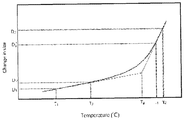
- FIG. 1 is a diagram showing a method for determining a glass-transition temperature in working examples.
- liquid epoxy resin composition is described in detail hereunder. However, the present invention is not limited to the following examples.
- the present invention contains the following components (A) to (E); or (B) to (E).
- a liquid epoxy resin (A) is an epoxy resin that is liquid at room temperature (25°C).
- liquid epoxy resin include a liquid bisphenol A-type epoxy resin, a liquid bisphenol F-type epoxy resin, a liquid naphthalene type epoxy resin, a liquid aminophenol type epoxy resin, a liquid hydrogenated bisphenol type epoxy resin, a liquid alcohol ether type epoxy resin, a liquid cyclic aliphatic epoxy resin, a liquid fluorene type epoxy resin and a liquid alicyclic epoxy resin. Any of these liquid epoxy resins may be used singularly, or two or more of them may be used in combination with one another.
- a rubber particle-dispersed epoxy resin mixture (B) is a mixture obtained by dispersing rubber particles (B-2) in the following liquid epoxy resin (B-1).
- rubber particle-dispersed epoxy resin mixture (B) there may be used a commercially available mixture directly; or each of (B-1) and (B-2) may be prepared beforehand, followed by mixing the two before use.
- the mixture is obtained by stirring, mixing and dispersing the components (B-1) and (B-2) while performing a heating treatment if necessary.
- an apparatus for performing for example, such stirring, mixing and dispersing. Examples of such apparatus include a kneader, a triple roll mill, a ball mill, a planetary mixer and a bead mill, each being equipped with a stirring and heating device(s). Further, these apparatuses may be appropriately used in combination with one another.
- the component (B) is added in an amount of 20 to 200 parts by mass, preferably 50 to 150 parts by mass, with respect to 100 parts by mass of the component (A).
- the component (B-1) be added in a relatively large amount.
- the liquid epoxy resin (A) and the liquid epoxy resin (B-1) be in an amount of 4 to 60% by mass, particularly preferably 5 to 50% by mass, in the liquid epoxy resin composition of the invention.
- examples of the liquid epoxy resin (B-1) include a liquid bisphenol A-type epoxy resin, a liquid bisphenol F-type epoxy resin, a liquid naphthalene type epoxy resin, a liquid aminophenol type epoxy resin, a liquid hydrogenated bisphenol type epoxy resin, a liquid alcohol ether type epoxy resin, a liquid cyclic aliphatic epoxy resin, a liquid fluorene type epoxy resin, a liquid glycidyl amine type epoxy resin and a liquid alicyclic epoxy resin. Any of these liquid epoxy resins may be used singularly, or two or more of them may be used in combination with one another.
- liquid epoxy resins particularly preferred are a liquid bisphenol A-type epoxy resin, a liquid bisphenol F-type epoxy resin, a liquid aminophenol type epoxy resin and a liquid glycidyl amine type epoxy resin.
- the liquid epoxy resin(s) used as (B-1) may be identical to or different from that or those used as (A).
- Examples of the rubber particles (B-2) having an average particle diameter of 10 to 10,000 nm include particles of styrene-butadiene rubber (SBR), particles of nitrile-butadiene rubber (NBR), particles of butadiene rubber (BR), particles of urethane rubber (UR) and particles of acrylic rubber (AR).
- SBR styrene-butadiene rubber
- NBR nitrile-butadiene rubber
- BR butadiene rubber
- UR urethane rubber
- acrylic rubber particles particles made of acrylic rubber is preferred in terms of heat resistance and moisture resistance.
- silicone rubber particles examples include particles obtained by bridging polyorganosiloxanes such as linear polydimethylsiloxane, linear polymethylphenylsiloxane and linear polydiphenylsiloxane; particles obtained by coating the surfaces of silicone rubber particles with a silicone resin; particles obtained by modifying the surfaces of silicone rubber particles with epoxy groups; and core-shell polymer particles that are obtained through, for example, emulsion polymerization, and are composed of solid silicone particles as cores and an organic polymer such as an acrylic resin as shells.
- These silicone rubber particles may be used regardless of whether they are amorphous or spherical. However, spherical silicone rubber particles are preferred for the purpose of keeping the viscosity of the liquid epoxy resin composition low, such viscosity being associated with a formability of the liquid epoxy resin composition.
- the rubber particles have an average particle diameter of 10 to 10,000 nm, preferably 100 to 5,000 nm, in terms of, for example, improving a thermal shock resistance and reducing a stress to a semiconductor element(s).
- the average particle diameter of the rubber particles is a value of median diameter (d50) measured by a nano-track particle size distribution measuring device (by NIKKISO CO., LTD., dynamic light scattering method).
- Examples of a curing agent as a component (C) include an amine-based curing agent, a phenol-based curing agent and an acid anhydride-based curing agent.
- amine-based curing agent examples include an aromatic diaminodiphenylmethane compound such as 3,3'-diethyl-4,4'-diaminodiphenylmethane, 3,3',5,5'-tetramethyl-4,4'-diaminodiphenylmethane and 3,3',5,5'-tetraethyl-4,4'-diaminodiphenylmethane; 2,4-diaminotoluene; 1,4-diaminobenzene; and 1,3-diaminobenzene. Any of these amine-based curing agents may be used singularly, or two or more of them may be used in combination with one another.
- the equivalent of all the amino groups in the amine-based curing agent(s) to 1 equivalent of the epoxy groups in the components (A) and (B-1) be 0.7 to 1.2, more preferably 0.7 to 1.1, and even more preferably 0.85 to 1.05.
- equivalent is smaller than 0.7, unreacted epoxy groups may remain, a glass-transition temperature may decrease, or an adhesion may be impaired.
- equivalent is greater than 1.2, a cured product of the composition will become hard and brittle such that cracks may occur at the time of performing reflow or a temperature cycle test.
- phenol-based curing agent examples include a phenol novolac resin; a naphthalene ring-containing phenolic resin; an aralkyl type phenolic resin; a triphenolalkane type phenolic resin; a biphenyl backbone-containing aralkyl type phenolic resin; a biphenyl type phenolic resin; an alicyclic phenolic resin; a heterocyclic phenolic resin; a naphthalene ring-containing phenolic resin; a resorcinol type phenolic resin; an allyl group-containing phenolic resin; and a bisphenol type phenolic resin such as a bisphenol A-type resin and a bisphenol F-type resin. Any of these phenol-based curing agents may be used singularly, or two or more of them may be used in combination with one another.
- the equivalent of the phenolic hydroxyl groups contained in the curing agent to the total of 1 equivalent of the epoxy groups in the components (A) and (B-1) be 0.7 to 1.3, more preferably 0.8 to 1.2.
- Examples of the above acid anhydride-based curing agent include 3,4-dimethyl-6-(2-methyl-1-propenyl)-1,2,3,6-tetrahydrophthalic anhydride, 1-isopropyl-4-methyl-bicyclo [2.2.2] oct-5-ene-2,3-dicarboxylic anhydride, methyl tetrahydrophthalic anhydride, methyl hexahydrophthalic anhydride, hexahydrophthalic anhydride, methylhimic anhydride, pyromellitic dianhydride, maleated alloocimene, benzophenonetetracarboxylic dianhydride, 3,3',4,4'-biphenyl-tetra-bis-benzophenonetetracarboxylic anhydride, (3,4-dicarboxyphenyl) ether dianhydride, bis (3,4-dicarboxyphenyl) methane dianhydride and 2,2-bis (3,4-
- the equivalent of the acid anhydride groups (-CO-O-CO-) in the curing agent to the total of 1 equivalent of the epoxy groups in the components (A) and (B-1) be 0.7 to 1.3.
- the equivalent of the acid anhydride groups (-CO-O-CO-) in the curing agent to the total of 1 equivalent of the epoxy groups in the components (A) and (B-1) be 0.7 to 1.3.
- unreacted epoxy groups will remain in a way such that the glass-transition temperature may decrease, and that the adhesion may be impaired as well.
- such equivalent is greater than 1.3, the cured product of the composition will become hard and brittle in a way such that cracks may occur at the time of performing reflow or a temperature cycle test.
- An inorganic filler (D) is added to reduce a thermal expansion rate of the liquid epoxy resin composition and improve a moisture resistance reliability thereof.
- examples of such inorganic filler include silicas such as a molten silica, a crystalline silica and cristobalite; alumina; silicon nitride; aluminum nitride; boron nitride; titanium oxide; glass fibers; and magnesium oxide.
- silicas such as a molten silica, a crystalline silica and cristobalite
- alumina silicon nitride; aluminum nitride; boron nitride; titanium oxide; glass fibers; and magnesium oxide.
- the average particle diameters and shapes of these inorganic fillers can be selected based on the intended use.
- the inorganic filler is added in an amount of 20
- curing accelerator E
- curing accelerator examples include phosphorous compounds such as triphenylphosphine, tributylphosphine, tri (p-methylphenyl) phosphine, tri (nonylphenyl) phosphine, triphenylphosphine ⁇ triphenylborane and tetraphenylphosphine ⁇ tetraphenylborate; tertiary amine compounds such as triethylamine, benzyldimethylamine, ⁇ -methylbenzyldimethylamine and 1,8-diazabicyclo [5.4.0] undecene-7; and imidazole compounds such as 2-methylimidazole, 2-ethyl-4-methylimidazole, 2-phenylimidazole and 2-phenyl-4-methylimidazole.
- phosphorous compounds such as triphenylphosphine, tributylphosphine, tri (p-methylphenyl) phosphine, tri
- the curing accelerator is added in an amount of 0.05 to 10 parts by mass, preferably 0.1 to 10 parts by mass, more preferably 0.5 to 5 parts by mass, with respect to the total of 100 parts by mass of the components (A) to (C).
- the heat-curable resin composition of the invention can be obtained by combining given amounts of the components (A), (B), (C), (D) and (E).
- other additives as a component (F) may also be added to the composition of the invention if necessary, without impairing the purposes and effects of the present invention.
- additives include a polymerization initiator, a mold release agent, a flame retardant, an ion trapping agent, an antioxidant, an adhesiveness imparting agent, a low stress agent, a coloring agent and a coupling agent.
- a mold release agent is added to improve a mold releasability from a mold.
- All known mold release agents may be used, and examples of such known mold release agents include a carnauba wax; a rice wax; a candelilla wax; polyethylene; oxidized polyethylene; polypropylene; montanic acid; stearic acid; stearic acid ester; stearic acid amide; and a montan wax as an ester compound obtained by combining montanic acid with, for example, a saturated alcohol, 2-(2-hydroxyethylamino) ethanol, ethylene glycol or glycerin.
- the flame retardant is added to impart a flame retardance.
- All known flame retardants may be used, and there are no particular restrictions on such flame retardants.
- Examples of such flame retardants include a phosphazene compound, a silicone compound, a zinc molybdate-supported talc, a zinc molybdate-supported zinc oxide, an aluminum hydroxide, a magnesium hydroxide and a molybdenum oxide.
- the ion trapping agent is added to trap the ion impurities contained in the liquid resin composition, and avoid a thermal degradation and a moisture absorption degradation. All known trapping agents may be used, and there are no particular restrictions on such ion trapping agents. Examples of such ion trapping agents include hydrotalcites, a bismuth hydroxide compound and rare-earth oxides.
- each additive be added in an amount of not larger than 10% by mass with respect to the whole liquid epoxy resin composition.
- the liquid epoxy resin composition of the invention can, for example, be produced by the following method.
- a mixture of the components (A), (B), (C), (D) and (E) can be obtained by simultaneously or separately mixing, stirring, melting and/or dispersing the liquid epoxy resin (A), the rubber particle-dispersed liquid epoxy resin (B), the curing agent (C), the inorganic filler (D) and the curing accelerator (E) while performing a heating treatment if necessary.
- At least one of the mold release agent, flame retardant and ion trapping agent as other additives (F) may also be added to and mixed with the mixture of the components (A), (B), (C), (D) and (E).
- each of the components (A) to (F) there may be employed only one ingredient, or two or more ingredients.
- the composition can be obtained by performing stirring, melting, mixing and dispersing while performing a heating treatment if necessary.
- an apparatus for performing for example, such stirring, mixing and dispersing.
- examples of such apparatus include a kneader, a triple roll mill, a ball mill, a planetary mixer and a bead mill, each being equipped with a stirring and heating device(s). Further, these apparatuses may be appropriately used in combination with one another.
- a liquid epoxy resin composition was prepared by combining the following components of the amounts shown in Table 1 and Table 2.
- the liquid epoxy resin composition was then molded after being heated at 100°C for 2 hours, and then at 150°C for 4 hours, thus obtaining a cured product of the composition in each example.
- Table 1 and Table 2 the amounts of the components (A) to (E) are expressed as parts by mass.
- the bisphenol A-type epoxy resin EPIKOTE 828 by Mitsubishi Chemical Corporation
- acrylic rubber particles F351 by Aica Kogyo Co., Ltd.; average particle diameter of rubber particles 200 to 400 nm
- a polyethylene container 150 ml
- a planetary centrifugal mixer THINKY CORPORATION
- the ingredients were further mixed 6 times using a triple roll mill (by INOUE MFG., INC.)
- a viscosity value was measured 2 min after a specimen had been positioned, in accordance with a method described in JIS Z8803:2011 where a measurement temperature was 25°C and a measuring device used was an E-type viscometer.
- the liquid epoxy resin composition of the invention was applied to a 10 ⁇ 10 mm silicon wafer, followed by mounting a silicon chip thereon and then curing the resin composition under the above curing conditions, thus obtaining an adhesion test specimen.
- a shear adhesion force of the specimen at room temperature (25°C) was measured using a bond tester DAGE-SERIES-4000PXY (by Nordson Advanced Technology Japan K.K.).
- An adhesion area between the frame of the specimen and the resin was 10 mm 2 .
- Each cured product obtained in the working and comparative examples was processed into a 5 ⁇ 5 ⁇ 15 mm specimen, followed by placing the same in a thermal dilatometer TMA 8140C (by Rigaku Corporation). After setting a temperature program to a rise rate of 5°C / min and arranging that a constant load of 19.6 mN be applied to the specimen, a change in size of the specimen was measured during a period from 25°C to 300°C. The correlation between such change in size and temperatures was then plotted on a graph. The glass-transition temperatures in the working and comparative examples were later obtained based on such graph showing the correlation between the change in size and temperatures, and through the following method for determining the glass-transition temperature(s). The results are shown in Table 1 and Table 2.
- T 1 and T 2 represent two arbitrary temperatures that are not higher than the temperature at the inflection point and by which a tangent line to the size change-temperature curve can be drawn; whereas T 1 ' and T 2 ' represent two arbitrary temperatures that are not lower than the temperature at the inflection point and by which a similar tangent line can be drawn.
- D 1 and D 2 individually represent a change in size at T 1 and a change in size at T 2 ; whereas D 1 ' and D 2 ' individually represent a change in size at T 1 ' and a change in size at T 2 '.
- the glass-transition temperature (Tg) is then defined as the temperature at the point of intersection between a straight line connecting points (T 1 , D 1 ) and (T 2 , D 2 ) and a straight line connecting points (T 1 ', D 1 ') and (T 2 ', D 2 ').
- liquid epoxy resin composition of the invention is superior in rubber particle dispersibility, and exhibits a lower elastic modulus without impairing a high heat resistance and mechanical strength that are inherent to epoxy resins.
Landscapes
- Chemical & Material Sciences (AREA)
- Organic Chemistry (AREA)
- Health & Medical Sciences (AREA)
- Chemical Kinetics & Catalysis (AREA)
- Medicinal Chemistry (AREA)
- Polymers & Plastics (AREA)
- Life Sciences & Earth Sciences (AREA)
- Engineering & Computer Science (AREA)
- Materials Engineering (AREA)
- Wood Science & Technology (AREA)
- Compositions Of Macromolecular Compounds (AREA)
- Epoxy Resins (AREA)
Abstract
Provided is a liquid epoxy resin composition superior in rubber particle dispersibility, and exhibiting a lower elastic modulus without impairing a high heat resistance and mechanical strength that are inherent to epoxy resins. The liquid epoxy resin composition contains:
(A) a liquid epoxy resin;
(B) a rubber particle-dispersed epoxy resin composition containing
(B-1) 50 to 90% by mass of a liquid epoxy resin;
(B-2) 10 to 50% by mass of rubber particles, the rubber particles having an average particle diameter of 10 to 10,000 nm;
(C) a curing agent;
(D) an inorganic filler; and
(E) a curing accelerator.
(A) a liquid epoxy resin;
(B) a rubber particle-dispersed epoxy resin composition containing
(B-1) 50 to 90% by mass of a liquid epoxy resin;
(B-2) 10 to 50% by mass of rubber particles, the rubber particles having an average particle diameter of 10 to 10,000 nm;
(C) a curing agent;
(D) an inorganic filler; and
(E) a curing accelerator.
Description
- The present invention relates to a liquid epoxy resin composition superior in rubber particle dispersibility, and capable of exhibiting a lower elasticity and a higher strength without lowering a glass-transition temperature.
- In recent years, electronic devices such as mobile phones, smartphones, ultrathin liquid crystal or plasma TVs and light laptop computers have been downsized in an accelerated manner. That is, electronic parts used in these devices have been subjected to, for example, high-density integration and high-density packaging in an accelerated manner as well. Further, it is required that a resin material used in these electronic parts have a lower expansibility and a lower elastic modulus in terms of thermal stress.
- Epoxy resins which are widely used in electronic parts have features such as a high heat resistance and a high adhesion to a base material. However, these epoxy resins also have a fault of, for example, being hard and brittle.
- Here, studies have been made on lowering the elastic modulus of a resin and the stress thereof accordingly, by adding to an epoxy resin composition a rubber component(s) such as acrylic rubber, silicone rubber and butadiene rubber (
Patent documents 1 and 2). However, in the case of directly adding a powdered rubber component(s) to an epoxy resin, there has, for example, been a problem that a desired property or properties cannot be achieved sufficiently as the rubber particles will clump together in such case. - Further, studies have also been made on lowering stress and improving the adhesion to a base material, by adding an epoxy-modified rubber which is obtained by reacting beforehand an epoxy resin and a rubber component having functional groups reactive with the epoxy resin (Patent document 3). However, in terms of modifying an epoxy resin, there have been, for example, a problem that a cured product will exhibit a lowered glass-transition temperature; and a problem that the mechanical strength of the cured product will decrease under a high temperature.
- In this way, there has been anticipated a type of epoxy resin allowing rubber particles to be highly dispersed therein such that the stress of the resin can be lowered without impairing the properties that are inherent to an epoxy resin.
-
- Patent document 1:
JP-A-2014-095063 - Patent document 2:
JP-A-2014-028932 - Patent document 3: Japanese Patent No.
4,775,374 - It is an object of the present invention to provide a liquid epoxy resin composition superior in rubber particle dispersibility, and capable of exhibiting a lower elasticity and a high strength without lowering a glass-transition temperature.
- The inventors of the present invention conducted a series of studies in order to solve the above problems, and completed the invention as follows. That is, the inventors found that the following composition was a resin composition for semiconductor encapsulation that could achieve the aforementioned objectives.
- Particularly, the invention is to provide the following resin composition.
- [1]
A liquid epoxy resin composition containing:- (A) a liquid epoxy resin;
- (B) a rubber particle-dispersed epoxy resin mixture in an amount of 20 to 200 parts by mass with respect to 100 parts by mass of the component (A), and containing
- (B-1) 50 to 90% by mass of a liquid epoxy resin in the component (B) and
- (B-2) 10 to 50% by mass of rubber particles in the component (B), the rubber particles having an average particle diameter of 10 to 10,000 nm;
- (C) a curing agent in an amount at which groups in the component (C) that are reactive with epoxy groups are in an amount of 0.7 to 1.3 equivalents with respect to 1 equivalent of epoxy groups in the components (A) and (B-1);
- (D) an inorganic filler in an amount of 20 to 1,500 parts by mass with respect to a total of 100 parts by mass of the components (A) to (C); and
- (E) a curing accelerator in an amount of 0.05 to 10 parts by mass with respect to the total of 100 parts by mass of the components (A) to (C).
- [2] A liquid epoxy resin composition containing:
- (B) a rubber particle-dispersed epoxy resin mixture containing
- (B-1) 50 to 90% by mass of a liquid epoxy resin in the component (B) and
- (B-2) 10 to 50% by mass of rubber particles in the component (B), the rubber particles having an average particle diameter of 10 to 10,000 nm;
- (C) a curing agent in an amount at which groups in the component (C) that are reactive with epoxy groups are in an amount of 0.7 to 1.3 equivalents with respect to 1 equivalent of epoxy groups in the component (B-1);
- (D) an inorganic filler in an amount of 20 to 1,500 parts by mass with respect to a total of 100 parts by mass of the components (B) and (C); and
- (E) a curing accelerator in an amount of 0.1 to 10 parts by mass with respect to the total of 100 parts by mass of the components (B) and (C).
- (B) a rubber particle-dispersed epoxy resin mixture containing
- [3] The liquid epoxy resin composition according to [1] or [2], wherein the component (B-2) is at least one kind of rubber particles selected from acrylic rubber particles, silicone rubber particles, urethane rubber particles, styrene-butadiene rubber particles and butadiene rubber particles.
- The liquid epoxy resin composition of the invention is superior in rubber particle dispersibility, and is able to exhibit a lower elastic modulus without impairing a high heat resistance and mechanical strength that are inherent to epoxy resins.
- FIG. 1 is a diagram showing a method for determining a glass-transition temperature in working examples.
- The liquid epoxy resin composition is described in detail hereunder. However, the present invention is not limited to the following examples.
- The present invention contains the following components (A) to (E); or (B) to (E).
- A liquid epoxy resin (A) is an epoxy resin that is liquid at room temperature (25°C). Examples of such liquid epoxy resin include a liquid bisphenol A-type epoxy resin, a liquid bisphenol F-type epoxy resin, a liquid naphthalene type epoxy resin, a liquid aminophenol type epoxy resin, a liquid hydrogenated bisphenol type epoxy resin, a liquid alcohol ether type epoxy resin, a liquid cyclic aliphatic epoxy resin, a liquid fluorene type epoxy resin and a liquid alicyclic epoxy resin. Any of these liquid epoxy resins may be used singularly, or two or more of them may be used in combination with one another.
- A rubber particle-dispersed epoxy resin mixture (B) is a mixture obtained by dispersing rubber particles (B-2) in the following liquid epoxy resin (B-1). A mass ratio between (B-1) and (B-2) is (B-1) : (B-2) = 50 to 90 : 10 to 50% by mass, preferably 60 to 80 : 20 to 40% by mass. Further, when the component (A) of the invention is not contained, the mass ratio between (B-1) and (B-2) may be (B-1) : (B-2) = 50 to 95 : 5 to 50% by mass.
- As such rubber particle-dispersed epoxy resin mixture (B), there may be used a commercially available mixture directly; or each of (B-1) and (B-2) may be prepared beforehand, followed by mixing the two before use. The mixture is obtained by stirring, mixing and dispersing the components (B-1) and (B-2) while performing a heating treatment if necessary. There are no particular restrictions on an apparatus for performing, for example, such stirring, mixing and dispersing. Examples of such apparatus include a kneader, a triple roll mill, a ball mill, a planetary mixer and a bead mill, each being equipped with a stirring and heating device(s). Further, these apparatuses may be appropriately used in combination with one another. The component (B) is added in an amount of 20 to 200 parts by mass, preferably 50 to 150 parts by mass, with respect to 100 parts by mass of the component (A). Here, if not employing the component (A), it is preferred that the component (B-1) be added in a relatively large amount. It is preferred that the liquid epoxy resin (A) and the liquid epoxy resin (B-1) be in an amount of 4 to 60% by mass, particularly preferably 5 to 50% by mass, in the liquid epoxy resin composition of the invention.
- As is the case for the component (A), examples of the liquid epoxy resin (B-1) include a liquid bisphenol A-type epoxy resin, a liquid bisphenol F-type epoxy resin, a liquid naphthalene type epoxy resin, a liquid aminophenol type epoxy resin, a liquid hydrogenated bisphenol type epoxy resin, a liquid alcohol ether type epoxy resin, a liquid cyclic aliphatic epoxy resin, a liquid fluorene type epoxy resin, a liquid glycidyl amine type epoxy resin and a liquid alicyclic epoxy resin. Any of these liquid epoxy resins may be used singularly, or two or more of them may be used in combination with one another. Among these liquid epoxy resins, particularly preferred are a liquid bisphenol A-type epoxy resin, a liquid bisphenol F-type epoxy resin, a liquid aminophenol type epoxy resin and a liquid glycidyl amine type epoxy resin. Moreover, the liquid epoxy resin(s) used as (B-1) may be identical to or different from that or those used as (A).
- Examples of the rubber particles (B-2) having an average particle diameter of 10 to 10,000 nm, include particles of styrene-butadiene rubber (SBR), particles of nitrile-butadiene rubber (NBR), particles of butadiene rubber (BR), particles of urethane rubber (UR) and particles of acrylic rubber (AR). Among these rubber particles, particles made of acrylic rubber is preferred in terms of heat resistance and moisture resistance. Further, as rubber particles other those described above, there may also be preferably employed silicone rubber particles. Examples of such silicone rubber particles include particles obtained by bridging polyorganosiloxanes such as linear polydimethylsiloxane, linear polymethylphenylsiloxane and linear polydiphenylsiloxane; particles obtained by coating the surfaces of silicone rubber particles with a silicone resin; particles obtained by modifying the surfaces of silicone rubber particles with epoxy groups; and core-shell polymer particles that are obtained through, for example, emulsion polymerization, and are composed of solid silicone particles as cores and an organic polymer such as an acrylic resin as shells. These silicone rubber particles may be used regardless of whether they are amorphous or spherical. However, spherical silicone rubber particles are preferred for the purpose of keeping the viscosity of the liquid epoxy resin composition low, such viscosity being associated with a formability of the liquid epoxy resin composition.
- In the present invention, the rubber particles have an average particle diameter of 10 to 10,000 nm, preferably 100 to 5,000 nm, in terms of, for example, improving a thermal shock resistance and reducing a stress to a semiconductor element(s). In the present invention, the average particle diameter of the rubber particles is a value of median diameter (d50) measured by a nano-track particle size distribution measuring device (by NIKKISO CO., LTD., dynamic light scattering method).
- Examples of a curing agent as a component (C) include an amine-based curing agent, a phenol-based curing agent and an acid anhydride-based curing agent.
- Examples of such amine-based curing agent include an aromatic diaminodiphenylmethane compound such as 3,3'-diethyl-4,4'-diaminodiphenylmethane, 3,3',5,5'-tetramethyl-4,4'-diaminodiphenylmethane and 3,3',5,5'-tetraethyl-4,4'-diaminodiphenylmethane; 2,4-diaminotoluene; 1,4-diaminobenzene; and 1,3-diaminobenzene. Any of these amine-based curing agents may be used singularly, or two or more of them may be used in combination with one another.
- It is preferred that the equivalent of all the amino groups in the amine-based curing agent(s) to 1 equivalent of the epoxy groups in the components (A) and (B-1) be 0.7 to 1.2, more preferably 0.7 to 1.1, and even more preferably 0.85 to 1.05. When such equivalent is smaller than 0.7, unreacted epoxy groups may remain, a glass-transition temperature may decrease, or an adhesion may be impaired. Further, when such equivalent is greater than 1.2, a cured product of the composition will become hard and brittle such that cracks may occur at the time of performing reflow or a temperature cycle test.
- Examples of the above phenol-based curing agent include a phenol novolac resin; a naphthalene ring-containing phenolic resin; an aralkyl type phenolic resin; a triphenolalkane type phenolic resin; a biphenyl backbone-containing aralkyl type phenolic resin; a biphenyl type phenolic resin; an alicyclic phenolic resin; a heterocyclic phenolic resin; a naphthalene ring-containing phenolic resin; a resorcinol type phenolic resin; an allyl group-containing phenolic resin; and a bisphenol type phenolic resin such as a bisphenol A-type resin and a bisphenol F-type resin. Any of these phenol-based curing agents may be used singularly, or two or more of them may be used in combination with one another.
- When a phenolic resin is used as the curing agent, it is preferred that the equivalent of the phenolic hydroxyl groups contained in the curing agent to the total of 1 equivalent of the epoxy groups in the components (A) and (B-1) be 0.7 to 1.3, more preferably 0.8 to 1.2.
- Examples of the above acid anhydride-based curing agent include 3,4-dimethyl-6-(2-methyl-1-propenyl)-1,2,3,6-tetrahydrophthalic anhydride, 1-isopropyl-4-methyl-bicyclo [2.2.2] oct-5-ene-2,3-dicarboxylic anhydride, methyl tetrahydrophthalic anhydride, methyl hexahydrophthalic anhydride, hexahydrophthalic anhydride, methylhimic anhydride, pyromellitic dianhydride, maleated alloocimene, benzophenonetetracarboxylic dianhydride, 3,3',4,4'-biphenyl-tetra-bis-benzophenonetetracarboxylic anhydride, (3,4-dicarboxyphenyl) ether dianhydride, bis (3,4-dicarboxyphenyl) methane dianhydride and 2,2-bis (3,4-dicarboxyphenyl) propane dianhydride. Any of these acid anhydride-based curing agents may be used singularly, or two or more of them may be used in combination with one another.
- When such acid anhydride-based curing agent is used, it is preferred that the equivalent of the acid anhydride groups (-CO-O-CO-) in the curing agent to the total of 1 equivalent of the epoxy groups in the components (A) and (B-1) be 0.7 to 1.3. When such equivalent is smaller than 0.7, unreacted epoxy groups will remain in a way such that the glass-transition temperature may decrease, and that the adhesion may be impaired as well. When such equivalent is greater than 1.3, the cured product of the composition will become hard and brittle in a way such that cracks may occur at the time of performing reflow or a temperature cycle test.
- An inorganic filler (D) is added to reduce a thermal expansion rate of the liquid epoxy resin composition and improve a moisture resistance reliability thereof. Examples of such inorganic filler include silicas such as a molten silica, a crystalline silica and cristobalite; alumina; silicon nitride; aluminum nitride; boron nitride; titanium oxide; glass fibers; and magnesium oxide. Here, preferred are a spherical alumina, a spherical molten silica, glass fibers and the like. The average particle diameters and shapes of these inorganic fillers can be selected based on the intended use. The inorganic filler is added in an amount of 20 to 1,500 parts by mass, preferably 50 to 1,000 parts by mass, with respect to a total of 100 parts by mass of the components (A) to (C).
- There are no particular restrictions on a curing accelerator (E), as long as it is capable of accelerating a curing reaction. Examples of such curing accelerator include phosphorous compounds such as triphenylphosphine, tributylphosphine, tri (p-methylphenyl) phosphine, tri (nonylphenyl) phosphine, triphenylphosphine·triphenylborane and tetraphenylphosphine·tetraphenylborate; tertiary amine compounds such as triethylamine, benzyldimethylamine, α-methylbenzyldimethylamine and 1,8-diazabicyclo [5.4.0] undecene-7; and imidazole compounds such as 2-methylimidazole, 2-ethyl-4-methylimidazole, 2-phenylimidazole and 2-phenyl-4-methylimidazole. Among these examples, preferred are triphenylphosphine, triphenylphosphine·triphenylborane and 2-ethyl-4-methylimidazole. The curing accelerator is added in an amount of 0.05 to 10 parts by mass, preferably 0.1 to 10 parts by mass, more preferably 0.5 to 5 parts by mass, with respect to the total of 100 parts by mass of the components (A) to (C).
- The heat-curable resin composition of the invention can be obtained by combining given amounts of the components (A), (B), (C), (D) and (E). However, other additives as a component (F) may also be added to the composition of the invention if necessary, without impairing the purposes and effects of the present invention. Examples of such additives include a polymerization initiator, a mold release agent, a flame retardant, an ion trapping agent, an antioxidant, an adhesiveness imparting agent, a low stress agent, a coloring agent and a coupling agent.
- A mold release agent is added to improve a mold releasability from a mold. All known mold release agents may be used, and examples of such known mold release agents include a carnauba wax; a rice wax; a candelilla wax; polyethylene; oxidized polyethylene; polypropylene; montanic acid; stearic acid; stearic acid ester; stearic acid amide; and a montan wax as an ester compound obtained by combining montanic acid with, for example, a saturated alcohol, 2-(2-hydroxyethylamino) ethanol, ethylene glycol or glycerin.
- The flame retardant is added to impart a flame retardance. All known flame retardants may be used, and there are no particular restrictions on such flame retardants. Examples of such flame retardants include a phosphazene compound, a silicone compound, a zinc molybdate-supported talc, a zinc molybdate-supported zinc oxide, an aluminum hydroxide, a magnesium hydroxide and a molybdenum oxide.
- The ion trapping agent is added to trap the ion impurities contained in the liquid resin composition, and avoid a thermal degradation and a moisture absorption degradation. All known trapping agents may be used, and there are no particular restrictions on such ion trapping agents. Examples of such ion trapping agents include hydrotalcites, a bismuth hydroxide compound and rare-earth oxides.
- Although the amount of the component (F) added varies depending on the intended use of the liquid epoxy resin composition, it is preferred that each additive be added in an amount of not larger than 10% by mass with respect to the whole liquid epoxy resin composition.
- The liquid epoxy resin composition of the invention can, for example, be produced by the following method.
- For example, a mixture of the components (A), (B), (C), (D) and (E) can be obtained by simultaneously or separately mixing, stirring, melting and/or dispersing the liquid epoxy resin (A), the rubber particle-dispersed liquid epoxy resin (B), the curing agent (C), the inorganic filler (D) and the curing accelerator (E) while performing a heating treatment if necessary. At least one of the mold release agent, flame retardant and ion trapping agent as other additives (F) may also be added to and mixed with the mixture of the components (A), (B), (C), (D) and (E). As each of the components (A) to (F), there may be employed only one ingredient, or two or more ingredients.
- When producing the composition of the invention, the composition can be obtained by performing stirring, melting, mixing and dispersing while performing a heating treatment if necessary. There are no particular restrictions on an apparatus for performing, for example, such stirring, mixing and dispersing. Examples of such apparatus include a kneader, a triple roll mill, a ball mill, a planetary mixer and a bead mill, each being equipped with a stirring and heating device(s). Further, these apparatuses may be appropriately used in combination with one another.
- The present invention is described in greater detail hereunder with reference to working and comparative examples. However, the invention is not limited to the following working examples.
- In working examples 1 to 14 and comparative examples 1 to 8, a liquid epoxy resin composition was prepared by combining the following components of the amounts shown in Table 1 and Table 2. The liquid epoxy resin composition was then molded after being heated at 100°C for 2 hours, and then at 150°C for 4 hours, thus obtaining a cured product of the composition in each example. Here, in Table 1 and Table 2, the amounts of the components (A) to (E) are expressed as parts by mass.
- (A) Liquid epoxy resin
- (A1) Bisphenol A-type epoxy resin (EPIKOTE 828 by Mitsubishi Chemical Corporation)
- (A2) Bisphenol F-type epoxy resin (TDF-8170 by Mitsubishi Chemical Corporation)
- (A3) Aminophenol-type trifunctional epoxy resin (jER630 by Mitsubishi Chemical Corporation)
- (B) Rubber particle-dispersed epoxy resin mixture
- (B1) Mixture of bisphenol A-type epoxy resin and acrylic rubber particles (BPA 328 by NIPPON SHOKUBAI CO., LTD.; average particle diameter of rubber particles 300 to 600 nm; amount of particles contained 20% by mass)
- (B2) Mixture of bisphenol F-type epoxy resin and acrylic rubber particles (BPF 307 by NIPPON SHOKUBAI CO., LTD.; average particle diameter of rubber particles 300 to 600 nm; amount of particles contained 20% by mass)
- (B3) Mixture of bisphenol A-type epoxy resin and polybutadiene rubber particles (MX-154 by Kaneka Corporation; average particle diameter of rubber particles 100 to 500 nm; amount of particles contained 40% by mass)
- (B4) Mixture of bisphenol A-type epoxy resin and silicone rubber particles (MX-960 by Kaneka Corporation; average particle diameter of rubber particles 100 to 500 nm; amount of particles contained 25% by mass)
- (B5) Mixture of glycidylamine type epoxy resin and styrene butadiene rubber particles (MX-451 by Kaneka Corporation; average particle diameter of rubber particles 100 to 500 nm; amount of particles contained 25% by mass)
- (B6) Mixture of bisphenol A-type epoxy resin and acrylic rubber particles, mixed in advance by a method described in the following preparation example (amount of particles contained 16.7% by mass)
- The bisphenol A-type epoxy resin (EPIKOTE 828 by Mitsubishi Chemical Corporation) of 100 g and acrylic rubber particles (F351 by Aica Kogyo Co., Ltd.; average particle diameter of rubber particles 200 to 400 nm) of 20 g, were put into a polyethylene container of 150 ml, followed by mixing them at 25°C and 1,800 rpm for 2 min using a planetary centrifugal mixer (THINKY MIXER by THINKY CORPORATION). Later, the ingredients were further mixed 6 times using a triple roll mill (by INOUE MFG., INC.)
- (B-2) Rubber particles
- (B-2-1) Acrylic rubber particles (F351 by Aica Kogyo Co., Ltd.; average particle diameter of rubber particles 200 to 400 nm)
- (B-2-2) Silicone rubber particles (KMP-600 by Shin-Etsu Chemical Co., Ltd.; average particle diameter of rubber particles 5,000 to 6,000 nm)
-
- (B7) Liquid butadiene rubber (CTBN1300X9 by UBE INDUSTRIES, LTD.)
- (C) Curing agent
- (C1) Allylphenol type phenolic resin (MEH-8000H by MEIWA PLASTIC INDUSTRIES, LTD.)
- (C2) Acid anhydride curing agent (RIKACID MH by New Japan Chemical Co., Ltd.)
- (C3) 3,3'-diethyl-4,4'-diaminodiphenylmethane (KAYAHARD AA by Nippon Kayaku Co., Ltd.)
- (D) Inorganic filler
- (D1) Spherical silica with an average particle diameter of 13 µm (CS-6103 53C by TATSUMORI LTD.)
- (E) Curing accelerator
- (E1) Curing accelerator: 2-ethyl-4-methylimidazole (by SHIKOKU CHEMICALS CORPORATION)
- The following properties of each composition and cured product thereof were measured. The results are shown in Table 1 (working examples) and Table 2 (comparative examples).
- A viscosity value was measured 2 min after a specimen had been positioned, in accordance with a method described in JIS Z8803:2011 where a measurement temperature was 25°C and a measuring device used was an E-type viscometer.
- In accordance with JIS K6911:2006, the cured product obtained under the above curing conditions was subjected to the measurements.
- The liquid epoxy resin composition of the invention was applied to a 10 × 10 mm silicon wafer, followed by mounting a silicon chip thereon and then curing the resin composition under the above curing conditions, thus obtaining an adhesion test specimen. A shear adhesion force of the specimen at room temperature (25°C) was measured using a bond tester DAGE-SERIES-4000PXY (by Nordson Advanced Technology Japan K.K.). An adhesion area between the frame of the specimen and the resin was 10 mm2.
- Each cured product obtained in the working and comparative examples was processed into a 5 × 5 × 15 mm specimen, followed by placing the same in a thermal dilatometer TMA 8140C (by Rigaku Corporation). After setting a temperature program to a rise rate of 5°C / min and arranging that a constant load of 19.6 mN be applied to the specimen, a change in size of the specimen was measured during a period from 25°C to 300°C. The correlation between such change in size and temperatures was then plotted on a graph. The glass-transition temperatures in the working and comparative examples were later obtained based on such graph showing the correlation between the change in size and temperatures, and through the following method for determining the glass-transition temperature(s). The results are shown in Table 1 and Table 2.
- In FIG.1, T1 and T2 represent two arbitrary temperatures that are not higher than the temperature at the inflection point and by which a tangent line to the size change-temperature curve can be drawn; whereas T1' and T2' represent two arbitrary temperatures that are not lower than the temperature at the inflection point and by which a similar tangent line can be drawn. D1 and D2 individually represent a change in size at T1 and a change in size at T2; whereas D1' and D2' individually represent a change in size at T1' and a change in size at T2'. The glass-transition temperature (Tg) is then defined as the temperature at the point of intersection between a straight line connecting points (T1, D1) and (T2, D2) and a straight line connecting points (T1', D1') and (T2', D2').
- Each of the cured products obtained in the working and comparative examples was processed into a specimen of a size of 5×5×15 mm. A fracture surface of such specimen was then observed by an electronic microscope so as to study the dispersibility of the rubber particles. The dispersibility of the rubber particles was visually evaluated. Here, examples exhibiting favorable rubber particle dispersibilities were marked "○," whereas examples exhibiting poor rubber particle dispersibilities were marked "×." The results thereof are shown in Table 1 and Table 2.
[Table 1] Working example 1 Working example 2 Working example 3 Working example 4 Working example 5 Working example 6 Working example 7 Working example 8 Working example 9 Working example 10 Working example 11 Working example 12 Working example 13 Working example 14 Liquid epoxy resin(A1) 100 100 100 100 100 100 100 100 100 100 100 Liquid epoxy resin(A2) 100 Liquid epoxy resin(A3) 100 Rubber particle-dispersed epoxy resin mixture(B1) 100 100 100 100 100 200 20 100 Rubber particle-dispersed epoxy resin mixture(B2) 100 Rubber particle-dispersed epoxy resin mixture(B3) 100 Rubber particle-dispersed epoxy resin mixture(B4) 100 Rubber particle-dispersed epoxy resin mixture(B5) 100 Rubber particle-dispersed epoxy resin mixture(B6) 100 100 Acrylic rubber particles (B-2-1) Silicone rubber particles (B-2-2) Liquid butadiene rubber(B7) Curing agent(C1) 136 121 133 155 255 197 84 136 Curing agent(C2) 162 162 162 162 74 Curing agent(C3) 61 Equivalent ratio (reactive group in curing agent/epoxy group) 1.0 1.0 1.0 1.0 1.0 1.0 1.0 1.0 1.0 1.0 1.0 1.0 1.0 1.0 Inorganic filler(D1) 336 362 261 321 333 355 455 155 1448 497 204 336 362 174 Curing accelerator(E1) 1 1 0.2 1 1 1 1 1 1 1 1 1 1 1 Viscosity[Pa.s] 200 30 100 310 220 120 80 10 180 400 160 300 50 120 Bending elastic modulus[MPa] 5500 5000 5300 4700 5000 5500 5800 4000 14000 5000 5700 5500 5500 4600 Bending strength[MPa] 120 140 120 100 100 110 140 80 150 100 100 110 150 160 Deflection amount[mm] 17 13 14 17 16 16 14 18 3.5 19 17 15 12 15 Glass-transition temperature[°C] 70 130 110 70 70 60 80 130 130 70 70 70 130 130 Adhesion force to Si[MPa] 32 28 35 33 31 29 36 31 32 33 31 31 29 27 Dispersibility ○ ○ ○ ○ ○ ○ ○ ○ ○ ○ ○ ○ ○ ○ [Table 2] Comparative example 1 Comparative example 2 Comparative example 3 Comparative example 4 Comparative example 5 Comparative example 6 Comparative example 7 Comparative example 8 Liquid epoxy resin(A1) 100 100 100 100 100 100 100 100 Liquid epoxy resin(A2) Liquid epoxy resin(A3) Rubber particle-dispersed epoxy 100 100 100 Rubber particle-dispersed epoxy Rubber particle-dispersed epoxy Rubber particle-dispersed epoxy Rubber particle-dispersed epoxy Rubber particle-dispersed epoxy Acrylic rubber particles (B-2-1) 20 Silicone rubber particles (B-2-2) 20 Liquid butadiene rubber(B7) 20 Curing agent(C1) 75 75 75 75 75 136 Curing agent(C2) 338 84 Curing agent(C3) Equivalent ratio (reactive group in curing agent / epoxy group) 1.0 1.0 1.0 1.0 1.0 0.5 1.5 1.0 Inorganic filler(D1) 175 175 175 175 539 284 175 Curing accelerator(E1) 1 1 1 1 1 1 1 Viscosity[Pa.s] 140 400 300 500 5 10 240 200 Bending elastic modulus[MPa] 6200 6000 6000 5500 3000 Molding failure 6100 Uncured Bending strength[MPa] 100 85 80 80 70 90 Deflection amount[mm] 10 9 9 8 15 10 Glass-transition temperature[°C] 70 50 50 40 70 130 Adhesion force to Si[MPa] 24 20 22 21 14 10 Dispersibility - × × ○* - - ○ - *Compatibilized - According to the working and comparative examples, it is obvious that the liquid epoxy resin composition of the invention is superior in rubber particle dispersibility, and exhibits a lower elastic modulus without impairing a high heat resistance and mechanical strength that are inherent to epoxy resins.
Claims (3)
- A liquid epoxy resin composition comprising:(A) a liquid epoxy resin;(B) a rubber particle-dispersed epoxy resin mixture in an amount of 20 to 200 parts by mass with respect to 100 parts by mass of the component (A), and containing(B-1) 50 to 90% by mass of a liquid epoxy resin in the component (B) and(B-2) 10 to 50% by mass of rubber particles in the component (B), the rubber particles having an average particle diameter of 10 to 10,000 nm;(C) a curing agent in an amount at which groups in the component (C) that are reactive with epoxy groups are in an amount of 0.7 to 1.3 equivalents with respect to 1 equivalent of epoxy groups in the components (A) and (B-1);(D) an inorganic filler in an amount of 20 to 1,500 parts by mass with respect to a total of 100 parts by mass of the components (A) to (C); and(E) a curing accelerator in an amount of 0.05 to 10 parts by mass with respect to the total of 100 parts by mass of the components (A) to (C).
- A liquid epoxy resin composition comprising:(B) a rubber particle-dispersed epoxy resin mixture containing(B-1) 50 to 90% by mass of a liquid epoxy resin in the component (B) and(B-2) 10 to 50% by mass of rubber particles in the component (B), the rubber particles having an average particle diameter of 10 to 10,000 nm;(C) a curing agent in an amount at which groups in the component (C) that are reactive with epoxy groups are in an amount of 0.7 to 1.3 equivalents with respect to 1 equivalent of epoxy groups in the component (B-1);(D) an inorganic filler in an amount of 20 to 1,500 parts by mass with respect to a total of 100 parts by mass of the components (B) and (C); and(E) a curing accelerator in an amount of 0.1 to 10 parts by mass with respect to the total of 100 parts by mass of the components (B) and (C).
- The liquid epoxy resin composition according to claim 1 or claim 2, wherein the component (B-2) is at least one kind of rubber particles selected from acrylic rubber particles, silicone rubber particles, urethane rubber particles, styrene-butadiene rubber particles and butadiene rubber particles.
Applications Claiming Priority (1)
| Application Number | Priority Date | Filing Date | Title |
|---|---|---|---|
| JP2015249479 | 2015-12-22 |
Publications (1)
| Publication Number | Publication Date |
|---|---|
| EP3184588A1 true EP3184588A1 (en) | 2017-06-28 |
Family
ID=57799478
Family Applications (1)
| Application Number | Title | Priority Date | Filing Date |
|---|---|---|---|
| EP16205938.0A Withdrawn EP3184588A1 (en) | 2015-12-22 | 2016-12-21 | Liquid epoxy resin composition |
Country Status (6)
| Country | Link |
|---|---|
| US (1) | US20170174879A1 (en) |
| EP (1) | EP3184588A1 (en) |
| JP (1) | JP2017115132A (en) |
| KR (1) | KR20170074799A (en) |
| CN (1) | CN106905658A (en) |
| TW (1) | TW201723073A (en) |
Families Citing this family (11)
| Publication number | Priority date | Publication date | Assignee | Title |
|---|---|---|---|---|
| TWI618760B (en) * | 2017-01-16 | 2018-03-21 | Environmentally friendly road marking paint containing rubber particles | |
| CN108164979A (en) * | 2017-12-25 | 2018-06-15 | 科化新材料泰州有限公司 | A kind of polyurethane modified epoxy resin composition for semiconductor packages |
| JP6922752B2 (en) * | 2018-01-15 | 2021-08-18 | トヨタ自動車株式会社 | Heat transfer components, battery packs, and vehicles |
| EP3763788A4 (en) * | 2018-03-07 | 2021-11-17 | Toagosei Co., Ltd. | Curable composition for polymer electrolyte, and laminate |
| CN111757911B (en) * | 2018-12-29 | 2023-02-28 | 广东生益科技股份有限公司 | Resin composition, prepreg, laminate, metal foil-clad laminate and printed wiring board |
| JP2021095531A (en) * | 2019-12-18 | 2021-06-24 | セメダイン株式会社 | Adhesive composition for automobile structure |
| CN112521718B (en) * | 2020-12-04 | 2023-08-18 | 上海华化胶业有限公司 | Modified epoxy resin, solvent-free bi-component epoxy resin adhesive derived from modified epoxy resin and preparation method of solvent-free bi-component epoxy resin adhesive |
| CN112834299A (en) * | 2020-12-31 | 2021-05-25 | 中铁十八局集团有限公司 | Sealing material based on fly ash machine-made sand mortar impermeability test and use method thereof |
| CN113801295B (en) * | 2021-11-01 | 2023-09-15 | 烟台德邦科技股份有限公司 | Liquid curing agent and preparation method and application thereof |
| CN115742474B (en) * | 2022-10-27 | 2024-12-10 | 航天特种材料及工艺技术研究所 | A wave absorbing layer with low curing deformation and a preparation method thereof |
| CN116903995B (en) * | 2023-07-25 | 2024-07-09 | 哈尔滨理工大学 | Preparation method and application of epoxy resin all-organic blending heat-resistant composite material |
Citations (9)
| Publication number | Priority date | Publication date | Assignee | Title |
|---|---|---|---|---|
| US6632881B1 (en) * | 1999-04-13 | 2003-10-14 | Hitachi Chemical Co., Ltd. | Encapsulant of epoxy resin and liquid aromatic amine curing agent |
| WO2008045270A1 (en) * | 2006-10-06 | 2008-04-17 | Henkel Ag & Co. Kgaa | Pumpable epoxy paste adhesives resistant to wash-off |
| JP4775374B2 (en) | 2005-11-25 | 2011-09-21 | 日立化成工業株式会社 | Liquid resin composition for electronic components and electronic component device |
| EP2444437A1 (en) * | 2009-06-15 | 2012-04-25 | Ajinomoto Co., Inc. | Resin composition and organic-electrolyte battery |
| JP2014028932A (en) | 2012-06-26 | 2014-02-13 | Nippon Shokubai Co Ltd | Low elastic resin composition |
| JP2014095063A (en) | 2012-10-11 | 2014-05-22 | Panasonic Corp | Epoxy resin/inorganic matter composite sheet for sealing |
| US20140378580A1 (en) * | 2012-05-16 | 2014-12-25 | Hitachi Industrial Equipment Systems Co., Ltd. | Epoxy-Vinyl Copolymerization Type Liquid Resin Composition, Cured Product of the Same, Electronic/Electric Apparatus using the Cured Product, and Method of Producing the Cured Product |
| JP2015030745A (en) * | 2013-07-31 | 2015-02-16 | 住友ベークライト株式会社 | Resin composition, semiconductor device, multilayer circuit board, and electronic component |
| WO2016130455A1 (en) * | 2015-02-11 | 2016-08-18 | Dow Global Technologies Llc | Low temperature curable adhesives and use thereof |
Family Cites Families (5)
| Publication number | Priority date | Publication date | Assignee | Title |
|---|---|---|---|---|
| JP3876965B2 (en) * | 2000-11-17 | 2007-02-07 | 信越化学工業株式会社 | Liquid epoxy resin composition and semiconductor device |
| JP2009013282A (en) * | 2007-07-04 | 2009-01-22 | Nippon Kayaku Co Ltd | Liquid crystal sealing agent and liquid crystal display cell using the same |
| JP2010059241A (en) * | 2008-09-01 | 2010-03-18 | Shin-Etsu Chemical Co Ltd | Semiconductor device encapsulating composition |
| JP2015054952A (en) * | 2013-09-13 | 2015-03-23 | 日立化成株式会社 | Epoxy resin composition, electronic component device, and method of manufacturing electronic component device |
| JP2015137299A (en) * | 2014-01-21 | 2015-07-30 | 住友ベークライト株式会社 | Resin composition, adhesive sheet, dicing tape integrated adhesive sheet, back grind tape integrated adhesive sheet, back grind tape / dicing tape integrated adhesive sheet, and electronic device |
-
2016
- 2016-12-05 JP JP2016235937A patent/JP2017115132A/en active Pending
- 2016-12-12 TW TW105140986A patent/TW201723073A/en unknown
- 2016-12-21 US US15/387,147 patent/US20170174879A1/en not_active Abandoned
- 2016-12-21 KR KR1020160175301A patent/KR20170074799A/en not_active Withdrawn
- 2016-12-21 EP EP16205938.0A patent/EP3184588A1/en not_active Withdrawn
- 2016-12-22 CN CN201611195513.8A patent/CN106905658A/en active Pending
Patent Citations (9)
| Publication number | Priority date | Publication date | Assignee | Title |
|---|---|---|---|---|
| US6632881B1 (en) * | 1999-04-13 | 2003-10-14 | Hitachi Chemical Co., Ltd. | Encapsulant of epoxy resin and liquid aromatic amine curing agent |
| JP4775374B2 (en) | 2005-11-25 | 2011-09-21 | 日立化成工業株式会社 | Liquid resin composition for electronic components and electronic component device |
| WO2008045270A1 (en) * | 2006-10-06 | 2008-04-17 | Henkel Ag & Co. Kgaa | Pumpable epoxy paste adhesives resistant to wash-off |
| EP2444437A1 (en) * | 2009-06-15 | 2012-04-25 | Ajinomoto Co., Inc. | Resin composition and organic-electrolyte battery |
| US20140378580A1 (en) * | 2012-05-16 | 2014-12-25 | Hitachi Industrial Equipment Systems Co., Ltd. | Epoxy-Vinyl Copolymerization Type Liquid Resin Composition, Cured Product of the Same, Electronic/Electric Apparatus using the Cured Product, and Method of Producing the Cured Product |
| JP2014028932A (en) | 2012-06-26 | 2014-02-13 | Nippon Shokubai Co Ltd | Low elastic resin composition |
| JP2014095063A (en) | 2012-10-11 | 2014-05-22 | Panasonic Corp | Epoxy resin/inorganic matter composite sheet for sealing |
| JP2015030745A (en) * | 2013-07-31 | 2015-02-16 | 住友ベークライト株式会社 | Resin composition, semiconductor device, multilayer circuit board, and electronic component |
| WO2016130455A1 (en) * | 2015-02-11 | 2016-08-18 | Dow Global Technologies Llc | Low temperature curable adhesives and use thereof |
Also Published As
| Publication number | Publication date |
|---|---|
| TW201723073A (en) | 2017-07-01 |
| JP2017115132A (en) | 2017-06-29 |
| KR20170074799A (en) | 2017-06-30 |
| CN106905658A (en) | 2017-06-30 |
| US20170174879A1 (en) | 2017-06-22 |
Similar Documents
| Publication | Publication Date | Title |
|---|---|---|
| US20170174879A1 (en) | Liquid epoxy resin composition | |
| CN103328530B (en) | Composition epoxy resin and use the semiconductor sealing material of this composition epoxy resin | |
| TWI579331B (en) | Liquid sealing material, electronic parts using the same | |
| EP3127933B1 (en) | Heat-curable epoxy resin composition | |
| TWI862483B (en) | Sealing resin composition | |
| EP3257898B1 (en) | Epoxy resin composition | |
| CN107636071B (en) | Epoxy molding compound with high adhesion to nickel surface, method for its preparation and use | |
| TWI763877B (en) | Thermosetting epoxy resin sheet for semiconductor sealing, semiconductor device, and manufacturing method thereof | |
| TWI912528B (en) | Liquid compression molding materials, electronic components, semiconductor devices, and manufacturing methods of semiconductor devices | |
| CN101321799B (en) | Liquid resin composition for electronic element and electronic element device | |
| JP2014095063A (en) | Epoxy resin/inorganic matter composite sheet for sealing | |
| WO2010029726A1 (en) | Semiconductor device and resin composition used in semiconductor device | |
| CN102378790B (en) | Epoxy resin composite | |
| JP7337462B2 (en) | epoxy resin composition | |
| US9972507B2 (en) | Method for encapsulating large-area semiconductor element-mounted base material | |
| JP2019167436A (en) | Resin composition, semiconductor device and method for producing semiconductor device | |
| JP2019167435A (en) | Resin composition, semiconductor device and method for producing semiconductor device | |
| CN110117405A (en) | Encapsulating semiconductor thermosetting epoxy resin piece, semiconductor device and its manufacturing method | |
| JP2019167434A (en) | Resin composition, semiconductor device and method for producing semiconductor device | |
| KR20120130064A (en) | Encapsulating sheet and electronic device |
Legal Events
| Date | Code | Title | Description |
|---|---|---|---|
| PUAI | Public reference made under article 153(3) epc to a published international application that has entered the european phase |
Free format text: ORIGINAL CODE: 0009012 |
|
| AK | Designated contracting states |
Kind code of ref document: A1 Designated state(s): AL AT BE BG CH CY CZ DE DK EE ES FI FR GB GR HR HU IE IS IT LI LT LU LV MC MK MT NL NO PL PT RO RS SE SI SK SM TR |
|
| AX | Request for extension of the european patent |
Extension state: BA ME |
|
| STAA | Information on the status of an ep patent application or granted ep patent |
Free format text: STATUS: THE APPLICATION IS DEEMED TO BE WITHDRAWN |
|
| 18D | Application deemed to be withdrawn |
Effective date: 20180103 |