EP3179751A1 - Informationssendeverfahren und -vorrichtung, endgerätevorrichtung und system - Google Patents
Informationssendeverfahren und -vorrichtung, endgerätevorrichtung und system Download PDFInfo
- Publication number
- EP3179751A1 EP3179751A1 EP15895173.1A EP15895173A EP3179751A1 EP 3179751 A1 EP3179751 A1 EP 3179751A1 EP 15895173 A EP15895173 A EP 15895173A EP 3179751 A1 EP3179751 A1 EP 3179751A1
- Authority
- EP
- European Patent Office
- Prior art keywords
- application
- information
- operating system
- sms
- network interface
- Prior art date
- Legal status (The legal status is an assumption and is not a legal conclusion. Google has not performed a legal analysis and makes no representation as to the accuracy of the status listed.)
- Granted
Links
Images



Classifications
-
- G—PHYSICS
- G06—COMPUTING OR CALCULATING; COUNTING
- G06F—ELECTRIC DIGITAL DATA PROCESSING
- G06F21/00—Security arrangements for protecting computers, components thereof, programs or data against unauthorised activity
- G06F21/60—Protecting data
- G06F21/606—Protecting data by securing the transmission between two devices or processes
-
- G—PHYSICS
- G06—COMPUTING OR CALCULATING; COUNTING
- G06F—ELECTRIC DIGITAL DATA PROCESSING
- G06F21/00—Security arrangements for protecting computers, components thereof, programs or data against unauthorised activity
- G06F21/70—Protecting specific internal or peripheral components, in which the protection of a component leads to protection of the entire computer
- G06F21/71—Protecting specific internal or peripheral components, in which the protection of a component leads to protection of the entire computer to assure secure computing or processing of information
- G06F21/74—Protecting specific internal or peripheral components, in which the protection of a component leads to protection of the entire computer to assure secure computing or processing of information operating in dual or compartmented mode, i.e. at least one secure mode
-
- H—ELECTRICITY
- H04—ELECTRIC COMMUNICATION TECHNIQUE
- H04L—TRANSMISSION OF DIGITAL INFORMATION, e.g. TELEGRAPHIC COMMUNICATION
- H04L63/00—Network architectures or network communication protocols for network security
- H04L63/08—Network architectures or network communication protocols for network security for authentication of entities
- H04L63/083—Network architectures or network communication protocols for network security for authentication of entities using passwords
- H04L63/0838—Network architectures or network communication protocols for network security for authentication of entities using passwords using one-time-passwords
-
- H—ELECTRICITY
- H04—ELECTRIC COMMUNICATION TECHNIQUE
- H04L—TRANSMISSION OF DIGITAL INFORMATION, e.g. TELEGRAPHIC COMMUNICATION
- H04L67/00—Network arrangements or protocols for supporting network services or applications
- H04L67/14—Session management
- H04L67/141—Setup of application sessions
-
- H—ELECTRICITY
- H04—ELECTRIC COMMUNICATION TECHNIQUE
- H04L—TRANSMISSION OF DIGITAL INFORMATION, e.g. TELEGRAPHIC COMMUNICATION
- H04L67/00—Network arrangements or protocols for supporting network services or applications
- H04L67/14—Session management
- H04L67/143—Termination or inactivation of sessions, e.g. event-controlled end of session
-
- H—ELECTRICITY
- H04—ELECTRIC COMMUNICATION TECHNIQUE
- H04W—WIRELESS COMMUNICATION NETWORKS
- H04W12/00—Security arrangements; Authentication; Protecting privacy or anonymity
- H04W12/06—Authentication
-
- H—ELECTRICITY
- H04—ELECTRIC COMMUNICATION TECHNIQUE
- H04W—WIRELESS COMMUNICATION NETWORKS
- H04W12/00—Security arrangements; Authentication; Protecting privacy or anonymity
- H04W12/12—Detection or prevention of fraud
-
- H—ELECTRICITY
- H04—ELECTRIC COMMUNICATION TECHNIQUE
- H04W—WIRELESS COMMUNICATION NETWORKS
- H04W4/00—Services specially adapted for wireless communication networks; Facilities therefor
- H04W4/12—Messaging; Mailboxes; Announcements
- H04W4/14—Short messaging services, e.g. short message services [SMS] or unstructured supplementary service data [USSD]
-
- H—ELECTRICITY
- H04—ELECTRIC COMMUNICATION TECHNIQUE
- H04L—TRANSMISSION OF DIGITAL INFORMATION, e.g. TELEGRAPHIC COMMUNICATION
- H04L2463/00—Additional details relating to network architectures or network communication protocols for network security covered by H04L63/00
- H04L2463/082—Additional details relating to network architectures or network communication protocols for network security covered by H04L63/00 applying multi-factor authentication
-
- H—ELECTRICITY
- H04—ELECTRIC COMMUNICATION TECHNIQUE
- H04L—TRANSMISSION OF DIGITAL INFORMATION, e.g. TELEGRAPHIC COMMUNICATION
- H04L63/00—Network architectures or network communication protocols for network security
- H04L63/18—Network architectures or network communication protocols for network security using different networks or channels, e.g. using out of band channels
Definitions
- the present invention relates to the field of computer application technologies, and in particular, to an information sending method and apparatus, a terminal device, and a system.
- the security issues involve aspects such as security protection, enterprise environment, connection security, and mobile payment. It is difficult to guard against a mobile payment type Trojan horse because the Trojan horse may be disguised as different applications to trick users into downloading and installing the applications. In addition, fraud short message service (SMS) messages and mobile phone loss also pose a threat to terminal security.
- SMS fraud short message service
- SMS verification code is identity identification.
- a Rich Ring Operation System, a rich operating system having a strong processing capability and multimedia function, such as Android or iOS
- an application may apply for an SMS permission, to read all SMS messages in the Rich environment and obtain SMS verification codes from the messages.
- SMS listening requires the following SMS permissions: a permission of reading an SMS message, a permission of processing a read SMS message, a permission of sending an SMS message, and a permission of editing an SMS message.
- Android mobile phone viruses can obtain the SMS permissions, to intercept and forward SMS verification codes for stealing by stealers.
- Embodiments of the present invention provide an information sending method and apparatus, a terminal device, and a system, so that a second application can obtain first information when an information permission is disabled.
- a first aspect of the present invention provides an information sending method, where the method is applied to a terminal device including a first operating system and a second operating system, a first application is running in the first operating system, the first operating system includes a first network interface, a second application is running in the second operating system, and the second operating system includes a second network interface, including:
- the receiving, by the first application, request information sent by the second application, where the request information carries association information of the second application includes:
- the sending, by the first application, the first information to the second application includes:
- the sending, by the first application, the first information to the third application includes:
- the method before the receiving, by the first application, request information sent by the second application, the method further includes:
- the first operating system is a TEE; and the establishing, by the first application, a session connection between the first application and the second application includes:
- the sending, by the first application, the first information to the second application includes:
- the method further includes:
- the determining, by the first application, whether a second message from the external network is received by using the first network interface includes:
- the request information carries information about a preset time threshold; and the receiving, by the first application, a first message from an external network by using the first network interface includes:
- a second aspect of the present invention provides a computer storage medium, where the computer storage medium stores a program, and when executed, the program performs all or some steps of the information sending method provided in the first aspect of the embodiments of the present invention.
- a third aspect of the present invention provides an information receiving method, where the method is applied to a terminal device including a first operating system and a second operating system, a first application is running in the first operating system, the first operating system includes a first network interface, a second application is running in the second operating system, and the second operating system includes a second network interface, including:
- the sending, by the second application, request information to the first application includes:
- the sending, by the second application, request information to the first application includes:
- the sending, by the second application, request information to the first application includes:
- the method before the sending, by the second application, request information to the first application, establish, by the second application, a session connection between the first application and the second application; and after the receiving, by the second application, the first information sent by the first application, the method further includes: disrupting, by the second application, the session connection between the first application and the second application.
- the first operating system is a TEE; and the establishing, by the second application, a session connection between the first application and the second application includes:
- the sending, by the second application by using the second network interface, the first information to an application server corresponding to the second application includes:
- a fourth aspect of the present invention provides a computer storage medium, where the computer storage medium stores a program, and when executed, the program performs all or some steps of the information receiving method provided in the third aspect of the embodiments of the present invention.
- a fifth aspect of the present invention provides an information sending apparatus, including:
- the request information receiving module is specifically configured to receive request information sent by a third application corresponding to the second application, where the request information carries association information of the third application, and the third application is running in the first operating system.
- the information sending module sends the first information to the third application, and is specifically configured to send the first information to the third application, so that the third application sends, by using a third network interface, the first information to an application server corresponding to the third application, where the first operating system further includes the third network interface.
- the information sending module sends the first information to the third application, and is specifically configured to send the first information to the third application, so that the third application sends, by using a third network interface, the first information to an application server corresponding to the third application, the application server corresponding to the third application verifies the first information and sends verification response information to the third application, and the third application performs a payment operation according to the verification response information.
- the apparatus further includes:
- the first operating system is a TEE; and the connection establishment module is specifically configured to establish the session connection between the apparatus and the second application by using a TEE Client API.
- the information sending module sends the first information to the third application, and is specifically configured to send the first information to the second application, so that the second application sends, by using the second network interface, the first information to the application server corresponding to the second application, the application server corresponding to the second application verifies the first information and sends verification response information to the second application, and the second application performs a login operation according to the verification response information.
- the apparatus further includes:
- the determining module is specifically configured to: after the request information receiving module receives the request information sent by the second application, determine whether the second message is received by using the first network interface.
- the request information carries information about a preset time threshold; and the message receiving module is specifically configured to receive, by using the first network interface, the first message that is sent from the external network within the preset time threshold.
- a sixth aspect of the present invention provides a terminal device, including a processor, a memory, a first operating system, and a second operating system, where the processor is running in the first operating system, the first operating system includes a first network interface, a second application is running in the second operating system, the second operating system includes a second network interface, the memory stores a set of program code, and the processor invokes the program code stored in the memory, to execute the following operations:
- a seventh aspect of the present invention provides an information receiving apparatus, including:
- the request information sending module is specifically configured to establish a session connection between the apparatus and a corresponding third application, so that the third application sends request information to the first application, where the request information carries association information of the third application, and the third application is running in the first operating system.
- the request information sending module is specifically configured to establish a session connection between the apparatus and a corresponding third application, so that the third application sends request information to the first application, where the request information carries association information of the third application, the first application extracts the first information from the first message according to the association information of the third application, and sends the first information to the third application, and the third application sends, by using a third network interface, the first information to an application server corresponding to the third application, where the first operating system further includes the third network interface.
- the request information sending module is specifically configured to establish a session connection between the apparatus and a corresponding third application, so that the third application sends request information to the first application, where the request information carries association information of the third application, the first application extracts the first information from the first message according to the association information of the third application, and sends the first information to the third application, the third application sends, by using a third network interface, the first information to an application server corresponding to the third application, the application server corresponding to the third application verifies the first information and sends verification response information to the third application, and the third application performs a payment operation according to the verification response information.
- the apparatus further includes:
- the first operating system is a TEE; and the connection establishment module is specifically configured to establish the session connection between the apparatus and the first application by using a TEE Client API.
- the first-information sending module is specifically configured to send, by using the second network interface, the first information to the application server corresponding to the second application, so that the application server corresponding to the second application verifies the first information and sends verification response information to the second application, and the second application performs a login operation according to the verification response information.
- An eighth aspect of the present invention provides a terminal device, including a processor, a memory, a first operating system, and a second operating system, where the processor is running in the second operating system, the second operating system includes a second network interface, a first application is running in the first operating system, the first operating system includes a first network interface, the memory stores a set of program code, and the processor invokes the program code stored in the memory, to execute the following operations:
- a ninth aspect of the present invention provides a communications system, including: the information sending apparatus in the fifth aspect and the information receiving apparatus in the seventh aspect, where the information receiving apparatus is configured to send request information to the information sending apparatus, where the request information carries association information of the information receiving apparatus; the information sending apparatus is configured to receive a first message from an external network; the information sending apparatus is further configured to extract first information from the first message according to the association information of the information receiving apparatus, and send the first information to the information receiving apparatus; and the information receiving apparatus is further configured to send the first information to an application server corresponding to the information receiving apparatus.
- a first application receives request information sent by a second application, where the request information carries association information of the second application; the first application receives a first message from an external network by using a first network interface; and the first application extracts first information from the first message according to the association information of the second application, and sends the first information to the second application, so that the second application sends, by using a second network interface, the first information to an application server corresponding to the second application.
- the second application can obtain the first information when an information permission is disabled.
- An existing information sending method is running in a Rich environment.
- an SMS permission is in an enabled state, and a client service application may apply for the SMS permission.
- the Rich environment provides, to the client service application, a permission of reading all SMS messages in a client SMS application.
- a Rich system sends broadcast information used to indicate that the SMS message is received, and the client service application having the permission of reading an SMS message may read the SMS message received by the client SMS application, to obtain an SMS verification code in the SMS message.
- the Rich environment has a relatively low security level, and a malicious application may obtain the SMS permission by using a virus, a Trojan horse, a phishing website, or the like, to read the SMS verification code in the client SMS application, resulting in leakage of security information and relatively low operation security.
- Embodiments of the present invention provide an information sending method.
- a trusted SMS application receives verification code request information sent by a client service application.
- the verification code request information carries application identification information of the client service application or an SMS number corresponding to the application identification information.
- the trusted SMS application receives an SMS message sent by the SMS number corresponding to the application identification information.
- the SMS message includes an SMS verification code. and the trusted SMS application sends the SMS verification code to the client service application. In this way, the client service application can obtain the SMS verification code when an SMS permission is disabled, and operation security is improved.
- the trusted SMS application is running in a first operating system
- the client service application is running in a second operating system
- the first operating system has a higher security level than the second operating system.
- the first operating system may be a TEE environment (Trusted Executive Environment, a trusted operating system TrustOS having a security processing capability and providing a secure peripheral operation)
- the second operating system may be the Rich environment.
- the TEE environment and the Rich environment are mutually independent executive environments, the TEE environment provides a security service to the Rich environment, and the TEE environment also provides confidentiality, integrity, and access permission control of resources and data thereof.
- an SMS permission is disabled, that is, the client service application does not have a permission of reading an SMS message, and after receiving an SMS message including an SMS verification code, the trusted SMS application sends the SMS verification code to the client service application. Another application cannot obtain the SMS verification code. In this way, leakage of security information is avoided, and operation security can be improved.
- the first operating system and the second operating system in the embodiments of the present invention have two work modes: 1.
- the first operating system is in a running state, and the second operating system is in a suspended state.
- the second operating system does not occupy memory and a CPU (Central Processing Unit, central processing unit) timeslot.
- the second operating system is in a running state, and the first operating system is in a suspended state,
- the first operating system does not occupy memory and a CPU timeslot.
- the first operating system is in a running state, and the second operating system is in a running state.
- the first operating system is running in the foreground, and the second operating system is running in the background.
- the second operating system is running in the foreground, and the first operating system is running in the background.
- the trusted SMS application may be a first application
- the client service application may be a second application
- a trusted service application may be a third application
- the client SMS application may be a fourth application.
- the SMS message may be a first message
- the SMS verification code may be first information. Specific names are not limited in the embodiments of the present invention.
- the information sending method mentioned in the embodiments of the present invention may be applied to a terminal such as a personal computer, a smart phone (for example, an Android mobile phone or an iOS mobile phone), a tablet computer, a palmtop computer, a mobile Internet device (MID, Mobile Internet Devices), or a wearable smart device.
- a terminal such as a personal computer, a smart phone (for example, an Android mobile phone or an iOS mobile phone), a tablet computer, a palmtop computer, a mobile Internet device (MID, Mobile Internet Devices), or a wearable smart device.
- a terminal such as a personal computer, a smart phone (for example, an Android mobile phone or an iOS mobile phone), a tablet computer, a palmtop computer, a mobile Internet device (MID, Mobile Internet Devices), or a wearable smart device.
- MID Mobile Internet Devices
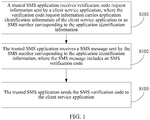
- FIG. 1 is a schematic flowchart of an information sending method according to a first embodiment of the present invention. As shown in the figure, the information sending method in this embodiment of the present invention may include the following steps.
- a trusted SMS application receives verification code request information sent by a client service application, where the verification code request information carries application identification information of the client service application or an SMS number corresponding to the application identification information.
- a trusted SMS application may receive verification code request information sent by a client service application.
- the verification code request information carries application identification information of the client service application or an SMS number corresponding to the application identification information.
- the application identification information may be a UUID (Universally Unique Identifier, universally unique identifier), and is used to uniquely identify the client service application.
- the trusted SMS application is running in a first operating system, the client service application is running in a second operating system, the first operating system and the second operating system are mutually independent executive environments in a terminal, and the first operating system has a higher security level than the second operating system.
- the first operating system may be a TEE environment, and the second operating system may be a Rich environment.
- An application running in the Rich environment is a CA (Client Application, client application), for example, the client service application.
- An application running in the TEE environment is a TA (Trusted Application, trusted application), for example, the trusted SMS application.
- the trusted SMS application may receive verification code request information sent by a trusted service application corresponding to the client service application.
- the verification code request information carries application identification information of the trusted service application or an SMS number corresponding to the application identification information.
- the terminal starts a trusted service application running in the first operating system, and the trusted service application sends verification code request information to the trusted SMS application.
- the client service application running in the second operating system corresponds to a trusted service application running in the first operating system.
- the client service application may send a session establishment request to the trusted service application, and the trusted service application establishes a session connection between the trusted service application and the client service application according to the session establishment request.
- the trusted service application sends verification code request information to the trusted SMS application.
- the verification code request information carries application identification information of the trusted service application or an SMS number corresponding to the application identification information.
- the trusted SMS application may receive the verification code request information.
- the trusted SMS application may receive the application identification information of the trusted service application and the SMS number that are sent by the trusted service application, establish a correspondence between the application identification information of the trusted service application and the SMS number, and store the application identification information of the trusted service application and the SMS number corresponding to the application identification information.
- the trusted SMS application may establish a session connection between the trusted SMS application and the client service application.
- the trusted SMS application may establish the session connection between the trusted SMS application and the client service application by using a trusted operating system client application programming interface TEE Client API.
- the trusted SMS application may receive a session establishment request sent by the client service application, and establish the session connection between the trusted SMS application and the client service application according to the received session establishment request.
- the TEE Client API is an underlying communications interface, and the TEE Client API is designed so that a CA run in the Rich environment may interact with a TA run in the TEE environment, where a full English name of the API is Application Programming Interface, and the API refers to an application programming interface.
- the trusted SMS application may receive the application identification information of the client service application and the SMS number that are sent by the client service application, establish a correspondence between the application identification information of the client service application and the SMS number, and store the application identification information of the client service application and the SMS number corresponding to the application identification information.
- the trusted SMS application may further determine whether a target SMS message sent by another SMS number other than the SMS number corresponding to the application identification information is received.
- the trusted SMS application may send the target SMS message to a client SMS application, so that the client SMS application receives and displays the target SMS message.
- the client SMS application is running in the second operating system.
- the client SMS application may directly receive the target SMS message sent by the another SMS number other than the SMS number corresponding to the application identification information, and display the received target SMS message on a display screen.
- the client SMS application does not have a permission of reading an SMS verification code, but has a permission of reading another SMS message other than the SMS verification code. In this way, leakage of security information is avoided, and operation security is relatively high.
- the client SMS application may directly receive the target SMS message sent by the another SMS number other than the SMS number corresponding to the application identification information.
- the client SMS application may further receive another SMS message sent by the SMS number corresponding to the application identification information, where the another SMS message does not include the SMS verification code, and for example, may include advertisement information or transaction information.
- the client service application performs a security operation, the client service application sends a session establishment request to the trusted SMS application.
- the trusted SMS application establishes a session connection between the trusted SMS application and the client service application according to the session establishment request.
- the first operating system is switched to a running state, and the second operating system is switched to a suspended state.
- the trusted SMS application sends the SMS verification code to the client service application
- the client service application receives the SMS verification code
- the client service application sends a session disruption request to the trusted SMS application.
- the trusted SMS application disrupts the session connection between the trusted SMS application and the client service application according to the session disruption request.
- the first operating system is switched to a suspended state, and the second operating system is switched to a running state.
- the trusted SMS application may determine whether a target SMS message sent by another SMS number other than the SMS number corresponding to the application identification information is received. When the target SMS message is received, the trusted SMS application may send the target SMS message to a client SMS application, so that the client SMS application receives and displays the target SMS message. Further optionally, the trusted SMS application may further determine whether another SMS message sent by the SMS number corresponding to the application identification information is received. When the another SMS message sent by the SMS number corresponding to the application identification information is received, the trusted SMS application may send the another SMS message to the client SMS application.
- the trusted SMS application may determine whether a target SMS message sent by another SMS number other than the SMS number corresponding to the application identification information is received. When the target SMS message is received, the trusted SMS application may send the target SMS message to the client SMS application. For another example, after receiving the verification code request information sent by the client service application, before sending the SMS verification code to the client service application, the trusted SMS application may determine whether a target SMS message sent by another SMS number other than the SMS number corresponding to the application identification information is received. When the target SMS message is received, the trusted SMS application may send the target SMS message to the client SMS application.
- the trusted SMS application may determine whether a target SMS message sent by another SMS number other than the SMS number corresponding to the application identification information is received. When the target SMS message is received, the trusted SMS application may send the target SMS message to the client SMS application.
- the client SMS application does not have a permission of reading all SMS messages, and may receive only an SMS message forwarded by the trusted SMS application. In this way, operation security is relatively high.
- the first operating system and the second operating system keep in a running state.
- work modes of the first operating system and the second operating system are: The second operating system is running in the foreground, and the first operating system is running in the background.
- the work modes of the first operating system and the second operating system are switched to: The first operating system is running in the foreground, and the second operating system is running in the background.
- the work modes of the first operating system and the second operating system are switched to: The second operating system is running in the foreground, and the first operating system is running in the background.
- the trusted SMS application receives an SMS message sent by the SMS number corresponding to the application identification information, where the SMS message includes an SMS verification code.
- the trusted SMS application may receive an SMS message sent by the SMS number corresponding to the application identification information.
- the received SMS message may include an SMS verification code.
- the verification code request information may further carry information about a preset time threshold, and the trusted SMS application may receive an SMS message that is sent by the SMS number within the preset time threshold.
- the trusted SMS application may start time counting when the verification code request information is received, to determine whether an SMS message sent by the SMS number is received within the preset time threshold.
- the trusted SMS application obtains an SMS verification code in the SMS message.
- the trusted SMS application may receive verification code request information re-sent by the client service application, and start time counting when the re-sent verification code request information is received, to determine whether an SMS message sent by the SMS number is received within the preset time threshold.
- the trusted SMS application obtains an SMS verification code in the SMS message.
- S103 The trusted SMS application sends the SMS verification code to the client service application.
- the trusted SMS application may send the SMS verification code in the SMS message to the client service application.
- the trusted SMS application sends the SMS verification code to the trusted service application, so that the trusted service application receives the SMS verification code, and disrupts the session connection between the trusted service application and the client service application.
- the trusted SMS application sends the SMS verification code to the trusted service application, so that the trusted service application sends the SMS verification code to an application server corresponding to the trusted service application, the application server corresponding to the trusted service application verifies the SMS verification code, the application server corresponding to the trusted service application sends verification response information to the trusted service application, and the trusted service application performs a payment operation according to the verification response information.
- the client service application may send a session disruption request to the trusted service application, and the trusted service application disrupts the session connection between the trusted service application and the client service application according to the session disruption request.
- the payment operation is executed in the TEE environment, and a malicious application cannot obtain security information, for example, an SMS verification code, an account (for example, a bank card number or an Alipay account), or an account password, by using a virus, a Trojan horse, a phishing website, or the like.
- security information for example, an SMS verification code, an account (for example, a bank card number or an Alipay account), or an account password, by using a virus, a Trojan horse, a phishing website, or the like.
- the trusted SMS application may disrupt the session connection between the trusted SMS application and the client service application.
- the client service application may send a session disruption request to the trusted SMS application, and the trusted SMS application may disrupt the session connection between the trusted SMS application and the client service application according to the session disruption request.
- the trusted SMS application sends the SMS verification code to the client service application, so that the client service application sends the SMS verification code to an application server corresponding to the client service application, the application server corresponding to the client service application verifies the SMS verification code, the application server corresponding to the client service application sends verification response information to the client service application, and the client service application performs a login operation according to the verification response information.
- the client service application is instant messaging software (for example, WeChat or QQ) or an e-mail or entertainment application (for example, Douban or Meituan), and the client service application may execute a login operation according to the SMS verification code.
- a trusted SMS application receives verification code request information sent by a client service application.
- the verification code request information carries application identification information of the client service application or an SMS number corresponding to an application identifier, the trusted SMS application is running in a first operating system, the client service application is running in a second operating system, and the first operating system has a higher security level than the second operating system; the trusted SMS application receives an SMS message sent by the SMS number corresponding to the application identification information, where the SMS message includes an SMS verification code; and the trusted SMS application sends the SMS verification code to the client service application.
- the client service application can obtain the SMS verification code when an SMS permission is disabled, and operation security is improved.
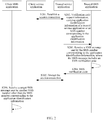
- FIG. 2 is a schematic flowchart of an information sending method according to a second embodiment of the present invention. As shown in the figure, the information sending method in this embodiment of the present invention may include the following steps.
- a client service application establishes a session connection between the client service application and a trusted service application.
- a client service application may send a session establishment request to a trusted service application, and the trusted service application establishes a session connection between the trusted service application and the client service application according to the session establishment request.
- a first operating system before the client service application establishes the session connection between the client service application and the trusted service application, a first operating system is in a suspended state, and a second operating system is in a running state.
- the first operating system is switched to a running state, and the second operating system is switched to a suspended state.
- the first operating system and the second operating system are mutually independent executive environments, and the first operating system has a higher security level than the second operating system.
- Work modes of the first operating system and the second operating system may be: The first operating system is in a running state, and the second operating system is in a suspended state, where the second operating system does not occupy memory and a CPU timeslot.
- the work modes of the first operating system and the second operating system may be: The second operating system is in a running state, and the first operating system is in a suspended state, where the first operating system does not occupy memory and a CPU timeslot.
- the client service application may establish the session connection between the client service application and the trusted service application by using a TEE Client API.
- the client service application may access, by using the TEE Client API, the trusted service application running in the first operating system.
- the first operating system is switched to a running state
- the second operating system is switched to a suspended state
- a trusted SMS application may determine whether a target SMS message sent by another SMS number other than an SMS number corresponding to application identification information of the trusted service application is received. If a result of the determining is yes, the trusted SMS application sends the target SMS message to a client SMS application, so that the client SMS application receives the target SMS message, and displays the received target SMS message on a display screen.
- the trusted SMS application may determine whether another SMS message sent by the SMS number corresponding to the application identification information is received, where the another SMS message does not include an SMS verification code, and for example, may include advertisement information or transaction information. If a result of the determining is yes, the trusted SMS application sends the another SMS message to the client SMS application, so that the client SMS application receives the another SMS message, and displays the received another SMS message on the display screen.
- the trusted service application sends verification code request information to a trusted SMS application, where the verification code request information carries application identification information of the trusted service application or an SMS number corresponding to the application identification information.
- the trusted SMS application receives an SMS message sent by the SMS number corresponding to the application identification information, where the SMS message includes an SMS verification code.
- the trusted SMS application may receive, according to the verification code request information, an SMS message sent by the SMS number corresponding to the application identification information, where the SMS message may include an SMS verification code.
- the trusted SMS application may receive the application identification information of the trusted service application and the SMS number that are sent by the trusted service application, establish a correspondence between the application identification information of the trusted service application and the SMS number, and store the application identification information of the trusted service application and the SMS number corresponding to the application identification information.
- S204 The trusted SMS application sends the SMS verification code to the trusted service application.
- the trusted SMS application may obtain the SMS verification code in the SMS message, and send the SMS verification code to the trusted service application.
- the trusted service application sends the SMS verification code to an application server corresponding to the trusted service application, the application server corresponding to the trusted service application verifies the SMS verification code, the application server corresponding to the trusted service application sends verification response information to the trusted service application, and the trusted service application performs a payment operation according to the verification response information.
- the client service application running in the second operating system cannot obtain information such as the SMS verification code. In this way, operation security can be improved.
- S205 The trusted service application disrupts the session connection between the trusted service application and the client service application.
- the trusted service application may disrupt the session connection between the trusted service application and the client service application.
- the client service application may send a session disruption request to the trusted service application, and the trusted service application disrupts the session connection between the trusted service application and the client service application according to the session disruption request.
- the trusted SMS application may determine whether a target SMS message sent by another SMS number other than the SMS number corresponding to the application identification information is received. When the target SMS message is received, the trusted SMS application may send the target SMS message to the client SMS application, so that the client SMS application receives and displays the target SMS message.
- the client SMS application is running in the second operating system.
- a client SMS application receives a target SMS message sent by another SMS number other than the SMS number corresponding to the application identification information.
- the second operating system is switched to a running state
- the first operating system is switched to a suspended state
- the client SMS application may receive a target SMS message sent by another SMS number other than the SMS number corresponding to the application identification information.
- the client SMS application may further receive another SMS message sent by the SMS number corresponding to the application identification information.
- a client service application establishes a session connection between the client service application and a trusted service application, the trusted service application sends verification code request information to a trusted SMS application.
- the verification code request information carries application identification information of the trusted service application or an SMS number corresponding to the application identification information
- the trusted SMS application receives an SMS message sent by the SMS number corresponding to the application identification information, where the SMS message includes an SMS verification code
- the trusted SMS application sends the SMS verification code to the trusted service application.
- the trusted service application can complete a security operation when an SMS permission is disabled, and operation security is improved.
- FIG. 3 is a schematic flowchart of an information sending method according to a third embodiment of the present invention. As shown in the figure, the information sending method in this embodiment of the present invention may include the following steps.
- a client service application establishes a session connection between the client service application and a trusted SMS application.
- a client service application may send a session establishment request to a trusted SMS application, and the trusted SMS application establishes a session connection between the trusted SMS application and the client service application according to the session establishment request.
- a second operating system before the client service application establishes the session connection between the client service application and the trusted SMS application, a second operating system is in a running state, and a first operating system is in a suspended state.
- the first operating system is switched to a running state, and the second operating system is switched to a suspended state.
- the first operating system is switched to a running state
- the second operating system is switched to a suspended state
- the trusted SMS application may determine whether a target SMS message sent by another SMS number other than an SMS number corresponding to application identification information of the client service application is received. If a result of the determining is yes, the trusted SMS application sends the target SMS message to a client SMS application, so that the client SMS application receives the target SMS message, and displays the received target SMS message on a display screen.
- the trusted SMS application may determine whether another SMS message sent by the SMS number corresponding to the application identification information is received, where the another SMS message does not include an SMS verification code, and for example, may include advertisement information or transaction information. If a result of the determining is yes, the trusted SMS application sends the another SMS message to the client SMS application, so that the client SMS application receives the another SMS message, and displays the received another SMS message on the display screen.
- the client service application sends verification code request information to the trusted SMS application, where the verification code request information carries application identification information of the client service application or an SMS number corresponding to the application identification information.
- the trusted SMS application receives an SMS message sent by the SMS number corresponding to the application identification information, where the SMS message includes an SMS verification code.
- the trusted SMS application may receive, according to the verification code request information, an SMS message sent by the SMS number corresponding to the application identification information, where the SMS message may include an SMS verification code.
- the trusted SMS application may receive the application identification information of the client service application and the SMS number that are sent by the client service application, establish a correspondence between the application identification information of the client service application and the SMS number, and store the application identification information of the client service application and the SMS number corresponding to the application identification information.
- S304 The trusted SMS application sends the SMS verification code to the client service application.
- the trusted SMS application may obtain the SMS verification code in the SMS message, and send the SMS verification code to the client service application.
- the client service application sends the SMS verification code to an application server corresponding to the client service application, the application server corresponding to the client service application verifies the SMS verification code, the application server corresponding to the client service application sends verification response information to the client service application, and the client service application performs a login operation according to the verification response information.
- the client service application running in the second operating system does not have a permission of reading an SMS verification code, but may receive the SMS verification code sent by the trusted SMS application.
- a malicious application cannot obtain the SMS verification code by using a virus, a Trojan horse, a phishing website, or the like. In this way, operation security can be improved.
- S305 The trusted SMS application disrupts the session connection between the trusted SMS application and the client service application.
- the client service application may disrupt the session connection between the client service application and the trusted SMS application.
- the client service application may send a session disruption request to the trusted SMS application, so that the trusted SMS application disrupts the session connection between the trusted SMS application and the client service application according to the session disruption request.
- the trusted SMS application may determine whether a target SMS message sent by another SMS number other than the SMS number corresponding to the application identification information is received. When the target SMS message is received, the trusted SMS application may send the target SMS message to the client SMS application, so that the client SMS application receives and displays the target SMS message.
- a client SMS application receives a target SMS message sent by another SMS number other than the SMS number corresponding to the application identification information.
- the second operating system is switched to a running state
- the first operating system is switched to a suspended state
- the client SMS application may receive a target SMS message sent by another SMS number other than the SMS number corresponding to the application identification information.
- client SMS application may further receive another SMS message sent by the SMS number corresponding to the application identification information.
- a client service application sends verification code request information to a trusted SMS application.
- the verification code request information carries application identification information of the client service application or an SMS number corresponding to the application identification information
- the trusted SMS application receives an SMS message sent by the SMS number corresponding to the application identification information, where the SMS message includes an SMS verification code
- the trusted SMS application sends the SMS verification code to the client service application.
- the client service application can obtain the SMS verification code when an SMS permission is disabled, and operation security is improved.
- FIG. 4 is a schematic flowchart of an information sending method according to a fourth embodiment of the present invention. As shown in the figure, the information sending method in this embodiment of the present invention may include the following steps.
- a client service application establishes a session connection between the client service application and a trusted service application.
- a client service application may send a session establishment request to a trusted service application, and the trusted service application establishes a session connection between the trusted service application and the client service application according to the session establishment request.
- a first operating system and a second operating system keep in a running state.
- work modes of the first operating system and the second operating system are: The second operating system is running in the foreground, and the first operating system is running in the background.
- the work modes of the first operating system and the second operating system are switched to: The first operating system is running in the foreground, and the second operating system is running in the background.
- the client service application may establish the session connection between the client service application and the trusted service application by using a TEE Client API.
- the client service application may access, by using the TEE Client API, the trusted service application running in the first operating system.
- the client service application sends verification code request information to the trusted service application, where the verification code request information carries application identification information of the trusted service application or an SMS number corresponding to the application identification information.
- a trusted SMS application receives an SMS message sent by the SMS number corresponding to the application identification information, where the SMS message includes an SMS verification code.
- the trusted SMS application may receive, according to the verification code request information, an SMS message sent by the SMS number corresponding to the application identification information, where the SMS message may include an SMS verification code.
- the trusted SMS application may receive the application identification information of the trusted service application and the SMS number that are sent by the trusted service application, establish a correspondence between the application identification information of the trusted service application and the SMS number, and store the application identification information of the trusted service application and the SMS number corresponding to the application identification information.
- S404 The trusted SMS application sends the SMS verification code to the trusted service application.
- the trusted SMS application may obtain the SMS verification code in the SMS message, and send the SMS verification code to the trusted service application.
- the trusted service application may send the SMS verification code to an application server corresponding to the trusted service application, the application server corresponding to the trusted service application verifies the SMS verification code, the application server corresponding to the trusted service application sends verification response information to the trusted service application, and the trusted service application performs a payment operation according to the verification response information.
- the client service application running in the second operating system cannot obtain information such as the SMS verification code. In this way, operation security can be improved.
- S405 The trusted service application disrupts the session connection between the trusted service application and the client service application.
- the trusted service application may disrupt the session connection between the trusted service application and the client service application.
- the client service application may send a session disruption request to the trusted service application, and the trusted service application disrupts the session connection between the trusted service application and the client service application according to the session disruption request.
- the work modes of the first operating system and the second operating system may be switched to: The second operating system is running in the foreground, and the first operating system is running in the background.
- the trusted SMS application receives a target SMS message sent by another SMS number other than the SMS number corresponding to the application identification information.
- the trusted SMS application may receive a target SMS message sent by another SMS number other than the SMS number corresponding to the application identification information.
- an order for performing step S406 is not limited in this embodiment of the present invention.
- the trusted SMS application may receive a target SMS message sent by another SMS number other than the SMS number corresponding to the application identification information.
- the trusted SMS application may receive a target SMS message sent by another SMS number other than the SMS number corresponding to the application identification information.
- the trusted SMS application may further receive another SMS message sent by the SMS number corresponding to the application identification information, where the another SMS message does not include the SMS verification code, and for example, may include advertisement information or transaction information.
- the trusted SMS application may send the another SMS message to the client SMS application.
- the trusted SMS application sends the target SMS message to a client SMS application.
- the trusted SMS application may send the target SMS message to the client SMS application.
- the client SMS application does not have a permission of reading an SMS message, and may receive only the target SMS message sent by the trusted SMS application.
- a malicious application cannot obtain any SMS message by using a virus, a Trojan horse, or a phishing website. In this way, operation security is relatively high.
- a client service application establishes a session connection between the client service application and a trusted service application, the trusted service application sends verification code request information to a trusted SMS application.
- the verification code request information carries application identification information of the trusted service application or an SMS number corresponding to the application identification information
- the trusted SMS application receives an SMS message sent by the SMS number corresponding to the application identification information, where the SMS message includes an SMS verification code
- the trusted SMS application sends the SMS verification code to the trusted service application.
- the trusted service application can complete a security operation when an SMS permission is disabled, and operation security is improved.
- FIG. 5 is a schematic flowchart of an information sending method according to a fifth embodiment of the present invention. As shown in the figure, the information sending method in this embodiment of the present invention may include the following steps.
- a client service application establishes a session connection between the client service application and a trusted SMS application.
- a client service application may send a session establishment request to a trusted SMS application, and the trusted SMS application establishes a session connection between the trusted SMS application and the client service application according to the session establishment request.
- a first operating system and a second operating system keep in a running state.
- work modes of the first operating system and the second operating system are: The second operating system is running in the foreground, and the first operating system is running in the background.
- the work modes of the first operating system and the second operating system are switched to: The first operating system is running in the foreground, and the second operating system is running in the background.
- the client service application may establish the session connection between the client service application and the trusted SMS application by using a TEE Client API.
- the client service application may access, by using the TEE Client API, the trusted SMS application running in the first operating system.
- the client service application sends verification code request information to the trusted SMS application, where the verification code request information carries application identification information of the client service application or an SMS number corresponding to the application identification information.
- the trusted SMS application receives an SMS message sent by the SMS number corresponding to the application identification information, where the SMS message includes an SMS verification code.
- the trusted SMS application may receive the application identification information of the client service application and the SMS number that are sent by the client service application, establish a correspondence between the application identification information of the client service application and the SMS number, and store the application identification information of the client service application and the SMS number corresponding to the application identification information.
- S504 The trusted SMS application sends the SMS verification code to the client service application.
- the client service application may send the SMS verification code to an application server corresponding to the client service application, the application server corresponding to the client service application verifies the SMS verification code, the application server corresponding to the client service application sends verification response information to the client service application, and the client service application performs a login operation according to the verification response information.
- the client service application running in the second operating system does not have a permission of reading an SMS verification code, but may receive the SMS verification code sent by the trusted SMS application.
- a malicious application cannot obtain the SMS verification code by using a virus, a Trojan horse, a phishing website, or the like. In this way, operation security can be improved.
- S505 The trusted SMS application disrupts the session connection between the trusted SMS application and the client service application.
- the client service application may send a session disruption request to the trusted SMS application, and the trusted SMS application disrupts the session connection between the trusted SMS application and the client service application according to the session disruption request.
- the work modes of the first operating system and the second operating system may be switched to: The second operating system is running in the foreground, and the first operating system is running in the background.
- the trusted SMS application receives a target SMS message sent by another SMS number other than the SMS number corresponding to the application identification information.
- the trusted SMS application may receive a target SMS message sent by another SMS number other than the SMS number corresponding to the application identification information.
- an order for performing step S506 is not limited in this embodiment of the present invention.
- the trusted SMS application may receive a target SMS message sent by another SMS number other than the SMS number corresponding to the application identification information.
- the trusted SMS application may receive a target SMS message sent by another SMS number other than the SMS number corresponding to the application identification information.
- the trusted SMS application may further receive another SMS message sent by the SMS number corresponding to the application identification information, where the another SMS message does not include the SMS verification code, and for example, may include advertisement information or transaction information.
- the trusted SMS application may send the another SMS message to a client SMS application.
- the trusted SMS application sends the target SMS message to a client SMS application.
- the trusted SMS application may send the target SMS message to the client SMS application.
- the client SMS application does not have a permission of reading an SMS message, and may receive only the target SMS message sent by the trusted SMS application.
- a malicious application cannot obtain any SMS message by using a virus, a Trojan horse, or a phishing website. In this way, operation security is relatively high.
- a client service application sends verification code request information to a trusted SMS application.
- the verification code request information carries application identification information of the client service application
- the trusted SMS application receives an SMS message sent by an SMS number corresponding to the application identification information, where the SMS message includes an SMS verification code, and the trusted SMS application sends the SMS verification code to the client service application.
- the client service application can obtain the SMS verification code when an SMS permission is disabled, and operation security is improved.
- FIG. 6 is a schematic flowchart of an information receiving method according to a first embodiment of the present invention. As shown in the figure, the information receiving method in this embodiment of the present invention may include the following steps.
- a client service application sends verification code request information to a trusted SMS application, where the verification code request information carries application identification information of the client service application or an SMS number corresponding to the application identification information, so that the trusted SMS application receives an SMS message sent by the SMS number corresponding to the application identification information, where the SMS message includes an SMS verification code.
- a client service application may send verification code request information to a trusted SMS application.
- the verification code request information carries application identification information of the client service application or an SMS number corresponding to the application identification information, so that the trusted SMS application receives an SMS message sent by the SMS number corresponding to the application identification information.
- the SMS message may include an SMS verification code.
- the client service application may send a session establishment request to a corresponding trusted service application, so that the trusted service application establishes a session connection between the trusted service application and the client service application according to the session establishment request.
- the trusted service application sends verification code request information to the trusted SMS application.
- the verification code request information may carry application identification information of the trusted service application or an SMS number corresponding to the application identification information, so that the trusted SMS application receives an SMS message sent by the SMS number corresponding to the application identification information, where the SMS message includes an SMS verification code.
- the client service application may establish a session connection between the client service application and a corresponding trusted service application.
- the trusted service application sends verification code request information to the trusted SMS application.
- the verification code request information may carry application identification information of the trusted service application or an SMS number corresponding to the application identification information.
- the trusted SMS application receives an SMS message sent by the SMS number corresponding to the application identification information, and the trusted SMS application sends an SMS verification code to the trusted service application.
- the trusted service application sends the SMS verification code to an application server corresponding to the trusted service application, the application server corresponding to the trusted service application verifies the SMS verification code, the application server corresponding to the trusted service application sends verification response information to the trusted service application, and the trusted service application performs a payment operation according to the verification response information.
- the client service application may establish a session connection between the client service application and the trusted SMS application.
- the client service application may establish the session connection between the client service application and the trusted SMS application by using a TEE Client API.
- the client service application receives the SMS verification code sent by the trusted SMS application.
- the client service application may receive the SMS verification code sent by the trusted SMS application.
- the client service application may disrupt the session connection between the client service application and the trusted SMS application.
- the client service application may send the SMS verification code to an application server corresponding to the client service application, the application server corresponding to the client service application verifies the SMS verification code, the application server corresponding to the client service application sends verification response information to the client service application, and the client service application performs a login operation according to the verification response information.
- a client service application sends verification code request information to a trusted SMS application.
- the verification code request information carries application identification information of the client service application, so that the trusted SMS application receives an SMS message sent by an SMS number corresponding to the application identification information, where the SMS message includes an SMS verification code, and the client service application receives the SMS verification code sent by the trusted SMS application.
- the client service application can obtain the SMS verification code when an SMS permission is disabled, and operation security is improved.
- An embodiment of the present invention further provides a computer storage medium, where the computer storage medium may store a program, and when executed, the program performs some or all steps in the method embodiments shown in FIG. 1 to FIG. 5 and FIG. 12 .
- An embodiment of the present invention further provides a computer storage medium, where the computer storage medium may store a program, and when executed, the program performs some or all steps in any one of the method embodiments shown in FIG. 2 to FIG. 6 and FIG. 13 .
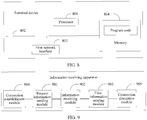
- FIG. 7 is a schematic structural diagram of an information sending apparatus according to an embodiment of the present invention.
- the information sending apparatus may be configured to implement some or all steps in the method embodiments described with reference to FIG. 1 to FIG. 5 .
- the information sending apparatus may include at least a request information receiving module 701, a message receiving module 702, and an information sending module 703, where the request information receiving module 701 is configured to receive request information sent by a second application, where the request information carries association information of the second application, the information sending apparatus is running in a first operating system, the first operating system includes a first network interface, the second application is running in a second operating system, the second operating system may include a second network interface, and the first operating system has a higher security level than the second operating system; the message receiving module 702 is configured to receive a first message from an external network by using the first network interface; and the information sending module 703 is configured to extract first information from the first message according to the association information of the second application, and send the first information to the second application, so that the second
- the request information receiving module 701 is specifically configured to receive request information sent by a third application corresponding to the second application, where the request information carries association information of the third application.
- the information sending module 703 sends the first information to the third application, and is specifically configured to send the first information to the third application, so that the third application sends, by using a third network interface, the first information to an application server corresponding to the third application.
- the first operating system may further include the third network interface.
- the information sending module 703 sends the first information to the third application, and is specifically configured to send the first information to the third application, so that the third application sends, by using a third network interface, the first information to an application server corresponding to the third application, the application server corresponding to the third application verifies the first information and sends verification response information to the third application, and the third application performs a payment operation according to the verification response information.
- the information sending apparatus in this embodiment of the present invention may further include:
- the first operating system may be a TEE; and the connection establishment module 704 is specifically configured to establish the session connection between the apparatus and the second application by using a TEE Client API.
- the information sending module 703 sends the first information to the third application, and is specifically configured to send the first information to the second application, so that the second application sends, by using the second network interface, the first information to the application server corresponding to the second application, the application server corresponding to the second application verifies the first information and sends verification response information to the second application, and the second application performs a login operation according to the verification response information.
- the information sending apparatus in this embodiment of the present invention may further include:
- the determining module 706 is specifically configured to: after the request information receiving module 701 receives the request information sent by the second application, determine whether the second message is received by using the first network interface.
- the verification code request information may carry information about a preset time threshold; and the message receiving module 702 is specifically configured to receive, by using the first network interface, the first message that is sent from the external network within the preset time threshold.
- the request information receiving module 701 receives request information sent by a second application.
- the request information carries association information of the second application
- the message receiving module 702 receives a first message from an external network by using a first network interface
- the information sending module 703 extracts first information from the first message according to the association information of the second application, and sends the first-information to the second application, so that the second application sends, by using a second network interface, the first information to an application server corresponding to the second application.
- the second application can obtain an SMS verification code when an SMS permission is disabled, and operation security is improved.
- FIG. 8 is a schematic structural diagram of a terminal device according to a first embodiment of the present invention.
- the terminal device provided in this embodiment of the present invention may be configured to implement the methods implemented in the foregoing embodiments of the present invention shown in FIG. 1 to FIG. 5 .
- FIG. 1 to FIG. 5 For ease of description, only parts related to this embodiment of the present invention are illustrated. For specific technical details that are not disclosed, refer to the embodiments of the present invention shown in FIG. 1 to FIG. 5 .
- the terminal device includes: at least one processor 801, for example, a CPU, at least one first network interface 803, a memory 804, and at least one communications bus 802.
- the communications bus 802 is configured to implement connection and communication between these components.
- the first network interface 803 may optionally include a standard wired interface or wireless interface (for example, a Wi-Fi interface), and is configured to communicate with an external network.
- the memory 804 may include a high-speed RAM memory, or may further include a non-volatile memory (non-volatile memory), for example, at least one magnetic disk storage.
- the memory 804 may optionally include at least one storage apparatus far away from the processor 801.
- the terminal may include a first operating system and a second operating system, the first operating system has a higher security level than the second operating system, the processor 801 is running in the first operating system, and the processor 801 may be combined with the information sending apparatus shown in FIG. 7 .
- the memory 804 stores a set of program code, and the processor 801 is configured to invoke the program code stored in the memory 804 to execute the following operations:
- the receiving, by the processor 801, request information sent by a second application may be specifically:
- the sending, by the processor 801, the first information to the second application may be specifically:
- the sending, by the processor 801, the first information to the second application may be specifically:
- the processor 801 before receiving the request information sent by the second application, the processor 801 may further execute the following operation:
- the first operating system may be a TEE environment; and the establishing, by the processor 801, a session connection between the processor 801 and the second application may be specifically:
- the sending, by the processor 801, the first information to the second application may be specifically:
- processor 801 may further execute the following operations:
- the determining, by the processor 801, whether a second message from the external network is received by using the first network interface 803 may be specifically:
- the request information may carry information about a preset time threshold; and the receiving, by the processor 801, a first message from an external network by using the first network interface 803 may be specifically:
- the terminal described in this embodiment of the present invention may be configured to implement some or all processes in the method embodiments described in the present invention with reference to FIG. 1 to FIG. 5 .
- FIG. 9 is a schematic structural diagram of an information receiving apparatus according to an embodiment of the present invention.
- the information receiving apparatus may be configured to implement some or all steps in the method embodiments described with reference to FIG. 2 to FIG. 6 .
- the information receiving apparatus may include at least a request information sending module 901, an information receiving module 902, and a first-information sending module 903, where the request information sending module 901 is configured to send request information to a first application, where the request information carries association information of the information receiving apparatus, so that the first application receives a first message from an external network by using a first network interface, and the first application extracts first information from the first message according to the association information of the information receiving apparatus, and sends the first information to the information receiving module 902, where the first application is running in a first operating system, the first operating system includes the first network interface, the information receiving apparatus is running in a second operating system, and the second operating system includes a second network interface; the message receiving module 902 is configured to receive the first information sent by the first application; and the first
- the request information sending module 901 is specifically configured to establish a session connection between the apparatus and a corresponding third application, so that the third application sends request information to the first application.
- the request information carries association information of the third application.
- the request information sending module 901 is specifically configured to establish a session connection between the apparatus and a corresponding third application, so that the third application sends request information to the first application.
- the request information carries association information of the third application, the first application extracts the first information from the first message according to the association information of the third application, and sends the first information to the third application, and the third application sends, by using a third network interface, the first information to an application server corresponding to the third application.
- the first operating system further includes the third network interface.
- the request information sending module 901 is specifically configured to establish a session connection between the apparatus and a corresponding third application, so that the third application sends request information to the first application.
- the request information carries association information of the third application, the first application extracts the first information from the first message according to the association information of the third application, and sends the first information to the third application, the third application sends, by using a third network interface, the first information to an application server corresponding to the third application, the application server corresponding to the third application verifies the first information and sends verification response information to the third application, and the third application performs a payment operation according to the verification response information.
- the information receiving apparatus in this embodiment of the present invention may further include:
- the first operating system may be a TEE environment; and the connection establishment module 904 is specifically configured to establish the session connection between the apparatus and the first application by using a TEE Client API.
- the first-information sending module 903 is specifically configured to send, by using the second network interface, the first information to the application server corresponding to the information receiving apparatus, so that the application server corresponding to the information receiving apparatus verifies the first information, the application server corresponding to the information receiving apparatus sends verification response information to the first-information sending module 903, and the first-information sending module 903 performs a login operation according to the verification response information.
- the request information sending module 901 sends request information to a first application.
- the request information carries association information of the information receiving apparatus, so that the first application receives a first message from an external network by using a first network interface, and the first application extracts first information from the first message according to the association information of the information receiving apparatus, and sends the first information to the information receiving module 902, and the first-information sending module 903 sends, by using a second network interface, the first information to an application server corresponding to the information receiving apparatus.
- the information receiving apparatus can obtain the first information when an information permission is disabled, and operation security is improved.
- FIG. 10 is a schematic structural diagram of a terminal device according to a second embodiment of the present invention.
- the terminal device provided in this embodiment of the present invention may be configured to implement the methods implemented in the foregoing embodiments of the present invention shown in FIG. 2 to FIG. 6 .
- FIG. 2 to FIG. 6 For ease of description, only parts related to this embodiment of the present invention are illustrated. For specific technical details that are not disclosed, refer to the embodiments of the present invention shown in FIG. 2 to FIG. 6 .
- the terminal device includes: at least one processor 1001, for example, a CPU, at least one second network interface 1003, a memory 1004, and at least one communications bus 1002.
- the communications bus 1002 is configured to implement connection and communication between these components.
- the second network interface 1003 may be configured to communicate with an application server corresponding to the processor.
- the memory 1004 may include a high-speed RAM memory, or may further include a non-volatile memory, for example, at least one magnetic disk storage.
- the memory 1004 may optionally include at least one storage apparatus far away from the processor 1001.
- the terminal may include a first operating system and a second operating system, the first operating system has a higher security level than the second operating system, the processor 1001 is running in the second operating system, and the processor 1001 may be combined with the information receiving apparatus shown in FIG. 9 .
- the memory 1004 stores a set of program code, and the processor 1001 is configured to invoke the program code stored in the memory 1004 to execute the following operations:
- the sending, by the processor 1001, request information to the first application may be specifically:
- the sending, by the processor 1001, request information to the first application may be specifically:
- the sending, by the processor 1001, request information to the first application may be specifically:
- the processor 1001 may further execute the following operation:
- the first operating system may be a TEE environment; and the establishing, by the processor 1001, a session connection between the processor 1001 and the first application may be specifically:
- the sending, by the processor 1001 by using the second network interface 1003, the first information to an application server corresponding to the processor 1001 may be specifically:
- the terminal described in this embodiment of the present invention may be configured to implement some or all processes in the method embodiments described in the present invention with reference to FIG. 2 to FIG. 6 .
- FIG. 11 is a schematic structural diagram of a communications system according to an embodiment of the present invention.
- the communications system in this embodiment of the present invention may include at least an information sending apparatus 1101 and an information receiving apparatus 1102, where the information receiving apparatus 1102 is configured to send request information to the information sending apparatus 1101, where the request information carries association information of the information receiving apparatus 1102, the information sending apparatus 1101 is running in a first operating system, the information receiving apparatus 1102 is running in a second operating system, and the first operating system has a higher security level than the second operating system; the information sending apparatus 1101 is configured to receive a first message from an external network by using a first network interface; and the information sending apparatus 1101 is further configured to extract first information from the first message according to the association information of the information receiving apparatus 1102, and send the first information to the information receiving apparatus 1102; and the information receiving apparatus 1102 is further configured to receive the first information sent by the information sending apparatus 1101, and send, by using a second network interface, the first information to an application server
- the communications system in this embodiment of the present invention may include a third application 1103, and the sending, by the information receiving apparatus 1102, request information to the information sending apparatus 1101 may be specifically:
- the receiving, by the information receiving apparatus 1102, the first information sent by the information sending apparatus 1101 may be specifically:
- the third application 1103 may further execute the following operation:
- the third application 1103 may further execute the following operation:
- the following operation may be further executed:
- the first operating system may be a TEE environment; and the establishing, by the information sending apparatus 1101, a session connection between the information sending apparatus 1101 and the information receiving apparatus 1102 may be specifically:
- the information receiving apparatus 1102 may further execute the following operation:
- the communications system in this embodiment of the present invention may further include a fourth application 1104, and the information sending apparatus 1101 may further execute the following operations:
- the determining, by the information sending apparatus 1101, whether a second message from the external network is received by using the first network interface may be specifically:
- the request information may carry information about a preset time threshold; and the receiving, by the information sending apparatus 1101, a first message from an external network by using the first network interface may be specifically:
- the information receiving apparatus 1102 sends request information to the information sending apparatus 1101, where the request information carries association information of the information receiving apparatus 1102, the information sending apparatus 1101 receives a first message from an external network by using a first network interface, extracts first information from the first message according to the association information of the information receiving apparatus 1102, and sends the first information to the information receiving apparatus 1102, and the information receiving apparatus 1102 sends, by using a second network interface, the first information to an application server corresponding to the information receiving apparatus 1102. In this way, the information receiving apparatus 1102 can obtain the first information when an information permission is disabled, and operation security is improved.
- FIG. 12 is a schematic flowchart of an information sending method according to a sixth embodiment of the present invention. As shown in the figure, the information sending method in this embodiment of the present invention may include the following steps.
- a first application receives request information sent by a second application, where the request information carries association information of the second application.
- a first application may receive request information sent by a second application, where the request information may carry association information of the second application.
- the association information may include application identification information of the second application or contact information corresponding to the application identification information.
- the application identification information may be a UUID.
- the contact information may include an SMS number, an e-mail address, a public account, or the like, where a contact corresponding to the contact information is a sender that sends a first message.
- the first application is running in a first operating system, the first operating system may include a first network interface, the second application is running in a second operating system, and the second operating system may include a second network interface.
- the first operating system has a higher security level than the second operating system.
- the first operating system may be a TEE environment
- the second operating system may be a Rich environment.
- An application running in the Rich environment is CA, for example, the second application.
- An application running in the TEE environment is TA, for example, the first application.
- the first application may receive request information sent by a third application corresponding to the second application.
- the request information may carry association information of the third application.
- the association information of the third application may include application identification information of the third application or contact information corresponding to the application identification information.
- the application identification information may be a UUID.
- the contact information may include an SMS number, an e-mail address, a public account, or the like, where a contact corresponding to the contact information is a sender that sends a first message.
- a terminal starts the third application running in the first operating system, and the third application sends request information to the first application.
- the second application running in the second operating system corresponds to a third application running in the first operating system.
- the second application may send a session establishment request to the third application, and the third application establishes a session connection between the third application and the second application according to the session establishment request.
- the third application sends request information to the first application.
- the request information carries association information of the third application.
- the first application may receive the request information.
- the first application may receive the application identification information of the third application and the contact information that are sent by the third application, establish a correspondence between the application identification information of the third application and the contact information, and store the application identification information of the third application and the contact information corresponding to the application identification information.
- the first application before receiving the request information sent by the second application, may establish a session connection between the first application and the second application.
- the first application may establish the session connection between the first application and the second application by using a trusted operating system client application programming interface TEE Client API.
- the first application may receive a session establishment request sent by the second application, and establish the session connection between the first application and the second application according to the received session establishment request.
- the first application may receive the application identification information of the second application and the contact information that are sent by the second application, establish a correspondence between the application identification information of the second application and the contact information, and store the application identification information of the second application and the contact information corresponding to the application identification information.
- the first application may determine whether a second message from an external network is received by using the first network interface. When the second message is received, the first application may send the second message to a fourth application, so that the fourth application receives and displays the second message. Further optionally, the first application may determine whether other information in a first message from the external network is received by using the first network interface, where the other information is not first information, and for example, may include advertisement information or transaction information. When the other information in the first message is received, the first application may send the other information to the fourth application, so that the fourth application receives and displays the other information.
- the first application may determine whether a second message from the external network is received by using the first network interface. When the second message is received, the first application may send the second message to the fourth application. For another example, after receiving the request information sent by the second application, before sending the first information to the second application, the first application may determine whether a second message from the external network is received by using the first network interface. When the second message is received, the first application may send the second message to the fourth application. For another example, after sending the first information to the second application, the first application may determine whether a second message from the external network is received by using the first network interface. When the second message is received, the first application may send the second message to the fourth application. In this embodiment of the present invention, the fourth application does not have a permission of reading information, and may receive only information forwarded by the first application. In this way, operation security is relatively high.
- the first operating system and the second operating system keep in a running state.
- work modes of the first operating system and the second operating system are: The second operating system is running in the foreground, and the first operating system is running in the background.
- the work modes of the first operating system and the second operating system are switched to: The first operating system is running in the foreground, and the second operating system is running in the background.
- the work modes of the first operating system and the second operating system are switched to: The second operating system is running in the foreground, and the first operating system is running in the background.
- the first application may further determine whether a second message from the external network is received by using the first network interface.
- the first application may send the second message to the fourth application, so that the fourth application receives and displays the second message.
- the fourth application is running in the second operating system.
- the fourth application may directly receive the second message from the external network, and display the received second message on a display screen.
- the fourth application does not have a permission of reading the first information, but has a permission of reading other information. In this way, information leakage is avoided, and operation security is relatively high.
- the fourth application when the first operating system is in a suspended state and the second operating system is in a running state, the fourth application may directly receive the second message from the external network.
- the fourth application may further receive other information in the first message, where the other information does not include the first information, and for example, may include advertisement information or transaction information.
- the second application performs a security operation, the second application sends a session establishment request to the first application.
- the first application establishes a session connection between the first application and the second application according to the session establishment request. In this case, the first operating system is switched to a running state, and the second operating system is switched to a suspended state.
- the second application After the first application sends the first information to the second application, and the second application receives the first information, the second application sends a session disruption request to the first application.
- the first application disrupts the session connection between the first application and the second application according to the session disruption request.
- the first operating system is switched to a suspended state, and the second operating system is switched to a running state.
- the first application receives a first message from an external network by using a first network interface.
- the first application may receive a first message from an external network by using the first network interface.
- the first message may include an SMS message, a discount coupon, a broadcast message, or the like.
- the first application may receive, by using the first network interface, a first message sent by the contact corresponding to the application identification information of the second application.
- the request information may further carry information about a preset time threshold, and the first application may receive a first message that is sent from the external network within the preset time threshold.
- the first application may start time counting when the request information is received, to determine whether a first message sent from the external network is received within the preset time threshold.
- the first application obtains the first message.
- the first application may receive request information re-sent by the second application, and start time counting when the re-sent request information is received, to determine whether a first message sent from the external network is received within the preset time threshold.
- the first application obtains the first message.
- the first application extracts first information from the first message according to the association information of the second application, and sends the first information to the second application, so that the second application sends, by using a second network interface, the first information to an application server corresponding to the second application.
- the first application may extract first information from the first message according to the association information of the second application, and send the first information to the second application, so that the second application sends, by using the second network interface, the first information to an application server corresponding to the second application.
- the first information may include sensitive information such as an SMS verification code, a discount coupon sequence number, or a digital signature.
- the first application may send the first information to the third application, so that the third application receives the first information, and the third application disrupts the session connection between the third application and the second application.
- the first application sends the first information to the third application, so that the third application sends, by using a third network interface, the first information to an application server corresponding to the third application.
- the first operating system may further include the third network interface.
- the first application sends the first information to the third application, so that the third application sends, by using a third network interface, the first information to an application server corresponding to the third application, the application server corresponding to the third application verifies the first information and sends verification response information to the third application, and the third application performs a payment operation according to the verification response information.
- the second application may send a session disruption request to the third application, and the third application disrupts the session connection between the third application and the second application according to the session disruption request.
- the payment operation is executed in the TEE environment, and a malicious application cannot obtain security information, for example, an SMS verification code, an account (for example, a bank card number or an Alipay account), or an account password, by using a virus, a Trojan horse, a phishing website, or the like.
- security information for example, an SMS verification code, an account (for example, a bank card number or an Alipay account), or an account password, by using a virus, a Trojan horse, a phishing website, or the like.
- the first application after sending the first information to the second application, the first application may disrupt the session connection between the first application and the second application.
- the second application after receiving the first information, may send a session disruption request to the first application, and the first application may disrupt the session connection between the first application and the second application according to the session disruption request.
- the first application sends the first information to the second application, so that the second application sends, by using the second network interface, the first information to an application server corresponding to the second application, the application server corresponding to the second application verifies the first information and sends verification response information to the second application, and the second application performs a login operation according to the verification response information.
- a first application receives request information sent by a second application.
- the request information carries association information of the second application;
- the first application receives a first message from an external network by using a first network interface; and the first application extracts first information from the first message according to the association information of the second application, and sends the first information to the second application, so that the second application sends, by using a second network interface, the first information to an application server corresponding to the second application.
- the second application can obtain the first information when an information permission is disabled.
- FIG. 13 is a schematic flowchart of an information receiving method according to a second embodiment of the present invention. As shown in the figure, the information receiving method in this embodiment of the present invention may include the following steps.
- a second application sends request information to a first application, where the request information carries association information of the second application, so that the first application receives a first message from an external network by using a first network interface, and the first application extracts first information from the first message according to the association information of the second application, and sends the first information to the second application.
- a second application may send request information to a first application.
- the request information may carry association information of the second application, so that the first application receives a first message from an external network by using a first network interface, and the first application extracts the first information from the first message according to the association information of the second application, and sends the first information to the second application.
- the second application may send a session establishment request to a corresponding third application, so that the third application establishes a session connection between the third application and the second application according to the session establishment request.
- the third application sends request information to the first application.
- the request information may carry association information of the third application, so that the first application receives the first message from the external network by using the first network interface, and the first application extracts the first information from the first message according to the association information of the third application, and sends the first information to the third application.
- the second application may establish a session connection between the second application and a corresponding third application.
- the third application sends request information to the first application.
- the request information may carry association information of the third application.
- the first application receives the first message from the external network by using the first network interface, and the first application extracts the first information from the first message according to the association information of the third application, and sends the first information to the third application.
- the third application sends the first information to an application server corresponding to the third application by using a third network interface, where a first operating system may further include the third network interface.
- the second application may establish a session connection between the second application and a corresponding third application, so that the third application sends request information to the first application.
- the request information carries association information of the third application.
- the first application may extract the first information from the first message according to the association information of the third application, and send the first information to the third application.
- the third application sends, by using a third network interface, the first information to an application server corresponding to the third application, the application server corresponding to the third application verifies the first information and sends verification response information to the third application, and the third application performs a payment operation according to the verification response information.
- the second application before sending the request information to the first application, may establish a session connection between the second application and the first application.
- the second application may establish the session connection between the second application and the first application by using a TEE Client API.
- S1302 The second application receives the first information sent by the first application.
- the second application may receive the first information sent by the first application.
- the second application may disrupt the session connection between the second application and the first application.
- the second application sends, by using a second network interface, the first information to an application server corresponding to the second application.
- the second application sends, by using a second network interface, the first information to an application server corresponding to the second application, so that the application server corresponding to the second application verifies the first information and sends verification response information to the second application, and the second application performs a login operation according to the verification response information.
- a second application sends request information to a first application.
- the request information carries association information of the second application, so that the first application receives a first message from an external network by using a first network interface, and the first application extracts first information from the first message according to the association information of the second application, and sends the first information to the second application, and the second application sends, by using a second network interface, the first information to an application server corresponding to the second application.
- the second application can obtain the first information when an information permission is disabled.
- a description of a reference term such as "an embodiment”, “some embodiments”, “an example”, “a specific example”, or “some examples” means that a specific feature, structure, material, or characteristic that is described with reference to the embodiment or the example is included in at least one embodiment or example of the present invention.
- the foregoing exemplary expressions of the terms are not necessarily with respect to a same embodiment or example.
- the described specific features, structures, materials, or characteristics may be combined in a proper manner in any one or more of the embodiments or examples.
- a person skilled in the art may integrate or combine different embodiments or examples and characteristics of different embodiments or examples described in the specification, as long as they do not conflict each other.
- first and second are merely intended for a purpose of description, and shall not be understood as an indication or implication of relative importance or implicit indication of the number of indicated technical features. Therefore, a feature limited by “first” or “second” may explicitly or implicitly include at least one of the features. In the descriptions of the present invention, “multiple” means at least two, for example, two or three, unless exactly specified otherwise.
- a description of any process or method in the flowcharts or described herein in another manner can be construed as one or more modules, fragments, or parts that include executable instructions used to implement a specific logical function or steps of a process.
- the scope of the preferred implementation manners of the present invention includes another implementation, where functions can be performed not in an order shown or discussed, including performing the functions basically at the same time or in reverse order according to the functions involved. This should be understood by a person skilled in the technical field to which the embodiments of the present invention belong.
- Logic and/or steps shown in the flowcharts or described herein in other manners, for example, may be considered as a program list of executable instructions that are used to implement logic functions, and may be specifically implemented on any computer-readable medium, for an instruction execution system, apparatus, or device (for example, a computer-based system, a system including a processor, or another system that can fetch instructions from the instruction execution system, apparatus, or device and execute the instructions) to use, or for a combination of the instruction execution system, apparatus, or device to use.
- the "computer-readable medium" may be any apparatus that may include, store, communicate, propagate, or transmit programs, for the instruction execution system, apparatus, or device to use, or for a combination of the instruction execution system, apparatus, or device to use.
- the computer-readable medium includes the following: an electrical portion (an electrical apparatus) with one or more buses, a portable computer cartridge (an magnetic apparatus), a random-access memory (RAM), a read-only memory (ROM), an electrically erasable programmable read-only memory (EPROM or flash memory), an optical fiber apparatus, and a compact disc read-only memory (CDROM).
- the computer-readable medium may even be a piece of paper on which the programs can be printed or another appropriate medium. Because, for example, optical scanning may be performed on the paper or the another medium, then processing, such as edition, decoding, or another appropriate means when necessary, may be performed to obtain the programs in an electrical manner, and then the programs are stored in a computer memory.
- parts in the present invention may be implemented by using hardware, software, firmware, or a combination thereof.
- multiple steps or methods may be implemented by using software or firmware that is stored in a memory and is executed by an appropriate instruction execution system.
- any item or a combination of the following well-known technologies in the art may be used for implementation: a discreet logic circuit having a logic gate circuit that is used to implement a logic function for a data signal, an application-specific integrated circuit having an appropriate combinatorial logic circuit, a programmable gate array (PGA), a field programmable gate array (FPGA), and the like.
- a person of ordinary skill in the art may understand that all or some of the steps of the method embodiments may be implemented by a program instructing relevant hardware.
- the program may be stored in a computer readable storage medium. When the program runs, one or a combination of the steps of the method embodiments are performed.
- functional units in the embodiments of the present invention may be integrated into one processing module, or each of the units may exist alone physically, or two or more units are integrated into one module.
- the integrated module may be implemented in a form of hardware, or may be implemented in a form of a software functional module.
- the integrated unit may be stored in a computer-readable storage medium.
- the foregoing storage medium may be a read-only memory, a magnetic disk or an optical disk.
Landscapes
- Engineering & Computer Science (AREA)
- Signal Processing (AREA)
- Computer Networks & Wireless Communication (AREA)
- Computer Security & Cryptography (AREA)
- Computer Hardware Design (AREA)
- Theoretical Computer Science (AREA)
- Physics & Mathematics (AREA)
- General Engineering & Computer Science (AREA)
- Software Systems (AREA)
- General Physics & Mathematics (AREA)
- General Health & Medical Sciences (AREA)
- Health & Medical Sciences (AREA)
- Bioethics (AREA)
- Mathematical Physics (AREA)
- Computing Systems (AREA)
- Computer And Data Communications (AREA)
- Telephonic Communication Services (AREA)
- Information Transfer Between Computers (AREA)
Applications Claiming Priority (1)
| Application Number | Priority Date | Filing Date | Title |
|---|---|---|---|
| PCT/CN2015/081447 WO2016201600A1 (zh) | 2015-06-15 | 2015-06-15 | 一种信息发送方法、装置、终端设备以及系统 |
Publications (3)
| Publication Number | Publication Date |
|---|---|
| EP3179751A1 true EP3179751A1 (de) | 2017-06-14 |
| EP3179751A4 EP3179751A4 (de) | 2017-11-29 |
| EP3179751B1 EP3179751B1 (de) | 2020-04-22 |
Family
ID=57544771
Family Applications (1)
| Application Number | Title | Priority Date | Filing Date |
|---|---|---|---|
| EP15895173.1A Active EP3179751B1 (de) | 2015-06-15 | 2015-06-15 | Informationssendeverfahren und -vorrichtung, endgerätevorrichtung und system |
Country Status (4)
| Country | Link |
|---|---|
| US (1) | US10080139B2 (de) |
| EP (1) | EP3179751B1 (de) |
| CN (1) | CN106664535B (de) |
| WO (1) | WO2016201600A1 (de) |
Families Citing this family (6)
| Publication number | Priority date | Publication date | Assignee | Title |
|---|---|---|---|---|
| CN110099029A (zh) * | 2018-01-30 | 2019-08-06 | 阿里健康信息技术有限公司 | 一种身份验证方法、终端设备及服务器 |
| CN108897482A (zh) * | 2018-05-25 | 2018-11-27 | 维沃移动通信有限公司 | 一种信息显示方法及终端设备 |
| CN113114847B (zh) * | 2021-06-15 | 2022-03-25 | 深圳传音控股股份有限公司 | 应用或服务的处理方法、设备及存储介质 |
| US11671422B1 (en) * | 2021-06-24 | 2023-06-06 | Gen Digital Inc. | Systems and methods for securing authentication procedures |
| CN113824628B (zh) * | 2021-09-30 | 2023-04-07 | 传仲智能数字科技(上海)有限公司 | 基于im的用户身份验证方法、装置、服务器及其存储介质 |
| CN114281555A (zh) * | 2021-11-08 | 2022-04-05 | 北京鲸鲮信息系统技术有限公司 | 应用状态同步方法、装置、电子设备和存储介质 |
Family Cites Families (16)
| Publication number | Priority date | Publication date | Assignee | Title |
|---|---|---|---|---|
| US20020032042A1 (en) * | 2000-02-18 | 2002-03-14 | Poplawsky Ralph C. | Exporting controls to an external device connected to a portable phone system |
| US20020025832A1 (en) * | 2000-02-18 | 2002-02-28 | Durian Michael B. | Controlling data transmission involving a wireless telephone |
| US20070124389A1 (en) * | 2005-11-28 | 2007-05-31 | Lucent Technologies Inc. | Anti-spam application storage system |
| US7855975B2 (en) * | 2007-05-30 | 2010-12-21 | Sap Ag | Response time estimation for intermittently-available nodes |
| KR20110028038A (ko) * | 2009-09-11 | 2011-03-17 | 삼성전자주식회사 | WiMAX/GSM 통합 지원 단말에서 발신자 번호 표시 방법 |
| CN101807273A (zh) * | 2010-03-25 | 2010-08-18 | 上海合合信息科技发展有限公司 | 提取信用卡短信中的消费信息进行财务管理的方法及系统 |
| CN101867893B (zh) * | 2010-06-29 | 2014-09-10 | 中兴通讯股份有限公司 | 一种进行增值业务指令处理的方法和业务管理平台设备 |
| US20130232282A1 (en) * | 2012-03-05 | 2013-09-05 | Jihwan Kim | Electronic device and method of controlling the same |
| CN103078892B (zh) | 2012-05-09 | 2015-07-29 | 腾讯科技(深圳)有限公司 | 短消息内容智能识别的方法、客户端、服务器及系统 |
| CN103457921B (zh) * | 2012-06-05 | 2016-08-17 | 联想(北京)有限公司 | 一种电子设备以及电子设备的安全防护方法 |
| US20140101310A1 (en) * | 2012-10-04 | 2014-04-10 | Box, Inc. | Seamless access, editing, and creation of files in a web interface or mobile interface to a collaborative cloud platform |
| US10097989B2 (en) * | 2012-12-21 | 2018-10-09 | E*Trade Financial Corporation | Dynamic communication |
| CN103177078B (zh) * | 2013-02-05 | 2016-07-06 | 小米科技有限责任公司 | 一种主题包的处理方法及系统 |
| US20150163654A1 (en) * | 2013-12-10 | 2015-06-11 | Mediafriends, Inc. | E911 geo-location detection for mobile devices |
| US9791841B2 (en) * | 2014-08-12 | 2017-10-17 | Citrix Systems, Inc. | Designer interface for control systems |
| US10033677B2 (en) * | 2015-06-11 | 2018-07-24 | International Business Machines Corporation | Tracking conversation threads among electronic communications |
-
2015
- 2015-06-15 US US15/514,775 patent/US10080139B2/en active Active
- 2015-06-15 CN CN201580013060.XA patent/CN106664535B/zh active Active
- 2015-06-15 WO PCT/CN2015/081447 patent/WO2016201600A1/zh not_active Ceased
- 2015-06-15 EP EP15895173.1A patent/EP3179751B1/de active Active
Also Published As
| Publication number | Publication date |
|---|---|
| EP3179751A4 (de) | 2017-11-29 |
| CN106664535A (zh) | 2017-05-10 |
| US10080139B2 (en) | 2018-09-18 |
| CN106664535B (zh) | 2019-08-20 |
| US20170230834A1 (en) | 2017-08-10 |
| WO2016201600A1 (zh) | 2016-12-22 |
| EP3179751B1 (de) | 2020-04-22 |
Similar Documents
| Publication | Publication Date | Title |
|---|---|---|
| EP3304465B1 (de) | Nfc-fähige vorrichtungen zur durchführung sicherer kontaktloser transaktionen und verwendung von hce | |
| US20190236300A1 (en) | Service processing method and apparatus, data sharing system, and storage medium | |
| US10055578B1 (en) | Secure software containers | |
| CN104113534B (zh) | 应用程序app的登录系统及方法 | |
| EP3179751B1 (de) | Informationssendeverfahren und -vorrichtung, endgerätevorrichtung und system | |
| CN107222485B (zh) | 一种授权方法以及相关设备 | |
| US20110161452A1 (en) | Collaborative malware detection and prevention on mobile devices | |
| CN108183972B (zh) | 文件处理方法及终端 | |
| WO2015169158A1 (zh) | 信息保护的方法和系统 | |
| CN108989263A (zh) | 短信验证码攻击防护方法、服务器和计算机可读存储介质 | |
| WO2016029595A1 (zh) | 开放平台的调用方法、装置、设备及非易失性计算机存储介质 | |
| US11734416B2 (en) | Construct general trusted application for a plurality of applications | |
| US10728841B2 (en) | Dynamic wireless network access point selection | |
| CN105512576A (zh) | 一种数据安全存储的方法及电子设备 | |
| US10158990B2 (en) | SMS message reading control method and terminal | |
| EP3716184A1 (de) | Verfahren und vorrichtung zur bezahlung eines busfahrpreises und vorrichtung | |
| CN105809037A (zh) | 快速布署可信任执行环境应用的系统与方法 | |
| US11671422B1 (en) | Systems and methods for securing authentication procedures | |
| US20160330239A1 (en) | Hacking prevention system for mobile terminal and method therefor | |
| CN110830479B (zh) | 基于多卡的一键登录方法、装置、设备及存储介质 | |
| Bouzefrane | Trusted platforms to secure mobile cloud computing | |
| US20160352522A1 (en) | User Terminal For Detecting Forgery Of Application Program Based On Signature Information And Method Of Detecting Forgery Of Application Program Using The Same | |
| CN107070878B (zh) | 一种用于对受监控应用进行病毒隔离的系统及方法 | |
| KR102082356B1 (ko) | 사용자 인증 시스템 및 그 방법, 그리고 이에 적용되는 장치 | |
| CN105323287B (zh) | 第三方应用程序的登录方法及系统 |
Legal Events
| Date | Code | Title | Description |
|---|---|---|---|
| STAA | Information on the status of an ep patent application or granted ep patent |
Free format text: STATUS: THE INTERNATIONAL PUBLICATION HAS BEEN MADE |
|
| PUAI | Public reference made under article 153(3) epc to a published international application that has entered the european phase |
Free format text: ORIGINAL CODE: 0009012 |
|
| STAA | Information on the status of an ep patent application or granted ep patent |
Free format text: STATUS: REQUEST FOR EXAMINATION WAS MADE |
|
| 17P | Request for examination filed |
Effective date: 20170309 |
|
| AK | Designated contracting states |
Kind code of ref document: A1 Designated state(s): AL AT BE BG CH CY CZ DE DK EE ES FI FR GB GR HR HU IE IS IT LI LT LU LV MC MK MT NL NO PL PT RO RS SE SI SK SM TR |
|
| AX | Request for extension of the european patent |
Extension state: BA ME |
|
| A4 | Supplementary search report drawn up and despatched |
Effective date: 20171026 |
|
| RIC1 | Information provided on ipc code assigned before grant |
Ipc: H04W 12/06 20090101ALI20171020BHEP Ipc: H04W 4/14 20090101ALI20171020BHEP Ipc: H04L 29/06 20060101AFI20171020BHEP Ipc: H04W 4/12 20090101ALI20171020BHEP |
|
| DAV | Request for validation of the european patent (deleted) | ||
| DAX | Request for extension of the european patent (deleted) | ||
| REG | Reference to a national code |
Ref country code: DE Ref legal event code: R079 Ref document number: 602015051427 Country of ref document: DE Free format text: PREVIOUS MAIN CLASS: H04W0004120000 Ipc: H04L0029060000 |
|
| RIC1 | Information provided on ipc code assigned before grant |
Ipc: H04W 4/12 20090101ALI20190920BHEP Ipc: H04L 29/06 20060101AFI20190920BHEP Ipc: G06F 21/60 20130101ALI20190920BHEP Ipc: H04W 12/06 20090101ALI20190920BHEP Ipc: G06F 21/74 20130101ALI20190920BHEP Ipc: H04W 4/14 20090101ALI20190920BHEP |
|
| GRAP | Despatch of communication of intention to grant a patent |
Free format text: ORIGINAL CODE: EPIDOSNIGR1 |
|
| STAA | Information on the status of an ep patent application or granted ep patent |
Free format text: STATUS: GRANT OF PATENT IS INTENDED |
|
| INTG | Intention to grant announced |
Effective date: 20191112 |
|
| GRAS | Grant fee paid |
Free format text: ORIGINAL CODE: EPIDOSNIGR3 |
|
| GRAA | (expected) grant |
Free format text: ORIGINAL CODE: 0009210 |
|
| STAA | Information on the status of an ep patent application or granted ep patent |
Free format text: STATUS: THE PATENT HAS BEEN GRANTED |
|
| AK | Designated contracting states |
Kind code of ref document: B1 Designated state(s): AL AT BE BG CH CY CZ DE DK EE ES FI FR GB GR HR HU IE IS IT LI LT LU LV MC MK MT NL NO PL PT RO RS SE SI SK SM TR |
|
| REG | Reference to a national code |
Ref country code: CH Ref legal event code: EP |
|
| REG | Reference to a national code |
Ref country code: DE Ref legal event code: R096 Ref document number: 602015051427 Country of ref document: DE |
|
| REG | Reference to a national code |
Ref country code: IE Ref legal event code: FG4D |
|
| REG | Reference to a national code |
Ref country code: AT Ref legal event code: REF Ref document number: 1261640 Country of ref document: AT Kind code of ref document: T Effective date: 20200515 |
|
| REG | Reference to a national code |
Ref country code: LT Ref legal event code: MG4D |
|
| REG | Reference to a national code |
Ref country code: NL Ref legal event code: MP Effective date: 20200422 |
|
| PG25 | Lapsed in a contracting state [announced via postgrant information from national office to epo] |
Ref country code: NL Free format text: LAPSE BECAUSE OF FAILURE TO SUBMIT A TRANSLATION OF THE DESCRIPTION OR TO PAY THE FEE WITHIN THE PRESCRIBED TIME-LIMIT Effective date: 20200422 Ref country code: NO Free format text: LAPSE BECAUSE OF FAILURE TO SUBMIT A TRANSLATION OF THE DESCRIPTION OR TO PAY THE FEE WITHIN THE PRESCRIBED TIME-LIMIT Effective date: 20200722 Ref country code: PT Free format text: LAPSE BECAUSE OF FAILURE TO SUBMIT A TRANSLATION OF THE DESCRIPTION OR TO PAY THE FEE WITHIN THE PRESCRIBED TIME-LIMIT Effective date: 20200824 Ref country code: LT Free format text: LAPSE BECAUSE OF FAILURE TO SUBMIT A TRANSLATION OF THE DESCRIPTION OR TO PAY THE FEE WITHIN THE PRESCRIBED TIME-LIMIT Effective date: 20200422 Ref country code: FI Free format text: LAPSE BECAUSE OF FAILURE TO SUBMIT A TRANSLATION OF THE DESCRIPTION OR TO PAY THE FEE WITHIN THE PRESCRIBED TIME-LIMIT Effective date: 20200422 Ref country code: IS Free format text: LAPSE BECAUSE OF FAILURE TO SUBMIT A TRANSLATION OF THE DESCRIPTION OR TO PAY THE FEE WITHIN THE PRESCRIBED TIME-LIMIT Effective date: 20200822 Ref country code: SE Free format text: LAPSE BECAUSE OF FAILURE TO SUBMIT A TRANSLATION OF THE DESCRIPTION OR TO PAY THE FEE WITHIN THE PRESCRIBED TIME-LIMIT Effective date: 20200422 Ref country code: GR Free format text: LAPSE BECAUSE OF FAILURE TO SUBMIT A TRANSLATION OF THE DESCRIPTION OR TO PAY THE FEE WITHIN THE PRESCRIBED TIME-LIMIT Effective date: 20200723 |
|
| REG | Reference to a national code |
Ref country code: AT Ref legal event code: MK05 Ref document number: 1261640 Country of ref document: AT Kind code of ref document: T Effective date: 20200422 |
|
| PG25 | Lapsed in a contracting state [announced via postgrant information from national office to epo] |
Ref country code: BG Free format text: LAPSE BECAUSE OF FAILURE TO SUBMIT A TRANSLATION OF THE DESCRIPTION OR TO PAY THE FEE WITHIN THE PRESCRIBED TIME-LIMIT Effective date: 20200722 Ref country code: RS Free format text: LAPSE BECAUSE OF FAILURE TO SUBMIT A TRANSLATION OF THE DESCRIPTION OR TO PAY THE FEE WITHIN THE PRESCRIBED TIME-LIMIT Effective date: 20200422 Ref country code: LV Free format text: LAPSE BECAUSE OF FAILURE TO SUBMIT A TRANSLATION OF THE DESCRIPTION OR TO PAY THE FEE WITHIN THE PRESCRIBED TIME-LIMIT Effective date: 20200422 Ref country code: HR Free format text: LAPSE BECAUSE OF FAILURE TO SUBMIT A TRANSLATION OF THE DESCRIPTION OR TO PAY THE FEE WITHIN THE PRESCRIBED TIME-LIMIT Effective date: 20200422 |
|
| PG25 | Lapsed in a contracting state [announced via postgrant information from national office to epo] |
Ref country code: AL Free format text: LAPSE BECAUSE OF FAILURE TO SUBMIT A TRANSLATION OF THE DESCRIPTION OR TO PAY THE FEE WITHIN THE PRESCRIBED TIME-LIMIT Effective date: 20200422 |
|
| REG | Reference to a national code |
Ref country code: DE Ref legal event code: R097 Ref document number: 602015051427 Country of ref document: DE |
|
| PG25 | Lapsed in a contracting state [announced via postgrant information from national office to epo] |
Ref country code: SM Free format text: LAPSE BECAUSE OF FAILURE TO SUBMIT A TRANSLATION OF THE DESCRIPTION OR TO PAY THE FEE WITHIN THE PRESCRIBED TIME-LIMIT Effective date: 20200422 Ref country code: AT Free format text: LAPSE BECAUSE OF FAILURE TO SUBMIT A TRANSLATION OF THE DESCRIPTION OR TO PAY THE FEE WITHIN THE PRESCRIBED TIME-LIMIT Effective date: 20200422 Ref country code: DK Free format text: LAPSE BECAUSE OF FAILURE TO SUBMIT A TRANSLATION OF THE DESCRIPTION OR TO PAY THE FEE WITHIN THE PRESCRIBED TIME-LIMIT Effective date: 20200422 Ref country code: CZ Free format text: LAPSE BECAUSE OF FAILURE TO SUBMIT A TRANSLATION OF THE DESCRIPTION OR TO PAY THE FEE WITHIN THE PRESCRIBED TIME-LIMIT Effective date: 20200422 Ref country code: RO Free format text: LAPSE BECAUSE OF FAILURE TO SUBMIT A TRANSLATION OF THE DESCRIPTION OR TO PAY THE FEE WITHIN THE PRESCRIBED TIME-LIMIT Effective date: 20200422 Ref country code: IT Free format text: LAPSE BECAUSE OF FAILURE TO SUBMIT A TRANSLATION OF THE DESCRIPTION OR TO PAY THE FEE WITHIN THE PRESCRIBED TIME-LIMIT Effective date: 20200422 Ref country code: EE Free format text: LAPSE BECAUSE OF FAILURE TO SUBMIT A TRANSLATION OF THE DESCRIPTION OR TO PAY THE FEE WITHIN THE PRESCRIBED TIME-LIMIT Effective date: 20200422 Ref country code: ES Free format text: LAPSE BECAUSE OF FAILURE TO SUBMIT A TRANSLATION OF THE DESCRIPTION OR TO PAY THE FEE WITHIN THE PRESCRIBED TIME-LIMIT Effective date: 20200422 Ref country code: MC Free format text: LAPSE BECAUSE OF FAILURE TO SUBMIT A TRANSLATION OF THE DESCRIPTION OR TO PAY THE FEE WITHIN THE PRESCRIBED TIME-LIMIT Effective date: 20200422 |
|
| REG | Reference to a national code |
Ref country code: CH Ref legal event code: PL |
|
| PG25 | Lapsed in a contracting state [announced via postgrant information from national office to epo] |
Ref country code: PL Free format text: LAPSE BECAUSE OF FAILURE TO SUBMIT A TRANSLATION OF THE DESCRIPTION OR TO PAY THE FEE WITHIN THE PRESCRIBED TIME-LIMIT Effective date: 20200422 Ref country code: SK Free format text: LAPSE BECAUSE OF FAILURE TO SUBMIT A TRANSLATION OF THE DESCRIPTION OR TO PAY THE FEE WITHIN THE PRESCRIBED TIME-LIMIT Effective date: 20200422 |
|
| PLBE | No opposition filed within time limit |
Free format text: ORIGINAL CODE: 0009261 |
|
| STAA | Information on the status of an ep patent application or granted ep patent |
Free format text: STATUS: NO OPPOSITION FILED WITHIN TIME LIMIT |
|
| 26N | No opposition filed |
Effective date: 20210125 |
|
| PG25 | Lapsed in a contracting state [announced via postgrant information from national office to epo] |
Ref country code: LU Free format text: LAPSE BECAUSE OF NON-PAYMENT OF DUE FEES Effective date: 20200615 |
|
| REG | Reference to a national code |
Ref country code: BE Ref legal event code: MM Effective date: 20200630 |
|
| PG25 | Lapsed in a contracting state [announced via postgrant information from national office to epo] |
Ref country code: IE Free format text: LAPSE BECAUSE OF NON-PAYMENT OF DUE FEES Effective date: 20200615 Ref country code: CH Free format text: LAPSE BECAUSE OF NON-PAYMENT OF DUE FEES Effective date: 20200630 Ref country code: LI Free format text: LAPSE BECAUSE OF NON-PAYMENT OF DUE FEES Effective date: 20200630 |
|
| PG25 | Lapsed in a contracting state [announced via postgrant information from national office to epo] |
Ref country code: BE Free format text: LAPSE BECAUSE OF NON-PAYMENT OF DUE FEES Effective date: 20200630 Ref country code: SI Free format text: LAPSE BECAUSE OF FAILURE TO SUBMIT A TRANSLATION OF THE DESCRIPTION OR TO PAY THE FEE WITHIN THE PRESCRIBED TIME-LIMIT Effective date: 20200422 |
|
| REG | Reference to a national code |
Ref country code: DE Ref legal event code: R079 Ref document number: 602015051427 Country of ref document: DE Free format text: PREVIOUS MAIN CLASS: H04L0029060000 Ipc: H04L0065000000 |
|
| PG25 | Lapsed in a contracting state [announced via postgrant information from national office to epo] |
Ref country code: TR Free format text: LAPSE BECAUSE OF FAILURE TO SUBMIT A TRANSLATION OF THE DESCRIPTION OR TO PAY THE FEE WITHIN THE PRESCRIBED TIME-LIMIT Effective date: 20200422 Ref country code: MT Free format text: LAPSE BECAUSE OF FAILURE TO SUBMIT A TRANSLATION OF THE DESCRIPTION OR TO PAY THE FEE WITHIN THE PRESCRIBED TIME-LIMIT Effective date: 20200422 Ref country code: CY Free format text: LAPSE BECAUSE OF FAILURE TO SUBMIT A TRANSLATION OF THE DESCRIPTION OR TO PAY THE FEE WITHIN THE PRESCRIBED TIME-LIMIT Effective date: 20200422 |
|
| PG25 | Lapsed in a contracting state [announced via postgrant information from national office to epo] |
Ref country code: MK Free format text: LAPSE BECAUSE OF FAILURE TO SUBMIT A TRANSLATION OF THE DESCRIPTION OR TO PAY THE FEE WITHIN THE PRESCRIBED TIME-LIMIT Effective date: 20200422 |
|
| PGFP | Annual fee paid to national office [announced via postgrant information from national office to epo] |
Ref country code: DE Payment date: 20250429 Year of fee payment: 11 |
|
| PGFP | Annual fee paid to national office [announced via postgrant information from national office to epo] |
Ref country code: GB Payment date: 20250501 Year of fee payment: 11 |
|
| PGFP | Annual fee paid to national office [announced via postgrant information from national office to epo] |
Ref country code: FR Payment date: 20250508 Year of fee payment: 11 |